If you visit the Social Security Administration’s website — specifically ssa.gov/oact/babynames — you can easily lose track of time digging into the statistics on baby names in the U.S. They have tools that measure the popularity of baby names by year and by area, or you can simply input your name and see its favor ebb and flow going back to the early 1900s. I say “you” because the SSA doesn’t have any statistics on “Soncirey.” (I’ve never found my name on a novelty keychain, either.) Still, I’ve spent an unreasonable amount of time researching naming trends for the years my friends and family and I were born. In my first year of life, 2000, the most popular names throughout the U.S. were Jacob and Emily, but Idaho switched things up a bit with Jacob and Hannah. The year my mom was born, the most popular names in the nation were Michael and Mary, but in Idaho, they were David and Lori. For Reader Editor Zach Hagadone and Publisher Ben Olson, the names Michael and Jennifer reigned supreme both in and out of the state. Speaking of, the popularity of the name “Ben” reached its peak in 1901, when it made up 0.224% of total U.S. male births. For some reason, the SSA doesn’t have any statistics on “Zach,” but the name “Zachary” peaked in 1994 at 1.233%. The top baby names of 2025 were surprisingly normal — Liam and Olivia — despite the stereotype that the younger generations are choosing keyboard smash-esque names like “Mychkeighlah.”
formication. read it again, slowly
When you think about lice, does your head start to itch? Does the image of a spider or a silverfish make the tickle of your shirt tag feel like a creepy-crawly? This is a well-documented psychological phenomenon called formication, which comes from the Latin formica, meaning “ant.” (The word “fornication” is completely unrelated and comes from the Latin fornicātus, meaning “arched,” so don’t start imagining the ancient Romans trying to seduce bugs.) Formication is a type of tactile hallucination brought on by anxiety, which triggers a sympathetic nerve response in the same way the body will increase heart rate and redirect blood flow to muscles when faced with danger. In the case of formication, the brain draws on memories of bugs and simulates the sensation on our skin, even when there is no physical stimulus. Severe formication can be brought on by substance abuse and withdrawal or other medical issues, leading to intense itching or burning sensations all over the body. In some cases, people suffering from formication also have Ekbom syndrome, or delusional parasitosis, where they believe that they are infested with insects or other parasites. Thankfully, most cases are manageable with medication and psychiatric help.
DEAR READERS,
This is the last edition before the primary election, and we ran short of space on the news pages, so here’s what you need to know before heading to the polls:
Early voting in the 2026 Idaho primary will continue to be available from 9 a.m.-5 p.m. through Friday, May 15 at the Bonner County Elections Office (1500 Hwy. 2, Ste. 124, in Sandpoint), and in-person voting will be open at area polling places from 8 a.m.-8 p.m. on Tuesday, May 19.
All absentee ballots must be returned to the Elections Office — not postmarked — by 8 p.m. on Election Day, and voters are reminded that while pre-registration has closed, they may still register at the polls.
The deadline for changing party affiliation has also closed, but unaffiliated voters are able to select an affiliation at the polls. The Idaho Republican primary is closed to only those who are registered as party members, while the Idaho Democratic primary is open to all registered voters, regardless of affiliation.
“If you’re clean slate and you’re unaffiliated, you can pick whatever party you want and register at the polls that day,” Idaho Secretary of State’s Office spokesperson Joe Parris told Idaho Education News.
For more info, visit the Bonner County Elections Office at: bonnercountyid.gov/Elections-Home
To register in advance by the May 15 deadline, or for all other election-related questions and information (including how to identify your polling precinct and location), go to voteidaho.gov.
Thanks for voting and thanks for reading. Best of luck, candidates.
– Ben Olson, publisher
111 Cedar Street, Suite 9 Sandpoint, ID 83864 208-946-4368 sandpointreader.com
Editors Emeriti: Lyndsie Kiebert-Carey Cameron Rasmusson John Reuter
Advertising: Ben Olson ben@sandpointreader.com
Contributing Artists: Ben Olson (cover design), ITD, Bill Borders, Zach Hagadone
Contributing Writers: Zach Hagadone, Ben Olson, Soncirey Mitchell, Lorraine H. Marie, Laura Guido, Lauren Necochea, Marcia Pilgeram
Submit Stories To: stories@sandpointreader.com
Printed Weekly At: Tribune Publishing Co. Lewiston, ID
Subscription Price: $200 per year
The Sandpoint Reader is a weekly publication owned by Ben Olson, Zach Hagadone and Soncirey Mitchell. It is devoted to the arts, entertainment, bluster, politics and lifestyle in and around Sandpoint, Idaho.
We hope to provide a quality alternative by offering honest, in-depth reporting that reflects the intelligence and interests of our diverse and growing community.
The Reader is printed on recycled paper using soy-based ink. Leftover copies are collected and recycled weekly, or burned in bonfires to appease the gods of journalism. For back issues, contact the publisher. Free to all, limit two per person, please.
Letter to the Editor Policy:
We welcome letters to the editor on all relevant topics. Please, no more than 200 words, no excessive profanity or libelous statements and no trolls. Please elevate the discussion and stay on topic. Letters will be edited to comply with the above requirements. Opinons expressed in these pages are those of the writers, not necessarily the publisher. Send to: letters@sandpointreader.com
About the Cover:
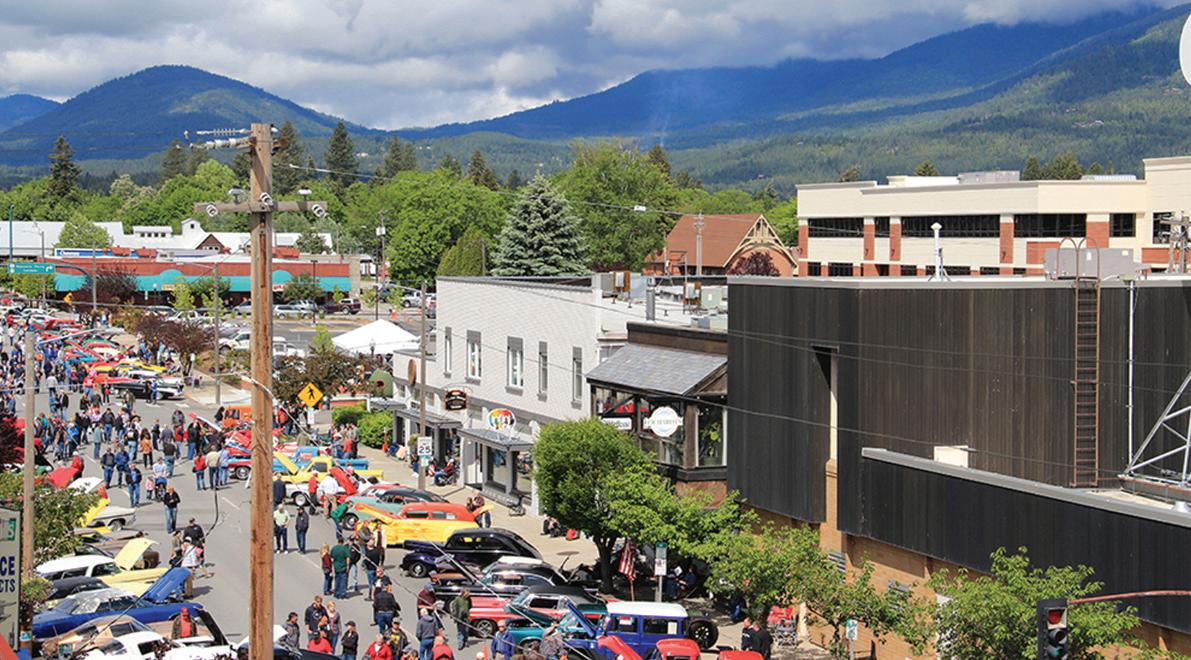
This week’s cover photo showcases our annual Lost in the ’50s edition. Be sure to check out Page 23 for a breakdown of events on this festive Sandpoint weekend. Have fun out there!
ITD provides update on Long Bridge pedestrian access
Other upcoming projects include eliminating left turn option from Lakeshore to
By Zach Hagadone Reader Staff
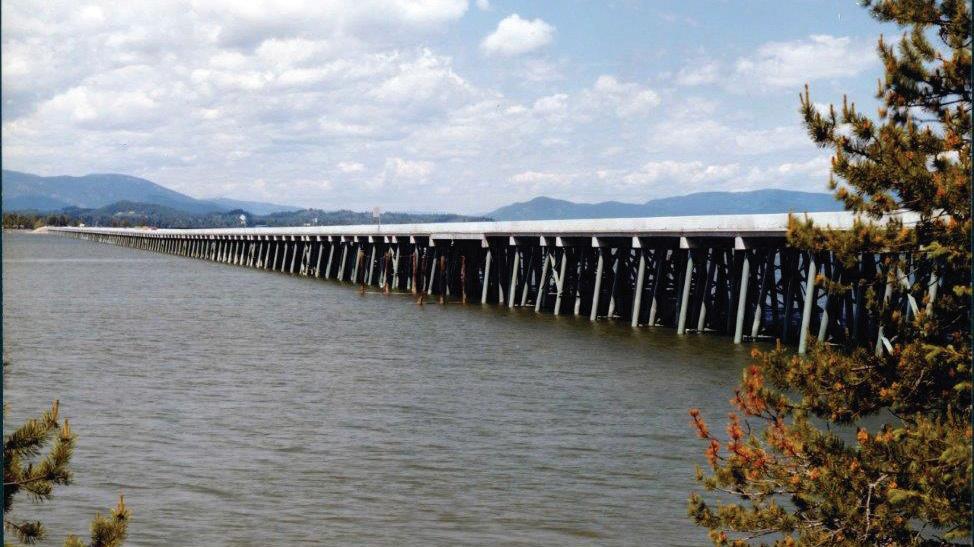
Pedestrians and cyclists on the non-vehicle span of the Long Bridge will have to navigate around portions of the structure that are closed as engineers conduct an analysis of needed repairs.
The Idaho Transportation Department announced the temporary access restrictions on May 7, citing “normal wear and tear” consistent with the age of the bridge, which opened to vehicle traffic in 1956 and was converted to pedestrian use in 1981.
According to ITD spokesperson Heather McDaniel, inspectors performing a routine evaluation found progressing deterioration at the ends of several of the concrete beams below the bridge deck, and will be conducting further investigation at the end of the month to determine what repair work will be necessary.
“The areas of the bridge that are supported by those deteriorating beams have been blocked off to pedestrians until repairs can be made while still allowing the bridge to be accessible for those who use it for walking, biking, etc.,” McDaniel told the Reader ITD emphasized the importance of bridge users following posted signs and traffic control devices and staying out of restricted areas.
Meanwhile, the vehicle restriction on the pedestrian bridge makes structural work more difficult, as ITD inspection teams usually employ a large, heavy “under bridge inspection truck” capable of lowering crews over the side and under the span via a boom to access below-deck elements.
“Because we can’t use a UBIT, these inspections had to be performed from below — typically from a boat on the water below, or with a drone to get closer looks at specific areas,” McDaniel said.
“Those inspection tactics are what revealed the deterioration we are now concerned with, and our teams are actively devising a plan to do a more in-depth inspection at the end of May that will provide the level of detail required to finalize a plan for repairs, which may include the use of a barge to access the bridge from beneath, or by using a lighter vehicle from the top side that can be used to lower inspectors and crews over the edge to access the structure that way,” she added. “Much of that is still to be determined pending the outcome of the more thorough evaluation at the end of this month.”
McDaniel said it’s too early to tell the extent or cost of the needed work, and will be determined after the upcoming in-depth investigation with potential costs identified later in the summer.
The access limitation also means the Veterans of Foreign Wars will delay the installation and dedication of benches made by the Sandpoint High School welding class originally planned for this month until further notice.
Meanwhile, ITD provided an update on long-term plans both for the pedestrian
and vehicle bridges, telling the Reader that a preliminary study begun in 2024 found the best option for upgrading the Long Bridge would be construction of a new bridge parallel to the existing span with two northbound-dedicated lanes. The existing bridge would then be converted to southbound traffic for a total of four lanes in both directions.
The planned northbound bridge would accommodate bike and pedestrian traffic, with the 1956 bridge eventually removed.
“At this point, ITD does not have a finalized plan regarding when the existing pedestrian bridge would ultimately be removed, or whether it would remain in service during all, or portions of, future bridge construction,” McDaniel said. “Those decisions will be made much further into the preliminary design process as engineering, environmental, navigation, permitting and construction considerations are evaluated. ...
“We also recognize how important pedestrian and bicycle access across the lake is to the Sandpoint community,” she added. “[M]aintaining some form of connectivity for pedestrians and cyclists during
going north.
future construction activities will be an important consideration throughout project development. At this stage, though, it is simply too early to know exactly what that solution may look like.”
Ultimately, the four-lane bridge configuration is intended to tie into the expansion plans for U.S. 95 to the south through Sagle, with the U.S.-95 Dufort to Lakeshore project currently undergoing an environmental reevaluation that will give the greenlight through NEPA for work on the corridor from the Long Bridge south to Dufort Road.
More immediately — and considering the recent prevalence of wrecks and other traffic incidents on or near the bridge — ITD is also addressing crashes and congestion within the corridor, including upcoming changes at the U.S. 95 and Lakeshore Drive intersection.
McDaniel told the Reader that the department is preparing to re-stripe the intersection to eliminate the option of making a left turn from Lakeshore onto the highway, directing motorists to use the J-turn located to the south in order to access U.S. 95
U.S. 95
That work is expected to take place in late May to early June, with a raised concrete median planned for construction later in the summer that would physically prevent vehicles from left turns off Lakeshore.
“That should help to significantly reduce the number of crashes we are seeing there, which frequently cause backups onto the bridge,” McDaniel said.
Overall cost for the future two-lane northbound bridge and separated pedestrian and bicycle infrastructure will be “at least $225 million,” she said, and “could change significantly as the study advances and project details become more defined.”
To cover the cost, ITD is gearing up to apply for a grant to perform preliminary design development and geotechnical analysis of the subsoil conditions in the lakebed, which McDaniel said are “less-thanideal.” That analysis is expected to cost “roughly a few million dollars,” she added, but because of the scale and complexity of the overall project — and the reality that scarce state matching funds are required alongside most federal grants — ITD is exploring the possibility of breaking up the work into smaller phases over time.
“Realistically, construction of a future replacement bridge is still likely many, many years away and will depend heavily on future funding availability for continued study, design and eventual construction,” McDaniels said.
Additional updates and more information will be shared by ITD as details become available, though for more information on the U.S. 95-Lakeshore intersection project, go to bit.ly/LakeshoreIntersection. Follow other Sandpoint area ITD projects at bit.ly/SandpointProjects.
The Long Bridge looking north to Sandpoint. Photo courtesy of ITD
Army Corps outlines spring operations
Lake level on schedule to reach summer pool by mid-June, first replacement gate due 2027
By Ben Olson Reader Staff
The U.S. Army Corps of Engineers held a public meeting May 7 at the Sandpoint Center to provide updates on spring operations and weather outlook, the ongoing spillway gate replacement project and the spring lake refill of Lake Pend Oreille.
In her final public meeting as Seattle District commander before a scheduled redeployment, Col. Kate Sanborn gave those in attendance a brief recap on Albeni Falls Dam operations.
“On the downstream side, it will mostly look like normal operations as it has the last several years,” Sanborn said, pointing out that the lake level should reach 2,060 feet by the end of May and summer pool of 2,062 feet by Friday, June 19. As of press time, the lake elevation was at 2,056.6 feet, with the lake refilling about 0.2 to 0.3 feet per day.
“If we can do it sooner, we will,” she said.
Sanborn also gave updates on the ongoing spillway gate replacement project, which was prompted when defects were found in gate No. 3 in 2024 after it was pulled for routine inspections the year before.
After stripping the gate of multiple layers of paint, steel defects were discovered, which led to concerns that, should a gate fail, it could drop or collapse. Gate failure could lead to a crane operator injury, damage to the crane, spillway gate damage and a subsequent loss of controlling lake levels.
“The way the material would fail would be with no warning,” Sanborn said.
Failure would most likely happen during times when the steel gates are moved open or closed, which led to restricted operations for the past couple of seasons.
“The good news is that
gate No. 3 is back in the project thanks to a fiber-reinforced polymer rehabilitation,” Sanborn said, pointing out that the rehabilitated gate also has added sensors and can be moved differently than the other gates, giving the Corps added control.
The first replacement gates are expected to arrive at Albeni Falls Dam in mid2027, with subsequent gates arriving in six-month intervals, as confirmed with the Deer Park-based contractor Knight Construction & Supply Co. The dam is expected to remain under restricted operations until the final gates arrive onsite, meaning gates will only move all the way open or closed to limit the amount of stress they’re subjected to.
“I know mid-2027 to get the first gate feels like a long time, and you’re not wrong,” Sanborn said. “But investing the time getting it right, right off the bat, and understanding all the aspects of replacing these gates in all 10 slots is really important.”
National Weather Service Senior Services Hydrologist Joel Atwood then gave updates on temperature and precipitation trends in the region.
Atwood said most of the region has below normal snowpack except for in the higher elevations.
“Above 6,000 feet you have normal snowpack; but, before that elevation, we’re well below normal,” Atwood said.
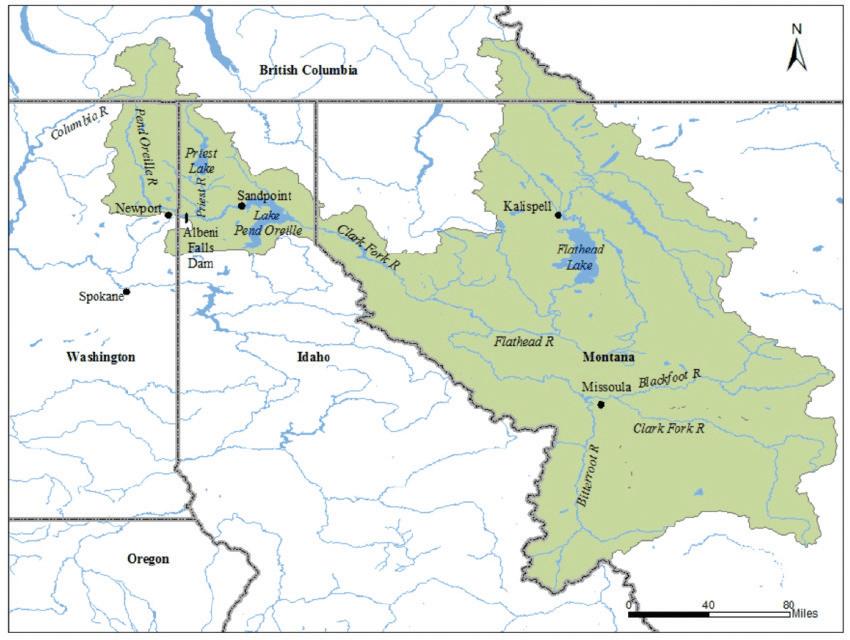
Because the 24,200-squaremile watershed basin of Lake Pend Oreille depends heavily on mid-level snowpack, Atwood said the water supply is around 83% of normal from April to September, with another model giving a more dire outlook at 76% of normal. All of the data points to a below-normal runoff this summer season, which, coupled with above-normal temperatures over Idaho and western Montana, should point to a warmer
and drier summer.
Sanborn then opened up the meeting to questions from the public, which centered on concerns that the lake level wasn’t reaching summer pool sooner.
Sanborn pointed out that despite lower-than-average snowpack in the mountains, if a rain-on-snow event or weather system brought torrential precipitation, the lake still had potential to flood since there are “many lake refills worth of water in the system,” she said.
A Dover Bay resident asked the Army Corps to weigh in on a recent economic impact study released by the Lakes Commission that claimed the local economy lost $43 million in economic activity last year due to inconsistent lake levels and a shorter season than other lakes in the region.
“We haven’t had time to fully digest that study,” Sanborn said. “We didn’t have an opportunity to provide comments on it when it was in the works, which is disappointing.”
Sanborn said the paper was a “single-issue” study that only focused on tourism benefits of holding a summer pool lake elevation for six months.
“The region gets tremendous benefits from the Albeni Falls project year round, throughout the summer, that simply wouldn’t exist without the dam,” Sanborn said, pointing out that the Corps balances dam operations based on a handful of uses, including recreation, hydropower, navigation, flood control and environmental stewardship.
“The economic study doesn’t address effects of a six-month summer pool and what it would be on flood risks, environmental impacts and erosion.”
Another audience member asked why the Corps didn’t take a more active hand in lake level adjustments, such as dropping the level a couple of feet prior to a forecasted storm to mitigate flood risk while also getting to summer pool eleva-
Lake Pend Oreille’s watershed, which encompasses 24,200 sq. ft; an area roughly the size of West Virginia. Courtesy image
tion earlier in the season.
“Operational standards are coordinated with the state and informed by public comment,” Sanborn said. “Water management is a super complicated, multi-factor process. It isn’t like you see a storm coming and drop the lake to prepare for it. This is a water basin the size of West Virginia.”
Sanborn said there are times when even if the gates are fully opened and there is extra storage in the lake, flood conditions could persist.
Sanborn concluded the meeting with “good news” that the Army Corps’ recreation sites around the lake will be fully staffed in 2026, with Riley Creek open on May 9 and Springy Point opening Saturday, May 16, among others. Book sites and learn more by visiting recreation.gov.
Rural hospitals grapple with raft of challenges
Federal rural health care grant may offer some reprieve, but other problems are ongoing
By Laura Guido Idaho Capital Sun
Idaho’s rural hospital leaders, who are facing mounting financial pressures, are hoping a $930 million, five-year federal grant will ease some of their pains.
As they recognized National Hospital Week, which runs May 10-16, two North Idaho hospital CEOs told the Idaho Capital Sun that their challenges are similar to those felt by rural hospitals across the U.S. Those challenges include difficulty housing employees, upgrading equipment, serving an aging patient population and stretching low cash reserves amid increasing insurance denials, delays and Medicaid reimbursement decreases.
Among Idaho’s small, rural hospitals, 67% in the last quarter of 2025 had a negative operating margin, according to data provided by the Idaho Hospital Association. Two years ago, just 15% were in the negative.
“It’s getting tougher and tougher to get payments on time and due to those denials, so we’re seeing our accounts receivable days going up and our days cash on hand going down,” Bonner General Health CEO John Hennessy said.
Not all of these challenges can be addressed with the federal Rural Health Transformation grant approved by Congress in July as part of the One Big Beautiful Bill Act. Idaho received around $186 million for the first year of the five-year program, and the state Department of Health and Welfare is expected to solicit for awarding subgrants this summer.
“I think there needs to be a big em-
Bits ’n’ Pieces
From east, west and beyond
According to Americans for Tax Fairness, Massachusetts’ millionaires’ surtax of 4% on incomes over $1 million raised close to $3 billion its first year — double projections. The new revenue goes to education and transportation.
phasis on how is this actually benefiting rural communities,” said Rep. Jordan Redman, R-Coeur d’Alene, co-chair of a committee overseeing the state’s grant. “And then also, how is this sustainable long-term? Not just some cash up front that they need ongoing.”
How can the rural health grant help? What are its limitations?
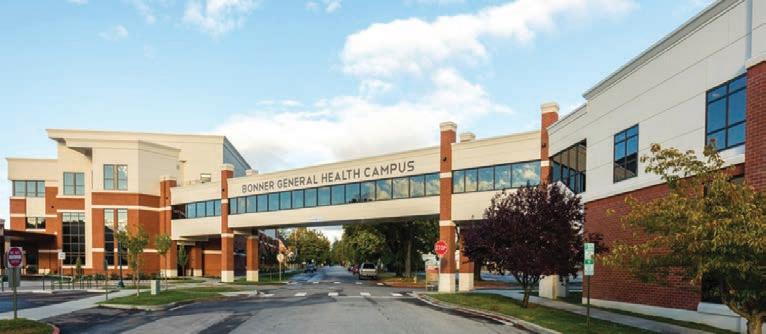
Bonner General Health was built in Sandpoint in the early 1970s, and that comes with some limitations, Hennessy said. He is hoping that if the hospital’s awarded a rural health grant, it can invest in a new air handler for the operating room to control humidity.
As of now, he said, certain operations, such as total knee replacements, have to be canceled if the humidity is too high.
“Every summer, we’ve had at least a couple weeks where we’ve had to cancel doing any kind of inpatient or those larger cases due to humidity issues,” Hennessy said.
The project would cost around $4.5 million, he said.
He said the hospital’s medical record system needs to be consolidated — there are five currently in use — and upgraded. But a large electronic medical record system can cost more than $1 million a year to run, Hennessy said.
In Benewah County, incidents of heart attacks and strokes are high, according to Benewah Community Hospital CEO Burt Keltner, and he’s hoping to use a grant to purchase equipment to support a new cardiac and dialysis care program.
He said he also wants to look at purchasing an upgraded MRI machine
ProPublica reported that Trump’s immigration crackdown has harmed scores of kids with tear gas and pepper spray in actions that judges have ruled to be excessive force. According to Reuters, U.S. officials recently closed the watchdog office for federal immigration detention abuses, while The New Republic reported that ICE withheld info from a federal judge, then smeared her for it in a press release accusing her of freeing a murderer. TNR also reported that Trump’s mass deportation machine isn’t helping native-born workers.
According to the Associated Press, Cole Tomas Allen — the man charged in the White House Correspondents’ Association dinner attack — has pleaded not guilty. Mohamed Sabry Soliman, who firebombed a demonstration in Colorado in 2025, killing one, has been sentenced to life in prison, the AP reported.
Russia is sending drone parts to Iran via the Caspian Sea, bypassing the Hormuz Strait blockade, The New York Times reported.
According to the Virginia Mercury, the Virginia Supreme Court ruled 4-3 to strike down the state’s redistricting amendment, which voters had approved in a referendum in April to allow redrawing congressional maps before the 2026 elections. Supporters of the amendment — including Virginia Democrats — framed the measure as a response to similar Republican efforts in other states.
Two court rulings have given Republicans a big advantage in taking control of the House in November, allowing gerrymandering that erases districts with high numbers of Black voters.
Recent legal actions could put the brakes on Republicans, but voters will have the final say.
Earthjustice and the NAACP are suing Elon Musk-owned xAI citing air pollution from its nearby data center, which is operating with unpermitted power plants. According to a U.N. report, investing in planetary health could unlock $20 trillion a year by 2070.
The Pew Research Center found in a study this year that 60% of Americans — Republicans included — be-
By Lorraine H. Marie Reader Contributor
lieve that saving the environment is “worth the cost.”
Texas lawmakers repeatedly failed to pass legislation that could have protected residents from deadly floods, ProPublica reported.
The AP reported that President Donald Trump has said he’ll move to suspend the federal gasoline tax, which would require congressional approval. Sen. Rand Paul, R-Ky, said, “instead of suspending the tax, we should suspend the war.” U.S. inflation has jumped 3.8% — the fastest rate in three years — due to the war in Iran.
According to various media, 590,000 buyers paid $59 million for Trump’s gold phone, though not a single phone has so far shipped and refunds look unlikely.
ABC news reported that experts are questioning why the Centers for Disease Control and Prevention have taken little to no action related to an unfolding hantavirus outbreak on a cruise ship that has sickened U.S. citizens. An international health expert said the CDC “is not even a player, I’ve never seen that before.” The CDC fired all its cruise ship inspectors before the outbreak.
According to The New Republic, FEMA has been caught blocking grants to states that didn’t vote for Trump Trump’s Religious Liberty Commission is pushing for “no separation between church and state,” the Huffington Post reported.
Various media reported that the cost of the Trump-ordered repainting and renovation of the Lincoln Memorial Reflecting Pool has risen to $13.1 million, after he promised that it would cost $1.8 million. Regarding White House spending, the spiraling costs of Trump’s fortified ballroom has spurred backlash from Republicans in a “surprise blow to MAGA,” according to TNR
Embattled FBI Director Kash Patel is making headlines around the country for his penchant for handing out bottles of “Ka$h Patel” whiskey, fueling reports of his heavy drinking and erratic behavior that have roiled the agency.
Blast from the (recent) past: Undocumented immigrants paid $96.7 billion in taxes in 2022 — more than what was paid by Jeff Bezos, Elon Musk and 55 mega-corporations. Americans for Tax Fairness called it “a con”: The ultra-wealthy use loopholes to shrink their taxes, while undocumented workers prop up the economy.
The Bonner General Health campus. Courtesy photo
Ponderay City Council hears application for Avista public utility complex
By Soncirey Mitchell Reader Staff
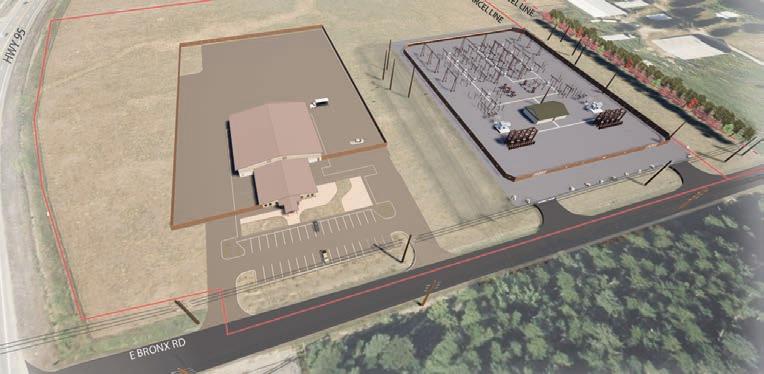
Ponderay City Council will hold a public hearing on Monday, May 18 to discuss Avista Utilities’ application for a special use permit to build a public utility complex near the intersection of East Bronx Road and U.S. Highway 95.
Interested parties can attend in person at 5:30 p.m. at Ponderay City Hall (288 Fourth St.) or remotely by visiting cityofponderay.org/pz-agendas.
The Ponderay Planning and Zoning Commission unanimously approved the application in April, sending it to the City Council for final approval. Planning Director KayLeigh Miller will accept written public comment at klmiller@ponderay.org at any time prior to the start of the meeting.
Avista bought the 22-acre residential city lot in 2018, which is adjacent to an existing substation owned by Northern Lights, Inc. and surrounded by a mix of commercial, residential and agri-
to speed up efficiency of imaging, and using the funds to start up a new nurse recruitment program to “wean off” traveling nurses — who fill vacant positions through temporary contracts at a much higher cost to the hospital.
The Benewah and Bonner hospitals are designated as “critical access,” which means the federal government reimburses costs for Medicare-eligible services. The payments come in a once-a-year lump sum, Keltner said, which can create challenges around stretching low cash flows through the next year or starting new programs.
He said a grant to start up a nurse recruitment program could go a long way to being sustained through other means.
Housing pressures hamper health care worker recruitment
Idahoans have seen increasing housing costs all around the state and, because of this, it’s become increasingly difficult for small hospitals to recruit and retain professionals.
cultural land uses. If approved, Avista will develop the facility over the next decade, beginning with construction of a six-acre substation that will convert high-voltage electricity to lower voltage for area distribution, direct power around the grid and localize power, making it easier to restore after outages.
In its application, Avista representative Karen Kendall cited Ponderay’s population boom as one of the factors necessitating the additional facility.
“Between 2020 and 2023 alone, the area’s population increased by 15.8%, according to the U.S. Census Bureau. This rapid growth has significantly reduced Avista’s operational flexibility, posing challenges to maintaining reliable and efficient electrical service,” representatives stated in the application.
Later, developers will build a large service center on the site housing customer support, billing services, account management and office staff. The property’s undeveloped land will be maintained as pasture for nearby
across the nation, is seeing a shortage of workers such as surgical nurses, surgery scrub technicians, physical therapists and nurses.
“So, the same positions that we’re hearing from other hospitals in our area that are also struggling to recruit those,” he said, “which also makes it tough, because you have one candidate, and you might have four hospitals within the service area that are all competing for that one applicant.”
St. Maries has seen a steep increase in retirees moving in, Keltner said, which has caused an increased population of patients using Medicare on top of a housing squeeze.
“We need nurses. We need lab workers. We need radiology techs,” Keltner said, “and it’s kind of a double-edged sword, where we have a lot of young people that might want to live here, but a lot of times, especially in northern Idaho, they can’t afford to buy something, or there just isn’t anything available for them to even get started into. Rentals are few and far between.”
cattle grazing.
According to the application, developers plan to blend the facility into the existing landscape by planting a mix of deciduous and evergreen trees, adding decorative boulders and digging a detention pond, which will catch and drain stormwater runoff. A ninefoot, noise-absorptive wall will obscure the facility’s infrastructure, except for
are covered by Medicare, which tends to reimburse at a lower rate than private health insurance plans, Keltner said.
Some patients purchase Medicare Advantage plans, an option for Medicare recipients to purchase private insurance that offers the same coverage.
Increasingly, claims filed for Medicare Advantage plans are denied, Keltner and Hennessy said. The practice of requiring prior authorization for coverage of a service or treatment used to be rare and only required for limited services, Keltner said.
“Now it’s getting to where these pre-authorizations are put on everything, every time you turn around, for every procedure you can imagine,” Keltner said. “And so those are slowly building in number, creating difficulty, trying to jump all these hurdles so that we can get paid appropriately.”
openings at the entrance gates.
As part of the area’s improvements, Avista also plans to lay asphalt along East Bronx Road from the highway to the intersection with Craig Court.
For more information, or to read the complete application, visit bit.ly/ BronxAvista.
for the last two or three years, large, commercial insurance companies have installed algorithms to auto-deny a lot of things right when they first come in,” he said, “just to create more workflow for the people that are submitting. I have no doubt, because it’s not possible for a person on the other end to actually make a decision.”
In 2023, ProPublica reported on a tool the insurer Cigna used to instantly reject claims without doctors reviewing the file. Over a period of two months the prior year, Cigna doctors denied more than 300,000 requests for payments using this method, spending an average of 1.2 seconds on each case, ProPublica reported.
Hennessy said when insurers do come back with lower reimbursements or denials, small hospitals have no leverage to negotiate.
Medicaid cuts already affecting reimbursement, hospitals bracing for more Idaho Gov. Brad Little last summer approved 4% Medicaid provider rate cuts, reducing the amount doctors are paid to provide services for Medicaid patients in response to a projected < BGH, con’t from Page 6 >
“We’re very fortunate to live in a beautiful area with a ski resort and a lake right in our backyard, but the problem is that the cost of living is quite high. And that housing becomes a problem for quite a bit of our staff,” said Hennessy from BGH. “So they want to move here, but due to the housing prices, sometimes it’s just not feasible.”
He said the hospital, like many
Zillow data released last summer found Idaho’s housing price growth between 2015 and 2025 topped the nation with a 156% increase, KTVB reported.
Insurance delays, denials and lower reimbursements stretch cash reserves thin
The aging population served by rural areas also means a number of patients
A KFF Health analysis of federal data found that Medicare Advantage insurers in 2024 denied 4.1 million prior authorization requests out of about 52.8 million requests, an about 8% denial rate.
Keltner and Hennessy said the number of services that require prior authorization and the rate of denials has continued to increase, even just since the beginning of this year.
Keltner said the process feels automatic, with denials coming in almost the instant a claim is filed.
“I’m completely convinced that,
“So usually it’s just insurance is coming each year with a lower number, kind of just expecting us to take it,” Hennessy said.
< see BGH, Page 11 >
Conceptual aerial view of the proposed public utility complex in 10 years.. Image courtesy of Avista.
Bouquets:
• There’s just something about driving on a recently-paved street — especially when it’s in Sandpoint, where potholes go to retire. I just drove down Pine Street for the first time and smiled at that smooth glide over fresh asphalt. Here’s a Bouquet to the city of Sandpoint for doing a great job on that stretch of roadway. I’m always happy to see my tax dollars go toward infrastructure and road repairs. Now do others!
• I was saddened when I heard that Bonner County Clerk Michael Rosedale was retiring from his position after serving for 12 years. As chief election official, Rosedale is one of those quiet people behind the scenes who ensures our elections go off without a hitch. He has been a great communicator with the press, a leader to the many pollworkers and election volunteers, and has represented our county and district well. We’ll miss his dedication to the job and always upbeat attitude. We’ll publish a larger story on Rosedale’s departure after the primary election, but for now, I’d like to wish him well and thank him for his service.
Barbs:
• Every election, we receive numerous complaints from readers about electioneering they witness at polling places. Just so everyone is clear, quoting from Idaho Code: “You may not display, wear, hand out materials or post any signs that supports or opposes a current candidate or ballot question within 100 feet of a polling place. You may not solicit signatures, interfere with the voting process, disrupt the polling place or obstruct other voters accessing the ballot box.”
‘Never forget’...
Dear editor,
To Donald Trump: No matter how many wars you may start, no matter what distractions you try to utilize, no matter how many outright lies you claim to be truths, you cannot escape the Epstein files.
Michael Harmelin Sandpoint
Vote for Mark Sauter, not the ‘extremism syndicate’...
Dear editor,
At a recent candidate forum in Clark Fork, Idaho House candidate
Jane Sauter held up the Bonner County Republican Central Committee voter guide and told the audience it was “the real answer.”
Let that sink in. A candidate for the Idaho Legislature pointed to a pamphlet funded by a Wyoming company, a North Carolina gold dealer and the chair of the Idaho Freedom Foundation and called it the truth about local Republicans.
Jane Sauter is new to the district and to politics. Her opponent, Rep. Mark Sauter — no relation — has spent years working for District 1. Town halls. Tough votes. Standing with neighbors against bills that targeted our community.
Jane knows the talking points handed to her by the “extremism syndicate.”
And the shared last name? It’s no coincidence. The machine recruited a candidate who happens to share a surname with the incumbent and slotted her against him on the ballot. That isn’t politics. That is a confusion strategy.
Riding into office on Scott Herndon’s coattails isn’t independence. It’s recruitment. Herndon’s ticket in the upcoming election is all about extremism and he’s willing to win by trickery rather than ideas.
Vote Mark Sauter. Vote for a thinker — not the machine.
conjure up trustworthiness and assurance that they are the authentic, endorsed Republican candidates.
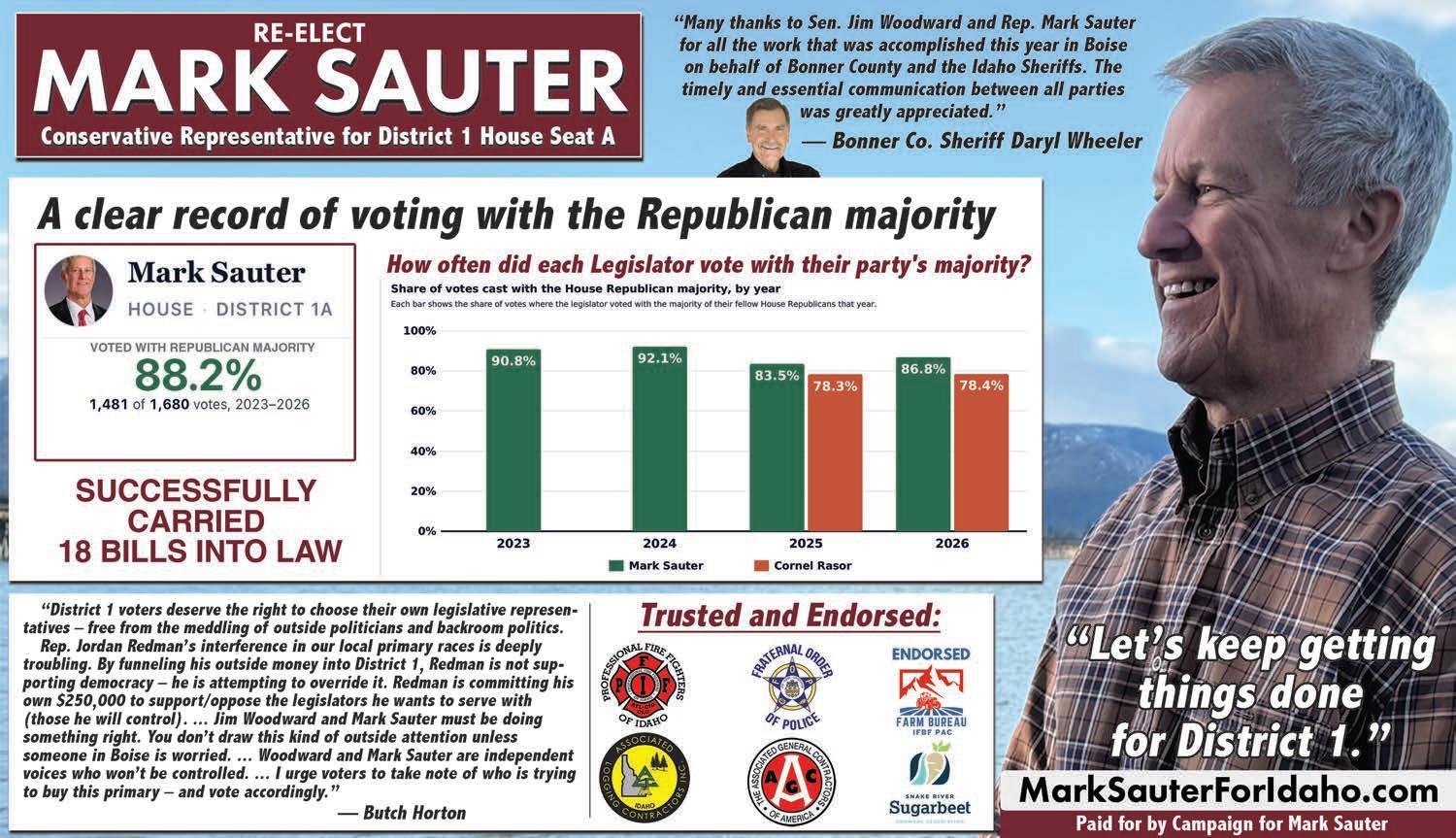
I am referring specifically to Jim Woodward and Mark Sauter. They are not endorsed by the Bonner County Republican Party. They vote with the Democrats more often than they do the Republicans.
This is a sneaky, tricky deception being perpetrated on unsuspecting Republican voters. Jim Woodward and Mark Sauter are in office because Democrats changed their party affiliation from Democrat to Republican in order to vote in the Republican primary. They are Democrats in Republicans’ clothing. Jim and Mark are the Democrats’ chosen candidates. This is a scam being perpetrated on the Republican voters. Republican voters, do not let them get away with this. Go to bonnergop.org and read the voter guide. Scott Herndon, Jane Sauter and Cornel Rasor are the candidates endorsed by the Bonner County Republican Party. They represent true conservative values. Remember to vote on May 19.
Yvonne Wilcox Hope
Editor’s note: Though several sets of statistics have been circulating in various campaign materials showing differing partisan vote percentages, a basic review of the Senate and House journals for the 2026 legislative session shows that of the roll-call votes in which they participated, both Woodward and Sauter voted with the Republican majority about 90% of the time.
‘All candidates deserve respect’…
featuring Bonner County candidates], but listened to it on KRFY where moderator and Reader Publisher Ben Olson established expected decorum and set the tone for the evening with: “we’re a friendly group.”
Respectfully, Arleen Lothian Dover
Slow down on gravel roads…
Dear editor,
Speeding on our gravel roads is a serious problem for all. When drivers travel too fast, they create large clouds of dust that create unnecessary health and safety concerns.
The lingering dust makes it harder to breathe, especially for children, seniors and those with respiratory issues. It also reduces visibility for other drivers, pedestrians and cyclists, increasing the risk of accidents.
It also creates washboarding, which can over time result in strut issues. In addition, the dust coats homes, vehicles and outdoor spaces, making it difficult for adjacent residents to enjoy their property.
The solution is simple: slow down. Driving responsibly helps reduce dust, protects road conditions and shows respect for the people who live nearby.
It takes 43 seconds more to drive one mile at 25 miles per hour than at 35 mph.
I urge drivers to be more mindful. A little consideration can make a big difference for everyone.
Jackie Lindenbach
Bonner County
Herndon gets an ‘A’ for diagnosis, and an ‘F’ for problem solving…
He correctly diagnosed that gun rights and public property are ambiguous. His solution cost the community $300,000 and, after three court losses, he used his Senate office to change Idaho law. Had he succeeded, Bonner County would have lost the Festival and $4 million in annual revenue.
If I had a scorecard, I’d give Scott an “A” for diagnosis and an “F” for problem solving. He consistently makes things worse. We deserve problem-solvers in the Statehouse.
Kathryn Larson Sandpoint
‘You
cannot go wrong voting for Jim and Mark’
Dear editor, I’m sure other people caught the postmark on the “Arlene Herndon” letter that went to local mailboxes. It came from a town in Virginia and I’m sure it was professionally written. More outside money coming into the Herndon camp. Red flags keep waving in the Herndon campaign. Meanwhile the flags remain green in the Woodward camp. Woodward cares for us. We’re always on his mind as he does his very best in Boise.
Sure, at times he votes a different way that I or we might not agree with. But, if you call him, yes, he will talk to you and will tell you exactly why he voted that way. More than likely you will then agree with him. Since space is short in these letters, I would like to mention that Mark Sauter has also earned our vote. Just yesterday, I fired off an email to Mark with some comments. True to form, I got an answer today. He tends to business.
‘How
George Eskridge, former state legislator Dover Dear editor, How do they get away with this?
Dear editor, I sensed on Monday night [at the May 4 Legislative District 1 forum] that Mark Sauter wasn’t prepared to deal with being called a “RINO”; and, perhaps, if he could, he would have walked off stage. Better yet, I wish he had a comeback remark the next time he spoke other than responding, “Thank you.”
Our mailboxes are stuffed every day with mailers and voter guides from the same candidates. The mailer/ voter guides repeat buzz words like “qualified candidate endorsements,” “conservative” and “family, faith and freedom.” They use words that
All candidates deserve respect. My fear: When disruptive interjections by opponents’ followers are not properly managed by forum hosts, some candidates just might not attend forums in the future. Perhaps the curious voting public might skip it, too.
I had a conflict and could not attend Tuesday evening’s forum [May 5,
Dear editor, Scott Herndon is good at diagnosis. In 2022, he correctly diagnosed that the Legislature was only reviewing 19% of the state budget. That was a real problem. His solution — splitting budgets, creating costly administrivia and assigning working groups — produced chaos among lawmakers and a budget crisis, without slowing spending by a dollar. He correctly diagnosed that property taxes are painful and unfair to longtime homeowners. His solution: eliminate them and rely on the state to fully fund our local services. This requires a state surplus that has disappeared, puts us at the mercy of Boise to adequately fund our needs, and removes the county’s ability to fund projects.
You cannot go wrong voting for Jim and Mark. They listen and pay attention to what you’re saying. May 19 is coming up fast. Remember to do your own research and vote.
Ernie and Helen Schoeffel Priest River
do they get away with this?’... Leaving Colorado…
Dear editor, I left the beautiful state of my childhood 20 years ago because I could see it coming: Left-wing politics were taking over the state and the Republicans were going along with it. I feel somewhat heartened, though, when we attended the candidate event at Sandpoint
High School on Monday night [May 4] and were truly glad we did. It exposed the fakery and lies of the Republican opponents and revealed something else: Jane Sauter is a magnificent candidate.
She was genuine, well-informed and educated on the issues, honest, articulate, kind but firm (I liked the way she went after the others who kept smearing their opponents during their own presentations, which was against the rules) and really held herself out as the alternative.
In other words, Jane shined. She gave a wonderful performance, if I may call it that, and I encourage other true conservatives to vote for her.
I hope and pray that Jane wins and the other candidates who stand with her so we don’t end up being another Colorado.
Billie Gross Sandpoint
hall meetings (as other candidates regularly do) but embraces the opportunity to talk with us. Jim believes in minimal state government focused on core state functions, such as public safety, education and transportation with decision-making kept at the local level.
The infamous Festival episode summarizes Herndon’s phony conservatism. He tried to expand state power over private businesses and local decision-making. He put his extremist ideology over the well-being of our community.
In my opinion, the choice this year is clear. For those who actually do their research and don’t vote blindly on recommendations from the biased and coercive Bonner County Republican Central Committee, I believe you will also find that a vote for Jim Woodward on May 19 is clearly the best choice. He’s our guy.
Tari Pardini Sandpoint
‘Support Mark Sauter’... Herndon’s property tax proposal would take away local control…
Dear editor,
We are lucky to have Mark Sauter as our representative for District 1A. Mark has been a dedicated representative listening to his constituents throughout the year, not just during the legislative session. During the session, Mark has regular town hall meetings at popular venues in all the towns in the district.
Mark is a retired fire chief and served in the fire service for over 30 years. He takes particular interest in bills that affect public safety. Currently, he is monitoring what is going on in the insurance industry as it applies to homeowner fire insurance rates and he has been successful in having some non-renewal notices put on hold. He has worked and volunteered with several local fire districts to improve fire prevention and life safety programs.
He is a fiscal conservative with experience balancing a multi-million dollar fire department and a city’s budget. Mark supports our military and has a son who is a naval aviator. Mark is also an active volunteer for the CHAFE 150 bike ride that supports child literacy programs in Bonner County.
Please vote for Mark Sauter for District 1A representative on May 19.
James Asche Sandpoint
Woodward is the only choice for Dist. 1 Senate…
Dear editor,
In my opinion, there is actually no question who is best to vote for when comparing Jim Woodward and Scott Herndon. Throughout this campaign, Herndon continues making one false claim after another. You will notice the pattern. Herndon advocates for authoritarian, top-down control. Jim Woodward’s pledge to provide the truth is very real. Jim meets with constituents, listens to their concerns and acts on their behalf. He doesn’t hide from town
“From Arlene Herndon” — is a nice touch. Except, as usual with your husband’s campaign, it’s deceptive. You didn’t write this letter. It’s an attack ad, postmarked from Virginia, filled with the usual Herndon half-truths (half-lies) and requesting donations.
Speaking of money, the Herndon campaign recently paid $5,676 to i360, a Virginia company (funded by the Koch billionaires) that sells voters’ personal data. Another $26,862 went to Red Mountain Direct, in Utah, a campaign management company that specializes in direct mailing. Your letter comes from slick campaign advisers in corporate offices, not from your so-called “homestead.”
Arlene, I remember when Scott boasted that he wanted to be “disruptive” and “force” his ideas on people. He said “the most effective way of getting handbills in people’s hands is to have them handed out by little girls.” He was using your daughters as political props. Now he is doing the same with you.
Timothy Braatz Bonners Ferry
Dear editor,
Scott Herndon promises voters he will work to eliminate property taxes.
It sounds great. But what Mr. Herndon is proposing is not realistic. His promise also ignores that property taxes fund essential county operations including law enforcement, jails and the courts. Surely Mr. Herndon is not suggesting we defund the police?
Our property taxes also help fund our schools, our local libraries, ambulances, and roads and bridges.
None of us like paying taxes. But property tax pays for the services that add to our quality of life.
Property taxes support local services provided by local government. This is government closest to the people and most easily held accountable.
What Mr. Herndon isn’t telling you is that eliminating property taxes will mean either cutting and eliminating services or funding via the state, and state funding is surely not the answer. The state will centralize control and hold the purse strings. Those of us at the local level will just be given an allowance, which may not be what we really need.
Moving funding away from local control means we give up more of our freedom to decide what we want for our communities.
Don’t be taken in by half-truths.
Robin Lundgren Bonners Ferry
‘Vote for people who truly represent our community’...
Dear editor,
Both Jim Woodward and Mark Sauter are: genuine and authentic; rational and have good common sense; balanced and stable; knowledgeable and understanding; disciplined and thoughtful; good communicators and responsive to their constituents; honest and ethical; dependable and accountable; problem solvers; fiscally responsible; open-minded with no hidden agendas; hard workers and work well with other legislators; and backed by our community members, and many local and state businesses.
If you are concerned about health care, the future of our local hospital, affordable housing, our Idaho state budgets, government services, education, the cost of living, wildfire, etc., Jim Woodward and Mark Sauter are the only candidates who will seriously address these issues.
If you want your legislators to debate public bathrooms, flags, skin color, biblical stories and state control of morality, then vote for their outof-state Freedom Foundation-backed opponents.
Re-elect Jim Woodward and Mark Sauter.
Kennon McClintock Moyie Springs
‘An open message to Arlene Herndon’... Herndon will protect public lands access…
Dear editor,
To Arlene: Thanks for the letter saying how “proud” you are of “Scott’s heart” and how you “have raised eight beautiful children.” Too much information, but I get it. You want to rehabilitate your husband’s otherwise shameful reputation. You want to persuade female voters. The frilly, pink letterhead —
to a felony.
The money behind those texts? $95,000 from Washington, D.C. — from the group that spent $120 million electing Kamala Harris. Another $60,000 from a Biden donor in Eagle. Not one dollar from our counties.
Scott Herndon passed the bill protecting Priest Lake. He passed S.B. 1258 keeping access open at Lake Pend Oreille.
I don’t care what a D.C. PAC’s texts say. I care about who votes to keep my family on the land we love.
Faith Brenneman Spirit Lake
Vote for legislators who work for the people, not ideologues…
Dear editor,
For me, elections are about getting a government that benefits constituents and our infrastructure and educational systems. I vote for legislators who hold town halls, listen to their constituents, take those issues to Boise and prioritize local control.
I inform myself and vote for the most qualified and community-minded candidates regardless of affiliation. I don’t vote for ideologues funded by outside money and culture warriors who support intolerant bills harassing less than 1% of Idahoans that provoke lawsuits within weeks of being signed into law; nor candidates who bring their fellow congregants to debates to clap loudly for them and heckle others; nor those who have to be asked if they will actually support the rights of voters not of the same faith.
This year I will also be carefully considering our statewide and federal candidates and avoiding those who traded federal administration favors overturning their constituents’ expressed preferences (H.B. 93 vouchers); or candidates partnering with a Christian political organization to put chapters in our public schools. I’m voting for candidates who listen to Idahoans and will work on our myriad impending public issues, and a party that will be a bulwark against the current bullying federal administration.
Nancy Britton Ponderay
Dear editor,
One of the things I love most about living in North Idaho is the beauty of the nature that surrounds us. My child and I are outdoors, including on public lands, every single day. When I got a text from a group called “PAC for Public Lands” telling me Jim Woodward protects our public lands, I wanted to believe it. Then I looked up his vote. Woodward voted yes on S.B. 1086 — making it a crime to use public land when the Forest Service posts a “use restrictions apply” sign. Not a fine. Criminal trespass up
Got something to say? Write a letter to the editor. We accept letters up to 200 words long which are free from libelous statements and excessive profanity. Please elevate the conversation. Note: It’s always best to send letters prior to primary and general elections as early as possible, as our space often fills before we are able to print all the submissions we receive.
Send submissions to: letters@sandpointreader.com
Science: Mad about
1950s technology
By Zach Hagadone Reader Staff
When a lot of people talk about “the good old days,” more often than not they’re conjuring a hazy image of the 1950s — a vibe that will be prevalent throughout the Sandpoint area with the 39th annual Lost in the ’50s celebration from Friday, May 15-Saturday, May 16.
The middle decade of the 20th century was complex, for sure. On one level, the ’50s were deeply unenlightened — from racial segregation to culturally enforced misogyny to inquisitorial anti-communism. On another, it was a revolutionary period that saw the mainstreaming of rock music, television, car culture and timeless fashion styles. On yet another level, it was a time of explosive technological development that perhaps did more to determine how we live today than any preceding era — from the polio vaccine, transistor radios, velcro and three-point seat belts, to satellites, lasers, copy machines, pacemakers and super glue.
Below are a handful of ’50s inventions that changed our world in ways big and small:
The integrated circuit Computers were in use throughout the 1940s, but by the end of the decade they’d grown enormous enough to be as unreliable as they were unwieldy. That was because vacuum tubes were needed to control the electrical flow through the machines, and the most advanced computers of the day needed tens of thousands of them — on top of thousands more other components.
That means computational
technology hit a ceiling until transistors came along and enabled computer components to be more densely arranged and thus reduce both the size and power consumption of devices.
Still, computers remained almost more trouble than they were worth until a series of inventions in the early 1950s culminated with Texas Instruments engineer Jack Kilby’s breakthrough in 1958 that introduced a way to pack together and connect tiny transistors, resistors and capacitors on a small piece of material — a.k.a. an integrated “chip” — that could perform all the functions of those earlier behemoth computers at a fraction of the size and energy needs.
Kilby’s innovation paved the way for rapid improvements by other engineers that resulted in the microchip and serves as the foundation for practically every modern technology — from cars to smartphones to credit cards, the latter which was also invented in the 1950s. In fact, that technology went from the cardboard Diners Club card in 1950 to the smart cards we know today by 1959, when a silicon integrated chip was put on a plastic card and used to accomplish secure electronic bank transfers.
Video tape
Storing data on a magnetized strip of plastic dates back to the late 1920s in Germany (and was kept mostly a secret by the Nazis during World War II), but up until the 1950s that technology had only been used for audio recording and playback.
Video tape actually has its origins with iconic singer Bing Crosby (born in Tacoma and raised in Spokane), who wanted to know if magnetized
tape could be used to record images, as well as sound. His engineer, Jack Mullin, said it could be done provided the tape ran at speeds high enough to achieve the wide bandwidth necessary to capture a picture (video needs a signal of six megahertz vs. audio, which requires just 20 kilohertz).
Crosby used his celebrity clout in 1951 to get electronics company Ampex to figure it out, and they started work on what would become the video tape recorder — a humongous open-reel device that almost immediately replaced old film stock and made TV recording much cheaper and faster. By 1955, CBS was using the VTR technology, but it was spendy: one Ampex VRX-1000 cost the equivalent of $592,000 in 1956, and that was on top of $300 for one 90-minute reel of tape — a cost of $3,600 today. Of course, now you can buy a whole box of VHS tapes for about a buck.
The microwave oven
While the patent for the first microwave oven was filed in 1945, it wasn’t until 1955 that folks could purchase one for their home. It all started with Raytheon Laboratories engineer Percy Spencer, who is credited with discovering that microwave signals could generate heat when he was working in proximity to a live radar set and noticed that a candy bar in his pocket had melted.
Spencer figured out that microwave signals being emitted from the radar’s cavity magnetron tube — a vacuum tube that creates microwaves when electrons interact with a field created by magnets — generated heat sufficient to liquify his snack, and started experimenting with how to
focus and direct the waves using a metal box with a door affixed to its front.
Spencer’s prototype was wholly inaccessible to the average person. The “Radarange” weighed about 750 pounds, was six feet tall and cost almost $5,000 — the equivalent of about $91,500 in today’s money. When Raytheon licensed the original patent for retail sales in 1955, the Tappan appliance company came out with the RL-1 model, which was a 220-volt
built-in wall unit design that weighed a slight 150 pounds and would have set a consumer back the equivalent of more than $10,500 in 2026 dollars. Needless to say, sales were not initially robust. Only 34 units were manufactured that first year, but the technology was out there and would be refined by the mid-1960s into what we’d recognize today. Stay curious, 7B, and look forward to Brenden Bobby’s return after he takes a break from column-writing duties.
Random Corner
• Black isn’t actually a color, it’s what you get when there’s a complete lack, or absorption, of visual light.
• One of the first colors used by humans to make art is black. It was created with charcoal, with burnt bones and ground manganese powder later used for a darker black pigment.
• In ancient Egypt, black was seen positively because it represented the rich soil from the Nile and therefore associated with fertility. It was also the color of Anubis, the Egyptian underworld god who protected the dead from evil.
• Most of the world’s police forces wore black until the 20th century. The color blue replaced it to make police appear less menacing to the general public.
• The color black was adopted by fascists in the 20th century, starting with Italian dictator Benito Mussolini’s paramilitary units called “Blackshirts.” Black uniforms
were also adopted by Nazi Germany and were worn by the regime’s elite guard, the Schutzstaffel, or SS.
• Priests and monks from many different Christian denominations wear black robes, as they believe the color represents penitence and humility.
• Among pagans, the color black is associated with protection, stability, force and dignity.
• Black panthers are jaguars or leopards with recessive genes that give the animals excess melanin, which turns their skin black. If you look closer, though, they still have the species’ characteristic spots, or rosettes, but they’re much harder to see.
• When the Model T was introduced, Henry Ford famously said, “Any customer can have a car painted any color that he wants so long as it is black.” The trend continued until 1926 when the car began to be offered with other color options.
budget shortfall.
“If it’s done appropriately, it’s a way for it to feed itself,” he said.
The “Big Beautiful” law Congress approved in July contained significant reductions in Medicaid spending and changes such as work requirements that are estimated to drop people from coverage. The Idaho Legislature also approved its own work requirements for some Medicaid recipients.
“Bottom line, any percentage cut is going to have a huge effect,” Hennessy said. “Especially to rural hospitals where they don’t have large margins to begin with. So just for example, 4% cuts happen here, that’s several $100,000 directly to our bottom line that we’re no longer being reimbursed.”
He said the hospital will also still have to continue serving those who might get dropped from the program and become uninsured. He said emergency care for those patients will have to be covered by the hospital through its charity care program.
He said about 10% of the patients
at BGH are covered by Medicaid. Keltner said about 12% of patients at Benewah Community Health are enrolled in Medicaid. Kelner noted that many critical access hospitals operate at about a 1% profit margin, meaning a potential 10% cut to about 10% of the patients would eliminate that entire margin.
“We weren’t built to be a profit center,” Keltner said. “We weren’t built in order to gouge and make just tons and tons of money, but we do need to be financially viable. So we have to balance that viability with as many services as we can offer for the size of community that we serve.”
“That’s the difficulty,” he said. “But we just have to keep in the forefront of our mind, and what keeps us optimistic is that we’re here to serve.”
This story was produced by Boise-based nonprofit news outlet the Idaho Capital Sun, which is part of the States Newsroom nationwide reporting project. For more information, visit idahocapitalsun.com.
Democrats deliver for Idaho, even when Republicans stand in the way
By Lauren Necochea Reader Contributor
Idaho moves forward when we invest in the people who grow our food, build our infrastructure, teach our kids and keep communities running. Democratic leaders know this and have enacted key laws fueling our economy today.
The Trump administration and Idaho Republicans have treated those investments like political targets. They terminate agreements and create uncertainty for Idaho communities while showing up at ribbon cuttings for projects they opposed.
The clearest example came from Donald Trump and Elon Musk’s Department of Government Efficiency. DOGE was sold as a war on waste. It created chaos, cut services, fired workers and then had to rehire many of them. It generated at least $21.7 billion in waste. Even Musk said he would not do it again.
Nevertheless, Idaho GOP leaders celebrated cuts that reached nearly every corner of daily life: rural libraries; digital skills training; refurbished computers for seniors, veterans, rural Idahoans and families trying to get online; residential solar grants that would have lowered utility bills for 15,000 Idahoans; and school programs, with funding restored only after parents and school leaders were sent into a panic.
In Pocatello, Trump’s administra-
tion terminated $16.4 million for the Portneuf River Vision project, cutting water and sewer infrastructure, stormwater drainage, groundwater protection and sewer connections for south Pocatello neighborhoods.
Idaho farmers were targeted, too.
The Democrat-led Inflation Reduction Act funded the University of Idaho’s $59 million Innovative Agriculture and Marketing Partnership, a program designed to help farmers improve soil health, conserve water, reduce risk and build stronger markets for Idaho-grown products. More than 200 farmers across 34 counties had already applied — and some had already spent promised funds — before Trump’s USDA retracted funding and shut it down.
Last month, the funding was restored. That is welcome news as Idaho farmers face drought and other manufactured crises. But they
never should have had the rug pulled out from under them.
Lewiston is benefiting from the Bipartisan Infrastructure Law, passed by Democrats and opposed by Idaho’s GOP representatives. The law is helping the city remove forever chemicals from drinking water and will save local taxpayers millions.
The CHIPS and Science Act, passed by Democrats, helped secure the largest private investment in Idaho history, supporting thousands of jobs, workforce training and Idaho’s growing role in advanced memory-chip manufacturing. That strengthens national security and reduces our reliance on foreign countries for critical technology.
Idaho is one of only a handful of states receiving direct investments, yet Idaho Republicans in Congress voted against the law that made it possible.
Idahoans need leaders who lower costs, strengthen local economies, protect clean water, support farmers and help families get ahead. Democrats are delivering those solutions. Republican politicians should stop standing in the way.
Lauren Necochea is chair of the Idaho Democratic Party and a former District 19 legislator. Necochea spent a decade leading nonprofit programs dedicated to research and advocacy in tax policy, health care and children’s issues.
Lauren Necochea. File photo
COMMUNITY Volunteers needed to clean up native plant arboretum
By Reader Staff
The Kinnikinnick Native Plant Society is seeking volunteers to help clean up the nonprofit’s native plant arboretum in Lakeview Park ahead of the busy season. The official spring cleanup will take place Sunday, May 17 from
BY THE NUMBERS
By Ben Olson Reader Staff
253
The number of wolves left in Wyoming after a state count found their numbers had dwindled to lows last seen in 1995’96. Wyoming Fish and Game biologists believe a flare-up of canine distemper is the likely cause of declining population numbers, but are hopeful the remaining animals now have strong antibodies and resistance.
33%
The percentage rate at which homelessness rose nationwide between January 2020 and January 2024, representing one in every 435 Americans, according to a Johns Hopkins and UCLA study. The study found that states with longer eviction moratoria saw smaller increases, while every home lost to climate disasters correlated with a measurable spike in homelessness.
1,500+
The number of new data centers currently in development across the U.S. Most are being built in rural areas, particularly in the South and Midwest, causing major implications for local infrastructure, power grids and workforce needs.
9 a.m. to noon outside of the Bonner County Historical Society and Museum (611 S. Ella Ave., in Sandpoint). Volunteer gardeners can help out when and how they can using KNPS’s hand tools, or bring some of their own. Workers will remove winter debris, pull weeds, deadhead old blossoms and rake paths in preparation for two of the nonprofit’s largest annual events: Arboretum Tree Tours and the Native Plant Sale.
On the mornings of Tuesday, May 26; Wednesday, May 27; and Thursday, May 28, KNPS will host almost 250 area third-graders for the annual
Arboretum Tree Tours. Small groups will visit 10 trees where KNPS volunteers will point out the different qualities of each species. Kids will also participate in outdoor, tree-themed activities throughout the mornings.
Following that, on Saturday, June 6, KNPS will host its annual Native Plant Sale from 9 a.m. to noon just outside of the arboretum. Attendees can browse and purchase a wealth of plant starts, as well as enjoy the arboretum in late spring.
Visit nativeplantsociety.org to learn more.
LPOIC hosts lakebed cleanup in Bayview
By Reader Staff
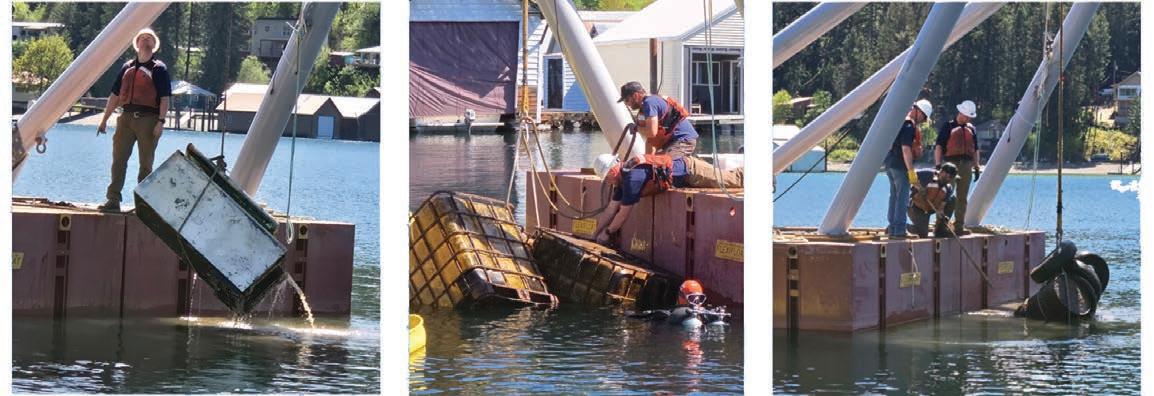
The Lake Pend Oreille Idaho Club hosted its annual Scenic Bay Cleanup Project from May 4-7, removing tons of debris from the waters around Bayview. The three-day event enlisted community volunteers, scuba divers and the U.S. Navy to clear debris from area kokanee spawning beds.
LPOIC is a volunteer-led nonprofit organization dedicated to protecting and enhancing Lake Pend Oreille and its fisheries. Volunteers this year pulled debris from the water including tires, large pieces of metal and other trash.
The cleanup was sponsored by the Idaho Community Foundation via the Getts-Yonker Charitable Fund and Forever Idaho North, the Kalispel
Tribe of Indians, the Charlie & Jylan Johnson Fund and LPOIC members’ donations.
To learn more, sign up as a volunteer or donate, contact LPOIC at lakepoic@gmail.com or visit lpoic.org.
LPOIC volunteers remove tons of debris from Lake Pend Oreille from May 4-7. Courtesy photos
Identifying native trees
By Soncirey Mitchell Reader Staff
Trees far outnumber people here in North Idaho, and that’s the way residents like it. Still, even though they’re our neighbors — while providing heat, building materials, shade and defining the idyllic landscape — many people don’t outright know how to tell the difference between, say, a ponderosa pine and a western white pine. For anyone curious about our evergreen (or leafy) companions, here’s a simple guide to some of the most common native species.
Western redcedar (Thuja plicata)
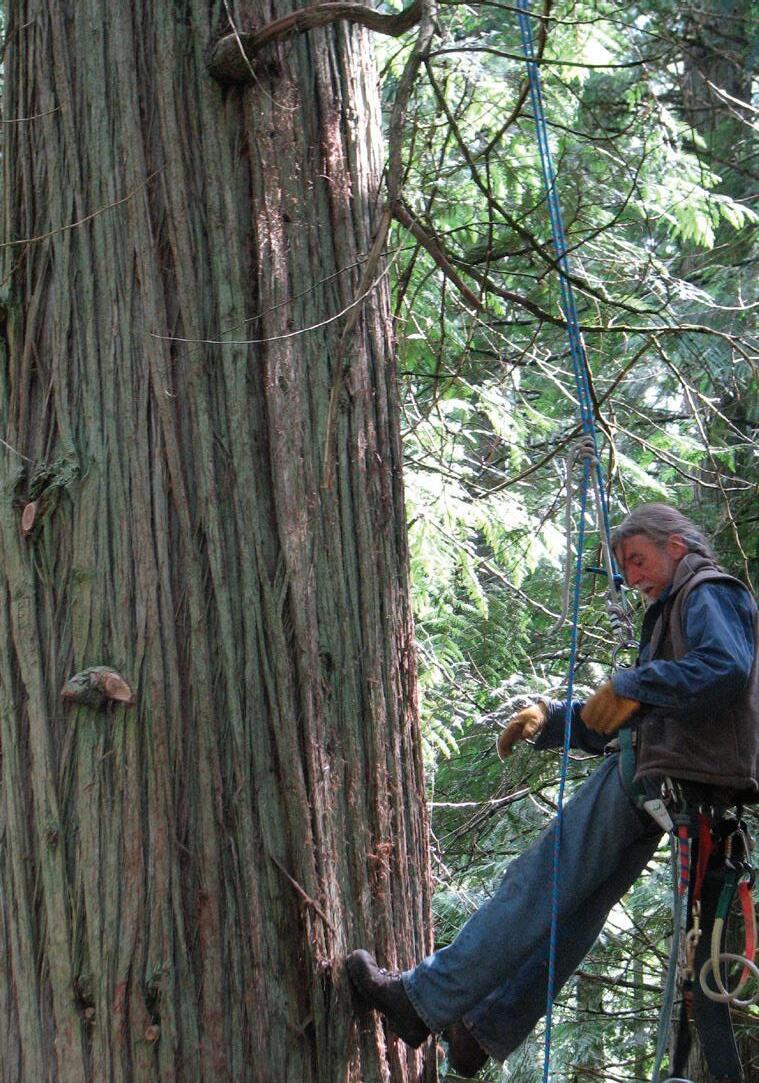
As is common with many plant species, what we call “cedar” isn’t a cedar at all. Western redcedar is a member of the cypress family, and doesn’t look anything like the true cedars native to the Mediterranean and western Himalayas, though they all share a spicy smell. These trees can reach heights of 160 feet with trunk diameters of two to eight feet, growing steadily over their possible lifetimes of more than 1,000 years. Western redcedar’s bark grows in long, fibrous strips that run vertically up the trees, transitioning from a brown-red to gray as they age. Rather than needles, redcedar grows scale-like leaves that fan out and remain evergreen throughout the cold months. Their cones are petite — about two centimeters long — and grow in clumps toward the ends of their boughs. You can find Western redcedars in mixed coniferous forests, growing in moist sites like ravines and swamps.
Ponderosa pine (Pinus ponderosa)
One way to identify ponderosa pines is to remember that their characteristics have the same alliteration as their name: prickly and puzzle piece-like. Their reddish bark is made up of layers of thin, irregularly shaped flakes that resemble puzzle pieces. Their large cones are typically three to six inches long and covered in sturdy, outward-facing spikes that prick your fingers when you try to pick them up. The ponderosa pine’s needles grow in broom-like tufts made up of five- to
10-inch needles growing in groups of three. These trees live for 300-600 years, reaching heights of 120-180 feet, and often plant themselves on dry southern slopes.
Western white pine (Pinus monticola)
Pop quiz: What’s Idaho’s official state tree? Admittedly, the title of this section gave the answer away. Western white pine grows all across the state in low and middle elevations, either in clusters or intermixed with other evergreen species. Mature tree bark takes on the appearance of dried mud or alligator scales, separating into thick, relatively square pieces with large fissures between them. Their needles average two to four inches in length and sprout in bundles of five, fanning out from the ends of smaller branches. These iconic Idaho trees can live for approximately 350 years, reaching heights of 180 feet but remaining relatively thin, with trunk diameters of 2.5-3.5 feet. The most surefire way to identify a western white pine is by its banana-shaped cones, which can grow up to 10 to 14 inches long and have relatively soft, flexible scales.
Western paper birch (Betula papyrifera) Idaho has native deciduous trees, too, which mostly grow along riparian zones, helping protect shorelines from erosion. One of the most recognizable of these species is the western paper birch, which starts out with dark brown bark that eventually lightens to a chalky white, curling into thin, papery ribbons. Their leaves are
teardrop-shaped with serrated edges and alternate on the left and right sides of each branch. Birch trees store their seeds in drooping flower clusters called catkins, which resemble long, green-yellow worms. In the grand scheme of trees, paper birches don’t live very long — about 80 years — and only grow to be around 70 feet tall with slender, one- to two-foot diameter trunks. You’ll find them near bodies of water, growing mostly among their own kind.
Black cottonwood (Populus balsamifera ssp. trichocarpa)
Finally, most people know black cottonwoods from the storm of fluffy “snow” they release in late spring and early summer. They grow along bodies of water or in moist, mountainous woods, generally among other cottonwoods, as they cannot stand the shade from other trees. Though they only live approximately 120 years, black cottonwoods reach heights of 60-120 feet, meaning they grow like weeds wherever they find the space. Even when they aren’t releasing clouds of sneeze-inducing lint, you can identify a black cottonwood by its gray-brown bark that develops deep ravines as it ages, which travel vertically up the tree. The trunk is generally free of branches until the crown opens up, revealing simple, teardrop-shaped leaves that alternate in a spiral pattern around small branches.
Western paper birch. Courtesy photo
Pend Oreille Water Festival teaches students about the natural world
By Reader Staff
The Pend Oreille Water Festival will host its 30th-annual multidisciplinary environmental education field trip for area fifth-graders on Wednesday, May 20 and Thursday, May 21 at the Riley Creek Recreation Area (1099 Riley Creek Park Drive, in Laclede).
The program begins with interactive, in-class lessons leading up to the outdoor festival, which this year will host 400 students from 14 public and private schools, allowing them to engage with natural resource professionals and Sandpoint High School student mentors.
Participants will learn about the area watershed through hands-on educational activities as they rotate through five different interactive, instructional stations: Fisheries, Water Quality, Watersheds, Animal Tracks and the Fur Trapping Era. After lunch, members of the Idaho Department of Fish and Game will give a presentation on living with grizzly bears.
The Bonner Soil and Water Con-
servation District, Avista and the U.S. Army Corps of Engineers at Albeni Falls Dam sponsor the event. Visit bonnerswcd.org/ pend-oreille-water-festival for more information.
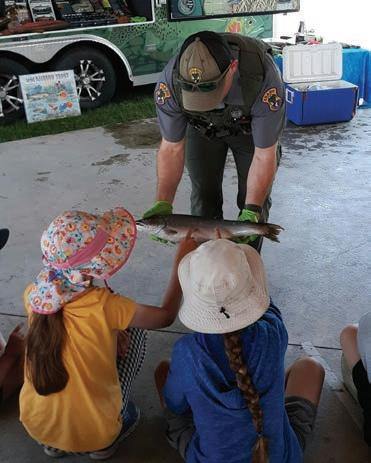
A member of Idaho Fish & Game shows local kids one of the area’s species of fish. Courtesy photo
Litehouse YMCA offers Water Safety Day
By Reader Staff
May is National Water Safety Month, and Litehouse YMCA is diving in headfirst to help educate the community on water safety.
The Y will host a free Water Safety Day on Saturday, May 16 from 1-4 p.m. — an event hosted in partnership with Bonner County Paramedics, Bonner County Sheriff’s Office and Selkirk Fire, Rescue and EMS.
The entertaining, hands-on event
is designed to help individuals and families feel confident and safe around water. Attendees have the opportunity to connect with local first responders, build safety skills and take an important step toward preventing water-related accidents. Activities and resources will include swim lesson evaluations, life jacket fittings, water safety demonstrations, and training in basic CPR and first aid.
This free event is open to all ages. To learn more, visit ymcainw.org.
Sandpoint Teen Center to host Hawaiian luau fundraiser
By Reader Staff
The Sandpoint Teen Center will host a Hawaiian luau-themed fundraiser on Wednesday, May 20 from 5:30-7 p.m. at the First Lutheran Church (526 S. Olive Ave.). The family-friendly night includes Hawaiian-inspired food and drinks, along with a silent auction, with all proceeds benefiting the teen center.
The fundraiser is free for kids and has a suggested donation of $20 for adults, which includes a dinner of smoked pulled pork or chicken, grilled pineapple and piña colada mocktails. Organizers are seeking donations from local businesses for the silent auction. Supporters can also sponsor a teen with a suggested donation of $25 so they can bid on silent auction items and continue practicing their budgeting skills.
The Sandpoint Teen Center serves approximately 150 teens daily between
two locations, providing snacks and hot meals after school, as well as leading excursions to take teens bowling, paintballing and on educational trips. The center also spearheads the “Too Good For Drugs” program and promotes art and skill-building activities for local teenagers.
“In the last year alone we served over 950 individual teens,” volunteers stated in a news release.
Learn more at sandpointteencenter. com.
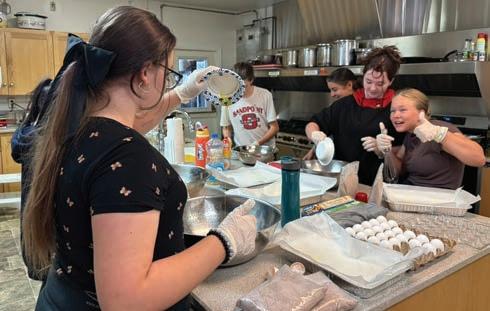
Local students attend baking classes at the Sandpoint Teen Center. Courtesy photo
Bonner Community Food Bank set to double in size at new location
By Zach Hagadone Reader Staff
The Bonner Community Food Bank is on the verge of a major new phase in its more than 40 years of serving area residents with free food assistance, after acquiring a new location in Ponderay.
Executive Director Debbie Love told the Reader that the food bank closed on the 12,222-square-foot space at 900 Kootenai Cutoff Road in April, providing a substantial increase from the 5,900-square-foot building it has been operating in for the past 15 years.
“We were looking for something that I like to say is ‘generational,’” Love said. “You know, years beyond when I’m here, it’ll always be here for our community.”
The food bank will remain at its current location at 1707 Culvers Drive, in Sandpoint, until sometime in the fall when operations will begin fully transitioning to the new space, which represents a doubling in size. Beyond that, the 1.7-acre Kootenai Cutoff property comes with more parking both in the front and rear of the building, a roll-up loading door, green space for community gardens, and a 2,400-square-foot outbuilding
that could be converted into a classroom or commercial kitchen.
“We’re looking at probably three to five years for that,” Love said of the classroom/commercial kitchen, “but there’s just all these opportunities that we can provide for the community to better serve them. And one of the biggest things, too, is it’s on the SPOT bus route, so we are super excited
Women Honoring Women announced 2026 awardees
By Reader Staff
The Women Honoring Women Committee has announced the recipients of the 2026 Bonner County Women of Wisdom Lifetime Achievement Award, recognizing five local women whose lives reflect exceptional service, leadership and dedication to the Bonner County community.
This year’s honorees are Dee Ann Smith, Nancy McAdam, Rebecca Hawkins, Sharon Bistodeau and Sue Brooks.
Selected from a large pool of nominations, this year’s honorees were chosen for their “enduring commitment to community betterment, their leadership across a variety of sectors, and their role as mentors and inspirations for future generations,” organizers stated.
“We received so many incredible nominations this year, making the selection process especially difficult,” the committee wrote in a statement.
“Each nominee was truly deserving of recognition, and those not selected will be thoughtfully carried forward for consideration at next year’s event.”
The honorees will be celebrated at the annual Women of Wisdom Gala Luncheon on Saturday, June 13, at the Marigold Bistro (414 Church St., in Sandpoint). The event begins at 11 a.m., and tickets cost $40. Seating is limited, and advance purchase is required.
The luncheon will feature a catered brunch, beverages and a special program honoring the 2026 Women of Wisdom, along with recognition of past recipients and the 2026 Women Honoring Women scholarship awardees.
“Community members are encouraged to attend and join in celebrating the legacy and contributions of these remarkable women,” organizers stated.
To buy tickets, contact Diane Stockton at 208-290-6362 or email stockton_diane@yahoo.com.
about the location.”
The move comes amid years of increasing demand for the food bank’s services, with 10,650 pounds of food purchased and 3,126 community members supported in April alone. That high demand has strained the storage capacity of the current location, plus the food bank’s lease of its north parking lot is up at the end of the year.
Growing into the new Ponderay space comes at an opportune time, and in addition to providing more warehouse capacity also positions the food bank to serve as a hub for area food pantries.
“Harvest, out of Spokane, stopped doing their monthly deliveries a couple years ago, so it’d be nice to be a resource for the Clark Fork pantry and Priest Lake pantry — people could come to us for more support and we’d have food to support them, too,” Love said.
According to property records, the Kootenai Cutoff location was valued at more than $1 million, and Love said the nonprofit was able to acquire it thanks to years of savings and a loan. The purchase expense will also be offset when the food bank sells its current location.
Meanwhile, work on the new facility will include repaving and expanding the parking areas, and volunteers — including from Cedar Hills Church and Numerica Credit Union — will lend a hand with cleaning and painting the interior in June.
Some other plans will require approval by the city of Ponderay,
though Love said, “Once we can have that, then we’ll have a timeline, but we’re looking to start moving in October, so if people want to come out to help with that, we would love the support there.”
Right off the bat, Love said the food bank will be using more than half the new space, “but we’ll have more room to grow, and really we’ll be able to do more volunteer work groups — we’ll be able to have more larger groups coming in to help us.”
To learn more about the Bonner Community Food Bank and its services, go to bonnerfoodbank.org. To volunteer or otherwise help the food bank’s mission, go to the website, call 208-263-3663 or email info@bonnercounytfoodbank.org.
The food bank’s new Ponderay location. Photo by Zach Hagadone
Send event listings to calendar@sandpointreader.com
THURSDAY, may 14
Lost in the ’50s welcome party and Live Music w/ Hot Cheetos
5-8pm @ Connie’s Lounge
Live Music w/ Double Shot Band
4-6pm & 7-9pm @ Connie’s Lounge
Live Music w/ BTP
6:30-9:30pm @ MickDuff’s Beer Hall
Hogwire: Lost in the Country party
8pm @ The Hive
Doors open at 5pm to watch parade. Line dancing lessons 7-8pm ($10)
Live Music w/ Ponderay Paradox
5-8pm @ Pend d’Oreille Winery
Live Music w/ Bright Moments Jazz
6-8pm @ Baxters on Cedar
Live Music w/ Kenny James Miller Band
11am-3pm @ 219 Lounge
Live Music w/ Glizi! 8-11pm @ 219 Lounge
Live Music w/ BTP
1-4pm @ Connie’s Lounge
Live Music w/ Light on the Water
7pm @ Eichardt’s Pub
Live Music w/ The Real McCoy
6-8:30pm @ Matchwood Brewing Co.
Live Music w/ Rockabilly Space Force
6:30-8:30pm @ Smokesmith BBQ
Music w/ DJ Sterling
9pm @ Roxy’s Lounge
Live Music w/ Bright Moments Jazz
6-8pm @ Arlo’s Ristorante
Live Music w/ Ian Newbill
7-10pm @ 1908 Saloon
Sandpoint Chess Club 9am @ Evans Brothers Coffee
Magic with Star Alexander 5-8pm @ Jalapeño’s
Celtic Folk Jam 3-6pm @ Idaho Pour Authority
Live Music w/ Amber Mae 8pm @ 219 Lounge
FriDAY, may 15
Live Music w/ Miah Kohal Band 9pm-midnight @ 219 Lounge
Live Music w/ Tim G. 5:30-8:30pm @ Barrel 33
Live Music w/ Thom and Coley
6:30-8:30pm @ Smokesmith BBQ
Live Music w/ Frytz & the Generals 8-11pm @ Roxy’s Lounge
Live Music w/ Eleven Strings 6-8pm @ Idaho Pour Authority
SATURDAY, may 16
Live Music w/ Kip McMillan 1-4pm @ Barrel 33
Live Music w/ Picked up Pieces
5:30-8:30pm @ Barrel 33
Live Music w/ Pamela Benton 5-8pm @ Pend d’Oreille Winery
Gigawatt: Lost in the ’80s dance party
8pm @ The Hive
Big hair, bright colors, great tunes. $10/ adv, $15/door. livefromthehive.com
Live Music w/ Inland Beaches
6-8pm @ Idaho Pour Authority
EP release show. No cover
Red Wheelbarrow plant/produce sale
9am-1pm @ 1541 Selle Rd.
Get lost in the Selle Valley and stock up for the spring garden
SunDAY, may 17
Weekly pool tournament 12pm @ Roxy’s Lounge
Live Music w/ Fiddlin’ Red 1-4pm @ Barrel 33
Monday Night Blues Jam w/ John Firshi
7pm @ Eichardt’s Pub
Trivia w/ Alaina 6-8pm @ Idaho Pour Authority
Live Music w/ John Firshi
5-7pm @ Pend d’Oreille Winery
Beginner Argentine tango class
7pm @ Embody Center, 823 Main St. No partner needed. $15
Family Night, live music w/ John Firshi 5-7:30pm @ Matchwood Brewing Co.
Trivia w/ Toshi
7pm @ Connie’s Lounge
May 14 - 21, 2026
Weekly pool tournament 6pm @ Roxy’s Lounge
Live Music w/ Liam Mccoy & Friends 7pm @ Eichardt’s Pub
Lost in the ’50s car parade and street party 6pm @ Downtown Sandpoint A vintage car parade followed by a street party playing old-school rock ’n’ roll
Sandpoint Farmers’ Market 9am-1pm @ Farmin Park
Lost in the ’50s: Rocky & the Rollers 7:30pm @ Bonner County Fairgrounds
A retro concert celebrating the 1950s
Lost in the ’50s vintage car show
9:30am-3:45pm @ Downtown Sandpoint Vintage car show along the downtown streets going all day long. Awards follow
Lost in the ’50s: Chubby Checker 7:30pm @ Bonner County Fairgrounds
Concert with the Rock Hall of Fame legend Chubby Checker ’50s themed dance party 6-9pm @ Sandpoint Community Hall
Swing dance lessons 6-7pm, general dancing 7-9pm. Wear 1950s attire
Welcome to the Circus dance recital 12pm & 4pm @ Panida Theater
Laiche Dance Center’s spring recital Square dancing lessons 2-5pm @ Sandpoint Community Hall
Live Music w/ Brian Jacobs 6-8pm @ Baxters on Cedar
Sofia Talvik live in concert • 6pm @ Panida Theater
Swedish singer-songwriter bringing Songs, Strings & Stories tour to Sandpoint. An intimate evening of Nordic folk and Americana with ethereal vocals and storytelling. panida.org
monDAY, may 18
Outdoor Experience group run 6pm @ Outdoor Experience
Karaoke w/ Big Rock Karaoke 9pm-midnight @ Roxy’s Lounge
wednesDAY, may 20
Live piano w/ Bob Beadling 5-7pm @ Pend d’Oreille Winery
Sandpoint Farmers’ Market 3-5:30pm @ Farmin Park
Festival at Sandpoint Youth Strings
Orchestra Spring Concert
6pm @ First Presbyterian Church
Final performance after 8 months of weekly sessions. Free admission
Open mic hosted by Russ 6-8pm @ Idaho Pour Authority
The [M] Factor 2 (free film screening) 5:30pm @ Panida Theater
Screening of film that “shreds the silence” about perimenopause
39th annual rocks Sandpoint
By Soncirey Mitchell Reader Staff
Nearly 40 years since its inception, the annual Lost in the ’50s festival, celebrating hot rods, poodle skirts and copious amounts of hair gel, is still going strong. The long weekend of events will transform downtown Sandpoint, inviting thousands of visitors from across the U.S. to don their dancing shoes and twist with the best of them.
Thursday, May 14
Celebrations begin Thursday at Connie’s Lounge (323 Cedar St.) with a retro welcome party from 5-8 p.m. Local high-energy cover band Hot Cheetos will play on-theme hits throughout the night.
Friday, May 15
The day begins at the Idaho Club Clubhouse Restaurant (151 Clubhouse Way off U.S. 2), which will host “Cars & Coffee” by serving up coffee and donuts from 9 a.m. to 11 a.m. The star of the show — the ’50s car parade — begins at 6 p.m. at Sandpoint High School and will travel down Cedar Street to Division Avenue, then to Church Street and finally down First Avenue.
Immediately following the parade, the area of Oak Street adjacent to the
city parking lot and Jeff Jones Town Square will shut down for a street party. Kids of all ages can dance the night away to old-time rock ’n’ roll thanks to local DJs.
To end the night, classic rock cover band Rocky and The Rollers will light up the stage at the Bonner County Fairgrounds (4203 N. Boyer Road), playing hits from every artist that’s
BGH hosts screening of documentary on challenges of perimenopause
By Reader Staff
Bonner General Health is hosting a screening and discussion of The (M) Factor 2: Before the Pause, on Wednesday, May 20 at the Panida Theater (300 N. First Ave., in downtown Sandpoint).
Doors open at 5 and the film is at 5:30 p.m., with free admission and a Q&A session to follow.
The (M) Factor 2 is the followup to The (M) Factor: Shredding the Silence on Menopause, which BGH screened last year and was focused on the “silent epidemic” of as many as 2.2 million women in the U.S. who enter menopause each year. While the stress
and disruption to their lives results in billions of dollars in lost wages, career upheaval and personal upset, very few women receive any medical care or accommodation for those challenges.
The sequel is a deep dive into the realities of perimenopause, which precedes menopause and gets even less attention.
According to organizers, “Before the Pause shines a light on perimenopause through real women’s stories, teachers, firefighters and doctors, showing how silence and stigma derail lives, and why early awareness is essential to protect women’s health, work and identity.”
For more info, go to themfactorfilm.com.
headlined this festival since 1987. Doors open at 6:30 p.m. for the 7:30 p.m., 21+ show. Find tickets for $40 at lostinthe50s.com.
Saturday, May 16
The long weekend concludes with Saturday’s celebrations, beginning with the car show from 9:30 a.m. to 3:45 p.m. Classic and custom vehicles from Friday’s parade will line First, Second and Third avenues so everyone can stroll by and get an up-close look. The show ends with awards for the judges’ favorite hot rods.
Several events are competing for attendees that evening, beginning with a special concert starring Chubby Checker and the Wildcats. Checker, a member of the Rock and Roll and National Rhythm and Blues halls of fame, was a mover and shaker — literally — in the 1960s. A singer and dance icon, he popularized the twist and the pony dance styles with his songs “Let’s Twist Again” and “Pony Time.” The popularity of his art persists, and even the youngest generations can still sing along to his music. This concert will also take place at the fairgrounds at 7:30 p.m. Tickets are $60 at lostinthe50s.com.
At the same time, The Hive (207 N. First Ave.) will mix things up with
an ’80s dance party beginning at 8 p.m., with live music from Gigawatt. The Spokane-based cover band is a local favorite, bringing to life hits from bands like the Cars, Genesis, Bon Jovi, the Police and R.E.M. Tickets are $10 at livefromthehive.com or $15 at the door for this 21+ concert.
Finally, Sandpoint Parks and Recreation and Sandpoint Dance will team up for a ’50s-theme dance party at the Sandpoint Community Hall (204 S. First Ave). The free event is kid-friendly, though an adult must accompany children under 15. Doors open at 5:45 p.m. and East Coast Swing lessons run from 6-7 p.m. After that, attendees can dance however they want until the bell tolls 9 p.m.
To stay up-to-date with Lost in the ’50s events, check out facebook.com/ lost50s.
A rainy Lost in the ’50s in 2025. Photo by Zach Hagadone
Lost in the ’50s in Sandpoint. Photo by Ben Olson
By Marcia Pilgeram Reader Columnist
The Sandpoint Eater Ode to Irish pastures
I understood immediately why Irish dairy tastes different.
“Happy cows” may sound like hyperbole or marketing nonsense until you stand ankle-deep in a lush clover-covered Irish pasture and see what genuine contentment looks like.
In Ireland, cream runs as thick as an authentic Irish brogue. Real cream. Not the apologetic half-and-half that passes for luxury here at home, but proper heavy cream with substance, character and the faint sweetness that comes only from deeply contented cows grazing in the rich pastures of Ireland.
On my last visit, I traveled to East Cork to spend time at the famed Ballymaloe Cookery School, the culinary heartland founded by the legendary Darina Allen. Ballymaloe is more than a cooking school; it’s a storybook disguised as an organic farm. The gardens spill over with herbs and edible flowers, bread emerges warm from the ovens at all hours and butter is treated with the reverence it deserves.
Through a personal connection to Billy the dairyman, I was fortunate enough to tour Ballymaloe’s small but remarkable dairy and creamery. Tucked behind the kitchens and gardens, the modern machinery hums quietly with the old-world rhythm of milk becoming cream, cream becoming butter and butter becoming something close to sacred.
The cows themselves seemed blissfully unaware of their reputation. Ballymaloe keeps Jersey cows and Friesian-Jersey crosses, all grazing on thick organic pasture under idyllic Irish skies. Jerseys, with their caramel-colored coats and enormous eyes, are especially prized for milk rich in butterfat — the kind of milk destined to become cream. Watching them move lazily through the fields, tails flicking as they graze contentedly,
At home, I am frequently accused (lovingly, though perhaps not without concern) of using too much cream in my cooking. Health conscious friends eye my “heavy” Alfredo sauces with suspicion, and my daughters often ask whether every soup truly requires “just a splash” of heavy cream. More than once, I’ve heard, “That was not a splash, Mother — that was a small tidal wave.”
But in Shanagarry, the village nearest Ballymaloe, I felt vindicated. At Ballymaloe, cream is not an excess; it is an ingredient treated with respect, woven naturally into the fabric of everyday cooking. Cream enriches soups, softens scrambled eggs, tops fruit desserts, folds into airy mousses and is whisked into classic sauces. Nobody reaches for reduced-fat
substitutions because there, dairy is celebrated precisely because it is extraordinary. During my visit to the dairy, I watched fresh milk being separated, the cream rising thick and pale gold. It bore little resemblance to the homogenized supermarket cream most of us know. You can taste that landscape in the dairy: the mineral richness of the soil, the sweetness of clover, the freshness of coastal air carried inland from the nearby Atlantic.
Since returning home, I’ve begun culturing cream for butter-making again, inspired by what I tasted in Cork (and previously in France). Cultured cream develops a subtle, slightly sharp depth that transforms butter from a condiment into something deeply flavorful. The process feels wonderfully old-fashioned: warming the cream gently, adding culture, then waiting patiently — 60 hours, to be exact — while invisible bacteria work their quiet magic. By Day 2, the cream thickens and sharpens, ready to churn (with
my KitchenAid paddle) into butter that is rich and tangy. It’s the perfect partner to my daughter Ryanne’s award-winning sourdough bread.
There is something deeply satisfying about creating this butter in a tradition so ancient and elemental, even with an electric mixer. Milk becomes cream. Cream becomes butter. Butter melts into potatoes or pastry or warm soda bread.
In a world increasingly devoted to speed and convenience, traditional dairy practices remind us that some processes simply cannot be hurried.
Back home, I suspect I will continue to be accused of overusing cream. Frankly, I intend to lean into the criticism. Life is too short for dry mashed potatoes or bland pasta sauces. If the cows of County Cork taught me anything, it’s that richness — real richness — comes from quality, not restraint.
So yes, my Alfredo sauce will remain gloriously decadent. My soups will continue to receive their generous fin-
ishing pour. And my scalloped potatoes, layered with cream and cheese, will carry the spirit of Ballymaloe into my kitchen forevermore.
I now consider myself fully endorsed by the good cows of Cork, particularly the lovely, doe-eyed Jerseys, who graze upon pastures of endless shades of green, stitched together by hedgerows and stone fences, and I take their approval very seriously indeed. This week, I’m paying homage to those lovely cows of Cork and their glorious cream. Since scalloped potatoes are a family favorite, it seemed fitting to prepare this simple but tasty dish that arrives at the table bubbling with rich cream and bronzed beneath a crust of gruyère. The recipe is seasonless — equally delicious on a cold winter day or packed up, potluck-ready, for a summer barbecue. May it bring a touch of green pastures to your own table.
Scalloped potatoes with seasoned cream and cheese
These potatoes are rich and decadent as a side or main vegetarian dish. Infuse the cream with favorite herbs to create a desired taste profile. 8 servings.
INGREDIENTS: DIRECTIONS:
• 3½ to 4 lbs russet potatoes (about 6-8 medium), peeled and sliced ⅛ inch thick
• 3 cups heavy cream
• 3 tbsp unsalted butter (plus extra for greasing dish)
• 2 tbsp finely chopped herb of choice (such as chives, rosemary or thyme)
• 3 cloves garlic, finely minced (optional)
• 1½ tsp kosher salt (plus more to taste)
• 1 tsp white pepper
• ¼ tsp ground nutmeg
• 2 cups shredded gruyère cheese
• Fresh chopped parsley for garnish
Slice potatoes evenly about ⅛ inch thick (cleaver or mandoline works best). Place in a large bowl and keep in salted, cold water until ready to use, then drain and pat dry.
In a saucepan, combine the heavy cream, butter, garlic, herb of choice, salt, pepper, thyme and nutmeg. Heat over medium until steaming and just beginning to simmer (do not boil). Whisk well so butter melts and garlic and herbs infuse the cream.
Place the potatoes back in large bowl, pour cream over potatoes. Gently toss so every slice is coated and begins to soften slightly.
Butter a 9- x 13-inch baking dish. Lift potatoes from bowl and layer evenly, pouring all the remaining cream mixture over them. Press down lightly so potatoes are mostly submerged.
Cover baking dish tightly with foil. Bake covered. Bake at 375° F (190° C) for 60 minutes.
Remove foil and bake another 20-30 minutes, until potatoes are tender when pierced with a knife and the sauce is
thickening. Remove from oven. Sprinkle shredded cheese evenly over the top. Return to oven uncovered for 10-15 minutes or until cheese
and
is melted, bubbling
golden brown. Let rest at least 15-20 minutes before serving, so the cream sets into a silky sauce. Garnish with fresh parsley.
MUSIC
Nordic folk in North Idaho
Swedish performer Sofia Talvik brings Songs, Strings & Stories to Panida Theater
By Reader Staff
Internationally acclaimed Swedish singer-songwriter Sofia Talvik will bring her 2026 U.S. tour Songs, Strings & Stories to Sandpoint on Sunday, May 17, with a 6 p.m. performance at the Panida Theater (300 N. First Ave.).
Known for her ethereal vocals and distinctive blend of Nordic folk and Americana, Talvik has performed in 49 U.S. states and toured extensively throughout Europe. With 10 full-length albums released,
she has established herself as a compelling storyteller whose music bridges continents while remaining deeply personal and intimate.
Sunday, May 17; doors at 5 p.m., show at 6 p.m.; $20.50. Panida Theater, 300 N. First Ave., 208-263-9191, get tickets at the door or panida.org. Listen at sofiatalvik.com.
Her Songs, Strings & Stories tour is a solo journey, highlighting Talvik’s intimate vocals and masterful songwriting. Set within the historic surroundings of the Panida, the evening promises a deeply engaging and memorable experience of music and storytelling.
“In times that feel uncertain and overwhelming, music can offer a moment of
stillness,” Talvik stated. “I’m excited to share an evening of songs and stories in such a beautiful and storied venue.”
Audiences can expect a carefully curated setlist featuring highlights from across her extensive catalog, along with newer material introduced on this year’s tour. Fans of Laura Marling, Lucinda Williams,
Gillian Welch and Emmylou Harris will find much in Talvik’s sound to appreciate.
Little Live Radio Hour features Jojo Dodge
By Reader Staff
The next installment of the Little Live Radio Hour on Tuesday, May 19 will showcase the talents of Jojo Dodge at a special show at The Hive (207 N. First Ave., in downtown Sandpoint).
Little Live Radio Hour is a free monthly presentation from KRFY 88.5 FM Panhandle Community Radio and The Festival at Sandpoint, offering performances from regional artists that are broadcast live and with an in-person
audience.
Doors open for the May 19 show at 6:30 p.m. and the broadcast runs from 7-8 p.m.
Coeur D’Alene-based Jojo Dodge has been playing her original music throughout North Idaho and the Inland Northwest for years, including an appearance at the 2025 Festival at Sandpoint Community Night. She’ll be joined on stage for the upcoming Little Live Radio Hour by guitarist Drew Brereton and drummer Cody Cummins (and maybe some surprise
A
guests). KRFY’s Jack Peterson will serve as host.
This will also be the last chance for audiences to see or hear Dodge locally — at least for a while — as she’s announced a move to Los Angeles to further pursue her musical career.
Admission is free. All ages welcome.
Listen to the show at 88.5 FM or stream it at krfy.org. For more info, go to jojododgeofficial.com.
snapshot of notable live music coming up in Sandpoint
Rockabilly Space Force, Smokesmith BBQ, May 16 Ponderay Paradox, Pend d’Oreille Winery, May 15
Just in time for Lost in the ’50s, Rockabilly Space Force will blast off to the past with its signature retro-space age renditions of mid-century classics from the likes of Chuck Berry, Bill Haley and the Comets, Jerry Lee Lewis, Buddy Holly and more. The Spokane-based five-piece embodies the rockabilly sound, melding country, rock and rhythm and blues that demands audiences get up and
jumping. It’s perfect timing for RSF’s Saturday, May 16 show at Smokesmith, and there’s no time like the present to revisit the past.
— Zach Hagadone
6:30 p.m., FREE. Smokesmith BBQ, Smokesmith BBQ, 102 S. Boyer Ave., 102 S. Boyer Ave., 208-920-0517, smokesmithidaho. com. Listen at rockabillyspaceforce.com.
In the midst of venues blaring music from the ’50s and ’80s, folks may need to take a moment to reset with a softer sound. Enter: Ponderay Paradox. Local duo Mike Genoff and Matt Moran play a mixture of ’60s blues, folk and soft rock, with a dash of offerings from other decades. No matter what they’re covering, they bring it to life with classic voice and guitar sounds
This week’s RLW by Soncirey Mitchell
READ
Whether read in translation or the original French, Monsieur Ibrahim and The Flowers of the Qur’an by Éric-Emmanuel Schmitt is a transformative, heartbreaking coming-of-age story that leaves a mark on its readers. The novella follows Momo, a young Jewish boy, as he grows up in 1960s Paris under the fatherly guidance of a local Sufi grocer. It’s an intimate portrayal of love, loss, faith and childhood naivete. Find it where you find books.
LISTEN
that feel easy and polished — the kind of quality that takes years of practice to achieve. Though they might consider themselves a paradox, something about the duo’s music just makes sense.
— Soncirey Mitchell
5-8 p.m., FREE. Pend d’Oreille Winery, 301 Cedar St, 208-2658545, powine.com. Listen on Ponderay Paradox’s Facebook page.
I can’t stop hitting repeat on the pared-down, indie-rock banger “Trigger of Love” by Jacob Sullenger, a.k.a. JAWNY. There’s something about the artist’s lo-fi, slacker rock that oozes effortless charisma and confidence, so much so that playing it makes me feel cooler. Songs on his EP For Abby share a similar sound, making for easy listening and easier vibing, perfect for late-night cooking or living room hangout sessions. Find him on most streaming platforms.
WATCH
Netflix is now streaming the adorable 2011 anime Hunter × Hunter, following the adventures of a young group of friends training to become professional monster hunters. It’s a classic story: One exemplary boy leaves home on a magical adventure, discovering hidden powers and making lifelong friends along the way. Still, the unnerving yet likable villains, the novelty of the power structure and the unwavering kindness of the protagonist make the show incredibly bingeable.
Sofia Talvik
Sofia Talvik. Courtesy photo
JoJo Dodge. Courtesy photo
From the Pend Oreille Review, May 12, 1911
BULLET HOLE IN THE HEAD
C. H. Dunn, residing alone in a lonely cabin a mile west of Heron, Mont., and just over the Idaho line, was found dead in his cabin last night with a bullet hole through his head. Dunn was a bachelor and middle aged. It is suspected that tramps committed the murder, and conditions surrounding the case point that way. No arrests have been made.
Coroner Robinson went to Heron from Thompson, Sanders county, this morning to hold an inquest and Undertaker Brower went from Sandpoint to care for the remains.
It was evident Dunn had been dead several days when found.
GAMBLING AT PRIEST RIVER
The county treasury was enriched $200 Tuesday morning by the payment of a fine imposed in probate court upon J.D. McIntosh of Priest River. William Whestler was fined a similar amount but could not pay it and went to jail to serve a four months’ term. Evidence against the two men was secured by the sheriff’s office last Friday and a witness was secured who claimed he had lost $70 in McIntosh’s place. McIntosh was conducting a soft drink parlor.
A feature of the arrest Monday evening was the throwing off of the warrants at Priest River while the fast train was going through town. Deputy Sheriff Riser got out the warrants in probate court Monday and when he boarded a Great Northern passenger train the conductor refused to stop for him at Priest River. Deputy Riser threw the warrants off the train to Turnkey Paul Remus, who served the warrants and Riser came back from Newport on the next train and Riser and Remus brought the two men to the county seat.
BACK OF THE BOOK
One party to rule them all
By Ben Olson Reader Staff
North Idaho wasn’t always like this.
Believe it or not, there was a time in the not-too-distant past when North Idaho was a more politically balanced region. Our district often sent more Democrats to Boise than Republicans, and both parties were largely concerned with issues that affected us here in the panhandle: jobs, infrastructure, conservation, protection of public lands, stewardship of wildlife and a shared mission to represent the working class.
These so-called “lunchbox Democrats” of Idaho — people like Jim Stoicheff, Frank Church and Cecil Andrus, among others — were mostly concerned with meeting their constituents’ basic needs.
Sure, North Idaho has always contained veins of libertarianism and conservatism while anti-government sentiments ran through the hills like spring rivers; but, in the seemingly quaint political era of the 1970s-’80s, your party affiliation didn’t matter so much. Rather, what counted for our elected officials was what they did to better the lives of their constituents.
Then, in the early 1990s, a shift began to occur. The economy started to slide. The price of precious metals tanked, mines closed, lumber mills shut down and Idaho (having passed right-to-work legislation in the mid’80s) handcuffed the unions that had grown powerful in the panhandle.
At the same time, a dramatic shift was happening in southern California. There was a recession, earthquakes and a riot that marked the beginning of an exodus. From 1992-2000, California lost 1.8 million more people
STR8TS Solution
than it gained, while other Western states gained roughly the same amount. Of all those who migrated to Idaho during that period, more than half came from California. By the end of the 1990s, a reported 500 California police officers retired to North Idaho, including Mark Fuhrman, whose perjury and recorded racism during the O.J. Simpson trial helped paint this region as tolerant of intolerance.
In the early- to mid-1990s, elections were often tight between Republicans and Democrats, but with the influx of deeply conservative newcomers flooding into North Idaho, that soon became a bygone era.
Fewer Democrats were elected to office in each subsequent election until there were essentially none left. In 1992, there were 20 Democrats elected to the Idaho House and 50 Republicans. Those numbers dwindled to nine Democrats to 61 Republicans by 2000 and — except for a short boost for Democrats during the Obama years — has now settled back to the same ratio for the most recent legislative session.
Since 1995, Idaho has been under one-party rule, with Republicans claiming the trifecta of Senate, House and Governor’s Office.
As is common in organisms living out of balance with the world around them, Idaho politics have been rotting for decades.
Buoyed by wave after wave of outof-state conservatives — many unironically calling themselves “political refugees” — the Idaho Republican Party has tacked further and further to the right, creating a party with an ideological platform that is nearly unrecognizable to Republicans of the past.
Influenced by the larger political swing to the right that’s occurred around the country, Idaho was off to
Sudoku Solution
the races. Ideological bills became red meat for lawmakers to toss to their constituents, and we passed a disgusting series of bills into law that further pushed marginalized populations away. Some were reversed after being found unconstitutional, but many stand as a reminder of the ugly new reality of politics in North Idaho.
It’s a tricky reality for these Idaho conservatives today, because a large part of that ideology depends on pointing to Democrats as the ones to blame for all the evils of the world — a tough ask, especially since North Idaho hasn’t sent a Democrat to Boise for more than 30 years.
As a result, North Idaho Republicans have taken to henpecking one another and establishing litmus tests to classify what a “true” conservative is.
This is, again, ironic, since the vast majority of these so-called “true” conservatives moved here from California, bought one of those stupid Idaho-shaped-like-a-gun-shootinga-pine-tree stickers and proclaimed themselves to be ambassadors — and protectors — of “North Idaho values.”
This yeasty ferment — frothing and eating itself constantly — might convince others that their conservative fever dream is normal or good, but those of us who have been around longer than them know the score. We know that their brand of extremism, wrapped in an American flag and punching down at anyone who questions it, has eaten the host and is here to stay.
Like wolves let into the henhouse, they will continue to pick us off, one by one, until there is nothing left but wolves, gnashing and yipping at one another, eager to find another group to blame. Rinse and repeat.
That’s the new Idaho way.
Laughing Matters
Solution on page 26
By Bill Borders
Week of the
Corrections:
Nothing to report this week, daddy-o.
[noun]
1. a language invented by an individual or small group
“The preschoolers developed a complex idioglossia that their parents could not understand.”
It takes
a big man to cry, but it takes a bigger man to laugh at that man.