Honey Pearl Productions Presents 1776: The Musical wit, a powerful score, & timeless relevance, 1776 shows that history was made by determined individuals daily 7 pm, matinee July 5, 3 pm, doors 45 mins. prior
Honey Pearl Presents in the Little Theater 1776 Pre-Funk Dinner & Music
JoDavi, North Carolina–based singer-songwriter Proceeds support North Idaho veterans Saturday, 4:45 pm prior to performance
House of Fly & The Mayfly Project Presents International Fly Fishing Film Festival with Bucket Raffles and Door Prizes Thursday, 7 pm, doors 1 hour prior
DanceWorks Presents Danceworks 2026
this annual showcase is a highly anticipated family event Thursday, 7 pm, doors 1/2 hour prior
300 North First Ave. Sandpoint, ID (208) 263-9191 panida.org
The week in random review
By Soncirey Mitchell Reader Staff
sip, sip hurray
When you say, “wine tasting,” there are two things that come to mind: either the rich, snobby intellectual going on and on about terroir or the 20-something bride-to-be downing glasses with her gal pals. That’s a sad dichotomy, because wine is so much more than a rich man’s collector’s item or a means to an end (and that end is, usually, in the toilet). You don’t need to be a sommelier to taste wine; all it takes is a little practice, and the steps are as easy as they are delicious. When trying a wine for the first time, you’re going to use three of the five senses: sight, taste and smell. (You can also fondle or try to listen to your wine, but other tasters may find it off-putting.) Begin by examining your wine and noting its hue, viscosity and the intensity of its color. You’ve no doubt heard of people scrutinizing a wine’s “legs” — that’s the taster measuring its viscosity. Swirl the glass and see how well the wine sticks to the sides, then taste it and determine how thin or thick it feels in the mouth. A thick, more viscous wine will have many legs — or teardrops — dripping down the side, indicating either high sugar or alcohol content (which is determined by initial sugar content during fermentation). If it’s thick, but not very sweet, the wine is likely high in alcohol.
Hold white wines up to a white background and see where the color ranges on a scale from faint yellow to deep gold. The deeper the color, the more oxidized the wine, meaning a darker white is either older or fermented in a style that allows more oxygen, such as in a traditional wine barrel. For red wines, look at the outer edge of the liquid for the wine’s hue and the center for its opacity. Wines with a red-orange hue are generally more acidic, while those with a purplish tint are less. Deep color often indicates a younger bottle, as red wine becomes paler and more brown as it ages.
Next, position the glass as if to take a sip, resting your lips on the rim, then tilt it until the opposite side of the glass nearly touches your nose. Take a deep sniff. The closer your nose is to the rim of the glass, the more delicate the notes you pick up on should be. Here’s where you (hopefully) smell floral or herbal notes. Does it remind you of anything in the garden, or in the kitchen? Put your nose deeper into the glass to find the richer, often fruity scents. Try to identify a common fruit — blackberry, strawberry, pear, apple — and then think about one adjective to add to it. If it reminds you of a pear, is it green and hard or ripe and juicy? If it smells like the holidays (vanilla, chocolate, cedar or allspice) then you’re likely smelling the oak barrels in which the wine was aged. If it just smells like grapes, well, have another sip and enjoy yourself.
Finally, take a sip and let the liquid wash over every part of your tongue. Is it sweet like juice? Is your mouth watering from the acidity? Are the tannins drying your mouth out, making your gums stick to your teeth? Take one (or more) of those descriptors and add it to your previous observations, and boom, you’ve successfully analyzed wine.
DEAR READERS,
We always appreciate our local artists here at the Reader. Not only do they add flavor and culture to our small town, but they also jazz up the pages of this newspaper with their paintings, photos and other artwork.
One local photographer named Albert De Armas has had several pictures published in the “Photos of the Week” pages over the years. We recently heard that Albert received a devastating diagnosis of Stage 4 colon cancer and thought it would be fitting to put one of his many photos on our cover this week in recognition of his years of sharing his work with this community.
If you’re looking for a way to help, Albert’s family has a GoFundMe set up that is intended to assist with Albert’s end-of-life care and expenses for his final arrangements. Click here to donate: bit.ly/DeArmas
Thanks for all the great photos, Albert.
– Ben Olson,
publisher
READER
111 Cedar Street, Suite 9 Sandpoint, ID 83864 208-946-4368 sandpointreader.com
Editors Emeriti: Lyndsie Kiebert-Carey Cameron Rasmusson John Reuter
Advertising: Ben Olson ben@sandpointreader.com
Contributing Artists:
Albert De Armas (cover), Ben Olson, Soncirey Mitchell, Laura Phillips, Shawna Perry, Bill Borders
Contributing Writers:
Zach Hagadone, Ben Olson, Soncirey Mitchell, Lorraine H. Marie, Brenden Bobby, Clark Corbin, Dave Britton, Caitlyn Embree, Sandy Compton, Tim Henney, Marcia Pilgeram
Submit Stories To: stories@sandpointreader.com
Printed Weekly At: Tribune Publishing Co. Lewiston, ID
Subscription Price: $200 per year
Website Designed By: Keokee
The Sandpoint Reader is a weekly publication owned by Ben Olson, Zach Hagadone and Soncirey Mitchell. It is devoted to the arts, entertainment, bluster, politics and lifestyle in and around Sandpoint, Idaho.
We hope to provide a quality alternative by offering honest, in-depth reporting that reflects the intelligence and interests of our diverse and growing community.
The Reader is printed on recycled paper using soy-based ink. Leftover copies are collected and recycled weekly, or burned in bonfires to appease the gods of journalism. For back issues, contact the publisher. Free to all, limit two per person, please.
Letter to the Editor Policy:
We welcome letters to the editor on all relevant topics. Please, no more than 200 words, no excessive profanity or libelous statements and no trolls. Please elevate the discussion and stay on topic. Letters will be edited to comply with the above requirements. Opinons expressed in these pages are those of the writers, not necessarily the publisher. Send to: letters@sandpointreader.com
About the Cover:
This week’s cover photograph was taken by Albert De Armas.
Paid parking program goes into effect July 1 City Hall increases number of permits available to each household
By Zach Hagadone Reader Staff
As Sandpoint prepares to see the new paid downtown parking program go into full effect on Wednesday, July 1, City Hall has rolled out a few additional changes based on the first two weeks of permit sales.
Permits and more information are available now at sandpoint.thepermitportal.com. In a June 23 social media post, officials stated the following adjustments to the policy:
• The number of vehicle parking permits available for each household has been increased from three to four;
• A boat trailer permit does not count toward the vehicle permit number a household may purchase. A household may now purchase up to four vehicle permits and additional boat trailer permits;
• Those with a blue handicap parking placard in their vehicle can park at any time in any legal parking space in any city lot or on-street, for any length of time. No parking permit is required for vehicles with handicap placards.
“As a reminder, the two resident permits available are for city of Sandpoint and Bonner County residents,” City Hall stated. “There have been many questions from residents of other counties and even other states about parking permits. The only parking permit available to non-locals (i.e. out of county residents) is the 24-hour downtown parking permit, which does not come with a residency requirement and provides the most access to parking in downtown Sandpoint and the waterfront lots.”
Street parking in the two-hour downtown zones will remain free up to the posted time limit, though parking longer than that will require payment of an hourly fee.
Parking will also remain free up to the three- and four-hour limits in those respective zones. However, users who wish to use 24-hour parking in downtown lots as well as the threeand four-hour street parking zones — plus up to eight hours in the waterfront lots — can pay $40 per month. No permits are valid in the two-
hour zone to encourage turnover and availability of parking spaces in front of the businesses that depend on parking availability for customers.
“This program helps ensure that the people who benefit from our parking lots, waterfront facilities, boat launches and beaches contribute to their upkeep while keeping access affordable for local residents,” stated Mayor Jeremy Grimm in a news release in early June.
The city of Sandpoint instituted the paid parking program after more than a year of planning and deliberation, ultimately agreeing that annual permits would cost $20 for city of Sandpoint residents and $35 for Bonner County residents. Holders of resident passes will receive up to eight hours of free parking per day in participating cityowned lots, which include the Third Avenue and Church Street lots (the latter also known as “The City Lot”), Bridge Street lot, City Beach, Dock Street Marina lot and Pend Oreille Bay Trail lot.
Hourly fees will be assessed for motorists parked without a valid permit beginning July 1.
Meanwhile, seasonal boat launch permits will also be required for unlimited use of the City Beach and War Memorial Field boat launches. Those permits cost $50 per year for vessels registered in Idaho and $100 per year for those registered out-of-state.
Users without boat launch permits may pay a $10 daily launch fee, which does not include the standard parking rate.
According to the city, downtown employees who are not city or county residents can purchase either a 24-hour downtown permit or use any of the free all-day street parking spaces downtown,
which include 315 parking stalls located from Alder Street to the north, Fifth Avenue to the west and Lake Street to the south.
Permits will remain on sale throughout the year and are valid for the entire calendar year in which they are purchased. A new permit is required in the new calendar year.
City Hall staff members are available to assist residents with permit purchases. For assistance, visit 1123 Lake St. For other questions, email parking@sandpointidaho.gov.
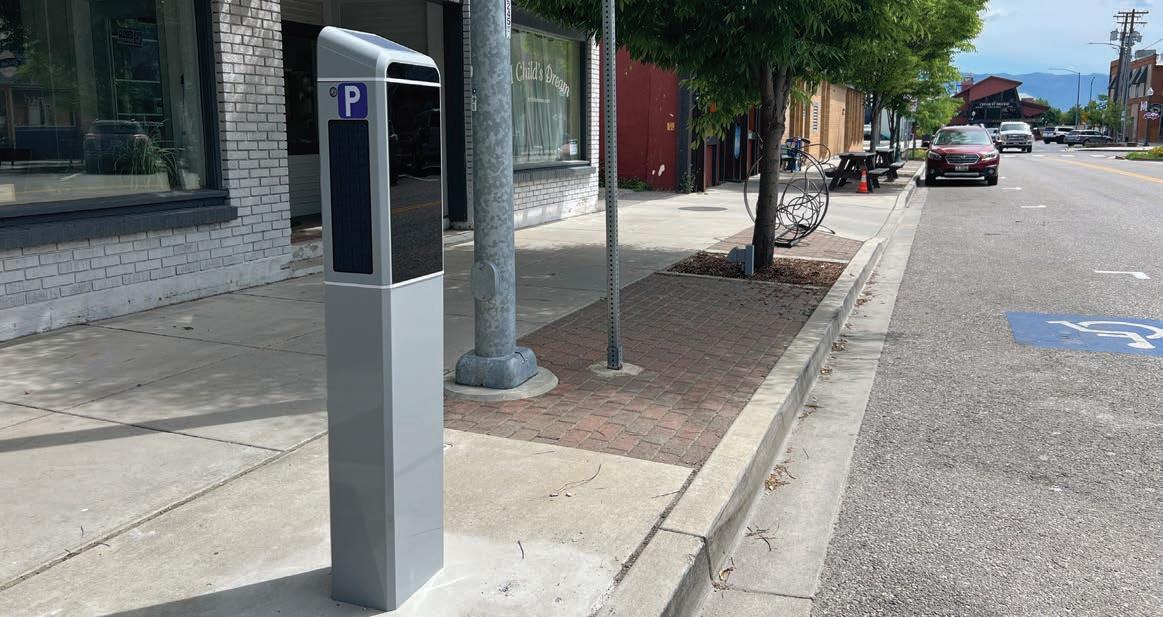
Top: One of the recently installed parking kiosks in Sandpoint. Photo by Soncirey Mitchell.
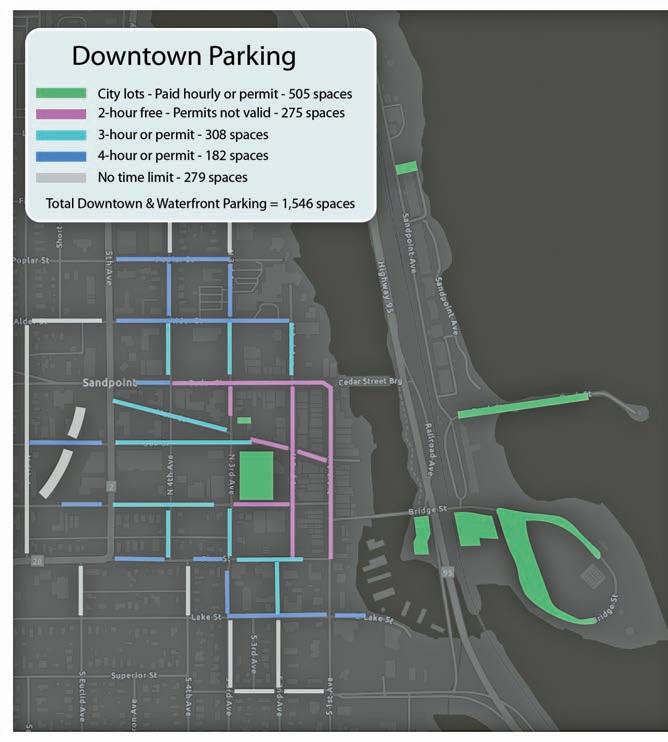
Above: A map of Sandpoint showing parking areas denoted by different color schemes. Courtesy image.
‘This is consent, but this is not informed consent’ PHD approves new informed consent policy at clinics
By Soncirey Mitchell Reader Staff
At its regular June 11 meeting, the Panhandle Health District Board of Health considered and approved a new informed consent policy, which seeks to define and solidify the process by which PHD providers receive consent for routine medical procedures. The motion, put forward by Board Member Duke Johnson, comes after months of campaigning by Bonner County Commissioner Ron Korn and PHD Board Chair Thomas Fletcher.
Though PHD maintains that obtaining informed consent is standard practice in its clinics, Johnson stated his motion defines “in essence, what was meant by ‘informed consent’” and outlines steps to ensure patient comprehension
and autonomy.
“This process shall include discussion of the nature and purpose of the proposed intervention, reasonably foreseeable risks and benefits, available alternatives and the consequences of declining the intervention,” said Johnson.
“The health care provider shall assess the patient’s understanding and provide information in a manner appropriate to the patient’s questions and level of comprehension.”
In addition to counseling by a licensed nurse practitioner or doctor — not a medical assistant, as is common — patients will also receive Food and Drug Administration-approved labeling, medication guides and “other patient educational materials” to supplement the current federally-mandated handouts, such as the Vaccine Infor-
mation Statements produced by the Centers for Disease Control and Prevention.
According to PHD Medical Director Gregory Pennock, “currently there is written informed consent for all procedures except vaccinations,” though anyone receiving a vaccine must sign an immunization consent form.
“This is consent, but this is not informed consent,” said Pennock, arguing that the form does not give adequate information or ensure the patient’s understanding.
Medical providers will now be required to tailor their explanations to the patient’s level of comprehension, whether that be at “an eighth grade level” or that of a post-doctoral researcher. Patients will then have time to process the information and ask questions before both they
and the provider sign the new informed consent paperwork, which will be entered into the medical record.
Board Member Glen Bailey, representing Bonner County, questioned how PHD will instruct its clinicians on informed consent practices, suggesting that the district could use artificial intelligence to tailor explanations to patients.
“My thought would be, they do it all the time throughout their professional career on a daily basis,” said Johnson. “That would be like saying, ‘How can we instruct people in construction to build buildings?’ I mean, this is what we do.”
Board Member Peggy Cuvala, or Benewah County, further cautioned her peers, stating that a legal opinion from March 2025 had in-
structed the board to “exercise caution” and ensure that it was not “practicing medicine” or “providing any kind of information that could be inconsistent with state law.”
The motion to adopt the new informed consent policy passed 5-2 with votes from Johnson, Fletcher, Bailey, Kootenai County’s Joel Noland and Shoshone County’s Melissa Cowles.
“This policy is consistent with and supplements the informed consent and parental consent statutes of the State of Idaho,” stated PHD Public Information Officer Jennifer Ekizian in a recent news release. “To our knowledge, this is the first time that a distinct informed consent policy has been implemented by any of the health districts of Idaho.”
New court date issued for Panhandle Bike Ranch dispute
By Soncirey Mitchell and Ben Olson Reader Staff
The ongoing land designation dispute between Bonner County and Panhandle Bike Ranch will go before First Judicial District Judge Regina McCrea on Tuesday, June 30 at the Kootenai County Courthouse (324 W. Garden Ave., in Coeur d’Alene). The hearing, initially scheduled for June 16, will include a ruling on the county’s cease-and-desist letter and the nonprofit’s ongoing operations.
PBR, located on more than 170 acres in Sagle, has bounced between courts and county boards since 2024. The property, zoned Rural 10, requires a conditional use permit for any commercial land uses, which founders Scott and Jennifer Kalbach received in 2024, authorizing them to build a commercial “recreational facility.” Neighboring members of the Five Lakes Estates community repeat-
edly appealed the decision, which the First Judicial Court of Idaho overturned in June 2025, finding that the county “failed to list facts supporting” the CUP’s approval. The Kalbachs then filed for and received federal and state recognition as a 501(c)(3) nonprofit, eliminating the organization’s commercial aspect, and began operations.
The nonprofit’s board later requested the county change PBR’s land designation from a recreational facility to a “park,” which is an allowed use in Rural 10 zoning and therefore does not require a CUP. Bonner County Revised Code 12-816 defines a park as a “noncommercial facility designed to serve the recreational needs of the residents of the community.” The Bonner County Planning Department and then-Interim Planning Director Alex Feyen denied the redesignation request and advised PBR to reapply for the permit. Rather than reapply, the nonprofit entered
into litigation with the county in January over its land use designation, later opening for the summer season in May, despite the absence of a legal ruling. On May 27, Bonner County ordered PBR to
suspend its operations “unless or until” the court rules in its favor.
The June 30 hearing will determine whether PBR must comply with the cease-anddesist letter.
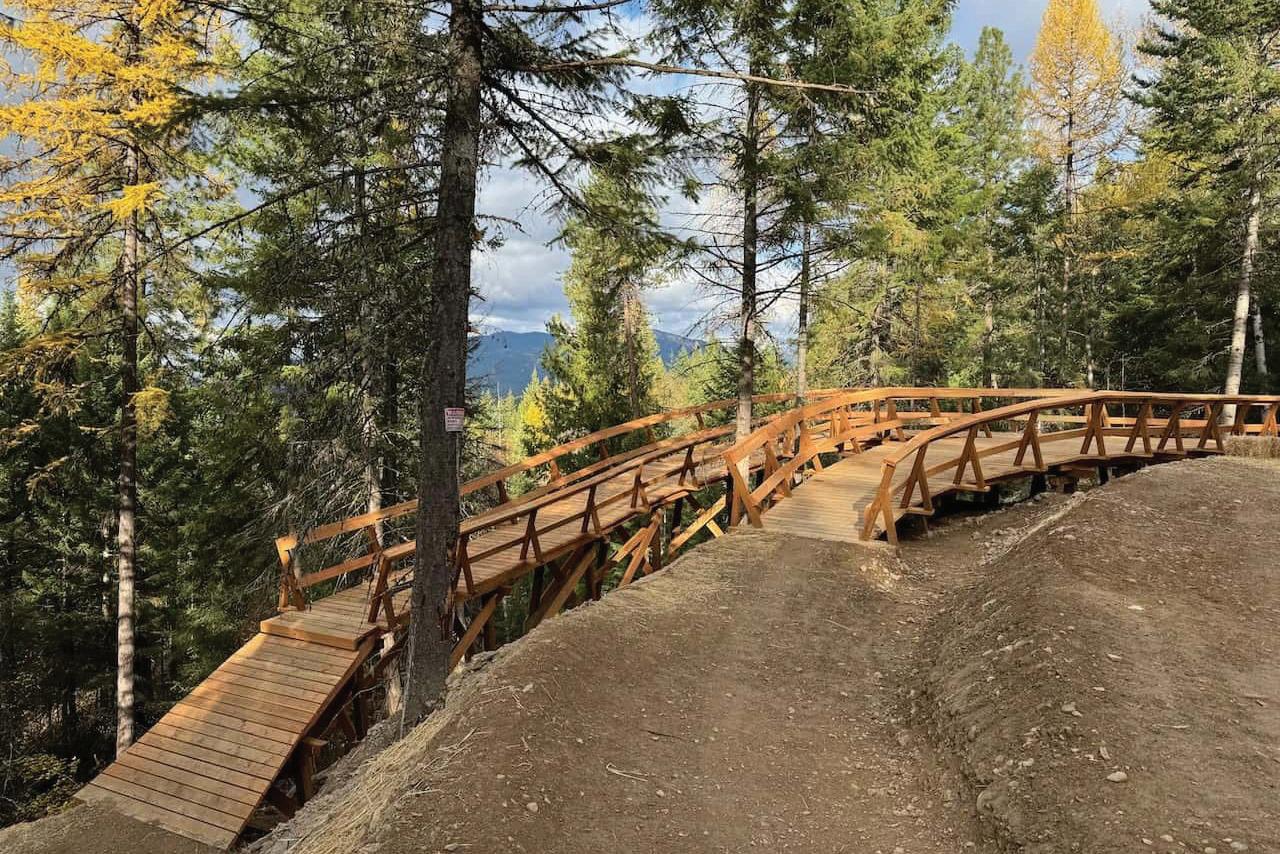
One of the trails at Panhandle Bike Ranch. Courtesy photo
Project 7B soliciting input on pedestrian Long Bridge closure
By Zach Hagadone Reader Staff
Following the closure of the Long Bridge pedestrian bridge in early June, nonprofit organization Project 7B, which advocates for responsible land use in Bonner County, has launched a community survey seeking information on how residents use — or want to use — the non-motorized span across Lake Pend Oreille.
“A survey is a way of collecting information in a less biased way so we can share that with the ITD, instead of predetermining what the demand is,” Project 7B Board Member Susan Drumheller stated.
The survey will run until Tuesday, July 7 and is available at bit.ly/LongBridgeSurvey.
According to Project 7B, no official study has yet been conducted to assess the impact of this closure and, though ITD is planning to launch a public comment period with an online portal that goes live on Wednesday, July 1.
The ITD Board will also meet in Coeur d’Alene on Wednesday, July 15 from 8 a.m.-5 p.m. Project 7B will then distribute the survey results to ITD officials as well as local county and city officials.
The Idaho Transportation Department blocked access to the pedestrian bridge following an inspection that revealed serious deterioration of the support structures undergirding the deck of the bridge, which was built in 1956 and closed to vehicle use in 1981 with construction of the current Long Bridge.
The closure is so far “indefinite,”
Bits ’n’ Pieces
From east, west and beyond
The Project on Government Oversight shared a recent report showing that 11 major defense contractors contributed close to $5 million to members of both parties of Congress serving on defense subcommittees in the first three months of 2026 alone. But, the Project told the Military Times, a dollar spent on defense creates “far fewer jobs than dollars spent otherwise.”
pending further investigation of its stability, but has for decades served as a connecting point for residents either as a commuter route or recreational amenity.
Project 7B asks generally how the pedestrian bridge closure is affecting community members, followed by specific questions related to why, when and how often they use the structure. In addition, the survey queries whether the recently established north-south Selkirks Pend Oreille Transit bus service across the vehicle bridge is an adequate solution to the lack of connectivity resulting from the pedestrian bridge closure.
Project 7B reported that nearly 400 people have taken the survey as of press time, and indicated that 30% of them use the pedestrian bridge “multiple times per week,” while 21% said they accessed the pathway weekly during the warmer months.
“Only 10% of respondents thus far have never used the path,” Project 7B stated in a news release. “Many respondents noted that closing the path makes traffic and parking worse, which is bad both for the city of Sandpoint and for private businesses.”
According to Project 7B, one commenter stated that the pedestrian bridge “feels like the heart of the area — the water and boats passing below, trains and cars bustling back and forth on each side, eagles and airplanes soaring overhead, the sunlight tracking through the sky. I love the energy and connection I feel when standing on the bridge, and it inspires me to be part of this community.”
For more info on Project 7B, go to project7b.org.
Agreements were signed last week to end the war on Iran, but that’s been complicated by Israel bombing Lebanon, threats from Iran to again close the Strait of Hormuz, and Trump threatening to seize and toll the strait — kill Iran’s peace negotiators. Axios called it Trump’s “messy peace,” and contrasting reports from Iran and the White House have described details in the “deal.” Iran is declaring “total victory.” Various media reported that sanctions against Iran will end, the nation can sell oil immediately on the world market, the U.S. will thaw frozen Iranian assets immediately, and plans will be made to repair damages from U.S. and Israeli strikes with at least $300 billion. U.S. costs so far have totaled at least $132 billion.
The New York Times asked, “What Changed After Almost 4 Months of War? Analysts Say Not Much.” Trump called that report “treasonous” and threatened to sue. He claimed Iran is now totally broken and “the U.S. Stock Market and Jobs are at record HIGHS.” But the war threatens U.S. economic stability. Trump’s military spending increase is twice the size of the Social Security shortfall projected for 2034.
Following House approval, the Senate voted 50-48 to pass a war powers resolution, showing disapproval for Trump’s war on Iran. The vote coincides with alarm over Trump’s “deal” with Iran, and the Pentagon asking Congress for another $80 billion to “backfill munitions and stockpiles,” according to the Associated Press.
A recent Reuters/Ipsos poll showed only 16% of U.S. adults think it was appropriate to hold a mixed martial arts fighting match on the White House lawn.
The U.S. Department of Interior is diverting at least $90 million from national park entry fees for Trump’s D.C. “beautification” projects, The Washington Post reported. The fees would normally be used to address maintenance issues, like road repairs, trails, bathrooms, visitor centers and historic buildings.
By Lorraine H. Marie Reader Contributor
Mother Jones reported that the U.S. Department of Justice’s new ICE protest indictment is the “most absurd yet.” Offenses justifying felony “conspiracy” charges include possession of a bullhorn, wearing clothing that says “antifa” and affiliating with Democratic Socialists of America.
According to NPR, war negatively impacts presidents’ approval ratings. During the Korean War, then-President Harry Truman’s ratings dropped 47 points. Former-President Lyndon B. Johnson’s rating dropped 43 points during the Vietnam War; and, after a helicopter crash in Iran, former-President Jimmy Carter’s rating dropped 27 points. During the Iraqi civil war, former-President George H.W. Bush’s ratings dropped 71 points and, after the Afghanistan withdrawal, former-President Joe Biden’s ratings dropped 13 points.
In a recent interview with Axios, Trump said, “I have one primary wish as president ... I never want to be the late, great Herbert Hoover.”
Blast from the past: Elected as the 31st president in 1928, Republican Herbert Hoover (1874-1964) appointed a cabinet of primarily wealthy conservatives. He hoped to banish poverty. But, less than a year in office, the stock market crashed. He’d been warned about the fallout if speculation was not curbed: It could trigger an immense financial catastrophe. But he did not take adequate actions. He also signed the Smoot-Hawley tariffs, now regarded as a blunder that worsened the Great Depression. Hoover looked to local governments and private giving to solve wide-spread suffering, rather than federal intervention. Unemployment was close to 23% by early 1932 when Hoover decided to cautiously try federal solutions. Due to a budget deficit, Hoover’s effort included new taxation, such as taxing top earners 63% of net income, eliminating corporate income tax exemptions and cutting personal income tax exemptions. The deficit remained. Hoover’s policies were reflected in terms like “Hoovervilles” (homeless encampments), and “Hoover leather” — a.k.a., cardboard to cover holes in shoe soles. The public was ready for new leadership; and, in 1932, Democrat Franklin D. Roosevelt, who, as governor of New York had provided aid for the needy, was elected president and went on to be elected to an unprecedented four terms and died in office in 1945.
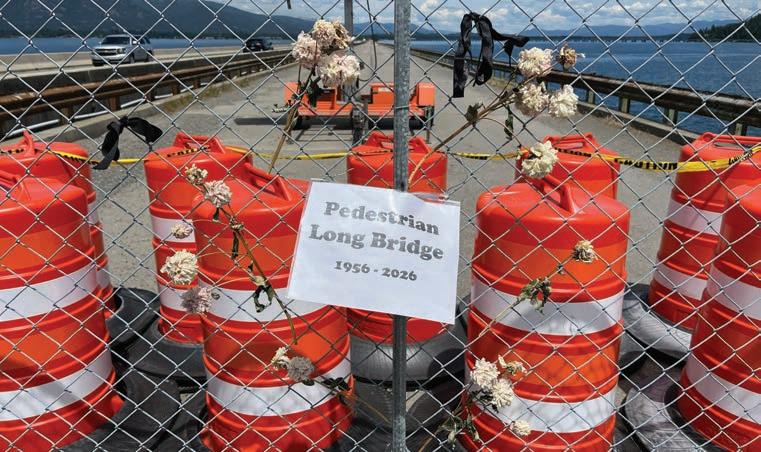
Barricades and a chain-link fence placed by ITD denoting the closure of the non-motorized portion of the Long Bridge, along with a sign and flowers placed by a community member. Photo by Soncirey Mitchell
New report finds tax cuts benefit highest-income Idaho households most
Lowest-income families have seen taxes increase due to changes since 2018
By Clark Corbin Idaho Capital Sun
A new report published this month by a Boise-based nonprofit organization found that state and federal income tax cuts have benefited the highest-income Idaho households the most, while low-income families are actually paying more.
The Idaho Center for Fiscal Policy published the findings in the new report, How federal and state tax cuts shift costs onto Idaho families and communities.
The report’s author, Policy Analyst May Roberts, tracked $4.5 billion in annual state and federal income tax cuts that Idaho households have received since 2018.
The report found that 73% of the benefits of those cuts went to the top 20% of households, defined as those that earn $143,000 or more each year.
The report also found that Idahoans with the lowest incomes — those earning less than $29,200 annually — saw their taxes increase by an average of $96 per year.
Balancing tax cuts and public services
The increase in taxes among the lowest-income earners was due, in part, to the Idaho Leg-
islature allowing the state child tax credit to expire and the federal One Big Beautiful Bill Act not extending premium tax credits that helped Idaho families and small business owners afford health insurance, the report stated.
“Tax cuts can be a valuable tool for helping families make ends meet, but it is important to look at who benefits and who bears the costs,” Roberts said in a written statement.
“A fair tax system can provide meaningful tax relief while maintaining the essential services Idaho families rely on. When tax cuts significantly reduce the resources available for public services, the costs do not disappear — they are shifted onto families and local commu-
nities through higher property taxes, rising tuition and fees, reduced services and growing barriers to accessing health care and food assistance.”
Sen. Scott Grow, R-Eagle, who serves as co-chair of the Idaho Legislature’s Joint Finance-Appropriations Committee, supports the tax cuts.
“I am a fiscal conservative,” Grow said. “As [certified public accountants], we try to help our clients to make sure they pay a fair amount of tax and not overly pay. What we are hearing from our constituents is that they are concerned about high taxes, whether it be property tax or income tax. We try to be very fiscally conservative. I believe in limited government. We
need to fund the government appropriately, and I feel like we do that.”
Report: Tax cuts exceed state investment in health care and education
The report also found that the combined $4.5 billion in tax cuts exceeds the Idaho Legislature’s Fiscal Year 2026 state funding for K-12 public education, colleges and universities and health and human services. The report said that for FY ’26, there was $2.2 billion in state funding for K-12 public education, $1.2 billion for health and human services and $492 million for colleges and universities.
After the Idaho Legislature cut funding for colleges
in universities in FY ’26 and ’27, the Idaho State Board of Education approved tuition increases, Idaho Education News reported.
“These examples illustrate how state-level budget cuts can shift costs to local governments and directly onto Idahoans,” the Idaho Center for Fiscal Policy’s new report stated.
More information about the Idaho Center for Fiscal Policy and its research is available online.
This story was produced by Boise-based nonprofit news outlet the Idaho Capital Sun, which is part of the States Newsroom nationwide reporting project. For more information, visit idahocapitalsun.com.
Bouquets:
GUEST SUBMISSION:
• “I would like to give bouquets and hugs to Cat, a volunteer, at the Sandpoint library. We had to take down two trees in our front yard so we put up a children’s library box. We searched high and low through the local thrift shops to buy children’s books but found none. So, as a final resort (before going online to buy new) I called the library and explained my plan. Cat (who answered the phone) said, ‘Look no further, I have lots of books my grandchildren no longer read!’ Within 90 minutes, she was at my house, as she had gone home for her lunch break, and sorted books! I have at least 100 books for all ages, so I hope children come see our book library at Second Avenue and Superior Street in south Sandpoint. Thank you Cat for sharing your love of reading and books with me. Now all we need are children to come by!”
— By Denise Plaza
Barbs:
• The nonsense going on right now at the Reflecting Pool in Washington, D.C. is idiomatic of the entire Trump presidency. Essentially, Trump found an imaginary problem, said only he could fix it, didn’t listen to any experts, hired his buddies (who grifted millions) on a no-bid contract to do the work, failed miserably, bragged about how great it went, and now blames Democrats and mysterious vandals for the problems that the pool is experiencing. His explanation for why the pool is now choked with algae and the blue coating he installed is now peeling away borders on delusional. He claims vandals with knives cut a 250-foot-long slit in the material. Later, he said it was 300 feet long and still later 350 feet. He also claims there are photos showing this vandalism, but when asked to show the photos for proof, he punted: “You’ll see it in court.” That’s right, he also claims he’ll sue ABC News because the network didn’t report on former-President Barack Obama’s renovation work done during his presidency. Meanwhile, federal officers are actually arresting tourists who kneel down and put their hands in the water while visiting D.C. The man is divorced from reality and holds the nuclear codes. Are we great again yet, folks?
PERSPECTIVES
Minority report: Forgive us our trespasses
By Dave Britton Reader Contributor
The Bonner County Republican Central Committee on June 16 held its first meeting since reorganizing after the primary election for the new session. Early in the meeting we took up whether our meetings would be recorded for later public access. Last session a ruling had been made to stop Washington Precinct Committeeman Tom Bokowy video recording the meetings, but the old prohibition no longer applied, and Bokowy was actively recording.
The committee reinstated the ban, only allowing the BCRCC secretary to video record meetings, and making them available to the public on the committee’s website, bonnergop.org, pending technical details being worked out for next month.
But the devil was in the details when Scott Herndon (former committee chair, re-elected P.C. and current candidate for District 1 state senator) demanded Bokowy stop recording immediately. Bokowy refused, standing on principle, because there were still no guarantees that the full, intact meeting recording would be made public and comments made during the amendments discussions clearly foreshadowed
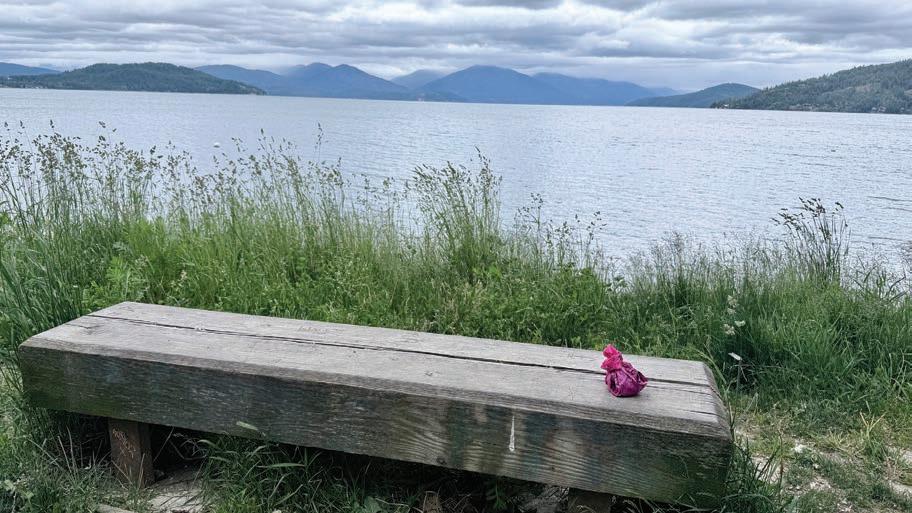
Poo with a view
Laura Phillips sent this photo (right) as a reminder for pet owners to clean up their bags of dog poo while walking on the Pend d’Oreille Bay Trail. Unfortunately, sights like this are a daily occurence on public walking trails. — BO
the likelihood that the recordings would be edited and bowdlerized if that was not explicitly prohibited, which would have to wait until next month.
On principle, Bokowy was refusing to trust the committee’s leadership to do the right thing: release the unredacted video publicly.
Biblically speaking, the snake in the Garden arrived when Herndon began rapidly citing lengthy sequences of citations and references to Idaho Code, other ordinances and Roberts
Rules of Order as if divine justification, disabling rational discourse since one cannot in the moment reasonably check the citations for their relevance to the matter at hand.
Like Eve, the committee was distracted from the core issue of “is this the right thing to do?” and was tempted by the taste of the apple’s power.
When presented with a confidently uttered strong assertion from an authority, with explicit pressure to act and temptation to be pleasing and winning, it is hard to resist. It’s a downside to democracy, that it can let a majority disrespect and even vilify the minority.
Tom stood fast for his principles and for his constituents, and all of us who understand that principled dissent see that it strengthens democracy.
But the snake’s temptation worked. The committee went into executive session, passed the motion “trespassing” Bokowy if he wouldn’t stop recording; called the police when he stood firm; and, after an hour or so of waiting around calling for directions about what to do, the police escorted him quietly from the premises. Score one for the apple.
Dave Britton serves as Beach Precinct Republican committeeman.
LETTERS
‘I am confused’…
Dear editor,
The U.S. forcefully quarantined 15 passengers from a hantavirus-infected cruise liner. None contracted the illness. Even before all
were declared disease-free, health officials said forced quarantine was overreacting.
In multiple states, measles outbreaks are raging. Health officials say they were preventable — and are avoidable in the future —- with vaccines. The CDC is not encouraging
vaccines and more outbreaks are predicted. There’s some logic here that I don’t understand.
Molly O’Reilly Sandpoint
Dave Britton. Courtesy photo
Water is our way of life, but it doesn’t protect itself
ICL’s water quality stewards are on the case
By Caitlyn Embree Reader Contributor
Lake Pend Oreille is the heart and soul of Sandpoint. If you live here, you recreate (and rely) on the water in one way or another. Summer is officially here, and the water is once again calling us toward it.
Water is our way of life in North Idaho — it’s how we connect and relate to each other, how we relax, recreate, meditate and center ourselves. Protecting this lake is one of the most important tasks we have at the Idaho Conservation League, and our Water Quality Monitoring Program plays a huge role in that effort.
ICL’s Water Quality Monitoring Program is a volunteer-based citizen science program, taking place on Lake Pend Oreille every summer. Over the past 15 years, the program has collected thousands of data points from water quality indicators — such as temperature, pH, dissolved oxygen, total phosphorus and more — which tell us about the health of the lake. This year alone, we will collect more than 500 data points. The program’s goals are to inform the public on the health of the lake, raise alarm over any concerning finds (like toxic algae or degrading water quality) and provide high-quality scientific data for regulatory agencies to use when making decisions that will impact our local waterways.
Though our lake is considered mostly clean and healthy, thanks to how large and deep it is, Lake Pend Oreille’s nearshore area was listed in 2002 as an impaired body of water due to mercury and phosphorus levels. As population growth spurs increased lakeside development, we will continue to see rising phosphorus levels, among other pollutants of our nearshore area. Not only is that area of shallow water highly important for aquatic life, it’s also where we all swim. ICL’s WQMP is working to establish an understanding of baseline conditions, so issues can be detected early before water quality is compromised. This way, we can proactively protect the water and keep the plants, fish and wildlife, and humans safe.
Meanwhile, two new stations have been added to the program this year; and, if you live in Sandpoint, you know why. Last year, Chuck Slough experienced a huge toxic algae outbreak, bringing it to the forefront of the community’s awareness. ICL added a new sampling station there this year, as well as a station at Trestle Creek, due to nearby shoreline development. Trestle Creek is highly important due to the bull trout spawning habitat. We are excited to begin monitoring these two sites and establish a baseline of water quality in these places to ensure they stay protected now and into the future.
In that spirit, the 2026 WQMP kicked off on June 16, with the first sampling of the season, marking the official start of the summer at the ICL Sandpoint office. A sunny, windy day made for a challenging sampling environment for our water stewards, but everyone made it out and collected their sample, and came back to the office with stories to share. From longtime to new stewards, the people make this program, and we are so lucky to have them.
There are three more sampling dates this summer, so if you see our stewards out on the water, be sure to say hello and thank them for their efforts to protect our lake and monitor the water.
The data collected by stewards allows us to advocate for Lake Pend
Oreille, so we can keep it swimmable, fishable and drinkable for all, for generations to come. As we continue this season, we will look for trends, outliers and notable observations to keep the community apprised of. Stay tuned for a summary of the 2026 data after the end of the season.
This summer, do your part in protecting our beloved lake.
Caitlyn Embree is the community engagement specialist with the Idaho Conservation League.
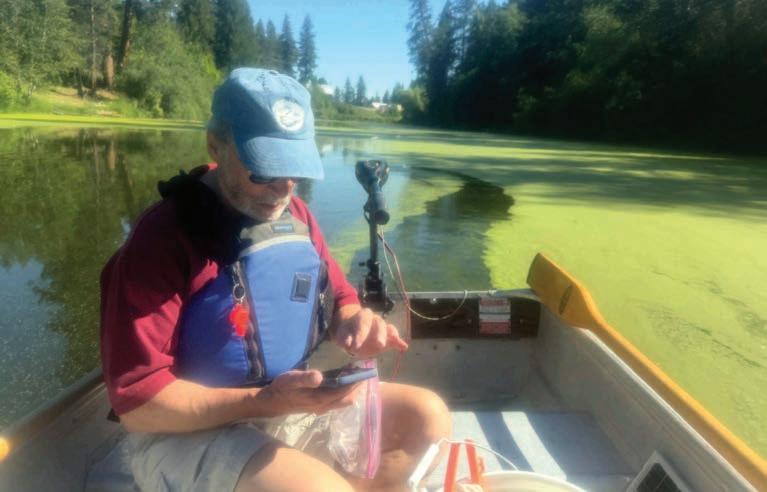
Laird Parry, ICL water steward, sampling Chuck Slough on June 16. Photo by Shawna Parry
Science: Mad about
By Brenden Bobby Reader Columnist
You probably haven’t put a lot of thought into the contents of your down comforter, or the luxurious throw pillows on your couch. They’re stuffed with feathers, so what? You can find half a dozen crow feathers on the side of the road walking from the library to Travers Park.
Feathers are an old biological adaptation, yet a relatively complex one in the way they function and are utilized.
Feathers are not simply made for flying, nor are all feathers useful for flight. The primary function of most feathers throughout evolutionary history has largely been for insulation.
Many birds, particularly in cool-weather climates, use down in exactly the same way humans use down blankets. The loose and fluffy feather structure is well-suited to trapping dead air as an insulation material, which keeps endothermic animals like humans and birds warm by trapping their body heat and not letting it escape into the open air. Down is an adaptation of the feather structure that is heavily varied from the slim blade-shaped feathers we often associate with birds.
Down is very loose and fluffy, designed to create space and air gaps, while typical blade-like feathers have tiny ridges that interlock and seal with oil to become waterproof. Both of these structures are different from protofeathers. Protofeathers are relatively rare to see today, as birds have gone through hundreds of millions of years of evolution to adapt to today’s climate, yet you can get a glimpse of
feathers
protofeathers every year at a farm and feed store like Carter Country, the Co-Op or North 40 Outfitters.
Baby chicks are covered in a form of down that closely resembles the protofeathers of ancient dinosaurs. They sport short, pointy hollow spike-like feathers that develop while the chick is in the egg, and even more once it has hatched. These feathers offer minimal protection from the elements — this seems counterintuitive at first glance, as chicks are extremely vulnerable to even tiny temperature fluctuations for the first two weeks of their life. However, they have evolved in a way that they are dependent on a fully grown hen’s developed down in order to survive.
Many evolutionary traits have a singular purpose or function they accomplish, having developed over countless generations to perform that task. Feathers have taken a different approach, often serving multiple functions that aren’t immediately apparent. Utilizing the parent’s feathers to warm offspring is one of these unexpected adaptations. Another is the ability to intimidate both predators and prey.
Early feathered creatures from the Cretaceous Period may have been incapable of flight, despite being covered from head to toe in feathers. Caudipteryx was a small, feathered dinosaur from the early Cretaceous, roughly 124 million years ago. It likely resembled the cross between a turkey and a velociraptor. Its arms, while feathered, were far too small to achieve flight, and the environment in which it lived was believed to be very warm, so what was the purpose of its feathers?
It’s possible that Cau-
dipteryx developed showy, high-contrast feathers in order to exploit a synaptic response in its prey, which were highly mobile insects like grasshoppers hardwired with a rapid-fire flight response when presented with surprising stimuli. Many insects to this day are wired this way, hiding in a spot until something frightens them and triggers a reflexive response to leap and flee. Humans aren’t well adapted to catching insects like this, and our response is often something similar: jumping in fright or becoming very alert for the presence of more insects. Birds, however, utilize scare tactics to frighten insects out of their hiding places and strike at them when they are out in the open. This is called flush-pursuit and is a foraging tactic still used by birds to this day.
Proving this on a 120 million-year-old cadaver is virtually impossible, but it stands to reason that this may have been one of the primary roles feathers provided on a bird in this kind of environment when it couldn’t fly. Over time, as insects evolved and became more agile, it’s likely that gliding and flight became a more appealing trait to avian dinosaurs, so feathers and arms evolved to match this need. Avian dinosaurs that were able to thrive naturally outcompeted those that could not, and so these adaptations and mutations grew into new species of dinosaurs, and later birds.
Over millions of years, feathers evolved to also communicate silently with other birds. Peacock feathers are the most obvious example by displaying intense colors to peahens in a mating display. Birds such as the
ruffed grouse will perform a rhythmic thumping with their feathered wings to serve as a call to other birds and potential predators.
Over time, feathers evolved into specialized shapes for specific functions. We are all familiar with the typical blade-shaped feather, but did you know they are actually asymmetrical? The asymmetry of the feather reduces force on the front-facing edge of
the feather which prevents the feather from twisting during flight. This gives the bird greater control in flight by allowing each feather to act as an individual airfoil, generating lift as air passes unevenly over the surface.
Who knows what we might look like if we manage to survive for 240 million years? Personally, I’m pulling for hot dog fingers.
Stay curious, 7B.
Random Corner
• Like the Olympics, the World Cup is held every four years. The first games took place in 1930.
• With five wins, Brazil has won the tournament more times than any other country. They are also the only country to have played in every single tournament since 1930.
• In 1966, the original World Cup trophy was stolen in London, and was found days later in a bush by a dog named Pickles.
• Further back, the vice-president of FIFA during World War II secretly hid the trophy in a humble shoebox underneath his bed. He feared the occupying troops would steal the solid gold prize. His trick successfully kept the trophy secret and it made it safely through the war.
• Though futbol/soccer isn’t a popular sport in the U.S., it’s widely recognized as the most popular sport around the world. The 2022 final between Argentina and France pulled in a staggering global audience of more than 1.5 billion viewers.
• The 2026 World Cup presented a huge logistical challenge, as it was hosted by Canada, Mexico and the United States. It also saw an unprecedented 48 teams participate.
• Soccer is known as a low-scoring sport. About a fifth of all matches worldwide end with the score 1-0. The second most common score is a draw at 2-1. One of the rarest scores in World Cup history (and also the most goals made in a single World Cup match) was Hungary’s 10-1 win over El Salvador at the opening group game in 1982.
• The official record attendance for a single match was 173,850 at the 1950 final between Brazil and Uruguay, though some sources claim the attendance was well over 200,000 people.
• Lionel Messi became the alltime men’s World Cup goal scoring champion June 22 with his 17th goal in the Argentina vs. Austria match.
By Sandy Compton Reader Columnist
Forty years ago, I brought a friend home who had grown up in a Texas city and never been to the Northwest. We drove north on I-15 to Butte, then west on I-90 to Missoula, then north on U.S. 93 through Evaro and Arlee to Ravalli, where we turned west on Highway 200. From there, we followed the Jocko River to its confluence with the Flathead at Dixon, and then drove down the Flathead to where it joins the Clark Fork at Paradise.
My friend watched the terrain change from basin and range to lava patches, sage meadows and agricultural fields in the Snake River Plain. She witnessed the long rise and fall over Monida Pass into Montana and the Beaverhead drainage, where the interstate traverses into a broad valley between rocky and forested ranges — the geological model of the rest of our route until the Clark Fork Valley begins to narrow between Drummond and Missoula.
She was a watchful type, and appreciative of the scenery we traveled through, but she didn’t say much until we got into the Clark Fork canyon between Plains and Thompson Falls. She looked at the cliffs rising abruptly on both sides of the river and asked, “What did this?”
It was a good question, but I didn’t know the answer. I’ve since learned a little. The cliffs of her curiosity were formed by glaciers and then further processed by huge masses of rushing water draining from glacial Lake Missoula.
Before the beginning of the end of the last ice age, ice carved the Clark Fork River canyon as well as the Bull River Valley. The results are exemplified by Flatiron Ridge at Thompson Falls, the giant slabs of open rock at the mouth of Thompson River, the cliffs where the ancient Bad Rock trail climbed the glacial cut on the north side of the river; and the peaks and cirques of the Cabinet Mountains Wilderness, the Scotchman Peaks and the Selkirk Mountains.
Evidence of the passage of ice and water is everywhere in the Clark Fork Valley and the Pend Oreille Basin. Lake Pend Oreille itself is a glacial
About geology and resistance
artifact; gouged deeper with each approach of the ice sheet. The Hope and Sunnyside peninsulas are monadnocks, chunks of stone the glaciers rounded off instead of shearing them flat. The lakes of the Cabinets and the Selkirks were scooped out by ice.
In the Cabinets are great slabs of Precambrian stone with scratches left by rocks carried by glacial passage. At the Clark Fork Delta is Johnson Point, an exposed stone cutting edge where the glaciers were divided by their own relentless progress. The right branch sheared off the face of the Green Monarchs and the left ground out the cliffs between Clark Fork and Montana and blocked the river to create a lake that was still hundreds of feet deep where Missoula is now. This lake filled and drained and filled again many times over the course of two millennia, during which the ice sheet proceeded and receded perhaps 50 times before finally melting away.
Ice is a fluid material. It flows around or over what it can’t break and bulldoze away. This and the resistance to glacial erosion of different sorts of rock is demonstrated at a spot in the high reaches of the Scotchmans. Millions of years ago, a near vertical crack formed in the subsurface sedimentary layers, and magma pushed into the fissure. It cooled slowly into a very fine-grained, black basalt.
Perhaps fewer than 25,000 years ago, a glacier peeled off the over-
lay and exposed that basalt. The ice levered great chunks out of the sedimentary stone but the basalt was not so cooperative. Its tiny grains must be plucked out one by one, and the ice was forced to flow over it, abrading it, surely, but leaving a wall in one place about eight feet high and very visible in contrast to the layers of gray-white sedimentary stone it resides in. It’s about six feet thick and composed of sand-sized crystals welded together by heat. Downhill of it, the rock has been sheared off, resulting in a long ramp following the sedimentary strata. Behind the wall is a depression from which the sedimentary stone was “quarried” by the glaciers, carried over the resistant basalt and swept away. The resulting basin is quite lovely. I’ve noticed lately that several places that had conspicuously displayed Trump banners no longer do so. I find this and other signs of resistance very hopeful. The millions of “little folks” who are appalled by Donnie Boy’s antics are like that basalt wall, combined in such a way that we will remain in spite of efforts to push us aside. Maybe, like I have since my friend’s question four decades ago, we have learned a little.
In addition to learning about geology, Sandy Compton has also been writing books for 40 years. His latest, Travel Compendium: Sixty-One Days on the Road in the West, is available at Sandpoint Books, bluecreekpress.com and amazon.com.
Sandy Compton. File photo
Tabula rasa?
By Tim Henney Reader Contributor
John McPhee of The New Yorker is one of America’s most gifted and celebrated authors, journalists and columnists. Just writing about him makes me nervous, because although he and I were both born in 1931, I am one of America’s least gifted and celebrated authors, journalists and columnists.
I don’t understand the cultural bias, because I have edited a kids’ summer camp newspaper, a college newspaper, a civic club bulletin, a military newspaper, a factory newspaper and several corporate house organs, most of which are defunct even though I edited them in New York just like The New Yorker articles by John McPhee.
John McPhee has written many famous books, and for decades has been a Princeton journalism professor. I have never written a book but once taught a journalism course at Pace University in New York (few have heard of Pace). A decade after retiring from the corporate world in 1986, I taught a course at Utah State University (few have heard of USU, either).
Inasmuch as all men are created equal, according to Thomas Jefferson, it seems to me that such social/ professional disparities ought not favor John McPhee so blatantly. Nor should the fact that he was awarded a Pulitzer Prize and is a Princeton grad. I was Spring Sing chairman at Long Beach State, known for beach volleyball
when I was there in the early 1950s.
As noted, John McPhee and I are both journalists and both approaching 95. We are equals. So why is he famous and I’m not? The New Yorker being The New Yorker, a recent McFee essay about unanticipated personal experiences is titled “Tabula Rasa.” According to Google, that means “no preconceived ideas or goals, a clean slate.”
Well, the following will be a North Idaho version of a John McPhee New Yorker column. But it will not be titled “Tabula Rasa,” because no one knows what that is. Before I checked Google, I assumed tabula rasa was some kind of Greek salad or fusion food, maybe something Aristotle and his pals tucked into. More fittingly, the following comments about two of my own unanticipated personal victories are titled “Undeserved Achievements.”
During the summers in the early 1940s, I was a camper at Camp O-ongo in California’s San Bernardino Mountains. A decade later, 1949-’50, I was cabin counselor, then tennis instructor. The co-ed camp was not church sponsored, but co-owner “Mother Preston” was a closet Baptist and had snuck a batch of pious songs into the songbook. O-ongo was a singing camp and she made sure we campers sang “I Come To The Garden” and “This Is My Father’s World” as vigorously as we did “We’re On The Upward Trail,” “Clementine” and “Waltzing Matilda.”
In 1951, with the Korean War in
full flower, I found myself in uniform in Albany, Ga., assigned to a USAF base newspaper. I joined the downtown Byne Memorial Baptist Church because that’s where Albany’s prettiest Georgia peaches hung out.
Unanticipated by me or anyone else, I did two wonderful things there. First, I told my squadron buddies about the Georgia peaches at church and they started attending. And, as the peaches applauded from rickety wooden stands under the lights, we Air Force quasi-Baptist jocks won the city’s slowpitch night softball league.
Second, thanks to repeated summers of Mother Preston’s efforts to keep us from perdition, as a newbie in the church choir I belted out classics such as “The Old Rugged Cross” with the fervor of a budding Billy Graham. As actor Richard Gere sang in the musical Chicago, “ya gotta razzle dazzle ’em.” And I did.
Truth was, I’d never spent much time in Sunday school or church. To me, Palm Sunday was something peculiar to Palm Springs. Yet, in gratitude for my righteous presence, gullible elders elected me president and choir leader of the BYU — not the university owned by Mormons, but the more hallowed (especially in Dixie), Baptist Youth Union. Before you could say “rubber baby buggy bumpers,” the fetching Peggy — a local peach who had piqued my original interest in Byne Memorial — started winking at me between hymns.
Having mastered political maneuvering as a pseudo-Georgia Baptist and home again in SoCal as editor of the Long Beach State campus newspaper, I took the art of deception to new heights. With fellow staffers, I attended the annual meeting of the California Intercollegiate Press Association in Sacramento. When we entered the enormous convention auditorium, the loudspeaker was pleading for nominees for CIPA president. Savvy student politicos from a member West Coast college — call it Cal Poly — had convinced the several hundred campus journalists and voters present that only the Cal Poly candidate had the wherewithal to be elected. It was a done deal. But they hadn’t counted on my
new pal, the sports editor from Long Beach State. Conveniently, as things turned out, I was on crutches recovering from a skiing accident a week earlier at, of all places, snowy milehigh Camp O-ongo. I had also served three recent years as an Air Force journalist during the Korean War. The sports editor, sitting next to me, asked, “OK if I toss in your name so these guys don’t get away with capturing the convention so easily?”
Seeing no possibility of affecting the vote, I said, “Sure, we don’t know anyone here — go ahead.”
So he said over the live mic that I edited the 49er at LBSC and was a Korean War vet. He forgot, however, to mention that I had spent the war dating pretty Georgia peaches and, not incidentally, had torn up a knee skiing at Camp O-ongo the week before. The loudspeaker then asked me to approach the stage where the lone candidate sat grinning with confidence.
As I hobbled down the aisle on crutches, possibly emphasizing the limp just a little, the auditorium erupted in applause. The answer to their prayers! Not just a common campus editor but an authentic war hero!
And even though I had no idea what the California Intercollegiate Press Association was or was supposed to do, I won the presidency in a landslide. Razzle dazzle ’em! Tabula rasa!
Tim Henney is a nonagenarian who, starting in 1951, edited an Air Force base newspaper in Georgia, a college newspaper in California and corporate publications in New York before retiring in 1986 as director of public relations of the original AT&T, parent company of the former Bell Telephone System, the world’s largest corporation at the time.
The author at work in the NYC corporate world,1986. His real job did not include producing and emceeing black tie musical galas for retiring board members. Unreal jobs were held at fabled NYC hotels like the Plaza and the Waldorf Astoria, shown in the photo above. Courtesy photo.
Dan Mimmack, 1955-2026
On Friday, May 29, 2026, Dan Mimmack took his last breath in this life, leaving behind a legacy of adventure, creativity, generosity, laughter and love that touched countless people.
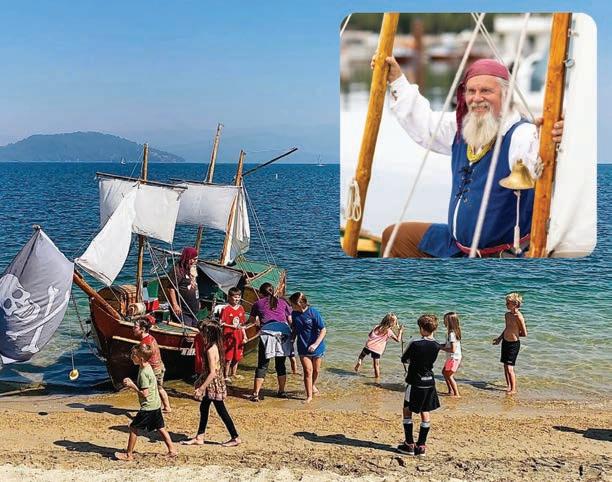
Many people in Sandpoint knew Dan as “The Pirate.” He delighted in bringing smiles to children’s faces and creating unforgettable experiences on the water. Through his beloved pirate boat, he gave many children — some who might never otherwise have had the opportunity — the chance to get out on the lake and simply experience joy. The ripples of those experiences spread far beyond what any of us may ever fully know.
Dan believed deeply in creativity and the power it had to change lives. One of his favorite sayings was, “Creative hands expand the mind.” Whether he was building furniture, crafting toys, creating experiences, or encouraging children to use their imagination, he was always looking for ways to inspire possibility in others.
Many homes throughout our community contain pieces of Dan’s craftsmanship. As a founder of Northwest Handmade Furniture in Sandpoint, he spent years creating beautiful furniture that will continue to be enjoyed for generations.
Dan was always dreaming, building, improving and bringing new ideas to life.
One of those dreams became the pirate boat. After finding an unfinished vessel in the Seattle area, he brought it home with excitement and determination to complete it. What began as a project became a passion and eventually a gift to the entire community. It was operated as a nonprofit for 14 years with a treasure chest filled with heartfelt stories and experiences.
Dan lived life wholeheartedly and brought laughter wherever he went. His spirit of giving was often quiet and behind the scenes, finding ways to help others without seeking recognition.
As the years went on, Dan faced Alzheimer’s disease with
the same courage and determination that he brought to everything else in his life. Yet he never allowed himself to be defined by a diagnosis. Rather than living in that label, he chose to share his experiences openly with Alzheimer’s communities and others walking similar paths. He offered encouragement, understanding and hope to many people. Even during his own challenges, he continued finding ways to serve others.
So many beautiful souls supported Dan over the years with extraordinary kindness, friendship, care and love. Please know how infinitely grateful we are for each of you. Your support meant more than words can express. We love you all.
We are grateful that the pirate boat and its mission will continue. Mike Elliott will carry forward the role of captain, helping ensure that future generations of children and families can experience the same joy, wonder, laughter and adventure that Dan loved to share.
Chamber welcomes Sprig Herbals
By Reader Staff
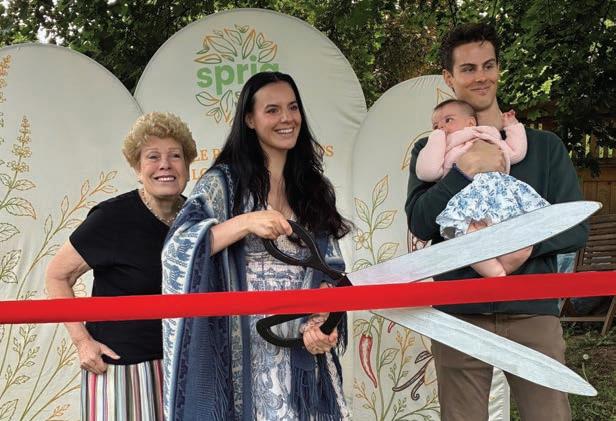
The Greater Sandpoint Chamber of Commerce welcomed the newest business to its ranks, Sprig Herbals, with a June 6 ribbon-cutting ceremony. The Sandpoint-based herbal supplement company specializes in handcrafted whole-plant extracts and loose-leaf teas.
Sprig Herbals began as a cottage business in January 2025, before transitioning into a commercial kitchen. Herbalist Victoria Thorburn founded the company, which creates “flavor-forward” herbal extracts to supplement coffee, tea, mocktails and desserts, and fulfill other cooking and baking needs. Dubbed “functional flavors,” the extracts are intended to go beyond “syrups, sweeteners and vague
‘natural’ flavoring,” making herbs approachable and easy to incorporate into everyday food and drink.
Thorburn’s work is based on formal herbal study, apprenticeship and more than 500 hours of herbal education. The company also utilizes
The community is invited to share with a celebration of life with us on Sunday, July 12 at City Beach Pavillion, 2 p.m. In the spirit of creating memories, the Wind Spirit will be docked nearby to commemorate Dan’s passion for offering opportunities for children of all ages to experience joy
In place of flowers, those who feel called to honor Dan’s memory may contribute through TruSelf Passage at truselfpassage.com. Donations will support getting sails for the Wind Spirit, as well as assisting families in need and continuing the spirit
of generosity, adventure and community service that Dan embodied throughout his life.
May his memory inspire each of us to live as fully as we can, to embrace adventure, to create, to laugh often, to love boldly, to support one another and to make memories that matter.
Submitted, in deepened gratitude, by Pamela Mimmack (wife), Laurie and Greg Huston (stepchildren) and Elissabeth Defreitas (honorary sister).
Ponderay Neighbor Day seeks vendors, sponsors
The much-anticipated Ponderay Neighbor Day will return for its 10th annual celebration Saturday, Aug. 29 — but before the party can get started, organizers are looking for local vendors and sponsors. Funds go to support the day’s free activities, which serve approximately 500-700 people.
tured prominently on marketing materials and around the Neighbor Day grounds.
“This event would not be possible without the generous support from our local businesses, vendors and residents,” wrote organizers. “Becoming an event sponsor is simple and your donations are tax deductible.”
third-party lab testing to certify its extracts.
For more information, or to view the store, visit sprigherbals.com.
Neighbor Day features live music, a beer garden, kids crafts, carnival games, inflatables (like bounce houses) and retail and food vendors — in other words, something for the whole family. Vendors and sponsors receive a full promotional campaign and will have their names and logos fea-
To become a sponsor or vendor, visit cityofponderay. org/ponderay-neighbor-day, fill out the corresponding form, and return it to Ponderay City Hall (288 Fourth St.) or email it to ponderay@ponderay.org.
Vendors must also submit a $50 vendor deposit, which will be refunded at the event check-in.
By Reader Staff
Chamber Executive Director Joan Urbaniak with Victoria Thorburn, Grant Thorburn and Baby Alexandria. Courtesy photo
Courtesy photos
BoCo Human Rights Task Force announces 2026 scholarship winners
By Reader Staff
The Bonner County Human Rights Task Force announced this year’s six winners of the Darby and Amber Campbell and Erik Robin Bruhjell Memorial Scholarships, which are awarded to local graduating seniors from any public, private, charter or home school.
The recipients of the Darby and Amber Memorial Scholarship are Dylon Jeck, Mary Mills, Kendra Bangeman and Hazel Keating, while Olivya Caldwell Vineyard and Aurora Lane won the Erik Robin Bruhjell Scholarship.
The BCHRTF received a large
number of participants this year, and volunteers had to choose between many quality submissions.
The purpose of the BCHRTF scholarships is to support local seniors as they pursue the post-secondary education of their choosing with a focus on human rights issues.
“The task force believes the community’s social and cultural diversity — including that of students — makes Bonner County a rich and worthwhile place to live,” organizers stated.
“We are honored to assist these students as they embark on their post-secondary educational journey,” BCRHTF added in a news release.
Sri Chinmoy Oneness-Home Peace Run carries a torch for harmony
By Reader Staff
The world’s largest grassroots torch relay, the Sri Chinmoy Oneness-Home Peace Run, returns to the shores of Lake Pend Oreille on Sunday, June 28. An international team of volunteer runners will carry the event’s Peace Torch into Sandpoint around 3 p.m. before continuing the journey through the Inland and Pacific Northwest.
The global relay crosses social, cultural and political boundaries in an effort to foster international peace. The torch has been passed from hand to hand through more than 160 nations since the run’s inception in 1987.
“The runners do not raise money or highlight political causes; their goal is simply to cultivate a shared expres-
sion of peace in every community they visit,” wrote organizers.
The Peace Torch first visited Sandpoint in its inaugural year, 1987, and returned in 1989, 2005, 2010 and 2012. The most recent runners that left from Sandpoint were an international women’s team, which headed for Western Montana on the July 2024 Trans-Continental Route. This year’s runners hail from across Europe, Asia and the Americas. They will meet with locals, youth and city representatives, passing around the torch and, with it, wishes for world harmony.
“Peace is not merely the absence of war,” founder Sri Chinmoy once said. “Peace is the presence of harmony, love, satisfaction and oneness.”
Visit peacerun.org to learn more.
West Fork Cabin community cleanup day scheduled
By Reader Staff
The Friends of Boundary County Historic Places is hosting a community cleanup day at the West Fork Cabin an hour outside of Bonners Ferry. Volunteers interested in helping can meet at 8:30 a.m. on Saturday, June 27 at the Three Mile Corner Station (510311 U.S. 95, in Bonners Ferry), or at 9:30 a.m. at the trailhead (limited parking available).
Volunteers will help with a variety of tasks, including carrying supplies to the cabin, packing out trash, washing walls, fixing whatever is broken, cleaning the fire pit and more. Everyone is welcome and no skills are needed to participate.
Bring water and a lunch, as well as mosquito repellent. Long pants and sturdy shoes or boots are recommended.
Call or text Pat Hart for more information at 208-597-5789.
Summer Sampler celebrates Sandpoint’s diverse flavors
By Reader Staff
The Greater Sandpoint Chamber of Commerce is once again celebrating the best of local food and drink with its annual Summer Sampler on Thursday, June 25. Area restaurants, caterers, brewers, vintners and more will gather at Farmin Park near the intersection of Oak Street and North Fourth Avenue from 5-8 p.m. to showcase their flavors.
“This has always been one of the most popular events here in Sandpoint, filled with folks who look
forward to the opportunity to sample epicurean delights from our many talented local chefs,” wrote organizers.
Attendees can taste their way through the park, enjoying small bites and sips while listening to live Americana music provided by Mattox Farm Productions. Plus, giveaways, raffles and more make the event enjoyable for the whole family. Tickets are $1 for one taste, $5 for five, $10 for 10 and a raffle ticket, and $20 for 20 and two raffle tickets.
Visit SandpointChamber.org to learn more.
Mobile planetarium brings the stars to Sandpoint and Clark Fork
By Reader Staff
Budding stargazers and longtime astronomy buffs alike are invited to visit the Mobius Science Center Planetarium, which will bring its mobile hands-on exhibits and STEAM learning experiences to Sandpoint and Clark Fork on Saturday, June 27.
First, from 9 a.m.-10:45 p.m., the Spokane-based nonprofit will set up at the Sandpoint library (1407 Cedar St.); then, from 1:15-2:30 p.m., it will move to the Clark Fork Filling Station (108 E. First Ave.).
Attendees can step inside the mobile planetarium for “a 360-degree journey where space, Earth and biology come to life,” organizers stated. Space is limited, and advanced registration is required at ebonnerlibrary. org under the “events” tab.
Shows run for 30 minutes and each has a different theme. Participants are asked to choose and register for one show time, and each person must have their own ticket.
According to the Mobius Discovery Center, the mission of the organization is to offer “a unique continuum of experiential learning that cultivates critical thinking and problem-solving abilities — foundational skills that create lifelong learners” through field trips, educational workshops, outreach experiences, birthday parties, classes and afterhours adult events.
Learn more at mobiusdiscoverycenter.org.
Sandpoint library organizes Spanish language social gathering
By Reader Staff
The Sandpoint branch of the East Bonner County Library is taking over MickDuff’s Beer Hall (419 N. Second Ave., in Sandpoint)) on Friday, June 26 for a Spanish language social gathering that gives enthusiasts the opportunity to hang out and practice their linguistic skills.
The get-together runs from 5:307:30 p.m. in the beer hall’s garden and will include free, Mexican-inspired small bites. Organized by library volunteer Jeffrey Calderon, who was born in San José, Costa Rica, the casual gathering is a place to socialize with fellow Spanish-speakers, share travel stories and immerse yourself in the language. Calderon has taught Spanish for travelers and Spanish for beginners at the library, and now provides private tutoring sessions, so feel free to ask him questions and get advice.
For more information on the free event, visit ebonnerlibrary.org/events.
Courtesy image
The Summer Sampler. Courtesy photo
Using ‘what the good Lord gave’ him
By Soncirey Mitchell Reader Staff
SHS Choir Teacher Jon Brownell retires after nearly 40 years
It’s a bittersweet summer for thousands of Bonner County graduates across three different generations, as the one teacher who united them all — Jon Brownell — has retired after 37 years with the Lake Pend Oreille School District. The esteemed choir teacher began his career right here in Sandpoint in 1989, introducing K-12 students to the joys of music and inspiring future singers, instructors and musical aficionados.
“No other teacher has taught for more than 37 years in this district. And I really think that it’s because I loved it here,” Brownell told the Reader. “I loved what I did, and you know, the old adage is, ‘Find what you love to do; you’ll never work a day in your life.’ That’s been me.”
Brownell knew music would be his life from an early age, and it helped that his passion went hand in hand with natural talent. From childhood through his high school and college years, his teachers identified and fostered his gift, setting him on his future path as not just a musician, but an educator.
“I just used what the good Lord gave me,” he said, later adding, “When I was in high school, my choir director would have me warm up my peers. I played warm-ups on the piano, and then he would take them, and I knew then that that was what I was going to do.
“He was a great role model, too. I had a great choir teacher in high school, and then when I went to college, I had a premier, nationally renowned professor, Dan Bukvich, and so between those two guys, it just spurred me on and inspired me to want to become what I became.”
He attended the University of Idaho, where he was introduced to the genre that would deepen his love of music and define much of his career: jazz.
“It opened a whole new door to me and I just sponged it up,” he said. “I was so hungry for it, and I loved it.”
That makes sense, since the UI Lionel Hampton School of Music is named after the great jazz bandleader, vibraphonist and percussionist — and was the first American university music school to bear the name of a jazz musician. It shares the name with the university’s annual jazz festival, at
which Brownell’s students would go on to win their division in Senior Vocal Sweepstakes “pretty much every year.”
Straight out of college, Brownell moved to Bonner County to begin his teaching career, back when the Sandpoint Middle School building housed the high school, and the district still had a special sixth-grade center. Brownell taught at both, along with just about every other school in the district at the time: Farmin-Stidwell, Sagle, Northside and Washington elementaries.
“When I was teaching at the high school — which is now the middle school — I remember being in the parking lot and looking over through the trees, watching them build the school, which is now the high school,” he said.
The current Sandpoint High School building opened in 1991.
During his tenure, Brownell led SHS choirs on myriad musical journeys to competitions and performances from New York to the Bahamas — almost always coming home with resounding victory and a new plaque for the school’s walls. He inspired great
passion in his students, even managing to lead a large men’s choir at SHS for years, which is a rarity among high schools.
“Students don’t care how much you know until they know how much you care,” Brownell told the Reader
Clearly, Brownell cares a great deal. Taking over his position at SHS will be current SMS choir teacher Sigrid Ribeiro, who has taught music classes throughout the district for more than eight years. Though Brownell plans to enjoy much of his retirement from his boat, he isn’t quite ready to give up teaching altogether, which is why he will take over one period a day at Valor Christian High School for the 2026-’27 school year.
When asked if he had any parting words after nearly four decades with the school district, Brownell said simply: “Enjoy what you do; it could take you places you’ve never dreamed of.”
Jon Brownell holding the the Lionel Hampton Jazz Festival winning trophy for the 2020 Senior Vocal Sweepstakes. Courtesy photo
Send event listings to calendar@sandpointreader.com
Summer Sampler
5-8pm @ Farmin Park
Sandpoint’s finest restaurants and caterers present samples of their best bites
Live Music w/ Liam McCoy and Friends
7pm @ Eichardt’s Pub
Live Music w/ Bridges Home
5-8pm @ Pend d’Oreille Winery
Live Music w/ Kosta La Vista
5:30-8:30pm @ Smokesmith BBQ
Live Music w/ The Bakerwood Brothers
8-11pm @ Eichardt’s Pub
Live Music w/ Eleven Strings
6-8pm @ Idaho Pour Authority
Live Music w/ Plastic Owls
8pm @ Eichardt’s Pub
Live Music w/ Liam Russell 9pm-midnight @ 219 Lounge
Live Music w/ The Cole Show
5-8pm @ Pend d’Oreille Winery
Live Jazz w/ Bright Moments
6-8pm @ Arlo’s Ristorante
Live Music w/ Hoodoo Udu
5:30-8:30pm @ Smokesmith BBQ
Live Music w/ Headwaters
6-9pm @ Blue Heron Cafe
Live Music w/ Scott Taylor
6-8pm @ Idaho Pour Authority
Sandpoint Chess Club 9am @ Evans Brothers Coffee
Magic with Star Alexander 5-8pm @ Jalapeño’s
Monday Night Blues Jam w/ John Firshi
7pm @ Eichardt’s Pub
Outdoor Experience group run
6pm @ Outdoor Experience 3-5 miles, all levels welcome
THURSDAY, june 25
Murder Mystery: W.T. Trailer Park BBQ
5:30pm @ Barrel 33
$30. Get into character in this themed murder mystery. barrel33sandpoint.com
Live Music w/ Sheldon Packwood 6-8pm @ MickDuff’s Beer Hall
FriDAY, june 26
Terrapin Flyer in concert (Night 2) 8pm @ The Hive
Playing the music of the Grateful Dead
Live Music w/ Carson Floyd
6-9pm @ Barrel 33
Music w/ DJ Sterling 9pm @ Roxy’s Lounge
Live Music w/ Mason Van Stone
6-8pm @ Baxters on Cedar
SATURDAY, june 27
A Night at the Improv 8pm @ The Hive
Seated event with comedy, hijinks and mayhem by LPO Repertory Theatre
Mobius Science Center Planetarium
Various @ Sandpoint / Clark Fork
A mobile planetarium staged at Sandpoint library (9-10:45 a.m.) and Clark Fork Filling Station (1:15-1:50 p.m.)
Monarch Grind: gravel bike ride See panhandlegravel.com for more info
Live Music w/ Carli Osika
6-8pm @ Connie’s Lounge
Live Music w/ Chris Paradis 6-9pm @ MickDuff’s Beer Hall
SunDAY, june 28
Community picnic at the Healing Garden 11am-3pm @ BGH Healing Garden Games, kids’ crafts, music, food
Live Music w/ Lynda Ryan
3-4pm @ Idaho Pour Authority
monDAY, june 29
Beginner Cuban salsa and rueda series 6-7pm @ Sandpoint Community Hall Email deniseellendance@gmail.com
Trivia w/ Ben Olson
6-8pm @ Idaho Pour Authority
tuesDAY, june 30
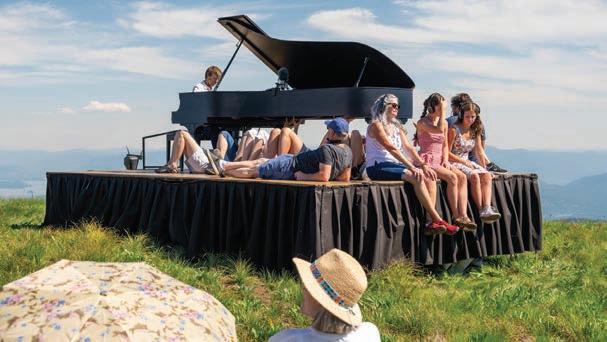
In a Landscape: Classical Music in the Wild • 3-4:30pm @ Schweitzer Featuring pianist Hunter Noack performing on a 9-foot Steinway grant with audio delivered via headphones to guests on the mountain. See Page 21
Bel Canto Opera presents: Singvergnügen
7pm @ Little Carnegie Hall, MCS
See Page 21
World Cup watch party
5pm @ Matchwood Brewing Co.
Watch the USA team on the indoor big screen. Family-friendly
Live Music w/ Liam McCoy and Friends
7pm @ Eichardt’s Pub
wednesDAY, july 1
Aster After Hours
5-7pm @ Aster Garden Center
With live music from Harold’s IGA, beer, wine, food trucks, artist vendors, flash paint sale and folk school crafts.
ThursDAY, july 2
June 25 - July 2, 2026
Terrapin Flyer in concert (Night 1) 8pm @ The Hive Night 1 of a two-night show, playing the music of the Grateful Dead. Wave That Flag U.S. Summer Tour
Live Music w/ Ian Newbill 5-8pm @ Pearl’s on the Lake (Hope)
SASi montly breakfast fundraiser 8:30am @ Sandpoint Senior Center RSVP: 208-263-6860. $10/person
Live Music w/ Angelina Adams 6-8:30pm @ Matchwood Brewing Co.
Live Music w/ Sydney Dawn 5-7pm @ Connie’s Lounge
Live Music w/ Chris and Kristi 6:30-9:30pm @ MickDuff’s Beer Hall
Sandpoint Farmers’ Market 9am-1pm @ Farmin Park
Local produce, art, live music and more
Cribbage tournament ($10/$15 entry) 12pm @ Eagles Club, 1511 John Hudon Ln. Drop-in country swing dance class 6-8pm @ Barrel 33 $15/person. 208-920-6258 for info
Live Music w/ Ian Newbill 6-9pm @ Barrel 33
Live Music w/ Angelina Adams 6-8:30pm @ Matchwood Brewing Co.
Live Music w/ Brian Jacobs 6-8pm @ Baxters on Cedar
BCA 8-ball weekly pool tournament 12pm @ Roxy’s Lounge Music w/ DJ Sterling 9pm @ Roxy’s Lounge
Live Music w/ Fiddlin’ Red 104pm @ Barrel 33
East Coast swing lessons 7pm @ Danceworks Studio Hosted by Muffy Nye. $15/person
Live trivia w/ Toshi 7pm @ Connie’s Lounge
Live Music w/ John Firshi 5-7pm @ Pend d’Oreille Winery
Open mic/jam 5-9pm @ Idaho Pour Authority
Eurythmy performance of ‘The Nightingale’ 5:30pm @ Sandpoint High School auditorium A performance of Hans Christian Anderson’s timeless story. $30/$15
Sandpoint Farmers’ Market 3-5:30pm @ Farmin Park
1776: The Musical (July 2-5) • 7pm @ Panida Theater
Celebrate the 250th anniversary of American independence with this special show by Honey Pearl Productions featuring John Adams, Benjamin Franklin and Thomas Jefferson navigating the struggles of birthing a new nation. $25
Celebrate the 250th anniversary of the U.S. with 1776: The Musical at the Panida
By Zach Hagadone Reader Staff
There are few stories in human history more captivating and complex than the establishment of the United States of America. As the nation prepares to celebrate its 250th anniversary on Saturday, July 4, Honey Pearl Productions is bringing 1776: The Musical for a multi-day run at the Panida Theater (300 N. First Ave., in downtown Sandpoint).
With music and lyrics by Sherman Edwards, and the
book written by Peter Stone, 1776 debuted on Broadway in 1969 and went on to 1,217 performances, a Tony for Best Musical and a Drama Desk Award for Best Book.
The story dramatizes the already dramatic days preceding the signing of the Declaration of Independence — specifically focusing on the role played by John Adams (who went on to serve as the first U.S. vice president and second president) in convincing his fellow “Founding Fathers” to sign the document and launch the effort
for American independence — with all the wordsmithing, wit, conflict and big personalities that were involved.
Placing audiences in the sweltering summer of 1776 in Philadelphia, actors bring to life characters such as Adams, Benjamin Franklin and Thomas Jefferson.
Showtimes are Thursday, July 2; Friday, July 3 and Saturday, July 4 at 7 p.m.; and Sunday, July 5 at 3 p.m. Doors open 45 minutes before the performances, and tickets to the two-and-a-half-hour
Angels Over Sandpoint hosts community picnic Serve Sandpoint event attracts 440 volunteers
By Reader Staff
Local nonprofit Angels Over Sandpoint will host a community picnic Sunday, June 28 from 11 a.m.-3 p.m. in Bonner General Health’s Healing Garden (600 N. Third Ave., in Sandpoint). The event includes games, food, live music and a silent auction to raise funds for the group’s charitable efforts.
Proceeds will benefit the organization’s myriad initiatives, including its Back to School Program, which dis-
tributes backpacks full of school supplies to more than 1,000 local children each year.
Attendees at Sunday’s picnic can participate in bingo, cornhole and guessing competitions, as well as a musical bake walk. There will also be an ongoing raffle and silent auction to peruse while enjoying Greek fare from the Opa Food Truck and live music with pop-country singer Carli Osika.
Visit angelsoversandpoint. org for more information.
By Reader Staff
Cedar Hills Church, Better Together Animal Alliance, Humble and Black Real Estate and other community partners and volunteers came together June 14 for the annual Serve Sandpoint event — a day dedicated to service projects in the area. 440 volunteers took on 19 different tasks, including the Good Neighbors Fencing Project, which sought to help pet owners keep their animals safe in their yards.
Volunteers processed and stacked 16 cords of wood for the Sandpoint VFW Post No. 2453, moved garden beds and prepped walls for paint in the Bonner Community Food Bank’s new building, did yard work for Bonner Homeless
New Kaniksu Community Health partnership to expand access to care
By Reader Staff
Kaniksu Community Health announced a new partnership with Tim Bonine — formerly of Mountain View Family Medicine — a comprehensive primary care provider with more than 30 years of experience. Bonine will conclude his current practice Friday, July 17, and begin seeing KCH patients Tuesday, Sept. 1.
“This transition comes af-
ter 24 wonderful years in private practice,” stated Bonine. “We are excited to partner with Kaniksu Community Health, an organization that shares our commitment to high-quality, personalized care and deep community connection. Most importantly, we’re pleased that our patients will have the option to continue their care with me at Kaniksu if they choose.”
According to a recent news release, the partnership
is intended to increase access to primary care services and trusted, local medical providers for the area’s growing community.
“We are truly honored to welcome Dr. Bonine to our team,” stated KCH CEO Kevin Knepper. “His longstanding relationships, clinical expertise and dedication to this community make him an incredible addition — not just for Kaniksu, but for the entire region. This transition
Transitions, held a fundraising carwash for Kaniksu Community Health, gardened and built a bridge at Pine Street Woods, built three dog fences for area pet owners and more throughout the day. Each project took a physical and financial burden off of local nonprofits and families in an effort to
is a win for our patients, ensuring continuity with a provider they trust while expanding access to care for our growing community.” Scheduling information is forthcoming. Contact Kaniksu Community Health at 208-263-7101 or visit kchnorthidaho.org for more information.
strengthen community ties.
“I just love this day and partnering with so many wonderful organizations in our community — just another example of us all working together to celebrate and strengthen our beautiful community,” stated volunteer Michele Murphree.
production are $28. Get tickets at the door or panida.org.
Courtesy image
Volunteers construct a fence for the Good Neighbors Fencing Project. Courtesy photo
By Marcia Pilgeram Reader Columnist
Last week we were soaking up the late afternoon sun along the banks of the water flowing past our favorite table at the Pack River Store. We were there for an early dinner; and, as always, my creature-of-habit order was a Reuben sandwich with fries and a side of fry sauce. I have loved fry sauce since I was an unruly kid in Helena, Mont., hanging out at the Arctic Circle drive-in. Sharing a bit of food history with granddaughter Fern, I told her that fry sauce was invented in Utah by the founder of the Arctic Circle chain back in the ’40s.
“Mimi, you told me that you invented fry sauce,” declared Fern.
I explained that while it’s my favorite condiment and I often make up a little batch at home, I certainly did not invent it.
“Well,” she argued, “you told me you did.”
There was no convincing her that she had quite possibly overstated a comment I made years ago about whipping up a home batch of fry sauce. That’s how food lore (and lies and embellishments) begin, folks.
Take the margarita. On the popular podcast, The Sporkful, a woman grew up believing her aunt invented the margarita. She was so convinced that she set out to prove its provenance, only to discover it was nothing more than family lore.
Culinary legends can be traced to families, restau-
The Sandpoint Eater Food facts (or fiction)
rants, towns and even countries. For instance, German chocolate cake is not German. That’s a fact! It was named after English-American chocolate maker Samuel German, who developed a baking chocolate that came to be used in the aforementioned cake.
County fairs love to lay claim to “The Original,” be it elephant ears, funnel cakes or deep-fried Oreos. The list of sweet, sticky, greasy originals is endless.
Closer to home, at the Davenport Hotel in Spokane, the menu declares that crab Louie was created for owner and hotelier Louie Davenport. Claims that it was created at the Olympic Club in Seattle and the St. Francis Hotel in San Francisco also
exist. The Davenport didn’t open until 1914, but there are crab Louie recipes dating to 1908. Often, communities want ownership of beloved foods, and local pride prevails. Judge for yourself.
Food lore isn’t necessarily false — it just tends to rise like a loaf of baking bread.
Two or three days after our early dinner at the Pack River Store, I was still trying to explain food lore and family legends to Fern. Ironically, one of her requests during her visit was to learn to make Pavlova, the fabulous meringue-based dessert created in honor of the celebrated ballerina Anna Pavlova.
Pavlova is perhaps the classic food custody battle. Both New Zealand and Australia claim to have invented
Pavlova
the dessert. Historians have uncovered early recipes from both countries, but the evidence is murky enough that neither side has completely won the argument.
Our Pavlova turned out perfect, and Fern returned home to Moscow and whipped one up — entirely by her 11-year-old self — for Father’s Day.
As for Fern, I suspect the lesson about food lore may not have entirely stuck. Years from now, she may very well be telling her own grandchildren that her Mimi invented fry sauce, settled the Pavlova dispute and personally taught Anna Pavlova how to dance. That’s the thing about family stories — with every passing season, they have a way of picking
up a little extra “seasoning.”
Perhaps that’s why we love food history so much. Food is more than recipes and ingredients; it’s memory served on a plate. The facts matter, but so do the stories. Somewhere between documented history and family legend is a sweet spot where the best tales live.
So, rather than debating who invented Pavlova, I encourage you to make one yourself. Gather a few simple ingredients, whip up a cloud of meringue, pile it high with cream and local ripe berries, and start a little food lore of your own. Years from now, someone in your family may be telling the story of the first Pavlova that came out of your kitchen.
This classic dessert is easy and elegant. It requires more patience than ingredients. The toppings will only be limited by your culinary imagination. Serves 8-10 people.
INGREDIENTS: DIRECTIONS:
• 5 egg whites at room temperature
• 1 ⅓ cups superfine sugar (you can use your food processor, pulse for 1 minute to make superfine sugar)
• 1 tsp cornstarch
• 1 tsp white vinegar
• 1 tsp vanilla extract
• Pinch of salt
Ingredients for serving:
• 3 cups of whipped cream
• Fresh berries, kiwi or passion fruit
• Sprinkle of powdered sugar and fresh mint leaves to garnish
Heat oven to 250° F. Line a baking sheet with parchment. Draw an 8-inch circle as a guide and turn the paper over (so the ink/lead doesn’t collide with egg whites).
In a standup mixer with a glass or metal mixing bowl (ensure bowl and beaters are completely grease-free), beat the egg whites on medium speed until soft peaks form. Gradually add sugar, 1 tablespoon at a time, over 5-7 minutes. Continue beating until the mixture is very thick and glossy. Rub a little between your fingers; it should feel nearly smooth, not gritty. With a spatula, fold in the cornstarch, vinegar and vanilla (these important ingredients help create the characteristic crisp exterior and soft interior).
Spoon onto the parchment circle. Build the sides slightly higher than the center to create a nest for toppings. Smooth lightly. Avoid pointy peaks
(they will brown too quickly). Place in oven. Bake 20 minutes at 250° F. Reduce temperature to 225° F and bake an additional 75 minutes.
Turn the oven off. Keep door closed. Do not peek! Leave the Pavlova inside the oven, with the door closed for at least 4 hours (overnight, if possible). This gradual cooling greatly reduces cracking and helps maintain the marsh-
mallow center.
You can store the Pavlova shell in an airtight container for up to 24 hours. When ready to serve, whip the cream to soft peaks. Spoon over the cooled Pavlova. Top with favorite berries of other fruit. Dust lightly with powdered sugar. Add mint leaves for garnish. Refrigerate leftovers for no more than a day.
MUSIC
Piano al fresco
By Reader Staff
Classical music often conjures images of swanky concert halls, tuxedos and evening gowns, but Schweitzer has a different take on the genre.
Back by popular demand, In a Landscape: Classical Music in the Wild returns to Schweitzer from 3-4:30 p.m. on Tuesday, June 30.
Founded in 2016 by classical pianist Hunter Noack, In a Landscape is an outdoor concert series in which America’s most stunning landscapes replace the traditional concert hall. The piano travels the
In a Landscape: Classical Music in the Wild features grand piano selections atop Schweitzer Mountain
country on a flatbed trailer and sets up wherever the scenery takes your breath away.
Noack will play a 1912 Steinway Model D concert grand piano atop the summit at Schweitzer, with audience members encouraged to wander the natural environment while listening to the music through wireless headphones.
It’s an immersive experience that fosters an important connection with music, nature and one another.
General admission tickets are $96.91, while season pass holders pay $70.39, including all fees and taxes.
To learn more or to purchase tickets, visit schweitzer. com.
Bel Canto Opera presents Sinvergüenza
By Reader Staff
Bel Canto Opera invites audiences to celebrate the beauty, renewal and joy of spring with Singvergnügen, an evening of music featuring beloved classical selections and seasonal inspiration. The performance will take place at 7 p.m. on Wednesday, July 1, at the Music Conservatory of Sandpoint’s Little Carnegie space (110 Main St., in Sandpoint).
Singvergnügen (the joy of singing) is derived from the advertisement from Volkswagen’s famous commercial tagline “Fahrvergnügen” (the joy of driving).
“We have taken this word and reapplied it to this pro-
duction as our singers wonder about the beauties of flourishing gardens with some unexpected surprises,” stated MCS Founder and Director Karin Wedemeyer. “We let our imagination run wild, improvise, tell stories and offer beautiful music.”
As the producer and artistic director of Bel Canto opera, Wedemeyer continues to infuse comedy into well-known operatic pieces from solos to duets and trios. This little opera was formed more than 10 years ago with a mission to reimagine opera and attract a new audience.
The upcoming performance will feature Max Mendez as a guest baritone, Brenda Rutledge as the mezzo-soprano
and Wedemeyer as the acting soprano.
“You may be surprised, if you have always hated opera then this is for you,” Wedemeyer stated.
Performers will lead audiences on a musical journey through springtime, showcas-
ing the richness and emotional depth of the classical vocal repertoire.
Tickets are $35 for adults, $15 for students and $15 for Avista seats for seniors. Go to sandpointconservatory.org to reserve seats in advance or pay for admission at the door.
A snapshot of notable live music coming up in Sandpoint
Dirty Cello, The Pearl Theater, June 28 Terrapin Flyer, The Hive, June 25-26
Dirty Cello — a band that’s advertised as having played from Iceland to China and back to the U.S. for a show in a nudist colony — certainly lives up to its name. Singer and cellist Rebecca Roudman describes the group as “a rock band, but with a cello instead of a lead guitar,” which fits their bluesy-Americana style. Whether playing songs by Jimi Hendrix, Charlie Daniels or Dirty Cello
originals, the players bring intense energy and skill, oscillating between soulful ballads, bossa nova songs and even sea shanty-esque pieces. Tickets are $10 for youth and $20 for adults — a small price to pay to see this level of talent.
— Soncirey Mitchell
7 p.m., $10-20. The Pearl Theater, 7160 Ash St., Bonners Ferry, 208-627-2675, thehistoricpearltheater.org. Listen at dirtycello.com.
Nationally touring Grateful Dead tribute band Terrapin Flyer can rightfully boast bona fides that other Dead-inspired groups can only dream of. Based in Chicago, the revolving lineup of artists have been plying their trade since 1999 and started out as the house band for the Sunday Grateful Dead Jam at the Boulevard Cafe in the Windy City. On top of that, they tour with Jerry Garcia Band organist Melvin Seals. Lucky for Sand-
This week’s RLW by Soncirey Mitchell
READ
Octavia Butler’s duology — or rather, unfinished series published throughout the ’90s — Parable of the Sower and Parable of the Talents envisions a world and a future much like our own, dominated by drought, climate change, social and economic inequality, and a Christian Nationalist movement headed by a president whose slogan is “Make America Great Again.” It shows both where we are (partly) and where we might end up without intervention. Find it at the library.
point audiences, Terrapin Flyer has taken a liking to our scene, too, and will perform two shows at The Hive on Thursday and Friday, June 25-26 as part of its Wave That Flag U.S. Summer Tour Night.
— Zach Hagadone
Thursday, June 25 and Friday, June 26; doors at 7 p.m., show at 8 p.m.; tickets from $30; 21+. The Hive, 207 N. First Ave., 208-9209039, livefromthehive.com. Listen at terrapinflyer.com.
LISTEN WATCH
Nothing beats the sound of British punk rock, and the Lambrini Girls are, in my opinion, at the movement’s current pinnacle. Crass, clever, anti-establishment and a lotta bit gay, they rage against homophobia, transphobia, fascism and violence against women in songs that are equal parts catchy garage pop and headbanging rock parody. Start with their newest album, Who Let the Dogs Out, on your favorite streaming platform and go from there.
It’s about time for my annual rewatch of BBC’s Doctor Who, one of the greatest TV shows of all time. (It’s on hiatus now, but just ignore that.) Following the adventures of The Doctor — a time-andspace traveling alien — and his many friends as they hop from Van Gogh’s yard to Mars and the universe in between, Doctor Who is a ridiculous premise that manages to be both insightful and heartrending. Find it at the library.
Listeners gather around the grand piano at a prior performance of In a Landscape at Schweitzer. Courtesy photo
Karin Wedemeyer. Courtesy photo
From Northern Idaho News, June 25, 1912
Fred Newman of Kootenai was drowned in Lake Pend d’Oreille in the booms of the Humbird mills at that place last Sunday evening while attempting to reach shore over the booms.
Freddy’s journey into the heart of darkness
By Ben Olson Reader Staff
There are billions of soccer fans around the world who live and breathe the sport, but none are as big of a deal in 2026 as Freddy.
Tourism, Exceptionalism and Values. (If that title didn’t make you throw up in your mouth, take a stroll through Adams’ social media history.)
after the Vietnam War.
Newman and two companions had been out on the lake and were returning home when the accident happened. Newman was walking ahead and it is supposed he slipped off the boom into the water. His companions immediately rushed to where he went down but were unable to rescue him.
The body was located later in the evening at the exact spot where he met his death and was brought to this city by Undertaker Brower and Sheriff Kearns.
Newman was well known in this city and Kootenai where he has resided for the past few years.
MAN DROWNED CHANCE FOR NEW DEPOT
At a conference between the depot committee of the Commercial club and N.P. officials last Wednesday, E.C. Blanchard, general manager, promised that when the railroad started building new depots again that Sandpoint would be among the first to receive attention. At present, business conditions are not favorable to outlay on new construction work, and the railroad is not building any except those for which contracts were let before the dullness of the past year.
Mr. Blanchard said the paint crew of the railroad was working westward and would be in Sandpoint in a few weeks and that if the Commercial club wished it, the railroad would freshen up the old depot with a new coat of paint.
Posting diligently during his journey across Mexico and the U.S. to watch the games, the random German soccer fan’s innocent all-caps revelations about the extravagant parts of America we often scoff at has captured the world’s attention — also reviving patriotic sentiments during this complicated time in our history.
Freddy dove headfirst into American culture on his trip. He called Taco Bell “the holy land,” and referred to his Waffle House experience at 1 a.m. as a “10/10.” He visited a Buc-ee’s after midnight and couldn’t believe it was a gas station. Most of his posts contained a child-like wonder at the surreal American scene.
Now, with more than 700,000 followers on X, Freddy’s lighthearted approach to everything American has led to an outpouring of love — along with a healthy amount of skepticism and complicated feelings.
He’s been given everything from gift baskets and free food to baseball tickets and stadium tours. “Welcome Freddy” banners were seen hanging at some state border signs. Airlines literally bid against one another to give him a free seat on their jets after he missed a flight that might’ve cost him the opportunity to see Germany’s games.
Everyone seems to want to give Freddy all the free stuff they can.
Freddy even received an invitation to tour the White House by Ambassador Nick Adams, a Trump-supporting internet troll and shit-poster who was named by the president as Special Presidential Envoy for American,
“I think it’s really important that we recognize people that truly love and appreciate our country that are not Americans,” Adams said. “Americans are the most hospitable people ...”
Uhhh, what’s that now? “Hospitable” you say? After years of deportations, xenophobia and the slow creep toward an authoritarian neo-feudal dystopia, the Trump administration now celebrates a German tourist because they visited a giant gas station and a Taco Bell?
Maybe it’s the fact that international tourism to the U.S. has declined 14% in a single year that has Trump’s toadies jumping on the Freddy bandwagon. The freefall has cost the U.S. economy a reported $29 billion in 2025 alone — all because non-Americans saw what was happening on the news and chose to stay away. (And Germans should by rights be most alarmed at our nationalist trajectory.)
The optics of applauding free food and services given to a tourist while also cutting SNAP benefits to millions of American taxpayers leaves a sour taste in the mouth that even ranch dressing can’t cover. The plain truth is that the America we live in is way more complicated than Freddy saw on his trip.
I remember traveling through Vietnam and eating a bowl of pho the size of a basketball that cost 75 cents. I was enamored and amazed, but I also didn’t allow that bowl of soup to distract me from some of the other troubling aspects of the country, like entire bays filled with discarded styrofoam noodle cups, thick air pollution and a communist government that treated — and still treats — one-half of its population with downright cruelty
My feelings about Freddy are equally as complicated, because what started as an innocent soccer fan enamored with another country has now led to corporations and bigwigs latching onto him as if to say, “See? Don’t believe the fake news — America is awesome. Just look at this guy who loves Buc-ee’s.”
And you better believe that I also identify with Freddy. America is awesome in all the amazing and terrible ways indicated by that description. As Hunter S. Thompson told a BBC film crew in 1978, “One of things I have to appreciate about America — and if I didn’t I’d either be stupid or insane — is that, for good or ill, I can function here. And I don’t think there are many societies, or social-political systems, where I could function the way I am now. And perhaps a lot of people would think that’s much better — that’s the best argument for destroying the system: It gets rid of people like me.”
Truer words were never spoken. Meanwhile, however, our president continues to use the White House to enrich himself and his family off the backs of taxpayers. More than 73,000 people are being held in ICE detention facilities around the country (bear in mind that there were about 24,000 people detained in German concentration camps in 1939), Trump’s biggest supporters still regularly tell anyone who isn’t white to “go back where you came from,” and rising prices just keep rising thanks to unprovoked wars and unforced errors. But don’t pay any attention to that, let’s celebrate fast food and consumerism.
Freddy’s trip through America might have started as an innocent voyage through the “American Dream,” but in reality, he’s traveling straight into the heart of darkness.
Laughing Matters
Solution on page 22
By Bill Borders
[noun]
1. a person who is easily duped or cheated.
CROSSWORD
ACROSS
1. Early computer language
6. Divided
11. Manila hemp
12. Navy jacket
15. Baby underwear
16. Forbearance
17. Addition
18. Highlander’s pouch
20. Young louse
21. Sounds of disapproval
23. Bobbin
24. Stow, as cargo
25. Albacore or bluefin
26. Snake sound 27. Wise men 28. Ragout
29. At a future time 30. Digital compression device
31. Fraudulence 34. Entertain
Solution on page 22
Solution on page 22
Large marine mammal
Growing old
Magnificent
Washer cycle Word Week of the
“Where once Americans were self-reliant and skeptical, they have now become a country of gudgeons, falling for grifts presented by con men in suits.”
I think somebody should come up with a way to breed a very large shrimp. That way, you could ride him, then after you camped at night, you could eat him. How about it, science?
Corrections: In the story, “‘Part of the family’” in the June 18 edition of the Reader, Kathy Chambers’ email was listed incorrectly. The correct email for Chambers is kathyrchambers@gmail.com.