InvestigateWest reporter Jacob Jones dropped a compelling piece of investigative journalism on July 2, revealing that Idaho Department of Labor employee Sam Wolkenhauer, who serves as North Idaho regional economist, has been pumping out neo-Nazi, antisemetic, pro-Russian, anti-Ukrainian and otherwise rancid posts through online accounts that may have netted him more than $50,000 from subscribers on just one of his feeds. Not only that, but timestamps and metadata show that he’s been spreading those ideologies during work hours. In an attempt to explain away the allegations, Wolkenhauer told InvestigateWest that he’s a “hobbyist historian” and his posts were “exaggerated” in order to satirize those beliefs. As a non-hobbyist historian with multiple degrees in history — and bookcases whose contents would raise eyebrows without the proper context — I can assure you that no one who repeats the kinds of perspectives in Wolkenhauer’s posts is doing so to make fun of them. Yet this has become a common element of the right-wing playbook, which even President Donald Trump has employed on more than a few occasions: Say something truly odious, offensive and/or harmful, then laugh it off like those who are offended can’t take a joke or don’t understand “satire.” In this way, these corrosive ideologies and viewpoints get normalized and shrugged off under some fuzzy notion of “free speech” or intellectual curiosity — both of which are profoundly disingenuous. I’m going to trust that Wolkenhauer is exactly who his online persona paints him to be, and hope (though don’t expect) that he’ll face consequences for not only spreading hate, but doing it on the taxpayers’ dime. Read the full story at investigatewest.org.
brain games
For a couple of years now, my daily routine has included playing brain teaser games like Wordle and Connections, and sometimes Worldle, which asks players to identify a country from its outline on a blank map of the world, then answer a series of questions about it. I’m adding a new one: Anthropeum, which shows images of a series of 10 human-created objects from throughout history, then challenges players to drop a pin on where in the world they think it was made and when. Your score depends on how close in geography and time you came to the correct answer, and results in a ranking among all that day’s players (my first time out I scored in the top 58% of just more than 7,000 users). All the artifacts featured in the game come from the Met’s collection, and even if you don’t score very well, at least you’re getting to see and learn about some of humanity’s most amazing creations. Play it for free at anthropeum.com.
quotable
“Deep summer is when laziness finds respectability.”
— Sam Keen, U.S. author, professor and philosopher (1931-2025)
DEAR READERS,
Has everyone recovered from the holiday weekend? Save up your strength, because it’s going to be another busy week ahead.
Sandpoint Pride kicks off this week with a variety of fun events. Check Page 16 for a full rundown of festivities. Also, check our calendar on Page 18 to see what’s happening around Sandpoint and beyond.
This week’s cover photo was taken by John Larrabee, who said he recently discovered this hidden mural in downtown Sandpoint. For those interested in learning more about the mural (it’s my favorite in town), it was painted by local artist Doug Jones back in the early 1980s, which was commissioned by Susan Dalby and Marilyn Sabella. You can read more about the mural — and Jones — by searching his name on our website and clicking the story, “Local spotlight: Doug Jones’ artistic contributions to Sandpoint are what community is all about.”
– Ben Olson, publisher
READER
111 Cedar Street, Suite 9 Sandpoint, ID 83864 208-946-4368 sandpointreader.com
Editors Emeriti: Lyndsie Kiebert-Carey Cameron Rasmusson John Reuter
Advertising: Ben Olson ben@sandpointreader.com
Contributing Artists: John Larrabee (cover), Ben Olson, Zach Hagadone, Racheal Baker, Savannah Lauren, Bill Borders
Contributing Writers: Zach Hagadone, Ben Olson, Soncirey Mitchell, Lorraine H. Marie, Brenden Bobby, Jim Jones, Jeremy Grimm, Marcia Pilgeram
Submit Stories To: stories@sandpointreader.com
Printed Weekly At: Tribune Publishing Co. Lewiston, ID
Subscription Price: $200 per year
Website Designed By: Keokee
The Sandpoint Reader is a weekly publication owned by Ben Olson, Zach Hagadone and Soncirey Mitchell. It is devoted to the arts, entertainment, bluster, politics and lifestyle in and around Sandpoint, Idaho.
We hope to provide a quality alternative by offering honest, in-depth reporting that reflects the intelligence and interests of our diverse and growing community.
The Reader is printed on recycled paper using soy-based ink. Leftover copies are collected and recycled weekly, or burned in bonfires to appease the gods of journalism. For back issues, contact the publisher. Free to all, limit two per person, please.
Letter to the Editor Policy:
We welcome letters to the editor on all relevant topics. Please, no more than 200 words, no excessive profanity or libelous statements and no trolls. Please elevate the discussion and stay on topic. Letters will be edited to comply with the above requirements. Opinons expressed in these pages are those of the writers, not necessarily the publisher. Send to: letters@sandpointreader.com
About the Cover:
This week’s cover photo was taken by John Larrabee. The mural was painted by Doug Jones in the early 1980s.
The Concerned Citizens for LPOHS Coalition served the Lake Pend Oreille School District with a conditional settlement offer on July 6, following the 31-page official grievance filed the week prior protesting plans to relocate the alternative high school. At the request of the coalition, the school board had planned to vote on the relocation at its upcoming Tuesday, July 14 meeting; however, the coalition is now threatening to recall board members if they do not reschedule the vote for discussion at a standalone public hearing.
The coalition also announced July 8 that it submitted a formal request to the Idaho Department of Education’s Chief Financial Officer, Gideon Tolman, to launch an audit into “PowerSchool Student Information System metadata logs and verify attendance logging compliance.” The request stems from one of many claims in the original grievance, submitted June 30, which alleged that the district uses optional work-fromhome days — called “Flex Fridays” — to artificially inflate attendance records and thereby receive more funding from the state. In a June 30 response, the school district stated that, contrary to the coalition’s claims, students who stay home on Flex Fridays but are not in contact with a teacher are marked as absent.
The district further denied claims that it violated Idaho Open Meeting law with its consent agendas, falsified graduation statistics by “coercing” dropouts into signing Intent to Homeschool forms, and that it misused Elementary and Secondary School Emergency Relief funds to remodel the LPOSD’s “executive boardroom.” According to the district, money for the renovation came from the
general fund and was used “to meet Americans with Disabilities Act requirements as well as space and security concerns.”
The rest of the allegations stem directly from the proposed relocation of Lake Pend Oreille High School from its 117-year-old facility on Boyer Avenue. The district announced its intention to move the alternative high school to the portables behind Sandpoint Middle School in February, subsequently eliminating the school’s electives and sparking backlash from the community. LPOSD cited dwindling attendance, state funding cuts, and the cost of maintenance and renovations as the reasons for the move and intends to remodel the portables following the completion of the SMS renovations to create a new campus for the alternative school.
LPOHS’s 56 students will continue to attend core classes in the historic building for the 2026-’27 school year, taking the bus back and forth from Sandpoint High School or signing up for online classes for all electives. They will then move into the renovated portables for the 2027-’28 school year, where they will have the same elective options.
The coalition has argued that this move violates the Individuals with Disabilities Education Act by forcing students onto the SHS campus and could potentially cost the school district state funding by demoting LPOHS from an alternative school to a program, claims which the school district denies.
According to the district, state classification as an alternative school requires three of five criteria: “Enrollment of at least 36 students, full-time enrollment, [an] instructional model different from the traditional high school” and that it “awards its own diploma or receives its own federal accountability rating.”
The June 30 grievance de-
manded remediation via independent fiscal and attendance audits; supplemental information on the relocation, including a public evaluation, ADA accessibility audit, state inspection and administrative review; and that the district cease all relocation efforts.
The coalition then bypassed the district and requested the attendance audit from the Idaho Department of Education, which is currently reviewing the request, according to IDE spokesperson Maggie Reynolds.
“The Department of Education staff reviews the request and determines what steps are necessary to verify the claims,” Reynolds told the Reader in a July 8 email. “In this case, regarding student attendance data, the department works with the Office of the State Board of Education to verify the data.”
The Board of Education collects and houses the data from the state’s school infor-
mation systems, which IDE then uses to calculate and distribute funding to districts and charter schools. According to Reynolds, review timelines vary based on complexity, but it “will probably take a few days to sort through the information in the request and then review the applicable data.”
The coalition has claimed that the alleged attendance inflation could result in “catastrophic, multi-million dollar state funding clawbacks.” IDE has yet to release any findings; however, Reynolds said, “When errors are found, the department asks the school district to correct the data, and funding based on the corrected data is adjusted in that district’s next foundation payment.”
As of press time, District Community Relations Liaison Shelby Struhs told the Reader that the Tuesday, July 14 vote was going ahead as scheduled. The 5 p.m. meeting is open to the public at the district
headquarters in Ponderay (365 Triangle Drive). It was immediately unclear whether the district would also hold a special meeting to accommodate more public input, as demanded by the coalition.
“We are offering the elected trustees a clean, cost-free compromise to resolve this dispute locally, transparently and immediately,” wrote former West-Bonner Superintendent Jackie Branum on behalf of the coalition.
“The trustees face a defining choice on July 14: they can grant the public their legal right to an open forum, or they can choose to protect administrative errors and face a formal state investigation alongside a multi-zone voter recall campaign under Idaho Code Section 74-208,” she added.
A float supporting the LPOHS facility staying in its current location makes its way down Cedar Street in the Sandpoint Independence Day parade on July 4. Photo by Zach Hagadone
Sandpoint P&Z receives update on paid parking system
So far 2,700 permits sold, $11K in revenue gathered from hourly parking lots
By Zach Hagadone Reader Staff
Lacking any old or new business at their regular July 7 meeting, Sandpoint Planning and Zoning commissioners heard a brief update from Planning and Community Development Director Jason Welker on the rollout of the city’s paid parking program a week after its launch on July 1.
Welker said 44 kiosks have been installed, including 31 in the on-street, two-hour zone, and 13 in off-street parking lots. As of July 7, the city was waiting for delivery of four more kiosks from technology provider IPS. Those will be installed at the Pend d’Oreille Bay Trail parking area and the public boat launch, where currently no fees are being charged for use. One more kiosk will be added to the City Beach parking lot, where five of the machines are already active.
Welker said the introduction of the kiosks in the twohour free parking zone downtown had already resulted in lower occupancy rates and higher turnover of vehicles, which was a primary reason for introducing the system.
“Anecdotally, we’re closer to that 80% to 85% occupancy that we want to see downtown during our peak summer months, whereas we knew from our 2022 parking study that we were closer to 100% during midday, midweek on the streets downtown,” Welker said. “That’s a failed parking system. A functioning parking system would be closer to about 85% occupancy.”
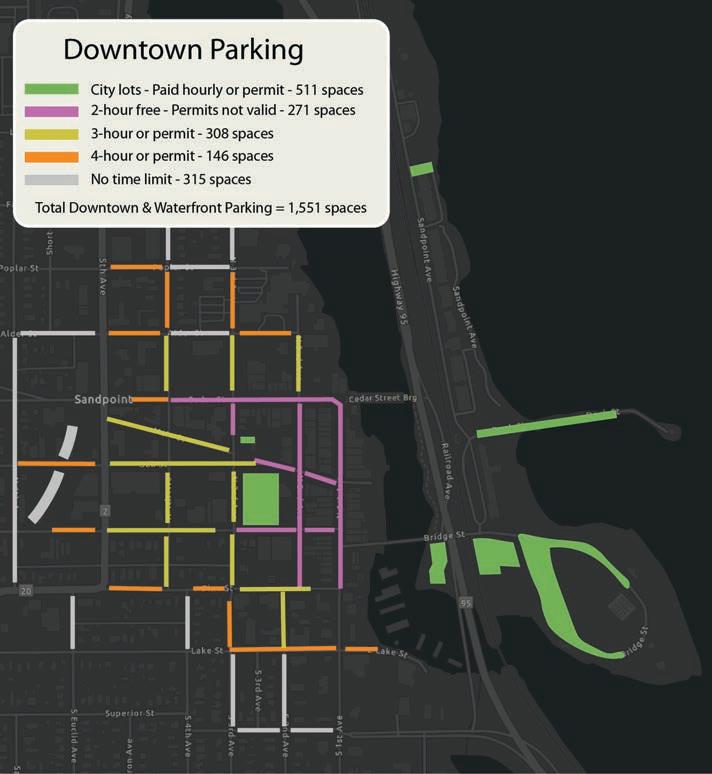
Parking in the two-hour zone — which encompasses the downtown core — is free but requires a check-in at any of the kiosks, where users input their license plate. After two hours, parkers can pay $4 per hour for additional time. In addition, city and county residents passes are available for $20 and $35, respective-
ly, which provide up to eight hours in any of the parking lots, including at City Beach, Dock Street, Bridge Street, the City Lot at Third Avenue and Church Street, and the Pend d’Oreille Bay Trail. The latter, however, is closed on weekdays until Friday, July 17 due to construction hauling related to the ongoing cleanup project on the trail.
Parking in the three- and four-hour zones remains free up to the posted time limit, with enforcement unchanged from years past.
As of July 7, Welker said the city had sold 2,700 permits — 1,275 to county residents, 180 to city residents, 165 for boat launches, 35 for marina slip holders and 45 for 24-hour permits, the latter being “the premium parking permit,” granting 24-hour access to both the city parking lots and in the three- and four-hour zones.
“We anticipated in the first year selling about 1,000 each of county and resident permits. We’ve exceeded that in the first four weeks,” Welker said.
Meanwhile, revenue generated by hourly parking — which is geared to falling on out-of-area visitors who are ineligible for parking passes — totaled about $11,000 in the first five days of operations, with 80% of that coming from parking at City Beach alone.
“That’s despite the city announcing on Friday last week [July 3] that we would only be issuing warnings, not citations for violations,” Welker said. “So we’re doing a soft rollout. No tickets will be written for people who don’t properly use the kiosks at least for another week.”
Ultimately, that parking lot revenue — especially at City Beach — will be used to help fund improvements to the RV park, boat launch, and boat trailer and vehicle parking in a multi-million project that is currently going
through the design concept phase.
“We’re trying to achieve something really nice for the people of Sandpoint and Bonner County, and paid parking will absolutely help us achieve that outcome in the next few years,” Welker said.
Finally, Welker reminded P&Z commissioners that parking enforcement only takes place from 9 a.m.-5 p.m., meaning if users check in to a kiosk at 3 p.m., they will pay nothing since their first two hours in the zone are free. Likewise, a checkin anytime before 9 a.m. will grant free parking until 11 a.m.
There were a number of what Welker called “hiccups” during the first days of the paid parking program, including a software glitch in the kiosks that defaulted users to full-day parking, rather than an automatic two hours free, though that was fixed by the afternoon on July 1. Those who paid for parking that day were reimbursed by the provider, and one kiosk malfunctioned at City Beach, but was repaired on July 7.
P&Z Commissioner William Mitchell conveyed a number of the questions about the parking system he’s received over the past week, and overall said the city needed to do a better job of educating the public on its details.
An updated map of parking zones in Sandpoint. Courtesy image
correct information and they’ll generally leave happy.”
“The fairly large one is that the mobile app is not yet able to be used to initiate a free two-hour parking session. That’s a feature that IPS is implementing soon. They say Q3, which will be in the next couple of months,” Welker said, referring to the ParkSmarter app.
Until then, users of the two-hour parking zone will have to check in at a kiosk, but can add time to their session using the app.
“People aren’t paying attention, and they’re mad,” he said, later adding, “You’re getting killed on Facebook. The city needs a more aggressive education campaign about the parking thing because there’s a lot of misinformation circulating. I mean, ‘Oh, you know, it’s illegal that they adopted these ordinances, blah, blah, blah’; ‘You’re getting paid, you’re getting kickbacks.’ A lot of misinformation ...”
“The city doesn’t actively engage on Facebook. That’s a policy decision at the city,” Welker responded, instead suggesting that those with questions can come to City Hall and they “will get the
P&Z Chairman Mose Dunkel said most of the backlash he’d seen came from “out-of-city-limits people who believe they’re owners of the city as well.”
“Overall, everything in my lifetime that’s been rolled out has had an initial backlash that eventually becomes a beloved part of the city,” he added, citing the Memorial Field renovation, the Sand Creek Byway and First Avenue reconstruction.
“I believe that the majority of city residents are in favor,” Dunkel said. “... We’ve done our due diligence, I believe. So I think time will definitely tell and it’ll also help, too.”
ITD seeking comment on draft investment plan
State also drops vehicle registration stickers, moves toward permanent license plates
By Zach Hagadone Reader Staff
The Idaho Transportation Department released a number of updates in the week leading up to the Fourth of July, inviting public comment on planned road, bridge and safety projects, as well as changes to vehicle registration and license plate policies.
Public comment is being gathered through Friday, July 31 on projects in ITD’s seven-year investment program, which have been reprioritized based on changes in transportation funding.
According to officials, $200 million is currently allocated toward pavement and $100 million toward bridges each year. In mid-June, the Idaho Transportation Board reviewed recommendations from staff geared toward establishing project priorities and balancing the budget as part of an update to the Idaho Transportation Investment Program.
The current draft ITIP includes about 20 projects throughout Bonner County scheduled from 2027 to 2032, as well as a handful that are unfunded and in the preliminary stages. Among them are bridge replacements and rehabilitation work on Whiskey Jack Road over the Boyer Slough and on U.S. 2 in the Priest River area — both scheduled between 2030 and 2031.
The bulk of the local entries in the draft ITIP are pavement resurfacing, along with some widening and safety improvements around the county including resurfacing and restoring U.S. 95 from the Long Bridge to Piehl Road in Ponderay, scheduled for 2032. Go to itd.idaho.gov/funding to review the full draft ITIP and submit a comment through the portal. Email comments to itipcomments@itd.idaho. gov, call 208-334-8063 or mail to Brianna Fernandez at P.O. Box 7129, Boise, ID 83707.
Paper copies of the draft are available at regional offices and provided on request by calling ITD at 208-334-8284. Comments received by the July 31 deadline will be reviewed by the board with an approved ITIP planned for September.
Meanwhile, Idaho drivers should expect to see some changes to vehicle licensing and registration, after the DMV announced that new proof of identity requirements went into effect on July 1 following updates to Idaho statute during the 2026 legislative session. According to the new policy, users of the DMV system will now have
to present a form of valid, government-issued identification including their full legal name, birthdate and a photograph in order to create a profile with the department.
New customers to the Idaho DMV will have to present that identification in-person when they create their profile. Valid ID includes Idaho and outof-state driver’s licenses and ID cards, U.S. Department of Homeland Security documents, U.S. military IDs, U.S. and foreign passports, Idaho concealed weapons permits, Native American photo identification, corrections-issued ID cards and Mexican Consular IDs.
Certified birth documents will also be accepted, but only when paired with photo ID. Some provisions will be applied to minors, with more info at dmv. idaho.gov or by calling 208-584-4343.
Finally, also on July 1, Idaho ended its longtime practice of requiring registration stickers on state-issued license plates and transitioned to permanent plates. That change came following House Bill 533, which the Legislature passed to eliminate the issuance or requirement of annual registration stickers on vehicle plates.
Going forward, a valid plate and current vehicle registration now fully meet state law. Officials stated that transitioning away from registration stickers and toward permanent plates will save about $300,000 a year in materials and production.
“Drivers must still register vehicles and are encouraged to keep a printed copy of their registration in their vehicles,” ITD stated.
Drivers will now only need to replace their plates if they are damaged or too deteriorated to be read by law enforcement. There is no more need under Idaho law to purchase new plates on a fixed cycle.
Registration stickers will no longer be mailed or required on any Idaho license plate, other than small plates on vehicles regulated by the Idaho Department of Parks and Recreation, such as off-highway vehicles, boats, snowmobiles, motorbikes and others that still must have a Parks and Rec sticker.
Despite the changes, enforcement policies will not change, with officers continuing to verify registration electronically during traffic stops or other checks, and drivers who fail to register their vehicles on schedule could face a citation of $101.
For more info on vehicle registration and license plates, go to dmv. idaho.gov.
Bits ’n’ Pieces
From east, west and beyond
According to the National Drought Mitigation Center, about 50% of the U.S. is in a drought. The National Weather Service reported last week that 163 million people lived in “heat risk” areas, experienced most by those working outdoors, in hot warehouses or delivery trucks. OSHA’s heat standard proposals have been stalled, with critics pointing out that the current head of OSHA, David Keeling, was a top safety executive at Amazon when a Senate report found that its warehouses were twice as dangerous as competitors’. Europe’s record-breaking heat wave has been linked to at least 1,300 deaths. With temperatures greater than 100° F in Washington, D.C. during the Fourth of July, hundreds of people were evaluated for heat-related illnesses. Mother Jones reported that at least 34 were hospitalized. A two-hour evacuation of the National Mall, due to a severe thunderstorm, preceded President Donald Trump’s speech, during which he praised the bombing of Iran, said he’d stop a communist takeover before the midterm elections and promised to restrict mail-in ballots
The Fourth was also marked by hundreds of masked Patriot Front white supremacists marching in D.C. chanting “reclaim America” while carrying Confederate battle flags, various media reported.
The American Civil Liberties Union will spend more than $50 million on the midterm elections, NBC reported. Half will go to ensure smooth administration of elections as Trump seeks to exert federal control over what is a state function under the guise of preventing voter fraud. ACLU funds will be used to train volunteers to encourage voting, and to ensure voter access while monitoring ballot counting and certification. The ACLU deems this a necessary investment given the Trump administration’s attempt to suppress votes, gerrymander, undermine mail-in voting and seize state election info
According to the ultra-conservative Heritage Foundation, there have been 100 voter fraud cases between 1982 and 2025.
According to Labor Department data, employers added 57,000 jobs in June — fewer than expected. In May there were 129,000 more jobs. Hourly earnings are up 3.4%, but annual prices increased 4.2%
The U.S. Supreme Court recently delivered a volley of end-of-term deci-
By Lorraine H. Marie Reader Contributor
sions, including a 6-3 ruling allowing the federal government to turn back asylum seekers before crossing into the U.S.; a ruling allowing Haitian and Syrian Temporary Protected Status people to be removed from the U.S. (6-3); a vote striking down limits on political party spending (6-3); and a ruling allowing Mississippi election officials to count ballots postmarked by Election Day, but received up to five days later (5-4).
SCOTUS also ruled to reject a Trump administration attempt to end birthright citizenship; in favor of striking down a law that limits the president’s power to fire Federal Trade Commission members; to affirm that location data is private and protected from unreasonable searches; and, the court rejected Trump’s push to toss the $5 million verdict in the E. Jean Carroll sexual abuse case.
The New York Times reported that Trump profited by more than $2 billion after returning to the White House for his second term, with about $1.4 billion of that amount flowing from the Trump family’s cryptocurrency businesses. Meanwhile, according to Fortune, nearly 1 million investors lost a total of $3.8 billion on Trump’s crypto memcoin. Blast from the (recent) past: Six months ago, David Streever sent an email to Todd Lyons, then acting director of Immigration and Customs Enforcement. It said, “The way you are protecting the obvious execution in Minnesota, even as we see the videos, will lead to your downfall. Even Trump will turn on you before the end, and you will be a sad, despised man who eats himself alive with shame at your own pathetic weakness. You will never know peace. You will seek to lose yourself, to escape the burden of knowing the truth about yourself. But wherever you go, you will find yourself. You will torment yourself until your last day on Earth.” Federal agents tracked down Streever five months later, claiming he had “threatened” Lyons, and saying he should sign “warning” documents. Attorneys said the email was not a threat. Streever learned about others facing similar false accusations and did not contact the agents. Instead, he and his wife went public. Streever said: “For them to come after me for one email, it makes me feel like we do have a lot of power. It makes me feel like they do care that we’re speaking up.”
Panida board accepts new appointments amid another resignation
Chris Bessler and Steve Garvin join Tari Pardini as new appointments
By Ben Olson Reader Staff
The monthly Panida Board of Directors meeting July 7 saw three new, but familiar, faces join the board, while another member resigned as shakeups continued for the historic theater.
Sean Behm stepped down from his position as chair, but remained on the board as a director, leaving Amy Flint to accept a nomination as the new leader of the board.
Along with the resignations of former-Executive Director Heather White, Board Directors Woody Sherwood and Rory Creigh effective mid-June, Flint said that Charlotte Solly also tendered her resignation effective June 22.
The vacant positions were filled by three names familiar to the theater: Chris Bessler as board secretary, Steve Garvin as vice chair and Tari Pardini as board treasurer. All three are longtime locals and have been involved in the Panida in various
capacities over the years.
Flint accepted a motion to accept the resignations and new appointments in a batch.
“As many of you know, each of these individuals have a strong history with the Panida and considerable experience in the nonprofit sector as well,” Flint said.
Flint read a statement that addressed electrical issues brought up by former E.D. White that ultimately led to the wave of resignations after the June 4 meeting.
“The life safety concern identified at the previous board meeting was a false alarm,” Flint said. “The theater closure and related loss of vending were not necessary. However, in the interest of staff, public and theater safety, it was prudent to temporarily close the theater until those perceived issues were researched and resolved.”
Flint said the board is working to maintain “stability and responsible management during this time of transition,”
and that rather than quickly hiring another E.D., the board will instead examine the current organizational structure.
White attended the meeting as a member of the public, and during the open comment portion again addressed electrical issues, claiming that the Panida’s assertion that inspectors didn’t find any “life safety issues or danger to staff or patrons” to be a “falsely represented” statement.
“I strongly advise rectifying these issues immediately,” White said.
After the board took public comment, Behm gave an explanation of an electrical report of the facility that White claimed presented a danger to the facility’s patrons. Behm said the report from 2023 was a comprehensive document meant to address issues and repairs that the historic building should consider.
“The KWR report was a long-term planning document that was not an immediate life safety report,” Behm said.
Board Director Dan Thompson shared that three building inspectors
BOCC elects Zach Spohn to Fair Board
By Soncirey Mitchell Reader Staff
The Bonner County Board of Commissioners voted July 7 to elect Zach Spohn to the Fair Board, citing his financial experience as a major asset after former-Treasurer Staci McBrayer left to take on the mantle of Fair Manager. The vote had undergone several delays since Spohn’s initial interview in April due to scheduling conflicts and an extended application deadline.
In his April 28 interview, Spohn discussed how he developed a relationship with the Bonner County Fairgrounds early in life thanks to his background raising and showing animals.
“My mom also took market animals at the fair and my grandpa also took market animals to the fair and my great-grandpa was involved with one of the first 4-H clubs,” said Spohn. “And so [I have] a family history of involvement with 4-H programs and that’s a pretty important part of not just my life but my kids’ lives.”
In his professional life, Spohn gained a financial background working at an accounting office before moving
on to his current position as chief financial officer of Wildwood Custom Millworks. According to Spohn, as CFO, he is responsible for the company’s financial reporting and budgeting and oversees the accounting department.
“Experience that I might bring to the table would be experience in operating a business from a financial seat,” said Spohn. “Being able to be business-like; to ensure that there’s checks and balances, and that there’s proper controls in place in order to safeguard the assets not only of the fair but also of the county; and to set up systems to ensure that things are done properly, clearly and on time.”
“technological events.”
“I do want to see the fair grow and I want to see it become something that includes everybody in the community — doesn’t just serve the agricultural side, although I believe that should always be a part of it ...” said Spohn. “I don’t have a problem with the way the fair’s been because it’s been historically catered, I believe, towards the agricultural community, which I’m a part of, so I haven’t felt left out. There may be people out there that do, and those are the people that I’d want to kind of bring in and kind of make it a fair for everybody.”
came through on June 9 to examine the building and reported that “nothing was egregious and alarming to them.”
Thompson continued, “There will be a report on that which will be sent to OSHA, I believe, because we’ve been turned into OSHA is what I understand.”
Asked later for clarification on the OSHA complaint dated June 27, Flint told the Reader, “There was a complaint related to the electrical concerns. We have addressed it and our final step will be to provide the documentation from the most recent repair work that was done. It’s under control.”
“We passed infrared inspections, we passed two state electrical inspections today,” Behm added. “Everything’s been corrected that’s been brought up.”
White and a few other members of the public again pressed the board on perceived safety concerns, leading to Pardini calling for a point of order and the board moving to adjourn the meeting.
Hot Dog champ
In his interview, Spohn said he didn’t have “any specific ideas” to encourage engagement and increase the fair’s profits. However, he would like to “expand our outlook on things and try to identify what would bring people into the fair, to captivate them, to incorporate them and to get more community involvement,” which, he later added, could include music or
Applications remain open for the seventh and final board position. Watch past interviews on the county’s YouTube page or attend the commissioners’ next interview on Tuesday, July 28, at a time yet to be determined. Watch online via Zoom by visiting bonnercountyid.gov/meetings or hear candidates in person at the Bonner County Administration Building (1500 U.S. 2, in Sandpoint).
Silas Anselmo, of Naples, was the champion of the Tervan Tavern’s inaugural Fourth of July hot dog-eating contest, downing eight (buns and all) in five minutes. Photo by Zach Hagadone
Zach Spohn. Courtesy photo
Barbs:
• I received an email from a reader who asked not to be identified, but wanted to share some thoughts on driving habits they have witnessed of late. The reader referenced the fatal head-on crash on Highway 95 on June 20, writing that while stopped to allow emergency vehicles to pass en route to the accident, they were aghast that other drivers barely moved over and were rudely honking at them for not completing a left turn in front of the ambulance. It’s important to remind everyone that Idaho Code dictates that when an emergency or police vehicle uses audible or visual signals, all other drivers must pull to the right and come to a complete stop. If you’re in an intersection, clear it first, then come to a stop. It’s not just being considerate; it’s the law. This is basic driver’s education stuff, but it seems like many have forgotten. As the reader wrote in their email: “Are we really in such a hurry that we have no consideration for the lives of those around us?”
Drive safe and don’t take chances. The minute you might save by driving like a jerk could lead to an accident and loss of life down the road.
• The city of Sandpoint just built a new basketball court at Hickory Park and it looks great. Unfortunately, according to a photo sent by a reader showing a teenager sitting on top of the rim, it’s already being disrespected. Here’s the deal, folks: If we want nice things in our community, we have to treat them with respect. When you destroy and vandalize public facilities, the repairs come out of everyone’s pockets.
‘Buyer beware’ of bad customer service…
Dear editor,
I applied for a Visa card at Mountain West Bank and, upon approval, received the card and used it twice. I went to the MWB branch in Sandpoint and tried to make a payment. I was told that they can’t accept payments for that card because they didn’t issue it. The card plainly says “Mountain West Bank” on the front. I was told I had to call customer service for help. I called the number on the back of the card several times but no one answered. Thinking I might get better service at the Ponderay branch, I went there. I spoke with the branch manager, who was absolutely useless. She offered no suggestions and questioned my attitude. I was wrong to imagine thinking a bank whose name is on their credit card might be able to help. Why would a bank advertise and issue a card with their name on it and then act as if they had no ability to help a customer? The three people I spoke with had no intent to assist me. I plan on speaking with upper management in the next couple of days. Buyer beware when dealing with this type of customer service.
Bill Litsinger Sandpoint
A solution to the parking problem…
Dear editor, Walk, bike, carpool, or ride the free Spot Bus. Easy peasy.
Bill Stuble Dover
Got something stuck in your craw? Write a letter to the editor. We accept letters 200 words or less which are free from libelous statements and excessive profanity. Please elevate the conversation and please make a point.
Send submissions to letters@sandpointreader.com.
Voting rights were a Republican thing, but with SAVE Act, they’re now in the GOP’s rearview mirror
By Jim Jones Idaho Capital Sun
Voting rights in America were a Republican thing for more than 100 years, but the GOP made an about-face on the issue beginning with President Richard Nixon’s “Southern strategy.” The Republican regression has reached a fever pitch with the GOP push for passage of the preposterously-named SAVE America Act (SAVE Act). It would make it infinitely more difficult for women, minorities and military personnel to participate in our elections. Thankfully, the SAVE Act is not likely to become law, due to strong opposition from affected voter groups, including many traditional Republicans.
President Abraham Lincoln set the stage for extending voting rights to formerly enslaved African Americans in a speech delivered at the White House on April 11, 1865. Following Lincoln’s assassination, his Republican Party was able to obtain ratification of the 15th Amendment to the U.S. Constitution. It granted voting rights for the first time to Black males. Voting rights for females of any race were not on the table until ratification of the 19th Amendment in 1920. Again, Republicans were behind that effort.
Despite the 15th Amendment, Southern Democrats were able for almost 95 years to prevent Black Americans from fully exercising their voting rights. That was accomplished by intimidation, poll taxes, literacy tests and a variety of other insidious stumbling blocks. Those tactics came to a halt with the passage of the Voting Rights Act of 1965. The act would not have passed without strong support from Republican members of Congress.
I was working as a legislative assistant for former-U.S. Sen. Len Jordan, R-Idaho, during the summer of 1965 and recall being proud of his support for the Act. Majority Leader Mike Mansfield, D-Mont., and Minority Leader Everett Dirksen, R-Ill., strongly pushed for the Act, too, overcoming fierce opposition from Southern Democrats. Its passage made a dramatic change in the composition of Congress.
Civil rights opponents immediately geared up efforts to marginalize the effects of the Act. Perhaps the most im-
portant development was President Nixon’s adoption of his “Southern strategy,” which sought to capture the support of white Southern voters by appealing to racist themes. The strategy proved wildly successful, eventually turning Southern segregationist Democrats into newly minted Republicans. In recent years, a number of Western states, including Idaho, have followed suit.
Former Gov. Phil Batt, who exemplified traditional Idaho Republicans, was a lifelong supporter of civil rights until he passed on March 4, 2023. His successors, Republicans Dirk Kempthorne and Butch Otter, both respected the rights and voices of Idaho voters. Republican Gov. Brad Little, determined to keep his Trump endorsement, has bought into the MAGA narrative. Idaho’s entire congressional delegation and attorney general strongly support the SAVE Act, despite any credible evidence of voter fraud in our elections. They know better but are fearful of straying from the Trump agenda.
If passed, the SAVE Act would likely be struck down as a flagrant violation of the U.S. Constitution, which gives states the power to control elections. If the MAGA-influenced Supreme Court should bow down to MAGA, the SAVE Act would seriously impact important voter groups. Those voters who have changed their names from that on their birth certificates, particularly married women, would have to dig up birth certificates, divorce decrees, passports or a variety of other documents proving their identity and citizenship in order to vote.
Members of the military, particularly those overseas like the more than 50,000 currently located in the Middle East, would likely be unable to find documentation proving their citizenship. Many service personnel would find it nearly impossible to register and vote.
Our military forces deserve better than this. After all, they are responsible for defending all of our freedoms. Their military identification should, in and of itself, be the key to allowing their vote and they should be allowed to send their ballots by mail, as has been the case for decades.
Idaho’s members of Congress and the Idaho Attorney General Raúl Labrador do not have much regard for the voting problems the SAVE Act would heap on our military. None of them ever stepped forward to serve. Sen. Jim Risch, R-Idaho, lamely claims that he did not serve in Vietnam because he “had an ongoing
ulcer and they didn’t want” him. Quite frankly, the military was not very picky during the Vietnam buildup about who they allowed to serve. Despite having broken both legs in a horrific auto accident, spending 14 weeks in the hospital and being unable to walk unaided for almost a year, the Army was happy to honor my request for Vietnam service.
Our elected officials should stand up and speak out for Idaho voters and constitutional government. If they can’t find the courage to do so, they should step aside.
Jim Jones is a Vietnam combat veteran who served eight years as Idaho attorney general (1983-1991) and 12 years as justice of the Idaho Supreme Court (2005-2017). He also publishes at substack.com/@ jjcommontater. This column was originally published by the Idaho Capital Sun, a Boise-based nonprofit news outlet.
Jim Jones. File photo
Science: Mad about
dilophosaurus
By Brenden Bobby Reader Columnist
Among the inaccuracies in the Jurassic Park franchise, none have quite had the staying power as the portrayal of the Dilophosaurus — the spitting, neck-frilled dinosaur that brings an end to the story’s tragic fool and plot catalyst, Dennis Nedry. These inaccuracies are so linked to its image that it has influenced the appearance of Dilophosaurus across 30 years of filmmaking, public commentary and even unrelated video games such as 2015’s Ark: Survival Evolved.
To be fair, having played Ark: Survival Evolved and numerous expansions and maps, I can confidently say that the game leans heavily into its betrayal of realism, as none of the dinosaurs accurately depict what dinosaurs actually looked like. Also there are dragons.
Being a dinosaur kid at heart, I can also safely say that every interaction I’ve had with anyone regarding Dilophosaurus has gone something like this:
“The Dilophosaurus was a really cool dinosaur.”
“The what?”
“The spitting one from Jurassic Park.”
“Oh, I guess.”
The fact that the dinosaur is identified as “the spitting one” is among the worst offenses to the actual animal. There is absolutely no evidence that suggests Dilophosaurus could spit, let alone expel toxic venom. Modern reptiles capable of spitting venom, such as various species of cobra, have adaptations visible on their skulls that would suggest the presence of internal tissue venom sacs or hollow teeth from which to eject the venom. Dilophosaurus had no
such features present in the skull, and it certainly didn’t have hollow teeth.
The second largest issue is that Dilophosaurus did not possess any evidence of a neck frill. A reptilian neck frill was likely inspired by two separate sources: the neck-frilled lizard of northern Australia and New Guinea, and the adaptation of hackle-raising by birds, particularly roosters.
The latter was a curious source of inspiration, as the Jurassic Park dinosaur clearly lacked any form of feathering, yet the actual dinosaur likely was covered in pin-like protofeather fluff.
It’s obvious why Steven Spielberg leaned toward featherless dinosaurs in the movie. Humans have two distinct reactions to scaly reptiles: fear and awe. We lack those responses when looking at birds, which we’ve raised as a domesticated food source for thousands of years. Until a 12-inch spicy lizard special is on the menu at Mr. Sub, it’s unlikely that we will ever shed our preprogrammed response to reptiles.
One of the more curious changes to Dilophosaurus in the movie was its size. Michael Crichton depicted the Dilophosaurus in his book Jurassic Park as accurate to its actual scale. Spielberg, however, decided to deviate heavily in the film to make the dinosaur distinctly different from the movie’s chief protagonist, the Velociraptor This was an interesting design choice for another reason we will explore later in this article; however, it’s worth noting that the Dilophosaurus was not a labrador-sized reptile. Fossils recovered point to this dinosaur reaching a height of up to eight feet and a length of up to 23 feet, with
a weight somewhere around 880 pounds. It was taller than most horses and longer than two of them standing in a line, while curiously being lighter than a single horse.
Spielberg shrank the Dilophosaurus so audiences could differentiate it from the Velociraptors later in the film. This is especially curious because the real-life Velociraptor was much closer in size to the portrayal of the Dilophosaurus in the movie, being a small turkey-sized creature. The Velociraptor in Jurassic Park is much closer to a Utahraptor, but the name was changed to sound more memorable and menacing.
Despite this change, the construction of the Dilophosaurus is not only inaccurate to the actual fossils in a lot of ways, but very closely mirrored to the Velociraptor in the film, despite the two animals having completely different skull shapes. The real-life Dilophosaurus had a strange, narrow skull with two, protruding sail-like crests on the top of its head. The strangest part was a pair of oddly shaped divots in the maxilla, where its upper teeth were located. There are a few hypotheses for why this adaptation existed.
Similar features are commonly seen in animals that eat a lot of fish or slippery prey, including crocodilians. It creates extra surface area that improves the grip and won’t let fish slide away during a struggle. Sometimes this is augmented by a set of larger teeth on the lower jaw, creating a recess, so the teeth don’t gouge the maxilla or the roof of the mouth.
Another hypothesis is that this adaptation served somewhat like a slashing sickle for Dilophosaurus’ particular method of hunting, which was to
grab prey with its powerful arms and rapidly slash and exsanguinate the unlucky creature. Its teeth seem to be adapted for both hunting fish as well as larger game, leading us to believe it was an especially adaptive and opportunistic predator. We know it had immense range, covering most of North America during the Jurassic 166 million years ago, and we have a plethora of fossils that lead us to believe it bred abundantly on the continent. It was likely the apex predator of its time.
We even have numerous footprint fossils, giving us a pretty good idea of what its
feet looked like without having to guess about muscles or skin. Unsurprisingly, its feet were similar to large flightless birds like the emu.
One of the best fossilized remains is actually an imprint from where a Dilophosaurus sat down in the sand. There are clear impressions of the animal’s feet and even its cloaca, which is pretty wild. That’s the dinosaur equivalent of using a photocopier to capture an image of your butt, except someone found it 166 million years later and added it to the scientific record.
Stay curious, 7B.
Random Corner
• The Moon is about one-quarter of Earth’s size. According to scientists, it was formed about 4.5 billion years ago from debris flung into space when the Earth collided with another planetary structure called Theia.
• The Earth and Moon are tidally locked, with their rotations in sync. This is why, even though the Moon rotates, we can only see one side from Earth. However, the Moon performs wobbly movements as it rotates called librations, allowing us to catch a glimpse of the dark side.
• The highest point on the Moon is Selenean summit, which is 35,387 feet tall — more than 20% higher than Earth’s tallest point, Mount Everest.
• The Moon’s atmosphere has 100 molecules per cubic centimeter. This is far thinner than Earth, which has about 100 billion billion molecules per cubic centimeter at sea level.
• The Moon is slowly drifting away from Earth at about 1.5 inches per year.
• Billions of years ago, the days on Earth were fewer than 10 hours long. The Moon’s gravitational pull on our planet slowed its spin over time, making Earth’s days longer.
• Through the years, more than 100 robotic spacecraft have been sent to the Moon.
• The Artemis IV mission, slated for early 2028, will see humans return to the surface of the Moon for the first time in more than 50 years. Artemis astronauts will travel to lunar orbit, where two crew members will descend to the surface and spend approximately a week near the South Pole of the Moon conducting new science before returning to lunar orbit to join their crew for the journey back to Earth.
• Temperatures on the Moon fluctuate, reaching 273° F during the day. On the night side, temperatures can plummet to -243° F.
A hypothetical life reconstruction of Dilophosaurus. Courtesy image
The price of stewardship
By Sandpoint Mayor Jeremy Grimm Reader Contributor
Amid the celebrations surrounding the 250th anniversary of our nation’s founding, we have a remarkable opportunity to reflect on what has sustained the longest-running constitutional republic in history. It has never been because every public decision was popular. Rather, our nation has endured because generations of Americans accepted that self-government requires both freedom and responsibility.
Our founders understood that representative government was never intended to be a system where elected officials simply followed the loudest voices of the moment. It was designed so citizens could elect leaders to study issues carefully, weigh competing interests and make decisions they believed would best serve the long-term interests of their communities.
That principle is just as important in Sandpoint as it is in Boise or Washington, D.C.
Over the past several weeks, Sandpoint’s new paid parking program has generated spirited debate. Some support it. Others oppose it. That is healthy. Public policy should be discussed openly, and reasonable people can certainly reach different conclusions.
What concerns me more, however, is not disagreement over parking. It is the growing tendency to view every difficult public decision through the lens of immediate personal benefit rather than long-term community stewardship.
The question before the City Council was not whether everyone enjoys paying for parking. Of course they don’t.
The question was whether the parking situation in town is working and if it is fair for the taxpayers of Sandpoint to continue bearing nearly the entire cost of maintaining downtown parking, City Beach, public restrooms, landscaping, lighting, enforcement and other public amenities that are enjoyed by tens of thousands of visitors and non-residents each year.
The council concluded that asking those who use these facilities to contribute a modest amount toward their upkeep was a more equitable approach.
Already, during the first five days of the program, more than $10,000 has been collected in hourly parking fees
— 79% from the City Beach lot. Those dollars are being paid primarily by visitors and non-residents using these public amenities rather than by the Sandpoint taxpayers who have historically subsidized nearly all of those costs.
That is not punishment. It is shared responsibility.
Every generation inherits public assets it did not build. We inherited our streets, parks, beaches, public buildings, water systems and the institutions of local government from those who came before us. Our responsibility is not merely to enjoy them. It is to preserve and strengthen them for those who come after us.
That has been one of my guiding principles as mayor: Take care of what we have. Deferred maintenance eventually becomes expensive maintenance. Ignoring problems because solutions are unpopular is not leadership. Good stewardship means making thoughtful investments today so future generations are not left with larger bills tomorrow.
As we celebrate America’s 250th birthday, we should remember that the strength of this republic has never rested on getting everything we want. It has rested on citizens willing to think beyond themselves, elected officials willing to make difficult decisions, and institutions that faithfully perform the roles entrusted to them.
The parking program will ultimately be judged not by the emotions surrounding its first week, but by its results in the eyes of Sandpoint’s taxpayers. Are our public spaces better maintained? Is parking more accessible? Are we treating Sandpoint taxpayers more fairly by asking visitors and non-residents to help support the
amenities they enjoy? Are we leaving our community on stronger financial footing than we found it? Those are the questions that matter.
Since 2007, Bonner County has grown 34% from approximately 41,000 residents to more than 55,000 today, yet the county still maintains just one small park (Garfield Bay). Much of that growth has occurred outside the incorporated cities, yet the responsibility for providing and maintaining the region’s most heavily used waterfront parks, sports fields and public gathering places continues to fall largely on the taxpayers of Sandpoint, Priest River and Ponderay.
Sandpoint is proud to welcome county residents and visitors alike, but this responsibility should not rest on municipal taxpayers alone. As our county continues to grow, so too should our shared investment in the public amenities that make North Idaho such an extraordinary place to live.
The lesson is simple: Stewardship is never free. Whether through serving in public office, paying our fair share for parking, or volunteering on a commission or committee, every generation has a responsibility to leave its community better than it found it. If we embrace that obligation together, our children — and those celebrating America’s 300th birthday — will inherit a Sandpoint every bit as remarkable as the one we cherish today.
Jeremy Grimm has served as Sandpoint mayor since 2024, served as Sandpoint city planner from 2007-2015 and is owner/land use planner at Whiskey Rock Planning + Consulting.
Jeremy Grimm. File photo
BY THE NUMBERS
By Ben Olson Reader Staff
$2.2 billion
The amount of money President Donald Trump has made during his first year back in office, according to a new financial report. Of that number, Trump made $1.4 billion in the cryptocurrency industry alone. He also made $635 million in royalties from Celebration Coins, the entity thought to be behind the $TRUMP meme coin he launched just before starting his second term (which has lost about 82% of its value over the past year). Trump also reported more than $500 million from the cryptocurrency business World Liberty Financial, a firm founded by his sons Donald Jr. and Eric, and the sons of Steve Witkoff, Trump’s special envoy to the Middle East and Ukraine.
$113 per month
The U.S. Army pension paid to former-President Harry S. Truman, which was his sole form of income after leaving the White House. Truman later wrote that it was wrong to “commercialize the prestige and dignity of the office of the presidency.” For comparison, $113 in 1954 — Truman’s first year out of office — is the equivalent of $1,407.77 in 2026.
24%
That’s how full Lake Powell, on the Utah-Arizona border, currently is. The water level is approaching the point where there won’t be enough water behind Glen Canyon Dam to generate electricity. Lake Mead — the country’s largest reservoir and located near Las Vegas — is at just 28% capacity. The Colorado River has shrunk about 32% since 2020 and this year’s flow is collapsing to one of its lowest points on record.
100%
The tax rate California will impose on any payments distributed to state residents from the Trump administration’s $1.776 billion “Anti-Weaponization Fund” after Gov. Gavin Newsom signed legislation on June 30 that would redirect the money back to state coffers before recipients could spend it. A federal judge has already blocked the fund indefinitely, but declined to submit a written declaration formally rescinding it, leaving the fund in limbo. New York and Wisconsin lawmakers introduced similar measures.
GARDEN
Common noxious weeds
By Soncirey Mitchell Reader Staff
When you start to identify the plants growing wild around the yard, garden or alongside roads, you may begin to notice a worrying trend: many of those pretty flowers are actually invasive species. Humans have intentionally and accidentally transported innumerable species from one continent to another, introducing plants to habitats where, without any of the competitors or pests that evolved alongside them, they run rampant, choking out the native flora. Here’s how to identify a handful of local noxious weeds that you probably see every day. For a complete list with resources and management tactics, visit bonnercountyid.gov/noxious-weeds.
Yellow and orange hawkweeds (Hieracium caespitosum or aurantiacum)
to ten feet tall and produces plenty of heart-shaped leaves reaching lengths of up to 12 inches. In the autumn, long fingers of white flower clusters bloom from the upper branches.
Rush skeletonweed (Chondrilla juncea)
These oneto three-foottall flowering plants have dark orange blossoms with yellow centers or plain yellow blooms that resemble oneinch dandelions. Flower clusters sit atop one long, hairy stem protruding from a rosette of long, sword-like leaves at its base. Native to Europe, this perennial spreads via roots, fluffy seeds or stolons — vine-like runners that travel along the top of the soil — often taking over fields. Anything that looks like a hawkweed is likely invasive, with one exception being the native white-flowered hawkweed (Hieracium albiflorum).
Giant, Japanese and bohemian knotweeds (Polygonum cuspidatum, sachalinense or X bohemicum)
Indigenous to northeastern Asia, these perennials can be found along roadsides, in ditches or in wetter pastures. The bamboo-like stems are thick, but hollow in the center, and covered in reddish-purple speckles. Knotweed can be anywhere from four
So named for its branching, bone-like frame, rush skeletonweed is a perennial that spreads via its roots and fluffy, dandelion-like seeds. It can grow anywhere from one to four feet tall, producing long, skinny stems covered in coarse hair at the base and small, yellow flowers at the top. All the plants’ leaves grow in a rosette at the base and are easily mistaken for a dandelion. If you’re not sure of your identification, break off a piece of the plant: skeletonweed will ooze a white, latex-like sap.
Hoary alyssum (Berteroa incana)
tinal parasites. The herbaceous perennial is a light green color, due to fine, silver hairs coating the leaves, and has a sagelike smell when crushed. It generally caps out at three feet tall but can reach up to five feet, with branching stems covered in many-lobed leaves (think parsley). Wormwood’s flowers look like dozens of small, yellow pompoms that eventually give way to myriad tiny, brown seeds, which can remain ungerminated and viable in the soil for years.
Tansy ragwort (Jacobaea vulgaris)
One of Bonner County’s most famous noxious weeds is tansy ragwort, a native of northern Africa, Asia and Europe that’s toxic to both humans and livestock due to high levels of alkaloids.
This Eurasian herb enjoys dry, sandy or rocky soils in pastures or along roadsides, spreading by flat, oval seed pods. It is poisonous to livestock — especially horses — making it particularly dangerous to Idaho’s farmlands. It can grow as an annual, biennial or short-lived perennial, reaching one to three and a half feet tall. Its long stalks, branches and skinny, pointed leaves are covered in fine hair, giving them a gray coloring. Clusters of white flowers with eight petals each sit at the top of the plant, blooming from May through September.
Absinth wormwood (Artemisia absinthium)
Yes, like the bright green spirit. Native to Eurasia, absinth wormwood is toxic, which is why it makes such strong booze and has historically been used to kill intes-
It can be biennial, annual or perennial, spending part of its life as a rosette of ruffled parsley- or daisy-like leaves. It later produced four-foot-tall stems with regular layers of leaves, branching only at the top into bouquets of oneinch yellow flowers with 13 petals each, resembling daisies. It reproduces by seed or vegetatively in disturbed soil or fields and is often made worse by mowing.
Spotted knapweed (Centaurea stoebe) Knapweed could easily be mistaken for a thistle due to its flowers, whose small purple petals emanate from a spiky, vase-shaped base. Unlike a thistle, though, this perennial has no thorns or spikes anywhere besides the base of the flower, and is sparsely covered in small, sword-like leaves. Its three- to five-foot-tall stems branch toward the top, each producing a single flower, and the entire plant grows from a rosette of multi-lobed leaves. Native to Europe, the tumbleweed easily takes over disturbed soil by producing plenty of small black and yellow seeds that it distributes on its wind-propelled journey.
Kootenai River Days covers Bonners Ferry in chalk art
By Reader Staff
The Kootenai River Days community celebration returns to Bonners Ferry on Thursday, July 16, bringing with it the annual Chalk the Block art party, which will decorate the historic downtown’s sidewalks. The free celebrations include vendors, live music, sweet treats and family-friendly activities until Sunday, July 19, all sponsored by the Bonners Ferry Chamber of Commerce.
The Chalk the Block competition begins a bit early — Tuesday, July 14 — at Teascarlet Fine Art (6389 Kootenai St.). All ages and artistic levels are welcome to stop by and pick up a bucket of chalk and create a piece of art right there on the sidewalk. Participants can then snap a photo of their work and submit it to teascarlet.com/chalk-the-block to enter the public competition, where anyone can vote until
Saturday, July 18. Winners will be named in six categories: 8 and Under, 9-15, 16+, Interactive, Stick Figure and Lettering. Last year saw 84 entries and 700 votes overall.
The main celebrations begin Thursday at 5:15 p.m. with the BF Rotary Wine Walk, beginning at Kootenai River Inn (7169 Plaza St.) and ending at the Kootenai River Brewing Company (6424 Riverside St.). Tickets are $45 at Mountain West Bank (7186 First St.), Under the Sun (7178 Main St.), and Firehouse Vines and Hops (6371 Kootenai St.), and include a tasty drink at each stop along the tour.
Friday, July 17 marks the start of Crazy Days, with sales and specials at businesses throughout town. Historic downtown will fill up with food vendors beginning at 5 p.m.; and, after dinner from 7:30-8:30 p.m., head to the Chamber of Commerce table on Main Street to grab a free ice cream voucher
for Hidden Haven Sweets and Treats. Finally, from 7:30-11:30 p.m., dance band Jam Shack will perform a mix of rock and pop hits live downtown. Listen at jamshackbandidaho.com.
Saturday’s activities kick off bright and early at 8 a.m. with the Kootenai River Run, a 5K or 10K race beginning and ending at the Boundary County Fairgrounds (6567 Recreation Park Road). Registration is $15 without a T-shirt or $30 with a shirt at bit.ly/ KootenaiRaceInfo, and all proceeds benefit the local cross-country team.
The regular Farmers’ Market begins at the same time and runs until 1 p.m. at the Gateway Visitor Center (7232 Main St.), and the Birdies For Our Brothers Golf Tournament starts at 9 a.m., with proceeds benefiting the Rob Gust and CJ Erickson
SKOOL Scholarship.
Afterward, head downtown where, from 4-8 p.m., vendors will be set up alongside a facepainting station, bounce house and more. The dance party in the streets begins at 8 p.m. with
DJ Mark Spinning discs until midnight.
Crazy Days sales and specials wrap up the long weekend on Sunday. Visit visitbonnersferry.org/kootenai-river-days for more information.
Innovia Foundation awards more than $1.3 million in grants
By Reader Staff
As part of its Community Grants Program, the Innovia Foundation will award more than $1.3 million to 125 regional organizations throughout eastern Washington and North Idaho. The funds will go toward education and youth development, health programs, arts and culture, and economic initiatives.
The Innovia Foundation raises donations throughout the year before meeting with local volunteer advisory committees to determine critical programs in need of funding. This year’s chosen organizations expand access to food, housing, health care, child care and education for underprivileged members of the community.
“Healthy communities begin where basic needs are met and connection among neighbors is possible,” stated Innovia CEO Shelly O’Quinn. “For 52 years, Innovia’s grantmaking programs
have strengthened our community fabric by uniting generous donors with nonprofits serving local needs. This year, we continue that legacy by investing in projects that build the stability and sense of belonging our communities need to thrive.”
Bonner County organizations to receive funds include: Blanchard Area Seniors, Bonner Partners in Care Clinic, Clark Fork-Hope Area Senior Services, Better Together Animal Alliance, IdaHope Families, Music Conservatory of Sandpoint, National Alliance for Mental Illness-Far North, Panhandle Alliance for Education, Panhandle Special Needs and Sandpoint Area Seniors Inc.
Innovia also donated to Boundary County School District 101, the Boundary County Youth Crisis and Domestic Violence Hotline, Community Coalition for Families and the Trinity Lutheran Church of Bonners Ferry. For more information, visit innovia.org.
By Reader Staff
For one weekend a year, Sandpoint’s boardwalk along Sand Creek transforms into a showcase of some of the coolest and most unique classic boats on the water. The Sandpoint Antique and Classic Boat Show will return to Sandpoint for three days of events beginning Friday, July 10.
From noon-5 p.m., the antique and classic boats will launch and moor along the boardwalk until the “Welcome Aboard” event from 6-9 p.m., where boat owners and their entourages meet at MickDuff’s Brewing Co. (220 Cedar St.) to hoist a few pints and swap stories.
The festivities kick into high gear Saturday, July 11 with a captain’s meeting at 9 a.m., followed by the Sandpoint Boat Show, held from 10 a.m.-5 p.m., alongside the Sandpoint Marina and the city boardwalk on Sand Creek. Beautiful boats will be on display for spectators to check out all day, often with the captains nearby to answer any questions. Amid the fun, the Ladies Luncheon will
Get inspired at the 2026 Garden Tour Classic Boat Show returns to Sandpoint
By Reader Staff
The Bonner County Gardeners Association will present the best of Bonner County’s backyard blooms on Saturday, July 11 with the annual Garden Tour. The self-guided stroll showcases seven well-tended gardens from 9 a.m.-3 p.m., with the full map and $15 tickets available at bcgardeners.org.
This year’s tour includes gardens throughout Sandpoint, Sagle and Cocolalla, each with its own focus. Sweet-
be held at noon at the Hydra Steakhouse (115 Lake St.).
An awards dinner from 6-9:30 p.m. at Marigold Bistro (414 Church St.) will conclude the activities for Saturday. Breakfast will be offered at DISH at Dover Bay (651 Lakeshore Ave., in Dover) at 9 a.m., followed by a Boat and Float where boaters will gather with friends and cruise the nearby waterways. Sponsored by the Inland Empire Chapter of the Antique and Classic Boat Society, the show in Sandpoint is always a spectator favorite. For more information, visit inlandempireacbs.com.
song Flower Farm (140 N. Terrace Drive, in Cocolalla) produces organic, fresh-cut flowers and herbs, while other private gardens focus on native plants or fruits and vegetables. Visit all seven to take in a variety of blooming paradises, or pick the gardens you’d like to emulate and spend some extra time talking to their caretakers.
Raffle tickets are available at each garden for $5 or three for $10, with a chance to win a garden-themed gift basket.
ICL invites artists of all skill levels to public lands paint-and-sip at Matchwood
By Reader Staff
The Idaho Conservation League invites lovers of public lands to display their appreciation for the region’s wild places with a paint-and-sip gathering Wednesday, July 15 at Matchwood Brewing (513 Oak St., in Sandpoint).
From 6-8 p.m., participants will have the opportunity to create a painting inspired by public lands. The event is open to painters of all skill levels,
with materials and supplies provided.
Admission is free and open to attendees 21 and older, but donations of $20 are encouraged, with proceeds benefiting ICL.
“Just bring your creativity and a favorite public lands spot in mind,” organizers stated, noting that, “at the end of the night, you’ll get to go home with your own beautiful painting.”
Get more information and register at idahoconservation.org/events.
Spectators stroll the Sand Creek Boardwalk during the Antique and Classic Boat Show. Courtesy photo
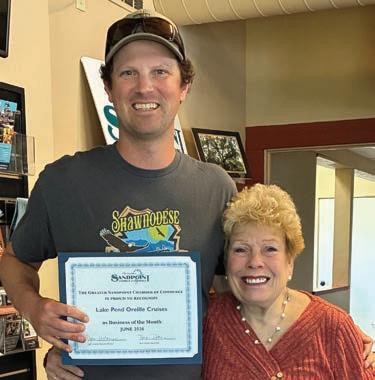
Chamber honors Lake Pend Oreille Cruises as June Business of the Month
By Reader Staff
The Greater Sandpoint Chamber of Commerce recently recognized 25-year member Lake Pend Oreille Cruises as its Business of the Month for June.
Lake Pend Oreille Cruises stands out because it combines “scenic beauty, rich history and wildlife encounters in a relaxed, family-friendly setting, all from the comfort of a narrated boat tour,” the Chamber stated.
“This cruise line is one of the most memorable tourist attractions in North Idaho, greatly enriching Sandpoint’s community life,” the Chamber added.
Cruising from Sandpoint, passen-
gers travel across Idaho’s largest lake, surrounded by the Selkirk and Cabinet mountains, on a 10-mile loop or specialty route that can go past the private waterfront estates, the Green Monarchs mountain goats, the islands of Hope and numerous historic sites — all with world-class views.
Built in 1966, Lake Pend Oreille Cruises’ vessel The Shawnodese is staffed by a knowledgeable captain and crew who share stories about the lake’s geology, area Indigenous history and the region’s development that makes the cruise both educational and memorable.
Chamber names Val Burgess as June Volunteer of the Month
By Reader Staff
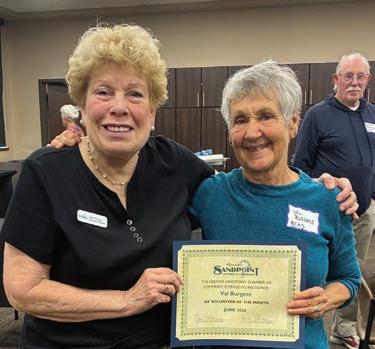
The Greater Sandpoint Chamber of Commerce has recognized local Val Burgess as its June Volunteer of the Month, honoring her work as volunteer coordinator and board member for the Bonner County Historical Society and Museum. This is Burgess’ fifth year in the position, where she oversees more than 70 volunteers, matching them with the BCHSM’s various projects.
“If you’ve been to a big, successful local event with lots of moving pieces, there’s a good chance Val coordinated
Library’s July
the volunteers for it,” stated chamber representatives.
A Sandpoint resident in the ’70s, Burgess moved to Seattle for a few decades before returning to Bonner County around 10 years ago. In her time here, she has helped start the museum’s History Exchange program, which gives volunteers the opportunity to present research on their favorite historical topics. She was also a founding member of the Pend Oreille Arts Council’s Arts and Crafts Fair and the Bonner County Gardeners Association’s Garden Tour.
Natural Connections program offers classes, presentations and more
By Reader Staff
The Sandpoint Branch of the East Bonner County Library will host a full day of events for its Natural Connections program on Saturday, July 11, with classes, presentations and more from 10 a.m.-4 p.m. in the Library Garden (1407 Cedar St.).
First, at 10 a.m., Kelly McLean will lead a guided song circle followed at 11 a.m. by an interactive workshop from Dr. Harvey Eckart titled “The Science of Joy: Why Laughter, Music, Movement and Connection Heal Us.”
Longtime local journalist and author Jane Fritz will then give a talk on her many years of researching and getting to know Lake Pend Oreille in her handmade cedar canoe while working on her definitive guidebook Legendary
First published in 2009, the book is in its third printing and has become a staple text for those interested in the lake’s geology, geography, wildlife and long human history.
The program wraps up with Bowls for the Soul at 1:30 p.m., which features a hands-on papier-mâché workshop hosted by Holly Pennington, who will demonstrate techniques using different materials so attendees can craft their own bowl to take home.
“Once you learn how to do this, you can papier-mâché just about anything,” organizers stated.
All materials will be provided.
Get more details at ebonnerlibrary. org/events.
Historical Society hosts weekly tours of Sandpoint’s past
By Reader Staff
There’s no time like the present to learn about the past, and the Bonner County Historical Society is once again offering an opportunity to do just that with its summer walking tours.
Starting Saturday, July 11, each week participants can stroll through Sandpoint for 75-minute guided tours with a local historian who will recount stories of the people and places of Sandpoint yore.
Tickets are $10 for adults, $5 for youth 18 and under, and kids under 6 can attend for free. The tour starts at 11 a.m. at the Cedar Street Bridge (334 N. First Ave., in downtown Sandpoint).
Tours are scheduled for Saturdays through Sept. 5. Get tickets at bonnercountyhistory.org/tours.
Eric Jensen, Owner, with Chamber Executive Director Joan Urbaniak. Courtesy photo
Chamber Executive Director Joan Urbaniak with Val Burgess. Courtesy photo
Lake Pend Oreille: Exploring a Wilderness of Water.
A long weekend of love and acceptance
By Reader Staff
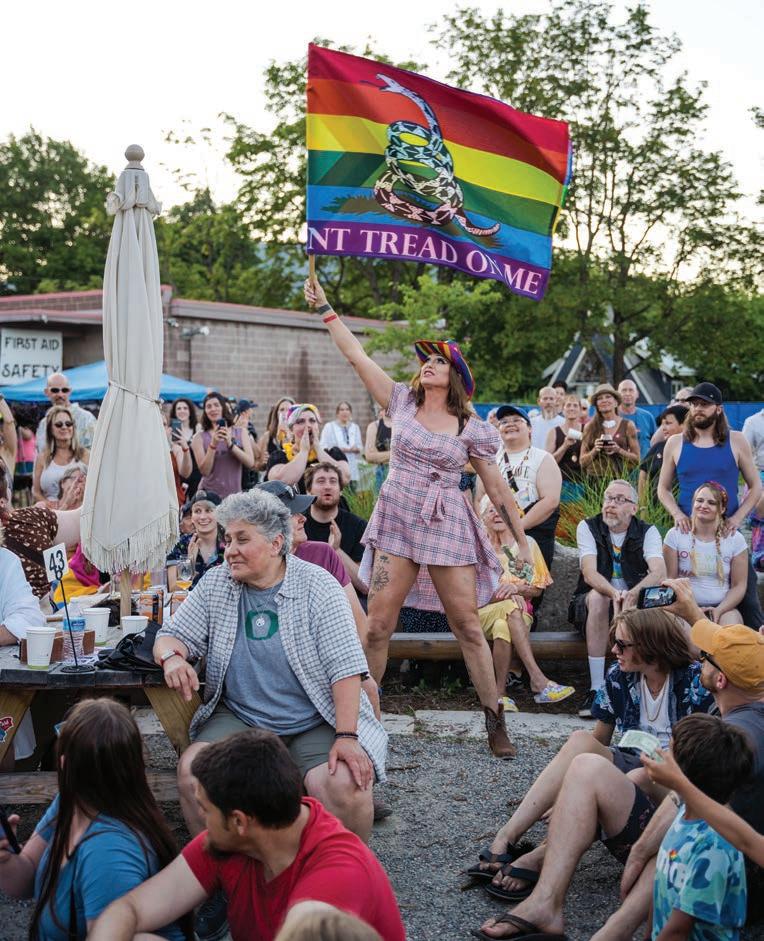
The sixth annual Sandpoint Pride will once again spread a message of peace, love and acceptance for all in a joyful series of celebrations Thursday, July 9-Sunday, July 12. Each event is free to the public and promotes kindness, connection and open dialogue in an increasingly divisive world. For more information, visit safe-idaho.org/ sandpointpride.
Thursday, July 9
The long weekend kicks off with the Paddle to Pride Beach Party at Sandpoint City Beach from 5-7 p.m. Swim, float, paddle or just hang out on the sand and chat.
“Paddle to Pride is about representation, common ground and endurance, which the LGBTQ+ community has been demonstrating for decades and more,” wrote organizers.
SAFE board members Ammi Midstokke and Lindsey Zembower will be taking the long way to the party by swimming the length of Lake Pend Oreille from Buttonhook Bay to City Beach to ring in Pride.
Friday, July 10
There are two options for entertainment on Friday, which will see both Teen Gayme Night and the Queer+ Open Mic. Gayme Night at Eichardt’s Pub (212 Cedar St.) is open to all teens from 5:30-7 p.m. and will have ping-pong, shuffleboard, putt-putt golf and plenty of other games alongside free snacks and soda.
Then, from 6:30-9 p.m., the open mic night at the Heartwood Center (615 Oak St.) invites everyone to share poetry, songs, stories, ideas and more with an accepting and respectful audience. Nashville-based bluegrass and country artists Megan McCormick and Amanda Fields will also perform their original, multi-award-winning music. Listen at butterfly-seahorse-bxla. squarespace.com.
Matchwood Brewing Company will provide the bar, which will be
open and contributing a portion of its proceeds to SAFE until 7:30 p.m. A guardian must accompany anyone 14 years of age or younger.
Saturday, July 11
Saturday is the main event, with all-day celebrations taking place throughout town. Pride-goers are encouraged to support allied businesses using the list on SAFE’s website. Shop around until 3 p.m., when the Sandpoint Pride Celebration at the Granary officially opens its doors. Enter from Oak Street near Matchwood Brewing
(513 Oak St.) and present ID. Weapons are not allowed on the premises.
The festival includes specialty foods, a beverage garden, bingo, tiedye, facepainting, a bounce house, hula-hoops, friendship bracelet-making, best-dressed contests and other family-friendly activities. More than 35 advocacy groups and local nonprofits will also set up booths for the LGBTQ+ Advocacy Fair, handing out merch, stickers and information on area services.
Taking the big stage at 3:30 p.m. will be the Mighty PJAMRS Marching
Band (a.k.a. Peace and Justice Activist Musical Rascals of Spokane). At 5:30 p.m., SAFE leaders will give a few short speeches and toasts before introducing the main musical headliners: Grace Love, Aquasha DeLusty and Jazmyn, Shook Twins and Coral.
Writer, musician, storyteller, chef and overall multi-disciplinary artist Love opens at 6 p.m. Her thrilling, alt-soul music can lean into a garage-rock slant or go full ’70s, depending on the mood, but always centers on resilience, identity and love. Learn more at gracelove.co.
At 7:15 p.m., the stage transforms into a glittery, rainbow extravaganza with the annual drag show, hosted by DeLusty and Jazmyn. Queens and kings from across the Pacific and Inland Northwest will strut their stuff and perform their all-ages-appropriate routines until it’s time for returning stars Katelyn and Laurie Shook to bring the house down.
Everyone in Sandpoint knows local legends Shook Twins, but if you’re new here, get ready for the twins to parade a sparkling entourage of women onto the stage and unleash a tidal wave of talent. Whether performing their original indie-folk pop or covering famous female hits with added angelic harmonies, Shook Twins’ concerts leave everyone energized, hypnotized and dancing in the streets. They will entertain audiences from 8:30-10 p.m. and close out Pride’s main event. If that wasn’t enough excitement, head over to Pivo Peaks Alehouse (119 N. First Ave., in downtown Sandpoint) for an energetic, 21+ afterparty with renowned producer and electronic music mixer Coral.
Sunday, July 12
Those with energy left to spare can head back to the Granary District anytime from 8:30-11 a.m. to hang out and help clean up. Afterward, organizers will meet on the lake for the Rainbow Regatta and spend the afternoon chillin’ on boats. Follow @ SandpointPride on Instagram to find out the time and meet-up spot.
A moment at a previous Sandpoint Pride. Photo by Racheal Baker
Send event listings to calendar@sandpointreader.com
Summer Music Series kickoff concert
6pm @ Farmin Park
A free outdoor concert with Boot Juice performing. Drink and food vendors
Line dancing lessons
6:30pm @ The Hive
Live Music w/ Justin Lantrip
6-8pm @ MickDuff’s Beer Hall
Live Music w/ The Cole Show
5-7pm @ Crow’s Bench (Schweitzer)
Live Music w/ Double Shot Band
5pm @ Connie’s Lounge
Live Music w/ Jake Rozier Band
8-11pm @ 219 Lounge
Live Music w/ Kerry Leigh, Bill Krutz
6:30-9:30pm @ MickDuff’s Beer Hall
Live Music w/ Fruition w/ The Coffis Bros.
8pm @ The Hive
American roots music
Live Music w/ Picked up Pieces
6-8pm @ Idaho Pour Authority
Live Music w/ Jon Dejong
6pm @ Connie’s Lounge
Live Music w/ Mason Van Stone Band
9pm-midnight @ 219 Lounge
Live Music w/ The Cole Show
5-7pm @ Crow’s Bench (Schweitzer)
Live Music w/ Jacob Robin
6-9pm @ MickDuff’s Beer Hall
Live Music w/ Laffin Bones
5:30-8:30pm @ Smokesmith BBQ
Live Music w/ Oak St. Connection
5-8pm @ Pend d’Oreille Winery
Live jazz w/ Bright Moments
6-8pm @ Arlo’s Ristorante
Live Music w/ Arie Vandenburg
6-9pm @ Blue Heron Cafe
Live Music w/ Tim G
6-9pm @ Barrel 33
Open mic night hosted by BioBeat
4pm @ Eichardt’s Pub
Live Music w/ Thrown Out Bones
7pm @ Eichardt’s Pub
Live Music w/ Blue Krawdads
3-5pm @ Idaho Pour Authority
Trivia w/ Toshi
7pm @ Connie’s Lounge
THURSDAY, july 9
International Fly Fishing Film Festival
7pm @ Panida Theater
The best fly fishing films from around the world. Benefits the Mayfly Project
Live Music w/ Liam McCoy & Friends
7pm @ Eichardt’s Pub
FriDAY, july 10
Live Music w/ Mudslide Charley
5:30-8:30pm @ Smokesmith BBQ
Live Music w/ Jenny & Rich
6-9pm @ Barrel 33
Queer+ open mic, happy hour
6:30-7:30pm @ Matchwood Brewing Co.
3rd annual Sausage Fest
11am @ Smokesmith BBQ
Hot dog-eating contests and more
Live Music w/ Ponderay Paradox
5-8pm @ Pend d’Oreille Winery
Live Music w/ Brian Jacobs
6-8pm @ Baxters on Cedar
SATURDAY, july 11
Friends of the Library monthly book sale
10am-2pm @ Sandpoint Library
Focus on summer reads and patriotic themed books. Specially priced books
Sandpoint Farmers’ Market
9am-1pm @ Farmin Park
Live music w/ Monarch Mtn. Band
Natural Connections learning activities
10am-4pm @ Sandpoint Library garden
A variety of activities centered around fun and education. Get the full schedule at ebonnerlibrary.org/events
Sandpoint Pride at the Granary District
3-10pm @ Granary Arts District
Live music, advocacy fair, family-friendly activies and art, SAFE speaking program and more
Live Music w/ Chris Paradis
6-8pm @ Idaho Pour Authority
SunDAY, july 12
Magic with Star Alexander
5-8pm @ Jalapeño’s
Magic with Fiddlin’ Red 1-4pm @ Barrel 33
July 9 - 16, 2026
Wheels-n-Waves Boat Show (July 9-12)
@ Dover Bay Marina
See wheels-n-waves.com for info
Open Irish jam night
5:30pm @ Connie’s Lounge
Open BCA pool tournament ($10/person)
6pm @ Roxy’s Lounge
Artist showcase
4-6pm @ Elliott Cole, 408 Cedar St. Celebrating three women artists: Nikki Brook, Karley Brown and Noelle Joy Team Gayme Night
5:30-7pm @ Eichardt’s Pub
An evening of games and new friends
Sandpoint Contra Dance
7-10pm @ Sandpoint Community Hall
Intro session at 7pm followed by general dancing. All are welcome. $8-$10
Live Music w/ Ian Newbill
7-10pm @ 1908 Saloon
Historic walking tours
11am-12:15pm @ Cedar St. and First Ave. Meet at Cedar Street Bridge and First Avenue, sponsored by the Bonner Co. Historical Society
Newport Street Dance (FREE)
6-9pm @ Third Street (Newport)
Live band playing ’50s and ’60s songs
Pop-Up Quilt Sale and Boutique
9am-3pm @ 168 Wild Fawn Lane (Sagle) Quilts, wall hangings, gifts, pottery and hand-made items. Portion of proceeds go to American Cancer Society
Sandpoint Antique & Classic Boat Show
10am-5pm @ City Boardwalk (Sand Creek) Wooden boats on display for the public
Drop-in swing dance class ($15/person)
6-8pm @ Barrel 33
Live Music w/ Mason Van Stone
6-8pm @ Baxters on Cedar
Sandpoint Chess Club 9am @ Evans Brothers Coffee
Open BCA pool tournament
12pm @ Roxy’s Lounge
Live Music w/ Hogwire
1-4pm @ Pearls on the Lake (Hope)
monDAY, july 13
Monday Night Blues Jam w/ John Firshi
7pm @ Eichardt’s Pub
Lake Pend Oreille Toastmasters meeting
5:45-7pm @ Sandpoint Library
Meets every Tuesday
Beginner Argentine tango class
7pm @ Embody Center, 823 Main St.
No partner needed. $15
Benny on the Deck
5:30-8:30pm @ Connie’s Lounge (patio)
Live Music w/ Liam McCoy and Friends
7pm @ Eichardt’s Pub
Outdoor Experience group run 6pm @ Outdoor Experience
tuesDAY, july 14
Live piano w/ Jennifer Stoehner
5-7pm @ Pend d’Oreille Winery
wednesDAY, july 15
Live piano w/ Sean Bostrom
5-7pm @ Pend d’Oreille Winery
Family night, live music w/ John Firshi
5-7:30pm @ Matchwood Brewing Co.
ThursDAY, july 16
Live Music w/ Benny Baker
6-8pm @ MickDuff’s Beer Hall
Trivia w/ Miranda 6-8pm @ Idaho Pour Authority
Open mic/jam 5-9pm @ Idaho Pour Authority
Sandpoint Farmers’ Market
3-5:30pm @ Farmin Park
Live music w/ The Blue Krawdads
Idaho Public Lands paint and sip 6-8pm @ Matchwood Brewing Co.
Live jazz w/ Bright Moments
6-8pm @ The District
STAGE & SCREEN
IF4 will screen top-notch fly fishing films from around the world at the Panida
By Reader Staff
The weather is fine and the fish are biting, which means it’s time for the International Fly Fishing Film Festival, screening some of the finest fly fishing films from around the world on Thursday, July 9 at the Panida Theater (300 N. First Ave., in downtown Sandpoint).
Doors open at 6 p.m. and the show starts at 7 p.m., with about a dozen short films traversing the globe.
Among the selections is Full Circle, which features award-winning filmmaker Jako Lucas and his father, Dirk, as they fish the pristine coastal landscape of Gabon in Africa while deepening their family bond. The Lucky Place, by Vaidas Uselis, centers on famed angler Helmut Zaderer as he travels the world from Bolivia to Cuba and Tanzania seeking “the perfect catch.” Things don’t go entirely as planned, however, until Zaderer comes to
Magdalena Bay, Mexico, and finds a fishing triumph.
The Only Boat on the Lake comes from acclaimed filmmakers Steve and Nic Schwartz, along with Harrison Hughes, as they return to their home waters in small-town Kansas and a bass lake that has served as a refuge for the family as much as a good place to cast a line.
International Fly Fishing Film Fest
Thursday, July 9; doors at 6 p.m., films at 7 p.m.; $17.50 GA, kids 10 and under FREE. Panida Theater, 300 N. First Ave., 208-263-9191, get tickets at the box office or panida.org.
Presented by House of Fly and The Mayfly Project — and hosted locally by North 40 Outfitters — IF4 also includes bucket raffles and door prizes, with the chance for attendees to win fly rods, reels, fishing trips and more. Proceeds will benefit The Mayfly Project, which is a 501(c)(3) national organization focused on using fly fishing to mentor and support children in foster care.
Tickets are $17.50 for general admission and kids 10 and under get in for free. Get more info at flyfilmfest. com. Buy tickets at the box office or panida.org.
By Marcia Pilgeram Reader Columnist
The Sandpoint Eater Colony culture
ewan and Manitoba, where they continue to live communally, sharing work, property and meals while preserving many traditions that have remained mostly unchanged for generations.
A couple of weeks ago, I gathered a couple of my grands for our summer call of duty to Silverwood. While sitting on a bench waiting for them to complete another circuit on the Ferris wheel, I found myself beside a mother and her two young daughters, who were also waiting for family members. By their modest dresses and beautifully braided hair, I recognized them as Hutterites. I complimented the girls on their braids, and when I mentioned to their mother that I had once spent time working on a Hutterite colony in Montana, her face lit up. Questions poured out as naturally as if we’d known one another for years. Before long, my mind had traveled back more than four decades to the eastern Montana Highline.
At the time, I worked for the Montana Department of Livestock on the state’s Brucellosis Eradication Program. Our four-person team traveled from ranch to ranch testing cattle herds, and one of those herds belonged to a Hutterite colony. I was the only woman on our crew, and my presence presented a few cultural challenges for everyone involved.
Hutterites, descendants of the Anabaptist movement that began in 16th-century Europe, trace their beliefs to the teachings of Jakob Hutter, from whom they take their name. Persecuted for their commitment to adult baptism, communal living and pacifism, they migrated across Europe before eventually settling in North America in the late 1800s. Today, most Hutterite colonies are found across Montana, the Dakotas and the Canadian provinces of Alberta, Saskatch-
to me. The women often exchanged amused glances and quiet giggles as they served me alongside the men, but everyone treated me with kindness and respect.
Meals on the colony reflected their orderly way of life. The women and older daughters prepared and served the food, while the men ate first around long wooden tables. Only after the men had finished did the women and children sit down to eat.
Our crew needed to return to work as soon as lunch was over, which created a dilemma. My supervisor’s simple solution was for me to eat alone in the small trailer where we had set up our laboratory equipment. I took no offense. I understood I was a guest in their community, and respecting their customs seemed the obvious thing to do.
Then, after a couple of days, my boss came to me with big news. The colony’s preacher (he’s like the CEO) had decided I could join our crew in the men’s dining area. Apparently, I was as much a curiosity to them as they were
There remained, however, a distinct dividing line at day’s end.
While the men gathered in the preacher’s home to enjoy conversation over homemade dandelion wine, I was welcomed into the company of the women and older daughters. Those late afternoons became some of my favorite memories. The ladies shared the practical details of colony life and, in return, peppered me with questions about the outside world. We compared recipes, talked about our families, laughed over misunderstandings. Believe it or not, we discovered we had many things in common.
Those ranch visits continued for several months, and each time we prepared for our drive back to Helena, someone would quietly press a gift into my hands. Sometimes it was a jar of homegrown poppy seeds. Other weeks it might
be a pair of beautifully handknit slippers or a loaf cake still fragrant from the oven.
Whenever I admired something, they shared the recipe or the knitting pattern. My mother learned to knit those slippers from the pattern they gave me and, over the next two decades, she made dozens of pairs for family and friends.
Meeting the Hutterite family at Silverwood reminded me what a privilege those months had been. Few outsiders ever experience colony life from the inside — I’m still grateful for the shared meals at their communal table, witnessing traditions firsthand and discovering genuine hospitality
One of my strongest memories from those Montana days was the poppy seed bread that always accompanied me home. Carefully wrapped in waxed paper, tucked inside a brown paper bag, it rarely survived the drive back to Helena. The temptation of that still-warm, fragrant loaf was too much. I’d find myself breaking off “just one more piece” until there was little left by the time I reached home.
So, after leaving Silverwood, I made one more stop before heading home. I pulled into Yoke’s; bought a container of poppy seeds; and, the next morning, baked a loaf using the recipe shared with me all those years ago.
The aroma filling my kitchen carried me straight back to that colony on the Montana Highline. One bite confirmed what memory had promised. It tasted exactly as it had 40 years earlier: warm, tender, lightly sweet and filled with the unmistakable crunch of poppy seeds.
Sometimes the shortest conversations open the longest memories. A chance meeting on a park bench became a reminder that while cultures may differ, kindness, curiosity and generosity have a way of bridging every distance. Some gifts last far longer than a loaf of bread or a pair of knitted slippers. They become the stories we carry with us, waiting for the right moment — and the right strangers — to bring them home. I hope you enjoy this recipe that’s near and dear to my heart, once again.
Traditional Hutterite poppy seed loaf
This recipe is from the ’70s and extract was often used in place of fresh juice or zest. Though glaze is popular today, this rich butter loaf, with its tender crumb and nutty poppy seeds, doesn’t need any adornment. Yield: two loaves.
INGREDIENTS: DIRECTIONS:
• 1 cup soft butter
• 1½ cups sugar
• 4 large eggs
• 1 tsp vanilla
• 1 tsp orange extract
• 3 cups all-purpose flour
• 2 tsp baking powder
• 1 tsp baking soda
• ⅓ cup poppy seeds
• ½ tsp salt
• 1 cup cultured buttermilk
• 1-2 tablespoons additional buttermilk if the batter is too thick
Preheat oven to 325° F. Grease and flour two 8½ x 4½-inch loaf pans (or line with parchment paper).
With a standup mixer, cream the butter and sugar for 4-5 minutes, until light and fluffy. Beat in the eggs, one at a time, mixing well after each addition. Stir in the vanilla and orange extract. In a separate bowl, whisk together the flour, baking powder, baking soda salt and poppy seeds.
Add the dry ingredients to the butter mixture alternately with the cultured buttermilk, beginning and ending with the dry ingredients. Mix just until combined. If needed, stir in an additional tablespoon or two of buttermilk to achieve a thick but spreadable batter. Divide evenly between the prepared loaf pans.
Bake for about 55-60 minutes, or until a toothpick inserted in the center comes out clean.
Cool in the pans for about 10 minutes, then remove to a wire rack to cool. For the best texture and flavor, wrap the cooled loaves overnight before slicing (though a warm slice is delicious). The second loaf freezes well.
MUSIC
Fruition to play The Hive
By
The best bands are the ones that are most difficult to categorize.
On the surface, Portland, Ore.-based Fruition might seem like it would fit under the Americana umbrella, until you realize it’s much more complicated than that.
Playing anything from Americana to gospel to blues and folk — with some elements of bluegrass peppered in for good measure — Fruition
is one of those bands you’ll see live and nod your head, saying, “Now this is a good band.”
Whether it’s the swirling, joyous vocals of Mimi Naja or incendiary guitar licks from Jay Cobb Anderson, the juicy piano chops of Kellen Asebroek, the foundational tones of bassist Jeff Leonard or the driving beat of drummer Tyler Thompson, Fruition knows what the hell they’re doing. Their songs are filled with fun, and the band genuinely enjoys their performances as much as audiences do.
John Craigie returns for Panida show
cathartic experience.
For the past couple of decades, John Craigie has kicked around the world with his guitar and a suitcase full of songs, living the embodiment of a troubadour in every way.
Craigie will return to Sandpoint for a special concert at 8 p.m. on Friday, July 17 at the Panida Theater (300 N. First Ave.).
Craigie’s music checks all the boxes. His songs fluctuate between hilarious romps that evoke smiles to soulful ballads that bring tears of nostalgia and upbeat tunes that get people dancing with abandon. Every Craigie show is a
With a tireless tour schedule, Craigie is a household name in dozens of small towns around the country — including Sandpoint — as well as a festival performer who draws thousands. He’s played alongside Langhorne Slim, Sierra Hull, Gregory Alan Isakov and Jack Johnson, not to mention numerous collaborations with Sandpoint’s own Shook Twins.
Craigie shows sell out fast, so don’t hesitate to book your tickets today at panida.org.
Joining Craigie is another local favorite Bart Budwig, who can be explained as a “cosmic country crooner,” who writes folky, jazzy, thrum-and-strum rhythms. He
Laffin’ Bones, Smokesmith BBQ, July 11
Few things go together better than barbecue and the blues, and Smokesmith BBQ and Laffin’ Bones are aiming to serve up plenty of both when the beloved Northwest blues-rock band brings its gritty riffs to town on Saturday, July 11.
Founded in 1994 and fronted by Neil Elwell, Laffin’ Bones is no stranger to stages throughout the region, spe-
cializing in rip-roaring electric blues and rockin’ jams from icons like Muddy Waters, Howlin’ Wolf, Wilson Pickett and more. That’s how a summertime Saturday is done.
— Zach Hagadone
5:30-8:30 p.m., FREE. Smokesmith BBQ, 102 S. Boyer Ave. 208-920-0517, smokesmithidaho. com. Listen on YouTube.
plays a mean trumpet, too. The show is presented by Mattox Farm Productions and is open to all ages.
This week’s RLW by Ben Olson
READ
Published in 1605 (and the second part in 1615), Don Quixote by Miguel de Cervantes is perhaps the oldest recommendation to grace this column. Labeled by many as the “best novel of all time,” Don Quixote was certainly a founding work of Western literature and is also considered the first modern novel. It introduced us to the “picaresque” style, which depicts the adventures of a roguish hero that somehow appeals to the reader. Give it a shot.
LISTEN
Alt-country is a loosely defined genre that emerged in the 1990s and produced some great artists over the years. Along with boots dipped in the country genre, artists will incorporate more lo-fi sounds, some punk and rock influences as well as socially aware lyrics that don’t rely on country cliches. Some favorites in this genre are Uncle Tupelo, Wilco, Son Volt, Centro-Matic, Lucero, Magnolia Electric Co. and DriveBy Truckers, to name a few.
WATCH
open at 7 p.m.
Tickets are $38.75 available at the box office or panida.org.
Camden Morris, Matchwood Brewing, July 10
Singer, songwriter and guitarist Camden Morris may be launching his music career in Nashville, but he grew up and developed his alt-country, folk sound right here in North Idaho. Morris’ debut singles split themselves between those genres; “Postcards” can easily find a place on a modern folk playlist alongside Mumford and Sons and Lord Huron, whereas “American Way” will scratch the itch for any
country lover. His rich, gravely voice likewise transforms to suit the mood. If you miss him for free, you’ll have to buy a ticket when he opens for Midland at the Festival at Sandpoint on Thursday, Aug. 6.
— Soncirey Mitchell
6-8:30 p.m., FREE. Matchwood Brewing, 513 Oak St., 208718-2739, matchwoodbrewing. com. Listen on Spotify. A snapshot of notable live music coming up in Sandpoint
If you’re a fan of true crime, Netflix recently dropped a new season of its popular show Worst Neighbor Ever. It never fails; every time I watch one of these shows, I want to run over and hug all my neighbors for being normal and sane. The firsthand accounts shared by surviving neighbors are rife with violence, intimidation and harassment. Coupled with raw police footage and interviews, this show has the true crime formula down pat.
Come to Fruition at 8 p.m. at The Hive on Friday, July 10 with special guests The Coffis Brothers. Visit livefromthehive.
Doors
Ben Olson Reader Staff
By Ben Olson Reader Staff
com for more info. Listen at fruitionband.com.
Courtesy photo
Photo by Savannah Lauren
From Northern Idaho News, July 8, 1913
MAN AND FAMILY WALK TO ST. PAUL
A.L. Tubbs, the well known barber, proprietor of the Eagle Barber shop, left this afternoon on the first stage of a unique journey. With Mr. Tubbs are Mrs. Tubbs and their two boys, Elmer aged 9 and Clarence, aged 11. It is Mr. Tubbs’ intention to walk from here to St. Paul following the Great Northern track and with him his entire family. Mr. Tubbs has improvised a wheelbarrow out of a bicycle wheel attached to which are two long iron pipes as handles with a small barrel reclining between. In the barrel are the necessary changes of underwear and a small camping outfit, the entire layout weighing but 75 pounds including a couple of rifles strapped to the handles. The barrel is well decorated with the cards of enterprising Sandpoint mercantile houses. When they desire to do so, the party will stop at the towns en route for accommodation but they are prepared to camp wherever night overtakes them and expect mostly to follow this course. Mr. Tubbs’ health is not the best and he has hit on this unique scheme for a summer’s outing. Their first camp will be just outside Sandpoint as they did not start till 4 o’clock this afternoon.
BACK OF THE BOOK
Following the path of rogue planets
By Soncirey Mitchell Reader Staff
The average person on the street thinks about planets as large, spherical rocks orbiting their respective sun — but that isn’t always the case. There are also rogue planets (a.k.a. free-floating planets or isolated planetary-mass objects) that float around the universe unbound gravitationally to any one star.
The Milky Way alone is estimated to have billions or trillions of rogue planets, though the likelihood of one making its way to our neck of the woods is negligible. There are several possible origins for iPMOs, but the two leading theories are that they’re created like a star outside of a planetary system (and that, in itself, can mean many different things) or that they’re regular planets that, for one reason or another, were ejected from their original orbits. Nothing is set in stone in terms of iPMOs, as far as astronomers and physicists are concerned, but the International Astronomical Union has proposed that iPMOs that form through the collapse of a gas cloud or disk — like stars — should be classified as sub-brown dwarfs. Brown dwarfs, or failed stars, are lighter than true stars and consequently cannot sustain stable hydrogen fusion; therefore, sub-brown dwarfs would be even smaller. Flunked out stars, if you will.
Astronomers can discover iPMOs through a phenomenon called microlensing, which doesn’t show the rogue planets so much as it shows their effects on surrounding light waves. The gravitational field of the planet — or another celestial body — acts as a magnifying glass, concentrating light from distant stars when it passes in front of them and creating a spike in brightness
STR8TS Solution
visible to sensitive telescopes. Microlensing reveals an object’s presence, and measuring the duration of the spike and the increase in brightness reveals its mass. Members of the Microlensing Observations in Astrophysics and the Optical Gravitational Lensing Experiment have identified 10 probable rogue planets comparable to Jupiter’s mass within the Milky Way, leading some to estimate that there are between 0.25 and two Jupiter-like iPMOs for every star in that galaxy.
It is the fate of most rogue planets to float alone through space forever, though they can interact with stars and planetary systems as they pass by. iPMOs can become weakly bound to a star and even replace exoplanets already in orbit, staying for a time before continuing on their journey. During this time, the planet may introduce new chemical elements or compounds to the system, potentially spreading the ingredients necessary to develop life.
Some rogue planets escape this lonely fate by forming a binary or triple system with one another, floating through space locked in a reciprocal embrace. Forty possible binary iPMO systems have been discovered in the Orion Nebula, adding another wrinkle to the puzzle of how iPMOs are formed. If they began like typical stars, then we need to understand why the original cloud or disk of dust and gas was dense enough to split into two, but not dense enough to form protostars. If they formed as typical planets and were ejected into interstellar space, then the question becomes: How and why did they stay together?
From a layman’s perspective, their formation as sub-brown dwarfs orbiting one another makes the most sense, but the idea of two planets leaving their
Sudoku Solution
system together is far more romantic. You could fully anthropomorphize them as literal star-crossed lovers fleeing an ill-fitting orbit, but even if you see them as nothing more than masses of gas and rock, it’s nice to know that they don’t have to be alone.
The vastness of space makes it an inherently lonely place, and yet humanity continues to venture out in search of other life like our own, though we may never live to see such a discovery. In that way, binary rogue planets are an inspiration, demonstrating how fitting pairs can find one another in all that void, despite the laws we ascribe to the universe. Not only that, but iPMOs potentially carry life-giving chemicals to new solar systems and, with them, our hope for companionship. Maybe one day these wandering planets will lead humanity to new peoples, cultures and friendships.
Crossword Solution
If you saw two guys named Hambone and Flipper, which one would you think liked dolphins the most? I’d say Flipper, wouldn’t you? You’d be wrong, though. It’s Hambone.
Solution on page 22
Laughing Matters
By Bill Borders
Week of the hector /HEK-ter/ [verb] 1. to bully or harass.
“The supervisor was careful not to hector the employees about their minor mistakes.”
22. Wife of Zeus 23. Strike 24. One cent coin 25. Millisecond 29. Begged 31. Come apart 33. Lay of the land 37. Earned 38. Complete disaster 39. Biological group 41. One thousand thousand 42. Confined to certain regions 44. Rational 45. Room dividers? 48. Relating to audible sound
50. Environs 51. Perspicacity
Corrections: Put that red pen away, there were no corrections to report this week. Have no fear; we’ll try, try again.
Solution on page 22
Blemish
Fixed gaze
Physics unit
Anagram of
S S S
DOWN
Asian nurse
Handout 3. A swinging barrier 4. Anagram of “Sees”
56. Seize suddenly 57. Baseball glove 58. Eagle’s home
Solution on page 22 7. Envisage 8. Withdrawal
Not difficult
Churches
Pale
Reject
Analytic literary composition 21. Got in the way of
Danger 25. Coffee cups 26. Break in two
Absorbs written material
Purify
A Great Lake 28. Eligible for annulment 30. Shortfall 32. Blood vessels
Largest continent 35. Computer symbol
Zero 40. Legislative meeting
60 in an hour 43. Spot 45. Engaged 46. Impressive display 47. Gain knowledge