A 2014 study conducted by multiple universities estimates that intentional mummification in ancient Egypt began more than five millennia ago — well over a thousand years before archaeologists initially thought. Up until that point, scientists believed that the earliest extant mummies were preserved due to the environment, rather than human intervention. However, analysis of a 5,600-year-old specimen confirmed that the ancients had intentionally embalmed the body with oils, plants and resin before wrapping it in linen. Mummification didn’t become central to Egyptian burial rites until sometime around 2800 BCE, approximately 4,800 years ago, and the process wouldn’t be perfected for another 200 years. What we know of Egyptian mummies comes from modern research and two texts: The Ritual of Embalming Papyrus and Herodotus’ Histories. The latter describes three different styles of embalming and burial based on wealth. “The most perfect” practice — as partially described by Herodotus and supplemented by modern research — began with the priests removing the internal organs, except for the heart, and using a rod to liquify the brain and drain it through the nose. They would then wash the body’s interior in palm wine and fill it with spices like myrrh and cassia before drying it. To remove all moisture, they filled and covered the body in natron — a type of salt — for 40-70 days, at the same time drying and wrapping the organs separately to return to the body or placing them inside canopic jars. Finally, priests would wrap the mummy in linen and apotropaic amulets, coat it in resin, place it inside a coffin, coat the coffin in resin, place the coffin in a sarcophagus and then, lastly, set the sarcophagus within its tomb. If a family didn’t have a wealth of, well, wealth, for such an involved procedure, the second best option was to instead inject the abdomen with a kind of cedar oil, which would liquify the organs. A priest would then plug the, um, rectum, to keep all the juices inside before drying the body in natron. When the body dried, the priest would remove the plug, drain the body and return it to its family for burial, which could have been in an elaborate tomb or a simple terracotta coffin.
DEAR READERS,
This week’s cover photo shows off the Phoenix, a 50-foot sailboat built by Sandpoint’s local “hippie junker,” Terry Anderson. Read the full story about the Phoenix’s rise on Pages 16-17.
The temperatures are heating up, so stay cool out there, folks. It’s always a good day for a swim.
–
Ben Olson, publisher
111 Cedar Street, Suite 9 Sandpoint, ID 83864 208-946-4368 sandpointreader.com
Contributing Artists: Ben Olson (cover), Soncirey Mitchell, Racheal Baker, Bill Borders, Idahoans United for Women and Families, Bryce Cain Photography, Rick Bouwer, Robert Osborn, David DaVinci, Marg Preuss
Contributing Writers:
Zach Hagadone, Ben Olson, Soncirey Mitchell, Lorraine H. Marie, Brenden Bobby, Emily Erickson, Laura Guido, Clark Corbin, Lauren Necochea
Submit Stories To: stories@sandpointreader.com
In summation
“The Egyptians believed that the most significant thing you could do in your life was die. And the more important you were, the more complicated that death had to be.”
— Diane Morgan as Philomena Cunk in the mockumentary Cunk on Earth
Printed Weekly At: Tribune Publishing Co. Lewiston, ID
Subscription Price: $200 per year
The Sandpoint Reader is a weekly publication owned by Ben Olson, Zach Hagadone and Soncirey Mitchell. It is devoted to the arts, entertainment, bluster, politics and lifestyle in and around Sandpoint, Idaho.
We hope to provide a quality alternative by offering honest, in-depth reporting that reflects the intelligence and interests of our diverse and growing community.
The Reader is printed on recycled paper using soy-based ink. Leftover copies are collected and recycled weekly, or burned in bonfires to appease the gods of journalism. For back issues, contact the publisher. Free to all.
Letter to the Editor Policy:
We welcome letters to the editor on all relevant topics. Please, no more than 200 words, no excessive profanity or libelous statements and no trolls. Please elevate the discussion and stay on topic. Letters will be edited to comply with the above requirements. Opinons expressed in these pages are those of the writers, not necessarily the publisher. Send to: letters@sandpointreader.com
About the Cover:
This week’s cover was taken by Ben Olson of Terry Anderson’s stunning 50-foot handmade sailboat called the Phoenix. Read more on Pages 16-17.
School board unanimously votes to relocate alternative high school
By Soncirey Mitchell Reader Staff
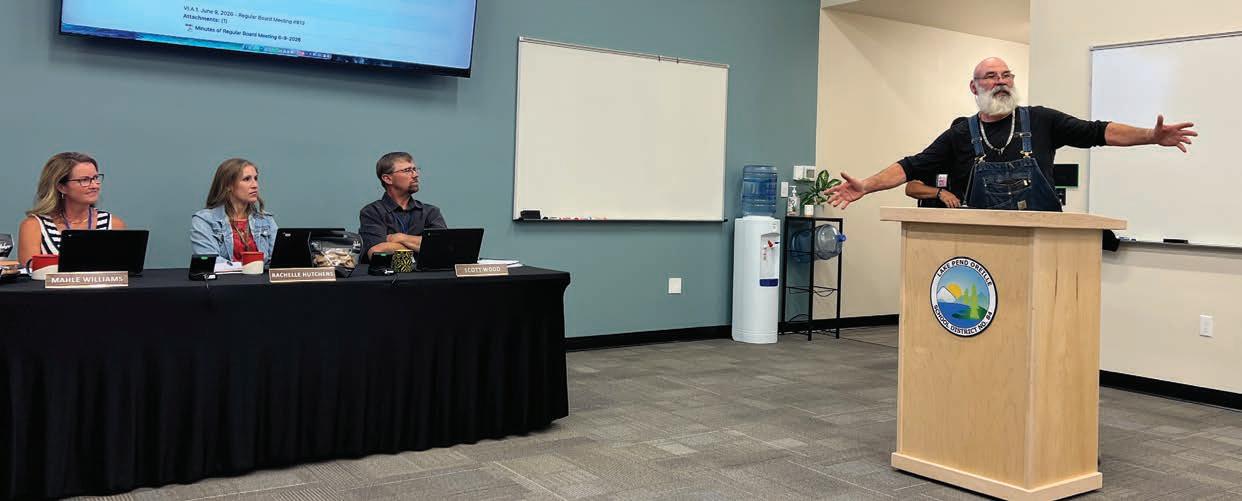
A crowd of more than 80 community members, teachers, parents and former students of Lake Pend Oreille High School gathered July 14 at the Lake Pend Oreille School District Board meeting, largely in protest of an agendized vote to relocate the alternative high school from its historic Boyer campus. Despite vocal and emotional opposition, the board of trustees voted unanimously to move LPOHS to the portables behind Sandpoint Middle School beginning in the 2027’28 school year.
Meeting attendees included members of the Concerned Citizens for LPOHS Coalition, which filed an official grievance with LPOSD on June 30, demanding that they halt efforts to relocate the school from its 117-year-old building on 1005 North Boyer Ave., in Sandpoint.
The 31-page document and subsequent conditional settlement offer alleged misuse of public funds, attendance and graduation data fraud, and violations of Idaho Open Meeting Law and the Individuals with Disabilities Education Act, among other claims. The group further threatened the board of trustees with recall efforts should they vote on the relocation without first holding a special public hearing on the issue.
The district has repeatedly denied the coalition’s allegations, citing past agendas and fiscal and attendance audits. Still, at the request of the coalition, the Idaho Department of Education is currently conducting an additional audit of the district’s PowerSchool Student Information System metadata.
LPOSD announced plans to relocate the alternative high school in February, citing declining attendance and the cost of necessary renovations and maintenance at the current campus, which requires new
plumbing, electrical wiring, roofing, and a fire alarm and suppression system, among other issues. Because state funding is based on enrollment and attendance, LPOHS has been operating at a deficit, costing the district $528,042 over the past five years.
The 2025-’26 graduating class has reduced enrollment to 51 students, resulting in a $308,056 loss in funding for the upcoming school year. To cut costs, the district has already eliminated all LPOHS electives, including physical education, which is a graduation requirement.
LPOHS students will remain in their current building for the 2026-’27 school year, attending core classes as usual while taking electives either online or at Sandpoint High School and the adjacent Career Technical Education Center, set to open in September. Following renovations, the school will then move into the portables behind SMS and continue with the same elective configuration.
The coalition argued that combining the campuses and classes will harm LPOHS’s youth, who have qualified for the alternative school for various reasons, including struggles with the academic and social environments at SHS.
LPOSD Chief Financial and Operations Officer Brian Wallace and Superintendent Becky Meyer both pointed to
increased LPOHS enrollment in SHS electives as proof of the system’s viability; however, opponents insisted that enrollment is only up because the district cut LPOHS’s electives.
“Administration claims that the school continues, yet they have already hollowed this program out,” said former-West Bonner County School District Superintendent Jackie Branum, speaking on behalf of the coalition at the July 14 meeting. “Only four teachers remain to teach four subjects. Forcing four remaining teachers in the trailers behind the middle school is not a routine relocation.”
Relocating LPOHS has been a longtime discussion topic, and, according to Meyer, the administration considered several options before deciding on the portables. While writing the initial grant to fund the CTE center, Meyer proposed revamping the district headquarters in Ponderay to house both the alternative high school and the CTE classrooms; however, the school board voted down the proposal due to potential access issues for SHS.
“In all transparency, there obviously are other options,” said Meyer. “We could maintain the current location at the Boyer site, and it would just really need to operate ... as more of an isolated, smallschool model, similar to how
Clark Fork is running.”
That option would require students to take mostly online electives and would not solve the school’s financial issues, as Clark Fork High School qualifies for additional funds under the Secure Rural Schools Act, and LPOHS does not. The third option, which Meyer and the board of trustees all argued against, would be to close the school and save an estimated $600,000-$800,000.
Though the board room reached maximum capacity and late attendees were turned away in the parking lot, only seven members of the public signed up to speak at the July 14 meeting. Of them, five argued against the relocation. The audience remained vocal throughout, often criticizing board claims, shouting out negative experiences at SHS and repeatedly claiming that the board did not “understand how much these kids matter.”
LPOSD Board Chair Lonnie Williams repeatedly called for quiet, banging his gavel and threatening the audience with expulsion, which prompted several members to leave.
Following public comment, Trustee Mahle Williams made the motion to relocate, which Trustee David DeMers seconded.
“I don’t know what to tell people when they say to me, ‘Do we really need the program? They didn’t have it
when I was in school, and I’m tired of taxes. I don’t want to pay taxes anymore. So, I don’t care if it’s 25 cents, $25,000 or $350,000, I don’t want to pay for it.’” said DeMers. “Many of them move here, and they don’t want to pay taxes at all. We all know that. They’re not here to spend [money on] Road and Bridge or the library or anything like that — or schools. They’re not going to vote for anything. It’s always a ‘No.’”
His fellow board members agreed, arguing that the move to the portables is “what is best for students” and is the fiscally responsible choice for taxpayers.
“You guys have proven, over and over, these last few months, what a family you are,” added Mahle Williams, speaking to the former and current students in the room. “You come here, you show up, the community supports you ... I have no doubt that that can continue.”
The board voted unanimously to relocate LPOHS. As of press time, the coalition had not initiated a multizone voter recall campaign, as threatened in the July 6 conditional settlement offer.
Former Lake Pend Oreille High School Culinary Arts teacher Rand Rosecrans asks the school board to postpone its July 14 vote, calling for open, peaceful dialogue between both sides of the issue.
Photo by Soncirey Mitchell
Initiative to end Idaho’s abortion ban qualifies for general election ballot
110,000+ signatures gathered for initiative that would also protect contraceptives, IVF access
By Laura Guido and Clark Corbin Idaho Capital Sun
The voter initiative seeking to end Idaho’s strict abortion ban has officially qualified to appear on ballots in November, Idahoans United for Women and Families, the group leading the effort, announced July 13.
Idahoans United for Women and Families turned in more than 110,00 signatures to the office on July 2, the Idaho Capital Sun previously reported.
“We are just immensely proud of the foundation we have built, and to continue that outreach into the fall,” Idahoans United Executive Director Melanie Folwell said in an interview. “We have known from early on this issue was deeply personal and had the ability to break through divisive partisan frames we are navigating nationally right now and certainly, very accurately here in Idaho.”
“The thing about the Reproductive Freedom and Privacy Act is it speaks to a fundamental Idaho value and a fundamental American value that no matter our own personal beliefs, we ought not impose those on others,” Folwell added. “When it comes to making the tough decisions in our lives and in our families, we call the shots and not the government. That is something that has resonated in every corner of the state.”
In Idaho, a ballot initiative allows residents to directly propose and decide whether to enact a new law. To qualify for the ballot, initiative
supporters must collect the signatures from a total of at least 6% of registered voters statewide, as well as 6% of registered voters in at least 18 of Idaho’s 35 legislative districts.
In a July 13 press release, Idahoans United said more than 1,250 volunteers helped collect the 110,000 signatures, and Idahoans from all of the state’s 44 counties signed the initiative’s petition.
“The 110,000+ signatures on the Reproductive Freedom & Privacy Act are the most collected for a qualified ballot initiative in Idaho history, over 1.5 times the 70,725 valid signatures required by law,” organizers stated in the release.
The initiative would take a simple majority of votes in the Nov. 3 general election to become law.
County clerks performed an initial check to determine whether signatures came from individual eligible registered voters, and the Idaho Secretary of State’s Office completed the final verification. A spokesman from the Secretary of State’s Office confirmed the initiative has qualified for the November election on July 13.
The proposed initiative would legalize abortion until fetal viability or in cases of emergency — essentially re-establishing the abortion rights Idahoans had before the U.S. Supreme Court overturned the Roe v. Wade decision four years ago. The initiative would also enumerate rights related to reproductive health, such as protections for access to contraception and IVF, and privacy in medical decisions.
Some legislative candidates support overturning initiative if it passes
The initiative faces strong pushback from some in the Idaho GOP.
Members of the Idaho Republican Party at its summer meeting in June approved a resolution to call on the Idaho Legislature to repeal the abortion initiative should it pass in November.
There are 16 legislative candidates who won their Republican primary elections that said they supported overturning the initiative if it passed in a survey distributed by a group called Honor Idaho.
The candidates are: Scott Herndon, Jane Sauter and Cornel Rasor, Vito Barbieri, Elaine Price, Cindy Carlson, Kyle Harris, Colton Bennett, Christy Zito, Judy Boyle, Camille Blaylock, Kent Marmon, Jeff Cornilles, Jaron Crane, Steve Tanner and Clint Hostetler.
On July 9, Idaho GOP Chair
Court issues injunction against Panhandle Bike Ranch
By Soncirey Mitchell Reader Staff
The Panhandle Bike Ranch has halted all activities following an injunction issued by the First Judicial District Court in the nonprofit’s ongoing land use dispute with Bonner County. The two entities met in court on June 30 and July 8, following the county’s issuance of a cease-and-desist letter, with which PBR did not comply.
Co-founder Jennifer Kalbach announced the ranch’s closure in a July 8 email to subscribers.
“Until we get more clarity relative to the scope of such injunction (and perhaps thereafter as well), the bike ranch
is temporarily closed, and all scheduled riding, events and programs are canceled during this time,” she stated.
PBR occupies approximately 170 acres in Sagle, zoned Rural 10, meaning property owners must obtain a conditional use permit before engaging in any commercial activity. The Kalbachs received a CUP in 2024; however, the court later vacated it in 2025, finding that the Bonner County Board of Commissioners “failed to list facts supporting its decision” to approve the development.
Rather than reapply, the Kalbachs transitioned PBR into a 501(c)(3) nonprofit, believing that the ranch could operate without a CUP. PBR
then requested the county change the organization’s land use designation from a recreational facility to a park, which does not require a CUP.
The county denied the request, advising PBR to reapply for the CUP.
PBR instead filed a petition for legal review in January 2026, which remains unresolved. The park opened to riders on May 22, and the county filed its cease-and-desist letter on May 27. Nevertheless, PBR continued to host riders until the July 8 ruling.
Both parties await the publication of the judge’s complete ruling, which the county anticipates in the coming weeks.
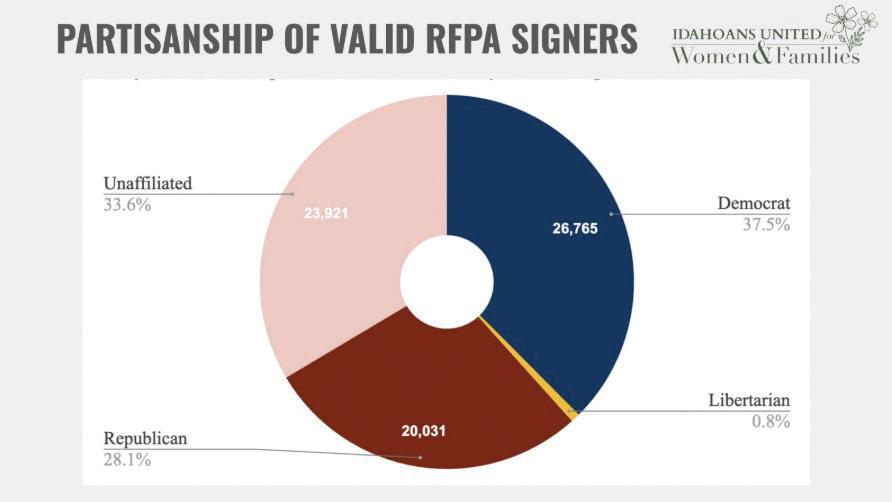
This graphic breaks down the political affiliation of the people who signed the petition to get the Reproductive Freedom and Privacy Act on the Nov. 3 general election ballot. Image courtesy of Idahoans United for Women and Families
Dorothy Moon released an op-ed denouncing the initiative as “deceptive,” and said she was proud to cast a vote while she was serving in the Legislature to support Idaho’s trigger law that went into effect after Roe fell.
Now organizers of the initiative are “trying to undo that progress and turn back the clock to a time when any unborn child could face the death penalty for the crime of being inconvenient,” Moon stated in the op-ed.
Despite Idaho’s status as a deeply conservative state — President Donald Trump won here by nearly 37 percentage points in 2024 — an estimated one-fourth, or 28%, of more than 110,000 signatures collected by the group spearheading the proposed Reproductive Freedom and Privacy Act are from registered Republicans, Stateline previously reported.
According to the campaign’s data, more than 33% of the signers are unaffiliated voters, 37% are Democrats and about 1% are Libertarians. Those shares may be slightly higher or lower now that petitions are certified by the Idaho Secretary of State’s Office to put the proposal on the November ballot.
This story was produced by Boise-based nonprofit news outlet the Idaho Capital Sun, which is part of the States Newsroom nationwide reporting project. For more information, visit idahocapitalsun.com.
Pedestrian Long Bridge reopens
By Zach Hagadone Reader Staff
The pedestrian portion of the Long Bridge is again open to non-motorized traffic, less than a month and half after the Idaho Transportation Department closed the span due to deterioration of support infrastructure below the bridge deck that posed a threat to public safety.
According to the department, the reopening — which took place July 14 — came after “an intensive effort by engineers, bridge inspectors, maintenance crews and a local contractor to design, fabricate and install custom steel support brackets beneath the bridge at its most critical locations.”
Crews installed the brackets, referred to as “saddles,” under the bridge deck to shore up some of the girders where the most severe damage was observed by inspectors. Officials stated that the brackets are intended to balance the weight of the structure, which allows pedestrians, cyclists and other users to traverse the span, built in 1956 and converted to non-vehicle use when the current motorized Long Bridge entered service in 1981.
However, those using the pedestrian bridge must stay in designated areas, with portions that remain unsafe marked with traffic control devices such as cones, barrels and caution tape.
ITD stated that while the bridge reopening provides continuous crossing between Sandpoint and Sagle, those traffic control devices will be replaced with “more substantial barriers that are better suited for long-term use.”
“This is not a return to normal,” stated ITD District Engineer Ryan Hawkins. “The bridge remains in need of additional repairs in several locations, but the emergency stabilization work we’ve completed allows us to safely reopen access while we continue ongoing evaluation, planning and work.”
ITD has underscored its reluctance to have closed the bridge, and acknowledged the “understandable frustration for many community members” who relied on the pedestrian bridge for transportation as well as recreation.
The reopening will come in time for the annual Long Bridge Swim, which is scheduled for Saturday, Aug. 1.
Local nonprofit Project 7B hosted a community survey following the closure of the bridge in June, and reported on July 13 that of the 732 respondents, more than 74% said they use the bridge for recreational cycling. More than 47% use it for “special occasions,” such as
fundraising, photography and spectating the Long Bridge Swim, while 8% said they don’t use it at all.
More than 31% reported using the pedestrian bridge “multiple times per week” and 19% said they use it weekly during the warmer months, though only about 6% and 10%, respectively, said the same for the colder seasons.
To meet the needs of those who use the pedestrian bridge as a connection between Sandpoint and Sagle, the SPOT bus launched a new route with regular service between the Selkirk Loop Welcome Center on Superior Street in Sandpoint and the former-Long Bridge Grill on U.S. 95 in Sagle.
Project 7B’s survey found that 9.4% of respondents said the crossbridge SPOT bus route “fixed the issue for them.”
ITD spokesperson Heather McDaniel told the Reader in an email that SPOT would suspend that service on July 15, but that bus officials were “open to reactivating the route in the future if there is enough desire from community users and also if funding partnerships can be identified to assist with the cost of providing that service.”
During the closure, SPOT’s Long Bridge shuttle route was supported by ITD in the form of a matching portion of the grant funding used to create the route.
Those interested in seeing the route return, or organizations interested in exploring a funding partnership to support transit service across the Long Bridge or further south into Sagle, are encouraged to contact SPOT at 208-263-3774.
Going forward, ITD engineers will continue evaluating needed repairs to the pedestrian bridge and the department emphasized that users stay on the designated pathway and never move or remove cones, barriers, caution tape or other traffic control devices.
Community members were relieved to know the bridge was reopening, as Project 7B reported: “The solution that the vast majority of the survey respondents favored was fixing the bridge ASAP, even if the fix wasn’t perfect — which is the solution that happened.”
According to one commenter to Project 7B, the bridge “feels like the heart of the area — the water and boats passing below, trains and cars bustling back and forth on each side, eagles and airplanes soaring overhead, the sunlight tracking through the sky. I love the energy and connection I feel when standing on the bridge, and it inspires me to be part of this community.”
Bits ’n’ Pieces
From east, west and beyond
The Cyclospora parasite has sickened more than 3,000 people, causing diarrhea, nausea, cramping and fatigue. NBC wrote that a year ago the Centers for Disease Control and Prevention decided to no longer track it.
As well, the flesh-eating screwworm is spreading in the U.S. and Central America, and is not restricted to cattle, now being found in wildlife. Politico reported that efforts to control the spread of screwworm cases have been hampered by the administration of President Donald Trump’s funding cuts.
The U.S.-Iran war is back on, as global media outlets report that Iranian leaders are calling for retaliation after Ayatollah Ali Khamenei died due to U.S. aggression. Based on Iran’s threats against Trump, he called for a standing order to step up attacks against Iran if agents of that country assassinate him. U.S. soldiers in the Iran region say the Army is significantly downplaying their injuries. The International Monetary Fund warned the global economy faces a “sharp slowdown” due to the war on Iran and to inflation.
Someone dies in immigration detention about every six days, according to the ACLU. CNN found cases directly attributable to medical neglect, understaffing and “cascading failures” due to for-profit concentration camp operations doubling the detained population without doubling of doctors.
In the last week, Immigration and Customs Enforcement killed two men, neither being their intended targets for arrest. Both were accused by ICE of weaponizing their vehicles, which has been disputed. In Texas, Lorenzo Salgado Araujo was shot “almost immediately” after exiting his vehicle. Video shows an unmarked ICE vehicle cutting off Araujo’s van — no officers were positioned where they could be hit. Araujo, a homebuilder and Mexican immigrant in the U.S. for 35 years, was close to obtaining his legal status. ICE said he “resembled” someone they wanted.
In Maine, ICE’s 11th shooting victim was Sebastian Guerrero, 26, who was in his car with his wife and 3-year-old daughter at the time. He was authorized to work in the U.S. and had a Social Security number. He was shot, dragged limp from his car, handcuffed and died shortly thereafter, with his
By Lorraine H. Marie Reader Contributor
family witnessing the killing. Mexican President Claudia Sheinbaum has filed a criminal complaint, and Trump has called for ICE to “cease” most vehicle stops. Another death occurred when a 28-year-old man was fleeing an encounter with immigration and federal agents in Florida, and was hit by a tractor-trailer.
Sen. Lindsey Graham, R-S.C., died unexpectedly July 11 at the age of 71. His sister will finish his term.
International media sources reported that a federal judge in Florida has dismissed Trump’s $3.8 billion defamation suit against The Washington Post, which reported that a bank tied to Trump Media also has connections with the porn industry.
According to The New York Times, the Trump administration is demanding states change voting rules or lose antiterrorism funds; though, per the Constitution, the executive branch has no power over state elections.
Rule changes pressed by Wall Street could mean that Americans’ 401(k) accounts are at risk, as financial firms seek to grab “a bigger piece of the $10 trillion” held by individuals for retirement, according to ProPublica. Meanwhile, the Trump administration is planning a regulatory rollback that would clear the way for less-regulated and potentially riskier investments.
NBC reported that a Trump-appointed district judge has tossed federal convictions for the remaining Jan. 6 Proud Boys after a request from the U.S. Department of Justice.
According to The Times, another district judge ruled that Trump’s lawsuit against the IRS, demanding the agency pay him $1.776 billion information leaks, was “self-dealing.” The judge referred the attorneys who represented Trump in the case — who included acting-U.S. Attorney General Todd Blanche — to bar association investigations. Blanche faces congressional hearings to determine if he will be appointed AG, and testimony against Todd will include an Epstein survivor.
Reuters reported that Europe recorded 10,000 excess deaths during a late-June heat wave.
Blast from the past: “The object of life is not to be on the side of the majority, but to escape finding oneself in the ranks of the insane.” — Marcus Aurelius, Roman emperor (121 A.D.-180 A.D.)
Bouquets: GUEST SUBMISSION:
• “Thank you to the gentleman cutting down tansy and weeds along the bike path near the UCAN gym. Not only is it needed, but he paused his work and turned the mower throttle down as I walked by. Your small act of thoughtfulness is a great example of what I love about our community!”
— By Melanie Almeida
Barbs:
• Yep, I totally judge drivers who pull into the Bonner Mall parking lot and take that first left into Yoke’s. The proper lane to use to enter Yoke’s is the second left, not the one across from the McDonald’s parking lot, but people don’t seem to care about doing practically anything the proper way anymore. But seriously, it’s one of those dumb little pet peeves that gets on my nerves, especially after I’ve seen that intersection back up with vehicles clogging the right of way as they keep trying to make that first left into Yoke’s. Recently, a new striping job on the turn lanes makes it easier than ever to realize that first left into Yoke’s isn’t the ingress to take. Should it help? Yeah, in theory. Will it help? Nah. One thing I’ve learned from living in the world after 2020 is that people will do whatever the hell they want and use any means to justify their decision as the correct one. Maybe you, dear reader, will be the change.
GUEST SUBMISSION:
• “ Everyone Poops is the title of a children’s book. After weekend chores, I decided to change it to Everyone Poops in My Yard. (Hope Peninsula lifestyle). ”
— By Jane Holzer
Meet Kaylee Peterson, running for Idaho Dist. 1 U.S. House…
Dear editor,
Thinking about November is tough when it’s 84 degrees outside. But we will have a choice to make this fall. It’s my belief that the most important one will be for our District 1 representative to Congress.
I would like you to come meet the person running against Rep. Russ Fulcher. At 6 p.m., Tuesday, July 28, you’ll be able to visit with Kaylee Peterson, Democratic challenger to Fulcher, and hear her vision for Idaho. Kaylee will discuss her campaign, answer questions and talk about how we build community and win in the midterm election.
My most important reason for supporting Kaylee is her point of view about public lands. She wants to keep them public. Fulcher wants the state to manage them. Think about the hours you spend camping, hiking, boating and fishing coming to an end because the public lands we love no longer belong to us. They will belong to an industry determined to extract minerals or timber. They will be sold to the highest bidder.
Kaylee wants to keep them available for public utilization.
Find out more about Kaylee at KayleeforCongress.com and pick your favorite reason to support a new representative for District 1.
David Stroud Sagle
‘Love of country’...
Dear editor, I love my country as I love my kids (and your kids, all kids). My country is not a symbol like the flag, nor some remarkable documents or even the noble aspirations they enshrine. My country, like the kids, are people. People to be loved, protected, nurtured, educated and helped to bring to this world all they were born to give.
I wish for the kids what I wish for this country and the world: that we be kind, wise, creative and learn to express (and so experience) love, rather than the absence of love, which is fear (and all the stupid stuff that comes from fear, like self-centeredness, greed, corruption, pollution and all the “us vs. them” thinking that leads to division, hate, violence and war).
I love my country as I love my kids: enough to want them (us) to help our world get better.
Greg Flint Sandpoint
COMMUNITY Race through town at the Sandpoint Summer Street Scramble
By Reader Staff
The Eastern Washington Orienteering Club is partnering with the Litehouse YMCA to host the Sandpoint Summer Street Scramble on Saturday, July 18, inviting participants to race through a number of checkpoints at local locations. Starting at 10 a.m. at the YMCA (1905 Pine St.), attendees of all skill levels will walk, run or bike throughout the area, criss-crossing Sandpoint following a map to checkpoints ranging from neighborhoods to prominent landmarks. Upon reaching each designated location, racers will then be prompted to answer a multiple-choice question related to the site. Scores will be tallied based on correct answers in a “score-o format,” which organizers stated means locations can be visited in any order
within the three-hour limit from the start time, and point values will vary depending on certain factors, including the remoteness of the location.
Winners will be selected based on total points, which also depends on how fast they can hit all the locations. The
race ends at 1 p.m., with steep point penalties for going over the time limit.
Admission is $8-$10 and registration is from 9-9:30 a.m., or pre-register by calling 208-263-9894. Get more info at ewoc.org.
By Emily Erickson Reader Columnist
“If you took a very long ruler and stretched it from here to the planet Pluto, one inch of that distance would be you. The rest of the distance would be other possible human beings that could have been, but never were. Each of us has won the lottery with a hundred thousand billion players. Being alive is the greatest stroke of luck we will ever experience.”
That’s from “The Ordinary Miracle of Existing,” by Alan Lightman in The Atlantic, which I was reading in the hard plastic chair of the laundromat. Humidity crawled across the window next to me, the hot breath of the washing machine obscuring its pane.
Lightman was describing the impossible odds of being the sole survivor of a single conception event — of being one in 300,000 eggs a human female carries in the fertile period of her life, as well as the one in 300 million sperm in a single male ejaculation. Before that, he described the unfathomable reality that is being alive on a planet within a solar system on the outskirts of 100 billion stars called a galaxy, of which we are but one of many.
He described the expanse: “Think of an ant in New York City contemplating a trip to San Francisco. Our houses, our roads, our cities are a speck in the cosmos, a dust mote, one grain of sand on a vast beach.”
A bead of sweat traced its way from my temple to my
Emily Articulated
Ordinary miracle
ear before disappearing into a dry strand of hair. A machine beeped across the room, and I looked up for the person whose clothes were ready. Farther away, a man with a faded Celtic knot tattoo fed a bill into the coin machine. It was the kind of tattoo that showed its age, fading into obscurity with each slowly blurring line. The clinking of the metal coins hitting the tray reverberated around the room.
I sat in the paradox of the moment, contemplating the magnitude of the universe and the impossible odds of my own existence while the mundane hummed around me. It felt like peeking behind the curtain of ordinary life and catching a glimpse of something deeper — a brief awareness of the extraordinary privilege of experiencing such profound insignificance — before the curtain drifted back into place.
Perhaps we only get glimpses like this because it would be too great to hold all of the time. We overcame unfathomable odds, and also needed to stand, feet planted on bathroom tiles, and brush our teeth while the Earth
spins around us. Or stand in line. Or separate whites from colors.
Whole religions and philosophies have been devoted to this question, each offering its own answer to the improbable fact of our existence. Monotheistic traditions see intention where others see chance, believing we were deliberately created and entrusted with purpose. Other faiths understand us as inseparable from the Earth or the cosmos itself — drops in the ocean, leaves on a tree, expressions of a larger whole. Nihilists find freedom in our insignificance, while existentialists argue that if existence is improbable, then meaning is ours to create. Different answers to the same mystery, each an attempt to explain what it means to wake up as one improbable life among billions.
Folk musician John Craigie (who is playing at the Panida Theater this Friday, July 17) has a lyric in his song “Dissect the Bird.” He sings: “[If] the universe feels like it’s against you, just take a minute to realize, all it took to make you / Sparks had to catch, oceans had to freeze, billions of cells had to survive endless disease / People had to leave, hearts had to get broken. People had to die, just so your eyes could open. The universe is not against you; it went through a lot, just to give you a chance. It must’ve wanted you pretty bad. (No pressure though).”
This song, like Lightman’s essay, explicitly incites a shift in perspective, insisting we step outside our lives and consider the magnitude of
our existence. Other nudges aren’t so obvious, but are there when you know what you’re looking for — the sunset that makes your chest ache, the loss of someone close, the joy of finding someone new, the sparks of a fire as they drift lazily to the stars. Our lives are ordinary and incomprehensibly insignificant. And also, complete miracles.
I folded the last shirt and placed it into my bas-
ket before wheeling it to the trunk of my car. Settling into my seat and switching on my blinker, I listened to the clicking beat as rhythmic as my own heart, and merged into the afternoon traffic.
Emily Erickson is a writer and business owner with an affinity for black coffee and playing in the mountains. Connect with her online at www.bigbluehat. studio.
Retroactive By BO
Emily Erickson
Science: Mad about
latex gloves
By Brenden Bobby Reader Columnist
My hobby involves going through a large number of latex gloves. Photopolymer resin is really bad for your skin, so you need to use gloves to handle the stuff when processing resin-based 3-D prints.
Don’t worry, we don’t use resin at the library and your PLA prints are perfectly fine to handle barehanded. The resin printer I use is for highly detailed miniatures, which require far more detail than extruded PLA can provide.
This led me to wondering how they mass-produce nitrile and latex gloves, and when they were invented.
Hands are pretty complex appendages. Everyone’s hands are shaped differently, so it isn’t realistic to mold a user’s hand and tailor mass-produced gloves specifically to them. Instead, a manufacturer has baseline hand molds that vary in size to produce a product that fits well enough for everyone. The latex glove only needs to act as a barrier to keep unwanted chemicals or pathogens out; it doesn’t need to be a perfect fit.
It all begins with latex. Latex comes in two forms: organic and synthetic. Organic latex comes from the milky-white sap of the rubber tree. Hevea brasiliensis, which is harvested from plantations in South America and Southeast Asia. The natural latex is hardened into durable rubber through vulcanization, which uses sulfur and heat to create dense polymer bonds within the latex. This makes it extremely useful for a wide variety of applications, from car tires to surgical gloves.
Organic latex has a long history, having been used by the Indigenous peoples of South America for at least 1,100 years, though without the process of vulcanization. That was discovered in 1839 by American chemist Charles Goodyear, for whom Goodyear tire is named. Goodyear, the chemist, wasn’t actually involved with the founding of Goodyear the company. It was named after him, four decades after his death, by the entrepreneur Frank Seiberling.
Synthetic latex comes from mixing two chemicals: styrene, often seen as expanding polystyrene or styrofoam packing material; and butadiene. Both of these chemicals are extracted from crude oil and, when combined, form a synthetic rubber. This is especially useful for countries that are far from rubber plantations but have access to crude oil. Before World War II, these were the driving factors for many countries seeking synthetic alternatives to rubber based on the fear of being cut off from organic rubber supplies by the British Empire. After all, the British controlled most rubber plantations in the world at that time through its numerous scattered colonies.
Returning to the manufacturing of latex gloves, preparing the liquid latex isn’t actually the first step of the production process — that involves getting the hand molds ready. Each line has a conveyor system in which thousands of hand molds are suspended from the conveyor to undergo several processes before the glove takes shape. At a distance, it looks like some kind of nightmare facility where thousands of disembodied hands are just hanging around.
The first step is to clean the hand molds by dunking them in an acid solution, then soaking them in water, blasting them with air, drip-drying them and then heating them in an oven. The molds are then submerged in calcium nitrate, often used as fertilizer, which acts as a coagulant to which latex will stick, as well as being an important part of the demolding process later. After this step, they are dried again and then are dipped in a tank filled with blue liquid latex.
The blue or green colors are not random — they’re specifically chosen for several specific reasons. These colors have high contrast to traditional hospital environments, as well as human skin. This makes it easy to spot rips in the glove before or during a procedure. I can attest to this one, as I usually spot the rip in the glove before I feel open air on my skin, prompting me to swap gloves before processing any more resin. Additionally, these gloves help reduce eye strain on surgeons, who spend a lot of time looking at the color red, as macabre as it is. Blue and green oppose red on the color wheel, allowing a surgeon to easily differentiate between their own hands and the patient they’re working on, even when their hands are covered in the patient’s blood.
The first layer of nitrile latex is dried in a long oven, and then they are dipped again to compensate for any bubbles or deformations from the first dunk. They’re dried again, and then fed into the hemmer, which is a series of textured rollers that texture the hem and push the latex up the mold to form the hem that you grab for removing the gloves once
they’re on your hand.
The molds go through several more water baths, a chlorine bath and two more sets of drying ovens before they reach the pre-stripping stage, where a roller presses up the hem of the glove to prepare it for peeling from the mold.
The stripping machine has little grabber mechanisms that
pull the glove to the fingertips of the mold, allowing them to hang free before reaching the final stage, which is a machine with two round grabbers that automatically counts the gloves and peels them off, depositing them into stacks for workers to pack into boxes for shipping.
Stay curious, 7B.
Random Corner
• Of the 2.1 million farms that dot America’s rural landscape, 95% are operated by families, individuals, family partnerships or family corporations. These family farms and ranches account for 90% of total agricultural production value. While farm and ranch families make up less than 2% of the U.S. population, farming is the largest employer on the planet, accounting for about 28% of the world’s workforce population.
• One acre of land can grow 50,000 pounds of strawberries or 2,784 pounds of wheat.
• A high-producing dairy cow can generate the raw material for the following in one day: 4.8 pounds of butter, 8.7 gallons of ice cream or 10.5 pounds of cheese.
• U.S. corn yield (tons per acre) has increased more than 360% since 1950.
• The world’s largest farm is Anna Creek Station in Australia, a cattle operation that spans just shy of 6 million acres.
• The first evidence of farming dates back to around 10,000 BCE, when ancient humans transitioned from a hunter-gatherer lifestyle to settling in one place and cultivating crops. The shift to agriculture allowed for the rise of civilizations, as people could produce more food and support larger communities.
• Honeybees are responsible for pollinating about ⅓ of all the food we eat. Without them, the global food supply would look drastically different.
• Pigs are as smart as dogs and young kids. They can learn tricks, follow commands and even play video games.
• Cows have four unique compartments in their stomachs that help them digest tough foods like grass. These compartments — called the rumen, reticulum, omasum and abomasum — each play a special role in breaking down the rough food they eat.
The road ahead is getting rougher for Idahoans
By Lauren Necochea Reader Contributor
A strong state needs strong infrastructure. Roads and bridges connect workers to jobs, products to markets and communities to opportunity. When infrastructure is neglected, the economy falls behind too. And when we fail to stay on top of maintenance today, repairs become more costly in the future.
Another $1.5 billion in congestion mitigation projects is unlikely to advance through the state’s bonding process. Altogether, nearly $2.8 billion in transportation work is at risk while Idaho keeps growing.
and education combined. The benefits overwhelmingly flowed to the wealthiest. The top 1% received an average tax cut of $111,610, while a family earning the median income received $1,318. Idahoans with the lowest incomes saw an average tax increase of $96.
A newly released seven-year transportation plan from the Idaho Transportation Department shows what Republican budget choices are putting at risk.
This year, the GOP budget cut $275 million from transportation funding, including $165 million for state highways and $110 million for local highway districts. Now, nearly 70 highway projects across Idaho could be put on hold indefinitely as the Idaho Transportation Department braces for the possibility of losing more than $1 billion over the next seven years.
Even after cutting projects, transportation officials are unsure they can keep up with basic safety measures, including pavement preservation, bridge and guardrail repairs, striping, and potholes. That should concern every Idahoan. Two hundred and fifty Idaho bridges are already rated poor or structurally deficient. Delayed repairs don’t save money. They risk small problems becoming expensive failures, with dangerous, disruptive, and costly consequences.
All of this raises the question: If Idaho families, businesses and communities are paying the price for a shortsighted budget, who benefits?
The Idaho Center for Fiscal Policy found that state and federal income tax cuts since 2018 delivered $4.5 billion in annual tax reductions, more than Idaho currently invests in health
The center was right to warn that cutting state revenue does not make costs disappear. It shifts the burden to families and communities through higher local property taxes, tuition, fees, and reduced services.
The same failed choices are showing up across the budget. Republican politicians cut $10 million from LAUNCH workforce training scholarships, drained the wildfire suppression fund to zero, and capped therapy visits for children with disabilities. All to cover tax cuts for the richest Idahoans.
A stronger Idaho starts with different choices, and Democrats are ready to make them.
Lauren Necochea is chair of the Idaho Democratic Party and a former District 19 legislator. Necochea spent a decade leading nonprofit programs dedicated to research and advocacy in tax policy, health care and children’s issues.
Learn to save seeds at the library
By Reader Staff
The East Bonner County Library District will once again welcome speaker Casey O’Leary of Snake River Seed Cooperative to a free seminar, this time discussing seed saving basics at the Sandpoint branch (1407 Cedar St.). The class runs from 5-6:30 p.m. on Thursday, July 16 outside in the library’s garden.
O’Leary is a professor and urban farmer, growing vegetables and seeds for more than 20 years at Earthly Delights Farm in Boise. She is also the general manager and co-founder of Snake River Seed Co., a collection of family farmers throughout the Intermountain West who grow and sell regionally-adapted heirloom and open-pollinated seeds.
O’Leary’s “edu-tainment” focuses on inspiring a sense of wonder and
joy in gardening while remaining highly informative. Thursday’s class will give an in-depth look at growing and saving seeds, including how to prevent or promote cross-pollination; the differences between heirloom, hybrid and open-pollinated seeds; and how and when to harvest and process different types of seeds.
To learn more, visit ebonnerlibrary. org/events/ and casey-oleary.com.
Local artists fundraise for Bonner Community Food Bank
By Reader Staff
Two local artists will sell a collection of their colorful, abstract art on Saturday, July 18 to raise funds for the Bonner Community Food Bank. The Giving Garden Art Sale will see mixed-media pieces displayed around the garden at 508 Forest Ave., in Sandpoint, from 11 a.m. to 5 p.m.
Artists Robens Napolitan and
Tom Kramer have created fine art independently and collaboratively for years, combining traditional and experimental processes that often produce psychedelic folk art. Saturday’s artwork will be priced between $1 and $50, and every cent will go to BCFB.
“This is a beautiful example of neighbors helping neighbors,” said BCFB Executive Director Debbie Love. “Robens and Tom have created a creative
and welcoming way for people to engage with local art, enjoy an incredible garden space, and make a meaningful impact for families in our community.”
Visitors can help provide food for thousands of Bonner County’s most vulnerable residents by picking up a piece of art and bringing non-perishable food donations to the event’s food drive. For more information, visit bonnerfoodbank. org and bit.ly/RobensKramer.
Lauren Necochea. File photo
Sam Owen Fire District hosts 24th annual pancake breakfast
By Reader Staff
Not only are pancakes delicious, but they can also help fund a fire station. To do your part, take the family on a scenic drive out to Hope on Saturday, July 18 for the 24th annual Sam Owen Fire District’s pancake breakfast.
Volunteers and firefighters will serve pancakes, biscuits and gravy, eggs, sausage, juice and coffee from 7:30-11 a.m. at Station 1 (17 Old Sam Owen Road, in Hope). Donations go directly to the Sam Owen Fire District to help fund training, training equipment and other needs
throughout the year.
The volunteer department serves the communities of Hope, East Hope and the surrounding areas. Visit samowenfire.org for more information.
YMCA Campfire Across America comes to Sandpoint with family-friendly events
By Reader Staff
Litehouse YMCA in Sandpoint is joining YMCAs across the country in hosting Campfire Across America — a community fair on Wednesday, July 22 featuring free family-friendly events “centered on connection, belonging and community,” according to organizers.
From 2-6 p.m., attendees will be invited to participate in arts and crafts, face painting, an inflatable bounce house, water balloon toss, cornhole, and other family games and outdoor activities.
Food vendors and refreshments will be available, along with
complimentary s’mores, hot dog roasting and music.
Community organizations and businesses will also be on hand with information about their offerings, including Advanced Soma Bodyworks, the Bonner County General Health Foundation, Creations for Sandpoint, Panhandle Special Needs Inc., Rustique Bakery, a tapping workshop, the Teen Center and more.
All events take place at Litehouse YMCA (1905 Pine St., in Sandpoint).
For more info, visit ymcainw.org/locations/ litehouse-ymca.
Museum’s Pioneer Picnic promises a historic good time
By Reader Staff
If past is prelude, and it often is, the community is in for a historic good time Sunday, July 19 with the Pioneer Picnic at the Bonner County Historical Society and Museum (611 S. Ella Ave., in Sandpoint).
The whole family is invited from noon-4 p.m. for carnival games, a dunk tank featuring local luminaries, tugof-war competition and prizes. On top of that will be food available for purchase from the Sandpoint Lions Club, home-churned ice cream and the opportunity to explore the grand opening of the museum’s Hall of Maps exhibition.
Admission to the
event is free, though some games will require tickets, which are available for $1 each (those games will require between one and three tickets to play).
The Pioneer Picnic also serves as the museum’s membership drive, so anyone who purchases a membership on that day will get 50% of the value back in tickets. That also goes for anyone who already has a membership.
Attendees are welcome to bring their own food and picnic in the park, and admission to the museum will be free that day as well.
For more info, including on memberships, go to bonnercountyhistory.org.
Courtesy photo
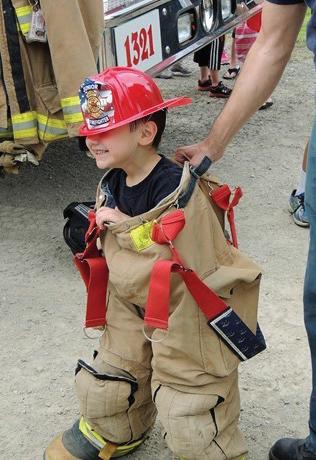
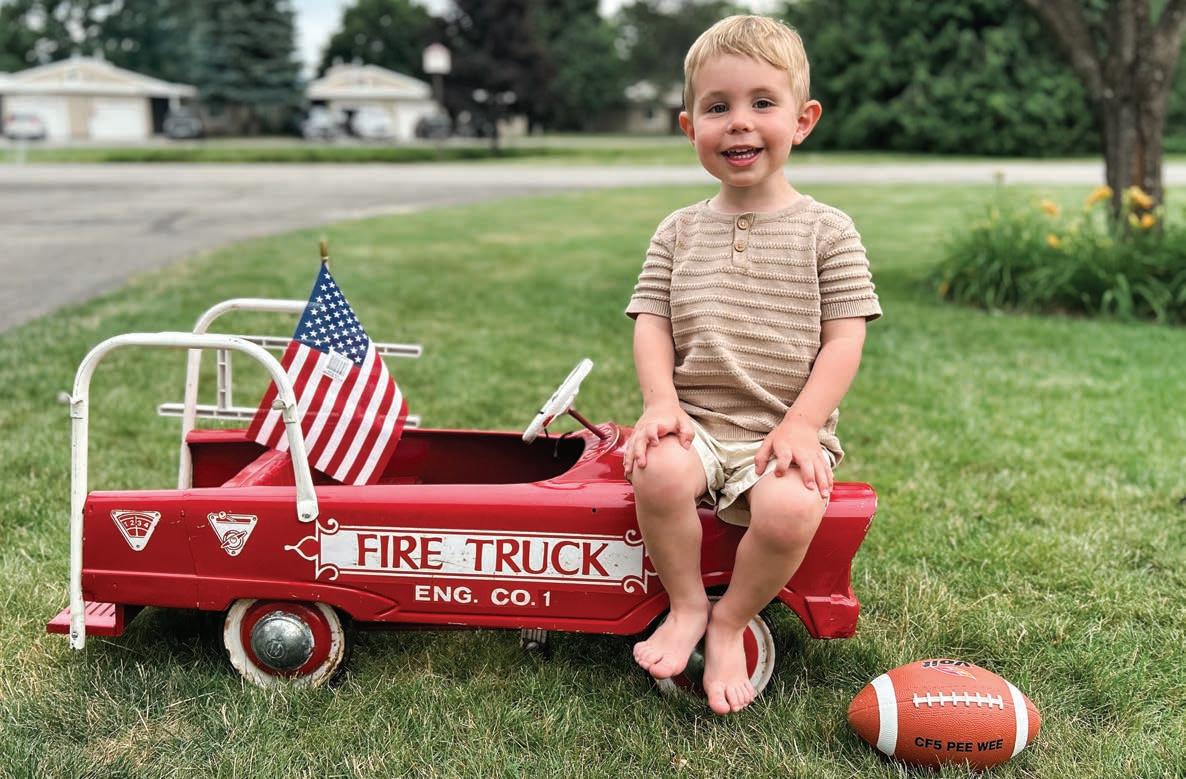
Top: Rick Brouwer submitted this adorable picture of his grandson, Benny McCarron, from the Fourth of July.
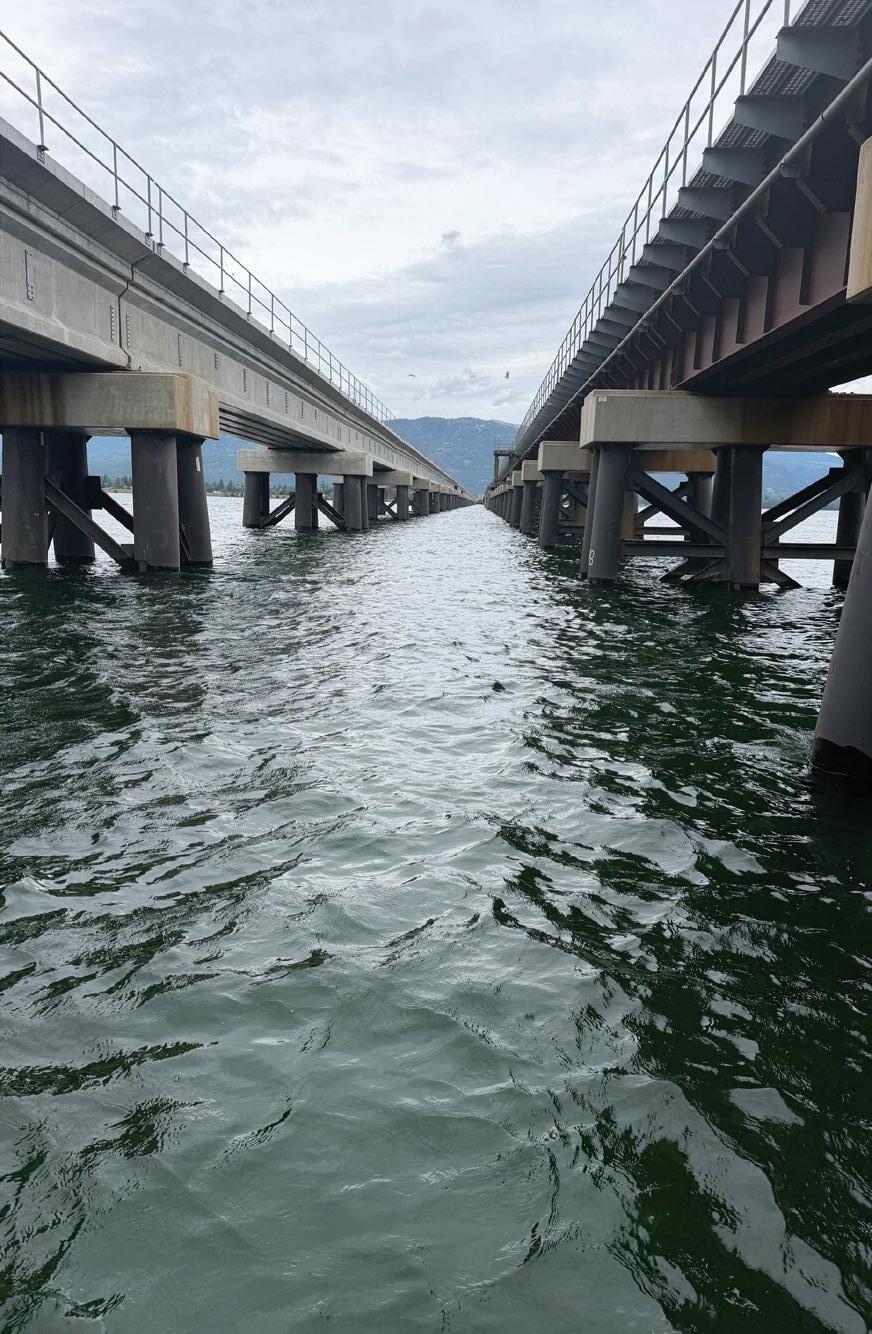
Bottom left: “Putting things in perspective,” wrote photographer Robert Osborn.
Bottom center: David DaVinci (a.k.a. the Thrillusionist) skydiving over Sandpoint and Lake Pend Oreille.
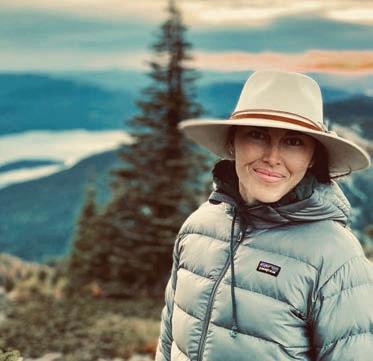
Bottom right: “Greatest Fourth of July ever,” wrote photographer Marg Preuss. Pictured by Sandpoint’s “Lady Liberty” at City Beach are Ella and Teddy Preuss.
Aster Garden Center celebrates local jewelry artisan
By Reader Staff
Madeline French will showcase her fine jewelry at a special Garden Art Party on Wednesday, July 22 from 5-7 p.m. at the Aster Garden Center (924 West Superior St., in Sandpoint). The evening will connect attendees with the artist herself and give everyone a chance to peruse the collection and enjoy an evening in the garden with refreshments.
French grew up in North Idaho, working alongside multiple generations at her family’s lumber yard and spending her free time outside in the area’s forests, mountains and rivers. Today, her regionally recognized jewelry takes inspiration from that nature-centered upbringing.
“I wanted to craft pieces that combine the strength I feel in the outdoors with the delicate beauty I find in the world around me,” stated French.
“Every piece I make tells a story.”
The evening, hosted by Kaniksu Land Trust, seeks to build community while highlighting the nonprofit’s connection to local art and nature. Learn more at kaniksu.org and madelinefrenchdesigns.com.
Schweitzer Winefest offers samples from 20 regional wineries
By Reader Staff
Schweitzer is again hosting its annual Northwest Winefest, with participating oenophiles gathering Saturday, July 18-Sunday, July 19 on the mountain to sip samples from 20 wineries drawn from Idaho, Oregon and Washington.
Events start at 11 a.m. both days, with chairlift rides and activities in the village, along with arts and crafts vendors and local food trucks before tastings begin at noon.
Sydney Dale will provide live music from noon-2 p.m. on Saturday, followed by The Whags from 2:30-4:30 p.m. and Pancho from 5 p.m.-7 p.m.
On Sunday, AP Collective will perform tunes from noon-2 p.m. and The Bed Heads will play from 2:30-5 p.m.
Tastings, bottle sales and food vendors continue throughout the day until
7 p.m. on Saturday and until 5 p.m. on Sunday. Cost of admission to the 21+ event is the purchase of a Northwest Winefest souvenir stemless 15-ounce glass for $45, which also buys attendees five tasting tickets, each good for a two-ounce pour of any of the 80 wines available (while supplies last).
Wine glasses are valid for use both days and can be bought on the day of the event or pre-purchased at schweitzer.com through Thursday, July 16.
Parking is free at the Lakeview and Gateway lots, with complimentary, no-service RV parking at the fire station near the roundabout. The SPOT bus will also run shuttles from the Red Barn at the base of the mountain to the village every 30 minutes starting at 11 a.m. Last shuttles down will leave at 7 p.m. on Saturday and 5 p.m. on Sunday, arriving at 7:30 p.m. and 5:30 p.m., respectively.
Bonner County Historical Society remembers America’s 1976 Bicentennial
By Reader Staff
In honor of America’s 250th anniversary this past July 4, the Bonner County Historical Society and East Bonner County Library District are looking back on the 1976 bicentennial with a special presentation and permanent display. The History Exchange, including a social hour, will take place from 4:30-6 p.m. on Thursday, July 16 at the library’s Sandpoint Branch (1407 Cedar St.).
The event kicks off the library’s new permanent display featuring Bonner County’s bicentennial quilt, sewn 50 years ago by more than 40 residents.
The work of art, which has not been displayed in several decades, is made up of vignettes depicting local landmarks and cultural touchstones that make Bonner County unique.
Take in the quilt and meet with fellow history lovers from 4:30-5:15 p.m., at which point the evening’s speaker, Susan Moon, will take the stage. A longtime resident and Realtor, Moon knows all there is to know about Bonner County and will share her recollections on how the local community celebrated America’s bicentennial five decades ago.
To learn more about the historical society, visit bonnercountyhistory.org.
Protect local public lands with Idaho Conservation League
By Reader Staff
The Idaho Conservation League will host an informational seminar Thursday, July 16 on the Idaho Panhandle Public Lands Initiative and proposed plans for the Selkirk Mountains at Evans Brothers Coffee (524 Church St., in Sandpoint).
The meetup runs from 6-7:30 p.m. and will give attendees the opportunity to ask questions and learn more about local land management while enjoying complimentary drinks and snacks.
“Protecting North Idaho’s Wildlands: An Introduction to the Idaho Panhandle Public Lands Initiative” is a community discussion of “conservation, recreation, restoration and working forest values” facilitated by ICL’s staff. Presenters will discuss work done in collaboration with local stakeholders to preserve area wilderness for future generations. A question-and-answer session will follow the presentations, as well as a free raffle.
Visit idahoconservation.org for more information.
Madeline French. Courtesy photo
Festival reveals ‘Shadow Serenade’ as 2026 fine art poster
By Reader Staff
The Festival at Sandpoint has selected artist Cyndie Hammond’s “Shadow Serenade” as this year’s Summer Series fine art poster. The original piece will be on display until Friday, July 24 at the Festival’s office (525 Pine St., in Sandpoint), after which it will move to the concert’s merch booth Thursday, July 30 through Sunday, Aug. 9 at War Memorial Field.
Hammond is a third-generation North Idahoan, and spent her career working as a special education and fifth-grade teacher throughout the area, before serving as executive director of the Coeur d’Alene Baccalaureate Center for Lewis-Clark State College. She now focuses on her grandchildren and her art, spending as many as 45 hours on a single piece, using between two and 20 layers of colored pencil.
“Memories and joy underpin all my pieces, especially this one,” stated Hammond. “My work is an invitation to the viewer, a visual feast of exuberant color and light to evoke personal memories, the warm, often forgotten snapshots of happiness, comfort and celebration.”
“Shadow Serenade” remains up for auction at fasfineartposter.ggo.bid until Aug. 9, with proceeds benefiting the nonprofit’s educational and communi-
Pine Street Farm to Table Dinner returns July 18
By Reader Staff
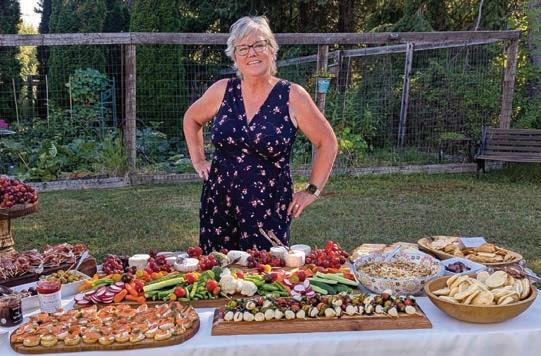
Pine Street Farm to Table — once a simple farm stand turned market and bakery — will welcome guests to its second annual community dinner celebrating locally grown food at the very garden it grew from (11742 West Pine St., in Sandpoint).
This year’s Mediterranean-inspired meal will take place on Saturday, July 18 from 5-9 p.m.
ty outreach.
“My work is an act of meticulous building, where layers of brilliant color accumulate to form surfaces that pulse with energy and optimism,” stated Hammond. “By pouring this heartfelt intention into every stroke, I hope to connect the viewer to the profound, enduring embrace of joy, not as a fleeting moment, but as a rich, layered and resonant experience.”
See more of her art at @cjhammondart on Instagram.
“The Farm to Table Dinner felt like a natural extension of what Pine Street Farm to Table had already become,” said founder Kathy Hellman. “The farm stand created connection. The dinner invites people into the experience itself — gathering around a table to celebrate the blessings of the season and the relationships that grow alongside them.”
Chef Enas Blanchard will prepare Saturday’s multi-course meal, which will be accompanied by wine pairings and live music from the Music Conservatory of Sandpoint. The meal begins with hors d’oeuvres featuring lamb- or vegetarian-stuffed grape
SkyRight Roofing and Gutters honors late-Ponderay Police Chief Mike Hutter with free roof installation
By Reader Staff
SkyRight Roofing and Gutters will be installing this year’s roof giveaway for Mary Hutter, selected in honor of her late-husband, Mike Hutter, a former Sandpoint police officer and Ponderay police chief.
SkyRight announced the selection on what would have been Mike Hutter’s 64th birthday, surprising Mary Hutter with the news that she had been chosen as the recipient of the company’s roof giveaway.
For years, Mike and friends patched and tarped the roof to keep it going. When SkyRight opened nominations for the giveaway this spring, the community — which knew the story and wanted to help finally get the roof replaced — overwhelmingly nominated Mary Hutter.
The installation took place July 10 in Ponderay.
The original surprise brought together family, friends, local law enforcement and community members. SkyRight is grateful to everyone who helped make the giveaway possible, including CertainTeed for supporting this year’s project.
SkyRight Roofing and Gutters
serves North Idaho and western Montana, including Bonners Ferry, Sandpoint, Coeur d’Alene, Rathdrum, Post Falls, Heron and surrounding areas. Learn more at skyright.com.
leaves and hummus with vegetables. Next, a garden salad and stuffed pork with balsamic glaze, basmati rice with lemon and seasonal vegetables or eggplant Parmesan. Fresh sourdough bread with dipping sauce, and baklava and lemon sorbet complete the meal. Tickets are $175 and available at pinestreetfarm2table.com.
Kathy Hellman with Pine Street Farm to Table. Courtesy photo
The SkyRight crew on July 10 after installation of a donated roof to Mary Hutter. Courtesy photo
Festival at Sandpoint 2026 Fine Arts Poster artist Cyndie Hammond poses with her winning piece, “Shadow Serenade,” at the unveiling event on July 7.
Photo by Racheal Baker
FEATURE
Rise of the Pend Oreille Phoenix
Terry Anderson launches his final boat after a lifetime of tinkering and building
By Ben Olson Reader Staff
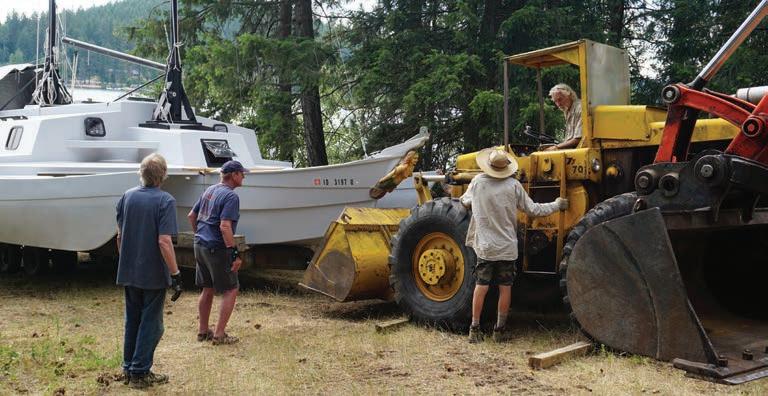
For most people, dragging a 50foot long and 20-foot-wide sailboat down an incline into the lake using a bulldozer without brakes might induce some anxiety. Terry Anderson, however, is not like most people.
The local boatbuilder, tinkerer and self-proclaimed “hippie junker” successfully launched his latest — and final — boat into Lake Pend Oreille on July 6, as a crowd of onlookers cheered his accomplishment.
Anderson launched the craft from his home near Sunnyside after nearly four years of work. He built it entirely from scratch, naming it the Phoenix after the mythical bird that cyclically regenerates by rising from the ashes of its predecessor. The choice of name was apropos, since the trimaran was built from materials Anderson repurposed, scrounged, bartered for or handcrafted. Much of the boat was built from materials sourced from remnants of the 20-odd other boats he’s built in the past, and each piece — from the twin masts to the smallest shackle — was placed with intention by the nautical hippie boat builder who prowls the shores of Lake Pend Oreille searching for the perfect balance between art and function.
Anderson has been using scraps to build his dreams since he could hold a screwdriver.
“I’ve been a junker since I was a kid,” he said. “I used to take my wagon when I was 8 or 9 years old on trash day and go through trash cans to make things. I had to sneak it in my yard when my parents weren’t looking.”
Anderson told the Reader he was inspired to make things largely because he struggled as a student.
“Ever since I was a kid, I didn’t do well in school,” he said. “I’m ADD and dyslexic. I have all kinds of learning things. I could make things, though. When I wanted to have something, I made it. I made my own toys, too. When I wanted a go-kart, I’d steal the engine off my buddy’s lawnmower and make it.”
Anderson leaned into his burgeoning abilities in high school, building cars and making money on the stuff he
built in metal and auto shop.
“It was obvious to me that I was not going to be college-bound,” he said. “The last two years of high school I took all shop classes.”
He made paraphernalia and pipes for the head shops that were just opening in the late 1960s. He built motorcycles and scooters, torches, kinetic metal sculptures and anything else that caught his fancy and maybe earned a buck.
“My contraptions didn’t always work, but that’s the way I’ve lived my whole life,” Anderson said. “I just learned as I went, by trial and error. We won’t talk about my errors, though.”
Those early years helped shape Anderson into the builder he is today, largely because he had big dreams — and his passion insisted that the dreams were his, not someone else’s.
“Everything I wanted to make has been made before and somebody made it the first time, but I’d rather have my version of it than a copy of someone else’s version,” he said.
After high school, Anderson began making annual trips to Belize and Mexico to experience the tropics in wintertime — an itinerant lifestyle he’s maintained to this day. There, he dove and explored the underwater world, encountering archeological finds, sought out adventure and surfed
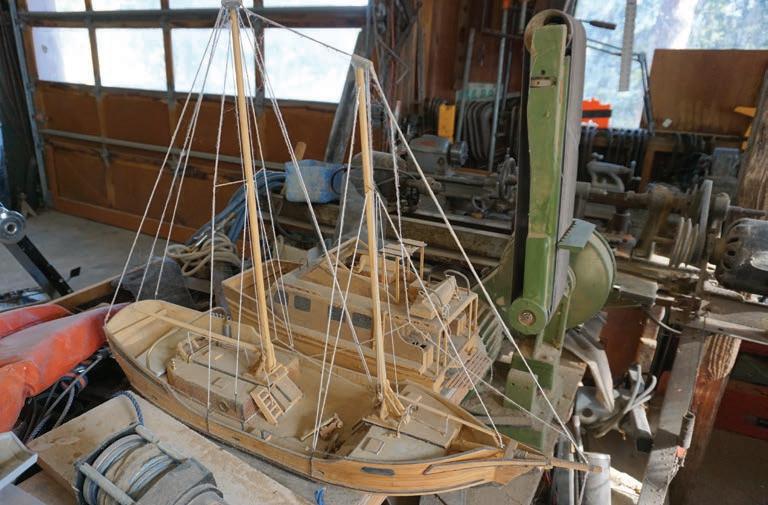
every chance he could. During downtimes, Anderson started tinkering and building small boats out of materials he scrounged up on the beaches. But, before launching into any projects, he would build an intricate model of the design out of whatever materials he came across — often coconut husks and palm fronds.
Building models became a habit that followed him all through life, with dozens of them lining every spare inch of his workshop and home. Mostly boats and airplanes, the majority of the models had working rigging and moving parts.
Four years ago, Anderson began scheming his latest boat-building project. The Phoenix was about to begin its heroic rise from the ashes.
Anderson first constructed several models of the boat he saw in his mind’s eye, initially envisioning a much different design than the finished product.
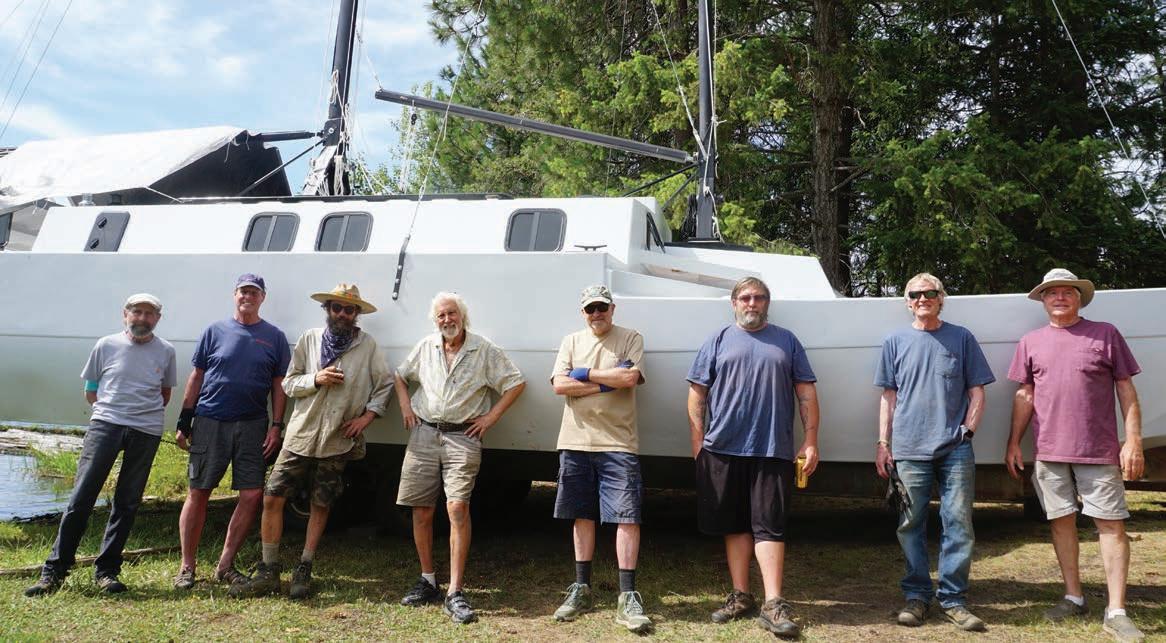
Top: The launch crew of the Phoenix after the hard positioning work was finished (L-R): Zeppie Lyster, Chris White, Robert Zweifel, Terry Anderson (capt.), Blake Burris, Keith Cook, Frank Wakeley and Kim Benefield.
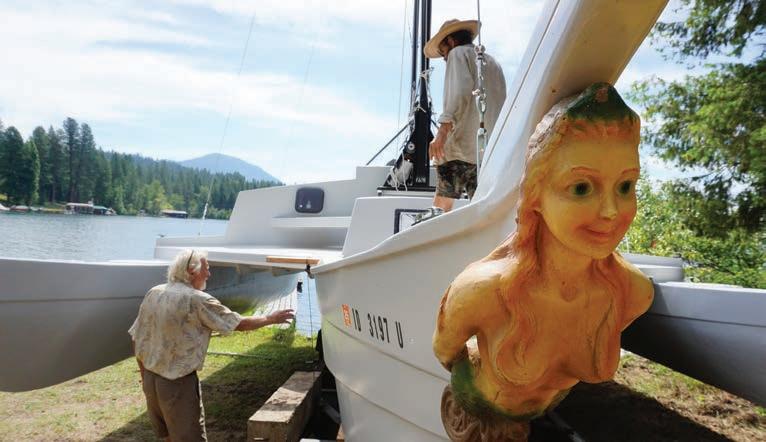
Above: The figurehead of the Phoenix, which was unfortunately damaged shortly after this photo was taken.
Photos by Ben Olson
“I was originally going to make something that looked like an old pirate ship,” he said. “That year I made the hulls and it took so long to put the center hull together, by the next year I decided I’m not going to do that. ... I thought, ‘I should make a trimaran.’”
A trimaran is a boat with three hulls — a large center hull with two smaller outrigger hulls on either side that are attached to the center.
For the main hull, Anderson used cement forms he’d taken from local dockworker Dana Martin decades ago. [Publisher’s note: Sadly, Martin passed away July 11. See the July 23 edition for his obituary.] He also pilfered some hulls from a catamaran he built in the 1970s and painstakingly built them up about 10 inches higher, adding a bow and a stern. That job took another year of work, usually by himself at his shop as he fiberglassed it together.
After completing the outer hulls, Anderson began checking off different aspects of the construction, piece by piece.
Two circular clothing racks that once displayed men’s shirts and ties were reborn as twin steering helms. He handmade the shafts that go through the cabin, then wrapped cables around to turn the rudder, which will be steered manually. Inside, he built individual cabins and lockers, made cushions and decks. Slowly, the Phoenix began to resemble a sailboat.
to Sandpoint. The other mast was found in Santa Barbara and also cut in two for the trek home.
With hair askew, ratty sweatshirt, and pants covered in paint and fiberglass residue, Anderson toiled day after day, slowly completing dozens of small projects that would culminate in the finished sailboat he saw in his mind.
Working out of his shop, which resembles an old-time chandlery, he picked through work benches lined with all manner of nautical equipment. The look was messy, but somehow organized.
“I used to go to auctions and buy boxes of stuff,” he said. “I have a spring collection with probably 1,000 springs. Everything from leaf springs on a car to tiny little springs out of an ink pen. I can make something out of anything. I have millions of nuts and bolts. I don’t throw anything away.”
Anderson completed the construction of the Phoenix this spring.
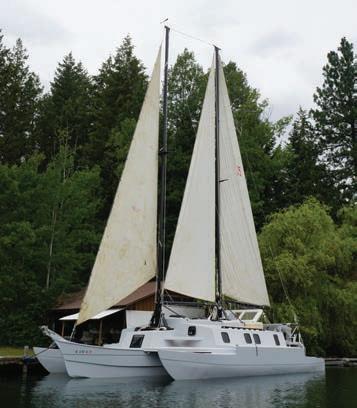
The trimaran’s final dimensions make it one of the largest vessels on the lake at 50-feet long with a 20-foot beam. He hoped for a 10-inch draft, which would ensure he could navigate close to shore in the shallow waters off of his lakeside home.
and some applause from the shore, he gave it a final shove into the water. Only one mishap marred the otherwise flawless launch: A weld broke on the bulldozer bucket and caused the Phoenix to lurch, which damaged the maidenhead on the bow. Her figure was mostly destroyed, but her smile endured.
“Oh well, we’ll make another one,” Anderson shrugged.
He bent down and examined the marks on the hull he’d made to see how much water the boat drew. Initially hoping for 10 inches, he was pleased to see it settled around eight inches, with a slight rake to stern.
“Perfect,” he nodded.
“All the rigging is stuff I found on eBay or in swap meets when I’m down south,” he said. “I made my own cleats, too.”
Anderson salvaged a main mast in Florida and cut it in two for transport
On launching day July 6, a crowd of local sailors and friends gathered to help Anderson with the tricky maneuver from the building platform to the shore. The task was made exponentially more difficult thanks to his old bulldozer without brakes.
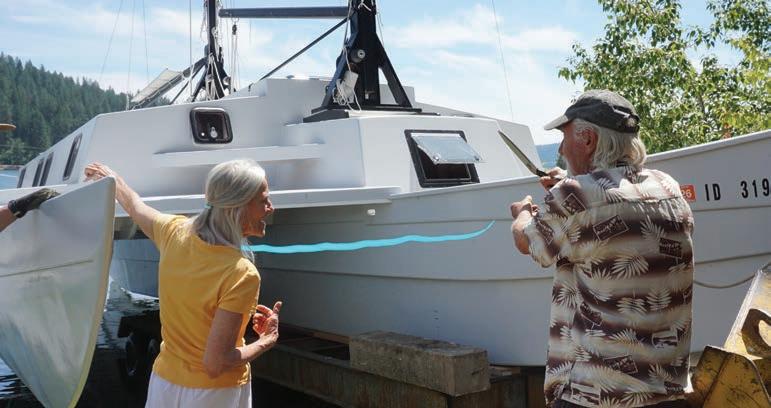
After about an hour of jockeying into position, Anderson finally managed to get the Phoenix to the water’s edge, where, after a short ceremony
Though the sailboat is finished, Anderson’s work continues. He plans to install a series of solar panels on stern racks and eventually an electric motor to push the craft to and from the dock.
But for now, the next plan is to bend on the sails and take the maiden voyage, introducing the Phoenix to her new home on Lake Pend Oreille.
Blending the line between art and function, the Phoenix is a perfect testament to Anderson’s abilities.
“I’m more of an artist than a builder,” he said. “I build things to look
good. Sometimes they don’t work, but they look good.”
Looking back on an artful life, Anderson’s fantastic crafts all hold special places in his heart, all culminating in the construction of the Phoenix. He’s built steam-powered canoes, motorcycles, beautiful catamarans, day sailors and dream projects. He’s poured every bit of engineering prowess and imagination into each craft, leading up to this, his final effort.
“This will be my last big project,” he said.
A version of this story by the same author first appeared in the summer 2026 edition of Sandpoint Magazine.
Anyone interested in taking a look at the Phoenix in person, Anderson’s wife Devon Chapman is participating in POAC’s Artist Studio Tour from Sept. 4-6. Her studio (and the Phoenix) will be open and available for visitors.
Top left: The launch crew assists Anderson in a bulldozer with no brakes. Top right: Anderson cuts the ribbon on the Phoenix with wife Devin Chapman’s assistance. Above: Some of the intricate handmade models in Anderson’s shop.Inset: The Phoenix with both mainsails and jib hoisted. Photos by Ben Olson
Send event listings to calendar@sandpointreader.com
Live Music w/ Liam McCoy and Friends 7pm @ Eichardt’s Pub
Live Music w/ Benny Baker
6-8pm @ MickDuff’s Beer Hall
Open bluegrass jam (host: Jim Rosauer)
5:30pm @ Connie’s Lounge
Live Music: Too Slim and the Taildraggers 8pm @ The Hive
Live Music w/ Ian Newbill
5-8pm @ Pend d’Oreille Winery
Live Music w/ Hot Cheetos
5pm @ Connie’s Lounge
Live Music w/ Alison Joy Williams
5:30-8:30pm @ Smokesmith BBQ
Live Music w/ Justin Howl 7pm @ Eichardt’s Pub
Live Music w/ Harold’s IGA
9pm-midnight @ 219 Lounge
Indie originals, ’90s alt-rock and punk
Live Music w/ Tom Catmull
5-8pm @ Pend d’Oreille Winery
Live Music w/ Aly Johnon & Light on Water
5:30-8:30pm @ Smokesmith BBQ
Live jazz w/ Bright Moments
6-8pm @ Arlo’s Ristorante
Live Music w/ Jason Perry
6pm @ Connie’s Lounge
Live Music w/ Monarch Mountain Band
6-9pm @ Barrel 33
Live Music w/ Picked Up Pieces
6-9pm @ MickDuff’s Beer Hall
Live Music w/ Chris Paradis
6-8pm @ Baxters on Cedar
Sandpoint Chess Club 9am @ Evans Brothers Coffee
Monday Night Blues Jam w/ John Firshi
7pm @ Eichardt’s Pub
THURSDAY, july 16
Festival volunteer ice cream social 4-6pm @ Festival at Sandpoint office
Anyone interested in becoming a 2026 summer series volunteer should attend for ice cream and information
FriDAY, july 17
John Craigie and guest Bart Budwig 8pm @ Panida Theater
Craigie’s folk has earned him a following around the country, while Budwig’s cosmic country is always fun
Music w/ DJ Sterling 9pm @ Roxy’s Lounge
SATURDAY, july 18
Friends of the Panida annual yard sale
8am-1pm @ 814 Cedar St.
Drop off donations at the address above. All donations appreciated
Historic Walking Tours
11am @ Meet at Cedar St. Bridge
A 75-minute tour featuring a local historian sharing fascinating stories from Sanpdoint’s earliest days. $10/$5 (youth). Register at bit.ly/4aSe60K
Live Music w/ Hot Cheetos 6-9pm @ Blue Heron Cafe
Music w/ DJ Sterling 9pm @ Roxy’s Lounge
Garden art fundraiser for food bank 11am-5pm @ 508 Forest Ave. With art by Robens Napolitan and Tom Kramer. Proceeds to food bank
SunDAY, july 19
Pioneer Picnic
12-4pm @ Bonner Co. History Museum
July 16 - 23, 2026
Live jazz w/ Bright Moments
6-8pm @ The District
Weekly BCA pool tournament
6pm @ Roxy’s Lounge
Paint and Sip with Nicole Black ($45) 5:30-7:30pm @ Barrel 33
Karaoke at the Eagles
6-9pm @ Eagles, 1511 John Hudon Ln.
Live Music w/ Picked Up Pieces 6-9pm @ Barrel 33
Live Music w/ Sam and Sheldon
6:30-9:30pm @ MickDuff’s Beer Hall
Live Music w/ Arie VanDenBerg 6-8pm @ Idaho Pour Authority
Sandpoint Farmers’ Market
9am-1pm @ Farmin Park
Live music w/ Ponderay Paradox
Sandpoint Street Scramble
10am-1pm @ Litehouse YMCA
A day of navigation and strategy. See Page 8 for more info
Cornhole at the Eagles 12pm @ Eagles, 1511 John Hudon Ln.
Full Draw Film Tour
7pm @ Panida Theater
All new films that capture the thrill of bowhunting cinematography
Northwest Winefest
11am-5pm @ Schweitzer
Enjoy 80 wines from 20 regional wineries, live music and village activities
Live Music w/ Nick Delffs 6-8pm @ Idaho Pour Authority
With opener Kjetil Lund
Northwest Winefest
11am-5pm @ Schweitzer
Outdoor Experience group run 6pm @ Outdoor Experience 3-5 miles, all levels welcome Magic with Star Alexander 5-8pm @ Jalapeño’s
Old carnival games, food, music, dunk tank and more. See Page 12 for more
monDAY, july 20
Live trivia w/ Toshi
7pm @ Connie’s Lounge
East Coast swing lesson ($15)
7pm @ DanceWorks Studio
Live piano w/ Jack Purdie
5-7pm @ Pend d’Oreille Winery
Beginner Argentine tango class
6pm @ Embody Center, 823 Main St. No partner needed. $15
Sandpoint Farmers’ Market
3-5:30pm @ Farmin Park
Benny on the Deck patio concert
5:30-8:30pm @ Connie’s Lounge
Sandpoint Summer Music Series: Milonga 6pm @ Farmin Park
Free outdoor music concert with Spokane’s hottest Latin group. Food/drinks
tuesDAY, july 21
Open mic/jam 6-8 or 9pm @ Idaho Pour Authority
wednesDAY, july 22
Garden Art Party featuring Madeline French Designs 5pm @ Aster Garden Center See the gardens, meet the artist
Live piano w/ Andrew Martinssen
5-7pm @ Pend d’Oreille Winery
ThursDAY, july 23
Live Music w/ Liam McCoy and Friends
7pm @ Eichardt’s Pub
Line dancing lessons
6:30pm @ The Hive
Enjoy 80 wines from 20 regional wineries, live music and village activities
Trivia w/ Alaina 6-8pm @ Idaho Pour Authority
Little Live Radio Hour w/ Camden Morris
7pm @ The Hive
Free to attend. Listen at 88.5FM
Shinyribs in concert (See Page 21)
7pm @ Panida Theater
YMCA Community Fair: Campfire Across America 2-6pm @ Litehouse YMCA Family-friendly fair, local vendors, arts and crafts, kids’ activities and more
Family night, live music w/ John Firshi 5-7:30pm @ Matchwood Brewing Co.
Open Irish jam (host: Seamus Divine)
5:30pm @ Connie’s Lounge
Weekly BCA pool tournament
6pm @ Roxy’s Lounge
Full Draw Film Festival brings bowhunting excitement to the Panida big screen
By Reader Staff
Archery season is just around the corner, and local bowhunters of all ages are invited to the Full Draw Fill Tour, which will feature all-new films on Saturday, July 18 at the Panida Theater (300 N. First Ave., in downtown Sandpoint).
Doors open at 6 p.m. and the screenings start at 7 p.m., including eight entries from independent filmmakers who capture awe-inspiring footage from hunts in some of the most rugged landscapes on the planet while telling powerful stories.
Presented by ONXHUNT, films
include Silas Summit, from Idaho filmmaker Austin Durham, which follows Durham and his father on an elk hunt following the unimaginable loss of his firstborn son Silas, to whom the film is dedicated.
Reverence is the story of Nathan Wayne Endicott, of Oregon, who has made it his mission to hunt blacktail in all the states where they range. The film showcases his hunt in Washington, which marked the final step in making his dream a reality.
Coasties is a portrait of coastal elk hunting, The Role from Haxen Hunt features pronghorn, No Plan B from Colorado-based Matt Short is a Rocky
Mountain bighorn sheep hunting story and Backcountry 7x7 tells the tale of an elk hunt where everything went wrong until it went just right.
Other films are philosophical ruminations Why I Hunt and My Heaven
In addition to the screenings, attendees can enter to win premium gear including a Hoyt Alpha AX-2 bow and more.
Tickets are $25 for adults and $9 for youth 4-17 years old, available at the door or panida.org. (Note that online tickets are only available at panida.org and no other third-party sites.)
Northwoods Performing Arts presents TheComedyRadioVarietyShow
By Reader Staff
Step back in time for an unforgettable evening of laughter, music and old-fashioned entertainment as Northwoods Performing Arts presents The Comedy Radio Variety Show, directed by Robyn Adams-Young, at the Circle Moon Theater (3645 Highway 211, in Newport, Wash.).
Performances will be staged Thursday, July 16 through Saturday, July 18 with dinner served at 6:30 p.m. and the curtain rising at 7:30 p.m. all three nights. This will be dinner theater, with the menu featuring pork cutlets on July 16, chicken fajitas on July 17 and beef enchiladas on July 18.
Inspired by the warmth of the classic radio show A Prairie Home Compan-
ion, this original production combines comedy sketches, toe-tapping music, audience interaction, outrageous commercials, sound effects and memorable characters into a fast-paced evening the entire family will enjoy.
Tickets are $35 for dinner and the show, or $12-$14 without food, at northwoodsperformingarts.com.
A screenshot from the film Backcountry 7x7. Courtesy photo
MUSIC
Texas-based band to play genre-defying show at Panida
By Reader Staff
If asked what genre his band Shinyribs plays, singer-songwriter Kevin Russell might respond, “All of them.”
The Austin, Texas-based supergroup is a sonic melting pot of Texas blues, New Orleans R&B, funk, horn-driven Memphis soul, country twang, honky tonk, Golden-Triangle Cajun, Arkansas jazz, border music, big band swing and roots-rock. They’re playing a special concert at 7 p.m. on Wednesday, July 22 at the historic Panida Theater (300 N. First Ave., in Sandpoint). Tickets are $40 at the door or on panida.org.
The nine-piece is led by
Russell, the charismatic frontman with colorful suits who rips on ukuleles just as often as he does electric guitars.
Stage performances are just that — performances, with antics and theatrics blurring the line between music and stage arts.
Shinyribs shows run the gamut from tongue-in-cheek winks and nudges to poignant stories of family, loss, grief and love. The music is dominated by poetic lyrics and joyful sonic explosions.
This will be a dancing show, so be aware that choosing seats in the first few rows will have obstructed views from people getting up to
To learn more or to purchase tickets, visit panida.org. To listen, go to shinyribs.com.
PNW Latin band Milonga to headline Summer Series July 23
By Reader Staff
Spokane’s hottest Latin band Milonga will play the next Sandpoint Summer Series at 6 p.m. on Thursday, July 23 in Farmin Park (Third Avenue and Main Street).
The free outdoor concert is presented by Mattox Farm Productions and funded by local sponsors.
Billed as a band that, “lays down a Pan-Latin buffet of the hottest dance styles that’s straight out of your abuelita’s kitchen,” Milonga is an eightpiece that plays a hot set that will get your hips shaking.
Playing a funky blend of Latin rhythms infused with
American jazz, funk, soul and rock, Milonga should prove to be a spirited way to spend your Thursday evening.
“In a world of salsa, Milonga is the whole enchilada!” the band states on its website.
While cha-cha-cha-ing across the park to the music, attendees can also purchase drinks from the bar provided by Eichardt’s Pub. There will also be food trucks on site from Mandala Pizza and Mountain Food Co. Attendees are always welcome to bring their own food and drinks as well, but no outside alcoholic beverages will be admitted.
Mattox Farm Productions’ “Odd Nights Out” theme for
A
its seventh year of free summer concerts in Farmin Park denotes concerts on the odd days in July and August. The next show will be The Jauntee on Aug. 13, followed by TBD on Aug. 27.
Band sponsors for the series include the Pend Oreille Arts Council, Sandpoint Hotel & Suites, Skyright Roofing and Washington Trust Bank. Event sponsors are the Greater Sandpoint Chamber of Commerce, Kester’s Kreations, KPND and North
Root Architecture.
Critical partners include the Heartwood Center, the Novas of Evergreen Realty, Sandpoint Reader and Travis Harmon Construction.
snapshot of notable live music coming up in Sandpoint
Too Slim and the Taildraggers, The Hive, July 17
There is no more venerable regional blues-rock outfit than Too Slim and the Taildraggers, which has been playing based out of Spokane for a whopping 40 years. With 14 studio albums, a series of live CDs and two solo albums from legendary frontman Tim “Too Slim” Langford, the band is still kicking out hits with their latest studio effort The Remedy rising to No. 3 on the Billboard Top Blues Album Chart. On top of all that, Too Slim has earned Lifetime Achievement and
Hall of Fame awards from three Northwest blues societies, and more than 40 regional and national music awards — including a nomination for Best Blues/Rock Album at the 2019 Blues Music Awards. Catch this essential musical powerhouse at The Hive for an epic Friday night. — Zach Hagadone
Doors at 7 p.m., show at 8 p.m.; $18 advance, $20 at the door; 21+. The Hive, 207 N. First Ave., 208-920-9039, get tickets at livefromthehive.com. Listen at tooslim.net.
Tom Catmull, Pend d’Oreille Winery, July 18
Friend of the Pend d’Oreille Winery and well-traveled storyteller Tom Catmull views music as a conduit for his infatuation and fascination with words. Harmonica and guitar serve to support and highlight his poetic, evocative lyrics, which have filled seven albums with stories, hopes and love like an ever-expanding diary. One album in particular — Tom Catmull’s Last
This week’s RLW by Soncirey Mitchell
READ
Kyle Pfannenstiel at the Idaho Capital Sun has been covering the ramifications of Idaho’s House Bill 752, which threatens people with a misdemeanor or felony for using a bathroom designated for the opposite sex. Police may have to run DNA tests or inspect naked bodies to enforce it. Read “Idaho’s transgender bathroom ban is now the law. How will police enforce it? That’s still unclear,” and, “Bracing for Idaho’s new ban, group maps safe bathrooms across the state for trans people” at idahocapitalsun.com.
LISTEN
Resort — has a breadth of songs that feel like driving down Southwestern dusty backroads. Take an evening and enjoy his comforting blend of Americana, folk and roots before he heads back to his homebase in Missoula, Mont. — Soncirey Mitchell
5-8 p.m., FREE. Pend d’Oreille Winery, 301 Cedar St, 208-265-8545, powine.com. Listen at tomcatmull.com.
You may know the indie-rock band Big Thief, but did you know that their lead singer, Adrianne Lenker, has a solo career as well? The singer, guitarist and master songwriter leans more toward folk when she’s alone, which puts an even greater emphasis on her raw, emotional lyrics. Her most recent studio album is Bright Future, but I always find myself returning to her 2020 release songs, which evokes feelings of nostalgia, longing and loss. Listen on any streaming site.
WATCH
In honor of The Mummy 4, slated for release October 2027, it’s time to rewatch the 1999 classic The Mummy starring Brendan Fraser and Rachel Weisz. A group of treasure-hunters unwittingly awaken a 3,000-year-old curse and must stop the undead from destroying Egypt. It’s a stacked cast of gorgeous people in a supernatural action-adventure film the likes of which hasn’t been seen in decades. Find it at the library.
dance in front of the stage. The opening act will be Mississippi artist Schaefer Llana.
Kevin Russell (in white hat) with the Austin-based band Shinyribs.
Courtesy photo
Photo by Bryce Cain Photography
From Pend Oreille Review, July 8, 1921
SHERIFF’S OFFICE GET SIX OVER WEEKEND AND FOURTH
Six arrests over the weekend were made by the sheriff’s office although but four of them were the result of Fourth of July celebrations.
Saturday, Sheriff Kirkpatrick arrested Eric Peterson at a lonely cabin on Pack river and brought him to the county jail to face a charge of moonshining and perhaps a charge of larceny as well. Peterson was found in possession of a small still with copper boiler and retort, gas stove, etc. and a large quantity of goods stolen from Humbird camp No. 7 was found near his cabin in a loft in a barn. As the moonshining case constitutes Peterson’s second offense against the liquor laws he will be charged with a felony and will face a penitentary sentence in the event of conviction. He was given a sentence of 60 days and a fine of $70 something over a year ago.
Peterson disclaims any implication in the theft of the camp goods, however, and asserts that these must have been taken by a fellow who was staying with him in the cabin but who has disappeared. The officers are inclined to believe Peterson’s statements in this regard and it is probable that he will not be charged with the theft. The loot consists of blankets, sweat pads and kindred articles of camp equipment.
The other arrests were all for drunkenness and took place at Samuels, Sheriff Kirkpatrick taking all four of the men during the Fourth of July celebration there Monday.
The celebration at Samuels, staged partly because of the establishment of a rural route there, drew a crowd estimated at several thousand.
Follow-up to the Tubbs’ long walk
By Ben Olson Reader Staff
In the world of journalism, there’s nothing better than a follow-up story.
Quite often, our coverage of particular issues doesn’t begin and end with a single article. Instead, there can sometimes be dozens of stories spread out over time that contribute to a rounder, more complete picture of an event or issue that has evolved over time (has anyone ever read the word “parking” in the Reader?).
Every week, I comb through the old newspaper archives looking for humorous stories from our past. Sometimes I find gold; other times it’s just a pretty rock, but they’re all entertaining and paint a picture of what life was like in North Idaho more than a century ago.
In the July 9 edition of the Reader, I wrote of the Tubbs family from Sandpoint in the “Old School Bonner County News Stories” column. The family of four embarked on a 1,500mile walk from here to St. Paul, Minn., in July 1913, pushing a 75-pound barrel filled with food and camping supplies mounted on a bicycle wheel. The family claimed they would walk during the day and camp wherever night found them. The trip was apparently a scheme to improve the health of A.L. Tubbs, and the family left Sandpoint on the evening of July 8, 1913.
I chose this story for the column in our July 9 edition, which generated a few emails from readers wondering what ever happened to the Tubbs family. Did they make it to St. Paul? Did they have any misadventures along the way? Did Mr. Tubbs’ health improve?
Always keen for a good follow-up, I dove back into the newspaper archive to learn the fate of the Tubbs family.
Unfortunately, I found no follow-up articles on whether the family made it. Digging deeper, I spent the better part of an evening trying to learn the fate of this plucky family 113 years after their mission.
I first found a notation in the “Here and around about” society section of the Pend Oreille Review from July 14, 1916, which stated, “E. Tubbs of Weyauwega, California, was the guest of his brother A.L. Tubbs of this city the past week, departing Wednesday for the east,” so it appeared that Mr. Tubbs and family made it back to Sandpoint after their voyage. But why no mention of their walking trip?
Another article in the Northern Idaho News dated Jan. 26, 1915 listed Tubbs as the founder of a committee to establish a dog race in Sandpoint, but again no mention of his long walk.
Finally, I found a brief notation in the Oct. 3, 1913 Northern Idaho News that shed some light on Tubbs’ pedestrian journey:
“Popular Mechanics for October has a picture and sketch of A.L. Tubbs and his wife with their barrel and dog as they looked in July when they left Sandpoint on a proposed trip on foot to St. Paul. They got only as far as Glacier park, but the advertising they received at the time extended much further than that.”
Sure enough, when searching the Popular Mechanics archives, I found the photo printed on this page with a brief story about their journey. It appears the Tubbs family walked as far as Glacier National Park in Montana before turning back for Sandpoint.
We still have no idea what caused them to return before their goal, or what inspired their voyage in the first place (other than a remedy for Mr.
Tubbs’ health), but I like the fact that specifics are not readily available for this nearly forgotten journey of a Sandpoint family. Sometimes, in the course of a lifetime, we just do weird stuff and there’s no answer that makes sense, even 113 years later.
I like to think of A.L. Tubbs on one of those hot summer days in 1913, pushing his bundle of gear in the barrel on a bicycle wheel, wife and children by his side, dog at his heels; a simple man from a small place in America, walking to see what he could see. Here’s hoping he found it.
Dig into North Idaho history yourself by accessing the old newspaper archives at ebonner.historyarchives.online. It’s free and always entertaining. Thanks to the East Bonner County Library District for providing us with this resource.
A.L. Tubbs and wife, along with their dog and the 75-lb. barrel trundled on a bicycle wheel (not photographed, the Tubbs children Elmer and Clarence). Photo from Popular Mechanics magazine dated October 1913.
Laughing Matters
Solution on page 22 Solution on page 22
By Bill Borders
[noun]
1. the transposition of letters, syllables or sounds in a word
CROSSWORD
ACROSS
1. Lunch or dinner 5. Phase
Majestic 14. Brute
15. A fruit of the gourd family 16. Beak
17. Fomenting subversion 19. Pint fraction
20. Evening (poetic) 21. Not a winner 22. Artist’s stand 23. Established law 25. Tropical fruit
Solution on page 22
58. Hindu princess 59. Enlist
63. Ages Word Week of the
“Children often say ‘aminal’ instead of ‘animal,’ which is a common example of metathesis. Another is calling it ‘pasketti’ instead of ‘spaghetti.’”
It makes me mad when I go to all the trouble of having Martha cook up about a hundred drumsticks, then the guy at the Marineland says, “You can’t throw chicken to the dolphins. They eat fish.” Sure they eat fish, if that’s all you give them. Man, wise up.
Corrections: Due to a typo in the July 9 paper, we incorrectly reported the number of paid parking permits sold to Sandpoint city residents as of press time. The correct number was 1,180. We also spelled Steve Garvan’s last name wrong in the July 9 edition. Apologies.
Fire residue 28. Modest and shy 31. Vacation destination 34. Ties together 35. Petroleum 36. Ammunition 37. Music groups 38. Be mad, angry, or furious 39. A castrated tomcat