2 / R / August 27, 2026
DEAR READERS, The week in random review By Soncirey Mitchell Reader Staff
o canada
Anything we can do, Canada can probably do better, with grace, humor, understanding and an all-around depth of character. There are many things that endear Canada to me, including the landscape and the people, but there is something especially comical and charming about the way Canadians name their lakes. The country has well over 2 million lakes, which, apparently, means they ran out of names almost as soon as they started cataloging them. This led to This Lake, That Lake, Another Lake and And Another Lake — all real places in British Columbia. Nova Scotia has Big Pond, Big Round Lake, Big Ass Lake and, my personal favorite, Soft Banana Lake. Not to be outdone, there’s also First Lake, Second Lake, Pussy Lake, Minnicock Lake and Bitch Lake in Ontario, as well as Stupid Lake, Manitoba; Man Drowned Himself Lake, Sahtu Region; and Lac J’en-Peux-Plus (“I Can’t Take It Anymore Lake”) and Lac Parles-en-Pas (“Don’t Talk About It Lake”), in Quebec. So Canada gets fun names, free health care, good education and a sane government, and what do we get? That’s right: Big Ass Dictator.
don’t quote me on that
The Reader staff has mentioned in previous Junk Drawers that I keep a running document with all the unhinged things we say in the office. I used to write each quote on a sticky note and paste them to my window; but, after a few years of shenanigans, I ran out of room and instead settled for compiling them into a Google Doc. Here, for your entertainment — and with all crucial context missing — are a few highlights: • “I’ve never voluntarily grown a bush; I’ve just dealt with the ones that have always been there.” — Publisher Ben Olson (hereafter BO) • “My head is spinning because it is in the toilet.” — Editor Zach Hagadone (ZH) • “I like the anonymity of a cardboard box.” — Senior Writer Soncirey Mitchell (SM) • “People who tape their envelopes all the way to the edge; what are they afraid of?” — BO • “What’s the fastest thing growing up my ass? It’s pickleball.” — ZH • “Post-text clarity.” — SM • “Even God couldn’t speed in a Honda CRV.” — BO • “I would be honored to be the one who murders you.” — SM • “She looked like a piece of beef jerky.” — ZH • “The larger the pickle, the less interested I am.” — BO
Time sure flies when the summer reaches these last few weeks. My fingers are hurting from being crossed so long, hoping for the rain to douse wildfires across the West and give us back our clean air and blue skies. It was also a tough week as we lost country music legend Dolly Parton, who died Aug. 25 at 80 years old. I’ve always admired her. Even when interviewers tried to poke fun at her appearance or make her feel inferior, she always responded with a humorous, self-deprecating, respectful tone that is missing from so many of us right now. Her philanthropy and dedication to using her fortune for good is something to be admired. She was truly one of our best, and this edition goes out to you, Dolly.
– Ben Olson, publisher
READER 111 Cedar Street, Suite 9 Sandpoint, ID 83864 208-946-4368 sandpointreader.com
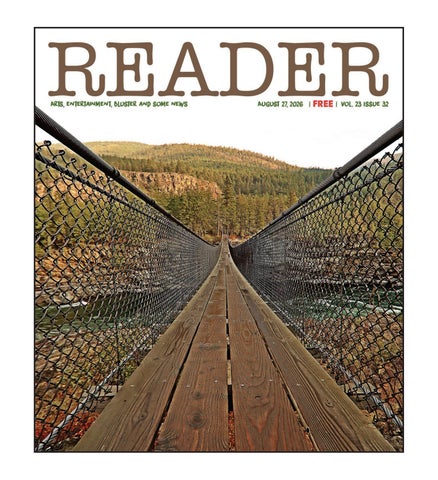
Publisher: Ben Olson ben@sandpointreader.com Editorial: Zach Hagadone (Editor) zach@sandpointreader.com Soncirey Mitchell (Senior Writer) soncirey@sandpointreader.com Editors Emeriti: Lyndsie Kiebert-Carey Cameron Rasmusson John Reuter Advertising: Ben Olson ben@sandpointreader.com Contributing Artists: John Larrabee (cover), Karley Coleman, Ben Olson, Oliver Pratt, Maia Gaddess, Rich Milliron, Don Fisher, Tami Daniel, Bill Borders Contributing Writers: Zach Hagadone, Ben Olson, Soncirey Mitchell, Lorraine H. Marie, Brenden Bobby, Laura Guido, Ryan Suppe, Emily Erickson, Jennifer Ekstrom, Rep. Brooke Green, Sandy Compton. Submit Stories To: stories@sandpointreader.com Printed Weekly At: Tribune Publishing Co. Lewiston, ID Subscription Price: $200 per year The Sandpoint Reader is a weekly publication owned by Ben Olson, Zach Hagadone and Soncirey Mitchell. It is devoted to the arts, entertainment, bluster, politics and lifestyle in and around Sandpoint. We hope to provide a quality alternative by offering honest, in-depth reporting that reflects the intelligence and interests of our diverse and growing community. The Reader is printed on recycled paper using soy-based ink. Leftover copies are collected and recycled weekly, or burned in bonfires to appease the gods of journalism. For back issues, contact the publisher. Free to all, limit two per person, please. Letter to the Editor Policy: We welcome letters to the editor on all relevant topics. Please, no more than 200 words, no excessive profanity or libelous statements and no trolls. Please elevate the discussion and stay on topic. Letters will be edited to comply with the above requirements. Opinons expressed in these pages are those of the writers, not necessarily the publisher. Send to: letters@sandpointreader.com About the Cover: This week’s cover photo was taken by John Larrabee from the famed swinging bridge over Kootenai River west of Libby, Mont.
August 27, 2026 / R / 3
NEWS
Sandpoint council approves $90M FY ’27 budget Capital investments include $34 million for wastewater treatment plant
By Zach Hagadone Reader Staff City Council members voted unanimously Aug. 19 to adopt Sandpoint’s Fiscal Year 2027 budget, approving expenditures of $92 million — the largest budget in the city’s history. The reason for the historic level of spending is the inclusion of $34 million in projects related to the reconstruction of the wastewater treatment plant. Voters in 2025 approved bonding authority of $130 million for improving the aging facility. Specifically, the FY ’27 budget includes $30 million for the first phase of design and construction at the plant, as well as $3.3 million for wastewater lift station replacements and $280,000 for inflow and infiltration reduction. The $30 million Phase I wastewater plant line item is the single largest capital improvement in the budget, with the next highest capital expenditures including $6.7 million for water mainline projects in the Woodland, Boyer and Pine corridors to address aging infrastructure. A further $4.75 million is earmarked for Phase III of downtown revitalization and $3.5 million for stormwater improvements in the Great Northern Road corridor.
Sandpoint will also spend $475,000 to replace six police patrol vehicles and hybrid patrol vehicles, emphasizing that they are replacements, not additions. “This budget reflects a philosophy that has guided this administration from the beginning: We must take care of what we already have,” Sandpoint Mayor Jeremy Grimm wrote in the budget letter. “Roads, sidewalks, parks, public buildings, public safety equipment, water systems and wastewater infrastructure are the foundation upon which our quality of life and local economy depend. Maintaining and improving those assets is not always the most visible work of government, but it is among the most important.” Altogether, the city will allocate more than $13 million toward transportation-related infrastructure, with $8.5 million of that funded through the Sandpoint Urban Renewal Agency, instead of relying on General Fund dollars or property tax revenue. Direct investment of $4.5 million will go toward road reconstruction and seal coating, sidewalk and pathway improvements, Cedar Street reconstruction, Highway 2 improvements and replacement of street maintenance equipment.
“Together, these investments reflect a maintenance-first philosophy focused on preserving and extending the useful life of existing transportation infrastructure before more costly reconstruction becomes necessary,” Grimm wrote. In addition to allocations in the budget, the city is also proceeding with a local option tax measure on the November ballot, asking voters to approve a 1% non-property sales tax for 10 years beginning Jan. 1, 2027 and with all revenues raised being put toward public infrastructure and access improvements throughout the city. Those projects would include street pavement maintenance, street rehabilitation and reconstruction, pothole repair, stormwater and drainage improvements related to streets, sidewalk repair and construction, ADA and pedestrian crossing improvements, bicycle and pathway connectivity and more. Councilors voted unanimously Aug. 19 to approve the ballot language, with Grimm
pledging that City Hall will “put together a very educational piece of literature, do a bunch of outreach to some businesses to educate them.” The city proposed a similar LOT in 2024, which failed to garner the necessary supermajority of votes. However, Grimm said on Aug. 19 that the city had “learned a lot” from the successful wastewater treatment plant bond election in 2025, which drew an unprecedented 90% support from voters. “It is a tough time to throw this out there with the costs that we’re all facing, but we don’t have any other solution to fix our roads and sidewalks,” Grimm said. Those tough economic times were reflected in the FY ’27 budget letter, which noted that, “The financial challenges facing Idaho cities continue to grow.” “State law limits annual property tax revenue growth to 3% plus the value of new construction, while the costs of health care, insurance, construction materials, equip-
Sandpoint city councilors meet in City Hall chambers. Photo by Ben Olson ment, technology and contracted services continue to rise at rates that often exceed inflation,” Grimm wrote. “The gap between allowable revenue growth and the actual cost of providing municipal services places increasing pressure on local governments throughout Idaho. “In response, the city continues to pursue alternative funding strategies that reduce the burden on local taxpayers,” he added. “Urban renewal funding, grants, impact fees, utility revenues and user-supported programs are increasingly important tools that allow Sandpoint to maintain critical infrastructure without relying solely on property taxes.” Overall, Grimm said on Aug. 19 that he is “excited to implement this budget. It is going to be really significant to get this wastewater treatment plant moving.”
ITD gathering feedback on long-range infrastructure plan By Reader Staff Idaho transportation planners are looking to the future of the state’s multi-modal infrastructure, inviting residents to weigh in on a long-range plan that will inform agency investments through 2050. Comments on the Idaho Transportation Department’s statewide Long-Range Transportation Plan are being accepted until Sept. 20, intended to help update the federally required strategic document. The LRTP is refreshed every 4 / R / August 27, 2026
five years and guides decisions for future studies and projects that are then approved by the Idaho Transportation Board. Considering factors including growth, travel demands, land use, safety, economic development, system reliability and anticipated revenue, “This policy document looks at current conditions, existing plans and future trends in Idaho, and lays the foundation for ITD to continue to deliver on our mission of safety, mobility and economic opportunity,” stated ITD Division Admin-
istrator for Planning Amy Schroeder. “It’s not necessarily about identifying specific projects,” she added. “It’s about determining, through data analysis and public input, the best strategy for investing in the transportation system given the variability of future revenue.” Nearly 1,500 people participated in the first comment period online and at open houses hosted in all regions of the state in 2025. Responses to the survey recognized growth as a significant factor affecting
transportation. Respondents also said they wanted ITD to focus on maintaining existing roads and bridges, investing in safety improvements and ensuring reliable system performance before pursuing major expansion or new transportation modes. Besides seeking public feedback, ITD has engaged with other planning organizations as the plan looks at the transportation network as a whole, which extends beyond state-managed highways to locally owned routes and alter-
native modes of transportation. ITD just closed its annual comment period in July for planned projects from 2027-’33, with comments under review and planned for presentation to the board in September. The LRTP is expected to be released in October following adoption by the Idaho Transportation Board. View a pdf of the plan at bit.ly/LRTP. Get more info and submit comments at idaholrtp.com.
NEWS
ID Tax Commission won’t release private school tax-credit data Here’s who’s asking, and why it’s been denied
By Ryan Suppe IdahoEdNews.org This month, taxpayers in Texas found out how many students receiving $1 billion in private education subsidies were already homeschooled or enrolled in a private school: 70%. Taxpayers in Idaho are still waiting to get that number from a similar private school choice program that serves nearly nine and a half times fewer students, costs $950 million less and was enacted two months earlier. And it’s not for lack of trying. Between February and July, the Idaho State Tax Commission received seven public records requests related to the Parental Choice Tax Credit. A college faculty member, a hobbyist data analyst, a homeschool advocate, a former public school superintendent and two journalists filed requests seeking data that would shed light on who’s benefiting from the $50 million-a-year taxpayer-funded program. Four of those requests — including two from Idaho Education News — sought the number of tax-credit recipients who previously attended a public school. This data would test a selling point of the program: that it helps students who couldn’t otherwise afford a private education. That tally doesn’t include unofficial requests. Democratic lawmakers, who asked for data in March, weren’t included in a tracking sheet of records requests obtained by EdNews. Nearly all of the requests were denied. What has the commission released? It’s been almost a year and a half since the Idaho Legislature and Gov. Brad Little enacted House Bill 93, creating the Parental Choice Tax Credit and directing the Tax Commission to administer the program.
It’s been four months since the commission closed the first round of applications and issued more than $42 million in awards. The second round closed last month. So far, the Tax Commission has released two data points on the program’s rollout: the total dollar amount that’s been awarded and the percentage of recipients whose income was above or below 300% of the federal poverty level. Meanwhile, officials at the commission have cited privacy laws to deny requests for additional data. The information that can be released to the public isn’t ready yet because computer systems haven’t been programmed to generate reports, they say, and applications are still being processed. “It’s not like an Excel spreadsheet where you can just go and gather the data and hit print,” Julie Eavenson, public information director for the Tax Commission, told EdNews by phone last month. “We don’t have a lot of resources to devote to this.” But some of the data that Idahoans requested in recent months isn’t being collected at all, according to commission responses to records requests. Here’s who has asked for data, what they asked for and how the commission responded: Previous enrollment status Stuart Anderson, an education faculty member at Brigham Young University-Idaho, was preparing for a campus debate on school choice when he asked the Tax Commission for the number of tax-credit recipients who were previously enrolled in private school. Anderson — who stressed that he was not speaking on behalf of BYU-Idaho — told EdNews that about 140 students attended the debate, which featured two professors on each side of the argument for spending public funds on private education. “We showed our students,
who are mainly in education, that this is a complex issue,” he said. “Here are the challenges. Here are the pros. Here are the cons to this.” The Tax Commission denied Anderson’s records request. “The information you’re requesting is not being collected or reported on through the Idaho Parental Tax Credit Program,” Eavenson wrote to Anderson on April 13. Anderson’s request sought to shed light on who was benefiting from the program. House Bill 93 supporters argued that it would open doors for students who couldn’t otherwise afford an education outside the public school system. But in other states with similar private school choice programs, most recipients weren’t attending public schools before applying for state subsidies. In Arizona, nearly 70% of education savings account recipients in the first year were already in a private setting. Don Coberly, the former superintendent of the Boise School District, got a similar response from the Tax Commission when he asked for the same figures. A critic of private school choice, Coberly said he planned to write an article about what the data showed. “One of the things that’s always been said about the voucher movement is it’s kids escaping failing schools,” he said. “I kind of wanted to know, are they really coming from public schools, or are they already enrolled [in private schools]?” Coberly said this data could be useful to public school leaders, if it showed that large numbers of students are fleeing public schools for private options. “That’s good information for the folks who are running those schools to know,” he said. Geographic information Tucker Anderson — no re-
lation to Stuart — is a hobbyist researcher who creates data visualizations and often shares his work in social media discussions about Idaho politics. Anderson asked the Tax Commission for aggregate geographic data, like the home ZIP codes that tax-credit recipients listed on their applications. He wanted to see whether recipients were primarily in urban or rural areas. Anderson previously made an illustration that showed private schools are concentrated in larger cities and rural towns have few choices outside the public system. “It’s public information that we should be able to pull,” he said of the geographic information on the tax-credit applications. The commission also denied Anderson’s request. “The information you’re requesting is not being aggregated or produced in any form at this time,” Eavenson told him. Eavenson noted that the Tax Commission will provide a report “containing geographic information” to Gov. Brad Little and the Legislature in 2027. H.B. 93 directed the commission to compile a report with eight data points on the program’s rollout, including the “geographic area” of recipients. But the legislation wasn’t specific about how detailed the information should be. Income data H.B. 93 didn’t require the commission to compile income data beyond the number of recipients who qualified for priority access by earning 300% or below the federal poverty level. During the first application period, 55% of applicants were above the poverty threshold, while 45% were below it. Melissa Nash, a member of Homeschool Idaho’s board of directors, asked the commission for additional income data, expecting it would show that wealthier families were
the primary beneficiaries. Her request sought aggregate data on tax credit recipients broken down by income tax bracket, among other variables. While homeschoolers are eligible for the tax credit, Homeschool Idaho staunchly opposed H.B. 93. “We feel like partnerships between public and private entities result in private entities being regulated more by the government,” Nash told EdNews. “We wanted to discourage that public-private partnership.” The commission also denied Nash’s request. “This program is being implemented through the income tax system, which means we must follow strict state and federal confidentiality laws,” Eavenson wrote in response to Nash’s request. “We are still in the application phase and actively developing the program, so not all data has been compiled into reportable formats.” The Tax Commission fulfilled one records request related to the tax credit. Audrey Dutton, a reporter at ProPublica, asked for all statistics and reports related to the tax credit as of March 19. The commission handed over the number of applications and dollar amounts — data the agency later published online. Eavenson told EdNews last week that the commission’s focus is on processing applications. “We’re still working on that,” she said by email. As of Aug. 17, the commission has received 7,055 applications covering 12,561 students. Idaho Education News is a nonprofit online news outlet based in Boise and supported by grants from the J.A. and Kathryn Albertson Family Foundation, the Education Writers Association and the Solutions Journalism Network. Read more at idahoednews.org. August 27, 2026 / R / 5
NEWS
BOCC approves 12-unit Coolin subdivision By Soncirey Mitchell Reader Staff After a contentious six-hour meeting Aug. 20, the Bonner County Board of Commissioners unanimously approved an application for a 12-unit subdivision outside of Coolin near Priest Lake. The development, called Yoman Bluffs, has been in the works since 2021 and initially included 23 residential lots. The proposed subdivision is located off Sherwood Beach Road on land zoned Recreation, and will comprise lots ranging from 2.5 to 3.9 acres. All future homes will utilize individual wells and septic systems, and the Coolin-Cavanaugh Bay Fire Protection District has issued a will-serve letter for the development. Developers Yomanone, LLC, represented by Cory Yost and John Mandere, applied for and received approval from the BOCC for a 10-unit subdivision in 2021, which would have represented Phase I of the housing community. While developers constructed the soon-to-be Yoman Drive, the Coolin Sewer District, which had previously issued the development a will-serve letter, instituted a moratorium on new hookups that remains active. The approved plat then expired while awaiting the moratorium’s end. Though the development must utilize the sewer district, according to Yost, it will take more than $20 million to bring the “Coolin Sewer up to standard, to fix it, and to add some capacity.” While awaiting the moratorium’s end, Yomanone has proposed installing septic tanks alongside future sewage hookups so that homes can operate. Panhandle Health District has tested the soil’s drainage and confirmed that the site is suitable for septic tank installation; however, final plat approval will be contingent on the district’s future evaluation of the tanks. All development will be more than 300 feet from Priest Lake.
6 / R / August 27, 2026
Attorney Preston Carter of the Boise-based Givens Pursley LLP, representing neighboring homeowners, argued that septic tanks are “likely to impact” Priest Lake’s water quality, and their inclusion in the development therefore violates the Local Land Use Planning Act. “Stepping back a minute, the Coolin Sewer District was created specifically to avoid septic systems around the lake. That’s because septic systems are known to negatively impact water quality,” said Carter. “The sewer district’s bylaws prohibit septic systems within its borders. The sewer district becomes useless if developers can simply install individual septic systems when the district’s infrastructure is inadequate.” Carter further argued that allowing the development to install septic systems puts the financial burden to repair and expand the Coolin Sewer District on the existing residents. Developers countered, saying that future Yoman Bluffs homeowners will be required to pay the hookup fees and connect to the district once the moratorium ends. “So, statements have been made that approving this application would fail to protect the natural environment,” said Commissioner Brian Domke. “Really, what that does is that suggests that the board should essentially ignore the authority and the expertise of the Idaho Department of Environmental Quality and the Panhandle Health District as jurisdictional agencies that have commented on the proposed subdivision. ... “Obviously, for me, the issue is that on-site septic systems are legally allowed in this situation. So, to deny an application that meets state and county requirements would mean that I’m not upholding the law.” The commissioners voted unanimously to approve the development. View all files associated with Yoman Bluffs at bonnercountyid.gov/s0003-25.
Bits ’n’ Pieces From east, west and beyond About $50 trillion shifted from the “bottom 90% to the top 1%” of earners between 1975 and 2018, according to the Rand Corporation. The organization Patriotic Millionaires reported that while the top 1% of Americans pay about 40% of all federal income taxes, as a percentage of their income, they pay a lower rate than working people. For instance, in 2018, the average American paid a 13.3% income tax rate and the 25 richest Americans paid 3.4%. Wall Street Journal Editor-at-Large Gerard Baker recently wrote about “income and wealth inequality on a scale not seen in a century,” with “technology leaders whose products are dissolving the bonds that keep society together ... rampant corruption and a political establishment that doesn’t seem interested in accountability ... [policies pushing] the cost of living to painful levels” and creating “conditions that historically have made for ... demands for something radical to replace it.” Baker added that our economic dysfunction is the “result of a capitalism that has mutated into a system run by and for large corporate interests,” fostered by “endemic cronyism ... a ruinously expensive health care system” and “a business-political class” pursuing personal enrichment of the broader mass of society. A federal judge has ordered the immediate return of a man deported to Mexico, where he faces extreme danger for having helped the U.S. fight cartels, The New York Times reported. President Donald Trump’s 50% tariffs on a variety of Canadian goods were set to begin last week. There were last-minute negotiations causing a delay, but they failed. The Wall Street Journal Editorial Board called Trump’s trade war with Canada “The Dumbest Trade War Revisited,” and said Trump’s last trade war with Canada was the “dumbest” in history. Canada is the second largest trade partner of the U.S., with major companies housing factories in Canada. Various media reported that Canadian officials objected to U.S. trade demands that included giving the U.S. control over Canada’s trade agreements with other countries, and a demand for the U.S. to have exclusive access to critical minerals in Canada. The trade war threatens U.S. efforts
By Lorraine H. Marie Reader Contributor
to lower inflation, according to Axios, but it aligns with Trump’s plan to use “economic force” and tariffs to pressure Canada into becoming the 51st U.S. state, which the vast majority of Canadian citizens reject. U.S. Treasury Secretary Scott Bessent announced more economic sanctions against Iran. Iran’s response: “Not a single drop of oil” will be exported from the Strait of Hormuz or anywhere else. Political commentators argue that would devastate the U.S. economy. Trump’s ploy for building a new ballroom, by saying it will enhance security, is “bunk” The Washington Post wrote. The White House already has a secure facility that can withstand a nuclear blast. Blast from the past: When the U.S. national debt was close to $800 billion, then-President Ronald Reagan said he’d been trying to think of a way to show how big a trillion is. “And the best I could come up with is that if you had a stack of thousand-dollar bills in your hand only four inches high, you’d be a millionaire. A trillion dollars would be a stack of thousand-dollar bills 67 miles high.” Now, sans tax restraints on the ultra-wealthy, the national debt is more than $40 trillion. (And the top 1% have more wealth than the bottom 50% of Americans.) Before Reagan took office in 1981, previous presidents from both parties had significantly paid down the WWII debt, going from 106% of GDP to 31% of GDP — all while also building interstate highways, thousands of new schools, hundreds of new hospitals, funding free college and cheap mortgages with the GI Bill, and creating Medicare and Medicaid. That was accomplished with a “top marginal income tax rate” on what some called the “morbidly rich” of 70% to 91% (which allowed them to have wealth, but not enough to influence government). In 2016, Trump said he could eliminate the national debt — about $19 trillion then — within eight years. Instead the debt grew. Lost U.S. revenue, which has hastened arrival at the $40 trillion mark, has come from Trump’s invalidated tariffs, his tax cuts that mostly benefitted big corporations and the wealthy, and the high cost of Trump’s war on Iran, as well as paying interest on the expanding debt.
To submit a photo for a future edition, please send to ben@sandpointreader.com.
Top left: A moment of audience participation at the Aug. 20 performance of The Merchant of Venice by Montana Shakespeare in the Parks. Photo by Karley Coleman. Top right: Montana Shakespeare in the Parks actors perform Much Ado About Nothing on Aug. 27 at Lakeview Park. Photo by Karley Coleman. Middle left: Oliver Pratt took this photo while visiting a former student, who is now a smokejumper, when the crew was laid over at the Sandpoint Airport. The photo was snapped when a call came for the smokejumpers to board the plane and head out into the unknown after a storm the night before. “I thought it was a neat perspective of the sacrifice and life those hotshots live,” wrote Pratt. Middle right: Ida and Kit Gaddess check in with the Reader while visiting Niagara Falls. Photo by Maia Gaddess. Third row (multiple): Photographer Rich Milliron snapped these shots at the Wings Over Sandpoint Fly-in at Sandpoint Airport on Aug. 22. “It was a beautiful morning at the fly-in,” Milliron wrote. “The pancake breakfast was a big hit and there were a number of interesting airplanes to see.” Bottom left: Photographer Don Fisher snapped this shot of four sailboats practicing maneuvers off Sandpoint City Beach. Bottom right: Lori Bertlow riding in a poker ride at Willamette Mission State Park. Photo sent by Tami Daniel.
August 27, 2026 / R / 7
Karen Matthee is the best choice for Dist. 1A House…
Bouquets: • Bouquets all around for the cast and crew of the Montana Shakespeare in the Parks. Every year I am reminded of how much I love this event. It brings so much culture and beauty to our town. Special thanks to local hosts Dan and Lori Meulenberg, Family Health Center, Pend Oreille Arts Council, and Jim and Geraldine Lewis. Barbs: • In my experience, when people drive 10 miles per hour slower than the speed limit on a highway, it’s just as dangerous as driving 10 mph over the limit. I notice this a lot on Highway 95 while driving up to Bonners Ferry; a car will be going along at 45-50 mph in a 60-mph zone and will trail a dozen or more vehicles behind them, everyone jockeying and impatient to get around them. I see people passing when they shouldn’t. I see others peeking over the left lane and ducking back quickly to avoid oncoming traffic. My suggestion to those who feel the need to go dramatically slower than the speed limit: Pull over and let backed up traffic pass you. • I have noticed more and more people parking in the fire lane at grocery stores to wait for their significant other to shop inside. I write this while fully acknowledging that I park temporarily in the fire lane while delivering newspapers to grocery store racks every Thursday morning, as do other delivery drivers. But there’s a certain entitled nature to those who refuse to park in a spot like everyone else. If your partner has mobility issues, by all means drop them off at the front door, but that doesn’t mean you block the fire lane while they shop. Pull into a parking space like everyone else and have them call you when they’re checking out for pickup. It’s not that hard, folks. 8 / R / August 27, 2026
Dear editor, North Idaho has an excellent candidate who will work for all Idahoans for Legislative District 1A: Karen Matthee. She is the most qualified candidate to represent us. Karen has a rich, varied background: nonprofit work, old-school journalism (facts), editor of a parenting magazine, volunteer work. She meets challenges with full force. “I’m running to fight for your freedom, your families and for a state government that is responsible to all Idahoans,” Karen states. Read her website, reach out to her, listen to her. She will work across the aisle; has real-life, practical solutions; and ideas to help families thrive in North Idaho. Forget labels: Republican, Democrats, Independents… look at the person and their mission. I have voted for Republicans (and not as a RINO), Democrats, Independents, Green Party. Character, experiences, successes, goals are the qualities for your representative. Karen is that representative for Seat 1A. Yep, she’s a Democrat, which may immediately influence your vote. Voters, do your research: Learn about Karen. Thomas Jefferson wrote, “An educated citizenry is a vital requisite for our survival as a free people.” Do not go blindly into the polls voting by party only. Educate yourself: kmattheeforidaho.com. Ann Giantvalley Sandpoint
Push to limit women’s voting should alarm all Americans… Dear editor, In 1920, Tennessee became the final state to ratify the 19th Amendment, guaranteeing women the right to vote. Generations fought to be recognized as full citizens — not dependents whose voices belonged to husbands or fathers. Today, that hard-won right is being questioned. Christian nationalists calling to replace the 19th with “household voting” are joined by far-right and manosphere influencers arguing women should be subordinate to men and denied their
By BO
vote. Different ideologies, same frightening destination: Women no longer have an equal voice. Voting is more than casting a ballot; it gives us a voice in the laws and decisions shaping our lives. If women lose that voice, what comes next? Our right to work? Own property? Control our money? Choose to marry or have children? Pursue an education or career? Live independently? Without political power, every other freedom becomes more vulnerable. We condemn societies where women live under male authority. Why tolerate movements pushing America in that direction? America cannot move forward by pushing half its citizens backward. Our foremothers fought too long for us to surrender what they won. Women are not represented by someone else’s vote. We are citizens. Our voices — our lives — are our own. Kari Saccomanno Sandpoint
Looking for ‘loyalty’? Vote for Idaho Independent candidates… Dear editor, Now that another election cycle is here, one of the words I’m hearing quite often is “loyalty.” The concept of loyalty is often debated and even bandied about by some politicians who are proposing some sort of litmus test to see if a candidate is truly loyal. But when I think of loyalty these words come to mind: fidelity, allegiance, patriotism and dedication. These words also apply to our Independent candidates running for election this Nov. 3 here in North Idaho. Whether we’re talking about our legislative candidates Kathryn Larson or Steve Johnson — or Todd Achilles and Sarah Zabel campaigning to represent us in Washington, D.C. — these four demonstrate fidelity, allegiance, patriotism and dedication. In other words, loyalty. That’s why they deserve your vote, and don’t forget about Independent John Stegner in the governor’s race. It’s time for a change. It’s time for Independents’ Day Nov. 3. Robin Lundgren Bonners Ferry
Idaho wage data fails to reflect income inequality… Dear editor, There are lies, damned lies and statistics. That quote has been attributed to Mark Twain, but not verified. Regardless, the Idaho Department of Labor’s report on “average” or mean hourly wage could be suspect [“Junk Drawer,” Aug. 20, 2026]. Why? Consider wealth inequity. Suppose a handful of people earn a huge amount while many people earn crumbs. The mean or average would not communicate that because the data is not a bell curve but is skewed. I wish the IDL would use the median, as it better reflects the wage situation. A few high earners will shift the mean and make the value higher. But that value does not reflect how the wages are distributed. I suspect the median wage of Idaho workers is less than what IDL reports. Both the ALICE reports and NOVA Idaho suggest that is the case. But that would be an inconvenient truth. Mary Ollie Bonners Ferry
‘We need debates’...
Dear editor, The following is an email I sent to several news outlets: “I am a patron of your station (or reader of your publication) and I’m increasingly concerned that the growing number of news sources presenting their own ‘facts’ and priorities has contributed to the political polarization of our democratic republic, putting it at risk of authoritarian rule, as we’ve seen in many other countries in recent decades. “To counter this trend, educate the public about important issues and expose disinformation, we need respectful, recorded and fairly moderated candidate debates that are televised, broadcast by radio, and published in newsfeeds and papers — not attack ads or one-sided interviews. Debates give candidates an opportunity to challenge their opponents’ facts and perspectives on the same platform, revealing their knowledge and reasoning
“The United States is giving serious consideration to changing the name of Lake Ontario to Lake America in that we don’t expect to [be] doing much business with Ontario any longer (sic). Thank you for your attention to this matter! President DONALD J. TRUMP.”
in ways interviews often cannot. Closed studio debates would ensure hecklers and other disruptions do not interfere with the process. “I urge you to help preserve our democracy by hosting debates between Idaho nominees for state Senate, state House of Representatives, governor, U.S. senator and U.S. House of Representatives.” If you agree, please write or call your news source. They will only consider hosting debates if enough people request them. Georgia Earley Bonners Ferry
Big trucks help fuel higher traffic fatalities… Dear editor, Sadly, there is one clear reason that fatal crashes are up here and elsewhere: we are purchasing and driving vehicles built on pickup truck frames. These vehicles have upright radiators in front and are often tall. In contrast, the car chassis has a hood that slopes back from the front. The car chassis is also required to be a height that crashes directly into another car, thus minimizing harm to passengers in either vehicle. For preventing fatalities, the car chassis has another couple of advantages: It is easier to see people, animals or other hazards close up. When it collides head-on with a person on foot or on a bike, they are thrown onto the hood, where survival is much likelier. With the pickup chassis, visibility close up is restricted, meaning you are way more likely to hit someone or something as you drive. When you hit that person, they are thrown underneath, and more often seriously hurt or killed. Roadway safety experts are concerned about this tall vehicle trend. Style is taking us in a more hazardous direction. Molly O’Reilly Sandpoint Got something to say? Write a letter to the editor. We accept letters up to 200 words that are free of libelous statements and excessive profanity. Please elevate the conversation. Send to letters@ sandpointreader.com.
— A social media post from Aug. 25 by President Donald Trump, after Ontario Premier Doug Ford said, “I don’t respond to a dictator like President Trump, a bully like President Trump. I’m not going to take any advice off a guy that’s the king of bankrupcies.” Ford also said Trump could, “kiss my ass.”
PERSPECTIVES
Emily Articulated Time travel
By Emily Erickson Reader Columnist The keys under my fingertips are raised — tapered white cubes that subtly resist being pressed before giving way with a satisfying click. Although new, they feel strangely familiar, like a dredged-up memory: sounds and sensations colliding under the fluorescent lights of my high school typing class, fingers fumbling to find the right letters beneath paper-covered keys. I’m writing on my new digital typewriter, its keyboard reminiscent of a 1990-something IBM, with a small screen where letters blink their way into words and lines and pages. It can connect to the internet, but only to back up the writing stored on the device. The non-keyboard buttons are large and tactile, too — physical toggles and switches. I’m at once here, in 2026, and transported backward in time. I could be 15, playing Snake on my Nokia phone, waiting for a text message reply from a friend, bored in the ways that used to be an ordinary part of everyday life. We sang songs into fan blades just to hear our voices change; a choppy, vibrato-distorted rendition of Nelly Furtado’s “I’m Like a Bird” before there was an app for that. I bought the typewriter mostly to see what would happen to my brain if I gave it more space, if I took away the option for distraction — no tabs waiting to be opened, no notifications asking to be cleared, no quick detour to look something up that somehow ends 45 minutes later somewhere entirely different. Almost immediately, my brain clicked back into a way of engaging with technology
Emily Erickson that I had nearly forgotten. Technology became a tool again — something separate from me. Not something constantly affecting my thoughts or augmenting my reality, but something tertiary. Something I physically sit down in front of and get up from. Something I power on and, perhaps more importantly, power off. Do you remember sharing a computer with the entire family? The dial-up tone of connecting to the internet reverberating through the house, etched into our brains forevermore. The opening window of The Oregon Trail, a rattlesnake perched above the “Quit” and “Travel the Trail” buttons. The way it felt to forge down the river on a too-small raft. To die of dysentery. To hunt far more meat than you could carry because bison were the easiest targets. Do you remember yelling at your sister to get off the phone so you could sign into AIM, then scanning the list of “Online” friends for your favorite people? Do you remember calling your friend’s house or just popping over to see if they were up to something? There was no anxiety about what you might be interrupting, because interrupting was the whole point. Perhaps Millennials are so reluctant (or perhaps I am so reluctant) to accept this
version of being perpetually connected because we know we didn’t start off this way. Somewhere, stored in our earliest memories, in the ways we first learned to be people in the world, we remember what it felt like to be disconnected. To be offline when we wanted and online when we could. We live at a time when we are constantly pulled toward stimulation, productivity and input (or at least the possibility of it). At the same time, we’re sold the idea that all of this is saving us time, even as we trade away some of our ability to think, wander and synthesize the world around us. Tools promising to make us more efficient come at us from every angle — “Do you want to try AI for this?” “Would you like a summary of that?” “Can we automate this for you?” — often delivered through the very platforms engineered to capture whatever attention we have left. Lately, I’ve been thinking too much about that trade-off. I’ve been remembering what it felt like to be unproductive. To stare into a fan and daydream about who I wanted to be. I’m a Millennial, raised on buying stickers from coin machines and considering that a legitimate form of entertainment. I remember too much to be entirely sold on the idea that boredom is bad. That space to think and feel is an emptiness waiting to be filled. Maybe augmenting myself with technology will help me produce something cleaner, more polished, more accurate. Maybe it will make me faster. Maybe it will make some of the things I create objectively better. But I’m not willing to trade away the parts of me that change through the process of making them. Like a craftsperson whose hands are calloused
from hours spent whittling a chunk of wood into something new — something beautiful, something flawed — I want to create imperfect things partly because of what creating them does to me. I want to write and make art that could be better. That could be sharper. That could be produced faster and consumed more easily. But I also want it to remain wholly mine, made by a human who was changed, however slightly, in the act of making it. This typewriter is a small step backward toward a
semi-analog life — an opportunity to return, if only while I’m sitting in front of it, to a time when I was a person who thought days were long. Who had hours I didn’t know how to fill and had to invent ways to stay engaged. Who knew boredom not as a problem to solve, but simply as part of being alive. Emily Erickson is a writer and business owner with an affinity for black coffee and playing in the mountains. Connect with her online at www.bigbluehat.studio.
Retroactive
By BO
August 27, 2026 / R / 9
Mad about Science:
Brought to you by:
digital addiction part ii
By Brenden Bobby Reader Columnist
In last week’s column we discussed the effects of video game addiction and how it sockets into digital dependency. This week, we will be exploring the effects of social media addiction. I shared an anecdote about my partner’s friend last week. He was unable to communicate outside of social media, relying on feeds to initiate conversation and is now unable and unwilling to ask an individual: “What’s new with your life?” This is a common sign of social media addiction. Similar to substance addictions, social media physically alters the chemistry of your brain over time when used without restraint. Make no mistake — it was designed with this purpose in mind. Idaho joined the 29-state coalition in the federal trial against Facebook’s parent company, Meta, which began on Aug. 18. Leading the coalition, lawyers from California, New Jersey, Colorado and Kentucky claim that Meta developed a product that was addictive, targeted at teens and children, and misled the public about the effects of their product on developing minds. Meta’s lawyers have argued that the accusations are blown out of proportion. Defenders of the company claim that you cannot become addicted to social media, as it is not an addictive substance like heroin or alcohol. However, the parallels between the design of social media and gambling, for instance, are hard to refute. Video game design has borrowed heavily from casinos, utilizing flashy rewards that draw in the user and give them rapid dopamine hits while encouraging them to spend more
10 / R / August 27, 2026
money to keep chasing those feelings. Social media has very similar design philosophies, but its pay structure is obfuscated from the viewer. Video games extract value directly by keeping users chasing the high. Social media extracts value through a mix of advertising and data collection. Both products are designed to keep users engaged for as long as humanly possible, and the most effective way to do that is to copy the psychology used by casinos for decades. First, they create an interface that rewards engagement, then present a somewhat unpredictable element that can either reward the user with a dopamine hit or provide a bad outcome that can be expanded to create another dopamine hit. Every like, comment and notification is analogous to a spin on the slot machine, and research shows that our brains process these events almost identically. The potential of virality is the winning lottery ticket — always looming yet barely out of reach. Social media addiction has real consequences for the brain. The rapid-fire pursuit of cheap dopamine hits causes deregulation, which increases anxiety and leads to heightened risk of depression. Compulsive scrolling at night causes sleep disruption through blue light exposure, imbalancing the circadian rhythm and reducing the quality of our sleep. This makes us even more anxious throughout the day, and more eager to chase another hit of dopamine to compensate. Sustained overuse of social media causes physical alterations to our brains. Heavy use has been linked to a reduction of gray matter in the anterior cingulate and prefrontal cortices. The anterior cingulate cortex is responsible for emotional regulation
and impulse control, and its response to prolonged social media has two major features: first, it makes each encounter more important to the user (everything becomes do or die); second, it makes it harder to resist the temptation to check notifications to see what’s going on, to post and to engage. Ultimately, this feeds back into the system to perpetuate the cycle. The prefrontal cortex governs executive function, impulse control and general attention span. Addictive social media use has a unique effect in the real world by paralyzing a user’s executive function and making them more reliant on information that is borrowed, rather than created. It also creates an optimization loop, whereby tasks that are quickly completed feel more rewarding, while longer and more meaningful tasks and subjects become difficult to sit through or even tolerate. This feeds back into the cycle by rewarding quick scrolls and rapid consumption rather than taking time to enjoy longer activities. TikTok’s ability to infinitely scroll through near-instantaneous short-form content heavily rewards and reinforces this cycle. Taken together, these effects bleed into the final form of addiction, which alters a person’s behavior. As was the case with my partner’s friend, social interaction transforms into consumption. Friends are “content” to be consumed. The most complicated part about this digital dependency is figuring out exactly where each of us lands on the spectrum. Social media is prevalent in our lives; it’s necessary as a business owner or a social person of any kind. “I’m not an addict” is a mantra for addicts, so what gives? Social media addiction
Courtesy photo becomes difficult to quantify by traditional means. Time spent on social media isn’t a quality indicator of addiction, as a business owner or content creator who depends on it for their livelihood may spend 10 hours a day on socials but aren’t actually addicted. Instead, the mark of addiction starts with dependency and a loss of impulse control. Compulsive swiping or filling every empty moment with screen time is the first major symptom and one virtually all of us have experienced. Withdrawal symptoms are another clear indicator, where anxiety, depression or obsessive thoughts
of “what if I miss something?” fill the gaps between use. In the most extreme cases, personality changes and offline social interactions change. People stop asking questions and instead exclusively talk about their own accomplishments or constantly check their phone while talking in person. It’s not all doom and gloom, however. Of all the addictions humans are prone to suffering, social media addiction is one of the easiest to conquer. Our final installment of this series next week will look into methods to overcome digital addiction. Stay curious, 7B.
Random Corner parton?
Don’t know much about dolly We can help! • Country music legend, actress and philanthropist Dolly Parton passed away on Aug. 25, 2026 at the age of 80. • Across a lifetime of music, Parton earned an astounding number of awards, with 25 of her singles going gold, platinum or multi-platinum; 26 songs reaching No. 1 on the Billboard country chart (a record for a female artist); 42 top-10 country albums (a record for any artist); and 110 career-charted singles. She wrote more than 3,000 songs and sold more than 100 million records. She has appeared on country music charts in each of seven decades, the most of any artist. • Dollywood, a theme park in Pigeon Forge, Tenn., opened in 1961, fashioned after Parton’s childhood fantasies. • One of Parton’s most iconic songs, “I Will Always Love You,” wasn’t written for a romantic partner, but rather the end of a professional relationship. Parton often performed with her mentor,
Porter Wagoner in the 1960s and early 1970s, but when she announced she was going to leave the show and start her own career, a rift formed between the two. She wrote the song and sang it to him the next day. • Parton was a philanthropist, who used her fortune and fame to promote worthy causes. Inspired by her father’s illiteracy, she created a children’s library that promoted literacy by giving more than 120 million free books to children worldwide. • Parton once lost a Dolly Parton look-alike contest. • “Dolly,” the sheep that was cloned in 1996, was named after Parton, with the lead scientist saying, “Dolly is derived from a mammary gland cell, and we couldn’t think of a more impressive pair of glands than Dolly Parton’s.” • “Never ignore your roots, your home or your hair.” — Dolly Parton
PERSPECTIVES
Shared Waters: A film for a defining moment for the Kootenai River By Jennifer Ekstrom Reader Contributor Pollution from five mountaintop removal coal mines in the Canadian Rocky Mountains is flowing downstream through the Elk River Valley of British Columbia; into the transboundary Koocanusa Reservoir; and then into the Kootenai River of Montana, Idaho and beyond. For decades, selenium and other contaminants from these mines have threatened water quality, fisheries and tribal cultural resources far downriver. Despite proven water treatment technology and promises of improvement, the pollution problem is escalating. Adding to the problem, Glencore’s proposed Fording River Mine Extension would expand coal exploitation to take down Castle Mountain and extend mining for decades. This and other new coal mining projects are moving through permitting processes by the British Columbia and Canadian governments. This is also a moment of extraordinary possibility. After years of pressure from the Ktunaxa Nation, which includes the Kootenai Tribe of Idaho, solutions are finally being formulated under the Boundary Waters Treaty of 1909. For the first time in the treaty’s history, Indigenous governments have their rightful seats at the negotiation table —
alongside federal, provincial and state governments — to help determine the path forward for the watershed. We are approaching an important milestone in their process. At the end of September, a draft report will be released for public review and comment. This public comment period will provide an important opportunity for people to make their voices heard before the action plan is drafted. The process also raises a larger question: Once the action plan is drafted, will the governments that are responsible for permitting the polluting coal mines actually implement it? That question is exactly why public engagement matters. The Idaho Conservation League is producing the film Shared Waters: Ktunaxa and the Coal Mines, because this complex story urgently needs to reach beyond regulatory processes, scientific reports and government meeting rooms. A film can do something those proceedings and documents cannot. It can take viewers into the Elk Valley and show the immense scale of the mines. It can bring them onto the Kootenai River with the people restoring sturgeon and burbot. It can allow Ktunaxa leaders to explain, in their own words, why these waters and fish are inseparable from culture, identity and responsibility. It is this moment — and the people
who have worked for decades to protect these waters — that we are documenting in Shared Waters: Ktunaxa and the Coal Mines. At the heart of Shared Waters is the Kootenai Tribe of Idaho and the larger transboundary Ktunaxa Nation. The film begins with the Kootenai Tribe of Idaho Vice Chairman Gary Aitken Jr., who tells the remarkable story of his grandmother, who was the tribe’s chairwoman in 1974, leading the tribe to declare war on the United States government. At the time, the tribe had dwindled to fewer than 70 members and was struggling without basic services. They needed a reservation order to get help, and their needs were being ignored. Their “war of the pen” ultimately helped secure a reservation and access to services — and demonstrated how thoughtful and committed action can change the course of history. That history provides a powerful backdrop for their work to protect the river that is unfolding today. One of the most hopeful parts of this story is what the tribe has already accomplished for the Kootenai River. For decades, they have invested hundreds of millions of dollars restoring habitat and rebuilding native fish populations that were devastated by dams, dikes and other historic changes to the river. The results are remarkable. Burbot, once functionally extirpated from the river,
have recovered enough to again support Tribal subsistence as well as recreational fisheries. Endangered Kootenai River white sturgeon from their hatchery program are also beginning to return to the Idaho portion of the river, after spending the first 30 years or so of life downstream in Kootenay Lake. These long-lived fish have been here since the time of the dinosaurs, and are particularly susceptible to reproduction failure resulting from selenium pollution. Our goal is for Shared Waters to do more than document this moment. We want the film to help shape it. As the diplomacy process unfolding under the Boundary Waters Treaty moves toward recommendations, ICL and its partners plan to bring Shared Waters to communities throughout the watershed and beyond. Screenings will create opportunities for audiences to engage with governments about protecting the Elk-Kootenai watershed. The premier is scheduled for Sept. 16 at the Roxy Theater, in Missoula, Mont. Look for a screening in Sandpoint shortly thereafter. Shared Waters is our effort to make sure people understand what is at stake — and know that they can make a difference in how the future unfolds. Jennifer Ekstrom is Kootenai River Campaign lead for the Idaho Conservation League.
On bad roads, mining and wilderness By Sandy Compton Reader Columnist Cliff Lake lies in a stone basin at the base of St. Paul Peak near the south end of the Cabinet Mountains Wilderness (CWM). St. Paul towers over the tarn, but “Cliff” refers to the world downstream. South of the outlet, the world falls in 40- and 50-foot steps into a canyon that joins Rock Creek near the Rock Lake trailhead. On Friday, some friends and I went to visit. The blessing and curse of getting there is a “road” that leads to a trailhead at the edge of the wilderness and near to the lake. Two miles before the trailhead, the route transitions from public land onto a mining claim owned by Hecla Mining Company of Coeur d’ Alene. Hecla is the largest silver and copper producer in North America, and owners of the famous Lucky Friday in the Silver Valley (where they got started), as well as the Rock Creek and Montanore claims at the edge of the CMW and the closed Troy Mine near the proposed Scotchman Peaks Wilderness. Montanore, on the east side of the CMW, is a number of claims consolidated by U.S. Borax in the early 1980s. It was acquired by Noranda Corporation,
then Mines Management and finally by Hecla in 2016. The Rock Creek claims were established in the 1960s by Kennecott Copper, and ownership progressed through American Smelting and Refining Company (ASARCO), Sterling Mining (led by bad actor Frank Duval of Zortman-Landusky infamy), Revett Silver and now Hecla. The “road” from the claim boundary to the parking lot is — uhh — challenging. It hasn’t been maintained in any real way since Kennecott built exploration roads hither and yon below Cliff Lake to facilitate core drilling. (In fact, there are holes in the ground at the edge of the cliff holding up the lake.) In places, it’s necessary to crawl over boulders in low range and first gear. Still, the draw of the lake makes people willing to risk their oil pans and rocker panels. Cliff Lake is a wild and beautiful place, though not so much as when I first visited 31 years ago. It has been “discovered,” and discovery is not always good for such a place. It’s thanks to road conditions, I suppose, that the place is still as “untouched” as it is, but its wildness is fraying at the edges. Multiple campsites encircle the water, with more fire rings than necessary. Sometime since my last visit, someone has
packed in a chainsaw (illegal in wilderness areas). Internal combustion machines and their users are hard to keep at bay, particularly when the U.S. Forest Service has no money to enforce wilderness regulations. (If Donnie Boy has his way and rescinds the Roadless Rule — something the leadership in mining and oil industries are drooling over — that will be a moot point.) It appears the chain-sawyers only cut down dead trees, so that’s a plus. There were six pickups at the trailhead when we walked out on Saturday, including Blue, the same Chevy that took me to the Cliff trailhead the first time. We met another rig coming up as we drove down, making a total of about two dozen folks in the lake vicinity. This may not seem like a lot, but the most I have seen at the lake at prior times was four beside myself and a friend or two. Most often, we’ve had the place to ourselves. For more than 30 years, there has been an ongoing battle about mining the Rock Creek and Montanore claims, which would be carried on under the wilderness. The resistance is led by Cabinet Resource Group, Wild Montana and, particularly, the Rock Creek Alliance. There are concerns about the tailings pile (waste material from the mine); dewatering Rock Creek and even
Cliff Lake itself; bull trout and grizzly bear habitat; and about subsidence, in which ground sinks into the space left by “room and pillar” mining. The results of subsidence are already a concern on Mount Vernon above the closed Troy Mine. Hecla is charged with “reclamation” at Troy, but there is no reclaiming a surface that is sinking into the huge gaps left below. It’s not Hecla’s fault, but it’s also a distinct possibility at Rock Creek. Across the Bull River from the Cabinet Mountains Wilderness are the Scotchman Peaks, a proposed wilderness. A bridge on the road to the trailhead for Little Spar Lake in the proposal washed out last winter, adding several miles to the hike. There is very little chance that the Forest Service will rebuild that bridge. Maybe the missing bridge isn’t such a bad thing. There are no mining claims nearby, either. Wilderness is a precious and fragile thing, somewhat difficult to protect. Maybe we can use all the bad roads and missing bridges we can get. For more info on protecting local wild country visit scotchmanpeaks.org, wildmontana.org, cabinetresourcegroup.org, rockcreekalliance.org, cubeironcataractcoalition. wordpress.com and idahoconservation.org.
August 27, 2026 / R / 11
PERSPECTIVES
Families like ours deserve the freedom to grow in Idaho By Rep. Brooke Green, D-Boise Reader Contributor
12 / R / August 27, 2026
Becoming a mother has been the greatest gift. My husband and I know the struggle of infertility — from the emotional highs and lows of in vitro fertilization to the financial strain and uncertainty of wondering whether we would ever bring a child home. Our first son, Bridger, is here because of IVF. After failed rounds, heartache and expense, we welcomed him three years ago. When we wanted to give Bridger a sibling, we returned to IVF. After several rounds, we had one viable embryo. We were two weeks from implantation when I was diagnosed with invasive breast cancer, a family history I could not outrun. That mammogram saved my life, but it changed our future overnight. I could no longer safely carry our child. I endured surgeries, chemotherapy, a mastectomy and the grief of losing the pregnancy journey I had imagined. Because of IVF and surrogacy, hope was not lost. In June, we welcomed our second son, Bryson. Our family is whole because those options were available to us. I share our story because building a family is rarely a straight line. Idaho families are built through IVF, adoption, embryo adoption, surrogacy and foster care. Those paths deserve respect and protection. That is why threats to IVF and surrogacy are so personal. The Idaho Republican Party recently adopted platform language that could fundamentally change how IVF is practiced if lawmakers turn those provisions into law. I know many Republicans, including several colleagues, support IVF and have no intention of restricting it. But the platform does not account for how IVF works. IVF involves creating, testing, freezing and transferring embryos. Not every embryo is transferred or preserved. Laws that fail to recognize that reality could make IVF legally risky, prohibitively expensive or unavailable. We saw the consequences in Alabama, where a state Supreme Court ruling that frozen embryos were pro-
tected under state law forced clinics to pause services. Families who had already endured years of infertility suddenly faced even more uncertainty. President Donald Trump has said he supports protecting IVF, but federal protections remain Brooke Green. File photo absent. Idaho families should not have to wait for Washington. We can protect IVF here. We have already shown bipartisan action is possible. In 2023, I sponsored Idaho’s first gestational surrogacy law, which passed with bipartisan support and created a clearer legal path for parents and surrogates. In 2025, I worked on bipartisan legislation to expand Idaho’s adoption expense deduction to include certain costs associated with donated embryos that result in a live birth. Next session, I plan to introduce legislation protecting fertility options for people diagnosed with cancer. This work reflects the reality Idaho families face. It should not be undermined by party language that does not. Idahoans United for Women and Families is also working to place the Reproductive Freedom and Privacy Act before voters this November. If it qualifies and passes, it would protect personal reproductive health care decisions, including IVF and surrogacy. Protecting IVF should not be partisan. Idaho families should be able to make personal medical decisions with their doctors and loved ones without fear that politics will take those choices away. My boys are here because IVF and surrogacy were available to us. Other Idaho families are still waiting for a call from the clinic, saving for another round or hoping that the embryos they have in storage will one day become their child. They deserve the same chance we had. Brooke Green is a fourth-term Democratic legislator representing District 18 in Boise. She serves on the Appropriations, Business, Ethics and House, and Transportation and Defense committees.
August 27, 2026 / R / 13
COMMUNITY
Service Reminder: Dana Landale Martin, 79 Dana Landale Martin, 79, passed away peacefully following a brief illness on Saturday, July 11, 2026, at his home in Sandpoint, Idaho. A celebration of life will be held at 1 p.m. on Saturday, Sept. 12 at Beyond Hope Resort. A gifted entrepreneur, designer and builder, Dana first made Sandpoint his home in 1972, living here until 1988 before relocating to Seattle to expand his dock-building business. He returned to Sandpoint in 1992, where he continued building docks and marine construction throughout the region, including the Hope Marina and Beyond Hope Resort. Dana is survived by his beloved wife, Jody Martin of Sandpoint; his children, Joel (Yuan) Martin of Wappingers Falls, N.Y, and Bevan Martin (Rich Wall)
14 / R / August 27, 2026
of Mountlake Terrace, Wash.; his stepsons, James (Lori) Bopp, Nicholaus Bopp and Joseph (Alicia) Bopp, all of Sandpoint; his grandchildren, Elsa Wall, Lily Bopp, James Bopp, Eli Brewster, Kaila Brewster and Haley Ledford; his brothers, Geoff Martin of New York City and Eric Martin (Julie Gardinier) of Copake, N.Y.; and his sister, Alix Martin of Brooklyn, N.Y. Memorial donations may be made in Dana’s memory to the Cerebral Palsy foundation (cerebralpalsyfoundation.org) in honor of his beloved granddaughter Elsa, who lives with cerebral palsy, or the American Cancer Society. Lakeview Funeral Home in Sandpoint is handling the arrangements. Please visit Dana’s online memorial at lakeviewfuneral.com and sign his guest book.
COMMUNITY
Celebration of life planned for beloved late-educators
Legacies of Bill, Larry and Ray Miller to be honored with memorial scholarship
By Reader Staff For generations of Sandpoint locals, the Miller family played an outsized role in their education. Brothers William “Bill” Barton Miller, Lawrence “Larry” Randall Miller and Raymond “Ray” Paul Miller all worked in local schools for decades as teachers, coaches, administrators and mentors. On top of that, all three were indelible characters and local community fixtures. Now, with the passing of Ray Miller on April 24 at the age of 81, all of the “Miller boys” are gone and the community is invited to gather to honor their lives and legacies at a celebration of life, scheduled to take place Saturday, Aug. 29 at 560 Sunnyside Road. The event begins at 2 p.m., and all those who were influenced by the Millers are welcome to attend and share their stories while remembering the lives they lived — all of which began in Akron, Ohio, where each was born to C.O. Miller and Eleanor Myers Miller. Bill came into the world first, on Sept. 26, 1938. After he graduated from high school, and with the death of his father in 1952, the family moved to Azusa, Calif., where Bill earned his degree at Cal Poly and participated on the rodeo team. After that, Bill returned to Akron and taught at his alma mater, Coventry High School. There he married Nancy Jean Becher on June 29, 1963 before moving to Sandpoint in August 1971 with their children Jennifer and Steven, the former who preceded him in death. Bill’s local teaching career began at Sandpoint Junior High, which was then located on Euclid Avenue, where he served as a teacher and assistant principal — later becoming the first principal of Stidwell Elementary School. He went on to Sandpoint High School and the assistant principal job, which he held until retirement in 1999. During those years, he worked alongside his wife, Nancy, who was also a teacher at SHS and remains an active community member and beloved former-educator in her own right. Bill passed on Aug. 18, 2024 at the age of 85 in Sandpoint, leaving a life filled with hunting, fishing and cowboy shooting — all passions he shared with his brothers. Larry was born Sept. 13, 1940 and, as with Bill and Ray, graduated from Cal Poly before finding his way to Sandpoint in the ’70s.
An avid outdoorsman, Larry was an elk hunter and angler, a Cessna pilot and cowboy shooter. As a member of the Single Action Shooting Society El Buscadero Posse, he was known affectionately as “Mr. Shorty.” He taught countless students as a P.E. and health teacher, driver’s ed instructor, and football and wrestling coach. Larry and his wife, Barbara, who preceded him in death, raised two children — son Randy and daughter Rae — and was known by all as a devoted father and committed to his entire family, which included a great-grandson when he passed on Dec. 5, 2025, also at the age of 85. Ray was born on July 18, 1944 and attended Azusa High before attending Citrus College. However, his studies were interrupted after being drafted into the U.S. Army in 1967 and serving in Vietnam as a helicopter mechanic and gunner on the UH-1 “Huey.” Following his service, Ray finished his degree in history at Cal Poly and joined his brothers in Sandpoint in 1971, where he initially worked for the U.S. Forest Service before beginning a 30-year career at SHS. He went on to earn a master’s degree in education and taught economics and world history, as well as coached football, wrestling, and track and field at SHS — including in 1997, when the Bulldogs won the state football championship. Ray married his wife Betsy in 1978 in Sandpoint and the family welcomed daughters Ann and Meredith, by whom he is survived along with Betsy, two grandchildren, nieces and nephews, and other extended family. In addition to his wide-ranging roles in the school system, Ray was
also a longtime public servant, holding a seat on the Sandpoint City Council from 1982 until 2002, when he became mayor. He held that position until 2008, during which time numerous important projects were undertaken — including the groundbreaking of the Sand Creek Byway. As with his brothers, Ray was passionate about the outdoors and the three shared countless hours exploring the landscape, hunting, fishing and participating in the El Buscaderos local chapter of the Single Action Shooting
A vintage photo of the Miller brothers (L-R): Larry, Ray and Bill Miller, with their mother Eleanor. Courtesy of the Miller family Society, in which he was known as “Kaniksu Kid.” The family has established the Miller Brothers Memorial Scholarship, which will benefit students in the community that they served for so long. Send donations via Venmo to @Meridith-Karppinen or via checks made out to The Miller Brothers Family Memorial Scholarship Foundation, mailed to 705 Merton Ave., Sandpoint, Idaho, 83864.
August 27, 2026 / R / 15
COMMUNITY
‘Living, preserving, protecting and teaching’ Natural Connections highlights culture of the Kalispel Tribe
By Reader Staff The Sandpoint branch of the East Bonner County Library will partner with the Kalispel Tribe Culture Department for the newest installment of Natural Connections, which will focus on traditional Kalispel weaving and food. The hands-on workshops run from 10 a.m. to 3 p.m. on Saturday, Aug. 29. This installment of Natural Connec-
tions will focus on weaving tule — or hardstem bulrush — an indigenous reed used by the Kalispel to construct homes before the introduction of the teepee by Plains peoples. Tule mats and baskets remain an important part of Kalispel culture, and teachers will explore that rich history as well as the practice of gathering and preparing the tule. Attendees will learn to weave their own mat or basket to take home free of charge.
In addition to the weaving workshops, the Kalispel Tribe Culture Department will also provide samples of traditional foods as part of its commitment to “living, preserving, protecting and teaching their culture.” Classes will take place, rain or shine, in the Sandpoint Library Garden (1407 Cedar St.). Visit ebonnerlibrary.org/events for more information.
Celebrate local pollinators at the Monarch and Friends Festival By Reader Staff Sandpoint will be all aflutter Saturday, Aug. 29, in honor of the Monarch and Friends Festival, celebrating the vital local pollinators that fill our world with color. Hosted by Idaho Conservation League, the festival will run from noon-4 p.m. in the Granary Arts District, between Evans Brothers Coffee (524 Church St.) and Matchwood Brewing (513 Oak St.). The festival will include hands-on activities for all ages, featuring more than 18 interactive, educational booths with information about monarch butterflies, local pollinators and Idaho conservation efforts, as well as trivia questions, raffles, a scavenger hunt, crafts and games. Kids who participate in each free activity will earn the honorary title of Junior Ambassador, as well as a free prize. Local indie-folk rock band Harold’s
16 / R / August 27, 2026
IGA will perform, showing off original music that ranges from introspective to downright hilarious. While enjoying the tunes, everyone will have a chance to walk around the pop-up monarch butterfly flight house, organized by the Coeur d’Alene-based WingsRising. Later that evening, volunteers will release all the event’s butterflies, introducing them to their wild habitat and boosting local pollinator numbers. Special coffee, ice cream and drinks for purchase will keep everyone energized and help raise funds for an organ-
ic, native pollinator garden outside of Matchwood Brewing. For more information, visit Idahoconservation.org/events.
Ponderay Neighbor Day is fun for the whole community By Reader Staff The 10th annual Ponderay Neighbor Day returns to Harbison Field on Saturday, Aug. 29 for an afternoon of classic carnival entertainment fit for all ages. Located behind the Hoot Owl Cafe (30784 Highway 200), the event will run from 1-6 p.m., offering free games, crafts and other activities thanks to event sponsors. Attendees are invited to enjoy plenty of area vendors, food trucks and a beer garden, as well as live music from the Spokane-based Brandon Jackson Band, a country artist who appeared on Season 22 of American Idol. For the kids — and the young at heart — the festival will offer
an educational petting zoo, pony rides, a bungee trampoline, inflatables (such as bounce houses), face painting, crafts and magic by local magician Star Alexander. Neighbor Day is hosted by the city of Ponderay in partnership with Aqua Plumbing, Avista Utilities, The Co-Op, Dryvest Roofing Service, DSS Backyard Events, Gardner Custom Homes, North Courtesy photo Idaho Rec and Marine, Numerica Credit Union, Pony Go Round, Selkirk Sealcoat, STCU and Ting, among other local businesses. Parking and activities are free. Visit CityOfPonderay.org to learn more.
COMMUNITY Misty Mountain Furniture celebrates final evening of ArtWalk
By Reader Staff
(L-R): Maria Larson, Lori Moore and Doug Fluckiger. Courtesy photos
Misty Mountain Furniture will celebrate the final night of ArtWalk on Friday, Aug. 28 from 4-7 p.m. at its showroom (502 Cedar St., in Sandpoint) with a special exhibition of the work of Maria Larson, Lori Moore and Doug Fluckiger. The three artists will present their work, which ranges from colorful impressionism to stark and lifelike graphite landscapes, in addition to
live painting demonstrations by Larson and Moore. Art lovers can learn more about the creative process while enjoying wine, charcuterie boards and light refreshments. The art is available for purchase, and attendees have the opportunity to take home beautiful decor through the evening’s raffle. To view the artists’ styles in advance, visit marialarsonart.com, lorimooreart.com and fluckiger.art.
Bonner General Health opens new urology clinic By Reader Staff Bonner General Health has expanded access to specialty care with the Aug. 24 opening of its newest clinic, Bonner General Urology, under the leadership of urologist Ron Barrett. The clinic will provide urologic care for both men and women, ranging in severity from minor infections to cancer. “The addition of urology is an important expansion of specialty care for Bonner General Health and the communities we serve,” stated BGH Chief Medical Officer Stacey Good. “Urologic conditions are common, particularly as people age, and having Dr. Barrett here means patients can receive evaluation and treatment closer to home.” Though often associated with prostate care, urologists also play an important role in women’s health. Common urologic concerns include kidney stones, bladder conditions, blood in the urine, bladder cancer, recurrent urinary tract infections, urinary difficulties and testicular issues. Barrett’s expertise will also allow BGH to expand its offerings to surgical procedures, such as vasectomies. “Throughout my career, I’ve cared for many patients from rural communities who often traveled long distances for specialty care,” stated Barrett.
Dr. Ron Barrett. Courtesy photo “I’m excited to bring essential urologic services closer to home and to make a direct impact on the health and quality of life in the Sandpoint area.” A born-and-raised New Yorker, Barrett earned his medical degree from the University of Pennsylvania in 1997 and completed his urology residency in 2002. He will take patients Monday through Thursday, 8 a.m. to 5 p.m., at the new clinic, located in Suite 110 of 423 N. Third Ave., in Sandpoint. For more information about Bonner General Urology, conditions treated and frequently asked questions, visit bonnergeneral.org.
August 27, 2026 / R / 17
events
Send event listings to calendar@sandpointreader.com THURSDAY, august 27
August 27 - September 3, 2026
Live Music w/ Sydney Dawn 6-8pm @ MickDuff’s Beer Hall Live Music w/ Liam McCoy and Friends 7pm @ Eichardt’s Pub Live Jazz w/ Bright Moments 6-8pm @ The District
Summer Music Series finale: Nu Jack City 6pm @ Farmin Park Soulful Motown classics with R&B, Top 40, 1980s and classic rock hits. Free show, food and drink vendors
Live Music w/ Chris & Kristi 6:30-9:30pm @ MickDuff’s Beer Hall Live Music w/ The Bakerwood Brothers 8-11pm @ 219 Lounge Live Music w/ Is It Cool Tho 8pm @ Eichardt’s Pub Live Music w/ Hot Cheetos 5pm @ Connie’s Lounge Live Music w/ Jenny and Rich 6-9pm @ Barrel 33
Zoso: The Ultimate Led Zeppelin Experience SASi Monthly Breakfast Fundraiser 8:30pm @ The Hive 8:30pm @ Sandpoint Senior Center See Page 21 Reservations required: 208-263-6860 ($10 donation at door) Live Music w/ Prairie Fire Panida $5 movie: Splash 5:30-8:30pm @ Smokesmith BBQ 7pm @ Panida Theater Live Music w/ Monarch Mountain Band Movies on the Mountain 5-8pm @ Pend d’Oreille Winery 7:35pm @ Schweitzer (Crow’s Bench) Live Music w/ Mason Van Stone Free showing of a mystery movie. PG-13 6-8pm @ Baxters on Cedar
Collage Night, Woods’ Wheatcroft ‘Garudio’ 5-8pm @ The Garudio, 443 S. Fourth Ave Collage night is back! BYOB, some supplies provided. $10-$20 drop-in fee. Come get the creative juices flowing
FriDAY, august 28
SATURDAY, august 29
Live Music w/ ElektroKelts 9pm-midnight @ 219 Lounge
Young Dubliners in concert 7pm @ Panida Theater Legendary Irish-rock band. Tickets at panida.org. See Page 21
Live Music w/ Tom Catmull 5-8pm @ Pend d’Oreille Winery
Monarch and Friends Festival 12-4pm @ Matchwood Brewing Co. Learn about monarch butterflies and other native pollinators. Kids’ activities, interactive booths, live butterfly release, trivia, raffle and live music with Harold’s IGA from 1-3:30pm
Live Jazz w/ Bright Moments 6pm @ Arlo’s Ristorante
Live Music w/ Zach Cooper Band 5:30-8:30pm @ Smokesmith BBQ Live Music w/ Sydney Dawn 6pm @ Connie’s Lounge
Live Music w/ Lauren Whitehouse Duo 6-9pm @ Barrel 33 Live Music w/ Hot Cheetos 6-9pm @ Blue Heron Cafe
Live Music w/ Jenny and Rich 6-8pm @ Baxters on Cedar
Ponderay Neighbor Day 1-6pm @ Harbison Field Free activities, family-friendly carnival
Community Full Moon Bike Ride 8pm @ MickDuff’s Beer Hall Meet at 7pm and ride at 8pm to raise money for affordable housing
Bingo at SASi 1-3pm @ Sandpoint Senior Center
Live Music w/ Chris Paradis 6-9pm @ MickDuff’s Beer Hall
SunDAY, august 30
Sandpoint Chess Club Magic with Star Alexander 9am @ Evans Brothers Coffee 5-8pm @ Jalapeño’s Live Jazz w/ Bright Moments 1-4pm @ Pearls (at Beyond Hope) Monday Night Blues Jam w/ John Firshi 7pm @ Eichardt’s Pub Live Music w/ Kip McMillan 2-5pm @ Barrel 33 East Coast swing dance lesson ($15) 7pm @ DanceWorks Studio
4th annual Stampede BBQ (FREE) 10am @ Naples (48.55693º N, 116.42623º W) Free, all-ages event for bikes, SxS and ATVs. Egg hunt, wheelie contest, potluck BBQ (free) and more activities
monDAY, august 31
Outdoor Experience group run 6pm @ Outdoor Experience 3-5 miles, all levels welcome Live trivia w/ Toshi 7pm @ Connie’s Lounge
Girls Night Out: Make & Take w/ Indi 6pm @ MickDuff’s Beer Hall Make and take glass cactus. $37 includes drink, supplies and instruction. No crafty skills required. 208-603-9454 to RSVP
tuesDAY, september 1
Armchair Boogie in concert • 7pm @ Panida Theater Read more on Page 21 Beginner Argentine tango class 6pm @ Embody Center, 823 Main St. No partner needed. $15
wednesDAY, september 2 Sandpoint Farmers’ Market 3-5:30pm @ Farmin Park
Live Music w/ Liam McCoy and Friends 7pm @ Eichardt’s Pub 18 / R / August 27, 2026
Sandpoint Farmers’ Market 9am-1pm @ Farmin Park Produce, local artisans, live music Fall Giveaway 10am-2pm @ North Summit Church Free clothing, shoes, for kids/adults Historic walking tours 11am @ Cedar Street Bridge $10/$5 for a 75-min. tour featuring a local historian sharing stories
Live Music w/ Natalie Hughes 5-8pm @ Barrel 33
ThursDAY, september 3 Live Music w/ Casey Freedom 5:30-8:30pm @ Smokesmith BBQ
Injectors Car Club meeting 6pm @ Serv-A-Burger
STAGE & SCREEN
The age of anxiety and The Death of Robin Hood By Zach Hagadone Reader Staff An enterprising young film student might be well served by examining an apparently developing cinematic tendency: Movies about epic heroes in their crusty, fallen arches years. The decline-of-the-king trope has been well established (The Fisher King or King Lear, for instance), but that’s different from reimagining what Peter Pan might be like as a grown-up with a swollen prostate, acid reflux and an unfulfilling 9-to-5. Recent examples of this plot device include Luke Skywalker’s reappearance in the final Star Wars trilogy — especially Episodes VII and VIII — as a grumpy, hermetic Jedi skeptic who chucks his lightsaber in the sea. Then we got Indiana Jones in The Dial of Destiny — a broken-down divorcee and bereaved father limping half-drunk through his last day as a professor of the ancient world in a world that
considers him just as ancient and equally worthless. Finally, we have The Death of Robin Hood, the 2026 film starring a grizzly Hugh Jackman as the titular rogue. Of the tens of thousands of representations of the character across the centuries and all forms of media, this has to rank among the bleakest. We meet Robin in a cave in a crag on a rock-shattered wasteland amid the brutal mini-ice age gripping 13th-century Europe. A young girl — frozen, hungry and desperate — turns up by his fire, and let’s just say the encounter doesn’t end with the mismatched pair sallying forth on a chivalric romp of derring-do that culminates in a reaffirmation of populist justice in an unjust world. This Robin puts the “hood” in “hoodlum.” He’s not just a seasoned killer, he’s an entire spice rack of murderous expertise, and bluntly states that all the tales of his epic deeds and romantic exploits are just
that: gloss on a lifetime of crime and wanton savagery. (And, because this film came from the A24 studio — whose offerings include The VVitch, The Lighthouse, Hereditary, Civil War and a host of other acclaimed, visceral, gritty modern masterpieces — it’s emphatically wanton and savage in parts.) Around the time we see the title card, Robin has buried the girl in what appears to be his personal cemetery, filled with the bodies of others who’ve tried and failed to get the drop on him. Then he’s back on the move for an eventual reunion with Little John (Bill Skarsgård), who quickly reveals himself to be a brutish enforcer whose obvious traumatic brain injuries and PTSD have made it impossible to settle down with a wife and child to farm as a decent medieval Christian. John’s outlaw ways have landed him in big trouble, and he needs Robin’s help on what he calls “one last adventure.” It’s more of a family feud-turned-massa-
cre (in which he’s pretty obviously highest of prices. the bad guy) that results in Robin Why we’re interested in seeing grievously wounded and on the these types of iconic heroes — all lam. white men deep in the transition John brings his old captain to from virulence and competence a remote island to obsoleswhere a prioress cence — strug(Jodie Comer) is gle through rumored to have the conflicted mystical powtwilight of ers of healing, their lives is and that’s really for that enterwhere the story prising young begins. film student to And it’s a explore. Howstory about a ever, a decent story. That is, working thesis Robin Hood might be that the man — we’re resonatHugh Jackman in The Death of Robin Hood the ruthless, ing as audiences near-nihilistic, blood-stained and with the feeling that long acceptscarred villain of a thousand outed triumphal narratives extolling rages — confronts Robin Hood the binary systems of good and the character: a hero invented out evil, might and right, vigor and of unearned valor and existing optimism versus decline and pesonly in the minds and motives of simism are breaking apart. those who tell his tales. Ours is an age of anxiety and, Robin, who calls himself certainly demographically, we have Randolph while in convalescent a particular anxiety about age. hiding, wants nothing more than Viewed in that way, it tracks to escape his past and shed his that Luke Skywalker, Indiana legend along with his life. “I’m Jones and Robin Hood should tired,” he says, but neither the deconstruct and disappear. That realities nor fictions of his life might clear the way for new heare done with him, as he finds it roes; it might not. But, in the case increasingly impossible to hide of The Death of Robin Hood, it’s a either from the prioress, the welcome, well imagined complicadaughter of John (Faith Delaney) tion of the quintessential people’s and the anonymous leper who all criminal with a heart maybe not of live on the sanctuary island. gold, but at least a heart. It’s a redemption story but not a tidy one, filled with lies, betrayRent it on Amazon Prime. als and sacrifices that carry the
August 27, 2026 / R / 19
COMMUNITY Fourth annual Stampede BBQ returns to Naples By Reader Staff The Naples community will once again host the fourth annual Stampede BBQ — a free, all-ages party for motorbikes, SxS and ATVs — on Sunday, Aug. 30, at Stampede OHV Park off of plantation road. Riders of all skill levels are welcome and must arrive by 10 a.m. Following sign-up, participants will ride across three designated trails of differing skill levels on an egg hunt in search of prize-winning tickets. Afterward, there will be a bike wheelie contest and an egg-and-spoon game before the 1 p.m. potluck barbecue. Organizers will serve up free burgers and hot dogs, and each attendee who
Courtesy photo brings a side or dessert will earn a special reward. Participation requires valid Idaho Off Highway Vehicle stickers. Find more information on Stampede OHV Annual BBQ’s Facebook Page.
Summer Music Series hosts final show By Reader Staff The final concert for the 2026 “Odd Nights Out” Summer Music Series takes place Thursday, Aug. 27 with Spokane-based band Nu Jack City starting at 6 p.m. at Farmin Park on the corner of Fourth Avenue and Oak Street, in Sandpoint. The series is hosted by Mattox Farm Productions. Playing a dynamic mix of Motown, soul, funk, R&B, Top 40 and classic rock party hits, Nu Jack City is known
20 / R / August 27, 2026
for captivating performances that always get audiences on their feet. To accentuate the free live music, Eichardt’s Pub will sell drinks at its mobile bar while food vendors include Mandala Pizza and Mountain Food Co. Guests are also invited to bring their own food and non-alcoholic drinks, but outside alcohol is not allowed past the venue gates. Learn more about the band at nujackcityband.net.
MUSIC
Irish rock legends The Young Dubliners to play Panida By Reader Staff After three decades as one of the world’s leading Irish-American rock bands, it’s safe to say The Young Dubliners are a pretty big deal. The five-piece made up of Keith Roberts, Chas Waltz, Justin Pecot, Dave Ingraham and Ethan Jones will play Saturday, Aug. 29 at 7 p.m. on the main stage of the Panida Theater (300 N. First Ave., in downtown Sandpoint). Hard at work on their 10th studio album and always playing a busy tour schedule, members of the Irish-American rock band hailing from Santa Monica, Calif. have been play-
ing their hearts out since they came together in 1988. Although The Young Dubliners’ sound is often called “Celtic rock,” that label is somewhat misleading. There are, indeed, Irish influences to the band’s music but several members have no Irish roots at all. “The sound was intended as a hybrid because we all come from different backgrounds,” said Roberts. With songs ranging from stadium-friendly extravaganzas to more intimate pub-sized opuses, The Young Dubliners have played their music everywhere from Jimmy Kimmel Live to TV shows like Sons
of Anarchy, and have toured with diverse artists such as Collective Soul, Jethro Tull, Los Lobos and Chriss Isaak to name a few.
The Young Dubliners. Courtesy photo Tickets start at $33 and can be purchased at panida.org. Listen at youngdubliners.com.
Panida presents bluegrass rock band Armchair Boogie By Reader Staff Are you ready to get down? The Panida Theater presents Armchair Boogie, a full-throttle bluegrass quartet infused with the energy of a jam band and the swagger of rock ’n’ roll. Playing at 7 p.m. on Tuesday, Sept. 1, the Madison, Wisc.-based band blends jamgrass, funk and country into a sound that’s as infectious as it is unexpected. Known for their tight harmonies, blistering solos and dance-fueled live shows, Armchair Boogie does, indeed, know how to get down.
Blending timeless originals and choice covers, the band is known for their fresh take on every stage they hit. Featuring Augie Dougherty on banjo, Ben Majeska on acoustic and electric guitars, Eli Frieders on bass and Denzel Conner on drums, the band stretches the boundaries of bluegrass with fiery instrumentals and grooves that live deep in the pocket. Tickets are available for purchase in advance for $23 on panida.org, or at the door the day of the show. Listen to and fall in love — or at least deep in like — with the energetic band at arm-
chairboogiemusic.com.
Armchair Boogie. Courtesy photo
Zoso, The Hive, August 28
ElektroKelts, 219 Lounge, Aug. 29
Hair, headbands, electric guitars and a sound to match — Zoso has everything it takes to live up to its reputation as the “ultimate Led Zeppelin Experience,” which is why this tribute band has gathered a horde of dedicated fans over the past 31 years. Not only are musicians Matt Jernigan, Adam Sandling, Bevan Davies and Holston Rainero devoted to faithfully reproducing the iconic rock band’s sound, but
There’s Celtic music, and there’s “Keltic” music. While the former may conjure misty green-hued isles and wistful scenes of ethereal magic, the latter sports the same letter that begins and ends the word “kick,” which is an operative word for any descriptor of the Inland Northwest-based band ElektroKelts. True to form, the kilted ensemble kicks out Irish and Scottish classics with the power of high-octane elec-
8:30 p.m., $35, 21+. The Hive, 208-920-9039, 207 N. First Ave., livefromthehive.com. Listen at zosoontour.com.
READ
The New Yorker recently published Julian Lucas’ piece “The Fantasy Behind Trump’s Anti-Smithsonian Crusade,” an overview of the smear campaign directed at the institution’s National Museum of American History. In it, Lucas tours the museum with members of the Citizen Historians for the Smithsonian, a group of (in this case) elderly women devoted to photographing the exhibits in case the federal government attempts to hide or destroy history. Find it at newyorker.com.
LISTEN
Danish musician Agnes Obel sounds like clean air and springtime — it’s as simple as that. Her song, “Riverside,” off her debut album Philharmonics, has been on repeat in my house on and off for years. It always returns to comfort me in the winter, when I’m missing light and green, and in the summer when I need a pensive walk under the cedar trees. Listen at agnesobel.com to see what I mean.
WATCH
A snapshot of notable live music coming up in Sandpoint with more than 4,900 shows under their belts, they practically live and breathe Led Zeppelin. Their performances are a must-see for fans of classic rock or anyone who wants to experience a ’70s-style concert in the 21st century. — Soncirey Mitchell
This week’s RLW by Soncirey Mitchell
tric guitar, fiddle, mandolin, banjo, accordion whistles and so many drums that it bears emphasis: “So. Many. Drums,” per the band’s own verbiage. Don your sturdiest brogues and raise a pint to “foot-stomping jigs and reels to pub singalongs and crowd favorites.” — Zach Hagadone 9 p.m., FREE, 21+. 219 Lounge, 219 N. First Ave., 208263-5673, 219lounge.com.
Most of us will never see a show on Broadway, and it’s rare for theaters to publish filmed versions. Thankfully, writer and musician Anaïs Mitchell has us covered. She just released an original Broadway cast recording of her sensational folk opera Hadestown, which earned 14 Tony nominations and eight awards in 2019. Based on the Greek myth of Orpheus and Eurydice, the musical is a devastating exploration of love and human fallibility. Find it on most streaming platforms.
August 27, 2026 / R / 21
BACK OF THE BOOK
Tidal changes of the inland sea By Ben Olson Reader Staff
From Northern Idaho News, August 30, 1910
DANGER FROM FOREST FIRES IS OVER Reports coming from the district which were swept by the forest fires state that in most sections the fires are either rapidly dying out or are under control and are being watched vigilantly. Homesteaders and ranchers who are driven from their homes by the fires are returning and many have already started to repair the damages done by the flames. The many who have been robbed of their homes will be cared for until such a time as they are able to provide for themselves and during this week the relief committee composed of B.S. Defenbach, C.E. Riggs, Tomas Bell, E.D. Farmin and H.H. Nagle will as far as possible gather supplies of winter clothing for the destitute women and children, many of which escaped from the flames with only the few clothes which they wore. Learning that there were a number of needy families in the vicinity of Westmond, the relief committee last week sent some supplies to that place in care of Alex Enos, who attended their distribution. The committee will be glad to receive all contributions of money or clothing that citizens of the city may be able to donate. No money will be forwarded to the needy ones, but such groceries and clothes as they need will be purchased for them. 22 / R / August 27, 2026
When a billy goat or ram is castrated, it’s known as a wether. Because they are sans family jewels, they have less testosterone, making them less aggressive and easier to manage. The practice of putting a bell around the lead wether’s neck made it so shepherds could track the movements of the entire herd just by hearing the bell, even when the flock wasn’t in sight. Over time, the word “bellwether” took on a different meaning, especially when applied to politics. A bellwether became an individual element that is strongly indicative of how the overall total will behave. In other words, it’s a single instance that often predicts the final outcome. Of the more than 3,100 counties in the U.S., there are a handful known as “bellwether counties” because the candidate voters pick is the same candidate who ultimately prevails in the presidential election. As we loom closer to the midterms this November, my eye is constantly scanning the horizon for bellwethers to indicate what might happen at this precarious moment in our country’s history. Will we step back from the ledge or keep leaning over it? While Idaho has been deep red for more than three decades, there are signs that the Republican stranglehold on the Gem State isn’t quite as strong as the party would like you to believe. One sign came last week, when polling showed that President Donald Trump’s approval rating had dropped below 50% in Idaho — a state that he won by more than 36 points in the 2024 election. The same poll showed 61% of Idaho voters ages 18-34 disapprove of
Trump’s job performance, along with 58% of independents. While polls should always be taken with a grain of salt, it’s an indication that the idolatry of Trump among Idaho voters is perhaps waning. That’s an important point, especially when Idaho voters will see an abundance of promising independent candidates on the ballot this November. Polling aside, one local development has me more intrigued: A billboard. Since before the pandemic, a certain billboard outside Bonners Ferry city limits has divided the community. I’m sure most readers know which one I’m referring to: It’s the one that reads, “Welcome to Trump Country,” followed by the line, “Love God, Guns, Family, Freedom and your Neighbors.” (It’s quite telling that “guns” gets higher billing than “family” on this sign, but I digress.) Say what you will about this billboard, but the property owner who installed it sure got their money’s worth. It has been photographed countless times by national news outlets as they tackle their latest story about the northern loons who can’t seem to get enough of Trump, God and guns. Oh yeah, and family. I always hated that billboard. Not just because I loathe what Trump stands for, but because it attempts to speak for an entire community. While the billboard might bring joy to Trumpers, it has turned off everyone else. I’ve interviewed Canadians and other tourists who have told me they refuse to even stop for gas in Bonners Ferry because of that billboard. I’ve spoken with locals who told me they’re embarrassed by its existence. After many years of scornful looks and facepalms in the driver’s seat, the billboard is no more. The message has
been covered over and replaced with a quote from the Bible; and, while the Charlie Kirk banner underneath is still up, the “Trump Country” graphic is gone, hopefully forever. I’m always curious when a Trump supporter takes down a sign. Was it a change of heart? Did the property owner get pushed over the edge by a particular issue? Was it the ongoing war in Iran that Trump has “ended” dozens of times? Was it the blatant slap in the face to U.S. cattle ranchers when Trump announced his plan to import 300,000 tons of tariff-free Argentine beef to artificially lower meat prices after his own tariffs have increased costs for everything from batteries to Bisquick? Was it Trump’s return to a hostile attitude and the institution of 50% tariffs toward our friendly neighbor Canada (even suggesting we rename Lake Ontario)? Was it the fact that Trump hosted an IndyCar race on Washington, D.C. streets while the rest of the nation struggles to pay exorbitant gas prices due to Trump’s war in Iran? A quick call to the Boundary County Assessor’s Office confirmed that the property has not sold to a new owner, which gives me hope that even Trump’s most rabid supporters are capable of saying, “Enough is enough” when their golden calf belches out a statement that finally crosses their line in the sand. Sometimes it feels like we’re adrift in a vast, inland sea of red in North Idaho. But there are tidal forces at work, even in deep-red Idaho, and change is possible. Whatever the reason, the “Trump Country” billboard is gone. I’ll hoist a pint to that and also to the future when, perhaps, Idahoans take back their independent nature, sending their Trump hats and signs to the bin once and for all. What dreams may come.
STR8TS Solution
Sudoku Solution
Crossword Solution
By Bill Borders
CROSSWORD
Copyright www.mirroreyes.com
Laughing Matters
Solution on page 22
Solution on page 22
ACROSS
slumgullion /sluhm-GUHL-yuhn/
Woorf tdhe Week
[noun] 1. a stew of meat, vegetables, potatoes, etc. “After a long day of backpacking, the hungry campers shared a large pot of hot slumgullion.”
Corrections: Nothing to report from the Mea Culpa Department this week. At first I thought, if I were Superman, a perfect secret identity would be “Clark Kent, Dentist,” because you could save money on tooth X-rays. But then I thought, if a patient said, “How’s my back tooth?” and you just looked at it with your X-ray vision and said, “Oh it’s okay,” then the patient would probably say, “Aren’t you going to take an X-ray, stupid?” and you’d say, “I did,” and then he probably wouldn’t even pay his bill.
1. Rate 5. Thespian 10. Winglike 14. Iridescent gem 15. Desire 16. Connecting point 17. Gardened 19. Glance over 20. Air hero 21. Not a winner 22. Honor 23. Ruddy 25. Bird sound 27. Appropriate 28. Intellectual 31. Business outfits 34. Femme fatale 35. Compete 36. Coastal raptor 37. Bib 38. French for “Head” 39. Grassland 40. Permit 41. Above the horizon 42. Extremely pleasing 44. Prohibit 45. A small island 46. Motorcycle attachment 50. Laneway 52. Hemlock spruce genus 54. Fire residue 55. Credulous 56. Communicating long distance
Solution on page 22 58. Ballet attire 59. Wear away 60. Abound 61. Tranquil scene 62. Aromatic compound 63. Celtic language
DOWN 1. Frigid 2. Without delay 3. Flogged 4. Antiquity 5. Buttonhole 6. Car accident 7. Adhesive strip 8. Overrule
9. Color of some sunsets 10. Reply 11. Phrases designating place 12. Jewish month 13. Rip apart 18. Slides 22. Long, long time 24. Day, month and year 26. Imagine (archaic) 28. Novices 29. Location 30. Adolescent 31. Ego 32. Fertilizer component
33. Helplessness 34. Stammers 37. Balm ingredient 38. Fork prong 40. Friend in war 41. Radiolocation 43. Utilitarian 44. Larger 46. Soft leather 47. Escapade 48. Fire residues 49. What limericks do 50. Against 51. Extol 53. Coin opening 56. Golf ball support 57. Consumed
August 27, 2026 / R / 23
LIBRARY
EVENTS
SEPTEMBER 2026
5
SANDPOINT FRIENDS OF THE LIBRARY BOOK SALE 10 - 2pm, Sandpoint Library
8
TEEN BACK TO SCHOOL PARTY 3 - 5pm, Sandpoint Library
11
EMBRACE THE HEAT: SPANISH SOCIAL GATHERING 5:30 - 7:30pm, Sandpoint Library Garden
17
HOMESCHOOL TOOLS FOR YOU 9 - 10am, Sandpoint Library, Please Register
26
DUTCH OVEN CAMPFIRE COOKING 11 - 1pm, Clark Fork Library
For events & info: ebonnerlibrary.org/events