New drivers take the wheel for The Grand Tour
29 August 2026 50p/60c
Explosive drama Vicky McClure returns in Trigger Point
‘Autistic people like me process things differently’
What is The Salvation Army?
From the editor’s desk
The Salvation Army is a Christian church and registered charity seeking to share the good news of Jesus and nurture committed followers of him. We also serve people without discrimination, care for creation and seek justice and reconciliation. We offer practical support and services in more than 700 centres throughout the UK. Go to salvationarmy.org.uk/find-a-church to find your nearest centre.
If someone likes a particular task to be done in a particular way, they may make a joke by saying that it is their OCD influencing them. However, a diagnosis of obsessive-compulsive disorder is no laughing matter. In this week’s War Cry, we speak with Thea Joshi, whose experience of OCD began while she was still at primary school. She tells us: ‘Everyone has intrusive thoughts, which will randomly come and go, and they’ll carry on with their day. What happens for people with OCD is that we’ll fixate on a thought and do certain activities to neutralise that anxiety. ‘Generally, the thoughts are referred to as “ego dystonic” because they’re not in line with your values, your beliefs or your desires – they’re completely the opposite. I think that’s why they’re so horrifying and that’s why we then fixate on them and think: “How could I even have a thought like that?”’ Thea also describes how her belief that Jesus is able to empathise with her helps her to live with the condition. ‘He knows what it is to suffer,’ she says. ‘And even if this world is really hard from day one to the end of our days, we know that we have eternal peace and hope and joy with him. I think it’s amazing news for people who have got OCD.’ This week, we also speak with the Rev John Allister, who is autistic. John finds that his faith helps him in his everyday life and makes him feel valued. ‘God welcomes us and accepts us the way we are,’ he says, ‘not fitting into society’s norms or saying we’ve all got to be the same.’ Whether we are neurodivergent or neurotypical, the truth is that God loves and values each one of us for who we are. Nobody is excluded from the opportunity to experience his presence in their lives – and the offer of his love is one to be taken seriously.
What is the War Cry? The Salvation Army first published a newspaper called the War Cry in London in December 1879, and we have continued to appear every week since then. Our name refers to our battle for people’s hearts and souls as we promote the positive impact of the Christian faith and The Salvation Army’s fight for greater social justice.
WAR CRY Issue No 7796
Editor: Gareth Dickens, Major Managing Editor: Philip Halcrow Staff Writer: Emily Bright Staff Writer: Claire Brine Staff Writer: Ewan Hall Editorial Assistant: Linda McTurk Graphic Designer: Mark Knight Graphic Designer: Matt Penberthy Email: warcry@salvationarmy.org.uk The Salvation Army United Kingdom and Ireland Territory 1 Champion Park London SE5 8FJ
When you’ve read the War Cry, why not pass it on ➔ ➔ ➔
Tel: 0845 634 0101 Subscriptions: 01933 445445 (option 1, option 1) or email: subscriptions@satcol.org Founders: Catherine and William Booth International leaders: General Lyndon Buckingham and Commissioner Bronwyn Buckingham Territorial leaders: Commissioners Jenine and Paul Main Editor-in-Chief: Major Andrew Stone Published weekly by The Salvation Army © The Salvation Army United Kingdom and Ireland Territory ISSN 0043-0226 The Salvation Army Trust is a registered charity. The charity number in England, Wales and Northern Ireland is 214779, in Scotland SC009359 and in the Republic of Ireland CHY6399. Printed by CKN Print, Northampton, on sustainably sourced paper
INFO
Your local Salvation Army centre
CONTENTS FEATURES
3
At your disposal Trigger Point returns
6
‘When people ask me what I feel, I don’t know the answer’ Author on being autistic
9
‘As I’ve gone into therapy, I’ve prayed for God’s healing’ How faith can help with OCD
13 Back on the road A new series of The Grand Tour on Prime Video REGULARS
FO 4
Team Talk and War Cry World
12 Tell-tale Signs 14 Puzzles 15 War Cry Kitchen Front-page picture: HTM TELEVISION
2 • WAR CRY • 29 August 2026
6 9 13 15
HTM TELEVISION
Lana and Hass must defuse a bomb in London
G N I K TIC ME BOMB I T Explosives officers seek to prevent carnage in the capital in returning drama TV preview: Trigger Point ITV and ITVX By Emily Bright
B
omb disposal expert Lana Washington (Vicky McClure) is trying to defuse her pain through therapy in returning ITV thriller Trigger Point. Over the past three series, Lana’s brother Billy, colleague Joel Nutkins and old flame DI Thom Youngblood have all been killed. She has also been kidnapped by terrorists and witnessed horrific explosions. She knows she needs to deal with the fallout – her PTSD and addiction to painkillers – if she is to continue working. Lana’s therapist asks her what she enjoys about her tough occupation. The explosives officer replies that it’s the excitement of attending the unknown. But she’s also very aware that her next call-out could be her last. Before long, Lana is back on the front line. Her team – the Expo – have received intelligence from an antismuggling operation that there’s a device stored in a pallet in a warehouse. By the time they get there, the bomb has been whisked away on a lorry to its target
– the Bank of England. The lorry is being watched by a drone and if the vehicle is intercepted or diverted by police, the observer could detonate the explosives. So Lana and her colleague Hass (Nabil Elouahabi) decide to hijack the vehicle in a tunnel, where the drone can’t see what’s happening. Then Hass must continue driving towards the Bank of England until Lana defuses the bomb. It soon becomes clear that these bombers are no novices. Lana and Hass are in a race against time to save central London from a catastrophic explosion. Vicky McClure says the culmination of all the trauma that Lana has experienced is taking its toll on her bomb disposal work. ‘She’s very capable but she’s also not in great shape,’ Vicky reveals. ‘She’s doubting herself, which is very dangerous in that job. You have to be certain when dealing with bombs because the stakes are as high as they can be.’ The pressure on Lana’s shoulders is
huge – one mistake at work could prove deadly. While our daily decisions may not necessarily be a matter of life and death, perhaps we can all relate to times of high stress and anxiety where we doubt our abilities or cannot see a way through our situation. Centuries ago, a man who sensed the threat of his city being destroyed felt God reassure people: ‘Fear not, for I have redeemed you; I have called you by name, you are mine… When you walk through fire you shall not be burned, and the flame shall not consume you’ (Isaiah 43:1 and 2 English Standard Version). The Bible writer knew that, come what may, God would help people to survive their difficult circumstances. We too can trust that, no matter how much pressure or stress we face or however much we doubt ourselves, God will provide us with the strength and wisdom we need to face our biggest challenges. If we take a second to ask God for help, it will be the best decision we ever make. 29 August 2026 • WAR CRY • 3
Team talk TEAM WA
talk ‘ TALK’ j Left to our own devices
Claire Brine gives her take on a story that has caught the attention of War Cry reporters ‘A mobile phone ban in Edinburgh schools has come into force – despite pouches to secure the devices not being available yet,’ reported the BBC. According to the online article, parent Andy Williamson, who led the campaign that resulted in the decision back in June to ban mobiles from the city’s state secondary schools, was disappointed to learn that the pouches were not ready on time. Nevertheless he outlined his hopes that as the ban gradually became the norm, it would have ‘knock-on effects outside of school’, making ‘kids realise they don’t have to be on their phones all the time’. His words reminded me of a Guardian article I read earlier in the summer, in which consumer journalist Alan Martin reflected that everywhere you look, people are ‘glued to their smartphones’. He explained that online searches for ‘phone addiction’ had been ‘steadily growing over the past decade, with people sharing tips on reducing use’. He went on to ask experts, including a psychotherapist and a professor of addictive behaviour, about the best ways to decrease screen time. Psychotherapist and author of The Phone Addiction Workbook Hilda Burke recommended carving out small pockets of time during which a person’s phone is left behind, switched off or put out of reach. She explained that many of her patients correlated phone use with a ‘low mood and a general sort of malaise’. After hours of scrolling, the questions would come: ‘Why did I waste that time? What am I doing?’ Honestly, I’ve been there. So many times I’ve spent my evenings scrolling on my phone when my daughter has gone to bed. I don’t know why I do it. Addressing areas in my life where I lack self-control is rarely easy. Working to carve out better habits is equally difficult. But hardest of all would be coming to the realisation that I have missed out on good things in life because my eyes are glued to a screen. I want to do better. I believe that my life is a gift from God. It’s time for me to pay greater attention to it, to look up and be thankful. So I’ve decided: that’s what I’m doing.
Phone use correlated with a ‘low mood’
Team talk 4 • WAR CRY • 29 August 2026
So spa, so good
Goldthorpe Salvation Army church in Barnsley is running weekly dropin sessions that offer mini spa treatments, haircuts and information about health professionals to help people take care of their wellbeing. Wellbeing Wednesday aims to improve the community’s physical and mental health by hosting a different service each week. ‘A haircut is a basic and essential thing, but people are telling us that they haven’t got the money to do it,’ says Jackie Kenning, the community programme co-ordinator at Goldthorpe Salvation Army. ‘So we can provide that service for them. We had one lady who was sofa-surfing with two children bring her son to have his hair trimmed for school, and we’ve encouraged her to come back and have her own done.’ One mum of two, who attended a Wellbeing Wednesday session and received a manicure and mini facial, said: ‘I don’t get much time to myself and I don’t get out of the house very much, so it has made a big difference.’
Pedicurist Joanne Crossley provides foot care
Do you have a story to share? a warcry@salvationarmy.org.uk TheWarCryUK
B salvationarmy.org.uk/warcry
R CRY
WnRLD
Bear and drama cast make ‘good mood’ TV
© HISTORIC ENGLAND ARCHIVE
St Oswald and St Edmund Arrowsmith Church and one of Harry Clarke’s stained-glass windows
Wigan ‘masterwork’ gets star treatment The architecturally significant St Oswald and St Edmund Arrowsmith Church in Ashtonin-Makerfield, Wigan, has been upgraded from grade II to grade II* listed status. Acting on advice from Historic England, the Department for Digital, Culture, Media and Sport has recognised the church as being a ‘particularly important’ building of ‘more than special interest’. Fewer than 6 per cent of all listed buildings are categorised as grade II*. Historic England says that the Roman Catholic structure, built between 1925 and 1930, is the ‘masterwork’ of architect J Sydney Brocklesby. It also contains the UK’s most significant collection of early modernist stained glass by Dublin-born artist Harry Clarke, whose pieces are celebrated for their jewel-like colours and wide-eyed, sharpchinned painted faces.
COURTESY OF PRIME
A TV series which follows actors from the Bible series The Chosen as they embark on adventures with Bear Grylls was described by Guardian writer Lucy Mangan as ‘surprisingly moving’. The reviewer described Prime Video’s The Chosen in the Wild with Bear Grylls as a show in which ‘the survivalist takes the cast of the Christian drama out in the wild to discuss faith’ – and she admitted that watching it put her ‘in a good mood’. Lucy explained: ‘The Chosen is a venture by evangelical Christian film-maker Dallas Jenkins that began as a crowdfunded project in 2017 and is now watched by an estimated 280 million people worldwide. Bear Grylls is a fan and a Christian – what could be more natural than him taking members of the cast for survivalist adventures in the Utah desert, to talk to them about faith in between zip-lining across chasms, filtering water through socks and rappelling down cliffs?’ In the first episode, Luke Dimyan (pictured), who in The Chosen plays Jesus’ disciple Judas Iscariot, completes a skydive before sitting down with Bear to talk about his upbringing in a Coptic Egyptian family. Lucy described the rapport between the two men as lovely, saying that they ‘discuss their faith in unembarrassed fashion and talk about what Jesus means to them’.
3D printing an option for church Christianity Today magazine ran a feature on a church in the United States that is aiming to become the first church in the country to be 3D-printed. St Mark’s Episcopal Church in Austin, Texas, plans to replace its ageing 1959 buildings with a new structure created using largescale 3D-printing technology. Supporters believe the 3D printing will reduce costs, improve durability and allow for innovative designs that would be difficult to achieve with traditional construction methods. ‘Not only can we execute this project but … we can do this project in such a way that it is a signpost to the eternal beauty, goodness, and generosity of God and of the redemptive work of Jesus Christ in our world,’ commented Jason Ballard, a parishioner who works in ecoconscious construction and who pitched the idea.
29 August 2026 • WAR CRY • 5
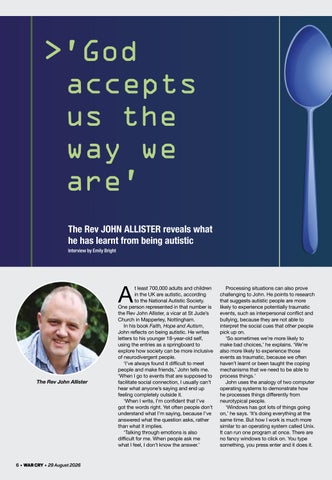
>’God accepts us the way we are’ The Rev JOHN ALLISTER reveals what he has learnt from being autistic Interview by Emily Bright
A
The Rev John Allister
6 • WAR CRY • 29 August 2026
t least 700,000 adults and children in the UK are autistic, according to the National Autistic Society. One person represented in that number is the Rev John Allister, a vicar at St Jude’s Church in Mapperley, Nottingham. In his book Faith, Hope and Autism, John reflects on being autistic. He writes letters to his younger 18-year-old self, using the entries as a springboard to explore how society can be more inclusive of neurodivergent people. ‘I’ve always found it difficult to meet people and make friends,’ John tells me. ‘When I go to events that are supposed to facilitate social connection, I usually can’t hear what anyone’s saying and end up feeling completely outside it. ‘When I write, I’m confident that I’ve got the words right. Yet often people don’t understand what I’m saying, because I’ve answered what the question asks, rather than what it implies. ‘Talking through emotions is also difficult for me. When people ask me what I feel, I don’t know the answer.’
Processing situations can also prove challenging to John. He points to research that suggests autistic people are more likely to experience potentially traumatic events, such as interpersonal conflict and bullying, because they are not able to interpret the social cues that other people pick up on. ‘So sometimes we’re more likely to make bad choices,’ he explains. ‘We’re also more likely to experience those events as traumatic, because we often haven’t learnt or been taught the coping mechanisms that we need to be able to process things.’ John uses the analogy of two computer operating systems to demonstrate how he processes things differently from neurotypical people. ‘Windows has got lots of things going on,’ he says. ‘It’s doing everything at the same time. But how I work is much more similar to an operating system called Unix. It can run one program at once. There are no fancy windows to click on. You type something, you press enter and it does it.
‘That may take five seconds, or it may take six hours. You can’t do anything else in the meantime. The only way to switch to a different task is to cancel what you’re doing, ask it to do something else, and then you’ve got to start all over again from scratch. ‘Once Unix has done the task, you can type in the next thing for it to do. It’s absolutely brilliant for some stuff that would take a week to do on Windows and you’d still get it wrong. But Unix doesn’t come across as being user-friendly. ‘That’s how it feels for me – if I’m writing and someone interrupts me, it’s almost like I have to start again from scratch. ‘If I’m concentrating, I’ll get on with a task until it’s done. But I don’t have the ability to do other stuff in the background or to change tasks quickly.’ John highlights how, in a neurotypical world, everyday tasks can take their toll. He talks about how writer Christine Miserandino, who has the autoimmune condition lupus, developed the ‘spoon theory’ to explain her struggles with
chronic fatigue. ‘She says that every day, you wake up with a certain number of spoons. It may be half a dozen or so. If you do certain activities, they will cost a spoon. If you run out of spoons, you’re unable to function on any more of those activities.
Noisy or social things cost spoons
‘F
or autistic people like me, noisy or social things cost spoons. Walking through the shopping centre easily costs a spoon. Navigating the school run costs a spoon. Going out for a pub meal costs at least a spoon, if not two. ‘If I do too much in a day, I tend to shut down. When children run out of spoons and they’re in a situation that needs a spoon, they’ll often have a meltdown. It looks a lot like a tantrum, but it isn’t. It has got different causes and you handle it differently.’ As a Christian living in a neurotypical
society, John takes comfort in the fact that the faith he follows doesn’t conform to the norms of the wider world. The Bible uses the recurring imagery of stones to illustrate that God celebrates difference in all shapes and sizes, even when it can feel awkward. And, John explains, Jesus, God’s Son, encourages us to fit our lives around him, not the world we live in. ‘Psalm 118 says that the stone that the builders rejected has become the cornerstone, and Jesus applies these words to himself. ‘As a cornerstone, Jesus is an awkwardly shaped rock that people should have chosen to build everything around. They should have let him determine the shape and position of everything else.’ John believes the Bible’s imagery of stones should be applied in the Church too. ‘In 1 Peter 2, it says that we are like
Turn to page 8 f 29 August 2026 • WAR CRY • 7
John at a book signing with his wife, Lydia From page 7
living stones. God didn’t choose to build his Church out of bricks of identical people, all fitting in neatly. He chose to build his Church out of living stones which are oddly or awkwardly shaped. And that means that God welcomes us and accepts us the way we are, not fitting into society’s norms or saying we’ve all got to be the same.
We need to listen to neurodivergent people
‘I
t’s a similar picture to that of the body in 1 Corinthians 12, which says that, if the Church is a body, then all the parts are meant to be different. You can’t build a body out of lots of livers. You’d get something really weird.’ John offers guidance on how churches can celebrate differences and be more inclusive of those who are autistic. ‘I often use the acronym FEEL,’ he says. ‘F is for “flexibility”, being willing
8 • WAR CRY • 29 August 2026
to adapt and treat people as individuals. The first E is “empathy”, listening to neurodivergent people and seeing what issues are affecting them. ‘Then there’s “empowerment” – we need to make sure that we invite neurodivergent people into positions of responsibility. And L is for “leadership”. It’s the leader’s job to set the tone. Sometimes I say: “Isn’t it wonderful that kids feel at home in the church building?” That shuts down any criticism of their autistic behaviour.’ John takes his lead from Jesus’ example. ‘On one occasion, Jesus was angry with his disciples for trying to keep children away from him,’ he says. ‘We need to be clear that tutting at autistic children because they can’t behave like neurotypical children is not acceptable. Let’s err on the side of grace. Autistic kids being autistic kids is wonderful. I wouldn’t expect them to be anything else.’ John adds that, in the eyes of God,
all people are infinitely valuable – a truth represented by God’s sending of Jesus, who was willing to sacrifice his life for the world. ‘The first law of economics is that an object is worth whatever its purchaser was willing to pay for it. We remember that we were redeemed with the precious blood of Jesus. ‘The value of every person is more than we could imagine. That’s as true of the neurodivergent as it is of the neurotypical. People’s value is determined by how much God has paid for them. And Jesus’ blood is worth far more than silver or gold. Our value is beyond counting.’ l Faith, Hope and Autism is published by Canterbury Press
i n v g w i L ‘
it
h la
r t s
D fel
n i g s ’ s e
OC
ti s o
ti n
g and
d i
THEA JOSHI, communications director of a national mental health charity, reveals what it’s like to live with OCD and tells how her faith has given her hope in her darkest hours Interview by Emily Bright
‘W Thea Joshi
hen I was eight or nine years old, I started having various odd worries that I didn’t know what to do with,’ says Thea Joshi. ‘For instance, my mum is one of my favourite people in the world. But I had a thought of: “What if I stabbed her? Then she would be gone and it’d be all my fault. I love her so much.” From the beginning, there were these thoughts that were completely opposite to my values and my desires. ‘Fast-forward 10 years, and I was at college, trying to sit exams. I’d struggled through my GCSEs, because I was scared that I might see someone else’s exam paper and then cheat. Then I would
jeopardise my whole future. I was so anxious.’ Thea decided to get some advice from her GP, who suggested that she might have obsessive-compulsive disorder (OCD). ‘I thought: “No, I don’t have any of those compulsive behaviours.” But it turned out that’s what it was.’ Thea, who is the communications director for a national mental health charity, explains that OCD can create a vicious cycle. ‘Everyone has intrusive thoughts,’ she
Turn to page 10 f 29 August 2026 • WAR CRY • 9
From page 9
says, ‘which will randomly come and go, and they’ll carry on with their day. What happens for people with OCD is that we’ll fixate on a thought and do certain activities to neutralise that anxiety. ‘Generally, the thoughts are referred to as “ego dystonic” because they’re not in line with your values, your beliefs or your desires – they’re completely the opposite. I think that’s why they’re so horrifying and that’s why we then fixate on them and think: “How could I even have a thought like that and what does this mean about me? I must make sure I never have that thought again.” ‘All of that tension is making our brain’s algorithm say: “Clearly, this is something important because you’re giving it a lot of attention. So here’s another one.” The more you resist a thought, the more it comes up. ‘Then there’s the feeling that “I can’t handle this distress any more. I must do something to neutralise it, calm myself
down, give me relief.” It creates that cycle of “I’m going to think this thought again and then I’m going to have to do this action again.” It gets worse and worse and worse.’
Honesty empowers and strengthens others
T
o raise awareness of the condition, Thea has collaborated with Will van der Hart – the founding director of a Christian mental health charity – on a book, When Thoughts Get Stuck. Thea had previously written a number of blogs and articles about her experiences, which she says was helpful in her recovery. ‘Living with OCD felt very isolating, distressing and hard to put in words,’ she says. ‘I was worrying about this random, irrational thing that was absolutely terrifying me. I didn’t know how to say
it out loud, so writing became a way of making sense of it.’ She felt that writing a book could help others. ‘I’ve been in a support group where I thought: “I can never say this thing out loud.” Then someone else said it and I decided that I’d be honest too. Honesty empowers and strengthens other people. ‘I hadn’t read much about OCD, particularly from a faith perspective. So by writing the book I wanted to put something out there to say that you’re not alone. Here are my scary thoughts and here is my experience of walking with them.’ In When Thoughts Get Stuck, Thea and Will not only describe their experiences of OCD but also provide encouragement that support is available. Thea believes that professional mental health support can be very beneficial. ‘There are some good evidence-based therapies that have been shown to treat people with OCD effectively,’ she says. ‘Medication is also a common grace that can help people. We have to take those things on board. ‘OCD treatment says: “Let’s just stop resisting the thoughts, because resisting increases the chance of us thinking them.” It’s a much more accepting approach of
letting thoughts come and go, which is really hard when you are terrified by the content of them, but it is the way that starts to reduce their frequency.’ But as a Christian, Thea also believes that faith can play a role in recovery. ‘Everything is under God’s domain,’ she says. ‘So it’s about taking all that’s good from universal therapeutic approaches that have helped millions of people but also bringing him into those things. ‘As I’ve gone into therapy, I’ve prayed for God’s healing through it and through the medication, asking: “OK, God, I just don’t know what’s going on here. Please give my therapist the wisdom to know how to help.”’ Thea has also found the Bible to be a comfort in difficult times. She cites the help she has found in some words from the Book of Lamentations: ‘I remember my affliction and my wandering, the bitterness… Yet this I call to mind and therefore I have hope: Because of the
10 • WAR CRY • 29 August 2026
Thea talks about her book at Christian festival Focus
Lord’s great love we are not consumed, for his compassions never fail. They are new every morning; great is your faithfulness’ (Lamentations 3:19, 21–23 New International Version).
I have seen the faithfulness of God
T
hea says: ‘Those verses have been a huge encouragement to me, because they’re not shying away from the fact that life can be really hard. The Bible doesn’t make us pretend that everything’s OK. It’s very honest. But we won’t be consumed by hard times, because God’s faithfulness is so great.’ The Bible’s Book of Psalms is also honest about life’s struggles. Thea found herself relating to one of its passages in particular. ‘Psalm 27 spoke to me at a time when I
felt desperate,’ she says. ‘I’d had so many relapses with OCD, and it had gotten to such a deep and dark point, where my life felt really restricted. I’d had time off work. Everything just felt impossible. ‘The thoughts were coming so frequently that there was no let-up until I fell asleep. Then I’d wake up and it would start all over again. It was awful. I had been feeling like I didn’t know how to keep going. ‘Then I felt like God spoke these verses to me: “I remain confident of this. I will see the goodness of the Lord in the land of the living.” It was as if those words were saying: “Hold on. This is not the end of the story. You’re going to see God’s goodness and faithfulness. It’s not always going to be all this dire. There is a better story coming.” ‘I have seen the faithfulness of God while going through OCD.’ Thea also explains how she takes great
comfort from her belief that Jesus, God’s Son, empathises with our pain, having died for our sins and risen from the dead. ‘He knows what it is to suffer the depths of everything,’ she says, ‘including being separated from God the Father on the cross. He’s so close to us in our suffering because he has walked it. And even if this world is really hard from day one to the end of our days, we know that we have eternal peace and hope and joy with him. I think it’s amazing news for people who have got OCD.’
l When Thoughts Get Stuck is published by Hodder & Stoughton
29 August 2026 • WAR CRY • 11
Prayerlink The War Cry invites readers to send in requests for prayer, including the first names of individuals and details of their circumstances, for publication. Send your Prayerlink requests to warcry@salvationarmy.org.uk or to War Cry, 1 Champion Park, London SE5 8FJ. Mark your correspondence ‘Confidential’.
j
Becoming a Christian
There is no set formula to becoming a Christian, but many people have found saying this prayer to be a helpful first step to a relationship with God
Lord Jesus Christ, I know that I have done things in my life that are wrong and I’m sorry. Thank you that I can ask you for forgiveness because of the sacrifice you made when you died on the cross. Please forgive me and help me to live a better life in the future as I learn how to love you and follow your way of living. Thank you, Lord Jesus.
Tell-tale signs Lynne Shaw explores how Jesus’ stories pointed to a bigger picture The parable of the new wine in old wineskins – Mark 2:22 If you’ve used computers or smartphones, you’ll probably be aware of operating systems. An OS allows us to use all the hardware and software on our device so that we are able to do what we want to do. Governments and societies also have operating systems in the form of laws and institutions that help to control how they function. And our personal lives too have operating systems – habits, routines, practices and decision-making frameworks. When Jesus told the parable about the dangers of putting new wine into old wineskins, he was teaching us something fundamental about updating our internal operating systems. Jesus’ listeners generally used animal skins for storing liquids such as wine. The thing about wine is that the volume it takes up increases as the fermenting process takes place. So new wine needed to be preserved in new wineskins, because they had the capacity to stretch and not burst. The parable can lead us to understand how new ideas don’t match well with old mindsets. Getting new results is difficult – almost impossible – with old behaviours. As the saying goes: ‘Insanity is doing the same thing over and over again, but expecting different results.’ Instead of trying to amend an old system, Jesus was offering a new way of approaching God – a way that has room to expand as we learn more of who God is and how God wants us to operate in the world. Changing our mind, turning around and heading in a different direction is the way to establish a new operating system. Jesus is inviting us to new ways of thinking and doing that will lead to new results: a full life that will change how we live and how we love not just each other, but God too.
"
Want to know more? a
To receive basic reading about Christianity and information about The Salvation Army, complete this coupon and send it to
If you’ve prayed this prayer, scan the QR code or contact us using the coupon on this page
War Cry 1 Champion Park London SE5 8FJ
Name
Address
Or email your name and postal address to warcry@salvationarmy.org.uk 12 • WAR CRY • 29 August 2026
Francis, Thomas and James in Angola for the new series of ‘The Grand Tour’
1
2 3 4 5 6
Who wrote the novel Middlemarch? Rock band Snow Patrol were formed in 1994 in which Scottish city? Which country’s flag consists of two black and two green triangles divided by a gold diagonal cross? What is the forename of the 17th-century mathematician and philosopher Pascal? Which comic actor wrote and directed the films Modern Times and The Great Dictator? A top hat, iron and race car are playing tokens in which board game?
ANSWERS
Long-running motoring show returns TV feature: The Grand Tour Prime Video By Ewan Hall
G
ood news! Fans of The Grand Tour will be happy to hear that a new trio of petrolheads are travelling the world and talking all things speed and power as the show returns next week. TikTok content creator Francis Bourgeois has teamed up with YouTube car enthusiasts James Engelsman and Thomas Holland to present the latest six-part series. ‘We took on the West African desert,’ reveals James. ‘We contended with fighter pilots. We even decided to challenge an entire nation’s legal system by protesting from the mountaintops.’ However, the biggest hurdle the team are likely to face is winning over long-term fans of the show. It has been nearly two years since the previous series reached its conclusion in the Makgadikgadi Pans, Botswana – a finale that also marked the ending of Jeremy Clarkson, Richard Hammond and James May’s two-decades-long TV partnership, which began back on Top Gear. The new hosts know that they have big boots to fill. Fans will compare them to the original trio, hoping for the same chemistry between them – which will place a lot of pressure on their shoulders. Pressure of one kind or another is something we all have to face as we make our way through life. Whether that pressure comes at work, or with family or friends, the effort of trying to live up to what others expect from us can be exhausting. But in such moments, Christians can turn to Jesus for support. In the Bible, Jesus assures us that we do not have to carry burdens alone. Recognising the weight of our problems, he says: ‘Come to me, all who are weary and burdened, and I will give you rest’ (Matthew 11:28 The Voice). If we look to Jesus when the road gets bumpy, we will find that we do not have to carry the expectation of others by ourselves. Life will still have its ups and downs, but Jesus will be there with us, helping to lighten the load – and that is the best news of all. 29 August 2026 • WAR CRY • 13
THE GRAND TOUR/PRIME VIDEO
QUICK QUIZ
On th e r o ad again
1. George Eliot (Mary Ann Evans). 2. Dundee. 3. Jamaica. 4. Blaise. 5. Charlie Chaplin. 6. Monopoly.
PUZZLES Quick CROSSWORD
SUDOKU
ACROSS 3. Chart (3) 7. Pilfer (6) 8. Pantry (6) 9. Mission (6) 10. Idea (6) 11. Lower limb (3) 12. Place of worship (6) 14. Cricket team (6) 17. Federal soldier in the American Civil War (6) 21. Articulated (6) 24. Form of dance (3) 25. Motionless (6) 26. Calculate (6) 27. Iron grating (6) 28. Serviette (6) 29. Manipulate (3) DOWN 1. Attack (6) 2. Renovate (6) 3. Interfere (6) 4. Dive in (6) 5. Squirm (6) 6. Distant (6)
Fill the grid so that every column, every row and every 3x3 box contains the digits 1 to 9
7 2 8 4 2 5 8 1 7 6 4 2 6 3 8 1 8 9 6 4 1 8 5 2 5 1 7 3 9 6 12. Attempt (3) 13. Falsehood (3) 15. Circuit (3) 16. Religious sister (3) 18. Blood vessel (6)
19. Water-boiling appliance (6) 20. Engraver (6) 21. Leap (6) 22. Inhabit (6) 23. Tropical (6)
W RDSEARCH
M O HONEYC B
Look up, down, forwards, backwards and diagonally on the grid to find these words associated with goodness
Each solution starts on the coloured cell and reads clockwise round the number 1. Breathe in 2. Female parent 3. Place to sell goods 4. Bat used in tennis 5. Moving swiftly 6. Chess piece
ANSWERS 6 4 5 2 8 3 7 9 1
7 2 8 9 5 1 4 6 3
9 3 1 6 4 7 2 8 5
4 5 7 1 2 8 6 3 9
3 8 6 7 9 5 1 2 4
2 1 9 3 6 4 8 5 7
1 6 3 8 7 9 5 4 2
8 7 4 5 3 2 9 1 6
5 9 2 4 1 6 3 7 8
HONEYCOMB 1. Inhale. 2. Mother. 3. Market. 4. Racket. 5. Racing. 6. Knight. QUICK CROSSWORD 3. Map. 7. Thieve. 8. Larder. 9. Errand. 10. Notion. 11. Leg. 12. Temple. 14. Eleven. 17. Yankee. 21. Spoken. 24. Tap. 25. Static. 26. Reckon. 27. Grille. 28. Napkin. 29. Rig. DOWN: 1. Charge. 2. Revamp. 3. Meddle. 4. Plunge. 5. Writhe. 6. Remote. 12. Try. 13. Lie. 15. Lap. 16. Nun. 18. Artery. 19. Kettle. 20. Etcher. 21. Spring. 22. Occupy. 23. Exotic.
14 • WAR CRY • 29 August 2026
WY I H Z QMZ E C B T L Y XMH T H G T X QWQ U Z R D J E L J K D O C Z Y S L S T K P HWZ L OMK V V D Q B A E R X B OQ C Q A VWQ X G U L K Q I N L N Q V N YMEMX R A H P Y V L T OQ L R S Z P Q Z D GQ S S E N L U F H T I A F Z OMN Y F Y V Y C R EMY T GQ Z I F K HWN P N L V O Z Q C V H HMX P B L F M N I S F I MH Z Q T V QWQ V N X I Y V D T Q N P WM E X Y Z U Q T J N E E T Z B X Z A I O J Z T Q B Z A T T C S Q S V N Q S U R QW I O T Q E MA Q T B VMZ E S Q A S VMZ QG C R E N Q B F CWN I Z L R Z KMR F G U QG Z G E N E R O S I T Y N I P B O J V D K J H S Z Y NM T D Q T K K NMD Y Q L F S T F Q Z B Y O Y COMPASSION
INTEGRITY
FAITHFULNESS
LOVE
GENEROSITY
MERCY
GRACE
MORALITY
HONESTY
RIGHTEOUSNESS
HONOUR
VIRTUE
SERVES 4
Peri-peri pork burgers with pineapple salsa
INGREDIENTS For the burger patties 500g pork mince 2tbsp peri-peri sauce 1 large red onion, finely chopped Salt and ground black pepper For the pineapple salsa 200g can pineapple rings in juice, drained and finely chopped ½ tsp chilli flakes ½ lime, juice Handful fresh coriander leaves, roughly chopped For the peri-peri mayonnaise 2tsp peri-peri seasoning 150g reduced-calorie mayonnaise To serve
METHOD Put the pork mince, peri-peri sauce and half the onion in a large bowl. Season with salt and pepper and gently mix together. Using slightly damp hands, shape the mixture into 4 burger patties. Cover and chill in the fridge for 20 minutes. To prepare the salsa, stir the remaining onion together with the pineapple, chilli flakes, lime juice and coriander, then set aside. In a small bowl, stir the peri-peri seasoning into the mayonnaise.
4 burger buns
Cook the burger patties under a preheated moderate grill for 6-8 minutes on each side, until cooked through and any meat juices run clear.
Salad leaves and sliced tomatoes
Spread the peri-peri mayonnaise over the bun bases, add the salad and burger patties, then top with the bun lids, to serve.
Recipe reprinted, with permission, from the Agriculture and Horticulture Development Board website lovepork.co.uk 29 August 2026 • WAR CRY • 15
Matthew 19:26 (New International Version)