newscience
NEWS FOR MEMBERS, PHILANTHROPIC PARTNERS AND FRIENDS OF THE SAINT LOUIS SCIENCE CENTER FALL 2023
Board Members
Saint Louis Science Center
Board of Commissioners
Mark J. Bulanda–Chairman
Joshua Randall–Secretary
David Baringer
Pratyush Kumar
Dr. Gena Gunn McClendon
Dr. Glen Stettin
Frank Thurman
Dr. Jeremy Williams
Dr. Mark S. Wrighton
Saint Louis Science Center
Board of Trustees
Dr. Mark S. Wrighton–President
Kevin R. Alm
Barry T. Cervantes
Jim Curran
Susan S. Elliott
Beverly Estes Guyton
Richard C.D. Fleming
Paris Forest
G. Patrick Galvin
Harvey A. Harris
Jerome Harris–Ex-Officio
Dr. Martin H. Israel
Jamie Jabouri
Frank D. Jacobs
Tishaura Jones–Ex-Officio
Dr. Toni Kutchan–Ex-Officio
Carol B. Loeb
Gregg Maryniak
John F. McDonnell (Life Trustee)
RADM Lee J. Metcalf, USN (Ret.)

Edward Monser
Elizabeth E. Niedringhaus
Kenneth A. Olliff
Dr. Sam Page–Ex-Officio
Donn Rubin
Kent Schien
Kathleen R. Sherby
Judy Sindecuse
Dr. Donald M. Suggs
Zar Toolan
Kenneth L. Wagner
Candace Webster–Ex-Officio
Dr. David J. Werner
Connect with curiosity.
Dear Friends of the Saint Louis Science Center,
On the cover of this issue of NewScience, you likely noticed the phrase “The Wonder of Why.” You may have already seen or heard this on TV or online because “The Wonder of Why” is the Saint Louis Science Center’s new brand narrative and advertising campaign. Everyone is curious. We all ask why. And one of the most exciting feelings is the lightbulb moment that happens when we find the answer.
“The Wonder of Why” is why the Science Center is here—as a place to inspire our community to ask questions, seek out answers, and be inspired to explore a topic that sparks their curiosity even deeper, whether they’re guests of our Oakland Building, visiting us at our Taylor Community Science Resource Center, or discovering us out among our St. Louis neighbors.
This issue of NewScience highlights a number of wonderful STEM experiences both from over the summer and coming soon for guests at the Science Center.
I encourage you to read about our Summer STEAM Camps on page 10. We were thrilled to welcome back our young campers for these new summer camp sessions. And on page 24 you can find stories from our Summertime Science program, STEMtastic Camp, Pop-Up Science events and more from our Youth Exploring Science (YES) Program, where our YES Teens explored STEM with members of our community.
On pages 8 and 9, I encourage you to take a sneak peek at some exciting updates to our Life Science Lab, where in the coming months guests will be able to explore connections between nature and medicine, as well as how scientists harness nature to advance healthcare. You can also read about our new Dream it. Build it. exhibit, where guests will be able to play, experiment and build using small wooden KEVA planks, as well as learn about St. Louis’ own architectural history.
Earlier this year, the McDonnell Planetarium celebrated its 60th anniversary, but that’s not the only anniversary we have to mark this year. I’m thrilled to say that in November our YES Program will celebrate 25 years of impact. We’re proud of the YES Program’s legacy of success in inspiring the next generation of STEM-skilled workers, and I cannot wait to see what our YES Teens accomplish in the years ahead.
Finally, as you read these stories, please know that whether you’re a philanthropic partner, a Science Center member, or a member of our St. Louis community, your generous support makes these accomplishments possible as we pursue our mission “to inspire everyone to be curious and engaged in science.”
I hope you’ll join us at the Science Center soon to explore the wonder of “why.”
Sincerely,
Todd Bastean President and CEO
2 FALL 2023
Connect with us for updates, special events and fun science.
Mission of the Saint Louis Science Center
To inspire everyone to be curious and engaged in science.
Hours
Thursday–Saturday 9:30am–4:30pm Sunday 11:30am–4:30pm Monday 9:30am–4:30pm
Closed Tuesdays & Wednesdays
Hours are subject to change; please check slsc.org for the most current information.
Contact
314.289.4400 slsc.org
Saint Louis Science Center 5050 Oakland Avenue St. Louis, Missouri 63110
Membership Services & Sales: 314.289.4491 slsc.org/membership memberships@slsc.org
Member Reservations: 314.289.4424
Reservations
Advance Sales & Group Reservations: 314.289.4424
Education
Field trip information: slsc.org/field-trips
Educator Resources: slsc.org/educator-resources
Programming information: education@slsc.org
Events
Host your next private event at the Saint Louis Science Center. Services and catering provided by Saint Louis Science Center Events. For information: 314.533.8179
Accessibility
Complimentary wheelchairs and strollers available in the lobby. Motorized scooters are available for a rental fee. Personal Hearing Assistance Devices available at the OMNIMAX® Theater and Planetarium. Captiview captions devices available for all OMNIMAX® films.
Official Partners
The Saint Louis Science Center gratefully acknowledges the support of our Official Partners.
In This Issue...
4 6 8 10
Membership Matters
Learn about our new online store, upcoming member events and meet a member who's been with us for over 25 years.
Science Today
Optometrist Tareq Nabhan explains a variety of updates in retinal science that are helping people see more clearly.
Gallery Spotlight
Take a sneak peek at the plans to refresh our Life Science Lab Atrium and learn about our upcoming KEVA Planks interactive display.
Science Never Stops
Look back at a summer of STEAM Camp fun. Plus, read interviews with John Christian, Ray Arvidson and Matt Muszynski, hailing from Washington University in St. Louis and NASA/JPL, whose work contributes to the Mars Perseverance Rover and Ingenuity Copter replicas of which are currently on display in the James S. McDonnell Planetarium.
16
Join Us
Learn about the upcoming eclipse and associated SciFest in October; also, spooky season approaches, and with it, our annual two-day Science Spooktacular. Plus, refreshing our Experience Flight area this fall and much more.

Community
Celebrate 25 years of our YES program, looking back as far as 2011 and as recently as this summer to see what our program's alums are doing now.
Partnership & Support
slsc.org 3
Meet our new Chief Institutional Advancement Officer Bobby Sanderson and learn about our partnership with Benson-Hill to grow high-protein soybeans. 22
30
THURSDAY, SEPTEMBER 14
Member Mission: Foods of the Future
Reservations available August 24
Join us for an evening of delicious dinner and drinks, plus presentations on the future of sustainable foods!
GROW Manager Maddie Earnest will be joined by Allison Miller, Ph.D., to explain how we can expect our meals to change in the coming years.
THURSDAY, OCTOBER 19
OMNIMAX® Member Preview:
Deep Sky
Reservations available September 28
Members see it first! Join us for the preview of a brand-new OMNIMAX® Theater film about the fascinating Webb Telescope. See what NASA’s newest telescope sees in an epic space adventure. Popcorn and a beverage are included in your free member reservation.
THURSDAY, OCTOBER 26
Member Mission:
Creepy Collections
Reservations available October 5
A beloved member event returns! Kick off spooky season with Manager of Collections
Kristina Hampton as she showcases some of the creepiest items in our Collections. Be warned: this event can get gross!
THURSDAY, DECEMBER 7
Holiday Member
Appreciation Night
Reservations available November 16
Our favorite event of the year! Join us for a fun night just for members to explore the entire Science Center. We’ll have Star Shows, OMNIMAX® documentaries, fun activities in our gallery spaces, food and shopping specials to help you cross some gifts off your holiday gift list and so much more.
Online Store Launches
Great news! You can now experience the fun and wonder of our ExploreStore and Planetarium Gift Shop from anywhere you can access the internet. Whether it’s apparel, mugs, keychains or some wonderful toy to enhance a child’s science learning experience, you can visit slsc.org/shop and order online. It’s an easy way to have gifts sent directly to the recipient.
Plus, the 10% gift shop discount for members is also available online! Enter code Members10%MM to apply your discount. Your purchase helps support the Saint Louis Science Center and our mission to inspire everyone to be curious and engaged in science.
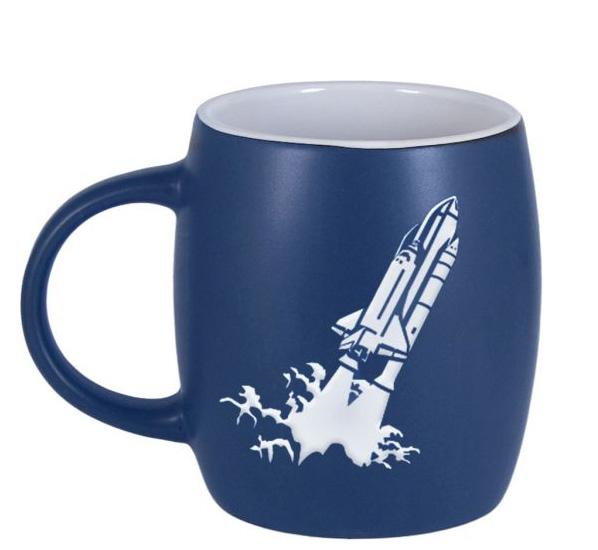
Special thanks to the team at Event Network and their partners at MuzeMerch for working with us to create this platform!
DID YOU KNOW:
KultureCity® Partnership
The Saint Louis Science Center team is devoted to living our values, and key among them is to be inclusive and welcoming to all. To that end, we're excited to announce our partnership with KultureCity®, a world-class organization devoted to sensory accessibility and acceptance for those with invisible disabilities.
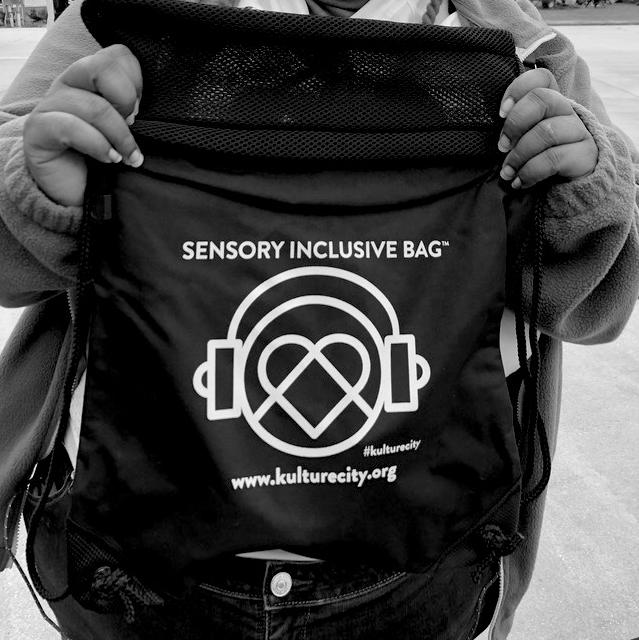
Staff from the Science Center have been undergoing awareness training to be better equipped to identify and support the many types of sensory needs our guests might experience. New signage and policies will help guests and staff identify potential impediments to the overall experience and navigate them with ease. Sensory bags are available for checkout and include sound-muffling headphones, fidgets and more that will assist those with sensory needs in enjoying their visit more comfortably. This partnership will be a huge boost to the experience for our entire community, not just for those with sensory needs!
To learn more about the wonderful work of KultureCity®, please visit their website at kulturecity.org–and stay tuned for more exciting developments from the Sensory Team!
4 FALL 2023 MEMBERSHIP MATTERS
Member Spotlight:
MARIE LAVALLEE
How long have you been a member?
It was 1997 when we joined after moving here in 1992. We joined because it was of interest to my husband and myself, but also because it would be of interest to our five children. We’ve been members ever since. Our kids are grown now, and I believe they have been influenced in their life careers through this membership.
How often do you visit, and what do you like to do here?
Currently, we come for your OMNIMAX® previews and so many other member events. The Becoming Jane exhibition member event was enlightening about Jane’s life. She received her college degree through her field experience. (One of our kids works at a renowned zoo and, unfortunately, lives out of town. She would have thoroughly enjoyed seeing the exhibit on Jane.) We like the GROW section and have been participating in the Green Living Festival, which we have been following around town.
Tell me a favorite memory or two from your years as a member.
One year, a mummy exhibit was at the Science Center, and the casing of a mummy was in the entryway. I had my grandson stand next to it and took his picture. It was so cute! The chicken coop out in the GROW section used to be an outer space themed coop, and I believe it influenced our kids, as one of them raises her own chickens today.
What types of member events do you like best—OMNI previews, Member Missions, or special events?
All of them! In Makerspace, at Holiday Member Night, you can make a light-up ornament. The concept of connecting a wire to a battery to light a small light bulb makes it happen, and it’s a great adventure for kids. One of the OMNIMAX® movies we previewed recently, Ocean Odyssey, was about whales migrating down to the South Pole after a period of birthing in warmer waters. Their populations are expanding because only two countries still practice whaling. As a result, it has been discovered that our ozone levels have gotten better because whales are helping to remove the carbon from our atmosphere.
What’s your favorite member benefit?
I would have to say the OMNIMAX® films and special exhibition member nights. Our out-of-town grandson is visiting, and we’ll take him to see Superpower Dogs. I get so much out of the films, not to mention the filming is spectacular. Besides Becoming Jane, the King Tut exhibition was very interesting and elaborate.
Why would you recommend becoming a member to anyone considering it?
There is so much to learn at the Science Center! A side benefit was when one of our boys went to Compton-Drew ILC Middle School, next door to the Science Center, for 6th, 7th and 8th grades. This school had tutoring from staff at the Science Center. He was mentored by a Science Center employee in a challenge to create a project in math (he chose to do it on prime numbers). His project won first place of all middle schoolers in the City of St. Louis Public Schools. The same project was converted to a science project in 7th grade, and he received an honorable mention with a monetary gift from a business who saw the project as noteworthy. In addition, upon graduation from 8th grade, all students were promised lifetime membership to the Science Center upon graduation from high school. Today, he has that membership, and not only that, he has two little boys who get to come explore the Science Center too. We are all big fans!
Know a family who would benefit from a Science Center membership? Consider giving the gift of a full year of fun events and science learning. Give the gift of membership! Visit slsc.org/membership to learn more.
slsc.org 5
The Field of Vision:
A Look at Three Cutting Edge Topics in Eye Science
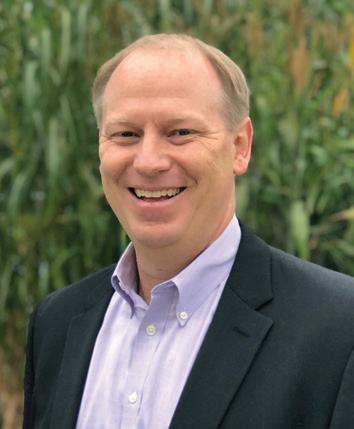
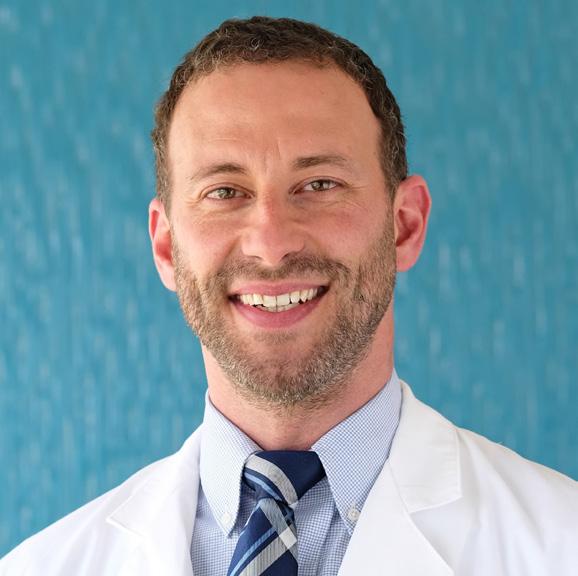
DR. TAREQ NABHAN
For humans, like many animals, vision is one of the primary ways of allowing us to interact with the world, making it important to maintain healthy, functional eyes. But for scientists and researchers, the human eye can also provide a unique look inside the human body in some surprising ways.

Dr. Tareq Nabhan, an optometrist and faculty member in the College of Optometry at the University of Missouri–St. Louis (UMSL), has over 10 years of experience in education, research and telehealth solutions in the field of vision. Recently, Dr. Nabhan shared three examples of cutting-edge research and technology showing that, while the eye may be a window to the world, it can also give us insight into so much more.
Retinal Biomarkers
Another hot topic in eye care, according to Dr. Nabhan, is being able to identify signs of disease in other parts of the human body using biomarkers, or substances in an organism that indicate the presence of a disease or infection, by evaluating the eye. These ocular biomarkers could then help doctors better diagnose and treat patients through more individualized precision medicine.
Myopia
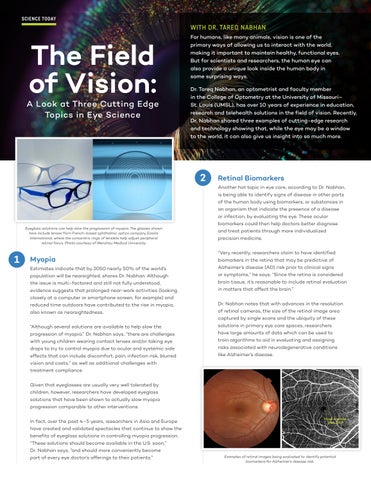
Estimates indicate that by 2050 nearly 50% of the world’s population will be nearsighted, shares Dr. Nabhan. Although the issue is multi-factored and still not fully understood, evidence suggests that prolonged near-work activities (looking closely at a computer or smartphone screen, for example) and reduced time outdoors have contributed to the rise in myopia, also known as nearsightedness.
“Although several solutions are available to help slow the progression of myopia,” Dr. Nabhan says, “there are challenges with young children wearing contact lenses and/or taking eye drops to try to control myopia due to ocular and systemic side effects that can include discomfort, pain, infection risk, blurred vision and costs,” as well as additional challenges with treatment compliance.
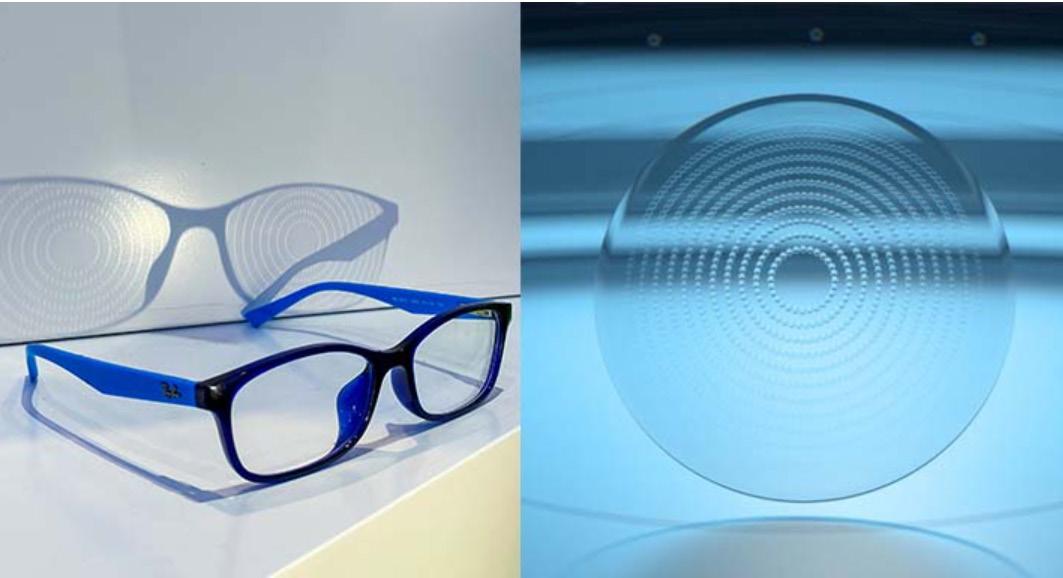
Given that eyeglasses are usually very well tolerated by children, however, researchers have developed eyeglass solutions that have been shown to actually slow myopia progression comparable to other interventions.
In fact, over the past 4–5 years, researchers in Asia and Europe have created and validated spectacles that continue to show the benefits of eyeglass solutions in controlling myopia progression. “These solutions should become available in the U.S. soon,” Dr. Nabhan says, “and should more conveniently become part of every eye doctor’s offerings to their patients.”
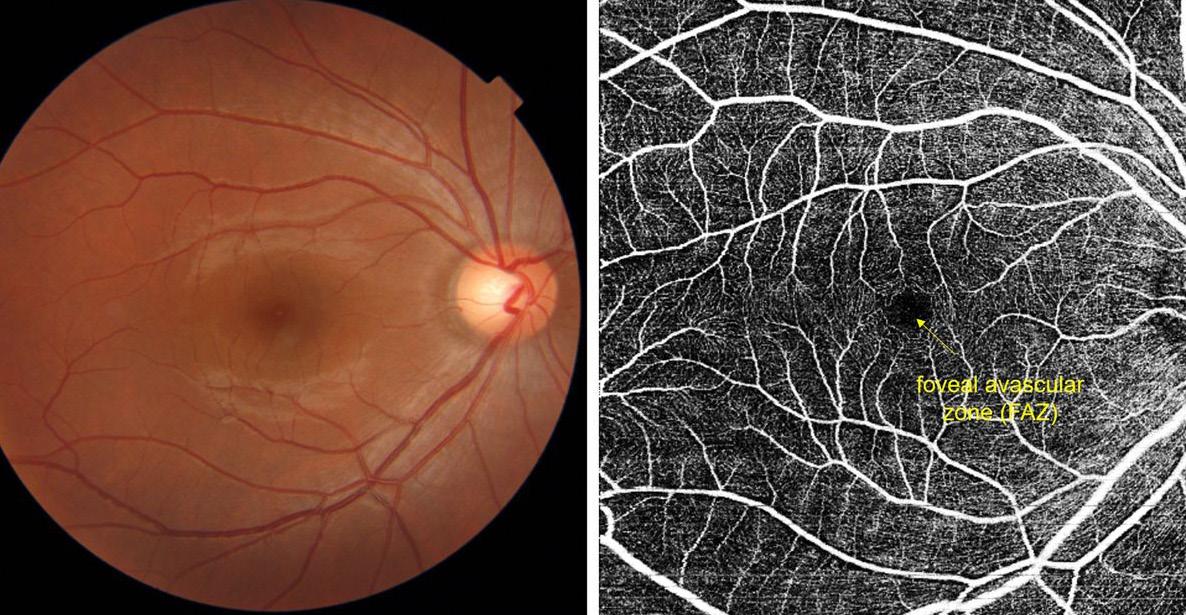
“Very recently, researchers claim to have identified biomarkers in the retina that may be predictive of Alzheimer’s disease (AD) risk prior to clinical signs or symptoms,” he says. “Since the retina is considered brain tissue, it’s reasonable to include retinal evaluation in matters that affect the brain.”
Dr. Nabhan notes that with advances in the resolution of retinal cameras, the size of the retinal image area captured by single scans and the ubiquity of these solutions in primary eye care spaces, researchers have large amounts of data which can be used to train algorithms to aid in evaluating and assigning risks associated with neurodegenerative conditions like Alzheimer’s disease.
SCIENCE TODAY
Eyeglass solutions can help slow the progression of myopia. The glasses shown here include lenses from French-based ophthalmic optics company Essilor International, where the concentric rings of lenslets help adjust peripheral retinal focus. Photo courtesy of Wenzhou Medical University.
1 2
Examples of retinal images being evaluated to identify potential biomarkers for Alzheimer’s disease risk.
WITH
Diabetic Retinopathy
According to Dr. Nabhan, diabetes and pre-diabetes combined affects 1 in 3 Americans, with multiple complications throughout the human body resulting from elevated blood glucose levels. One complication, diabetic retinopathy (DR), is a leading cause of blindness in working-aged adults in the U.S. But ocular conditions like DR also provide examples of the potential importance of looking to the eye as a window into the human body.
“With prevalence and incidence rates of diabetes and DR increasing,” Dr. Nabhan says, “we face [the equivalent of] a pandemic within a pandemic for years to come. But novel solutions in eye care are working to either prevent diabetic eye disease, catch it early or reverse it.”
Eye care has stood on the shoulders of giants in oncology (the study, diagnosis and treatment of cancer) to reverse certain forms of DR that have parallels to certain cancers, with these options having become the standard of care for treating DR.
Dr. Nabhan notes while prevention is key, an additional approach to addressing the DR pandemic is to catch the condition early when it’s more responsive to treatment, and one effective method is to leverage telehealth technology solutions. The term “telehealth” refers to the distribution of health and medical services, including diagnosis and treatment, using electronic information and telecommunication technology. One of the advantages of telehealth services is that doctors and specialists do not have to be in the same geographic area as a patient, making care more accessible—especially for individuals and communities challenged by access, awareness and affordability barriers to healthcare.
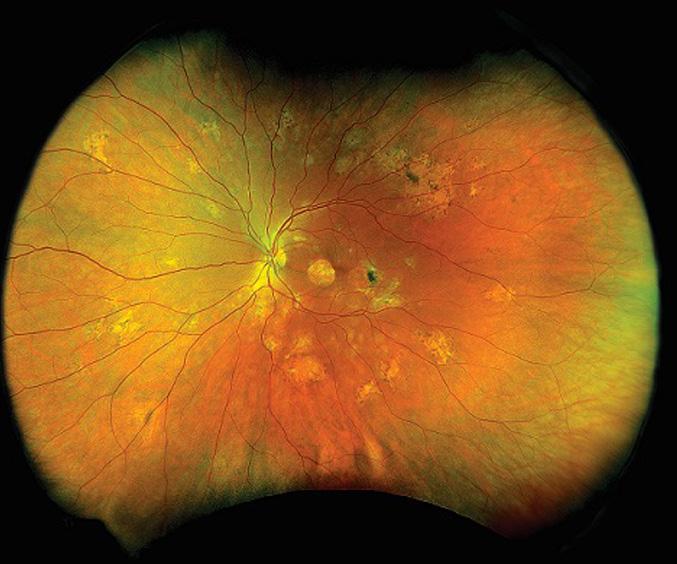
“Technology solutions [like telehealth] allow for remote retinal imaging of patients in rural or remote areas and then having those images read by eye care specialists not readily available to patients.” This solution, known as “teleretina,” has “shown to be effective in detecting DR and even other ocular conditions in the Veterans Health Administration (VHA), Indian Health Services (IHS), and the National Aeronautical and Space Administration (NASA),” says Dr. Nabhan.
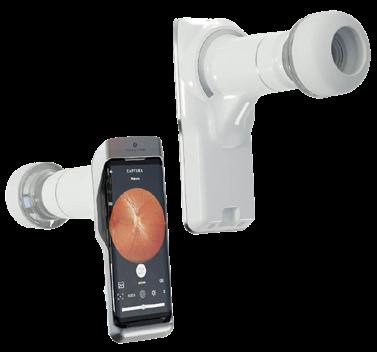
Although teleretina healthcare is effective in earlier detection and referring patients to other care providers, challenges include limits to the amount of retinal tissue that can be captured conveniently, the portability of the retinal camera, internet connectivity and the costs of the cameras themselves. However, Dr. Nabhan points to a number of novel solutions seeking to make teleretina healthcare more effective and democratizable.
“There are a slew of novel solutions seeking to expand the retinal area imaged, [address] the size of the camera to improve device portability and even utilize artificial intelligence (AI) algorithms in real time. We are currently rolling out some of the proven solutions in partnership with community health centers in St. Louis and testing AI solutions to make sure they are safe for our patients.”
Dr. Tareq Nabhan is an optometrist with teaching, clinical, research and entrepreneurial experiences in hardware-software telehealth solutions. Dr. Nabhan is a faculty member in the College of Optometry at the University of Missouri–St. Louis (UMSL), where he helped develop UMSL’s first-ever telehealth course and teleretina services in partnership with Affinia Healthcare. He also serves as a Special Government Employee (SGE) for CMS MEDCAC, on the Board of Directors to Volunteer Optometric Services to Humanity/International (VOSH/I) and on multiple clinical advisory boards; was selected to the 2020 class of the National Alliance for Eye and Vision Research; was named UMSL College of Optometry Educator of the Year in 2017 and 2023; and is the college’s faculty advisor to students dedicated to VOSH/I through charitable, sustainable and STEM activities.
3
An example retinal image (above) from U.K.-based company Optos, whose high-resolution retinal imaging technology allows easy capturing of 200 degrees, or over 80%, of the retina. Solutions like smartphone-based retinal camera devices (inset) can help democratize eyecare by making retinal imaging more portable.
STEM EXPERT SPOTLIGHT
NATURE AS MEDICINE
The Saint Louis Science Center will be refreshing its Life Science Lab Atrium this year!


In this newly designed area, content will be centered around how scientists harness nature to improve health. One of the three centrally located towers in the Atrium will focus on how nature has been used to provide medicine in the past, and another will showcase the ways modern science (specifically our ability to sequence DNA) has allowed us to research medicines in animals without harming them.
“Animal venoms are a big focus here,” explained Life Science Senior Educator Dakota Price, adding that many currently used pharmaceuticals were derived from studying the venoms of snakes, spiders, scorpions and more.
The third tower will illustrate ways nature can inspire new medical tools and techniques. Here, guests can learn about surgical bandages, medicine delivery tools, tissue grafting tools and more–all inspired by animals.
“My hope for the space is to introduce guests to biomedical sciences in a way they don't expect and to hopefully inspire a sense of connection between humans and the rest of the living world. A lot of the challenges we're looking to solve in medicine have already been solved by nature, and we're at a place where we have the technology and understanding to harness that while still protecting those other living things.”
–Dakota Price, LIFE SCIENCES SENIOR EDUCATOR
8 FALL 2023 GALLERY SPOTLIGHT


slsc.org 9
A LOOK BACK AT
It was our absolute pleasure to welcome campers back this summer to our weeklong Summer STEAM Camps. We spoke with our Associate Director of Galleries Liz Senzee to get a sense of how much fun and science the camps were able to pack into a week of half-day sessions, and the answer is: A TON.
It shouldn’t surprise anyone to learn that the first camps to fill up were dinosaur-themed! Space-themed sessions were a close second, and the video game camp sessions, in which campers got to design their own video game characters, were also well attended.
Campers attended morning sessions for one week, Monday through Friday, which meant spending time in the Science Center even on days when it’s closed to the public.

“I have been pleasantly surprised at how excited the kids are to be here during the off days. They feel like they own the place,” Senzee explained.
Several campers enrolled in different sessions week after week, and some kids spent four weeks in camps and by the end felt like they really knew their way around the museum. One camper who spent several weeks here even earned the nickname “The Mayor” because of his knowledge of the museum and ability to navigate camps easily.
"The kids like to have their hands and bodies moving," Senzee said, so camps have incorporated a good balance between in-class activities and in-museum exploration, allowing for structured education and [some] purposeful play."
One surprise for the campers was seeing that our beloved T.rex underwent some repairs this summer, resulting in his being headless for a large portion of summer camp sessions. How did
the kids feel about this local icon losing his head? “They’re all very concerned about the dinosaur, which is really cute.”
Campers don’t just show up, of course – their parents and guardians need to enroll them! So we would like to extend a special thank you to the adults who signed their kids up for these fun sessions.
Furthermore, no camp could be successful without the support of amazing counselors, and our counselors exceeded expectations. Senzee had this to say about our Summer STEAM Camp staff: “Our counselors have been awesome. They’ve been helpful and excited to teach the kids, have specific age ranges that they really love to work with and are wonderful at creating memorable moments.”
Senzee also mentioned that camp activities both assisted in filling the knowledge gap that occurs between school years, as well as simply being a safe, fun place for kids to learn science comfortably. Art projects are incorporated into most days, too. With many camp-age children struggling with structured education and socialization after a childhood interrupted by a global pandemic, this balance between structured and explorative sessions has been important. "If you want to the keep kids engaged, you have to be ready to keep them moving forward.”
You can help us continue to make programs like this possible by donating to the Science Center's Curiosity Fund
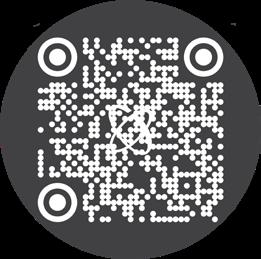
Visit donations.slsc.org/curiosity-fund or scan the QR code to make a gift.
10 FALL 2023 SCIENCE NEVER STOPS
Welcome Back, Science Tots
The Preschool Science Series has made some recent changes that readers with preschool-aged children will be thrilled to hear about! The official relaunch of our Science Tots program divides our smallest scientists into programs particularly tailored to the learning goals of their age groups.
Science Tots and Storybook STEAM are two programming options that fall under the umbrella of Preschool Science Series. Science Tots is for ages 18-36 months. Storybook STEAM is for ages 3-5.

“We originally started these two programs in January of 2020,” said Manager of Early Childhood, Camps and School Engagement Emily Lemonds. “Then the lockdown came in March 2020.”

Lemonds continued, “When the Discovery Room opened in the summer of 2022, we relaunched Preschool Science classes for ages 3-5, and brought back the toddler option in spring of 2023.”


Regarding our Science Tots program, research states that most brain development happens in the first three years of a child’s life. Each 45-minute Science Tots class is designed to provide opportunities to support brain development and learning. Toddlers and their grown-ups will explore STEM (Science, Technology, Engineering and Mathematics) topics through songs, stories, hands-on exploration, and play. Activities will ignite curiosity and wonder in young children as well as empower parents and caregivers to support their child’s STEM learning in class and in their daily lives. Science Tots programming is offered on the second and fourth weeks of the month.
In our Storybook STEAM programs, we emphasize that engineering is the process of using science and technology to solve real-world problems. Today’s preschoolers are tomorrow’s engineers and problem-solvers! In each 45-minute class, we use a thought-provoking storybook to engage children in STEAM (Science, Technology, Engineering, Art and Mathematics) challenges, exploration and play. Little engineers will learn science and math concepts as they design and create solutions to problems connected to the characters in the story or their everyday lives. Storybook STEAM is offered on the first and third weeks of the month.
These programs take place in the Learning Lab on the second floor, near the Life Science Lab. These programs are offered on Thursdays and Saturdays at 10:30am and on Sundays at 1:00pm.
Cost is $10 for members and $12 for nonmembers. Cost is per child. Adults do not need to pay. For more information regarding changes to class schedules, or just to learn more about these programs, visit slsc.org/preschool

slsc.org 11
Roving with Perseverance
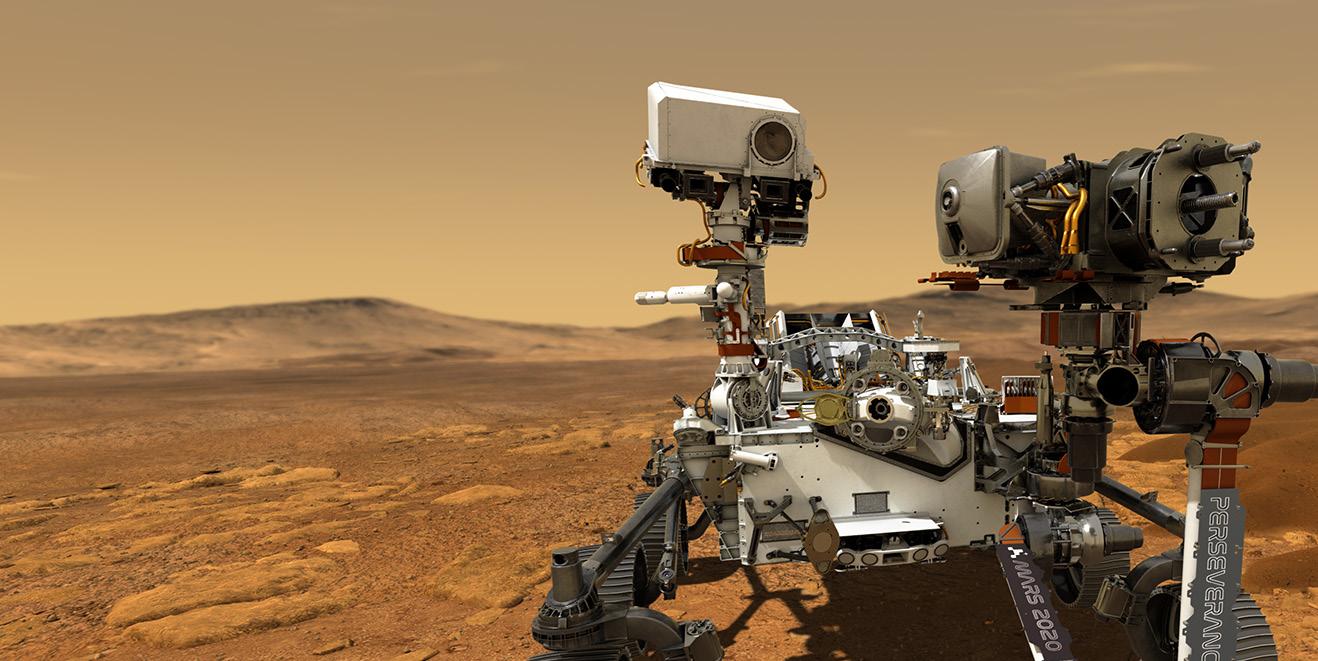
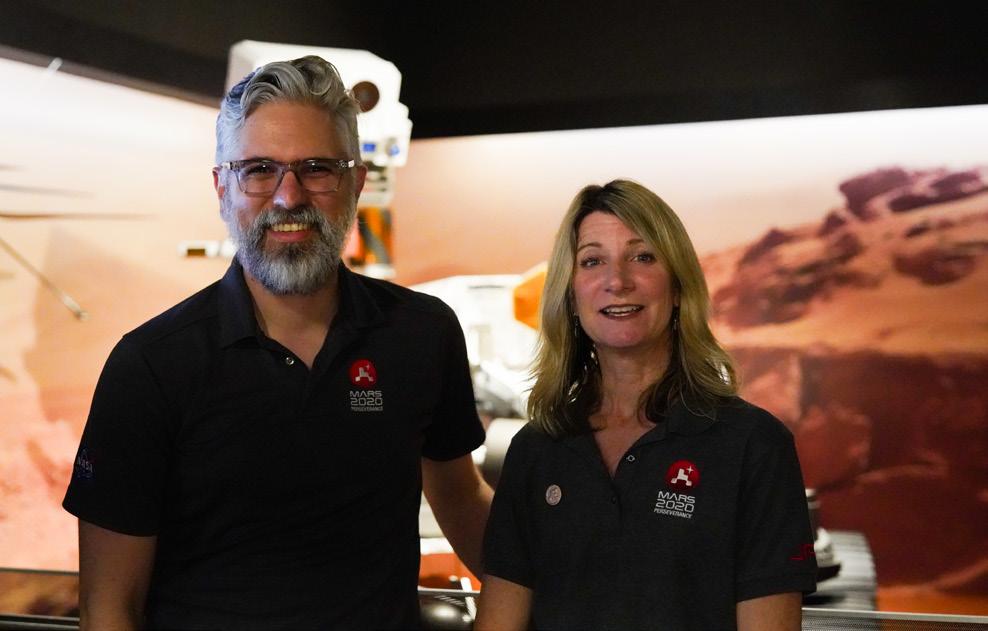
Over the weekend of June 23, the Saint Louis Science Center’s McDonnell Planetarium welcomed special guests—both human and robotic—from NASA’s Jet Propulsion Laboratory (NASA/JPL) to help connect the St. Louis community with a close-up look at the modern science helping humans explore Mars.
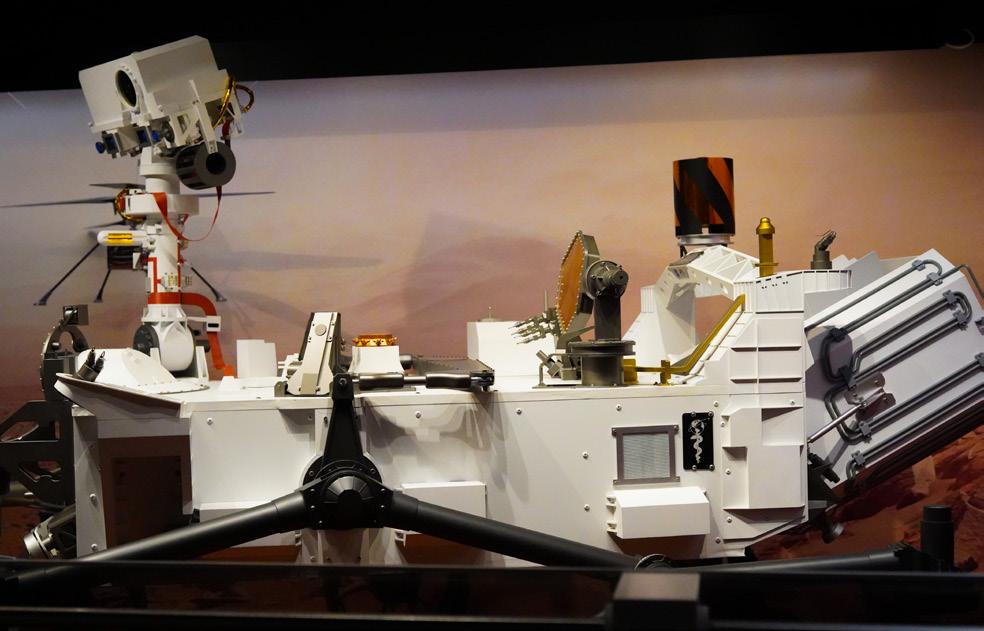
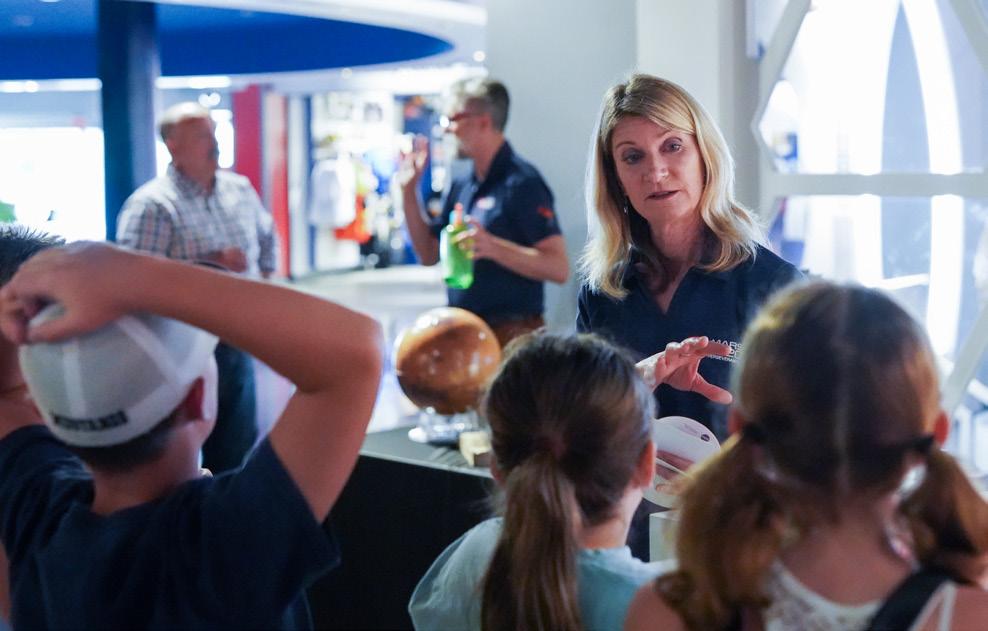
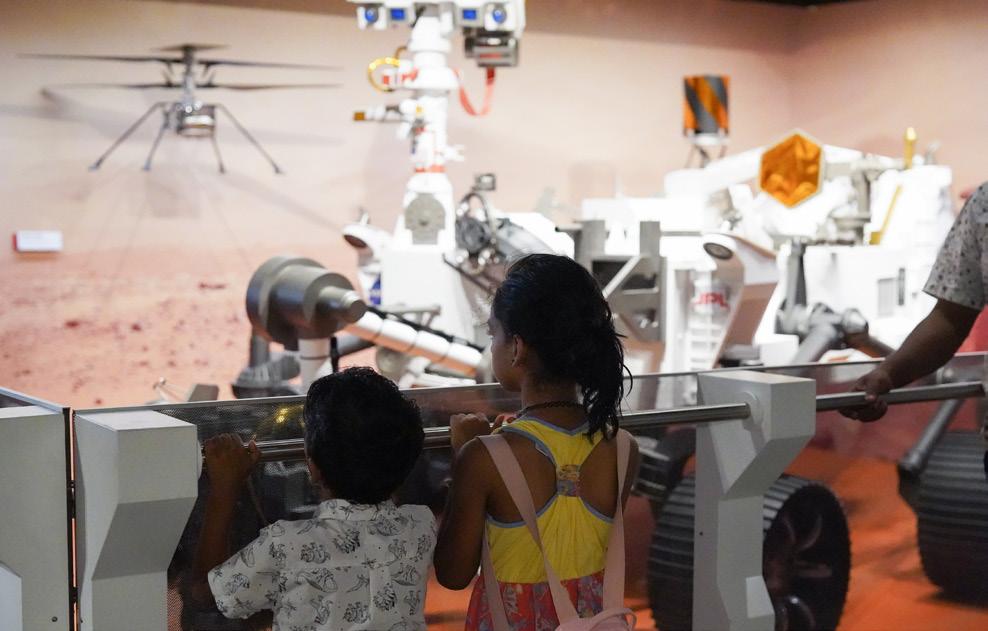
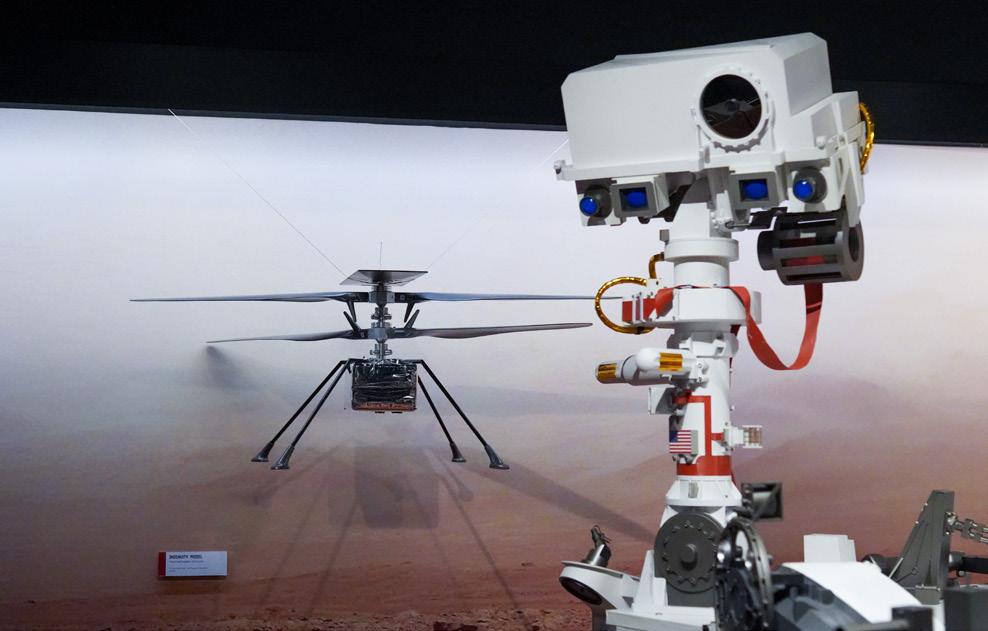
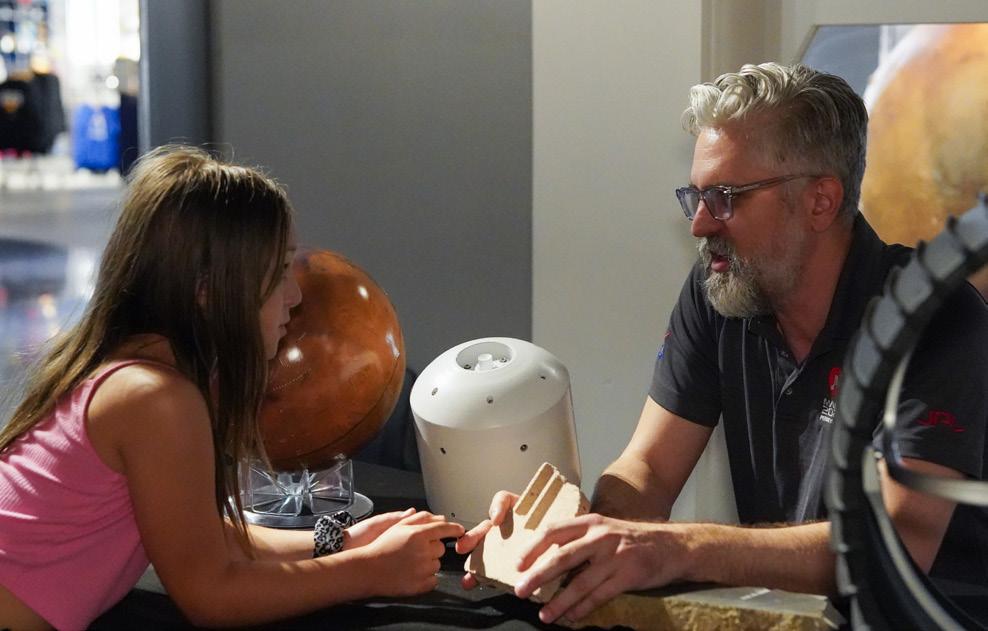
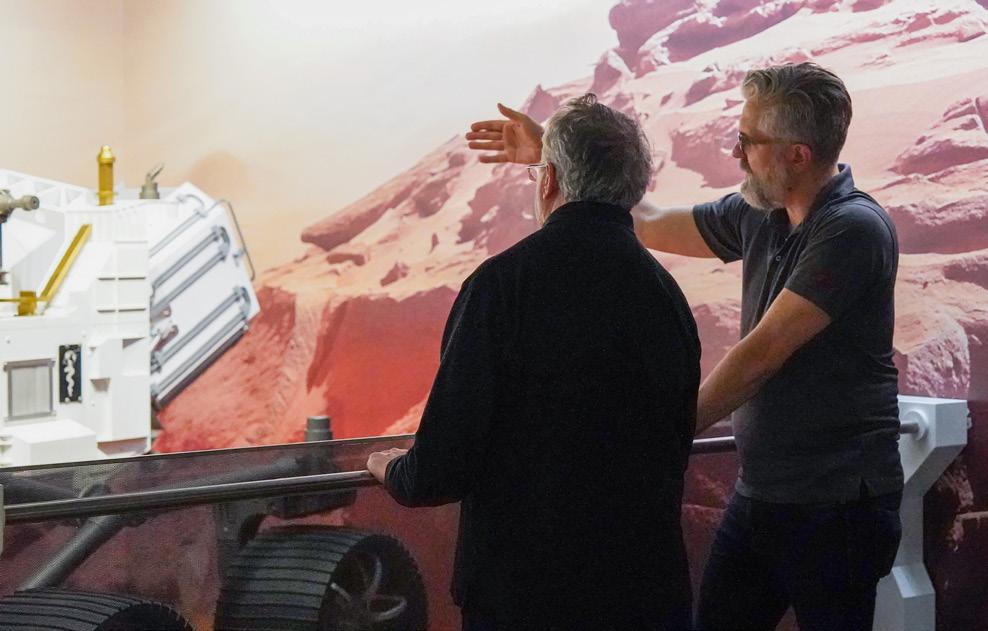
Over Friday, Saturday and Sunday, NASA team members and engineers were stationed inside the lobby of the McDonnell Planetarium alongside a newly installed, life-sized display called Roving with Perseverance, where approximately 8,000 guests had the opportunity to get a first look at a pair of full-scale replicas of the NASA Perseverance Mars Rover and Ingenuity Helicopter up close.
With activities, handouts and touchable objects including a 3D-printed model of a coring bit used by Perseverance to drill for rock core samples, the experts from NASA/JPL met with guests, answering questions and talking about the Mars missions, the rover and its cutting-edge technology and the work they do at NASA.
As big as a car, with its camera “head” rising high, Perseverance’s six-wheeled lookalike towers over most guests, while Ingenuity’s double highlights just how small the history-making rotorcraft is. While the real-life technological marvels are at work hundreds of millions of miles away exploring Mars, these life-sized “twin” models will be on display inside the McDonnell Planetarium until June 2024 to help demonstrate the scale and technology required for space exploration.
The NASA team’s arrival coincided with a special collaboration with Washington University in St. Louis on Saturday evening inside the Planetarium’s Orthwein StarBay. That evening, NASA/JPL engineer Matt Muszynski joined Washington University scientists Dr. Ray Arvidson and Dr. John Christian for a free panel discussion where attendees heard from the experts as they shared updates on the Mars 2020 Mission.
If you were unable to meet these experts in person, we are happy to introduce them here. Thank you so much to Raymond, John and Matt for taking the time to speak with us!
Dr. Raymond Arvidson
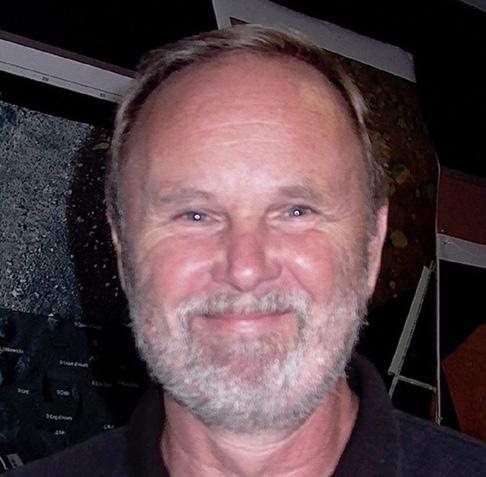 JAMES S. MCDONNELL DISTINGUISHED UNIVERSITY PROFESSOR EMERITUS, WASHINGTON UNIVERSITY
Tell us about the childhood dreams, studies or career path that led you to this point.
I have been interested in space since the days of Sputnik and Apollo, deciding on graduate studies in planetary sciences to be able to work with various robotic missions exploring the solar system.
Tell us about the exciting work you’ve done.
I retired at the beginning of July 2022. Before then, I taught and did research at Washington University in Saint Louis, McDonnell Center for the Space Sciences, and Department of Earth and Planetary Sciences. I was fortunate to be able to participate in and have leadership roles for the Magellan radar orbiter mission to Venus and many of NASA’s robotic missions to Mars.
What do you see changing in the future of your industry?
For Mars, we are acquiring rock cores from the Jezero delta with the Perseverance rover, to be returned in the early 2030s. Analyses of the rock samples with advanced instrumentation in laboratories across the world will likely tell us about whether or not life got started and evolved on the red planet.
What do you love about science in St. Louis?
It has been our home since 1974, raising two sons with my wife, Eloise. Washington University in St. Louis is our center of activities, with many friends and involvements. However, we also take advantage of the many other great institutions in the greater St. Louis area, including the wonderful Saint Louis Science Center!
12 FALL 2023
This illustration depicts NASA's Perseverance rover operating on the surface of Mars. Credits: NASA/JPL-Caltech
Dr. John Christian POSTDOCTORAL RESEARCH ASSOCIATE, WASHINGTON UNIVERSITY
Tell us about the childhood dreams, studies or career path that led you to this point.
My early interest in space exploration (especially Mars exploration) came from the Spirit and Opportunity rovers, both hearing all about them and watching concept videos of how they landed (bouncing across the surface covered in giant airbags!). The Curiosity rover had a much more direct influence–I was lucky enough to get to see it being assembled at the Jet Propulsion Laboratory in California and had a summer research position there when the rover arrived on Mars, so I got to see all the excitement around that. It's been an enormous privilege to get to work on that mission (and on Perseverance, too) so many years later.
Tell us about the exciting work you’ve done.
I'm part of the science team for both the Curiosity and Perseverance missions, as well as the APXS (on Curiosity) and PIXL (on Perseverance) instrument teams. I'm involved in day-to-day operations on both missions, usually 2-3 times per month for each role. For Curiosity, I work with the engineers who operate the rover to decide which instruments are safe to operate each day (we don't want to accidentally bang the rover's arm against the ground!). On Perseverance, I assist in target selection for each day's observations. [I also] help with initial processing of PIXL data upon downlink to Earth, to make the data easily available for the rest of the team for detailed analysis.
When I'm not working with the rovers, I also work with orbital data returned from the Mars Reconnaissance Orbiter and am starting to get involved with data archiving for the Mars Sample Return campaign.
What do you see changing in the future of your industry?
The biggest change coming for Mars science is Mars Sample Return, where samples collected by the Perseverance rover will be returned to Earth in the early 2030s. These samples can be subjected to much more advanced analytical techniques than are possible to do on Mars. These will hopefully tell us more about whether life was possible on Mars and will definitely provide better constraints on age estimations of features on Mars (and everywhere else in the solar system, too!).
Beyond Mars, there are several very exciting missions at various stages of development which will greatly expand our knowledge of the solar system. Some of the ones I'm most excited about are VERITAS (going to Venus to investigate tectonics and volcanism), Europa Clipper (going to Jupiter's moon Europa to investigate the subsurface ocean, which might harbor life), and Dragonfly (going to Saturn's moon Titan to investigate the liquid hydrocarbon seas and rivers on the surface, which are also expected to tell us about the origin of life).
What do you love about science in St. Louis?
I only moved to St. Louis in 2018. There's a lot of active research going on at Washington University in all kinds of fields, and I sometimes go to open lectures offered by other departments to learn more about the kinds of work they do. I've also been to the Science Center a few times, and come away each time having learned something new.
Continues on Page 14
slsc.org 13
Matt Muszynski
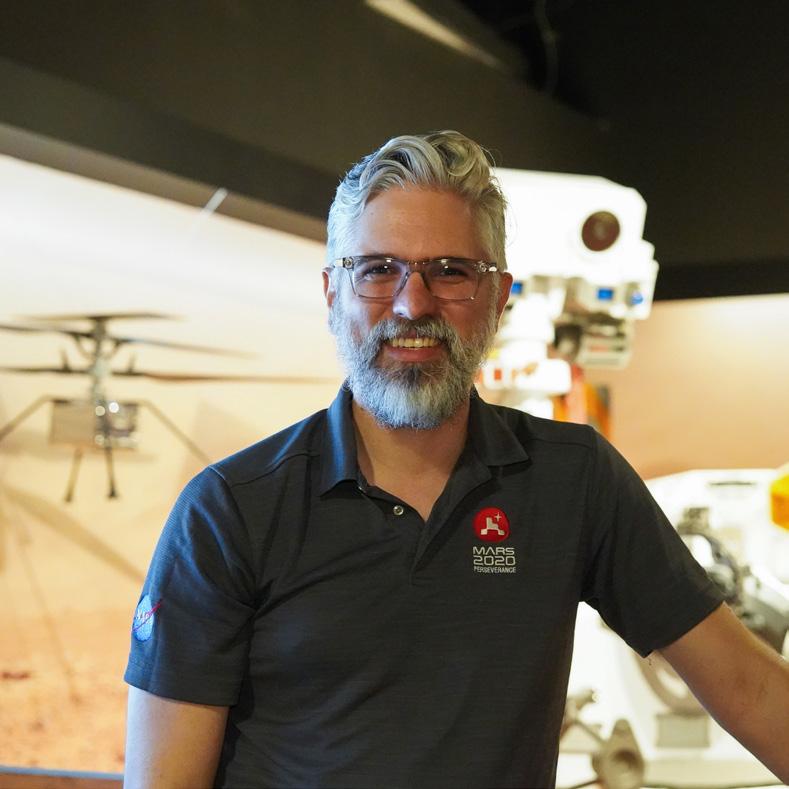
JPL SYSTEMS ENGINEER
On the Mars 2020 Project (Perseverance), I’m also a member of the Tactical Downlink Lead (TDL) team, and I am the Downlink Systems Engineer. I also work on Sample Retrieval Lander (SRL), where I am a Planning & Execution Systems Engineer.
Tell us about the childhood dreams, studies or career path that led you to this point.
I took a bit of a roundabout path. The story really starts with my dad, who was 16 when Apollo 11 landed on the moon. It made a huge impression on him, and while he didn’t go into the space industry himself, he exposed my brother and me to a ton of space media (Apollo 13, From the Earth to the Moon, The Right Stuff, etc.). We also lived in Central Florida during most of the Space Shuttle era. We were close enough to Kennedy Space Center that we could see shuttle launches from our front door. We could even make out the Solid Rocket Boosters falling into the ocean after they separated from the shuttle during launch. When the shuttle returned to Earth, its twin sonic booms would shake the dishes in our cabinets. Those were so jarring that a couple of times I thought a car had slammed into the house before remembering that no…the space shuttle was scheduled to come home that day.
But I also had other interests. When I was 18, I left home to study music and astronomy at the University of WisconsinMadison. That lasted a couple of semesters until I took my first real astrophysics midterm and got a 26/100. I used that moment to do some soul searching and decided that while I knew I could succeed in astrophysics, I wasn’t putting in the effort because I was spending so much time practicing tuba. So I dropped Astro and finished just my Music Performance degree. After Wisconsin I moved to New York, where I got a Masters in Classical Tuba from the Manhattan School of Music and started a career as a freelance musician.
It should come as no surprise that classical tuba playing is not a lucrative career, so I always had to have a day job.
I ended up working as a sales associate at the bookstore for the Juilliard School. Eventually that turned into a backoffice job buying textbooks from wholesalers to sell to the students. We used a lot of Excel and spent many hours meticulously copying one cell to another by hand. I knew that there were probably better ways to get the job done faster, so I started tinkering with VBA and SQL and taught myself to code. Meanwhile my freelance career was slowing down. Not because I wasn’t doing well, but because all my mental energy was going towards new coding projects and not towards finding new gigs.
Eventually I decided to go back to school and pursue a second career. That took me to the University of Colorado at Boulder, where I completed that Astronomy degree that I didn’t finish in Wisconsin. I was also hired as a student satellite operator at the Laboratory for Atmospheric and Space Physics (LASP). I did ops there for a handful of Earth Orbiting Missions (SORCE, QuickSCAT, AIM, MMS) as well as the Kepler Space Telescope. Actually getting to sit at a console and send commands to spacecraft was a dream come true (especially Kepler, since that mission was part of my inspiration to go back to school).
I fell in love with engineering and decided that the day-to-day work of being an engineer suited me much better than that of an astrophysicist, so I pursued a master’s degree in aerospace engineering. After graduating with the MS from CU, I got hired by JPL!
Tell us about the exciting work you’ve done.
Working at JPL is a dream come true in so many ways. I started off with a 50/50 split doing operations for the Curiosity Rover and development for Perseverance. On Curiosity, I was a Science Planner and Sequence Integration Engineer. In short, I was one small part of the very large uplink team, who collaborates every day to decide what to do with the rover, validate that the plan will meet the mission’s science goals and that it can be safely executed, and build the actual computer files that will be sent to the Rover to tell it how to do its job.
On Perseverance I started as a Dictionary Engineer, keeping track of metadata that helps engineers communicate with each other and with the vehicle itself about what commands can be sent to the rover and what information it can send back to Earth. Later I did verification and validation of the downlink tools, which are now used every day in operations to analyze data returned by the vehicle to make sure it is healthy and doing what we expect it to do. On landing day, I worked as a Vehicle Systems Engineer, which is an uplink role focused on validating the health and safety requirements of each plan we send to the rover. I’ve since switched to the downlink side, where I am a TDL, the role running our downlink assessments and polling each subsystem team for the status of their part of the vehicle (Think Gene Kranz as played by Ed Harris in Apollo 13). I am also the outgoing Downlink Systems Engineer, a role designed to coordinate the ongoing development of the downlink system. Even though our tools are very good, we’re still working hard to improve them to keep Perseverance’s mission going as long as we can!
14 FALL 2023
SCIENCE NEVER STOPS
In the last year, I’ve started transitioning into the next step both of my career and of the Mars Sample Return Campaign. One of Perseverance’s main jobs is collecting samples and caching them for potential future return to Earth, and Sample Retrieval Lander (SRL) is the mission that would land on the surface, collect the samples and launch them back into Martian orbit to return to Earth for scientists to study here. My role on SRL is Planning & Execution Systems Engineer, representing the future operators of the mission in meetings with the folks who are designing the lander and the ground software we will use to operate it. I review their designs with an eye towards the operability of the system. Basically, will the vehicle be easy or hard to operate once it’s on Mars? What changes can be made to make it easier?
I also help develop the processes and procedures that will eventually be used by the operations team once SRL is on its way to Mars and when it is on the surface.
What do you see changing in the future of your industry?
This is an incredible time to work in the space industry. Technology is changing rapidly and opening up opportunities for exploration that have never been possible, and there’s a lot of excitement in the air from big projects both at NASA and at private companies.
The scientific exploration of Mars with robots that has made JPL so famous in the last 30 years might actually be slowing down. The 2020 Planetary Science Decadal Survey had very little to say about Mars, as the planetary science community is starting to pivot towards the outer planets. I would expect to see more orbiters visiting gas giants like Jupiter, Saturn, and Uranus. One of JPL’s next missions (planned launch: October 2024) would visit Jupiter’s moon Europa with the goals of mapping its surface and looking for signs of life in its global ocean that lies under a kilometers-thick ice sheet.
Meanwhile, NASA’s human spaceflight arm is starting to ramp up the Artemis program to return humans to the moon and lay the groundwork needed to eventually get humans to Mars to take over the work we’ve been doing with robots up until now.
What did you enjoy about your weekend at the Saint Louis Science Center?
I felt very welcomed by the entire community! The staff was very accommodating and a joy to geek out with about space stuff. The visitors showed lots of curiosity about JPL’s work and asked some great questions related to space and the rover.
I think that I have the best job in the world. But lots of days, any job is just a job. Even operating a robot on Mars comes with its fair share of stress, frustration and burnout. Visiting the Science Center and communicating with your staff and the public created an invaluable opportunity for me to reconnect with the excitement and wonder that drove me to want to do this work in the first place.
In the end I think that’s one of the most special things about what we do at JPL. We explore on behalf of all of humanity, and your excitement really is what keeps us going a lot of the time. In that way, I honestly believe that anyone who has ever expressed interest in my work—even as simple as coming to the Science Center or just sharing a social media post from JPL—really is a part of it.
slsc.org 15
The Perseverance Rover and Ingenuity Copter will be on display in the Planetarium through June 2024.
Upcoming Eclipses
Eclipses can be really meaningful events. They are a chance for us to better understand how the Earth, and us on it, are part of something larger. Eclipses are community events that can bring us together and give us all a reason to look up. The October eclipse may only be a partial one in St. Louis, but it is a perfect opportunity to learn how to safely view these events and get everyone excited for the upcoming total solar eclipse we’ll see in southern Missouri and Illinois in April 2024. If you miss the total eclipse next April–or if it is cloudy–we won’t see another total solar eclipse in the Midwest until 2045; these are events you really don’t want to miss!
–Will Snyder, PLANETARIUM MANAGER
Come See a Star Show!
ECLIPSE
Are you ready to get eclipsed?
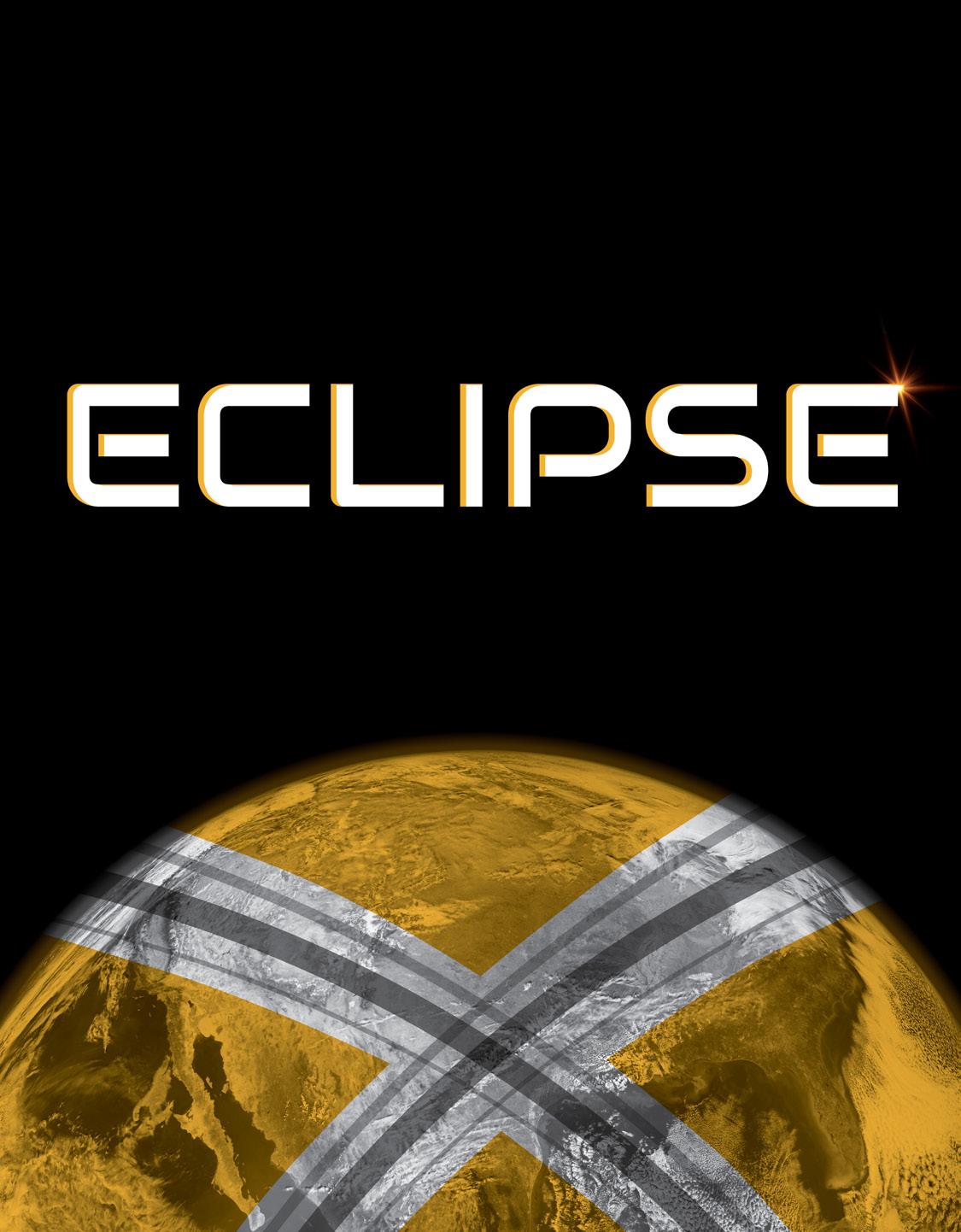
Learn about the nature of eclipses and get prepared to safely observe the upcoming solar eclipses in October 2023 and April 2024.

16 FALL 2023 JOIN US
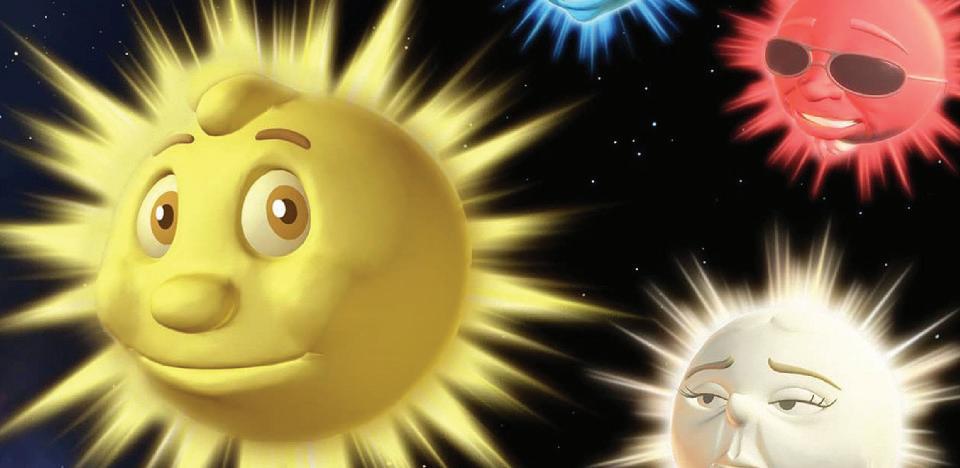
The Little Star That Could
Sometimes, being average can also be special. A tradition in St. Louis for over 30 years! Developed for our youngest stargazers, experience the timeless story of an average star in search of what makes him special. Along his journey, we will discover the differences between stars, planets and galaxies in the night sky.
Coming Soon TO THE JAMES S. MCDONNELL PLANETARIUM
The Sky Tonight
Your sky…tonight.
Relax under the clearest night sky in St. Louis as our skilled presenters lead you on tour of the best the night has to offer. This live show is different every time, so stop back again to discover the changing stars, planets and other celestial events visible from your own backyard.
Yoga Under the Stars
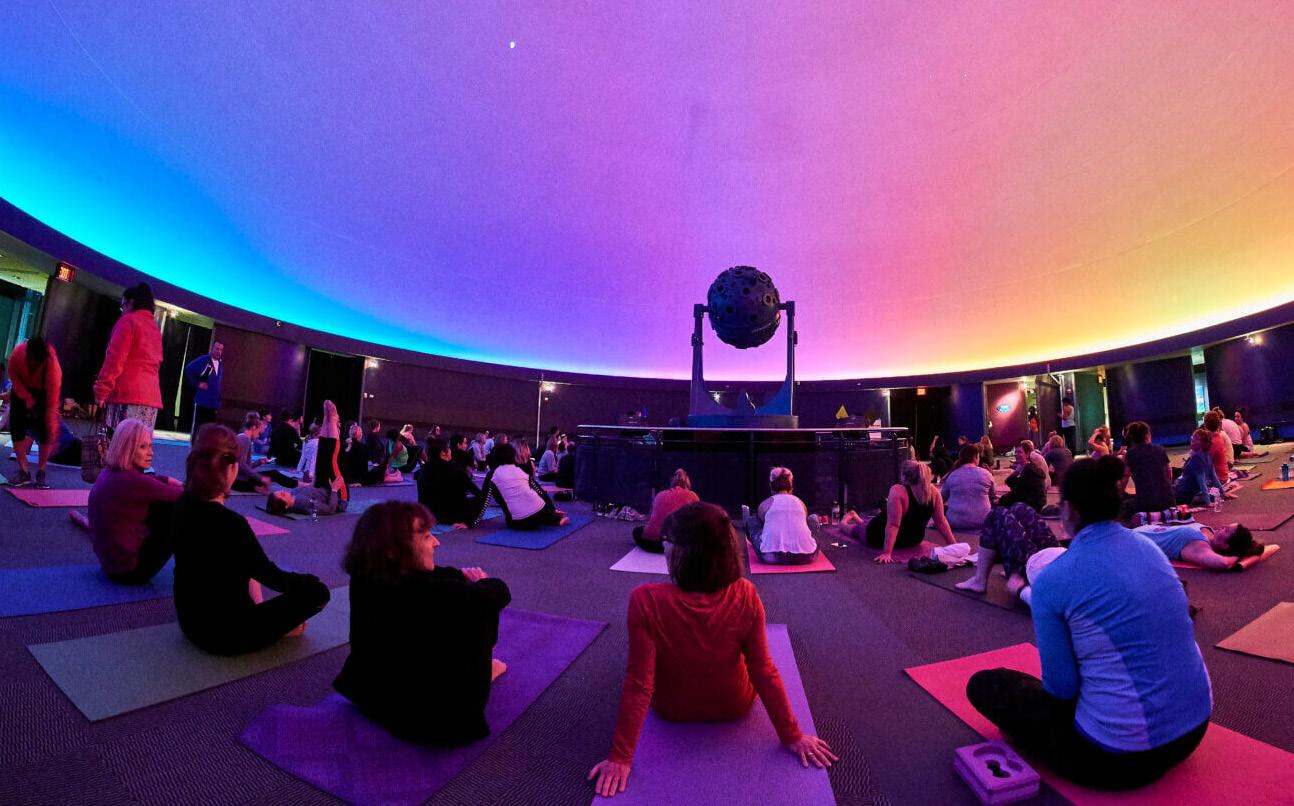
SEPTEMBER 25 | OCTOBER 30 | NOVEMBER 20
To buy tickets, visit slsc.org/yoga
Laser Shows
OCTOBER 27–NOVEMBER 12
Tickets on sale Monday, October 2. For the most current information, visit slsc.org/lasers
Astronomy Dates
SEPTEMBER 23 | Autumnal Equinox
The autumnal equinox marks the first day of fall in St. Louis. On this day, the Northern and Southern Hemispheres of Earth receive equal amounts of sunlight.
OCTOBER 14 | Annular Solar Eclipse
The Constellations
The Constellations
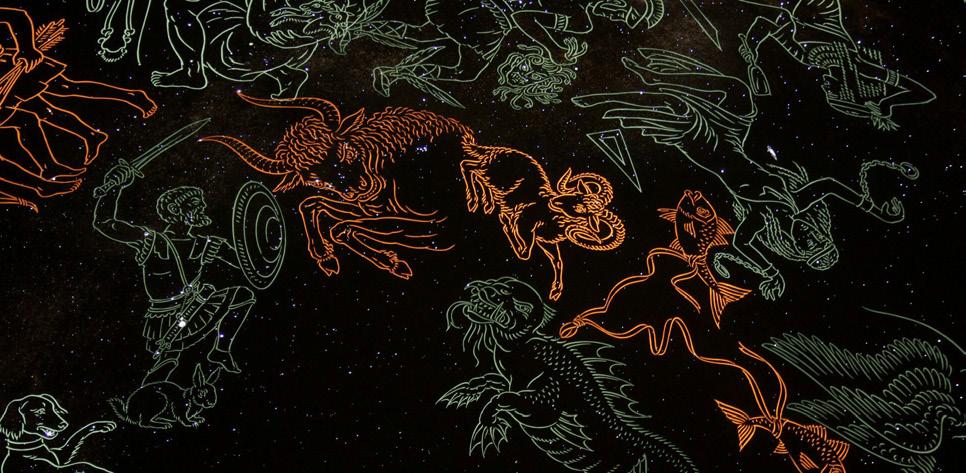
Returning in Fall 2023
Constellations are your map to the sky. Explore the constellations that change overhead throughout the year and how to use these patterns to explore space in this popular, live Star Show.
An annular solar eclipse will sweep across the southwest this fall. During an annular eclipse, the Moon is too far away from the Earth in its orbit to fully block out the Sun, leaving a ring of light visible. In St. Louis, a partial solar eclipse will be visible from 10:32am until 1:26pm CDT.
NOVEMBER 17–18 | Leonid Meteor Shower
The annual Leonid meteor shower peaks on the night of November 17 into the morning of November 18. Produced by debris left by comet Tempel-Tuttle, this shower has a cyclonic peak that occurs every 33 years. The last outburst was in 2001, with the next one forecast for 2034.
slsc.org 17
The Saint Louis Science Center is happy to announce our refresh of the Experience Flight room!
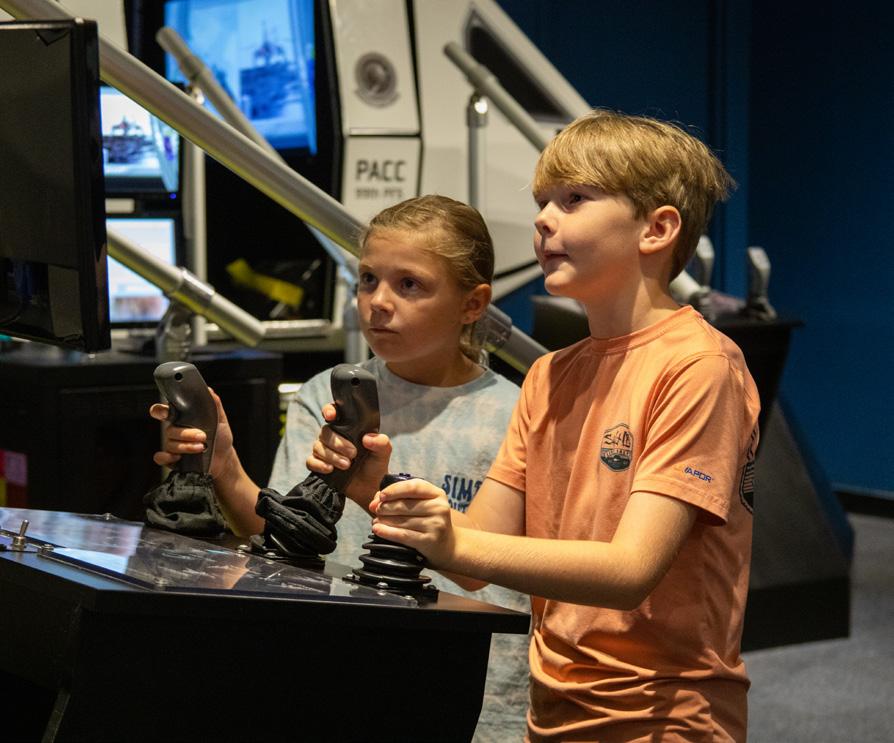
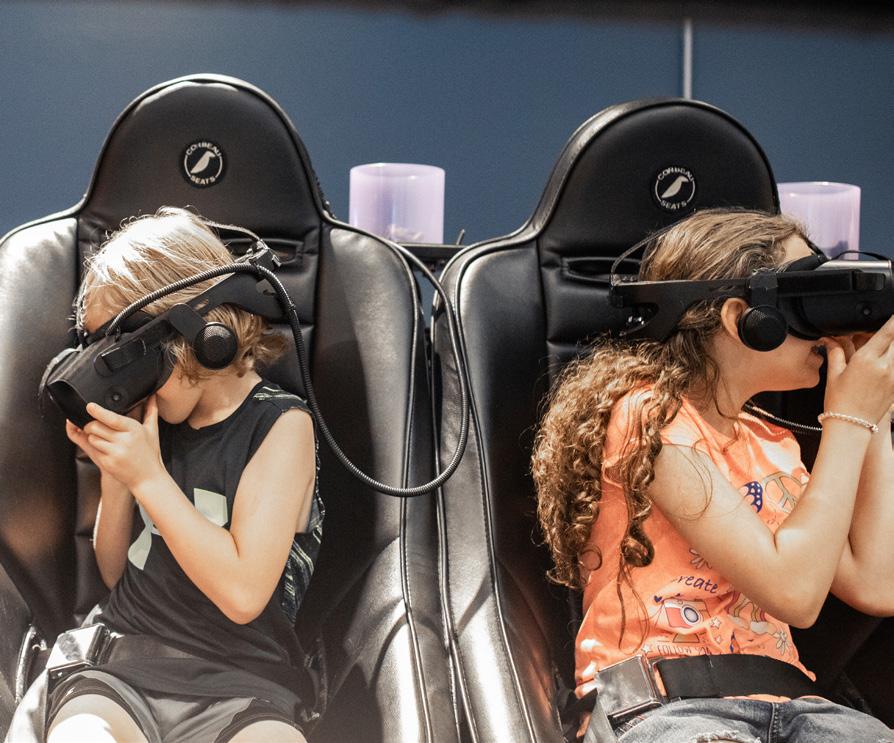
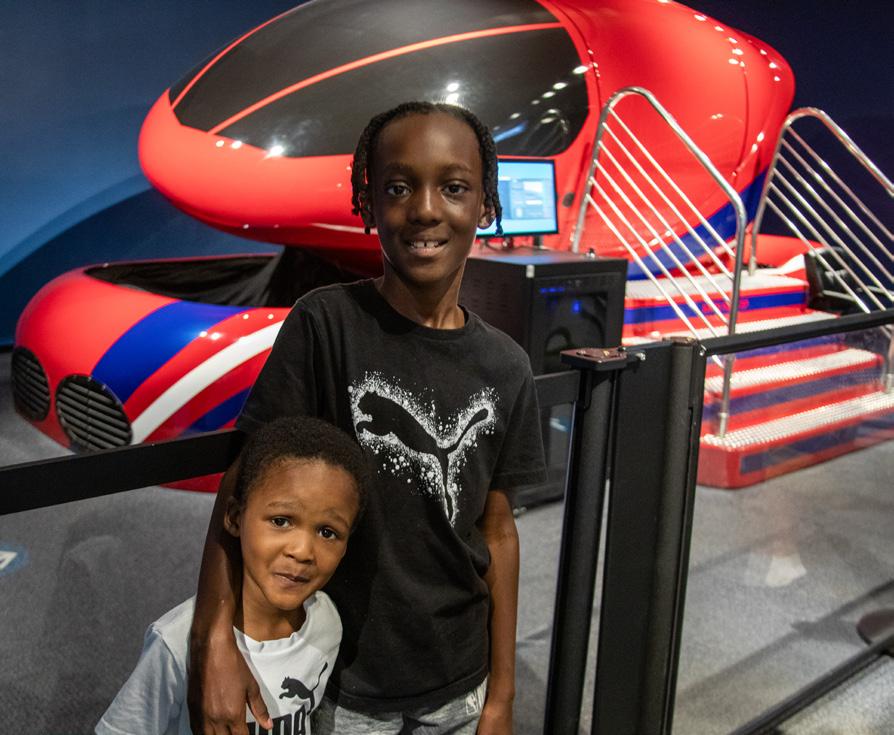
Along with a much smoother experience, guests will be able to choose from:
Adventure Pod
Take flight with a stunt plane as it does tricks over an airshow! This ride is 5 minutes long, $6 per person ($5 with membership) and suitable for all ages. Note: guests under 42 inches tall must ride with an adult.
VR Transporter
Feel every G as your F/A-18 Super Hornet takes off from an aircraft carrier! Looking around in all directions during your training mission, you'll feel like you're the next ace! This ride takes about 8 minutes from start to finish, is $10 per person ($9 with membership) and riders must be a minimum of 42 inches tall. Note: no glasses or headwear are allowed due to the VR headsets.
360 Flight Simulator
With your favorite copilot, take the controls of the legendary F-15 Eagle! We'll teach you how to fly, then it's up to you to take on enemy aircraft! This machine responds to all your inputs, including spinning completely upside down! This ride takes 10 minutes from start to finish, is $7 per person ($6 with membership), and riders must be a minimum of 48 inches tall. Please note: due to the nature of this machine, all loose personal items must be removed and stored during the ride. This includes your phone!
We're excited for you to "take to the skies" with us! As we continue to evolve our focus on flight experiences, let us know what you'd like to see in this room next!
"With all of our simulators together in the same room for the first time, we have the opportunity to focus on one incredible experience for our guests. Flight has been such an important part of the recent history in St. Louis, and we're thrilled to offer three totally different rides on that theme. In each, you'll feel the incredible freedom and excitement of flight without ever leaving the ground! My hope is that we'll inspire the next great pilot or aircraft designer to push new frontiers in aerospace."
– Neville Crenshaw, MANAGER OF SPECIAL EXHIBITIONS & FEATURED EXPERIENCES
SATURDAY, OCTOBER 14 | 9:30AM–4:30PM
SciFest: The Great Outdoors/Eclipse Expo
Discover a deeper appreciation for the great outdoors and experience special programming themed around a partial solar eclipse at our all-day, free event!
View the partial eclipse (weather permitting) and find out how to best prepare for the total solar eclipse coming in 2024! Visit with space, aeronautics and astronautics experts around the McDonnell Planetarium. Participate in activities and engage with STEM experts and organizations related to outside life, activity and work. Find inspiration for your own outdoor hobbies, activities and adventures.
Visit slsc.org/scifest for updates on this event!
18 FALL 2023
JOIN US
DOCUMENTARY FILM
Deep Sky goes behind the scenes of the James Webb Space Telescope, capturing its launch and the release of the mind-blowing first full-color images seen by billions around the world. The film is a thrilling story that begins during the telescope’s construction, following it to the harrowing launch stage, and through the release of the first full-color images to the public on July 12, 2022, and beyond.
All First Friday events will take place from 5:00pm–9:00pm. Visit slsc.org/first-fridays for updates and schedules.
SEPTEMBER 1 | Teenage Mutant Ninja Turtles
Cowabunga, dude! The Teenage Mutant Ninja Turtles are taking over the Saint Louis Science Center for one night only. Test your knowledge of '80s and '90s TMNT trivia, learn about radioactivity, see a screening of the original 1990 movie and more!
OCTOBER
6 | Studio Ghibli
DOCUMENTARY FILM
Secrets of the Universe is a sweeping, giant-screen adventure that immerses audiences in the greatest mysteries of our time and introduces the brilliant minds seeking to unravel them. Those answers await at the collision points of intellect and imagination, of theory and experiment, of the tiniest particles and most powerful forces in the universe.


The Catbus is now boarding! The October First Friday will feature all things Studio Ghibli! Catch a screening in the OMNIMAX® of beloved Studio Ghibli films Kiki’s Delivery Service or My Neighbor Totoro. Explore the themes and science often used by Hayao Miyazaki from flight to environmental sustainability. Test your trivia knowledge, engage in educational activities, play the building-wide game–there will be so much to do!
NOVEMBER 3 | Dune
Do you know what color spice turns someone’s eyes or where sandworms come from? Join us to celebrate the premiere of Dune: Part II. Prove your trivia knowledge, learn about life in deserts, explore with a building-wide game and more!
DECEMBER 1 | 60 Years of Doctor Who
Celebrate 60 years of Doctor Who with us!
DOCUMENTARY FILM
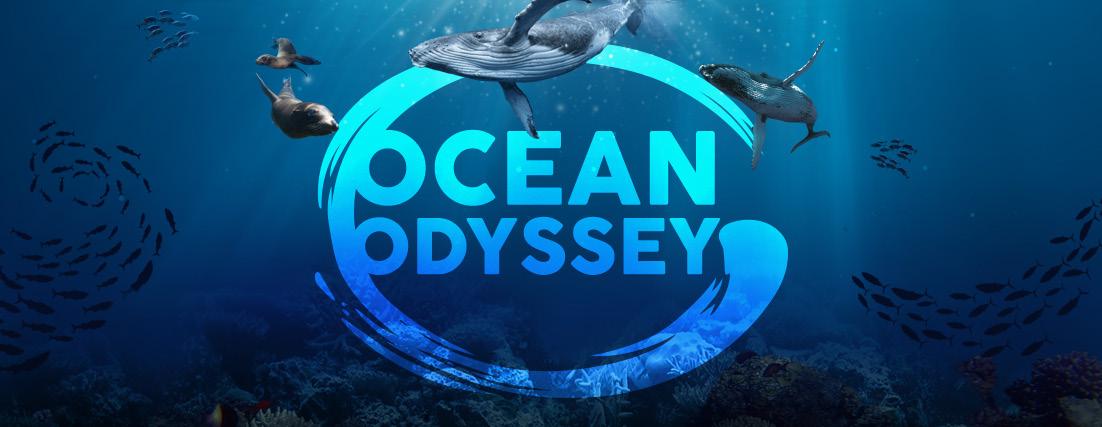
Five hundred million years ago, life left this blue womb and colonized the land, but we are still intricately linked to the ocean. Our climates, coastlines, ecosystems and economies are tied to the perpetual movement of water between continents. The great ocean currents are the arteries and veins of Planet Earth! This is the story of one particularly fascinating flow–the East Australian Current, a massive oceanic river that stretches the length of Australia’s east coast.
See the only screen-used Tardis located in North America in our Doctor Who exhibit and catch a featured episode. Test your knowledge with trivia, learn about time travel and alien life, play the building-wide game and more! Stay tuned for a special announcement about which special episodes will be playing in the OMNIMAX® Theater.
slsc.org 19 NOW PLAYING AT THE
OMNIMAX® Theater
WORLD TOILET DAY
NOVEMBER 19, 2023
Recognized by the United Nations since 2013, World Toilet Day provides the opportunity to recognize the humble flushable toilet–a device that carries waste far away from us via sewer or septic before being treated. In the United States, only a small percentage of people lack access to toilets and washrooms, but in many other countries, this is not the case.
Nearly half of the world’s population lives without a safe toilet. A “safe” toilet means it isn’t shared with other households and is connected to a well-functioning sewer system, or the contents can be stored safely until it can be emptied and processed.
Good sanitation is integral to public health. Contaminated groundwater and other water systems can lead to human disease. Safe toilets are also critical for women and girls who miss opportunities in school and work without access to toilets during menstruation and pregnancy.
On this day, celebrate the human ingenuity that created disposal systems for human waste. And, for those without access, like many of the homeless population, work to help provide access to housing and safe hygiene areas.
20 FALL 2023 JOIN US
MANDELA: The Official Exhibition


FINAL WEEKS
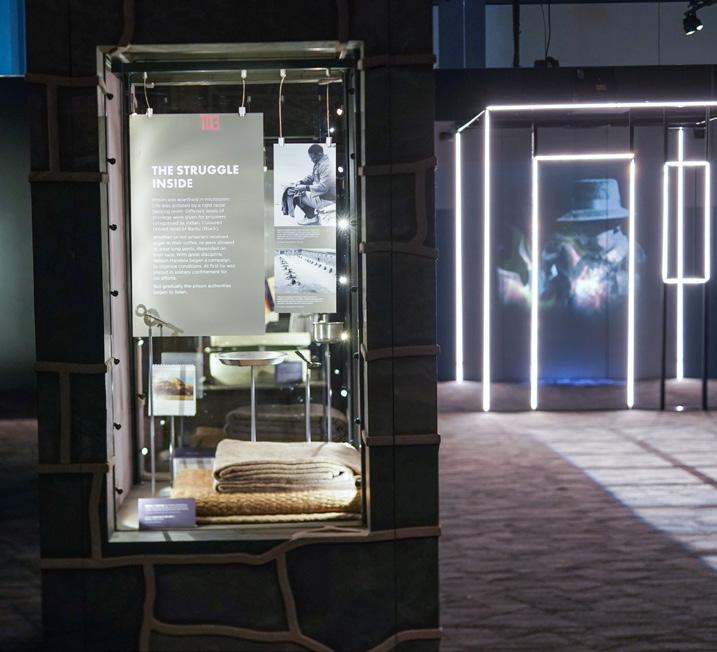
Don't miss your opportunity to see our latest special exhibition, Mandela: The Official Exhibition. Charting the moving story of Nelson Mandela's journey from activist to prisoner to President, this exhibition illustrates the struggle of the South African people fighting for inclusion and representation.
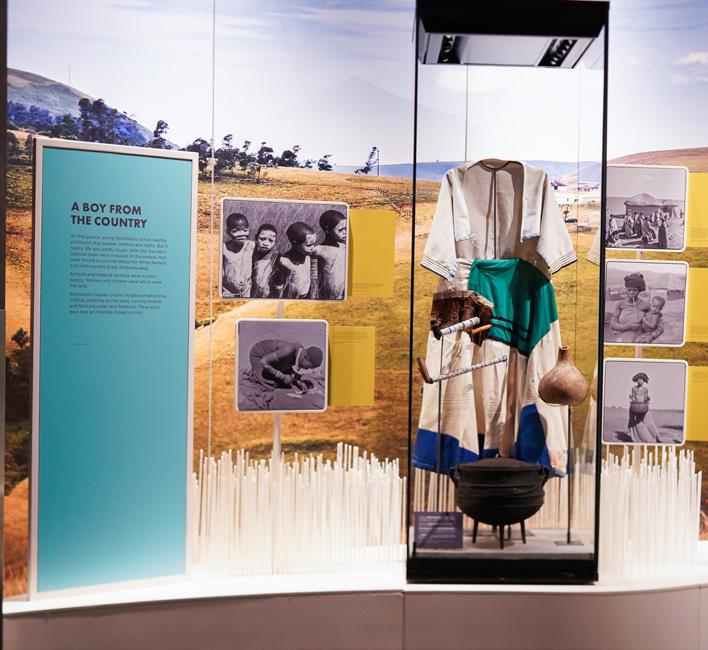
With 150 real artifacts from Mandela's life, this is an experience you'll never forget.
Tickets are $8 for adults, $6.50 for seniors and $5 for children ages 5-12. Members enjoy the special price of just $4 per person. For more information, call our reservations office or visit slsc.org
slsc.org 21
STEM Week in St.Louis
As part of STEMSTL’s STEM Celebration Week, the Saint Louis Science Center hosted the Project Lead the Way Senior Showcase and Missouri STEM Signing Day on April 28, 2023.


The Project Lead the Way Senior Showcase is an opportunity for students at regional high schools to display and discuss their senior capstone projects in engineering and biomedical science. The showcase included over 100 student projects presented by over 200 students. Students with top projects were also awarded scholarships from local STEM businesses and organizations.
In conjunction with the Project Lead the Way showcase, the Science Center also hosted STEM Signing Day in partnership with the Missouri Chamber of Commerce. Just like signing days for athletes, Missouri STEM Signing Day celebrates Missouri high school seniors as they make commitments to study within a STEM field at a 4-year or 2-year college or technical school. The Missouri Chamber Foundation’s Missouri Mathematics and Science Coalition launched Missouri STEM Signing Day in 2019 to raise awareness of STEM pathways for students beyond high school.
STEM Celebration Week included seven days of hands-on educational activities in science, technology, engineering and math that took place at various locations throughout the region.
22 FALL 2023 COMMUNITY
Three Wins for the YES Teens at the 2023 NFTE Competition Series

Earlier this year, three teens from the Youth Exploring Science (YES) Program’s Entrepreneurship component celebrated three wins at the Network for Teaching Entrepreneurship’s (NFTE) STL Competition, including YES Teen Kiaira Merrill, who won 1st place for her business, KiaKoutur. In addition, Kiara won first place at the NFTE Midwest Youth Entrepreneurship Regional Challenge in Chicago. She was also awarded the Ernst & Young Midwest EOY Youth Entrepreneur of the Year Scholarship and will receive $2,000 to support her postsecondary education.
The Network for Teaching Entrepreneurship is an educational nonprofit focused on bringing the power of entrepreneurship to youth in low-income communities, and for many years the YES Program’s Entrepreneurship component has helped teens build their businesses and hone their skills, from the business plan to the pitch, for NFTE’s annual competition.
After placing 1st in the regional competition, Kiaira will advance to the NFTE National Competition, which will be held in New York City this October. There, Kiaira will pitch her business idea and compete against the top NFTE businesses from across the United States for the championship title and a chance to win seed capital for funding her business or pursuing her educational goals. Kiaira has also been named the Ernst & Young Midwest EOY Youth Entrepreneur of the Year and will receive a $2,000 Ernst & Young scholarship for her freshman year. Earlier this year, Kiaira graduated from the YES Program, and she intends to pursue Fashion Business and Entrepreneurship at Lindenwood University.
YES Teen Elias Scott, CEO of Triple R Learning, placed 3rd in the NFTE STL Semi-Finals Competition. Triple R Learning educates and empowers youth to be good stewards of our planet, seeking to inspire, empower and renew! This educational outreach program will provide a 5-week extensive program to elementary and middle school students in underserved areas. Using hands-on and interactive experiences, students will learn how to reduce, reuse, and recycle and be good overall stewards of the earth and its resources. Elias will also serve as the alternate to represent the region if a national qualifier cannot compete.
Naturals, another NFTE semifinalist business from YES Teen and CEO Sayana Scott, is a retail company helping to renew and restore the planet with sustainable products. Naturals will sell products that are sustainable, eco-friendly, all natural and biodegradable.

Photos Submitted by: Global entrepreneurship education nonprofit, Network for Teaching Entrepreneurship (NFTE.com)

slsc.org 23
NFTE CEO Dr. J.D. LaRock pictured with Kiaira Merrill of Missouri’s Saint Louis Science Center.
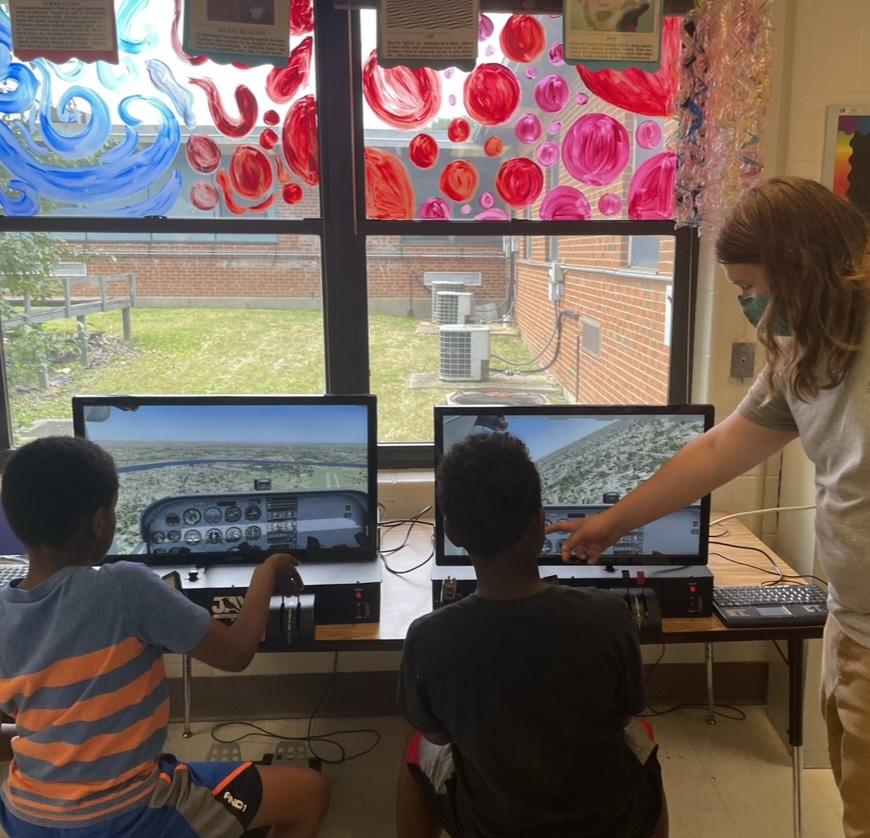
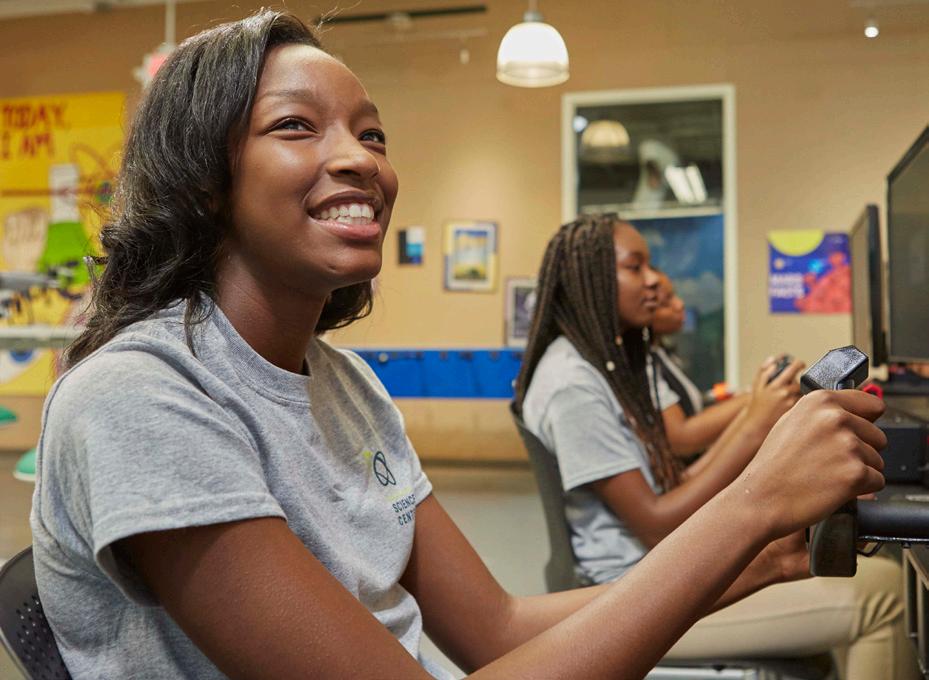
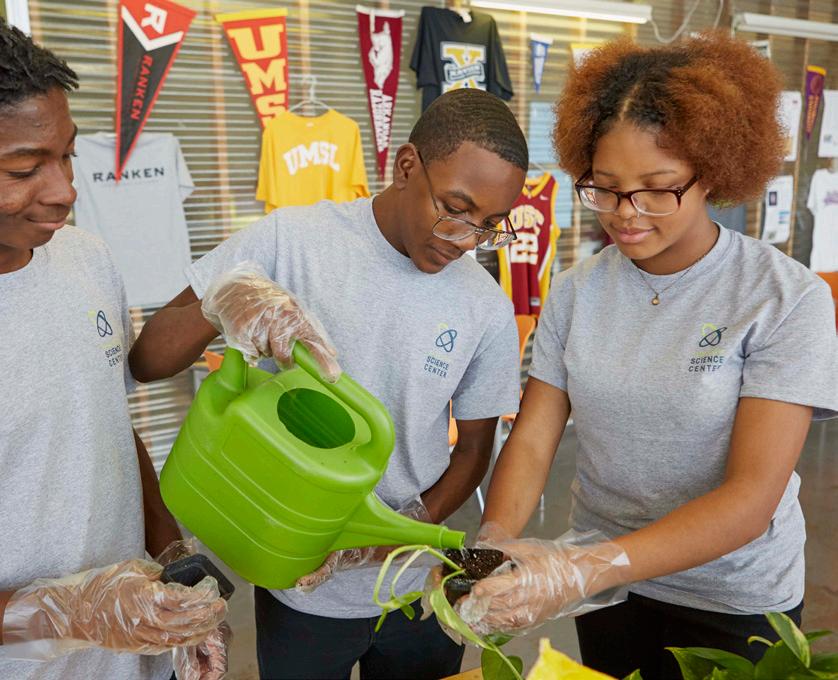
Each summer, the Science Center’s Youth Exploring Science (YES) Program makes an impact on STEM education by turning outward with the program’s YES Teens to deliver fun and accessible STEM learning experiences throughout the St. Louis community.
From long-running programs like Summertime Science to newer initiatives like the STEMtastic Camp, the YES Program continues to inspire a curiosity for science and technology.
Summertime Science
MEASURABLE IMPACT:
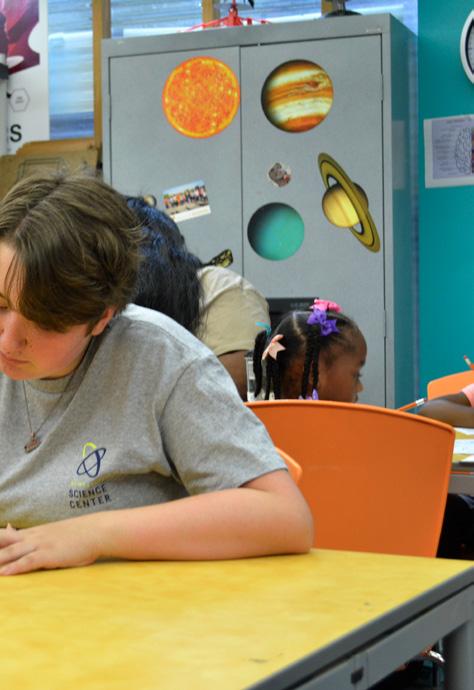
This year’s Summertime Science program served over 1,100 kids and over 140 adult supervisors
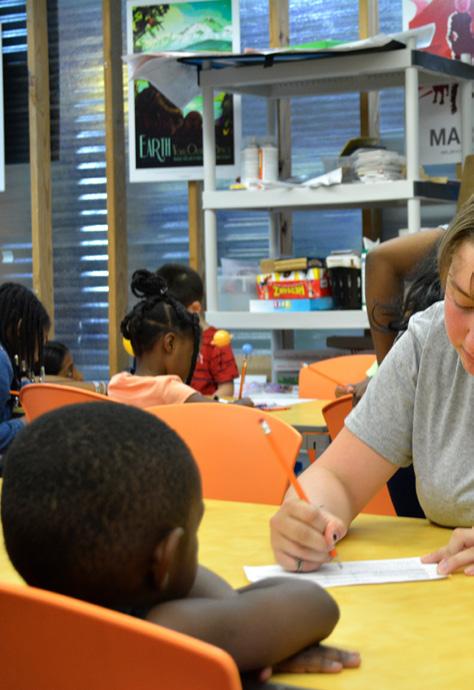
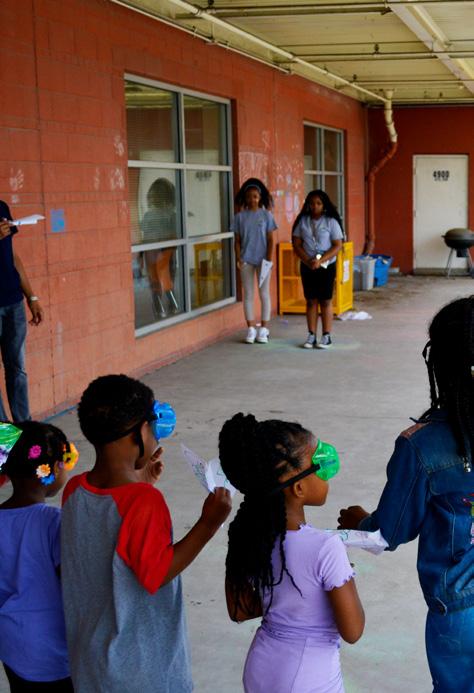
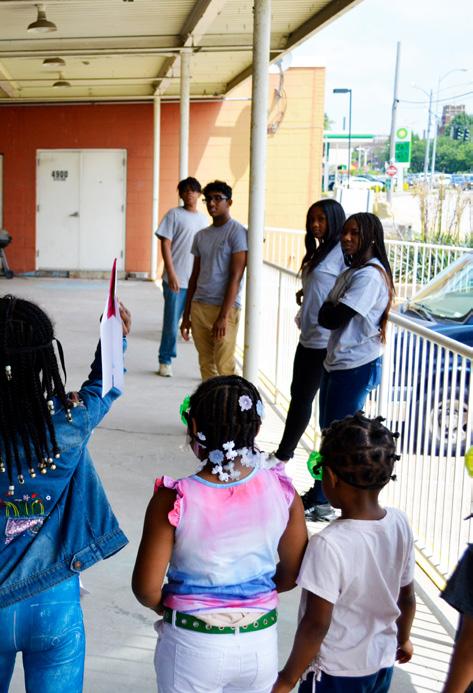
At the Taylor Community Science Resource Center, the YES Teens have been welcoming young members of the community from the Science Center’s network of community partners to go hands-on with activities and experiences around aerospace.
The YES Teens have been leading and instructing the kids through activities like building their own paper airplanes, improving on their designs, and then participating in a contest to see whose plane could fly the farthest. The teens have also made songs and chants to help teach some of the science involved in flight, including a song, “Up Up and Away,” which teaches kids about force and drag.
In addition to inspiring a curiosity for STEM in the community, one of the goals of the Summertime Science program each year is to help the newer YES Teens develop many of the fundamental skills they’ll hone over the course of the four-year program—skills like leadership, collaboration, workplace fundamentals and more.
“From the beginning of summer until now, I’ve seen improvements with every teen,” says Amiee More, Manager of YES’s Integrative Medicine & Well-Being component. “It’s inspiring to watch the teens grow through challenges and try new things. I’m starting to see leadership skills develop with the teens, and I’m proud of the way they’re communicating with each other and with staff.”
Asked about a standout memory from the summer, More shared, “We had a competition over the teens’ classroom welcome, intro and content songs. It was fun to see the teens working together, supporting one another, and clapping along while each group performed.”
STEMtastic Camp
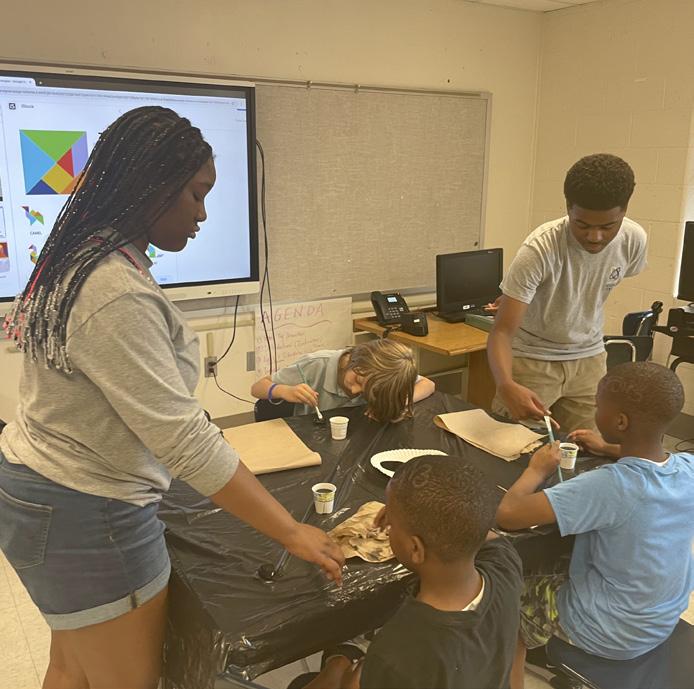
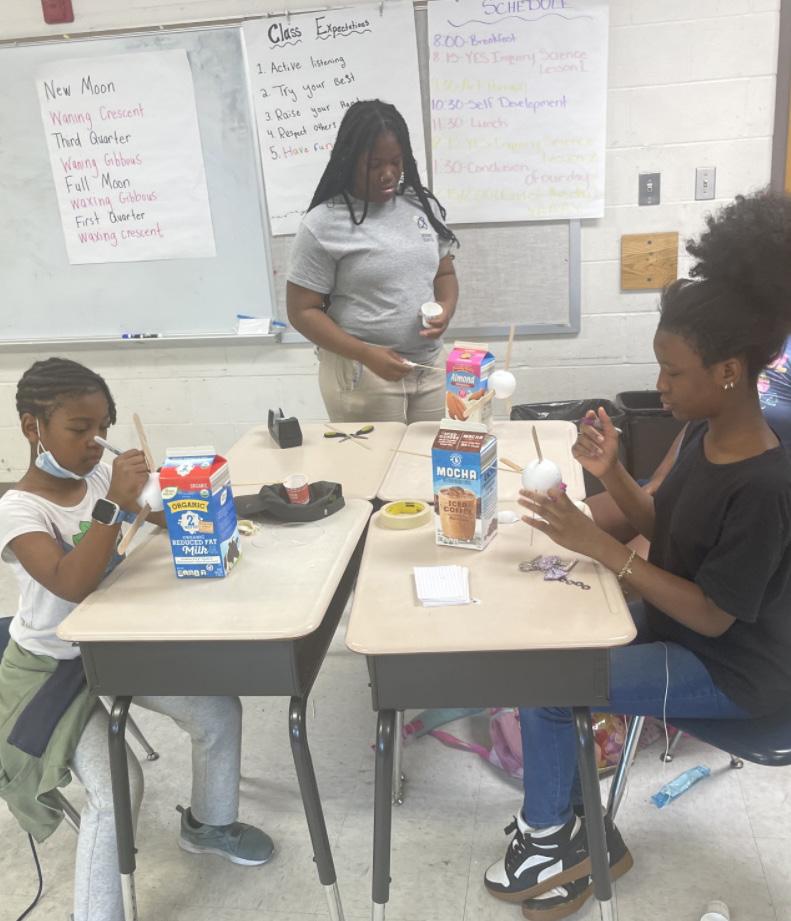
Meanwhile, the YES Teens from the program’s Aerospace and Engineering components brought STEM learning to the community in the STEMtastic Camp. Now in its third year, the STEMtastic Camp saw the YES Teens visit two schools—Meadows Elementary and Glasgow Elementary—located in the Riverview Gardens school district. Splitting time between each school, the Aerospace and Engineering YES Teens worked with the young kids, guiding them through a variety of hands-on STEM activities.
The campers used common materials to build projects like windmills, hovercraft airplanes and helicopters, as well as straw rockets and mini rollercoasters. As the campers looked to the stars, the YES Teens aided them in building pinhole planetariums and even creating their own celestial bracelets among other art projects.
“Watching [the teens] dive headfirst, taking ownership of their roles, leading and working together as a team, making connections with the kids, and leading and teaching lessons has made me so proud,” says Chastity Culberson, Manager of the YES Program’s Aerospace component.
Pop-Up Science
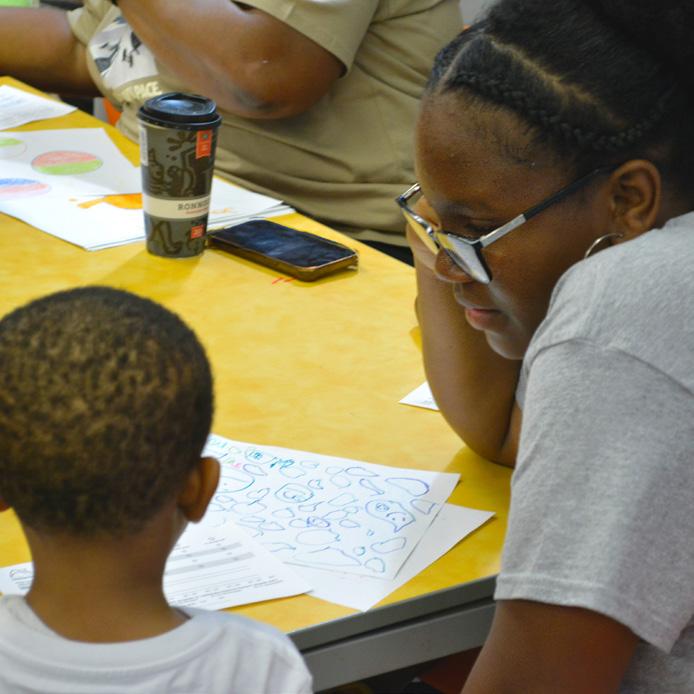
St. Louis community members also had a number of opportunities to meet the YES Teens and learn about STEM with Pop-Up Science events. This year, Pop-Up Science also highlighted aerospace and engineering with free activities at locations like City Museum, the Missouri Botanical Garden, St. Louis City libraries and more.
MEASURABLE IMPACT:
This year’s STEMtastic Camp was held at two schools, included 12 YES Teens and served 25 campers with each camper receiving 15 STEM lessons per week.
MEASURABLE IMPACT:
This year's Pop-Up Science activities served 219 people
A LEGACY OF SUCCESS:
YES at 25 Years (and
Counting)
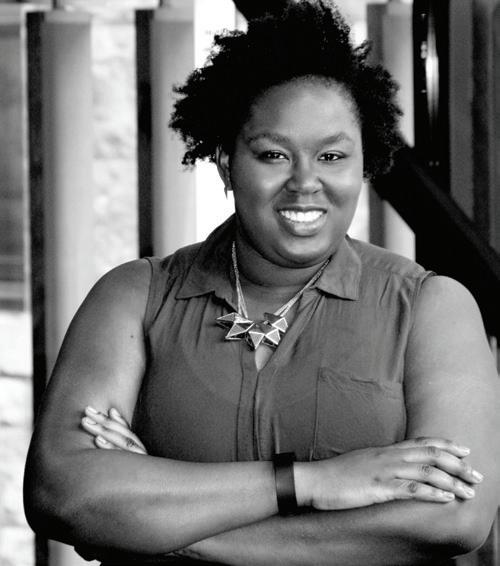
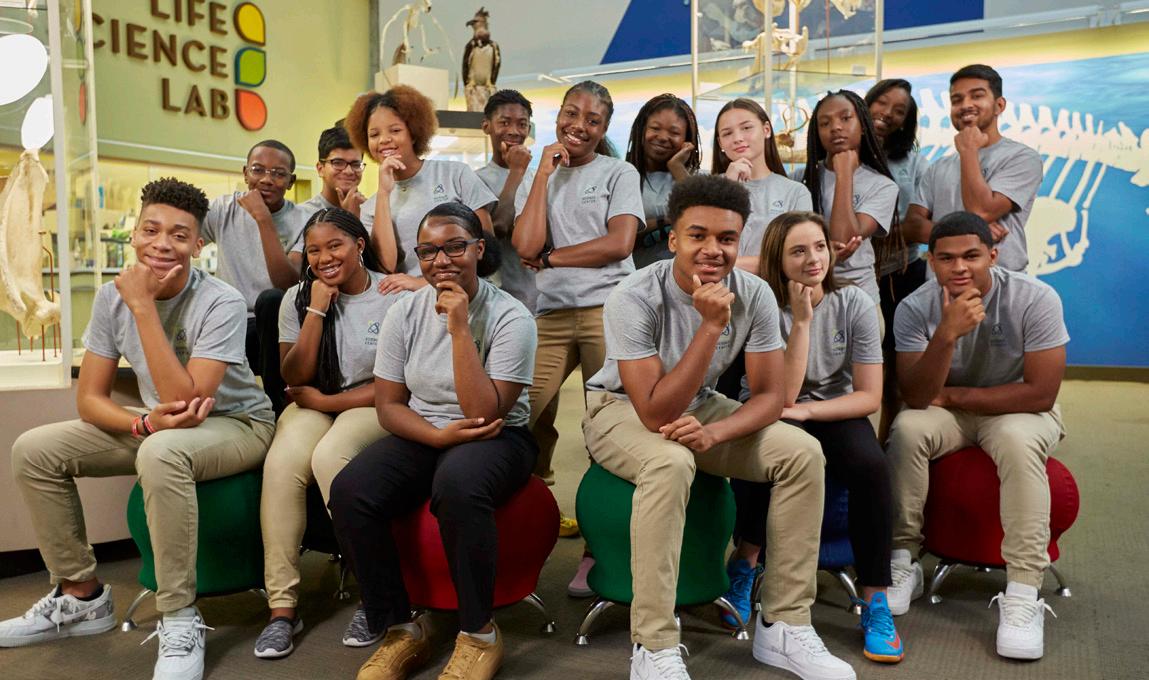
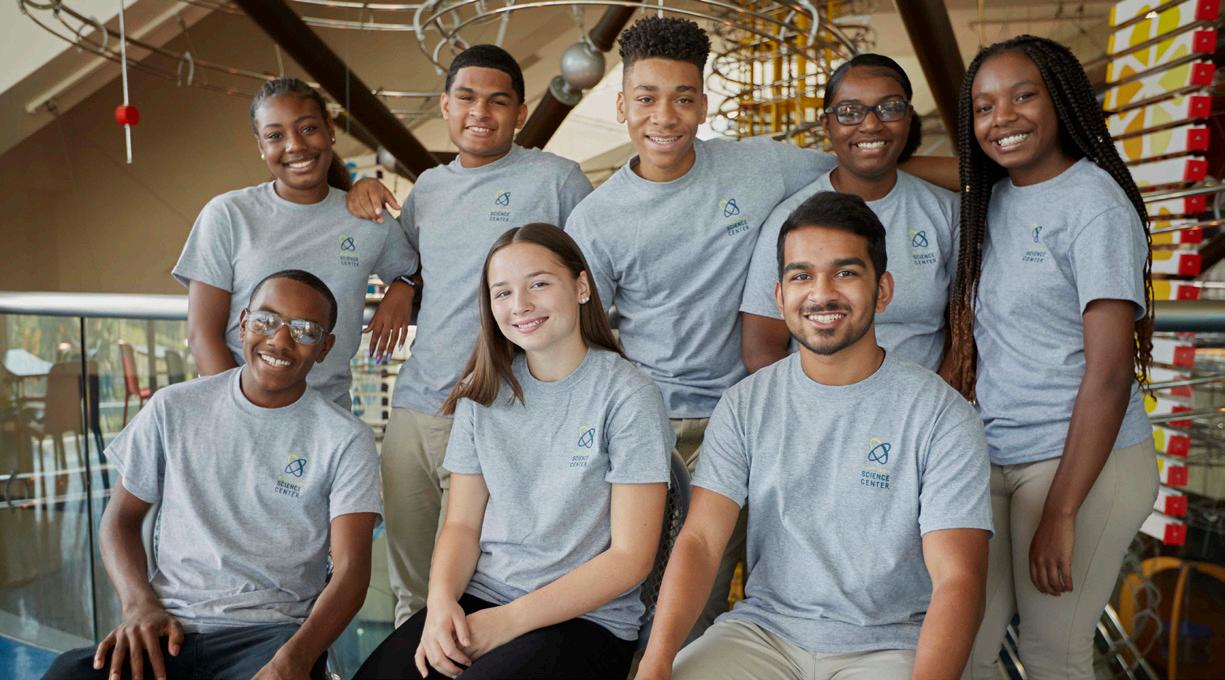
Since the Science Center’s Youth Exploring Science (YES) Program began in 1998, more than 1,200 teens have completed the program, contributing to the YES Program’s 25-year legacy of success. The YES Program works with teens from underserved parts of St. Louis area throughout their high school years to help prepare them for in-demand STEM (science, technology, engineering, and math) careers of the future.
The teens are immersed in hands-on STEM components to support 21st century skills, including: Aerospace, Agriscience, Computer Science, Engineering, Entrepreneurship, Integrative Medicine & Well-Being and Media Arts. Learning these skills empowers the students from predominately low-income households to recognize their abilities and strive for in-demand STEM careers that they may not have considered for their future.
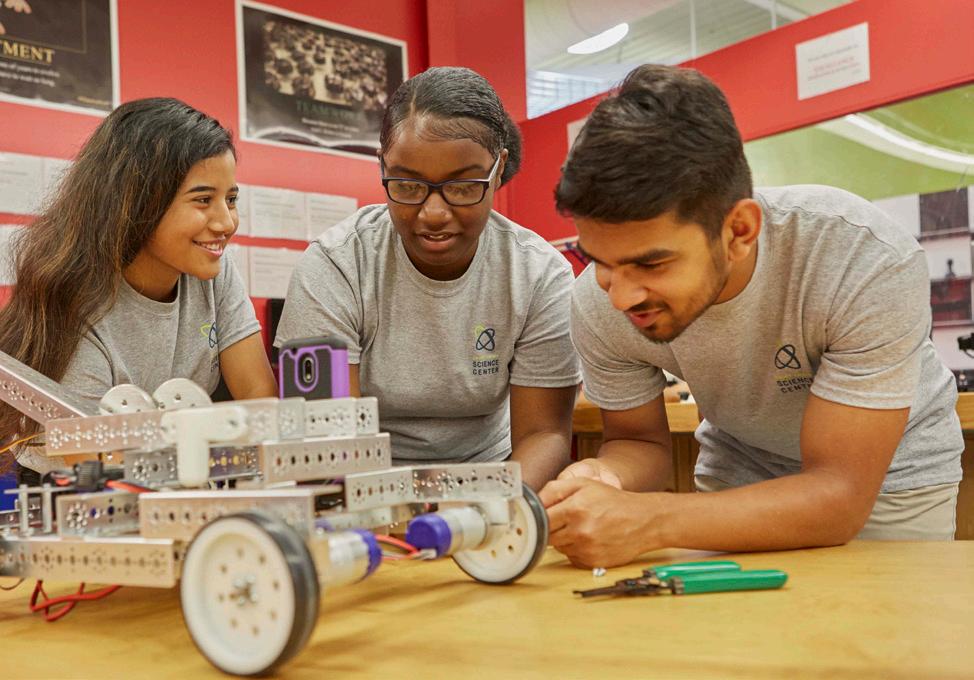
The YES Program also engages with the community in outreach initiatives to positively impact the St. Louis region. YES Teens serve as teachers and mentors for up to 2,000 elementary-aged children a year in our free Summertime Science camp. YES Teens further build their skills in communication and education by delivering engaging STEM learning activities that they helped develop, and begin to see themselves as leaders in the community and agents of change.
26 FALL 2023 COMMUNITY
Meet Cetris Ivy
YES ALUMNUS
This summer, we caught up with recent YES graduate Cetris Ivy, Jr., to ask about his experience in the YES Program, what stood out, and how YES has impacted his life. Continuing his time with the Science Center, Ivy is now an Assistant Educator, where he continues to put the STEM education and mentorship skills he picked up in the YES Program to work as he pursues his college degree.

Cetris, can you tell us your name, current job title and where you work?
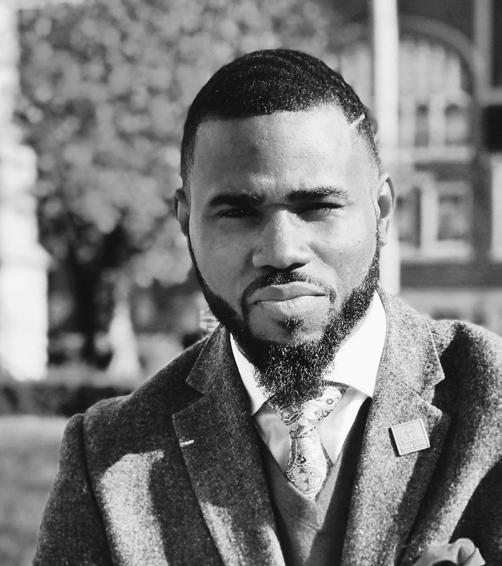
Jerome Harris, Jr.
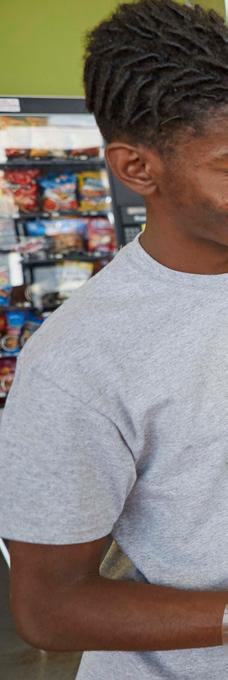
CLASS OF 2005
“The YES Program was the launching pad of where I was destined to be.”
Founder & President at Urban Golf St. Louis & Saint Louis Science Center Board Member
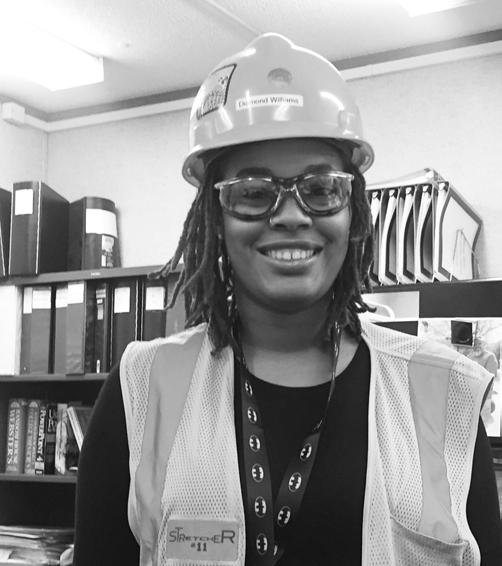
Diamond Williams
CLASS OF 2008
“I came to the YES Program looking for a summer job and left 4 years later pursuing a degree in engineering.”
Data Engineer at Slalom Build
Adeola Nicole Adewale
CLASS OF 2011
“YES was an amazing stepping stone that helped me succeed and prepare for college. YES was where I learned to speak publicly and present my ideas to an audience of my peers.”
Project Designer at WSP USA

My name is Cetris Ivy, Jr., and currently I am an Assistant Educator at the Saint Louis Science Center.
When were you in the YES Program?
I got into the YES Program in 2016, and I graduated in 2020 during the COVID-19 pandemic.
What’s one standout memory from your time in YES?
One of the biggest standout memories I have in the program was aiding in creating not only [the GameXPloration gallery], but helping in the creation of [the Esports Program] as well.
How did YES help prepare you for where you are today?
YES helped me to shape myself to be who I am today by teaching me how to communicate, be a leader, be more disciplined, and figure out what it is in my life that I want to do. The program has helped me to meet new people, make new friends, and it’s shaped me into who I am today.
How do you think you’d be different if the YES Program hadn’t been available to you as a teen?
If the YES program wasn’t available to me as a teen, I am not sure if I would be as determined as I am today. The program has taught me how to communicate with people, different employees and business people, learn about basic knowledge of the work field, and discover what it is that I want to do in my life.
Say

Generous support for the Science Center’s Curiosity Fund helps enable impactful STEM programs like Youth Exploring Science and supports our mission “to inspire everyone to be curious and engaged in science.”
Make an impact on STEM education by making a gift to the Curiosity Fund at donations.slsc.org/curiosity-fund
Learn more about the YES Program at slsc.org/yes
slsc.org 27
YES to another 25 years of impact.
Elly Walsh-Rock
MANAGER, COMMUNITY SCIENCE
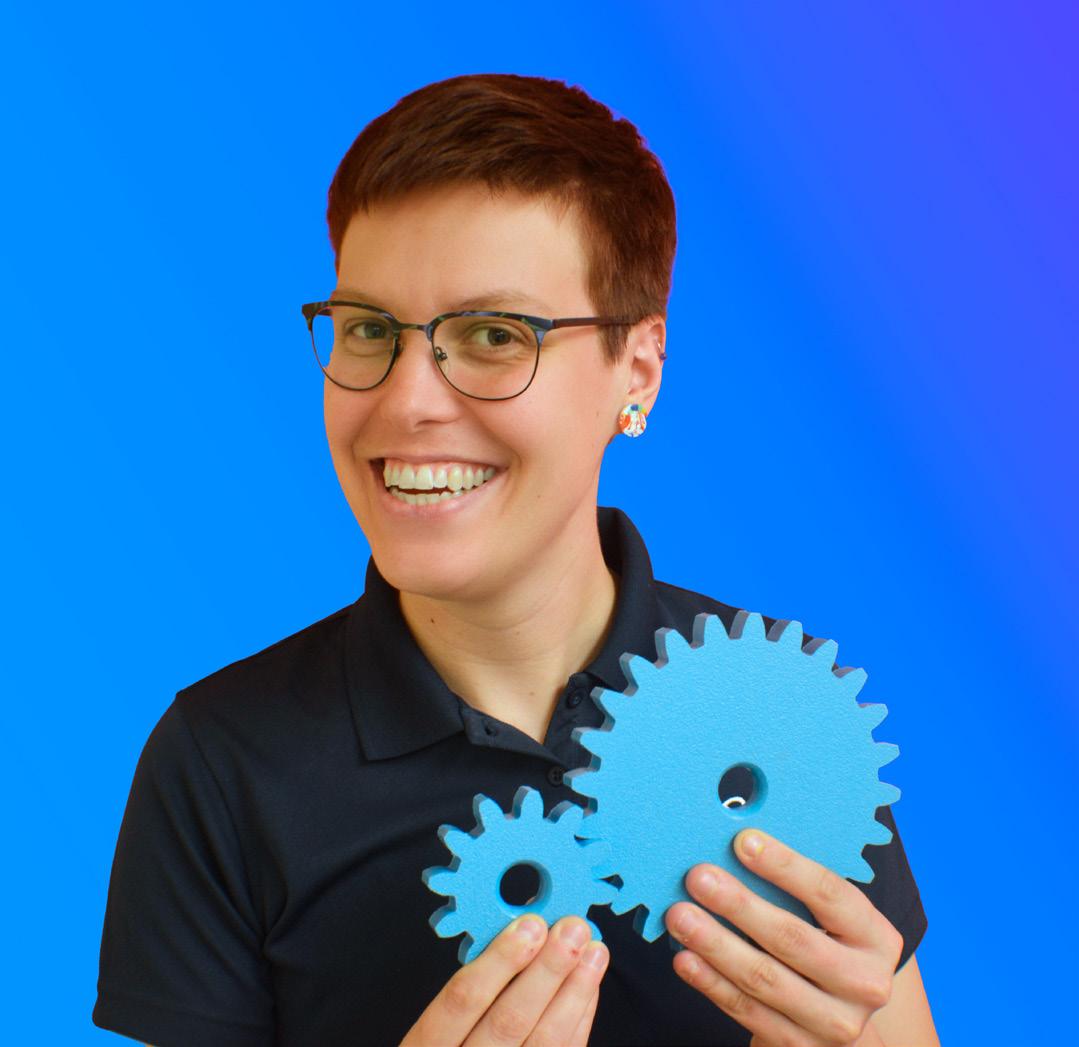
Earlier this year, the Science Center welcomed a new face to lead the Youth Exploring Science (YES) Program’s Engineering component, Elizabeth (Elly) Walsh-Rock. We spoke with Elly (she/they) about her background in education, her experience as a recent finalist for the Carol B. and Jerome T. Loeb Prize for Excellence in Teaching Science and Mathematics, and what she hopes to bring to the YES Program’s Engineering component.
Elly, can you tell us a little about your professional background and how you heard about the YES Program?
I’m a former Ferguson-Florissant school teacher, where I taught middle school and high school, and I also taught abroad in England for a semester. So, my background is in secondary education, teaching at different levels.
I had actually heard of the YES Program when I was a high school teacher, where I had a student who’d done the program for a year. I came to an outreach program at the McDonnell Planetarium when I was her freshman biology teacher, so that was my first exposure.
Even when I was a teacher, I thought the YES Program was outstanding, so it’s super exciting to be a part of it now because of the real, tangible outcomes that are coming out of this program and giving back not only to the St. Louis community, but also the wider area in the state and region.
What are some of the things you and the YES Teens in the Engineering component have been up to this summer?
We’ve been working with the Aerospace component to do our STEMtastic Camp, as well as some Pop-Up Science activities out in different areas of the community.
Today, we built parachutes with the kids, and as part of that we teach them to go through the engineering process—look at the materials, draw what you’re going to use, receive feedback, and try again. They build it, and then they test it. So, it’s a series of design challenges, and we’ll do parachutes, catapults, roller coasters. Really big things, which is part of what’s so fun. It’s super cool to see kids making comments on each other’s designs, and even for those who science might not be their jam, it’s a different kind of science than they’ve done before. It’s amazing, and it’s super fun.
In 2021, you were a finalist for the Loeb Prize. Can you tell us a little about that experience?
It was humbling to be part of such an amazing group of educators. I was shocked when I got the phone call, but just getting to talk
with Carol [Loeb] and also the previous winners, the wealth of knowledge that was there in the Zoom room—because I went through the process during COVID—was amazing. It was one of the most incredible experiences I had while I was teaching.
So, it was amazing to be around educators who are really good at what they do, and to get the chance to talk to some of the previous winners as well.
What are some experiences or skills you’re hoping to bring to the YES Program?
I’ve had the privilege at each high school level to teach Project Lead the Way courses, which are all training- and work-based to provide students with training certifications, which is similar to what we do here [in the YES Program] with real work skills.
I’m coming with those experiences, but into a different content area. Already we’re working on bringing in new types of engineering—working with environmental engineering firms to talk about solar panels or biomedical engineering to talk about prosthetics, for example—to give the teens an understanding of what the field of engineering looks like and how many different ways they can work in that field.
As an educator and now in YES, how do you approach creating a learning environment that helps young people from diverse backgrounds really connect with STEM?
I believe deeply that classrooms and educational spaces must be inclusive and safe spaces for all students, especially around the explicit inclusion of students from marginalized communities.
With the [monetary] prize that I received for being a Loeb Prize finalist, I purchased some “We Believe…” flags for my classroom and other classrooms that clearly stated, “Science is Real,” “Black Lives Matter,” “Water is Life,” “No One is Illegal Here,” “Love is Love,” and “Women’s Rights are Human Rights.” It is really important to have classrooms where kids feel safe and supported. For this reason, it was essential to spread the tenants of the "We Believe…" signs in classrooms to explicitly call out the expectations of human decency and respect that hopefully permeate throughout students’ lives long past their time in school and show them they are safe and heard in the classroom.
COMMUNITY
Correction: In the previous issue, we misstated the length of Carol Loeb’s teaching history. Mrs. Loeb has been teaching high school math for more than 60 years, not 53. We regret the error.
Recognizing Excellence in Teaching Science and Mathematics with the Loeb Prize
On May 18th inside the McDonnell Planetarium, the Science Center held the prize ceremony for the 2023 Carol B. and Jerome T. Loeb Prize for Excellence in Teaching Science and Mathematics.
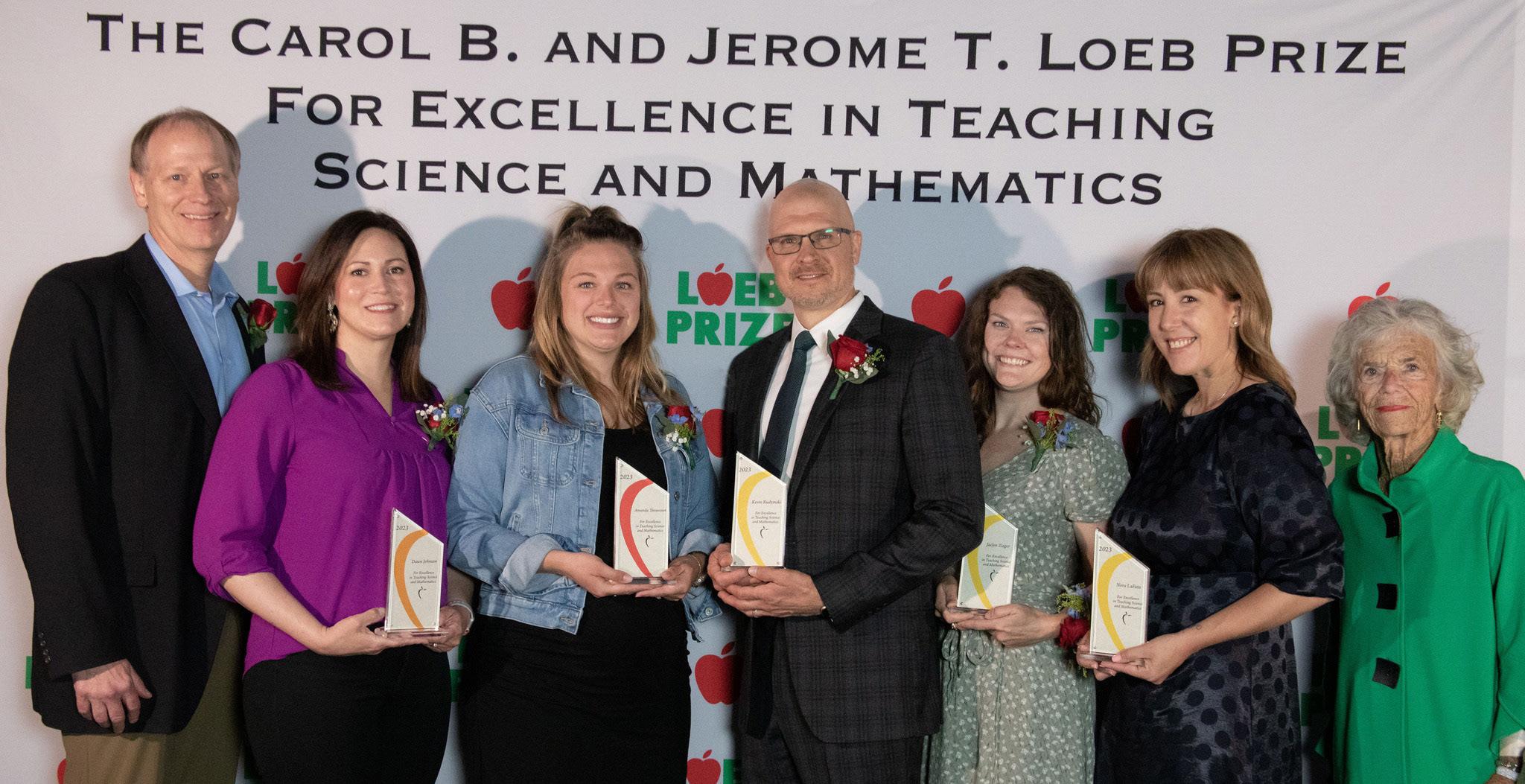
First place went to Amanda Thouvenot of Hoech Middle School. Dr. Dawn Johnson of Cor Jesu Academy won second place. The runners-up included Nora LaFata of Lindbergh High School, Kevin Rudzinski of St. Paul’s Lutheran and Jaclyn Zieger of Valley Park Middle School. Science Center President and CEO Todd Bastean recognized Thouvenot and the four finalists during the ceremony, where approximately 150 students attended to support their teachers.
Congratulations to Amanda and all the other Loeb Prize winners! And thank you to all the nominated teachers who make a difference in the lives of their students every day.
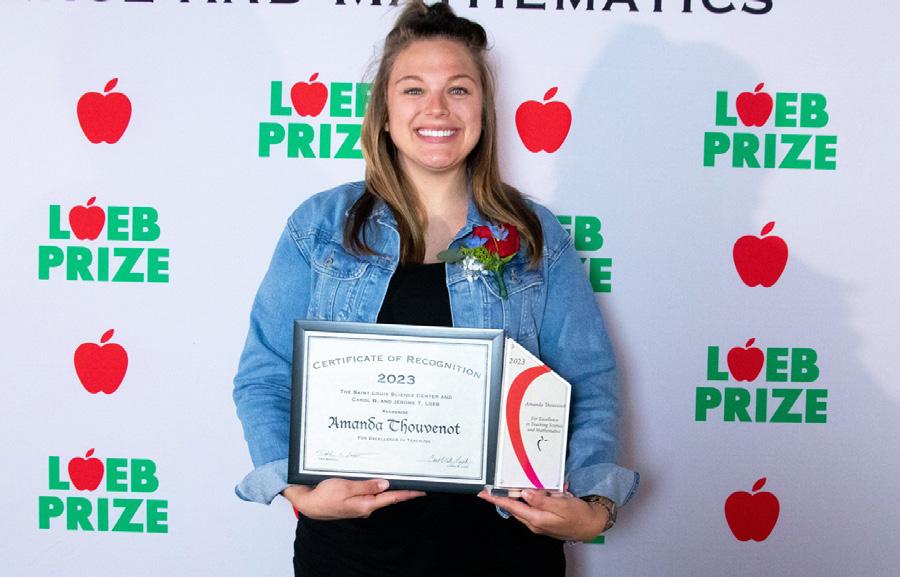 2023 Loeb Prize winner Amanda Thouvenot, Hoech Middle School
From left: Todd Bastean, Dawn Johnson, Amanda Thouvenot, Kevin Rudzinski, Jaclyn Zieger, Nora LaFata, and Carol Loeb
2023 Loeb Prize winner Amanda Thouvenot, Hoech Middle School
From left: Todd Bastean, Dawn Johnson, Amanda Thouvenot, Kevin Rudzinski, Jaclyn Zieger, Nora LaFata, and Carol Loeb
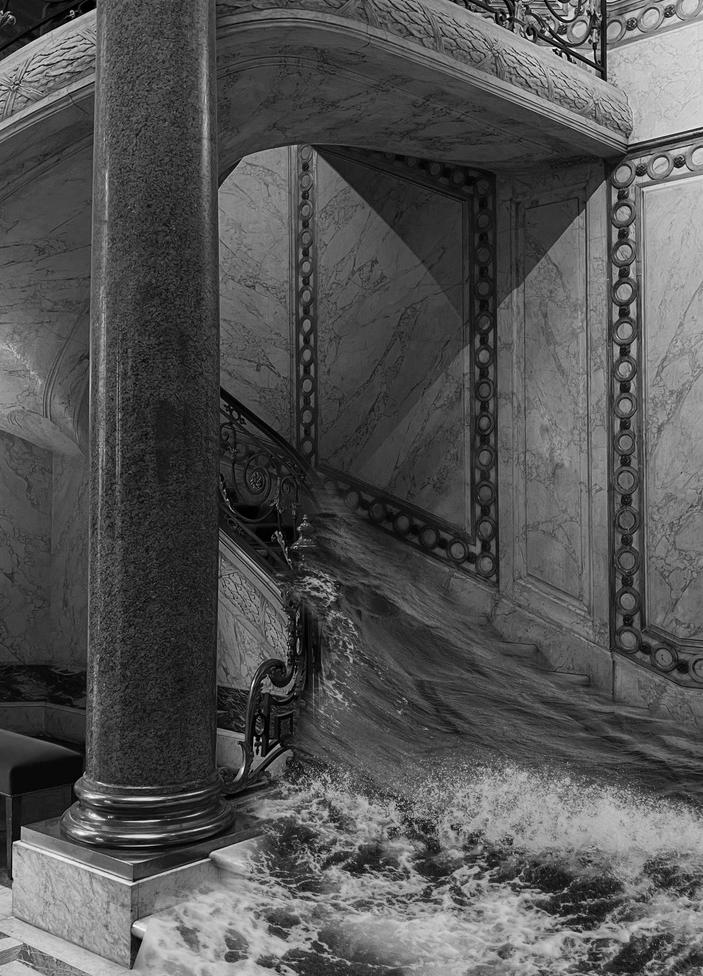
Watch Your Step , Zionna Anderson
“This is a remix between nature and a household structure to be an exaggeration of the ‘careful, the floor is wet’ or ‘watch your step’ signs.”
YES Teens Selected for Saint Louis Art Museum’s Exhibition, Remix
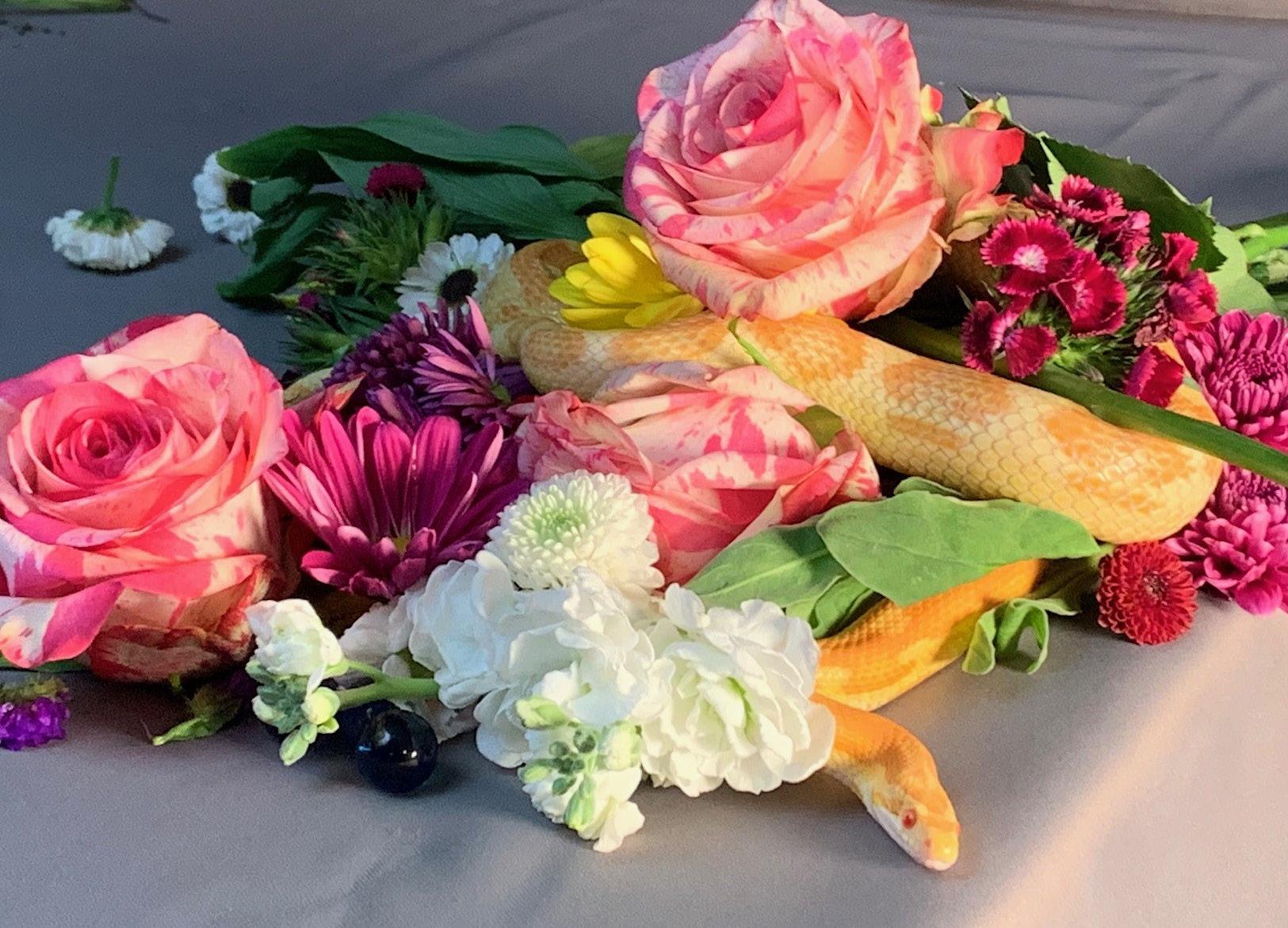
The Youth Exploring Science (YES) Program’s Harmony Cooper and Zionna Anderson, both YES Teens from the program’s Media Arts component, were recently selected for the Saint Louis Art Museum’s 2023 Young Artists Exhibition, Remix. The exhibition is scheduled to open September 15, 2023, and will be on view through the end of December.
In the YES Program’s Media Arts component, YES Teens gain valuable hands-on experience with fundamental media arts skills like digital photography, filmography, graphic design, sound mixing and more. Using these 21st century skills as well as industry-standard technology, software and equipment, the YES Teens complete a variety of projects allowing them to create, present and connect with the media arts.
“Putting your artwork in the world is a scary thing to do,” she says. “Whenever artists submit to juried art shows, you are never sure what might get accepted or rejected. It can be hard, especially for young artists. I’m extremely proud of my teens for applying to be a part of this show. Not only is it a great professional experience for them, it’s amazing to know that the Saint Louis Art Museum is soon going to have the artwork of these two young Black, female artists hanging on its walls.”
Jasmine Krueger , YES PROGRAM MANAGER, MEDIA ARTS COMPONENT
Jupiter , Harmony Cooper
“I think this photo fits the theme of ‘Remix’ because the main focus of this photo is my good friend Jupiter (the snake). People usually see snakes as scary or dangerous. So, when I put Jupiter in a bunch of flowers I wanted to change that perspective from scary to wholesome.”
30 FALL 2023 PARTNERSHIP & SUPPORT
In GROW, Ultra High Protein Soybeans Demonstrate the Latest Agricultural Advancements from Benson Hill
Earlier this year, the Science Center partnered with local St. Louis ag tech firm Benson Hill to showcase Benson Hill’s proprietary Ultra High Protein (UHP) commercial soybeans in the GROW Gallery. There, guests can learn about how Benson Hill used traditional breeding procedures to create these high-protein soybeans, as well as their benefits for farmers, food production and the planet.
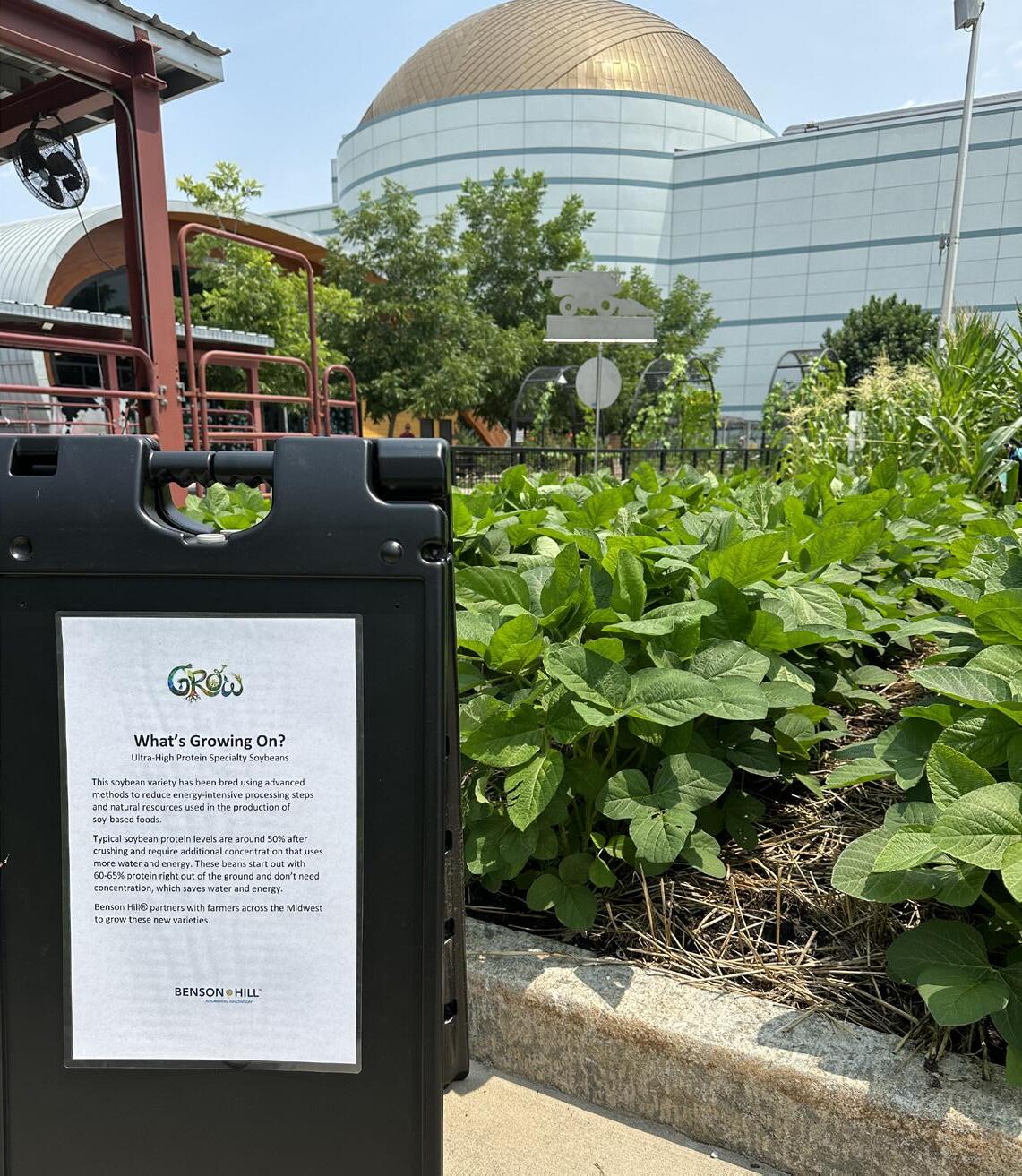
Typical commodity soybeans used in the production of soy-based ingredients result in protein levels of around 50% after they’re processed (which involves crushing the beans, followed by a concentration step that involves additional water and energy use). Benson Hill’s UHP soybeans have “post-crush” protein levels of around 60–65%, which means the concentration step can be skipped, reducing the amount of energy used in processing by approximately 50% and the amount of water used by approximately 70%.
“We’re so excited for our partnership with Benson Hill and to showcase this local business that’s part of our St. Louis agricultural scene,” says Maddie Earnest, GROW Gallery manager at the Science Center. “St. Louis has so many businesses and organizations dedicated to agriculture and ag tech, and this partnership gets to the heart of why GROW is here— to give our guests the chance to discover and learn about the science of agriculture happening right in our own backyard.”
Learn more about Benson Hill at bensonhill.com
INTRODUCING: Bobby Sanderson
Saint Louis Science Center’s Chief Institutional Advancement Officer
Bringing more than 15 years of combined experience with Zoo Museum District institutions, Bobby Sanderson joined the Saint Louis Science Center as Chief Institutional Advancement Officer in June 2023. He and his team are responsible for managing the Science Center’s philanthropic strategies and accomplishing the institution’s goals for development, membership and community stewardship. Sanderson is an advocate for cultivating strong board leadership and its critical role in advocating for support.
“The Saint Louis Science Center values our donors and their interests in unlocking the wonder of science in us all,” notes Sanderson. “I am passionate about the transformative impact of education, and it is a privilege to cultivate, solicit and steward gifts to ensure that the organization is able to achieve its mission while helping our stakeholders to accomplish their philanthropic goals.”
Prior to the Science Center, Sanderson directed the fundraising efforts for two of St. Louis’ iconic institutions and served with many organizations throughout the community. As Director of Campaigns and Major Gifts and Interim Director of Development at the Saint Louis Art Museum, he was responsible for establishing individual giving programs, growing the Museum’s support through major gifts, annual fund and endowment programs while stewarding those donors who supported the Museum’s $162,000,000 campaign. Prior, he served as Director of Major Gifts for the Missouri Botanical Garden.
Sanderson earned his Bachelor of Arts in Economics from Westminster College in Fulton, Missouri, and a Master of Business Administration from Webster University in St. Louis. Please join us in wishing him a warm welcome and many successful years at the Science Center!
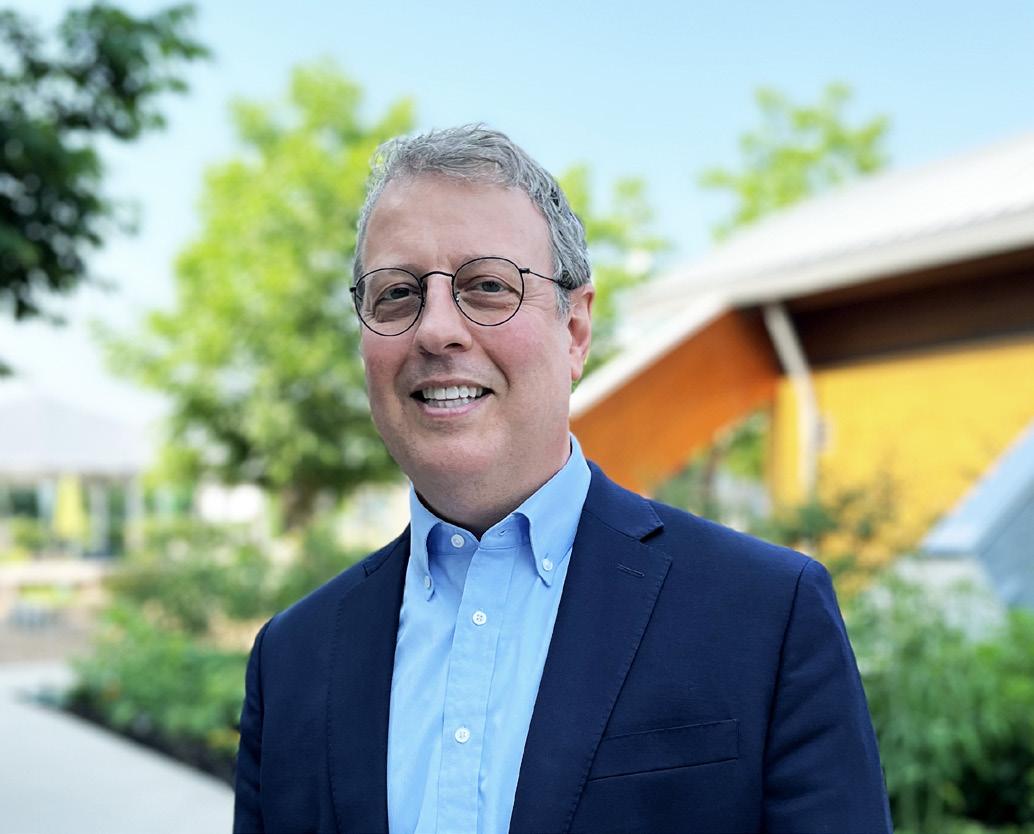
slsc.org 31
5050 Oakland Ave.
St. Louis, MO 63110
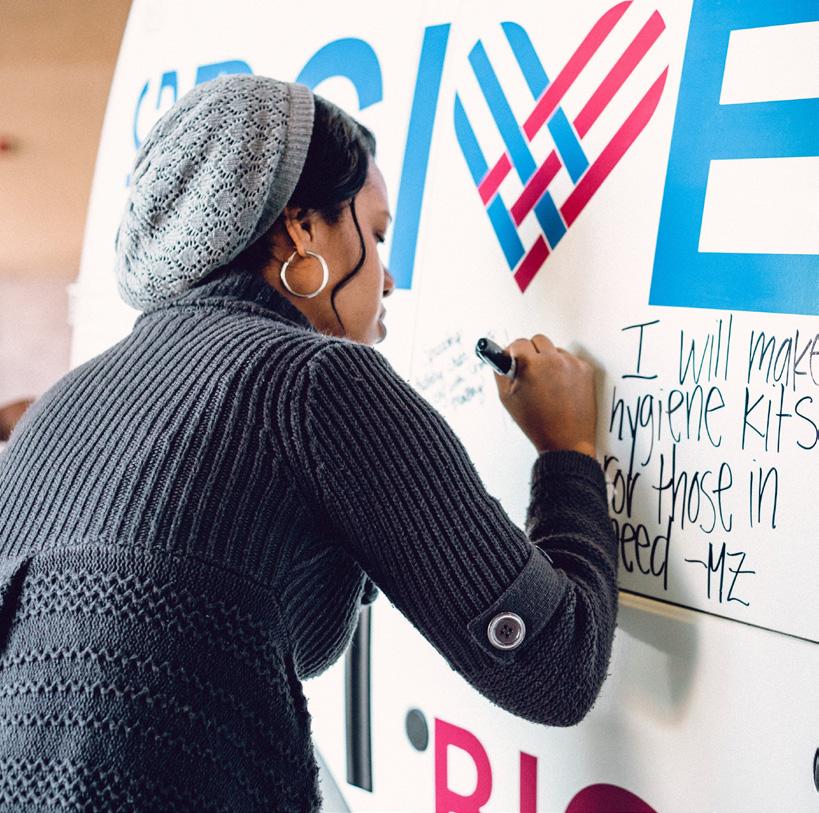
NewScience is always GREEN
The Saint Louis Science Center is a committed steward of the environment. We are proud to continue to offer the digital and interactive version of NewScience at slsc.org/newscience
If you would like to opt for a sustainable choice and only view NewScience digitally, please send an email to us at memberships@slsc.org to no longer receive a paper subscription.
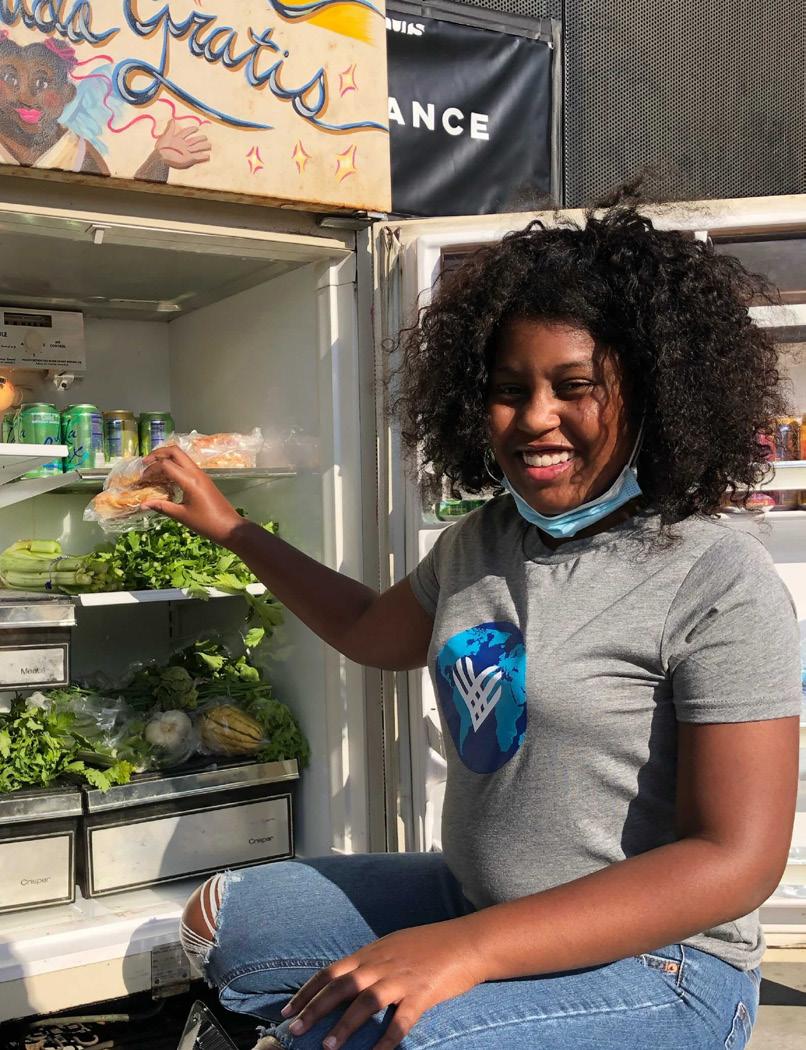
You can also send us an email if:
• Your email address has changed
• Your name is misspelled
• Your address is incorrect
Smithsonian A liate Membership Program
NONPROFIT ORG U.S. POSTAGE PAID ST. LOUIS, MO PERMIT NO. 1491
NOVEMBER 28
a day of global generosity this Giving Tuesday and help spark curiosity for STEM in the St. Louis community.
November, join a global generosity movement unleashing the power of people and organizations to transform communities and the world. For Giving Tuesday, support STEM—science, technology, engineering and math—education and our mission to inspire everyone to be curious and engaged in science with a gift to the Saint Louis Science Center.
more at slsc.org/givingtuesday.
TUESDAY,
Join
This
Learn