16
COVER STORY
Measuring what matters:
Advancing OHS with integrated safety metrics Leading companies demonstrate that aligning OHS measurement with strategic goals can turn data into a driver for safer, more resilient workplaces, writes Craig Donaldson
T
he topic of workplace health & safety performance measurement has been a longstanding debate for decades, which suggests many organisations are still struggling to apply effective OHS metrics and measurement. When applied well, OHS metrics and measurement should support effective decision making, promote desired behaviours, create optimal workplace conditions, and ultimately assist with improvement. If applied ineffectively, however, reporting on OHS metrics and measurement can be an administrative burden that adds little value. “OHS performance measurement should align with a clear set of strategic objectives to create value and enable high performance,” said Mark Wright, managing director of FEFO Consulting. “When discussing this topic, it is important to differentiate between metrics (numbers) and performance (relative progress). Too often, organisations overdose on metrics and rely solely on numbers as the only way to measure performance. Although quantitative performance
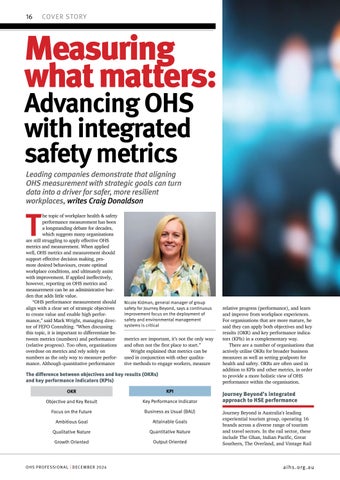
Nicole Kidman, general manager of group safety for Journey Beyond, says a continuous improvement focus on the deployment of safety and environmental management systems is critical
metrics are important, it’s not the only way and often not the first place to start.” Wright explained that metrics can be used in conjunction with other qualitative methods to engage workers, measure
The difference between objectives and key results (OKRs) and key performance indicators (KPIs) OKR
KPI
Objective and Key Result
Key Performance Indicator
Focus on the Future
Business as Usual (BAU)
Ambitious Goal
Attainable Goals
Qualitative Nature
Quantitative Nature
Growth Oriented
Output Oriented
OHS PROF ESSIONA L | DECEMBER 2024
relative progress (performance), and learn and improve from workplace experiences. For organisations that are more mature, he said they can apply both objectives and key results (OKR) and key performance indicators (KPIs) in a complementary way. There are a number of organisations that actively utilise OKRs for broader business measures as well as setting goalposts for health and safety. OKRs are often used in addition to KPIs and other metrics, in order to provide a more holistic view of OHS performance within the organisation.
Journey Beyond’s integrated approach to HSE performance Journey Beyond is Australia’s leading experiential tourism group, operating 16 brands across a diverse range of tourism and travel sectors. In the rail sector, these include The Ghan, Indian Pacific, Great Southern, The Overland, and Vintage Rail
aih s . o rg . a u