

STEWARDING UNITY IN EMERGENCY MEDICINE An Interview with Wendy Coates, MD 2023-2024 SAEM President SPOTLIGHT JULY-AUGUST 2023 | VOLUME XXXVIII NUMBER 4 www.saem.org Leading the advancement of emergency care through education and research, advocacy, and professional development in academic emergency medicine. The NIH Peer Review Process page 40 Office of Emergency Care Research
SAEM STAFF
Chief Executive Officer
Megan N. Schagrin, MBA, CAE, CFRE Ext. 212, mschagrin@saem.org
Director, Finance & Operations
Doug Ray, MSA Ext. 208, dray@saem.org
Manager, Accounting
Edwina Zaccardo Ext. 216, ezaccardo@saem.org
Director, IT
Anthony "Tony" Macalindong Ext. 217, amacalindong@saem.org
IT AMS Database Specialist
Dometrise "Dom" Hairston Ext. 205, dhairston@saem.org
Specialist, IT Support
Dawud Lawson Ext. 225, dlawson@saem.org
Director, Governance
Erin Campo Ext. 201, ecampo@saem.org
Manager, Governance
Juana Vazquez Ext. 228, jvazquez@saem.org
Director, Communications & Publications
Laura Giblin Ext. 219, lgiblin@saem.org
Sr. Manager, Communications & Publications
Stacey Roseen Ext. 207, sroseen@saem.org
Manager, Digital Marketing & Communications
Alison “Ali” Mistretta Ext. 244, amistretta@saem.org
Sr. Director, Foundation and Business Development
Melissa McMillian, CAE, CNP Ext. 203, mmcmillian@saem.org
Sr. Manager, Development for the SAEM Foundation
Julie Wolfe Ext. 230, jwolfe@saem.org
Manager, Educational Course Development
Kayla Belec Roseen Ext. 206, kbelec@saem.org
Manager, Exhibits and Sponsorships
Bill Schmitt Ext. 204, wschmitt@saem.org
Director, Membership & Meetings
Holly Byrd-Duncan, MBA Ext. 210, hbyrdduncan@saem.org
Sr. Manager, Membership
George Greaves Ext. 211, ggreaves@saem.org
Sr. Manager, Education
Andrea Ray Ext. 214, aray@saem.org
Sr. Coordinator, Membership & Meetings
Monica Bell, CMP Ext. 202, mbell@saem.org
Specialist, Membership Recruitment
Krystle Ansay Ext. 239, kansay@saem.org
Meeting Planner
Kar Corlew Ext. 218, kcorlew@saem.org
AEM Editor in Chief
Jeffrey Kline, MD AEMEditor@saem.org
AEM E&T Editor in Chief
Susan Promes, MD AEMETeditor@saem.org
AEM/AEM E&T Peer Review Coordinator
Taylor Bowen tbowen@saem.org aem@saem.org aemet@saem.org
2023–2024 BOARD OF DIRECTORS
Wendy C. Coates, MD President
Los Angeles County Harbor-UCLA Medical Center
Ali S. Raja, MD, DBA, MPH President Elect
Massachusetts General Hospital/Harvard
Members-at-Large
Pooja Agrawal, MD, MPH
Yale University School of Medicine
Jeffrey Druck, MD
The University of Utah School of Medicine
Julianna J. Jung, MD
Johns Hopkins University School of Medicine
Nicholas M. Mohr, MD, MS University of Iowa
Michelle D. Lall, MD, MHS Secretary Treasurer Emory University
Angela M. Mills, MD Immediate Past President
Columbia University Vagelos
Ava E. Pierce, MD UT Southwestern Medical Center, Dallas
Jody A. Vogel, MD, MSc, MSW Stanford University
Department of Emergency Medicine
Resident Member
Michael DeFilippo, DO, MICP NewYork-Presbyterian - Columbia & Cornell
3 President’s Comments
Leveraging the Power of Collaboration, Mentorship, and Networks
4 SAEM Board Corner
8 Spotlight Stewarding Unity in Emergency Medicine – An Interview With Wendy Coates, MD 2023-2024 SAEM President
12 23 Wrap-Up
22 DEI Perspective
Racial Trauma: The
44 Sex & Gender in EM
Rural Women Health Care Workers: Burnout and Mental Health Disparities Post-COVID-19
46 Wellness
Dark Nights, Dark Moods: Recommendations for Fatigue Mitigation for Emergency Physicians
48 PART ONE - Why I Chose to Freeze my Eggs: An EM Physician’s Personal Account
PART TWO - Freezing my Eggs: An EM Physician’s Personal Account
52 Wilderness Medicine
Balancing Sustainability With Point-of-Care Ultrasound Needs in Samoa
54 SAEM Foundation Annual Alliance Donors Pave the Way to More Funding for Emergency Medicine’s Future Research Leaders
Thank You! 2023 Annual Alliance Donors
57 Who will win the 2023 Academy, Committee, Interest Group Challenge?
59 SAEMF Grants Deadline Is August 1
58 Briefs & Bullet Points
- SAEM News - Just for RAMS
- SAEM Journals - Educational Courses
- Regional Meetings - In Other News
- SAEM Foundation
60 SAEM Reports
- Interest Group Reports - Committee Reports - Academy Reports
62 Academic Announcements
64 Now Hiring
Burden of Being Black in Medicine
Ethics in Action Considering the Implications of ChatGPT for Academic Literature
First Person “Is There a Doctor or Nurse on Board?”
Geriatric EM Shared Decision Making for Persons Living with Dementia and Care Partners: A Complex Conversation 32 Global EM Journey Through Residency in Rwanda: An Emergency Physician’s Story 36 Innovation Transforming Emergency Medicine: Highlights From an Expert Panel on AI and Machine Learning 40 NIH Office of Emergency Care Research The NIH Peer Review Process 42 Reflection The Invisible Bullets: A Medical Student’s Journey With Tragedy, Healing, and Advocacy
26
28
30
HIGHLIGHTS SAEM Pulse is published bimonthly by the Society for Academic Emergency Medicine, 1111 East Touhy Ave., Ste. 540, Des Plaines, IL 60018. (847) 813-9823 Disclaimer: The views and opinions expressed in this publication are those of the authors and do not necessarily reflect the official policies, positions, opinions, or views of the Society for Academic Emergency Medicine or its members. © 2023 Society for Academic Emergency Medicine. All rights reserved. No part of this publication may be reproduced, stored, or transmitted in any form or by any means without prior permission in writing from the copyright holder.
PRESIDENT’S COMMENTS
Wendy Coates, MD

UCLA David Geffen School of Medicine
Harbor-UCLA Department of Emergency Medicine
2023-2024 President, SAEM
Leveraging the Power of Collaboration, Mentorship, and Networks

“Emergency medicine is our family. We look out for each other and have intertwining networks. Now, more than ever, we need to ensure a robust pipeline for our future. It is in your hands. Reach out to others and bring people together. Be a mentor. Accept mentorship. Create your legacy so that the future world of EM is a better place because of you.”
We are a diverse community of more than 8,400 dedicated members who believe in the SAEM mission, “to lead the advancement of academic emergency medicine [the best specialty, by the way] through education, research, and professional development.” Our origin story represents a union of pioneers of research discovery at UAEM (University Association for Emergency Medicine) and education specialists at STEM (Society of Teachers of Emergency Medicine) who realized that emergency medicine (EM) would be stronger if researchers and educators collaborated to advance the discipline. In 1989, the first unified SAEM meeting took place in San Diego, Calif.
We have come a long way since then, but our needs are greater than ever this year. Emergency care research is responsible for saving countless lives and needs to be a national priority. We must advocate for federal funding to train and support world class researchers in EM. Likewise, the educational environment is rapidly evolving. Our educators and health professions education researchers have the opportunity to lead this transformation. These goals are intertwined and each SAEM member can advocate for excellence for all our colleagues. SAEM has 8 Academies and 29 Interest Groups (all are free to join!) and there are 20 committees that enjoy the passionate commitment of hundreds of volunteers.
Like most working parents, Odysseus had to find childcare for his son, Telemachus, when he went off to work fighting in the Trojan War, c. 1200 BCE. His trusted friend, Mentor, guided Telemachus to adulthood. We can look to one another for strength and support to build our careers. My personal “Mentorship Board of Directors” is composed of diverse members who guide me in the ways of academic life, how to be a researcher, how to succeed as a woman/wife/mother in a professional setting, how to keep in touch with my lifelong avocation with dance, how to be an effective leader and coach, how to be an educator. Age does not define the mentoring relationship — some of my mentors are decades younger but have skills I want to learn. The generosity of time from my mentors is the most meaningful gift of my life and I try every day to “pass it on.” Won’t you join me in doing the same? Be a mentor. Find a mentor. Share yourself with someone aspiring to join the EM family. I look forward to serving as your president this year and thank you for your trust in my commitment to fostering a kind and collaborative environment to grow and support our specialty.
ABOUT DR. COATES: Wendy Coates, MD, is professor of emergency medicine at UCLA David Geffen School of Medicine and senior faculty/ education specialist at Harbor-UCLA Department of Emergency Medicine.
3
During her acceptance address at SAEM23, Dr. Coates engaged the audience in a visual demonstration of the power of networks.
SAEM BOARD CORNER
network within their national cohort of ARMED peers and with leaders in emergency care research.
• Recent participants have received successful funding through a dedicated SAEMF grant and funding agencies such as the National Institutes of Health.
Global Emergency Medicine Academy
President: Naz Karim, MD, MHA, MPH

○ Humanitarianism and International Medical Corps: A View from Emergency Medicine Physicians
○ Global Emergency Medicine Fellowships Overview
○ AHA Town Hall to Address Shared Challenges in Rural and Global Resuscitation
Membership Committee
Chair: V. Ramana Feeser
Member-at-Large, SAEM BOD Professor, UT Southwestern Medical Center
@AvaPierceMD
Dr. Pierce is SAEM Board liaison for the following SAEM groups:
Advanced Research Methodology Evaluation and Design (ARMED)
Director: Danielle McCarthy, MD, MS
The Advanced Research Methodology Evaluation and Design (ARMED) course course is geared toward 1.) junior faculty with a foundational knowledge of emergency care research and 2.) fellows and senior residents with basic knowledge of research. The purpose of the course is to equip participants with the core principles and fundamental knowledge and skills to design high-quality research projects and obtain early career grant funding. The course runs for nine months, from September through May, and includes three workshops and monthly virtual webinars. Applications are due July 31.
Notable Accomplishments
• Since 2017, over 160 emergency physicians have been trained through the ARMED course.
• Each year ARMED focuses on teaching research methodology, grant writing skills, and professional development.
• Participants in the three, in-person sessions not only gain research skills, but also have an opportunity to
SAEM's Global Emergency Medicine Academy (GEMA) focuses on improvement of the worldwide delivery of emergency medical care. There are eight committees/task forces within GEMA that help further their stated goals.
Notable Accomplishments
• SAEM/Global Emergency Medicine Fellowship Consortium (GEMFC) Merger
○ SAEM welcomed the GEMFC as a new committee within the SAEM Global Emergency Medicine Academy (GEMA)
○ There are 36 active global EM fellowships within the consortium
○ One representative from the consortium is invited to serve on the SAEM Fellowship Approval Committee
○ NRMP Match
○ A new application portal and section of the SAEM website was launched for global EM fellowships. Residents may now apply using a standardized application through the SAEM application portal.
• GEMA -supported awards and recipients:
○ GEMA-AWAEM: 42 applicants
Dr. Olita Shilpakar from Nepal
Dr. Salote Behr from Fiji
○ GEMA-SAEMF Research: Adam Laytin, MD, MPH
○ ARMED: Jonathan Dyal, MD, MPH
○ ARMED MedEd: Michelle Feltes, MD
• Webinars
○ Research in the Humanitarian Context: Designing and Evaluating Health-Related Interventions in Complex Settings
The SAEM Membership Committee is responsible for ensuring that SAEM meets the growing and changing needs of its members. Additionally, the committee strives to increase academic emergency medicine faculty, resident, and allied health care professional membership in the Society. Through the review of membership statistics, surveys, and trends, the SAEM Membership Committee identifies potential new members and develops mechanisms for membership recruitment and retention.
Notable Accomplishments
• Celebrating a new record for SAEM Membership: 8400+ total members
3,227 Residents
3,292 Faculty Members
1,042 Medical Students
174 Chairs
275 Fellows
8,400+ Total Members
141 Administrators
59 Associates
Wellness Committee
Chair: Al’ai Alvarez, MD
192 Young Physicians
The SAEM Wellness Committee is charged with collaborating with National Academy of Medicine (NAM) Action Collaborative on Clinician Well-Being and the Emergency Medicine Physician Wellness and Resilience Summit. The committee members are responsible for addressing physician wellness and resilience, building a knowledge hub of information, resources, models, and
4 SAEM BOARD CORNER
Ava Pierce, MD
tools to be used at the individual and organizational level, and creating a series of discussion papers, perspectives papers and white papers to address physician wellness.
Notable Accomplishments
• Establishing October as #StopTheStigmaEM month in support of the Stop the Stigma EM campaign Lead: Dr. Amanda Deutsch. The effort comprised 13 national and international emergency medicine organizations that make up the EM Mental Health Collaborative and collectively agree with and commit to assiduously working toward promoting the following key messages:
○ Mental health strain in emergency medicine is a threat to clinicians, teams, and patient care
○ Identifying mental health stress and distress early is critical for individuals to get the support they need to sustain their health and careers
○ Significant stigma exists across EM in acknowledging the impact of the field on our mental health and in accessing mental health support
○ Normalizing the conversation about mental health in EM is an essential first step
○ Lowering the barriers to mental health care and promoting self-care will improve and strengthen our teams, ourselves, and patient care
• Break-taking behaviors among EM residents Lead: Dr. Wendy Sun in collaboration with SAEM RAMS
• Understanding the role of defusion after critical events Lead: Dr. Christine Stehman
• Sleep impairment and circadian rhythm disruptions Lead: Dr. Katren Tyler
• Addressing moral injury in the context of current events Lead: Dr. Cindy Bitter
• Development of a wellness consultation Lead: Dr. James O’Shea in collaboration with the SAEM Consultation Committee.
• The Intersection of Wellness and DEI
Lead: Dr. Logan Weygandt
Airway Interest Group
Chair: Alexander Bracey, MD
The SAEM Airway Interest Group serves as a gathering place for emergency physicians to discuss airway research, potential collaborations, and the influence of airway research and updates
on clinical practice in emergency medicine in general. Its mission is to promote the communication of current ideas in the emergent management of airways in the field of emergency medicine.
Notable Accomplishments
• Fiberoptic course
Looking Ahead/Works in
Progress
• Airway video database
• Laryngoscopy education curriculum
• Speaker Series
Palliative Medicine Interest Group
Chair: Naomi George, MD
The mission of the SAEM Palliative Medicine Interest Group is to develop and share educational and assessment tools for medical student and resident education in dealing with the needs of patients and families in end-of-life (EOL) and palliative care
Notable Accomplishments
• Published Mapping the Future for Research in Emergency Medicine
Palliative Care: A Research Roadmap, by Emily L. Aaronson MD, MP, et al.
• Emergency Medicine-Palliative Care Medicine Expertise Database, with over 25 EM-PC experts
• EMS Care of Adult Hospice Patients- a Position Statement and Resource Document of NAEMSP and AAHPM resulted in five major recommendations:
1. EMS teams should receive hospice education
2. EMS medical directors should develop partnerships with local hospice orgs.
3. EMS and hospice orgs should do a needs assessment
4. Include EMS care of hospice in quality assurance
5. Reimbursement programs that compensate EMS for scene treatment, alt transfers
Looking Ahead/Works in Progress
• EM–Geriatric and Palliative Care Guidelines developed in partnership with the SAEM Academy of Geriatric Medicine and ACEP. Research questions being defined around EM-
PM using PICO strategy Lead: Dr. Kei Ouchi
• EM-PC Career Mentoring Roadmap
Lead: Dr. Chris Richardson
• Interprofessional Education in EM Palliative Care Lead: Dr. Rebecca Wright
• Concepts in Practice – Models of Care
Lead: Dr. Naomi George
• Patient-Reported Outcomes Measures for EM-PC Interventions Lead: Dr. Naomi George
Research Directors Interest Group
Chair: Kiran Faryar, MD, MPH
The mission of the Research Directors Interest Group is to promote, through education, advanced training, mentorship, and ethical conduct, the role of research in advancing emergency medicine.
Notable Accomplishments
• Successfully designed and piloted a survey that was disseminated to multiple SAEM interest groups and committees in Winter 2022, with plans to disseminate version two of the survey in 2023.
• The results of the pilot survey was presented in the May-June 2023 SAEM Pulse article, Describing the Current Landscape of Research Directors and Vice Chairs of Research: Results of the 2022 Research Director’s Interest Group Pilot Survey
• Didactic, “Rules of the Road for Publishing Quality Improvement Research” was presented at SAEM23.
• Cosponsored several other didactics with the SAEM Research Committee, which were presented at SAEM23
• Presented Research Learning Series (RLS) - Pearls and Pitfalls for Building an EM Research Program in June 2023
Looking Ahead/Works in Progress
• Preparing a Research Learning Series webinar for current and future research directors.
• Completing a data analysis of survey version 2 with goal of publishing in EM journal.
continued on Page 6
SAEM BOARD CORNER 5
Pooja Agrawal, MD, MPH

Member-at-Large, SAEM BOD
Associate Professor, Yale School of Medicine
@pagrawalmd
Dr. Agrawal is SAEM Board liaison for the following SAEM groups:
Program Committee
Chair: Ryan LaFollette, MD
The SAEM Program Committee is responsible for the overall planning and coordination of the SAEM Annual Meeting content. They ensure the didactics, abstracts, and unique learning sessions like IGNITE and Innovations are of high quality and represent the diverse expertise of the SAEM membership. They continue to innovate, engage new experts and learners in the process and have already begun planning for another excellent conference in Phoenix in 2024.
Notable Accomplishments
• 3890 participants/attendees
• 17 workshops, plus the Consensus Conference
• 155 didactics
• 205 e-poster abstracts
• 8 plenary abstracts
• 100 oral abstracts
• 518 lightning oral abstracts
Awards Committee
Chair: Ryan Pedigo, MD, MHPE
The SAEM Awards Committee manages all the SAEM and RAMS awards presented at the SAEM Annual Meeting in recognition of excellence in the field of academic emergency
continued from Page 5
medicine and contributions that improve the health of society and/or academic achievement. These awards seek to recognize outstanding individuals in EM across all domains: leadership, service, research, education, patient care, advocacy, and more.
Notable Accomplishments
• 133 total nominations received
• 30 awards presented
• Looking Ahead/Works in Progress
• Increase transparency of awards criteria
• Reduce barriers to applying and increasing the number of institutions who nominate for awards by:
○ designing templates for letters of reference to facilitate nominations
○ curating or creating new resources to help new nominators prepare more effective applications
○ re-evaluating the entirety of award offerings to identify potential gaps
Simulation Academy
Chair: Sara Hock
SAEM's Simulation Academy is a national educational organization that focuses on the development and use of simulation in emergency medicine education, research, and patient care. There are six committees within the Simulation Academy that help further their stated goals.
Notable Accomplishments
• Regular simulation faculty development sessions
• Research and innovation e-consultation services, including teaching debriefing skills
• Support for research grant funding (ARMED and ARMED MedEd course scholarships, annual awards, travel scholarships)
• Fellow’s Forum, SimWars, Mentoring Mixer at the SAEM Annual Meeting
• Membership growth to over 300 members
• Addition of a Young Physicians Subcommittee
• Creation of a simulation grant guide, novel model research group, INSPIRE research group, DEI Sim development
Oncologic Emergencies Interest Group
Chair: Jason Bischof, MD
The SAEM Oncologic Emergencies
Interest Group is focused on increasing awareness of supportive care guidelines and improving education and research related to oncologic topics.
Looking Ahead/Works in Progress
• Multicenter study evaluating acute oncology education of EM providers
• Highlighting the addition of immunotherapy complications in the 2022 ABEM Model of the Clinical Practice of Emergency Medicine (EM Model)
• Recent IG member publications:
○ Narrative review of acute oncology training
○ Oncologic emergencies and urgencies: A comprehensive review
Toxicology Interest Group
Chair: Kyle Suen, MD
The SAEM Toxicology Interest Group provides a forum for discussion, networking, education, scholarship, and research collaboration in medical toxicology.
Looking Ahead/Works in Progress
• Increase medical student and resident exposure to medical toxicology opportunities
• Expand on the group’s collaboration with medical toxicology professional organizations
• Create unique educational opportunities for those interested in applying to a medical toxicology fellowship
• Supply more EM related toxicology content for future SAEM Pulse issues
Emergency Medicine
Transmissible Infectious Diseases and Epidemics Interest Group
Cochair: Michael Waxman, MD
Cochair: Michael Lyons, MD
6 SAEM BOARD CORNER
The SAEM Emergency Medicine
Transmissible Infectious Diseases and Epidemics (EMTIDE) Interest Group builds a coordinated network of individuals and institutions with capacity to mobilize emergency departments rapidly and efficiently for early detection and response to transmissible infectious disease threats. The interest group builds innovation in research, practice and policy to improve the health of individuals and the public.
Looking Ahead/Works in Progress
• Collaboration on infectious disease-related topics including emergency department HIV/ HCV screening and COVID-19 vaccination
• Multisite ED Mpox (monkeypox) case reporting
• Operations and outcomes of ED syphilis screening
Learn More About SAEM Academies
• Academy of Administrators in Academic Emergency Medicine (AAAEM)
• Academy for Diversity & Inclusion in Emergency Medicine (ADIEM)
• Academy of Emergency Ultrasound (AEUS)
• Academy of Geriatric Emergency Medicine (AGEM)
• Academy for Women in Academic Emergency Medicine (AWAEM)
• Clerkship Directors in Emergency Medicine (CDEM)

• Global Emergency Medicine Academy (GEMA)
• Simulation Academy
Join an Interest Group and Explore a Specific Specialty Area
Members wanting to explore a specialty area, share ideas, and network in a relatively unstructured and informal fashion, are encouraged to join one or more of SAEM’s 29 Interest Groups. Interest groups generally conduct business virtually and may meet in person at the SAEM Annual Meeting.
Committee Participation Furthers Your Professional Development
One of the most valuable benefits of membership in SAEM is the opportunity to participate on one or more of SAEM’s committees. Serving on an SAEM committee furthers your professional development by providing leadership experience, expanding your professional network, and strengthening your ties within the specialty. Great things happen when we work together. We invite you to review the SAEM Committee Descriptions and considering joining a committee when the sign up window opens in October!
Join an Academy and/or Interest Group!
1
2
3
SAEM BOARD CORNER 7
It's Free to Join! Log into SAEM.org
Click “My Participation” in the upper navigation bar
Under “My Participation” click the “Update (+/-) Academies or Interest Groups”
STEWARDING UNITY IN EMERGENCY MEDICINE
An Interview With Wendy Coates, MD 2023-2024 SAEM President

Wendy Coates, MD, is professor emeritus of Emergency Medicine at University of California, Los Angles – David Geffen School of Medicine and at Harbor-UCLA Department of Emergency Medicine. Dr. Coates served as dean of the UCLA Acute Care College and director of education at Harbor-UCLA where she founded the first fellowship in Medical Education Scholarship in 1997. Dr. Coates earned her medical degree from Case Western Reserve University and completed an emergency medicine residency at Medical College of Pennsylvania/Allegheny General.
Dr. Coates’ research focus is health professions (medical) education with an emphasis on faculty development, mentorship, and qualitative methods. She has been a leader in curricular innovation and evaluation, and the art/science of creativity in medicine. She is a proud recipient of research funding from the SAEM Foundation and has been honored with several education and teaching awards, including a lifetime achievement award from SAEM’s Clerkship Directors in Emergency Medicine (CDEM) academy. Dr. Coates is a founding member of the editorial board for AEM Education & Training (AEM E&T), a member of the Academic Emergency Medicine (AEM) editorial board, and associate editor for the Journal of Dance Medicine and Science. She served as an item writer for the American Board of Emergency Medicine (ABEM) for nine years and was elected to the Council of Residency Directors in Emergency Medicine (CORD) Academy of Scholarship as one of the initial scholars.
Dr. Coates began her service to SAEM as the resident representative to the SAEM Education Committee, which she subsequently chaired for several years. She was the inaugural chair of the SAEM Undergraduate Education Committee, where she led the creation and implementation of the SAEM Virtual Advisor Program and, more recently, the initial Fellowship Approval Committee that developed metrics for non-ACGME (Accreditation Council for Graduate Medical Education) approved fellowships in emergency medicine. Dr. Coates has also served on the SAEM Nominating Committee, SAEM Research Committee, and was the SAEM representative to the national committee on medical student education reform. She led the creation of the new ARMED MedEd (Advanced Research Methodology Evaluation and Design: Medical Education) course for advanced education research methodology and has been its co-chair. Dr. Coates currently serves as president on the SAEM Board of Directors.
SPOTLIGHT
Dr. Coates and "the boys" hiking up to the top of Diamond Head, a volcanic cone on the Hawaiian island of Oahu .
8 SAEM PULSE | JULY-AUGUST 2023
Congratulations on your election as the new president of SAEM. What do you hope to accomplish during your tenure?
I would like to be a steward of unity both within SAEM and with our partner organizations in emergency medicine (EM) and to ensure that the academic perspective is always represented. It is important to underscore the value of our specialty with federal and foundational funding entities so that we may continue our trajectory as researchers, educators, and leaders. I am dedicated to facilitating professional advancement for all members on their unique pathways.
What do you think are some of the urgent issues facing academic emergency medicine today? What issues do you feel are most germane to current and future emergency medicine trainees?
This is a critical time for academic EM. All domains of academia present opportunities to redefine our specialty’s importance and to cultivate the careers of our future colleagues as we optimize our recruitment of the best candidates. EM educators are poised to innovate future educational norms with emerging systems such as the Master Adaptive Learner (MAL) Model and reconsidering Competency Based Medical Education (CBME). Health professions education researchers in EM have expertise in research methods to ensure that new models are evidence-based. Emergency Care Research is growing, and we are partnering with the National Institutes of Health Office of Emergency Care Research (NIH OECR) to facilitate further development of EM researchers and increased funding to our researchers. We will remain a supportive home for those interested in academic EM, including those who are seeking to join our EM family and those who recruit, support, and mentor them in research and education. Our thousands of volunteer committee, academy, and interest group members demonstrate expertise across the wide spectrum of EM and with this depth and breadth of expertise, SAEM is ready to address the challenges and opportunities that may come our way.
You have served in many leadership positions with SAEM. Which do you consider your favorites, and why?
This may be a trick question, because I have always been “allin” with each leadership opportunity, and each was my favorite during its time. The common thread has been collaborating with

other passionate academicians to work together on something meaningful.

The creation of ARMED MedEd was very satisfying since it is the first of its kind cohort program for advanced training and will enable the formation of a capable specialty-based network of Health Professions/Medical Education researchers. In 1997, I was fortunate to have been able to create the first post-graduate fellowship in medical education and scholarship. There, I could mentor one fellow per year; with ARMED MedEd, a team of experts can offer a similar outcome for 20 or more colleagues at a time!
Serving on the SAEM Board of Directors has been especially meaningful. Through this service, I have met new colleagues and have gained a new appreciation for the depth of expertise within our society. As the president, I feel a deep responsibility to be a steward in supporting all my colleagues in academic EM by making progress on SAEM’s strategic plan that focuses on our mission “to lead the advancement of academic emergency medicine through education, research, and professional development.”
What led you to choose emergency medicine as your specialty and, specifically, why academics?
I could easily write the same personal statement that many of our applicants share about liking all the specialties, being the first to see the patients, enjoying procedures, etc. While all these things are true, I chose EM because of the people. I always felt at home in the emergency department (ED) and marveled at how diverse and acute the clinical conditions were, how many outside interests EM physicians had, and how it was possible to have a meaningful impact on the patients. As for the academic part, I’ve always been involved in discovery and education and my biggest high is enjoying the successes of the people I’ve trained.
continued on Page 10
Dr. Coates in earlier days rehearsing for the role of Coppélia in the ballet of the same name.
9
Dr. Coates and her husband Michael with their three kids and spouses attending another Broadway show at the Pantages Theatre in Los Angeles.
What is it about working with learners that you most enjoy?
Learners are the antidote to complacency. I worked hard to attain excellence and want to share best practices with trainees so they can bypass my mistakes and begin their learning journey in a supportive environment. Learners keep me fresh and teach me about their ever-evolving world — technology, pop culture, new ways to look at wellness. It’s very refreshing! Tell us about a particularly satisfying moment you had while training a learner or mentee.
At a national conference one year, all the research presentation awards went to my fellows — best plenary presentation, best poster presentation, best presentation by a fellow. I’ll never forget the look on the upcoming fellow’s face, worried just a bit about starting in a few months and what expectations there were going to be! These talented education researchers were self-motivated, worked very hard, and I am particularly proud as I watch them take the helm as leaders in health professions education scholarship and MedEd research.
What is your education philosophy?
Creativity should be at the center of developing excellence. It’s important to meet learners where they are and to give them the tools for self-advancement in a safe environment where they know they’re being supported and not judged. I’m going to expect you to be the best you can possibly be, and I’ll do my part to facilitate your journey. There’s rarely only one way to do things and I might learn something from your approach that will help someone else someday.
What experiences in your life outside of medicine do you feel have made you a better educator?
I’ve been a dancer since I was a kid. It’s very difficult to excel, but dedication is a must. My colleague, Chris Martin from ABT, used to say, “Becoming a competent ballet dancer is like moving a 5000-foot-tall mountain from here to there… one plastic teaspoonful at a time.” The results of daily hard work may not be obvious in the moment, but persistence and teamwork eventually pay off. As a new professional dancer, I was assigned to teach a beginning ballet class to 6–8-yearolds, where grand jetés were a means to escape lurking imaginary alligators on the stage, and other forms of imagery abounded. I taught in many academic venues: high school Physics; adult GED classes; and Russian refugees from the USSR who came to America in the 1980s with absolutely nothing. The latter group was incredibly motivated, and their vulnerability reminded me that I was lucky, despite challenges in my youth. All learners are different and it’s very important to meet each on their terms to enable them to take charge of their growth and destiny.
Do you have any advice/pearls to share with those who are just beginning their journey in academic emergency medicine?
You don’t need to figure anything out by yourself, but you must figure yourself out. Saying “yes” to opportunities can introduce you to new networks and expand your skills. But saying “no” to activities that don’t advance your career is just as important to prevent frustration and delay in substantive
advancement. It’s a good idea to make a long-term (~5 years) plan and a one-year plan that details how you’ll get started on your way to your envisioned future. Repeating the exercise every year is refreshing and allows you to refine your longerterm goals and appreciate how your short-term plans have advanced you. It’s always helpful to find mentors to guide you along the way, give you opportunities, and introduce you to people who have shared interests and can invite you to their professional networks.
What do you think is the future of emergency medicine education research?
Education research can have a profound impact on patient outcomes and on the efficiency and quality of training of EM physicians. While it is difficult to predict trends, a few topics are gaining interest for researchers, such as Assessment Science, Competency Based Medical Education (CBME), Social EM, and Wellness. As our specialty trains more health professions education researchers, opportunities will exist for partnerships with Emergency Care researchers who have translational and implementation objectives; across specialties to develop research based models of education with demonstrable patient outcomes; and in partnership with the highest level of health professions educators around the globe who are engaged in discovery for learners at all levels.
You’ve been a powerful advocate of the mentor/mentee relationship. Why should established physicians seek out protégés to mentor?
We are at a critical time to encourage dynamic and thoughtful medical students to choose a career in EM. All of the existing research points out that the most influential factor in choosing a specialty is one’s mentor. EM faculty can shape the career of aspiring doctors by offering opportunities to shadow them in the ED, to become engaged in short- or longer-term research projects, and to develop a healthy relationship. As a mentor of students, residents, or other faculty members, you can see things through younger eyes and become rejuvenated in your practice. You can learn from your protégés too! They’re awfully good at technology and have new ways of looking at old problems. You can help them launch a meaningful career and rest assured that when you’re no longer at-it all the time, someone is carrying a small piece of you to every patient or teaching encounter. Mentors come in all varieties – peers, people who are senior or junior to you.
Who are the mentors or peers who most shaped your thinking, and how?
A good mentor will challenge you to think for yourself and might open doors for you. They key is that when you walk through the open door, it’s on you to excel – in addition to your own advancement, it’s not a good idea to let your mentor down. I’ve been fortunate to have had many people who cared throughout my life and career. I think I’ve kept a bit of each close to my heart and still want to make them all proud.
At the end of your career, for what would you most like to be remembered?
I really care about the people I’ve taught, worked with, and treated. I’m passionate about making sure EM leads the pack in faculty development to create capable EM education researchers who can work together to take us into the next era.
from Page 9 10 SAEM PULSE | JULY-AUGUST 2023
continued
Up Close and Personal
1. Please complete these three sentences:
• In high school I was voted most likely to… be a professor
• A song you’ll find me singing in the shower is… Cecilia by Simon & Garfunkel or some classical guitar concerto by Villa Lobos.
• One quote I live by is… “I never lose. I either win or I learn.” Nelson Mandela
• Something I wish I was good at, but am not, is… singing a cappella
2. Who would play you in the movie of your life and what would that movie be called?
“Dancing to Doctoring” I would really want Meryl Streep to play me because she always does such a good job capturing the essence of her characters, and that might give me insight into who I am!
3. Name three people, living or deceased, whom you invite to your dream dinner party.
Rosalind Franklin, Mary Cassatt, and my grandfather.
4. What is your guilty pleasure (book, movie, music, show, food, etc.)?
Going to live theatre — Broadway, music, dance, plays, whatever.... I could actually go every day.
5. You have a full day off — what do you spend it doing?


I’d drink a latte in the backyard and then go hang out with friends at dance classes (ballet, rhythm tap) and perhaps sit in on a tech rehearsal of an upcoming production. Someone else would make dinner that I could enjoy with my husband and all three kids who would all be in town at the same time. Then, we’d take a walk on the beach and I’d read a novel until it was time to go to sleep.
6. Name one thing on your bucket list. Hike the Via Emilia Romagna trail in Italy and take in all the art and culture along the way.
Dr. Coates and family enjoying Disneyland after a long day at work.
11
Dr. Coates, husband Mike, and their friends hiking the Pacific Coast Trail
A Record 3,896 Attendees Convene in Austin, Texas for SAEM23
The 2023 SAEM Annual Meeting, May 16-19, in Austin, Texas, was one for the record books! A total of 3,896 attendees — the most for an SAEM annual meeting in the Society’s 34-year history — convened in Austin, Texas for four days of high-quality career development opportunities, cutting edge education, state of the art original research, and innovation in academic emergency medicine presented by some of the top names in the specialty.

Plenary Abstracts From the Brightest Minds in EM
Emergency medicine academicians in eight plenary abstract presentations explored a broad diversity of research relevant to the practice of emergency medicine during special plenary sessions following the keynote addresses. These eight abstracts were chosen by the Annual Meeting Program


Committee as the best from among more than 1,210 submissions.
Sign in with your user name and password at saem.org to view all 903 SAEM23 accepted abstracts in the SAEM23 Annual Meeting Abstract Supplement.

1. Erector Spinae Plane Block for Low Back Pain Reduces Pain and May Reduce Opioid Consumption

Andrew Wayment, Robert Steele, Jacob Avila, Ryan Itoh
2. Emergency Medical Treatment and Labor Act Citations for Failure to Accept Appropriate Transfer, 2011-2022
Jasmeen Randhawa, Genevieve Santillanes, Sameer Ahmed, Zachary Reichert, Katie Hawk, Sarah Axeen, Jesse Pines, Seth Seabury, Michael Menchine, Sophie Terp


3. Emergency Medicine Workforce Attrition Differences by Age and Gender
Cameron Gettel, D Mark Courtney, Pooja Agrawal, Tracy Madsen, Arjun Venkatesh
4. Derivation of a Clinical Decision Rule to Guide Neuroimaging in Older Adults Who Have Fallen
Kerstin de Wit, Mathew Mercuri, Natasha Clayton, Éric Mercier,
12 ANNUAL MEETING WRAP-UP 23
ANNUAL MEETING WRAP-UP
Judy Morris, Rebecca Jeanmonod, Debra Eagles, Catherine Varner, David Barbic, Ian Buchanan, Mariyam
Ali, Yoan Kagoma, Ashkan Shoamanesh, Paul Engels, Sunjay Sharma, Andrew Worster, Shelley McLeod, Marcel Émond, Ian Stiell, Alexandra Papaioannou, Sameer Parpia
5. Emergency Medicine Bound Fourth-Year Medical Student Performance on a Standardized Substance Use Disorder Patient Case
Tomohiro Ko, Amanda Esposito, Brennan Cook, Archana Pradhan
6. Facilitating Adaptive Expertise in Learning Computed Tomography: A Multicenter Randomized Controlled Trial
Leonardo Aliaga, Rebecca Bavolek, Benjamin Cooper, Amy Mariorenzi, James Ahn, Aaron Kraut, David Duong, Michael Gisondi

7. Geographic Distribution of Emergency Residency Training in Medically Underserved Areas and Current Practice
Mary Haas, Laura Hopson, Caroline Kayko, John Burkhardt
8. Data-Driven Learning: Understanding How Medical Students
Utilize a Data Dashboard
Daniel Owens, David Scudder, Wendy Christensen, Rachael Tan, Tai Lockspeiser
LOOKING AHEAD Save the Date!
The SAEM Annual Meeting Program Committee, under the guidance of chair, Ryan Lafollete, MD, is already hard at work to make SAEM24 another stellar success. We look forward to seeing you in Phoenix, Arizona, May 14-17, 2024, at the Sheraton Grand Hotel.
SAEM24 Submission Deadlines
The SAEM Annual Meeting is the largest and most notable gathering of its kind for the presentation of original, high-quality research and educational innovation in emergency care. Add these submission dates to your calendar and plan now to submit your work when submissions open!
Advanced EM Workshops
Aug. 1 – Sept. 15, 2023
Didactics
Aug. 15 – Oct. 2, 2023
Keynotes
Sep. 7 – Nov. 1, 2023
Abstracts

Nov. 1, 2023 – Jan. 2, 2024
Innovations
Nov. 1, 2023 – Jan. 11, 2024
IGNITE!
Nov. 1, 2023 – Jan. 11, 2024
Clinical Images Exhibit
Nov. 1, 2023 – Jan. 11, 2024
Post-SAEM23 Need-to-Know
Claim CME By July 31!
Claim your SAEM23 CME in four easy steps:
1. Log into the SAEM Annual Meeting App or SAEM23 Program Planner using your SAEM username and password
2. Click “Claim CME”
Dr. Wendy Coates Installed as the Society’s 2023-2024 President
Wendy Coates, MD, was installed on May 17, at the SAEM23 opening ceremony, as SAEM’s 2023-2024 president. Dr. Coates is a professor of emergency medicine at UCLA David Geffen School of Medicine and senior faculty/education specialist at Harbor-UCLA Department of Emergency Medicine. Dr. Coates succeeds Angela Mills, MD, Columbia University College of Physicians and Surgeons, who became SAEM’s immediate past president. She will hold the president post for a one-year term.
Dr. Coates used her presidential address during the opening ceremony to emphasize SAEM's committement to diversity and discuss the many ways SAEM is striving to attain excellence across all areas of the Society’s mission.

A key component of Dr. Coates’ message focused on the importance of mentorship and the reminder that “nobody gets to where we are today alone.”
3. Complete CME Required Tasks
4. Print your completed CME certificate
Three Ways to Access SAEM23 Content
Miss out on the big event, but interested in what all the “buzz” was about? We have three ways you can access SAEM23 content you might have missed:
1. Starting in August, experience convenient online and mobile viewing of SAEM23 presentations anytime, anywhere on SOAR (SAEM Online Academic Resources).
2. Videos recorded from three full days of SAEM23 livestreaming are available for viewing on our SAEM YouTube channel.
3. Preconference and daily recap podcasts, presented by SAEM’s Virtual Presence Committee, provide key events and sessions.
ANNUAL MEETING WRAP-UP 13
These are the Champions!
SONOGAMES® CHAMPIONS

University of Connecticut Emergency Medicine
Best Team Names
1. PENG Pongers
2. Walker Texas Scanner - University of Arkansas for Medical Sciences
3. Finding Pneumo
Best Team Uniforms
1. Buffalo – The original SIN*
2. Wellspan – Everyone in the club gettin' TAPSE
3. Eastern Virginia Medical School – Fellowship of the Ringdown
Album Art
1. VCU 2. St. Barnabas
3. Cleveland Clinic 4. Mayo
5. Northwell
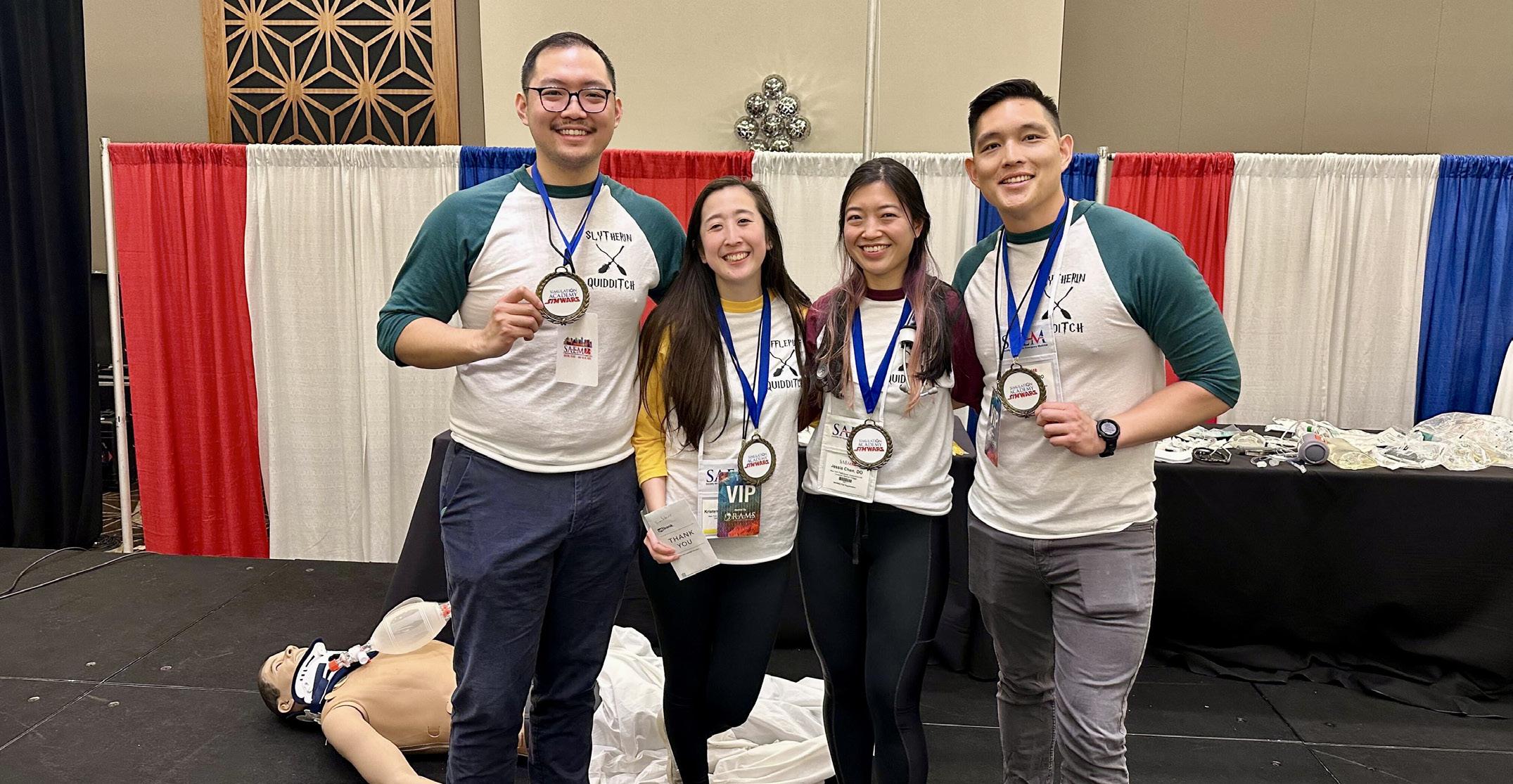
SIMULATION ACADEMY SIMWARS CHAMPIONS
NewYork-Presbyterian Queens
14 ANNUAL
MEETING WRAP-UP
DODGEBALL CHAMPIONS
University of Alabama at Birmingham Emergency Medicine
CLINICAL DIAGNOSIS WINNERS

Resident: Jordan Sell, University of Michigan. Medical student: Yi-Chen Liu

BECAUSE OUR MEMBERS MAKE IT ALL POSSIBLE. THANK YOU.
The SAEM Annual Meeting Program Committee, Board of Directors, and staff would like to express our gratitude to the presenters and participants at our recent record-breaking annual meeting in Austin, Texas. Your willingness to share your expertise, showcase groundbreaking research, contribute educational content, and give of your time and yourselves, elevated the quality of our event to new heights. Your contributions — whether large or small — enriched the academic emergency medicine community, setting new benchmarks, expanding our boundaries, and inspiring us all.
ANNUAL MEETING WRAP-UP 15
Meet Our SAEM23 Award Winners!
SAEM awards are given each year at the SAEM Annual Meeting in recognition of exceptional contributions to emergency medicine and patient care through leadership, research, education, and compassion. Congratulations to all of our 2023 award recipients!

John Marx Leadership Award
Andy S. Jagoda, MD Icahn School of Medicine at Mount Sinai
Honors an SAEM member who has made exceptional contributions to emergency medicine through leadership - locally, regionally, nationally or internationally.
Excellence in Research Award
Carlos A. Camargo Jr., MD, DrPH Massachusetts General Hospital Harvard Medical School


Presented to a member of SAEM who has made outstanding contributions to emergency medicine through the creation and sharing of new knowledge.
Hal Jayne Excellence in Education Award
Teresa M. Chan, MD, MHPE McMaster University

Awarded to a member of SAEM who has made outstanding contributions to emergency medicine through the teaching of others and the improvement of pedagogy.
Organizational Advancement Award
Marquita S. Norman, MD, MBA UT Southwestern Medical Center

Honors an SAEM member who has made significant contributions to programs, services, or leadership within the Society that has advanced the mission and trajectory of SAEM.
Advancement of Women in Academic Emergency Medicine Award
Wendy L. Macias Konstantopoulos, MD, MPH, MBA Massachusetts General Hospital / Harvard Medical School


Honors an SAEM member who has made exceptional contributions to emergency medicine through advancing diversity and inclusion in emergency medicine.
Tracy Madsen, MD, PhD Brown University
Recognizes an SAEM member who has made significant contributions to the advancement of women in academic emergency medicine.
16 ANNUAL MEETING WRAP-UP
Marcus L. Martin Leadership in Diversity and Inclusion Award
Arnold P. Gold Foundation Humanism in Medicine Award
Jonathan D. Sonis, MD, MHCM Massachusetts General Hospital/ Harvard Medical School

Given to a practicing emergency medicine physician who exemplifies compassionate, patient-centered care.
Public Health Leadership Award
Herbie Duber, MD, MPH University of Washington
Honors an SAEM member who has made exceptional contributions to addressing public health challenges through interdisciplinary leadership in innovation - locally, regionally, nationally, internationally. These contributions and accomplishments should demonstrate foresight and leading-edge innovative thinking.
Mid-Career Investigator Award
Daniel Nishijima, MD, MAS UC Davis Department of Emergency Medicine


Recognizes those SAEM members who have demonstrated commitment and achievement in research during the mid-stage of their academic career.
Early Investigator Award
Cynthia Santos, MD Rutgers New Jersey Medical School


Recognizes those SAEM members who have demonstrated commitment and achievement in research during the early stage of their academic career.
Early Investigator Award
Michael Gottlieb, MD Rush University Medical Center
Recognizes those SAEM members who have demonstrated commitment and achievement in research during the early stage of their academic career.
FOAMed Excellence in Education Award
Kristen Grabow Moore, MD, MEd Emory University

Honors a SAEM member who has made outstanding contributions to the online learning community of emergency medicine through innovative and engaging FOAMed content.

Mentor Award
Keith Kocher, MD, MPH University of Michigan

Honors an SAEM member who has mentored the career advancement of other SAEM members.
Mid-Career Investigator Award
Bernard P. Chang, MD, PhD Columbia University
Recognizes those SAEM members who have demonstrated commitment and achievement in research during the mid-stage of their academic career.
Early Investigator Award
Elizabeth A. Samuels, MD, MPH, MHS UCLA Department of Emergency Medicine
Recognizes those SAEM members who have demonstrated commitment and achievement in research during the early stage of their academic career.
Early Educator Award
Kamna S. Balhara, MD Johns Hopkins
Honors an SAEM membert who has made outstanding contributions to emergency medicine through the teaching of others.

ANNUAL MEETING WRAP-UP 17
continued on Page 18
Early Educator Award
continued from Page 17
Adaira Landry, MD, MEd Brigham & Womens Hospital/Harvard Medical School

Honors an SAEM member who has made outstanding contributions to emergency medicine through the teaching of others.
Fellow Awards — Critical Care
Michael Self, MD UC San Diego
Early Educator Award
Eric Shappell, MD, MHPE Massachusetts General Hospital / Harvard Medical School

Honors an SAEM member who has made outstanding contributions to emergency medicine through the teaching of others.

Fellow Awards — EMS
Jake Toy, DO Harbor-UCLA Department of Emergency Medicine


Fellow Awards — Pediatric
RAMS Leadership in Emergency Medicine Award
Preeti Panda, MD Stanford University School of Medicine

Fahad Ali, MD
Alpert Medical School at Brown University, Brown University School of Public Health
Honors a medical student or practicing emergency medicine resident taking a leading role in their student interest group or residency program and making an impact on the local, regional, national, or international level through their efforts.
18 ANNUAL MEETING WRAP-UP
RAMS Excellence in Research Award

Jamaji Nwanaji-Enwerem, MD Emory University Department of Emergency Medicine

Awarded to annually to a senior emergency medicine resident or student who has demonstrated exceptional promise and early accomplishment in the creation of new knowledge.

RAMS Excellence in Education Award
Maxwell Spadafore, MD University of Michigan
Given annually to a senior emergency medicine resident who has demonstrated exceptional aptitude and passion for teaching during residency.
Victor Flores Cortez, MD Boston Medical Center
Presented for dedication, leadership, and innovative work in academic emergency medicine.
DEI Medical Student Education Award
Daniel Ruiz-Betancourt Stanford University School of Medicine

Given to underrepresented medical students who demonstrate a strong commitment to and leadership skills in emergency medicine.
DEI Medical Student Education Award
Leyla Farshidpour
UC Davis
Given to underrepresented medical students who demonstrate a strong commitment to and leadership skills in emergency medicine.
Outstanding Department Award for Excellence and Innovation in Diversity, Equity, and Inclusion


Emory University School of Medicine
Presented for dedication, leadership, and innovative work in academic emergency medicine.
Giovanni Rodriguez, MD Harvard Affiliated Emergency Medicine Program at Mass General Brigham
Presented for dedication, leadership, and innovative work in academic emergency medicine.
DEI Medical Student Education Award
Joseph Rojo Medical Student Year 4 St. Louis University School of Medicine


Given to underrepresented medical students who demonstrate a strong commitment to and leadership skills in emergency medicine.

ANNUAL MEETING WRAP-UP 19
RAMS DEI Resident Education/Innovation Award
RAMS DEI Resident Education/Innovation Award
2023 Medical Student Excellence in Emergency Medicine Award Recipients
SAEM congratulates this year’s recipients of the SAEM Medical Student Excellence in Emergency Medicine Award. The award is offered to each medical school in the United States and internationally to honor an outstanding medical student.
Eric Segev Albany Medical College
Eileen Williams
Baylor College of Medicine
Riley Kolus
Boston University Chobanian & Avedisian School of Medicine
Jacob Perino
Case Western Reserve School of Medicine
Haley Maser
Central Michigan University College of Medicine
Julie Calabrese Cooper Medical School at Rowan University
Regan McKeough
Dalhousie University, Faculty of Medicine
Veronica Gonzalez
David Geffen School of Medicine at UCLA
Mathangi Kularajan
Des Moines University
Sarah Emslie
Drexel University College of Medicine
William Stephen Miller East Tennessee State University, Quillen College of Medicine
Ethan Smolley Eastern Virginia Medical School
Marcus Gresham
Emory University Emergency Medicine
Raelynn Vigue
Florida International University / Herbert Wertheim College of Medicine
Kendall Anne Philipson Florida State University College of Medicine
Daniel Petrosky
Geisinger Commonwealth School of Medicine
Kira Chandran Georgetown University School of Medicine
Sarah E. Hopfer Indiana University School Of Medicine
Erin Elizabeth Clough
Jacobs School of Medicine & Biomedical Sciences, University at Buffalo
Sarah Armstrong
John A Burns School of Medicine
Nneoma Okonkwo
Johns Hopkins University School of Medicine
Nathan Dow
Larner College of Medicine at the University of Vermont
Tyton Roberts
Lincoln Memorial University-Debusk College of Osteopathic Medicine
Jenna Lee Loma Linda University Medical School
Avery Bryan
Louisiana State University School of Medicine in Shreveport
Robert Canning Loyola University Chicago, Stritch School of Medicine
Kara Plasko LSUHSC New Orleans Medical School
Zachary Ginsberg Mayo Clinic Alix School of Medicine
Veronica Weihing McGovern Medical School at UT Health
Houston
Sauveur Barry Medical College of Georgia at Augusta University
Rebecca Bixler Medical College of Wisconsin
Stiles Harper Medical University of South Carolina
Alexis Brawner Michigan State University College of Human Medicine
William Arnold Adamy, DO Midwestern University -- Arizona College of Osteopathic Medicine
Sasha Becker Northwestern University Feinberg School of Medicine
Nicole Lewis Oakland University-William Beaumont School of Medicine
Caroline King Oregon Health & Science University
Kaitlyn Callaghan
Paul L Foster School of Medicine, Texas Tech University Health Sciences Center El Paso
Maria Holstrom-Mercader Pennsylvania State College of Medicine
Charlotte Tisch
Perelman School of Medicine at University of Pennsylvania
Katherine Mary O'Shae
Philadelphia College of Osteopathic Medicine
Ngozi Nwabueze Pritzker School of Medicine
Maryam Zadeh
Queen's University
Brian Pringle Rocky Vista University College of Osteopathic Medicine
Mimi Williams
Roy J. and Lucille A. Carver College of Medicine
Katherine Tehaney Rush Medical College
Lauren Zingaro
Rutgers New Jersey Medical School
Kelsey Thompson Rutgers Robert Wood Johnson Medical School
Christina Wesley Saint Louis University School of Medicine
Jason Truong
SUNY Downstate College of Medicine
Laura M. Szczesniak
SUNY Upstate Medical University
Christopher Wend
The George Washington University
Sarah Pajka
The Ohio State University College of Medicine
Abigail Raynor
The Warren Alpert Medical School of Brown University
Jacob Hurwitz
Tulane University
Katrin Jaradeh
UC San Francisco, Department of Emergency Medicine
Ryan Lindsay
UMass Chan Medical School
Mathieu McKinnon
Undergraduate Medical Education, University of Ottawa
ENS Rory Wagner
Uniformed Services University of the Health Sciences
Julia Sawatzky
University of Alberta, MD Program
Teresa Crow, MD
University of Arkansas for Medical Services
Rutvij Khanolkar
University of Calgary Cumming School of Medicine
Tyler Kirchberg
University of California, San Diego
Sarah Fuller
University of Connecticut School of Medicine
Daniel Zhang
University of Florida, Department of Emergency Medicine
Katherin Briggie
University of Iowa Roy J. and Lucille A. Carver College of Medicine
Stephanie Strothkamp
University of Kentucky
Oladele Osisami
University of Louisville School of Medicine
Nikita Salker
University of Maryland School of Medicine
Joseph Douglass
University of Massachusetts Chan School of Medicine--Baystate
Megan Purdy
University of Michigan Medical School
Alora Sager
University of Minnesota Medical School
Kaitlyn Wendt
University of Missouri - Columbia School of Medicine
Joseph O'Brien
University of Missouri-Kansas City School of Medicine (UMKC SOM)
Tiana Jayanathan
University of New England College of Osteopathic Medicine
Kiley Nygren
University of New England College of Osteopathic Medicine
Lionel Candelaria
University of New Mexico School of Medicine
Lucas Bouknight
University of North Carolina-Chapel Hill
Louisa James Grant Weindruch
University of North Texas Health Science
Center - Texas College of Osteopathic
Cindy Lin
University of Pikeville - Kentucky College of Osteopathic Medicine
Rafael Ortega
University of Rochester
Payal K. Patel
University of South Alabama College of Medicine
Hayn Arrington Jackson
University of South Carolina School of Medicine Greenville
Ionut C. Pupazan
University of South Carolina School of Medicine- Columbia/Prisma Health
Richland
Kjerstin Hensley
University of South Dakota - Sanford School of Medicine
Brad Hall
University of South Florida Morsani College of Medicine
Hart Edmonson
University of Washington
Ines Hoxha
University of Wisconsin
Christopher Joseph
UT Southwestern School of Medicine
James O. Jordano
Vanderbilt University Medical Center, Department of Emergency Medicine
Rebecca Pilkington
Virginia Commonwealth University SOM
Lucas Popp
Wake Forest University School of Medicine
Jack Basse
Washington University School of Medicine
Lauren Shawver
Wayne State University School of Medicine
Jacqueline Tran
Weill Cornell Medical School
Raechel Warchock
Western Michigan University Homer Stryker, MD School of Medicine
Leah J. Wolfer
Wright State University, Boonshoft School of Medicine
Douglas Barber Yale School of Medicine
20 ANNUAL
WRAP-UP
MEETING
Many Thanks to Our SAEM23 Exhibitors and Sponsors!
Exhibitors
Abbott
Abbvie
ACEP Geriatric Emergency Dept. Accredidation Program
ACEP/CDC Peds
Vaccination Grant
ACEP/CDC TickED - Tickborne Diseases of the United States
Anatomage Inc.
ApolloMD
AstraZeneca ANDEXXA
Atlantic Pension Planning
Balco Management
Baxter Healthcare Corporation
Beckman Coulter
Belle AI
BioXcel Therapeutics
Sponsors
Satellite Symposiums
Abbott
Janssen Pharmaceuticals, Inc.
Beckman Coulter
Consensus Conference
Stanford
Belle AI
Mednition Inc.
Inflammatix
Caretaker Medical
Austin Hunt
US Acute Care Solutions
Brainscope
BRC
BTG Pharmaceuticals
Butterfly Network
Ceribell, Inc
CHRISTUS Children's
Clarius Mobile Health
Cytovale
EchoNous Inc.
EDPMA
Emergency Care Partners
Emergency Medicine Specialists, Inc.
Emergent Medical Associates
(c/o Pacific Healthworks LLC)
Envision Physican Services
Flat Medical
Icahn School of Medicine at Mt. Sinai
Integrative Emergency Services
IU School of Medicine, Department of Emergency Medicine
Ivy Clinicians
Janssen Pharmaceuticals, Inc.
Kowa American Corp.
Mayo Clinic & Mayo Clinic Health System
Medical College of Wisconsin
Affiliated Hospitals
MedTech International Group
MeMed
Moneyscript Wealth
Manqement LLC
National Foundation for Emergency Medicine
Residency & Fellowship Fair
Vituity
US Acute Care Solutions
SonoGames®
Philips Exo
Mindray
Butterfly Network
Clarius
Sonosite
Intelligent Ultrasound
EchoNous Inc.
NES Health
Oregon Health & Science University
Penn State Health
Pfizer
Rare Disease Therapeutics, Inc.
Rosh Review
(A Blueprint Prep Company)
Splash Medical Devices
TeamHealth
The Permanente Medical Group
University of Colorado Denver
UPMC Emergency Medicine
US Acute Care Solutions
Victoria Emergency Associates
Vituity
Wilderness Medical Society
RAMS Party VIP Table Sponsors
Mass General Brigham
The Ohio State University
University of Iowa Department of Emergency Medicine
IUSM - Department of Emergency Medicine
Medical College of Wisconsin
Stanford University
Columbia University
EMRA
For information about exhibitor and sponsorship opportunities for SAEM24, May 14-17 in Phoenix, Arizona, contact exhibitors@saem.org

ANNUAL MEETING WRAP-UP 21
Racial Trauma: The Burden of Being Black in Medicine
 By Ashlea Winfield, MD, MSPH and Sanche Mabins, MD on behalf of the SAEM Academy for Diversity and Inclusion in Emergency Medicine
Trauma is any event, series of events, set of circumstances or environment that is experienced as harmful, having lasting effects on the individual’s functioning and well-being. While discussions of trauma and trauma informed care often center around adverse childhood experiences (ACEs), we often gloss over the disparate burden of trauma that is carried by individuals from historically marginalized ethnic and racial groups. Racial trauma or race based traumatic stress (RBTS) is mental and emotional injury caused by encounters with racial bias and ethnic discrimination, racism, and hate crimes. Through this article we aim to provide an awareness of race based trauma, highlighting a small fragment of the
burden of racism within medicine and the associated cost.
“Can you refill the paper towels in the bathroom?”
Microaggressions as Every Day Racial Trauma
Imagine you are busy charting when someone interrupts to ask you to refill the paper towels in the bathroom. You look down at your embroidered scrubs and bright block lettered “DOCTOR” badge to wonder what made them think you were environmental staff. You know this perception that you are in a service position is largely because of your race, because you are Black. This is a microaggression.
Racial microaggressions specifically are “brief, everyday exchanges that send denigrating messages to people of color…” . While we frequently frame microaggressions as little annoyances, they are a form of racism that carries significant health burdens, affecting the mental and physical health of those who experience them. Microaggressions have been shown to lead to higher rates of depression, feelings of hopelessness, suicidal ideation, sleep disturbances, hypertension, and substance use
How others choose to respond to an individual’s experience of microaggressions may also alleviate or exacerbate trauma activation. Imagine talking to a faculty member or colleague
DEI PERSPECTIVE 22 SAEM PULSE | JULY-AUGUST 2023
to process a microaggression and they offer you an alternative theory that avoids discussions of race altogether. “It’s because you look so young.”
While we would like to think that this an atypical response, it has been demonstrated that dominant group members will often dismiss the notion of microaggressions or avoid discussion altogether, preferring to link the microaggression to another factor. Denying the role of racism in these instances leads to further invalidation and worsens traumatization.
The Cost of Foregoing Authenticity
A 2018 study published in JAMA highlighted the self-policing that minoritized residents must perform to be deemed professional. Many reported altering the way that they speak, wear their hair or other forms of selfexpression to meet more Eurocentric standards. The implications for this inability to be their authentic selves leads to increased psychological stress and feelings of not belonging, contributing to the phenomenon known as “imposter syndrome” which is nothing more than internalized racism rebranded to be a character fault of the minoritized individuals.
Racism in Evaluative Systems
Racism is pervasive within medical education, especially within our systems of evaluation and promotion. We use “objective measures” such as standardized tests that are associated with parental income and have repeatedly demonstrated racial bias. Within emergency medicine the standardized letter of evaluation (SLOE), perhaps one the most highly regarded components
of a candidate’s emergency medicine residency application, lacks validity evidence and has also been shown to demonstrate racial biases. These measures then determine which fields of medicine a person is “fit” to enter, relegating trainees from historically marginalized to certain specialties, worsening depression, burnout, and attrition. The use of systems that perpetuate racism are not limited to residency but also serve to keep Black and Brown trainees from getting their feet through the well-guarded gate to a career in medicine.
Acknowledging Community Trauma
Community or collective trauma refers to “an aggregate of trauma experienced by community members or an event that impacts a few people but has structural and social traumatic consequences.” Community trauma disproportionately impacts historically marginalized communities that due to systemic racism and structural inequalities are more likely to be impacted by poverty, violence, and discrimination. As medicine has started to acknowledge the role of racism and social determinants of health more formally, there has also been increasing resistance from others who want to steer clear of “wokeness” within medicine by avoiding topics such as gun violence or the disproportionate murder of unarmed Black people by police.
The reality is that while many of our dominant group colleagues can go home and escape the realities of the outside world, individuals from historically marginalized groups cannot. Witnessing the trauma of others within our communities can lead to further traumatization. Studies have shown that after police killings of unarmed Black people, Black people within that state reported higher rates of poor mental health for up to three months. We also have to reckon with the violence perpetuated in our clinical spaces where we see members of our communities being denied life saving procedures at higher rates than whites and dying at disproportionate rates from preventable diseases. This trauma has also been compounded by the COVID-19 pandemic that ravaged Latinx and African American communities while political leaders blamed “colored people” for not washing their hands instead of acknowledging the impact of systemic racism. We are not learning and practicing in a vacuum and failure to acknowledge this will lead to further traumatization.
It is also very important to highlight historical trauma of the Black community due to chattel slavery, Jim Crow policies, and ongoing daily exposure to racism that has allowed trauma to alter the way in which our DNA is expressed and passed onto future generations.
continued on Page 25
“You look more like a doctor with your straight hair…”
“We all know Black people get in with lower scores…”
“Everybody is woke now…”
“While we frequently frame microaggressions as little annoyances, they are a form of racism that carries significant health burdens, affecting the mental and physical health of those who experience them.”
23
“The use of systems that perpetuate racism are not limited to residency but also serve to keep Black and Brown trainees from getting their feet through the well-guarded gate to a career in medicine.”

24 SAEM PULSE | JULY-AUGUST 2023
DEI PERSPECTIVE
continued from Page 23
“She’s Distracted on Shift…” How Does Trauma Show Up?

The usual rigor of residency is significant and compounding this with the additional burden of racial trauma may overload a trainee’s ability to cope. This constant activation due to the ongoing toxic stress can show up in many ways including but not limited to agitation and depression. Traumatized individuals may appear distracted or withdrawn on shift or may withdraw from medicine altogether. Once matched, Black residents are more likely to withdraw, be dismissed from programs, or take extended leaves of absence
Our inability to recruit and retain physicians of color is multifactorial, but we can be certain that a lack of awareness of the effects of trauma within medical education, specifically racial trauma, play a tremendous part. Medicine was not designed to be inclusive of minoritized groups, as evidenced by the hundreds of years of intentional exclusion from medical organizations such as the American Medical Association Medicine as it exists now has continued to uplift white supremacy as evidenced by the lack of physicians of color within medicine, recent overt racist comments on social media regarding the qualifications of a majority black residency class, and current attacks on affirmative action. To move forward and create safe,
trauma responsive spaces, we must acknowledge that racism is weaved throughout the fabric of not only our country but also medicine. We must also acknowledge race-based trauma or we will continue to rob historically excluded trainees and faculty of safe environments in which to learn and practice.
While I have framed this discussion from my perspective as a Black woman, the concept of ethnic or racialized trauma applies to other historically marginalized groups including our Latinx colleagues and Indigenous Americans. I would also like to acknowledge the disparate burden of our LGBTQ+ colleagues, with special attention to our transgender and gender expansive communities who encounter trauma daily as our governing bodies strip away their rights to simply exist as their authentic selves
ABOUT THE AUTHORS
Dr. Winfield is an assistant professor of emergency medicine and the associate director of simulation at Cook County Health. She is co-chair of the ADIEM Mentorship Committee.


Dr. Mabins is a fourth-year resident at Cook County Health and co-leads the DEI subcommittee within the SAEM Education Committee.
About ADIEM
The Academy for Diversity & Inclusion in Emergency Medicine (ADIEM) works towards the goal of diversifying the physician workforce at all levels, eliminating disparities in health care and outcomes, and insuring that all emergency physicians are delivering culturally competent care. Membership in SAEM's academies and interest groups is free. To participate in one more groups: 1.) log into SAEM.org; 2.) click “My Participation” in the upper navigation bar; and 3) click “Update (+/-) Academies or Interest Groups.”
25
“Our inability to recruit and retain physicians of color is multifactorial, but we can be certain that a lack of awareness of the effects of trauma within medical education, specifically racial trauma, play a tremendous part.”
Considering the Implications of ChatGPT for Academic Literature
By Robert J Stephens, MD
The Case
The resident editor for an emergency medicine academic journal has been asked to write an editorial on the ethics of use of ChatGPT and other similar artificial intelligences in academic writing. Writing the manuscript is not going as easily as he hoped, but while researching for the editorial, he decides to see if the tool can help him complete the article before his deadline. He quickly prepares a draft using this new online artificial intelligence technology and submits it to his project mentor for review.
Recent advances in artificial intelligence (AI) have entered the public awareness with large language models (LLM) such as ChatGPT becoming remarkably popular leading to excitement and controversy in the academic work. The dissemination of these tools raises multiple ethical questions for how they can and should be used in clinical research.

Falsification and Duplicate
Publication
LLM AIs use a vast data bank of example text to predict “ideal” responses to queries — what statistically is the most likely set of sentences that should return to answer a question. This does not guarantee that these responses are correct, as the reinforcement learning model does not provide a “source of
truth,” according to the developers. Simply put, it seeks plausibility rather than fact. The algorithm does not have a search engine function and is not able to utilize sources from the internet; rather, it can only refer to the training data bank. Citations delivered by ChatGPT may not reflect the content of the cited work and has been reported to generate citations for nonexistent works with one study
ETHICS
26 SAEM PULSE | JULY-AUGUST 2023
IN ACTION
finding only 6% of citations being correctly referenced. Above all, ChatGPT is not an analysis tool and should not be used in this context. Most concerning is that the AI output is plausible and seems adept at falsifying results in a credible way.
A similar concern is that these technologies will make duplicate publication more difficult to detect. Gao, et al. were able to duplicate 50 published abstracts using ChatGPT with all generated abstracts being rated high on originality using a plagiarism detection algorithm.
Authorship and “Plagiarism”
One of the stickiest ethical issues that we will face in the coming years is how these tools will impact the concept of authorship. LLMs do not understand the sentences produced regardless of how well the model has been trained. Authorship inherently implies accountability to the scientific community for the content of the work. AI tools cannot carry this responsibility. In response to publications produced using AI and several listing ChatGPT as an author, many publishers in the scientific community have issued specific author guidance on the use of AI and AI-assisted technologies in the publication of scientific work. Carefully reviewing these policies will be vital for authors who chose to use AI assistance and clear declaration
of whether and how these technologies are used should be included in submitted manuscripts. Multiple scientific organizations and publishers have weighed in on this topic, unanimously ruling that AI cannot be credited as an author (COPE, JAMA Network, Nature).

Additionally, the use of AI to generate text for a manuscript raises ethical questions surrounding the definition of plagiarism. Although any author considering using AI to generate text would not be taking credit for a different person’s work, their text certainly would not be original. Provided the ideas are original, does physically writing the text truly determine authorship? Is the use of AI-generated or edited text an act of plagiarism? Currently, we do not have definitive answers to these questions and as a scientific community we need to be actively seeking consensus on the answers.
Future Use
It is naive to believe that LLM and similar AI will not play a role in the future of research. So how can these tools be leveraged to aid in publishing research in an ethical manner? The obvious answer is to enhance readability. This is perhaps most promising to aid those for whom English is a second language. Another potential use would be for authors to use these tools to aid in formatting their
work to meet journal requirements and preparing submission cover letters. However, for this application, ChatGPT has been shown to be particularly inept, with the only study on this topic finding it unsuccessful across nearly tested abstracts. But that is not to say that this technology will not develop significantly in the coming weeks to months as further iterations are developed. In the future AI may play a greater role in study design, hypothesis generation, data analysis, and manuscript production.
The Conclusion
The resident editor tells his mentor that he used ChatGPT to aid in drafting the paper. He and his mentor rework the manuscript to ensure that it is an original manuscript and that it truly reflects reality
ABOUT THE AUTHOR
Dr. Stephens served as a 2022-2023 resident editor for Academic Emergency Medicine journal. He is a graduating emergency medicine resident at Washington University in St Louis and will be continuing his training as a critical care fellow at the University of Maryland.

27
“Authorship inherently implies accountability to the scientific community for the content of the work. AI tools cannot carry this responsibility.”
FIRST PERSON
“Is There a Doctor or Nurse on Board?”
By Lily Leitner Berrin, MD
“Is there a doctor or a nurse on board?”
As a first-year emergency medicine resident, I was both excited and terrified to hear the call on my recent flight home from SAEM23 in Austin, Texas. I’ve been told that every doctor responds to an inflight medical emergency at least once in his or her career, I didn’t realize my moment would come so soon. I paused my Netflix show and made my way to the front of the plane.

The patient, a man in his 60s, had been in the restroom for about 20 minutes and was acting strangely. Thankfully, William “Bill” Toon, EdD, NREMT-P, was already there. On our quick assessment, we noted that the patient was altered, diaphoretic, and
unstable on his feet. Bill took his vitals, and the flight attendant brought forward the patient’s medicine bag, which was full of insulin. There was no glucometer in the plane’s medical kit, but a call overhead had one quickly brought to us from another passenger. The patient’s glucose was 29. We quickly started giving him juice, and attempted an IV,
which was challenging since the patient was still in the airplane bathroom. The plane did have D50, which we mixed with the cranberry cocktail, since it had the most sugar of the available beverages. As Bill and I took turns giving the patient the juice, we learned that we had both come from SAEM23, and were surprised we were the only
28 SAEM PULSE | JULY-AUGUST 2023
“I’ve been told that every doctor responds to an inflight medical emergency at least once in his or her career, I didn’t realize my moment would come so soon.”
medical providers on the flight. We rechecked the patient’s glucose, which had increased only to 34. After a little more juice and an episode of emesis, the patient’s glucose rose to the 70’s. The flight attendants and captain arranged for an emergency medical services crew to meet us at the airport. When we landed, the patient was mentating and we were able to successfully transfer him to the paramedics for assessment at a local hospital.
Bill and I deplaned, shook hands, took a photo, and went our separate ways — he to his final destination in Phoenix and I to my connecting flight back home to Oakland, California. One of the reasons

I chose emergency medicine is for the interdisciplinary teamwork. I was grateful to learn from and work with Bill, whose career as a paramedic prepared him to expertly care for a patient on a plane with limited resources. From this experience, I learned that I could help stabilize a patient using collaboration, my medical knowledge, and limited medical tools. I also learned that not all airlines carry the same medical kit, and I have written to the airline to recommend that they add a glucometer and pulse oximeter to their kit. I am grateful that as an emergency medicine resident I will continue to gain the knowledge and experience to help care for patients in all settings, and I
am grateful to continue learning from colleagues in and out of the emergency department.
ABOUT THE AUTHOR
Dr. Berrin is a first-year emergency medicine resident at Highland Hospital, in Oakland, California. She completed her medical degree at the University of Pittsburgh School of Medicine in 2022. She is the resident representative on the SAEM Academy of Geriatric Emergency Medicine (AGEM) executive board. @LilyBerrin

“From this experience, I learned that I could help stabilize a patient using collaboration, my medical knowledge, and limited medical tools.”
29
William “Bill” Toon, EdD, NREMT-P, and Lily Berrin, MD at the Phoenix airport after responding to a medical emergency on their flight home from SAEM23 in Austin, Texas.
Shared Decision Making for Persons Living with Dementia and Care Partners: A Complex Conversation
By Justine Seidenfeld, MD and Fernanda Bellolio, MD, MS
When caring for persons living with dementia (PLWDs) in the emergency department (ED), there are many situations in which there is more than one reasonable option, and a decision needs to be made. This can pertain to different types of decisions, such as whether to obtain a certain lab or imaging test, what type of medication to try, and whether to admit or discharge a patient home, among others. In these situations, shared decision making (SDM) can facilitate conversations between patients, care partners, and health care providers, and increase patient and care partner understanding of their options. Despite concerns about decision making

on behalf of the SAEM Academy of
capacity in PLWDs, they are able to communicate values and preferences, and thus can participate in SDM when done appropriately. Below, we outline steps involved in SDM and important considerations when discussing ED decisions with patients and care partners.
Decisional Roles
One of the first steps is determining who will be involved in making the disposition decision.
• PLWDs can reliably communicate their values and choices, but their decision making capacity is often overlooked by both health care and family members
Geriatric Emergency Medicine
• Additionally, the care partner present at the ED visit with them may not be the documented legally authorized representative. In these cases, ideally both the bedside care partner and the legally authorized representative would be involved along with the patient. If there is no care partner at the bedside, do your best to reach out to the most appropriate party.
• PLWDs will experience a range of “good days and bad days.” Patients with low dementia severity and high decisional capacity when at their baseline may be having more severe symptoms at the time of the ED visit. Likewise, a patient with high severity dementia may be
GERIATRIC EM 30 SAEM PULSE | JULY-AUGUST 2023
having a “good day” during the ED visit and should not be excluded from the decision-making conversation.
Establish Rapport
The ED encounter represents a very stressful situation, as it is an unfamiliar environment requiring interactions with many different staff members. Trust is needed so that PLWDs and care partners feel comfortable expressing their own values and preferences.
• Health literacy is an important communication barrier when having a complex conversation around medical decisions. This is especially true for PLWDs as health literacy can change as dementia progresses.
• Nonverbal communication is also important to establish rapport. This can include taking the time to sit or otherwise position yourself at eye-level and avoid multi-tasking (including use of screens) during the discussion.
Provide Information and Assess Decisional Needs
One of the health care provider’s roles is to give information about the options available to the patient in a neutral and balanced manner.
• Discussing the possible risks and benefits of any decision must be tailored to the PLWD and care partner’s particular situation and the reason for their ED visit. While it may not be possible, or even recommended, to convey risks with statistics, the patient and care partner need the relevant facts to participate in decision making.
• Give the patient and care partner sufficient time to process new information. This may require breaking up the discussion into two or more sessions.
About AGEM
Clarify Personal Values and Preferences
Give the PLWD and care partner time to share any relevant information with you.
• The patient and the care partner may have different goals or levels of risk tolerance or aversion that need to be balanced.
• Clarify any goals that might have prompted the ED visit and get a sense of “what matters most” to them.
• Personal or situational circumstances for the patient and care partner might impact the decision (for example, if they are deciding whether to be admitted or not, and the care partner lives 45 minutes away and cannot help every day with activities like dressing or bathing at home.)
Support Deliberations
This final step combines knowledge about the risks and benefits of the options along with the goals of the patient and care partner, to work together to reach agreement about the preferred option.
• Decision making can happen in stages, and the health care provider’s role is to facilitate progress throughout the discussion.
• This may reveal additional psychosocial or resource related issues that influence the decision. For example, if they are deciding about admission versus discharge, if there are home help options that would support a safe discharge home, be sure to communicate that to the patient and care partner.
PLWDs are a varied and medically complex population. Many ED decisions require us to weigh downstream
possibilities that are often difficult to quantify. It is important to recognize when SDM can be used to support ED care that is consistent with what matters most to these patients and care partners. Involving patients in their health care decisions both empowers and respects them; however, even compared to older adults without dementia, guidelines for ED communication and SDM for PLWDs and their care partners are very limited. Future work in this area is needed to support ED health care providers, patients, and their care partners to navigate this complexity.
ABOUT THE AUTHORS
Dr. Bellolio is a professor of emergency medicine in the Department of Emergency Medicine, Department of Health Sciences Research, and Department of Medicine, Section of Geriatric Medicine at Mayo Clinic. She is a member-at-large of SAEM’s Academy of Geriatric Emergency Medicine (AGEM) and a methodologist for SAEM’s Guidelines for Reasonable and Appropriate Care in the Emergency Department (GRACE).
Dr. Seidenfeld is a core investigator with the Durham VA Center of Innovation to Accelerate Discovery and Practice Transformation and a practicing emergency physician at the Durham VA Medical Center. She recently completed a health service research fellowship with National Clinician Scholar Program at the Durham VA and Duke University.

The Academy of Geriatric Emergency Medicine (AGEM) works to improve the clinical care of older patients, prepare trainees to care for older patients, and advance the geriatric EM research agenda. Joining AGEM is free! Just log into your member profile. Click “My Account” in the upper right navigation bar. Click the “Update (+/-) Academies and Interest Groups” button on the left side. Select the box next to the academy you wish to join. Click “save.”

31
“Patients with low dementia severity and high decisional capacity when at their baseline may be having more severe symptoms at the time of the ED visit. Likewise, a patient with high severity dementia may be having a “good day” during the ED visit and should not be excluded from the decision-making conversation.”
Journey Through Residency in Rwanda: An Emergency Physician’s Story
 By Destry Jensen, MPH, on behalf of the SAEM Global Emergency Medicine Academy
Emergency medicine training is relatively new in many African countries, but the specialty has rapidly developed across several regions, allowing those interested in medicine to pursue specified training in the field. This was so for Dr. Kamunga Badibanga Laurent Gamy, who started his medical career as a primary care physician in the Democratic Republic of Congo, and then chose to specialize in emergency care.
Dr. Kamunga has always held a passion to pursue medicine, explaining, “I think it was something I was called for — my destiny or something I was meant to do.”
In his secondary education, Dr. Kamunga felt the most comfortable in biology and chemistry courses, which first piqued his interest in medicine. He
completed medical school, then worked as a general practitioner in the Congo. After a few years, he moved to Rwanda to continue his practice. While working as a general practicioner in Rwanda, the country’s first emergency medicine training program was started. Dr. Kamunga was interested in emergency medicine, as general practitioners often worked with emergency conditions in the Congo due to limitations in emergency medicine as a standalone specialty within the country. While watching the development of the program, he saw specialized emergency training as an advantageous step in his career and a way to improve his skills.
The emergency residency in Rwanda is a four-year training program for those who have graduated from medical school, consisting of weekly academic lectures, written exams, simulation
learning, rotations to various emergency departments and the intensive care unit (ICU), and research requirements. Rigorous research requisites include a quality improvement project during the second year of the program and a publishable quality thesis project during the last year of residency. Graduation is awarded to those who pass an extensive written exam, an Objective Structured Clinical Exam, case simulation examination, as well as a thesis defense that includes both a written portion and an oral presentation.
Concerning the most challenging aspect of residency: “You do everything under pressure, which can be beneficial because you are forced to learn self-control, responsibility, decisionmaking, and how to best respond to circumstances quickly.”
— Dr. Kamunga
GLOBAL EM 32 SAEM PULSE | JULY-AUGUST 2023
Dr. Kamunga then described the contrast between his experience in general medicine and emergency training, explaining that during residency he had higher expectations from faculty and seniors while having to master both academic knowledge and applied skills. He further explained that because emergency medicine is a new field in Rwanda, there is consistent pressure within the department to define what the specialty entails to other departments within the hospital.
Despite such challenges, Dr. Kamunga gained valuable skills and knowledge during his years of training. He explained that as a resident, he learned to be flexible, compliant, reliable, and responsible. As he ruminated over his time in residency, Doctor Kamunga thought of a quote written on a wall in the emergency department of the University Teaching Hospital of Kigali. The words “think quickly, perform well, and save a life” are printed across the old tan paint of the trauma room where critical patients are kept. He explained every time he received a critical patient, he told himself that if he thought quickly and performed well, he could save a life. He would often go home thinking that despite the stress and pressure of the emergency environment, he was able to save lives. Dr. Kamunga shared, “every day that I went home and was able to say to myself ‘I saved a life’ was a good day.”

The emergency medicine training residency in Kigali, Rwanda also incorporates international colleagues and frequent global collaboration. Dr. Kamunga explained that during the establishment of the residency, several faculty came to Kigali from overseas to lead trainings. This is not an uncommon phenomenon when instituting a new medical specialty, especially in Eastern Africa, where novel medical practices often seek to establish a sustainable ‘train the trainer module’ where graduates can teach future trainees. While the emergency residency was developed in Kigali, Doctor Kamunga observed as a general practitioner. He saw residents being trained and graduating to attending emergency doctors. He was encouraged by the faculty to join the program and is grateful for the decision to do so. He expressed gratitude for such encouragement and detailed that he has
continued on Page 35
Dr.
Kamunga Badibanga Laurent Gamy
Concerning the most challenging aspect of residency: “You do everything under pressure, which can be beneficial because you are forced to learn self-control, responsibility, decision-making, and how to best respond to circumstances quickly.”
33
— Dr. Kamunga

34 SAEM PULSE | JULY-AUGUST 2023
GLOBAL EM
continued from Page 33
stayed in touch with several international mentors.
While emergency medicine practices and training differ in various regions globally, the COVID-19 pandemic has a strenuous impact on all emergency care providers across every corner of the world. Countless records detail the mass global morbidity and mortality caused by the disease, often hitting hardest in emergency care settings. Doctor Kamunga strongly felt such hardships, despite organized and strict lockdown regulations by the Rwandan government. While impacting patient volume and case severity within the emergency department, the pandemic also had numerous ripple effects. One such effect was that Laurent was the only person in his cohort, as he began residency during the onset of the pandemic; however, he felt very supported by faculty and senior residents. With such encouragement Laurent completed his first year of residency; however, during his second year the pandemic was still strongly impacting global health systems. Despite this, the emergency residency continued in Rwanda which caused stress for students and faculty. He explained that several physicians, including himself, saw a lot of suffering and death. This time caused Laurent to question himself, often asking “what am I doing?” Such hesitation and timorousness were undoubtedly pervasive for countless health care providers across the world during the spikes of the pandemic. Despite this
About GEMA
global crisis, Doctor Kamunga was able to personally overcome such fears and continue to pursue residency training. Laurent has since graduated from the emergency medicine residency and is now an attending emergency medicine physician at a large local hospital in Kigali, Rwanda.
Doctor Kamunga’s experience completing emergency medicine training will likely resemble the stories of future trainees, as the specialty continues to grow in Eastern Africa and across the greater continent due to an expanding number of countries that have established training and residency programs. He views this as a success and expressed his hopes for continuous expansion in future years. Dr. Kamunga explained the existing lack of emergency physicians in many African countries, stating, “As long as I see more emergency medicine physicians being trained, it is a positive.”
Doctor Kamunga also articulated the uniqueness of practicing emergency medicine in Rwanda. He detailed that critical care management is a significant part of his work and the work of his colleagues, explaining, “our emergency department seems to be an ICU.”
Dr. Kamunga further explained that that there are insufficient numbers of ICU beds available in Rwanda, often causing congestion of patients and long wait times in the department. The existing insufficiency in ICU care leaves patients in the emergency department for extended periods of time, as Dr. Kamunga expressed, “there is nowhere for them to go.” While this challenge exists in Rwanda, it is also prevalent in emergency
departments across numerous other African countries. However, Dr. Kamunga sees this as an opportunity for advocacy, stating, “if we have more training of EM physicians then they can save lives, not just through direct patient care but through advocacy for additional ICU beds and other necessary resources.” He summarized this point by quoting: “more emergency physicians means more people shouting for needed change.”
Doctor Kamunga articulated the value in emergency training, the benefits in expansion of trainings across the African continent, and the additional advantage of advocacy when more medical personnel receive such specialty training.
When looking toward the future, Doctor Kamunga Badibanga Laurent Gamy is excited to pursue emergency medicine through patient care and education. “I want to train people because this is a new specialty in Africa. I want to find a way to share my skills with future emergency physicians so they can think quickly, perform well, and save a life.”
ABOUT THE AUTHORS
Destry Jensen, MPH is a global health researcher and communications professional. She is an alumnus of Brown University, and a health journalist with numerous narrative pieces, news coverage, and research summaries from various regions including the United States, Sierra Leone, India, Rwanda, and more. @JensenDestry
 The Global Emergency Medicine Academy (GEMA) focuses on improvement of the worldwide delivery of emergency medical care. Membership in SAEM's academies and interest groups is free. To participate in one more groups: 1.) log into SAEM.org; 2.) click “My Participation” in the upper navigation bar; and 3) click “Update (+/-) Academies or Interest Groups.”
35
“The emergency residency in Rwanda is a four-year training program for those who have graduated from medical school, consisting of weekly academic lectures, written exams, simulation learning, rotations to various emergency departments and the intensive care unit (ICU), and research requirements.”
Transforming Emergency Medicine: Highlights From an Expert Panel on AI and Machine Learning
 By Kirsten Douglass, MD, Nicholas Stark, MD, MBA, Jonathan Oskvarek, MD, MBA, and Zaid Altawil, MD on behalf of the SAEM Innovation Interest Group
Artificial intelligence (AI) and machine learning (ML) have emerged as powerful tools in transforming emergency medicine. These technologies offer promising applications that enhance decision-making, improve patient outcomes, and optimize resource allocation. In the realm of triage, AI algorithms can analyze patient data such as vital signs, symptoms, and medical history to accurately prioritize cases based on urgency. Machine learning models trained on large datasets enable the early identification of critical conditions, such as sepsis, by recognizing patterns and alerting
medical staff. AI-powered imaging analysis plays a vital role in radiology, assisting in the rapid detection of abnormalities in images, thereby expediting diagnosis and treatment.
That introduction sounds pretty good, right? In full disclosure: the above paragraph was generated by ChatGPT when prompted to “write a paragraph about artificial intelligence and machine learning applications in emergency medicine.”
At SAEM23 in Austin, Texas, the SAEM Innovation Interest Group partnered with the SAEM Informatics
& Data Science Interest Group and the Emergency Medicine Innovation Collaborative to host a panel titled “Innovating in Acute Care: Artificial Intelligence and Machine Learning.” Throughout the discussion, two emergency physicians on the cutting edge of artificial intelligence and machine learning — Drs. Christian Rose and David Kim, both of Stanford Emergency Medicine — explored the current and potential future applications of these technologies. What follows is an explorative summary of their discussion.
INNOVATION
36 SAEM PULSE | JULY-AUGUST 2023
What are artificial intelligence and machine learning?
Artificial intelligence (AI) is a broad field of computer science that focuses on creating intelligent systems capable of performing tasks that typically require human intelligence. It involves developing algorithms and models that enable machines to perceive and understand their environment, reason, make decisions, and learn from experience.
Machine learning (ML) is a subset of AI focused on the development of models that allow computers to learn and improve from data without being explicitly programmed with specific rules. Instead, ML algorithms are designed to analyze large amounts of data, identify patterns, and make predictions or take actions. ML algorithms are trained on large datasets, which help them recognize patterns and make informed decisions or predictions when presented with new data. ML is a key component of many AI systems, as it allows computers to adapt and improve their performance over time.
(In the spirit of AI and ML, the content of the above section was developed using assistance from ChatGPT)
Do you think AI will become better than emergency physicians in certain domains, such as predicting outcomes or conversing with patients?
AI may be able to help assist emergency physicians (EPs) by removing tasks that currently take up a significant amount of bandwidth on shift. Drs. Kim and Rose hope that AI will become better than humans at certain menial tasks, because this could free EPs to do more “human” work.
One of the causes of burnout is that there is more care to be delivered than we can supply. Aspects that EPs often find fulfilling about our jobs, such as talking with patients, are being cut shorter by the need for us to complete other
tasks. For example, the fact that after interviewing a patient we must go and write down everything that just happened, is relatively redundant. Dr. Kim is hopeful that AI may be able to help us reduce these redundancies in our shifts and thus hopefully reduce burnout overall.
What sort of tasks in acute care may be taken over by AI?
Emergency medicine (EM) is more multifaceted than most other medical specialties, so our field may not be as susceptible to dramatic shifts from AI/ML; however, there is no shortage of things to do in the emergency department (ED) and AI may be able to help us with tasks like translating discharge instructions to another language or interpreting X-rays.
Drs. Kim and Rose hope that AI continues to evolve to assist with certain primary care and clinic abilities. One example would be replying to patient inbox messages, which would allow outpatient clinicians to spend more time performing the fulfilling and human aspects of medicine.
What kinds of patient data could be utilized by AI and ML in emergency medicine?
One of the things that makes EM unique is that data obtained can be dispersed over broad time scales. For example, EPs can gather information from chart review that would raise concern for nonaccidental trauma (NAT) or abuse, such as a suspicious number of traumatic injuries relative to a time course. EPs can do this (and are often expected to), but
they do not always have the time to comb through every prior visit. A computer model could gather this information, then nudge the EP to investigate this further.
Patient monitors in the ED generate another vast dataset that an AI program could leverage. A patient is often continuously hooked up to a monitor, but much of that data is discarded when the vital signs are only charted once per hour. There is often not a practical way to search this data, so it is difficult for the EP to make use of this potentially valuable information.
Is incorporating AI and ML a good/safe idea for patient care?
What dangers can come from this?
As AI and ML become smoother through improving predictive analytics, the more invisible they become. One of the dangers is that in invisible systems, one may not always know where a piece of information or recommendation is coming from. We must question how to critically appraise a clinical recommendation. One of the worries is that if recommendations become too smooth, we will stop being critical of them. We are always doing potentially dangerous things to patients in the ED (think invasive procedures and potent medications) and must constantly question whether we are making the right decisions in patient care. Dr. Rose cautions that we must learn how any
continued on Page 39
“Artificial intelligence is a broad field of computer science that focuses on creating intelligent systems capable of performing tasks that typically require human intelligence.”
“Any time that artificial intelligence and machine learning are going to be implemented, we must choose the outcome of interest. If the aim is “zeromiss” or 100% sensitivity, then it will result in more testing. Ultimately AI and ML can help like any tool can; it is just critical that we thoughtfully define its goals.”
37

38 SAEM PULSE | JULY-AUGUST 2023
INNOVATION
continued from Page 37
machine-learning algorithm comes to a specific conclusion.
What sort of bias can be present in these models? How can we detect and prevent it?
Bias in these models threatens to undermine their usefulness and reinforce disparities between patients. Incomplete data sets are common, and elements of missing data may affect certain patient populations (especially in underrepresented patients). There is often a tradeoff between data set size and data quality. We must define who we are trying to reach and what gaps new data sets are trying to fill.
Some patient groups may get worse predictions from a model. For example, an insurance company may use health care expenditures to estimate the health care needs of a patient. However, disadvantaged populations may get worse care in this model, by assuming that those that sought out less care in the past have fewer health care needs. Sometimes the sickest patients are those who have not sought medical care in years, so low health care utilization does not necessarily equate to better health.
How might AI and ML change the testing that we perform?
Any time that AI and ML are going to be implemented, we must choose the outcome of interest. If the aim is “zeromiss” or 100% sensitivity, then it will result in more testing. Ultimately AI and ML can help like any tool can; it is just critical that we thoughtfully define its goals.

For example, imagine that AI becomes proficient at reading noncontrast head CT scans. We may get to a point where AI reads head CTs independently of radiologists, and then the physician compares the two reads. If AI’s goal is zero-miss, it will ultimately generate more false positives, which the radiologist could review to see if there is something that a
human missed or if it is an artifact that AI flagged as abnormal.
In summary, while the exact applications of AI and ML in emergency medicine are uncertain, the future holds great potential for positive impacts if approached thoughtfully and intentionally.

ABOUT THE AUTHORS
Dr. Douglass is beginning her fourth year of emergency medicine residency at the University of California, San Francisco (UCSF). She graduated from University of California, Davis School of Medicine.

Dr. Stark is an emergency physician who works clinically at the University of California, San Francisco (UCSF) and is the vice chair of emergency medicine and director of operations at Mercy Medical Center. He is the cofounder of the national nonprofit EM Innovation Collaborative and the assistant director of the UCSF Acute Care Innovation Center. @NickStarkMD
Dr. Oskvarek is an emergency physician with US Acute Care Solutions and research co-director at Summa Health in Akron, Ohio. Jonathan has received grants to evaluate a pilot emergency department advanced alternative payment model. He also conducts research in clinician performance improvement and works with entrepreneurs.

Dr. Altawil is an emergency medicine attending physician at Lawrence General Hospital in Massachusetts. He is co-founder of the Emergency Medicine Innovation Collaborative, a group of emergency medicine physicians working to cultivate collaborations, share resources, and inspire innovative change. He completed residency in emergency medicine at Boston Medical Center.

39
“Machine learning is a subset of AI focused on the development of models that allow computers to learn and improve from data without being explicitly programmed with specific rules.”
NIH OFFICE OF EMERGENCY
The NIH Peer Review Process
By Jeremy Brown, MD
In our previous columns we discussed the pros and cons of applying for National Institutes of Health (NIH) funding, and how to find the right program officer for your project (and remember, the Golden Rule of applying to NIH: never apply without talking to a program officer!). Today we will look at what happens within the NIH after you hit the send button.
To begin, let us note the path that your project will take will depend on the kind of grant that it is (R01, U10, R13, K23), and which of the NIH Institutes is going to fund it if you are successful. The first point of entry for all the proposals is the Center for Scientific Review (CSR). The Division of Receipt and Referral (DRR) within the CSR receives and checks for compliance in

all applications submitted to NIH. Then the DRR assigns each application: 1) to one or more institutes or centers for funding consideration and 2) to a study section (scientific review group) to evaluate the scientific and technical merit of the application. They also check the application for completeness and verify that there are no submissions of similar applications from the same principal investigator.
When you submit your proposal, you can request a specific awarding institute (but see the Golden Rule above) and the study section to which you would like it assigned. (These requests should be embedded in the PHS Assignment Request Form, and not in the cover letter that you may opt to send.)
There are about 250 different study sections; most meet three times a year, while others might meet only once,
40 Office of Emergency Care Research
“the path that your project will take will depend on the kind of grant that it is (R01, U10, R13, K23), and which of the NIH Institutes is going to fund it if you are successful.”
CARE RESEARCH
to review a specific one-off funding opportunity announcement. The names of all the study section members are publicly available, and you should spend a moment looking over the names of your peers who will review your grant. You may request that a specific member not be assigned to your grant, and you may request that a person with a specific expertise be among the reviews, though you may not suggest that person by name. So, if your proposal needs a pediatric radiologist to understand it, request that the study section include such a person on the review. The CSR will strive to find that person and appoint him or her as an ad hoc member, ensuring that your proposal gets the review that it deserves.
Sometimes, institutes appoint their own review panel. These are not
managed by the CSR, although they follow the same rules. For example, if you propose a clinical trial to be funded by the National Institute for Neurological Disorders and Stroke, it will be reviewed by an NINDS-appointed review panel of your peers. These instituteappointed study sections can often only be appointed after the grants have been received, because there may be conflicts of interest that are only apparent once the PIs have been identified. This is one of the reasons that there can be a delay of several weeks between your submission and when it is reviewed; however, most of the study sections meet on specific standing dates and their members are often appointed for 12 months of service.


Now that you understand how your proposal is assigned to a study section,
in our next column we will explain what happens during a study section meeting.
ABOUT THE AUTHOR
Dr. Brown is the director of the Office of Emergency Care Research (OECR) where he leads efforts to coordinate emergency care research funding opportunities across NIH. Additionally, Jeremy is the primary contact for the NINDS Exploratory and Efficacy FOAs and serves as NIH's representative in government-wide efforts to improve emergency care throughout the country. He is also the medical officer for the SIREN emergency care research network which is supported by both NINDS and NHLBI. Jeremy.brown@nih.gov
41 Office of Emergency Care Research
“You may request that a specific member not be assigned to your grant, and you may request that a person with a specific expertise be among the reviews, though you may not suggest that person by name.”
The Invisible Bullets: A Medical Student’s Journey With Tragedy, Healing, and Advocacy
By Jasmanpreet Kaur
I walk past the same sign in the Michigan State University Secchia Center that reads "Spartan Strong" and often wonder how these two words carry so much hope but also so much pain.
On the night of February 13, 2023, three students were murdered at Michigan State University. Another five were critically injured. And the entire Spartan community was left traumatized.

I worked a 10-hour shift in the emergency department earlier that day and was wrapping up a research
meeting when I looked down at my phone and saw the words, "Run, Hide, Fight." My eyes widened, and I felt sick to my stomach. Heart racing, hands trembling, dry mouth — I felt my body getting ready to "run, hide, and fight." I wanted to move, but I could not. The flight or fight response I learned about during my first year of medical school failed me — I instead became paralyzed with fear.
When a bullet shears through the human body, the damage is instantaneous. Our job as doctors is to
determine the bullet's location, assess its damage, repair the injuries, and not cause further harm. During my surgery rotation, I learned sometimes it's best to leave behind the retained bullet.
I carry four of these invisible bullets with me.
After the World Trade Center attack, my Sikh community became a target of hate crimes. Our turbans, a religious article of our faith, were viewed as dangerous. Balbir Singh Sodhi was the first Sikh man murdered by a gunman four days after 9/11. Unfortunately, this
REFLECTION
42 SAEM PULSE | JULY-AUGUST 2023
wasn't an isolated event. A gunman next targeted a Sikh temple in Wisconsin, killing six members of my community.
I carry the third, invisible bullet from a gunman who targeted a chapter of my Alpha Phi community and killed seven students in Isle Vista, California. I carry my fourth (hopefully last) bullet from the gunman who killed three MSU Spartans and injured another five students at Michigan State University.
As a future emergency medicine physician, I often worry about the safety of my patients. Firearms are the number one killer of American children and teens. In 2023 alone, 448 children and teens (ages 0-17) died from firearms, and another 1,072 were injured. That is 30 school buses full of dead and injured children. To make matters worse, these deaths are entirely preventable.
During my family medicine rotation, one of my patients presented with worsening depression — she had one previous suicide attempt, she no longer played sports, saw her friends, or enjoyed school. Call it my (future) "doctor's gut feeling," but I felt compelled to ask about firearms in the home. There were three — all easily accessible and not securely locked. I counseled her mom that day, and together my attending physician and I know we saved her life. My attending took me aside and told me he rarely asked patients about access to firearms — he was grateful that I did.

The research meeting I attended before receiving news of the MSU mass shooting was about my passion
project — incorporating firearm violence prevention and education into medical education. Since that night, I’ve often wondered if this was a coincidence or if mass shootings are just that prevalent in our society. I received my answer one month later, in March, after I presented this project in Nashville, Tennessee. A few days later, in the middle of a conversation with a patient, I received a notification on my watch that a gunman had murdered six people at The Covenant School in Nashville. My heart rate did not increase this time. My hands did not shake. Instead, I proceeded with my physical exam and finished my patient encounter. As I left my patient's room, and a few tears roll down my cheeks, I thought of those children and families. I thought of the dreams they had for themselves. I thought of the little kids who may have wanted to become doctors one day. And then I thought about the next patient I needed to evaluate — I only had a few moments to process my grief and collect my thoughts.
Firearm violence is no longer about protecting our freedoms but rather about protecting our children. I do not want our children growing up and keeping track of their invisible bullets as I have done. No child, caregiver, or person, for that matter, deserves to carry the psychological or physical trauma of firearm violence.
I call upon our community to speak out on behalf of the individuals we have lost to firearm violence and no longer have a voice.
Next, I call upon our medical community to address firearm violence for
what it is — a preventable disease. I ask our medical community to:

• Develop a standardized curriculum that addresses firearm safety education, firearm violence epidemiology, risk factors for firearm-related injuries and death, and firearm safety counseling
• Advocate for passing gun-sense laws, such as Extreme Risk Protection Orders (ERPOs), that allow physicians to file for a temporary transfer of firearms from patients at risk to themselves or others.
• Include accreditation requirements for all U.S. medical schools, including MD and DO programs to include firearm education and injury prevention in medical education
• Include accreditation requirements for all residency programs to provide their trainees with firearm education and injury prevention
• To build up post-trauma resources for residency programs.
ABOUT THE AUTHORS
Jasmanpreet Kaur is a thirdyear medical student at the Michigan State University College of Human Medicine. She plans to pursue a career in emergency medicine and continue her advocacy in firearm injury prevention. She is an SAEM Foundation research grantee and has presented FIP research and multiple conferences. @jaskMS3
43
Rural Women Health Care Workers: Burnout and Mental Health Disparities Post-COVID-19
 By Jennica Siddle, MD, MPH, Neha Hudepohl, MD, and Alyson J. McGregor, MD, MA on behalf of the SAEM Sex & Gender in Emergency Medicine Interest Group
The COVID-19 pandemic did more than disrupt and end the lives of millions; it further exacerbated disparities in rural U.S. women’s communities by negatively impacting their livelihoods, mental well-being, and overall health. We recently explored the cross-section of mental health for rural communities, women, and health care workers in Rural Health Quarterly; here we highlight the issue for our rural patient populations as well as our workforce in emergency medicine in rural hospitals recovering from the pandemic.
Women, people of color, and immigrants comprised a majority of essential workers amidst the COVID-19 pandemic, serving as teachers, doctors, nurses and home care and food service workers. The mental and physical stress that many essential health care workers (HCWs) faced led to many withdrawing from the workforce. The remaining workers continued to witness and absorb the critical health strain tending to their communities and their families. In 2021, hospital administrators reported that nearly 96% of rural hospitals had difficulty filling
open positions. Unsurprisingly, the result of a contracting workforce and patient caseloads increasing in volume and severity is that the mental health of HCWs further deteriorated.
Rural communities are disproportionately affected by many health-related issues, including mental health and substance use disorders. The Substance Abuse and Mental Health Services Administration (SAMHSA), the U.S. Census, and researchers estimate approximately 20% of the population living in rural
SEX & GENDER IN EM 44 SAEM PULSE | JULY-AUGUST 2023
areas have a mental health diagnosis. During 2001-2015, the suicide rate alone in rural populations was 1.5 times higher than in urban populations. Disparities in mental health outcomes in rural populations are linked to limited access to essential health care resources and limited availability of specified mental health providers in rural areas. During the COVID-19 pandemic, these disparities were exacerbated, with higher proportions of individuals reporting the pandemic harmed their mental health Rural hospitals with negative operating margins have closed at even higher rates and closed specialty services once offered, especially OB-GYN and maternity services, further stressing women’s and children’s health in rural areas. Women have a higher incidence of psychological distress at baseline due to the heavier incumbrance of work in the home and the greater responsibility to be the caregiver for family members.
Few studies focus on the HCW woman’s experience, at home or work, during the pandemic or if this insult persists in their lives and communities. In a 2020 study of 5,317 HCWs in Wuhan, China, 71.8% were women and experienced higher rates of depression, anxiety, and acute stress syndrome (14.2%, 25.2%, and 31.6%, respectively). Those working over ten years, having two or more children at home, or personally suffering from a chronic medical problem fared the worst. These women were also at greater risk for developing depression when a household family member or relative had suspected or confirmed COVID-19. Women HCWs, especially at younger ages, and those with preexisting anxiety, reported more stress and persistent burnout than their male counterparts, which led to increased anxiety and overall depersonalization symptoms. The substantially different effect on young women and nurses was redemonstrated in a pooled systematic review of 13 other studies. Burnout and job dissatisfaction, while not categorized as a mental health disorder, still affects the well-being and careers of HCWs. A 2022 Medscape survey found 60% of emergency physicians feel burned out. Of
physicians, 56% of women versus 41% of men feel burned out. Nurses reported comparable levels of burnout at 64%. In another burnout survey of emergency medicine (EM) physicians, burnout was strongly associated with lack of institutional resources, staffing, and lack of patient care resources.

Health care systems and federal funding must pay heed to the physical and mental health burdens especially weathered by rural communities, especially in HCWs and women. As disparities in care have widened, rural medical and mental health care systems need continued support, protections against hospital closures, and funding to support their patients and employees. Chartis National Leader, Michael Topchik, aptly described this in the 2023 report exploring which at-risk rural hospitals stand to benefit from new federal “Rural Emergency Hospital” designation and urged, “...the return of policy-driven reimbursement cuts, population health disparities, and the nurse staffing crisis will apply renewed pressure to the rural health safety net.” The CARES act, passed by Congress in 2020, included funding to help rural health care systems, while the American Rescue Plan Act of 2021 designated $8.7 billion to rural health workforce issues in grants, payments, training, and roughly $100 million allocated for enhanced mental health and reduced burnout in underserved communities. The impact of whether this funding did
or did not address the issues of the rural health workforce has yet to be thoroughly studied nor how it has affected women in rural areas.
We predict the prevalence of persistent psychological distress and lasting morbidity will further result in an insidious mental health fallout if not given the appropriate attention, policy, and funding to bridge the chasm that COVID-19 widened, especially for essential workers in rural areas, and especially for women
ABOUT THE AUTHORS
Dr. Siddle is a clinical assistant professor at University of South Carolina School of MedicineGreenville.


Dr. Hudepohl is a clinical associate professor at University of South Carolina School of Medicine –Greenville
Dr. McGregor is a professor of emergency medicine and associate dean for faculty affairs and development at the University of South Carolina School of Medicine Greenville.
45
“Rural communities are disproportionately affected by many health-related issues, including mental health and substance use disorders.”
WELLNESS
Dark Nights, Dark Moods: Recommendations for Fatigue Mitigation for Emergency Physicians
 By Katren Tyler, MD, Simiao Li-Sauerwine, MD, MSCR, Mengchen Cao, MD, Ashley Palmer Stevenson, MA, MS-4, Amanda Deutsch, MD, and Al’ai Alvarez, MD, on behalf of the SAEM Wellness Committee
Fatigue contributes to safety lapses, errors, and burnout Fatigue affects performance by increasing reaction times, impairing situational awareness, increasing lapses in attention, and impairing reasoning. The effects of fatigue have been demonstrated in multiple industries, including health care. We present a framework for contributors to fatigue and suggestions for solutions to mitigate fatigue in emergency medicine (EM) physicians.
Types of Fatigue
There are three primary types of fatigue.
1. Transient fatigue — a short-term fatigue experienced after sleep restriction or extended periods of being awake over several days;
2. cumulative fatigue due to repeated mild sleep restrictions or extended hours awake across several days; and
3. circadian fatigue, which refers to reduced performance when the
individual is usually asleep and is often felt during the individual’s window of circadian low (WOCL) — typically between 2-6 a.m.
Impact of Chronotypes on Shift-Related Fatigue
Fatigue is directly associated with shift work, especially cumulative and transient circadian rhythms disruptions. Chronotypes are defined as the timing of natural mid-sleep on workfree days. Chronotypes tend to shift earlier with age, although substantial individual variation exists. Scheduling against chronotype, such as a late chronotype physician working an early shift, contributes to all three forms of fatigue, especially circadian fatigue. Circadian fatigue, or social jetlag, is a complex interplay between the social clock, the sun clock, and our biological clocks. Switching from standard time to daylight savings time in the spring leads to circadian fatigue, despite
the time change of only 60 minutes. Many experience circadian fatigue when traveling across time zones. EM physicians will generally experience the most significant circadian fatigue during and after overnight shifts, and it may take several days to return to baseline. Early chronotype physicians are more likely to struggle with night shifts, while late chronotype physicians struggle with early shifts.
Shift Scheduling and Work-Life Integration
EM physicians have various roles outside of clinical work. Nonstandard working hours can be productive but draining. Navigating work schedules to meet other life demands is challenging for EM physicians. EM departments should ensure that at least one daily shift fits within the regular business day to facilitate child or elder care. This is especially necessary for EM physicians who are single parents or
46 SAEM PULSE | JULY-AUGUST 2023
functionally single parents (e.g., with a significant other who is deployed, longdistance or travels frequently for work). The department’s burden of overnight shifts may decrease by incentivizing a nocturnist team with fixed scheduling or shift/pay differential.
Interactions Between Personal Health and Shift Work
EM departments must have guidelines for facilitating time off during pregnancy and postpartum periods for faculty needing assistive fertility treatments, faculty with aging family members, planned procedures, and unexpected illnesses. At other times, EM physicians must use leaves of absence for an extended period, including weeks to months off the clinical schedule, which may necessitate adjustment of clinical hours for a given year.
Recommendations for Pregnancy
Night shifts and extended work hours are associated with adverse pregnancy outcomes in the first and third trimesters. Whenever possible EM departments should avoid scheduling pregnant physicians for these periods of increased risk. To reduce burdens on colleagues in case of late-term calloffs, prioritized scheduling of alternative clinical duties (e.g., telehealth services) allows physicians to keep working without depleting limited parental leave. Prioritized scheduling for more easily coverable/cancellable shifts is another option.
Night Shifts and Physician Age
Chronotypes tend to shift earlier as we age. For many physicians beyond middle age, late or night shifts become more grueling and arduous, and the duration of circadian disruption following a night shift is extended. Extrapolating from work in other health care professions and from other industries, EM physicians should be able to opt out of night shifts from an age that the physician and the department agree is feasible and achievable; we recommend that EM physicians should be able to opt out of night shifts at age 50.
Allowing for Fatigue Mitigation on Shift
EM departments should also provide time and space for clinicians to take short breaks during shifts. Research shows that microbreaks and 6-20 minutes of intentional rest are enough to improve concentration and reduce
errors in judgment. Caffeine naps have more benefits than caffeine or a nap alone. Crucially, this involves ingesting the caffeine equivalent of an espresso and directly followed by a maximum of a 20-minute nap. This nap period offers the sleep benefit while the caffeine takes effect. Alternatively, those struggling to nap quickly may use non-sleep deep rest (NSDR) techniques, which utilize a full body scan and provide instructive relaxation, leading to rejuvenating benefits. NSDRs are easily accessible by phone and can be done within a 15-minute break during a shift. Finally, to prevent motor-vehicle crashes and nearmisses from micro-sleeping while driving EM departments should provide sleep pods and ride-sharing options at the end of shifts, whenever clinicians feel unsafe driving due to fatigue.
Fatigue Mitigation for Physicians is a Shared Responsibility and Essential to Quality Patient Care
Fatigue management in health care is a complex problem with multiple layers and should be considered part of a patient safety framework. Substantial evidence from other industries and the chronobiology literature shows that the risk of safety lapses, near misses, and errors increase as fatigue progresses Health systems should recognize the inherent shared responsibility of fatigue management for all health care workers and acknowledge that shiftwork tolerance may change over time. The shared responsibility for fatigue management should include preferential scheduling for periods of physiologic challenges such as pregnancy, fertility treatments, aging, planned procedures, unexpected illnesses, and flexible scheduling options around caregiving burdens for young children, family members with disabilities, or elder care.
Fatigue in physicians with shift-based scheduling is inevitable. Still, with planning and institutional infrastructure, we can mitigate the impact of circadian rhythm disruptions, optimize physician well-being and professional fulfillment, and address attrition and burnout that ultimately impact patient care.
Recommendations
1. EM departments should provide anticipatory scheduling for pregnant physicians to mitigate pregnancy complications and facilitate parental leave following delivery. Accommodations include limiting required night shifts in the first and
third trimesters and offering modified clinical schedules from 36 weeks’ gestation.
2. EM departments’ clinical schedules should allow interface with standard child or elder care hours.
3. EM departments should have easily accessible, formal, and clear Family and Medical Leave Act policies.
4. EM departments should allow EM physicians over the age of 50 to opt out of night shifts.
5. EM departments should consider individualized chronotype scheduling for EM physicians.
ABOUT THE AUTHORS
Dr. Tyler is vice chair of geriatric emergency medicine and wellness in the emergency department and the medical director for physician wellbeing at the University of California Davis. @katren_tyler


Dr. Li-Sauerwine is assistant residency program director and clinical associate of emergency medicine at The Ohio State University. @theSimiao

Dr. Cao is an assistant professor in the department of emergency medicine at UT Southwestern Medical Center.

Ashley P. Stevenson is a medical student at Stanford University School of Medicine. @ashpalm
Dr. Deutsch is a clinical instructor in emergency medicine and an emergency medicine wellness fellow at Stanford Emergency Medicine. @amandajdeutsch
Dr. Alvarez is director of wellbeing at Stanford Emergency Medicine and chair of the SAEM Wellness Committee. @alvarezzzy

47
WELLNESS - FIRST PERSON
PART ONE
Why I Chose to Freeze my Eggs: An EM Physician’s Personal Account
 By Amanda J. Deutsch, MD, on behalf of the SAEM Wellness Committee and SAEM Academy for Women in Academic Emergency Medicine
Becoming a doctor comes with its fair share of sacrifices. There are weddings I’ve been forced to miss but sent gifts; vacations and family events that have caused major FOMO; a never-ending list of acclaimed movies that I never had the chance to watch yet am confident I will find time to watch in the future. These missed opportunities are just a glimpse of the consequences I knew came with the job. However, one consequence I was oblivious to until I entered residency was the additional risk being a doctor posed to my future children.
In this account, I want to highlight two crucial aspects of a complex topic. Firstly, I aim to raise awareness about the prevalence of infertility among women physicians. The number of female physicians in the workforce
increases yearly, as highlighted by the recent AAMC report, which states that over a third of physicians are now women. Secondly, I want to share my personal journey of facing the reality of aging eggs. Let me preface this with where I am in this journey. I am a few months past my 35th birthday, happily committed to a long-distance relationship due to my career, and nowhere near ready to have children. However, someday I want the option to have children. Sadly, I am all too aware of the odds of infertility faced by female physicians. I wonder if my fellow physicians, both women and men, are aware of this as well.
Medical schools fail to emphasize the increased risk of infertility for female physicians. It still isn’t considered
normal to discuss one’s journey to starting a family, as it may seemingly contradict the goals of our profession — to help others. Due to this prevailing silence, by the time decisions about starting a family arise, it’s often riskier or, worse, too late. In a recent publication, Academic Medicine issued a call to action, urging for increased education and awareness about available options for female physicians starting from undergraduate education and advocating for changes such as insurance coverage and support.
Let me be clear: women in medicine face a higher risk of infertility. According to the CDC, the general female population has an estimated infertility risk of 12 to 19%. In contrast, female physicians have an increased rate of
48 SAEM PULSE | JULY-AUGUST 2023
24.1%, meaning that 1 in every 4 female physicians is infertile. This higher rate is often attributed to women in medicine choosing to establish their careers before starting a family. On average, female physicians have their first child at age 32, while non-physicians had theirs at age 27. Fortunately, we are starting to discuss this topic, albeit within smaller circles within the medical community. However, it still leaves a bitter taste in my mouth, and I wonder why we don’t openly address this personal sacrifice during the first year of medical school. As women now constitute more than 50% of matriculating students in medical schools nationwide, the moral tension between career and life decisions will only persist, if not worsen. So, why don’t we talk about alternative options, such as egg retrieval and freezing? And if we do, why don’t insurance companies cover the costs?
Women in medicine dedicate most of their 20s and even some of their 30s to training as doctors. Unfortunately, during these crucial years, a woman’s egg quantity and quality diminish. Even dating while pursuing a medical career poses unique challenges, as humorously depicted in shows like “The Mindy Project.” Regardless of one’s dating life, women doctors should have the autonomy to decide when to embark on their reproductive journey, armed with all the available knowledge.
In my personal experience in 2023, I discovered that the process of egg freezing is expensive and offers no guarantees of success. I waited a few extra months, accepting the added risk of aging, before undergoing the procedure, hoping it wouldn’t drain my fellow’s salary entirely in Palo Alto, CA. Anxiously, I waited to see if my new insurance coverage, effective from January, would contribute towards the initial price tag of $15,000. It’s worth noting that this price only covers the procedure itself and doesn’t include the cost of hormone medications or the annual fee
for storing my eggs. Fortunately, my current insurance partially covers the egg retrieval, bringing the price down to around $6,000. However, this doesn’t account for the additional expenses such as storage fees, ultrasound tests, juggling clinical shifts to attend clinic visits and manage side effects, and the stress of finding someone to accompany me for the procedure, as it requires anesthesia. There are numerous logistical considerations that I continue to discover, but the point is clear – it’s far from a simple procedure, even when there is discussion and support.
The decision to have children is a unique journey for every individual. However, I believe that more conversations among physicians and those in training are needed regarding this topic. Egg retrieval, as an alternative to having children during the peak of one’s career when work takes precedence over family life, remains relatively unknown, even within the medical community, let alone outside of it. Being a woman in medicine already presents several challenges without adding the conversation about starting a family into the mix. Having open discussions about these added risks and sacrifices earlier in one’s career will hopefully empower women to inquire about insurance coverage for the process, involve their OB-GYNs in considering egg retrieval and freezing even before finding a partner, or simply preserve the option of having children in the future. A woman’s choice to pursue a medical career should not come at the expense of her future family. Studies surveying women physicians have revealed that a significant portion of them regrets their family planning choices and faces infertility. In fact, 16% of women physicians would have used cryopreservation had they known the risks. By sharing my story, I hope to normalize conversations about fertility for women in medicine and encourage everyone, regardless of gender, to advocate for change.
Allow me to share my actual experience:
• It took eight days of injections before I noticed any bruising.
• Over the course of nine days, I injected myself with a needle 22 times.
• My medication dosages were adjusted four times.
• I reached the lifetime fertility policy limit of my insurance, which was $10,000, within the first week of the process.
• I experienced significant symptoms, to the point where I couldn’t work a shift, with mild ovarian hyperstimulation syndrome (OHSS) for nine days after the procedure.
• In the end, I had 32 eggs retrieved, of which 24 were deemed mature.
• I craved cake daily, though it remains unclear if there was any relation.
As emergency physicians, we need to hear more narratives like this. It’s perfectly acceptable to prioritize something for ourselves, even when it means intentionally safeguarding our fertility. My friends, fiancé, and family reminded me that I took a deliberate and courageous step towards securing my future. By sharing a glimpse of my experience, I hope to provide others with an understanding of what they can expect, make them feel less alone if they share the same worries and internal monologue, and empower them to protect their future families while fearlessly owning their roles as doctors.
(*Note: Women under the age of 35 generally require fewer eggs, on average, to ensure a viable pregnancy. According to my reproductive endocrinology team, a woman aged 35 needs 25-30 eggs to maximize the chances of a future pregnancy. Research has shown that storing 10 eggs provides a 60.5% probability of a live birth for women under 35, compared to just under 30% for those over 35.)
continued on Page 50
“According to the CDC, the general female population has an estimated infertility risk of 12 to 19%. In contrast, female physicians have an increased rate of 24.1%, meaning that 1 in every 4 female physicians is infertile.”
49
continued from Page 49
PART TWO Freezing my Eggs: An EM Physician’s Personal Account

When it comes to cryopreservation, there is a noticeable lack of personal narratives, especially from women physicians who have undergone the process. Today, I want to share my own story. It began on February 3 when I started taking stimulation medications for egg freezing. At 30 years old, then a resident, I had debated this decision for a while. It wasn’t until I turned 34 and was approaching the end of my fellowship that I finally decided to pursue it. However, between traveling to see my partner across the country, presenting talks, long clinical hours, and waiting for my health insurance to partially cover the cost, another year slipped by.
The anticipation of the nightly injections of hormones was
overwhelming. On that first day, I meticulously cleaned a section of my kitchen counter, prepared the syringes and alcohol swabs, and took one
of the medications out of the fridge where it rested beside some chilled wine. As I prepared the medication, it reminded me of getting butter to
WELLNESS
50 SAEM PULSE | JULY-AUGUST 2023
“I discovered that many women in our emergency department, including nurses, fellow physicians, and some knowledgeable medical students, had already gone through this process; however, it was a topic that remained largely unspoken.”
room temperature for baking. During the process, I FaceTimed my fiancé for moral support. Aaron was calm, curious, and genuinely concerned, even advising me to sit down instead of standing while doing the injections. While many people across the country, including my patients, self-inject medications like insulin and Lovenox, this was a completely new experience for me.
Through this journey, I learned a few things. Injecting into my subcutaneous tissue wasn’t comfortable, but I soon realized it could be easily done at home, work, and even at a movie theater. It also hurt, and despite trying EMLA cream for relief, it offered little comfort. Storing my medications in the work fridge felt strange, but the strict timing of medication administration left me with no other choice. I discovered that many women in our emergency department, including nurses, fellow physicians, and some knowledgeable medical students, had already gone through this process; however, it was a topic that remained largely unspoken. Once I opened up about my experience, several others started sharing theirs. Regardless of how unrealistic it may be to believe that my follicles would suddenly grow at an incredible rate (Hulk-out) after the first few days of medication, nothing was as humbling as that initial ultrasound check-up. It was a reminder that I needed to continue injecting, visiting the reproductive-endocrinology and infertility (REI) clinic every two days, and sometimes even daily, to monitor my ovaries’ progress.
As an emergency physician, I found the ultrasound sessions to be precise and impressive. The sonographer meticulously assessed and measured each follicle, dictating the dimensions to their assistant for documentation. I watched each follicle on a large screen, silently urging my left ovary to keep up with the right, like a coxswain in college. I had quiet internal cheering and if I’m honest, some mocking, hoping to expedite the process.
This made me realize how clueless I was about the ideal number of follicles needed to achieve what I endearingly referred to as my “insurance plan” for a hopeful future child. So, I turned to the internet to determine the approximate number of eggs I could expect to harvest from each cycle and the number required for a successful pregnancy. It all boiled down to age and ovarian reserve. The earlier the egg retrieval and freezing, the higher the success rate. At 35 years old, I was at the critical tipping point; eggs harvested before this age had a higher chance of success. I hope to arm others with this knowledge, to feel better equipped to advocate for themselves as a patient. Because even my OB-GYN during residency often dismissed the topic, saying, “Don’t worry about it until you’re 35.”
As for the procedure itself, when I woke up, it felt as though I had just had the best nap in years. I remember feeling annoyed at the nurse for having to wake me. Still under the influence of anesthesia, I managed to send a garbled group text to my mother, fiancé, and my amazing friend who acted as my driver. The text was pure gibberish, clearly influenced by the anesthesia, as I couldn’t recall even having my phone in hand. My mom calmly asked everyone on the group text to decipher the meaning behind my words (she’s not in the medical field) and inquired if I was okay. Later, it became evident that the texts were not medical jargon but simply nonsensical ramblings.
The days following the procedure were when I experienced the most symptoms. Surprisingly, the weeks leading up to the procedure with hormone injections weren’t as challenging as I had anticipated. The post-procedure cramping was milder than my typical period, and I was surprised to be offered a prescription for oxycodone for pain relief. Instead, I chose to manage the discomfort with ibuprofen, Tylenol, and my trusty extralong heating pad. However, after the initial day, I began to experience significant
weight gain, constant pelvic pressure, loss of appetite (which was highly unusual for me), early satiety, and nausea after eating. Even a pair of pants became a trigger for vomiting. I cursed myself for getting rid of my hospital-issued scrubs during a closet cleanup, as they were the only thing that could potentially accommodate my now swollen and uncomfortable belly. It was clear that I was retaining excessive fluid. I had to call in sick for a shift during my most symptomatic days, knowing I wouldn’t be able to provide proper care to patients while I was still in the process of recovering as a patient myself. Each day, I feared waking up to more ascites and worsening symptoms, becoming a patient in my own emergency department. Fortunately, that never happened. Instead, I learned to slow down, forgave myself for needing recovery time after a procedure, and made proactive choices for my wellbeing.
This is my unique experience, and yours may be different. Perhaps you have found a better way to navigate this journey. Whatever the case may be, I wish you all the best and encourage you to share your experiences and questions. Only through open dialogue can we learn more and improve the overall experience. Let’s find the courage to discuss this topic so that as a specialty, both men and women can feel empowered to support a growing need in our workforce. By sharing our stories, we can become better doctors for our patients who may also be grappling with similar decisions and experiences.
ABOUT THE AUTHOR
Dr. Deutsch is a clinical instructor in emergency medicine and an emergency medicine wellness fellow at Stanford Emergency Medicine. @amandajdeutsch

51
“The earlier the egg retrieval and freezing, the higher the success rate. At 35 years old, I was at the critical tipping point; eggs harvested before this age had a higher chance of success.”
WILDERNESS MEDICINE
Balancing Sustainability With Pointof-Care Ultrasound Needs in Samoa
By Lorenzo Albala, MD on behalf of the SAEM Wilderness Medicine Interest Group
The audience laughed as the words “WE NEED UPSKILLING” unexpectedly filled the screen only a few slides into Dr. Nolan Fuamatu’s presentation on the state of emergency medicine in Samoa. It was not until several months later, when I was spending my days in the emergency department (ED) in Samoa, that I began to truly understand what he meant.
Samoa is a Polynesian island country halfway between Hawaii and New Zealand with a population of approximately 218,000 between its two islands. There are six emergency doctors in the entire country, four of which are pursuing emergency medicine certificates — the equivalent of a U.S. residency. Most have been practicing for several years in the ED at Tupua Tamasese Meaole, the country’s main hospital. The concept of emergency medicine specialization is in its infancy in Samoa,
and with no in-country training, the “junior” registrars must travel to Fiji and New Zealand for rotations. After speaking with Dr. Nolan, I found out that he, like other trainees, had a six-month ED rotation at Savaii Island’s main hospital as an intern, managing the department by himself. Due to staffing shortages, this assignment morphed into a threeyear administrative posting where he effectively managed the entire hospital.
I quickly learned that emergency physicians (EPs) in Samoa are incredibly hardworking and mostly self-taught, operating with very constrained resources and trained with virtually no attending supervision. After several zoom calls with Dr. Nolan, we identified their greatest pain points: convincing consultants to staff or admit patients and struggling to obtain advanced imaging. Point-of-care ultrasound
(POCUS) was one thing we believed could help. The crew of Samoan EPs did not have an easily accessible ultrasound system, nor did they have any significant ultrasound training, and so our plan coalesced into three steps:

1. Develop a curriculum of virtual lectures covering POCUS principles and emergency ultrasound applications;
2. evaluate various strategies to acquire a dedicated ultrasound system for their department; and
3. spend four weeks in the field providing teaching and hands-on clinical POCUS training.
Fast forward to mid-April 2023: I wake up to an alarm of roosters and crickets floating through the open wall of my fale, a traditional thatched hut. I send the group a WhatsApp message:
52 SAEM PULSE | JULY-AUGUST 2023
Scan shift with Dr. Agape
the ultrasound device purchase will be co-funded by St. Vincent’s Pacific Health Fund and the secretariat of the Pacific Community. My grant applications, over six months in the making, have finally been approved. I was overwhelmed with relief: the training we had done so far using my handheld ultrasound would now be truly worthwhile.
During my time in Samoa, my daily routine consisted of snorkeling at the local marine reserve, eating local tarobased fare, and spending several hours in the ED with the on-shift physician. The case mix was diverse enough that we ran the gamut of emergency POCUS applications. When our shifts were light on ultrasound, I found that bread-andbutter teaching (shock, codes, airway management, etc.) was a crowd favorite, and both the EPs and medical students on rotation were always receptive to my back-of-the-napkin talks.


Although my daily routine was comfortable, the resource-constrained
practice often pushed me out of my comfort zone. “It is what it is” was often the reply to many problems. For instance, a shortage of adult laryngeal mask airways or neonatal oxygen masks were discovered during the most critical resuscitations. Other problems were more systemic: from the only critical care physician leaving the country to a scarcity of skilled nurses and no cardiac interventional or neurosurgical care. Although some of these issues had workarounds, one of the most frustrating roadblocks for the EPs centered around ordering CT scans. I still struggle to understand some of the “reasons” for why we could not get clinically indicated imaging: it is hard to convince the tech or radiologist to approve a scan after 6 p.m., the radiologist requires the surgeon be consulted prior to a brain trauma scan, or my personal favorite — the patient must be fasting for eight hours prior to an abdominal scan to “reduce gas.” These challenges were so pervasive that plain skull radiographs are standard of care in the head trauma workup.
Considering that the EPs only enjoyed 1-2 days off for every six shifts, I am sure the work often feels Sisyphean. I often wondered if some of these hurdles are common to settings where specialized emergency medical care has been and will be developed, where its pioneers are tasked with establishing the respect and legitimacy we enjoy in our field here at home.
Despite these challenges, community and family were immensely important for my colleagues, and truly for all the Samoans I met. Genuine hospitality and smiles were ubiquitous. I experienced a new level of close-knit family values, as well as an incredible respect for rest and religion. The communities and people of this country come together every Sunday and every evening to feast, pray, and be together. As a recent residency graduate, I was weaned on the many layers of isolation that accompanied the plague. In Samoa, every patient bed was always surrounded by at least five family members — fanning, massaging, and generally tending to their loved one. This sense of community was the drink I did not know I was dying for after a long time behind PPE.
I have given much consideration to the sustainability of global EM development, and specifically my efforts with this POCUS project in Samoa. I am now
home, and I plan to return sometime in the next two years. The Samoan EPs occasionally send me scans to review through Whatsapp — agreeably not an ideal quality assurance (QA) system. However, when the staff is using gloves as venipuncture tourniquets and the ED is festooned with buckets positioned to catch water dripping from the ceiling — well, perhaps a robust QA system is low on the priority list. Is it better to not go at all, to avoid delivering an imperfect solution? Of course not.
Time and again, I saw the Samoan EPs use POCUS to reach a diagnosis, alter management, and leverage conversations with consultants, ultimately improving care. Often, POCUS was the necessary “ammo” needed to convince a consultant to see a patient, or to convince the radiologist to approve a CT scan. Towards the end of our second week, Dr. Baz decided to perform a bedside biliary scan on a patient, making the diagnosis of cholecystitis, all without my assistance. He smiled with a look that said, “this will change everything,” and called the surgeon. Dr. Agape noted free fluid on the scan of an early pregnancy patient and within one hour, the patient was in the operating room — an unheard-of disposition time. From bowel obstruction to RUSH (Rapid Ultrasound for Shock and Hypotension) exams and difficult IV access, patients who would have otherwise languished in the ED received better care. Perhaps most importantly, POCUS served a critical role in improving the confidence of our Samoan colleagues.
In a resource-constrained setting, providing health care can sometimes feel like an uphill battle. Providing a tool that increases emergency physician confidence and control over the patient’s care is not only empowering, but well worth it.
ABOUT THE AUTHOR
Dr. Albala is a recent graduate of the Harvard Affiliated Emergency Medicine Residency and is currently a Wilderness Medicine Fellow at Massachusetts General Hospital. His interests include wilderness medicine education and global emergency medicine development. Outside of the hospital he is an avid surfer and kiteboarder.

53
Samoa, a tropical paradise
SAEM Foundation Annual Alliance Donors Pave the Way to More Funding for Emergency Medicine’s Future Research Leaders


The SAEM Foundation (SAEMF) has grown its endowment of research funding to close to $11 million thanks to strong financial stewardship. Each year, hundreds of dedicated SAEM member donors take an important step to ensure that these precious resources continue to grow through their Annual Alliance donations. These funds are our specialty’s shared foundation for the future of research, and they will generate annual funding in perpetuity to help support the most promising researchers and their projects.
Please join us in celebrating this year’s Annual Alliance donors, then join them by donating to build the pipeline of emergency medicine’s future research leaders.
Thank You!
2023 Annual Alliance Donors Enduring Donors
54
Bill Barsan, MD
Gail D'Onofrio, MD and Robert Galvin
Steven L. Bernstein, MD
Robert S. Hockberger, MD
Michelle Blanda, MD
Gabor D. Kelen, MD
Charles B. Cairns, MD
Ian B.K. Martin, MD, MBA
Steven B. Bird, MD
James F. Holmes, Jr., MD, MPH
Andrew S. Nugent, MD Ali S. Raja, MD, DBA, MPH
J. Adrian Tyndall, MD, MPH Gregory A. Volturo, MD Megan N. Schagrin, MBA, CAE, CFRE Richard E. Wolfe, MD In memory of Peter Rosen, MD
Wendy C. Coates, MD
James J. McCarthy, MD
Deborah B. Diercks, MD, MSc
Nicholas M. Mohr, MD, MS
Donate Today!
Sustaining Donors
Advocate Donors
James G. Adams, MD
Opeolu M. Adeoye, MD
Brian J. Browne, MD
Bo D. Burns, DO
Danielle Campagne, MD
Chad M. Cannon, MD
Christopher Robert Carpenter, MD, MSc
Brendan G. Carr, MD
Ted A. Christopher, MD
Carl R. Chudnofsky, MD
Ted Corbin, MD, MPP
John DeAngelis, MD
Jeff Druck, MD
Robert Eisenstein, MD
Marie-Carmelle Elie, MD
Gregory J. Fermann, MD
Charles J. Gerardo, MD, MHS
Prasanthi Govindarajan, MD, MAS


Erik P. Hess, MD

Christy Hopkins, MD, MPH, MBA


Ula Hwang, MD, MPH
Nicholas J. Jouriles, MD
Stephanie Kayden, MD, MPH
Babak Khazaeni, MD
Kevin Kotkowski, MD, MBA


Robert F. McCormack, MD
Lawrence A. Melniker, MD, MS, MBA
Joseph Miller, MD
Chadwick Miller, MD
James R. Miner, MD
Paul I. Musey, Jr., MD, MS
Marquita S. Norman, MD, MBA

David T. Overton, MD
Edward A. Panacek, MD, MPH

Arthur M. Pancioli, MD
Peter S. Pang, MD
Ralph J. Riviello, MD, MS
Robert W. Schafermeyer, MD
David C. Seaberg, MD


Peter E. Sokolove, MD
Benjamin C. Sun, MD, MPP
Mary E. Tanski, MD, MBA


Jeremy Thomas, MD, MBA

Michael J. VanRooyen, MD, MPH

David W. Wright, MD
Richard D. Zane, MD

Nestor Rhett Zenarosa, MD
James M. Ziadeh, MD
55
Pooja Agrawal, MD, MPH Thomas C. Arnold, MD Michelle H. Biros, MD, MS
Andra L. Blomkalns, MD, MBA
David F.M. Brown, MD Michael D. Brown, MD, MSc Jim Comes, MD
Amy H. Kaji, MD, PhD
Katherine L. Heilpern, MD
Zachary F. Meisel, MD, MPH, MSc Brian Hiestand, MD, MPH James W. Hoekstra, MD
Michelle Lall, MD, MHS Phillip D. Levy, MD, MPH
Angela M. Mills, MD Brian J. O'Neil, MD
Roland Clayton Merchant, MD, MPH, ScD
Susan B. Promes, MD, MBA
Ava Pierce, MD
Niels K. Rathlev, MD Manish N. Shah, MD, MPH
Anonymous Donor
Jody A. Vogel, MD, MSc, MSW
Elizabeth Schoenfeld, MD, MS
J. Scott VanEpps, MD, PhD
Arjun Venkatesh, MD, MBA
David Evan Wilcox, MD
Brian J. Zink, MD
Mentor Donors
Christian Arbelaez, MD, MPH
Mike Baumann, MD
Jane H. Brice, MD, MPH
Linda Brown, MD MSCE
James E. Brown, Jr., MD
John Burkhardt, MD, PhD
Yvette Calderon, MD, MS
Jeffrey M. Caterino, MD, MPH
Douglas M. Char, MD
James E. Colletti, MD
Elizabeth Datner, MD
John M. Deledda, MD
Rosemarie Fernandez, MD
Chris Fox, MD
Chris Goode, MD
Azita G. Hamedani, MD, MPH, MBA
Richard J. Hamilton, MD, MBA
Young Professionals
Rami A. Ahmed, DO, MHPE
Uche Anigbogu, MD
Fernanda Bellolio, MD, MS
Christopher Bennett, MD, MSc, MA
Dowin Hugh Boatright, MD
Charmayne Cooley, MD
Deborah Dean, MD
Petra Duran-Gehring, MD
Yves Duroseau, MD
Carly Eastin, MD
Daniel J. Egan, MD
Robert Ehrman, MD, MS
Jonathan Fisher, MD, MPH
Latha Ganti, MD, MS, MBA
Romolo J. Gaspari, MD
Michael A. Gisondi, MD
Elizabeth M. Goldberg, MD, ScM
Joshua Goldstein, MD
Colin F. Greineder, MD, PhD
Corita Reilley Grudzen, MD, MSHS
Alison Schroth Hayward, MD, MPH
Sheryl L. Heron, MD, MPH
Gregory W. Hendey, MD
Carolyn Kluwe Holland, MD, MEd
Namita Jayaprakash, MB Bch BAO, MRCEM
Dietrich Von Kuennsberg Jehle, MD
Samuel M. Keim, MD
Brent King, MD, MMM
Diann M. Krywko, MD
Dick C. Kuo, MD
Nathan Kuppermann, MD, MPH
Eric L. Legome, MD
John P. Marshall, MD
Kerry McCabe, MD
Nicole McCoin, MD
Christopher McDowell, MD, MBA, MEd
Bryn E. Mumma, MD, MAS
Lewis S. Nelson, MD, MBA
Vicki E. Noble
Mary D. Patterson, MD
Mary Beth Phelan, MD
Megan L. Ranney, MD, MPH
Scott W. Rodi, MD, MPH
Rawle Anthony Seupaul, MD
Rahul Sharma, MD, MBA
Adam J. Singer, MD
David P. Sklar, MD
Gregory Ryan Snead, MD
Susan A. Stern, MD
Terry L. Vanden Hoek, MD
Michael C. Wadman, MD
Elizabeth Lea Walters, MD
Scott G. Weiner, MD, MPH
Sandy L. Werner, MD
Julianna J. Jung, MD
Matthew T. Keadey, MD
Rachel Koval, MD
Nancy Kwon, MD, MPA
Penelope C. Lema, MD
Mark Levine, MD
Michelle Lin, MD, MPH, MS
Eve D. Losman, MD, MHSA
Seth Lotterman, MD
Mike Lozano, Jr., MD, MSHI, FACEP
Dan Mayer, MD
Danielle M. McCarthy, MD, MS
Jolion McGreevy, MD, MBE, MPH
Sudave Daniel Mendiratta, MD
Anne M. Messman, MD, MHPE
Andrew B. Moore, MD, MCR
Erin Muckey, MD, MBA
Philip A. Mudd, MD, PHD
Jessie G. Nelson, MD
Ronny Otero, MD, MSHA
Leigh A. Patterson, MD
Cori McClure Poffenberger, MD
Gregory Polites, MD
Heather Marie Prendergast, MD, MS, MPH
Christian D. Pulcini, MD, MEd, MPH
Neha Raukar, MD, MS
Michael Redlener, MD
Lynn Palacol Roppolo, MD
Anthony Russell Rosania, III, MD
Elizabeth Rubano, MD
Shira A. Schlesinger, MD, MPH
Kinjal Nanavati Sethuraman, MD, MPH
Gururaj Shan, MD
Siri Shastry, MD
Jeffrey Stowell, MD
Judah Sueker, MD
Wendy W. Sun, MD
Daniel L. Theodoro, MD
Andrej Urumov, MD
Laura Walker, MD, MBA
Dustin Blake Williams, MD
Stephanie Williford
We are also grateful to the Resident Donors, Medical Student Donors, Staff Donors, and Additional Donors. See the full SAEMF donor list online. If your name was omitted from this list, or if it is incorrect, we apologize and ask that you contact jwolfe@saem.org As of June 6, 2023
56
Who will win the 2023 Academy, Committee, Interest Group Challenge?



Your gift will have an impact


57
Bragging
for a whole year A special treat…maybe coffee…maybe a cake…at SAEM24 Recognition as the Challenge Champions on SAEM channels Visit www.saem.org/challenge for details or to see where your groups are on the Leaderboards.
Thanks for partnering with SAEMF to make more and larger research grants possible through your gift to this year’s Challenge. The SAEM Foundation is a public charity exempt from federal income tax under Section 501(c)(3) of the Internal Revenue Code. Contributions to SAEM Foundation may be tax-deduc>ble to the fullest extent permitted by law. Please check with a tax advisor regarding the deductibility of your gift. Donate Today!
the 2023-24 Grants cycle, the SAEMF awarded close to $850,000 to fund these promising researchers and educators in emergency medicine. Meet our researchers, hear more about their work at www.saemfoundation.org
The annual SAEMF Challenge is underway! YOUR gift or pledge to SAEMF by August 31 will help your Academy, Committee, or Interest Group rise to the top. Donate at www.saem.org/donate Winning groups will receive:
rights
During
BRIEFS & BULLET POINTS
SAEM NEWS
SAEM Webinars
Check Out Our Upcoming and Recorded Webinars!
SAEM offers live and recorded webinars on a variety of emergency medicine topics and are a great way to stay current and learn from your colleagues. Registration for SAEM webinars are free for SAEM members and webinar recordings are available after each event. Visit the webinars web page for what’s coming up and while you’re there, check out our menu of extensive of recorded webinars!
JUST FOR RAMS
Virtual Residency & Fellowship Fair
Don’t Forget to Sign Up for This July 24-27 Event!
Residents and medical students, the 2023 Virtual Residency & Fellowship Fair (RFF), is happening July 24-27, 2023. If you haven’t registered, now’s the time to do so. Meet online with representatives from top residency and fellowship programs from around the country — all waiting to talk to you about their programs and give you advice to help you with the application process. The RFF is free for residents and medical students, so take advantage of the opportunity to sign up and visit with as many programs as your time allows.
Program Directors: There’s still time to register your program if you act ASAP!
Resources for Students
New CDEM M3 Curriculum is Now Available!
The M3 curriculum, created by SAEM's Clerkship Directors in Emergency Medicine academy, provides a framework for a consistent experience for students rotating through emergency medicine during their third year. The focus of this curriculum is the exposure of the student to core emergency medicine concepts and is meant to both supplement and be independent of the M4 curriculum, with certain topics geared towards the M3 student. The background for the curriculum, the full set of objectives divided into the MUST-SHOULDCAN framework, and the guide for implementation of a third-year EM medical student curriculum can be found on the M3 curriculum webpage
RAMS Podcasts Podcasts By and For Residents and Medical Students
RAMS podcasts are sponsored and moderated by SAEM Residents and Medical Students (RAMS) and cover a range of resident- and medical studentrelevant content. Visit the RAMS podcast web page to listen and learn:
• Who’s Who in Academic Emergency Medicine Podcasts
• SAEM Academy Podcasts
• RAMS BioSketch Podcasts
• RAMS Ask a Chair Podcast
SAEM JOURNALS
AEM Education and Training
Special Issue of AEM E&T: Proceedings
From the SAEM 2022 Annual Meeting
A special issue of AEM Education and Training (AEM E&T) highlighting proceedings from SAEM22 in New Orleans, is now available. The issue includes conceptually based white papers from SAEM academy, committee, and interest group members that share cutting-edge ideas and concepts relevant to education and training. (Note that SAEM member login is required to access journal content.)
Call for Submissions: Proceedings From SAEM23! AEM E&T invites submissions from SAEM academies, committees, and interest groups for a special SAEM23 proceedings issue, to publish in early 2024.
EDUCATIONAL COURSES
Advanced Research Methodology Evaluation and Design
July 31 Is the Final Day to Register
The Advanced Research Methodology Evaluation and Design (ARMED) course is geared toward junior faculty with a foundational knowledge of emergency care research and fellows and senior residents with basic knowledge of research. The purpose of the course is to equip participants with the core principles and fundamental knowledge and skills to design high-quality research projects and obtain early career grant funding. The course runs September 2023 through May
2024 and includes three workshops and monthly virtual webinars. Apply by July 31. Scholarships are available. Also, be sure to check out all of SAEM’s upcoming educational course offerings, including:
• ARMED MedEd
• Chair Development Program
• Certificate in Academic Emergency Medicine Administration (CAEMA)
• Emerging Leader Development Program (eLEAD)
• SAEM Master Educator
REGIONAL MEETINGS
Midwest Regional Registration is Live! Submit Abstracts by August 15
Registration is open for the 2023 SAEM Midwest Regional Meeting, to be held September 14, 2023. The meeting, to hosted by the Michigan State University Department of Emergency Medicine, will be held at the L.V. Eberhard Center in Grand Rapids, Mich. Program highlights will include research posters, lightning presentations, and a plenary oral session. Abstract submission is open through Tuesday, August 15.
IN OTHER NEWS
Journal of Graduate Medical Education
Call for Papers on Climate Health and Graduate Medical Education
The Journal of Graduate Medical Education (JGME) is seeking submissions related to climate and graduate medical education (GME) for a journal supplement to be published in 2024. The goal of this supplement is to enhance access, for GME programs worldwide, to curriculum, faculty development, assessments, and other resources on climate change and GME. Where there are gaps, articles providing specific research directions, for enhancing our understanding of the intersections of patients, trainees, training programs, and those marginalized or underserved by health care, are strongly encouraged. Deadline: January 15, 2024. Contact jgme@acgme.org. Interested in reviewing for this supplement? Contact Masi@uchc.edu.
58
SAEM FOUNDATION
SAEMF Grant Applications
Now Accepting Applications for the Following Grants!
• Research Training Grant (RTG) - $300,000
• Research Large Project Grant (LPG) - $150,000
• Education Research Training Grant (ERTG) - $100,000
• Emerging Infectious Disease and Preparedness Grant - Up to $100,000

• New! SAEMF/ED Benchmarking Alliance Clinical Operations Research Grant - $50,000
• SAEMF ARMED Pilot Grant - $25,000
• SAEMF ARMED MedEd Pilot Grant - $25,000
• Education Project Grant (EPG) - $20,000
• MTF/SAEMF Toxicology Research Grant - $20,000
• New! Geriatric Emergency Medicine Research Catalyst Grant, Supported by Michelle Blanda, MD - $10,000
• SAEMF/Academy of Emergency Ultrasound (AEUS) Research Grant - $10,000
• SAEMF/Global Emergency Medicine Academy (GEMA) Research Pilot Grant - $10,000
• SAEMF/Academy for Diversity and Inclusion in Emergency Medicine (ADIEM) Research Grant - $6,000
• SAEMF/Academy for Women in Academic Emergency Medicine (AWAEM) Research Grant - $5,000

• SAEMF/Simulation Academy Novice Research Grant - $5,000
• SAEMF/Clerkship Directors in Emergency Medicine (CDEM) Innovations in Undergraduate Emergency Medicine Education Grant - $5,000
• SAEMF/Resident and Medical Student (RAMS) Research Grants - $2,500 - $5,000
For more information visit What We Fund
Helpful Resources & Information
• Grant submission tutorial
• Grant writing webinars
• 2023 SAEMF grantees and their work
• SAEMF Donor Guide
• Questions? Email grants@saem.org
Free
•
•
NEW Resources for SAEM Members to Promote COVID Treatments
print and digital materials are available for SAEM members to use to help education patients about
Who is at increased risk for severe illness from COVID
• The availability of COVID treatments
The importance of getting treated early Check Out Our New Resources 59
SAEM REPORTS
INTEREST GROUP REPORTS
Evidence Based Healthcare and Implementation Interest Group
Second Annual Engineer Award Winner Announced
In honor of Dr. Rakesh Engineer (1970-2019), the SAEM Evidence Based Healthcare and Implementation Interest Group introduced the Rakesh Engineer Award at SAEM22. This award recognizes a high-quality oral or poster presentation at the SAEM Annual Meeting utilizing implementation science showing sustained positive change. This year’s winner was “Large Scale Implementation of Fascia Iliaca Compartment Blocks in an Emergency Department” by Joshua Jacquet, MD (@MedCramUS); Robert Stenberg, MD (@POCUSaurusRex); Tony Downs, MD (@Downs2Ta); Jno Disch, MD; Nicholas Kolodychuck, MD; Lance Talmage, MD; Erin Simon, DO (@drerinsimon); Anita Meehan, APRN, RN-BC; and Jessica Krizo, PhD.
The winning project utilized a multidisciplinary approach to help improve the care of patients with hip fractures in the emergency department (ED) by utilizing fascia iliaca compartment blocks (FICBs) for pain control. Regional blocks like the FICB have been shown to be effective at reducing pain, risk of pneumonia, time to first mobilization, and cost. Dr. Jacquet and his study team utilized a multidisciplinary group of nursing, orthopedics, anesthesia, emergency medicine (EM), pharmacy, and point-of-care ultrasound (POCUS) experts to develop a protocol for FICB use, which they summarized into one-page educational handout. At the same time, a core group of emergency physicians trained with anesthesia in the PACU, where these blocks are routinely performed postoperatively. This core group of emergency physicians championed the rollout of the protocol and education to the rest of the emergency physicians.
Their novel program showed significant success. Of eligible physicians, 86% were credentialed to perform FICB (achieving the goal of >80%), and 54% of eligible patients received one.
We interviewed Dr. Jacquet about the success of the project and what learning points he had to share with others. His big take home point: with a multidisciplinary, multifaceted, protocolized approach, large-scale implementation of ED FICB for acute hip fractures is feasible.
His multidisciplinary team had the advantage that the implementation project was initiated at an institution where a multidisciplinary institutional workgroup evaluating how to improve fragility hip fracture care was already underway, although that is not necessary.
He has a few tips for those considering similar projects:
• Involve all stakeholders early
• Focus on patient-centered outcomes
• Anticipate barriers to implementation and develop strategies to mitigate these pre-emptively
• Stay flexible, be patient, be collegial, learn and adapt as you go
• Expanding upon the project is key to sustain the results of the project
To address sustainability, they attempted to anticipate barriers to implementation and address them preemptively as well as address ongoing barriers. They continue to provide multifaceted education (online, in-person, simulation, etc.) and feedback to EM providers. Educating and giving feedback on shift and having easy access to a FIBC simulator are key components of engaging the faculty. They are also working to cultivate a culture of ultrasound-guided regional anesthesia in the ED.
Future plans for this work include expanding to other EDs, expanding to other regional and nerve blocks, and a new study comparing the pericapsular nerve group block to the FICB for hip fractures.
Submitted by Joshua Davis, MD (@MedFactChecks); Peter Wyer, MD; and Carly
Eastin, MD
COMMITTEE REPORTS
Nominating Committee
An Opportunity to Shape Academic Emergency Medicine
SAEM23 was a success and our biggest event yet! As we reflect on so many accomplishments of our fellow academic emergency physicians and SAEM as an organization, we want to inspire you to consider being a leader and help guide the trajectory of our organization and our specialty.
Although we have many years of training, and service to our patients, trainees, and our organizations, we may still question our ability to serve as a leader. We all experience some version of the imposter phenomenon. To learn more about the nominating nuts and bolts, please check out this Nominating Committee Q&A video which discusses the mission and vital role our members play in electing our future leaders.
Once elected to the Nominating Committee, members typically serve in many roles over many years.
Elected roles include:
• Nomination Committee membership (2-year appointment)
• Bylaws Committee membership (2-year appointment)
• SAEM Board of Directors member-at-large (3-year appointment; up to 6 years consecutively)
• SAEM Board of Directors resident representative (1-year appointment)
• SAEM Board of Directors secretary-treasurer (1-year appointment)
• Executive leadership (3-year appointment as president-elect, president, and past-president)
60
Other leadership opportunities with RAMS, AACEM, SAEM Foundation, and Academy Executive Committee leadership roles
Key Dates:
• September 27, 2023: Nominations open
• October 10, 2023: Nominations close
• January 31, 2024: Election opens
• February 23, 2024: Election closes
As you consider stepping up for any of the SAEM leadership roles, here are some tips from Nominating Committee member, Dr. Prasanthi (Prasha) Govindarajan:

• Start when you feel the time is right for you; earlier is better.
• Proactively transition from being a member to serving in an interest group or committee leadership role.
• Learn through engagement and networking as you develop leadership skills.
• Reach out to current and past leaders to understand the role, time commitments, and workflows.
• Be a part of a larger community. You do not have to journey through academic emergency medicine alone.
In short, you have a fantastic choice to make to be a leader. Seek opportunities, engage early, give your fullest potential, support each other, and contribute to the mission through service to our academic community and SAEM.
We wish you the best in your leadership journey within SAEM. The future is bright for academic emergency medicine with you in it!
Submitted by Al’ai Alvarez, MD, Prasanthi (Prasha) Govindarajan, MD, and Ali Raja, MD
ACADEMY REPORTS
Clerkship Directors in Emergency Medicine Congratulates This Year’s Award Recipients!

Theresa Plater
Clerkship Coordinator of the Year
Theresa Plater is the clerkship coordinator at Georgetown University School of Medicine/ Medstar Health for the past 14 years assisting over 3,000 medical students though clerkships to date.

Megan Henn, MD
Clerkship Director of the Year
Dr. Henn is the clerkship director at Emory University and she developed a curriculum for remote learning, the transition back to in personal clinical rotations, and developed a mentoring program for underrepresented students.
Julianna J. Jung, MD Distinguished Educator
Dr. Jung is an education leader at Johns Hopkins University School of Medicine and in the national EM community. She has served on the CDEM Executive Committee as the president in addition to other roles in the past.
Matthew Malone, MD
Innovation in Medical Education
Dr. Malone designed and executed a virtual reality simulation experience for students with over 200 cases at The Ohio State University College of Medicine.
Earl Karl, MD Medical Education Fellow Travel Award

Dr. Karl is completing a medical education and simulation fellowship and pursing a master’s in health professions education at Hennepin County Medical Center.
Ulia Pecheny, DO Medical Education Fellow Travel Award
Dr. Pecheny is a medical education fellow and pursuing a master’s in science for health professions education at the University of Rochester.
Douglas Rappaport, MD, Young Educator of the Year
Dr. Rappaport organizes resident rotations and developed a medical student clerkship for a newly opened medical school associated with the Mayo Clinic.
SAEM Academies and Interest
Groups Are FREE to Join!
SAEM Academies and Interest Groups provide a means for members of the Society with a special interest or expertise to meet and network, share information and ideas, and collaborate on initiatives pertaining. Membership is free for SAEM Members.


1. Log into SAEM.org
2. Click “My Participation” in the upper navigation bar
3. Under “My Participation” click the “Update (+/-) Academies or Interest Groups”
•
61
ACADEMIC ANNOUNCEMENTS
Drs. Day, Pafford, and Pettit Are IU Teaching Award Recipients
Dr. Thomas Lardaro Promoted to Associate Professor of Clinical EM at IU

Drs. Rachel Day, MD, Carl Pafford, MD, and Nicholas Pettit, DO, PhD, are 2023 recipients of the Indiana University Trustees Teaching Award. The Indiana University Board of Trustees established the award to recognize excellence in teaching by honoring individuals who positively impact learning through the direct teaching of students. Award recipients must have demonstrated a sustained level of teaching excellence in the form of documented student learning.
Dr. Nathan Alves Promoted to Associate Professor of EM With Tenure at IU

Nathan Alves, MS, PhD has been promoted to associate professor of emergency medicine with tenure at Indiana University School of Medicine. Dr. Alves serves as the director of translational research. His focus is the improvement of emergency care through expanding emergency medicine research He is a funded investigator and conducts translational research. Dr. Alves has worked to develop a new and collaborative research program as the first tenure-track non-physician biomedical engineering faculty member in the department.
Dr. Anne Whitehead Promoted to Associate Professor of Clinical EM and Pediatrics at IU

Anne Whitehead, MD has been promoted to associate professor of clinical emergency medicine and pediatrics at Indiana University School of Medicine. Dr. Whitehead is the associate program director for the pediatric emergency medicine fellowship. She is dedicated to the improvement of emergency care of children through the education of physicians and future physicians. Dr. Whitehead’s scholarly work in pediatric emergency medicine research focuses on the diagnosis of pediatric appendicitis.
Thomas Lardaro, MD has been promoted to associate professor of clinical emergency medicine at Indiana University School of Medicine. Dr. Lardaro serves as the IU Health Lifeline Medical Director and the Indianapolis Fire Department Associate Medical Director. He is dedicated to emergency medicine services mentorship, and his exceptional teaching skills allow countless residents, fellows, and students to grow proficient in providing the best care.
Dr. Matt Rutz Promoted to Associate Professor of Clinical EM at IU


Matt Rutz, MD has been promoted to associate professor of clinical emergency medicine at Indiana University School of Medicine. Dr. Rutz serves as the Assistant Director of Point-of-Care Ultrasound Operations and Director of Quality for the Sidney and Lois Eskenazi Hospital Emergency Department. Dr. Rutz is dedicated to teaching through mentorship, service, and leadership.
Dr. Marla Doehring Promoted to Associate Professor of Clinical EM at IU
Marla Doehring, MD has been promoted to associate professor of clinical emergency medicine at Indiana University School of Medicine. Dr. Doehring is a constant advocate for wellness and diversity. Throughout her career, Dr. Doehring has mentored faculty, residents, and students in all facets, including scholarly projects, career guidance, wellness, and peer support.
Dr. Audrey Herbert Promoted to Associate Professor of Clinical EM at IU


Audrey Herbert, MD has been promoted to associate professor of clinical emergency medicine at Indiana University School of Medicine. Dr. Herbert serves the clerkship team and point-of-care ultrasound division. Dr. Herbert is dedicated to the improvement of emergency care through the education of physicians and future physicians on the implementation of point-of-care ultrasound.
 Dr. Rachel Day Dr. Carl Pafford Dr. Nicholas Pettit
Dr. Marla Doehring
Dr. Audrey Herbert
Dr. Nathan Alves
Dr. Thomas Lardaro
Dr. Matt Rutz
Dr. Rachel Day Dr. Carl Pafford Dr. Nicholas Pettit
Dr. Marla Doehring
Dr. Audrey Herbert
Dr. Nathan Alves
Dr. Thomas Lardaro
Dr. Matt Rutz
62
Dr. Anne Whitehead
Dr. Baruch Fertel Promoted to Associate Professor of EM at Columbia


Baruch Fertel, MD MPA has been promoted to the rank of associate professor of emergency medicine at Columbia University Vagelos College of Physicians & Surgeons. Dr. Fertel currently serves as the NewYorkPresbyterian Vice President of Quality and Patient Safety. He is recognized for his regional and national leadership in informatics, clinical operations, and quality and patient safety.
Drs. Carreiro and Chai Receive R25 Research Education Grant From NIDA

Stephanie Carreiro, MD, and Peter Chai, MD, MS, were recently awarded an R25 Research Education Grant from the National Institute on Drug Abuse for the Advancing New Toxicology Investigators in Drug abuse and Original Translational research Efforts (ANTIDOTE) Institute. The two-year program, in collaboration with the American College of Medical Toxicology, supports junior toxicologists in building research careers and provides seed funding for ANTIDOTE fellows to conduct formative research. Dr. Carreiro is an associate professor, department of emergency medicine, UMass Chan Medial School, and Dr. Chai is an associate professor, department of emergency medicine, Brigham and Women’s Hospital.
 Dr. Baruch Fertel
Dr. Stephanie Carreiro
Dr. Baruch Fertel
Dr. Stephanie Carreiro
SUBMIT YOUR ANNOUNCEMENT! The SAEM Pulse Academic Announcements section publishes academic appointments, promotions, retirements, grant awards, research announcements, published papers, etc. Send your content (50-75 words max) to newsletter@saem.org. The next content deadline is August 1, 2023 for the September/October 2023 issue. 63
Dr. Peter Chai
NOW HIRING
POST YOUR OPEN JOBS IN FRONT OF OUR QUALIFIED CANDIDATES!
Accepting ads for our “Now Hiring” section!
Deadline for the next issue of SAEM Pulse is August 1.

For specs and pricing, visit the SAEM Pulse advertising webpage.

64

65
UCSF Fresno Emergency Medicine

UCSF Fresno and CCFMG are seeking Emergency Medicine faculty members. Our residency program founded in 1974 includes 46 EM residents in a PGY1-4 format. Being amongst the busiest Level One Trauma Centers in California, our ED exceeded 120,000 visits last year. We serve as the Base Hospital for a four-county comprehensive EMS System and provide medical direction to the National Park Service. We seek BC/BE E mergency M edicine ca ndidates wi th gen eral o r s ubspecialty e xpertise in Ult rasound, P ediatrics, E MS, T oxicology, DEI expertise an
Fresno County has an abundance of
Fresno County is close to three national parks and other wilderness areas. From

museums, restaurants, and festivals, to recreational opportunities in the region’s numerous lakes, rivers, foothills and mountains, Fresno County has it all.
Stephanie Delgado Manager, Provider Recruitment
Stephanie.Delgado@ccfmg.org
UniversityMDs.com
66
We have academic leadership and staff positions at leading client partner sites across the nation. Let us help you find the academic position that fits your needs, goals and schedule!
RESIDENCY PROGRAM DIRECTOR
Centerpoint Medical Center
Kansas City, MO
RESIDENCY PROGRAM DIRECTOR
HCA Florida Lawnwood Hospital
Fort Pierce, FL
ULTRASOUND PHYSICIAN
St. Joseph Mercy Health System
Ann Arbor, MI
Two
PEDIATRIC SITE MEDICAL DIRECTOR
Medical City Dallas
Dallas, TX
CORE FACULTY OPPORTUNITIES
HCA Florida Lawnwood Hospital
Fort Pierce, FL
RESEARCH DIRECTOR
Morristown Medical Center
Morristown, NJ
to Connect With Us
Envision.Health/AcademicEM Reach out to our experienced recruiters today to learn more about these featured opportunities.
Perfect
Academic Emergency Medicine ACEP23 Oct. 9-11 in Philadelphia Booth 1406 EMRA Job & Fellowship Fair Oct. 9 5-7 p.m.
866.786.9932
Envision Your
Fit in
Opportunities
Talk with our clinical leaders and seasoned recruiters, learn about our various academic opportunities and register for your chance to win a $100 Amazon gift card. 67
Penn State Health Emergency Medicine


About Us:
Penn State Health is a multi-hospital health system serving patients and communities across central Pennsylvania. We are the only medical facility in Pennsylvania to be accredited as a Level I pediatric trauma center and Level I adult trauma center. The system includes Penn State Health Milton S. Hershey Medical Center, Penn State Health Children’s Hospital, and Penn State Cancer Institute based in Hershey, Pa.; Penn State Health Hampden Medical Center in Enola, Pa.; Penn State Health Holy Spirit Medical Center in Camp Hill, Pa.; Penn State Health St. Joseph Medical Center in Reading, Pa.; Penn State Health Lancaster Pediatric Center in Lancaster, Pa.; Penn State Health Lancaster Medical Center (opening fall 2022); and more than 3,000 physicians and direct care providers at more than 126 outpatient practices in 94 locations. Additionally, the system jointly operates various health care providers, including Penn State Health Rehabilitation Hospital, Hershey Outpatient Surgery Center, Hershey Endoscopy Center, Horizon Home Healthcare and the Pennsylvania Psychiatric Institute.
We foster a collaborative environment rich with diversity, share a passion for patient care, and have a space for those who share our spark of innovative research interests. Our health system is expanding and we have opportunities in both academic hospital as well community hospital settings.


Benefit highlights include:
• Competitive salary with sign-on bonus

• Comprehensive benefits and retirement package

• Relocation assistance & CME allowance
• Attractive neighborhoods in scenic Central Pennsylvania
Penn State Health is fundamentally committed to the diversity of our faculty and staff. We believe diversity is unapologetically expressing itself through every person’s perspectives and lived experiences. We are an equal opportunity and affirmative action employer. All qualified applicants will receive consideration for employment without regard to age, color, disability, gender identity or expression, marital status, national or ethnic origin, political affiliation, race, religion, sex (including pregnancy), sexual orientation, veteran status, and family medical or genetic information.

INFORMATION
FOR MORE
PLEASE CONTACT: Heather Peffley, PHR CPRP - Penn State Health Lead Physician Recruiter hpeffley@pennstatehealth.psu.edu
OUR TEAM EMERGENCY MEDICINE OPPORTUNITIES AVAILABLE 68
JOIN


69
EMERGENCY MEDICINE
NIH-Funded Research Fellowship Opportunity


The Mount Sinai Clinician Scientist Training Program In Emergency Care Research

is currently accepting applications for July 2024 from individuals who wish to pursue fellowship training in emergency care research. Clinical and health services research tracks are available. This NHLBI-funded T32 program will provide qualified candidates with:
Individual & Collaborative Research Opportunities
Outstanding Mentorship
Multidisciplinary Research Training
Career and Leadership Development


Masters of Science in Clinical Research
2-3 years of salary support
Lynne D. Richardson, MD, FACEP, Program Director
Alex Manini, MD, MS , Associate Program Director
Roland Merchant, MD, MPH, ScD, Associate Program Director
Ethan Cowan MD, MSc, Assistant Director
Cindy Clesca, MA, Program Administrator
Department of Emergency Medicine of the Icahn School of Medicine at Mount Sinai
For more information, please contact us at ERTP@mountsinai.org or 212-824-8057, or to apply online click here
The Icahn School of Medicine at Mount Sinai is located in New York City. Our top-ranked Emergency Medicine Research Division is comprised of talented investigators conducting high quality research in a supportive, collegial atmosphere that promotes scholarly inquiry and mutual respect. We value diversity of all kinds.
1T32HL160513 National Institutes of Health NATIONAL HEART, LUNG, AND BLOOD INSTITUTE 70
Continue your academic training at the University of Wisconsin School of Medicine and Public Health, a recognized international, national, and statewide leader in medical education, research, and service Located in Wisconsin' s capital and second largest city, the BerbeeWalsh Department of Emergency Medicine sponsors several advanced training programs for early career physicians

Our primary ED at UW Health's flagship hospital in Madison, Wisconsin:
#1 hospital in Wisconsin for more than a decade
ACS certified Level 1 adult and pediatric trauma and burn center certified comprehensive stroke centers
ACGME accredited Anesthesia Critical Care Medicine

The multidisciplinary EM-ACCM fellowship advances skills in medical, surgical, and cardiothoracic critical care, including extracorporeal device support (ECMO) Fellows benefit from a team of EM/CC Intensivists dedicated to developing them as leaders, with opportunities to work with prehospital, quality, and ECPR teams, teach residents, and conduct research

ACGME accredited Emergency Medical Services

This EMS fellowship trains physicians to provide exceptional medical direction and education to prehospital agencies with advanced competencies in EMS & HEMS operations, clinical care, and education This one-year program combines ground, aeromedical, and tactical EMS exposure with administrative, advocacy, research, QA/QI, and leadership responsiblities

Research
This two-year, SAEM-certified fellowship trains physicians to become independent physician-scientists and leaders in emergency care research, setting them on a pathway to achieve NIH funding in clinical or health services research Fellows are supported to pursue an MSCI or other advanced degree at UW–Madison’ s world-renowned research enterprise
University Hospital ED: 70,000+ adult and pediatric patient visits annually
Administration, Quality, and Leadership
Develop the analytical and management skills to pursue leadership roles in administration, quality, patient safety, and operations within an ED, hospital, or healthcare system Fellows work directly with faculty leaders in ED operations, gaining a complete view of patient safety, cost-effectiveness, efficient flow principles, patient experience, and change management
Global Emergency Medicine
This SAEM-certified fellowship offers the opportunity to advance emergency medicine in low resource settings through 2+ months of fieldwork abroad, teaching, developing curricula, research, and graduate-level coursework at UW Prior fellows have engaged in global health projects and research in Uganda, Rwanda, and Kenya, and with local NGOs and the UNDP

Medical Simulation
Develop expertise in creating and administering clinical and non-clinical, simulation-based learning experiences in this oneyear, mentored program Fellows utilize UW Health' s state-ofthe-art simulation facilities and are provided with extensive interdisciplinary training opportunities with subspecialty areas, including Critical Care, EMS, Med Flight, and Ultrasound
F E L L O W S
U N I V E R S I T Y O F W I S C O N S I N E M E R G E N C Y M E D I C I N E
H I P S
2 0 2 4 - 2 0 2 5 A c a d e m i c E m e r g e n c y M e d i c i n e F e l l o w s h i p P o s i t i o n s A v a i l a b l e
A p p l y a t e m e d w i s c e d u 71
THE ROLE OF RAPID DIAGNOSTICS IN FIGHTING AMR
Learn the latest about antimicrobial stewardship in the ED from industry supporter, bioMérieux


72
BROWSE OPEN ACADEMIC EMERGENCY MEDICINE JOBS!



• Explore new career opportunities for FREE!

• Click on any websites, emails, and videos to learn more.
• Download the guide to look back on organizations and positions that appeal to you.
EMERGENCY CARE PODCASTS


 Michael Puskarich, MD, MS, and Robert Ehrman, MD, MS
Sponsored in part by
Approaches
Detection
Current and Novel
to Sepsis
in the Emergency Department
73

See You in Phoenix, Arizona May 14-17, 2024 | Sheraton Grand Phoenix 24
