JAN-FEB 2026 | VOLUME XLI NUMBER 1
SPOTLIGHT
Beyond the Data Dr. Zachary Meisel
on why stories, mentorship, and translation matter in emergency medicine.
26 A Preview of What’s New, Next, and Not to Miss Page 10
Pulse
2025–2026 SAEM BOARD OF DIRECTORS EXECUTIVE COMMITTEE
Michelle D. Lall, MD, MHS
Jody A. Vogel, MD, MSc, MSW
Ava E. Pierce, MD
Ali S. Raja, MD, DBA, MPH
Emory University School of Medicine
Stanford University
UT Southwestern Medical Center
Massachusetts General Hospital/ Harvard Medical School
SAEM President
Board Liaison to: • Bylaws Committee • Governance Committee • Ethics Committee
SAEM President-Elect
Board Liaison to: • RAMS Board • Committee of Academy Leaders • SAEM Federal Funding Committee • Nominating Committee • Sex and Gender in Emergency Medicine Interest Group
SAEM Secretary-Treasurer
Board Liaison to: • Global Emergency Medicine Academy • Finance Committee • Program Committee • Clinical Researchers United Exchange Interest Group • Wilderness Medicine Interest Group
SAEM Immediate Past President
Board Liaison to: • Academy of Administrators in Academic Emergency Medicine • Workforce Committee • Educational Research Interest Group • Informatics, Data Science, and Artificial Intelligence Interest Group • Quality and Patient Safety Interest Group
Pooja Agrawal, MD, MPH
Cassandra Bradby, MD
Jeffrey P. Druck, MD
Ryan LaFollette, MD
Nicholas M. Mohr, MD, MS
Yale Department of Emergency Medicine
East Carolina University
The University of Utah
University of Cincinnati
University of Iowa Carver College of Medicine
Member at Large
Member at Large
Member at Large
Member at Large
Board Liaison to: • Clerkship Directors in Emergency Medicine • ED Administration and Clinical Operations Committee • Grants Committee • Behavioral and Psychological Interest Group • Pediatric Emergency Medicine Interest Group
Board Liaison to: • Academy of Emergency Ultrasound • Awards Committee • Critical Care Interest Group • Oncologic Emergencies Interest Group • Toxicology/Addiction Medicine Interest Group
Board Liaison to: • Academy for Diversity & Inclusion in Emergency Medicine • Fellowship Approval Committee • Climate Change and Health Interest Group • Evidence-Based Healthcare & Implementation Interest Group • Tactical and Law Enforcement Interest Group
Board Liaison to: • Simulation Academy • Education Committee • Airway Interest Group • Operations Interest Group • Transmissible Infectious Diseases Interest Group
Bryn Mumma, MD, MAS
Jane H. Brice, MD, MPH
Patricia Hernandez, MD
Erin Campo, CAE
University of California, Davis
University of North Carolina at Chapel Hill School of Medicine
Massachusetts General Hospital
Member at Large
Board Liaison to: • Academy for Women in Academic Emergency Medicine • Research Committee • Disaster Medicine Interest Group • Palliative Medicine Interest Group • Research Directors Interest Group • Trauma Interest Group
Chair Member
Board Liaison to: • Faculty Development Committee • Vice Chairs Interest Group
Resident Member
Board Liaison to: • Wellness Committee • Innovation Interest Group • Neurologic Emergency Medicine Interest Group, • Telehealth Interest Group
CONTACT SAEM: 1111 East Touhy Ave, Suite 540 Des Plaines, IL 60018 www.saem.org
Member at Large
Board Liaison to: • Academy of Emergency Medicine Pharmacists • Academy of Geriatric Emergency Medicine • SAEM Federal Funding Committee • Membership Committee • Emergency Medical Services Interest Group
Acting SAEM Chief Executive Officer Liaison to: • SAEM Executive Committee • Association of Academic Chairs of Emergency Medicine (AACEM) • RAMS Board • SAEM Foundation
Phone: (847) 257-SAEM (7236) Email: saem@saem.org Monday-Thursday: 8 a.m. to 5 p.m. CT Friday: 9 a.m. to 5 p.m. CT Staff Directory
FOLLOW US:
HIGHLIGHTS
Articles displaying the RAMS icon have been identified as being of interest and benefit to residents and medical students.
4
President’s Comments Happy New Year from SAEM: Celebrating Our Progress and Looking Ahead
42
6
Spotlight Beyond the Data: Dr. Zachary Meisel on why stories, mentorship, and translation matter in emergency medicine.
Federal Funding Focus Emergency Medicine Funding at the National Institute on Aging: Overview, Update, and Opportunities
46
26
Global Health Lessons From Bayalpata: A Personal Journey Through Global Health in Rural Nepal
48
Building Emergency Care Capacity in Rwanda: Empowering Nurses Through the WHO Basic Emergency Care Course
10
A Preview of What's New, Next, and Not to Miss
12
Where Innovation Meets the ED: Introducing the Inaugural SAEM Hackathon
13
Why the Medical Student Ambassador Program at SAEM26 Is a Smart Career Move
14
Ask The Pharmacist Metformin Toxicity and the Emerging Role of Methylene Blue
18
Disaster Medicine Beyond Drowning: The Patients Emergency Departments See After Hurricanes
20
Education & Training Strengthening Resilience Through Education: Lessons From the Champions for Change Program
22
Transforming Resident Education Through an AntiRacist Social Emergency Medicine Curriculum
26
Early Exposure to Emergency Medicine Through an Undergraduate Volunteer-Led Falls-Risk Reduction Program
30
Emergency Medical Services Bridging the Gap After Overdose: How Emergency Medical Services Are Advancing Opioid Use Disorder Care
32
Faculty Development Integrating Artificial Intelligence Into Academic Emergency Medicine
36
Preserving the Human Voice: Ethical and Effective Use of Artificial Intelligence in Letter Writing
40
Level Up: EM Women on the Rise
86
Simulation SIMposium Spotlight: Dr. Sara Hock on Designing Simulation Curricula That Last
90
Ultrasound Artificial Intelligence in Point-of-Care Ultrasound: Implications for Emergency Medicine Training and Practice
94
Using Point-of-Care Ultrasound to Identify Tricuspid Regurgitation in Suspected Infective Endocarditis
96
Early Detection of Lower Extremity Tendon Rupture With Point-of-Care Ultrasound
52
Health Equity & Disparities Equity in Oxygen Monitoring: Addressing MelaninDependent Errors in Pulse Oximetry
98
54
Health Policy House of Representatives Bill 1, the One Big Beautiful Bill Act: Implications for Emergency Care
102
Wellness Operationalizing Wellness in Emergency Medicine: Lessons From a Large Health Care System
58
Informatics, Data Science & AI Predictive Modeling in Emergency Medicine: Promise, Pitfalls, and the Path Forward
106
Night Shift Mastery: Thriving as a Nocturnist Through Boundaries and Balance
110
When Care Hurts the Caregiver: Vicarious Trauma and Second Victim Experiences in Emergency Medicine
114
SAEM Foundation Join the Annual Alliance This Year and Turn Potential into Progress
62 66
Rapid, Patient-Centered Communication Tools: An Artificial Intelligence Framework From a Two-Week Emergency Department Pilot Pediatric EM Emergency Care of Newly Arrived Immigrant and Refugee Children
70
RAMS Special Feature How to Prepare for the New ABEM Certifying Exam
76
Research Harnessing Artificial Intelligence for Emergency Medicine Research and Scholarship
80
Sex & Gender In EM Beyond the Pump Room: Supporting Lactating Patients and Physicians in Emergency Medicine
82
Simulation Building a Career in Simulation: Pathways for Emergency Physicians
A Window Through the Skull: Transcranial Point-ofCare Ultrasound in the Emergency Department
115
Invest In What Comes Next
116
Briefs & Bullet Points
118
SAEM Reports
119
Innovation Meets Telehealth: TEEM Interest Group Charts the Future of EM
120
Academic Announcements
123
Now Hiring
SAEM Pulse is published bimonthly by the Society for Academic Emergency Medicine, 1111 East Touhy Ave., Ste. 540, Des Plaines, IL 60018. (847) 813-9823 Disclaimer: The views and opinions expressed in this publication are those of the authors and do not necessarily reflect the official policies, positions, opinions, or views of the Society for Academic Emergency Medicine or its members. © 2025 Society for Academic Emergency Medicine. All rights reserved. No part of this publication may be reproduced, stored, or transmitted in any form or by any means without prior permission in writing from the copyright holder.
PRESIDENT’S COMMENTS Michelle D. Lall, MD, MHS Emory University 2025-2026 President, SAEM
Happy New Year from SAEM: Celebrating Our Progress and Looking Ahead
SAEM PULSE | JANUARY-FEBRUARY 2026
As we welcome a new year and all the opportunities it brings, this is a moment to reflect with gratitude on the extraordinary journey of the Society for Academic Emergency Medicine (SAEM) and the SAEM Foundation (SAEMF). Our community continues to exemplify what is possible when innovation, collaboration, and academic excellence drive us forward.
4
This year marks a special milestone for SAEM as we honor Megan Schagrin, MBA, CAE, CFRE, who has dedicated more than 10 years of exceptional service to our organization. Under her leadership, Megan Schagrin SAEM has seen tremendous growth including record breaking membership, strengthening our national influence, enhancing our education and scientific programming, and increasing support for academic careers in emergency medicine. Megan has helped shape the modern identity of SAEM and SAEMF, and her impact will be felt for years to come.
As Megan transitions into an exciting new role outside of our organization, we extend our deepest gratitude for her leadership and unwavering commitment to academic emergency medicine. We thank her for all she has done and wish her every success as she embarks on this next chapter. With this transition, SAEM has partnered with Russell Reynolds Associates, a globally respected executive search firm, to assist us in identifying our next CEO, someone who will build upon our strong foundation and lead us confidently into the future. We are also tremendously grateful for the steady leadership of Erin Campo, CAE, Acting CEO of SAEM, and Melissa McMillian, CAE, CNP Acting CEO of SAEMF, who have assumed their roles as of January 5, 2026. We sincerely thank them for stepping forward with professionalism, dedication, and clear commitment to our mission. We are equally thankful to the entire SAEM staff for stepping up and stepping in to support Erin and Melissa and to ensure that operations continue
“Our community continues to exemplify what is possible when innovation, collaboration, and academic excellence drive us forward.”
smoothly and successfully. Their collective guidance, teamwork, and service ensure continuity during this important moment of change and keep SAEM and SAEMF advancing with strength and purpose. The past decade has been one of remarkable progress: expanded research funding and fellowship opportunities, significant growth
in our education and scientific offerings, and a more connected and inclusive community united by a shared commitment to advancing emergency care. These achievements reflect the passion and talent of our members and leaders across the organization. As we move into the year ahead, we do so with excitement, optimism, and gratitude. Together,
we will continue shaping the future of academic emergency medicine. Wishing you a year filled with innovation, collaboration, and joy. ABOUT DR. LALL: Michelle D. Lall, MD, MHS, is professor and vice chair of community and belonging in the Department of Emergency Medicine at Emory University School of Medicine.
5
SPOTLIGHT Beyond the Data Dr. Zachary Meisel on why stories, mentorship, and translation matter in emergency medicine. A Conversation With Zachary F. Meisel, MD, MPH, MSHP As president of the SAEM Foundation (SAEMF) Board of Trustees, Dr. Zack Meisel champions the science of storytelling, the urgency of implementation, and the next generation of emergency medicine researchers. When Zachary F. Meisel, MD, MPH, MSHP, talks about emergency medicine, he often begins not with data but with a story. It’s a fitting instinct for someone whose career has been shaped at the intersection of narrative, evidence, and real-world clinical care. A historian by training who became an emergency physician, health services researcher, policy leader, and national voice for evidence translation, Dr. Meisel has long believed that the way we communicate science is as important as the science itself. Now serving as the 2025–2026 president of the SAEMF Board of Trustees, Dr. Meisel brings that philosophy to the forefront of the organization’s mission. He has built a career focused on translating research into practice—especially in areas historically overlooked, such as injury prevention, opioid prescribing, and emergency medical services safety. His work demonstrates that stories, far from being “fluff,” are often what move clinicians to act, policymakers to pay attention, and researchers to keep asking questions. Throughout his career, Dr. Meisel has championed the idea that the greatest opportunities in emergency medicine lie not only in generating knowledge but in ensuring it changes what happens at the bedside. And in a time of shrinking federal support for critical research areas, he sees the SAEMF as an essential force for sustaining curiosity, fostering careers, and elevating the next generation of academic leaders.
SAEM PULSE | JANUARY-FEBRUARY 2026
About Dr. Zachary F. Meisel Zachary F. Meisel, MD, MPH, MSHP, is the William G. Baxt Endowed Professor of Emergency Medicine at the Perelman School of Medicine at the University of Pennsylvania. He serves as vice chair for research in the Department of Emergency Medicine, director of the Center for Emergency Care Policy and Research, and co-director of the Penn Injury Science Center. He is also a senior fellow at the Leonard Davis Institute of Health Economics.
6
Dr. Meisel is an attending physician at the Hospital of the University of Pennsylvania and is board-certified in emergency medicine and addiction medicine. His research focuses on knowledge translation, narrative communication, comparative effectiveness in emergency care, opioid prescribing practices, guideline adherence, injury prevention, emergency medical services, patient safety, and substance use disorder. He has a particular interest in using persuasive, evidence-based narratives to communicate research findings to patients, clinicians, and policymakers. He directs the Policy and Dissemination Core for the Center for Health Economics of Treatment Interventions for Substance Use Disorder, HCV, and HIV (CHERISH), where he leads dissemination strategies designed to bring economic and clinical research to key stakeholders. His work has been supported by continuous federal funding since 2013, including major grants from the National Institutes of Health, the Centers for Disease Control and Prevention, the Patient-Centered Outcomes Research Institute, the Agency for Healthcare Research and Quality, and the WT Grant Foundation. He has served as principal investigator or co-investigator on projects totaling more than $14 million. In addition to his research and clinical work, Dr. Meisel has written medical columns for Slate and Time and is a senior associate editor for the journal Academic Emergency Medicine. This year he is serving as president of the SAEM Foundation Board of Trustees.
You started your academic path with a degree in history before moving into medicine and health policy. What led you to emergency medicine and, ultimately, to a career focused on health services and implementation research? I studied history in college and, for a short time, planned to pursue a doctorate in history as well. I enrolled at Johns Hopkins for med school, where I thought I could do both. Ultimately, I ended up pursuing public health training alongside my medical degree, mostly because I wanted to fuse my interest in tackling “big picture” problems with boots-on-the-ground patient care. I will say that I haven’t lost my love for history, and understanding the historical context for so many of the issues we deal with every day is really important. I think my interest in history has been most useful when I am working on communicating science or information about health care to lay audiences.
Much of your work centers on narrative translation and how stories can shape clinical and policy decisions. Can you share an example of how a narrative approach influenced your research or your work in the emergency department? If you ask emergency physicians and scientists how they want to receive important new information, they will usually tell you: “Give it to me straight.” We think we don’t want (or need) stories or “fluff” to accompany data. But I think they are wrong. Narratives provide essential context and emotional or memory hooks even for the experts among us. Once upon a time I had an academic manuscript and a general audience story published on the same topic around
the same time. The lay publication reviewed the science and told a few stories that gave it context. Not only did that publication get more attention overall, but I also heard from experts in the field that the story is what moved them and what they remembered. Later, we conducted a randomized trial testing different ways of disseminating a clinical guideline to a national audience of emergency physicians. We found that when guidelines were paired with stories—particularly stories about other doctors— emergency physicians were more likely to read and interact with the guideline compared with straight-up, bullet-pointed guidelines.
Your research spans injury prevention, opioid prescribing, substance use disorder, guideline adherence, and EMS safety. What changes have you observed in these areas during your career, and where do you see the most urgent need for improvement? These are all areas that are chronically underfunded and specifically at risk with the reduction in federal funding. The CDC is the primary funder of injury science, which intersects with almost all areas of emergency care. And yet this funding has been reduced or is severely at risk. I think the most urgent need is for us to be able to continue to explore these chronically neglected areas. And for that, we need to make it through what are almost certainly going to be lean years, and do so without losing continued on Page 8
7
continued from Page 7
the energy and interest of young clinician-researchers. One opportunity: there are so many natural experiments happening given the pendulum that swings back and forth in how we treat patients, pay for and deliver care. In some ways, there are more questions we can seek to answer now than ever. It is both an exciting and worrisome time.
SAEM PULSE | JANUARY-FEBRUARY 2026
As vice chair for research, what advice do you offer earlyand mid-career investigators who want to build research portfolios that connect clinical work, health policy, and evidence translation?
8
My suggestion is to use your clinical experience to generate questions that are often unanswered and then seek mentors and data that can help you get there. As we become more focused on specific research topics, we can lose the ability to answer the “so what?” question, and that makes translation difficult. A young researcher should be able to summarize what they are studying and why (and how) to a lay person within 15 to 30 seconds.
and why to make a change. But there are lots of ways to make the environment easier as well. We should be looking for the weakest links that help us do the right thing at the right time for the right patients. Root causes are important, and low hanging fruit is also efficient to address. But the solutions to improving care are often somewhere in between.
You’ve written for general audiences through outlets like Slate and Time. Why is communication outside academia important for emergency medicine, and how can SAEM members strengthen those skills? I work in a few areas that many people know nothing about. Health services research: “What is that? Sounds boring.” Emergency medicine: “Sounds stressful; what are you going to specialize in after you leave the ER?”
Dr. Meisel’s Narrative Principles A quick, practical reference for readers interested in communication and evidence translation.
My other suggestion is to read about research in nonmedical areas. Often the best ideas and methods come from other disciplines, and these ideas blossom when applied to our realm.
1. Stories stick. Narratives create memory and emotion, even for experts.
What do you view as the biggest barriers to implementing evidence-based guidelines in emergency departments, and how can communication and narrative strategies help address those barriers?
3. Clinicians respond to clinicians. Peer stories outperform bullet points in promoting guideline uptake.
There is so much friction in the clinical setting that can prevent changing one’s behavior. But there is no simple solution for reducing friction in a busy environment like the ED. Stories can definitely help people remember how
2. Context matters. Data alone rarely changes behavior; data with meaning does.
4. Translation is a skill. Evidence must be shaped, not just delivered. 5. Implementation is the last mile. Research has no value unless it reaches and influences practice.
Up Close and Personal What non-medical skill most improves your scientific work? I love to ski, and on a great day it puts me in an elevated mental state—super focused, but not overthinking. Research can feel that way too, though it’s more elusive. I’m always chasing that sense of flow in my work. What podcast or book is currently sparking your curiosity? I just started re-reading The Snow Leopard, the classic Peter Matthiessen book documenting his physical and spiritual quest in 1970s Nepal in search of the rare animal—and enlightenment. I first read it in college while trekking and winter camping in the Wyoming Wind River Mountains. I recently found my old copy, liner notes and all, and I’m deep in it again 30 years later. What’s your go-to coffee order? Espresso macchiato. Injury science: “Isn’t that the same thing as ER medicine?” I think we all can relate. But the truth is that we are communicating to others about our work all the time. People are genuinely curious about what we do, and we have an opportunity to take whatever we care about (and want to advocate for) and fuse that with the stories of our professional lives. I am not sure we need special training.
During your tenure as SAEM Foundation president, what accomplishments are you most proud of, and how do you believe they have strengthened the Foundation’s impact on the emergency medicine community? SAEMF continues to grow and thrive. It is such a privilege to do this work to help support our community of budding researchers and academics. This year we awarded more than $1 million in grants, completed one of our largestever grant cycles with the help of 128 volunteer reviewers, expanded the early-career pipeline through RAMS Research Grants, donor-supported scholarships, and the EMF-SAEMF Grantee Workshop, funded five EMIGs across the country, and raised significant donor support to propel new ideas and discoveries. SAEMF continues to grow and thrive. It is such a privilege to do this work to help support our community of budding researchers and academics.
As the Foundation looks to the future, what do you see as the most important opportunities for advancing emergency medicine research, career development, and implementation? For those who are scientifically inclined, research in emergency care is the cure for burnout. During these strange times, we have to find ways to support those folks who are our next generation of thinkers, questioners, and leaders. As we continue to grow, SAEMF is increasingly one major avenue to elevating good science and great people.
If you weren’t in emergency medicine, what career would you pursue instead? I think I’d be a historian, since I nearly became one. Or a journalist; I’ve really enjoyed writing for lay audiences. If you could write a nonmedical book, what would it be about? What would you call it? I’d write about how we can improve the world by fixing the weakest links in broken systems. It sounds obvious, but we often focus far upstream or downstream of where the greatest impact can be made most efficiently. I’d call it The Weak Link Solution. If you had a tagline for your mentoring style, what would it be? I try to be a “glue guy”—someone who connects people to other people and ideas. Which hobbies help you reset after intense research or clinical weeks? Skiing and cooking are probably one and two. I’m also new(ish) to mountain biking and loving it. Live music is important to me; my wife and I are new empty nesters and have pledged to see more live shows this year. If you could have dinner with any historical figure, who would it be? Since I live in Philadelphia and work at Penn, I see Ben Franklin iconography every day. He was a savant, and dinner with him would definitely be interesting. What movie or show do you return to again and again? Fargo (the movie) is my favorite. Captain Fantastic—not a superhero movie, but such a good one—I just watched it for the third time. If you could instantly learn any new skill, what would it be? I want to learn to play guitar before I get too old.
9
26
A Preview of What’s New, Next, and Not to Miss SAEM26 is shaping up to be our most comprehensive, innovative, and energizing annual meeting yet — an experience designed to elevate your learning, build meaningful connections, and deliver more value from your registration than ever before. This year we’re bringing you everything you love about SAEM’s flagship meeting, plus bold new features and fresh ideas that redefine what excellence in academic emergency medicine looks like.
ANNUAL MEETING
A Fresh and Reimagined Lineup
10
SAEM26 introduces a dynamic new meeting structure packed with expanded opportunities from Monday morning through Thursday afternoon. With four full days of education and two complete days of workshops, your schedule will be filled start to finish with inspiring, practical, forward-thinking content. This year’s 27 workshops — spanning every interest area, career stage, and specialty focus — are now included with your registration, offering exceptional value and unparalleled access to hands-on learning.
Also new for 2026, three cornerstone career development Forums — the Medical Student Symposium, Chief Residents Forum, and Leadership Forum — are now included with registration as well. Whether you’re just starting your EM journey, preparing for your next leadership role, or strengthening your professional
Early Bird Registration Is Open! Don’t miss your chance to secure the best rates for SAEM26 — Early Bird Registration is now open and runs through March 10. Register early to lock in significant savings, secure your spot in high-demand workshops and forums (all now included with registration!), and start planning your most valuable annual meeting experience yet. SAEM26 is packed with fresh programming, expanded education, and exciting new events — and Early Bird ensures you get the most for your investment.
You’ll also experience dynamic general sessions that set the tone for each day: interactive plenaries, energizing keynotes, and sessions designed to spark curiosity, conversation, and community.
Innovative Formats and High-Energy Opportunities
This year, we’re introducing Lightning Orals in place of ePosters — fast-paced, engaging research presentations that keep ideas flowing and create space for meaningful dialogue among presenters and attendees. SAEM26 will also host two landmark consensus conferences, both included in the cost of registration: Artificial Intelligence and the Future of Emergency Medicine and Rebuilding Trust in EM. These gatherings will bring together thought leaders, innovators, and experts to frame the conversations and research priorities that will shape the future of our specialty. Innovation continues with the EM Hackathon, a highenergy challenge where teams collaborate to develop data-driven solutions to real-world problems in emergency medicine. Participation is free for all registered attendees.
Key Dates and Opportunities You Shouldn’t Miss Key Dates and Opportunities You Shouldn’t Miss
ANNUAL MEETING
foundation, SAEM26 supports your growth every step of the way.
Clinical Images, IGNITE!, and Innovations: Due Jan. 12
Don’t miss your opportunity to showcase your work at SAEM25. Submissions for Clinical Images, IGNITE!, and Innovations close Jan. 12 — a valuable chance to elevate your career and connect with leaders across academic EM.
Secure Your Room by April 24, 2026
The centrally located Atlanta Marriott Marquis is the official host hotel for SAEM26 — and the hub for sessions, events, and member gatherings. Housing fills up fast, so lock in savings and secure your room early. The room block is available on a first-come, first-served basis through April 24, 2026.
Onsite Childcare: Reserve by March 10
Jovie’s professional onsite childcare/day camp is available for infants through age 12. Reserve your spot by March 10 for a seamless, worry-free meeting experience.
Residency & Fellowship Fair: Three Options for 2026
Programs can participate in the live event on May 20, the virtual fair July 20–23, or choose both options and save. This streamlined, cost-effective recruitment opportunity offers high-impact engagement with potential candidates. Register by March 10 to secure discounted rates.
Team Activities: Sign Up Now
And for those seeking adventure, team spirit, or simply some fun, SAEM26 has no shortage of memorable experiences. MedWAR returns with its legendary wilderness medicine race through Atlanta’s scenic 200-acre Piedmont Park. A brand-new Pickleball Tournament offers friendly rivalry SAEM-style, while a special Food Is Medicine Volunteer Event invites attendees to support Open Hand Atlanta through a meaningful service opportunity.
Welcome to Atlanta: SAEM26 Host City
This year’s meeting will take place in the heart of Atlanta, Georgia, a vibrant city where Southern charm meets modern innovation. From iconic cultural landmarks and world-class attractions to dynamic dining and walkable neighborhoods, Atlanta offers the perfect environment to unwind, explore, and connect outside the meeting rooms. Our host hotel, the Atlanta Marriott Marquis, places you steps from Centennial Olympic Park, the Georgia Aquarium,
Round up your crew and get in on the learning, camaraderie, and friendly competition. Sign up for SimWars, SonoGames, Dodgeball, the SAEM RAMS Hunt, returning favorite MedWAR, and the all-new Pickleball Tournament! Deadlines vary.
the World of Coca-Cola, and a variety of restaurants and entertainment venues — making it both convenient and inspiring as your home base. Whether you’re a first-time visitor or returning to a favorite destination, Atlanta promises opportunities for discovery around every corner.
See You at SAEM26
With reimagined programming, expanded learning, exciting new events, and unmatched value built into your registration, SAEM26 is an experience you won’t want to miss. We can’t wait to welcome you for four unforgettable days of education, innovation, community, and inspiration.
11
Where Innovation Meets the ED: Introducing the Inaugural SAEM Hackathon You already know how to excel at the task in front of you — no matter the challenge. As an emergency physician, your emergency department (ED) sits at the intersection of everything the hospital has to offer. The future of the ED depends on your problem-solving skills, including teamwork, data-driven pivots, operational strategy, and informatics insights. That is the spirit behind the upcoming SAEM Hackathon, an interactive, “Shark Tank”–style competition sponsored by the SAEM Informatics, Data Science, and Artificial Intelligence Interest Group and debuting as an EM Advanced Workshop at SAEM26 in Atlanta.
The weeks before the event are key. Getting to know your teammates and engaging thoughtfully with the data will set you up to build a compelling plan — and an even better pitch.
A New Kind of Competition
Proposals will be scored on creativity, practicality, and analytical rigor, with emphasis on balancing data-driven thinking and persuasive pitching. Emergency physicians are uniquely positioned to identify inefficiencies and patient-care bottlenecks, but we rarely have structured opportunities to experiment with solutions. The Hackathon provides that space — and the support — to test your creative instincts and practice building the future of emergency medicine.
The Hackathon will bring together residents, fellows, and faculty from across the country to tackle real-world emergency department challenges using data and teamwork. And the best part? No technical experience is required to become one of the first Hackathon champions.
ANNUAL MEETING
In the months leading up to the meeting, registrants will sign up either as preformed teams or as individuals — like your favorite recreational summer sports league: bring a team or show up and join one. Each team will receive a synthetic dataset modeled after real ED operations — including patient flow, triage, and common clinical and operational metrics — along with a guiding question.
12
Coaching, Collaboration, and Creativity
Each team will be paired with a “data champion,” a mentor who will help interpret the dataset and frame meaningful questions. Individuals interested in deeper training are encouraged to apply for the data team track, a mentored opportunity to build core informatics skills that enhance both expertise and impact.
The Twist
On the morning of the event, teams will face an unexpected variable: a new constraint, shifting perspective, or surprise factor that forces them to adapt their proposal in real time. They will have four hours to analyze, problem-solve, refine their approach, and prepare a “Shark Tank”–style presentation for a panel of judges.
Plan Now to Join Us!
Whether you’re an experienced data enthusiast or simply curious about how information systems are reshaping clinical practice, we invite you to join this first-of-its-kind event. Interested participants must be registered for SAEM26 and the Advanced EM Workshop, “The Hackathon: Team-Based Innovation in Emergency Medicine,” and complete this form. Submitted by Christopher Awad, MD; Drew Birrenkott, MD, DPhil; and Arwen Declan, MD, PhD, on behalf of the SAEM Informatics, Data Science, and Artificial Intelligence Interest Group.
My first day as a Medical Student Ambassador (MSA) at SAEM23, I quickly realized this program is one of the best opportunities available to students interested in emergency medicine. It’s not just about volunteering at a conference; it’s about gaining unparalleled access to people, experiences, and mentorship that can shape your career.
ANNUAL MEETING
Why the Medical Student Ambassador Program at SAEM26 Is a Smart Career Move
If you’ve ever wondered how to get involved in SAEM or in emergency medicine as a medical student, here are the reasons you should absolutely apply to be part of the Medical Student Ambassador (MSA) program at SAEM26.
Exclusive Access to Emergency Medicine Leaders
As an ambassador, you’re not just attending sessions — you’re helping run them. That means direct interaction with nationally recognized faculty, researchers, and educators. It’s one thing to hear a lecture in a packed room; it’s another to hand the microphone to the speaker, thank them afterward, and start a conversation might lead to mentorship.
Networking Made Easy
Conferences can feel overwhelming, especially as a student. Wearing the blue MSA jacket breaks the ice. Faculty, residents, and other students immediately recognize that you’re committed to learning more about emergency medicine, which makes introductions easier and conversations more natural. Many ambassadors walk away from the annual meeting with new mentors, interview connections, and even future research collaborators. MSAs also build strong relationships with one another, meeting students from across the country who often become support systems and peers throughout residency and beyond. As an MSA, you also have access to the SAEM Residency Fair — an incredible opportunity to meet program directors and residents, learn what makes each program unique, and stand out just a little more in that blue jacket.
Professional Development You Can’t Get in Class
From troubleshooting audiovisual needs to guiding attendees across a busy convention center, ambassadors develop skills that mirror emergency medicine itself: adaptability, communication under pressure, and teamwork. These moments build confidence and prepare you for the clinical challenges ahead. Lunch sessions on curriculum vitae development, Q&As with program directors, and discussions about how to stay involved in emergency medicine further strengthen your professional growth.
A Cost-Effective Way to Access SAEM Benefits
National organizations can be costly to join, especially for medical students. As an MSA, however, you gain a wide range of benefits that extend well beyond the SAEM Annual Meeting. In addition to complimentary annual meeting registration, you receive a full year of SAEM Medical Student membership. This includes access to members-only content and the opportunity to join SAEM committees for deeper involvement within the organization. It’s a rare chance to learn, engage, and present research for a full year — without stretching your budget.
Why It Matters
The MSA program invests in the future of academic emergency medicine by giving students opportunities to connect with mentors, contribute to the specialty, and build leadership skills early in their training. By stepping into this role, you’re not only helping SAEM; you’re opening doors that may shape your residency applications, research interests, and even your long-term career. If you’re a medical student interested in emergency medicine, the question isn’t why you should apply — it’s why not? The experience offers insider access, invaluable mentorship, and skills that last far beyond a single conference. Take the leap, apply, and join the team that makes SAEM’s annual meeting possible. Your future self will thank you. Applications are due Jan. 12, 2026. Apply online. Submitted by Kiersten Diercks, a fourth-year medical student at UT Southwestern Medical Center Dustin and a member of the SAEM Membership Committee
13
ASK THE PHARMACIST
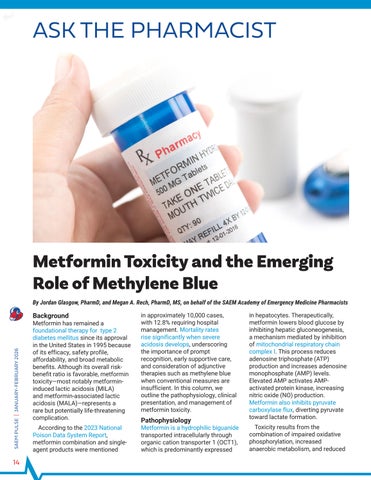
Metformin Toxicity and the Emerging Role of Methylene Blue By Jordan Glasgow, PharmD, and Megan A. Rech, PharmD, MS, on behalf of the SAEM Academy of Emergency Medicine Pharmacists
SAEM PULSE | JANUARY-FEBRUARY 2026
Background
14
Metformin has remained a foundational therapy for type 2 diabetes mellitus since its approval in the United States in 1995 because of its efficacy, safety profile, affordability, and broad metabolic benefits. Although its overall riskbenefit ratio is favorable, metformin toxicity—most notably metformininduced lactic acidosis (MILA) and metformin-associated lactic acidosis (MALA)—represents a rare but potentially life-threatening complication. According to the 2023 National Poison Data System Report, metformin combination and singleagent products were mentioned
in approximately 10,000 cases, with 12.8% requiring hospital management. Mortality rates rise significantly when severe acidosis develops, underscoring the importance of prompt recognition, early supportive care, and consideration of adjunctive therapies such as methylene blue when conventional measures are insufficient. In this column, we outline the pathophysiology, clinical presentation, and management of metformin toxicity.
Pathophysiology
Metformin is a hydrophilic biguanide transported intracellularly through organic cation transporter 1 (OCT1), which is predominantly expressed
in hepatocytes. Therapeutically, metformin lowers blood glucose by inhibiting hepatic gluconeogenesis, a mechanism mediated by inhibition of mitochondrial respiratory chain complex I. This process reduces adenosine triphosphate (ATP) production and increases adenosine monophosphate (AMP) levels. Elevated AMP activates AMPactivated protein kinase, increasing nitric oxide (NO) production. Metformin also inhibits pyruvate carboxylase flux, diverting pyruvate toward lactate formation. Toxicity results from the combination of impaired oxidative phosphorylation, increased anaerobic metabolism, and reduced
“Although promising, methylene blue remains a rescue therapy due to limited data.”
lactate clearance. Under therapeutic conditions, the body compensates by clearing excess lactate through the liver. However, in overdose or when comorbidities impair clearance, lactate production can exceed the body’s metabolic capacity. A multicenter retrospective study of 173 diabetic patients with acute kidney injury found a 26% mortality rate for MALA and approximately 7% for MILA. MILA typically followed large, acute ingestions of more than 10 g of metformin, while MALA occurred at therapeutic doses when precipitating factors—such as renal
failure or sepsis—triggered drug accumulation and worsening acidosis.
Clinical Presentation
Patients with metformin toxicity often present with nonspecific symptoms that may rapidly worsen. Early signs include nausea, vomiting, abdominal discomfort, malaise, and generalized weakness. As acidosis progresses, compensatory tachypnea may develop. Severe toxicity is characterized by hypotension and vasopressorrefractory shock due to profound metabolic derangements, impaired myocardial contractility, and reduced
catecholamine responsiveness. Altered mental status, ranging from confusion to coma, may follow. Without early intervention, multiorgan failure can occur.
Management
Management focuses on supportive care, correction of acid-base disturbances, and enhancement of drug clearance in severe cases. Because no antidote exists, the initial evaluation should prioritize airway protection, oxygenation, and
continued on Page 17
15
SAEM PULSE | JANUARY-FEBRUARY 2026
“Metformin to poses a signific because of it deterioration and
16
oxicity, although rare, cant clinical challenge ts potential for rapid d severe lactic acidosis.”
Because of metformin’s large volume of distribution and intracellular sequestration, prolonged or repeated dialysis sessions may be required.
Extracorporeal Treatments in Poisoning Workgroup Recommendations for Metformin
Recommended • Lactate > 20 mmol/L • pH ≤ 7 • Shock
ASK THE PHARMACIST continued from Page 15
hemodynamic stabilization. We advise clinicians to consult poison control or a bedside toxicology service early in the course of evaluation to optimize management. Activated charcoal has low adsorption of metformin, and may be ineffective, even with extendedrelease formulations. It may be considered if the patient presents soon after an acute ingestion, provided the airway is protected; otherwise, the risk of aspiration and subsequent acute respiratory distress syndrome is significant. Aggressive crystalloid resuscitation is essential in hypotensive patients, and vasopressors may be required for persistent shock. Sodium bicarbonate may serve as a temporizing measure in cases of severe acidemia, particularly when the pH is less than 7.2 and shock is present. Although bicarbonate does not correct the underlying mitochondrial dysfunction, it may improve hemodynamics and reduce vasopressor requirements. Renal replacement therapy (RRT) is a key component of care for severe MALA. The Extracorporeal Treatments in Poisoning Workgroup recommends hemodialysis for patients with lactate concentrations greater than 20 mmol/L, pH of 7.0 or less, refractory shock, or significant renal impairment. RRT effectively removes both metformin and lactate while correcting acidemia and supporting hemodynamics.
• Impaired kidney function • Failure of standard supportive measures
Suggested • Lactate > 15 mmol/L • pH ≤ 7.1 • Liver failure • Decreased level of consciousness
Role of Methylene Blue
Growing literature has explored methylene blue as an adjunct therapy for severe metformin toxicity, particularly in cases complicated by vasoplegic shock. Increased NO production in MALA may contribute to vasodilation and vasopressorrefractory shock. Methylene blue counters this effect by inhibiting the NO–soluble guanylate cyclase pathway. Additionally, methylene blue may support cellular respiration by acting as an alternative electron carrier, partially bypassing metformin’s inhibition of mitochondrial complex I and supporting ATP generation during severe mitochondrial stress. Evidence remains limited to case reports, but several describe notable hemodynamic improvement after methylene blue administration. For example, methylene blue improved hemodynamics in a pediatric patient who required fluids, vasopressors, sodium bicarbonate, and continuous RRT after an intentional high-dose metformin ingestion. In another case, a 45-yearold female developed cardiac arrest
after an intentional metformin overdose and required venoarterial extracorporeal membrane oxygenation and continuous RRT. After methylene blue administration, she demonstrated hemodynamic stabilization, cessation of vasopressor support, and resolution of lactic acidosis. Methylene blue is typically given at 1–2 mg/kg over 5–30 minutes. Some case reports describe infusions of 2 mg/kg per hour though evidence supporting continuous infusion is limited. Early use within the first 24 hours may improve outcomes. Clinicians must monitor for adverse effects, including serotonin syndrome, hemolytic anemia, methemoglobinemia, and tissue injury from extravasation. Although promising, methylene blue remains a rescue therapy due to limited data. Consultation with a medical or clinical toxicologist or a regional poison control center can help guide its use in severe or refractory cases.
Conclusion
Metformin toxicity, although rare, poses a significant clinical challenge because of its potential for rapid deterioration and severe lactic acidosis. Understanding the underlying pathophysiology, recognizing early signs of toxicity, and providing supportive care—including RRT—are critical for improving patient outcomes. Emerging case reports suggest methylene blue may offer benefit in refractory shock through its unique mechanism, but further research is needed to clarify its role.
ABOUT THE AUTHORS Dr. Glasgow is an emergency medicine pharmacy resident with interests in toxicology, infectious disease, and neurology.
Dr. Rech is a research health scientist and emergency medicine pharmacist and is the inaugural president of the SAEM Academy of Emergency Medicine Pharmacists.
17
DISASTER MEDICINE
Beyond Drowning: The Patients Emergency Departments See After Hurricanes
SAEM PULSE | JANUARY-FEBRUARY 2026
By Walker Plash, MD, and Ann Marie Walker, MD on behalf of the SAEM Wilderness Medicine Interest Group
18
With hurricane season in full swing, hospitals along the Gulf Coast are revisiting emergency response plans and ensuring readiness for major storms. Past disasters such as Hurricanes Katrina and Ivan have demonstrated both the massive destruction these storms can cause and the vulnerabilities in our medical infrastructure. Even wellprepared protocols can falter when unpredictability enters the equation: levees break, storm tracks shift, or mandatory evacuations are ignored. Emergency department (ED) volumes often dip just before and during a hurricane, only to surge dramatically as the storm clears and recovery begins. Physicians and hospital staff may also be
required to remain on-site for several consecutive days, with no safe way to return home. In the post-hurricane environment, power outages, infrastructure failure, and extreme heat create conditions for a wide range of emergencies. Common ED presentations include chainsaw accidents, wildlife exposures, crush injuries, burns, and a spike in carbon monoxide poisoning. Patients reliant on oxygen, dialysis, or insulin may rapidly decompensate once powerdependent therapies or refrigeration fail. These issues can escalate quickly and become life-threatening. Seasoned emergency physicians who have worked through hurricanes
emphasize several high-risk patient populations and clinical presentations that EDs should anticipate following major storms.
Submersion Injuries
Most hurricane-related deaths stem from freshwater flooding, with more than half caused by submersion from storm surge or torrential rain. The majority of victims are pronounced dead in the field after prolonged downtime. While some critically ill survivors may present to the ED, drowning will not represent the predominant patient population after a hurricane. Survivors of submersion injury should be assessed for airway, breathing, and circulation.
The mainstay of treatment is supportive care, including PEEP and supplemental oxygen.
Burns and Traumatic Injuries
Hurricanes leave behind significant debris—from downed trees to collapsed homes—and residents participating in cleanup may be inexperienced with chainsaws, heavy equipment, or hazardous conditions. As a result, EDs frequently see lacerations, crush injuries, and falls during the recovery period. Downed power lines pose electrical risks, while debris burning can lead to thermal injuries. Trauma rates may rise by up to 20% post-hurricane, and these injuries are as much as three times more likely to require admission compared with nondisaster trauma.
Wildlife-Related Injuries
Humans aren’t the only ones displaced by hurricanes. Flooding and habitat destruction often push wildlife—such as snakes and alligators, and occasionally sharks in severely flooded areas—into closer contact with people. ED presentations may include snakebites, envenomations, and, on rare occasions, alligator or shark attacks.
Carbon Monoxide Poisoning
Power outages often last days, sometimes weeks, after severe storms. Many residents rely on generators for cooling, refrigeration, or medical equipment. When used in enclosed or poorly ventilated areas, generators produce carbon monoxide (CO), an odorless and potentially deadly gas. CO binds hemoglobin with high affinity, displacing oxygen and impairing tissue oxygenation. Every patient presenting with altered mental status after a hurricane should be screened for generator use, and CO-oximetry should be strongly considered.
Oxygen Supply Shortages
Patients dependent on home oxygen often struggle to evacuate due to the logistics of transporting equipment. Ideally, they maintain backup supplies, but hurricanes can shift course with little warning, leaving
“In the post-hurricane environment, power outages, infrastructure failure, and extreme heat create conditions for a wide range of emergencies.”
limited preparation time. Oxygen concentrators fail without power, and tank deliveries may be delayed due to road closures or supply shortages. This vulnerable group often presents to the ED once outages become prolonged.
Teams—including physicians, nurses, environmental services, and dietary staff—arrive before landfall and remain on-site until it is safe for relief crews to travel, sometimes for several days. Everyone plays a critical role in maintaining continuity of care.
Dialysis Interruptions
Emergency physicians must be prepared for extended shifts, limited resources, and complex patient presentations. Humanitarian groups, such as the International Medical Corps, also mobilize, but frontline ED providers remain the cornerstone of the response.
For patients reliant on dialysis, hurricanes can create life-threatening barriers. Dialysis centers may shut down due to power loss or contaminated water, and even if operational, patients may be unable to reach them because of flooding or debris. Without timely treatment, these patients risk fluid overload and electrolyte imbalances. Some facilities coordinate alternate treatments in unaffected regions, but many patients cannot travel the required distances. Hospitals and EMS frequently become the last line of support, though both are typically overstretched after a storm.
Whether practicing in hurricaneprone regions, serving on disasterresponse teams, or preparing for the unexpected, emergency physicians must anticipate the unique clinical and logistical challenges these storms bring. Building hurricane-specific protocols and staying current in disaster medicine ensures readiness when it matters most.
Refrigerated Insulin Loss
While some insulin formulations remain stable at room temperature, many require refrigeration. Extended power outages place patients at risk of spoiled insulin, and pharmacy closures or supply disruptions further complicate diabetes management. EDs often see increased cases of diabetic ketoacidosis (DKA) and hyperosmolar hyperglycemic state (HHS) in the aftermath.
Conclusion
Hospitals maintain overarching emergency plans to prepare for hurricanes, often adopting “A and B” staffing models with 12-hour shifts.
ABOUT THE AUTHORS Dr. Plash is an associate professor in the University of South Alabama Department of Emergency Medicine, where he serves as the residency program director and associate director of wilderness medicine. Dr. Walker is a postgraduate year 3 emergency medicine resident at the University of South Alabama.
19
EDUCATION & TRAINING
Strengthening Resilience Through Education: Lessons From the Champions for Change Program By Lily Sloan; Marta A.W. Rowh, MD, PhD, MPH; and Madi Lindauer, MD, MPH, on behalf of the SAEM Academy for Women in Academic Emergency Medicine
SAEM PULSE | JANUARY-FEBRUARY 2026
Understanding the Challenge
20
Burnout among medical students often begins long before residency— rooted not only in workload but also in the constant pressure to master new topics and keep pace with the expanding knowledge demands of medicine. Few areas reveal this tension more clearly than reproductive healthcare. Reproductive health education continues to evolve, and the scope and consistency of related teaching vary widely across medical schools. A 2024 study reported that only onequarter of U.S. allopathic programs included a dedicated abortionfocused lecture in their preclinical
curriculum. A 2025 national survey of 101 U.S. medical schools found preclinical coverage rates of 63.4% for abortion, 82.2% for contraception, 52.5% for options counseling, and 47.5% for values clarification. These clinical scenarios often arise during rotations in emergency medicine, family medicine, or obstetrics and gynecology, where students apply new knowledge in fast-paced, team-based environments. When learners face these complex moments without consistent preparation, the emotional weight can contribute to feelings of uncertainty, helplessness, and early signs of burnout.
A Program Designed for Change
The Champions for Change (CoC) program was launched in 2025 as one way to turn these challenges into opportunities for growth. Created by emergency physicians in collaboration with a medical student advisory board, CoC integrates clinical learning, community building, and systems-level thinking into a unified framework that empowers learners to identify gaps and design practical improvements within their own institutions. What began as a series of discussions about clinical preparedness has grown into a national community focused
“Reproductive health education continues to evolve, and the scope and consistency of related teaching vary widely across United States medical schools.”
medication abortion, contraception, and ectopic pregnancy—all integral to emergency medicine practice. Each video features presentations by expert faculty on clinical management, medication mechanisms of action, and appropriate use in emergency care. Yet the program goes beyond content. Its core innovation is reframing advocacy as changemaking—equipping students not just to recognize barriers but to work collaboratively toward solutions through mentorship, reflection, and teamwork. Students are encouraged to examine how these topics appear in their own clinical environments and to identify opportunities for growth or improvement within their emergency departments.
Early Impact and Learner Experience on changemaking, reflection, and resilience. More than 175 students across the U.S. have participated in the program’s virtual curriculum. The CoC curriculum is delivered through a videobased learning series that covers foundational reproductive healthcare topics—such as early pregnancy loss,
Preliminary data from the CoC curriculum review showed a statistically significant decrease in participants’ reported personal burnout. Students cited a sense of community, shared purpose, and actionable skill-building as key contributors to their resilience. The transition from student to physician demands more than
“Programs like Champions for Change remind us that community and mentorship are powerful tools against burnout.”
clinical competence; it requires the ability to find meaning and stability in uncertainty. Learning to navigate complex systems, communicate effectively, and maintain perspective amid moral and emotional challenges equips trainees with skills that extend far beyond any single patient encounter.
Building a Supportive Learning Environment
Programs like Champions for Change remind us that community and mentorship are powerful tools against burnout. By creating spaces where learners feel supported and empowered to improve the systems around them, we can prepare the next generation of physicians to deliver compassionate, equitable care—and to sustain themselves while doing so.
ABOUT THE AUTHORS Lily Sloan is a fourth-year medical student at Oregon Health & Science University pursuing a career in emergency medicine.
Dr. Rowh is an assistant professor of emergency medicine and the Healthcare Excellence through Applied Advocacy and Leadership curriculum thread director at Emory University School of Medicine. Dr. Lindauer is an assistant professor of emergency medicine at Emory University Hospital.
21
EDUCATION & TRAINING
Transforming Resident Education Through an Anti-Racist Social Emergency Medicine Curriculum SAEM PULSE | JANUARY-FEBRUARY 2026
By Fahad Ali, MD; Gianna Petrone, MD; Denise Marte, MD; Ambuj Suri, MD; and Almaz Dessie, MD
22
One of the greatest privileges of practicing emergency medicine is that the door is always open. However, this also means emergency physicians care for a disproportionate number of patients whose lives are shaped by structural drivers of health.
environments. Physicians from minoritized racial and ethnic backgrounds frequently describe feelings of isolation or being overlooked and cultural mismatch between learners and institutions has been shown to negatively affect learning and retention.
Historically, there has been limited formal education in emergency medicine on caring for marginalized groups. When such education is provided, trainees of color and other marginalized groups often report experiencing unwelcome
At Brown Emergency Medicine, we recognized these gaps and developed a Social Emergency Medicine curriculum for our residency program. This approach has helped foster a more inclusive, respectful, and engaging learning
environment, particularly when addressing important but sensitive social emergency medicine topics. Our curriculum, Striving for Equity in Emergency Medicine, or SEEM, is designed to help learners: (1) reflect on their identities as providers; (2) understand their role within larger structures that drive inequity in the health care system; and (3) develop familiarity with the social needs and resources of the communities they serve. Each 90- to 120-minute session combines self-reflection with practical knowledge about
“We intentionally prioritize the voices of people who are true experts through their lived experience.”
local resources. Topics include homelessness, substance use, incarceration, immigration, and LGBTQ health. What makes SEEM unique is its foundation in anti-racist pedagogy, intentionally designed to create an inclusive and supportive learning environment. Each session incorporates four core tenets that guide discussion and ensure a thoughtful, consistent approach to
these important and often challenging subjects.
Bring in Diverse Speakers
We intentionally prioritize the voices of people who are true experts through their lived experience. For example, we have welcomed formerly incarcerated individuals, a refugee activist who founded a local resettlement organization, and patients experiencing homelessness to share their stories. Faculty with
topic expertise may assist with a session but rarely lead it, allowing the focus to remain on the voices of those most impacted. The value of lived experience is profound and consistently cited by residents as one of the most meaningful aspects of the curriculum. These sessions provide key teaching points and practice-changing insights continued on Page 25
23
24
SAEM PULSE | JANUARY-FEBRUARY 2026
EDUCATION & TRAINING continued from Page 23
while cultivating empathy and a deeper understanding of the structural barriers patients face. Learners routinely leave with a renewed sense of connection to their community and a stronger commitment to delivering equitable, compassionate care.
Incorporate Small-Group Activities This is one of our non-negotiables. Traditional classroom settings can be challenging for marginalized learners, who may feel excluded or unsafe and therefore less likely to participate. To counter this, the curriculum applies principles of anti-racist pedagogy by minimizing lecture time and prioritizing self-reflection and smallgroup discussion. This format fosters inclusion, encourages participation, and values each person’s contribution, regardless of expertise. We believe this approach supports marginalized learners and enriches the learning experience for everyone.
We structure sessions so learners break into pairs or small groups of two to four, creating a more comfortable environment for participation without putting individuals on the spot. This format has been especially well received. For example, during our session on human trafficking, learners first received a brief overview of risk factors and warning signs, then worked through case scenarios in small groups. This approach allows them to immediately apply knowledge in a collaborative, practical setting while still asking questions.
Involve Learners in Development
Anti-racist pedagogy builds on the principles of a flipped classroom, emphasizing that learners are more engaged when their perspectives are incorporated into the discussion. Our residency program benefits from having a chief resident of health equity who serves on the SEEM curriculum committee, providing feedback and resident insight. We also invite residents with expertise or strong interest to collaborate on sessions. For example, two residents with disabilities helped curate a deeply meaningful program on caring for patients with disabilities. We collect feedback through comprehensive, anonymous surveys at the conclusion of each session and through an annual review at the end of the academic year. This process ensures the curriculum remains responsive to learner needs.
Build Your Curriculum to Be Everywhere
We strive to extend elements of this curriculum beyond the dedicated social emergency medicine didactic sessions. Instead, we aim to build a culture that incorporates principles of health equity throughout all aspects of resident education. These principles are relevant to every facet of clinical responsibility in emergency medicine. Examples include simulation sessions for working with patients with limited English proficiency, a health equity– focused journal club, and structuring Morbidity and Mortality conference to highlight how bias may influence care.
residents and faculty, who have described it as “important,” “powerful,” and “a breath of fresh air.” We have now completed the full two-year curriculum and begun a second cycle, enhanced with resident feedback on the topics they most want and need to better understand. The curriculum is intentionally iterative, evolving alongside the needs of our patients in Rhode Island. New themes, such as climate change and advocacy, have been incorporated into this second cycle. The most rewarding part of implementing this curriculum has been witnessing the clinical impact as residents advocate for their patients and go the extra mile to treat the whole person, not just the chief complaint.
ABOUT THE AUTHORS Dr. Ali is an assistant professor at Brown Emergency Medicine.
Dr. Petrone is an assistant professor at Brown Emergency Medicine.
Dr. Marte is an assistant professor at Brown Emergency Medicine.
This curriculum has been met with enthusiasm and appreciation from Dr. Suri is a resident at Brown Emergency Medicine.
“This format fosters inclusion, encourages participation, and values each person’s contribution, regardless of expertise.”
Dr. Dessie is an associate professor at Brown Emergency Medicine.
25
EDUCATION & TRAINING
Early Exposure to Emergency Medicine Through an Undergraduate VolunteerLed Falls-Risk Reduction Program SAEM PULSE | JANUARY-FEBRUARY 2026
By Anita Goel, MD; Taran Ghuman; Lesika Pajany; and Dataar Ghuman
26
Introduction: Early Exposure as a Response to EM Workforce Challenges
Emergency medicine (EM) has faced notable challenges in residency recruitment over the past several years. In 2023, the specialty experienced a historic low, with only 81.8% of positions filled and more than 550 slots left vacant nationwide. Although fill rates improved in 2024 (95.5%) and 2025 (97.9%), these fluctuations highlight
ongoing concerns about sustaining interest in the field and underscore the importance of strengthening the pipeline of future emergency physicians. Early, structured exposure to EM is increasingly viewed as a key strategy to sustain interest in the specialty and prepare students for its unique demands. At UC Health in Cincinnati, a novel volunteer-led FallsRisk Reduction (FRR) Program addresses this need by embedding
undergraduates directly into the emergency department. Created by undergraduate students for undergraduate students, the program simultaneously enhances patient safety through fall-prevention measures while providing volunteers with authentic clinical experiences. These experiences introduce participants to the pace, teamwork, and patient-centered ethos of EM. This dual focus on operational improvement and learner development makes the initiative
“Early, structured exposure to emergency medicine is increasingly viewed as a key strategy to sustain interest in the specialty and prepare students for its unique demands.” a compelling model for integrating education and patient care in support of the EM workforce.
Educational Impact for Learners: Early Exposure to EM in Action With more than 2,500 volunteer hours logged since its launch earlier this year, the FRR Program offers undergraduates a rare opportunity to engage directly with emergency medicine. In contrast to traditional volunteer roles focused on supply
stocking or clerical support, this program embeds students in the clinical workflow, giving them a front-row view of patient care, safety protocols, and interdisciplinary teamwork. Key educational benefits include: • Bedside experience in a high-acuity setting: Volunteers distribute nonslip socks, apply fall-risk identification bands, and assist with mobility and comfort measures—tasks that
build clinical intuition and reinforce patient-centered care. • Exposure to systems-based practice: Participants observe how nurses triage competing demands, how physicians prioritize interventions, and how operational details, such as bed-rail positioning, affect patient safety.
continued on Page 29
27
28
SAEM PULSE | JANUARY-FEBRUARY 2026
EDUCATION & TRAINING continued from Page 27
• Development of core EM competencies: Volunteers cultivate adaptability, empathy, and communication skills while navigating the fast-paced, emotionally charged emergency department environment. • Career influence and confidencebuilding: Initial survey data show that 87.5% of participants agreed or strongly agreed that the experience improved their understanding of EM, and 75% reported it was likely or very likely to influence their decision to pursue medicine, with an interest in emergency medicine. Student reflections underscore the program’s impact: “This experience strengthened my commitment to pursuing medicine and deepened my understanding of teamwork, safety, and attention to detail in clinical care.” “I gained a better understanding of the inner workings of emergency medicine, all of which will strengthen my medical school application.” “Volunteering taught me that by showing genuine care through our actions, we can build strong, trusting relationships between staff and patients.”
Operational Outcomes and Patient Experience: Safety Through Service
While the program’s educational value is clear, its operational contributions are equally significant. During periods of high patient volumes and prolonged boarding in emergency departments nationwide, volunteers can help offload routine safety tasks from nurses, allowing clinical teams to focus on acute care while ensuring vulnerable patients receive consistent attention. Operational highlights include: • Fall prevention through proactive rounding: Volunteers conduct room safety checks, confirm call-light accessibility, and ensure mobility aids are within reach, reducing risk among patients prone to injury. • Enhanced patient reassurance and comfort: Volunteers offer companionship and support to patients who may be disoriented, anxious, or lonely during extended emergency department stays. • Improved staff workflow and morale: By managing nonclinical but safety-critical tasks, volunteers reinforce the department’s safety culture and foster a sense of shared responsibility.
Take-Home Message
The FRR Program demonstrates how
“The Falls-Risk Reduction Program demonstrates how thoughtfully structured volunteer roles can serve as a gateway to emergency medicine by embedding learners in the clinical workflow and assigning them meaningful, safety-focused responsibilities.”
thoughtfully structured volunteer roles can serve as a gateway to emergency medicine. By embedding learners in the clinical workflow and assigning them meaningful, safety-focused responsibilities, the program cultivates future clinicians while simultaneously enhancing patient care. It offers a replicable model for institutions seeking to align educational innovation with operational excellence. Looking ahead, program leaders plan to formally track the initiative’s influence on EM interest and career trajectories among participants, including its impact on specialty choice at the affiliated medical school. Expansion efforts are also underway to include medical student volunteers, creating targeted opportunities for learners closer to residency decisionmaking to engage with emergency medicine through patient safety, systems-based practice, and frontline care.
ABOUT THE AUTHORS r. Goel is an associate D professor of emergency medicine at the University of Cincinnati. She directs longitudinal programs for medical students interested in emergency medicine and leads a section of the Transitions to Residency course. Taran Ghuman is a first-year medical student at the University of Cincinnati with an early interest in emergency medicine.
Lesika Pajany is a graduate student in biostatistics at the University of Cincinnati.
Dataar Ghuman is a high school senior at Walnut Hills High School in Cincinnati with an early interest in a career in medicine.
29
EMERGENCY MEDICAL SERVICES
Bridging the Gap After Overdose: How Emergency Medical Services Are Advancing Opioid Use Disorder Care By Margaret Hayslip, MD
SAEM PULSE | JANUARY-FEBRUARY 2026
The Ongoing Burden of OpioidRelated Harm
30
Over the last several years, more emergency medical services (EMS) systems across the country have begun initiating treatment for opioid use disorder (OUD) with buprenorphine in the field. Despite improvements in medical providers’ prescribing of opioid analgesics — opioid prescriptions dispensed in the United States declined from 46.8 per 100 persons in 2019 to 37.5 per 100 persons in 2023 — burden of opioidrelated harm remains substantial. In April 2024, the United States recorded an estimated 100,049 overdose deaths. By April 2025,
that figure had declined to 73,690, representing a 24.5 % reduction. Synthetic opioids such as fentanyl remain the primary drivers of mortality, and individuals who survive a nonfatal overdose face an extremely elevated risk of death within the following year.
Opportunities for EMS Intervention
Paramedics and emergency medical technicians have a unique opportunity to intervene at a critical point in the trajectory of OUD. Many of the patients they treat — particularly those whose overdoses are reversed with naloxone — subsequently decline transport to the
emergency department. This leaves a gap in linkage to treatment and harm-reduction services. National EMS data indicate that about 12.4 % of nonfatal opioid overdose events resulting in EMS contact end with nontransport. Additional studies have reported refusal rates of almost 40% in some jurisdictions.
Emerging Models of Prehospital Buprenorphine EMS agencies have adopted several approaches to address this challenge: • Initiation after naloxone reversal: Buprenorphine is administered when the patient enters acute withdrawal following reversal.
“Buprenorphine is a partial opioid agonist with a favorable safety profile, a ceiling effect that reduces the risk of respiratory depression, and rapid onset of withdrawal relief.”
• Initiation when stabilized: The medication is started once the patient is no longer intoxicated and before withdrawal begins, allowing earlier engagement without the physiologic stress of acute withdrawal. • Referral and follow-up models: Overdose reversal serves as a gateway to referral programs or community paramedicine visits in the days or weeks that follow. A study published in April 2025 reviewed prehospital buprenorphine protocols and identified 42 state or regional protocols. Initial dosing ranged from 4 mg to 24 mg, with a median initial dose of 16 mg. Total doses typically had a median of 24 mg, and maximum dosing ranged from 8 mg to 48 mg. About 19% of protocols limited treatment to mobile integrated health or paramedicine programs; approximately 52.4% permitted initiation via standing order, and about 26.2% required physician authorization. Notably, more permissive inclusion criteria were associated with higher rates of linkage to ongoing care after field initiation.
Advantages of Prehospital Initiation
Buprenorphine is a partial opioid agonist with a favorable safety profile, a ceiling effect that reduces the risk of respiratory depression, and rapid onset of withdrawal relief. These characteristics make it well suited for administration by paramedics in the field. Initiating treatment immediately after overdose — a moment of heightened vulnerability but also increased readiness for change — allows EMS providers to reach individuals who might otherwise
remain disconnected from the health care system.
National Trends in Buprenorphine Access
While opioid prescribing has declined, the national buprenorphine dispensing rate remained relatively stable from 2019 to 2023; in 2023 the rate was 4.7 buprenorphine prescriptions per 100 persons. The removal of the DATA-waiver requirement in December 2022 expanded access by allowing all Drug Enforcement Administrationregistered practitioners to prescribe buprenorphine. However, studies to date have not shown significant increases in prescribing.
A Critical Opportunity to Improve Outcomes Prehospital buprenorphine initiation reflects a paradigm shift in the management of OUD. EMS providers frequently encounter individuals at their greatest risk of death, many of whom refuse transport and decline
engagement with treatment. By initiating medication for OUD at the moment of overdose reversal, EMS agencies can strengthen the link between emergency response and long-term recovery, reduce the likelihood of recurrent overdose, and open a pathway to evidence-based care. Given that overdose deaths remain high, initiating treatment in the field offers a critical opportunity to save lives and improve continuity between emergency care and communitybased recovery services.
ABOUT THE AUTHOR Dr. Hayslip is a Carolinas Medical Center emergency medicine resident committed to advancing health equity through compassionate care, community engagement, and advocacy.
31
FACULTY DEVELOPMENT
Integrating Artificial Intelligence Into Academic Emergency Medicine
SAEM PULSE | JANUARY-FEBRUARY 2026
By Bret A Nicks, MD, MHA; Justin Myers, DO, MPH; and Tim Palmieri, MD, on behalf of the SAEM Faculty Development Committee
32
Artificial intelligence (AI) is already reshaping emergency care, from triage and documentation to bedside teaching and scholarship. For academic emergency medicine (AEM), the real opportunity is not adopting new tools for their own sake, but integrating AI to strengthen how we educate, discover, disseminate, and deliver care.
Teaching Learners: From Static Content to Adaptive Mentorship
AI can personalize on-shift learning, simulation, and academic activities. Large language models (LLMs) can generate tiered teaching scripts, critique differential diagnoses, and produce tailored practice questions
aligned to individual gaps. Early evidence suggests LLMs can perform competitively on EMrelevant tasks: GPT-4 achieved higher diagnostic accuracy than emergency medicine residents in a prospective comparison, underscoring its value as a “second reader”—not as a replacement, but as a sparring partner that accelerates feedback cycles.
LLM-assisted scenario design and interactive simulations that trainees perceive as beneficial for clinical decision-making and communication practice. AEM Education & Training has begun exploring AI’s role in assessment and academic processes, including studies of LLM analysis of SLOEs ensuring to support fairer, more consistent evaluations.
AI can also be a force multiplier for faculty preparing lectures, slides, and other teaching materials.
Bedside Learning/Clinical Decision Support: Evidence at Your Fingertips
In simulation and skills training, AI can co-create realistic cases and debrief checklists. Controlled studies and case reports describe
At the bedside, AI can condense charts, surface decision rules, translate discharge instructions, and streamline documentation.
“Artificial intelligence can help clinicians think more clearly, teach more effectively, and study more rigorously.”
Reviews in the emergency medicine literature summarize emerging use cases such as AI-assisted triage, real-time deterioration prediction, ambient documentation tools, and rapid extraction of unstructured data for coding, quality improvement, and research. Point-of-care systems such as OpenEvidence demonstrate how LLM fluency can pair with curated primary literature to answer clinical questions. AI-assisted medical note generation through ambient systems has been shown to reduce burnout, cognitive task load, and time spent documenting—creating more opportunities for meaningful work such as patient interaction
and bedside teaching. While this technology may disrupt traditional scribe roles, it may also enhance efficiency and cost savings. Critically, bedside AI is not just about speed; it is about equity and reliability. Annals of Emergency Medicine has highlighted both the promise and the pitfalls of implementation, emphasizing that deployment choices determine whether AI narrows or widens disparities. Early work on outcomesdriven decision support aims to improve fairness in triage decisionmaking, illustrating how thoughtfully built models can promote more equitable care.
Academic Dissemination: From Manuscript to Multipliers
AI can streamline how insights become impact. It can serve as a drafting aid and abstracting tool for clinician-educators, assist with literature mapping and citation checking, and help synthesize evidence. Editorials in Annals of Emergency Medicine and Academic Emergency Medicine (AEM) argue that academic leaders should balance productivity gains with maintaining trustworthy translation of medical evidence. AEM’s recent focus on diagnostic error included a special
continued on Page 35
33
SAEM PULSE | JANUARY-FEBRUARY 2026
“Deployment choices de
34
etermine whether artificial intelligence narrows or widens disparities.” FACULTY DEVELOPMENT continued from Page 33
contribution on AI’s potential role, signaling that the conversation has moved from hype to implementation science and governance.
Research Transformation: Better Questions, Cleaner Data, Faster Cycles AI accelerates research across the entire lifecycle:
• Problem selection and design: Automated scans of event logs and triage notes can reveal hidden failure modes worth studying, such as low-signal deterioration patterns. • Data curation: Natural language processing unlocks notes, imaging reports, and ECG text for multicenter datasets without months of manual abstraction. • Analysis and inference: Hybrid predictive and causal models can test how operational changes or clinical bundles influence outcomes. • Trial operations: Screening, eligibility checks, and follow-up messaging can be AI-assisted to reduce time to enrollment. AEM’s synthesis on AI and diagnostic error outlines the research agenda: measure harm, design human-AI workflows that lower cognitive load, and prospectively evaluate models with equity endpoints. AI is already being tested for ED prognostics and treatment decisions.
Triage and Operations: Evidence Beyond the Buzz The triage desk is a proving ground for AI. Early literature reports that machine-learning and LLM-based systems can enhance prioritization and reduce mis-triage, while emphasizing that prospective validation remains essential. Early studies show GPT-4 and similar
models performing strongly on Emergency Severity Index categorization tasks, suggesting LLMs may complement nurse triage rather than replace it.
Practical Guardrails for Academic Leaders 1. Start with efforts that help people, not dashboards. Documentation support, evidence retrieval, and triage quality assurance deliver immediate value and measurable outcomes.
2. Insist on transparent, audited models. Follow reporting standards and build bias and drift monitoring. Editorials in Annals emphasize implementation and equity as the make-or-break variables. 3. Teach AI literacy as a clinical skill. Studies comparing LLMs with residents and faculty underline a new competency: knowing when and how to consult AI, interpret its claims, and document its role. Integrate AI debriefs into simulation, chart reviews, and morbidity and mortality conferences. 4. Measure what matters. Move beyond offline metrics to patientcentered outcomes, throughput, and equity indicators. AEM’s diagnosticerror framework offers a model. 5. Assess impact on professional well-being. Consider how AI can support the academic mission across clinical practice, teaching, and research.
Getting Started This Year: A Simple Playbook
• Bedside evidence: Pilot an onshift evidence assistant and track uptake, time to answer, and ordering changes. (OpenEvidence) • Education: Embed LLM co-pilots into morning reports and simulations; assess diagnostic reasoning and communication outcomes. Use pedagogical frameworks to guide
LLM-generated outlines, slides, or curricula. • Research: Build a natural language processing abstraction pipeline for a high-volume topic, such as chest pain, integrated with clinical decision support. Streamline manuscript development with AIsupported reference generation. • Clinical operations: Partner with nursing to test AI-assisted triage review, including ambient models, and prospectively measure safety, equity, and patient flow. EM thrives where information is incomplete and stakes are high. That is exactly where AI can help clinicians think more clearly, teach more effectively, and study more rigorously. The literature is no longer speculative—Annals and AEM outline a roadmap. By integrating AI’s speed with EM’s values of teamwork, equity, and pragmatism, academic emergency medicine can become not only more efficient, but also more humane and just. That is a future worth building, shift by shift.
ABOUT THE AUTHORS Dr. Nicks is a professor and executive vice chair of emergency medicine at Wake Forest University School of Medicine and Atrium Health Wake Forest Baptist Medical Center. Dr. Myers is an associate professor of emergency medicine at the University of North Carolina in Chapel Hill and director of faculty education and the global emergency medicine fellowship. Dr. Palmieri is an associate professor of emergency medicine at Albany Medical College, associate program director for the residency program, and associate course director for the college's course in evidence-based healthcare.
35
FACULTY DEVELOPMENT
SAEM PULSE | JANUARY-FEBRUARY 2026
Preserving the Human Voice: Ethical and Effective Use of Artificial Intelligence in Letter Writing
36
By David Barnes, MD; Rob Cooney, MD, MS; Deborah Diercks, MD, MSc; David Leon, MD; Julie McCausland, MD, MS; Jim Miner, MD; and Kabir Yadav, MD, MS, MSHS, on behalf of the SAEM Faculty Development Committee As we think about weaving artificial intelligence into academic letter writing, the familiar ethical pillars of medicine still apply: beneficence, nonmaleficence, respect for autonomy, and justice. The challenge isn’t whether these principles matter, but how they play out when the “writer” on our team is an algorithm. For students and applicants, autonomy and transparency are
paramount. If AI contributes to their letters, should they know? Many argue yes. Letters often include personal and sensitive details, and most public AI platforms store or learn from whatever is entered. Without safeguards, uploading an evaluation paragraph into a chatbot could mean a learner’s private information becomes part of a training dataset. That kind of
unintentional data sharing risks both privacy and trust. For educators, the core concern is integrity. A thoughtfully crafted letter of recommendation (LOR) conveys authenticity and judgment. While large language models (LLMs) can reduce bias or clean up clunky phrasing, they can also generate polished but generic text—and, at worst, fabricate details not
“Artificial intelligence can ease the burden of letter-writing season, reduce biased language, and help with structure, but it can also erode the qualities that give a letter weight: a mentor’s voice, a genuine story, or a specific anecdote that conveys impact.” provided by the writer. This is why many recommend an “AI-as-editor” approach: use the tool to refine human-written content, not replace it. For institutions, justice and accountability come into play. Without clear policies, faculty are left to improvise on questions of disclosure, data security, and responsible use. Efforts like the Transparent Reporting of Ethics for Generative AI (TREGAI) checklist offer a roadmap, emphasizing privacy, equity, transparency, and trust. While the checklist was developed for publications, the principles translate well to letters: AI should support the process, not undermine fairness or reliability.
Risks and Limitations of LLMs for Letters of Recommendation
Even with the best intentions, AI brings real risks to letter writing. These include: • Formulaic output: LLMs often produce grammatically correct but generic language. Without careful human editing, letters may sound like templates rather than unique endorsements of an applicant’s strengths. • Hallucinations and inaccuracies: These tools can “make things up” with confidence—fabricated accomplishments, quotes, or citations. In the context of a promotion or residency application,
even a small invented detail can harm credibility. • Confidentiality concerns: Letters contain sensitive professional and sometimes personal information. Public-facing models may not meet institutional privacy standards. Entering identifiable details into an unverified system could expose protected information. • Bias: Because LLMs are trained on massive datasets, they may reflect embedded societal biases. Gendered descriptors, racial stereotypes, or inequitable assumptions may appear subtly in generated text, reinforcing continued on Page 38
37
FACULTY DEVELOPMENT continued from Page 37
disparities rather than reducing them. The tension is between efficiency and authenticity. AI can ease the burden of letter-writing season, reduce biased language, and help with structure. But it can also erode the qualities that give a letter weight: a mentor’s voice, a genuine story, or a specific anecdote that conveys impact. If we embrace AI uncritically, letters risk losing their human touch. If we ignore it altogether, we may miss opportunities to make the process fairer and more sustainable. The task ahead is to strike a balance— leveraging efficiency without sacrificing the qualities that make letters meaningful.
Recommendations for EM Faculty: Practical Do’s and Don’ts
SAEM PULSE | JANUARY-FEBRUARY 2026
1. Choose your tool and learn it well LLMs such as ChatGPT, Claude, and Gemini offer similar functionality, but subtle differences in how they interpret prompts or maintain tone can affect outcomes. By selecting one platform and learning its strengths and limitations, faculty can improve efficiency. Keeping reusable prompts for common tasks—such as summarizing feedback or revising tone—can also speed up future letters.
38
2. Use institution-approved, privacysafe models Data privacy is critical. Many publicfacing LLMs store inputs or lack encryption, which risks exposing sensitive evaluation content. Faculty should use institution-approved
Read More, Lea
• I mplications of Large Language Mod
• Using Generative Artificial Intelligenc
• A Scoping Review of Artificial Intellig
•C omparing Letters Written by Human
enterprise tools, such as Microsoft 365 Copilot, that keep data within secure environments and offer governance, data handling protections, and auditability. 3. Retain your voice and tell the story Even the most eloquent AI cannot replicate your personal experience with an applicant. Use an LLM to help structure thoughts, but ensure the final product reflects your authentic voice—especially when sharing anecdotes or assessments that highlight specific moments of growth, leadership, or clinical impact. A meaningful letter hinges on credibility and warmth. 4. Use AI to reduce bias, not reinforce it LLMs can help flag or rewrite biased language, such as gendered descriptors or assumptions about effort versus achievement. Faculty can also try anonymized prompting— removing identifiers like names, race, or gender—to see whether tone or emphasis shifts. Iterative editing can reduce implicit bias and promote equity. 5. Avoid over-reliance on first drafts AI-generated drafts can provide helpful scaffolding but should never be submitted without close human review. Drafts may include generic phrasing, unsupported claims, or subtle inaccuracies. A “human-inthe-loop” model—where AI drafts or refines portions and the educator critically revises—helps maintain accuracy and authenticity. 6. Ask for help and share what works LLMs are evolving rapidly, and institutional policies are evolving with them. Faculty should connect with IT support, digital innovation leads, or
departmental “superusers” to learn what tools are approved and what practices are recommended. Sharing effective prompts or cautionary experiences in faculty development sessions can accelerate responsible adoption.
Looking Ahead: New Rules for an Old Genre
The use of AI, and LLMs in particular, in the LOR and standardized letter of evaluation (SLOE) process is emerging as both an opportunity and a challenge for emergency medicine educators. Faculty increasingly turn to these tools to manage rising volumes of letter requests, improve efficiency, minimize biased language, and ensure consistency. But significant ethical, practical, and professional concerns remain. AI-generated drafts can lack authenticity, risk data privacy breaches, confabulate details, or perpetuate inequities if not carefully reviewed. While AI can streamline drafting and standardize tone and structure, it cannot replace a mentor’s voice, tone, or personal anecdotes that make a letter genuine. For faculty, the path forward requires cautious adoption of approved tools, clear institutional guidance, transparency when using AI, and a commitment to ensuring that AI serves as an adjunct—not a replacement—for human authorship. This evolving landscape underscores the need for formal professional standards from organizations such as the American Medical Association (AMA), Association of American Medical Colleges (AAMC), and Society for Academic Emergency Medicine (SAEM) to guide ethical, equitable,
arn More
dels for Clinical Practice: Ethical Analysis Through the Principlism Framework
ce When Writing Letters of Recommendation
gence in Medical Education: BEME Guide No. 84
and effective AI use in letter writing. LLM use will continue to grow, and educators now have an opportunity to shape guidelines that safeguard integrity, equity, and the human connection essential to LORs and SLOEs.
ABOUT THE AUTHORS Dr. Cooney is associate professor of emergency medicine and associate dean, faculty development, at Geisinger College of Health Sciences.
r. Barnes is health sciences D clinical professor of emergency medicine at UC Davis Health and serves as physician advisor, emergency department operations team member, and director of emergency medicine faculty development, alumni relations, and sustainability. Dr. Diercks is professor and chair of the Department of Emergency Medicine at UT Southwestern Medical Center and holds the Audre and Bernard Rapoport Distinguished Chair in Clinical Care and Research. Dr. Leon is health sciences assistant clinical professor with dual appointments in emergency medicine and anesthesiology at UC Davis.
Dr. McCausland is associate professor of emergency medicine and medicine at the University of Pittsburgh School of Medicine and attends in the Emergency Department at UPMC. Dr. Miner is professor of emergency medicine at the University of Minnesota Medical School and chief of emergency medicine at Hennepin Healthcare.
Dr. Yadav is vice chair for research and academic affairs and professor of emergency medicine at Harbor-UCLA Medical Center and is also on faculty at UCLA.
ns and ChatGPT: A Preliminary Study
39
FACULTY DEVELOPMENT
Level Up: EM Women on the Rise By Elizabeth Leenellett, MD, on behalf of the Academy for Women in Academic Emergency Medicine
SAEM PULSE | JANUARY-FEBRUARY 2026
The following was presented at the inaugural Grand Rounds of the Academy for Women in Academic Emergency Medicine (AWAEM).
40
In emergency medicine, we pride ourselves on rapid decisionmaking, resilience, and rising to the challenge. But when it comes to advancing women in academic leadership, progress has been far too slow. Despite decades of awareness, fewer than one in three women faculty reach the rank of associate or full professor--- a number that has remained stubbornly unchanged since 2015.
Why the Stagnation?
Part of the answer lies in longevity. Women in emergency medicine tend to leave the field nearly a decade earlier than men, and leadership roles often correlate with experience.
If we want to change the trajectory, we need to act with intention now. The strategies and messages outlined here are applicable to everyone, regardless of gender or career stage. Whether you’re just starting out, navigating a transition, or considering your next chapter, these insights are designed to help you stay longer, grow faster, and lead boldly.
“Faculty development is not a one-time task; it is an ongoing process of growth and alignment.”
Identify Your Core Values
Your values are your compass. They guide decisions, clarify purpose, and help keep you aligned when the path gets rocky. Taking time to reflect on what truly matters can be transformative at any stage of your career. Ask yourself: • What energizes me? • What do I want my legacy to be?
• What do I stand up for, even when it’s hard?
Join an Action Group
Networking doesn’t have to feel transactional. Think of it as building your “Huntrix ” — a community
“Learning to speak confidently about your accomplishments is not arrogance; it is owning your impact.”
that strengthens and sustains you. Joining a committee, such as SAEM’s research or didactics committees, bolsters your CV, supports promotion, and can significantly expand your academic output through collaborative publications and presentations. • Recruitment committee: Promote fair and transparent hiring practices through open job postings, standardized role-based packages, and structured interview rubrics. • Promotions committee: Learn what strengthens a CV, recognize colleagues’ accomplishments, and openly share promotion criteria. Track years in rank to identify those ready for advancement. • Wellness committee: Advocate for open communication, parental leave policies, lactation accommodations, and fairness in scheduling and workload. • Hospital committees: Participate in credentials committees to review new staff for quality and equity. Serve on medical executive committees to help shape clinical priorities — or consider becoming
chief of staff to drive meaningful change. Leadership starts by showing up and speaking up. Let your interests guide you toward regional, national, and global committees. Building relationships with purpose strengthens your academic impact and supports your leadership trajectory.
Amplify Your Accomplishments
Many of us were raised to be humble, to wait for recognition, or to believe that hard work speaks for itself. But in academic medicine, visibility matters. Learning to speak confidently about your accomplishments — a “brag bite” — is a skill. It’s not arrogance; it’s owning your impact. Practice saying: “I gave a national presentation.” “I was awarded a grant.” “I nailed a tricky intubation.” Say it with pride. You’ve earned it. Just as importantly, tell leadership what you’re interested in and what you’ve achieved. This keeps you top of mind when new roles or opportunities arise and gives leaders a chance to
share your successes with others. Visibility isn’t just self-promotion — it opens doors for future impact. These strategies aren’t theoretical; they’re personal. Many of us have experienced the “peanut butter principle” — spread too thin across too many roles. We’ve battled imposter syndrome. And we’ve learned that leadership doesn’t require a fairy godmother. It starts with showing up, speaking up, and aligning your values with action. Faculty development is not a onetime task. It’s an ongoing process of growth and alignment. Together, we can shift the narrative through focus, engagement, and intentional leadership.
ABOUT THE AUTHOR r. Leenellett is a professor D and vice chair of faculty affairs in the University of Cincinnati Department of Emergency Medicine, the W. Brian Gibler Endowed Chair for Education in Emergency Medicine, and chief of staff for UC Health–West Chester Hospital.
41
FEDERAL FUNDING FOCUS
Emergency Medicine Funding at the National Institute on Aging: Overview, Update, and Opportunities
SAEM PULSE | JANUARY-FEBRUARY 2026
By Tony Rosen, MD, MPH; Andrea Gilmore-Bykovskyi, PhD, RN; Lauren Southerland, MD; and Kori Zachrison, MD, MSc, on behalf of the SAEM Federal Funding Committee
42
This article is the first in a series from the newly formed SAEM Federal Funding Committee summarizing emergency medicine research funded by each of the institutes within the National Institutes of Health (NIH). The purpose of this series is to inform SAEM members about NIH-funded emergency medicine investigators and research projects and to identify opportunities to support and increase this funding. The number of U.S. adults ages 65 and older will double to 83 million by 2050, and the population ages 85 and older will triple in the same period. Projections suggest
that older adults may represent as much as 33 percent of emergency department patients by 2030. Optimizing acute, unscheduled care for these older adults is challenging because of diagnostic and treatment complexity caused by atypical presentations, multiple chronic conditions, frailty, delirium, polypharmacy, and cognitive impairment. Emergency medicine investigators funded by the National Institute on Aging (NIA) are exploring a broad range of research questions to generate evidence to address these challenges and improve care for older adults.
Overview of the National Institute on Aging The NIA was created in 1970 as the 16th institute within the NIH. Its mission is to lead a broad scientific effort to understand the nature of aging and extend the healthy, active years of life. Its research portfolio spans four major divisions: Biology of Aging, Geriatrics and Clinical Gerontology, Behavioral and Social Research, and Neuroscience and Neuropsychology of Aging. It is the primary federal agency supporting research on Alzheimer’s disease and related dementias (ADRD). Driven by increased funding for ADRD
research, the NIA has grown to be the third-largest NIH institute in funding. In fiscal year 2024, NIA funding reached more than $4.5 billion, accounting for 10.2 percent of all NIH appropriations.
Emergency Medicine Funding at NIA: Snapshot
Funding for emergency medicine projects and investigators at the NIA has risen substantially in recent years (Figure 1). In 2024, the NIA provided nearly $9.3 million to support emergency medicine investigators working on 19 active research projects. Emergency medicine funding from the NIA ranks sixth among the 27 institutes in total funding and fourth in active research projects. Emergency medicine researchers received 0.2 percent of all extramural NIA funds in 2024 (ranking sixth), and the NIA represents 6.7 percent of all emergency medicine NIH funding (ranking sixth). See Table 1.
Career Development Funding Mechanisms for Subspecialists in Aging Research
The NIA has created and strongly supports specific career development awards for early-career clinician scientists in emergency medicine who focus on aging research. These grants include the Grants for Early Medical and Surgical Subspecialists’ Transition to Aging Research (GEMSSTAR) and the Paul B. Beeson Emerging Leaders Career Development in Aging (Beeson) awards. Both are designed to encourage non-geriatricians to develop research programs that improve care for older adults within their specialties. The GEMSSTAR provides two years of research funding and is frequently used by investigators preparing to apply for an NIH mentored K award. The Beeson award is an advanced career development award, with greater funding and specific requirements and benefits, intended to support investigators who plan to become leaders in aging research. Emergency medicine investigators have been highly successful in obtaining both awards—leading most other specialties—and have used
Emergency medicine investigators from 2024 GEMSSTAR/Beeson Meeting.
Figure 1: NIA Funding to Emergency Medicine, 2015-2024
Institute Rank Total Funding to EM:
$9,289,708
6th
Total Projects:
19
4th
Fraction of Institute Funding to EM:
0.2%
14th
6.7% of all NIH extramural funding Table 1: NIA Funding to Emergency Medicine, 2024
them to conduct impactful research and secure additional independent funding. Since 2002, 34 emergency medicine recipients have secured GEMSSTAR awards (or its prior equivalent), studying topics including falls, pneumonia, serious illness communication, delirium, and alcohol use. A 2018 study demonstrated the program’s impact, showing that emergency medicine GEMSSTAR recipients had served as principal
investigators or co-investigators on 126 additional grants and published a median of 33 peer-reviewed articles. GEMSSTAR alumni now include two academic chairs and four vice chairs of research. To date, 11 emergency medicine researchers have obtained Beeson awards. The NIA and the American Federation for Aging Research support annual meetings for current continued on Page 45
43
SAEM PULSE | JANUARY-FEBRUARY 2026
44
“In 2024, the National Institute on Aging provided nearly emergency medicine investigators working on 19 active
FEDERAL FUNDING FOCUS continued from Page 43
GEMSSTAR awardees and for current and former Beeson scholars. These meetings, which include scientific presentations and career development sessions, offer valuable opportunities for networking with geriatric and gerontology leaders and NIA program officers.
Mentoring
Emergency medicine investigators focused on geriatric emergency care have benefitted from a strong national mentorship network through the Academy of Geriatric Emergency Medicine and the American College of Emergency Physicians Geriatric Emergency Medicine Section. Senior members of the geriatric emergency medicine community have advised, guided, and supported early-career investigators and have formally served as mentors on career development awards. Two emergency medicine investigators—Manish Shah of the University of Wisconsin–Madison and Tony Rosen of Weill Cornell Medicine/ NewYork-Presbyterian—have obtained NIA K24 midcareer awards to support their mentoring. Available to investigators with an active R01 or equivalent grant, the NIA K24 provides up to 50 percent effort for five years (and is renewable for an additional five years) to support mentorship and research. This mechanism provides essential support to expand mentoring capacity and strengthen growth of this research community.
Research Infrastructure: The GEAR Network
Infrastructure is essential to supporting research, and the NIA funds infrastructure specifically for emergency medicine. The Geriatric
$9.3 million to support e research projects.”
Emergency Care Applied Research (GEAR) Network, currently supported through NIA R33 grants and led by principal investigators Ula Hwang of New York University and Manish Shah of the University of Wisconsin– Madison, advances interdisciplinary studies on care transitions, cognitive impairment and delirium, elder abuse, falls, medication safety, and communication and decision-making in the emergency department. GEAR has launched multiple pilot funding opportunities and fosters collaboration across specialties, positioning emergency medicine as a model for integrating geriatrics into emergency care research.
Additional NIA Support of Emergency Medicine
Beyond career development awards, the NIA has supported emergency medicine by issuing targeted funding opportunities and identifying emergency department care as an institute priority. In 2019, the NIA released a Request for Applications to develop a collaborative network to optimize emergency care of older adults with ADRD. From 2020 to 2022, the NIA was one of 12 NIH institutes participating in a Notice of Special Interest focused on “Research in the Emergency Setting.” However, several of emergency medicine’s strongest advocates within the NIA and the NIH have recently retired or departed. As a result, building new relationships, strengthening existing ones, and continuing to advocate for emergency medicine within the NIA are more essential than ever.
Future Opportunities
Several opportunities exist to increase NIA funding for emergency medicine. Strengthening and formalizing the existing geriatric mentorship and support network—including encouraging midcareer and senior researchers to pursue K24, T32, and similar awards— will be key. Ensuring that trainees and faculty interested in aging research are connected to the emergency medicine mentorship network and aware of unique NIA career development opportunities is also crucial.
Continued development and use of research infrastructure will help advance emergency care for older adults. As Robin Barr, PhD, former director of the NIA training office, often noted: you cannot get a grant unless you apply. Increasing NIA funding for emergency medicine will require investigators to engage with the NIA and submit more applications on topics relevant to the emergency care of older adults.
ABOUT THE AUTHORS Dr. Rosen is an associate professor of emergency medicine at Weill Cornell Medicine, the associate director of research in the department of emergency medicine, and a practicing emergency physician at NewYork-Presbyterian Hospital. He is involved in national efforts to improve geriatric emergency care, including serving on the board of governors for the American College of Emergency Physicians’ geriatric emergency department accreditation program. Dr. Zachrison is an associate professor of emergency medicine at Harvard Medical School, an emergency physician and endowed scholar in emergency medicine research at Massachusetts General Hospital, and chief of the division of health services research in the Mass General Brigham department of emergency medicine. Dr. Gilmore-Bykovskyi is an associate professor in the BerbeeWalsh Department of Emergency Medicine at the University of Wisconsin School of Medicine and Public Health, where she also serves as vice chair for research and the John and Tashia Morgridge chair of emergency medicine research. She also serves as co-director of the Establishing Mechanisms of Benefit to Reinforce the Alzheimer’s Care Experience Roybal Center; lead for the high risk populations and disparities core with the National Institutes of Health–funded IMPACT Collaboratory; deputy director of the University of Wisconsin–Madison Center for Health Disparities Research; and colead for the University of Wisconsin Alzheimer’s Disease Research Center care research core. r. Southerland is director D of geriatric emergency medicine, assistant medical director of the emergency department observation unit, and an assistant professor of emergency medicine at The Ohio State University Wexner Medical Center.
45
GLOBAL HEALTH
Lessons From Bayalpata: A Personal Journey Through Global Health in Rural Nepal By Evan Weldon on behalf of the SAEM Global Emergency Medicine Academy
SAEM PULSE | JANUARY-FEBRUARY 2026
A Journey to Bayalpata
46
What does it take to run a no-cost hospital in rural Nepal? This summer, I traveled to Nepal with the Health Advancement Program to Serve All (HAPSA) to work and conduct research with the team at Bayalpata Hospital. The hospital is located in the Achham district, home to roughly 200,000 people. Each year it treats nearly 70,000 patients and operates the district’s only emergency department, inpatient ward, obstetrics unit, operating room, and X-ray machine. Despite the challenges of providing care in a lower-resource setting, the medical staff still found time to include me—a second-year medical student. The trip from Dallas to Bayalpata was arduous. After 24 hours of flights and layovers, I arrived in Kathmandu before boarding a local plane to the far-western city
of Dhangadhi. From there, a mudspattered jeep carried me another 10 hours through verdant hills on narrow, serpentine roads. We blared the horn at every blind corner to warn approaching vehicles. Along the roadside, people aired laundry, led buffalo, sold fruit, and repaired sections of washed-out road. We stopped for tea and snacks and cooked meals over open flames. I bought kafal—a berry gathered by intrepid, agile children—to eat on the drive. I didn’t know then that this glimpse of daily life would foreshadow the rampant chronic obstructive pulmonary disease and traumatic injuries common in the region.
Adapting to Limited Resources Bayalpata Hospital, built in 2014 from rammed earth and equipped with solar power, was designed to be sustainable and self-sufficient.
Once operated through a partnership between the nonprofit Nyaya Health Nepal and the government of Nepal, it is now fully government run. The transition resulted in lost funding and reductions in key programs, including patient transportation. The extensive network of community health workers—essential for perinatal care, chronic disease identification, and follow-up—also experienced disruptions. Many employees, uncertain about job security, left for other opportunities. When fully staffed, the hospital had two orthopedic surgeons and up to 10 medical officers. During most of my time there, I saw only one surgeon, one de facto obstetriciangynecologist, and one medical officer. Yet even with diminished staffing, the team worked tirelessly to adapt. Mid-level providers expanded their roles, stepping
“Medicine, whether at home or abroad, continually challenges us to adapt to new situations and to meet the needs of the communities we serve.”
in wherever needed. Physicians, on call around the clock, delivered consistently high-quality care. With one X-ray machine and no CT or MRI, diagnoses were made clinically and with ultrasound. In one case, ultrasound helped the team identify and treat a patient with chronic obstructive pulmonary disease and pneumothorax, saving both time and personnel. During a power outage that made X-ray unavailable, ultrasound revealed severe pulmonary edema in a patient after a nonfatal drowning. Mid-level providers used ultrasound to identify upper-extremity fractures even before X-ray confirmation. Although ultrasound is widely used in the United States, the breadth and impact of its application at Bayalpata astonished me.
Rethinking Standards of Care
Some aspects of care had never changed. Bayalpata has never offered general anesthesia; surgeries are performed using nerve blocks. Watching intramedullary nailing on conscious patients was an adjustment, but it is the norm here. Given the equipment, staffing, and risks of general anesthesia, I quickly saw how local anesthesia was well suited for the setting. It sped up care, and many patients would walk into the operating room, doze during their procedures, walk out on their own, and be discharged the same day. This challenged my assumption that “improvement” in global health meant aligning with Western standards of care. When I asked Dr. Mandeep, the orthopedic surgeon and hospital director, whether he wanted general anesthesia available, he shrugged and
said, “It might be helpful sometimes, but there is not an urgent need.” Many of the improvements the staff hoped for weren’t hospital-based at all. They talked less about anesthesia machines and more about better roads, stronger health education, and substance use prevention. Cutting-edge techniques coexisted with scarcity. Live fluoroscopy was available, but high-flow oxygen was not. Board-certified orthopedic oncologists practiced at a hospital where appendectomies had to be referred hours away. The austere environment required constant reevaluation of capabilities, resources, and personnel to meet the community’s most pressing needs.
Lessons from a Resource-Limited Setting
Despite its challenges, Bayalpata Hospital could appropriately treat most patients who arrived. But in a region where reaching the hospital can require a grueling 10-hour trip, every referral felt heavy. Many patients could not afford to travel to a higher center of care. Even more could not afford treatment once they arrived, as few hospitals are free. The staff often cared for patients who needed higher-level services but could not realistically access them due to financial or social barriers. I left Nepal both frustrated and inspired. I was frustrated that a remarkable hospital and its network of outreach programs had been forced to scale back because of internal politics. Yet I was inspired by how the staff refused to let these obstacles diminish their commitment to patients. I witnessed how technology, when thoughtfully applied, can have
an outsized impact in resource-limited settings, and how standards of care are always shaped by context rather than by universal rules. I was honored to be welcomed into the camaraderie of the team—who taught me how to make roti and how to perform brachial plexus blocks. Medicine, whether at home or abroad, continually challenges us to adapt to new situations and to meet the needs of the communities we serve. The result may be imperfect, but the drive to do better for our patients remains constant. And that, I learned, is what makes this work extraordinary.
ABOUT THE AUTHOR Evan Weldon is a medical student at UT Southwestern Medical Center.
47
GLOBAL HEALTH
Building Emergency Care Capacity in Rwanda: Empowering Nurses Through the WHO Basic Emergency Care Course SAEM PULSE | JANUARY-FEBRUARY 2026
By Sharmeen Jaffry, DO, MPH; Pascal Mugemangango, MD; Benjamin Katz; Christine Uwineza, RN, BScN, MSc; and Naz Karim, MD, MS
48
Low- and middle-income countries bear a heavy burden of trauma, infectious disease, and obstetric crises, yet often lack a workforce trained to manage time-sensitive conditions. Emergency medicine is a young specialty in these regions, and the responsibility for acute care frequently falls on emergency care providers who deliver care without standardized, context-specific training. This gap can lead to delays in identifying and stabilizing lifethreatening conditions, contributing to preventable morbidity and mortality.
Targeting frontline emergency care providers with foundational skills is therefore a critical strategy for improving outcomes. Rwanda, a nation building a robust healthcare system, exemplifies both the challenges and the opportunities in developing emergency care capacity. At the Centre Hospitalier Universitaire de Kigali (CHUK), the country’s largest referral hospital, approximately 1,700 patients receive emergency care each month, with emergency department nurses forming the backbone of acute care delivery. This underscores the
outsized impact that empowering the nurse workforce—as well as all other emergency care providers—through the World Health Organization (WHO) Basic Emergency Care (BEC) course can have on addressing critical gaps in emergency care.
A Sustainable Solution: The WHO BEC Course To address this global need, the WHO and the International Committee of the Red Cross, in collaboration with the International Federation for Emergency Medicine, developed the BEC course in 2018.
“Targeting frontline emergency care providers with foundational skills is therefore a critical strategy for improving outcomes.”
This open-access, competency-based training is designed for first-contact providers in resource-limited settings. The BEC course centers the ABCDE (airway, breathing, circulation, disability, exposure) approach in the management of acutely ill or injured patients. It focuses on practical skills for trauma, respiratory distress, shock, obstetric emergencies, and altered mental status—without reliance on advanced diagnostics or specialized equipment—making it suitable for austere environments and varying levels of medical expertise. The traditional model involves in-person lectures and hands-on skills training; however, hybrid models that combine online modules with shortened skills sessions have been developed to accommodate the busy schedules of frontline staff, especially in strained healthcare systems in low- and middle-income countries.
A key component of the program’s sustainability is the training-of-trainers model, which equips participants to become future BEC instructors. This approach fosters local ownership, creates a cascade of knowledge, and reduces reliance on external experts.
experience. This diversity presented both a challenge and an opportunity, requiring a curriculum adaptable enough to reinforce fundamentals for some while introducing a structured framework for others.
Implementation in Rwanda: Training the Frontline
One major success was grouping nurses with relatively similar clinical backgrounds. This created a more consistent baseline and allowed facilitators to adjust the teaching pace accordingly. The involvement of local trainers proved especially valuable in translating more complex topics into Kinyarwanda, which supported comprehension and encouraged active participation. Having adequate supplies and equipment in the simulation lab also contributed to smoother skills practice.
Rwanda is among several African countries implementing the BEC program, including the newer hybrid format. Rwandan emergency care providers, in collaboration with the Rwandan Emergency Care Association and the Division of Global Emergency Medicine at Brown University, with support from the African Federation for Emergency Medicine, trained more than 60 emergency department nurses at CHUK through a threeweek intensive program. The cohort ranged from new graduates to nurses with more than 10 years of
What Worked
continued on Page 51
49
50
SAEM PULSE | JANUARY-FEBRUARY 2026
GLOBAL HEALTH
continued from Page 49
Beyond the curriculum itself, facilitators intentionally created moments to build community among participants. They respected cultural norms and shared breakfast, lunch, and tea breaks, fostering a space where questions and open communication were welcomed. The course concluded with a certificate ceremony, professional photos for participants’ portfolios, and the universal favorite—birthday cake. These simple gestures reinforced the importance of participants' dedication and the weight of their accomplishments, leaving them as confident providers who will care for and train hundreds more.
Challenges and Lessons Learned
Adapting a course originally designed by physicians for a nursing workforce required careful consideration. The limited number of nurse-trainers meant the training was led mostly by emergency medicine physicians. Although physician facilitators brought valuable expertise, expanding the pool of nursing-trained facilitators through additional training-of-trainers sessions will be essential for future sustainability. Because nurses make up the majority of healthcare workers in need of training, having nursefacilitators familiar with their scope of practice and daily realities strengthens the learning experience and supports clear communication within the care team. The team also identified opportunities to enhance the program’s effectiveness, including increasing structured simulation time and offering brief refresher sessions, especially for participants with weaker baseline clinical skills as identified through pretests, posttests, and skills-station evaluations. Incorporating follow-up assessments in the workplace would further support knowledge retention and skill application. Ensuring diversity among facilitators in terms of practical background, expertise, and perspective will be vital in enriching future BEC instruction.
“By investing in nurses who deliver most frontline emergency care—and by celebrating their growth along the way—we can meaningfully improve outcomes even in the most resourceconstrained settings.”
Looking Forward
As Rwanda continues expanding BEC training nationwide to strengthen emergency care capacity across the health system, several key priorities have emerged. Building an adequate workforce of trained nurse-facilitators remains the highest priority. Although context dependent, grouping participants with similar clinical experience helped trainers maintain a consistent teaching pace and supported learner engagement. However, one of the strengths of running BEC courses across regions is the ability to adapt to local nuances. Including participants with a diversity of clinical backgrounds may also be beneficial, mirroring the collaborative nature of emergency medicine, where teamwork across disciplines is essential to high-quality care. The successful rollout of the training-of-trainers model in Rwanda has already established a sustainable pipeline that allows teams to conduct BEC courses without external support. For emergency medicine educators and global health practitioners, the Rwandan experience offers practical lessons in adapting evidence-based curricula to local needs. By investing in nurses who deliver most frontline emergency care—and by celebrating their growth along the way—we can meaningfully improve outcomes even in the most resource-constrained settings.
ABOUT THE AUTHORS Dr. Jaffry is an attending emergency physician and global emergency medicine fellow at the Warren Alpert School of Medicine at Brown University. Her work focuses on capacity building in low-resource settings, including prehospital care in Nepal, and she serves on the World Health Organization Basic Emergency Care Task Force. Dr. Mugemangango is an emergency medicine and critical care consultant and clinical lecturer at the University of Rwanda. His work centers on strengthening emergency care systems and medical education in Rwanda. Benjamin Katz is a medical student at the Warren Alpert School of Medicine at Brown University. He spent three months in rural Rwanda conducting research on tropical diseases as part of a fellowship with the nongovernmental organization Move Up Global. Christine Uwineza is the matron of the accident and emergency department at the University Teaching Hospital of Kigali, where she leads clinical operations and nursing care in emergency medicine. Dr. Karim is an associate professor of emergency medicine at Brown University and president of the SAEM Global Emergency Medicine Academy. Her work focuses on emergency care training, residency development in Rwanda, and global implementation of World Health Organization Basic Emergency Care courses.
51
HEALTH EQUITY & DISPARITIES
Equity in Oxygen Monitoring: Addressing Melanin-Dependent Errors in Pulse Oximetry
SAEM PULSE | JANUARY-FEBRUARY 2026
By Patrick J. Maher, MD; Mark S. Rea, PhD; and Lynne D. Richardson, MD
52
Pulse oximetry remains a cornerstone of emergency medicine, guiding oxygen titration for critically ill patients and enabling the rapid detection of hypoxia. However, mounting evidence shows that conventional pulse oximeter measurements systematically overestimate arterial oxygen saturation (SaO₂) and are more variable for individuals with dark skin. These inaccuracies are attributed to the higher density of discrete melanocytes in the epidermis. The extent to which clinicians recognize and act on these melanin-dependent errors has been unclear. Two recent national surveys, one in emergency medicine and
one in neonatology, investigated clinician awareness of this phenomenon. Survey questions evaluated clinicians’ knowledge of pulse oximeter accuracy, perceived clinical importance, behavior in response to potential inaccuracies, and communication practices with families. Both groups demonstrated low levels of awareness regarding melanindependent inaccuracies—about 50%. Rates of correct identification of the magnitude and direction of the bias, based on estimates from prior clinical studies, were even lower at about 20%. Physicians in both specialties also reported uncertainty about the magnitude of the errors, which may reflect broader gaps in understanding of the underlying
“Mounting evidence shows that conventional pulse oximeter measurements systematically overestimate arterial oxygen saturation and are more variable for individuals with dark skin.” physiological effect. Demographics, including years in practice and respondents’ racial identification, had no relationship with awareness of the bias. Strategies currently used by physicians to address this problem varied widely, with most respondents not modifying patient care in any meaningful way. Smaller numbers reported adapting their practice, either by applying mental corrections for darker-skinned patients or by obtaining arterial blood gases when clinically warranted. Emergency physicians reported higher rates of discussing these inaccuracies with patients and greater comfort having those discussions compared to neonatologists. Both groups overwhelmingly supported adopting more accurate pulse oximeters, even at increased cost. This reinforces clinicians’ openness to technological solutions
that would eliminate the need for compensatory behaviors. A novel biooptic approach to reducing melanindependent bias is currently under study, but until improved devices reach the market, several interim strategies should be considered: • Ensuring proper sensor placement on well-perfused skin with minimal motion artifact. • Assessing serial values rather than single readings to reduce imprecision, recognizing that this does not eliminate accuracy bias. • Considering modified treatment thresholds for darker-skinned patients in critical scenarios to avoid missing occult hypoxemia. • Obtaining arterial blood gases for critically ill patients, as SaO₂ measurement remains the gold standard and is unaffected by skin pigmentation.
• Advocating for next-generation devices engineered to reduce melanin-dependent errors and supporting research and procurement of these technologies. In summary, these two surveys add to the growing literature showing that melanin-dependent inaccuracies in current pulse oximeters remain under-recognized and that most emergency physicians do not modify their practice in response. Given the essential role of pulse oximetry in guiding oxygen titration and ventilatory support, continued improvements in clinician education and the development of melaninindependent devices are critical steps toward more equitable care. This work was supported by the US National Institute of Biomedical Imaging and Bioengineering (R01 EB033799-01).
ABOUT THE AUTHORS Dr. Maher is an adjunct associate professor of emergency medicine at the Icahn School of Medicine at Mount Sinai in New York and an attending physician in emergency medicine and critical care medicine in San Jose, California. Dr. Rea is a professor at the Light and Health Research Center of the Icahn School of Medicine at Mount Sinai in New York.
Dr. Richardson is an endowed professor of emergency medicine and the founding co-director of the Institute for Health Equity Research at the Icahn School of Medicine at Mount Sinai in New York.
53
HEALTH POLICY
SAEM PULSE | JANUARY-FEBRUARY 2026
House of Representatives Bill 1, the One Big Beautiful Bill Act: Implications for Emergency Care
54
By Elaine Hsiang, MD; Monica Saxena, MD, JD; and Ayesha Khan, MD, MPH, on behalf of the SAEM Social Emergency Medicine and Population Health Interest Group
House of Representatives Bill 1 and Implications for Emergency Care
House of Representatives Bill 1 (H.R. 1), also known as the One Big Beautiful Bill Act, is a budget reconciliation law that introduces substantial changes to health care coverage with significant implications for patients, providers, and health care systems nationwide. Signed into law July 4, 2025, H.R. 1
is projected to reduce federal health spending by more than $1 trillion by 2034. As a central component of the health care safety net, the emergency department (ED) often serves as an early indicator of systemwide change. H.R. 1 is expected to increase the number of uninsured patients and reduce emergency Medicaid funding, which may result in greater reliance on
EDs for care among uninsured and underinsured populations. Emergency physicians and health system leaders must assess how these changes could influence patient care and broader patterns in national health care delivery.
Medicaid
Cumulatively, policy changes to Medicaid under H.R. 1 are expected to reduce access to coverage, particularly for low-income adults,
“House of Representatives Bill 1 is projected to reduce federal health spending by more than one trillion dollars by 2034, with significant implications for patients, providers, and health care systems nationwide.” rural residents, and vulnerable families. Some individuals who currently qualify may lose coverage because of new administrative, financial, and logistical requirements.
enhanced premium tax credits for
A significant change is the introduction of community engagement requirements. Beginning in 2027, adults ages 19 to 64 will be required to work, attend school, or volunteer at least 80 hours per month to maintain coverage in the 40 states and the District of Columbia that have expanded Medicaid eligibility. The law also mandates more frequent eligibility verification, requires reenrollment twice yearly, shortens retroactive coverage (including for the Children’s Health Insurance Program, or CHIP), and adds cost-sharing requirements for some lower-income adults. The Rural Health Transformation Program allocates $50 billion in grant funding as part of the reconciliation package; however, this amount represents approximately one-third of projected Medicaid funding reductions in rural areas. Many rural hospitals already operate with negative margins, leaving these communities particularly vulnerable to further financial strain. In addition, H.R. 1 prohibits Medicaid reimbursement to nonprofit organizations that provide family planning or reproductive health services, including Planned Parenthood, if they offer abortion care outside federal exceptions, potentially limiting access to reproductive and preventive health services.
Marketplace Coverage
H.R. 1 scales back several Affordable Care Act (ACA) provisions by allowing
marketplace coverage to expire at the end of 2025 unless Congress acts to extend them. The expiration of these subsidies is expected to increase out-of-pocket premiums, which may reduce enrollment or make coverage unaffordable for some individuals. The law also shortens open enrollment periods, tightens eligibility verification requirements, and eliminates automatic re-enrollment, increasing administrative complexity and potentially disrupting coverage continuity.
Medicare
H.R. 1 includes a one-year 2.5% increase in Medicare physician payments in 2026. While this change provides temporary relief from inflationary pressures, it does not address longer-term reimbursement challenges. The law also affects coverage for individuals who are eligible for both Medicare and Medicaid, delays minimum staffing
continued on Page 57
55
SAEM PULSE | JANUARY-FEBRUARY 2026
56
“Under the Emergency Medical Treatment and Labor Act, em medical screening examinations and stabilizing treatment r even as reductions in federal matching payments m
HEALTH POLICY
continued from Page 55
standards for skilled nursing facilities, and limits Medicare’s authority to negotiate prescription drug prices.
Immigrant Coverage Eligibility
Among the most significant changes under H.R. 1 are new restrictions on immigrant eligibility for federally supported coverage. The law revises the definition of “qualified noncitizens,” substantially limiting access to Medicaid, CHIP, subsidized ACA marketplace coverage, and Medicare for many lawfully present immigrants. An estimated 1.4 million immigrants lawfully residing in the United States are expected to lose health insurance coverage as a result. Under H.R. 1, Medicaid and CHIP eligibility for lawfully present immigrants is limited to the following groups: • Lawful permanent residents (green card holders) • Cuban or Haitian immigrants • Citizens of the Marshall Islands, Micronesia, or Palau residing in the United States under the Compact of Free Association • Immigrant children and pregnant adults lawfully residing in states that waive the five-year waiting period For marketplace coverage, a series of policy changes taking effect between August 2025 and January 2027 further restrict eligibility. Individuals granted Deferred Action for Childhood Arrivals (DACA) status were previously eligible for marketplace coverage under ACA definitions of “lawfully present”; however, as of
August 2025, DACA recipients are no longer eligible for marketplace plans or premium subsidies. Beginning in January 2026, certain lawfully present immigrants—such as refugees, asylees, individuals with valid work visas, and those with Temporary Protected Status— who earn below the federal poverty level but are ineligible for Medicaid because of immigration status will lose access to premium tax credits in the marketplace. By January 2027, eligibility for subsidized marketplace coverage will be limited to lawful permanent residents, Cuban or Haitian immigrants, and Compact of Free Association migrants. Similar restrictions will apply to Medicare, with individuals holding disqualifying immigration statuses disenrolled that same month.
Impact on Emergency Departments
Recent estimates suggest that approximately 15 million people could lose health insurance coverage by 2034 because of H.R. 1. Individuals losing marketplace subsidies are expected to be younger and healthier on average, potentially leaving a smaller, older, and higher-cost risk pool and contributing to further premium increases. Emergency departments frequently serve as an entry point into the health care system. Under the Emergency Medical Treatment and Labor Act (EMTALA), EDs are required to provide medical screening examinations and stabilizing treatment regardless of insurance or immigration status. Emergency Medicaid provides partial reimbursement for this care, but reductions in federal matching
mergency departments are required to provide regardless of insurance or immigration status, may affect hospital financial stability.”
payments may not keep pace with rising costs, affecting the financial stability of hospitals that already provide substantial uncompensated care. These challenges may be compounded by broader socioeconomic changes, including reductions in Supplemental Nutrition Assistance Program benefits and caps on federal student loans, which are expected to disproportionately affect lower-income, older, and immigrant populations. With increasing patient volumes, acuity, and care complexity, many EDs already experience overcrowding, prolonged wait times, delays in care, and strain on patients and staff. Coverage changes under H.R. 1 are likely to intensify these pressures and contribute to widening disparities in access to timely emergency care. As these policy changes take effect, ongoing evaluation will be needed to assess their impact on emergency care delivery, hospital finances, and patient outcomes. Data-driven analysis, coordination with community partners, and monitoring of coverage trends may help inform future policy discussions and support the role of emergency departments within an evolving health care system.
ABOUT THE AUTHORS Dr. Hsiang is a social emergency medicine fellow and clinical instructor of emergency medicine at Stanford University.
Dr. Saxena is a clinical assistant professor of emergency medicine at Stanford University.
Dr. Khan is a clinical associate professor of emergency medicine at Stanford University.
57
INFORMATICS, DATA SCIENCE & AI
Predictive Modeling in Emergency Medicine: Promise, Pitfalls, and the Path Forward By Mona Moukaddem MD, MS; Will Freeman, MD; Greg Han, MD; and Christopher Awad, MD, MBA, on behalf of the SAEM Informatics, Data Science, and Artificial Intelligence Interest Group
SAEM PULSE | JANUARY-FEBRUARY 2026
The Expanding Role of Predictive Models in Health Care
58
Electronic health records (EHRs) are a near-ubiquitous feature of health care settings and have promise as a rich source of data that can inform new ways to improve clinical care. As EHRs have become commonplace, predictive clinical models are proliferating in many clinical contexts as extensions of clinical decision support (CDS) systems. Current estimates suggest that most hospitals now use predictive modeling in some capacity, most often in the form of third-party,
vendor-developed tools deployed in inpatient settings. Yet despite this widespread adoption, relatively few models have been implemented in emergency departments (EDs), a gap that represents both a challenge and an opportunity.
What Predictive Models Are Designed to Do
Predictive models are tools that analyze health care data and aim to forecast outcomes or guide clinical decisions. Simple examples include risk scores like the HEART score, but with advances in artificial intelligence and machine learning,
newer techniques include algorithms that analyze large volumes of patient data — such as demographics, vital signs, lab results and historical health records. Ideally, predictive models might identify patterns that are not obvious to clinicians in real time, offering decision support that improves the speed and safety of medical care. Given the time pressure, limited resources and unpredictable nature of the ED, models that can safely and accurately estimate risks such as patient deterioration, likelihood of admission or anticipated resource needs would be highly valuable.
“Predictive models might identify patterns that are not obvious to clinicians in real time, offering decision support that improves the speed and safety of medical care.”
Current and Emerging Applications in the ED
There are several areas where advancements in modeling are already starting to impact daily decisions. Tools like TriageGo and KATE AI have been validated in ED settings, offering complementary approaches to standard nursing-driven ESI triage. These tools are being rolled out in organizations across the country and may improve the fidelity and safety of the triage process. Beyond triage, predictive modeling can support large operational outcomes such as forecasting bed availability, anticipating boarding or imaging needs, and predicting the
need for hospital admission versus a higher level of care. These models also show promise in assisting with diagnoses of high-stakes conditions such as sepsis or acute coronary syndrome.
EHR Vendor Capabilities and Future Directions
Major EHR vendors are expanding their predictive capabilities and working on the future of model integration. Epic Systems, for example, offers proprietary models across acute care, ambulatory health, billing and operations. With proper training, Epic analysts or clinician-builders can design custom models using methods ranging from
regression and decision trees to more advanced machine-learning techniques deployed via Epic’s Nebula cloud server. The rapid evolution of artificial intelligence suggests that opportunities for predictive modeling across EHR platforms will continue to grow. Emerging innovations such as ambient voice dictation and advanced natural language processing promise to expand the data available for predictive modeling, making these tools even more powerful and bringing the possibility of continuous, contextaware decision support closer to continued on Page 61
59
SAEM PULSE | JANUARY-FEBRUARY 2026
“Lack of transparency c limit adoption, and ris
60
The Cultural and Strategic Challenges
can erode clinician trust, sk perpetuating bias.”
INFORMATICS
continued from Page 59
fruition. These advances are likely to support the development of models that help systems optimize variables unique to their patient-specific, regional or system-level needs.
Limitations and Risks of Predictive Models
Despite their promise, predictive models in emergency medicine face important limitations, many of which have yet to be fully explored. Most published studies focus on model derivation and validation rather than clinical performance or real-world implementation. A major concern is poor external validity: models developed in one setting may fail elsewhere due to differences in patient populations or workflows. The Epic sepsis model, for example, has struggled to perform consistently across sites. Resource constraints also pose barriers. Model validation and recalibration require technical expertise and financial investment that may exceed the capacity of lower-resourced facilities, potentially widening the disparities they are meant to reduce. Advanced machine-learning models add further complexity: their “blackbox” nature makes it difficult to explain or interrogate their logic. Lack of transparency can erode clinician trust, limit adoption and risk perpetuating bias. In extreme cases, failed implementations could backfire, leaving clinicians with low expectations for the utility of predictive models altogether, even as the technology improves.
Predictive modeling in emergency medicine is not just a technological challenge; it is also a cultural and strategic one. Clinicians must see that predictive tools work in their environment, for their patients and under their constraints. Building trust in these solutions means engaging frontline teams in model selection, implementation and iterative improvement — not simply deploying vendor-derived models that lack transparency. Health systems could take a cue from the University of Chicago’s Analytic Interventions Unit, which aims to ensure that predictive tools are aligned with clinical priorities and engages key stakeholders for validation and long-term monitoring. Efforts such as these can help clinicians understand the “why” behind a model’s implementation and output, improving compliance and, in turn, the model’s ability to improve targeted clinical and operational outcomes.
Looking Ahead
The future of EHRs — and the predictive models they enable — has the potential to transform emergency medicine by enhancing triage, improving operational efficiency and supporting critical diagnoses. Yet without cultural validation, model transparency and equitable deployment, they risk undermining trust and exacerbating disparities. The call to action is for clinicians, researchers and health systems to lead with caution, collaboration and vision to ensure that predictive models become not just technological novelties, but trusted tools that truly improve patient care.
Key Points
• EHR data are now central to clinical decision-making, and predictive models represent the next logical extension of CDS systems. • Despite broad adoption in inpatient care, predictive models remain underused in emergency medicine, representing a missed opportunity for improving triage, diagnosis, and operational metrics.
• Validated tools like TriageGo and KATE AI have shown realworld potential in their support of the triage process and patient prioritization. • Barriers to adoption include poor external validity, lack of transparency, and limited resources especially in smaller or underfunded hospitals, which could enhance bias and disparities. • Governance is essential. Dedicated teams should monitor and recalibrate models to ensure intended outcomes are met. • Validation builds trust. Models must be tested and refined within the local clinical environment, not simply imported as vendor black boxes. • The future depends on balance: predictive CDS must enhance clinical reasoning, simplify workflow, and strengthen, not replace, the humanistic aspects of emergency medicine.
ABOUT THE AUTHORS Dr. Moukaddem is a TL1 postdoctoral fellow at the University of Chicago.
Dr. Freeman is an emergency medicine resident physician at Washington University School of Medicine.
Dr. Han is an emergency medicine resident physician at NewYork-Presbyterian Hospital.
Dr. Awad is an emergency medicine resident physician at The Ohio State University.
61
INFORMATICS, DATA SCIENCE & AI
Rapid, Patient-Centered Communication Tools: An Artificial Intelligence Framework From a TwoWeek Emergency Department Pilot SAEM PULSE | JANUARY-FEBRUARY 2026
By Janvi Desai Nandi, MD and Tehreem Rehman, MD, MBA, MPH
62
Artificial intelligence (AI) is increasingly integrated into emergency medicine workflows. While much attention has focused on predictive analytics and documentation, an equally promising but underutilized application lies in improving patientfacing communication. Emergency department operations evolve rapidly, and traditional educational materials often cannot keep pace. AI offers a way to create guidance that is both timely and truly patientcentered.
Our team completed a two-week pilot to create AI-augmented patientfacing materials on on level loading, a system strategy used to reduce emergency department boarding and balance inpatient capacity. More broadly, level loading includes both interhospital transfers and movement within a single hospital, all aimed at strategically distributing patients across hospitals and departments to relieve crowding and prolonged emergency department boarding. Our project focused on
patient communication around the transfer of admitted patients to inpatient hallway beds in units with available capacity, a backend intervention increasingly used to optimize hospital flow without compromising care quality. The material was developed as a onepage flyer, intentionally framed to prioritize clarity, readability, and a strong patient-centered mindset. The project’s rapid timeline was intentional. The goal was not simply to produce a flyer but to
“Artificial intelligence equips emergency clinicians to rapidly generate organized, accessible patient-facing materials at a pace that aligns with the speed of emergency department operations.”
test whether AI, paired with targeted patient-centered input, could serve as a scalable framework for rapidly generating high-quality, patient-facing materials. While level loading served as the use case, the framework was the true product.
AI as a Rapid Prototyping Engine Emergency department operations shift daily in response to boarding, staffing, and capacity pressures.
Patient communication materials, however, are often slow to update, leaving patients with outdated or incomplete information. Generative AI offers a solution by enabling rapid drafting and revision. Within minutes, AI produced a clear, structured draft of a level-loading flyer. Over the next few days, we generated multiple variations reflecting early clinician and operational feedback.
AI delivered immediate advantages: organized content, readability, and fast reformatting. But its limitations were equally clear — AI cannot intuit the lived experience of being an admitted emergency department patient. To make the material truly patientcentered, we brought the early draft continued on Page 65
63
SAEM PULSE | JANUARY-FEBRUARY 2026
64
“This cycle transform process into an efficien emerg
INFORMATICS
continued from Page 63
to our institution’s Patient and Family Advisory Committee (PFAC), a group unique to our health system that consists of patients, caregivers, and staff who volunteer insights on communication and patient experience. While PFAC is specific to our institution, the feedback they provided reflects universal patient concerns.
Real-Time Patient Engagement: The Human Layer AI Cannot Replace During a live review session, PFAC members highlighted themes that neither clinicians nor AI would have identified alone. Their input underscored:
• Plain language: eliminate jargon and ensure every sentence is clearly understandable • Clear framing: present level loading as a step forward in care, not an operational workaround • Anticipating fears: directly address the top anxieties admitted patients consistently express • Concrete benefits: explain how proximity to the inpatient team improves communication and access These insights reshaped both the tone and structure of the flyer. With AI assisting the redrafting process, we incorporated these themes and circulated updated versions rapidly. In just two weeks, we produced a polished, patient-informed tool — something that typically takes months to produce.
A Two-Week Framework for AIAugmented, Patient-Informed Materials
From this pilot emerged a practical, repeatable model for creating patientfacing materials in the emergency department: • Day 1: Use AI to generate a structured working draft • Days 2–3: Incorporate clinician and operational feedback • Week 1: Gather patient-centered perspectives through local reviewers or institution-specific patient advocacy groups • Week 1–2: Use AI to rapidly integrate patient-centered themes and, by day 10–14, finalize a nearcomplete product This cycle transforms patient communication from a slow, linear process into an efficient, iterative workflow aligned with the pace of emergency department operations.
Why Speed Matters
Emergency departments constantly adjust patient flow, capacity strategies, and communication processes. When educational materials lag behind operational changes, uncertainty grows — as do patient anxiety and distrust. A rapid two-week turnaround helps departments deliver timely, accurate materials, support staff during operational shifts, reinforce transparency with patients, and keep communication aligned with realtime workflows. Speed is no longer a convenience; it is essential for maintaining trust during periods of strain.
ms patient communication from a slow, linear nt, iterative workflow aligned with the pace of gency department operations.”
Conclusion
AI equips emergency clinicians to rapidly generate organized, accessible patient-facing materials at a pace that aligns with the speed of emergency department operations. While AI alone may miss critical patientcentered nuance, pairing it with direct patient insight can fundamentally reshape how quickly and effectively departments create communication and educational tools. This two-week pilot demonstrated that generative AI can accelerate drafting and iteration, while local reviewers ensure that the final product reflects the concerns, language, and expectations of the people it is meant to serve. As emergency department boarding intensifies and operational workflows become increasingly dynamic, this blended approach offers more than a single educational tool — it offers a blueprint. The model we developed provides a scalable framework for future AI-augmented patient-facing materials: fast enough to keep pace with operations, flexible enough to be applied to new use cases, and grounded in the voices of patients themselves. By combining technological efficiency with patient partnership, we can create communication tools that inform, reassure, and clarify — enhancing the patient experience when it matters most.
ABOUT THE AUTHORS Dr. Nandi is a third-year emergency medicine resident at the Mount Sinai Hospital/ Elmhurst Hospital training program. She is pursuing the quality and administration scholarly track, with a focus on patient safety and advancing approaches to patient-centered care. Dr. Rehman is an assistant professor and associate medical director of the emergency department at the Mount Sinai Hospital, where she directs the geriatric service and leads system-wide unified communications strategy. As a board-certified clinical informaticist, she leverages applied artificial intelligence and patient-facing digital tools to build multidisciplinary clinical pathways that optimize hospital operations and standardize post-discharge care transitions.
65
PEDIATRIC EM
Emergency Care of Newly Arrived Immigrant and Refugee Children By Tatenda Mupepi, MPA; Kudakwashe Mupepi, MPA; and Meta Carroll, MD, on behalf of the SAEM Pediatric EM Interest Group
SAEM PULSE | JANUARY-FEBRUARY 2026
Case
66
A 4-year-old girl presents to the emergency department (ED) with fever, cough and fatigue, accompanied by her mother and 10-year-old sister, newly arrived from Venezuela. The family speaks an indigenous language, and the older sibling speaks limited Spanish. A medical interpreter communicates with the sibling in Spanish, who then interprets for her mother. The family fled their home after relatives were killed, arrived at a U.S. intake center and later moved into a relative’s apartment. The child has been ill for a month, with the mother afraid to leave the apartment. The child’s
medications were lost during transit. On exam, the patient is small for her age, cachectic, febrile and dehydrated. This case illustrates several challenges in emergency care for newly arrived immigrant or refugee children, including language and cultural barriers, limited access to prior medical information, food and housing insecurity, and fear of immigration enforcement.
Communication and Cultural Safety
A stepwise approach to the emergency care of newly arrived immigrant or refugee children
addresses both immediate medical needs and broader psychosocial concerns. The first step is is effective communication through the use of a certified medical interpreter to ensure accuracy of medical terminology, assess caregiver health literacy, and identify relevant cultural practices and beliefs. This approach fosters cultural safety within the health care setting, helping to build trust and improve health outcomes. In this case, a sibling facilitated communication; however, reliance on a minor for medical interpretation places an unfair burden on the child. In-person, telephone and video interpretation services are widely
available, though indigenous and rare language needs may require outreach to community-based interpreters.
Trauma-Informed Care and Mental Health Concerns For many refugee children, the journey to safety is prolonged and traumatic, often involving significant exposure to violence. One report documents exposure rates as high as 30% for sexual assault among girls during transit. Trauma-informed care in the ED helps prevent retraumatization, promotes safety and trust, emphasizes patient strengths and supports patient autonomy. This approach includes consistent use of medical interpreters, allowing adequate time for communication, providing clear explanations of each step of the encounter, and obtaining consent before examinations. Detailed trauma histories should be deferred to behavioral health or social work professionals to avoid repetitive questioning. Recognition of red flags for human trafficking is essential and requires obtaining history directly from the patient whenever possible. Mental health screening should be integrated into every ED encounter. Anxiety, depression and post-
GOALS OF CARE IN THE ED FOR THE NEWLY ARRIVED IMMIGRANT OR REFUGEE CHILD Stabilization and evaluation of medical, surgical, and psychiatric conditions Privacy and safety under hospital policy and federal law Medical interpreter service provision and cultural safety Trauma-informed care and knowledge of human trafficking case management Access to inpatient care for more comprehensive clinical management Social service resources (e.g., housing, food, legal assistance, health insurance) Referral to outpatient primary and specialty care clinics Table 1: Goals of Care in the Emergency Department
traumatic stress disorder may be identified using the Refugee Health Screener-15. Validated tools for depression and suicide screening include ASQ (Ask Suicide-Screening Questions), C-SSRS (Columbia Suicide Severity Rating Scale), and PHQ-A (Patient Health Questionnaire– Modified for Adolescents). HEADSS and SSHADDESS frameworks offer additional psychosocial screening for
adolescents. When a formal mental health evaluation is needed, a warm handoff to psychiatry should occur in the presence of the caregiver to foster trust and engagement.
Documentation and Scripting Immigrant and refugee parents may avoid seeking care for their continued on Page 69
67
SAEM PULSE | JANUARY-FEBRUARY 2026
68
“Trauma-inf helps prevent r emphasizes patie
PEDIATRIC EM
continued from Page 67
exacerbation of chronic conditions and mental illness.
children due to fear of immigration enforcement and family separation. Medical documentation should prioritize privacy, clinical concerns and social needs, without unnecessary inclusion of immigration status. Neutral terminology such as “newly arrived,” rather than “undocumented,” avoids assigning legal status or judgment. Hospital policies informed by federal law, protect patient privacy.
Testing for HIV, hepatitis B and C, and tuberculosis should be considered. Parasite screening and treatment for malaria, schistosomiasis, strongyloidiasis and soil-transmitted helminths are addressed in the Centers for Disease Control and Prevention’s immigrant and refugee health guidelines. Immunization rates may be low, and clinicians should review the CDC’s catch-up immunization schedule.
For unaccompanied minors, the Office of Refugee Resettlement (ORR) may have placed the child with a sponsor, making it essential to document the relationship between the caregiver and the child. Clinical care guidelines that include scripted dialogue for ED staff can improve communication and standardize care. For example, staff may say, “I will ask about places you have lived to check for infections that may need treatment.” A thorough history should include the country of origin and areas traveled during transit for medical, not legal, purposes.
Medical Considerations
Evaluation of the newly arrived immigrant or refugee child in the ED prioritizes stabilization of acute conditions, followed by a comprehensive assessment. In this case, evaluation should consider infectious pathogens endemic to the child’s country of origin and regions traversed during transit. Clinical priorities include identifying sepsis, acute kidney or liver injury, malnutrition, dehydration, physical injury, sexual trauma, pregnancy,
Children arriving from regions with high rates of poverty and malnutrition may present with rickets, pellagra, anemia, beriberi, scurvy or thyroid disease related to nutritional deficiencies, all of which require prompt identification and treatment.
Disposition and Discharge Planning
Discharge planning should establish continuity of care through primary care, subspecialty clinics, federally qualified health centers or refugee health clinics. Written discharge instructions should be translated into the caregiver’s primary language. Social services can assist with access to community resources for medical care, transportation, food assistance, legal services and housing. For EDs without 24/7 social work coverage, informational pamphlets or electronic medical record–embedded messaging may be used. When outpatient clinics are available within the institution, interpreter-supported appointment scheduling before discharge should be considered. Lack of health insurance coverage in the United States is closely tied
formed care in the emergency department retraumatization, promotes safety and trust, ent strengths and supports patient autonomy.”
to parental immigration status, with the highest uninsured rates among noncitizen children and those from mixed-status families. This contributes to unmet medical needs and delays in care. Discharge instructions should include information on insurance enrollment options. One nonprofit legal resource center recommends a a Step-by-Step Family Preparedness Plan addressing child care arrangements, guardianship, legal resources and federally protected rights. Medical-legal partnerships such as these address social determinants that significantly affect pediatric health.
Key Takeaways
Emergency care of newly arrived immigrant or refugee children prioritizes effective communication through professional interpreter services, thorough medical evaluation, mental health screening, traumainformed care, patient privacy and recognition of social needs. Discharge planning should address food and housing insecurity, lack of health insurance and access to legal support. Providing this care requires a compassionate, multidisciplinary approach and a sustained commitment to cultural safety.
ABOUT THE AUTHORS Tatenda Mupepi is a medical student at Saint James School of Medicine and vice chair of the American Academy of Emergency Medicine/Resident and Student Association Cabinet of Delegates and president of the Saint James School of Medicine Emergency Medicine Interest Group. Kudakwashe Mupepi is a medical student at Saint James School of Medicine and education chair of the Saint James School of Medicine Emergency Medicine Interest Group. Dr. Carroll is a clinical assistant professor at Northwestern University Feinberg School of Medicine and a distinguished clinician at Ann and Robert H. Lurie Children’s Hospital of Chicago.
69
RAMS SPECIAL FEATURE
How to Prepare for the New ABEM Certifying Exam SAEM PULSE | JANUARY-FEBRUARY 2026
By the SAEM RAMS Board
70
In our first article on the American Board of Emergency Medicine (ABEM) Certifying Exam, we reviewed how the exam was designed and why ABEM shifted away from the traditional Oral Exam. This follow-up article is a practical guide for RAMS members and new graduates preparing for the ABEM Certifying Exam. We review what to expect on exam day and how to develop a mental framework for approaching these new assessments. To develop this article, we reviewed publicly available exam materials and met with ABEM leadership to clarify key points.
Logistics
The new ABEM Certifying Exam officially launches in 2026, replacing the Oral Exam. Exam dates for 2026 are now published, with nine three-day administration windows scheduled from March through November. Each candidate will test during a single half-day session, with afternoon sessions prioritized for examinees from Western time zones. Registration is not yet open. The anticipated examination fee is $1,255 and will remain fixed for a minimum of three years. Candidates are responsible for their own travel,
lodging, and meals. ABEM does not offer direct financial assistance to offset these costs. That said, ABEM recognizes that expenses can accumulate early in a physician’s career and has engaged a financial advisor familiar with the board certification process to help identify potential resources that may offset exam-related expenses. The exam will be administered at the AIME Center in Raleigh, North Carolina. ABEM recommends flying into Raleigh-Durham International Airport and staying at the Hyatt House Raleigh North Hills, which will
“This structure ensures that missing points earlier in the case does not prevent candidates from earning points later.”
maintain a reserved room block for examinees and serve as the location for exam registration. Candidates should plan to arrive at least one day before their exam. During registration, candidates will receive a lanyard with a personalized schedule printed on the back. Examinees are asked to wear scrubs or business-casual attire. Clothing with hospital or university logos should be avoided and will be covered during registration if present. Candidates should also avoid wearing other identifying information. After registration, candidates will be escorted to the testing center. Upon arrival, they will be shown designated storage areas for personal belongings and restricted items, including phones, watches, electronics, reference materials, backpacks, purses and writing utensils. A proctor will orient candidates to the space, review schedules, and direct them to assigned testing areas. The exam begins with an overhead start tone, at which point candidates may begin reviewing the case materials. The testing center includes restrooms and wellness rooms, including a refrigerator for medications and breast milk. A 30-minute break is scheduled between the Clinical Care cases (80 minutes) and the Communication and SkillsBased cases (90 minutes). During this break, candidates may use the restroom, eat a snack, if brought, and rest in the wellness rooms. Transitional periods, such as check-in and orientation, allow for additional restroom opportunities outside the scheduled break. Nursing mothers will be granted additional approved breaks, and assigned proctors will facilitate
access to a secure, private wellness room. Candidates with disabilities or those requiring additional time may request accommodations. Because this is a clinical skills assessment, accommodations cannot remove required critical competencies expected of emergency physicians.
Format
The exam consists of three major case types: Clinical Care, Communication and Skills-Based cases (Procedures and Ultrasound). Each candidate will complete four Clinical Care cases and six cases drawn from the Communication, Procedure and Ultrasound categories.
Scoring
Each case is scored based on multiple competency items and critical actions. Examiners also have the opportunity to provide an overall assessment at the end of each scoring sheet, even if individual points are missed. For cases without an examiner present in the room, such as Communication cases, scoring is performed asynchronously through video review. ABEM declined to clarify whether scoring results in a binary pass-or-fail determination for individual cases and confirmed that formal scoring rubrics will not be released for any case type. For this reason, candidates should exercise caution when using board preparation resources that claim to know exact scoring criteria. That said, the critical actions that matter in real clinical practice, such as administering aspirin and heparin and activating the catheterization lab for STEMI or maintaining sterile technique during invasive procedures, are almost certainly the actions being assessed. Psychometric safeguards include internal benchmarking across
cases for each candidate and benchmarking examiners across case administrations. A subset of examinations will be evaluated by multiple examiners to assess interrater reliability.
Preparing for Each Case Type
Candidates are strongly encouraged to review ABEM’s sample case videos. These videos demonstrate exam room layouts and illustrate what ABEM considers the performance of an average candidate for each case type.
Clinical Care Cases
There are two types of Clinical Care cases. In both, candidates have 15 minutes and interact with two examiners. Clinical Decision-Making This case type most closely resembles the retired Oral Exam format. Candidates are expected to elicit focused elements of the patient’s history and physical examination, articulate diagnostic reasoning and explain a differential diagnosis. Candidates must select appropriate diagnostic tests, explain what they are evaluating for, interpret results and describe how those findings influence clinical decision-making. Candidates may be asked to justify why certain tests were not ordered. Candidates must initiate appropriate stabilization and treatment, consider the need for consultation, and provide clear anticipatory guidance and return precautions. All examinees receive standardized case materials following each phase of care. For example, after the history and physical examination portion, all candidates are provided the same written summary of findings. continued on Page 73
71
72
SAEM PULSE | JANUARY-FEBRUARY 2026
“Co In e c
RAMS
continued from Page 71
Similarly, if a diagnostic test is not requested, all examinees receive the same test results. This structure ensures that missing points earlier in the case does not prevent candidates from earning points later. Although the new exam uses more targeted questioning and moves away from the “what do I hear, see or smell when I walk into the room” approach, it still requires candidates to address essential elements of patient care. When making treatment recommendations, candidates should continue to verbalize fundamental interventions such as placing the patient on a monitor, establishing IV access, and initiating other immediate stabilization measures. Sample case: A 14-year-old girl presenting with syncope and found to have a prolonged QT interval. Prioritization This case type uses a trackboard and evaluates the ability to manage multiple patients simultaneously. Candidates will not have sufficient time to manage every patient, and new patients may appear during the 15-minute interval. Existing patients may deteriorate, and workflow interruptions are intentional. To succeed, candidates must articulate patient acuity, systematically assign priorities, and direct team resources appropriately (e.g. two nurses to complete orders and assist in basic assessment). Initial management should be
verbalized for patients requiring immediate or critical intervention. Sample Case: Candidates must triage and provide management of six new patients as they come onto shift (accidental wrist laceration that is distally neurovascularly intact, hypoxic patient on a nonrebreather, hemodynamically stable young adult with chest pain, elderly patient with altered mental status found to be hypoglycemic, dislocated trimalleolar fracture without distal pulses, and a 5-year-old with cough and normal vital signs). After managing three patients, two more arrive (a neurovascularly intact adult with back pain and a burn patient with evidence of airway involvement).
Communication Cases
Communication cases fall into four categories. In each, the goal is to ensure a patient-centered care plan despite interpersonal, emotional, or systemic barriers. Candidates have 10 minutes per case and interact with a patient, family member, or colleague in a role-playing format. In all Communication cases, candidates must establish rapport using both verbal and nonverbal skills, demonstrate empathy, and recognize social determinants of health that may affect care. Patient-Centered Communication This case type focuses on developing shared understanding regarding symptoms, concerns, diagnostic uncertainty and patient care plans. Candidates are provided pertinent patient history, physical examination findings, test results and treatments
ommunication cases fall into four categories. each, the goal is to ensure a patient-centered care plan despite interpersonal, emotional, or systemic barriers.”
and are tasked with a specific discussion topic. To succeed, candidates should acknowledge and respect the patient’s or family member’s perspective, develop a mutual understanding with openended questions, share results without complex medical jargon, and support shared decision-making. Sample Case: A patient with an asthma exacerbation hesitant to be discharged from the ED. Difficult Conversations In this case type, candidates must disclose sensitive, unwanted or unexpected information to a patient or family member. To succeed, candidates should gauge understanding, respond compassionately to the patient’s or family’s reaction, and provide closure with anticipatory guidance. Sample Case: Disclosing a new diagnosis of metastatic colon cancer to an elderly patient initially in denial. Managing Conflict In this case type, candidates must demonstrate the ability to manage conflict when a patient, consultant, nurse, or other colleague disagrees with them. To succeed, candidates should express understanding of the other party’s position, articulate their own position, and acknowledge differences in opinion. From there, candidates should identify shared interests and propose a path forward that maintains a patient-centered solution. Sample Case: A hospitalist does not initially agree to admit a diabetic patient with a soft tissue infection that failed an outpatient course of antibiotics. Reassessment This case type mimics the real experience of reassessing a patient with a change in clinical course. To succeed, candidates must identify and implement appropriate adjustments to the care plan and explain these changes to the patient. Systemsbased factors, such as boarding and transitions of care, may contribute to continued on Page 74
73
RAMS
continued from Page 73
the case and should be considered in the discussion. Sample Case: A patient diagnosed and treated for pneumonia by the overnight care provider develops shortness of breath and a diffuse skin rash in reaction to IV antibiotics after a shift change.
Skills-Based Cases
Skills-Based cases represent the greatest departure from the Oral Exam format. These 10-minute cases assess the ability to explain indications, interpret findings, and physically perform procedures or ultrasound examinations.
SAEM PULSE | JANUARY-FEBRUARY 2026
Members of the RAMS Board met with Dr. Ernest Wang and Dr. John Kendall, members of the American Board of Emergency Medicine Board of Directors leading the Procedure and Ultrasound committees, for further clarification on expectations for these cases.
74
Although ABEM has released lists for both Procedure and Ultrasound, changes are expected in upcoming years. Although “femoral nerve block” appears on the Procedure List and “regional anesthesia” appears on the Ultrasound List at the time of publication, ABEM clarified that ultrasound-guided regional anesthesia will not be included on the Certifying Exam until at least 2027. Dental blocks, digital blocks, hematoma blocks, and other regional anesthesia techniques that do not require ultrasound guidance will remain testable beginning with the first administration of the exam in 2026. ABEM will announce when ultrasound-guided regional anesthesia becomes a testable exam component. When asked which joints may be tested for arthrocentesis, which appears on both ABEM’s Procedure and Ultrasound lists, ABEM declined to clarify and stated that candidates should be prepared to perform procedures within the scope of emergency medicine. ABEM
recommended the 2022 EM Model for reference, but this resource does not provide a comprehensive list of testable joints. Therefore, the RAMS Board recommends that examinees be comfortable performing both ultrasound- and landmark-guided arthrocentesis of the shoulder, elbow, hip, knee, and ankle, consistent with guidance outlined in the ACEP Sonoguide. Roberts and Hedges’ Clinical Procedures in Emergency Medicine also describes landmarkbased approaches for the hand and feet (metacarpophalangeal, metatarsophalangeal, interphalangeal, and first carpometacarpal joints). Procedures This case type involves performance of one or more procedures from ABEM’s Procedure List. Candidates will interact with an examiner and procedural equipment. To succeed, candidates must explain indications, contraindications, benefits, and risks or complications for any procedure performed. Candidates must also verbalize procedural steps, describing their approach and identification of landmarks, if applicable.
Candidates then perform the procedure on a low-fidelity task trainer using equipment that may already be arranged. ABEM selected low-fidelity models to minimize advantages for candidates training at programs with high-fidelity simulation centers. Candidates are assessed on technical proficiency, such as sterile technique, and overall procedural success. Candidates are also expected to complete appropriate postprocedure management, including interpretation of procedure-related results. Candidates receive a brief orientation to any devices or task trainers used. Direct management of more complex devices, such as ventilators or defibrillators, is not expected given the time constraints of these cases. However, candidates should understand general principles and be able to describe key settings, such as the appropriate defibrillator mode. The slit-lamp examination appears on ABEM’s Procedure List; however, ABEM confirmed it remains in development and will not be included on the exam in 2026. ABEM will
announce when the slit-lamp exam becomes testable. Of note, candidates should be prepared to perform both transcutaneous and transvenous pacing. For procedures that can be performed using multiple techniques, such as procedural sedation or shoulder reduction, ABEM emphasized that examiners are not assessing a single correct approach. Instead, scoring focuses on candidates’ understanding of when each method is appropriate or contraindicated and their ability to perform the chosen technique safely and accurately. These cases may also incorporate complications related to the selected approach. For example, if ketamine is used for procedural sedation, candidates may be expected to recognize and manage adverse events such as laryngospasm. Sample Case: Knee arthrocentesis with fluid analysis revealing crystal arthropathy. Ultrasound These cases assess the ability to acquire two to three ultrasound images and interpret two to three ultrasound videos from the Ultrasound List. Each scan type is associated with clinical indications according to ABEM’s 2022 EM Model (see Figure 1).
Aorta
Abdominal aortic aneurysm
Biliary
Cholelithiasis Cholecystitis
Bowel
Peritoneal fluid
Cardiac
Global LV function Global RV size Pericardial effusion Asystole
Female Pelvis
Both transabdominal and transvaginal approaches IUP Fetal assessment and fetal heart rate
MSK
Joint effusion
Ocular
Undifferentiated vitreous chamber
Renal/Bladder
Hydronephrosis Bladder volume
Soft Tissue
Cellulitis Abscess Necrotizing fasciitis Foreign body
Thoracic
Pneumothorax Pleural effusion Alveolar interstitial syndrome
Vascular
Deep vein thrombosis IVC evaluation
Resuscitative
Cardiac arrest (transthoracic echocardiogram parasternal long axis or subxiphoid views) Traumatic (E-FAST) Medical (RUSH)
Procedural
Abscess incision and drainage Arthrocentesis Foreign body removal Paracentesis Pericardiocentesis Thoracentesis Vascular access (peripheral venous, central venous, arterial)
Candidates interact with an examiner who operates the ultrasound machine controls. Candidates may need to troubleshoot suboptimal images by asking the examiner to adjust depth, gain or mode. Candidates acquire ultrasound images on either a standardized patient or an ultrasound task trainer. When scanning a standardized patient, candidates should interact in a patient-centered manner, as in a real clinical encounter.
Figure 1: Ultrasound List including clinical indications from ABEM’s 2022 EM Model
To succeed, candidates must verbalize probe selection and approach. After obtaining ultrasound views, candidates interpret prerecorded ultrasound videos. Candidates are tasked with identifying relevant anatomy, structures and artifacts by pointing to the screen with a stylus. Candidates must describe
The new Certifying Exam represents a significant departure from the structure of the Oral Exam. Although the new components and expectations of the exam have been outlined, preparing for an entirely new assessment remains a daunting task. When asked how candidates should
pathologic findings and explain how they affect clinical decision-making. Sample Case: An IV drug user requires ultrasound-guided peripheral IV access. Soft tissue ultrasound shows a thigh abscess. The patient becomes hypotensive and tachycardic, prompting an IVC assessment to evaluate fluid status.
Closing Thoughts
best prepare, ABEM has consistently emphasized that the Certifying Exam is grounded in the same skills candidates use every day in the emergency department. Therefore, the most meaningful preparation is to continue learning and practicing highquality emergency medicine. Additionally, candidates are encouraged to regularly review materials released by ABEM, including the 2022 EM Model, which serves as the foundational blueprint used to write every case for both the Qualifying Exam and the new Certifying Exam. Best of luck to all first-time Certifying Exam candidates this spring.
75
RESEARCH
Harnessing Artificial Intelligence for Emergency Medicine Research and Scholarship SAEM PULSE | JANUARY-FEBRUARY 2026
By Shaila Quazi, DO; Edward Durant, MD; Andrew Mittelman, MD; Erin L. Simon, DO; and Joshua Davis, MD, on behalf of the SAEM Research Committee Subcommittee
76
Introduction
Emergency medicine has always been defined by its information density, but today’s digital scale is unprecedented. PubMed alone adds nearly one million biomedical papers annually—about two every minute. For academics, efficiently managing this influx can be daunting. Beyond PubMed and Cochrane, researchers must also navigate repositories and preprint archives that are not consistently indexed. This article highlights practical, artificial intelligence–based tools
that can help emergency medicine researchers manage the deluge of digital information.
Promise and Peril
A growing body of literature explores the benefits and risks of artificial intelligence in medicine. Sallam’s 2023 systematic review outlined several advantages, including improved scientific writing (particularly for non-native English speakers), streamlined literature analysis, clinical workflow support, and innovative applications in medical education. Recent
evaluations of large language models on clinical research and systematic review tasks show encouraging but inconsistent results. These findings suggest that artificial intelligence can augment research efficiency but remains imperfect, requiring expert oversight and validation.
Finding and Triaging Literature
Keeping pace with new publications may be the most time-consuming task in academic emergency medicine. Artificial intelligence– enabled search and review tools
“Artificial intelligence is poised to become integral to academic productivity—enhancing efficiency, supporting education, and driving discovery—while simultaneously introducing new ethical and professional challenges.”
can substantially reduce that burden. Platforms such as Semantic Scholar and Semantic Reader generate concise article summaries, “TL;DR” highlights, and citation cards, accelerating initial appraisal. In internal evaluations, these tools reduced article screening time by roughly 40 percent compared with traditional abstract review. Citation mapping platforms such as Scite and Open Evidence add quality control by displaying whether a paper has been cited in support of, in contradiction to, or merely in passing. This functionality helps researchers avoid weak or misleading references.
For example, Scite’s analysis of 2.3 million emergency medicine citations found that only 67 percent received supporting citations, while 23 percent were cited in contradiction. Researchers using citation mapping tools can identify flawed studies more quickly and almost entirely avoid citing retracted papers. Systematic review platforms, including Rayyan, Covidence, and DistillerSR, now integrate machine learning algorithms that prioritize abstracts likely to be relevant. Early surveys suggest these tools can reduce screening time by 30 to 50 percent compared with manual review.
Even for narrative or scoping reviews, automation assists with duplicate detection, tagging, and conflict resolution, allowing investigators to focus on synthesis rather than mechanics.
Supporting Data Analysis
Artificial intelligence can also serve as a “junior research assistant” during data analysis. Large language models can generate R or Python code for common statistical tasks, clean datasets, and produce narrative summaries of exploratory findings.
continued on Page 79
77
SAEM PULSE | JANUARY-FEBRUARY 2026
78
“For acad question is engage wit but how t
RESEARCH
continued from Page 77
They can even draft portions of the Methods section by translating analytic steps into prose. However, artificial intelligence is not a substitute for statistical or methodological expertise. Reproducibility and accuracy vary, and complex modeling decisions should never be delegated to a chatbot. When used to automate routine steps—such as data cleaning, figure generation, or descriptive text—artificial intelligence can free researchers to focus on interpretation and synthesis. The most effective workflows involve crafting specific prompts, critically reviewing outputs, and revising iteratively before incorporating results into a manuscript.
Ethical and Privacy Considerations Ethical and privacy concerns are central to the use of artificial intelligence in research. Issues related to copyright, data security, plagiarism, and algorithmic bias remain unresolved. Artificial intelligence systems are prone to hallucinations—confidently generating false or misleading information—and may propagate misinformation under a veneer of authority. Overreliance on these tools can also diminish critical thinking and alter cognitive engagement, particularly among learners. For mentors, the challenge lies in demonstrating how to use artificial intelligence efficiently while maintaining skepticism and methodological rigor.
demic researchers, the s no longer whether to th artificial intelligence, to do so responsibly.”
Practical precautions include: •A void entering any personally identifiable or protected health information. •U se platform data controls to opt out of model training or long-term data storage. •C onsider temporary chat or private browsing modes to reduce persistence of stored conversations. •A lways verify artificial intelligence– generated citations, data outputs, and summaries before use in manuscripts. These steps help ensure data integrity and compliance with institutional research standards.
Journal Selection
Beyond data analysis, artificial intelligence can streamline journal selection, a frequent source of delay in the publication process. Misalignment between a manuscript and a journal’s scope can extend timelines by months. Artificial intelligence– assisted journal matchers, such as JANE (Journal/Author Name Estimator), Elsevier Journal Finder, and tools from Springer Nature and Wiley, recommend potential outlets by comparing an abstract’s language with indexed publication databases. A practical approach is to compare results from multiple matchers and examine overlapping recommendations. Reviewing each journal’s aims and scope, recent articles, time to decision, and indexing status helps ensure alignment with the manuscript’s focus and intended readership. Citation ecosystems can be evaluated with tools such as Scite, which identify journals that consistently publish well-supported research versus those with frequent contradictory citations.
Looking Ahead
The digital transformation of medicine continues to accelerate. As the volume of new information grows, academic emergency physicians must become fluent in artificial intelligence tools that support literature management, data analysis, and journal targeting. Artificial intelligence is poised to become
integral to academic productivity— enhancing efficiency, supporting education, and driving discovery— while simultaneously introducing new ethical and professional challenges. For academic researchers, the question is no longer whether to engage with artificial intelligence, but how to do so responsibly. The task ahead is to balance innovation with integrity, efficiency with accuracy, and opportunity with caution. Achieving that balance will allow the emergency medicine community to harness the digital deluge while strengthening its core values of quality, education, and patient-centered care.
ABOUT THE AUTHORS Dr. Quazi is an emergency medicine physician at Tower Health and co-course director at Drexel University College of Medicine. She has served as director of emergency medicine simulation and chair of faculty development, leading innovations in curriculum design, procedural competency assessment, and faculty development research in medical education. Dr. Durant is research director for the Kaiser Central Valley Emergency Medicine Residency Program and a clinical associate professor at the Kaiser Permanente Bernard J. Tyson School of Medicine. Dr. Mittelman is an attending physician in the department of emergency medicine at Boston Medical Center and an assistant professor at the Boston University Chobanian & Avedisian School of Medicine. Dr. Simon is a professor of emergency medicine at Northeast Ohio Medical University. She is vice chair of research for the Cleveland Clinic department of emergency medicine and research director for the Cleveland Clinic Akron General Emergency Medicine Residency. Dr. Davis is assistant medical director for ultrasound, quality, and research with Vituity in Wichita, Kansas. He is a faculty instructor at the University of Kansas School of Medicine– Wichita simulation center and course director and assistant professor of clinical medicine at the Kansas College of Osteopathic Medicine.
79
SEX & GENDER IN EM
Beyond the Pump Room: Supporting Lactating Patients and Physicians in Emergency Medicine SAEM PULSE | JANUARY-FEBRUARY 2026
By Alexa Sabedra, MD
80
When lactation comes up in emergency medicine, it is usually in the context of our patients — the mother in triage with mastitis or the postpartum patient worried about breastfeeding while taking antibiotics. But for many of us, lactation is more than a clinical issue. It is personal, professional and cultural. This article explores the intersection of lactation and emergency medicine, highlighting strategies to foster a more inclusive and supportive environment for breastfeeding individuals in our departments.
The Problem We Ignore
The American Academy of Pediatrics recommends exclusive breastfeeding for the first six months postpartum and continued breastfeeding for two years or longer, as mutually desired by mother and child. These recommendations are supported by strong evidence showing reduced rates of infections, chronic diseases and some cancers for both infants and mothers. Despite these benefits, only about 25% of U.S. infants meet these guidelines, with workplace barriers cited as a major factor.
Emergency medicine presents unique challenges for anyone who is lactating — whether a patient or a clinician. The pace is relentless, breaks are unpredictable and private spaces are often lacking or inaccessible. Lactating patients may find themselves in crowded waiting rooms without equipment or support, often cared for by clinicians who have had little education in lactation medicine. The “null curriculum” — the topics we do not teach or talk about — extends to breastfeeding care and workplace lactation support, leaving both patients and providers without essential resources.
“Emergency medicine presents unique challenges for anyone who is lactating — whether a patient or a clinician.”
For Our Patients: Small Actions, Big Impact
As emergency physicians, we can start by recognizing that lactating patients are in our departments — they just may not tell us. A few small actions can make a meaningful difference: • Normalize asking about lactation status during the history-taking process, not just for newbornrelated visits but for any patient within six to 12 months of delivery. • Be prepared to counsel on common lactation-related issues, such as mastitis, which affects up to onethird of postpartum women and exists on a spectrum from ductal narrowing to bacterial infection. Conservative management — including ice, nonsteroidal antiinflammatory drugs, continued feeding and gentle massage — is preferred. Aggressive techniques can worsen inflammation or cause abscess formation. • Reassure rather than over-restrict. Most medications, antibiotics, and contrast agents are compatible with breastfeeding. Patients generally do not need to “pump and dump” after a single imaging study or one glass of wine. • Ensure access to lactation support tools. When possible, have pumping equipment available in the emergency department or, at minimum, know how to obtain equipment quickly. These small acts can reduce discomfort, maintain milk supply and demonstrate compassionate, whole-patient care. • Screen for postpartum mood and anxiety disorders, which are more common among those facing lactation challenges.
• Show empathy. Validating frustration, exhaustion, or guilt can be as therapeutic as any medication we prescribe.
These interventions normalize breastfeeding, empower employees and improve patient care.
For Our Colleagues: The System Is the Problem
Sustaining lactation support in emergency medicine requires intentional design and leadership buyin. We can:
Emergency medicine culture prizes resilience — a mindset that can make it difficult to acknowledge when systems fail to support us. Lactating clinicians face many of the same barriers as their patients, compounded by long shifts, unpredictable volume and clinical environments that prioritize constant availability. A 2021 Annals of Emergency Medicine study by Moulton et al. found that many emergency physicians lacked access to dedicated pumping spaces, consistent scheduling accommodations or clear lactation policies. As a result, clinicians returning from parental leave often felt isolated and unsupported, leading some to shorten breastfeeding duration or even reconsider their place in the specialty.
What Support Looks Like
Departments can implement policies that support lactating staff, such as: • Dedicated, private pumping spaces within the emergency department that include access to clinical tools such as a computer, dictation and a phone. • Modified scheduling — for example, avoiding single-coverage shifts for six months postpartum to reduce the risk of critical-patient delays interfering with pumping. • Subsidies for hands-free pumps to allow clinicians to personalize their breastfeeding experience to the realities of emergency medicine.
The Way Forward
• Advocate for protected pumping time and functional, private spaces in every clinical setting. • Incorporate lactation medicine education into residency and faculty development. • Normalize wearable pumps, scheduling accommodations and lactation needs as standard professional supports — not special exceptions. • Frame lactation as a wellness and equity issue, essential to clinician retention and morale.
Conclusion
Supporting lactating individuals in emergency medicine is not just a matter of policy. It is a matter of equity, wellness and clinical excellence. By acknowledging the challenges and implementing thoughtful solutions, we can create a more inclusive environment for both our patients and our colleagues.
ABOUT THE AUTHOR Dr. Sabedra is an associate professor and medical director for the advanced practice providers program in the University of Cincinnati Department of Emergency Medicine. She has presented on lactation support and parental wellness at local, regional and national levels and advocates for gender equity and improved workplace support for emergency medicine clinicians.
81
SIMULATION
Building a Career in Simulation: Pathways for Emergency Physicians SAEM PULSE | JANUARY-FEBRUARY 2026
By Conor Reilly, MS; Katherine Stewart, MD; Sarah Rabinowitz, MD; Tiffany Moadel, MD; and Suzanne Bentley, MD, on behalf of the SAEM Simulation Academy
82
Simulation has become a cornerstone of emergency medicine education, shaping how clinicians prepare for rare, high-stakes events and refine everyday clinical practice. For physicians drawn to teaching, systems improvement, or innovation, simulation also offers an expanding range of career pathways that extend well beyond the traditional academic track.
Dr. Afrah Ali
Dr. Marcus Sinewe
During a recent SAEM Simulation Academy webinar hosted by the Early Career Simulation Subcommittee, Afrah Ali, MBBS,
“Emergency medicine is — and should be — the leader in this space. Our specialty is uniquely positioned to drive simulation, patient safety, and innovation because of the diversity of cases we see and the teams we work with.” — Dr. Marcus Sinewe
and Marcus Sinewe, MD, shared their experiences navigating simulation-focused careers. Their discussion highlighted how clinical interests, mentorship, and strategic opportunities can translate simulation training into impactful roles across academic medicine, community practice, and industry. Dr. Marcus Sinewe is the current simulation fellow in the Department of Emergency Medicine at Stanford University and a clinical instructor in emergency medicine at Stanford Health Care. He has training and experience in simulation-based education, including work in austere and military settings. Dr. Afrah Ali is associate dean of the clinical simulation program and center and an associate professor in the Department of Emergency Medicine at the Brody School of Medicine at East Carolina University. She has experience across undergraduate, graduate, and interprofessional medical education.
Career Pathways and Opportunities
Dr. Sinewe described how his experience in austere trauma settings during an Air Force deployment shaped his understanding of simulation’s potential. “We learned with simulation how to function as a team and do trauma with limited resources,” he said. He later applied these skills to prepare interdisciplinary surgical teams for field hospital operations before pursuing a simulation fellowship at Stanford.
His career path highlights the versatility of simulation and the range of opportunities available across community hospitals, academic medicine, and industry, with applications extending beyond education to include patient safety initiatives and product development. Dr. Ali, who completed her clinical simulation fellowship at the University of Maryland School of Medicine, emphasized the importance of networking and proactive engagement in building a simulation career. By leveraging cross-departmental collaborations and working across undergraduate medical education, graduate medical education, and interprofessional education, she stepped into broader leadership roles, ultimately becoming associate dean at the Brody School of Medicine. She advised early-career physicians to “look for needs you can fill where you are and find the people who will help you grow in that space.” Both panelists emphasized that saying yes to opportunities beyond traditional clinical roles can help earlycareer professionals identify paths that align with their interests and values.
Simulation as a Learning Tool
A recurring theme was the value of strong debriefing skills over technical perfection. Dr. Sinewe noted that simulation is most effective as a conduit for reflection and feedback, emphasizing that high-fidelity equipment is less important than structured debriefing that helps
learners process experiences and improve performance. Dr. Ali echoed this perspective, advising educators to focus on learner objectives rather than over-engineering scenarios.
Designing Curriculum for Diverse Learners
The panel highlighted strategies for tailoring simulations to learners at different stages, from medical students to attending physicians. When teaching more advanced learners, Dr. Sinewe emphasized partnering with subject matter experts to incorporate real-world clinical experience and strengthen content-based teaching points. This approach allows simulation faculty to focus feedback on team dynamics and communication, domains he described as “where my expertise helps the team most.” He also discussed customizing simulations for different specialties, ensuring scenarios address both technical and operational needs. “When you’re downrange, you don’t get to choose the scenario—you prepare for the team you have and the resources you’ve got,” he said. “Simulation has to reflect that.”
Industry and Innovation
Simulation expertise can also open doors beyond clinical practice. Dr. Sinewe encouraged early-career physicians to engage with simulation technology companies, attend conferences such as the Institute
continued on Page 85
83
84
SAEM PULSE | JANUARY-FEBRUARY 2026
“When y scenario resourc
SIMULATION
continued from Page 83
for Medical Simulation in Healthcare and SAEM, or pursue innovation fellowships to better understand gaps in current practice and contribute to product development. Both speakers stressed the importance of understanding departmental policies, intellectual property considerations, and collaboration guidelines when pursuing industry partnerships. Dr. Sinewe recommended building a strong clinical and simulation foundation before formal engagement, noting that “if you want to innovate in simulation, first understand the problems clinicians face. Experience in the field helps you define gaps, create meaningful solutions, and collaborate effectively with industry partners.”
Balancing Simulation and Clinical Work
Both panelists acknowledged the challenge of balancing clinical responsibilities with simulation roles. Dr. Ali emphasized the importance of protected time and using existing resources to streamline curriculum development, noting that simulation should enhance clinical learning rather than compete with it. Leveraging validated cases, AI-generated scenarios, and iterative quality improvement can help educators balance rigor with efficiency. Dr. Sinewe shared practical scheduling strategies to ensure simulation activities complement clinical shifts without contributing
“Look for needs you can fill where you are and find the people who will help you grow in that space.” — Dr. Afrah Ali
to burnout. Reflecting on career decision-making, he said, “I felt a lot of pressure to make the right decision. I knew where my family wanted to be and was between community jobs, residency programs, and fellowship.” He offered reassurance to those facing similar choices, adding, “You will have a long career. You don’t have to have all the answers right away, and you can pivot, change, and evolve over time.”
Key Takeaways
•S imulation careers span academia, community hospitals, and industry •N etworking and proactive engagement are critical to uncovering opportunities •D ebriefing and reflection are central to effective simulation education •C ustomizing scenarios for different learner levels enhances educational impact •E arly-career exposure to varied roles helps refine long-term career goals
Conclusion
Simulation in emergency medicine is more than a teaching tool; it is a gateway to career growth, patient
you’re downrange, you don’t get to choose the o—you prepare for the team you have and the ces you’ve got. Simulation has to reflect that.” — Dr. Marcus Sinewe
safety innovation, and interdisciplinary collaboration. As Drs. Ali and Sinewe demonstrated, cultivating skills, building networks, and remaining open to opportunity can transform an interest in simulation into a fulfilling and impactful career.
ABOUT THE AUTHORS Conor Reilly is an MD candidate in the Class of 2025 at St. George’s University School of Medicine.
Dr. Stewart is a simulation fellow with the SAEM Simulation Academy and an assistant professor of emergency medicine at Tufts University School of Medicine. She practices clinically at Maine Medical Center. Dr. Rabinowitz is a medical simulation fellow at Northwell Health and a simulation fellow with the SAEM Simulation Academy. She serves as an attending emergency physician at Long Island Jewish Medical Center. Dr. Moadel is president of the SAEM Simulation Academy and director of the medical simulation fellowship at Northwell Health. She is an assistant professor of emergency medicine at the Zucker School of Medicine at Hofstra/Northwell. Dr. Bentley is chief wellness officer at Elmhurst Hospital, immediate past president of the SAEM Simulation Academy and a professor at the Icahn School of Medicine at Mount Sinai.
85
SIMULATION
SIMposium Spotlight: Dr. Sara Hock on Designing Simulation Curricula That Last SAEM PULSE | JANUARY-FEBRUARY 2026
By Sarah Rabinowitz, MD; Katherine Stewart, MD; Tiffany Moadel, MD; Suzanne (Suzi) Bentley, MD, MPH; and Janice Shin-Kim, MD, on behalf of the SAEM Simulation Academy
86
Simulation has become a cornerstone of emergency medicine education, giving learners the chance to practice high-stakes clinical scenarios in a controlled and supportive environment. Yet building, refining, and evaluating effective simulation curricula remains a significant challenge for educators. At the October 2025 SAEM Simulation Academy SIMposium and Early Career Subcommittee lecture on simulation curriculum development, Dr. Sara Hock shared practical guidance, lessons learned, and strategies for developing impactful simulation programs
across training levels, disciplines, and institutions. Dr. Hock is an emergency physician and simulation expert at Rush University Medical Center in Chicago. Her work spans undergraduate and graduate medical education, continuing medical education, and includes OSCEs, procedural assessments, and faculty development. Her research focuses on using simulation for learner evaluation and to enhance medical education. Drawing on her experience since completing a simulation fellowship at Rush in
2015, she offered insight into how educators can build sustainable, evidence-based simulation curricula from the ground up.
Early Lessons in Simulation and Curriculum Design
Hock emphasized the importance of early data collection for new curricular builds. Her advice for new educators is to begin gathering data from the outset, ideally with institutional review board exemption to allow for future publication. This approach not only strengthens the curriculum but also accelerates scholarly productivity.
“Creating a challenge targeted to their experience level promotes engagement. If it’s too easy, you will lose engagement.”
Collaboration, she noted, is equally important. Mentors and peers help sustain momentum and make the process more enjoyable. Reflecting on her own path, Hock described the intense “production mode” of her early career, followed by the transformative impact of engaging with a mentor in 2020 — someone who helped refine projects, navigate IRB processes, and increase scholarly output. Mentorship, she argued, is inseparable from succession planning. Training future simulation leaders not only advances individual careers but also ensures program longevity. With each revision and iteration, Hock reminded educators to continually refine their curricula: repetition alone is not enough.
Conducting Needs Assessments
A thoughtful needs assessment forms the backbone of any successful curriculum. Different learner groups have distinct priorities and skill gaps, and early engagement helps ensure relevance. Learner surveys are a practical starting point, giving trainees ownership in the design process and improving buy-in. Informal conversations can also uncover gaps that later become formalized needs assessments. In one example, early discussions with nursing educators and departmental leadership identified challenges in caring for pediatric patients in a mixed-acuity emergency department where pediatric specialists were limited. These conversations eventually led to structured surveys and targeted data collection, helping shape a more responsive curriculum. To guide this process, Hock recommends using an established framework such as Kern’s six-step model. Shared frameworks help align
objectives with institutional priorities and ensure that real-life clinical challenges form the foundation of the curriculum. She encouraged educators to focus cases on scenarios learners are likely to encounter, reinforcing relevance and practical value.
Implementation Strategies and Evaluation
Effective implementation requires advance planning, realistic timelines, and early data collection. Publishing a simulation curriculum can be challenging, particularly
when attempting to present an entire program at once. Breaking large projects into smaller, more manageable components increases the likelihood of successful publication. For those new to educational scholarship, collaboration with experienced colleagues or organizations such as the SAEM Simulation Academy can provide essential support. Journals, she added, often have specific formatting or submission requirements, so continued on Page 89
87
88
SAEM PULSE | JANUARY-FEBRUARY 2026
SIMULATION
continued from Page 87
contacting them before writing can prevent significant rework later. Persistence also matters. The complexity of simulation is not always visible to others. Designing cases, preparing equipment, coordinating schedules, and facilitating debriefings require more time and effort than many anticipate. Change rarely happens quickly. Starting small, executing early projects well, and building trust can help educators gradually secure additional support, protected time, and funding.
Engaging Experienced Learners
Teaching faculty and other seasoned clinicians presents its own set of challenges. Experienced learners require appropriately complex scenarios that match their skills. Hock explained, “Creating a challenge targeted to their experience level promotes engagement. If it’s too easy, you will lose engagement.” She encouraged educators to prepare materials in advance and consider voluntary participation early on, particularly because experienced clinicians may be hesitant to make mistakes in front of peers. Psychological safety is essential. Debriefings must reinforce that simulation offers an opportunity to practice the most difficult cases clinicians may encounter and that the purpose is not judgment or scrutiny. In some situations, separating learners by level — residents, fellows, and attendings — preserves comfort and encourages open reflection. When appropriate, observation-only roles can help experienced learners transition into participation without feeling exposed.
Interprofessional and Multidisciplinary Simulation
Interprofessional collaboration is one of simulation’s strengths, and Hock encouraged educators to partner with other professions and specialties from the earliest stages of planning. Co-developing cases and co-leading debriefings increases
relevance, fosters mutual respect, and improves buy-in across groups. Many system-level challenges — such as infection prevention, maternal emergencies, or high-risk procedures — lend themselves naturally to multidisciplinary simulation and can help demonstrate simulation’s impact on clinical operations and patient safety. Accreditation requirements or departmental needs often provide a useful starting point for curriculum design. Aligning simulation with measurable institutional goals strengthens leadership support and highlights program value.
Practical Advice for Early Career Educators Hock offered several actionable tips for educators beginning work in simulation: •S tart small. Begin with a single case or focused initiative rather than attempting to build a full-year curriculum. •L everage existing resources. Many high-quality cases and curricula already exist; adapting them is more efficient than starting from scratch. • Translate institutional priorities into curricular objectives. Identify departmental needs and determine where simulation can help. •K eep learning objectives clear and manageable. Avoid overcomplicating scenarios, particularly early on. Adapt cases in real time if goals drift or become overly ambitious. Hock summarized, “I would think about medical education and simulation as cousins. Curriculum design is the marriage between the two. Speaking the language is important in getting into the conversation.” Learning the language of education theory helps simulationists participate in broader discussions of curriculum design and scholarly work.
Conclusion
Creating effective simulation curricula requires intentional design, careful assessment of learner needs, and ongoing refinement. Engaging learners at appropriate levels,
collaborating across disciplines, and using structured frameworks help ensure simulations remain relevant and impactful. By starting with manageable projects, collecting data early, and seeking mentorship, educators can build strong, sustainable programs that enhance learner performance and improve patient care. Simulation’s power lies in its ability to make challenging clinical experiences safe, structured, and reflective — an essential component of modern emergency medicine education.
ABOUT THE AUTHORS Dr. Rabinowitz is a medical simulation fellow at Northwell Health and a simulation fellow with the SAEM Simulation Academy. She serves as an attending emergency physician at Long Island Jewish Medical Center. Her interests include quality improvement, health care systems improvement, and resident education. Dr. Stewart is a simulation fellow with the SAEM Simulation Academy and an assistant professor of emergency medicine at Tufts University School of Medicine. She works clinically at Maine Medical Center and has a special interest in resident education and improving care for behavioral health emergencies. Dr. Moadel is president of the SAEM Simulation Academy and director of the medical simulation fellowship at Northwell Health. She is an assistant professor of emergency medicine at the Zucker School of Medicine at Hofstra/Northwell. Her interests include simulation-based innovation, competencybased medical education, and quality improvement. Dr. Bentley is chief wellness officer at Elmhurst Hospital, immediate past president of the SAEM Simulation Academy, and a professor at the Icahn School of Medicine at Mount Sinai. Her expertise includes interprofessional education, medical education research, simulation innovation, curriculum design, assessment, and global health. r. Shin-Kim is director of D emergency medicine simulation and an assistant professor in the Department of Emergency Medicine at Columbia University Medical Center. Her interests include medical simulation, virtual reality, and faculty development.
89
ULTRASOUND
Artificial Intelligence in Point-of-Care Ultrasound: Implications for Emergency Medicine Training and Practice SAEM PULSE | JANUARY-FEBRUARY 2026
By Ethan Kimball, DO and Levi Filler, DO
90
Artificial intelligence (AI) is a rapidly growing field with wideranging applications, exemplified by its increasing integration into ultrasound devices. In the 1990s, ultrasound manufacturers began incorporating features such as auto gain and automated obstetric measurements; however, these early tools were not considered AI. In the 2010s, ultrasound companies began investigating machine learning, though widespread clinical adoption did not occur until February 2020, when the FDA approved the first AI-enabled ultrasound applications.
Since that time, AI has become increasingly prevalent across ultrasound platforms. AI enhances sonographer practice by identifying pathologies, assisting with procedures, calculating complex measurements, and guiding novice learners in image acquisition and interpretation. As ultrasound becomes more widespread in emergency medicine, AI will help expand point-of-care ultrasound (POCUS) integration. Identification of pathology, such as pulmonary edema, will extend into prehospital EMS units. Cardiac function calculations will become
obtainable at the push of a button, and novice learners will receive realtime guidance. AI will reshape how ultrasound is used, expand who can use it, and benefit the patients we treat. Many ultrasound manufacturers now include integrated AI packages in their machines (Table 1). These packages enhance POCUS in emergency medicine by supporting several key functions:
Automating measurements:
AI automates tasks such as measuring cardiac output, assessing diastolic function, and calculating ejection fraction, reducing
“AI will reshape how ultrasound is used, expand who can use it, and benefit the patients we treat.”
Vendor / Example Model
AI / Guidance Features
Automated Measurements / Interpretation
Mindray — TE X / TE7 / M9 / ME8
• Smart Echovue — AI-enhanced plane • Auto EF Plus — one-click LV tracing, recognition & probe guidance for cardiac views. volume data & Simpson’s EF • Smart Fluid Management — includes • Smart B-line, Smart IVC — automated automated VTI, IVC, B-line analysis lung/volume tools. • Smart Nerve — automated nerve bundle • Auto VTI — automated LVOT VTI for recognition for procedures. fluid/CO assessment.
GE HealthCare — Venue Go / Venue Sprint
• Caption Guidance™ — step-by-step probe positioning guidance for cardiac windows. • Auto view recognition.
• Auto EF, Auto IVC, Auto Bladder Volume, Auto B-lines (depending on module).
Philips — Lumify / CX50 / Epiq
• AI-based view recognition & optimization, guided workflows.
• Auto LV Quantification (a2DQ), Auto IVC, Lung Ultrasound Quantification (higher-end models).
Butterfly Network — Butterfly iQ3
• Real-time AI guidance via app, auto-preset & view recognition.
• Auto B-line Counter — FDA-cleared lung B-line detector.
Siemens Healthineers — ACUSON P500 / Juniper
• eSieScan protocols (guided acquisition), autoimage optimization (TEQ/ZST+)
• Auto EF, Auto Volume, Auto OB/Vascular measurements (config dependent).
Table 1: List of ultrasound manufactures and their respective machines with built-in AI, & functions.
operator workload and improving reproducibility. For learners, these tools provide feedback by allowing independent measurements and comparison with AI-generated values.
Providing real-time guidance:
AI offers on-screen instructions for probe positioning and image acquisition. Tools such as Butterfly’s Caption AI and GE’s AutoAssist can recognize adequate views or provide corrective feedback. This improves learner performance and helps democratize ultrasound access in resource-limited settings.
Aiding interpretation:
AI interpretation tools detect B-lines and identify conditions such as pneumonia or heart failure, improving accuracy for less experienced operators.
Increasing accessibility and efficiency:
By simplifying workflow and supporting novice users, AI makes
POCUS more accessible and reliable in high-acuity and resource-limited environments, including prehospital and austere settings. AI already aids sonographers in image interpretation through several applications. For example, AI effectively identifies B-lines on lung ultrasound, a benefit particularly pronounced among less experienced operators. Beyond interpretation, AI simplifies complex POCUS concepts by automating demanding measurements, reducing operator variability and improving bedside accuracy. Hypoxemia is an emergent condition requiring rapid evaluation, and heart failure is a common cause. Traditional POCUS identifies reduced ejection fraction; however, heart failure with preserved ejection fraction (HFpEF) is more challenging to diagnose due to the detailed calculations required. AI can bridge this gap by rapidly generating diastolic parameters such
as E/A ratio and E/e′, which previously required expert-level precision. AI also supports systolic function assessment. Experienced sonographers can visually estimate ejection fraction, but detecting subtle changes may require Simpson’s biplane measurements, which are time-consuming. AI-driven ejection fraction tools provide rapid, standardized values that can be compared with prior imaging. For trainees, these tools accelerate scanning by allowing comparison between clinician estimates and AIderived results. In addition, AI improves image acquisition. Real-time on-screen guidance is valuable for novice or infrequent users. Systems such as Butterfly’s Caption AI and GE’s AutoAssist recognize when a view has been adequately obtained and continued on Page 93
91
SAEM PULSE | JANUARY-FEBRUARY 2026
92
“As point-of-care ultrasou intelligence can help less processes and improve d
ULTRASOUND
continued from Page 91
prompt adjustments as needed. This reduces the learning curve, enhances consistency, and extends high-quality imaging into environments where ultrasound training is limited. As POCUS expands into prehospital settings, AI can help less experienced providers differentiate disease processes. AI-assisted interpretation may help distinguish congestive heart failure from COPD exacerbations, improving prehospital decisionmaking. Many EMS providers work in challenging environments, including bright outdoor light, limited space, or settings with limited ultrasound exposure, making AI support particularly valuable.
Current Limitations and Future Considerations
• Image quality: AI performance depends heavily on image quality; poorly acquired images are difficult for AI systems to interpret. • Generalizability: AI may underperform in patient populations underrepresented in training datasets, including pediatric patients, individuals with obesity, device-bearing patients, or those with postoperative anatomy. • Clinical utility: Many AI tools require larger validation studies to confirm accuracy and clinical impact. • Trust and bias: AI tools may exhibit population bias and often lack transparency in decision-making processes. • Role of the clinician: AI supports, but does not replace, clinicians. Physicians remain responsible for
integrating clinical, laboratory, and imaging data. A major limitation of AI is its reliance on complete, highquality imaging windows. During resuscitation of a hypotensive, hypoxemic patient with poor acoustic windows, a clinician may obtain only limited views—such as the tricuspid annulus for TAPSE— whereas AI systems typically require more complete views. Because AI is trained on ideal, standardized images, performance may decline in real-world conditions, including patient instability, poor windows, or limited cooperation. This limitation is particularly relevant in underrepresented populations. AI often provides measurements without explanation or confidence intervals. While experienced clinicians may recognize inaccurate ejection fraction values, novice learners may not, raising medicolegal concerns. Physicians retain ultimate
und expands into prehospital settings, artificial s experienced providers differentiate disease decision-making in challenging environments.”
responsibility for diagnosis and treatment. Furthermore, AI systems validated in controlled environments may not reliably perform in unstable emergency department patients. AI should therefore function as an adjunct to, rather than a replacement for, clinician interpretation.
Conclusion
AI enhances the efficiency and accessibility of POCUS across clinical settings. In high-acuity environments, automation and interpretation support can improve evaluation speed and reliability. In resource-limited settings, AI helps compensate for limited training and challenging imaging conditions. As POCUS adoption expands, AI will broaden access, improve accuracy, and support clinicians, provided its limitations are recognized as the technology evolves.
ABOUT THE AUTHORS Dr. Kimball is an ultrasound fellowship-trained assistant professor at Oregon Health and Science University.
Dr. Filler is an emergency medicine physician and ultrasound fellowship director at Valleywise Health and Creighton University in Phoenix, Arizona.
93
ULTRASOUND
Using Point-of-Care Ultrasound to Identify Tricuspid Regurgitation in Suspected Infective Endocarditis SAEM PULSE | JANUARY-FEBRUARY 2026
By Mikolas Jalinskas and Trent She, MD
94
Infective endocarditis (IE) remains a significant cause of morbidity and mortality among patients with intravenous drug use (IVDU). From 1999 to 2020, IE accounted for approximately 222,573 deaths in the United States, with a growing proportion attributed to rightsided endocarditis involving the tricuspid valve (TV). Tricuspid valve involvement is common in this population and can lead to serious complications, including sepsis, septic emboli and decompensated heart failure. Although echocardiography and blood cultures have long been
standard diagnostic modalities, delays in recognition remain common. These delays contribute to poor treatment adherence, recurrent infections and an increased burden of disease.
Role of Point-of-Care Ultrasound
Point-of-care ultrasound (POCUS) has emerged as a valuable diagnostic tool in the early evaluation of suspected IE in the emergency department (ED). Multiple case reports describe the use of POCUS to identify valvular vegetations, which are highly suggestive of IE in the appropriate clinical setting. However, transthoracic echocardiography (TTE) is often insufficient for direct visualization of vegetations.
Because vegetations themselves can be difficult to visualize, an alternative strategy is to identify the resultant valvular regurgitation. Regurgitation occurs due to poor valve closure caused by the vegetation and requires the use of color or spectral Doppler for detection.
Tricuspid Regurgitation as a Diagnostic Clue
Incorporating Doppler assessment into a POCUS evaluation for IE may be particularly useful in cases of suspected TV endocarditis. The presence of significant tricuspid regurgitation (TR) can provide an important diagnostic
Figure 1: An example of an apical 4-chamber view with a vegetation (dotted circle) on the atrial side of the tricuspid valve, suggestive of IE.
clue and may expedite treatment. Reviewing prior echocardiograms is essential, as newly developed TR is more concerning than chronic TR. With modern electronic medical record systems and linked charts, determining whether TR was previously present is often feasible. Vegetations in patients with endocarditis are described as irregular, mobile, echogenic masses attached to the upstream side of cardiac valves or endocardial surfaces. For the TV, this corresponds to the atrial side of the valve. Vegetations typically oscillate independently of valve leaflet motion and are often visualized as discrete, well-circumscribed structures (Figure 1). Vegetation size and mobility are important prognostic features; vegetations larger than 10 mm are associated with an increased risk of embolic events and may warrant surgical intervention. While TTE can detect vegetations, transesophageal echocardiography (TEE) is more sensitive, particularly for smaller vegetations and those involving prosthetic valves or intracardiac devices.
Doppler Evaluation of Tricuspid Regurgitation
Color Doppler can be used to assess for TR by placing the Doppler gate over the TV, with most of the gate positioned over the right atrium. Acute TR jets are often high velocity and
Figure 2: An example of an apical 4-chamber view demonstrating a significant tricuspid regurgitant jet that is high-velocity (with the red, yellow and blue mixed coloration suggestive of aliasing) and poorly focal, suggestive of acute tricuspid regurgitation.
demonstrate aliasing on color Doppler, appearing as a swirling mixture of red, blue and mixed signals (Figure 2). These jets are frequently eccentric and irregular, in contrast to chronic TR jets, which tend to be narrow and focal. If no flow is visualized in the right atrium on color Doppler, TR is typically absent. Optimizing the apical fourchamber view is essential, with the interventricular septum positioned vertically to maximize right ventricular visualization.
Clinical Implications of Tricuspid Regurgitation
Beyond aiding in diagnosis, TR in patients with TV endocarditis is strongly associated with right-sided heart failure and increased morbidity and mortality, particularly when severe and symptomatic. Signs of vascular congestion may further support the diagnosis of TR. Common symptoms include orthopnea, paroxysmal nocturnal dyspnea, abdominal swelling and rapid weight gain. Physical examination findings may include elevated jugular venous pressure, peripheral edema (including pitting edema of the lower extremities, sacrum or scrotum), pulmonary rales or crackles, abdominal distention suggestive of ascites, decreased breath sounds due to bilateral pleural effusions, hepatomegaly (especially if
pulsatile) and a third heart sound (S3 gallop). Although clinical outcomes are generally better for right-sided than left-sided endocarditis, severe TR can result in persistent symptoms, recurrent hospitalizations for heart failure and reduced long-term survival.
Conclusion
Use of Doppler with POCUS is not standardized in the emergency setting, which may lead clinicians to miss clinically significant findings in IE. Identification of TR using POCUS can prompt faster comprehensive TTE, earlier TEE and more timely management. The authors advocate not only for the use of POCUS in patients with suspected IE but also for routine incorporation of color Doppler to improve diagnostic accuracy.
ABOUT THE AUTHORS Mikolas Jalinskas is a member of the clinical research department at Hartford Hospital in Hartford, Connecticut.
Dr. She is a physician in the emergency ultrasound division in the department of emergency medicine at Hartford Hospital in Hartford, Connecticut.
95
ULTRASOUND
Early Detection of Lower Extremity Tendon Rupture With Point-of-Care Ultrasound By Mikolas Jalinskas and Trent She, MD
SAEM PULSE | JANUARY-FEBRUARY 2026
Background
96
Knee pain is a common presenting symptom in the Emergency Department (ED), accounting for up to 8% of all injury-related visits. Although these patients may have emergent pathologies, such as acute vascular injuries or septic arthritis, they are often triaged to lower-acuity care areas. Emergency physicians may order laboratory testing and additional imaging, and patients are frequently diagnosed with nonspecific knee pain before being discharged with recommendations to follow up with a primary care clinician or orthopedist. Tendon injuries are an infrequent cause of knee pain, accounting for approximately 1% of all ED
presentations. Although these injuries are rarely life- or limbthreatening, delayed diagnosis and management can result in poor long-term outcomes. Physical examination is often limited by pain, swelling and guarding, which can obscure the severity of injury and make early imaging particularly valuable.
Role of Point-of-Care Ultrasound
Point-of-care ultrasound (POCUS) can be used to assess tendon injuries, including disruption and rupture, allowing emergency physicians to provide more accurate diagnoses for patients presenting with knee pain. This article focuses on the use of POCUS to identify patellar tendon rupture, with findings that can be extrapolated to other large tendon injuries.
Figure 1: An anatomic depiction of a knee, with the yellow star showing the location of the patellar tendon that can be located with POCUS.
Figure 2: Point-of-care ultrasound of the contralateral normal side demonstrates a normal appearing patellar tendon (in between the white lines), with no hypoechoic fluid and a tightly bound fibrillar structure.
Clinical Presentation of Patellar Tendon Rupture
Patellar tendon ruptures typically result from acute overload of the extensor mechanism, often with the knee in flexion. Injuries may occur during rapid acceleration, sudden changes in direction or direct trauma. Patients commonly present with anterior knee pain, swelling, a high-riding patella (patella alta) and difficulty performing a straight-leg raise due to disruption of the extensor mechanism. While history and physical examination findings may suggest tendon rupture, definitive diagnosis in the acute care setting can be challenging. Significant swelling often limits the reliability of physical examination. Plain radiographs may reveal indirect findings, such as patella alta, avulsion fractures or loss of tendon margins, but they lack sensitivity for soft tissue injury. Magnetic resonance imaging is considered the gold standard for tendon evaluation; however, it is frequently unavailable or impractical during an ED visit. POCUS offers a rapid, bedside alternative that can directly visualize tendon morphology, identify discontinuities and detect associated hematoma.
Figure 3: A point-of-care ultrasound demonstrates hypoechoic fluid (white arrow) and a discontinuity in the right patellar tendon (intended path in between the white lines) suggestive of rupture. There also is a fracture fragment of the distal patella (red arrow).
POCUS Technique and Sonographic Findings
The most common POCUS approach for identifying patellar tendon rupture uses a linear transducer oriented in the sagittal plane, positioned between the inferior pole of the patella and the tibial tuberosity (Figure 1). The probe can be adjusted mediolaterally and cephalocaudally to assess the full length of the tendon. A normal patellar tendon appears as a continuous fibrillar structure extending from the patella to the tibial tuberosity (Figure 2). In cases of complete rupture or avulsion, a discontinuity is typically visible from multiple beam angles (Figure 3). Additional findings may include osseous fragments, irregular or blunt tendon margins and hypoechoic fluid consistent with hematoma.
Clinical Impact and Conclusion
Early diagnosis and treatment of patellar tendon rupture are critical for restoring knee extensor mechanism function and optimizing long-term outcomes. Prompt surgical repair, ideally within days of injury, reduces the risk of complications such as patellar retraction, quadriceps contracture and adhesions. Unfortunately, diagnosis is often
delayed in the outpatient setting, sometimes taking days to weeks. POCUS can serve as a first-line imaging modality in the ED, enabling early identification, timely orthopedic consultation and expedited followup. Although radiology-performed ultrasound may also be useful, it is not always readily available and may introduce delays. Once more emergent causes of knee pain have been excluded, emergency physicians should consider incorporating POCUS into their diagnostic evaluation for suspected patellar tendon and other large tendon injuries. Bedside ultrasound can improve diagnostic accuracy, shorten ED length of stay and ultimately enhance patient outcomes.
ABOUT THE AUTHORS Mikolas Jalinskas is a member of the clinical research department at Hartford Hospital in Hartford, Connecticut.
Dr. She is a physician in the emergency ultrasound division in the department of emergency medicine at Hartford Hospital in Hartford, Connecticut.
97
ULTRASOUND
A Window Through the Skull: Transcranial Point-of-Care Ultrasound in the Emergency Department SAEM PULSE | JANUARY-FEBRUARY 2026
By Ricardo Soubelet, DO, and Nicole Aviles-Lugo, MD
98
Evaluating the unstable neurologic patient at the bedside has long challenged emergency clinicians. CT imaging remains the cornerstone for diagnosing intracranial mass effect, midline shift, cerebral edema, and vasospasm after subarachnoid hemorrhage (SAH). Yet as emergency department volumes rise and critically ill neurologic patients board for extended periods, clinicians increasingly rely on repeat CT scans—often ordered simply to check for progression. This dependence creates
downstream burdens, including cumulative radiation exposure, transport-related risk, delays in care, and increased strain on radiology resources. Fortunately, a safe, rapid, and repeatable alternative already exists within the skill set of emergency physicians: transcranial point-of-care ultrasound (TCD/TCS). Transcranial point-of-care ultrasound has demonstrated clinical utility for assessing midline shift, intracranial compliance, and vasospasm at the bedside. The evidence supporting its incorporation
into emergency practice is emerging, and it is increasingly recognized as an essential tool for emergency physicians.
Bedside Detection of Midline Shift: Accurate, Fast, and Repeatable
Several recent meta-analyses demonstrate strong correlation between transcranial sonography and CT for detecting intracranial midline shift. A 2021 meta-analysis showed strong concordance between TCS and CT, with narrow limits of agreement, concluding that TCS is a reliable alternative to CT
for serial neurocritical assessments in adults. American College of Emergency Physicians ultrasound guidelines now endorse TCD/TCS via the transtemporal window as an adjunct for quantifying midline shift and mass effect. The technique is straightforward. Using a low-frequency phasedarray probe (1–5 MHz), the clinician identifies the third ventricle, visualized as paired hyperechoic parallel lines. Measuring the distance from each temporal bone to the ventricular midline yields:
Midline shift = (Distance A – Distance B) / 2
Shifts of 5 mm or greater typically indicate clinically significant mass effect. Once mastered, the examination takes fewer than two minutes and can be easily repeated as the patient’s neurologic status evolves. This rapid reassessment capability is invaluable for traumatic brain injury, malignant stroke, large intracerebral hemorrhage, or patients at risk for cerebral edema after reperfusion. It can provide actionable information well before repeat CT becomes available, particularly in crowded emergency departments.
Vasospasm After SAH: TCD Remains the Best Noninvasive Screening Tool
Transcranial Doppler has decades of evidence supporting its role in screening for vasospasm after aneurysmal SAH. A large Journal of the American College of Radiology review reported approximately 90% sensitivity, 92% negative predictive value, and strong ability to detect early hemodynamic changes before symptomatic vasospasm becomes clinically apparent. Performance is strongest in the middle cerebral artery and internal carotid artery territories. Many neuro ICUs already use daily TCD as standard of care. While TCD does not replace CTA or angiography, its ability to detect rising flow velocities, trend vasospasm progression, and guide the timing of higher-level imaging or endovascular intervention makes it a practical
and powerful bedside tool. This is particularly valuable when CT scanner access is limited or when neurocritical care units request serial evaluations before transfer. The images below demonstrate patient positioning (Image 1) and acquisition of transcranial Doppler of the left middle cerebral artery using pulsed-wave Doppler (Image 2), showing normal flow velocities.
Reducing Repeat CT Use in the ED: A Practical, System-Level Benefit A substantial portion of repeat neuroimaging in the emergency department is performed solely to assess whether midline shift or cerebral edema is worsening.
For EDs facing CT bottlenecks, prolonged boarding, ICU bed shortages and/or rising volumes of neurologic emergencies, transcranial POCUS provides a safe, immediate, radiation-free way to triage which patients truly need repeat imaging
and which can be monitored at the bedside. Even modest reductions— such as 20% to 30% fewer repeat CT scans—could significantly improve radiology throughput and overall ED operational efficiency. This approach is particularly relevant for unstable or agitated patients for whom transport carries risk. Bedside ultrasound allows realtime assessment without moving the patient.
The Time Has Come: NeuroPOCUS Should Be an Emergency Medicine Standard
Emergency clinicians have already integrated point-of-care ultrasound into nearly every domain of acute care, including FAST examinations, cardiac evaluation, pulmonary assessment, ocular imaging, and procedural guidance. The brain should be the next goal. continued on Page 101
99
SAEM PULSE | JANUARY-FEBRUARY 2026
Image 1: PGY-1 Dr. Jomar Carrasquillo showing the patient positioning, and the use of the phased array probe (in TDC setting) to evaluate the flow of the left MCA
100
“Even modest reductions— tomography scans—could overall emergenc
Image 2: Pulse wave doppler over the left MCA showing pulsatile flow, demonstrating the first sharp upstroke of systole and stepwise deceleration of diastole. Note, TAMAX represents the mean velocity, in this case 48.13 cm/s, which is a normal mean flow velocity (normal <80 cm/s)
ULTRASOUND
continued from Page 99
Transcranial POCUS is: •p ortable and usable anywhere in the ED • f ast, with midline shift evaluation in under two minutes • r epeatable, making it ideal for trending evolving pathology •s afe, with no radiation, contrast, or patient transport •e vidence supported by guidelines and systematic reviews
•o perationally valuable, reducing unnecessary CT use and detecting complications earlier While transcranial ultrasound will never replace CT or CTA, it serves as an indispensable adjunct—especially during the critical early hours of neurologic deterioration or when delays in CT access threaten patient outcomes.
Conclusion
Transcranial POCUS provides emergency physicians with a dynamic bedside view of intracranial physiology. It can detect midline shift, monitor mass effect, trend
—such as 20% to 30% fewer repeat computed significantly improve radiology throughput and cy department operational efficiency.”
vasospasm, and reduce unnecessary repeat imaging. In a resource-limited, high-acuity emergency department environment, this technology is not merely helpful—it should be essential. As emergency medicine continues to lead innovation in point-of-care diagnostics, integrating transcranial ultrasound into routine neurologic evaluation represents a logical and overdue advancement for the specialty.
ABOUT THE AUTHORS Dr. Soubelet is a postgraduate year 2 resident in emergency medicine at HCA Kendall in Florida.
Dr. Aviles-Lugo is associate program director at HCA Kendall in Florida.
101
WELLNESS
Operationalizing Wellness in Emergency Medicine: Lessons From a Large Health Care System SAEM PULSE | JANUARY-FEBRUARY 2026
By Jennifer Goebel, DO; Jessica Sidle; Carolina Vasquez-Walton; and Charles Filippazzo
102
Introduction: The Case for Wellness in Emergency Medicine
Emergency medicine continues to experience some of the highest burnout rates in health care. According to the 2024 Medscape Physician Burnout and Depression Report, 60% of emergency physicians report symptoms of burnout, among the highest of all specialties. Recognizing this challenge, the Emergency Medicine Service Line (EMSL) at Northwell Health launched
an evidence-based wellness initiative aimed at identifying drivers of burnout and implementing targeted interventions across 18 emergency departments.
to embed well-being into the operational and cultural fabric of emergency medicine, shifting wellness from an optional add-on to an organizational standard.
As New York’s largest health care system, Northwell Health employs more than 500 emergency physicians and 180 advanced clinical providers and manages more than 900,000 annual emergency department visits. Within such a large system, the EMSL sought
Building a Foundation: From Framework to Action
The initiative was grounded in Northwell Health’s system wellness framework, TeamWell, which organizes resources across seven pillars of well-being: environmental, social, personal, emotional,
“Female respondents reported both higher satisfaction and higher burnout, suggesting that engagement and emotional burden may coexist.”
intellectual, physical and spiritual. The EMSL Wellness Committee adapted this framework to the specific needs of emergency medicine, recruiting multidisciplinary representation from all sites and transitioning from a traditional committee structure to a Wellness Learning Network focused on continuous improvement and shared learning. Between February and April 2024, EMSL wellness leadership conducted on-site and virtual presentations at all EMSL locations, including hospitalbased emergency departments, telemedicine (NETS), EMS and GoHealth sites. These sessions
aimed to define wellness at the local level, assess engagement and gather feedback on barriers and opportunities.
•6 3% felt their professional values aligned with those of their leaders
Listening to the Workforce: The 2024 EMSL Well-Being Survey
•5 8% reported significant job stress, and 39% described their day as mainly frustrating
To guide future programming, the EMSL distributed a Well-Being Survey in April 2024 using validated items from the Institute for Professional Worklife’s Mini Z instrument. The survey received 648 responses, providing insight into both strengths and opportunities for improvement: •7 1% reported satisfaction with their job
•5 8% rated team efficiency as good or optimal
•3 0% reported poor or marginal control over workload Responses to the survey’s burnout question ranged from no symptoms of burnout to feeling completely burned out and in need of help. Staff younger continued on Page 105
103
SAEM PULSE | JANUARY-FEBRUARY 2026
104
“Within to embed fabric of e optio
WELLNESS
continued from Page 103
than 45 accounted for 78% of reported burnout cases. Female respondents reported both higher satisfaction and higher burnout, suggesting that engagement and emotional burden may coexist.
Turning Data Into Change: Targeted Interventions
The EMSL translated survey findings into targeted interventions emphasizing connection, psychological safety and overall wellbeing. Peer-to-Peer Program: To support onboarding and professional growth, the EMSL launched a mentorship program pairing new physicians and advanced clinical providers with graduates of Northwell leadership programs. Participants reported that the program helped them navigate career transitions and build professional community. Expansion of the program is planned for 2026. Litigation Support: Recognizing the stress associated with malpractice litigation, the EMSL partnered with Northwell’s Risk Management team to develop a Litigation Support Session Series. Sessions, beginning with Anatomy of a Malpractice Case, achieved 100% participant satisfaction, with confidence scores increasing from 5 pre-session to 8 post-session on a 10-point scale. The EMSL also shared system resources, including Stress First Aid, an organizational peer-support and self-care framework, and Well Checks, virtual and confidential 15-minute sessions with a licensed psychologist.
Wellness Retreat and Awareness Events: In March 2025, the EMSL hosted a wellness retreat featuring mindfulness, movement and restorative activities. Participants from nine sites cited the value of systemwide connection and time for decompression. The committee also organized initiatives for National Physician Suicide Awareness Day and a career development panel. Overall, 91% of participants strongly agreed that wellness initiatives support process improvement and program development.
Sustaining Progress: Expanding Wellness and Collaboration Across the EMSL
Sites were encouraged to develop local well-being initiatives, with progress shared during committee meetings and at the inaugural endof-year virtual retreat. Feedback from committee members reflected increased engagement and stronger cross-site collaboration. Frontline staff receive updates through quarterly newsletters, a centralized Wellness Toolkit and a SharePoint site housing system and service line resources. During 2025–26, the EMSL plans to continue bringing system resources to the local level while promoting crossdisciplinary collaboration across sites. Planned initiatives include additional litigation support sessions, a workplace violence education session, a career development session and continued expansion of the Peer-toPeer Mentoring Program. The forthcoming 2025 Well-Being Survey will incorporate adaptive follow-up questions and validated screening for depression and anxiety,
n such a large system, the service line sought d well-being into the operational and cultural emergency medicine, shifting wellness from an onal add-on to an organizational standard.”
enabling longitudinal tracking and more targeted interventions. Early participation already exceeds 50%, reflecting sustained engagement.
Conclusion: A Culture Shift Toward Evidence-Based WellBeing
The EMSL wellness initiative demonstrates how data-driven, service line–level action can influence workplace culture. Using feedback collected directly from frontline staff, initiatives such as the Peer-to-Peer Program and Litigation Support Sessions were developed to address identified needs. The approach offers a scalable framework for large health care organizations seeking sustainable wellness strategies. Well-being in emergency medicine is not a luxury but a clinical and operational imperative. When organizations invest intentionally in their clinicians, the benefits extend beyond morale to improved teamwork, retention and, ultimately, patient care quality.
ABOUT THE AUTHORS Dr. Goebel is director of wellness for the emergency medicine service line and an attending physician in emergency medicine at Northwell Health’s South Shore University Hospital.
Jessica Sidle is a physician assistant in emergency medicine at Northwell Health’s Huntington Hospital.
Carolina Vasquez-Walton is a senior project manager with the emergency medicine service line at Northwell Health.
Charles Filippazzo is a project manager with the emergency medicine service line at Northwell Health.
105
WELLNESS
SAEM PULSE | JANUARY-FEBRUARY 2026
Night Shift Mastery: Thriving as a Nocturnist Through Boundaries and Balance
106
By Victoria Zhou, MD ; Kyra Reed, MD; Mia L. Karamatsu, MD; Al’ai Alvarez, MD; and Stephanie Kok, MD, on behalf of the SAEM Wellness Committee It is 3 a.m. on another long string of night shifts in the emergency department. You feel the fatigue settling in despite being only halfway through the shift, much less your stretch of nights. You count down the hours until sign-out, when you can finally head home, bleary-eyed and ready for bed. And then it hits you: You are scheduled for a smattering of meetings throughout the day.
We all know that working overnights is an integral part of our specialty, requiring us to balance clinical demands with academic expectations. As academic emergency medicine (EM) physicians, especially those who choose to be nocturnists, we have long recognized the deleterious effects of shift work, particularly sleep-related impairment. landmark study in the mid-1990s demonstrated that sleep deprivation can cause
impairment comparable to alcohol intoxication. In addition, a survey of more than 800 EM physicians in the United States found that: • 58% felt night shift work negatively influenced job satisfaction • 43% indicated that night shifts had caused them to consider leaving the specialty • Among those who had left EM, 56% cited late evenings and night
“Somewhere in the schedule, we must make room for genuine rest and recovery. Even when total sleep hours seem adequate, circadian disruption can still impair alertness, health, and overall well-being.”
shifts as a major factor in their decision to leave. Even in the 1990s, it was well established that sleep-related impairment significantly affected both physician well-being and workforce retention. Since then, expectations of academic EM physicians have only increased. We now practice in a more complex clinical environment shaped by hospital boarding, emerging diseases, and changing reimbursement models, all while carrying the weight of moral distress and vicarious trauma. So how do we sustain our work, find ways to thrive, and not just survive?
Optimize Scheduling to Manage Your Workload Many academic institutions offer scheduling incentives to encourage a cadre of nocturnists to take on overnight work. While approaches vary, common models include: 1. Scheduling flexibility: Giving nocturnists greater agency and choice over their schedules 2. Protected time: Using a multiplier for overnight clinical shifts to adjust workload expectations
4. Modified academic expectations: Reducing daytime academic requirements and meeting attendance
advocate for them. These benefits often attract EM physicians to night work, and for good reason. Even with incentives, however, practical strategies are essential for managing both clinical schedules and academic responsibilities. Finding balance is key to sustaining your work and maintaining a manageable life while working nights.
If you are working as a nocturnist without receiving any of these incentives, it may be time to
If you have flexibility in choosing shifts, consider which patterns best align with your circadian rhythm and
3. Financial incentives: Using a multiplier for overnight shifts to recognize the added strain of night work
academic responsibilities. For some, grouping three to four consecutive night shifts minimizes circadian disruption and allows for a smoother transition back to daytime duties. Others prefer one or two consecutive nights so their bodies never fully adapt to a nocturnal schedule. Another approach is dedicating certain weeks to academic work and others to clinical duties, consolidating continued on Page 109
107
SAEM PULSE | JANUARY-FEBRUARY 2026
“Thriving as a noctu boundaries, an
108
urnist requires intention, nd self-awareness.” WELLNESS
continued from Page 107
shifts to maximize uninterrupted time and reduce frequent day-night transitions. Working fewer total shifts in exchange for nights can free up additional days for nonclinical work. However, fewer clinical hours do not automatically translate into more academic productivity, as schedule adjustments require recovery time and energy. Weigh these trade-offs carefully. While fewer shifts may offer flexibility, the benefits depend on how that time is used. A word of caution: It is easy to burn the candle at both ends. Somewhere in the schedule, we must make room for genuine rest and recovery. Even when total sleep hours seem adequate, circadian disruption can still impair alertness, health, and overall well-being. If night shifts come with additional pay, consider whether that compensation supports reducing overall hours, or at least avoid adding shifts beyond your clinical full-time equivalent.
Set Boundaries and Protect Your Sleep As a nocturnist EM physician, it is essential to develop strategies
that establish and maintain clear boundaries among personal, clinical, and academic responsibilities. Avoid scheduling meetings or events during your usual sleep hours unless absolutely necessary. Block both your shifts and your sleep time on your calendar and be firm about protecting them. You do not need to offer unlimited availability. It can be tempting to stack meetings before or after shifts to save a commute or free up future days. While this may feel efficient, it often comes at the expense of energy, recovery, and long-term sustainability. Do this sparingly. As academic EM physicians, we tend to fill any perceived “free” time with additional work. Advocating for remote meeting options, when feasible, can ease the strain of coordinating academic responsibilities around a nocturnal schedule. Equally important is proactive communication with leadership to set realistic expectations and propose flexible roles aligned with night work. Practical adjustments can also help. Assigning distinct notification tones for work versus personal messages allows you to triage communication without feeling constantly “on call.” Consider using focus or do-not-disturb settings to silence notifications automatically during sleep hours while allowing selected contacts to reach you if needed. Another helpful tactic is setting an out-of-office message noting that you are on a block of night shifts and when you expect to respond. This simple step acknowledges your
“Finding balance is key to sustaining your work and maintaining a manageable life while working nights.”
work and relieves pressure to reply immediately. It takes intention and practice, but it can meaningfully protect your time and energy. Thriving as a nocturnist requires intention, boundaries, and selfawareness. The work is demanding, but with thoughtful scheduling and clear communication, it can be sustainable. Research shows that work-related strain on personal relationships increases the risk of burnout and isolation, particularly in EM. Protecting time for rest and connection helps reduce that impact and strengthens both well-being and the relationships that sustain you. Caring for yourself and those you love preserves the joy and meaning that make this work worth doing.
ABOUT THE AUTHORS Dr. Zhou is an assistant professor of emergency medicine and associate program director at the University of Vermont emergency medicine residency.
Dr. Reed is an associate program director at the Indiana University School of Medicine emergency medicine residency.
Dr. Karamatsu is an associate professor of emergency medicine and pediatrics and director of well-being in the division of pediatric emergency medicine at Stanford University School of Medicine. Dr. Alvarez is a clinical professor of emergency medicine, director of well-being in Stanford emergency medicine, and chair of the SAEM Wellness Committee Stop the Stigma in Emergency Medicine subcommittee. Dr. Kok is a clinical assistant professor of emergency medicine and assistant program director at the University of Illinois College of Medicine Peoria emergency medicine residency.
109
WELLNESS
When Care Hurts the Caregiver: Vicarious Trauma and Second Victim Experiences in Emergency Medicine SAEM PULSE | JANUARY-FEBRUARY 2026
By Diego X. Torres, MD, and Al’ai Alvarez, MD, on behalf of the SAEM Wellness Committee
110
Defining Second Victim Experiences and Vicarious Trauma
The emotional impact of clinical events on clinicians is increasingly recognized. The term second victim (refers to any health care worker psychologically affected after direct or indirect involvement in an unanticipated patient event, medical error, or patient harm. Second victim syndrome describes the psychological, emotional, and physical repercussions that follow.
Although initially focused on medical errors, the concept now includes distress arising from unavoidable outcomes despite appropriate, or even exemplary, care. For many clinicians, vicarious trauma has become a more fitting descriptor. Emergency physicians regularly witness traumatic events that leave a lasting emotional residue. This vulnerability extends to technicians, nurses, EMTs, paramedics, and all members of the health care team.
Prevalence and Scope
Data suggest these experiences are common. Nearly half of health care workers experience symptoms at least once during their careers. Across specialties, prevalence ranges from 10% to 45%, with higher rates in high-acuity, trauma-exposed fields such as emergency medicine, surgery, and intensive care. Approximately one-quarter of emergency medicine physicians and nurses, and nearly one-fifth of
“Emergency medicine creates a perfect storm for vicarious trauma, as clinicians must make rapid decisions with incomplete information in a volatile, uncertain, complex and ambiguous environment, often in life-or-death situations with unpredictable outcomes.”
anesthesiologists, report extreme or persistent distress related to adverse clinical events. Cultural stoicism within medicine likely means these numbers are underestimated.
Why Emergency Medicine Is Uniquely Affected
Emergency medicine creates a perfect storm for vicarious trauma. Clinicians must make rapid decisions with incomplete information in a VUCA environment—volatile, uncertain, complex and ambiguous—often in lifeor-death situations with unpredictable outcomes. Exposure to trauma, ethical dilemmas and moral injury, such as withholding or withdrawing care, is routine. Time pressure leaves little opportunity for emotional processing: “Another sick patient was just roomed” or “Can you check out this EKG?” The specialty has historically rewarded resilience and self-sacrifice, which can stigmatize vulnerability and deepen the psychological toll when adverse outcomes occur.
Psychological and Functional Manifestations
Manifestations of second victim experiences are well-documented. A systematic review by Busch et al., involving more than 11,000 health care workers exposed to adverse clinical events, identified troubling memories (81%), anxiety and excessive worry (76%), anger toward oneself (75%) and remorse (72%). Distress, fear of future errors, embarrassment, guilt and sleep disruption are also common.
Symptoms extend beyond emotional suffering. Anxiety can impair cognitive functioning and degrade performance, while fear of future mistakes may lead to excessive checking behaviors that paradoxically increase error risk. Persistent anger, whether self-directed or outwardly expressed, is associated with burnout, impaired communication and diminished teamwork.
Progression and Risk of Escalation
Vicarious trauma often progresses through stages. Intrusive thoughts and
self-doubt may follow an initial period of shock and chaos, with clinicians replaying the triggering event and questioning their competence. Those already experiencing impostor phenomenon may face amplified internal criticism. Without adequate support, some clinicians alter behavior, avoid specific clinical scenarios, become emotionally detached or withdraw from the profession entirely. In severe continued on Page 113
111
SAEM PULSE | JANUARY-FEBRUARY 2026
112
“Even brief, em shortly after a escalation and lon
WELLNESS
continued from Page 111
cases, vicarious trauma can contribute to depression, substance misuse or suicidal ideation.
The Role of Support Systems
Support systems significantly influence whether clinicians process these experiences adaptively or spiral toward dysfunction. Scott’s widely adopted three-tiered support system outlines escalating levels of intervention. Tier 1 consists of immediate emotional support from colleagues in the clinical environment. Tier 2 involves trained peer supporters who provide confidential conversations, validation and guidance. Tier 3 connects clinicians with mental health or occupational health professionals when distress is persistent or severe. Early intervention is critical. Even brief, empathetic conversations shortly after an event can prevent escalation and long-term consequences.
Barriers to Seeking Help
Initiatives such as #StoptheStigmaEM Month highlight the difficulty clinicians face when acknowledging their need for support. Emergency physicians frequently internalize expectations of toughness and self-reliance, making it challenging to view their own distress as legitimate or deserving of attention. Even when clinicians are willing to seek help, barriers remain. Confusion about available resources, concerns about confidentiality, inconsistent institutional pathways and fear of professional repercussions often obstruct access. Continued efforts must promote psychological safety,
mpathetic conversations an event can prevent ng-term consequences.”
normalize open dialogue and improve awareness and usability of support resources.
Institutional Peer Support Models Growing awareness has led many institutions to develop formal peer support programs. One widely replicated model, pioneered at Johns Hopkins in 2011, is the RISE program (Resilience in Stressful Events). RISE provides confidential, on-call peer support from trained volunteers.
Through a hotline activation process, responders contact affected staff within approximately 30 minutes and offer one-on-one or smallgroup support. No documentation enters personnel files, and follow-up support is available as needed. The program emphasizes confidentiality, normalization of reactions, accessibility and early intervention. Successful implementation of peer support programs requires thoughtful structure. As the RISE developers emphasize, essential steps include assessing organizational need, securing leadership and stakeholder buy-in, forming a steering committee, developing policies and procedures, recruiting and training peer responders, piloting the program and scaling while safeguarding responder well-being. Long-term success depends on visibility, regular evaluation and sustained institutional commitment.
Emerging Models in Emergency Medicine
Building on programs such as RISE, a pilot initiative at Stanford, conducted in collaboration with emergency medicine and trauma services, implemented a four-pronged approach to supporting care teams after a trauma death. The process began with an immediate pause to acknowledge the event. Within one hour, a brief defusion session allowed initial emotional processing. Within 24 to 72 hours, team members received a personalized email offering peer support and mental health resources, along with invitations to monthly healing sessions. These sessions, facilitated by grief counselors, created
ongoing opportunities for reflection and peer connection. The pilot demonstrated the feasibility of integrating consistent, team-centered support within a fastpaced academic medical environment and highlighted clinicians’ desire for accessible, institution-driven resources.
Moving Forward
Vicarious trauma underscores that even anticipated clinical outcomes can leave profound emotional imprints on those who deliver care. These experiences reaffirm the shared humanity and inherent vulnerability of emergency medicine clinicians. Preventing isolation, normalizing distress and ensuring timely, equitable support are essential not only for clinician well-being but also for sustaining safe, high-quality patient care. As awareness grows through initiatives such as #StoptheStigmaEM and the continued expansion of peer support programs, the path forward becomes clearer: health care systems must foster cultures that recognize emotional impact as an expected component of clinical work, prioritize psychological safety and equip clinicians with tools to process the weight of adverse events. In doing so, the profession strengthens both its workforce and the systems they serve, ensuring that those who care for others are meaningfully cared for themselves. Adapted from the Senior Grand Rounds lecture delivered by Dr. Torres as part of residency training in Stanford Emergency Medicine.
ABOUT THE AUTHORS Dr. Torres is chief resident and incoming emergency medical services fellow in emergency medicine at Stanford.
Dr. Alvarez is chair of the Society for Academic Emergency Medicine Wellness Committee #StopTheStigmaEM subcommittee and director of well-being in emergency medicine at Stanford.
113
Join the Annual Alliance This Year and Turn Potential into Progress As we step into a new year, the SAEM Foundation (SAEMF) pauses to reflect on a year defined by progress and purpose. The progress of 2025 was made possible not only by what we achieved, but by the collective generosity and shared commitment of SAEM members and partners who empowered SAEMF’s scholars to imagine—and advance—the future of emergency medicine. Thanks to the support of SAEMF Annual Alliance donors and our Innovation Partners Alliance supporters, SAEMF accomplished significant milestones last year. Together with our SAEM member donors and partners, SAEMF was able to: • Award $1,143,285 to advance research, educational innovation, and support the next generation of EM scholars. • Complete one of our largest-ever grant cycles, powered by 128 volunteer reviewers, including 10 new resident reviewers.
• Strengthen the early-career pipeline through our RAMS Research Grants, donor supported scholarships, and the EMF-SAEMF Grantee Workshop. • Fund five Emergency Medicine Interest Groups (EMIGs) for skills sessions, simulations, and research activities on medical school campuses. Each of these accomplishments reflects a simple truth: our specialty thrives when we invest in the people who will carry it forward. And now we need your help to continue this momentum in 2026.
Looking Ahead: The Possibilities We Will Create Together
A new year brings new possibilities—and SAEMF needs your continued support to accelerate discovery, develop emerging talent, and strengthen the pipeline of future EM investigators and research leaders that supports our specialty. The progress ahead will only be possible with the help of SAEMF’s Annual Alliance and our grant partners.
2025 SAEMF/RAMS Resident Research Grantee Manoj Arra, MD, PhD Is Uncovering the Power of Possibility Thanks to Annual Alliance Donors Your gift to SAEMF will turn potential into progress for academic EM and for patients through the work of SAEMF-funded scholars like Manoj Arra, MD, PhD. Dr. Arra received an SAEMF/RAMS Resident Research Grant last year to support “Characterizing Time of Day Variation in Human Neutrophil Inflammation and Metabolism.” This project will help to demonstrate the feasibility and utility of basic and translational research performed by emergency medicine physicians. Learn more about Dr. Arra’s work.
“I’d like to thank the SAEM Foundation for funding my grant aiming to investigate the role of circadian rhythms in neutrophil metabolism and inflammatory responses…We hope that this work will identify novel biomarkers as well as novel therapeutic targets and set the stage for larger studies in the future.”
- Manoj Arra, MD, PhD 2025 SAEMF/RAMS Resident Research Grantee
114
Invest In What Comes Next To continue making more progress like Dr. Arra’s possible, we need every member of SAEM’s community to invest in what comes next by joining the Annual Alliance. The demand for early-stage support is growing, and the innovations that will shape emergency care tomorrow need fuel today. Annual Alliance donors help ensure that: • Promising investigators can launch new research • Early-career scholars receive mentorship and development • EMIGs introduce students to academic EM • Innovative ideas have the resources to be realized • SAEMF can plan sustainably and strategically for the future
Special Recognition Opportunities at SAEM26 for 2026 Annual Alliance Donors When you become a 2026 Annual Alliance donor, you not only contribute to advancements in emergency care but also unlock exclusive benefits that express our deepest thanks for your commitment. Some of the benefits most valued by Annual Alliance members are those they receive at the SAEM Annual Meeting, such as: • Recognition on the Digital Donor Display • Exclusive invitation to SAEMF’s Coffee and Networking Event • VIP Lounge Access • Sedan transportation from the airport Recognition varies by donor level. A gift of any amount will lead to donor recognition. Learn more here or contact Julie Wolfe, CFRE, at jwolfe@saem.org for details.
Click to learn more about the SAEMF and how your gift can make a difference.
Donate Today!
E DONOR GUID
ORM WE TRANSF CH JOIN US AS GH RESEAR CARE THROU EMERGENCY
ion.org
saemfoundat
www.saem.org/donate Your support is not only a donation, it is an investment in the future of emergency care. Check out the SAEMF Donor Guide to learn more.
115
BRIEFS & BULLET POINTS FEATURED NEWS A Warm Welcome to Our New Members! SAEM is delighted to extend a heartfelt welcome to the newest members of our growing community! Your decision to join the SAEM family energizes our mission and fuels the innovation, learning, and collaboration that define who we are. Below is a list of those who have recently become part of our community. Welcome— we’re glad you’re here! • Administrators • Associate Administrators • Associates • Faculty • Military • Fellows • YP1 • YP2 • Pharmacy Y1 • Pharmacy Residents • Med Students • Residents • Pharmacists • Pharmacy Students
Searching for That Next Job in Your EM Career? We Can Help! Ready to take the next step in your career or broaden your professional network? Discover SAEM’s EM Job Link, your go-to resource for academic emergency medicine opportunities. Explore featured positions and career insights designed to help you grow. Elevate your career with SAEM’s EM Job Link! Hiring in Academic EM? Post today on SAEM’s EM Job Link and reach qualified candidates who are ready to make an impact!
116
Save the Dates: Jan-Feb Webinars January
• Equitable by Design: Understanding the Role of Data for Improving Systems of Emergency Care, Jan. 7 • Social Emergency Medicine Journal Club, Jan. 20 • The State of Resuscitative TEE, Jan. 28
February
• MedEd Journal Club, Feb. 3 • Clinical Leadership in Critical Care Situations, Feb. 4
SAEM Regional Meetings Offer Opportunities to Innovate, Learn, and Connect Western Regional Meeting: Innovations in Teaching SAEM kicks off its 2026 regional events with the Western Regional Meeting, March 13–14 at
SAEM JOURNALS Announcing Two Exciting Opportunities for Aspiring EM Editors! Applications are currently being accepted for resident and fellow editor positions for SAEM’s two peer-reviewed journals, Academic Emergency Medicine (AEM) and AEM Education and Training (AEM E&T). This is a unique opportunity for mentorship and hands-on experience in peer review, editing, and the journal publishing process. AEM Resident Editor: Apply by February 6, 2026 AEM E&T Fellow Editor-in-Training: Apply by February 6, 2026
REGIONAL MEETINGS SAEM Regional Meetings Offer Opportunities to Innovate, Learn, and Connect Western Regional Meeting: Innovations in Teaching
SAEM kicks off its 2026 regional events with the Western Regional Meeting, March 13–14 at Eisenhower Health in Rancho Mirage, California. Centered on the theme Innovations in Teaching, the meeting will highlight creative educational strategies from residency programs across the region. EM faculty, fellows, residents, and students are invited to present research, share educational innovations, participate in workshops and simulation sessions, and network with colleagues from across the West. Abstract proposals are open through January 5, 2026. Register now! Southeastern Regional Meeting: Showcase Your Research Later in the year, the Southeastern Regional Meeting will take place July 11, 2026, at Lakeland Regional Medical Center in Lakeland, Florida. This free, one-day event offers a collaborative, career-boosting venue for residents and faculty to present research, share scholarly work, and compete in the high-energy “EM Madness” knowledge competition. Attendees will enjoy e-poster sessions, a keynote address by Dr. Neha Raukar, top abstract presentations, and abundant networking opportunities. Register now! Whether you’re looking to innovate, showcase your research, or expand your professional network, SAEM’s 2026 regional meetings provide dynamic opportunities to learn, connect, and engage.
SAEM MEMBER RESOURCES Essential SAEM Resources for Building Your Academic Emergency Medicine Career Advance your academic emergency medicine career with SAEM’s expert-developed resources. Whether you’re a student, resident, fellow, or faculty member, these guides provide practical tools and insights to help you succeed in education, research, and leadership.
Mentorship and Pathway Program Directory
A comprehensive directory supporting the EM pipeline through mentorship, clinical exposure, career development, and networking for underrepresented minority students—from early education through medical school. Programs span virtual workshops to hands-on initiatives, all focused on fostering diversity and reducing health care disparities. Contribute by submitting your program today.
Global Emergency Care Resources From GEMA
SAEM’s Global Emergency Medicine Academy offers a robust collection of tools for those pursuing global EM, including trainee guidance, short courses, research resources, travel tips, books, and a curated library. GEMA supports the development of global emergency care through education, mentorship, and scholarship.
Competency-Based Medical Education Primer
A practical, EM-focused guide to understanding and implementing CBME. Covers foundational CBME principles, essential program components, and strategies for overcoming common challenges. Includes examples, references, and an annotated bibliography to help educators build effective, scalable CBME programs.
AEUS Webinar Library
An on-demand collection of expert-led ultrasound education, offering case reviews, practical instruction, and professional insights. Sessions cover topics such as academic ultrasound operations, ultrasound-guided
regional anesthesia, and innovative POCUS training strategies. Explore the full library to enhance your EM ultrasound skills.
Access Top-Tier Speakers in Academic EM SAEM’s four speakers’ bureaus provide expert presentations across diverse topics in emergency medicine.
• AACEM Faculty Lectures: Prehospital care, ethics, neurology, pediatrics, research, social EM, and more. • ADIEM ACED-IT: DE&I topics including racism in medicine, implicit bias, and inclusive environments. • AWAEM: Gender disparities, trauma, critical care, airway management, professional development. • Palliative Medicine: Symptom management, communication, quality improvement, and care pathways. Book a speaker to bring leading expertise to your next event.
RAMS Roadmaps: Purpose-Driven Career Guidance
Structured pathways offering mentorship, resources, and step-by-step guidance for students through fellows. With 25 specialty tracks—including ultrasound, health policy, administration, and the new Disaster Medicine roadmap—RAMS Roadmaps help trainees stay grounded in EM’s mission while supporting professional growth and well-being.
SAEM Clerkship Directory
A comprehensive, searchable listing of EM clerkships nationwide. Users can filter by location, electives, and rotation details; compare programs; save favorites; and link directly to institutional sites. To add your program, contact SAEM Directories.
Join an Academy and/or Interest Group!
1
Log into SAEM.org
2
Click “My Participation” in the upper navigation bar
3
Under “My Participation” click the “Update (+/-) Academies or Interest Groups”.
Free to Join! 117
SAEM REPORTS COMMITTEES Education Committee The Education Committee guides SAEM and RAMS on undergraduate, graduate, and continuing medical education. Working collaboratively with partners such as Clerkship Directors in Emergency Medicine, the committee advances education for medical students, residents, and fellows and develops educational tracks for the annual meeting.
Highlights
Explore the committee’s offerings, including webinars, journal clubs, and social media content—covering topics from exploring EM as a specialty to resources for experienced clinician educators. There’s something for everyone. For more information, contact Sara Krzyzaniak at skrzyz@stanford.edu.
ACADEMIES Academy of Emergency Medicine Pharmacists (AEMP) The Academy of Emergency Medicine Pharmacists (AEMP) champions excellence, innovation, and advancement in emergency medicine pharmacy practice through advocacy, education, research, and collaboration. AEMP fosters a community of dedicated professionals, drives research, enhances training programs, and disseminates best practices to improve EM pharmacy practice and patient care.
Awards and Scholarships
Apply by Feb. 6 for an AEMP Travel Scholarship (free registration at AEMP26/SAEM26!) or one of the annual AEMP Awards: • Emergency Medicine Pharmacist of the Year
SAEM REPORTS
• Emergency Medicine Pharmacy New Practitioner of the Year
118
• Emergency Medicine Pharmacy Resident of the Year • Emergency Medicine Pharmacy Advocate of the Year For more information, contact Megan Rech at megan.a.rech@gmail.com.
Academy of Administrators in Academic Emergency Medicine (AAAEM) The Academy of Administrators in Academic Emergency Medicine continues to collect FY25 academic year data for its annual benchmark surveys. These surveys help departments and divisions evaluate performance across clinical, education, and research missions. AAAEM will share select FY25 findings at its booth during SAEM26—stop by to learn more about the survey process and how your department can participate. For questions or assistance with data submission, contact Alyssa Tyransky at alyssa.tyransky@ osumc.edu.
INTEREST GROUPS Operations Interest Group The Operations Interest Group brings together SAEM members committed to improving the functioning of emergency departments for both patients and staff. The group promotes community, shared learning, and innovation in ED operations across diverse practice environments.
Updates
• The OIG hosted a year-end meeting on Dec. 15, 2025, featuring discussion of operational challenges, shared research opportunities, and reviews of impactful operational literature and educational curricula. Output from this session will guide OIG work and initiatives throughout 2026. • One member institution shared a resident conference focused on developing and integrating centralized operations centers. Learners engaged ACGME milestones in patient flow, telemedicine, virtual care, and system triage. The conference also explored EMTALA requirements for stabilization and transfer and proposed a systems-based operational leadership curriculum. • Members interested in re-energizing the ED Admin Fellowship Section in 2026 are encouraged to reach out to Nick Tsipis, MD, MPH. For more information, contact Nick Tsipis at netsipis@carilionclinic.org.
In an era when technology shapes nearly every facet of clinical care, innovation and telehealth are no longer parallel pursuits — they are interdependent. Recognizing these shared priorities, the Society for Academic Emergency Medicine has approved the merger of the Innovation and Telehealth Interest Groups to form the Technology-Enhanced Emergency Medicine (TEEM) Interest Group. The merger represents more than a name change; it signals an evolution in how emergency physicians approach care delivery, education, and research in a rapidly digitizing world. By uniting the creativity of innovation with the connectivity of telehealth, TEEM brings together clinicians, educators, and researchers who are redefining how technology enhances every aspect of emergency medicine.
Why Merge Now
When telehealth first entered the emergency medicine landscape, it was seen primarily as a tool for extending care to remote settings or improving access during crises. Its role has since expanded significantly. Today, telehealth in emergency medicine encompasses artificial intelligence, remote diagnostics, wearable devices, and augmented reality — all deployed to enhance assessment, decision-making, and patient outcomes. Emergency departments across the country now use technology to connect with prehospital providers, conduct real-time consults across institutions, and guide procedures or education through remote visualization platforms. This growing sophistication reflects both a technological and cultural shift: technology has become integral to how emergency medicine functions, innovates, and educates. This transformation underscores the need for national leadership and investment to ensure practitioners help shape the future of this rapidly evolving field. The Innovation and Telehealth Interest Groups have long shared a commitment to advancing emergency medicine through collaboration and technology-driven solutions. As the field expands into a broader ecosystem of technology-enhanced care, the need to reimagine and strengthen these
SAEM REPORTS
Innovation Meets Telehealth: TEEM Interest Group Charts the Future of EM efforts has never been greater. By uniting under one umbrella, TEEM fosters synergy, mentorship, and cross-pollination of ideas, positioning its members to help lead the next wave of transformation in emergency medicine.
The Mission of TEEM
The mission of the Technology-Enhanced Emergency Medicine Interest Group is to inspire, connect, and empower emergency physicians to transform clinical care, education, and research through innovation, telehealth, and emerging technologies that improve patient outcomes. To help shape the future of emergency medicine and prepare the next generation of leaders, TEEM aims to: • Develop cutting-edge educational content
for SAEM’s annual meeting and related programming.
• Foster scholarship and multicenter collaboration
in technology-enhanced emergency care.
• Build a mentorship network linking clinicians,
educators, innovators, and industry partners.
• Promote design thinking, telehealth, innovation,
and new technologies to enhance clinical care and operational efficiency.
What’s Next
In the coming months, TEEM will host a virtual brainstorming session to generate ideas for collaborative projects and identify priorities for the year ahead. An in-person kickoff meeting is planned for SAEM26, where members will help shape the group’s early initiatives and long-term vision. As emergency medicine continues to evolve, TEEM aims to ensure the specialty remains at the forefront of technological transformation — where innovation is not only about new tools but also about improving the lives of patients and providers. The group invites clinicians, educators, and researchers to join in shaping the future of emergency medicine together. Submitted by Kelechi Umoga, MD; Christopher Awad, MD; Shruti Chandra, MD; Jonathan Oskvarek, MD; and Nicholas Stark, MD, on behalf of the SAEM Innovations Interest Group
119
ACADEMIC ANNOUNCEMENTS Dr. Peter S. Pang Appointed Senior Vice President of Academic Medicine at IU Health
Peter S. Pang, MD, has been named senior vice president of academic medicine for Indiana University Health Medical Group and executive associate dean for clinical affairs for Indiana University School of Medicine. Dr. Peter S. Pang Dr. Pang joined the IU School of Medicine in 2014 and serves as clinical faculty at both Indiana University Health Methodist and Eskenazi Health emergency departments. He brings extensive clinical expertise, academic leadership, and a strong commitment to innovation in patient care.
Dr. Peter Chai Receives NIH R34 Award for Music-Based Pain Intervention Study
Peter Chai, MD, MMS, associate professor of emergency medicine at Harvard Medical School and Brigham and Women’s Hospital, has received a National Institutes of Health R34 award of $269,468. His study, Dr. Peter Chai “Harmonized Healing: personalized music interventions to address chronic pain in people living with HIV,” aims to develop tunable musicbased interventions addressing the psychological and biological components of chronic pain and its comorbidities.
Dr. Paul Musey Named Interim Chair of Emergency Medicine at Indiana University School of Medicine
Paul Musey, MD, associate professor of emergency medicine, has been named interim chair for the Department of Emergency Medicine at Indiana University School of Medicine. Dr. Musey serves as the Eskenazi Dr. Paul Musey Health Foundation Chair and Scholar of Emergency Medicine and vice chair for research in the department. He is also the medical director for Enterprise Clinical Research Operations at Indiana University Health, where he integrates research into clinical practice across the system. His academic focus centers on evaluating and managing psychological contributors to emergency department presentations.
120
Dr. Rama Salhi Receives K23 Career Development Award
Rama Salhi, MD, MHS, MSc, assistant professor of emergency medicine at Harvard Medical School and Massachusetts General Hospital, has been awarded a K23 grant of $169,079 for her project, “Variability Dr. Rama Salhi in ED Demographic Data and Clinical Outcomes.” The funding will support Dr. Salhi’s career development and advance her research on the reliability and accuracy of race and ethnicity data in emergency department–based research. Her work aims to identify factors associated with variability in documentation and pilot a novel ED data collection strategy to improve detection of differences in clinical outcomes and reduce disparities in health care delivery.
Dr. Trudi Cloyd Promoted to Associate Professor of Emergency Medicine at Columbia Trudi Cloyd, MD, has been promoted to associate professor of emergency medicine at Columbia University Vagelos College of Physicians and Surgeons. She serves as assistant program director for the NewYorkPresbyterian Columbia–Cornell Dr. Trudi Cloyd Emergency Medicine Residency and director of the Ready for Residency (R4R) Course for medical students.
Dr. Thomas F. Burke Awarded Harvard Medical School Dean’s Community Service Award Thomas F. Burke, MD, associate professor of emergency medicine at Harvard Medical School and Massachusetts General Hospital, has been awarded the Harvard Medical School Dean's Community Service Dr. Thomas F. Burke Award for founding and leading the nonprofit Vayu Global Health Foundation. Vayu developed an ultra-low-cost, noninvasive ventilator and a “Breathing for Babies” care package that has delivered life-saving respiratory support to more than 200,000 infants with acute respiratory distress in 34 low-resource countries.
Dr. Richard Trepp Promoted to Associate Professor of Emergency Medicine at Columbia
Richard Trepp, MD, has been promoted to associate professor of emergency medicine at Columbia University Vagelos College of Physicians and Surgeons. Dr. Trepp also serves as chief medical informatics officer for Dr. Richard Trepp NewYork-Presbyterian, overseeing informatics operations across 11 hospital campuses and ambulatory sites.
Dr. Eugene Kim Promoted to Associate Professor of Emergency Medicine at Columbia
Eugene Kim, MD, has been promoted to associate professor of emergency medicine at Columbia University Vagelos College of Physicians and Surgeons. He serves as assistant director of informatics and analytics Dr. Eugene Kim for NewYork-Presbyterian and directs the Informatics Advanced Practice Track for the NewYork-Presbyterian Columbia–Cornell Emergency Medicine Residency Program.
Dr. Anju Wagh Promoted to Associate Professor of Pediatrics in EM at Columbia
Anju Wagh, MD, has been promoted to associate professor of emergency medicine at Columbia University Vagelos College of Physicians and Surgeons. Dr. Wagh serves as cochair of the Department of Emergency Dr. Anju Wagh Medicine Faculty Development Committee and is among the few faculty inducted into the Columbia University Irving Medical Center Academy of Clinical Excellence.
Dr. Vinay Saggar Appointed Assistant Program Director for NYP Columbia–Cornell Emergency Medicine Residency
Vinay Saggar, MD, has been appointed assistant program director for the NewYork-Presbyterian Columbia– Cornell Emergency Medicine Residency Program. He is an assistant professor of emergency medicine Dr. Vinay Saggar at Columbia University Vagelos College of Physicians and Surgeons and co-chair of EDWell, the department’s well-being committee.
Dr. Wendy W. Sun Appointed Assistant Medical Director of NYP Allen Emergency Department Wendy W. Sun, MD, MBA, has been appointed assistant medical director of the NewYork-Presbyterian Allen Emergency Department. She is an assistant professor of emergency medicine at Columbia University Dr. Wendy W. Sun Vagelos College of Physicians and Surgeons. Dr. Sun completed her emergency medicine residency at Yale–New Haven Health, where she served as chief resident, and later completed an administration fellowship while earning her MBA from the Yale School of Management.
Dr. Laurie Malia Named Medical Director and Promoted to Associate Professor at Columbia University
Laurie Malia, MD, has been named medical director of the NewYorkPresbyterian Columbia University Morgan Stanley Children’s Hospital Department of Emergency Medicine. She has also been promoted to Dr. Laurie Malia associate professor of pediatrics (in emergency medicine) at Columbia University Vagelos College of Physicians and Surgeons. Dr. Malia completed her pediatrics residency and fellowship at the University of Connecticut/Connecticut Children’s Hospital and a fellowship in pediatric emergency ultrasound at Columbia.
Summer Jenneten Achieves Dual Board Certification in Pediatric Pharmacotherapy and Emergency Medicine Summer Jennetten, PharmD, has become the third pharmacist recognized by the Board of Pharmacy Specialties to achieve dual board certification in pediatric Dr. Summer Jennetten pharmacotherapy and emergency medicine. She serves as an emergency medicine pharmacist at OSF Saint Francis Medical Center and OSF Healthcare Children's Hospital of Illinois. Her current quality improvement work focuses on developing pharmacist-specific education for pediatric emergencies and expanding the presence of pediatric pharmacists in the emergency department. Academic Announcements continued on Page 122
121
ACADEMIC ANNOUNCEMENTS continued from Page 121
Dr. Monisha Dilip Appointed Assistant Director of Quality and Patient Safety at Columbia Monisha Dilip, MD, MBA, has been appointed assistant director of quality and patient safety for the Columbia University Department of Emergency Medicine. She is an assistant professor of emergency medicine at Dr. Monisha Dilip Columbia University Vagelos College of Physicians and Surgeons. Dr. Dilip completed her residency at SUNY Downstate/Kings County, where she served as chief resident, followed by an administration fellowship and MBA at the Yale School of Management.
Dr. C. Anthoney Lim Named Vice Chair and Division Chief of Pediatric Emergency Medicine at Columbia
C. Anthoney Lim, MD, has been named vice chair and division chief of pediatric emergency medicine for the Columbia University Department of Emergency Medicine. Dr. Lim is an associate professor of pediatrics (in Dr. C. Anthoney Lim emergency medicine) at Columbia University Vagelos College of Physicians and Surgeons and most recently served as medical director of the Morgan Stanley Children’s Hospital Pediatric Emergency Department.
Dr. Joni Rabiner Promoted to Professor of Pediatrics in EM at Columbia
Joni Rabiner, MD, has been promoted to professor of pediatrics (in emergency medicine) at Columbia University Vagelos College of Physicians and Surgeons. Dr. Rabiner directs the Pediatric Emergency Dr. Joni Rabiner Ultrasound Fellowship and PEM Fellow Ultrasound Education for the Department of Emergency Medicine. She is nationally recognized for her leadership in pediatric point-of-care ultrasound, particularly musculoskeletal applications, and has authored landmark studies that have shaped the field.
Dr. Elizabeth Hartofilis Named Medical Director of NYP Columbia Westchester Emergency Department Elizabeth (Liza) Hartofilis, MD, has been named medical director of the NewYork-Presbyterian Columbia University Westchester Emergency Department. A graduate of the NewYork-Presbyterian Columbia– Dr. Elizabeth Hartofilis Cornell Emergency Medicine Residency, where she served as chief resident, Dr. Hartofilis also serves as physician lead and co-chair of the hospital Sepsis Committee.
SUBMIT YOUR ANNOUNCEMENT! The SAEM Pulse Academic Announcements section publishes academic appointments, promotions, retirements, grant awards, research announcements, published papers, etc. Send your content (50-75 words max) to newsletter@saem.org. The next content deadline is February 1, 2026 for the March/April 2026 issue. 122
NOW HIRING
POST YOUR OPEN JOBS IN FRONT OF OUR QUALIFIED CANDIDATES! Accepting ads for our “Now Hiring” section! Deadline for the next issue of SAEM Pulse is February 1. For specs and pricing, visit the SAEM Pulse advertising webpage.
123
EM Jobs Now on SAEM Facebook Does your institution have an open position it’s looking to fill? Contact John Landry at 847-257-7224 or jlandry@saem.org to add your name to the career widget on our SAEM Facebook page. Job seekers: Click on “Careers” on the left-hand menu of SAEM’s Facebook page to view recently posted jobs in academic emergency medicine.
Free CV Critique Did you know that EM Job Link offers a free CV critique service to job seekers? As a job seeker, you have the option to request a CV evaluation from a writing expert. You can participate in this feature through the CV Management section of your account. Within 48 hours of opt-in, you will receive an evaluation outlining your strengths, weaknesses and suggestions to ensure you have the best chance of landing an interview.
Job Alert! Are you looking for a job in academic emergency medicine? Create a personal job alert on EM Job Link so that new jobs matching your search criteria will be emailed directly to you. Make sure the perfect opportunity doesn’t pass you by. Sign up for job alerts today on EM Job Link by clicking on Job Seekers and then selecting Job Alerts. You will be notified as soon as the job you’re looking for is posted.
UPDATE YOUR PROFILE 124
JOIN OUR TEAM
EMERGENCY MEDICINE OPPORTUNITIES AVAILABLE
Penn State Health Emergency Medicine About Us: Penn State Health is a multi-hospital health system serving patients and communities across central Pennsylvania. We are the only medical facility in Pennsylvania to be accredited as a Level I pediatric trauma center and Level I adult trauma center. The system includes Penn State Health Milton S. Hershey Medical Center, Penn State Health Children’s Hospital and Penn State Cancer Institute based in Hershey, Pa.; Penn State Health Hampden Medical Center in Enola, Pa.; Penn State Health Holy Spirit Medical Center in Camp Hill, Pa.; Penn State Health Lancaster Medical Center in Lancaster, Pa.; Penn State Health St. Joseph Medical Center in Reading, Pa.; Pennsylvania Psychiatric Institute, a specialty provider of inpatient and outpatient behavioral health services, in Harrisburg, Pa.; and 2,450+ physicians and direct care providers at 225 outpatient practices. Additionally, the system jointly operates various healthcare providers, including Penn State Health Rehabilitation Hospital, Hershey Outpatient Surgery Center and Hershey Endoscopy Center.
We foster a collaborative environment rich with diversity, share a passion for patient care, and have a space for those who share our spark of innovative research interests. Our health system is expanding and we have opportunities in both academic hospital as well community hospital settings.
Benefit highlights include: • Competitive salary with sign-on bonus • Comprehensive benefits and retirement package • Relocation assistance & CME allowance • Attractive neighborhoods in scenic central Pennsylvania
FOR MORE INFORMATION PLEASE CONTACT: Heather Peffley, PHR CPRP - Penn State Health Lead Physician Recruiter
hpeffley@pennstatehealth.psu.edu
Penn State Health is fundamentally committed to the diversity of our faculty and staff. We believe diversity is unapologetically expressing itself through every person’s perspectives and lived experiences. We are an equal opportunity and affirmative action employer. All qualified applicants will receive consideration for employment without regard to age, color, disability, gender identity or expression, marital status, national or ethnic origin, political affiliation, race, religion, sex (including pregnancy), sexual orientation, veteran status, and family medical or genetic information.
125
See You in Atlanta, GA May 18-21, 2026 | Atlanta Marriott Marquis