ASK THE PHARMACIST
Psilocybin Exposures: What Emergency Medicine Providers Need to Know
SAEM PULSE | JANUARY-FEBRUARY 2025
By Hayley Gartner, PharmD, on behalf of the SAEM Academic Emergency Medicine Pharmacists Interest Group
64
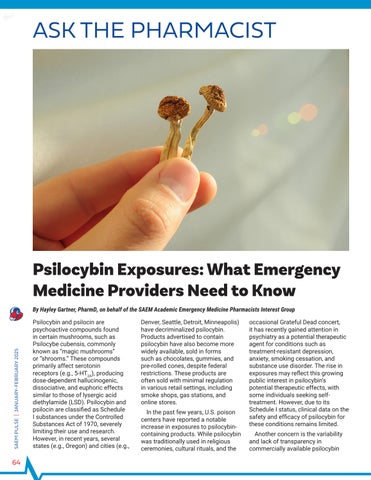
Psilocybin and psilocin are psychoactive compounds found in certain mushrooms, such as Psilocybe cubensis, commonly known as “magic mushrooms” or “shrooms.” These compounds primarily affect serotonin receptors (e.g., 5-HT2A), producing dose-dependent hallucinogenic, dissociative, and euphoric effects similar to those of lysergic acid diethylamide (LSD). Psilocybin and psilocin are classified as Schedule I substances under the Controlled Substances Act of 1970, severely limiting their use and research. However, in recent years, several states (e.g., Oregon) and cities (e.g.,
Denver, Seattle, Detroit, Minneapolis) have decriminalized psilocybin. Products advertised to contain psilocybin have also become more widely available, sold in forms such as chocolates, gummies, and pre-rolled cones, despite federal restrictions. These products are often sold with minimal regulation in various retail settings, including smoke shops, gas stations, and online stores. In the past few years, U.S. poison centers have reported a notable increase in exposures to psilocybincontaining products. While psilocybin was traditionally used in religious ceremonies, cultural rituals, and the
occasional Grateful Dead concert, it has recently gained attention in psychiatry as a potential therapeutic agent for conditions such as treatment-resistant depression, anxiety, smoking cessation, and substance use disorder. The rise in exposures may reflect this growing public interest in psilocybin’s potential therapeutic effects, with some individuals seeking selftreatment. However, due to its Schedule I status, clinical data on the safety and efficacy of psilocybin for these conditions remains limited. Another concern is the variability and lack of transparency in commercially available psilocybin