Consist of curated one-on-one meetings and roundtable discussions between lenders, sponsors, and investors.
By Paul Marino
By Val Orekhov
Frank Bukowski
By Kelvin Harrylall
By Drew Brantley
WELCOME
By Laura Shen & Katherine Relle
By Robert Mazzocco & Steve LeClair
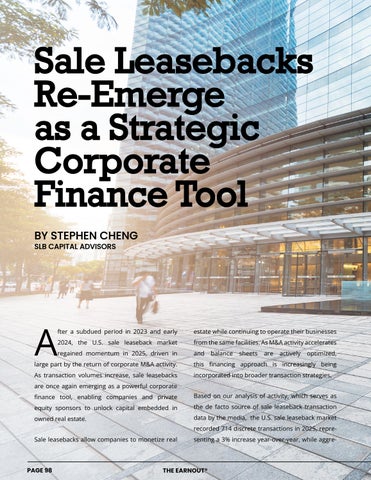
By Stephen Cheng
ABOUT SADIS
The firm maintains a diverse, businessoriented practice focused on investment funds, litigation, corporate, real estate, regulatory and compliance, tax and ERISA.
Drawing on the experience and depth of our lawyers in these distinct areas, we can leverage each lawyer’s industryspecific knowledge to help our clients succeed. This collaborative approach brings to the table a collective insight that contributes to sensible, efficient resolutions, and allows us to remain attentive to the cost and time sensitivities that may be involved.
Sadis’s clients include domestic and international entities, financial institutions, hedge funds, private equity funds, venture capital funds, buyout funds, commodity pools, and numerous businesses operating in various industries around the world.
THE GRUNGE ECONOMY
BY PAUL MARINO SADIS & GOLDBERG
As a 1991 graduate of Westhill High School in Stamford, CT, I was lucky enough to be in High School for a number of converging musical trends including the height and fall of glam rock (which may, along with many of the girls in my graduating class, have singlehandedly kept Aquanet in business—think Dokken, Cinderella,
etc.), the continued growth of hard rock/metal (e.g., Metallica—Black album in fall of 1991, GNR, Van Halen (truth be told I am a David Lee Roth guy and don’t consider the Hagar-VH hard rock), ska/Long Beach Island sound (Chili Peppers and Sublime), southern rock and jam bands (Black Crowes, Dave Matthews, Widespread Panic, Allmans making a
big come back, etc.), mainstreaming rap (Run DMC, Eric B and Rakim, Big Daddy Kane, Beastie Boys), classic rock like Billy Joel, etc., and of course the rise of “grunge” (Nirvana, Pearl Jam, Soundgarden, Alice in Chains, Smashing Pumpkins, Candlebox, Screaming Trees, (I don’t include Stone Temple Pilots because they were really San Diego—hard rock) etc.)
Now, why did I list Grunge last? Because to me, it killed Rock n’ Roll (or maybe a better phrase would be it knocked Rock n’ Roll off its pedestal as the #1 music genre). Now, before you tell me why Pearl Jam or Soundgarden or Nirvana were great (they were), let me explain.
Very few hit songs of the grunge era from that era makes you feel…well, good.1 Most grunge songs, with titles like “Better Man”, “Here Come the Rooster”, “Blackhole Sun”, “Hunger Strike”, “Lithium” and of course “Heart-Shaped Box” (read the lyrics—not uplifting)—none of the foregoing songs were jams that you put on to feel good—it’s as if Arthur Schopenhauer was the spiritual muse for each band.2
Juxtapose that to any number of fun to listen to pre-grunge rock songs and one can easily start to see why grunge rock may appeal to the tortured poet in you, but it doesn’t make one want to enter into a sing along (e.g., Don’t Stop Believing (if you’re interested in seeing an eclectic list of 1980’s songs see the footnote below).3
My point is that even if something is great, if it doesn’t make you feel great, it just is associated with negativity.4
Today’s economy is akin to the grunge music— the stock market is at, near or bouncing around alltime highs, MEGS (meat/eggs/gas) (until recently because of a war) has decreased to pre-pandemic levels, GDP growth and company profits are strong but people just don’t feel good about it; even the people who are profiting from the economy (the supposed top of the “K”) don’t feel good—it is the Grunge Economy.
A Quick Snippet on the Economy.
For S&P 500 Companies:
• Net profit margin: ~13.2% (record-high level)5
• Earnings growth (YoY): ~10%–13% range6
• Revenue growth (YoY): ~7–9%7
• Earnings per share (EPS) hit record highs for the index8
Strong first-quarter corporate earnings alongside steady (if not spectacular) GDP growth suggest the underlying economy remains resilient, while a still-elevated but stabilizing CPI signals inflation is no longer accelerating but hasn’t fully normalized. For M&A and private equity, this combination is constructive: earnings visibility supports valuation floors, GDP growth underwrites revenue assumptions, and moderating inflation increases confidence that interest rates will plateau or decline.
The net effect of this data is a gradual reopening of deal markets—buyers regain conviction, financing becomes more predictable, and sellers’ expectations stabilize—pointing toward increased transaction volume, tighter bid-ask spreads, and a more competitive environment for quality assets over the next 2–3 quarters.
LONG LIVE ROCK: WHY PRIVATE EQUITY ISN’T
DEAD— BUT THE MODEL (SEE, E.G., INDEPENDENT SPONSORS) IS EVOLVING
Private equity has never been accused of lacking confidence. For decades, the industry has operated on a straightforward proposition: institutional capital enters a closed-end fund, managers deploy the capital into companies, value is created through operational improvements, efficiencies and financial engineering, and exits return cash to investors at multiples that justify the illiquidity.
That model built one of the most powerful capital allocation machines in modern finance. But in the past several years, a quiet tension has emerged between investors and fund managers. Limited partners—pensions, endowments, family offices, and wealthy individuals—are asking a simple question: Where is the cash?
The answer lies in a metric that has become the industry's most closely watched number: DPI or Distributed to Paid-In Capital.9 DPI measures the amount of actual cash returned to investors relative to the capital they have contributed. Unlike unrealized valuations, DPI reflects money that has physically been returned to investors’ bank accounts. And lately, that number has been stubbornly low.
Yet the story isn’t that private equity is broken. Rather, the traditional pooled fund model— characterized by long lockups, slow liquidity, and increasingly aggressive valuations—is facing a credibility challenge. Meanwhile, a different model
has quietly stepped into the spotlight: independent sponsors (about 2500 independent sponsors and growing).
Often described as “deal-by-deal private equity,” independent sponsors are, in many ways, simply lower middle market private equity operating without a blind pool. But in a world where investors are demanding transparency, flexibility, and faster paths to liquidity, that structure suddenly looks remarkably attractive.
In other words: private equity isn’t dying. It’s just changing its venue.
HERE COMES THE ROOSTER
The past decade was a golden age for private equity fundraising. Institutional investors increased allocations, sovereign wealth funds piled in, and the industry’s assets under management grew to trillions of dollars.
But capital raised and capital returned are two very different things.
At the center of the current tension is DPI. In private equity, performance is often measured through three core metrics:
• IRR (Internal Rate of Return). A time-weighted measure of performance.
• TVPI (Total Value to Paid-In) Includes both realized and unrealized gains.
• DPI (Distributed to Paid-In Capital). The cash that has actually been returned to investors.
DPI is the most tangible of the three. Investors can debate IRR assumptions or dispute portfolio valuations, but DPI reflects real distributions; and
recently distributions have slowed.
Global exit activity due to a variety of factors, including: (i) higher interest rates, (ii) valuation gaps between buyers and sellers; (iii) sluggish IPO market; and (iv) profits at the portco level. The result is simple: capital is stuck. For LPs who depend on distributions to fund new commitments, the slowdown has created a ripple effect across the entire ecosystem.
HUNGER STRIKE
Liquidity is the oxygen of the institutional investment world. When distributions slow, allocations tighten. Many investors entered the 2020s planning to increase their exposure to private equity. But with capital locked inside existing funds, a phenomenon known as the “denominator effect” emerged.10 As public markets declined and private holdings remained marked at relatively high valuations, private equity suddenly represented a larger percentage of many portfolios than policy allowed.
The easiest solution? Stop committing to new funds.
This shift has created fundraising challenges for even well-established private equity managers. Funds that once closed in months are now taking a year or more to reach their targets. Investors aren't rejecting private equity outright. They’re rejecting blind trust in long-duration pooled vehicles where capital is locked up for a decade while valuations remain largely theoretical.
companies. They just want more control over how and when that exposure occurs.
SMELLS LIKE TEEN SPIRIT
Few developments illustrate this shift better than the rise of independent sponsors. Independent sponsors operate differently from traditional private equity funds. Instead of raising a blind pool of committed capital before finding deals, independent sponsors source acquisitions first and then raise capital from investors on a dealby-deal basis.
The structure provides several advantages:
• Investors choose the deals. Rather than committing to a fund that may pursue dozens of transactions, investors can evaluate each opportunity individually.
• No idle capital. Money is called only when a transaction is ready to close.
• Flexible economics. Independent sponsors typically negotiate carried interest and fees transaction by transaction, often aligning incentives closely with investors.
• Transparency. Investors know exactly what they are buying.
For many limited partners frustrated with slow DPI and opaque valuations, this approach feels refreshingly straightforward. And yet, structurally speaking, independent sponsors are not revolutionary; they are simply lower middle market private equity without a blind pool.
EVEN FLOW
In other words, LPs still want exposure to private
The lower middle market has always been one of
the most compelling segments of private equity. Companies with enterprise values between roughly $25 million and $250 million often operate in fragmented industries, have limited institutional ownership, and present clear opportunities for operational improvement.
But historically, this market was less accessible to large institutions. Deals were smaller, sourcing was relationship-driven, and the number of managers operating at scale was limited. Without the pressure of deploying a large fund, independent sponsors can pursue attractive deals that might otherwise fall below the radar of traditional private equity firms.
In effect, independent sponsors created a modular version of private equity.
ALIVE
Another advantage of the independent sponsor model lies in alignment—independent sponsors are more of a partner than manager/advisor. Traditional private equity funds often charge a management fee on committed capital for the life of the investment (with certain caveats) that can be as long as 10-15 years.
That structure made sense when fundraising was difficult and operational infrastructure was expensive. But in today's environment, investors increasingly question paying fees on capital that remains unused for extended periods.
Fees are typically tied to transactions rather than commitments. Investors pay when deals close and value is created—not merely for the privilege of reserving capital. That difference may sound subtle,
but it changes the psychology of the relationship between investor and manager.
MAN IN A BOX
One of the biggest drivers of investor hesitation today is not private equity itself—but valuation uncertainty. During the low-interest-rate era, cheap debt fueled record deal multiples. Companies that once traded for six- or seven-times EBITDA suddenly commanded valuations north of twelve.
When rates rose and financing costs increased, buyers became more cautious; sellers, resisted lowering valuation expectations and the result has been a persistent valuation gap. Private equity funds that purchased assets at peak multiples now face a difficult choice: sell at lower valuations and realize disappointing returns or hold assets longer and hope markets recover.
Neither option produces immediate DPI. Independent sponsors, by contrast, are entering the market today under very different conditions. Many are acquiring companies at more reasonable multiples, often with less leverage and more operational focus. In other words, they are buying assets in the current market, not defending prices set three years ago.
HERE I GO AGAIN
Traditional funds often move through layers of investment committee approvals, portfolio construction considerations, and allocation constraints. That structure can slow decisionmaking. Independent sponsors, especially experienced ones, can often move faster. They identify an opportunity, assemble the appropriate investor group, and close the transaction without
navigating the complexities of a large fund structure.
For sellers—particularly founder-owned businesses in the lower middle market—that agility can be incredibly appealing. In many cases, founders prefer working with investors who are directly engaged in the deal rather than a large institutional fund where decision-makers feel distant.
INTERSTATE LOVE SONG
Despite these advantages, independent sponsors are not replacing traditional private equity. Large funds still dominate mega-buyouts, global platform strategies, and capital-intensive industries that require billions of dollars of investment. But what independent sponsors have demonstrated is that investors crave flexibility.
The private equity model built in the 1980s and 1990s assumed investors were comfortable locking up capital for a decade with limited visibility into individual transactions. That assumption is now being tested.
Independent sponsor deals offer an appealing compromise: professional deal sourcing and execution combined with investor-level visibility. This hybrid structure has allowed many investors to feel more engaged with their private market allocations. And engagement, in turn, tends to produce confidence.
Modern investors—particularly family offices and high-net-worth individuals—often prefer direct exposure to specific deals rather than blind pools.
LONG LIVE ROCK
Private equity will continue to evolve, but its core
value proposition remains intact: identifying strong companies, improving their performance, and generating returns through strategic exits.
What is changing is the structure through which capital flows. Blind pools still exist and will continue to exist, but investors will increasingly demand: (i) faster paths to liquidity, (ii) greater transparency into individual investments; (iii) stronger alignment of fees and performance; and (iv) more flexible capital commitments.
Funds will soon begin to return capital and DPI will
recover. And when it does, investors will once again feel confident committing capital to the asset class that has generated some of the most attractive long-term returns in modern finance.
Private equity isn’t fading away; it’s just learning a new setlist.
And if the industry gets the balance right—between transparency and expertise, liquidity and long-term value creation—the next chapter could be just as loud as the last.
Long Live Rock (be it dead or alive)…
1 Gin Blossoms, Blues Traveler, Dave Matthews do not count as they are not “grunge”.
3 https://www.ranker.com/list/greatest-80s-rock-songs/ranker-music (visited 3/31/2026) Some more great pre-grunge songs of the 1980’s early 1990s) e.g., here are a number of sing along tunes from the 80’s: Sweet Child O Mine, Jump, Panama, Don’t Stop Believing, Crazy Train, Money for Nothing, Don’t You (Forget About Me), Here I Go Again, Owner of a Lonely Heart, You got Fight (for your right to party), Tom Sawyer and Hit Me With Your Best Shot I know—that’s a wide range of music but you get the point).
4 E.g., Pearl Jam Elderly Woman Behind a Counter is an awesome song but doesn’t make you want to raise your beer at a bar.
5 https://insight.factset.com/sp-500-reporting-highest-net-profit-margin-in-more-than-15-years?utm, visited, 4/9/2026, Margins (~13.2%) indicate very high profitability by historical standards
9 DPI, or Distributions to PaidIn Capital, represents the cumulative distributions made by a private equity fund to its investors (limited partners) divided by the total amount of capital they have invested in the fund. It is also known as the realization multiple. A DPI ratio greater than 1 indicates that the fund has returned more capital to investors than they initially invested, while a DPI of less than 1 suggests that the fund has not yet returned the full amount of the invested capital.
10 The denominator effect is a portfolio math problem that makes private equity look like a bigger slice of an investor’s holdings than it actually should be. It happens when public markets drop sharply, shrinking the total portfolio value (the denominator in the allocation fraction), while private equity valuations stay flat because they update on a delayed schedule. The result: an institution that was perfectly within its target allocation yesterday is suddenly overweight in private equity today, even though nothing changed about the private holdings themselves. This mismatch has forced pension funds and endowments into costly fire sales, frozen billions in new commitments, and reshaped fundraising across the private equity industry.
PAUL MARINO Partner Sadis & Goldberg pmarino@sadis.com
Paul Marino is a partner in the Financial Services and Corporate Groups. Paul focuses his practice in matters concerning financial services, corporate law and corporate finance. Paul provides counsel in the areas of private equity funds and mergers and acquisitions for private equity firms and public and private companies and private equity fund and hedge fund formation.
Moonshots and Mop Buckets: When AI Investment Math Actually Works in Private Equity
BY VAL OREKHOV WITHUM
Every private equity1 professional is asking the same deceptively simple question when they look across the portfolio: What are we actually doing about AI, and where does it create real value within a hold period? Management teams are eager. Advisors are enthusiastic. AI vendors are everywhere. But as a sponsor, your concern is more fundamental: does any of this actually create value within our targeted hold period?
This is the central tension surrounding AI in private equity today: separating genuine value creation from innovation theater.
Maybe you’ve sat through too many pitches. You’ve heard consultants promise transformation. You’ve seen the LinkedIn posts and conference slides. And you’re skeptical because the proof points are thin, and the hype is exhausting. The MIT “State of AI in Business 2025” report2- confirms your instinct: 95% of Generative AI pilots deliver zero return on investment or maybe you’re still bullish. You remember the first time you had a real conversation with AI and the moment when the potential clicked. Since then, you’ve transformed your own operations. You’re using it to source deals, stresstest assumptions, and accelerate diligence. Now
you want to bring that same edge to your portfolio companies.
Still, AI can’t be ignored. Many private equity firms are already using it effectively for sourcing, market research, diligence, and stress-testing assumptions. The question is whether that value creation translates to portfolio companies and under PE economics.
At a high level, AI investments fall into two buckets: Moonshots and Mop Buckets.
• Moonshots are transformational bets. Custom AI that fundamentally changes how a business operates.
• Mop buckets are unglamorous automation. Workflow improvements that don’t make headlines but can incrementally move EBITDA.
Both can create value. The question is when does the math actually work?
THE SINGLE COMPANY CHALLENGE
The instinct is reasonable: pick a portfolio company, automate their accounts payable, clean up reporting and build some workflows to speed up customer onboarding. The tools already exist: Zapier, n8n and other off-the-shelf Software-as-aService (Saas) products. You could hire someone to deploy it. But run the numbers on what it actually takes.
You’ll need someone dedicated to the work for three to six months to accomplish scoping, building, deploying, debugging and training the team. That’s not a side project; that’s a role. Call it $200,000
– $300,000 loaded cost for a forward-deployed engineer or automation specialist. The portfolio company team needs to be involved too; their time isn’t free. Figure another $50,000 – $100,000 in opportunity cost. You’re looking at $250,000 –$400,000 to get something into production.
Now ask: What does this need to return? You’ve deployed in year two of your hold, so you have maybe two to three years left. To break even on a $300,000 investment at a 6x multiple, you need roughly $50,000 in annual EBITDA improvement, about 1% on a $5M EBITDA company. That sounds achievable.
But break-even isn’t the bar. Factor in the risk that it doesn’t work, the management bandwidth consumed and the opportunity cost of capital, and you want something more like 5-10% EBITDA improvement for a clear and meaningful outcome. For a $50M revenue company with $5M EBITDA, that’s a high hurdle.
Here’s the challenge: Most automation improvements like faster AP processing, cleaner reports and better data extraction get you 1-3% efficiency gains. Not 10%. The economics don’t work for a single company in isolation. But that doesn’t mean they don’t work at all.
THE MOONSHOT CALCULUS
So, sponsors look bigger. What if AI transforms the business model? Supply chain optimization. Predictive analytics. AI-driven pricing or recommendations. Deploy predictive analytics that fundamentally alter their service delivery.
This is the moonshot approach, and the allure is
obvious: if it works, you’re not talking about 5-10% EBITDA improvement. You’re talking about real competitive advantage, defensible differentiation and potentially transformational value creation. But the math gets brutal fast.
Custom AI and Machine Learning solutions take 12-18 months to get to production, not three to six. You’re not spending $300,000, you’re spending $500,000 – $1M+ on data scientists, engineers and infrastructure. The risk of failure isn’t 10%, it’s 50%+. And assuming you own this company for three to five years total, which means you might exit before you even know if it worked.
Run that expected value: $1M investment, 50% chance of failure, two to three years to see results, one to two years of potential value capture. If success means a $5M enterprise value lift, simple expected value math gives you a $2.5M return on $1M invested. That looks attractive on paper.
But paper isn’t reality. Factor in the management bandwidth consumed, the opportunity cost of deploying that capital elsewhere, the risk of partial failure (it works but not as well as hoped) and the possibility you either exit before realizing the value or need to extend your hold period. The riskadjusted return gets much less compelling.
For A Single Portfolio Company Moonshot, You Need To Honestly
Check Three Boxes:
1. This specific company has a unique AI opportunity (not just “AI would be cool here”)
2. You have five+ years of hold time to see it through
3. The competitive advantage is defensible enough to show up in exit valuation
If you can check all three, it might be worth the bet. Most situations don’t qualify, which is why sectorlevel approaches are more promising.
But what if the moonshot isn’t company-specific? What if you’ve identified a thematic opportunity across an entire sector you own?
THE SECTOR MOONSHOT: DIFFERENT MATH, STILL A BIG BET
Consider a fund backing eight healthcare services companies that believe AI-driven patient intake and care coordination could fundamentally change operational economics across the sector. Or ten industrial distribution businesses where predictive inventory optimization might be a category-level game-changer.
Now you’re making a different kind of bet. You’re still spending $1-2M+ to develop something meaningful. But you’re potentially deploying it across eight to ten companies, which changes your risk-return profile. If it works for even half of them, you might be creating $10-20M in enterprise value across the portfolio.
The catch is you’re essentially building a vertical Software as a Service (SaaS) product without the benefit of being a SaaS company. You can’t iterate for five years. You don’t have product-market fit feedback from 100 customers. And deploying fundlevel initiatives across portfolio companies requires buy-in that isn’t always easy to achieve.
This can work, but only under very specific conditions:
• You have genuine sector expertise and deeply understand the operational opportunity
• You’re willing to partner with technology firms or acqui-hire the capability (don’t build from scratch)
• You have enough portfolio concentration to deploy across six + similar companies
• You can move fast. 18 months from concept to production, not three years
You have realistic expectations about adoption rates (not all portfolio companies will implement).
The firms that pull this off treat it like M&A³, not R&D: clear thesis, structured diligence, decisive resource allocation and ruthless measurement of outcomes.
This is a specialized capability, not table stake. If you have the sector concentration and expertise, it’s worth serious consideration. If you don’t, the aggregation model is your path.
AGGREGATION: WHERE THE MATH ACTUALLY WORKS
Platform plays in PE aren’t new. Roll up similar businesses, consolidate back-office, standardize operations and achieve economies of scale. That playbook is well established.
What’s different now is that AI-enabled automation adds a new layer to the platform thesis, one you can deploy before mature SaaS solutions exist for your sector. The vendors are still figuring out AI-native
products. Enterprise software is bolting on copilots and assistants. Meanwhile, the building blocks are available: workflow automation tools, APIs and language models that can handle unstructured data.
This creates a window. Five healthcare services companies, or eight industrial distribution businesses, all with similar operational patterns, and you can systematically improve efficiency by 1-3% across all of them using lightweight automation and common playbooks.
The math shifts dramatically when you aggregate AI in private equity. Build the automation playbook once: the workflows, the integrations, the process documentation. Deploy lightweight versions to each portfolio company. Your investment per company drops to $50,000 – $100,000. Your return hurdle becomes 1-2% EBITDA improvement per company.
That’s achievable. Standardized AR workflows, automated reporting dashboards, and customer intake automation can realistically deliver 1-3% efficiency gains.
Run it across eight companies: invest $500,000 -$1M over two to three years, generate $2-4M in enterprise value across the portfolio. That’s a 2-4x return on your operational excellence investment.
The alpha here isn’t waiting for a packaged solution. It’s in doing the unglamorous mop bucket work now: building the playbooks, deploying the automations, learning what actually moves the needle, while others wait for the market to mature.
THE SOFTWARE HOUSE TRAP
Whether you’re pursuing incremental efficiency or sector moonshots, the temptation is to think: “We should build a team. We could create proprietary tools. Maybe even license them after exit.”
Resist this. You’re a three-to five-year investor, not a ten-year product company. Software requires ongoing maintenance. Your portfolio companies will resist “fund-imposed tech” the moment you exit. And you can’t recruit top engineers for fundlevel operational work; they want to build products, not internal tools for a rotating set of companies.
The Better Model Is A Playbook Factory.
1. Map the common operational patterns across your portfolio.
2. Document best practices.
3. Identify the tool stacks that support those practices, n8n, Zapier or whatever off-the-shelf SaaS makes sense.
4. Then partner with AI implementation firms who do the heavy deployment lifting.
Your team should be two to three people maximum: one automation specialist who knows APIs and light scripting, one process consultant who understands the business problems and one data person who ensures you’re feeding clean inputs to the automation. That’s not an engineering team. That’s orchestration.
For moonshots, you partner or acqui-hire. You don’t build from scratch.
WHERE TO ACTUALLY PLACE YOUR BETS
The examples used so far, AP automation, reporting
dashboards, customer intake, are back-office wins. They're real, but they're not what makes these businesses valuable. If you're going to invest in AIenabled operational improvement, invest where the actual value creation happens.
In most industries, that means focusing on the operational drivers that determine margin, not the administrative processes surrounding them.
HEALTHCARE SERVICES: STAFFING OPTIMIZATION
Labor runs 50-60% of revenue in healthcare services . That’s where the money is. Patient volume forecasting tied to dynamic scheduling can reduce overtime, cut agency staffing costs and improve clinician utilization. You’re not automating billing, you’re optimizing the single largest cost driver in the business.
A 5% reduction in labor costs on a company running 55% labor-to-revenue drops 2.75 points to EBITDA. For a $40M revenue urgent care platform, that’s $1.1M annually. Healthcare services⁴ typically command higher multiples than general industrials. At 8x, that’s nearly $9M in enterprise value.
Deploy the same demand forecasting and scheduling optimization across six to eight urgent care or home health companies in your portfolio, and you’re creating real value from a repeatable playbook.
Industrial Distribution: Inventory and Demand Forecasting
Inventory carrying cost runs 20-30% of inventory value annually, covering the cost of capital, warehousing, obsolescence and shrink. Meanwhile,
stockouts kill revenue and customer relationships. This is the core tension in distribution⁵: too much inventory destroys margin, too little destroys sales.
Better demand forecasting attacks both sides. Reduce safety stock, cut dead inventory and improve fill rates. You’re improving working capital AND margin simultaneously.
A distributor carrying $15M in inventory at 25% carrying cost burns $3.75M/year just holding product. Cut inventory 15% through better forecasting without hurting fill rates, and you’ve freed $2.25M in working capital plus reduced carrying costs by $560K annually.
This works as a sector play because the forecasting models learn from similar demand patterns across similar businesses. Six industrial distributors in adjacent verticals compound the data advantage.
The edge isn’t waiting for perfect software. It’s doing the unglamorous mop-bucket work now while others wait for vendors to catch up.
Manufacturing: Predictive Maintenance
Unplanned downtime costs
$10-50k/hour depending on the line. Traditional preventive maintenance either over-maintains (expensive) or under-maintains (catastrophic failures).
Sensor data plus ML models can predict failures before they happen and intervene during planned downtime, not when the line goes down.
pipelines and models trained on failure patterns. But if you have five + similar manufacturing⁶ operations, the pattern recognition compounds. A failure mode discovered in one plant trains the model for all of them.
A plant running 6,000 production hours annually with 3% unplanned downtime (180 hours) at $20K/ hour loses $3.6M to unplanned stoppages. A 20% reduction in unplanned downtime is worth $720K per plant per year. The exact numbers depend on your baseline. Some operations run tighter and some looser, but the leverage is real.
WHY THESE AI USE CASES MOVE EBITDA
None of these are admin or support functions. They’re the operational core where labor, inventory or uptime directly drive margin. And they all benefit from scale: staffing models trained across multiple healthcare sites, demand patterns learned across multiple distributors, failure signatures detected across multiple manufacturing lines. This is where the sector specialization thesis becomes an operational reality. If you don’t have concentration in similar businesses, you can’t build the data advantage. If you’re a generalist, you’re stuck with back-office automation that moves EBITDA 1-2% at best.
THE BOTTOM LINE
This isn’t primarily an AI decision. It’s a sector specialization strategy combined with operational discipline.
This is genuinely harder to implement than the first two examples. You need sensor infrastructure, data
• Vertical-focused PE firms with 5-8+ similar companies have the clearest path. Incremental aggregation is obvious. Build the play-
books, deploy lightweight automations, capture 1-3% efficiency gains across the portfolio. Sector moonshots become plausible if you have the concentration and expertise to justify a multimillion-dollar bet.
• Generalist PE firms with portfolio companies spread across many industries face harder math. No repeatable playbooks means every deployment is custom, and the unit economics fall apart. The honest answer might be to focus AI investment on individual high-potential situations rather than a portfolio-wide strategy.
• Single-company initiatives, whether incremental or moonshot, rarely justify the investment given PE hold periods. The economics work at a portfolio scale.
The opportunity is real. AI can create meaningful value in portfolio companies. But capturing that
value requires the same discipline you bring to any investment decision: clear thesis, honest assessment of your capabilities, and rigorous attention to the math.
One more thing: you don’t necessarily have to build this capability in-house. The right integration partner, one who understands both the operational realities of your sectors and the economics of PE hold periods, can help you develop and deploy repeatable playbooks across a portfolio without becoming a software house yourself. The sophistication is in knowing what to build, where to deploy it, and how to measure the outcome. The implementation can be someone else's job.
VAL ORKEHOV Market Leader, Digital Workplace Solutions Withum
Withum works with private equity firms and their portfolio companies to identify where AI initiatives can improve operational performance and implement solutions that support measurable EBITDA impact.
Maximizing the Lifecycle of Your Investment
Opportunity
Zones vs. Private Equity: What is the Difference?
BY FRANK BUKOWSKI JTC GROUP
While OZ might sound like just another type of private fund, it has unique aspects that make it especially attractive to investors who care about where their money goes.
Have you heard the good news about the renewal of Opportunity Zones?1 If not, that is okay. Many Americans are still unaware of OZ, or have received inaccurate information2 about what the initiative actually does. Far from a standard government policy, the Federal Opportunity Zones initiative is
an economic development and impact investment tool that allows investors to grow their portfolios, take advantage of tax incentives, and generate wealth while supporting economically distressed communities.
WHAT ARE OPPORTUNITY ZONES?
Opportunity Zones3 were first created as part of the Tax Cuts & Jobs Act of 20174. The initiative utilizes financial incentives to induce investment in under-
invested areas. OZ was successful enough that its tax incentives were made permanent through the 2025 One Big Beautiful Bill Act5 (OBBBA), with a new version of the initiative, commonly called "OZ 2.0," set to begin in 2027.
Census tracts are eligible for OZ designation6 if they fall below a certain threshold for employment or poverty rate. Individual states can designate up to 25% of their eligible tracts as Qualified Opportunity Zones (QOZs). Investors receive OZ tax incentives when they invest in Qualified Opportunity Funds (QOFs) for deployment in projects within Qualified Opportunity Zones.
These projects take many forms7, and include operating businesses8, construction and real estate development, agriculture, mining, renewable energy, and plenty more. OZ has brought billions of dollars of investment9 to areas that otherwise might not benefit from this economic activity, and it's thanks to OZ investors.
WHO INVESTS IN OPPORTUNITY ZONES? HOW ARE THEY DIFFERENT FROM PE INVESTORS?
Private Equity10 funds are private funds that traditionally cater to "institutional investors." An institutional investor is defined as11 "an entity that manages their clients’ investments," including such entities as "investment banks, insurance companies, and mutual funds."
over time. A professional investment manager is tasked with investing that money on behalf of the fund. The fund itself is the actual investor, and since it is an institution, not a person, it is therefore an "institutional investor."
Institutional investors desire broad portfolio diversification, just like individuals, but deal in much larger amounts. They invest in stocks, bonds, real estate, and other things individuals invest in, as well as private funds. Because institutional investors are professionally managed, sectors like private equity, private credit12, and venture capital12 are open to them, and the manager has a directive to invest a certain percentage of the fund in highgrowth sectors.
In addition, private funds can cater to accredited investors13, those with considerable net worth or who have a demonstrable knowledge of these markets. The rules for investor accreditation exist to protect everyday investors who don't understand the risk profile and illiquid nature of these fund types.
A third category is comprised of retail investors, those who are neither accredited investors nor institutional investors, but who want to access private markets. Private funds have long been looking for ways to target retail investors, with mixed success14 .
A great example is a pension fund for state employees: the state makes contributions to a fund for its employees, but it wants that money to grow
DO I HAVE TO BE AN ACCREDITED INVESTOR TO INVEST IN AN OPPORTUNITY ZONE?
Qualified Opportunity Funds are much more
targeted in who they look to for investment. For example, Fund of Funds15 structures (FoF) were not included as part of the recent OZ extension in the OBBBA. That means other private funds cannot invest in a QOF, limiting some of the institutional investment that is possible.
Institutional and accredited investors can invest in OZs, and retail investors also can if they have a capital gain, which could come from selling assets like stocks or property, the sale of a business, or another taxable event. Reinvesting gains in an OZ is the way to take advantage of OZ tax incentives; this ability to defer or reduce one's overall tax burden is one of the biggest reasons investors choose OZ.
Here's where the topic gets a bit confusing: you do not have to be an accredited investor in order to invest in an Opportunity Zone. However, if you want to invest in an Opportunity Fund16, you may be required to be accredited based on the type of fund. So while you could invest in an OZ and receive OZ tax benefits without being accredited, your options may be more limited than those available to accredited investors.
The other category to know about is impact investors17, those who put their money toward investments they believe will do good in their communities, for the environment, or to further a specific cause. While some QOFs invest in a broad range of projects, others concentrate on a specific location, sector, or even one specific project, allowing impact investors to target the causes that matter most to them.
believe in the project, this limits the benefits one receives. To get the most out of an OZ investment, you need realized gains eligible for OZ tax incentives.
WHAT ARE THE ADVANTAGES OF INVESTING IN OPPORTUNITY ZONES?
Why do people invest in Opportunity Zones? There are as many reasons as there are investors, but some of the main reasons are the OZ tax incentives. For those who have a considerable gain (for example, from a property sale), taxes can greatly eat into the amount they ultimately get to keep. OZ can help in several major ways.
The tax incentives for investing in an OZ changed slightly with the passage of the OBBBA. The OZ 2.0 tax incentives are as follows:
1. Investors can defer capital gains taxes on the realized gains they reinvest in a QOF for five years or until the investment is sold (whichever is earlier).
2. After five years, investments receive a 10 % step up in basis, which reduces the gain ultimately subject to taxation.
3. If the QOF investment is held for at least 10 years, it receives a step up in basis to fair market value upon sale, meaning all appreciation on the OZ investment is excluded from federal capital gains tax.
4. If the QOF is a Qualified Rural Opportunity Fund (QROF), the 10% five-year step up in basis is increased to 30 %.
While it's possible for someone to invest in OZ without having a capital gain simply because they
By investing in an OZ and leaving the investment
in the fund for long enough, it's possible to walk away with much more than you would if you'd simply paid the taxes when your gain was realized. However, tax incentives aren't the only reason OZ has become so popular.
OZ has worked because investors are seeing that their investments make a tangible impact. For example, there are parts of the country where Opportunity Zone investment has increased housing supply18 without driving up rents, contributing to the push for more affordable housing. JTC has worked with Opportunity Funds since OZ's inception to deliver social impact reporting19 that helps investors know which projects are doing the most good.
The OBBBA instituted requirements for impact reporting and created a new category of Opportunity Zones to drive investment to rural communities20 that have traditionally struggled to attract economic activity. Investments in Rural OZs will be eligible for an increased 30% step up in basis, a major incentive that should attract those who want to maximize both their impact and their returns.
It is important to note that impact investing is not at odds with generating returns, as impact investments sometimes outperform their counterparts21 in nonimpact-focused funds. OZ funds can contribute to a more diversified investment portfolio, resulting in increased portfolio return with reduced risk, producing a higher Sharpe Ratio22 and a better positioning of the investor's overall portfolio on the efficient frontier23 .
want: the best of both worlds. With the extension of the OZ initiative, it's possible to help areas in need and grow an investment at the same time.
HOW DOES OZ INVESTING DIFFER FROM TRADITIONAL PRIVATE EQUITY?
While QOFs can sometimes be thought of as a subset of Private Equity in that they are private funds that make equity investments in business enterprises, OZ has enough differences to make its investor base separate from that of PE. OZ investors are often motivated by tax savings, which means they can accept OZ's long-term hold times to achieve their full OZ tax incentives. Unlike PE, OZ investors aren't operating on a traditional time frame and won't necessarily expect an exit in 5-7 years. For some investors, OZ can contribute to more efficient estate planning as they aim to leave as much as possible for future generations.
The key differentiator that separates OZ and PE is the impact of OZ investments. Some private funds focus on impact or ESG24, while some don't. But every QOF is designed to have an impact. Whether that impact is employment, sustainability, affordable housing, or another type of social impact, these funds are designed to bring economic activity to areas PE (and most other fund types) haven't been able to help.
OZ incentives can make it easier to achieve both returns and impact, which is what OZ investors
Should you consider investing in an Opportunity Fund? Obviously, whether or not you already have a realized gain is not up for debate. But starting in 2027, the number of Opportunity Funds may greatly increase, as Rural OZs and the new map go into effect. That may be the perfect time to realize a
gain and take advantage. More than anything, this is a chance to make a real difference in the lives of everyday Americans by selecting a project that will do the most good. If you're looking to find an investment that will help the country and will also be a prudent financial move, OZ may be the best place to start.
JTC does not provide legal, tax or investment or other professional advice and, whilst it may review and report upon such advice received, JTC does not give, accept or endorse and should not be understood to be giving, accepting or endorsing such advice.
FRANKBUKOWSKI Senior Director - Institutional Capital Services
JTC Group
JTC Plc (“JTC”) is a global provider of fund, corporate and private client services. JTC administers more than $410 billion in assets and employs more than 2,300 people worldwide. JTC currently administers 72 Opportunity funds with an approximate AUA of $10 Billion. A leader in specialty financial administration, JTC serves markets characterized by high administrative complexity, elevated transaction security needs and challenging compliance requirements.
Your Real Estate Partne Trusted Expertise, Global Reach
As a leading global fund administrator with c.$410bn in assets under administration, including c.$54bn in real estate funds, we deliver seamless, end-to-end support at every stage of the fund lifecycle. With genuine real estate experience and a global reach, we go far beyond traditional fund administration. Let our expertise unlock the full potential of your real estate investments.
Find out more at jtcgroup.com/realestate
From Factory Floors to Financial Close: An Independent Sponsor's Journey Into Ownership of a Precision CNC Machine Shop
BY KELVIN HARRYLALL
HARRYLALL INDUSTRIAL HOLDINGS INC. & BYFORD MACHINE-TOOL INC.
When people meet me today as the owner of Byford Machine-Tool Inc, a precision CNC machine shop in Valley Mills, Texas, they often assume I came from a wealthy background, private equity, investment banking, or some other traditional M&A pathway. The truth is almost the opposite. I came up through the corporate world of American manufacturing, selling automation into plants and job shops across the country, and learning the intricacies of the manufacturing world long before I learned what an independent sponsor was, much less the lower middle market.
This article is about how I went from being a Sales
Engineer at a multi-billion-dollar factory automation company to becoming an independent sponsor and ultimately acquiring a precision CNC machine shop. It is a story about choosing an industry you truly understand, surrounding yourself with the right advisors, surviving a lot of failed deals, and utilizing all of the resources you accumulate along the way to finally close a deal.
If you are an independent sponsor—or want to become one—I hope this gives you a realistic but encouraging playbook for doing your first deal, preferably in an industry where you have a genuine competitive edge and a clear, defensible
differentiator.
MY ORIGIN STORY IN AMERICAN MANUFACTURING
My journey into manufacturing started in 2012, when I joined Keyence as a Sales Engineer. For those who do not know the company, Keyence is a multibillion-dollar global leader in factory automation— sensors, vision systems, measurement equipment, and more. That role gave me front-row access to hundreds of manufacturing operations: CNC shops, fabricators, assembly plants, packaging lines, and highly automated production environments.
At the time, I did not fully appreciate this, but looking back at it, Keyence gave me three things that proved life-changing.
First, it gave me financial stability. I was making a solid income in a company with real structure, training, and resources. It wasn’t the “buy a company,” type of money but it was enough for me to pay for the ancillary things like monthly database access for deal flow, retainer fees for counsel, payments to attend networking events and so on.
Since my head was above water, I could do the second thing, which was learn everything I could from the company I was working for. How does this corporation implement systems? How does information travel within the organization? What does the org chart look like? What is their culture and how was it developed? I started questioning everything. This foundation was imperative when looking at deals and formulating a vision for potential companies. I had a solid framework of how a multi-billion dollar company functions and I used it as a template for my future deals.
Third, it gave me deep insight into how American manufacturing works from the ground level. I saw the difference between shops that lived dayto-day and those that built durable competitive advantages. I saw how a single bottleneck machine could cripple a plant, how poor measurement practices led to quality issues, and how the best operators quietly kept everything running while the rest of the world focused on flashy new technology.
Walking factory floors year after year, I learned how to ask the right questions:
• Where does this shop really make its money?
• Which customers are truly sticky and why?
• What processes are repeatable and scalable versus one-off heroics?
• How does culture show up in quality, delivery, and safety?
Those questions stayed with me.
In 2018, I set a private, very clear goal: I wanted to own a manufacturing company. Not just work in manufacturing, not just sell into manufacturing— own a business that made real parts for real customers. That decision changed how I looked at every plant tour, every P&L, and every operator I met. I was no longer just selling automation; I was studying business models.
WHY INDEPENDENT SPONSORS MUST PICK AN INDUSTRY THEY KNOW
As independent sponsors, we do not have the luxury of unlimited capital or brand recognition. What we do have—or should have—is an edge. For me, that edge was manufacturing.
When I finally committed to pursuing an acquisition, I did not cast a wide net across unrelated industries. I leaned into what I knew: the world of machine tools, tolerances, cycle times, and customers who live and die by part performance. I decided that my first acquisition would be a precision CNC machine shop.
But not just any shop.
I was looking for a very specific profile:
• A shop with amazing foundations—good bones, solid equipment, and reliable processes.
• Strong operators on the floor, people who knew the machines, the setups, and the customer standards inside and out.
• Little to no formal outside sales presence, but a steady flow of repeat business driven by word of mouth and long-term relationships.
• A reputation for quality that kept customers coming back without a big marketing budget.
Why that profile? Because it played directly to my strengths. Years in sales taught me how powerful it is when a business has strong fundamentals but underdeveloped commercial effort. I wanted to find a shop where the work spoke for itself, the foundational systems were in place, and my sales background could "add fuel to the fire."
I knew that if a shop could maintain steady demand purely on the strength of its work and reputation, then layering in better sales, account management, and customer expansion could unlock growth without needing to reinvent the business. My job as an independent sponsor would be to respect the core, not replace it.
Too many first-time buyers chase whatever deal is
in front of them—car wash one week, SaaS the next, healthcare clinics after that. The biggest advantage you have early on is what you already know. Picking manufacturing was not just a preference; it was risk management. I understood the customers, the cost drivers, the language on the shop floor, and the difference between real and imaginary capacity. That understanding would become critical as deals got serious.
LEARNING WHAT I DIDN'T KNOW: M&A, FINANCE, AND THE RIGHT ADVISORS
Knowing manufacturing didn't mean I understood M&A. Far from it. I had never worked on Wall Street, never closed a deal from the buy-side, and did not grow up speaking in terms of "preferred equity," "leveraged buyouts," or “debt service to cash flow ratios.”
I knew how to sell. I knew how to walk a plant and ask operational questions. But I did not know how to:
• Read a balance sheet with an investor's eye.
• Analyze income statements over multiple years for quality of earnings.
• Negotiate LOIs, purchase agreements, and seller notes.
• Speak the language of lenders and capital providers.
• Structure deals in a way that worked for all sides.
That realization could have been paralyzing. Instead, I treated it as another sales job—except this time, I was selling myself on the importance of humility and learning.
I started building an informal advisory board.
Some of these people were official and compensated. Others were trusted mentors and peers who agreed to help and teach in exchange for long-term relationships and future opportunities. Together, they helped fill in the gaps:
• On the financial side, I learned how to read and question financials, how to normalize earnings, and how to think about working capital.
• On the legal side, I learned what really matters in a purchase agreement versus what is just noise.
• On the deal side, I learned what makes a transaction bankable, what scares lenders, and why some deals with "great stories" never get funded (don’t catch a falling knife!)
Balance sheets, income statements, negotiation frameworks, deal flow strategies, financing structures—all of it had to be learned. There was no shortcut. But having the right people around me transformed that learning curve from overwhelming to manageable.
If you do not come from M&A or finance, the lesson is simple: you cannot fake competence at the closing table. You must either acquire it through hard study or borrow it through great advisors. Ideally, you do both.
THE GRIND: SOURCING AND LOSING MORE THAN 50 DEALS
Once I had a basic team and framework, I started doing what every independent sponsor eventually has to do: sourcing.
with people who saw deals in my target space. I lived on listing sites and kept a running pipeline of opportunities. Every time a relevant machine shop or manufacturing company surfaced, I dug in.
Over time, I looked seriously at more than 50 deals.
And one by one, they fell apart.
Some died early. The numbers clearly did not work, or the quality of earnings did not justify the price.
In some cases, I could see operational risk that was invisible on the CIM but obvious once I understood the customer concentration or the condition of key equipment.
Other deals died later, for reasons that will sound familiar to any buyer:
• Lack of capital. The required equity check was too large relative to what I could reasonably raise or commit at that stage.
• Seller expectations. Owners sometimes wanted far more than the business was worth, anchored to a "magic number" that had little to do with normalized earnings or market comparables.
• Deal fatigue and misalignment. Timelines slipped, trust eroded, or key parties changed their minds halfway through the process.
• Competition. I was a small fish in a large pond. Strategic buyers and private equity groups all had deeper pockets than I did, and for some deals, it was just impossible to compete.
I networked. I met brokers. I built relationships
It would be easy to compress this into a neat narrative: "I looked at 50 deals, learned from each, and eventually found the perfect one." The emotional reality is messier. Watching deals die
is painful. You invest time, energy, hope, and credibility. Every failed deal can feel like a personal setback. At one point I turned to my wife and asked her, “Is this what depression feels like?”
But this is where mindset matters. I decided to treat each broken deal as paid education. I asked myself after each one:
• What did I learn about this industry segment or customer base?
• What did I miss early that I caught later, and how do I catch it sooner next time?
• Where did my advisors save me from a bad decision?
• How could I improve my process, my questions, my presentations?
If you are an aspiring independent sponsor, internalize this: deal flow is not just about finding a "yes." It is also about surviving and learning from a long series of "no's" without losing your belief or your standards.
CRAFTING AND COMMUNICATING YOUR STORY
While I was learning and losing deals, I was also doing something else: deliberately crafting my story.
In this game, people do not just bet on businesses. They bet on people. Sellers are deciding who will steward their life's work. Lenders are deciding whether to trust you with their capital. Advisors are deciding whether to invest their time and reputations alongside you.
To win those bets, you must present yourself in the best possible way—authentically, but intentionally. I worked on how I introduced myself and my thesis:
• Who am I?
• Why manufacturing?
• Why precision CNC?
• What is my long-term vision?
• How will I treat the people inside the business?
• Why should a seller trust me, and why should a lender back me?
I practiced telling that story with enthusiasm and clarity. Not as a pitch deck monologue, but as a narrative that connected my journey—from Keyence to the goal I set in 2018, to the kind of company I wanted to own—to the interests of the people I was talking to.
Equally important, I learned to stand on the shoulders of giants. I made sure sellers and lenders knew who was in my corner—experienced lawyers, financial advisors, and board-level mentors who had been through many deals. I wanted them to understand that while I was doing my first acquisition, I was not doing it alone.
When you surround yourself with experts, you are not just borrowing competence; you are borrowing credibility. That credibility gets you meetings you otherwise would not get, grace when you make honest mistakes, and confidence from counterparties that you can actually close.
If you are building your own path as an independent sponsor, do not underestimate how much your personal narrative matters. Your story is not fluff. It is a core asset.
WHEN IT FINALLY COMES TOGETHER
After eight years of intention and several years of active deal hunting, it finally came together—fast.
We found a precision CNC machine shop that fit almost exactly what we were looking for: Byford Machine-Tool in Valley Mills, Texas. Byford had the bones: skilled operators, tight-tolerance work, and a strong reputation with repeat customers. It had a long history and a culture of doing things the right way. It also had minimal outside sales presence, which meant my background could add real value.
Just as importantly, we were the kind of buyer the seller was looking for.
We were not trying to flip the business in three years. We were not going to gut the team or radically change the company's identity. We wanted to build on what they had created, preserve the reputation they had earned, and grow the company in a way that honored its past while preparing it for the future.
Because I had spent years cultivating relationships, we also had something else: a network of lenders who understood our vision and were willing to back it. They knew our thesis, had seen us do the work on previous (failed) deals, and believed that this time, with this shop, it made sense to move forward.
THE CAPITAL STACK: ABL, SELLER NOTE, AND PERSONAL SKIN IN THE GAME
The financing of the Byford deal reflected both creativity and discipline.
We did not rely on a single source of capital. Instead, we built a stack that included:
• Asset-Based Lending (ABL). We worked with lenders who were comfortable collateralizing the company's equipment and accounts receivable. For a precision CNC machine shop, this is a powerful tool. The machines and the receivables represent real, tangible value, and experienced ABL lenders know how to underwrite that.
• A meaningful seller note. The seller agreed to carry a large note, reflecting our shared confidence in the company’s future. Remember, people align and resonate with your story, your narrative, your vision. Cultivate it wisely, spread it enthusiastically. This not only reduced the cash required at closing but also aligned the seller's incentives with the ongoing success of the business.
• Personal capital and guarantees. I committed my own capital and signed personal guarantees. I wanted everyone involved—seller, lenders, employees—to know that I was fully bought in. This was not a passive investment. It was a commitment of money, time, and reputation.
Together, these elements allowed us to finance the acquisition in a way that was responsible, aligned, and achievable for an independent sponsor. It was not about maximizing leverage at all costs; it was about balancing risk, honoring the seller's objectives, and giving the company room to breathe and grow post-close.
THE ROLE OF COUNSEL: SADIS & GOLDBERG
One part of this story that I cannot emphasize enough is the role of our counsel, Sadis & Goldberg. Deals with multiple moving pieces—ABL facilities,
seller notes, guarantees, and a first-time sponsor— do not come together by accident. They require legal teams who understand the big picture but are also relentless about the details.
Sadis & Goldberg were essential to getting this transaction done.
They helped structure the deal in a way that worked for all parties, negotiated key terms, managed the interplay between lenders and seller, and guided us through the documentation from LOI to close. They translated my goals and constraints into agreements that banks and sellers could sign with confidence.
Could the deal have happened without them? I do not think so. At least not on the timeline and terms we achieved. Having counsel that understands independent sponsors, asset-based lending, and lower middle-market realities is not optional. It is a force multiplier.
CLOSING THOUGHTS FOR INDEPENDENT SPONSORS
Looking back, the Byford Machine-Tool acquisition was not a sudden leap; it was the culmination of more than a decade in American manufacturing and eight focused years aimed at a single goal: owning a manufacturing company.
If you are on a similar path, here are the principles I would emphasize:
• Pick an industry you truly know. Your lived experience is your edge. Use it.
• Get humble about what you do not know. Learn finance, M&A, and negotiation—or bring in people who already have.
• Treat every failed deal as practice, not defeat. The scars become your skill set.
• Craft your story and deliver it with conviction. People bet on people.
• Surround yourself with giants. Advisors, counsel, and lenders whose shoulders you can stand on.
• When the right company finally appears, move with clarity, integrity, and urgency. The time to act is when alignment is real.
For me, that company was Byford Machine-Tool. For you, it may be something entirely different. But the path—industry expertise, relentless learning, disciplined deal flow, credible storytelling, and aligned capital—will look surprisingly similar.
And when it finally comes together, you will know that every plant tour, every late-night model, every broken deal, and every "no" was not a detour. It was the route.
KELVIN HARRYLALL CEO
Harrylall Industrial Holdings Group Inc.
President
Byford Machine-Tool Inc.
Harrylall Industrial Holdings Group Inc. is a U.S.-based manufacturing group focused on acquiring, growing, and operating precision CNC machine shops across the country. Our mission is to build a network of world-class American manufacturing businesses defined by craftsmanship, reliability, and technological excellence.
The Rise of the AI-Augmented Independent Sponsor
BY DREW BRANTLEY FRISCH CAPITAL
Independent sponsors have long been defined by their lean teams, agile structures, and ability to move quickly enabling them to operate with focus, flexibility, and speed that often outpaces larger, fully staffed private equity firms. What’s changing rapidly is the emergence of artificial intelligence as a force multiplier.
AI is not just improving workflows; it is fundamentally altering how deals are sourced, evaluated, negotiated, and operated post-close. For
independent sponsors in particular, AI effectively compresses what used to require a full deal team into a much smaller, more agile operating model.
The result is faster decisions, better-informed underwriting, and a new competitive edge against traditional PE firms.
While the use of AI allows Independent Sponsors to become more agile and a force multiplier of their efforts, AI cannot replace the human interaction
and human judgement associated with transactions today.
AI AS A DEAL EXECUTION ENGINE
Historically, the independent sponsor model relied heavily on outsourced diligence, banker materials, and manual analysis. AI is collapsing those timelines.
A growing ecosystem of AI-native platforms is emerging specifically to support financial professionals.
One such example is Rubi.ai, a firm purpose-built to serve the finance community including private equity firms and independent sponsors. Led by founder and CEO TJ Richardson, Rubi.ai focuses on embedding AI into the core workflows of deal professionals.
Two high-impact use cases illustrate how tools like Rubi.ai are reshaping deal execution:
1. Automated Deal Screening and Memo Generation
Rubi.ai can ingest CIMs, financial statements, and market data, then rapidly generate structured investment memos. Instead of spending days synthesizing materials, sponsors can evaluate opportunities in hours or minutes often with AI surfacing risks or opportunities that may otherwise be overlooked.
2. Data Room Intelligence and Diligence Acceleration
AI tools can scan large volumes of diligence ma-
terials (contracts, customer data, financials) and extract key insights—flagging anomalies, summarizing trends, and identifying diligence gaps. This dramatically reduces reliance on junior analysts or third-party consultants.
The net outcome is that independent sponsors can evaluate more deals, with greater rigor, at a fraction of the cost.
INSTITUTIONAL ADOPTION: FROM EXPERIMENTATION TO SCALE
AI adoption in finance is no longer theoretical. Large institutions are already deploying it at scale—and their use cases are directly transferable to independent sponsors.
CASE EXAMPLE: MOHIL GUPTA AND J.P. MORGAN
Mohil Gupta holds a master’s degree in artificial intelligence and an MBA, with experience as an AI founder and in private equity operations. He is an early builder and pioneer applying AI in private equity, as well as a community builder in the space.
At J.P. Morgan, Mohil built and deployed AI-driven workflows for Chase Auto across products, quality assurance, operations, legal, and quotation processes. These systems were delivered end to end in eight weeks and generate more than 2,000 hours of monthly time savings.
He has also developed AI tools focused on value creation, due diligence, automation, and process mapping for venture capital and private equity firms, driving 7-figure savings and more than
10,000 hours of monthly time savings across organizations.
These hours and costs saving are real but not limited to just the JP Morgans of the world. Whether it’s working with someone like Mohil Gupta or others, the barriers to gain access to these tools is being lowered. For independent sponsors, this represents a critical shift: access to institutionalgrade analytical capability without institutional overhead.
TWO ADDITIONAL HIGHIMPACT AI USE CASES
Beyond screening and diligence, AI is expanding into every stage of the investment lifecycle. This includes both uses pre-close during the transaction itself, and post close value creation both planning and execution.
Use Case #1: Transaction Optimization (Pre-Close)
AI is increasingly being used to optimize the structure and execution of deals themselves.
What This Looks Like in Practice:
• Legal Document Review: AI can analyze legal documents and flag non-standard clauses, risks, and negotiation leverage points. Paul Marino, a partner at the law firm Sadis and Goldberg LLP is leading the way by utilizing AI to streamline their workflows and in turn creating a pricing model for Sponsors that is both easy to predict and cheaper than the competition, reducing inflated legal cost for transactions.
• Quality of Earnings (QoE) Augmentation:
AI models can reconstruct financials, normalize EBITDA, and identify inconsistencies across periods. The need for third party validation is not going away anytime soon, however, accounting firms like Withum are utilizing AI tools for initial reviews of financials to give clients a faster “flash report” to make real time decisions.
• Market Mapping and Proprietary Sourcing:
AI agents can scrape and synthesize data across thousands of companies to identify off-market acquisition targets.
Emerging research and platforms show that AI can even build structured risk scoring systems and redflag identification frameworks for due diligence.
For independent sponsors—who often operate under tight exclusivity windows—this can be the difference between winning and losing a deal.
Use Case #2: Post-Close Value Creation
The second, and arguably more powerful, application of AI is after the deal closes.
Independent sponsors historically rely on operating partners or management teams to drive value creation. AI introduces a new layer, continuous, data-driven operational optimization.
KEY APPLICATIONS:
1. Pricing and Revenue Optimization
AI models can analyze customer data, elasticity, and competitor pricing to recommend real-time
pricing adjustments, often increasing margins without sacrificing volume.
1. Cost Structure Analysis
AI can identify inefficiencies in procurement, labor allocation, and overhead by benchmarking against industry datasets and internal historical trends.
2. Sales Enablement and Pipeline Forecasting
AI tools can analyze CRM data to predict deal conversion rates, identify at-risk customers, and recommend next-best actions for sales teams.
3. Talent and Organizational Design
AI can map organizational structures against performance metrics to identify redundancies or gaps in management layers.
Any one, or all, of these applications can lead to Accelerated EBITDA growth, reduced reliance on external consultants, and more scalable operating playbooks across portfolio companies.
THE EMERGING “AI-NATIVE” INDEPENDENT SPONSOR
Taken together, these capabilities are giving rise to a new archetype: the AI-native independent sponsor.
This model looks fundamentally different from the traditional approach:
Traditional Model
Heavy reliance on bankers and consultants
Manual CIM review and modeling
Slow diligence cycles
Limited post-close infrastructure
AI-Native Model
Direct sourcing via AI-powered market mapping
Automated memo generation and financial analysis
Traditional Model
Real-time data room intelligence
Continuous AI-driven operational optimization
In effect, AI is compressing the functional equivalent of analysts, associates, operating partners, consultants and more, into a set of tools that can be deployed on demand.
STRATEGIC IMPLICATIONS (AND A CONTRARIAN VIEW)
1.
Independent
Sponsors
Outcompete Small PE Funds
Because independent sponsors are not burdened by legacy systems or large teams, they can adopt AI faster and more aggressively. This allows them to evaluate more deals, move faster in competitive processes, and operate with lower fixed costs. In the lower middle market, this can lead to independent sponsors outperforming traditional funds.
2. The Human Layer Becomes More Important, Not Less
As AI tools become more widely adopted, informational advantages will compress. What used to be proprietary insight may become commoditized. This can push forward the relationship component of working with sellers and sellers choosing to sell to buyers they feel will be a good partner, good steward of their business and legacy, and buyers they trust. Independent Sponsors can thrive in these environments, and we (Frisch Capital) often see buyers that choose an Independent Sponsor over a funded sponsor for many of those reasons and more, despite not
being the highest bidder.
Contrary to popular belief, AI does not eliminate the need for human judgment and experience. Instead, it amplifies it. AI handles the processing. Humans handle the judgment and navigate the unique intricacies of the human interaction of transactions. Selling and buying a business involves people, emotions, and not just the numbers. The human interaction and element cannot be replaced by AI.
CONCLUSION: FROM LEVERAGE TO TRANSFORMATION
AI is not just a productivity tool for independent sponsors—it is a structural advantage.
Firms like Rubi.ai, led by TJ Richardson, are building infrastructure specifically designed to empower financial professionals. Innovators like Mohil Gupta are demonstrating that AI can deliver institutional-level efficiency gains—saving thousands of
hours and transforming workflows.
At the same time, new use cases—from transaction optimization to post-close value creation—are expanding what independent sponsors can realistically accomplish without large teams.
The independent sponsor model has always been about operating in an asset light model and finding ways to different themselves and win. AI is now becoming the ultimate form of leverage for Independent Sponsors.
And for those who adopt it early and intelligently, it may redefine what’s possible in the lower and middle market deal landscape.
References: Rubi.ai
gupta.mohil@gmail.com
DREW BRANTLEY
Managing
Director
Frisch Capital Partners drew@frischcapital.com 706-227-4144
Drew is a serial entrepreneur having started 5 businesses, sold a few and still owns some. He knows what it’s like to be in your shoes. He sees the Independent Sponsor model as the method executives and industry experts can take to own and run already established businesses. He now dedicates his career to helping individuals buy companies, find greater success and live life on their own terms.
Independent Sponsor Capital
From Experiment to Edge: How AI Is Rewriting the Private Equity Workflow
BY MANUEL KOSER ALTIUS REACH
• About 70% of PE firms are still using AI in an ad hoc, experimental way, with only around 10% having built defensible, firmwide capabilities.
• Sourcing and screening see the biggest gains, with a 195:1 throughput ratio on lead filtering, though the real value lies in redirecting freed-up time toward deeper human judgment.
• As AI models become commoditised, competitive advantage shifts to firms that build proprietary data architectures and tailored workflows rather than simply licensing generic tools.
• Speed without rigour is a liability because AI accelerates flawed processes just as easily as good ones, making structured human judgment essential for durable advantage.
Private equity is being changed less by AI itself than by the rise of better acquisition workflows. Altius Reach sits in that shift: a firm built to help investors screen earlier, test harder, and reach conviction before process momentum takes hold.
BEYOND THE HYPE
While the private equity sector is racing to integrate AI into its deal workflow, the market’s maturity remains notably uneven. An Altius Reach analysis drawing on over 100 structured conversations with General Partners across the US and Europe, 75% of which are concentrated in buyout and growth equity, reveals that the market is moving beyond experimentation, but unevenly. The data, cross-referenced with published research, paints a picture of an industry where AI is already part of the mainstream toolkit, yet a durable advantage remains elusive for most.
MATURITY GAP
Approximately 70% of funds surveyed remain in the experimental stage. For these firms, AI is visible in daily activities (analysts prompt ChatGPT, associates test document-parsing tools, someone in the back office automates reporting using a template), but usage remains ad hoc. There are no structured workflows, meaningful governance, or a clear link between the tool and the investment process it is supposed to improve.
Only about 20% have progressed into a workflowintegrated phase, embedding AI into repeatable parts of the process such as screening, automated CIM analysis, and structured investment committee support, often alongside deliberate investment in data architecture. Critically, they have also begun investing in the data architecture required to make
those workflows reliable over time.
The remaining 10% operate more like AI-natives. AI runs across the value chain supported by proprietary models, formal governance frameworks, and defensible internal data environments that are beginning to resemble a competitive moat. The gap between these tiers is widening, and it is not primarily a technology gap. The firms in that top 10% are not using dramatically different models or tools. They are using similar technology more deliberately, with clearer commercial questions, tighter feedback loops, and stronger alignment between what the AI produces and what the investment thesis demands.
WORKFLOW EVOLUTION: CONQUERING NOISE, VOLUME AND TIME
The study identified sourcing and screening as the areas where AI is delivering the strongest near-term gains. It is no surprise that the most actionable and meaningful use cases are emerging here first. These are the stages where information volume is highest, timelines are frequently compressed, and the penalty for weak filtering is exceptionally high.
The headline number is a 195:1 AI-to-analyst throughput ratio, compressing initial lead filtering from weeks to mere days. A firm tracking thousands of potential targets can surface and rank the most relevant opportunities with a speed that was not possible through manual triage. Beyond throughput, if screening means reviewing more mediocre opportunities at greater speed, the firm has automated the wrong problem. The value materialises when screening compression is paired with more rigorous human judgment on the leads that survive, when the team spends less time on
classification and more time on interpretation.
Further down the process, AI also improves some of the preparatory layers of diligence. Automated parsing of CIMs, data rooms, and dense legal documents has driven a 35% increase in productivity, materially reducing review time and accelerating model build. But the picture in diligence itself is more nuanced. AI handles transcript summaries, desktop research, and document extraction well. Its impact on the core work remains narrower. Primary research, commercial judgment, and thesis testing still depend on professional expertise. The quality of a diligence outcome is still determined by the people directing it, not the tools supporting it.
Downstream, structured memo generation has yielded an additional 30% efficiency gain in drafting Investment Committee materials. Perhaps a more interesting development is the emergence of AI as a participant in the investment committee. Around 24% of PE leaders already deploy AI agents as “non-voting IC members.” The point is not to outsource judgment; no serious GP is allowing a language model to make investment decisions. It is to use AI as a structured dissenter. The agent pressure-tests the thesis, surfaces objections, and identifies missing evidence. Effectively, it serves as an inexhaustible devil's advocate, immune to hierarchical deference and consistently willing to challenge assumptions.
Taken together, these figures highlight the critical shift in resource allocation. The foundational layers of deal work, such as classification, extraction, comparison and initial synthesis, can be executed faster and with unprecedented consistency. This liberates analysts and partners from administrative heavy lifting, allowing them to focus their time on
interpreting evidence. Yet the lesson of automation is easy to misinterpret. Efficiency alone does not create a durable competitive edge; a flawed acquisition process merely makes false confidence faster to manufacture. True alpha is generated only when workflow compression is combined with rigorous, structured judgment.
FROM TOOL USE TO WORKFLOW REDESIGN
The shift from tool use to workflow redesign is best illustrated by firms that have built proprietary systems rather than simply licensing off-the-shelf products.
One Peak's PULSE platform offers an example. The system was designed to address a specific problem: how to systematically surface high-potential opportunities from a universe of more than 20 million companies and 930 million professionals, without relying on the traditional combination of banker relationships and manual market mapping. PULSE begins with a continuously refreshing data layer that tracks employee growth, revenue signals, and relevance indicators in real time. An AI screening layer scores and prioritises this data, generating a ranked pipeline of leads. From there, the system deploys multi-agent research, AI agents that analyse company websites, industry databases, and the broader web to build out a richer picture of each opportunity. The output is packaged into structured categories that produce consistent, actionable research outputs.
Two things are worth noting about PULSE. First, it is a unified data architecture that continuously refreshes and rescores the market. This is fundamentally different from running a periodic
screen; it means One Peak can identify shifts in momentum before conventional deal-sourcing channels capture those signals. Second, PULSE reflects a broader shift among leading investors towards building in-house AI capabilities rather than buying them. EQT's Motherbrain, which operates across the investment lifecycle, and General Atlantic's Ada, introduced as a non-voting AI participant in IC discussions, follow the same logic.
The implication is significant. As general-purpose AI models become widely accessible, the competitive value of simply having access to the technology approaches zero. What remains defensible is the proprietary layer: the firm-specific data, the tailored workflows, and the institutional knowledge about which signals matter for a given strategy.
BUILDING THE DILIGENCE
ADVISORY MODEL AROUND AI
The same principle — that advantage lies in workflow design, not tool access — applies to the advisory side of the table. As AI streamlines the preparatory layers of diligence, the role of the advisor is not diminishing; it is evolving. The basic tasks (document extraction, desk research, and initial synthesis) are increasingly automated. However, the work that truly determines whether a deal is good or bad, testing the investment thesis, pressure-testing management claims, and interpreting the commercial signals that lie between the data points, still requires experienced professionals who have sat in the GP's seat and understand what conviction truly demands. That reality is unlikely to change any time soon. Tools will support diligence, but investment professional judgment is likely to remain central for a long time
to come.
The advisory firms that will thrive in this environment are those that run AI alongside deep professional judgment rather than as a substitute for it. That means building workflows in which AI handles speed and coverage, while seasoned consultants, operators, and sector specialists handle interpretation and challenge. This is the model Altius Reach was built around. Founded in 2025 as a data-driven consultancy specialising in commercial due diligence and value creation for PE funds and their portfolio companies, the firm integrated AI into its operational model from the outset rather than retrofitting it into legacy processes.
Altius Reach operates across three stages of the deal cycle: pre-LOI diligence, commercial due diligence, and value creation, with commercial due diligence and value creation at its core. These are where investment theses are tested, competitive positioning stress-tested against management forecasts, and growth levers identified and executed. They are also where the cost of getting it wrong is highest, and where the combination of structured judgment and AI-enabled speed matters most.
The leadership team has led over $2 billion in transactions, scaled $7 billion platforms, and delivered market-leading AI solutions, with collective experience across Bain, BCG, Verdane, UBS, Credit Suisse, and high-growth operator roles, including scaling Jumia Group to a $1.3B NYSE IPO and architecting AI-based credit-risk solutions for Capitec Bank. That depth of deal and operating experience ensures every tool and workflow is
directed by people who understand what a GP needs at each stage of the process.
The result is an advisory model that rivals the quality of premium consulting at a significantly lower price point, delivering investor-ready insights within days rather than weeks, not through technological novelty but through the same workflow integration that the study identifies as the defining trait of the best-performing GPs.
PORTFOLIO USAGE PATTERNS
Post-acquisition, AI is beginning to reshape portfolio oversight, though the gap between ambition and execution is widest in this area. The first wave of activity takes shape across three specific use cases. First, KPI summarisation utilises AI to consolidate fragmented reporting formats into standardised KPI views, significantly improving comparability across portfolio companies. However, this visibility remains fundamentally shaped by the quality and timeliness of the underlying inputs. Second, board deck generation leverages automated drafting from portfolio data feeds to speed up the first pass of recurring board packs and lighten the preparation workload. Yet the benefits here are typically stronger for repeatable reporting than for drafting a nuanced narrative. Third, performance analytics combines financial and operating signals to identify changes in trajectory earlier. This enables more focused portfolio oversight, though its true value still heavily depends on reliable data and disciplined follow-through. The investment appetite is undeniable: more than 90% of investment professionals plan to expand portfolio-level technology budgets over the next three years, and 31% have identified automated performance reporting as a distinct AI priority
for exit readiness and valuation. Yet execution remains highly fragmented, with low levels of full integration. Despite realising 35% productivity gains in analyst-intensive tasks such as synthesis and reporting workflows, only 7% of firms report having fully integrated AI platforms rather than isolated pilots. The real bottleneck is organisational learning, with 41% citing feedback gaps as the main barrier to proving value. Ultimately, portfolio AI provides earlier warning, not automatic control; better consolidation and visibility only create value when the organisation possesses the discipline to act on what it sees.
WHAT SEPARATES THE LEADERS
Across the study, four capabilities consistently distinguish the top-quartile AI adopters from the rest: AI-assisted deal sourcing at scale, automated screening parsing with structured data pipelines, AI as an IC challenger, and systematic memo generation. None of these capabilities requires exotic technology. All of them require deliberate workflow design, investment in data quality, and most importantly, human expertise that knows what questions to ask and how to interpret the answers.
This last point is easy to overlook in a landscape saturated with AI enthusiasm. The lesson of automation in private equity is the same as in every other domain where it has been deployed: efficiency alone does not create a durable advantage. A flawed acquisition process, accelerated by AI, manufactures false confidence faster. The firms generating real edge are those that combine workflow compression with rigorous, structured judgment, using AI to expand what they
can see while relying on experienced investors and operators to decide what it means.
WHERE THIS IS HEADING
The study's implications point to a market in which several current advantages will become table stakes within the next 12 to 18 months. AI-assisted screening is already approaching baseline status for front-end deal work; firms that cannot triage and filter at scale will process fewer opportunities with no offsetting quality advantage. IC augmentation will follow, as the value of structured dissent and automated thesis testing becomes harder to ignore. And portfolio oversight, currently the least mature application area, will be where the next wave of differentiation emerges as data architectures mature and feedback loops tighten.
The overarching shift, though, is not about any single use case. It is about the nature of competitive advantage in an industry that has historically run on relationships, judgment, and proprietary access to information. AI does not replace any of those, but it does raise the floor. When every firm can screen faster, parse documents more efficiently,
and generate memos at pace, the edge migrates to the quality of the questions asked, the rigour of the interpretation, and the discipline of the organisation executing on what the tools reveal.
Private equity will not be sorted by who has access to AI. That advantage is already fading. It will be sorted by who builds better acquisition machinery around it, and whom they choose to build it with.
Altius Reach is built for exactly that task: to help investors reject weak deals earlier, back stronger ones with cleaner conviction, and turn faster workflow into better judgment rather than faster noise.
Altius Reach, AI in Private Equity: Insights from 200+ GP Conversations (March 2026)
MANUEL KOSER
Partner
Altius Reach
Manuel Koser is a Partner at Altius Reach, working with consumer and digital businesses. He co-founded Silvertree Brands, building a portfolio of leading South African e-commerce and consumer internet companies, and cofounded Jumia, where he scaled the business across Africa through to a $1.3 billion IPO on the New York Stock Exchange. Earlier, he was Vice President for Corporate Development and Investments at Altira Group in Frankfurt, focusing on technology and energy, and a consultant with Boston Consulting Group across Europe, the Middle East, and Africa. Mr. Koser holds a BSc from the University of Maastricht and Università Luigi Bocconi.
Where the Smart Money Is Going in AI Healthcare
BY CHARLES BOORADY HEALTH CATALYST CAPITAL
THE $5 TRILLION QUESTION
Here’s a number that should wake up every allocator in the room: American healthcare is a $5.3 trillion market—nearly 20% of GDP—and it remains one of the most inefficient, paper-laden, labor-constrained industries on the planet.1 If you’re looking for a sector where artificial intelligence can move from slide deck to income statement, this is it.
The demand side is almost absurdly durable.
Seventy-five percent of American adults are now managing at least one chronic condition, and half of every dollar the U.S. spends on healthcare is concentrated in just 5% of the population.2 That kind of spending density doesn’t respond to marginal tweaks. It responds to fundamentally different workflows—and that’s precisely what AI enables.
Capital markets have noticed. AI-focused healthcare companies captured 54% of total digital
health funding in 2025—up from 37% the prior year—pulling in $14.2 billion across the sector.3 Meanwhile, 85% of healthcare organizations report they are already pursuing or have implemented generative AI.4 This is no longer a speculative bet. It is a capital deployment reality.
THE AMBIENT LAYER: SCRIBES, REVENUE CYCLE, AND THE LABOR BUDGET
If there’s a category that defines the current moment in healthcare AI, it’s ambient clinical documentation—the so-called “AI scribe.” Over $1.5 billion has flowed into AI scribe companies in roughly 18 months: Abridge raised $300 million and then $250 million more, Ambience Healthcare pulled in $243 million, and Commure closed $200 million.5 Investors are not confused about where value is forming.
The underlying math is compelling. Medical documentation and revenue cycle management account for 60% of all healthcare IT spend—a $38 billion addressable market, according to Menlo Ventures.6 McKinsey estimates that more than 10% of U.S. physicians are already using ambient scribing tools, and one large California health system saved 16,000 documentation hours in just 15 months 7 A urology group reported a 12% increase in wRVU capture in Q1 2025 after deploying ambient documentation.8
Eighty percent of health systems are now exploring or implementing AI for revenue cycle management—a 38-percentage-point jump in two years, per the HFMA/AKASA survey.9 Documentation time drops 40–60% with ambient scribes, freeing
physicians to see more patients and, frankly, to stop hating their jobs.10
Here’s the insight that PE investors should underline twice: ambient AI taps labor budgets, not IT budgets. When you sell against a $15 million annual spend on transcription, coders, and documentation staff—rather than a $500,000 line item for software licenses—you unlock an orderof-magnitude larger total addressable market.11 That’s the kind of TAM expansion that makes rollup strategies work, especially in the lower middle market where dozens of point solutions are still fragmented and ripe for consolidation. McKinsey sees the industry shifting toward modular, connected AI architectures—think platforms, not plugins.12
THE DIAGNOSTIC LAYER: FROM PILOT TO BILLING CODE
The FDA has now authorized more than 1,000 AIenabled medical devices, with nearly 80% of them in medical imaging.13 That regulatory throughput matters. It signals that AI diagnostics are graduating from research curiosity to clinical workflow.
The accuracy data is striking—and, honestly, a little uncomfortable for the medical establishment. AI standalone diagnostic accuracy hits 89%, compared to 74% for clinicians working alone. Even human-AI teams only reach 76%—meaning, somewhat counterintuitively, AI by itself currently outperforms the collaboration.14 Vinod Khosla has been making this point for years, and the data keeps proving him right.
The AI pathology market was $134 million in 2024
and is projected to reach $1.15 billion by 2033—a 27% CAGR. 15 Roche’s digital pathology platform already hosts over 20 AI algorithms for cancer research and detection. Companies like Valar Labs, an a16z portfolio company, are using AI to predict which cancer treatment will be effective from pathology tissue analysis—and they’re actively pursuing CPT codes.16
That last detail is the key. The real inflection isn’t accuracy—it’s reimbursement. When a diagnostic AI algorithm gets its own CPT code, it moves from a cost center to a revenue generator. The a16z team frames healthcare economics as “Price × Quantity = Total Medical Expense.”17 AI is fundamentally changing the quantity side of that equation—fewer unnecessary procedures, faster diagnoses, more targeted treatments. That creates enormous value for payors and patients, even as it disrupts legacy business models built on volume.
On the funding side, OpenEvidence raised a $210 million Series B plus a $200 million Series C to build AI-powered medical information search, while Aidoc pulled in $150 million scaling FDA-cleared solutions across cardiovascular care, oncology, and rib fracture triage.18 The checks are getting bigger because the evidence base is getting stronger.
AGENTIC AI: THE NEXT FRONTIER
If ambient scribes are the current wave, agentic AI is the next one—and it may be bigger. Instead of passively recording and transcribing, agentic systems act: they call patients, schedule appointments, close care gaps, manage intake, and
monitor clinical signals between visits.
The Khosla Ventures / Cleveland Clinic strategic alliance, announced in October 2025, is a bellwether.19 Portfolio companies get direct access to test innovations in real-world clinical settings— an “innovation sandbox” model that General Catalyst has also pursued with HATCo and Summa Health across 20-plus health system partnerships.20 As Khosla puts it: “The biggest risk isn’t adopting AI too quickly; it’s moving too slowly. Every year we delay, patients suffer and costs balloon.”21
The evidence from the NHS is especially persuasive. Forty percent of talking therapies in England now use AI-assisted intake, serving roughly 400,000 patients by December 2024—and recovery rates have nearly doubled.22 In the U.S., Hippocratic AI raised a $126 million Series C for AI agents that call patients to handle sub-clinical tasks: scheduling, intake, care gap identification.23 Thyme Care runs an AI-augmented cancer care team paid a monthly per-patient fee, taking actual risk accountability for outcomes—a model that aligns payer incentives with AI capability.
McKinsey reports that agentic AI job postings grew exponentially between 2023 and 2024, with $1.1 billion in equity investment flowing to agentic systems.24 The investment angle is the same one that makes ambient scribes so attractive: these agents compete for staffing budgets, not software budgets. When a health system is spending $8 million a year on call-center labor for scheduling and care coordination, an AI agent that costs a fraction of that and operates 24/7 is not a hard sell.
The larger thesis, which a16z articulates well, is
the shift from reactive to proactive care—alwayson monitoring, early signal detection, prevention before intervention.25 That’s not just a technology story. It’s a business model story, and it’s where the next generation of healthcare platforms will be built.
DRUG DISCOVERY AND THE PICKS-AND-SHOVELS PLAY
AI drug discovery is a $5–7 billion market in 2025, projected to reach $8–10 billion in 2026, and McKinsey and Deloitte estimate that generative AI could deliver $60–110 billion annually to pharma.26 Strategy& at PwC goes further, projecting an $868 billion opportunity in pharma and life sciences by 2030.27 These are eye-watering numbers, but the early results suggest they’re directionally right.
Pharma companies are already using AI to submit regulatory filings three times faster. Novartis leverages AI for clinical trial feasibility and site selection. Amgen has deployed deep machine learning in manufacturing.28 In pathology, companies like PathAI and Proscia have enormous runway as digital pathology enters clinical trials at scale—Roche’s platform, hosting 20-plus AI algorithms, is a leading indicator of where the field is heading.
For investors, the question is whether to back pure-play AI biotech—betting on a pipeline—or the “picks and shovels”: data infrastructure, model training platforms, clinical trial software, and digital pathology tools. In my experience, the picks-andshovels play tends to offer better risk-adjusted returns, especially in the lower middle market where you can build proprietary data moats through workflow integration rather than swinging
for a single-molecule moonshot.
THE INVESTMENT THESIS: WHERE WE PLAY
At Health Catalyst Capital, our focus is applied AI in the lower middle market—healthcare IT and techenabled services businesses. We’re not betting on the next foundation model. Foundation models are commoditizing. We’re betting on distribution, data moats, and workflow integration—the layers where defensibility actually lives.
McKinsey’s key insight resonates with how we think about the space: “The real battleground will be who controls the data and orchestration layers.”29 In practical terms, that means companies that sit in the clinical workflow—ambient documentation, RCM, care coordination—and accumulate proprietary data with every patient interaction. The PE model applies beautifully here: fragmented point solutions, rational buyers, clear consolidation logic. Buy three or four best-in-breed ambient documentation companies, integrate them on a common data platform, and you’ve built something that no single startup can replicate.
PwC estimates that $1 trillion of annual healthcare spending will shift over the next decade from fragmented models toward digital-first care.30 Vinod Khosla frames the opportunity with a comparison
I find particularly useful: AI in healthcare is analogous to Tesla in autos—Tesla created more market value than the ten largest traditional automakers combined. 31 A similar scale of value creation is possible in healthcare, and it won’t go to the incumbents who move slowly.
I’d be doing a disservice if I didn’t flag the risks honestly. Reimbursement uncertainty remains
real—CMS moves at CMS speed. Integration complexity is high; health systems run on 1990s infrastructure duct-taped together with HL7 interfaces. Workflow resistance from clinicians who’ve been burned by prior “transformational” technologies is significant. And regulatory lag, particularly around agentic systems that make clinical decisions, will create speed bumps.
But the direction of travel is clear. The convergence of capable AI models, massive healthcare datasets, acute labor shortages, and growing payer willingness to fund innovation means this isn’t a question of “if.” It’s a question of “when”—and the window to get positioned ahead of the curve is now.
THE SPEED OF TRUST
Every technology adoption cycle in healthcare eventually comes down to the same thing: trust. Clinicians need to trust the outputs. Patients need
to trust the process. Regulators need to trust the evidence. We’re in the early innings of building that trust at scale, but the velocity is remarkable. Three years ago, AI scribes were a novelty. Today, they’re a line item in health system budgets across the country. Three years from now, agentic AI will be managing patient populations, not just documenting encounters.
The smart money isn’t waiting for the technology to be perfect. It’s backing the teams that are building trust—one workflow, one integration, one CPT code at a time. In a $5.3 trillion market where inefficiency is the norm and labor is the bottleneck, the returns for getting this right are going to be extraordinary.
The question isn’t whether AI will transform healthcare. It already is. The question is whether you’ll be an investor in the transformation—or a spectator watching from the sidelines.
CHARLES BOORADY
Managing Partner
Health Catalyst Capital
Mr. Boorady is the Founder and Managing Partner of HCC, and leads the Investment Committee. He has over 25 years of professional experience with healthcare investment and information technology. Charles’ career includes over 20 years as a leading healthcare equity analyst with major investment banks including Credit Suisse, Goldman Sachs, and Citi. He was involved underwriting a wide range of deals, most notably as the sole lead analyst on the demutualization and IPO of Anthem in October 2001. As an equity analyst, he was: ranked #1 by Institutional Investor Magazine for his coverage of Managed Care, and ranked in the top 3 in the U.S. for over a decade; named among the “Dazzling Dozen” by Forbes Magazine; and often quoted in national and trade press for his insights on healthcare industry trends. In an earlier stage of his career, Mr. Boorady was a technology consultant for Accenture, a global consulting firm. He is a Founding Advisory Board member of The Oliver Wyman Health Innovation Center, convening leaders to identify business solutions to improve healthcare outcomes. Mr. Boorady has an MBA in Analytic Finance and Statistics from The University of Chicago and a BS in Engineering from Cornell University.
1a16z, "Infinite Healthcare: What's It Worth?" Jay Rughani, Jane Rhee, Julie Yoo, February 26, 2026. https://a16z.com/infinite-healthcare/
2a16z, "Infinite Healthcare: What's It Worth?" Jay Rughani, Jane Rhee, Julie Yoo, February 26, 2026. https://a16z.com/infinite-healthcare/
3Rock Health, 2025 Digital Health Funding Report, January 2026. https://rockhealth.com/insights/2025-digital-health-funding-report/
4McKinsey & Company, "What to Expect in US Healthcare in 2026," January 12, 2026. https://www.mckinsey.com/industries/healthcare/our-insights/what-to-expect-in-us-healthcare-in-2026
5Morning Brew, "Top 20 Healthcare Funding Rounds of 2025," December 2025. https://www.morningbrew.com/daily/stories/top-healthcare-funding-2025
6Menlo Ventures, "2025: The State of AI in Healthcare," October 2025. https://menlovc.com/2025-the-state-of-ai-in-healthcare/2h
7McKinsey & Company, "What to Expect in US Healthcare in 2026," January 12, 2026. https://www.mckinsey.com/industries/healthcare/our-insights/what-to-expect-in-us-healthcare-in-2026
8Forbes, "The Greatest Value From AI Scribes," Seth Joseph, December 2025. https://www.forbes.com/sites/sethjoseph/2025/12/aiscribes-value/
10Forbes, "The Greatest Value From AI Scribes," Seth Joseph, December 2025. https://www.forbes.com/sites/sethjoseph/2025/12/aiscribes-value/
11a16z, "Big Ideas 2026: Part 1," December 2025. https://a16z.com/big-ideas-2026/
12McKinsey & Company, "The Coming Evolution of Healthcare AI Toward a Modular Architecture," November 18, 2025. https://www. mckinsey.com/industries/healthcare/our-insights/the-coming-evolution-of-healthcare-ai
13McKinsey & Company, "What to Expect in US Healthcare in 2026," January 12, 2026. https://www.mckinsey.com/industries/healthcare/our-insights/what-to-expect-in-us-healthcare-in-2026
14Vinod Khosla, "The Opportunity for AI in Healthcare Is Here Now," Khosla Ventures, January 31, 2025. https://www.khoslaventures. com/the-opportunity-for-ai-in-healthcare-is-here-now/
15Grand View Research, AI in Pathology Market Report. https://www.grandviewresearch.com/industry-analysis/ai-in-pathology-market-report
16a16z, "Big Ideas 2026: Part 1," December 2025. https://a16z.com/big-ideas-2026/
17a16z, "Infinite Healthcare: What's It Worth?" Jay Rughani, Jane Rhee, Julie Yoo, February 26, 2026. https://a16z.com/infinite-healthcare/
18Morning Brew, "Top 20 Healthcare Funding Rounds of 2025," December 2025. https://www.morningbrew.com/daily/stories/ top-healthcare-funding-2025
19HLTH, "Cleveland Clinic and Khosla Ventures Form Strategic Alliance," October 2025. https://www.hlth.com/community/cleveland-clinic-khosla-ventures
20General Catalyst, "U.S. Healthcare at the AI Inflection Point," March 2025. https://www.generalcatalyst.com/perspectives/us-healthcare-ai-inflection-point
21Vinod Khosla, "The Opportunity for AI in Healthcare Is Here Now," Khosla Ventures, January 31, 2025. https://www.khoslaventures. com/the-opportunity-for-ai-in-healthcare-is-here-now/
22Vinod Khosla, "The Opportunity for AI in Healthcare Is Here Now," Khosla Ventures, January 31, 2025. https://www.khoslaventures. com/the-opportunity-for-ai-in-healthcare-is-here-now/ 23Morning Brew, "Top 20 Healthcare Funding Rounds of 2025," December 2025. https://www.morningbrew.com/daily/stories/ top-healthcare-funding-2025
24McKinsey & Company, "What to Expect in US Healthcare in 2026," January 12, 2026. https://www.mckinsey.com/industries/healthcare/our-insights/what-to-expect-in-us-healthcare-in-2026 25a16z, "Big Ideas 2026: Part 1," December 2025. https://a16z.com/big-ideas-2026/ 26Drug Target Review, "AI in Drug Discovery: Predictions for 2026," February 2026. https://www.drugtargetreview.com/article/ ai-drug-discovery-2026/
28McKinsey & Company, "What to Expect in US Healthcare in 2026," January 12, 2026. https://www.mckinsey.com/industries/healthcare/our-insights/what-to-expect-in-us-healthcare-in-2026
29McKinsey & Company, "The Coming Evolution of Healthcare AI Toward a Modular Architecture," November 18, 2025. https://www. mckinsey.com/industries/healthcare/our-insights/the-coming-evolution-of-healthcare-ai
30PwC, "The Future of Healthcare," September 2025. https://www.pwc.com/gx/en/industries/healthcare/publications/ai-robotics-newhealth/transforming-healthcare.html
31Vinod Khosla, "The Opportunity for AI in Healthcare Is Here Now," Khosla Ventures, January 31, 2025. https://www.khoslaventures. com/the-opportunity-for-ai-in-healthcare-is-here-now/
Canadian Capital Markets and Access Funds: A Practical Guide for Foreign Fund
Managers and Advisers
BY JASON CHERTIN & MARIE LIANG MCMILLAN LLP
Imodel, and the harmonization tools that make it more accessible than it first appears. This article builds on that foundation. Having established who regulates the Canadian market, the practical question for most foreign fund managers and advisers is: what steps are required to successfully
a few basic requirements that must be addressed prior to undertaking these activities. In this summary we set out the high-level elements that should be considered by foreign fund managers, advisers and broker-dealers before doing business in Canada.
REGISTRATION REQUIREMENTS
Generally, unless an exemption is available, firms
and individuals that are “in the business” of trading or advising in securities are required to register with the securities regulatory authority in the province or territory where they wish to carry out such activities. Registration is the process of being approved by securities regulatory authorities to conduct specified activities, following which the entity or individual may do so in compliance with the applicable requirements and under active
regulatory supervision.
EXEMPTIONS FROM REGISTRATION
There are several exemptions from the registration requirements in Canada that allow certain firms and individuals to operate without full registration. The following are the most commonly relied upon exemptions by foreign fund managers, advisers and broker-dealers seeking to do business in Canada.
Investment Fund Managers
Responding to unsolicited inquiries from investors is permitted, but if a foreign fund manager or their agent actively solicits investors from Ontario, Quebec, or Newfoundland and Labrador, the fund manager must take the necessary steps to rely on the International Investment Fund Manager exemption in the applicable province including, among other things, submission to the authority of the securities regulator in the jurisdiction, providing disclosure of regulatory actions and appointing an agent for service. Other Canadian provinces and territories only require registration or filing for an exemption if the manager engages in the prescribed activity from a place of business in the jurisdiction.
Managers should also engage the services of a locally registered dealer (or an entity relying on an exemption from the requirement to register as a dealer) as early as possible to intermediate the distribution of securities of the fund to the investor.
from investors and deliver Canadian-specific disclosure, typically using a Canadian addendum to its subscription materials. On an ongoing basis, the manager is required to confirm reliance on the exemption annually and report on assets under management and any distribution of fund securities in Canada to the applicable securities regulatory authorities. A copy of any offering document of the fund used in connection with the distribution of securities may also be required to be filed with the applicable securities regulatory authority.
Advisory Services through Separately Managed Accounts
No pre-filings are required to market advisory services in Canada. However, prior to providing advisory services in Canada, a foreign adviser must make the necessary filings to rely on the International Adviser Exemption from registration in each province or territory where they have clients and provide the mandated disclosure to Canadian clients.
The International Adviser Exemption limits advisory activities to “foreign securities”, unless advising on Canadian securities is merely incidental. In addition, annual revenues realized from advisory services in reliance on the International Adviser Exemption are limited to 10% of the adviser’s gross consolidated revenues for the year.
Foreign advisers relying on the International Adviser
Prior to the time of investment, the manager must provide a mandated form of notice to investors, obtain certain representations and warranties
Exemption are also required to confirm reliance on the exemption on an annual basis and pay an annual capital markets participation fee based on their advisory revenues from Canadian clients. Foreign advisers will also be required to submit monthly Anti-Terrorism and Money Laundering Reports in Canada.
Provision of Broker-Dealer Services
Prior to providing broker-dealer services in Canada, a foreign dealer must file for the International Dealer Exemption from registration in each province or territory where they have clients and provide mandated disclosure to all Canadian clients. To qualify for the International Dealer Exemption, the foreign dealer must be registered as a dealer or otherwise authorized to engage in a similar activity in their home jurisdiction. International dealers must also restrict their dealing activities to “foreign securities” that are not publicly offered or traded in Canada.
Similar to the other exemptions discussed above, foreign dealers relying on the International Dealer Exemption must confirm the exemption annually and pay an annual capital markets participation fee based on their revenues from Canada. Foreign dealers will also be required to submit monthly Anti-Terrorism and Money Laundering Reports in Canada.
EXEMPTIONS FROM THE PROSPECTUS REQUIREMENTS
A foreign fund manager seeking to raise capital from Canadian investors by distributing securities of a foreign investment vehicle will generally have to rely on an available exemption from the requirement to file and obtain a receipt for a prospectus from the appropriate provincial securities regulator. The two most commonly used prospectus exemptions for distribution of private alternative investment funds in Canada are the “accredited investor” exemption and the “minimum investment amount” exemption.
and institutional investors, including financial institutions, trust companies, pension funds, municipalities, and entities with net assets of at least $5 million. Individuals may qualify by, among other things, meeting certain income thresholds: net income before taxes of not less than $200,000 in each of the two previous calendar years, or combined net income with a spouse of not less than $300,000 over the same period.
The “minimum investment amount” exemption permits a distribution of a security to a person, other than an individual, if the acquisition cost is at least CAD$150,000. The securities must be those of a single issuer, each purchaser must purchase as principal for their own account and the purchaser cannot have been created or used solely for the purpose of relying on the exemption.
The issuer relying on either prospectus exemption must file a Report of Exempt Distribution in prescribed form in the jurisdiction where the distribution takes place within a specified period of time and securities acquired under an exemption are subject to restrictions on resale in Canada.
CANADIAN ACCESS FUNDS Accessing Canadian Capital
The “accredited investor” exemption permits distributions to high net worth individuals
Canadian LPs present a growing opportunity for U.S. fund managers. Although there are regulatory hurdles and structural considerations, those who succeed in navigating the cross-border landscape can achieve impactful outcomes. Canadian Access Funds are fund-of-funds that invest directly into an underlying institutional fund managed or advised by a foreign fund manager that allow access to strategies and portfolios developed for institutional investors.
What are they?
Canadian Access Funds offer another mechanism for accessing Canadian capital markets outside of the registration and prospectus exemption regime discussed above. These Access Funds serve as the primary vehicle through which eligible Canadian investors can gain exposure to strategies managed by foreign managers. Structured in collaboration with major Canadian financial institutions such as BMO, TD, SCOTIA, CIBC, and RBC, Access Funds invest directly into underlying institutional funds managed by foreign fund managers, opening up private market exposure that is typically limited to institutional investors.
Structures and Strategies
Canadian registered platforms assume the administrative functions for these Access Funds, including onboarding, subscription processing, and lifecycle operations, while providing support to the funds institutional and high net worth clients. Notably, foreign fund managers are not required to be registered with Canadian regulatory authorities, and the underlying foreign funds face no specific statutory requirements to file audited financial statements or deliver reports to Access Fund investors. This makes the structure a relatively accessible option for foreign fund managers interested in accessing Canadian capital markets.
Asset classes and strategies of Access Funds can include, among others, private equity, real estate, private debt, venture capital and hedge funds.
How do they work?
Canadian registered platforms partner with Canadian wealth managers (like BMO, TD, CIBC,
SCOTIA, RBC) who manage large institutional and high net worth portfolios. Canadian registered platforms create an Access Fund that invest in securities of the partner's foreign fund. The Access Fund then offers its securities to Canadian eligible investors, providing them with the same exposure as institutional investors, but with a streamlined structure.
Foreign Fund Managers do not require registration
Managers and advisers of foreign underlying funds are not required to register with Canadian regulatory authorities. Foreign fund managers may also act as sub-advisers to the Access Funds under a registration exemption.
Foreign underlying funds are not required to file audited financial statements with the applicable securities regulators. Foreign underlying funds also have no specific statutory requirements to deliver reports or financial statements to Access Fund investors, although may choose to do so voluntarily.
MARKETING AND ADVERTISING STANDARDS
Marketing and advertising activities by investment fund managers and portfolio managers in Canada are subject to both prescriptive and principlesbased regulatory requirements. For privately offered funds, these requirements establish baseline standards of conduct. For public funds, the rules are generally more stringent and regulate all communications made to potential investors, regardless of medium, covering topics such as disclosure of past performance and comparisons
of fund performance against other funds or benchmarks.
The key principles-based requirement is the obligation to deal fairly, honestly, and in good faith with clients. Fund managers are also prohibited from making statements that are untrue or omitting information that is necessary to prevent a statement from being false or misleading. Generally, all statements provided to investors must be clear, complete, accurate, timely and properly supported.
FOR MORE INFORMATION
If you would like to discuss fundraising in Canada in more detail or explore how you can do business in Canada, please contact any member of McMillan’s
Investment Funds & Asset Management Group who would be pleased to speak with you at your convenience. We advise many Canadian and nonresident fund managers, dealers, and portfolio managers on Canada’s complex registration and compliance obligations. We provide solutionsoriented legal advice through our offices in Vancouver, Calgary, Toronto, Ottawa and Montréal. For more information, please visit our website at www.mcmillan.ca.
A CAUTIONARY NOTE
The foregoing provides only an overview and does not constitute legal advice. Readers are cautioned against making any decisions based on this material alone. Rather, specific legal advice should be obtained.
McMillan is a leading business law firm serving public, private and not-for-profit clients across key industries in Canada, the United States and internationally. With recognized expertise and acknowledged leadership in major business sectors, we provide solutions-oriented legal advice through our offices in Vancouver, Calgary, Toronto, Ottawa and Montréal. Our firm values – respect, teamwork, commitment, client service and professional excellence – are at the heart of McMillan’s commitment to serve our clients, our local communities and the legal profession.
JASON CHERTIN Partner McMillan LLP
MARIE LIANG Associate, Capital Markets & Securities McMillan LLP
Adapting to a New Era of Private Equity
BY NICK BELLAMY CEIBA CAPITAL PARTNERS
FROM LEVERAGE TO EXECUTION
Financial engineering alone no longer delivers target returns
Operational improvements now represent half of PE value creation1. The shift has been driven by:
• Higher EV/EBITDA entry multiples in buyouts (6.5x in 2009; 11.9x in 20242).
• The era of cheap capital ending and interest rate uncertainty persisting.
• Intensified competition; firms need an execution edge. For portfolio companies, technology and globalization have eroded barriers to entry. For funds, raising capital is harder (down 38% since 20212).
• Stakeholders increasingly demanding operational expertise. As operational execution increasingly drives returns, institutional LPs expect a dedicated portfolio operations function. At the same time, management teams seek capital allocators that act as strategic partners.
Despite Trends, Many Pe Firms Have Yet To Evolve
The implication is clear: firms must adopt a dedicated portfolio operations function. Yet, as of 2024, over 50% of PE firms relied on deal teams to manage operational improvements3 . The trend is strongest in the lower-middle market, where resources are typically more constrained. In such scenarios, returns are at risk; quarterly, even monthly, board check-ins will not close the execution gap. Without a dedicated portfolio ops function:
• Deal teams become overstretched; sourcing, diligence, portfolio monitoring, and value creation suffer.
• Portfolio companies may not have the resources and capabilities to run operations beyond the day-to-day; transformation initiatives are left underserved.
BUILDING AN EFFECTIVE PORTFOLIO OPERATIONS FUNCTION
Three
components:
monitoring, value creation, and operating partners
Build-out will vary by firm size and strategy, all managers must maintain comprehensive monitoring capabilities and ensure in-house talent can be deployed to portfolio projects. Today, leveraging automation and AI to replace manual and repetitive tasks at both the fund and portfolio level is a critical responsibility across all three.
1. Monitoring: Aggregate and analyze company data on a recurring basis. Ensure key portfolio initiatives stay on track, enforce KPI discipline, and run portfolio reviews. Set up and manage workstreams, deploying resources at companies as needed. To be clear, monitoring is not reporting. It is the operating cadence that translates C-suite governance to execution discipline.
2. Value creation:
a. Planning: Build comprehensive short-term (100-day) and long-term (2-3 year) value creation plans (VCPs) during underwriting. Plans should be developed independently by the PE firm to bring fresh perspectives. Plans are then refined alongside company management to ensure early alignment and
buy-in. In exclusive processes, refinement may occur pre-close; in competitive processes, it may be deferred until post-close to mitigate information leakage.
i. The portfolio operations team must also pressure-test execution readiness as part of underwriting. Where gaps exist, the initial phase of the VCP should focus on establishing execution readiness. Without an execution-ready organization, even well-conceived VCPs will miss targets. Because most transformation occurs in year one, delays to early initiatives compound quickly and are difficult to recover from. Establishing a centralized execution model materially improves outcomes. At a minimum, portfolio operations should provide interim transformation leadership post-close (for example, a VP-level transformation lead) to ensure momentum and accountability through the first phase of execution.
b. Special projects: Support portfolio companies on targeted engagements that fill capability or capacity gaps (for example, PMO support to establish an operating rhythm) and accelerate priority VCP initiatives (for example, CRM upgrade).
i. Projects might involve analysis (for example, pricing, talent strategy) and hands-on execution (for example, supply chain optimization, M&A integration). Portfolio operations may also lead portfolio- or fund-wide initiatives, enabling best-practice sharing and more consistent execution across the portfolio (for example, analysis of marketing spend across a portfolio).
3. Operating partners: step into a C-suite role at a portfolio company on an interim or permanent basis to fill a leadership gap and/or lead a transformation. Operating partners can accelerate maturation by implementing best-inclass practices and driving exit readiness.
Anchoring The Work: Value Creation Levers And Workstreams
Portfolio company value creation is driven by the organic and inorganic levers listed below. A value creation plan should begin by identifying which levers will be pulled. For each lever, initiatives, tasks, and a roadmap should be defined based on the specific situation, with clear accountability and measurable outcomes.
While these activities are typically post-close, portfolio operations can add value pre-close on inorganic initiatives by evaluating opportunities for
strategic rationale, cultural fit, and integration risk.
As shown below, value creation levers can be aligned with specific workstreams, a structure commonly adopted as firms scale. Some firms, however, staff portfolio operations professionals across a handful of companies to drive cross-workstream initiatives, irrespective of size. Workstream involvement varies by context, with support roles especially prone to shifting.
From Stand-Up To Scale
A portfolio operations function should start lean and scale with AUM. A practical approach is to codify playbooks and monitoring, scale into workstreams, and maintain a cadence that keeps initiatives on track and insights leveraged across stakeholders.
Codify:
Anchoring the work: value creation levers and workstreams
• Establish playbooks for value creation initiatives as they are completed for the first time (for
Portfolio company value creation is driven by the organic and inorganic levers listed below. A value creation plan should begin by identifying which levers will be pulled. For each lever, initiatives, tasks, and a roadmap should be defined based on the specific situation, with clear accountability and measurable outcomes.
example, 13-week cash flow build).
• Automate portfolio company data collection and analysis.
Scale:
• As AUM grows, assign the operating team to workstreams (for example, technology, operations, finance, go-to-market, people).
• Consider a monitoring solution that can integrate with portfolio company CRMs and ERPs (for example, iLevel, Chronograph, Allvue).
Maintain:
• Dedicate resources to monitoring and special projects, ensuring workstreams are supported and insights from ops are leveraged across stakeholders.
Macro Trends Are Transforming Portfolio Operations
Balance sheet strength Improve working capital management
Manage CapEx, long term obligations
Raise additional capital
Revenue growth Improve sales
Evaluate new markets, offerings
Margin expansion Review pricing strategy
Minimize COGS
Inorganic
Integrate culture, operations
Realize synergies across select organic levers
Cross-functional Supply Chain & Operations
From stand-up to scale
A portfolio operations function should start lean and scale with AUM. A practical approach is to codify playbooks and monitoring, scale into workstreams, and maintain a cadence that keeps initiatives on track and insights leveraged across stakeholders.
ops teams has taken off in the last five years, especially in Fund II to III transitions4. Firms are realizing that the cost of staffing up an ops function is modest relative to the value created.
• Firms are also moving away from operating partner benches, finding that dedicated internal portfolio operations teams create value with greater consistency, control, and efficiency. Operating partner benches provide variable and uncertain availability by their nature – firms cannot expeditiously assign a resource to a pressing initiative. In the new model, juniors and mid-levels manage monitoring and special projects, while operating partners focus on complex initiatives and C-suite roles.
• Implementing AI-driven solutions at the fund and operating company level is taking center stage. Certain solutions are gaining recognition for their capabilities (for example, Ramp for
finance). Separately, no-code solutions (for example, Base44) have enabled the seamless automation of many repetitive and manual tasks across functions for minimal cost.
ADAPT, OR FALL BEHIND
The traditional model of a bench of external or purely advisory operating partners is not designed for today’s environment. The answer is not more board meetings or expanded deal team responsibilities. It is a dedicated portfolio operations function that focuses on monitoring and value creation. The cost of standing up this function is insignificant compared to the value it creates. Firms that adapt to this new normal will be better armed to achieve target returns. Those that do not will fall behind.
1Ernst & Young (2024): How the drivers of private equity value creation are changing. 2024-2025 data is projected. https://www.ey.com/ en_pl/insights/strategy-transactions/how-the-drivers-of-private-equity-value-creation-are-changing
2 McKinsey & Company (2025): Braced for shifting weather – McKinsey Global Private Markets Report 2025 https://drive.google.com/ file/d/1V6a9KHpqGgfYmBTGBJfmdGfmwNt4m2OY/view?usp=sharing
3Paul, Weiss (2024): Private Equity Fundraising: Key Trends and Market; “Portfolio operations team” defined as dedicated operating partner groups, whether employees or external professionals; internal groups may include junior/mid-level employees as well as operating partners. https://drive.google.com/file/d/1dXKuZP1tvbaJ8k0tsYpqCb6VHZ5B31qT/view?usp=sharing Alvarez & Marsal (2024) reports 46% of French PE firms with operating teams, consistent with data shown. https://drive.google.com/file/d/1miO2ets5d7Yb1aY0QSDm8-985hu0FLuH/view?usp=sharing
Ceiba Capital Partners is a lower-middle-market, industry-agnostic buyout firm focused on value creation through digital optimization and other established levers.
AI Will Not Save Your Deal. Your Data Will.
BY JOSH MIRAMANT BLUE ORANGE DIGITAL
The deal environment Paul Marino describes in this issue should give every sponsor pause. Compressed multiples. A wide bidask spread in the middle market. Capital that is patient but selective. The sponsors who earn their carry in this climate will be the ones with a genuine operational edge, not a financial engineering thesis. And right now, every board meeting, investor deck,
and management presentation in the portfolio is anchored on one word: AI.
Here is what I have learned after a decade of building data and AI systems for companies across the growth spectrum: the vast majority of those AI strategies will fail. Not because the technology does not work. It does. Not because the use cases are not real. They are. They will fail because the data underneath is a mess, and nobody wants to talk about that part.
If you are an independent sponsor or a PE operating partner evaluating AI investments across your portfolio, the most important thing you can do right now is ignore the shiny objects and ask one simple question: how clean, accessible, and reliable is the company's data?
THE DIRTY SECRET OF THE AI BOOM
The AI conversation in private equity circles tends to focus on applications. Can we automate customer service? Can we use machine learning to optimize pricing? Can we deploy a large language model to accelerate research? The answers to all of these questions are technically yes. But the distance between "technically possible" and "actually working in production" is enormous, and 90% of that distance is data quality and infrastructure.
Think of it like building a house. AI is the kitchen, the living room, the finishes that everyone wants to show off. Data infrastructure is the foundation, the plumbing, the electrical. Nobody wants to talk about the foundation. But if you pour a bad one, nothing above it works, no matter how much you
spend.
At Blue Orange Digital, we see this play out constantly. A portfolio company gets excited about AI. They hire a data science team or bring in a vendor. Six months and $500,000 later, they have a prototype that works on clean sample data but breaks the moment it touches the real production environment. The model is fine. The data is not.
WHAT THE MARKET IS GETTING WRONG
The current AI hype cycle bears a striking resemblance to the early days of cloud computing. In 2010, every company "needed" to be in the cloud. Most of them rushed the migration and spent the next five years cleaning up the mess. The ones that succeeded took a different approach: they built a strong foundation first and then moved to the cloud strategically.
AI is following the same pattern. The companies that will capture real value from AI, meaning measurable EBITDA impact rather than science projects, are the ones that invest in their data foundation before they invest in AI applications. What does a strong data foundation look like? It is not complicated, but it requires discipline:
• Centralized data platform: One source of truth for the company's operational, financial, and customer data. This is where Databricks and Snowflake come in. They are the standard.
• Clean, governed data pipelines: Automated processes that move data from source systems into the central platform, with quality checks at every stage. No manual spreadsheet hand-offs.
No "the analyst knows where to find it."
• Scalable architecture: A system designed to absorb acquisitions, new business lines, and increasing data volume without breaking. This matters enormously for platform plays running roll-up strategies.
• Cost optimization: Consumption-based pricing on these platforms means that without active management, costs balloon. The savings from right-sizing compute and eliminating redundancy drop straight to EBITDA.
A FRAMEWORK FOR
SEPARATING SIGNAL FROM
NOISE
Knowing the foundation matters is one thing. Evaluating it is another. When a management team presents an AI initiative, here is the framework I would use:
First, ask where the data comes from. If the answer involves manual processes, spreadsheets, or "we pull it from multiple systems," the company has a data problem that needs to be solved before AI enters the conversation.
Second, ask about production deployment. There is a world of difference between an AI model that works in a lab and one that runs reliably in production every day. Most companies are stuck in the lab. If management cannot articulate the path from prototype to production, they are not ready.
Third, ask about ROI measurement. "We are investing in AI" is not a strategy. "We deployed an AI model that reduced customer churn by 8% and increased annual revenue by $2.3 million" is a
strategy. If they cannot put numbers on it, they are still in science project territory.
Fourth, ask about the data platform spend. This is the sleeper question. Most companies are spending six to seven figures annually on Databricks or Snowflake and have never had an independent assessment of whether that spend is optimized. A 20-30% reduction in platform cost is often available within 90 days. That is real money, and it funds the AI work that actually matters.
THE ECONOMICS OF GETTING IT RIGHT
Those four questions reveal the gap. The next question is what it costs to close it.
The cost of a data infrastructure assessment is a fraction of what most sponsors spend on financial and legal diligence. And the information it provides directly informs the deal model, the value creation plan, and the first 100 days post-close.
Consider the alternative. Without the assessment, a sponsor discovers six months in that the data platform needs $1.2 million in remediation before any of the planned efficiency improvements can begin. That is not a hypothetical. We see it regularly. It delays value creation, strains the management team, and puts pressure on an already tight hold period.
With the assessment, that $1.2 million either gets priced into the deal, built into the operating plan, or used as a negotiating lever on valuation. The information is worth far more than the cost of obtaining it.
"The companies we work with are already spending this money on data infrastructure. We are not asking them to create a new budget line. We are showing them how to make existing spend work harder and turn it into margin."
- Colin Van Dyke, CTO, Blue Orange Digital
HOW SPONSORS CAN TAKE ADVANTAGE
At Blue Orange Digital, we built a product called Blueprint1 specifically for this scenario. It connects to a firm's existing Databricks or Snowflake environment and, within weeks, maps the entire data landscape: what is running, what it costs, what is redundant, and where the optimization opportunities sit.
The output is not a strategy deck. It is a quantified roadmap with dollar amounts attached to every recommendation. For readers of The Earnout, we are offering complimentary Blueprint assessments for portfolio companies. No cost, no obligation. The data will speak for itself.
1https://blueprint.blueorange.digital/
WHERE THE SMART MONEY IS GOING
The sponsors and family offices that are getting this right in 2026 are not chasing AI headlines. They are investing in data foundations for their portfolio companies and using the cost savings to fund targeted AI deployments with clear ROI expectations. In a market where, as Marino notes, the days of cheap capital and high multiples are firmly behind us, this kind of disciplined, measurable value creation is what separates sponsors who return capital from sponsors who return calls.
This is not a technology-first conversation. It is a value creation conversation dressed in technology language. The levers are the same ones every good operator knows: reduce waste, improve efficiency, invest the savings in growth. The tools are just newer.
AI will be a generational force multiplier for businesses. But it will not save a bad deal, it will not fix a broken data environment, and it will not create value by itself. The data will. Start there.
JOSH MIRAMANT CEO
Blue Orange Digital josh@blueorange.digital
Josh Miramant is the CEO of Blue Orange Digital, a data engineering and AI consultancy backed by Oliver Wyman. Blue Orange partners with Databricks and Snowflake to build production-grade data infrastructure for growthstage and PE-backed companies. The firm's Blueprint assessment tool is deployed during diligence and post-close to quantify data platform savings and acceleration opportunities.
HEADWAY CAPITAL for Independent Sponsors: More than Just Capital
BY LAURA SHEN & KATHERINE RELLE HEADWAY CAPITAL PARTNERS
INTRODUCTION: THE RISE OF THE INDEPENDENT SPONSOR
Private equity is undergoing a significant shift. Increasing numbers of experienced dealmakers across Europe and North America are choosing a more entrepreneurial and flexible model: operating as Independent Sponsors and raising capital on a deal-by-deal basis rather than raising blind-pool capital in traditional fund structures. Independent Sponsors are one of the fastest growing and most compelling segments of private equity. Yet, Independent Sponsors have historically relied on family offices or opportunistic investors to finance their transactions, and many have struggled to gain consistent access to institutional-grade capital.
Headway Capital recognized this gap and built a dedicated strategy to fill it, becoming an early and consistent institutional capital provider to Independent Sponsors. Long before the model gained credibility in the broader private equity ecosystem, Headway recognized that Independent Sponsors offer a powerful combination of proprietary sourcing, access to differentiated deal flow, alignment of interests, and outsized return potential rarely found in traditional private equity. Today, with over 20 years of lower middle market investing experience on both sides of the Atlantic, over 150 completed transactions, and one of the largest funds focused on providing equity capital to Independent Sponsors, Headway believes it is uniquely positioned to support entrepreneurial private equity dealmakers in financing their transactions and building their businesses.
HEADWAY CAPITAL: 20+
YEAR EVOLUTION
Headway Capital was formed in 2004 by three
founding partners: Christiaan de Lint, Sebastian Junoy, and Laura Shen, who left Coller Capital together to pursue what they perceived to be an underserved market opportunity neglected by larger asset managers. Building on their experience at Coller Capital, Headway initially invested in smaller, complex secondary transactions like continuation vehicles for lower middle market assets. Through this approach, Headway built a disciplined underwriting culture focused on partnering with experienced private equity managers to invest in high quality lower middle market assets at attractive valuations.
Over time, Headway increasingly came across Independent Sponsors pursuing transactions in the lower middle market and quickly observed that the best of these teams were exceptionally capable and were focused on high-conviction deals sourced through proprietary channels and priced attractively. In 2013, Headway completed its first Independent Sponsor investment, and Independent Sponsor transactions accounted for the majority of Headway’s fourth fund, HIP IV. In 2024, Headway closed on commitments of EUR 627 million for its fifth fund, HIP V, which is the largest fund raised to date to focus on Independent Sponsor transactions.
As the leading institutional investor in the space, Headway regularly engages with the press and speaks at industry conferences about the Independent Sponsor market. Headway co-hosts The Independent Sponsor Forum, Europe’s leading conference for Independent Sponsors. This year, Headway published an educational white paper on the Independent Sponsor market based on proprietary survey data and one-on-one interviews
with market participants. Headway recently collaborated with Invest Europe (Europe’s leading trade association for private equity) to establish an Independent Sponsor roundtable chaired by Christiaan de Lint, one of Headway’s founding partners.
Headway’s journey reflects its deep and sustained commitment to the Independent Sponsor sector. Since its founding in 2004, Headway has sought to identify and address gaps in institutional capital, evolving its strategy to focus on lower middle market transactions led by Independent Sponsors. Through dedicated funds, active industry engagement, and leadership in forums and trade associations, Headway has become a trusted partner and advocate, reinforcing its role as a leader and champion of the Independent Sponsor model.
WHY HEADWAY INVESTS WITH INDEPENDENT SPONSORS
In Headway’s experience, Independent Sponsor transactions can provide differentiated access to the lower middle market at attractive, belowmarket valuations given Independent Sponsors’ proprietary deal sourcing, deal selectivity, and stronger alignment of interests.
To overcome the perception by some sellers and intermediaries of presenting more execution risk given their need to raise capital on a deal-bydeal basis, Independent Sponsors must be more resourceful in deal sourcing and generally focus on proprietary or off-market opportunities where relationship building and differentiated value-add
capabilities carry greater weight than speed or precommitted capital. This often involves leveraging personal networks, developing direct relationships with business owners, and implementing thematic sourcing strategies tailored to specific sectors. By prioritizing proprietary deal sourcing, Independent Sponsors are often able to secure high-quality assets at favorable, below-market valuations that might not be accessible through traditional bankerled auction processes.
Without the pressure of annual deployment targets faced by traditional private equity funds and with fewer resources, Independent Sponsors tend to be highly selective and focus on their “best ideas,” securing capital on a deal-by-deal basis for high conviction deals, rather than being constrained by a fund’s fixed mandate, investment period, and size.
Better alignment of interests is another key differentiator of the Independent Sponsor model. Independent Sponsors typically invest meaningful personal capital and earn performance based economics for each transaction. This creates clear accountability, shared upside, and direct ownership of results.
This combination of proprietary deal sourcing, selective investment in high-conviction opportunities, and strong alignment of interests can set the stage for generating outsized returns; however, such results are not guaranteed. Achieving superior performance ultimately depends on rigorous deal selection, disciplined execution, and effective value creation, emphasizing that success is contingent on investing well rather than simply following the model.
WHY INDEPENDENT
SPONSORS PARTNER WITH HEADWAY
Independent Sponsors often lack the fundraising infrastructure of established private equity managers and most institutional investors tend to dedicate their time and capital to more established firms. While Independent Sponsors today are benefiting from increased visibility and therefore have a growing number of potential capital partners, many of these are still opportunistic investors in such transactions and may provide inconsistent support or require significant governance (such as board seats), which can dilute or impair sponsor control, post investment value creation, and deal attribution.
Independent Sponsor transactions are at the core of Headway’s strategy – not a peripheral activity. The firm has been purpose-built to source, evaluate, and execute these deals effectively and efficiently, with a dedicated team of 24 professionals, institutional infrastructure, and a deep understanding of the unique dynamics involved in Independent Sponsor transactions. Headway’s longstanding commitment and consistent track record resonate with sponsors seeking a capital partner that can support them across multiple investments. Headway also supports sponsor ownership and deal attribution while maintaining appropriate governance.
While many emerging players are now seeking to raise capital to focus on Independent Sponsor transactions, the number of established institutions with experience and a demonstrated track record of investing with Independent Sponsors is limited, particularly in Europe. Headway is the leading
institutional investor focused on Independent Sponsor transactions in Europe and North America, with its latest fund, HIP V, being the largest dedicated vehicle currently in the market. The firm leverages 20 years of lower-middle market experience and its 24-person team to deliver skilled due diligence and efficient execution, thereby positioning itself as a reliable partner for Independent Sponsors. Headway’s reputation as the premier institutional investor in Independent Sponsor transactions can also help enhance the credibility of its sponsor partners. Having Headway as an equity capital partner signals sponsor and deal quality to sellers, lenders, advisors, and co investors and strengthens a sponsor’s position in sales processes and fundraising efforts.
Independent Sponsors consistently provide feedback that they value Headway for its responsiveness, experience, and collaborative approach. Beyond capital, Headway draws on its two decades of experience to help Independent Sponsors institutionalize their operations (i.e., administration, reporting, fundraising, etc.) and position themselves for long-term success. Headway also has a strong network of investors interested in emerging managers – both within its own investor base and the broader market. While Headway itself does not invest in blind pool funds, it often facilitates connections between these investors and Independent Sponsors preparing to launch first-time funds, helping sponsors gain access to valuable early capital.
Through its leadership in industry forums, regular engagement with market participants, and ongoing publication of proprietary research, Headway maintains a pulse on evolving market dynamics,
further reinforcing its position as a trusted partner and advocate for Independent Sponsors. This combination of deep market experience, strategic focus, and active industry involvement enables Headway to consistently deliver value and help Independent Sponsors achieve their growth ambitions.
CASE STUDY: GYRUS CAPITAL
Headway Capital’s long-term partnership with Geneva-based private equity firm Gyrus Capital exemplifies how Headway can support Independent Sponsors and emerging managers in their development. In October 2018, Guy Semmens (formerly of Argos Soditic) and Dr. Robert Watson (formerly of Altaris Capital Partners) co-founded Gyrus Capital, a private equity firm specialising in transformational investments within healthcare and services. Headway supported Gyrus Capital’s inaugural transaction in January 2019, acting as the lead investor in Gyrus’ acquisition of dss+. Headway subsequently continued its backing of Gyrus with investments in Essential Pharma in 2019 and CorCym in 2021, committing over €60 million across these transactions. In addition to capital, Headway provided value-added support to Gyrus through swift decision-making, efficient negotiations on behalf of the LP syndicate, introductions to co-investors, references for other investors, and serving as a sounding board. In 2021, Gyrus successfully raised €215 million for its first fund and now boasts a 16-person team with over €1.4 billion in assets under management. Headway is proud to have partnered with Gyrus during its formative years and believes this case study demonstrates how Headway’s relationship-driven approach can help new private equity managers
build their firms.
WHAT HEADWAY LOOKS FOR IN INDEPENDENT SPONSOR TRANSACTIONS
Headway applies a rigorous and multi-dimensional evaluation process when selecting Independent Sponsors with whom to partner, focusing on key criteria such as track record, investment experience, and operational value-add capabilities. Headway seeks to partner with sponsors who bring differentiated angles to specific transactions – such as proprietary sourcing, industry expertise, or privileged relationships with sellers or management teams. Strong integrity, high quality references, and meaningful personal capital commitments by the sponsor are also essential. Headway works with both first time and established independent sponsors and is the first institutional investor for many of its sponsors.
Headway targets high quality, lower middle market companies in western Europe and North America with minimum EBITDA of $5 million and invests primarily alongside Independent Sponsors who acquire control stakes in portfolio companies. Headway appreciates companies with defensible competitive advantages, strong financial performance, experienced management teams, and clear pathways for value creation.
LOOKING FORWARD:
CONTINUED MARKET GROWTH
The Independent Sponsor market is experiencing rapid growth both in terms of transaction volumes as well as the number of Independent Sponsors, and
market participants expect this growth to continue. The dramatic increase in media coverage about the sector as well as in attendees at Independent Sponsor-specific conferences in the US and Europe are testaments to increasing market activity.
The challenging environment for private equity fundraising continues to push emerging managers to build track records on a deal by deal basis as Independent Sponsors. Meanwhile, established firms that are between funds are utilizing deal-bydeal financing to maintain investment activity while they await realizations from current portfolios or improved fundraising conditions, effectively operating as temporary Independent Sponsors. Additionally, the ongoing slowdown in fundraising, private equity deals, and overall performance is prompting professionals at established firms to pursue more entrepreneurial opportunities as Independent Sponsors.
At the same time, the Independent Sponsor ecosystem is maturing with intermediaries, sellers, and capital providers increasingly recognizing Independent Sponsors as credible acquirors. The growing prominence of the market is demonstrated by expanded media coverage, industry-specific conferences, and a rising number of dedicated funds investing in Independent Sponsor transactions. Headway believes that expanding capital availability and greater market acceptance will fuel continued growth in the Independent Sponsor space, regardless of broader fundraising cycles. This model represents a resilient, entrepreneurial, and performance-driven approach to investing in the highly attractive lower middle market. Headway looks forward to partnering with Independent Sponsors as they capitalize on new opportunities, scale their businesses, and drive lasting value for all stakeholders.
Headway invests with private equity managers on a deal-by-deal basis with a focus on lower middle market buyout and independent sponsors
LAURA SHEN Managing Partner Headway Capital Partners
KATHERINE RELLE US Business Development Director Headway Capital Partners
FEATURED BUSINESS LEADERS
ELLIOT HAMBRECHT & JUSTIN KAPLAN WHITE WOLF CAPITAL
Precision Over Pace: Deploying Capital in a More Demanding Cycle
Elliot Hambrecht, Partner, and Justin Kaplan, Managing Partner, were recently interviewed by Paul Marino of Sadis & Goldberg. The discussion focused on how private equity firms are adapting to a more demanding environment—one defined less by abundant capital and more by precision, operational depth, and disciplined execution. Their approach at White Wolf Capital reflects a shift toward fundamentals, where value creation is driven by performance rather than financial structuring.
They emphasized that today’s opportunity set requires selectivity. Deals must stand on their own merits, with underwriting grounded in realistic assumptions and a clear path to growth. Rather than pursuing transactions based on momentum, White Wolf focuses on businesses where operational improvements can drive outcomes. This has led to a more deliberate pace of deployment and a sharper focus on downside protection.
Operational engagement remains central. They noted that driving change within portfolio
companies—through improved processes, talent, and execution—is now a primary determinant of success. Firms that bring hands-on expertise and a structured approach to growth are better positioned to navigate shifting conditions and deliver consistent results.
The conversation also highlighted alignment. White Wolf structures investments so management teams are incentivized alongside investors, reinforcing a shared commitment to long-term value creation. This supports disciplined decision-making as exit timelines extend and short-term pressures increase.
With a disciplined framework and a focus on execution, White Wolf continues to find opportunity in markets where complexity creates room for differentiated performance. Their perspective underscores a consistent theme: durable outcomes are built through patience, rigor, and a clear focus on fundamentals.
For an in-depth exploration of their business insights, please visit SADIS.com.
Know Your Competitor or Ally: ESOP vs Independent Sponsor Sale
BY ROBERT MAZZOCCO & STEVE LECLAIR LECLAIR WEALTH PARTNERS
In January, the Department of Labor’s Employee Benefits Security Administration quietly removed ESOPs from its national enforcement priorities. For those who have spent time in this space, that shift matters. For years, the
backdrop today looks meaningfully different than it did even a year ago.
ESOPs and independent sponsors are often looking at the same businesses. These are founder led companies built over decades, where the owner is now thinking about what comes next. As the ESOP path becomes more predictable, more of those founders are going to give it a real look. Sponsors who do not understand that option will lose deals without always knowing why.
WHAT THE CHOICE ACTUALLY LOOKS LIKE FOR A SELLER
On valuation, an ESOP trustee is required to pay no more than fair market value. That is a fiduciary obligation, not a negotiating point. A sponsor, if conviction is high, can stretch beyond that. On headline price, the sponsor often wins.
But headline price is only part of the story. For a C corporation owner, Section 1042 allows capital gains to be deferred if at least 30 percent of the company is sold to an ESOP and proceeds are reinvested in qualifying securities. If those securities are held until death, the gain can disappear entirely through a step up in basis. For a founder with a low basis, that can materially change the outcome. In some cases, the after tax result from an ESOP exceeds a higher priced sponsor deal.
For S corporations, the math shifts again. A company that is fully owned by an ESOP pays no federal income tax. That has a direct impact on cash flow and ultimately on value. It is not always the right fit, but it is a dynamic worth understanding before focusing only on price.
Control is where the paths separate more clearly. In a sponsor transaction, control transfers at closing. In an ESOP, the founder can remain involved, keep a board seat, and transition on their own timeline. For many owners, that matters. They care about the people and the culture they built. Walking away is not always the goal.
Liquidity is different as well. Sponsors tend to offer more cash at close. ESOP transactions often include a seller note alongside bank financing, which keeps the founder tied to the business for a period of time. The structure is more complex and the process takes longer. Sellers who choose this path are usually motivated by more than just economics.
WHERE THE ESOP BECOMES AN ALLY
This is where the conversation gets more interesting. The ESOP does not have to be the outcome that replaces you. It can be part of how you get a deal done.
There are founders who want employee ownership but also want a partner who can help grow the business. An independent sponsor can structure alongside an ESOP, providing liquidity and operational support while preserving the benefits of employee ownership. The founder gets a balanced outcome. The sponsor gains access to a situation that may not have been available otherwise.
There is also an exit path here that is often overlooked. For a portfolio company with steady cash flow and a stable workforce, an ESOP can be a credible buyer. It is not the most common route
today, but it is becoming more relevant. In the right situation, it can provide a clean and thoughtful exit without running a full process.
WHY THIS MATTERS
When a sponsor approaches a business without acknowledging the ESOP option, one of two things tends to happen. The seller discovers it later and questions the guidance they received, or someone else introduces it first and the opportunity is lost.
At LeClair Wealth Partners, we spend time upfront running the after tax math across all viable paths.
Traditional sale, ESOP, and hybrid structures. The right answer depends on basis, entity structure, liquidity needs, and what the owner wants life to look like after closing. Skipping that step often leads to an outcome that works, but is not optimal.
These founders have spent decades building their businesses. They are thoughtful about their options. The sponsors who take the time to understand the full picture tend to be the ones who stay in the conversation.
Steven LeClair is the founder of LeClair Wealth Partners, a firm dedicated to advising business owners and families of wealth through complex transitions, tax strategy, and long-term capital stewardship. He works alongside clients to align their business, personal, and financial decisions, helping them move from building enterprise value to preserving and transferring it with clarity and intention. Robert Mazzocco serves as a wealth advisor at LeClair Wealth Partners, working alongside business owners to align their financial, business, and personal decisions at every stage of growth. Drawing on over $1 billion in transaction experience across investment banking and private equity, with a deep focus on the construction and infrastructure industries, he helps clients understand what drives business value, plan for a successful transition, and preserve what they have built for the long term.
ROBERT MAZZOCCO Wealth Advisor LeClair Wealth Partners
STEVE LECLAIR Founder LeClair Wealth Partners
Sale Leasebacks Re-Emerge as a Strategic Corporate Finance Tool
BY STEPHEN CHENG SLB CAPITAL ADVISORS
After a subdued period in 2023 and early 2024, the U.S. sale leaseback market regained momentum in 2025, driven in large part by the return of corporate M&A activity. As transaction volumes increase, sale leasebacks are once again emerging as a powerful corporate finance tool, enabling companies and private equity sponsors to unlock capital embedded in owned real estate.
Sale leasebacks allow companies to monetize real
estate while continuing to operate their businesses from the same facilities. As M&A activity accelerates and balance sheets are actively optimized, this financing approach is increasingly being incorporated into broader transaction strategies.
Based on our analysis of activity, which serves as the de facto source of sale leaseback transaction data by the media, the U.S. sale leaseback market recorded 714 discrete transactions in 2025, representing a 3% increase year-over-year, while aggre-
gate transaction volume rose approximately 18% to $14.4 billion. Activity accelerated meaningfully during the second half of the year as larger transactions returned to the market.
While the sale leaseback market does not move in perfect lockstep with broader M&A activity, history suggests that real estate monetization often follows corporate transactions with a lag. If that relationship holds, the resurgence in M&A could provide a constructive backdrop for the sale leaseback market in the year ahead.
THE ROLE OF SALE LEASEBACKS IN M&A TRANSACTIONS
One of the defining characteristics of the modern
sale leaseback market is its increasing relevance to corporate transactions. For private equity sponsors in particular, owned real estate can represent a meaningful source of capital that can be unlocked through a sale leaseback structure.
Sale leasebacks are once again emerging as a powerful corporate finance tool, enabling companies and private equity sponsors to unlock capital.
In many acquisitions, real estate monetization can serve as a complementary financing component alongside traditional sources of capital such as senior debt, mezzanine financing, and sponsor
equity. By separating the operating business from the real estate, acquirers can generate additional proceeds that may help fund an acquisition, improve returns, or reduce overall leverage.
The economics of these transactions can often be compelling. Based on our estimates, current sale leaseback cap rates generally range from approximately 6.6% to 8.4%, implying real estate valuation multiples in the range of roughly 12x to more than 15x. In many middle-market transactions, these implied real estate valuations compare favorably to enterprise value multiples, creating potential value arbitrage opportunities.
Real estate valuations compare favorably to enterprise value multiples, creating potential value arbitrage opportunities
For operating companies and private equity sponsors alike, a sale leaseback transaction therefore represents a flexible corporate finance tool — one that can generate liquidity without diluting equity ownership or materially increasing traditional debt burdens.
MARKET MOMENTUM BUILDS
IN THE SECOND HALF OF 2025
Although the year began cautiously amid tariffrelated headlines and a slower pace of corporate transactions, activity improved significantly as 2025 progressed.
Sale leaseback transaction volume accelerated
during the second half of the year, with fourthquarter dollar volume rising to approximately $4.7 billion, up from roughly $3.0 billion in the third quarter, as larger transactions returned to the market. The increase in activity marked the first time since 2022 that annual transaction volume exceeded 700 discrete deals, underscoring the continued resilience of the market.
At the same time, investor demand for longduration, income-producing real estate remained strong. Institutional capital, net lease investors, and private funds continued to actively pursue sale leaseback opportunities across a range of sectors including industrial, manufacturing, distribution, and specialized operating facilities.
Pricing trends also improved toward the end of the year. From the second half of 2025 into early 2026, market participants observed moderate cap rate compression, reflecting both improved capital market conditions and growing competition for high-quality transactions.
LOOKING AHEAD: WHY 2026 COULD BE ACTIVE
Looking forward, the outlook for the sale leaseback
market looks constructive.
Historically, sale leaseback activity tends to lag broader corporate M&A cycles, as companies often pursue real estate monetization following acquisitions or as part of post-transaction balance sheet optimization strategies.
Given the resurgence in M&A activity in late 2025 and early 2026, that dynamic could translate into increased sale leaseback activity in the quarters ahead.
For private equity sponsors in particular, the ability to unlock capital embedded in owned real estate continues to represent a valuable addition to the dealmaker’s toolkit. As sponsors look for ways to enhance returns, optimize capital structures, and fund acquisitions in a competitive market, sale leasebacks are likely to remain an important strategic financing option.
If the historical relationship between M&A activity and real estate monetization holds, the sale leaseback market may be poised for a particularly active period in 2026.
STEPHEN CHENG Partner
SLB Capital Advisors
Stephen Cheng is a Partner at SLB Capital Advisors, which advises corporates and private equity sponsors on a wide range of sale leaseback transactions. Mr. Cheng has over 20 years of experience in the real estate markets, including execution of sale leasebacks, capital raising, joint ventures and M&A.