September – November 2026 · No. 11
Retail Technology Innovation Hub AI MEETS DIY The new DIY retail journey powered by 3D Cloud technology
SO HOT RIGHT NOW RTIH launches its first ever Retail Technology Hot 100 list
100 influencers to follow in 2026
Latest edition of our top 100 Retail Technology Influencers List has landed
Retail Technology Innovation Hub
ON THE COVER AI meets DIY: the new DIY retail journey powered by 3D Cloud technology. Plus, RTIH’s first ever Hot 100 List and 100 retail tech influencers to follow in 2026.
ISSUE September - November 2026 EDITOR AND FOUNDER Scott Thompson Email: scott.thompson@retailtechinnovationhub.com Website: www.retailtechinnovationhub.com LinkedIn: www.linkedin.com/company/ retail-technology-innovation-hub CONTRIBUTORS Vineta Bajaj Mike Cadden Rodrigo Santos Fernández Rosalind Sheldrake Emma Thompson PRINTED BY Walstead UK 18 Westside Centre London Road Colchester Essex CO3 8PH Website: www.walstead-uk.com GRAPHIC DESIGN Steve Kelly Concept Graphics Tel: 07734 264835 Email: steve@conceptstudio.co.uk © 2026 Paxton Media Limited
Editor’s letter
Welcome to the eleventh issue of RTIH magazine, packed with must read interviews, thought leadership pieces, industry deep dives, and the latest technology innovations transforming the global retail sector.
W
ith thanks to our supporters: 3D Cloud, Aptos, Hanshow, Everseen, Foundit!, Orquest, Datitude, Sitoo, Star Micronics, Retec, Retail Express, Broadsign, and Fynd. In this issue, in partnership with 3D Cloud, we bring you the first ever Retail Technology Hot 100 List, a rundown of the companies who are so hot right now and whose solutions and systems are helping drive the retail sector forward. I drew up a list of 150 companies that had consistently been on my radar over the past 12 months whilst bringing our community the latest retail tech news and views that matter. These companies operate across the omnichannel retail landscape (stores, online, mobile, supply chain, payments etc). Our judging panel, including Vineta Bajaj, Group CFO, Holland & Barrett, Dan McGrath, JD Group Customer Operations, JD Sports, Dr. Astha Purohit, Director of Product Management, Customer Data and Identity, Walmart, and Paula Bobbett, Chief Data and Digital Officer, Boots, provided feedback on those who have the most innovative, forward thinking technology offerings and are also best addressing retailers’ current challenges, painpoints, and opportunities. And there was also a public vote, with thousands of members of our community of retail tech enthusiasts getting involved. Thanks to all those who took part! Based on the judging panel’s feedback and the public vote, we then drew up our first ever RTIH Retail Technology Hot 100. Check it out on pages 8 to 19. Also in this issue is the latest edition of the RTIH Top 100 Retail Technology Influencers List. If you made the list, well done you! If you would like to be considered for the next edition, which will be published in issue number 12 of RTIH magazine (out in March 2027), drop me a line at the email address below.
Scott Thompson Editor & Founder, RTIH scott.thompson@retailtechinnovationhub.com www.retailtechinnovationhub.com
Retail Technology Innovation Hub · September - November 2026
3
AI meets DIY The new home improvement journey By Leigh Davidson, Managing Director, UK and International, 3D Cloud Leigh Davidson: Generative AI has transformed the way consumers explore ideas.
website to explore products, compare finishes, and start turning ideas into a real project. Turning that inspiration into a kitchen that can actually be built is the challenging bit. The room must be measured accurately. Cabinets, appliances, and worktops need to fit the available space. Product selections must work together aesthetically and technically. Most projects involve several revisions before a final quotation is produced. For retailers, this process has traditionally required significant input from experienced kitchen designers. For homeowners, it often means multiple appointments over several weeks before they are ready to place an order. Every revision, manual task, and handoff adds time and delay. Artificial intelligence is already changing that. The latest generation of AI is moving beyond chatbots and search assistants to something far more valuable: intelligent AI design agents that help consumers create accurate, purchasable kitchen designs through natural conversation. Announced by 3D Cloud earlier this year, these AI powered kitchen design agents simplify one of retail’s most complex buying journeys by enhancing the expertise of professional designers and shortening the sales cycle.
From inspiration to specification
F
or many homeowners, a kitchen renovation begins long before the first cabinet is ordered. It starts with inspiration. A favourite renovation programme. A feature in an interior design magazine. A Pinterest board filled with natural materials, farmhouse sinks, and statement range cookers. An Instagram post showcasing the perfect kitchen island. From there, nearly every homeowner visits a retailer’s
4
September - November 2026 · Retail Technology Innovation Hub
Generative AI has transformed the way consumers explore ideas. A simple prompt can produce beautiful concept images in seconds, raising expectations for how quickly inspiration can become reality. That said, customers still need a kitchen that can actually be priced and built. A concept image does not confirm whether a kitchen fits the available space. It does not understand full manufacturer catalogues or validate cabinet configurations, appliance clearances, and product compatibility. It cannot generate an accurate bill of materials or produce a quotation. This is where AI powered design agents mark a significant evolution. Working alongside a retailer’s
National Kitchen & Bath Association (NKBA) design rules and best practices. The resulting designs include professional documentation and bills of materials, giving retailers a stronger foundation for the next stage of the sales process. This experience removes much of the complexity, and lets retailers engage customers earlier while reducing the time to a completed design.
Enhancing the role of the designer
Customers can describe the kitchen they want through natural conversation, with the AI agent asking questions and guiding style and product decisions.
product catalogue, design rules, and 3D planning technology, AI agents can create layouts utilising real products, and evolving through conversation into a validated, purchasable project. The objective is no longer simply to inspire customers. It is to accelerate the journey from inspiration to installation.
A more natural way to design Traditional kitchen planning software often requires customers to learn how to use complex design tools before they can begin designing. AI reverses that relationship. Instead of navigating menus and manually placing cabinets, consumers simply describe the kitchen they want. The AI agent responds by asking followup questions, refining the layout, and recommending products based on the retailer’s or manufacturer’s catalogue. The experience becomes conversational rather than technical. Not every customer wants the same level of involvement, though. Some want to steer the design themselves, try ideas, and see the result before anyone else gets involved. Others want to hand the conversation over to a designer early, valuing the reassurance of a second, expert view. The best AI powered design experience supports both instincts rather than forcing a single path: self-directed exploration for the customer who wants control, and a seamless handoff to a designer for the customer who looks for professional expertise. It’s why we invented AI powered kitchen design agents that generate complete kitchen layouts while following
As AI becomes more capable, questions inevitably arise about the future role of professional designers. The answer is that the retail kitchen design process benefits from the best of both. Kitchen designers contribute far more than technical expertise. They notice how a family actually cooks, spot a structural constraint before it becomes a problem, and guide customers through one of the most significant purchases they will make for their home. People still buy from people, especially when a purchase is considered rather than transactional. Recent research into high-stakes consumer purchases found that two-thirds of buyers still prefer human help once a decision turns complex, even as they lean on AI earlier in the journey. A kitchen renovation sits squarely in that category. AI is designed to support that expertise rather than replace it. By automating many of the repetitive tasks involved in creating an initial design, retailers can spend less time producing first drafts and more time collaborating with customers. Designers have a solid starting point for a project rather than placing individual cabinets one at a time, allowing them to focus on refining layouts, solving complex challenges, and building confidence in the final design.
As the conversation evolves, the 3D Cloud Kitchen Designer translates the customer’s choices into a validated 3D layout using real products from the retailer’s catalogue.
Retail Technology Innovation Hub · September - November 2026
5
A photorealistic render from the AI assisted project plan helps customers visualise the finished kitchen, while integrated 3D Visual CPQ turns the design into an accurate, purchasable project.
The result is a more efficient design process that enables experienced teams to support more customers while maintaining the high level of service consumers expect.
Bringing AI and 3D Visual CPQ together One of the most significant aspects of this development is the integration of AI with 3D Visual CPQ (Configure, Price, Quote). Creating a kitchen design is only part of the journey. The design must also become a purchasable project. That requires accurate product selections, validated configurations, pricing, and a complete bill of materials. This is also where the risk of visual hallucination becomes real. A generative image can show a beautiful kitchen that no cabinet range, appliance clearance, or wall could ever actually produce, it’s a vision, not a plan. 3D Visual CPQ is the bridge between the two: it takes that dream and grounds it in the real engineering of a buildable kitchen, checking every product, dimension, and configuration against what can genuinely be manufactured and installed. By combining conversational AI with 3D Visual CPQ, retailers can connect every stage of the customer journey within a single workflow. As design decisions are made, product rules are applied automatically. Bills of materials are generated from the selected products, creating a direct path from design through quotation and ordering. Instead of moving a project through a series of disconnected manual steps, retailers can accelerate the entire process while maintaining accuracy and consistency.
the opportunity extends well beyond a single category. Any project involving configurable products presents similar challenges. Customers need help understanding options, comparing products, and visualising the finished result. Retailers need efficient ways to guide those customers while producing accurate project information. Conversational AI, 3D visualisation, and 3D Visual CPQ provide a framework for achieving both objectives. As these technologies mature, they are reshaping how consumers approach home improvement.
The next chapter of the DIY journey Every major technology shift changes customer expectations. Online shopping changed consumer habits. Smartphoneenabled mobile commerce changed them again. Interactive 3D visualisation changed how they evaluate products. Artificial intelligence is now changing how shoppers find inspiration and has enhanced their depth of knowledge when it comes to home improvement projects. Today, consumers increasingly expect technology to understand their intent, guide them through complex decisions, and help them move from inspiration to purchase with confidence. The real winner is the retailer: those that embrace AI supported design will sell more kitchens, serve more customers, and make better use of their experienced designers. To learn how the 3D Cloud Kitchen Designer uses AI powered design agents and integrated 3D Visual CPQ capabilities, request a personalised demonstration or visit
A blueprint for the future of DIY Although kitchens provide one of the clearest examples,
6
September - November 2026 · Retail Technology Innovation Hub
3DCloud.com.
Hot 100
Making a
Measureable difference
At 3D Cloud, we believe the best ideas move retail forward when they are shared, celebrated, and put into practice. That is why we are proud to support the RTIH Retail Technology Hot 100 - this year’s list of the 100 technology vendors making the biggest impact on retail.
2026 has been a challenging year for UK retail, but those willing to invest are still finding meaningful growth opportunities. Several have outperformed the wider market by backing fresh investment, whilst spring’s brighter weather provided a welcome lift across the sector proof that, with the right conditions and the right technology, retail can still flourish. What stands out about this year’s Hot 100 is technology delivering measurable results in real retail environments, tackling operational complexity while enhancing both business performance and the customer experience. The same goes for retailers backing it: none of this works without those willing to invest and innovate rather than wait, and that choice deserves recognition too. At 3D Cloud, we see this daily with retailers like B&Q, John Lewis, and DFS, where the hardest part was never the technology; it was finding partners on both sides who understood the customer well enough to make it worth using. If 3D Cloud has earned its place on this list, it’s largely thanks to those partnerships. Congratulations to everyone recognised this year, and thank you for helping shape the future of retail technology. Leigh Davidson, Managing Director, UK and International at 3D Cloud
8
September - November 2026 · Retail Technology Innovation Hub
Hot 100 Vineta Bajaj: One should judge tech by the size of the problem it attacks and whether it can prove that, in the real world, it pays.
BORING
WINS As a RTIH Hot 100 judge, Vineta Bajaj argues the most bullish signal in this year’s list is that the hype has quietly moved from the front of the shop to the back.
I
have judged enough of these lists to know when the ground shifts. Two years ago almost every entry for award shortlisting was a chatbot with a nice interface and a demo that fell over the moment you asked it a second question. This year the companies that made me sit up are the boring ones. The ones fixing whether the product is on the shelf, whether the stock in the van is where the system says it is, whether the robot in the warehouse pays for itself. So why is boring a compliment? The tech entries that earned their place this year have one thing in common. They run in the background. They handle the routine 80% of a task and surface only the exceptions a human should think about, and they do it without a dashboard or a launch event. That is the opposite of the copilot-
Retail Technology Innovation Hub · September - November 2026
9
Hot 100 and-chatbot wave that has dominated many shortlists, most of which has since gone quiet. The reason is simple and slightly brutal. Very few of those companies were ever clear on the problem they were solving, and fewer still had the data discipline to solve it. You can bolt the cleverest model in the world onto a broken process and a messy data set, and all you get is a faster version of wrong. Shit in, shit out. The founders who understood that are the ones still standing. The second shift is that autonomy stopped being a science project. For years the robots, the drones and the computer vision stores on these
lists were sold on the wow. You watched the video, you nodded, and then you asked what it cost to run and the room went quiet. That changed this year. The strongest entries in warehouse robotics, shelf scanning and last mile delivery now lead with the number that matters: cost per pick, cost per drop, hours of manual counting removed. One of them can tell you it delivers several pounds cheaper than a human courier, which is the difference between last mile being a permanent drain on margin and an actual advantage. I spent a decade around warehouse automation, so I
One thing the Hot 100 puts to bed. The store is not dying, its role and job is changing.
10
September - November 2026 · Retail Technology Innovation Hub
know how rare it is to see this category talk about economics before it talks about hardware. When it does, pay attention, because that is the sound of a technology crossing from interesting to inevitable. The third theme is the one that most founders get wrong when they pitch me. Everyone now has access to the same frontier models. That means the model is not the moat, and a thin wrapper around someone else’s model is not a business. The defensible companies on this shortlist are doing something harder and far less glamorous. They are taking an old, unloved category, workforce
Hot 100 management, replenishment, store execution, and rebuilding it from the ground up with AI in the foundations rather than bolted on the side. Better still, they own a flywheel of real production data that improves with every shift, every pick, every store. That data is the moat, and you cannot buy it or prompt your way to it. It has to be earned in the messy real world, which is exactly why it is worth something. But of course, everyone will ask about the thing that is starting to sound the most interesting, especially for retailers. Agentic commerce, the AI that discovers and buys on the shopper’s behalf is coming or rather, is here! And it will reshape the funnel when it arrives. I judge on production, not on promise, so I kept my
enthusiasm in check. The companies claiming agentic capability today are mostly showing it in a controlled sandbox, not running it across a live estate at peak on a wet Tuesday in November. That’s a reminder to tell the difference between a pilot and a business. Ask me again next year and I suspect this becomes the headline, but I don’t think it is there yet en masse. One more thing the shortlist put to bed. The store is not dying, its role and job is changing. The most interesting store technology this year was not trying to replace the shop with a screen. It was making the physical estate work harder, cheaper and smarter, because the people building it understand that a store is still the highest converting,
most profitable channel most retailers own. So here is what this year taught me, and it is the same lesson I apply running multiple global finance functions. One should judge technology by the size of the problem it attacks and whether it can prove that, in the real world, it pays. The flashy front-end that dazzles in a boardroom is rarely the thing that moves your cost base or your cash. The boring company fixing an expensive, structural problem it can actually measure almost always is. Think like an owner rather than a spectator, and you stop being seduced by the demo and start being interested in the deployment. The most exciting retail technology I saw this year does not look exciting at all. That is precisely why it will win.
A major shift is autonomy no longer being a science project.
Retail Technology Innovation Hub · September - November 2026
11
Hot 100
HOTright now
So
In partnership with 3D Cloud, RTIH is pleased to launch its first ever Retail Technology Hot 100 List.
W
e’re bringing you the hottest companies whose solutions and systems are helping drive the retail sector forward. Our Founder and Editor, Scott Thompson, drew up a list of 150 companies that had consistently been on his radar over the past 12 months whilst bringing our community the latest retail tech news and views that matter. These companies operate across the omnichannel retail landscape (stores, online, mobile, supply chain, payments etc). Our judging panel, including Vineta Bajaj, Group CFO, Holland & Barrett, Dan McGrath, JD Group Customer Operations, JD Sports, Dr. Astha Purohit, Director of Product Management, Customer Data and Identity, Walmart, and Paula Bobbett, Chief Data and Digital Officer, Boots, provided feedback on those who have the most innovative, forward thinking technology offerings and are also best addressing retailers’ current challenges, painpoints, and opportunities.
12
September - November 2026 · Retail Technology Innovation Hub
The judges used the following framework: 1.
Retailer problem fit - how meaningful, strategic, and widely felt the retailer pain being addressed is.
2.
Production traction in retail (2025–2026) - real named retailer deployments, pilots.
3.
Innovation and defensibility - genuine technical novelty paired with a defensible competitive position.
And there was also a public vote, with thousands of members of our community of retail tech enthusiasts getting involved. Thanks to all those who took part! Based on the judging panel’s feedback and the public vote, we then drew up our first ever RTIH Retail Technology Hot 100. So, without further ado, here are the 100 hottest global retail technology ventures right now. Drum roll, please…
Hot 100
TOP
100 1. Everseen
Our judges said: Problem fit is strong, shrink is unambiguously board level. Traction is also strong: 140,000+ checkouts, many of the top 20 global retailers as customers, Kroger across almost 2,000 stores. Nobody else on the Hot 100 List has that depth of proven, renewed production.
2. Hanshow
Our judges said: Leading the way in the ESL enhancements space and impressive innovation with its digital twin capabilities.
3. OpenAI
Our judges said: The problem it addresses, the customer relationship migrating into the chatbot, is the single most consequential shift in retail distribution. Traction scores
autonomous delivery network in the world and come in around three to four pounds cheaper per drop than a human courier. Cracking the unit economics is the hard part, and they have. I also know the founder very well and really rate the tech they have in the background.
5. Vusion
lower because the named retail deployments (Loblaw, Instacart, DoorDash apps) are live but genuinely early. There are challenges as Google, Amazon, and Anthropic are all contesting the same layer. On the flip side, it isn’t a retail tech vendor. It’s the disintermediation threat your board should fear as much as court, since a native commerce layer taking a cut of every conversational sale would invert the economics for everyone below it.
4. Starship Technologies
Our judges said: Starship has done the thing everyone in last mile has promised for a decade and almost nobody has delivered, which is make the economics work. Its pavement robots run the largest
Our judges said: Category leader in electronic shelf labels and 2026 RTIH AI in Retail Awards winner. Foundation infrastructure for real– time pricing, promotion, and dynamic shelf at retail scale.
6. Dexory
Our judges said: Dexory has gone after one of the oldest lies in a warehouse, which is that anyone knows what is really on racking. Its autonomous robots scan the aisles and build a live digital twin that sits on top of the warehouse system you already run, hitting around 99.9% accuracy and taking out 16-plus hours of manual counting a day. What I like is that they fixed inventory truth without asking anyone to rip out their existing systems. This is great for anyone in the supply chain, and also for finance people!
7. Trigo
Our judges said: Trigo is the most interesting story on my list. It built world class computer vision for cashierless stores with Tesco and REWE, watched that market stall, and re-pointed the exact same technology at shrink and loss prevention using the cameras retailers already have on the ceiling. Taking a stalled moonshot and turning it into a boring, high ROI product is a masterclass in following the problem instead of the hype.
8. Stripe
Our judges said: A strong player in the payments space, combining with Instacart.
Retail Technology Innovation Hub · September - November 2026
13
Hot 100 agentic. Strong traction, the core payments production is enormous, though the ACP specific deployment is new. Powerful defensibility on the developer moat, network and standard setting position as ACP co-author. The agentic angle is still nascent, it’s not retail specialised, and it sits in a knife fight on take rate with Adyen and Checkout.com. Adyen arguably has the cleaner pure payments moat; Stripe wins here only on agentic positioning.
9. Symbotic
Our judges said: The deepest structural cost play. Strong problem resolution, supply chain labour and throughput is the biggest cost lever in the business. Solid traction, Walmart anchor and a multi-billion backlog, docked for lumpy, slow deployment cycles. Good systems integration depth and near absolute switching costs once installed. Heavy Walmart customer concentration is a genuine single point risk, the model is capital intensive with long paybacks, and its execution/financial reporting history has had wobbles. A moat, but a lumpy one.
10. Foundit!
Our judges said: This intent led commerce platform is rapidly becoming an established player with major retail clients including B&Q, Tradepoint, and John Lewis & Partners. Delivering measurable results with fast deployment and integrating well with retail operations.
11. Simbe
Our judges said: Simbe is solving the fact that no one knows what is on the shelf, and that finding out by hand eats around 30 hours per store every week. Its robots scan shelves for availability, pricing errors, and shrink, and hand people back the time they were spending re-checking the
14
obvious. On-shelf availability looks like an operations problem and is really a data problem, which is exactly why it interests me.
12. Orquest
What they do: Powered by AI, Orquest’s in-store workforce scheduling solution and smart planning capabilities simplify store and HR management processes to improve retail interactions at every level of the business. It aims to enhance retail operational efficiency, foster frontline team well-being, and deliver an optimised customer experience.
13. Instacart
What they do: Smart carts, agentic shopping, online platforms (Aldi USA).
14. VoCoVo
What they do: Retail team communication solutions provider, improving business efficiency, and customer experience for businesses.
Sensei.
strong on implementation base and traction: 700+ implementations and a credible named base (M&S Food, Home Depot, Circle K).
19. Sensei
What they do: Unified commerce platform anchored by a Point of Sale (PoS) solution.
Our judges said: Heavy, credible AI use for item recognition, analytics, and operational decision support. Customer impact is strong: seamless, queue free shopping, and better availability.
16. Quorso
20. Focal Systems
15. Sitoo
What they do: Connects an entire retail operation in one platform, unifying siloed systems, and turning complex data into daily actions. Driving smarter decisions, faster execution, and better store performance.
17. Shopify
What they do: Global commerce company, providing tools to start, grow, market, and manage a retail business.
18. RELEX Solutions
Our judges said: A strong solution to an overarching retail problem, forecasting, availability, and waste hit the P&L in three places at once. Also
September - November 2026 · Retail Technology Innovation Hub
Our judges said: The most balanced scorecard in the field, solid, not spiky. Solid if unglamourous problem fit (onshelf availability is pure lost sales, but narrower than shrink or forecasting). And solid traction on 300,000+ cameras and Walmart heritage, plus the Pricer integration. And just as solid on defensibility, on the proprietary camera and two billion image corpus. A single use case, in a lane being squeezed from two sides-vision AI commoditisation above, and shelf–scanning robots (Simbe) plus ESL camera combos beside it. Hardware deployment cost and a low visibility ownership picture are the other watch outs.
Hot 100 21. Exotec
Our judges said: Decathlon multisite Skyfleet, Stadium Norway live. French robotics unicorn delivering production scale warehouse automation across multiple major retailers - the rare robotics story with real multi-retailer scale.
22. Google Cloud
What they do: AI models and solutions, combined with Google’s strengths in data and, consumer experience.
23. Adobe
Our judges said: The customer experience layer, earning its slot on our lens. Personalisation is a strong platform to play in (personalisation and content velocity are universal, but lean closer to vitamins than painkillers). Enormous install base plus the named Tesco 2026 partnership. Firefly and Experience Cloud are strong from a defensibility view, but GenAI content generation is commoditising fast. It’s an expensive, heavy stack whose personalisation ROI is notoriously hard to attribute, and the agentic shift threatens the very MarTech layer it sells, if the agent owns the customer Starship Technologies.
conversation, parts of the CX stack get disintermediated. Salesforce Agentforce is breathing down its neck for this exact slot.
24. Ocado Group
Our judges said: Differentiated IP, difficult economics, been trying for a long time. Always had a good problem fit (online grocery fulfilment, narrower because it’s channel specific). Traction has taken time but now solid. Defensibility is high on the genuinely patented automation stack. Capital intensive, lumpy, share price volatile, with real partner concentration risk and an unresolved identity question: is it a retailer or a tech licensor? I’m not sure they even know.
25. InPost
Problem fit: Last mile cost, carbon, failed deliveries. Traction: Millions of parcels daily across Europe. Innovation: Dense locker network and routing optimisation.
26. Deliverect
Our judges said: Clever tech to solve managing more than one quick commerce partner on multiple devices.
27. 3D Cloud
What they do: 3D digital asset management platform for 3D product visualisation, serving kitchen, bath, furniture, and outdoor/decking retailers and manufacturers.
28. Mirakl
Our judges said: Continues to be the leading tech on marketplaces.
29. PervasID
What they do: Designs and supplies next-generation passive RFID tag reading solutions for automating inventory tracking, stock taking and asset management processes.
30. Polytag
Our judges said: Saica Flex and Paragon waste journey traceability partnership, February 2026. RFID + sustainability - the credible specialist in what is now a top three 2026 retailer priority.
31. Zebra Technologies
Our judges said: Practical store staff and shopper in-store solutions that are being implemented by many.
32. AutoStore
What they do: Combines robotics, software, cloud technology, data, and AI to help organisations create fulfilment operations that are more efficient, more resilient, and more adaptable to changing demand.
33. Gander
What they do: Connecting shoppers and expiring food to fight waste problem.
34. TPP Retail
What they do: Technology for frontline workers.
35. StrongPoint
What they do: E-commerce fulfilment, last mile solutions, checkout payment solutions.
Retail Technology Innovation Hub · September - November 2026
15
Hot 100 39. Rokt
Our judges said: Post-purchase monetisation - another way to improve on site margins.
40. Poq
What they do: SaaS company that enables retailers and DTC brands to create fully customised mobile native apps.
41. Wing
Our judges said: Early days but this is an innovative drone solution. Not sure if it can work in the UK but a great solution in the US.
42. Salesforce Dexory.
36. Ocula Technologies
Our judges said: Great tech for understanding website performance and improving GEO/SEO optimisation.
37. Aptos Retail
What they do: Unified commerce solutions for retailers. Its cloud native PoS and enterprise technologies are used by hundreds of retail brands around the world.
Our judges said: Clever pivot to agentic. Has some great solutions in this space and ahead of some of its competitor set.
43. Retail Express
What they do: Merchandising software solutions for the planning and operational aspects of managing, recording and delivering pricing, price optimisation, promotions, advertising, marketing, and assortment. Provides analytics and forecasts for merchandising and the wider supply chain in a single unified product.
38. Particl
Our judges said: Particl is doing something genuinely clever with data. It reconstructs what competitors are really selling, at what price and what stock levels, from public signals across hundreds of millions of products, and it now plugs straight into tools like LLMs. The honest caveat is that the data is modelled rather than measured, so you treat it as signal and not gospel, but as a way to read the market without paying a research firm a fortune for a stale PDF, it is a smart build. Simbe.
16
September - November 2026 · Retail Technology Innovation Hub
44. Commercetools
Our judges said: First European retailer (Frasers Group) deploying its agentic commerce suite. The composable and agentic shift is the architectural story of 2026.
45. Eagle Eye
Our judges said: Wakefern Food Corp running on the AIR platform for real-time loyalty and personalised promotions. One of the largest US grocery cooperatives serving as the top-tier production reference in the category.
46. Constructor
Our judges said: Furniture Village partnership. AI powered search and discovery where the AI is materially integrated, not bolted on, passes the AI substance test that most “AI for retail” claims fail.
47. Manna Air Delivery
What they do: Quietly building out realworld aerial drone delivery solutions.
48. Akeneo
Our judges said: River Island digital transformation. PIM and catalogue category leader; catalogue governance is a universal retailer pain that compounds with assortment scale.
Hot 100 impressive, plus it’s relative low tech lift. Worth a look!
53. Advertima
What they do: In-store communication and digitalisation specialist.
54. Bambuser
What they do: AI native unified commerce platform.
What they do: Real-time in-store retail media solution.
What they do: Video commerce platform.
55. Auror
What they do: Retail crime intelligence built for retailers and law enforcement to make stores safer and communities stronger.
VoCoVo.
49. Satalia AI
Our judges said: Waitrose AI powered delivery route optimisation. Applied AI on a clearly defined retail operations problem with a major grocer deployment - concrete, measurable, replicable.
50. Siena AI
Our judges said: Siena AI is taking on customer service, which is still either scripted bots that everyone hates or expensive outsourcing. Their agent handles up to 80% of interactions across a hundred languages while holding a brand’s actual voice. It is agentic AI pointed at a real cost line rather than a demo, and the open question is whether it can hold its edge in what has become a very crowded category.
51. Inspectorio
Our judges said: Gap Inc. AI traceability platform across global supply chain. Supply chain transparency plus AI with a major retailer logo, currently within the last quarter.
52. Made With Intent
Our judges said: Uses behavioural signals and AI to nudge customers to certain behaviours. We’re trialling it and the first set of results are
61. Pricer
56. Cleveron
What they do: Parcel lockers and last mile robotics.
57. Datitude
What they do: Unified data platform for omnichannel retail.
58. NCR Voyix
What they do: Checkout solutions and platform-based offering, deployed at likes of Morrisons and Sainsbury’s.
59. Afresh
Our judges said: Afresh is attacking the hardest and least glamorous problem in grocery, which is fresh. Software sorted out packaged goods years ago and did almost nothing for produce and meat, where shelf life is measured in days and the data is a mess. Afresh built AI specifically for that, and its customers report up to a quarter less shrink, a few points of sales uplift and materially better inventory turns. Getting fresh demand right pulls shrink, availability and margin in the same direction, which is the whole game.
60. Ecrebo
What they say: Customer engagement platform.
62. Fynd
63. Goddiva
What they do: Online fashion retailer that develops technology solutions inhouse, including an AI powered virtual try-on experience.
64. HyperFinity
What they do: Helps retailers make the most of their data using analytics and AI.
65. Augmodo
Our judges said: Genuinely advanced application of augmented intelligence in retail operations. This is not just for one task (like visual merchandising or workforce efficiency), but a multilayered AI system that fuses digital simulation, predictive analytics, and human workflow orchestration. It’s a technological leap in how retailers visualise, test, and deploy changes in stores.
66. Sereact
Our judges said: Sereact is the one that gets the nerd out in me! Industrial robots have always been rigid and hopeless with messy, unpredictable items. Sereact built a software first robot brain that plugs into almost any hardware and learns from real production, over a billion actual picks with one human intervention in roughly fifty-three thousand. The clever part is that the value sits in the brain and not the robot, and it improves with every shift.
67. Red Ant
What they do: Red Ant’s RetailOS is a store associate app for increased
Retail Technology Innovation Hub · September - November 2026
17
Hot 100 75.
Toshiba Global Commerce Solutions What they do: Integrated in-store solutions enhancing customer engagement, improving in-store experiences, and accelerating digital transformation.
76. Snappy Shopper
What they do: Convenience store delivery service provider. Exotec.
sales and exceptional experiences an in-store solution that turns every interaction into revenue.
68. Movable Ink
What they do: Helps marketers create more relevant customer experiences across email, mobile, and web through data activation, AI powered decisioning, and personalisation at scale.
69. Vista Technology
Support
71. Brarista
Our judges said: Makes a personal service (bra fitting for lingerie retailers) more accessible to customers who might struggle with traditional ways of engaging expertise.
72. Barron McCann and
Retail Assist
What they do: Installs, deploys and maintains IT technology for some of the world’s largest brands in the retail, hospitality, leisure, and corporate sectors.
What they do: Specialises in delivering IT technology deployment and support services in retail, hospitality, healthcare and entertainment sectors.
73. Uncrowd
70. GK Software
74. Zitcha
What they do: Cloud-based retail solutions powering innovation in omnichannel retail, personalisation, and AI powered pricing.
What they do: Data business offering experience analytics.
What they do: Retail media platform, bringing together onsite, offsite and in-store advertising with planning, and reporting in one dashboard.
77. Proximity
What they do: Helps store teams to build lasting relationships with customers by bringing everything into one place: clienteling, appointments, events, and transactions.
78. Archive
What they do: Technology platform that enables brands to launch and scale profitable resale businesses.
79. AiFi
What they do: Spatial intelligence specialist powering autonomous deployments that reduce shrink, optimise operations, and enhance CX. Supported by partnerships with Microsoft, HP, and Qualcomm.
80. PMC
What they do: Combines consulting with software engineering and 24x7x365 managed services to deliver technology services and solutions across retail, D2C, and broader commerce.
81. WorkJam
What they do: WorkJam’s Frontline Operations Platform provides employees with a single application for deskless work that consolidates task management, communications, employee learning, flexible scheduling, and more on a mobile device, shared tablet, or web browser.
Manna Air Delivery.
18
September - November 2026 · Retail Technology Innovation Hub
Hot 100 labour pressure. Traction: Dozens of named deployments across multiple formats. Innovation: Lightweight, rapid deployment autonomous checkout.
94. Zyntrix
What they do: Unifies Open Banking, loyalty, and digital identity in one experience. Enhance existing loyalty programme, or start from scratch with payments, identity, and rewards built in.
Shopopop.
82. Rithum
What they do: Helps brands and retailers list, market, and optimise products to sell across all major commerce channels, enabling fast, cost-effective fulfilment and delivery for every order.
83. 1MRobotics
Our judges said: 1MRobotics is the boldest swing on my list, and I have included it knowing that. It builds lights out robotic fulfilment inside a shipping container that you can drop almost anywhere, and it is now pivoting toward unmanned stores. It was born into the q-commerce boom that then collapsed, so the risk is real and I would not pretend otherwise. The boldest idea is usually the one that disappoints, and I would still rather back one swing this ambitious than ten safe ones.
84. SCALA
What they do: Allows retailers to create audience engagement experiences by connecting networks of digital signs, kiosks, mobile devices, websites, and internet connected devices.
85. Nextail
Our judges said: Plausible AI, big names onboard, amazing forecasting capabilities.
95. Trust Retail
86. Shopopop
What they do: Provides technology that saves retailers time and enhances customer loyalty through a range of purpose-built products.
What they do: Crowdshipping delivery solution.
87. SymphonyAI
What they do: Builds AI applications that help enterprises tackle their most complex, high value challenges, like stopping financial crime, improving store performance, and boosting manufacturing efficiency.
88. Algolia
96. Xiatech
What they do: AI powered composable platform for system integration, data management, orchestration, analytics and agentic AI.
97. YOOBIC
What they do: AI search and discovery platform.
What they do: Platform for retail communication, training, and task execution.
89. XY Retail
98. shopreme
What they do: Unified commerce platform.
90. SOLUM
What they do: Offers solutions such as ESLs, digital signage, power modules, and IoT platforms.
91. QSIC
What they do: In-store audio for a retail media era.
92. Veloq
What they do: AI native grocery fulfilment platform that was spun out from Rohlik Group.
93. Zippin
Problem fit: Queue friction and
What they do: Scan & Pay on smartphones, handheld scanners, or smart carts, SCOs, AI loss prevention etc, with a single integration, without replacing the PoS.
99. Standard AI
Problem fit: Checkout friction and in-store analytics. Traction: Strong US deployments; acquired by Walmart’s Sam’s Club. Innovation: Mature computer vision checkout with defensible IP and operational data.
100. Spangle AI
What they do: Building an agentic infrastructure layer that delivers adaptive experiences from discovery to conversion.
Retail Technology Innovation Hub · September - November 2026
19
The future store starts with
CONNECTED INTELLIGENCE By Joe White, CEO, Everseen
Every minute, a store generates a stream of small signals. An item passes a checkout without a scan. A shelf empties while stock sits in the back room. A queue starts to build. Movement in a high risk aisle goes unnoticed. Each event can affect revenue, service or safety, but stores have often handled them separately and after the opportunity to act has passed.
E
ach decision involves a pull in three directions. Security asks the store to put stopping losses first. Customer experience asks it to avoid unnecessary
20
September - November 2026 · Retail Technology Innovation Hub
delays or accusations. Operational efficiency asks it to involve colleagues only where they can add value. Improving one of these factors at the expense of the others can simply move the problem.
The future store must balance these demands continuously in real-time. It needs to see physical events, understand their context, choose the proportionate responses and learn from the results.
Evercheck, Everseen’s checkout revenue recovery solution, combines vision AI with transaction data to see and interpret what’s happening before the sale closes.
Checkout is a useful place to examine that model because the event and its financial impact can be connected clearly.
Checkout makes the trade-off visible The latest ECR Retail Loss research found that selfcheckout handles 54% of transactions where available. Yet industry estimates of malicious intent behind non-scans vary wildly, ranging from 6% to 80%. The same event may be a mistake, a technical failure, confusion or deliberate action. Consider a box of chocolates that passes the scanner unregistered, but which is spotted by cameras or other sensors. A hard stop might prevent a loss, but it can also frustrate an honest shopper and cause a queue. Ignoring the event protects shopper flow but allows the sale to be lost. Calling a colleague every time puts staff under pressure and may provoke entirely unnecessary confrontations. Detection identifies the moment. Getting the call right on the response is an incident-by-incident decision that takes judgement.
The operating sequence is simple: detect, nudge, then alert. When the system sees a likely missed scan, it can show the shopper an instant replay and invite a correction. If that resolves the issue, the transaction continues. A colleague is called only when help is still needed. ECR Retail Loss found that alerts or nudges are generated in roughly 3% to 10% of selfcheckout transactions, with shoppers self-correcting in about 80% to 97% of those cases. Most exceptions certainly don’t need a confrontation. Revenue is recovered, the shopper avoids an unnecessary challenge, and colleagues can focus on the much smaller number of unresolved events. That matters when the British Retail Consortium’s Crime Report 2026 records around 1,600 incidents of violence and abuse against shopworkers each day. The Crime and Policing Act 2026
Everseen the seriousness of the threat. Technology can’t remove it, but it can reduce avoidable face-toface challenges.
Scale turns events into learning A pilot can prove that a piece of technology works in one controlled setting. The real retail test begins when it has to perform in the real world, across different formats, products, layouts and legacy systems. Everseen systems review more than 15 million transactions a day across 150,000 checkouts in 10,000 stores. For retailers, that’s the difference between a promising demonstration and robust technology proven across multiple live estates. That volume also makes learning more powerful. Products, promotions and loss patterns change but past experiences can inform future decisions if they are recorded and analysed.
The response matters as much as detection Evercheck is Everseen’s checkout revenue recovery solution. It combines vision AI with transaction data to see and interpret what’s happening before the sale closes. The system detects dozens of loss and error patterns across self-checkout and staffed lanes, including missed scans, product switching, abandoned transactions and items left in baskets or trolleys.
Everseen systems review more than 15 million transactions a day across 150,000 checkouts in 10,000 stores.
Retail Technology Innovation Hub · September - November 2026
21
Everseen Models are refined through transaction data, behavioural analysis and feedback on how events were resolved. Evidence from across the chain exposes patterns that a single trial can’t reproduce, while retailer specific feedback tunes the response to each environment. The return can be proved. A 2024 study conducted by Forrester estimated an average 374% return on investment over three years and break-even in six months. The analytics layer in the software extends this proof to live systems. It lets retailers see their own results through live loss patterns, recovered revenue, colleague involvement and recurring process issues.
The operating model extends across the store Checkout is only one part of the store where physical activity and historical operational systems fall out of step. An empty shelf may need inventory context. A growing queue may inform workforce decisions. Movement through a high risk aisle may need a security response. The details change, but the operating loop remains the same: observe, interpret, act, measure and learn. Vision supplies information about what is happening in the physical store. Point of Sale, inventory and workforce systems add commercial and operational context. The intelligence layer turns that combination into a
Self-checkout handles 54% of transactions where available. Yet industry estimates of malicious intent behind non-scans vary wildly, ranging from 6% to 80%.
22
September - November 2026 · Retail Technology Innovation Hub
timely action. This approach works with the systems retailers have already built rather than asking them to replace everything before they can start. Checkout provides a proven starting point for that model. The wider opportunity is a store that can respond to what is happening while the outcome can still be changed, then improve the next decision. Its intelligence will show up in fewer preventable losses, less unnecessary friction, better use of colleagues’ time and returns that can be measured across the estate. Follow us on LinkedIn (linkedin.com/everseenlimited) or visit Everseen.com for more information.
FoundIt!
Why most product discovery is driving on four flat tyres Retailers keep buying separate fixes for search, SEO/agentic, merchandising and product data. Four budgets, one problem. Product discovery is governed by four forces. In this article, Warren Cowan, CEO and Founder, FoundIt!, talks about how to find the flat one and fix it.
E
very multi-category retailer I meet has lived a version of the same year. Site search replaced in Q1, because search was the problem. New SEO agency in Q2, because organic was the problem. PIM migration over the summer. A merchandising tool in Q4, because merchandising was the problem. Four budgets. Four vendors. Four dashboards. Then someone in the January board meeting asks, politely, why revenue looks like it did last January. I have stopped blaming the tools. They mostly work. The fix never sticks because the retailer bought four answers to one question: can a customer find the right product before they get frustrated and leave? Your customer does not have four problems. They
have one. They cannot find what they came for, so they go. Splitting that failure across four teams does not make it four smaller problems. It just means nobody owns the whole of it. So, we stopped selling features. What we sell is a force multiplier.
Four forces, and the order matters Product discovery is governed by four forces. None works in isolation. Apply all four, in sequence, and they compound, each amplifying the next, in a loop we call the Intent Flywheel. At the centre is the outcome: products found, journeys completed, more revenue. Typically a 4-6% uplift for top-tier multi-category retailers once all four are pulling together. But the centre is not the interesting bit. The compounding is.
Retail Technology Innovation Hub · September - November 2026
23
FoundIt!
FoundIt!’s customer list includes M&S.
Every example below comes from FoundIt!’s work with some of our customers: Marks and Spencer, John Lewis and Ironmongery Direct.
Force 1: Intent. The understanding layer. You can sell to a customer whose intent you do not understand. It is just harder, slower and smaller. Most retailers read signals with one eye closed: a keyword here, a click there, behavioral data locked in five tools that do not talk to each other. Intent comes first because everything sits on top of it. Get it wrong and the structure, the product data and the channels are all wrong too. FoundIt!’s knowledge graph captures intent as structured data: what customers type, what they mean, what they want next, and what they buy. In practice, this is unglamorous and slightly wonderful. At our customer Marks and Spencer, customers were searching for the “midaxi” dress length before the site had any pages using that word. We caught the demand in the search data and built the pages to match, so the catalogue spoke the customer’s language instead of the merchandiser’s.
a customer expresses. Most catalogues are built for internal teams: SKUs, suppliers, attributes that matter to merchandisers. Customers shop by outcome, occasion, constraint and mood. So, we enrich existing product data at scale. No dark aisles. No inventory that only appears when someone searches the exact keyword a merchandiser happened to think of. Here is a small one I love. Marks and Spencer had hundreds of long-tail gifting pages no team had hours to optimise by hand. The signal in the “gifts for grandad” data was unambiguous: grandads like whiskey. So, the enriched data filled the page with whiskey. Now multiply that across hundreds of pages.
Force 4: Channels and platforms. The distribution layer. Understanding, structure and findability mean nothing if they only live on your homepage. Customers research everywhere: Google, Reddit, AI assistants, social, marketplaces. And the part most platforms miss: every channel is also a sensor. Every interaction feeds signal back into Force 1. That is what makes it a flywheel and not a pipeline. At John Lewis, intent led interlinking delivered an 8.9% lift in organic PLP traffic, validated through SearchPilot’s controlled A/B methodology. It reads like an SEO win. It is not. It is validation that the first three forces were already working; pull any one out, and the result goes with it. At Marks and Spencer, moving intent led discovery to the top of the product page cut bounce significantly. Instead of hitting a dead end when a product isn’t quite right, the customer is shown a way onward to one that is.
The agentic bit is not a new project Force 2: Structure. The customer decision tree layer. Understanding intent is not enough. On its own, it is tacit, not something you can act on at scale. Structure turns it into a map of how customers actually decide in your categories. Not flat tags. Relationships. The hierarchies of attributes people care about, plus the semantic layer connecting them: the links between ‘black’ and ‘sequin’ and ‘smart’. My favourite illustration is a cabinet hinge. Our customer Ironmongery Direct carries 20,000+ products, and that hinge could live under hinges or under cabinets. Pick either, and half your customers struggle. Build the decision tree from intent data, and it lives wherever the job takes it, which is how tradespeople think anyway.
Force 3: Product data. The findability layer. Once intent is structured, you apply that structure to products, so they can be found against any intent
24
September - November 2026 · Retail Technology Innovation Hub
Everyone wants to talk about agents. The next search box is not a box: customers ask a question and accept an answer, or send an agent off to find, compare and buy for them. The instinct is to treat this as a fifth workstream. It is not. Agentic readiness is an output of the four forces, not an addition to them. An agent needs answer ready product data: is it true to size, what occasion is it for, as machine-readable attributes rather than marketing prose. That is Force 3. It needs substitution and context attributes to reason about what to recommend when the first choice is out of stock. That is Force 2 applied to Force 3. And it rewards catalogues that say the same thing everywhere, because coherence is what these systems trust. That is Force 4 on a single intent layer. Retailers with four flat tires will buy an “AEO tool” next year. It will not stick either, for exactly the same reason nothing else did.
FoundIt! The framework at a glance #
FORCE
LAYER
THE QUESTION IT ANSWERS
CORE FOUNDIT! CAPABILITY
1
Intent
Understanding
What does the customer actually want?
Knowledge graph, intent signals, behavioral data
2
Structure
Customer decision tree
How do customers actually make decisions in this category?
Taxonomy, attribute hierarchies, semantic relationships
3
Product data
Findability
Can every product be found by every relevant intent?
Product enrichment, structured data, PDPs
4
Channels + platforms
Distribution
Is our intelligence deployed everywhere customers look?
SEO, AEO, customer journeys and navigation, syndication, feeds
Each rotation on the Intent Flywheel makes the next faster. That is the force multiplier, and it’s why our customers keep finding growth year after year. Ironmongery Direct have booked six years of compounding returns, with targeted tests delivering wins at every layer - from a 2.98% uplift in conversion rate to an 8% increase in revenue year-on-year in the most recent Own Brand test (December 2025 - February 2026). It’s a flywheel that gathers speed, not a deployment that finished in year one.
Where are you on the flywheel? The flywheel cannot compound if any one force is weak. So, the first job is not picking a vendor. It is finding your weakest force. None of this requires a replatform. We do not rip and replace. We make what
Find out which force is holding your flywheel back. FoundIt! is the intent led commerce platform for multi-category retailers. Get in touch at foundit. com and we will show you where each force sits for your business, and what it would take to get the flywheel turning.
you already own understand what your customers are trying to do. Score yourself honestly. Wherever you land on “beginner” is the force holding the other three back, and until it moves, the multiplier never kicks in.
FORCE
BEGINNER
EMERGING
WORKING
COMPOUNDING
1. Intent
Decisions made on gut feel, anecdote or last week’s report.
Basic analytics in place, but siloed across tools.
Intent signals captured and structured across the journey.
Knowledge graph actively improves with every interaction.
2. Structure
Tags come from suppliers; no map of how customers actually decide.
Partial taxonomies in a few categories; relationships are patchy.
Decision trees mapped across key categories, with attributes and semantics.
Structure evolves automatically as intent signals change.
3. Product data
Catalogue used as supplied; attributes missing everywhere.
Manual enrichment on hero SKUs only.
Structured, enriched data across the full catalogue.
Product data autoimproves based on intent signals.
4. Channels + platforms
On-site only; SEO treated as a separate workstream.
SEO and feeds are running, but inconsistent and uncoordinated.
Intent led experience across search, SEO, AEO and feeds.
Every channel contributes signals back into the flywheel.
Retail Technology Innovation Hub · September - November 2026
25
Aptos
EMPOWERING THE PEOPLE AT THE TILL
How modern Point of Sale (PoS) is transforming the store experience There is a conversation happening in retail boardrooms and conferences around the globe, and it goes something like this: “We’ve invested heavily in digital. We’ve optimised our supply chain. We’ve consistently delivered a product range that resonates with our customers. So why does the total experience with our brand still feel lacking?”
T
he answer, more often than not, comes down to one thing: the legacy tools used by many retail store employees today are simply not fit for purpose, resulting in a store experience that falls short of current expectations. For decades, the PoS has been treated as a glorified cash register - a transaction-processing machine bolted to a counter, running software that looks like it belongs in a 1990s IT department. Retailers have poured investment into customer-facing
26
September - November 2026 · Retail Technology Innovation Hub
digital technologies whilst leaving their store colleagues to wrestle with clunky interfaces, incomplete customer data and siloed systems that cannot talk to each other. The result is a workforce that is perpetually on the back foot, unable to deliver the kind of connected, knowledgeable service that today’s shoppers now see as table stakes. But the tide is turning. A new generation of PoS solutions – cloud native, mobile first and built with the colleague and customer in mind - is beginning to close the gap between what retailers promise and what their frontline teams can actually deliver.
The shift to mobile first PoS liberates colleagues from the constraints of the fixed till.
Perhaps most significant about this shift to modern PoS is the virtuous cycle it creates: when retailers invest in their store staff through better technology, customers benefit almost immediately.
Colleague experience is customer experience There is a growing recognition across the retail industry that the quality of the customer experience is directly shaped by the experience of the colleagues delivering it, and that technology plays a central role. Every time a customer asks whether an item is available in a different size at a different store, every time they want to know their loyalty points balance, every time they need a return processed without drama - in that moment, everything hinges on the tools the colleague has in their hands. When those tools are inadequate, store employees cannot do their jobs well. They make apologetic faces and disappear to the back of the house to check stock. They ask customers to wait whilst they call another store. They say, “The system won’t let me do that.” None of this is the employee’s fault. It is a technology failure that plays out as a people failure, and the customer, rightly or wrongly, blames the brand. Modern PoS changes this dynamic fundamentally. When a store colleague has a device with real-time inventory visibility across the entire network and detailed product information, including ratings and reviews, they stop being a transaction processor and start being a trusted advisor. When the PoS surfaces a customer’s purchase history, preferences and loyalty rewards at the moment of engagement, the store employee can have a personalised conversation rather than starting from zero. When the checkout process is fast, flexible and frictionless, the colleague can focus on the human side of the interaction rather than battling the technology.
Reducing friction is not a small thing One of the most significant yet often underestimated benefits of modern PoS is how dramatically it reduces cognitive load for store employees. Legacy systems often require staff to memorise arcane key combinations, navigate menus three or four levels deep, or switch between multiple applications or devices to complete a single transaction. This is not just inefficient - it is genuinely stressful, particularly during peak trading periods when queues are long and every second counts. Good technology should make hard things easy. Mobile first PoS platforms, designed with intuitive interfaces that mirror the mobile apps colleagues use in their personal lives, can be learned in minutes rather
Aptos Perhaps the most transformative capability that modern PoS brings to the shopfloor is unified customer data
than hours or weeks. This has major implications for onboarding and seasonal staffing - two persistent pain points for retail operations. When a new team member can be productive on day one rather than day ten, the entire store benefits. Experienced colleagues are not pulled away to oversee training. Managers can focus on coaching rather than troubleshooting. And importantly, customers do not have to suffer through uncertain, hesitant checkouts from someone still finding their feet. The shift to mobile first PoS also liberates colleagues from the constraints of the fixed till. Colleagues can approach customers on the shopfloor, assist them and complete the transaction right there, without ever directing them to a queue. This not only improves throughput; it fundamentally changes the nature of the interaction from transactional to relational.
Insight at the point of human connection Perhaps the most transformative capability that modern PoS brings to the shopfloor is unified customer data delivered at precisely the right moment, in a format that is actually usable. Retailers have spent years building rich customer profiles through loyalty programmes, e-commerce platforms and CRM (customer relationship management) systems. Yet historically, this data has not been made available in a way that store colleagues could easily access “in the moment” when serving shoppers. The employee interacting with a customer in-store had no idea that person had browsed three pairs of trainers online that morning, that they had £45 in unredeemed loyalty rewards, or that they had returned two items in the past month that turned out to be the wrong size. All of that context was invisible, and so the colleague was flying blind. Modern PoS solutions break down these walls. When customer data flows seamlessly from all touchpoints to the point of sale, colleagues gain a 360-degree view of each shopper. They can acknowledge loyal customers meaningfully.
Retail Technology Innovation Hub · September - November 2026
27
Aptos When retailers invest in their store staff through better technology, customers benefit almost immediately
Retailers sometimes underestimate how much colleague confidence shapes customer perception. Shoppers pick up on uncertainty and hesitation. They interpret it, often unconsciously, as a signal about the brand. Building technology that colleagues can genuinely rely on is therefore not just an operational investment; it is a brand investment. Aptos ONE is more than just a modern Point of Sale.
They can make product recommendations grounded in actual purchase behaviour rather than guesswork. They can resolve issues - “I see you had trouble with sizing recently; let me help you find something that will work.” in ways that feel thoughtful rather than scripted. This kind of service does not just satisfy customers; it builds genuine loyalty. Research consistently shows that shoppers who receive personalised, knowledgeable service in-store are more likely to return, to spend more and to recommend the brand to others. The return on investment for getting this right is not a rounding error - it is a commercial advantage.
When store employees trust the system, customers trust the brand There is a subtler benefit to modern PoS that does not always make it into the ROI calculations but deserves to be talked about nonetheless: colleague confidence. Working with technology that works-that is reliable, fast and does what it promises-changes how employees carry themselves on the shopfloor. When store staff know that the inventory data they are quoting is accurate, they make promises with conviction rather than hedging. When they know that all transactions, even complicated ones, including mixed cart, endless aisle or in-store returns for online orders - can be handled with ease, they approach it without the anxiety that often creeps in with legacy platforms. That confidence is palpable to customers. It is the difference between a colleague who says, “We have that in size ten at a nearby store - I can order it for you and have it delivered to your home” and one who says, “I think we might have it, but the system isn’t always accurate, so…”
28
September - November 2026 · Retail Technology Innovation Hub
The modern PoS imperative All of this points to something the retail industry needs to confront more directly: investing in modern store technology is not a cost of doing business - it is a strategic priority. For too long, the IT budget conversation in retail has centred on the digital domain - the website, the app, digital marketing. The store has been chronically underfunded, with staff routinely handed the technological equivalent of a blunt instrument and expected to perform surgery with it. The consequences show up in staff turnover, in customer satisfaction, and ultimately in revenue. The good news is that the business case for modern PoS has never been clearer. Frictionless transactions mean higher throughput and lower queue abandonment. Better data served up directly in the PoS UI results in higher conversion rates and larger basket sizes. Improved staff experience means lower turnover and fewer resources spent recruiting and onboarding. And a genuinely excellent in-store experience means something that no website can replicate: the kind of human connection that keeps customers coming back not because they have to but because they want to.
Aptos ONE: A modern PoS for modern store experiences Aptos ONE is more than just a modern point of sale - it’s a powerful platform that enhances every aspect of the customer journey by empowering store employees. Cloud-native and mobile-first, Aptos ONE PoS is trusted by some of the world’s most recognised brands, including The North Face, Skechers, and New Balance, to deliver exceptional experiences, streamline operations and future-proof their retail business.
Learn more at www.aptos.com.
Modernise your stores with mobile-f irst POS.
Aptos ONE Modern POS Learn more at www.aptos.com | info@aptos.com
Five constraints, one rota
The hidden cost of getting scheduling wrong In this article, Orquest, the AI powered scheduling software running rotas for retail and QSR brands such as H&M, Kiabi, McDonald’s and Burger King, discusses why building a rota today means solving five problems at once, and why top retailers can no longer afford to get it wrong.
F
or years, the best scheduling tool was experience: a manager who knew the floor could feel a wet Tuesday coming and build next week’s rota from memory. That instinct still matters, but it is no longer enough on its own. Building a rota today means solving five problems in the same document: matching the team to demand, complying with a legal framework that keeps tightening in
30
September - November 2026 · Retail Technology Innovation Hub
every market, holding a wage bill that keeps climbing, keeping people engaged enough to stay, and getting the coverage and skill mix right so customers never notice any of it. Get one wrong, and it quietly erodes the margin the other four were protecting. That is why Kiabi turned to Orquest. As its Chief Sales Officer, Darío Acuña, puts it: “It’s not just an operational solution. It’s a strategic lever that allows you to scale, optimise resources, and build an organisation centred around people.”
Building a rota today means solving five key problems: demand, compliance, cost, people and CX.
principle across the region. A smart scheduling software like Orquest, built to align demand with people while assuring full legal compliance, embeds your regulatory requirements from day one: no compliance fees, no team disengagement.
Cost Costs are not waiting either. The UK’s National Living Wage, set annually by the Low Pay Commission, climbs to £12.71 in April 2026, with the rate for 18 to 20 year olds up 8.5% to £10.85, and the rise is global: every hour scheduled now costs more than it did last year, so cost control and coverage have to be solved together. Arcos Dorados, McDonald’s largest franchisee in Latin America, turned to Orquest as wages rose 20% and inflation climbed alongside. Darío Luksemberg, HR Corporate Director at Arcos Dorados, points to a $2.7 million annual saving in labour cost across its 2,000 restaurants, while managers cut scheduling time by 90%.
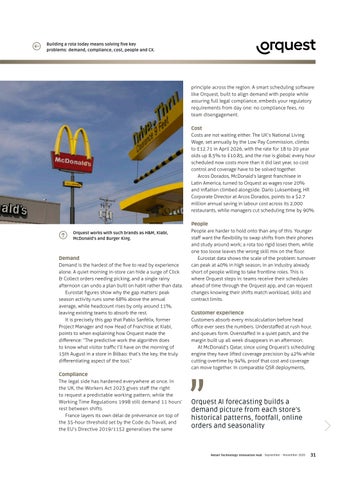
People Orquest works with such brands as H&M, Kiabi, McDonald’s and Burger King.
Demand Demand is the hardest of the five to read by experience alone. A quiet morning in-store can hide a surge of Click & Collect orders needing picking, and a single rainy afternoon can undo a plan built on habit rather than data. Eurostat figures show why the gap matters: peak season activity runs some 68% above the annual average, while headcount rises by only around 11%, leaving existing teams to absorb the rest. It is precisely this gap that Pablo Sanfélix, former Project Manager and now Head of Franchise at Kiabi, points to when explaining how Orquest made the difference: “The predictive work the algorithm does to know what visitor traffic I’ll have on the morning of 15th August in a store in Bilbao: that’s the key, the truly differentiating aspect of the tool.”
People are harder to hold onto than any of this. Younger staff want the flexibility to swap shifts from their phones and study around work; a rota too rigid loses them, while one too loose leaves the wrong skill mix on the floor. Eurostat data shows the scale of the problem: turnover can peak at 40% in high season, in an industry already short of people willing to take frontline roles. This is where Orquest steps in: teams receive their schedules ahead of time through the Orquest app, and can request changes knowing their shifts match workload, skills and contract limits.
Customer experience Customers absorb every miscalculation before head office ever sees the numbers. Understaffed at rush hour, and queues form. Overstaffed in a quiet patch, and the margin built up all week disappears in an afternoon. At McDonald’s Qatar, since using Orquest’s scheduling engine they have lifted coverage precision by 42% while cutting overtime by 94%, proof that cost and coverage can move together. In comparable QSR deployments,
Compliance The legal side has hardened everywhere at once. In the UK, the Workers Act 2023 gives staff the right to request a predictable working pattern, while the Working Time Regulations 1998 still demand 11 hours’ rest between shifts. France layers its own délai de prévenance on top of the 35-hour threshold set by the Code du Travail, and the EU’s Directive 2019/1152 generalises the same
Orquest AI forecasting builds a demand picture from each store’s historical patterns, footfall, online orders and seasonality
Retail Technology Innovation Hub · September - November 2026
31
waiting times have fallen by up to 26% and guests served per crew hour have risen by up to 23%.
One engine, five constraints None of this replaces a manager’s instinct so much as it empowers it. Orquest AI forecasting builds a demand picture from each store’s historical patterns, footfall, online orders and seasonality. Its scheduling engine then generates the rota from scratch around that forecast, checking every rest period, notice requirement, cost target and skill need. That is why top retail and QSR brands, including H&M, Kiabi, Dior, Burger King, KFC and McDonald’s in over 40 countries, trust Orquest to optimise their teams’ scheduling, turning it into a lever for operational excellence, employee wellbeing and customer satisfaction.
grown 319% over four years, was Highly Commended as AI Technology Supplier of the Year (Rest of World) at the RTIH Innovation Awards, and picked up two prizes at the Retail Systems Awards 2026: QSR Technology Innovation of the Year and Retail Workforce Innovation Award. “Being in the room when Orquest was announced winner was a moment I will not forget,” says María Torres, EMEA Regional Director. “For those of us working in the field every day, this confirms what our clients already know: this is not another software tool. It genuinely changes how restaurants and stores operate.”
About Orquest
Recognition
Orquest is a workforce scheduling software provider for top retail and quick service restaurant brands operating in 90+ countries, optimising rotas in a few clicks while keeping compliance, costs, teams and customer experience on track.
Recognition followed. This year alone, Orquest was named to Deloitte’s Technology Fast 500 EMEA, having
More at orquest.com.
Orquest is a member of the RTIH Innovation Awards hall of fame.
32
September - November 2026 · Retail Technology Innovation Hub
STORE DIGITAL TWIN Why it will become the operating system for future retail.
Introduction: the next frontier of retail AI As the retail industry prepares for NRF 2026: Retail’s Big Show Europe in September, much of the conversation continues to centre on artificial intelligence. From generative AI to emerging agentic commerce, retailers are exploring how AI can improve decisionmaking, streamline operations and create more responsive shopping experiences. Yet a fundamental challenge remains. While AI has become increasingly capable of analysing information and generating recommendations, physical retail environments remain highly dynamic and complex. Products move, shelves change, store conditions evolve, and customer behaviour shifts continuously throughout the day. Understanding what is actually happening inside the store, and acting upon it in real-time,
34
remains one of the industry’s greatest operational challenges. As AI moves closer to the heart of store operations, the question is no longer simply how to deploy AI, but how to provide the operational foundation that enables AI to understand, interpret and act within physical retail environments. This is where Store Digital Twin is becoming increasingly important. More than a technology initiative, Store Digital Twin is emerging as the foundational operational platform that enables AI powered retail operations.
From visibility to autonomy: the evolution of retail operations Store Digital Twin is becoming increasingly important as retailers seek to move beyond traditional approaches to store management. While early digital initiatives focused primarily on
September - November 2026 · Retail Technology Innovation Hub
visibility, the next stage of retail transformation is about creating the conditions for smarter and more responsive operations. The journey often begins with understanding what is happening across products, shelves, shoppers and store assets in real-time. Once these signals are connected, retailers can begin identifying patterns, uncovering root causes and understanding why issues occur. This deeper level of insight creates the foundation for AI powered decisionmaking, enabling organisations to prioritise issues, evaluate business impact and determine the most appropriate actions. The greatest value emerges when intelligence is connected directly to execution. Insights become operational outcomes through store teams, automated workflows and increasingly intelligent systems capable of
As retailers explore the next generation of AI powered operations, the conversation around Store Digital Twin is only just beginning.
Understanding what is actually happening inside the store, and acting upon it in real-time, remains one of the industry’s greatest operational challenges.
coordinating actions across the retail environment. Over time, this creates a path towards greater operational autonomy, where sensing, analysis, decision-making and execution function as a continuous cycle of optimisation. Viewed through this lens, the significance of Store Digital Twin lies not only in improving visibility, but in providing the platform that connects awareness, intelligence and execution. As AI becomes more deeply embedded within retail operations, the transition from visibility to autonomy is likely to become one of the defining themes of the industry’s next phase of transformation. For technology providers, this also requires a shift in focus. Rather than addressing individual operational challenges in isolation, the goal is increasingly to create an operational foundation where data, intelligence and
execution work together within a unified framework. This thinking underpins Hanshow’s approach to Store Digital Twin.
Building an AI powered Store Digital Twin ecosystem At Hanshow, the Store Digital Twin is built through a connected ecosystem that links products, people, assets and operational processes across the store. At its core, a Store Digital Twin provides a real-time digital representation of store operations. More importantly, it creates the foundation that enables information, intelligence and execution to work together within a single operational environment. At the frontline, Hanshow’s solutions such as NexShelf, NexConnect Smart Cart and NexMate robotics help create real-time awareness across the retail environment. Together, they provide visibility into
product availability, shelf execution, shopper interactions and operational conditions within the store. By connecting information from multiple touchpoints, retailers gain a more complete understanding of how their stores are performing in real-time. Building upon this operational awareness, AI powered solutions such as xPilot help transform information into actionable intelligence. By analysing operational conditions, identifying issues and recommending next steps, AI can help store teams focus resources where they create the greatest impact, improving consistency and responsiveness across the store network. At the same time, Store Digital Twin continues to expand beyond the sales floor itself. Store operations are increasingly influenced by critical infrastructure and energy systems, making operational visibility across these assets equally important. NexGrid and NexOptim solutions bring energy management, in-store systems and other critical store assets into a unified operational environment, helping retailers improve efficiency, resilience and sustainability. Together, these capabilities contribute to a connected Store Digital Twin ecosystem where people, products, assets and operational processes are linked through a shared operational foundation. This foundation enables AI not only to observe the store, but also to support decision-making, coordinate execution and lay the groundwork for increasingly autonomous operations.
Retail Technology Innovation Hub · September - November 2026
35
Case study: how Rainbow & Lingzhi built an AI ready operational model
At the frontline, Hanshow’s solutions such as NexShelf, NexConnect Smart Cart and NexMate robotics help create real-time awareness across the retail environment.
36
Rainbow’s collaboration with Hanshow provides a practical example of how Store Digital Twin can support AI enabled retail operations. As one of China’s leading digital retailers, Rainbow operates in one of the world’s most competitive retail markets, where e-commerce, instant delivery and omnichannel competition continue to raise expectations for operational speed, efficiency and execution. Rainbow has been exploring how to connect real-time operational awareness, intelligent decision-making and execution across its store network. Through the deployment of a Store Digital Twin ecosystem incorporating solutions such as NexShelf, NexConnect and xPilot, Rainbow has established a more connected operational environment capable of supporting data driven store management. In an award winning joint initiative in merchandise
September - November 2026 · Retail Technology Innovation Hub
precision management, Rainbow brings Store Digital Twin and AI powered intelligence into operations. One key application focuses on out-of-shelf (OOS) management. Hanshow provides the store-wide sensing hardware that captures real-time shelf images and inventory data, while Lingzhi contributes its self-developed AI analytics engine to interpret that data. Together, the two capabilities enable continuous, aroundthe-clock monitoring of shelf availability - automatically identifying out-of-stock SKUs and pinpointing their exact locations. Lingzhi’s demand forecasting algorithms then automatically issue replenishment tasks, helping store teams respond faster and more consistently. By connecting detection, analysis and task creation within a single workflow, the project helps reduce response times while improving product availability and operational efficiency. Rainbow is also among the first retailers to deploy xPilot
in live store environments. By introducing intelligence driven, automated workflows into daily operations, xPilot helps store teams respond more quickly to merchandising, pricing and inventory issues, reducing reliance on manual inspections and improving execution consistency across the store network. More importantly, this codeveloped operational model pioneered by Rainbow highlights a broader industry direction: the shift from deploying individual technologies to building a unified operational foundation capable of supporting AI powered retail execution.
Conclusion: the operating system for future retail As retailers explore the next generation of AI powered operations, the conversation around Store Digital Twin is only just beginning. The next chapter of retail transformation will not be defined by visibility alone, but by how effectively retailers connect awareness, intelligence and execution across the physical store. As these capabilities become increasingly integrated, the path towards more autonomous operations becomes clearer. At NRF 2026: Retail’s Big Show Europe, Hanshow will showcase how its AI powered Store Digital Twin ecosystem is helping retailers establish a unified operational foundation for the future, creating the conditions for more intelligent, adaptive and increasingly autonomous store operations. Visit Hanshow at Hall 6, Booth E-020, and follow Hanshow on LinkedIn for the latest insights on retail innovation.
INFLUENCERS TO FOLLOW IN 2026 The latest edition of the RTIH Top 100 Retail Technology Influencers List is here!
T
he list has seen a surge in popularity over the past few years, to the point that we’ve decided publishing it once a year is no longer enough. Here, then, is the second edition for 2026, with some names dropping out of the top 100 and some new names coming in (the latter are flagged as new entries for ease of reference). Including the likes of retailers, brands, technologists, analysts, and consultants, the list celebrates individuals who are helping to redefine retail in a fast moving omnichannel age. We use a variety of sources to select our top 100, including feedback from industry observers, research within our own networks, direct or third–
38
September - November 2026 · Retail Technology Innovation Hub
party nominations via our website, and social media tools. In addition to social presence, we also take into account award winners and judges, event speakers, books published, media appearances, and people building innovative companies, solutions etc in the retail space. We hope you enjoy reading through the top 100 and, as always, if you would like to give feedback or believe that there are some glaring omissions, please feel free to get in touch. Many thanks to 3D Cloud, which provides 3D product visualisation software trusted by top furniture and DIY retailers, for sponsoring the list. Scott Thompson, Editor and Founder, RTIH
RTIH’s Top 100 Influencers VINETA BAJAJ
MICHAEL GUZZETTA
Group CFO @ Holland & Barrett | Ex– Ocado | Ex–Rohlik Group | Chief People Officer | NED | Mentor | Advisor | Investor | Top 100 Retail Tech Influencer 2024 | Expert.
Product & Innovation Leader | Omnichannel Retail & Guest Experience | AI, Automation & Platforms | $552M+ Impact | USAF Veteran.
LinkedIn Bio
DAN MCGRATH JD Group Customer Operations at JD Sports Fashion plc. LinkedIn Bio
PAULA BOBBETT Chief Data and Digital Officer @ Boots UK | Executive Director | NED. LinkedIn Bio
ROB SMITH
LinkedIn Bio
GRAHAM BROOMFIELD Managing Director Austen & Blake | NED | Investor | CEO | Trustee | Advisory Board Member. LinkedIn Bio
PHIL THORNE | NEW ENTRY COO at Quorso · Writing about retail ops, AI, & scaling enterprise tech. LinkedIn Bio
LAUREN CLARK–ROUT | NEW ENTRY LinkedIn Bio
Social Media Lead–Marks & Spencer.
Technology Officer @ East of England Co–op | Technology Leadership.
CLAUDIO B. LANDSBERG | NEW ENTRY
MATT BRADLEY
I help retailers win with technology–not just adopt it. | Retail Tech Veteran · 30 Years · 3 Continents · 500+ Retailers.
LinkedIn Bio
LinkedIn Bio
Director & Founder–Retail Technology Show.
LinkedIn Bio
Matt Bradley
Retail Technology Innovation Hub · September - November 2026
39
RTIH’s Top 100 Influencers GLENN FAULKNER
MARTIN BAILIE
Product Manager | Spatial Intelligence & AI | Turning physical spaces into intelligent environments at AiFi.
MICHELLE GRANT
Global Retail CEO | Multi–Award AI & Growth Expert | Founder MWB Advisory | Leading Retail Transformation via AI & Operational Excellence | Advisor PwC Strategy&, Vusion, Quorso | CEO Tesco/Tata, COO Lidl, Primark Board.
Global Head of Consumer Industries Go–to–Market at SAP.
RICHARD NOON
LinkedIn Bio
LinkedIn Bio
Customer, Digital, Transformation & CRM Leader | CX | Customer Product | Paid Marketing | Contact Centre | AI Implementation | Post Purchase | DTC | Payments | Coach & Mentor. LinkedIn Bio
SARAH HUGHES | NEW ENTRY
40
September - November 2026 · Retail Technology Innovation Hub
KATE HARDCASTLE The Customer Whisperer™ partnering brands to delight consumers globally. Creating trust & growth | NonExec Director | Advisor | Broadcaster | Keynote Speaker | Author, The Science of Shopping | Award winning Maker of Joy. LinkedIn Bio
Co–founder & Director at Datitude | Get what you need from your data when you need it with Datitude’s award winning Managed Data Platforms & Solutions.
George Hayworth
Implementation Engineer | Fintech & Technology I Payments Did you know i’m also a Retail Technology Innovation Hub 100 Tech Influencer for both 2024 & 2025 | Speaker at Retail Technology Show 2025. LinkedIn Bio
SJ GRABIEC | NEW ENTRY
LinkedIn Bio
LinkedIn Bio
Dan McGrath
RTIH’s Top 100 Influencers DEANN CAMPBELL
JUSTIN BRETON
Retail turnaround through optimising stores | Global Speaker | Rethink Retail Top Global Influencer | RTIH Top 100 Retail Technology Influencer.
Marketing executive driving meaningful customer engagement through innovation; Recognised as Ad Age 40 Under 40, Event Marketer Watchlist, Brand Innovators 40 Under 40, & Business Insider Rising Star of Brand Marketing.
LinkedIn Bio
NADINE NEATROUR Customer Centric Leader. Helping brands see through a customer lens to thrive. CMO. CCO. Advisory. Fractional. Consulting. NED. LinkedIn Bio
MARSHALL KAY Strategic Advisor to retailers, global brands and investors. Speaker. Writer on Retail topics for Forbes. Named one of 2026’s Top Retail Influencers by UK–based Retail Tech Innovation Hub and US–based RETHINK Retail. LinkedIn Bio
JAMES PEPPER CEO @ Vista Technology Support | Charity Sector Trustee. LinkedIn Bio
Kate Hardcastle
LinkedIn Bio
CHRIS DUNN COO & Co–Founder @ FoundIt! | Driving sales & revenue for retailers through innovative marketing technology. LinkedIn Bio
GEORGE HAYWORTH | NEW ENTRY Retail Director @ Bringg | Helping Retailers Transform Last–Mile Delivery | 8+ Years in Quick Commerce. LinkedIn Bio
MATTHEW TAYLOR Global Technology & Delivery Executive | CTO / CIO | Cyber, Cloud & AI Platforms | Secure–by– Design, Data–Driven Leadership. LinkedIn Bio
Justin Breton
Retail Technology Innovation Hub · September - November 2026
41
RTIH’s Top 100 Influencers SCOTT THOMPSON
STEVE COLLINGE
Editor and Founder at Retail Technology Innovation Hub and EdTech Innovation Hub. Organiser of the RTIH Innovation Awards and RTIH AI in Retail Awards. Member of the judging panel for EHI Retail Institute’s reta awards.
Rethink Retail Top Retail Expert 2026, RTIH Top 100 Retail Technology Influencer 2025, Commentator, Content Creator, International Speaker and Expert on the Home & Garden Industry. Group Managing Director.
CHRISTIANA HAWES | NEW ENTRY
CAITLIN ALLEN
Senior Director, Global Retail Technology at Warner Bros Discovery | CIO–Track Leader | International Growth.
RTIH Top 100 Retail Tech Influencer | PG 2025 Top Woman in Grocery | SVP of Market @ Simbe.
LinkedIn Bio
LinkedIn Bio
YATHU KANAGARATNAM
LinkedIn Bio
LinkedIn Bio
DR. ASTHA PUROHIT | NEW ENTRY Director of Product Walmart I Ex– McKinsey I MIT Sloan MBA. LinkedIn Bio
Head of Technology & AI Strategy | Award–Winning AI & Digital Transformation Leader | Retail Tech | E–Commerce | Building AI Systems That Deliver Real Business Results. LinkedIn Bio
ANDREW BUSBY
Commercial Director | ex–Tesco | ex– Travelex | ex–Morrisons.
Senior Industry Adviser, BOXTEC | Retail Writer at Fortune | Founder, Redline Retail Consulting | Best–Selling Author | Bookmark Charity Ambassador | ReTHINK Retail/RTIH Top 100 | Speaking: Speakers Corner.
ORNELLA URSO | NEW ENTRY
LEE ALLEN | NEW ENTRY
PETER MATTHEW | NEW ENTRY LinkedIn Bio
PhD | Research Director - Retail Tech & Business Insights Analyst and Advisor. LinkedIn Bio
LinkedIn Bio
LinkedIn Bio
Marketing–Retail Technology Show.
DEAN D. MCELWEE VP of E–Commerce | Digital Transformation Leader | Expert in Digital Marketing & Strategy | Author of “eCommerce for CEOs” | Scaling Omnichannel Revenue & Brand Growth | Driving ROI through Data–Led Innovation. LinkedIn Bio
JAMES USSHER–SMITH | NEW ENTRY MD @ TPP Retail Group–Technology Built to Power Frontline Workers. LinkedIn Bio
DAVID POLINCHOCK Pres, Brand Experience Lab | Retail Innovation Strategist | RETHINK Retail Top Expert | RTIH Top Voice in Retail | Top AI In Retail | Mentor | Writing book on 3rd Place with Sydney Polinchock. LinkedIn Bio
LINDA JOHANSEN–JAMES | NEW ENTRY Global Keynote Speaker | Top Retail Expert | Retail Strategist | CEO & Founder, International Retail Group | Built $1B+ in Retail Revenue | Author | Retail Voice 2026 | Publisher, IR Magazine | Consultant | Real Estate. LinkedIn Bio
Christiana Hawes
42
September - November 2026 · Retail Technology Innovation Hub
RTIH’s Top 100 Influencers TED MCCAFFREY
ASIF AZIZ
Omnichannel Champion | Rethink Retail Top Retail Expert 2024–2026 | RTIH Top 100 Retail Influencer 2026 | Retail Tech + RFID + AI | Strategic Partnerships • Store Intelligence • Data–Execution
Retail Director EE/BT Group | NED | BT Group Clinical Advisory Board Member.
LinkedIn Bio
MELISSA MINKOW LinkedIn Bio
Global Director, Retail Strategy & Insights
at CI&T.
ELAINE PARR
LinkedIn Bio
MIKE CADDEN Transformational retail–focused IT Director/CIO/Programme Manager; RTIH Top 100 Retail Tech influencer. LinkedIn Bio
CHRISTINE RUSSO
Consumer Products, Retail & Luxury Industry Leader | Recognised Industry & LinkedIn Top Voice | The CPG Geek™ | Gender Equality & Talent Champion | Proud Mum of The Firecracker | IBMer.
Leading Industry Voice | Tech Scouting | Events | Believer in Converting with Content | Partnerships | Creator and Host What Just Happened Podcast on Spotify | Moderator, Advisory Board Member | Debate Winner.
MARTIN NEWMAN
CELIA VAN WICKEL
One of the world’s leading authorities on customer centricity, a global speaker, part time chief customer officer, author, creator of the Mini MBA in Customer Centricity and a trusted board advisor.
Expert in eCommerce, Retail, CPG, and Marketing activation, insights, and trends | Creative and curious thought leader & storyteller | Thoughts expressed are my own.
LinkedIn Bio
LinkedIn Bio
LinkedIn Bio
LinkedIn Bio
Asif Aziz
Retail Technology Innovation Hub · September - November 2026
43
RTIH’s Top 100 Influencers GREG DEACON
TREVOR SUMNER
Commercial & Growth Leader | Quick Commerce, Retail Media & FMCG | Scaling Revenue, Partnerships & Market Expansion.
CEO of i–Genie.ai–Top 100 Retail And Top 50 RetailTech Expert–Entrepreneur–Executive– Advisor–Angel.
TOBY PICKARD
SHISH SHRIDHAR
Retail Futures Senior Partner @ IGD | Top Retail Expert from Rethink Retail and RTIH Top Influencer.
Global Retail Startups Lead | Top AI Leader 2024 | Top Retail Expert 2024 | Top 100 Retail Technology Influencers | Advisory Board | Public Speaker.
LinkedIn Bio
LinkedIn Bio
NICHOLAS FOUND LinkedIn Bio
Head of Commercial Content at Retail
Economics.
LinkedIn Bio
GARY NEWBURY Rapid Performance Recovery | Supply Chain Transformer | 25+ Operational Turnarounds | Mid–Market Growth Escalator | Speaker | Radical Strategic Thinker | Highly Focused | Empowering | Interim C Suite Leader. LinkedIn Bio
TABITHA GAFENCU | NEW ENTRY LinkedIn Bio
LinkedIn Bio
Project Manager–Stores Transformation
and Ops Dev.
SHARON YOURELL LAWLOR Global strategic consultant & keynote speaker, helping brands and retailers turn consumer & shopper insight into strategies for commercial growth. NRF Retail Voice | RETHINK Retail Top Expert | RTIH Top 100 Tech Influencer. LinkedIn Bio
IAN RASMUSSEN Leading the Future of Convenience Retail | Trusted Advisor to Executives | Leading Business Transformation & Customer Success. LinkedIn Bio
CHRIS CONWAY Chief Digital Officer | Ecommerce Director | Commercial Director | Operations Director | Global Tech Top 50 Retail Week 2024 & Board Adviser. LinkedIn Bio
LEONID GLADILIN eCommerce & Omnichannel Growth Leader | Founder, HQ Portraits | Building Ai–native Phygital Client Experience | P&L, Automation, DTC, Top Retail Expert 2025, 2026 | Top 100 Retail Tech Influencer 2024, 2025, 2026. LinkedIn Bio
MARK GLEESON | NEW ENTRY General Manager @ Auror | UK & Europe | Veteran. LinkedIn Bio
BECKY LOMBARDO Helping fast growth global eCom businesses scale and grow profitably | Logistics | Supply Chain | Operations | SME | eCommerce | Omnichannel | LinkedIn Bio
Toby Pickard
44
September - November 2026 · Retail Technology Innovation Hub
RTIH’s Top 100 Influencers Glen Richardson
Tabitha Gafencu
Retail | Scale Up | Start Up | Growth Accelerator | Advisor | COO.
ALICE RACKLEY Chief Executive Officer @ Polytag Limited | Circularity Pays–platform solutions to power sustainable businesses. Digital Product Passports and more. ISO certified. Global Brand Clients. VC Backed. LinkedIn Bio
DOMINIQUE PIERRE LOCHER 1st generation digital pioneer, early stage investor and Food–and RetailTech entrepreneur. LinkedIn Bio
TONY D’ONOFRIO
VIRGINIA MARSH Top Retail Expert 2026, 2025 | RTIH Top 100 Retail Technology Influencer 2026 | AI Retail & CPG Data Strategist | Audience Activation & Data Monetisation | AdTech & Martech Leader. LinkedIn Bio
OSKAR JAKOBSSON Director Customer Solution @ICA–Senior retail manager. RTIH–Top 100 Retail tech influencer. Rethink Retail–Global Retail Leader. Retail tech expert and speaker. LinkedIn Bio
CARL BOUTET
President @ Sensormatic | Recognised Global Top Retail Expert– 11,000+ Direct Contacts / 150,000+ Followers > Views my own.
Available now! TheFlipBook.online → Keynote Speaker & Author | McGill & AIT Adjunct Faculty | Board Director & Advisor | Top 10 Global Retail Thought Leader.
RICHARD HAMMOND
HENRIK HÄLLBERG
Uncrowd CEO & Founder | Expert in Experience Analytics.
MD @ WAIR Nordic | AI native | Inventory Planning | Fashion.
LinkedIn Bio
LinkedIn Bio
LinkedIn Bio
LinkedIn Bio
Retail Technology Innovation Hub · September - November 2026
45
RTIH’s Top 100 Influencers Melissa Moore
GILES SMITH
MELISSA MOORE
CPO/CTO | Keynote Speaker | Technologist | Executive, Leader & Board Trusted Advisor @ Burberry, Unilever, Selfridges, John Lewis, Matalan, Arcadia, Walmart, Woolworths, Mondelez, Diageo, Kao, Kimberley Clarke, Waitrose+.
The Retail Advisor | The Retail Tea Break Podcast Host | Retail & Sales Lecturer | Conference Chair & Event MC | RETHINK Retail Top Retail Expert.
GLEN RICHARDSON
TOBIAS CATERER
Non Executive Director | Former COO @ The Range, CMO @ Fruugo.
Microsoft Cloud & AI Specialist–RTIH Top 100 Retail Tech Influencer 2025 & 2026.
ROY HORGAN | NEW ENTRY
BELLA TRANG NGO
Group SEVP Strategy, Marketing & Communications at Vusion Group.
LinkedIn Bio
LinkedIn Bio
Founder at Brarista–We make bra & swimwear shopping so much easier | Sifted’s Femtech Startup to watch | Draper’s Tech Innovator Finalist | Women in Innovation Awardee. LinkedIn Bio
JO HICKSON Director of Strategic Initiatives Development at Specsavers. LinkedIn Bio
46
September - November 2026 · Retail Technology Innovation Hub
LinkedIn Bio
LinkedIn Bio
LinkedIn Bio
OLIVER BAGGALEY LinkedIn Bio
General Manager, Autonomous Stores
at Trigo.
MARTIN SCHOFIELD LinkedIn Bio
Solutions.
CEO at Retail247 | PIM and Stock SaaS
RTIH’s Top 100 Influencers NIKKI BAIRD | NEW ENTRY
CATHY MCCABE
Retail industry and technology expert, focused on the future and its implications for today and tomorrow.
CEO & Co–Founder–Leading Global Retail Clienteling Solution | Empowering Associates with Omnichannel Retail | Build Your Business By Growing Customer Engagement | Understand Interactions | Data– Driven Retail Marketing.
LinkedIn Bio
WALTER HOLBROOK YODA RETAIL | RETHINK Retail Top Expert 2024/2025/2026 | Leadership Development | Merchant | Transformation & Change Coach | Retail Pioneer–Mad Man Era to Today | RTIH/3D Cloud Top 100 Retail Technology Influencers. LinkedIn Bio
LinkedIn Bio
JESPER HOLME KALHAVE | NEW ENTRY Chief Sales Officer (CSO) at GoFact. Supporting Lifestyle Retailers and Brands with Merchandise, Buying and Planning Management. LinkedIn Bio
DAVID PERKS
CAROLE KINGSBURY
Experienced MD | Global top 100 Retail expert | Rethink Retail Industry Expert | ex Tesco | Sainsbury’s | Kingfisher | BP | Accenture |
CIO | Technology Director | People– focussed Change and Digital Transformation Leader.
LinkedIn Bio
ADRIANA RIVAS | NEW ENTRY
LinkedIn Bio
JOHN-PIERRE KAMEL
Gold Stevie® 2026 · COO & AI Strategist @BIGWISE · AI in Retail · #7 Global Thought Leader in Retail · Top 25 Agentic AI · Award–Winning Author.
Retail, Omni–Channel, RFID Technology Executive | Rethink Retail Top Retail Expert 2024, 2025, 2026 | RTIH Top 100 Retail Global Technology Influencer 2024, 2025, 2026.
OLIVIA ROBINSON
YAZ HANLEY
LinkedIn Bio
LinkedIn Bio
VoCoVo.
Nikki Baird
Global Strategy & Enablement Director,
LinkedIn Bio
Head of Customer Success @ Strongpoint ALS. LinkedIn Bio
Olivia Robinson
Retail Technology Innovation Hub · September - November 2026
47
RTIH’s Top 100 Influencers
Isabell Aakervik
ISABELL AAKERVIK
GONEN GERSHUNI
Chief Expansion Officer at Sitoo | MACH Alliance Community Council Member | Women in MACH Ambassador.
Unmanned Stores | Auto Pick & Pack | 24/7 Omnichannel | 100% Loss Prevention | Automation & Robotics Pro | Top Retail Expert @ RETHINK Retail | RTIH Top 100 Retail Tech Influencer | Entrepreneur & Mentor.
LinkedIn Bio
MARK SIMPSON Retail / Technology Advisor / CEO / NED / Ex ASDA Exco–Chief Supply Chain and Transformation Officer. LinkedIn Bio
CAMILLA YOUNG Chief Firestarter | Retail Transformation Leader | Connected Packaging Evangelist | High Impact Career Coach for Courageous Change Makers | DM me to talk future of retail or career reinvention. LinkedIn Bio
OLIVIA (LIV) PARKES | NEW ENTRY Founder & CEO of Persi | Making personalisation actually personal! LinkedIn Bio
48
September - November 2026 · Retail Technology Innovation Hub
LinkedIn Bio
MERIEL NEIGHBOUR Global Transformation Director | Leadership-Delivery | Digital, eCommerce, Point of Sale, ERP | Award winning | Customer focused | Technology and Business Change portfolio strategist | Results driven | Mentor | Speaker. LinkedIn Bio
CHRIS IGWE Award winning industry leader | Global Retail Authority | Retail Voices by NRF 2025 & 2026 | Top Retail Expert 2023–2026 | Keynote Speaker | Bestselling Author | C–Suite roles & Board positions | Mentor. LinkedIn Bio
RTIH’s Top 100 Influencers ALEX BAKER LinkedIn Bio
Co–creating the new retail ecosystem.
ROGER DUNN Global Retail Media Lead | LinkedIn Top Voice | Keynote Speaker | The Drum Commerce Media Power 100 | Retail Media Leader of the Year | RETHINK Top Retail Expert | WFA & IAB Council | Marketing BSc & MBA. LinkedIn Bio
STEVE DENNIS Transforming Retail QA | Giving Technology Leaders the Confidence to Launch at Scale. With Zero Surprises. LinkedIn Bio
CHAMIAH DEWEY 24x Award Winning Petite Fashion Founder of DEWEY, Drapers 30 Under 30 | Top 10 Retail Disruptors & Innovators of 2026. LinkedIn Bio
HARRY RIDLEY LinkedIn Bio
Head of Technology at Levy UK + Ireland.
NATALIE BERG Retail Analyst | Author | Host of the Retail Disrupted Podcast. LinkedIn Bio
Natalie Berg
HOW DO WE IDENTIFY THE TOP 100?
We use a variety of sources to select our top 100, including feedback from industry observers, research within our own networks, direct or third-party nominations via our website, and social media tools. In addition to social presence, we also take into account award winners and judges, event speakers, books published, media appearances, and people building innovative companies, solutions etc in the retail space. Chamiah Dewey
Retail Technology Innovation Hub · September - November 2026
49
Retec Retec Group’s Chris Griffiths: “The consulting pyramid had a good run. AI will end it.”
Consulting has a legacy system too Here’s a parallel that every retail technology leader will recognise immediately. The single biggest challenge in delivering transformation is the complexity of change within an organisation.
T
he single biggest challenge in delivering transformation is not setting the technology strategy or choosing the right platforms. Instead, it’s the complexity of change inside an organisation. Organisations where decades of accumulated systems, integrations, and decisions that made sense at the time, are now load-bearing walls you cannot remove without bringing something else down. The legacy estate is not just a technical problem: it’s an
50
September - November 2026 · Retail Technology Innovation Hub
organisational one. The business processes, the informal relationships, the institutional knowledge baked into how an organisation behaves: these are harder to replace than the technology itself. The large consultancies face an identical problem with their own operating model. The governance layers, the approval hierarchies, the utilisation targets, the account structures. These are their legacy estate. They know it needs to change and many are genuinely trying. But structural problems of this scale cannot be
Retec The organisations attempting those transformations are being guided by the same firms now trying to transform themselves.
contracts from the clients whose programmes those people were delivering. The arithmetic is telling. Greenfield is always easier. That is not a criticism of anyone. It’s simply true.
What replaces the pyramid
resolved by good intentions alone. Modernising from the inside - while keeping the lights on for existing clients and managing the politics of change at scale - is the hardest thing to do. The retail industry knows this better than most. The number of large scale transformation programmes that have delivered their original promise, on time and on budget, does not reflect well on the industry. And the organisations attempting those transformations are, very often, being guided by the same firms now trying to transform themselves.
Why change is harder than it looks The consulting industry’s response has been predictable: AI centres of excellence, innovation labs, and rebranded service lines with ‘AI’ somewhere in the name. The intent may be genuine. But structural problems are not solved by renaming them. Large organisations accumulate what could be considered ‘organisational scar tissue’. In effect, every failed project produces a new governance process, every risk event generates a new approval layer, every growth phase adds a management tier that, when growth reverses, proves almost impossible to remove. Over time, the organisation becomes less a vehicle for delivering outcomes and more a system for managing its own complexity. One where processes designed to protect quality end up preventing it. As a result, approval chains outlast the problems they were built to solve, and the most talented people quietly start to leave. AI has accelerated all of this. Analysis, documentation, reporting, coordination - this is precisely what AI does well. Not perfectly, and not without oversight, but well enough and fast enough to fundamentally change how many people you need to deliver transformation and change. A billing model built on hundreds of heads becomes structurally indefensible when that headcount can be augmented by a well-configured set of tools. Tens of thousands of roles have been cut across the major consultancies in the past 18 months. This is often at the same firms simultaneously winning AI transformation
When you build from scratch, you make different choices. Not because you’re smarter or more virtuous, but because you’re not constrained by what already exists. You don’t inherit governance structures designed for a business ten times your size. You don’t have utilisation targets that incentivise billing over outcomes. You don’t have account hierarchies that put the wrong person in the room. You build what you actually need for the environment you’re operating in. In the AI era, that means small, senior teams with deep domain expertise and genuine proximity to the client’s business. Teams who can move at the speed the problem demands, not the speed the governance structure permits. Augmented by AI tools that compress analytical and coordination work which once required large teams, senior practitioners are freed up to focus on judgement, relationships, and outcomes. This model only works with the right culture underneath it. A high-calibre team operating under a command-and-control hierarchy isn’t a high-calibre team, it’s a small bureaucracy.
A billing model built on hundreds of heads becomes structurally indefensible when it can be augmented by a well-configured set of tools.
Retail Technology Innovation Hub · September - November 2026
51
Retec Culture is the delivery model Building this kind of firm requires deliberate choices at the start; about who you hire, how you structure authority, and what you are willing to say no to. But what does this actually look like? For starters, slow hiring for alignment; not just on capability, but on the values that make high-performing teams function. Teams built on trust, accountability, the willingness to tell a client something they don’t want to hear, and the commitment to stay until the work is done, not until the statement of work expires. Senior practitioners who have lived the problem from both sides, as consultants and as the clientside leaders accountable for outcomes when those consultancies fell short. That combination: genuine expertise, genuine proximity, and a culture that doesn’t have to be rescued from its own legacy, is what the next generation of consulting firms will be built on. The evidence, where it exists, is not found in credential decks. It shows up in staff retention, in NPS, in whether the person who sold the engagement is the person doing the work. It’s also, it turns out, what makes people want to come to work. When Retec was named a Sunday Times Best Places to Work this year in our first year of operation, it wasn’t a surprise to us. It was
confirmation that the model we’ve built is working in the way we intended.
The questions worth asking The retailers who navigate the next five years well won’t simply be those who adopted AI earliest. They’ll be those who were clear-eyed about what kind of partner they needed. Before you sign the next statement of work, ask your systems integrator what their staff retention rate looks like on client programmes. Ask how many of the people who started your programme are still on it. Ask whether the person presenting the proposal is the person who will actually do the work. The answers will tell you more about your likely outcomes than anything else in the proposal. The consulting pyramid had a good run. AI will end it. What comes next is smaller, faster, and built on genuine expertise, genuine proximity, and a culture that didn’t have to be rescued from its own legacy. About the author: Chris Griffiths is CEO and Cofounder at Retec Group, a boutique retail technology consultancy working with some of the UK’s leading retailers and hospitality operators. Retec was named a Sunday Times Best Places to Work 2026.
What comes next is smaller, faster, with a culture that didn’t have to be rescued from it’s own legacy.
52
September - November 2026 · Retail Technology Innovation Hub
Independent retail
Smarter neighbourhood retail ops in the AI age Independent retailers cannot outspend national chains, but they can build stronger operating systems, use data more intelligently, and apply AI to strengthen the advantages large retailers still struggle to replicate: local trust, flexibility, and deep community knowledge, says Rodrigo Santos Fernández.
I
Rodrigo Santos Fernández: Store environment influences customer behaviour far more than many owners realise.
have spent many years inside neighbourhood stores across Mexico, meeting with owners of tienditas, kiosks, and family run retail businesses trying to hold their ground against convenience chains and supermarkets. The conversations were remarkably consistent. Store owners described shrinking margins, declining customer traffic, limited visibility into what products were actually profitable, and no operational systems beyond a cash drawer and handwritten inventory notes. Many had already convinced themselves the outcome was inevitable: large chains would eventually dominate every market. That assumption did not align with what I later observed while leading Súper Ya!, a public-private retail modernisation initiative developed
54
under Grupo Modelo to help independent retailers compete more effectively against organised chains. Backed by government funding and private sector partnerships, the programme ultimately modernised more than 4,000 neighbourhood stores across Mexico between 2010 and 2013. The retailers that improved performance were not operating with larger budgets or sophisticated infrastructure. Competitive gains came from stronger execution standards, clearer insight into business performance, and more consistent execution across the business. Large retailers succeed because they operate systematically. Customer experience, inventory control, staffing, pricing, promotions, merchandising, and replenishment all function within clearly defined
September - November 2026 · Retail Technology Innovation Hub
processes that can be measured, adjusted, and improved continuously. But independent retailers already possess strengths that large chains spend enormous amounts of money trying to recreate. Owners understand neighbourhood buying habits, recognise shifts in purchasing patterns quickly, and build relationships that develop over years rather than transactions. Most smaller stores do not fail because they lack local knowledge; they struggle because that knowledge rarely becomes part of a repeatable operating structure that employees can execute consistently. To address that gap, I developed and implemented TRIPS, a fivepillar framework designed to help independent retailers operate more systematically. The first 300 stores that fully adopted the model
Independent retail achieved average sales increases of 20% while reducing costs by roughly 10%. Results came from improving execution across five interconnected operating areas rather than from any single technology investment or isolated operational change. As a practical roadmap for execution, TRIPS organised those areas into an integrated operating model: Training and Capability Building, Retail Operations Optimisation, Intelligent Sourcing, Physical Environment and Customer Experience, and Systems Integration.
1. Training and capability building Most small retailers underestimate the value of structured training. Retail skills are often treated as something employees absorb informally over time, but consistent operating standards rarely emerge without deliberate coaching, accountability, and repetition. Through Súper Ya!, store
owners and managers received practical instruction in inventory management, gross margin analysis, merchandising, customer service, and product display optimisation. Operational improvements became visible quickly, but the more important change involved consistency. Stores with stronger training programmes experienced lower employee turnover and more stable customer interactions because staff understood expectations more clearly and operated with greater confidence. In neighbourhood retail, familiarity matters. Customers are far more likely to return to stores where service feels dependable and where relationships develop naturally over time.
2. Retail operations optimisation Many independent retailers still manage their business primarily through instinct. Owners know
whether a day felt busy, but often lack reliable visibility into category performance, shrinkage, labor efficiency, or inventory turnover. During Súper Ya!, participating stores implemented simple but structured reporting systems supported by PoS transaction data, inventory tracking tools, and operational dashboards designed to help owners monitor business performance more consistently. Once store owners could see the numbers clearly, operational blind spots became difficult to ignore. In many cases, a small number of underperforming categories were consuming disproportionate working capital, while only a handful of products generated most of the store’s profit. Access to better business insight changed decision-making quality almost immediately because purchasing, staffing, pricing, and promotional decisions could now be tied to measurable performance indicators instead of assumptions.
3. Intelligent sourcing Independent retailers frequently purchase products through fragmented supplier relationships with inconsistent pricing structures and limited negotiating leverage. Under the TRIPS framework, participating stores were organised into purchasing cooperatives that allowed them to negotiate collectively with suppliers and improve purchasing efficiency. Even modest improvements in cost of goods sold can materially improve profitability in retail, particularly in businesses operating on thin margins. Coordinated sourcing also gave smaller retailers access to suppliers, promotional programmes, and product categories that had previously been unavailable to them individually. Independent retailers can tap AI to strengthen the advantages they have over national chains.
Retail Technology Innovation Hub · September - November 2026
55
Independent retail More importantly, collective purchasing created leverage that independent operators rarely possess when negotiating alone.
4. Physical environment and customer experience Store environment influences customer behaviour far more than many owners realise. Poor lighting, cluttered aisles, weak signage, and disorganised product placement reduce customer comfort and limit product visibility, even when pricing remains competitive. Participating retailers worked on practical but measurable improvements: clearer product organisation, improved lighting, cleaner shelf presentation, more disciplined inventory placement, and better use of physical space. Most of these changes were relatively inexpensive, yet they improved shopping flow and increased the amount of time customers spent inside the store. Organised environments also communicate professionalism and reliability, both of which influence purchasing behaviour more directly than many operators realise.
decisions grounded in actual sales behaviour rather than intuition. TRIPS succeeded because each pillar reinforced the others. Training without business insight limits improvement. Better sourcing without inventory management creates inefficiency elsewhere. Sustainable gains required stores to apply the framework consistently across all five operational areas rather than treating operational problems as isolated issues.
How AI strengthens the TRIPS model Although TRIPS was originally implemented more than a decade ago, the operational challenges it addressed remain central to independent retail today: inconsistent execution, limited visibility into performance, fragmented purchasing decisions, and difficulty responding quickly to changing customer demand. What has changed is the accessibility of technology. Artificial intelligence now gives independent retailers access to analytical
capabilities that were previously available only to large enterprises with significant technology budgets. When integrated into a disciplined operating model, AI strengthens the operational foundation behind retail execution by improving forecasting accuracy, accelerating response time, increasing visibility into performance trends, and helping operators respond faster to changes in customer demand. Training programmes, for example, become more effective when retailers can analyse customer interactions, transaction patterns, and employee performance data to identify behaviours associated with stronger sales and customer retention. Instead of relying on generic retail guidelines, managers can adapt coaching and employee development based on what actually works within their own customer base and operating environment. Managers also gain the ability to respond earlier to operational problems. AI tools can identify shrinkage patterns, inventory anomalies, declining margins, and
5. Systems integration Traditional cash registers record transactions. Modern Point of Sale systems generate operational intelligence capable of improving decisions across the business. Affordable PoS systems implemented through the programme gave store owners continuous visibility into sales patterns, inventory movement, customer preferences, staffing needs, and profitability by category. Many retailers were seeing this level of operational detail for the first time. Better information led to stronger inventory management, more effective promotions, and purchasing Large retailers succeed because they operate systematically.
56
September - November 2026 · Retail Technology Innovation Hub
Independent retail TRIPS is a five-pillar framework designed to help independent retailers operate more systematically
unusual transaction behaviour before they become serious operational problems. Earlier visibility allows operators to intervene before profitability is affected, particularly in businesses where small inefficiencies compound quickly over time. AI’s forecasting tools improve sourcing decisions by evaluating purchasing trends, sales velocity, seasonality, and local demand patterns continuously. Independent operators no longer need to rely entirely on instinct when determining inventory levels or reorder timing because machine learning tools increasingly make sophisticated demand forecasting accessible at much lower cost. Retail layout and merchandising decisions are also becoming more measurable. Heat mapping, traffic analysis, and customer movement tracking help retailers understand how shoppers interact with physical space. Shelf placement, promotional displays, and product organisation can then be adjusted using actual customer behaviour instead of assumptions or generalised industry templates. Finally, modern PoS systems are evolving into operational decision platforms capable of analysing purchasing patterns, customer profitability, abnormal cash flow activity, and operational trends in real-time. Many of these capabilities are now available
Many independent retailers still manage their business primarily through instinct.
through affordable cloud-based platforms that independent retailers can realistically implement without enterprise scale IT budgets.
Independent retailers already possess a powerful competitive advantage Large retail chains benefit from scale, process standardisation, and purchasing leverage. Independent retailers possess something even more valuable: trust within the local community, flexibility in decisionmaking, and direct understanding of customer behaviour. TRIPS was designed to make those advantages more systematic. AI now allows smaller retailers to strengthen those systems further through better forecasting, faster analysis, and more informed operational decisions. Retailers most likely to succeed over the next decade will not necessarily be the operators with the largest budgets. More durable competitive advantages will belong to businesses capable of combining local knowledge with consistent execution, stronger performance insight, and the ability to adapt quickly as buying patterns evolve.
Large organisations often struggle to build genuine local trust and responsiveness at scale, while independent retailers already possess both in ways that can become extraordinarily powerful when supported by consistent execution and intelligent systems.
About the author Rodrigo Santos Fernández is an operations executive and business transformation strategist specialising in retail modernisation, operational optimisation, and AI enabled process improvement systems. Over the past two decades, he has led large scale transformation initiatives across retail, beverage, logistics, and manufacturing sectors, including the modernisation of more than 4,000 independent retailers in Mexico through the Súper Ya! programme. A former executive with Grupo Modelo/AB InBev, he currently serves as CEO at Cervecería Allende, where he leads operational and commercial turnaround initiatives. He holds a Master of Science in Management Science and Engineering from Stanford University.
Retail Technology Innovation Hub · September - November 2026
57
Retail Express
PROMOTIONAL PRICING WHERE REWARD MEETS POTENTIAL RISK Ed Betts, Retail Express, argues that while promotional pricing helps retailers prove value in a tough market, a poorly controlled offer can become a compliance and customer confidence problem.
Ed Betts: Accurate, fair and compliant promotional pricing hinges on discipline, just as it always has.
P
romotional pricing is one of retail’s most powerful tools. It is a way to draw customer attention, shape value perception, and build retention. But a recent ruling against Australian supermarket Coles offers an uncomfortable lesson in how easily discounting can go wrong. The Federal Court found that the supermarket’s “Down Down” promotion had misled customers, after the Australian Competition and Consumer Commission (ACCC) challenged the way price reductions had been presented. Coles’ promotion pattern was simple enough: sell a product at one price, increase its price for a relatively short period, then later promote that product as reduced. Most retailers will immediately see the flaw, particularly as the ACCC found many “Down Down” ticket prices were the same as, or higher than, the product price before the temporary increase.
58
September - November 2026 · Retail Technology Innovation Hub
While the precise rules differ slightly between the CMA in the UK, FTC and state consumer laws in the US, ACCC in Australia, and the Price Indication Directive across the EU, their regulatory intent is consistent. Reference prices used in promotions need evidence, and any claim of savings must be based on a real, representative price history – not, as in Coles’ case, a convenient reference point created by the mechanics of the promotion.
The pressure of promotions Yet Coles’ pricing misstep is also understandable. Most retailers do not set out to mislead, but the grocery sector is under enormous pressure to show value, move quickly and fight hard for customers who are more aware than ever of the contents of their baskets. Energy and freight costs are driving up prices for suppliers and making negotiations ever more fraught; commodity shifts and geopolitical movements may, in many cases, make staples more difficult to discount. Promotional pricing is complex and dependent on a huge number of variables. Price history, promotion planning, marketing communications and store execution – and the teams responsible for them – have to move together. If a reference price is wrong, an establishment period too short, or a promotion extended beyond the point at which the original
Retail Express comparison becomes invalid, it is all too easy to fall foul of the rules. However unintended.
Smart systems for smart comparisons The most exposed promotional mechanic is the comparative claim, meaning any message that uses a previous price to make the current one more attractive. Comparisons are powerful because they are easy to understand, but risky because establishing the veracity of the reference price – and the legitimacy of the saving – depends on a clear record of what a product has actually sold for, when, where and for how long. That is not an easy timeline to reconstruct manually. If a retailer is relying on spreadsheets, email approvals and manual checks, building a clear picture of price memory may be difficult to achieve. Undocumented changes brought about by last minute actions or poor record keeping can lead to checks being ineffective. A robust pricing process should not rely on slow methodologies or expect people to remember every exception. It should hold price history at item level, and use it when an offer is being created. Data must always come first. If a local jurisdiction expects the lowest recent price to be used as a reference point, that should be readily available and visible. If a product planned for promotion has not been established at the higher price for long enough, pricing systems should flag it. Put
simply, if a “was” price should not be communicated, the offer should be stopped (or have its “was” price cleanly removed) before it can be executed.
The freedom to change Retailers should still be free to promote aggressively, just not carelessly. Building rules into the pricing workflow ensures that compromised promotions do not slip through unnoticed. These rules should also reach forward, applying required price changes in a way that does not create a misleading future claim for a planned promotion. Rulesbased pricing establishes a foundation on which retailers can build promotions quickly within firm guardrails. In essence, it weaves compliance into the act of pricing. Such a system does not, however, have to mean rigidity. Plans change, and when a promotion is landing – or when it is not – retailers must be able to move in the direction that makes sense. They may wish, for example, to extend a successful offer price beyond the point where a comparison to a higher price is fair to customers. That is perfectly valid, but any reference price needs to disappear everywhere: on paper labels, electronic shelf edge labels, point of sale, online, apps, loyalty communications and so on. In a large grocery operation, there is a significant operational risk that something might be missed, so pricing systems need to connect the commercial plan with the way the offer is actually executed.
Retailers should still be free to promote aggressively, just not carelessly.
Retail Technology Innovation Hub · September - November 2026
59
Retail Express With modern pricing systems that place data front and centre, mistakes become much harder to make and easier to prevent.
The real cost of faulty discounts In the end, accurate, fair and compliant promotional pricing hinges on discipline, just as it always has. Retailers need to know the price they are claiming, the history that supports it, the places that claim is being made, and precisely when it must change. That is possible under legacy pricing systems, but it is difficult and prone to error. With modern pricing systems that place data front and centre, mistakes become much harder to make and easier to prevent. The public result of promotional inaccuracies for Coles — and potentially for rival Woolworths, also under investigation by the ACCC — is likely to be a significant penalty from the courts. The deeper damage may be harder to quantify, because promotional pricing depends on the belief that a discount is honest. Once that trust is weakened, every future offer has to work harder.
Learn more about pricing optimisation with AI: https://www.retailexpress.com/solutions/pricing/
Edward Betts, COO, Retail Express Ed has worked in the retail industry for over 20 years and joined Retail Express in 2019 where he is Chief Operating Officer. Ed has extensive and specialty knowledge of retail category management, pricing and buying requirements having worked with several UK retailers,
60
September - November 2026 · Retail Technology Innovation Hub
including 8 years at Asda where he developed and launched a standalone online wine service. Following this, he worked for Distell, a large international drinks manufacturer, where he managed strategic accounts across several major UK grocers including Morrisons, Asda and Marks & Spencer. Ed is also Retail Express’ Head Consultant helping clients make more effective use of the products and services as well as providing consultancy on the effective use of pricing and category management.
About Retail Express Retail Express is a leading provider of merchandising solutions and services for retail, wholesale and consumer packaged goods (CPG) manufacturers. It uses its deep industry understanding and expertise to provide business solutions that meet the evolving needs of merchandising and category management departments delivering improved productivity and enhanced financial results. Through its AI-powered end-to-end Intelligent Merchandising™ solution, Retail Express addresses the complex problems of advertising, marketing, promotions and pricing in retail, providing one version of the truth across the organisation and departments. Retail Express operates out of Leeds, UK, across Europe, North America & Australia.
www.retailexpress.com.
Desert Island Retail Tech “My Secret Stylist incorporates my lifetime of learnings in fashion retail.”
Q &A My Secret Stylist’s Cristina Holm
As part of a new RTIH series, in which leading industry figures share the retail soundtrack of their lives, we sit down with Cristina Holm, Co-founder at My Secret Stylist and talk brand apps, magic mirrors, AI, and Amazon’s delivery proposition.
RTIH: Your earliest memory of interacting with retail technology CH: One morning back in 1992, the MD I reported to (the owner of a Danish fashion retail chain) threw me the keys to a store he’d just bought and told me to go and open it up. I had 30 minutes to do so. There was a till with a barcode scanner. I read the manual and opened on time. It worked. There was also a big file which catalogued all the product prices. Good job too, as barcode tags often went missing.
Retail Technology Innovation Hub · September - November 2026
61
Desert Island Retail Tech
Shortly after I moved to the UK in 1998, I remember training all Wallis store teams across the city of London to use Arcadia’s new ISSI system. This helped manage both front and back of house tasks including HR matters and payroll. It was brilliant for store management. Though ironically, I don’t think much has changed since. I often help store staff with their own systems, when I’m the shopper. Of course, I see there are better interfaces, functionality, and integrations. There’s more nowadays for staff to learn, but overall systems are easier to operate and are more reliable. That said, these systems are still very task orientated and product focused. In my opinion, there’s a huge commercial opportunity for more customer centric systems. As, never forget, they pay the bills!
RTIH: Most frequently used retail technology in your day-to-day life CH: Brand apps! In many ways I’ve become an expert user since 2009, when I stepped away from working directly
for fashion retail brands. I felt retailing was losing sight of the customer. Which was an issue for me. Perhaps no surprise then, I became an independent personal stylist so I could continue doing what I loved serving customers. I then became a pioneer using tech. I was the first stylist (globally) to invest in a 3D body scanner in 2009 and I launched one of the first styling apps on Apple’s App Store, back in 2013 (called My Shape Stylist). It’s still available today on iOS, has had >150,000 downloads globally and provided some of the key insights for the tech that underpins my new store concept. My job meant I’ve remained heavily involved with retail, as technically I support all brands - helping match their products to my clients. With far fewer returns and much happier customers. I use all the fashion apps out there. I’m an expert navigating and using all the filters. So, discovery takes me minutes if not seconds. That said, this is because I know what to filter for. My clients honestly don’t (which is why they use me). They need this help.
“The retail tech innovation I would take to a desert island? That’s a no brainer! Amazon and their delivery service.”
62
September - November 2026 · Retail Technology Innovation Hub
Desert Island Retail Tech Everyone is talking about AI but this is such a generic and broad term. It’s like saying you’re buying a car. However, is it a Ferrari or a Lada?
Which is why I built our My Secret Stylist platform, a proprietary ‘personal styling’ AI which underpins a unique new store concept for physical fashion retail. Democratising my expertise, where both customers and brands benefits. Where the brand doubles turnover and 4x more profitably. As well as reducing online returns by half and new data streams designed to help improve collections and reduce waste. For the customer? They get this service for free. I’ve hidden my tech within what is a unique 1:1 human led, shopping experience. Yet, here’s the thing…it’s really just another app. One specifically designed to work in a store and that underpins the entire operation. Where I’ve streamlined processes and eliminated time consuming and wasteful tasks. With a game-changing layer of trust for every customer. It’s not just personalisation at scale. It’s service that creates profit. The USP is that it’s accurate from the first point of contact.
RTIH: The most exciting and promising retail technology innovation right now CH: Well, of course it’s pretty clear I am excited about what we’re bringing to market with My Secret Stylist. It incorporates my lifetime of learnings in fashion retail. Everyone is talking about AI but this is such a generic and broad term. It’s like saying you’re buying a car. However, is it a Ferrari or a Lada? I read, according to Gartner, many AI projects are struggling to deliver on their promise. In my opinion, this is owing to premature adoption and scaling without a proper test drive. In fact, it’s why My Secret Stylist has been created as a standalone solution. We know our results will do the talking. Why else would we own the store lease and staff liability? In effect, brands can ‘live trial’ our technology and make a profit, without impacting their business as usual (BAU). As literally, there are no integrations or cyber risks. Not only is the return on investment (ROI) far better than traditional stores, it’s brutally simple and transparent to calculate. I’m excited because we’re bringing back purpose and
joy, in the form of service, to physical shopping. Creating an experience. Delighting shoppers. Creating jobs too. As we will employ more staff per square foot than traditional fashion stores. Where their focus is on service and selling. Doable because the customer and product journeys are now more slick and efficient. Store teams simply facilitate this ‘matching moment’ - as that’s where the magic happens. The outcome is a store that more than doubles turnover in less than half the space, equating to being 4x more productive than traditional outlets. Also reducing plenty of waste. In terms of time, money, and fabric. This sustainability benefit is an ‘incidental effect’ that I’m proud of. With new regulations incoming, I’m delighted we’re going to be part of the fix.
RTIH: The retail technology innovation you’d like to take to a desert island CH: That’s a no brainer! Amazon and their delivery service. Though I guess it won’t feel like being on a deserted island. I’m already planning the location of their drone ‘drop zone’.
RTIH: The most overhyped retail technology innovation you most definitely wouldn’t take to a desert island CH: ‘Magic mirrors’ in fitting rooms and ‘in-store’ virtual try on. First of all, why would you ‘virtually’ try something on in-store if you can physically try it on? One of the main reasons returns are roughly four to eight times less than online purchases is owing to physically trying on clothing. Why put that at risk? Similarly with augmented reality mirrors, you’re creating a bottleneck within a fitting room by increasing dwell times. Any upsell gains get lost via those customers who simply won’t queue and wait. Then overlay ongoing training and logistics involved for staff. Which sends shivers down my spine! Yet my biggest problem is the cost. Not just the installations and connectivity (i.e. capital expenditure (CAPEX) but the ongoing operating expenditure (OPEX) (i.e. digital maintenance) with ranges constantly changing. At least a website is on 24/7 and is accessible across regions. By comparison, in a store, there will be plenty of redundant time when this technology is not in use - not least when it’s closed. I’ll stop there. My advice to fashion brands and retailers? Seek out the Ferraris. Better still, come and test drive ours.
Retail Technology Innovation Hub · September - November 2026
63
Future proof retail stores with advanced PoS tech
Creating a future-proof retail store environment that is able to adapt quickly and flexibly to changing market conditions is key for many retail businesses.
C
entral to this is improving operational efficiency, identifying opportunities to diversify and boost revenue alongside responding to the ever rising number of consumers ordering via multiple channels, all of which can be facilitated and successfully managed with
64
September - November 2026 · Retail Technology Innovation Hub
reliable, feature rich advanced PoS technology. Without a doubt, such technology has to provide versatility and scalability. Offering an extensive portfolio of PoS solutions for small independents through to large scale retailers, Star delivers the versatility required to integrate its PoS hardware with current and established
systems, allowing businesses to seamlessly transition to mobile, tablet and cloud-based solutions, thereby creating a future-proof store environment.
Flexible and scalable solutions As retail shifts from fixed PoS systems to flexible mobile PoS as well as self-service, featurerich hardware with versatile
Star takes pride in its consulting approach and commitment to working closely with retailers of all sizes.
connectivity options coupled with high reliability is crucial. Such hardware can provide a future-proof cost-effective solution, while eliminating the need to continually invest in replacement products. For scalable hardware that can support fixed, mobile and cloud applications, the Star TSP143IV X4 receipt and order printer is equipped with exceptional connectivity: USB, LAN, WLAN and Bluetooth alongside cloud connectivity as standard. Delivering seamless compatibility with PoS systems, tablets, handheld devices, online ordering systems and self-ordering kiosks, the TSP143IV X4 supports all major operating systems. As a result, the same model can be used in multiple locations, reducing the need for integration and training on a range of different printer models. Equally, the Star mC-Print series featuring multiple connectivity options can be used throughout the store to provide extra self-service terminals or pop-up stores to cater for seasonal fluctuations in demand. And, thanks to its compact cube, front opening design this printer can be conveniently placed under the counter saving counter space or easily integrated into a selfservice kiosk.
This has limited the move towards true mobile PoS. With this in mind, Star has recently launched the Star mC-Connect Drawer providing flexible, mobile cash drawer control along with real-time status monitoring across a range of store environments. Featuring four distinct interfaces enabling control of up to four cash drawers via Bluetooth (BLE), WLAN, Ethernet and USB, the mC-Connect Drawer facilitates mobile POS and multi-location deployments. The versatility of the device is reflected in direct cash drawer control from tablets, mobile devices and PoS systems, with or without connection to a fixed PoS printer. As a result, existing PoS set-ups can be easily upgraded to, or installed as, a fully networked or wireless cash management solution. Consequently, store staff are able to operate a cash drawer from different mPOS devices to
provide greater store flexibility and enhanced customer service. Given the device delivers control for multiple cash drawers and real-time status monitoring, retailers can independently monitor drawer disconnection as well as manual open and close events for loss prevention. Moreover, status reporting can be integrated with existing software and date stamps compared with network camera and other security systems, if required.
Simple hardware set-up in store The ability to easily and quickly set up printers in store allows a retail business to be up and running within minutes with minimal technical support required, avoiding unnecessary and potentially costly downtime. In the case of the Star TSP143IV X4, the printer benefits from a WLAN and Bluetooth set-up designed to simplify wireless connectivity
The Star mC-Connect Drawer provides flexible, mobile cash drawer control along with real-time status monitoring across a range of store environments.
Star mC-Connect Drawer A prime concern for many largescale installations focuses on cash drawer control. Until now, it has been difficult to manage cash drawer operation without needing a PoS printer to drive it, even when a physical receipt is not always required.
Retail Technology Innovation Hub · September - November 2026
65
‘out-of-the-box’, allowing users to quickly connect via an autogenerated QR code or via the Star Quick Set Up Utility and be online within less than a minute. For multi-site installations, this provides simple and straightforward provisioning of multiple printers, while eliminating the time and costs associated with engineer visits and support. And, once a Star printer has been installed, additional Star hardware based on the same architecture can be quickly integrated, allowing retailers to easily expand the hardware estate, react promptly to change and be ready to serve customers with minimal technical support required.
Multi-platform support and cloud connected solutions Multi-platform support for greater flexibility and managing the printer estate in order to optimise operational efficiency is key to future proofing the store environment. Offering the versatility of multi-platform integration across all major platforms: iOS, Android, Windows including ARM64 support, Linux, ChromeOS as well as tablet PoS, web and cloud-based printing with Star CloudPRNT technology and StarIO. Online managed Cloud service, Star has all angles covered. Star’s advanced cloud services enable fully managed cloud connected receipt, label and online order printing along with powerful device management tools for monitoring and controlling CloudPRNT enabled Star devices. For multi-channel retail, this provides an invaluable
66
The Star TSP143IV X4 printer benefits from a WLAN and Bluetooth set-up designed to simplify wireless connectivity ‘out-of-the-box’.
means of managing both online orders and PoS. In terms of managing the entire printer estate, StarIO. Online also allows for real-time monitoring and centralised control. As a result, central IT can rapidly identify issues and avoid potential downtime while facilitating deployment, updating and device management.
Technical consultancy and support As a manufacturer with over 40 years’ experience and whose expertise lies firmly in retail PoS, Star has an in-depth understanding of the sector and can provide expert knowledge on hardware provisioning in a retail environment. With links to market leading
September - November 2026 · Retail Technology Innovation Hub
retail software and payment providers as well as established partnerships with retail IT integrators and installers across the world, retailers can be confident of Star’s expertise to deliver a comprehensive global solution. Star takes pride in its consulting approach and its commitment to working closely with retailers of all sizes, guiding small independents as well as global retail chains to the most appropriate solution. As a result, retailers have the reassurance of high quality, reliable products accompanied by technical consultancy through to aftersales technical support for the lifetime of any given project.
For more information, visit star-emea.com
Retail media
THE RAPID EVOLUTION OF
RETAIL MEDIA Sabrina Allard, Director of Product Marketing at Broadsign, discusses what retail media trends at Cannes Lions signal for the future of in-store.
Retail Technology Innovation Hub · September - November 2026
67
Retail media
A
s the rosé flowed beachside at the Cannes Lions Festival of Creativity in June, conversation around retail media swirled, from la Croisette to the Vieux Port. Its presence was palpable, between Walmart Connect’s “Le Marche” activation, the Ipsos and Mars creative click fatigue session, and the debut of Albertsons Media Collective and P&G’s first microdrama. Instacart took home its first ever Cannes Lions for its “Bananas” campaign, and this year’s festival featured expanded retail media award categories. While everyone may have arrived with their own retail media agendas, one core takeaway was: the channel has won its place when it comes to advertiser budget allocation, but its continued growth - shaped by AI and creator influence - will stall without solving fragmentation and more attention to creative in-store and beyond.
AI is evolving fast The perception of AI and agentic AI shifted from emerging technology to technology that can be implemented day-today in retail media operations. The conversation centred on its role in influencing shopper behaviour in e-commerce, such as shortening the shopper journey by providing in-app recommendations, rather than the creative. While merchandising, automation, campaign optimisation, and personalisation were the primary drivers of the conversation, in-store activation is increasingly working its way into the discussion.
The creator economy is edging its way into stores Influencers were out in full force this year and very much a part of the retail media discussion. It was evident that the industry is no longer looking at the creator economy, commerce, retail media, and influencer marketing in silos, but as a connected ecosystem in which creators are part of the shopper journey. While ‘in-store’ wasn’t a huge part of the conversation, the potential is there, whether it’s curated endcap collections or pop-up influencer led events, QR codes, on in-store signage that link back to a creator’s review.
Collaboration is key to solving fragmentation On- and off-site retail media strategies are maturing quickly, but it was readily apparent that in-store retail media remains uncharted territory for many retailers. With many still at the very beginning of their journeys, whether just starting to deploy or scale screen
68
September - November 2026 · Retail Technology Innovation Hub
networks, test formats, or run pilots. The very nature of in-store retail media architecture is complex. From the hardware and the CMS to the ad server, programmatic connectivity, and measurement, there are many, quite alien, areas to consider. The fragmentation can make it a minefield to piece together, which is where a partner who understands the full ecosystem and both the buyer and seller priorities can be a real advantage. It’s also why ad tech’s growing footprint at Cannes provides value by helping retailers make connections with providers like Broadsign. In response to the growing need to address the increasing fragmentation that exists within the in-store space, there is further demand to connect activity instore with the wider retail media ecosystem - specifically a retailer’s on- and off- site proposition - all under one unified, central point of access. The need to bring more order to retailers just trying to find their way is strong. Thankfully, this year, we saw some real positive movement on this front, with Broadsign and Mirakl Ads announcing a partnership to help retailers unify digital on-site, off-site, and in-store retail media processes for their buyers. On a similar note, SMG announced RMX, an exchange that will streamline retail media buys for agencies and brands by bringing retail media inventory from multiple networks into a single open platform. In recent years, we have witnessed the increasing, and at times awkward, scramble of ad tech vendors from all corners of the tech stack, vying for a chance to get on retailers’ radars. But at the festival this year, there was a change in tack - a realisation that success can’t be pursued in silos, and the idea that collaboration is beginning to prevail. Solving fragmentation will require retailers, buyers, ad tech providers, and retail tech providers to unify workflows; it’s a crucial first step before even addressing challenges ahead, like measurement.
The time has come to dial in retail media creative A session led by Ipsos and Mars echoed sentiments in a report outlining why the industry hasn’t yet unlocked the full power of retail media. In many cases, a hyperfocus on short-term attribution has compromised creative quality, hampering the channel’s inherent brand building capabilities. Leveraging a popular candy brand as an example of successful creative, the panellists pointed to the distinct personalities established for each candy’s colour and how they took off as a brand in their own right.
Retail media Then, they showed what that creative might look like in-store, and while colourful, it lacked animation. Today, most in-store creative is still static content that plays in a loop or uses the same font size as ads developed for other channels, which isn’t effective. One of the throughlines was that creative needs to be adapted for each channel, and particularly in-store. At the same time, Albertsons Collective and P&G embodied this call for change, with their release of a new microdrama that will play out on Albertsons’ YouTube, social, and instore media channels.
Preparing for the future of in-store The rapid evolution of retail media presents tremendous monetisation and brand building opportunities for retailers and advertisers alike, a central talking point at Cannes Lions in 2026.
But moving beyond the hype to truly unlock those advantages will require a new wave of innovation that can’t happen in isolation. Advancement means confronting fragmentation headon and embracing collaborative partnerships that not only unify the in-store tech stack but also the full RMN stack. It will also require a creative strategy that focuses on long-term brand storytelling rather than driving clicks and purchases. While AI and the creator economy are rewriting the rules and may have been the talk of Cannes, their impact can only be realised in-store through solving the immediate challenges first. The retailers, brands, and tech partners who break down silos and reimagine how in-store media can engage, inspire, and ultimately drive growth will be the ones to capitalise on a market projected to reach more than $30 billion by 2033.
The perception of AI and agentic AI has shifted from emerging tech to tech that can be implemented dayto-day in retail media operations
As the rosé flowed beachside at the Cannes Lions Festival of Creativity, conversation around retail media swirled.
Retail Technology Innovation Hub · September - November 2026
69
Fynd
AGENTIC COMMERCE
The next frontier of retail
The part of retail no one is talking about is where agentic commerce pays off first, says Sreeraman Mohan Girija, Founder at Fynd.
E
very conversation about AI in retail ends up in the same place: discovery. How does a customer find the right product? How does an agent suggest the perfect outfit, get the size right, and take someone from a vague idea to a completed purchase? It is a compelling picture. But it is not where most retailers should start. Think about what happens when a parcel does not arrive. The customer opens an app, looks for a way to get in
70
touch, waits in a queue, explains the problem to someone who pulls up the order, checks the tracking, and eventually offers a resolution. The whole thing takes time, costs money, and often leaves the customer more frustrated than the original issue did. Now multiply that across a peak trading week. The cost is not just operational. Every one of those interactions is a loyalty decision. An AI agent handles this differently. It finds the customer, pulls up the order, sees that the delivery window has
September - November 2026 · Retail Technology Innovation Hub
passed, and offers three options - refund, replacement, or reroute. The customer picks one. It is done. No queue. No ticket. No one manually updating three different systems. Two minutes, and the customer has a confirmation in their inbox. This is not a concept. It is running in production today. And the business case for it is about as clear as it gets. UK retailers lost £27 billion to online returns in non-food categories in 2024. Handling returns is expensive. The customer experience around post-
Fynd A must read: Fynd’s new whitepaper, Agentic Commerce: The Next Frontier of Retail.
purchase queries is consistently one of the weakest parts of the retail journey. Nearly half of all returns come down to sizing, fit, or colour being different from what the customer expected. A further 14% are caused by product descriptions that simply were not accurate enough. These are not edge cases. They are recurring, predictable costs and they are concentrated exactly where an agent can step in. There is another reason to start here, beyond the numbers. It comes down to trust. Customers are more comfortable letting an agent sort out a problem they already have than letting one spend their money. The risk of a wrong answer in post-purchase is manageable. If the agent offers the wrong option, the customer picks a different one. If an agent places the wrong order on someone’s behalf, that is a harder problem to fix. Beginning where the
stakes are lower means you build confidence in the system before you ask more of it. It also makes success easy to measure. In the early stages of any deployment, you need to know quickly whether it is working. Post-purchase gives you that. How many queries is the agent resolving without a human stepping in? How much faster is it than the old process? How many customers are getting what they need without calling? These numbers show up immediately, and they make the case for doing more far easier to build internally. What separates a post-purchase agent that works from one that disappoints is the same thing that determines outcomes across all agentic commerce: what the agent is connected to. An agent that cannot see live inventory cannot confirm whether a replacement is available. One that cannot access the order management system cannot process a refund. One without accurate delivery data cannot tell a customer where their parcel is. The conversation is the visible part. The systems underneath it are what make the answer right or wrong. This is why getting the operational foundations in order matters so much. Every post-purchase query the agent handles well is a data point. Every customer who gets a fast, accurate answer is more likely to trust the agent next time, and more likely to let it do more. The move from post-purchase resolution to product recommendations to autonomous reordering is not a jump. It is a natural progression, and it starts here.
Some retailers are putting all their energy into building the most sophisticated product discovery experience possible. That will matter. But they are skipping past the part of the journey where the commercial return is most immediate, the trust requirement is lowest, and the learning builds fastest. Start where the customer already needs help. Start where the costs are visible and the value is easy to measure. Start after the order, not before it. The front of the funnel gets all the attention. The back of it is where the money is. To receive your free copy of Fynd’s new whitepaper, Agentic Commerce: The Next Frontier of Retail, visit:
retailtechinnovationhub.com/ fynd-ai-whitepaper
Retail Technology Innovation Hub · September - November 2026
71
AI “I think a lot of people are feeling a real sense of AI fatigue.”
Q &A Walmart’s
Dr. Astha Purohit RTIH: Tell us about yourself.
RTIH talks AI trends, challenges and opportunities with Dr. Astha Purohit, Director of Product Management, Customer Data and Identity at Walmart.
72
September - November 2026 · Retail Technology Innovation Hub
AP: I was born and raised in India. I am a physician by training and got my MBA from MIT. Post-MIT I joined McKinsey focused on the technology practice for the retail sector. I’ve spent the last decade working in retail tech across companies like DoorDash, CVS, and Walmart. I’ve been predominantly focused on the data and infrastructure layer - the foundational ecosystem that powers online shopping and lets customers search, compare, and check out. Outside work, I’m a voracious reader, enjoy going on long walks, and love travelling.
AI
RTIH: For the last 20 years, retail technology has been built around a person browsing a website or walking a store. That’s quietly starting to change, as AI agents start acting on behalf of the shopper. Could you talk about this shift? AP: As I think about AI agents acting on behalf of the shopper, the important thing is to see how the retail experience shifts depending on the segment. When it comes to luxury purchases, where a customer is spending a lot of money, increasingly it’s going to be about experience. I think we’ll see a shift towards in-person, analogue experiences here. It becomes even more experiential and shopper centric, and brands will lean hard into that. AI will largely not be part of this retail segment, especially from the customer’s point of view. The tech will leverage AI, but the customer experience will stay personal, and brands will focus on brand building and experiential shopping experiences. Next is the considered purchase segment - a laptop, a television, an expensive appliance. Here we’ll see heavy AI use: comparison research, pulling reviews, narrowing the options. But the final decision will be made by
the customer. It will depend on whether they saw an influencer they follow using it, whether they trust the brand, how they feel about spending the money. The final decision-maker is the customer. Then there’s everyday shopping. Most of this gets automated over time. Agents build the basket, assemble the grocery list, push it to your app so you can add things in a tap, reorder the staples. It moves towards a subscription rhythm - you’re barely thinking about it. So as agents start acting for shoppers, it becomes increasingly important for retailers and brands to understand which segment they sit in - premium, considered, or everyday - and design the shopping experience around that. The right approach in one tier is the wrong approach in another.
RTIH: What are the key challenges facing retailers when navigating this fast changing landscape? AP: I see two big challenges. The first is catalogue debt. Most retailers carry years of product data that was good enough for a human navigating the page - inconsistent taxonomy, missing attributes, at times, variants that aren’t on the same page, missing spec or nutritional fields you’d
“The retailers and brands that keep a genuinely human layer hold something an agent can’t easily replicate, and I think that becomes a real source of durability.”
Retail Technology Innovation Hub · September - November 2026
73
AI
have to Google. Humans could interpret the page. With agents entering the fray, clean data has become important - but cleaning up a large catalogue, while genuinely painful, can be done with AI. You can use models to normalise taxonomy, collapse duplicate products, enrich attributes, and find and fill in nutritional profiles at scale. The second is discoverability - what’s becoming known as generative engine optimisation (GEO). For 20 years the game was ranking on page one of Google. The new question is different: what makes an AI agent pick you? And here’s the part retailers underestimate. When someone asks an assistant for, say, a good vitamin brand, the model isn’t just reading your website and making a decision - it’s synthesising what the wider web says about you. Structured product data gets you parsable; but what gets you recommended is consistent, credible third-party signal - reviews, expert roundups, real discussion in the places people talk, like Reddit. An agent treats that community sentiment as a trust proxy, the same way a person asking a knowledgeable friend would. So, the two challenges meet in one place: clean structured data makes you legible to the agent, and authentic outside signal makes the agent choose you. Neither alone is enough, and there’s no shortcut around either.
“As more shoppers start their journey inside third-party AI chatbots, the chatbot - not the retailer - becomes the front door.”
74
September - November 2026 · Retail Technology Innovation Hub
RTIH: What are the key benefits for retailers who get this right? AP: I think getting this right has quietly become table stakes. Over the next couple of years, as agents mediate more of how people shop, GEO becomes the baseline everyone in retail has to meet. For 20 years, retailers competed for the customer’s attention - the search result, the shelf, the homepage. Increasingly, you’re also competing for the agent’s attention, because the agent decides which handful of products the customer ever sees. Getting this right is going to be critical for retailers to win in the coming decade.
RTIH: What in your view will be the AI related trends and developments to watch over the coming months and into 2027? AP: My top three are as follows. First, the fight over who owns the customer. As more shoppers start their journey inside third-party AI chatbots, the chatbot - not the retailer - becomes the front door. That’s a real risk for retailers: you can quietly slip from being the destination a customer chose to being an anonymous supplier the agent picks from. I think the defining strategic question over the next couple of years is how retailers keep a direct relationship with the customer, through loyalty, through exclusive products, through reasons a shopper comes to you vs letting an agent decide for them. Second, discoverability becomes a real discipline, measured and tracked. Right now, “how do I get picked by an agent” is something most teams are improvising on. I think over the next two years it hardens into an actual practice, with its own tooling, its own metrics, its own methodology - the way SEO did over the past two decades. And it becomes something you can actually measure: not just “are we ranking,” but “how often does an agent surface us, in which categories, and against whom.” Third, with so much AI all around us, I think a lot of people are feeling a real sense of AI fatigue, and it swings value back towards human trust and in-person experiences. A recommendation from someone you know and trust, a friend, a creator who isn’t perpetually running ads, starts to mean more, precisely because it’s human. So, the smart move isn’t only to optimise for AI agents. The retailers and brands that keep a genuinely human layer - real voices, real relationships - hold something an agent can’t easily replicate, and I think that becomes a real source of durability.
The POS and Unified Commerce Platform used by 300+ global retailers
www.sitoo.com