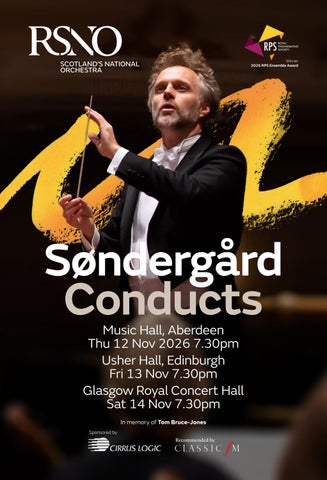
Winner 2026 RPS Ensemble Award
Søndergård Conducts Music Hall, Aberdeen Thu 12 Nov 2026 7.30pm Usher Hall, Edinburgh Fri 13 Nov 7.30pm Glasgow Royal Concert Hall Sat 14 Nov 7.30pm In memory of Tom Bruce-Jones Sponsored by
2 Søndergård Conducts
Søndergård Conducts Music Hall, Aberdeen Thu 12 Nov 2026 7.30pm TCHAIKOVSKY Polonaise from Act III of Eugene Onegin [4’] SCHUMANN Piano Concerto in A Minor Op54 [31’] Anna Vinnitskaya Piano INTERVAL BRAHMS Symphony No4 in E Minor Op98 [41’]
Usher Hall, Edinburgh Fri 13 Nov 7.30pm HOWELL Lamia [12’] SCHUMANN Piano Concerto in A Minor Op54 [31’] Anna Vinnitskaya Piano INTERVAL ELGAR Symphony No1 in A flat Major Op55 [52’]
Glasgow Royal Concert Hall Sat 14 Nov 7.30pm HOWELL Lamia [12’] RACHMANINOV Piano Concerto No2 in C Minor Op18 [32’] Roman Borisov Piano INTERVAL ELGAR Symphony No1 in A flat Major Op55 [52’] Thomas Søndergård Conductor Royal Scottish National Orchestra In memory of Tom Bruce-Jones Sponsored by
The Glasgow performance will be recorded for the RSNO Archive. Supported by the Iain and Pamela Sinclair Legacy. If viewing these notes at the concert, please do so considerately and not during performances. Please silence all mobile telephones and alerts, and refrain from taking photographs, without flash, until the end of each piece.
4 Søndergård Conducts
Pictures at an Exhibition Also featuring Chopin’s Piano Concerto No1
Edinburgh | Fri 11 Dec: 7.30pm Glasgow | Sat 12 Dec: 7.30pm Samy Rachid Conductor Rafał Blechacz Piano
Book online at
rsno.org.uk
RSNO: Scotland’s National Orchestra 5
Welcome This week’s concerts are slightly unusual in that the repertoire and soloists change between Aberdeen, Edinburgh and Glasgow. This is because next week we are heading off on tour to six cities across Germany, including Essen and Munich, and into Austria to Innsbruck. Our performances on Scottish soil form a vital part of the preparation for our tours, giving us not only a chance to rehearse repertoire but also to give you the chance to hear it in advance of our European audiences. Getting our vibrant culture out there, to Europe and beyond, is so important to enhancing Scotland’s reputation internationally and we are proud to be ambassadors for Scotland. Culture can help define a place. We think differently about, for instance, Berlin because of the Philharmonic and this is what we’re aiming to do for Scotland. If you’d like to keep up to date with the tour, head to our blog at rsno.org.uk/news-and-blog where we will be keeping a diary. A perfect example of how business can help to enhance culture at home and abroad is our partnership with Cirrus Logic, which has developed over the last few years. Tonight we announce renewed support from the Texas-headquartered semiconductor supplier, which is now our Partner in Innovation. Since we began working with Cirrus Logic’s Edinburgh team, we’ve met employees in China and we’ll welcome guests from the Munich office on the upcoming tour. Finally, I’d like to introduce you to two new Orchestra members: Sub-principal Second Violin Joana Rodrigues and Second Violin Helena Rose. You may have seen them already on the stage in the last few months as they trialled for their positions and we are delighted that they are both joining us as full-time members. A very warm welcome to Joana and Helena!
Keep in touch with the RSNO
Royal Scottish National Orchestra 19 Killermont Street Glasgow G2 3NX T: +44 (0)141 226 3868
rsno.org.uk Scottish Company No. 27809 Scottish Charity No. SC010702
Alistair Mackie CHIEF EXECUTIVE
The RSNO is supported by the Scottish Government
6 Søndergård Conducts
Royal Scottish National Orchestra
Formed in 1891, the Royal Scottish National Orchestra (RSNO) is one of Europe’s leading symphony orchestras. Awarded royal patronage by Her Late Majesty The Queen in 1977, its special status in the UK’s cultural life was cemented in 2007 when it was recognised as one of Scotland’s five National Performing Companies, supported by the Scottish Government. Led by Music Director Thomas Søndergård, the Orchestra performs across Scotland, including concerts in Glasgow, Edinburgh, Dundee, Aberdeen, Perth and Inverness, and appears regularly at the Edinburgh International Festival and BBC Proms. The RSNO tours internationally, most recently visiting China and Europe. In May 2026, Giedrė Šlekytė was announced as the RSNO’s Music Director Designate and will formally become Music Director from the beginning of the 2027:28 Season, with Thomas Søndergård taking on the new position of Music Director Emeritus. The RSNO has a worldwide reputation for the quality of its recordings, receiving a 2020 Gramophone Classical Music Award for Chopin’s Piano Concertos (soloist: Benjamin Grosvenor), conducted by Elim Chan, two Diapason d’Or awards (Denève/Roussel 2007; Denève/Debussy 2012) and eight GRAMMY Award nominations. In recent years, the RSNO has cultivated an international reputation for world-class film, television and videogame soundtrack recording. The Orchestra has recorded for BAFTA-winning
series Silo (Apple TV) and worked with the likes of GRAMMY Award-winning composer Lorne Balfe on Life on Our Planet (Netflix). Other notable titles include Nuremberg (Sony Pictures), Now You See Me: Now You Don’t (Lionsgate), Horizon: An American Saga (Warner Bros) and Star Wars Outlaws (Ubisoft). The Orchestra records at its bespoke in-house facility in Glasgow, Scotland’s Studio. In 2026 the RSNO was the first professional orchestra since 2014 to be awarded the Royal Philharmonic Society’s Ensemble Award. The award recognises musical ensembles for outstanding quality and scope of performances and work. The RSNO believes that music can enrich lives and aims to inspire, educate and entertain people throughout Scotland and beyond with its performances, recordings and engagement programmes. Supporting schools, families, young professionals and wider communities, the RSNO delivers high-quality initiatives for all ages and abilities. The RSNO’s engagement offering includes its singing strand, encompassing a Buggy Choir and Chorus Academy in both Dundee and Glasgow and a lunchtime Workplace Choir, which complements the well-established and highly respected RSNO Youth Choruses and RSNO Chorus. The community choruses are designed with the benefits of group singing for health and wellbeing at their core and are open to all.
RSNO: Scotland’s National Orchestra 7
On Stage FIRST VIOLIN Igor Yuzefovich LEADER
CELLO Pei-Jee Ng
PRINCIPAL
HORN Amadea Dazeley-Gaist
Shlomy Dobrinsky
Betsy Taylor Kennedy Leitch Yuuki Bouterey-Ishido Rachael Lee Gunda Baranauskaitė Neil Sild Joseph Donmall
Stephanie Jones Andrew McLean David McClenaghan Martin Murphy
DOUBLE BASS Nikita Naumov
Katie Bannister Jason Lewis Goodwin
Yat Hei Lee Michael Rae Moray Jones Alexandre Cruz dos Santos Yehor Podkolzin
TROMBONE Dávur Juul Magnussen
ASSOCIATE LEADER
Tamás Fejes
ASSISTANT LEADER
Robin Wilson Caroline Parry Ursula Heidecker Allen Elizabeth Bamping Lorna Rough Susannah Lowdon Alan Manson Liam Lynch Veronica Marziano Catherine Alsey Gill Risi SECOND VIOLIN Liu-Yi Retallick GUEST PRINCIPAL
Marion Wilson Joana Rodrigues Paul Medd Anne Bünemann Sophie Lang Kirstin Drew Colin McKee Stewart Webster Fiona Stephen Jane Lemoine Sophie Sild
PRINCIPAL
FLUTE Katherine Bryan PRINCIPAL
Oliver Roberts Janet Richardson PRINCIPAL PICCOLO
OBOE Adrian Wilson PRINCIPAL
Peter Dykes Henry Clay
PRINCIPAL COR ANGLAIS
VIOLA Tom Dunn
CLARINET Timothy Orpen
Felix Tanner Beth Woodford Nicola McWhirter Claire Dunn Katherine Wren Maria Trittinger Francesca Hunt Henry Justo Richard Montgomery
William Knight Duncan Swindells
PRINCIPAL
PRINCIPAL
PRINCIPAL
TRUMPET Christopher Hart PRINCIPAL
PRINCIPAL
Cillian Ó Ceallacháin Alastair Sinclair PRINCIPAL BASS TROMBONE
TUBA Matthew Lait GUEST PRINCIPAL
TIMPANI Richard Cartilidge GUEST PRINCIPAL
PERCUSSION Simon Lowdon PRINCIPAL
Stuart Semple Philip Hague HARP Pippa Tunnell Sharron Griffiths
PRINCIPAL BASS CLARINET
BASSOON David Hubbard PRINCIPAL
Matthew Kitteringham Paolo Dutto PRINCIPAL CONTRABASSOON
Orchestra list and programme details correct at time of going to print.
8 Søndergård Conducts
Thomas Søndergård Conductor
and Helsinki Philharmonic. In North America, his engagements have included the Los Angeles and New York Philharmonics, the Cleveland Orchestra and the symphony orchestras of Chicago, Cincinnati, Baltimore, St Louis, Toronto, Atlanta, Montreal, Vancouver, Houston and Seattle. The 2026/27 season continues Thomas’ work with both the Minnesota Orchestra and the RSNO, alongside guest engagements across Europe. He returns to the Gürzenich-Orchester Köln with Benjamin Grosvenor and to the City of Birmingham Symphony Orchestra with Alina Ibragimova. At the Royal Danish Opera, he conducts performances of Verdi’s Falstaff, continuing a long-standing relationship with the company. Danish conductor Thomas Søndergård is Music Director of the Minnesota Orchestra and the RSNO. The 2026:27 Season marks his final season as Music Director of the RSNO, before becoming Music Director Emeritus in 2027:28. He previously served as the orchestra’s Principal Guest Conductor for six seasons. From 2012 to 2018, Thomas was Principal Conductor of the BBC National Orchestra of Wales, following his tenure as Principal Conductor and Musical Advisor of the Norwegian Radio Orchestra. Thomas has appeared with most of Europe’s leading orchestras, including the Berliner Philharmoniker, Symphonieorchester des Bayerischen Rundfunks, Gewandhausorchester Leipzig, Tonhalle-Orchester Zürich, Orchestre National de France, London Symphony Orchestra, Philharmonia Orchestra and Royal Concertgebouw Orchestra. A familiar figure across Scandinavia, he has worked with the Oslo Philharmonic, Gothenburg Symphony, Danish National Symphony Orchestra, Royal Stockholm Philharmonic, Swedish Radio Symphony Orchestra, Finnish Radio Symphony Orchestra
Opera has formed an important part of Thomas’ career. Following his Royal Danish Opera debut with Kafka’s Trial, he has returned regularly for repertoire including Die Walküre, which won the 2022 Reumert Award for Best Opera Production, Elektra, Le nozze di Figaro, Il barbiere di Siviglia, La bohème, The Cunning Little Vixen and Il viaggio a Reims. Further operatic collaborations include the Staatsoper Stuttgart, Norwegian Opera, Royal Swedish Opera and Bayerische Staatsoper. At Deutsche Oper Berlin he conducted the world premiere of Scartazzini’s Edward II and has since returned for Berlioz’s Roméo et Juliette and Strauss’ Elektra. A committed advocate of Scandinavian repertoire, Thomas has a particular affinity with the music of Carl Nielsen and Jean Sibelius. During the composers’ joint anniversary year in 2015, he conducted their works with orchestras across Europe, and in 2019 took part in a concert celebrating Nielsen at the Royal Danish Academy of Music in Copenhagen.
Cirrus Logic: Partner in Innovation The RSNO is proud to announce that Cirrus Logic has renewed its support of Scotland’s National Orchestra, becoming our Partner in Innovation from 2027. Cirrus Logic has sponsored the RSNO since 2023, with the organisation’s corporate philanthropy supporting the Orchestra on stage, in recordings and in education across Scotland.
placement opportunity for a fifth-year student on the University’s Master of Engineering (MEng) Electronics with Music programme. The internship provided professional experience with Cirrus Logic, developing recording technology to be tested within Scotland’s Studio recording the very Orchestra you’ll hear perform this evening.
Cirrus Logic is an Edinburgh-based international company that is a leading provider of highperformance audio and mixed-signal semiconductor solutions; technology that we use within our state-of-the-art recording facility, Scotland’s Studio.
Education opportunities remain at the heart of the RSNO’s recording work, with projects including the Film Composers Lab and our year-long Trainee Audio Engineer post.
Our dynamic partnership recently evolved to develop a new collaboration with the University of Glasgow. This year we launched an innovative
If you are interested in becoming a corporate sponsor, or discussing similar philanthropic opportunities, contact Constance Fraser, Head of Development, on constance.fraser@rsno.org.uk
10 Søndergård Conducts
Inspired by Scotland. Engineered for INNOVATION. Where creativity, community, and technology converge to shape a future driven by imagination and innovation.
Cirrus Logic ad
cirrus.com
cirrusrocks
PROUD SPONSOR OF
RSNO: Scotland’s National Orchestra 11
Pyotr Ilyich Tchaikovsky (1840-1893)
Polonaise from Act III of Eugene Onegin and plagued by remorse over Lensky’s death. Introduced to Tatiana, who is now married to Prince Gremin, he realises that he loves her. It is often unwise to connect events in a composer’s life with the music they composed at that time. Generally it is better to regard the life and the music as running on separate tracks. However, there is an unavoidable connection between Tchaikovsky’s life and that of Eugene Onegin. When one of his students became infatuated with Tchaikovsky, she wrote a letter to him confessing her love ( just as Tatiana does in the opera). He was very reluctantly drawn into marriage, with disastrous consequences.
FIRST PERFORMANCE Full opera: Moscow, 29 March 1879 DURATION Polonaise: 4 minutes ABERDEEN ONLY Eugene Onegin, with a libretto by the composer and K S Shilovsky based on Pushkin’s epic verse-novel, is the most widely performed of Tchaikovsky’s ten operas. Composed in 18778, it was first seen in a student performance in March 1879, then professionally staged two years later at Moscow’s Bolshoi Theatre. While composing what is one of his most affecting major works, Tchaikovsky developed an extraordinary empathy with the plight of the heroine Tatiana. The opera’s setting is St Petersburg and the surrounding countryside in the late 18th century. After his rejection of Tatiana’s passionate love and his killing of Lensky, Tatiana’s sister’s fiancé, in a duel, Onegin departs. He spends several years travelling around Europe, then returns. He stands alone at the ball, reflecting on the emptiness of his life
The celebrated Polonaise is performed at the beginning of Act III as part of a glamorous ball scene at the house of a rich St Petersburg nobleman. In common with most dances in operas, it is incidental to the plot. Nevertheless, this Polonaise (a stately, traditional Polish dance) is a popular piece in the concert hall. A grand introduction featuring an arresting rhythm on trumpets, giving way to animated writing for the strings, leads to the swaggering main theme. A relaxed, more lyrical middle section eventually makes references to the dotted rhythm of the opening section before its full return. © Philip Borg-Wheeler
12 Søndergård Conducts
Robert Schumann (1810-1856)
Piano Concerto in A Minor Op54
ABERDEEN AND EDINBURGH
FIRST PERFORMANCE Dresden, 4 December 1845 DURATION 31 minutes 1. Allegro affettuoso 2. Intermezzo: Andantino grazioso 3. Allegro vivace
Schumann’s Piano Concerto was hard-won indeed. The composer had made several attempts over the years to compose a concerto for piano – in 1827, 1828, 1831 and 1839 – but had completed none of them. What became the finished Op54 began life as a more modest Fantasy, premiered as a single movement in 1841. With the encouragement of his pianist wife Clara, Schumann revised the single movement, then added an Intermezzo and finale, completing the Concerto in July 1845. He had a major physical and emotional collapse immediately afterwards, and only just managed to attend the Dresden premiere later in the year. Perhaps understandably, he did not tackle the piano concerto form again. Clara was not only instrumental, so to speak, in encouraging Schumann to expand and complete the work. Themes from her own youthful Piano Concerto – also in A Minor – are to be found in the first movement, notably a four-note theme from her third movement which appears in the coda. She was, of course, the first soloist of the work and performed it many times subsequently. Furthermore, she had suggested to her husband that he expand his repertoire beyond solo piano and vocal works: ‘Don’t take it amiss if I tell you that I’ve been seized by the desire to encourage you to write for orchestra,’ she wrote to him in 1839, adding, ‘Your imagination and your spirit are too great for the weak piano.’ The finished work is irresistibly romantic, playful and beautifully proportioned. It opens with a dramatic flourish for the soloist – a bravura canter down the keyboard (surely influencing the later Piano Concerto by Grieg, also in A Minor, and also opening with a bold statement for the
RSNO: Scotland’s National Orchestra 13
soloist). A wistful theme for orchestra follows, amplified by the piano (again, we find something similar in the Grieg concerto), and then the piano is off, leading the ensemble in a series of quicksilver mood changes. While the first movement is in some ways quite conventional in its alternation of soloist and orchestra and development of themes, the origins of the movement as a ‘fantasy’ give it a loose-limbed, sometimes dreamlike quality (such as the beautiful duet between soloist and clarinet during the central passage). A lengthy cadenza gives the soloist a blistering workout, before the movement concludes with a march-like coda. The soloist shares the spotlight with the cellists in the gorgeously lyrical Intermezzo. After a graceful opening section, with its alternation of delicate semiquavers and sighing strings, the cellos play a deeply romantic ‘song’, while the piano ripples with passages of quavers. The opening music returns, then segues into a reprise of the theme of the first movement, converting it into a major key before plunging into the finale. This is a boisterous and thoroughly jolly romp, with playfully displaced rhythms and much in the way of sparkle for the soloist. The oboe section is invited to contribute an entirely new theme at one point, before the earlier themes are reprised and the movement concludes with a beautifully fluid coda. While clearly a struggle for Schumann to write, his only Piano Concerto has a seemingly effortless grace and wit that has rendered it one of his most frequently performed and best-loved works. © Lucy Walker
What was happening in 1845? 29 Jan Edgar Allen Poe’s The Raven was published for the first time, appearing in the New York Evening Mirror 7 Feb The Roman cameo glass Portland Vase, held in the British Museum, was smashed by William Lloyd, who was drunk; the vase was later repaired 11 Mar The British colonial settlement of Kororareka (today’s Russell) was burnt by Maoris led by chiefs Kawiti and Hōne Heke, starting the New Zealand Wars 13 Mar Felix Mendelssohn’s Violin Concerto was premiered in Leipzig 17 Mar Stephen Perry of London patented the rubber band 19 May Sir John Franklin’s ill-fated expedition to find the Northwest Passage sailed from Greenhithe on the Thames 26 Jul Isambard Kingdom Brunel’s iron steamship Great Britain departed Liverpool for New York, the first screw-propelled vessel to make the transatlantic crossing 9 Sep Potato blight broke out in Ireland, signalling the start of the Great Famine 19 Oct Richard Wagner’s opera Tannhäuser premiered at the Dresden Royal Court Theatre 2 Dec President James K Polk announced the Monroe Doctrine should be enforced and the US should expand into the West
14 Søndergård Conducts
Johannes Brahms (1833-1897)
Symphony No4 in E Minor Op98
ABERDEEN ONLY
FIRST PERFORMANCE Meiningen, Germany, 25 October 1885 DURATION 41 minutes 1. Allegro non troppo 2. Andante moderato 3. Allegro giocoso 4. Allegro energico e passionato
Beethoven signed off his symphonic cycle with a magnificent, ecstatic ‘Ode to Joy’. Brahms’ last symphony is magnificent too, but if it ends in exultation, it is exultation of an unmistakably tragic kind. How apt, some might say, for a composer with such a pronounced tendency to melancholy. But Brahms also had a lively, teasing sense of humour, and as he prepared his friends to hear his new Fourth Symphony in 1885, this came to the fore – perhaps with an element of self-protective irony. Writing to the conductor Hans von Bülow from the Austrian Alpine resort of Mürzzuschlag, Brahms suggested that the weather might have had a negative effect on the music: ‘I’m afraid it takes after the climate in these parts – the cherries don’t get ripe here; you wouldn’t eat them!’ The sour cherries were evidently a bit of a preoccupation: to another trusted friend, the pianist Elisabeth von Herzogenberg, he confided, ‘In the field of work I’m speaking of the cherries don’t grow ripe and sweet to the taste – if you don’t like the thing, don’t hesitate to say so.’ After hearing a preliminary play-through on two pianos, some of Brahms’ closest musical friends confirmed his worst fears. Von Bülow’s report to his concert agent was tight-lipped: ‘Brahms Fourth, E minor, difficult, very.’ Even Brahms’ staunchest critical ally, Eduard Hanslick, admitted that, ‘All the way through I felt I was being beaten up by two terribly clever men.’ Perhaps part of the problem on this occasion was that the new Symphony was so different from Brahms’ previous major work, the Symphony No3. Warmly expressive, intimate, ultimately calm, the Third Symphony was full of things that were ‘ripe and sweet to the taste’. In contrast, the Fourth was often nervously impassioned, unsettlingly ambiguous, at times even harsh in colour (Brahms had a point about those sour cherries). And
RSNO: Scotland’s National Orchestra 15
the last movement was unlike anything he had created before: a taut, rigorously constructed set of variations on a stark chordal theme blared out at the opening by winds, moving with increasingly grim inevitability towards a dark minor-key conclusion. Despite its many beautiful moments, this was a symphony which seemed to offer, in the old biblical phrase, ‘naught for your comfort’.
The Arts in 1885
But sour cherries can be delicious in the right context, and tragedy can be exhilarating, even uplifting – and that, it would seem, is how many people now respond to Brahms’ Fourth Symphony. Brahms rarely gave clues as to meanings beyond the music in his symphonies, but some have found hints of a dark saying in the Fourth Symphony, and in this case there are some delicately planted clues. For all its sweeping melodic generosity, the first movement is haunted by eerie pre-echoes of the third of Brahms’ Four Serious Songs: ‘Oh death, oh death, how bitter you are’ – in the opening notes of the first theme, for instance. Like many depressives, Brahms was haunted by thoughts of death, and these intensified as he entered his fifties, as they do for many of us.
In Literature: Adventures of Huckleberry Finn by Mark Twain Germinal by Émile Zola King Solomon’s Mines by H Rider Haggard A Child’s Garden of Verses by Robert Louis Stevenson
The second movement offers moments of consolation, and there’s even the possibility of joy in the vigorous march-like third movement, marked giocoso, joyous. But the theme of the finale is adapted from one of J S Bach’s most sombre church cantatas, Nach dir, Herr, verlanget mich (My soul longs for Thee, O God). And yet there is also something thrillingly alive about this music – not resigned, but defiant and full of life. Perhaps the nearest equivalent in words comes in Dylan Thomas’ magnificent poem Fern Hill: ‘Time held me green and dying, Though I sang in my chains like the sea.’ © Stephen Johnson
In Music: Symphony No7 by Antonín Dvořák Symphonic Variations by César Franck Horn Concerto No1 by Richard Strauss The Mikado by Gilbert & Sullivan The Gypsy Baron by Johann Strauss II
In Art: The first imperial Fabergé egg was delivered The first Glasgow Boys group exhibition Aberdeen Art Gallery opened Meadow with Haystacks near Giverny by Claude Monet The Potato Eaters by Vincent van Gogh
16 Søndergård Conducts
Dorothy Howell (1898-1982)
Lamia
EDINBURGH AND GLASGOW
FIRST PERFORMANCE London, 10 September 1919 DURATION 12 minutes
‘When the composer was called on and a slim young girl came forward, people became wildly excited and on her parents’ return to Stourbridge they found the house full of reporters eager to interview her.’ So wrote Dorothy Howell’s aunt of the audience reaction on the evening when Howell, aged just 21 and a recent graduate of the Royal Academy of Music, had Lamia – her first large-scale work – premiered at the London Proms, conducted by Sir Henry Wood. It wasn’t simply the fact that Howell was a woman, either – there was just as much amazement that anyone as young as her could handle an orchestra and its colours with such eloquent grandeur, maturity and competence. An ‘English Strauss’ is how one newspaper enthusiastically described her. Wood himself, meanwhile, took the unusual step of re-programming Lamia no fewer than four further times that same Proms season. As for how the score had found its way to Wood in the first place, the conduit had been Howell’s RAM composition teacher, Sir J B McEwan, who together with her RAM piano teacher, Tobias Matthay, was determined she should have a career in music – something that in fact wasn’t too hard a sell to her amateur musician parents, given they’d already taken the unusual step of allowing her to enter the RAM to study composition and piano aged just 15, after composition lessons with composer Granville Bantock during holidays from her Belgian convent school. Back to Lamia, and it’s not difficult to see why some were comparing Howell to Richard Strauss, given that it’s exactly the sort of tone poem – a single-movement work, describing an extramusical narrative – that Strauss was famous for, and written in a similarly chromatic, lateRomantic language. Based on John Keats’ 1820
RSNO: Scotland’s National Orchestra 17
poem of the same name, its narrative opens with Lamia, trapped in a serpent’s body, persuading the Greek god Hermes to change her back into a woman, in return for her helping him to obtain an unwilling nymph he desires. Once in her human form, Lamia finds and seduces the man with whom her serpent self had fallen in love from afar, a young Corinthian named Lycius. Fearful of being recognised and having her true nature exposed to him, she draws him away from his friends and family to live in seclusion with her. Eventually, though, he insists upon public marriage, she unwillingly consents, and at the wedding feast her fears are realised – Lycius’ concerned former mentor, the philosopher Apollonius, exposes her true identity, causing her to instantly disappear, and Lycius to die of sorrow. Howell’s music opens in C Minor with an anxious, chromatic, oscillating figure played by the flute – Lamia longing to be liberated from her serpent body – against dark lower strings. As the orchestral textures build, there’s a fleeting, temporary quality to the whole, figures evaporating as quickly as they appear, and high chromaticism rendering the tonality ambiguous. After a brass-rich climax landing squarely in major tonality, the music subsides into harpcoloured softness, and the love music for Lamia and Lycius is introduced – a long-lined oboe solo, accompanied by tender offbeat horns and smooth chordal strings, which then gets taken up by the violins, the Straussian flavour intensifying over the ensuing ecstatic, lushly scored music. The marriage feast provides the next switch of mood, opening on an energetically lilting threetime dance. Gradually though, the anxiety builds, the dance disintegrates, and a coda reintroduces both the original oscillating theme and the love theme, before fading out on a dark, subdued C Minor funeral march.
Howell’s composing career would continue relatively successfully through the 1920s, her most notable success perhaps being the 1923 premiere of her Piano Concerto with herself as soloist. However, her teaching became increasingly important, not least as the RAM’s Professor of Harmony and Counterpoint from 1924 until 1970; and while she continued to compose into later life, it was predominantly small-scale sacred pieces. The last four years of her life were lived out in Malvern, where she was buried near Edward Elgar, whose grave she had tended for the Elgar Society. © Charlotte Gardner
18 Søndergård Conducts
Sergei Rachmaninov (1873-1943)
Piano Concerto No2 in C Minor Op18
GLASGOW ONLY After forging a reputation in the early 1890s as arguably the most promising Russian composer of his generation, Sergei Rachmaninov experienced a devastating crisis of confidence following the disastrous premiere of his First Symphony in 1897. Plunged into depression and severe self-doubt, he even gave up composing for a while. Indeed, it was only after he sought treatment from the physician and hypnotherapist Nikolai Dahl that he regained some semblance of mental stability and began to write music again.
FIRST PERFORMANCE Moscow, 9 November 1901 DURATION 32 minutes 1. Moderato 2. Adagio sostenuto–Più animato–Tempo I 3. Allegro scherzando
One of the first and most significant fruits of this creative recovery was his Second Piano Concerto in C Minor, composed between 1900 and 1901. Not surprisingly, this work was dedicated to Dahl with the deepest gratitude, its emotional trajectory almost acting like a personal diary, moving from the depths of despair in the opening movement to eventually culminate in a feeling of overwhelming elation at the end of the finale. There are few more strikingly original musical gestures in the piano concerto repertoire than the opening to this work – a sequence of deep bell-like chords on the solo piano that gradually gain intensity before the orchestra enters the fray with a sombre theme of great emotional impact punctuated by powerful flourishes in the lower registers of the piano. Thereafter, the piano writing becomes more overtly virtuosic, though Rachmaninov allows for moments of repose with a particularly tender and expressive second theme. Nonetheless, the overriding mood remains unsettled, especially in the dramatic middle section, which builds up to a particularly strident climax with the return of the opening theme. Once again Rachmaninov tries to ward off a sense of impending doom with a magical recall
RSNO: Scotland’s National Orchestra 19
of the second theme in the solo horn, but despite this the movement ends rather brusquely. In stark contrast to the turbulent first movement, the ensuing Adagio sostenuto begins in a mood of magical serenity. A solo flute, followed by a solo clarinet, trace an exquisite and delicately shaped melody in dialogue with gentle arabesque-like figurations in the piano. There is an improvisatory feeling to this music, almost as if time has stood still. Eventually, however, the dream is shattered. A more animated and emotionally charged middle section surges to a dramatic climax before calm is once again restored with a poignant recall of the opening material. With its quiet yet energetic orchestral opening, the finale at first misleadingly invokes a more light-hearted character. But a dramatic flourish from the solo piano suggests that the struggles of the first movement have not yet been fully resolved. Indeed, the first theme, initially announced by the piano, becomes increasingly insistent and restless, especially in the middle of the movement where Rachmaninov further develops this material in a frenzied dialogue between solo piano and orchestra. As in the first movement, a contrasting theme, initially heard in the orchestra, provides welcome lyrical repose. It returns triumphantly at the climax of the entire Concerto, where piano and orchestra join forces in a passage of great emotional power, before an irresistible burst of energy brings the work to a triumphant close. Given the public’s overwhelming and long-lasting admiration for the Second Piano Concerto, it is somewhat surprising that the initial reaction to the work, when it was first heard in London in the early part of the 20th century, was rather lukewarm. Responding to a performance by the
Ukrainian pianist Basil Sapellnikov in 1902, one English critic even ventured to suggest that there was little chance of this Concerto ever becoming popular – evidence if ever needed that the path of musical criticism can often be beset by extremely embarrassing mistakes. © Erik Levi
Listen again to the RSNO
Rachmaninov Piano Concerto No2 Plus Études-Tableaux Op33 Boris Giltburg Piano Carlos Miguel Prieto Conductor More information rsno.org.uk/recordings
20 Søndergård Conducts
Edward Elgar (1857-1934)
Symphony No1 in A flat Major Op55
EDINBURGH AND GLASGOW
FIRST PERFORMANCE Manchester, 3 December 1908 DURATION 52 minutes 1. Andante, nobilmente e semplice–Allegro 2. Allegro molto– 3. Adagio 4. Lento–Allegro
‘Here it was!’ – followed by the first three bars of this Symphony’s opening melody – was Edward Elgar’s message sent on a postcard of the Appian Way to his publisher at Novello. Elgar had spent the winter of 1907 in Rome with his wife, Alice, and their 17-year-old daughter, Carice. Elgar was 50 and his goal that season was to complete his First Symphony. Ten years earlier, in 1898, Elgar had declared himself ‘possessed’ by the idea of a symphony on the life of General Gordon (killed in 1885 in defence of Khartoum). The Gordon Symphony never materialised, but a seed had been planted. Returning from Rome, Elgar laboured feverishly on his new work. To his great friend August Jaeger, he wrote, ‘I can’t answer your letter at this moment. I can’t say I have anything more important to do but it must be done and done now. Oh! Such a tune.’ To which Alice added, ‘E. sends his love and wants to say to you the Sym. is A 1. It is gorgeous, steeped in beauty.’ The ten years of the Symphony’s gestation had seen a huge change in Elgar’s fortunes. In 1890 the Elgars had moved back to Malvern from London, to allow Edward to return to his life of a provincial musician and teacher. It was the Enigma Variations, completed in 1899, that first established his fame. This was the work that led George Bernard Shaw to remark: ‘When I heard it I sat up and said, “Whew!” I knew we had got it at last.’ The Dream of Gerontius followed in 1900, and Elgar’s national and international fame was secured. Public recognition brought him many honours, and his position as England’s foremost composer was sealed by his composition of music for the coronation of Edward VII. The First Symphony was dedicated to the conductor Hans Richter, ‘True artist and true friend’. And it was Richter who gave the work
RSNO: Scotland’s National Orchestra 21
its premiere in the Free Trade Hall in Manchester in December 1908. It was an instant success. A young Neville Cardus, present at the premiere and destined to become an eminent music critic, later wrote: ‘Those of us who were students were excited to hear at last an English composer addressing us in a spacious way, speaking a language which was European and not provincial.’ Richter conducted the first London performance, with the London Symphony Orchestra at the Queen’s Hall, a few days later. ‘Gentlemen,’ he said to the players, ‘let us now rehearse the greatest symphony of modern times, and not only in this country!’
storms of cheers. As Jaeger wrote: ‘My dear friend, your Adagio is not only one of the very greatest slow movements since Beethoven, but I consider it worthy of that master. How original, how pure. It is the greatest thing you have done.’
The tune that Elgar penned from Rome to his publisher became the broad, noble theme which both begins the work and binds it together. It recurs at intervals throughout the four movements before eventually emerging as the triumphant march at the very end of the Symphony. ‘There is no programme’, Elgar wrote, ‘beyond a wide experience of human life with a great charity and a massive hope in the future.’ The second movement, marked Allegro molto, is a scherzo with an interrupted perpetuum mobile in running semiquavers; the trio has an airy flute duet and a violin solo worthy of Mahler. The solo violin reappears after the return of the scherzo to introduce the final section of the movement.
© Mark Fielding
The Adagio, which follows without a break, transforms the first notes of the second movement into a long-drawn theme of singular beauty, its power to move increased by the reappearance of elements of the noble theme that opened the Symphony. It was this movement which brought the Manchester audience to its feet in enthusiastic applause at the first performance. Richter, who was one of the first of the modern conductors to discourage applause between movements, brought the composer to the stage to acknowledge the
The finale begins with a slow introduction before the main body of the movement begins allegro, with a new swaggering Falstaffian theme. The music builds gradually to a climax (marked Grandioso – poco largamente) and the noble theme that has dominated the Symphony returns once more, bringing the work to a sumptuous conclusion.
RSNO Connections Elgar’s First Symphony was performed by the Scottish Orchestra (as the RSNO was then known) for the ‘First time in Glasgow’ on 30 November 1909, conducted by Frederic Cowan. It shared the bill with overtures by Schubert and Dvořák, plus vocal items by Bellini and Charpentier, among others – quite a programme! Sir Edward conducted the Orchestra, as part of the Choral and Orchestral Union of Glasgow, just once, in the Scottish premiere of his oratorio The Kingdom, at St Andrew’s Hall on 22 November 1910.
22 Søndergård Conducts
Anna Vinnitskaya Piano
major debut with the Symphonieorchester des Bayerischen Rundfunks under Kazuki Yamada alongside collaborations with the RSNO and Thomas Søndergård, Warsaw Philharmonic and Krzysztof Urbański, and Bamberg Symphony and Pablo Heras-Casado. This follows a landmark previous season during which she was the Portrait Artist at the Philharmonie Essen and performed high-profile concerts at the Vienna Musikverein with Esa-Pekka Salonen and Klaus Mäkelä.
Since winning first prize at the Queen Elisabeth Competition in 2007, Anna Vinnitskaya has consolidated her place among the elite pianists of our time. Known for a technique that possesses diamond-like strength and velvet-like sensitivity, she is celebrated for her ability to paint grand musical canvases with orchestral depth. She is based in Hamburg, where she has held a professorship since 2009. Vinnitskaya’s interpretations are characterised by unconditional dedication, energy and poetic depth. Her performances with the world’s leading orchestras, including the Berlin Philharmonic, Gewandhausorchester Leipzig, Staatskapelle Dresden, Munich Philharmonic and Boston Symphony, continue to be received with global enthusiasm. Last year, an extensive European recital tour took her to Turin, Amsterdam, Madrid, Hamburg, Brussels, Vienna, Paris and Liège. Reflecting her growing resonance on the international stage, the 2026/27 season continues her journey of profound musical storytelling. The current season features a
Vinnitskaya is also a prolific recording artist whose albums have garnered the Diapason d’Or and Gramophone Editor’s Choice. Her celebrated discography includes Piano Dances (2024), which takes listeners on a virtuosic journey through Ravel, Shostakovich and Widmann, a celebrated Rachmaninov collaboration with the NDR Elbphilharmonie Orchestra, and a deeply personal recording of Bach Piano Concertos alongside Evgeni Koroliov and the Kammerakademie Potsdam. Beyond the concert platform, she is highly sought-after as a mentor and adjudicator. In addition to her professorship at the Hochschule für Musik und Theater Hamburg, she recently served as a juror for the 2025 Queen Elisabeth Competition and the ARD International Music Competition.
RSNO: Scotland’s National Orchestra 23
Roman Borisov Piano
Highlights of the 2026/27 season include return engagements with the RSNO under Thomas Søndergård and the hr-Sinfonieorchester under Roberto González-Monjas, alongside solo recitals at the Théâtre des Champs-Élysées Paris, Wiener Konzerthaus and Philharmonie Luxembourg. His chamber music partners this season include Quatuor Modigliani, soprano Erika Baikoff and cellist Jaemin Han, with performances at the Elbphilharmonie Hamburg, Concertgebouw Amsterdam, Kölner Philharmonie, Nikolaisaal Potsdam and Konzerthaus Dortmund.
Born in 2003, Roman Borisov is one of the most compelling pianists of his generation. In 2022 he won First Prize at the Kissinger Klavier-Olymp as the competition’s youngest participant. Borisov’s musical journey began at the age of four, when a perceptive kindergarten teacher introduced him to the legendary piano pedagogue Mary Lebenzon at the Novosibirsk Conservatory. She remained his mentor until 2020. Early success in children’s competitions earned him, among other distinctions, a scholarship from the Spivakov Foundation. Since then, he has established himself internationally, performing at leading venues and festivals. Recent and upcoming orchestral collaborations include the Deutsches Symphonie-Orchester Berlin, Helsinki Philharmonic Orchestra, Konzerthausorchester Berlin, Orchestre National du Capitole de Toulouse, ORF RadioSymphonieorchester Wien, Orchestra i Pomeriggi Musicali, Orchestra della Svizzera Italiana, SWR Symphonieorchester and Kammerakademie Potsdam.
In 2022, at the invitation of the Orpheum Foundation Zurich, Borisov recorded Mozart’s Piano Concertos K413 and K415 with the ORF Radio-Symphonieorchester Wien under Howard Griffiths as part of Alpha Classics’ complete recording of the Mozart piano concertos, released in 2023. His debut solo album, featuring works by Franck, Godowsky and Rachmaninov, followed on Alpha Classics in winter 2024/25 to widespread international acclaim. A committed advocate for children’s rights, Borisov has collaborated with Save the Children since the beginning of his career. In September 2025, together with Save the Children, Konzerthaus Dortmund and Deutsche Welle, he conceived a piano marathon marking Universal Children’s Day, performing all 840 repetitions of Erik Satie’s Vexations alongside children and young people from the region. An alumnus of the Verbier Festival Academy (2019), Borisov received the Tabor Foundation Award as the piano department’s outstanding graduate. Since 2022 he has been based in Berlin, where he studies with Eldar Nebolsin at the Hochschule für Musik Hanns Eisler Berlin.
24 Søndergård Conducts
GLASGOW HOSPITALS’ CHRISTMAS CONCERT
Conductor: Alistair Digges Featuring
The Glasgow Hospitals’ Christmas Choir The Glasgow Chamber Orchestra
With Guest Artists
Stephen Ashfield | Sally Magnusson Bothwell Primary School Choir | right2dance
FRIDAY 11 DECEMBER 2026 7.30PM GLASGOW ROYAL CONCERT HALL More than a ticket This concert supports Young Lives vs Cancer. It’s more than a ticket. It’s a way of helping to make sure children and young people with cancer get the care and support they need this winter.
Adults £20 | Children (under 16) £5 Booking fees apply Available from
https://www.glasgowlife.org.uk/ event/1/young-lives-vs-cancer-46thchristmas-concert or scan the QR code Box Office: 0141 353 8000 Young Lives vs Cancer is an operating name of CLIC Sargent Cancer Care for Children. A registered charity in England and Wales (1107328) and in Scotland (SC039857). Also operating in Northern Ireland. Registered office: 4th Floor, Whitefriars, Lewins Mead, Bristol, BS1 2NT.
RSNO: Scotland’s National Orchestra 25
THE INSTITUT FRANÇAIS D'ÉCOSSE PRESENTS
BAROQUE MUSIC FESTIVAL APRIL-MAY 2027 IN SCOTLAND
IFECOSSE.ORG.UK
26 Søndergård Conducts
Benefactors, Patrons and Circle members We are grateful to all our individual supporters for their generous philanthropy and loyalty. Your support enables the Orchestra to achieve its most ambitious goals and to continue inspiring people across Scotland both on and off the concert stage.
RSNO Benefactors
RSNO Conductors’ Circle
RSNO Patrons
Sir Ewan and Lady Brown Gavin and Kate Gemmell Kat Heathcote and Iain Macneil Ms Chris Grace Hartness Stina Bruce Jones Shirley Murray
Ardgowan Charitable Trust Ian and Evelyn Crombie Kenneth and Julia Greig David and Alix Stevenson Eric and Karen Young
Geoff and Mary Ball Lady Rebecca Fraser Don and Lois Macleod Walter and Janet Reid Charitable Trust George Ritchie Stephen Sweeney Valerie Wells
Learning and Engagement Patrons William Brown, W.S The Dundee RSNO Circle Committee Neil and Nicola Gordon Professor Gillian Mead, FRSE Nicholas and Alison Muntz Maurice and Nicola Taylor Charitable Trust David and Marilyn Wilson
Chair Patrons Assistant Conductor
Second Violin
The Solti Foundation Chair
The Nigel and Margot Russell Chair
Celia Llácer
Marion Wilson ASSOCIATE PRINCIPAL
Double Bass
Nikita Naumov PRINCIPAL
The Gregor Forbes John Clark Chair
First Violin
Sophie Lang
The Ian and Evelyn Crombie Chair
James Wood Bequest Fund Chair
Dunard Fund Chair
Viola
Flute
The Cathy and Keith MacGillivray Chair
The David and Anne Smith Chair
Maya Iwabuchi LEADER
Tamás Fejes ASSISTANT LEADER
The Bill and Rosalind Gregson Chair
Ursula Heidecker Allen
The James and Iris Miller Chair
Tom Dunn PRINCIPAL Francesca Hunt
Elizabeth Bamping
The Rolf Thornqvist and Celia Sinclair Thornqvist MBE Chair
Alan Manson
Cello
The WL and Vera Heywood Chair The Hugh and Linda Bruce-Watt Chair
Pei-Jee Ng PRINCIPAL
Ms Chris Grace Hartness Chair
Liam Lynch
Betsy Taylor ASSOCIATE PRINCIPAL
Lorna Rough
Kennedy Leitch ASSISTANT PRINCIPAL
Ms Chris Grace Hartness Chair The Sir Richard Dunbar Chair
The Maxwell Armstrong Chair
The David and Anne Smith Chair
Rachael Lee
The Christine and Arthur Hamilton Chair
Michael Rae ASSISTANT PRINCIPAL Katherine Bryan PRINCIPAL Oboe
Adrian Wilson PRINCIPAL The Hedley Wright Chair
Peter Dykes ASSOCIATE PRINCIPAL
Witherby Publishing Group Charitable Trust Chair
Cor Anglais
Henry Clay PRINCIPAL
In memory of a dear friend, Fiona H
RSNO: Scotland’s National Orchestra 27
Clarinet
Alison Murray ASSISTANT PRINCIPAL
Trumpet
The Shirley Murray Chair
Martin Murphy ASSISTANT PRINCIPAL
Ms Chris Grace Hartness Chair
Timothy Orpen PRINCIPAL
Mr and Mrs Pierre and Alison Girard
Christopher Hart PRINCIPAL
The Turcan Connell Chair
The Gordon Fraser Charitable Trust Chair
Staff
Horn
Andrew McLean ASSOCIATE PRINCIPAL The Catherine McLagan Chair
COMMUNITY SINGING ASSISTANT
William Knight ASSOCIATE PRINCIPAL David McClenaghan SUB-PRINCIPAL
Chiko Parkinson
Supported by ScotRail
The Springbank Distillers Chair
We are also grateful to those who give but who wish to remain anonymous.
If you would like to discuss how you can become an RSNO Patron, please contact Constance Fraser, Head of Development (Individuals and Partnerships), at constance.fraser@rsno.org.uk
RSNO Circle Virtuoso Ms Catherine Y Alexander Mrs A M Bennett Mr Alan and Mrs Carolyn Bonnyman Dame Susan and Mr John Bruce Francesca and Eoghan Contini Mackie Dr Clive Criper Scott and Frieda Grier Judith and David Halkerston Iain MacNeil and Kat Heathcote MBE Ian and Sarah Lister Miss A McGrory Maureen Michie Mr James Miller CBE David Moncur Mrs Abigail Morrison Nicholas and Alison Muntz Bernard and Jane Nelson Mr and Mrs W Semple Gregor and Lesley Stewart Mr Ian Taft Claire and Mark Urquhart Raymond and Brenda Williamson Margaret Duffy and Peter Williamson Symphony Martin and Jackie Beard Mr John Brownlie Mr A Campbell Dr K Chapman and Ms S Adam Dr C Cradock and Dr S Todd Mr W G Geddes Dr Robert Gibb Mr I Gow Hon Lord McGhie Mrs A McQueen
Kathryn Michael Mr Iain Percival James and Pam Robertson David and Maggie Robinson Mrs Henrietta Simpson Ian and Janet Szymanski Nelson and Barbara Waters Tom and Lisa Watson Philip Whitely and Robert H Mackay Concerto Neil Barton Mrs Mary Black Miss D Blackie Dr C M Bronte-Stewart Dr F L Brown Mr and Mrs Burnside David Caldwell Ms H Calvert Ross Cavanagh Myk Cichla Terry and Joan Cole Dr J Coleiro Christine and Jo Danbolt Steven J Davis Mr and Mrs K B Dietz Dr A Ewing David and Sheila Ferrier Mr C Ffoulkes William Findlay Mr and Mrs M Gilbert Simon and Fiona Guest Lord and Lady Hamilton P Hayes David G Henderson Dr and Mrs P Heywood Tony Hughes Ms H Kay Mr and Mrs W Kean
Nicholas Kilpatrick Christine Lessels Morag MacCormick Sandra Marwick Mr S Marwick Mrs Sandra Maxwell Mr and Mrs G McAllister Mrs M McDonald Dr Colin McHardy Dr A H McKee Mr Rod McLoughlin Morag Millar Mrs B Morinaud Dr and Mrs D Mowle Ms A and Miss I Reeve Mrs E M Robertson Sheriff Linda Ruxton Dr and Mrs G K Simpson Dr Norma H Smith Mr and Mrs A Stewart Jenny Stewart David and Helen Strachan Mr I Strachan Dr G R Sutherland Mr and Mrs J B Watson Helen and Peter Wilde David W Wren Roderick Wylie Sonata Mr and Mrs G H Ainsley Mr K Allen Dr A D Beattie Mrs H Benzie Mr R Billingham John Bradshaw and Shiona Mackie Dr Jen Brown and Professor Ken Donaldson Mrs Bryan
28 Søndergård Conducts
Andrew Burrows Mrs C M Campbell Miss S M Carlyon Amanda Carter-Fraser Lady Coulsfield Adam and Lesley Cumming Mrs C Donald J Donald and L Knifton Mr John Duffy Mr R M Duncan Brigadier and Mrs C C Dunphie Mrs E Egan Mr R Ellis Mr R B Erskine Dr E Evans Kenneth Forbes Mr D Fraser Philip and Karen Gaskell Elizabeth Gibb Mrs M Gibson Mrs M Gillan Mrs J K Gowans Dr J and Mrs H Graham Professor and Mrs A R Grieve Mr Martin Hammick Dr P J Harper Dr N Harrison Mr and Mrs R J Hart Bobby and Rhona Hogg Mr and Mrs F Howell
Mrs A Hunter Inez Hutchison Professor R N Ibbett Thomas Jakobsen Burns Geoffrey and Elizabeth Johnston Iain M and Maire Lanaghan Ms K Lang Mrs Anne Lindsay Dr Dorothy A Lunt Alison and Bryn Martin Mrs Jean C Martin Mr and Mrs J Martin Ms S McArthur Jean McCutcheon Rhyse McDermid Mr M McGarvie Ms H L McLaren Margaret McLay Libby McLean Mr and Mrs B Mellon Simon Michaelson Mr I Mills Mrs P Molyneaux Kenneth M Murray Bruce and Christine Nelson Alastair Ogilvie Mr and Mrs K O’Hare Mr and Mrs K Osborne Dr G Osbourne Mr A Ownsworth
Stephanie Park Mr R Parry John Paterson Misses J and M Penman Mr J W Pottinger Miss J A Raiker Alastair Reid Ms F Reith Dr and Mrs D Robb Anne Robertson Ms A Robson Mrs J Shanks Mr J A Shipley Dr M J and Mrs J A Shirreffs Richard and Gillian Shirreffs Ana Smith Mrs E Smith Mr M Smith Dr and Mrs B Stack Mrs Lorna Statham Mrs R F Stewart Mr and Mrs B Tait Lisbeth Thoms Dr and Mrs T Thomson Dr Morag Ward Dr Alex Watson Mr W Watters Alan Weddell Mr R Young
Thank you to all our members of the Circle, including 40 who wish to remain anonymous and over 230 Overture members.
If you would like to discuss how you can become an RSNO Circle member, please contact Polly Lightbody, Development Manager, at polly.lightbody@rsno.org.uk
RSNO Foundation The RSNO Foundation was founded in 2004 with the sole purpose of supporting the work of the RSNO, encouraging the performance, study, practice and knowledge of music in Scotland, and elsewhere throughout the world. The independently registered charity is governed by its own Board of Trustees (Scottish charity no. SC035934).
RSNO Foundation Trustees Chris Huckle Chair Don Macleod Mariella MacLeod Christine Macpherson Jane Reid James Inglis Secretary and Treasurer
RSNO: Scotland’s National Orchestra 29
Charitable Trusts and Foundations Charitable trusts and foundations have a distinguished history of supporting the RSNO, both on and off the stage. From one-off donations for specific concerts and musicians’ chairs, to multi-year funding for our community engagement initiatives, including our Schools Programme, every grant in support of our work is truly appreciated. We are grateful to the following trusts and foundations for their generosity: Aberdeen Endowments Trust Alexander Moncur Charitable Trust Alma & Leslie Wolfson Charitable Trust Boris Karloff Charitable Foundation Castansa Trust CMS Charitable Trust Common Humanity Arts Trust Cookie Matheson Charitable Trust Cruden Foundation David and June Gordon Memorial Trust Educational Institute of Scotland Ettrick Charitable Trust Evelyn Drysdale Charitable Trust Fidelio Charitable Trust Gannochy Trust Gaelic Language Promotion Trust Gordon Fraser Charitable Trust Hinrichsen Foundation Harbinson Charitable Trust Hugh Fraser Foundation James Wood Bequest Fund Jennie S Gordon Memorial Foundation Jean & Roger Miller’s Charitable Trust John Mather Trust JTH Charitable Trust Leach Family Charitable Trust Leisure & Culture Dundee Leng Charitable Trust Lethendy Charitable Trust Marchus Trust Mary Janet King Memorial Fund, administered by Foundation Scotland McGlashan Charitable Trust MEB Charitable Trust Meikle Foundation Miss E C Hendry Charitable Trust Miss Jean R Stirrat’s Charitable Trust Nancie Massey Charitable Trust Noël Coward Foundation Northwood Charitable Trust
Pear Tree Fund for Music PF Charitable Trust Q Charitable Trust Radcliffe Trust Ronald Miller Foundation Russell Trust Scott-Davidson Charitable Trust Scottish Enterprise Solti Foundation Souter Charitable Trust Stevenston Charitable Trust Sylvia Aitken Charitable Trust Tay Charitable Trust Thriplow Charitable Trust Tillyloss Trust Trades House of Glasgow Commonweal Fund W A Cargill Fund W M Sword Charitable Trust Walter Scott Giving Group Walter Craig Charitable Trust Weir Charitable Trust Zich Trust We are also grateful to a number of trusts that wish to stay anonymous.
If you would like more information about our work and how you can make a difference, please contact Niamh Kelly, Head of Trusts and Projects, at niamh.kelly@rsno.org.uk
30 Søndergård Conducts
A big Thank You to our supporters FUNDERS
CORPORATE SUPPORTERS
Ecosse
PRINCIPAL MEDIA PARTNER
PRINCIPAL TRANSPORT PARTNER
EXCLUSIVE AIR TRAVEL PARTNER
BROADCAST PARTNER
PARTNERS Adelaide Place • Age Scotland • Black Lives in Music • Charanga • Children’s Classic Concerts Children’s Hospices Across Scotland • Classic FM • Douglas Academy • Dundee Science Centre • Dunedin Consort Edinburgh Zoo • Education Scotland • Fanzclub • Gig Buddies • Glasgow Life • GMAC Film Heads of Instrumental Teaching Scotland • Hebrides Ensemble Kibble • Luminate • Marine Conservation Society MARSM • Music Education Partnership Group • ParentZone • The Pyramid at Anderston Royal Conservatoire of Scotland • Scottish Book Trust • Scottish Chamber Orchestra • Scottish Refugee Council Sistema Scotland • St Mary’s Music School • Tayside Healthcare Arts Trust • Trees for Life • University of Glasgow V&A Dundee • Visible Fictions
With thanks to all RSNO Benefactors, Patrons, Circle Members and appeal donors for their support of the RSNO.
If you would like more information about sponsorships, corporate partnerships or fundraising events with the RSNO, please contact Constance Fraser, Head of Development (Individuals and Partnerships), at constance.fraser@rsno.org.uk
RSNO: Scotland’s National Orchestra 31
Royal Scottish National Orchestra PATRON His Majesty The King
Andrew McTaggart
DIRECTOR OF CHANGED VOICES
NOMINATED DIRECTOR
ARTISTIC TEAM Thomas Søndergård
COMMUNITY SINGING DIRECTOR (GLASGOW)
COMPANY SECRETARY
Giedrė Šlekytė
RSNO BOARD OF DIRECTORS
MUSIC DIRECTOR
MUSIC DIRECTOR DESIGNATE
Patrick Hahn
Aimee Toshney David McLean
COMMUNITY SINGING DIRECTOR (DUNDEE)
Celia Llácer
Elected Directors Gregor Stewart
Ellie Slorach
Gail Blain
PRINCIPAL GUEST CONDUCTOR ASSISTANT CONDUCTOR ENGAGEMENT CONDUCTOR
Kellen Gray
ASSOCIATE ARTIST
Neeme Järvi
CONDUCTOR LAUREATE
Alexander Lazarev CONDUCTOR EMERITUS
Stephen Doughty DIRECTOR, RSNO CHORUS
Patrick Barrett
CHAIR
HONORARY TREASURER
Kayla-Megan Burns Ken Hay Don Macleod David Macluskey Louise Mitchell John Stewart David Strachan
Cllr Edward Thornley
Julia Miller
Player Directors Kirstin Drew David Hubbard William Knight Liam Lynch David McClenaghan Felix Tanner SCHOOLS ADVISORY GROUP
Pam Black Norman Bolton Martin Greig Neil Millar Mae Murray
DIRECTOR, RSNO YOUTH CHORUSES
CHIEF EXECUTIVE
Alistair Mackie CHIEF EXECUTIVE
Dr Jane Donald
DEPUTY CHIEF EXECUTIVE
Nicola Kelman
EXECUTIVE ASSISTANT
PLANNING
Adam Dundas
Polly Lightbody
Ted Howie
Graham Ramage
STAGE MANAGER
FACILITIES MANAGER
GRAPHIC DESIGNER
LEARNING AND ENGAGEMENT
INFORMATION SERVICES MANAGER
Andrew Stevenson DIRECTOR OF ENGAGEMENT
Tammo Schuelke
Anna Crawford
Xander van Vliet
Rachel Naismith
Rachel Pullin
Maisie Leddy
Richard Payne
Chiko Parkinson
DIRECTOR OF ARTISTIC PLANNING ARTISTIC PLANNING MANAGER ARTISTIC PLANNING OFFICER HEAD OF LIBRARY SERVICES
Megan Bousfield
PARTNERSHIPS AND EVENTS ADMINISTRATOR
Ross Williamson
VIDEO PRODUCER (MARKETING)
AUDIO
Hedd Morfett-Jones
ENGAGEMENT PRODUCER
Sam McErlean
COMMUNITY CHORUS AND PARTNERSHIPS COORDINATOR SUPPORTED BY SCOTRAIL
EXTERNAL RELATIONS
Dr Jane Donald
YOUTH CHORUS MANAGER
Aria Tsvetanova
ENGAGEMENT DELIVERY MANAGER
CHORUS MANAGER
Christine Walker
Sam Stone
ENGAGEMENT DELIVERY MANAGER
LIBRARY ASSISTANT
Anna Burns
DEVELOPMENT MANAGER
DIRECTOR OF EXTERNAL RELATIONS
Carol Fleming
STUDIO MANAGER
MEDIA MANAGER AND AUDIO ENGINEER
Nico
TRAINEE AUDIO ENGINEER
FINANCE AND CORPORATE SERVICES
Nicola Mills
HEAD OF MARKETING
DIRECTOR OF FINANCE AND CORPORATE SERVICES
HEAD OF DEVELOPMENT
HEAD OF FINANCE
PROGRAMMES EDITOR
FINANCE OFFICER
TRUSTS AND PROJECTS OFFICER
FINANCE ADMINISTRATOR
MARKETING MANAGER
FINANCE ASSISTANT
EXTERNAL RELATIONS OFFICER
FINANCE BUSINESS PARTNER AND ANALYST (INTERIM)
ORCHESTRA MANAGEMENT
Constance Fraser
Susan Rennie
Matthias Van Der Swaagh
Ian Brooke
Jade Wilson
Fred Bruce
Abby Dennison
Clara Cowen
Phoebe Connolly
Seonaid Eadie
David Hazel
HEAD OF ORCHESTRA MANAGEMENT
Brodie Smith
DEPUTY ORCHESTRA MANAGER
Rosie Linane
ORCHESTRA AND PROJECTS OFFICER
OPERATIONS AND PRODUCTION
Craig Swindells HEAD OF PRODUCTION
Katie Kean
COMMUNICATIONS AND MARKETING OFFICER
Niamh Kelly
HEAD OF TRUSTS AND PROJECTS
Contents © Copyright RSNO and named authors.