Annual Report 2010-2011 STUDY ASSOCIATON ROTTERDAM SCHOOL OF MANAGEMENT, ERASMUS UNIVERSITY | 33RD YEAR
2
Preface 1. Preface 2. About 3. 33rd STAR Board 4. Operations 5. Strategy 6. Thanks 7. Financial Statements 8. 34th STAR Board
Copyright Š September, 2011 Study Association Rotterdam School of Management, Erasmus University Print: OCC dehoog Design: Roel van der Duin
3
September 29th 2010, the 33rd STAR year officially commenced at the General Assembly of Members. Subsequently, together with active members and devoted alumni, we as 33rd STAR Board have been responsible for a year full of successful events. This Annual Report gives a comprehensive overview of all activities during the year 2010-2011, showcasing the fantastic events, exemplifying various strategic accomplishments as well as illustrating STAR’s steady financial performance. We believe that either organizing or participating in any STAR project makes a difference; you’ll find valuable learning experiences while making friends for life. The everlasting dedication of our 277 active members has been what drives us and what keeps us going, and so here is a big thank you to you to for another successful, exciting and valuable year. Together, we have enabled thousands of students to participate in great events. Likewise, especially the substantial and continuous support of Rotterdam School of Management, Erasmus University and our corporate partners, ensures our success is sustainable – now and in the future.
Putting this Annual Report together makes us grasp a sense of what impact we have actually had this year. I am extremely proud of my fellow Board members, who have succeeded in strategic implementations while at the same time managing 57 events and 51 committees/ Master Study Clubs. Lastly, I obviously would like to extend my warmest thanks to STAR’s Supervisory Board and Verification Committee for your devotion, support and advice. At the same time, we wish the 34th STAR Board the best of luck and every success in continuing STAR’s journey! I hope you enjoy having a look at this overview of 2010-2011 achievements and developments. Yours sincerely,
Jasperina de Vries Chairman 33rd STAR Board 2010-2011 Study Association Rotterdam School of Management, Erasmus University
About
4
ABOUT STAR STAR is the study association of Rotterdam School of Management, Erasmus University (RSM). With 6,500 members, STAR is Europe’s largest study association and above all the most active and professional study association in the Netherlands. STAR’s mission is to enrich RSM student life; from various perspectives, offering students to join events or organize these themselves. Each year, around 250 dedicated active members organize STAR projects that reach thousands of students. STAR provides students with the opportunity to get in contact with their fellow students, their studies and a broad range of companies. This is facilitated by the great amount of activities that are organized by numerous committees and Master Study Clubs.
Apart from academic activities like speakers events, case competitions or selling books, STAR also aims to organize social activities as well, ranging from IBA events, introduction days to parties. RSM students can join us abroad with a ski or sailing trip, international weeks, study trips or community development. The best known events are the STAR Management Week, which consists of social, academic and career events; International Business Study, where students conduct research for companies in an emerging country and the Erasmus Recruitment Days, which is the largest recruitment event of the Benelux organized by students.
STAR’s mission is to enrich student life for RSM students. Mission Statement
5
HISTORY In 1969, the ‘Interfaculteit Bedrijfskunde’ (and later on ‘Interuniversitair Instituut Bedrijfskunde’ - IIB) was established, a joint initiative of various faculties of both Erasmus University and Delft University of Technology. In 1977, S.V.I.I.B. (studievereniging IIB) was founded, an association focused on external contacts, internal contacts with scientific staff, and, of course, mutual contacts among business students. The exact meaning of S.V.I.I.B. was lost in 1984, when the faculty of Business Administration became an official part of Erasmus University, and so the name changed to Sviib. As with the establishment of Rotterdam School of Management (RSM) as we know it today, which led to a more cohesive organisation of BA,
IBA, and MBA studies, the aim was to achieve the same cooperation among study associations. Several daughter associations (Dutch: disputen) were established and later on consolidated as Master Study Clubs. More importantly, in early August 2005, Sviib and BActive (association for students of the programme in International Business Administration) merged to become STAR (Study Association of the Rotterdam School of Management), an association with a bit of both worlds and an international focus. Over the past 30 years, STAR has become an association of influence, diversity, and professionalism. With more than 6,500 members, including 250 active members, we can proclaim to be the largest study association in Europe.
6
Master 33rd Study STAR Board Clubs
7
XXXIIIRD STAR BOARD
SUPERVISORY BOARD 2010-2011
Jasperina de Vries Chairman
Bart van Muijen Clyde Waal Eric Ritsema Erik Gruwel Guido van der Ven Jelena Obradov Jelle van den Akker Laura Pool Marcel Duits Mark Grashoff Marloes Hemmen Nazanin Vafaee Remco van den Born Sanne Vrijland Shiko Ben-Menahem
Niels van Deuren Secretary & Vice Chairman Roeland Stolker Treasurer Rosalie Seriese Commissioner of Commercial Relations Roel van der Duin Commissioner of Marketing & PR Maarten de Smit Commissioner of Public Affairs Djordy Seelmann Commissioner of IT & Innovation Ellen Dekker Project Manager & HRM
VERIFICATION COMMITTEE 2010-2011 Erik Gruwel Erik van Veen Gerard Drost Jacomijn Klitsie Sanne Vrijland Sharita van den Herik
Operations
8
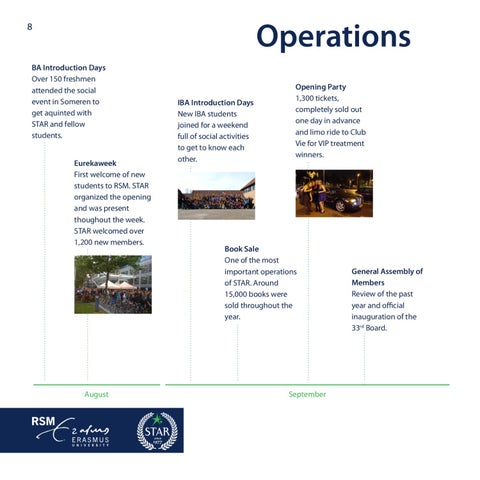
BA Introduction Days Over 150 freshmen attended the social event in Someren to get aquinted with STAR and fellow students. Eurekaweek First welcome of new students to RSM. STAR organized the opening and was present thoughout the week. STAR welcomed over 1,200 new members.
August
IBA Introduction Days New IBA students joined for a weekend full of social activities to get to know each other.
Opening Party 1,300 tickets, completely sold out one day in advance and limo ride to Club Vie for VIP treatment winners.
Book Sale One of the most important operations of STAR. Around 15,000 books were sold throughout the year.
September
General Assembly of Members Review of the past year and official inauguration of the 33rd Board.
9
IBA Social Drink First IBA Social Drink of the academic year. Taking place in Sorbonne. STAR Active Members Weekend The first time new active members get to know STAR and other active members during a weekend to kick-off the new year.
All MSC Drink Social drink for all Master Study Club Active Members.
October
STAR Management Week Annual highlight of STAR and one of the largest student events in the Benelux. Consisting of academic, recruitment and social activities, such as the Annual Management Conference, Company Dinners and the famous STAR Party at Maassilo Rotterdam.
Constitution Drink Night of congratulations to the 33rd Board, taking place at Villa Kakelbont.
IBA Social Drink Taking place at Club Riva. Mergers & Aquisitions Day MSC Financial Management
IBA Graduation Party Organized by the IBA Events committee, a special last party for graduated IBA students. All MSC Dinner Dinner at Weimar for all Master Study Club Active Members.
November
Strategic Alliances and M&A Day MSC Strategic Management
Operations
10
Active Members Christmas Dinner Social activity for all active members at Weimar 1889.
IBA Social Drink Social drink in the new opened Cafe Beurs. STAR New Year’s Party Second STAR party of the academic year sold out. Masquerade theme and special DJ and VJ show.
Ski Trip Risoul (France) was home to 40 STAR members for one week of sun, snow and party.
Alumni New Years Drink
December
January
Erasmus Recruitment Days Largest on-campus recruitment event in Europe, organized in coorporation with EFR. record number of 2,000 students particpiating and for the first time with opening conference.
Active Members Day in Amsterdam
Study Trip to Istanbul MSC Supply Chain Management
IBA Prom Prom party taking place at VIP Room.
Real Estate Day MSC Financial Management
February
Community Development National Team Start of CDNT programme
11 BA Study Trip Hong Kong was the destination where fourty BA students explored business, culture and education.
General Assembly of Members Review of the past half year and presentation of Plan 2011. IBA Study Trip Fourty IBA students had the week of their lives, exploring business, culture and education in Beijing.
Business with Asia Seminar MSC Chinese Economy & Business
March
Race of the Classics Team Erasmus competed against teams from other universities in an ocean race to England.
Facebook Day MSC Business Information Management & MSC Marketing Management
All Master Party Special STAR party, organized by MSCs specially for master students.
Consultancy Castle Premium recruitment event with top consultancy companies at Castle Hoge Vuursche.
STAR Spring Party Last STAR Party of the year, with a glow in the dark theme taking place at Club Vie.
Study Trip to Dubai MSC Marketing Management
April
International Week Throughout the year STAR members have joined international weeks abroad. STAR welcomed students from all over the world during the International Week Rotterdam
Operations
12
Game On Conference Organized by the new team Conference & Networking.
Active Members Soccer Tournament Social activity for active members, organized by the activity team.
Case Competition New event this year; STAR organizes a case competiton in close coorporation with companies for students from different backgrounds.
Study Trip to Dublin MSC Human Resource Management & MSC Organisational Change and Consulting
Study Trip to Hong Kong MSC Strategic Management
STAR Goes Green Conference
Study Trip to Sillicon Valley MSC Business Information Management
IBA Social Drink Last social drink of the year, in St. Tropez. Study Trip to California MSC Management of Innovation
STAR Alumni: Night with the STARs
Study Trip to Vienna & Budapest MSC Global Business and Stakeholder Management
Active Members Weekend
May
June
Rotterdam Student Party Party in coorporation with other study and student associations.
13
International Business Study departure to Brazil One of the most prestegious projects. Group of 25 student consultants carry out research in Brazil for Dutch companies.
Community Development National Team Departure to Uganda with group of 20 students.
Master Study Club events The twelve Master Study Clubs of STAR organized events throughout the year, such as recruitment, social, academic events and study trips.
Publication of STAR Agenda
Interface Magazine Four issues have been published thoughout the year by the Interface committee.
Other events
July
August
All year round
Functional Teams - Marketing Team - Commercial Team - IT Team Have been supporting committees, MSCs and board in daily and strategic operations, throughout the year.
Strategy
14
STRATEGIC PERSPECTIVES 2011
Connecting, Enhancing, Creating. Three words mark the 2011 plan we have been able to create during Fall 2010.
PRESENT OBSERVATIONS As you can see throughout the report, STAR fulfills a significant role in offering activities beyond or complementary to the RSM curriculum. Successful recurring as well as newly organized projects make sure that there is
opportunity for 250 students to organize these and for thousands of students to take part in it. Yet, with size comes operational complexity in structural coordination, although we see performance has been generally stable and successful. From research amongst our students we find that STAR is being perceived positively: an ambitious, international, social and professional study association. Besides, projects show consistent success, the financial situation remains healthy and the group of active members is enthusiastic. This is extraordinary, because inherent to the fact that STAR is completely run by volunteers, every single member of the organization shows intrinsic motivation, yet is active for a limited period of time. Evident consequences are dispersed information and incomplete tacit
15
information. Resulting from this, we see a huge challenge in knowledge management and knowledge sharing in general. Transparency and empowerment would then also imply that the focus on strategic direction would be strengthened. Finding opportunities in optimizing In other words we’ve come to a point where we can conclude the structure and portfolio are adequate and effective. Accordingly, we feel there is a need for focus on tweaking, facilitating and easing daily activities that active members face while organizing the various events. By this we mean by systematizing recurring stages or by establishing ways to gather input from more active members (fellow or preceding), committees and Master Study Clubs have tools to increase the quality of projects.
Inherently, committees have, and the association as a whole has more time for tactical and strategic thinking and action. Lessening the emphasis on operational tasks, you are able to do more things and do them better. Hence, optimizing information flows can be achieved by utilizing (dispersed) knowledge and by automation of routine tasks within the organization. The Board’s responsibility is ensuring both continuity and strategic direction as its core task is to facilitate and support committees, which allows them to organize successful projects, which ultimately serve member needs. Obviously, in this way the license to operate of the entire association, its mission (enriching student life of RSM students) is lived up to. Therefore, we have formulated ambitions
16
TODAY’S AMBITIONS Consequently, synthesizing the above reflections results in wanting to achieve a next level in terms of connection, enhancing and new opportunities. An important perspective is that, by making operational tasks straightforward, there is more time and space for strategic thought and action. This contributes to being able to truly live up to the mission of STAR.
THE VALUE DRIVERS ENABLE COLLABORATION As a means, we have identified three value drivers. Connecting People is all about bringing together active members and alumni in diverse compositions like similar functions, similar
Strategy projects, etc. A next step would be Enhancing Processes, tweaking daily routines; structurally improving or outsourcing current practices (predominantly impacting internally and in particular Board-specific). Creating Possibilities means to introduce new projects, new activities and new functionalities (external visibility and impact). These three elements drive the success of identified goals: the goal of Connecting people is Collaboration, the goal of Enhancing Processes is Synergy (and efficiency), the goal of Creating possibilities is Growth. Additionally, the three objectives are mutually reinforcing. Ultimately, these are initiatives that lead to more collaboration within the organization and powerful partnership with
17
other stakeholders. Synergy would be the result, as an interconnected group is more than the sum of its parts. In the end teamwork produces an overall superior result than if each person was working toward the same objective individually.
Growth stands for the ultimate objective, meaning that as a whole, the association can extend to a new level in terms of performance: become better at what we are and do. Extending and improving the association’s output in general, within the framework of students’ focus and professionalism.
18
KEY RESULTS CONNECTING PEOPLE In order to enable connection and knowledge sharing within the organization, we have completed specific actions. Internally, we’ve implemented specific changes to the benefit of our active members: on a social note, we worked on encouraging the social bond within and amongst committees (e.g. Active Members Kick-Off Weekend Fall 2010, encouraging committee diners and weekly get-togethers, an enhanced portfolio Activity Teams and All Master Study Club events). Functionally speaking, we changed the set up of functional meetings especially with the introduction of the Chairman Meeting Cycle.
Strategy This platform has turned out to be a great means for chairmen to interact, as the agenda includes practical issues, training sessions, feedback questions and above all space for knowledge sharing.
We created a customized Social Information Platform (Max) with functionalities like active member contact information, polls, reservations system, forums as well as a Wiki with searchable and up to date information on practical (FAQ) issues. Further ambitions include creating a
19
dedicated part with expertise areas, but also live document sharing and project management tools. As for the social aspect, we shift this to the active members Facebook group, as a spot for social updates, pictures, events and so on. Further efforts have been made to organize a variety of active members trainings. Throughout 2011 the 34th Board will work to enhance this element as it coincides with the transformation of SIAF (see next section). This emphasis on personal development has great potential and should become a key factor for students to see the added value to become active member. Another element where there’s work to be done includes STAR’s alumni policy, in order to connect former active members, while creating opportunities for speakers, commercial
activities, social activities and feedback. While we’ve supported the efforts of STAR’s Alumni Board, we see ample room for development. Examples could include more predecessor dinner possibilities or year reunions, or experts who can assist current committees. This means creating alumni activities for alumni of all committees, to enforce social as well as information transfer objectives.
20
KEY RESULTS ENHANCING PROCESSES In addition, we enhanced current processes within the organization. We initiated a pilot to outsource maintaining and resolving debtors. We renewed our collaboration agreement with EFR (Economic Faculty Association) with regards to Erasmus Recruitment Days. We have shifted the role of Functional Teams towards a more strategic and advisory responsibility, e.g. by assisting in forming a committee’s plan for the entire period in this area. We also implemented new support software: an upgrade of accounting software which enables powerful analytics, archive digitalization, and linkage with e.g. contract application and web shop portal; email marketing software with
Strategy templates, analytics and which is linked with our CRM (Custom Relationship Management system); and a professional surveying system to investigate opinions of all stakeholders (this could also be a means to gather internal information and feedback from active members on for example new policy). Regarding the recruitment process of active members, we improved the operational aspects of interview periods and application processes and we paid special attention to appealing and clearly visible themed recruitment promotion. As with the start of the 34th Board, STAR Academy is ready to be launched. Throughout the year we have worked to establish new reason for existence for SIAF (STAR Internal Auditor Fund), as requested by and in cooperation with the SIAF Board. Originally
21
aimed at providing study delay compensation (which university takes care of now), this fund needed a new objective. SIAF will partly fund STAR Academy, which becomes the personal development platform within STAR. STAR Academy supports relevant individual and committee training sessions, alumni-active member coach duos, traineeship-like programs for full-time active members, and company training programs. In terms of current practice improvements, the integration of various information systems is key to create supporting and efficient IT structures. While having made big steps this year, one could think of linking different IT solutions, outsourcing development and maintenance to professional service providers, and looking for future-proof opportunities of virtualizing computer hardware as well as cloud computing.
22
KEY RESULTS CREATING POSSIBILITIES From a commercial viewpoint, we are joining forces within RSM Career Services and RSM MBA Career Services, participating in an RSM corporate liaison network. Expectantly, in the near future this will translate in new commercial chances to serve career needs of students. We are also combining forces in another commercial perspective, having worked towards a new partnership agreement with PWC, our main corporate partner. Also, we have expanded STAR’s non-recruitment commercial activities, a novel way to serve members needs, adding stability to STAR’s financial condition and creating a new value
Strategy proposition to members. Throughout 2011, students will see the result of STAR developing a Web shop, aggregating all products STAR offers in one online portal with one back-end and overall integration. Simultaneously, this creates the opportunity to identifying customer trends which allows for new marketing practices. Soon after their start, the 34th STAR Board will be able to launch the new website design, as well as the newly developed Career Site. This website feature will anticipate a student’s career interest with new functionalities. Improving the new website by implementing several new functionalities (also: social media integration) creates more ways to interact with students, STAR will be perceived as more open and social (both values important to students, as shown in
23
the 2010 image research) and in the meantime STAR takes advantage of new advertisement opportunities. To enhance the international, intellectual and competitive aspects of our portfolio, we have introduced new activities. The two additions have been Case Competitions and International Career (providing career opportunities for internationals), very promising projects adding value to the portfolio. Also, the International Week was a successful event (while for the first time organizing it alone) and all Study Trips made it in terms of financial viability and were able to go abroad. Creating successful possibilities means it is key to keep track of what the STAR member expects and wishes for; therefore we conduct research
to find out what is fine, what we can improve on, and what is redundant. Throughout this year, for example we worked on characteristic of the Book Sale (improving ways of ordering/ delivering/paying), fine-tuned the STAR Management Week after surveying. Various elements of STAR’s activities should be analyzed more thoroughly, enabling us to find future opportunities and to measure the exact mission statement fulfillment. After this year’s preparations, the 34th Board will dedicate their efforts to serving members needs even better, for example emphasizing the importance of Master Study Clubs or creating great STAR Lustrum (2012-2013) plans.
Thanks
24
Adeline Heuvelman Alexander Reinhold Alexander Schabel Alf Lokkertsen Amber Mechelse Anette Schouls Angela van der Maarel Ankit Bucha Anneke Geerts Anneke Otterspeer Annemiek van de Merwe Anouk Geertsen Aranka Hetyey Armin Firouzi Arnold Kamanke Arthur Reichardt Arwen Smit Audrey Afari August Runge Babette van Dinten Babette Meier Bart van Oorschot Bart van Muijen Bart-Jan ter Haar Bas Louwman Bas Woudstra Berdien Fennema Blanche van Schijdel Bonnie Choi Boudewijn Van den Bergh Carolien Goudriaan Casper Rademaker Cathrin Schmitz-Draeger Chantal Poldervaart
Charlotte Boeve Charlotte Persoon Chris van Wijnen Christèl van den Hoek Christiaan Portengen Christien Bakker Christina Chou Clyde Waal Corinna Duerr Corneel Braber Cynthia Blok Daniel Schlee Daniel Theuerkauf Daniel Tromp Danielle Hooijmans Danielle Keijzer Debbie Hagendijk Dennis Tak Dennis Darkwah Didi Spruit Dineke Westerhof Dior van Heijster Djordy Seelmann Edda Beck Elena Koulekova Eleonore Cossery Elise Adriaansen Ellen Weijers Ellen Dekker Emiliya Saeva Eric Ritsema Erik Gruwel Erik van Veen Erik Gruwel
EunJee Kim Evi Grigoriou Evita Bizune Fabian Dekker Fariha Amiri Felix Mehring Finn Althoff Fleur van Unen Fleur Osté Florine van den Adel Floris van Kessenich Fouad el Kanfaoui Frank van de Wolde Frank van Lambalgen Frank van Well Frederik Mastenbroek Gerben de Jong Gerard Drost Giovanni Federico Benedetti Guido van der Ven Hande Macit Hanna Neeft Hannah Loef Hanneke Raaijmakers Hendrik Buma Hester Leenheer Hugo Griffioen Inge Rutten Ingrid Lugtenberg Ivan Fartunov Jonel Timbergen Jacomijn Klitsie Jan van Werkhoven
Jan Matthijs de Berg Janine Regtuit Jasper Buntinx Jasperina de Vries Jean Dallest Jelena Obradov Jelle de Vries Jelle van den Akker Jennifer van de Velde Jeroen Aelen Job Eskens Joël Loupatty Johannes Gerard Blok John Binay Joost van der Geer Jorien Koning Joy van Eck Justus Hacke Juul Scheepers Karl Wolfart Karl Kluun Kevin Osuri Kim Langendijk Kim Randewijk Koen van Walstijn Koen Doggenaar Koen Hogenboom Koen Smits Ksenia Odintsova Linda Huinink Laura Pool Laurence Prinz Laurens Reijmerink Laurens Lie
25
Laurie Robben Lena Hillert Lennart de Lange Leonie ten Dam Lettice de Zeeuw Lieke van Velthoven Lilian Leermakers Lisa Linskens Lisa Barendse Lisa Linskens Lisanne Hofs Lisette Buist Liz Derks Lizan Bakker Lotte Boekestijn Lucien Lamberigts Maaike Ruesen Maarten de Smit Maarten van der Heide Maarten de Smit Maikel Ooms Maikel de Maertelaere Malou Dirks Marc-Alexander Vetter Marcel Duits Marco Streng Maria-Magdalena Stancioi Marieke van Vliet Marjan van Lieshout Mark Grashoff Marleen van der Kwast Marleen Bloo Marloes Hemmen Marlous Rijnja
Marly Bastiaansen Matthias Han Max de Ruijter Max Schaefer Menso van Leeuwen Merle Rรถnnebeck Melissa Verkoeyen Marianne Kromwijk Michelle Hooijen Michelle de Hiep Michiel Rauws Mike van Ommen Mirna Steur Martijn van Halem Nathalie Koolhoven Nazanin Vafaee Nicholas Cointepas Nicole Bakker Nicolet van Dijke Niels Geesing Niels van Deuren Niels Meijssen Niels van Deuren Nikki van Rooten Olena Petrosyuk Paolo Prina Cerai Patrik Schmitt Paul Diekema Paul van Vuuren Peder van den Berg Pelle van Steen Peter Abrahamse Peter Cernak Pieter Blanksma
Pieter Vogelaar Pieter Immerzeel Pramod Tewarie Ralph Pijls Raymond Tsang A Sjoe Remco van der Sanden Remco van den Born Renee Mulder Richard van den Bogaard Rick van Gelder Rick van den IJssel Rick van der Pluijm Rik Beekers Rivelino Dijksteel Rix Hufman Robbert-Jan Wanna Robin Sie Roel van den Berg Roel van der Duin Roeland Stolker Rosalie Papenhuijzen Rosalie Seriese Shailinder Soekhai Sander Gort Sanne Vrijland Sanne Vrijland Sara Turgutoglu Sebastiaan Breukel Selin Capkin Seul Ae Kim Shara Darr Sharita van den Herik Shiko Ben-Menahem Sianna Koleva
Silke Kranz Silvana Lefel Simon Van Oort Sofya Shuster Steffi Boots Suzanne van Baal Tamara Benetti Tatum Kaptein Teresa Rolfes Tessa Slagter Teus Jan de Jong Thomas van der Ploeg Tianshu Zhao Ties de Vos Tim Geuns Tim Nieuwendijk Timothy Langstraat Tjeerd De Boer Tobias Runne Tom Vermaas Tom Dellebeke Tycho Grouwstra Welmoed Altena Wesley Kemp Wietse Osinga Willemijn Bulsink Wing Sheung Leung Wouter Heuterman Yanko Anastasov Yei Ji Park Ying Xiong
Financial Statements
26
BALANCE SHEET FOR THE YEAR 2011 For the year ended 31 July 2011 ASSETS
31-7-2011 EUR
31-7-2010
EUR
EUR
EUR
Fixed assets Tangible fixed assets
48.350
49.814
Current assets Inventory Accounts receivable Liquid assets
4.885
2.783
92.849
251.024
444.643
194.671
Total assets EQUITY AND LIABILITIES
542.376
448.478
590.726
498.293
31-7-2011 EUR
31-7-2010
EUR
EUR
EUR
Equity Retained earnings General reserves Exploitation surplus/deficit
Provisions Current liabilities Total equity and liabilities
276.654
255.143
96.093
85.980
126.615
21.518 499.361
362.641
-
30.000
91.365
105.652
590.726
498.293
27
INCOME STATEMENT FOR THE YEAR 2011 For the year ended 31 July 2011 31-7-2011
31-7-2010
EUR Net income
EUR 1.653.790
1.496.459
(1.474.704)
(1.310.758)
Gross result
179.086
185.700
General and administrative expenses
Cost of organising projects
(185.217)
(184.618)
Operating result
(6.131)
1.082
Other income
129.810
16.345
2.935
4.099
-
(9)
126.615
21.518
Interest income Interest expense Exploitation surplus
28
Financial Statements
NOTES TO THE FINANCIAL STATEMENTS 2011 For the year ended 31 July 2011 General STAR (Study Association RSM Erasmus University) was incorporated on September 27, 1977. STAR aims to provide development opportunities for Rotterdam School of Management students. These development opportunities are staged on and off the university and are organised together with the faculty, the university and other organisations who take interest in Rotterdam School of Management students. STAR is not required to publish financial
statements, using the exemption option as laid down in Article 396, Title 8, Book 2 of the Netherlands Civil Code. These statements are primarily drawn up to inform the members of STAR and other stakeholders. The financial statements have been prepared in accordance with the requirements of Title 9 of Book 2 of the Netherlands Civil Code. Historical cost is used as the measurement basis, unless otherwise indicated. STAR uses EUR as reporting currency, because EUR is the functional currency of the association. Comparative figures Certain comparative figures have been reclassified to be consistent with the classification applied in the current year.
29
SUMMARY OF SIGNIFICANT ACCOUNT PRINCIPLES Balance sheet Unless stated otherwise, assets and liabilities are stated at face value. Tangible fixed assets Tangible fixed assets are stated at cost less accumulated depreciation, calculated on a straight-line or accelerating basis, over the estimated useful life’s of the assets (3-10 years). Impairment losses The carrying amounts of tangible fixed assets are reviewed at each balance sheet date to determine whether there is an indication of impairment. If any such indications exist, the asset’s recoverable amount is estimated. An impairment loss is recognised whenever the carrying amount of an asset exceeds its recoverable amount. Impairment losses are recognised in the income statement. The recoverable amount is the greater of the net selling price and value in use. An impairment
loss is reversed if there has been a change in the estimates used to determine the recoverable amount. An impairment loss is reversed only to the extent that the asset’s carrying amount does not exceed the carrying amount among that would have been determined, net of depreciation or amortisation, if no impairment loss had been recognised. Receivables Receivables are stated at face value less provisions considered necessary for doubtful debts. Income taxes The Association is in principle not liable for income taxes to the extent that it operates as an non-profit organisation and does not conduct commercial activities. Under that assumption these financial statements have been drawn up. Income statement Income and expenses are recognised on an accrual basis.
Financial Statements
30
BALANCE SHEET AS AT 31 JULY 2011 Tangible fixed assets
31-7-2011
31-7-2010
EUR Inventory Computers and peripheral devices
EUR 30.779
30.367
9.335
14.975
380
634
7.855
3.838
48.350
49.815
Marketing items Software and licences Inventory
Inventory comprises mainly office supplies and other small items which are used by the Association. Receivables
31-7-2011 EUR
31-7-2010 EUR
Joint venture projects
19.609
35.469
Provision Bad Debts
6.486-
43.513-
Other receivables
79.725
259.151
92.849
251.107
Liquid assets The liquid assets represent bank balances and are freely available.
31
Equity Changes in equity during the year are specified as follows.
Retained earnings
General reserves
EUR Balance as of 31 July 2010 Result second half 2010 Appropriation of result 2010
Exploitation Surplus
EUR
EUR
Total EUR
255.143
85.980
21.497
362.620
-
-
14
14
21.511
-
(21.511)
-
Mutation general reserves 2011
-
10.112
-
10.112
Exploitation surplus
-
-
126.615
126.615
276.654
96.093
126.615
499.361
Balance as of 31 July 2011 Provisions
Provision Innovation Fund
Provision Bad Debts EUR Balance as of 31 July 2010
EUR 43.513
Additions
30.000
-
-
33.690-
30.000-
Use of provision
3.338-
-
Balance as of 31 July 2011
6.486
-
Releases
Current liabilities
31-7-2011 EUR
Accounts payable
31-7-2010 EUR
91.365
Repayment of current liabilities will take place within one year.
105.652
Financial Statements
32
INCOME STATEMENT FOR THE YEAR 2011 For the year ended 31 July 2011 31-7-2011 Net income
31-7-2010
EUR
EUR
Contribution students
377.225
349.373
Acquisition revenues
527.218
436.346
Contribution faculty
62.280
50.888
Contribution funds
23.175
21.178
654.046
637.755
9.846
918
1.653.790
1.496.459
Sales books Contribution other
31-7-2011 Cost of sales Office supplies
31-7-2010
EUR
EUR 23.008
19.292
362
1.320
345.779
277.559
70.382
85.377
Travelling costs
238.247
177.490
Recruitment and marketing costs
156.103
133.139
Costs books
637.848
614.185
Other costs
2.974
2.396
1.474.704
1.310.758
Usage and depreciation Project costs Day programme costs
33
31-7-2011 General and administrative expenses
31-7-2010
EUR
EUR
Office supplies
24.588
24.433
Usage and depreciation
20.805
18.895
Project costs
55.680
51.713
4.234
835
Day programme costs Travelling costs Board costs Marketing costs Other costs
1.979
2.856
57.820
36.690
6.535
14.999
13.577
34.196
185.217
184.618
31-7-2011 Other income Cash register surplus
31-7-2010
EUR
EUR 4.513
(21.017)
-
153
2.935
4.099
-
(9)
Result joined events
42.963
68.035
Incidental results
10.725
3.270
-
225
Result provisions
60.478
-
Result liabilities
6.595
(34.322)
Other results
4.537
-
(0)
-
132.746
20.435
Difference in exchange rate Interest revenues Interest costs
Result assets
Incidental results exact
34
Financial Statements
Employees The association has no employees. All work is performed on a voluntary basis. Exploitation surplus The association has no objective to have an exploitation surplus. However the Association will use this exploitation surplus to improve its liquidity, which means a possible exploitation surplus is added to the retained earnings.
OTHER INFORMATION Audit obligation Under section 396 (6) Book 2 of the Netherlands Civil Code, the association is exempt from the obligation to have the financial statements audited by an auditor. Consequently, no audit
has been requested and therefore no auditor’s report has been issued. Rotterdam, August 20, 2011 On behalf of the Board,
Roeland Stolker Treasurer 33rd STAR Board 2010-2011 Study Association Rotterdam School of Management, Erasmus University
34 STAR Board th
During 2011-2012 the 34th STAR Board will be there for you.
Thomas Snuverink Chairman Marlies Ruigewaard Secretary Karl Kluun Treasurer Daniel Gaspersz Commissioner of Commercial Relations Job de Groot Information & Brand Manager Raymond Tsang-A-Sjoe Commissioner of Public Affairs & Vice Chairman Milou Houtman Project Manager Bachelor Projects David Boudeling Project Manager Master Projects Thijmen Kaster Project Manager Campus Events
35
36
MAILING ADDRESS STAR Study Association RSM Erasmus University Room T04-53 P.O. box 1738 Rotterdam, the Netherlands
VISITING ADDRESS Room T04-53 Burgemeester Oudlaan 50 3062 PA Rotterdam, the Netherlands T +31 (0)10 408 20 37 F +31 (0)10 408 90 23 E info@rsmstar.nl W www.rsmstar.nl