by ROY ESPINOSA
.
Philippine Art and beyond
INTERNATIONAL EDITION 2022
ABOUT THE COVER
The cover presents a digital fusion of two artworks by Roy Espinosa and Franklin Caña specifically " Perfetual Flux " and " Vertical Horizon ", respectively. From the foreground, bold gestural brushworks of vivid colors burst in different directions towards the center, colors appears to resonate from a circular soure in which its transparency suggest of its enigmatic character. Contrary to the energized foreground, the composition gradually becomes calm and angular towards the background. A golden horizon somewhat invites viewers to explore what is beyond, the unknown.
Vertical Horizon Acrylic on Canvas 48 x 36in 2021 Perpetual Flux 1 Arylic on Canvas 24in x 24in 2021 Ms. Cherrymae Valderama collection
The Word of Light Mixed Media 32 x 37in 2021
YAHUWAH and the Language of Mathematics Mixed Media 35 x 35in 2021
Philippine Art and beyond Philippine Copyright 2022 Roy C. Espinosa ISBN no. 978-621-95380-5-3
The Filipinas Institute for the Advancement of Arts and Culture Inc
Roy C. Espinosa Publisher Ben-Oliver Matias Editor Timberly S. Fuentes Arnaldo Bernabe Mirasol Ruth Espinosa Vanessa Tan Gana Ma. Socorro Margallo – Tan Gana Tess Rayos del Sol Writers Frank Caña Cover Design John Renoir Layout All rights reserved. No part of this publication maybe reproduced, distribute, or transmitted in any form or by any means. Including Photocopying, recording, or other electronic or mechanical methods. without the prior written permission of the publisher, except in the case of brief quotations embodied in critical reviews and certain other non-commercial uses permitted by copyright laws. For Permission request. write to the publisher. Published by: The Filipinas Institute for the Advancement of Arts and Culture (FILARTS), Inc. Block 4 Lot 13-A Gemini Street Cruzville Subdivision, Brgy. Kaligayahan, Quezon City 1124 Philippines Email: filartspublishing@gmail.com Quantity sales, special discounts are available on quantity purchases by corporations, associations, and other organizations. For details, contact the publisher at the address above. First Printing April 2022
YAHUWAH The Summer Light of Maharlika Mixed Media 35 x 35in 2021
YAHUWshua is the Life Mixed Media 35 x 35in 2021
Introduction
D
irecting art projects during this pandemic has been nerve wracking since 2020. A change in community quarantine declaration could affect flight reservations, exhibit opening schedules, logistics gathering, and on and on. Nevertheless, we are still positive that we shall overcome these challenges. True enough, we were able to convene a circle of artists who have pushed the boundaries of their creativity despite the pandemic. What makes book project more meaningful for me was the additional support from our editorial team who never let me down despite the extreme pressure. Salute to all of you. Iam really overwhelmed by the artists and talents who are willing to lend their time and resources. Launching the "Contemporary Art by Asian Artists," the first international coffee-table book of Filarts Inc., is one tough act to follow. Fortunately, a number of artists that I have interacted with in my online exhibits and those from the pre-pandemic period are still exhilarated to join me in my next publications. Well, we have to go beyond our comfort zones and move forward. This led to the publication of "Philippine Art and Beyond." In selecting artists for this project, we have seriously considered only those who are courageous enough to break the barriers of their artistic comfort zones. Norms and conventions have defined what an artwork or a medium should be. For these artists, creativity is and should always be limitless whether on their choice of subject, technique, or materials. To tell you the truth, I am still at awe by the countless invitations that I am receiving both locally and abroad.
Roy Espinosa Visual Artist / Publisher
Publisher Note
ROY C. ESPINOSA Visual Artist. Arts & Culture advocate. Publisher. Art Show Organizer. Founder of (FILARTS) The Filipinas Institute for the Advancement of Arts and Culture.
S
ince FILARTS’ inception, the organization has already released several coffee table books which featured an all Filipino visual artists and their art works. Last year’s “Contemporary Art by Asian Artists” however was the first book FILARTS published that featured not only Filipino visual artists but from the Southeast Asian region as well. The internationally released book must have achieved a considerable success that soon after I was overwhelmed with clamor for a sequel; thus planning for a second international book was promptly initiated. For this edition, we wanted to allot more pages to Filipino artists (this, after all, is a Philippine publication) while at the same time to broaden and expand the book’s reach to include visual artists not only from Asia but from other continents as well. And I thought it would be a wonderful opportune time to put on the spotlight to the artists whom FILARTS has worked and collaborated with. And so began the fastidious and prudent selection of the book’s featured artists. “Philippine Art and Beyond” gathers more than 60 contemporary visual artists from the Philippines, Asia, Americas, Africa, Middle East, and Europe. We were able to come up with an impressive line-up of visual artists I am extremely proud of; an arduous feat which I thought was unattainable at the beginning. Consistent with FILARTS’ goal of art and cultural advancement and promotion, “Art and Beyond” is a felicitous platform to showcase our kind of art to other parts of the world. I thank God for the people who made the book come to fruition. To those directly involved in the publication; to the wonderful and generous benefactors and patrons of the art; to the good samaritans who helped us in more ways than expected; to my family, siblings, friends, and colleagues who are always there to lend support. Lastly, special thanks to two of my most ardent supporters who are now in a peaceful place, I hope I have made you proud.
PREFACE “Philippine Art and Beyond” is one of Roy C. Espinosa’s major art projects for 2022. More than 60 Filipino and foreign artists have manifested their intentions to participate in this book which would be circulated in the Philippines, Malaysia, Indonesia, and in other European countries. Indeed, the book is a testament to Espinosa’s advocacy in promoting Philippine art and in building relationships with other Asian and European artists. Looking back, I was a writer in the Manila Bulletin during the Philippine Centennial of 1998. One of my special writing assignments was the special publication, “Kalayaan.” I thought then that a visit to the National Museum of the Philippines was the best place to find a topic. Eventually, I was so absorbed by the artworks and artifacts that I transferred work. From a broadsheet writer, I became an art researcher. For 15 years, I was immersed in art management, trainings, and in meeting artists and gallery owners. Eventually, I was introduced to Sir Roy Espinosa of FilArts, Inc. by visual artist Joseph Clavita. In one of our talks, I was challenged to edit Sir Roy’s “Palettes: Feast of Colors” which I immediately accepted. This was followed by “Contemporary Art by Asian Artists” and the latest, “Philippine Art and Beyond.” As an editor, my task is more than grammatical editing but to assist the publisher in producing a quality book. This means that every aspect of this book - editorial, visual, and technical - is worthy of international circulation. Also, I am honored to have a great team of contributing writers namely, Timberly Fuentes, Arnaldo Bernabe Mirasol, Vanessa Tan Gana, Ma. Socorro Margallo – Tan Gana, and Ruth Espinosa. They were effective in capturing the stories behind the artworks as encapsulated in the biographies, experiences, and creative challenges that each artist has faced in his or her career. As quarantine restrictions are lowered, I hope that FilArts, Inc. would be a prime moving organization in publishing more quality international coffee-table books, curating local and foreign exhibits, and in organizing art interactions and fellowships.
Ben-Oliver Matias Editor
F O R E W O R D Greetings of Peace and Harmony!
L
ast year, FILARTS thru its gracious founder Roy Espinosa invited ASWARA to be part of its first international coffee table book “Contemporary Art by Asian Artists”. It was a gathering of Asian visual artists selected for their own individual achievements in their respective countries. Artworks of more than 60 internationally known artists who have carved a name in their own right were featured in the book. For the second time, ASWARA is grateful for the opportunity to again be a part of FILARTS’ second international coffee table book – ART AND BEYOND – an attempt to further expand and broaden its reach to achieve its endeavour. This book features visual artists not only from Asian countries but from different continents as well, and with more diverse cultural background. ASWARA is and will always lend support to efforts exerted towards artistic development within intercultural community. The growth and promotion of arts and culture among nations is foremost in our primary concern. By creating awareness on the essence of art through the eyes of each artist, we are also enriching our lives by sharing our culture, cultivating peace and goodwill to mankind, and fostering brotherhood among nations. Congratulations, FILARTS! We look forward to future endeavours with you.
Prof Ts Dr Ruslan Abdul Rahim Rector, National Academy of Arts, Culture & Heritage/ ASWARA, Kuala Lumpur, MALAYSIA
PAMBANSANG KOMISYON PARA SA KULTURA AT MGA SINING
M E S S A G E
I
t is important to make sure that the project I am asked to support is for the preservation, development and advancement of Philippine arts and culture. This is my mandate being the head of National Committee on Art Gallery of the National Commission for Culture and the Arts, The Filipinas Institute for the Advancement of Arts and Culture (FILARTS), Inc. - a non-profit cultural institution advances the rights and welfare of the Filipino artists and the preservation of indigenous arts and culture. It provides the platform from which to navigate the country’s culture and identity. This 8th publication of FILARTS coffee table book titled Philippine Arts and Beyond is a testimony to the genuineness of its advocacy. This book presents collaborations between Philippine artists and artists from other countries creating intercultural exchanges through various exhibitions. Yes, the pandemic could not stop them from pursuing its objective. Philippine Arts and Beyond features the geniuses of 38 Filipino artists and 32 artists from around the world and share what they have, showcasing the universality of arts beyond all social , political, racial and geographical boundaries, thereby creating an atmosphere of peace and understanding. I am deeply honored and grateful for the opportunity to share my insight and give my support to this worthy undertakings. Mabuhay!
Danny M. Rayos del Sol Head – National Committee on Art Galleries SCH - NCCA
M E S S A G E
I
have known Mr. Roy Espinosa since 2015 because of my appreciation for the arts. He came back to the Philippines from USA to start his passion in painting as a visual artist, full of potential and dedication. He then founded FILARTS, Inc., Filipinas Institute for the Advancement of Arts and Culture and also published the quarterly Filipino Artists Magazine. Since 2015, Roy has made a name for himself as a great visual artist in painting not only locally but internationally. He is an international art exhibit organizer, and an art magazine and book publisher. To note the different art books to his name: “Different Strokes” in 2015, “Different Strokes 2 - Watercolor Magic” in 2016, “Art Saturday” in 2017, “Grupo Kwadro” in 2017, “Palettes Feast of Colors” in 2017 and “Contemporary Art by Asian Artists” in 2021. I am thankful to Roy for giving me the opportunity to write this foreword for his book “Art and Beyond”. The title itself says his book will transcend in introducing the different artists globally by sharing their arts and masterpieces. He sees art as something to be valued and appreciated and not frivolous especially in the face of uncertainties like this pandemic. I admire his advocacy and dedication in fighting for the rights of artists and his aim to advance art, especially in promoting Filipino arts and culture. Hoping our government and private sectors will move in the direction of patronizing Philippine Arts not only locally but internationally. Art and Beyond, as I see it, will be a vision for the future and I look forward to the values it can create! I would like to congratulate Roy Espinosa for this wonderful coffee art book, another ground-breaker, worthwhile for everyone to enjoy and appreciate. God bless us all.
Jorge Estanislao M.D. SMBA Director
M E S S A G E
W
hile the global pandemic has made quite an impact and a lot of adjustments in our daily lives, the art industry still manages to thrive and create ways on how to exhibit the ingenuity of artists both in the local and international scene. I believe that this circumstance has rendered all of us opportunities to hone our creative side more than ever, as it is also a way to cope with the adverse effects of the pandemic. As a seasoned gallery owner and art collector, Art and Beyond published by the FilArts has allowed me to be even more receptive and appreciative of the brilliance that various global artists possess, particularly that of our home-grown talents. Despite the restrictions caused by the global pandemic, Roy Espinosa and the team behind this series were able to put together a visual imagery of the rich cultures and fine artistry of the world through this publication. Through their collaborative effort, they have once again done an excellent job in exhibiting the flair of each art figure presented in the pages of this edition. May this coffee table book inspire the readers as they devour the world's masterpieces page by page. May it serve as a reminder that art indeed has the power to get us through even in times of crisis.
Lina Gonzales Gallery owner / Collector
CONtents:
Philippines:
11....... Introduction
13....... About the Publisher 14....... Preface
16....... Foreword from the Rector of ASWARA 18....... Message from Danilo Rayos Del Sol Head – National Committee on Art Galleries SCH - NCCA
78....... Benedicto Ducat Capturing Nature’s Bliss 82....... Sam Penaso High Achiever From Guildulman 84....... Roger Rishab Tibon The Pop Surrealist Sensei 90....... Rico Lascano Art As Meditation Device
20....... Message from Collector Dr. and SBMA Director Jorge Estanislao
94....... Aris Bagtas Guardian of Filipinism and Faith
21....... Message from the Gallerist and Collector Ms. Catalina Gonzales
98....... Romeo Ronald Cortes A Pinoy Photorealist In America
26.
Raul Isidro An Artist’s Non-Stop Evolution and Passion to Contribute
30....... William Yu A Man of Unwavering Faith 34....... Joe Datuin Endowing Legacies
38....... Celso Pepito Ambassador of Truth and Beauty 42....... Jun Impas Society Portraitist Par Excellence
102..... Roland Rosacay Elegant Simplicity of His Visual Artistry 106..... Manuel Sinquenco Budding Pride Of Tanay 110..... Lito Pepito Born To Be An Artist 114..... Avic Zamora Celebration Of Family 118..... Levi Yu In Defence of Apropriation
46....... Romeo Gutierrez Crystallized Eloquence
122..... Dale Bagtas Promising Leader of Philippine Contemporary Art
50....... Fernando Sena Respected Artist
126..... Fe Madrid A Childhood Dream Fulfilled
54....... Fidel Sarmiento Amalgam Of Old And New
130..... Melissa Yeung-Yap Bonafide Renaissance Artist and Filipino Culture Advocate
58....... Pancho PIano Etherealscapes
62....... Seb Chua Patterns of Love 66....... Philipp Badon Brothers in Art
70....... Danilo Rayos Del Sol On Regeneration and Rebirth 74....... Franklin Caña Caña’s Kaleidoscope World
134..... Jeff Dahilan Beneath the Surface 138..... Louie Ignacio Through Light and Shadows 142..... Eric Masangcaay Caught in their Vigorous Lives 146..... Wencly Mallari Symbolism At Its Finest 150..... Michael "Myk" Velasco The Gold Standard In Art
154..... Gerardo De Guzman Leaving Legacies
210..... Gabriel Grama - Greece Bound for Transactions
158..... Ada Panopio Ada's Realm Of Magic
212..... George Struikolblock - Suriname The Heartwarming Artist of Suriname
162..... Aris Carandang Passion For Facades
214..... Hsiao Chu-Sheng - Taiwan Living life to the fullest
166.... Justiness Henrey Godio Translucency In Paintings
216..... Ipek Denizli - Cyprus A Woman Of Vision
170..... Ronald Rudinas The Renaissance Man
218.... Jorge Torres Gomez - Colombia The Contemporary Prehistoric Artist
174..... Erzil Morales Beyond the Silver Lining
220..... Kateryna Repa - Ukraine Through Her World
178... Roy Espinosa Versatile Artist and Visionary Philantropist
222..... Leila Vazehi - Azerbaijan Watercolorist rising
International Artists:
224... Mongkol Srisombat - Thailand Among Thailand’s National Treasures
184..... Abdesleem Azdem - Morocco Reimagined Worlds
226..... Oksana Steffan - Germany Changing The World Through Art
186..... Abdolreza Rabeti - Iran The Signs of the Times
228..... Petrus de Vuyst - Belgium Revisiting Landscapes
188..... Abu Jalal Sarimon - Singapore The call of the mind
230..... Rajesh Kumar Yadav - India Modern Traditionalist Trailblazer
190..... Antonis Tsakiris - Greece In Between Stories and Spaces
232..... Renato Reul Ulloa - Equador A glimpse of the glyphs
192..... Bedia Kale - Cyprus Contemporary Vestiges
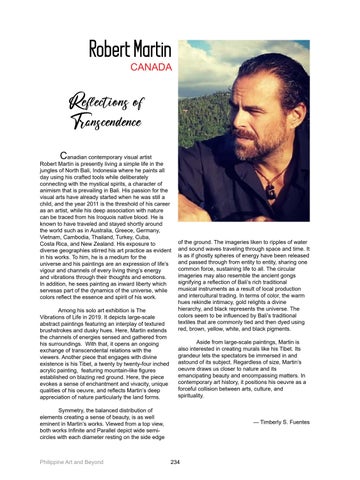
234..... Robert Martin - Canada Reflections of Transcendence
194..... Charley Lesquelin - France Pursuing a Quest
236..... Roshan Padhan - Nepal East Meets West
196..... Chien-Shih - Taiwan The Dreamweaver
238..... Safaa Afifi - Egypt Visions and Sensibilities
198..... Dang Tuan - Vietnam The journey back home
240..... Salette Viana - France Painting Well With The Heart
200..... Dora Labora - USA The Guardians of the Corals
242..... Shefqet Avdush Emini - The Netherlands Resonating Hues
202..... Elsa Ordonez - Equador Marks of Whimsicality
244..... Stephen Oldershaw - United Kingdom Visualizing Society
204..... Elena Tereshkova - Russia A world of Bright Colors and Universal Empathy
246..... Suzlee Ibrahim - Malaysia Revised Unbridled Hues
206..... Emmy Go - Indonesia Loving nature at its best
248..... Yasmin Olivares - Venezuela Creating Art With Harmony In Nature
208..... Farrukh Negmatzade - Tajikistan Simply unpretentious
250..... Zhang Kexin - China Master Allegorist Of Our Time
ARTISTS FROM THE PHILIPPINES
Raul Isidro An Artist’s Non-Stop Evolution and Passion to Contribute
Raul Isidro’s artworks are visual poetry of
Indonesia, Spain, West Germany, France, the Netherlands, Hong Kong, China and Singapore. Yet, he still is the same hardworking artist who paints daily because he believes the enthusiasm to paint must always be in an artist’s heart.
unfolding stories and emotions. One cannot ignore the picturesque beauty, lingering memory, peace or sense of healing that his arts convey. Isidro’s paintings are genuine encounter with contemporary art- both a personal vision and a masterpiece. The prolific contemporary Filipino artist is a National Artist nominee, a TOYM awardee, a Lifetime Achievement Awardee of the City of Paranaque, Outstanding Samareno, and Outstanding Thomasian. But inspite of all of these accolades, he is a man of remarkable humility subscribing to hardwork and pragmatic perseverance.
A consummate abstractionist to the core, Isidro reverts to intentionally-contrived textured strokes of colors applied ostensibly throughout the canvas via the gestural movement of his brush. Glimpses of ethereal admixture chroma vividly peeking through dense swathes of calming blues, intense yellows, striking reds, or modulated greens speak of an otherworldly depiction of the topography of his hometown, Calbayog City in Western Samar. A variation of leitmotif substantiates a transition into another sphere of interest close to his heart: that of replicating the forces of nature as well as the dynamism of human motion.
A native from Calbayog City, Isidro grew up in a rich culture, surrounded by verdant nature, religious history, and even economic challenges. With his typical Filipino background, he grew up to be a man of discipline, perseverance and fortitude. Consistently for more than 60 years, his flourishing success as a renowned contemporary Filipino and Asian artist can be attributed to his non-negotiable dedication to his profession and passion to contribute.
In a sense, he is a virtuoso whose power lies in capturing the kinetic energy expended upon by a burst of exaltation akin to triumph. Manifold experiences from his decades of observing the nuances of life and his surroundings equipped him with a unique visual syntax which defines the narrative of his artworks. He is like a magician who conjures wondrous visions that defy logic; allied to this is the subconscious appeal to the senses heightened by the mystic ethereality comprising the symphony of forms.
In 1965, Isidro earned his Fine Arts Degree, Major in Advertising at the University of Sto. Tomas. Despite his parents wanting him to be an architect, he followed his heart and pursued fine arts. Isidro is one of the finest Filipino visual arts warriors as he struggled, emerged and conquered his dreams through the decades. Honor and recognitions are basked in glory. But for him, it is his contribution to the young visual artists who are beginning to walk their path that is important. He has participated in numerous solo and group art exhibits in the Philippines and in countries such as in the USA, Israel, India,
Philippine Art and Beyond
Isidro through appropriation of gestural movement, lyricism, fluidity of rendition, and emotive use of color, was able to encapsulate the true spirit of Abstract Expressionism. He combined action painting, automatism, and mood-engaging color field in his mastery of techniques while at the same time tapping the subconscious terrain of the surrealists.
26
Isidro’s perseverance in both his personal life and in art has granted a view of the universe where the world is transformed into a representation of alternate reality through his abstractionist vision. He is a genuine role model to all young and aspiring artists and is known for his “legendary work ethic, with his brilliant art always on firm ground. (Inquirer. net, Lito Zulueta, 2018)” He is most importantly, one of the Philippines’ pride and honor in the field of visual arts. When asked, if he is awarded the national Artist Award, Isidro said, he would help young and poor, struggling artists. (GKTV Network Interview, 2021). — S. Tan Gana and V. Tan Gana
Blue Shades Acrylic on Canvas 24 x 48in 2020 Chrome Convergence Acrylic on Canvas 48 x 36in 2016
Philippine Art and Beyond
27
Upper photo Fourth Moon Coming Acrylic on Canvas 48 x 60in 2017 Lower left photo Red Sails Acrylic on Canvas 36 x 48in 2016 Lower right photo Dreams Acrylic on Canvas 48 x 60in 2015
Philippine Art and Beyond
28
Red Formation Acrylic on Canvas 36 x 48in 2020 My Daugther Tricia Acrylic on Canvas 48 x 60in 2016
Philippine Art and Beyond
29
William Yu
A Man of Unwavering Faith “Art is the love of pictorial invention. At the same time, it is a multi-dimensional form of communication. That is why it is also a form of worship to our Creator the Sovereign YAHUWAH RUWAKH ELOHIYM - the Father, YAHUWSHUA the Son, the YAUW Haqodesh Elohiym - The Sacred Spirit. “ –William Yu William Yu is perhaps the only Filipino visual artist who has the most extraordinary form of artistry known as ‘Hallelism’; It is a manifestation of his spiritual transformation and evolution through the years. His art in essence transcends the conventional attitude of art making--it is a metaphysical and spiritual quest for the divine truth. Born in Baculin, Baganga, Davao Oriental Philippines, Yu’s father introduced him to calligraphy writing at a young age. He took up International Correspondence study in London in 1981, and apprenticed in the studio of National Artist Cesar Legazpi thereafter. Prior to going to Manila to become a full-time painter, Yu mounted a three man show, the first ever exhibit that was held in Baganga. Yu later became a full-time painter in Manila and practiced the holistic approach, believing that the “act of painting is no longer confined to a one-dimensional activity, but as a performative process that involves the activity of body and soul, the ora et labora of art making.” Master Yu, as he is fondly called by his friends is considered as the artist’s artist. He is a man of humility, kindness and benevolence--a genuinely spiritual individual who sees art as a catalyst for enlightenment in society, so long as it is directed towards glorifying the Creator YAHUWAH RUWAKH ELOHIYM. Henceforth, his masterpieces became
Philippine Art and Beyond
his way of sharing this message. His unconditional generosity in sharing his artistic gifts to those who are willing to learn goes beyond imparting to them the fundamental learning. He also provides shelter until they can fully stand on their own. The artist is a good Samaritan, with a colossal faith while living a simple and contented life with his family. In one of his interviews, he uttered a timely message: “The significance of faith in our time is an indispensable gift that liberates man from his uncertainties and sorrows. It gives him wisdom and direction in life amid the trappings of materialistic society. “ Yu’s unwavering faith has always been the cornerstone from which he built his art practice. This deep-seated belief in the power of the almighty Creator who is One entity in three persona--The Father - Abinu YAHUWAH ELOYIM , The Son YAHUWshua the Messiah ELOHIYM and the Spirit of Truth , AbbAH YAUW HAQODESH ELOHIYM is One YAHUWAH RUWACH ELOHIYM EKHAD (ONE) - originated from his study of the Torah, which is a narrative of the first five books of the Hebrew Bible. He further elaborated that the holy book “consists of letters, numbers, and sounds, and that every letter from Aleph (A), to Tauw (T) is a network to the entire Hebrew syllabary.” Syllabary are written characters which represents syllables as correlated to particular symbols. In this case, Yu associated it as such to Hebrew and designated every letter as a holy script bearing the name of Abinu YAHUWAH ELOHIYM. He called the Torah the Sacred Matrix of the Universe-of the YAHUWAH RUWAKH ELOHIYM. Psalms 40 :7 , Hebrews 10:7, Revelation 1:8 It is from this spiritual inception that he developed his recent art theory ‘Sacred Geometrical Code Rhythm’. As a form of worship, he devised a
30
visual language that captures the eloquence of his faith as expressed through the visual arts. The compositional structure of his current paintings suggests a culmination of a belief system that centers in trying to decipher the mystical characteristic representative of the Creator through His creation of the Universe. Yu stated: “In my new paintings, I am trying to express that the Universe was written in the language of Light--letters of Light (Ketab Lebonah letters), in the language of Mathematics, and in the language of the Sacred Geometry of YAHUWAH RUWAKH (Spirit) ELOHIYM that the viewer may be able to perceive the Light.” Thus, Yu’s ‘Sacred Geometrical Code Rhythm’ is a visual translation of comprehensible signifiers informing the viewer about his faith. It is the theoretical foundation of what he calls the ‘Tesseract Style’- the ‘Hypercube’- the ‘Time Cubism’. “Tesseract is actually a geometric network in a multi-dimensional space-time” says Yu. “A threedimensional square is a cube. And a cube in a four-dimensional space-time is called Tesseract. In this version of my art, I am trying to describe how object is transformed by space-time, motion, and by the effect of light energies.” Another facet essential to his current body of works is the rationale behind his concept of the ‘Linguist Style’; On the premise that “every painting is a language” Yu further extemporizes on the morphology of the stylistic forms from Realism, to Cubism, and culminating in Abstraction. As communication is expressed through the alphabets (written language) and words (spoken language), it can also be discerned through a pictorial language as paintings. Hence, “the main objective of a linguist painter is to paint the ‘Beauty of Wisdom in Art’ by means of painting different versions and different styles. The linguist painter believes that in doing this, he becomes more knowledgeable in art than just painting in one style”. Given that style varies greatly from that of Western Art, Oriental Art, and other artistic production coming from diverse cultural denominations, Yu stresses that “the very style, the best style is to understand that the artist is the style himself; the very art is to understand that the artist is the art himself. It is like the Art is producing art.” Yu instituted a unique approach in his quest to discern the sacredness of faith and sanctify the mundane in his artworks. Revelation, intuition, instinct, spontaneity, directness, and careful planning become interdependent directives that predetermine the direction through which he tackles and develops each masterpiece. Such methods can be Baruwk Yahuwah Ruwakh Elohiym Mixed Media 35 x 35in 2021
Philippine Art and Beyond
31
South East Light Acrylic on Canvas 36 x 60in 2021
To YAHUWAH be the glory Acrylic on canvas 27 x 27in 2020
He Word Of Light Acrylic on Canvas 32 x 37in 2021 Lower left photo Yahuwah - The Sound Of Light Acrylic on Canvas 27 x 27in 2021 Lower right photo Yauw Haqodesh Is The Life Acrylic on Canvas 27 x 27in 2020
Philippine Art and Beyond
32
apprehended upon contemplation of his present-day oeuvre. Figurative images co-exist with geometrically abstracted forms infused with coded number symbols and syllabary. Light bathes the vibrant hues that permeate the deconstructed articulations. Still present is his signature neo-baybayin calligraphy ‘Maharlika’ which is also part of his ‘Hallelism’; The seamless transitions of elements which represents space-time compendium are achieved through precise layering and rhythmic balancing of patterns resulting in a visually uplifting and harmonious composition. As a man of conviction with unwavering allegiance to the Creator, Yu demonstrated that humankind is capable of elevating any simple act into an expression of love and devotion. -S. Tan Gana and V. Tan Gana Yahuwshua The Son Is The Word Acrylic on Canvas 35 x 32in 2021 Yahuwah Ori Acrylic on Canvas 35 x 32in 2021
Philippine Art and Beyond
33
Joe Datuin Endowing Legacies inside. It is his response to the problem of trade-in trash in the country in which he strongly disagrees. Macabre art is also present in Datuin’s oeuvre, particularly his Toxic Earth that presents us with a skull sitting atop a standing metallic circle situated atop a black stool chair. Attached to the left cheek of the skull is the tail part of a skeleton structure hanging loosely. It profoundly illustrates the effects of pollutants such as toxic material waste, especially when irresponsibly managed, on humans. It also highlights the fleetingness and fragility of the human body.
A
World Renowned Filipino International Contemporary Visual Olympian and monumentalist Jose ‘Joe’ Datuin’s recent oeuvre is an array of paintings and mostly metal sculptures which some are adaptable to different environments be it indoor or outdoor. His ability to manipulate metal in different arrangements and compositions demonstrates his proficiency in metal welding, artistry, and critical thinking. His works are housed in prestigious art venues such as the National Museum of the Philippines, GSIS Museum and at the Olympic Museum, Lausanne, Switzerland. It is worth noting that he was among the nominees to the 2018 Order of National Artist Award. Many of Datuin’s sculptures are composed of rings and round forms like his Infinity Wheel of Fortune, an assemblage of a modified standard color wheel on canvas, and two overlapping metallic rings with a round metal at the center. Moreover, His D’TXTER is a sitting robotic-like figure composed of found objects, particularly used and thrown electronic gadgets also known as e-waste. The physical form is inspired from the famous ‘The Thinker’ sculpture by Auguste Rodin. On the downside, it shows a glimpse of the accumulated e-waste in our country. Yet, on a lighter note, it shows how these can be upcycled into an innovative piece that is thought-provoking and encouraging to being a responsible gadget user and digital citizen. Similarly, his Special Delivery is a sculptural installation of an intermodal container’s opening where trash can be seen piling up from the
Philippine Art and Beyond
Further, his kinetic art World-Class Filipino represents a clock installed in a circular garden. It is commonly called the flower clock in Rizal Park. It not only functions to tell of what time it is but also, as the title implies, appreciates the contributions of the Filipinos in different international platforms as it ignites a sense of patriotism. Furthermore, artworks under the historical genre are also present in Datuin’s oeuvre such as his Statue of Bagong Bayani, and God first. The statue of Bagong Bayani is a sculptural installation that features an angular and planar sculpture seemingly in an abstracted form. Yet, when looked closely the composition or suggested movement draws resemblance from the Bantayog ng Mga Bayani situated in Quezon Avenue and the Katipunero situated in Manila, suggesting possible influences on the work. Here, Datuin gives recognition to the acknowledged and unsung heroes in our Philippine history. It implies Datuin’s utmost respect for the heroes specifically to the Overseas Filipino Worker (OFW) and International Migrant Workers who unselfishly in supreme sacrifice left their families to work abroad to provide necessary life support systems to the family in return thus contributing a great amount of remittances to boost the Philippine Economy, crystallizing a visual representation of their legacy. While, God First is a simplified crucified Jesus Christ on the Cross, along with a halo. Here, Datuin drifted away from the traditional realistic depiction of the Crucifixion by retaining only the main features: the bowed down head of the Messiah, the cross, the halo, and the pedestal. Among other topics tackled in his works are love, beauty, motherhood, and nature. Taken as a whole, Datuin’s works are national treasures that prove his capability to discuss current news and
34
Beauty Icon Stainless Steel 12.5 x 24 x 8in 2014
trends; articulate his commentaries; and encourage an engaging in-depth analysis on varying issues through visual art forms be it painting, sculpture, assemblage, and installations. — Timberly S. Fuentes
Toxic Earth Mixed Media 48 x 24 x 18in 2017 Exhibited: “XI Florence Biennale” Artist Collection
Philippine Art and Beyond
35
Statue of Bagong Bayani (Statue H-40 Ft / Maquette H-19”) Stainless Steel 2016 Unveiled & Exhibited, “Nationalistic Monuments”, Artist Collection
Mother & Child Series 14 9.25 x 6.5 x 6in 2014 Raul Luis Manaligod collection
Ripples Stainless Steel 45 x 84 x 10in 2018 Exhibited: Infinity+”, Artist Collection
Philippine Art and Beyond
36
I Love You Acrylic on Canvas / Triptych 120 x 144in 2009 Philippine Heart Center Collection Infinity Wheel of Fortune 8ft x 6ft Mixed Media 2018 Exhibited: Infinity+, Artist Collection
Philippine Art and Beyond
37
Celso Pepito Ambassador of Truth and Beauty T
he maestro from the Northern tip of Cebu is one of the country’s most prolific artists. Throughout his life, Celso Pepito always focused on the most fundamental of Filipino virtues “sipag at tiyaga”. He began to exhibit his creativity when he was in high school and attained a formal education in the arts when he studied for a Certificate in Fine Arts at the University of the Philippines, Cebu from 1977 to 1981. The maestro’s evolution is mostly a road not commonly taken. He had to find his own expression, unique style, and ultimate motivation. For the first thirteen years of being an artist, Pepito dealt with Realism and Impressionism. A friend encouraged him to cultivate his own unique style. Thereafter, he decided to apply the Cubist tendency of rendering form until he developed his signature style. According to him, it takes sincere dedication to create with passion. He considers National Artist Vicente Manansala as the main inspiration who pushed him to explore artistic innovations. This made Pepito value authenticity and instilled in him the discipline of adherence to the fundamentals of color and drawing which must always be present in his works. Even the most naïve of art audience will experience its emotive power when confronted with Pepito’s creations. His aim to inspire people, to contribute to positivity, to motivate them to carry on with the virtues of love for God, family, and country are all expressed in his artworks. He abides by the valuable tenets of nation building as the guiding force behind his advocacy of promoting Cebu art and artistry to the contemporary art scene. Cebu Artists Incorporated is a vision he and his wife Fe Madrid formulated to provide fellow Cebuano artists the opportunity to showcase the culture and arts of their locality. Organizing art exhibitions within the Philippines and abroad as a venue for promoting artistic ingenuity and excellence is a major contribution made possible through Pepito’s inspiring initiative.
Philippine Art and Beyond
His devotion to the Sto. Nino (an icon image of the Child Jesus) bespeaks of his deep Christian faith as conveyed in his recent oeuvre “Nurturing Faith”; Done in expressionist cubist style, the three figures of children beholding the icon image reiterate the virtue of innocence and trust in professing one’s love for God. Another crucial motivation in his depiction of ordinary people like vendors, farmers, fisherman, and carpenters is his profound respect for the struggles they encounter in their daily lives. According to him, “they strongly manifest the value of resiliency and offer us the sense of cooperation and dignity which are very strong messages to our political leaders to promote unity and decency if only to finally attain total positive change in our society.” Such sentiment is perceptibly incorporated in his works “Manifestation of Filipino Culture”, “Gift of Joy”; “Beyond Covid”; and “Leisure Time”; Celso Pepito succinctly declares his stance when he stated that “art defines the one who created it and reflects who he is- an artist who shall be an ambassador of truth and beauty. And as one continually travels in the realm of beauty, one must strive, if not, to just try to be a positive example to his viewers, and not otherwise.” Furthermore, he believes that “as art is a reflection of who we are as people, it can be a good reminder to our present and future generations-the value and importance of our culture as Filipino people.” — S. Tan Gana and V. Tan Gana
38
Beyond Covid • Pastel on Paper • 40 x 26in • 2021
Philippine Art and Beyond
39
Philippine Art and Beyond
40
Manifestation of Filipino culture Acrylic on Canvas 48 x 96in 2021 Mr. William Ang collection Nurturing Faith Acrylic on Paper 14.75 x 10.25in 2021 Mrs Leah Eamiguel Perez collection
Opposite page Gift Of Joy Acrylic on Canvas 16 x 20in 2021 Mrs Jane Panganiban collection Leisure Time Acrylic on Canvas 36 x 48in 2021 Mr. William Ang collection
Philippine Art and Beyond
41
Florentino "Jun" G. Impas, Jr Society Portaitist Par Excellence J
UN IMPAS has come a long way. The artist who learned the rudiments of the craft on his own, and started out as a painter of movie posters or cartelons, is now a most sought-after society portraitist. Judges, businessmen, and even Cardinals, among others, seek him out whenever they want their portraits painted.
Competition; 2nd Place, Outside the Box Category, Portrait Society of America International Competition; Semi- finalist, Landscape Category, Semi-finalist, Figurative Category, and Finalist, Portrait Category, Art Renewal Center International Competition; and Finalist, Commissioned Portrait Category, Portrait Society of America International Competition. Impas had held 12 solo exhibitions so far in prestigious galleries in both Metro-Manila and Cebu City. He: had depicted in those shows happenings from long ago, historical scenes and period genres where women wear "baro't saya". It is apparent in these latter works Impas's special fascination for that clothing which he lovingly captured in dazzling pinks and whites in paint.
Impas was born in Cebu in 1970, but spent most of his young life in Surigao. Since his father Florentino senior was just a fisherman who had a wife and eleven children to feed, Impas had to take on odd jobs himself to help tide them over. Yet, deprived though they were, the family was still blessed in having a son gifted with innate artistic talent whose creativity shone through early. The path to a future art career was opened to him when he was hired by a movie theater in Surigao City to do the posters of the movies that were to be shown. It was by way of that job that Impas's skill in painting faces was honed. When he relocated to Cebu, Impas joined local art groups, not only as a stepping stone towards a full-time painting career, but also as a way of learning the techniques of his peers. He further deepened his knowledge of his craft by perusing art books. Impas's diligence paid off. From then on, nothing could stop him from winning prizes, among which are the following: 1st Place, Martino Abellana Annual art Competition; 1st Place, Philippine College of Surgeons Painting Competition; 1st Place, Petron National Art Competition; Excellent Award, China-ASEAN Artwork Competition; 2nd Place, GSIS National Painting Competition; Finalist, Bangkok Sentral ng Pilipinas National Painting Competition; 1st Place, Mentor Category Regional Level, Fernando Amorsolo Painting Competition; 1st Place, Mentor Category National Level, Fernando Amorsolo Painting Competition; 8th Place, Outside the Box Category, Portrait Society of America International
Philippine Art and Beyond
Incidentally, Impas enrolled in and earned his Bachelor's Degree in Fine Arts from the University of Santo Tomas when he was well into his forties, and is already popular and widely considered too as a young master. Cebu is the bulwark of realism in art in the Philippines, because gathered there today were the staunch champions or defenders of the classical realist tradition of Fernando Amorsolo. These Cebuano painters stand out in their mastery of portraiture, which is Impas's forte. I daresay that Impas had surpassed - as shown by his portraits which were filled with background objects and details - their lodestar, the old master Amorsolo himself, when it comes to capturing likenesses on canvas. Well, why not? Impas had a lot of practice. He had been painting, during his younger days, faces of movie stars on cartelons day in and day out.
42
— Arnaldo Bernabe Mirasol
Mrs. Conchita Ting Chua Oil on Canvas 36 x 48in 2017 Collector: Commissioned Portrait
Philippine Art and Beyond
43
Pananghalian Oil on Canvas 40 x 40in 2019 Collector: Amado Go Afternoon Pastime Oil on Canvas 48 x 48in 2019 Collector: Ma. Ivy Ang
Philippine Art and Beyond
44
Mano Po Oil on Canvas 36 x 48in 2009 Collector: GSIS Museum (Winning piece: 2009 GSIS painting competition, 2nd place)
Behind The Mask Oil on Canvas 36 x 48in 2017 Collector: Florentino’s Art Gallery (Winning piece: Portrait Society of America Members Only Competition - Outside the Box category)
Philippine Art and Beyond
45
Romeo Gutierrez Crystallized Eloquence R
omeo E. Guitierrez is a painter, printmaker, and art educator. He holds a bachelor's degree in painting from the University of the Santo Thomas, Philippines, and art education at the University of the East, Philippines. He started his career as a professor at the College of the Holy Spirit, Fine Arts Department. He then became the vice president and board director of the Art Association of the Philippines, an organization founded by Purita Kalaw-Ledesma in 1948, that aims to promote visual arts in the country, and support fellow Filipino visual artists.
(2018) gives us a glimpse of metropolitan sceneries he had encountered. The application of a tetradic color palette supports his in-depth knowledge of color theories, and the alteration of shifting angles proves his confidence in perspective.
He had garnered numerous awards and had exhibited both in the local and foreign artworlds such as in Taipei, Chile, China, Hongkong, Germany, London, England, United States of America, and in Europe. To date, he had a total of forty solo art exhibitions. In 1994, the NCCA awarded him as among the ten outstanding visual artists in the Philippines. In 2016, his alma mater awarded him as an outstanding UST Alumni. In the same year, the Bakusi Foundation awarded him as an outstanding art educator. His works are housed in well-known art collectors such as Gokongwei, Ayala, Sycip, and Romualdez; and well-known institutions such as the Manila Peninsula Hotel, National Arts Center, National Museum, and Cultural Center of the Philippines. Some of his notable works can be found on Hallmark's holiday season greeting cards which are globally publicized and sold. He also took part in international and local art-related books including Who’s Who in the International Art Switzerland), and Encyclopedia of Philippine Arts (Philippines).
In 2020, the pandemic has caused several distressing scenarios, unexpected changes, and mandatory precautionary steps, causing collective grief around the world until the present. Yet, Gutierrez shifted away from the burdensome depiction of these realities. Instead, his Flower of the Month series which was produced in the same year cordially welcomes us to take a pause and find peace in the natural world, as it evokes a spirit of optimism, a much-needed attitude during these difficult times. Similar to his painting The Good Life, his painting entitled Memories (2020) presents a warm intimacy and strong ties among families, characteristics of Filipino culture. Meanwhile, his recent painting entitled Light Festival (2021) chronicles a cultural practice commemorating a particular noble person or religious key person. In the Philippines, the Light Festival is equivalent to the annual giant lantern festival commonly held in Pampanga, to celebrate Christmas, the birth of the Lord Jesus Christ.
His oeuvre is known to reveal a festive integration of transparent, translucent, and opaque planes and figures depicted in varying viewpoints, which have been the artist's increasingly signature. His subject matters that encompass family, plants, and buildings resonate with the Filipino social landscape. An exemplar of this is his 2015 painting entitled The Good Life that presents us a family in the center affectionately hugging each other as passers-by and buildings surround them in visual harmony. In addition, his painting entitled Serenity
Philippine Art and Beyond
Guitierrez’s undeniably exquisite glowing oeuvre persists to develop amidst vicissitudes. Currently, he is part of a group art exhibition entitled PYESTA: Continuing Legacies, which will run from October 8 to November 8, 2021 via satellite.
46
—Timberly S. Fuentes
The Good Life Acrylic on Canvas 30 x 30in 2015
Light Festival Acrylic on Canvas 24 x 24in 2021
Philippine Art and Beyond
47
Flower of the Month Dec Acrylic on Canvas 24 x 24in 2021
Serenity Acrylic on Canvas 36 x 36in 2018
Philippine Art and Beyond
48
Flower of the Month October Acrylic on Canvas 16 x 20in 2020
The Couple Acrylic on Canvas 24 x 36in 2013
Philippine Art and Beyond
49
Fernando Sena Respected Artist, Beloved Mentor F
ernando Sena's place in Philippine art history, as the father of Philippine art workshops, is already secure. An art educator for most of his life, Sena began his career as a volunteer teacher in the art classes of the Children's Museum and Library Incorporated (CMLI). It was his way of paying back, because Sena himself attended art classes for free at CMLI, after which he was awarded by the museum director a painting scholarship to the University of the East School of Music and Fine Arts. Sena taught at the CMLI for almost ten years, and later on at the University of the East and the University of the Philippines. Sena branched out to conducting art classes of his own in various venues. He was also routinely invited by organizations to conduct art classes for them. Fernando Sena was born in Tondo. His father, Arturo, was a "plantsador", a fellow who irons clothes for a living. His mother, Faustina Belen, was a market vendor. Sena's parents struggled hard to provide him an education. To be of help, Sena peddled newspapers. Menial though the job was, it was Sena's stepping stone to becoming an artist because the movies and comics sections of the newspapers provided him plenty of pictures to copy. Sena's diligence in learning how to draw paid off. His skill as a draughtsman, and later on as a painter adept in the use of various media, allowed him to create little masterpieces done in a range of styles. His series of still-lifes that feature the pan de sal was iconic. It was his signature body of work, his trademark. These still-lifes that include not only pan de sals, but also cups of coffee, salted and fried eggs, and kitchen objects were rendered the classical realist way in pastel. On the other hand, another set of pastel artworks that include the mother and child motif and assorted landscape scenes were fine examples of Sena's impressionist works, because he employed here short daubs of the pastel stick he was using and minimal blending of colors. Sena in time started another series, his paintings of toys in disarray and jumbled together tightly, which when viewed from afar would seem to be cubist-like
Philippine Art and Beyond
50
abstractions. He revealed in an interview that his two boys' very toys inspired him to do the series. It was perhaps Sena's way of preserving the memories of his sons' childhood days, which I presume was the happiest phase in his life as a father.Sena founded the Kabataang Tundo Art Group and the Art Discovery.and Learning Foundation Incorporated. Inherently generous, Sena facilitates free art workshops for the poor, and also for cancer patients, children in orphanages, and prisoners. Those civic activities led institutions to grant him various awards, like one of the "Ten Outstanding Manilans" in 1979, the "Outstanding UE College of Fine Arts Alumni" and "Most Distinguished UE Alumni" in 1986 and 1989 respectively, and the "Patnubay ng Sining at Kalinangan" in the field of Painting, which was given him by the City of Manila during the Araw ng Maynila celebration in June 1995. Sena's life is a life well-lived. A challenge to the youth, especially to the deprived ones like Sena once was, to never give up in the struggle to make something of themselves. Definitely, Sena is savoring now the fruits of his tortuous yet triumphal journey to become a renowned, respected, and beloved artist and mentor .
— Arnaldo Bernabe Mirasol
Mother and Child in the Garden Oil on Canvas 30 x 24in 2021
Philippine Art and Beyond
51
Philippine Art and Beyond
52
Opposite page Pandesal, Itlog Acrylic / Oil on Canvas 16 x 20in 2021
Nipa Hut at Pinto Acrylic on Canvas 18 x 24in 2021 Garden Acrylic on Canvas 25 x 40in 2021
Almusal Acrylic / Oil on Canvas 20 x 27in 2021
Philippine Art and Beyond
53
Fidel Sarmiento Amalgam of Old and New F
idel Malig Sarmiento started out to be an architect. He first enrolled at the Mapua Institute of technology to take up Architecture, but quit after a year. Sarmiento must have felt that Architecture isn't for him because of his aversion to technical drawing. He is a fine artist who find free hand drawing more fun. So, he switched course and enrolled in Fine Arts major in Painting at Feati University. Sarmiento was born on December 19, 1959 in Sampaloc, Manila. His parents are Ardalion Manite Sarmiento and Pricilla Bautista Malig Sarmiento's parents were lucky. They never worried about the expense of sending him to college because he was a university scholar. Sarmiento made a good career choice because his profession as an artist propelled him, not only to prominence as a painter, but also to serving as President for 8 terms of the Art Association of the Philippines (AAP).Sarmiento began reaping art awards in high school. He continued his winning ways when he became a professional artist. Here are a few of his wins and near-wins: 2nd Prize, 1996 AAP Art Competition; 1st Prize, 1998 AAP Centennial Art Competition (NCR Edition); Grand Prize, 2001 DENR Sail Painting Competition in Boracay; Jurors's Choice Awardee twice in both the Philippine Art Awards and the AAP Art Competition; Finalist, Diwa ng Sining Competition; and five times Runner-up awardee in Gallery Genesis Kulay sa Tubig Watercolor Painting Competition.Two painters might have influenced Sarmiento. One is Lino Severino, who, through his Vanishing Scene series, popularized paintings of vintage houses, and the other, the photorealist Nestor Leynes. Sarmiento was first noticed for his paintings of vintage houses a la Severino. But Sarmiento's iconography deviated somewhat from Severino's, because Sarmiento also included in his paintings foliage, colorful flowers, cats, pigeons and other pets, pedestrians, and calesas to avoid projecting the somber and deserted atmosphere of Severino's works. Aside from that, Sarmiento didn't limit himself to painting facades or exteriors of houses. He delved deeper, and portrayed the interiors with their
Philippine Art and Beyond
54
furnishings to give us an idea on how comfortable genteel Filipinos lived during the pre-war era. Leynes's influence on Sarmiento, on the other hand, could be discerned in his hyperrealistic still lifes. Sarmiento's recent works, which he exhibited in the First Visayan Art Fair, were the products of his experimentation with composition and technique. The works were some sort of summing up, an amalgam, of the motifs that have enthralled him through the years. Facades of vintage houses and churches, painted photo prints seemingly taped on the picture planes, and images of turn of the century Filipinos and Filipinas were strewn, though not haphazardly, or superimposed on abstract backgrounds. Sarmiento seems preoccupied here in mixing things old and historical with the modern language of abstraction. These supposedly experimental pieces won't be experimental anymore because of the success they have achieved in the art fair. Seven paintings from this series were sold, attesting to Sarmiento's current status in the Philippine art scene as one of its most in demand practitioners.
— Arnaldo Bernabe Mirasol
Byaheng Crisologo • Acrylic on canvas • 18 x 24in
Biyaya sa Umaga • Acrylic on canvas • 18 x 24in • 2020
Philippine Art and Beyond
55
3 Koi's Acrylic on Canvas 24 x 18in Mahalagang Butil Acrylic on Canvas 18 x 24in 2019
Philippine Art and Beyond
56
Pamana Acrylic on Canvas 48 x 72in 2021 Inilawang Pamana ng Maestro Acrylic on Canvas 46 x 32in
Philippine Art and Beyond
57
Pancho Piano Etherealscapes B
orn in Camarines Sur, Philippines, well-known visual artist Pancho Piano holds two bachelor’s degrees: a bachelor’s degree in Economics at the University of the Nueva Caceres, and a bachelor’s degree in Fine Arts at the University of the Philippines as a scholar of Jose Joya. He is known to masterfully create stained glass pieces and murals for local and religious institutions in different places such as in Bicol, Naga, Legaspi, Quezon City, Mandaluyong, and others. Many of his art deal with Philippine mythology and the local people of the Bicol region which gained admiration from members of the artworld and the public. He has participated in numerous solo and group art exhibitions in the local and foreign art scene including Japan, the United States of America, Germany, and many more. His recent oeuvre Awakening, Awakening II, Celebrations, Celebrations XXX, Merging Motions, and Merging Motions 2 are dominated by a combination of thick aggressive gestural and straight brushstrokes that together resemble shimmering light movements caught in different time segments. Moreover, these are frequently punctuated with a focal point at the center that likens to an illuminating amorphous form. Arranged with a hint of symmetrical balance, the surrounding elements of the focal points are glowing circles, squares, and similar shapes in varying sizes as if celestial bodies emanating from the canvas. His Awakening presents us with diagonal and horizontal wavy lines freely moving at each side. At the center looks like a white open clam atop a mountain composed of vertical swirls. The clam appears to be spewing a number of gleaming white pearls towards the ground. While his Awakening II shows us not only the varying brushstrokes but also the transitioning hues. Light shades are concentrated at the center, and as it moves towards the side the pigment becomes orange to brown, evoking a warm mood. Each artwork has a red circle on the upper left that brings to mind romantic sunset seascapes, attesting to Piano’s deep appreciation of nature, and ability to connect with feelings through colour.
Moreover, festivity as a theme persists in Piano’s Celebrations and Celebrations XXX as more variations of shapes and pigments were applied. His Celebrations feature seemingly precious stones or gemstones sparkling from a distance, suggesting Piano’s possible interest in geology. Meanwhile, a group of white circles in Celebrations XXX resembles exploding fireworks, a recognizable sight during parties. Here, both works indicate Piano’s character as a merry artist who is interested in capturing exuberant representations, prompting a thrilling atmosphere among the viewers. His Merging motions is a landscape using primary colors, black, and white pigments. The wide expressive lines are ornated with squares and circles. The whole imagery exhibits a familiar rocky landscape which allows the viewers to consider an array of sceneries be it natural or reimagined. Further, his Merging motions 2 is mainly painted using lime green and emerald-green color combination. The embodiment reminds us of the aurora borealis also known as the polar lights because of their atmospheric flickering moving light appearances. The focal point likens to a heavenly body floating in the air, which demonstrates a possible influence of the artists’ spiritual perspective. Taken as a whole, Piano’s oeuvre proves his ability to weave light and movement to create glowing sceneries that are out of this world, engaging the viewers to play along with their imagination and ponder unending possible profound analyses.
-Timberly S. Fuentes
Philippine Art and Beyond
58
Awakening Acrylic on canvas 24 x 30in 2021
Celebrations Acrylic on canvas 20 x 16in 2021
Awakening II Acrylic on canvas 24 x 18in 2021
Philippine Art and Beyond
59
Winding moments Acrylic on Canvas 36 x 48in 2018
Philippine Art and Beyond
60
Merging motions 2 Acrylic on Canvas 18 x 48in 2020
Merging motions 1 Acrylic on Canvas 18 x 48in 2020
Philippine Art and Beyond
61
Seb Chua Patterns of Love F
ilipino-Chinese Modern and contemporary artist, Seb Chua had exhibited and auctioned his artworks here and abroad. His first solo art exhibition titled Fractal Visions took place in 2007. Among his auctioned works are Cervitaur (2016) and Nautilus (2009). One of his remarkable pieces is The Guardian which depicts a sitting man with a dog resting on his lap. It is his dedication and contribution to the Philippine Animal Welfare Society to pay tribute to the pet parents along with their pets. Chua is also a resident artist of ArtAsia Gallery wherein in 2008 he had exhibited a series of sculptures in partnership with Unicef, which all proceeds went to Unicef as support to their mission and vision. His works are known to speak of volume in terms of their form and message. Among them tackle intimacy in line with the physical body as manisfested in Mother Earth, and familial values which are commonly practiced by close-knit families as evident in his Morning Ritual, Mother’s Love, His Precious One, and His True Treasures. The overall physical appearance is a combination of soft planes, giving a subtle geometric look, and well-rounded curves, showing a hint of voluptuousness. His human figures are often faceless. These sculptures are made from either cast marble or cold bronze. His Mother Earth depicts a woman in a semi-fetus position. The graceful melancholic pose seemingly represents a sense of self-protection as she covers herself from harm while in deep solemn thoughts. The idea of introspection suggests that Chua’s oeuvre put into consideration the importance of self-analysis, a positive act of self-care. As the title states, it could also symbolize the call of mother earth to love itself by preserving and conserving its resources. Further, His Morning Ritual depicts a scenario of a woman, possibly a guardian or a mother, dressing up a boy who may be on his way to school, a likely core memory Chua has. The imagery allows us to be grateful for the people who have helped us when we need assistance. Similarly, Chua’s His Mother’s Love is a scene of a mother
Philippine Art and Beyond
62
tenderly nursing her baby. It is a witness of an intimate bond between a mother and a child. It also highlights the unconditional responsibility of being a mother and the joy of motherhood which speaks a lot of Chua’s great respect for mothers from around the world who would do everything to give their children a good life. Meanwhile, his Precious One is another familial setting: a couple lovingly gazing and caressing their newborn baby. The father being so gentle and protective of their precious child brings to light the soft side of the head of the family. Likewise, his True Treasures is a warm family scene wherein the mother breastfeeds their infant while the father carefully observes. His left arm wraps around her while his right hand gently massages their child’s head. Indeed, true treasures are not the gold or the material culture but the irreplaceable moments we shared with our loved ones. Here, Chua was able to crystallize and stamp an indelible mark these acts of cherishing and nourishing as important moral principles in developing a healthy sense of being and sense of family, a crucial role in the making of a society.
— Timberly S. Fuentes
Mother Earth Cast Marble 18 x 20 x 11in 2014 Morning Ritual Cast Marble Bronze Finish 31 x 23 18in 2014
Philippine Art and Beyond
63
Mothers love high cold bronze 3ft high 2011 Precious One Cast Marble 13.5 x 16.5 x 12in 2015
Philippine Art and Beyond
64
Rocking Chair Cast Marble 9.5 x 11 x 6.5in 2012 Reaching Out 27 x 10 x 6in Cast Marble in Golden Bronze finish, 2022. Raul Luis Manaligod collection True Treasures Cast Marble bronze finish 26.5 x 22 x 14in 2012
Philippine Art and Beyond
65
Philipp Badon Daniel M. Carpio
Brothers in Art C
ollaboration among artists is nothing new. That is a must when the art being created is a large-scale work, like a humongous mural for example. Monumental sculptures also require a number of people to complete it. But not all collective efforts in art making are genuine collaboration. Many are just master-apprentice relationships, where the whole credit for the finished work goes to the master, while the apprentices or assistants remain unknown. Painter Philipp Badon and sculptor Daniel Carpio are now collaborating on a sculpture project. Even though Badon is obviously the master here because of his decades-long experience in art making and notable standing in the Philippine art scene, Carpio is truly his collaborator as he is given equal prominence despite his young age. And rightly so, because the art they are making are woodcarvings, sculptures. Badon contributed the concepts and designs, and did the finishing touches.
rolled into one. But Baldemor's paintures are reliefs or wall sculptures while Badon's and Carpio's are in the round or freestanding.
Painted woodcarvings, again, are nothing new. The renown painter and sculptor Manny Baldemor once exhibited a series of painted woodcarvings he called "paintures"; if I remember the term he used correctly. He called it thus because he considered those works as paintings and sculptures
Badon's contribution to the project is very much visible in the forms the sculptures took, especially the torso sculpture of a fellow with blue spiky hair which reminds me of the paintings Badon used to do years ago when he was still entranced by Picasso. The other sculptures, although no longer akin to Picasso's style, are still definitely Badon's. These sculptures are apparent paeans to working class people - like farmers, fishermen, and vendors because they were painted gold to symbolize their significance and worth. Philipp Badon studied at the University of the East School of Music and Fine Arts, where he honed his skill in drawing, painting, printmaking, and sculpture. He had explored and tried various styles, like Surrealism, Fauvism, Expressionism, Cubism, and Abstract Expressionism. A professional artist for forty years now, Badon had exhibited widely both here and abroad. He has had more than 30 solo shows and had joined more than a hundred group exhibitions. Among the styles that Badon adopted, it is abstract expressionism that gives him the greatest delight because of the spontaneity and freedom inherent in the creation of paintings in that style - especially in his choice of colors. Badon is not averse to using colors in their full intensity because he considers bright colors to be both therapeutic and uplifting.
Philippine Art and Beyond
66
Daniel M. Carpio was born on May 6, 1984 in Betis, Guagua, Pampanga - a town famous for its woodcarving industry. Carpio began learning the craft when he was twelve years old by watching his father at work. Highly skilled at fifteen, he was already working at that young age in different woodcarving shops in their town. When Carpio started raising a family, he came up with the idea of doing woodcarvings on his own which he posted on social media. A good move, because that was how he got noticed and began attracting clients and collectors. One of those is his project partner Badon, who selflessly shares the limelight with him, and who regard him as his peer: a brother and comrade in their common struggle to make a living and a name for themselves through their art.
— Arnaldo Bernabe Mirasol
Fruit Vendor 21 H x W 8in Hardwood 2021 BiyayangDagat 21 H x W 8in Hardwood 2021
Philippine Art and Beyond
67
Cockfighter 21 H x W 8in Hardwood 2021
Harvest 21 H x 7in W Hardwood 2021
Philippine Art and Beyond
68
Abruptionalism Acrylic on Canvas 2022 Dr. Froilan Del Leon collection
Mamas Love 22 H x 10in W Hardwood 2021
Philippine Art and Beyond
69
Danilo Rayos del Sol On Regeneration and Rebirth D
anilo Rayos del Sol (b. 1959) is known and respected as the current head of the National Committee for Art Galleries under the National Commission for Culture and the Arts (NCAG-NCCA), a mentor to artists and ally to many gallerists. He is the curator of ManilArt – the National Art Fair, and the Annual Sculpture Review. He also spearheaded the establishment of Mindanao and Visayas Art Fair. work titled Mag-Ina, housed as part of the permanent collections of the ASEAN Museum in Indonesia, a gift from Secretary of Foreign Affairs, Allan Peter Cayetano to Indonesia in 2018. His works were exhibited in London, New York, Japan, Hong Kong, Singapore, and the Philippines.
Fondly called “Danny” by many habitués of the Philippine arts scene, he is popularly known as the lone Filipino artist who makes use of the ostrich egg as canvas, a medium that Philippine National Artist Napoleon Abueva finds unique and ingenious. Carving on ostrich eggs was a hobby that later became distinctive of Rayos del Sol. He renders his artistic vision through carvings of a two-dimension images on the egg, set in metal or wood and lighted to highlight the intricate and complex design. Rayos del Sol extensively probed the nature, properties, and characteristics of his medium through a series of experimentation using specialized high speed drills. He mastered the technique of rendering variant flowing lines, detailed geometric patterns, and delicate layered and textured incisions projected in various depths with some designs completely cut through the inner core of the egg shell.
Recently, Rayos del Sol, explored another conceptual design on a new medium, animal skulls and horns of cows and carabaos. For him, the use of animal skulls is not about death but about rebirth, a fresh look on symbolism of morbidity to something exquisite and fascinating. The Carabao or kalabaw, a majestic creature native to Philippines is his representation of Filipinos’ perseverance, power, strength and hard work. A plain tribute to hardworking Filipinos, working here and abroad who had played a significant role in their own little way for the country. Rayos del Sol treats the carabao skull with dignity and respect, transforming it by carving exquisite Philippine ethnic patterns known to different regions in the North and South and the indigenous peoples of the country. The soft tribal patterns with some bends, curves, swirls and sometimes words in ancient baybayin are sculpted on to the skulls making it unique handmade masterpieces hoping to transmit valuable tradition.
His body of works, scoured myriads of forms and patterns implicating norms and derivatives concurrent to folk and contemporary iconography perpetuates narratives of peace, freedom, and inner spirituality that is uniquely Filipino aesthetics. His Dambana ni Maria and skulls carving are but two of his oeuvres that exemplify the finesse and emotive force characteristic of his sculptural compositions. More popular of his carving are various religious icons, which according to him is his way of visually influencing subtly his audience to go back into believing in the power of the divine. The precious sculpted icons, set individually or in compact size retablo that is carved in rare kamagong wood, ready to fit in a special room for spiritual meditation, reflection and silence. His pieces are favorites in private auctions and collections but one that made him proud is his
Philippine Art and Beyond
Rayos del Sol aside from being a cultural worker is also a multi awarded humanitarian worker, a corporate executive and a resource speaker. He obtained his BS Psychology. degree at the Far Eastern University with further studies at University of Toronto. A graduate of MBA at the Ateneo de Manila Graduate School of Business and recently he completed a course on curation at the Sotheby’s Institute of Arts. —Tess Rayos del Sol
70
Safaria Ostrich Egg Shell 6.5in 2021
Galleon: The Harbinger Ostrich Egg By Danny Rayos De Sol Wood By Agi Pagkatipunan Metal By Jik Villanueva 68” X 46” X 15”
Philippine Art and Beyond
71
Ako Ay Pilipino Cow Skull and Horn 34 x 24 x 10in 2021
Bagobo Carabao Skull and Horn 36 x 30 x 10in 2021
Philippine Art and Beyond
72
Kalinga Carabao Skull and Horn 36 x 28 x 10in 2021
Dambana ni Maria Ostrich Egg + Kamagong Retablo 68 x 68 x 30in 2021 A multi-tiered structure behind the altar with an elaborate designs housed the various Marian representation in a strong visual intensity and texture on Ostrich Egg.
Philippine Art and Beyond
73
Frank Caña Caña’s Kaleidoscope World F
ranklin “Caña” Valencia is one of the most versatile Filipino artists known for signing his paintings with his middle name as suggested by mentor and friend Noted Artist Malang. This is so that his identity as an artist will be his own and not associated with his brother Magoo Valencia. A Fine Arts in Advertising graduate from the University of Sto Tomas, Manila, as well as veteran practitioner in the advertising field, Caña created his trademark “C” forms in his paintings as symbol of creativity and centrality representative of his true calling. He creates his masterpieces spontaneously, focusing on details and following the flow that he chooses intuitively. These are inspired by the stories created in his mind looking through the colors and hues within the marbles that he used to play with during his growing up years in Kamuning, Quezon City. That childhood experience is a seedbed of his visual language to the world. The kaleidoscope of colors in the marbles he played with in his childhood years allowed him to see differently and create his authentic narratives, reinforcing his talent as a visual storyteller. The extraordinary acuity he practiced in merging imagery is now most popularly known as “Cañaism”. The play of light and shadow has been a guiding post by which Caña abstracted both figurative and non-objective compositions. There is always the element of balance and harmony in his designation of shapes and form, not withstanding the spontaneity and sense of exuberance displayed as he wielded his brush. Observed fragments coalesce into a symphony of imagery composed of rhythmic arrangement of geometrically abstract forms. Transparent and translucent overlays are harnessed to perfection to exemplify depth of perception as well as spatial distinctions. The brilliance of coloration coupled with textural markings orchestrates an ethereal cacophony of luminance that belies mere cubist affiliations. His technical approach to artmaking is a fusion of intellect and emotion, a potent combination alluding to precision of geometric forms and the fluidity of intuitive creation.
In his quest for that elusive perfection, Cana devised four categorization in his paintings characteristic of stylistic transformations through the years—(1) Woman-Nature, (2) Mother and Child, (3) Kaleidoscopic Urbanscape, and (4) Kaleidoscopic Abstract. These four classifications are variants of themes, abstract techniques, and fragmentation process that fueled his drive to boldly forge ahead with his own brand of innovations. His current works such as Yin Yang (2021), 8 Reds (2019), and Interstice @02 (2014) are testament to years of modifications that resulted in these wondrous compositional permutations. In his prismic study of illuminant hues, he discovered color configurations of chroma and tonal scales that defined planar surfaces and volumetric delineations and which charges the canvas with kinetic energy as the vibrant forms interpolate with each other. Caña, in his artwork sensed something beyond what is apparent and tangible. He transformed this vision into a visual language catering to alternate perceptual trajectory that transcended the mere play of optics and light. A new reality with multi-dimensional possibilities was created, henceforth transposing this vision into a metaphysical worldview as contained within the parallax of his creative universe. Caña’s kaleidoscope world extemporizes on the virtue of beauty, the wonder of nature, and the magnificence of God’s human creation as wielded through the powerful strokes of his paintbrush. — S. Tan Gana and V. Tan Gana
Philippine Art and Beyond
74
Interstice @02 Acrylic on canvas 24 x 36in 2014 Kaleidoscopic Shield Acrylic on Canvas 48 x 36in 2017
Philippine Art and Beyond
75
8 Reds • Acrylic on Canvas • 36 x 48in • 2019
Vertical Horizon • Acrylic on Canvas • 36 x 48in • 2021
Philippine Art and Beyond
76
Yin Yang • Acrylic on Canvas • 36 x 48in • 2021
Through Colors 08 • Acrylic on Canvas • 30 x 40in • 2021
Philippine Art and Beyond
77
Benedicto Ducat Capturing Nature’s Bliss P
ainter, sculptor, and educator Benedicto Bong Ducat was born in Tondo, Manila, on May 6, 1957. Both from Pampanga, his parents are Abraham Ducat who was a war veteran, and Emerenciana Benoza who was a high-speed sewer. He holds a bachelor’s degree in painting from the University of the Santo Thomas, Philippines wherein he received the University of Santo Tomas Benavides Civic Award, an award given to students who have shown notable excellence in their performance most especially when joining contests outside the university such as art competitions. He then took his Master’s in Painting at the University of the Philippines. He had garnered numerous awards throughout and after his schooling years. To date, he had a total of 23 solo art exhibitions, and several group art exhibitions graced and attended by well-known personalities. His role as an encouraging art educator started in 1980 to 1981 when he became a faculty of the Technical University of the Philippines. From 1990 to 1992, he became a lecturer at the Philippine Women's University. While many of his sculptures are portrayals of religious, historical, and literary characters like the Lord Jesus Christ, the Katipunero Andres Bonifacio, and Don Quixote Dela Mancha, which supports his wide range of knowledge on character studies, Ducat’s paintings draw references from natural surroundings such as plants, orchids, and sunflowers. In his recent oeuvre, Ducat dominantly employed pointillism, a technique using small strokes or dots of varied hues to create figures. An exemplar of this applied technique is the landscape in his Antipolo series. Using vibrant hues, he depicted the breathtaking overlooking scenery in Antipolo, also known as the pilgrimage capital of the Philippines, which invites the viewers to appreciate and introspect its geography. His mastery in the landscape including the capturing of light and shadow using pointillism and crafting semi-stylized figures signifies a modernist advancement in the Philippine art world. Among the key figures of artists who incorporate this technique in their art practice are Filipina artist Nena Saguil, and foreign artists George Lemmen and George Seurat.
Philippine Art and Beyond
78
One of his Antipolo series depicts a row of different kinds of mobile vehicles that are mostly dilapidated in contrast with the luminous and lush landscape from a distance. It presents the viewers the overruling power of nature amidst man’s creation, a quality of Romanticism. Another examplar of his modernist romanticist oeuvre is his Birds in Paradise series which presents us a hybrid of pointillist and semi-stylized figures of plants like Bird’s of Paradise, Alocasia, Anthurium, and Banana, another form of artistic technical innovation. The work allows us to witness the artists’ deep fascination with nature and calls us to conserve and preserve our natural heritage as it exhibits a share of the rich biodiversity our world has. His series of lotus ponds and gabi leaves can be traced from his interest in mysticism which was a prominent spiritual practice in the 1970s. Currently, Ducat is teaching as assistant professor two at the Painting department of the University of the Santo Thomas. He looks forward to participating in group art exhibitions.
— Timberly S. Fuentes
Lotus 2 • Oil on Canvas • 30 x 40in • 2019 • Private Collection
Lotus 3 • Oil on Canvas • 35 x 72in • 2019 • Private collection
Philippine Art and Beyond
79
Lotus 3 Oil on canvas 35 x 72in 2019 Private collection Sunflower Oil on Canvas 48 x 48in 2020
Philippine Art and Beyond
80
Birds of paradise 2 Oil on Canvas 36 x 72in 2019 Private collection
Birds of Paradise Oil on Canvas 36 x 72in 2019 Private Collection
Philippine Art and Beyond
81
Sam Penaso High-Achiver from Guindulman P
rolific and versatile are words that describe SAM PENASO best. He isn't just a painter: he is also a sculptor of note and an international performance artist. Penaso is one of if not the most bemedaled artist around. Consider this: Penaso won the Grand Prize in the 4th Annual Don Papa Art Competition in 2019, the First Prizes in the 2014 and 2016 GSIS Art Competition, the First Prize in the 2012 Art Association of the Philippines Annual Art competition, and the Third Prize in the 2001 Metrobank Young Painters Annual. He was also a Finalist in the 2006 Beppu Asia Biennale of Contemporary Art in Japan and in the 2013 Winter Grand Salon in New York. His most recent win is the Excellence Award in the 6th Geoje International Art Festival in South Korea. In 2018, he received an Award of Merit from the Philippine Art Awards and the Metrobank Award for Continuing Excellence and Service (Metrobank ACES). I first took notice of Sam Penaso when I saw his collage of molded letters of the alphabet jumbled and glued on the surface of his artwork and all painted white. That was his entry in a GSIS Art Competition. I was so awestruck by that work that I, on impulse, blurted to my companion: "Panalo na to! (This will be the winner!)"; I was right! Penaso's recent paintings, which are actually silkscreen prints, are competition material too. One have won for him the Grand Prize in the 4th Annual Don Papa Art Competition. His winning entry, "Botany", a black and white work done in acrylic, which speaks of the need for man to conserve and co-exist with the rich forest life, has animals and plants silk-screened all over the reflective stainless steel surface. Truly a high-achiever, Penaso had already held 30 solo exhibitions here and in Japan, Thailand, Austria, Germany, Singapore, UK, UAE, and the USA. He had also represented the Philippines in the 8th Beijing International Art Biennale, the Exhibition Exchange in Hanoi, the Asian International Art Exhibition in Bandung, the ArTriangle in Malaysia, Philippine Art and Beyond
82
and the Young Art Philippines Europe Tour. He was also a recipient of several art grants, like those from the Asian Cultural Council International Studio and Curatorial Program in New York, the ThailandPhilippines Art Exchange Program in Bangkok, the Art Hub Artresidency in Abu Dhabi, and the Don Papa Artistic Sojourn Residence in London. Being one of the core members of the performance artists group, Tupada Action and Media Art (TAMA), Penaso had brought his act as the Stripewalker to the Asia Performance Art in Seoul and to the Nippon International Performance Art Festival in 2005 and 2011. Penaso hails from Guindulman, a seaside town in Eastern Bohol. He finished high school there, at Saint Mary's Academy. After high school, he went to Manila to enroll in the Technological University of the Philippines where he earned his Bachelor's Degree in Fine Arts, major in Advertising. His first job was as graphic designer in a firm in Makati which he confessed didn't suit him well. He humbly admits that no matter how hard he tried to learn the intricacies of digital design he still couldn't master it. But it's all for the best. He doesn't belong there. He belongs to what I consider as a higher discipline - serious art - where all that's needed are innate talent and inventiveness, not high-tech devices. — Arnaldo Bernabe Mirasol
Earth Hour 48 x 48in Acrylic on Canvas 2020 Infrastructurescape Acrylic on canvas 36 x 48in 2021
Philippine Art and Beyond
83
Infinty 89 Stainless 16 x 15 x 16in 2021
Infinity Stainless 26 x 13 x 16in 2021
Philippine Art and Beyond
84
Unlimitextscape Mixed media 36 x 48in 2020 Mazescape 808 Acrylic on canvas 36 x 24in 2021 Wirescape 99 Acrylic on canvas 72 x 72iin 2021
Philippine Art and Beyond
85
Roger Rishab Tibon The Pop Surrealist Sensei R
OGER "RISHAB" TIBON is an ardent lover of nature. That sentiment shows in his art. But not for him is the conventional depictions of nature in the manner of the Amorsolo school. Tibon employs a contemporary pop-surrealist approach in his paintings which is mildly disturbing if one isn't aware of its allegorical purpose. His usage of fantastic imagery is merely his way of bringing his advocacy in step with the times. One Tibon painting that is disturbingly mysterious is his portrait of a man with a face dotted by poker card patterns like hearts, spades, diamonds, and clubs. In lieu of hair, this man flaunts a luxuriant growth of sea fan corals atop his head. Completing the composition are images of a seahorse, lantern fish, seaweeds, and sea anemones. I could have easily identified this man as Tibon's interpretation of a contemporary Neptune or sea god, but the image of a rooster - even if not so conspicuous - and the white roses on the man's suit prevented me from doing so. Complementing this work is Tibon's s superbly painted androgynous-looking "human" that must be a mythic undersea-dweller too, donning a jellyfish hood topped by two nautilus horns. Paintings of children always elicit warm responses from viewers. Tibon's works do too. One painting of his shows a girl wearing a headband with Mickey Mouse ears and a Donald Duck extension of her mouth. Another painting is of an infant who is apparently an aquatic denizen, because flitting around him is a fighting fish and a koi. Both of those paintings are charming, but not more so than Tibon's painting of a baby owl looking out the hole window of their treehouse. Now, this baby owl painting and that portrait of what I supposed as a contemporary sea god are indicative of the theme that enamored Tibon, for these paintings are composites of images of creatures of both forest and sea implying the inherent connectivity of all living things. Tibon was born in June,1960, in Aklan. He moved to Cebu and Manila years later, and in 1990
Philippine Art and Beyond
86
settled for good in Baguio City. Tibon was an installation and performance artist, a graphic designer, an advertising art director, and a filmaker. He dabbled in poetry once and is a "sensei", or master, of the Filipino martial art, arnis. It was in Baguio that Tibon got acquainted with National Artist Benedicto 'Bencab' Cabrera, who encouraged him to devote himself to painting full time.. Tibon had joined an art biennial and sculpture festival, group art exhibitions and art fairs. an art environmental project, and art residency programs in various places in Asia, and in Australia, Italy, Mexico, and the USA. Proof of Tibon's growing reputation in the Philippine art scene was his winning prizes in several AAP art competitions and in the Philippine Art Awards. Aside from those, Tibon also won the Grand Prize in the Green Cordillera Painting Competition, the First Prize in the Baguio Painting Competition, a 'Gawad Urian Award' for Best Production Design in Films, and the Lyra Award for the Shadow Play Competition at the Third World Delphic Games in Jeju, South Korea. With a list of achievements as long as that, we shouldn't be surprise when we one day hear Tibon's name uttered with the same awe as Bencab's, and his masterpieces elevated to the same status that Bencab's works enjoy.
— Arnaldo Bernabe Mirasol
Allegory Acrylic on Canvas 36 x 48in 2018
Baby Duck Acrylic on Canvas 48 x 48in 2017
Philippine Art and Beyond
87
Sea Goddess Acrylic on Canvas 48 x 60in 2019
Symbiosis Acrylic on Canvas 48 x 36in 2019
Philippine Art and Beyond
88
Waves of Time Acrylic on Canvas 48 x 60in 2014 Happy Thoughts Acrylic on Canvas 36 x 24in 2021
Philippine Art and Beyond
89
Rico Lascano Art As Meditation Device T
here are several strains of abstraction here in the Philippines. I will cite though only those I consider as the five clear-cut strains together with their most noted practitioners. First on the list are the gestural abstracts of Jose Joya; second, the geometric abstracts of Arturo Luz; third, the color field abstracts of Nestor Vinluan; fourth; the minimalist abstracts of Lao Lian Ben; and fifth, the abstracts depicting organic forms of Hernando Ocampo. Rico Lascano's artworks are abstractions yes, but they don't seem to belong to any of the abstract styles I mentioned. His works resemble figurative Chinese watercolor paintings transformed into non-objective abstracts. Although painted in opaque acrylic with touches of graphite here and there, Lascano's paintings project instead the fluidity and charming delicacy of pure aquarelle. Rico H. Lascano received his Bachelor's Degree in Fine Arts major in Visual Communication from the University of the Philippines (UP), where he garnered one of the top awards for his graduation thesis. He would win later on several other awards from many Creative Guilds and Advertising Congress competitions. Currently an instructor at the UP College of Fine Arts, Lascano had also been busy doing commissioned works like the interactive sculptures for the Ayala Bonifacio Foundation's Mind Museum, the sculptures for the Terra Park at the Bonifacio Global City (BGC), and the series of paintings for the private villas of Solaire Hotel and Casino and for the Isabella Ballroom of the Makati Shangri-la. What's more, paintings by Lascano can also be found displayed at the Ascott Hotel in BGC, the City of Dreams in Pasay, the One Shangri-la Place in Ortigas, and the residential projects of Architect Ramon Antonio and Budji+Royal Architects/Designers. Philippine Art and Beyond
90
Lascano has had seventeen one-man shows, and had joined group shows not only in the Philippines but also in the USA and Singapore. His works were featured in books like "A Guide to Art Collecting", "The Best of World Art" and "The Philippines Impressions on Continuity". But what made Lascano felt honored the most was when the Bangko Sentral ng Pilipinas, the Metropolitan Museum of Manila, and the Mastercard International chose his works to be part of their permanent collection. Lascano is represented in Singapore by the Momentous Arts Gallery, and in Berlin by the Ronewa Art Projects. Zen-like, meditative, and tranquil were the adjectives used to describe Lascano's works. But I don't see stillness in his works. I see motion arrested motion: motion captured by a camera. That's how images moving sideways look when captured by a camera. Blurred. Hazy. But that's perhaps the exact intention of Lascano, to blur things up, to make them hazy, and have them assume an appearance that is hypnotic and spellbinding. The painting "Pondering" represented best the arrested motion I was talking about. When viewed from afar, the impression we'll get is of carps flitting about in a pond. Which they could be except that they don't look like carps at all when viewed closely. They are but blotches and streaks of dark colors created by sure flicks of the brush. I daresay that this series of subtly colored abstracts could perhaps be original and uniquely Lascano's. But original or not, the sheer elegance of Lascano's works coupled with their power to induce introspection and meditation would place him on a par, sooner or later, with Jose Joya, Hernando Ocampo, and Arturo Luz - National Artists all. — Arnaldo Bernabe Mirasol
Pondering I • Acrylic on Canvas • 2015 • Private Collection
Portal of Transcedence I • Acrylic & Graphite on archival paper • 48 x 72in • 2015 • Private Collection
Philippine Art and Beyond
91
Upper left Spatium Divinae V Acrylic on Canvas 72 x 48in 2018 Agot Isidro Collection Upper right Mindfulness IV 48 x 36in Mixed media 2021 Botom image Deconstructing Mondrian XXX Acrylic on Canvas 36 x 48in 2015 Bangko Sentral ng Pilipinas Collection
Philippine Art and Beyond
92
Spatium Divinae XX Acrylic on Canvas 60 x 48in 2018 The Metropolitan Museum of Manila Collection The Void is my Playground I Acrylic and Graphite on archival paper 2015 Solaire Hotel & Casino Collection
Philippine Art and Beyond
93
Aris Bagtas Guardian of Filipinism and Faith T
rue to the virtuous meaning of his name, “bagtas”, which means to walk the path, neo folkloric iconographer, Aris Bagtas paved the way for “Filipinism”, an art movement that envision nationalistic spirit that manifests Filipino culture, diversity, faith and family values through the visual arts. According to him, “the style of my works showcases abundance of culture, tradition, exploration of faith through devotion equipped with new styles and techniques.”
included the images of fish and doves as devices which are connotative icons of Christ Jesus and the Holy Spirit. His stylized rendition of secular forms and vibrant elucidations of religious iconography converges into a masterpiece steeped in deep faith and love for family.
An outstanding alumnus, and faculty of the University of the East, where he finished his degree of Bachelor of Arts in Fine Arts Major in Advertising, Aris Bagtas is a gem of both his educational institution and home province of Bulacan. He is a true Philippine pride. His brilliant masterpieces are celebration of genuine Filipino identity and spirit. In his solo exhibitions both local and international
In a similar vein, Bagtas’ “Ligaya at Tagumpay” foretells of fellowship as several members of the community assembles together in momentous celebration of a successful harvest. “Pamilyang Pilipino” in contrast, is a solemn portrayal of family life as experienced inside their humble abode. Framed by capiz-laden windows and intricate, iron-clad balustrade and traceried top awning, the family of father, mother, and their two children seemingly contemplates reflectively on the God’s grace and blessing as they gaze lovingly at each other. The four artworks are formally structured to typify solidity and balance in the placement of constituent elements without foregoing the ideals of dynamism and movement as expressed in the stylized configuration of the design components surrounding the main figurations.
Bagtas persistently uphold “Filipinism” and deep devotion to faith. These values inculcated in both his paintings, murals and sculptures are rooted in his love for his family who according to Bagtas are his source of inspiration and stalwart of strength. However diverse and unique, Bagtas, promotes the Filipino culture, identity and values to the world through his arts. Everyone who has the opportunity to see his creations sees beyond what is on the frame and gains a better understanding and appreciation for Filipino heritage and distinctness. His oeuvres “Happy Life” and “Abundant Life”, Bagtas once again revisits his recurring theme of solidarity and oneness emblematic of the idyllic rural family life. Situating the whole pictorial composition within a colorful background, the main figuration of father, mother, and child garbed in patterned-laden Filipino traditional clothing exemplifies a sense of unity and togetherness as they share with the viewers the succulent fruition of bountiful harvest. There is also the sentiment of benediction from God Almighty as he symbolically
Philippine Art and Beyond
A truly a quintessential man, Bagtas has created grand religious murals for the historic Manila Cathedral in Intramuros, Malolos Cathedral, Our Lady of Fatima Shrine in Valenzuela City and The Divine Mercy in Occidental Mindoro. His generosity as multi-awarded Filipino visual artist substantiated by his gift of art advocacy projects for the less privileged and talented Filipino youth.
94
— S. Tan Gana and V. Tan Gana
Abundant Life Acrylic on Canvas 48 x 60in 2021 Gift to DPWH Sec Mark Villar
Philippine Art and Beyond
95
Philippine Art and Beyond
96
Pamilyang Pilipino Acrylic on cavnas 36 x 48in 2003 Fr. Egai De Jesus Collection
Opposite page Happy Day Acrylic on Canvas 48 x 60in 2021 Gift to DPWH Usec Roberto R. Bernardo Ligaya at Tagumpay Acrylic on Canvas 48 x 60in 2021 Hendry and Amor Alcantara collection
Philippine Art and Beyond
97
Romeo "Ronald" Cortez Jr. A Pinoy Photorealist In America L
ucban, in Quezon province, is the hometown of Romeo "Ronald" Cortez and the late renowned painter Oscar Zalameda. Their connection ends there, because even if they are both Lucbanons their brands of art are poles apart. While Zalameda's art traced its lineage back to Vicente Manansala's school of cubism, Cortez's on the other hand showed marked similarities with the works of the Manileño photorealist Nestor Leynes. Cortez and Leynes share the same fascination for images of warm family ties and still life groupings of vegetables, fish, and uncooked rice, among others. Not only are they fascinated by the same motifs and themes, Cortez and Leynes also employed the same small brush technique to capture faithfully, to the minutest detail, the appearance of the objects or models before them, to the point that they almost seem like photographs. Finest examples of the two artists' photorealistic works are their epictions of uncooked rice in a "bilao" (circular woven bamboo tray), where the rice grains look so real that an incredulous Humanities teacher who saw Leynes' work suspect those to be real grains glued on to the canvas. Cortez's virtuoso ways with his brush is the result of long years of diligent practice starting from when he was still in preschool. Cortez learned how to draw before he learned how to write. Since their family was poor and couldn't afford to buy him toys, Cortez made do with just pencils and papers as his playthings. He remembers the doodles he did on the paperbags used by his dressmaker mother to put the finished dresses in, which the customers must have found cute because they praised him profusely for it.
But those years spent studying for a career he didn't like weren't wasted. Cortez used his free time to browse art books in bookstores in downtown Manila. He also visited not only the art galleries and museums on weekends, but also the studios of painters working in the Mabini or Ermita area. He learned a lot there by keenly observing the artists at work. Having granted his mother's wish by graduating from maritime school, Cortez felt free to pursue his real passion, art. He began associating with artists who he assumed could teach him the rudiments of the craft, like Loreto Racuya for example. Cortez also began joining art exhibits. The year 2000 was a landmark year for Cortez, because he got invited then to participate in a group show at the Philippine Center in New York. The next year, Cortez landed a job in the US. Cortez has been working in the US for several years now, yet, his painting themes and motifs have remained Filipino. His fascination for such may have perhaps become even stronger. Induced partly by nostalgia and partly by his desire to present to other people the culture and food he so loved and missed, Cortez never tires of painting the same subjects again and again, with the same obsessiveness with details and the same virtuosity he had reached a long time ago.
When the time came to go to college, Cortez didn't enroll in a fine arts school. His mother didn't want him to because she perceived an art career to be impractical and unstable. So, Cortez, reluctantly, entered a maritime school in Manila from which he
Philippine Art and Beyond
earned the degree Bachelor of Science in Marine Transportation.
— Arnaldo Bernabe Mirasol
98
Oyayi ng Ina Pastel on Canvas 24 x 18in 2015 Isda At Kamatis (Series lll) Pastel On Paper 19 × 25in 2018 Mrs. Armida Caguitla
Philippine Art and Beyond
99
Legacy Oil On Canvas 24 x 18in 2017 Bilao At Bigas Pastel on Paper 24 x 30in 2020 Opposite page Isda At Kamatis (Series ll) Pastel On Paper 21 x 28in 2018 Isda At Kamatis Pastel On Paper 19"×25" 2018 Archt. Michael Torres collection
Philippine Art and Beyond
100
Philippine Art and Beyond
101
Roland Rosacay Elegant Simplicity of His Visual Artistry T
he oeuvres of Roland Rosacay resonates enlightenment where radiant Zen and the infinite can be felt deeply. Just as Picasso said, “art washes away from the soul the dust of everyday life.” The elegant simplicity of his artworks conveys a hallmark of distinctive art, a signature style and a reflection of his roots. The Angat, Bulacan born virtuoso grew up surrounded by the wonders of nature of his province boastful of the majestic Sierra Madre Mountain. A born artist, Rosacay is further nurtured by the splendid nature that surrounded him. This is gift that he fully embraced and put into masterful visual artistry in his artmaking practice.
symbolism is derived from Eastern Oriental convention epitomizing abundance, wealth, and good fortune. Unity and infinity are also implied by the multi patterned depictions with its linear waves adding a spatial dimension. The hard-edged, graphic structure is reminiscent of incised printmaking artworks. Rosacay’s minimalist, two-dimensional circle geometrics segmenting the canvas plane is another abstractionist venture he pursued. A Zen-like quality can be ascertained from this creation. Situated on a grayish white backdrop, the delineated circular outlines of varying dimensions and the vertically dripped pigmentation populates the surface area. His limited use of color palette to monochrome gray and earthly hue further emphasized the purity of form. Red circumferential outline encompasses the smaller circular forms expounding on the concept of oneness. He again refers back to infinity and perpetual motion in his use of circular configurations, while the accents of vertical drips serve as symbol of flowing water emblematic of his artworks.
Rosacay took up Art Studies in the Philippine Women’s University in Manila. He is also a trained printmaker and sculptor. His works appeared in the “400 Years Limbag Kamay” Cultural Center of the Philippines Publication. He has seventeen major solo exhibitions from 1990 to 2018 and has joined numerous prestigious art group exhibitions both locally and internationally. Rosacay is a recipient of various recognitions including the Certificate of Awardee in the New York International Art Competition and the Seoul South Korea Exchange Art Exhibition. Beyond being a celebrated artist, Rosacay is also a compassionate human who contributes his gift for charity causes close to his heart. The artist lives his life fully where, “ambition and conquest without contribution is without significance.” Though well-versed in a number of stylistic maneuvers, his current inclination is predicated on the reduction of forms abridged into basics. In his school of fishes painting series, the stylized, overlapping figures are depicted in repetitious pattern. The undulating lines representing water waves on light blue or pink splatter-filled background perpetuates a mirage of surging motion propelling the fishes forward. Neon hues envelope the abstracted figures which enlivens the whole composition. The
Philippine Art and Beyond
In the genre of mystical formation with vivid hues done in the glass finish, Rosacay is an esteemed luminary virtuoso. It is his trademark that established himself as one of the most exceptional Filipino abstract visual artists practicing in the contemporary artscene today.
102
— S. Tan Gana and V. Tan Gana
Fish Fish Series Acrylic on Canvas 24 x 48in 2021 Atty. Roberto Salcedo Collection
Fish Fish Series Acrylic on Canvas 24 x 48in 2021 Private Collection
Philippine Art and Beyond
103
Fish Fish Series Acrylic on Canvas 36 x 48in 2021 Neil Valenton Collection Fish Fish Series Acrylic on Canvas 36 x 36in 2021 Veronica T. Tolentino Collection
Philippine Art and Beyond
104
Gray Composition Series • Acrylic on Canvas • 36 x 48in • 2021 • Atty. Roberto Salcedo Collection
Gray Composition Series • Acrylic on Canvas • 36 x 48in • 2021 • Private Collection
Philippine Art and Beyond
105
Manuel Sinquenco Budding Pride Of Tanay P
roud are the artist born and raised in the lakeshore towns of Angono, Binangonan, and Tanay, because three of the greatest names in Philippine painting - Botong Francisco, Enteng Manansala, and Tam Austria - hail from there. Also, two markedly distinct schools or styles of painting originated from the place: the Botong Francisco school with their curves and graceful lines and the Manansala school of transparent cubism with their angles and jagged planes. Tam Austria, who is from Tanay, belongs to Francisco's school, while Manuel Sinquenco, another Tanay native, leans more towards Manansala's transparent cubism.
them cheap. A breakthrough occurred in Sinquenco's career when his entry to the 1998 Philippine Art Awards, "Sisikapin Ko", managed to be among the finalists. That propped up his confidence because the Philippine Art Awards is the most prestigious regular art competition in the Philippines.
Manuel Sinquenco was born on February 26, 1972 to Jaime Hucom Sinquenco, a master carpenter, and Lydia Buizon Samonte. The third of four children and the only boy, Sinquenco spent his grade school years at the Tanay Elementary School and high school at the Sierra Madre Institute. Sinquenco's family may be poor, but he is rich in artistic talent. Sensing the possibility of his son's earning a living through his art, the elder Sinquenco encouraged him in his artmaking. The boy Sinquenco thus diligently taught himself the rudiments of painting, hoping to make it big one day in the Philippine art scene. After finishing high school, Sinquenco joined the Tanay Artist Group in 1990, and participated in the group's art exhibit, "Likhang Tanay". Sinquenco exhibited in that show realistic paintings of komiks, Philippine money, and old newspapers. Sinquenco's mentor then was the noted realist painter Jun Tiongco. Sinquenco expanded his range two years later when he did a series of paintings of old houses on miniature canvases and calados - the lace embroidery designs on barong-tagalogs and Philippine tablecloths. These paintings had buyers all right, but they didn't fetch the prices Sincuenco wanted. The galleries he brought them to bought
Philippine Art and Beyond
Sinquenco held his first one-man show "Deep Colors, Changing Hues, New Point of View" - in 2006, at the Philippine Heart Center. Sinquenco exhibited seventy-two still-lifes, landscapes, and abstracts in that show, which apparently were of disparate styles. It was Pipo Alcantara who advised Sinquenco that if he wants to make his mark he should find and create his own distinct or signature subject and style. Which Sinquenco did. From then on, Sinquenco focused mainly on painting overlapping images of old and modern houses of Tanay, set in milieus that are sometimes moonlit and sometimes sun-drenched, and whose lines and grids and transparent overlaid planes would place them within the ambit of cubism. Sinquenco's days as a struggling artist seem to be over. Because this series of paintings did find its market, and so caught the art-loving public's eyes, that Sinquenco no longer has to sell his paintings cheap. Further proof of Sinquenco's budding prominence was his inclusion in Manny Duldulao's "The Art Collector's Guidebook". Another was the "Natatanging Pintor na Tagataguyod ng Sining" award given him by the BAKUSI Foundation.
— Arnaldo Bernabe Mirasol
106
Blessed day for Trading Acrylic on Canvas 36 x 48in 2019 Symphony in Blue Acrylic on Canvas 36 x 24in 2018
Philippine Art and Beyond
107
Philippine Art and Beyond
108
Opposite page Symphony in Purple Acrylic on canvas 36 x 24in 2018 Upper Photo Selling Language Acrylic on canvas 36 x 48in 2018 Lower Photo Busy Day Acrylic on canvas 36 x 48in 2021
Philippine Art and Beyond
109
Lito Pepito Born To Be An Artist M
any artists excel in painting even if they never took up fine arts in college. An outstanding example is National Artist Hernando R. Ocampo, who started out as a writer. Another is Lino Severino, who was a pilot, and also Onib Olmedo, an architect. I will add to the list Welehito N. Pepito. Pepito's artistic urge manifested itself early. As a child, he did doodles on any paper he could lay his hands on, and sometimes even on the walls of their house. But poverty hindered his ambition to enter fine arts college. After high school, Pepito was persuaded by a relative to migrate to Dipolog City where a job was waiting for him. Although he was a mere all around worker, Pepito was able to support himself through college. He finished his course - not fine arts, I must add - and worked for many years as a medical representative selling intravenous fluids. When the company closed he was hired to be Sales Coordinator by another company selling dental supply and equipment. He apparently excelled in this job because his French employer gifted him with a trip to Paris and Bordeaux, where he indulged his love for art by visiting the museums there. Successful though he was, Pepito never felt fulfilled. The craving in his heart to do art intensified. He quenched his thirst for artmaking by setting aside a portion of his salary to buy art materials and painting on his own. Since he had flexible working hours, the art galleries in the Ermita and Malate areas became his haunts. Pepito moved later on to Davao City. It was there after leaving his job that he went into painting full-time.
sold so well, because the collectors would presumably acquire not only his valuable well executed artworks but also the luck they carried as well. Later on, Pepito added genre scenes of lumads or tribal people to his list of painting subjects. A slight variation in brushwork can be discerned in Pepito's paintings after attending the art workshops of Tony Alcoseba and Ibarra Dela Rosa. He began to employ in his paintings the broken brush-strokes and pastelly tones so dear to the impressionists. But Pepito didn't remain an impressionist for long. He experimented and explored and tried to come up with paintings that would combine in them the distinct characteristics of realism and cubism. What he did was overlay layers of translucent rectangles and squares on the picture planes and vary the gradation of tones of the separate segments formed. This is not full cubism yet, but his new style is a departure at least from the classical realism he had outgrown. Pepito claimed though that these semi-cubist works are but part.of the transition phase of his career. He hinted that he'll definitely do abstracts in the near future. A gregarious fellow, Pepito is an officer of several art organizations in Davao City, while also founding two - the Davao Watercolor Society and the Trihil Art Club. These affiliations demonstrate how selfless and committed Pepito is in advancing not only his own art career, but also that of his fellow Davaoeño artists.
Pepito's early subject matter were still-lifes of fruits and tea sets, aquarium fishes, and kois painted the traditional way. It should be noted that fruits and fishes are prosperity symbols. It's no wonder therefore why the works he exhibited during shows
Philippine Art and Beyond
— Arnaldo Bernabe Mirasol
110
Lumad Weavers Oil on Canvas 20 x 28in 2018 Sir Matthew & Amylou L. Aarts collections
Philippine Art and Beyond
111
Koi Oil on Canvas 20 x 26in 2015 Engr Randolp Salvado collection Tea Time Oil on Canvas 18 x 24in 2021 Artist Collection Opposite page Davao Bounty II Watercolor 19 x 24in 2020 Engr Randolph Salvador collection Koi Feeding Time Oil on Canvas 26 x 30in 2015 Engr Randolp Salvado collection
Philippine Art and Beyond
112
Philippine Art and Beyond
113
Avic Zamora Celebration Of Family I
can believe Avic Zamora when she described herself as a 'little vandal' creating her own little masterpieces on the walls of their house. That's because all children with innate artistic talent truly are like that. No surface is safe from them if they run out of paper to draw their artworks on.Maria Victoria Lazana Zamora was born in San Jose del Monte, Bulacan. Her father, Dominador P. Zamora is a native of Bulacan, while her mother, Carmelita, was from Manila. Avic's father studied Mechanical Engineering. Unlike Avic, her father was drawn more into poetry. Avic said her father is a "natural-born poet, with great talent in writing poetry"; Avic took up Fine Arts major in Advertising Design at the College of the Holy Spirit. After graduation, Avic worked as a Designer/ Merchandiser for a clothing line that manufactures high-end apparels. She no longer works for that company. Avic is now into painting full time. She is very prolific, because, she already has under her belt eleven solo art exhibits, not to mention the two person and group art exhibits she had joined. Pablo Picasso is Avic's favorite painter. Avic admires him not only because of his art, but also because of his philosophy, his vision. Picasso is the most inventive artist ever, churning out styles after styles one after another. Cubism - which Picasso invented in collaboration with George Braque - was the style that captivated Avic.True to Picasso's dictum that art and natural appearance are two different things, Avic is not averse to distorting her figures. People with conventional tastes may look askance at her works, but the sophisticated art loving public with modern tastes had been educated long enough to see modern paintings in a new light - to, in fact, see them as more suitable adornments for houses of contemporary design.Avic is a brilliant and fearless colourist. She uses as many colors as she wants in her compositions, although she also has paintings where she used minimal colouration, like for example her carefully composed still lifes of fishes. But Avic was not always a colourist. She had developed years
Philippine Art and Beyond
before, when she was still in college, a style where she used only three colors - black, white, and red. Those black-white-red paintings became her signature works - her brand. Avic has been consistent all these years. Aside from being loyal to the stark color scheme she truly prefers, the distorted figures outlined in black, which originated from when she was still a student, are still the same figures she routinely paint nowadays.This way of outlining her figures in black to make them stand out, in addition to deliberately distorting them, is what made her paintings so Picassoesque. However, her distorted figurations don't disturb in the manner that the works of another Filipino cubist, Ang Kiukok, disturb. Avic's works do the opposite. They calm, and soothe, and charm the spirit, because what she depicts in her paintings are people praying, contemplating, and doing group hugs. Families - Avic celebrates families in her paintings.When the pandemic struck, there occurred a shift in Avic's leitmotif. Dread now radiates from the eyes of the masked family members scared of the viral danger that could be floating in the air. This suite of work is so timely. A social realism of the non-political kind, Avic shows in this series how fearless she is in working out of the box away from her comfort zone. This series, I believe, is only temporary, and Avic will be returning soon to the familiar familial theme, whose effects calming, soothing, and charming - are exact and vivid description of her temperament and personality.
114
— Arnaldo Bernabe Mirasol
Abundant Life Acrylic on Canvas 18 x 24in 2019 This Too Shall Pass Acrylic on Canvas 48 x 36in 2020
Philippine Art and Beyond
115
Thankful And Blessed Acrylic on Canvas 36 x 48in 2017 Guiding Light Acrylic on canvas 48 x 36in 2021
Philippine Art and Beyond
116
Salvation 1 Acrylic and Ink on Canvas 11 x 8.5in 2021
Woman With A Cat Acrylic on Canvas 20 x 16in 2001
Philippine Art and Beyond
117
Sir Levi Yu In Defence of Apropriation I
n the same manner that Cubism and other modernist styles liberated painters from their compulsion to copy natural appearances, so did Post Modernism free the succeeding generation of painters from their obsession to be original. That's because in this Post Modernist era, appropriation, or the copying of the artworks of other painters is no longer looked askance at. Post Modernism dates from when Pop Art - which was a reaction against Abstract Expressionism's negation of the recognizable image - arose. Pop Art and all the other styles that came after it were subsumed by art historians under the eclectic embrace of Post Modernism. But even before the arrival of Pop Art, appropriation was already resorted to by Marcel Duchamp who came out with his mustachioed image of Mona Lisa, and Salvador Dali who painted a facsimile of Vermeer's "The Lace Maker". A 1979 painting with a longish title by Art and Language (Michael Baldwin and Mel Ramsden) could be mistaken for a drip and splatter painting by the arch-action painter himself, Jackson Pollock. There is also Mike Bidlo, who now rocks, though notoriously so, the global art scene by churning out imitations and paintings in the style of Picasso, Fernand Leger, and Matisse, among other masters of the past. Our very own Mabini painters have been at it, too, copying Fernando Amorsolo's rustic scenes for years without using fancy terms like appropriation to describe their artistic practice. LEVI YU however is not a mere copyists. Yu does appropriations. His paintings were definitely inspired by and near-copies of the works of recognized Filipino painting masters, like Malang, Luz, and Bencab. But there is something novel in his approach, because Yu often mingled in a single work altered fragments of paintings by the masters I mentioned. It is as if his paintings are interactions or collaborative works by them. Prime example of that is Yu's painting of a Malang woman with little eyes and little mouth and angled black outline nose, swathed in voluminous cloths that were the trademark garb of Bencab's Philippine Art and Beyond
Sabel. Subtle humor radiates from this painting as Yu playfully "teletransported" that woman to the present and equipped her with a gadget to take selfies with. Yu's interpretations of Arturo Luz's linear hill paintings are very similar to the originals. What prevented them from being sheer imitations is Yu's insertion in the valleys and foothills clusters of foreign-looking houses, and even a walled city. Ubiquitous in all his works though is the circle or orb which serves as some sort of signature that would identify these works as his. Yu was born in Davao City on August 26, 1980, to Emma and painter William Yu. He grew up in Manila. He said that he started doing art when he was small and was even his dad's assistant. However, it wasn't Fine Arts that Yu took up and finished in college - at San Beda-Alabang - but Management major in Entrepreneurship. Before going into painting full time, Yu was a Property Consultant for Brittany Corporation. Yu seems to be treading the same career path being trodden on now by that prolific "appropriationist" Mike Bidlo. Nothing wrong with that as long as Yu exhibits the manual dexterity and aplomb necessary in the execution of his works. Which he does, and which shouldn't surprise us, because Levi Yu after all is the son of the noted Cubist William Yu. Curiously though, Yu appears to avoid (for the meantime at least) painting in the Cubist manner like his dad. Which again shouldn't surprise us, because a precedent was set decades before by Malang's sons Steve and Soler, who opted not to follow their father's Cubist footsteps. — Arnaldo Bernabe Mirasol
118
Acoustic Serenade Series Red • Mixed Media • 24 x 36in • 2021
Paris France Series Red • Mixed Media • 24 x 36in • 2021
Philippine Art and Beyond
119
Carve Glass Abstraction Series Green Acrylic On Canvas 24 x 36in 2021 Santorini Greece Series Blue Green Mixed Media 24 x 36in 2021
Philippine Art and Beyond
120
Somewhere in Europe Yellow Mixed Media 24 x 36in 2021 Selfie Series Woman Acrylic on Canvas 48 x 36in 2021
Philippine Art and Beyond
121
Dale Bagtas Promising Leader of Philippine Contemporary Art I
am an artist that conveys happiness thru art.” Just like his bright smile that makes anyone brim with positive energy, the art of Dale Bagtas is an expression of his contribution to humanity – joy and positivity. The young artist is the most promising leader of his generation in the field of visual art. Armed with his faith in God, inspiration from his family and artistic genes from his father maestro Aris Bagtas, Dale is destined to lead the contemporary visual art of the future generation. The multi-awarded artist is an outstanding alumnus of the University of the East Caloocan. He considers his father, as a major influence in his brilliant artistry. At four years old, he joined his first art competition and won the first place. He is an abstract expressionist whose aim is freely expressing his emotions through his art. His goal is always to deliver good vibes and positivity which is undeniably a timely mission for him in the pandemic era, and being an emerging leader of his craft. For Dale, art appreciation is for everyone, “I create art for everyone, even for those who are visually impaired to touch and feel my creation.” His latest acrylic painting masterpiece “Between Heaven and Earth” one of the grand prize winners of the Metrobank Arts Design and Excellence competition held last September 2021. This is proof of how he wishes to forge ahead with a greater purpose. The young artist, who is humility personified showed “that there is light”; and that “in the midst of crisis there is unwavering hope for a better tomorrow.” He is known for the symbiotic configurations manifested in his paintings as microcosm universe of biomorphic cellular forms. His technique of creating organic mass and dots through the direct application of acrylic paint on the canvas from the paint tube is a distinctive style uniquely his own. The presence of vibrant hues and brilliant neon colors incite a throbbing cadence that insinuates a primordial quality to the composition. His sculptural works “Ernesto and
Philippine Art and Beyond
Esperanza” and “Sarao Horse” showcases the burst of neon dots that seems to converge and expand as it takes on its intended forms. His recent paintings are offshoot of his journey as an artist while growing up under the tutelage of his father. Aris Bagtas is a master virtuoso of Filipinism style with its folk depiction of figures and rural-themed characterization. Dale adapted the caricature-like illustration of people but added a whimsical element to his oeuvres. In his “Puto Bumbong at Bibingka”, the stylized figures with organic-patterned skins and tattooed face selling the local Filipino Christmas delicacy of puto bumbong and bibingka heralds the start of the Simbang Gabi Christmas tradition. “Existence” also exemplifies the caricature-like characters portraying different aspects of human existence. There is at the center of the composition a God-like icon overseeing the rituals of daily living. “Mother’s Love” is a representation of three mother persona symbolic of light, love, nurture, and hope. The son of Marilao, Bulacan is a shining example of what our national hero, Jose Rizal said, “that the youth is the future of our nation.” With Dale's thriving contributions to Philippine contemporary visual arts, the future illuminates unequivocally.
122
— S. Tan Gana and V. Tan Gana
Mother's Love Acrylic on canvas 36 x 48in 2016 Existence Acrylic on canvas 48 x 36in 2016 Fr. Sean Tiongson Collection
Philippine Art and Beyond
123
Ernesto at Esperanza Sculpture 2021 Mr. and Mrs Alcantara collection The Promise Acrylic on sarao horse 2018 Mr. Maranan Collection
Philippine Art and Beyond
124
Wonder Acrylic on canvas 48 x 36in 2018
Puto bumbong at Bibingka Acrylic on canvas 24 x 18in 2018 Fr. Egai de Jesus Collection
Philippine Art and Beyond
125
Fe Madrid Pepito
A Childhood Dream Fullfilled F
e Madrid Pepito was a late bloomer in art. Although she showed hints, even as a child, of being an artist, she only began to paint when she was married for years already. Not only did Fe liked to draw then, she was also adept in doing craft works like the fashioning of bags, slippers, bangles, and shell accessories. These she sold to help augment the family income. She was a working student during her high school years. She worked at an art supplies store near her school, where she met kindred spirits, artists, including her future husband, the would-berenowned painter Celso Duazo Pepito. Fe was born in Tres de Abril, Labangon, Cebu. She grew up in a family who wasn't exactly convinced of the practicality of a career in art. She therefore chose to take up Commerce. But financial difficulties again got in the way. For the second time in her life as a student, she was obliged to work. But those were not wasted years, because it was then that Fe was given the opportunity to observe how painters work. During weekends, Fe would tag along with boyfriend Celso and his fellow artists to wherever scenic place they would go to paint. Watching them, she realized how absorbing the task of painting was, because even when it was time to Philippine Art and Beyond
eat, and she was hungry already, these painters seemed not to notice the rumbling of their stomachs and just continue on painting. That was an amusing memory Fe never tires of telling to this day. Fe and Celso got married in 1984. One would expect that living with a painter would inspire Fe to finally paint. She didn't: she wasn't ready yet. Perhaps, Fe saw the need to have another quite different source of income aside from the selling of artworks. She therefore enrolled in optometry, and after graduation, worked as an optometrist for some time. Fe's yearning to create remains, though. Yet, despite her being around artists for years, it was only in 1993 that she finally found the confidence to paint. She started with flowers, and used pastel as her medium. She tried other media later on before finally settling on oil as her regular medium. The Amorsolo of the South, Martino Abellana, was Fe's lodestar. Many Cebuano painters looked up to him and emulated his style. Fe did that too, and painted in the manner of Abellana's later impressionist inspired works. But while Abellana loved to paint fields and beach scenes, Fe was drawn more into painting waterfalls and brooks, and the boulders and rocks that dot them. What excites Fe is the challenge of interpreting the dance of light on the flowing water and the textures of rocks. But unlike a true impressionists, Fe uses subtle earth colors, an inadvertent reflection of her unobtrusive, self-effacing personality. Now in her senior years, with her passion to paint still undiminished, Fe hopes to again join fellow
126
artist in their future exhibitions. Being a pioneer member and treasurer of the Cebu Artists Incorporated, Fe participated in their group's art exhibits which took them not only to different Philippine cities, but also to Malaysia, Indonesia, Peru, and the USA. Fe had achieved her childhood dream of becoming a professional artist. And that gives her much pleasure. But nowadays, the pleasure she derives from painting pales in comparison to the joy and upliftment she feels from being a doting "lola" to her grandchildren. — Arnaldo Bernabe Mirasol
Jewel of Camotes Oil on Canvas 24 x 18in 2016
Jewel of Daranak 1 Oil on canvas 24 x 36in 2021
Philippine Art and Beyond
127
Opposite page Remnants of time Oil on Canvas 36 x 24in 2016
Jewel of Samboan Oil on Canvas 24 x 18in 2019
Jewel of Daranak 2 Oil on canvas 20 x 16in 2021
Philippine Art and Beyond
128
Philippine Art and Beyond
129
Melissa Yeung-Yap Bonafide Renaissance Artist and Filipino Culture Advocate V
isual artist Melissa Yeung-Yap is a social entrepreneur, environmentalist, artist, teacher, and mother, a renaissance woman intent on fulfilling her life’s mission. From its humble beginning to its continued success, Yeung-Yap's Got Heart social enterprise remains steadfast in “creating heartlinks “ an alternative means for people to connect and grow by giving social and economic opportunities to the less fortunate sector of society. She dedicated her life to working with various marginalized communities farmers, indigenous people, and persons with disabilities- earning their respect and trust, and assisting them in promoting their products. The founder of Got Heart Foundation, owner of Earth Kitchen and Got Heart Gallery is an alumna of Ateneo De Manila University’s Development Studies Program. She is currently a faculty member of the ADMU School of Social Sciences and enrolled in Harvard Business School’s Owner/President Management Program. As dedicated visual artist, Yeung-Yap creates art to empower, to advance and promote Philippine indigenous heritage and culture. The theme of her artworks encompasses “indigenous ingenuity” IndiGenius and ARThropology, “fusion of art and anthropology.” Her oeuvres reflect a genuinely unique lens with her deep immersion on Philippine cultural heritage and anthropology. It offers a contemporary insight on our cultural roots, leading to a better appreciation and love for art, culture and environment. In her current body of works, she highlighted paying homage to the T’boli heritage and culture. Her immersion in the T’boli community and commitment to assist in their economic upliftment enabled her to gain a deep understanding of the importance of the T’nalak fabric woven by the T’boli women. The T’nalak fabric with its geometric pattern is a material
Philippine Art and Beyond
representation of T’boli identity, beliefs, and customs. An important element of rituals that sanctify spiritual and social ceremonies, the cloth served to express their oral tradition encompassing folklore literature and art. Yeung-Yap utilized her fluency in the language of pattern-configuration to explore the symbiotic relation of her organic/ biomorphic design motifs with that of the T’nalak cloth’s geometric elements. She combined her trademark stylized repertoire of ornamentation syntax with that of intricately folded relief-like formations of T’nalak fabric to create a macrocosm of a folkloric universe. She arranged her multi-hued forms conjunctively as a metaphorical setting to frame the T’nalak relief structure. At times representing a terrain and at other times an articulated extension of the shaped cloth itself, it is her intrinsic naturalist canon that ties up the thematic composition of her manifold oeuvres. For Yeung-Yap, the rediscovery and appreciation of our culture is of utmost importance. It is a way to link the historic past with the present. The brilliant artist has mounted solo and group art exhibitions in various places in the Philippines and around the globe in support of her advocacy. According to her, “the more we give of ourselves, the more meaningful and purposeful life becomes.” Thus, “the appeal of her artworks is discernable not only visually within the mind’s eye, but intrinsically within the heart of those who marvel at the sight of richness of tapestry born from her creative vision and love for art, nature and culture.”
130
— S. Tan Gana and V. Tan Gana
Inner Grace T'nalak Weave and Acrylic on Canvas 48 x 36in 2021
Art Liftment T'nalak Weave and Acrylic on Canvas 18 x 36in 2021
Philippine Art and Beyond
131
Art Liftment T'nalak Weave and Acrylic on Canvas 24x 36in 2021 Dino Play T'nalak Weave and Acrylic on shaped Canvas 48 x 36in 2021
Philippine Art and Beyond
132
Full of Grace T'nalak Weave and Acrylic on Canvas 48 x 24in 2021 Lucky Koi T'nalak Weave and Acrylic on Canvas 48 x 60in 2021
Philippine Art and Beyond
133
Jeff Dahilan Beneath the Surface F
rom Panguil, Laguna, Jeff Dahilan took Computer Technology in College. After he graduated he chose to pursue art-related commissions and jobs in line with the film and advertising industries. He was among the visual artists who would create props float design, backdrops, and others. He is also familiar with different techniques and methods in handling oil, acrylic, watercolor, and many more, best describing him as a versatile artist. He has garnered awards and recognitions here in the local and foreign artworlds. Dahilan’s oeuvre is known for its mosaic-like triangular pieces that create an optical illusion also known as Trigonometric Designs. The idea was born from his perception that out of a mess or gulo in Filipino something beautiful and harmonious can be formed out of it, and that out of angles or anggulo in Filipino something creative and constructive can be produced. You need to view it from a certain angle to fully appreciate the subject matter. The tedious process of creating these triangular pieces is a sincere collaboration between the artist Dahilan and his fellow community members or ka-barangay in Filipino. Dahilan would humbly ask the community to create and sand triangular wooden pieces. Once the community finished their task each member who participated will receive a financial share. After that, Dahilan would collect these carefully crafted pieces and bring them to his studio where he would begin putting and assembling together triangular wood cutouts in an attempt to form one unifying surface. Next, he would start incorporating more processes like polishing, priming, and painting. For instance, his One Love depicts a man carrying his lover. According to Dahilan, the piece demonstrates romantic love and patience. Despite the odds and circumstances happening around them, the couple kept their promises and waited for the right timing for them to freely express their love towards each other. His Solemn Pledge is about the love shared within a family. According to Dahilan, if you want to genuinely change then start within yourself or your family as the basic unit of society. He added: if you want to start building a good nation start in your family.
Philippine Art and Beyond
In his recent series, the subject matters gravitate towards female portraiture which seems to tackle womanhood; zoological which seems to highlight animal rights; and botanicals which seem to stress the importance of conservation of the plant kingdom. These are evident in his Beauty in my mind, Grace and Strength, Primal instinct, Speaking Glance, and The Words I Speak. There is an ironic relationship between the soft side of feminity as depicted by the curvaceous female bodies against the angular wooden cutouts. It is also worth noting how Dahilan managed to create balance such as an interplay between the women in greyscale against the multi-hued animals and plants. These corresponding differences create a synchronous of opposing elements present in Ddahilan’s oeuvre, making it appealing and rousing. Whether about womanhood, nature, or love, Dahilan’s works and the innovative process behind them suggest lessons like cooperation, love, and commitment that bring to light the making of a nation. It is his goal to share his expertise, inspire more in his community, create more works, invent more innovative strategies, produce fresh perspectives, and meaningful contributions to the art world
134
.—Timberly S. Fuentes
Beauty in my mind Wood Oil Acrylic Marble Cystal 48 x 24in 2021 Grace and Strength Wood Oil Acrylic Marble Cystal 48 x 36in 2021
Speaking Glance Wood Oil Acrylic Marble Cystal 48 x 36in 2021
Philippine Art and Beyond
135
Solemn Pledge Oil on Canvas 30 x 30in 2020 One Love Oil on Canvas 30 x 40in 2018 Primal Instinct Wood Oil Acrylic Marble Cystal 48 x 36in 2021
Philippine Art and Beyond
136
The Words I Speak • Wood Oil Acrylic Marble Cystal • 48 x 36in • 2021
Philippine Art and Beyond
137
Louie Ignacio Through Light and Shadows B
orn on April 4, 1965, Louie Ignacio is widely known as an awarded television, musical video, and film director in the Philippines. He holds a bachelor’s degree in Mass Communication from Centro Escolar University. Among his films are Pangarap Ko, Ibigin Ka (2003), Asintado (2015), School Service (2018), and Huling Ulan sa TagAraw (2021). His artistic influences come from his exposure to his mother’s musical taste and other music genres like classical, his deep connection with nature, his experience during meditation, his wonder of his hometown, and his travels from one culture to another culture. These artistic stimulations which are converged with his ingenuity allowed him to create distinct creations as evident in his films, and unique forms as evident in his paintings which are dominated by semi-abstraction.
journey along a seashore. His Textured of Dreams displays horizontal strips in various textures and shades. A semi-circle can be seen peeking from a distance. The depiction seems to romanticize two natural events: sunrise and sunset, both metaphoric sequences of one’s human life. His Harlequin depicts an eerie frontal portrait of harlequin a character from the movie Batman which proves Ignacio’s fondness for western fiction films. Similarly, his Vogue is a portrait of a contoured-faced model facing the viewers, which implies Ignacio’s admiration for fashion trends.
His paintings magnify his adeptness in techniques as he strategically employs texture, a central theme to his paintings as evident in his Lady in Moonlight, Life Cycles, Mother and Child, Summer Solitude, Textured of Dreams, The Harlequin, and Vogue. He managed to creatively play with light and shadow to seemingly narrate stories. For instance, His Lady in Moonlight depicts vertical stripes of varying width. It seems to be a representation of flowing waters on rocky ground, suggesting a sentiment to his appreciation of the Pangasinan river. His Life Cycles present us with a round shape against a darker background. Round shapes are a Common symbol of wholeness and infinite. Here, Ignacio creates various shades of black pigment to accentuate his reimagined idea of life in a simple yet elegant manner. His Mother and Child feature a round halo-like atop a mountain-like shape. Unlike the traditional mother and child where a woman holds a baby, Ignacio veers away from that and takes us to his modernist approach. His Summer Solitude reminisces of sea waves. The refined texture makes it as if we are part of the scene, embarking on a
Philippine Art and Beyond
Ignacio’s admiration for nature is manifested in his Floras presented in one of his previous art exhibitions entitled DEepexPRESSIONS held at Galerie Joaquin. Moreover, he has been included in the Southeast Asian, Artists magazine wherein he was among the artists who represented the Philippines. Here, he presents his series on Floralscape which are bright and colorful flowers that stand against a metallic background, particularly gold and bronze. In his recent 2022 ouevre, Ignacio created another Flora series using a palette knife as a tool and metallic bronze as dominating pigment, creating a stunning relief-like piece. Through light shadow not only Ignacio was able to convey narratives but also reimagined flourishing floras.
138
— Timberly S. Fuentes
Lady in Moonlight Mixed Media on Canvas 24 x 24in 2020
Mother and Child Mixed Media on Canvas 48 x18in 2020
Philippine Art and Beyond
The Harlequin Mixed Media on Canvas 36 x 24in 2021
139
Vogue Mixed Media on Canvas 36 x 24in 2021 Texture of Dreams Mixed Media on Canvas 24 x 48in 2021
Philippine Art and Beyond
140
Summer Solitude Mixed media on Canvas 36 x 48in 2021 Life Cycles Mixed Media on Canvas 48 x 48in 2020
Philippine Art and Beyond
141
Eric Masangkay Caught in their Vigorous Lives E
ric Masangkay holds a bachelor’s degree of Fine Arts major in Painting from the University of the Philippines. He had solo and group art exhibitions in well-known art venues. His solo shows were held at Ayala Museum (2003), SSS Gallery (2004), and Kape Kesda Art Gallery (2018 and 2019). He had also participated in a group show in Malaysia (2021 and 2022). He also received awards and distinctions during Metrobank National Art Competition (1994 and 200), and the GSIS National Art Competition (2021). Welded steel, wire, epoxy, copper, and stone are Masangkay’s growing signature materials used in creating his well-known sculptures. It’s astonishing and thought-provoking how he was able to harmoniously manipulate these industrial resources to create stunning art pieces. For instance, his Tempest in a Teapot featured in FAME+, an online space that showcases designs and other forms of visual art by Filipino designers and artists. Here, Masangkay managed to attach a human figure atop a teapot, a utilitarian found object, making one unifying fragment. Another worth noting is his art included in the Art Plus Magazine entitled The War which features asymmetrical figures of a horse, dog, and a naked human holding a spear. They are fighting against nearby enemies while in a midst of a great war. According to Masangcay, this work is an ode to the people facing the pandemic. Taken as a whole, Masangkay’s oeuvre captures the essence of dynamic movement or constant change at the same time stability as the figures are well-built and firmly fixed on a rock or wood. These are apparent in his works First Day, Hey Look At Me, Magdalena, Makiling, and Young Plantita. The subject is commonly humans in all walks of life, in their respective contexts. The expressive depiction of muscular bodies maximizes the space around them as if freed from constraint, and challenges the idea of balance as it defies gravi-
Philippine Art and Beyond
ty. Like skilled dancers gracefully and perpetually expressing themselves aimlessly while afloat, these robust figures are crystallized in their creative stances, inviting the viewers to introspect the series of possible meanings behind them. For example, His First Day depicts a lady holding an umbrella while effortlessly riding on a bicycle situated on a wooden pedestal. The idea is similar to his Magdalena which features a woman riding on a unicycle while carrying things with her. Could they be on a long ride journey to work or playing around the area? His Hey Look At Me depicts a man excitedly pulling off bicycle tricks. Its human head is a metallic ball while a small ball is attached to each tip of its feet. It suggests Magsangcay’s ability to project entertainment and visual pleasure. Some of his work echoes literature as evident in his Makiling which depicts Maria Makiling covered with plants while a bird perch on her shoulder. She is a Philippine myth character derived from the enchanted forest in the province of Laguna. Further, the familial setting is portrayed in his 17 by 17 inches, which depicts a family on a boat with baskets of fish with them. While some of his works manifest Magsancay’s fondness of nature as apparent in His other Young Plantita which is a dancing woman carrying a basket filled with monstera plants. Magsangcay’s sculptures are well-thought and crafted that not only highlighting his adeptness in materials, and his knack for depicting the different notions of human life but also the enriching history of Philippine sculpture.
142
— Timberly S. Fuentes
First Day Welded steel, wire, epoxy, copper and stone 20 x 12 x 8in 2021
Hey Look at me Welded steel, wire, epoxy, stainless ball 17 x 14 x 10in 2020
Philippine Art and Beyond
143
Magdalena Welded steel, wire, epoxy brass, copper 14 x 5 x 5in 2021 TAGA- ILOG 17 x 17 x 6in Welded steel,epoxy,wire,brass, copper,wood 2021
Philippine Art and Beyond
144
Makiling Steel, wire, epoxy, brass copper, stone 24 x 12 x 12in 2021
Young Plantita Welded steel, wire, epoxy, copper and stone 18 x 6 x 7in 2021
Philippine Art and Beyond
145
Wencyl Mallari
Symbolism at it's Finest Goddesses, nymphs, and other nature deities are recurrent motifs in art. Venus, Diana,
Athena, and an assortment of nymphs and fairies have been painted countless times by European artists. Wencyl Buenafe Mallari, an upcoming Filipina artist from Tarlac chose nature goddesses too as the primary motif of her art. Wencyl was born on October 5, 1987. She grew up in a home where art is loved and encouraged. The fourth child of Corazon Buenafe and Ambrosio Mallari, Wencyl was tutored since childhood by his father who is also an artist. Wencyl began drawing when she was nine years old. When she finished high school, she spent a year studying painting. She learned then and mastered the use of oil and other painting mediums. In 2004, DTI-Central Luzon sponsored an exhibition of Wencyl's and her father's paintings in Intramuros, Manila. That same year, she was invited to be the guest in a local tv show, The Focus, where she was interviewed to serve as inspiration to other aspiring artists. Wencyl entered college in 2005. She took up Architecture at the Tarlac State University, where she began to actively join art competitions, winning some and almost winning others. Her biggest triumph was her winning the Grand Prize in the oil painting category of the Vision Petron National Painting Competition in 2015. Prior to that, she was runner-up
Philippine Art and Beyond
four times in the same competition. She placed second in the Tropa National Painting Competition in 2015, and in the Tarlac 4th National Painting Competition in 2020. Wencyl also won the 3rd Prize in the East Art Award Galal Kalalangan Aslagan Painting Competition, also in 2020. In the ALVEO National Painting Competition in 2015 and 2018, Wencyl was Jurors' Choice and Finalist. The last competition she joined in 2020, where she was also a Finalist, was the ARTablado National Painting Competition.In 2011, Wencyl and her father were hired by Theme Builders Philippines to do the interiors and murals for their project in Donetsk, Ukraine. Nothing surprising about her going international because Wencyl's paintings do exude an international aura. Wencyl admits to being influenced by Anna Halldin Maule and David Gray, who are among the main proponents today of h yperrealism. Although she admires both artists, Wencyl is fascInated more by the art of Maule, not only because of its emphasis on lone figures of women, but also because of its surrealist trappings. Representative of Maule's surrealist works is her painting of a naked woman whose head is about to be enveloped by hovering butterflies. Wencyl sought to emulate that painting and yet at the same time strove to distance herself from it. This she did by painting in lieu of butterflies - or hair - flowers, swans, and corals, emanating from her women's heads. This is symbolism at its finest, because the images clearly convey the message that these women are goddesses who protect the seas, lakes, and forests. Strong and nurturing women, Wencyl believes that
146
these goddesses, mythical though they are, are the real embodiment of the feminine spirit. Wencyl aspires to be identified with them. But for the meantime, Wencyl is pretty contented with just being almost the equal of her idol Maule in terms of painting skill and richness of imagination.
— Arnaldo Bernabe Mirasol
More Than Skin Deep Oil on canvas 24 in. x 24 in. 2021 Raul Luis Manaligod collection Serene Oil on Canvas 48 x 36in 2021
Philippine Art and Beyond
147
Beauty Lives in Me Oil on Canvas 48 x 36in 2021 Lower left photo Grace Oil on Canvas 24 x 24in 2021 Lower right photo Grit Oil on Canvas 24 x 24in 2021
Philippine Art and Beyond
148
Tres Marias Oil on Canvas 36 x 48in 2021 Full Bloom Oil on Canvas 48 x 36in 2021
Philippine Art and Beyond
149
Michael "Myk" Velasco The Gold Standard In Art G
old occupies the highest niche among metals Even though I was told many years ago that it was dislodged by platinum from the highest pedestal, gold remains to be the standard of excellence in everything. A distinct characteristic of paintings during the Byzantine and Renaissance periods was the frequent use by artists of gold leaf in their artworks. That practice was carried over into the twentieth century by the Austrian master Gustav Klimt. Among Filipino painters, Raul Isidro and Myk Velasco are the only ones i know who use gold leaf as pigment. There may be others but I don't know of them at this point
level of painting skill had reached such height. Velasco's list of the painters he admires reveal his artistic inclination. Except for Klimt and also perhaps Degas, Velasco's favorites are all conservative painters who put a premium on the ability to capture natural appearance. Being his idols, Velasco naturally aspires to equal their level of skill, an objective he seemed to have attained already.
(Gold leaf, by the way, is made of real or imitation gold and is available today in flakes, thin sheets, and in liquid form, the first two of which are glued on to the painting surface and the last applied by brush.)
What's more, all the masters Velasco listed had a predilection for women as their subject matter. Velasco has that predilection too. Velasco paints women in their various guises: as nurturing mothers, demure maidens, and perhaps, even as femmes fatales. Affection, charm, seduction, and subtle eroticism were the undertones of his works. Clad or unclad, Velasco's women exude that 'come-hither' aura that only women with overpowering charm possess.
Michael N. Velasco was born on June 17, 1980 in Quezon City. Velasco's father is a businessman. His mother, who worked as an assessor in Tesda, and who also had a business of her own (a salon), now works as a caregiver in The US. Velasco started doing art in high school. He began joining art competitions then and was a winner in several of them. He must have inherited his artistic genes from his mother who loves drawing and making poster collages out of old magazines. But it was an uncle who worked as a journalist in New York who actually encouraged him to take up Fine Arts. Velasco enrolled at the University of the Philippines College of Fine Arts and majored in Studio Arts (Painting). His professors -Nestor Vinluan, Rey Concepcion, Araceli Dans, John Santos lll, Bob Feleo, Ruben David Defeo and Roberto Chabet - were among the most notable names today in the Philippine art scene. With art instructors as illustrious as those, it is no surprise that Velasco's
Philippine Art and Beyond
A painting that represents best Velasco's current concern, "Lovelorn Muse Series 4" has all the undertones I mentioned. This painting definitely stood out. It's loud dominant color scheme of scarlet and gold works well with the subdued violet of the blanket. But a latent meaning can be discerned in this composition - betrayal. The girl, as implied by the very title, was very likely abandoned by her golden (meaning, rich) lover. Velasco began exploring the use of gold leaf for his paintings in 2007. Gold as we all know symbolizes prosperity, fortune, and success. Good luck for short. Thus, Velasco's paintings are most likely aligned with the feng shui principle governing luck. That's probably the reason - aside of course
150
from their intrinsic worth as excellent works of art - why Velasco's paintings continue to sell well to this day, why his luck persists. Velasco's paintings, I surmise, must have always made good on their promise to attract good fortune not only for him but for the collectors of his works as well. — Arnaldo Bernabe Mirasol
Untitled (commissioned work) Oil and Goldleaf on Canvas 48 x 72in 2016 Lovelorn muse series I Oil and Goldleaf on Canvas 72 x 132in 2017
Philippine Art and Beyond
151
Maternal Affection Oil and Goldleaf on Canvas 48 x 72in 2015 Mother's Love Oil and Goldleaf on Canvas 48 x 36in 2017
Philippine Art and Beyond
152
Lovelorn muse series II Oil and Goldleaf on Canvas 72 x 72in 2017 Lovelorn muse series IV Oil and Goldleaf on Canvas 20 x 13in 2021 Lovelorn muse series III Oil and Goldleaf on Canvas 48 x 36in 2019
Philippine Art and Beyond
153
Gerardo " Gerry" De Guzman Leaving Legacies G
erardo “Gerry” de Guzman was born on March 23, 1964. His parents are Lt. Col. Colonel Artemio and Elisa de Guzman. He holds a bachelor’s degree in Business Administration from the University of the East, and a bachelor’s degree in Fine Arts major in Advertising. He is recognized as someone who has a simple soul and who can give fresh ideas especially when reflecting on his art. In 1983, Gerry started teaching as a painting and drawing instructor at the University of the East for a special interest class. Five years later, he became a competitive instructor of painting wherein he received an award as the most outstanding and dedicated instructor. From 1991 to 1993, a well-known artist in the Philippines Rody Herrera took him as his assistant in his private art school. At the same period, Gerry had produced several mural paintings for the Plaza Fair Inc. In December 1993 he moved to Vienna Austria and joined a group composed of Filipino artists. From 2004 to 2016, Jackie Mauersberger took him as an assistant at the Gallery M. Vienna. In 2012, he joined the international group composed of diverse artists entitled Euro-Asian Worldwide. He had a long list of participation in the international art exhibitions. In 2019, he founded the Filipino Visual Artists in Austria (FVAA). His oeuvre proves his mastery of realism, colors, and shading. Among his works is a painting that depicts an open tomb. It invites the viewers to contemplate the Calvary, the historical event in which Jesus Christ was accused falsely, tortured, and crucified on the cross. He later died on the cross to pay the penalty of the people's sins. The empty tomb signifies the resurrection of the Messiah after three days from his death, a significant affirmation that Jesus Christ is one hundred percent human and one hundred percent God. This work does not only demonstrates about the artist's ability to make astonishing large-scale artworks but also the artists’ deep knowledge of Biblical themes.
of rice, and a still-life composed of fresh fruits along with weaving products connotes abundant source of goods from Philippine rural settings, a positive sign of agriculture, and a familiar element of the Amorsolo School. His watercolor art Aming Bakuran which depicts light passing through the plants placed on stony ground, focusing on the Dieffenbachia, is another best exemplar of his realistic painting and good composition. His keen eye for details which can also be seen in his still-life painting titled Lace depicting an apple beside a lace fabric can be influenced by the painstaking miniaturist painting. A miniaturist art is a realistic painting known for its minute details like the art of Damian Domingo’s 19th-century miniaturist portraits. His ice sculpture Swan Ice Curving veers away from the traditional material of wood commonly found in Asia. It not only highlights a development of his works but also his versatility as a Filipino artist. Gerardo de Guzman is currently planning to have more solo exhibitions. His interests are painting, sculpture, photography, and taekwondo. It is his goal to pass the legacy to his two sons and the next generations to come.
His works Anihan which depicts two men each riding a carabao with a wagon filled with sacks
Philippine Art and Beyond
154
—Timberly S. Fuentes
Aming Bakuran Watercolor on paper 40 x 60cm
May Charcoal portrait 40 x 60cm
Philippine Art and Beyond
155
Ani Oil on Canvas 85 x110cm
Philippine Art and Beyond
156
Anihan Watercolor on paper 40 x 60cm
Lace Oil on canvas 90 x 120cm
Philippine Art and Beyond
157
Ada Panopio Ada's Realm of Magic Engkantada is the Tagalog equivalent of the
Ada disclosed in an interview that she really likes to paint women, especially the enchantresses of our folktales and legends. Her obsession with the female form, she adds, is merely her journey towards finding herself. She revealed that the women she paints, who were gifted with extraordinary beauty and mysterious powers, were in truth but reflections of herself, and her dreams and aspirations as a woman.
Like Ada, many Filipino artists, most notably Botong Francisco have depicted Mariang Makiling and the other nature spirits time and again. The engkantadas as painted by other artists though were always clad in "baro't saya" or other native Filipino attire. On the other hand Ada's engkantadas, except those characters from Philippine legends, were depicted naked, or nearly so, in the manner of Frank Frazetta's and Boris Vallejo's portrayal of goddesses and other mighty creatures in their fantasy paintings.
Florna "Ada" Panopio is from San Pascual, Batangas. She took up her Fine Arts course major in Advertising at the Batangas State University, but missed the chance to earn her degree. She worked for eight years as Marketing Assistant and Graphic Designer for the Citimart Group of Companies, where she displayed her artistry in designing their grand prize-winning company floats for the float parade in Batangas City and for Tanauan City's Parade of Lights. She was obliged to resign during the height of the pandemic, not only because she was scared to go out and risk getting herself infected with the covid virus, but also because of the need to assist her children in their online schooling.
word enchantress. Engkantadas are said to guard our mountains, forests, and seas. Of the Filipino engkantadas, no one is more famous than Mariang Makiling and Mariang Sinukuan who were the resident goddesses of Mt. Makiling and Mt. Arayat respectively. Engkantadas so fascinate ADA PANOPIO that she made them the major subject of her art.
But Ada wasn't familiar with the works of Frazetta and Vallejo. What inspired her when she was in high school were the characters from the manga series Magic Knight Rayearth which she routinely copied. But her fascination with Japanese cartoons came later, because much earlier, when she was but a child, her vivid imagination impelled her to draw without any references fantasy creatures like, nymphs, fairies, elves, leprechauns, and unicorns. She liked to draw too their haunts, like the brooks dotted with boulders that flow through a magical forest. Ada claims that her imagination was so rich in those days, that she felt like she can do anything and go anywhere. Everything she drew then we're culled from her imagination, her dreams - a foreshadowing of her present adherence to surrealism and everything fantastic.
Philippine Art and Beyond
Ada now sees her leaving the corporate world as a blessing in disguise. She confessed that despite her being contented and happy in her previous job, there was still that striving for true fulfillment, the craving to pursue her passion to paint. Because only in that way can she gambol again, so to speak, in her magical realm with those enchantresses that were so like her, and the other fanciful creatures that were so real and alive to her when she was just a little girl.
158
— Arnaldo Bernabe Mirasol
Ako at ang Aking Pangarap Acrylic on Canvas 18 x 24in 2021 Healing flower Acrylic on Canvas 24 x 36in 2021 Mr. Raul Luis Manaligod collection
Philippine Art and Beyond
159
InBetween Acrylic on Canvas 20 x 25in 2021 Mr. Chito Maniago collection Jurist in the depths Acrylic on Canvas 18 x 24in 2021 Mr. Tom Yuzon collection The Good Sisters Acrylic on canvas 30 x 40in 2022 Macuha Art Gallery collection
Philippine Art and Beyond
160
Lost within your body Acrylic on Canvas 36 x 24in 2021 Yamang Kalakip Acrylic on Canvas 24 x 36in 2021 Raul Luis Manaligod collection Reyna Elena Acrylic on Canvas 24 x 36in 2021 Ricardo's Galeria Al Fresco collection
Philippine Art and Beyond
161
Aris Carandang Passion For Facades J
ust when I thought of motifs of Spanish-era houses as already 'squeezed dry' by artists, along came ARIS CARANDANG with his novel low-relief re-creations of their facades. It was Lino Severino who popularized paintings of old houses in the 1970s. Severino's works have an abstract feel to them, especially the close-up images of facades, with their straight lines and nearly flat planes. Many imitators who are excellent artists themselves followed his lead.
a Guidance Counselor once at the Saint Paul College of San Rafael, and later on a technical support call center agent. He also do volunteer work for the church.
But a deviation in technique and form occurred when Danny Pangan tackled the theme. Pangan departed from the usual depictions in paint of the old houses in full view and did instead threedimensional (3D) interior scenes showing windows with carved wood adornments atop them. Carandang's innovation, in turn, was to do the reverse of Pangan's interior scenes. The carved wood embellishments are still.there, but they no longer adorn the interior of the house. Instead, Carandang's pieces, which he dubbed collectively as "Obra ni Carandang", are framed 3D-depictions of exteriors of houses. Aristotle E. Carandang was born in Barangay Lumangbayan, Plaridel, Bulacan on March 15, 1977. He was called to the priesthood and entered the Immaculate Conception Major Seminary in Tabe, Guiguinto, Bulacan, where he earned his Bachelor of Arts degree in Classical Philosophy. However, after graduation, Carandang decided not to pursue his studies for what he calls 'priestly formation'. He said he left the seminary to explore more about life, which led him to his present career as a visual artist. He found the arts so much to his liking that he consider his shift to it fortunate, because for him, doing art is just a new way of inspiring others "especially in this time of the pandemic".
The urge to become an artist was kindled during his seminary days, where his talent for singing, acting, and the visual arts was honed to the fullest. So, it was there at the seminary when the muse finally beckoned - where Carandang discovered his true calling. Carandang's milieu provided him his subject matter. Being old and historic, Malolos City, also in Bulacan, has plenty of Spanish-era ancestral homes. His hometown too, Plaridel, has such houses. Fear of these houses finally crumbling and vanishing due to neglect was what prompted Carandang to specialized in re-creating in miniature their facades, using a variety of materials for his works - like cement, wood, capiz shell, colored glass, terracotta bricks, metal, and acrylic paint. Carandang's relief sculptures are replicas all right, but they are not exact copies. He told me that he just invented some details. But these inaccuracies don't matter anyway. Because, as per his intention, his artworks will still give future generations of Filipinos an idea on how and where Filipinos of the past lived. Besides, his works will likewise prove that Philippine architecture is not exemplified by the 'bahay-kubo' alone, but also by those sturdy Castilian-inspired heritage houses, the so-called 'bahay na bato' of old.
But before pursuing art, Carandang worked first at the office of the Mayor of Plaridel. He was also
Philippine Art and Beyond
162
— Arnaldo Bernabe Mirasol
Balai Pag-asa Mixed media sculpture 27 x 38in Casa Bella Mixed media sculpture 29 x 40in
Philippine Art and Beyond
163
Casa Cagandahan Mixed Media sculpture 26 x 40in
Balai Pangarap Mixed media sculpture 38 x 38in
Philippine Art and Beyond
164
Casa Santos Mixed Media sculpture 17 x 25in
Ventana de Samantha Mixed Media sculpture 16 x 24in
Philippine Art and Beyond
165
Justiness Henrey Godio Translucency In Paintings J
USTINESS HENREY GODIO's artistic talent manifested itself early. He was still a child when he began drawing without prompting and guidance from anyone. This urge to create impelled him to level up and try watercolor and other paints next. He learned easily, because he didn't find studying art a chore. Drawing and mixing colours were pleasure activities for him. A native of Koronadal City, South Cotabato, Godio was born on March 23, 1987. He could have entered fine arts school if his family had the means to support him through college. They didn't. So, Godio was dissuaded from enrolling in that, some would say, very impractical course. Nevertheless, his lack of formal schooling didn't prevent him from acquiring the knowledge and skills required of a professional artist. What Godio learned through years of unwavering practice of art enabled him to be hired as an artist in a commercial company. Godio joined a group of painters in his province to gain exposure. This group was actively exhibiting in their place during fiestas, and it was through their exhibits that Godio's name began to get known. Godio was prolific. He did paintings on various subjects using a variety of styles. But after having seen print reproductions of National Artist Vicente Manansala's works, Godio gravitated to cubism, and steadily turned out still-lifes in the manner of that master. Cubism was introduced here in the Philippines by Vicente Manansala who absorbed its principles while on a painting scholarship in Paris, where he was mentored by Fernand Leger. The works of the recognized pioneers of Cubism, Pablo Picasso and George Braque, were so similar during the early years of their collaboration. But both painters traversed dissimilar stylistic paths later on. Other cubists followed suit and did their own variations of cubism.
Philippine Art and Beyond
Especially Fernand Leger who invented a variant of cubism derisively labelled "tubism" by the art critic Louis Vauxcelles because of Leger's repeated use of cylinders in delineating human forms and other objects in his paintings. Manansala created too his own variation of cubism. Manansala's version was dubbed transparent cubism because he invariably segmented his forms and overlaid seemingly transparent - or to be more exact, translucent - triangular planes over surfaces he painted earlier. These technique by Manansala was what Godio absorbed, although he also admitted that Romulo Olazo's work were inspiring him more lately. It is not surprising that Godio admires both painters. Their styles have a look Godio is so enamored with - which is translucency. Manansala and Olazo differed though in their choice of motifs. Where Manansala often painted angularized human figures, Olazo, in his diaphanous series, clung more to non-objective abstraction - the stylistic path Godio seems to be traversing nowadays. Today, Godio is gradually becoming prominent. He was often invited to join group shows. The more significant of these shows were the "Engkwentro sa Labuyo" and the "FilArts" art exhibits. The next step for him if he wish to continue his push to fame and remain in the art public's eye is to mount solo art shows as often as he could.
— Arnaldo Bernabe Mirasol
166
Black Headed Munia Sanctuary Acrylic on Canvas 24 x 30in 2021 Still Life Acrylic on Canvas 28 x 24in 2021
Philippine Art and Beyond
167
Countryside Barn Acrylic on Canvas 30 x 24in 2021 Still Life 2 Acrylic on Canvas 28 x 24in 2021
Philippine Art and Beyond
168
Fishing at the Lake Acrylic on Canvas 24 x 28in 2021 Still Life 3 Acrylic on Canvas 30 x 24in 2021
Philippine Art and Beyond
169
Ronnie Rudinas The Renaissance Man
L
' uomo universale, universal man, Renaissance man - they all mean the same thing - a man knowledgeable or skilled in many fields. He is equivalent to what we describe today as a well-rounded man. I may be exaggerating a bit, but that's how I see Ronald 'Ronnie' Rudinas.
Pepito, who Rudinas said are his favorite artists. The difference between the cubism of Rudinas (which he termed "Ronnism") and that of Manansala might be subtle, but can be discovered if one looks closely. In Rudinas' works, the angularism of the background patterns is reduced, or even nil, especially in his series of paintings depicting leaves all over. Not for him are the jagged planes and the plethora of straight lines that the old master seem to be fond of. His painting "Purple Harvest" exemplify this best. The woman in the picture cuddling a trayful of mangosteens is no longer delineated with straight lines, but rather, with graceful lines and curves. The background too is rich with undulating planes.
Why?, you ask. Well, firstly: he is an artist twice over. He not only paints, he also sings. Rudinas has a great singing voice. He is a member of the Schoenstatt Male Choir and Coro di Sant' Agostino. An admirer once described his voice as a "gift that can invite a crowd to draw near". Secondly, Rudinas finished accountancy in college, which is an indication that he also excels in Mathematics, a subject which many artists shun or have an aversion to. Rudinas was born in Butuan City, Agusan del Norte, on September 16, 1974. His parents are Lamberto Sr. and Mercedes Rudinas. He said that no one among his immediate relatives were into art, that's why he can safely say that no one among them had truly inspired him to be an artist. Rudinas artistic bent manifested itself fully when he was in elementary school. He increased and honed, years later, his knowledge and skill in painting by joining art groups, perusing art books, and clipping features about art from magazines and newspapers.
Love, affection, and tenderness are the emotions evoked by many of Rudinas' works: love between sweethearts, between parents and children, and even love as imagined by the girl in the painting "Sweet Guitar'. Love is demonstrated instinctively by the inclined heads of the cuddling persons indicating their desire to be as close as possible to the object of their affections. Even the green painting of what look like leaves has an element that Rudinas meant to be a symbol of love - the purple colored "puso ng saging" (literally, heart of the banana).
Rudinas took up BS Accountancy in college. He worked in a bank after he graduated, where he rose to become a manager of a Metrobank branch. He resigned in 2018, which gave him the opportunity to paint full time. He went back to banking when the pandemic struck, and is currently head of a BDO Network Bank. It was in the year 2000 that Rudinas arrived at his very own cubist style after seeing and absorbing the underlying principles and techniques of the works of Vicente Manansala and Celso
Philippine Art and Beyond
These green paintings that I kept mentioning are truly worth noting because they signal a shift or departure from his previous overt cubist style. They may be classified as non- objective abstracts if not for the puso ng saging and the human figures faintly discernible among the leaves. If Rudinas pursue this style further, this could be his brand, his signature style, because this is Ronnism at its distinct best.
170
— Arnaldo Bernabe Mirasol
Hiniusa Sa Gugma Oil On Canvas 48 X 48 Inches 20210 Bahandi Oil On Canvas 48x48 Inches 2017
Philippine Art and Beyond
171
Bulawang Higayon Oil On Canvas 36 x 48in 2021 Us One Oil On Canvas 24 X 24in 2021
Philippine Art and Beyond
172
Purple Harvest Oil On Canvas 24 x 24in
Sweet Guitar Oil on Canvas 24 x 24in
Philippine Art and Beyond
173
Erzil Kho-Morales Beyond the Silver Lining A
lthough she traces her roots in Pangasinan, a coastal province north of the Philippines, Erzil Morales grew up and lived in the city capital. Her penchant for drawing was already evident as a young chile but was put on a backseat to fulfil her dream in the corporate world. Erzil Morales went on to study Accountancy at the De La Salle University and went on to become a Certified Public Accountant. She is currently an executive in one of the most respected and largest power companies in the Philippines. In year 2016, Erzil started to take painting events seriously when a colleague of hers who is also into painting sparked the fire she has kept for so long. She then realized that it is time to pursue her passion for the arts – to fulfil her dream of becoming an abstract artist. Before she knew it, she has found herself joining art shows, exhibits and joining National Art Competitions. Even during this pandemic time, Erzil is kept busy taking part in physical and virtual art exhibitions. Locally her works have been exhibited in Altro Mondo Gallery, Art Anton Gallery, Amalia Gallery and Espacio Gallery, to name a few. In the international arena, her works have reached all around Asia and Europe. With her latest work showcased in Haegumgang Theme Museum in Geoje, Republic of Korea.
It is also worth mentioning that apart from the gold specks that frame all of Erzil’s art works, the colour white is also visibly present. This completes the vibe that the artist wishes to impart - hope, calm, serenity - while creating a smoky, dramatic effect to the art piece. Overall, the paintings are like a happy palette; the bright and luminous reds, golden yellows, royal blues, and greens completed the cheerful note. Erzil creates art works not just for its aesthetic purposes; she hopes that thru her paintings, she is able to impart positivity, aspiring to evoke peace, joy and energy to its viewers. For Erzil painting is a passion, definitely; a therapy, potentially; a destiny, most likely. With a mission to give back to the world a reason to smile through her artworks.
Most artists infuse a distinct characteristic impression or trademark that makes his/her artwork unmistakably theirs. With Erzil’s creations, it is interesting to notice of that one common denominator: single gold line is always present and incorporated in her paintings, which has somehow become her artworks’ trademark. These, according to Erzil, represent the silver lining – to remind her that “no matter how gloomy a situation is, there will always be that silver lining”. In harmony, flecks of gold are visible giving a touch of elegance to the art pieces too.
Philippine Art and Beyond
174
— Ruth Espinosa
Flames And Vision Acrylic On Canvas 18 x 24in 2021 Here Comes The Sun Acrylic On Canvas 24 x 24in 2021
Philippine Art and Beyond
175
Sweetness of Life 1 Acrylic on Canvas 15 x 15in 2021 Play of Colors II Acrylic on Canvas 48 x 48in 2021
Philippine Art and Beyond
176
Nature’s Gain Acrylic on canvas 36 x 48in 2021 GSIS National Qualifying Entry
Naranjas and Blue Skies Acrylic on Canvas 30 x 24in 2021
Philippine Art and Beyond
177
Roy Espinosa Versatile Artist and Visionary Philantropist A
rtistry is an evolutionary and revolutionary process. Art is fluid. There is always room for improvement and there is always a new subject and genre to explore.” True to his zestful outlook on art and artistry, Roy Espinosa, multiawarded visual artist, arts and culture advocate, founder of The Filipinas Institute for the Advancement of Arts and Culture, Inc. (FILARTS), Publisher of the Filipino Artists Magazine and Southeast Asian Magazine, and several coffee table books, and art curator, persistently champions the advancement of arts and culture and inter-cultural art exchange. Albeit, the unparalleled time brought about by the pandemic, Espinosa consistently welcomes the challenges and keeps forging ahead to promote both the masters and emerging visual artists not just in local, but also in international scene. Equipped with his erudite artistry and fortitude, Espinosa established a hallmark of art and culture advocacy, which transcends his duty as an artist, and defines his steadfast humanity. He was granted various honors and recognitions for his advocacy and vital contributions to the advancement of arts and culture by different institutions and organizations. He was also conferred the Art Ambassador Award by the National Academy of Arts, Culture and Heritage (ASWARA), in Kuala Lumpur, Malaysia. Espinosa’s major art exhibitions which began in 1985 and continues to the present, both local and international, manifest his evolution as one of the most ingenious and visionary Filipino visual artists of our times. His grit to push boundaries and seek innovations in his artistry reflects his discipline and philosophy. His mentor, Ibarra Dela Rosa, would genuinely be proud of his student. For him, “each artwork is a story, a narrative that can bring into the fore the essence of things both ordinary and extraordinary.” True to his calling, Espinosa is a visual storyteller and his canvases are his narratives, vividly painted stories created “to awaken the storyteller in others,” and to “instill hope, again and again.”
Philippine Art and Beyond
His latest body of works portrays a simulacrum of vivid hues and forms seemingly immersed in uncovering the mystery of the Universe. The multi-layered atmospheric projection implies an inter-dimensional depiction of space transcending temporal boundaries. Surrealist landscapes of silhouetted valleys and hills populated with exuberant burst of vermillion, turquoise, magenta, green, and amplified by iridescent tinges of yellow and pink inhabit the interior world of his canvas. There is ordered symmetry and rhythmic balance in the rapidly applied gestural brushstrokes that bespeaks of technical virtuosity in wielding paint and medium. Masterful in capturing nuanced impressions of Nature at its finest, Espinosa is also well-versed in apprehending junctures of opposing binaries of creation and destruction in a single stroke. An abstract expressionist to the core at this point in his artistic career, Espinosa is nevertheless an artist whose sense of style and aesthetics is dictated by the principles governing his life: unity and harmony amidst turmoil, spontaneity and freedom in self-expression, and commitment and dedication to values of integrity and hardwork as dictated by his vision of upliftment of Filipino culture and arts within the global art community.
178
— S. Tan Gana and V. Tan Gana
Perpetual Flux 2 Arylic on Canvas 24in x 24in 2021
Perpetual Flux 3 Arylic on Canvas 24in x 24in 2021 Ms. Cherrymae Valderama Collection
Philippine Art and Beyond
179
Perpetual Flux 4 Arylic on Canvas 24in x 24in 2021
World at Peace @08 Acrylic on Canvas 24 x 24in 2021
Philippine Art and Beyond
180
World at Peace @07 Acrylic on Canvas 24 x 24in 2021
World at Peace @09 Acrylic on Canvas 24 x 24in 2021
Philippine Art and Beyond
181
ARTISTS FROM OTHER COUNTRIES
Abdeslem Azdem MOROCCO
Reimagined Worlds B
orn in Taza and grew up in Marrakech and Casablanca, Abdeslem Azdem graduated with a bachelor’s degree in Sociology in 1980. After college, he taught philosophy until 2005. He was an active member of non-government organizations for culture and human rights in Morocco from 1995 to 2000. He then became the president of the New Cine-Club cinema Beaux-lieux Aine Sebaa Casablanca. He also became a member of the Workshop of Aesthetic Reflection at the Higher Fine Arts of Casablanca from 1991 to 1993. Moreover, he became the member and co-founder of the Association of Education to Human Rights in Casablanca; and member of the Association Achoualaa Filiate Aine Chok Casablanca from 1996 to 2000. He had a number of solo and group art exhibitions such as held at the Palmeraie Museum in Marrakech, Marrakech Biennal 2016 in Re Gallery Marrakech, Cote Sud Ouarzazat Morocco, Hotel Riad Saam Ouarzazat Morroco, and Galerie lSalle Les Rocher St Brévin Les Pins France. Symbolism as a visual art movement highlights ideas and meanings behind forms, lines, shapes, and colors of an artwork. In Azdem’s graphic oeuvre, his version of symbols is mostly depicted on a square-sized ground, while his version of the world is commonly represented in his sculptures made of sandstone, ceramic, and bronze. Both allow the viewers to have thought-provoking mental images linking to possible series of implications. Examples are his large-scale human bust figure Imagine which was part of the international biennale 6 in the year 2016, and Dream for Two which was displayed at the Musee La Palmerai Marrakech in 2018.
seemingly invite us to a spiritual journey. Moreover, his Nous Nous Sommes Tant aime features a simplified human-like figure standing in the foreground while gazing towards a couple depicted inside a square-like frame in front of him. The setting suggests a deep correspondence between the two parties. The bold orange and violet liken to Mark Rothkowitz’s abstract paintings, a possible influence in Azdem’s art practice. His Sans Titre is a semiabstract work featuring abstract and objective figures resembling a man, a scroll, mountains, a romanticist entry between nature and humankind. Azdem is also interested in producing abstract figures, and in experimenting with twodimensional and three-dimensional forms by merging them into one. Currently, he is part of an exhibition published in a book entitled ArtWorks Auction: On the Occasion of the World Day of Solidarity with the Palestinian People. He is presently having his solo art exhibition entitled Delivrance. Here, features his current graphic and sculptural works which tackle about the pandemic covid-19 at the Galerie de la Fondation Mohammed VI from November 25,2 2021 to December 16, 2021. —Timberly S. Fuentes
His interest in themes related to man, quest, and meditation are channeled to his artworks such as his Le Collier de la Colombe (The Necklace of the Dove), Nous Nous Sommes Tant Aime (We are so loved), and Sans Titre (Untitled). His Le Collier de la Colombe features lightly painted figures on a textured white canvas. The painted figures resemble windows, doors, houses, kites, and beast-like creatures. The surreal scenery is undoubtedly associated with Azdem’s playful imaginations and fantasies that
Philippine Art and Beyond
184
Opposite Page left Le Collier de La Colombe Acrylique sur toile et collage 50 x 50cm 2012 Opposite Page right Nous Nous Sommes Tant Aimé Acrylique sur toile 50 x 50cm 2012
Sans Titre • Mixte Sur Toile • 50 x 50cm • 2012
Philippine Art and Beyond
185
Abdolreza Rabeti
IRAN
The Signs of the Times B
orn in Dezla, Iran, in 1964, painter, sculptor, and calligraphy artist Abdolreza Rabeti has been making art for more than forty years. Ever since he was a child his passion for art-making started to grow. Until he grew up, Rabeti would search for innovative art-related ideas like his interest in calligraphy which eventually led him to study in the Iranian Calligraphers Association for four years under the tutelage of professor Sabzeh Karo and Israfil Shirchi. Before that, Rabeti took Civil engineering at Shahid Chamram University. After college, he had exhibited in different countries such as the United States of America, Germany, England, Netherlands, Macedonia, Portugal, and South Korea. He also became a jury in international art-related events like in Iran. Among the awards he received was the number one award from the international Miss and Mister art in London. His oeuvre is known to depict topics related to humans, nature, and flight, for instance, his acrylic paintings entitled Flight in the Desert and the Mask Collection. His Flight in Desert depicts men each wearing black hooded robes. They seem to be praying while passing through from a gushing black and red water, and moving towards the golden ground in front of them. Their clothing can be traced back to medieval times when monks and priests typically wear it. Here, the scene reminds us of the red sea where Moses wanted to cross the sea yet was discouraged because there was no other way. Yet, God in His power and mercy provided a way for them to cross over by commanding Moses to lift his rod, stretch up his hands, and command the sea to be divided. The flying doves above them set a symbol of hope and chastity which also reminds us of Noah’s Ark story where Noah was guided by a dove to prove that the land is safe for occupancy. The work attests to Rabeti’s ability to recount religious themes and subjects including the history of Christianity. Moreover, Rabeti’s Mask Collection is dominated by dynamic splattered lines done in criss-cross movement. It allows the viewers to gaze
Philippine Art and Beyond
in different areas with no fixed focal point. The gestural and expressive brushstrokes can be attributed to his experience in calligraphy-- the art and design of making expressive letters using pen and ink. Both works prove Rabeti’s interest in both figurative and abstract, refusing to confine himself to any particular genre. Presently, Rabeti is managing as head and curator of the L’Art International group in Iran. The group aims to advance the culture and arts in Iran and to nurture the creativity of fellow artists who are mainly from Iran, by mainly participating in international art exhibitions. Among their past art exhibitions is the Mystery of Water. With his two artworks, both entitled Waters is the Secret of Life, Rabeti yet again depicted lively highly gestural lines including semi-abstracted marine wildlife and flying birds, a persisting signature of his works. Their recent group art exhibition entitled Life and Peace under the Blue Sky will be held from December 10, 2021, to December 15, 2021 (part one),and on February 25, 2022 to March 2, 2022.
—Timberly S. Fuentes
Opposite Page Flight in Desert Acrylic on cardboard 58 x 33.5cm 2021 Mask Collection Acrylic on cardboard 21 x 39cm 2021
186
Review Memories Acrylic on cardboard 130 x 80cm 2020
Philippine Art and Beyond
187
Abu Jalal Sarimon SINGAPORE
The Call of the Mind Coming from a family of artists,
Singapore-born Abu Jalal Sarimon is a thirdgeneration artist known for his art works which delve on socially relevant issues of today. As a social commentary artist, Jalal is very precise and bold. He loves to explore the richness, joyousness and harmony of colours. When asked why he favours people, nature and everyday objects as his subject matter, he says it’s because of “the freshness and spontaneity they bring to life.” Jalal creates cartoon and comic-inspired themes, with the Big Nose as his signature among his art works. “Monstrous Meal,” is suggestive of a socially relevant issue, an illness of the society, perhaps. It could mean anything from people being at the mercy of a powerful persona (the three-eyed monster) or a community (the people in the sandwich) being over-ruled by an influential authority. The interpretation thus depends on the viewer’s mind set. In this particular art work, Sarimon successfully achieved visual coherence through his intensive knowledge and proficiency in the acrylic medium. The flawless application of vibrant yet sophisticated colors to his deftly, intellectuallyinformed drawn figures, and the ubiquitous comical elements give an underlying verve to the composition. Moreover, his choice of colors - playful shades of blue, pink, yellow, red, gray and green softened the queer scenario. The take is funny and entertaining yet intellectually engaging. The “Flower Bouquet” catches one’s attention not only because of the beautiful flower arrangement but also of the presence of the crippled soldier with a face mask beside the bouquet. It subtly
Philippine Art and Beyond
echoes the condition of the society today, that in spite of the ravages of the Covid-19 virus, we bravely stand guard to protect the living. Since bagging the coveted first prize in Singapore’s National Art Mural Competition at the young age of 24, Sarimon’s artistic accolades came one after another: The Most Promising Artist Award for Philippe Charriol Art Competition in 1994, Juror’s Choice Award for Philip Morris Art Competition in 1995, and Gold winner for UOB Painting of the Year in 2017. Sarimon’s latest recognition was in 2019 when he won first prize at the Freedom & Love Philippines Art Exhibition. Sarimon’s significant figure in the contemporary art scene places his works in important museums and cultural spots both locally and internationally; his artworks are collected by the Singapore Art Museum, Westfries Museum of Netherlands, Dubai Ministry of Culture, Palace of Brunei, The UOB Bank of Singapore, The Singapore Tourism Board, The Singapore Ministry of Labor, to name a few. He is currently in the process of completing four pieces, two-meter bronze sculpture for Far East Organisation, to be installed at Wood Square Tower 1, Woodlands, Singapore. Abu Jalal Sarimon is an active member of several art groups. He is the founder of Freedom & Love International Art Group, a founding member of TUJU art Group, an executive member of Singapore Modern Art Society, head of Imago Mundi Singapore and senior member of Singapore Malay Artists of Various Resources. — Ruth Espinosa
188
Monstrous Meal Acrylic on Canvas 140cm x 140cm 2021 White Shark for Sale Acrylic on Canvas 150cm x 115cm 2021 Waves of Petals Acrylic on Canvas 150cm x 150cm 2020 Dirtry Dancing Acrylic on Canvas 120cm x 120cm 2021
Philippine Art and Beyond
189
IRAN Antonis Tsakiris
GREECE
In Between Stories and Spaces
“The possibility of expression is great luck for anyone who possesses it. It creates craters and it relieves the lava that prowls in the volcanoes of the soul. Without the crater, the lava revolves inwards, corroding everything little by little”
—Antonis Tsakiris’ perspective on being an artist
A
ntonis Tsakiris was born in Athens, Greece in 1970. He studied at the German School of Applied Graphic Arts and Design under the tutelage of professor Fritz Ludtke. Tsakiris’s father is from Smyrna and his mother born in Egypt. His life in Ydra, a city known for its strategic port relations, allowed him to have personal experiences with the sea, a contribution to his artistic stimuli. To him, art should narrate a unique story contrary to the news report that is common as being mass-produced. To date, he had four solo art exhibitions and several group art exhibitions. Many of his works are housed in well-known private collections in Greece and other countries, such as in the National Bank of Greece Art Collection, and Frissas Museum Collection. His oeuvre examines individuals along with their surroundings including the daily life activities revolving around them. Taken as a whole, his oeuvre is deepened by his appreciation of his father’s poems, the masterpieces of Yiannis Ritsos a well-known poet who also happened to be a family friend, his life living in a boat, nature, music on night clubs, and Spanish surrealist Salvador Dali’s Swans Reflecting Elephants. In addition, he is influenced by the emotions evoking in the works of Cezanne, Van Gogh, Velasquez, and Domenikos Theotokopoulos also known as El Greco; and the color, elegance, and sentimental depth of Amedeo Modigliani. In terms of subject matter, people is his most dominant interest hence his anthropocentric paintings like his oil paintings Runner and his Shadow and The Ride Home.
Philippine Art and Beyond
In Runner and His Shadow, Tsakiris depicted two men each in a different pose. In the forefront at the right bottom, a man can be seen in pensive mode, as if contemplating with his deep thoughts. His face is expressed gesturally in muddy colors, igniting a melancholic state. Meanwhile, at his back is a man caught in action, his upper body facing the back while his tilted head is gazing upwards, implying that he is looking for something as he reflects on the past. The cropped building at the back supports that these two men could be in a metropolitan setting while the simple blue-green takes us to sea waters where Tsakiris had personal encounters. On the other hand, his Ride Home features a woman inside a bus. Her skin is gesturally depicted mainly in cool colours, a deviation from the classical figures. Behind her is a small painting depicting the holy virgin Mary and her young son Jesus Christ, an iconography suggesting the religious values the culture holds. Both works emancipate sentiments captured by his brustrokes and vivid hues, signature of his style. It recounts a story that is seemingly familiar yet mysterious; and substantiates particular culture which is interestingly anticipated to be unfold. Currently, in his art practice, Tsakiris has been interested in expressing transformations and exaggerations of figures deepened by appreciation on poetries and colors.
190
— Timberly S. Fuentes
Runner and his Shadow Oil on Canvas 60 x 40cm 2020 The Ride Home Oil on Canvas 70 x 70cm
Philippine Art and Beyond
191
IRAN Bedia Kale
CYPRUS
Contemporary Vestiges
Painter and ceramic artist Bedia Kale
studied Ceramic Design and Art at the Department of Ceramics, Faculty of Fine Arts in Marmara University from 1993 to 1997. After graduation, she took pedagogical formation training on painting teaching at Maramara University, Faculty of Education. After two yeas, she opened her own ceramic atelier named as Atölye Sanat Seramikin Adana. After a year, she started working as an art teacher at the Tarsus Americal College and started her first solo exhibition in Adana. After six years, Kale worked as a Fine Arts officer at the Department of Culture. Her work focuses on coordinating organizations in promoting and developing art and fellow artists from North Cyprus in the field of plastic and visual arts. In 2008, she became the president of the Northern Cyprus Ceramics Association (KKSD). During that year she had co-facilitated in conducting activities. From 2018 until the present, she began to work as an instructor in adult painting and ceramic workshops for adults at the Kyrenia Municipality Art Workshop. She had joined numerous group exhibitions, and participated in workshops in his hometown and abroad. Her art is known to abstract iconic figures relating to the history of Cyprus using mixed media and multi-techniques such as collage and sculptural installations like Together Forever, Meditation, and Silent Touches.
such as symbols of fertility, pendant, and burial practices. This piece also reflects the rich material culture and written language Cyprus has. Her Meditation depicts three sculptural faces in white with a tinge of blue. Each is tied on a string attached to a rod above. This piece crystallizes facial expression on an immersed meditation- the practice of being intentional in calming the mind, body, and soul, aiming a certain level of awareness of a certain thought or state. Here, Kale was able to capture three personas sharing a meditative experience. It brings to light Kale’s pursuit of increasing self-awareness and the collective practice of concentration and introspection. Her Silent Touches are three white vessels, each with a slit on the side. In history, vessels are containers of liquid and other articles used for rituals and beliefs, such as bones. Here, Kale counteracts against its original purpose by making a slit on each side, allowing the possible items to be exposed and released from its place. It challenges the viewers to rethink the purpose of a vessel and examine a series of probable intentions. Taken as a whole, Bedia Kale delves into a contemporary approach to scrutinizing artifacts and objects that links to spirituality, anthropology, and archaeology that foster both intellectual and spiritual engagement with the viewers.
Her Together Forever features three anthropomorphic figures in varying sizes, against a textured blue-green background. Ancient text can be seen in vertical and horizontal layouts on the surface. It not only invites the viewers to decipher the meanings behind each character but also signifies Kale’s interest in archaeology and anthropology, linking to Cyprus’s pre-history excavation. Studies show that such figures are commonly used for rituals
Philippine Art and Beyond
192
— Timberly S. Fuentes
Together for ever Pastel on paper 2021 Meditation White clay, carbon oxside, 900C 200 x 100cm 2021 Silent Touches White clay, carbon oxside, 900C 2021
Philippine Art and Beyond
193
Charly Lesquelin FRANCE
Pursuing a Quest C
harly Lesquelin is a French painter born in 1969 in Saint-Pierre, south of Reunion Island, a French department in the Indian Ocean. This accomplished artist began his inclination towards painting as a young teen studying drawing. Before devoting himself entirely to art, Charly worked for eight years as an advertising illustrator. At the age of 21, he left his profession to become a full time painter. His first art exhibition in 1991 proved to be the catalyst for him to answer his true calling, and that is painting. He did street portraitures to earn a living, perfecting his pictorial technique with the ultimate goal to be a painter. A hard worker, he devoted all his time to producing personal works, strongly inspired by the history and culture of his native island. He participated in multiple local art exhibitions in Paris from 2002 to 2006 – from Carrousel du Louvre, Large Market of Contemporary Art, to Garcia-Laporte, Miromesnil Fine Art and Art’et Miss art galleries. Since 2006, he has been collaborating with "Foot Bridge"; an international artist collective and regularly participates in art workshops and exhibitions in Thailand, Malaysia, Indonesia, India, China and Botswana. Charly was a resident artist at the Léon Dierx National Museum in his home town from 2017 to 2018. He spends most of his time creating masterpieces in his studio-gallery in the city of Saint-Pierre, in front of the sea port. Charly Lesquelin draws inspiration for his art works from the intense beauty of Reunion Island, a volcanic island situated in the Indian Ocean. As a child, he has often paced the mountain trails of his native island. Caves, islets and rocks served as witnesses to a tormented history: slaves "chestnuts" haunt the spirit of the artist to the point of inspiring his work. It is first by the representation of these landscapes with a great effusion of colours that the artist tries to exorcise the demons of the past. The painting becomes an inner quest.
Philippine Art and Beyond
One fine example is “The waterfall of freedom”, skilfully done by Lesquelin in oil on canvas. The smooth gradation and blending of colours in his signature shades is a masterpiece. There is so much angst in the art work; it screams of raging emotions trying to burst out in the open. In contrast, “The Wind of memories” gives a tinge of reminiscence as interpreted by the artist thru fragments of memories of the past. The whole idea is brilliant and well-thought of. You may conclude that those were happy memories with Lesquelin’s choices of colours in blue, green, orange, and red hues. Throughout his works, Charly Lesquelin soothes his anger, the ghosts of slavery dissipate. The opening to other cultures, including Buddhism with the meeting of a monk in 2007, will bring him this peace of mind: "Painting the mountains of Reunion can then become a quest for the sacred." From then on, the calligraphy, the blacks of the ink of China and the shades of grey are invited in his landscapes more and more are present in his works.
194
— Ruth Espinosa
The Waterfall of Freedom Oil on Canvas 100 x 120cm 2021 The Wind of Memories Oil on canvas 89 x 116cm 2021
Philippine Art and Beyond
195
Chien Shih-Ju TAIWAN
The Dreamweaver W
hen it comes to being well-educated in the field of arts, Taiwan’s Chien Shih-Ju takes the cake: she has a bachelor’s degree at Tunghai University in Taichung Taiwan, a master’s degree at the National Taiwan Normal University in Taipei, and a doctorate degree at National Taiwan Normal University’s Art Theory Creation Group. Chien Shih-Ju or Ruby, as she is fondly called, got her first taste of winning a major award while she was still an art student. Chien took home the First Prize (Rookie Award) when she participated at the Fourth Taipei Contemporary Ink Painting Biennial Competition in 2012. In her relatively young career as an artist, Ruby Chien has already done six solo art exhibitions, including “Weaving a Dream for You” held at the Teh-Chun Gallery in Taipei, Taiwan. Chien has also participated in several group art exhibitions in Taiwan and in various cities of China and Japan. She regularly gets invited by the 21st Century Museum of Contemporary Art in Kanazawa, Japan to join the art exhibitions it organizes. Chien Shih-Ju’s art works make use of the Oriental philosophical concept of space and time as symbols; it seeks to attempt to explore the complicated and ever-changing relationship between individuals and peoples. Chien likes to use images of nature as a metaphor to express the dynamics of the flow of relationships and at the same time using the painting materials as a method of expression in bringing out the traces of the ever-changing nature of time. Chien’s inclination towards creating nature-inspired art works is eminent and each piece echoes a different sentiment, thereby exuding a different emotion. The artist conveys her message to the audience through her unique way of mixing and blending of colors and materials.
Philippine Art and Beyond
Notably, all of Chien’s art pieces evoke nothing but positivity that you can’t find any hint of negative connotations to it. It is left to the viewer’s own discernment, whether to take the artworks literally or figuratively, as the artist would like to mpart her audience. Chien draws inspiration from her own perception on the people she encounters – memories about her family, friends, loved ones, even strangers she met in her journey through life – channeling her feelings and emotions by creating paintings that she considers are a part of her. Chien’s 2019 mineral pigment and silver leaf ink on paper “The Dream and the other shore” denotes about the life beyond. The art piece is mysterious yet enticing; it somehow creates a feeling of uncertainty but still hopeful. With Chien’s flawless blending and muted tone of colours, whatever fear or trepidation you may initially feel would eventually fade away. “Weaving a dream for you” which headlined Chien’s recent solo exhibition of the same title is also done in the artist’s preferred medium. The predominantly green hue in the art work is symbolic of growth, abundance, harmony, and freedom - a dream the artist wishes for everyone to have, translated into one fine work of art.
— Ruth Espinosa
196
The Dream and the Other Shore • Mineral Pigment, Silver Leaf, Ink, Paper • 60 x 72cm • 2019
Weaving a Dream for You • Mineral Pigment, Silver Leaf, Ink, Paper • 80 x180cm • 2021
Philippine Art and Beyond
197
Dang Tuan VIETNAM
The Journey Back Home V
ietnamese visual artist Dang Tuan was born and raised in Hanoi, the capital city located at the northern region of Vietnam. He studied Oil and Lacquer Painting in Vietnam University of Fine Arts (formerly Hanoi College of Fine Arts), an art school where many of Vietnam’s leading artists were trained and schooled. Dang Tuan has mounted numerous solo and group exhibitions in his more than two decades of painting. One of the memorable highlights in his career is having the privilege of curating the open lacquer project “Collaboration project of Vietnamese and international artists” held in Hampden Gallery, Massachusetts, USA in 2011. To further realize his dream as a visual artist and to answer his true calling, Dang Anh Tuan founded Palm Artspace in 2019 in Hanoi, an exhibiting and exchanging space for Vietnamese and international artists. Dang Tuan’s passion in arts is already evident even at a young age. He draws inspiration from French Post-Impressionist artist Paul Gauguin as manifestly observed in his artworks. He claims expressive abstraction as his style of painting and utilizes varying materials such as oil, lacquer, acrylic, and silk in his artworks. Dang Tuan’s play on his favored colors to impart his painting’s messages is well chosen. His oil in acrylic “Emotional Exchange” wanted to convey utopia, where humans and animals are able to live alongside harmoniously, in contrast to the reality of our physical world being abused and ravaged by the society. The artwork illustrates encouragement, change, and stability. The interposing subjects are coherently drawn within to express the artist’s emotions and ideas.
generation. His use of varying shades of the colour yellow is well employed, both illuminating enlightenment and confusion as all sorts of madness and violence lurks upon. “Jealousy” kills – physically, mentally, and emotionally. That’s what Dang Tuan is trying to convey through this artwork. He glaringly presented the ill effects of jealousy and adultery in our society and how it destroys human lives due to deteriorating moral standards. As the title itself suggests, “Nightmare” is about the common nightmares people experience emanating from their negative thoughts. The artist successfully conveyed the message through his aptly chosen colors and brilliantly thought sequencing, bringing up the feeling of fear and fright to the viewer. Dang Tuan’s works have evolved over the years; while his early works were primarily themed on people, nature, sceneries, and diverse cultures of the places he has visited, the artist’s works in the last decade leaned towards contemporary life along with its throbbing issues – society’s decaying moral values, rampant violence, downgrading moral standards, temptation, greed, negative thoughts, and most recently the devastating effects brought about by the Covid-19 pandemic. Dang Tuan currently lives in Hanoi and works as a full-time artist, while regularly holding art shows at his gallery, the Palm Artspace.
“Young Boy” is about the artist’s concern on the growing violence among the society’s younger
Philippine Art and Beyond
— Ruth Espinosa
198
Emotional Exchange Acrylic on Canvas 100 x 100cm 2020 Young Single Mother Acrylics on canvas 150 x 150cm 2018
Philippine Art and Beyond
199
Dora Labora USA
The Guardians of the Corals C
urrently living in New York City, United States of America, visual artist Dora Labora conveys her desire to oversee the planet earth particularly the marine life biodiversity in her paintings. In line with that, she pioneered a new movement called the Guardians of the Coral. It aims to voice and address concerns about the ecosystems and their worsening situation like the disappearance of coral reefs underwater rock structures composed of dead and living corals which are stony substances created from the secreted marine coelenterates. Likewise, it urges fellow artists and individuals to join the cause in protecting the whole planet not only for the present times but also for the next generation. To honor her desire and cause, Labora fashioned multi-hued humanized corals, each having distinct indivisuality, depicted in a stylized manner. Labora was among the 80 artists who paid tribute to the coronavirus warriors through an online international art exhibition organized by Jammu and Kashmir Centre for Creative Arts (JKCCA) on June 5, 2020. Her work paid a significant role in responding to the global crisis by honoring the warriors who are mostly medical workers, at the same time still bringing to light the crisis faced by the ocean. Moreover, Labora participated in an online group art exhibition entitled Across the Pacific last August 30, 2021. Here, she depicted a humanized coral at the center on a large-scale canvas entitled Mantilus! The Corals Guardian. The humanized coral is surrounded by dead sea creatures such as fishes and jellyfishes. It once again captures the unfortunate reality of the earth's aquatic life. Yet, Labora highlights the continuous responsibility of citizens most especially the marine scientists in preserving and conserving ocean life. Her other oeuvre has been exhibited around the world such as in the United States of America, France, Spain, Egypt, Jordan, Northern Cyprus, and South Korea.
Philippine Art and Beyond
Among her notable works is the Brain the Coral Guardian, Princess Floralina the Coral Guardian, and Princess Salang the Coral Guardian. Her Brain the Coral Guardian depicts a green-scaled humanized coral holding her tentacles. Her top head is adorned with red corals attached to sea snakes and sea plants. Her Princess Floralina the Coral Guardian presents us with a pink-scaled royal princess with her head delicately adorned with biomorphic forms found under the sea. Meanwhile, her Princess Salang the Coral Guardian presents us with a purple-skinned princess with a heart symbol on her chest. She is surrounded by vibrant colored corals and sea plants. Flamboyant colors and lively creatures surround them, blending along with their distinct physique. As we view these subject matters it is as if we are under the sea, slowly dragging us towards them, mesmerizing at their beauties as the royalties of the depths. Recently, Labora received an award during the Qatar International Art Festival, the third edition, held from October 24 to October 28, 2021. It proves her artistic knack and her credibility as an visual artist who is actively taking part in protecting the environment .
200
— Timberly S. Fuentes
Queen Angel The Coral Guardian Acrylic on Canvas 36 x 69in. 2021 Brain The Coral Guardian Acrylics on canvas 36 x 60in. 2020 Princess Salang The coral guardian Acrylics on canvas 36 x 51in 2021
Philippine Art and Beyond
201
Elsa Ordoñez EQUADOR
Marks of Whimsicality B
orn in Quito, Ecuador, Elsa Ordoñez studied at the Quiteña School, Bernardo de Legarda Foundation focusing on Technique: Sculpture in imagery from 1993 to 1996. Her involvement in different workshops hosted by various fellow artists supported her creativity in her art practice. Ordoñez had participated in numerous art exhibitions, including national and international biennales such as at the Ruminahui Extension House of Culture in Sangolqui from 2019 to 2020; at the Ecuadorian Culture in 1993; at the third world summit of arts and peace and life in 2019; and in other regions such as Costa Rica, Panama, Mexico, Colombia, Venezuela, Argentina, France, India, Turkey, Syria, Palestine, Germany, and many more. Moreover, she was part of a project under the Fundacion Bellas Artes in Guayaqui including the World March of the Arts for Peace and Non-Violence in December 2019, the first and second international meeting of art and culture in July 2019 and 2020, and the Galaxia Ecuador I and II with Enrico Carnigo in Guayaquil. She also participated in the Nala Project in Germany, and the Andante Project in Spain and Galicia. Nymphs are characters originating from Greek folklore. Known to have a long life, they are described as highly-respected young and beautiful human-like beings commonly found in the woods. They are associated with fertility, growth, and nature. Their captivating beauty makes men fall in love in them easily. Ordoñez’s oil painting entitled Dance of the Nymphs depicts three long-haired naked nymphs gracefully dancing, and two monkeys peeking at them: one is hiding from a bush while the other is sitting inside a wooden slat box. Four birds can be seen perching on the plants at the side. The setting is compared to a forest with varied flowers growing from the ground. Here, Ordoñez contrasts the carefree spirit of the nymphs from the restricted
Philippine Art and Beyond
caged monkey. It brings to light the heartbreaking reality that many animals including monkeys around the world are in great danger as they undergo smuggling for the black market business. Ordoñez highlights the significance of taking action in ending these prohibited acts. In this work, she puts the caged monkey about to be freed in its natural habitat that is safe for them, an intentional positive response. Furthermore, Ordoñez’s oil painting entitled The Dance of the Curiquingues features six Curiquingues, which are commonly found in Ecuador, Peru, Chile, Argentina, Peru, and Bolivia, each perching on a chopped tree trunk. Their assembly suggests an ongoing hunting party. Above them is a flying eagle gazing and moving towards an anthropomorphic figure of a human with a sunflower as its head. The setting is grassland with blooming flowers near a mountain. Achieved in this work is a narrative of a rushing naked anthropomorphic figure, the uninvited prey, running for its life. Meanwhile, it highlights the strength and vigor of the predator eagle, the king of all birds, over its prey. Both artworks attests to Ordoñez’s ability to create whimsical scene along an effective visual narrative that raises awareness of animal conservatory, with a hint of humor.
— Timberly S. Fuentes
202
Dance of the Nymphs Oil on Canvas 100 x 80cm 2003 The Dance of the Curiquingues Oil on Canvas 70 x 60cm 2021
Philippine Art and Beyond
203
Elena Tereshkova RUSSIA
A world of bright colors and universal empathy E
lena Tereshkova is more than just a pretty face. Her beauty and grace echo in her works; her paintings project joy and happiness through the use of bright, cheerful shades, thus conveying positive emotions to the viewers.
Mexico, South Korea, Turkey, Philippines, Greece, Nepal, Romania, Morocco, Norway, India, Hungary, and China. In 2020, Elena won third place at the American Art Awards Cubism category for her work “You and Me”. The following year, she took home the first place in the Russian Cup for Artistic Creativity for her “LEGO people” self-portrait. Feathers continue to add up to her cap as Tereshkova was chosen to be the Russian Ambassador to the 4th World Summit of the Arts for Peace and Life, an alliance that pushes for the preservation and upkeep of Mother Earth. Elena is an active member of the European Academy of Arts since 2020.
Elena Tereshkova’s style leans particularly on figurative naive, cubism, and abstract art. Russian artist, art historian and curator Daria Toski describes Tereshkova’s paintings as “a modern continuation of the sand magic of the Navajo Indians”. A quick search on the Native American Art website gives a description of the Navajo sand paintings as having the characteristics of using soft and subtle colors, an infinite variety in the repetition of lines, and abstract conception of the figures which transports the viewer into a strange new world of beauty. Maestro Micell Campanale, a paintersculptor, and art director in Milan, Italy discerns Tereshkova’s artworks as “a true representation of a new physical dimension, where an invisible diagram connects all the elements that "intersect", from a geometric and chromatic point of view, through Tereshkova's very personal, unique and inimitable style”. Elena believes that what you feel inside of you is what you bring into the world. If you project harmony and positivity within yourself, the same goes to what comes out of your mind. Thus, before she starts on a painting, she clears her mind of all the negativity so that “the finished art work will bring only light and joy”.
The Covid-19 pandemic notwithstanding, Elena Tereshkova mounted a couple of art exhibitions in 2020 in her hometown Krasnodar, Russia: “Dreams come true” and “Vselennaya” which means “universe”, held at the Vardo Gallery. Both exhibits pretty sums up Elena’s emotions when she paints – to dream and create a better universe thru her artworks. Elena continuously works on her growth as an artist while sensitively capturing cosmic emanations, ready to open up to the big world. Elena Tereshkova was born and raised in Krasnodar, a federal subject of Russia located in the North Caucasus region in Southern Russia.
A self-taught artist, Elena started joining art shows and exhibitions only in 2018 but despite her relatively young artistic career, she has already amassed a good number of art show participation held in various places around Russia, Italy, Germany, United States, Argentina, France, Spain, Pakistan, United Arab Emirates, London, Peru, Ecuador,
Philippine Art and Beyond
— Ruth Espinosa
204
Success Acrylic on canvas 50 x 40cm 2021 Life is Love Acrylic on Canvas 90 x 70cm 2021 Bringing Love, Joy and Happiness Acrylic on Canvas 130 x 80cm 2021
Philippine Art and Beyond
205
Emmy Go
INDONESIA
Loving nature at its best “Art makes life more meaningful. It is a necessary element that fulfills the spirit.”
E
ldest in a brood of three, Emmy Go was born in Banyuwangi, a place with a stunning view of the island of Bali in East Java, Indonesia. Her growing up surrounded by its beauty and that of its neigboring region, eventually became Emmy’s inspiration in her art pieces. As a child, Emmy has always been interested in drawings; she once received offers of scholarships to study Fine Arts from two prestigious Universities in Indonesia, but her parents declined the offer because they do not want an art career for their daughter. This however did not dampen her desire to one day become an artist. She juggled work and art courses, even taking workshops overseas to study painting. Emmy Go attended years of painting workshops conducted by well-known Indonesian painter Mozes Misdy; she went to the US to take art workshops at the School of Light and Color under the supervision of american painter Susan Sarback, and attended a workshop by renowned Australian painter Colley Whisson. Bent on gaining more knowledge to improve her craft, Emmy bought tons of books and videos on paintings by senior and renowned painters which she never got tired of reading and watching over and over again. Emmy wanted to further expand her skills in painting that in 2010 she took chinese painting and calligraphy at the Beijing Art School and recently attended a workshop on Encaustic Painting (a technique using heated beeswax) in Seattle, USA.
In over two decades of Emmy’s painting career, she has participated in numerous group exhibitions all over Indonesia and other countries as well. Her works were included in the Grafton Art Festival in Australia in 2007; Colours of Indonesia in Malaysia in 2009; Indonesia - Thailand Exchange in Thailand in 2014; Kusadasi Painting in Turkey in 2015; Hanoi Exhibition in Vietnam in 2015; Dubai Art Fair in UAE in 2016; Khajuraho Art Festival in India in 2016; Shanghai International Contemporary Art in China in 2017; Nepal Contempo Indonesia Color in Nepal in 2018; and the Lithuania Women Bienal I held in Lithuania in 2018, to name a few. Emmy’s works have been featured in Kompas, a leading Indonesian newspaper where she was also invited as a contributor / illustrator. She is a member of the Ikatan Wanita Pelukis Indonesia – The Indonesian Women Painters Association. Aside from painting, Emmy has a soft heart towards the people in Papua, the easternmost province of Indonesia. She witnessed the hardships and poverty in the region prompting her to initiate a donation drive from friends in Jakarta to hand out necessities thru the missionaries that help the villagers improve their lives.
Emmy’s works are evidently inspired by her love for nature; her paintings depict the natural beauty of the places she has visited translated into canvas using powerful strokes in vibrant colors. Her piece “Laurentz National Park” with its carefully blended mixture of colors are soothing to the eyes, exuding calmness to the viewers.
Philippine Art and Beyond
— Ruth Espinosa
206
Woods around Sorong Oil on Canvas 150 x 100cm Lorentz National park Oil on Canvas 110 x 80cm Woods around Sorong 2 Oil on Canvas 150 x 100cm
Philippine Art and Beyond
207
Farrukh Negmatzade TAJIKISTAN
Simply Unpretentious F
arrukh Negmatzade was born in Dushanbe, the capital of Tajikistan, a landlocked country in Central Asia. He graduated from Moscow Art School under the Academy of Arts of the USSR. In 1982 he graduated from Moscow State Art Institute, a famous art academy named after Vasily Ivanovich Surikov, considered the greatest master of Russian historical painting. Farrukh is one of Tajikistan’s brilliant and prominent painters. It is common to see his works displayed in museums, banks and hotels around Dushanbe as well as in private art collections in different parts of the world. Over the years Farrukh has experimented with different genres, from his early years of abstract painting to nude, and monumental art. It was in 2005 when Farrukh started painting landscapes depicting the countryside of his homeland. Tajik’s simple rural life translated into colorful, picture-perfect art with its cartoon-like portraits became a hit and continuously enjoyed immense commercial success to date. Thus it became known as his signature style. Farrukh’s subjects are simple and unpretentious; his use of colours is subtle and restrained. Be it the changing of the season or the time of day, the artist maintains a muted color selection and sticks to old traditions. In “Evening in the Mountains”, the blue palette is predominantly used by the artist to suggest expansiveness and freedom; while in “Evening Melody” the artist played with the colors blue and green, representing nature and growth. It is also interesting to note of the artist’s preference for female characters in his art works. In both “Evening in the Mountains” and “Evening Melody”, one would presume that male characters should be featured instead of women, given the setting – going on a journey in the mountains or spending time in the woods at night. Talk about
Philippine Art and Beyond
creating a typical scenario but with a modern view twist. “Golden Autumn” on the other hand is vivid, brightly colorful; it exudes hope and optimism that one couldn’t help but feel the positive vibe coming out of the art work. The art piece is colourful but not overwhelming; Farrukh has strategically placed his muses to break the monotony and dominance of the blooms in between and around them. When asked about his choice of subjects in his paintings, Farrukh wants to show the world what life in Tajikistan is about - the simple, leisurely rural life of the people in his homeland living unpretentiosly Everyday scenes and occurrences set in typical countryside landscapes magically transformed into postcard-pretty oeuvres by the artist. Farrukh has held solo exhibitions in all the European capitals and in numerous countries around the world, including several cities in the USA. He has also participated in the largest exhibition of fine art in the world, the Art Expo-2017 in New York. Aside from doing paintings, Farrukh has done illustrations in “Orange and Blue: the World of Barzu”, a children’s book about the diverse cultures of Central Asia published in 2017. Currently, Farrukh is a member of the Union of Artists of Tajikistan. — Ruth Espinosa
208
Evening in the Mountains Acrylic on Canvas 120 x 100cm 2019
Evening Melody Acrylic on Canvas 118 x 94cm 2021
Golden Autumn Acrylic on Canvas 118 x 94cm 2021
Snow Storm Acrylic on canvas 1 18 x 94cm 2021
Philippine Art and Beyond
209
Gabriel Grama GREECE
Bound for Transactions G
abriel Valentin Grama was born on October 14, 1976 in Piatra Neamt, Romania. He holds a bachelor’s degree in Sculpture from the University of Fine Arts, “George Enescu,” Iasi, Romania. He took another course on the History of Moder Greek Art at the University of Fine Arts, Athens, Greece from 2007 to 2008. He then took a Fine Arts degree with honours in 2008. He worked as a sculptor, painter, and interior decorator from 2000 to 2012. He became a member of the Hellenic Union of Fine Arts, and Association Internationale des Arts Plastiques (UNESCO) in 2007. He then worked as a fine arts teacher at the Hellenic ministry of education from 2010 to 2020. To date, he had a total of fourteen solo art exhibitions, participated in eight symposiums and several group art exhibitions. In his acrylic painting entitled For A Better Life, Grama depicted the face of the 45th former United States of America President Donald Trump atop a mountain. His hair radiates with light while figures of men pass through his ears and open mouth. This piece connotes the ability of the influential politician to receive and perceive information and experiences in line with society. It also challenges a socio-political discourse about the presidential government that may involve the struggles faced by the citizens and the hopes to have a better future.
questionable consumerist acts. Behind the lamb, a horse juxtaposed with the Statue of Liberty is holding a Visa flag, and a scroll on its right hand. It is covered with white strings resembling a marionette waiting to be directed. On the other hand, behind the fox is a wolf juxtaposed with the head of a snake. On its left shoulder, a logo that states international tertiary fund. This unfitting and contrasting relationship aims to overcome the unfamiliar and heterodox, and invites a discussion on controversial issues on commerce. Grama’s recent artworks talk about the Minoan dance, a cultural heritage that can be traced from Crete during the second millennium BCE. Here, Grama depicted animal, human, anthropomorphic, and heavenly figures graciously performing the Minoan dance. Taken as a whole, Grama’s oeuvre is influenced by his deep appreciation of ancient Greece and its literature, the rhythm, and the traditional art of the Balkans and the Middle East. It also attests to Grama’s ability to reimagine allegorical figures in different contexts, and to tackle the concept of primitive survival instinct present in many cultures.
His acrylic painting entitled The Deal is dominated by anthropomorphic figures mostly dressed in royal robes. Behind them is a classical greek architecture, which likens to the Parthenon, standing tall against the blue starred-sky with one anthropomorphic on each side, as if guarding their assembly. Several serpents can be seen crawling on the front stairs laid with carpet. In literature, snakes often imply an omen, while the lamb and the fox often allude to the prey and the predator in their natural habitat. Here, the lamb and the wolf engage in two kinds of monetary transactions suggesting
Philippine Art and Beyond
— Timberly S. Fuentes
210
The Deal Acrylic on canvas 330 x 180cm 2016 ''For a better life'' Acrylic on wood 50 x 76cm 2017
Philippine Art and Beyond
211
George Struikelblok SURINAME
The Heartwarming Artist of Suriname R
esearcher, art educator, and visual artist George Struikelblok took Art Studies at the Nola Hatterman Art Academy in Suriname from 1987 to 1991. His artworks during this time were depicted realistically. After six years, he took Art Education at the Edna Manley College for the Visual and Performing Arts in Jamaica, an important role in his artistic development. Since then, he participated in numerous art exhibitions. His works tackle love and death that are firmly rooted in the loss of his father. He then opened his art studio named ‘Atelier Struikelblok’ where many students enrolled and learned a lot of his expertise in art. He then became a resident at the Duende Art Institute in Rotterdam in 2008. With a keen interest in understanding art, he completed his research project on public art and land art at the Rijksakademie in Amsterdam in 2011. His focus is three-dimensional art including multimedia art installations which he usually exhibits on a national scale. In 2016, He started a foundation named as G-Art Blok: Contemporary Art and Studios which aims to motivate the youth in making art and in participating in exchange programs in partnership with international art organizations and fellow visual artists. Later on, his works evolved into something “abstract, emotional, and impulsive” as manifested in his paintings titled Blessing, Happiness, and We Will Stay. In his three paintings titled Blessing, Happiness, and We Will Stay, he painted amorphous figures made up of a striking arrangement of curvilinear strokes and splatters, seemingly spontaneously dancing in upbeat energy. Written in a gestural manner, alphabet texts can be seen at the lower-left corner, while numbers can be spotted at the lower right, a recurring pattern in most of his works. In terms of colors, primary hues and analogous blues are his prominent palette. The three works demonstrate George’s not only his flair
Philippine Art and Beyond
in non-representational oeuvre but also his ability to depict exuberant figures and stimulating colors, an exceptional qualities. Another of his stunning works is the Woman featuring a simplified figurative nude woman standing while hugging her upper body against a soft peach background. She is gracefully wrapped with splatters around her body. The title has a description: she is clothed with strength and dignity, and she laughs without fear of the future, a Bible verse magnifying an ideal woman of God, which transcribes George's influence from historical texts. Moreover, George’s impressive glass sculptures permit themselves to retract and protract from the light’s reflection, a dynamic interchange of brilliancy, translucency, and transparency. With that, it allows the viewers to take witness its unpredictable switching turns. As an individual artist, George is still proactive in partnering with organizations such as UNICEF. He has helped the children in Suriname, who are marginalized and exposed to disasters caused by climate change, in managing their mental health and in coping with negative emotions through leading a mural painting in one of their schools. George’s involvement reflects again his resourcefulness and his big heart towards his mankind most especially the youth.
— Timberly S. Fuentes
212
Happiness Acrylic on Canvas 200 x 200cm 2021
Blessing Acrylic on Canvas 150 x 150cm 2021
We will stay together Acrylic on Canvas 220 x 150cm 2021
Philippine Art and Beyond
213
Hsiao Chu-Sheng
TAIWAN
Living life to the fullest Visual Art Curator. Art Advocate. Fine Arts
He chooses landscape as subject not just to present the beauty of nature but to reflect his inner heart and thoughts through his creations. For Hsiao, creativity lies on living life to the fullest. “Without us experiencing this, art will have no thoughts, no life; it will be barren and shallow.” And with Hsiao’s meticulous attention to details and precise brush strokes, the ruggedness of the mountains became subtly subdued.
professional. These are just some of the distinctions synonymous with rising Taiwanese contemporary ink painter Dr. Hsiao Chu-Sheng’s name. After completing his Fine Arts degree at the National Taiwan University of the Arts, Dr. Hsiao’s quest for more knowledge never seemed to cease. Hsiao’s educational achievements are quite impressive: a doctorate degree at the Nanjing University of the Arts in China; Doctor of Fine Arts at the National Taiwan Normal University; Doctor of History at the Chinese Culture University in Taiwan; and a Master’s degree at the Tunghai University of Fine Arts, in Taiwan. Hsiao is also the Chairman of YuanMo Art Association, an art appreciation group based in Taipei focusing primarily on contemporary ink painting. Despite his proficiency in his preferred medium, Hsiao Chu-Sheng continues to broaden his skills in Chinese ink painting through constant research and study on contemporary ink painting. He even studied on the history of Chinese painting to get a more in-depth grasp of the medium. He shuttles back and forth between Taiwan and China thus he is able to familiarize himself with the development of ink painting on both sides. Just like in traditional Chinese ink painting, Dr. Hsiao Chu-Sheng favors the rivers and mountains as his inspiration in painting. The scenic mountain ranges of Taiwan compel him to create artworks that convey his strong bound and love to his motherland.
Philippine Art and Beyond
In his latest mountain series such as the “Mountain after mountain” and “Red all over the sky”; Hsiao combined mineral pigment and ink to create a seemingly endless mountainous region. The artworks pierced beyond the naked eyes could see; you could feel the struggle and upheaval going through. Yet it breathes hope; such brilliant artistry only a few could pull off successfully. Hsiao has participated in several local and international art shows in and around Taiwan, China, and Austria. One of his recent art shows is his solo exhibition entitled “Hidden in White” held in December 2020 at Chung Yo Gallery which belongs to Chung Yo Department Store Co. LTD., the company behind the expansive, upscale mall in Taichung City, Taiwan, through the gracious invitation of its manager Mr. James Chien. The exhibit displayed more than 20 artworks of Hsiao from his observation and experiences in life through the years.
214
— Ruth Espinosa
Dialogue • 69.1 × 134.6cm • Mineral pigment and Ink on Rice Paper Vegetable Glue • 2021 Prehistoric Force Flames 92.1 x 203cm Mineral pigment and Ink on Rice Paper Vegetable glue 2021
Red All Over the Sky 203×95.8cm Mineral pigment and Ink on Rice Paper, Vegetable glue, 2021
Philippine Art and Beyond
215
Ipek Denizli
CYPRUS
A Woman Of Vision I
PEK DENIZLI derives her iconography from various wellsprings of inspiration - mostly from styles that emerged during the postmodernist period. Gestural abstraction and Graffiti art are the styles Ipek's paintings have marked kinship with. While she admires Vincent Van Gogh and Frida Kahlo who are both figurative painters, Ipek chose to create works entirely distinct from theirs. I mentioned the word "postmodernist" What exactly is Postmodernism? Postmodernism is an eclectic movement that embraces not only painting, but also literature, film, photography, and performance, video, conceptual, and installation art. Also categorized as postmodernist are the successive art styles that sprouted after the heyday of Abstract Expressionism. Pop Art, which was a reaction against Abstract Expressionism's negation of recognizable image is postmodern. And so are Neoexpressionism, Graffiti, and feminist art. Unlike other schools or styles of the past, Postmodernism is nebulous, having no distinct form or philosophy of its own. It is an "anything goes" movement where practitioners even appropriated images from academic paintings from the 19th century and earlier, and situated them in a new contemporary context. Ipek is a postmodernist. She is because of her propensity for turning out graffiti-like paintings that have letters and numbers painted quite haphazardly on them. One painting even has her birthdate, 14061982, written prominently on it, which was perhaps her way of celebrating the occasion. The set of numbers painted on her canvases apparently pertains to years, and were put there to mark Ipek's artistic journey through time. Aside from her use of letters and numbers, Ipek also incorporates in her paintings collages, printed images, an outline of a fish, white lotus flowers floating on the surface of a polychromatic pond - and as a paean perhaps to feminism - looped scarlet ribbons and outlines of crimson lips.
Philippine Art and Beyond
Ipek Denizli was born on June 14, 1982 in Nicosia, Cyprus. She grew up in a village called Lapta. Her father was a traffic policeman and her mother a primary school teacher. An aunt, a published writer, has three books to her name. Ipek's childhood was idyllic and ideal. She relates that her parents like to grow their own vegetables and bake their own bread. Even though her parents have no artistic leaning themselves, they were supportive of Ipek's creative urge. They never tried to curb her habit, which she began when she was five years old, of doing charcoal drawings all over the house. Her father also used to bring the family along to see the cultural and historical sites around Cyprus. These trips further heightened Ipek's creative awareness and desire to be an artist. Ipek received her bachelor's degree In Art Education and also her Art and Design training at the Gazi University in Turkey. She also earned her Master's degree there and is now working on her Doctorate at Near East University in Cyprus. Ipek is currently an art teacher at the Lefkosa Anatolian High School of Fine Arts, and paints after her classes in her studio/gallery in the basement of their house, which used to be the room of her grandmother. A restless woman with multiple talents, Ipek - aside from being a curator - is into Performance Art too, in emulation of another of her idols, Joseph Beuys. A woman of vision, Ipek said that she busies herself nowadays setting up an International Women Artists Museum in her country.
— By Arnaldo Bernabe Mirasol
216
Dream Seller Monoprınt 35 x 50cm 2020 Real or Dream Monoprınt 35 x 50cm 2020
Philippine Art and Beyond
217
Jorge Torres Gomez
COLUMBIA
The Contemporary Prehistoric Artist F
rom Bogota, Colombia, Jorge Torres Gomez is the only Columbian artist who paints on a rock-like surface that can be credited to his interest in Pre-Columbian culture including its “symbols, myths, rites, legends, and archaeological discoveries." His further interaction with well-known artists and art teachers molded and enhanced his artistic skills, and knowledge of art history. Among them are Jaime Osono, Juan Manuel Lugo, Maestro German Barrera, Antonio Marti Catalan, Fernando Vergara, Gabriel Garcia Maruez, David Manzur, and many more. Gomez has been part of art books such as the Colombia Arte: The First World Art Biennial S.O.S. Mother Earth Pandemic is in line with his most recent art exhibition. Gomez had exhibited around the world, among of these took place in Germany at the Hanover Galery City Art (2003); New York at the MoMa Museum of Modern Art (2010); China, Shanghai at the Museum Pre-Columbian Towers (2018); Mexico at the Cultural Center of Mexico (2019); Bogota Colombia at Los Lagartos Club (2019); the United States of America at the Orlando Gallery City (2019); Spain, Madrid at Pilar Miro Cultural Center (2019); and the United States of America at Miami Beach Mana Spectrum (2020). Another of his recent art exhibition is the SPECTRUM Miami Art Fair that took place in December 2021. Here Gomez depicted portraits of musicians and celebrities on canvas. In pre-historic art, our ancestors would paint humans, animals, geometric designs, and sometimes their handprints on rocks and cave walls using pigments found in their environments like iron oxides and charcoal. The purpose is to narrate stories, to symbolize meanings, and to serve as an instrument in their religion and spirituality. In the case of Gomez’s impressive oil paintings, he combines media such as ink and oil to depict human figures on a rock-like surface on the canvas, as if painted on a real-life rock similar to pre-historic art. For instance are his Sangre Y Petroleo and Dama del Cosmos. Here, Gomez seems to be delighted in combining energetically expressed colors along with portraits as
Philippine Art and Beyond
subject matter, a central theme of his oeuvre. In Sangre Y Petroleo, Gomez depicted a Caucasian woman whose gaze is fixed towards the viewers. Her sultry look reminds us of the modern pin-up model popular during World War Two, when many posters of women, whose beauty was standard during the time, are found in the barracks. Gushing red and gold colors bursts around her, as if she is rising from a wavy sea. On the other hand, Gomez’s Dama del Cosmos depicts a royal highness in her majestic attire with a glowing crown-like halo. The scene emancipates her beauty and accentuates her power and prestige. Both masterpieces subscribe to realism proving Gomez’s knowledge in human anatomy, and are influenced by the pre-Columbian culture, making his work a contemporized version of it. It is worth noting how Gomez projected the women’s luminous skin on rough ground, supporting his innate flair in playing with textures. It is undeniable that both works open discussions on topics revolving around the state, condition, and concerning issues on being a woman.
— Timberly S. Fuentes
218
Dama Del Cosmos Cargas Material Mixtas Tintas Oleo Pigmento Sobre Lienzo 40 x 50in 2019
Sangre Y Petroleo Cargas Materials Mixtas Oleo Pigmento Sobre Lienzo 40 x 50 2019
Philippine Art and Beyond
219
Kateryna Repa UKRAINE
Through her world K
ateryna Repa was born in 1979 in Odesa, a city in Ukraine where she also lives and works. In 2001, She graduated from the Odesa Hydrometeorological University. In her art practice, she has proved her knowledge with painting, graphics, media art, sculpture, art objects, and photography. In total, she had three solo art exhibitions and numerous group shows. In 2020, Repa received the third international prize Leonardo da Vinci-Universal Artist at the Borghese Palace, Florence, Italy. In 2021, she received a special prize winner in the Mellow Art Award, Mellow app in Japan. She also received the Spotlight award during an international exhibition, in Taza, Morrocco. She was part of numerous publications from around the world such as Italy, London, Mexico, India, Colombia, Canada, South Korea, United States of America, and Ukraine. Some of her works are housed in private collections and a museum in South Korea and the Philippines. In addition, she participated as a jury in four art-related events: International Poetry and Art Festival ‘Art Poetry,’ Art Week in Tel Aviv, Israel; Art Geography,’ Art Week in Tel Aviv, Israel; 4th International exhibition competition “Vanguard Today,” in Moscow, Russia; and Israel Art Week in Tel Aviv, Israel. Repa is also a writer and fashion designer. In 2016, she published an electronic book entitled The Adventures of Lucinda. A year before, she was nominated for the national literary award entitled “Writer of the Year 2015.” In 2019, she received the Alexander Pushkin medal, an award given by the Russian Academy of Sciences to mostly fellow citizen-writers who have shown excellence in their craft. In the same year, she founded her clothing and accessories brand for women.
them stretches our imaginations beyond. Her acrylic painting entitled Skeleton 2: Gorilla represents a human-like or gorilla-like skeleton with its head as a flower. The figure is facing forward against a flat black background. Here, Repa intends to present the relationships of humans to their respective ecosystems- the interaction of organisms living in a similar bubble of the environment- and its further relational manifestations and development. It highlights the concepts of the ecosystem like food consumption and its series of consequences. Taken as a whole, Repa’s graphic arts explore the topic of human essence. It challenges the question: What does it mean to be human? How does human life, interacts, and cope with its environment? On the other hand, her 2018 sculptural installation entitled Evolution: Arch Earth features a small-scale white Pavillion with a stone raised in the center. Here, Repa brings alive the idea and possibility of teleportation-which is the act of moving an object or living thing from one place to another without crossing the physical space between the two locations- merged with technology given the many disputes and arguments in science. It is Repa’s goal to present and invite her renewed alternative reality, a mark of ingenuity, to the public.
Repa’s graphic and sculptural works have been known to break boundaries between the arts and sciences. She collides them into one and externalizes them to artworks which as we reflect on
Philippine Art and Beyond
— Timberly S. Fuentes
220
Upper Left Skeleton 2 'Gorilla' Acrylic on canvas 50 x100cm 2018 Upper right Evolution Arch Earth 2018 Lower right #3 paper, ink , A3 2020 Lower left #6 Paper, Ink 2020
Philippine Art and Beyond
221
Leyla Vazehi AZERBAIJAN
Watercolorist Rising L
eyla Vazehi Afandiyeva was born and raised in Baku, the capital and largest city of Azerbaijan, one of the former Soviet Republics. Even as a student, Leyla has shown exceptional talent and skills in the field of arts. She graduated with honors at the Azerbaijan Academy of Arts, obtaining a Bachelor’s degree in 2012 and then her Master’s in 2014. There she earned two Red Distinguished Diplomas for the “Carpet Artist” undergraduate course she took from the Architectural Design faculty of the Azerbaijan State Academy of Arts, and in the graduate degree “Restoration and study of applied decorative arts”.
Since becoming a professional artist, Leyla has joined several art groups and organizations to further hone her drawing skills and to broaden her reach. Currently Leyla is a member of the union of artists in Azerbaijan, including the prestigious "Azerbaijan Carpet Weavers Public Union"; the only Non-Governmental Organization represented at UNESCO, accredited in the form of Ihc-NGO of the Intangible Heritage Convention.
Leyla Vazehi is a multitasking woman (she is an artist, wife, mother, and teacher) who wears many hats. As a professional artist, Leyla specializes in still life, food art, and landscape paintings. Aside from that, she is also a professional carpet artist, creating eastern style miniature carpet illustrations. She regularly gets commission art works from pet owners asking to have a portrait done of their pet animals. But despite her busy schedule, Leyla has also made it her passion to teach painting to children since 2012 – a devotion that is important and close to the artist’s heart.
She has also joined several art shows and exhibitions in her home town and abroad such as in Norway, USA, Austria, Turkey, Bangladesh, India, Pakistan, Russia, Korea, Indonesia, Venezuela, and Argentina to name a few. Leyla has also received several awards and recognitions for her art works. She was recently a recipient of a special award at the “Harmony of Water and Colors 2021”; an art competition organized by Khatai Arts Center and International Watercolor Society (IWS) Azerbaijan.
For some artists, especially those who are still learning to use watercolour or are still beginners, using the watercolour medium is quite daunting and it takes a lot of practice and patience to master the technique. But such is not the case with Leyla Vazehi. As a rising watercolourist, Leyla is evidently in control of her brush and palette. Looking at her portfolio of art works, Leyla clearly showed that she is very comfortable in the watercolor medium. Whether in monochrome black such as in “Wild Life” and “Chimpanzee”, or in multicolor pieces such as in “boat”, “forest”, and “chickens”; Leyla is definitely showing her premier talent and precise skills in the field of watercolour painting.
— Ruth Espinosa
Philippine Art and Beyond
222
Chicken Watercolor on paper 30 x 42cm 2021 Garden Watercolor on paper 30 x 42cm 2021 Boat Watercoloron paper 30 x 42cm 2021
Philippine Art and Beyond
223
Mongkol Srisombat THAILAND
Among Thailand’s National Treasures B
orn in northern Thailand, Mongkol Srisombat holds a bachelor’s degree in Art Education from the Poh-Chang Academy of Arts Bangkok, Thailand. Before he decided to be a full-time visual artist, he was an art teacher. In 2020, he received a British special award during the International Watercolour Exhibition in Tbilisi, Georgia. Last August 2021, he had participated in numerous international art exhibitions such as the Hues of Life an art exhibition between the Philippines and Thailand. After a month, he participated in The Last Snowfall an international virtual art exhibition on the occasion of “World Population Day” for “Climate Change Awareness in the Himalayan Region” organized by the Society for Prabal Pramanik’s Academy of Arts Bhamlada Art Village, Foothills of the Himalayas; Lumbini World Peace Forum, Kathmandu, Nepal; International Women Artist Group; and Artists Guild Ajitgarh. In the same year, he had participated in the international online art exhibition inaugurated by Dr. Uttam Pacharne who is the chairman of Lalit Kala Akademi, New Delhi, India. His recent online group art exhibition is the VIBGYOR, The Strokes of Rainbow Hues coordinated by the Artreion.
eyes and warm smile bear an uplifting attitude, while her hand gesturing a peace sign suggests a desire for a harmonious life. Portraiture is known to commemorate a particular individual. Here, Srisombat demonstrates his high regard for elders by memorializing one of them through portraiture. His watercolor painting entitled Farmer’s Grandparents depicts an elderly couple with woven baskets around them. Woods rich in fiber, bamboo, rattan, and other malleable raw materials seem to surround their workplace. The subject matter fosters an analysis of the emerging folk tradition of basket making, its unique weaving techniques, design, and respective meanings. Moreover, his Friendship and Kindness features children ordering food from a street vendor. It offers a glimpse of Thai gastronomy such as Pad Thai, Som Tam, Khao Pad, Massaman Curry, Khao Soi, Guay Teow, Sataw, and Gaeng Kiew Wan Gai. While his Protect-Nurture presents a young girl carrying a child behind her back with a woven fabric as support. This act is common in rural provinces where children look after their younger siblings while their parents work in the fields. As a result, children already have an awareness of their obligations.
Srisombat’s source of art inspiration comes from his perception of beauty stirred by his life experiences; the physical environment around him like architecture and nature; and the culture embraced by his nation, Thailand. He intends to extend and share his emotions and personal experiences embedded in his watercolor works with the public. His mastery in medium, form, color, and texture manifest in his realistic oeuvres like his watercolor paintings My Grandmother, Farmer’s Grandparents, Friendship and Kindness, and Protect-Nurture.
Evoking a sense of warm hospitality, Srisombat’s oeuvre permeates a reflection of the culture and picturesque life in Thailand witnessed through his eyes, which undoubtedly affirm that his oeuvre is considered national treasures.
His painting My Grandmother is a portrait of a smiling woman in her golden age. She is wearing red and white striped clothing, and a printed black turban. With her gaze fixed towards the viewers, her cheerful
Philippine Art and Beyond
224
— Timberly S. Fuentes
Upper left photo Protected life Watercolor 38 x 56cm
Upper right photo Protected life Watercolor 38 x 56cm
Philippine Art and Beyond
Lower photo Protected life Watercolor 38 x 56cm
225
Oksana Steffan
GERMANY
Changing the world through Art O
ksana is a self-taught artist from a small village in Belarus. Although a linguist by profession (Oksana is a German teacher in inlingua Wurzburg, a language school in Germany), Oksana is also an art teacher who actively participates in different art projects along with her students. Her steadfast devotion to art led her to establish her own circle “Art-workshops”, leading various art sessions and collaborations in Germany where she has been living with her husband for the past 11 years. For Oksana, art is her greatest love and hobby. She credits her parents, who both drew well, for her inclination towards art. During the lockdown brought about by the Covid-19 pandemic, Oksana started painting extensively, as art became a self-revealing journey for Oksana. Oksana’s favourite subjects are abstract painting and portrait, with preference to using hot and wet media like encaustic, a painting technique she started adopting back in the year 2000s, in which pigments are mixed with hot liquid wax. Oksana is fond of using Beeswax in vibrant colors creating beautiful color gradients and textures. Although the encaustic painting technique is difficult to tame, according to Oksana, “this type of painting has a positive effect on self-confidence. It is very relaxing and brings calmness and equanimity to the often hectic daily life”. She added, “I dedicate my artworks primarily to women, to their life-giving energy which brings like hot encaustic painting positive emotions and feeling”. “In the Ocean” and “Tailwind” are two of the most recent artworks by Oksana Steffan, both done in encaustic. True to her word, “Tailwind” conveyed calmness despite the hint of apparent gust of wind blowing. The artist’s choice of vibrant yet soothing color mix lightens up the mood and helps mitigate the anxious. Makes you want to go and savor the sea. Looking at “In the Ocean” through ordinary eyes, one would quickly surmise it as a drawing of an aquatic creature (a jellyfish species) – colourful
Philippine Art and Beyond
and pretty. But for an art guru, the painting is full of interpretations. One characteristic of the jellyfish is that it is known to go with the flow, always moving forward, never stagnant – succeeding in carrying out Oksana’s personal advocacy of sending positivity through her paintings. Mission accomplished. Oksana is an active member of more than 250 art groups and galleries all over the world, including ArtKula, a group of artists who come together to share their art and abilities and Ukraine’s World Genyus Artists Carpatian. Since the onset of the pandemic when in-person art shows and exhibitions are not yet feasible, just like most artists, Oksana’s artworks are exhibited regularly thru social media, on New York Art Gallery, Museum Virtual Da Arte Haroldo Lousada and at the MoMa (The Museum of Modern Art), among others. She believes making art is essential to dream of new realities and change the world. At present, Oksana Steffan is the president of International Art Acts Germany Chapter, a nonprofit organization that fosters cross-cultural understanding and access to the arts. — Ruth Espinosa
226
In the ocean • Encaustic • A2 • 2021
Tailwind • Encaustic • A2 • 2021
Philippine Art and Beyond
227
Petrus de Vuyst
BELGIUM
Revisiting Landscapes “Nature and art, they go their separate ways, it seems; yet all at once they find each other.”
– Johann Wolfgang von Goethe
P
etrus de Vuyst was born in 1954 in Ghent, Belgium. He is temporarily residing in Quito, Ecuador. He holds a bachelor’s degree in visual arts at the higher institute of Fine Arts Sint-Lucas, Ghent, Belgium. After college, he took a degree in the restoration of works of art at the royal academy of Fine Arts, Ghent. In 2012, he started to become a professional expert in preventive conservation in museums and exhibitions at the University of Alcala in Spain. Since 1979 de Vuyst started to practice in a painting studio. From 179 to 1987 he taught as an art teacher at the Higher Institute of Fine Arts, Sint-Luccas, Ghent. From 1988 to 1944, he was appointed as the head of an international conservation training program in an agreement between Belgium and Ecuador. From 1990 to 1995, he became the director of the De Vuyst- Endara Art Gallery in Quito. He also received awards such as recognition by the London art magazine ARTIT. To date, he had a total of one solo art exhibition and twelve group shows. De Vuyst’s oeuvre features stunning realistic landscapes of different regions. His experiences like traveling from one country to another paved way as artistic inspiration to his art practice. His ability to paint realistic figures makes his works as if taken by a camera and then produced as photographs. Hence his works are akin to the art genre called photorealism also known as hyperrealism or superrealism. For instance, his Landscape Near Siena is a picturesque scenery of a peach-hued house standing atop a grassy hill in Italy. Through painstaking stippling application, de Vuyst was able to realistically
Philippine Art and Beyond
depict the lush trees, shrubs, and plants. His The Cliffs of Cascais features a stony cliff beside a blue sea in Cascais, a municipality in Portugal. The place is known for its serene sea near the coastline where locals and tourists tend to have escaped. It is also recognized for its beach activities such as sailing and surfing competitions. Here, de Vuyst's rendition of the ground looks tangible as if the viewer can step on its implied surface. His oil on hardboard entitled Sunset over the Andes Mountains presents mountains located in Ecuador, South America. Here, de Vuyst was able to depict the warmness of the sunset reflecting on the ground. He then applied atmospheric perspective, making the mountains hazier as they go beyond the distance. This piece opens a deep connection between the grandness of nature and the viewer, a character of romanticist painting, a genre that highlights the feelings, emotions, and moods evoking in a piece of art. Aside from landscapes, de Vuyst is also known for his realistic portraits such as his 2021 oil painting entitled My Father, his oil on hardboard Portrait of Lieve, his 2014 acrylic painting entitled Aiki’s Dream, and his 2012 acrylic painting entitled Self-Portrait. Taken as a whole, his ouevre proves that his excellence in realism extends to all genres of painting.
228
— Timberly S. Fuentes
Cliffs of Cascais Mixed Technique on Canvas 22.5 x 31cm 2020
Sunset over the Andes Mountains Oil on Hardboard 21 x 29.7cm 2020
Philippine Art and Beyond
229
Rajesh Kumar Yadav
INDIA
Modern Traditionalist Trailblazer R
ajesh Kumar Yadav's art had, at first glance, departed far from traditional Indian painting. That's easy to see, because Yadav's recent works used not only pop artist Andy Warhol's favorite composition device - repeating images - but also the abstract expressionists' very modern drip and splatter technique combined with collages. What makes Yadav's art distinct from Warhol's are the subjects of those repeating images. While Warhol appropriates pictures of western celebrities and commodities, Yadav chose commonplace elements like light bulbs and heads of what I identified as Hindu priests or "pandits".
We can see through those paintings that Yadav's effort in his art practice is geared towards fusing traditional Indian Art with the modern Western type. A commendable and smart effort, because by doing this, Yadav becomes a trailblazer of sorts in the art scene of his native India.
My observation though of a gulf separating Yadav's paintings from traditional Indian painting seems to be at variance with Yadav's view of his art. Yadav claimed that his "work comes from the deep connection with the art of India". But perhaps, what Yadav means by deep connection is that the connection isn't visible on the surface, and that we need to delve or dive deeper to discover it. Let's analyze the painting that features repeating images of bald heads. As I said earlier, those heads could be Yadav's representation of the heads of pandits which he altered and repeated many times over a la Warhol. Pandit refers to a Hindu priest or scholar well-versed in Hindu scriptures like the Bhagavad Gita and Ramayana. The priestly identity is subtly suggested by Yadav's overlaying what looks like manuscripts torn from some ancient book - which I presume to be those two Hindu scriptures themselves - over those heads. Naif style line drawings of women's faces are also superimposed on some heads. The significance of the latter could be puzzling, but then, this must be Yadav's way of integrating the female principle in what would otherwise be an exclusive male worldview. Another painting, the one with repeating images of lightbulbs, to which are affixed found objects to make them resemble faces of men wearing suits with Indian textile patterns, could be taken to symbolize Indian learning and civilization. That is so because a lightbulb, which is a product of technology, is the icon used to denote a brilliant idea.
Philippine Art and Beyond
Rajesh Kumar Yadav hails from Udaipur, a city in the western Indian state of Rajasthan. After receiving his Master's Degree in Drawing and Painting from Rajasthan University, Yadav worked as an Art Director at Prayas, a school for special children in Jaipur. His expertise and interest in weaving and textile design led him to undertake the revival of the BAGROO project in 1998, with the help of UNIDO and IRRD. Today, Yadav serves as Director of Art Pivot, the center for contemporary art and ideas in the so-called City of Lakes, Udaipur. Yadav is also an ardent proponent and facilitator of the World Art Mitigation Program, where art students from India are send abroad to absorb what they can of the art and culture there, and the art students from there are in turn send to India. Yadav had done murals and installation art not only in various cities in India, but in New York as well. His paintings have been exhibited in Malaysia, England, and Italy. For his selfless effort in conserving India's cultural heritage and the brilliancy of his prolific art practice, Yadav had been conferred with the Mohan Sharma Memorial Award, and the State and Best Presentation Award by the Lalit Kala Academy in Jaipur, Rajasthan.
230
— Arnaldo Bernabe Mirasol
Mr Bulb Mix Media On Paper 18 x 12In each Heritage Head Mix Media On Paper 36 x 24in Me & My World Mix Media On Paper 12 x 18In each
Philippine Art and Beyond
231
Renato Reúl Ulloa
EQUADOR
A Glimpse of the Glyphs R
enato Reúl Ulloa was born in the historic city of Quito, the capital of Ecuador. Even as a child, Renato has shown interest in the arts despite his parents’ disapproval. But as he grew older, he realized that the only goal in his life is to create art. Thus, he studied various courses in drawing and painting at the Faculty of Arts at Central University of Ecuador and Atlantic International University (AIU) to fulfill his dreams. Throughout his artistic career, Renato has participated in over 200 art exhibitions in various galler ies and museums around the world. His works have been widely recognized and has earned merits and recognitions from award giving institutions such as the Intercontinental Biennial of Indigenous Art, the Kala Maharshi Baburao, and Order of Merit of Commander Belmonte-OCB in Rio de Janeiro, Brazil. Likewise, Renato has also developed illustrations, glass painting, stained glass and Art Nouveau furniture designs. His works are in the prized collection of distinguished government and private organizations all over the globe.
resonance. The yearning for lives to get back to normal, the elusive peace in some parts of the world, the restrictions imposed by the Covid-19 virus, the environmental issues that threaten our surroundings and all things living - Renato Ulloa has captured and summarized all the feelings in this art work, done in “hieroglyphic” style. Clean strokes, aptly chosen colors, and balanced symmetry.
Renato’s works are influenced by the hieroglyphs of cultures such as that of Egyptian and Sumerian; in it he draws ideas, mainly from the pre-Columbian cultures of America where he made some artistic appreciation of archaeological sites and museums in Latin America and in his country Ecuador. But not intending to copy these symbols, Renato created a work that is distinctly his own by using pictographs, hieroglyphs and graphics with a contemporary twist. For Renato, the works that he produced are inspired by the ancestral cultures of the world in which our identity is found with a contemporary work of art. With that in mind, it became his mission to develop this heritage.
Another featured art work is the “Glyphs of Ecuador”; an acrylic on canvas which seeks to present the artist’s home country, its culture and people, symbolically. The art work exudes tranquility yet at the same time it invokes dynamism. Renato Ulloa has again shown his mastery of the style that is truly his own. As Jorge Davila Vasquez, writer, professor and art critic from Ecuador describes Renato - “He is a man of remarkable creative ability; but when he works, silent and deep within himself, Renato Reúl Ulloa penetrates the wisdom of his people and his ancestors and deciphers them with detail and color, in an art that we feel is loaded with knowledge.”
During one of his creative moments, Ulloa came up with a very timely piece in this acrylic on cardboard “Some Time Peace Will Return”; a painting on a sentiment that most of us today echo in
Philippine Art and Beyond
232
— Ruth Espinosa
Glyphs of Ecuador Acrylic on Canvas 20 x 30cm 2021 Some Time Peace will Return Acrylic on Cardboard 16 x 11cm 2021
Philippine Art and Beyond
233
Robert Martin
CANADA
Reflections of Transcendence C
anadian contemporary visual artist Robert Martin is presently living a simple life in the jungles of North Bali, Indonesia where he paints all day using his crafted tools while deliberately connecting with the mystical spirits, a character of animism that is prevailing in Bali. His passion for the visual arts have already started when he was still a child, and the year 2011 is the threshold of his career as an artist, while his deep association with nature can be traced from his Iroquois native blood. He is known to have traveled and stayed shortly around the world such as in Australia, Greece, Germany, Vietnam, Cambodia, Thailand, Turkey, Cuba, Costa Rica, and New Zealand. His exposure to diverse geographies stirred his art practice as evident in his works. To him, he is a medium for the universe and his paintings are an expression of life’s vigour and channels of every living thing’s energy and vibrations through their thoughts and emotions. In addition, he sees painting as inward liberty which servesas part of the dynamics of the universe, while colors reflect the essence and spirit of his work. Among his solo art exhibition is The Vibrations of Life in 2019. It depicts large-scale abstract paintings featuring an interplay of textured brushstrokes and dusky hues. Here, Martin extends the channels of energies sensed and gathered from his surroundings. With that, it opens an ongoing exchange of transcendental relations with the viewers. Another piece that engages with divine existence is his Tibet, a twenty by twenty-four inched acrylic painting, featuring mountain-like figures established on blazing red ground. Here, the piece evokes a sense of enchantment and vivacity, unique qualities of his oeuvre, and reflects Martin’s deep appreciation of nature particularly the land forms.
of the ground. The imageries liken to ripples of water and sound waves traveling through space and time. It is as if ghostly spheres of energy have been released and passed through from entity to entity, sharing one common force, sustaining life to all. The circular imageries may also resemble the ancient gongs signifying a reflection of Bali’s rich traditional musical instruments as a result of local production and intercultural trading. In terms of color, the warm hues rekindle intimacy, gold relights a divine hierarchy, and black represents the universe. The colors seem to be influenced by Bali’s traditional textiles that are commonly tied and then dyed using red, brown, yellow, white, and black pigments. Aside from large-scale paintings, Martin is also interested in creating murals like his Tibet. Its grandeur lets the spectators be immersed in and astound of its subject. Regardless of size, Martin’s oeuvre draws us closer to nature and its emancipating beauty and encompassing matters. In contemporary art history, it positions his oeuvre as a forceful collision between arts, culture, and spirituality.
Symmetry, the balanced distribution of elements creating a sense of beauty, is as well eminent in Martin’s works. Viewed from a top view, both works Infinite and Parallel depict wide semicircles with each diameter resting on the side edge
Philippine Art and Beyond
— Timberly S. Fuentes
234
Essence Acrylic on Canvas 152 x 100 4cm Bali collection #4 Third series 2019
Desire Acrylic on Canvas 152 x 100 4cm Bali collection #8 Third series 2019
Philippine Art and Beyond
235
Roshan Pradhan
NEPAL
East Meets West stylized images of deities that populate the Buddhist and Hindu celestial spheres. Pradhan borrowed motifs from those praubhas and integrates them with his realistically painted human forms. Pradhan's paintings are overtly surreal. I say that because his naked male subjects are depicted as coalescing, floating, and kowtowing on a tiled floor that seem to fly in the air, like a magic carpet.
T
he first line of Rudyard Kipling's poem, "The Ballad of East and West" goes like this: "Oh East is East, and West is West, and never the twain shall meet...". Well, that could be true, in other human endeavors perhaps - but not in art. An early example of the apparent blending of East and West in art was the surge in popularity of "Japonisme" among Western artists, mostly French, during the latter half of the nineteenth century. Japonisme was the term used to describe a style in art that was markedly influenced by Japanese ukiyo-e woodblock prints. The PostImpressionist Vincent Van Gogh was one of those much influenced by Japonisme as shown by the linearity and graphic quality of his paintings, his adoption of Japanese composition devices like asymmetry, and his employment in the latter part of his short career of an intense full-color palette. The outward flow of influence was reversed in the succeeding years when Asian artists who've gone to the West returned with new insights into how a painting ought to look. Others who have not studied abroad, and only saw western paintings as reproductions, were similarly inspired by them. Nepal-based painter ROSHAN PRADHAN was one of those. Pradhan combines in his art the centuries-long western tradition of realistic modelling of the human form with snippets of the equally centuries-long traditional Nepalese Newar art. The Newars are the indigenous inhabitants of the Kathmandu Valley in Nepal. A remarkable people, their artists and craftsmen were responsible for the creation of an art and architecture that (although considered as distinctly Nepalese) have exerted strong influence on the art of Tibet and China. In the field of painting, the Newars have their "praubha" to show, which is basically religious art that portrays Philippine Art and Beyond
One work that has as its focal figure a blue being that appears to be a Hindu deity has all the distinguishing elements of Surrealism - and perhaps of science fiction too. This painting shows a naked male figure ubiquitous in many of his works and a robot-like creature seemingly emanating from the centrally-placed blue deity. This work must be Pradhan's own version of the creation myth and human evolution, where the creator blue deity is presented as the originator of humans that will in time transform into androids. Another of his paintings, the one showing a man kowtowing on the floor, with images appropriated from some praubha of a man sitting in a lotus position and a stylized tiger weighing down on the man's back, could be interpreted as tradition forcing the man not to dissociate himself completely from his Newar cultural roots. Pradhan is a freelance artist. He received his Master's Degree in Fine Arts from Lalit Kala Campus. A practicing artist for 25 years now, Pradhan had began exhibiting in 1998. He had two solo exhibitions so far, first at the Nepal Art Council Gallery, and second, at the Sakano Ueno Bijutsukan Art Gallery in Hokkaido, Japan. He had also joined group art exhibits in India, Bangladesh, Thailand, China, Taiwan, Japan, Indonesia, and Italy. A recipient of several national and international awards, Pradhan now serves as Director of the Pagoda Institute of Fine Arts. He is the founder of Pagoda Group Nepalese Contemporary Artists Guild, and a member of the International Island Country Arts Group-Turkey.
236
— Arnaldo Bernabe Mirasol
Eternal God Acrylic on Canvas 48 x 54in
The Mask Acrylic on Canvas 18 x 24in
Self determination Acrylic on Canvas 36 x 48in
Philippine Art and Beyond
237
Safaa Afifi
EGYPT
Visions and Sensibilities F
rom Cairo, Egypt, visual artist Safaa Afifi holds a bachelor’s degree in Interior Design. Afifi is also a Lumbini World Peace Ambassador and Egypt Coordinator of the art exhibition entitled “Dialogue of Civilization.” She had participated in numerous solo and group art exhibitions and symposiums from 2014 to 2021. Among these are: Africa in the Eyes of the Artist held at Beit Al Sinari (2014), Salah Taher’s Opera Energy of Peace Exhibition (2017/-18), the Cairo International Art Symposium by Zervas Art and UNESCO (2018), Hawagis international art exhibition in Iraq (2020), and First Art Biennale at Bandirma University (2021). She also participated in Art for Cause, the 11th International Online Exhibition. Initiated by Faisal Mateen, Art for Cause aims to support individuals suffering from hunger and poverty through international online art auctions, exhibitions, and competitions. Afifi’s oeuvre is known to show an interplay of alternating luminous forms: geometric, biomorphic, and amorphous. Textured surface, repetitive circles, the utilization of metallic gold paint are her striking growing signature. To her, colors and details perform important roles in highlighting and associating visual art to “the well-being of the individuals, society, and environment.” What set her pieces which are mostly abstract and semi-abstract from the rest are her interpretation of the subject, mass, color, and their respective relationship with harmony as evident in Footprints, My Yellow City, and Waves. Her Footprints is dominated with layers of shoe sole marks in curvaceous movement which allows the viewers to follow along its direction. Here, Afifi strategically composed her color palette by using a double complementary match of blue, blue-green, yellow, and yellow-orange, which provides an insight into her knowledge of color theories. Moreover, in My Yellow City, she recreates a cityscape using patches of different colored textures, against a bright golden background. The piece demonstrates her adeptness in non-objective art, quality of modernity. In addition,
Philippine Art and Beyond
the piece grants the viewers to mentally reconstruct their version of a metropolitan, adding much engagement between the piece and the ideas behind the subject. Her Waves prevails a back-andforth application of splatters and splashes of paint creating an overall marble effect. Here, the paint is applied more loosely, hence making it more fluid like the waves. The playful strokes make as if we can hear the crashing and ripples of water in loud volume. In her recent art exhibition, Afifi is among the international visual artists who participated in the show entitled South Korea and China: The 49th ASROPA (since 1995) International Art Exhibition held at the Grand Gunsan Art Center, from November 13 to 15 2021. The art exhibit was organized by Professor Clemens Beungkun SOU. Afifi is among the participating artists from different countries who had shown a mark of excellence in their art practice. Here, she portrayed two artworks. The first resembles cherry blossom-like figures attached from branches with growing leaves. The second is a compelling stroke of green, yellow, and dark brown which likens to lush greeneries. Her dexterity in playfully producing delicate and sound figures in dynamic composition bestows a sense of visual awakening and persisting vivacity.
238
— Timberly S. Fuentes
My Yellow City Acrylic on Canvas 100 x 100cm Waves Acrylic on Canvas 100 x 100cm
Philippine Art and Beyond
239
Salette Viana FRANCE
Painting Well With The Heart S
alette Viana was born in Portugal in 1950 and then later on went to live in Monaco. She used to be a banker in her younger years, having studied business at the University of Oporto in Portugal. Salette started painting in the 1980s when she met a painter whose works she got interested in. Thus it paved the way for her to take art lessons. Now a professional artist for 30 years, Salette Viana currently lives and work in Southeastern France, in Roquebrune Cap Martin, a commune in the Alpes – Maritimes department, in between Monaco and Menton. Salette Viana credits French impressionists Claude Monet and Pierre-Auguste Renoir as her inspirations in painting but Austrian symbolist Gustav Klimt is her favourite - her artworks evidently showed Klimt’s influence. Ever since Viana started joining art exhibitions in 1986, her paintings have been exhibited not only in France but in other countries as well. She has participated in annual fairs and art shows in Italy, Monaco, Portugal, Malta, USA, Brazil, Luxembourg, Turkey, and the Philippines. Additionally, her art works have been featured in publications such as Monaco Matin and Monaco Reporteur. Salette has won several awards for her works, including a national competition wherein her winning piece was featured on the cover of the Monaco directory. She is listed in the art databases and art dealers " Akoun, Artprice” and a member of the GemlucArt Community artists in Monaco. Viana’s preferred medium is acrylic, and her artworks primarily focus on women as subjects. Her female drawings are distinctly “Salette Viana characters” – animated, imbued with a mixture of emotions; sometimes of melancholy, full of joy, other times of mischief, or flirtatiousness - almost as if they are engaging in conversation with the viewer. At first glance one would immediately notice the commercial
Philippine Art and Beyond
appeal of Viana’s artworks. These are the type of artworks you would typically see adorned in fashion, magazines, marketing materials and advertisement of products and the like. “Secrets de Famille” is the artist’s playful take on the gossipy socialites. The scene is funny and amusing, brought to life by Viana’s clear yet engaging approach. “Champagne” probably belongs to the “gossipy party ladies” series - typical scenarios in high society gatherings. The lines are clean and simple; just the right colour combinations making it easy on the eyes. “Kelly”, “Lucrece” and “Marta” are portraits of three women, each depicted in differing personalities and social status - an ode to women, a tribute perhaps. The emotions of the women on each portrait are subtly suggested and effortlessly transposed into a brilliant work of art. It is interesting to note of Salette Viana’s inclination towards a common set of colour palettes. Varying shades of red, orange, yellow, and blue hues are present in most of her artworks – the vibrant colours signifying youthfulness, chic and sophistication, defying her mature age. — Ruth Espinosa
240
Lucréce Acrylic on Canvas 80 x 65cm
Marta Acrylic on Canvas 20 x 20cm
Kelly Acrylic on Canvas 20 x 20cm
Philippine Art and Beyond
241
Shefqet Avdush Emini NETHERLANDS
Resonating Hues Italy, Spain, United States of America, China and Korea.
B
orn in Kosovo on June 2, 1957, Shefqet Avdush Emini is a visual artist who is widely known to produce clay sculptures, paintings, and drawings. After studying visual arts at the Art Academy in Pristina, Kosovo, he pursued his career as a visual artist and art teacher in Kosovo. His art practice is stirred by the memories in his hometown Kosovo including the outbreak of war in the late 1990s and its aftermaths: lingering emotions such as grief, sorrow, fear, as well as enduring desires for instance hope for unity and healing as shared among his countrymen. Hence, he is considered an artist who is never afraid of expressing the synchronicity of tension and harmony within him that is resonating in his oeuvre. One of the striking qualities of Emini’s art practice is the series of actions taken to finish one exemplary piece. Swift, vigorous, fervent, and free-spirited are words that best describe each process which may involve direct pouring and spreading water and paint over the canvas, and briskly squeezing paint tubes and bottles filled with pigments high above the surface to achieve a certain effect. In addition to his non-traditional approches is the manipulation of paint and water using his bare hands, improvised painting tools, brushes, and sometimes his feet with shoes on. In a span of more than ten years, he had exhibited and many times demonstrated the processes behind some of his works that have been witnessed with amazement and wonder by the artworld and the public from all over the world such as in Germany, France, Turkey,
Philippine Art and Beyond
These simultaneous processes enabled him to create a growing distinct visual character as evident in his portraitures like his Untitled, Untitled 2, and Untitled 3. These three masterpieces prove Emini’s mastery of the chiaroscuro-the application of high contrast of light and shadow-creating a theatrical effect; and show his trademark pose: a dignified person in pensive mode, suggesting Emini’s regards to meditation and reflectiveness. Here, the dominating palette of blue, blue-green, and yellow-green is mainly applied, giving off a sense of coolness, calmness, and peacefulness albeit the frenzied lines. The interplay of bursting colors and light running through the surface can be credited to the impressionist movement. His Untitled features a bearded man looking over his shoulder. The persisting abrupt calligraphic brushstrokes and thin outlines show an inkling similarity to cartooning editorial, a possible influence from news and magazines. His Untitled 2 presents an adorned woman with her Mona Lisa smile. Her multi-hued clothing and turban along with her hoop earing suggest Emini’s attention to fashion that highlights a culture of a certain ethnolinguistic tribe. His Untitled 3 depicts a person seemingly looking miles ahead. The blued side of the face projects a melancholic state while the other red side of the face identifies with a vindictive state. Taken as a whole, Emini’s vibrant oeuvre the portraiture affirms his knack for painting facial expressions together with strong hues and powerful lines. With that, his works generate an eerie yet spectacular atmosphere that leaves undeniably indelible awe among the viewers. Furthermore, his generosity in sharing his developing artistic process with the viewers supports his contribution to the growth of performance art. --Timberly S. Fuentes 242
Untitled 2 Acrylic on Canvas 60 x 70cm
Untitled 2 Acrylic on Canvas 60 x 70cm
Untitled Oil on canvas 40 x 50cm
Philippine Art and Beyond
243
Stephen Oldershaw United Kingdom
Visualizing Society
Visual artist Stephen Oldershaw was born
discussion on its public services, telecommunications, roads, water, and power supplies. The imparting of knowledge or news on current events is magnified in this work, as it also highlights the ability of humans to visionize, voice out, and rally along the streets.
in the United Kingdom in 1956. He had participated in numerous art exhibitions such as the international cultural center Dar Sebastian Hammamet with Moncef Guiga and Ezzedine Ferjani in 2018 and 2019. Art reflects the ever-changing society, its culture, values, and current significant events. It not only encourages society to express itself by having a substantial discussion on varying contexts but also serves as a platform for social change. In Oldershaw's oeuvre, his artworks reflect the revolutionary changes and society in Tunisia, a country in North Africa. Here, his works bring to light the challenges it is facing such as the protest of people against their government as it provides a platform for change for the higher good of its the social order. In addition, his works are stirred from his emotions evoked when observing nature, and when dealing with humans caught in their daily activities. For Instance, his Relfexion Profonde depicts three faces side to side while a huge mouth can be seen below. Three floating eyes can be seen on the left top against three buildings. These figures take us to Pablo Picasso’s distorted faces, a possible influence on Oldershaw’s figures. Moreover, these three faces collectively suggest the people or the masses while the buildings represent the infrastructures in society. It provides an open
Philippine Art and Beyond
Similarly, his painting entitled Corona Consternation is filled with human faces with house roofs as their top heads which give an impression that each face represents a home or a community of people. The different skin and roof colors suggest a varying class and wide array of cultural backgrounds. These groups of faces looking in different directions seemingly depicts an ongoing dialogues and intercultural exchanges-a critical role in nation building. Further, his Passe Partout is, at first sight, as if it is a purely abstracted piece. Yet, on a closer look, it is dominated by female nude bodies situated against a black grid atop a green background. As we gaze at the female bodies, it leads us to Oldershaw’s perspective on feminism-the advocacy for women’s rights concerning society, politics, and economics. This piece of artwork seemingly echoes Tunisia’s women’s issues in terms of discrimination such as gender equality and proper treatment. In contrast, it also uplifts positive steps in addressing these concerns such as Tunisia’s new launch of a website on gender equality and violence against women. The site aims to educate and provide tools to the
244
website’s visitors about gender and its issues, women’s rights, and violence against children, inspiring the visitors to be responsible citizens. Furthermore, his Covid Operations is an oeuvre curated in a diamond formation. This work serves to recall and honor the ongoing operations during pandemic including the medical frontliners who are key persons in solving the covid-19 crisis. Among the works are representations of floating glass-like sheets against an abstracted background, which prove his knack for perspective and shading. Taken as a whole, Oldershaw’s advances his fight for social justice through his paintings, be it figurative or abstract.
— Timberly S. Fuentes
Passe Partout Mixed Media on recycled Canvas 31 x 34cm
Covid Operations Photo Print on Synthetic Canvas 100 x 120cm 2020 / 2021
Corona Consternation Mixed Media on recycled canvas 46 x 55cm 2021
Philippine Art and Beyond
245
Suzlee Ibrahim
MALAYSIA
Unbridled Hues Born in Malaysia in 1967, Suzlee
Ibrahim is a well-known abstract expressionist and academician. He was a former part-time lecturer at the School of Design, Mara Institute of Technology from 1993 until 2009; and at the Faculty of Fine Art at the National Academy of Arts, Culture, and Heritage in 2009. In 2015, he became the dean of the Faculty of Visual Communication Design. He then became the dean of the Faculty of Fine Arts until 2020. He had exhibited in more than 40 countries such as the United Kingdom, United States of America, Finland, Macedonia, Singapore, Indonesia, Taiwan, Hongkong, Japan, Tunisia, Turkey, and the United Arab Emirates. He had received numerous prestigious recognitions and awards. To name, in 2015, his painting The Poem received recognition as the longest abstract painting in the gallery by the Malaysia Book of record, another pivotal point in his career as an artist. Moreover, He received 2nd prize during the Monastir International Festival of Visual Arts at Monastir Tunisia in June 2019; the Gold Medal of Zervas Art during the 5th Paris Art Symposium at Paris, France on January 29, 2020; the Modern Masters Art Award at Art Fort India, Chandigarh, India on April 6, 2021; and the Excellence Service Award at Panggung Sari, Istana Budaya, Kuala Lumpur on May 25, 2021. Ibrahim veers away from the traditional representations of figures, a mark of modernist tendency. Instead, he creates a stunning interplay of spontaneity and control, imbalance and harmony, fluidity and texture, while making use of various striking palettes of hues and shades on mostly large-scale canvasses. Among Ibrahim's astounding abstract expressionist oeuvre is his Sakura Festival series which presents us his experience and lingering emotions while being immersed by the cherry blossoms at the Sakura Festival, an event where
Philippine Art and Beyond
around two million tourists enjoy a wide range of cherry blossoms at Ueno Park, Japan during the spring season. In here, Ibrahim makes a hybrid of thin gestural lines and splatters, energetically expressed on the canvas using white, red, and black pigments which reminisce us to Harold Rosenberg's gestural abstraction, and Jackson Pollock's drip technique. His identification with his hometown Terengganu, Malaysia gives birth to another series called The Batik. The oeuvre invites us to reconnect with his hometown, a significant place of his life and takes account of the development of batik-making, a cultural tradition of dyeing fabric using a dye-resistant substance called wax. In here, Ibrahim takes us to his visual approach to preserving a substantial history eminent in Malaysia through abstracted imageries by vigorously dabbling with heavy droplets of red, white, blue, and black acrylic pigments in altering volumes. His paintings Ocean Park and Sea Festival can be traced from his aquatic relations including the sea waves, seabed, and corals in Pangkor and Langkawi islands of Malaysia, which reinforced his new development in pictorial composition. His Ocean Park graces us into the depths in one of Malaysia's marine heritages using yellow, white, black, and cool hues; while his Sea Festival calls us to interact with the sea and its creatures gesturally depicted using white, black, and primary colors in different shades. Ibrahim's oeuvre never fails to be mesmerized by the evolving technique he applied in every work that unfolds a story about a witnessed culture and newfound discoveries. Currently, he is having his solo art exhibition entitled Selected Series 2005-2017 displayed at the G13 Gallery, Kelana Square, Petaling Jaya, Selangor Malaysia from October 1 to October 23, 2021.
246
—Timberly S. Fuentes
Aming Bakuran Watercolor on paper 40 x 60cm
Ocean Park • Acrylic & Oil on Canvas • 166 x 214cm • 2005
Sakura Series • Ueno Park • Acrylic & Oil on Canvas 183 x 244cm • 2008
Sea Festival 1 • Acrylic & Oil on Canvas • 166 x 213cm 2006-2007
Philippine Art and Beyond
247
Yasmin Olivares VENEZUELA
Creating art in harmony with nature blessing in disguise because it gave her the opportunity to pursue her passion for the art full time. Since then, Olivares has done numerous art exhibitions in museums and galleries in Venezuela and in other parts of the globe including the Philippines, Morocco, Egypt, India, Austria, Nepal, Norway, Poland, Ukraine, Himalayas, Spain, Italy, Argentina, Mexico, Honduras, Peru, Panama, Nicaragua, Ecuador, Cuba, and Colombia.
Y
asmin Olivares was born in Los Teques, the capital city of the state of Miranda in North Central Venezuela. She was about 10 when their family moved to Maracay, in Aragua State where she has been living since then. Yasmin together with her five siblings was raised and able to finish her education through the hardships of her father who set up "El Matero Artístico", a small pottery shop which produces amphoras (an ancient Greek type of container) and all sorts of pots used as plant receptacles. Yasmin attributes her inclination towards art to her father who himself has been recognized in the amphoras he has beautifully crafted and designed. Even at a very young age, Yasmin’s fascination with the arts is already evident; she loved looking at art books to admire the works of great artists from around the world. This inspired her to draw as she grew older. In 2003, Yasmin Olivares made her first foray as an artist by heeding an open invitation at Simón Bolívar University’s "Salon de Artes Plásticas", an art call her professor-friend prodded her to join. She took the second place for her work, citing originality of technique and use of natural materials in re-elaboration of a contemporary proposal. This paved the way for Simón Bolívar University (where she teaches) to invite her to become its “resident” artist / exhibitor. In 2006, an unfortunate occupational accident happened to Yasmin which forced her to permanently quit her research and teaching occupation at the University. However, it became a
Philippine Art and Beyond
Yasmin Olivares describes her painting style as “ecological art in harmony with nature”; She takes nature as the center of inspiration and creation, a conjunction between the traditional and the natural through a mixed technique; she uses bright and saturated colours, alternatively maintaining the transparency of the work on the canvas thereby producing a firm and delicate effect at the same time. Incredibly, Yasmin uses the biological degradation of tree leaves technique to create her own papyrus canvas. This type of canvas allows her to paint with any pigment, even pencil, and her favourite medium, watercolour. By using an indigenous material, the technique adds uniqueness to each of Olivares’ art works; the leaves somehow created the illusion of having a drawing over another art work. These four paintings, (Iglesia de la Santa Croce, Bleycer, Mi Jardin, and Estancia Los Reyes) were all drawn by Olivares in papyrus canvas, using oil and watercolour. The subjects may be simple and ordinary, but with the artist’s unique approach and technique, they became extraordinary works of art a skill that only Olivares could easily pull off.
248
— Ruth Espinosa
Bleycer Pintura al oleo 35 x 30cm 2021
Iglesia de la Santa Croce Pintura al oleo 45 x 39cm 2003
Estáncia Los Reyes Pintura de acuarela 39 x 29cm 2021
Mi jardín Pintura de acuarela 39 x 29cm 2021
Philippine Art and Beyond
249
Zhang Kexin CHINA
Master Allegorist Of Our Time Wanderlust consumes Zhang Kexin. While
most artists would feel contented to stay put on the spot where their studios are, Kexin always seeks new places, new faces, and new experiences. Kexin was born in Harbin, China in 1957. He completed his art education in 1982 at the Normal University of Harbin. From 1984 to 1989, he immersed himself in creative activities and joined several local art exhibits. After 1989 though, Kexin felt dried up, his source of creative inspiration depleted. What he longed to do to ignite his creative fire was to travel abroad, to become a nomadic artist. In 1992, Kexin and two other artists were invited by the Ministry of Culture of the Soviet Union to visit Moscow to give lectures and hold an art exhibit there. It was while they were on their way aboard the Trans-Siberian Express that news of the break-up of the Soviet Union was announced. That news stunned Kexin and his two colleagues, as well as the Russian passengers of course. Although those were uncertain times, Kexin still managed to make their stay in Russia productive by befriending fellow artists there and studying Russian contemporary art, and later on, the art of Eastern Europe. It was during his stay In Russia that Kexin felt the urge to do a series of ink paintings that would combine what he calls western fine arts narratives with poetic oriental aesthetics. When Kexin was in Europe, he was invited to join the "Modern Chinese Painting Duo" exhibition in Thailand. He remembers well the event because his works made a big impression on Thailand's art-loving public who then began to acquire a large number of his works. The most notable painting he accomplished there was the mural, "Romance of the Three Kingdoms". Kexin next sojourned in India to conduct research on religious as well as
Philippine Art and Beyond
contemporary Indian art. He was kept busy during his stay there working on a long-term art project titled "Worshipping Red". With travel experiences as comprehensive as that, it is no wonder that Kexin's iconography is so rich, drawing from eras as diverse as biblical, medieval, and contemporary. Kexin is the master allegorist of our turbulent times. His works feature a dizzying array of images ranging from Adam and Eve and the iconic apple tree to medieval quack doctors to puppet show dolls, etcetera, etcetera.... Beasts traipse all over his works. There is even one painting where a wild boar sits by the head table gorging on the dishes laid there. And as a concession perhaps to the current popular culture, I saw an image of what could only be a cosplayer flaunting her giant bat wings. A particularly intriguing work depicts three naked woman suggestive of the three Graces gone wild. Why wild? Because instead of presenting them in a restful pose, like in a group hug for example, Kexin showed them drunk and posing seductively, while an amused King Kong-like character watch. Now, this mish-mash of seemingly unrelated characters within a single painting could be perplexing. Well, it is perplexing. It looks as if it's difficult to place Kexin's style, except that there exist a term for works that combine fantasy with contemporary popular culture which Kexin's works do - Pop Surrealist. As for his theme, Kexin's inclusion of Adam and Eve and that girl cosplayer is clue enough. I see Kexin's body of works as products of an ambitious plan on his part to narrate the march of history from its primal beginnings to our disarrayed but interesting present.
250
— Arnaldo Bernabe Mirasol
Dream Prince Cruise Acrylic on Canvas 130 x 150cm 2019 - 2020 Social Distancing Theme Park Acrylic on Canvas 150 x 200cm 2020
Floating Paradise Acrylic on Canvas 150 x 200cm 2019 - 2020
Philippine Art and Beyond
251
ACKNOWLEDGEMENT I wish to express my gratitude to all those who became instrumental to make this coffee table book come into fruition Dr. Jorge Estanislao Ms. Catalina Gonzales Mr. Ray Beng Duque Mr. Anton Magpantay My editor Oliver Ben Matias My Writers: • King Tan Gana • Ma. Socorro Margallo – Tan Gana • Timberly Fuentes • Arnaldo Bernabe Mirasol Tess Rayos del Sol and my sister Ruth Espinosa who is always there to support my publication.
Philippine Art and Beyond
252
ABOUT THE EDITOR Ben-Oliver Matias has more than 25 years of experience as a writer since 1997. After finishing BA Organizational Communication at the University of the Philippines Manila, he worked as a writer at the Manila Bulletin. He later transferred to the National Museum of the Philippines as an art researcher while contributing arts and culture articles in the Philippine Panorama, the Sunday magazine of the Manila Bulletin. He finished his Master of Public Administration degree at the University of the Philippines Diliman in 2006 where he earned a membership in the International Honor Society of Phi Kappa Phi. His break in editing coffee-table books began with “Green Art: and Environmental Advocacy” (Onion and Chives, Inc., 2015). Since then, he has served as editor, managing editor, author, or editorial consultant of more than a dozen publications including art coffeetable books, international economic policy books, and public policy handbooks. His involvement with FILARTS, Inc. began in 2017 as editor of “Palettes: Feast of Colors” and followed with “Contemporary Art by Asian Artists.” Visual artist Joseph Clavita introduced him to artist/publisher Roy C. Espinosa of FILARTS, Inc. After leaving full-time work in 2015, he has served as a project consultant of more than 20 companies and local government units (LGU) including the International Rice Research Institute, Department of Foreign Affairs, Development Bank of the Philippines, Development Academy of the Philippines, Manila Yacht Club, LGU-Tanay (Rizal Province), and the Hier Business Solutions, Inc. Outside of his consultancy work, he actively serves his community as director and president of the Colinas Verdes Residential Estates Phase 2 Homeowners Association Inc. in the Province of Bulacan.
Philippine Art and Beyond
253
Arsenise Arnaldo Timberly S. Fuentes holds a bachelor’s degree in Fine Arts major in Painting and Art History from the University of the Philippines, Diliman. Before pursuing the field of arts, the young Timberly never thought of having a talent aside from making drawings and doodles on her notebook, at the back of her academic books, and even on their house floors. Noticed by her late brother Archie, he enrolled her at Fernando Sena Art Workshop during her high school days. Through constant coaching from the Father of Philippine Art workshop Mr. Sena along with his co-art teachers, Timberly’s artistic talent flourished and developed which made her decide to pursue Fine Arts in college. In her final undergraduate thesis, she created seven feet by 3 feet cocoon, a sculptural installation made of her brother’s belongings such as books, school uniform, clothes, shoes, and toys. As an expression of gratitude and honor to her late brother, Timberly uses the cocoon in line with metamorphosis as a metaphor to (1) depict the significance of human life, (2) compare the fleetingness of human life to that of a butterfly, and (3) illustrate Kubler Ross’ stages of grief to the butterflies stages of metamorphosis. After graduating, she then took a Fine Arts major in Art history to further enhance her understanding of visual arts. Currently, she is interested in making botanical drawings using graphite and ballpoint pen. It is her goal to inspire people to protect nature and to pursue their passion such as painting and drawing.
Arnaldo "Arnel" Mirasol is the multi-awarded illustrator of over a dozen children’s books. He studied fine arts at the University of Santo Tomas and the University of the East, and is known for his rich and meticulous attention to detail. Two of the books Mirasol illustrated - "Once Upon a Time" (Tahanan Books), a collection of ten Hans Christian Andersen fairy tales, and "The Brothers Wu and the Good-luck Eel" (Tahanan Books) - were winners for two consecutive years of a National Children's Book Award. The latter book was also named to the prestigious 2002 International Board on Books for Young People (IBBY) Honour List. Mirasol was also a runner-up in the 2000 Noma Concours for Picture Book Illustration for "The Origin of the Frog" (Rex Printing, 1998). Arnel Mirasol is not really a professional writer. He just writes on the side - mostly blogs - about art and his fellow Filipino artists. The review he wrote on the art of painter Buds Convocar, "The Abstract Visions of Sir Buds", appeared in the newspaper Manila Bulletin sometime in 2011. His essay, "No Place Like Tahanan", was part of the book "The House Tahanan Built" a compilation of memoirs and conversations about the creative process written by the authors, artists, staff, and friends of Tahanan Books. A few of his blogs were featured in the art magazine of Filarts Inc. Mirasol didn't take up journalism nor any writing course. He claimed that everything he knows about writing he learned just by voracious reading.
Ruth Chua Espinosa is accustomed in multitasking and is adept in handling multiple jobs. She works full time in a financial institution as head of human resources and as regional manager, while doing some accounting and bookkeeping on the side. And as if these aren’t enough to keep her hands full, Ruth still finds the time to do some editing and writing for FILARTS. She is currently the editor-in-chief of FILARTS’ publications, The Filipino Artists Magazine and the Southeast Asian Artists Magazine. Ruth started appreciating the arts while watching her older brother paint and tagging along to his art shows and exhibits. Although she did not possess the talent and skills for drawing, Ruth is able to acquire a sufficient grasp of art appreciation which became useful in her write ups. And despite her full schedule, she has committed to support FILARTS’ advocacy and is more than willing to lend a helping hand through her writing. Ruth graduated at the Philippine Women’s University with a degree in Bachelor of Arts in Communication Arts. She loves to travel, and is thankful that through her work she is able to have the opportunity to visit different places.
Philippine Art and Beyond
254
Writers
Ma. Socorro Margallo – Tan Gana, LL.B. is a law graduate from the University of Perpetual Help, City of Binan, Laguna. She took up her pre-law courses in St. Scholastica’s College, Manila, and graduated with the degrees in Bachelor of Science in Psychology and Bachelor of Arts, Major in Guidance and Counselling. She started her writing journey at a very young age. At 9 years old Ma. Socorro started representing her school in poetry, essay and journalism writing contests. Writing has always been close to her heart, because for her, it is her form of artistic expression. Growing up, she always finds writing as an ally. In high school and College, even though she became more of an orator and extemporaneous speaker, she writes her own speeches. She was the Local Committee President of AIESEC-St. Scholastica’s College in 1993, and the Student Council President of St. Scholastica’s College in 1994. In her stints as a student leader, she also worked on writing leadership training modules and workshops. When she graduated from college, she worked with Andersen Consulting before taking up law. She specialized in business correspondence and negotiation writings. It is with her law studies that she engaged further in legal writings and research. In her line of work with their family-owned corporation, she specializes in business and legal contracts. Writing is a huge part of her professional and personal life. Ma. Socorro wrote articles about parenting that were featured in international parenting networks. As part of her advocacy for women and children, she is a resource speaker, program and workshop speaker/facilitator in various civic oriented activities advancing the status of women and girls. Her first feature writing of a renowned Filipino artist, was with Current Magazine in July 2005. She wrote about “Rene Robles and His Assertionism”. For Ma. Socorro, being able to write again about the contemporary visual Filipino artists through the invitation of Ms. Vanessa J. Tan Gana, an extraordinarily talented artist and writer, and her sister-in-law, is both an honor and journey to the unique beauty of Philippine arts, and a form of immersion to the brilliant minds of the exceptional Filipino visual artists. Ma. Socorro is married to Vicente J. Tan Gana Jr., three term City Councilor of the City of Binan, Laguna. They have three children, Vicente Salvador III (poet and writer), Veronica Shirin and Vittoria Sophia.
Vanessa J. Tan Gana studied Bachelor of Science degree courses in Architecture and Bachelor of Fine Arts degree courses in Art History at the University of the Philippines Diliman (UPD), Philippines. She was a freelance architectural designer for several years designing residential, commercial, and religious structures and spaces, and co-founded her family’s company VTG 2001, Incorporated before she discovered her inkling for artmaking. Her interest as an art enthusiast nurtured at a young age from art museum visits in the Philippines and abroad found its full expression at this time. Her courses in art history and visual arts enabled her to gain knowledge and insight as to the importance of Art in society as an agent of change. She began participating in local group art exhibitions as well as attending art talks. The writing stint came later when she was invited to write for the Art Quarterly Manila publication in 2003 and other magazine publications. It was through the guidance and mentorship of her Art Criticism and Art Connoisseurship professor, Santiago A. Pilar that she acquired a better grasp as to how to view and write about artworks critically. She is currently pursuing a Bachelor of Fine Arts in Painting degree at UPD, participating in group art exhibitions, and is a regular contributing writer for the Filipino Artists Magazine and South East Asian Artists Magazine publications of FILARTS, Incorporated. She also co-authored the art book “Contemporary Art by Asian Artists” with Ruth Espinosa in 2021 (also under FILARTS Inc. publication) , and is privileged to have collaborated with Ma. Socorro M. Tan Gana in chronicling the life and works of talented Filipino visual artists in this special art book “Philippine Art and Beyond”.
Philippine Art and Beyond
255
Frank Caña • Urbanscape • Oil Pastel on felt paper • 14 x 22.5in • 2021 Dr. Froilan De Leon collection
Fidel Sarmiento Bintana Acrylic on Canvas 12 x 16in 2021
Philippine Art and Beyond aims to situate the Philippine artscape within the sphere of contemporary global art scene. It contextualizes the artistic influences acquired from centuries of interaction with various cultures from around the world through the representation of exceptional artworks done by distinguished Filipino visual artists. It intends to commensurate a balance between the influx and outflow of creative and innovative ideas through the cultural interaction and exchange among notable visual artist from Asia, Americas, Middle East, and Europe via their body of works. A critical and dynamic discourse occurs stemming from the rich and diversified articulation of concepts and ideologies unique to each culture. Themes and subject matter such as personal and national identity, social commentary, cultural traditions, political stance, globalization, body politics, to that of the mundane and commonplace are tackled succinctly within the visual artists’ oeuvres. Figurative as well as non-objective representations comprise the gamut of images in this publication. A cultural as well as interpersonal dialogue occurs between the contended imageries, the visual artists, and the readers, perpetuating a cyclical narrative of decoding, transliteration, and elucidation of projected concepts embedded in the artworks’ style, content, and form. Philippine Art and Beyond is a congregation of eminent contemporary visual artists from the countries Azerbaijan, Belgium, Canada, China, Colombia, Cyprus, Egypt, Ecuador, France, Germany, Greece, India, Indonesia, Iran, Malaysia, Morocco, Nepal, Netherland, Philippines, Russia, Singapore, Suriname, Taiwan, Tajikistan, Thailand, Ukraine, United Kingdom of Great Britain, United States of America, Venezuela, and Vietnam. Each in their own way exemplifies the inherent characteristics particular to their culture and nation through their artistic discipline. The arduous feat of bringing together these exceptional individuals from all corners of the world is a testament to perseverance and dedication in pursuit of a noble cause. Consistent with FILARTS’ goal of art and cultural advancement and promotion, this publication is a felicitous platform showcasing a global commitment to art and artmaking from around the world. Roy Espinosa, publisher
The Filipinas Institute for the Advancement of Arts and Culture Inc
78621958053
978-621-95380-5-3