Australian Policy and Case Law for Public Safety in Inland Waterways A Review and Recommendations 2022
ABOUT ROYAL LIFE SAVING
Royal Life Saving is focused on reducing drowning and promoting healthy, active and skilled communities through innovative, reliable, evidence based advocacy; strong and effective partnerships; quality programs, products and services; underpinned by a cohesive and sustainable national organisation. Royal Life Saving is a public benevolent institution (PBI) dedicated to reducing drowning and turning everyday people into everyday community lifesavers. We achieve this through: advocacy, education, training, health promotion, aquatic risk management, community development, research, sport, leadership and participation and international networks. © 2022 Royal Life Saving Society – Australia This publication is copyright. Except as expressly provided in the Copyright Act 1968 and the Copyright Amendment Act 2006, no part of this publication may be reproduced, stored in any retrieval system or transmitted by any means (including electronic, mechanical, microcopying, photocopying, recording or otherwise) without prior permission from Royal Life Saving Society – Australia. For enquiries concerning reproduction, contact RLSSA on: Phone 02 8217 3111 or email: info@rlssa.org.au. Every attempt has been made to trace and acknowledge copyright, but in some cases, this may not have been possible. Royal Life Saving apologises for any accidental infringements and would welcome any information to redress the situation.
OUR VISION
A water-loving nation free from drowning. RoyalLifeSaving.com.au 2
Printed copies of this document are available upon request. Please contact: PO Box 558 Broadway NSW 2007 Australia Phone: 02 8217 3111 Email: info@rlssa.org.au
The drowning prevention research of the Royal Life Saving Society – Australia is proudly supported by the Australian Government:
Suggested Citation: Schiavone, C., Houston, R., Cherfils, B. & Pidgeon, S. (2022) Australian Policy and Case Law for Public Safety in Inland Waterways – A Review and Recommendations. Royal Life Saving Society - Australia, Sydney.
Acknowledgments Royal Life Saving state and territory organisations Caitlin Schiavone Dr Amy Peden Dr Richard Franklin Noelle Simpson Josephine Hipwell Megan Crockford
CONTENTS
4
Key Facts: Inland drowning figures
5
Overview of legal cases
6
Summary of key findings
7
Reducing drowning in inland waterways key policy needs
8
Definitions
10
Background
12
Water Safety Policy and Governance in Australia
13
Water Resources Policy and Governance in Australia
13
Inland Waterway Management Stakeholders
Legal Cases 14
Rivers/Creeks
22
Lakes/Quarries
26
Artificial Waterways
28
Dams
30
Lagoons/Estuaries
32
Beaches
34
Discussion
35
Recommendations
36
References
38
Appendices
3
KEY FACTS: INLAND DROWNING FIGURES
940
people drowned at an Inland waterway in Australia in the 10 years between 1 July 2011 and 30 June 2021 Includes rivers, creeks, streams, lakes, dams, and lagoons.
81% were males
48% were aged 45 years and over
70% occurred in regional and remote locations
74%
22% drowned when swimming and recreating
were not visitors to the location where they drowned
39% occurred in the summer months
62%
53% occurred on a Friday, Saturday, or Sunday
23% recorded a blood alcohol concentration <0.05% = above the upper legal limit for driving a motor vehicle 4
19% drowned after an unintentional fall into water
drowned within a 30-minute drive of where they lived
44% in the afternoon (12:01pm to 6pm)
11% recorded illegal drugs
OVERVIEW OF LEGAL CASES
The below snapshot provides key insights into the legal cases reviewed.
Cases
23
Aquatic location where deaths occurred
no. of cases reviewed
54%
Rivers
31%
of the cases did not go to an inquest
17%
Creeks
48%
of the cases went to an inquest
13%
Lakes
21%
of the cases were brought to determine liability
12%
Dams
4%
Other body of water (e.g. billabong, stream, channel, culvert, reservoir, weir)
Gender total 25
81%
Male
19%
Female
5
SUMMARY OF KEY FINDINGS
Examination of inland waterway drownings cases presents the following key findings: 1. Multiple preventable deaths have occurred in inland waterways over the past decade. 2. There is a considerable gap in the standard of water safety management between inland waterways and beaches and pools. 3. A lack of prescriptive guidelines and regulations for inland waterways may contribute to a lack of practical safety measures being implemented, which could see drownings continue if left unaddressed. 4. Many patrons of inland waterways clearly did not possess adequate knowledge to take care and responsibility when using waterways, but the onus, in many cases, was placed directly on them. 5. The law is reluctant to find any acts of negligence by public authorities, owners, and operators of inland waterways when serious injury or death occurs because there is no authoritative guidance to follow in this area. A policy framework could assist adjudicators in making inland waterway public safety recommendations for owners and operators clearer and more consistent.
6
6. In the absence of standards, Coroners have provided detailed recommendations for specific locations that nationally-consistent standards could enhance. 7. Some deaths could have been avoided with basic risk management practices that would be considered standard for beaches and swimming pools, such as safety signage. Without further prescriptive intervention, the risk of harm to the public will continue. 8. There is a need for cross-collaboration between stakeholders to ensure risk is effectively and extensively mitigated across a range of settings and applications.
REDUCING DROWNING IN INLAND WATERWAYS KEY POLICY NEEDS
Reducing drowning in inland waterways will require the resources and support of many policy-making bodies and stakeholders. To create safer aquatic places and spaces, a suite of activities is needed to reduce drownings in these environments.
Goal
Reduce drowning in inland waterways
How
By enabling owners/operators to adopt best practices in drowning prevention
What
Develop a policy framework that provides practical guidance to stakeholders on the reasonably practicable measures to take to improve public safety at inland waterways
Priority Areas
Focusing On
Risk Management
Risk assessment of waterways and recreation areas near water Development of Local Water Safety Strategies Supervision Rescue equipment Zoning of waterways
Engineering and Infrastructure
Safe waterfront design and management Vegetation Egress and access Drain/inlet coverings Flood/surge warning systems
Policy, Regulation, and Enforcement Development of nationally consistent safety standards Designated swimming and recreation areas Prohibition and enforcement of alcohol and drugs Deterrent and enforcement strategies for trespassing, e.g. fines
Collaboration
Multi-sectoral/ multiagency collaboration Engagement with key stakeholders Tailored approaches to local contexts Building consensus around strategies Consultation with experts
Public Awareness and Communication Australian Standard signage Encouraging life jacket use Local campaigns and programs Media and communications Partnering with the aquatic industry and providers Alert systems for patrons
7
DEFINITIONS
Beach
Lake
The sloping shore along a body of water that is washed by currents, waves or tides and is usually covered by sand, mud or gravel. Beaches are common access areas to inland waterways for swimmers and recreational users.
An expanse of water surrounded by land and unconnected to the sea except by rivers or streams, may contain fresh water or salt water.
Creek A small stream or tributary that may be fed by other rivers often characterized by intermittent flow.
Dam (commercial) An enclosed body of water with banks or barriers on all sides. They may also have one wall and use gravity of water flow to ensure the water remains contained. Dams may vary in size and depth, e.g. sizable recreational dams and or smaller bodies of water such as farm dams. Often these water bodies to allow access by livestock and for recreational activities. Includes reservoirs.
Dam (farm) A barrier of concrete, earth, etc., built across a river or slope to create a body of water for a domestic water supply. May vary in size and depth. A reservoir created by such a barrier. Usually found on rural property that may include dams for farm use and around the home environment.
Estuary Part of a river or stream or other body of water having a connection with the open sea, is subject to the sea’s tides and its effects and the seawater is diluted with fresh water.
Irrigation channel An irrigation channel is a built structure that facilitates the movement of water from one location to another, from a supply area (e.g. a river or dam although not always the case) to be distributed for agricultural purposes. Includes culverts on farms
8
Lagoon A small, pond-like body of water, especially one that may be connected with a major body of water. A lagoon may also be an area of shallow water separated from the sea by low sandy dunes. Water bodies include rock pools and gorge pools fed by waterfalls or rivers. Lagoons can be salt or freshwater.
River A large natural stream of fresh water along a definite course, usually into the sea, being fed by tributary streams.
Storm water drain A drain is a built structure that facilitates the movement of storm or other wastewater from one location to another. Includes stormwater, table drain, culvert (not on a farm) and other types of drains. Generally open to the air/sky, but can be covered
9
BACKGROUND
Swimming and aquatic recreation activities have become synonymous with the Australian identity. Given Australia’s vast landscape and the remote nature of a large portion of the Australian population, inland waterways such as rivers, creeks and streams, lakes, dams, and lagoons have become common areas for recreation. Where they are easily accessible, they are an important place of recreation where locals and visitors can walk, cycle, swim, boat, fish, camp, picnic, and socialise. In addition to the many recreational benefits of inland waterways, they also provide significant social and economic value to Australia, such as clean and safe drinking water, habitats for fishing stocks, and a reliable water source for agricultural productivity, which is closely linked to economic productivity. The World Wildlife Federation’s 2018 Valuing Rivers Report cited that fresh water is linked to nearly every United Nations’ Sustainable Development Goal. Inland waterways are also significant drivers of tourism, with waterways and aquatic recreation heavily featured in tourism marketing by regions hoping to attract economic activity to towns and businesses near waterways.
Inland waterways provide a significant social and economic value to Australia, such as clean and safe drinking water, wildlife habitats, water for agricultural activity, and a space for aquatic recreation. However, they are the most prominent location for unintentional fatal drownings in Australia.
Engaging with natural aquatic environments can increase the risk of drowning due to rapidly changing conditions and hidden dangers, such as strong currents, submerged objects, slippery or crumbling banks, and cold water. Artificial inland waterways, such as storm water drains and irrigation channels, also pose injury and drowning risks. Often the risks are not obvious or are hidden, and accidents can occur even when a person is not recreating in or intentionally engaging with the waterway. For example, a person might accidentally fall into a drain that is not suitably covered. Over the last ten years, Australia has recorded consistently high numbers of drowning deaths in inland waterway locations. Consequently, the Australian Water Safety Strategy identified inland waterways as a priority area for reducing drowning deaths. Unlike other aquatic locations, inland waterways are not regularly patrolled by a lifesaving or maritime service. In the case of an emergency, timely medical assistance may be impacted by geographic isolation and a lack of telecommunication facilities. A diverse range of activities and exposure to hazards makes drowning prevention in rivers and lakes challenging. Inland waterways are the most prominent location for unintentional fatal drownings in Australia. In 2020/21, 26 per cent of incidents took place at rivers/creeks and a further 10 per cent at lakes/dams. Drowning deaths at inland waterways most commonly occur when people are swimming, recreating, and/or boating or unintentionally falling into the water.
There are no national standards for public safety that extend beyond water quality management concerning inland waterways in Australia. Guidance is lacking to: Support how land owners can safely manage access to and recreation in, on, and around inland waterways. Set an appropriate standard of care to be applied to users of waterways and the surrounding recreation areas. Outline effective strategies that reasonably and practicably reduce risk in line with approaches taken in public swimming pools and ocean beaches.
Drowning Data Data in the Royal Life Saving National Fatal Drowning Database have been collated from the National Coronial Information System (NCIS), State and Territory Coronial offices and year-round media monitoring. Information contained within the NCIS is made available by the Victorian Department of Justice and Community Safety. 10
This review undertook an examination of legal cases involving inland waterway drowning cases and found a concerning lack of nationally consistent minimum standards and/or regulations to support the safety of inland waterway users. This is in stark contrast to public ocean beaches and public swimming pools. This review found that each state has different practices and that individual liability is determined on a case-bycase basis. Because of this, the law is reluctant to find acts of negligence by public authorities, owners, and operators of inland waterways when a serious injury or death occurs in otherwise preventable circumstances. However, it should be noted that the law must interpret what is reasonable through either regulations or case law precedence. The absence of comprehensive regulations, case law, and industry standards in Australia has made it difficult for courts to determine the reasonably practicable measures that could have been in place to reduce risk, as well as the terrible social, health, and economic burden that inland waterway drownings place on the country. As the peak body for drowning prevention in Australia, Royal Life Saving Society – Australia (RLSSA), with the support of the Australian Government, has commissioned this review to assist with determining the content for a set of nationally-consistent public safety standards for inland waterways. In 2021, RLSSA released a draft Guidelines for Inland Waterway Safety for comment. The Guidelines are evidence-based and provide practical guidance to owners and operators of inland waterways and organisations who use them, to reduce and prevent drowning. Governments, businesses, associations, clubs, and individuals can use the Guidelines to understand and adopt best practices for drowning prevention.
Limitations of this Review Royal Life Saving engaged a legal researcher to assist with reviewing and collating the various sources of legal commentary. This analysis does not constitute legal advice, nor should it be relied upon as such. It is purely the opinion of Royal Life Saving on the need for increased policy and structure relating to public safety in inland waterways. You and/or your organisation should seek legal advice concerning any matter you and/or your organisation may have. This report examines all cases relating to drowning deaths that have occurred in inland waterways in Australia that are publicly available through the Coroner’s Court and other publicly available sources. It should be noted that some information may be suppressed from public access. For example, there are no publicly available investigations and recommendations into the deaths that have occurred in streams, water tanks, or lagoons in Australia.
When deciding whether to make a record of investigation public, the Coroner considers: The death prevention role of the Coroner. Family privacy. Sensitivity of the findings. The work of the courts being available to public scrutiny. Any possible harm that may occur from making an investigation publicly available.
This report reviewed the legislation, civil, and coronial cases and supports a clear necessity of Inland Waterway Safety Guidelines to ensure a reduction in the number of drowning deaths that occur in inland waterways.
The findings contained in this review are not definitive or exhaustive and should not be interpreted as definitive. It is a synthesis and analysis of key themes and issues surrounding the state of the law relating to inland waterways and public safety. Any future examinations into inland waterway drownings should include requests to the Coroner’s Court for information that may not be on the public record.
Method and Scope
Role of the Coroner’s Recommendations
The information in this document compiles a desktop review of legislation, policy, standards, and legal cases, including relevant Supreme Court and High Court of Australia judgments and coronial recommendations. It is also informed by water safety research and the work of Royal Life Saving.
In Australia, a Coroner is a judge who conducts an investigation or holds an inquest into the circumstances of death when a person dies in an unnatural or unusual way. Their role is to establish facts, not cast blame or determine any civil or criminal liability. They make recommendations based on their findings.
The main discussion and findings relate to legal cases. However, additional information on water safety and water resource policy and governance, and stakeholders has been included for reference in the appendices.
Coroner’s Court recommendations can be used as an empirical source for prescriptive guidelines as their investigations are extensive. 11
WATER SAFETY POLICY AND GOVERNANCE IN AUSTRALIA
Water safety policy and governance in Australia are delivered through a range of predominantly nongovernmental organisations and in the form of industry strategies, standards and/or guidelines. In some cases, standards and/or guidelines are incorporated or referenced in legislation, such as home pool barrier legislation. Strategies are endorsed by governments and delivered by the water safety sector. The Australian Water Safety Council (AWSC) comprises Australia’s leading water safety organisations that work in partnership to prevent drowning through the production and implementation of National Water Safety Plans. The Council has developed the Australian Water Safety Strategy 2030, which outlines priority areas where Australia’s peak water safety bodies can work together to prevent drownings at beaches, rivers and lakes, and in swimming pools. Royal Life Saving Society – Australia is the country’s peak authority on drowning prevention policy and practice and has developed Guidelines for Safe Pool Operations and Guidelines for Water Safety in Urban Water Developments.
12
Standards Australia brings together key stakeholders to form technical committees that develop standards relating to swimming pools and spas, including Australia Standard AS1926.1 – Safety Barriers for Swimming Pools and AS2610.2 – 2007 Private Spas. Surf Life Saving Australia developed The Australian Public Coastal Safety Guidelines and has developed and maintains standard operating procedures for beach lifesaver patrolling and rescue operations. While the water safety sector has numerous organisations developing and implementing various policies and governance frameworks related to pools and beaches, there is a distinct lack of policy and framework explicitly for inland waterway safety. Further information about water safety policy and governance can be found in Appendix A.
WATER RESOURCES POLICY AND GOVERNANCE IN AUSTRALIA
INLAND WATERWAY MANAGEMENT STAKEHOLDERS
The regulatory environment relating to water resources policy in Australia is highly complex and varies significantly between states and territories. Statutes primarily focus on water from the perspective of its role in agriculture, public health, drinking water resources, and ecological elements such as habitats for flora and fauna, not as areas used for recreational activities such as swimming and boating.
There are a significant number of stakeholders with a vested interest in the management of inland waterways which include:
There is limited, if any, guidance on public safety measures that waterway owners and operators should adopt to prevent aquatic-related injury or death in the waterways they control or manage. Although beyond the scope of this review, a detailed analysis of the legislation is recommended to understand where opportunities lie to strengthen regulations around public safety when interacting with a waterway. A summary of legislation regarding water resources in Australia can be found in Appendix B.
• International influences. • National stakeholders: - Water management authorities. - Research and data agencies. - Emergency services. - Non-governmental organisations (NGOs). • State and territory regulatory authorities and control agencies. • State and territory water corporations, owners, and operators. • Local government. A list of stakeholders can be found in Appendix C.
13
Legal Cases: RIVERS / CREEKS
CASE 1
CASE 2
A 20-year-old male died from drowning in the South Esk River in Tasmania. Alcohol and methamphetamine were found in his system when he died. There was no evidence of foul play in the cause of his death, and therefore, it was determined he died by accidental drowning.
A male died at Minnehaha Falls in Katoomba, New South Wales, but the cause of his death was officially documented as unknown because his body was too badly decomposed for this to be determined.
Legal proceeding: No inquest. Who was found responsible: No one – because the death was determined to be accidental drowning. Coroner recommendations: None – there was not enough evidence to make recommendations, but the coroner made a comment to the effect that the riverbank was easily accessible to pedestrian traffic and that a fence and sufficient ambient lightning around the waterway may have led to an alternative outcome.
“Inland waterways are the most prominent location for unintentional fatal drownings in Australia.” 14
The man’s body was found at the base of the falls after an aerial search was conducted. The Coroner paid close attention to the Police investigation, particularly their emergency response management and their decision not to conduct a land investigation earlier. Police determined that the man either entered Yosemite Creek or upstream at the falls, causing death. Legal proceeding: Inquest. Who was found responsible: No one – because the cause of death was officially documented as unknown. Coroner recommendations: None – but the coroner made a general comment about the fact there was no fencing in the area.
CASE 3 A male died while swimming in the Mossman River, which adjoins Mossman Gorge, Queensland. When he entered the water, he was immediately swept downstream in a current and later drowned.
Tourism marketing images of the swimming location were in stark contrast to the actual hazards and risks present at the site.
He and a group of friends took a charter bus, operated by the Gorge and the Douglas Shire Council, from the tourist centre to the swimming area. The Coroner held an inquest to look into the safety risks to visitors, safety management at Mossman Gorge, and the availability of rescue and emergency personnel in the area. Two key issues were identified: 1. The lack of telecommunications available at the Gorge. The bus driver’s mobile phone battery was flat, and his handheld radio had no reception. There was also no phone or satellite reception, or landline available at the Gorge. 2. Lack of information available for visitors to the Gorge. There were no warning signs on the bus about the dangers of swimming at the Gorge or any information provided to visitors at the centre where they boarded the bus. Staff were also not trained to advise visitors about swimming at the Gorge.
The website painted a picture of crystal-clear water cascading over boulders that form swimming holes and that the area is surrounded by lush green rainforests. It talked about sheltered retreats being the perfect location for a swim and that visitors could let the troubles of the day float away. The Coroner determined no actions or inactions of any stakeholders contributed to the man’s death. However, due to the increase in swimming-related injuries, the potential for drowning, and the man’s death, the Council and Centre formed a committee to address the key issues. Their list of actions included: speaking to the local telecommunications provider about increasing mobile phone reception in the area, installing a repeater station to allow for handheld radio communication, training staff to inform visitors about the risks, and providing adequate warnings on the charter buses and at the Gorge tourist centre.
Police reported that most of the visitors and people swimming at the Gorge were tourists, and there had previously been at least four or five occasions where swimmers had got into trouble and had to be rescued.
Legal proceeding: Inquest.
While there were two large signs at the entrance and along the walkway to the Gorge that displayed safety information and symbols (for rapidly rising water, no diving, slippery rocks, and deep water), this was in stark contrast to the information provided on the Mossman Gorge website.
Coroner recommendations: None – but the Council and Centre committee did address:
Who was found responsible: No one – because the Coroner determined that no actions or inactions contributed to the man’s death.
• Providing better safety information to visitors of the Gorge. • Providing better telecommunications in the area to ensure a quicker response.
15
CASE 4
CASE 5
A mother and her two children died when the vehicle they were travelling in lost traction and slid into the Tweed River. Recent flooding in the area had left mud and silt on the road, but it had not been closed by the Council.
A seven-year-old boy died from head injuries after being thrown from a ski biscuit onto rocks at the Prosser River, Tasmania. The accident occurred when the man who was towing the boy and his younger brother lost control of the boat during a turn.
While the mother and her children did not voluntarily enter the water, the recommendations made by the Coroner directly related to improving inland waterway safety. The Council admitted they were not aware of the extent of the mud and silt on the road and had not put up any signs warning drivers that the road was slippery and hazardous. They accepted responsibility and stated they were overwhelmed by the floods and did not have the resources to implement road closures within their policies and procedures. In response to the tragedy, the Council made sweeping changes to its procedure for hazardous road closures and invested heavily into a ‘Road Spotters’ program. The program saw the Council partner with the community to seek help monitoring the ever-changing road conditions and risks in rural floodwater areas. The Coroner noted the innovative approach of the program and how it could drastically improve risk management by using local knowledge and immediate intervention to reduce deaths in waterways. Legal proceeding: Inquest. Who was found responsible: Council accepted responsibility. Coroner Recommendations: • ‘Road Spotters’ program – volunteers who live near floodwater locations register to be part of a system that notifies the Council of significant risks as they arise. This type of program could be adopted in rural areas and/or have isolated inland waterways.
16
The boat was travelling at 30 kilometres (16 knots) per hour which was well in excess of the recommended 9.26 kilometres (five knots) per hour speed on the Prosser. The driver’s 11-year-old daughter was acting as a ‘spotter’ at the time. The Coroner concluded that while the area where the accident occurred had been a common place for water sport activities, the narrow width of the river, rocky river banks, and shared nature of the waterway increased the risk of injury or death. The area was not suitable for water skiing, knee-boarding, or ski-biscuiting. The Coroner noted it was not the first time a boating tragedy had occurred on the Prosser River. Legal proceeding: Inquest. Who was found responsible: No one. Coroner recommendations: • Ban some water sports in the area. • The age of ‘spotters’ to be lifted to 16 years old. • A maximum speed limit of 9.26 kilometres (5 knots) per hour.
17
CASE 6 A male died from drowning after sleepwalking into Big Creek, Tasmania. The man had been seeking medical help for sleep apnoea and was taking medication at the time of his death. He sleepwalked outside, where the property’s boundary ran along the river. While there was no inquest held into the man’s death or recommendations made by the Coroner, it was determined that due to the man’s medical history, his death was caused by an accidental fall into the water, which a fence could have prevented. Legal proceeding: No inquest. Who was found responsible: No one. Coroner recommendations: None – but the case highlighted the need for fencing to be installed at key locations.
CASE 7 A man’s body was found in the bed of Gees Arm Creek, New South Wales, but the cause of his cause of death was not recorded as a drowning because he was found too long after death. The Coroner did not conduct an inquest even though there was a steep embankment down to the creek, and it was located in remote bushland without any fencing. It was determined that the man suffered some form of misadventure before being found dead in the creek.
18
Legal proceeding: No inquest. Who was found responsible: No one. Coroner recommendations: None.
CASE 8 In April 2019, the Coroner held one detailed inquest into two deaths that occurred at Josephine Falls, Queensland, because both cases were similar. The Falls are a catchment for wet season rain, which can be unpredictable, and the topography of the Falls also contributes to rapid changes in water levels and flow rate. Together, they make the area notorious for waterrelated deaths. Visitors to the Falls are allowed to use the ‘Bottom Pool’ for swimming, and it’s characterised by a large sloping rock face that acts as a natural water slide. The slide is very popular with visitors. As at June 2016, the Falls attracted around 120,000 visitors per year. A male of British nationality died from drowning in the ‘Bottom Pool’ area of the falls after last being seen using the natural water slide. He was carried downstream, past the visitor access bank and under a large rock with an undertow. A female of Korean nationality died from drowning at the Falls while visiting the area with a group of friends. After using the water slide, she became stranded on a boulder, where she clung for life. While emergency services were called and attempted to rescue her, she was fatigued and let go before they could get to her. She tried to grab onto throw bags but was swept downstream, where she drowned. She had limited to no swimming ability and, due to heavy rain, a no swimming sandwich-board sign had been placed at the entrance of the pathway, which led to the ‘Bottom Pool’. At the time of each death, there were signs placed around the Falls that warned visitors about the dangers of swimming. They warned of slippery rocks, submerged objects, rapidly rising water levels, and dangers. The signs were also translated into German and Chinese.
The Coroner determined that the issue was not the lack of signage but the lack of regard for the signs. While the Coroner stated that the messaging on the signs was not ambiguous, the two deaths were consistent with waterrelated injuries at the Falls, and the owner/operator still needed to explore additional options to further deter people from the water. In 2014, prior to the inquest into the two deaths, a working group comprised of Queensland Police, Fire, Emergency Services, and the Ambulance service was established to set out safety specific goals to be achieved by all the services. This was in response to the number of search and rescue operations that had occurred in the area. The Coroner stated that the inter-agency approach was a positive step in the attempt to eliminate risk to patrons, and it should continue. Legal proceeding: Inquest. Who was found responsible: No one – but the owner/operators still needed to explore additional options to deter people from or alert them to the dangers of the water. Coroner recommendations: • Inclusion of government and police logos on signage to act as a deterrent to trespassers and to convey the message that police potentially patrol the area. • Investigation with government telecommunications departments into increasing mobile reception in the area. • Development of a water reading system that sets off an alarm near the site when the water levels approach ‘wash away’ levels. • Development of a water reading system at two sites in conjunction with radio communication (upgrades required to communication infrastructure). • Development of three water reading systems across all three sites. • The continued funding of the working group to enable the continuation of education programs, training exercises, and recommendations for enhancement of visitor safety at the falls.
19
CASE 9
CASE 10
A male died from drowning at Orphan Creek, New South Wales. The man was elderly and had wandered from the aged care facility he was living in at the time.
A 23-year-old male died from drowning at Babinda Creek, Queensland. The man was swimming with friends at a popular swimming hole in the creek known as ‘The Boulders’, which is within an area known as ‘The Devil’s Pool’. The area was owned and operated by the local city council and allowed the public to use the area for recreational purposes, despite 17 deaths in the area previously. The group swam in a large pool that was upstream and calm but had a large rock that created spa-like bubbly white water under it. The man was swept under the rock and drowned.
An inquest into the man’s death was held but focused on the failure of the aged care facility and the New South Wales Police missing persons process. There were no recommendations made for the prevention of drownings in the area. Legal proceeding: Inquest. Who was found responsible: No one. Coroner recommendations: None relating to the prevention of drownings. Recommendations were made only to New South Wales Police to improve their missing person process.
Earlier in the day, that group had been exploring the area and climbed over or around a safety rail that had a warning sign attached. The inquest heard that the council used signage that was compliant with the relevant Australian standards and international language protocols. The signs stated the area was too dangerous for swimming and that people had died in the water. While this was the Council’s only warning system, the Coroner asked why patrons voluntarily chose to ignore warning signs and engage in risky behaviour? The Council affect a ‘No Go Zone’ local law to exclude access to ‘The Devil’s Pool’ and issue on-the-spot fines for people breaching the rules. This followed a similar measure taken in 1996 by the Department of Environment, which was responsible for the Josephine Falls area. Josephine Falls had a similar history of waterrelated deaths and ignorance by visitors to warning signs. The Coroner noted the effectiveness of the new enforcement strategy in the Babinda Creek area. Legal proceeding: Inquest. Who was found responsible: No one – although the owner/operator responsible for the swimming area affected a ‘No Go Zone’ and restricted access to ‘The Devil’s Pool’ area. Coroner recommendations: Restricted access and enforcement of rules to deter access.
20
Recommendations Summary: Rivers / Creeks Risk Management Risk assessment of waterways. Local waterway safety strategies. Engineering and Infrastructure Fencing or geo barriers to be appropriate. Appropriate fencing in key areas. Policy, Regulations, and Enforcement Zoning of waterways to prohibit certain activities in high-risk areas. Use of enforcement strategies to prevent and/or deter access to particularly hazardous areas. Collaboration Collaboration with telecommunications services near high-risk areas. Development of inter-agency or stakeholder working groups. Use of volunteers for flood watch. Public Awareness and Communication Consistent information about the waterway to be provided to the public e.g. Australian Standard safety signage. Improved signage, including pictorial signage. Water depth indicators for high patronage areas with colour-coded interpretation. Alert systems when there are increases in water flow/depth.
21
Legal Cases: LAKES / QUARRIES
CASE 11
CASE 12
A man died after doing a front flip into the water of a disused quarry known colloquially as ‘Green Lakes’. He was visiting the site with a friend when the incident occurred. The water visibility was very poor due to rock and silt, and his body was found 32 metres below the surface.
A man died while swimming as a dare in a makeshift lake at the Transpacific Waste Facility in Collingwood Park, Queensland. The man had little to no swimming ability and had only recently migrated to Australia.
Transpacific Industries privately owned the disused quarry, and although they had taken measures to prevent people from accessing the lake, residents were using it as a swimming hole. Measures included fencing in most parts (some of the boundary was with nearby creeks and powerlines), boulders across the access points, signs that stated the area was private property with no access, swimming or diving, and security patrols. Despite the efforts of Transpacific Industries, the fencing was damaged and pulled down, the signs were graffitied and removed, and residents still accessed the lake. The Coroner concluded that not much more could be done to improve the site’s safety. Legal proceeding: No inquest. Who was found responsible: None. Coroner recommendations: None – the Coroner stated there was not much more the owner could do to improve the safety of the lake.
22
The site had six large signs on the approach to the area that stated: private property, no trespassing, no swimming, no diving, and do not enter the water. There was also a smaller sign on the approach to the location that stated: danger, keep out. The Coroner did not hold an inquest as the circumstances of the man’s death were not unusual. It was also noted that the efforts of the owner to prevent trespassing were sufficient. Legal proceeding: No inquest. Who was found responsible: No one – the Coroner found the efforts of the owner to prevent trespassing were sufficient. Coroner’s Recommendations: None.
CASE 13 A male died from drowning by recreational jumping and attempting to swim at Island Quarry, New South Wales. The man had entered the quarry through a hole in a barbed-wire fence with friends, and he was affected by cannabinoids at the time of his death. The Quarry is Crown Reserve and owned by the New South Wales government, which established the Island Quarry Incorporated Group as part of the reserve to care for, control, and manage the land. The Trust operates with the assistance of the Department of Industry and Byron Shire Council to manage the land. Nine people had been hospitalised from jumping into the lake, including three with spinal fractures, over a three-year period before the man’s death. Island Quarry had fencing and signage, and the man’s friends testified that the fence they entered through had a sign that said, ‘Enter at your own risk’. Other signage in the area included: danger keep out, restricted area, do not enter, authorised personnel only, members-only etc. The man’s friends said they did not pay any attention to the signs. However, they did say that if the fence had been higher (1.8-2 metres), that would have deterred them. While fencing at the quarry was in the process of being completed, there was also a six-foot-high fence that ran 50 metres along the Western and Northern boundaries and the entire length of the Eastern boundary to prevent trespassers.
The area had previously been closed to the public but was open at the time of the man’s death to allow the public to assist with regeneration works. The caretaker working for Island Quarry Incorporated regularly reported trespassing to the police and said that number could be up to 15 people per day during summer. The caretaker reported that a temporary fence had halved this number and that a new fence had significantly increased vegetation which helped prevent public access. The Coroner found that Island Quarry Incorporated, the Council and the Department of Industry were responsible for maintaining the current fencing and signage to restrict access and to warn of dangers. The Coroner also found the Council had granted an occupation certificate and recommended resuscitation signs, but they did not consider there would be cliff jumping. Legal proceeding: Inquest. Who was found responsible: No one. Coroner recommendations: No additional recommendations were required as the Coroner was satisfied that the improved fencing, signage, and commitment of the land’s caretaker to prevent trespassing through monitoring and the use of vegetation as a barrier had made the area safer.
“Restricting access alone is not a sufficient risk mitigation to prevent drownings in attractive swimming locations. Systemic interventions like education and public awareness are also needed to reduce drowning risk.” 23
CASE 14 A male was water skiing when he struck his head on the bottom of a lake in New South Wales and became a paraplegic. The case had gone to trial and negligence by Wyong Shire Council was ruled, but the decision was overturned on appeal. This set an important precedent which has been referred to in recent inland waterway cases. The man argued he chose to water ski in the area because warning signs provided by the Council said deep water, but the area he hit his head was shallow, leading to his injury. He alleged the sign was misleading as he believed the water beside and beyond the sign to an undetermined distance was deep, and he believed it was safe to water ski there. The judges determined that the Council was not negligent as the sign had no relationship with the activity of water skiing. The fact the man misconstrued the sign was not a real risk council could be responsible for. The decision to overturn the original ruling of negligence set a significant precedent, and the case became a ‘calculus’ case for claims of negligence by people who were injured using a body of water. The calculus is a formula made up of four questions that are used to determine what a reasonable person would do in response to a foreseeable risk.
The answers to these questions determine how the court makes its decision, and it is a method used by all courts examining negligence in inland waterways. • What is the magnitude of the risk? • What is the probability of its occurrence? • Is there a difficulty or inconvenience to the owner/ operator in taking alleviating action? • What are the other conflicting responsibilities of the owner/operator? Implications: This precedent and ‘calculus’ have been used for every inland waterway case since its inception. The judges in this case determined that the owner/ operator is not expected to take steps in every case to warn or prohibit a user of a body of water because a risk of injury from using a body of water is foreseeable. Risk can only be managed in a reasonable way, and courts do not expect the owner/operator to be held accountable when there is an injury from a risk that was not foreseeable to them. Legal proceeding: Liability case. Who was found responsible: No one. Judge recommendations: None.
24
Recommendations Summary: Lakes / Quarries Engineering and Infrastructure Improved fencing for lakes. Use of vegetation to prevent access. Policy, Regulations, and Enforcement Regular monitoring of the integrity of fencing. Caretaker to assist with trespassing.
25
Legal Cases: ARTIFICIAL WATERWAYS
CASE 15
CASE 16
A man died from drowning after falling face down into an open drain in Tasmania. The man left a nearby hotel and was heavily intoxicated when he walked to a junction and fell into the drain. The Coroner attributed the cause of death to the high consumption of alcohol, and this was the reason why the man fell into the drain.
A male died from drowning after becoming trapped in a storm water drain he was working in at SITA Organic resource Recovery Park in New South Wales.
Police suggested the man tried to get out of the drain but was unable and proceeded to drown. Legal proceeding: No inquest. Who was found responsible: No one. Coroner recommendations: None – but the fact that the man tried to remove himself from the drain suggests that fencing, roofing, ladders, or structures in the drain may have prevented his death.
The death was labelled an industrial accident after a severe storm caused dangerous immersion conditions in the drain. Although the man was a strong swimmer with a diving certificate, he became trapped by an unexpected amount of flowing water. A hydraulic engineer who gave evidence at the inquest said the design standards of drains and sewers focused on efficiency, not safety, and that most people wouldn’t understand the safety risks associated with drainage. The Coroner recommended the use of an independent expert to assess risk and report to the owner/operators of these types of inland waterways. Legal proceeding: Inquest. Who was found responsible: No one. Coroner recommendations: The use of an independent expert to assess risk at these types of waterways.
26
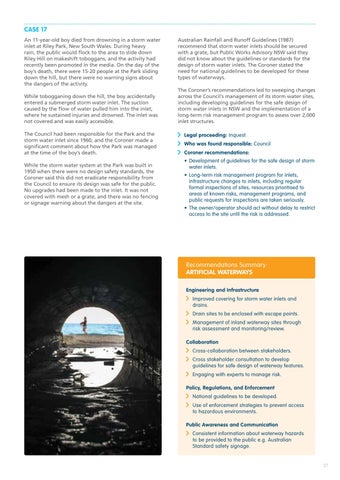
CASE 17 An 11-year-old boy died from drowning in a storm water inlet at Riley Park, New South Wales. During heavy rain, the public would flock to the area to slide down Riley Hill on makeshift toboggans, and the activity had recently been promoted in the media. On the day of the boy’s death, there were 15-20 people at the Park sliding down the hill, but there were no warning signs about the dangers of the activity. While tobogganing down the hill, the boy accidentally entered a submerged storm water inlet. The suction caused by the flow of water pulled him into the inlet, where he sustained injuries and drowned. The inlet was not covered and was easily accessible. The Council had been responsible for the Park and the storm water inlet since 1960, and the Coroner made a significant comment about how the Park was managed at the time of the boy’s death. While the storm water system at the Park was built in 1950 when there were no design safety standards, the Coroner said this did not eradicate responsibility from the Council to ensure its design was safe for the public. No upgrades had been made to the inlet. It was not covered with mesh or a grate, and there was no fencing or signage warning about the dangers at the site.
Australian Rainfall and Runoff Guidelines (1987) recommend that storm water inlets should be secured with a grate, but Public Works Advisory NSW said they did not know about the guidelines or standards for the design of storm water inlets. The Coroner stated the need for national guidelines to be developed for these types of waterways. The Coroner’s recommendations led to sweeping changes across the Council’s management of its storm water sites, including developing guidelines for the safe design of storm water inlets in NSW and the implementation of a long-term risk management program to assess over 2,000 inlet structures. Legal proceeding: Inquest. Who was found responsible: Council Coroner recommendations: • Development of guidelines for the safe design of storm water inlets. • Long-term risk management program for inlets, infrastructure changes to inlets, including regular formal inspections of sites, resources prioritised to areas of known risks, management programs, and public requests for inspections are taken seriously. • The owner/operator should act without delay to restrict access to the site until the risk is addressed.
Recommendations Summary: ARTIFICIAL WATERWAYS Engineering and Infrastructure Improved covering for storm water inlets and drains. Drain sites to be enclosed with escape points. Management of inland waterway sites through risk assessment and monitoring/review. Collaboration Cross-collaboration between stakeholders. Cross stakeholder consultation to develop guidelines for safe design of waterway features. Engaging with experts to manage risk. Policy, Regulations, and Enforcement National guidelines to be developed. Use of enforcement strategies to prevent access to hazardous environments. Public Awareness and Communication Consistent information about waterway hazards to be provided to the public e.g. Australian Standard safety signage.
27
Legal Cases: DAMS
CASE 18 An eight-year-old girl died after being hit in the face by a boat while swimming near a boat ramp at Bill Gunn Dam, Queensland. While the hit didn’t cause unconsciousness, it was enough to cause panic, and the girl could not swim out of the water.
Legal proceeding: No Inquest.
Bill Gunn Dam is located at Lake Dyer and is a popular area for recreational activities, including swimming. But the only signage at the location said fishing and boating were permitted; there were no warnings about the dangers of swimming in the dam.
The owners should:
During the investigation, Queensland Police stated that because of the topography of the dam caused by dilating, it was easy for someone to lose their footing and suddenly find themselves in deeper water than expected. Therefore, there should have been signs prohibiting swimming. The dam was privately owned by Seqwater, who believed warning signs were unnecessary as there was ample information on their website, including that swimming was prohibited at Lake Dyer. They also believed their only responsibility was to have orientation and visitor signage at the site.
• Introduce a designated swimming area patrolled by lifeguards.
The Coroner disagreed and stated that Seqwater should introduce warning signs against swimming at Lake Dyer and encourage the use of life jackets. Seqwater should also consider a suitable, designated swimming area that is patrolled by lifeguards. The inquest highlighted the need for caretakers of dams to be trained and place emergency procedures and signs in place for when there is a missing person or accident at the dam.
28
Who was found responsible: No one – but the Coroner stated Seqwater should do more than only display orientation and visitor information signage. Coroner recommendations: • Be trained and have emergency procedures and signs for missing persons and accidents in place. • Introduce signage specifically warning against swimming.
• Encourage the use of life jackets.
CASE 19 A female died from drowning while wading in Bedford Weir, Queensland. An inflatable rubber barrier (known as a dam) used to increase the height of the weir failed and unexpectedly released a large and uncontrolled volume of water. The woman was swept away and drowned. Her body was found a short distance down an adjoining river the next day. The life of the dam installed at the weir was 30 years, but the dam started to develop problems with ruptures and tears in the fabric just two years after installation. It was found that there was a serious problem in the manufacturing of the dam. It was installed too tight over its radius, which pushed air internally long the fabric folds. The ruptures and tears were the weak spots the air had pushed through. On the days leading up to the failure, members of the public had reported a large bubble in the dam, but without regular inspections the bubble was not addressed. The dam ruptured and released a wall of water over one metre high. The Coroner did not recommend fences or barriers as these would not be effective in floods, would consistently sustain damage, and could present a more significant hazard to the public.
Legal proceeding: Inquest. Who was found responsible: No one. Coroner recommendations: • Installation of warning signs. • Removal of the dams by the supplier in Queensland. • Owner to consider whether the public should pursue recreational activities near the dam weir given the risk. • Regular inspections of dams.
Recommendations Summary: DAMS Policy, Regulations, and Enforcement Dam emergency procedures. Regular inspections of dams. Public Awareness and Communication Consistent safety information about the waterway use to be provided to the public e.g. Australian Standard safety signage. Use of life jackets should be encouraged by waterway owner/operators.
29
Legal Cases: LAGOONS / ESTUARIES
CASE 20 A six-year-old boy died from drowning in Terrigal Lagoon, New South Wales. The boy’s family claimed negligence by the Gosford City Council because there were not enough warning signs about the dangers of swimming in the lagoon, especially for children. The lagoon was separated from the ocean by a berm, and it was not considered tidal and had no currents. The boy’s mother took her children to the lagoon because she regarded the beach as too dangerous. The mother entered the water first to test its depth before allowing her children to swim as she supervised them. It was evidenced by a bystander that the mother left her children unattended at one point to retrieve another one of her children from the water 150 metres away. The deceased boy’s family claimed that the one warning sign near the lagoon was not positioned where anyone could see it on the normal approach to the water. They also claimed that because there had been previous fatalities at the lagoon, Gosford City Council should have fenced off, guarded, barricaded, or prevented people from swimming in the area. The sign that was positioned near the lagoon stated: Due to previous fatalities and the presence of deep holes in this lake, it is considered very dangerous for bathing. Children should be under adult supervision at all times.
While the boy’s family argued that the lagoon had a hole or hidden peril that caused their son to drown, the Judge did not agree. The Judge determined that the boy had drowned due to a gradual increase in the depth of the lagoon, and additional signage would not have made a difference. He dismissed the liability case.
In contrast to legal cases for oceans and pools, the requirement to have signage was not upheld by the court.
Implications: The Judge commented extensively on the fact that it is the public authority looking after the lagoon whose responsibility it is to take reasonable care to control and manage the lagoon. However, the liability case was dismissed because there was no requirement by the Gosford City Council to erect a warning sign that referred to the depth of the water or to state that children should be supervised. There was no requirement because, as the Judge stated, these are things that exist in almost every naturally occurring body of water. The Judge also stated that Gosford City Council did not create the risk the boy was exposed to on the day. Nor did they not encourage or invite the boy to the lagoon or put him in harm’s way. The Judge asked why the defendant had to warn against a risk that was so obvious. Legal proceeding: Liability case. Who was found responsible: No one – because there was no requirement by the Council to erect a warning sign, and the risks were obvious. Judge recommendations: None – the Judge did not believe additional signage would have provided any more information than the boy’s family already had.
30
CASE 21 A male broke his neck after diving into an estuary and striking his head on the bottom. The man claimed that Coffs Harbour City Council were negligent because there were no warning signs alerting swimmers to the danger. His first case was unsuccessful, and he appealed to the High Court of Australia. The man and his friend were swimming in the tidal estuary, which contained undulating sand dunes known as bedforms, and dove into the water from a popular diving spot. He hit his head on a bedform and broke his neck. He alleged the Council should have put up a sign warning people about the dangers of diving into the water. The High Court found Coffs Harbour City Council not liable because the owner/operators of the inland waterway were only expected to meet their duty of care for the public at large, not every individual.
Implications: The decision by the court now means there is no exact definition of negligence when referring to inland waterways. The basis is ‘it depends’. The case also added two factors for the duty of care owed to users of inland waterways. They are that a person should be responsible for their own safety and that owner/operators should only be required to address risk and safety issues to the public at large. This means it is highly unlikely that a court will ever recognise liability for a specific individual unless it is an extreme case. Legal proceeding: Liability case. Who was found responsible: No one. Judge recommendations: None.
The Judge stated that the conditions that led to the man’s injury were not unusual, and it was a danger that existed at nearly every Australian beach and inland waterway. The Council could not practically eliminate the physical risk of a swimmer striking a sand dune unless they deepened the channel. They could also not address the diving risk specific to the man’s misadventure. The case was dismissed.
Recommendations Summary: LAGOONS / ESTUARIES Policy, Regulations, and Enforcement
“The law is reluctant to find any acts of negligence by public authorities, owners, and operators of inland waterways when serious injury or death occurs because there is no authoritative guidance to follow in this area.”
Consistent requirement for water safety signage across all publicly-accessible waterways where swimming and recreation are known to occur e.g. Australian Standard safety signage. Australian Standard water safety signage tailored specifically for inland waterways to ensure it is appropriate, reasonably practicable and within context. Public Awareness and Communication Consistent information about the waterway to be provided to the public and local programs to promote safe participation. Improved signage, including pictorial signage.
31
Legal Cases: BEACHES
CASE 22 A male suffered head injuries and became a paraplegic after diving from a rock into the Basin at Rottnest Island, Western Australia, and hitting a submerged rock. The case had been heard by the Supreme Court, which determined the accident was caused by the man’s dive, not by any act done by the Rottnest Island Authority. The decision was appealed to the High Court of Australia. There was no sign warning of the dangers of diving from the ledge, and because the man saw other members of the public jumping, he assumed it was safe to dive off. He claimed the owner, who promoted the area for swimming and recreational activities, failed to give adequate warning and had they done so, he would not have jumped. The High Court determined that the Rottnest Island Board had a duty of care to visitors as they had control of the area and were responsible for ensuring users of the area were protected from injury. Failing to warn visitors of the danger of diving from the ledge was a breach of their duty of care that led to the man’s injury. The case was supported by evidence from Surf Life Saving Australia (SLSA) which showed that warning signs about swimming and diving are obeyed by a large percentage of adults. The court considered both the scope of the duty of care and the legal obligation for an owner/operator to foresee risk.
32
Because of the evidence presented by experts, the High Court found that it was reasonable for the Rottnest Island Authority to erect a sign and that the risk of harm to the man was foreseeable. Rottnest Island Authority was liable to pay damages to the man for a breach of their duty of care and negligence.
Because of the expert evidence testimony and the pre-existing coastal safety standards regarding warning signs, the requirement to erect signage was deemed reasonable by the court.
Implications: This case set a precedent that negligence can be established if evidence supports the lack of duty of care. The difference between this case and Case 20 is that this case relied on expert evidence, not just a claim. Legal proceeding: Liability case. Who was found responsible: Rottnest Island Authority. Judge recommendations: Signage to warn visitors about the dangers of diving from the rock ledge.
CASE 23 A male became a tetraplegic after he dived off a rock platform into the sea at Soldier’s Beach, New South Wales. He claimed damages against Wyong Shire Council and was awarded 75 per cent of his claim. The case set a precedent of contributory negligence for inland waterways. Contributory negligence is determined by assessing the obviousness of danger and the expectation that a person will take reasonable care for their own safety. It was noted that diving off that particular rock platform was a popular activity that had been going on for years, and the man said he was following common practice. Fifteen years earlier, a similar incident had occurred, and a beach inspector had recommended a sign be erected at the elevated rock to discourage diving. This was not done. The Judges found the Wyong Shire Council liable for 75 per cent of the man’s claim because the risk was foreseeable, the same incident had occurred 15 years earlier, and the Council did not erect a sign as recommended by an expert.
Implications: Negligence was upheld in this case, but the Judges discussed in detail that the duty of care by the owner/ operator is only required to an individual if it is reasonable. The Judges stated if the owner/operator is managing a large area of land, that may take away their duty of care to people based on the size and what is reasonable in that circumstance. The case set a precedent that the obviousness of danger can be important when deciding whether a warning sign is required. But the question of why that particular hazard had been singled out was posed by the judiciary. It stated: if a public authority that controls a large area of land put up a sign to warn about every hazard, regardless of how obvious they were, then the signs would either be so general or so numerous to be effective. Legal proceeding: Liability case. Who was found responsible: Wyong Shire Council. Judge recommendations: Signage.
The Judges also discounted the Council 25 per cent of negligence because the man contributed to his injury by engaging in a risky activity. One Judge stated that public authorities could not eliminate risk unless they prohibit swimming altogether.
33
DISCUSSION
Multiple preventable deaths have occurred in inland waterways in Australia over the past decade. Evidence in the publicly available legal cases demonstrates that, in some instances, there are no reasonably practicable risk management measures that could have been taken at the aquatic location that would have decreased the likelihood of drowning. For example, excessive alcohol and/or drug use or trespass cases where signage and fencing were already present. However, many patrons of inland waterways clearly did not possess adequate knowledge to take care and responsibility when using waterways, but in some cases, the onus was placed directly on the patrons themselves. Appropriate risk management activities supported by industry policy frameworks, such as guidelines, play an essential role in keeping members of the public and workers safe and could play a critical role in reducing drowning and aquatic injury in inland waterways. Community-wide approaches to inland waterway safety are also critical. In some cases, upstream measures such as improved parental education about the importance of child supervision and public awareness campaigns about the use of life jackets may also have contributed to a better outcome. There is also a need for crosscollaboration between stakeholders to ensure that risk is effectively and extensively mitigated across a range of settings and applications.
There is a considerable gap in the standard of water safety management between inland waterways and beaches and public pools.
34
Some deaths could have been avoided with basic risk management practices that would be considered standard on beaches and swimming pools, such as safety signage. Without further prescriptive intervention, as well as upstream measures, the risk of harm to the public will continue. This review examined five inland waterway liabilities cases that further address legal implications in this area. These cases demonstrate some inconsistencies in decision-making regarding inland waterway public safety, which suggests the presence of standards would be effective in providing clarity as to the reasonably practicable measures that could have been in place to prevent drowning incidents. In Case 22, the High Court of Australia held that the waterway owner/operator had a duty of care to visitors as they had control of the area and were responsible for ensuring users of the area were protected from injury. Failing to warn visitors of the danger of diving was a breach of their duty of care that led to a man’s injury. In Case 23, the High Court of Australia found that the obviousness of danger and the expectation that a person will take reasonable care for their own safety are critical factors in determining what is reasonable for an owner/ operator to do to prevent injury. In layperson terms, this suggests a risk assessment for waterfront areas should be an expected activity that owners/operators should take and that warning signage in compliance with relevant standards is likely to be reasonable where it is known that users swim and recreate.
RECOMMENDATIONS
There is a considerable gap in the standard of water safety management between inland waterways and beaches and public pools. The law is reluctant to find any acts of negligence by public authorities, owners, and operators of inland waterways when serious injury or death occurs because there is no authoritative guidance to follow in this area. This was demonstrated in Case 14, which found that courts do not expect the owner/operator to be held accountable when there is an injury from a risk that was not foreseeable to them. This case set a precedent and a ‘calculus’ for claims of negligence relating to inland waterways and has been used or every inland waterway case since its inception. Interestingly, Case 22 demonstrated that negligence can in fact be established if there is expert evidence to support it. Because Surf Life Saving Australia presented evidence that warning signs about swimming and diving are obeyed by a large percentage of adults, the owner/operator was found to have breached their duty of care. Public safety would benefit from a policy framework that assists with making inland waterway public safety recommendations for owners/operators more clear and more consistent. In the absence of objective standards, Coroners have provided detailed recommendations for specific locations which could be enhanced by nationally consistent standards.
Develop industry guidelines for waterway owners/ operators. The guidelines should address the risk management considerations that are reasonable and practicable where members of the public swim or recreate in and around waterways. The guidelines would assist with decision-making around ways of reducing risk. Encourage the development of local water safety plans/strategies which take into account local knowledge, insights, and realities about hazards and risks and ways of mitigating them. Encourage supervision, particularly of children, around all aquatic environments. Introduce zoning to waterways to prohibit activities in areas where they would be unsafe. Design waterfronts and shorelines to increase their safety and/or provide engineering solutions where waterfronts are hazardous and it is known that swimmers and recreational users frequent them. Develop warning systems for floods and surge currents. Designate safe swimming locations that are supported by rescue equipment, a beach patrol, and/or supervision. Prohibit alcohol and drugs in high-risk locations, and enforce the prohibitions. Encourage collaboration between stakeholders. Encourage life jacket use. Develop and implement local water safety campaigns and communication messages, and partner with media providers to amplify voice. Provide and promote safe swimming environments like aquatic facilities and beaches. The requirement to have water safety signage should be consistent across all publicly-accessible waterways where swimming and recreation are known to occur. Australian Standards for water safety signs already exist, however should be contextualised to inland waterways as to what is reasonably practicable to install and where.
35
REFERENCES
1.
Case 1: Magistrates Court of Tasmania. (2017). Record of Investigation into the death of Ben Wara Plowright (File No. TASCD 159).
2.
Case 2: Coroners Court of New South Wales. (2019). Inquest into the death of Dennis Brooks (File No. 2016/174220).
3.
Case 3: Queensland Courts. (2014). Inquest into the death of Che-Wei Su (File No. 2014/590).
4.
Case 4: Coroners Court of New South Wales. (2019). Inquest into the death of Stephanie Jane King, EllaJane Kabealo and Jacob Matthew Kabealo (File No. 2017/102175; 2017/102191; 2017/10284).
5.
Case 5: Magistrates Court of Tasmania. (2022). Record of Investigation into the death of deceased (File No. TASCD 147).
6.
Case 6: Magistrates Court of Tasmania. (2013). Record of Investigation into the death of deceased (File No. TASCD 154).
7.
8.
9.
Case 7: New South Wales Courts. (2016). Inquest into the death of Mikael Felsch (File No. 2016/9226). Case 8: Queensland Courts. (2019) Inquest into the deaths of Thomas Hunt and Youngeun Kim (File No. 2018/426; 2016/815). Case 9: Coroners Court of New South Wales. (2019). Inquest into the death of Yousif Yousif (File No. 2016/380289).
10. Case 10: Queensland Courts. (2010). Inquest into the death of James Andrew Bennett (File No. 2008/395). 11. Case 11: Queensland Courts. (2018). Non-inquest findings into the death of Duncan Cameron Wilmott (File No. 2016/477). 12. Case 12: Queensland Courts. (2017). Non-inquest findings into the death of Peter Chol Pawuoi (File No. 2016/35274). 13. Case 13: Coroner’s Court of New South Wales. (2018) Inquest into the death of Brendan Vickery (File No. 2014/00058593).
36
14. Case 14: Wyong Shire Council v Shirt [1980] HCA12: (1980) 146 CLR 40 (1 May 1980) 15. Case 15: Magistrates Court of Tasmania. (2017). Record of Investigation in the death of Gary John Hedrick (File No. TASCD 415). 16. Case 16: Coroners Court of New South Wales. (2016). Inquest into the death of Paul Smith (File No. 2014/00089895). 17. Case 17: Coroner Court of New South Wales. (2019). Inquest into the death of Ryan Teasdale (File No. 2017/83407). 18. Case 18: Queensland Courts. (2015). Non-inquest findings into the death of Child A (File No. 2013/3869) 19. Case 19: Queensland Courts. (2016). Inquest into the death of Nelani Ciara Koefer (File No. 2008/165). 20. Case 20: Saad & Anor v Gosford City Council [2007] NSWSC 643 21. Case 21: Mulligan v Coffs Harbour City Council [2005] HCA 63 22. Case 22: Nagel v Rottnest Island Authority [1993] HCA76; 117 CLR 423; (1993) Aust Torts Reporter 81211; (1993) 112 ALR 393; (1993) 67 ALJR 426 (21 April 1993) 23. Case 23: Vairy v Wyong Shire Council [2005] HCA 62
37
APPENDIX A: Water Safety Policy and Governance in Australia
The below lists are not exhaustive. Instead, they demonstrate that while there are many water safety policies and frameworks relating to pools and beaches in Australia, there is a gap regarding inland waterways. Information was sourced from publicly available websites. Australian Water Safety Council
Royal Life Saving Society – Australia
The Australian Water Safety Council (AWSC) comprises Australia’s leading water safety organisations working in partnership to prevent drowning. The AWSC was officially formed in February 1998 as a result of strong industry consultation and Federal Government support.
Royal Life Saving is Australia’s peak authority on drowning prevention policy and practice, water safety in inland environments and aquatic facilities and is Australia’s leading water safety educator.
The AWSC is committed to improving water safety in Australia, as demonstrated through the production and implementation of National Water Safety Plans. These plans have generated bipartisan support for water safety in Australia and have improved water safety throughout the country. The AWSC member bodies continue to demonstrate their commitment to water safety by directing resources of their respective organisations towards the development and implementation of the Australian Water Safety Strategy.
Guidelines for Safe Pool Operations Royal Life Saving has developed and maintained the Guidelines for Safe Pool Operation (the GSPO) since 1992. The GSPO is a set of detailed specifications and recommendations establishing best practice design and operations of aquatic locations nationwide.
Australian Water Safety Strategy 2030
The GSPO is the recognised national industry standard that describes and makes recommendations as to the appropriate minimum standards of safety that should be attached to the design, ownership, and operations of aquatic facilities, thereby providing a recognised standard of care in a particular area of design and/or operations.
The Australian Water Safety Strategy (AWSS) plays an essential role in National, State and Territory, and community approaches to preventing drowning and promoting safe use of the nation’s waterways and swimming pools. It outlines priority areas where Australia’s peak water safety bodies Royal Life Saving and Surf Life Saving, and AWSC Members can work together to prevent drowning on beaches, at rivers and lakes, and in swimming pools across Australia.
Although published by Royal Life Saving, the GSPO represents the collective opinion of the aquatic industry across Australia through an extensive and consultative development and review process undertaken by the National Aquatic Industry Committee (NAIC). As such, the GSPO is written and authorised for industry by industry – leveraging a formal network of collaborators both nationally and internationally.
For inland waterways, the AWSS 2030 cites example actions that can reduce drowning, and they include:
Today, over 800 aquatic facilities nationally are subscribed to the GSPO.
• Targeted safety campaigns to raise awareness of hazards. • Flood and weather warnings, including those targeting driving through floodwater. • Location-specific risk management plans. • Signage and safety information. • Development of local water safety plans. • Enforcement of alcohol-free zones. • Swimming and water safety programs tailored to inland waterways.
Guidelines for Water Safety in Urban Water Developments In 2004, Royal Life Saving issued the Guidelines for Water Safety in Urban Water Developments. These came about as the development of residential subdivisions with water bodies became popular modern developments. The popularity of ornamental lakes, ponds, or fountains in residential developments’ size and accessibility had increased significantly at the time, leading to concerns about public safety. The Guidelines applied to purpose-built water environments, near or around areas that the general public may frequent, and would include: • Residential developments in both urban and rural settings. • Commercial developments such as shopping precincts and hospitality venues. • A combination of residential and commercial developments. • Public spaces, e.g. parkland and reserves.
38
Standards Australia
Surf Life Saving Australia
Standards Australia brings together key parties and stakeholders to form technical committees. These committees collaborate to develop standards that are of value to Australia, its businesses, and its people.
Surf Life Saving Australia is Australia’s peak coastal water safety, drowning prevention and rescue authority. Surf Life Saving has 180,000 members and over 300 affiliated surf life saving clubs.
With stronger standards in place, Australia can enjoy greater economic efficiency and increased prominence on the international stage. Robust standards also help support our local communities by building a safer, more sustainable environment.
The Australian Public Coastal Safety Guidelines Surf Life Saving has continued to develop and maintain the Coastal Safety Guidelines since 2007.
Australian Standard AS1926.1 – Safety Barriers for Swimming Pools This standard aims to assist residential pool owners/users in avoiding pool-related drowning by providing design, construction, and performance of various barrier options, which are designed to restrict entry to the swimming pool area by young children. Australian Standard AS1926-2012 (the Standard) is the current standard in place in NSW, Victoria, South Australia, Tasmania, Western Australia, and the ACT. There are also local variations affected under the legislation. For example, Northern Territory operates under AS1926.1 – 1993, and Queensland has its own standard in place, which is a modified version of AS 1926-2007 combined with a state standard QDC MP 3.4.
AS2610.2 – 2007 Private Spas The objective of this standard is to provide designers, specifiers, construction personnel and operators within the industry with information in particular on the safety aspects associated with public spas in Australia.
39
APPENDIX B: Water Safety Resources and Governance in Australia
The below lists are not exhaustive. They demonstrate the complexity and significant differences in water resources legislation and policies between states and territories in Australia. Information was sourced from publicly available websites. Commonwealth Legislation
Water Regulations 2008
The Australian Government administers:
The Water Regulations 2008 sit under the Water Act and guide how the provisions of the Water Act will be applied. For example, the regulations specify the water information that certain organisations must give to the Bureau of Meteorology in its water information role under the Water Act and the time and format in which it must be given.
• Water Act 2007 (Cth) • Water Regulations 2008 (Cth) • Water Charge Rules 2010 (Cth) • Water Market Rules 2009 (Cth) • Water Efficiency Labelling and Standards Act 2005 (Cth)
Water Act 2007 The Water Act 2007 (Cth) seeks to:
Water charge and water market rules
• Return to environmentally sustainable levels of extraction for Murray–Darling Basin water resources.
The Water Charge Rules provide transparency in charges and costs for customers of monopoly water infrastructure providers across the Basin. The Water Market Rules ensure irrigators can permanently transform their irrigation right into a statutory water access entitlement. The Australian Competition and Consumer Commission monitors regulated charges and compliance and enforces these rules.
• Give effect to relevant international agreements. • Promote the use and management of Basin water resources in a way that optimises economic, social and environmental outcomes. • Protect, restore and provide for the ecological values of the Basin. • Ensure information is available on Australia’s water resources. Key features of the Water Act include: • A national framework to manage Basin water resources. • Establishment of the Murray–Darling Basin Authority (MDBA). • Establishment of the Commonwealth Environmental Water Holder. • Requirements for a Murray–Darling Basin Plan prepared by the MDBA. • A regulatory role for the Inspector General of Water Compliance. • A role for the Bureau of Meteorology to compile and deliver comprehensive information on Australia’s water resources. • A role for the Australian Competition and Consumer Commission to develop and enforce water charges and water market rules. • A role for the Productivity Commission to report on the effectiveness of implementation of the Basin Plan and achievement of NWI outcomes. The Australian Government has amended the Water Act several times since its commencement in response to emerging water management challenges and following an independent review conducted in 2014 that assessed its operations and achievements against its objectives. 40
Commonwealth Water Policy and Governance
Water Efficiency Labelling and Standards Act 2005 The Water Efficiency Labelling and Standards scheme is a partnership between the Australian Government, state and territory governments and industry. The scheme reduces demand for drinking water by informing consumers about the water efficiency of household appliances, fitting and fixtures at the point of sale. The Water Efficiency Labelling and Standards Act 2005 provides the legislative authority supported by subordinate instruments and complementary legislation enacted in all states and territories.
Collaboration and Consultation
State and Territory Legislation
The National Federation Reform Council
Australian Capital Territory
The National Federation Reform Council provides an opportunity for leaders and treasurers across the Commonwealth and states and territories to focus on common priority issues. Its membership includes the Prime Minister, state premiers and territory chief ministers, treasurers from each jurisdiction and the president of the local government organisation. The National Federation Reform Council replaced the Council of Australian Governments in 2020. COAG was established in 1992 and played a significant role in initiating and shaping cooperative water reform in Australia.
The Water Resources Act 2007 is the governing legislation for managing water resources in the ACT, defining access rights to surface and groundwater resources, environmental flow provisions, water licensing requirements, resource management and monitoring responsibilities, and setting penalties for water-related offences.
Councils and committees A number of councils and committees work cooperatively to address water issues in Australia. These include: • The National Water Reform Committee and its supporting committees. • The Murray–Darling Basin Ministerial Council. • The Basin Officials Committee. • The Basin Community Committee. • The Advisory Committee on Social, Economic and Environmental Sciences. • The Murray Darling Basin Authority. • The Australian Recreational Boating Safety Committee (ARBSC).
The ACT Water Strategy 2014-44: Striking the Balance (ACT Water Strategy) details the Government’s vision for water management in the ACT over the next 30 years. The ACT Water Strategy provides long-term strategic guidance to manage the Territory’s water resources.
New South Wales The Water Management Act 2000 regulates the sustainable and integrated management of the state’s water for the benefit of both present and future generations. The Water Management (General) Regulation 2018 specifies important procedural and technical matters related to the administration of the Water Management Act, and also specifies exemptions from licence and approval requirements under the Act. The Water Supply (Critical Needs) Act 2019 facilitates the delivery of emergency water supplies to certain towns and localities and to declare certain development relating to dams to be critical State significant infrastructure. The Water NSW Regulation 2020 (which operates under the Water NSW Act 2014) provides WaterNSW with the power to legally enforce access restrictions. WaterNSW has enforcement powers under the Protection of the Environment Operations Act 1997 to penalise polluting activities in the catchment that may impact water quality.
Northern Territory The primary tool for managing and protecting the Territory’s water resources in the Northern Territory (NT) Water Act 1992.
Queensland The Water Act 2000 (Qld) (Water Act) provides a framework for the planning, allocation, and use of surface water and groundwater in Queensland, including regulating major water impoundments (e.g. dams and weirs) and extraction through pumping for irrigation and other uses. 41
South Australia
Tasmania
The Landscape South Australia Act 2019 provides a framework for the sustainable and integrated management of the state’s water resources, including surface water, groundwater, and watercourse water.
The State Policy on Water Quality Management (1997), also known as the Water Quality Policy, provides a framework for the development of ambient water quality objectives and the management and regulation of point and diffuse sources of emissions to surface waters, including coastal waters and groundwater.
Victoria The Victorian Waterway Management Strategy outlines the framework for government to manage rivers, estuaries, and wetlands so that they can support environmental, social, and economic values now and into the future. The Victorian Water Act 1989 provides the framework for allocating surface water and groundwater throughout Victoria. The Water Act details the Crown’s entitlements to water and private entitlements to water from Victoria’s rivers, streams, and groundwater systems. The Safe Drinking Water Act obliges water suppliers to supply safe and good quality drinking water. The Environment Protection Act 1970 – State Environment Protection Policy (Waters of Victoria) 2003 and associated schedules The SEPP Waters of Victoria details the uses and values of water environments (beneficial uses), sets measurements and indicators (environmental quality objectives) and outlines what needs to be done to protect them (attainment program).
The Water Management Act 1999 is part of the State’s integrated Resource Management and Planning System and provides for the management of Tasmania’s freshwater resources. Under the Act, there are three separate sets of regulations: the Water Management Regulations 2019, the Water Management (Safety of Dams) Regulations 2015 and the Water Management (Electoral and Polling) Regulations 2019.
Western Australia The Department of Water administers water policy in Western Australia. The Acts, regulations, and by-laws administered by the department are: • Country Areas Water Supply Act 1947 • Metropolitan Arterial Drainage Act 1982 • Metropolitan Water Supply, Sewerage, and Drainage Act 1909 • Rights in Water and Irrigation Act 1914
The Heritage Rivers Act 1992 identifies 18 Heritage River Areas in Victoria. The Act protects public lands in specific parts of heritage rivers or river catchment areas that have significant recreation, nature conservation, and scenic or cultural heritage attributes.
• Water Agencies (Powers) Act 1984
The Flora and Fauna Guarantee Act 1988 is the main piece of Victorian state legislation for the conservation and protection of threatened species and ecological communities and for the management of potentially threatening processes.
• Waterways Conservation Act 1976
• Water Corporations Act 1995 • Water Efficiency Labelling and Standards Act 2006 • Water Services Act 2012
• Country Areas Water Supply By-laws 1957 • Country Areas Water Supply (Clearing Licence) Regulations 1981 • Metropolitan Water Supply Sewerage and Drainage By-laws 1981 • Rights in Water and Irrigation Regulations 2000 • Water Agencies (Entry Warrant) Regulations 1985 • Water Agencies (Infringement) Regulations 1994 • Water Agencies (Water Use) By-laws 2010 • Water Services Regulations 2013 • Water Services (Water Cooperations Charges) Regulation • Waterways Conservation Regulations 1981
42
APPENDIX C: Stakeholders
The below lists of stakeholders are not exhaustive. They demonstrate the complexity of the stakeholders involved in inland waterway management, operations, and emergency management in Australia.
International Influences • International Commission on Irrigation and Drainage • International Life Saving Federation • Royal Life Saving Commonwealth
State and Territory Regulatory Authorities and Control Agencies Australian Capital Territory • Environment, Planning and Sustainable Development Directorate – Environment
• United Nations Resolution on Drowning Prevention • World Health Organisation
Australian Stakeholders National Water Management Authorities: • Australian Water Partnership • Commonwealth Environmental Water • Department of Agriculture, Water and the Environment • Department of Foreign Affairs and Trade • Department of Infrastructure, Transport, Regional Development and Communications • Geoscience Australia • Infrastructure Australia • Murray-Darling Basin Authority • National Water Grid Authority
Research and data agencies • Australian Bureau of Agricultural and Resource Economics and Sciences (ABARES) • Australian Bureau of Statistics • Australian Competition and Consumer Commission • Bureau of Meteorology • CSIRO—Water
Emergency Services
New South Wales • Dam Safety NSW • Department of Planning, Industry and Environment • Department of Primary Industries • Department of Transport – Centre for Maritime Safety • Fire and Rescue NSW • NSW Ambulance • NSW Police Force • Office of Environment and Heritage • State Emergency Services • Transport for NSW – Centre for Maritime Safety
Northern Territory • Department of Environment, Parks and Water Security • Department of Infrastructure, Planning and Logistics – Marine Safety and Logistics • Northern Territory Ambulance Services • Northern Territory Fire • Northern Territory Police • NT Emergency Service
Queensland • Department of Agriculture and Fisheries • Department of Environment and Science
• Australian Federal Police
• Department of Regional Development, Manufacturing and Water
Non-Governmental Organisations (NGOs)
• Department of State Development, Infrastructure, Local Government and Planning
• Australian Freshwater Sciences Society • Australian National Committee on Large Dams Incorporated • Australian Water Association • Australian Water Safety Council • Irrigation Australia Limited National Committee on Water Engineering
• Maritime Safety Queensland • Queensland Ambulance Services • Queensland Family and Child Commission • Queensland Fire and Rescue Services • Queensland Police Service • Queensland State Emergency Service
• Royal Life Saving Australia
43
South Australia • Department for Environment and Water • Department of Primary Industries, Water and Environment
State and Territory Water Corporations, Owners and Operators Australian Capital Territory • Icon Water
• Environmental Management and Pollution Control Board
New South Wales
• Environment Protection Authority
• Central Coast Council
• Marine and Safety Tasmania
• Cobar Water Board
Tasmania • Ambulance Tasmania • Department of Police, Fire and Emergency Management • Department of Primary Industries, Parks, Water and Environment • Marine and Safety Tasmania • State Emergency Service • Tasmania Fire Service • Tasmania Police
Victoria • Ambulance Victoria • Department of Environment, Land, Water and Planning
• Essential Energy • Fish River Water Supply • Natural Resources Access Regulator • Sydney Water • WaterNSW
Northern Territory • Power and Water
Queensland • Avondale Water Board • Babinda Swamp Drainage Board • Bollon South Water Authority • Bollon West Authority • Bones Knob Water Board
• Department of Transport
• Eugun Bore Water Authority
• Environmental Protection Authority
• Expenditure Advisory Committee for the Office of Groundwater Impact Assessment
• Maritime Safety Victoria • Metropolitan Fire Brigade Victoria • Victorian Environmental Water Holder • Victorian Fisheries Authority • Victoria Police • Victorian Water Register
• Fernlee Water Authority • Gladstone Area Water Board • Glamorgan Vale Water Board • Ingie Water Authority • Kaywanna Bore Water Board • Lower Burdekin Water
Western Australia
• Lower Herbert Water Management Authority
• Department of Biodiversity, Conservation and Attractions
• Mount Isa Water Board
• Department of Transport WA • Department of Water and Environmental Regulation • Environmental Protection Authority • State Emergency Services • Western Australian Police Force
• Orchard Creek and East Euramo Drainage Board • Queensland Great Artesian Basin Advisory Council • Queensland Urban Utilities • Roadvale Water Board • Seqwater • SunWater • Silkwood Drainage Board • South Maroochy Drainage Board • Unitywater • Water Act Referral Panel
44
South Australia
Local Area Management Services
• Department for Environment and Water
New South Wales
• Department of Environment, Water and Natural Resources
• Border Rivers Food and Fibre
• Department for Infrastructure and Transport - Road & Marine Services • Department of Primary Industries and Regions • Environment Protection Authority • SA Water • SafeCom • South Australian Ambulance Service
• Dumaresq-Barwon Border Rivers Commission • Environmental Protection Authority • Lachlan Valley Water
Northern Territory • Environmental Protection Authority • Northern Territory Environment Protection Authority • Rapid Creek Water Advisory Committee
• South Australian Metropolitan Fire Service • South Australia Police
Queensland
• WaterConnect
• Dumaresq-Barwon Border Rivers Commission
Tasmania • Department of Health and Human Services (DHHS) Tasmania • Hydro Tasmania • Tasmanian Irrigation • Tasmanian Natural Resource Management groups (NRM South, NRM North and Crade Coast NRM) • TasWater
Victoria • Barwon Water • Central Highlands Water • City West Water
• Environmental Protection Authority • Mount Isa Water Board • North Australian Indigenous Land and Sea Management Alliance • Regional natural resource management bodies • River Improvement Trusts
South Australia • Environmental Protection Authority • Natural Resource Management (NRM) Boards
Tasmania • Environmental Protection Authority
• Coliban Water
• Regional Water Management Officers under the Department of Primary Industries
• East Gippsland Water
• Tasmanian Irrigation
• Gippsland Water • Goulburn Murray Water • Lower Murray Water • Melbourne Water • North East Water • South East Water • South Gippsland Water
Victoria • Environment Protection Authority
Western Australia • Department of Water and Environmental Regulation • Environmental Protection Authority • Stormwater Industry Association of Western Australia
• Wannon Water • Westernport Water • Western Water • Yarra Valley Water
Local Government In addition to the above management organisations, local governments are also significant owners and operators of inland waterways.
Western Australia • The Department of Water • The Water Corporation 45
FOR MORE INFORMATION Call 02 8217 3111 Email info@rlssa.org.au
CONNECT WITH US RoyalLifeSaving RoyalLifeSaving RoyalLifeSaving RoyalLifeSavingAust RoyalLifeSaving.com.au 46