








Vice President for Enrollment Management and Strategic Communications: James A. Goecker
Vice President for Institutional Advancement: Steven P. Brady
Alumni Association President: Dedric A. Day, Class of 2003
Office of Alumni Relations: Ben Paolillo, Executive Director; Lauren L. Jackson, Associate Director; Rachel Romas, Alumni Relations Coordinator; and Emma Campbell, Alumni Relations Coordinator
Office of Communications and Marketing: Mary Wade Atteberry, Associate Vice President for Communications and Marketing; Bryan Cantwell, Photographer; Hyung-Jung Chang, Graphic Designer; Arthur Foulkes, Writer; Shaun Hussey, Email Marketing and Social Media Manager; Hayley Kuepers, Internal Communications Manager; Dale Long, Executive Editor and Director of Media Relations; Stacey Muncie, Writer; Traci Nelson-Albertson, Creative Director; Paul Shepherd, Digital Content Director; Alia Shuck, Project Manager; Steve Voltmer, Web Manager; Majel Wells, Communications and Marketing Coordinator
Executive Editor: Dale Long
Contact E-mail: Dale.Long@rose-hulman.edu
Contributing Writers: Herb Bailey, Scott Hall, Steve Kaelble and Dale Long
Photographers: Karl Ammerman, Bryan Cantwell, Caterpillar Inc., Edgile, Eli Lilly & Company, NASA, Mick Orman/Mic’s Pics Photo & Digital Solutions, John Odaniel/GE Appliances, Daniel Reck, Darrell Staggs, Mike Tack, Texas Instruments, Voxel 8, Mike Wolanin/Columbus Republic and Kara Zemlyak/Cook Pharmica
Cover Design: Traci Nelson-Albertson
Cover Special Effects: Hidouci abd el ouahab and Augment
Contributing Designers: Chris Denison and Traci Nelson-Albertson
Class Notes/Alumni News Contact: Send alumni news and address updates to alumniaffairs@rose-hulman.edu
You have before you the first issue in Echoes’ long history to have a three-dimensional cover. I hope you’ve had a chance to view the 3-D effect using the free Augment app (see information on inside front cover). First-year students in this fall’s graphical communications classes created the motorcycle model on the cover and other models pictured inside (see pages 12 and 13).
This cover is fitting, given that our feature spread is about the ever-widening impact of additive manufacturing, which is more commonly referred to as 3-D printing. Our faculty and alumni, as always, are at the forefront of this revolution.

BY JIM CONWELL , PRESIDENT conwell@rose-hulman.edu
In this issue, you can read about Professor Rick Stamper (ME, 1985) and other faculty who are incorporating additive machining in their courses, and alumni who are developing a range of applications for that technology, from spare parts to microchips (see pages 4-8). Also at the leading edge of disruptive technology are the faculty, students and alumni— described as “rock stars in the industry”—who are working with high-speed electromagnetics (see pages 9-11).
Embracing disruption is essential if an individual, an organization or a nation hopes to continue to thrive. Rose-Hulman’s own history bears this out. Founded to create engineers for the railroad industry, the institute has broadened and adjusted that focus
over the decades in response to new discoveries and developments and the corresponding need for highly skilled professionals in those areas—electronics, computing, space exploration, biomedicine, and so on.
By remaining at the forefront of technological advancement, Rose-Hulman affirms its mission to prepare students for productive and meaningful lives by offering the highest level of undergraduate science, engineering and mathematics education in an environment of individual attention and support. Our family culture remains strong, and we have always invested in exceptional teachers and exceptional opportunities for students to learn by doing, by researching, by competing, by traveling, and by serving others. What we teach is always evolving, but our commitment to quality and to our students is constant.
Societal change is now so rapid that our greatest challenge is preparing students to continually learn, adapt and innovate. To be tomorrow’s initiators of ideas and creators of value, our students, now more than ever, need to develop an entrepreneurial mindset alongside their professional competencies. We are working across the curriculum to integrate this mindset and help them become disruptors for life.
As Professor Ed Wheeler (EE, 1982) points, out, “What our students are learning is conceptually and mathematically challenging, but it is giving them important tools to succeed in today’s fastpaced, ever-changing technological world.”
I should note that professors Stamper and Wheeler have received the Board of Trustees Outstanding Scholar Award and are acknowledged nationally as gifted teachers who have created a legacy in the alumni who are making their own impact in their professions today.
It always gives me a lift to hear about the leadingedge work of our alumni, and I’m committed to seeing that our students are well prepared to continue this tradition of excellence and innovation.

There were several stories in Echoes’ fall issue that caught my attention, especially the one about the alumni beekeepers.
Some five years before I “retired,” my wife (Kathy) and I found a wonderful log house in the Rabun Gap region of northeast Georgia and spent six to eight months of the year there before retreating to Florida for the winter. Sadly, Kathy is no longer with me, but I still stay here until December each year. My house overlooks the campus of a small private, college prep boarding school (Rabun Gap Nacoochee School), for grades 5 to 12.
I have come to know a number of the school’s teachers, parents and students. I have been active in FIRST Lego League with a team that went twice to the Georgia state finals. As a result I became interested in robotics and, in particular, low cost computers. This naturally, led to the Raspberry Pi Foundation and the Raspberry Pi computers. I started with the model B and have progressed up to the current version Pi 3 B ($35) and its little brother, the Pi Zero ($5).
I have been buying and building the Pi’s as fast as my budget will permit, and donating them to local school systems, particularly Rabun Gap Nacoochee School. Teachers and students are using the Pi’s for several projects and currently have a project to instrument a bee hive. The instrumented bee hive is installed on Wayah Bald, a mountain in North Carolina, about 70 miles north of Rabun Gap. This is part of a project to monitor bee hives in as remote a place as possible in order to determine a baseline environment for hives. After about six months the hive will be dismantled and shipped to a government lab for analysis.
We welcome getting feedback on stories in each issue.
Send Elephant Ears items to: dale.long@rose-hulman.edu or Dale Long, executive editor-Echoes, CM 14, Rose-Hulman Institute of Technology, 5500 Wabash Ave., Terre Haute, IN 47803.
I am very proud of the school for this project, and the results will be ground-breaking scientific data. For those interested, go to the Raspberry Pi Foundation (raspberrypi.org) and look up another bee project in the United Kingdom using the Raspberry Pi’s. –William Waggener (EE, 1957)
What a wonderful story about Athletic Hall of Fame pitcher
Art Nehf in the Down Memory Lane section of the fall issue. I often talk to our baseball recruits about Nehf and, specifically, his accomplishments in pitching the series-clinching games of the 1921 and 1922 World Series.
Not only is Nehf the only pitcher in Major League Baseball (MLB) history to win back-to-back clinching World Series games, but he also threw a complete game in each of those clinching games.
Based on further research, the closest anyone else has come to duplicating Nehf’s feat is legendary St. Louis Cardinals pitcher Bob Gibson, in the 1967 and 1968 World Series. Gibson threw a complete game in winning the seventh game of the 1967 World Series, and then threw a complete game in Game 7 of the 1968 World Series. However, Gibson took the loss as the Detroit Tigers won the pennant.
Thanks again for remembering Art Nehf’s many accomplishments on the professional baseball mound. The baseball program is proud that its baseball field is named for such a significant person in Rose-Hulman and MLB history.
–Sean Bendel, Assistant Baseball Coach
The archives in the Logan Library trace back to the institute’s founding in 1874. Since then, records, photographs, artifacts and other items of historical value have been collected and preserved.
Over the last three years, great strides have been made in preserving our past. The Logan Library created the Rose-Hulman Scholar to provide access to the scholarly, educational, and creative works of Rose-Hulman community. This institutional repository now includes Rose-Hulman authored papers, commencement programs, and student-authored newspapers that can be browsed, searched and downloaded.

The newspapers were added this fall.
The Rose Thorn (1971 to 2016) can be viewed at scholar.rose-hulman.edu/ therosethorn/ and The Rose Technic (1891-1971) can be viewed at scholar.rose-hulman.edu/rosetechnic/.
This year, The Logan Library plans to enhance the Rose-Hulman Scholar with the Modulus student yearbooks.
Additional information about the Logan Library’s archives can be found at www.rose-hulman.edu/offices-andservices/logan-library.aspx.
–Bernadette Ewen, Director, Logan Library

STORY BY STEVE KAELBLE
Watching an episode of HBO’s new hit series “Westworld” provides a good glimpse of the melding of science fiction and the current reality of three-dimensional printing. As the opening credits roll, fictionalized images of sophisticated 3-D printers carefully craft remarkably human-seeming robots, one artificial sinew at a time. Then, as the action unfolds, these futuristic humanoids are portrayed on the television screen by real-life humans—And those actors are wearing on-set costumes created through today’s 3-D printing technology.
IN THE WORLD OF 3-D AND ELECTRONIC PRINTING, THE FUTURE IS CERTAINLY NOW.
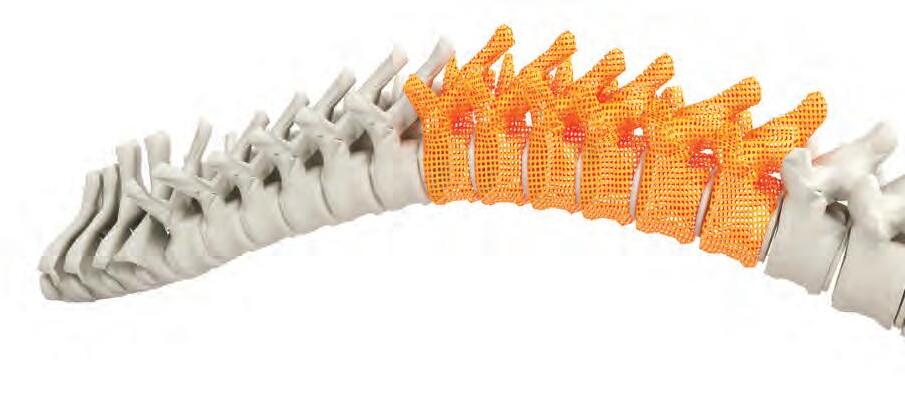
What’s known to the layperson as 3-D printing is more accurately described as additive manufacturing or additive machining. Unlike traditional machining—where you begin with a block of material and carefully whittle away what you don’t need to create the part you want—additive processes begin with nothing and build the part a layer at a time.
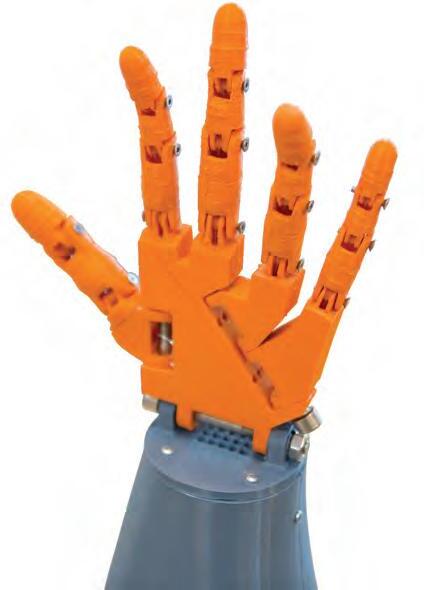
Two-dimensional printing leaves ink on the page in precisely the right places to create an image, while 3-D printing meticulously crafts objects using layers of various kinds of material—often polymers, sometimes metals. The list of possible materials continues to grow.
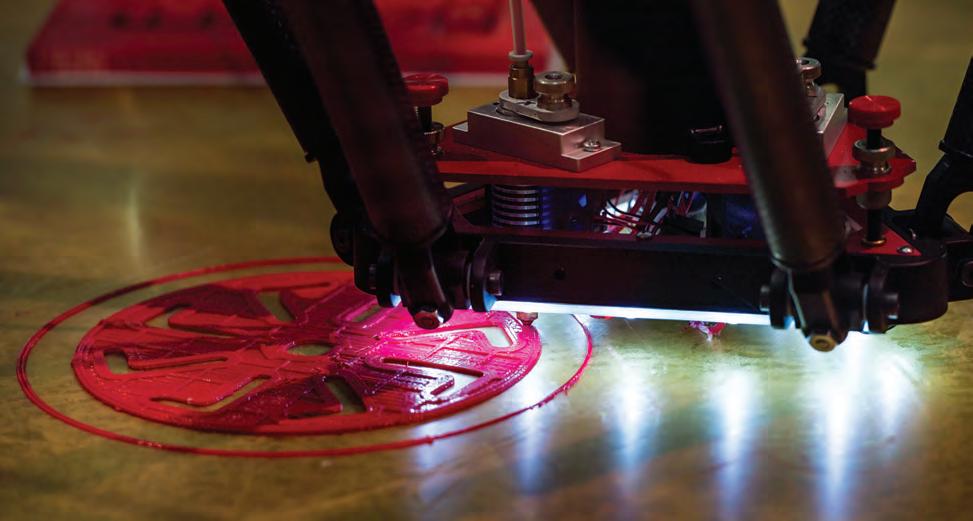
3-D printing is a technology that’s taking hold on the Rose-Hulman campus as well as in the professional lives of many alumni, including the father-and-son team of Robert Schroeder (ME, 1971) and Jonathan Schroeder (ME, 2004), who operate an Illinois-based company, 3D Platform, that makes large-scale, industrial-class 3-D printers.
For several years, according to Jonathan Schroeder, 3-D printing has been indispensable in creating plastic prototypes of various parts and products. However, increasingly “this type of printing is now being used for production as well as prototyping. We’re also seeing it used by Hollywood to make props for movies,” he says, noting that customers are using his company’s technology to make everything from furniture to items decorating theme parks.
This technology is particularly useful for producing smaller quantities of unique or customized items. You can adapt the final product simply by tweaking the computer-aided design that’s driving the printer. By altering
shapes and changing colors, additive manufacturing makes things possible that otherwise would be cost-prohibitive or even downright impossible.
The technology is flexible, but at this point isn’t always cheaper per piece than mass production.
“I don’t think you’re going to see this at Wal-Mart to replace the $9 plastic chairs you want to buy,” Schroeder points out.
Even more promising is the world of electronics printing, which is the focus for Michael Bell (ME, 2013). You’re not likely to see his work because it is embedded inside sophisticated devices. Bell is cofounder of Voxel8, a startup spun out of a Harvard University research laboratory that’s setting the stage for “multi-material
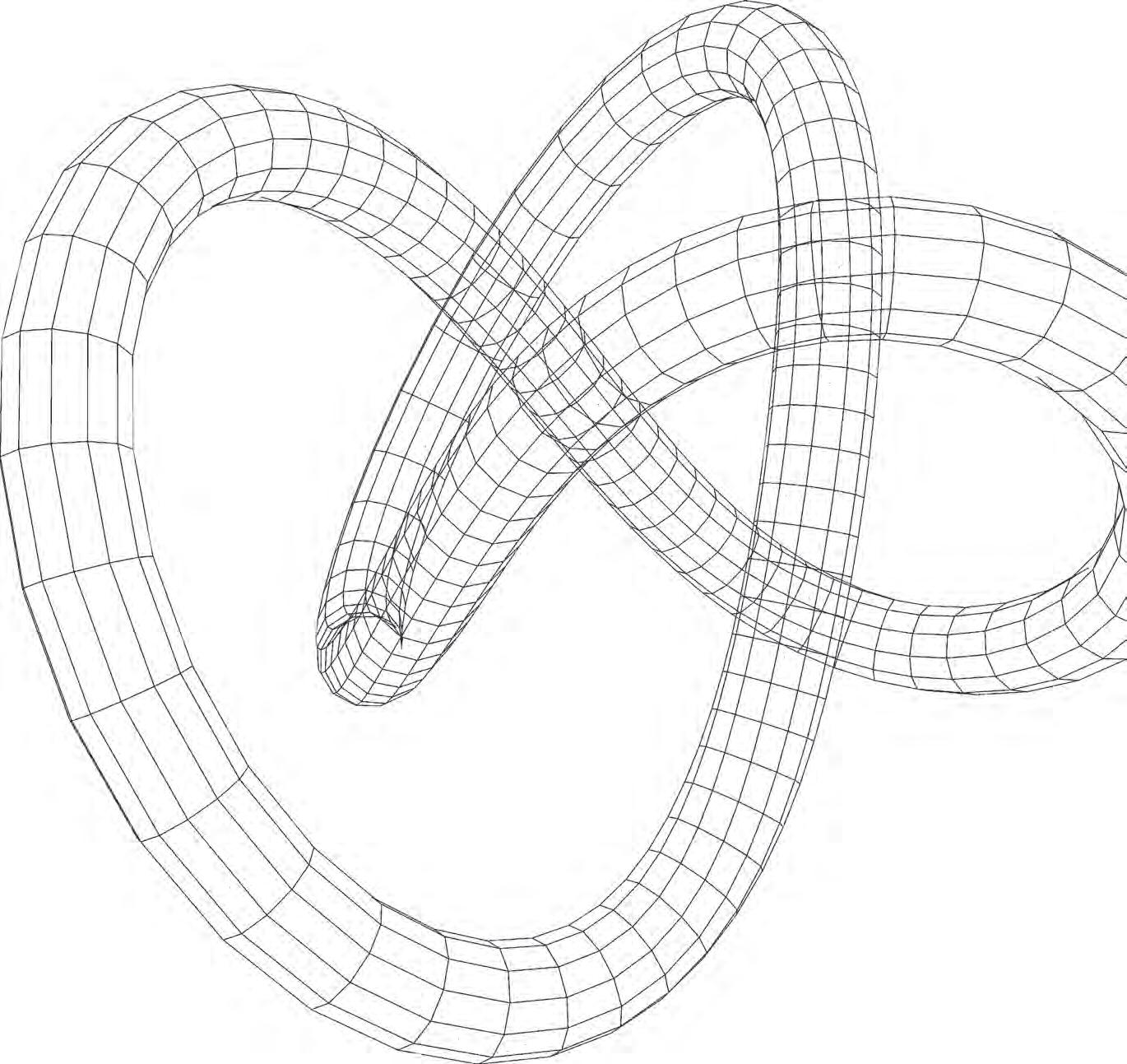
3-D printing technology is flexible, but not always economical for large-scale manufacturing.
digital manufacturing.” The company was named one of the 2016 Tech Pioneers by the World Economic Forum, is a recipient of a 2016 R&D 100 award (from R&D magazine), and was named one of MIT Tech Review’s 50 Smartest Companies for 2015. Voxel8’s technology can simultaneously put down multiple kinds of materials, such as the polymers and conductive metals, which can emerge as electronic circuitry.
This makes the possibilities practically endless, Bell says. He has had a particular interest in antenna technology, finding ways to use electronic printing to innovate in industry sectors ranging from defense to satellite
(CONTINUED ON NEXT PAGE)
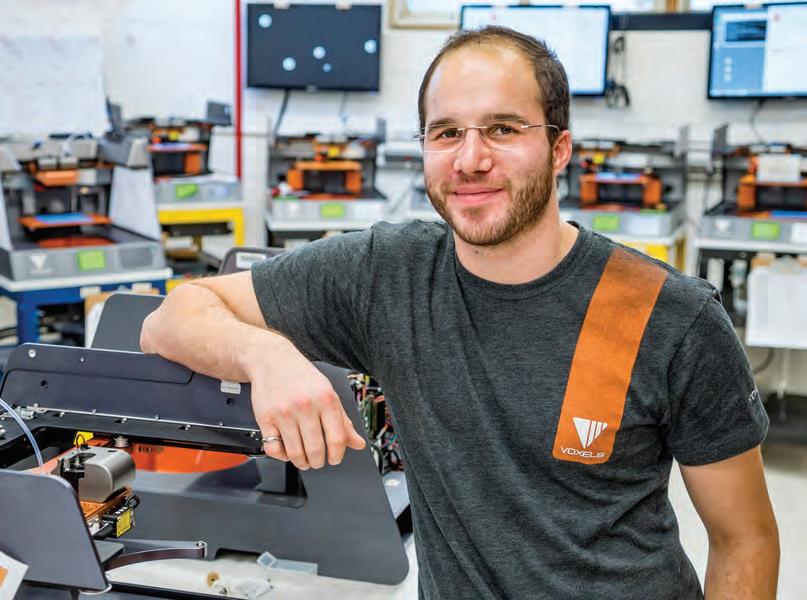
communications to consumer electronics. He says Voxel8’s customers are slashing product development cycles and creating functionality that really wasn’t possible before. Their applications of 3-D and electronic printing are groundbreaking, Bell says, but not necessarily for the layperson: “You really need a degree in engineering.”
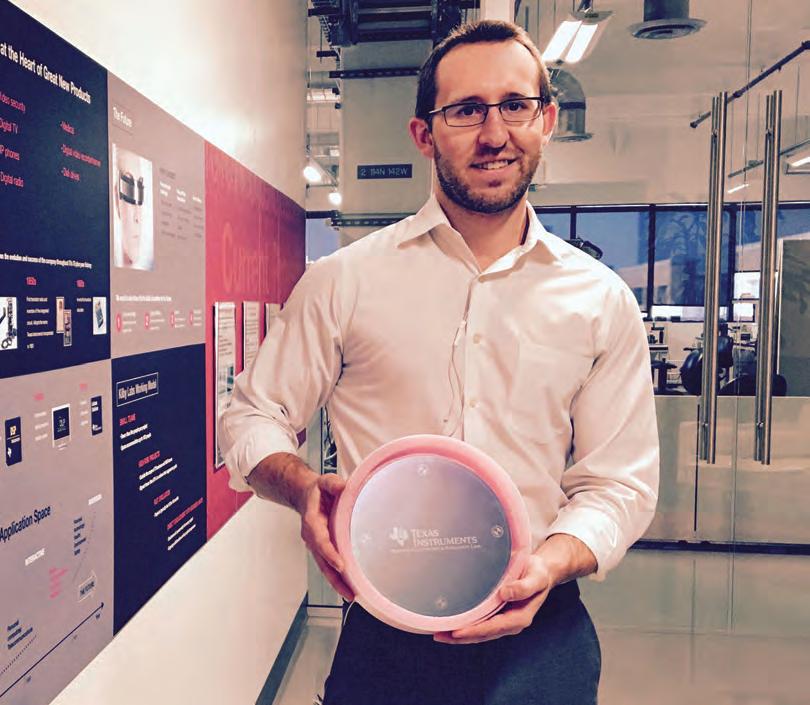
Ben Cook (EE, 2010) is exploring the possibilities of 3-D-printed electronics through his role as director of printed electronics and foundational technology at Texas Instruments. It was an area of focus in his doctoral studies, and holds incredible promise for companies such as TI that are exploring how to accelerate innovation in semiconductors and related applications.
“How cool would it be if you could download a phone from Amazon and just print it out?” Cook muses. Cool, indeed, but admittedly not a
near-term possibility. Still, “think about how printing changed all other industries,” he says. Society moved from hand-set lead type to electronic typesetting, to today’s word processing and design capabilities that people can use at home and even on their smartphones. This opened the capabilities to many more people and “it allowed people to rapidly change the content,” Cook notes.
Now translate that idea to 3-D and electronics printing. Imagine that one model of digitally produced electronic circuitry is suitable for one use, but needs to be tweaked for another task. Rather than building a whole new manufacturing process, “I just go in digitally and make tiny changes,” Cook says, then essentially hit the “print” button. Innovation, he explains, becomes exponentially faster, and infinitely less expensive.
Speeding up processes that take a product to market is one of the biggest ways 3-D printing is
AS WITH ANY TECHNOLOGY, IT’S BECOMING MORE POWERFUL AND COST-EFFECTIVE... THAT WILL NOT ONLY CHANGE THE WORLD OF SHOPPING, IT WILL REVOLUTIONIZE SUPPLY CHAINS, FROM PRODUCTION THROUGH LOGISTICS AND DISTRIBUTION.
impacting consumers right now, Bell says. The days of having an in-home device that can print sophisticated electronics are still very much in the imagination phase; however, the dizzying speed of advancing technology is being enhanced by 3-D and electronics printing technology, albeit more behind-the-scenes right now.
Additive manufacturing is still a novel concept that seems too costly for many industries. However, this landscape is changing. Many machine tool companies are starting to develop their own systems, and new startups are introducing new technologies in this area at an amazing rate.
“I believe additive manufacturing will be an enabler for a whole new type of design, one where the limits of the manufacturing process are not as important as they are today,” says Nick Okruch (ME, 1986), manager of GE Appliances’ Rapid Prototyping Center (RPC). He works with Advanced Development General Manager Scott Welham (ME, 1983) to identify new technologies which would be useful in GE Appliances’ operations, which are now part of the Haier Company. There has been continual growth in the adoption of 3-D printing as part of the product development process since


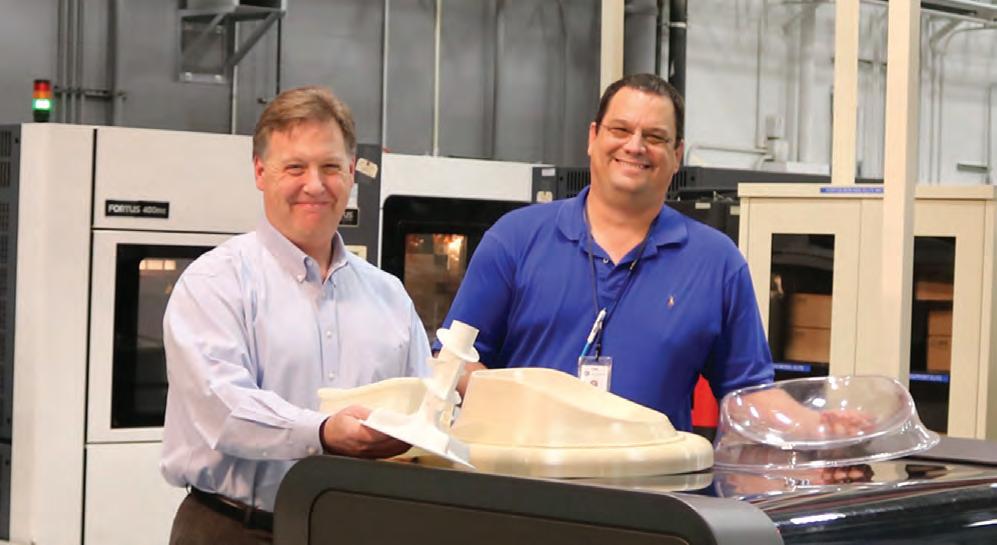
2008, and now 17 3-D machines provide seven different ways to print parts—producing 30,000 pieces in a typical year.
RPC supports all the industrial design, product engineers, and manufacturing plants across GE Appliances, allowing for the Louisville-based operation to quickly iterate designs and prototypes.
“This allows us to bring more innovative products and features to the market by allowing engineers to quickly and cost effectively try out new designs. They don’t have to make large investments in tooling to create concept models, and they have physical samples to evaluate and make design changes on,” Okruch says. “We’ve even expanded our processes to print injection molds and hydroform tooling to make low-cost prototypes.”
“I BELIEVE ADDITIVE MANUFACTURING WILL BE AN ENABLER FOR A WHOLE NEW TYPE OF DESIGN, ONE WHERE THE LIMITS OF THE MANUFACTURING PROCESS ARE NOT AS IMPORTANT AS THEY ARE TODAY.”
Nick Okruch (ME, 1986)

The use of additive manufacturing for production parts is not yet an option at GE Appliances. The technologies are generally too costly and too slow for the company’s typical volume requirements. However, there are niche applications—service parts, conformally cooled mold inserts, low-volume products— where Okruch believes additive manufacturing makes sense as technologies become less expensive and the development cycle continues picking up pace.
That’s why Okruch and Welham have helped expose Rose-Hulman students to additive manufacturing technology by sponsoring senior design capstone projects for the past three years. The students are allowed to use GE Appliances’ capabilities in their projects. The company also has allowed students taking design courses to tour RPC facilities, and Okruch has been a guest campus lecturer on 3-D printing technology.
(CONTINUED ON NEXT PAGE)

Here’s just a small sampling of what 3-D printing is doing now or is expected to accomplish in the foreseeable future:
3-D-LICIOUS: Tailor-made delicacies are virtually on our doorstep. Already, NASA has commissioned a Texas company to develop food possibilities for deep-space travel. One option is a 3-D-printed pizza that could be commercially available on earth within the year.
BODY PARTS: It’s already possible to create an individualized knee replacement using additive manufacturing technology. Researchers are exploring ways to use “bioprinting” that involves printing human cells into complex living tissues.
Custom Accessories: Imagine ordering headphones, earbuds and hearing aids custom-printed to fit your ears. Slip-on shoes could be individually produced to fit each of your feet.
BRACE YOURSELF: Countless people have already had their teeth straightened through the use of customized, nearly invisible braces printed through 3-D technology.
POWER AID: Nano-sized 3-D printing can be used to create lithium ion batteries the size of a grain of sand. Imagine what they could power: microscopic medical devices, miniscule electronics, tiny robots... TOTALLY NEW CONSTRUCT:
For years, builders have been innovating ways to create building components in a factory, to be assembled onsite. Now, they’re exploring how to use additive manufacturing to create what essentially are 3-D printed homes and other buildings.
FROM HAMMER TO HANDGUN: Innovators in 3-D printing have already developed and manufactured hand tools, lawnmowers, small vehicles and even
Manager, GE Appliances’ Rapid
Prototyping Center
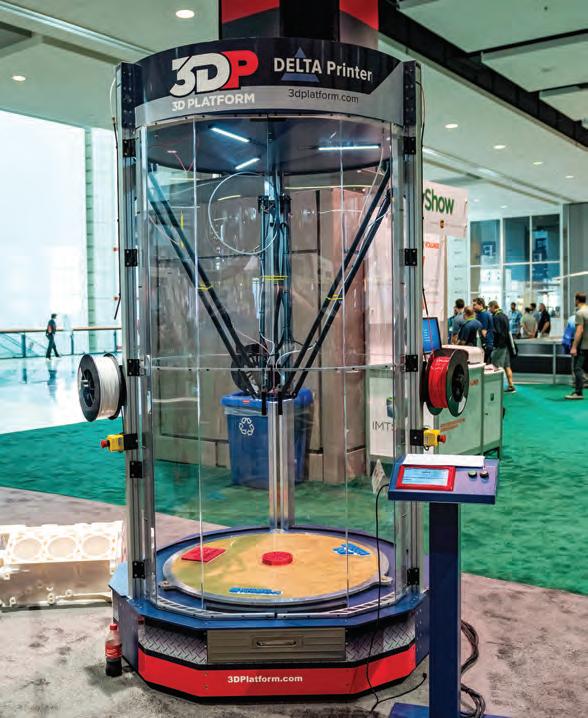
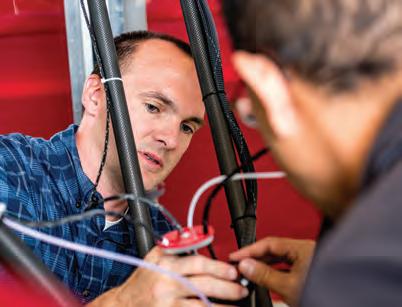
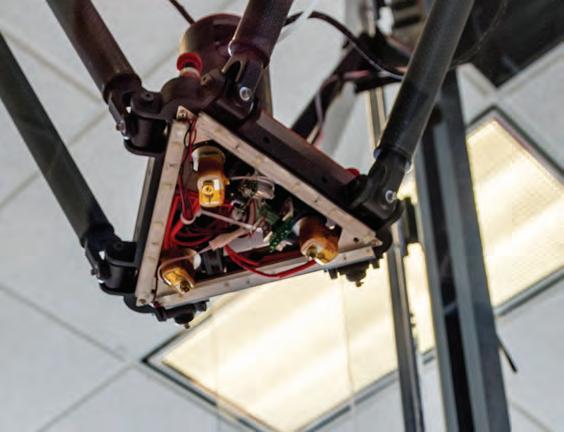
3D Platform worked with Director of Engineering Brian Dougherty, below, (BSEE, 1993; MSEM, 1999), five project managers and several students at Rose-Hulman Ventures to design and build a large, adjustable 3-D printer that dazzled potential clients while creating items, such as the red vase pictured here, at a major Chicago trade show. The vase is a commonly used 3-D printed test object. The 3-D printer project took only 60 days to complete.

As 3-D printing has rapidly moved from science fiction to fact, Rose-Hulman has been a longtime player in the storyline. Students regularly use the technology as part of their studies, and Rose-Hulman Ventures has been a major user of the technology for more than a decade and a half.
When the Schroeders learned of an opportunity for 3D Platform to take part in a major Chicago trade show, they wanted to build and showcase a large, adjustable 3-D printer. The challenge: The printer needed to be designed, created and perfected in about 60 days. Rose-Hulman Ventures took up the challenge.

Ventures Director of Engineering Brian Dougherty (BSEE, 1993; MSEM, 1999), five project managers (several of them Rose-Hulman alumni), a couple of technicians and a dozen student interns put in about 2,000 hours, designing and building components and controls simultaneously. The product worked well, looked good and turned heads at the trade show.
The future of the technology seems nearly limitless, driven by a number of unfolding trends. As with any technology, it’s becoming more powerful and cost-effective—get used to the idea of ordering a highly personalized and customized item such as a shoe and having it produced immediately at a neighborhood 3-D print shop. That will not only change the world of shopping, but also revolutionize supply chains, from production through logistics and distribution. The list of things that can be created using 3-D technology is expected to grow, even including edible and organic materials, as it becomes possible to load more and more materials into additive manufacturing devices.
Just as significant, the technology is getting better at creating sophisticated items that are almost too small for the eye to see. Marrying 3-D printing with nanotechnology has the potential to open vast new possibilities in electronics and the batteries that power them. And it certainly will continue to accelerate design and commercialization of exciting new products, as 3-D printing has been doing for years already. The future is exciting to imagine, but as Cook points out, the present is already pretty amazing.
“It’s enabling a lot of new things that were never done before.” n
See a 60-second video of the printer being built at www.rose-hulman.edu/ventures3d
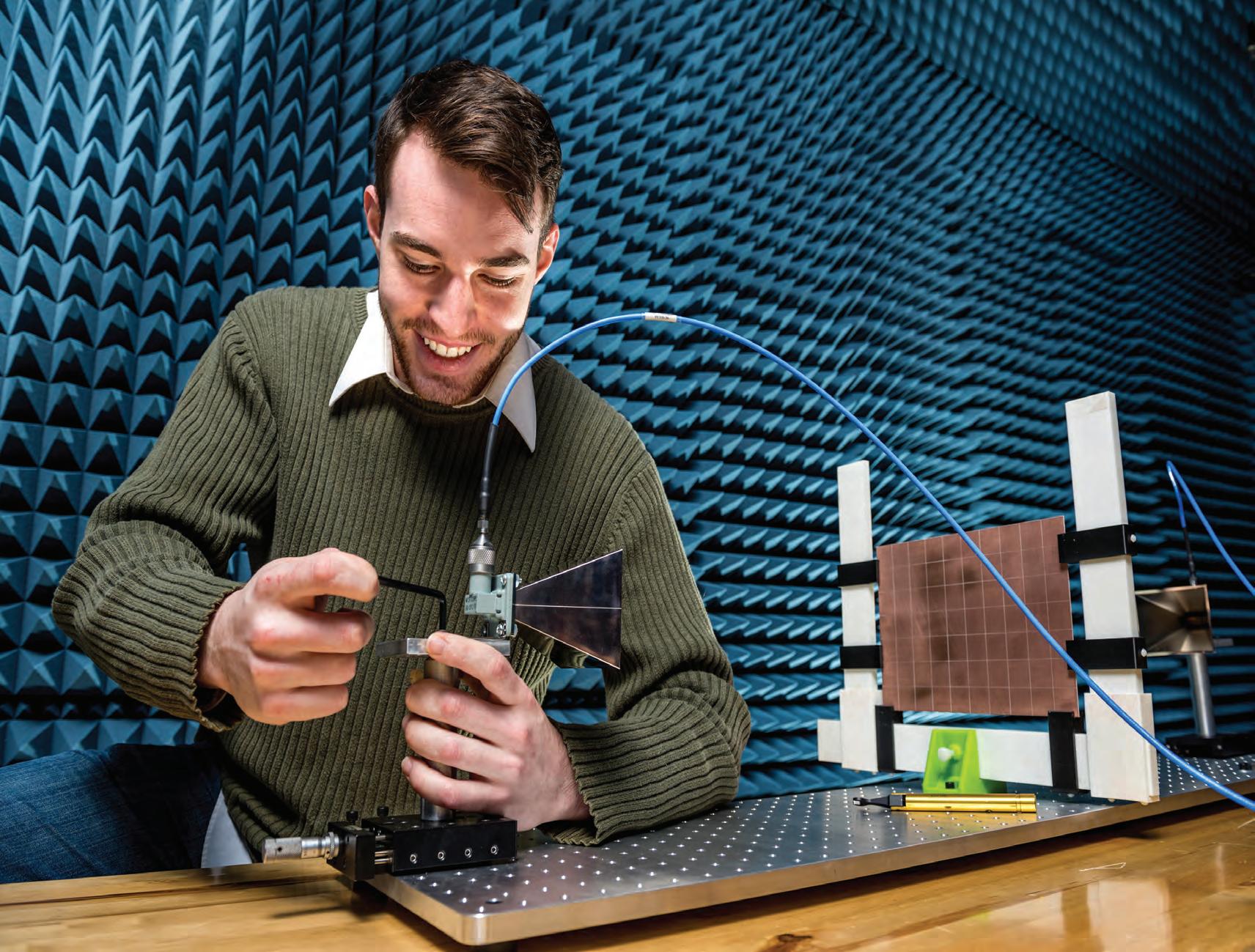
he frequencies being used in Rose-Hulman’s electromagnetics and high-speed design program may be measured in gigahertz, but it’s the students, alumni and professors who are really moving fast.
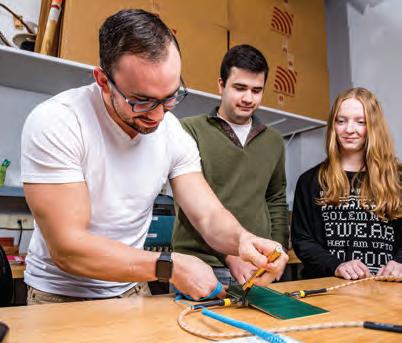
Just drop by the Department of Electrical and Computer Engineering’s campus laboratories and you will find senior and graduate electrical engineering students elbow-deep in projects for IBM’s Research Triangle Park and Texas Instrument’s Kilby Laboratories. Other collaborations have included the Air Force Research Lab and Italy’s
(CONTINUED ON NEXT PAGE)
(CONTINUED FROM PREVIOUS PAGE)
University of l’Aquilla. These projects have resulted in award-winning student research papers and presentations at international and national conferences.
Students working in the electromagnetics and high-speed design lab have access to top simulation packages and measurement equipment such as vector network analyzers, high-speed real-time oscilloscopes and time-domain reflectometers. This technology provides undergraduate and early graduate students with unique educational experiences, inspiring them to enter challenging or hightech careers in industry or continued study at graduate school.
And, alumni have used lessons learned on campus to bring innovations to Apple, Qualcomm, Texas Instruments, Ford Motor Company, Freescale/ NXP Semiconductors and Tesla, as well as to advance technology at top research laboratories at Georgia Tech, University of Illinois, Case Western, Purdue, University of Texas, Virginia Tech, Stanford and UCLA.
Electromagnetics, though a longestablished area within electrical and computer engineering, has many exciting emerging areas of application in wireless communication, highspeed and high-performance computing, and medical diagnosis. Common household appliances utilizing microwave-frequency technologies include mobile phones, televisions and microwave ovens. Rose-Hulman’s recent efforts in developing this area began in 2004 and has expanded in scope and influence ever since.
“Introducing our undergraduates to electromagnetics, high-speed design and microwave engineering is something we do as well as anyone,” says electrical and computer engineering professor Ed Wheeler. “Few students across America get the type of education we’re providing at the undergraduate level, with leadingedge technology backed with technically challenging projects with industry and outside laboratories, and supported with exceptional classroom and laboratory facilities.”
Courses in electromagnetic waves and high-speed digital design are core
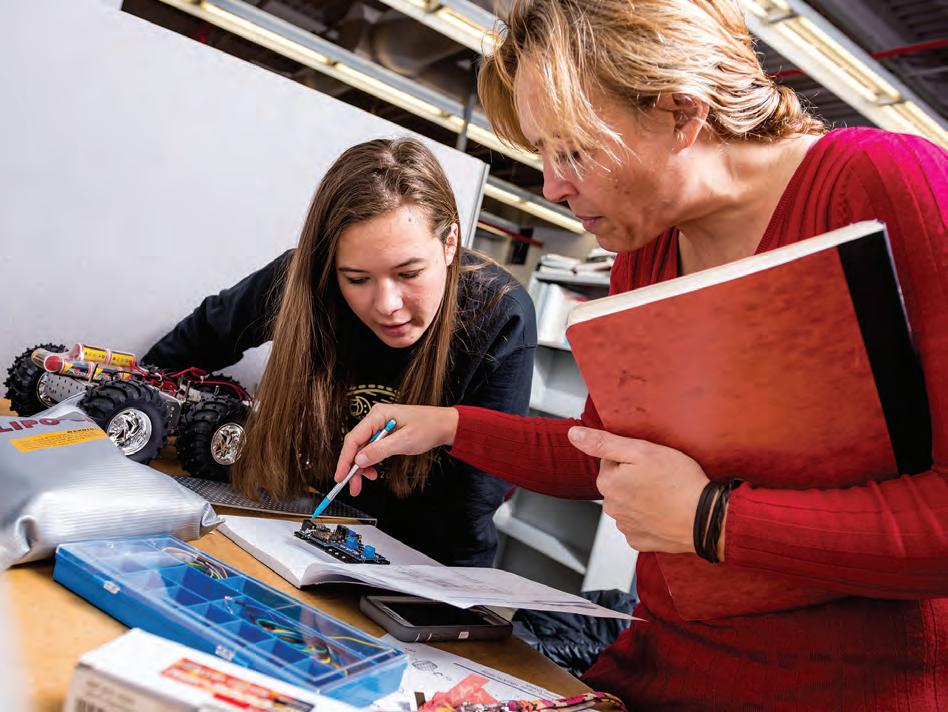
courses in the electrical and computer engineering curriculum, and are supplemented with advanced elective classes in microwave engineering, antenna engineering, electromagnetics, signal and power integrity, and electromagnetic metamaterials. To get students started on the right foot, the core courses are supported by a range of demonstrations and more than 130 videos online providing students with detailed, guided examples of topics appearing in class notes. Then, there’s a wealth of opportunities for students to work with professors on projects with industry and national research laboratories.
Associate Professor Debra Walter has worked with Air Force Institute of Technology officials to exploit electronics systems to provide better intelligence, surveillance and reconnaissance information. Wheeler and students have worked with the military on development of low-energy intentional electromagnetics to render homemade improvised explosive devices ineffective in attempts to harm U.S. soldiers in the Middle East and Europe. Meanwhile, Professor Jianjian Song and student teams have examined car headlight control systems for Valeo Lighting Systems.
“The electromagnetics program provides a variety of interesting projects for students to work on,” says Blake Marshall (EE, 2010), an Apple input device design engineer who helped develop the Apple Pencil and other innovative devices. As a Rose-Hulman student, he worked on an electromagnetic interference project with the Air Force. “Professor Wheeler created my passion for this field and built the foundations of knowledge that I still use every day at Apple,” he says.
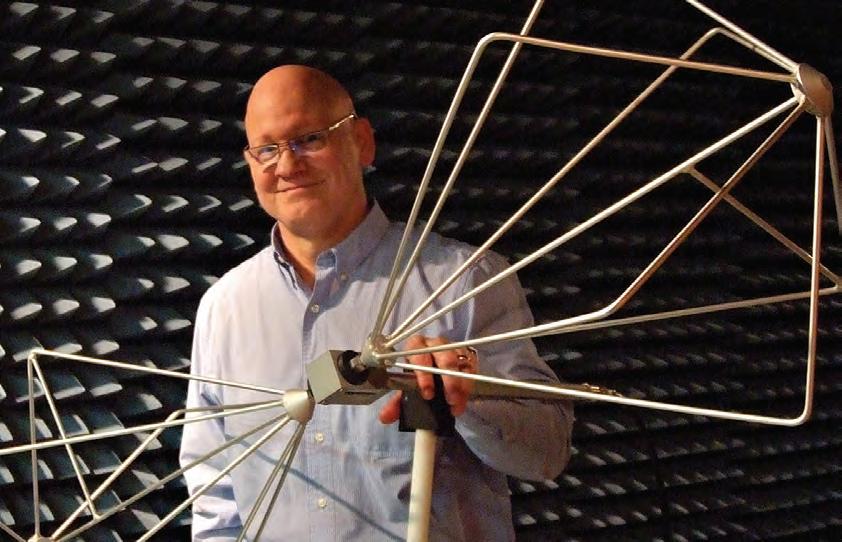
Georgia Tech electro-optical research leader Chris Valenta (EE/CPE/OE, 2008) observes that electromagnetics is a challenging academic area that many students typically avoid. However, Wheeler provides a caring environment that puts the focus on students through interesting projects, award-winning conference presentations and academic journal publications.
“The faculty are the best part of the program,” remarks Valenta. “Professor Wheeler and other faculty members help stimulate their students’ academic interests, and help foster their ideas and passion.”
Wheeler, a 1982 Rose-Hulman electrical engineering alumnus, earned the Board of Trustees’ Outstanding Scholar Award in 2011 and is the current Lawrence J. Giacoletto Endowed Chair in Electrical and Computer Engineering. He was ahead of other college educators in teaching about electromagnetics, according to Ryan White (EE, 2010), a radio frequency design engineer with Ball Aerospace. White joined Marshall on the senior-year project to design a system for remote disruption of improvised explosive devices.
“Professor Wheeler was so engaged in teaching the material. He allowed us to figure things out on our own, but at
the same time provided us with great insight into any difficult questions that would arise,” says White, who spent three years as an electronic warfare engineer for the Air Force before earning a master’s degree from California Polytechnic State InstituteSan Luis Obispo. “Through his course lecture notes [Wheeler] basically wrote a customized book to teach the material that proved very effective. His short video lectures were great tools for helping students understand the material.”
Ben Cook (EE, 2010) is director of printed electronics and foundational technology and team leader on printed electronics for Kilby Labs, where he also manages Texas Instrument’s Printed Electronics Research Lab and is developing an external ecosystem to support the company’s roadmap for printed electronics. Under Cook’s leadership, the work with printed electronics has grown into one of the company’s 16 key foundational technologies. His group is developing the next generation of fabrication technology for additively manufactured semiconductors, and he helps define key investment areas for university research on additive manufacturing
Ed Wheeler (EE, 1982) has been ahead of other educators in teaching about electromagnetics, and several of his former students are now making their own achievements in the field.
technologies (see related story on pages 4-8). He has published more than 75 peer-reviewed journal and conference papers, and has 50 patents and patents pending.
“What people are doing in Rose-Hulman’s Electromagnetic Laboratory is highly regarded across the country, with faculty and alumni that are considered rock stars in the industry,” he says. “The quality of the program’s alumni speaks volumes about the quality of instruction and research being done on campus.”
Assistant Professor Sun Hong spent nearly a decade as an engineer for the Naval Research Laboratory’s Tactical Electronic Warfare Division in Washington, D.C., before being attracted to Rose-Hulman’s electromagnetics program in 2015. He teaches classes in electromagnetic fields and waves, and has worked with students on a project detecting small electronics in a heavily cluttered electromagnetic environment. This work has applications in areas of wireless power transfer and biomedical technology.
“The electromagnetics program offers a great educational environment that features top-level classroom instruction and research,” says Hong. “We have everything to compete with the nation’s best undergraduate programs: great resources, high-quality equipment and instruments, and really bright students.”
The program’s facilities will get even better, according to Hong, when a high-speed signal generator is added to the Electromagnetic and High Speed Laboratory in the future, through Rose-Hulman’s annual equipment budget, which is supported by alumni gifts. n
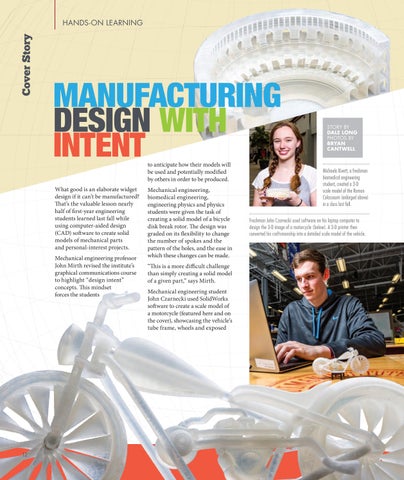
to anticipate how their models will be used and potentially modified by others in order to be produced.
What good is an elaborate widget design if it can’t be manufactured?
That’s the valuable lesson nearly half of first-year engineering students learned last fall while using computer-aided design (CAD) software to create solid models of mechanical parts and personal-interest projects.
Mechanical engineering professor John Mirth revised the institute’s graphical communications course to highlight “design intent” concepts. This mindset forces the students
Mechanical engineering, biomedical engineering, engineering physics and physics students were given the task of creating a solid model of a bicycle disk break rotor. The design was graded on its flexibility to change the number of spokes and the pattern of the holes, and the ease in which these changes can be made.
“This is a more difficult challenge than simply creating a solid model of a given part,” says Mirth.
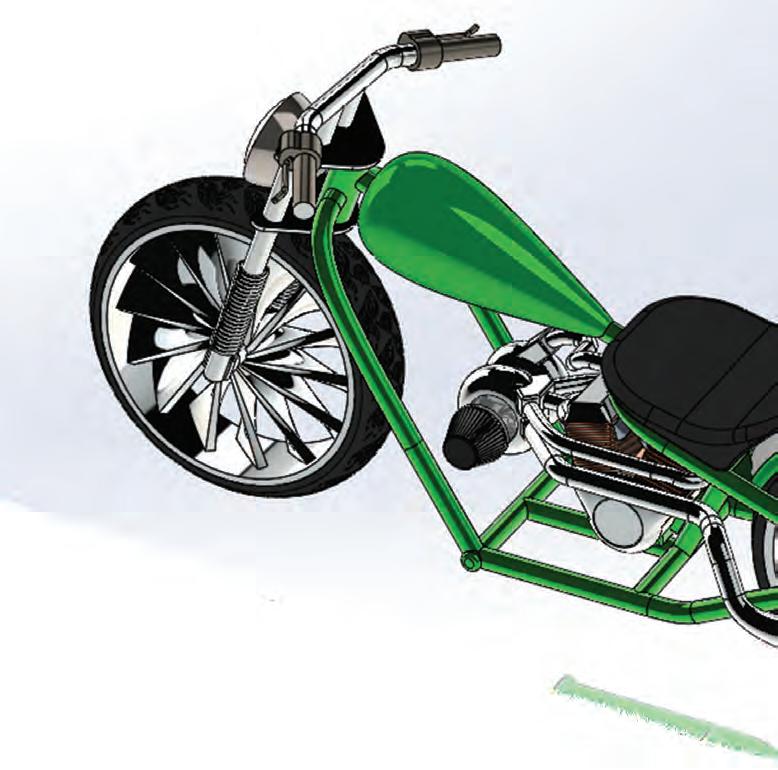
Mechanical engineering student John Czarnecki used SolidWorks software to create a scale model of a motorcycle (featured here and on the cover), showcasing the vehicle’s tube frame, wheels and exposed
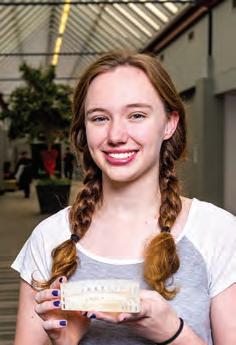
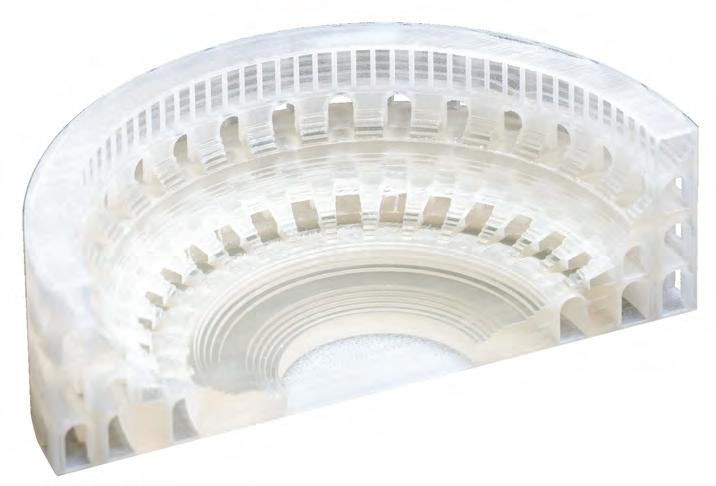
Michaela Kivett, a freshman biomedical engineering student, created a 3-D scale model of the Roman Colosseum (enlarged above) in a class last fall.
Freshman John Czarnecki used software on his laptop computer to design the 3-D image of a motorcycle (below). A 3-D printer then converted his craftsmanship into a detailed scale model of the vehicle.
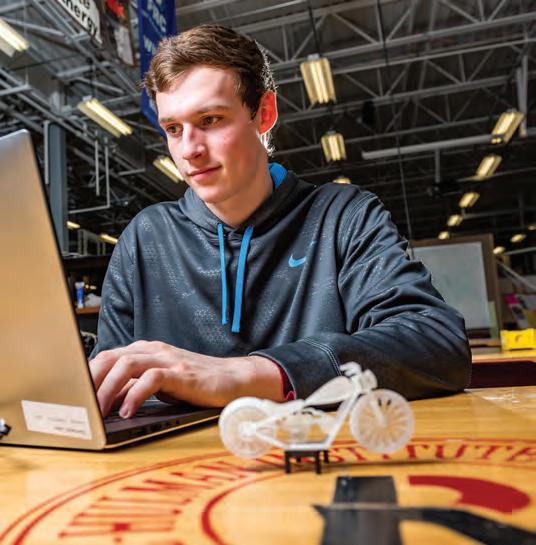


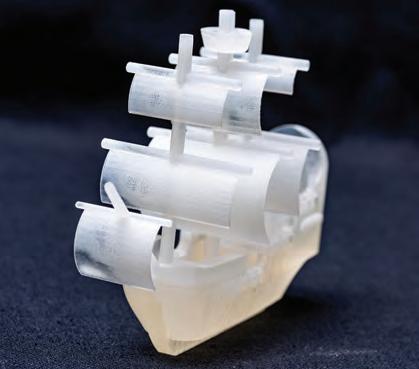
engine. The project required nearly 40 hours of meticulous work on his laptop computer.
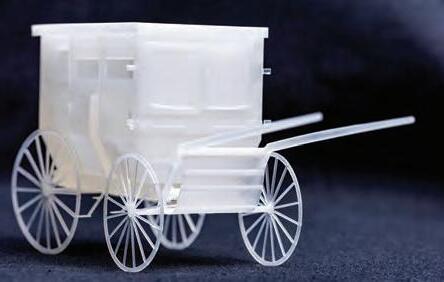
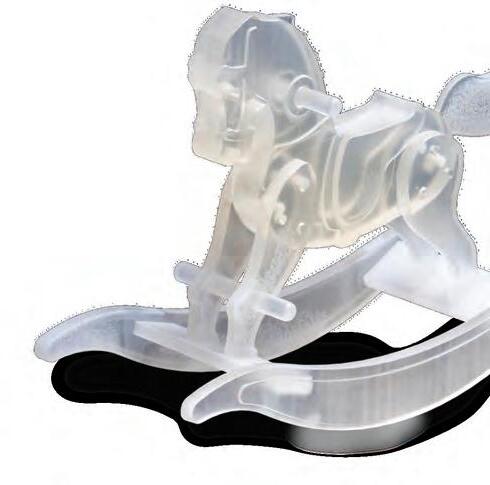
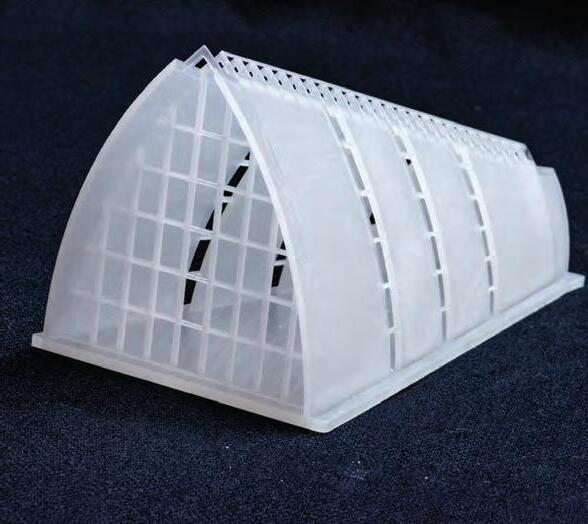
Meanwhile, biomedical engineering student Michaela Kivett drew from her visit to Rome’s Colosseum to capture details of the legendary amphitheater for her model. Other students created a variety of intricate 3-D models, including those shown on these pages. Projects included Star Wars and Harry Potter items, a chessboard and pieces, and a variety of campus buildings.
“I was able to use my creativity and imagination to solve problems and build new things,” Kivett says. “It was a great introduction to my Rose-Hulman career.” n

Mechanical engineering professor Rick Stamper (ME, 1985), one of five graphical communications course instructors, notes that computer-aided design allows engineers to:
• S howcase creativity
• C reate new and interesting products
• Create models that can be used to simulate a product in a virtual world before you spend the resources to create a physical product
• Create a model that can provide insights into a design
• C reate value


American engineers and industry designers commonly use third-angle projection to view different planes of an object, but probably have no idea that it has its roots at Rose-Hulman with legendary machine design and mechanical engineering professors William Ames and Carl Wischmeyer. Ames and Wischmeyer co-authored the 1918 book Descriptive Geometry, which introduced the concept as a teaching tool. More recently, an Engineering Design Graphics Journal article credited Ames for introducing third-angle projection through descriptive geometry courses.
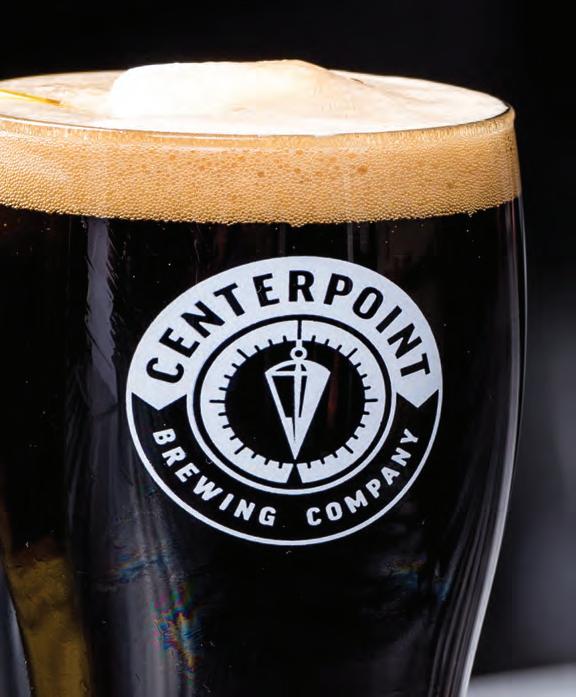
APeter Argiris (CHE, 2001), Jeff Ready (CS, 1996) and Jonathan Robinson (ME, 2003) tapped into the expanding marketplace late this past fall, opening Centerpoint Brewing in downtown Indianapolis’ up-and-coming Circle City Industrial Complex, around the corner from the trendy Massachusetts Avenue district.
Peter Argiris, left, and Jonathan Robinson turned their interest in home craft beer into Indianapolis’ Centerpoint Brewing. Not pictured is the company’s other owner, Jeff Ready.


mericans spend more than $100 billion a year consuming beer, and here’s the sudsy truth: they’re not all drinking the national brands. Craft beers made by independent breweries are booming in popularity. As a result, the number of U.S. breweries reported by The Brewers Association grew from 2,500 in 2012 to nearly 4,300 by 2015. Those in the business say there’s still room for more, and a number of Rose-Hulman alumni are doing their part to satisfy the demand.
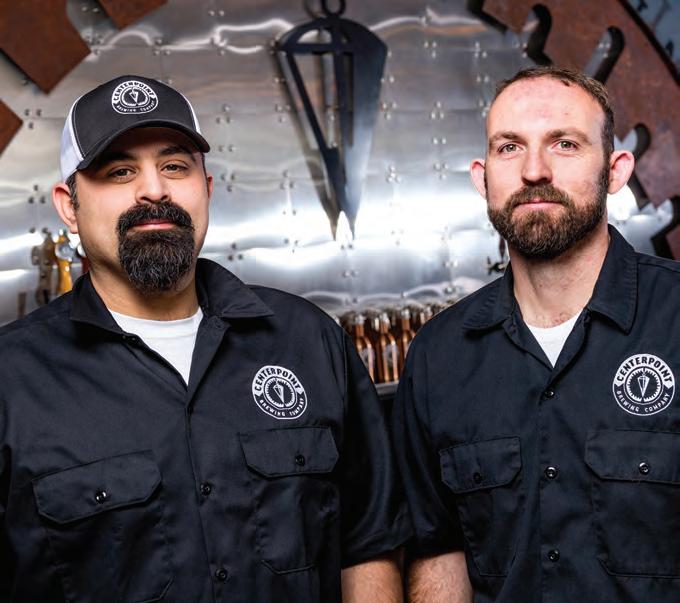






Argiris had an itch to launch a business of some kind, and by 2013 got Robinson, a veteran home brewer, involved in working on a business plan to turn their avocation into an entrepreneurial venture. At the same time, Ready, a serial entrepreneur, already had done some business planning for the craft beer business. The team began raising capital for their venture by 2015 and a year later sold the first glass of beer at their brewery.
With so many local breweries sprouting, distinctiveness is the key.
“First and foremost, we’re trying to make a selection of craft beer that has a broad appeal,” Ready says. Some of the more highly regarded craft beers are quite simply too bitter for a lot of individuals’ tastes, he says. Centerpoint offers a selection of flavorful brews that can appeal to the seasoned craft beer aficionado and the beer drinker who wants something tasty but with a bit less
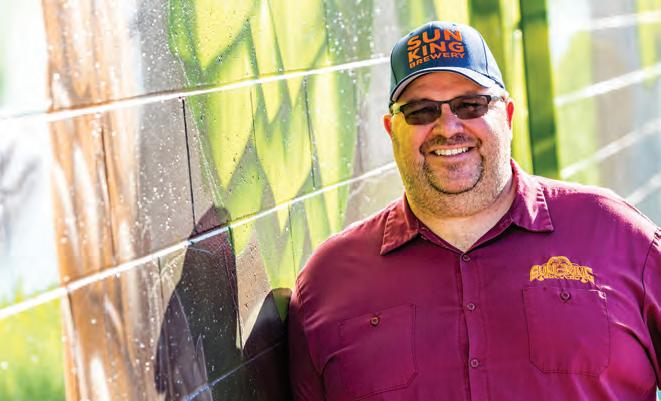
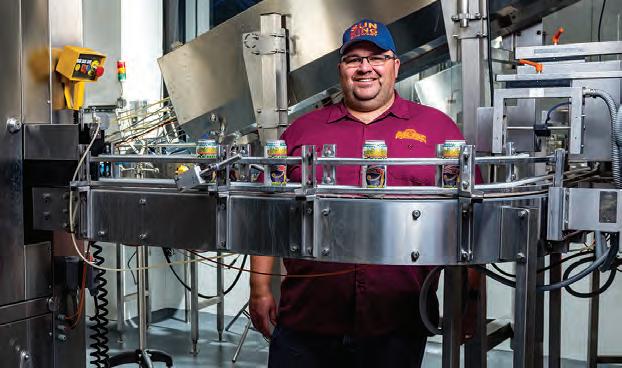
Alumnus Andy Fagg is the primary investor and executive vice president of Sun King Brewery, a successful Indianapolis-based enterprise founded in 2009.

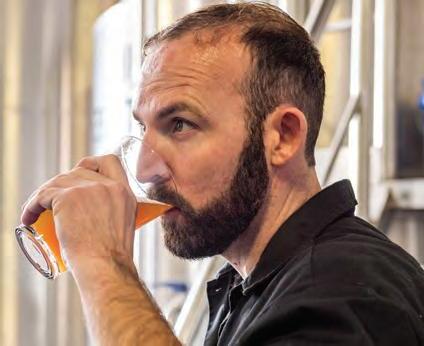
bite. The company’s signature gateway beer Centerpoint Gold, Ready says, offers something bolder but appeals to a Bud Light drinker who’s out on the town with craft beer buddies.
Centerpoint’s plan for steady growth involves building a small stable of brews that are always available, such as Centerpoint Gold and the increasingly popular Black Porter, while mixing in other varieties for customers wanting to try new things. Many beers, Ready says, will be available only at the brewery, while some have already
found their way through keg sales onto the menus of local bars and restaurants. The next step is canning the most popular brews for consumers to take home.
That was a similar approach undertaken by Sun King Brewery, founded in 2009 in Indianapolis by a couple of veteran brewers and now the city’s biggest craft brewery. Andy Fagg (BSAO, 1991; MSAO, 1994) signed on as the company’s
(CONTINUED ON NEXT PAGE)

Centerpoint Brewing’s Jonathan Robinson and Peter Argiris got into the craft beer business by brewing their own home brews, and with a chemical engineering degree, Argiris is very much in touch with the chemistry of beer making. It’s a meticulous process, he says, and it’s no small accomplishment to create a recipe that scales well into larger production and is consistent from batch to batch.
ARGIRIS OFFERS THESE IMPORTANT ELEMENTS FOR CRAFTING THE RIGHT BEER:
Water: Local water quality plays a significant role in creating a beer’s character. Among age-old beer capitals, England has harder water than the Czech Republic, and that impacts their beers. The importance of the water is even more obvious when you consider that basic beer has only three other ingredients: barley, hops and yeast.
Temperature Control: This is vital in the various production stages, including mashing, when the grains are steeped in hot water to release their sugars. The liquid that results, known as wort, is boiled while hops (and sometimes other spices and flavors) are added. Next up is fermentation, when yeast is added to break down the sugars and leave behind alcohol and carbon dioxide.
Aging Process: As a rule of thumb, beer will continue to improve in flavor as it ages. However, you must determine when the amount of aging is just right before preparing to sell the beer. Sell it too soon and the flavor is not ready, but it doesn’t usually last indefinitely, either. That makes it important to brew just the right amount so that it can be sold and consumed at its peak.


(CONTINUED FROM PREVIOUS PAGE)

primary investor and serves as executive vice president. Sun King, he says, brews a wide range of different beers, many of which are available only occasionally and sold at its taprooms or local bars. Meanwhile, its canned Cream Ale, Wee Mac and Osiris brands have become very popular. The company recently expanded its brewing capacity, and now sells more than 30,000 barrels a year.
Fagg finds the craft brewing business “a refreshing change from the world of science and industry,” where secrets are jealously guarded and competition is often cutthroat. “This is a collaborative industry. Everyone wants to help each other out. We got a lot of assistance from breweries bigger than us, and we do the same for small breweries now,” he says. Local brewers, he adds, simply don’t see each other as competition. On the contrary, their aim is to collectively grow beer drinkers’ interest in local, fresher and tastier brews in order to steal market share from the industry’s mega-players, like Budweiser and Miller. n


“This is a collaborative industry. Everyone wants to help each other out. We got a lot of assistance from breweries bigger than us, and we do the same for small breweries now.”
— Andy Fagg (BSAO, 1991; MSAO, 1994) Executive Vice President, Sun King Brewery


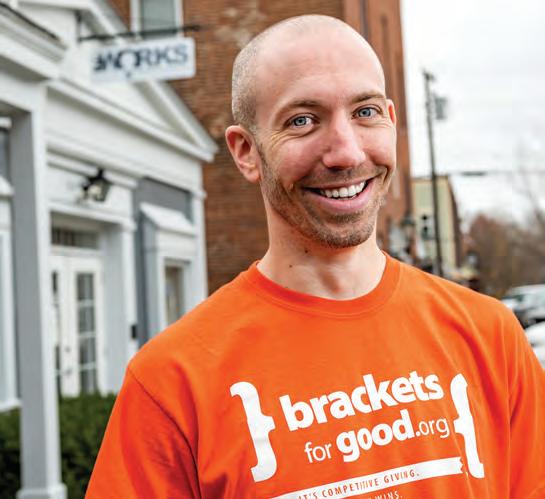
David Cornelius brought his web and tournament bracket development experiences to help co-found Brackets For Good, a charitable project supporting several nonprofit organizations across the country.
Sometimes the most creative ideas are scribbled across a napkin over drinks and snacks in a restaurant.
That’s what happened when two college basketball crazed entrepreneurs wondered if they could turn the excitement of each year’s March Madness bracket challenge into helping local nonprofit organizations.
Brackets For Good was born, with the two entrepeneurs getting assistance from cofounder David Cornelius (CS, 2006). The project uses the NCAA tournament model, but instead of teams from the University of Kentucky, North Carolina and Duke, the bracket is filled with such groups as the Boys & Girls Club, Indiana Sports Corp, Juvenile Diabetes Research Foundation and Indiana FIRST Inc. Like-sized groups are paired with one another in the early rounds, and they rally donors to raise money over the course of one week. Every dollar raised equals one tournament point. The group earning the most points wins each round.
The six-round tournament takes place over five weeks, beginning on the last Friday in February. Participating nonprofits keep the donations raised, regardless of how far they advance in the tournament.
Since its inception with one tournament in Indianapolis in 2012, Brackets For Good has
raised more than $2.75 million in communities across the country. Tournaments have been organized this year in Ann Arbor, Mich.; Baltimore; Cincinnati; Denver; Hartford, Conn.; Indianapolis; Louisville; Miami; Minneapolis-St. Paul; Nashville; and St. Louis. The winning organization in each city is expected to receive a $10,000 grand prize.
And, AT&T has partnered to introduce the first nationwide tournament featuring 64 national nonprofits. In addition to raising awareness and money, the winner will receive $100,000.
Learn more about Brackets For Good and this year’s tournament at bfg.org.
Cornelius has played a key role in the enterprise’s success, through his expertise in web development and experience developing brackets for office recreational tournaments. He built challonge.com, a successful tournaments and events platform. It is one of the few online bracket-generator programs available on the market.
“Structuring a seeded double-elimination tournament was surprisingly difficult, but difficult problems are the fun ones for engineers,” he says of developing the bracket generator. “Proud of conquering the challenge, I polished up a small website for it. The site solved my problem nicely, and I’d soon find out that I wasn’t the only one with this problem.”
Challonge’s introduction aligned with the rise of competitive video gaming, or e-sports, and this allowed the project to grow in popularity within the online community. Now, tens of thousands of tournaments are run each month on Challonge from all around the world (through 11 languages), with more than a million participants and spectators, Cornelius says. The platform was acquired last summer by Philippines-based SplitmediaLabs. Cornelius works as project manager with colleagues half a world away from his co-working space in Zionsville, Ind., which also enables him to spend time with his young daughter; he is married to Katherine Castro (MA, 2005).
“Time and burnout were the biggest challenges for me in founding Challonge and co-founding Brackets For Good,” Cornelius says. “Starting a new project is fun and energizing, but finishing that last 20 percent can be grueling. My recommendation: Do whatever you need to do to build and release your product quickly.” n
STORY BY DALE LONG
Why does he do this? Watch Trey’s story (courtesy of Jon Connor) at bit.ly/echoes2017a
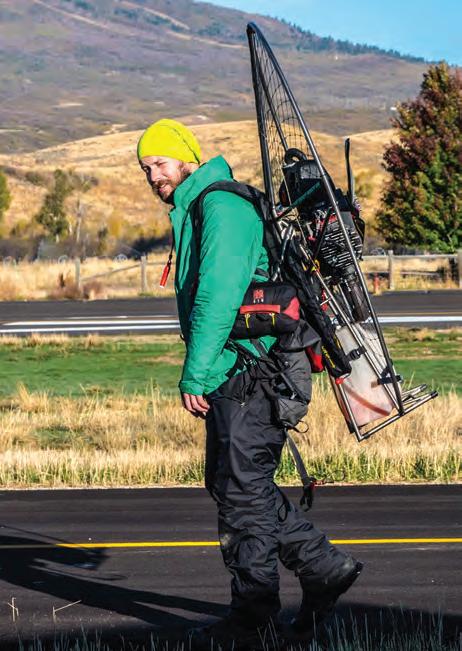

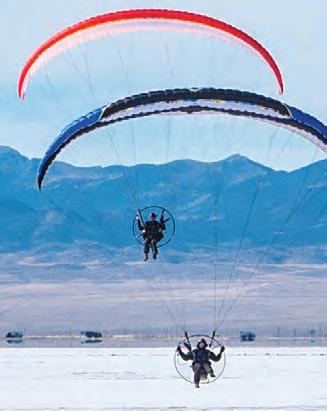
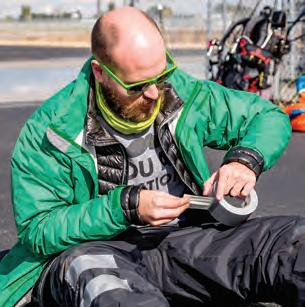
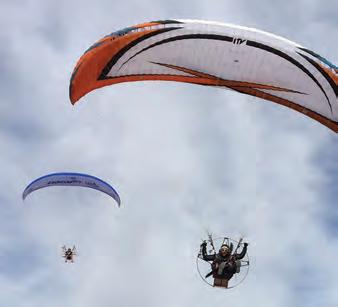
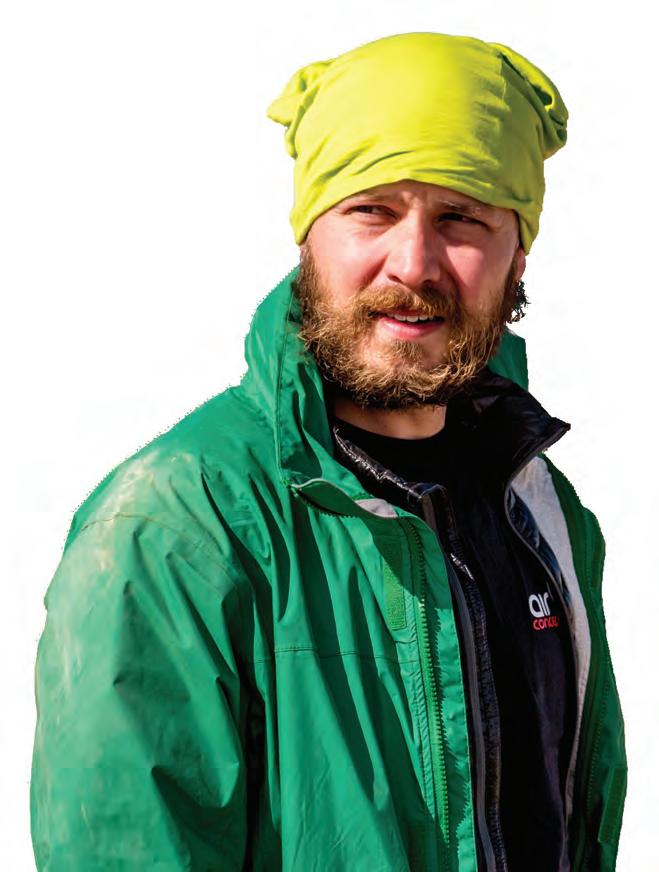
There are conventional ways to travel through the Rocky Mountains from Montana’s Canadian border to a patch of the desert near Las Vegas. Then there’s the thrilling adventure that Trey German completed in the seat of his paraglider this past fall.
With a motor and a two-blade propeller strapped to his back, the 2009 computer engineering alumnus soared at altitudes reaching 11,000 feet to be one of seven worldwide daredevils completing the 1,000-mile Icarus Trophy, an event billed as “The Toughest Race The Sky Has Ever Seen.”
Along the way, he navigated through some of America’s most breathtaking sights, pushed his physical limitations to extremes, battled a variety of weather elements, and survived encounters with bears and mountain lions.
“When you’re in the air everything else that you would normally think about or be worried about goes away: it’s you and the sky and nothing else. It’s the closest you can get to flying like a bird as a human,” German says. “It’s terrifying and freaking amazing.”
Starting in Polson, Mont., the 29 year old averaged nearly 100 miles in flight each day—from before sunrise until 4 p.m., with a mid-day refueling and rest stop—to complete the 1,000-mile cross country
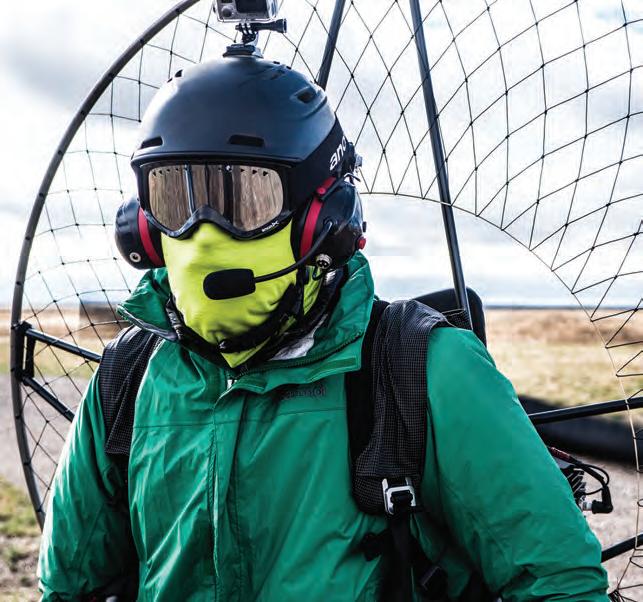
challenge by crossing the finish line in Mesquite, Nev., within 10 days. Throughout the journey, he traveled from 25 to 45 miles per hour with a titanium frame strapped to his back containing a 200cc two-stroke dirt bike motor making 8,000 revolutions per minute that powered a twin blade carbon fiber propeller within a foot of his head. A software application helped German keep track of his position on an aviation sectional chart, avoiding airspace restrictions and keeping him on course for the destination of each day’s trip.
“What’s terrifying is that for much of the time you’re flying over terrain that doesn’t have great access. If your motor was to go out and you had to land, it could be a several-day hike back to civilization with 50 to 100 pounds of gear,” says German, who sits in a chair-like harness during flight and steers by shifting his weight and manipulating the two brake lines.
“My life is in my hands with each takeoff. It’s really important that you know exactly what you’re doing. I continue to learn new things every time I fly,” he says.
“At the same time, this type of adventure flying is amazing. Some of my favorite flights were just east of mountains that border Salt Lake City. I was eye level with the tops of the mountains and could see Salt Lake City and the Great Salt Lake through the gaps in the mountains.”
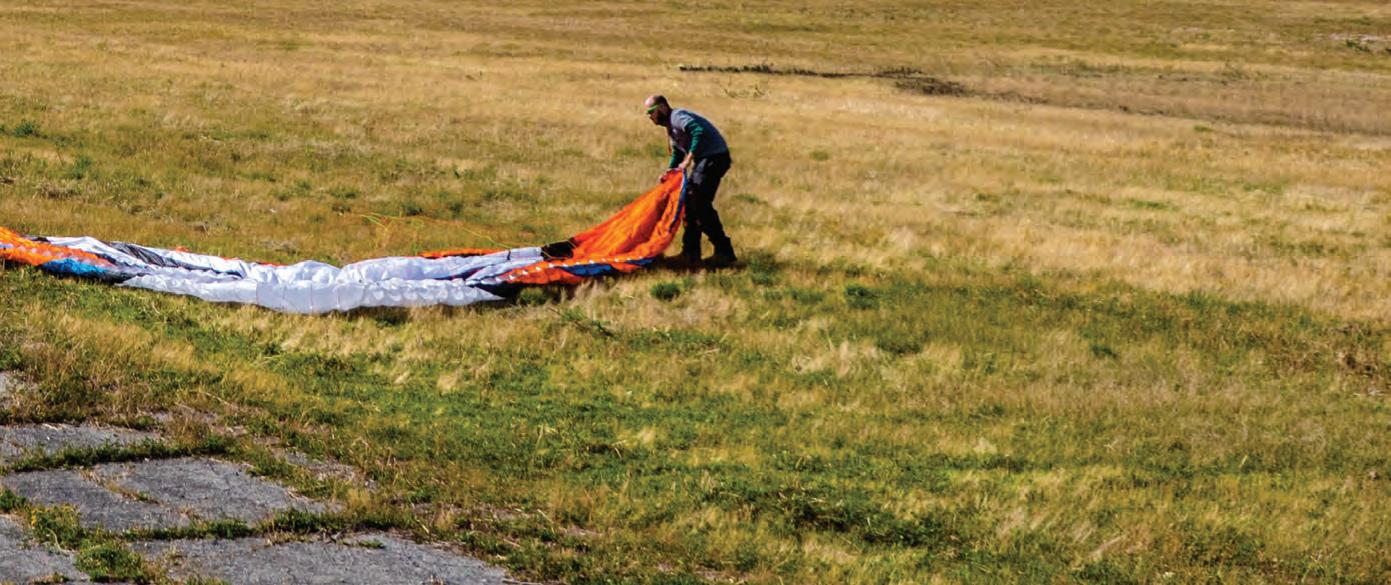
German became fascinated with flight during his youth as he took rides on his grandparents’ private plane. He took flight lessons after graduating from Rose-Hulman and eventually earned a private pilot’s license. Without the financial luxury to have his own plane, his interest turned to powered paragliding about two-and-a-half years ago.
(CONTINUED ON NEXT PAGE)
It took daredevil extraordinaire Trey German 10 days to travel the 1,000-mile Icarus Trophy event—from northern Wyoming to near Las Vegas—this past fall. He flew from before sunrise to 4 p.m. each day.
“WHEN YOU’RE IN THE AIR EVERYTHING ELSE THAT YOU WOULD NORMALLY THINK ABOUT OR BE WORRIED ABOUT GOES AWAY: IT’S YOU AND THE SKY AND NOTHING ELSE. IT’S THE CLOSEST YOU CAN GET TO FLYING LIKE A BIRD AS A HUMAN.”
-TREY GERMAN (CPE, 2009)


(CONTINUED FROM PREVIOUS PAGE)
“I love the freedom of flight,” he says. “I often tell people ‘life is the most difficult thing you’ll ever do, but it’s also the most rewarding.’ You have to fight through the challenges life throws at you. If you do, ultimately you’ll be rewarded for it. I’m doing something only six other people in the world are doing.
“Most people have never seen this before,” he continues. “They may have seen it in a James Bond movie, but it’s not something that people would imagine as a normal hobby.”
And, he’s ready for the next adventure. He may try to extend next year’s Icarus Trophy challenge by starting in Barrow, Alaska, (the nation’s northern-most point in the U.S.) and then continuing on to the far reaches of the south, possibly ending up in Key West, Florida.
In the meantime, during his time on the ground, he’s accepted another risk: starting his own electronics company, Polymorphic Labs. This came after he helped Texas Instruments develop the LaunchPad maker-friendly technology tool. He’s currently building hardware platforms that will allow web developers to incorporate real world data into their applications for use in everything from computer games to industrial instrumentation.
“Other than flying, my biggest love has always been electronics. I love finding problems and solving them by using electronics I’ve designed,” he says. n
MOTOR: Air Conception Nitro 200, 200cc two-stroke motor that puts out about 28 horsepower. Engine has a maximum 8,000 revolutions per minute.
FRAME: Titanium based, weighing roughly 43 pounds, including the motor.
PROPELLERS: A two-blade carbon fiber propeller, total length 125 centimeters. The propeller is driven with a 2.7:1 belt reduction drive and has a maximum speed of about 3000 revolutions per minute.
FUEL: Federal regulations limit an ultralight aircraft to carry up to five gallons. (The tank during the Icarus Trophy trip was 3.9 gallons.) The standard premium automotive gas is mixed with a 40:1 mixture of full synthetic two-stroke motor oil.
TOTAL WEIGHT: 80 to 90 pounds on ground, with full fuel and personal gear bag.
NAVIGATION SYSTEM: An aviation app displays current position on an aviation sectional chart.
STEERING SYSTEM: Through weight shifting in the harness a slow and shallow turn can be initiated. More aggressive turns require the pilot to pull on one of the two brake lines.
“I LOVE THE FREEDOM OF FLIGHT. I OFTEN TELL PEOPLE ‘LIFE IS THE MOST DIFFICULT THING YOU’LL EVER DO, BUT IT’S ALSO THE MOST REWARDING.’ YOU HAVE TO FIGHT THROUGH THE CHALLENGES LIFE THROWS AT YOU. IF YOU DO, ULTIMATELY YOU’LL BE REWARDED FOR IT.”
– TREY GERMAN (CPE, 2009)
Ride along as Trey started the Icarus Trophy race at bit.ly/echoes2017b

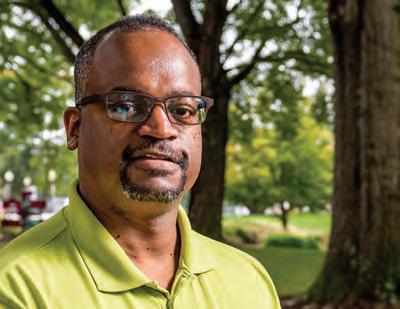
Like most visitors to the new National Museum of African-American History and Culture, Robert Wilkins has come away with a much deeper appreciation for the richness and diversity of the African-American experience and how it helped shape the nation.
And, as one who was influential in the museum’s creation, his emotional ties are even stronger.
It’s hard not to be affected by many of the 35,000 artifacts on display, many of them donated by ordinary people. There’s an authentic auction block, shackles and a cabin from America’s history of slavery; the original coffin of Emmett Till, a 14-year-old savagely killed in Mississippi in 1955; Ku Klux Klan hoods; a segregated railcar; and the track cleats Jesse Owen wore in his gold medal-winning performances at the 1936 Olympics. The names of more than 2,200 people known to have been lynched between 1882 and 1930 line the walls of one gallery, and a cultural exhibit is devoted to African-Americans’ influence on film, television, theater and dance.
“This was a proud moment for America,” says Wilkins from his office as a U.S. Court of Appeals judge in Washington, D.C. “I can’t believe this place, a dream for so many people, has become a reality.”
The 1986 chemical engineering alumnus chronicles the long and winding path to the museum’s creation in the book, Long Road to Hard Truth: The 100 Year Mission to Create the National Museum of African American History and Culture.
Bridging history and personal memoir, Wilkins writes about the time he attended the wake of a fellow church congregant, Lewis Fraction. Paying his respects to the family, he listened as the African-American elders relayed stories of joyous courtship rituals and family life from long ago; of attending all-Black, oneroom, ramshackle schoolhouses; and of suffering the indignities inflicted on African-Americans—but also of the camaraderie at the marches and sit-ins during the Civil Rights movement.
“I wondered why African-Americans didn’t have a museum to share all these wonderful stories,” says Wilkins. “It became an obsession. The more I learned about the history, the more I wanted to become involved to make this happen.”
In his book, Long Road to Hard Truth, Robert Wilkins wrote about the struggles to create the new National Museum of African-American History and Culture, which opened last fall in Washington, D.C.
Wilkins served on the Presidential Commission created by Congress to plan the museum and its location, a five-acre site on the National Mall near the Washington Monument. The $540-million building (funded through private donations) was designed as a three-tiered structure topped by a corona similar to the three-tiered crowns depicted in Yoruban artwork from West Africa. The exterior metal lattice wrapping the building evokes the ornamental ironwork made by slaves.

Long Road to Hard Truth chronicles early efforts, starting in 1916, to build a memorial in honor of the nation’s black soldiers of the Civil War, which expanded into a vision for the national museum. Obstacles ranging from political maneuverings to world events put it at the bottom of priorities. Wilkins revived the idea and worked with Congressman John Lewis and other AfricanAmerican civic leaders to make it a reality; the building was dedicated last September.
“There were bumps, setbacks, and plenty of doubts,” Wilkins says. “This was something that had to happen. For most of our history, African-Americans were not seen or heard. Hopefully, this museum will help bring the country together. I hope that people will come away with a new appreciation of the many sacrifices that African-Americans went through and progress we have achieved.” n
DARRELL STAGGS’ passion for creating images through a camera’s lens can best be summarized in Henry David Thoreau’s quote: “It’s not what you look at that matters, it’s what you see.” Staggs’ vision of nature or man-made creations, along with his expanding photography talents, have produced delightful images that have been featured in art galleries throughout central Indiana. “Hopefully, my photographic images are not just something for the eye to look at, but something for the mind to see. My images must be personal and not predictable,” says the 1978 chemical engineering alumnus who retired in 2016 after 38 years in petroleum and pharmaceutical engineering. This collection of images provides the opportunity to observe Staggs’ journey into the world we live in, and the colors and flows that are all around us. Like engineering, there have been instances where a technical failure has led to a visual artistic success. Find out more about Staggs’ photography at darrellstaggsphotography.com.



who would like to be considered for future photo albums should contact Dale.Long@rose-hulman.edu.







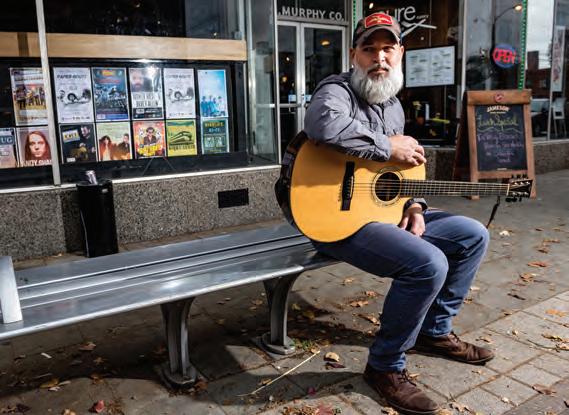
ngineering and music might seem like two distant worlds, but for Chad Mills, they’re more like two sides of the same coin.
“It’s been a nice balance,” he says. “They’re coming from different parts of my brain. I think it’s kept me sane.”
Mills (CE, 1998) has spent the last 18 years building a civil engineering career, now leading the construction inspection team at the Indianapolis office of Shrewsberry & Associates, a national engineering consulting firm. Along the journey he also started a family and developed a reputation as a prolific folk-rock singer and songwriter.
Whether he’s working solo or with friends, most notably his roots quartet the Upright Willies, Mills’ songs are built around his acoustic guitar, heartfelt lyrics and gritty tenor vocals. His ninth and latest album of original music, “Love & Loss,” leans toward the minimal side, with his voice and

guitar accompanied only by cello, keyboards and backing vocals. (Mills’ music is available through iTunes and other online sources, including www.chadmillslive.com.)
While growing up in Zionsville, Ind., Mills enjoyed listening to metal and rap music—the louder the better—but his love was football. When it came to attending college, Rose-Hulman was a place where he could study engineering and continue his gridiron pursuits. Music entered the picture in his junior year as he began strumming Bob Dylan songs on a guitar in the Alpha Tau Omega fraternity house on campus.
As he learned the instrument, Mills grew more interested in lyrics and in the emotion that a song could convey. Soon thereafter, he began putting pen to paper and discovered a new side to himself. Songwriting became a means to grapple with his own ups and downs and tell stories that could move other people.
“For me, the most powerful part about writing, about music, is that personal connection,” he says. “It can be very spiritual. And what an odd place to discover music like that—at an engineering school!”
Upon graduating, Mills launched a day job at the architecture and engineering firm Burgess & Niple, where he would stay for 16 years. At the same time, his interest in music continued, and in 1999 he made his first recordings with technical assistance from fellow alumnus Ryan Powell (CPE, 2000), owner of the Repo-Records recording studio.
“I think we recorded my first album through a keyboard onto a floppy disk and then transferred it to cassette,” Mills recalls.
Mills and Powell, an information technology professional in Indianapolis, have collaborated on other albums, including “Love & Loss.”
“Ryan and I have grown over the years in terms of our projects,” Mills says. Also growing has been Mills’ family, with his wife of 14 years, Joellen, who is also from Zionsville. They now have three daughters, ages 7, 10 and 12. When the second was born, they decided Joellen would put her career on hold and stay home. Chad kicked his music sideline into high gear, averaging more than 100 gigs a year over the intervening decade and releasing several albums. He has approached music as a business, handling his own booking, promotion, marketing and sales.
“I thought I was being a provider for my family,” he says. “I tried to rationalize it that way.”
As the girls grew older, however, Mills was finding it harder to balance work, life and music. He recently decided to be more selective about making commitments outside the family.
“I just reached a point where I got tired of being gone multiple nights a week, feeling like I was always saying goodbye to my kids,” he says. “I know I have a small window before they grow up. I’ve only got one chance at this. Music will always be there.” n

Chad Mills offers the following advice to others wanting to follow their musical dreams:
The older we grow, the busier we get. I wish I would’ve discovered music earlier in life, but I still feel lucky to have picked up the guitar at Rose-Hulman. I’m not sure that would’ve happened after graduation. If you’re sure you want to chase your passion, what are you waiting for?
The music business is not for the faint of heart.
Performing is great, but the business side can really crush your spirit. Prepare by doing your research. Get to know your local market. Read blogs. Talk to those in the business. Information is power. Use it to succeed.
Your goals will drive how much “business” you need to invest in your own music business. While it would’ve been nice to have a team of folks helping me along the way, the reality is I’ve done it all on my own. From marketing and sales, booking and promoting the shows, making albums and managing websites... if you have the time and energy, it’s all stuff you can do on your own.
While you dream about nights when the room is packed full of engaged listeners, you’re also going to have nights where you could be playing for the bartender and a couple patrons. I try to commit to the philosophy that “you play for the people who are there, not the ones who aren’t.” You never know who’s listening. Even if it’s one person, give them something to remember.
Be gracious to the management and staff at the venues that let you come and play. Be polite and accommodating to the guy operating the sound system. Be supportive to the other acts you meet and share the stage. Most of all, be appreciative to the folks who come out to listen, especially the paying customers. As in any business, be kind to others. The world could use more of that right now.

Two Rose-Hulman alumni-turned-educators, Mike Spock and Chris Repa, are using innovative projects and research programs to get high school students jazzed about math, science, and engineering.
THEIR EFFORTS HAVE NOT GONE UNNOTICED.
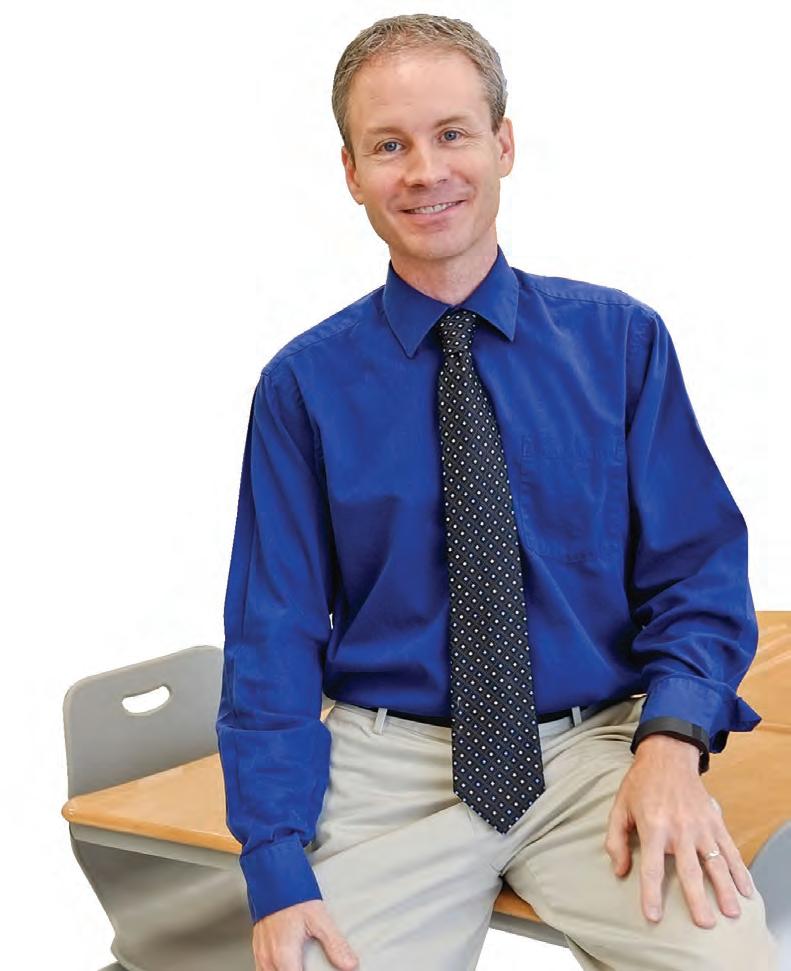
Spock (EE, 1992), a teacher at Indiana’s Columbus North High School, was among 57 teachers in grades 7-12 honored last fall with the 2016 national Presidential Award for Excellence in Mathematics and Science Teaching. The winners are selected by a panel of distinguished scientists, mathematicians and educators.
Repa (CHE, 1999) is introducing new physics concepts to students at Oak Lawn (Ill.) Community High School and providing them with research experiences at the Argonne National Laboratory near Chicago and at Rose-Hulman through the institute’s participation in the National Science Foundation (NSF) Engineering Research Center’s Smart Lighting project. He received the institute’s Outstanding Mentor Award in 2015.
“By inspiring future engineers and change agents through my work as a high school teacher, maybe some of society’s biggest challenges will be overcome sooner,” says Repa about his decision to become a teacher. “I know it sounds cliché, but my decision was made from a place of compassion and hope.”
Spock left his job as a systems engineer at Cummins Inc. in Columbus, Ind., 18 years ago to teach secondary math, physics and computer science. He helps his students use math to model the world and connect with other fields of interest, such as music or current events. Students in his computer science classroom typically work collaboratively on projects and take an active role in their own learning.
“A challenge is to find ways to connect the subject matter to things that are important to the students,” he says. “I get to be creative and come up with interesting ways to help students connect to the material. I have been able to use my engineering experiences as a model for structuring projects that I have my students do.”
In 2012, one of Spock’s classes recreated the classic 1980s Centipede arcade game using the Java programming language and Java’s built-in graphics packages. He also has created an annual artificial intelligence-based competition that requires students to program
virtual RatBots to navigate a maze—each year bringing different challenges and scoring dynamics that require students to think creativity. He encourages students to develop new approaches to solving problems and helps them value mistakes as a step in the learning process.
STORY BY DALE LONG
Mr. Spock, and I hope to inspire other students in the future the same way that he has inspired me and so many other students.”
Another of Spock’s former students, junior chemical engineering major John Rupp, says his former teacher “has a genuine love of his craft that clearly shows in class. He has a great sense of humor, and encourages students to try new challenges and go beyond
Repa is helping address a critical national shortage of high school physics teachers while teaching courses that are at the core of nearly all STEM careers. He also has collaborated with Rose-Hulman’s Department of Physics and Optical Engineering to expose his students to research.

Outside the classroom, Spock coaches multiple academic teams, including mathematical modeling, debate and computer application design. In addition, he has mentored students who have designed and led computerprogramming camps for elementary school students.
“I enjoy getting to know and help all of the students, and love seeing their excitement when they succeed,” he says. “My background in engineering has helped me mentor students who want to enter a similar field.”
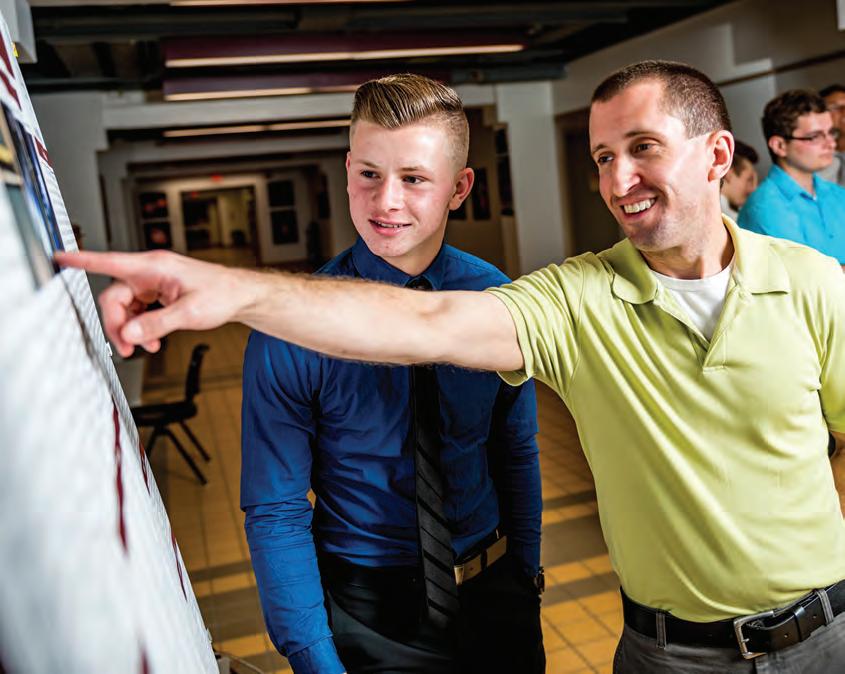
Each school year, student teams complete a year-long Exemplary Student Research Program (ESRP) with scientists at Argonne National Laboratory near Chicago. During the summers of 2016 and 2014, Advanced Placement Physics students examined solar panel, battery efficiency and power output projects in Rose-Hulman’s Smart Lighting Project, and made technical presentations on campus.
“Being able to be flexible, alert and forward-thinking are skills that my students have taken away from the Smart Lighting experience with Rose-Hulman,” says Repa, who advises the school’s STEM Club. “Physics answers the questions of ‘Why?’ and ‘How?’ These are questions that everyone grapples with throughout life. Exposure to such thinking in high school can only benefit a student moving forward.”

Repa regularly waives calculus and honor-track prerequisite courses to enroll students in his AP Physics class, and shows students that they have the limitless potential to become a doctor, engineer or scientist.
“Mr. Repa provides life-changing opportunities for his students while making physics fresh and interesting,” says Kris Stopka (ME, 2015), one of nine former Oak Lawn students who have attended Rose-Hulman.
Of his role, Repa, the son of a kindergarten teacher, admits, “As a teacher there’s gratification in watching a student do what he or she never thought possible. I’ve been very fortunate in my career to work with a number of highly motivated and caring students. They have made my profession less of a job and more of a partnership. We are all trying to be change agents for the better. Seeing students come to this realization is both inspiring and powerful to me. It is the reason I come to school every day excited.” n
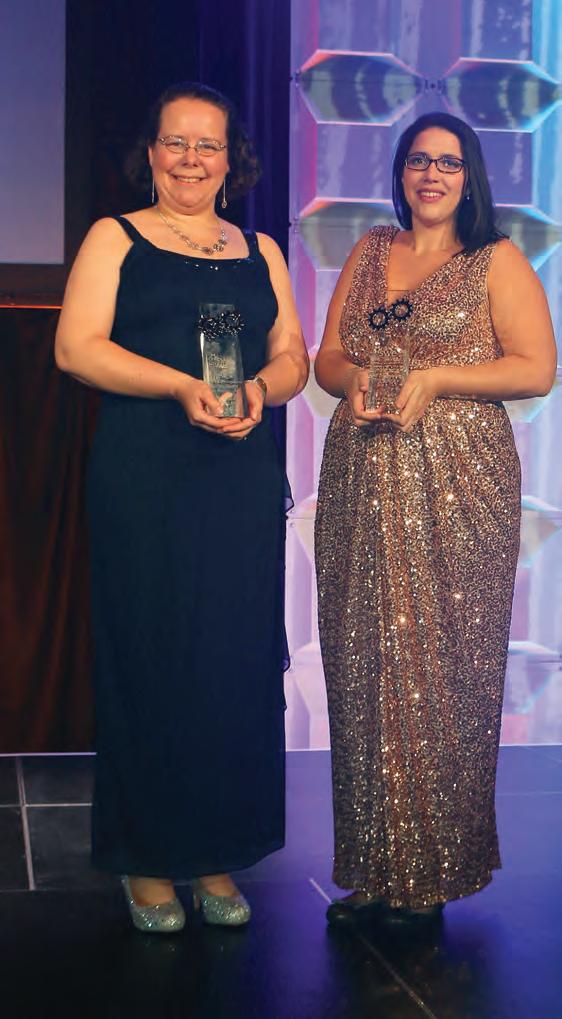
A decade after starting their own engineering careers, Rachel (Young) Borchers and Rebecca (Johnson) Reck are encouraging young girls to blaze their own trails as future engineers, scientists and mathematicians. Their efforts were recognized nationally this year when Borchers and Reck became Distinguished New Engineer Award recipients during the Society of Women Engineers (SWE) conference. The honor recognizes their technical performance and leadership within SWE and their communities.
Borchers (CHE, 2006) has developed a partnership between SWE and the Girl Scouts in the Minnesota and Wisconsin River Valley areas, with a focus on delivering science, technology, engineering and math (STEM) programming across all age ranges. She organized “Wow! That’s Engineering” and “Spark! Slime! Speed!” outreach programs that have taught Girl Scouts STEM principles.
A “Design Your Future” program, aligning within the Girl Scouts’ Product Designer Badge, has become a
staple of STEM youth educational programming in the Minneapolis-St. Paul area, where Borchers is a principal supplier quality engineer for Boston Scientific Corporation’s cardiac rhythm management division.
At the same time, Reck (EE, 2005) has been an instrumental mentor as a judge for Future Cities and FIRST Robotics events, and has led STEM programming for Girl Scouts and Boy Scouts chapters. The first-year Kettering University mechanical engineering assistant professor also has been a national, regional and local SWE volunteer.
“These leaders are making it possible to remain a catalyst for change as we work together to empower women in STEM and close the gender gap in engineering,” says SWE President Jessica Rannow.
Borchers sought out SWE as a way to become acclimated to people and businesses after moving to the Twin Cities area. She became instrumental in SWE’s Minnesota Section outreach efforts, and was the section’s president in 2016 after being vice president a year earlier. She has been involved in developing strategic planning, youth outreach and professional development for the organization and its membership, which now includes more than 500 engineers.
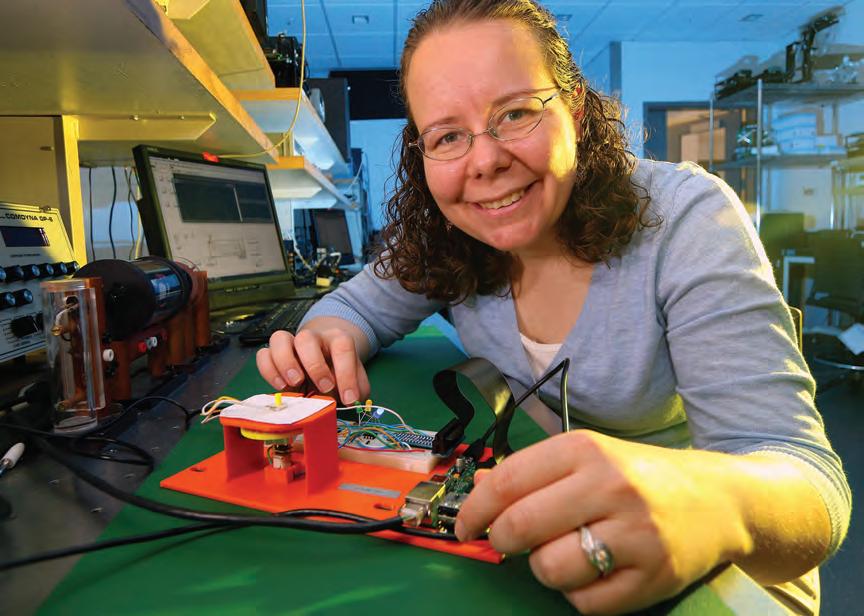
Outside of SWE, Borchers has been a Girl Scouts troop leader since 2010 and plans to mentor these teenage girls through high school.
Rebecca (Johnson) Reck, an assistant mechanical engineering professor at Kettering University, has developed an affordable and portable kit to improve student access to hands-on engineering laboratories.
STORY BY DALE LONG
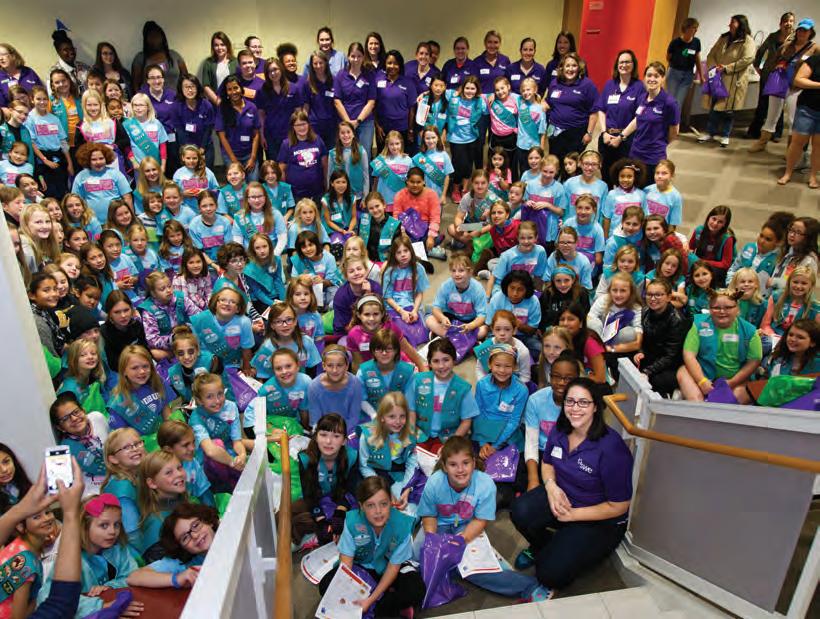
“I encourage the girls to try new things and pursue their interests. They are learning to be active participants in their community and role models for younger girl scouts,” says Borchers.
Professionally, Borchers focuses on developing chemical and electronic sub-components use in longterm, implantable, life-sustaining devices. One recent project is an innovative new primary chemical battery for medical devices that Boston Scientific launched in 2014. She also has taken on increased responsibility for driving quality system efficiencies and business process improvements, supporting a divisional team of more than 40 engineers, and a global team of more than 100 engineers.
Meanwhile, Reck designed control systems for business and regional jet aircraft as a senior systems engineer for Rockwell Collins. As
a doctoral student at the University of Illinois at Urbana-Champaign, she developed an affordable and portable kit to give college students access to hands-on engineering labs. She also has been a national, regional, and local SWE volunteer.
At Kettering, Reck is teaching courses in dynamic systems and introduction to mechanical design.
“As I begin a new phase of my career, in academia, I hope to be able to make similar technical contributions to advance engineering education and help prepare my students to thrive as engineers and leaders in their career as well,” Reck says. n
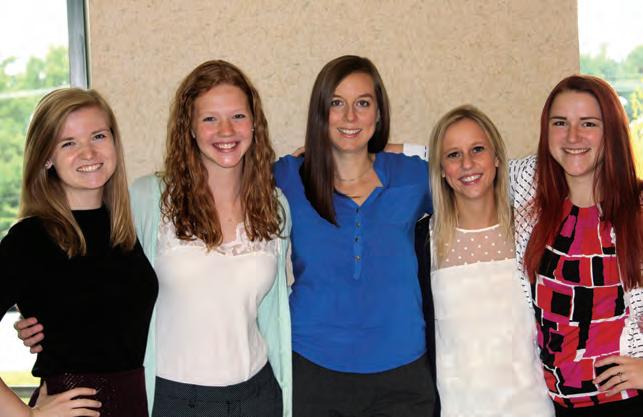
Alumnae with Cook Pharmica are providing pathways for other female Rose-Hulman students to follow in their footsteps toward science, technology, engineering and math (STEM) careers.
In 2008, Sophia Percival (BE, 2009) was a validation intern at Cook Pharmica’s plant in Bloomington, Ind. The company’s internship program was in its infancy, and she was one of the first Rose-Hulman female students tapped to participate. It was such a worthwhile summer experience, with an encouraging female STEM mentor, that Percival hoped to pave the way for others to follow—from Rose-Hulman.
“A mentor can have a significant impact on an intern. My mentor, Migdalia, was the first person I would seek out to ask for help or more things to do. She was strong and confident with many years of pharmaceutical industry experience. It was hard to say goodbye to her at the end of the summer.”
So, Percival hoped to be an inspirational influence when she had the opportunity to mentor technical services interns Adriana Rubycz (CHE, 2014) and Kara Davis (CHE, 2016). Both made considerable contributions, with Rubycz revitalizing the company’s New Client Survey to assess potential business clients. Meanwhile, Davis developed a set of spreadsheets that the Drug Product Technical Services Department still uses for tracking and trending metrics related to client projects.
“I learned how to function in a fast-paced business environment,” Rubycz remarks. “My internship
changed the way I organized my work and how I presented that work to others, and I’ve been using and evolving those skills ever since.”
Davis adds, “Having a female mentor absolutely helped me. It was great to see a young female (Percival) who is professional, successful and well-respected.”
Because of their contributions, Cook Pharmica hired Rubycz and Davis following their graduations.
Last summer, the mentorship role was paid forward again as Percival and Rubycz helped current engineering students Jayme Brace and Sydney Rodenbeck as company interns.
“Hopefully, one day all girls will grow up knowing that they can be an engineer if they want, and I would love to play a role in that happening,” says Brace, a senior.
Alumnae wanting to explore mentorship opportunities for their companies should contact Rose-Hulman’s Office of Career Services at www.rose-hulman.edu/careerservices.
Nationally, women are a distinct minority among engineering, tenuretrack faculty, accounting for just 15.7 percent of this sector in 2015. Efforts to alter that picture are bearing fruit at Rose-Hulman, which has set new records this year, exceeding the national average. Females now account for 20 percent of the institute’s tenured and tenure-track engineering faculty.
“We want our faculty to reflect the changing workplace demographics nationally,” says Anne Houtman, vice president for academic affairs.
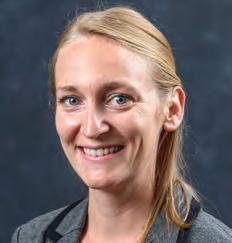
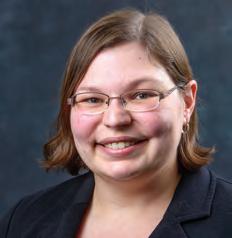
Five female professors joined the faculty for 2016-17, including alumnae Megan (Knilands) Heyman (MA, 2008), assistant professor of mathematics, and Amanda (Stephan) Stouder (CS, 2008), assistant professor for the practice of computer science and software engineering.
There was a time when Indianapolis was derided as “Naptown.” No longer. Indiana’s capital city is developing a reputation as a vibrant tech hub with an enterprising startup culture and quality of life that are attracting the best and brightest talent.
Last year, while referring to Indiana as a “Silicon Prairie,” then-Governor Mike Pence boasted that tech jobs in the state had grown at triple the national average. Meanwhile, Indianapolis is now considered one of the best places in the nation for tech college graduates, No. 5 for women in tech and a top-10 city for creating tech jobs.

TechPoint, which promotes Indiana’s technology community, estimates that the tech sector contributes about $14 billion annually to the state’s gross regional product. A study shows that information technology (IT) jobs grew by 17 percent from 2009 to 2014 and that central Indiana gained more than 5,000 computer and IT jobs during those years.
ZipRecruiter, a job search engine, lists Indianapolis as an up-and-coming city for tech jobs. “One of the things we were surprised about is there are some bright spots in the upper Midwest, and Indianapolis is one of them,” says Scott Garner, corporate communications manager for ZipRecruiter. “It goes back to technology. If you can live in Indianapolis and still work for a top-tier tech company, why wouldn’t you?”
Lyle Carlson agrees. The 1991 computer engineering alumnus moved to Indianapolis to join the management team at cybersecurity and risk management company
Edgile, after 20 years in the management consulting business. He’s now the firm’s national managing partner, working to solve the most challenging cyber risk issues for leading companies, including some run by Rose-Hulman alumni.
Edgile’s revenue grew from $7 million in 2011 to $50 million in 2016 by helping chief security officers with their governance, risk, identity management and cybersecurity programs. The company recently accepted a $35-million private equity investment by ABRY Partners and is ranked among Inc. magazine’s 2016 list of fastest-growing private companies. That is, says Carlson, as long as he continues to win over enough talented engineers and computer programmers for the company’s world-class team in Indianapolis and other tech hubs to drive potential business opportunities with current and future Fortune 500 clients.
“Talent is one of the biggest challenges for every company,” says Carlson, who has helped Edgile hire 10 Rose-Hulman graduates during the past two years, with five more expected this year. “There’s zero unemployment in the cybersecurity high-tech sector. People with those skills have the golden ticket in our business. Fortunately, our customer-focused business model, innovative culture and dedication to growing our employee’s opportunities as we grow the firm attracts some of the best and brightest in the business.”
The competition for talent is a challenge shared by other technology entities. One way the city stands out, according to Carlson, is its very affordable cost of living, especially for those just starting their tech careers. Proving this point, four of the five Rose-Hulman graduates this year selected Indianapolis over other Edgile locations such as Chicago, New York, Dallas and San Francisco. A recent study, “American Business Expansion to 2020,” conducted by the Economist Intelligence Unit and sponsored by the Indiana Economic Development Corporation, found that IT and technology executives are most motivated by enhancing the quality of life for their workforce (67 percent) when making relocation and expansion decisions.
“There’s this really unique ability to have a great tech career here, along with a great quality of life,” says TechPoint Chief Executive Officer and President Mike Langellier. n
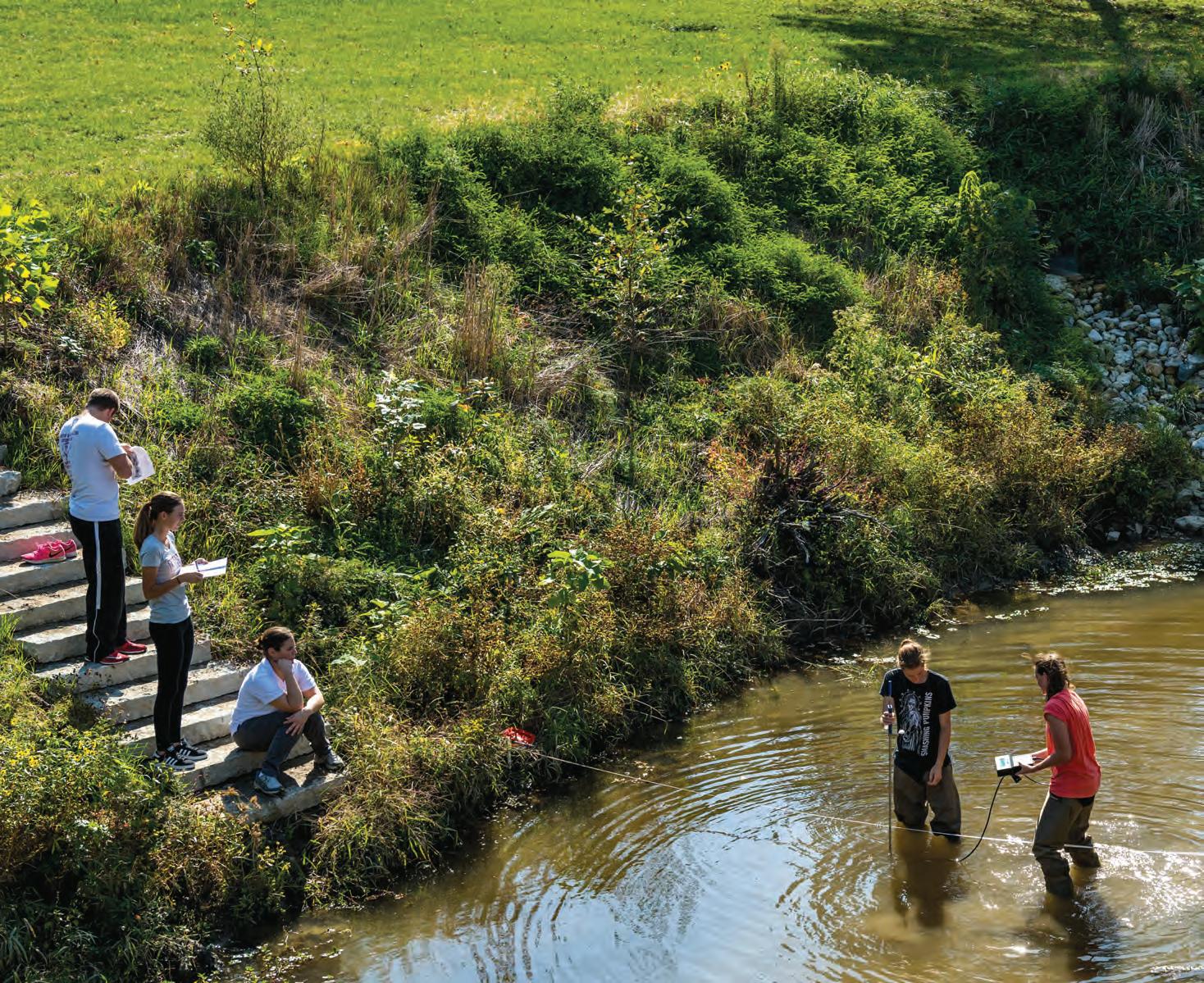
LOST CREEK MEANDERED THROUGH THE CAMPUS LANDSCAPE LONG BEFORE STUDENTS FILLED ROSE-HULMAN’S CLASSROOM BUILDINGS, RESIDENCE HALLS AND ATHLETIC ARENAS. BUT THANKS TO A RECENT COMPENSATORY MITIGATION PROJECT, THE WATERWAY IS TAKING ON A NEW LIFE AND EXPANDING OUTDOOR EDUCATION OPPORTUNITIES.
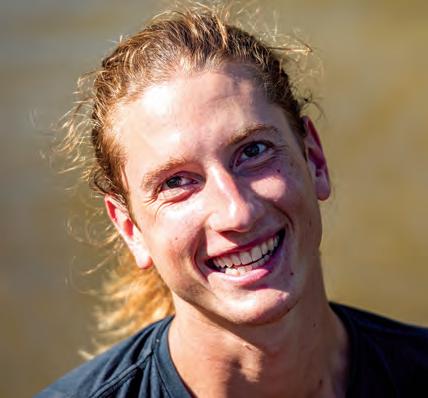
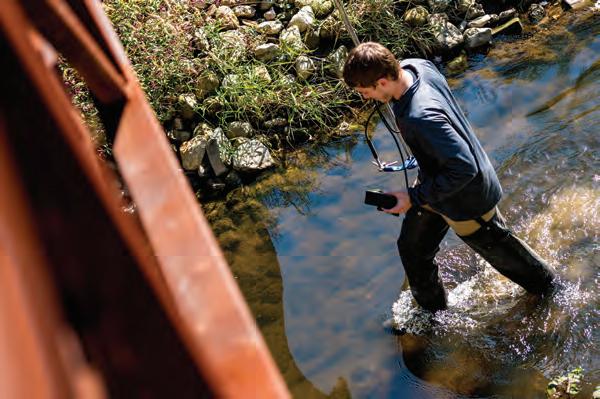
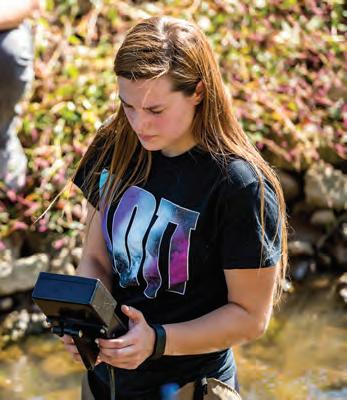
Wetland losses associated with the Indiana 641 highway bypass resulted in federal and state entities restoring or creating new wetlands along Lost Creek on campus. This meant that trees and overgrown vegetation were cleared, bridges replaced, erosion control measures placed, creek banks widened and shored up, and accessibility improved.
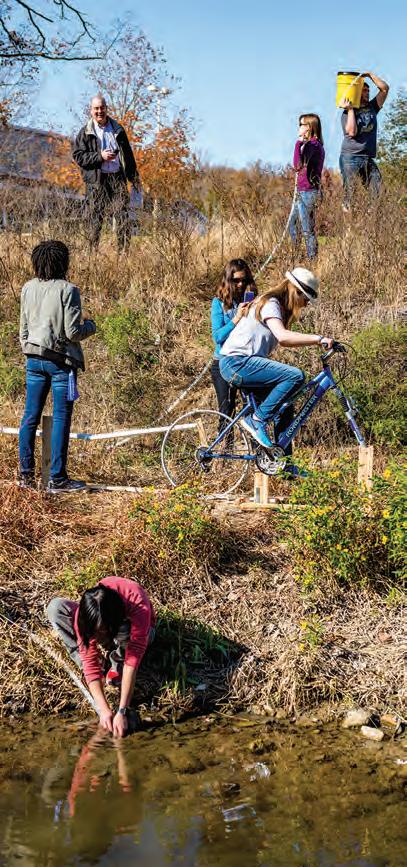
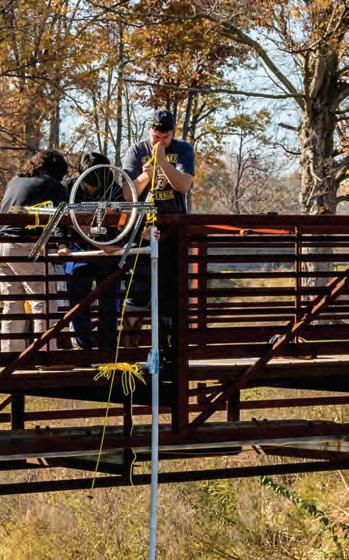
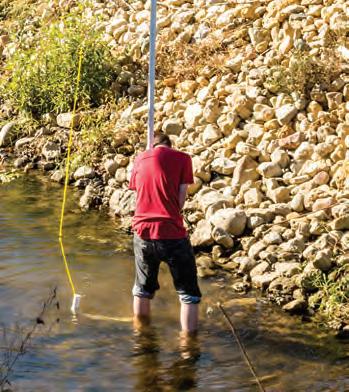
“Lost Creek has taken on a vibrant new life and has grown as a great outdoor classroom,” says Jennifer Mueller Price, associate professor of civil engineering and environmental engineering.
“ Our students are so fortunate to have this gem of a resource in our backyard.”
Students in her hydraulic engineering courses spent last fall examining water quality and habitat characteristics—measuring water flow and velocity and analyzing sediment concentrations at several locations along the one-mile stretch of the creek’s campus route.
“Our students are learning that the creek is a dynamic ecosystem,” says Mueller Price.
The same is true of students assessing stream quality through water samples, bacterial counts and simple water chemistry in biology professor Ella Ingram’s ecology class. Added elements to these studies are the varieties of small bugs found along the creek and the fact that the creek receives storm water runoff from campus and nearby tributaries.
–Ella Ingram, Biology Professor
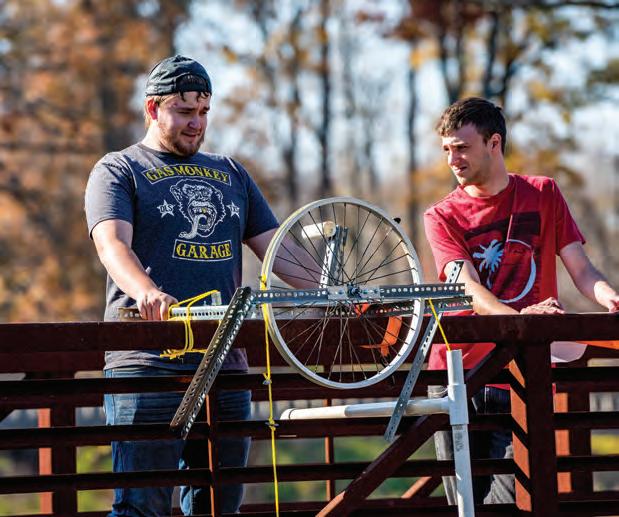
Lost Creek also served as a resource for student teams in another course that spent this fall experimenting with novel pumping mechanisms designed to provide ample water to villagers living “off the grid” on the banks of a small stream somewhere in the developing world. Hand and rope pump devices were created to bring water 12 feet above the creek to a makeshift filtering and distribution center.
The pumps were the final projects for an Appropriate Technologies for Developing Countries course taught by Andy Mech (mechanical engineering), Wayne Padgett (electrical and computer engineering) and Michelle Marincel Payne (civil engineering). n
BY PROFESSOR EMERITUS HERB BAILEY
I continue to be encouraged by the number of solvers for each challenge, with a record 130 alumni and friends coming up with correct solutions from the Fall Challenge. Some may find the problems in this issue more difficult. Good luck!
A glass is full of water. The total weight of the glass and water is 12 ounces. After drinking half of the water, the weight of glass and remaining water is 7 ounces. What is the weight of the glass in ounces?
Let A, B and C be equilateral triangles such that A has a side length of 4 and the sum of the areas of B and C is equal to the area of A. Find the side lengths of B and C.
Starting at the same time from diametrically opposite points, Linda and David travel around a circular track at uniform speeds, their speeds need not be equal. They travel in opposite directions, one clockwise and the other counterclockwise. They first meet after David has traveled 100 yards and meet a second time 40 yards before Linda completes one lap. Find the radius of the track.
Problem 2: O = 2, N = 3, E = 1, T = 4 and W = 6 or O = 4, N = 3, E = 2, T = 8, and W = 6.
Bonus Problem: Given the trapezoid ABCD with BC = AB + CD, the rectangle DCEF with DF = AB and the square ADGH. Find the area of the square if the area of the rectangle is 17.
Bonus Solution: Construct BJ perpendicular to CD. We have BJ2 + JC2 = BC2 or AD2 + (CD-AB)2 = (CD+AB)2, or AD2 = 4(AB)(CD). Thus the area of the square is 68.
Send your solutions to Herb.Bailey@rose-hulman.edu or to Herb Bailey, 6990 E. County Road 100 N., Apt. 207, Avon, IN, 46123. Alumni should include their class year.
Congratulations to the following solvers of the fall problems:
ALUMNI: T. Jones, 1949; C. Hirshfield, 1954; J. Verdeyen, 1954; B. Hall, 1955; J. Moser, 1956, D. Carrell, 1957; Brown, 1957; C. Ambuehl, 1958; D. Bailey, 1959; J. Kirk, 1960; J. Tindall, 1961; N. Hannum, 1962; B. Lovell, 1963; R. Susemichel, 1963; A. Cleek, 1964; D. Moore, 1964; S. James, 1965; B. Kevorkian, 1966; D. Wray, 1967; T. McLeish, 1968; R. Dutton, 1969; T. Bumgardner, 1970; D. Moulton, 1970; D. Jordan, 1971; W. Pelz, 1971; S. Sample, 1971; D. Hagar, 1972; T. Nelson, 1972; J. Sanders, 1972; B. Schacht, 1972; D. Bryant, 1973; R. Collins, 1973; E. Engelman, 1973; R. Kominiarek, 1973; S. Koss, 1973; D. Wheaton, 1974; P. Eck, 1975; M. Bailey, 1976; B. Hunt, 1976; J. Jordan, 1976; J. Schroeder, 1976; W. Bayles, 1977; P. Van de Motter, 1977; T. Greer, 1978; S. Warner, 1978; J. Thompson, 1979; J. Slupesky, 1979; D. Engelhardt, 1980; R. Joyner, 1980; J. Koechling, 1980; J. Skinner, 1980; P. Gunn, 1981; S. Nolan, 1981; M. Taylor, 1982; B. Downs, 1983; T. Endress, 1983; B. Geen, 1983; J. Marun, 1983; R. Priem, 1983; S. Guinther, 1984; M. Saltsgaver, 1984; D. Smith, 1985; L. Beckman, 1986; M. Lancaster, 1987; C. Abdnour, 1989; J. Eiler, 1989; J. Jachim, 1989; M. Vassil, 1989; J. Allen, 1990; E. Cegielski, 1990; K. Steele, 1990; B. Burger, 1991; B. Heinz, 1991; R. Hochstetler, 1991; P. Kimmerle, 1991; L. Moon, 1991; C. Schlimm, 1991; R. Wilkinson, 1991; J. Zamora, 1991; B. Geene, 1993; E. Geib, 1993; M. Ray, 1993; E. Rector, 1995; D. Wiscaver, 1995; S. Franklin, 1998; M. Pilcher, 1998; C. Ehrhart, 1999; R. Archer, 2000; P. Seyler, 2002; B. Hirsch, 2004; C. Krepps, 2004; B. Ross, 2004; J. Somann, 2004; J. Lange, 2005; S. Tourville, 2005; J. Trojan, 2005; A. Siebenthaler, 2006; T. Homan, 2007; J. Krall, 2007; M. Trowbridge, 2008; D. Schoumacher, 2010; M. Schoumacher, 2010; D. Straub, 2010; A. Cleek, 2013; P. Jarnatt, 2013; and E. Yuhas, 2015. FRIENDS: D. Archer, S. Bonney, E. Boyer, E. Brock, H. Cao, T. Cutaia, A. Doti, C. Estill, N. Estill, A. Foulkes, D. Harke, P. Hines, A. Kremer, L. Kulbago, T. Kulbago, J. Ley, J. Marks, L. Metcalfe, D. Moulton, P. Nilsen, M. Rosene, A. Siebenthaler, N. Susemichel, D. Voltmer and M. Wittstein.

Wolfgang Pelz fondly recalls his first experiences on the Rose Polytechnic campus in the fall of 1967 as if they happened yesterday. That’s when he sat in a Crapo Hall classroom and learned the elements of calculus from veteran math professor Herb Bailey.
“I enjoyed his lectures and was impressed with his obvious concern for the students. He was always available for assistance and advice throughout my undergraduate career,” says Pelz (MA, 1971).
Bailey was one of several Rose Poly educators who inspired Pelz to become a math, statistics and computer science professor who enjoyed a 32-year career at the University of Akron. The former head of the Department of Computer Science as well as an Intellectual Property Center Fellow, Pelz now holds the title of professor emeritus at the Ohio institution.
And, he’s been an avid solver of the Bailey Challenge since its inception. In fact, the math problems are his favorite section of Echoes
“Reading about Rose-Hulman’s activities is interesting, but I’ve always enjoyed problem solving,” says Pelz.
He likes the variety of logic-based, geometric and analytical problems offered in each Bailey Challenge.
“The common theme is that the solutions require thought and creativity more than knowledge of some sophisticated mathematics. I seem to struggle more with geometric problems than with other types,” Pelz remarks.
In retirement, the career educator spends time solving Sudoku and Jumble number and word problems, and, more recently, the electronic game Flow Free. He’s also in the process of learning a foreign language using the Duolingo software app.
After all, as Pelz says, “It’s another challenge.”
The new year has brought a new name and focus for the Office of Alumni Relations (formerly Alumni Affairs) to more accurately reflect the relationship between the office and alumni, students and friends, along with staff’s role in supporting alumni in meeting Rose-Hulman’s long-term goals.
“We will continue to provide outstanding programing, events and communication to engage and connect alumni, students, parents and friends both on campus and worldwide in support of this great institution,” says Ben Paolillo, executive director of alumni relations.
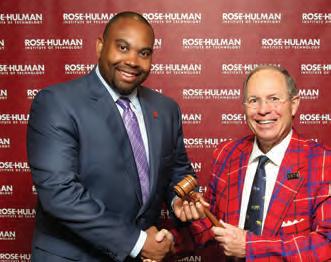
Taking the gavel as Alumni Advisory Board President at Homecoming 2016 was the next step in Dedric Day’s commitment as an active alumnus.
Also a leader in the Indianapolis community and professional engineer with Eli Lilly and Company, Day (CHE, 2003) has been an advisory board member since 2012 and has had leadership roles as the group’s secretary (2014-15) and vice president (2015-16). In addition, the former varsity student-athlete has chaired the Varsity R Advisory Board.
In the Indianapolis community, Day has been a member of the Minority Engineering Program since 2006, has twice been a finalist for Junior Achievement of Central Indiana’s Indy’s Best and Brightest Award (2014 and 2012), received the Golden Sneaker Award from the Juvenile Diabetes Research Foundation and has been named to the Indiana Blood Center’s Wall of Honor.
Day has been an Eli Lilly employee since graduating from Rose-Hulman, elevating in responsibility within the engineering team. He became manager of tech services/ manufacturing sciences for the company’s global injection molding division in November 2015, and he’s a certified Lean Six Sigma Black Belt.
Other members of the Alumni Advisory Board’s leadership team include Jim Gidcumb (CHE, 1976), past president; Dan Price (CE, 1975), vice president; and Greg Gotwald (CHE, 2001), secretary.
President Jim Conwell will update alumni, family members and guests about the institute and its future plans during upcoming Rose-on-the-Road events in the following communities:
Houston
Washington, D.C.
Chicago
Detroit
Cincinnati
February
April
June
August
October
Printed and e-mail invitations will be sent to all area alumni prior to each event.
A total of 27 alumni have put their names on the President’s Graduates Of The Last Decade (G.O.L.D.) list of distinction after making cumulative gifts worth $5,000 or more to the institute within the first 10 years of graduation. Four of the most recent additions to the list were recognized during Homecoming 2016: Keenan Long (ME, 2010), an engineer with Easton Sports’ baseball/softball division; Jennifer Morrison (EE, 2006), an engineer with Technology Service Corporation; Alexander Mullans (SE/CS, 2013), a program manager for Microsoft; and Stefani Vande Lune (BSAB, 2006; MSBE, 2008), a first-year student at Indiana University School of Medicine.
A Rose² Valentine’s Day reception for central Indiana alumni couples is being planned on February 11 at Tastings, a modern, artsy bistro in downtown Indianapolis offering wine tastings plus a menu of tapas, flatbreads and cheese plates.
Other Indianapolis events planned for 2017 include the Indianapolis 500 Pole Day, May 21; 101st Indianapolis 500, May 28; Alumni and Friends Picnic, Indianapolis Indians vs. Louisville Bats, July 1; and Rose-Hulman Day, Indianapolis Children’s Museum, August.
Now in its third year, Attitude of Gratitude Week (March 27 to April 1) is a time for Rose-Hulman and its current students to recognize the many contributions of alumni, family and friends toward the institute’s success. Philanthropy is a learned behavior, which is why it is important to teach students about giving back to the college during their undergraduate years, according to Steven Brady, vice president for institutional advancement. Learn more about what’s being planned this year at rosestem.rose-hulman.edu/AOG.
Here are other events alumni may be interested in attending this year:
139th Rose-Hulman Commencement May 27
Details for all upcoming events can be found at rosestem.rose-hulman.edu/AlumniEvents

Hotel information can be found at www.rose-hulman.edu/homecoming
Never one to shy away from a challenge in his 35-year career with Caterpillar, Inc., Jim Umpleby is now striving to keep the company a leader in the global heavy equipment manufacturing marketplace and darling of Wall Street investors.
The 58-year-old mechanical engineering alumnus became Caterpillar’s chief executive officer earlier this year, succeeding the retiring Doug Oberhelman. He is the 15th CEO in the company’s 91-year history, and first Rose-Hulman graduate to lead a Fortune 100 company.
Since 2013, Umpleby had presided over Caterpillar’s engines business, a division that has accounted for up to two-thirds of the company’s annual operating profit in recent years and 40 percent of its equipment sales.
Now, he’s looking to identify growth areas in Caterpillar’s cyclical markets as sales of earthmoving and mining equipment have declined for four consecutive years, with more weak sales expected in 2017. The company’s restructuring plan has cut nearly 14,000 jobs worldwide since mid-2015.
Brent crude futures, the global oil price benchmark, have been on a decline for nearly five years. This has significantly impacted the sale of reciprocating engines used for gas gathering, drilling, well servicing and production, according to Umpleby. He’s optimistic that sales have bottomed in several of the company’s markets overseas.
“I have been privileged to work with Caterpillar employees and dealers in supporting our customers as they develop the world’s infrastructure
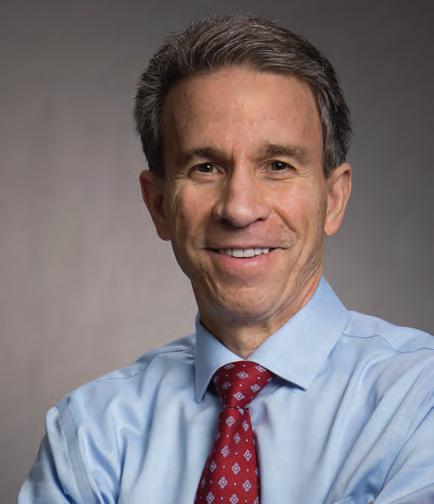
and improve standards of living and quality of life,” Umpleby remarked in a company statement.
“I look forward to leading our dedicated team as we build upon the accomplishments of those that have come before us.”
Through Caterpillar’s recent struggles, the company has consistently provided its investors with a quarterly dividend.
Caterpillar spokeswoman Rachel Potts says Umpleby “is committed to Caterpillar and making this company stronger for the future.”
After graduating from Rose-Hulman in 1980, Umpleby joined San Diego-based Solar Turbines Inc., a Caterpillar subsidiary that has become one of the world’s leading manufacturers of industrial gas turbine systems. He held numerous positions of increasing responsibility in engineering, manufacturing, sales, marketing, and customer
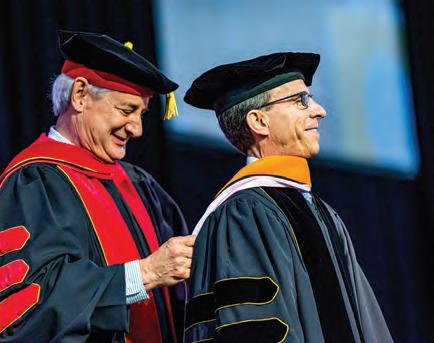
services with the division. Umpleby has lived and worked in a variety of positions in the U.S. and Asia, where he accepted assignments in places such as Singapore and Kuala Lumpur from 1984 to 1990.
Umpleby was elected a Caterpillar vice president and president of Solar Turbines in 2010, and became a group president and a member of Caterpillar’s executive office in early 2013, moving to the company’s headquarters in Peoria, Ill. He serves on the board of directors of the World Resource Institute and U.S.-India Business Council, and Rose-Hulman’s Board of Trustees.
The Highland, Ind., native and former Rose-Hulman student body president was awarded an honorary doctorate of engineering degree during Rose-Hulman’s 2016 Commencement, and he received the Alumni Association’s Career Achievement Award in 2000.
As chairman and chief executive officer of Edwards Lifesciences Corp., Michael Mussallem (CHE, 1974; HD, 1999) ranks among Facebook’s Mark Zuckerberg, Amazon’s Jeff Bezos and Apple’s Tim Cook as one of America’s top business leaders. In fact, Mussallem has been named to Fortune magazine’s list of the top 50 businesspersons of the year for 2016, based on the magazine’s review of company profits, revenues and stock performance, along with factors such as return on capital and debt. Edwards Lifesciences is a world leader in heart valve technologies. Mussallem has headed the Irvine, California-based company since it was spun off from Baxter International in 2000.
Mike Mussallem has led Edwards Lifesciences to become a world leader in heart value technologies. Agnes Berzsenyi is poised to continue impacting health care throughout the world.
Bringing new health care products to market and delivering new software to customers, GE Healthcare vice president Agnes Berzsenyi (MSME, 1995) has built a career as a rock star technical leader. That’s why she was named among America’s 100 “Women to Watch” in business for 2016 by Bizwomen magazine. The native of Hungary leads an 80-member product management team at GE locations around the world. The two products Berzsenyi is most credited with advancing are the Vscan pocket-size ultrasound unit and Dosewatch, which measures cumulative radiation doses a patient receives through computerized tomography (CT) scans. She joined GE’s technical leadership program through a job fair at Rose-Hulman. She started in the aviation business before transitioning to health care and moving in 2007 to GE Healthcare. A mother of two teenage girls, Berzsenyi finds time to mentor women within GE as well as encourage middle school girls to enter technical fields through the company’s GE Girls program.
Alpha Tau Omega fraternity members made this year’s homecoming even more special by dedicating the conference room of Hatfield Hall’s Office of Institutional Advancement in honor of Ronald G. Reeves (EE, 1958). In his role as “Mr. Rose-Hulman,” Reeves was an inspirational campus leader for 30 years (24 as vice president of development) who helped raise the necessary funds to improve the institute and raise its stature in higher education. “Thanks to ATO members’ generosity, the Ronald G. Reeves Conference Room recognizes the foundation built by Ron and others,” says Vice President for Institutional Advancement Steve Brady.
The room will serve as a place where the institutional advancement staff can gather to work on serving the institute’s future needs.
Kathleen A. O’Brien (MA, 1969), an ordained interfaith minister and LGBT issue expert, is chief executive officer of a diversity training program (www.transgendertherapist.com) and presents educational programs at churches throughout the country.
Jed Holt (CE, 1970) is a professional engineer mentor for Rose-Hulman’s Engineers Without Borders student chapter, providing technical assistance to students building public latrines in the village of Gomoa Gyaman, Ghana.
Ronald Kicinski (ME, 1975) was elected one of three directors for the Indian Wells Valley Water District near Rivercrest, Calif., where he resides. He was the maintenance department manager for more than 30 years at a chemical production plant.
Timothy E. Voegele (CHE, 1977) is chief investment officer for Indiana-based Treybourne Wealth Planners after founding and being president of Acuity Financial Advisors. He formerly worked in engineering, manufacturing and finance with Eli Lilly and Co. for more than 30 years.
Jerry Douglas (CHEM, 1978) is the chief medical officer for three clinics comprising the Mendocino Community Health Center in Ukiah, Calif. He is a board certified family physician.
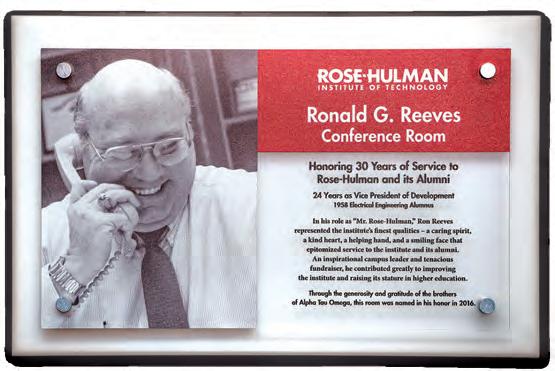
David L. Perrings (CE, 1978) and Michael J. Schipper (CE, 1982) were members of the American Society of Civil Engineers’ Committee on American Infrastructure that developed the ASCE 2017 Infrastructure Report Card.
Kenneth J. Hilk (ME, 1981) is chief executive officer of VetsLinQ, Inc., a new business-oriented social media networking portal providing networking opportunities for businesses owned by military veterans. He formerly spent 31 years in corporate business leadership, marketing and operations at DuPont Co.
Scott McLaughlin (ME, 1981) is managing partner for McLaughlin & Associates Thermal Spray, Inc., a manufacturer’s representative specializing in thermal spray industrial coatings. The company has relocated to Carmel, Ind., from Naperville, Ill.
John T. Kloosterman (ME, 1982) has retired after nearly 33 years with Marathon Oil Company.
Steve Spicklemire (PH, 1983), head of the Department of Physics and Earth-Space Science at the University of Indianapolis, received the university’s faculty achievement award for outstanding contributions to the university, his profession and the community.

Curtiss W. White (CE, 1984) has brought 30 years of experience in planning, design and construction of public works projects as senior project manager for Midwestern Engineers Inc. He currently is president of the Indiana chapter of the Construction Management Association of America.
David L. Lakey (CHEM, 1986) is the senior vice president for population health at University of Texas Health and associate vice chancellor for the University of Texas System. In these roles he will focus on population health, with the goal of improving health outcomes throughout Texas. Lakey, former commissioner of the Texas Department of State Health Services, is a nationally known physician and expert on disease prevention, family and community health services, and environmental and consumer safety, as well as infectious disease outbreaks and bioterrorism preparedness.
Ross Johnston (MA, 1989) is the director of fringe benefit administration and Affordable Care Act (ACA) operations for Medcom, a leading provider of ACA reporting. He has worked in the information technology sector for more than 20 years.
Jeffrey S. Pahl (EE, 1991) is now an MR test equipment engineer with GE Healthcare in Waukesha, Wis.
Adam Razavian (MSEE, 1995) is director of integrated missions systems for General Dynamics’ mission systems division. He leads strategic direction, operations and business development for naval surface ship and submarine platforms. He formerly was technical director of the Naval Surface Warfare Center in Crane, Ind.
Kevin M. Unger (EE, 1996) has become the assistant vice president of the electronic warfare (EW) division at SRC, Inc. In his new role, Unger will focus on helping define the strategic vision for EW with the Syracuse, N.Y.-based company, and international business development for the division. He has been a member of the SRC team for 20 years and has extensive experience in the EW and intelligence communities.
Mark A. Stangl (ME, 1997) is now global marketing manager for Timken Co., focusing on the firm’s long-term plan for the automotive aftermarket and commercial vehicle cradle-to-grave strategy. He has had several positions with the company since graduation, most recently serving as business manager for rail products.
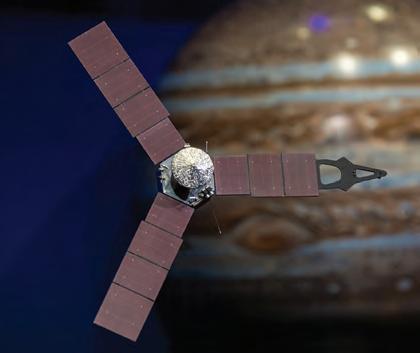
Andrew M. Cain (ME, 1999) is an executive officer on the U.S. Navy’s tactical readiness evaluation team.
Deborah Kroll (ME, 2000) is working as a Kybba-contracted design release engineer in the development of Fiat Chrysler Automobiles’ current and future Jeep Wrangler program.
Christina (Forsyth) Drake (EE, 2002) was featured in the National Collegiate Athletic Association’s “Life After the Game” Series (www.ncaa.org/ student-athletes/ former-student-athlete/christina-drake-lightingway), highlighting former college student-athletes who have done impactful work in their careers. She is a team leader for Midcontinent Independent System Operator, an Indiana-based nonprofit providing and monitoring high-voltage energy transmission in the U.S. and Canada.

Michael Henderson (CPE, 2002) has committed to a lifetime of cross-cultural work overseas. His family completed an outreach program in East Africa and transitioned to North Africa in January.
Sean McCue (CS, 2002) is a program manager for Google Fiber in the New York City area. He formerly was a program manager for Google.
Jennifer (Anderson) Mrzlack (ME, 2002) is the vice president of technology strategy for Heeter, a printing company located in the Pittsburgh area. She formerly was co-founder and head of business development of Naturi, an artisanal organic Greek yogurt.
Kevin Knue (ME, 2005) is development manager for Duke Realty’s healthcare team, helping secure new business opportunities while managing existing client projects. He spent several years working on some of the company’s most prestigious industrial and healthcare developments.
Karl Ammerman is helping expand our knowledge of the solar system through NASA’s Juno space probe that’s providing scientists a close-up view of Jupiter.
As a software engineer with Lockheed Martin Space System Company’s space exploration systems division, the 1996 computer engineering alumnus developed and implemented interface flight software that’s critical to the probe uncovering mysteries involving the composition of Jupiter and its moons. Juno has been transmitting high-resolution images and data from scientific experiments since July, and the mission will continue through February 2018. Ammerman has been with Lockheed Martin since 2003.
Learn more about his role in the June project at bit.ly/echoes2017d

Stefani Vande Lune (BSAB, 2006; MSBE, 2008) received the Office of Student Affairs’ Jess Lucas Alumni Leadership Award for career achievements. She earned a law degree from George Washington University, was an intellectual property litigator for a Washington, D.C., law firm and is now a first-year medical school student at Indiana University-South Bend.
Matthew D. Lovell (CE, 2006) earned the American Society of Civil Engineers’ Region 4 Daniel V. Terrell Award for his paper “The Engineer’s Ethical Obligation When Working in a Foreign Location.” He is an assistant professor of civil engineering at Rose-Hulman.
Eric Wojak (CE, 2006) has earned a Master in Business Administration from Indiana State University.
Sarah M. Farlow (CE, 2010) is the new engineer for the LaGrange County (Ind.) Highway Department. She formerly was an engineer with the Indiana Department of Transportation’s Fort Wayne district.
Arnold Yim (MA, 2010) is an assistant professor of mathematics at Bridgewater College (Va.) after earning a doctorate from Purdue University. His research interest is algebraic geometry topics related to hyperplane arrangements, tropical geometry and dynamical systems.
Cheyenne Arrowsling (BE, 2011) is now a field service engineer at Avedro.
Christian Hidden (CE, 2011) is a project estimator for Doerre Construction Co. in Charlotte, N.C. He formerly was a business development manager for Performance Structural Concrete Solutions.
Mindy Grupe (CE, 2011) is a hydraulics engineer for the U.S. Army Corps of Engineers’ district office in Rock Island, Ill. She had spent three years as a civil engineer and water control manager for the Corps of Engineers’ Los Angeles district.
Debra Davis-Brutchen (BSBE, 2012/MSEM, 2013) has earned a Master of Law degree in intellectual property law from the University of Dayton’s School of Law. She lives in Dayton, Ohio, and is a contract specialist with the Air Force Research Lab at Wright-Patterson Air Force Base.
Andrew Jordan (ME, 2012) has earned a Master of Business Administration from Millikin University in Decatur, Ill., where he lives and is a senior design engineer for protein systems at The GSI Group, Inc.
Liz Evans (BSEE/MA, 2013; MSEM, 2015) competed for a spot on the U.S. Olympic Team at the 2016 USA Track and Field Outdoor Championships, after posting a career-best high jump of 6’-11/4” this past spring. She eventually placed 18th with a 5’-101/2” leap.
Nick Birch (ME, 2014) is serving as Entrepreneur in Residence for Launch Terre Haute, a co-work space for innovative startups. He is a resource for Rose-Hulman’s Escalate program, a living-learning campus community of students interested in
Darin Moody’s career path with Eli Lilly and Company continues to advance, with the 1987 chemical engineering alumnus promoted to senior vice president of the company’s global active pharmaceutical ingredient, dry products manufacturing and continuous improvement division.
For the past nine years Moody has been responsible for global engineering and maintenance activity, as well as the Six Sigma initiative within Lilly’s manufacturing plants around the world. His international experiences also have included nearly three years in England as general manager of a plant in Liverpool and head of the operations center in Speke.
Moody also is a member of Rose-Hulman’s board of trustees and has been active in increasing diversity in the institute’s student body.
entrepreneurship, and RISE Club. He is co-founder and chief executive officer of PropelTeam.
Dustin Shoulders (ME, 2014) is an engineer for Hendrick Motorsports, working on Chase Elliott’s team in the NASCAR Sprint Cup Series. In his spare time he continues a dirt track racing career that has brought victories at tracks throughout the Midwest and South.
Thomas P. Foulkes (EE, 2015) has been awarded a five-year National Science Foundation graduate research fellowship. At the University of Illinois, he is developing ultra-high efficiency and compact power electronics for more-electric aircraft in collaboration with NASA’s Glenn Research Center.
Cody Roberts (MA, 2015) is a second-year medical student at the Virginia Tech School of Medicine, where he is working in the mechatronics lab within the College of Engineering to develop a system that could be used to improve sleep or exercise studies.
Marshall Yeoman (SE, 2015) finished 476th among 2,428 competitors this fall in the Louisville Ironman, a challenge requiring the former Rose-Hulman varsity swimmer to complete a 2.4-mile swim, 112-mile bicycle journey and 26.2-mile run.
James Tradup (CE, 2016) and Yan Zhu (CE, 2016) are new staff engineers for RQAW Corp., an Indianapolis-based consulting firm.
Former Board of Trustees Chair John V. Titsworth (ME, 1949; HD, 1980), 91, died on November 29, 2016, in Chanhassen, Minn. He was a longtime advocate of Rose-Hulman becoming a coeducational institution, asking those that had long opposed the move to “put aside all personal differences, and do what will be in the best interest of the college.” As chairman, he played a key behind-the-scenes role in working with the campus community, alumni and other key constituents in order to eventually gain the trustees’ affirmative coeducation vote in 1991. An executive with the Xerox and Control Data corporations, Titsworth had a reputation as a shrewd and caring business leader. He wrote two books about corporate America and frequently returned to campus as an executive-in-residence. Titsworth was a native of Robinson, Ill.
John E. Bartmess (ME, 1941), 98, died on Oct. 12, 2016, in Cincinnati, Ohio. He retired as an engineer and salesman for Westinghouse Electric Corp.
Lyndon E. Eberly, Jr. (ME, 1947), 94, died on March 4, 2016, in Maysville, Ky. He was honored as a Kentucky Colonel.
James C. Hoskinson (ME, 1947), 93, died on Oct. 12, 2016, in St. Albans, W.Va. He retired from Union Carbide.
Ralph A. Mitchell (CE, 1947), 93, died on Aug. 8, 2016, in Brownstown, Ind. He was a professional engineer and founder of Mitchell & Stark Construction Company.
Robert E. Campbell (CE, 1949), 93, died on Sept. 27, 2016, in Louisville, Ky. He was a former county surveyor.
Robert E. Devlin (CHE, 1949), 90, died on Aug. 13, 2016, in Speedway, Ind. He worked 40 years as a design engineer for General Motors Corp.’s Detroit Diesel Allison division.
Robert E. Jenkins (EE, 1949), 91, died on Sept. 5, 2016, in Carmel, Ind. He retired as an engineer for Eli Lilly and Company.
I. Joseph Roberts (EE, 1949), 88, died on Nov. 4, 2016, in Schererville, Ind. He retired as vice president of Northern Indiana Public Service Company.
Marvin E. Shelley (CE, 1949), 100, died on Oct. 16, 2016, in Phoenix. He retired after a career in the steel sales business.
Charles C. Olmsted (EE, 1950), 90, died on July 20, 2016, in LaFayette, N.Y. He spent 30 years as an engineer for General Electric Co.
Earl W. Albin (ME, 1952), 95, died on Oct. 7, 2016, in Louisville, Ky. He retired after 31 years as an engineer with General Electric Co.
D. Michael Klein (CHE, 1952), 87, died on June 21, 2016, in Newark, Del. He was a chemical engineer for more than 40 years with DuPont Co.
Allan W. Stiles (CE, 1952), 87, died on July 2, 2016, in Swansea, Mass. He retired as assistant vice president of administrative services for GM Global.
Frederick L. Corban (CHE, 1954), 88, died on Sept. 28, 2016, in Crown Point, Ind. He retired as an executive at Inland Steel Co. and as a commissioner at the Indiana Utility Regulatory Commission.
Lawrence L. Ogborn (EE, 1954), 84, died on July 29, 2016 in West Lafayette, Ind. He was a professor emeritus at Purdue University, becoming a pioneer in distance video learning.
David C. Flock (EE, 1957), 88, died on Sept. 6, 2016, in Stanton, Calif. He retired as an engineer with Interstate Electronics Corp.
Ronald B. Shaw (CE, 1958), 80, died on Sept. 12, 2016, in Vincennes, Ind. He was president and co-owner
of Shaw Contractors and Builders and R and R Coal Company.
Thomas M. Bowman (EE, 1966), 71, died on Oct. 25, 2016, in Indianapolis. He retired as an engineer with the government and Raytheon.
Thomas R. Sprouse (CE, 1966), 72, died on Aug. 31, 2016, in Winston-Salem, N.C. He was a pioneer in the development of computer software in the pulp and paper industry.
Robert D. Brunt (ME, 1967) died on July 1, 2016. He was an account executive for Southwest Gas Company in Arizona.
Eugene “Skip” A. Brackbill (ME, 1969), 68, died on July 1, 2016, in Richmond, Va. He cofounded Sci-Tech, an environmental and engineering services consulting firm.
Richard L. Conn (CS, 1976), 62, died on Sept. 27, 2016, in Carmel, Ind. He was a retired engineering specialist with Lockheed Martin Aeronautics.
Michael R. McLear (CHE, 1981), 57, died on Sept. 4, 2016, in Evansville, Ind. He was executive vice president at Core Minerals Operating Company.
Stephen C. Dillinger (EE, 1983), 53, died on June 24, 2015, in Woodland Park, Colo. He was a senior design engineer with Avago Technologies.
Jeffrey G. James (CE, 1983), 55, died on Sept. 21, 2016, in New Whiteland, Ind. He retired as an
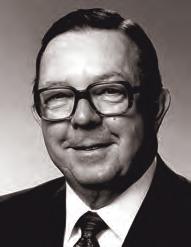
engineer with the Indiana Department of Transportation.
Daniel S. Kieffner (EE, 1984), 54, died on July 24, 2016, in Jasper, Ind. He worked at the Naval Surface Warfare Center in Crane, Ind. R. Scott Sizemore (EE, 1985), 52, died on July 9, 2016, in Harrison, Ohio. He was an engineer with Texas Instruments.
Thomas S. Doerr (CPE, 1988) died on July 27, 2016, in Crownsville, Md. He worked for General Dynamics Mission Systems and the National Security Agency.
Justin A. Gillie (ME, 1998), 40, died on Sept. 2, 2016, in Upper Arlington, Ohio. He was an engineer with Honda.
Scott R. Condon (ECON, 2000), 41, died on Aug. 2, 2016, in Fort Wayne, Ind. He had a distinguished career in the U.S. Army, serving two tours of military intelligence duty in Iraq and Afghanistan.
Muriel K. Hannig, 91, died on Sept. 17, 2016, in Phoenix. She and her late husband Shelton supported Rose-Hulman students in taking the annual Engineer-In-Training test.
Albert McGarvey died on Nov. 3, 2016, in New Albany, Ind. He was a longtime technician for the Department of Physics and Optical Engineering.
These charming legacies are the daughters of sisters Theresa (Henke) Owen (CE, 2011) and Joanna (Henke) Varner. Julia Varner, left, was born on April 15, 2016 to Joanna and Anthony Varner (CPE, 2006) of Folsom, Calif; Alice Owen arrived March 27, 2016, to Theresa and Stephen Owen (CE, 2011) of Virginia Beach, Va.

Kevin Bair (ME, 1997) and wife Karen had a daughter, Pascale, on Aug. 31, 2015.
Jennifer Schmitt (ME, 1999) and husband Jeff Etapa welcomed their second child, Cayden, on Sept. 8, 2016. The family lives in Oakfield, Wis.


Justin Blomenberg (ME, 2001) and wife Megan had their third daughter, Krista, in June 2016. The family resides in Seymour, Ind.
D. Keith Casey (EE, 2001) and wife Dawn had a son, Gideon, on Oct. 2, 2016. Keith is a problem solver for Okta and the family lives in Austin, Texas.


Aaron Roberts (CE, 2005) and wife Patricia had a son, Isaac, on Oct. 4, 2016.

Daniel Forbess (EE, 2006) and wife Jenna had a daughter, Ava, on June 7, 2016. Daniel is a flight test instrumentation engineer with Boeing, and the family lives in Chandler, Ariz.
Amber Pennington (CS, 2006) and husband James Jordan (CPE, 2006) had a daughter Adelaide “Addie” on Jan. 19, 2016. The family lives in St. Louis.

Michael Gough (ME, 2007) and his wife had their first child, George, on Aug. 6, 2016.

Brittany McNeill (CS, 2008) and husband Christopher Achard (CPE, 2008) had their second child, a daughter, Margot, on May 20, 2016.
Eliza Brock (SE/CS, 2008) and husband Keith Marcum (SE/CS, 2008) welcomed their first child, Gwendolyn, on Sept. 15. The family lives in Nashville, Tenn.

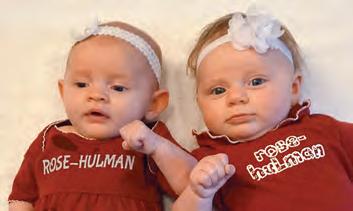
Tim Pulliam (ME, 2008) and wife Brooke had a son, Owen, on July 25, 2016.

Rachael Spellum (ME, 2009) and husband
Logan Reese (ME/EE, 2009) had a daughter, Emerson, on Aug. 10, 2015. The family resides in Greenwood, Ind.
Nicole (Burton) Perilstein (MA, 2010) and husband Joshua had their first child, Haylee, on August 22, 2016. The family resides in Scottsdale, Ariz.


Matt Granger (ME, 2010) and wife Megan had their second child, Lincoln, on April 27, 2016. The family lives in Syracuse, Ind., where Matt is a process engineer for Zimmer Biomet.
Adam Bales (CE, 2011) and wife Samantha had a daughter, Marlowe, on April 14, 2016. The family resides in Spiceland, Ind.

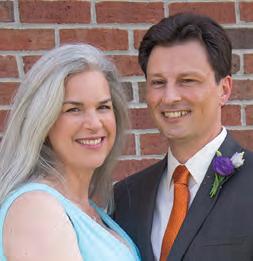
James W. Grey (MA, 1989) married Margaret Joyce Rawson on July 9, 2016, in Whitestown, Ind. The couple resides in Zionsville, Ind.
Christopher I. Meyer (BSCHE, 2004; MSBE, 2007) married Jennifer Spraggs on Oct. 8, 2016, in Piqua, Ohio. He has been a patent attorney at Dinsmore & Shohl LLP in Dayton, Ohio, after earning a law degree from Washington University in St. Louis.
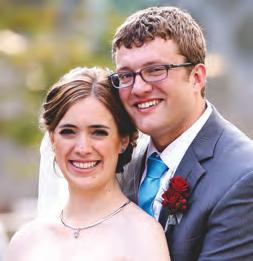
Alexandra Jantzen (BE, 2006) married Kyle Schroeder (ME, 2005) on Sept. 17, 2016, at Rose-Hulman’s White Chapel. He is a research engineer for SpringActive, Inc. and she is a vascular device reviewer for BSI. They live in Phoenix.
Frederick C. Webber (ME/CS, 2007) married Stephanie Harrier on July 9, 2016, near Dayton, Ohio. He is a computer scientist for the Air Force Research Laboratory at Wright-Patterson Air Force Base.

Amanda Isom (CHEM, 2008) married Matthew E. Decker on July 22, 2016. She is a neuroscientist in Frisco, Texas.
Caleb Nickels (CE, 2013) married Brooke Busenbark on June 11, 2016, in Rockville, Ind. He is an estimator and heavy lift engineer with White Construction/IEA Renewable Energy. The couple lives in Clinton, Ind.

Catherine Fiutem (CE, 2014) and James Pillischafske (CE, 2014) were married on June 25, 2016, in Louisville. James is a project engineer for Messer Construction and Catherine is a project engineer for Cornerstone Controls Inc. They live in Fishers, Ind.

Shifan Geng (BSCE, 2013/ MSEM, 2014) married Yun Zha (OE, 2014) in Sept. 25, 2016, in Shanghai, China. Attending the ceremony were Guanqun Wang (EE, 2012), Yueiun Zhu (EE, 2012), Junxuan Hou (MSEE/CPE, 2013) and Heng Ye (CHE/ECON, 2014).

Lauren F. Miller (BE/BCMB, 2016) married Jesse M. Sestito (ME/MA, 2013) on June 4, 2016, in Belleville, Ill. Both are doctoral students at Georgia Institute of Technology, Jesse in mechanical engineering and Lauren in biomedical engineering. The couple lives in Atlanta.

Nicole Hensley (CHEM, 2015) married Dakota Huckaby (CHE, 2016) on Sept. 3, 2016, in Fort Wayne, Ind. He is a process engineer with Monument Chemical and she is a chemist with the Flint Group. The couple lives in Louisville.
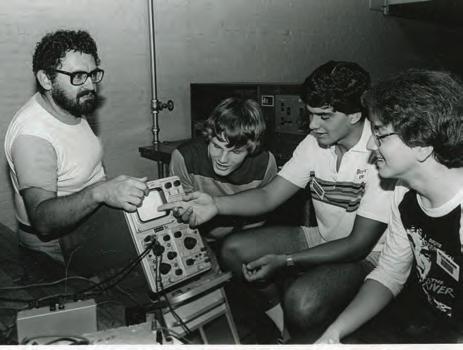
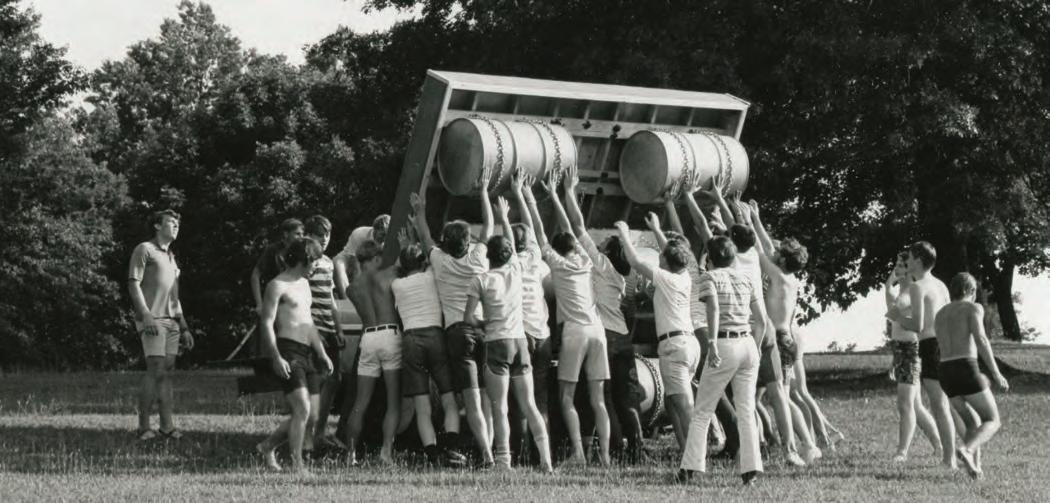
Fifty years after its founding, the institute’s Operation Catapult program has passed the test of time in providing a stimulating pre-college experience for thousands of high school students in science, technology, engineering and math (STEM) while building their confidence and cementing their interest in these fields. Over the years, many of the Catapulters have returned to earn degrees from Rose-Hulman and launch successful STEM careers.
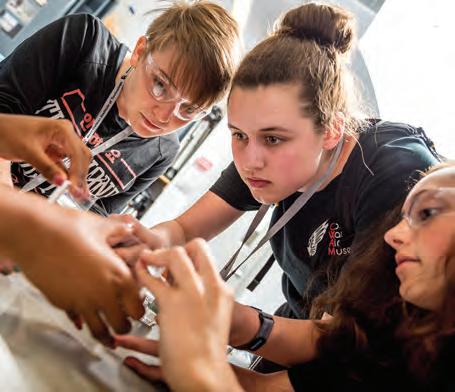
AMONG THOSE WHO ATTENDED CATAPULT, MEMORIES ARE WARM AND VIVID.
Bill Schott (MA, 1974), recalls huddling with other Catapult students and counselors around a small black-and-white television set in a campus residence hall on July 20, 1969, to watch Neil Armstrong take man’s first step on the moon— an event that signified a new era for America in science and technology. “We were engineers-in-waiting watching history being made,” Schott says. “It was an exciting time for all of us.”
The next summer, Rick Ditteon (PH, 1975) became fascinated with lectures such as “Linear Least Squares Fit” (by math professor Alfred Schmidt) and “Energy Does Matter” (by chemistry professor Oran Knudsen), and learned how to use a water tunnel to complete a hydrodynamics project.
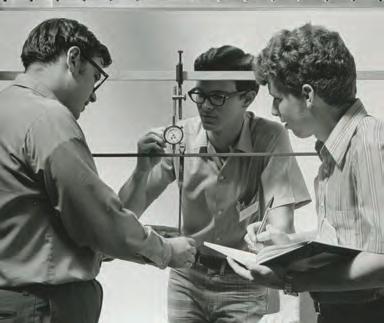
“I had finally found a place, in Rose-Hulman, where I belonged. I was inspired by all of the professors’ lectures and having the opportunity to work alongside students doing intriguing projects,” he says.
“Rose-Hulman wasn’t even on my radar for college until that summer. After that, it was the only college that I applied to attend.” He still has his Catapult notebook from that summer.

At least 30 percent of each year’s Operation Catapult participants, like Ditteon, return to attend the institute the following year, and several program alumni have had sons and daughters become second-generation program participants
Operation Catapult’s roots extend to February 1967 when Director of Admissions Paul Headdy got Schmidt interested in developing a summer program on campus for post-11th-grade high school students interested in learning about engineering and physical sciences. Mimeographed promotional announcements went to Indiana high schools seeking
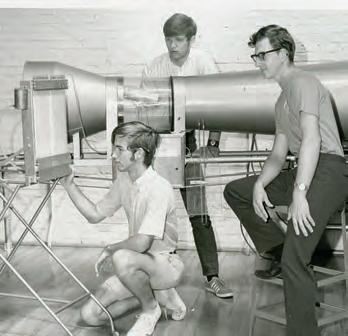
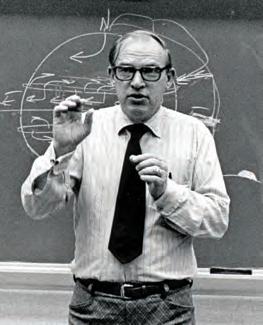
a pilot group of 40 students. Demand for the program was higher than expected, with 67 “rising seniors” enrolling during the first summer under Schmidt’s leadership, and with faculty support from legendary educators Herman Moench and Knudsen.
“You did not forget what Al Schmidt, Herman Moench and Oren Knudsen wanted you to learn,” recalls Barry Jenkins (ME, 1970), who was in that first Catapult group a year before graduating as valedictorian from Chrisman High School in Illinois. “In retrospect, I feel privileged to have had the opportunity to study under them.” Attending a high school with fewer than 120 students in all, “I knew I would be competing (at Rose-Hulman) with valedictorians from much bigger schools,” Jenkins says. “I needed every advantage I could get for a running start.”
instilled value of providing individualized student educational experiences.
“From the very beginning, professors have had a tremendous amount of fun with the students,” Schindel says. He notes that having student counselors on staff is another strong element in the program’s long-term success.
Catapult’s enrollment has grown in gender and social diversity, and now includes approximately 300 students each summer from nearly every state and from hometowns in Turkey, China, Greece and Thailand (to name just a few). Though the signature, and very popular, trebuchet challenge is still being offered, new projects have replaced those with diminished relevance.
Today’s students are receiving hands-on experiences in biofuels, forensic engineering, rapid prototyping, heat treatment of steels, wind tunnel testing, entrepreneurship and computer game design.
“It’s a fantastic program that has served Rose-Hulman well and keeps getting better,” says Ditteon, who became an Operation Catapult professional mentor after joining the Rose-Hulman faculty in 1984. He was the program’s third director from 1995 until 2004. Other leaders have been Noel Moore (who replaced Schmidt), Patsy Brackin (2004 to 2015) and, now, Michael Robinson. “We continue to be focused on giving students a significant summer experience, one that could impact the rest of their lives,” remarks Robinson.
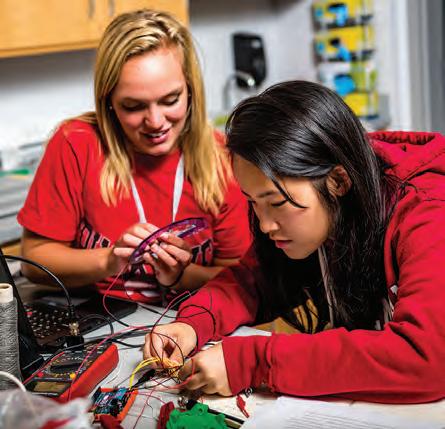
Bill Schindel (MA, 1969), a student counselor for that inaugural summer, recalls Operation Catapult as an aggressive and highly creative experiment—“a high-wire act,” in his words—that typifies the kind of educational innovation that Rose-Hulman faculty continue to practice. A significant part of the program’s out-of-the-box thinking, according to Schindel, was introducing high school students to the institute at the end of their junior year.
He notes that faculty mentors who are matched with each student project team showcase Rose-Hulman’s
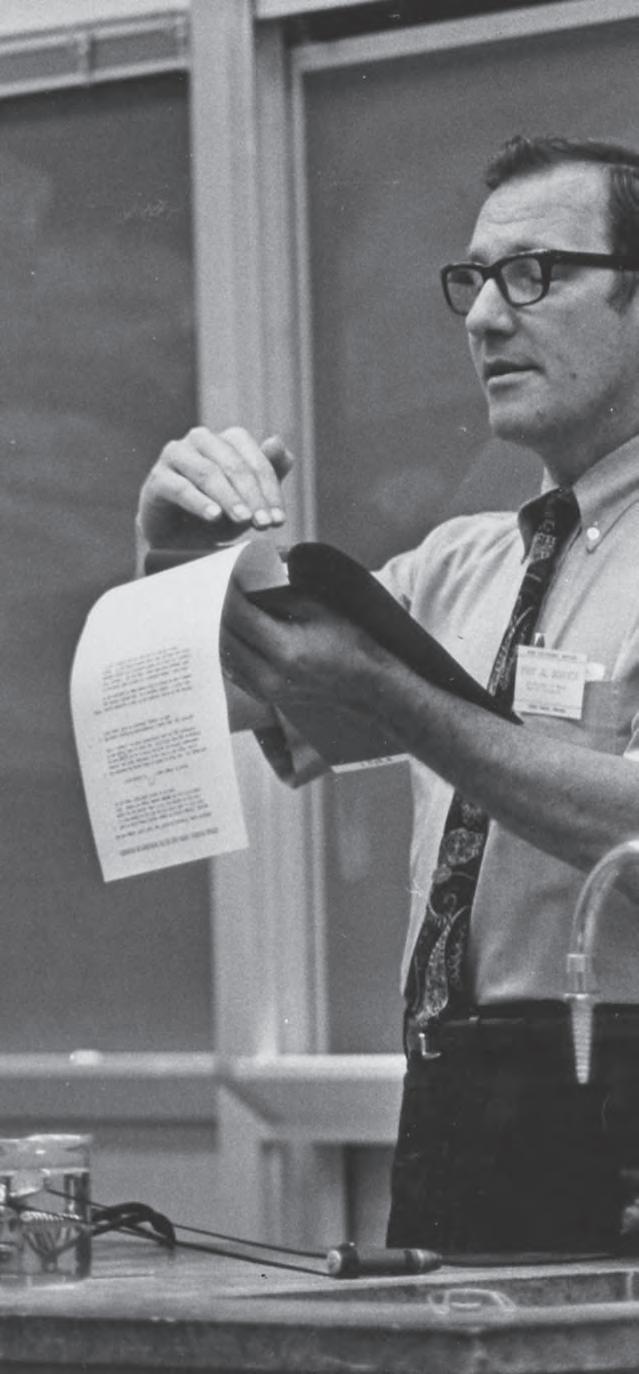
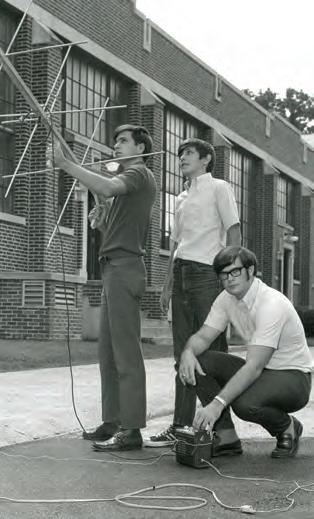
Doug Tougaw (EE, 1991) was a counselor for three summers, working with classmates who have remained friends well after graduation. He is now head of the Department of Electrical and Computer Engineering at Valparaiso University. “Operation Catapult was one of the most important experiences of my life,” Tougaw says. “It helped me to discover the joy I find in teaching and helping younger people to achieve their highest potential. It also was the first real opportunity I had to work with faculty outside the classroom, and their professionalism and the joy they found in their work helped me to set my sights on becoming a professor myself.” n
Help Us Celebrate 50 Years of Operation Catapult
A special Facebook page (facebook.com/OperationCatapult) has been set up for you to share your summer photos and memories. Also tag any posts across social media (Facebook, Twitter, Instagram, etc.) with the hashtag #Catapult50.
5500 WABASH AVENUE
TERRE HAUTE, IN 47803
Address Service Requested
Civil engineering students are knee-deep in hydraulic field studies along sections of Lost Creek that meanders through campus. A recent mitigation project has made the waterway accessible for a variety of classroom projects. Learn more on pages 32-33.
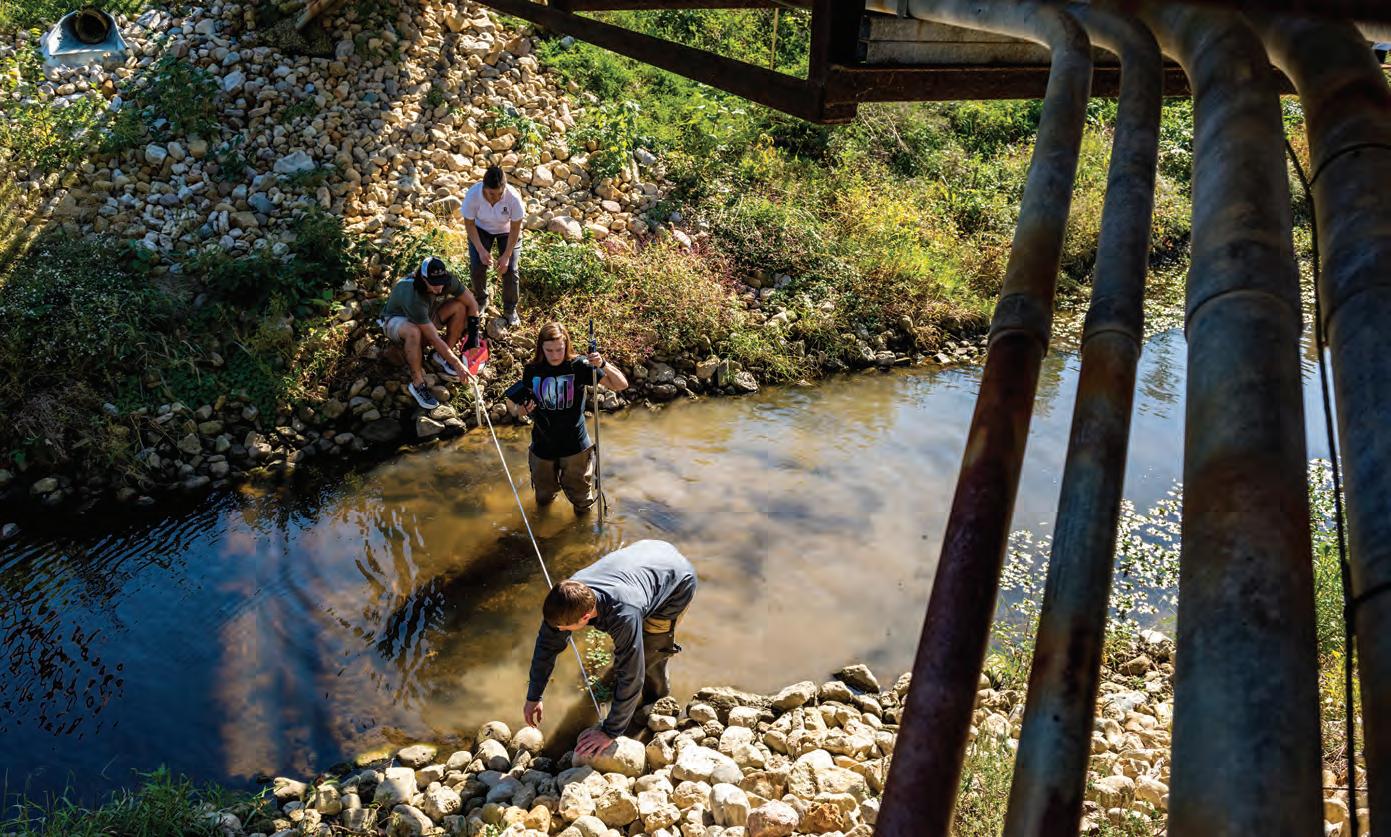
STAY CONNECTED with Rose- Hulman through our website www.rose-hulman.edu. Also become a fan of Rose-Hulman’s Facebook page or follow us on Twitter and Instagram @rosehulman.