The Codes are Working: Newer Buildings Tended to Protect Better During Ian John Hellein, FRSA Educational & Research Foundation Director
Dr. David Prevatt (left) presents preliminary findings for Hurricane Ian at the October Florida Building Commission meeting in Gainesville.
At the October Florida Building Commission meeting in Gainesville, Dr. David Prevatt of the UF Department of Civil Engineering, presented preliminary findings to the Commission on the effects of Hurricane Ian to buildings in the area of impact. Given the extent of the damage from Ian, it was sobering to hear Dr. Prevatt characterize the storm as a “moderately strong wind event.” Looking at the reported wind speeds around landfall, we can understand the reason for this characterization: despite Ian’s 150 mph sustained winds – which apparently occurred offshore – the top three-second sustained gusts were around 120 mph. Prevatt noted that the actual wind speeds experienced onshore were significantly below the design speeds, which were in the 150-to-160 mph range (see map at the bottom of page 13).
Newer Construction Performed Better
Municipal buildings and schools in the area of impact
20
FLORIDA ROOFING | November 2022
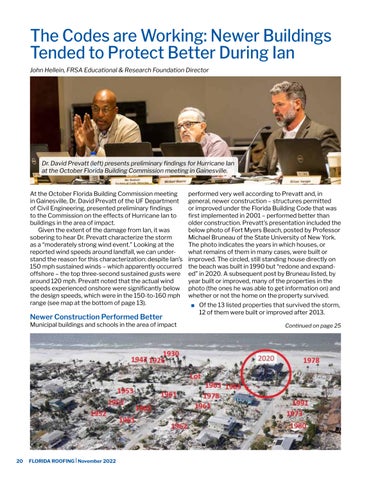
performed very well according to Prevatt and, in general, newer construction – structures permitted or improved under the Florida Building Code that was first implemented in 2001 – performed better than older construction. Prevatt’s presentation included the below photo of Fort Myers Beach, posted by Professor Michael Bruneau of the State University of New York. The photo indicates the years in which houses, or what remains of them in many cases, were built or improved. The circled, still standing house directly on the beach was built in 1990 but “redone and expanded” in 2020. A subsequent post by Bruneau listed, by year built or improved, many of the properties in the photo (the ones he was able to get information on) and whether or not the home on the property survived. ■ Of the 13 listed properties that survived the storm, 12 of them were built or improved after 2013. Continued on page 25