Hoof Signals
Success factors for healthy hooves
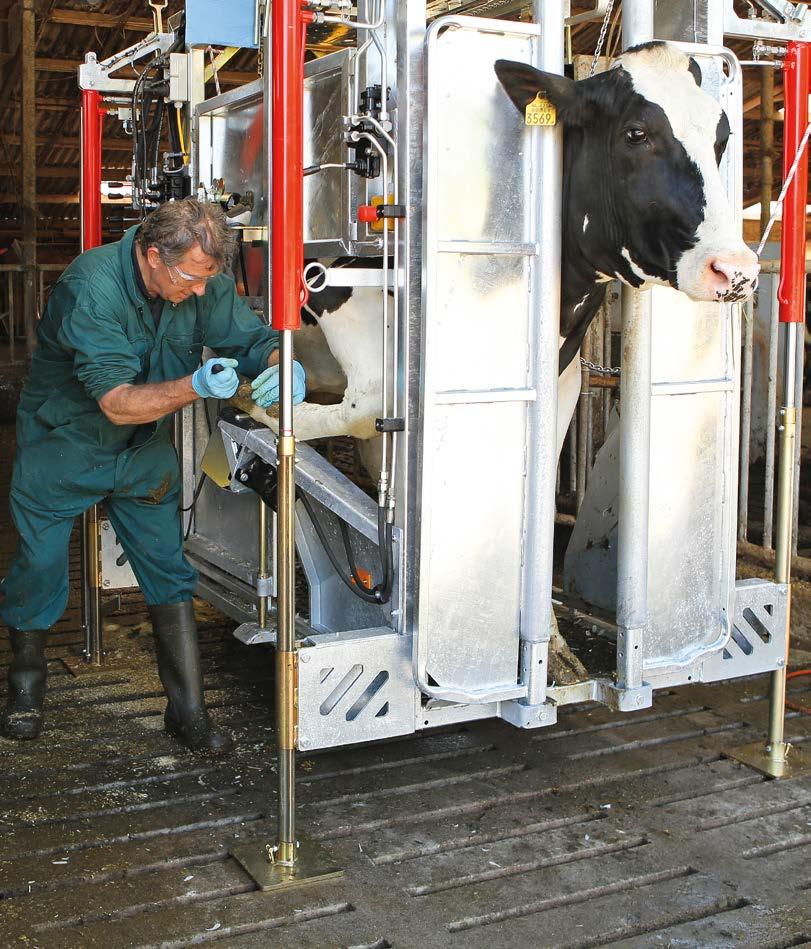
Jan Hulsen
Hoof Signals
Publisher
Roodbont Publishers B.V.
Author
Jan Hulsen, Vetvice
English version content editor:
Owen Atkinson; Lambert, Leonard and May Farm Vets
Photographs
Jan Hulsen
Other contributors:
Joep Driessen (p. 26, 27, 28), Anneke Hallebeek (p. 6), Menno Holzhauer (p. 34, 35), Paul Hulsen (p. 30), Anne Kloek (p. 22), PTC+ (p. 16, 17, 34, 35).
Drawings
Marleen Felius
Herman Roozen
Dick Rietveld
Design
Erik de Bruin, Varwig Design
With the cooperation of:
Menno Holzhauer, GD Deventer
Gerrit Hooijer, H3 Consultancy
Piet Kloosterman, PTC+ Oenkerk
Joep Driessen, Marcel Drint, Nico Vreeburg, Bertjan Westerlaan, Vetvice Group
And with many thanks to:
Mar tien van Bostelen, Vereniging voor Rundveepedicure, Jan Bakker, Neil Chesterton, DigiKlauw, Paul Hulsen, Dick de Lange, Bert van Niejenhuis, Jos Noordhuizen, Kees Peeters, Jan Rietjes, Lucas Talsma, Wiebe Veenstra, hundreds of cattle farmers and a great many vets, consultants and feed advisors.
Roodbont Publishers B.V.
P.O. Box 4103
7200 BC Zutphen
The Netherlands
T +31 (0)575 54 56 88
E info@roodbont.com
I www.roodbont.com
CowSignals® Training Company
Hoekgraaf 17A
6617 AX Bergharen
The Netherlands
T +31 (0)487 745 041
E info@cowsignals.com
I www.cowsignals.com
Vetvice Group
Moerstraatsebaan 115
4614 PC Bergen op Zoom
The Netherlands
T +31 (0)165 30 43 05
E info@vetvice.com
I www.vetvice.com
Hoof Signals is part of the successful Cow Signals® series. Cow Signals® is a registered trademark of CowSignals® Training Company. CowSignals training and e-learning is provided by: CowSignals® Training Company.
CowSignals content is provided by Jan Hulsen/ Roodbont Publishers.
© Jan Hulsen, 2021
IISBN 978-90-8740-091-0
No part of this publication may be duplicated, photocopied, reprinted or reproduced in any other form without prior written permission from the publisher.
The author and publisher have compiled this publication with great care and to the best of their knowledge. However, we assume no liability for damage of any kind resulting from actions and/or decisions based on this information.
Hoof Signals 2 Credits
copyrightprotected
Contents 3 Introduction: summary 4 Anatomy underfoot and forces 6 1 Four success factors for healthy hooves 8 Hoof health is people work 9 Success factor 1: Excellent quality hooves 10 Success factor 2: Minimal forces 12 Success factor 3: No environmental effects 14 Success factor 4: Early and effective intervention 16 Intervening in hoof problems 17 2 Day-to-day practice 18 Introducing heifers: The no. 1 high-risk time 19 Calving and the start of lactation 20 Dr ying off and transition 21 The total picture of hoof health 22 Are the cows lying down enough? 23 Sur faces, rest and space 24 Drive calmly 25 3 The most common conditions 26 Less common conditions 27 Heel horn erosion 28 Digital dermatitis 29 Interdigital growths 30 Foul-in-the-foot 31 Laminitis 32 White line disease 34 Sole ulcers and white line abscesses 35 4 Hoof care and treatment 36 Planning and organisation 37 Functional pedicures 38 Preventive footbathing 39 Functional pedicures : The five-step plan 40 Glueing a block 42 Treating horn lesions 43 Intervention time: early or too late? 44 Tips for a functional pedicure 45 5 Monitoring 46 Assessing the success factors 47 Structured monitoring 48 Assessing during milking 49 Monitoring hoof health: scoring hoof conditions 50 Record hoof data 51 Dair yCo mobility score 52 Hoof score chart 53 Dr y and clean 54 Inspection card for cubicle comfort 55 Instructions for hoof bandage 56 Check list successful footbaths 57 Treatment plan 58 Index 59 Contents copyrightprotected
Four success factors for healthy hooves
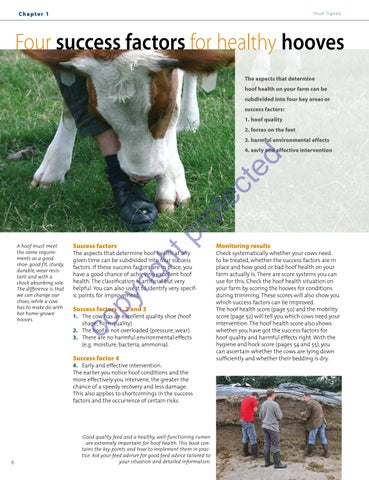
The aspects that determine hoof health on your farm can be subdivided into four key areas or success factors:
1. hoof quality
2. forces on the feet
3. harmful environmental effects
4. early and effective intervention
A hoof must meet the same requirements as a good shoe: good fit, sturdy, durable, wear resistant and with a shock absorbing sole. The difference is that we can change our shoes, while a cow has to make do with her home-grown hooves.
Success factors
The aspects that determine hoof health at any given time can be subdivided into four success factors. If these success factors are in place, you have a good chance of achieving excellent hoof health. The classification is artificial but very helpful. You can also use it to identify very specific points for improvement.
Success factors 1, 2 and 3
1. The cow has an excellent quality shoe (hoof shape, horn quality).
2. The hoof is not overloaded (pressure, wear).
3. There are no harmful environmental effects (e.g. moisture, bacteria, ammonia).
Success factor 4
4. Early and effective intervention.
The earlier you notice hoof conditions and the more effectively you intervene, the greater the chance of a speedy recovery and less damage
This also applies to shortcomings in the success factors and the occurrence of certain risks.
Good quality feed and a healthy, well-functioning rumen are extremely important for hoof health. This book contains the key points and how to implement them in practice. Ask your feed adviser for good feed advice tailored to your situation and detailed information.
Monitoring results
Check systematically whether your cows need to be treated, whether the success factors are in place and how good or bad hoof health on your farm actually is. There are score systems you can use for this. Check the hoof health situation on your farm by scoring the hooves for conditions during trimming These scores will also show you which success factors can be improved. The hoof health score (page 50) and the mobility score (page 52) will tell you which cows need your intervention. The hoof health score also shows whether you have got the success factors for hoof quality and harmful effects right. With the hygiene and hock score (pages 54 and 55), you can ascertain whether the cows are lying down sufficiently and whether their bedding is dry.
Hoof Signals 8 Chapter 1
copyrightprotected
Breeding, rearing, introduction
A cow grows her own hooves and therefore termines the starting point in terms of their shape and robustness. Breeding is only one that impacts on later hoof health. For example: a twisted leg position (hocks-in stance) can caused by foot infections and floors that are smooth for young stock. Heifer introduction must also run smoothly The heifer’s hooves need to be healthy at that point, and this is very often not the case It is important to keep the stress to which a heif is exposed during calving to a minimum so continues to eat, lies down enough and avoids conflict wherever possible.
The dairy cow
Housing is a choice, as it is man-made Take the time to have a critical look at your housing and improve it if necessary. Putting more bedding the cubicles, keeping floors drier, good ventilation and a straw pen for close-up and fresh cows go a long way to improving it Then you will pr bly only have to make sure that the floors are with enough grip and no risk of bruising. Lift hooves three times a year and trim if necessary. Also treat hoof infections by foot bathing Finally, make sure you interact calmly with the animals and keep their interaction with each er on a peaceful footing. Fights, flights and turning abruptly for other reasons or moving off with force will exert extreme pressure on parts of the hooves.
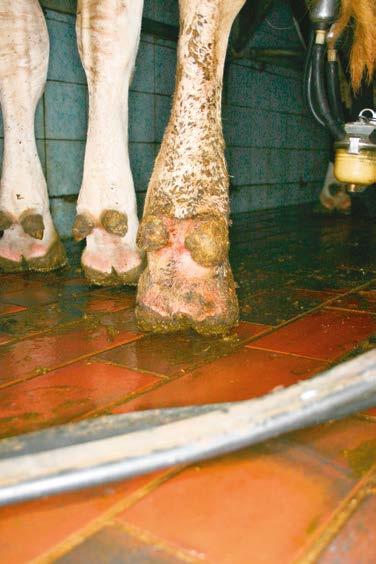
joint is swollen (red arrow).
sheath of the flexor tendons above the fetlock
space on this hoof (yellow arrow). As a result, the
There is an infected area in the interdigital
This illustration shows the positive and harmful events for each success factor. You can influence all three success factors by intervening early and effectively.

To recover from her lameness, this cow needs to eat and drink well. But the step up to the feed barrier and the drinking trough is too high. How do you solve this?
must be dry and not too hot or cold.
water: the pasture, or a hospital pen. The cubicle
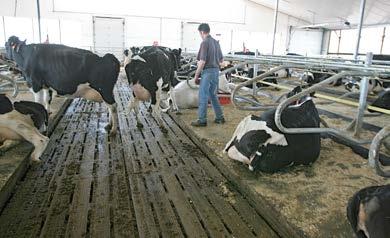
Move the cow to a location near feed and
bruises from the ground or the cubicle rails.
to prevent her from sustaining any additional
provide a roomy resting area with a soft floor
a block. The cow must have sufficient rest, so
relief, trim the hoof and, if necessary, attach
First of all, alleviate the pain: administer pain
Strength of horn Moisture Pressure points on the floor Bacteria Irritating agents Shape Thickness fat cushions Hoof quality Forces Harmful effects Wear Weight Moving off Legend Growth Healing Hoof health is people work 9 Chapter 1. Four success factors for healthy hooves
Early signals What does this photograph tell you?
Intervene
copyrightprotected
Always handle your animals calmly and let them move at their own speed. Cows walk more slowly than humans.
Hoof quality: how do you achieve it?
Hoof quality is the extent to which a hoof is able to withstand certain loads and disorders. The quality of the hoof is determined by a combination of horn hardness, hoof shape and the inner structure of the hoof Action points:
• Provide good quality feed and make sure feed intake is good, so that the horn is as strong as possible
• Lift the hooves three times a year and trim if necessary so that every hoof is the right shape.
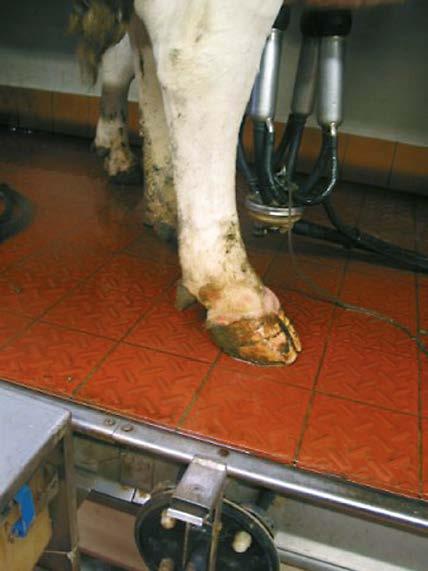
• Make sure heifers and dry cows get enough exercise.
• Use footbaths as much and as often as necessary.
• Breed for hoof health.
Because the cow grows the horn herself on an ongoing basis, her feeding status, lactation stage and health are also important for horn quality. Horn grows at a rate of 5 mm per month. The sole is about 1 cm thick, so any bruising is only visible after two months. Sufficient exercise improves circulation to the hoof, so it can endure a greater load.
horn. The most important factor seems to be a well-functioning rumen, because this ensures a good energy supply, vitamin production, including biotin, and intake of nutrients, vitamins, minerals and trace elements.
The major cause of rumen problems is rumen acidosis; caused by excessive intake of rumen digestible carbohydrates (starch and sugars) in relation to the buffer capacity of the rumen. This buffer capacity depends on the size of the rations, the rumen fill, the rate at which the rumen wall absorbs acids, and the amount of saliva: in other words, chewing and rumination activity. So make sure that there is enough fibre in the rations and that the cows have a regular feed intake without diet sorting. Sudden feed changes should be avoided, and spoiled or mouldy feed must not be given. The formation of healthy hoof horn requires an adequate supply of specific nutrients such as calcium and phosphorus, biotin, zinc, copper, manganese, and vitamins A, D and E. Cows must also be able to drink as much as they want all the time, i.e from troughs. And this includes dry cows!
Hoof health is hereditary
Select and breed for hoof health. Breeding affects the position and use of the hooves, their size and shape, horn quality and strength. Pigmented hooves are harder than not pigmented ones, for example, and small breeds have relatively bigger hooves. The degree to which a cow reacts to pain and discomfort also seems to differ between breeds and blood lines. But at the same time, do not expect too much from breeding. The differences within a herd of cows are 25% down to hereditary factors and 75% down to management. Better quality breeding data is becoming available all the time, enabling you to focus more specifically on hoof health in your breeding.
Heritability factors
The actual condition is partly determined by breeding. We call this the heritability factor. The rest is the result of environmental circumstances.
Hoof Signals Success factor 1: Excellent quality hooves
Locomotion score 12% Hoof angle 23% Digital dermatitis 10% Interdigital growths 10% Heel horn erosion 8% Sole haemorrhage 5% White line disease 2%
Source: Veeteelt, 1 August 2004
copyrightprotected
High-risk time: calving
The biggest high-risk time for poor hoof quality is calving. During calving, not only are the ligaments in the birth canal affected by hormones, but the ligaments and connective tissue in the foot become softer. This puts more pressure on the sole and therefore on the living tissue (corium) between the sole and the pedal bone. The cow’s metabolism adjusts to high milk production, which makes her hoof horn softer. The udder diverts nutrients, especially energy and calcium.
At the same time, this is the period in which the cow is very susceptible to feeding problems in the rumen, with toxins entering the bloodstream and her intake of energy, vitamins, (especially A, D, E and biotin), minerals (e.g. copper and zinc) and trace elements (cobalt, manganese) under pressure.
Finally, calving can also cause the formation of
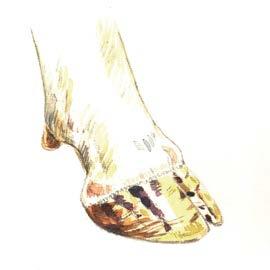
Shape of the hoof
oedema (fluid accumulation). The feet are also very susceptible to this, causing reduced blood flow This situation affects the sole corium, making the hoof highly susceptible to sole haemorrhages, white line defects and detachment of the pedal bone (laminitis) when loaded. See page 33. After severe laminitis, the hoof remains more sensitive to overloading.
Hoof horn and strength
In addition to breeding and nutrition, the strength of the hoof horn is also influenced by its moisture content. This depends on how dry the immediate surroundings of the hoof are. The more moisture there is in the horn, the softer it is. Soft horn wears faster and can carry less weight. The hoof horn forms a protective layer on its surface. If this layer is damaged by walking on rough ground, the hooves are more susceptible to heel horn erosion caused by bacteria and urine.
Not-optimal conditions
Sole at the toe end too thin so the tip of the pedal bone exerts pressure on the sole. Result: toe ulcer exacerbated by soft sole horn or moisture.
The weight of the cow presses on the pedal bone via the short pastern bone. The flexor tendon provides elasticity and transfers more of the pressure to the suspensory tissue on the hoof wall. In cows suffering from severe laminitis, the pulling force of the flexor tendon causes the pedal bone to separate close to the sole and not by the coronary band, which causes the pedal bone to tilt. During calving, the suspensory ligaments soften and more pressure is exerted on the sole.
Thin digital cushion poses a greater risk of bruised soles. Result: sole bruising, ulcers. Thin cows (low BCS) have thin digital cushions.
The toe of the claw is too long or the bulb area is too low. Overloads the sole, especially towards the back. Result: sole bruising, sole ulcers, more heel horn erosion.
Preventive trimming is often needed to give the hooves the best shape. Hoof trimming has an effect on hoof shape for about four months. Severe heel horn erosion reduces the load-bearing surface of the hoof, increasing the risk of overloading. Movement stimulates the blood circulation and metabolism, and improves the quality and load-bearing capacity of the hooves.
Success factor 1: Excellent quality hooves 11 Chapter 1. Four success factors for healthy hooves
Extensor tendon
Short pastern bone
Flexor tendon
Pedal bone
Carriage and support of the sole, with a resilient fat cushion in the bulb area
Suspension on the wall horn
copyrightprotected
Inadequate hoof quality: more sole haemorrhages, white line defects and heel horn erosion.
Day-to-day practice
Every group of cows, young stock or fattening cattle on the farm requires a different approach. This also applies to hoof management. Make sure you understand the success factors and are aware of the risks. Then you can optimise your animals’ conditions and care, assess the signals properly and prevent problems. Once the success factors have been improved, it will take a long time before a clear improvement in hoof health is achieved. You can reckon on a year.
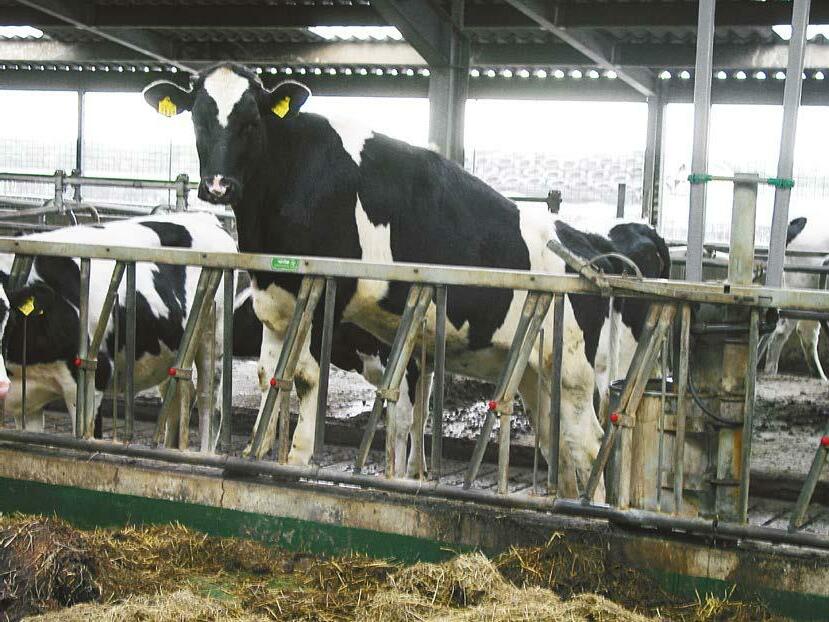
If young stock grow up healthy, they will get off to a stronger start in their lives as dairy cattle. Too many young cattle already suffer from hoof conditions.
Young stock
Young stock rearing lays the foundation for cows with strong legs, bones, muscles, joints and hooves.
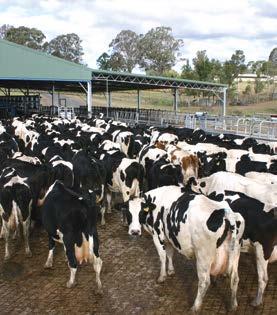
Important points:
• Provide enough room to walk and feed, and comfortable lying places. Particularly when changing groups.
• Make sure there is enough sunlight and excellent ventilation, and avoid heat stress.
• Keep feet clean and dry. Every week, check the hooves on standing and lying animals. Treat hoof infections in the foot-trimming crush or by foot bathing.
• Get the ration calculated and make sure all the animals eat it. Make sure the feed in the feeding trough is good quality. Ensure the correct mineral intake. Change rations gradually over the course of at least a week.
• Make sure the young stock are accustomed to people and are not shy.
Holding areas and the collection yard are high-risk locations for hoof overloading and harmful effects. Cows should not stand for longer than 1 hour per milking time if you are milking twice a day, and 45 minutes if milking three times a day. Avoid nervousness and overcrowding. The cows must be able to walk past each other. A backing gate is used to make the collection yard smaller, not to drive the cows. Use an alarm bell; don’t use electricity. Don’t walk in between the cows but round the outside of the collection yard. The floor should be clean, dry and level: preferably rubber. Provide excellent ventilation and cooling for the cows.
Older cows
Older cows are particularly susceptible to sole ulcers, probably because of higher production, a deeper negative energy balance or greater susceptibility to milk fever. Accumulation of problems that were not properly treated in previous years can also be an issue. On the other hand, they can be less susceptible to digital dermatitis and heel horn erosion, possibly because they have developed resistance, or possibly due to selection (the weakest animals have been culled).
Hoof Signals 18 Chapter 2
copyrightprotected
Introducing heifers: the no. 1 high-risk time
Around calving and the start of lactation, a heifer is very vulnerable to laminitis, particularly sole bruising and rotation of the pedal bone away from the wall. Suspensory tissue that has separated from the pedal bone never heals. The cow will put a heavier load on its soles for the rest of its life.
Heifers have relatively small hooves and thin digital cushions (fat pads), which makes the hooves very susceptible to overloading. They often develop a lot of oedema. Stress from calving and any changes reduce feed intake and make the heifer stand a lot Social conflicts exacerbate this, and flight behaviour is a risk factor in excessive hoof wear, white line disease and sole bruising. Even after calving, factors like social uncertainty, fear of unknown cows and too few lying places cause heifers to separate themselves off, stand too much and eat and drink too little About 40 per cent find it difficult to calve. Pain and inflammation around the birth canal inhibit feed intake and lower resistance. These animals are also highly susceptible to uterine infections and mastitis, which are risk factors for laminitis.
Heifers that are ill at ease or do not feel well are at high risk of developing rumen acidosis. They eat less feed in fewer meals, eating big portions fast and generating little saliva. Give heifers
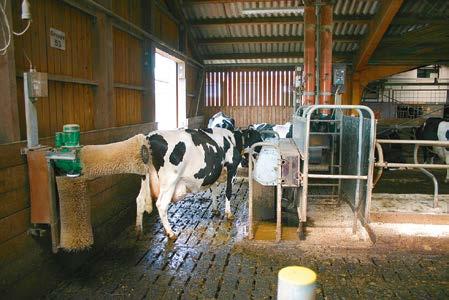
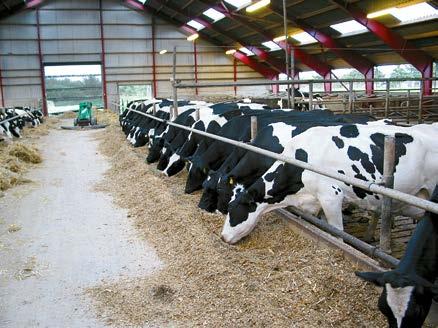
If good, tasty feed is always available for every cow, they will tend not to fight for dominance in the herd. Any shy heifers or cows can then eat safely and will eat the right amount of feed. If you have self-locking yokes, make sure youngstock also have them. Ensure that feed is pushed close enough to the animals, because heifers have shorter necks. Also make sure the heifers get used to the cubicles. Monitor the rumen fill and behaviour of the heifers and score their hoof conditions.
Introduce a heifer into the herd at least six weeks before her expected calving date, trim her hooves and check her health (infections, resistance, vaccinations, parasites) and mineral status. At that point she will still have the strength and the time to get used to the other cows and recover from any health problems. Bring heifers in groups to mix with dry cows
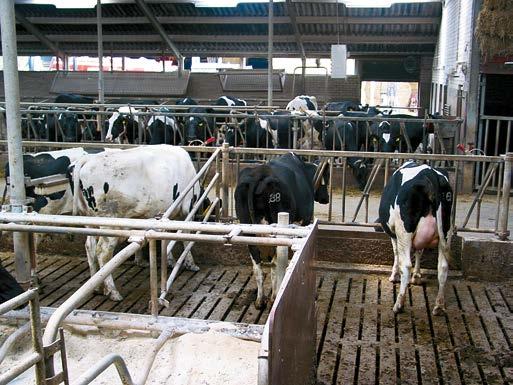
in the shed, fights for dominance, hoof quality and conditions under foot. The locations of things like drinking troughs, feed barriers and cattle brushes have a major influence on cow movement and accessibility. Make sure there is enough room to manoeuvre at busy areas and that the floor provides sufficient grip. Avoid passageways with dead ends.
Introducing heifers: The no. 1 high-risk time 19 Chapter 2. Day-to-day practice
copyrightprotected
The most common conditions
copyrightprotected
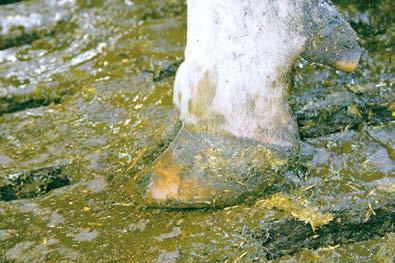
To integrate hoof problem prevention as seamlessly as possible into your work, housing and management, your best plan is to follow the four success factors. The number of hoof problems will then tell you how well you are doing. Some farms struggle very specifically with one type of hoof problem. They can improve their situation with a strategy based on the risk factors for this condition. But most farms struggle with a combination of conditions. The best plan is to intervene at the level of the success factors.
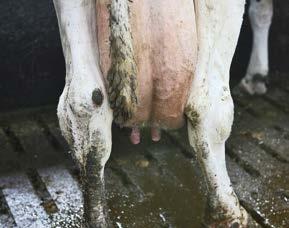
Hock chafing occurs when the inside of the hock bone rubs against the udder. It develops gradually and heals very slowly. Like all inflammations, it is painful, it lowers resistance and provides an entrance for infections. Prevention of udder oedema and dropped udders helps prevent hock chafing (dry cow management, transition, breeding). Hock chafing can also be caused by the presence of scratchy bedding in the cubicles and the hygiene score of the cows (udder, flanks). The less scratchy material there is that sticks to the udder and hock skin, the less likely the cow is to develop hock chafing. The hocks-in stance probably also plays a role in this.
Hoof Signals Chapter 3
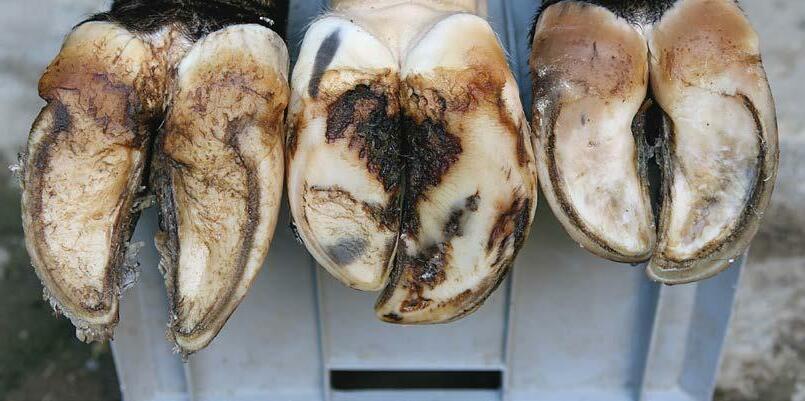
A hind leg and two front legs of three slaughtered cows that clearly lived in different circumstances...
The kink in the toe indicates laminitis
(rotated pedal bone). Swelling of the coro -
nary band along the front is an indication
of heel horn erosion bacteria.
This hoof is displaying a number of conditions. Which ones?
Identify early
Leg problem: hock chafing
Less common conditions
You need to know about the less common conditions so that they can be treated properly. Your hoof trimmer and your vet should certainly be able to identify them, so you can always call in these experts.
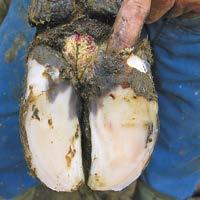
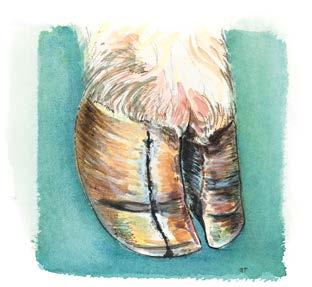
Ingrowing wall horn (“corkscrew claw”)
In dry conditions on a hard surface, vertical wall cracks (sand cracks) can appear in the hooves, usually on the front feet, and particularly in older beef cattle. These cracks are extremely painful. They are caused by dry conditions, extremely hard horn and heavy load. A good supply of biotin can help.
The wall horn is ingrowing underneath the sole towards the bulb area. This is a congenital defect, probably with a hereditary factor.
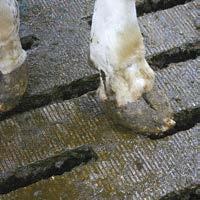
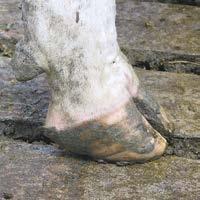
The inner claws on these fore feet are crooked, so the tip does not wear off but continues to grow. This is possibly caused by too much pressure when feeding, a raised edge by the feeding barrier, or because the feed is too far away.
Problems of the coronary band and bulb area
Toe necrosis can be the result of a too thin sole at the toe end. Main cause: too much horn removed during trimming. This also happens with heifers that have soft sole horn and spend time on hard, abrasive surfaces. Damage caused by sharp edges and suchlike may also play a role. Sole ulcers in the toe tip can be caused by severe laminitis, when the dropped pedal bone presses on the sole. Poorly controlled digital dermatitis can also be implicated on some farms, possibly where infection at the front of the foot leads to splits on the inner hoof walls (axial wall splits), followed by deep infection. They are difficult to cure.
The finger is between the double sole and the young, new sole horn. A double sole like this is most likely to be caused by a white line abscess bursting out at the heel (underrun sole). Double soles can also be caused by a massive disruption in the horn-forming cells (acute damage to the corium). Heel horn erosion sometimes causes large flaps of loose horn in the bulb area.
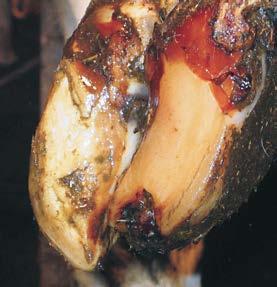
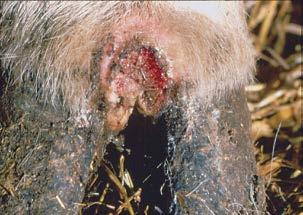
Digital dermatitis lesions occur on the coronary band, usually in the bulb area of the hind hooves, but they can also appear on the front, the fore feet and the dewclaws. Lesions on the front, like this, can lead to severe damage of the coronary band and split walls (see toe necrosis).
Less common conditions 27 Chapter 3. The most common conditions
copyrightprotected
Photo: Menno Holzhauer, GD
Monitoring
Monitoring means finding out whether the claws are healthy at set times in a structured manner, and checking whether the circumstances are under control so that you will also have healthy hooves tomorrow and the next day. Ideally you will be able to observe sufficiently that you will know for certain that every animal has healthy hooves.
By scoring and recording hoof conditions during herd trimming, you will get a picture of its current health status. It will also tell you if there have been any changes since the previous trim.
Using the information
Hoof health requires you to keep your finger on the pulse all the time There are various times when you should monitor claw health, and various ways of doing it. Action lists and score cards help you answer the questions: what are the success factors, the risks, herd signals and, of course, the cow signals telling you? Information becomes valuable when you can use it to improve your farm management and actually do so. You will often need to seek advice to help you.
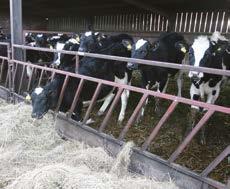
What can you see and what should you do?
Cows will not lie down on a wet surface. A wet surface also makes the hooves soft and more susceptible to heel horn erosion, wear and overloading. The feeding barrier neck rail is also much too low.
Monitoring provides three types of information:
1. Insight into the current situation.
You can compare your measurements with those on other farms, for example. The question to ask: how does my stock compare?
2. Feedback.
Use the information to check the results of previous measures. The question to ask: how did it go and what have I learned from it to help me do things just as well or better next time?
3. Feed-forward.
This is where you use the available information to look at the future. The question to ask: is there anything I should be changing now to make things better in the future?
Continue to improve
Managing means following a systematic, targeted approach. Regular checks and monitoring are part of this. (Make plan - implement planmonitor - amend plan or not - and so on.) Check the results against your targets. A good result is a good outcome. A bad result calls for immediate action. In between there is a grey area indicating that more attention is needed.
46
Picture Puzzle
copyrightprotected
Structure your attention
When observing and monitoring, always work from large to small. First observe the big picture. If necessary, look a little deeper. An important question to ask at this point is: should I be paying more attention to hoof health care? Or do I have things sufficiently in hand? This question can be answered by monitoring a number of key aspects. For the success factors, these are feed and signs of sole bruising, soiling of the hooves and signs of hoof infections, swollen hocks, the number of incidents of lameness and the number of interdigital growths. You will also want to have information on hoof health of cull cows and figures on any hoof conditions the hoof trimmer observes (all trimmers should provide you records of their findings).
Monitor risks
Be aware of high-risk groups, high-risk times and high-risk locations. Try to avoid the risks and minimise the consequences. And monitor carefully how well you are succeeding How healthy are the hooves of the heifers on your farm? How calmly do you handle your cows?
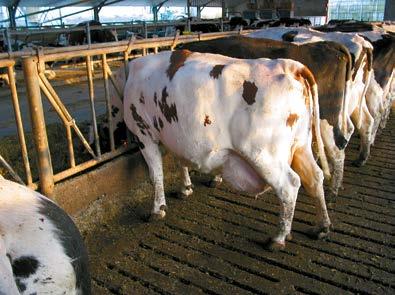
If cows have to stretch to reach feed, this puts a high load on the front hooves. As a result, these can wear and grow unevenly. The risk of hoof defects and sole ulcers affecting the front feet is increased. Push the feed towards the cows at least five times a day and tilt the feed barrier forward (15 cm from the perpendicular).
Key aspects
Success factor: Cow signals to be monitored:
Excellent hoof quality Score the amount of sole discoloration, sole haemorrhages, hardness
Evaluate the shape and balance of hooves
Score the number of cows with red coronary bands
Minimal loadScore the number of sole bruising, white line conditions and sole ulcers; score lying comfort
No harmful effects Score the number of cows that are tripping and loading hooves unevenly when standing Score the number of cows with signs of digital dermatitis, heel horn erosion: scabs, or oozing Score the number of cows with swollen coronary bands and/or pasterns.
Early and effective intervention
Number of lame cows, plus their BCS and rumen fill
Score the number of sole ulcers and interdigital growths, chronic lamenitis, chronic infections
Number of repeat cases of lameness and their treatment
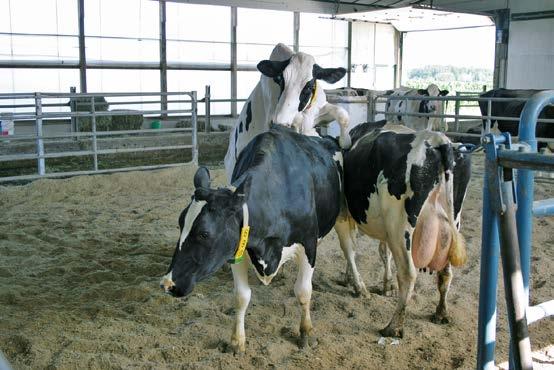
Three cows in oestrus, isolated in a special pen, with a thick layer of sawdust bedding. This reduces the risk of hoof injuries and other damage, both for the cows in oestrus and the other cows.
General situation
Number of lame cows (mobility score)
Score hoof hygiene and hoof conditions
Assess hoof health of culled cows
Assessment by an external expert
Assessing the success factors 47 Chapter 5. Monitoring
copyrightprotected
Hoof Signals
Our cows’ hooves are the weakest link in their health, along with feed and feed intake. Cows that become lame - however slightly - suffer from pain and will eat, drink and lie down less. They will therefore produce less milk and it will be more difficult to get them in calf. Plus they will need additional attention and work on an ongoing basis.
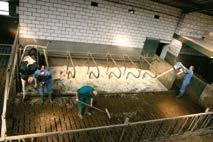
This is why it is important for every livestock farmer to pay constant attention to the health of his cows’ hooves. In terms of the design and construction of paths and barns. In terms of the way they are managed so they remain clean and dry. And in terms of daily care tasks such as feeding, moving and treatment of the animals.
A good manager makes hoof health care an integral part of his work and in his daily, weekly, monthly and annual routine. He also focuses on prevention, so his time is not constantly taken up treating lame cows. He thinks ahead!
The modern farmer knows that he can bring in specialist vets, hoof trimmers and feed advisors. They may not have a clear picture of why certain conditions come about, but they know more than enough about how to prevent them.
Hoof Signals provides all the practical knowledge a farmer needs to get hoof health on his dairy farm under control. With easily understandable descriptions, clear drawings and lots of photographs.

‘Good hoof health brings higher financial returns and r educes the pressure of work. And it delivers more job satisfaction for man and cow.’
www.roodbont.com www.cowsignals.comcopyrightprotected
Hoof Signals is a publication in the Cow Signals® series. Cow Signals® presents highly practical knowledge on animal-oriented cattle farming in an accessible way.