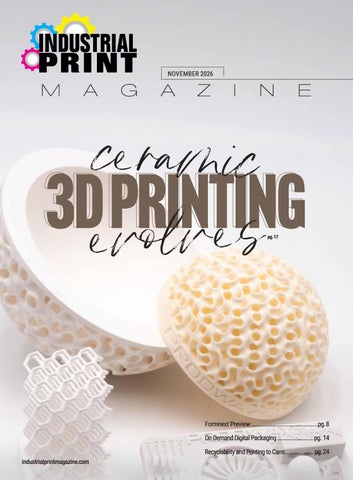
DUSTRIAL RINT
M
A
G
I NOVEMBER 2026
A
z
N
E
Formnext Preview ............................................ pg. 8 On Demand Digital Packaging ........................ pg. 14 industrialprintmagazine.com
Recyclability and Printing to Cans... ""...
..fi18. 24
COMMANDCORE 2026.3 LAUNCHES
MULTICAM ANNOUNCES STRATA ONE
EXCELITAS ADVANCES RADIOMETERS
ePS releases CommandCore 2026.3, a major platform update built to provide more saleable capacity from existing plant resources and putting the information a plant is already generating to use. The foundation of the release is PackAI, ePS’ artificial intelligence (AI)-powered business intelligence (BI) solution, embedded in Radius and built for packaging. It’s a standalone solution, complete with the dashboards and visualizations a packaging plant needs. A user describes the dashboard they need in plain language, reviews the query and charts PackAI proposes, and refines them in the same conversation before publishing. Users ask questions directly and get answers the same way. No SQL, no BI training, no waiting on a specialist or a report queue. The whole team can work with it too, without per-user BI licences stacking up the #165 cost.
MultiCam debuts next generation STRATA One Routing technology. Featuring an updated operating system and controller, the router helps manufacturers simplify production, reduce downtime, and achieve consistent results. The simpler, modern user interface used in STRATA One is powered by MultiCam’s newly developed Pegasus controller and signature Coreo operator software, which combined with reliable industrial CNC engineering and routing performance, delivers improved operator experience and enhanced diagnostics. STRATA One is designed for small to midsized manufacturers that need dependable routing across a range of materials. It delivers cutting speeds of 1,500 IPM and Rapid Traverse speeds of 2,121 IPM, making it ideal for soft and hard plastics, paper, foam, non-ferrous materials, composites, and wood. There are five table #166 sizes available.
Excelitas launches the OmniCure R2000Plus UV/Visible Radiometer, an enhanced radiometer designed to provide highly accurate broadband optical power and irradiance measurements for UV and visible light curing applications. It enables manufacturers to simplify system setup, process validation, and ongoing monitoring of UV curing operations while maintaining the accuracy and repeatability required for qualitycritical production environments. The radiometer measures optical power and irradiance across a broad spectral range and provides NIST-traceable measurements that support reliable quality assurance and process consistency. Designed for integration with OmniCure S2000 Elite and OmniCure S2000 UV Spot Curing Systems, the R2000Plus supports rapid calibration, irradiance verification, and process optimization. The platform is fully compatible with ex#167 isting OmniCure accessories.
#2 6 [ Industrial Print Magazine ] November 2026
industrialprintmagazine.com
5 120 mW/cm² and lifting resolution by 60 percent—from 40 to 25 µm, making it much more accessible for processing dark ceramics. The S65 Performance Pack performs live demonstrations during the show. Application highlights include 116 aluminium nitride cooling plates printed on a single CeraFab S320 platform, demonstrating linear scalability for ultra-precise thermal management components; novel alumina cooling plates with molybdenum-manganese metallization by Sigma Advanced Materials; a new zirconia color range on luxury watch bezels; hydroxyapatite spinal cages developed with Swiss ADMS pioneer Spherene; casting cores by Access e.V. displayed inside a real turbine blade from a renowned engine manufacturer; and complex lead-free KNN piezo ceramic parts for miniaturized medical sensors and actuators. INFO# 146
industrialprintmagazine.com
Nikon Advanced Manufacturing, hall
12.0, booth D119, offers Formnext attendees an early look at MACHX from its Nikon SLM Solutions unit as manufacturers increasingly turn to AM to scale production of complex, high-performance parts across demanding industries, including aerospace and defense. INFO# 147 Solukon, hall 12.0, booth D58, presents a new depowdering system, the SFM-AT850. Designed for the automated depowdering of complex, large LPBF metal parts, the system combines a compact footprint with a high load capacity of up to 1,000 kg. It accommodates parts measuring up to 650x650x800 mm and features Solukon’s front-top loading concept for safe, flexible crane loading. At the same time, Solukon unveils the SFM-AT850-E version of this machine with ultrasonic excitation, offering gentle and noiseless
cleaning. Smart Powder Recuperation (SPR) technology with programmable two-axis rotation and vibration excitation, protective-gas inertization, and compatibility with SPR-Pathfinder enable reliable, reproducible powder removal, even from intricate geometries and internal channels. New machine software features include a flexible portrait display, user access levels, simplified program management, and remote maintenance. INFO# 148 Wayland Additive, hall 12.0, booth B139, showcases Calibur3, featuring the NeuBeam metal AM process, which offers a compelling alternative to laser and traditional eBeam metal AM systems. Calibur3 overcomes the compromises of traditional metal AM systems, enabling applications previously seen as troublesome or impossible and the development of projects with new materials. INFO# 149 IPM
November 2026 [ Industrial Print Magazine ] 11
showing customers what we are capable of and what the technology can do in terms of size, tolerances, and features.” The company is quality focused and holds an AS9100 certification, which is the international quality management system or QMS standard for the aviation, space, and defense industries. Additionally, it is registered with the International Traffic in Arms Regulations’ or ITAR, signifying that it meets the requirements applicable to suppliers supporting controlled programs or materials.
Ceramic Materials With an arsenal of ten ceramic AM devices, from both Lithoz and Prodways Printers, Adva Cera is uniquely positioned to print with a variety of ceramic materials, including oxides, nitrides, and bioceramics. Oxide-based technical ceramics are known for their versatility, stability, and proven performance across many industries. When combined with AM, oxide ceramics enable greater design freedom while maintaining the material properties required for demanding environments. The oxide-based materials Adva Cera utilizes include alumina and zirconia. Williams recognizes alumina as the most popular, as it is the most ubiquitous and can be used for multiple applications. The company also uses advanced nitride-based ceramics. These materials are ideal for applications requiring exceptional mechanical strength, thermal performance, and reliability. Nitride-based ceramic materials are widely used in environments where components must withstand extreme temperatures, mechanical loads, and chemically aggressive conditions. Among its nitrate-based ceramic materials are aluminum nitrade and silicone nitrade.
C O M PA N I E S M E N T I O N E D
Its bioceramics are developed for AM applications in medical, dental, and orthopedic fields. These advanced bioceramic materials are designed to support biocompatibility, osteoconductivity, and controlled resorption. The material is known as hydroxyapatite (HA), which is a naturally occurring mineral and a primary component of human bone. As a bioceramics material, HA offers exceptional biocompatibility and osteoconductivity, making it ideal for applications that require strong biological integration. Additively manufactured HA enables the creation of well-defined, porous, and patient-specific structures that promote bone cell growth. Once implanted, HA scaffolds support bone ingrowth while the material is gradually resorbed and replaced with newly formed natural bone. As far as AM, ceramics is “the last frontier,” according to Williams. He feels that these materials can be utilized in many applications that probably aren’t taken advantage of today. “Ceramics are difficult to manufacture no matter the method because of their properties. Some great features they offer include thermal management and temperature resistance. They are also electrical isolating or insulated. While this is true for plastics and some metals, ceramics also have excellent wear resistance for demanding environments like space,” explains Williams.
The Onboarding Process The typical journey for a Adva Cera customer starts with a concept or problem. A client meeting involves engineers trying to understand the problem or concept and working together in design. These teams go through their ideas and designs, add modifications when See page 21 for more information.
INFO# Company
Website
169
Lithoz
lithoz.com
170
Prodways Printers
prodways.com
industrialprintmagazine.com
necessary, and once the design is agreed upon a prototype is produced. “Depending on the needs, this can be a first run with some initial testing, or a tier two prototype with very strict dimensional requirements,” shares Williams. Then the customer takes the component to ensure it is performing as expected. After some refinements, dimensional adjustments, or feature testing, it moves straight to production. The turnaround time depends on the design process, as well as the number of components.
On the Horizon The future of technical advanced ceramic AM is bright. Williams feels we’re just scratching the surface of what is possible. One of the most exciting developments is around ceramic core production. This is the element that defines the internal geometry of a final part. It must withstand the extreme heat and mechanical stresses that are incurred by the investment casting process, and it must be removed from the solidified part without damaging it. Ceramic cores are conventionally produced using silica via injection molding, which tend to take months or even years to produce. The material is thermally stable and dissolvable, making it ideal for this application. Advancements in AM printed silica cores use the same material but eliminate the lead time constraints as well as introduce new capabilities, like creating complex designs that improve thermal management with internal features like directional cooling channels. “We’re just touching the surface of what’s is capable with this technology,” stresses Williams.
Advanced Ceramics Adva Cera is fully adept in working with ceramic materials. Experienced in the features and benefits of advanced technical ceramic AM, it partners with manufacturers that need anything from prototypes to production runs. IPM
November 2026 [ Industrial Print Magazine ] 13
CORRUGATED
SHAPING THE FUTURE Revolutionizing Packaging with On Demand Digital Cutting by Cassandra Balentine
Digital print and supporting technologies are inching their way into the packaging space, especially for prototyping and short runs. Common packaging applications printed and finished digitally include folding cartons, corrugated board, luxury packaging, and those that incorporate specialty materials. For any of these packaging products, finishing is essential. “As demand for shorter runs, faster turnaround, and more customized packaging continues across all of these areas, brands 1 want to test packaging concepts before committing to larger production, and printers want the ability to say yes to more digital workflows that eliminate the traditional divide between specialty work without the cost of outsourcing or purchasstructural design, prototyping, and manufacturing.” ing traditional dies,” says Drew DiPirro, sales and marketing Wendy Baker, UK marketing manager, Plockmatic Group, support, Graphic Whizard USA. feels that the conversation around packaging has shifted deQuick turnarounds and short runs are here to stay, and Dacisively. “What was once a market built on long runs, dedicatvid Newell, director of applications, Kongsberg Precision Cuted tooling, and conventional die cutting is being challenged ting Systems, says it is important to have the ability to produce by a customer base demanding rapid turnaround, versioned packaging closer to demand in order to reduce inventory. products, and economically viable short runs—often in the Martin Thornton, packaging business development manhundreds or low thousands rather than the millions.” ager, Zund America, Producing Prototypes Inc., agrees, adding that Digital cutting is parpackaging development ticularly well suited to is much more agile. prototyping because it “Brands want to evaluate eliminates the need to more concepts, more fremanufacture expensive quently, while also maintaining the ability to quick1. Summa offers a comprehenly transition into market sive portfolio of digital flatbed — Martin Thornton, packaging business development manager, testing or short-run procutting solutions designed for Zund America, Inc. duction. As a result, there packaging, displays, signage, and prototype production. is growing demand for
As a result, there is growing demand for digital workflows that eliminate the traditional divide between structural design, prototyping, and manufacturing.
14 [ Industrial Print Magazine ] November 2026
industrialprintmagazine.com
CORRUGATED
2 to test shapes, folds, materials, and structural concepts quickly,” offers DiPirro. Thornton agrees, pointing out that systems that use digital, computer-controlled knife cutting and routing technology are highly adaptable to any kind of production scenario. More widely, Newell says digital cutting reduces production costs by enabling materials to be ordered when needed. Muto sees few limitations in a prototyping environment. The primary consideration may be material compatibility or the need to replicate very specific production effects intended for high-volume converting equipment. 2. Zünd’s range of cutting platforms help users maintain continuity, from concept development all the way through to industrial-scale production.
C O M PA N I E S M E N T I O N E D
It is important to utilize the correct technology for the requirement. “For example, organizations producing high volumes of prototypes or requiring greater throughput, the Kongsberg C or Ultimate may be more appropriate due to its productivity” says Newell. DiPirro adds that each material and structure may require some testing to determine the best tool, blade, pressure, and speed settings.
Short-Run Territory For short-run packaging, digital cutting provides the flexibility to switch quickly between jobs without lengthy setup processes. Thornton says it supports cost-effective production, rapid turnaround times, and consistent quality, even as order volumes, designs, or material requirements change. “As brands increasingly demand versioning, personalization, and shorter product lifecycles, digital cutting has become a compelling solution for short-run packaging production,” comments Muto. For short-run packaging, DiPirro explains that digital cutting helps eliminate See page 21 for more information.
INFO# Company
Website
155
graphicwhizard.com
Graphic Whizard USA
156
Kongsberg Precision Cutting Systems
kongsbergsystems.com
157
Plockmatic Group
intecprinters.com
158
Summa
summa.com
159
Zund America, Inc.
zund.com
16 [ Industrial Print Magazine ] November 2026
the cost and lead time of traditional dies, which can be a major barrier for smaller quantities. “Runs around 2,500 pieces often require a balance between automation and flexibility. Automatic sheet feeding, barcode recognition, mark registration, and multi-tool capabilities allow print providers to produce short-run packaging efficiently while still handling frequent job changes, custom shapes, and versioned designs.” For print providers moving into packaging, Baker says the single biggest hurdle is rarely the printing itself. It is the mental and operational leap from a world of predictable, repeatable bulk to one of constant changeover. The good news is that the technology to dissolve that barrier has matured rapidly. “Over the past three to five years, the most significant workflow advancement has been the move to fully digital, tangential cutting and creasing. The advantages for prototyping are clear—no tooling cost, no lead time, and the freedom to iterate a design on screen and produce a finished, folded sample within minutes. For short-run packaging, the same technology turns what would once have been loss-making work into profitable production, because every job carries the same low setup overhead regardless of quantity.” Thornton admits that while run lengths increase and jobs become highly standardized, conventional die cutting may offer greater economies of scale. “The crossover point depends on factors such as run length, design complexity, material, turnaround requirements, and the level of automation in place.”
Cut it Out In today’s packaging market, speed, agility, and personalization are critical competitive advantages when it comes to finishing. “Digital cutting technology provides the flexibility needed to respond rapidly to changing customer demands while maintaining exceptional quality and efficiency,” concludes Muto. IPM
industrialprintmagazine.com
1 New Materials A number of ceramic-based materials are compatible with additive manufacturing (AM). AIN, silica-based ceramics, and calcium phosphates are three options that have been scaled and
proven for use in industrial and production settings. “The range of ceramic materials available for AM is expanding, with increasing interest in materials selected for very specific thermal, electrical,
mechanical, or chemical properties,” admits Sébastien Jacoberger, marketing manager, Prodways Printers. According to Dr. Johannes Homa, CEO, Lithoz, AIN, silica-based ceramics, and calcium phosphates each recently crossed important industrial milestones—growing clinical or field evidence, verifications, and large-scale adoption. Across a material portfolio that spans over 50 ceramics, Dr. Homa admits that these three are the fastest growing in terms of demand at Lithoz. “They open up entirely new industries and application spaces that were previously beyond the scope of ceramic AM,” continues Homa. Beyond AIN, silica-based ceramics, and calcium phosphates, Maxence Bourjol, sales manager, 3DCeram Sinto, says there is growing interest in silicon nitride and silicon carbide. Bourjol points out that not any one of these materials is better than other, as they provide a specific property or application. “Ultimately, the material should always be selected according to the function and operating environment of the final part.” “The main trend is therefore not simply the replacement of traditional ceramics by newer materials, but the development of a broader range of printable ceramics adapted to specific industrial applications,” agrees Jacoberger.
Application Growth With new materials, there is an opportunity to expand ceramic AM into new industries and create applications not once possible. “We see strong potential in industries such as semiconductors, aerospace, space, and defense. In semiconductor 1. Silicon nitride radome designed and printed using 3DCeram Sinto SLA printing technology. 2. The
2
18 [ Industrial Print Magazine ] November 2026
CERAM PRO 365 from Prodways Printers works with validated ceramic formulations including silica-based materials for investment casting applications and alumina for advanced technical ceramic applications.
industrialprintmagazine.com
primer is applied in a micro-thin layer via inkjet. It acts as a chemical bridge between the overvarnish already on the can and the ink application,” say Stempfer and White. While surface pretreatments ensure the ink stays on the container for the length of its use, it’s important to consider whether the pretreatment detracts from the ultimate recyclability of the container. According to Stempfer and White, “properly selected pretreatments do not negate recyclability. Flame treatment leaves zero chemical residue or foreign layer on the metal. Applied primers, opacifying coatings, and overvarnishes are engineered as ultra-thin organic layers that cleanly pyrolyze—or burn off—during the thermal de-coating furnace stage prior to melting without contaminating the aluminum melt.” “For metal beverage cans, the ink and coating used have no effect on recyclability since the ink and coatings are vaporized during the recycling process,” points out Alex Folloso, VP of research and development, metal decorating technology, INX International Ink Co.
Ink Considerations Certain types of ink sets are deemed more sustainable and ultimately recyclable than others. UV-curable ink is the preferred solution for pre-formed aluminum cans, suggest Stempfer and White. “It enables precise dot size and placement on rotating cans, minimal thermal load on thin aluminum walls, rapid pinning, zero volatile organic compound emissions, and compliance with global food contact material regulations. The
C O M PA N I E S M E N T I O N E D INFO# Company
crosslinked matrix withstands mechanical handling, denting, and scratching without flaking or micro-cracking.” Instant polymerization is another benefit offered by UV-curable ink sets for DTO printing to cans. “Because cans are printed dynamically on a rotary spindle, UV LED pinning freezes ink droplets in milliseconds, preventing ink slump, misting, or dot gain on curved surfaces,” say Stempfer and White. After a can is used and placed in a recycling bin, that UV-curable ink is easily broken down in the recycling process. “The crosslinked polymer network of cured UV inks breaks down smoothly during the thermal de-coating stage in aluminum recycling plants. The organic binders volatilize cleanly into gases, leaving zero metallic or slag residues to contaminate the recycled molten aluminum,” share Stempfer and White.
Strategic Partnership Koenig & Bauer Kammann and CanSealing Systems work together to solve operational spoilage while driving circular economy demand for fully recyclable aluminum packaging. CanSealing Systems’ process converts setup misprints, obsolete inventory, and rejected pre-filled beverage containers into new, printable cans. With traditional processes, misprinted and rejected containers are melted down and recycled before they hold a single drop of liquid, this for a few reasons. “Redecorating these cans via traditional offset printing is both legally and mechanically impossible. Legally, trademark laws forbid printing over established brand logos. Mechanically, offset See page 21 for more information. Website
121
CanSealing Systems
cansealingsys.com
122
Enercon Industries Corporation
123
Koening & Bauer Kammann (US) Inc.
enerconind.com kammann.koenig-bauer.com
124
INX International Ink Co.
inxinternational.com
26 [ Industrial Print Magazine ] November 2026
printing processes are engineered for cylindrical with straight walls before necking occurs—making this process physically incapable of handling prenecked, fully shaped cans,” say Stempfer and White. CanSealing Systems technology allows for this scrap stock to be recovered and transformed into fully formed blank cans to create an ideal substrate for DTO digital printing without the resource and energy loss of the traditional recycling process. By bypassing the re-smelting stage, Scope 3 emissions is slashed by 84.8 percent per repurposed unit, as cited by research conduced by CanSealing Systems. “The CanSealing process delivers a major step forward for pre-filled beverage container circularity at the manufacturing level while end-of-life recycling for used beverage cans remains vital and still relies on consumer behavior,” share Stempfer and White. The new, printable cans are then run on Koenig & Bauer Kammann’s direct-toshape digital printing technology, which offers dome-to-neck coverage—seamless graphics extending continuously from the dome to the neck; tactile 3D embossing and functional relief—high-build digital varnishes that create raised tactile effects and braille without physical tooling or mold costs; and short runs and low minimum order quantities—digital printing eliminates physical plate swaps, supporting economical low-minimumorder-quantity runs, personalized variable data, and rapid time-to-market.
Goals Achieved More beverage companies look to create shorter run marketing campaigns that reflect levels of customization and personalization that only digital printing can achieve. An elaborate eco-system of pretreatment, printer, ink, and post process ensures that beverage containers like aluminum cans remain recyclable and meet those design goals. IPM
industrialprintmagazine.com
#1
#5