


ISSUE NUMBER 6 VOLUME 26
reading for today’s transport worker JUNE 2023 www rmt org uk
AT DB CARGO PAGE 4 SOLID STRIKE ACTION PAGE 6
SOLIDARITY CALL PAGE 18 FOR A PEOPLE’S CALMAC PAGE 8
Essential
ORGANISING
RMT LGBT +
WORKING FOR YOU
Use the QR code to join to get help at work and save money

RMT has developed a number of benefits to save members money. This includes negotiating access to savings and special offers from our approved partners.
COLLECTIVE BARGAINING
The union has a dedicated team of elected officers and local reps to serve your interests negotiating with employers on issues from pay, hours of work, pensions and working conditions. They are supported by a team of researchers to formulate pay claims to obtain the best negotiated terms for you.
CAMPAIGNING
The union has a political fund to run campaigns and provide a political voice to benefit members’ interests in the workplace. RMT has a very active parliamentary group which raises issues of concern for members at Westminster, the Scottish Parliament and Welsh Assembly.
PERSONAL INJURIES
Personal injury claims cover if you suffer an accident in work or outside work. RMT underwrites settlements that would not be provided by no-win, no-fee companies. Call 08457 125 495.
INDUSTRIAL DISEASES
Members who have suffered an industrial disease will receive free legal support to make a claim. Such claims are underwritten by the union and members will not have any deduction from their settlement unlike claims run by no-win, no-fee companies. Call 08457 125 495
EMPLOYMENT TRIBUNALS
Should a member find themselves unfairly
dismissed, discriminated against or have any claim which has reasonable prospects of success at an Employment Tribunal, RMT will provide legal representation and pay the fee. Even if the union is advised that the claim is unlikely to succeed, members who make a claim are eligible to receive free legal advice.
ACCIDENT BENEFIT
Payable if you have an accident at work or on the way to or from work. Accident benefit is only payable if you have been off for three days or more. Accident must be reported to branch secretary within 26 weeks in order to qualify for accident benefit.
RETIREMENT BENEFIT
Payable to any member who retires over the age of 60 or aged 55 if retired through redundancy or resettlement. Ill health retirement is also payable; proof of this must be sent with application for retirement benefit.
TAX AND WILL PREPARATION
The union can provide a personal taxation service and will preparation service.
DEMOTION COMPENSATION
Payable to any member who is experiencing loss of wages through being permanently demoted or downgraded as a result of illness or injury.
Payment of £300 provided that member reports this to branch secretary within 12 weeks.
ORPHAN FUND
The beneficiaries of this fund would be any child of a member or spouse if the member dies in service or if a members’ spouse dies and the member has responsibility of the children. Benefit is paid while a child is in full-time education up until the age of 22. Payment is made quarterly and the rate is £12.00 per week for children up to the age of 16, then £12.75 per week from 16 to 22.
RMT CREDIT UNION
Accessible savings and affordable loans from RMT’s Credit union. www.rmt.org.uk/about/credit -union
ONLINE SHOPPING DISCOUNTS
Shop online with RMTrewards.com and earn cashback savings from hundreds of retailers, like B&Q, Argos and Tesco. It’s free to join, plus you’ll get a FREE £10 Welcome Bonus in your online account!
(Terms and conditions apply) www.rmtrewards.com
FINES POOL
if you drive a company vehicle as part of your job you can join the RMT fines pool for £7 per year. The Fines Pool will reimburse members for any speeding fines, related court costs and lost time to attend a court hearing. www.rmt.org.uk/memberbenefits/fines-pool
BEREAVEMENT BENEFIT
A Death Grant of £600 is payable to the nearest relative or legal representative if a member dies through any cause prior to retirement.
CASHBACK PREPAID CARD
Fancy cashback on your everyday shopping? Use your RMT Prepaid Plus Cashback card at over 50 partner retailers, including Sainsbury’s, ASDA and Boots, and earn unlimited cashback! It’s different to a credit or debit card - you can only spend what you load so there’s less chance of getting carried away. www.rmtprepaid.com
FREE £5,000 ACCIDENTAL DEATH COVER
As a benefit of your RMT membership you can register for £5,000 Free Accidental Death Cover. Cover is for UK residents aged 18-69. 12 months free cover. Annually renewable and always FREE. The Cover is underwritten by Advent Insurance PCC Ltd – UIB Cell. www.rmtprotect.com
HEALTH CASH PLAN
For a small monthly premium you can claim cash-back on dental, optical and therapy treatments. Visit www.bhsf.co.uk
Join RMT by visiting www.rmt.org.uk
RMT helpline 0800 376 3706 :: june 2023 :: RMTnews 2
Page 4
ORGANISING AT DB CARGO
Page 5
BRING SAFETY CRITICAL TUBE WORKERS IN-HOUSE
Page 6
SOLID STRIKE ACTION
Page 7
RMT NEGOTIATE SCOTRAIL DEAL
Page 8
FOR A ‘PEOPLE’S CALMAC’
Page 9
MASSIVE TUBE VOTE EXTENDS STRIKE MANDATE
Page 10
CLEANING JOBS MATTER
Page 12
THE COMING BATTLE FOR RAIL
Page 14
THE ROLLING STOCK SCANDAL
Page 16
CALL TIME ON AGENCY WORK!
Page 18
RMT LGBT+ CONFERENCE SOLIDARITY CALL
Page 21
A SPECTRE HAUNTING EUROPE

Page 22
LEGAL VICTORIES
Page 24
EXPLOSIONS, APPENDICITIS AND EXHAUSTION
Page 26
FROM LONDON UNDERGROUND TO LONDON RECRUIT
Page 27
PRESIDENT’S COLUMN

Page 28
BLUEBELL DAYS
Page 30
HOLYHEAD WISHES JACK A HAPPY RETIREMENT/CROSSWORD
OUR WORK MAT TERS
Thisunion is keenly aware that the use of agency work and the gig economy is growing on London Underground and across the entire rail network.
RMT members who work in track protection for London Underground are calling on the London Mayor to take action to address their pay and conditions as well as their employment status.
These workers are agency workers but are wrongly described as self-employed but their employment status is a fiction.
These are not isolated incidents as more and more employers seek to remove permanent workers and engage supposedly ‘self-employed’ workers who are denied sick pay, holiday or pensions and live in a state of constant precariousness.
This growing use of agency work comes on top of the continued outsourcing of renewals work. RMT has exposed that contracts with construction giants mean that Network Rail’s supply chain is riddled with casualisation, bogus selfemployment and the use of payroll companies.
This is the model that employers have for transport workers, and it is connected to the national rail dispute. Over 20,000 RMT members took strike action earlier this month in the dispute on jobs, pay and conditions across the train operating companies.
Members have displayed a magnificent show of solidarity and commitment to the dispute
and it has been that steadfastness which has stopped the companies and the government from driving on with the imposition of cuts and changes to conditions.
RMT is also campaigning to get outsourced cleaning grades back in-house. The union is putting pressure on the London Mayor to deliver on his pledge to review his cleaning contract with ABM with a view to in-sourcing these workers.
It is time for the mayor to show real leadership and bring in-house more than 2,000 tube cleaners and who are currently outsourced to the US company ABM.
RMT is also calling on the Scottish government to end the current ferry chaos in Scotland and commit to keeping CalMac Ferry services in permanent public ownership when the current contract ends next year.
Time and again we see the private sector failing to deliver in transport on ferries, buses or in rail. In fact, following the government taking the shambolic Transpennine Express franchise into public ownership, last month, private transport companies now run less of the rail network than at any point since privatisation in 1993.
In response this union is stepping up its campaign to rebuild an integrated, directly employed and fairly paid workforce for all transport and energy sectors.
When
RMT helpline 0800 376 3706 :: june 2023 :: RMTnews 3 RMT News is compiled and originated by National Union of Rail, Maritime & Transport Workers, Unity House, 39 Chalton Street, London NW1 1JD. Tel: 020 7387 4771. Fax: 020 7529 8808. e-mail bdenny@rmt.org.uk The information contained in this publication is believed to be correct but cannot be guaranteed. All rights reserved. RMT News is designed by Bighand Creative and printed by Leycol Printers. General editor: Mick Lynch. Managing editor: Brian Denny. No part of this document may be reproduced without prior written approval of RMT. No liability is accepted for any errors or omissions. Copyright RMT 2016
Contents
you have finished with this magazine give it to a workmate who is not in your union.
EDITORIAL
ORGANISING AT DB CARGO
ORGANISING

Union launches recruitment campaign at one of the largest rail freight companies in Britain JOIN RMT

RMT has launched an organising campaign for workers employed by DB Cargo (UK) the German owned rail freight company which operates in Britain.

The Deutsche Bahn AG (abbreviated as DB or DBAG) is the national railway company of Germany, and a state-owned enterprise under the control of the German government and RMT negotiates for DB Ground staff working in this country.




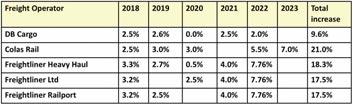
Part of the campaign is to highlight the lag in pay for DB Cargo (UK) workers compared to other rail freight companies (see charts below). There is also a threat to pension provision at the company. Members and potential members are working in a depots across the country and the union already has reps in place in many areas.
DB Cargo (UK) participates in a cash pooling arrangement operated by its ultimate parent, Deutsche Bahn AG. This effectively operates in the same was a
bank account and is used to manage day to day working capital. This is a longstanding arrangement operated by DBAG to manage the liquidity needs of DBAG group companies and the company has been party to this arrangement for several years. Under the arrangement there is a daily sweep of the company’s cash balances into the DBAG cash pool which is fully ringfenced as DB Cargo UK money.
RMT assistant general secretary Eddie Dempsey said that DB could clearly afford
to increase pay and continue to provide decent pension provision for its workforce.
“Ground staff working at DB Cargo deserve more but in order to get better treatment workers need to join the only union that can represent them effectively,” he said.
If you work for DB Cargo or your branch wants to assist in the campaign, contact RMT organiser Donald Graham email d.graham@rmt.org.uk or phone 07753 748074.
RAIL FREIGHT PAY AWARDS SINCE 2018

4
BRING SAFETY CRITICAL TUBE WORKERS IN-HOUSE
London Underground engages ‘self-employed’ agency track protection workers
Outsourced safety critical track protection workers held a protest outside London City Hall earlier this month to bring workers employed by the Morson and Cleshar’s Framework in-house.
The union has written to London deputy mayor Seb Dance regarding the issue following a report by the Rail Accident Investigation Board into a track worker struck by a train at Chalfont Latimer in April last year.
The RAIB raised issues relating to the employment of agency workers, noting that ‘some agency staff feel that they cannot question or challenge LUL staff because this could affect the likelihood of further work with a particular group of people at a particular depot’.
The report also noted that
some agency staff may feel that they need to exaggerate their familiarity with track or be reluctant to raise questions in briefings for fear of not being offered work in the future.
Despite the history of failed experiments with outsourcing of maintenance on the Tube maintenance, it is a littleknown fact that London Underground still outsources some key safety critical track maintenance work to private companies.
According to an RMT report these workers are given shifts by text message, never know how many hours or where they will be working and are denied sick pay, holiday, pensions and travel facilities.
Two thirds of Track Protection staff say they would be worried about raising safety concerns for fear of losing
work and 75 per cent are struggling to make ends meet.
Most workers report constantly monitoring their phones and being uncomfortable turning down unsuitable shifts for fear of not getting future work. This way of working creates stress for them and their families, leading to poor physical and mental health.
The union believes that ultimately, employing these workers in house directly would be more efficient, more economical and fairer and safer.
RMT general secretary Mick Lynch said that these were serious issues that could not be waved away with finesounding statements of intent.
“These are structural issues that go to the heart of problems with this
employment model, and they show why these workers, like other maintenance workers, should be employed in-house as part of established teams.
“Previous experience on both Network Rail and London Underground shows that inhouse maintenance teams work better together than ones based on outsourcing and Labour Provision contracted workers.
“Bringing these workers inhouse would not only put an end to these shameful practices but would also be more economical as RMT has shown,” he said (see pages 16 & 17).
*The RMT policy Briefing ‘Why the Mayor must insource safety-critical track workers’ is available on www.rmt.org.uk

RMT helpline 0800 376 3706 :: june 2023 :: RMTnews 5
SOLID STRIKE AC TION
RMT members take further action in the campaign to defend jobs pay and conditions

Over 20,000 RMT members took strike action earlier this month in the latest phase of the national industrial dispute on jobs, pay and conditions across the train operating companies.
The strike, sandwiched between two ASLEF strike days, demonstrated that the entire railway workforce remains committed to the dispute, to protecting the future of workers in the industry and winning a fair deal.
RMT general secretary Mick Lynch said that members had
displayed a magnificent show of solidarity and commitment to the dispute and that it had been the steadfastness of the membership which had stopped the companies and the government from driving on with the imposition of cuts and changes to conditions.
“Your support for this dispute in three separate ballots and your solid strong backing of strike action has stopped those detrimental measures being introduced and has in fact, produced improved offers from the rail delivery group (RDG),” he
said.
The initial stance of the government and the Rail Delivery Group included:
• A mere two per cent pay increase for everyone
• To bring in driver-only Operation in every company and railway service
• To cut catering services and restructure fleet engineering
• To close every ticket office at every station on the network from October 2022
• To bring in new contracts of employment for all staff with additional compulsory hours to cover mandatory Sunday working
• To cut thousands of our members jobs
• To attack the Railways Pension Scheme with massive cuts to benefits and increases to your contributions.
“Since the strikes there have been communications between the union and the (RDG) but no formal negotiations are yet planned. Despite its previous remarks,
RMT helpline 0800 376 3706 :: june 2023 :: RMTnews 6
Preston
the RDG has not indicated that it is going to drive these matters directly into the 14 individual TOC negotiating structures at this time.
“It remains the position that the government requires that RMT should declare the dispute over before the union can enter in to negotiations in each of the TOCs on the detailed changes in the companies and internal departments which is something the union cannot agree with.
“It would be irresponsible of your union to give up its mandates and leverage at the negotiating table before the consultations and negotiations on your future in your company has even commenced.
“A meeting of the RMT and ASLEF executive committees has also been arranged to discuss our disputes.
“I thank you again for your support for your union and each other during this dispute and in the action we have taken. It is essential now that we stand firm and remain committed to the cause until we get a settlement that we can support,” said Mick Lynch.
RMT NEGOTIATE SCOTRAIL DEAL
RMT members have accepted the latest pay offer from Scotrail which means that all RMT members will receive a five per cent basic uplift with the lowest paid receiving as much as an eight per cent increase.
The pay deal was overwhelmingly endorsed by Scotrail members in a referendum and Scotrail RMT members will also benefit from various measures which have added value to the overall pay package.
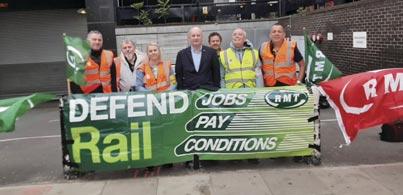
RMT general secretary Mick Lynch said that there had been some tough negotiations and members had voted to accept

this modest pay deal.
"We have managed to negotiate this deal like many others on the railways including in Wales, the English regions and now Scotland.
"Where the Department of Transport has the controlling mandate for 14 train operators, RMT has had a year-long dispute with multiple strikes.
"Scotrail members have benefited from annual pay rises and extra value added to their overall pay packages, unlike RMT members on 14 rail operators, some of whom have not had a pay rise in four years,” he said.

RMT helpline 0800 376 3706 :: june 2023 :: RMTnews 7
Euston
Carlisle
FOR A ‘PEOPLE’S CALMAC’ RMT makes the case to MSPs for permanent public ownership
RMT called on the Scottish government to commit to keeping CalMac Ferry services in permanent public ownership when the current contract ends next year.
The union made the demand after it was revealed the deadline for re-tendering the contract had now passed. It takes at least 18 months to draw up specifications in the contract and to launch a tendering process for Clyde and Hebrides Ferry Services. The current contract expires in September 2024.
This also means that at the very least the Scottish government will now have to make a temporary extension by direct award to the existing contract operated by CalMac.
RMT general secretary Mick Lynch met with MSPs in the Scottish Parliament convened by RMT parliamentary group convenor Richard Leonard MSP earlier this month to make the case for a ‘People’s CalMac’.
The meeting discussed a report written by Professor Jeanette Findlay from the University of Glasgow on the ‘Financing and delivery of lifeline ferry services in Scotland’.
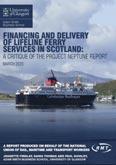
Professor Findlay’s report recommends the re-integration of CalMac and CMAL (Caledonian Maritime Assets Ltd) should be strongly considered, and that the wider
social and economic value of a publicly owned ferry operator must be at the heart of considering the future of the service.
There must also be greater involvement of workers, travellers and businesses in the design and delivery of ferry services, the report says.
Mick Lynch told the meeting that the last thing that communities and workers needed was for the Scottish government to launch a bidding war for the Clyde and Hebrides ferry contract which could encourage companies like P&O and Serco to enter a race to bottom.

“People relying on lifeline ferries need certainty over jobs, training and services. And the Scottish government must work with stakeholders to stave off a full-blown ferry
crisis in lifeline communities and to implement a long-term plan for the future of these critically important public services.
“We do not believe there is any legal requirement for the Scottish government to be compelled to re-tender the Clyde and Hebrides ferry contract.
“The Scottish government needs to commit to a permanently publicly owned People’s CalMac with proper investment and the exclusion of private profit. This would allow for successful long-term planning for improved services and resilience with a direct voice for CalMac workers and passengers,” he said.
When Scotland’s First Minister Humza Yousaf was Transport Minister, he set up the Ferry Law Review, which
December 2017: “A case will be built for making a direct award to an in-house operator which meets the full requirements of Teckal and the State aid rules, particularly the four Altmark criteria.
A decision on the future approach to procuring these services will be taken in advance of the current contract ending in September 2024”.

RMT helpline 0800 376 3706 :: june 2023 :: RMTnews 8
Calmac worker Brian Reynolds explains the need for government action
MASSIVE TUBE VOTE EXTENDS STRIKE MANDATE
Tube workers hold protests at Lancaster Gate against growing levels of tube closures
Tube workers have extended their mandate for strike action on London Underground with a huge 96 per cent vote for action. RMT members on London Underground are in dispute with TfL over jobs, cuts, and attacks on pensions and working conditions.
The result was announced as tube workers held a lively demonstration outside Lancaster Gate station over repeated station closures due to staff shortages. The lack of staff has meant that it has been closed for whole weeks and other intermittent closures are taking place across the network.
TfL has had its funding from central government dramatically cut but instead of standing up to ministers, Mayor of London Sadiq Khan
is cutting 600 staff and implementing a new rostering system that does not work.
RMT has revealed that stations were closed on 2,115 occasions last year, compared with a pre-pandemic high of 649 and, more often, stations have been left open with no staff.
At the protest RMT general secretary Mick Lynch said that the inevitable consequence of station staff cuts was that they have spread the jam too thin, and they were now having to shut stations and that's causing a strain.

"The public as a consequence are losing their service because we have not got enough people.
"We also have increasing attacks on our members and unsocial activity and violence
which is unacceptable. So, we really need LUL and London Transport to engage and restaff these stations, making our members secure and the public secure, providing the service that Londoners need."
Carlos Barros NEC member from the London Transport region said: "Members of staff have been asked to do two- or threepeople's jobs and it's unsustainable.
"These people [TfL] have no idea how to run a railway. We're here and we'll keep fighting until we have a safe railway for everyone,” he said.
The re-ballot, which is a requirement of UK anti-trade union legislation, smashed all thresholds with a huge majority voting ‘Yes’ for more
strike action on a turnout of 56.5 per cent. Those voting "yes" represent 54 per cent of those entitled to vote.
Mick Lynch congratulated tube members for giving the union the continued industrial leverage at the negotiating table.
"TfL cannot continue to simply wish this dispute away and the government which has drastically cut the funding to London transport budgets, shares a great deal of responsibility for this continuing impasse.
"London Underground workers want a negotiated settlement and are quite prepared to take more strike action over the next 6 months to make that a reality,” he said.
RMT helpline 0800 376 3706 :: june 2023 :: RMTnews 9
CLEANING JOBS MAT TER
“We’re in momentous times,” RMT senior assistant general secretary Eddie Dempsey said as he opened this year’s national industrial organising conference of cleaning workers.
Amid the highest level of industrial action specific to cleaning grades in the union’s history, he continued: “You’re an important conference to this union, I think you’re going to be one of the most important conferences over the next year or two”.
The conference took place in Birmingham and top of the agenda was the inadequate provision of personal protective equipment (PPE) to cleaners and delegates highlighted particular problems with contractor Churchills.
A motion described items of protective wear as “mostly
uncomfortable to work with”, highlighting pain-inducing safety shoes and “heavy and hurtful” winter jackets.
Serwaa Boateng, South London Rail said: “As we all know cleaners are being neglected for PPE, especially in Churchill’s.
“To be given one item of PPE to last for a year is uncomfortable for us. Most of the cleaners are reporting that when they are recruited, they are being asked to provide their own PPE”.
Tim Butler, York & District said: “It’s not a request, it’s a requirement. It needs to be correct PPE. You can just have there’s a male uniform and there’s a female cleaner, and it doesn’t fit”.
Joseph Mambuliya, Finsbury Park said: “We are being exploited because we are doing more than we are
supposed to and personal equipment is so important for safety”.
Roy Osarogiagbon, Jubilee South stressed the need to put requests for adequate PPE in writing, while Amar Barouche, Euro Passenger Services noted: “They force you to buy your own safety shoes”.
Amen Charles Usiomoifo, Euro Passenger Services warned: “While I’m in support of the resolution, the onus is on us as reps to hold these companies accountable”.
Delegates also backed concerns over the national cleaning campaign not including in-sourcing as one of its key demands and agreed to raise the issue of in-sourcing at the union’s AGM this month.
Tim Butler said: “It is union policy and should be on the table at every company council. We’re in a national
dispute and it isn’t being raised - why not?”
Backing the motion, Eddie Dempsey said that the insourcing of cleaners has been in the national dispute but more needed to be done.
“If we’re honest with ourselves, we’ve not pushed this as hard as it should be,” he said.
Conference also called for action for cleaners who are already employed in-house by rail companies. A motion from York & District noted that “inhouse cleaners in Northern Rail will see little change to their terms and conditions as part of this dispute”.

Delegates also raised worries that a negotiated pay increase at train operating companies would still leave inhouse cleaners short-changed.
“If you look what’s in the pay offer for the RDG… that still
RMT helpline 0800 376 3706 :: june 2023 :: RMTnews 10
Cleaning members discuss pay, protective clothing and the campaign for insourcing
leaves the cleaners that are in house well short of £15 an hour,” Tim Butler said.
Delegates unanimously supported a call for a new ‘outsourced grades officer’ lay position to be created at regional council level.
Bella Fashola Hastings & Tonbridge said: “We feel it necessary and important for our union to create a regional position for outsourced grades officer to work alongside the recruitment and retention officer.
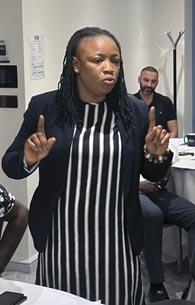
Conference also backed a motion raising the alarm over companies using the government’s National Living Wage as a basis for pay talks, rather than the Living Wage Foundation’s ‘Real Living Wage’.
Colin Stewart, Plymouth 1 said that it was important for all employers to sign up to the Living Wage Foundation rates.
“Some members are losing around £ 40 per week or £172 per month,” he said.

Another concern was the “discriminatory” nature of free travel won by the union in the capital. A motion from Jubilee South hailed the “important victory” in getting Transport for London to offer free travel but said that the policy would be “detrimental to workers who have second jobs”.
Roy Osarogiagbon said: “We have a situation where
everyone is compelled to have second jobs and it’s very punitive. It’s a situation where you’re given these assets, but it’s also being weaponised. When we do this, we are fighting for the majority,” he said.
Delegates called for a lobby of Parliament in support of bringing tube cleaners back in-house. Marian Dmitrov, Central Line West said: “The Labour Mayor has failed to bring them back in house
while seeking a third term of office”.
Conference noted that some cleaning contractors failed to give workers time off in lieu of special bank holidays. Extra paid time off had been given for various royal events but some contractors had not followed suit.
Dyanika Christianson, Waltham Cross & District said: “They said they won’t pay us for that bank holiday because
CLEANERS ARE ESSENTIAL Sign the petition to get London Underground cleaners brought in-house
RMT is campaigning to get outsourced cleaning grades back in-house as part of the TUC's 'Our Work Matters' campaign.
But as part of RMT’s own campaigning, pressure is being put on the Mayor of London Sadiq Khan to deliver on his pledge to
review his cleaning contract with ABM with a view to insourcing these workers.
It is time for the mayor to show real leadership and bring in-house more than 2,000 cleaners who work on the Underground and who are currently outsourced to a US company called ABM.
There are two ways you can support this campaign and our cleaning grades members now: Sign the online petition hosted by the TUC or write to the mayor here: https://www.rmt.org.uk/letter /bring-londons-tubecleaners-in-house/
it’s a one off”.
John Hill, Teesside said that he had successfully fought for time and a half for cleaners working on bank holidays.
Delegates also called on the union to contact other unions with a mandate for industrial action to strike together.
Serwaa Boateng added: “It’s a very good idea because unity is strength”.
Guest speaker Colin Stewart spoke on the work of RMT’s disabled members advisory committee. “We’ve successfully fought against the closure of ticket offices.
“If there’s nobody there to assist anybody with mobility issues,” he said.
RMT relief regional organiser Glen Hart told delegates that to tackle a problem you need to take each hurdle at a time.
“Strike action is always our last option, and we always have to be willing to use it as well. Even if we haven’t balloted in some of the companies, we can still use the national dispute in other companies to our advantage,” he said.
RMT helpline 0800 376 3706 :: june 2023 :: RMTnews 11
Rose Aweah
Amar Barouche
THE COMING BAT TLE FOR RAIL
The collapse of the private sector in rail opens the way for democratic control
Last month the Secretary of State for Transport Mark Harper announced that the government was taking the shambolic Transpennine Express franchise into public ownership. While Mr Harper was at pains to stress that this was a temporary measure it marked a new low for private sector train operation. This is because that private transport companies now run less of the network than at any point since privatisation in 1993.
Out of 17 franchises, seven, ie nearly half, will now be run in the public sector by the DfT’s Operator of Last Resort (OLR), or by the OLR in Wales and Scotland. Three more are wholly run by foreign stateowned companies, three more
franchises are run by joint ventures including foreign state-owned companies as minority shareholder, leaving only four being run wholly by private companies.
The story is the same when you measure the number of Train Kilometres travelled on the rail network. According to ORR data, 40 per cent of all train kilometres run are on franchises controlled by UK State-owned companies. Only 23 per cent are on franchises controlled by wholly private UK companies.
So, 30 years after privatisation, the private sector is at its smallest size with its weakest grip since 1993 and this should be the point of no return. The rot started, of
course, shortly after privatisation. The infrastructure company Railtrack had to be taken into the public sector after it effectively became insolvent following the series of disasters leading up to the Hatfield crash and the chaos that ensued. Then a succession of passenger franchises ran into trouble over the years.
These failures were not just due to management incompetence, they were rooted in the basic economics of franchising and the contradictions in these economics have grown more problematic over the years.
Privatisation was sold to the public on the grounds that it would bring in competition,
innovation and investment from the private sector. In reality, private sector investment was always minuscule, especially after the nationalisation of Network Rail. Competition among companies was always limited in practice, with a handful of operators carving up franchises between them. The illusion of success relied on two things: the growth of passenger numbers and profits.
Passenger number growth has tracked economic growth and re-composition of the labour market around urban centres – especially London in the 1990s and early 2000s. With the onset of economic stagnation and fiscal austerity,

RMT helpline 0800 376 3706 :: june 2023 :: RMTnews 12
STRIPPED: Rail privateer First Group has been stripped of the Transpennine Express franchise and brought into the government’s operator of last resort which already runs three other rail contracts
growth in passenger numbers has levelled off. As the National Audit Office noted in a report from 2021: “before the COVID-19 pandemic, some franchised operators were experiencing commercial difficulties. This was largely because their bids were based on assumptions of passenger growth that were higher than those which materialised”.
Even the profits that the train operating companies did take out were in essence politically constructed. As a series of academic studies established since privatisation, the market had to be designed so that the Train Operating Companies’ costs were as low as possible. That meant ensuring that the burden of paying for infrastructure was shunted onto Railtrack and then subsequently Network Rail.
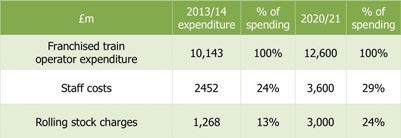
In addition, the costs of leasing rolling stock from the rampantly parasitic ROSCOs had been rising markedly in recent years. From the early 2000s, governments began mandating TOCs and ROSCOs to buy new trains, recognising that the ROSCOs’ business model gave them little incentive to invest in new rolling stock and every interest in sweating ageing assets. The ROSCOs responded by exploiting their monopolistic position to raise lease charges. Rolling stock charges have grown by 33 per cent in the last five years and totalled £3 billion in 2022.
The net consequence, as the NAO and the Office of Rail and Road recognised, even before the pandemic, was that the privatised passenger operators were becoming a net drain on the taxpayer. Covid was simply the final blow.
MANAGEMENT CONTRACTS
The government’s new management fee contracts were supposed to give a new lease of life to the train operators, but it failed to tackle structural issues with the
demand to create a profit while throwing up new problems.
Southeastern had to be nationalised after revelations that for years the Goviacontrolled company had been concealing public money in an effort to boost dividends from the franchise. The Welsh and Scottish governments took action to end Keolis Amey and Abellio’s contracts after years of receiving subsidies from their governments.
The nationalisation of Transpennine Express and the debate over Avanti’s future under FirstGroup reveal another issue with privatisation. With Track access charges to Railtrack and Network Rail and lease charges to the monopolistic ROSCOs more or less fixed, the structure of privatisation meant that any TOC looking to drive up profits would focus heavily on staff costs. Immediately after privatisation this led to a dramatic shrinking of the workforce.
In the longer-term it committed TOCs to running with lean workforces, dependent on overtime and goodwill and with little resilience to shocks. Covid and the government-backed attack on workers’ jobs and terms and conditions have exposed the costs of this in the inability to run predictable timetables, even on non-strike days.
By the end of its life, the FirstGroup Transpennine franchise was cancelling one in four of its trains. The sum of these developments is that private control of train operation hangs in the balance and the prospect of a nationally integrated, publicly owned railway has not looked closer since 1993.
Of course, the cabal of super-rich monopolists who own the Train Operating Companies have not taken this lying down but have stepped up their lobbying. Industry ‘sources’ were quoted in a recent Times article fretting that the government was
sitting on lucrative contracts being run by the Operator of Last Resort. Their new trade body ‘Rail Partners’ was quoted recently saying that “the market’ [in reality a very small handful of big businesses] would be watching closely for clear signals of intent and rapid action, such as the announcement of legislation to create GBR, or more detail on the shape and timeline for letting new contracts, including those with the operator of last resort”.
Presumably their anxiety is fuelled not only by the possibility that a Labour government may extend public ownership yet further but also by the fact that the Operator of Last Resort appears to be performing quite well for passengers. The latest data from the ORR show publicly owned LNER on the
East Coast Mainline comfortably outperforming FirstGroup’s Avanti West Coast franchise on most metrics.
FirstGroup in particular can be expected to fight hard against public ownership. While Go-Ahead might survive the loss of its remaining rail contract, it’s hard to see how FirstGroup could. Last year it reported a revenue of £4.5 billion from its continuing operations. 82 per cent of this revenue -£3.8 billion - comes from rail. Therefore, the company now effectively lives off the continuing favour of the Secretary of State for Transport.
RMT and its sister rail unions face a major battle to win the prize of an integrated publicly owned railway, but the terrain hasn’t looked more favourable since 1993.
Train kilometres travelled on UK Rail (millions) by ownership type
UK State owned company (Caledonian Sleeper, London and North Eastern Railways, Nothern Trains, Scotrail, Southeastern railways, Transport for Wales, Transpennine Express), 176.6m (40%)
UK private company (Ea Midlands, Great Weste Greater Anglia, We Midlands), 113.3m (26%
UK private compa (East Midlands, Gre Western, Great Anglia, We Midlands), 113.3 (26%
Joint venture between U private company and foreig State owned compa (Avanti West Coast, Gov Thameslink Railways, Sou Western Railways), 116.1 (26%
Number of UK Rail franchises by ownership type
UK State owned company (Caledonian Sleeper, London and North Eastern Railways, Nothern Trains, Scotrail, Southeastern railways, Transport for Wales, Transpennine Express), 7, (41%)
Wholly owned by foreign State owned company (c2c, Chiltern, Cross Country), 3, (18%)
Joint venture between UK private company and foreign State owned company (Avanti West Coast, Govia Thameslink Railways, South Western Railways), 3, (18%)
UK private company (East Midlands, Great Western, Greater Anglia, West Midlands), 4, (23%)
RMT helpline 0800 376 3706 :: june 2023 :: RMTnews 13
THE ROLLING STOCK SCANDAL RMT produces case study of rolling stock company Eversholt
Rolling stock companies, known as ROSCOs, are sweating the UK rail industry for eye-watering quantities of money with the protection of the government and almost no public scrutiny.
Recently the union scrutinised one of three main ROSCOs Eversholt and the huge profits it is making while passengers face reduced services and staff endure pay cuts and attacks on their jobs.
Eversholt is one of three ROSCOs that own around 87 per cent of Britain’s trains. They were handed British Rail’s stock of trains on privatisation and have continued to dominate the train leasing market ever since.
According to Eversholt’s latest accounts last year it paid a dividend of £40,700,000 to its Luxembourg-based parent company. In the last ten years,
has paid £380 million in dividends to its Luxembourgbased parent, with an average annual dividend payment of £35 million.
These dividends represent, on average, between around 70 per cent of the profits being made by the group of companies. In the last ten years, Eversholt has also paid £520 million in interest payments on inter-company loans from its parent company.
Eversholt own 3,426 vehicles and they lease trains to Chiltern, East Midlands Railways, Greater Anglia, Great Western, Govia Thameslink, LNER, MTR, Arriva Rail London, Northern, Scotrail, Southeastern and Transpennine Express, as well as the freight companies Freightliner and GB Railfreight.
The cost of leasing these trains from the ROSCOs has
been growing markedly over the last few years. In 2013, rolling stock leasing represented 13 per cent of TOC spending. Now it has nearly doubled to 24 per cent.
Rolling stock leases work in a similar way to PFIs. The government sets the requirement to build new trains, the ROSCOs raise money to buy them from train manufacturers and then the operating companies lease them back.
Rolling stock companies would have us believe that they are innovative investors in new trains. Yet left to their own devices, the ROSCOs presided over an ageing fleet and failed to invest in new rolling stock, preferring to sweat old assets.
This failure is why, in recent years, the government stepped in to mandate new
rolling stock through franchises and to commission bespoke projects like the InterCity programme. Government has effectively paid for these purchases either in the form of the InterCity PFI deals or through franchise payments to TOCs that pay for the ROSCOs’ additional investment.

As the ORR noted in its financial analysis of 2018-19, the growth in rolling stock charges does not reflect the upfront costs of buying trains but is instead ‘largely due to the increases in the on-going costs of rolling stock after the recent replacement of various trains’. These ongoing costs are ‘the increased cost of leasing and maintaining trains’.
The ROSCOs are able to keep their lease costs high because the three companies

RMT helpline 0800 376 3706 :: june 2023 :: RMTnews 14
effectively monopolise a market in which there is little interchangeability between their products and so, little real competitive pressure. Between them, they still own 87 per cent of the rolling stock on the network. This is why they were investigated by the Competition and Markets Authority in 2009.
In April 2020, the ORR recently advised that the measures put in place (inadequate though they were) to offset this monopoly position, should be maintained because there had been no significant change in the period since 2009.
There is little incentive on the TOCs to negotiate lower lease costs either, as they are not really paying for the rolling stock. As a consequence, as academic research has suggested, the public is likely to be paying the ROSCOs for years after the real cost of the trains has been paid off.
This is one major reason why, under the old franchising system, franchise subsidies from government rose sharply. The rising cost of operating leases was effectively covered by franchise subsidies to Train Operating Companies.
As the National Audit Office pointed out back in 2004, government pressure on the ROSCOs to buy new trains would simply generate more demands for subsidies as it was “unlikely that TOCs would accept stronger obligations in their franchise agreements for the delivery of new trains, unless the costs of such obligations were reflected in higher franchise subsidies”.
The NAO report went on to note that as TOCs' principal sources of income are subsidies … and fares, “ultimately taxpayers and passengers will pay for the work”.
Now, under the Emergency Recovery Measures Agreements (ERMAs) and the National Contracts, the cost of these trains is being directly covered by the taxpayer.
Dividend generating
machines
As RMT has exposed, the three ROSCOs are complex networks of companies whose parent companies are based overseas in low tax regimes like Luxembourg and Jersey. These companies are geared toward the production and extraction of dividends and they have been very successful at doing this both up to, and during the pandemic.

Eversholt’s latest published
TABLE

accounts show that Eversholt UK Rails (Holding) Limited and subsidiaries (Security Group) paid a dividend of £40.7 million to its top UK-based holding company Eversholt UK Rails Limited. This company then paid the same amount as a dividend to its Luxembourgbased parent company UK Rails S.a.r.l.
ROSCO dividends represent, on average, around 70 per cent of the profits being made by the group of
companies.
The ratio of dividend to group profits indicates clearly that this ROSCO, like the others, is basically a value extracting machine that sucks money out of the rail industry. Very little money appears to be being reinvested in rolling stock.
The RMT report ‘A great sucking sound’: Eversholt as a case study in the parasitism of the rolling stock companies is available on the RMT website.
RMT helpline 0800 376 3706 :: june 2023 :: RMTnews 15
1: GROWTH IN ROLLING STOCK LEASE COSTS
TABLE 2: THE ROSCOS’ OVERSEAS PARENT COMPANIES
C ALL TIME ON AGENC Y WORK!
Agency work and the gig economy is growing on London Underground and rail infrastructure
Earlier this month RMT members who work in track protection for London Underground led a protest outside London’s City Hall, calling on the London Mayor to take action to address their pay and conditions, but also their employment status.

The protesting workers are agency workers, mostly bogus self-employed and engaged by London Underground via two companies, Morson and Cleshar. Their employment status is a fiction.
Nearly 95 per cent of the workers responding to a recent survey reported that they had worked on London Underground for more than five years, averaging between four and five days a week work.
Yet because Morson and Cleshar engage these workers as supposedly ‘self-employed’, they are denied sick pay, holiday or pensions and live in a state of constant precariousness. The workers are often notified of work at short notice, often by text message. Although they are supposed to be given 72 hours’ notice, it is often less and because of their pay and working conditions, the workers have little choice over
whether to take shifts. As one put it, ‘Waiting for the text messages on the phone day in day out and thinking about the location they are going to send you to is a nightmare.’
Alarmingly, TfL’s use of agency workers like this is on the rise again. According to the latest data put before the TfL Board, there are 400 Full Time Equivalent fewer permanent staff than in 2019/20 and almost 2,000 agency workers, 400 more than before the pandemic. The amount that TfL is spending is accordingly also on the rise. In 2019/20 it spent
£86 million on agency staff which rose to £105 million in 2022. £89 million of that total went to Morson and Cleshar. There is a direct link between the government mandated austerity cuts at TfL and the growing use of agency staff. As staff leave and vacancies are unfilled, the need for labour is filled by greater use of agency workers.
NETWORK RAIL

There is a similarly disturbing story on Network Rail. The infrastructure company’s spending on ‘Contingent Labour’ has grown from £14
million in 2021 to £24 million the following year. This growing use of agency workers comes on top of its continued outsourcing of renewals work. Network rail spent £3.2 billion on renewals in 2021-22 and the vast majority of this went to a handful of construction companies. These are among the top 20 recipients of network Rail contracts: BAM Nuttall, J Murphy, Balfour Beatty, Amalgamated Construction, Atkins, Story and Amey.
As RMT exposed back in 2013 in ‘The Great Payroll Rip Off’, its contracts with these
RMT helpline 0800 376 3706 :: june 2023 :: RMTnews 16
construction giants means that Network Rail’s supply chain is riddled with casualisation, bogus self-employment and the use of payroll companies. MPs have recently tabled a series of questions in Parliament in an effort to shed more light on the current situation and RMT will be monitoring these answers closely as the union builds its campaign to win the insourcing of these and other infrastructure workers.
On April 15 2022, a worker engaged by Morson was struck by a train at Chalfont Latimer, narrowly escaping with her life. The subsequent RAIB report highlighted critical issues with the use of agency employment in safety-critical work.
The report warned that ‘some agency staff feel that they cannot question or challenge LUL staff because this could affect the likelihood of further work with a particular group of people at a particular depot’. The RAIB also noted that some agency staff may feel that they need to exaggerate their familiarity with track or be reluctant to raise questions in briefings for fear of not being offered work in the future. RMT conducted a survey of its members at Morson and Cleshar between 23 and 26 May 2023. 63 per cent of respondents to the survey agreed or strongly agreed with the suggestion by the RAIB that they would feel uncomfortable raising an issue for fear of losing work. As one worker said, “I am not in charge of where and when I work as such cannot afford to go against anyone who controls these”. Another reported that “When I raised an issue...it caused me a few days off work for investigation. It makes you rather feel I would not raise any issue to avoid losing any shifts subsequently.” With 75 per cent of these workers reporting that they struggle to make ends meet on these contracts, it’s unsurprising that
their anxiety to get another shift might be of paramount importance.
The rail industry is well aware of these problems. The Office of Rail and Road’s Ian Prosser acknowledged in a letter to RMT some years ago that the widespread use of ‘notionally self-employed’ staff on zero hours contracts …has a generally negative effect on the attitudes and behaviour of those involved, which is not conducive to the development of a safe railway.”
In 2019, Network Rail was
advised by the RAIB to end its use of zero hours contracts after a worker was struck by a train and killed between London Bridge and Three Bridges. The RAIB said, “When workers are employed on a casual basis on zero hours contracts, there can be great pressure for them to try and juggle multiple jobs to make ends meet. The possible effects of such patterns of employment on fatigue and fitness for work are significant. We are therefore recommending that the railway
NETWORK RAIL TOP 20 SUPPLIERS FINANCIAL YEAR 2021-22

industry reviews the way it manages the use of staff on zero hours contracts, to minimise the risk associated with this pattern of work”
RMT believes that the industry as a whole must call time on this casual, ‘gig economy’ approach to much of the work that takes place on its infrastructure. In the coming year, the union will be stepping up its campaign to rebuild an integrated, directly employed and fairly paid workforce.
RMT helpline 0800 376 3706 :: june 2023 :: RMTnews 17
Source: RMT Policy Briefing: Why the Mayor must insource safety critical agency track workers on the Tube, May 26 2023
RMT LGBT+ CONFERENCE SOLIDARITY CALL
RMT members from the LGBT+ community expressed strong support for transgender people and young people struggling with their gender identity at the advisory conference in Perth, Scotland.

Around 30 delegates took part in the event which included debating motions, speakers from local campaign groups and charities.
Unanimously backing a solidarity call to LGBT+ people in the United States, Simon Gilson from Euro Passenger Services branch moved a motion, stating: "528 antitrans bills have been proposed across 49 states in the USA; 50 of these bills have already been passed.
“Consequences of these bills are as far reaching as barring transgender people
from serving in the armed forces or removing genderaffirming care.
“In the case of Oklahoma bill OK SB129, doctors could lose their licence for simply referring someone under 26 years of age for genderaffirming care."
Mr Gilson also urged the RMT to raise the issue with the union's parliamentary group as policies such as these will come to Britain "sooner rather than later."
He added: "We will continue the fight against all and any attempts by this government, or any that follows, to restrict the rights and freedoms of not just our trans consociates, but all of the LGBTQ+ community.”
Delegates also expressed concern at government
proposals to "introduce guidance for schools that will require them to tell parents if their children are trans, nonbinary or gender nonconforming."
The unanimously backed motion, moved by Bakerloo Line delegate Georgie Duane read: “This union notes that the government has signalled its intention to introduce guidance for schools that will require them to tell parents if their children are trans, nonbinary or gender nonconforming.
"This union believes that this is a gross infringement of the rights of young people, and will make trans, binary and gender non-conforming kids vulnerable to rejection, stigma and pressure to remain in the closet.
"This union resolves to oppose this guidance and instead to support alternative guidance that protects the right of schoolchildren to explore their gender identity.
“We resolve to work with the LGBT+ sections of school workers' unions - primarily the National Education Union - on this issue.”
Other motions relating to support for the Scottish Gender Recognition Bill and people taking HIV medication were also passed unanimously by conference.
Earlier during conference, Co-founder, and Director of Time for Inclusive Education, (Tie), Jordan Daly gave a powerful address on the need for greater understanding of LGBT+ issues in Scottish schools.
RMT helpline 0800 376 3706 :: june 2023 :: RMTnews 18
"When I went to school, I didn't learn about anyone like me. I didn't have any representation of LGBT community. I did not learn about the impact of homophobia, biphobia or transphobia despite homophobia in particular being one the most common forms of prejudice that I and many others at my school,” he said.
Mr Daly went on to explain that his organisation started out with a petition calling on the Scottish government to ensure all schools allowed every LGBT young person to see themselves reflected in their learning.
He added: "We wanted to start addressing the damaging legacy of section 28 and the culture of silence around LGBT topics at school.
"I've been doing this work
for 8 years and when I do these talks, I always find LGBT people of my age who will say they had the same experiences.
"It is not good enough. One of the things that unites LGBT people are difficult childhoods".
Other speakers to address conference were Solomon Adebayo from LGBT Unity.
He detailed the work his charity does in supporting LGBT+ asylum seekers and refugees to provide a social space and support in obtaining legal assistance for their cases.
RMT Senior Assistant General Secretary Eddie Dempsey gave the union's unswerving solidarity to LGBT+ members and updated conference on the national rail dispute.
LGBT+ LONDON PRIDE EVENTS 2023
LGBT+ Pride events are opportunities to promote the union and its campaigns as well as to show support and solidarity for LGBT+ members and the wider community. RMT will be looking to have a presence at the following events and members are invited to get involved and join in with friends and family.
LONDON PRIDE, SATURDAY JULY 1:
The union will have a place in the march which goes from Hyde Park Corner to Whitehall. Places need to be booked as wristbands must be allocated.
TRANS PRIDE, SATURDAY JULY 8:
Meet at 1pm in Trafalgar Square, meeting point to be confirmed.
UK BLACK PRIDE, SUNDAY AUGUST 20:

The union will have a stall at the event which is in the Queen Elizabeth Olympic Park, Stratford. Volunteers are sought to staff the stall during the day.
If you are able to join us for any of the above events, and/or if you have a Pride event in your local area that you would like advertised, please do contact Jess Webb, RMT equal opportunities officer, j.webb@rmt.org.uk
RMT helpline 0800 376 3706 :: june 2023 :: RMTnews 19
PRIDE: Members at UK Black Pride last year
Save money with your RMT membership!
With household finances under mounting pressure from the current cost of living crisis, we wanted to remind you that your RMT membership is there for you both in and out of work.
Over 68,000 RMT members have benefited from membership services which offer a variety of savings, as well as legal and financial support from our trusted partners.
Members are benefiting from cashback on their everyday shopping, exclusive car and home insurance rates, as well as protection policies designed with union members and their families in mind. Your family can benefit too!†
EARN CASHBACK ON YOUR INTERNET SHOPPING
Union Rewards provides cashback and discounts from hundreds of online retailers. Access to Union Rewards is free to RMT members and includes a £10 Welcome Bonus for you.
RMTRewards.com
FREE £5,000 ACCIDENTAL DEATH COVER
Don’t miss out on your RMT membership entitlement. Register for your FREE £5,000 Accidental Death Cover today:
RMTProtect.com/Member
CAR INSURANCE COMPARISON
Compare quotes online to see how much you could save on your car insurance. PLUS don’t miss out on their Price Match Guarantee - if you find a cheaper car insurance quote online, just call 0330 022 6657 and RMTCar guarantee to beat it!
RMTCar.co.uk
RMT PREPAID PLUS CASHBACK CARD
Earn up to 8% cashback on your everyday shopping with the RMT Prepaid Plus Cashback card!
RMTPrepaid.com/Magazine
“Any income RMT receives from these products goes into our dispute fund.”
SAVE WITH THE NEW HOME INSURANCE COMPARISON SERVICE
With an expert panel of insurers, the home insurance comparison offers a discount for RMT members and searches for the best deals to suit your needs.
PLUS - get a quote before 30th November to be entered into our £2,000 prize draw!

RMTProtect.com/Home
INCOME PROTECTION

Pays you a monthly tax-free income which can be used to pay your bills, your mortgage or your rent in the event you are unable to work due to an accident or sickness.
RMTProtect.com/Income
GUARANTEED ACCEPTANCE LIFE INSURANCE

Life Insurance provides a cash lump sum payout when you die, money to help support your loved ones at a very difficult time. Key features of RMT life cover include:
Guaranteed acceptance
No medical questions
Fixed premiums - will not rise
RMTProtect.com/Life
MEMBERSHIP ENTITLEMENT
To find out more visit: RMTProtect.com †See terms and conditions for full details *For prize draw rules visit RMTProtect.com/win2000 Terms and conditions apply to all products. RMTProtect is a trading name of Union Income Benefit Holdings Ltd who are authorised and regulated by the Financial Conduct Authority to distribute non-investment insurance products, register number 307575. This can be checked on the FCA website: www.fca.org.uk. Free Accidental Death Cover and Income Protection underwritten by Stonebridge International Insurance Ltd. Life insurance underwritten by Scottish Friendly Assurance Society Ltd. RMTCar.co.uk is administered by Vast Visibility Limited. Home insurance operated by Ceta Insurance Limited, registered in England & Wales company number 2827690. RMT Rewards and RMT Prepaid Plus are trading names of Union Income Ltd who arrange RMT Rewards and the RMT Prepaid Plus Cashback card.
A SPECTRE HAUNTING EUROPE
Workers across Europe are taking action against privatisation, low pay, attacks on pensions and poor working conditions
While strikes by transport workers in Britain have made the headlines in this country what has not been widely reported is the explosion of industrial action by transport workers and others across Europe.
Greek rail workers have been protesting for months over the catastrophic deterioration of the country’s railways since privatisation in 2013 following a devastating head-on high speed train crash in northern Greece earlier this year which killed around 60 people.
The Troika of the European Union, European Central Bank and International Monetary Fund demanded the privatisation and break-up of the Greek rail network ten years ago as part of harsh neoliberal conditions applied to the austerity bailouts.
Rail workers in France have also led rolling strike action for months against right wing President Emmanuel Macron's highly authoritarian moves to push through deep cuts in social provision including cutting the retirement age from 64 to 62.
The strike is being led by staff from state rail company SNCF, workers at Air France as well as energy workers and other public sector workers who have been staging walkouts and demonstrations in an increasingly militant atmosphere.
Macron's government is also insisting that French railways need to be ‘liberalised’ as all EU countries
must open rail to competition and fragmentation as demanded by EU directives, arguing that it is 30 per cent more expensive to run a train in France than elsewhere.
Unions point out that the changes represent the de-facto privatisation of the national rail operator and oppose plans to strip new workers of a special rail workers' status guaranteeing jobs for life and early retirement.
Workers across Europe are also unhappy that sky-high inflation has not been matched by higher wages.
Transport services across Germany also ground to a halt across much of Germany recently as unions held a major one-day strike over pay. The 24-hour walkout was called by Verdi and EVG unions demanding pay rises to keep pace with the soaring cost of

living.
The country’s cargo transport by rail and ship cargo as well as Germany’s ports and waterways were all hit by strike action. Verdi is demanding a rise of 10.5 per cent, while EVG is looking for a 12 per cent rise for the workers they represent. As with many other countries, Germans are struggling with high inflation, which hit 8.7 per cent in February.
State rail company Deutsche Bahn suspended all long-distance trains and many regional and local connections were at a standstill. Verdi represents around 2.5 million public-sector employees, while EVG represents 230,000 workers on the railways and at bus companies.
The unified joint strike call in Germany marks an escalation of an increasingly
militant and co-ordinated disputes by unions across Europe to win higher wages and to protect terms and conditions at work.
There was also a nationwide 24-hour general strike Italy last month affecting rail, bus and tram services as well as metro lines called by the Italian union USB (Unione Sindacati di Base) in protest at against precarious work contracts and plummeting wage levels. Strikes by members of Italian unions Cgil, Cisl, Uil and Ugl also took place earlier this month. Workers in many European countries are particularly vulnerable in the Eurozone due to the fact that governments often claim that they are powerless to act as economic policy such as the setting of interest rates are set by the European Central Bank.
RMT helpline 0800 376 3706 :: june 2023 :: RMTnews 21
PROTEST: French rail workers lead protests in the city of Nimes against government attacks on pensions.
LEGAL VICTORIES
A member was employed by Network Rail Infrastructure Limited and was dismissed as a Team Leader Track Inspections. The member suffers with anxiety and social phobia, which includes social phobia in passing urine in public places.
He was asked to undergo a Drugs and Alcohol test and he was happy to cooperate and had no reason to be concerned. The test was “for cause” although the member was not informed of this at the time. The member undertook and passed the breathalyser test. However, he was unable to produce a sample for the urine test due to the anxiety that he was experiencing. The member offered to take an alternative test, such as a blood test, but was told by sample collector that NR did not offer any other form of testing.
The following day the member took steps to arrange a blood test to prove that he had not taken any drugs and had no reason to refuse or avoid the D&A test but he was suspended from his duties.
The member provided negative results to NR for an oral swab drug test undertaken and hair follicle test which was also carried out. Despite the member’s explanations regarding his social phobia and provision of the negative oral swab and hair follicle tests, he was
dismissed.
A claim was lodged at a Employment Tribunal for unfair dismissal and outstanding wages and holiday pay. The outstanding wages and holiday pay was subsequently paid by NR prior to hearing.

At a full hearing the Employment Judge found that the member had been unfairly dismissed. He had not refused to take the urine test, but had been physically unable to provide a sample. The Judge stated that a reasonable employer acting reasonably would have considered other test options available in these circumstances, but NR failed to consider any other options for testing.
The Employment Judge ordered that your member should be reinstated. However, after a number of remedy hearings, NR refused reinstatement as it would be contrary to the Sentinel Scheme. Eventually the member was awarded £62,161.68 to reflect losses and an uplift for failing to reinstate him to his role.
BUS DRIVER
An RMT bus driver has secured compensation after a road traffic collision caused spinal injuries. The member suffered whiplash type injuries to her cervical and thoracolumbar spine. She also suffered general psychological symptoms from the incident.
Due to the injuries the member was off work initially for two weeks and then was forced to reduce her working hours due to ongoing symptoms. Following further time off work her employment was terminated.
The member instructed specialist injury lawyers at Thompsons Solicitors, through the RMT legal assistance scheme. After a thorough investigation the insurers for the vehicle driver that collided with the member’s bus admitted liability for the accident.
Thompsons instructed a GP and consultant orthopaedic surgeon to prepare medical reports detailing the nature and extent of the injuries suffered by the member. Court proceedings were commenced and following detailed negotiations a settlement of £28,500 was agreed.
ARRIVA RAIL
A member employed by Arriva Rail London was walking back to the ticket office carrying a box of coins from the ticket machines when he tripped on a loose carpet tile. He fell forwards, dropping the box of coins and twisting his ankle. The loose carpet tile had been raised to his employers prior to the accident but nothing had been done. The member had pre-existing problems which the accident exacerbated.
RMT submitted a claim for compensation for injuries and losses arising from his accident. It was claimed that the employer had breached their duty of care by failing to provide a safe place of work. The employer’s insurers admitted liability and confirmed that they would pay compensation in respect of his injuries and losses suffered as a result of this accident.
RMT’s solicitors arranged physiotherapy treatment for ongoing symptoms and sought the opinion of an independent expert in the relevant field in respect of our member’s injuries. The expert confirmed that the accident had aggravated a pre-existing issue for a period of three months following the accident.
The member underwent an MRI scan and it was found that he had an injury to the lateral ligament complex which was causing ongoing problems. It was confirmed that the member would continue to suffer permanent symptoms and limitations in respect of work and domestic life and strenuous sports activity indefinitely.
RMT’s solicitors negotiated a settlement with the employer’s insurers in the sum of £8,500, which compensated for his injuries, together with the medical expenses and travel expenses that were incurred as a result of the accident.
RMT helpline 0800 376 3706 :: june 2023 :: RMTnews 22 LEGAL
As an RMT member you have access to legal advice and representation from leading trade union lawyers

EXPLOSIONS, APPENDICITIS AND EXHAUSTION
Mike Esbester explains the ‘Railway Work, Life & Death’ project which includes over 150 years of rail history
The database of the recently launched ‘Railway Work, Life & Death’ project includes the records of nearly 25,000 members of RMT’s predecessor unions, the National Union of Railwaymen (NUR) and the Amalgamated Society of Railway Servants (ASRS).
Those records bring individuals, their families and their stories to light. The cover accident, ill-health and old age – sometimes it’s dramatic stuff, sometimes it’s fairly mundane but no less important. Put it all together and we learn a lot about the dangers of railway work before 1921 and how the union looked after its members.
The project is seeking to regularly introduce these stories and show what the union did to help.
At the more dramatic end of the spectrum, we have fireman H Hawks (28) and cleaner W Murphy (17), killed on the Rhymney Railway in Cardiff on April 21, 1909. They and another colleague were blown up in a boiler explosion. The union ensured their dependents each received compensation – though Hawks’ dependents received £300 and Murphy’s only £100.

Most of the time the accidents weren’t so visible. They were fairly mundane things like slips, trips and falls,
or crushed fingers. However, they still mattered to the individuals affected, and to their families and the union. The ASRS/NUR provided legal counsel and ensured as much compensation was possible was secured.
For example, on January 10, 1900, Great Central Railway drayman SM Burdett was kicked by a horse at Leicester goods warehouse, breaking his leg. He was awarded £10.10 in compensation from the railway
company. Without the original records and our project’s transcription, it would almost certainly be impossible to know the vast majority of women and men in the database had been hurt at work.
A great many of the entries are for ‘old age’ – at least 2,700 of 3,400 cases listed under the union’s disablement fund, for example. This included platelayer J Tyrell of the Clapham Junction branch, making a claim on the fund in
1904 at the age of 83. Intriguingly, in some places cause of death is given as ‘exhaustion’. Rather than it meaning someone was worked so hard they collapsed and died, was it a substitute for ‘old age’? Gatekeeper John Taylor of the ASRS Sheffield branch died in 1889 of ‘primary decay and exhaustion’, which looks like it’s linking age and exhaustion.
We see a full range of health conditions in the records – something we’d
RMT helpline 0800 376 3706 :: june 2023 :: RMTnews 24
1915: Union members were killed in the Quintinshill disaster when for packed troop train, bound for Liverpool crashed killing over 220 people.
previously not been able to find evidence for (so: thank you, past Union record keepers!). As well as conditions we don’t usually hear about today (syncope? Apoplexy? Morbis cordis?), the records show an important change between past and present. Conditions that today are manageable or treatable regularly killed in the past. For example, D Herd, based in Edinburgh on the North British Railway, died of diabetes in 1898. Things like appendicitis and septicaemia appear throughout the records. Sometimes we see global events unfolding, too – the ‘flu pandemic of 1919 appears, as the numbers of railway staff dying from pneumonia and related respiratory issues increased.
There are also mysteries which take a bit of unravelling. In Southport, Lancashire, one Mrs Clarkson appeared in the
records of legal representation provided by the Union at coroner’s inquests, to protect the interests of members or their dependents. On 4 May 1917 Celia Clarkson fell from the crane she was driving in the goods warehouse. Yet details of the inquest appeared in the 1918 records – an error? Not as it turned out: tragically she remained gravely ill between her accident and her death in January 1918 from the effects of the accident. The inquest therefore took place eight months after the accident which led to her death.
To help spread the word about the existence of the project, the database and all the hard work the volunteers are doing to transcribe the records, we’ve been Tweeting, daily, an ‘On This Day’ trade union case. For May 22, we chose the case of Caledonian Railway fireman J Hannah, 33,
killed in an accident in 1915. He’d been a member of the Carlisle branch of the NUR. His dependents received the union’s standard £5 death fund pay out (equivalent to around £425 today), to pay the immediate costs associated with a death.
Hannah was the fireman for a special troop train, bound for Liverpool. The accident took place at Quintinshill, and killed over 220 people. One reply to the ‘On This Day’ Tweet came from a man who was related by marriage to James Hannah. That contact from as close to a descendent as it is possible to get in this case was amazing. So, if you’re a descendent of someone included in the database, please get in touch – we’d love to hear from you!
So, we’d encourage you to have a look at the Railway Work, Life & Death project’s database – it’s available free


on our website. If you come from a long railway family, then perhaps your ancestor might appear (and we’d love to hear from you if that did happen).
Alternatively, do have a look and see if your branch of the union features. Our suspicion is that it will – given how many people died or were made ill working on the railways in the past. Again, please let us know if you do have a look and if you find anyone from your branch’s past.
Dr Mike Esbester: Mike is Senior Lecturer in History at the University of Portsmouth. He is co-leader of the ‘Railway Work, Life & Death’ project. The project website now features details of nearly 50,000 railway worker accidents, covering Britain and Ireland between 1889 and 1939.
25 RMT helpline 0800 376 3706 :: june 2023 :: RMTnews Confidential Reporting for Safety New CIRAS app Available on: Got a health and safety concern? Report it in confidence, on the go. Scan me
Web: railwayaccidents.port.ac.uk/ Twitter: twitter.com/RWLDproject Facebook: facebook.com/Railway-Work-Life-Death-108745674380484
FROM LONDON UNDERGROUND TO
LONDON RECRUIT
Anti-apartheid activist Graeme Whyte talks about his role in the movement
A new film, London Recruits, due out this year tells the amazing story of young volunteers from London sent to South Africa on secret missions by the African National Congress fifty years ago as part of the freedom struggle to overthrow South Africa’s racist, apartheid state.
Graeme Whyte was one such volunteer who joined RMT’s predecessor, the National Union of Railwaymen when he started work for London Underground in 1969 as a Signalman.
Graeme spoke to RMT general secretary Mick Lynch and RMT president Alex Gordon about his incredible story as one of the London Recruits.

In 1964, Nelson Mandela with 10 other ANC leaders was charged by the white supremacist South African regime, with recruiting, training, and preparing for violent revolution to overthrow the apartheid state and further the objectives of communism.
At the Rivonia Trial eight ANC defendants, Nelson Mandela, Walter Sisulu, Denis Goldberg, Govan Mbeki, Ahmed Kathrada, Raymond Mhlaba, Elias Motsoaledi, and Andrew Mlangeni were sentenced to life imprisonment. ANC activists inside South Africa were rounded up, imprisoned, tortured, and killed. Their organisation seemed utterly smashed.
ANC leaders who escaped abroad were determined to rebuild the organisation to mobilise the disenfranchised, black African majority population to fight for a democratic and free South
Africa. But to do this, they had to demonstrate that the ANC was alive and kicking to lead the freedom struggle. As a result, ANC’s military commander Oliver Tambo initiated a secret plan.
ANC leaders in London including Yusuf Dadoo, Joe Slovo, and Ronnie Kasrils were tasked to contact politically aware, young people in London to be the ANC’s London Recruits.
Graeme Whyte was 20 years old in 1971 working for London Underground as a Signaller at Drayton Park on the Northern City line out of Moorgate Station. He was already politically active in the Young Communist League and visited Chile a year before where he met and shook hands with Chile’s newly elected Socialist President, Salvador Allende.
Graeme’s own family educated him as a committed anti-racist. His father, a mechanic in the RAF, was a talented musician playing double bass in an RAF band. Touring the United States in the 1940s, he was disgusted by the ‘Jim Crow’ race laws underpinning segregation and the oppression of black people he saw there.
The full story of Graeme’s mission to South Africa is told in the film London Recruits, where Graeme appears in person - as well as portrayed by an actor in a dramatic reenactment.
The ANC asked Graeme and his friend, Denis Walshe to fly to Durban using the cover of two young men on a beach holiday. Graeme remembers being told by the ANC, “You’re a railwayman. You look
like you need a holiday, so we are sending you somewhere nice”.
So, Graeme booked his two weeks of summer leave, taking a precaution to tell workmates he was going to France for a fortnight. Instead, he and Denis flew to Durban via Nairobi.
With them they brought suitcases with false bottoms in which they smuggled thousands of ANC leaflets printed in Zulu, Xhosa, and English languages. Their mission was to distribute illegal leaflets from the banned ANC to hundreds of postal addresses across South Africa.
They were trained to assemble leaflet bombs, harmless devices designed to shower bundles of ANC leaflets into the air. These were set up where black African workers gathered to travel from city centres back to the segregated townships, where they were forced to live.
The meticulously timed leaflet bombs went off at precisely 5pm accompanied by
a tape-recorded ANC announcement broadcast on improvised public address systems. On 10 August 1971 at 5pm in central Durban leaflets fired into the air and the ANC message of resistance was heard by South Africans loud and clear.
It sounds complicated and it was. But Graeme and Denis carried off their mission successfully without being suspected by police. Their ANC contacts left them in no doubt that if arrested they could expect to be beaten and tortured to extract confessions.
Before leaving South Africa to fly home Graeme and Denis were told to buy every South African newspaper they could find in English and Afrikaans. That was when they discovered they were not acting alone.
Not only Durban, but also in Johannesburg, Cape Town and Port Elizabeth, ANC leaflets rained down from the sky and ANC leaders broadcast messages to crowds of African workers. South
RMT helpline 0800 376 3706 :: june 2023 :: RMTnews 26
RECRUIT: Eddie Dempsey with Graeme Whyte and president Alex Gordon.
African Security Police were in hot pursuit of the dozens of active ANC cells they believed must be responsible for these actions.
Back in London, Graeme and Denis were told by the ANC that to maintain security they could never speak publicly, or even to families and close friends about their actions.
They never did speak about it until long after the defeat of apartheid and the election in 1994 of South Africa’s first democratic government led by President Nelson Mandela.
Now RMT members can see the extraordinary story of the bravery of Graeme and other young volunteers, when the long-awaited film London Recruits comes out.
Graeme went on to work for London Underground as a signaller at Piccadilly Circus, which he found too polluted and noisy. So, he transferred to British Rail and trained as a Guard at Temple Mills depot in Stratford, where he worked for several years.
Graeme remembers being part of the railway family at that time was to be part of a multiracial workforce where racist attitudes and policies were actively challenged.
Graeme eventually retrained as a teacher. He is now retired and lives in Perth.

He is still proud of his NUR membership and the role the union plays today in the fight for workers’ rights and social justice.
Graeme says, “Our NUR badge slogan, ‘Workers of the World, unite’ was one I really believed in, and it was one of the ideas behind my commitment to taking action on behalf of oppressed workers in South Africa.”
You can check out the London Recruits website at londonrecruits.com
For more information on the London Recruits see: https://www.londonrecruits.org. uk/ or: London Recruits: The Secret War Against Apartheid, Ken Keable (Merlin Press 2012)
RAIL PRIVATISATION GOES OFF THE RAILS IN INDIA
At this month’s Statutory Meeting of RMT’s National Executive Committee we extended our union’s solidarity and condolences to survivors and families of rail workers and passengers killed in the terrible Balasore train crash in Odisha State, eastern India on 2 June this year.
Pictures of this horrific crash shocked the world. 288 people were killed and over 1100 injured when a passenger train was diverted into a loop line occupied by an iron ore train causing another passenger train to collide with derailed coaches. Both passenger trains were packed with migrant workers and families travelling between Kolkata and Tamil Nadu on India’s east coast main line.
India’s Railways Minister hinted at possible sabotage while Indian opposition parties denounced this as a diversionary move to shift blame away from politicians responsible for presiding over funding cuts to prepare Indian Railways for privatisation.
The Centre of Indian Trade Unions argues that government rail policy has diluted parliamentary scrutiny, reduced financial support to rail meaning 320,000 vacancies are left unfilled and safety standards neglected, and promoted the Vande Bharat, a semi-high speed Intercity service as a silver bullet for modernisation in place of secure long-term investment.
These events bring back memories of the multiple train crashes in Britain following Tory privatisation of British Rail in 1993. Within a few years we suffered train crashes at Southall in September 1997 (7 killed, 139 injured), 1999 Ladbroke Grove in October 1999 (31 people killed, over 520 injured), Hatfield in 2000 (4 killed, over 70 injured) and Potters Bar in 2002 (7 killed, 76 injured).
Jarvis Rail, responsible for maintenance at Potters Bar, initially speculated the crash was caused by a sophisticated saboteur with "informed" engineering knowledge and said it was searching for disgruntled former employees before admitting liability in 2004.
In 2010, the Office of Rail Regulation eventually charged Network Rail and Jarvis under the Health and Safety at Work Act. All these tragic crashes had multiple, complex causes, but shared a common characteristic of a rail system where profit making, and financial priorities led to short cuts with public and worker safety.
As with Britain in the 1990s, India today is suffering a series of train crashes - over 2000 between 2017-21. The latest brutal tragedy at Balasore destroys the Indian government’s narrative that Indian Railways is being converted into a ‘smart’ and speedy transport system, with latest technology.
The Railway Board and the rail minister have indicated that the cause of the crash at Balasore was probably an electronic interlocking failure, but this is not the whole story. A recent report on derailments in the railways in 2017-21 highlighted a shortfall of 30-100 per cent in track recording inspections which assess track structural and geometrical features.
Of 1129 derailments, 422 were attributed to engineering issues including ‘maintenance of track’ (171) and ‘deviation of track parameters’ (156), while defects in wheels etc of coaches were found to be the cause in 182 cases, and 275 were due to ‘incorrect setting of points and other mistakes’.
Recently, the All-India Loco Running Staff Association (AILRSA) demanded that 471 train driver vacancies in the Southern District should be filled immediately. They point out Drivers are often working shifts of over 12 hours due to staff shortages.
These are symptoms of rail privatisation. Where corporations see profits, rail safety becomes a casualty. We need to remember the lessons of the 1990s in Britain as well as in India.
Alex Gordon
RMT helpline 0800 376 3706 :: june 2023 :: RMTnews
President’s column
BLUEBELL DAYS
The Bluebell Railway gives you the opportunity to travel through 11 miles of glorious Sussex scenery behind a puffing steam engine, but it has so much more to offer.


Following the closure of the London Brighton and South Coast line (LB&SC) in 1956, the Bluebell re-commenced train services in August 1960 and still runs vintage steam and diesel trains between Sheffield Park and East Grinstead, stopping at the former junction at Horsted Keynes and Kingscote.

As expected from a premier living museum you can meet railway staff in period clothing, see original working signal boxes and step back in time boarding immaculate historical carriages. The Bluebell’s stunning four stations are also preserved in different periods of history including Victorian, 1930s and 1950s.
It runs various familiar heritage events throughout the year including visiting engines, family fun days, Santa
Specials, Real Ale evenings and dining trains on selected dates. It also runs steam traction days, murder mysteries and, during the winter months, the popular Steam Lights which involves illuminating the beautiful woodlands along the track.
Horsted Keynes is very much the hub of the Bluebell, with its multiple platforms it was once a large junction station in the 1930s, with a line branching off to Haywards Heath via Ardingly. There are even plans to re-open part of this line as well.
Today, this station has been restored to the Southern Railway period – mid 1920s. This station is particularly popular with film and television companies and used as a location for many historical blockbusters.
Horsted Keynes station is currently undergoing further work as part of the ‘Jewel In The Crown Project’ to fully restore historical buildings on the site, however, full disabled
RMT helpline 0800 376 3706 :: june 2023 :: RMTnews 28
The iconic Bluebell Railway was one of the first preserved heritage lines in the country
CAMELOT: Driver Ruben Smith in the cab of the Camelot steam engine
Driver Bob Pamment on the plate
access to operational Platforms 3 and 4 is always available.
The on-duty operations manager Colin Chapman explains that the station is also home to one of the largest carriage and wagon restoration sheds in the country. On the way Colin guides us through an educational display which includes 1875 built engine ‘Stepney’, which hauled the Railway's first passenger train back in 1960.
“We have focussed on developing educational services for school groups and other young people as well as track training facilities for companies including Network Rail,” he explains.
Alongside Stepney is a fullsize mock-up of the locomotive where the young can get up close and operate the controls, view progress down the track, and experience life on the footplate. There are also hands-on exhibits to explain the operation of steampowered locomotives.
But nothing can prepare you for the sheer size and scope of the carriage and wagon restoration operation beyond, it is enormous. Head of operations and lifelong carriage restorer Giles Clifford happily takes us through the collection where stock is continually being hand painted, re-fitted and generally being brought back to their former glory.
In the more than 60 years since it reopened, the Bluebell has assembled one of the country’s finest collections of vintage steam locomotives and carriages – many of which were preserved straight out of service from British Railways.


“Many of our carriages were built over a hundred years ago before even the Big Four rail companies were created. As a result, they may require a complete rebuild which can take up to ten years,” he says.
The site is also home to one of the largest specialist

trim shops in the country run by the capable hands of Steve Biggs, an expert in train upholstery who trains a new generation in the joys of properly sprung seating that no longer exists anywhere on today’s railways.

He points to one particularly luxurious example: “sit in that - as I say you sit in these seats, but you only sit on modern railway seating, not the same thing”.
RMT activist Steve Loeber has been associated with the Bluebell for over 20 years when he became involved with the Camelot Society which looks after one of the steam trains that runs on the line.

As a signaller he has worked the box at Sheffield Park which, unusually, sits on the platform at the station allowing visitors to see operations up close as well as the larger signal box at Horsted Keynes.

His passion and sense of pride in the Bluebell is infectious and seems to be present among all those that work so hard to maintain and expand the railway through community support, innovative education programmes, fun events and of course relentless fundraising.
“There is a sense of community and purpose at the Bluebell railway which is what really keeps it going strong,” Steve says.
One of its strengths is, like many other heritage lines, it is connected to the existing rail network. This means you can jump on a train from Victoria station in London, hop off at East Grinstead and catch up with the latest developments in the Bluebell’s continuing railway journey.
During your visit you can delve into the history and science of the industrial age, get up close to working locomotives of all kinds and luxuriate in the comfort and style of a bygone era when railway seats really were more comfortable.
For more information go to: www.bluebell-railway.com
29 RMT helpline 0800 376 3706 :: june 2023 :: RMTnews
Steve Loeber in the signal box
Carriage restorer Giles Clifford
Steve with Camelot Trim expert Steve Biggs
HOLYHEAD WISHES JACK A HAPPY RETIREMENT
Overforty RMT members and their families attended Holyhead No.1 branch awards night last month.

As well as RMT regional organiser Daren Ireland presenting 10 and 25-year badges for RMT members working for Stena Line, Network Rail, Transport for Wales, and Avanti West Coast, RMT President Alex Gordon presented a 40-year award to RMT stalwart, Dave Griffiths (former TfW Guards Company Council Representative) and a 50-year badge and medal to Jack Jones.
Jack retired last year as Holyhead No.1 branch

secretary after a career that began in Holyhead Marine Yard before he became a Signaller and trade union panel member at Employment Tribunals. Jack was elected a member of RMT’s Executive (2006-8) and was an RMT Tutor for over 15 years.


Holyhead No.1 branch secretary Steve Conway presented Jack with an inscribed pocket watch on behalf of branch members. On behalf of the whole union Alex Gordon thanked Jack and his wife Pat for a lifetime of service to members and wished them a long and happy retirement together.
£50 PRIZE CROSSWORD
17
RMT helpline 0800 376 3706 :: june 2023 :: RMTnews 30 Send entries to Prize Crossword, RMT, Unity House, 39 Chalton Street, London NWI IJD by July 20 2023 with your name and address. Last month’s winner is Winner D Thomson, Annan. Please supply bank account details and sort code to receive your prize quickly. Last month’s solution... ACROSS 1 Gymnastic moves (10) 8 Gymnastic moves (7) 9 Scope (5) 10 Arson (5) 11 Gemstone (7) 12 Imbibe (6) 14 Be present (6) 16 Frighten (7) 17 Dark coffee (5) 19 Farewell remark (5) 20 Turkish term of respect (7) 21 Composed of plants (10) DOWN 1 Underwater defence (13) 2 Perform again (5) 3 Entitlement to rank (6) 4 Heavy rain (7)
Gradual healing (13)
Subject of study (4)
Married (6)
Place
Fabric
Former unit of money
5
6
7
12
(6) 13
(7) 15
(6)
Civilian
dress (5)
18 Corrosive (4)


RMT helpline 0800 376 3706 :: june 2023 :: RMTnews 31

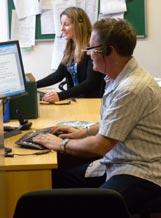

online or call the helpline on freephone 0800 376 3706 BRITAIN’S SPECIALIST TRANSPORT UNION Problems at work? Call the helpline Keep your RMT membership details up-to-date In the light of draconian anti-trade union laws that have been used against the union, members should keep their personal data up to date. It also important to note that in order to keep members informed your union requires your mobile telephone number and email address. Members can do this via the RMT website, telephone the RMT helpline above, or writing to the membership department at RMT head office, Chalton Street, London NW1 1JD. JOIN RMT
