INK
FALL 2015
A P U B L I C A T I O N O F T H E C O R E I N S T I T U T E
®
An Experienced Orthopedic Trauma Surgeon Makes All the Difference The CORE Institute Offers Gold Standard in Epilepsy Care At-Work Yoga Classes Offer Employees Opportunity to Live Healthier
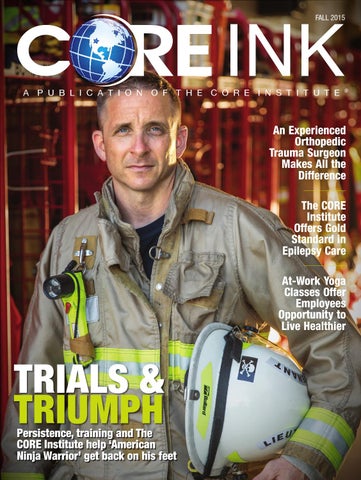
TRIALS & TRIUMPH
Persistence, training and The CORE Institute help ‘American Ninja Warrior’ get back on his feet
Have your patients met their deductible? Get in today, with SimonMed!
With the end of the year approaching, allow your patients to get in before deductibles reinstate. SimonMed offers Same Day, night, and weekend appointments available for your patients convenience. This will allow you and your patients the ability to take care of any of their ailments in a timely manner. By choosing SimonMed you’re choosing the market leader in outpatient imaging.
Call To Schedule 623-XRAY-NOW (623-972-9669)
Connect with us
@simonmedimaging
simonmed.com
WELCOME VOLUME 6, ISSUE 3 – FALL 2015
FROM THE CHAIRMAN
A time of great change...for the better For the past 10 years, The CORE Institute has dedicated itself to serving patients and helping the communities in which we serve. Today, our patients have entrusted us to manage their patient experience and deliver outcomes that allow them to “keep life in motion.” We believe that The CORE Institute’s integrated care model, which combines a full range of musculoskeletal, rehabilitative, and neurological care managed through a proprietary quality platform with proven results, has never been more essential than it is right now. Since opening our doors in 2005, The CORE Institute has never wavered in its vision to provide best-in-class care to patients through partnerships with hospitals, referring physicians, industry, and insurance companies. With complex changes trying to solve complex problems in healthcare today, complex solutions are required. It is clear that as The CORE Institute continues to grow, we continue to drive positive change. With change comes challenge; with challenge comes personal and professional growth; with growth comes pride and success. The famous business and management author, Peter Drucker, is well known for writing… “Everybody has accepted by now that change is unavoidable. But that still implies that change is like death and taxes — it should be postponed as long as possible and no change would be vastly preferable. But in a period of upheaval, such as the one we are living in, change is the norm.” This is a time of great change in healthcare as regulations change, insurance laws change, and business models change. Objective Medicare data supports that The CORE Institute provides better value to our patients than competitors, better patient outcomes than the norm, and better planning for the future than those looking in. On behalf of all of our physicians, providers, and staff, The CORE Institute appreciates your continued support as we navigate through the ever-changing healthcare environment together. Keep Life in Motion!®
David J. Jacofsky, MD Chairman & CEO
A P U B L I C A T I O N O F T H E C O R E I N S T I T U T E
CREATED BY REPUBLIC MEDIA CUSTOM PUBLISHING FOR THE CORE INSTITUTE
General Manager: Cami Kaiser/ cami.kaiser@pni.com Creative Development Director: Isaac Moya/ imoya@republicmedia.com
®
Editor: Jim Williams/JLWilliams@republicmedia.com Editorial Coordinator: Nick Kostenko/nkostenko@republicmedia.com Sr. Managing Art Director: Tracey Phalen/tphalen@republicmedia.com Design: Rachel Tullio Photography: Jacob Lewkow, Emily Piraino Advertising Coordinator: Dominick Galluzzo/dgalluzzo@republicmedia.com
Contents D E PART ME N TS Ask the Expert 8 A Brain Health Clinic for Athletes. The CORE Institute’s Jeffrey Kutcher, MD, answers questions about the treatment of concussions.
Specialty Spotlight 10 Simple hands: Deceptive complex. Advances in treating hand problems have come a long way.
What’s New? 11 The CORE Institute is pleased to introduce new physicians to the CORE team.
Patient Care 18 Breathe in yoga, breathe out stress: At-work yoga classes offer employees the opportunity to live healthier lifestyles.
14
CORE Candid 21 Employees at The CORE Institute are “Keeping Life in Motion.”
CO V ER S TO RY
Giving Back
TRIALS & TRIUMPH
22 Stepping up to serve. Staff at The CORE Institute donate time and skills to annual Volleyball Festival.
Persistence, training and The CORE Institute help ‘American Ninja Warrior’ get back on his feet.
FEATURES Gold Standard in Epilepsy Care
Recent advancements are helping patients control seizures. See page 12.
Orthopedic Trauma Requires Specialized Care
An experienced surgeon makes all the difference. See page 13.
connect with us
18
www.thecoreinstitute.com
7
ASK THE EXPERT
high schoolers, college players and professionals — need to stay vigilant about more than avoiding and treating concussions, says a Sports Neurologist who recently affiliated with The CORE Institute. “A concussion by itself is not necessarily a long-term problem,’ said Jeffrey Kutcher, MD, who will begin directing the Sports Neurology Division of The CORE Institute in January 2016. “A concussion, if identified correctly and treated efficiently, is typically a 7-14-day injury. The larger consideration for athletes of all levels, however, is maintaining brain health during and after their athletic career, and that requires awareness on the part of the athletes themselves, parents, coaches and athletic trainers and monitoring by sports neurology professionals over time.”
A Brain Health Clinic for Athletes The CORE Institute establishing a neurological program in Michigan
By Debra Gelbart Concussions among athletes have become one of the most concerning and talked-about risks that sports leaders at all levels now must confront. But athletes across the spectrum—pre-teens,
MANAGING CONCUSSION
CONCUSSION CONCERNS IN ALL SPORTS Here are ways to minimize the effects of concussion: Dr. Kutcher and The CORE “It’s important to avoid Institute will be establishing a the risk of contact while sports neurology program in you are concussed,” said Michigan within the next year Jeffrey Kutcher, MD, a Sports to monitor the brain health of Neurologist and member of the Sports Neurology athletes of all ages and across Division at The CORE the entire spectrum of sport. Institute. Avoid participatRepeated force expeing in sports or intense rienced by the brain can cognitive activities, he said. result in changes to the way “Additional hits, as well as further taxing your brain neurons in the brain comthrough exertion, may make municate with each other and the injury worse.” in how the brain functions, The key to concussion Dr. Kutcher explained. That’s recovery and a safe return to why regular monitoring of sport is an early comprehensive neurological evaluation. brain health is critical for any If you’ve been diagnosed athlete of any age. In the new with a concussion, see a sports neurology clinics at sports neurologist right The CORE Institute, athletes’ away, Dr. Kutcher advised. brain health will be evaluated at least annually through a series of tests and examinations, Dr. Kutcher said. Doctors will discuss with patients and their families ways to protect brain health and participate in sports safely. If subtle neurological changes are detected year over year, the possible causes can be addressed and steps can be taken to minimize the likelihood of future changes, he said. MISSION OF CHANGE “Our mission will be to change how the community regards brain health and to improve the overall neurological health of athletes,” he said. “And we hope to accomplish that through ongoing monitoring not just during their athletic careers but after they leave their sport. We also will be continuing to educate athletes, their families and the community about the cumulative effects of repeated exposure to force against the brain.”
SPECIALTY SPOTLIGHT
Simple Hands: Deceptively Complex Advances in treating hand problems have come a long way By Joan Westlake When you hear that complex anatomy was one of Dr. Mark Shreve’s favorite courses in medical school, you understand one of the reasons he chose hands as his specialty. “Most people have no idea that the anatomy of the hand and wrist is one of the most complex arrangements in the human body,” he said. “There are a multitude of joints, which are powered by an even greater Dr. Mark Shreve amount of delicately placed ligaments, tendons and muscles. These allow a person to perform very intricate and sophisticated tasks ranging from playing a musical instrument to sign language.” Another reason Dr. Shreve cites for selecting hands as his specialty is that he
10
is able to work with a wide range of people from small children with birth defects to adults suffering injuries to seniors dealing with aging issues. Making a difference in people’s lives is why he went into medicine and being able to help so many is especially rewarding. COMMON PROBLEMS Some of the most common problems he treats include: Carpal tunnel syndrome involves compression of the median nerve in the wrist with symptoms such as intermittent numbness, tingling and radiating pain in the thumb, index, middle and ring fingers. It can be worse at night, interrupting sleep. Trigger fingers are form of tendonitis which involves catching and locking of the finger flexor tendons in the palm. It can be quite painful and sometimes the fingers become stuck and unable to be extended. Arthritis in the hands, as it is elsewhere in the body, involves painful swelling and decreased range of motion. It is most common in the small joints of the fingers
and the base of the thumb. Among the symptoms that require immediate medical care are constant numbness and tingling in the fingers because these are indications of potential, severe nerve compression in the upper extremity. In addition, any signs of an infection, such as swelling, redness, and pain, especially after a penetrating injury, should prompt seeking urgent treatment. TREATMENT ADVANCES Dr. Shreve says one of the significant advances in hand treatments is for dupuytren’s disease, which is when fingers contract forward due to fibrous growths between the finger tendons and the skin of the palm. Instead of extensive surgery to remove the scar tissue, an enzyme, Xiaflex, can now be injected to dissolve the scar tissue. As to keeping hands working as they should, the doctor says in addition to good general health, be certain to wear protective gloves and gear. And, especially, use all safety equipment when operating machinery and using tools.
www.thecoreinstitute.com
WHAT’S NEW NEW PROVIDERS The CORE Institute is pleased to announce the addition of new physicians to our provider team.
MICHIGAN MARK C. SHREVE, MD
Dr. Shreve is a fellowship-trained hand orthopedic surgeon specializing in hand, wrist, and elbow surgery.
ARIZONA SHANE HESS, MD
JONATHAN B. MACKNIN, MD
Dr. Hess is a fellowship-trained orthopedic surgeon specializing in adult joint reconstruction of the hip and knee.
Dr. Macknin is a fellowship-trained orthopedic surgeon specializing in hand, wrist, and elbow surgery.
GENE D. PRENDERGAST, DO
Dr. Prendergast is a board certified orthopedic surgeon specializing in general orthopedics including adult and pediatric fracture care, sports medicine and arthroscopy, and joint reconstruction surgery.
LOUISIANA LON M. BARONNE II, MD Dr. Baronne is
a fellowship-trained orthopedic spine surgeon, specializing in minimally invasive spine surgery, arthroplasty including artificial disc replacement, and cervical and lumbar spine surgery. KEVIN J. LASSEIGNE, JR., MD
Dr. Lasseigne is a fellowship-trained physician specializing in interventional spine. He performs minimally invasive spinal interventions to help diagnose and treat pain. ADAM T. PERRY, MD
Dr. Perry is a fellowship-trained and board certified orthopedic surgeon specializing in athletic injuries, arthroscopic surgery, fracture care and total joint replacement.
MICHAEL J. DUVAL, MD
Dr. Duval is a fellowship-trained and board certified orthopedic surgeon specializing in in arthroscopic surgery of the knee and shoulder, as well as, reconstructive surgery of the shoulder. ROBBY LEBLANC, JR., MD
Dr. LeBlanc is a fellowship-trained and board certified orthopedic surgeon, specializing in hand, wrist, and elbow surgery, with special qualifications in minimally invasive and advanced reconstructive surgery. NEIL C. ROMERO, MD
Dr. Romero is a fellowship-trained and board certified orthopedic spine surgeon, specializing in minimally invasive spine surgery, arthroplasty including artificial disc replacement, and cervical and lumbar spine surgery.
CHRISTOPHER K. HEBERT, MD
Dr. Hebert is a board certified and fellowship-trained orthopedic surgeon, specializing in foot and ankle surgery.
JUDSON L. PENTON, MD
Dr. Penton is a fellowship-trained and board certified orthopedic surgeon specializing in arthroscopic surgery of the shoulder, elbow, hip and knee. MATTHEW D. WILLIAMS, MD
Dr. Williams is a fellowship-trained and board certified orthopedic surgeon specializing in shoulder replacement surgery, arthroscopic reconstruction of the shoulder, and surgery of the elbow.
11
FEATURE STORY
Gold Standard in Epilepsy Care Recent advancements help patients control seizures By Brian Sodoma More than 2.1 million people in the U.S. have epilepsy, and worldwide about 150,000 develop the neurological condition each year, according to the Epilepsy Foundation. However, tremendous treatment advancements now allow these people to still enjoy a very high quality of life. “A lot of people feel once they have epilepsy, they don’t have a life. That’s not true. ... We want to send a message to the community that there are various treatments available for this condition which can help control their seizures,” Atul Syal, MD said Atul Syal, MD, Director of the Epilepsy Monitoring Center at the Banner Boswell Medical Center. Arizonans, in particular, have access to some of the best epilepsy care available in the world. TESTING, UNDERSTANDING EPILEPSY Epilepsy is a disorder where an individual has recurrent seizures. Seizures occur when there is a disturbance in the electrical activity of the brain and can be the result of heredity or a brain injury, but their cause is usually unknown. If you have at least two seizures not caused by a medical condition, you may be epileptic. At the Epilepsy Monitoring Center, experts use a continuous EEG (electroencephalogram)/video test to monitor a patient’s brain wave activity to see exactly where in the brain the electrical disturbance occurs. Patients are admitted to the monitoring unit for four basic reasons. The first is to establish an epileptic seizure diagnosis if it is not clear cut; second, to see what part of the brain the seizure is coming from; third, for surgical evaluation, and last, to help optimize their seizure medications. Those who are already being treated can be taken off seizure medication and have their brain waves monitored during a seizure, or spell, to help doctors better locate the source of the seizure. The unit is a safe, controlled environment for patients to
go off their medications, as they have 24-7 access to caregivers. This testing environment allows physicians to better understand if a spell is a true epileptic seizure or a psychogenic one. For psychogenic spells, anxiety, depression or other psychiatric problems are likely the cause and seizure medications are usually not needed. PLENTY OF OPTIONS If a patient is truly experiencing epileptic seizures, Dr. Syal’s team brings plenty of treatment options. Seizures are generally separated into two main categories, partial and generalized. Partial seizures occur in either the right or the left side of the brain. In a generalized seizure, the electrical discharges occur simultaneously on both sides. In the case of a partial seizure, epilepsy surgery, or removal of the troubled area of the brain, could be an option. Some patients, however, opt to participate in one of The CORE Institute’s many clinical trials to find the most effective medicine for their specific problem, instead. “The newer medications are more effective and have fewer side effects compared to some of the older anti-seizure drugs. So patients can tolerate higher doses to help them control the seizures. We also have clinical trials going on constantly here with the latest medications available,” Dr. Syal added. Others opt for a Vagus nerve implant, says Dr. Syal, where a pacemaker-like device stimulates the Vagus nerve, the longest of the cranial nerves, often helping patients with seizure control.
What to Watch For
Dr. Syal says people often associate seizures with convulsive symptoms. But many occur more subtly and the person having one — along with others present — may not even know one is occurring. Watch for these symptoms, the expert says. »» A recurrent metallic taste in the mouth »» Tingling sensation on one side of the body that comes and goes »» Queasy feeling in the stomach that moves up to the chest, then throat »» Staring spells, confusion or suddenly passing out »» Incontinence during a passing out spell
12
www.thecoreinstitute.com
FEATURE STORY
Preventing Orthopedic Trauma in Seniors
Orthopedic Trauma Requires Specialized Care An experienced surgeon makes all the difference By Stephanie Conner Snap. Pop. Crack. Ouch! These are the sounds of a traumatic injury to your bone. Bones can fracture or break as the result of a workplace injury, a car accident, a recreational injury (such as hiking or skiing) or a serious fall. And, just like any other traumatic injury, an orthopedic trauma or injury needs the best medical care as quickly as possible. THE RIGHT CARE, RIGHT NOW “It can be more difficult to take care of some of these injuries the longer you wait,” says Clifford B. Jones, MD, National Trauma and Bone Health Director for The CORE Institute. “You really want to have these injuries properly diagnosed and treated the first time,” Dr. Jones says. Here’s why: If an orthopedic injury isn’t accurately diagnosed, it can lead to greater injury or problem later — even death in some serious cases. Dr. Jones is often involved in “revision” surgeries. A revision is a second (or third) procedure to repair an injury or correct what has previously been done. “Those surgeries take longer, are more
Serious orthopedic injuries are typically the result of accidents at work, at play or on the road. But for older adults, fractures can occur from simple falls — or in some cases, even just a sneeze. The suffering from an elderly or osteoporotic fracture can be immense and debilitating. In fact, the numbers and cost of osteoporotic fractures are more than heart disease, stroke and breast cancer combined. Such injuries can affect an older adult’s ability to live independently. That’s why in addition to helping fractures heal properly, The CORE Institute wants to help prevent these injuries. Through imaging and labora-
tory tests, doctors can look at bone density, quality and activity, says Clifford B. Jones, MD, The CORE Institute’s Trauma and Bone Health Director. “That helps us determine how to optimally treat these patients.” Some might require medication for osteoporosis. Others might need simple supplementation with vitamin C or D. Most begin a physical therapy program to improve balance, strength, and endurance, which can reduce the risk future falls and disability. “When older adults are striving for their independence,” Dr. Jones says, “the more we can do to prevent that second or third or fourth fracture down the road, the better.”
costly and usually have a higher risk rushed to a hospital in an ambulance, of potential problems than the original he says, “you still have the choice to be surgery,” he says. “It takes longer to taken care by the surgeon and trauma get people back to normal or baseline center with a team in place.” functioning again.” That team can make a big difference. The risk of a delayed return to life is “Especially if it’s a complex injury with serious. Consider a young adult who’s other associated injuries, you want to gainfully employed, he says. go to a trauma center like Banner – “A serious injury means University Medical Center time off work, time away Phoenix,” from family and stress on Dr. Jones advises. the family,” Dr. Jones notes. Verified trauma centers go Getting back on their feet through a rigorous certification quickly is critical. process to ensure they have That’s why, he says, it’s the resources and training important to choose an to handle the most serious Clifford B. Jones, MD experienced orthopedic injuries. They have trauma trauma surgeon and trauma center. surgeons and dedicated teams of trained trauma nurses, technicians and WHY A TRAUMA CENTER anesthesiologists available around the Dr. Jones, who also serves as Chief of clock with specialty surgeons available Trauma and Bone Health for the Banner as well. Health Musculoskeletal Institute, says Regardless of where you go, Dr. Jones patients should be educated in their says, make sure you are comfortable with choice of physicians. your doctor. “You have the power to get “You always have a choice to see seen by the right doctor for you and your whomever you want,” he says. Even if injury,” he says. “This leads to the best your injury is so severe that you’re being results for patients and families.”
13
COVER STORY
Trials & Triumph Persistence, training and The CORE Institute help ‘American Ninja Warrior’ get back on his feet B Y M E G H A N N F I N N S E P U LV E D A
14
www.thecoreinstitute.com
He spent the majority of his life training not only for his job as a Firefighter in Redford, Mich., but as an elite athlete who enjoyed mountain biking, running, hiking and extreme sports. Dennis Lappin trained hard to qualify for NBC’s “American Ninja Warrior.” It came as devastating news when he suffered an Achilles injury during the competition and could not complete the course. Following recommendations to see an Orthopedic Surgeon at The CORE Institute for treatment, Lappin, 40, was able to recover and gained a second chance. THE INJURY Lappin was thrilled upon learning that he was selected as a contestant on Season 6 of “American Ninja Warrior.” Athletes who compete on the reality television show attempt to overcome a challenging obstacle course that tests overall strength, endurance and balance. As Lappin was jumping to the second obstacle during filming in Denver in May 2014, he had intense pain in his left leg. “I felt like I got shot,” Lappin said. “It was the worst pain I had ever experienced.” But he didn’t want to give up. He continued, proceeding to the third obstacle, dragging his leg behind him, while fighting the excruciating pain. He eventually fell down and was immediately evaluated by the onsite medic and again at urgent care the next day where it was suggested the injury was a sprained ankle. Several days later at a follow-up appointment with his primary care physician back in Michigan, Lappin received the news that he would need surgery to repair an Achilles tendon rupture. An Achilles tendon rupture is a common injury in adults who play recreational sports such as basketball, but can occur in even the most conditioned athletes. “I was devastated,” Lappin said. “As
a Firefighter, I have a very active job and this meant I would be out of work and could no longer compete.” THE SURGERY Following a referral to The CORE Institute, Lappin met with Victor Nwosu, DPM, a fellowship-trained foot and ankle surgeon, who scheduled the procedure just three days later. “He walked into the office and I immediately noticed he wasn’t casted or on crutches,” Dr. Nwosu said. “Because he had been putting weight on it, this caused the tendon to move farther apart, resulting in a high grade tear that extended over eight centimeters, leaving a really big gap.” Dr. Nwosu and his team reviewed the MRI results and planned to surgically
lengthen Lappin’s Achilles tendon by using a cadaveric graft to fill in the space. Dr. Nwosu also inserted more graft into his heel bone to help strengthen the tendon and reduce the chance of a reoccurrence. “I was confident that we chose the right procedure for him,” Dr. Nwosu said. “Our goal was to get him back to the normal activities of his daily life.” Other treatment options for an Achilles tendon rupture can include nonsurgical methods such as wearing a cast or walking boot, but usually extends recovery time and may eventually lead to the need for surgical repair. THE RECOVERY Achilles tendon rupture injuries can take approximately 12 months or longer to fully heal, but Lappin was determined
15
COVER STORY
to get back to work and ninja training as soon as possible. “I started intense physical therapy three days a week for two or three hours each session,” Lappin said. “I had to learn how to walk, run and jump again.” To get around faster, Lappin used a knee scooter, switched out the handlebars to mimic a mountain bike and adjusted the breaks so he could scoot three to four miles each day. He continued to train his upper body. “I was definitely pushing the rehabilitation limit,” Lappin recalls. Some athletes who undergo surgery to repair an Achilles tendon are forced to be out for an entire season. Others never fully recover. Within five short months, Lappin returned to work and reapplied for a spot on Season 7 of “American Ninja Warrior.” He was selected a second time. “I knew I was coming back for redemp-
“I was confident that we chose the right procedure for him. Our goal was to get him back to the normal activities of his daily life.” Victor Nwosu, DPM
tion and that I could beat the course,” he added. “I needed to prove it to myself.” Lappin made it through the city qualifying round and the city finals and progressed to the national finals in Las Vegas.
THE FUTURE Today Lappin has no restrictions and enjoys running, mountain biking and rock climbing again with his wife, and chasing his 3-year-old daughter. He participated in a half marathon on Oct. 3 and continues to work on strengthening his leg. His family and medical team are very proud of his progress and continued success. “I’m really happy for him,” Dr. Nwosu said. “He worked really hard and deserves it.”
PATIENT CARE
Breathe In Yoga , Breathe Out
Stress
At-work yoga classes offer employees opportunity to live healthier lifestyles By Elise Riley Four years ago, Brittany Piercy was a different person. She handled stress differently, wasn’t as healthy, and got colds frequently. And then she started moving. Piercy started practicing yoga — got so involved, that she became an instructor. And now, she’s bringing her passion to her coworkers at The CORE Institute. Piercy leads a flow and vinyasa flow yoga class 2-3 days a week for her colleagues, giving them the opportunity to keep their lives in motion. LIFE-CHANGING “It’s changed my life,” says Piercy, who’s an Executive Assistant at The CORE Institute. “Before I found yoga, I didn’t know what I was doing with myself. The serene, calm feeling I had afterward was something I hadn’t experienced before and I knew I wanted to share with others.” The CORE Institute held its first innovation fair where employees presented ideas on ways to improve the workplace, increase patient satisfaction and increase employee satisfaction. Piercy presented an idea to teach yoga, and it was the top choice of her colleagues.
18
“Before I found yoga, I didn’t know what I was doing with myself. The way I felt afterward, it was like I was able to push myself to the limit without hurting myself.” STRESS MANAGEMENT Piercy says her class will be more about breathing and stretching rather than “turning your body into a pretzel.” She’s hopeful that by putting people’s bodies in motion, they’ll be better able to handle stress in the workplace and everyday life, return home refreshed and restored, and come to work energized. “Yoga helps me connect with myself better,” Piercy says. “I deal with my emotions in a better way. It’s not a physical practice, necessarily. It’s all about connecting the movement with the breath.
If you can manipulate the breath, you can manipulate the temperature in your body. You can manipulate emotions.” Piercy’s class will be slower, appropriate for beginners as well as those who are familiar with yoga. “It’ll be at a slower pace and more focused on stretching and breath work,” she said. “The big thing is to reduce stress.” PHYSICAL BENEFITS In addition to emotional benefits, yoga also offers physical benefits to those who practice it.
www.thecoreinstitute.com
“I think in general yoga is a great practice for people to add into their exercise routine,” said Dr. Nina Patel-Hinkle, a Primary Care Sports Medicine Physician with The CORE Institute. “It definitely has some positive effects on the mental health of people as well as some fitness health. It’s a good practice for helping with pain control, and improving balance and quality of life.” Studies of yoga show that yoga can help improve cardiovascular risk factors – decreased blood pressure in people who have high blood pressure, which can then
reduce the risk of stroke and heart attack. And lengthened and strengthened muscles are less likely to suffer injury. Piercy said that in addition to the mental benefits of yoga, she’s also seen physical changes. “My health is so much better,” she said. “Overall, doing yoga is part of a generally healthy lifestyle. My body’s stronger, I go to the doctor less, I don’t get colds anymore.” Yoga can also prevent injuries. “There is a core-strengthening aspect to yoga,” Dr. Patel-Hinkle said. “Stronger
core muscles can help prevent injury. In addition, people who are active may forget to take the time to stretch – yoga is a great addition to help with flexibility and stretching, which is an important part of an exercise regime.” A limber body, a calmer mind, and a stronger heart – they’re all components to keep life in motion. “Four years ago, I’d like to think I was a different person,” Piercy said. “I found a passion in yoga. I’m a better version of me, and I’m looking forward to helping people do the same thing.”
CORE CANDID BRANDON JONES
I Keep Life in Motion by working out — running (5k-marathons), CrossFit and trying new things (Strongman, Highland Games).
How Are You ‘Keeping Life in Motion’
DR. SARIM AHMED & SIMON WILLMAN
STEPHANIE WILLIAMS
I like to keep life in motion by hiking with my 2-year-old Corgi, Marley. I stay motivated by his energy level and the beautiful views from the top of the hill.
JULIA NEIDENBECH
I keep Life in Motion by going to boot camp and keeping up with my 3-year-old daughter.
Simon Willman, in house counsel for The CORE Institute, accompanied Dr. Sarim Ahmed, Keep Life in Motion by participating in a 50k through the night and early morning hours. They both enjoy competing in endurance events, such as Ironman triathlons.
G IV I NG BACK
Stepping Up To Serve Staff at The CORE Institute donate time, skills to annual Volleyball Festival By Gremlyn Bradley-Waddell When it comes to giving back to the community, The CORE Institute really steps up to serve. For about seven years, staff and physicians from The Core Institute in Phoenix area have donated their time and expertise to the Volleyball Festival, a premier summertime competition for young female athletes on club, school and international volleyball teams. John Kearney, MD, a Sports Medicine Physician with The CORE Institute, said the orthopedic group’s ability to offer all types of orthopedic specialties, along with primary care, made it an easy decision to volunteer as the medical partner for both the festival and the Festival Fiesta Classic, a regional, sister event held in winter at the University of Phoenix Stadium in Glendale. TRAINERS TO RESCUE “The Volleyball Festival does a wonderful job of employing certified athletic trainers who staff the courts and the practices and handle routine injuries,” said Dr. Kearney, a longtime volleyball player himself who still participates in a city league recreational team. “The CORE Institute staffs the festival’s walk-in medical clinic at all times, with one physician during the day who can address both medical and orthopedic issues. We also offer a special-injury clinic for two hours every night and that’s staffed by a fellowship-trained orthopedic sports medicine physician. That means the athletes can get a formal second opinion from
22
a specialist every day, so their level of care there is higher than that of a typical urgent care emergency room.” Dr. Kearney said there can be thousands of participants at the Phoenix venue alone, and as many as half of them can be from out of state. Add to that all the family members, friends and volleyball fans, and there can easily be a crowd of 20,000 to 25,000. And that means a lot of potential issues. “Along with broken bones, concussions, joint dislocations and lacerations, some athletes may arrive and get sick, developing a common cold, strep throat or even a sinus infection or urinary tract infection,” Dr. Kearney said.
“On the ‘fan’ side, we’ve had fans develop blood clots after driving long distances to the event and we’ve seen potentially deadly problems like heart ailments,” he said. “We get them the help they need and triage them, and, yes, we’ve sent people to the emergency room.” Tiffany Gutierrez, The CORE Institute’s Sports Medicine Coordinator, said the medical care The CORE Institute provides at the volleyball events is invaluable. Many players at the summer tournament, after all, are from out of town and cannot see their primary doctor until they return home. Other folks simply may not be familiar with the area, so it’s helpful and convenient when they can see a CORE physician in the same facility in which they are spending so much time, she said. “Parents are very grateful for this service, since we make it so convenient for them,” Gutierrez added. “When I have a parent come back the next day and thank us again for the service we provided and say how they appreciate what we were able to do for their family, it makes it all worthwhile. We love to be involved with programs like this, and it’s a great way to meet new people in the community and allow The CORE to help others along the way.”
THE HELP THEN NEED And, remember, that’s just the players.
www.thecoreinstitute.com