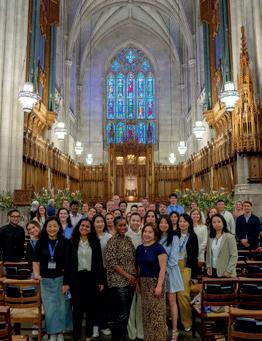
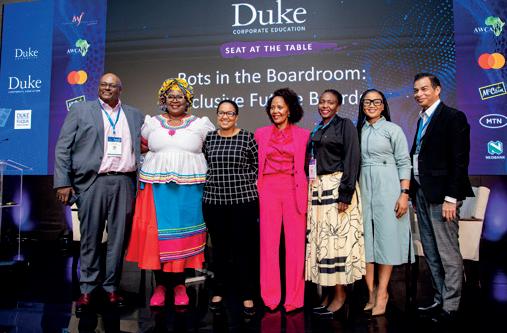
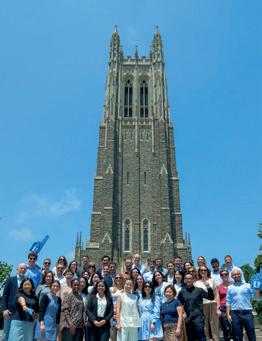
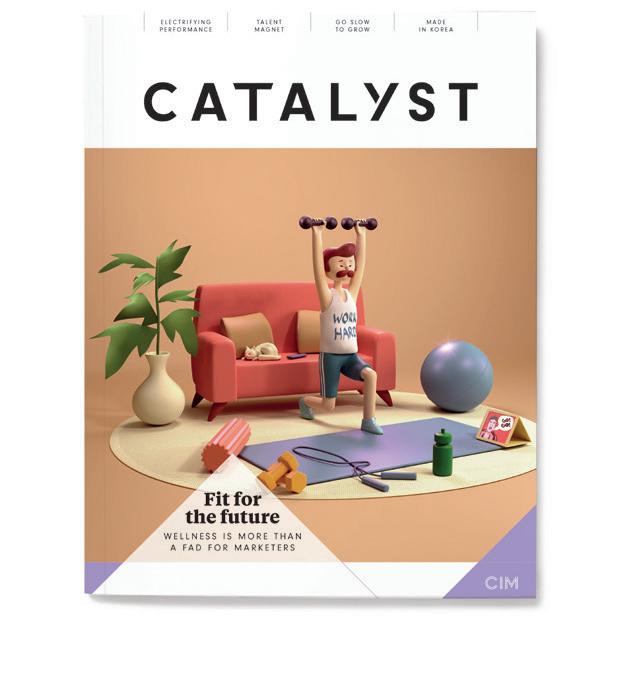
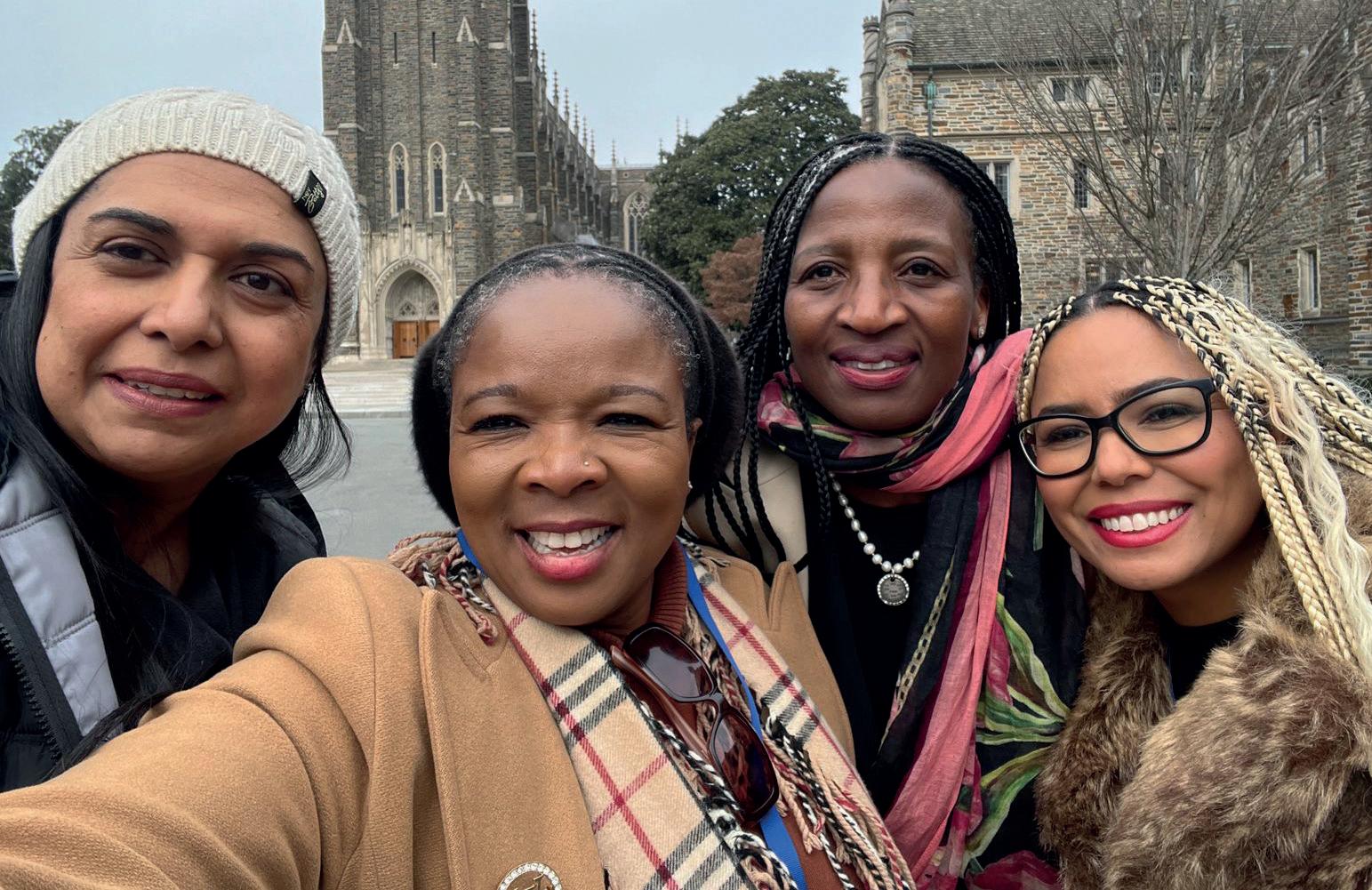
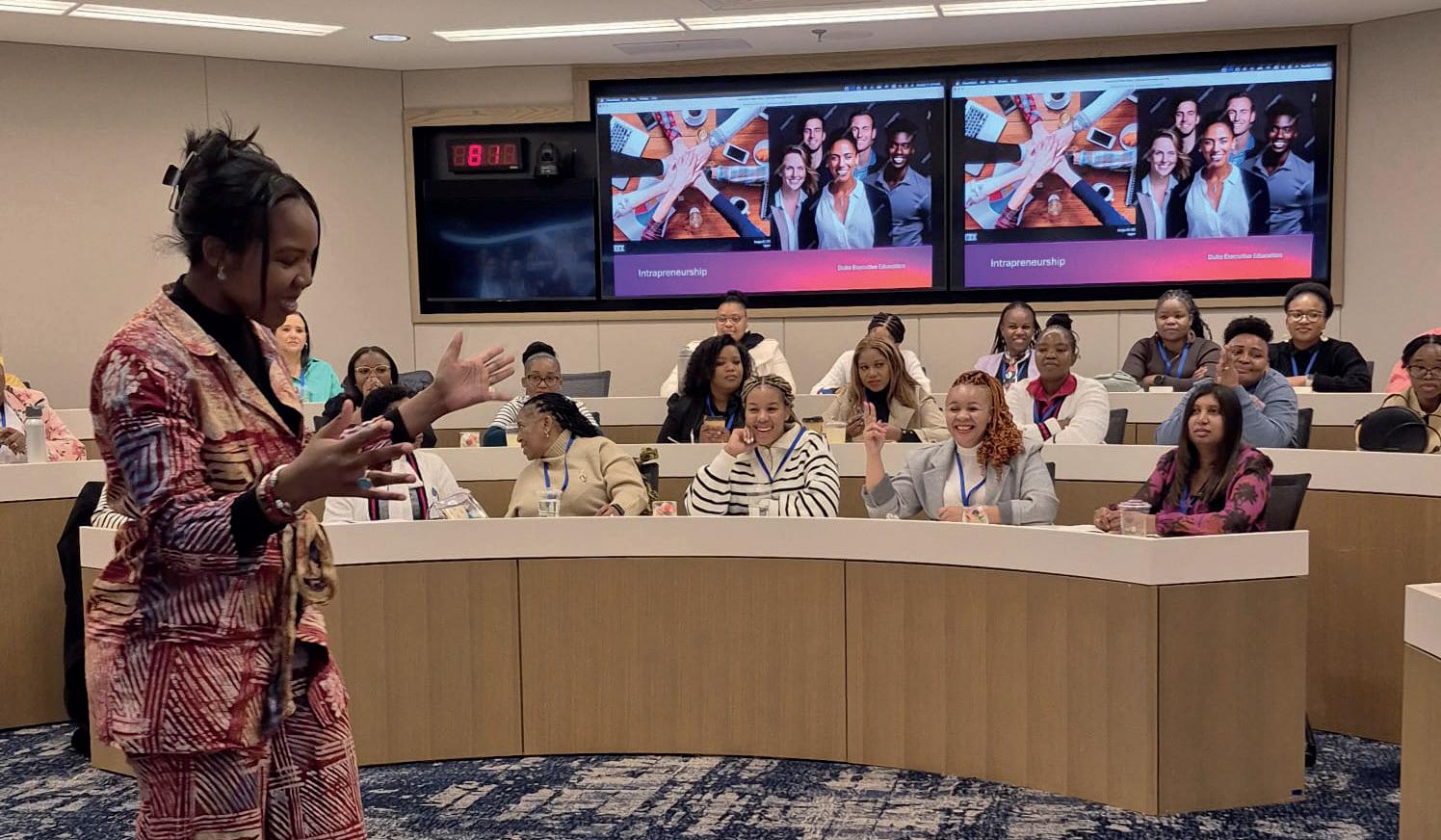
#1000women Celebrating a lifechanging program in South Africa
A serious business The case for prioritizing happiness at work
Quiet fring How subtle exclusion destroys company culture
The tech transformer
IBM’s Deema Alathel on leading through the AI revolution
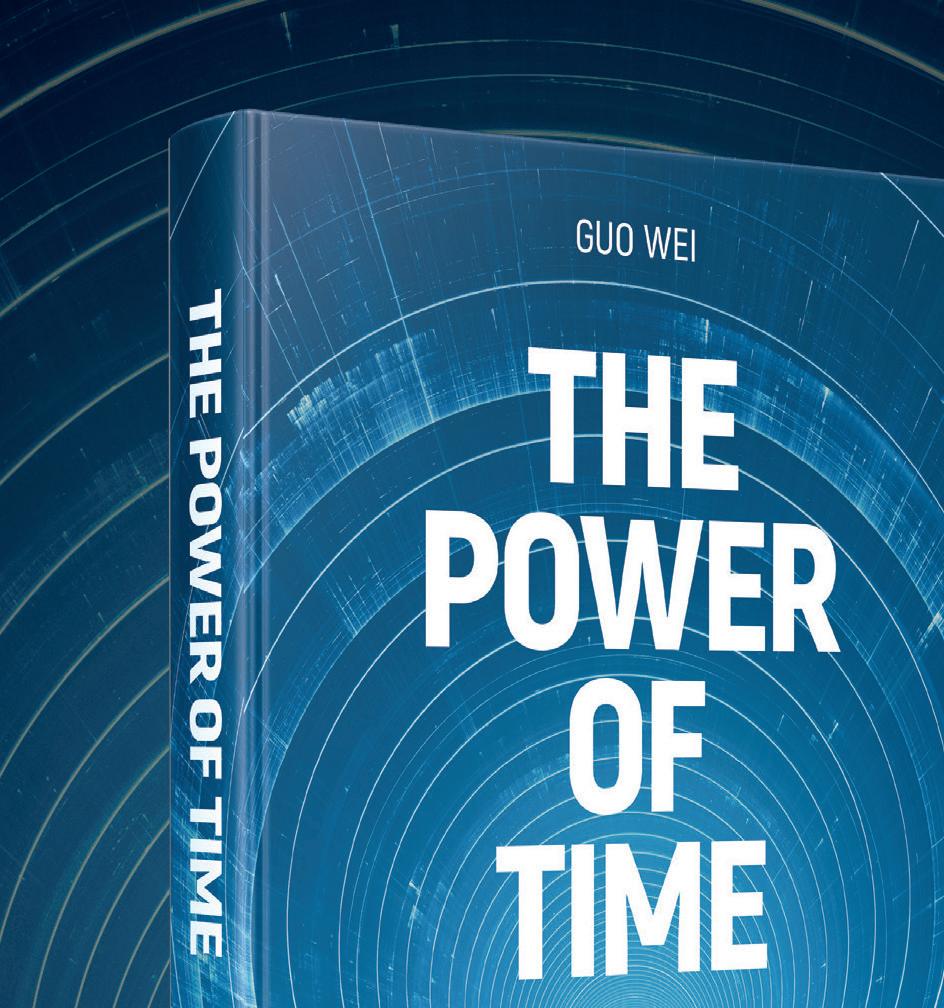
“The bible for the life-centred economy.”
STEVEN D’SOUZA
Senior Partner, Korn Ferry, and author of the award-winning Not Knowing
“The future of work requires us to break free from preconceived notions of how organizations are shaped and managed. Paul’s insights spur us to think about organizations as living organisms, providing a fresh perspective and roadmap to create thriving, sustainable organizations.”
MARY CIANNI
Clinical Associate Professor of Organizational Consulting, New York University
“Just as artifcial intelligence threatens to further dehumanize organizations, Alive is an urgent reminder that businesses thrive when they are built around motivated and engaged people. I love the analogy to a living organism –in an era of digital transformation, it brings back into focus the need for humanity at the heart of our organizations.”
STEPHEN GRAHAM
Executive Vice President and General Manager, Hexagon
Collective intelligence
The multigenerational workplace is upon us. Its emergence is part of a truly historical shift. Simply put: we’re living longer than ever. Human life expectancy more than doubled over the past century. The 100-year life isn’t sci-fi – it’s an entirely reasonable expectation for generations born today in advanced economies. This is unequivocally a good news story – yet is not without its challenges. At a societal level there are thorny questions about how we pay for those longer lives. How will the burden be shared between older and younger generations? Macro questions play out at the micro level: we are all well-advised as individuals to think carefully about choices that will sustain us in good health and financial security. New career models, professional pivots, and lifelong learning are the building blocks of success in this new world.
Because of course, this remarkable shift in human longevity is happening just as we enter a period of revolutionary change driven by new technology. The nexus between these two megatrends is found within our organizations. On the one hand, businesses have access to a talent pool that is wider and deeper than ever. On the other, they have increasing options to draw on the astonishing power of artificial intelligence. AI tools are rapidly becoming more mature, more reliable, more powerful – and better embedded in our organizations. And the AI revolution is only just getting started.
As Duke CE’s chief executive Dr Sharmla Chetty writes in this issue (p16), this is not an either/or situation. The most powerful response is ‘and.’ The organizations that win in the new era will be those that harness the power of collective intelligence, orchestrating humans and machines in harmony to create new capabilities.
Focusing on the human side of the equation, Avivah Wittenberg-Cox explores the dimensions of longevity leadership (p20). The old three-stage model of life – learn, work, retire – is obsolete, she explains. In its place: a new four-quarter
model, ofering individual leaders a better way of structuring their careers, and giving organizations a platform for better engagement with talent. Diane Ty, meanwhile, focuses on another critical implication of aging societies: the fact that more workers have important duties as caregivers (p24). How can organizations support those individuals in the moments that matter?
At the other end of the generational spectrum, Bobby Dufy explains how leaders can cut through the myths that cloud organizational thinking about Gen Z. With a clearer understanding of real generational diferences, leaders should focus on increasing connection across all age groups (p26).
In our cover interview, we speak with IBM’s Deema Alathel about the errors organizations make as they grapple with AI and the leadership shift required to thrive in the AI evolution (p34). Selena Rezvani examines the phenomenon of quiet firing, when managers freeze out individuals, and ofers tips to prevent it (p40). Nic Marks warns that too many businesses drift along in a dangerous ‘okay’ zone, neither excelling nor taking action to drive higher standards. Leaders should refocus on what makes employees happy (p44).
Elsewhere, Marco Robledo and Joseph Pine ofer a powerful framework for understanding changing consumer behaviors (p70). Kevin O’Marah looks at the implications of geopolitical change for supply chain resilience (p76). And Stephen Wunker and Jonathan Brill argue that leaders should learn from one of nature’s marvels, the octopus (p78).
Enjoy the issue.
The nexus between these two megatrends is found within our organizations
Patrick Woodman is editor of Dialogue
Dialogue is brought to you by:
LID Business Media
Editor Patrick Woodman
patrick.woodman@lidbusinessmedia.com
Creative director Kate Harkus
Chief subeditor Luisa Cheshire
Editor-at-large Ben Walker
Publisher Martin Liu
Associate publisher Alec Egan For advertising sales: alec.egan@lidbusinessmedia.com
Duke Corporate Education
Chief marketing ofcer
Christine Robers
Publisher
Published in the United Kingdom by LID Business Media Ltd, LABS House (5.12), 15-19 Bloomsbury Way, London WC1A 2TH
Disclaimer
Copyright 2026 by Duke Corporate Education and LID Business Media Ltd. All rights reserved. Material may not be reproduced without permission of the publisher. While we take care to ensure that editorial is accurate, independent, objective and relevant for the readers, Dialogue accepts no liability for reader dissatisfaction rising from the content of this publication. The opinions expressed or advice given are the views of individual authors and do not necessarily represent the views of Dialogue. This journal is also supported by Knowledge Partners, including Duke Corporate Education as Lead Knowledge Partner. Whenever an author is related to a Knowledge Partner it will be noted as such. Dialogue takes every efort to credit photographers but we cannot guarantee every published use of an image will have the contributor’s name. If you believe we have omited a credit for your image, please email the editor. Cover image Al-Musharraf ISSN 2053-4361
Printed by Paragon www.paragon.world
Upfront Vishal Patel on the attention economy
Quiet fring Freezing out team members kills culture
The happy team Why happiness is a serious business
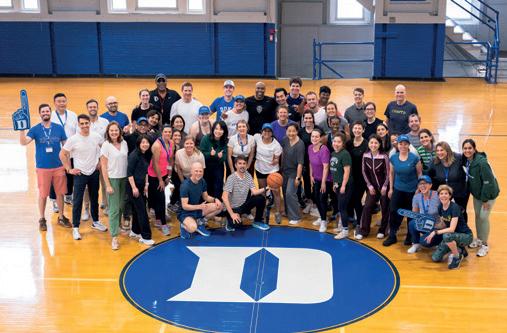
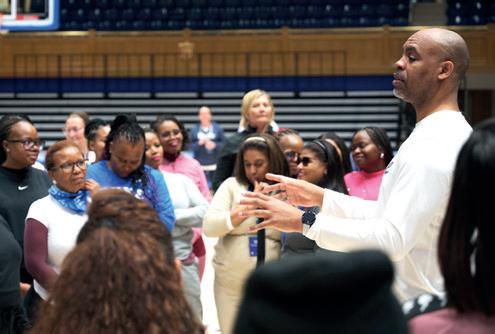
1,000 women An inspirational development program in South Africa
Building resilience Learn to upskill like US Navy Seals
THE KEY TO TURNING IT
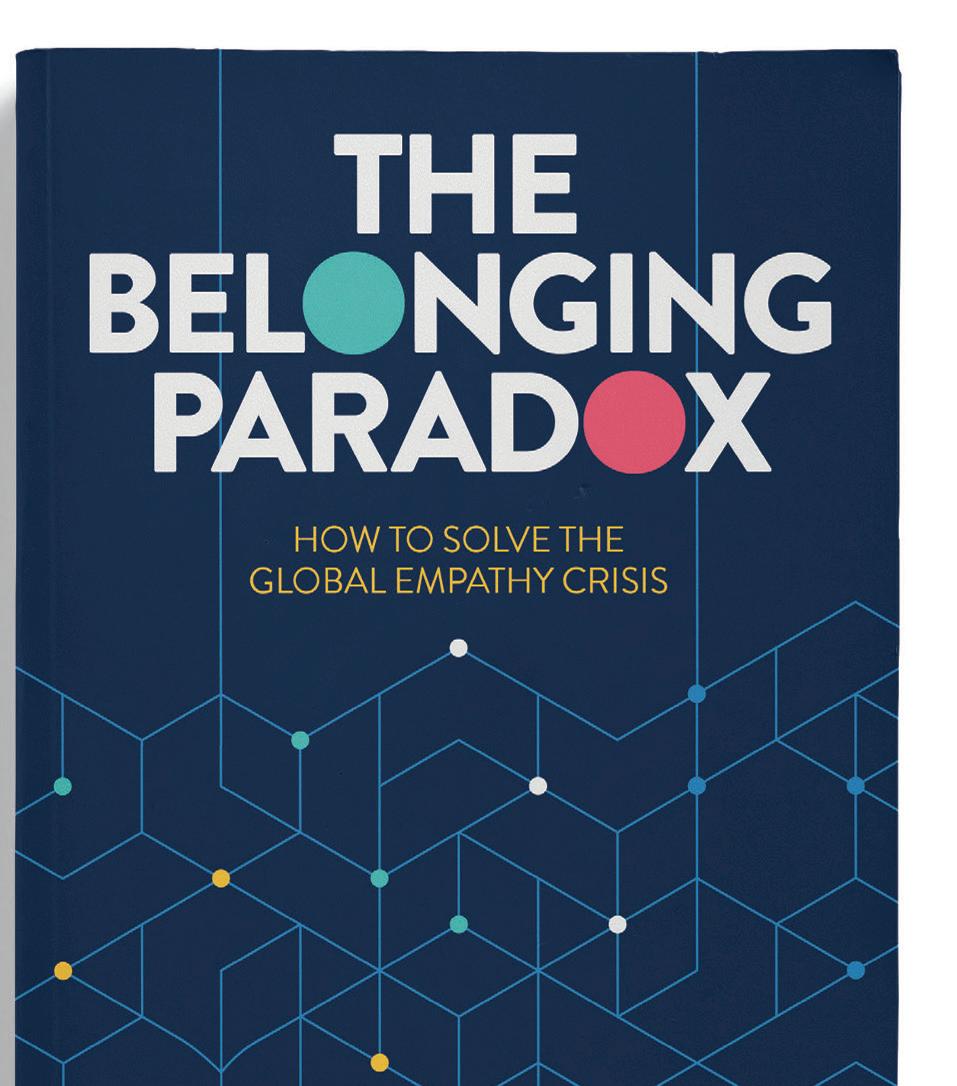
“In The Belonging Paradox, Danny Gal ofers powerful methods for bridging divides in our increasingly polarized world. Drawing on his extensive work, he reveals that transformative connection is only possible when we develop the capacity to see the human behind the perceived enemy –a skill that feels more urgent than ever.”
PROFESSOR DANIEL L. SHAPIRO
Author of Negotiating the Nonnegotiable and Founder and Director, Harvard International Negotiation Program
“In this important book, Danny Gal distils decades of work building empathy, showing that building trust with the ‘other’ is not a task limited to saints but a practice that all of us can – and must –take up if our world is to survive.”
DOUGLAS A. JOHNSON
Lecturer in Public Policy at Harvard Kennedy School and former Faculty Director of the Carr Center for Human Rights Policy
“Danny Gal explores the empathy crisis at the heart of global challenges, revealing how disconnection fuels polarization and systemic breakdowns. He presents a compelling call to reclaim democracy and cocreate models of collective belonging rooted in empathy, deep listening and generative leadership. A vital guide for changemakers, this book provides the tools to shape a more inclusive and just future.”
OTTO SCHARMER
Senior Lecturer, MIT School of Management, author of Theory U and Co-founder of the Presencing Institute
Contributors
Diane Ty
Avivah Witenberg-Cox
A writer, speaker, coach, consultant and change agent, working on building gender and generational balance in organizations. Wittenberg-Cox is CEO of 20-first, an ambassador for the Stanford Center on Longevity, and co-founder of the Longevity Leadership program at Católica Lisbon. She writes the Elderberries newsletter on Substack, and is author of the graphic books Thriving To 100 and 5 Steps to Longevity Leadership. Focus p20
Managing director of the Milken Institute Future of Aging, leading eforts to advance healthy longevity and financial security through a life-course perspective on aging. Ty is a senior adviser at Georgetown University’s Business for Impact at the McDonough School of Business, and previously held executive roles at AARP (formerly the American Association of Retired Persons), Save the Children and American Express. Focus p24
Selena Rezvani
A Wall Street Journal
bestselling author, leadership expert and sought-after keynote speaker. Rezvani trains teams at firms like Microsoft, Pfizer, and The World Bank on leading without ego, building trust and cultivating unstoppable teams. Her latest book, Quick Leadership (Wiley) ofers practical, people-first strategies for building trust and driving results from day one. Leadership p40
Sam Sahni
A global workplace strategist and technology entrepreneur with over 20 years’ experience advising boards, mentoring leaders and delivering workplace transformations. Sahni is a recognized thought leader in the world of work and AI, helping leaders reimagine roles, and the author of Destination 2.0: The Playbook Every Executive Needs to Master Hybrid Working (LID Publishing) Focus p30
Bobby Dufy
Professor of public policy and director of the Policy Institute at King’s College London. Dufy’s first book, The Perils of Perception – Why we’re wrong about nearly everything, focused on how people misperceive key social realities, and his latest, Generations – Does when you’re born shape who you are?, challenges myths and stereotypes around generational trends. Focus p26
Join the Dialogue
Nic Marks
An award-winning statistician, Ted speaker and author of Happiness is a Serious Business. Marks is the founder of Friday Pulse, a tech company helping organizations improve team happiness. He’s the creator of the Happy Planet Index and has helped hundreds of organizations unlock the power of happier teams. Leadership p44
Dialogue Digest
A quick look at the key themes and topics covered in this issue
Collective intelligence
Dramatic demographic changes around the world are ushering in the era of the fivegeneration workforce, creating unprecedented opportunities to capitalize on diverse human capabilities in synch with powerful new AI tools. Doing so requires leaders to intentionally build a culture of collective intelligence with an emphasis on adaptability, as Duke CE chief executive Dr Sharmla Chetty explains (p16).
Grasping new realities
In for the long haul
Avivah Wittenberg-Cox sets out a new model for longer careers (p20), Diane Ty assesses the growing importance of caregiving (p24), and Bobby Dufy explains why organizations should cultivate stronger multigenerational connections (p26).
Happy place
To deliver great team performance, focus on a simple emotional idea, writes Nic Marks (p44). Are your people happy at work? Selena Rezvani assesses the corrosive efects of quiet firing and explains how leaders can avoid perpetrating it (p40).
Rapid changes in consumer attitudes can leave many brand leaders floundering. Marco Robledo and B Joseph Pine II set out their new framework for the four stages of consumer evolution (p70). Kevin O’Marah dissects how geopolitical tensions and economic uncertainty demand a refocus on supply chain capability in place of agility (p76). And to help leaders design the future organization, Steven Wunker and Jonathan Brill draw inspiration from the mighty octopus (p78).
Experience is no longer enough
Learning agility has overtaken experience as the defining leadership capability
Peter Drucker wasn’t just wise. He was prescient. “We now accept the fact that learning is a lifelong process of keeping abreast of change,” the late, great Father of Modern Management once noted. “And the most pressing task is to teach people how to learn.”
Drucker died in 2005, when social media channels like Facebook and YouTube were in their infancy. He had no experience of artificial intelligence (AI). Yet, two decades after his death, his words encapsulate the crucial challenge of our time: to build a generational learning mechanism in our people. In periods of exponential change, experience does not merely lose value. It becomes an active liability if it locks leaders into outdated mental models. What matters now is not what leaders know, but how fast they can update what they know.
I was struck by the comments of Cisco executive vice president Francine Katsoudas. Katsoudas, also Cisco’s chief people, policy and purpose ofcer, describes her brief as “bringing together people and technology to drive positive impact for the company and global communities.” Channeling Drucker’s classic wisdom, Katsoudas maintains that learning agility holds the keys to the future. “I think it’s everything,” she says, warning that experience makes a poor substitute for a discovery mindset. She harkens back to when her current CEO was going through the CEO selection process, and the other two candidates were much more experienced. “Over the 11-month process he demonstrated what his tenure would look like –because of this ability to constantly learn, reframe and think about things diferently.” This learning agility proved decisive in his appointment.
Faster learners are rightly in heavy demand. Technology is racing ahead of the organizational structures required to harness it. AI is not a future disruptor – it is a present test of leadership relevance. And, like all tests, it is exposing who
The question is no longer whether leaders can adapt – but whether they are willing to let go of the very experience that once defned them
has been preparing, and who has not. Moreover, the foundations of organizations require constant updates to meet the ethical challenges of the future. Katsoudas says that vulnerability –acknowledging that we lack all the answers – is an essential leadership quality amid technological disruption. Innovation and AI present extraordinary opportunities. But ethical leadership and enduring principles remain paramount.
The discovery mindset can be paradoxical: it demands a rare ability to acquire new knowledge quickly, while simultaneously unwinding many of the things we thought we knew. “It’s important for all of us to unlearn,” said Katsoudas. Yet it requires leaders to let go of ideas that once made them successful – and that can feel like a loss of identity and authority.
The velocity of change is unforgiving. Experience is no match for an open mind and a willingness to embrace new ideas; to learn – and unlearn – at pace. The leaders who thrive will not be those with the longest résumés, but those with the shortest learning cycles. The question is no longer whether leaders can adapt – but whether they are willing to let go of the very experience that once defined them. It is a query that recalls Drucker’s forward thinking. “The best way to predict the future,” he once said, “is to create it.”
Dr Sharmla Chety is chief executive of Duke Corporate Education. She works with global organizations on leadership, learning and future-ready capability
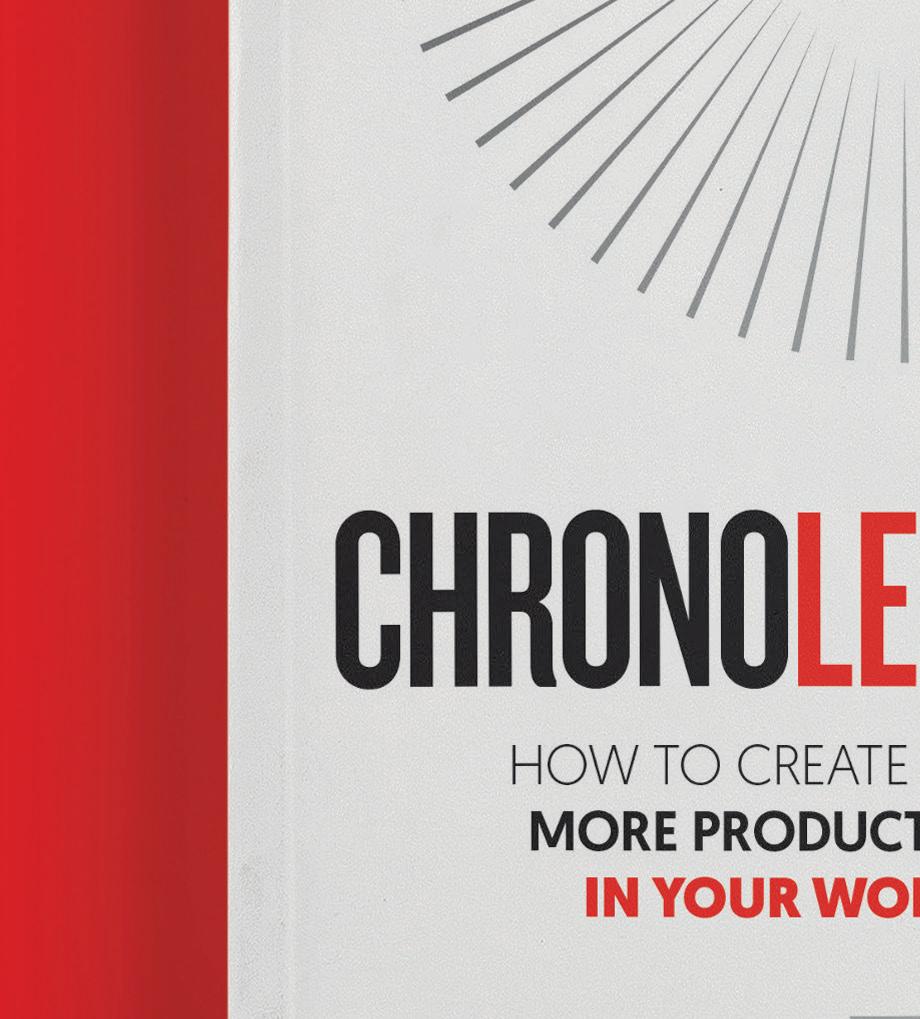
WHY RECOGNIZING AND ACCOMMODATING CHRONODIVERSITY COULD BE A BOON FOR BOTH EMPLOYEES AND EMPLOYERS
“The best companies want to tap into the full potential of their employees – and that means recognizing the unique needs of morning and evening people. Chronoleadership revolutionizes the way we create inclusive work cultures and equips leaders with strategies for embracing a diversity of chronotypes to improve health, productivity and overall wellbeing in the workplace.”
DORIE CLARK Wall Street Journal bestselling author of The Long Game and executive education faculty of Colombia Business School
THOMAS WEDELL-WEDELLSBORG author of What’s Your Problem?
“With this manifesto against our culture’s time tyranny, Camilla Kring points the way to a brighter future: one where employees flourish, students learn more, and society becomes just a little bit more human. Can we get this revolution started now, please?”
“A must-read for anyone interested in unlocking the full potential of their workforce.”
ALEX WUERFEL Executive Coach and former Vice President at AbbVie Inc.
Pollyanna and Cassandra will lead us astray
The attention economy polarizes opinion. It should not
It is the best of times. It is the worst of times. It is the age of opportunity. It is the era of threat.
This column has noted that the leaders who command attention, not adulation, will thrive (Dialogue Q1, 2026).
The advent of mass interconnectivity, born of the tech explosion, has changed the paradigm. The attention economy is no longer emergent. It is already here. Yet the world divides on whether it is a blessing or a curse.
In one kingdom, Pollyanna is queen. The march of the machines will enrich the human experience! In the instant, networked and dispersed attention economy, leaders who can bond with their people in the virtual universe will deliver unlimited benefit for individuals, businesses and society.
In the other kingdom, Cassandra reigns. The attention economy will destroy the very foundations of good leadership! Once, great leaders could inspire their people to even greater things, but they will now flail – invisible in the morass of competing attractions.
Yet Pollyanna and Cassandra have more in common than they might admit. For this is their time: on any touchstone issue the world splits into extremes. All is good, or all is evil. Attitudes to the attention economy are no diferent.
This polarization is born of two unwelcome trends; one short-term, the other long-term. In the short term, ‘cognitive closure’ subverts our minds. It leads us to seize on solutions, then freeze on them – resisting new information that challenges our conclusions. Cognitive closure forces us to become anchored and blind to the world as it evolves. It pushes us into one mentality or the other: the Pollyanna Perspective or the Cassandra Complex. We see the world not how it is, but how we wish to perceive it.
The world is uncertain. The future unknown. What is the compelling future you want to create?
The long-term problem arises from the Pipeline Paradox. In an agentic world, machines are increasingly tasked with assessment and analysis. Leaders with discernment and judgment – the core qualities of human decision-making – are prized. The rank-and-file, who were once responsible for data collection and examination, are being ‘rationalized’ out of their jobs. The labor force is becoming less humanoid, more android. Yet here is the paradox. Human leaders gather discernment and judgment only through experience. If we restrict the pipeline, who will make the decisions in the future?
How do we escape this bind? First, follow the advice of neither Cassandra nor Pollyanna; instead, heed the insight of F Scott Fitzgerald. “The test of a first-rate intelligence is the ability to hold two opposed ideas in the mind at the same time and still retain the ability to function.”
The world is uncertain. The future unknown. Leaders must do the hard work of introspection: What is the compelling future you want to create? We must embrace risk as an enabler, not an inhibitor. Only then can we discover the right balance of agentic analysis and human ingenuity. Limiting humans is as unwise as rejecting machines.
The attention economy is real and present. Neither the Cassandras nor the Pollyannas can capture its potential. Extreme takes, as ever, are likely wrong. The mundane truth – neither clickable nor attention-grabbing – is probably somewhere in the middle. Leaders must equip for the best future, then walk sure-footedly toward it.
Vishal
Patel
is
president of global markets at Duke Corporate Education
For 25 years, Duke Corporate Education has partnered with organizations across the globe to meet defining moments — and shape what comes next. We don’t deliver off-the-shelf answers. We co-create learning that is custom designed for the challenges organizations face. Whether navigating disruption, building future-ready leadership, or transforming cultures, we walk alongside our clients to fuel purposeful business change — across the globe, at every level.
At the heart of every transformation is a partnership — and every partnership, a story. Let’s shape the next chapter, together.
Multigenerational intelligence
e are in a new era of work. For the first time, five generations rub shoulders at work. Driven by new global demographics, from advanced economies’ aging societies to emerging markets’ booming young populations, it is a unique moment in the evolution of our collective human brainpower. Yet it comes at a time when the very idea of intelligence is being redefined by technology. In this issue, we examine how leaders can cultivate collective intelligence, drawing on multiple generations of human talent in harmony with artificial intelligence. As we look forward to longer lives, we explore the concept of longevity leadership. We consider ways to adapt to the needs of workers who are caregivers. We puncture the myths that lead to a focus on Gen Z at the expense of the bigger challenges of building cross-generational connection. And we assess how to create workplaces that work for people of all ages.
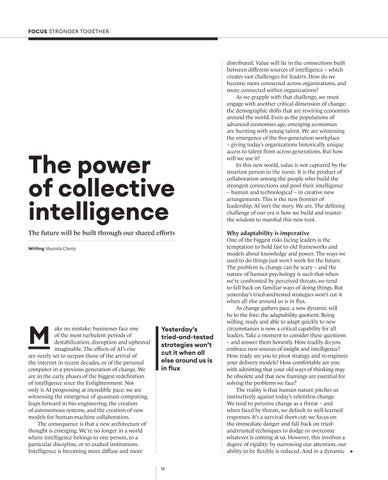
The power of collective intelligence
The future will be built through our shared eforts
Writing Sharmla Chetty
Make no mistake: businesses face one of the most turbulent periods of destabilization, disruption and upheaval imaginable. The efects of AI’s rise are surely set to surpass those of the arrival of the internet in recent decades, or of the personal computer in a previous generation of change. We are in the early phases of the biggest redefinition of intelligence since the Enlightenment. Not only is AI progressing at incredible pace: we are witnessing the emergence of quantum computing, leaps forward in bio-engineering, the creation of autonomous systems, and the creation of new models for human-machine collaboration.
The consequence is that a new architecture of thought is emerging. We’re no longer in a world where intelligence belongs to one person, to a particular discipline, or to exalted institutions. Intelligence is becoming more difuse and more
distributed. Value will lie in the connections built between diferent sources of intelligence – which creates vast challenges for leaders. How do we become more connected across organizations, and more connected within organizations?
As we grapple with that challenge, we must engage with another critical dimension of change: the demographic shifts that are rewiring economies around the world. Even as the populations of advanced economies age, emerging economies are bursting with young talent. We are witnessing the emergence of the five-generation workplace – giving today’s organizations historically unique access to talent from across generations. But how will we use it?
In this new world, value is not captured by the smartest person in the room. It is the product of collaboration among the people who build the strongest connections and pool their intelligence – human and technological – in creative new arrangements. This is the new frontier of leadership. AI isn’t the story. We are. The defining challenge of our era is how we build and master the wisdom to marshal this new tool.
Why adaptability is imperative
One of the biggest risks facing leaders is the temptation to hold fast to old frameworks and models about knowledge and power. The ways we used to do things just won’t work for the future. The problem is, change can be scary – and the nature of human psychology is such that when we’re confronted by perceived threats, we tend to fall back on familiar ways of doing things. But yesterday’s tried-and-tested strategies won’t cut it when all else around us is in flux.
Yesterday’s tried-and-tested strategies won’t cut it when all else around us is in fux
As change gathers pace, a new dynamic will be to the fore: the adaptability quotient. Being willing, ready and able to adapt quickly to new circumstances is now a critical capability for all leaders. Take a moment to consider these questions – and answer them honestly. How readily do you embrace new sources of insight and intelligence? How ready are you to pivot strategy and re-engineer your delivery models? How comfortable are you with admitting that your old ways of thinking may be obsolete and that new framings are essential for solving the problems we face?
The reality is that human nature pitches us instinctively against today’s relentless change. We tend to perceive change as a threat – and when faced by threats, we default to well-learned responses. It’s a survival short-cut: we focus on the immediate danger and fall back on triedand-trusted techniques to dodge or overcome whatever is coming at us. However, this involves a degree of rigidity: by narrowing our attention, our ability to be flexible is reduced. And in a dynamic
environment like today’s, where change is multifaceted and all around us, that’s maladaptive. It’s not the way that leaders will thrive – or even survive – the new context.
We already see the reality of how the world has changed. The world is more deeply interconnected than ever. Entire markets can go terribly wrong because of one small mistake. That puts an onus on organizations to leverage their collective intelligence to the maximum extent possible.
The systems that leaders build must be diverse by design, bringing together multiple perspectives, experiences and sets of knowledge and skills. We cannot rely on a single source of knowledge; the stakes are too high. No one mind can solve the complex challenges that our organizations face.
This new paradigm means combining diverse human and technological systems, because this is the new source of advantage. The new neural network of the organization is both human and technological, and it is constantly evolving –learning continuously, becoming better able to solve the complex challenges that confront us.
It also means bringing together humanity’s full diversity. For many leaders, attention needs to turn to a sometimes overlooked and misunderstood dimension of change: the rise of the five-generation workforce.
The multigenerational opportunity
The global workforce is undergoing one of the most consequential shifts in modern history. For the first time, as many as five generations are working side by side – and how leaders respond will shape not only organizational performance, but long-term economic growth. Research by the World Economic Forum, AARP and the OECD suggests that investing intentionally in multigenerational workforces could raise GDP per capita by nearly 19% over the next three decades.
This demographic reality makes one leadership capability more important than all others: the ability to cultivate collective intelligence.
It starts with inclusiveness. This is not a moral aspiration alone; it is a strategic necessity. When leaders sideline any generational cohort, they cut themselves of from irreplaceable sources of insight, experience and creativity. Maximizing the quality of organizational thinking requires deliberately bringing the broadest possible range of perspectives into the room. We make mistakes when we amplify biases, accelerate inequality, or concentrate on the power of a certain group. Age-related diferences
Leaders should focus on the rich opportunities ofered by the multigenerational workplace
need to be considered in the ways we bring teams together, how we create psychological safety so that everyone contributes their ideas, and how we build connection between diverse team members.
While some analysts home in on the challenges of aging societies or the considerable risks of youth unemployment, leaders should focus on the rich opportunities ofered by the multigenerational workplace. To seize the moment, we need balance and integration: we mustn’t focus only on one generation or another. Gen Z may bring digital fluency, speed, and a readiness to reimagine the world – but these strengths reach their full potential only when combined with the judgment, pattern recognition and contextual understanding that older generations have developed over time.
I see this dynamic play out vividly in my own life. I treasure my conversations with my nephew. Not only am I struck by how smart he is, and how deeply he understands technology. What is so brilliant is that we challenge each other’s views and ideas – robustly, but respectfully. These exchanges sharpen thinking on both sides – and reveal what becomes possible when organizations design for intergenerational dialogue rather than hierarchy.
Combined with the technological revolution, the rise of the multigenerational workforce is fundamentally transforming how we learn, how we innovate and how we lead. It will require us all to think diferently.
Ethics are everything
Inclusion is also essential to ensure organizations don’t fall foul of the ethical quandaries that emerge amid fast-moving, technologically-driven change. Collective intelligence is not only a performance advantage – it is also a moral safeguard.
Discussions of ethics in the age of AI often default to technological fixes. Yes, it is important to guard against bias in datasets and in how AI is trained, and to monitor and correct for emerging bias in how systems operate once deployed. But ethical business practice can’t be guaranteed by algorithms. Our ethics need to include the machines we now work with, but morality cannot be outsourced to AI.
Rather, an ethical approach relies on the foundation of our fundamentally human values. We need to be clear about what those values are and what they mean.
We need to engage everyone across the organization, too. That means ensuring that our collective ethics are brought to life every day through decisions, behaviors and systems – and that a plurality of voices are heard in honest discussions about nuanced ethical questions. Leaders need to be open to varied perspectives and comfortable with being challenged about how they enact shared values. Uncomfortable though this may be, it is the only way to find the right path through complex and finely-balanced situations.
Ultimately, our direction will be determined by human wisdom – by kindness, care for others, and the quality of our collective judgment. While some leaders obsess about seizing advantage by being first to deploy AI, the real story is that kindness, care and collective intelligence will win the race.
Questions for leaders
As leaders set out to build collective intelligence, start with these questions.
1 Are we genuinely designing the organization for collective intelligence? Too many organizations are still optimizing for efciency at the expense of insight, inclusion and adaptability. Reflect on whether organizational structures, processes and culture support collective intelligence, or remain oriented toward other goals. Creating the future means reorienting toward collective intelligence, developing the organizational muscle needed to reimagine the business and innovate around complex challenges.
2 Are we building our collective adaptability quotient? Relentless change will lead to old markets shrinking and new markets emerging as customers’ needs are transformed. Is your
organization ready to jettison its old proposition and seize new opportunities? How will it reimagine its enduring purpose for a new era? How will it reengineer its structures and processes, and build the culture needed to adapt at pace?
3
What intelligence are we failing to use?
When leaders sideline any generational cohort, they cut themselves of from irreplaceable sources of insight
Assess whether certain groups – be they generational cohorts, women, or other social groups – are being left out of the conversations that matter. How can more people be brought into the room for the discussions that matter? And are you seizing every opportunity to complement and expand human intelligence with machine intelligence?
4 How do we seize the learning opportunity?
Continual change demands continuous learning – a crucial foundation for building adaptability. How is your organization supporting people to level-up their learning and refresh their skills, at a faster pace than ever before? Pause to think too about your own learning and how you can prepare personally for a fast-changing world. Adaptability is a critical leadership competence, as well as an organizational capability.
5
How do we exert a positive infuence on society’s direction? Organizational leaders have the opportunity and responsibility to influence change beyond the borders of their organizations. Speaking up as society debates how it will adapt to the rise of AI, and managing the transformational impact on economies and communities, will be vital to ensure fairness, inclusion and sustainability.
Pioneering the new frontier, together
As the AI revolution gathers pace, it can feel like our future is being defined by a small handful of uniquely powerful individuals – the Sam Altmans, Elon Musks or Jensen Huangs of this new world. Their contributions will be pivotal. Yet the truth is that the change now under way is bigger than any one individual or even any one organization.
The change before us is collective; the response will be collective. Across generations, across our organizations, and across societies, we are embarking on a journey that will ultimately transform our thinking about the world. It will give us a renewed sense of identity and purpose; a new understanding of our role in the world – both individually and collectively.
Dr Sharmla Chety is CEO of Duke Corporate Education
The future will not be shaped by any one generation, leader or technology. It will be shaped by how well we think, learn and act together.
The future belongs to all of us – and it will be defined by our collective intelligence.
Longevity leadership
Unprecedented demographic changes have profound implications for individuals and organizations alike
Writing Avivah Wittenberg-Cox
once home to a billion-strong labor force, saw its population decline for the first time in six decades. The UK Ofce for National Statistics now projects that by 2035, there will be more people over 65 than under 18.
The case of South Korea is particularly illustrative. It now holds the world’s lowest fertility rate, at just 0.72 children per woman – far below the replacement level of 2.1. The implications are profound: by 2100, South Korea’s population could shrink by more than half. The Seoul city government is already preparing for the closure of schools, while companies are struggling to fill jobs and maintain productivity. With fewer workers supporting more retirees, pension systems are under intense pressure, and intergenerational inequality is rising fast. South Korea is the demographic future of many developed nations –and it is arriving quickly.
At the same time, retirement ages have not shifted in line with life expectancy. Pension systems are strained. Economic growth is slowing as workforces age and contract. According to McKinsey’s recent report on the demographic economy, aging populations could reduce GDP growth by 0.4-0.8 percentage points annually in several OECD nations. This is no longer a social policy issue. It’s an economic and leadership one.
The countries and companies that thrive in this new era will be those that embrace the shift, redesign systems, and leverage the longevity dividend. Those that don’t will face labor shortages, declining consumption, and mounting intergenerational inequality. Are you ready?
Life’s four quarters: how this impacts you
We are not just all getting older and living longer, everywhere. We are entering a fundamentally diferent demographic era. In just over a century, life expectancy in developed countries has increased by 30 years. Yet this miracle of science is happening at a time when fertility rates are plummeting and populations are contracting. According to the UN, by 2050, two-thirds of the world’s population will live in countries where fertility rates are below replacement level. In major economies like Japan, Germany and South Korea, the population is already shrinking.
The new demographics
The demographic pyramid that defined the last century is flattening into a square. Once, the olderage population was a minority, supported by many more younger people of working age. In many societies, that structure is fast disappearing.
In Japan, nearly 30% of the population is over 65. In Italy, that figure is close behind. Even China,
We all need to prepare for 60year careers, not just longer retirements
The change now unfolding won’t just hit countries and companies. It will have equally profound impacts on every one of us. The old three-stage life – learn, work, retire – was built for 70-year lives. Today, half of babies born in OECD countries are expected to live past 100. That’s not a footnote. That’s a complete rewriting of the life script.
We are moving toward what I call Four-Quarter Lives, shaping a new roadmap for life.
Q2: Achieve Career progression, family formation, financial growth
Q3: Become Reinvention, mastery, purpose
Q4: Harvest Mentoring, wisdom-sharing, legacy work
These quarters are not strictly chronological. They are navigational. And learning how to navigate them will become a key longevity KPI, like your heart rate or your body mass index.
I know this firsthand. I went back to school at 60 – not to start over, but to ‘Become’: to realign purpose with practice and lead from experience. Today, I work with CEOs and executive teams across the world on how to redesign macro and micro systems for our lengthening lives. And I am not alone in making big changes at this stage. It is truly the new chapter of our lives.
What’s becoming clear is that we all need to prepare for 60-year careers, not just longer retirements. That means planning not for the old success-defining linear progression, but for multiple transitions: career pivots, side ventures, periods of caregiving, returns to study, reskilling, sabbaticals and reinventions.
The reality is that most of us aren’t trained to navigate these transitions well. We were raised in systems built for stability, not agility. In this new era of longevity and disruption, we need to develop new personal capacities to manage change efectively. Inspired by Lynda Gratton and Andrew Scott’s book The 100-Year Life, I’ve
In this new era of longevity and disruption, we need to develop new personal capacities to manage change
rebranded four core ‘muscles’ that we must strengthen to thrive across the new marathon of longer lives.
1
Brain – knowledge and relevance
Do your skills and experience match the world we’re heading into? The pace of technological and social change means we’ll need to continually upgrade our minds, stay current and build relevancy muscle. Long-life learning isn’t a buzzword – it’s a survival strategy.
2
Love – relationships and community
Who do you love, and who loves you?
Our personal, professional and community networks are our greatest sources of resilience and happiness in life. As we move across careers and life stages, our relationships – with partners, friends, family, mentors and colleagues – become the scafolding of our transitions. Longevity without connection is life without air. It’s hard to breathe and grow.
3
Change – growth mindset and fexibility
Do you believe you can grow, adapt and start again? And again? The ability to embrace reinvention – to leave behind what no longer serves us and lean into something new, welcoming the ignorance and ineptitude of the beginner’s mind – is critical. Especially in Q3, the Become phase that starts around age 50, people who consciously adopt a growth mindset are more likely to find meaning, energy and purpose.
4
Choice – health and wealth as enablers
Transitions require the freedom and agency to choose. That freedom comes from being well grounded. Having enough of a foundation of health – physical, emotional and mental –and financial security that enables movement. Without these, even the best intentions remain stuck. Investing early in wellbeing and long-term financial planning opens doors when opportunity calls or disaster knocks.
These four areas – Brain, Love, Change and Choice – act as navigational supports for life transitions. Like muscles, they can be built with intention and strengthen over time. Without attention, they shrivel, just as sarcopenia eats away at our body’s muscles with age. And just like in the gym, the earlier we start training, the better prepared we’ll be for the new career marathon, with its constant pivots and adjustments.
Helping individuals build these muscles should become part of how we think about leadership development, coaching and education. This isn’t about managing decline. It’s the opposite. It’s about unlocking human potential at every stage of our lengthening lives.
Longevity leadership: how it impacts companies
Most leadership teams are not longevity-ready. They are operating with outdated assumptions about age, talent and time. Too often, strategies focus on early-career pipelines, ignoring the growing value of experienced talent, the needs of the powerful new Q3 consumer, and the power of intergenerational teams.
To prepare for the longevity economy, companies must take five strategic steps.
1 Start smart – measure the impact (and potential)
If you can’t measure it, you can’t manage it. Longevity is already reshaping your organization. But without clear metrics, its impact remains invisible. Begin with a data audit: what is your workforce’s age distribution? How does it align with your customer base? What future scenarios
Many countries’ demographics are shifing Pyramids Squares
Most leadership teams are operating with outdated assumptions about age, talent and time
could demographic change create in your sector? Companies need to get smart, fast – not just about risks, but also about the massive potential. The number of indices to measure your longevity readiness is growing fast. Are longevity and demographics on your organization’s strategic radar?
Case study L’Oréal, the world’s largest cosmetics company, elevated longevity to the same strategic tier as climate change and AI. Under the leadership of Murielle Arnould, director of organization and future of work, the company launched L’Oréal for All Generations, a global program that repositions age as an asset in both workforce and marketplace. Campaigns now feature age-proud icons like Jane Fonda and Andie MacDowell flaunting grey hair – a revolution in a company that has long defined hair coloring. It is leading a global repositioning of age from invisible to aspirational.
2 Get leaders longevity-literate
Most executives have been trained for a 20th-century model of work and life. Very few are equipped to lead multigenerational teams, or design strategy for 100-year lives. It’s time to upgrade leadership curricula. That means integrating longevity-thinking into strategic planning, talent management and customer engagement – not just delegating it to HR. Senior leaders must understand the implications of age shifts on global markets and develop the language and mindset to lead across life stages.
Case study Companies from a range of sectors including CUF (healthcare), Trivalor (facility services) and Grupo José de Mello (energy and infrastructure) have sent C-suite executives to Católica Lisbon School of Business and Economics to help them get longevity literate. The School put longevity on the agenda in its advanced management program in 2023, before launching
Young people
Old people
Muscles for the marathon of longer lives
BRAIN
What do you know?
Experience Skills Relevance Knowledge
LOVE Who loves you?
Family Friends Community Relationships
CHANGE
Are you a skilled transitionalist?
Networks Curiosity Learnability Growth mindset
a one-week executive deep dive. Most recently, it launched the Católica Lisbon Center on Longevity, which will align the work of researchers across the university on the challenges of aging societies. It is a megatrend that needs to be better integrated in business school curricula across the globe.
3 Make cultures longevity fuent
One of the obstacles to embracing our aging futures is the profound and generalized ageism that has been baked into many cultures, especially the more youth-oriented Anglo-Saxon ones. But just adding ‘ageism’ to the list of already-overloaded DEI initiatives won’t change things fast enough. A more constructive framing of the next society is more efective. Creating a longevity-fluent culture means bypassing anti-ageism and leapfrogging immediately to more pro-aging mindsets: designing with age in mind across products, services and people systems. It’s about ensuring all generations feel understood, relevant and integrated, both as employees and as consumers.
Case study The Portuguese insurance company Fidelidade has taken a pioneering step by creating a chief longevity ofcer tasked with embedding longevity thinking across the business. This role ensures that age-inclusion isn’t a siloed initiative, but a strategic imperative across functions from HR to customer experience, and brand strategy to innovation.
4 Adapt sales and marketing to four-quarter customers
Most marketing departments are convinced the future lies with Gen Z. But what if the future consumer is old? By 2040, those over 50 will account for the majority of consumer spending in most developed countries. Yet only a small fraction of advertising and product design is targeted at them. The same shift applies to digital platforms,
healthcare, education and housing. Brands need to ditch outdated assumptions about youth-centric marketing and start designing experiences that resonate with Q3 and Q4 consumers: vibrant, purpose-driven and aspirational.
CHOICE Have you built choice?
Health Wealth Flexibility Freedom
Case study US company Caddis Eyewear is a lifestyle brand redefining reading glasses – and aging. With bold design, provocative messaging (“Age is the new black”), and unapologetic celebration of people in Q3, they’ve built a brand that speaks directly to the reinvention generation. Their success shows what happens when companies lean into, rather than shy away from, the longevity market.
5Make talent management systems intentionally intergenerational
The current definition of a successful career is still embedded in the old three-stage definition of life. We need to redesign for a four-quarter workforce, keeping workforces healthy, productive and contributing across more decades. (Note that Denmark recently raised retirement ages to 70; other countries will soon follow.) That means creating age-diverse pipelines, flexible working models for diferent life stages, and benefits that reflect longer and more varied lives. It also means rethinking succession planning, executive development and governance, to ensure institutions reflect the demographic reality they serve.
Case study The airline easyJet made headlines with its Empty Nesters campaign to recruit older cabin crew. The campaign was wildly successful, both in business terms and in brand equity. It demonstrated that flexible, age-inclusive talent strategies can unlock new pools of experienced, enthusiastic talent. Longevity leadership is not about extending work arbitrarily or merely accommodating older workers. It is about fundamentally redesigning leadership, business models and institutions for a society in which five generations live, work and consume – together.
Leading the square
Avivah WitenbergCox is CEO of 20-first and author of Thriving To 100 and 5 Steps to Longevity Leadership
From pyramids to squares, from three-stage lives to four-quarter ones, the demographic era we’re entering demands a new kind of leadership: one that recognizes age, not as a constraint, but as a design default. Longevity isn’t a burden. It’s a business opportunity. It’s a leadership strategy. It’s the blueprint for building relevance, sustainability and growth in the decades ahead.
We must stop managing age as a risk, and start leading it as our collective future. This is us we’re talking about – something we all share.
Let’s not just add years to our lives. Let’s add leadership to our years.
The rise of caregiving
Over the past century, global life expectancy has more than doubled, adding roughly 40 years to the human lifespan. In the US, as in much of Europe and Asia, population aging is accelerating as large cohorts move into older age and birth rates decline. By 2030, the share of adults 65 and over is projected to be about 21% in the US, 23–25% in Italy and Germany, and over 30% and 20% in Japan and South Korea, respectively.
Caregiving in the spotlight
As our societies age, employers need to understand the hidden risks created by employees’ obligations as caregivers
Writing Diane Ty
Ireached my breaking point after years of juggling full-time work, raising three children, navigating care for my father with Alzheimer’s, and supporting my mother, who was burnt out after years as my father’s primary caregiver.
Instead of quitting altogether, a former boss ofered me flexible, project-based work. This sustained me financially and professionally as my father neared the end of his life and during the years that followed, until my children left for college. I was lucky; too many are not.
In the US, 63 million people are family caregivers. Seven in 10 of that group also hold paid jobs, and about a third are part of the sandwich generation, caring for both children and adult family members. One in four US caregivers puts in hours the equivalent of a full-time job.
The US is not unique. Similar patterns are emerging across Asia and Europe. Longer lives, smaller families, urban migration and rising dementia rates are placing unprecedented strain on working families.
Caregiving, whether episodic or sustained, is no longer a private matter to be quietly managed. Rather, it is a growing reality for today’s workforce – one that requires thoughtful leadership.
Caregiving is a growing reality for today’s workforce – one that requires thoughtful leadership
While longer lives are a remarkable achievement, many of these additional years are lived in poor health. Globally, the gap between lifespan and healthspan – years lived in good health – is 9.6 years, while the US faces a striking 12.4-year gap. Americans turning 65 today have an 80% chance of needing long-term care during their lifetime. Who provides that care lies at the heart of today’s caregiving crisis and growing employer risk.
A decade of poor health in later life, combined with shifting family structures, shortages of professional care workers, and the lack of coordinated long-term care systems, means that an increasing number of employees, from frontline workers to executives, are managing complex elder caregiving responsibilities alongside their jobs.
The distinct demands of eldercare
Most of us understand how care for children works, with daycare and early education organized around clear age milestones. Eldercare is fundamentally diferent, as needs emerge unevenly, unpredictably and with no roadmap.
It often begins without warning: with a phone call, a diagnosis that spirals into crisis, or the growing realization that a parent may be experiencing cognitive decline. These moments disrupt the lives of workers worldwide, with care responsibilities starting episodically and increasing to more than 20 hours per week. It can encompass hands-on care, care coordination, and financial tasks, such as bill paying and insurance claims management. For many families, caring for a loved one with dementia eventually becomes round-the-clock.
A
leadership imperative
As C-suite leaders grapple with mental health, return-to-ofce policies, talent shortages, and AIdriven transformations, caregiving emerges as a core challenge, intersecting with and exacerbating each of those pressures.
Family caregiving costs US employers as much as $35 billion annually in lost productivity and turnover. Replacing an employee can cost between 50-200% of the annual base salary, depending on role, tenure and organizational context. The impact tends to fall most heavily on mid-career employees, especially women, who disproportionately
shoulder eldercare responsibilities during their peak earning years. Many reduce hours, turn down promotions, or exit the workforce altogether.
Caregiving also takes a measurable toll on mental health, sleep, financial security and productivity, compounding over time to afect long-term career trajectories. There are financial sacrifices, with the out-of-pocket expenses incurred by US family caregivers averaging $7,200 annually, and dementia caregivers report outlays exceeding $9,000. All told, 45% of caregivers report a negative financial impact.
Employers as levers for change
Despite its growing scale and its significance to employees, caregiving often remains largely invisible inside organizations. Yet employers can be powerful catalysts for broadscale change by adopting practical strategies to support working caregivers and advocating for policy reform.
At the Milken Institute Future of Aging, we see employers as underleveraged but well positioned to support win-win policies and practices. It starts by implementing a range of measures.
A care-aware culture where leaders share their experiences balancing work and family responsibilities, including eldercare, and normalize caregiving as a shared life experience. Conducting an anonymous survey to understand the prevalence of caregiving and unmet needs is a low-cost way to get started
Employee afnity or resource groups to foster peer support and connection
Flexible work arrangements including remote
Employers can be powerful catalysts for broadscale change
options, job sharing, and part-time or adjustable hours
Transitional retirement strategies that honor experience, retain expertise and support evolving caregiving needs
Paid leave that is separate from vacation or sick leave and can be used intermittently
Education and support on financial, legal and care planning topics, including advance care directives, powers of attorney, and (in the US) Medicare and Medicaid navigation
Specifc caregiving benefts such as pooled long-term care insurance, care concierge platforms, or backup care.
Employers can further extend their impact beyond the workplace by advocating for policies that include tax incentives and reforms to support caregivers. Examples include expanding eligible uses and contribution limits for health savings accounts and dependent care accounts to cover eldercare – without requiring the older adult loved one to be claimed as a dependent.
Diane Ty is managing director, future of aging, at the Milken Institute
Caregiving can no longer be treated as a private issue happening outside the workplace. It directly impacts workforce productivity, retention, leadership pipelines and long-term competitiveness. The organizations that will thrive in an era of longer lives and tighter labor markets will be those whose leaders recognize caregiving for what it is: a shared life experience that transcends seniority, gender and job function. It starts with actions that enable flexibility without penalty, create psychological safety, and – ultimately –normalize caregiving.
require a continuous renovation... from one generation to the next.”
These are big ideas: life, death and societal change. So it is a real shame that the level of generational analysis we typically see today is represented by media headlines like: “Millennials are killing the napkin industry” (younger consumers are opting for paper towels, apparently). I could fill the rest of this article just listing things that Millennials are supposed to have killed –everything from marriage to the Olympics to marmalade.
Generational thinking
Clickbait headlines and misleading analyses are clouding the conversation about generational change. Here’s what leaders really need to know
Writing Bobby Dufy
Generational thinking is an incredibly powerful idea – but it has been horribly corrupted by terrible myths, stereotypes and clichés.
The history of academic theory on generations spans some of the biggest thinkers we’ve had in philosophy and sociology. The French philosopher, Auguste Comte, for example, thought that generational change was the key determinant of the speed of societal change. “We should not hide the fact that our social progress rests essentially upon death,” he wrote. It is not a particularly cheery thought, but what he meant was that we tend to get stuck in our ways once we pass a certain age, so “the successive steps of humanity necessarily
Understanding real shifs between generations is vitally important
But it’s not just Millennials who get picked on. Baby Boomers also receive a lot of negative coverage – not so much for killing things as ruining them. The peak: an Atlantic piece arguing that they “ruined everything.”
It just keeps rolling on, including to our current youngest adult generation, Gen Z, who are – according to many pieces – “the most annoying generation.” Their behavior in the workplace, in particular, is targeted.
Indeed, the workplace is one of the noisiest engines of these shallow stereotypes, with Gen Z bearing the brunt. They are supposedly “proudly shirking from home, and taking the economy down with them.” They are “entitled” and “workshy staf [who] can’t be bothered to read emails.” TikToks of young women crying after their first day at a 9-to-5 job go viral, and inevitably lead to opinion pieces by middle-aged journalists claiming to explain “why Gen Z can’t cope with the real world.”
As someone who has analyzed generational change for the last 20 years, these shallow and misleading descriptions cause me pain. Understanding real shifts between generations is vitally important, not just for understanding our past or today, but our future. Older generations are always receding, being replaced by younger generations in the workplace or society, so understanding how they really difer is vitally important – but we’re distracting ourselves with misleading commentary, driven by our biases.
Let’s attempt to take a more evidence-based view of what’s really happening.
Explaining generational change
The evidence for the complaints against Gen Z is extremely thin beyond anecdotes from grumpy older bosses. For example, it is true that young people change jobs more frequently than older people – but that has always been the case. The average length of time in a role is no diferent now for young people today than for young people decades ago. In fact, it’s older people who change jobs more frequently today than older people did in the past – largely because ‘jobs for life’ are harder to come by.
It’s also true that working hours for young people have declined over the past few decades, but that’s because they have declined for all age groups. There is a long-term trend towards a diferent worklife balance across many economies. But it isn’t driven by younger people.
Here, it’s worth introducing the key framework for understanding true generational change – the three types of efect that explain all societal change.
Period efects The example of declining work hours is what we call a period efect, which is a change that afects all of us to some degree. It can be a big shock like an economic crisis, a pandemic or a war – but it can also be the slower, more gradual changes in norms that reshape societies, such as a work-life rebalancing.
Life-cycle efects Life-cycle efects are those where we change as we age and go through key lifestages, such as getting a job or leaving one, getting married, having kids and retiring. These are also very powerful efects. Auguste Comte didn’t mean we stopped changing entirely as we age – where you are in your life and career will afect your behavior and priorities.
Cohort efects The final category are those efects where one generation is diferent from other generations in some way, and stays diferent over time – taking some of that uniqueness with them throughout their life. These efects emerge because our formative years and early careers are very important in shaping our lives. We know that early experience of big disruptions, like an economic crisis or global pandemic, for example, has a bigger impact on those just starting out – partly because they have fewer resources to fall back on.
You can go to any era in history and fnd diatribes against the young people of the day
Many of the stereotypes about individual generations flow from mixing up these efects –particularly for young people, and particularly from mixing up life cycle with cohort efects. Much of the negative press for Gen Z stems from the deeply human trap that we always think the latest generation of young people are the worst ever.
You can go to any era in history and find diatribes against the young people of the day. In 400BC Socrates said, “The children now love luxury; they have bad manners, they show disrespect for elders and love gossip in place of activity.”
We tested this exact phrase in a nationally representative poll in the UK – and over half the public agreed it was true for young people today.
We also have a rosy retrospection about how driven and amenable we all were as younger workers. In his 1985 book on the work ethic, the industrial sociologist, Michael Rose, described how managers in the 1970s and early 1980s thought that professionalism, self-discipline and drive were plummeting among the younger workers of the day.
Those young workers were, of course, the Baby Boomers, who are now so quick to bemoan the work ethic of today’s youth. Gen Z were not the first, and won’t be the last, generation of young people to be accused of fecklessness.
Given these trends and biases, it’s maybe no surprise that by far the most frequent brief I get for corporate away days, strategy sessions or conferences goes something like this: “We’re really worried about how diferent our young workers are – how do we develop a Gen Z workplace strategy?”
What I try to do in response is to convince the organizers that this is exactly the wrong response.
The real Gen Z shifts
I am not saying that there is nothing at all diferent about Gen Z – far from it. Generations do change, as Comte recognized. With Gen Z, I see three real shifts playing out.
The first is that their economic circumstances are just tougher, with wage stagnation, hugely higher housing costs, a general cost of living crisis, and little wealth, in an economy where private wealth has become both much greater and much more important to how people feel about their financial situation. They will naturally need to be more focused on wages and benefits than they might have been in better circumstances.
The second big shift relates to mental health, where the extraordinary rise in common mental health disorders seems to have a clear cohort element: it has afected young people at this point in time more than older people. They will need and expect more support on this aspect of life.
Finally, there is a more general trend of delayed adulthood, where younger people are doing things later than previous generations – important things, like leaving education, leaving home, getting married or having kids. They also have less experience of the workplace before their first post-education job, as Saturday and holiday jobs have rapidly declined. For example, in 1997, half of 16-17-year-olds in the UK had Saturday jobs. This had collapsed to a quarter by 2019.
Of course, this way of living is only ‘delayed’ compared with what we older folk got used to from our own upbringings, rather than some natural order of things. I think back to my mum’s life experience. She left school at 15 and went straight to work – not something we could imagine as a sensible progression today, but a move that seemed utterly natural in the 1940s.
In contrast, my daughter is 17 and her only experience of making any of her ‘own’ money is selling clothes on Depop and Vinted (clothes that we bought for her, and sales where we do most of the admin). That feels wrong to us: by that age, I’d already had seven or eight (terrible) jobs. On the other hand, she has a 50% chance of living to 90 and could well work for 50 years, so perhaps a slower start to working life is not such a bad idea.
Generational separation and connection Employers should be sensitive to these pieces of context – but they should not build an employment strategy around them that specifically targets Gen Z. That’s partly because, while these circumstances are more common among Gen Z, they clearly do not apply to everyone in such a varied generation. Plus, many people in older generations face similar challenges and contexts.
More importantly, setting workplace strategies up as a response to the “Gen Z problem” inevitably reinforces the stereotyping that only serves to divide us. This caricaturing is driven by the really big – and actually true – trend that I see across work generations: separation.
We’re living more separately by age than we have at any time in human history, with young people sorted into cities and large towns, and older people outside of these, to a quite remarkable degree. These are relatively new trends. We may have a sense that this has always been the case, but it’s very recent, with little sign of this separation until the 1990s.
On top of this, our digital lives are also now much more important to us. These remain very separate across the age groups, with diferent generations doing diferent things, on diferent platforms, at very diferent levels of intensity. The workplace, then, has become one of the few areas of life where diferent generations are
THE BRIEFING
Generational myths
Stereotypes about Gen Z, from workshy to entitled, are fueled by misleading headlines, not evidence. In truth, younger workers face real issues, such as tougher economic conditions and rising mental health needs, which afect all age groups. The misplaced hysteria around Gen Z demonstrates the need to understand period, life cycle and cohort efects more clearly – or risk further confusion.
Separation and connection
The real challenge of leading multigenerational workforces is the lack of intergenerational connection. Ditch the ‘Gen Z problem’ narrative and focus on an intergenerational strategy that unlocks productivity and innovation, by creating environments where all ages can collaborate, share insights and come together in pursuit of shared purpose.
The workplace has become one of the few areas of life where diferent generations are pushed together regularly
pushed together regularly. But instead of taking advantage of this to promote intergenerational connection and understanding, we’re fueling a fake sense of conflict. LinkedIn research in 2024 found that one in five Gen Z workers hadn’t even spoken to a colleague aged over 50 during the past year – while two in five of over-50s hadn’t spoken to a Gen Z colleague.
This is a huge shame and a missed opportunity. We know that both older and younger people benefit from greater intergenerational connection. We’re also starting to see evidence that those organizations that find ways to bring generations together benefit from increased productivity and innovation, by promoting better understanding and drawing on more of the available ideas and talent, working together.
Bobby
Dufy
is director of the Policy Institute
at Kings College London and author of Generations: Does When You Are Born Shape Who You Are? (Atlantic Books)
We also have an increasing understanding of what works in workplaces to bring people together and achieve broader aims. These include creating meaningful intergenerational networks and groups, which can take a mix of approaches – whether it’s coming together around a defined purpose, such as developing a strategy or product, or purely as a forum for sharing views. We’ve also moved on from traditional mentoring models, through reverse mentoring (which can still reinforce generational distinctions) to more mutual mentoring, where it’s clear both sides can – and do – benefit.
Creating a Gen Z workplace strategy misses all these benefits. Instead, it risks inadvertently reinforcing or creating a problem. Forget the headlines and the misconceptions, and build an intergenerational strategy instead.
Destination 2.0
Generational diferences are not the problem. The real challenge is rethinking broken workplace models
Writing Sam Sahni
Let me be honest. I’ve never been a fan of labeling people purely by their birth year. I’ve worked with Millennials who prefer hierarchy, and Gen Xers who thrive on collaboration and purpose. People are complex, and not everyone fits neatly into generational boxes. There are always outliers, shaped more by culture, life experience and personal values than by the decade they were born in. But still, general patterns exist. They may not define individuals, but they do shape trends. And when you’re designing workplaces at scale, understanding these generational themes can help you make smarter choices.
In broad terms, Boomers tend to value structure, loyalty and formal leadership. Gen X often prefer autonomy, pragmatism and a healthy work-life balance. Millennials usually look for flexibility, development and a connection to purpose. Gen Z bring expectations of inclusivity, rapid feedback and seamless digital experiences. And Gen Alpha? They’re still arriving, but they’ll be the first truly AI-native generation – growing up in a world where intelligent tools aren’t novel, they’re normal.
These preferences aren’t problems. They’re signals. Signals about what matters to people, how they see the world, and what they need from their workplace to do their best work. When organizations overlook these signals, or treat them as quirks to be managed, they’re not just missing a trick: they’re building frustration, disengagement and even attrition into the core of their culture.
The real risk isn’t generational diference. It’s institutional indiference. Workplaces that fail to recognize and respond to these generational shifts aren’t standing still – they’re sliding backwards.
We talk a lot about the generational divide at work. From TikTok trends to quiet quitting, headlines love to tell us that younger generations don’t want to work the same way as their older colleagues. But the truth is this: most people, no matter their age, want to do meaningful work in a way that fits their life. What’s changed isn’t just the people. It’s the world around them. Technology has transformed how we connect. Covid rewired how we think about time. Expectations have shifted. And yet most workplace models haven’t. We still treat people as problems to fix. We should be fixing the workplace instead.
One workplace, five generations
Today’s workforce now spans five generations: Baby Boomers (born 1946–1964), Generation X (born 1965–1980), Millennials (born 1981–1996), Generation Z (born 1997–2012) and Generation Alpha (just beginning to enter the workplace).
We still treat people as problems to fx. We should be fxing the workplace instead
A structural challenge
The real challenge is structural, not generational. Most workplaces today are built around outdated assumptions about how work should happen. They default to a sea of identical desks. Looking busy – your days stacked with meetings – is still perceived as more meaningful than actual output. Presenteeism (the need to be seen at your desk to be recognized as working) disguises real productivity. Leadership flows in one direction –top down – and spaces are designed for sameness, not supporting diferences in how people work.
Well, that’s my ofce, I hear you say. OK. But this model was built for a world where work was physical, predictable and linear. A world where you showed up, did your job and went home; where there were clear boundaries between what is work and what is not. But that world no longer exists. Covid didn’t just disrupt where we work, it exposed how fragile those old assumptions were. Add to that global instability, climate urgency and
rising expectations from younger generations, and it’s no surprise that the cracks are now impossible to ignore. Yet too many organizations are attempting to do just that. The result? Friction across every generation. Not just the young, not just the old, but everyone.
It’s not that Gen Z don’t want to work; they just don’t want to work like it’s still 1995. It’s not that Boomers are stuck in the past, either. Most have already adapted through multiple workplace shifts. And it’s not that Gen X are checked out. They’re often the glue holding it all together, burning out quietly while doing so.
When the core model is broken, everyone pays the price. Engagement drops. Trust erodes. Productivity stalls. And culture becomes something people tolerate, not something they thrive in. Don’t just take my word for it: simply look at the workforce engagement data available for the last decade. It’s been at its lowest points ever, and continues to sit there.
The answer isn’t to pick a side. It’s to fix the system. If you keep forcing a modern workforce into a legacy model, don’t be surprised when no one feels like they belong.
Enter a new model: Destination 2.0
For the past 16 months, I’ve been leading a global
When you keep forcing a modern workforce into a legacy model, donʼt be surprised when no one feels like they belong
research initiative grounded in real project data from 16 countries. We weren’t searching for trends. We were looking for truth. What truly makes a workplace future-ready?
The answer didn’t sit in a policy manual or a new furniture catalog. It lived in the day-to-day experience of people, across roles, generations and organizations.
What we found was a consistent blind spot in the way workplace strategy was being approached. Leadership, people and place were being treated as disconnected parts.
We decided to build something diferent. Using advanced AI workflows trained on anonymized, industry-specific data, all layered with deep, hands-on project experience, we developed a new framework: Destination 2.0.
It’s a structured, research-backed strategy system made up of 11 interconnected pillars, each addressing a critical dimension of workplace performance. Together, they help organizations move from reactive space planning to proactive human-centric design.
This isn’t about designing for any one age group. It’s about designing for reality – across generations, functions and cultures.
Let’s explore five of the pillars that matter most when it comes to working across generations.
Demographics and diferences
Every workforce is a mix of experiences, life stages and expectations. Yet most strategies only segment by job title or business unit. Leaders must make the efort to go deeper.
Start by understanding who your people are. What generations are present? Where are they in their career journey? How does that shape their expectations?
This isn’t about making assumptions; it’s about gaining clarity. Because what you don’t see, you can’t design for – and what you don’t design for, you leave behind.
Experience and personalization
Trying to create a uniform experience across a diverse workforce ends up serving no one well. A 23-year-old early-career starter and a 59-yearold department head don’t need the same space, schedule or support. Personalization isn’t about luxury. It’s about fit: for workstyle, for purpose, and for life stage.
Organizations need to ofer meaningful choice in how and where people work. They need to match tools to tasks, not trends, and create environments that respond to today’s employees’ needs, not outdated norms.
When done well, personalization becomes a lever for performance, not just a perk.
Technology as a driver
Technology is often sold as a solution. But in many workplaces, it’s become the wedge driving generations further apart.
Digital natives, typically Gen Z and younger Millennials, move fluidly between platforms. But others can feel overwhelmed, left behind, or disengaged by tech that assumes a level of fluency they never needed before.
Organizations need to reframe the role of technology and build intuitive ecosystems that serve everyone. They should provide multigenerational training and support, and design for simplicity, not flashiness.
Good technology should create flow, not frustration. When tech adapts to people, rather than forcing people to adapt to it, the entire organization benefits.
Inclusive by design
Inclusion has often been siloed under HR or treated as a compliance measure. But if your workplace design decisions aren’t inclusive, no amount of policy can fix what people feel. So inclusion needs to shift from back-ofce to front-ofhouse – to be visible, tangible, and built into how spaces and systems work.
In practical terms, that means involving employees of diferent generations in cocreation and decision-making. It means designing spaces that account for accessibility, neurodiversity and life stage. Ultimately, it’s about valuing lived experience, not just tenure or seniority.
True inclusion is when people walk into a space and know: “This was built with me in mind.”
Next-generation leadership
Let’s not underestimate this one. In fact, of all 11 pillars, this is arguably the one that makes or breaks the rest. You might have the best strategy, design and policy in place, but if leadership behavior doesn’t evolve, the workplace cannot transform.
Managing a hybrid, agile and multigenerational workforce requires a new kind of leadership mindset. One that listens more than it dictates. One that adapts, includes and empowers.
Our research shows that the servant leadership model is the most efective approach in today’s environment. This isn’t about being soft or stepping back. It’s about stepping up in a diferent way: to serve the team, not control it. Servant leaders create psychological safety across age and background. They champion flexibility and autonomy without losing accountability. And they lead with purpose and humility, not title and command.
When leaders role-model the change they want to see – leading with transparency, empathy and
responsiveness – generational tension fades. What’s left is shared purpose and trust. So, the question becomes: are your leaders enabling performance, or holding it hostage through old habits?
What Destination 2.0 looks like
Let me share three real stories from organizations that we’ve worked with (anonymized for confidentiality).
1
The fnance frm facing quiet quiting
A large financial institution in London was losing early-career talent. Surveys showed younger staf felt ignored; older leaders felt unappreciated. Rather than pin the blame on either side, the organization revisited its workplace dynamics. They explored persona-based planning, reframed ofce attendance around purpose, and supported leadership in adapting their communication style. Within six months, resignations slowed, and satisfaction increased across the board.
Servant leadership isnʼt about being sof or stepping back. Itʼs about stepping up in a diferent way: to serve the team, not control it
2 A tech frm burning out its best people
In the European HQ of a global tech firm, productivity was high – but so was burnout. Older employees were exhausted. Younger ones felt micromanaged. The organization created crossgenerational mentor pods, introduced meetingfree focus days, and ran regular feedback sprints. The result? A 19% increase in engagement and a smoother way of working across teams.
3
Local government struggling with talent
A local government council in the UK was struggling to keep young recruits and retain experienced staf, with new hires leaving within a year and senior colleagues retiring early, taking valuable knowledge with them. The council implemented phased retirement and onboarding pathways, set up shared knowledge hubs, and improved tech support for all age groups. Within a year, retention rates improved and trust across generations deepened.
The future of work needs every generation
is
Sam
Sahni
founder of
WorkTransformers.ai and author of Destination 2.0: The Playbook Every Executive Needs to Master Hybrid Work (LID Publishing)
We’re not going to solve workplace challenges by blaming one group. Generational diference isn’t a threat. It’s an asset – but only if we build systems that value it. The Destination 2.0 model gives organizations a starting point for rethinking strategy in a way that puts people first, meeting them where they are, not where policy says they should be.
We need to design with curiosity, lead with humility, and plan for a future where every generation finds their place. The workplace isn’t broken because of people. It’s broken because of poor models. Now’s the time to build better ones.
national systems and global markets. And she is direct about what she sees going wrong.
Most executives, she says, treat AI as a project. That is the first mistake. “Boards want quick ROIs, proof of concept, something to present,” Alathel explains. “But AI isn’t a project that delivers returns in a quarter or two. The whole organization needs to change how it operates.”
This is not consultant shorthand. Alathel holds a PhD in computer science focused on AI from George Washington University. She’s written the algorithms and built the models – and watched them break. That technical grounding underpins her understanding of the pain points that are common across industries today, as leaders globally grapple with the challenges of adopting AI – and it is the context for her analysis of why so many organizations are struggling to make the progress they expect.
Her central argument is both simple and challenging. AI adoption is not just a technology project – yet most leaders do not understand that they are playing an entirely new game.
Responsibility and revolution
As AI sweeps away old boundaries, bold leadership, ethics and accountability are critical, says IBM’s Deema Alathel
Writing Patrick Woodman
Irresistible waves of change are sweeping through business and society as the AI revolution gathers pace. Legacy systems, long-established organizational habits and entire business models are being washed away as new models begin to take shape. For leaders, the challenge is no longer whether AI will transform their organizations, but how – and how they can navigate the change.
Few people are better positioned to make sense of this moment than Deema Alathel, executive director of global strategic initiatives at IBM. A technologist by training and a strategist by profession, Alathel sits at the intersection of engineering, policy and executive decision-making. Her work spans governments and corporations,
You cannot just blame bad outcomes on AI models – you need to have governance, explainability and human oversight
The discipline of uncertainty
Alathel’s thinking about leadership is inseparable from her experience as a technologist. “AI forces you to confront complexity, uncertainty and unintended consequences head-on,” she says. “Models break. Assumptions fail. Data reflects human bias. That training taught me humility as a leader. I’m skeptical of hype, and I’m allergic to shortcuts.”
Executives would do well to note that skepticism – especially when their professional expertise lies in non-technological fields. “Most leaders and board members are not technical,” she observes. “They treat this as another IT initiative when the entire operating model needs to shift.”
The result is a mismatch between expectations and reality. Boards push for fast returns, while underestimating the scale of organizational change required – yet they are also hesitant to commit to larger scale investment.
That hesitation is understandable, says Alathel, but costly. “Leaders are reluctant to invest early because they don’t know if it’s worth it,” she points out. “But if you don’t invest now, by the time you act, everyone else will have moved ahead. Progress is accelerating.”
Yet even large organizations are earlier in their journeys than they’d like to admit. Benchmarking against competitors is nigh-on impossible when secrecy surrounds AI investments, but the idea that everyone else has already figured it out is a myth, she says. “Most organizations are only scratching the surface and running pilots. We hear about bigbang projects, but that approach never works.”
Instead, she advocates starting small. Low-risk applications – such as HR processes or document summarization – can help organizations build confidence and capability. “You get people comfortable with the change,” she says. “Then you accelerate from there.”
From local to global Alathel’s perspective has been shaped by a career that has rapidly expanded in scope. She began in academia, working at her alma mater, King Saud University in Riyadh, before joining IBM Saudi Arabia in 2019. From there, she moved into regional roles spanning the Middle East and Europe, and later relocated to IBM’s New York headquarters with a global remit.
“I started grounded locally in Saudi Arabia, working with national institutions and understanding what it takes to build capability within a specific context,” she reflects. “That progression taught me that efective technology leadership cannot be designed in isolation. It must translate across borders and hold up under global scrutiny.”
Her leadership philosophy did not emerge from any single mentor, she says, generous though many mentors have been during the diferent stages of career. Instead, she describes learning through pattern recognition across contexts –watching how power is exercised, how decisions are made, and how organizations behave under pressure. “The leaders who shaped me created space for disagreement, protected teams from political noise, and understood that power is borrowed temporarily, not owned,” she says.
Credibility and consequence
The question of who wields that power is a crucial one for many employers – even industries – globally that continue to have an underrepresentation of women in senior leadership roles.
Working in male-dominated environments taught Alathel specific lessons. “It sharpened me rather than softened me,” she says. “I learned that credibility is built through consistency, not visibility. I learned to speak precisely, decide deliberately, and avoid performative leadership.”
She’s more concerned with systemic questions than representation metrics – particularly those that relate to bias in AI systems. “You need to understand the target audience for a model and reflect them in the team building it,” she explains. Sex, age, regional background and heritage all matter. It’s a matter of managing risk – and it needs to be dealt with up front, not treated as a tick-box exercise in a project’s later stages.
“These things influence outcomes. They get into models without you knowing it when people
CV
Deema Alathel
2025–
Executive director, global strategic initiatives
IBM
2024-25
Director, client and product advocacy
2023
MEA technology services delivery leader
2022-2023
Critical accounts executive, EMEA
2021-2022
Global data & AI business development leader
2019-2021
Strategy leader, Saudi Arabia
2016–2019
Chief information ofcer and vice-dean King Saud University
2015-2019
Assistant professor, computer science King Saud University
write the algorithms. That’s why it needs leaders’ attention early.”
The focus on systems rather than symbolism extends to the broader debate about AI’s societal impact, which is poorly framed, she argues. “The conversation is often cast in extremes: salvation or catastrophe. Both narratives are lazy,” says Alathel. “The real opportunity lies in something more uncomfortable: redesigning how organizations think, decide and take responsibility.”
Decision velocity and accountability
For Alathel, AI’s value proposition goes far beyond cost reduction. “Its real value emerges when it reshapes decision velocity and decision quality,” she argues. Organizations that use AI well shorten feedback loops and replace intuition with evidence. “That requires leaders willing to be contradicted by machines.”
At a societal level, however, the stakes are higher. Context matters. “In environments with strong institutions, AI can improve access and efciency,” she says. “In weak environments, it could deepen inequality and increase opacity. That’s why leadership matters more than algorithms.”
This is the critical insight. As organizations redesign systems and processes, leaders must stay focused on responsibility, being consistently explicit about who owns decisions and outcomes. “You cannot blame bad outcomes on AI models. You need governance, explainability and human oversight. Those aren’t compliance exercises, they’re leadership choices,” says Alathel. Leaders have to ensure key questions are answered. “Who decides on the team composition? Who ensures model explainability? Who’s responsible for cleansing training data?”
The pace of adaptation is critical. “The biggest risk isn’t that AI moves too fast; it’s that leadership thinking moves too slowly,” she warns. “Many organizations are trying to apply 20th-century management models to 21st-century systems.”
Today’s leaders, she argues, must be comfortable with probabilistic thinking, crossfunctional fluency and moral clarity. “I cannot stress that enough,” Alathel says. “Leaders must be able to say not just what can be built, but what should not be deployed, and why.”
Translation and execution
Alathel describes her current role in deliberately practical terms. “I translate between governments and corporations, between engineers and policymakers, between ambition and execution,” she says.
That translation involves building partnerships across borders while guiding executives through complex AI journeys. “Successful leaders invest
time in governance models, shared accountability and talent development long before technology decisions are finalized,” she explains. “This is unglamorous work, but it’s where real impact is created.”
In her view, the organizations that stand out are not those with the biggest AI labs. “They’re those with the courage to rethink operating models. They treat AI as organizational capability, not a digital product. And they invest in people.”
The human dimension, we reflect, is sometimes overlooked. The challenge is multilayered. For employers, building internal capability is essential; no organization can simply rely on consultants to build an AI system and then hand over the keys without developing in-house expertise.
National leadership also matters. Developing talent for the future economy requires coordination across institutions. “We need ecosystems that bring together universities, ministries, governments and the private sector,” she argues. The galvanizing focus, she explains, should be a rigorous analysis of skills needs over the next three to five years.
Saudi Arabia’s AI and digital strategy – part of the Kingdom’s national strategy, Vision 2030 –ofers lessons for emerging economies, points out Alathel. “It stands out because it’s being built with intent rather than retrofitted,” she says. “There’s rare alignment between policy, capital and talent development. This creates an opportunity not just to adopt AI, but to shape its norms.”
Indeed, developing nations may have unexpected advantages when it comes to harnessing the extraordinary power of AI and other new technologies. “When they’re building infrastructure for these technologies, they’re starting fresh. They’re not slowed down by fixing old mistakes.” From building physical infrastructure like data centers to shaping their legal and regulatory frameworks, emerging markets have a real opportunity to drive future prosperity, believes Alathel.
Recent changes in Saudi Arabia stand as an example of what intentional redesign can achieve. Women’s roles in business and society have shifted significantly in a relatively short period. The critical lessons, she argues, are not cultural but structural. “Where systems are intentionally redesigned, women advance faster. Where legacy structures remain untouched, progress stalls.”
The biggest risk isn’t that AI moves too fast; it’s that leadership thinking moves too slowly
Forging future leaders
For young leaders navigating today’s fast-changing landscape, Alathel’s advice is uncompromising. “Do not optimize for comfort,” she says. “Seek environments that expose you to complexity early. Learn how systems fail, not just how they succeed.”
Patrick Woodman is editor of Dialogue
Employers must recognize changing leadership requirements. “It’s not just being tech-savvy. It’s about having empathy, being agile, being a risktaker, being responsible.”
She advocates shadowing programs that give young professionals exposure to high-stakes situations without putting mission-critical projects entirely in inexperienced hands. “It allows you to observe how they operate under pressure,” she explains. “That’s how you discover talent.”
In an era when old boundaries are fast disappearing and old certainties no longer hold true, the ability to lead through risk is not optional. Neither is responsibility. As organizations and societies grapple with AI’s transformative potential, Alathel’s message is clear: leadership is not defined by control, but by accountability.
“Leadership,” she says, “is forged through responsibility.”
SHARING KNOWLEDGE
conversations are avoided. Leaders who struggle to articulate expectations or confront underperformance may be experiencing the same behaviors from their own manager, reinforcing a culture of, “We don’t talk about that here.” The result? Employees are left guessing where they stand, doubting themselves and feeling invisible.
How quiet fring destroys culture
When leaders start freezing out team members, disengagement and distrust inevitably follow
Writing Selena Rezvani
In the wake of the pandemic, we started to hear a lot about quiet quitting – employees pulling back without saying a word. But what happens when the silence starts with the boss? That’s quiet firing.
Quiet firing is not loud or obvious. There are no pink slips of termination, and no confrontation – just a slow freeze-out that has employees second-guessing themselves, and leaves teams quietly falling apart. The name might suggest this phenomenon is mild, but it can be devastating to workplace culture. In some cases, managers may not realize the harm they’re causing. Yet its efects ripple through teams: lowering morale, eroding trust and downgrading productivity.
What is quiet firing and where does it come from?
Quiet firing is when managers’ actions push an employee out – slowly, subtly and systematically. They might leave an employee of invites, limit feedback, reduce their responsibilities, or ignore performance reviews and check-ins. The outcome is not always overt termination but gradual disengagement.
As an executive coach, I see this phenomenon more often in workplaces where indirect communication is the norm and difcult
Quiet fring isn’t always malicious. Sometimes it’s a misguided atempt to sidestep confict
Quiet firing isn’t always malicious. Sometimes it’s a misguided attempt to sidestep conflict – to defer awkward pay or promotion discussions, or avoid admitting there’s a fit issue with an employee. Yet regardless of intent, the outcome is the same: disengagement and distrust.
The signs of quiet firing
How can you recognize if quiet firing is happening to you? Early detection certainly helps, and knowing the warning signs can help you protect your role, influence and advancement prospects. There are several typical indicators.
Exclusion from critical conversations You suddenly find yourself left out of team meetings, project updates or strategic discussions that you once attended regularly. Decisions that afect your work are happening without your input.
Reduced visibility High-profile projects, leadership opportunities, or ownership of important initiatives are reassigned, downgraded, or vanish. Your contributions no longer have the same exposure; your accomplishments go unnoticed.
Ignored feedback loops Check-ins, performance reviews or mentorship sessions are canceled, deprioritized or handled superficially. When feedback is given, it’s vague and infrequent. The lack of actionable guidance leaves you uncertain about expectations.
Micro-ostracism Subtle but telling gestures, like being left of key email threads, excluded from team celebrations, or overlooked in social interactions, signal that your presence and voice are no longer valued. These small acts accumulate, quietly diminishing your influence and morale.
These patterns are clear hazard signs – though not necessarily a verdict on your value or future at the organization. Even if there’s a pervasive habit in your workplace of tolerating indirect communication or tiptoeing around difcult conversations, ignoring these warnings can allow disengagement to calcify. That not only undermines employee’s career prospects, but the broader team’s sense of cohesion and confidence, undermining the idea that, “We handle things head-on around here.”
Why quiet firing is a culture killer
Quiet firing damages organizations at multiple levels. On the surface, it often achieves its mission to detach the employee from their day-to-day work: an increasingly disengaged employee will stop contributing, usually taking the hint they’re not welcome. Over time, the efects are more profound.
Erosion of trust Employees feel unsafe and uncertain, questioning if they have a clear read on where they stand in terms of performance. Trust in the organization is compromised.
Talent loss High performers thrive on direct communication. If they need to continually navigate ambiguous signals, they’ll launch a stealth job search of their own. The company sufers attrition of its most capable employees.
Lower morale and collaboration Teams become fragmented as colleagues sense inequities. The flames of favoritism, and a sense that there are insiders and outsiders, are fanned, as employees are left to guess about the rationale behind decisions.
Stagnation of growth Avoiding hard conversations prevents both individual and organizational development. Employees are neither coached nor empowered to improve; they’re more likely to be functioning in survival mode.
Leaders who rely on quiet firing may believe they’re avoiding conflict, but the reality is they’re undercutting the very culture and performance they aim to sustain.
What to do if you’re facing quiet firing While quiet firing is disheartening, it’s possible to take concrete steps before it spirals into a fullblown career setback.
The first step is documentation. Keep a clear, detailed record of instances where you’ve been left out of meetings, overlooked for projects, or excluded from performance discussions. Note dates, timestamps, emails, and even informal interactions. This log will serve as evidence, allowing you to
reference specific examples rather than relying on vague impressions when speaking with your manager. It also helps you to see patterns and recognize when behaviors cross the line from occasional oversight to targeted exclusion.
Next, force the conversation. A candid but respectful approach is critical. You might say, “I’d like to get some clarity on my role. I’ve noticed I’ve been left of several recent projects, and I’d like your feedback on where you see me fitting into the team’s future.” This approach accomplishes several goals: it names behaviors that have been hidden, demonstrates that you’re engaged and committed, and invites dialogue rather than escalating conflict.
If passive-aggressive behavior persists despite your eforts, it’s time to prioritize your own career trajectory. Initiating a discreet job search isn’t a sign of failure. It’s taking ownership of your future. Employees must recognize that they cannot rely solely on a manager who avoids direct conversations to dictate their career.
By documenting patterns, starting candid conversations, and preparing to take the next steps, you both reclaim control and demonstrate professional resilience.
IDEA IN BRIEF
Recognizing quiet fring
Quiet fring is perpetuated by managers who gradually push employees out. It may take the form of exclusion from critical conversations that leaves the employee with reduced visibility, or subtle gestures that tell a colleague their presence isn’t valued. The results?
Diminished trust, loss of talent, and stagnant growth.
Leading a reset from the top
Three strategies are key to avoiding quiet fring. First, leaders need to communicate candidly, avoiding ambiguous messages. Second, embed structured feedback loops, built on meaningful conversations. Third, share power intentionally, creating opportunities for ownership and visibility.
Additionally, lean on trusted mentors or peers for guidance. Allies can provide perspective, reinforce your observations, and support next steps. Your career is ultimately yours to protect, and acting decisively is a mark of strength, not defeat. Speaking up and planning proactively is the way to safeguard your growth and value.
What leaders can do instead
Responsibility for putting a stop to the harm done by quiet firing falls to leaders. The antidote is not micromanagement or superficial check-ins; it’s having direct, trust-building conversations. Leaders need to embrace transparency and accountability to foster engagement. Follow these three strategies.
1 Communicate candidly, consistently and clearly
Avoid ambiguous messages, indirect hints and passive-aggressive behaviors. Direct communication signals respect, reduces anxiety and empowers employees to act decisively. Managers should name the issue openly and with care. Try opening with phrases like, “I want to be direct with you about something I’ve noticed,” “Here’s what’s working well, and here’s where I see room for improvement,” and, “To make sure we’re on the same page, here’s what I need from you going forward.”
Naming issues doesn’t have to be confrontational. It can be framed as real-time problem-solving, together.
2
Build structured, recurring feedback loops
Regular one-on-ones, mentorship check-ins, and performance reviews are the scafolding of clear, ongoing communication. Make these sessions meaningful, two-way and forward-looking. They should be treated as sacred, with managers going out of their way to fully show up. Solicit employee feedback on leadership, projects and team dynamics. Celebrate wins, even little ones, and regroup about what went wrong with mistakes. Normalize the idea that failure and learning are requirements for innovation.
Try asking, “Where do you feel most energized in your work – and where are you getting stuck?”, and, “What’s one thing I could do diferently as your manager to help you succeed right now?”
3
Share power intentionally
Avoid micromanagement by clarifying roles and authority, and delegating with accountability. Creating opportunities for ownership and visibility – like actively involving employees in high-impact projects and committees, and even having them lead meetings – can strengthen your team and spread the influence. Giving employees visibility
and authority communicates trust and reinforces value, and ensures credit is attributed fairly.
Try saying, “You’ve got the lead on this one – what support or resources do you need from me?” and, “This project is a great platform for you to show your leadership/analysis skills/strategic thinking. How would you like to approach it?”
When leaders embody these transparent behaviors, disengaged employees are more likely to feel heard, supported and empowered to contribute meaningfully. They’re also likelier to share information, resources and feedback with others.
A cultural reset starts at the top
Many leaders that I meet mistake culture for their best-made plans. But it’s much more than that. Culture is what you abide and tolerate. It’s the behavior, values and standards that you allow to happen without challenge. And when negative behaviors or norms go unchecked, they become the unspoken rules of the workplace.
When we treat others as capable grownups, respect blooms. Trust deepens. Teams thrive
In so many workplaces, quiet firing is a symptom of the larger cultural issue of avoidance. By deferring difcult conversations, ignoring performance gaps, or ‘kicking the can’ on coaching, misunderstandings and disillusionment are practically guaranteed. The solution isn’t about punitive measures or instant termination. It’s about establishing management norms that prioritize clarity, feedback, trust, and fairness – and then measuring people’s perceptions of those drivers over time to gauge improvement.
Teams don’t have to fall victim to quiet firing
Quiet firing isn’t inevitable, even if it’s the cultural norm where you work. It’s a choice that leaders make, day by day, interaction by interaction. By embracing transparency, communicating in simple language and sharing power, managers can reverse disengagement. They can build teams that thrive. For employees, recognizing the signs early, documenting experiences and initiating candid conversations are critical steps in protecting career trajectories.
Ultimately, the solution to quiet firing is a culture where honesty, clarity and human-centered leadership are the norm. Work should energize, challenge and inspire – not erode confidence and trust. Leaders who commit to this philosophy not only prevent the hidden costs of quiet firing, but also cultivate teams that are more innovative and invested in their work.
Selena Rezvani is a speaker, coach, and the author of Quick Leadership: Build Trust, Navigate Change, and Cultivate Unstoppable Teams (Wiley)
When we treat others as capable grownups, worthy of being spoken to directly and able to handle even the most uncomfortable conversations, respect blooms. Trust deepens. Teams thrive. When managers lead with candor and care, everyone wins.
Happiness is a serious business
Too many teams drift in the ‘OK’ performance zone. Doing better requires a more human approach to leadership
Writing Nic Marks
For more than a decade, workplace wellbeing has enjoyed an extraordinary rise. Organizations have created mental health programs, introduced hybrid working, trained wellbeing champions, and encouraged people to take care of themselves. And yet, despite the growth of this industry, many employees still feel stretched, fatigued, or are quietly struggling. Burnout levels remain high. Turnover continues to disrupt teams. And, perhaps most concerning of all, large parts of the workforce sit in an emotional middle zone where nothing is particularly wrong, but very little feels energizing. They are stuck in ‘OK’ – drifting, not thriving.
Leaders can sense that something isn’t quite working. The problem is not a lack of goodwill or investment. It’s that wellbeing, as commonly measured and managed, only takes us so far.
Wellbeing tells us whether people are coping; it does not reliably tell us whether they are thriving. In most situations, thriving is what organizations actually need.
This is why happiness matters. Happiness is a clearer, more intuitive, and more emotionally resonant concept than wellbeing. Everyone knows what it means to feel happy at work. We recognize it instantly – in our energy, our relationships, our focus, our sense of possibility. Happiness is also dynamic. It ebbs and flows from week to week, reflecting how well our inner experience fits the environment around us. These ups and downs are not distractions; they are signals. They tell us whether people are aligned with their roles, connected to their colleagues, and supported by their team culture. Happiness, in other words, is a live measure of how well work is working.
When organizations grasp this, they begin to see that happiness is not frivolous. It is functional. And when you invest in happiness, you are investing directly in success.
Why wellbeing struggles – and happiness succeeds
Most organizations now understand the importance of wellbeing. No leader wants burnt out or distressed employees. But wellbeing, as typically defined, has two limitations.
First, it lacks emotional clarity. Wellbeing encompasses stress, health, balance, safety and resilience – vital concepts, yet often too broad to be motivational. People rarely wake up saying, “I want to maximize my wellbeing today.” But “I want to feel happy at work”? That resonates. The emotional immediacy of happiness makes it a far more powerful measure for understanding motivation, creativity and engagement.
Happier
employees think more fexibly, solve problems more creatively, and navigate difcult interactions with greater skill
Second, wellbeing is often static. It tends to be measured, if at all, annually or sporadically, which means the data is backward-looking. It captures states long after they have occurred. Happiness behaves diferently. Because it fluctuates naturally, it can be measured frequently – monthly or even weekly – giving leaders a dynamic understanding of how people feel in real time.
This dynamism matters. Over the last decade, large-scale research – including robust studies from Oxford University tracking British Telecom sales operators for six months – has shown that happiness strongly predicts performance, especially in complex or emotionally demanding tasks. Happier employees think more flexibly, solve problems more creatively, and navigate difcult interactions with greater skill. They are also far less likely to leave. Happiness acts as both an accelerator and a stabilizer, fueling performance while bufering against burnout.
Wellbeing may tell us if someone is sufering. Happiness tells us whether they are flourishing.
The hidden danger of OK cultures
When teams are unhappy, the signs are obvious: conflict, withdrawal, complaints, absences. But the most damaging emotional state is often the quiet middle zone where people report feeling “fine.” These OK cultures can drift for months – sometimes years – without triggering alarm, yet they steadily undermine motivation and performance.
OK cultures lack momentum. They don’t generate the spark that happiness brings, yet they don’t create the urgency that unhappiness does. They breed stagnation. People stop volunteering ideas. Collaboration becomes perfunctory. Energy drains away. Turnover rises almost invisibly, one person at a time.
Because happiness is dynamic, it reveals this stagnation long before performance metrics do. A slight downward trend in weekly emotional tone can predict future problems with startling accuracy. Leaders who track happiness can intervene early; those who don’t often discover issues only after they have become serious.
Why teams matter more than organizations
Most organizations talk about culture as a whole – values, principles, mission statements, leadership standards. But few people experience culture at this level. They experience culture in the day-to-day reality of their immediate team. This is where trust is built, where conflict arises, where expectations are negotiated, where fairness is judged. It is also where people feel most deeply whether they fit or belong.
Team leaders are central to the emotional life of the workplace. Their behavior sets the tone
The evidence is clear: team culture has nearly three times the influence on a person’s happiness at work than organizational culture does. You can work for a company with wonderful values and still feel miserable if your team is dysfunctional. Conversely, a strong, supportive team can create a bubble of positivity even within a struggling organization.
This makes team leaders central to the emotional life of the workplace. Their behavior sets the tone; their presence shapes the climate. Yet most receive little training in how to lead people well. They are often promoted for technical expertise rather than relational skill. Supporting team leaders – giving them the tools to build trust, have better conversations, and navigate emotional dynamics – is one of the most efective ways to improve workplace happiness.
And because happiness is dynamic, leaders must not only understand team culture – but they must also track it. This means paying attention to emotional patterns, not once a year, but week by week.
How to increase happiness at work
If happiness is to be taken seriously, leaders need a grounded, practical framework for creating it. The Five Ways to Happiness at Work provide exactly that. They are not abstract ideals but everyday practices that shape the emotional fabric of teams.
Connection is the foundation. Humans are social creatures, and work is fundamentally relational. When people feel seen, trusted and valued by their colleagues, happiness grows. Without connection, even the most meaningful work feels brittle.
Daniel Shapiro
Fairness is the quiet engine of motivation. People care deeply about being treated consistently and respectfully. Fairness builds trust; unfairness erodes it instantly. Leaders who are transparent in their decisions – and generous in their assumptions –create environments where people feel safe.
Empowerment gives people ownership. Autonomy is one of the most powerful drivers of motivation. When people have a say in how they work, not just what they do, they feel energized and engaged. Micromanagement sufocates happiness; empowerment lifts it.
Challenge stimulates growth. Happiness is not about relaxation. It thrives when people feel stretched – but not overwhelmed. Matching skills with challenge creates flow: that deeply satisfying experience of being absorbed in meaningful work.
Inspiration brings purpose to the surface. People want to know that their work matters –that it contributes to something larger. Inspiration reconnects them to a sense of meaning and possibility.
Together, the Five Ways ofer leaders a simple language for understanding and improving the emotional quality of work. They translate the idea of happiness into concrete daily actions.
The rhythm that builds happier teams
If happiness is dynamic, our approach to cultivating it must be dynamic too. This is where the rhythm of Measure–Meet–Repeat becomes invaluable.
Annual surveys are too slow and too blunt to influence behavior. But a short weekly checkin on happiness – combined with a brief team conversation – creates a habit of reflection that steadily strengthens culture.
The process is disarmingly simple. Measurement provides a pulse: a snapshot of how the team feels this week, not last quarter. Meeting brings those emotions into conversation: what went well, what was frustrating, what needs adjusting. Repeating the cycle builds momentum, creating a flywheel of continuous improvement. Over time, this rhythm transforms teams. It deepens trust, surfaces problems early, reinforces shared responsibility, and embeds the Five Ways in everyday behavior.
Happiness stops being an aspiration, and becomes a practice.
Why
happiness
is the future of leadership
The modern workplace is emotionally complex. Hybrid working has changed how relationships
THE BRIEFING
The limits of wellbeing
Many organizations have made signifcant investments in wellbeing, yet the returns have plateaued. In today’s emotionally-complex workplace, merely helping employees to cope falls short, because it does not help them thrive. The result is that many teams drif in a stagnant ‘OK’ zone – neither unhappy enough to trigger action, nor energized enough to perform at their best.
The power of happiness
Happiness is a clearer, more intuitive, and more emotionally-resonant concept than wellbeing. It can be promoted through fve everyday practices: connection, fairness, empowerment, challenge and inspiration. Team leaders are central, because team culture far outweighs organizational culture in infuencing happiness. Ultimately, by investing in happiness, leaders fuel creativity, sustain resilience, and promote performance.
Nic Marks is an award-winning statistician, TED speaker, and author of Happiness is a Serious Business (Rethink Press)
form. Technology accelerates expectations. People want purpose, fairness and meaning – not just a paycheck. In this environment, leaders need more than strategy and technical expertise. They need emotional literacy. They need to understand not just what people do, but how people feel doing it. Happiness provides that insight. It is the most human – and the most practical – emotional metric we have. It captures motivation, connection, fairness, creativity and energy in one clear signal. It moves quickly. It reflects reality. And it shows leaders, with remarkable precision, when things are working and when they are not.
When happiness rises, performance follows. When happiness falls, problems are already forming. And when happiness stagnates, teams quietly drift into OK-ness – a state far more dangerous than it appears.
Taking happiness seriously does not mean chasing constant positivity. It means paying attention to emotional reality and creating conditions where people can genuinely thrive. It means supporting team leaders, strengthening relationships, and building rhythms that keep teams connected and moving forward.
Ultimately, happiness is not the opposite of seriousness. Happiness is what makes serious work possible. It fuels creativity, sustains resilience, and anchors collaboration. It ripples outward – to clients, candidates, partners, and even investors. It is both human and strategic.
If you invest in happiness, you invest in success. And happiness, in the end, is a serious business.
Lift as we rise
A trailblazing partnership in South Africa has been helping to deliver transformational change for women leaders in finance
Writing Patrick Woodman
Big challenges demand bold solutions – and in South Africa, there can be no doubt about the need for bold action to create a level playing-field for women leaders.
South Africa’s top universities now produce more female than male graduates. Yet in 2023, the Commission for Employment Equity reported that women held just 26.5% of top management roles in the country.
In business, women held just 37.2% of senior management positions – with African women the most underrepresented, occupying just 5.4% of top private sector management posts. Representation was uneven in the public sector too, with women holding about 30-37% of leadership roles at municipal and local government levels.
Progress has been slow, despite leading employers’ commitments to inclusion for women in recent years. Yet change is in the air. Powerful initiatives with the potential to change South African organizations for good – and to transform women’s lives – are making a difference.
One such development is the IWFSA Fasset Women’s Leadership Programme (IFWLP), a groundbreaking partnership between the International Women’s Forum South Africa (IWFSA), Fasset – the Financial Accounting Services Seta (one of South Africa’s Sector Education and Training Authorities), and Duke Corporate Education.
This is the story of the #1000women program, and its impact in unlocking and accelerating change: change that’s benefiting not just the talented women who participated, but their employers, their communities, and even their country.
The change imperative
From the outset, the IWFLP was guided by a cleareyed view of the challenges facing women, and by audacious, inspiring, objectives.
Nolitha Fakude is IWFSA president and chairman of Anglo American’s Management Board in South Africa. She points out that business and social structures have long tilted the tables against women. “I have lived, moved and led in spaces that were never designed for women to be… leaders,” says Fakude. The inequalities of South African society, historically and today, exert a powerful influence on women’s opportunities.
“Our journey as women is both unique and shared,” reflects Fakude. “Our experiences shape us, but it is how we support one another, the values we hold, and the legacy we create that define us.”
The drive to shape a legacy for future generations, based on shared values and support for one another, was to shape the development of the IWFLP.
Vision
for leadership
The program was shaped from the very start by a strong vision of leadership. “We wanted to create a pipeline of ethical leaders – women who lead with consciousness and purpose,” explains Charmaine Houvet, senior director Africa at Cisco, a past IWFSA board member, and chair of its Leadership Development Committee when the program was initiated.
What emerged was a program focused on finance and accounting professionals in private and public sectors alike, shaped in partnership with Fasset, which funded the US$13-million program under the leadership of its CEO, Ayanda Mafuleka. “Over Fasset’s 25-year history we’ve seen vast progress – so that today, 53% of the workforce in
I have lived, moved and led in
spaces that were never designed for women
Nolitha Fakude, IWFSA president
the sector are women,” says Mafuleka. “However, they’re mainly in entrance-level or junior positions. They’re not really progressing to the C-suite or the board.”
IWFSA and Fasset identified dual challenges facing women: a “sticky floor” and a “glass ceiling.” The first speaks to the evidence that women get stuck in junior jobs longer than men; the second, to the often-invisible barriers that mean highlyqualified women are overlooked for the most senior roles. Tackling both was essential.
The analysis was aligned with a clear-eyed view of the business case for change, says Mafuleka. “The sector benefits from women’s diverse views,” she points out. “The question was, how could we elevate women’s voices and raise their confidence –to open the boardroom’s doors, and rightfully take their seats at the decision-making table?”
Shaping the Women’s Leadership Programme
Duke Corporate Education (Duke CE) was appointed as delivery partner, bringing in deep expertise in leadership development. “Duke CE was already talking about how to prepare leaders for the world of AI – for complex, volatile, uncertain environments,” reflects Houvet. “They were very forward-thinking and, most importantly, they were prepared to design the program in partnership with us.”
The approach adopted consisted of a Middle Manager Development Programme (MMDP) and an Executive Development Programme (EDP), sharing some similarities in program design but with content tailored to each career stage.
At the heart of each strand were carefully curated learning modules. For the MMDP, those included the neuroscience of leadership, leading from the middle, and brand presence, with an emphasis on confidence building, self-awareness, and influencing without authority. For the EDP, modules included working in and with boards, and future digital strategy – with an emphasis on enterprise-level strategic influence, governance and leading systems change.
The program was enriched by dialogues with industry leaders, group coaching, mentoring and global immersions. Throughout, the emphasis was on skill acquisition, the development of leadership identity, and supporting career mobility.
The program’s impact
Shirley Machaba is the current chair of IWFSA’s Leadership Development Committee, and chief executive of PwC Southern Africa. Central to the IFWLP’s impact was how it cultivated selfawareness, she argues. “Self-awareness is at the center of everything. You cannot grow if you don’t understand yourself.”
That insight was critical, given the program’s goals. “We wanted to produce leaders who lead with purpose, and that starts with your why,” she continues. As they better understood their ‘why’, so participants learned to leverage their strengths and lead with authenticity.
Mentoring relationships created through the program were incredibly powerful, with many of IWFSA’s preeminent leaders agreeing to be mentors, says Houvet. Topics included key professional challenges – navigating new roles, making an impact in the boardroom, and overcoming impostor syndrome.
But mentors also helped learners with tough personal situations. “We had women whose spouses were challenging why they were traveling, or who were going through a marriage that was falling apart. We could help source counseling,” says Houvet.
That reflected the full human realities that confront women leaders – and overcoming the
Below Program participants came together for a variety of learning experiences during the IFWLP
challenges made those involved stronger. “Their resilience flourished as a result.”
Another priority was building learners’ networks. “The majority of the people who participated were from previously disadvantaged communities,” says Machaba. “They didn’t know where to start with networking, because they were taught to be respectful – and unfortunately, they took this respect to an extreme level.” Breaking down self-limiting instincts and instilling the confidence to build new connections was one of the program’s biggest achievements.
The global immersions were particularly powerful. Machaba traveled with one group to Duke CE’s hometown of Durham, North Carolina. A basketball-based activity, drawing on Duke University’s famous team, was particularly memorable. “People underestimated that!” recalls Machaba. “It develops a lot of leadership attributes and relies on teamwork. I could see our participants connecting, collaborating, working together to win.”
Houvet traveled to London. “Many of the women had never left the country – they had to apply for passports for the first time,” she notes. Visits to the stock exchange, or even the simple act of buying Tube tickets, brought earlier theoretical conversations to life. “Suddenly, debates we’d had about trade deficits, exchange rates and hedging were a lot more real,” she recalls. The effect was a massive broadening of horizons.
Stand tall, speak up, lift as we rise The effect of the IFWLP on participants has been transformative. “It has been a life-changing program,” says Mafuleka. “These were all highly intelligent, highly capable women. They just needed this nudge – an affirmation to say, ‘You have what it takes, now go and lead.’”
“The biggest difference is how these women are now showing up in their respective spheres,” observes Houvet. “I interviewed all these applicants, and I didn’t recognize the women who graduated at the end. They walked a little taller. This program gave them the courage to find their voices.”
Machaba agrees. With 30 women at PwC South Africa participating, she has seen changes firsthand. “These women are speaking with confidence, they ask the right questions, they’re hungry for networking, and they’re intentional about what they do on a daily basis.”
Stories of the impact on individual women abound. “Within six months of the program being completed, we’ve seen so many women’s careers soaring,” says Mafuleka. About a third of women have had career progression since embarking on the IFWLP. “Some have been appointed to boards. Others have taken on new roles or even left employment to start their own business.”
One of the highest-profile alumni is program participant Dr Mampho Modise, who was appointed deputy governor of the South African Reserve Bank in 2024. She highlights the influence of IFWLP mentoring. “I am… so grateful for my mentor, who has, in such a short period of time, made a huge difference in my life and career,” reflects Modise.
The program has also succeeded in creating powerful new networks. Participants have not just learned how to network – they have gained access to their mentors’ established networks, and created myriad new direct connections. “Someone in the Treasury now knows somebody in Standard Bank, and at Investec, and so on,” points out Houvet.
With the program drawing toward its close, this network now comes to the fore. An alumni program has been established via IWFSA, with women creating new connections, opening new doors, and now mentoring others in their turn. It is a powerful dynamic that will have enduring effects. “This is the core philosophy of the program – lifting as we rise,” points out Machaba.
The energy going into this new phase speaks to the opportunity that women leaders have to support others. It is an idea that runs deep in the program’s ethos – and one that can be found in abundance in the personal values of the leaders behind the program.
“This was born of a strong personal conviction about paying it forward,” says Mafuleka. “I’m where
I am because a village of women paid it forward to me. My hope is that these women go back to their organizations and multiply such programs.”
The initiative’s contribution to empowering women to influence change in their organizations and their communities is also key.
“The greatest impact of the program – besides creating inclusive economic growth – is having 1,000 advocates who are going to speak out and promote gender equality, because it’s still such a big problem,” says Machaba.
What lies ahead
If we want to fix our governance in South Africa, we must support women who are in government
Ayanda Mafuleka, Fasset chief executive
The inspirational impact of the IFWLP is now fueling further work among its partners.
For Fasset, a new program is focusing on the public sector. “If we want to fix our governance in South Africa, we must support women who are in government,” says Mafuleka. The IFWLP has shown what’s possible.
“This was a much-needed investment for this country – and we can never quantify the lives changed. It is the most successful legacy program we have ever funded,” she concludes. “We are not stopping!”
IWFSA, meanwhile, is exploring ways to drive change in other sectors, while continuing to extend the influence of the #1000women in finance and accounting. “We are going to think beyond the 1,000 – I can tell you that now,” says Machaba. The end goal? Equality. “Our wish is that we get to a stage where we no longer talk about inclusion, because everybody’s just equal,” she notes. “But it might take time.”
Ultimately, the change unleashed by the IFWLP speaks to the profound changes that face society globally in the coming years. It is an opportunity to redefine what the future of leadership looks like for women in the world of AI – and the IFWLP provides a blueprint for the future. It is proof of just how effective an ambitious, multi-part development program built around one-on-one mentorship, training, and collaboration can be.
In the meantime, growing the #1000women movement in finance and accounting remains a priority. The program’s impact has already been impressive, yet it is just the start – as the program partners underline.
Houvet points to the alumnus statement of intent: “I come as one but I stand as 1,000.” That will need to be updated, and soon. “We say 1,000 but it’s already so many more, because of those they’ve brought in. One day it may be, ‘We stand as one million – or one hundred million,’” she smiles.
Patrick Woodman is editor of Dialogue
Given the sheer energy and talent unleashed by this program, that day might come sooner rather than later.
Thrive on adversity
Leaders build resilience by layering new capabilities on top of their existing expertise
Writing Camelia Ram
In US Navy Seal training, every conceivable obstacle is presented to force a relentless focus on the objective at hand. They train for success using the crawl, walk, run approach: for example, learning to shoot, then shooting while running, then shooting in total darkness. The idea is simple: develop basic proficiency through repetition, before training in diverse, difcult conditions. This ensures that no amount of confusion distracts from the objective, while allowing the Seals to pivot en route to their goal. Their example succinctly describes personal resilience. It ofers leaders three main lessons for building and sustaining their capacity for handling challenging and unexpected circumstances – a capability that is key to managing complex transitions, and essential for thriving in today’s turbulent business environment.
1 Identify moments of truth
The moment when one transitions to applying known skills and resources in a diferent situation
is a moment of truth. In the case of the Navy Seals, the moment of truth is being able to perform – to shoot – when a situation changes. For the rest of us, our moments of transition and truth present in diferent ways.
At the personal level, we can follow a few steps to identify moments of transition as moments of truth. First, examine the times in your life when you were productive, fulfilled and alive. What worked for you in those moments? Why did it work, across diverse circumstances? Now, return to what you want to achieve for your future. What would need to be true to realize those ambitions? By answering those questions, you can develop a hypothesis about what actions you might take that may lead to an observable shift in the direction of your objective.
Christine Lagarde, president of the European Central Bank, stands out as a female leader who has applied her skills in diverse circumstances: in government, the private sector and the non-profit sphere. A former member of the French national synchronized swimming team, Lagarde credits the extraordinary degree of discipline and teamwork required by the sport as having informed her leadership style, which she has described as prima inter pares – first among equals. Key characteristics include trying to understand others’ interests, clear communication, and aligning actions to provide a comprehensive response to challenges – evidenced in the way she navigated challenging moments of truth including the 2008 financial crisis, the Eurozone crisis and the Covid-19 pandemic.
2 Craf a powerful narrative
When our circumstances change multiple times, we need to develop powerful narratives to sustain our ability to act
Recognizing the moment of truth is a helpful nudge when our situation changes once – but when our circumstances change multiple times, we need to develop powerful narratives to sustain our ability to act and influence outcomes.
A strong narrative inspires us. It also helps us understand what needs to be diferent, and why. It creates a frame of reference for taking consistent actions that drive the desired outsized positive efect, while maintaining flexibility about the exact actions we need to take as our circumstances change.
Elite military services are well known for simple but strong mottos that ofer a clear guideline for taking action in the face of adversity. The British Special Air Service (SAS) was founded in the Libyan desert in 1942 to penetrate enemy lines, destroying Nazi planes on their own airstrips and freeing countless Allied prisoners. Its motto, “Who Dares Wins,” focuses on acting with courage and initiative to bring success, with an emphasis on mental and physical resilience, and on adaptability. The SAS prides itself on performing with precision
under pressure. The US Navy Seals’ Ethos includes the phrase, “I persevere and thrive on adversity.”
What is your personal narrative for navigating difcult transitions?
3
Balance performance today versus tomorrow
The final lesson from the Seals relates to the power of honing core skills at the same time as layering on new skills – enabling elite performance in changing conditions. This is linked to the idea of habit stacking, where a new way of being is anchored on an existing habit. Small changes, sequenced well, combine to create large shifts.
Being able to sequence the application of our existing skills enables us to drive value in a diferent context. Former members of the US Navy Seals, for example, often go on to leverage their skills in leadership, discipline and risk management to take on post-military careers in private security, law enforcement, speaking, coaching and entrepreneurship.
In US sports, former NFL quarterback Tom Brady – hailed as the greatest of all time for his playing achievements – has started to win plaudits as a TV analyst, describing how he has built on the skills he honed as a player, while learning new ways to explain game dynamics to network audiences. Our existing skills can often have significant meaning and value in a diferent context. Stack new capabilities on top of our existing strengths and we can overcome apparent constraints in unexpected and powerful ways.
Resilience in the face of change
By drawing on concepts from system change, positioning theory in psychology, neuroscience, and strategic foresight, it is possible to build the capacity and capability to thrive in a world where uncertainty and volatility are inherent.
Resilience is ultimately a product of our ability to build capability, create capacity for consistent action, and commit to mastery by layering skills in a range of contexts.
Camelia Ram is a partner at Korn Ferry. She is afliated with executive education at Duke Corporate Education and EDHEC Business School
WHY TIME MANAGEMENT IS CRUCIAL FOR ANY COMPANY’S SUCCESS
“The book provides a classic methodology that extends from personal time management to leveraging time management as a tool for corporate strategic management…In the opening passage of the book, Guo writes that ‘Resources are limited, while human desires and needs are infinite.’ It is a fact too easily forgotten. The role of business leaders is to find ways to meet demand with a finite supply of this most precious resource. The Power of Time is a great place to start.”
PATRICK WOODMAN Editor of Dialogue leadership magazine
“Time is the scarcest resource for everyone. Guo Wei is an expert in time management, and his book can inspire courage and strength on the battlefield of time, helping you achieve more. It is also an excellent and practical guide for both personal and corporate time management, especially for entrepreneurs… The Power of Time not only helps individuals achieve excellence in the race against time but also provides significant opportunities for business growth.”
MICHAEL YU
Founder and Chairman, New Oriental Education & Technology
Group
Beware the magical mundane
AI is becoming normal – and invisible
Any sufciently advanced technology,”
Arthur C Clarke once noted, “is indistinguishable from magic.” The great English sci-fi writer’s observation holds true for many modern inventions. The smartphone, a mere infant born only in 2007, was itself a fantasy as recently as the 1990s. Then, it was a key plot device in the TV show Quantum Leap, albeit as a handheld supercomputer called Ziggy.
The sci-fi mysticism in smartphones, wireless internet and driverless cars is well-defined: few mere mortals outside northern California and southern China know how these quasi-magical technologies work, or even care to know. Most shruggingly accept them as miracles of the modern world.
Yet it isn’t just high-tech that is magical to many. How many fail to understand the fundamentals of science itself? Relatively few really know how a battery functions. How does electricity work, period? Most rarely consider it – they simply attach their appliance to a hole in the wall. The magic is everywhere. But the magic is mundane.
AI will soon go that way. The technology stirred and shocked the world in equal measure when ChatGPT and its ilk arrived a little over three years ago, speaking near-human from a microchip. Yet LLMs, and AI more generally, will soon join everyday inventions – household electricity, tapped water and air conditioning – in the realms of the mundane. The magic will still happen. Indeed, it will grow more powerful. But it will become the wallpaper to our lives – an omnipresent force that we no longer think about.
Consider the transformation of the last five years. The way we work, communicate, learn and think changed faster in that half-decade than over 50 years in earlier eras. Ofces became optional. Video calls – once the gimmicky stock of Star Trek
AI will become the wallpaper to our lives –an omnipresent force that we
no longer think about
– became the norm. More recently, AI has joined them. AIs pervade our browsers, phones, even cars. AI is becoming reassuringly boring. Yet that reassurance is false. The advance of technology is such that humans have become like the fabled frog, swimming in a pot on the stove, not noticing the rising temperature. There are challenges ahead – but the mundanity of the new electricity risks making us blind to them.
It is only the midpoint of this decade. The latter half of it promises even greater magic. Self-driving cars will finally fulfil their potential. Androids will live as humanoids, moving out of factories and into homes – as assistants, friends and companions. And AI? It will shift from mundane to invisible, quietly shaping healthcare, infrastructure and daily life. Will there be anything left to marvel at? Space travel, perhaps – until, one day, it too may become the magical mundane.
Normality has its advantages. It dissolves fear, which prevents humans from operating rationally and stultifies strategic thinking. But it also has risks. When the extraordinary becomes everyday, few stop to question it. If, just like electricity, AI is forgotten, who will provide the checks and balances on something no longer in their conscience?
We must proceed carefully. The possibilities are infinite, the threats indefinite. We no longer turn AI ‘on’. It simply exists in the background, amplifying human capability – and human error –simultaneously.
is
Vivek Wadhwa
author of The Immigrant Exodus: Why America Is Losing the Global Race to Capture Entrepreneurial Talent
For leaders responsible for commissioning coaching, this distinction matters more than the technology itself.
Understanding and scaling what works I’m an engineer who spent years dealing with undiagnosed complex post-traumatic stress disorder (CPTSD) from a traumatic past. Confronted by questions of how the brain develops, I did what engineers do: I worked the problem. I took apart every personal development process I could find. I wanted to know exactly what worked, why it worked, and how.
AI in coaching
Here’s how to use artificial intelligence in coaching – without losing human connection
Writing Lisa Turner
Artificial intelligence is forcing a rethink across leadership development. For organizations that invest heavily in coaching, the question is no longer whether AI will play a role, but how to use it without degrading the very human capacities that coaching is meant to develop.
The most important issue is not whether AI replaces coaches. It is whether organizations understand coaching well enough to know which parts of it can be supported by AI, and which parts must remain fundamentally human.
AI is exceptionally good at replicating defined processes. It can scale structure, consistency and pattern recognition at a level no human system can match. But it can only amplify what already exists. When the underlying methodology is clear, AI strengthens it. When the methodology is vague or poorly understood, AI amplifies confusion and surface-level language.
Clarity maters more than ever. Leaders need to know what kind of coaching they are commissioning
I then spent two decades teaching and refining the frameworks I developed. When AI showed up, I turned my existing processes into AI tools. The AI became a way to deliver methodologies I’d tested over decades. The value was never in the technology itself: it was in the clarity of the underlying system. I’m not using AI to replace what I do – I’m using it to scale how I deliver it. That distinction is now critical for organizations making decisions about AIenabled coaching.
Why some coaching approaches struggle with AI
A large proportion of coaching relies on what psychologists call unconscious competence. Practitioners develop strong intuition through experience, but are often unable to articulate the full sequence of how change occurs. The work is efective, but not fully explicit.
This becomes a problem when AI is introduced. Without a clearly defined method, there is nothing precise to encode. The output looks fluent and confident, but lacks depth or consistency. In organizational settings, this can create a false sense of progress, while outcomes remain unchanged.
For learning and development leaders, the risk is subtle. AI does not simply replace weak coaching. It exposes where organizations have been paying for work that was never fully specified in the first place.
AI’s impact on diferent types of coaching
From a leadership development perspective, coaching can broadly be grouped into three levels. Each interacts with AI very diferently.
1 Transactional and accountability-based coaching
This includes goal tracking, habit monitoring, structured check-ins, and standardized models such as Smart goals or Grow conversations. AI already performs these functions extremely well. It is consistent, tireless and inexpensive. For organizations, this means a straightforward
decision. Paying humans to deliver transactional accountability is rarely an efective use of budget when AI can perform the same function reliably. This does not diminish the importance of accountability; it changes how it should be delivered.
2
Method-based development work
At this level, coaching involves identifiable processes for shifting thinking patterns, decisionmaking habits and leadership behaviors. When these processes are clearly articulated, AI becomes a powerful support tool. AI can deliver frameworks consistently, surface patterns across large populations and support leaders between sessions. Used well, it reduces cognitive load on coaches and allows human time to be focused where it adds the most value.
The key is methodological clarity. Without it, AI produces polished language that lacks substance. With it, AI becomes an extension of a well-designed system.
3 Presence-based
leadership work
Some aspects of leadership development do not scale and should not be automated. This includes real-time human presence, relational attunement, and the ability to regulate and respond to complexity in the moment.
AI has no nervous system. It cannot sense hesitation, emotional undercurrents or shifts in group dynamics. It cannot calibrate itself relationally under pressure. These capacities remain uniquely human, and they are often where the most meaningful leadership growth occurs.
From an organizational perspective, this is where human coaching should be protected and prioritized.
Practical implications
For those responsible for designing and funding coaching programs, four key implications emerge. First, clarity matters more than ever. Leaders need to know what kind of coaching they are commissioning. If a program primarily delivers accountability and structure, AI should play a central role. If it relies on human presence and judgment, that value should be preserved rather than diluted.
Second, methodology should be explicit. Organizations should expect coaches and providers to articulate their process clearly. What patterns are being diagnosed? What interventions are used in response? How does change unfold over time?
Third, AI tools should be narrow and well-designed. Systems that attempt to do everything tend to do very little well. Efective AI supports specific functions, acknowledges its limitations, and leaves final judgment with human decision-makers.
Finally, AI should be used to amplify strengths, not to compensate for unclear practice. When the underlying work is well designed, technology enhances it. When it is not, technology merely hides the problem.
Integrating AI without losing what matters
The more conscious an organization is about how leadership development actually works, the less threatening AI becomes. Used intelligently, it removes inefciencies and sharpens focus. Used indiscriminately, it risks hollowing out the very capacities that organizations are trying to build.
When I translated my own transformation frameworks into AI tools, the goal was not to replace human connection. It was to ensure that human attention was available at the moments where it mattered most. That same principle applies at scale. AI can handle structure, pattern recognition and consistency. Human coaches remain essential for judgment, presence and integration.
Dr Lisa Turner is an awardwinning coach and founder of CETfreedom
Integrating AI into coaching without losing human connection requires a clear understanding of both. It asks leaders to systematize what can be systematized, and to protect what cannot.
Digital dollars, real impact
Stablecoins are entering the corporate mainstream
Writing Terence Tse & Dražen Kapusta
Not so long ago, stablecoins were a niche cryptocurrency tool. Today, they are rapidly making the transition to become mainstream financial instruments, showing substantial potential to transform global financial transactions. While originally used mainly by traders and investors, stablecoins are now essential to a growing number of corporate operations, signaling a significant shift in business and finance.
The projected growth of stablecoins is remarkable. Standard Chartered Bank anticipates an increase in circulation from approximately $250 billion in 2025 to an estimated $2 trillion by the end of 2028. That represents a trajectory of exponential growth, considering that just five years ago, the total circulation stood at a mere
$10 billion. Major financial entities, such as Stripe and Visa, are actively deepening their investments in this space. Concurrently, regulatory bodies worldwide are establishing frameworks to govern stablecoins, suggesting that they are poised to become central to the global financial system.
But what exactly are stablecoins, what are the advantages and disadvantages associated with this new form of digital money, and what are the potential impacts they can have on businesses?
What are stablecoins?
At its core, a stablecoin is a cryptocurrency designed to keep a stable value by tying its worth to a sovereign currency, such as the US dollar. Unlike volatile cryptocurrencies like Bitcoin, stablecoins resemble traditional fiat currencies. Think of a stablecoin as a digital voucher that is valued at exactly $1. The company that issues this voucher guarantees that each voucher is backed by a real dollar or an equivalent value in assets. This guarantee ensures that the stablecoin can always be exchanged back for its physical counterpart at face value.
One may ask what companies gain from issuing stablecoins. The short answer, for a majority of issuers, is that these companies use the dollar that users paid to purchase stablecoins to buy government bonds. Then, in time, they collect the interest on those bonds.
Beyond that, stablecoins ofer a compelling array of advantages to their users when compared to traditional money systems.
Major pros and cons
Stablecoins ofer a compelling array of advantages to their users when compared to traditional money
One of the most significant advantages relates to costs. Stablecoins can be transferred over the internet outside the traditional banking system, potentially making transactions faster and cheaper than conventional methods. This, in fact, is the defining feature of stablecoins: their ability to combine the stability of fiat currency with the efciency and programmability inherent in blockchain technology.
That combination ofers multiple benefits. First and foremost is enhanced speed and efciency. Stablecoins can significantly accelerate payment settlements. Cross-border transactions, which are slow and error-prone, can now be completed in seconds.
The cost advantages can be significant, too. Traditional cross-border payments often involve fees of £25 to £50 per transaction, due to multiple intermediaries and currency exchanges. In sharp contrast, stablecoin transfers usually cost less than £0.01 in network fees.
Then there’s the access to stable currencies. This is an important consideration for individuals
and businesses in countries struggling with high inflation, volatile currencies or unstable banking systems, since stablecoins can provide a reliable substitute for currencies like the US dollar. This makes them a potentially-crucial tool for managing risk and safeguarding against economic downturns, utilizing the global value of the US dollar.
Last but not least, stablecoins allow for the financial inclusion and accessibility that traditional money fails to provide. They can empower unbanked and underbanked populations by ofering accessible, low-cost and reliable financial services, efectively bypassing many traditional banking barriers.
However, the widespread adoption of stablecoins also brings significant risks and challenges that need careful management. Perhaps
the most-cited argument against stablecoins is the potential for illicit activity. Unfortunately, they are a primary vehicle for unlawful transactions within the cryptocurrency sector. Research published by Chainalysis in January 2026 found that illicit crypto activity grew to $154 billion in 2025 –with stablecoins accounting for 84% of illicit transaction volumes.
Part of the issue is that stablecoins currently dwell in a gray area within regulatory frameworks. They often exist ambiguously: as a payment network, a bank deposit and a security. This ambiguity calls for new regulations – adding to ongoing uncertainty.
Another problem is the lack of transparency and audits. Despite public attestations of reserves, many issuers have yet to provide complete and
independent audits, raising legitimate concerns about the proper backing of their tokens. This opacity complicates eforts to accurately model their potential impacts on overall financial stability.
Finally, it is important to recognize that stablecoins are not cash. The assets backing a stablecoin can decrease in value or become illiquid, making it hard for the issuer to meet redemption requests at par value. If these backing assets are inherently risky, a sudden increase in redemption requests, similar to a bank run, could force the issuer to sell assets at distressed prices, causing losses and reducing confidence in the stablecoin.
Revolutionizing corporate treasury operations
Beyond their general financial implications, stablecoins are set to become a transformative force in corporate treasury management, resolving longstanding issues with current payment methods. Their unique features make them an increasingly attractive choice for companies operating across multiple currencies and regions.
Real-time and signifcantly cheaper transactions Traditional cross-border payments typically take two to five business days, often with no processing on weekends or holidays. In stark contrast, stablecoin transactions usually take just two to three minutes, or even seconds, and can be processed at any time. This efciency is combined with a significant decrease in transaction costs, resulting from the reduced number of intermediaries in the payment network. While traditional wired transfers can cost $20 to $25 for domestic use in the US and $40 to $50 internationally (with cross-border fees potentially ranging from 2% to 4%), using the Solana blockchain platform, network fees can be as low as 0.000005 SOL, equivalent to £0.0008. The infrastructure supporting these rapid and lowcost transactions is quickly developing; Europe’s HashNET (of which co-author Dražen Kapusta is principal), for example, is a blockchain format designed for speed and scalability, capable of processing over 20,000 transactions per second.
Automated liquidity management
Corporate treasurers can program stablecoins to optimize cash positions through just-in-time funding, recurring payments, and automated rebalancing based on preset conditions or real-time data. For instance, a subsidiary’s account could be automatically topped up if its balance falls below a certain threshold. This feature greatly reduces the need for manual intervention and also removes the requirement for pre-funding across multiple jurisdictions, which often forces companies to pay in advance, or pay
immediately, for bank-processed transactions – regardless of the actual payment due date. Companies like Siemens and Maersk have been exploring these possibilities.
Stablecoins enhance capital efciency, reduce working capital requirements, and strengthen supplier relationships
Working capital optimization By preventing settlement delays and unlocking trapped liquidity, stablecoins enhance capital efciency, reduce working capital requirements, and strengthen supplier relationships. Programmability can further enforce internal liquidity and control policies automatically, such as restricting transfers to pre-approved counterparties or requiring multisignature approval for high-value transactions, thereby lowering the risk of human error or fraud. Moreover, the real-time data and predictable settlements provided by stablecoins significantly improve the accuracy of cash flow forecasting, empowering corporate treasurers with enhanced planning capabilities when combined with automated variance analysis.
Exchange rate risk management In economies marked by high inflation or capital controls, stablecoins provide businesses with a more stable way to manage their cash. Corporate treasuries can quickly convert local currency proceeds into stablecoins, immediately safeguarding their working capital from further value decline that could occur if they hold weakening local currencies. Similarly, a company in a country with volatile
exchange rates receiving payments in stablecoins can protect its income, without the urgent need to convert it into a potentially depreciating local currency.
Bank relationship management Stablecoins decrease dependence on traditional banks, potentially reducing bank accounts by 70%, simplifying banking systems, decreasing maintenance expenses, and boosting negotiating power for corporations.
Skepticism and challenges for corporate adoption
Despite these compelling advantages, corporate treasury professionals, particularly in developed countries with stable currencies, remain rightly cautious. There are at least three reasons.
Beter payment infrastructure weakens demand Companies in the US and Western Europe benefit from robust local financial infrastructure, which often makes the immediate transition to stablecoins appear less urgent.
Potential adoption challenges Integrating stablecoins can create new operational challenges. Managing multiple stablecoin wallets – one for each type – can be like handling various traditional currencies. Transferring funds from stablecoin wallets to regular deposit accounts may not be instant. It could also incur fees, prompting questions about whether stablecoins are always more cost-efective than traditional wire transfers. Foreign users holding US dollar-pegged stablecoins also remain exposed to foreign exchange risk, as fluctuations between their local currency and the dollar can still afect their value.
Existing infrastructure inadequacies
Infrastructure readiness and the inherent complexity of integrating stablecoin systems into existing financial architectures can also pose significant challenges, often requiring dedicated resources to address. Treasury functions are typically risk-averse and tend to be slow in adopting new financial technologies without clear mandates, proven case studies or strong regulatory reassurance. Crucially, any stablecoin integration must first secure approval from compliance teams within the organization.
Given these challenges, the path to widespread corporate adoption remains challenging. Initiatives like the US Genius Act of 2025 – that is, the Guiding and Establishing National Innovation for US Stablecoins Act – aim to ofer a regulatory boost. Yet specific requirements for large listed
companies to obtain regulatory committee approval before issuing stablecoins, along with agreements that prohibit data misuse or forced adoption, pose significant obstacles.
Stablecoins, if adopted en masse, can revolutionize the way our current fnancial system works
Constantly-changing global regulatory frameworks – including the Markets in CryptoAssets Regulation (MiCA) in the EU and ongoing eforts in the UK – provide both much-needed clarity and new compliance challenges. This complex environment often leads companies to partner with established financial institutions, like JPMorgan’s Kinexys or Citi’s Token Services. Corporate treasurers continue to prioritze expertise and trust over haste when it comes to adopting these emerging technologies.
Tread carefully, confidently
Despite these challenges, stablecoins, if adopted en masse, can clearly revolutionize the way our current financial system works. They can make it easier for individual users to send and receive money, and change how they manage their finances.
For businesses, the advantages come from improved cash management. Indeed, recognizing the strategic benefits of tokenization could unlock its vast potential to modernize capital markets and boost efciency across numerous industries.
Stablecoins have clearly established a beachhead in corporate finance, emerging as a potential backbone for business operations. That position is being further solidified by major infrastructure initiatives like 8ra, the largest open-source project in EU history, which boasts a €3.2 billion budget and involves 150 significant European participants. This consortium presents a prime opportunity to create a genuine EU sandbox for stablecoin implementation, and provides the necessary scale and infrastructure for swift deployment across the European market.
Cryptocurrency enthusiasts have long claimed that digital currencies would rapidly transform global finance. However, such predictions have yet to come true. Many businesses have so far avoided adopting this technology in their operations. Stablecoins might pave the way for more widespread adoption of cryptocurrencies, leveraging their transformative potential. Although challenges and skepticism remain, the advantages of using stablecoins in corporate treasuries – such as faster transactions, lower costs, and greater operational efciency – are clear.
Terence Tse is professor of finance at Hult International Business School.
Dra
žen Kapusta is principal and founder of Cotrugli Business School
It has been said that there are decades when nothing happens, and weeks in which decades happen. This is an apt description of business’s stuttering adoption of cryptocurrencies to date. It may seem that decades unfold, fast, if companies take the leap and embrace stablecoins.
THE HUMAN QUALITIES ESSENTIAL TO LEADERSHIP EXCELLENCE
MEGAN REITZ Professor of Leadership and Dialogue at Hult International Business School
PAUL (PABLO) ETTINGER Chairman of TALENTBANQ and one of the founding team of Cafe Nero
“This concise and thoughtful volume masterfully demonstrates the power of the leader who shows up mindfully, with clarity, calmness, compassion and courage. It condenses a huge body of wisdom into an original and accessible framework, with tools and practical advice to improve both leadership skill and life fulfilment.”
“This is an immensely valuable book for anyone who would like to understand what good leadership behaviours look like and would like to improve their own leadership.”
“ Sally-Anne’s book captures an important nuance of leadership through storytelling and blends her experience with a wealth of practical guidance.”
LARISSA HARRISON Global HR Director
The hidden dangers of crypto
Beware the chaos of today’s anarchic cryptocurrency markets. Better solutions are emerging
Cryptocurrencies hold undeniable allure, promising quick wealth and revolutionary potential. Yet beneath the headlines lie risks that can wipe out corporate capital and personal wealth alike. Recent figures show that between 70-90% of retail crypto investors lose money – similar to outcomes in other speculative markets. Much of this stems from extreme volatility, frequent project failures, and investor overconfidence.
Over half of all cryptocurrencies launched since 2021 have disappeared, while nearly half of venture-backed projects or initial coin oferings (ICOs) have also failed. Add the cost of scams, exchange collapses and cyber thefts (over $2.1 billion in the first half of 2025 alone) and the picture becomes clear. These risks are not theoretical. They are all too real.
Businesses are not immune
Individual crypto investors face casinostyle odds. Yet roulette has known risks and probabilities; crypto ofers none. Prices swing unpredictably, with 90% of new tokens destined to fail. Social media hype fuels Fomo, and behavioral biases deepen losses – chasing trends, ignoring risk management and reacting emotionally during downturns. A market crash can erase gains instantly. And even security isn’t guaranteed: nearly one in five owners has faced withdrawal problems. Wallet thefts remain rampant.
Institutional investors have more tools to manage crypto’s volatility, including diversification, hedging and advanced analytics. But they are not immune to crypto’s risks. Cyberattacks
have cost business billions over the past year, and counterparty and operational risks remain dominant concerns.
For CFOs using crypto as part of treasury operations, the dangers include custody failures, governance lapses and market contagion. Stablecoins are marketed as safe yet carry their own risks, such as insufcient reserves or redemption runs that could trigger liquidity crises across banks and markets.
Crypto’s rapid expansion mirrors historic speculative bubbles where excitement outpaced substance, from the tulip mania of the 1600s to the dot-com
Crypto investors face casinostyle odds. Yet roulete has known risks; crypto ofers none
era. Many tokens have no intrinsic value; when sentiment shifts or regulation tightens, collapses can be swift and devastating. In 2022, the TerraUSD crash erased over $40 billion in days. It is a cautionary example of systemic weakness.
Crypto is also vulnerable to rising interest rates, tightening liquidity, and broader macroeconomic pressures. As safer assets like Treasury bonds yield higher returns, capital often exits speculative markets, driving crypto prices downward. For any business reliant on crypto, that could disrupt plans for growth.
What’s more, stablecoins and crypto markets are increasingly intertwined with traditional finance, creating new vectors of contagion during stress events. Theft, operational errors and unsettled trades still plague the sector, despite investment in compliance and security.
Business leaders would do well to be cautious, avoiding using cryptocurrencies for financing and opting instead for traditional instruments like bonds or equity. If exposure is necessary, I believe holdings should be limited to 1-2% of assets, held with insured, regulated custodians. Likewise, for retail investors, diversification through regulated ETFs or index funds looks smart, keeping crypto allocations modest (under 5%) and avoiding speculative memecoins.
Light at the end of the tunnel CFOs should consider emerging alternatives. The introduction of central bank digital currencies (CBDCs) – a government-backed digital form of money – will enhance payment efciency, financial inclusion, and monetary policy efectiveness. Via secure, instant, low-cost, non-intermediated transactions, CBDCs can modernize national payment systems and reduce cash reliance. And the kicker? As CBDCs become established, flight from decentralized crypto is likely.
As the philosopher Nietzsche said, “from chaos comes order.” Beware the perils of today’s anarchic crypto markets.
Joseph DiVanna is managing director of Maris Strategies and a Duke CE educator
JOSEPH DIVANNA ON FINANCE
The unicorn map redrawn
Analysis of the latest billion-dollar startups points to the emergence of new rules for company valuations
Writing Paul Hofman
Once a Silicon Valley invention, the unicorn is now a global creature. The shifting geography and changing industry mix of the world’s most valuable startups tells a bigger story about how innovation in business is now valued.
Unicorns – privately-held startups valued at over US$1 billion – have become a defining currency of modern innovation, and the map of where they emerge is shifting faster than at any time in the past decade. After the exuberance of the late 2010s and the whiplash of the post-pandemic tech boom, today’s unicorn landscape no longer constitutes a California-centric monopoly. Rather, it is a global horse race, shaped by new hubs, new sectors, and a sharp recalibration of investor expectations.
The sector perspective
BestBrokers’ analysis, drawing on data from CB Insights, helps to illustrate the shifts now under way. It is no surprise that technology, and AI in particular, are key. In 2025, AI startups accounted for 29.2% of all ‘newly born’ unicorns. Enterprise tech and software accounted for 18.8% and fintech for 12.5%, while consumer and retail, and healthcare and life sciences, each comprised 11.5%.
Fintech led the first major unicorn explosion, and many of its flag-bearers remain among the
Today’s unicorn landscape no longer constitutes a California-centric monopoly. Rather, it is a global horse race
most valuable private companies worldwide. Stripe, Klarna, Revolut and Chime turned once-sleepy niches, like digital payments and challenger banking, into billion-dollar juggernauts. Some later successfully went public – yet in general, fintech valuations have cooled. Klarna’s value plunged from $45.6 billion in 2021 to about $6.7 billion in 2022, before rebounding to $18 billion when it went public in 2025. Despite this, 12 fintech startups reached a valuation of $1 billion or more during 2025 – 12.5% of all 96 unicorns that were ‘born’ and remained private throughout the year. This makes fintech the third-most common industry for modern-day unicorns, and the sector continues to mint new stars, especially in emerging markets. Mexico’s Plata and Kapital reached unicorn status during 2025 with valuations of US$3.1 billion and $1.3 billion, respectively.
Yet the torch has unmistakably been passed to AI. The release of ChatGPT in late 2022 sparked a global boom, making AI the fastest-growing engine of unicorn creation in history. OpenAI’s half-trillion-dollar valuation, Anthropic’s rapid fundraising, and the rise of enabling infrastructure firms like Hugging Face and CoreWeave pushed AI to the center of private markets. Venture investment was quick to follow: nearly one in two new unicorns worldwide in 2024 had an AI angle, spanning generative tools, chip design, automation, or sector-specific models for finance and healthcare. The latest figures suggest the shift is only accelerating – but the peak is still yet to come.
Even biotech startups, long considered a separate universe, now regularly integrate AI platforms to speed up drug discovery or assist in medical tech, creating hybrid AI-biotech unicorns such as the American Insitro, Sweden’s Neko Health, and Singapore’s UltraGreen.ai.
There’s been a decline in another oncepromising field, however: green tech. Climateand renewable-focused startups used to sprout across Europe and the US, thanks to government incentives, corporate net zero mandates and rising energy insecurity. Now, with the Trump administration rolling back or threatening key green incentives from the Biden-era Inflation Reduction Act, the momentum has slowed. Clean-energy projects worth more than US$14 billion were canceled or delayed during 2025, and the Financial Times has noted a trend for “greenhushing,” where companies scale back green bonds – or avoid labeling them green – to minimize political risk.
The ramifications are evident across the market. Earlier this year, Swedish battery maker Northvolt filed for bankruptcy and, although rescued by an acquisition, the incident dealt a major blow to Europe’s battery ambitions. It also rattled confidence among startups more broadly. Funding is no longer so easily secured, no matter how promising a project may sound. According to Crunchbase, cleantech startups have seen a 46% drop in investment in 2025 versus the same period in 2024. Capital is getting more selective: investors want not just ideas but demonstrable paths to revenue.
The new geography
Just as the sectors driving the growth of unicorns have diversified, so the geography of unicorn creation has undergone its own disruption. California’s Silicon Valley – and the US as a whole – still dominates: nearly a quarter of the current 1,321 unicorn startups worldwide are based in the Golden State.
This dominance no longer resembles the 2010s, however. Several European cities, including London, Paris and Berlin, have positioned themselves as major entrepreneurship hubs. One of the most intriguing unicorns to emerge from the UK recently is the AI-infrastructure company Nscale, which raised $1.1 billion in a Series B round in September 2025.
And if AI isn’t appealing enough, Nscale also runs its data centers on 100% renewable energy. That makes for an irresistible cocktail of buzzwords, which has led investors such as Blue Owl Managed Funds, Dell, Nvidia and Nokia to put actual capital into the startup. The list is hardly surprising, considering Nscale’s work on OpenAI’s Stargate
Paul Hofman is data analyst and author at the finance research and analysis platform
data centers, including a major AI campus in Norway.
Asia’s story is even more dramatic. Chinese and Indian cities now regularly mint unicorns with regional and increasingly global ambitions. Despite the lack of Western investor capital flowing into China, cities like Beijing, Shanghai, Hangzhou and Shenzhen host more valuable startups than most of Europe.
The new value equation
Behind these sectoral and geographic shifts is a change in how investors define value. The AI boom inflated valuations at a pace that startled even seasoned venture capitalists, and many now expect a correction – not only in private funding, but potentially across global markets.
Signs of this are already visible: 2025 produced fewer unicorns than 2021 and 2022, though more than 2023 and 2024. Enthusiasm for AI remains intense, but these numbers show a maturing market where sector dominance is concentrating rather than dispersing.
If the past decade was defined by the race to create as many startups as possible, the next few years will be defined by competition that determines which ones endure. We may need to look past hype cycles toward businesses with global relevance; past hot markets and toward genuine problem solvers. That shift may prove to be the healthiest development the startup world has seen in a long time.
Community safeguards
Could a more diverse environment be key to curbing accounting manipulation?
Writing Gaia Melloni
Accounting manipulation erodes public trust in businesses, undermines the credibility of financial markets, and can ultimately destabilize entire economies. High-profile corporate scandals – from Enron and WorldCom in the US to Carillion, Patisserie Valerie, and Tesco in the United Kingdom – have shown how the misrepresentation of accounting numbers can create a dangerously distorted picture of a company’s financial health.
Through fraudulent bookkeeping, firms have concealed losses, inflated revenues and masked growing debts, misleading investors, regulators and the public. When these deceptions come to light, the fallout can be disastrous: shareholders lose billions, employees face redundancies and pension shortfalls, and public trust in corporate governance is deeply shaken.
Such cases raise important questions. What prompts companies to manipulate their accounts, and what kinds of environments make this behavior more or less likely in the first place? Understanding these wider influences is crucial if we want to prevent such misconduct, rather than simply respond to it.
Business in the community
Alongside colleagues Jafar Al Saleem (SUNY Empire State University), Ricardo Malagueño (Essex Business School) and Ana Marques (Norwich Business School), we set out to explore how a company’s surrounding environment might shape its likelihood of engaging in accounting misbehavior, particularly earnings management. Rather than focusing solely on internal corporate governance or individual leadership traits – topics that have already been widely studied – we asked whether the social composition of the community in which a company operates could play a role.
To investigate this, we examined whether firms located in areas with higher levels of population diversity displayed diferent patterns of accounting manipulation than those based in more socially homogeneous regions. We measured this across four aspects of social identity: race, religion, age and gender. The core idea is straightforward yet compelling. Communities composed of individuals from varied racial, religious, age and gender backgrounds expose firms to a richer array of viewpoints and expectations. Might this broader and more heterogeneous oversight naturally discourage dubious accounting behavior?
Fostering inclusive and diverse communities can promote integrity within organizations
The answer is presented in our study (which was recently published in the Journal of Accounting, Auditing & Finance) where we analyzed almost 13,000 US firm-year observations covering the period 2000-2016. Drawing on US census data and the Association of Religion Data Archives, we created indicators of racial, religious, age and gender diversity, and compared them with measures of earnings management such as discretionary accruals, revenue manipulation, and current accruals. We employed advanced econometric methods to isolate the efect of community diversity and validate the robustness of the analyses.
Our results consistently revealed a statistically significant relationship lending support to our hypothesis: firms located in more diverse communities were less likely to engage in accounting manipulation. Across all four of the dimensions that we examined, higher diversity in a company’s surrounding environment was associated with lower levels of earnings management. Importantly, this relationship held even after we controlled for a broad set of firm-
level characteristics, including size, profitability, leverage, industry and governance structure. In other words, the efect of local diversity cannot be explained simply by firms being larger, better resourced or members of particular industry groups; it appears to reflect the social norms and expectations embedded in the communities where firms are headquartered.
We also found that internal leadership characteristics matter. Firms led by female CEOs, or those with executives receiving higher remuneration, were notably less likely to
manipulate their accounts. This indicates that both external social environments and internal governance cultures play reinforcing roles in shaping ethical behavior.
Taken together, these patterns suggest that community diversity may serve as a predictor of financial corporate misconduct, by shaping the norms of accountability and fairness that underpin and inform corporate decision-making in meaningful ways.
Ethics shaped beyond the ofce walls
Our findings expand the discussion on diversity beyond boardrooms and internal hiring policies. They indicate that the social environment surrounding a company is important. The daily interactions, norms and expectations within more diverse communities seem to influence decisionmaking inside firms, promoting transparency and reducing manipulative behavior.
In other words, diversity in the broader environment is not just a background condition. It can serve as a structural safeguard for financial honesty, afecting how executives assess risks, ethical boundaries, and their responsibilities to stakeholders.
Businesses do not operate in isolation; they are deeply embedded in local communities whose social makeup can influence corporate behavior. When set in diverse communities, companies are exposed to a broader range of perspectives, moral standards and societal expectations. This heterogeneity creates a more complex form of scrutiny, which firms cannot easily ignore.
Fostering inclusive and diverse communities can promote integrity within organizations. People from diferent backgrounds – whether in terms of religion, race, age, gender or lived experience – tend to bring distinct perspectives, questions and ethical reference points to the table.
This diversity of outlook makes it harder for groupthink to develop, provides unique perspectives for analyzing problems and asking questions, improves decision-making, and discourages unethical behavior.
Amid political debates in many countries that question the value of diversity, our findings provide a timely counterpoint: inclusiveness is not a weakness, but a strength. Far from damaging cohesion, diversity seems to enhance it, helping organizations build trust, fairness and long-term stability. By ofering an extra safeguard against corporate misconduct, diverse environments benefit not only investors and boards, but also employees, consumers, and society as a whole.
Diversity is not just a social ideal – it is a practical asset in preserving the integrity of our economic and governance systems.
Gaia Melloni is an associate professor in the Department of Accounting and Control at HEC Lausanne, University of Lausanne
HOW BRANDS CAN SAVE THE WORLD
“ We know that brands change behaviour. We know that if the world is to have any kind of a sustainable future, our behaviour must change. This book shows how sustainable, regenerative brands can be that future. So this might be about the most important book this decade about human behaviour and how to change the world.”
JONATHAN CHENEVIX-TRENCH
be about the most important book this Morgan Co-owner, Madresfeld Court and
Former Chairman, Morgan Stanley, Co-owner, Madresfeld Court and Co-founder, Mad About Land
“Brands and branding are concepts that everyone seems to know about today, but the diference between brands as veneer and brands we can believe in has never been more stark or more important. Bob’s book gives valuable guidance on how to build brands that will succeed and last.”
SIMON MOTTRAM
“Brands and branding are concepts that but the diference between brands brands
Founder, Rapha Performance Roadwear
Founder, Rapha Performance Roadwear
“Sheard is a marketing savant who mutually benefcial relationship brands action for global unity to protect our
“Sheard is a marketing savant who channels his expertise by exploring the mutually benefcial relationship brands must embrace to ensure their legacies. His passion for this union is a call to action for global unity to protect our one shared gift.”
PHYLICIA FANT
Global Head of Music, Amazon
Live longer and prosper
How do brands achieve the longevity that lets them cross generations?
Many sources will tell you that the most important factors contributing to a longer life are a mixture of genetics and lifestyle. For us humans, the key elements include a plant-rich diet, regular physical activity, good sleep and moderate alcohol intake. What few lists mention is that wealth is also strongly correlated with an increased lifespan.
But what about brands? What’s the secret to long life and good health? Well, brands clearly don’t follow the same rules. To start with, some of the oldest ones are alcoholic, or produce lesshealthy foods, like chocolate. They include Berry Bros & Rudd, the wine and spirits merchant founded in 1698; and confectioners like Baker’s Chocolate (1765) and Lindt (1845).
Brand longevity has a contradiction at its heart. It’s all about being the same, but diferent. This has been espoused by brand gurus in many diferent ways, but perhaps my favorite analysis comes from Jim Collins and Jerry Porras in Built to Last. They describe the challenge as “maintaining the core whilst stimulating change.”
Collins and Porras show that successful, longlasting brands – while simultaneously developing and innovating – stay true to a core ideology. In today’s marketing speak, that translates as a purpose and a set of principles.
The notion of stimulating change comes in two parts. The first is perhaps akin to renovation, and the idea that “good enough is never enough.” Brands should strive to keep doing what they do today – but do it better. The second part relates to true innovation and potentially reinvention. It’s increasingly clear that brands benefit from trying ‘new stuf,’ and keeping what works.
This can mean a fundamental shift in your business. Nokia began as a paper mill, while Lego was originally a producer of wooden toys. Virgin, founded by childhood friends Richard Branson
Brand longevity has a contradiction at its heart. It’s all about being the same, but diferent
and Nik Powell, is another great example of the virtue of trying new things. It has a core ideology and purpose, expressed as “Changing business for good,” underpinned by its values: “Be Human, Be Visionary and Be Brave, for the good of all.” By design, that’s broad enough to encompass all that the company now does. Virgin has tried a lot of ‘new stuf ’ in its time, attempting to shake up markets as diverse as radio, cola, vodka, cosmetics, fashion, bridal wear and financial services. Not everything has been successful – yet plenty of new businesses have stuck around, keeping the brand healthy and contributing to its longevity.
Another key factor for brand longevity is building and maintaining close customer connections. The best brands work hard to be loved – yet they are also willing to adapt precisely what it is that they are loved for, and to change the experiences they deliver. Long-lasting brands create a unique ethos for employees, too.
Setting highly ambitious objectives – what are sometimes called big, hairy, audacious goals – is another factor. This is closely linked to the need to keep evolving: bold challenges and targets can help make sure brands don’t rest on their laurels. Yet perhaps surprisingly, many of today’s strongest brands don’t see size as a guarantee of longevity. In 2018, Jef Bezos said, “Amazon is not too big to fail... In fact, I predict one day Amazon will fail.”
As we ponder the challenges of increased human lifespans, brand leaders would do well to reflect on the lessons for brand longevity. Great brands, well led, should outlive us all.
Giles Lury is
an independent brand consultant and writer
The consumer evolution
A new model ofers a dynamic framework for understanding fast-changing consumer needs
Writing Marco Robledo & B Joseph Pine II
Imagine time travelers from the 1950s landing in your living room. While your television’s technology would astonish them, the true shock would be its content: the intricate narratives, diverse characters and broadminded values unfolding on the screen that would challenge their era’s norms.
Technological advancements, societal movements and economic developments constantly reshape consumer behavior and perceptions. Sure, some changes prove superficial, but others represent a more profound evolution that alters not just what we do, but what we value, how we think, and how we view the world.
Traditionally, businesses rely on demographics and psychographics to categorize consumers. This static approach, however, fails to capture the
dynamic nature of consumer evolution. We need a deeper understanding of how consumers change, to anticipate future needs, create relevant oferings and build stronger relationships.
The consumer evolution model
Stage theory, a well-established field of study in developmental psychology, explores how people mature in response to a shifting environment. It posits that individuals progress through a series of increasingly complex phases, each with distinct worldviews, values, motivations and behaviors. Think of it like leveling up in a video game. Each stage of development allows a certain range of behaviors, and when we encounter obstacles we can’t overcome, we’re pushed to grow. At this point, we have two options: stick to our existing beliefs, or move toward a more complex understanding of the world.
Numerous stage models reveal a consistent pattern, with each level building on earlier ones. Lower stages correspond to basic survival instincts, while higher stages represent increasing complexity, heightened self-awareness and expanded consciousness. Individuals may evolve from egocentric (self-focused) stages, to ethnocentric (group-focused), to world-centric (global awareness), ultimately reaching integral stages that harmonize multiple perspectives. Yet such progression is uneven, context dependent, and not universal.
Our Consumer Evolution Model (CEM), introduced here, leverages this theory to illuminate consumer behavior. It creates a typology of how consumers mature through four diferent stages.
1 The Traditional Consumer
Emerging with the dawn of commerce, Traditional Consumers remained dominant until the 1960s. While often associated with seniors, traditionalists appear across demographics, today accounting for roughly 20-40% of adults in developed societies.
Characteristics
Conventionality and conservatism They value familiar brands, established institutions and oferings that align with traditional moral codes
Practicality They purchase oferings based on price, availability and functionality
Loyalty They tend to be repeat customers, comfortable with established routines
2 The Achieving Consumer
Think of the yuppies of the 1980s, when Achieving Consumers represented symbols of the economic boom. Achievers remain the largest segment today, an estimated 30-50% of the market.
Characteristics
Consumerist and materialistic Motivated by achievement, success and social status. They are early adopters of advanced technology and luxury goods
Competitive They thrive in competitive environments and find themselves drawn to oferings that position them for success
Individuals progress through a series of increasingly complex phases, each with distinct worldviews, values, motivations and behaviors
Compartmentalized They navigate distinct professional (competitive) and personal (hedonistic) selves
3
The Experiential Consumer
A growing force, Experiential Consumers are socially and environmentally aware, culturally curious, and highly interested in memorable experiences. Experientialists represent about 20% of adults, wielding significant cultural influence – and are a stark contrast to Achievers.
Characteristics
Experience-driven They value experiences that foster connection, personal growth and a sense of purpose over possessions
Socially and environmentally conscious Their purchasing decisions are guided by a desire to support companies that align with their values
Culturally sensitive Open to diverse cultures and perspectives, they value authenticity and experiences that broaden their horizons
4 The Transformational Consumer
This type represents the leading edge of consumer development. Although a smaller segment (5-10%), Transformationalists act as powerful catalysts for positive change, using consumption as a vehicle for personal growth, collective wellbeing and societal transformation.
Development-oriented They see consumption as an opportunity to consciously experiment with new ways of being and engaging with the world Holistic explorers They seek practices and experiences that nurture their emotional wellbeing, physical health, intellectual capabilities and spiritual growth Collaborative and purpose-driven Actively engaged in cocreating a better world, they seek brands that share their passion for positive impact
Unlike broader models that track people from early life to rare stages that only represent a small portion of the population, the CEM focuses on the core customer groups that drive the economy. It is a highly dynamic landscape, with Traditional and Achieving Consumers decreasing, and the Experiential and Transformational levels growing.
Meet Sarah. Raised in a conservative small town, she embodied the Traditional Consumer – frugal and practical. College flipped the script, ushering in the Achieving stage: a lawyer craving success, designer clothes and statusmarking getaways. As she matured, she entered the Experiential stage, where connection and environmental consciousness guided her choices, favoring cycling, cultural travel and value-aligned brands. Finally, Sarah reached the Transformational stage: yoga and meditation fuel her desire for self-improvement and active contribution to social causes.
By contrast, Sarah’s first boyfriend, Chris, remained in their hometown, content with familiar comfort and practicality, firmly rooted in the Traditional stage. Though both are Millennials, they ended up very diferent – illustrating how stage theory ofers a more nuanced and useful lens than generational classification.
Consider electric vehicles (EVs). Consumers across the four stages approach EVs with distinct priorities.
Experiencers Transformationalists
Self-actualization
Transcendence
Authenticity Meaning
Experiencing Growing
Connection, authenticity, social justice, ecology, community, relativism
A company can only efectively serve customers at a level of complexity that does not surpass its own
Traditionalists Motivated by environmental stewardship or reducing oil dependence
Achievers Status is key; they view high-end EVs as symbols of success
Experientialists Prioritize low environmental impact, ethical manufacturing and an enhanced driving experience
Transformationalists Take a holistic, critical view, examining sustainability throughout the entire supply chain with a commitment to broader societal wellbeing.
Adapting to evolving consumer needs
The Consumer Evolution Model is a strategic compass, guiding companies toward customercentric strategies. It is descriptive, ofering myriad approaches – whether focusing on a single stage or adopting a multilevel approach. Timex is focused on Traditionalists, LVMH on Achievers, Meow Wolf on Experiencers, and many travel companies on Transformationalists – while the multilevel approach is exemplified by Marriott with its diverse brand portfolio.
To adapt successfully to evolving consumer needs, businesses must embrace four fundamental strategic shifts.
1From a fxed mindset to an evolutionary mindset
Companies must move from reacting to changes to anticipating the dynamic nature of consumer evolution. They must become adaptive organisms capable of fluidly responding to the shifts in consumer preferences.
However, a company can only efectively serve customers at a level of complexity that does not surpass its own. Just as individuals evolve, so too do organizations (as detailed by authors such as
Frederic Laloux in Reinventing Organizations, and co-author Marco Robledo in 3D Management). A company that operates primarily at a Traditionalist level, for example, will struggle to serve Achievers.
Mattel’s Barbie exemplifies this dynamic. Born in the Traditionalist era, it evolved to mirror Achiever values of career and material success. The rise of Experiential consumers brought criticism for sexism, unrealistic standards and a lack of inclusivity. Mattel’s masterful repositioning came with the 2023 Barbie movie, which transformed the brand into a feminist postmodern icon resonating deeply with Experiential consumers. Mattel’s decision to prioritize the culturally influential Experiencers proved strategically sound for brand relevance, but it was not without cost, alienating some Traditionalists – while striking Transformationalists as overly simplistic.
The lesson? You cannot please all the levels all the time.
2
From segments and personas to individual journeys
CEM is a dynamic framework, not a rigid classification system. People are not static categories. Imagine consumers as Russian dolls, each layer representing a diferent stage. Altered life circumstances can prompt someone to embrace earlier stages.
Conventional marketing strategies are increasingly misaligned. The CEM calls for a shift to a ‘customering’ mindset that sees each customer as a distinct individual on a unique journey, tailoring interactions to the stage they exhibit at a given moment. Consider an automotive brand aiming to meet Sarah’s evolving needs as she transitions into motherhood. To remain relevant, it could emphasize safety and reliability (appealing to Traditional tendencies), while still ofering customization options that appeal to her Experiential inclinations.
3
From suppliers to guides in personal growth
Businesses can shift from being mere suppliers to active participants in their customers’ growth journeys. This involves creating the conditions for meaningful change. While many companies cannot guide transformation oferings themselves, they can equip customers with the tools, knowledge and inspiration needed. ‘Sherpa companies’ master this art, proactively shaping consumer evolution through a purpose-driven approach.
Patagonia stands as a paragon. It doesn’t just sell gear; it champions environmental activism. Initiatives like Worn Wear and its Don’t Buy This Jacket campaign encourage mindful consumption. Giving the $3 billion company to a trust dedicated to fighting climate change solidified its founder,
Yvon Chouinard, as a pioneer in conscious capitalism. Consumers become members of a movement, their personal journeys intertwining with Patagonia’s purpose.
4
From goods and services to experiences and transformations
People are not static categories. Imagine consumers as Russian dolls, each layer representing a diferent stage
Finally, brands can shift from providing goods and services to staging enriching experiences and guiding personal transformations. Businesses should design experiences that serve as catalysts for evolutionary journeys, and transformations that help complete them.
Eataly, the Italian grocery chain, exemplifies this. Founder Oscar Farinetti didn’t just create a store; he crafted an immersive experience embodying the slow food philosophy. Each of its 40 locations worldwide is a bustling marketplace with cafes, restaurants and culinary schools where consumers learn to cook Italian meals, moving along a transformational journey. While it attracts all consumer types, for Transformationalists, it’s a destination for meaning, an entrée into slow food and the mastery of cooking.
Looking to the future of consumer evolution
The Consumer Evolution Model isn’t merely a framework for understanding current consumer behavior; it serves as a powerful lens through which to glimpse the future. The model has demonstrably tracked the shift from an Industrial Economy to a Service Economy, and, finally, to today’s Experience Economy, where consumers crave unique and memorable encounters.
Dr
Marco Robledo is professor of management, University of the Balearic Islands, and author of 3D Management. B Joseph Pine II is cofounder of Strategic Horizons LLP and author of several books including The Transformation Economy
However, the CEM suggests the journey doesn’t end there. We stand on the precipice of a new era – the Transformation Economy. In this emerging landscape, consumers increasingly seek not only memorable or meaningful experiences; they desire transformative experiences that catalyze personal growth, foster purposeful living and contribute to a better world. As this trend accelerates, we expect a significant rise in Transformational Consumers, with a concomitant decrease in Traditional and Achieving Consumers. Businesses should thoughtfully consider the best approach to respond to this evolution. Companies that embrace the CEM and its insights can position themselves to thrive – and those that focus on Experiencers and Transformationalists can contribute meaningfully to a more conscious and purpose-driven society.
The ever-evolving consumer presents a dynamic challenge and an unparalleled opportunity. Companies can help create the world where business and personal growth go hand in hand. It’s time to embrace the Transformation Economy by empowering individuals and making the world a better place.
MAKE MANAGEMENT
Better is the yardstick for management with agile, people-centric and dynamic features. As such, it turns management into a competitive advantage – one of the few advantages left in a time where they dissolve faster than ever before. Better Management gets work done, creates value; it is unique and hard to copy, it prevents short cuts and is deeply rooted in culture. That’s why it deserves the attention of every manager.
“Better management is badly needed. We learn about it daily from the media. Failures in management are often attributed to managers. Lukas Michel makes the case that theory and practice need an upgrade and ofers six principles for the fix.”
MICHAEL KÜHNER CEO, Strametz & Associates
“Lukas Michel’s new book provides every leader with compelling insights and tools and serves as a time-tested and validated blueprint that will help to shift an organization from activity-based leadership to true and sustainable organizational e
MARK W BELICZKY, President and CEO, ProHome Holdings, LLC
Print edition: ISBN 978-1-911687-27-6 Published by LID Publishing (www.lidpublishing.com)
Exploring uncertain opportunities
The Nokia Ventures Organization of the early 2000s ofers enduring lessons for innovation
The track record for corporate innovation is pretty dismal. One major reason is that decisionmakers use the same processes for uncertain ventures as they do for their established businesses. There is a better way.
In the early 2000s, I worked with Nokia’s New Ventures Organization (NVO) as it developed a framework for nurturing new business opportunities. It recognized a fundamental truth: the level of investment should match the level of knowledge about an opportunity. Unlike traditional corporate governance that evaluated proposals based on projected returns, NVO established a dedicated Venture Board designed to provide appropriate governance amid uncertainty. Rather than asking, “What will the returns be?” the board asked stage-appropriate questions like, “Has the team tested critical assumptions?”
Nokia’s framework treated venture development as a learning journey with four stages. Early stages emphasized learning velocity and assumptiontesting, while later stages incorporated commercial metrics. This helped NVO avoid funding ventures that would fail.
V0: the exploration phase A venture would be initiated at V0, where a champion with an idea could access modest funding – perhaps €5,000 –based on a one- to two-page document. The questions were fundamental: is there a real customer need? Could Nokia address it? Does this align with strategic intent? Many ideas would never get beyond this stage.
V1: testing the hypothesis To advance, the team would write a five- to ten-page document similar to a discovery-driven plan, laying out key assumptions and a testing plan. One or more people would be assigned full-time with a larger budget (perhaps €30,000) to conduct market experiments, develop prototypes, and talk to customers. The objective was reducing uncertainty around critical unknowns. A V1 venture needed evidence – not just arguments – that customers wanted the ofering, and that Nokia could deliver it.
The Nokia framework ofers an instructive model for calibrating commitment to knowledge
V2: building the foundation
Advancement to V2 signaled that initial hypotheses had been proven. Investment increased meaningfully, supporting product development and early commercialization. Remaining uncertainties concerned execution and scale, rather than fundamental viability.
V3: scaling toward independence
A venture reaching V3 had proven itself sufciently to warrant investment at scale. At this stage, the business either prepared for integration into Nokia’s existing business units or continued building toward standalone viability.
Lasting lessons
Nokia’s staged approach embodied several enduring principles. First, it recognized that early-stage venture groups must convert assumptions to knowledge through learning. Second, it protected the organization from overcommitting to unproven concepts while creating space for exploration. Third, it established clear criteria that ensured ventures earned additional investment through demonstrated progress, rather than compelling presentations.
The framework acknowledged that most ventures would not advance through all stages – and that this was acceptable. By keeping early-stage investments modest, NVO could pursue many opportunities knowing only a fraction would prove viable, distributing risk while maintaining exposure to transformative innovations.
Nokia’s subsequent strategic challenges should not obscure the sophistication of this framework. The staged approach anticipated concepts that later became mainstream in startup methodology and corporate innovation practice. For organizations seeking to nurture new ventures without betting recklessly on unproven concepts, the Nokia framework ofers an instructive model for calibrating commitment to knowledge.
Rita Gunther McGrath is professor of management at Columbia Business School
The new global rules
To compete in a volatile world, leaders need to reevaluate their capability stack – and rebuild their supply chains
Writing Kevin O’Marah
For three decades, global business strategy has rested on a seemingly immutable assumption: trade rules might evolve, but the system itself was fundamentally stable. Comparative advantage, open markets and a predictable free trade regime formed the backdrop against which companies optimized for cost, scale and efciency.
That assumption no longer holds. We’ve seen export controls on advanced AI chips, escalating tarif threats, the rise of India and Vietnam as manufacturing hubs, and the continued growth of China’s global trade surplus despite a decade of US pressure. Together, these developments signal a deeper structural shift. Global trade is moving from a rules-based system to a capability-based one.
Resilience demands more than just rapid response
For companies operating globally, this changes the nature of supply chain risk. Exposure is no longer limited to cost volatility or supply disruption; it now includes the possibility of losing access to entire classes of capability. Strategy must therefore start with a new question: where are we dependent on capabilities – whether in production, engineering, science or technology – that we do not control, and what happens if access is constrained?
Nowhere is this clearer than in artificial intelligence. Advanced AI is far more than just a productivity tool. It is a strategic asset. The concentration of cutting-edge compute capacity,
In volatile systems, agility is overrated.
Capability
is the only durable defense
technical talent and data center infrastructure in the US and China points toward an emerging duopoly. Operational strategies that assume freemarket movement of AI capabilities are headed for disappointment. Agility is not enough.
Capability beats agility in volatile systems
The dominant response to trade volatility has been diversification, reflected in strategies such as Chinaplus-one sourcing, near-shoring and tarif arbitrage. While these agility-oriented approaches may mitigate short-term exposure, they do not, on their own, constitute resilience. Resilience is a function of depth built through sustained investment in capabilities, institutional relationships, and operational control across the value chain.
India’s growing role in global manufacturing illustrates this distinction. India is often framed as a hedge against China – a low-cost alternative for sourcing. Yet that framing misses the point. What makes India strategically important is its ability to learn at scale. Companies that have stayed the course in India are building operational muscle: supplier ecosystems, workforce skills, process maturity and digital infrastructure. These capabilities compound over time.
The lesson for leaders is uncomfortable but clear. In volatile systems, agility is overrated. Capability – especially the kind that improves with repetition – is the only durable defense. You cannot diversify your way out of structural uncertainty. You have to build for it.
China’s trade surplus is not an anomaly China’s expanding trade surplus, now surpassing one trillion dollars annually, reinforces this point. Despite years of tarifs, export controls and industrial counter-policies, China’s share of global goods exports continues to rise.
The country has invested relentlessly in automation, robotics and digitally integrated manufacturing. It operates atop a multitiered industrial base that spans basic chemical inputs through advanced materials, enabling speed and scale that are extremely difcult to replicate. The result is persistent deflationary pressure exported to the rest of the world – a short-term benefit to consumers, but a long-term challenge to competitors.
Supply availability may look stable today, and China-plus-one strategies may appear sufcient. But without rapid domestic advances in automation, skills and digital manufacturing, European and American businesses are negotiating from a position of weakness. Cost advantages built on policy bets will not survive a shock. Capabilities built on learning curves just might.
The capability stack: a strategic lens for leaders
To operate efectively in this environment, leaders require a practical framework for assessing competitive viability under conditions of uncertainty. One such framework is the capability stack, which evaluates whether a firm possesses
Kevin O’Marah is co-founder and chief research
fcer of supply chain intelligence
the underlying capacities needed to sustain performance when external conditions change. A resilient capability stack is composed of four interdependent dimensions.
1 Physical capacity Manufacturing footprints, logistics networks and communications infrastructure that can handle disruptions
2 Digital capacity Automation, AI integration, proprietary data platforms and software controls that provide speed, visibility and adaptive decision-making
3 Human capacity Skills, training and other mechanisms for institutional learning that support rapid reconfiguration
4 Governance capacity Decision speed, crossfunctional alignment, and the ability to act in the absence of complete information
Weakness in any of these layers amplifies exposure in the others. Strength across the stack institutionalizes capability-building for growth.
Strategy for a new era of supply
chain
The defining mistake leaders can make now is treating today’s volatility as temporary. This is not a rough patch before normality resumes; the system has forever changed. The next era of global competition will favor organizations that design for instability, rather than efciency alone. This means investing where learning compounds fastest, and treating policy as weather, not terrain.
How to build an octopus
In the AI age, leaders need to go beyond future-proofing
Writing Stephen Wunker & Jonathan Brill
Future-proofing sounds comforting, but it delivers very little. Markets move faster than roadmaps ever can. The economics of decision-making shift from quarter to quarter. The better goal is to become an organization that can sense change early, coordinate action across silos in real time, and shift
the required work to a fast-responding frontline without losing coherence.
Nature already runs this play in the mighty octopus. The octopus distributes capability through its arms, using an astonishing nine brains – while a coordinating nerve ring keeps its whole body in rhythm. The arms might be performing their own tasks, but when a shark approaches, they synchronize in a flash to jet away.
Lessons from nature’s smartest cephalopod While many companies have flattened org charts and sped-up projects, actions still funnel through rigid, centralized decision-making processes and end up in bottlenecks. Teams sprint, then stop. Projects begin to take shape, then headquarters puts on the brakes, and momentum quickly fades.
An octopus management model fixes this rhythm. In an octopus-inspired organization, intelligence lives everywhere, so those on top can focus on principles and aims. While decentralization has long been preached, AI finally
makes it practical, by transforming streams of often-unstructured data into insights that can inform the right teams at the right times and places.
Here’s what building an octopus organization means in practice.
1
Shif the gravity of decisions to the edges of your organization
Your frontline teams may be at the edges of your company, but they’re the first to see customers and the first to tackle tasks. Equip them with real-time data so they can resolve issues on the spot, rather than being caught in a “wait for the boss” gridlock.
In turn, those at the center of your organization will focus on what’s really important: setting goals, maintaining standards, and ending conflicts quickly rather than micromanaging line items.
As AI raises everyone’s field of view by sifting information and providing context, even junior managers can weigh trade-ofs that may once have required a phalanx of analysts. Decision latency falls and quality rises.
2 Shif from command chains to data streams
Octopuses can coordinate their arms through communication among them, all without involving the central brain in their heads. Companies can mirror this behavior by using AI to translate signals – from the market up to HQ, or from HQ strategy down to the frontline – into easy-to-understand data streams and language, tailored for every role.
Instead of top-down directives, work in an octopus organization is driven by a small set of shared events and objectives, and updates flow to the people who can take action. Meetings shift from sharing information to making decisions, because the facts and their implications arrive as the work unfolds.
This is how a firm becomes intelligent everywhere, while staying aligned on what matters.
3
Create an RNA layer so that small changes happen fast
When an octopus’s environment changes, it can edit its RNA rapidly – something very few animals can do. This ability, which adjusts what its body is capable of, makes an octopus superadaptable. You can put a Caribbean octopus into the Antarctic, and it’ll do just fine.
Organizations can build their own RNAlike systems to adapt while in motion. Start by assigning a cross-functional team to rewrite rules, workflows, and customer ofers in small, reversible steps that are triggered by clear indicators. This is how a company adapts from within rather than freezing when currents shift.
4
Operate in distinct rhythms for diferent contexts
An octopus has three hearts, each serving a diferent purpose. This helps it thrive when conditions change.
Organizations need to do the same to make the most of AI. Most organizations already have a strong Analytic Heart – one that is deliberate and careful. But they also need an Agile Heart when the outlook is uncertain and learnings are emerging. And they need an Aligned Heart to keep people together when events are swirling and change is everywhere.
The
octopus
teaches us to decentralize, synchronize and adapt continuously
5 Redefne the work of middle management
Within octopus organizations, the trafc-cop role fades and the editor role rises. Imagine what your middle managers could do if they didn’t have to worry about processing information and other administrative tasks. They’d curate signals for their teams, frame choices, test scenarios, and clarify guardrails that keep their teams’ actions fast and safe. Making this change restores judgment as the centerpiece of the job and enables middle managers to focus on human relationships, not synthesizing data.
6
Measure the health of the organization, not just the output
The octopus transformation requires new KPIs. Track decision latency at the frontline, the share of routine choices resolved without an escalation, the rework rates after those choices, and the meeting-to-decision ratio inside key flows. These numbers will tell you whether the arms are truly working together.
7 Foster trust in your systems as the speed of change accelerates
Success depends on people believing that your AI-infused systems will help them do their best work. Remember an important fact about the octopus: it’s emotional. Organizations need to be emotional, too.
Stephen Wunker is managing director of New Markets Advisors. Jonathan Brill is the futurist-in-residence at Amazon and executive director of the Center for Radical Change. They are the authors of AI and the Octopus Organization: Building the Superintelligent Firm (Menlo Park Books)
Plain-English explanations, human reviews of high-impact judgment calls, and personal communication will preserve employee confidence as your business accelerates. And ensure that AI outputs are integrated with workflows that don’t seem alien to your workforce.
Putting it all into motion
The octopus teaches us to decentralize, synchronize and adapt continuously. If your organization can think fast at the frontline, continuously coordinate and change in real time, the future won’t catch you of guard. You’ll be ready for it, and already moving.
Saudi Arabia
A decade on from the launch of its Vision 2030 national strategy, eforts to diversify the Saudi economy are accelerating
Fact fle
Land area
2,149,690 sq km
(830,000 sq mi)
Population
36 million
Capital
Riyadh (pop. 8.1 million, est.)
GDP
US$1.24 trillion (2024)
Economic record
+1.8% (2024)
Economic forecast
+4.5% (IMF forecast for 2026)
GNI per capita
US$62,700
Currency
Saudi Riyal (SAR)
SAR 1 = US$0.267 (February 2026)
Unemployment 3.4%
Life expectancy
Women 77.4 years
Men 75.7 years
Ofcial language
Arabic
$681bn
Value of non-oil GDP in 2024, up from a baseline of $534 billion in 2016
57%
Estimated share of GDP from non-oil activity in 2025
>$40bn
Current annual investments in non-oil activity through the Public Investment Fund
FUTURE ECONOMY
525
The Vision 2030 target for fntech companies operating in the Kingdom by 2030
$12.3bn
Target contribution from gaming and esports by 2030 2.1m
Industrial sector jobs to be created by 2030
We will not rest until our nation is a leader in providing opportunities for all through education and training
HUMAN CAPITAL
+1,300,000
Training opportunities provided through the Skills and Training Forum in 2024, part of Vision 2030’s Human Capability Development Program
+20,000
Individuals accessing digital economy training via the Future Skills initiative (2024)
47.8%
Vision 2030 is reshaping the corporate landscape, creating opportunities for economic growth outside the oil industry
S&P Global analysts, October 2025
Vocational and technical education graduates in employment within six months of graduation (2024)
+120
University startups supported in 2024
80 years
Target life expectancy under Vision 2030
Crown Prince Mohammed bin Salman Al Saud
Visible to everyone but ourselves
The AI era will pose unique challenges to millions of people’s sense of identity and purpose, making self-reflection and personal growth critical leadership capabilities
Writing Ethel Felice
Looking in the mirror
Bartolo invites readers to look inwards and take responsibility for their lives, through honest self-reflection and disciplined follow-through. He highlights how modern life, dominated by social media and constant external demands, can make people “visible to everyone but themselves.”
The ThriveOn Method relies on four simple daily reflection questions: What did I achieve today? What did I learn? What could I have done better? What must I change? Though simple, these questions help readers review their actions, learn from experience and plan improvements. This structured reflective method parallels mindfulnessbased approaches, cultivating deliberate attention to one’s internal experiences.
Reflection alone, however, is not enough. Bartolo introduces a Growth Plan that spans multiple domains of life.
Focus – the where The first step involves identifying areas for development, including health, career, relationships, learning, spirituality and contribution.
Purpose – the why Next, examine the links between each area and one’s personal values, motivations and contributions.
The Mirror Never Lies by Ivan Bartolo, a seasoned entrepreneur, business leader and transformational coach, is a thoughtful and practical guide to personal growth, selfawareness and intentional change.
In an age defined by acceleration, disruption and the rise of artificial intelligence (AI), The Mirror Never Lies reminds readers to pause and look inward. Humanity has experienced five industrial revolutions, each reshaping life and work. The fifth – the era of AI – challenges identity and purpose like never before. AI will not replace humans, but those who harness it with reflection, awareness and emotional intelligence will thrive. Self-reflection and personal growth are therefore essential.
At the core of Bartolo’s book (and supported by a digital ecosystem on his website, thriveon.vip) is his ThriveOn Method – a framework that combines daily reflection, goal setting, and purposeful action. Its main message is clear and compelling: personal transformation arises not by doing more, but by becoming more. The book serves as both a reflective manual and a behavioral guide, ofering structured methods that translate introspection into measurable growth. Many of the concepts draw on psychological frameworks, making the book relevant not only to the general reader but also to clinicians and mental health professionals aiming to strengthen resilience, self-regulation and metacognitive awareness.
The book serves as both a refective manual and a behavioral guide
Goals – the what Third, define desired outcomes in each domain.
Personal success metrics (PSMs) – the how Finally, define ways of measuring progress to turn aspirations into actionable steps.
By aligning goals with purpose and providing measurable indicators of progress, the method promotes intentional and sustainable growth, strengthening self-efcacy and motivation. Goals also adhere to Smart criteria (specific, measurable, achievable, realistic and time-bound), ensuring that progress is clear and actionable.
Bartolo also addresses life’s challenges, or “corners,” which he describes as “insurmountable places of discomfort, doubt or even despair.” Consistent with the principle of post-traumatic growth, the book teaches readers to embrace such moments rather than avoid them. It transforms how we approach these corners: they become opportunities for growth, for “building resilience, self-awareness and a forward-thinking mindset.”
Overcoming self-sabotage and building resilience
A further strength of The Mirror Never Lies is its exploration of self-sabotaging thoughts. Bartolo identifies four inner voices that undermine
personal progress: doubt, distraction, deflection and discouragement. These voices are conceptualized as conditioned responses, rather than expressions of the individual’s true self. Readers are encouraged to “name the voice,” challenge distorted self-talk and reafrm their purpose by drawing on evidence of progress, an approach closely aligned with cognitive therapy techniques.
Later chapters focus on adaptability, mental strength and resilience. Bartolo describes selfinvestment – the consistent efort to improve oneself – as the “engine of growth.” Growth is rarely linear, and he emphasizes that turning experience into insight requires reflection via patient and consistent daily practice. The final chapters encourage readers to define their aspirational identity and align daily behavior with this vision. Its key message is powerful: “growth is not a destination – it is a daily decision.”
Bartolo’s book is distinguished by the combination of self-reflection with practical, actionable steps. Many works in self-help literature focus either on developing self-awareness or on promoting behavioral change, failing to integrate both in a structured framework. Bartolo, however, integrates both approaches, showing that selfawareness is not enough without consistent application. The combination of the Growth Plan and PSMs is particularly innovative: it makes personal growth measurable and trackable, while keeping the focus on meaningful development rather than reducing progress to mere tasks.
The book is also useful for mental health professionals themselves. Burnout is common in psychiatric and therapeutic work, and structured reflection can maintain self-awareness, balance and
Turning experience into insight requires refection via patient and consistent daily practice
professional efectiveness. Using purpose as central to resilience and growth, The Mirror Never Lies encourages readers to “use the mirror” – to pause, reflect and become more aware of their thoughts and actions.
With a practical structure, clear guidance and a grounding in psychological principles, each chapter provides exercises that help readers turn selfawareness into measurable action across diferent areas of life. While the book emphasizes personal eforts, some readers – particularly those who have experienced trauma, deprivation or challenging relationships – may benefit from additional support. In these cases, the book can serve as a valuable companion to professional guidance, complementing therapeutic work rather than functioning as a stand-alone intervention.
The Mirror Never Lies ofers a structured method to align purpose, goals and actions, acting as a mirror and a map. In a world moving at warp speed, our greatest advantage remains self-awareness. Its enduring message is clear: growth is a daily decision, linking thought, emotion and action.
Dr Ethel Felice is a psychiatrist and president of the Parent Infant Health Alliance, Malta
A fully referenced version of this review is published at dialoguereview.com
The Mirror Never Lies: From Refection to Prosperity – The Blueprint for Success and Fulflment
Ivan Bartolo (LID Publishing)
Why service is a system
Attempts to lead service organizations like manufacturing lines are fundamentally flawed
In a world obsessed with efciency, scale and the emerging opportunities for automation, most organizations still treat service work like manufacturing: standardized units, predictable flow, tight control, strict measurement. But the manufacturing metaphor may be dangerously misleading – an insight that’s at the core of John Seddon’s challenge to orthodox management thinking.
Seddon invites us to see service organizations not as factories producing identical widgets, but as complex systems where work – and demand – varies all the time, shaped by human need, context and feedback. Drawing on systems thinking, his work rejects the notion that factorystyle control and standardization can ever deliver good service. Rather, they result in a vast waste of time and energy.
This stems from what Seddon terms “failure demand”: the demand generated only because something was done badly, or not at all, first time round. Fail to meet a customer’s need just once and you risk being pulled into a vortex of reactive work: complaints, re-work, extra calls. In many of the service organizations studied by Seddon, failure demand amounted to the majority of work.
What makes Seddon powerful isn’t just his critique, but his alternative. His Vanguard Method sets out a diferent architecture for organizing service, built on careful assessment of what demands come in, how variable they are, what people need, and how work flows through the system.
Critically, he treats variability not as a nuisance to be eliminated, but as a fact of service reality – and a signal that tells us where to build resilience into the system. This is a subtle, but profound, inversion of conventional management logic. Rather than flattening variation, the design absorbs it, via autonomy, adaptability and structural flexibility.
Why does this matter? If your mental model of the organization is rigid – roles, processes, KPIs, silos – Seddon’s systems view feels radical and unsettling. But for anyone working on dynamic organizations rooted in fluidity, adaptability and humancentered design, his work ofers powerful building blocks.
Firstly, it cancels out the myth that economies of scale are the only path to efciency. In service contexts, tight centralization and standardization often produce suboptimal economies – not of scale, but of mess. Secondly, it emphasizes demand and purpose – not what managers think should happen, but what
users actually need. That aligns perfectly with mission-led organizations’ eforts to prioritize value over output. Thirdly, it embeds systemic feedback loops, where variation, failure demand, customer experience and system performance are continuously visible. This creates a scafolding for adaptive leadership, incremental learning and sustainable transformation.
That all makes the Vanguard Method a systemic blueprint for work for leaders designing organizations that must respond to complexity, volatility and human needs – ones that breathe, adapt and reconfigure themselves in service of real demand.
Seddon’s influence can be seen in the example of a multinational, multi-brand outsourced service provider. It knew that automation technologies can make a huge diference in ofering customer self-service 24-7, but they fall short on exception handling and the human touch. So, to avoid failure demand, this global giant invested in both technology and enhanced human capability among its 100,000 operatives. Customer satisfaction and net promoter scores showed huge increases: the approach both helped provide great service and helped win new contracts.
The truth is that many organizations still cling to hierarchical designs and mechanistic control that stopped making sense long ago. Yet people and services are not simple parts on a line.
John Seddon’s work helps leaders ask deeper questions. What if the success of an organization were measured not by throughput or compliance, but by how well it meets real demand, absorbs complexity and releases hidden capacity? What if ‘management’ meant caring for systems, not policing people?
For any leader curious about dynamic, human-centered, future-ready organizations, this may be the most radical act: to see service as a system and design accordingly.
Perry Timms is founder and chief energy ofcer of PTHR, a consultancy aiming to create better businesses for a better world. He is a TEDx speaker, top-selling author, and a member of HR Magazine’s Most Influential Hall of Fame
Faster, faster!
Vaclav Smil has produced a thoughtful analysis of our obsession with speed
Vaclav Smil, a Czech-Canadian professor at the University of Manitoba, has long been one of the most disciplined thinkers on how technological change shapes our lives. In Speed: How it Explains the World, the scientist turns to a surprisingly underexamined theme.
Speed, he argues, is not only how fast we move from A to B, but also the rate at which things change: how quickly economies grow, vaccines are developed, or machines produce other machines. Recognition of the dual meaning – speed in the strict sense and in its broader meaning – gives the book range and bite.
Speed
ofers
leaders a bracing reminder that progress is not a race to go ever faster
For most of Earth’s history, Smil explains, everything happened with glacial slowness, beginning with biological change. In nature, limits to speed are everywhere. A cheetah’s velocity is traded against maneuverability; migrating birds travel within a narrow speed-band that optimizes energy. Nature rarely rewards maximum speed: it rewards balance.
That insight becomes a lens through which Smil rereads human history. For millennia, human life barely changed. Economies scarcely grew – and often shrank in the face of war, famine or disease. The real inflection came in the early 19th century in parts of Europe –and most dramatically in Britain. From the 1830s on, rising speeds in transport, communications, machining and calculation reshaped economic life and public health.
Yet Smil resists triumphalism. Many technologies, he notes, reached their practical peak speeds quickly after first deployment, then plateaued. It is a reminder that mythology often outruns physics – and machines, like organisms, have limits. Jet engines have become roughly 2% more efcient each year since the 1960s, yet commercial aircraft fly no faster. The economic sweet spot remains just below the speed of sound; push beyond it and costs rise faster than benefits. Similar logic applies on the ground. Cars reached their practical maximum cruising speeds as early as the 1930s; safety, congestion and urban design matter more than raw velocity.
Smil also reminds us that headline speeds obscure lived experience. Time in the air is only a fraction of a modern journey, swallowed by airport transfers
and security queues. Achievable speed is not the same as real-world time saved.
For leaders accustomed to narratives of relentless acceleration, Smil’s analysis is a welcome corrective. He challenges what he calls “dubious grand generalizations” about ever-increasing speed and the inevitability of exponential progress. Information technology, and AI in particular, may be a striking contemporary outlier. Yet even here, Smil invites us to ask how long such exceptionalism can persist – and what happens when demographic slowdown, declining productivity growth, and organizational complexity create new forms of drag.
Smil is no Luddite. He dismisses romantic claims, such as the idea that walking is as “efcient” as motor travel, through careful empirical analysis. But neither does he worship speed for its own sake. Instead, he urges us to ask where additional speed truly benefits human welfare. Cutting turnaround times for medical tests may matter more than building hypersonic aircraft.
The book occasionally underplays the ethical and policy consequences of its own insights. A fuller exploration of how societies might mitigate the harms of excessive speed – not only in physical mobility, but in the rate of organizational and technological change – would have enriched an already thoughtful study. Still, Speed is characteristically Smil: meticulous, quietly contrarian, and deeply grounded in material reality.
For leaders navigating the rhetoric of disruption, it ofers a bracing reminder that progress is not a race to go ever faster – but an exercise in knowing how, when and why to accelerate at all.
How it Explains the World
Piers Cain is a management consultant
Speed:
Vaclav Smil (Penguin Viking)
In defense of inefciency
Great leaders know the importance of intentionally creating time for teams to talk
When I first entered Bloomberg’s London headquarters, I was bafed. All elevators went to one place – the sixth floor. Whichever floor you wanted, you had to go via this point to reach your final destination. Yet what at first seemed like puzzling inefciency is actually intended to foster long-term productivity.
The sixth floor is Bloomberg’s central gathering space, with sweeping views of St Paul’s Cathedral. Large fish tanks inspire wonder. Food and drink stations encourage serendipitous encounters. The entire space catalyzes pauses, greetings and small talk. It’s designed for culture. While it might be more efcient in the short term to send people directly to the floor where they work, these spontaneous interactions are the connective tissue of an organization. Studies by the MIT Human Dynamics Lab show that the highest-performing teams spend about 50% of their time communicating outside formal meetings. Relationships form, trust grows and collaboration builds. In a world of uncertainty, these are the ingredients for organizational agility.
As leaders rush towards hyper-automation in pursuit of hyper-efciency, this lesson is more important than ever. Technology is used to remove friction from nearly every task we do. AI apps promise to save us time, optimize our workflows and reduce costs. These are all good things, but they can also result in silos. Without design that intentionally incorporates relationships and interactions, we risk stripping away human connection.
We talk about efciency in terms of the inputs saved – fewer man-hours or fewer steps –which result in cost savings. But we forget that organizations do not exist merely to minimize inputs. They exist to serve people – customers, patients, families – and to create value for them. If done well, customer loyalty and organizational growth are the consequences.
Our greatest innovations rarely come from streamlined workfows. Instead, they come from perspectiveshifing conversations
The objective we should pursue in deploying efcient technology is less, “How do we reduce man-hours?” but rather, “What important human work can we do with the time saved?” The real return on technology lies in how we redeploy those hours into doing what only human employees can do to enhance customer experience.
Our greatest innovations rarely come from streamlined workflows. Instead, they come from perspective-shifting conversations, honest disagreements and supportive relationships. These are the messy, inefcient parts of collaboration. Ironically, these ‘inefciencies’ are sometimes what leads us to true efciency in the long-term.
Think about virtual meetings. They have eliminated commute and travel time. We’ve gained convenience, but what have we lost? The in-person interactions that foster connection: the colleague’s insightful comment while walking to the meeting room, the conversations about family and friends, or the relief shared after a tough presentation is successfully navigated.
So, what if we intentionally reintroduced inefciency? Try beginning a remote weekly meeting with human inefciencies. What’s one thing that made you smile this week? What inspiring moments have you witnessed? Or simply allow five minutes for informal chatter. These small signals of care will compound over time.
Inefciency is not your organization’s enemy. Nor is it the antithesis of productivity. Intentionally designed, it can be the soil in which connection, creativity and culture bloom and grow.
Sanyin Siang is a Pratt School of Engineering professor and leads the Fuqua/ Coach K Center on Leadership & Ethics at Duke University
THRIVING IN THE AGE OF CHAOS
“This book is essential reading for any leader who is serious about breaking free from legacy thinking. If you want your organization to continuously evolve and thrive, you need to stop being afraid of disruption and start seeing it as the opportunity it is. The Antifragile Organization perfectly captures that shift.”
KEVIN NOLAN, President & CEO, GE Appliances, a Haier company
“The Antifragile Organization explains why top-down command-and control businesses cannot survive in today’s world and describes the kinds of dynamic organizations that are able to navigate the unending change that lies ahead. The book’s diverse examples and well explained principles make it a useful resource for anyone interested in the future of business.”
AMY C EDMONDSON, Novartis Professor of Leadership, Harvard Business School, and author of Right Kind of Wrong: The Science of Failing Well
“In The Antifragile Organization Janka Krings-Klebe and Jörg Schreiner take challenging, complex and abstract concepts and make sense of them in a truly compelling way. Their insights are backed by in-depth and highly practical examples from some of the world’s most progressive organizations. If you are simply interested in organizations or wrestling with managing in complex global corporations, this is required reading.”
STUART CRAINER, Co-founder Thinkers50
Print edition: ISBN 978-1-915951-87-8 Published by LID Publishing (
Available through all good book retailers | E-book edition: ISBN 978-1-915951-88-5 www.lidpublishing.com)
SMART THINKING AND SELF-DEVELOPMENT FOR A NEW GENERATION
• Dynamic and practcal
• Concise and to the point
• Clever, smart and savvy advice
• Relevant to all levels of readers – from students to CEOs
• Appeals to diferent generatons and age groups
Publisher: LID PUBLISHING (info@lidpublishing.com) Distributor: HACHETTE UK DISTRIBUTION www.lidpublishing.com/product-category/concise-advice-series