18 | VPELA Revue Winter 26
Places
Chinese streets hold design lessons for Australia Jemima Cummins Eukai: Transport Advisory Jemima, a transport planner based in Naarm (Melbourne), presents her observations and experiences from a recent five-week stint in China. In doing so, she hopes to highlight an alternative planning approach that could improve transport choice and affordability in Australian cities and regions. I recently went to the Chinese provinces of Yunnan and Sichuan, where I spent the best part of a month travelling by bicycle with my partner. We rode through villages, towns and cities with populations ranging from a few hundred to millions. Our time in China came at the end of a three-month-long bikepacking trip, where we also visited Thailand, Laos and Vietnam. Of all the countries we visited, China stood out when it came to bicycle infrastructure. It has urban and regional networks comparable to what I have experienced in the Netherlands. The design approach is different, but the same key principles are evident (i.e., safety, connectivity, directness and comfort). ‘Safe’ bicycle network design refers to both physical infrastructures, like protective barriers from motorised traffic, and perceived safety, where people of all ages and abilities feel comfortable using the facilities. Before my trip, I thought that creating a network of protected lanes for the exclusive use of people cycling should be prioritised. It took my trip to China to also understand the potential of shared lanes and traffic calming for building safe and efficient bicycle networks.
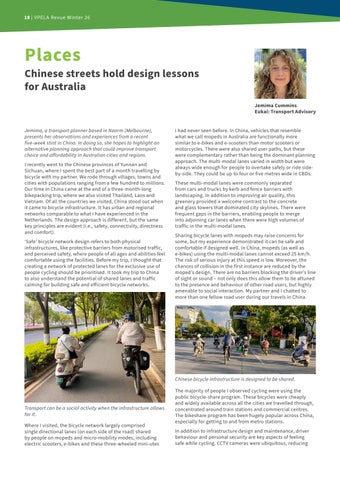
I had never seen before. In China, vehicles that resemble what we call mopeds in Australia are functionally more similar to e-bikes and e-scooters than motor scooters or motorcycles. There were also shared user paths, but these were complementary rather than being the dominant planning approach. The multi-modal lanes varied in width but were always wide enough for people to overtake safely or ride sideby-side. They could be up to four or five metres wide in CBDs. These multi-modal lanes were commonly separated from cars and trucks by kerb and fence barriers with landscaping. In addition to improving air quality, this greenery provided a welcome contrast to the concrete and glass towers that dominated city skylines. There were frequent gaps in the barriers, enabling people to merge into adjoining car lanes when there were high volumes of traffic in the multi-modal lanes. Sharing bicycle lanes with mopeds may raise concerns for some, but my experience demonstrated it can be safe and comfortable if designed well. In China, mopeds (as well as e-bikes) using the multi-modal lanes cannot exceed 25 km/h. The risk of serious injury at this speed is low. Moreover, the chances of collision in the first instance are reduced by the moped’s design. There are no barriers blocking the driver’s line of sight or sound – not only does this allow them to be attuned to the presence and behaviour of other road users, but highly amenable to social interaction. My partner and I chatted to more than one fellow road user during our travels in China.
Chinese bicycle infrastructure is designed to be shared.
Transport can be a social activity when the infrastructure allows for it. Where I visited, the bicycle network largely comprised single directional lanes (on each side of the road) shared by people on mopeds and micro-mobility modes, including electric scooters, e-bikes and these three-wheeled mini-utes
The majority of people I observed cycling were using the public bicycle-share program. These bicycles were cheaply and widely available across all the cities we travelled through, concentrated around train stations and commercial centres. The bikeshare program has been hugely popular across China, especially for getting to and from metro stations. In addition to infrastructure design and maintenance, driver behaviour and personal security are key aspects of feeling safe while cycling. CCTV cameras were ubiquitous, reducing