
WE CALGARY avenuecalgary.com 09/10.23 / $6.50 ENTREE NOUS The best Calgary restaurants for dining out family-style BEHIND THE SCENES
some of the people making the arts come alive BUILDING UP, BUILDING OUT Our population is growing. Do we have enough homes? LOCAL LOVE THE WINNERS OF THE 2023 MADE IN ALBERTA AWARDS cool s0 The outerwear you want for the coming season OVERALL GRAND PRIZE WINNER The Envelope by One21
Meet
We invite you to embark on Strathcona-Tweedsmuir


Register Today!
Step into a world where education and enchantment intertwine







SCAN QR CODE TO REGISTER
on











Experience the magic of nestled in the Foothills, child’s imagination.



on a fantastical journey at Strathcona-Tweedsmuir School's





Fun for the whole family
After your Open House experience, you are also welcomed to take part in our annual Family Fall Fair with food trucks, a Farmer’s Market, live entertainment, and more! This is a wonderful chance for your family to learn more about our amazing school and all that it has to offer in a relaxed and friendly environment.
SEPTEMBER 23RD, 2023















10:00 AM to 1:00 PM










of our 220-acre campus, Foothills, and let us ignite your imagination.







on
The Alberta Medical Association salutes the recipients of the 2023 Medal for Distinguished Service, Medal of Honour, Award for Compassionate Service, Member Emeritus, Long Service Awards and the Albertan honourees of the Canadian Medical Association.
Our Remarkable Honourees
AMA MEDAL FOR DISTINGUISHED SERVICE recognizes physicians who have made an outstanding personal contribution to the medical profession and the people of Alberta, and have contributed to the art and science of medicine while raising the standards of medical practice.
Dr. Cheryl Mack, Pediatrics, Edmonton
Dr. Jonathan Meddings, Gastroenterology, Calgary
AMA LONG SERVICE AWARD recognizes physicians with 10 years of AMA service who contribute their knowledge, skill and time to the advancement of the profession.
Dr. Gregory Boughen, Chronic Pain, Spruce Grove
Dr. Sam Wong, Pediatrics, Edmonton
Dr. Daniel Wood, Anesthesia, Calgary
Dr. R. David Murray, Emergency Medicine, Fort McMurray
Dr. Rajpal Thiara, Physical Medicine & Rehabilitation, Edmonton
AMA MEMBER EMERITUS AWARD recognizes significant contributions to the goals and aims of the AMA, seniority, long-term membership and distinguished service (20 years) based on criteria determined by the Board of Directors.
Dr. Peter Grundy, Endocrinology and Metabolism, Calgary
Dr. Jacques Romney, Endocrinology and Metabolism, Edmonton
AMA AWARD FOR COMPASSIONATE SERVICE recognizes an AMA member who has demonstrated outstanding compassion, philanthropy and/or volunteerism to improve the state of the community in which they are giving back.
Dr. Katherine Atchison, Family Medicine, Red Deer
AMA MEDAL OF HONOUR recognizes a non-physician who has raised the standards of health care in Alberta and made an outstanding personal contribution to the people of Alberta by contributing to the advancement of medical research, medical education, health care organization, health education and/or health promotion to the public.
Mr. Bill Kreutzweiser, Edmonton
OWEN ADAMS AWARD OF HONOUR is the highest CMA award available to a non-physician. This award recognizes many contributions to Canadian health care, medical research, education, value of patient/caregiver insight and service to the people of Canada in raising the standards and improving the health and wellness of Canadians.
Ms. Brenda Reynolds, BISW, RSW, MA, CIYT 200, Edmonton
DR. WILLIAM MARSDEN AWARD IN MEDICAL ETHICS AND PROFESSIONALISM is awarded to a CMA member who has demonstrated exemplary leadership, commitment and dedication to advancing and promoting excellence in medical ethics or medical professionalism in Canada.
Dr. Scott McLeod, Family Medicine, Edmonton
F.N.G. STARR AWARD is the highest CMA award available to one of its members and recognizes outstanding and inspiring lifetime achievement.
Dr. Esther Tailfeathers, Rural Medicine, Stand Off
CMA HONORARY MEMBERSHIP recognizes those persons who have distinguished themselves by their accomplishments in medicine, science, the humanities or who have rendered significant services to the association and are members of the association in good standing.
Dr. Richard Bergstrom, Anesthesia, Edmonton Dr. Kenneth Corbet, Occupational Medicine, Calgary
AWARD FOR YOUNG LEADERS, EARLY CAREER recognizes CMA members who have demonstrated exemplary dedication, commitment and leadership in one of the following areas: political, clinical, educational or research and community service.
Dr. Francesco Rizzuti, Public Health & Preventative Medicine, Calgary
For more information on these awards and individuals visit www.albertadoctors.org or www.cma.ca.
The AMA and CMA awards are presented annually.
Alpine Park
Bayview
Clearwater Park
Cranston’s Riverstone

Fireside
Mahogany
Sage Hill Crest
The Willows of River Heights
Vantage Fireside
Perfectly designed for real life.
CalbridgeHomes.com





Your Tailored Kitchen Awaits Combining standard & custom cabinetry sizes and features helps create your dream kitchen while optimizing your investment. From Concept to Cooking 1-888-408-9856 | merit-kitchens.com/kitchenconcepts
Beauty on the inside. And out.

Full-Day French Preschool to Grade 12.

Individual attention with small class sizes. Bilingual learning and study abroad opportunities.

CALGARY'S PRIVATE FRENCH SCHOOL A
PASSPORT TO THE WORLD
LYCÉE INTERNATIONAL DE CALGARY



Register to join us for our Fall Open Houses LEARN MORE LYCEE.CA/VISIT

Simply elegant.

Pictured: THE COLLINGWOOD IN LIVINGSTON FIND HOMES THAT FIT YOUR FAMILY AT EXCELHOMES.CA CALGARY | EDMONTON | AIRDRIE
for 35
Your simplest way home
years.
CALGARY’S PREMIERE WINE & FOOD EVENT OF THE YEAR









$250 PER TICKET








30 h
IN SUPPORT OF THE CALGARY CO-OP COMMUNITY FOUNDATION WWW.CWAYYC.CA
NOTHING ELSE COMPARES
Crafted by our family, for yours.
Energy-efficient Lux windows and doors offer the perfect balance of performance and beauty. We carefully design and craft each one to ensure your home not only looks better, but feels better too.

The result? You’ll clearly see the remarkable difference premium Lux windows and doors can make in your life for years to come.










Call









today
and learn more at LuxWindows.com
for a free estimate,



Let’s build something great, together.

your dream home to life with Baywest.
visit to a Baywest show home and you’ll know you’ve found the builder who takes design, craftsmanship and customer care seriously. Talk to our friendly team today – we’ll ensure your new home is not only a dream to live in, it’s a joy to build.
OUR SHOW HOMES in Mahogany, Rangeview, and Harmony, Springbank
Bring
One
VISIT
the scarlett in harmony The Baywest experience is about care and craft, from start to finish Find floorpl ns, photo g llery, show home m ps & more t BaywestHomes.com NEW SHOW HOMES COMING FALL 2023 in mahogany & rangeview
Step

Offering

kitchen & bath fixtures CALGARY, AB 4300-21 Street NE 493.291.1099 bgshowrooms.com
Up in Style with the new Avalanche® Toilet.
elevated design and standout performance: KeepClean™ surface treatment prevents residue from sticking while QuietClean® engineering keeps water circulating longer and faster to leave a cleaner bowl.
For clear financial advice that meets you where you are and takes you where you’re going, let’s talk. Tell us about your priorities and challenges. Share your vision for the life you want to lead, business you want to build, or future you want to create—and let's bring your possibilities to life.
Cut through the noise with advice that's made for you, with you.
atb.com
FIRESIDE: A TRUE EVOLUTION OF COMMUNITY
COCHRANE’S FIRESIDE NEIGHBOURHOOD CONTINUES TO GROW AND FLOURISH, INCLUDING ADDING A NEW CENTRAL PARK.
Established in 2010 by Calbridge Developments and named Cochrane’s best community in 2022, Fireside is a flourishing community that continues to grow, not just in homes, but in spirit with its welcoming small-town dynamic and safe, nurturing family environment.


THE WARMTH OF FIRESIDE
Located on the south side of Cochrane, Fireside blends all the small-town charm with big-city amenities, including two schools and 30,000 square feet of commercial space, all nestled within sweeping Albertan landscapes. Fireside connects its residents to the outdoors with its 57 acres of parks and pathways, proximity to the mountains, two preserved wetlands, four sports fields and even more amenities on the way. But the true warmth of the community comes from its residents. Volunteer-led initiatives, including the community garden in 2020 and the operation of the NHL-sized outdoor rink in 2021, have given homeowners a chance to connect with one another and give back to the community. “It’s rewarding and exciting for our team to see this collective spirit and sense of ownership growing among the homeowners as that is what turns a development into a community,” says Laura Button, managing director of land development at Calbridge Developments.
TRADITIONAL- AND MODERN-INSPIRED HOME DESIGNS
Fireside showcases an exciting builder group made up of Genesis Builders, Cardel Homes, Janssen Homes and Calbridge Homes. These trusted builders have a strong reputation in Calgary and surrounding areas, with years of home building experience and excellent customer service. Each builder’s home designs draw on natural inspirations that blend warm earth and vibrant tones in all colour schemes to ensure they capture Fireside’s essence. The single-family, duplexes and townhomes feature traditional and modern interpretations of popular architectural styles. The mid-$300s townhomes are ideal for first-time buyers or downsizers; the paired and street townhomes starting from the $480s are suited for young families, while the single-family houses starting from the $570s provide extra space to grow. “Fireside has always been great at offering ample options for everyone at different stages of their life,” affirms Edmundo Azuaje, manager of marketing and communications at the Calbridge Group.
This past June, Fireside hosted the grand opening of its new show home parade as part of the community’s latest expansion phase, featuring three builders — Cardel Homes, Genesis Builders and Calbridge Homes. Seven

new show homes are available for home buyers to explore, with three new single-family homes and four paired homes.
EVER-GROWING AMENITIES
As with the newly added community garden and outdoor rink, there is always something happening in Fireside. The latest addition to the bustling community will be a brand-new central park boasting more than five acres of green space. The still-to-be-named park will feature fire pits, picnic areas, a new playground, pump tracks, a tobogganing hill and plenty of open park space for year-round activities and fun for residents. “We can’t wait to open the park and add to the ever-growing list of amenities in Fireside. Just as we have done in the past, we’ll celebrate what’s new so residents can expect a grand opening event in the new park. It is exciting to see how this community has flourished into a community of neighbours, and so much is still going on!” says Azuaje.
Visit firesidecochrane.com to learn more about the community, and get updates for the opening event to celebrate the new central park. ADVERTISING FEATURE PHOTOGRAPH: (TOP LEFT) COURTESY COCHRANE TOURISM



Celebrating 10 years of igniting the potential in Calgary's youth.
The Calgary Flames Grade 6 Membership at YMCA Calgary provides a fun and safe place for our city's youth to develop independence, friendship, resilience, and healthy choices.

Sign up your grade sixer at
ymcacalgary.org

We’removingto PoplarCentre infall2023 Dr.RobertMitchell|Dr.PatrickMitchell&Associates 5504MacleodTrailSW,Calgary,A |MitchellEyeCentre.com|MitchellEyeCentre





FREE INDOOR PARKING ASPEN LANDING SHOPPING CENTRE FREE IN Look good FEEL GOOD
Aspen Woods Estates is a development community inspired by Calgary’s architectural heritage. The development features beautiful executive homes, breathtaking views, walking and biking paths, and west Calgary’s premier shopping destination Aspen Landing Shopping Centre.










www.LiveinAwe.ca
Homes By Us
Crystal Creek Homes
Homes By Us
Crystal Creek Homes
Homes By Us
on the cover
A cozy look for cooler weather, featuring the Overall Grand Prize Winner of the 2023 Made In Alberta Awards: The Envelope handbag. Turtleneck and pants from Vespucci; vest, Canada Goose; eyewear from Winners. Styled by Julie Roth

FEATURES DEPARTMENTS
104 Calgary Style
The onset of autumn means it’s officially sweater weather, and who better to showcase an outfit from her own closet than knitwear designer and sweater company president South van der Lee?
118 Decor
66 Dining
Some restaurant-savvy types swear by family-style dining (not to be confused with family restaurants — you know, for kids). Where to go in the city for a great shared experience.

How a designer, with the blessing of her landlord, jazzed up a rental home with bold paint colours and antiques.
124 Mountains
Why serious (and not-so-serious) cyclists are ditching pavement for gravel roads.
39 Real Estate Report
Will housing supply be able to keep up with demand in the hot Calgary market? Plus, commercial-to-residential conversions in the downtown areas and a look at how builders are designing homes with sustainability in mind.

By Ximena González, Cailynn Klingbeil and Karin Olafson
55 Faces Behind the Spaces

As another arts season launches, meet some of the people behind the scenes.
74
Made In Alberta Awards
All the winners and runners-up from Avenue’s annual awards program celebrating excellence in products made in our province and the makers who bring them to market.
By
Shelley
Arnusch, Tsering Asha, Jennifer Hamilton, Chris Landry, Amber McLinden, Michaela Ream and Colleen Seto
94
Fall/Winter Fashion
By
Shelley Arnusch, Deaniell Cordero, Stephanie Joe and Katherine Ylitalo
Ultra-cool outerwear and knitwear for the colder weather to come, photographed at Contemporary Calgary.
September/october 2023 24 PHOTOS BY JARED SYCH 26 Editor’s Note 154 You Are Here 31 Detours
A look at the Siksikaitsitapi Medicine Wheel at Nose Hill Park. Plus, a local archaeologist helping support others in her profession and beyond, the making of a flaming Mai Tai, and a treatise on why Calgarians are more like larch trees than you likely ever considered.
contents 94 39 66
Photo by Jared Sych
SEPT/OCT23





avenuecalgary.com 25 • ine exclusive suites accessed by a private elevator on a private floor • Expertly designed and furnished by Paul Lavoie • Luxury finishes and fixtures, including Fisher & Paykel appliances and custom cabinetry • 500 - 1,000 SQ FT private terraces for select residences • Direct access to The Oliver’s Fitness Centre and notable building amenities • Exclusive storage, underground heated and secure parking • 10 - 12 FT ceilings • 1,040 - 2,440 SQ FT one-bedroom and two-bedroom suites • Hotel luxury, under a nightly premium hotel price • Starting from $5,500/month LIVE ABOVE IT ALL, LEASE A FURNISHED SUITE AT THE OLIVER IN A MADISON AVENUE EXECUTIVE SUITE CRAFTED FOR LUXURY www.OliverOn10th.com Leasing@OliverOn10th.com 403.700.0866 Visit us at 524 10th Ave SW, Calgary, AB Keep finding new Marilyn BOCCE PRO (in training) Come experience the best of older adult living Book your tour at UnitedActiveLiving.com
calgary residents with a couple of fall seasons under their belts know that it won’t be very long before the chic insulated vest on this month’s cover is the ideal piece of outerwear for those days when the temperature hovers somewhere between big warm sweater and big warm coat. Beyond the weather, though, it’s somewhat ironic to talk about “cooling down,” as September marks the time when things really tend to heat up.
It’s the month we announce the winners of the Made In Alberta Awards. In this annual program, makers from all points of the province enter goods in a range of categories that cover everything from foods and beverages (alcoholic and non), to furniture and fashion. The category winners then contend for the $5,000 Overall Grand Prize. This year, that prize went to The Envelope, a luxury leather handbag made by Calgary-based One21. (That’s it on the cover.) Join us in celebrating The Envelope and the other 2023 winning products and makers at our Made In Alberta Awards ceremony and networking event on September 26. For tickets, go to showpass.com/miaa2023/.
What else is hot right now? Definitely Calgary’s real estate market, which has been on a major roll, buoyed by what many experts say is its relative affordability compared to other urban centres across Canada and worldwide. That affordability and, by extension the healthy market, might be in jeopardy, however, if the housing supply can’t keep up with current and future demand. Writer
Cailynn
SHELLEY ARNUSCH EDITOR IN CHIEF sarnusch@redpointmedia.ca
THE SEPTEMBER SIZZLE
Klingbeil addresses this “question of quantity” as part of our spotlight on local real estate, starting on Page 39.

We’re also hard at work on our annual Top 40 Under 40 list, a project that marks its 25th anniversary this year. We’ll be celebrating this incredible milestone as well as introducing the class of 2023 at the Southern Alberta Jubilee Auditorium on November 2. Whether you’re under 40 or over 40, it’s a night you 100 per cent won’t want to miss. Visit AvenueCalgary.com/t40tickets for more information.
LIKE & SUBSCRIBE
This past summer, new legislation went into effect that was designed to force major tech platforms (in particular Meta and Google) to pay for using Canadian news content. This didn’t sit well with Meta and Google, both of which moved to ban Canadian journalistic content rather than contribute to the cost of creating it. While this might put a crimp in the way many of us have become accustomed to reading newspaper and magazine articles — and using the Internet — it certainly doesn't have to be the end of the line for journalism in Canada. Although you may no longer see our work in Google search or when you share it on Facebook, just as in the time before social media, you can find us by coming to us directly. If you like what we’re doing here, subscribe to our free newsletters or our print publication. Or, better yet, join our A-List membership program which comes with perks on top of your magazine subscription. For details visit AvenueCalgary.com/Shop.

26 SEPTEMBER/OCTOBER 2023
PHOTO BY HEATHER SAITZ; CLOTHING STYLING BY GRAVITYPOPE
Editorʼs
Note



avenuecalgary.com 27 special presentation A Jann Arden Christmas Dec. 19 & 20, 2023 td amplify cabaret Wakefield Brewster Presents: Part 1 Nov. 17 & 18, 2023 bd&p world stage The Triplets of Belleville: 20th Anniversary Film in Concert Nov. 2, 2023 national geographic live Andy Mann: From Summit to Sea Nov. 19 & 20, 2023 special presentation Ruben & Clay: Twenty | The Tour Sep. 29, 2023 classic albums live Led Zeppelin: Houses of the Holy Oct. 20, 2023 bd&p world stage The Barra MacNeils: An East Coast Christmas Nov. 24, 2023 Artists, programs, and dates subject to change. The fall is looking bright! Why wait? Get the best seats now to see American Idol stars, Calgary's sweetheart at Christmas, an iconic rock album, and more live at Arts Commons. Explore the full 2023-24 season of Arts Commons Presents today Find out how a series subscription or an Arts Commons Presents Flex Pack can help you save on multiple shows 403-294-9494 acpresents.ca at arts commons Andy Mann –From Summit to Sea Joel Lipkind & Sally Sprague-Lipkind ACP Signature Series Presenting Sponsor Classic Albums Live ACP Signature Series Presenting Sponsor BD&P World Stage ACP Signature Series Presenting Sponsor National Geographic Live NGL Student Engagement Sponsor NGL BluWater Partner ACP Special Presentation Engagement Sponsor A Jann Arden Christmas BD&P World Stage Supporting Sponsors NGL Explorers Circle Engagement Sponsors NGL EXPLORE National Geographic Sponsor NGL EXPLORE National Geographic Supporting Sponsors/Partners Teatro Fund for Arts Commons Education Title Sponsor TD Amplify Cabarets Public Sector Support Media Sponsors Hospitality Sponsors
Engineered Air Theatre
Jack Singer Concert Hall
RedPoint Media Group
1721 29 Ave. S.W., Suite 375 Calgary, Alberta T2T 6T7 (letter mail only)
Phone 403-240-9055
Toll Free 1-877-963-9333 x0
Fax 403-240-9059 info@redpointmedia.ca
AvenueCalgary.com
Facebook Avenue Magazine — Calgary


Instagram @AvenueMagazine
Subscriptions
(Prices do not include 5% GST)
3 issues: $18
1 year (6 issues): $25
2 years (12 issues): $40
3 years (18 issues): $60
1 year (USA): $36 US
To subscribe, visit AvenueCalgary.com/shop subscriptions@redpointmedia.ca
Advertising Inquiries
Phone 403-240-9055 x0
Toll Free 1-877-963-9333 x0 advertising@avenuecalgary.com
AvenueCalgary.com
Published six times a year by RedPoint Media Group. Copyright (2023) by RedPoint Media Group. No part of this publication may be reproduced without the written consent of the publisher.
Canadian Publications
Mail Agreement No. 40030911.
Editor in Chief Shelley Arnusch, sarnusch@redpointmedia.ca
Design Director Steve Collins, scollins@redpointmedia.ca
Senior Editor, Digital Alana Willerton, awillerton@redpointmedia.ca
Digital Engagement Editor Alyssa Quirico, aquirico@redpointmedia.ca
Associate Editor Tsering Asha, tleba@redpointmedia.ca
Assistant Editors Chris Landry, Michaela Ream
Senior Contributing Editor Jennifer Hamilton
Contributing Editors Karin Olafson, Colleen Seto
Staff Photographer Jared Sych
Graphic Design Assistant Sofia Velásquez
Special Projects Intern Deaniell Cordero

Contributors Elizabeth Chorney-Booth, Jennifer Friesen, Christina Frangou, Ximena González, Phoebe Heard, Stephanie Joe, Travis Klemp, Cailynn Klingbeil, Dominique Lamberton, Michelle McIvor, Amber McLinden, Julie Roth, Pete Ryan, Jarett Sitter, Katherine Ylitalo
Contributing Fact-Checkers Samantha Gryba, Amber McLinden
Proofreader Alex Frazer-Harrison
Land Acknowledgement Advisors Elder Edmee Comstock, Elder Reg Crowshoe, Elder Rose Crowshoe
Print/Digital Production Manager Mike Matovich

Digital Producer Paula Martínez
Client Support Coordinator Alice Meilleur
Account Executives Michaela Brownlee, Jocelyn Erhardt
Printing Transcontinental RBW
Distribution City Print Distribution Inc.; NextHome
REDPOINT MEDIA GROUP INC.

CEO, Co-owner Roger Jewett
President, Co-owner Käthe Lemon, klemon@redpointmedia.ca
Director Strategy & Content Meredith Bailey, mbailey@redpointmedia.ca
Art Director, RPM Content Studio Veronica Cowan, vcowan@redpointmedia.ca
Accountant Jeanette Vanderveen, jvanderveen@redpointmedia.ca
Administrative and HR Manager Tara Brand, tbrand@redpointmedia.ca
THE AVENUE EDITORIAL BOARD
Joy Alford, Mariangela Avila, Rachelle Babcock, Erin Best, Shalini Bhatty, Desiree Bombenon, Richard Boyer, Bridget Brown, Doug Bruce, Ellie Bruce, Danielle Caffaro, Elizabeth Carson, Melinda Channon, Carla Chernetz, Alan Chong, Connor Curran, Kristiana, Dayrit, April DeJong, Speranza Dolgetta, Anne Donaldson, Nicole Dyer, Jan Eden, Mohammed Eljabri, Raissa Espiritu, Elizabeth Evans, Janice Lynn Froese, Karen Gallagher-Burt, Derege Gebretsadik, Sarah Geddes, Briggitte Gingras, G. Grewal, Gaurav Gupta, Christina Hagerty, Amanda Hamilton, Katherine Harmsworth, Kyle Hofstetter, Rameez Husseini, Alison Jeffrey, Pritha Kalar, JP Kansky, January Kohli, Brad Krusky, Wil Lakatos, Shannon Lanigan, Heather Lawton, Andrew Layzell, Anila Lee Yuen, Chris Lemke, Jamie Leong-Huxley, Derek L’Hirondelle, Trina Lo, Sharon Martens, Emma May, Stacy McFarlane, Diana McIntyre, Robert McIntyre, Karen Metrakos, Joann Meunier, Elizabeth Middleton, Catherine Moar, Cory Moench, Judi Parrott, Steven Phillips, Kelly Pitaoulis, Gord Plouffe, Victoria Plouffe, Carmyn Prefontaine, Paul Salvatore, Rob Schultz, Montana Shaw-Antonio, Tom Spatola, Kelli Stevens, Janet St. Germain, Theresa Tayler, Jessica Theroux, Ryan Townend, Arleigh Vasconcellos, Wendy Winder, Bradley Zumwalt
We acknowledge the traditional territories and the value of the traditional and current oral practices of the Blackfoot Confederacy, the Tsuut’ina and Stoney Nakoda Nations, the Métis Nation (Region 3), and all people who make their homes in the Treaty 7 region of Southern Alberta
We acknowledge the financial support of the Government of Canada and the Government of Alberta.
Avenue is a proud member of the Alberta Magazine Publishers Association, Magazines Canada and the International Regional Magazine Association, and abides by the editorial standards of these organizations.

Avenue has partnered with TreeEra to plant 1,425 trees, replacing all the trees used to print the magazine this year.
The Avenue editorial board is exclusive to members of the A-List and A-List+ programs, and provides the opportunity to participate in discussions on the direction and content of the magazine. For more information on how you can join the A-List and the board visit AvenueCalgary.com/shop.
28
avenue
PHOTOS
BY JARED SYCH












avenuecalgary.com 29 The grand reveal of our annual list of exceptional Calgarians finding success across a range of sectors at a young age. PLUS Wining and Dining A look inside some of the top restaurant wine cellars in the city. winter in the Mountains Shy about the snow and the cold? This winter mountain guide is for you! NOV/ DEC 2023 NEXT ISSUE by Oct 1 to get the Nov-Dec 2023 issue to your door. Three-issue subscription $18, one-year $25. AvenueCalgary.com/shop SUBSCRIBE 2023 top40under40 • October 16: Small Business Kickoff Reception • October 17: Navigating Negotiation: Strategies for Success • October 19: Advancing Indigenous Entrepreneurs • October 20: 40th Calgary Small Business Awards Gala Celebrate Calgary’s best at the 40th Calgary Small Business Awards Gala on Friday, October 20! O t b 16 S ll B i Ki k f f R ti Small Business Week Events Get your tickets today!
Your Phil this Fall
thrilling concerts with the Orchestra
September
Never Break The Chain: The Music of Fleetwood Mac 8 + 9 September
Pictures at an Exhibition 16 September
Tour De Force: Cheng + Cello 23 September

Serena Ryder with the Calgary Phil 29 September


October
The Sneetches, by Dr. Seuss 1 October
Disney + Pixar’s Up in Concert 7 October

The Last Night of the Proms … Ever! 13 October
Roman Rabinovich in Concert 27 + 28 October
November
Classically Jazzed 3 + 4 November
Alberta in Harmony: Moving Mahler 10 November

Brett Kissel with the Calgary Phil 17 + 18 November
Price + Schumann2 25 November
For details and tickets, visit calgaryphil.com
PHOTO BY TK TK TK september/october 2023 30
ready for
Get
these
PHOTO BY JARED SYCH
Detours
SACRED GROUND
THE SIKSIKAITSITAPI MEDICINE WHEEL AT NOSE HILL PARK WAS DESIGNED TO ENCOURAGE EDUCATION AND CONNECTION.

Built by members of the Blackfoot Confederacy in 2015, the Siksikaitsitapi Medicine Wheel marks sacred ground once used for ceremony and gathering. The area in the southeast corner of Nose Hill Park was formerly a lookout point over the rolling grasslands for game or members of other tribes. Stone circles that held down tipis
are strewn across the hillside, indicating that both summer and winter camps were once there.
Today, the Medicine Wheel is a tribute and reminder of the historic and ancestral connections between First Nations Peoples and the place now called Calgary. The Siksikaitsitapi Medicine Wheel is a signifier of Blackfoot territory and a place to make offerings to Creator. It is a reciprocal offering to land that emphasizes stewardship and relationality.
Constructed of rocks in the shape of the Siksikaitsitapi logo, a circle that represents the four member tribes: Siksiika, Blood, Northern and Southern Peigan, it was designed by Andy Black Water, a ceremonial Elder and member of the Blood Tribe and created during the 2015 Siksikaitsitapi conference. As a place of education and connection, the Medicine Wheel is open to all to visit and experience to learn about the history of the Siksikaitsitapi and the land. —Travis Klemp
31 avenuecalgary.com [
A NOTEBOOK OF THE CITY ]
Margarita de Guzman began her archaeology career in the U.K. and worked across Europe and Canada, before returning to Alberta in 2005. “For me, the joy of archaeology is in the discovery, so I find joy in finding things that are rare,” de Guzman says.
Though she has a masters degree, her work as an archaeologist in the U.K. was considered an unskilled vocation, with wages she says were “equivalent to an unskilled labourer.” Whether it was that disparity between education and wages, or the long hours and travel, de Guzman noticed there were fewer and fewer female colleagues working alongside her.
Back in Alberta, where archaeology is considered a professional career with a living wage, de Guzman felt a renewed sense of optimism for her work. Even so, female peers in career positions were still few and far between.
“As my career [has] progressed, I’ve seen women less willing to stand up for themselves, have less confidence and more imposter syndrome,” she says.
A FOUNDATION FOR FAIRNESS
MEET THE FEMALE ARCHAEOLOGIST WHO IS HELPING TO SUPPORT WOMEN AND OTHER GROUPS PURSUE THEIR CAREER GOALS.
That led de Guzman, in January 2023, to launch The Fair Field Foundation, a supportive community that provides women-led engagement, mentorship, educational and networking opportunities for archaeologists, as well as other fields.

Ultimately, the goal is to create a community that supports sustainable career longevity. “We decided on the name The Fair Field Foundation because it wasn’t limited to archaeology and it wasn’t limited to women,” de Guzman says. “The issues that we have as women in archaeology
“FOR ME, THE JOY OF ARCHAEOLOGY IS IN THE DISCOVERY, SO I FIND JOY IN FINDING THINGS THAT ARE RARE.”
MARGARITA DE GUZMAN
are faced by women in general and across different industries. People of every discipline can participate with us in everything that we do, and it’s not just [for] women, it’s [for] anybody that feels that they haven’t had a fair shot and that they’re facing any systemic and inherent issues.”
Tsering Asha
Individual stakes that make up a several- thousand-year-old fish weir site in Minette Bay, Haisla Territory, B.C.

“This project provided the impetus to develop an internship for a Haisla member to work as a conservator with these materials and ultimately aid in Indigenous heritage capacity-building.”
Jennifer M. Botica, PhD, RPCA, RPA, CAHP
Base of a Clovis projectile point dating to ca.11,050 to 10,800 Before Present.

“Years ago when I was a young archaeologist, I came across [this]. I’ve found many other artifacts since, and the awe of discovery is always the same. When you consider that the last human being to hold the object was 2,000, 6,000, 10,000 years ago, one can’t help but wonder about who that person was.”
Laureen Bryant, M.A.
3D scan of an 18th-century, stacked-stone foundation feature found in 2019 during a pedestrian survey in the St. Croix (Shoodic) River area, N.B.
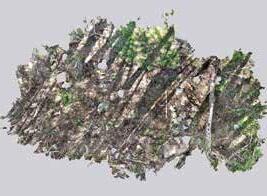
“Archaeology is like CSI: ... when we find that piece of evidence that just blows the whole known history of the area out of the water, it’s the most exhilarating feeling.”
Chelsea Colwell-Pasch, MMA, RPA
september/october 2023 32 DE GUZMAN PHOTO COURTESY OF MARGARITA DE GUZMAN; MINETTE BAY IMAGE COURTESY OF JENNIFER M. BOTICA; 3D SCAN BY CHELSEA COLWELL-PASCH; CLOVIS POINT PHOTO FROM ADOBE STOCK
DIG IN
THREE ARCHAEOLOGISTS FROM THE FAIR FIELD FOUNDATION SHARE THEIR MOST THRILLING FINDS.
Will Garden Loft work for my aging parent?
Garden Loft is a prefabricated backyard suite that’s ideal for someone who needs assistance to remain independent and has a family who’s willing to help. Sixteen support and safety features make life easier and safer - like adjustable height countertops so you can sit down to cook and a fall protection floor, including in the shower. The backyard location means help is only steps away but separate enough to maintain everyone’s privacy. The result is convenience and peace of mind for you - companionship and continued independence for your parent.

Visit our Show Suite at 838 11 Ave SW Open

Winner of the 2023 Calgary Award for Accessiblity

avenuecalgary.com 33 garden loft Housebrand, celebrating 26 years of residential design-build in Calgary FAMILY FOCUSED
www.gardenloft.ca
Photography by Michael Grondin
AGING IN PLACE
Above: GL 480 one bedroom installed in NE Calgary. Below: GL 480 interior.
House every Saturday, from 1-3pm ADVERTISEMENT
Detours
2010 29TH AVENUE SW $1,799,900





A2058310
5 BEDROOMS
5 BATHROOMS
3585 SQ FT PLUS BASEMENT
SOUTH CALGARY
Welcome to this stunning and rare 4+1 bedroom residence on the highly desirable street of 29th Avenue in the heart of Marda Loop, presenting an impressive living space of nearly 4900 sq ft, including a fully developed WALK-OUT BASEMENT. Prepare to be captivated by the BREATHTAKING PANORAMIC CITY AND DOWNTOWN VIEWS that this luxurious home offers.This remarkable residence is ideally located near the vibrant Marda Loop, excellent schools, shopping destinations, River Park, and offers easy access to downtown via 14th Street. Prepare to elevate your lifestyle and immerse yourself in the epitome of luxurious living in South Calgary.
 GOLDEN HOUR: LARCH SEASON IN SUNSHINE MEADOWS.
september/october 2023 34
PHOTO BY GERARD YUNKER, COURTESY OF TRAVEL ALBERTA
“changeable and resilient, the slender larch punches far above its weight.”
Land of the Larch nature
When Barbara Walters asked Katharine Hepburn what kind of tree she would want to be, Hepburn replied, “everybody would like to be an oak tree.” With all due respect to one of the grand dames of classic cinema, I think many Calgarians, given the option, would choose to be a larch.
Larches, like Calgarians, do not behave like their neighbouring species.
The larch is one of the rare deciduous conifers, losing its needles each year in a spectacularly coloured
display. Now is the season of larchmania when we tromp through the aptly named Larch Valley (or find a larch-road less travelled) to behold this annual neon show.
Unlike the varied fall colour display of the maple tree — the tree that nationalists assume all Canadians must identify with — larches change en masse in a unified shout of brilliance. If one were so inclined (as it appears I am), one could compare this to Calgarians’ annual but short-lived display of Stampede regalia — another show that draws in observers from far and wide. Or the colour display of Flames jerseys
whenever there is a home game or a playoff run.
Larches are supported by a root system that is both broad and deep. Because of the roots we grow across our communities that bind us together deeply but also broadly throughout the city, Calgarians seem to be only ever one degree of separation from one another.
At once hardy and delicate, changeable and resilient, the slender larch punches far above its weight. Larch is a native species, acclimated to the mountainous region and ready for the rapid ups and downs of this environment. Larch is also consid-

ered a “pioneer species” — one of the first on the scene building things up after wildfire. Indigenous Calgarians whose ancestors were the first peoples of this land, as well as Calgarians who have just arrived, seem to all exhibit a similar sense of resilience and renewal, adaptability and excitement about how to improve conditions here.
BEDROOMS

5.5 BATHROOMS

3,532 SQ FT PLUS BASEMENT

UPPER MOUNT ROYAL
An oak may be very strong and pretty, as Hepburn noted, but a larch is more aspirational. Resilient, longlived, with a feisty and spectacular annual display and always playing against type. Sounds like a lot of Calgarians I know. —Käthe Lemon Tanyaeklundgroup.ca



Exceptional contemporary urban residence with stunning CITY & DOWNTOWN VIEWS, nestled in the heart of historic Mount Royal. This thoughtfully designed home offers 4 bedrooms & over 4,300 sq ft of meticulously crafted living space, including a FULLY DEVELOPED WALK-OUT BASEMENT.The property boasts an irrigated back yard & front yard with low maintenance landscaping, an underground sprinkler system & double garage accessible by in-slab heated front driveway (no snow shoveling!), ensuring easy upkeep and a beautiful exterior. This beautiful home enjoys an ideal location, just a short walk from 17th Avenue & 4th Street, as well as proximity to the Glencoe Club, top-notch schools, shopping, excellent restaurants, public transit & a quick commute to the downtown core.


avenuecalgary.com 35
(403) 863-7434 Each office is independently owned and operated.
DURHAM
Direct
824
AVENUE SW $1,799,900 A2069940 4
FLEETWOOD LOUNGE’S FLAMING MAI TAI

DECONSTRUCTED
THE ICE
A bartender’s ice choice can make or break a drink. For the Mai Tai, Fleetwood’s bar manager Tiffanie Hensel uses crushed ice to keep everything nice and cold, while slowly diluting the alcohol-forward nature of the cocktail.
THE RUM
To build layers of flavour, Hensel uses not one, but two kinds of rum from the Caribbean: a pineapple-infused white/ dark hybrid from Plantation and a Wray & Nephew overproof. “The Plantation adds some complexity, while the overproof brings in that spirit-forward quality of a traditional tiki cocktail,” Hensel says.
THE ORGEAT
An essential component of any Mai Tai is orgeat, a creamy almond syrup. Like all of Fleetwood’s bar syrups, the orgeat is made in-house. “If I want to add notes of nutmeg or more almond flavour, I have control over it when I make it myself,” Hensel says.
With its glamorous 1930s-era decor, Fleetwood Lounge at The Oliver is one of the classiest spots in the city to grab a cocktail right now. The luxurious room calls for above-average sips, and bar manager Tiffanie Hensel delivers, with Instagram-worthy drinks that taste even better than they look. Hensel’s Mai Tai is one such drink, paying homage to tiki culture’s most famous tipple with a few signature twists. Here’s what makes this cocktail so cool:
THE JUICES
Lime juice is standard to a Mai Tai, but Hensel makes hers unique by adding a hit of guava juice to balance out the sweetness of the overproof rum. “It adds a little bit of tartness and a touch of pink to the cocktail,” she says.
THE GARNISH
Hensel finishes off the Mai Tai with a lime wheel holding a flaming Everclearsoaked brown sugar cube topped with grated tonka bean. The fire caramelizes the sugar as the scent of warmed tonka wafts throughout the air. Guests can push the cube into the cocktail to adjust the sweetness to their liking.
Elizabeth Chorney-Booth
Is there an interesting, innovative or iconic Calgary dish or drink you think we should deconstruct?
Send us a DM on Instagram: @avenuemagazine
it
Dish
BY ELIZABETH CHOR -
september/october 2023 36
PHOTO BY JARED SYCH
PHOTO BY JARED SYCH
Local Podcast Spotlight
MOVIE NIGHT WITH CIFF
The Calgary International Film Festival (CIFF) kicks off on September 21 with an 11-day lineup of screenings, red carpet premieres, musical performances and more. But come October 3, you can still get your CIFF fix, thanks to the festival’s monthly podcast. Movie Night with CIFF launched last year to celebrate the world of cinema and the people who bring it to life. Host Gaby Aguilar, CIFF’s marketing content coordinator, is joined by guest hosts from the CIFF team, including executive director, Steve Schroeder, and engagement manager, Lucia Juliao. They interview film and TV powerhouses, from Oscar-winning Canadian documentarian Ben Proudfoot and star of The Last of Us Gabriel Luna to long-time Calgary-based production manager Tom Benz, whose credits include Brokeback Mountain and Cool Runnings. Whether you’re an all-around film buff or particularly interested in Alberta’s screen scene, you’ll want to give this podcast a shot.
Dominique Lamberton
Listen to Movie Night with CIFF on Spotify or Apple Music; it also airs on CJSW 90.9 FM radio on the first Tuesday of each month at 11:30 a.m. and again at 8:30 p.m.

Ask an Expert:
Cece Warren is a Canadian Certified Counsellor and a Registered Marriage and Family Therapist. She is the Clinical Director of Calgary Couples Therapy & Associates, a holistic mental health agency offering Individual and Couples Therapy to help clients move toward their life and relationship goals. Cece has been supporting couples and individuals for over 12 years and has training in Gottman Method Couples Therapy and Emotionally Focused Couples Therapy.
Cece Warren MHSc, CCC, RMFT Clinical Director Calgary Couples Therapy & Associates




One of the most common challenges I see couples struggle with is managing conflicts, particularly when discussions start to escalate. Conflict with a partner is inevitable, we cannot escape it and it is a good thing too. Research shows that conflict is the gateway to connection. Conflict is how we learn what is important to our partner and hear about their values, beliefs, experiences and desires. It is within conflict that we have the opportunity to better understand our partner’s wants and needs. Unfortunately, when escalation in conflict occurs we tend to say hurtful things, criticize, become defensive, and sometimes even yell at our partner. In these hurtful interactions, couples often disconnect from each other. If we do not then re-engage in the conversation, offer to repair and reconnect, over time withdrawal becomes the end result.
If this sounds familiar in any way, know you are not alone. This is a very common dynamic in relationships. When we escalate in arguments, our freeze, flight, or fight response becomes activated. We feel psychologically and physically overwhelmed - a term that has been coined ‘emotional flooding’. When we emotionally flood our ability to process information is greatly reduced. In these moments it is difficult for us to be empathetic, understanding, or an attentive listener. This makes resolving the issue highly unlikely and continuing the conversation potentially destructive to our relationship.
Learning to recognize the signs of physiological flooding in ourselves and our partners is the first step on the way to more productive discussions. Once we recognize flooding we need to stop and let our partner know we are feeling flooded and need some time to calm ourselves. This needs to be acknowledged and accepted by our partner. We also need to assure our partner that we are coming back to the conversation when emotionally calm. If we fail to provide this reassurance and/or fail to return to the conversation our partner can feel emotionally abandoned. Taking some time apart is crucial, this allows us time to regulate our nervous system. Research states that this self-soothing can take a minimum of 20-30 minutes. However, the time it takes to calm oneself is different for every person. It may take hours or it may take days. It is important to wait for both partners to feel ready to engage in the conversation again for reconnection and repair to occur. This way we can engage in an effective discussion in a kinder, more loving way. A supportive therapist can help us learn the skills to engage in healthy conflict with our partner.
If you are interested in our relationship or individual
https://calgarycouplestherapy.com/ (587) 400-3523

avenuecalgary.com 37
residential
architectural
interior design
Calgarians a NEW concept in design. Visit our website to view our portfolio and services we offer!
www.atgradientcc.ca A
and commercial
and
firm offering









38 september/october 2023
SHERWOOD
strathcona.ca/adventure
PARK | STRATHCONA COUNTY
(and What’s Out There) What’sUp
inCalgary

Real Estate Right Now
ILLUSTRATIONS BY PETE RYAN
C C C
algary is not a static entity, rather, it grows and expands, shrinks and condenses. With the city currently experiencing a growth spurt, both in physical size and in population, we look at how we’re building new homes to support this growth, where we’re building them and whether what we’re building is in line with what homebuyers want — and what the future holds.
PHOTO BY STEVE COLLINS
39 avenuecalgary.com
Balancing Quality and Quantity
Handling the housing shortage isn’t as simple as “build, build, build.” As Calgary continues to grow, there is a need for balance between building enough to satisfy demand while considering the big picture of sustainability, liveability and overall quality of life.

n the northern edge of the city, in one of Calgary’s newest communities, a cacophony of construction sound fills the air. There will eventually be 6,000 homes in Glacier Ridge, but right now it’s a bustling construction site, with show homes and some early residents sprinkled in. Excavators and loaders work with an expansive backdrop of rolling prairie, preparing land for more new builds.
This steady supply of new housing, primarily on the city’s outskirts, provides choices for Calgarians and keeps housing affordable compared to other major markets, says a City of Calgary report monitoring citywide growth. While new-home builds also happen in Calgary’s 180 “older” neighbourhoods, an average of 63 per cent of new units built over the past five years were in new communities.
Now, there’s a growing focus on all these new homes — and whether there’s enough of them. An influx of people moving to Calgary is part of a broader trend of international migration to Canada that has pushed our population growth to record highs. Plus, as Alberta touts its affordability advantage, people from other provinces are also moving here in droves. Amid all this rising demand, Calgary’s housing market is seeing its lowest inventory levels since the boom times of 2006, leaving people who are looking to buy a house facing limited choice and higher prices.
Balancing housing supply and demand, however, goes beyond a question of quantity. It’s not as simple as just build, build, build. Supply alone won’t fix all the problems. A deeper look at housing reveals a more complicated conversation about the type of city we’re building.
***
In August 2022, Maria Morales and her family moved to Calgary from Winnipeg. With Morales and her husband both able to work remotely, they seized the opportunity to keep their jobs, move closer to the mountains and live in a bigger city with more opportunities for their two teenage sons. They sold their house in Winnipeg, where they had lived
BY CAILYNN KLINGBEIL
for nine years since arriving from São Paulo, Brazil, and headed west.

In 2022, Calgary recorded the most significant level of demand for housing since the City started collecting such data in 1990. The reasons cited are net migration, employment and wage growth. That net migration included 10,916 interprovincial migrants to the Calgary census metropolitan area, according to Statistics Canada, and nearly 30,000 international migrants.
The Morales family looked at buying in every quadrant of the city, but when their sons were accepted to a soccer club in southeast Calgary where they’d be practising daily, the family limited their search to the Southeast. Wanting to be close to a high school narrowed their search even more. Ultimately, they chose the new community of Legacy.
This weighing of factors is repeated over and over as people move to Calgary and look for a place to live, each influenced by different needs, wants and budgets. But it’s not just local demand that influences the market. Real estate has increasingly become a speculative investment, says Byron Miller, a professor of geography and co-ordinator of the Urban Studies program at the University of Calgary. That financialization of housing complicates the common belief that, if we just build more housing, we’ll solve our housing problems. “If you’re building housing locally for sources of demand that may span the globe, it calls into question whether we can build our way out of this problem,” says Miller.
The Morales’ search for a house in Calgary started with looking at existing homes. They found one they liked, but didn’t bid on it fast enough. There weren’t many other houses on the market that matched what they wanted, so they looked at show homes in the area. “I think, once you step into a show home, it’s very hard to go back,” Morales says. “You can choose your finishes, you can choose the floor plan, everything,” she says.
The family researched a few different builders and settled on Jayman Built, drawn in by the selection of floor plans to choose from and the ninemonth timeline for building. Their home was one of the 14,770 housing units started last year in Calgary — a record number for that indicator. In late May, the Morales family moved from their rental condo into their new four-bedroom house on the ridge, particularly excited to enjoy summer afternoons on the large back deck overlooking Legacy’s expansive environmental reserve.
Forecasting collective demand from buyers such as the Morales family falls on the City’s corporate economics group and growth analytics team, which dig into population changes, demographic trends
41
O O O
and economic activity. When the economy is booming, Calgary expects to welcome a younger, workingage population without kids. That’s likely to mean more demand for apartments in established areas than single-family homes in the suburbs.
While the City isn’t building those apartments, or whatever else buyers may be demanding, they’re observing how the market is shifting and helping to create the right conditions for various housing types to be constructed throughout the city.
“In a place as volatile as Calgary, where there are ups and downs in the market, you can’t be superprecise about what you facilitate. So you have to create a pretty wide array of choice and some flexibility for those ups and downs,” says Josh White, director, city and regional planning at the City of Calgary.
It’s then up to builders like David Hooge, COO of Jayman Built, to meet buyers’ specific demands. Understanding buyers’ tastes, desires and needs is a very collaborative effort among the Jayman team, Hooge says. Sales teams in show homes share what potential buyers are asking for, while design and production teams tour various markets and attend trade and product shows, all to better understand trends and innovations. “Then we come together as a team and strategize how we can incorporate the very best features in our housing products to meet a very diverse demographic of buyers that we see coming through our doors across Alberta,” he says.
Different factors drive different features Jayman offers. Hooge says floor plans that include legal basement suites, for example, help buyers afford the houses they want, and Jayman is seeing a growing trend for legal suites.
The company also constructs net-zero show homes in every community it builds in across Alberta, even though there’s not yet strong customer demand for such homes. In this case, it’s about leading the industry and bringing forward energy efficient solutions that are attainable, Hooge says.
While such specific features are left to developers, the City of Calgary can influence the types of housing units built. That’s happening in Calgary’s inner city and established areas, where different pressures exist than in the suburbs. White points to market demand for rowhouses and townhouses, as even semi-detached houses in established areas creep out of people’s price range.
It’s up to the City to create the regulatory environment for the development industry to more easily cater to specific demand. In the case of rowhouses and townhouses, changes were made to Calgary’s Land Use Bylaw in late 2022 to make it possible to construct more of those buildings, especially in the inner city. White says the City’s role is to create the
environment for housing markets to flourish. “That’s the most important thing we can do, and we need to do more and more to [enable] housing diversity,” he says.
Inner-city builder Shameer Gaidhar, president and CEO of Millenium Plus Homes, says townhomes and fourplexes comprise most of his current builds, given there’s high demand for such missing “middle housing” in older communities. Gaidhar is also chair of the Calgary Inner City Builders Association, a group formed in 2020 to give voice to small- and medium-sized developers focused on established areas.
The association feels important changes are being made to allow for more missing middle housing — that is, housing that falls between the size

of single-family homes and mid-rise apartments. But barriers to development remain. In particular, Gaidhar points to how various costs on developers add up and are ultimately passed on to buyers, such as the longer timelines to build in the inner-city compared to new communities.
Other factors can also slow down builds across the city, regardless of their location, such as labour shortages and supply-chain problems. And, in established areas, opposition from neighbours can be a challenge. “There’s always going to be concern about change,” White says. “And that’s because people love their communities. There are reasons why they chose [them].
“But many Calgarians also understand that change is going to be inevitable.”
september/october 2023 42
“ IF YOU ’ RE BUILDING HOUSING LOCALLY FOR SOURCES OF DEMAND THAT SPAN THE GLOBE, IT CALLS INTO QUESTION WHETHER WE CAN BUILD OUR WAY OUT OF THIS PROBLEM.”
BYRON MILLER, UNIVERSITY OF CALGARY
So, is Calgary’s housing supply on track to fulfill demand? That depends on who you talk to. From the City’s perspective, the answer is yes, says White. “I think, especially compared to other municipalities, where you see some really acute housing shortages, we are doing relatively well,” he says. But, White adds, Calgary is currently experiencing high population growth, and there’s more the City needs to do to address the diverse range of housing required to meet the escalating demand.
Hooge calls the demand for housing in Calgary in 2023 “very great.” Bringing on enough inventory is a challenge, he says, and it will continue to be a challenge, considering the number of people moving to Calgary, the corporations making Alberta home and the significant cost advantages to buying in Calgary compared to certain other Canadian cities.
The Canada Mortgage and Housing Corporation (CMHC), meanwhile, estimates Alberta needs 20,000 additional housing units by 2030 — above
and beyond current rates of construction — to ensure housing affordability.
There are also outstanding questions about where new houses are being built. Calgary’s population is expected to reach 2 million over the next 50-to-60 years. The City’s 60-year vision for how Calgary grows and develops, the Municipal Development Plan, aims to have 50 per cent of all population growth in established communities by 2069.
Since that target was set, Calgary City Council has declared a climate emergency and approved a new climate strategy, which White says pushes him and his city- and regional-planning team to move quicker on that target. After all, as City administration has noted, accommodating growth in new communities is the most greenhouse gas-intensive way for Calgary to grow.
Currently, 35 to 40 per cent of new housing units are in established communities, and 60 to 65 per cent are in new communities. But the population distribution isn’t the same, with about 85 to 90 per cent of net population growth happening in new communities. Calgary’s population is growing very fast in the inner city, White says, but those gains are offset by a ring of older communities, such as Silver Springs in the northwest, seeing a decline. So collectively, established areas just aren’t experiencing as much population growth as the new communities.
White calls the situation a delicate balance for the City. How does it enable enough land supply for the market to respond to increasing demand without over-supplying in a way that’s inefficient to operate and over-stresses the city’s infrastructure? Others call Calgary’s tendency for outward growth (or sprawl, if you will) more problematic, threatening financial and environmental sustainability and affecting our city’s cohesion.
Miller says, as the municipal government continues to approve new communities, new housing on the outskirts of the city tends to be comparatively more affordable for buyers than that in established communities. People often want to be more centrally located, he adds, but they can’t afford it.
For the Morales family, living closer to Calgary’s core wasn’t a priority as both Maria and her husband work from home. The family travels to other parts of the city on weekends, for soccer games, to visit restaurants, parks or museums, and for trips out to the mountains. But, during the week, they stay close to home. “You have all you need here,” Morales says. Ensuring others feel that same satisfaction — wherever they choose to live — involves the City and developers considering individual wants and needs, and balancing those against the wants and needs of our growing city.
NON-MARKET HOUSING
Non-market housing is subsidized or below-market-rate housing for those who can’t afford market-rate homes. It is typically owned or offered by governments, non-profits or co-operatives. By the City of Calgary’s definition, a household needs affordable housing when it earns less than $60,000 a year and pays more than 30 per cent of its gross income on shelter costs. According to the City’s estimates, more than 100,000 households are expected to need affordable housing by 2026.
Josh White, director, city and regional planning at the City of Calgary, sits on the Housing and Affordability Task Force, a group that presented recommendations to Council in June 2023 aimed at creating more affordable housing options. “We need far, far more investment from all orders of government to fulfill that end of the housing spectrum, because it has been underinvested in for so many decades now,” White says.
Byron Miller, a professor of geography and co-ordinator of the Urban Studies program at UCalgary, agrees we need a new way to tackle the affordable housing situation.

“Instead of creating non-market housing, we’re relying on urban sprawl as our de facto affordable housing policy,” he says.
Strong non-market housing policies are sorely needed, and Calgary risks losing the affordability it has if action isn't taken. “We have to do more,” White says.
avenuecalgary.com 43
***
BUILDING OUT THE ’BURBS CAN’T BE OUR ONLY ROUTE TO AFFORDABILITY.
building projects that commercial-to-residential FIVE

september/october 2023 44
have impacted Calgary’s
innercity
BY XIMENA GONZ Á LEZ PHOTOS BY STEVE COLLINS
S S
ince the City of Calgary’s Downtown Development Incentive launched in 2021, more than $100 million has been granted to projects that will remove more than 1.35 million square feet of vacant office space from the market and convert it into residential housing. Currently, there are 10 projects throughout the inner city at different stages of development. These include the Natural Resources Building, the Petro Chemical Building, the Petro Fina Building and the historic Barron Building — all slated for conversion with support of the City’s incentive.
At a time of accelerated population growth and low rental vacancy rates, office-to-residential conversions have added roughly 150 units to Calgary’s rental stock — a number expected to reach 1,420 when all 10 projects are complete. Peoplefirst Developments’ Petro Fina Building is the first office-toresidential conversion to become available on Addy, a crowdfunding platform for real estate investors. Launched on April 20, Petro Fina met its $500,000 crowdfunding target in just two weeks.
Despite the current hype, converting commercial buildings for residential uses isn’t new in Calgary. Building adaptations in the 1990s created loft residences out of warehouses in the Beltline — today some of the most-desirable addresses for urban living in Calgary — while Strategic Group’s 2019 conversion project, Cube, paved the way for adaptive reuse of office buildings in the city.
Here are five commercial-to-residential conversions that have helped shape Calgary’s urban core.

45 avenuecalgary.com










september/october 2023 46 VISIT OUR PRESENTATION CENTRE AT THE CORNER OF SETON WAY & 202 AVENUE SE • 403.460.4211 • 2&3 Bedroom townhomes with attached garages • Choose fom 15' & 17' wide • Home interiors curated by award-winning Ali Velji • Open concept floor plans $400s Starting from the low PLUS GST 2004 - 2023 Best For The World Four Time Honoree W NNER To learn more visit coloursofseton.com Welcome to Calgary's most exciting new neighbourhood. Life here offers the best of all worlds - a designer home that has all the space & style you crave plus a Seton address just steps away from exceptional, shopping, entertainment & more. NOW PRE-SELLING! New designer townhomes at the corner of convenient & cool SETON2-28186 Avenue HP - Sept/Oct Issue v8.indd 1 2023-08-04 2:36 PM
Strategically located at the corner of 10th Avenue and 5th Street S.W., and adjacent to the railway tracks, this 55,000-square-foot building was constructed in 1912 as a warehouse for the Hudson’s Bay department store.
After hosting myriad tenants between 1925 and 1993, including the Alberta Liquor Control Board and Safeway, the six-storey warehouse was purchased by Apex Land Corporation in 1993 for $650,000 and converted into New Yorkstyle lofts — the first of their kind in Calgary.

The flexibility of the building’s rectangular footprint and timber structure allowed for its swift transformation and contributed to its timeless appeal. The Hudson’s red brick facade, adorned with frieze mouldings, encases modern interiors that feature exposed 16-inch Douglas
fir beams and 12.5-foot ceilings.
One of the challenges of this conversion was adapting the components of an aging structure to modern standards, requiring a close collaboration between the building’s developers and the City. With prices starting at $100,000, and a wait-list of 230 prospective buyers, 29 of the 31 condo units sold within a month of the building’s launch in November 1993.
The success of The Hudson sparked the transformation of three other commercial buildings in the Beltline into the Lewis Lofts, Imperial Lofts and Manhattan Lofts.
Three decades after the first conversion, the interest in loft living hasn’t waned. Ranging from $500,000 to $1 million, a condo at The Hudson is comparable to any other luxury condo in the Beltline.
M ANHATTAN LOFTS
1117 1 S t. S.W.
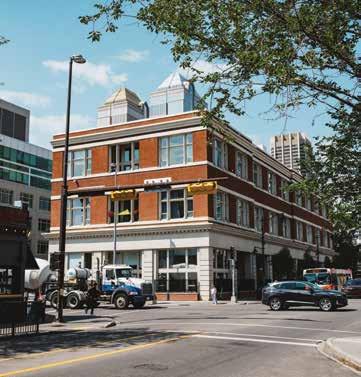
Built in 1906, the building that is now the Manhattan Lofts is one of Calgary’s most distinctive pre-war era structures. A mix of live/work uses and high-profile tenants, including artist Paul Van Ginkel, make a Manhattan Loft a coveted find.
The building was originally designed by architects William Bates and Gilbert Hodgson, whose work includes Calgary’s Grain Exchange Building and St. Mary’s Cathedral, to function as the Pryce-Jones department store. After sitting vacant for many years, a group of Edmonton investors purchased the derelict building in 1993 for just under $1 million, with the goal of converting it into condominiums. With a budget of $5 million, the initial plan fell through, but the original owner, United Inc., went ahead with the retrofit project, with a design led by architect Manu Chugh.
The transformation of the building into 38 condo units didn’t go smoothly. The retailintended design made it more difficult to adapt than an open-layout warehouse, as only the pillars and elevators could be preserved. Moreover, the installation of balconies and large-expanse windows meant additional pressures to the conversion challenges, as the architects had to replicate the unique features of the original facade in the new elements.
Despite a sluggish start in sales, Manhattan Lofts have only increased in value. When the building launched in 1994, condos could be purchased for less than $200,000. Earlier this year, a real-estate listing advertised a one-bedroom, 1,039-square-foot unit for $535,000.
avenuecalgary.com 47 PHOTOGRAPH BY TK TK TK PHOTOS BY STEVE
COLLINS
H UDSON LOFTS 535 10 A ve. S.W.
C UBE 1177 11 A ve. S.W.
In the economic downturn following the global recession of 2015, high office-vacancy rates encouraged many companies to move to newer buildings at a discounted cost. As a result, in the summer of 2019, Strategic Group’s Stephenson Building had a 95-per cent vacancy rate, and its assessed value had dropped from $21.5 million in 2009 to $8.4 million.
Aware of the shortcomings of an outdated Class B building, and having already completed a similar project in Edmonton, Strategic embarked on what would become the first officeto-residential conversion in Calgary’s inner city in more than a decade.
The features that made this building less than desirable for offices were the very characteristics that enabled its transformation. While offices today require large open floor plates (the total floor area of a storey within a building’s structure), the Stephenson Building’s respective floor plates of around 9,120 sq. ft. made it ideal for residential, as this size allows for spacious units with access to sunlight and ventilation.
By the end of 2019, the renovations to Cube were well underway. To ensure the building’s past use didn’t make for a hostile experience for residents, the design team selected a warm colour palette of reds and hints of yellow, complementing a neutral base in various shades of grey. Modern finishes and upscale amenities, such as a rooftop patio, make it as livable as any other apartment building in Calgary’s Beltline communities.
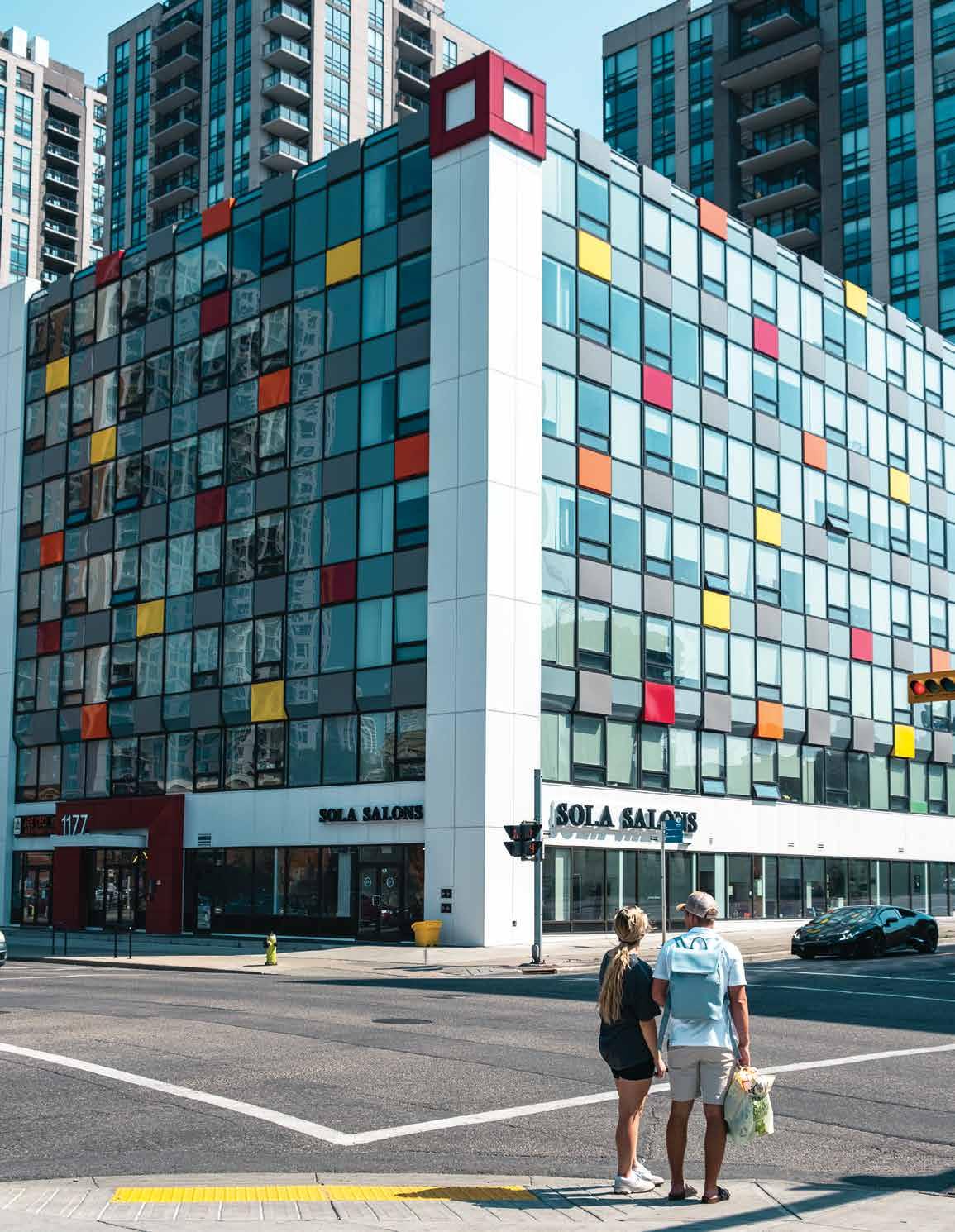
At a total cost of $25 million (which included a dive into the project’s contingency budget), it took 10 months for the 65 units to be completed.
Cube welcomed its first tenants on May 1, 2020.
september/october 2023 48 PHOTOGRAPH BY TK TK TK
N EOMA
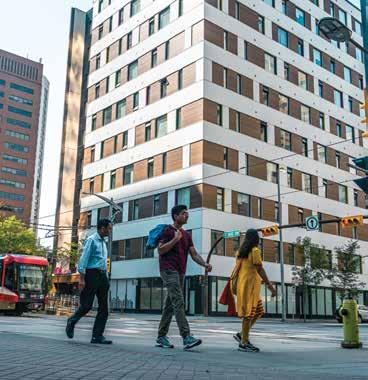
In 2021, the HomeSpace Society acquired downtown’s Sierra Place for $4.7 million, with the purpose of transforming it into affordable housing. Long past its former days as the headquarters of Dome Petroleum, the 1958 building had sat fully vacant since 2019. But, like Strategic Group’s Stephenson Building, the features that made it unattractive as office space made it suitable for residential conversion.
In the fall of 2021, conversion of the 10-storey building began, but so did the challenges inherent to co-ordinating design, demolition and construction — all at the same time.
While the building had “good bones,” some components couldn’t be preserved, despite their heritage value. Sierra Place’s unique aluminium facade with granite-clad pillars had reached the end of its life and didn’t meet current fire ratings, so it was replaced with metal panel cladding.
Using an innovative approach based on trauma-informed design, the architectural program of the building included 82 familysized and single-sized units plus 10 units of second-stage housing, as well as wraparound services for Inn from the Cold families.
At a total cost of $20 million, in September 2022, Neoma was ready to welcome families in need — on time and on budget. The array of bachelor, two- and three-bedroom apartments offer safe and stable places to live for lowerincome Calgarians. Monthly rental rates range between $608 and $968 — about 37 per cent lower than market rate.
T HE CORNERSTONE
909 5 A ve. S.W.
Formerly the SNC-Lavalin Building, The Cornerstone was part of the first round announcements of the Downtown Calgary Development Incentive. It is currently under construction, with substantial completion expected by the end of this year.
Constructed in 1978, the building was purchased in 2021 by Peoplefirst Developments, just weeks after the City’s incentive was announced. “The moment it became clear that the City grants were coming to fruition, we decided to pull the trigger on the building,” says Maxim Olshevsky, managing director of Peoplefirst Developments. Although the amount Peoplefirst paid is confidential, at its peak in 2014, the building’s assessed value surpassed $40 million. After sitting vacant for nearly a decade, it was listed in 2018 by Colliers International for $18.5 million.
With an estimated cost of $38 million, upon completion, the 10-storey building will feature 112 two- and three-bedroom units, with 40 per cent to be rented at below-market rates. The units will have in-suite laundry, marble countertops and stainless steel appliances — what Olshevsky deems “attainable luxury.”

“Our goal is to find the perfect balance between cost and value,” he says.
Olshevsky acknowledges the incentive provided by the City greatly reduces the risk for Peoplefirst to do these types of projects.
In April, the company added the Petro Fina Building to its City-supported conversion portfolio, and has its sights set on Place 800, an 18-storey office building west of downtown.
COMMON BARRIERS TO OFFICE-TO-RESIDENTIAL CONVERSION
The size and shape of a floor plate is key to determining the suitability of a building for conversion. If a floor plate is too deep, the long distance between the building’s envelope and elevator shaft can result in poorly lit units, undermining the livability of these spaces.
Post-tension concrete is a type of structure that can jeopardize the conversion of a building, as the perforations required to introduce plumbing and electrical installations for residential units could cause irreversible damage to the structural integrity of the building.
Many office building envelopes, especially in older structures, aren’t always conducive to residential use. Depending on the difficulty and cost to either preserve, upgrade or replace glazing to meet fire and building codes, as well as environmental standards, building envelopes can make or break a conversion project.
In many cases, demolition, design and construction take place at the same time. This poses significant coordination challenges, especially for developers whose expertise lies in new construction.
While not related to the buildings themselves, the presence of neighbourhood amenities — such as grocery stores, parks and schools — is key for the success of these buildings in attracting long-term tenants.
avenuecalgary.com 49 PHOTOGRAPH BY TK TK TK
7 A ve. S.W.
706
PHOTOS BY STEVE COLLINS; RENDERING SUPPLIED BY PEOPLEFIRST DEVELOPMENTS
What Sustainability in Home Building Looks Like Now

W HETHER IT’S MICRO-SCALED LIVE-WORK SPACES, NET-ZERO HOMES, D ISASTER-PROOF CONDO TOWERS OR NEW-OLD HYBRIDS, CREATIVE
S OLUTIONS ARE COMING TO LIFE IN RESIDENTIAL BUILDING
P ROJECTS THROUGHOUT THE CITY.
BY KARIN OLAFSON
W HEN SUSTAINABILITY M EETS LIVABILITY
n Nov. 15, 2021, Calgary City Council declared a climate emergency and announced its commitment to “accelerated action to respond to climate change” and to “accelerate the pace and scale of climate action needed to achieve our goal of net zero emissions by 2050.” (Net zero means cutting greenhouse gas emissions so they are as close to zero as possible.)
After all, the impacts of climate change are already being felt: August 2022 was the second-hottest on record; June 2021’s historic heatwave was followed by worrying air quality related to wildfire activity; and, of course, we all remember the 100-year flood in 2013.
You don’t need a weatherman to know it’s time for change — and that includes rethinking the buildings we live in. From small-scale live-work spaces to major multi-family towers, here are some examples of sustainable home building happening in Calgary right now.
In 2017, John Lewis had an idea. The president and founder of Intelligent Futures — a company that develops strategies to aid everything from sustainability solutions to affordable housing — had lived in a 1,100-square-foot Hillhurst bungalow for more than a decade with his wife and their daughter, when he saw the opportunity to do something different with the property and demonstrate a sustainable way of living and working that aligned with his company’s values.
In 2022, the bungalow was demolished to make way for Kensington Corner, slated for completion this month. While mixed-use development exists in Calgary, it is typically larger projects undertaken by big developers. What makes Kensington Corner unique is that it is a small-scale mixed-use development. The project, totalling 4,537 square feet, including basements, combines a commercial space for the Intelligent Futures office (a team of eight people) and a townhouse for the Lewis family. The entire project aims to meet the highest standards of sustainable design and construction. “We removed all natural gas from the site so it’s an all-electric project. Solar plays a big role in the design process and we did energy modelling to make sure that Kensington Corner will have a low carbon footprint,” says Lewis, who worked with Hindle Architects and Plaid Shirt Projects to bring Kensington Corner to life.
As well as using sustainable materials, the building’s features and design add to its environmental-friendliness. “We included bike parking and showers to encourage people to use humanpowered mobility to get to work,” says Lewis. “We also took a function-based design approach to the office space. We’re organizing our floors for different purposes: the top floor will function as a co-working space; the main floor is going to be our collaboration space for team meetings, client workshops and community events; and the basement is a quiet space where employees can put their heads down to get work done.”
For Lewis, sustainable living means being adaptable and flexible. When extended family is visiting from out of town, the office side can be used to host big dinners. If the Intelligent Futures team prefers to work virtually, the office space can be rethought and repurposed. There’s also space to add an apartment on the lot to further increase density. There’s fluidity between home and office, and flexibility in how the space looks and operates.
“The micro-scale nature of the project has promise in terms of replication and scalability,” says Lewis. “If you own an accounting firm or law firm, maybe working and living like this is within your grasp. My hope is that people can take some lessons from us and add to the building innovation and diversity in Calgary.”
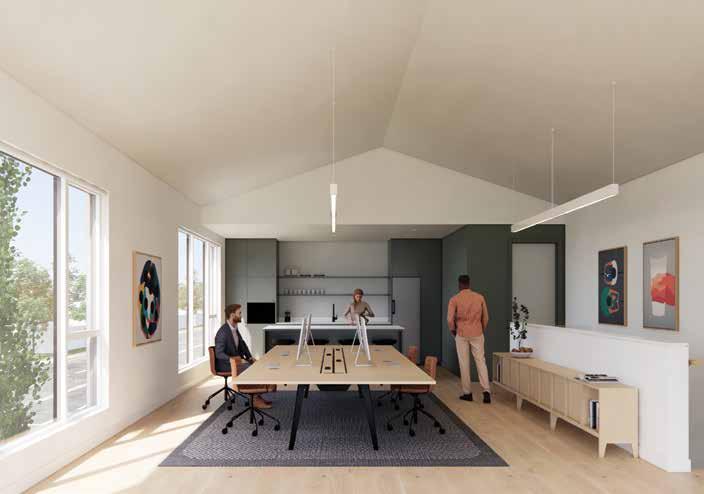
RENDERING
COURTESY OF JOHN LEWIS
O O O
avenuecalgary.com 51
G ENERATE WHAT Y OU CONSUME
The City of Calgary’s Climate Climate Strategy: Pathways to 2050 report states that, in order for Calgary to be on track to achieve net-zero emissions by 2050, all new buildings will need to be built to a net-zero standard by 2030.

Home builder Jayman Built started developing net-zero-certified homes in 2021, with the first show home in the southeast Calgary community of Seton. “Net zero means the home produces as much energy as it uses over the period of one year,” explains Dave Krasman, Jayman Built’s director of corporate purchasing and the lead in many of the company’s net-zero projects.
The company’s net-zero-certified home, named the Quantum Performance Ultra EHome, might sound like something out of Star Trek, but these homes look and feel like any ordinary home in any ordinary suburb. It’s the way they use and produce energy that’s different.


To produce green energy, Quantum Performance homes have a minimum of 25 solar panels. “We do energy modelling through our advisors, 4 Elements Integrated Design, to look at the home model and the lot orientation — the goal is get as many panels facing south as possible for peak performance — and then send that energy data to the solar experts,” explains Krasman. “They take the energy data and calculate exactly how many solar panels are needed to offset the energy needs of the home.”
Additionally, the Quantum Performance homes are designed to be more energy-efficient than a typical home, making it easier for the solar panels to offset their energy demands. In addition to features like LED lighting and triplepane windows, the homes feature Jayman Built’s proprietary wall system that acts like a thermal blanket (the bonus is that it makes it nice and
quiet inside, too). The homes are entirely electric and are equipped with an electric heat pump, called the Daikin FIT Heating, Ventilation and Air Conditioning system, which sits outside like a typical air-conditioning unit, instead of a natural gas furnace. To heat the home, these cuttingedge pieces of equipment pick up heat from outdoor air — even at temperatures as chilly as -25°C — by moving it through a heat exchanger, and do the opposite in the summertime. The homes also have electric vehicle-charging stations in the garages.
Each Quantum Performance home reduces greenhouse gas emissions by 10.67 tonnes per year and saves homeowners just over $2,100 per year in energy costs. As of this spring, the company has built 21 net-zero homes across Calgary and Edmonton. Most are show homes in new Calgary communities like Legacy, Mahogany, Seton and Glacier Ridge. There have been just four sales so far — Krasman admits their cost can be prohibitive. For a 1,800-square-foot home, a homeowner could expect to pay an additional $68,000 to have it built net-zero.
The number of these homes on the market so far might seem miniscule for a city of 1.6 million, but the demand for innovative green living is slowly increasing. Jayman Built isn’t the only company in Calgary treading into the world of net-zero homes: Cedarglen Homes is also a qualified net-zero builder; Avalon Master Builder is rethinking multi-family homeownership with net-zero-ready townhomes in Seton; and Homes by Sorensen builds both net-zero and passive homes.
“Net-zero homes seem to be gaining momentum in Alberta,” says Krasman. “We’re all trying to pioneer the future now.”
52 september/october 2023
THE NEW O LD
When the Upton Residence in Sunnyside was listed for sale, many assumed it would be torn down. Built in 1908 by a tinsmith named Frederick Upton, the 800-square-foot Edwardian bungalow was small by modern standards, and few homes from the same era remain in the neighbourhood today.
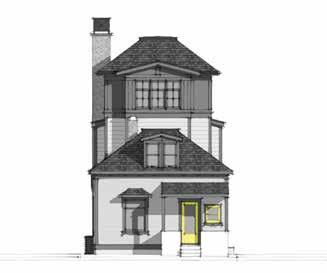
But owners Tonya and Dana McKechnie couldn’t ignore the house’s charm. “I fell in love with all these quirky characteristics,” says Tonya. “I thought there could be an interesting way to bring it back to life.”
The McKechnies decided to preserve the heritage home while constructing an addition behind it to meet their family’s needs. They purchased the property in March 2022 and worked with architect Tom Chute, principal at Marre Design Group, to blend old and new. A 1,700-square-foot addition constructed by Saville Homes was designed to meld seamlessly into the heritage home (for a total square footage of 2,500), and Chalmers Heritage Conservation was brought in to perform the hands-on restoration work.
D ESIGN AT ITS BEST TO P REPARE FOR THE WORST
As climate change increases the number of extreme weather events we experience, some new multi-family residential buildings are being designed to withstand such events. After the flood of 2013, The Concord — a luxury condo tower located on the banks of the Bow River in the inner-city community of Eau Claire — was designed to be Canada’s top flood and emergency-prepared residential building.
“The condo’s disaster-mitigation infrastructure includes both landscape berms and flood gates, which can be raised with a two-foot perimeter around the entire site in the event of

a flood to protect the condo from water,” says Grant Murray, senior vice-president of sales at Concord Pacific Developments Inc. “Our diesel generators can run to provide additional power for up to two days, and then can be switched to natural gas indefinitely in case the City loses power, like it did in 2013.”
Among the other innovations at The Concord are self-sealing waterproof foundation walls, designed to repair themselves and prevent underground water seepage. The building’s design is expected to be able to withstand a flood three times as significant as the one in 2013.
“The homeowners are retaining the original structure, the hipped roof and the exterior facade. We’re restoring the home’s siding, windows, doors, porches, all exterior elements,” says Dave Chalmers, owner of Chalmers Heritage Conservation. “Interior elements had to be upgraded to meet current building code, but we’re retaining all original material on the inside, including the Douglas fir floors and baseboards, the doors and the moulding detail on the stairwell.”
Building materials are being reused whenever possible, with plans to repurpose the original front door as a side door with the goal of keeping all its original hardware.
“This is recycling at its best,” Tonya says. “We’re saving what we can and trying to work with what we have.”
JAYMAN IMAGES SUPPLIED BY JAYMAN BUILT; CONCORD IMAGE BY STEVE COLLINS; UPTON IMAGE SUPPLIED BY MARRE DESIGN GROUP
53 avenuecalgary.com

september/october 2023 54 ADVERTISEMENT
THE FACES BEHIND THE SPACES
he launch of a new arts season unveils a range of possibilities for going out to performances, concerts and exhibitions. As an audience member, as you sit there or stroll around, captivated by what’s in front of you, it’s sometimes easy to forget there are people behind the scenes doing the work of setting it all up, making it look and sound the way it should. So come with us as we peek behind the curtain and meet some of these backstage operators who run the show so we can all enjoy the show.

avenuecalgary.com 55
PHOTOS BY JARED SYCH
COSTUME DESIGNER JOLANE HOULE, BACKSTAGE AT THE GRAND






september/october 2023 56 See the entire series and purchase tickets at bclt.ca NICE HORSE SEPT. 23, 2023 MIDDLE RAGED OCT. 13, 2023 BERT CHURCH LIVE THEATRE PRESENTED SERIES 2023-24 Experience it LIVE on Airdrie’s stage! • Two-storey & bungalow homes available • Unique & versatile floorplans with options to fit every lifestyle • Choose from personalized interior options & upgrades • Established neighbourhood just minutes away from amenities, schools, & LRT • Only 7 opportunities available! * Prices subject to change without notice. Some conditions apply. E&OE VISIT OUR SALES CENTRE AT ST. MICHAEL'S CHURCH PARKING LOT • 800 - 85 STREET SW • 403.246.2127 Includes Home, Lot & GST Semi-Estate Homes $900'S* Starting from the High o o LIMITED HOMESITES AVAILABLE! 2004 - 2023 Best For The World Four Time WINNER To learn more visit tricohomes.com Brand new luxury semi-estate homes in a prestigious SW community. WESTSP-28185 Avenue HP - Sept/Oct Issue v4.indd 1 2023-08-04 2:49 PM
MELANIE KJORLIEN
CHI EF OPER AT IONS OF FICER
lenbow is in the throes of renovation, with plans to open anew in late 2025-early 2026. Behind the scenes, Melanie Kjorlien is responsible for the inner workings that will transform the longstanding Calgary institution into a museum for our day.

Remembering how Glenbow once, in 2014, cut a notch in its low ceiling to accommodate a towering Salvador Dali painting, Kjorlien is excited about how the retrofit will improve function and offer more ways to enjoy the museum. Both are her domain.
As chief operations officer and vicepresident of engagement, Kjorlien oversees operations that frame the visitor’s experience. Her work under six different Glenbow directors covers broad territory, from public programming and exhibition project management, to developing online access to the collections. Highlights include touring exhibitions by artists Laurie Anderson, Nick Cave, Fernando Botero and Kent Monkman; and Oh Canada, the mega-exhibition of Canadian contemporary art curated in Massachusetts that Glenbow presented collaboratively in 2015 with the Esker Foundation, Nickle Galleries (University of Calgary) and Illingworth Kerr Gallery (Alberta University of the Arts). Kjorlien is also proud of exhibitions developed in-house, such as Made in Calgary, a series of five shows with each representing a decade of our own art history. “As a city, we needed to have a spotlight on our own artists,” she says.
Kjorlien has also been instrumental in bringing in artists and creatives in other fields (such as musician Corb Lund and designer Paul Hardy) to do novel projects with Glenbow’s vast collection.
Originally from Rocky Mountain House, she worked in broadcasting and corporate communications before coming to Glenbow in the early 1990s to write and co-edit a documentary on Sybil Andrews, a visionary 20th century British/Canadian artist, whose core work is in the Glenbow collection. That experience hooked Kjorlien on both the visual arts and on ways to make art accessible to the public. Thirty years later, she’s excited that visitors will be able to visit every floor when Glenbow reopens, whether to watch conservators at work in the lab, peek into visible storage areas of the collection, enjoy the patio view or engage with exhibitions.
While reconstruction continues on the exterior and interior of the Glenbow building, Kjorlien is overseeing a satellite exhibition space in The Edison building nearby. Visitors to the space can see shows through December 2024, free of charge.
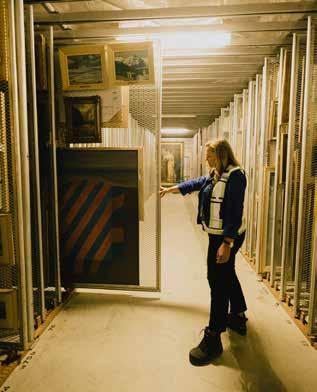
As Glenbow’s physical building undergoes a metamorphosis, the museum is also re-examining its role in the community. Kjorlien’s calm, professional leadership style; her committment and her extensive institutional memory will serve the museum well as it embraces so much change.
Katherine Ylitalo
avenuecalgary.com 57
A N D V ICE -PR ESI DEN T OF ENGAGEM EN T AT GLEN BOW
JOLANE HOULE
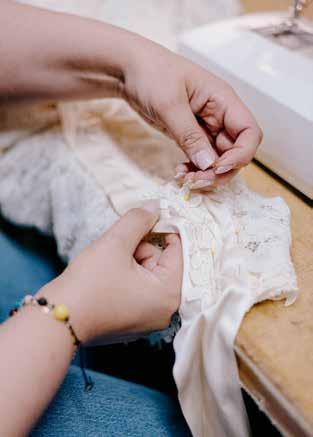

COSTU M E DESIGN ER
olane Houle, Blackfoot from Kainai, is waiting at the alley entrance of The Grand theatre for me to arrive. It’s a rainy night and she’s wearing a long pink sweater. Tonight is the dress rehearsal for playwright and director Tara Beagan’s The Ministry of Grace. A freelance costume designer, Houle works closely with Making Treaty 7, the Indigenous theatre company presenting the show as part of its residency at the Grand. Tonight’s dress rehearsal will be the first time Houle will see her vision come to life on stage. She also knows that she’ll have more work to do based on what she sees. Houle is the sole costume designer for this show, designing, sewing and finding costumes for all four characters herself. She’s no stranger to hard work: Houle picked up her sewing skills from her mother and grandmother — her first inspirations. Her formal education includes a Bachelor of Fine Arts from the University of Lethbridge and a diploma in fashion design from Lethbridge College. Along with Making Treaty 7, she has worked with several theatre production companies, including New West Theatre (Lethbridge), Stage West Dinner Theatre and Alberta Theatre Projects, as well as numerous TV and film productions, including The Revenant, Lost in Space and Wind River: The Next Chapter
As a visual storyteller, Houle wants the audience to know each character just by looking at them. One way she achieves this
september/october 2023 58
(PHOTOGRAPHED AT THE GRAND )
is by drawing on her deep understanding of colour theory. “Colour makes a difference with how you want to portray someone,” she says. “Think Disney: to portray ‘evil’, they’ll use darker shades of purple, green or even black. To portray ‘good’, they’ll use florals and more light and airy colours.”
The Ministry of Grace takes place in the 1950s Southern California desert, so Houle and Beagan decided together on a muted palette of browns, pinks and yellows for the actors. Houle turns to Pinterest for inspiration, creating boards for every project. She often sources items from The Costume Collective, a local business that designs and rents unique costume items to those in the performance, film and TV industries.
Every piece of clothing is chosen and prepared with intention. If a garment is too neat and clean, Houle manipulates it to look lived-in using acrylic paint and a powder of rottenstone mixed with beeswax. As we talk, she is washing shirts with Earl Grey tea bags — clothing that is pure white shines too brightly under stage lights and takes attention away from the story.
As the actors arrive, they greet Houle and she knows it’s almost time for dress rehearsal to begin. She explains each costume to the assistant stage manager and puts all the pieces in each actor’s dressing room. Though she says she’s “not a hair person,” Houle does the actors’ hair for the dress rehearsal — the actors in this particular show
will do their own hair and makeup on performance nights. As Houle curls the lead actor’s hair, her soft voice and calming presence creates a feeling of warmth in the room.
Like a mother getting her children dressed and ready for school, Houle ensures all the actors have their costume pieces on correctly before going on stage. Not a shirt untucked, a shoe untied or a stray hair out of place for her stage children.


As the actors take their places, Houle and I take a seat and watch the rehearsal. While I’m observing the acting, Houle observes the clothes, making notes on her phone: hairspray; shine shoes; bigger hairnet; more sweat/dirt at neckline; dress change too slow — add clasps... “Theatre is something I stumbled upon and it feeds a part of my soul,” she says. “As an Indigenous person, we’re storytellers. I may not be a writer, but my creativity comes through visual storytelling.” —Stephanie Joe
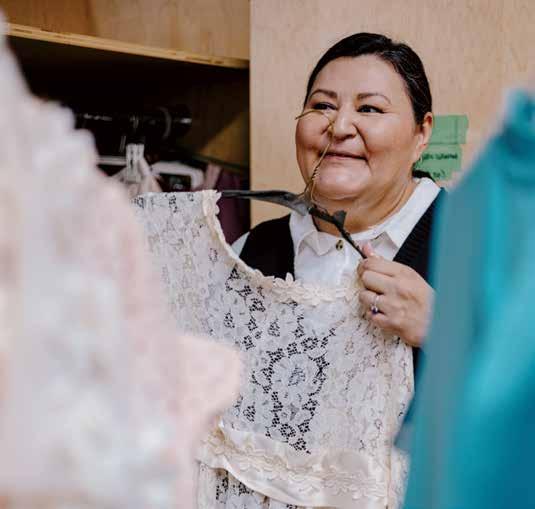
avenuecalgary.com 59
DOUG HASLAM
he Esker Foundation, a non-profit contemporary art gallery in Calgary, is a respected member of World Art Foundations, a hub for more than 450 privately funded art foundations worldwide. Thanks to the generosity and vision of founders Jim and Susan Hill, Esker presents free exhibitions from all over the world, and, thanks to Doug Haslam, the Esker’s head preparator, each is installed superbly.
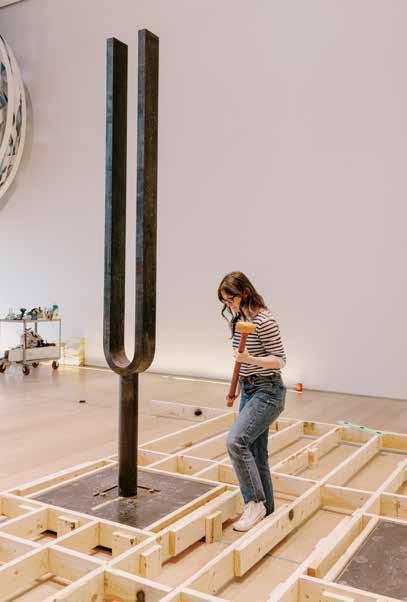
The paradox of Haslam’s job is that the better he does, the more invisible his work becomes. “The beauty of working here is that every day is a new day,” he says.
Seated in the architectural “nest” space suspended above the gallery floor, Haslam talks about the range of projects on his plate. Front-of-mind at the time of our chat is problem-solving the delivery and installation of the Pulse of the Planet exhibition by Sydney/Paris-based artist Mel O’Callaghan. Haslam is trying to figure out the best and safest method to lift O’Callaghan’s threemetre-tall, 802-kilogram, raw-steel tuning forks out of their crate and stand them up in the exhibition space. The plan involves bringing in Spyderman Crane Ltd. to help
PREPARATOR/INSTALLER, E SKER FOUNDATION
with the hoisting — but first, Haslam needs to envision building a large resonating platform in stages. A small portion can be pre-built, but the rest can only be completed after the tuning forks are in place.
Haslam is also in the early stages of planning for an upcoming Esker exhibition of historic objects from the Museum of Fear and Wonder, a collaborative project of brothers Brendan and Jude Griebel, who house their collection in a renovated army barracks just outside the town of Bergen, Alta. Along with that, Haslam is considering what might be required for a showing of crash test dummies in Care and Wear: Bodies Crafted for Harm and Healing (opening on Sept. 23 and running through Dec. 17).
Esker’s preparator since 2012, Haslam confesses he once vowed he would never get locked into an institutional position. He went to the University of Calgary at 17, intending to become a veterinarian. But, after a trip to Europe, he decided he wanted to work with wood. He went to the School of Craft and Design at Sheridan College in Oakville, Ont. — then the most forwardthinking school of fine craft in Canada. On
september/october 2023 60
his return to Calgary, he set up a woodworking studio, helped establish the Southern Alberta Woodworkers Society, volunteered with the Calgary Allied Arts Foundation, participated in a number of residencies and taught woodworking for Chinook Learning Services. He continues to work for the Alberta Foundation for the Arts as a packing, shipping and display consultant for the Travelling Exhibition Program (TREX).
A mentor to emerging Calgary preparators, Haslam is also an artist in his own right. His Cabinet of Curiosities exhibition has been shown around the province.
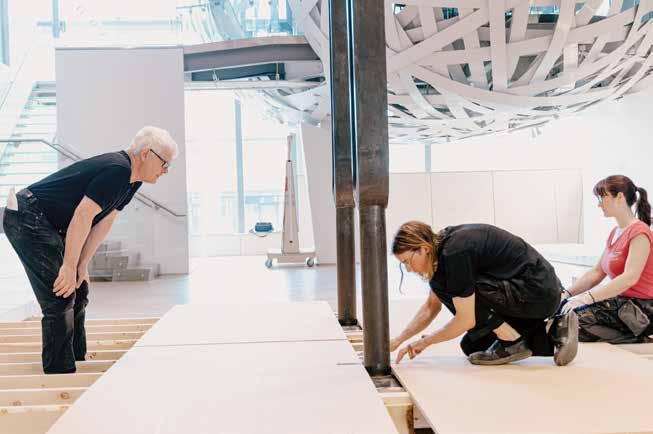
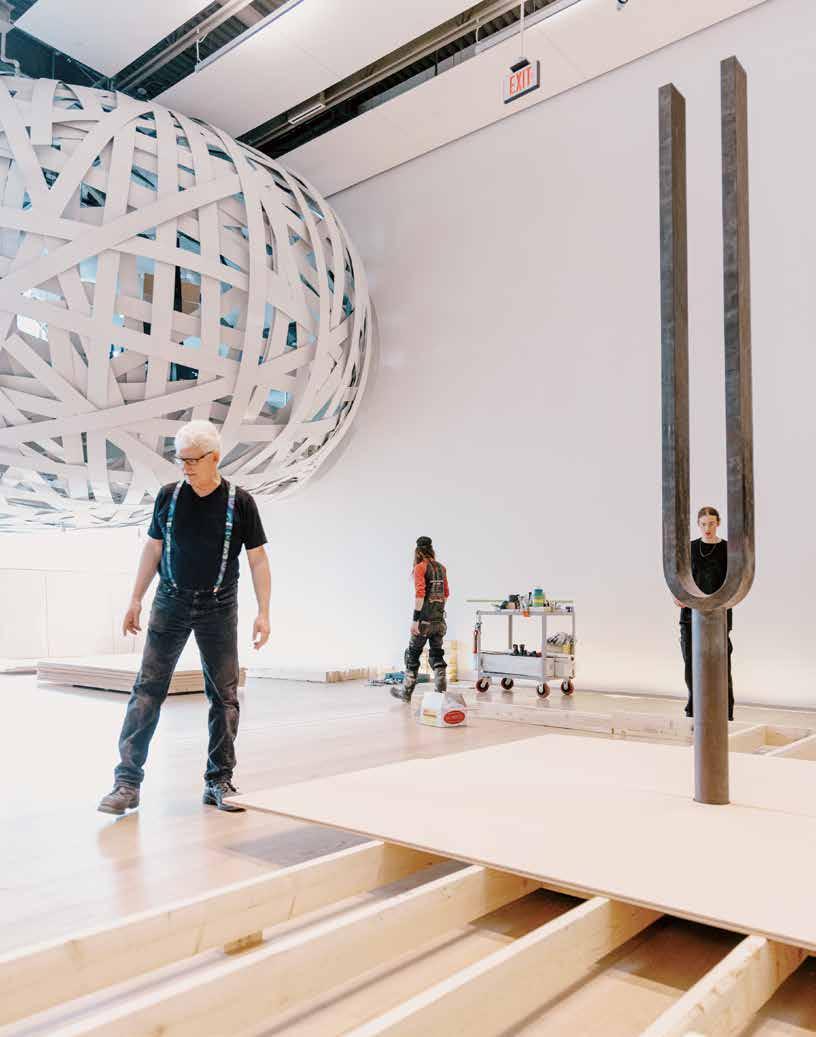
At Esker, Haslam has mounted more than 30 major exhibitions in the main space and has helped with the installation of a similar number for the 9th Avenue street-level window project space. He has a knack for making supports, bases and mounts that are in tune with the art and the artists’ intentions. He has a fully equipped workshop for construction and mount-making on the ground floor of the building, adjacent to the loading dock and uncrating area, and an office upstairs in the gallery. His role also involves testing audio and visual files for installations and managing the AV room.
Unlike other preparators who tend to avoid opening-night celebrations, lest someone ask them to make last-minute changes, you can usually spot Haslam in the crowd on the first night of a new exhibition, wearing his signature suspenders.
Katherine Ylitalo
avenuecalgary.com 61
SHELBY-JAI FLICK
STAGE MANAGER, CALGARY OPERA
nder the light of a desk lamp, pencil in hand, stage manager Shelby-Jai Flick follows the dress rehearsal notes for Calgary Opera’s rendition of Giuseppe Verdi’s Macbeth. She keeps everything in a big binder that, to her, is holier than the Good Book itself. Her adjustable headset allows her to communicate with the rest of the crew at all times, but she leaves her right ear open, anticipating the expected and unexpected.
Flick’s passion for stage management started back when she was taking a premaster’s seminar course at Western University in Ontario. As part of the program, actors and directors from the Stratford Shakespeare Festival were invited in to speak with the class. One of these speakers was veteran stage manager Bona Duncan. Flick approached Duncan afterward to see if they could continue the conversation and received an invitation to shadow Duncan and her team. “I stopped pursuing my master’s full stop and was like: this is it, I found my thing. I found the thing that made my brain click together,” Flick says.
Managing a large-scale operatic production like Macbeth at a large-scale venue like the Jubilee Auditorium is an especially difficult undertaking, with multiple voices from the cast and crew, technical considerations and constant changes. But Flick has her own ways of streamlining the chaos. She jokingly talks about how she lives in 15-second increments: timing every 15 seconds helps her know when a specific queue will land, plan quick changes with the wardrobe department, and prepare her standbys so that the show can run smoothly.

On top of timing, Flick colour-codes each department of cues, with the entirety of the show marked in her binder — what she calls her “score.” For Macbeth, the fly cues are orange, deck cues pink, lighting cues or “electrics” blue, video cues are green, and sound cues are purple. “If I have to [leave] and somebody else has to call this show, I need to make it easy for them to step in and call this show from my score,” she says.
Looking back on her career in the arts, Flick says she doesn’t regret switching paths, feeling like this was always meant for her. With Macbeth in the books (or, in her case, in the binders), she’s ready for her next show. —Deaniell Cordero, with files from Stephanie Joe
september/october 2023 62



avenuecalgary.com 63
SoundMinds

64 september/october 2023
ARRAN FISHER ASSOCIATE HEAD OF SOUND, ARTS COMMONS
PATRICK PALARDY PUBLIC LUNCH STUDIO
CHRIS MCEWEN HOUSE SOUND TECHNICIAN, THE PALOMINO SMOKEHOUSE
JAMES BUNDY FREELANCE AUDIO ENGINEER; HEAD OF AUDIO, BELLA CONCERT HALL
The best part of experiencing live music is being swept up in the sound. Whether it’s the pounding assault of a punk band in an underground club or the dulcet tones of a classical concert in a soft-seat theatre, sound is everything. Even a Mick Jagger-level front man can’t hold the attention of an audience if the sound is bad. So, here’s a toast to some of the unsung heroes of the Calgary music scene: the ones behind the soundboards making the music come alive. —Shelley Arnusch

avenuecalgary.com 65
JOHN HIEBERT PRODUCTION MANAGER, CALGARY FOLK MUSIC FESTIVAL, BLOCK HEATER WINTER FESTIVAL, FESTIVAL HALL
JESS HOWAT
FREELANCE SOUND TECHNICIAN; HOUSE TECH, DICKENS PUB; MONITOR TECH, THE PALACE
SHOT ON LOCATION AT PK SOUND
TERRY AALDERS HEAD OF SOUND, ARTS COMMONS

september/october 2023 66
THE MORE THE MERRIER: THE STREET FOOD-INSPIRED DISHES AT MUMBAI BITES IN INGLEWOOD ARE BEST SHARED AMONG FRIENDS.
DINING OUT FAMILY-STYLE
FOSTERS CONNECTION, CONVERSATION AND CULINARY EXPLORATION.
Sharing s Car ng
for people who truly love food — that is, the crowd that lives to eat, as opposed to eating to live — there’s a constant quest to taste as many dishes, flavours and ingredients as possible. Standard menus, which require diners to choose a single plate with pre-determined sides, are not ideal for such adventurous gourmands who know of the many other delicious dishes and sides being prepped in the kitchen that they’ll not have a chance to savour. That’s why, if you are of this mindset, there are no sweeter words spoken by a restaurant server than: “Our dishes are all served family-style and come out as the kitchen prepares them.”
Family-style or shared-plate eating, can be divisive among diners, some of whom don’t understand the fuss and just want to be served their own plate of food. Yet, over the last decade or so, sharing multiple dishes with the rest of the table has become de rigueur at many cool contemporary restaurants, with everything from devilled eggs and dumplings to enormous bone-in steaks and lamb chops served à la carte and portioned for sharing.
As modern as it may feel, family-style dining is essentially a throwback to the way most of us grew up eating at home. Whether your dining “family” includes two people or 20, there’s something magical about enjoying the same food together at the same time. The meal becomes a connector for the evening. As everyone at the table digs into house-made chips and dips at a Mexican restaurant or divvies up a dish of Italian raviolo to watch the egg yolk filling ooze out, conversation and even emotional responses begin to flow. Food is love, as they say, and you can’t experience that shared endorphin rush when everyone is silently slicing into what is directly in front of them on their own individual plates.

“I love sharing,” says Elia Herrera, the chef behind Milpa, a Mexican small-plates restaurant in the Beltline. “When I have my own plate, I get bored. By having small, shared plates, I can have a party in my mouth and try the whole menu. I have more fun as both a customer eating and as a chef.”
BY ELIZABETH CHORNEY-BOOTH PHOTOS BY JARED SYCH
To get the best out of a restaurant, guests should be curious and adventurous, and family-style service allows everyone to try some of everything. Not sure if you’ll like caviar (or octopus or celery root)? Mitigate the risk (and the cost) by sharing it with three friends. If no one likes it, at least you’ll all have a shared story to laugh about for 25 cents on the dollar.
avenuecalgary.com 67
Dining
SAPORE
The first full-service restaurant run by the Lina’s Group offers shareable pinsas (Roman flatbread) and plates of richly topped pasta.
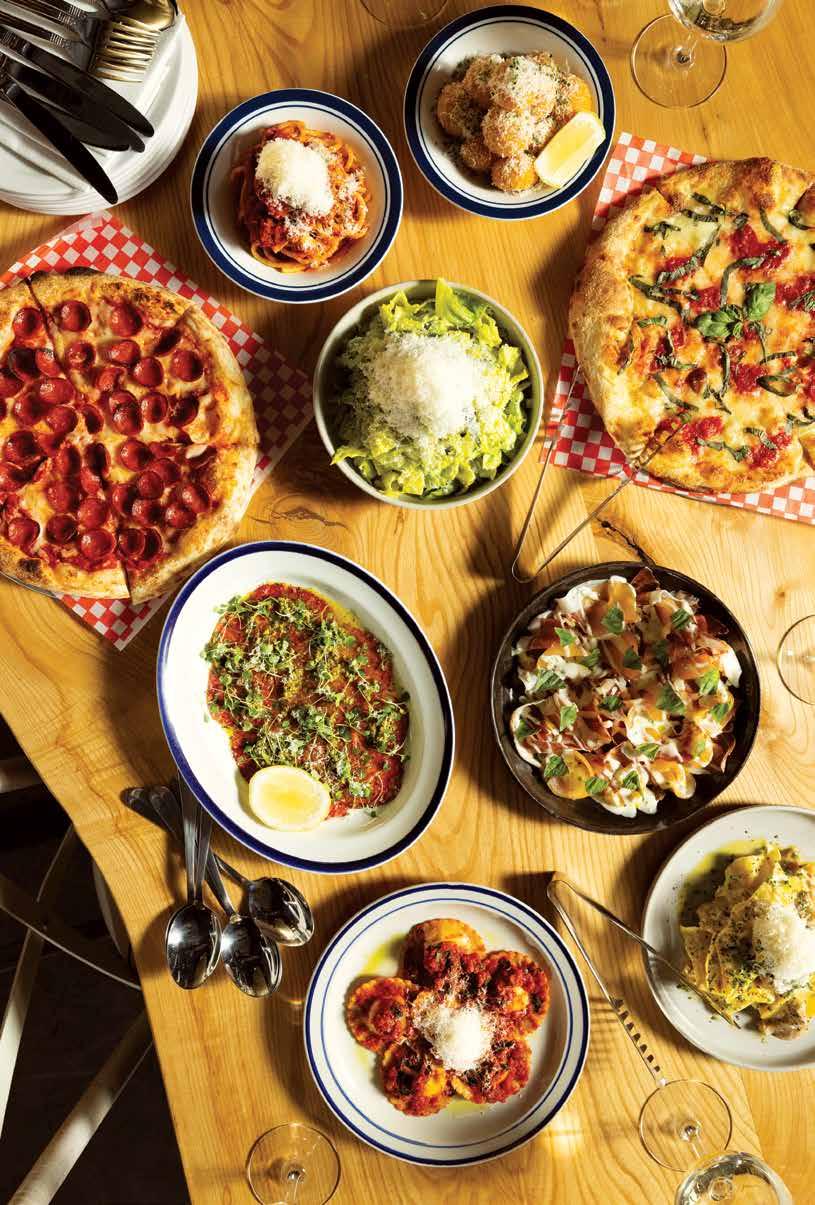
1023 9 Ave. S.E., 403-960-1007 linasmarket.com
PASS IT AROUND
Modern share-plate restaurants may feel like a drastic shift in food culture, although anyone who has eaten at a classic Chinese, Indian or Thai restaurant has already experienced this style of dining. Ordering a range of dishes with sides of rice or bread, and passing everything around (with the help of a lazy Susan if you’re lucky) represents family-style eating in its purest form.
No matter the cuisine, sharing food is also a great way for actual families to eat, allowing groups with kids to adjust the amount ordered to match smaller appetites. Kids — and adults still struggling to break out of meat ’n’ potatoes diets — get to learn the nuances of passing things around while sampling different kinds of food. If they still turn their noses up at a plate of oysters or bison tartare, it just leaves more of the good stuff for the more discerning diners at the table.
“I am at my happiest when I am eating food with friends and loved ones,” says Christopher Hyde, the executive chef for Lina’s Italian Market and its new Sapore restaurant, which offers an Italian take on the family meal. “The act of sharing in itself is something that we’ve kind of lost, but are rediscovering.”
There are too many restaurants to list that provide a traditional communal experience, as every corner of the city is blessedly stacked with good Chinese and Indian restaurants. You can also reach beyond cuisines that traditionally skew towards family-style dining. Any restaurant that specializes in plates of a single dish, be it pizza and pasta, a big hunk of meat, or whole fish, is prime for the passing.
WHERE TO GET IT
MUMBAI BITES
Try this modern Indian restaurant’s butter chicken and aloo gobi, but also don’t miss out on the street food snacks and Mumbai-style Chinese food.
1214 9 Ave. S.E., 587-319-6600, mumbaibites.ca
GOLDEN SANDS CHINESE RESTAURANT
Shareable dim sum dishes like swan taro puffs, pan-fried turnip cakes and wrapped sticky rice make for a most interesting midday meal.
5010 Centre St. N.E., 403-455-2777, goldensandscalgary.ca
september/october 2023 68
A MODERN ITALIAN FAMILYSTYLE SPREAD AT SAPORE.
DIPPING AND DUNKING
Adding an interactive element to a meal can spark conversation, coming in handy for couples and families who have already heard all of each other’s stories, or new acquaintances who might need to break the ice. Doing a bit of the cooking yourself may feel a bit counterintuitive at a restaurant, but fondue, especially of the cheese variety, is becoming increasingly popular in Calgary restaurants for both romantic dates and group hangouts. Not only does it give you something to do beyond eating, but all that spearing
and dunking prolongs a meal, giving everyone more time together.
Beyond cheese fondue, action-seeking diners can try one of Calgary’s numerous hot pot restaurants, a traditional Asian fondue variation that involves cooking items in a simmering broth, or cook-ityourself Korean barbecue joints. If paying to cook your own dinner doesn’t compute, then a meal comprised of dips and spreads — think Mediterranean mezze, a parade of Mexican salsas, guacamole and queso, or a paté-heavy charcuterie board — packs a similar punch, with less effort.
WHERE TO GET IT
AIDA’S BISTRO
Make a meal out of Aida’s cheese plate and dip sampler, featuring the restaurant’s famed roasted red pepper mouhammara. 2208 4 St. S.W., 403-541-1189 aidasbistro.ca

FRENCHIE WINE BAR
The recently expanded Frenchie lacks an in-restaurant kitchen, but guests can still commune over pots of cheese fondue, French onion dip and charcuterie. 616 17 Ave. S.W. (access through Una Takeaway), 403-476-3615, frenchieyyc.com
1
POT
A classic hot pot restaurant offering an all-you-can-eat experience with dozens of choices of meat, seafood and veggies to dip. 123 3 Ave. S.E., 403-708-8088 facebook.com/1potcalgary
avenuecalgary.com 69
DIP CAN ABSOLUTELY BE A MEAL AT AIDA’S BISTRO.
CONTEMPORARY SHARE PLATES
The decision to go with a share-plate concept, be it traditional Spanish-style tapas or a creative collection of snacks, appetizers and larger platters, is central to a restaurant’s identity. The Concorde Group, for example, has built many of its most celebrated restaurants, including Major Tom, Barbarella Bar and Bridgette Bar, around the possibility of sharing, with the option of going solo. JP Pedhirney, VP of culinary operations, estimates as many as 70 per cent of customers opt to share when dining in Concorde venues, greatly contributing to the energy of the restaurants.
“We try to position our restaurants as places where people can come in and feel relaxed. The sharing process helps to accomplish that,” Pedhirney says. “It speaks to the social nature of dining, where people get to interact. It also gives people the sense they’re getting good value when they get a larger-format plate put in front of them.”
The secret for share-plate success is to fully lean into the experience. Dishes that may seem a little unusual (or outright weird) usually come with a bigger payoff when it comes to flavour and wow factor. Taking risks and trusting the chef’s creativity is part of the fun.
WHERE TO GET IT
PIGEONHOLE
The menu here entices with favourites like charred cabbage, tartare and a caviar service, which is tailor-made for sharing over a bottle of bubbles.
306 17 Ave. S.W., 403-452-4694, pigeonholeyyc.ca
LAS CANARIAS
Spain is the capital of share-plate eating, and Las Canarias does that tradition proud with dishes of croquettes, papas bravas, pulpo and larger-scale paellas.

1129 17 Ave. S.W., 403-475-4165, lascanarias.ca
MILPA
This Mexican tapas restaurant boasts a little more than a dozen hot and cold dishes, each packed with layers of flavour.
1531 5 St. S.W., milpa.ca
september/october 2023 70
PLATES A-PLENTY AT PIGEONHOLE.















avenuecalgary.com 71 SEPT 19 – 24, SOUTHERN ALBERTA JUBILEE AUDITORIUM SEPT 26 – OCT 1, NORTHERN ALBERTA JUBILEE AUDITORIUM BroadwayAcrossCanada.ca Ticketmaster.ca 220 - 42 avenue s.e. | 403 287 9255 @alloyrestaurant | events@alloydining.com alloydining.com Come enjoy the season with us! Book your holiday party with alloy.






WWW.LACTALISFOODSERVICE.CA @LACTALISCANADAFOODSERVICE Let’s connect TM Find us online for mouth-watering inspiration! 19%M.F. Pizza Mozzarella From a Brand You Trust Shorten kitchen prep time and maximize melt. Try Cracker Barrel Pizza Mozzarella today! Available Now!
SHARED EXPERIENCES (NOT PLATES)
While the thrill of sharing food is real for those who love it, family-style dining isn’t for everyone. Diners who worry about passing germs around the table alongside the spaghetti or the etiquette of divvying up three dumplings among four people can choose a morestructured Sunday supper, chef’s tasting menu or
Japanese omakase format where everyone gets their own serving of multiple dishes simultaneously. Ticketed dinners and food festivals work on the same concept. Look for special wine dinners, chefcollaboration dinners and prix fixe dine-around festivals offered in the city throughout the year. Eating the same thing as everyone in the restaurant is, in many ways, the ultimate shared dining experience, even in a room full of strangers.
WHERE TO GET IT
SATSUKI
This intimate Japanese restaurant in Kensington specializes in omakase, a chef’s-choice menu that sees everyone at the sushi bar eating the same thing at once.

1130 Kensington Rd. N.W. 403-300-2405, satsuki.ca
DEANE HOUSE
For its Sunday Supper Club, Deane House offers a discounted version of its five-course chef’s tasting menu. 806 9 Ave. S.E., 403-264-0595 deanehouse.com
avenuecalgary.com 73
OMAKASE OMG AT SATSUKI.
PHOTO BY CHRIS LANDRY
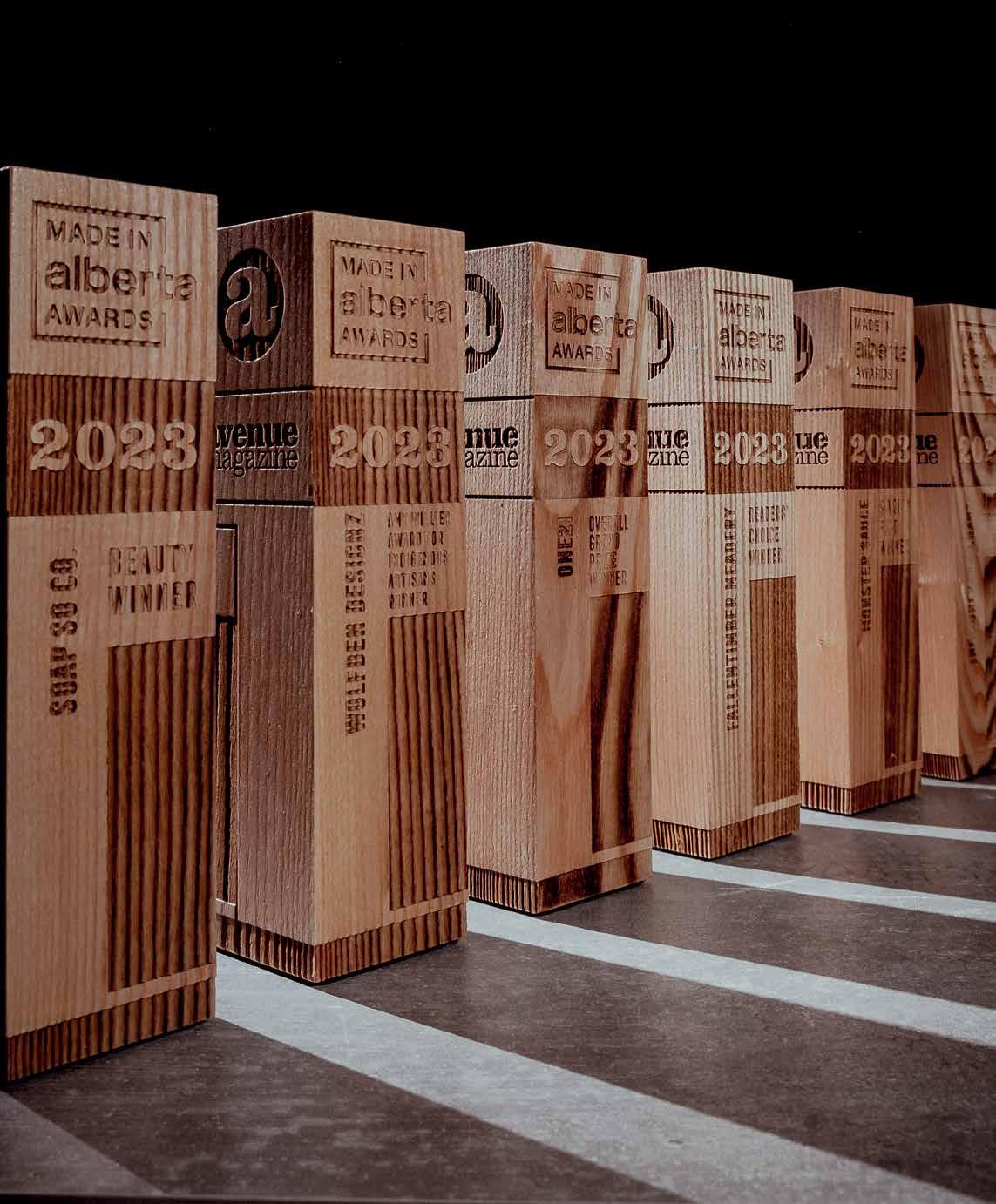
september/october 2023 74
PHOTO BY STEVE COLLINS
For the fifth anniversary of the Made In Alberta Awards, makers and producers from across the province truly stepped up, putting forth a wide array of well-made, well-produced, well-crafted products to be judged in 10 different categories.
From the functional, to the beautiful, to the delicious (to all of the above) we’re excited to unveil the judges’ top picks, plus our Readers’ Choice award, for 2023.
BY SHELLEY ARNUSCH
avenuecalgary.com 75
THANK YOU TO OUR 2023 JUDGES AMY WILLIER AWARD FOR INDIGENOUS ARTISANS: YVONNE JOBIN AND VANESSA MARSHALL; BEAUTY: MARIE BERTRAND AND TARA COWLES; CRAFT: JILL NUCKLES AND NICHOLE WINDBLAD; DRINK (ALCOHOLIC AND NON-ALCOHOLIC): OWEN KIRKALDY AND JOCELYN MACGREGOR; FASHION AND ACCESSORIES: HAITHEM ELKADIKI AND KARI WOO; SAVOURY FOOD: MATT PENNER AND CHANRY THACH; SWEET FOOD: SYLVIA KONG AND SAID M ’ DAHOMA; FURNISHINGS AND HOME DECOR: KAREN ASHBEE, DAYLE SHEEHAN, AND ALYKHAN VELJI; UNIQUE PRODUCT: KELLY JUBENVILL, MELANIE LOVE AND RANDY WONG
2023
TSERING ASHA JENNIFER HAMILTON CHRIS LANDRY AMBER MCLINDEN
MICHAELA REAM AND COLLEEN SETO PHOTOGRAPHY BY JARED SYCH
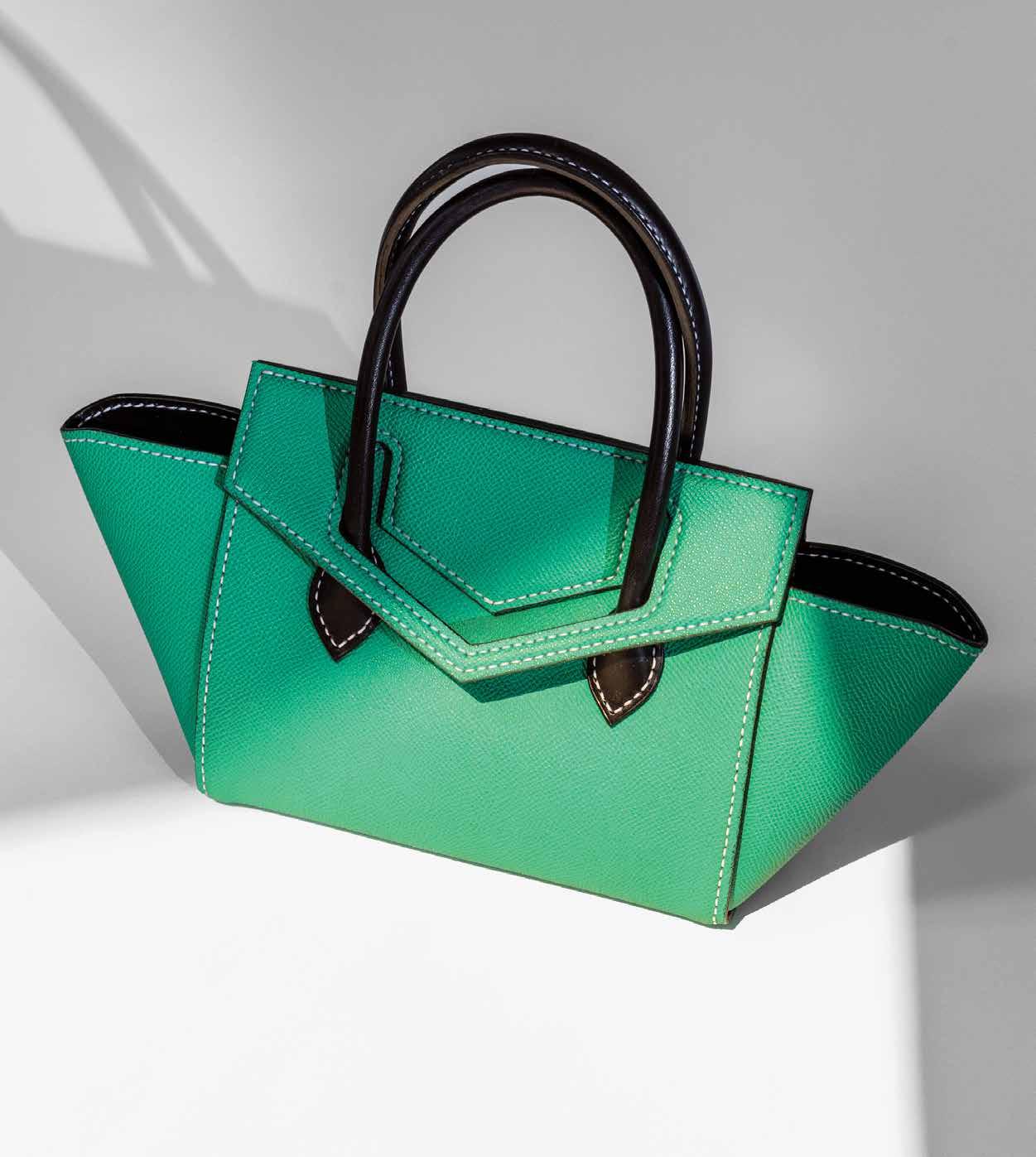
september/october 2023 76
LEATHER LOVE
The Envelope handbag by Calgary-based maker Theo Popilchak is crafted from the highest-quality leathers sourced from tanneries in Italy that “rescue” hides otherwise destined for landfill.
Read more about the runners-up in all MIAA categories at madeinalbertaawards.ca
OVERALL GRAND PRIZE WINNER
FASHION AND ACCESSORIES
The Envelope by One21 MADE IN CALGARY
$550 to $650 one21goods.com
It all started with a fob and a bad toss. Back in 2019, when Theo Popilchak was working at a car dealership, his boss threw him a key fob. Popilchak missed catching it and the $500 gadget smashed on the ground. It got him thinking: “There has to be a way to protect something so expensive and fragile.” And so began his passion for working with leather.
“I started with the key cover and found I really liked the tactile feel and quality of leather,” Popilchak says.
Fast forward to today, and Popilchak is the artisan behind One21’s The Envelope purse. The Envelope stands out for its sumptuous leather, intricate design, structured shape and customizability. And it’s entirely handmade, exuding quiet luxury at a significantly lower price point than big-brand bags like the Birkin. “You can carry it knowing it’s thoughtfully made, very high-quality and didn’t cost the price of a car,” he says.
Popilchak’s journey from working at a dealership to becoming a full-time leather artisan is as surprising to himself as it may seem to others. “I wasn’t supposed to be doing this,” he says, noting that he has a degree in human kinetics, a minor in psychology, a background in sales and no formal training in leatherwork. But leather crafting was a passion that he couldn’t ignore. “I just fell in love with the creation process and craftsmanship that goes into working with leather. It’s a natural, organic material that can be shaped into anything you want it to be.”
Popilchak spent much time learning about leather and how to work with it, and also that not all leathers are created equal. The Envelope is
made with the highest-quality leathers, sourced from Italian and French tanneries. “I work with 19 tanneries in Italy that came together to ‘rescue’ hides destined for the landfill,” says Popilchak. The leather is vegetable-tanned using natural ingredients such as tree bark, roots and leaves, as opposed to “genuine leather,” which is highly processed, not as durable and of unknown origin.
The meticulous crafting process for The Envelope starts with Popilchak drafting the shape and design on paper, then crafting a paper version of the bag for visualization. Final stencils are created in Adobe Illustrator. The leather is chosen, and each stencil piece is traced onto the material. The panels are cut, roughed on the back sides and glued together. The stitch holes are punched by hand. The rolled handles are hand-stitched to the bag. The nylon cross-body strap is sized and the ends are glued and stitched onto the strap. Finally, the bag is examined for any inconsistencies or issues.
But, for all the precision that goes into constructing his purses, Popilchak doesn’t want people to be too precious about them. “Nothing is sillier than spending [a lot of] money on something you have to baby,” he says. “When you think about the actual product — leather — it comes from cows who roam around in the bushes and live outside in a field. So it’s durable. You should be able to use it.” Should it start to show effects of that usage, One21 products can be fully serviced and revitalized for life.
Along with being this year’s Overall Grand Prize Winner, The Envelope is the perfect accessory for those who want a statement piece that whispers, rather than screams. —J.H
FASHION AND ACCESSORIES CATEGORY RUNNERS-UP
WHAT THE JUDGES SAID
WHEN I LAID EYES ON THE ENVELOPE, I IMMEDIATELY FELT AN ELECTRIC ENERGY. IT WAS THE SAME KIND OF EXCITEMENT THAT I EXPERIENCED WHEN I DISCOVERED CLAUDE MONTANA’S AND THIERRY MUGLER’S WORK; I SAW THE FUTURE! HAITHEM ELKADIKI
avenuecalgary.com
77
Midlander Denim Jacket by Allan David Bespoke Made in Calgary $750 allandavidbespoke.com
Solaluna necklace by b heer jewellery originals Made in Cochrane $1,000 to $7,000 (chain); $4,000 to $5,800 (enhancer) bheer.com
The Worthy Collection by Nicole & Rose Made in Calgary $155 to $265 nicoleandrose.com
BEAUTY
Soap Addict Starter Set by Soap So Co.

Are you a handwashing enthusiast? Maybe it’s something you picked up during the pandemic, or maybe you just love the feeling of nice, clean hands. Whatever the reason, Soap So Co. has got you covered with its Soap Addict Starter Set (SASS), which is as functional as it is fun.
WHAT THE JUDGES SAID
LOVED THE PACKAGING, THE WORK THAT OBVIOUSLY WENT INTO CREATING THE PRODUCT, AND THAT THE SMELL WASN’T OVERPOWERING. I WOULD GIVE THIS AS A HOUSEWARMING GIFT FOR SURE! TARA COWLES
Founded by Ian Earnshaw and Keiron Walker, Soap So Co. creates handcrafted soaps that will satisfy your hygiene needs while styling up any soap dish. There are four unique scent profiles in the SASS, including Bonbon — a mix of tangerine, jasmine, coconut and orange blossoms — and Teen Spirit, which features lemon, bergamot, winter berry and white musk.
The scents are delightful but subtle, which is especially appealing in scent-sitive spaces.
Each artisanal soap is made with a blend of olive oil, coconut oil, palm oil (sustainably grown and ethically sourced) and castor oil, infused with mois-
turizing sodium lactate and exfoliating kaolin clay. And, with a high superfat content, these bars are gentle on the skin and leave a silky-clean feel.
Earnshaw and Walker started Soap So Co. as a hobby after discovering a soap-making tutorial online in February of 2019. They became immersed in learning how to achieve different designs, and soon transitioned to the cold-process technique, which allows for more design possibilities. By May 2019, they’d moved out of their kitchen into a legit production space and began selling at the Bountiful Farmers’ Market in Edmonton. Today, you can still find them there, as well as at Old Strathcona Farmers’ Market and more than 100 retail stores across Canada, and online at soapsoco.com.
Soap So Co. doesn’t sacrifice ethics for aesthetics: its soaps are vegan and cruelty-free, and the packaging is made with recycled card stock and cotton bags. All products are made and assembled by hand in the Edmonton workshop. It’s sudsy, scent-sational sustainability for the win! —J.H.
BEAUTY CATEGORY RUNNERS-UP
78
WINNER
Yuzu Melange by Pura Botanicals Made in Edmonton $68 purabotanicals.ca
CleanO2 Shave Bars by CleanO2 Made in Calgary $25 cleanO2.ca
Wild Orange Oil to Milk Face Cleanser by Dry Skin Love Skincare Made in Okotoks $108 dryskinlove.com
MADE IN EDMONTON $36.95 soapsoco.com
september/october 2023
CRAFT
Sphere Jar by Husted Ceramics
MADE IN CALGARY
$100 husted.ca
Rare is the object that can give you a sense of pleasure simply by holding it in your hands. The Sphere Jar by Husted Ceramics is one such object.
“I really enjoy precision work and the satisfaction that comes from the two halves fitting together just so,” says Kate Husted, maker of the compact ceramic jars. “It’s a fairly challenging form to make and has taken lots of practice to get the hang of, but that combination of challenge and skill means I can stay absorbed in working on a batch of them for hours. It’s a wonderful feeling.”
Made from stoneware clay from Alberta-based Plainsman Clays, the palm-sized jars are precise and restrained, giving them a remarkable versatility and timelessness.
“Their appeal comes from subtleties like the feel in your hand and the smooth closure, not from
ornamentation or embellishment,” Husted says. In fact, closing the jars offers an unexpectedly pleasing clink. As each jar’s halves were originally a single piece, they fit together ultra-smoothly.
Available in five earthy tones, the unassuming jars can hold tiny objects, but what and where is up to you. “They don’t have a single obvious use or place in the way a mug does. Instead, they could fit into almost any room and store whatever little miscellaneous objects a person happens to collect or use there,” Husted says.
The glazes used to finish the jars — which vary from very glossy to a more mottled satin finish with warm flecks — invite people to touch and examine them, furthering the tactile experience.

All in all, the Husted Sphere Jar is proof-positive that small, simple and functional things can offer much to appreciate, and even treasure. —C.S
CRAFT CATEGORY RUNNERS-UP
Flower Petal Fashion by Janice Lutsenko’s Flower Art Made in Airdrie $950 janicelutsenko.com
Beer and Cocktail Mugs by Suspended Studio Made in Edmonton $70 to $85 suspendedstudio.com
Moon Collection by Jennea Frischke Jewelry Made in Calgary $95 to $150 jenneafrischke.com
WHAT THE JUDGES SAID
THE DESIGN IS FANTASTIC, PERFECTLY FITTING WITH THE LID AND EVENLY BALANCED. THE COLOUR CHOICES ARE BRIGHT, YET EARTHY, AND THE FACT THAT [HUSTED] USES NATURAL DYEING METHODS ENHANCES THE LUXURY OF EACH PIECE. NICHOLE WINDBLAD
avenuecalgary.com 79
WINNER
WHAT THE JUDGES SAID
AMY WILLIER
AWARD FOR INDIGENOUS ARTISANS
Forest Floor Trilliums by WolfDen Designz
MADE IN CALGARY
$200 wolfdendesignz.ca
Carrying on a traditional Indigenous art form is important for so many reasons, not least of all because it draws from a wealth of knowledge that was nearly lost, and helps preserve it for the future. WolfDen Designz’s forest floor trillium earrings represent such knowledge.
THE FOREST FLOOR TRILLIUMS HAVE A BEAUTIFUL DESIGN, AND THE WORKMANSHIP IS EXCELLENT. I PARTICULARLY LOVED THE RAISED BEADWORK STYLE — IT ADDS DIMENSION AND AN ADDED LAYER OF BEAUTY.
VANESSA MARSHALL
“Generations of Mohawk women before me created the same style of beadwork I do today,” says Staci Duchene-Wolfe, co-owner of WolfDen Designz. “That’s a lot of history and tradition passed down through matriarch to matriarch. It’s at the centre of who I am as an Indigenous artisan.”
The raised beadwork earrings were inspired by Duchene-Wolfe’s memories of trillium flowers that blossomed every spring in the Ontario bush where she spent her childhood summers.

A rare art form in Alberta, raised beadwork is a traditional style specific to Iroquois people, and
Duchene-Wolfe’s forest floor trillium earrings showcase the special 3D effect of that style. Made with 98-per cent locally sourced Indigenous supplies, the forest floor trilliums have deer back hides and sterling silver hooks.
Duchene-Wolfe’s artistry comes from her peoples’ creation story, applied to the skills of hide-tanning, sewing and beading taught to her by her Kookum (grandmother). The forest floor trillium earrings are a prime example of the best in sustainable, authentic, Indigenous wearable art.
Such work, “asks each one of us to consider the way we engage with our environment, like the forest floor, for instance,” Duchene-Wolfe says. “The pieces I make are not fast fashion. I would consider myself a ‘slower’ fashion house, where my designs are carefully curated into small, but meaningful collections that can be handed down through generations.” —C.S
AMY WILLIER AWARD RUNNERS-UP
Beaded Billie Hat by Sakihta Swag Made in Calgary $700 instagram.com/sakihta_swag
Indigenous Tea by Mother Earth Essentials Made in Edmonton $3.50 to $18 motherearthessentials.ca
Métis Medicine Pouch by Beading Medicine Made in Calgary $1,015 beadingmedicine.com
80
WINNER september/october 2023
SWEET
Healing Honey by The Honey Merchants
MADE IN CALGARY
$20 thehoneymerchants.com
Just over five years ago, as part of a plan to help her youngest son overcome his fear of bees, Katie Merchant purchased 20,000 bees and two backyard hives in the hope that learning beekeeping could serve as exposure therapy for her scared little boy.
Merchant took a beekeeping course, and soon the endeavour turned into a true love of the bees and beekeeping. The whole family got involved, expanding their hives and ultimately finding themselves with thousands of pounds of honey.
When gifting to friends and family was not enough to get rid of it all, Merchant decided to expand the scope of her honey-producing hobby. She began experimenting with new flavours, perfecting the creaming methods, and ultimately launched The Honey Merchants as a business in the summer of 2022.
SWEET
The Honey Merchants Healing Honey was created to serve as a natural alternative to pharmaceutical pain relievers. Since honey is so often associated with natural healing, a concoction like this only makes sense: by adding healthful ingredients to her honey, Merchant has created something that’s good for what ails you, but also tastes delicious.
Healing Honey is chock full of natural, organic ingredients used in ayurvedic medicine — turmeric, ginger, cayenne and black peppers — and flavoured with lemon. It not only makes you feel great, but it tastes fantastic, whether eaten by the spoonful or stirred into warm water.
Now housing more than 2 million bees out in Millarville, Alta., The Honey Merchants has since produced hundreds of Healing Honeys in addition to its 11 other varieties of honey, merchandise and beeswax products. —C.L
FOOD CATEGORY RUNNERS-UP
Superfood Chocolate by 7 Summits Snacks Made in Edmonton $42 (pack of six) sevensummitssnacks.com
High Protein Baking Mixes by HelloAmino Made in Calgary $20 helloamino.com
travellingdishes.com
WHAT THE JUDGES SAID
I LOVED THE EARTHY FLAVOUR OF THE HEALING HONEY, WITH ITS DELICIOUS LIGHT SPICY KICK FROM THE CAYENNE AND BLACK PEPPERS. IT’S A PERFECT FOOD GIFT! SYLVIA KONG
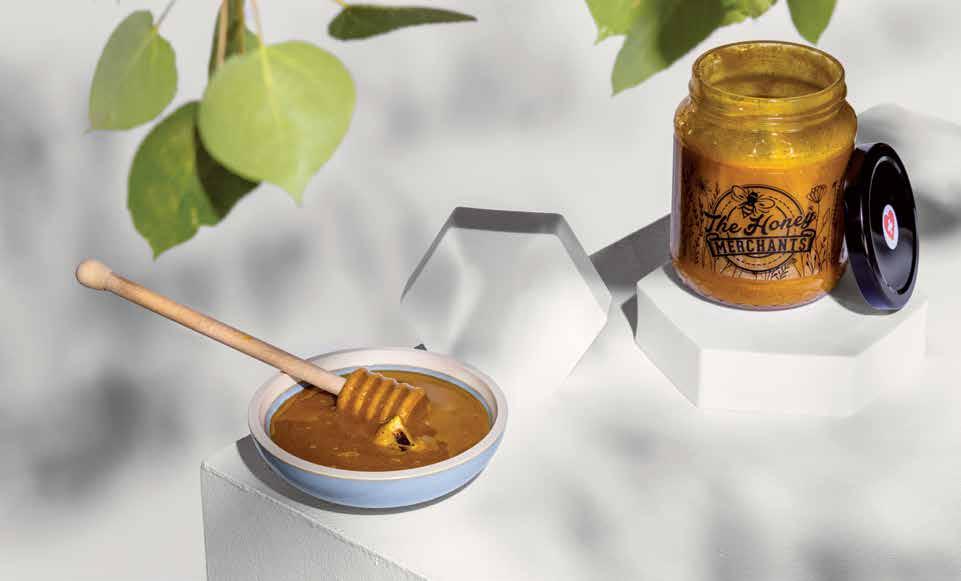
avenuecalgary.com 81
PHOTO BY JARED SYCH
WINNER
Chin Chin Poppers by Travelling Dishes Made in Edmonton $7.50
FOOD
NON-ALCOHOLIC
DRINK
Rviita Energy Tea by Rviita Inc.
$50 for 10-pack rviitalize.com
WHAT THE JUDGES SAID
THE PACKAGING ON THIS PRODUCT MAKES IT STAND OUT FROM THE CROWD. IT ’ S LIGHTWEIGHT, FLEXIBLE AND PACKS DOWN SMALL. IT IS THE PERFECT ENERGY DRINK FOR CAMPING AND HIKING. OWEN KIRKALDY
Caffeinated energy drinks can be an opportune tool to give you the extra kick you need to get through a tough day, but excessive caffeine consumption can also be dangerous. Mitch Jacobsen, CEO of Rviita Energy Tea, witnessed the ill effects of energy drinks when a friend suffered a minor heart attack due to overconsumption. Though his friend recovered, this close call forced Jacobsen to reconsider his own addiction to energy drinks, as well as wonder: what exactly was in them?
After extensive research, he was inspired to make a better version and Rviita Energy Tea was born. Rviita is the only non-carbonated, naturally sweetened, tea-based energy drink currently on the Alberta market. All of the caffeine in the beverage comes directly from the tea, which has additional health benefits. “Amino acids, tannins and molecules ... effectively combine with caffeine

to prolong its positive effects, so you don’t get the same crash or quick spike you get from other drinks,” Jacobsen explains.
Approximately six years since first formulating their beverage, Jacobsen, his sister, Karly, and his best friend, Rob Wigg, are now retailing Rviita at major grocery chains such as Safeway, Sobeys and Walmart, as well as Calgary Co-op, Blush Lane, Sunterra Market, Community Natural Foods and others. Since inception, the company has sold almost 850,000 Rviita Energy Tea drinks in flavours such as peach, elderberry and black cherry.
The functional packaging is a big part of the product’s popularity — a pouch-like container that can be flattened and folded when empty.
“The overwhelming positivity we received from the community of people who are happy that there’s a great-tasting, healthy alternative to what’s out there has been really encouraging,” Jacobsen says. “I think that’s what keeps us going.” —A.M.
NON-ALCOHOLIC DRINK CATEGORY RUNNERS-UP
Carbonated Greek Yogurt Smoothie by Bijano Foods Ltd. Made in Calgary $4 bijano.com
Non-alcoholic Raspberry Lemon Gin & Tonic by Confluence Made in Calgary $14.99 (4-pack) confluencedistilling.ca
Foxy Tea by The Wild Stuff Made in Diamond Valley $22 the-wild-stuff.com
82
MADE IN CALGARY
september/october 2023
WINNER


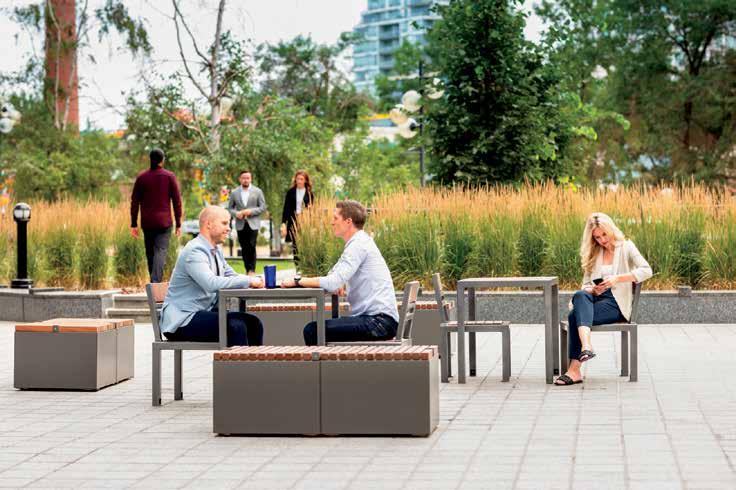



avenuecalgary.com
WINNER
ALCOHOLIC
DRINK
$24 spirithillswinery.com
WHAT THE JUDGES SAID
ALBERTA WILDFLOWERS INTERTWINE WITH THE EXQUISITE ARTISTRY OF WINEMAKING — NATURE’S ESSENCE, BOTTLED. IT ENCHANTS THE PALATE WITH ITS CRISP, DELICATE FLAVOURS AND SMOOTH FINISH. JOCELYN MACGREGOR
we’re 100 per cent on the level when we tell you that this year’s winning alcoholic beverage is a wonderful wine from Millarville. No, there are no vineyards there (and good luck to anyone who tries to plant one). Rather, this “wine” is made with wildflowers.
Shock and awe are the standard responses that winery owner Hugo Bonjean says he gets when introducing his products to hospitality professionals.
“It’s most enjoyable for us at this point to go into the top restaurants around the world with our flower wines from Millarville,” he says. “You meet with the sommeliers and it just knocks their socks off. They say, ‘Wow, we did not expect this.’”
Bonjean, who runs the winery with his wife, Ilse de Wit, hails from a multigenerational winemaking family with vineyards in central France. He and his family settled in the Millarville area in 1997. The
idea to make wine was a product of both his roots and a commitment to living off the land. “We started out with dandelion wine — because almost everybody in Alberta has a grandfather or grandmother who used to make dandelion wine — so we decided to craft a royal version of that,” Bonjean says. Clearly, this is not your grandad’s dandelion wine. Spirit Hills hires pickers to gather local wildflowers and then harvests the nectar and the petals, which are then fermented with honey and berries. The winery offers tours and tastings that guests have ranked on-par with tours in places like California’s Napa Valley. Spirit Hills exports to Europe and Japan and its wines have been served in Michelin-starred European restaurants.
Their winning Whitetail is an oaked violet flower wine, perfect for sipping on a patio or pairing with white meats, seafood and cheeses, and is proof that, while wine from Millarville may be a curiosity, it’s also a legitimate world-class beverage. —S.A.

ALCOHOLIC DRINK CATEGORY RUNNERS-UP
Brett
Reifel
blindmanbrewing.com
albertadistillers.com
fallentimbermeadery.ca
september/october 2023 84
Whitetail by Spirit Hills Winery
24-2 Stock Ale by Blindman Brewing Made in Lacombe $9.50
Rye by Alberta Distillers Ltd. Made in Calgary $45 to $52
Meadjito by Fallentimber Meadery Made in Water Valley $16 (4-pack)
MADE IN MILLARVILLE







avenuecalgary.com 85 C P
W Go global with TAP Alberta Get the tools, connections and knowledge to take your business to international markets. The Trade Accelerator Program has been supported by Innovation, Science and Economic Development. Apply for Alberta’s free cohorts: TAPAlberta.com PRESENTS Whisky Calgary November 11th, 2023 Get your tickets today at whiskycalgary.ca Held at
H
WINNER (TIE)
WHAT THE JUDGES SAID
SAVOURY FOOD
OG GHEE HAS TRULY BEEN A GAME-CHANGER IN MY CULINARY JOURNEY. THIS PRODUCT HAS BROUGHT A DELIGHTFUL TOUCH TO MY EVERYDAY COOKING, AND ITS SMOOTH TEXTURE AND RICH FLAVOUR EFFORTLESSLY ENHANCE THE TASTE OF MY DISHES, WHETHER I ’ M MAKING A CURRY, PAN-FRYING AN EGG OR THROWING TOGETHER A PASTA DISH. CHANRY THACH
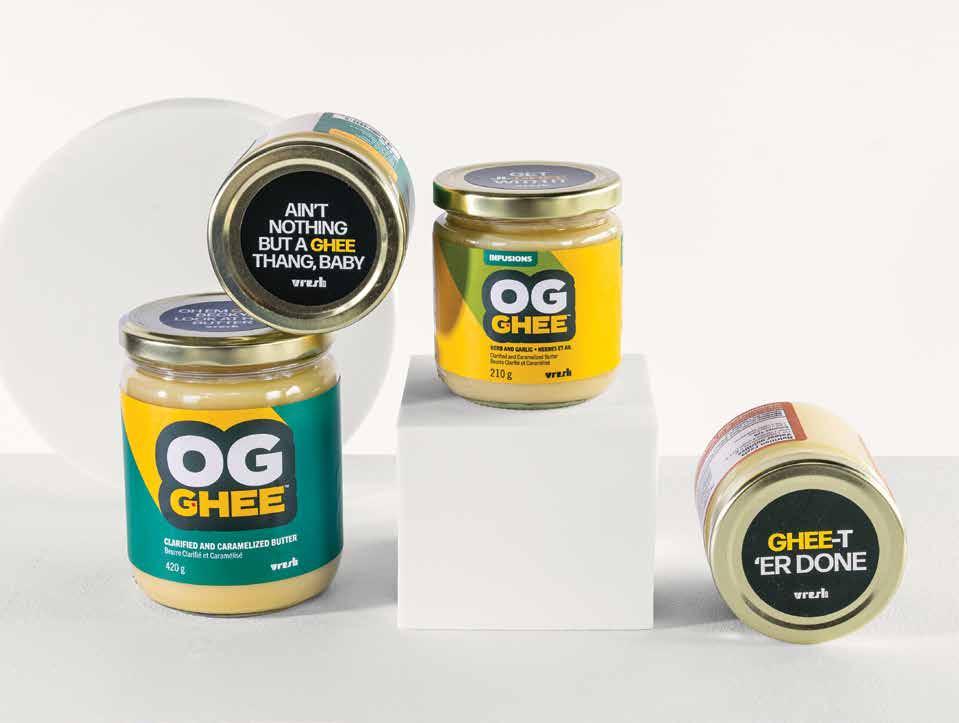
MADE IN CALGARY $17 to $26 vreshfoods.com
Monster Crunch Chili Crisp by Monster Sauce
MADE IN CALGARY $15 monstersauce.ca
No, you’re not seeing double: in the Savoury Food category, we have a tie for First Place. The two winning products were deemed equally excellent by this year’s judges and, since two are better than one when the two in question are this delicious, we decided to bestow best-in-show ranking on both of these Calgary-made miracles: OG Ghee by Vreshfoods and Monster Crunch Chili Crisp by Monster Sauce.
Vreshfoods founder Vresh Nagarajan likes to call ghee “caramelized butter.” It’s the perfect descriptor. This staple ingredient for Indian cuisine sits somewhere between clarified and brown butter and boasts numerous benefits — from a higher smoke point to being nearly lactose-free thanks to the removal of milk solids during the clarifying process, essentially making it a buttery option for the dairy-intolerant.
Ghee has yet to reach the same level of fame in Western cuisine as soy sauce or kimchi, but
86
OG Ghee by vreshFOODS
september/october 2023
Nagarajan believes half the battle is educating the masses. It’s part of the inspriation behind his OG Ghee — that, and the fact that people who subscribed to his Fresh with Vresh at-home meal kits couldn’t get enough of it. “I got a lot of feedback from tons of folks who were like, ‘Can I just buy the ghee from you?’” Nagarajan says.
The ghee can be used to baste a steak, or for shallow-frying your favourite food. In any situation, it’s sure to enhance the flavour. “At the end of the day, it’s a substitute for butter,” Nagarajan says.
Monster Sauce’s delicious Monster Crunch Chili Crisp is poised to become your new pantry staple. Co-founders and partners Kelly Mandeville and Paul Massie created the crunchy condiment to serve adventurous, spice-loving home cooks like themselves: people looking to elevate their everyday cooking.
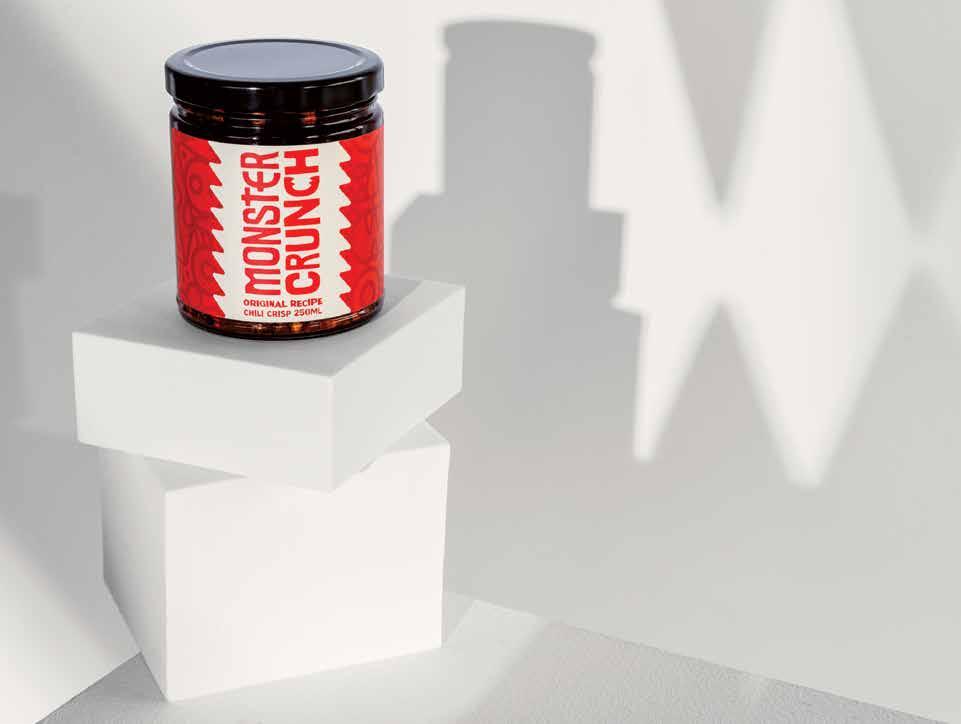
A Chinese food staple, chili crisp isn’t standard
on local grocery shelves just yet, so, when travelling to places where it is more common, such as Portland, Ore., the duo capitalized on the opportunity to taste-test. “We would bring back suitcases full of sauce,” Mandeville says.
Their research methods certainly paid off. Monster Sauce’s chili crisp includes fried garlic and peanuts (for extra crisp), ginger, onions, two kinds of chiles, seaweed and salt in both the original recipe and the extra-hot version. The sauce has gained traction and was even given a starring role on the menu at Leopold’s Tavern last April, when the Monster Crunch Burger was honoured as the pub’s Burger of the Month.
“You can put it on everything,” says Mandeville, who admits she has even tried it over vanilla ice cream.
Sweet or salty, Monster Crunch Chili Crisp is sure to spice up any dish.—A.M
SAVOURY FOOD CATEGORY RUNNERS-UP
Red Miso Bacon by Respect the Technique Made in Okotoks $12 respectthetechnique.com
Rosé Sauce by Soul Bowl Kitchen Inc. Made in Calgary $13 to $60 soulbowlkitchen.com
WHAT THE JUDGES SAID
I’VE HAD A LOT OF CHILI OILS, BUT THIS ONE CHANGED THE GAME FOR ME. AMAZING FLAVOUR, WONDERFUL CRUNCH AND BEAUTIFUL PACKAGING MAKE THIS AN INSTANT FAVOURITE. I HAVE TO STOP MYSELF FROM PUTTING IT ON ALL MY MEALS!
MATTHEW PENNER
avenuecalgary.com 87
Top Grass Burgers by Top Grass Cattle Co. Ltd Made in Calgary $13 to $15 topgrass.ca
PHOTO BY JARED SYCH
WINNER (TIE)
FURNISHINGS
AND HOME DECOR
Tesoro Folding Door System by Lux Windows and Doors
MADE IN CALGARY
$12,000 to $60,000 Luxwindows.com
WHAT THE JUDGES SAID
THE TESORO FOLDING DOOR SYSTEM OFFERS SO MUCH STYLE AND POLISH TO ANY ROOM.
THIS IS A WORLD-CLASS PRODUCT THAT BRINGS THE OUTDOORS IN, AND VICE VERSA.
DAYLE SHEEHAN
Creating living spaces that seamlessly blend the indoors with the outdoors in places like California is easy. But, in Calgary, where the weather can be less than co-operative, not so much. The Tesoro Folding Door System, created by Lux Windows and Doors, makes it possible — and does so robustly and with panache.
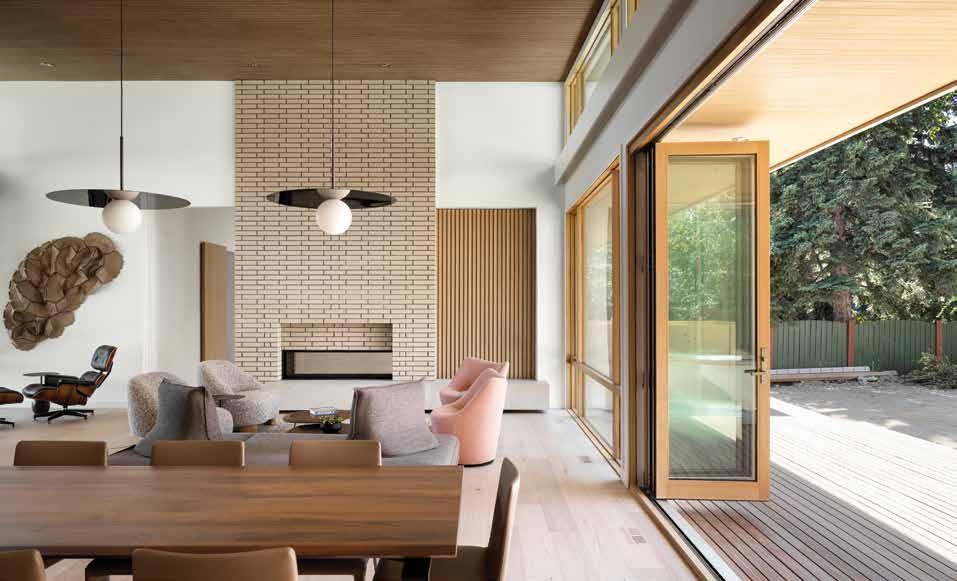
Manufactured in Alberta and designed to withstand our challenging climate, this folding door system is built for year-round comfort. When closed, the doors resemble regular patio doors, providing insulation and security. But, with a simple fold and slide, they transform into a dramatic gateway that brings the outdoors in.
The Tesoro’s large glass surfaces — up to 10 feet high and 38 feet wide — allow natural light to fill a space while affording expansive outdoor views. Its state-of-the-art hardware enables even massive configurations to glide seamlessly from open to
closed, ensuring a smooth transition between indoors and out.
Lux offers more than 25 possible configurations with low-maintenance exteriors, warm wood interiors and a range of glazing options, allowing homeowners to personalize the door system to suit their individual tastes and style.
The engineered wood rails provide durability and strength, while the double-weather stripping provides optimal insulation against the cold. These doors are meticulously constructed and tested to withstand the harshest elements that Canada's climate can throw at them.
Connection to nature promotes well-being, reduces stress and enhances overall quality of life. The Tesoro Folding Door System bolsters this connection by expanding living spaces, creating versatile gathering places and inviting the beauty of the outdoors into our homes.
Take that, California! —J.H.
FURNISHINGS AND HOME DECOR CATEGORY RUNNERS-UP
Permanent LED Lighting by Lumenox Made in Calgary $24 per foot lumenox.ca.
Flower Vases by Suspended Studio Made in Edmonton $250 suspendedstudio.com
UNWIND Beeswax Candle by Misiyo Candle Co Made in Leduc $19 to $36 misiyo.com
88
PHOTO BY EYMERIC WIDLING
september/october 2023
WINNER
UNIQUE PRODUCT
MADE IN CALGARY
Cribbage has remained a beloved pastime for the last four centuries, found in game cupboards, cottages and Legion halls across Canada. Originally invented in England, the game quickly gained popularity among early Canadian explorers and whalers and the Inupiaq people of Alaska, who crafted cribbage boards from walrus tusks.
In July 2022, the team at Knurl brought a new twist to the old game by adding a distinctly Albertan feature: mountains.
Mt. Cribb overlays the game of cribbage onto a 3D topographic surface resembling famous mountain ranges. As players progress through the game, the little crib pegs begin “climbing.” The first to reach the peak is the winner.
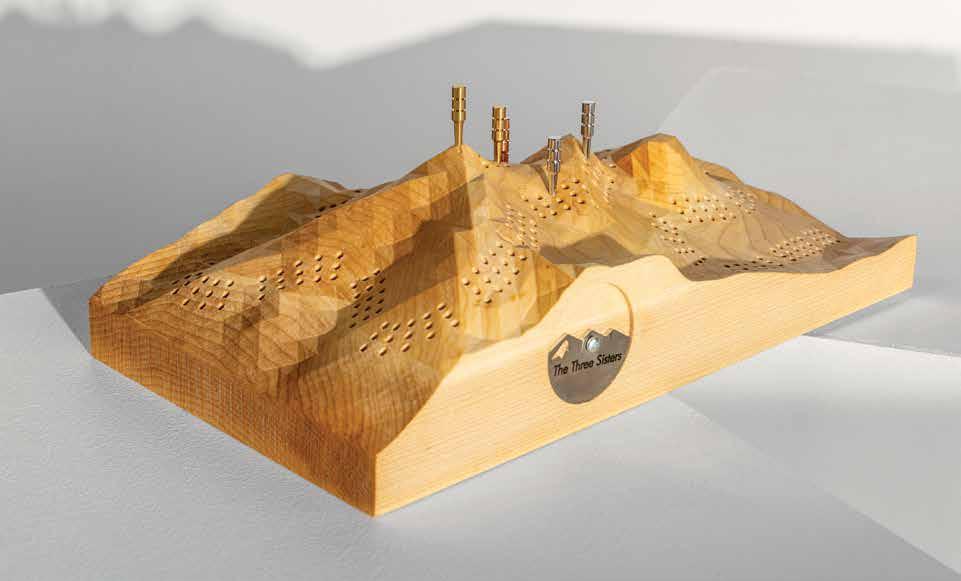
Knurl co-founder Brett Sanderson says his own childhood memories of playing cribbage and spending time in the mountains informed the
development of Mt. Cribb. “Cribbage has always been the go-to activity for my family. My grandmother was always keen to get a game in with all of her grandkids. Some of my fondest memories of her are playing cribbage together,” says Sanderson. “All of us here at the shop are also huge fans of the Rockies. We love any chance to escape the city and enjoy some of Alberta’s wilderness.”
The idea for Mt. Cribb initially came from a custom request for a 3D cribbage board. From there, the Knurl team grew the idea to design a board in the likeness of the Three Sisters in Canmore. The idea was a hit and there are now 16 different mountain variations. The most popular continue to be the Three Sisters and Ha Ling Peak. Requests have also come from outside Canada, with Mt. Rainier another top contender. “We’re delighted to see the culmination of our efforts and experience result in something that so many have enjoyed so much,” Sanderson says. —M.R.
UNIQUE PRODUCT CATEGORY RUNNERS-UP
NutraStat
WHAT THE JUDGES SAID
3D PLUS THREE SISTERS EQUALS THREE GOLD STARS. THIS JUST MAKES YOU WANT TO PLAY CRIB, EVEN IF YOU DON’T REMEMBER HOW. IT'S ALSO A BEAUTFUL CENTREPIECE AND A CONVERSATIONSTARTER.”
KELLY JUBENVILL
avenuecalgary.com 89 WINNER
Mt. Cribb by Knurl
Artistic Wooden Jigsaw Puzzles by Palmaris Puzzles Made in Rocky View County $79 to $229 palmaris.ca
by Sunny Boy Foods Made in Camrose $23 nutrastatfiber.com
Happiness in a Bag: Freeze-Dried Raw Liver Treats by The Dancing Dog Co. Made in Grimshaw $11 to $12 dancing-dog.com
september/october 2023
$175 to $200 knurl.ca
READERS ’ CHOICE
Meadjito by Fallentimber Meadery
MADE IN WATER VALLEY
$16 for a 4-pack fallentimbermeadery.ca
mead is one of the first alcoholic beverages recorded in human history. Made from fermented honey and water and additional ingredients such as fruits, grains and spices, it’s found all over the world in various forms. So, when family-owned and operated Fallentimber Meadery entered its sparkling canned Meadjito — a mead-based take on the classic mojito cocktail — into the 2018 Jasper Beer & Spirits Festival, just one year after the product’s debut, it was high praise indeed when it was deemed the most innovative product in the room.
“There really wasn’t any sparkling mead being produced in Alberta before we did it,” says Chris Molyneux, sales manager and member of the family behind Fallentimber. “This product came to market prior to the craft cocktail/packagedcocktail explosion. It was very much ahead of the curve in that regard.”
The Meadjito combines honey, mint and lime and takes about eight weeks to produce, including

fermenting the base mead, flavouring it with fresh ingredients and force-carbonating the drink prior to packaging. The use of hyper-local ingredients is truly what sets this drink apart from other canned cocktails: the honey is made with Fallentimber Farm’s wild flowers (mostly clover), and the mint leaves are grown and hand-picked in Fallentimber’s greenhouses. “It’s too bad we can’t grow limes in this climate,” says Molyneux, with a laugh. “Then we’d really be off to the races.”
The Meadjito garnered rave reviews and requests for more when it debuted six years ago, and it still has a loyal following today. Molyneux attributes the cocktail’s success to its role as a “gateway mead” for consumers. “We've certainly cracked our way into the local beverage scene in a meaningful way,” he says. And, with Alberta’s thriving honey industry, the opportunity for growth is just as sweet. “We’re seated in the honeypot of North America here in Alberta,” Molyneux says. “We do have the opportunity to be global leaders in the industry.” —T.A.
september/october 2023 90
WINNER

MEET THE JUDGES
KAREN ASHBEE
Furnishings
and Home Decor
Karen Ashbee is the Calgary city editor for Western Living. She has a degree in marketing and economics from the University of Guelph and formerly developed major national accounts for beauty and lifestyle clients at Flare magazine. She also writes for The Globe and Mail and covered the first Saut Hermès event at Paris’ Grand Palais for Bombardier magazine.
MARIE BERTRAND Beauty
As chief creative officer of SkinScience, Marie Bertrand has more than 20 years of experience in the skin-care industry. Prior to founding SkinScience, Bertrand worked in management for L’Oreal Canada, developing skin-care training programs for cosmeticians and dermatologists throughout Canada. In 2018, Bertrand launched her own skin-care line, Aliquote Skin.



TARA COWLES
Beauty
Makeup artist and beauty entrepreneur Tara Cowles is the founder and director of Artists Within Makeup Academy and the creator of the makeup line AW03 Maquillage, which she launched more than 15 years ago. AW03 is available in various local Alberta businesses and also online at artistswithin.com.
HAITHEM ELKADIKI Fashion and Accessories

Libyan-Born, Toronto-bred, Haithem Elkadiki is a source of international style who continues to challenge the norm in Canadian fashion by offering sleek fits, bold colours, loud prints and mega-sexy swimwear for men. His collections have been selected to show at Berlin Fashion Week, L’Oréal Fashion Week (Toronto) and The POOL Vegas show.
YVONNE JOBIN
Amy Willier Award
Yvonne Jobin is Cree First Nation, originally from High Prairie, now residing in Calgary. She is the owner of Moonstone Creation, a gallery she started with her daughter, the late Amy Willier, namesake of the Made in Alberta Award for Indigenous Artisans. Jobin’s artwork is in private and public collections in Canada, the U.S. and Europe.
KELLY JUBENVILL Unique Product
An advocate for all things local, Kelly Jubenvill supports Alberta small businesses and non-profits with creative, fast and affordable project and operations solutions through her consulting practice, Solve4 Results Ltd. She helped develop and chair the Calgary Stampede’s Maker Market and spent two years chairing Your Brain on Art, a fundraiser for the Branch Out Neurological Foundation.
OWEN KIRKALDY
Non-Alcoholic/Alcoholic
Drinks

Owen Kirkaldy is president and education director of the Edmonton Homebrewers Guild, a Master-ranked BJCP Judge, and has acted as an instructor in beer-judging preparation courses. He has judged at the BC Beer Awards, Canadian International Beer Awards and Northern Lands Festival, and is cofounder and head judge of the Alberta Beer Awards.

SYLVIA KONG

Sweet Food
Coming from a family of food-lovers, Sylvia Kong thoroughly enjoys eating and trying new flavours. Through her Calgary-based business, Savory Palate Consulting, Kong is a food stylist, cookbook author, recipe developer, media spokesperson and home economist. She is always on the lookout to find the best banana cream pie (especially if it’s from a retro diner).
MELANIE LOVE

Unique Product
Melanie Love is a Coralus Activator, supporting Canadian women-led businesses. She is also a 10-year contributor to the Calgary Stampede, previously vice-chairing the Western Showcase Creative Arts & Crafts sub-committee and currently on the Downtown Attractions Committee. In 2016, she led a team to pitch the idea for a craft market at the Calgary Stampede that ultimately became the Maker Market.
JOCELYN MACGREGOR


Non-Alcoholic/Alcoholic Drinks
Jocelyn MacGregor is the proud owner of Mighty Pines Cocktail Co., a runnerup in the 2022 Made in Alberta Awards’ Alcoholic Drink category. MacGregor has over 20 years of experience in the creation and delivery of unique learning experiences in tourism and hospitality and her concentrated cocktail mixers are recognized in both the craft spirits and non-alcoholic beverage worlds.
92
september/october 2023 PHOTOS SUPPLIED BY JUDGES
VANESSA MARSHALL

Amy Willier Award
Vanessa Marshall is a proud Métis woman born and raised in northern Alberta, now based in Edmonton. She is the founder of Jack59, a women-led, Indigenous-owned beauty brand sold by more than 350 retailers across North America and winner of the beauty category in the 2022 Made In Alberta Awards. In 2022, Marshall also received the Indigenous Entrepreneur Award from Alberta Women Entrepreneurs.


SAID M’DAHOMA
Sweet Food
After receiving a PhD in neuroscience in Paris, Said M’Dahoma moved to Canada to conduct research at the University of Calgary, before quitting his career as a scientist to follow his true passion for baking. The French-Comorian pastry chef now teaches more than 300 amateur bakers across the world through online classes and courses crafted to introduce them to the delicious world of French patisserie.

JILL NUCKLES

Craft
Jill Nuckles is an artist and community outreach coordinator at the Alberta Craft Gallery. She has a business management diploma from MacEwan University and a Bachelor of Fine Arts with distinction in sculpture from the Alberta University of the Arts. Nuckles has been featured in many solo and group exhibitions and her art is available for sale in galleries throughout Western Canada.

MATTHEW PENNER

Savoury Food
Matt Penner has worked in the natural foods industry for over 15 years, and is the category management lead and manager of e-commerce for Community Natural Foods (CNF). He believes that, with a commitment to people and the planet, we can truly make change in the world, focusing on reducing packaging and sustainable ingredient sourcing. The CNF core value that he resonates with the most is radical transparency.
DAYLE SHEEHAN
Furnishings and Home Decor
Dayle Sheehan is lead designer and owner of Dayle Sheehan Interior Design Inc. and Dayle Sheehan Website and Social Media Consulting. Through her inspiring story of managing a neuromuscular disease and chasing her dreams, Sheehan aims to inspire others to live their best lives in the most beautiful environments possible, and is a soughtafter public speaker, advocate and a thought and lifestyle influencer.
CHANRY THACH
Savoury Food
Chanry Thach is a marketing professional and agency owner with a passion for all things culinary. For the past decade, she has shared her love of food through her Instagram profile and her writing, which has been featured on the Food Network online, CBC Hamilton, Hamilton Magazine and in Avenue, where she co-curated the Best Things To Eat lists for 2022 and 2023.
ALYKHAN VELJI
Furnishings and Home Decor
For 15 years, Alykhan Velji’s boutique design firm has brought an energetic flavour to the Canadian design scene. Recently shortlisted for WL Magazine’s Designer of the Year 2022, Velji is the resident TV design expert on The Marilyn Denis Show, and has been featured in numerous publications including Architectural Digest India, House and Home, The Globe and Mail, and Style at Home
NICHOLE WINDBLAD
Craft
Nichole Windblad is the owner, director and producer of the nationally renowned annual Art Market, one of the few highly successful, high-end art and craft sales in Canada. Windblad believes in supporting fine art and craft and serving both the consumers and the artisan community. She is the mother of two adventurous, fabulous boys.
RANDY WONG

Unique Product
Randy Wong is co-owner of Hexagon Board Game café with his partner, Kellie Ho. They opened Hexagon in 2014 with a collection of 400-plus games. Hexagon has since grown its collection to 2,000-plus board games, split between locations in Edmonton and Calgary. From espresso sourced from a Calgary roastery to local beers on tap, customers love knowing that what they consume at Hexagon is made in Alberta.
KARI WO0
Fashion and Accessories
Founder and creative director of Draw the Line Jewelry, Kari Woo is an independent studio jeweller, mixed-media artist and entrepreneur. Known for her understated and modern aesthetic, her award-winning contemporary jewellery is distributed across Canada and the U.S. Draw the Line’s Signature Collection was the Made in Alberta Awards Fashion and Accessories categorywinner in 2022.
avenuecalgary.com 93
cozy& cool
THERE’S NO DENYING THE COLD WEATHER AHEAD, SO GO ALL IN WITH OUTERWEAR
 PHOTOS BY JARED SYCH
STYLED BY JULIE ROTH ART DIRECTION BY STEVE COLLINS
HAIR AND MAKEUP BY PHOEBE HEARD , ARTISTS WITHIN MODELS AVAH A. AND NATHAN L. , MODE MODELS SHOT ON LOCATION AT CONTEMPORARY CALGARY
PHOTOS BY JARED SYCH
STYLED BY JULIE ROTH ART DIRECTION BY STEVE COLLINS
HAIR AND MAKEUP BY PHOEBE HEARD , ARTISTS WITHIN MODELS AVAH A. AND NATHAN L. , MODE MODELS SHOT ON LOCATION AT CONTEMPORARY CALGARY
 NORMA KAMALI DRESS, $298; AND FIRST BORN KNITS SWEATER, $425, FROM COLLINS ST.; CHANEL JACKET, $2,495, FROM VESPUCCI; BILLINI BOOTS, $160 (SALE $128), FROM HUDSON’S BAY.
 MONCLER TURTLENECK, $265; PHILIPP PLEIN COUTURE FUR PANTS, $995; ANN DEMEULEMEESTER SHOES, $395, ALL FROM VESPUCCI; VEST, $795, FROM CANADA GOOSE.
 LE 31 SUNGLASSES, $19, LE 31 JOGGERS, $89, SCOTCH & SODA SWEATER, $228 (SALE $99.95), AND SIMONS X BOULET BOOTS, $325, ALL FROM SIMONS; JACKET, $950, FROM CANADA GOOSE.

september/october 2023 98
C.P. COMPANY BALACLAVA, $275; LE 31 JUMPSUIT, $175, KARHU SHOES, $210, ALL FROM SIMONS; VEST $695, FROM CANADA GOOSE.
 GLAMOROUS JACKET $319, FROM THE BAMBOO BALLROOM CALGARY; GUCCI X THE NORTH FACE ZIP-UP JACKET, $1,995, GUCCI SHORTS, $1,995, AND AEYDE BOOTS, $325, ALL FROM VESPUCCI.
 MOOSE KNUCKLES JACKET, $495; CHANEL BAG, $5,995; VICTORIA BECKHAM SUNGLASSES, $345, ALL FROM VESPUCCI; KATE HEWKO SKIRT, $138 (SALE $124), FROM KATE HEWKO; ALIAS MAE SHOES, $285, FROM HUDSON’S BAY.
West Island College’s (WIC) state-of-the-art 40-foot x 65-foot greenhouse aims to revolutionize the student experience by cultivating green minds and empowering young changemakers to shape a more sustainable future.


Under the guidance of WIC greenhouse guru Tim Kruchkowski of GreenprintsYYC, students have embarked on a transformative journey that combines theoretical learning with practical applications.

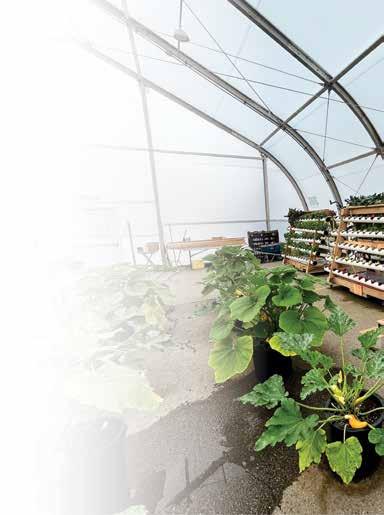
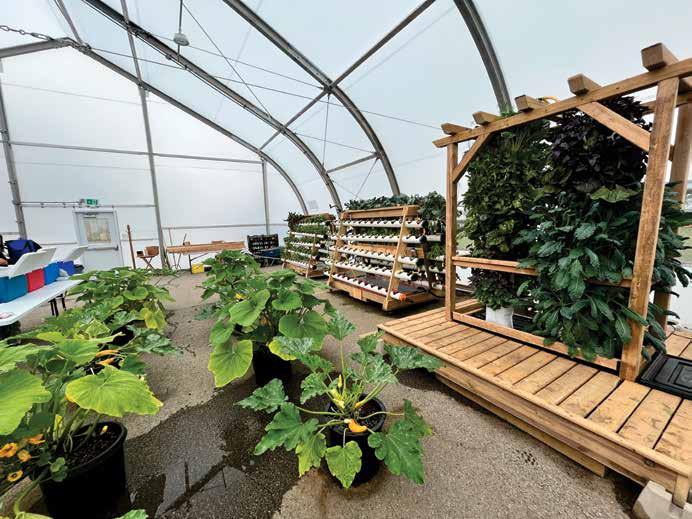
In its first year, students, staff and community members enjoyed delectable delights such as squash, kale, swiss chard, dill and zucchini. Excitement brews as they eagerly anticipate sharing more delicious produce in the coming year.

Within the greenhouse lies a realm of boundless opportunities for the WIC community and beyond. Fueled by their unwavering dedication, students in the greenhouse option course are actively propelling the program forward, championing a sustainable future for generations to come.

Ready to learn more? Visit the greenhouse and tour the campus during the WIC annual Open House, Thursday, October 12 at 6:30 p.m.
RSVP today on the WIC website!


avenuecalgary.com 101 Art. Right here on your doorstep. Come for the art. Stay for the art. See what’s on. #701 11th Street SW
@contemporarycalgary
C C.C
C F C
JACKET, $1,195, AND SHOES, $595, FROM CANADA GOOSE; PRADA BAG $395, FROM VESPUCCI; THE NORTH FACE PANTS $240, FROM SIMONS.
The Bamboo Ballroom Calgary 814 16 Ave. S.W., 403-454-1088, bambooballroom.ca; Canada Goose CF Chinook Centre, 587-355-8058, canadagoose.com; Collins St. 6120 2 St. S.E., Unit A9-E, 403-452-9352, shopcollinsst.com; Hudson’s Bay multiple Calgary locations, thebay.com; Kate Hewko 908 17 Ave. S.W., 587-356-1229, katehewko.com; Simons The Core Shopping Centre, 403-697-1840, simons.ca; Vespucci 8244 Elbow Dr. S.W., 403-252-9558, vspconsignment.com; Winners multiple Calgary locations, winners.ca

FASHION
SOURCE

avenuecalgary.com 103 VOTING : AUGUST 29 TO SEPTEMBER 15, 2023 VOTEFORYOURFAVOURITE RESTAURANTsINCALGARY Upcoming Events Garden Noir | September 15 An evening of elegance and indulgence. ZooDunnit | October 13 Crack the case at the zoo’s new interactive murder mystery evening. Visit calgaryzoo.com. Discover adult-only events at the zoo
BY MICHELLE MCIVOR PHOTO BY JARED SYCH
HOW TO DRESS FOR SWEATER WEATHER
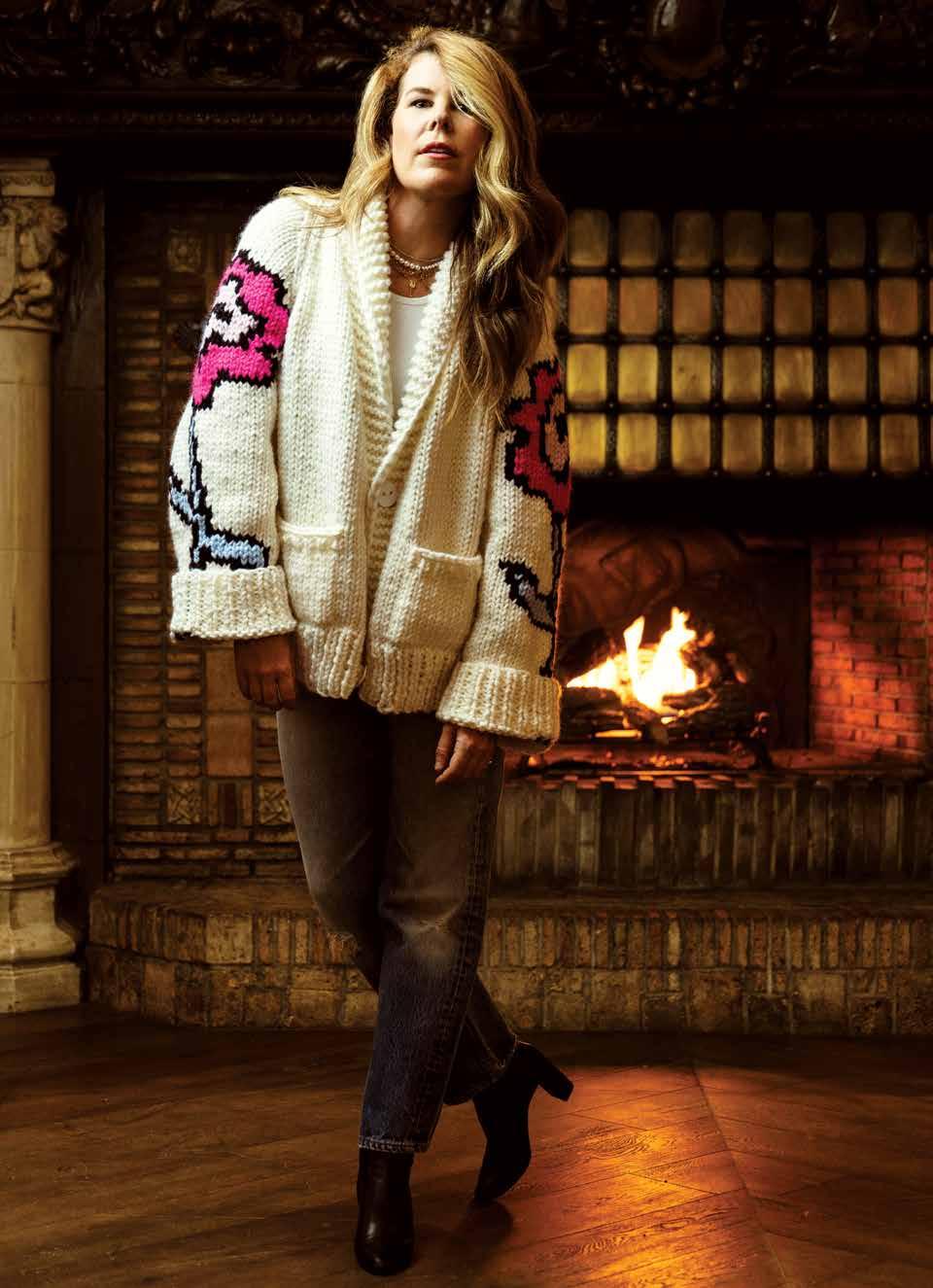
It’s always sweater weather for South van der Lee. The president and designer of GOGO, the Calgary-based brand renowned for its chunky hand-knit cardigans and pullovers, has sweaters to suit every season. But, she says there’s nothing like dressing for fall. “It’s such a clean, cool, crisp season,” she says. “And wearing a GOGO feels like you’re getting a warm hug.” Her ideal fall outfit includes neutral pieces such as a denim shirt or black maxi dress, jewellery with sparkle, and a colourful sweater (a GOGO, naturally). When temperatures plummet, van der Lee layers a denim or puffer jacket underneath her sweater. “Most people wear their knits underneath something,” she says, “but I love wearing my sweater as the exterior piece, where people can see it.”
GOGO Flower Jacket sweater in the colour “ snow ” from the new fall/winter collection; rag & bone top, and Justine Clenquet necklace, purchased from online retailer SSENSE; jeans, vintage Levi’s 501; Saint Laurent Lou ankle boots from Holt Renfrew; gold necklace purchased at a tiny shop in Rome, Italy.
september/october 2023 104 Calgary Style
KNITWEAR DESIGNER SOUTH VAN DER LEE EMBRACES FALL BY MAKING HER SWEATERS THE STAR.

avenuecalgary.com 105 Thank you to ouR sponsors
NATIONAL DAY FOR TRUTH & RECONCILIATION
SEPTEMBER 30, 2023
ELDERS STORY PROJECT
Members of the Elders Knowledge Circle Society share their stories of survival and resilience, in this powerful event.
-
Jack Singer Concert Hall | 7 PM
MAKERS MARKET
Curated by Four Winds Indigenous Market and Showcase.

Jack Singer Concert Hall Lobby | 12 - 6:30 PM
CELEBRATING INDIGENOUS LIFE THROUGH FILM
A selection of films provided courtesy of the National Film Board of Canada about Indigenous lives, traditions, and history.

Engineered Air Theatre | Times Vary


july/august 2023 106
artscommons.ca/NDTR AT ARTS COMMONS
Special Thanks Elders Story Project Circle of Relatives Public Sector Support Circle of Supporters Market Curator ELDERS KNOWLEDGE CIRCLE SOCIETY
HOME SWEET NEW HOME





As new arrivals decide to settle into Calgary and existing residents also seek out contemporary home builds, new communities in and around the city continue to accommodate.













See how these neighbourhoods combine both nature and amenities, and offer options for every stage of life.

107 ILLUSTRATIONS: MARUMARU, COURTESY STOCK ADVERTISING FEATURE
SHOWING OFF SHAWNEE PARK
THE LAST NEW BUILD COMMUNITY BORDERING FISH CREEK PARK.

specifications, including Hardie board siding, aggregate driveways, full-yard landscaping with irrigation and finished decks. Many lots offer scenic views overlooking green spaces filled with trees. Cardel Homes’ meticulous attention to detail and unwavering commitment to quality ensure an innovative product line featuring modern floorplans with undeniable curb appeal. For over 50 years, Cardel Homes has been building exceptional homes and communities, and Shawnee Park is a shining example. Accessible conveniences, natural surroundings and exquisite homes come together to create a one-of-akind lifestyle. It’s time to make this charming community home.
Counting the Green


20 -metre greenbelt surrounds most of Shawnee Park
25 percent of community dedicated to green space
Shawnee Park is an award-winning community like no other in Calgary. This unique infill development is found in an established part of the city’s southwest within walking distance of Fish Creek Provincial Park and showcases contemporary architecture as well as parks, green space and an abundance of trees.
Built on the last developable land bordering Fish Creek Park, Shawnee Park residents can escape into its endless natural surroundings and feel miles away from the city while living in the heart of Calgary’s thriving southwest. Fish Creek Park, one of North America’s largest urban forests, offers a 3,000-acre playground for outdoor adventures. Only minutes from home, there’s a place to hike through the trees, fish in the creek, bike down single-track trails or have a picnic while watching for wildlife. The opportunities to enjoy nature are limitless.
Parks, paths and trees are everywhere in the community. The greenbelt connects many of the larger parks and provides a buffer between Shawnee Park and adjacent neighbourhoods. East Park, Central Park and the newly finished West
Park have dynamic playgrounds for imaginative play and open spaces for a game of frisbee or frolicking with the dog. There are picnic areas, sports courts and even a wetland environmental reserve. Seamlessly weaving nature into the community’s fabric, Shawnee Park is one of Calgary’s most beautiful neighbourhoods.
Another major perk of Shawnee Park is its location. It’s situated just off James McKevitt Road, near MacLeod Trail, Tsuut’ina Trail and the Fish Creek-Lacombe LRT, making getting around easy with access to major roadways and public transit. Unlike in other new communities, residents don’t have to wait for amenities to appear. From coffee shops and restaurants to grocery stores, shopping centres, daycares and schools, everything is readily available and conveniently close.
This compelling community deserves an equally captivating selection of homes, and Cardel Homes delivers with its premium estate designs. Boasting two-storey houses and bungalows with double- and triple-garage options, these stunning residences come with superior
33 acres of parks and green space
580 mature trees within the community

3000+ trees planned for Shawnee Park
3000 acres of terrain to explore in nearby Fish Creek Park
Learn more at shawneepark.ca.
108
ADVERTISING FEATURE



LEWISTON PRIORITIZES NATURE AND SUSTAINABILITY
When Genesis Land planned the northeast community of Lewiston, the developer knew the new neighbourhood needed to include lush green space with ample pathways to create an outdoor haven.
And so, Lewiston is designed as an active neighbourhood where residents connect through a common appreciation of nature, featuring 130 acres and a 30-acre wetland. Four parks are framed by surrounding homes, which includes close to 1,000 low-density homes and 150 multifamily homes.
“A big benefit of this next generation of communities is the diversity in the product,” says Genesis Land’s vice-president of land development, Brendan McCashin. “There’s something for everyone and every lifestyle. It has a great diversity of housing for the whole community, and it’s greener and more sustainable than the communities of the last couple of decades.”
Lewiston offers affordable middle-class homes for families, singles or empty-nesters. “It could be your first home, your second home or your last home,” McCashin adds. “The idea of being able to age-in-place with some of the newer technologies coming along creates a
welcoming community feel.”
Another characteristic that distinguishes Lewiston as a new kind of suburb is the mixeduse hub built at the heart of the community. It will offer retail space for restaurants, cafes and boutiques, commercial space for services such as lawyers and dentists, and housing diversity. A joint-use site will also incorporate a K-6 separate elementary school and playfields.
McCashin adds that it was important to scale the community to pedestrians, cyclists, growing families and outdoor enthusiasts. “There are lots of trails and pathways throughout these great open spaces and parks,” he says, adding the concept of live, work and play can be easily accomplished in Lewiston.
PLANNING FOR THE FUTURE
“We know people love their parks and water amenities so we paid a lot of attention to detail around that,” McCashin says, adding Lewiston was designed with sustainability in mind.
“There’s an expectation from residents that their new homes and new communities be sustainable and something that they can be proud of talking to their friends and families about.”
That meant enhancing the existing drainage

course and integrating the adjacent wetland park into the community, while ensuring the restoration of natural areas, including planting more than 2,000 trees. “We are creating an urban forest that people will love, in their own backyards,” McCashin says.
Much attention has also been paid to how to bring the community to life with future-forward infrastructure that will evolve over decades to come. Every Lewiston home will have roughins for solar panels and EV charging stations as well as high-efficiency furnaces and hot water tanks, LED lighting throughout and smart home technology.
The overall design of the community plus its location near Stoney Trail makes Lewiston the perfect place to establish roots. “There’s easy access to both the airport and the mountains,” McCashin affirms.


Lewiston is currently under development with building partners including Genesis Builders, McKee Homes and Sterling Homes, and could see its first residents next summer.
Learn more at genesisland.com/community/lewiston.
110 PHOTOGRAPHY BY JOSH GAGNON
ADVERTISING FEATURE
GENESIS LAND’S NEW NORTHEAST COMMUNITY IS THE PERFECT HAVEN TO LIVE, WORK, PLAY AND GROW.

URBAN CONVENIENCE MEETS THE SIMPLICITY OF NATURE IN TWO NEW COMMUNITIES
MELCOR CELEBRATES ITS 100-YEAR ANNIVERSARY


 BY UNVEILING SORA AND GOLDWYN.
Marking 100 years of building communities that enrich quality of life, Melcor Development’s resilience and passion have helped it thrive through the past century.
Melcor continues its community-building by launching two new communities in Calgary and area — Sora at Hotchkiss in Calgary’s southeast and Goldwyn in Balzac. “It speaks to the city overall, the community landscape and amenities that families are coming to Calgary to build a life here no matter where you are in the journey,” says Erin Cripps, project coordinator at Melcor. Whether you’re seeking a community where you can connect with nature or embrace the simplicity of prairie living, Melcor offers a place to settle for individuals in every stage of life, from entry-level single family to estate living.
SORA AT HOTCHKISS
Located just off Stoney Trail SE, near many shopping and dining options, Sora is a community where young families will soar.
“Named after the sora bird and the feeling of a bird soaring in-flight, Sora is a safe and calm community for families to build their nest,” says Cripps.
The 140-acre community features 37 acres of wetlands, 13 acres of parks and 900 homes that provide an escape from the hustle of urban life. Just steps from their homes, residents can also enjoy a network of scenic walking paths, boasting breathtaking prairie vistas with its open layout and high elevation.
Sora offers new-build, single-family, frontdrive garage homes, laned duplexes and street townhomes, starting in the $400,000s, from Douglas Homes, Rohit Communities, Homes by Avi, Akash Homes and Sterling Homes. The home designs work well for young families as well as health-care professionals wanting quick access to the South Health Campus hospital and outdoor enthusiasts who value active lifestyles.
“In Sora, life is easy, effortless, tranquil and energizing,” affirms Cripps. “It offers all the space and amenities needed for young families.”
Learn more at liveinsora.com.
GOLDWYN IN BALZAC
Bordering the north edge of Calgary, east of the Hamlet of Balzac, Goldwyn Prairie Estates will take your breath away. Named in honour of the region’s golden wheat fields and sunsets, Goldwyn combines the simplicity of prairie living with the convenience of the city.

“With scenic views of the Rocky Mountains in the distance and stunningly vivid prairie sunsets in a rural setting, Goldwyn offers the privacy and rustic beauty of prairie estate living while maintaining convenient access to urban amenities,” says Cripps.

Only a 20-minute drive from Calgary and Airdrie, Goldwyn residents enjoy proximity to the Rockies, providing abundant opportunities for hiking, mountain biking, kayaking and skiing.
Residents of this new community relish the benefits of owning spacious, single-family estate homes, starting in the $700,000s. “The ample lot sizes, starting at 50 feet wide, allow homeowners to pursue their hobbies and interests, with room for additions like a home library, a painting studio, a workshop or even a sauna or an extra garage,” says Cripps.
Lots can also be customized to add workshops, greenhouses, RV and boat parking, or a guest house suite. Each home can be modified to meet specific needs by builders such as McKee Homes, Brilliance Homes, Aspen Creek Homes, Green Cedar Homes, Akash Homes, Sterling Homes and Castellano Homes.
Learn more at liveingoldwyn.com.

112 ADVERTISING FEATURE




A GOLDEN OPPORTUNITY L IVE I N G OLDWYN.COM LEARN MORE BY SCANNING QR CODE
TWO NEW MUST-VISIT ESTATE SHOW HOMES IN HARMONY
THE WEST-SIDE COMMUNITY NOW HAS EVEN MORE THOUGHTFUL AND SPACIOUS HOME STYLES.
show home boasts a dramatic grand entrance with plenty of natural light, which leads into a gourmet kitchen. Upstairs hosts the laundry, three bathrooms and four bedrooms; the main bedroom is complete with double walk-in closets and an ensuite bathroom. The Scarlett also features a generous side-drive, triple-car garage with ample space for vehicles and outdoor gear.
THE HENDERSON II: A LUXURIOUS AND SPACIOUS BUNGALOW
Harmony — a master-planned community from Qualico Communities and Bordeaux Developments — makes living an active yet tranquil life easy.
With a 40-acre fresh-water lake, and a second, 100-acre lake currently under construction, the Mickelson National Golf Club and the upcoming Village Centre, which includes a world-class wellness spa, Harmony residents have so much to enjoy, just steps from home.






Townhomes start from the high $500s, front-


drive and rear-lane single-family homes from the high $700s, estate homes from $1.2M and lakeside homes from $1.3M. And two new estate show homes offer prospective buyers even more choice.
THE SCARLETT: A FAMILY-FIRST, TWO-LEVEL HOME
Built by Baywest Homes with more than 3,000 square feet, The Scarlett was designed with active and growing families in mind. This new
Augusta Fine Homes crafted a bungalow that meets the needs of modern couples and families who want all the space and thoughtful design of a single-family home — but without the stairs. At almost 2,000 square feet, The Henderson II features three bedrooms, 2.5 bathrooms and a home office. The nearly 30-foot-wide, lowerlevel family room and well-planned, seamlessly connected dining area and kitchen make family get-togethers a breeze, while the main bedroom is a spa-like retreat.
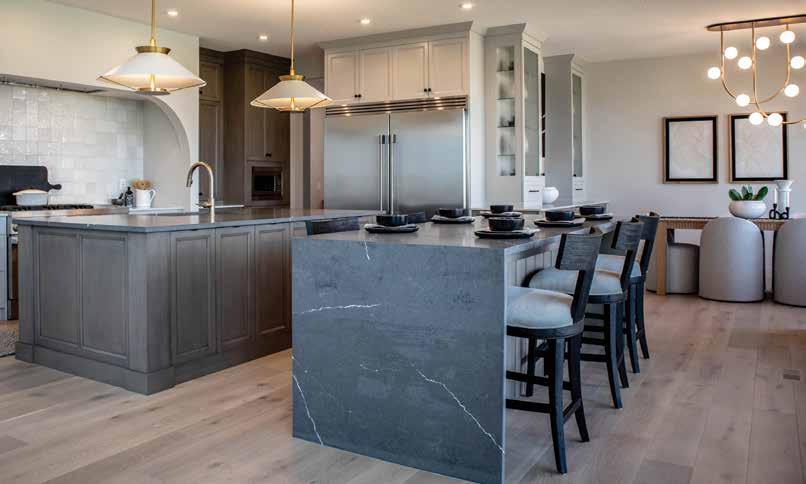
Visit liveinharmony.ca to learn more.
ADVERTISING
114 HOME PHOTOS COURTESY OF BAYWEST HOMES
FEATURE
THREE NEW CALGARY AND AREA COMMUNITIES TO CALL HOME
QUALICO COMMUNITIES: BUILT WITH QUALITY OF LIFE IN MIND.
With more than 70 years of experience building neighbourhoods for Calgary families, Qualico Communities Calgary showcases three new developments in and around the city that should be on every homebuyer’s radar.
VERMILION HILL

Homes are selling fast in this new southwest Calgary community, which sits on the doorstep of Fish Creek Park, Bragg Creek and majestic Kananaskis Country. Homes start from the low $500s for a duplex home, mid-$500s for a laned home and mid-$600s for a front-garage home.
Breaking ground in 2021, Vermilion Hill offers residents a communal gathering space, easy
access to shopping and downtown Calgary, as well as an array of amenities that include nearby daycares, medical services, schools and parks.

AMBLETON
This desirable northwest Calgary community is located at Panorama Rd N.W. and 144 Ave N.W. An innovative stormwater pond, pathways and park are all within the community while other established amenities like schools and daycares are only minutes away. Ambleton will also boast a future commercial area, high school and over 1,200 homes, including multi-family options. To top it off, a homeowners association focuses on the maintenance of the community and helps
organize community events.
Offering craftsman, prairie, farmhouse and mid-century modern housing styles, buyers can choose from duplexes and laned homes in the low $500s, front-garage homes in the mid-$600s and wide shallow front-garage houses starting in the low $700s.
DAWSON’S LANDING
Located 20 minutes east of downtown Calgary on the corner of Chestermere Blvd and Rainbow Rd, Dawson’s Landing is a 266-acre amenity-rich community, perfect for growing families. From laned duplexes in the low $400s, front-garage duplexes and laned houses in the low $600s, and front-garage homes in the $700s, Dawson’s Landing is the ideal community to grow with.
Dawson’s Landing is built to offer residents of all ages a place to live, work and play, with easy access to schools, playgrounds, two unique stormwater ponds and surrounding pathways, shopping and endless outdoor fun at Chestermere Lake.
Storm pond and pathways now complete
Front Garage homes available now
New lots being released this Fall
www.liveinvermilionhill.ca

Limited lots backing onto greenspace

Park and Storm pond pathways now open

New playground now complete
www.liveinambleton.com
Chestermere
New lots now released

First Stormwater KidneyTM pathway in Canada & the world
First playground now complete
www.liveindawsonslanding.com
WE CREATE LEGACY COMMUNITIES THAT INSPIRE PRIDE ENRICH LIVES AND ENDURE IN VALUE
Visit qualicocommunitiescalgary.com
Southwest Calgary
Northwest Calgary
115
ADVERTISING FEATURE
RESORT-STYLE LIVING IN THE STREAMS OF LAKE MAHOGANY
JAYMAN BUILT’S NEWEST SHOW HOMES OFFER EXCLUSIVE, MAINTENANCE-FREE, SINGLE-LEVEL LIVING.
If the freedom of a luxury, maintenance-free lifestyle is on your bucket list, look no further than The Streams of Lake Mahogany.
Unveiling four new Reflection Estate show homes in Calgary’s award-winning southeast community of Mahogany, Jayman BUILT provides its customers with the best in outdoor living, with amenities like group barbecues, firepits and pergolas, surrounded by meandering streams, all bringing the community together.
Nearby attractions include Mahogany’s Urban Village, Westman Village, Alvin’s Jazz




Club, Chairman’s Steakhouse and Mahogany Lake’s West Beach. Strolling along cobblestone streets, Reflection Estate residents enjoy a year-round, resort-like atmosphere coupled with maintenance-free, environmentally friendly living.
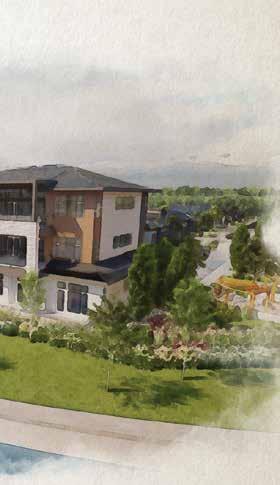


The Reflection Estate Condominiums offer three unique floorplans in two-bedroom configurations, with the Brook offering 1,705 sq. ft., 10-ft. ceiling heights, a mudroom directly from the attached garage and luxurious soaker tubs.
The Cascade spans 1,747 sq. ft., with two covered terraces, a walk-in pantry and soaring 10- to 12-ft. ceiling heights.
The Springs is the largest floorplan at 2,053 sq. ft. and boasts majestic lakefront vistas.
All suites include views of either the park or lake, with forced air heat and air conditioning, a heated private garage with full driveway and expansive terraces, full-height kitchen cabinets, spa-inspired ensuites and luxurious finishings.
“Each home comes with four solar panels and a smart home technology package,” says Jordan D’Haese, sales manager with Jayman BUILT Multi-Family.
Reflection Estates show homes are now open, and condominiums start in the $970,000 range up to $2.2 million plus GST. And, with Jayman’s hands-on approach, each homeowner spends a full day with an interior designer at its styleMagicTM centre personalizing their home to meet their wants and needs.
LIFE AT THE STREAMS


• All the benefits of single-level, maintenance-free living with the best views in Mahogany
• Water features and meandering streams with immaculate landscaping throughout
• Outdoor living spaces with seating areas, BBQs, and firepits that bring people together
• South lake views – every home has access to all-season recreation on the lake

• Modern sustainable features including 4 solar panels, heat-recovery ventilators, smart home tech and more with Jayman Core Performance




• A full day with a professional styleMagicTM Interior Designer to personalize every detail of your home


• Double car garages with every suite, so you can live luxuriously without compromise

• Enjoy comfortable living with 4” concrete floors to dampen noise levels


1901 Mahogany BLVD SE Mon–Thurs: 2–8pm

Visit jayman.com/thestreams and live your dream in The Streams of Lake Mahogany. 116 PHOTOGRAPHY BY DUSTIN HOFFERT/DCPIX PHOTOGRAPHY
ADVERTISING FEATURE VISIT OUR SALES CENTRE
Sat–Sun:
(587) 350-0237 Jayman.com/TheStreams
EDITION LIVING
12–5pm | Fri Closed ResortLiving@jayman.com
LIMITED
ESTATE CONDOMINIUMS FROM $970K-$2.2M + GST 1,705 - 2,053 SQ. FT.
DISCOVER ADVENTURE IN YOUR BACKYARD
DON’T WAIT FOR THE LONG WEEKEND TO ENJOY THE MOUNTAINS.
Nestled just 20 minutes west of Calgary, next to the meandering foothills of the Canadian Rocky Mountains and along the shores of the majestic Bow River, you’ll find Heartland.

Rohit Land Development is based in Edmonton and has more than two decades of development experience in Alberta, which they now bring to Cochrane. Adding 430 lots in the Heartland community, a range of housing options that include single-family homes, duplexes

and townhomes will cater to all stages of homeownership.

“The Calgary region has a vibrant atmosphere and has done a remarkable job of attracting new investment and of growing its economy,” says Luciano Salvador, executive vice-president of land development for Rohit. “We see Heartland as an incredible opportunity to bring our expertise in the industry to a new market, filled with great neighbourhoods and potential.”
Located on Cochrane’s west side, Heartland offers breathtaking mountain views and rich amenities, including greenspace, playgrounds, restaurants and a future pond, while providing easy access to Hwy 1A.
“Heartland is a dream location for those who love the outdoors. That’s why our community proudly embraces the tagline ‘Live Your Adventure,’” says Jedidiah Nibre, senior marketing coordinator, land development for Rohit. “It offers the perfect balance of enjoying nature and having access to opportunities in the Calgary region.”
Nibre says Heartland’s builder group is “nothing short of amazing,” and features awardwinning builders, such as Daytona Homes, DS Homes, Rohit Communities and Akash Homes.
“It’s going to be an incredible journey,” says Nibre of their venture into Cochrane, “and we can’t wait to see Heartland continue to flourish.”
Start your adventure in Cochrane’s Heartland and enjoy the best of small-town living right next to Calgary and the Canadian Rockies by visiting heartlandcochrane.ca.
117
ADVERTISING
F e at ev
FEATURE
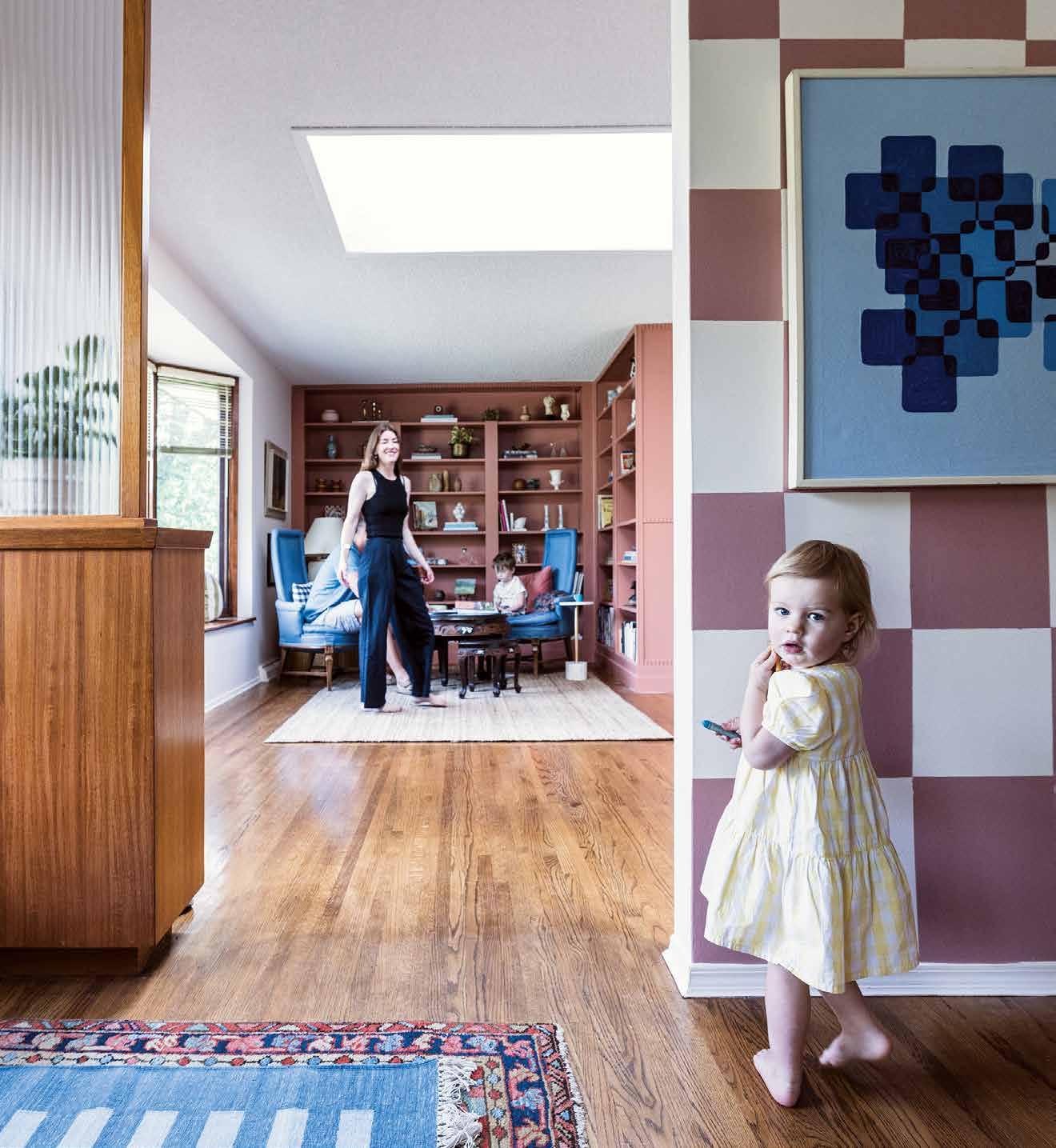
september/october 2023 118
PAST LIVES: DESIGNER LAURA COLLINS NESTLED HEIRLOOM LONG-BACKED CHAIRS IN THE LIBRARY ROOM OF HER MID-CENTURY HOME.
REIMAGINING A
RENTAL

With the blessing of her landlord, interior designer Laura Collins transformed a 1950s bungalow in Glamorgan into an eclectic mid-century English dream.
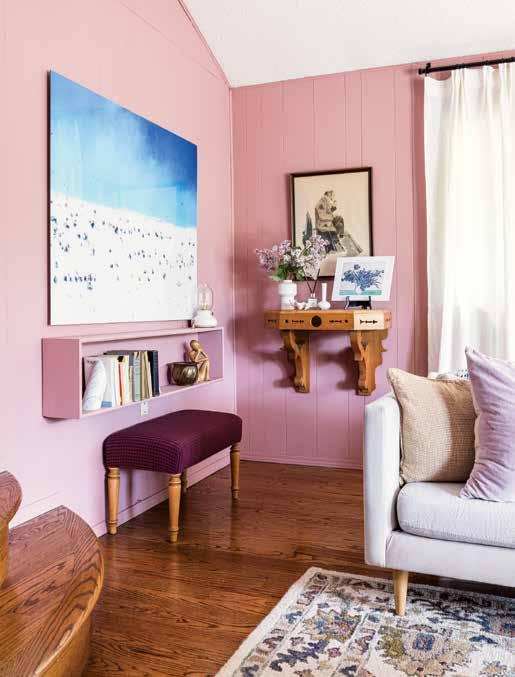 BY JENNIFER FRIESEN PHOTOS BY JARED SYCH
avenuecalgary.com 119
Decor
he first time Laura Collins saw her new Glamorgan home, it was on the small screen of a FaceTime call as her mother took her on a tour of a rental listing she insisted Collins would love. After catching a glimpse of the sunken den complete with a fireplace and encased with wood panelling, Collins knew her mom was right. “That space is really what drew my attention,” Collins says. “As soon as I saw it, I thought, ‘This is my mid-century dream.’”
Collins and her husband, Blayre, had been living in a semi-detached Victorian row house in Toronto with their two children, but they decided it was time to start fresh and relocated to Calgary. She wanted to find a character-driven home to rent that would give her more room for creativity, and this 1950s bungalow had the mid-century features she craved: wood panelling, alcove windows, a fluted glass divider in the entryway and plenty of built-in storage.
They took possession in February 2023 and Collins got to work on reimagining the space.
After seven years of co-running the LC & Kel Interiors design firm in Toronto, Collins was ready to embrace a design all her own and set about
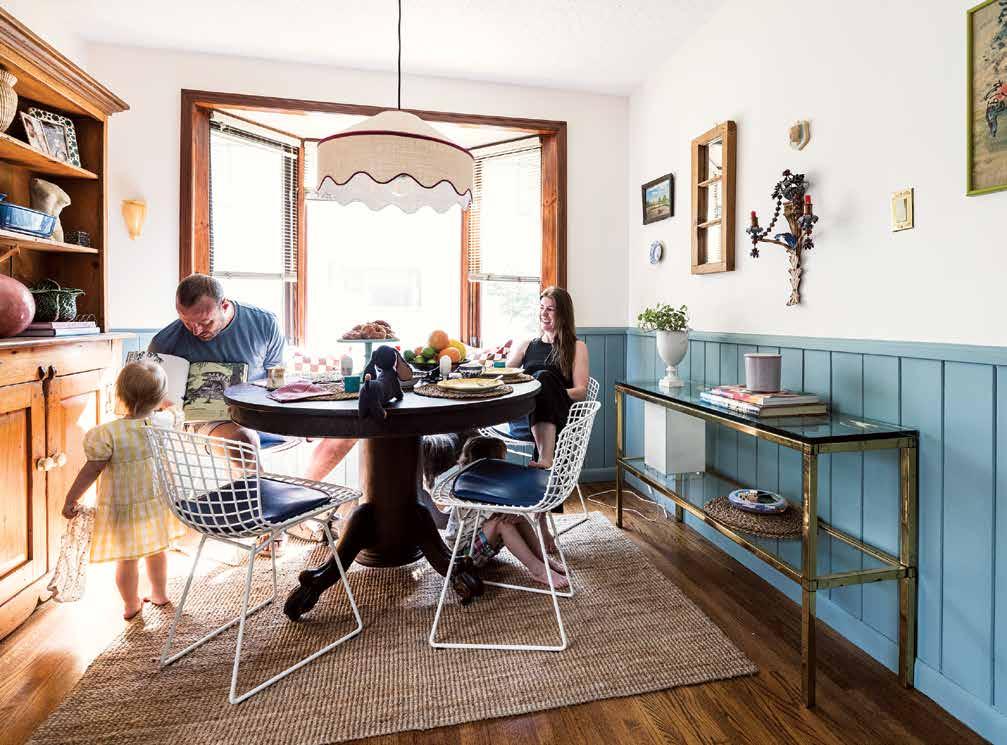
transforming the rental with cosmetic upgrades to match her vision of mid-century English. “My overarching thought is how we can merge English and mid-century,” she says. “Colour is always a staple of any British interior. There’s usually a bold colour — they really don’t hold back.”
With the space being a rental, Collins prepared a presentation for her landlord, where she pitched her plans and “promised him the home will be in great hands,” she says, laughing. Starting with the sunken den, she pulled out blush, rosy tones from the stone mantle and repainted the wood panelling in Amaryllis by Benjamin Moore. For the dining room wainscotting, she opted for Oval Room Blue by Farrow & Ball.
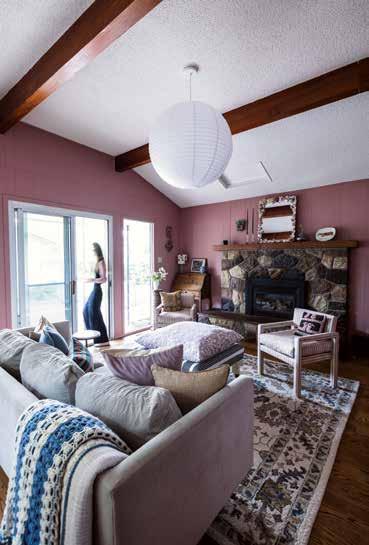
“I've selected some colours that are possibly a little bolder for some people’s tastes,” Collins says. “It can easily turn into a funhouse when you’re dealing with colour, so you have to be really careful. I was incredibly mindful that it should be light and bright throughout, and also have original character.”
The colours make their way through the rest of the home, including the library and Collins’ studio.
september/october 2023 120 Decor
INSPIRED BY ENGLISH-STYLE DESIGN, COLLINS OPTED FOR BOLD PAINT COLOURS IN THE DINING ROOM AND DEN.
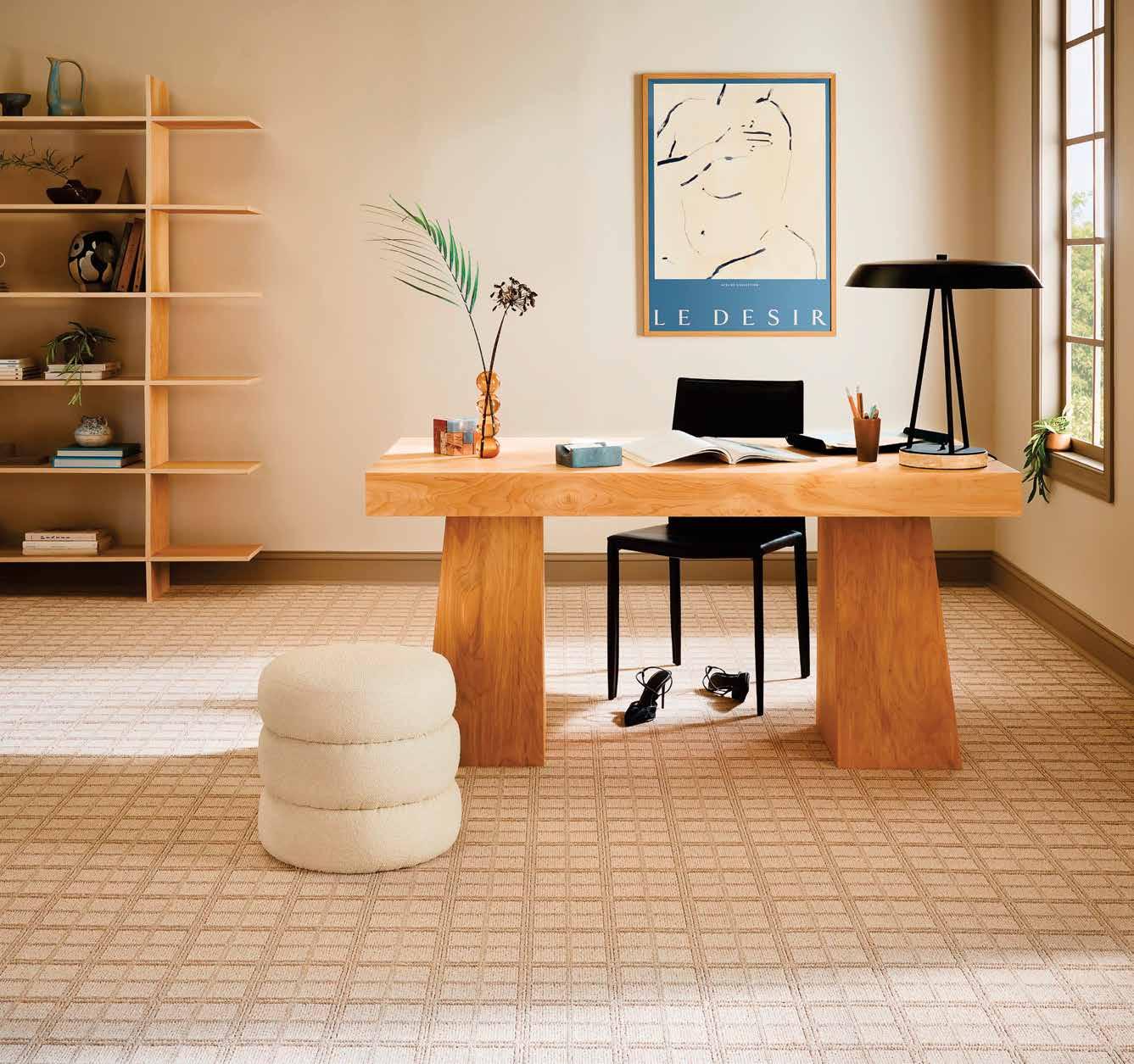



avenuecalgary.com 121 ANDERSON TUFTEX | ZZ291 BREEZE BLOCK | 00174 CDL Calgary (403) 255-1811 7265 - 11 Street SE Calgary, AB T2H 2S1 www.cdlflooring.ca CDL Invermere (250) 342-1592 4B 492 Arrow Road Invermere, BC V0A 1K2 @cdlcarpetandflooring
For the library, the couple purchased Ikea Billy bookcases that were painted Savannah by Benjamin Moore and finished with custom cuts in the dentals for depth. Collins then filled out the space with items from her personal inventory of furniture, art and decorative objects, many of which are heirlooms or hidden gems found at estate sales.
Re-purposing furniture when looking for a change is a cheaper and more environmentally friendly way to upgrade your space, Collins adds. “There’s a lot of repurposing in British interiors. They take the pieces that they have and re-upholster them to give them new life.”
Mixing heirloom pieces from her family with modern art and textiles is one of the ways Collins keeps her space dynamic and unique. “Layers, layers, layers,” she quips, while pointing out the antique long-backed chairs in the library that once belonged to her grandmother, Audrey, now cushioned with new throw pillows. “Layering old and new keeps things cheeky and fun. I just want the overall feeling to be very in-the-middle and playful”
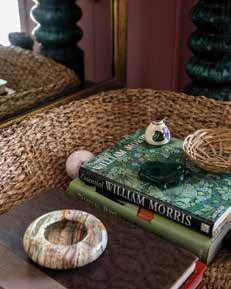
Behind the fluted glass built-in divider in the entryway, Collins looks into her newly completed
living room and wonders what Audrey would think.
“She had a lot of opinions,” she muses. “She might have questions, but she’d like that these pieces have a new home.
“It’s a really cool way to honour people, and I'm also lucky that she was very tasteful,” Collins adds. “My grandmother has passed and my father has passed, and I think it keeps them alive. It makes me think of my memories of interacting with them in their spaces, and it makes me smile.”
Collins continues her colour theme and layered aesthetic throughout the rest of the home. The three bedrooms each feature layered custom curtains, storied art and pops of colour. The kitchen has unique features including a sky tube skylight and traditional built-in cabinetry with beading and dental moulding that Collins painted Ecru by Benjamin Moore.
“There are weird, funky little nooks and crannies everywhere,” says Collins as she opens a spice cabinet. “I think some people might be overwhelmed by a space like this and how to tackle it and modernize it, whereas, for me, that’s my greatest excitement.”
Prime for Paint
“No matter what budget you are playing with, paint is typically the most important space-influencer,” Collins says. “In some rentals, you may be subject to what the landlord has selected, in which case I’d encourage the use of colourful art, new draperies and textiles.”
Textile Messaging
“I love layering, so naturally rugs are of the utmost importance. By adding beautiful textiles to the walls, floors and furnishings, you instantly bring the space to life and make it feel more personal.”
Beautiful Books
“One of the best tips I’ve heard is to buy a beautiful coffee-table book with each paycheque. Not only are they pieces of art, but they also can diplay decorative objects.”
Quirks and Curios
“If you want to have a home that keeps people guessing, scour sites like Frank Hall Estate Auctions to find unique pieces that no one else will have. Almost everything in my home is either bespoke or found items. It makes your home completely unique to you, and I love a storied home.”

september/october 2023 122 Decor
AS IN THE REST OF THE HOME, ANTIQUE PIECES GIVE THE MAIN BEDROOM A STORY ALL ITS OWN.
H OW TO GET A B IG IMPACT FROM C OSMETIC UPGRADES



avenuecalgary.com 123 sEPTember26 4 p.m. to 9 p.m. Calgary Central Library 800 3 St. S.E. Tickets available now for 2023 Divorce isn’t easy, but it’s a path to a new beginning. CALGARY ALBERTA Suite 1900, 639 5th Ave. S.W., Calgary, AB T2P 0M9 | Phone (587) 356-4342 | info@wellsfamilylaw.com | www.wellsfamilylaw.com Compassionate, Guidance Through All Areas of Divorce.
G AV L
W HY
SERIOUS (AND NOT-SO-SERIOUS) C YCLISTS
ROADS
MARKED BY A SIGN CAUTIONING “IMPASSABLE” ARE EXTRA-SEDUCTIVE TO THE GRAVEL CYCLIST.
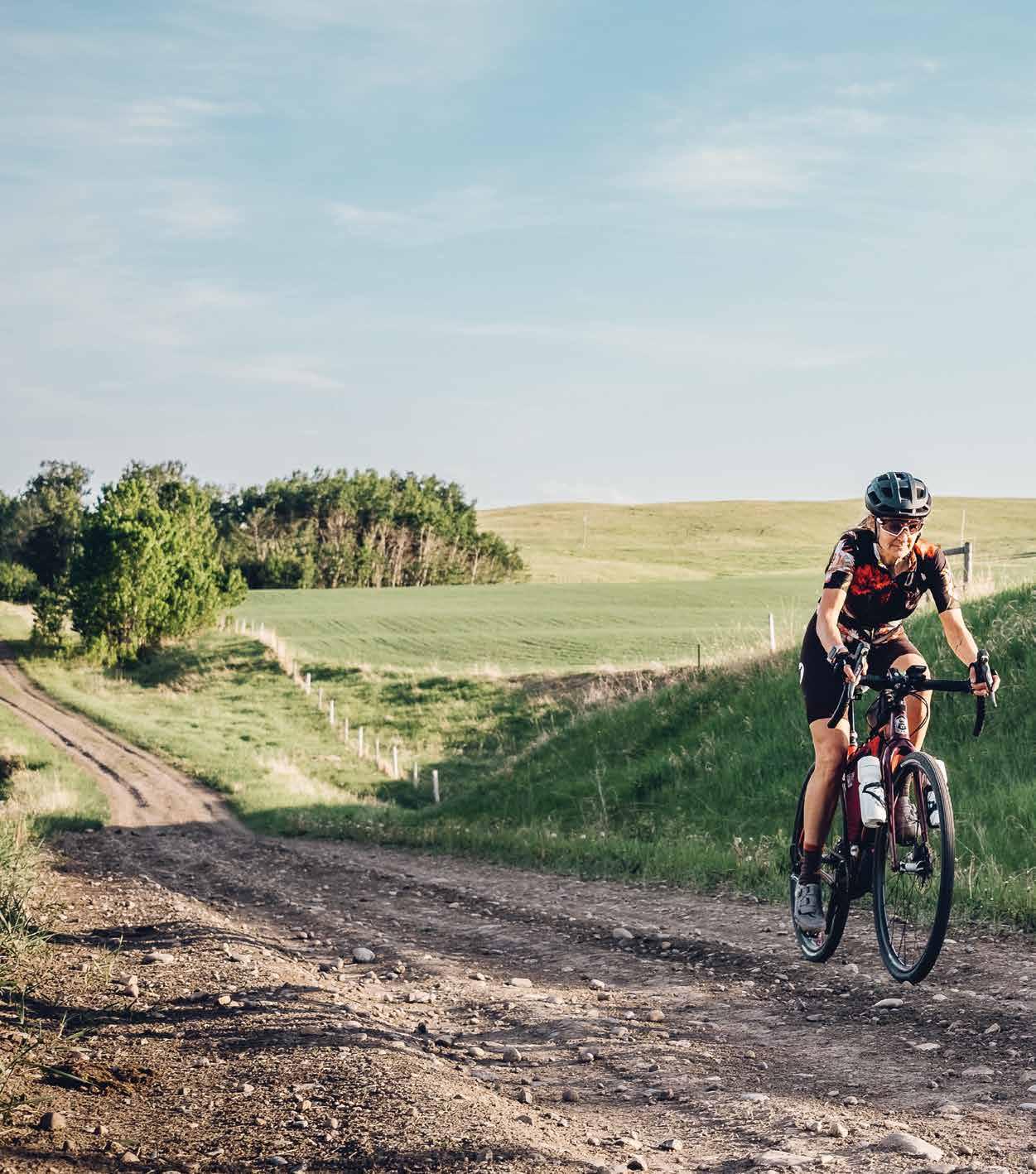
sEPtember/october 2023 124
A RE D ITCHING T HE PAVEMENT
ROUGHER ROADS.
UP
BY CHRISTINA FRANGOU PHOTOS BY STEVE COLLINS
Dust and mud. Wind and sun. Rain and snow. Welcome to one of the fastest-growing sectors in cycling — gravel riding. Cycling off-road and on unpaved terrain is nothing new. Paris-Roubaix, one of the oldest bike races in the world, has been rolling over cobblestones and the rough terrain of northern France since 1896. (Note of pride: In spring 2023, Alberta’s Alison Jackson, who grew up on a bison farm outside Edmonton, won Paris-Roubaix Femmes — one of the greatest wins in Canadian cycling history.)
Canada, of course, has a long legacy in mountain biking, with B.C. mountain bikers considered the pioneers of freeriding. Gravel cycling covers that huge gap between road and mountain biking; it can be a high-performance sport, but it’s mostly old-fashioned exploring for the heck of it.
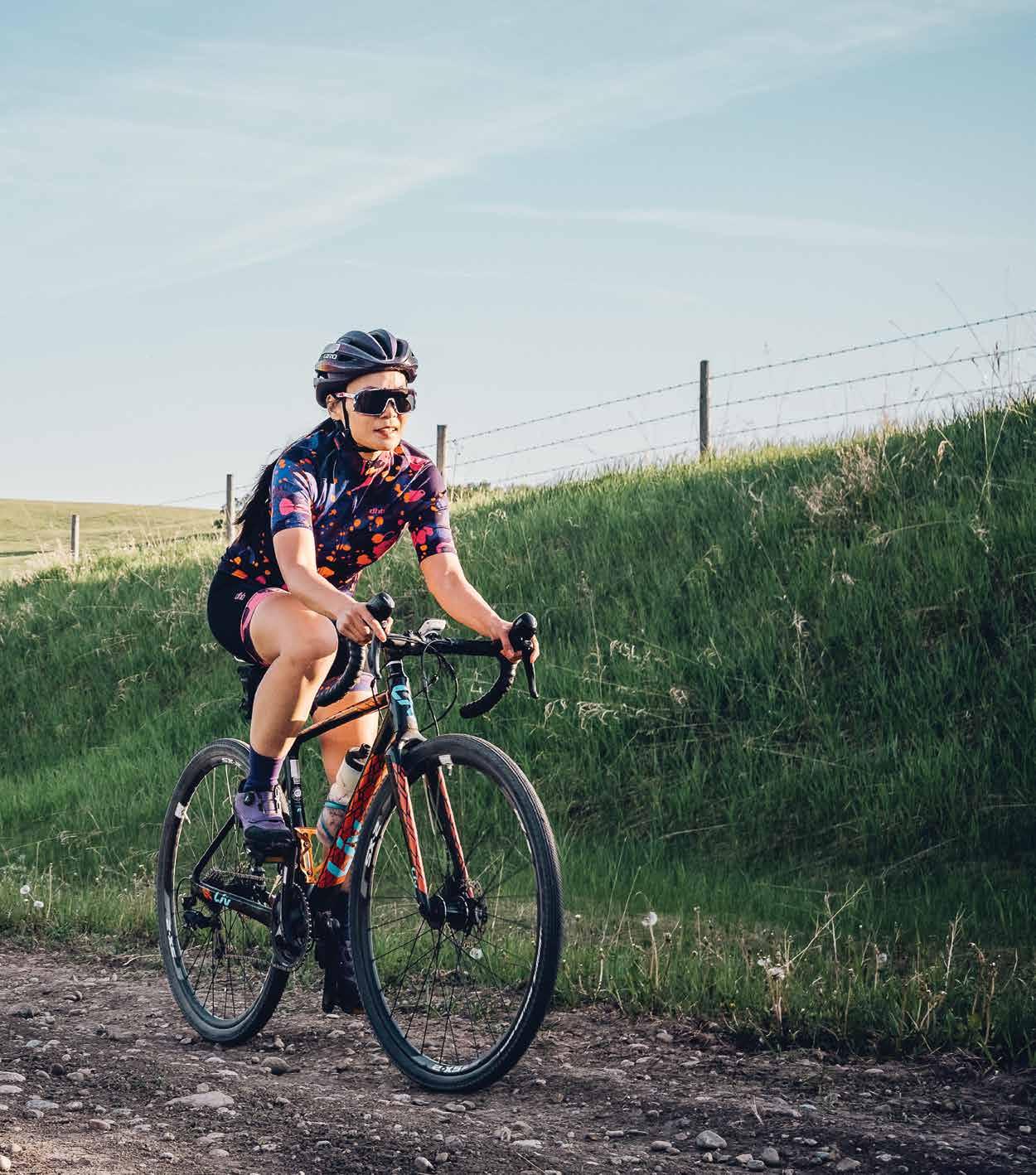
Gravel cyclists tend to be less-focused on performance stats like watts and speed than road cyclists because they can’t move as quickly. The routes run along old forestry roads, along abandoned rail beds and into dusty towns that rarely see a tourist. Some mechanical skills are recommended; tire punctures are common. Cyclists pass through mud, creeks, long grass and even (especially in Alberta) snow.
Sometimes, the topography is too hostile for two wheels, requiring riders to get off the bike and walk. In fact, roads marked by a sign cautioning “impassable” are extra-seductive to the gravel cyclist. That’s the allure. Adventuring down an impassable is the only way to know for sure. “It’s riding stuff where you get to feel like a kid again — but you’re old,” explains Chris Roy, a 43-year-old Calgary cyclist who started gravel riding about five years ago.
Roy rides gravel with small groups of friends or on organized rides with the Bow Cyclist Club, a popular members-only, all-terrain local cycling group affiliated with Bow Cycle. Roy likes to pore over Google Maps to find forestry or mining roads that go through terrain he’s never seen. “It’s about seeing what happens when you choose something on a map and go,” he says. “It’s not about going fast, even though [gravel cyclists] have the ability to go fast. I would rather go explore a cave on the route.”
avenuecalgary.com 125
F
Mountains
OR
SONYA LAING AND AMY WAY RIDING NEAR BIG HILL SPRINGS PROVINCIAL PARK.
The camaraderie of gravel is what appeals to enthusiast Robin Reese. “The cycling community here reminds me a lot of biking with friends as a kid,” says Reese, who rides both gravel and road (she also mountain bikes and does bikepacking trips). “You would meet up, ride your bikes and enjoy the adventure, have fun and then head home.”
Unlike road cycling, which is indisputably European in origin and character, gravel was popularized on the backroads of North America. The sport started gaining momentum about five years ago, spurred on by advancements in bike technology.

Until you get up close, a gravel bike looks like a road bike. It has drop bars that curve down toward the ground and a lightweight frame so riders can zip up climbs and barrel down bumpy descents. But its tires are fatter than on a standard road bike — road tires are typically 28 millimetres, while gravel tires are no narrower than 35 mm. The pressure runs lower and the tread is knobbier, all to help the rider stay upright over sketchy ground.
The first gravel race bike, the Warbird by Minnesota-based Salsa Cycles, took place in 2012. It was
followed by a swell in the popularity of gravel races held across the U.S. These events now draw thousands of riders to unlikely areas like Barry County, Michigan, and Emporia, Kansas.
The same is now happening in Alberta and British Columbia. In 2022, Ghost of the Gravel, which winds through nearly 120 kilometres around Water Valley in June, sold out in 48 hours. This past July, The Range, which covers 127 km over private and public roads in southern Alberta, had its 300 spots scooped up in five hours. “People want that adventure feeling, like they’re out there, exploring,” says Garth Stotts, organizer of The Range.
Because gravel cycling routes are off main roads, vehicles rarely pass by — a big draw in a province where cyclists are constantly on guard for trucks whizzing by uncomfortably close. In Calgary, the law requires drivers to leave a minimum of one metre when passing a cyclist and 1.5 m at speeds above 60 km per hour. But, from a cyclist’s perspective, these laws often feel like the exception, rather than the rule. “What I’ve seen is that people just want to get off the roads,” says Sonya Laing, who rides road,
mountain and gravel bikes, but prefers gravel. “They are recognizing that there are other options available to them.”
Gravel riding “really exploded” in Alberta over the last five years, says Greg Nicholson, a rider from Sherwood Park. In 2017, he founded a Facebook group called Alberta Gravel Cycling to find more people to ride with and create a list of routes for riders to share. Since then, the group has swelled to more than 4,500 members, a true community where people trade maps, knowledge and even bike parts.
Finding people to ride with is the first step to getting into gravel, says Christine Barr, a Calgary cyclist who led a workshop to introduce women to gravel riding. She says there’s no need to invest in a gravel bike from the start — any bike that can handle bumpy terrain will do the job — but a bike specifically designed for gravel riding can comfortably take on more challenging routes, she adds. She advises people to pick simple routes to start, sticking to gravel roads, rather than trails and fields. Carry extra water and food, spare tubes, a hand pump and patch kit, she advises.
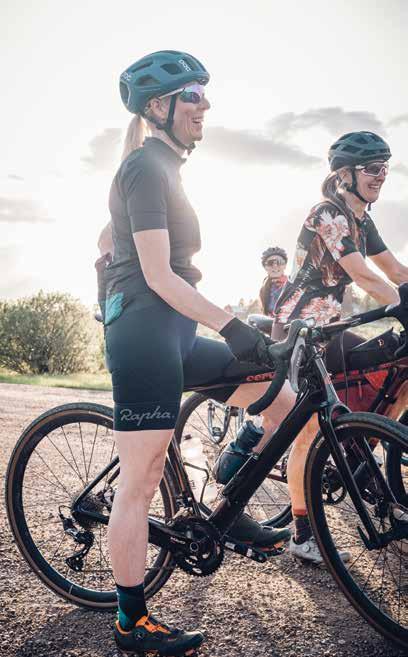
“You’ll be in some of the nicest landscapes you can see in parts of Alberta,” Barr says. “You’ll get to see sunsets and deer running through. Random birds. Impassables.”
There’s no predicting exactly what a gravel cyclist might see. That’s the point of it.
sEPtember/october 2023 126 Mountains
LEFT: CHRIS ROY ON A TRAIL NEAR NORTH GHOST CAMPGROUND.
RIGHT: CHRISTINE BARR TAKES A BREAK.
BECAUSE GRAVEL CYCLING ROUTES ARE OFF MAIN ROADS, VEHICLES RARELY PASS BY.
W ESTERN CANADA R ACE ROUNDUP
Mother Nature can be unpredictable come autumn, but that’s not going to deter gravel cyclists. Most races sell out within days, even with snow on the horizon. Here are three great race events happening in Western Canada this fall.


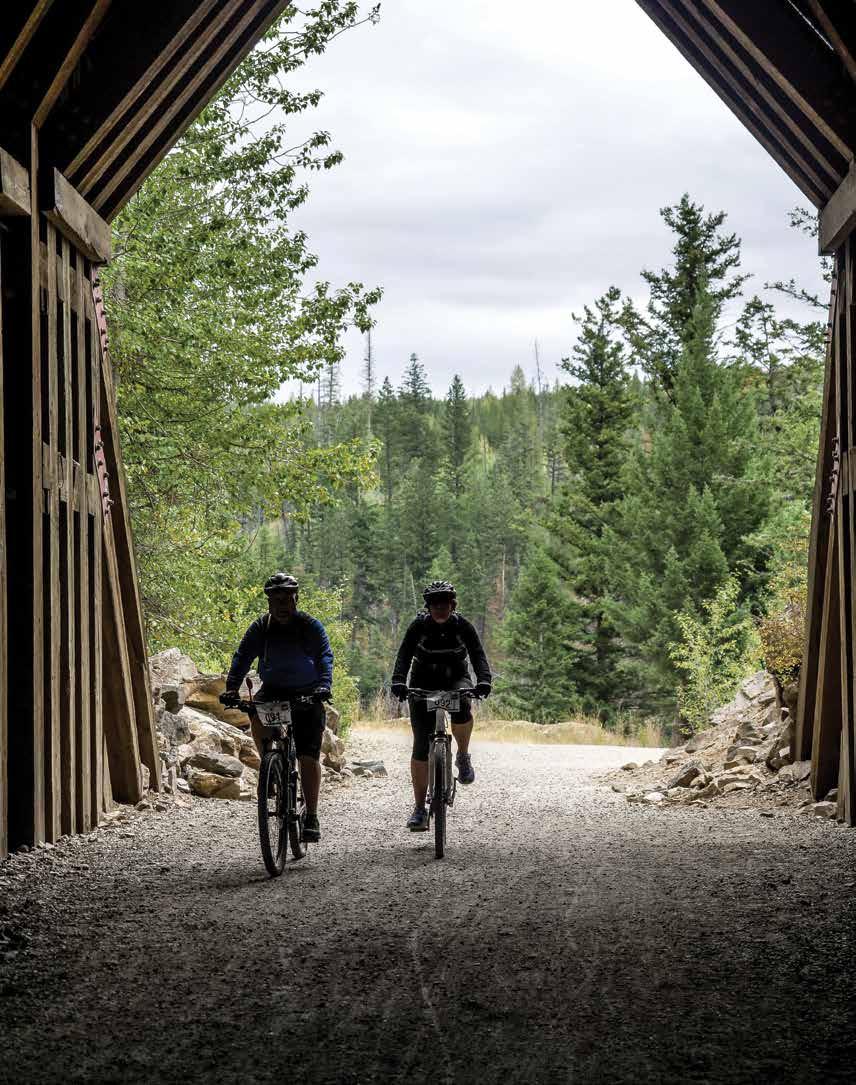
SEPT. 15-16, 2023
Billed as the oldest gravel fondo in Western Canada, the Kettle Mettle winds through the canyons of the Okanagan, along old rail trestles and through decommissioned tunnels. Riders can choose from 50-, 100or 138-km course options designed to be ridden in one day, or a 200-km course divided over two days. The overnight stop is in Penticton, where the intrepid choose to camp and those who like clean sheets and the smell of shampoo swing for a hotel. kettlemettle.ca
OCT. 1, 2023
The course maps are kept secret, but here’s what we know for sure: the three course routes all start and end in the Squamish Valley and run through the Sea-to-Sky corridor. It’s got big mountain views, creek crossings and forestry roads, plus a party at the end. Expect to climb — one stretch of road last year got the nickname “Bonk Hill.” sea2skyfondo.com
OCT. 7, 2023
This always-challenging race comes late in the cycling season for one reason to ensure that conditions are less than perfect. Here’s how organizers bill it: “Cold weather? Great! Windy? Even better. Snow or rain? The best.” The ride kicks off near Pigeon Lake and winds through central Alberta. It passes one corner store that may or may not be open, so cyclists need to be self-sufficient. The 2022 race was so popular that they’ve doubled capacity this year to 220 riders.
ertc.org/crokenclassic
avenuecalgary.com 127
1 The Kettle Mettle Dirty Fondo
2 The Sea2Sky Gravel Fondo
3 The Croken Classic
CLOCKWISE FROM TOP: COURTESY OF THE KETTLE METTLE DIRTY FONDO; ALEXANDER PATTON; COURTESY OF SEA2SKY GRAVEL FONDO
THE KETTLE METTLE DIRTY FONDO COURSE RUNS ALONG OLD RAIL TRESTLES AND THROUGH DECOMMISSIONED TUNNELS IN THE OKANAGAN.
SEA2SKY. CROKEN CLASSIC.


sEPtember/october 2023 128 BEST OF THE MOUNTAINS NOMINATE YOUR FAVOURITE PLACES TO STAY, EAT AND PLAY IN AVENUE’S FIRST EVER NOMINATIONS ACCEPTED SEPTEMBER 18 – 30 VOTING ROUND OCTOBER 23 – NOVEMBER 5
will support children’s programs, services and spaces at Calgary Public Library. CENTRAL LIBRARY :: LITGALA.CA LIT GALA :: OCT . 21 . 2023
Proceeds















WORLD-LEADING CANCER CARE Introducing the Arthur J.E. Child Comprehensive Cancer Centre BY THE NUMBERS A peek inside the largest cancer centre in Canada STAND TOGETHER How we will OWN.CANCER
Meet 18 of Calgary’s trailblazers shaping the future of cancer treatment, research and care
Bright Minds

Introducing the newly named Opening in Calgary 2024 owncancer.ca Celebrating a historic gift to Albertans facing cancer Thank you to the Arthur J.E. Child Foundation for its remarkable $50 million donation to the OWN.CANCER campaign, accelerating cancer care and research in Calgary.
131 Created for OWN.CANCER Welcome Message 132 Stand Together 135 18 Trailblazers Changing the Cancer Journey 136 Mannat Bansal 138 Arrow Big Smoke 138 Dr. Pierre Billon 139 Dr. Jeffrey Cao 140 Dr. Julie Deleemans 140 Sandip Dhaliwal 141 Dr. Nicolas Jacquelot 142 Dr. Safiya Karim 142 Charlotte Kessler 143 Dr. Jose Monzon 144 Dr. Dustin Pearson 144 Dr. Robert Puckrin 145 Dr. May Lynn Quan 146 Iqra Rahamatullah 146 Dr. Fiona Schulte 147 Dr. Heewon Seo 148 Dr. Matt Warkentin 148 Dr. Lin Yang 149 By the Numbers 151 Contents The OWN.CANCER campaign is a joint fundraising initiative between the Alberta Cancer Foundation, the University of Calgary and Alberta Health Services to raise funds for the improved prevention, detection and treatment of cancer at the Arthur Child. OWN.CANCER is more than a slogan — it's a call to action to make cancer a memory.
Cover images by Jared Sych and Jason Dziver
Welcome Message
As Co-Chairs of the OWN.future Committee, we are passionate about engaging with bright minds and talent in Calgary to support the OWN. CANCER campaign. OWN.CANCER is an ambitious fundraising campaign actively raising $250 million for cancer care and research at the Arthur J.E. Child Comprehensive Cancer Centre in Calgary, bringing researchers, medical teams, prevention experts, patients and families together in ways never before possible.
As young leaders in Calgary’s business community who are navigating cancer journeys ourselves, we’re part of a generation of Albertans who are putting cancer on notice, right now.
It’s why we’re thrilled to be included as a special insert in Avenue magazine to introduce you to some of cancer’s next trailblazers helping to OWN the future of cancer care and research in Alberta.
Beginning in 2024, our world-renowned experts in cancer research, education and patient care will work shoulderto-shoulder under one roof at the new Arthur J.E. Child Comprehensive Cancer Centre, the largest comprehensive cancer centre in Canada. Alberta Health
Services and the Arnie Charbonneau Cancer Institute will bring researchers, cutting-edge technology and clinicians together to solve some of the most challenging questions.
Calgary’s cancer trailblazers are OWN-ing cancer by decreasing cancer in the population, improving cancer treatment, improving cancer outcomes and forming the world-class team we need to change the trajectory of this disease.
With one in two Albertans facing a cancer diagnosis in their lifetime, we’ll all experience cancer, whether personally or through a loved one. We’re stepping up to OWN.CANCER through OWN.future. Are you with us?

If you would like to be part of this amazing campaign to OWN.CANCER, join us at an event on Sept. 28, 2024 at Sub Rosa. Not your typical gala-style fundraiser, it will be a lively, interactive “cocktails for a cause” evening, with Calgary’s next generation stepping up to OWN.CANCER. It will also connect the next generation of philanthropists with the incredible work being done in Calgary. Proceeds from the event will benefit the OWN.CANCER campaign.
Learn more by visiting owncancer.ca/own-future.
Katie Smith-Parent
ALBERTA CANCER FOUNDATION EDITOR
Breanne Kraus
UNIVERSITY OF CALGARY EDITOR
Mia Sosiak
DIRECTOR, STRATEGY & CONTENT
Meredith Bailey
MANAGING EDITOR
Karin Olafson
ART DIRECTOR
Veronica Cowan
STAFF PHOTOGRAPHER
Jared Sych
CONTRIBUTORS
Sarah Comber, Jennifer Dorozio, Jason Dziver, Stephanie Joe, Nathan Kunz, Jaelyn Molyneux, Michaela Ream, Lynda Sea
PUBLISHED FOR Alberta Cancer Foundation
Alberta Health Services
University of Calgary
PUBLISHED BY RedPoint Media Group
cSPACE Marda Loop
1721-29 Ave. S.W., Suite 375 Calgary, Alberta T2T6T7
(Letter mail only)
Tel: 403-240-9055
Toll free: 1-877-963-9333
Fax: 403-240-9059
info@redpointmedia.ca
CEO Roger Jewett
PRESIDENT
Käthe Lemon
OWN.CANCER
Jil Macdonald
132 Created for OWN.CANCER
Campaign Cabinet Members & OWN.future Committee Volunteers


134 The Arthur J.E. Child Comprehensive Cancer Centre opening 2024
Together, we will OWN.CANCER.
The largest comprehensive cancer centre in Canada is coming to life in Calgary this very second. When it opens its doors in 2024, the Arthur Child will shelter 1.3 million square feet of world-leading cancer care, research and education.
In response, Alberta Health Services, the University of Calgary and the Alberta Cancer Foundation have come together with one mission: to OWN.CANCER and we are asking all Albertans to answer the call. We are already more than half way towards our goal of raising $250 million in support of the Arthur Child but we need your help.
Bricks and mortar are only the beginning. We're bringing together researchers, medical teams, prevention experts, patients and families in ways never before possible.
Together, we will OWN.CANCER with will, by reducing the number of people receiving a cancer diagnosis in the first place. By gathering the right people with the right tools under one roof, this is a once-in-a-generation opportunity to transform cancer care and treatment.
It’s our chance to OWN.CANCER once and for all.
We will OWN.CANCER with research, by developing new diagnostic tools and precision medicine to identify, target and weaken cancer before it can take hold.
We will OWN.CANCER with determination, by improving the patient experience through customized support programs that lift up the whole family throughout a cancer journey.
We are calling on champions in all of our communities to make this possible by donating online or making gifts that have the impact to change and save lives.
It’s time to shine a light on this devastating disease and take back some of the power cancer has taken from us.
To make cancer a memory, we need everyone in Alberta to stand together.
Right here.
Right now.
OWN.CANCER with us.
owncancer.ca
135 Created for OWN.CANCER
18 Trailblazers Changing the Cancer Journey
Trailblazers Changing the Cancer Journey
Meet some of the bright minds shaping the future of cancer treatment, research and care
by SARAH COMBER, JENNIFER DOROZIO, STEPHANIE JOE, NATHAN KUNZ, JAELYN MOLYNEUX, KARIN OLAFSON, MICHAELA REAM and LYNDA SEA photography by JARED SYCH and JASON DZIVER
136 Created for OWN.CANCER
On June 28, 2023, the OWN.CANCER campaign received the largest cancer donation in Alberta’s history. The Arthur J.E. Child Foundation donated $50 million to the centre, which is now officially named the Arthur J.E. Child Comprehensive Cancer Centre (the Arthur Child).
CALGARY IS ON A MISSION TO OWN CANCER.
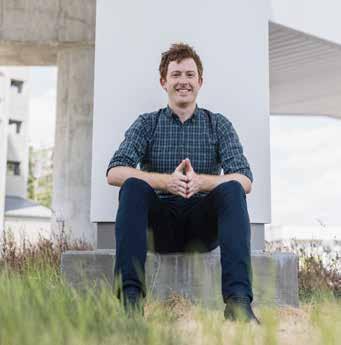
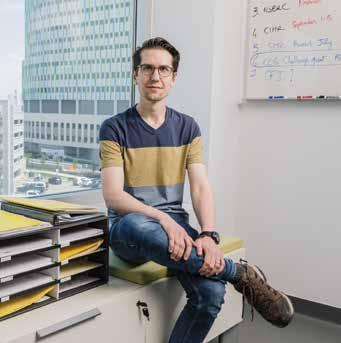


It’s a city where innovative cancer research drives change, top-tier treatment is accessible to all and patient experiences come first. Calgary’s reputation as a world-class hub for cutting-edge cancer care will further soar when the Arthur J.E. Child Comprehensive Cancer Centre opens in 2024.
From researchers at the University of Calgary, to volunteer patient advocates, to physicians and nurses working on the frontline, these 18 individuals influence the next generation of cancer research and treatment. By shaping the future of cancer care here in Calgary and beyond, these groundbreakers will help transform what the cancer journey looks like.
Here is a glimpse into the critical work taken on by these 18 bright minds to make an impact — now and when the Arthur Child opens.
137 Created for OWN.CANCER
Mannat Bansal
Exercise Oncology PhD Student
Faculty of Kinesiology, University of Calgary
Bansal is working towards a future where more Calgarians have access to exercise oncology programs and resources as part of standard cancer care.
Inspired by the world’s big challenges — specifically, uncured diseases — Mannat Bansal dressed as a scientist for her thirdgrade career day.
Today, Bansal is pursuing her dream while helping Calgarians combat treatment fatigue, maintain fitness levels and reclaim their cancer journeys


through her doctoral research in exercise oncology.
While exercise’s physical, mental and social benefits for cancer patients
Arrow Big Smoke
Big Smoke supports and advocates for Indigenous cancer patients and families.
Indigenous Cancer Patient Navigator
Alberta Health Services
Arrow Big Smoke, a member of the Blackfoot Confederacy and registered with the Piikani Nation in Southern Alberta, knows that her Indigenous patients have existing support systems. Her job is to listen, find answers and help them build relationships with their health team.
Big Smoke says she learns so much from her clients by spending time with them, celebrating their wins and sharing a laugh. “My best days are when I'm able to help someone access services when they would otherwise leave,” she says. “Clients with complex lives need more time, patience, understanding and a team of support.”
She says the most challenging part of her job is overcoming systemic barriers. “Cancer is hard, the treatments are hard, and life is harder for those struggling with homelessness, addiction, stigma and a health-care system that isn’t trauma informed,” says Big Smoke. “If
138 Created for OWN.CANCER
are proven, access remains unequal. Bansal’s research, supervised by Dr. Nicole Culos-Reed, focuses on improving access to resources for Calgary’s under-served South Asian community.
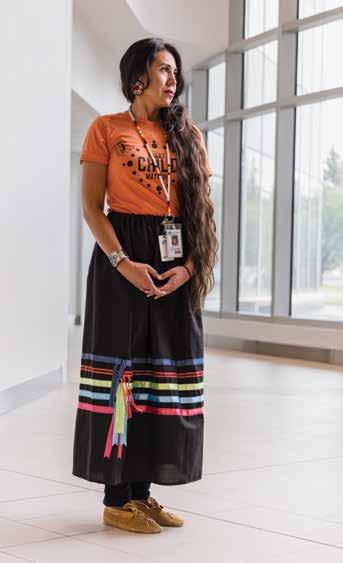
Work so far has largely surrounded understanding exercise oncology barriers and facilitators for South Asian populations. Partnerships with religious organizations and appearing on Punjabi radio stations have also been explored as effective avenues for outreach and awareness-building. Next, she’s tailoring programs and resources to better serve participants.
Ultimately, Bansal and her colleagues are working towards exercise becoming part of standard cancer care, helping more Calgarians during treatment and beyond.
“We want to see these amazing benefits from exercise available to everyone,” says Bansal. “This is something that would improve lives and improve the health-care outcomes of a lot of people.”
—NK
Dr. Pierre Billon
we can make health care safer, it will decrease fear, promote autonomy, and empower others to enter into care and get screened earlier.”
—SJ
DNA is the very complex blueprint of how we develop and function. A single change in that blueprint can lead to genetic diseases and cancer.
In his laboratory, Pierre Billon develops new technologies to promote precision genome editing. By correcting the underlying genetic causes of human diseases, genome editing can cure or even prevent life-threatening conditions.

When a child in Britain became the first patient to be successfully treated for a highly aggressive, relapsed cancer in part because of a gene-editing approach Billon established, he knew that his lab work was impacting lives.
Billon has worked and studied
Genome Stability and Editing Laboratory, Robson DNA Science Centre, Arnie Charbonneau Cancer Institute
Assistant Professor
Department of Biochemistry & Molecular Biology
Cumming School of Medicine, University of Calgary
in the United States, France and Switzerland. He came to Calgary to join the momentum of cutting-edge genomic and therapeutic research at the Cumming School of Medicine’s Robson DNA Science Centre and the Arnie Charbonneau Cancer Institute, and contribute to the international movement to rapidly advance gene therapies into powerful life-saving treatments. It’s a treatment approach that will immediately impact patients of the Arthur Child as it becomes available.
“The pace is incredible,” says Billon. “We are really revolutionizing health care.”
—JM
139 Created for OWN.CANCER
Billon explores how to precisely, accurately and safely edit human DNA to enhance the potential of using genome editing to fight cancer and correct the underlying causes of human genetic diseases.
Researcher
Dr. Jeffrey Cao

Radiation Oncologist
Tom Baker
Cao is advancing national and international clinical trial research in radiotherapy so that breast cancer patients can access the latest treatment techniques. In his leadership roles, he ensures policies and structural frameworks are in place so patients get care in an equitable and timely manner.
Cancer Centre
Provincial Breast
Tumour Team Lead
Cancer Care Alberta, Alberta Health Services
Clinical Associate Professor
Department of Oncology, Division of Radiation Oncology, Cumming School of Medicine, University of Calgary minimize side effects.
Canadian Institutes for Health Research
Jeffrey Cao is the man behind a few ongoing clinical trials for breast cancer patients, including the ELISA, RHEAL and RAPID 2 trials. The ELISA trial gives patients access to genomic testing of their tumours to determine whether they need radiation. The RHEAL trial looks at whether patients can have their radiation treatments in just five days, as opposed to 15 days or three weeks. And the RAPID 2 trial looks at focusing radiation to just the specific surgery spot, as opposed to giving radiation to the whole breast, to
“Opening a lot of clinical trials is making that difference to patients because it gives them innovative options,” he says, adding these trials can help improve patients’
Dr. Julie Deleemans
Using her personal cancer experience as a catalyst, Deleemans helps people find solutions for sometimes debilitating gastrointestinal and psychosocial symptoms after cancer treatment.

When Julie Deleemans was 18, the last thing she expected was to have advanced stage 4 laryngeal cancer. She was given two choices: have her voice box removed and receive high doses of chemoradiation, or die before her 19th birthday.
Deleemans was left with a permanent vocal disability and a disfiguring scar from a tracheotomy (an incision in the front of the neck where a breathing tube is placed into the trachea). She also suffered from gastrointestinal (GI) problems, PTSD, anxiety and severe clinical depression. Despite the challenges she experienced, Deleemans turned to research to help others affected by cancer.
Postdoctoral Research Fellow

Department of Oncology, Cumming School of Medicine, University of Calgary
Co-founder and Vice Chair
Many survivors of cancer experience chronic GI symptoms and mental health challenges after treatment ends, yet they don’t always get the help they need. Deleemans’ research strives to find solutions to address these chronic GI and psychosocial symptoms by using microbiome-based therapies, like nutrition or probiotics.
“The research we’re doing will change lives, helping to ensure that those with cancer don’t just survive, but thrive.” —MR
140 Created for OWN.CANCER
AYA Can —
Advocacy
Canadian Cancer
quality of life and overall survival.
Cao wants the donors of the Arthur Child to know that irrespective of the amount donated, it’s all meaningful.
“It's hard to accomplish things individually,” says Cao. “But collectively, we have the power to make a significant contribution to cancer care.” —LS
Sandip Dhaliwal
Dhaliwal’s research looks at how a cancer diagnosis reshapes family dynamics for emerging adults, and how to better address family needs in adult health-care settings.



Registered Nurse
Foothills Medical Centre
Doctoral Candidate
Faculty of Nursing, University of Calgary
Over the last six and a half years, Sandip Dhaliwal has worked as a registered nurse and cared for patients diagnosed with blood cancer. During this time, she noticed that emerging adults — those aged 18 to 29 — often fall through the cracks of the dichotomized health-care system, which treats populations as either pediatric or adult.
This gap in care inspired Dhaliwal
to pursue her PhD. Her doctoral research focuses on how a blood cancer diagnosis changes the role family plays in an emerging adult’s life.

“Emerging adults face a variety of developmental transitions,” says Dhaliwal. She explains how a cancer diagnosis disrupts these transitions — particularly when it comes to gaining independence from an emerging adult’s family. Emerging adults are often forced to remain reliant on their families’ support.
“My ultimate goal is to make more space and place for families in adult health-care settings, so the emerging adults’ needs are addressed and acknowledged,” she says. —SC
Created for OWN.CANCER 141
Dr. Nicolas Jacquelot
Jacquelot is building a better understanding of how we can harness the immune system to combat cancer.
Assistant Professor
Departments of Biochemistry & Molecular Biology and Microbiology, Immunology & Infectious Diseases, Cumming School of Medicine, University of Calgary
Discovery, in its truest form, drives Nicolas Jacquelot.
“I really enjoy being at the forefront of the field — asking questions that nobody has answered before,” says Jacquelot.
Jacquelot, who is originally from France, was recruited to lead his own Calgary lab space and research at the Arnie Charbonneau Cancer Institute in
the Cumming School of Medicine in winter 2023. The lab focuses on innate lymphoid cells (ILC) — a family of immune cells that shows promise in shrinking tumours. Working with non-human models in early stages and human samples, Jacquelot is building an early foundation for future immunotherapy treatment development.
Jacquelot’s lab will move from UCalgary’s Foothills Campus into the Arthur Child when it opens. Having worked in similar comprehensive centres in the past, Jacquelot says collaborating with fellow fieldleading professionals and connecting with patients is endlessly inspiring.
“It's not only about communication or collaboration. It's also to remind us why we are doing this,” says Jacquelot. “It's important to see why we are working every day — to try to provide patients a better cure.” —NK
Dr. Safiya Karim
Karim is improving cancer patients’ treatment experience by pairing therapies like mindfulness and exercise with conventional treatments, like chemotherapy.
Clinical Associate Professor

Department of Oncology, Cumming School of Medicine, University of Calgary
Medical Oncologist and Fellowship Program Director
Tom Baker Cancer Centre
As both a clinical oncologist with a focus on gastrointestinal and genitourinary cancers and an oncology researcher, Safiya Karim wants patients to thrive. That’s why her research focuses on integrative oncology — complementary evidence-based approaches to cancer care that support the mind and body.

Currently, she is running a two-year pilot
integrative oncology clinic that started in August 2022, through the Alberta Complementary Therapy and Integrative Oncology Centre. With promising results, the clinic could continue to be offered at the Arthur Child.
Using “whole person care,” the pilot clinic blends integrative oncology practices into cancer care by connecting patients to resources on nutrition, exercise and mind-body therapies. This can help improve the symptoms patients feel
142 Created for OWN.CANCER
during treatment, like cancer-related fatigue and mood changes, and lead to improved patient outcomes during the process from diagnosis to discharge.
“That’s really the most meaningful part,” says Karim. “Having the privilege to be involved in patients’ lives at such a critical and vulnerable time.”
She adds that the innovations in cancer research made at the Arthur Child will benefit cancer care into the next century.
“There’s going to be so many opportunities for research and collaboration,” says Karim. “I think the impact is going to be huge.” —JD
Charlotte Kessler
While navigating cancer treatment in 2014, Kessler joined the Patient and Family Advisory Council for the Arthur Child and provided insightful feedback on the centre’s design and operations from the beginning. Once it opens in 2024, Kessler will continue to provide insight and improve the patient experience as part of this council.
In October 2013, Charlotte Kessler learned in an earth-shattering way that she had a rare, highly recurrent brain cancer. She was expecting a simple follow-up appointment about a benign tumour; instead, she was brusquely told she had just two years to live.

Despite the challenging news, Kessler advocated for herself and found a supportive care team. She joined the twoyear CATNON drug trial, which has added years to her life by stabilizing her tumour. Kessler was also inspired to become an advocate for other cancer patients.
Kessler joined the Patient and Family Advisory Council for the Arthur
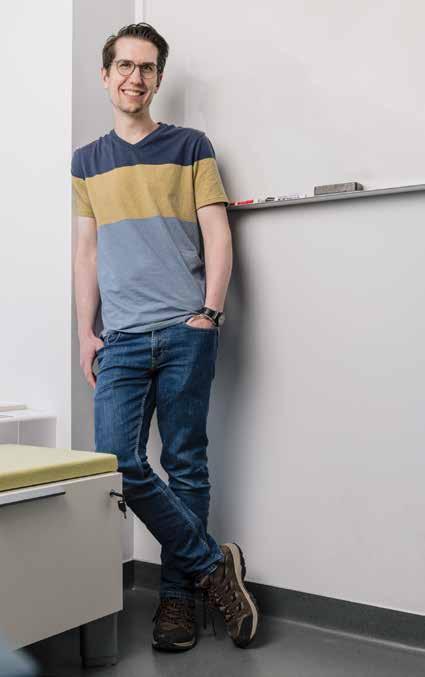
Child — consisting of patients, family members, Tom Baker Cancer Centre staff and Calgary Cancer Project staff — when it was formed in 2014. Since then, she has been an integral player in helping shape the Arthur Child’s design, building and operations, improving the patient experience.
“We wanted the centre to inspire hope with lots of light and warmth, so that as soon as you walk in, you feel welcomed and embraced. The team took our feedback wholeheartedly and turned it into a building for patients designed by patients,” says Kessler. “It’s beyond anything I could have imagined.” —KO

143
Volunteer and Co-Chair, Patient and Family Advisory Council for the Arthur Child
Dr. Jose Monzon
Monzon is changing how cancer is treated in Calgary through innovative trials and cuttingedge treatment opportunities.
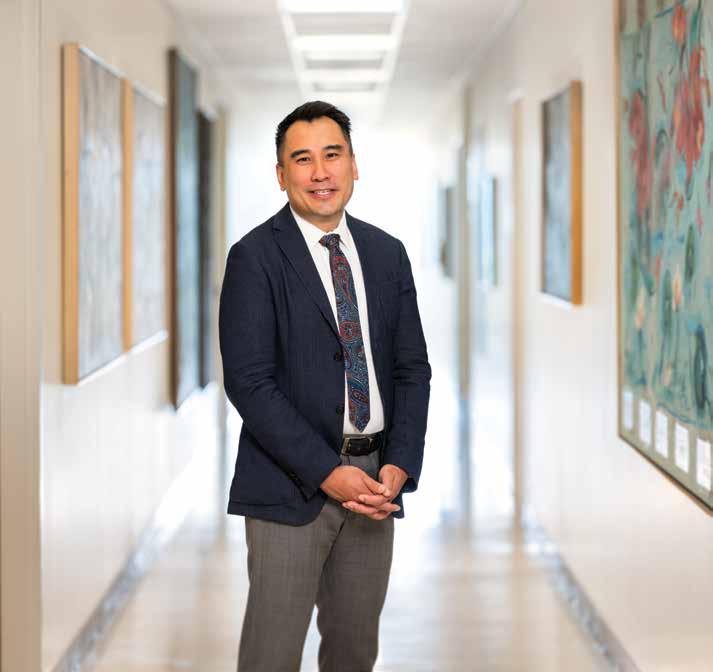
Medical Oncologist
Alberta Health Services
Medical Lead
Clinical Research Unit, Tom Baker Cancer Centre
Clinical Associate Professor
Department of Oncology, Cumming School of Medicine, University of Calgary
Jose Monzon wants clinical trials to be a standard of care for cancer patients.
Clinical trials look at new ways to prevent, detect and treat disease,
Dr. Dustin Pearson
Pearson is a research scientist working to reduce the prevalence of radon-induced lung cancer and save lives by getting more people into early lung cancer screening programs.
Researcher
Robson DNA Science Centre, Arnie Charbonneau Cancer Institute, Cumming School of Medicine, University of Calgary
Operations Lead
Evict Radon National Study
It’s a common misconception that only smokers will get lung cancer. In truth, about 16 per cent of all lung cancers in Canada are due to radon exposure.
Canada’s soil is rich in radioactive elements, like radium and uranium. As these elements decay, they become an odourless gas that leeches out of the soil. Radon becomes problematic when it gets trapped in our homes and we breathe it
in. (Every home, condo and apartment — in every region of Canada — has the potential to be high in radon.)
Dustin Pearson regularly presents his research to the public in an approachable way, as education and awareness can help reduce the prevalence of radon-induced lung cancer.
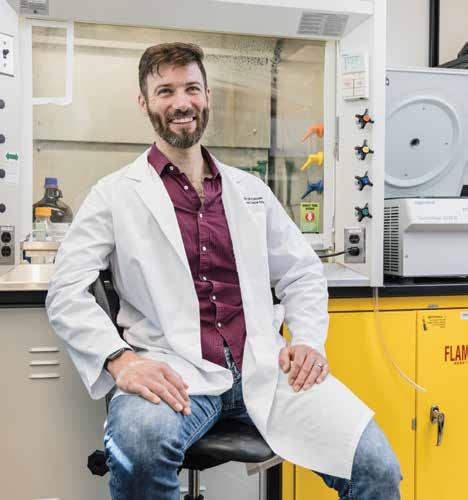
“I’ve found talking about my work has an immediate impact: people will buy a kit [through the Evict Radon National Study or from other reputable sources] and test their homes’ radon levels. Something that simple can prevent a lung cancer case,” says Pearson.
He is also developing a diagnostic tool to measure lifelong radon exposure. He hopes this would make otherwise ineligible, highradon exposed individuals eligible for early lung cancer screening and
144 Created for OWN.CANCER
PHOTOGRAPH: JASON DZIVER
offering patients access to the latest treatment options.
“I want to have a trial offered to every patient,” says Monzon, who’s led the Tom Baker Cancer Centre’s Clinical Research Unit since 2019.
Monzon’s vision comes with lofty numbers, including surpassing the national average of patient trial participation at the Arthur Child. Part of the goal includes doubling phase 1 trials — when research is often first tested in patients — and using novel immunotherapy, such as CAR T-cell therapy, putting Calgary at the forefront of research.
Monzon says with the Arthur Child’s opening approaching, donors have the opportunity to invest in the infrastructure and team necessary to make these trials happen, and to make the city a true world leader.
“Calgary is going to be a place to come and be innovative,” says Monzon. “And we need to build these clinical trial opportunities to foster that reputation.”
—NK
Puckrin
Hematologist
Alberta Health Services
Department of Medicine, Cumming School of Medicine, University of Calgary
improve patient outcomes. (Currently, only those with a history of heavy tobacco smoking are eligible.)
As part of his research, Pearson works closely with medical physicists at the Tom Baker Cancer Centre and is excited to continue this collaborative relationship when the Arthur Child opens.


Both on the frontlines and behind the scenes, Robert Puckrin is making a difference for Albertans facing cancer. Puckrin was originally inspired to pursue hematology by the emergence of futuristic and potentially life-saving advancements. Today, his focus lies in treating lymphoma patients with similarly innovative methods, such as CAR T-cell therapy — where immune cells are modified to better fight cancer — alongside chemotherapy and stem cell transplantation.
stem cell transplantation and cellular therapy. As he begins a new chapter leading his own work as an independently practicing physician, he remains focused on improving treatments, increasing access to Alberta-made CAR T-cells and, ultimately, helping patients live longer and better lives.
—KO
Following 11 years of training, Puckrin recently completed his subspecialty in
“The best part of my job is that I get to care for so many wonderful patients and caregivers,” says Puckrin. “To bring comfort, hope and promising new treatments to patients is my greatest honour as a physician.”
—NK
145 Created for OWN.CANCER
Dr. Robert Puckrin
is improving patient outcomes today and into the future by researching and deploying advanced treatment methods to combat blood cancers and other blood disorders.
Clinical Lecturer
Professor
Departments of Surgery, Oncology and Community Health Sciences,
Cumming School of Medicine, University of Calgary
Medical Director
Calgary Breast Health Program
Scientific Director
SPHERE (Strategies for Precision
Health in Breast Cancer)
Site Lead, General Surgery
Foothills Medical Centre
Quan works directly with breast cancer patients and also leads collaborative research projects to study and implement improvements in the breast cancer journey, from diagnosis to survivorship.


Iqra Rahamatullah
Second Year MD Student
Cumming School of Medicine, University of Calgary
A three-time cancer survivor, and currently a medical student, Rahamatullah believes that leading with empathy and centring the patient during care will lead to improved patient experiences.
Iqra Rahamatullah never dreamed of being an oncologist. But after becoming a cancer patient, she realized her own experiences gave her a unique perspective to empathize with patients.
Rahamatullah was first diagnosed with Ewing sarcoma as a grade 12 student in 2013, and again in 2019. After her second bout with cancer, she was overcome with worry that it might return. It took a conversation with an oncologist who was also a former cancer patient to address her fears in a meaningful way.
That chat stuck with her, and after she finished her degree in kinesiology, she applied for medical school. Despite a cancer recurrence in 2021, undergoing chemotherapy and having a lung removed, she got into the Cumming School of Medicine.

146 Created for OWN.CANCER
Dr. May Lynn Quan
May Lynn Quan thinks of herself as kind of a Swiss army knife of breast cancer care. Her multi-tool approach includes working as a surgeon, administrator and researcher. As a surgeon, she works directly with patients. As a researcher, she evaluates what is working in breast cancer care and what isn’t. And as an administrator, she helps improve cancer care by streamlining processes, filling gaps and changing policy for the better.
Quan strives to understand the entire scope of a woman’s breast cancer journey. That understanding will become even clearer when the multidisciplinary Breast Health Clinic settles into its new homebase at the Arthur Child. There, nurse navigators, clinicians, researchers and others specializing in breast cancer will have direct access to each other and the wider oncology community.
Dr. Fiona Schulte
Schulte, a clinical psychologist and researcher, studies the psychological and social aftereffects cancer treatment has on children, adolescents and young adults. Her goal is to improve the post-treatment experience for survivors and their families.
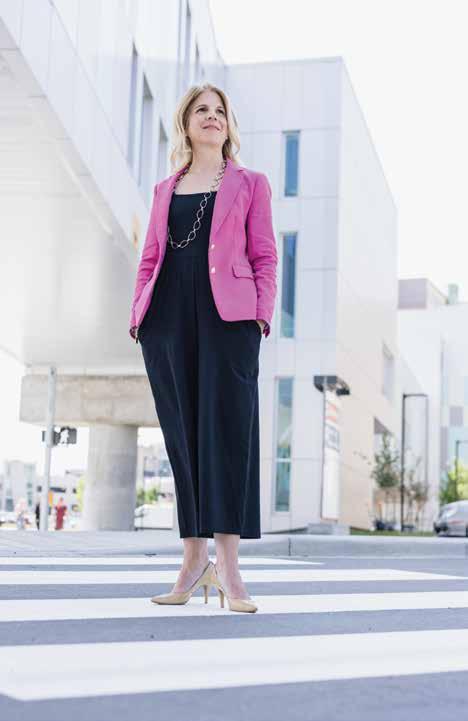
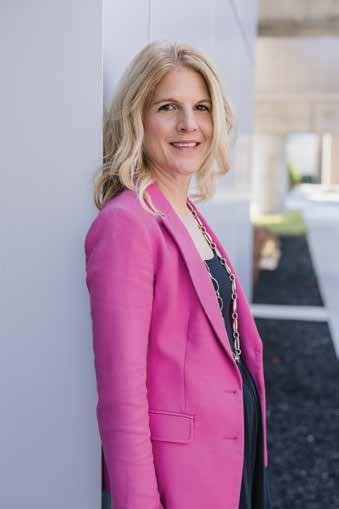
—JM
“We can evaluate how we're delivering care, see where the gaps are from patients themselves, develop interventions and test them right there,” she says. “We want to address the needs of breast cancer patients right here in Calgary and tailor it for them.”
For patients and their families, the cancer experience isn’t over when chemotherapy and radiation ends.
“In the research that I've done, we've found that 50 per cent of adolescents and young adults report significant mental health difficulties more than six years after cancer treatment completion,” says Fiona Schulte. Depression, anxiety, PTSD and fear of recurrence are all common in patients and their family members post-treatment. “We can't laud impressive survival rates and cancer cures without considering the psychological impact that cancer has on people. There needs to be a greater focus on youth with cancer, more resources — like psychosocial intervention support groups — and advocacy for the emotional needs of these young people following their cancer treatment to improve survivors’ quality of life.”
Now, her mission is to better integrate patient-centred care practices into medicine; Rahamutallah is strongly considering becoming a pediatric oncologist when she graduates medical school in 2025.

“I’m very motivated to live and carry out what I feel like is my purpose in life,” says Rahamatullah.
—JD
Schulte has published over 100 research papers on this topic and is excited to continue her research out of the Arthur Child when it opens, closely connecting her to patients.
“The support for the OWN.CANCER campaign acknowledges that there is expertise here in Calgary, and that support gives us the power and the resources to make real change,” says Schulte. “Thank you to the donors of the campaign. I'm looking forward to making a difference.”
—KO
Created for OWN.CANCER
Associate Professor Department of Oncology, Division of Psychosocial Oncology, Cumming School of Medicine, University of Calgary
Seo uses data technology to derive a better understanding of how brain tumours and tumour microenvironments interplay to determine more effective drug therapies.
Bioinformatician
Arnie Charbonneau Cancer Institute, Cumming School of Medicine, University of Calgary
Heewon Seo sees himself as a “hidden figure,” referencing the 2016 film Hidden Figures as he explains his behind-thescenes work to provide hope for individuals living with brain cancer.

Seo uses data gathered by a team of pathologists and clinicians, statistics and computer-based methods to create models that demonstrate the effectiveness of alternative drugs, so the most effective drugs can be prioritized.
“Brain cancer progresses really fast, so we have limited time [to treat it],” says Seo. “But in the bioinformatics area, we can move quickly to help clinicians with decisions.”
Integral to Seo’s work is spatial transcriptomics, a process that uses cutting-edge technology to map out the different components of a brain tumour. It breaks down which cells within a tumour are malignant, vascular or part of the immune system. Seo then uses this data to gain a better understanding of how each cell within a tumour works
Dr. Matt Warkentin
As a research analyst, Warkentin uses big data to generate realworld evidence that informs ways of improving cancer prevention, screening and treatment.

Molecular Epidemiologist
and Postdoctoral
Associate
Department of Oncology, Cumming School of Medicine, University of Calgary
Senior Research Analyst
Oncology Outcomes
Matt Warkentin uses big data and real-world evidence (RWE) to answer questions that will help prevent cancer diagnoses each year, catch cancers earlier and improve patients’ outcomes. Big data refers to using massive amounts of realworld information from various academic and clinical health-care databases, such as the Alberta Health Services’ database, to inform research, while RWE provides
148 Created for OWN.CANCER
Dr. Heewon Seo
together as an “ecosystem,” along with knowledge supplied by oncologists, immunologists and biologists.
Previously, technology was not advanced enough to look at tumours in such detail. This opens up the potential for what is known as precision oncology.
“Even though people may have the same brain cancer diagnoses, brain cancers are different from person to person,” says Seo. “What bioinformatics can do is profile patients individually, so that clinicians treat them with different solutions patient to patient.” —SC
Dr. Lin Yang
Research Scientist and Epidemiologist
Department of Cancer, Epidemiology and Prevention Research with Cancer Care Alberta, Alberta Health Services
Adjunct Assistant Professor
Departments of Oncology and Community Health Sciences, Cumming School of Medicine, University of Calgary
surgery. In another, she’s exploring if intensive exercise interventions before bladder cancer surgery can help reduce surgical complications.
clinically rich insights into what actually happens in everyday practice and why.
“Very often, we are dealing with terabytes of data and we are trying to find order in the chaos,” says Warkentin. To that end, some of his work focuses on machine learning and how artificial intelligence can improve cancer control initiatives throughout Alberta and Canada.
Real-world data will also have a significant impact in clinical decision making. For example, integrating big data into patient treatment allows clinicians to gain a more comprehensive and long-term look at how a patient’s illness and treatment progresses. “Real-world data is about using data from previous patients — which therapy was used and when to produce the best outcomes — to inform care and decisions for current patients, so that their survival and quality of life are the best possible,” says Warkentin. “We leverage real-world data to make sure the right person is offered the right treatment at the right time.” —SC
There’s a window for cancer patients, after diagnosis but before treatment begins, that’s often a waiting game. For Yang, this period of time is an opportunity for prehabilitation. Her research examines how exercise, lifestyle modifications and psychological mental health supports can positively set patients up for their treatments. In one study, she developed a virtual tai chi program for prostate cancer patients to participate in before
“The cancer journey is really like running a marathon. Running the cancer race demands physical and psychological endurance. We aim to build up endurance from prehabilitation,” she says. “When we think about this long journey of cancer survival, it’s not just the treatment outcome. It’s how the treatment outcome may affect their long-term survival.”
Yang was recruited to Calgary from Vienna, Austria, and says the Arthur Child was a reason for her move. She’s most excited about the space bringing together patients, clinicians and researchers.
“The new cancer centre will be able to provide this opportunity, in a physical way, to put everyone together to solve a common problem.” —LS
149 Created for OWN.CANCER
Yang conducts research to provide evidence that prehabilitation with personalised lifestyle interventions, particularly non-invasive approaches like exercise and mental health support, can improve the readiness of patients for cancer treatment as well as improve longterm cancer survivorship.

150
The Arthur J.E. Child Comprehensive Cancer Centre opening 2024
Cancer Centre – by the numbers
One of the largest comprehensive cancer centres in North America
160 in-patient beds
100+ patient exam rooms
1.3m square feet in area
90+ chemotherapy chairs
12 radiation vaults for radiation therapy services
The largest comprehensive cancer centre in Canada
Bricks and mortar are only the beginning. We’re bringing together researchers, medical teams, prevention experts, patients and families in ways never before possible. But big dreams need big support. That's why we have committed to OWN.CANCER by raising $250 million to accelerate research innovations and provide world-leading cancer care and treatment at the Arthur Child when it opens its doors in 2024.
Help
110k square feet of dedicated research space
:
Created for OWN.CANCER 151
us OWN.CANCER
Are you with us? owncancer.ca
The Arthur J.E. Child Comprehensive
WE’RE READY TO
Are you with u s?
Calgary is already a recognized hub for cancer research, treatment and care. That's nothing compared to what we are poised to become when the Arthur Child opens its doors in 2024.
We're more than half way towards reaching our goal of raising $250 million to accelerate research innovations and provide world-leading cancer care and treatment.
But big dreams need big support and we need your help to get there.

us OWN.CANCER: owncancer.ca
Help







avenue calgary.com 153 CELEBRATE 25 YEARS OF CELEBRATING CALGARY’S BEST TICKETS ON SALE NOW avenuecalgary.com/T40Tickets 25 Incredible Years • 1,000 Amazing Calgarians • 1 Great Night 2023 top40 under40
You Are Here
Edelweiss Village
Unmistakable with its Bavarianstyled exterior, Edelweiss Village is a hub for European foods and shopping. On one side is the in-house deli, bakery and kaffee stube, a casual counter-service restaurant serving up classics like Wiener schnitzel and cabbage rolls. On the retail side is a range of European imports and specialty items, including cuckoo clocks, table linens, Christmas decor and gnome figurines.
Capitol Hill
The Artist Lounge
The longstanding Ruberto Ostberg art gallery expanded in 2022 by opening a cocktail and tapas lounge in the adjacent space. The Artist Lounge was designed by local artist/ architectural designer Khalid Omokanye, who also did some of the construction. You can appreciate his handiwork while snacking on chicken flautas and piña chinos paired with a “Pandan-Monium” cocktail.
Lil Empire Burger
The newest location of the home-grown chain opened here last year, offering its classic burger joint menu along with sweet treats and alcoholic beverages from partner businesses Made By Marcus ice cream and Annex Ale Project. It’s worth a visit just to gaze at the amazing ’90s video game-inspired mural by Vancouver-based Andrew McGuire, who also created Lil Empire’s Burger Boy mascot.
Weeds Cafe
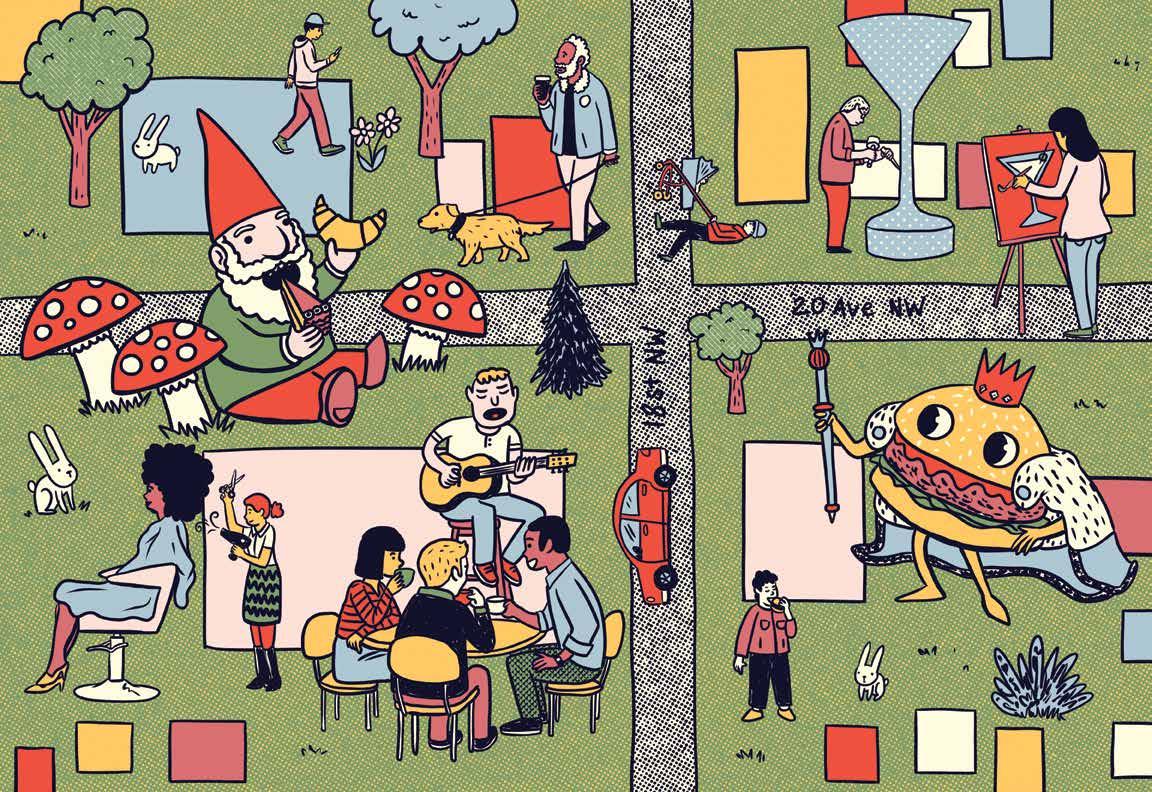
This boho coffee house has been anchoring this corner since 1994, serving up classic barista drinks and baked goods. Over the years, the laid-back atmosphere has been an incubator for artists and musicians such as Reuben Bullock. These days, catch the recurring Ol Time live music session on the last Sunday of the month in the side room off the main space.
Phyl’s Beauty Salon
Tucked behind Weeds Cafe, this neighbourhood beauty shop, named after original owner Phyllis Rice, has been providing cuts, colours and perms to a loyal clientele since it opened in the 1980s. Current owner Marian Lyttle is a former employee, who took over in 2005 after Rice passed away, and has been running the three-chair salon ever since. —Shelley Arnusch
154 september/october 2023
ILLUSTRATION BY JARETT SITTER 51° 04' 14.0" N, 114° 06' 16.6" W 1 4 2 2 3 1 3 4 5 5
CALGARY - 225 10th Avenue SW - Tel. 403-532-4401
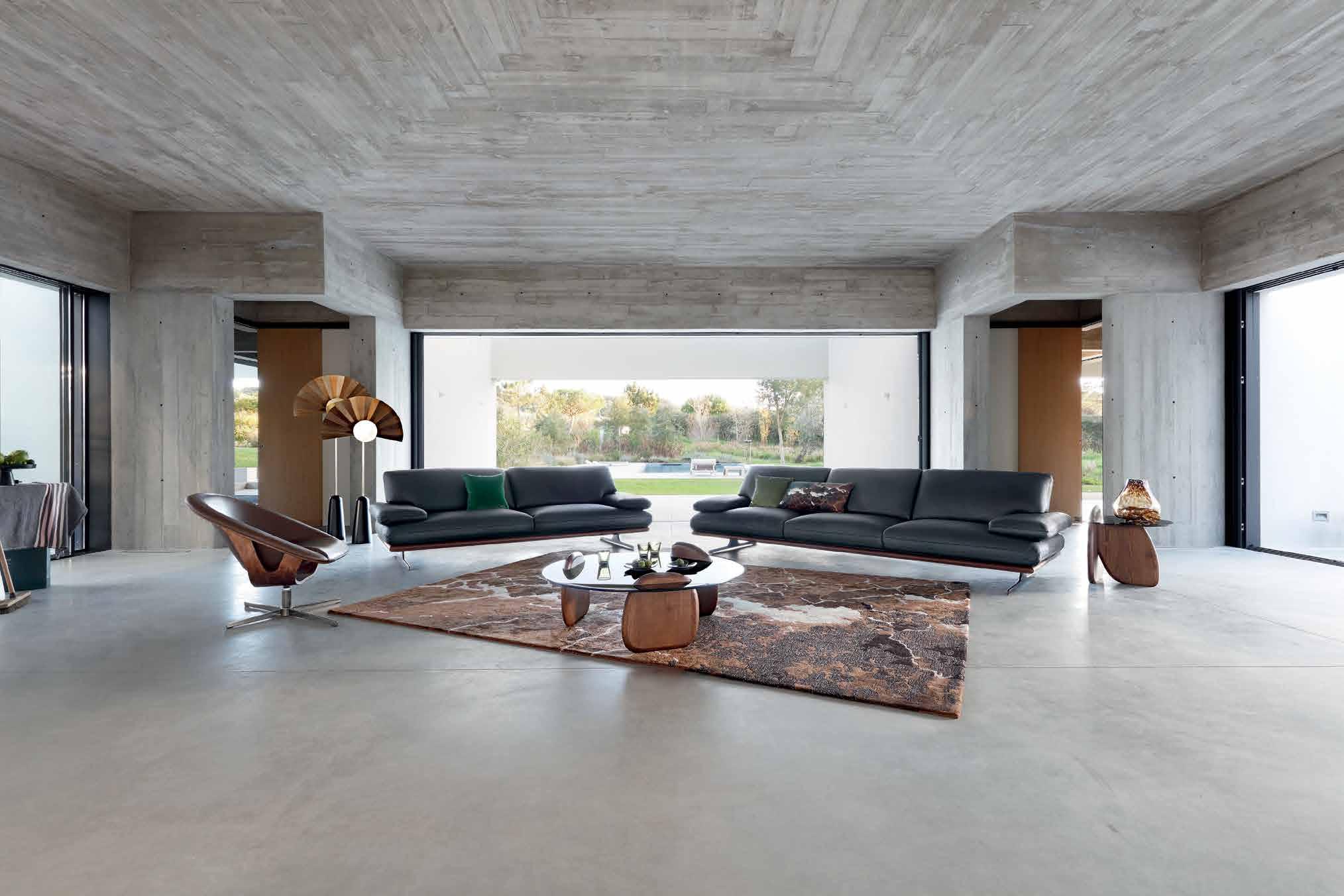
VANCOUVER - 716 West Hastings Street - Tel. 604-633-5005
avenue calgary.com 155 French Art de Vivre
by
Le Quiniou, for advertising purposes only. (1) Conditions apply, contact store for details.
Photos
Flavien Carlod and Baptiste
Envergure. 5-seat sofa, designed by Philippe Bouix. Sira. Armchair, designed by O&M. Shark. Cocktail and end tables, designed by Studio Juam.
In-store interior design & 3D modeling services.(1)


















































































































































































































september/october 2023 156 PHOTOGRAPH BY TK TK TK WORK OF ART SHANE HOMES, THE BETTER WAY TO BUILD. SHANEHOMES.COM/HOMES/MODELS/PAIRED-HOMES Your Duplex Home Should Pass the Yell Test. At the heart of family lies exuberant noise, joyful shouts, and heartfelt laughs. By passing the Yell Test, our duplexes maintain harmony with your neighbours, so you can enjoy all the things that make a home. Explore Shane Homes’ ‘Yell Test’ Approved Duplexes in 6 Premier Communities: Wolf Willow, Creek View, Pine Creek, Sirocco at Pine Creek, Legacy, and Glacier Ridge. NEW HOMES FROM THE $550’s * * Pricing includes house, lot and GST Subject to change without notice. Conditions Apply. See Area Manager for details.
