This open-source database is enabling people around the world to forage in the streets of their city, reconnecting with the origins of their food Where does your food come from? It’s a question that many of us couldn’t answer. In an age of packaged supermarket produce, growing or harvesting our own fruit and vegetables can seem old-fashioned and unnecessary. But look around your city and, from elderflower and garlic on the side of the road to apple trees in the local park, food is growing everywhere for free. Falling Fruit, a global opensource database created by foragers Ethan Welty and Caleb Phillips, seeks to restore the connection between humans and their food by mapping edible plants and giving people the knowledge to harvest from their urban environment. The idea for Falling Fruit came, as many great ideas do, over a pint – or, at least, the intention to make one. “There were two apple trees in the backyard of my first house in 20
Boulder [Colorado],” explains Welty. “I had already learnt how to make my own beer, so I decided to make my own cider. I wasn’t getting enough apples from my backyard, so I started to consider whether I could harvest more from other trees in the city. Some friends pointed me to apple trees that were overhanging a bike route and were very productive.” Welty’s search for apples coincided with an academic study he was working on, estimating how much food could be grown in Boulder based on the amount of available exposed ground with no buildings, roads or trees in the way. Through his cidermaking hobby, he came to appreciate that the city’s trees could be a source of food and not just a barrier to growing other crops. “At that point, I met Caleb and we connected over the fact
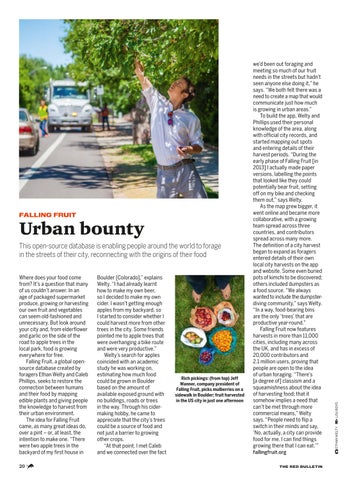
Rich pickings: (from top) Jeff Wanner, company president of Falling Fruit, picks mulberries on a sidewalk in Boulder; fruit harvested in the US city in just one afternoon
THE RED BULLETIN
LOU BOYD
Urban bounty
ETHAN WELTY
FALLING FRUIT
we’d been out foraging and meeting so much of our fruit needs in the streets but hadn’t seen anyone else doing it,” he says. “We both felt there was a need to create a map that would communicate just how much is growing in urban areas.” To build the app, Welty and Phillips used their personal knowledge of the area, along with official city records, and started mapping out spots and entering details of their harvest periods. “During the early phase of Falling Fruit [in 2013] I actually made paper versions, labelling the points that looked like they could potentially bear fruit, setting off on my bike and checking them out,” says Welty. As the map grew bigger, it went online and became more collaborative, with a growing team spread across three countries, and contributors spread across many more. The definition of a city harvest began to expand as foragers entered details of their own local city harvests on the app and website. Some even buried pots of kimchi to be discovered; others included dumpsters as a food source. “We always wanted to include the dumpsterdiving community,” says Welty. “In a way, food-bearing bins are the only ‘trees’ that are productive year-round.” Falling Fruit now features harvests in more than 11,000 cities, including many across the UK, and has in excess of 20,000 contributors and 2.1 million users, proving that people are open to the idea of urban foraging. “There’s [a degree of] classism and a squeamishness about the idea of harvesting food; that it somehow implies a need that can’t be met through more commercial means,” Welty says. “People need to flip a switch in their minds and say, ‘No, actually, a city can provide food for me. I can find things growing there that I can eat.’” fallingfruit.org