BEYOND THE ORDINARY
U.S. EDITION JAN./FEB. 2021, $5.99
BEYOND THE ORDINARY
M A E T M A DRE ory— t s i h g n i gam ry o e l d g a 2 m A G T DO MO A m i E a l T c e w r o H an to l p y e h t and how
THE RED BULLETIN 01-02/2021
SUBSCRIBE
NOW D E TA I L S
INSIDE
EDITOR’S NOTE
COURSE CORRECTION No doubt, this has been a really weird year that has demanded improvisation. This month’s cover story— “Ready to Rock” (page 22) —was almost a casualty of 2020. Our original plan was to photograph and interview Team OG—the champion Dota 2 team has an epic underdog story—as they trained in a Los Angeles mansion for the first tournament of the year. But then COVID-19 exploded. The tourney (and ultimately, the season) was canceled. We shot the team the day before America locked down.
CONTRIBUTORS THIS ISSUE
STEPHANIE B. CHANG
“This shoot felt like a full circle— combining my photo work, my hometown and brilliant women,” says Chang of her assignment to shoot Muslim basketball pioneer Jamad Fiin. The New York Citybased photographer, who went to art school in Boston, has shot for Vogue and Levi’s. “Getting to know Jamad and her basketball camp and seeing her in action was really uplifting, especially during such a tumultuous year.” Page 9
F. Scott Schafer shoots Team OG on March 13 in a home the team rented for a pre-tourney boot camp. When the shoot wrapped, they rushed to LAX to fly home.
The team had to recalibrate—to keep training without clear goals, to overcome unexpected hurdles. Since our shoot in March, Team OG has made roster changes, and as new interviews reveal, adapted to online competition as they keep their eyes on the prize: Being ready for the return of live tournaments. It’s a testament to how the improvisational skills esports demand apply to real life. 04
“I’ve worked with many famous people over the years and I have to say it was amazing being in the presence of greatness,” says the Los Angeles-based photographer about photographing Team OG. Adds Schafer, who has shot portraits of Barack Obama, Mark Zuckerberg, LeBron James, Serena Williams and Michael Phelps for editorial and commercial clients, “These guys are super badass rock stars!” Page 22
THE RED BULLETIN
SERGE SEIDLITZ (COVER)
F. SCOTT SCHAFER
Ucluelet, BC, Canada Pro snowboarder and YETI Ambassador Robin Van Gyn sets out for a new challenge.
CONTENTS January/February
FEATURES
2 2 Ready to Rock
Team OG, esports legends and two-time Dota 2 champions, are geared up for an encore after a year of unexpected challenges.
3 4 Winter Escapade
Four of the world’s best snow athletes reveal their secrets to finding adventure during their favorite time of year.
4 4 Higher Purpose
In 2012, Nims Purja climbed his first peak. Today he holds the record for the fastest ascent of the world’s highest mountains.
5 6 Bright Ideals
His vivid Soundsuits brought him acclaim. Now artist Nick Cave is aiming to unite a divided nation with his latest project.
6 2 Inner City Limits
Free solo climber Robbie Phillips planned to scale greater heights in 2020, but lockdown forced him to explore new ground.
70 Water Woman After a near miss at a world record, big-wave surfer Justine
Dupont reveals how she wants to change her sport forever.
22 TIME SHIFT
When Team OG was photographed back in early March, they were still able to gather in one place. Now they’ve shifted their gameplay to online tournaments.
56 BIGGER PICTURE Nick Cave’s colorful, full-body Soundsuits are a commentary on prejudice, be it related to race, class or gender.
06
THE RED BULLETIN
26
THE
DEPARTURE
Taking You to New Heights
9 Hoops star Jamad Fiin inspires a new generation 12 Riding wrecks in Florida 14 Smashing records in Russia 16 Grammy-winning blues
guitarist Fantastic Negrito
18 Stunt rider Aaron Colton
rallies for Wings for Life
20 Rapper Benny the Butcher
serves up his prime cuts
GUIDE
Get it. Do it. See it. 81 Travel: Three meccas for snowmobiling fun 84 Fitness tips from pro snowboarder Nick Russell 86 Dates for your calendar 88 The best new gaming gear 96 The Red Bulletin worldwide
F SCOTT SCHAFER, AARON BLATT/RED BULL CONTENT POOL, JAMES PRINZ
98 Pillow play in the Kootenays
34 LET IT SNOW
X Games gold medalist Hailey Langland likes tackling bigger terrain to get out of her comfort zone.
THE RED BULLETIN
  07
LIFE
&
STYLE
BEYOND
THE
ORDINARY
THE
Jamad Fiin, 21, founded a basketball camp that encourages Muslim girls of all ages to play sports.
STEPHANIE B. CHANG
CROSSOVER SUCCESS
After her dribbling skills made her an internet sensation, college star Jamad Fiin is inspiring a new generation of Muslim girls to play hoops in Boston—and around the world. THE RED BULLETIN
09
T H E D E PA RT U R E
J
amad Fiin rhythmically dribbles backward while her hijab and skirt bob to the beat of the basketball hitting the damp asphalt. Her cameraperson tries to anticipate her moves, but Fiin’s handles make the task nearly impossible. She turns around, bounces the ball between her legs and flows into an array of behindthe-back moves and countermoves. Then she gives the cameraperson a little hesi before finishing the graceful sequence with a crossover dribble and a behind-the-backboard layup. It’s effortless moves like these that effectively broke the internet back in February 2017, when a 4-second video of Fiin’s basketball skills went viral. In it, she calmly crosses over several male players before driving to the basket and scoring in the lane with her left hand. Fiin’s cousin tweeted the video on her 18th birthday, when she was still a senior and varsity
player at Boston Latin School. Almost four years later, she’s amassed nearly 330,000 followers on Instagram and 400,000 on TikTok, with bigname fans like the rapper Drake and Boston Celtics forward Jaylen Brown taking note. But the 21-year-old senior at Boston’s Emmanuel College and a guard for its Division III basketball team aspires to be more than just a social media phenomenon. It’s evident that the hardwood and blacktop are her refuge, where she’s able to create ball-handling masterpieces without judgment or boundaries. And she wants to use her rising celebrity to give girls who come from a similar background that same kind of joy, confidence and freedom. That’s why a few years ago Fiin founded the Jamad Basketball Camps, which helps Muslim girls of all ages and skill levels to not only be better athletes but better people.
STEPHANIE B. CHANG
Fiin was shot at Malcolm X Park in Boston on October 4, 2020.
10
“Basketball helped me become more open to people, because I was a very shy person,” Fiin says of her youth. “I really didn’t talk to anyone, but now I can have a regular conversation with people. The friendships I made through basketball are like a family.” Born and raised in Boston as the daughter of Somali immigrants, Fiin didn’t see any Muslim girls like her playing sports. “It was like me and one other girl that I had to force to come play with me,” Fiin explains. The Somali community frowned on the activity. “They didn’t like the idea of girls playing basketball or any sport in front of boys,” she says. That initial lack of support stems from a troubled history. After civil war broke out in Somalia around 1991, an extreme form of Sharia law began to take over and sports were declared satanic acts. Girls were not allowed to compete or even watch sports. And although Somalia now has female club teams and a national women’s basketball team, players still receive death threats from extremists. So it wasn’t surprising that Fiin’s mother was hesitant to let her daughter pick up the game while surrounded by Boston’s close-knit Somali community. In fact, it was Jamad’s father who helped convince her. “We had to get my mom on board in the beginning,” Fiin recalls. “She would always think about what other mothers would say.” Thankfully, it didn’t take long to change her mother’s mind, and today, she is one of Fiin’s biggest supporters and a frequent presence at her daughter’s camps, where THE RED BULLETIN
“Basketball helped me become more open to people,” Fiin says.
“GIRLS SAY TO ME, ‘I SHOWED MY MOM YOUR VIDEOS AND NOW SHE LETS ME PLAY.’ ” THE RED BULLETIN
a new generation of Muslim girls are encouraged to play hoops and build confidence. “I want those girls to have fun with it—just work their hardest,” Fiin says. “Like if you really love it, you gotta work hard and prove everybody wrong.” “When people first get here, there isn’t much to do and they don’t know what to expect, so they are very shy and quiet,” says Yuleska Ramirez-Tejeda,” a former teammate at Emmanuel who helped Fiin at a camp in Boston’s Timilty Park in September. “But when they leave, they leave smiling and making friends. This camp is a safe place where girls come to not only be better basketball players but have fun, make memories and have a great time. I think Jamad has been a big inspiration for girls around the world that this camp will [continue to] expand outside of Boston.” Beyond her home court, Fiin has already hosted camps in Columbus, Ohio, Minneapolis and Toronto, which got an assist from local hero Drake. The Canadian rapper, who is a global ambassador for the Toronto Raptors, invited Fiin to host a camp at their practice facility in December 2019. Since then, awareness has only continued to grow, with girls flooding Fiin’s social feeds with requests to bring her next camp to their city. “Now it’s being accepted that [Somali] girls can play basketball. A lot of girls come up to me or message me on Instagram, saying ‘I showed my mom [your] videos, and now she lets me play whenever I want.’ ” —Jannelle Moore 11
T H E D E PA RT U R E
Sebastian, Florida
HULL AND HIGH WATER For Italian wakeboarding champion Massimiliano Piffaretti, any surface is an opportunity to showcase his skills. As luck would have it, the Italian came across this abandoned boat (a victim of 2019’s Hurricane Dorian) during the Red Bull pro wakeboard team’s South Florida loop trip in June—a 200-mile adventure along the Sunshine State’s Intercoastal Waterway—and Floridian snapper Bryan Soderlind was there to capture the moment. Instagram: @thegoldenbear
  13
BRYAN SODERLIND/RED BULL CONTENT POOL
Mount Elbrus, Russia
ENERGY TO BURN
When you’ve just demolished two records, no one would begrudge you a little showboating. Admire the flare, then, of Russian mountainrunning powerhouse Dmitry Mityaev, caught in the Caucasus here by Moscow-born photographer Danil Kolodin. The appropriately titled Elbrus Race involves a 69-mile run up Mount Elbrus—Europe’s highest peak—with a climb up to 18,500 feet. Back in July, Mityaev ran it in 13 hours and 19 minutes, smashing the record by two hours and 34 minutes. This was clearly a breeze, as he kept going, covering a further 18.5 miles to complete the circuit and take the “world cruise record.” “As soon as I crossed the finish line, I knew that when you’re well prepared you’re able to do marvelous things,” says the 28-year-old. Instagram: @danilkolodin
DANIL KOLODIN/RED BULL CONTENT POOL
T H E D E PA RT U R E
  15
T H E D E PA RT U R E
The Grammy-winning blues guitarist reveals how a hard-learned education in hustling helped score him one of the most unlikely careers in music.
I
n 1996, Xavier Dphrepaulezz was bound for superstardom. After being taken under the wing of Prince’s former manager, the guitarist had just signed a million-dollar deal with major label Interscope—not bad for a young man who grew up in a house with 14 siblings, ran away at the age of 12 and got involved in petty crime during his teens on the streets of Oakland, California. But then life took another U-turn. His debut album was a flop. Then, in 1999, a near-fatal car accident put him in a coma and mangled his strumming hand; Interscope dropped him. When Dphrepaulezz picked up his guitar again several years later, he had a new mantra: Don’t try to please anyone and don’t chase trends. He reinvented himself as delta blues guitarist Fantastic Negrito, playing raw protest songs, dressing outlandishly and making statements others might find uncomfortable. This new direction has earned the 52-year-old the Grammy Award for Contemporary Blues Album in 2017 and 2019, and praise from the likes of Barack Obama and Bernie Sanders. the red bulletin: What’s your aim when writing songs? fantastic negrito: Basically, every song I write, I write for my kids. The things I sing about are openness, equality, healing,
16
accountability, a little bit of the middle finger. I think we need all of these things in our toolbox in order to navigate through this construct of society. Most importantly, I want them to know: Don’t let anybody tell you what you can or can’t do. Is that a rule you live by? I mean, look at me! I released my first Fantastic Negrito album at 46. People in the music industry, they’re bean counters, they didn’t get it at all. They’re like, “Wait a minute, you’re not a rapper, you’re not a pretty white girl singing pop.” I didn’t fit into any of these categories, and yet here we are. So I like to think that Fantastic Negrito is for all the people who’ve been told no; all the people who didn’t get picked for the team. So Fantastic Negrito is the patron saint of outsiders? Absolutely! At age 12, I ran away from home and never saw my family again. I was living on the street. I was hustling for food, for water, trying to find an abandoned car to sleep in. I was hustling to that mentality of surviving. I wasn’t hustling to rip people off—although I did do some of that—I was mostly trying to eat! When it came time to create Fantastic Negrito, I picked up the guitar and was like, “I know how to do this: You just don’t take no for an answer.”
What’s liberty mean to you? It’s about not giving a fuck. It’s the most powerful thing you can do. All my heroes made their best music when they didn’t give a fuck, when they didn’t try. I’m a firm believer in that. Because when you give a fuck you lend yourself to this repressed fantasy that people in power have of where we should fit. So that they feel comfortable. Why are we living in a society that’s openly medicated? I don’t drink or smoke—I don’t need that. Because I feel liberated, I don’t give a fuck. It’s a beautiful thing. How do you get there? Through failure and disappointment. I got there from watching my little brother killed at 14, seeing him on the ground with a hole in his head. I got there from seeing my 16-yearold cousin in a casket. I got there from losing my playing hand. But I also got there from walking the streets as a kid, trying to find a way. Finding out who I am, embracing who I am, then celebrating who I am, and most importantly, not making apologies to people for who I am. I don’t need anybody’s permission, because I feel amazing. And I want to pass that on to people who may not feel amazing. I feel like that’s my mission. Fantastic Negrito’s third album, Have You Lost Your Mind Yet?, is out now; fantasticnegrito.com THE RED BULLETIN
FLORIAN OBKIRCHER
TAKING AN OUTSIDE CHANCE
How does a two-time Grammy winner hustle? I’m still on the outside of things. People still ask me, “Why don’t you do something easy, like this ’60s retro thing?” They’re basically asking me to make them feel comfortable. But listen, I don’t give a fuck about making people feel comfortable. Being an artist is about confronting society. Making people comfortable? That bores the shit out of me. I don’t care about selling records; what I care about is liberty as a human being.
LYLE OWERKO
Fantastic Negrito
“I DON’T NEED ANYBODY’S PERMISSION, BECAUSE I FEEL AMAZING.”
THE RED BULLETIN
17
Wings for Life
WORTHY STUNT
After his best man suffered a life-changing injury, freestyle rider Aaron Colton doubled down on his efforts to raise awareness and funds for spinal cord research. Run began in 2014. And it’s raised more than $35 million, making the event the largest source of funding for the Wings of Life Foundation. Colton, who used to run cross country in junior high and high school, went out way too fast that first year. He clocked 6-minute miles for the first two miles before hitting the wall (and spent the next two days in agony on the couch). He’s participated every year since but adjusted his strategy, focusing more on the community and the cause than the competition. And then that focus shifted. “Wings for Life got a lot more serious for me when Brad got a spinal cord injury,” says Colton, 29, of Los Angeles. “I went from interested to fully invested.” Brad “The Bullet” Baker was an Indian Motorcycle factory rider. In 2018, he
Colton at the 2019 Wings for Life Golf Classic in Chicago—just one of the ways he has been helping to raise money for spinal cord research.
18
fractured his T6, T7 and T8 vertebrae in a crash during practice for Flat Track Racing at the X Games in Minneapolis. Baker and Colton were longtime friends, and Baker had been Colton’s best man at his wedding. After the crash, Colton’s immediate goal was to connect Baker with Wings for Life, especially to the foundation’s community, so that Baker could be surrounded by people who understood what he was going through and could model positive transitions to living with a spinal cord injury. Then Colton committed to participating in every event the organization held—from the World Run to the Scavenger Hunt to the Golf Classic—to raise awareness and funds for research. He’s done several events already with Baker, who, Colton says, has “treated his recovery situation like a champion.” The pair had planned to do the 2020 World Run together. It would have been Baker’s first, but the pandemic made travel too risky. Nothing will stop them in 2021, says Colton. They’ll figure out a way to do it together, no matter what, and Colton will leverage his social channels to raise the kind of awareness that he himself has gradually come to understand. “The most important thing I’ve learned about spinal cord injury is that seeing someone in a wheelchair, that’s just the tip of the iceberg,” says Colton. “What you don’t see are the neurology and neuropathy
Since his first World Run in 2015, Colton’s relationship with Wings for Life has only grown.
WINGS FOR LIFE WORLD RUN
A
t first, Aaron Colton thought the Wings for Life Foundation was simply interesting. Colton, a stunt rider who has competed in nearly all motorcycling disciplines, first heard about the organization back when he was racing motocross. He thought it was a good cause with a unique angle—a privately funded charity that funneled 100 percent of donations to research on spinal cord injury. He entered his first Wings for Life World Run in 2015. The event is actually a run, walk or roll, and it’s the distance that matters, not the clock. Participants from around the globe start at the same time and try to hold off a chase car (real or virtual). More than 690,000 people from 104 countries have participated since the World
THE RED BULLETIN
T H E D E PA RT U R E
“I WENT FROM INTERESTED TO FULLY INVESTED.” FABIO PIVA/RED BULL CONTENT POOL
issues, as well as the bodily function issues. The effort to handle daily tasks, or just getting ready for an airport trip. There’s a lot more to it than not being fully mobile.” Colton’s connection with Wings for Life and his friendship with Baker have influenced how he himself navigates the world. He now THE RED BULLETIN
pays attention to things like accessibility, the need for it or the lack of it. He’s more vigilant to the struggle of others. If he sees someone in a wheelchair who’s having a hard time, he offers to help. He doesn’t have a lot of patience for those who might overthink what it means to give a hand, who might let their personal discomfort keep
them from doing the right thing. “If it means you’re going to approach the situation wrong and it might mean a little embarrassment for you, just take it,” he says. “Suck it up. Your life’s great.” —Christine Fennessy This year’s Wings for Life World Run takes place May 9; sign up at wingsforlifeworldrun.com. 19
T H E D E PA RT U R E
Playlist
FLEXING HIS CHOPS
Benny the Butcher, the New York rapper and member of hip-hop collective Griselda, shares four classic tracks from the Big Apple that shaped his career.
N
MARLEY MARL FEAT. MASTA ACE, CRAIG G, KOOL G RAP & BIG DADDY KANE “THE SYMPHONY” (1988) “My pops was one of the biggest hip-hop fans alive. He listened to everything, and I got to take it all in from the back seat of the car. That’s how I first heard ‘The Symphony.’ Those keys Marley Marl took from Otis Redding were stupid, and the way Kool G Rap rhymed his syllables was crazy.” 20
THE NOTORIOUS B.I.G. “JUICY” (1994) “ ‘Juicy’ was a huge moment for New York. It came out at a time when the West Coast had the game in a headlock, so we were happy to have a record like this. I remember being a kid, and whenever it came on the radio everyone would just smile. It’s not just one of the biggest New York anthems ever, it’s one of the biggest hip-hop anthems, period.”
NAS FEAT. LAURYN HILL “IF I RULED THE WORLD (IMAGINE THAT)” (1996) “Hearing Nas and Lauryn on a record together was special; there’s no way it would have been the same without them. It was so New York—the video was shot in Times Square—yet it had an undeniable universal appeal. It ended up being a blueprint for so many artists who wanted to re-create that same feeling.”
PUFF DADDY & THE FAMILY “IT’S ALL ABOUT THE BENJAMINS” (1997) “The first time I heard this, all I could think about was how crazy the beat was. Then this verse from Sheek [Louch] got me: ‘I’m strictly tryin’ to cop those colossal-sized Picassos.’ I mean, c’mon. Puff is so good at putting people together; it’s like he’s coaching an all-star team. It definitely influenced Griselda.” THE RED BULLETIN
WILL LAVIN
ew York hip-hop is enjoying a renaissance right now, and among those leading the charge is 35-year-old rapper Jeremie Pennick, better known as Benny the Butcher. Benny and his hip-hop collective, Griselda—formed in Buffalo, New York, in 2012—have taken up the mantle laid down by the likes of Wu-Tang Clan and Mobb Deep in the ’90s, delivering their own take on the hardcore East Coast sound. In 2017, Eminem signed Griselda to his Shady Records imprint, and last year Benny inked a management deal with Jay-Z’s Roc Nation. With more than 15 years in the game, payback has been a long time coming for Benny. Here he pays homage to some of the tracks that helped get him there. Benny the Butcher’s new album, Burden of Proof, is out now on Griselda Records; griseldaxfr.com
Get a GEICO quote for your bike and, in just 15 minutes, you’ll know how much you could be saving. If you like what you hear, you can buy your policy right on the spot. Then let us do the rest while you enjoy your free time with peace of mind. geico.com/cycle | 1-800-442-9253
Some discounts, coverages, payment plans, and features are not available in all states, in all GEICO companies, or in all situations. Motorcycle and ATV coverages are underwritten by GEICO Indemnity Company. GEICO is a registered service mark of Government Employees Insurance Company, Washington, DC 20076; a Berkshire Hathaway Inc. subsidiary. Š 2021 GEICO
Team OG was photographed in Pasadena, CA, on March 13, 2020. Since then, the squad released Syed Hassan (in red), as Sébastien Debs (not shown) returned to the roster.
READY TO ROCK Team OG, esports legends and two-time Dota 2 champions, are geared up for an encore after a year of unexpected challenges. Words CALE MICHAEL Photography F. SCOTT SCHAFER
22
WARDROBE STYLING: KATHRYN McRITCHIE
“If you want to be a good competitor, excuses aren’t going to do anything for you,” says Johan Sundstein.
Adapting is something that OG is used to doing at every level of competition.
t’s a rainy night in Los Angeles and the city is darker than usual. It is a Thursday in early March, a moment in the United States in which COVID-19 is poised to morph from a theoretical concern to an outbreak. The world is about to change. The ESL One Los Angeles Major— an important event on the circuit for professional squads that play the immensely popular multiplayer battle arena game Dota 2—has just been postponed, leaving more than a dozen top teams without a tournament to compete in. This news has hit Team OG’s captain, Johan “N0tail” Sundstein, hard, and he is trying to absorb the impact as he sits on a couch inside a posh mansion in Pasadena that the team rented for a team-building boot camp. None of this— the hard rain, the virus, the canceled tournament, a looming pandemic—is how he had imagined the narrative of their spring start. Just a month earlier, OG had competed in the open qualifiers for ESL One Los Angeles, with Sundstein leading a new roster into battle as the team played together for the first time in an actual event. Despite three new players and a distinct lack of experience playing together, OG managed to qualify for the Major with only one loss. It was a dominant performance worthy of the two-time champions. The team already has won more than $33 million in tournament prize money and was gearing up for more—more Major titles, more loot, more glory, more fun. A lot changed in one month. Now, slumped on the couch, Sundstein is feeling empty after hearing that he and his team would be denied a chance to test their skills against the best teams in the world. Each player on OG’s roster has competed on some of the biggest stages in Dota history, but they feel like the chance to show how their skills didn’t atrophy in the previous nine months, while each of them spent time away from the Dota Pro Circuit, has been stolen from them.
“It’s definitely a huge bummer, man. There is no easy way to say it,” Sundstein says. “We were so excited, so mentally prepared. It’s a huge blow.” OG arrived in Pasadena a week prior to the scheduled March 15 start of ESL One Los Angeles, participating in an intense boot camp to sharpen their skills for the battles ahead. But with the event being pushed back and eventually canceled, the team was suddenly left with nothing in the immediate future to aspire to after putting in all of that work. As a group, we spend much of their final day in the United States sprawled out in the living room of the mansion, watching their since-released sister team, OG.Seed, compete at Dota Summit 12 and bursting into unrestrained joy when they upset North American superpower Evil Geniuses in the lowerbracket finals. That is how passionate OG is about the game, always looking forward and rolling with whatever comes their way. They don’t quite know it yet on this March afternoon, but they will make similar improvisations with all of the trials they will soon face as COVID-19 essentially shuts down the competitive Dota circuit. Instead of talking with a team looking to win the third Major of the 2020 Dota Pro Circuit, I am left to hang out for a day with a group of individuals who are being forced to make their first adaptations to what will become the new normal in the upcoming months. But adapting is something OG is used to doing at every level of competition. The team rallies to participate in a spirited photo shoot that captures their camaraderie amid the semicomical décor of their rented mansion. They gather around the grand piano and theatrically break keyboards and crack jokes as they fling pancakes in the kitchen. Then, minutes after the photographer calls it a wrap, they jump in cars and head to LAX—in a rush to get back to Europe and face a completely uncertain future. 25
N0tail
T
he original OG roster, formed in 2015, was made up of a group of experienced gamers who had been playing as an independent squad called (monkey)Business. And instead of working to be signed by another organization by playing well, Sundstein and longtime teammate Tal “Fly” Aizik decided to form their own organization following a dominant run through the Frankfurt Major qualifiers. (Competition in the Dota Pro Circuit has historically been divided into a distinct number of Major and Minor tournaments played before huge crowds in various world cities.) Over the next year, the team went on to win the Frankfurt Major and the Manila Major, eventually qualifying for the sport’s premier tournament—The International—in June 2016, making their TI debut in their first season together. Though the team performed well in the group stage, The International 2016 ended with OG being upset twice and eliminated in ninth place. These early tournaments offered strong signs that OG was going to be something special. Nonetheless, the team wound up having to go through
26
MidOne
several iterations before finally striking gold at The International. In 2017, for instance, the team underwent a massive shift, as only Sundstein and Aizik remained from the previous lineup. To fill out the roster, the mix of veterans and promising talent was recast, bringing in Jesse “JerAx” Vainikka, Gustav “s4” Magnusson and Anathan “ana” Pham. This roster would get off to a strong start, becoming the first team in history to win back-to-back Majors— at the Boston Major 2016 and the Kiev Major 2017. And, though the team was considered one of the favorites to win it all at The International 2017, they were again upset in the lower bracket, this time being eliminated by PSG.LGD, watching as their former teammate Amer “Miracle-” Al-Barkawi and Team Liquid hoisted the Aegis of Champions.
Soon thereafter, Pham announced a hiatus from competitive Dota, leaving Aizik and Sundstein to switch things up again as they headed into the inception of the modern Pro Circuit. The team struggled to establish itself, so they subbed in their coach, Sébastien “7ckngMad” (now Ceb) Debs, to stand in for the remainder of the season as they fought for a spot at The International 2018. The struggles came to a head after the team was eliminated in the first round of the ESL One Birmingham playoffs, as Aizik and Magnusson departed the organization to join Evil Geniuses. The transfer nearly broke OG apart, forcing Debs, Sundstein and Vainikka to pull out of the final Major and try to salvage their season. Knowing they had very little time before they’d have to compete in the European qualifiers for TI, the members
OG's win at The International 2018 is one of the great underdog stories in esports history. THE RED BULLETIN
HUGO SILVA
Saksa
convinced Pham to rejoin the team early while also filling their fifth spot in an unorthodox way. Instead of trying to complete their roster with a proven player who might not quickly fit their system, the team brought in Topias “Topson” Taavitsainen, a player with little competitive experience who had been dominating public games in the European servers. And while it looked like an odd pick, OG went on to crush the European qualifiers, finishing 7-0 to make it into The International 2018—setting up what would be one of the greatest underdog stories in esports history. The team squeaked into the playoffs of The International and then put together a legendary run to win it all. Along the way they destroyed Aizik’s EG squad, leading to one of the most iconic moments to ever grace Dota, as the former teammates clasped hands while the OG captain gave Aizik a scathing look that even the crowd could feel. OG ended the event by beating PSG.LGD, the team that eliminated them in 2017, to finally lift the Aegis—and take home $11 million. It was a shocking, dominant and enormously lucrative win—and Team THE RED BULLETIN
Topson
Ceb 27
From the start, 2020 was going to be a year full of challenges, defined by rebuilding.
OG charted an unlikely path to repeat that script the following year. Sundstein and his team didn’t win a single Major in 2019 but still managed to directly qualify for The International 2019 before finishing at the top of their group and crushing almost every team in their path. Throughout the entire tournament, OG lost only five games and never dropped a series, defeating Liquid to become the first team to win a second International. And just like that, they had won two championships and more than $26 million in prize money. From the start, 2020 was going to be a year full of challenges, defined by rebuilding. This was true before the virus was a factor. After raising the Aegis of Champions a second time in August 2019, the players on OG took some time away from the game and made their own plans for 2020. Vainikka announced his retirement from competitive Dota; Pham decided to take another extended break from the game; and Debs stepped away from the active roster to take a more organizational role. That forced Sundstein to lead a rebuild once again. “There’s a lot of memories there,” says Sundstein. “Winning TI twice—it was ridiculously crazy.”
O
n an afternoon eight months after that rainy day in Pasadena, Sundstein is in Lisbon, Portugal, musing about the past and the future. In the time in between our conversations, OG has made a few moves, releasing one of the players it signed at the beginning of the year— Syed “SumaiL” Hassan—and adding Debs back to the roster. Yeik “MidOne” Nai Zheng and Martin “Saksa” Sazdov remain on the team. During the pandemic, OG has competed in 11 different tournaments, all of them online competitions instead of the large, IRL so-called LAN events they were used to. The team placed second in the online version of ESL One Los Angeles, but their results were all over the map. The team struggled to deal with travel issues and time-zone challenges caused by COVID-19 and ultimately made their roster changes to simplify and stabilize things. “It has been a pain in the ass that I never thought I would have to deal with because Dota, ever since I started, was
29
about showing your best performance at LAN events,” Sundstein says on a video call from Lisbon. “We had three different time zones to deal with and were playing with stand-ins. It was hell for someone like me who hates losing and having an excuse to blame it on.” At last, as of November, OG finally has all five of its main roster situated in the same time zone in Europe, where they can compete and play together regularly, giving them a small sense of normality while the world is still dealing with the COVID-19 pandemic. Sundstein feels that this version of Dota competition is hard on OG, which has been a dominant LAN team. He says the team is still suffering through a “learning process” to adapt to the conditions of online tournaments, and that this form of play demands a lot more personal responsibility from each player on the team. Just as millions of people have struggled to adjust to working from home during the pandemic, competitive esports teams have had to adapt their approach to competing online. Sundstein specifically points to the loss of centralization that LAN events provide, which he says makes it harder to focus completely on the games. “When we play from home, I think there’s way more room for error, way more room for technical issues, and it can take away from the best mindsets for both teams,” he says. “Therefore, the games might just be slightly less competitive, slightly worse in quality.” Still, Sundstein understands that complaints are hollow and unproductive. “If you want to be a good competitor, a good samurai, a good warrior, excuses aren’t going to do anything for you,” he says. “If I lose, I die, and it is very tricky right now. I felt much more in control when LAN events were the real test and the real challenge. Now it’s different.” And while the team is prepared to keep grinding out online events as the pandemic continues, Sundstein is also optimistic about the future. “Well, it kind of brings me a lot of nice, warm feelings when I think about the future because every day we have here is a day to prepare as a team and to get better,” he says. “I know how good we are already and I know how good we have been getting over the past couple of months, so when TI does come back, my vision and my dream is to play the best that we ever have.” 30
The team takes a break from practicing in the basement of their boot camp mansion in Pasadena.
He of course wants to win The International again, but he’s perhaps even more excited about the possibility of competing at the highest level in front of a crowd again. “I want to have the best run that we could possibly have,” Sundstein says. “And if somebody is there to match it with us, we’re going to have the best games ever, and that’s what I’m just excited for.” With that said, not everything is perfect, as COVID-19 and other circumstances have popped up to give
the team more hurdles to clear. They have to play tournaments remotely and deal with the mental health challenges of pandemic life and the evolving world around them. Having everyone in the same time zone helps, but each player still has their own lives to live. Taavitsainen, for instance, recently became a father, and all of the players— including Nai Zheng, who is from Malaysia—are unable to visit family as often as they might like due to travel restrictions and quarantines. And they THE RED BULLETIN
While the team is prepared to grind out online events, Sundstein is optimistic about the future. all must constantly compete in all of the online tournaments as well. “We don’t have that much time to take breaks because we still have to be a part of the online circuit,” Sundstein says. “We don’t want to do the stand-in thing anymore because we always want to limit excuses, no excuses. Honestly, there are a lot of things I still really don’t like.” But even with everything still hitting the team hard, Sundstein is grateful that he can continue competing at all thanks to the general infrastructure provided by THE RED BULLETIN
Dota, the tournament organizers and the teams. “Of course I’m happy that esports continues to be there and continues to be a form of entertainment through these hard times,” he says. “We get to keep our job, which is amazing. But I think once you have tasted how nice it can be, how good the LAN tournaments can be and how hype it is, it doesn’t feel the same to play online.” This is tough for Sundstein, who now has not played in a LAN event since August 2019. As a top gamer who has
competed in Dota for more than a decade, traveling to events and battling it out with the best teams in the world, he is suffering from some serious withdrawal. “If I had to really speak my mind, I am still struggling with not having these fierce competitions happen,” he admits. “Online is a nice substitute, but it just doesn’t feel the same. It is like having a banana split without the chocolate. You still appreciate the banana, but I wouldn’t really call it a full banana split.” 31
“I want to have the best run that we possibly could have,� says Sundstein about 2021.
Right after this shoot wrapped in March, the team raced to LAX to fly home.
  33
34  
AARON BLATT/RED BULL CONTENT POOL
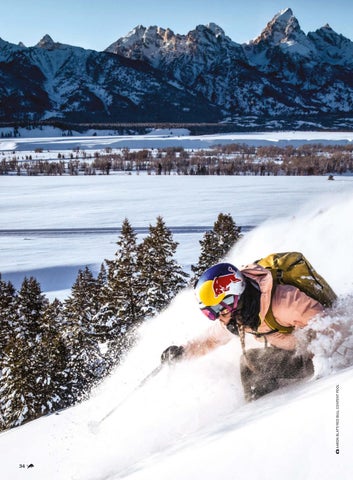
Freeskier Michelle Parker carves a line in front of the Tetons in Jackson, Wyoming, in 2019.
WINTER ESCAPADE
As temperatures drop, some of the world’s best snow athletes reveal the secrets to finding adventure during their favorite season. Winter is not just a chance for an adrenaline trip— it’s a state of mind. Words WILL COCKRELL
M I C H E L L E PA R K E R FREESKIING MAVEN
F
reeskier Michelle Parker is one of the hardestworking athletes on Red Bull’s roster. And yet, she sees things a little differently. “Every day is so fun,” she says. “Even when I’m exhausted, I don’t really feel like I need a vacation. To be honest, I view my lifestyle as one giant vacation.” Interestingly, this attitude toward her work is exactly what propelled Parker from being just another talented young ski racer in her hometown of Truckee, California, to being one of the strongest and most ambitious big-mountain freeskiers in the world today, with impressive side jobs in both climbing and mountain biking. Parker, 33, is perhaps best known for her fearless and flowing style, as captured in the dozen or so ski films she has appeared in (one of which earned her a Best Female Performance nod at Powder 36
magazine’s 2013 Powder Awards). But each year her skiing ratchets up a notch, in both technicality and consequence, as Parker has discovered how to unlock even bigger lines. Early on in her career, during trips to Alaska, she would do avalanche and mountain-guide training courses. Meanwhile, her home range, the Eastern Sierra, provided nearly endless opportunities for self-powered missions involving incredibly technical ascents. “Climbing, rope management, crevasse rescue—all of this just opened up the doors for more adventure,” she explains. “My bread and butter is shooting for these action-packed films, but my passion lies with ski
mountaineering. Lines that incorporate rope skills are so much more complex, and years of experience will get you to those lines.” While Parker still calls Truckee and Lake Tahoe home, home is wherever it’s snowing. Throughout the winter and spring, she basically chases low-pressure vortexes, with each month presenting a new challenge. She usually scores earlyseason snow either in Tahoe, Jackson Hole or British Columbia. In March, the snow is still deep and the sun begins to shine, so Parker is usually filming for upcoming ski flicks. Then in April, things get real. “April is big-line season and you better be prepared,” she says. “First, I’ll spend some time in Alaska and when that starts to fizzle I come back to the Eastern Sierra, where the beautiful big-mountain spring lines have become more accessible and safer to ski. After that, I’m just thinking, Where can I keep this party going?” But wherever Parker happens to be living or staying, these places are merely base camps for her increasingly ambitious missions into the backcountry. “Right now, a lot of my goals lie within exploration,” she explains. “Specifically, I am focused on the Cascade Range in the Pacific Northwest, Teton National Park and the Eastern Sierra. “This voluntary suffering aspect of bigger days is what gets me. The conversations I have on the skin track, and the relationships I build with the people I’m with—these moments are quiet, grounding and beautiful.”
“Every day is so fun, even when I’m exhausted. To be honest, I view my lifestyle as one giant vacation.”
AARON BLATT/RED BULL CONTENT POOL, CHRISTIAN PONDELLA/RED BULL CONTENT POOL
As a top freeskier, Parker seeks out increasingly ambitious backcountry missions in Alaska and the West.
BRIAN NEVINS/RED BULL CONTENT POOL
Powell’s spontaneous style and joie de vivre harks back to a day when snowboarding was all about finding fun.
ZEB POWELL SLOPEST YLE ARTIST
S
nowboard slopestyle artist Zeb Powell was either born three decades too late or was put on this earth to remind the snowboarding world of its roots. While the 20-year-old North Carolina native is relatively new on the scene— with his breakout moment being the Knuckle Huck event at last winter’s X Games—he’s a throwback to a time when riding was all about friends, fun and freedom. “I guess I do treat snowboarding a little differently,” he admits. “That’s how creativity is generated. When I’m with a really good group of friends, we push each other. That’s what I love and that’s when I ride the best. And at this point in my life, it’s working for me.” It certainly is. In his few short years as a pro, Zeb— short for Zebulon—has picked up some of the best sponsors in the industry, gazillions of views on his park session clips and X Games gold for a string of wildly creative tricks. And yet, the closest thing to training Zeb does is a bit of skating and wakeboarding in the offseason. What is most surprising (and refreshing) about Powell is his lack of a plan: “I just go to where my snowboard takes me,” he says. Basically, Powell makes the most of his winters by staying in motion, saying yes whenever someone invites him out West to shred for a few days and surrounding himself with like-minded riders who often end up becoming some of his best friends. He’s as talented at couch surfing as he is
snowboarding and seems to have a “crew” in every city and ski town in the country. “I love seeing a new place and meeting a new face, riding the mountain and just having a genuinely fun time.” These days Powell is based in Burlington, Vermont, but that’s as much for its proximity to an airport as for its proximity to the mountains. While home, he regularly hits Killington and Stratton resorts, and he loves the park at Mount Snow, but the city of Burlington offers an opportunity that mountain towns don’t, as Powell loves to improvise on snow-covered urban features. To him, every handrail, business plaza and bus stop is a canvas. Out
“I love seeing a new place, meeting a new face, riding the mountain and just having a genuinely fun time.”
West, Powell has a soft spot for Copper Mountain in Colorado, which has one of the country’s best terrain parks, but Salt Lake City is perhaps his favorite spot. With world-class resorts like Park City and Brighton a short drive away, SLC is a place that feeds his need for both mountain terrain and some street-style. Unsurprisingly, Powell’s riding style oozes spontaneity. It’s both unpredictable and unorthodox, and the best moments seem to come out of nowhere. Ultimately, it really doesn’t matter where he goes—it’s all about who he’s with. “Riding with my friends triggers me to do things I’ve never done before,” he explains. “I’ll land a trick and look back at my friends with my mouth wide open—and their mouths wide open too—saying ‘What was that!?’ That’s what I live for.” 39
WILL GADD
ICE CLIMBING LEGEND
W
ill Gadd is a true elder statesman of adventure. Not that he’s old, by any stretch—just 53 and with the strength and energy of a 23-year-old—but he has been at it for a very long time. Gadd burst onto the winter sports scene in the early ’90s as perhaps the most skilled and successful ice climber of his generation, winning just about every competition out there, from the Ice Climbing World Cup to the Winter X Games, year after year. Gadd became known for outlandishly risky first ascents up brittle frozen waterfalls, raising the bar of difficulty every time he strapped on his crampons. But even early on, it was clear that competitions would not hold his attention forever. “I really love ice climbing,” he says. “But I began asking myself, What can we do with this stuff called ice? And the 40
unknown is always a lot more interesting than the known.” Today, Gadd is probably best known for appearing in some of the most striking adventure imagery ever produced. Gadd is the tiny figure clawing his way up an iceberg floating in the middle of the Labrador Sea; Gadd is the guy going up Niagara Falls via a series of frozen columns of water; Gadd is the speck of red Gore-Tex dangling inside an amphitheater of spray ice behind Helmcken Falls in British Columbia. And the reason he turns up in so many great adventure photos is because his ideas are so grand and cinematic. “A lot of it is about being open to things that other people call crazy,”
Gadd says. “If someone tells me my idea is the stupidest thing they’ve ever heard—or says it’s crazy—I know I’ve got a good idea.” In 2014, Gadd hiked up Africa’s tallest peak, Kilimanjaro, in order to access one of the highest technical ice routes in the world, a famous chunk of vertical glacier near the summit at 19,341 feet. Earlier this year he returned to climb it again, but also to spotlight how rapidly it was disappearing due to global warming. He calls this expedition “the last ascent.” The funny thing is, eventually Gadd no longer saw himself as just an ice climber, as he now pivots to paragliding once the ice has melted. Sure enough, he set a new distance record for paragliding in 2002 (263 miles) and continues to dream up unique flying objectives. Likewise, his hometown of Jasper in Alberta, Canada, affords him the luxury to constantly switch it up between rock and ice climbing, kayaking, skiing and flying. Gadd has now amassed a strong following of armchair adventurers who simply want to see what he’ll do next. But don’t expect him to give you any hints. “Well, Antarctica is the only continent where I have not climbed ice,” he says cautiously. “But I don’t want to get any more specific than that because it’s a really good idea and I don’t want anyone to steal it.”
“If someone tells me my idea is the stupidest thing they’ve ever heard, I know I’ve got a good idea.”
CHRISTIAN PONDELLA/RED BULL CONTENT POOL
In 2018, Gadd joined forces with a top scientist to explore Greenland’s ice sheet, hoping to better understand glacial melt.
Already an Olympian, Langland likes to step out of her comfort zone— and into bigger, untamed terrain.
HAILEY LANGLAND SNOWBOARDING PRODIGY
S
AARON BLATT/RED BULL CONTENT POOL, DANIEL MILCHEV/RED BULL CONTENT POOL
nowboarder Hailey Langland has accomplished more at age 20 than most pro riders twice her age. She was only 6 when Burton offered her a sponsorship. At 16, she placed 7th on the FIS World Cup tour, and she became the first woman to land a double cork 1080 at the X Games, earning a big-air gold medal in the process. And just a year after that she competed for Team USA in the Winter Olympics. Surely, a finely tuned athlete like her must be a training machine with inhuman discipline. Not quite. “As snowboarders, I wouldn’t say we’re the most disciplined athletes,” she admits. “I’d say we’re more like a band of misfits—we all just like to have fun, and we always get into trouble somehow.” Langland actually learned a valuable lesson about her snowboarding career—and about life itself—by not snowboarding. Whereas most riders of her pedigree extend their season by heading to the Southern Hemisphere for snow, injury kept Langland sidelined for two summers in a row. Then COVID canceled a third—and she says she’s a stronger snowboarder because of it. “It helped me see that I don’t need to keep pushing myself throughout the summer,” she says. “I get to enjoy my 20s and slow down. I feel very strongly that’s why I didn’t end this season with another injury.” Her attitude lines up nicely with her life in San Clemente, California, where she spends her free time in the ocean. “Most mornings I wake up, check the surf and go out for
a few hours if it’s good,” she says. “If not, we just go hang out on the beach and chill, maybe get into some mischief.” Langland has also found an outlet in painting and playing music, which she believes also has a positive influence on her riding. But at first snowfall her mind turns to the mountains. She often hits Colorado first, spending most of her time in Summit County towns like Silverthorne (at the home of her boyfriend, 2018 Olympic gold medalist Red Gerard) and Frisco. This winter she’s genuinely looking forward to her first official trip of the year, to the Stubai Glacier in Austria. “But when I travel, 75 percent of it is about the
“When I travel, 75 percent is about the place I’m visiting and what I’ll eat. Snowboarding is the other 25 percent.”
place I’m visiting and what I’ll eat,” she says. “Snowboarding is the other 25 percent.” If it sounds like Langland may be losing her competitive edge, think again. “I’ve been competitive since I came out the womb,” she says. “When it comes down to the moment, when we’re down to the wire at the top of the start gate, ready to drop in, things get way more serious.” Langland is also feeding her competitive nature by stepping out of her comfort zone, venturing into bigger terrain and the backcountry (she even bought herself a snowmobile), but in this case, it’s not about winning. “Big-mountain terrain has taught me a great deal about how I want to ride,” she explains. “I want to ride strong, in powder, in places like Jackson Hole. It’s pretty awesome to see someone making smooth, graceful turns. It looks like art.” 43
In 2012, Nims Purja climbed a mountain for the first time. Eight years later, he has changed the face of mountaineering— and he’s just getting started. Words TOM GUISE and MATT RAY Photography SANDRO BAEBLER
Higher purpose 44
Purja on Mont Blanc in the Alps in September 2020. The Nepalese climber holds the record for the fastest ascent of the world’s 14 highest mountains.
In 2017, the Gurkhas—an elite squad of Nepali-Indian soldiers that has served the British Army for 200 years—undertook an expedition to summit Everest. It was a pilgrimage of great significance for the storied brigade, their second attempt at the world’s highest mountain after their aborted 2015 mission, when the fateful Gorkha earthquake triggered an avalanche that wiped out base camp and stranded most of the climbers at Camp One. Now this expedition was also in jeopardy. Unpredictable weather meant the official rope-fixing team had yet to set a route to the summit that year. No one could ascend.
“I was like, wow,” says Nirmal “Nims” Purja—at the time a 35-year-old member of the Gurkha climbing unit. “Everyone thinks, as a Gurkha, you are not only the bravest of the brave, but that Everest is in your back garden. Our reputation was at risk. But secondly, when were we ever going to get another chance to climb Everest using British taxpayers’ money? I decided to lead the fixing team.” When word spread around camp about his plan, there was one reaction: “ ‘Does he have a clue what he’s doing?’ Nobody knew who I was,” recalls Purja. 46
“So I led 13 members of the expedition to summit—the first team to make it from the southern side that year. We came back down into Kathmandu and celebrated with a week of partying. “Then I climbed Everest again, and then Lhotse and Makalu [the world’s fourth- and fifth-highest mountains], all in five days, with two days of partying in between.” Three years later, Purja enjoys worldwide acclaim. In 2019, he scaled all 14 “eight-thousanders”—peaks on the planet rising more than 8,000 meters
(26,247 feet) above sea level—in the fastest time he could. The record stood at seven years, 10 months and six days; Purja planned to do it within seven months. He achieved it in six months and six days. It propelled the Special Forces soldier (the first Gurkha ever to be accepted into the U.K. Special Boat Service, an elite unit of the Royal Navy) into the spotlight. It also brought criticism from alpine purists, in particular for his use of supplemental oxygen. “I only do that on the final peak. I climb, setting a fixed line, everything THE RED BULLETIN
Nims Purja, the Gurkha
NIRMAL PURJA
Pictured on his graduation day with the elite military unit in 2002. “My dad was a Gurkha, my brothers were Gurkhas, and it’s such a life. People respect that in the Nepalese community.”
without oxygen up to Camp Four,” he retorts. “People were saying, ‘Oh, Nims did Nepal mountains because he can use helicopters to the base camp.’ I said, ‘OK, fine,’ so I climbed all the Pakistan mountains without any helicopters, running from base camp to base camp— 23 days, buddy. All five 8,000-meter peaks. I have no problem with critics. If someone breaks my record I’ll be the first to shake their hand, but it’s easy to just say it. “Please write that when Nims said that, he said it with a smile, OK?” THE RED BULLETIN
Purja’s words may read as defiant, but in person he gives off a different energy —a restless cockiness that draws people in, rather than repelling them. Sitting in a hotel room at the base of Mont Blanc, where he has spent the whole summer vacationing, he’s all smiles. Muscular, as you’d expect, but diminutive at 5’7”, he’s shaved off the gentleman-explorer mustache he sported during 2019’s Project Possible missions, revealing a boyish face that belies his age. “I’m 38, but to be honest, I don’t really know how old I am,” he says. “I never celebrate my
birthday, because age is just a mindset, a way of letting yourself think that you’re getting old and having that as an excuse.” If this self-consciousness is surprising, it’s just one of many contradictions that penetrate the myth that is Nims Purja. For example, the stereotype that a Nepalese climber benefits from a life raised at high altitude. “I grew up in Chitwan, which is the flattest and warmest part of Nepal. It’s almost sea level. We were a really poor family in a small house with chickens next door. I didn’t even have flip-flops. That changed when my two brothers got 47
Annapurna, April 2019
into the Gurkhas.” Wanting a better life for their sibling, Purja’s brothers sent him to boarding school, where, by his own estimation, he excelled. “I used to be top five; I could have been first, but I’d finish a two-hour exam in an hour so I could be first to leave the test room. But I didn’t want to be a doctor or an engineer. I had two options: One was to be the Robin Hood of Nepal, seeing off those rich people who don’t pay tax—you know, politicians and all that—and distributing that money to the poor.” He chose option two: joining the Gurkhas. 48
“Getting in was tough. In my time, 32,000 young Nepalese applied and only 320 made it. I started training at 15, in a hostel. I’d wake up at 3 a.m. and run with weights strapped to my legs. I had no clue what that did, but I used to go back to bed at 5 a.m. and pretend I hadn’t left. I passed the selection on my second attempt.” Purja is deeply proud of his time in the armed forces—he joined the Gurkhas in 2002 and entered the elite Special Boat Service (SBS) in 2009—but for every detail he isn’t willing to reveal
(“What I can say is I have been shot; I have been into the most sensitive operations across the globe.”), he is candid about one aspect: “I had what others didn’t have—I could climb an 8,000-meter peak in two weeks. When I got leave I’d empty my savings and go climb.” Indeed, when Purja finished partying after his five-day tour of Everest, Lhotse and Makalu in 2017, he had to go straight back to work. “I was supposed to get a heli ride to a Special Forces mission, but the heli didn’t come because of the weather, so THE RED BULLETIN
NIRMAL PURJA/PROJECT POSSIBLE
More than 30 percent of climbers who attempt to summit the world’s 10th-highest mountain perish. Avalanche risk forced Purja’s team to ascend along a rarely traversed route called the Dutch Rib (pictured).
“It’s a thin line between being brave or stupid; living in that moment and getting yourself killed. I want to live in the moment for a long time.�
“I wanted to show the world what is humanly possible if you put your mind, heart and soul into it.”
Purja speed-flying on Mont Blanc. The day before this photo was taken, he went into a sharp spiral. “When a force is so big, you just have to roll with that force.”
“I CARRY MY FAMILY WITH ME”
DAVID SHERPA/PROJECT POSSIBLE
Four days before Purja set off on Project Possible, he attended the final sitting for a piece of body art across his back. It shows the 14 mountains he intended to climb—from the smallest (Shishapangma, 8,027 m) at the base of his spine to the tallest (Everest, 8,848 m) below his neck. But this is no ordinary tattoo—it contains the genetic code of his loved ones. Inked by London tattooist Valerie Vargas in four sittings, the process—patented in 2016 by former Navy SEAL Boyd
I ran all the way from base camp—six days’ worth of trekking in 18 hours, running through the night. At that point I realized: ‘I think I’ve got something.’ ” That something, even his fiercest critics would agree, is an incredible capacity for recovery. It usually takes weeks of living at a high-altitude base camp to acclimatize to the low-pressure air as your body compensates, increasing the hemoglobin levels (the protein that absorbs oxygen) in your red blood cells. Only then would you attempt an 8,000-meter summit, and you’d need THE RED BULLETIN
Renner and business partner Patrick Duffy and known as “Everence”—takes DNA (in Purja’s case, from the hair of his parents, brothers, sister and wife) and encases it in a medicalgrade polymer to create powder-sized beads that can be blended with tattoo ink. This ink was used to illustrate prayer flags marking out the route on his back. “I wanted to take my whole family on this spiritual journey,” says Purja. “But it was also a reminder that, if I was about to cross the fine line between brave and stupid, I must come home alive to look after my family, especially my mum and dad.”
weeks to recover. When Purja returned to Everest, Lhotse and Makalu for Project Possible in 2019, he summited all three in 48 hours and 30 minutes. “My recovery time is really rapid,” he agrees. “It’s a mindset. I love what I do to the bone. And I’m having so much fun that all that tiredness goes away. And an 8,000-meter peak? That’s where I come alive. I don’t lose any of my strength. That is my playground.” Purja hadn’t even worn a pair of crampons before the age of 29, first summiting 6,119-meter Lobuche East in
Nepal in 2012 without any prior mountaineering experience. Two years later he scaled his first eight-thousander, Dhaulagiri, and discovered his natural ability to thrive at altitude. “I climbed that in 14 days without any acclimatization, and I led 70 percent of the route,” he says. But he isn’t immune to the effects of the “death zone”—the oxygen-scarce space above 8,000 meters—as he discovered on his first ascent of Everest in 2016. “I was in camp to carry all my equipment and oxygen. People were taking six weeks to get to that phase; 51
I was doing it in five days,” he recalls. “As a mountain trooper in the SBS I knew I couldn’t go that fast, but my body was taking it OK. That’s when I had a pulmonary edema [fluid in the lungs]. It’s like drowning. More than anything I was ashamed, because I had the knowledge to avoid that, but you don’t know where your limit is until you push it.” If that attitude seems reckless, Purja sees it differently. “It is reckless to many. Even in the Special Forces I was known for taking high risks, but risk is not one size fits all. If a BASE jumper does his stuff, 52
I can’t do that. You live in the moment, but that doesn’t mean you don’t do a risk assessment. It’s a thin line between being brave or stupid; living in that moment and getting yourself killed. I want to live in the moment for a long time.”
W
hen Purja was 13, he decided to swim across one of the biggest rivers in Nepal. “I was just in my underwear. I wasn’t a good swimmer, but I was committed and got to the bank on the other side,” he says. “Then I was like,
THE RED BULLETIN
NIRMAL PURJA
Everest, 2017 This shot was taken as Purja fixed lines to the summit as part of the Gurkha 200 expedition. “The weather was brutal,” he says. “It’s so painful that you think you’d rather die, but death isn’t the solution.”
‘Fuck, now I have to go back again.’ ” As he began his return swim, he started thinking. “I remembered stories of people getting attacked by crocodiles. I was so tired—I came to that point where you have to give up, so I did. And I stood up. I found I was in knee-deep water. I thought, ‘Thank God.’ ” Purja is giving an example of his willingness to test his limits, but he’s aware it also shows his capacity to perhaps reach too far. In 2018, Purja was appointed head of extreme cold-weather warfare in the SBS. “My job was to learn new climbing techniques and teach that to my fellow operators,” he explains. “I said to my command, ‘Since my job is this and I have so much leave, I’d like 18 days off to climb the world’s five highest mountains. It’s good for the unit.’ ” His superiors were ecstatic; then they researched what he was planning. “They told me, ‘You cannot take the risk.’ I said, ‘Fine,’ and that’s when I decided to leave the job.” It wasn’t a decision he took lightly. “I was the bread earner for my family. Every month I sent money directly from my paycheck to my parents. My dad was half-paralyzed, and my mum was living in a room in Kathmandu to be near the medical facility. For me to give up everything now was crazy. My brother called. He said, ‘No Gurkha’s ever made the SBS—you’re the first. You’re close to your pension—why sacrifice that?’ He was furious. He didn’t speak to me for two months.” Meanwhile, Purja’s plan, which had now become Project Possible, hit a wall. “A friend who was leading the financial side said, ‘I’m sorry, I couldn’t raise any funding after trying for seven months.’ I had only two months to raise £750K [roughly $975,000]. It was hard, going to every sponsor, begging. I got £1,000 here, £5,000 there, but it wasn’t enough; no one believed in the vision. Some said, ‘If you’re a badass climber, why have we never heard about you?’ And I’d say, ‘Because I was in the Special Forces.’ One guy told me, ‘Maybe you didn’t get sponsorship because you’re not white.’ It hit me. I said, ‘You could be right.’ But at the end of the day, it doesn’t matter. In life there are harder problems, but you solve the problem. So I remortgaged the house, I got the biggest amount I could—60 grand—and put 10K aside so, should something happen, it would pay the mortgage. I started the mission with 5 percent of what I needed. I was driving
2 6
7
1 5 3
8
9
15
14
10
12 13 11
FAST PACKING The gear that helped Nims succeed in the mountains. 1. One-liter Thermos flask: “I don’t carry any other water bottles, but I melt snow using the hot water in this, so I can make 2 liters with one and save weight.” 2. Black Diamond Cobra carbonfiber ice axes: “Very lightweight and technical. Used for lead climbing on technical slopes as well as self-arrest in a fall.” THE RED BULLETIN
3. Baseball cap: “Because you need to protect your head from the sun.” 4. Sunglasses (not pictured) 5. ThruDark bespoke Summit Suit: “Designed by my two friends from the Special Forces, this is the third generation of the Summit Suit I have been using. It can go as cold as -40°F.” 6. Beanie 7. Lightweight, waterproof 40 m alpine rope 8. Pair of crampons 9. Duffel bag: “For all of my expedition gear.”
10. Lightweight harness: “Plus all my climbing equipment: two ice screws and a rescue system that includes a Ropeman [mini-ascender used to climb up ropes], belay device [for controlling the tension of the rope attached to a climber below], sling and Prusik loop [a separate rope knotted to the main line that acts as a friction hook while rappelling].” 11. Thick socks 12. Three different layers of gloves: “Working gloves and big summit gloves.”
13. Base layers 14. Summit boots: “They’re black because when I asked the brand if they’d support me, they said no. So I removed their logo with a marker.” 15. Backpack: “I’m designing the Nims 120 with Osprey. It’ll be the ultimate daypack for mountaineers, made of very lightweight material, small and compact, but you can make it massive, because we need to carry the tent, oxygen, everything.”
53
“I love what I do to the bone. And I’m having so much fun that all the tiredness goes away. An 8,000-meter peak is where I come alive.”
Purja on the summit ridge of Gasherbrum II, July 18, 2019—the ninth mountain in his quest to summit all 14 eight-thousanders.
one day with tears coming from my eyes. I never cry, but I couldn’t stop. All I could think was, ‘Why am I doing this project?’ “It was so painful that I just wished an avalanche would come and kill me. But it’s not about me. I was doing it for a bigger reason.” When embarking on a mission of this scale, Purja says, you need a purpose. “If I wanted to just break a record, I would have said, ‘It’s nearly eight years; I’ll do it in seven.’ But I wasn’t trying to be the best; I wanted to show the world what is humanly possible if you put your mind, heart and soul into it. And I wanted to highlight the names of the Nepalese climbers. For the last 100 years we’ve been in the background, but high-altitude mountaineering—eightthousanders—that is our ground. I felt I needed to do something about this. That’s what gives me energy.” Purja is not of Sherpa ethnicity, but he identifies with the term as used to describe any Nepalese who work in the climbing community. His team consists wholly of Nepalese climbers, not as guides or rope-fixers, but as equals. “When people climb, they want to use a Sherpa because he knows the route, he can show you the way. I said, ‘You’re going to climb that mountain because this is an opportunity for you, too. It’s equal glory.’ Then he’s also climbing a new peak and, next time, when he’s guiding, he can charge double.” Members of Purja’s team are now rising stars in their own right, like Mingma David Sherpa, who, at 31, is the youngest climber to summit all 14 8,000-meter peaks. “He’s my right-hand man; one of the strongest Sherpa I have ever seen,” says Purja, whose team has given him a new name: “Nimsdai.” Dai means “older brother” in Nepali. It’s the name Purja now goes by and how he presents it in his new book, Beyond Possible: One Soldier, Fourteen Peaks— My Life in the Death Zone.
O
n April 23, 2019, the Project Possible team summited their first eight-thousander— Annapurna in Nepal, widely considered to be the world’s deadliest mountain. As they descended, Purja got news that another climber, Singaporean doctor Chin Wui Kin, had become separated from his team at 7,500 meters. Purja, Mingma David Sherpa and a third member of his crew, Gesman Tamang,
THE RED BULLETIN
aborted their mission to go back up and rescue him. (Chin sadly died in hospital.) Two days later, on Kanchenjunga (the world’s third-highest mountain), they deviated to rescue two more. The stories made world headlines, alongside a now infamous photo Purja took of climbers queuing to summit Everest. “As I ticked off the mountains,” he recalls, “people started donating to my GoFundMe.” More crucially, the sponsors started rolling in, too. They were finally believing in his vision. If Purja experienced any doubt in his vision, it came on K2, the world’s secondhighest mountain at 8,611 meters. “I checked the video of where people had given up, and while I don’t take the word of every Western climber, when the top Nepalese climber, who I respect, says, ‘That’s impossible,’ I think, ‘Fuck, can I make it?’ Other climbers were waiting, thinking I would fix lines for them, but I didn’t have to do this. It would have made more sense to climb nearby Broad Peak. Then everybody could be safe; they could all go home. But what I remembered was the U.K. Special Forces Selection—200 soldiers from the Royal Marines, RAF, Army, Navy—all thinking they’re the best, but only four make it. If you listen to those 196 who failed it, you’re never going to try.”
“I never celebrate my birthday. Age is just a mindset, a way of letting yourself think that you’re getting old.”
Purja decided to ascend K2 with two members of his team. “I said, ‘If we can’t make it, we’ll come back down, you two will have a rest, and I’m going to take you two up. And if we don’t make it, I’ll take you two—it’s going to be six rotations before I think about giving up.’ But with just one push it was done.” On July 24, 2019, Purja’s team summited K2, a mountain that still, however, remains unconquered in winter. “It’s because there’s a very short window,” explains Purja, when asked why that is. “But of course it’s possible, buddy. You just need the speed.”
W
hen Purja takes a holiday at Mont Blanc, it really is just that. The highest mountain in the Alps, at 4,808 meters, is a cakewalk for him. Or rather a flight. He’s spent the summer learning how to speed fly—a revved-up version of paragliding, with a faster, lighter wing that can fit into a small backpack, used by extreme alpinists. “It lets you get down from a summit quickly, but with style, flying right next to the mountain,” he explains. Purja’s idea of fun is always full-on. He enjoys hard rock, particularly AC/DC (“I always played ‘Thunderstruck’ on my headset in the Special Forces helicopter,” he reveals), and just before The Red Bulletin arrived, he’d broken his tailbone in a hard landing. “I rested for 24 hours, then was flying again,” he says, nonchalantly. “You’ve got to go with the energy. It’s like trying to jump off a moving train—if you don’t run, you’re going to fall.” Don’t be fooled if Purja seems blasé about his process; he’s deadly serious about his purpose. And now he has another major objective to add to the list—raising awareness about climate change. “I never used to believe in it,” he admits. “But I climbed Ama Dablam in 2014 and we had snow at Camp One to melt and cook food. I went back in 2018 and we had to carry gallons of water from base camp. I realized, ‘Oh my God, this shit is real.’ “We are all a part of it. I have this voice and my power of influencing people will grow even bigger. I believe we’ve got these two next decades to make this change. “There’s a solution to every problem.” Find Purja’s book, Beyond Possible: One Soldier, Fourteen Peaks—My Life in the Death Zone on nimsdai.com; IG: @nimsdai 55
Bright Ideals His outlandish Soundsuits made him “a rock star of the art world,” and now he’s aiming to reunite a divided nation through his statues. Artist Nick Cave explains how to turn despair into hope. Words FLORIAN OBKIRCHER
56
NICK CAVE/JACK SHAINMAN GALLERY
Enter the Momentary and you feel like a kid in a candy shop. More than 16,000 aluminum wind spinners of all shapes and colors dangle from the ceiling. Everything is shiny and sparkly; the constant spinning all around you is dizzying. At first your brain finds it hard to focus, due to sensory overload. Then, after a few minutes, you settle into this surreal environment, feeling almost hypnotized and strangely calm. Until you detect some uncanny elements that wake you up sharply. The “Kinetic Spinner Forest” is part of artist Nick Cave’s immersive megainstallation Nick Cave: Until (on display until January 3, 2021), which covers 24,000 square feet of the Momentary, a contemporary art space in Bentonville, Arkansas. Most of the Forest’s spinners look like the kind you find in souvenir shops. But among them are a few that stand out—mobiles created from images of bullets, guns and teardrops. What at first seems like a lighthearted experience is, in truth, an exhibition dealing with the issues of gun violence, race relations and police brutality in America today. “The idea is to create this fantastical world and disrupt it with these harsh forms and images that we—particularly THE RED BULLETIN
Super furry activism: Cave’s colorful, oversized Soundsuits perform a dance to traditional drumming. The project is more than artsy fluff—these fullbody costumes are a comment on prejudice, be it related to race, class or gender.
58
Horse play: Made from raffia, with masks adorned in Asian and African patterns, Cave’s equine Soundsuits stunned commuters at New York’s Grand Central Terminal.
“At first a piece will seem larger than life, blissful. But get closer and it’s like, ‘Oh, this isn’t so pretty!’ ” For Cave, who studied with modern dance legend Alvin Ailey’s company in New York in the ’80s, wearing the Soundsuits is an essential part of his artistic intention. His performances draw inspiration from ritual celebrations by Bantu ethnic groups in Central Africa. There’s a lot of drumming and dancing, joy and exuberance; the Soundsuits come to life. In 2013, Cave turned New York’s Grand Central Terminal into a surreal stable where 30 colorful, life-size, horselike figures in Soundsuit costumes galloped and danced for surprised rail commuters. “The performance was about this multicultural world we live in,” Cave says. “The horse is created by two individuals that make it. It’s really about collective modes of working together and how we move as a collective in the world.” In 2018, he turned a former military drill hall in New York into an immersive dance experience in which visitors were invited to “let go” during Soundsuit performances and dance workshops, allowing them to speak their minds
through movement in politically tumultuous times. “How do we find refuge to release the anguish and frustration in a nonverbal way?” he remembers asking himself. “I was looking at a town hall, taking this idea and transforming it into a dance hall.” Last year, Cave organized Boston’s first Joy Parade, a colorful 3-mile-long procession featuring 75 local artists and performers and 500 members of the public, with the goal of bringing together the city’s different communities. Cave sees himself as a messenger first and an artist second: “I use my art as a vehicle for change. I’m interested in thinking about art as an array of vast options. Like, how can this work serve as a catalyst for intervention? I want my work to be defined by the greatest effect I can have on the world.” The more he follows this calling, the further he moves away from the traditional gallery space. Cave believes art should be about creating communities and providing people with platforms. One example of this is the dance training he gave to the youth of a Detroit LGBTQ shelter so they could take part in his 2015 multimedia performance As Is —a collaboration with underprivileged residents of social service organizations in Shreveport, Louisiana. “In a way, I’ve always done that,” Cave says when asked about his positive motivation. “When I was 14, I’d put together talent shows THE RED BULLETIN
JAMES PRINZ/JACK SHAINMAN GALLERY, TRAVIS MAGEE
me as a Black male—are confronted with in our day-to-day experience,” explains Cave. “The sort of imagery we try to turn our backs to, but in reality we cannot.” This artistic approach—blending the playful with the deadly serious, bringing a light touch to the heaviest of themes—is a recurring strategy in Cave’s work. His art might appear provocative to some, but his goal is to create a space for dialogue, to celebrate positivity. It’s made the 61-yearold Missouri-born artist one of the most respected figures in the contemporary art world. Cave’s sculptures sell for as much as $150,000 apiece and reside in renowned institutions such as New York’s Museum of Modern Art, as well as the homes of celebrity art collectors including Jay-Z and Beyoncé. Cave’s gallerist, Jack Shainman, even describes him as a rock star. “When I see people start to ask my artists for an autograph,” says Shainman, “that changes into a different realm.” And in these turbulent times, Cave has an aim that’s incredibly ambitious: He wants to heal a torn country with art. Cave’s career really began in 1992 on a park bench in his adopted hometown of Chicago. Shaken by the beating of Rodney King at the hands of the Los Angeles Police Department—an event that sparked riots in L.A. that year—the artist, sculptor and dancer confronted himself with questions like “How do I exist in a place that sees me as a threat?” This feeling of dislocation drew Cave’s attention to the detached and disparate twigs on the ground around him. He carried a large bag of them back to his studio without an idea of what to do with them. The result was his very first “Soundsuit,” a wearable installation that would become his trademark. Over the years he has crafted more than 500 of these full-body costumes (some are 10 feet tall), constantly experimenting with colors and materials. Some are made of fluoro fur; some use buttons, wires, human hair or beads. Others he creates with found objects from flea markets and thrift stores. But each is an oversized suit of armor that conceals the wearer’s race, class and gender. With unexpected sounds created by its specific ornaments, the Soundsuit warns you of the wearer’s presence and, due to its otherworldly appearance, encourages you to face it without judgment. “The moment you wear it, you are shielded. Your identity is no longer relevant.”
“I want my work to be defined by the greatest effect I can have on the world.“
”The moment you wear the suit, you are shielded. Your identity is no longer relevant.” Head count: To make this Soundsuit, Cave used hundreds of plastic buttons and an abacus he found at a flea market. “I saw it as a face guard,” he says.
NICK CAVE/ JACK SHAINMAN GALLERY, JAMES PRINZ/JACK SHAIMAN GALLERY
with friends. I need to collaborate, to pull people together. The studio is one thing, but there’s a world out there. And I see that as the canvas, as my playground.” Like many people, Cave saw his optimism tested in 2020. When COVID-19 hit in spring, he created “Cultural Stimulus,” a series of short videos featuring vibrant smiley face objects, to cheer up his social media followers during the lockdown. Things got more difficult after the killing of George Floyd in May. “I was really not doing very well,” he remembers, “and I started to think my work wasn’t purposeful enough.” As a quick intervention, Cave and his partner, fellow artist Bob Faust, initiated a community-based project titled “Amends,” where neighbors, friends and local leaders were invited to visit their Chicago gallery and fill the windows with “Letters to the World Toward the Eradication of Racism.” In these handwritten messages, participants could open up about their privilege and role in the context of racism. Cave believes the only way to reunite a divided nation is with honesty and dialogue. However, at the time of our interview, on the day after the first presidential debate between Joe Biden and Donald Trump, this goal seems more distant than ever. “Let me tell you, I am in full outrage, for sure,” Cave says in his gentle yet firm tone. “But I am also strategically thinking about how my [work] can be a tool to
Bird brain: The first statue in Cave’s “A·mal·gams” project—his solution for empty plinths that once celebrated icons of colonialism.
seduce, to bring us together collectively, all of us.” He calls this strategy “conceal and reveal.” The idea is to create colorful worlds that seem appealing and broadly accessible at first glance. By the time you discover a darker side, it’s too late—you’re trapped like a fly in Cave’s web. “When you first encounter that experience, it is
Shining a light: A trip through the “Kinetic Spinner Forest”—Cave’s installation at the Momentary in Arkansas—is first dizzying, then hypnotizing and ultimately illuminating. THE RED BULLETIN
larger than life, blissful. Then all of a sudden you get closer and you’re like, ‘Oh shit! This isn’t so pretty!’ What do you do in that moment, when you are confronted with that? Do you continue to experience this installation? Or do you turn away? I hope it’s the former.” This simple yet effective trick can be seen in the Until exhibition as well as the Soundsuits, and thanks to the interwoven ambivalence of his work, Cave has gained popularity beyond the narrow borders of the art world while retaining his credibility. “My audience [and I] may all come from different backgrounds and have different political intentions,” he says, “but we’re collaborating, because [they’re all] my partners in this project.” Last year, Cave began work on a new series of bronze statues, titled “A·mal·gams,” which have become part of a new project, “Soundsuits 2.0.” The first statue (pictured at left) is a seated figure with a human lower half decorated in floral tiles and an upper body resembling a tree filled with ceramic bird sculptures. “A·mal·gams” is Cave’s response to a current debate: What should be done with the empty plinths where icons of slavery, racism and the Confederacy stood before being toppled by protesters? How can we turn these former reminders of hatred and pain into symbols of hope? “My proposal is the tree of life,” says Cave. “A tree is a migration hub where flocks of birds come together collectively and nest within the structure.” In terms of its detail and exuberance, this new project is clearly a relative of the earlier incarnation of Cave’s Soundsuits, but the differences are clear: It’s not wearable and it doesn’t make a sound. But for Cave this isn’t a contradiction—more a natural progression. “You know, I don’t always want to give it all away,” says the artist with a warm chuckle. “I think it’s all in the mind. You can imagine what it would be like to move around in it; what it would be like if the figure were to stand up. I want you to walk up to the bronze sculpture and ask yourself, ‘What am I feeling?’ It’s important to stay in this space of curiosity. For me, it’s all about dreaming, and imagining what a bright future looks like.” To see Cave’s contribution to the Jack Shainman Gallery’s online show States of Being, visit jackshainman.com/ states_of_being 61
INNER CITY LIMITS
Free solo climber Robbie Phillips had planned to scale even greater heights this year, but lockdown forced him to break new ground somewhere unexpected. Words MATT RAY Photography NADIR KHAN
Phillips “jams” beneath a bridge in Edinburgh, Scotland—climbing by wedging his hands into cracks in the wall, or as he describes it, “hanging off your bones.”
63
“I’m not the most physically strong climber, but I’ve never found a climb I can’t cheat my way up.”
I Phillips demonstrates jamming, flexing his thumb into his palm to expand his hand in the gap. “It’s 90 percent technique,” he says.
64
t’s a clear August morning in Edinburgh, but here on the banks of the Union Canal something isn’t quite right. Normally during this month, the city would be teeming with visitors to the Edinburgh Festival Fringe. This year it’s quieter. There’s a jogger on the towpath, a woman walking her dog, a group of kayakers on the water—all enjoying the opportunity to get outdoors after a long summer of lockdown. But that’s not what’s unusual. Next to Meggetland Old Bridge, a footbridge built from the city’s familiar gray sandstone two centuries ago, is the newer, less picturesque concrete river crossing, and there’s a man beneath it. Only he’s not on the path or in the water but hanging from the bridge’s underside, seemingly crawling across the flat surface like a fly. Look closer and you can see his hands and feet carefully feeling for their next invisible anchor, with the occasional pause to let one arm or leg hang. To the untrained eye, what the man is doing seems impossible; to someone with an understanding of climbing, his purpose is clear—he’s free soloing. And it’s something Robbie Phillips is very good at. The Scotsman, now 30, has been climbing for half his life. From competing in national challenges at the age of 15, Phillips quickly progressed to long, demanding lines up entire mountainsides, such as the Paciencia—one of the hardest routes on the North Face of the Eiger—and the El Niño route on Yosemite National Park’s El Capitan; climbs rated at 5.13b and 5.13c respectively. To put that into context, a rating of 1 is a hike, a 5 is technical rock climbing and anything above 5.12 is reserved for the elite. The letters after the number denote a finer grading of difficulty—from a, the easiest, to d, the most hellacious. THE RED BULLETIN
Phillips in August in front of the route he has dubbed the “Pablo Smokes Crack Crack”: “The bridges have made me a better climber.”
THE RED BULLETIN
65
Last summer, Phillips completed the legendary “Alpine Trilogy” of 5.14a big-wall climbs in the Alps, first ascended in 1994 by climbing titans Stefan Glowacz, Beat Kammerlander and Thomas Huber. “At the time, they were the limit of hard rock climbing in the Alpine environment,” says Phillips in his Edinburgh lilt. “They’ve since been surpassed in difficulty, but this feat has still only been accomplished by a handful of climbers. And only once by a British climber—me.”
V
isually speaking, Phillips meets all the expectations of a modern-day free soloist— he’s tall and gangly but muscular in that peculiar way that comes from pulling oneself up vertical rock faces. The Scot is affable, his face young but weathered by his many adventures, his hair surfer-scruffy—a look that’s in keeping with his taste for short-sleeved Hawaiian shirts and living out of a van. His Ford Transit is stuffed with climbing gear and books, and a wall-mounted Beastmaker fingerboard to practice those onefingered dead hangs. “I’m not the most physically strong climber, but I’ve never really found a climb I can’t cheat my way up,” Phillips says with a big grin. “I always look for ways around pulling hard.” One of those ways is crack climbing, which involves following continuous cracks in the rock and “jamming” his hand inside the crack instead of hanging onto the edge, then widening his palm by flexing his thumb inward to secure it. “The beauty is that your hand is locked in there, so you’re hanging off your bones rather than gripping onto a small hold and tiring out your muscles,” he says. It’s a subgenre of rock climbing with a reputation for being counterintuitive, bad for your skin and very challenging, but, as Phillips puts it, “There’s something about a long fault line running through otherwise blank rock that looks amazing.” It’s a fix that Phillips had trouble satisfying on his native soil because, while cracks are readily found in big granite walls like those of El Capitan, they’re far harder to locate in the U.K., and difficult to replicate on training walls. “The best crack climbers come from the U.S., as there’s so much [available] in Utah and California, and Squamish in Canada,” he says. “In the U.K., there isn’t much to match that. And crack climbing in Scotland is almost nonexistent.” Almost but not quite. Early this year, Phillips was roaming the Union Canal to find where he’d parked his trusty van, when he came across a far more local crack-climbing solution than he’d ever imagined. “I took a wrong turn and ended up on the canal towpath beneath Meggetland [New] Bridge,” he says. “I saw these cracks running straight through it, formed by gaps between the slabs of concrete, and my first thought was, ‘You could climb that.’ ” Within the hour he’d done exactly that. “It was the best climbing I’ve ever found in Edinburgh.” 66
“There’s something about a long fault line running through otherwise blank rock that looks amazing.” Phillips tackles the Meggetland New Bridge route on Edinburgh’s Union Canal: “When I first climbed it, I was determined not to fall off into the canal, because it’s shallow and probably full of shopping carts.”
Phillips laughs as he encases his battle-scarred fists in strips of white fabric climbing tape, observing, “My hands look like an MMA fighter’s.” It’s that same morning in August, and he has brought us to the scene of his discovery. Jamming both hands between the concrete slabs on the underside of the bridge, he elegantly swings his body out over the brown water, sticks both feet into the gap and starts to painstakingly work his way across to the opposite bank, hand over hand, foot over foot. THE RED BULLETIN
The traffic along the canal has been building all afternoon, bikes weaving between walkers, and just as Phillips reaches the opposite bank, an entire column of runners wearing race numbers threads along the narrow towpath. The climber’s face becomes a mask of effort as he’s forced to stay jammed in the crack until they pass. “Jesus,” Phillips says afterward, “I actually got my hand stuck, and then that race came through. I was like, ‘I can’t hang here any longer.’ ” He holds THE RED BULLETIN
out the red-raw patch on his wrist where the skin has worn through. “That was good training . . . in suffering,” he laughs. Climbers get to name the rock routes they establish, and Phillips brings a sense of humor to his. The Meggetland New Bridge line was duly christened the “Troll Toll,” because trolls live beneath bridges and there’s always a price to pay in crack climbing. “Jamming has a reputation for chewing up your hands and, even when mine were 67
YouTube videos of Phillips’ exploits have energized an urban climbing movement: “Hopefully, this sport will grow and create more opportunities for climbers in the city.”
taped, the concrete edge of this bridge crack was cutting away at the back of mine,” says Phillips of that first “ascent.” “Now I have two scars on the insides of my wrists, like I’ve been crucified.”
W
hile Phillips was thrilled by his inner-city climbing epiphany, his year held far bigger plans. “My goal,” he recalls, “was to climb Eternal Flame on Trango Tower.” This route up one of Pakistan’s most famous granite walls was first ascended in 1989 and successfully free-soloed in 2009 by Thomas Huber and his brother Alexander. “Put bluntly, it’s the Everest of big-wall rock climbing,” says Phillips. “Like El Capitan, but at high altitude. There are few higher faces that have technically hard rock climbing.” En route, Phillips went to Joshua Tree National Park in Southern California to seek out the desert’s incredible rock formations and apply his irreverent naming convention to some unclimbed lines. There’s now a highball boulder out there with a route called “Yoda’s Head.” “My plan for Joshua Tree was to climb the classic corner Dihedron, which hasn’t had a second ascent since [pioneering U.S. climber and BASE jumper] Randy Leavitt opened it in 1997,” says Phillips, “but our trip was cut short.” As a global pandemic shut down the world, he was forced to return to Edinburgh. Then the British Mountaineering Council asked the outdoor community to put climbing on hold. Phillips was grounded. “I was disappointed, but I didn’t angst about it,” he recalls. “Climbers are used to adapting to an everchanging environment. You could say it’s just part of the sport.” Instead, he turned to Leavitt, who he’d been chatting to through Instagram to prepare for Dihedron. “Back in the ’80s, he and [fellow U.S. climber] Ron Kauk found this car park in L.A. with big cracks going through the roofs. In the evenings they would train on these cracks, and Randy said it enabled them to learn better techniques for climbing natural cracks out in the Mojave Desert. That they were doing similar stuff to me back in the ’80s showed that what I was doing wasn’t mad—people have done this before, for similar reasons.” When the climbing ban was eventually lifted, a travel restriction remained in place. “In Scotland,
“Climbing in urban areas opens it up to everybody, because you don’t need to pay money to go and climb it, or even any gear.”
we had a maximum 5-mile radius we could travel in,” Phillips recalls. But he’d also begun to see the concrete structures of his hometown in a new way. “The canal bridge crack opened my eyes to the possibility that you can climb something in the city and have almost the same experience you would in nature, at a crag.” Then he found something better —11 climbable parallel cracks under a bridge leading into Murrayfield Stadium, this time without a drop into dirty water. Together with climbing partner and filmmaker Culann O Brien, Phillips documented the development of the routes on the pair’s YouTube channel. Word began to spread. Beneath the Murrayfield bridge, you’ll find broken glass from booze bottles and other urban flotsam. Graffiti reading “Pablo smokes crack” is sprayed onto the concrete, providing the inspiration for Phillips’ name for the climbing route: the “Pablo Smokes Crack Crack.” And alongside that are other markings—chalk indicators left by climbers who have followed in Phillips’ wake. “I’d go down there and find these random people with climbing shoes and bouldering mats jamming along the cracks,” says Phillips. “The other day there were four groups of climbers visiting from Glasgow and Newcastle. I was like, ‘Holy shit, where did you come from?’ They’d seen it on my Instagram.” Now, Phillips receives daily messages from people around the world, showing him urban climbing lines they’ve discovered in their own locales. “I got one from a guy this morning. It was a picture of this art installation he’s been using as a bouldering project for the last 10 years. Climbing in urban areas opens it up to everybody, because you don’t need to pay money to go and climb it, you don’t need any gear, you don’t even need to wear climbing shoes if you don’t want to. You can just go there and try it.” He now spends his days touring Edinburgh by bike, looking for new urban structures to scale. “The community is growing, and it’s nice to feel I had a part to play in that,” Phillips says. “It’s not going to be hundreds of climbers coming from around the world to climb the bridge, but I definitely think it’ll be something. I’m even working with the Scottish Mountaineering Club on a guide to the routes.” And he’s not limiting his urban climbing to just Edinburgh. “Culann and I are keen to visit a city with someone who knows it well, to explore more ‘buildering’ opportunities,” he says with a grin. Meanwhile, this year’s goal to climb Eternal Flame has been pushed back to 2021, but he’s OK with that, because it’s a climb that requires solid crack technique. “The first time I went to Yosemite, I really struggled on easy crack climbs,” Phillips recalls candidly. “It has always been a weakness for me. The locals laughed at me and didn’t believe that I was a professional climber. The bridges have made me a better climber, and an infinitely better crack climber.” Follow Robbie Phillips’ buildering exploits on his YouTube channel and Instagram: @robbiephillips_ 69
Words PATRICIA OUDIT Photography RICK GUEST
WATER WOMAN Last November, Justine Dupont took on a monster wave more than 65 feet high at Nazaré in Portugal. Three months later she did it again and became a contender for a Guinness World Record. Here the big-wave surfer digs deep about a career that’s changing her sport forever.
70
Leading light: At 29, Dupont is one of the most respected names in surfing.
N
ovember 13, 2019, will be forever etched in Justine Dupont’s memory. That was the day the big-wave surfer from Lacanau—a coastal town near Bordeaux in southwestern France—took on the biggest wave she’d ever witnessed and came out the other side, still standing. That day, when Dupont let go of the rope that had towed her to the top of the 65-foothigh monster, everything felt right. She became a tiny speck upon this fearsome, frothing giant, in her own world as she sped across the wave, impervious to its roar, senses alert to the slightest vibration. “I sense it quickly when something changes,” says Dupont, 29. “After all, when I’m on the wave I have nothing but my own instincts to assess my speed.” And here, in Nazaré, Portugal—which, in just a few short years, has become the destination for big-wave surfers—she was as quick as she’s ever been. “You can’t imagine it,” she says. “I pick up incredible speed in the endless succession of little waves, as if a shadow is on my tail.” Dupont first took to the waves in Lacanau at the age of 11 and has since become one of the world’s most versatile waterwomen, with titles in almost every surf discipline. Last year she became SUP and paddleboard world champion, and she has finished second in the Longboard World Championship (achieved at just 15) and the 2016 Big Wave Tour Pe’ahi Challenge in Hawaii, in addition to winning numerous individual titles at national and European levels, plus four world championship titles with the
French team for SUP, longboard and surfing. But it’s chasing big waves—the biggest waves—that has become her real passion. Dupont has worked diligently to learn how to tame these thundering walls of water, in pursuit of those few incredible seconds of adrenaline. She has scouted out the best big-wave hot spots, such as Belharra in France’s Basque Country, Mavericks in California, Mullaghmore in Ireland, Jaws in Hawaii and, of course, Nazaré in Portugal, where she now lives. Three months after conquering her first 65-foot wave in Nazaré, Dupont was back for more. This past February, as part of the Nazaré Tow Surfing Challenge, she found herself being pursued by a furious swell once again. “I knew it was more than [65 feet] high,” Dupont says. “And that my partner Fred, who tows me out on a jet ski, had gone for the right wave. It just kept taking shape beneath my board as I surfed down it. I could sense that behind me it was growing, flattening out and burrowing a lot more than usual. I had this great power all around me. I took a line closer to the trough, headed down to the base of the wave and got ready for the explosion to come behind me. The foam swept over me. I felt like I was part of the wave, and I was happy to come out of it still upright on my board.” That effort earned Dupont the award for Women’s Wave of the Day, and for Performance of the Year at the 2020 Big Wave Awards. But—after months of deliberation and assessment involving a
“[After Nazaré in February] I wondered what our limits are as humans. Are we really now surfing the biggest waves on the planet?” 72
THE RED BULLETIN
All in the mind: Monster waves hold no fear when you’re in the zone, says Dupont.
Calm before the storm: Dupont takes a brief pause for thought on the steps at Nazaré.
“Patience is essential in a sport like mine. Then the longest wave might last for 20, 30 seconds. It’s a brief moment, but it’s magical.”
Break time: Dupont has been riding waves since her school days in Lacanau, a surf hot spot in southwest France—she began at the age of 11.
panel of experts—it was decided that Brazilian Maya Gabeira had broken her own record for the biggest wave ever surfed by a woman, for her performance on a 73.5-foot-high wave at the same contest. Dupont’s wave was judged to be “two to three feet smaller.” For Dupont, the decision was a controversial one—not only due to the difficulties in getting exact measurements from photos and video footage, but also because Gabeira didn’t finish her ride. But she’s not going to dwell on it. “The season is starting,” Dupont says. “And I know I can surf even bigger waves without waiting for any records for them.” the red bulletin: Did you fear being swallowed up by the monster waves at Nazaré? justine dupont: Whenever I’m on a wave, no matter how powerful or big it is, I’m in the zone and concentrating 300 percent. I only ever think of the three or four meters ahead of me. When I’m on the crest of the wave, before I surf down it, I take in all THE RED BULLETIN
the information I can—the shape, the speed, the incline—and work out my line based on where I’ll be able to find the energy to surf for as long as possible. There was a lot of turbulence with the November wave, because of the wind. The choppy water was getting hard. It felt like being in a field with really steep bumps that you had to negotiate extremely carefully at speed. But the February wave gave me greater freedom to do what I like most—finding a nice line with my board sideways on to get the right angle for more speed, like boarding through powdery snow. If I’m too frightened, that means I’m definitely not ready yet, and there have been times when I’ve changed my mind. It can also come with hindsight. When I was going over my GoPro footage for one of these waves, I saw things in two stages. The first shows my face in total concentration. I’m living in the moment. I’m on maximum alert. All my senses are heightened. The second shows a smile that means, “I’ve done 75
it. I’ve just been through the most critical phase of the wave.” I’m emotional and then I knuckle down to end the wave well and safely. In those few seconds, my brain goes through so much. Big-wave surfing involves a lot of waiting around for those few seconds of pleasure . . . Patience is essential in a sport like mine. Then the longest wave might last for 20, 30 seconds. One day I should wear sensors to measure the intensity of those moments, to see how my heartbeat is affected. It’s a brief moment, but it’s so crazy and magical. You narrowly missed out on the Guinness World Record for the biggest wave surfed by a woman. How important are titles like that? Four years ago when I came to Nazaré, I had no clue about the world record, so I didn’t originally have it as a goal—I just wanted to push my own limits. I was unhappy about the decision, as Maya [Gabeira] didn’t finish the wave and that doesn’t make sense to me. Having a record for someone who falls on a wave doesn’t push the sport in a good way—it puts the safety team in danger. For me, the sport is about performance and safety. There was a lot of confusion [regarding the judging process], and I don’t want to represent the [World Surf] League if it’s a league that doesn’t represent my values. It’s not about winning—if the other person wins because she or he gets a bigger wave, then well done to you, but that’s not the current situation. I’m not looking for a record anymore, or not this kind of record that doesn’t make sense for me. It’s about the journey, learning about myself and pushing my limits; it’s about how I work with my team and improve my sport. And this is very much a team sport, even though you’re alone on the wave . . . Yes, I have the extreme good fortune to experience all this with my partner, Fred David, who’s a world champion bodysurfer. I couldn’t do it without him by my side, and he gives me complete confidence in my decisions. We know each other so well that we don’t even need to speak when we’re in the water. Fred works the jet ski. In case of a large swell, Clément Nantes, who’s a lifeguard, is on hand with a second jet ski should Fred lose sight of me. There’s also someone keeping an eye from the clifftop. Eventually, to improve safety, we’d like to have our own “watchman.”
What drew you to Nazaré, where you’ve been surfing for four seasons now? Nowhere else has the same intensity. No two seasons are ever the same. You think you know the wave, but it’ll always surprise you. There are large swells two or three times a month, especially from October to March. Sometimes there are fantastic conditions for 10 days in a row, where you might spend up to six hours in the water. On good days, they’re the most perfect [waves] in the world. It’s a pretty crazy shared experience. There’s a real spirit of solidarity. That must also come from doing something with a lot of potential risk. How do you mitigate that? The two jet skis and the watchman on the clifftop are the basic setup. When the waves are really big, there’s an emergency doctor on standby on the beach, as well as the lifeguards who are sometimes present. We’d like for there to always be a doctor there. We’re working to that end with the local authorities, who take our concerns very seriously, but they only send backup when the waves are higher than 50 feet. At that height, things are already very tense in terms of risk. Did you ever consciously say to yourself, “I’m going to surf the biggest wave in the world”? Yes, when I started surfing at Nazaré. I was lucky— the waves were perfect to start on, and I reeled off a number of little sessions to get accustomed. The more experience I had, the more the swell grew, as if by magic. And it’s still good at Nazaré even when the waves are small, unlike at places like Belharra, where the waves only break at 26 feet. How do you build up to surfing at Nazaré ? I didn’t just want to focus on the size of the waves— that’s not the most important criterion. The way you tackle it, the work you have to put in, the way it looks . . . those matter more than size; feeling you’re really surfing rather than just coming down the wave. Before I came to Nazaré, I practiced wherever I could—first at Belharra, where I took things slowly. The risk there is drowning, so I worked on my underwater resistance by regularly doing freedives. And then came Jaws . . . I arrived there in November 2018 after a fantastic start to the winter in Nazaré. I was full of confidence and I took on a really good wave. As I was going back out to sea, a run of waves struck me in the head. I was
“I’m not looking for a record anymore. It’s about the journey, learning about myself and pushing my limits.” 76
THE RED BULLETIN
For Dupont, success is about being happy and proud of the things she’s done.
THE RED BULLETIN
77
Natural high: Dupont at Nazaré in November last year, as shot by the late Rafael Riancho, a legend on the local surf scene.
RAFAEL G. RIANCHO/ RED BULL CONTENT POOL
“When I’m on the wave, I have nothing but my own instincts to assess my speed.”
78
THE RED BULLETIN
Lean on me: Dupont and her partner, Fred David.
in the wrong place at the wrong time. I fractured my shoulder and damaged my knee. That was the end of my winter. Frustrating, but it’s part of the game. Do you ever have doubts? It happens! I often ask myself questions: “Does what I do make any sense? Is it too dangerous?” As things stand now, I don’t have doubts. I’ve never gone into the water feeling fear in the pit of my stomach. When I think back to competing in February and that record-breaking wave, it was a magical day. It was when I looked at the footage later that I got frightened and started to question myself. It was weird looking at the pictures; it was almost too much. I wondered what our limits are as humans. Are we really now surfing the biggest waves on the planet? Does ego come into it? There definitely has to be some ego. When I was young and out on the water with my big brother, I always wanted to compete against the boys. When you confront the biggest waves, you’re chiefly doing it for yourself, to learn how to master your emotions and conquer your fear. In this environment where you have to make quick decisions without hesitation, you get to know yourself better and more quickly than anywhere else. It’s a distillation of life. But the crazy thing in this sport is that we’ve transcended gender issues. It doesn’t matter whether you’re male or female—all that’s important is surfing big waves. THE RED BULLETIN
To get to your level takes years of preparation. How do you train ? Five years ago I joined BCO [Biarritz Chasse Océan], a freediving club in Biarritz [France], to learn and train, and I’ve been to a tank in Gironde several times, too. Then I did some specific exercises to learn how to conserve oxygen. I’ve made quite a lot of progress in bodysurfing with fins thanks to Fred, which gives me confidence when I get struck full-on by a huge wave. I also do short runs, and I go up and down stairs for some cardio. And I mustn’t forget CrossFit for core strength, and weight training at the gym to work on my legs with squats. Then in the evening I do yoga and stretches. What does this season hold for you? I can’t wait for the season to start. Catching the big waves isn’t the hard thing—that was this summer, waiting to hear about this [world] record! I come from shortboarding, and I do longboarding and stand-up paddleboarding, so I really want to work on my lines when I surf a big wave, to add some performance. I’m lucky to have [U.S. big-wave champion] Kai Lenny and [Brazilian pro] Lucas Chianca as references in the sport, and I really want to push that way. For me, success is about being happy and proud about the things you’ve done. I’m so proud of my performance and my team. My goal hasn’t changed—it’s to surf huge waves. justinedupont.fr 79
NEED TO CONQUER A MOUNTAIN OF WORK? FREE
Gain insights to improve the way you work at www.wingfinder.com
AS
SE
SS
MENT
guide
RYAN TAYLOR/RED BULL CONTENT POOL
Get it. Do it. See it.
Snowmobile racer Gunnar Sterne goes for a spin in his hometown of Chicago. For other sweet spots, turn the page.
THE RED BULLETIN
MOBILE HOTSPOTS Snowmobiling turns social distancing into a thrill. For crowd-free winter fun, check out these three sledneck meccas. Words KELLY BASTONE
  81
G U I D E
Do it NORTHWOODS, WISCONSIN
Let the rest of the U.S. worship cars: Northern Wisconsin swaps out steering wheels for handlebars come winter, when residents ride snowmobiles to stores and restaurants—and gas stations preserve snow around their pumps to offer drive-up service for sleds. “Snowmobiling has its own culture up there,” says Red Bull racer Gunnar Sterne, who honed his speedster skills on the Northwoods’ frozen lakes. “I’ve ridden a lot of places, but the Northwoods of Wisconsin has the best trail riding anywhere,” he attests. Some 1,600 miles of marked routes thread through birch forests and atop cliffs bordering Lake Superior, and junction signs indicate mileage to nearby pit stops. “You can visit three or four towns in one day,” says Sterne, meaning that a platter of fried lake fish is never far away. Neither is the lake-effect powder that buries Michigan’s Upper Peninsula, a 30-minute snowmobile ride from Boulder Junction. Michigan’s snowy
The Northwoods of Wisconsin offer 1,600 miles of marked routes.
82
hills challenge experienced riders, while Wisconsin’s flatter (but twisty) trails and open lakes appeal to all skill levels. And everyone converges on Eagle River (dubbed the “snowmobile capital of the world”) for races at Derby Complex, a snow track that hosts the sport’s top oval and snocross races—including the World Championships in midJanuary. Stay Cozy into leather sofas warmed by a stone fireplace at Boulder Junction’s Acorn Lodge, located amid Main Street eateries and Northwoods trails (you can ride from the hotel). Or, cocoon into a lakeside cabin at Black Bear Lodge in St. Germain, which boasts 100 miles of groomed trails maintained by the local snowmobiling club. Eat After a fire last summer burned down the taxidermyfilled Gooch’s A-1 Bar & Grill in Boulder Junction, the owners rebuilt snowmobilers’ de facto clubhouse and continue to serve their fish fry and breaded chicken wings.
In Land O’ Lakes, a diehard powder rider runs Bent’s Camp Bar and Restaurant, serving the region’s tastiest hand-tossed pizzas in a birchpaneled lodge built in 1906. Here, Wisconsin cheese curds come with a side of housemade marinara. Drink Don’t miss the flavored beers at Eagle River’s Tribute Brewing Company: Its White Legs Jalapeno Wheat Ale won brewing’s most prestigious gold medal, and its Blueberry Train Wheat Ale integrates notes of the region’s candysweet wild fruit. For a slowstart-Sunday, roll into George’s Pub in Boulder Junction for a late-morning Bloody Mary bar that includes Wisconsin’s own Arty’s Bold Bloody mixer. Guide Have your own sled? You’ll need separate trail passes for Wisconsin and Michigan. Boulder Marine Center in Boulder Junction rents snowmobiles. In St. Germain, Adventure North rents sleds and offers guided tours through snow-laden pines and open lakes.
KENNEBEC VALLEY, MAINE
Rugged, 4,000-foot peaks border the shining Kennebec River and the tributary streams that tumble through Maine’s fragrant evergreens, and that mash-up makes for some of the most diverse winter scenery in the East. “There’s such a variety of riding,” says Russell Walters, a whitewater paddler and snowsports enthusiast who co-founded Kennebec River Brewery. Snowmobiles can circumnavigate venerable Bigelow Mountain on an 18-mile loop, or cross the Kennebec on a suspension bridge built specifically for sleds. A groomed trail (Maine’s highest) climbs to 3,717-foot Coburn Mountain, “And on a clear day, the views across Maine’s western mountains are amazing,” claims Walters. Another bucket-list destination is Grand Falls, a spectacular 40-foot waterfall that forms a 100-foot crescent across the Dead River. All are accessible via Maine’s sprawling Interconnected Trail System (ITS), which is facilitated by private landowners who’ve given snowmobiles the rightof-way. Many trails hug picturesque rivers and streams, or lakes where riders can free-form their lines. From The Forks, where the Kennebec meets the Dead, snowmobiles can log daylong loops in every direction, making this an ideal base camp. Or ride the ITS from town to town, staying in a new lodge each night. Stay Northern Outdoors, at The Forks, offers everything riders need: cabin rentals, hot tub, foosball—even a microbrewery. In Eustis, Tea Pond Lodge and Cabins bunks guests in peeled-log luxury with outdoor fireplaces, Shipyard on tap and cauliflower-crust pizza.
THE RED BULLETIN
Snowmobiling
BEN JONES, LAKE TAHOE ADVENTURES
Many beginnerfriendly routes feature beautiful scenery in Lake Tahoe, California.
Eat “People travel 60 miles for our burgers,” says Walters, because the hand-shaped patties of locally raised Pineland Farms beef are just that good. Day-tripping to Greenville should include homemade meatloaf (try it in the grilled cheese sandwich) or lobster mac and cheese at the StressFree Moose. In Monson, follow a cup of Spring Creek’s BBQ pork with homemade carrot cake or blueberry-ginger cake—
skipping dessert here is wicked foolish. Drink Gulp a Sledhead Red or Magic Hole IPA at Kennebec River Brewery at The Forks. In Bingham, hit up Patrick’s Pub for Allagash, Bigelow and other Maine brews on tap. Guide 201 Power Sports rents snowmobiles and related gear from locations in Bingham and Jackman, and through Northern Outdoors at The Forks. Guides are also available.
Experienced riders can find the “most epic backcountry riding there is” in Lake Tahoe. THE RED BULLETIN
NORTH LAKE TAHOE, CALIFORNIA
“The views here blow you away,” raves Travis Alley, a Truckee-based golf pro who winters as a Polaris ambassador and snowmobile influencer (@tahoesledhead). Combine Sierra granite with prodigious snow (650 inches was the recent high mark) and panoramas over a blazing blue Lake Tahoe, says Alley, and you get “one of the prettiest places in the world— and I’ve ridden just about everywhere.” You don’t need to be an expert to plug into the scene. Many beginnerfriendly routes serve up the region’s signature vistas,
particularly around Brockway Summit and its powder meadows. Experienced riders with their own sleds and avalanche training will find “the most epic backcountry riding there is,” promises Alley. Those playground features include wind lips and cornices, pillow lines, powder fields and vast cirques for high-marking. “And unlike a lot of places, which require a 20-mile road commute to get to the fun stuff, the great riding around here is often right out of the parking lot,” Alley adds. And between the town of Truckee and North Tahoe hamlets like Kings Beach, refueling stations for body and machine are always within striking distance. Stay Cedar Glen Lodge in Kings Beach makes it tough to choose between the cabins (with fireplaces and kitchens) and lodge rooms (killer Lake Tahoe views). Fortunately, both options can include jet baths to soothe ride-weary muscles. Meanwhile, Cedar House Sport Hotel in Truckee caters to mountain athletes who like stylish sustainability and German down comforters. Eat Alley says that Golden Rotisserie in Truckee makes the best grab-n-go burrito, hands-down. Nod for best burger goes to the Char Pit, a Kings Beach institution since 1962. Drink Everything at Alibi Ale Works starts as Lake Tahoe water—from quirky sours to the English-style porter (also served at their public houses in Truckee and Incline). In Truckee, the majestic Bar of America began life as the train depot, but the cocktails are on point and in the moment. Guide Eagle Ridge Snowmobile Tours combine trail riding on groomed snow with opportunities to veer off-route and try your hand at carving powder turns in some wideopen terrain.
83
G U I D E
Do it TRAIN LIKE A PRO
“IT’S JUST THIS NEVER-ENDING SEARCH” Snowboarder Nick Russell describes how he prepares to ride big lines on some of the world’s highest mountains.
Nick Russell discovered backcountry snowboarding when he moved to Salt Lake City after high school. Growing up, he’d ridden at Stratton Mountain in Vermont and thought halfpipe was the pinnacle of snowboarding. But in Utah, Russell found a new world to explore beyond resort boundaries. Backcountry snowboarding offered a freedom that fired his imagination. “I’d see a peak I wanted to stand on top of,” he says. “And from there, I’d see five more peaks I want to ride down.” Since then, Russell, 32, has chased sunlit powder on some of the world’s steepest mountains. In 2019, Russell climbed to the 20,310-foot summit of Denali in Alaska and then spent nearly two weeks snowboarding the storied peak. To prepare for bigmountain expeditions, Russell spends his days splitboarding and riding the vast Sierra Nevada backcountry that opens up from his Lake Tahoe doorstep. “You have to go out every day,” Russell says. “You have to put in the time to gain that understanding of what the mountains are doing.”
“Going out every day gives you the fitness base for when perfect days do line up,” says Russell. “That’s what it takes to have the endurance to be able to ride and climb all day.”
84
THE RED BULLETIN
Fitness
E N DU R AN C E
“Getting in a routine helps me build up to bigger lines” “I definitely do a mix of structured training and just riding. When there’s snow on the ground, it’s about putting in the time and going out on less-than-ideal days. I want to get strong and have those days on snow to feel really comfortable on my snowboard. Big-mountain snowboarding goes down in the spring months, and by late February I’ve already had maybe 100 days on snow. With splitboarding, my hips get so beat up that I have back issues from time to time. I am always working on core stability—lots of planks—trying to get that to be as solid as possible.”
N UTR ITI O N
COREY RICH/RED BULL CONTENT POOL
JEN SEE
“It’s important for me to be snacking all day” “Once you hit a wall it’s really difficult to get out of that. Before I go out on a big day, I’ll strategically place snacks throughout my kit—in the pockets of my backpack and in the layers of my clothing. As I shed or add layers, I always have a bite nearby. I’m a pretty simple eater in the mountains, but definitely electrolytes are huge. I don’t eat meat, so I’ll have mushroom jerky. Eating and drinking a lot can be the difference between bonking out and not, and if you’re constantly drinking water and snacking, you can go all day.”
THE RED BULLETIN
M E NTAL FOC U S
“Each time I go into the mountains is a moving meditation” “When I ride, I’m able to tune out and observe my surroundings in the purest form. If I’m looking at a big-mountain line, I visualize the entire thing. I look at what the snow might do and try to anticipate that—which comes back to putting in the time on snow. I do lots of rock climbing in the summer, which puts me in exposed situations on the mountain where I need to remain calm. In general, yoga is a lifesaver. That slow movement with deep breaths has been beneficial, just being able to slow my mind down and move in ways I wouldn’t normally move.”
“LEARN TO GIVE THE MOUNTAINS THE RESPECT THEY DESERVE” “I think many snowboarders would benefit from an avalanche course. It’s kind of where it all starts. Learning to read your local avalanche forecast and understanding what it means is crucial. Try to seek out someone more experienced than you to learn from. It’s really about not rushing into it too fast. Giving the mountains the respect they deserve will allow you the best runs of your life.”
R EC OV E RY
“I work hard to give my body what it needs” “During the winter I wake up before sunrise and come home in the dark. At times it’s definitely full throttle and after a big, multiweek or month-long expedition, I need a lot of sleep. I’m lucky in the Eastern Sierra mountains to have hot springs that are pretty accessible, and I hit those as much as I can. If I’m not at home, Epsom Salt baths work, too. I also use foam rollers. I appreciate occasional days of just doing nothing. I need that every now and then. On rest days I do some stretching and a nice, gentle movement routine.”
85
G U I D E
See it
Available now
SMALL AXE Directed by Academy Award winner Steve McQueen (12 Years a Slave) and starring the likes of John Boyega and Letitia Wright, this five-film anthology about Black British life between the 1960s and ’80s won acclaim at the 2020 New York Film Festival this Fall. Watch it on Amazon Prime.
28 January SUNDANCE FILM FESTIVAL In January 2020, who knew that Sundance would be one of the last film festivals of the year that was able to proceed as planned, with people traveling from all over the world to watch some of the most exciting new voices in independent cinema? One of last year’s breakouts was The 40-YearOld Version, a comedy written, directed and starring Radha Blank (pictured). Things will look very different in 2021, with the heart of the festival centered on virtual screenings and much smaller satellite events, but the spirit will remain. Thru February 3; sundance.org
31
January GRAMMY AWARDS After the Emmys proved that you could deliver entertaining but socially distant presentations without an audience, other awards shows like the American Music Awards followed suit, thanks to colossal technical feats behind the scenes. Now the biggest music awards show of the year has a solid template to improve upon. This year, we hope artists like Megan Thee Stallion and Phoebe Bridgers will take home some golden gramophones. Watch it on CBS.
86
12 February
BILLIE EILISH: THE WORLD’S A LITTLE BLURRY At the 2020 Grammys, Eilish, 18, became the youngest-ever artist to win the four top awards. Filmmaker R.J. Cutler has spent two years making this account of her life so far, which she says terrifies her: “Who has that much footage of them they’ve never seen?” On Apple TV+
THE RED BULLETIN
Calendar Available now THE OTHER SIDE OF FEAR
Available now
CINETIC MEDIA, GREG NOIRE/RED BULL CONTENT POOL, MISAN HARRIMAN, ALAMY, ANDREW CHISOLM/RED BULL CAPE FEAR/ RED BULL CONTENT POOL, GASTON FRANCISCO/RED BULL CONTENT POOL
ASSEMBLY REQUIRED: TEYANA TAYLOR’S HOUSE OF PETUNIA At the Grand Ballroom of the Manhattan Center in May 2019, Teyana Taylor delivered her dazzling musical performance “House of Petunia” as part of the Red Bull Music Festival New York. The Harlem-born R&B singer-songwriter, dancer, choreographer and actress was already a huge star, having worked with the likes of Kanye West, Pharrell Williams and Jay-Z, but this project—a mixture of spectacular show design, choreography and performance— was, in her own words, “my most ambitious show to date—it’s all my visions brought to life.” This is just one of the thoughts she reveals in this 60-minute film, which goes behind the scenes of her show’s production, detailing what it took to bring this spectacle to realization, from brainstorming with producers, stylists, choreographers and her family to the intense training and the logistics of building the sets. It’s a candid diary of her personal journey and a master class in the creative processes of a music icon at the top of her game. Watch it on Red Bull TV.
THE RED BULLETIN
Mark Mathews is one of Australia’s big-wave surfing legends, but the accolade has been hard earned. In 2016, off the coast of New South Wales, a huge wave planted him feet first in a shallow reef, causing injuries so severe that doctors almost amputated a leg. This film documents Mathews’ journey back to health, both physically and mentally, as he worked to rebuild his body and life and overcome a fear of the ocean so intense he couldn’t even face looking at it through his window. It’s a moving tale of human resilience and relearning to love yourself. Watch it on Red Bull TV.
Available now SKATE TALES Madars Apse loves to skateboard. This passion has made the 31-yearold Latvian pro skater a favorite on the competition circuit, and with this six-part series he takes that infectious enthusiasm on the road, from Japan to the USA and beyond. Apse meets like-minded boarders on their local streets and in skateparks to discover what unifies them in their love of the sport, and also what defines their cultural differences. The trip kicks off with a visit to Jackass star Bam Margera’s skate barn, an epic session with blind skater Dan Mancina and a look at the 150-strong-and-growing skate scene in Addis Ababa, Ethiopia. Watch it on Red Bull TV.
87
G U I D E
RAISE YOUR GAME
If you’re serious about having fun, this new tech will make your gaming life more immersive and entertaining. Words CHRISTIAN DE LOOPER
SONY DUALSENSE CONTROLLER
The DualSense represents a new era in gaming controllers. With adaptive triggers, incredible haptic feedback (like vibration) and a natural shape, it makes gaming more immersive than ever. It’s also a work of art, with a black-andwhite build and sleek blue-light highlights. It currently only works with the PlayStation 5 but should eventually get support for other devices. $70; playstation.com
88
The DualSense controller is a work of art that offers a leap in functionality, too. THE RED BULLETIN
C O N T R O L L E R S
A N D
XBOX ELITE WIRELESS CONTROLLER SERIES 2
NINTENDO SWITCH PRO CONTROLLER
STEELSERIES APEX PRO
AUKEY KM-G12
If you want a truly versatile gaming controller, then the Xbox Elite Wireless Controller 2 is the way to go. This controller not only supports the Xbox One; it also works with PCs, Apple devices and more. The controller is super comfortable, stylish and has motion sensors and rumple haptics for an immersive gaming experience. $180; xbox.com
The right keyboard can elevate the gaming experience, and the SteelSeries Apex Pro well and truly is the right keyboard. With beautifully tactile mechanical switches and adjustable perkey sensitivity, plus an OLED smart display to show information from your games, the Apex Pro will transform your gaming. It’s super strong, too, thanks to a Series 5000 Aircraft grade frame, and it has a detachable soft-touch wrist rest for a comfortable feel. $200; steelseries.com
K E Y B OA R D S
The Nintendo Switch comes with the famous Joy-Con controllers, but serious gamers who want an upgrade should check out the Nintendo Switch Pro Controller, which has a more natural feel, a premium build quality and a sleek seethrough design. Plus, the controller pairs seamlessly with your Nintendo Switch and has a long battery life that can be charged through a USB-C port. $70; nintendo.com
You don’t have to pay an arm and a leg to get a tactile keyboard with nice, mechanical switches. This keyboard is inexpensive— available online for about $45—and has RGB backlit Aukey Blue switches that feel great during gaming. You can even program the lighting effects behind the keys to make for a customizable look, and it has a steel body for a durable build. $65; aukey.com
COOLER MASTER MP510
You might not realize how much of a difference a mouse pad can make until you get one. This pad delivers even friction game across your surface, ensuring that you can game with a little more accuracy than you’d otherwise get. You don’t have to suffer with a mouse pad that’s too small either, with the largest of four sizes covering roughly 35 x 16 inches. $9-$35; coolermaster.com
The right keyboard can elevate the gaming experience and transform your play. THE RED BULLETIN
89
H E A D S E T S ,
D I S P L AY S
A N D
S P E A K E R S
ASTRO A10
The Astro A10 boasts a durable design, solid audio performance, a good microphone—and it comes at a low price, making it more affordable than ever to get high-quality audio. The headset is available in seven colors and is compatible with PC, Xbox and PlayStation systems. When it comes to audio response, this headset has powerful bass and crystalclear highs. $60; astrogaming.com
HYPERX CLOUD ORBIT S
You won’t know how great your games could sound until you play them while wearing the HyperX Cloud Orbit S headset. This headset was built in partnership with audiophile brand Audeze, and it can deliver realistic 3D audio, a high-quality microphone and a stylish design. Be prepared for booming low frequencies and super-detailed highs. $330; hyperxgaming.com
ASUS ROG SWIFT PG279Q
One of the best ways to ensure you have an immersive gaming experience is by upgrading your monitor—and this Asus monitor is a serious upgrade. It has a 1,440p resolution and a 165Hz refresh rate to make for a smooth and silky experience. Connectivity-wise, you’ll get a DisplayPort 1.2 port, a HDMI 1.4 port and two USB 3.0 ports. $650; asus.com
HISENSE 55H9G QUANTUM TV
A PC monitor won’t do if you’re a console gamer. In that case you need a great TV. This system features Hisense’s awesome ULED tech, which delivers vibrant colors and deep black levels without the price normally associated with an OLED panel. It’s also sleek and stylish and has Android TV built into it— perfect for when you just want to watch a movie. $750; hisense-usa.com
LOGITECH LIGHTSYNC G560
Immersive audio is awesome, but wearing headphones can eventually get uncomfortable. That’s where a great pair of speakers comes in. These well-designed speakers, with a sleek black build, offer nice, round bass, detailed highs and even RGB lighting to match the rest of your setup. You can connect them through a USB port, 3.5 mm audio port or Bluetooth. $200; logitechg.com
One of the best ways to ensure an immersive gaming experience is to upgrade your monitor. 90
THE RED BULLETIN
G U I D E
STEELSERIES ARCTIS 9 WIRELESS
SteelSeries has been at the top of the gaming headset game for a while now, and this wireless option is no exception. The headset is available in a few variants for the PC, Xbox and PlayStation and offers features like wireless connectivity and a retractable microphone. At a less-thanexorbitant price, it is overly comfortable, sounds great and offers a range of high-end features. $200; steelseries.com
The SteelSeries Arctis 9 offer great wireless connectivity and sound at a midrange price.
THE RED BULLETIN
  91
G A M I N G
SECRETLAB OMEGA
It’s important to stay comfortable during long gaming sessions, and a high-end gaming chair can really help. This chair is sheathed with a stunning Prime 2.0PU Leather for great durability, while the Secretlab Cold-Cure Foam Mix will help keep you cool and comfortable for hours on end. The Omega is available in dozens of color schemes and designs. From $419; secretlab.co
AC C E S S O R I E S
RAZER DEATHADDER V2
LOGITECH G502 LIGHTSPEED
GTRACING GAMING CHAIR
ORZLY NINTENDO SWITCH CARRY CASE
This is easily one of the best gaming mice, thanks to its remarkably sensitive 20,000 DPI optical sensor, sleek build and ergonomic feel. It has eight programmable buttons, ensuring that your tools are always right where you need them. There’s even storage on the mouse itself, so you can store different profiles of your button payout for different games. $70; razer.com
This is worth your consideration if you want a solid gaming chair on a budget. This chair has an ergonomic build, plenty of padding to keep your posture healthy and a racing-stripe design that will turn any room into a gaming room. The chair also has a strong metal frame for long-lasting durability, plenty of adjustability, and head and lumbar support. $140; gtracing.com
92
This exemplifies how wireless gaming mice keep getting better. The mouse has a battery life of up to a huge 60 hours, plus it connects through a dongle that will assure a strong connection. The mouse also charges wirelessly, and it can charge on Logitech’s wireless charger mouse pad, ensuring you never run out of battery during a gaming session. $150; logitechg.com
The Nintendo Switch is built for easy portability, but it’s not always easy to keep it safe on the go. This case has enough space for your Switch, two Joy-Con controllers, charging accessories and up to eight game cards. It also has a nice handle for easy portability, and a hard shell to ensure that your Switch is protected at all times. $21; orzly.com
THE RED BULLETIN
G U I D E
CORSAIR ST100 RGB
Turns out, a stand for your headset can also be highly functional. Not only does this stand store your headset in style, but it also extends your computer’s connectivity, with a headphone jack that supports 7.1 Surround Sound, and has two USB 3.1 ports. It’s a good look—and offers customizable RGB lighting and two power ports. $70; corsair.com
Who knew? A stand for your headset can also be highly functional.
The Corsair ST100 RGB will add power and connectivity to your setup—and it looks pretty sick.
THE RED BULLETIN
93
H A R D WA R E
ALIENWARE AURORA R11
This gaming desktop system is the perfect intersection of performance, power and design, boasting 10th-generation Intel Core processors, up to 128GB of RAM and more than enough storage for all your games. The PC is stylish, has tons of ports in both the front and the back and can be configured to include the best graphics processors around. This is an investment worth making. From $910; dell.com
A N D
S T O R AG E
HP PAVILION GAMING DESKTOP
Though this desktop isn’t as flashy or as powerful as costlier options, this capable system, with a cool tempered-glass panel, represents great value for money. The $800 model has an Nvidia GTX 1650 GPU, Intel Core i5 processor and a 256GB SSD. And, with a decent selection of ports on the top and the back, you should be able to connect all the peripherals you need to. From $800; hp.com
WESTERN DIGITAL WD_BLACK PERFORMANCE HARD DRIVE
Upgrading the storage built into your computer can be pricey, but there’s another way: external storage. This line of hard drives offers excellent performance at a competitive price. The drive is available starting at 500GB, and all the way to a massive 10TB, so no matter how big your game library is, there should be something for you. $56-$320; westerndigital.com
DELL G5 15
Not everyone wants to spend more than a grand on a gaming laptop, and this machine demonstrates that you don’t necessarily need to. The Dell G5 15 still offers up to an NVIDIA GeForce RTX 2070 GPU for incredibly high-end gaming performance, plus up to 16GB of RAM and up to a 512GB solid-state drive. It even has a solid battery life for long sessions on the go. From $840; dell.com
SAMSUNG EVO PLUS MICROSD CARD
Need a bit more space for your Nintendo Switch games or mobile games? This MicroSD card offers plenty of space for more than a few titles. With read speeds of up to 100MB/second and write speeds of up to 90MB/second, the card, available in storage amounts from 32GB to 512GB, should load games as fast or faster than other SD cards. $10-$150; samsung.com
The Dell GS 15 demonstrates that it’s possible to get a capable gaming laptop for less than $1,000. 94
THE RED BULLETIN
G U I D E
RAZER BLADE 15
A powerful gaming-specific laptop like this allows you to game on the go without compromises. The 2020 version of the Razer Blade 15 offers a sleek design, a beautiful 15-inch display with the option of a 4K resolution and more than enough oomph under the hood for all your gaming needs. In short, this is the best of the best in portable gaming performance. From $1,600; razer.com
With a sleek design and tons of power, the Razer 15 is a gaming laptop without compromises.
THE RED BULLETIN
  95
GLOBAL TEAM
THE RED BULLETIN WORLDWIDE
The Red Bulletin is published in six countries. The cover of this month’s U.K. edition features British snowboarder and 2018 Olympian Katie Ormerod, who grew up training on dry slope in a nation with little snow. For more stories beyond the ordinary, go to redbulletin.com.
Disclaimer If you subscribed to The Red Bulletin magazine in the USA either by mail, online or other method, we may send you offers through direct mail that we feel might be of interest to you and/or share your name and mailing address and certain other information, such as when you first subscribed, with reputable companies that provide marketing offers through direct mail. If you do not want us to send you any offers from third parties through direct mail or share your personal Information with other companies so that they can send you direct mail offers about their products and services, please write to us at the street address or subscription email address above. Please note that even if you opt out of receiving promotional direct mail offers, we may continue to send you service notifications by direct mail that are related to your The Red Bulletin account(s).
96
Head of The Red Bulletin Alexander Müller-Macheck, Sara Varming (deputy) Editors-in-Chief Andreas Rottenschlager, Andreas Wollinger (deputy) Creative Directors Erik Turek, Kasimir Reimann (deputy) Art Directors Marion Bernert-Thomann, Miles English, Tara Thompson Designers Martina de Carvalho-Hutter, Kevin Goll, Carita Najewitz Photo Editors Eva Kerschbaum (manager), Marion Batty (deputy), Susie Forman, Tahira Mirza, Rudi Übelhör Digital Editors Christian Eberle-Abasolo (manager), Elena Rodriguez Angelina, Benjamin Sullivan Special Projects Florian Obkircher, Arkadiusz Piatek Managing Editors Ulrich Corazza, Marion Lukas-Wildmann Publishing Management Ivona Glibusic, Bernhard Schmied, Melissa Stutz Managing Director Stefan Ebner Head of Media Sales & Partnerships Lukas Scharmbacher Head of Co-Publishing Susanne Degn-Pfleger Project Management Co-Publishing, B2B Marketing & Communication Katrin Sigl (manager), Mathias Blaha, Katrin Dollenz, Thomas Hammerschmied, Teresa Kronreif (B2B), Eva Pech, Valentina Pierer, Stefan Portenkirchner (communication) Creative Services Verena Schörkhuber-Zöhrer (manager), Sara Wonka, Julia Bianca Zmek, Edith Zöchling-Marchart Commercial Management Co-Publishing Alexandra Ita Editorial Co-Publishing Raffael Fritz (manager), Gundi Bittermann, Mariella Reithoffer, Wolfgang Wieser Executive Creative Director Markus Kietreiber Project Management Elisabeth Kopanz Art Direction Co-Publishing Dominik Uhl (manager), Stefanie Werth, Andreea Parvu Commercial Design Peter Knehtl (manager), Simone Fischer, Martina Maier, Alexandra Schendl, Julia Schinzel, Florian Solly, Stephan Zenz Subscriptions and Distribution Peter Schiffer (manager), Nicole Glaser (distribution), Victoria Schwärzler, Yoldaş Yarar (subscriptions) Advertising Manuela Brandstätter, Monika Spitaler Production Veronika Felder (manager), Friedrich Indich, Walter O. Sádaba, Sabine Wessig Repro Clemens Ragotzky (manager), Claudia Heis, Nenad Isailović, Sandra Maiko Krutz, Josef Mühlbacher Finance Klaus Pleninger, Mariia Gerutska MIT Christoph Kocsisek, Michael Thaler Operations Melanie Grasserbauer, Alexander Peham, Yvonne Tremmel Project Management Gabriela-Teresa Humer Assistant to General Management Patricia Höreth Editor and CEO Andreas Kornhofer Editorial office Heinrich-Collin-Straße 1, A-1140 Vienna Phone +43 1 90221-0 Fax +43 1 90221-28809 Web redbulletin.com Published by Red Bull Media House GmbH, Oberst-Lepperdinger-Straße 11–15, A-5071 Wals bei Salzburg, FN 297115i, Landesgericht Salzburg, ATU63611700 Executive Directors Dkfm. Dietrich Mateschitz, Dietmar Otti, Christopher Reindl, Marcus Weber
THE RED BULLETIN USA, Vol 10 issue 4, ISSN 2308-586X is published monthly except for four combined issues January/February, June/July, August/September and October/November by Red Bull Media House, North America, 1740 Stewart St., Santa Monica, CA 90404. Periodicals postage paid at Santa Monica, CA, and additional mailing offices. ATTENTION POSTMASTER: Send address changes to THE RED BULLETIN, PO Box 469002, Escondido, CA 92046. Editor-in-Chief Peter Flax Deputy Editor Nora O’Donnell Art Director Tara Thompson Copy Chief David Caplan Director of Publishing Cheryl Angelheart Marketing & Communications Manager Laureen O’Brien Advertising Sales Todd Peters, todd.peters@redbull.com Dave Szych, dave.szych@redbull.com Tanya Foster, tanya.foster@redbull.com Printed by Quad/Graphics, Inc., 668 Gravel Pike, East Greenville, PA 18041, qg.com Mailing Address PO Box 469002 Escondido, CA 92046 US Office 2700 Pennsylvania Ave. Santa Monica, CA 90404 Subscribe getredbulletin.com, subscription@us.redbulletin.com. Basic subscription rate is $29.95 per year. Offer available in the US and US possessions only. The Red Bulletin is published 10 times a year. Please allow four to six weeks for delivery of the first issue. Customer Service 855-492-1650; subscription@us.redbulletin.com
THE RED BULLETIN Austria, ISSN 1995-8838 Editor Wolfgang Wieser Proofreaders Hans Fleißner (manager), Petra Hannert, Monika Hasleder, Billy Kirnbauer-Walek Publishing Management Bernhard Schmied Media Sales & Partnerships Thomas Hutterer, Stefanie Krallinger, Alfred Vrej Minassian, anzeigen@at.redbulletin.com
THE RED BULLETIN France, ISSN 2225-4722 Editor Pierre-Henri Camy Country Coordinator Christine Vitel Country Project M anagement Youri Cviklinski
THE RED BULLETIN Germany, ISSN 2079-4258 Editor David Mayer Proofreaders Hans Fleißner (manager), Petra Hannert, Monika Hasleder, Billy Kirnbauer-Walek Country Project Management Natascha Djodat Advertising Sales Matej Anusic, matej.anusic@redbull.com Daniela Güpner, daniela.guepner@redbull.com Thomas Keihl, thomas.keihl@redbull.com Martin Riedel, martin.riedel@redbull.com
THE RED BULLETIN Switzerland, ISSN 2308-5886 Editor Wolfgang Wieser Country Project Management Meike Koch Commercial & Brand Partnerships Manager Stefan Bruetsch Advertising Sales Marcel Bannwart (D-CH), marcel.bannwart@redbull.com Christian Bürgi (W-CH), christian.buergi@redbull.com
THE RED BULLETIN United Kingdom, ISSN 2308-5894 Editor Ruth McLeod Associate Editor Tom Guise Culture Editor Florian Obkircher Chief Sub-Editor Davydd Chong Publishing Management Ollie Stretton Advertising Sales Mark Bishop, mark.bishop@redbull.com Fabienne Peters, fabienne.peters@redbull.com
THE RED BULLETIN
SUBSCRIBE NOW!
THE RED BULLETIN BEYOND THE ORDINARY
10 issues for $12
getredbulletin.com
Action highlight
The next issue of THE RED BULLETIN is out on February 18.
98
THE RED BULLETIN
TIM ZIMMERMANN/RED BULL CONTENT POOL
Mound games There’s a name for the move that snowboarders Blair Habenicht (left) and Travis Rice are performing here in the Kootenay Rockies in British Columbia. It’s known as a “pillow line.” We prefer “marshmallow mayhem” or “shaving foam shimmy,” but you know these snowsports types, they won’t be told. Watch the video at redbull.com.