THE
No. 567 | Sep-Oct 2018
Ergonomist Bringing human factors to life
ergonomics.org.uk
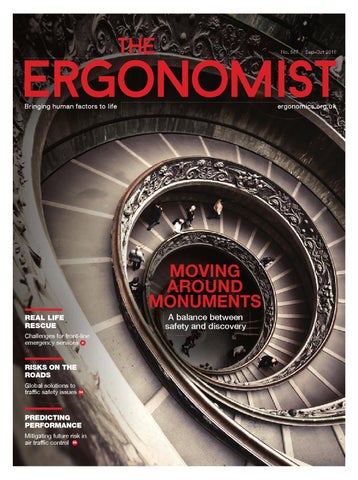
MOVING AROUND MONUMENTS A balance between safety and discovery
REAL LIFE RESCUE Challenges for front-line emergency services 6
RISKS ON THE ROADS Global solutions to traffic safety issues
24
PREDICTING PERFORMANCE Mitigating future risk in air traffic control 26
cover_September-October 2018_The Ergonomist 1
03/08/2018 15:20
Do you: ... want to work in a team with Ergonomists, Psychologists and Human Factors professionals? ... wish to work closely with clients at their sites? ... feel passionate about Human Factors? ... wish to work in nuclear safety? ... enjoy working on diverse topics? ... want to be at the heart of a small business? ... want enjoyable professional relationships with clients?
Greenstreet Berman Ltd has grown for over 20 years to become one of the UK’s largest independent Human Factors, Safety Management and Safety Culture consultancies, working across many sectors.
We offer a competitive reward package and flexible working in a professional and friendly environment. We support tailored personal career development through structured mentoring and training. We also support professional Chartership and post-graduate qualification. We can help develop your client & project management skills as well as your professional expertise.
We are recruiting to support our growing nuclear sector work and help us deliver a high volume of interesting work. Our diverse work includes design & assurance of new power stations, safety case support, leadership & management for safety, human performance, safety culture, competence, delivering training, conducting research and many more topics.
If you want to join our team please email a CV and covering letter telling us why you wish to join us to info@greenstreet.co.uk
You will have a first or second degree in Psychology or Human Factors and Ergonomics or other relevant degree.
If you have any questions about the roles please email Ben McCaulder at ben.mccaulder@greenstreet.co.uk.
•
For Junior grade you will be enthusiastic, willing to learn, able to apply yourself and work towards Chartership.
Closing date: 28th September 2018
•
Consultants have some relevant experience, preferably in safety critical sectors.
•
Senior consultants are likely to have 4 or more years relevant experience, preferably in safety critical sectors, and are competent in project and client management.
•
Principal consultants have directly relevant experience, including nuclear sector, and are able to offer professional leadership and direction.
greenstreet berman: ERG.SeptOct2018.002.indd 2
Manchester
ɿ
Reading
ɿ
London 08/08/2018 09:06
No. 567 | Sep-Oct 2018 / 3
Contents The magazine of The Chartered Institute of Ergonomics & Human Factors
6
6/ A day in the life A fast moving, complex job with huge rewards 10/ News The value and quality of occupational health across the sectors 11/ Perspectives Changing times call for changing circumstances and a move to more flexible working 13/ News Maintaining cleanliness in cars of the future 14/ Lithuanian perspective A thriving Baltic country with big ambitions
APPLIED ERGONOMICS AND HUMAN FACTORS 16/ Aviation Designing cockpits in combat aircraft
The Chartered Institute of Ergonomics & Human Factors Registered Address: 43 Temple Row Birmingham B2 5LS 07736 893350 www.ergonomics.org.uk/ think-green
COVER IMAGE: FAMOUS SPIRAL STAIRCASE THAT LEADS TO THE EXIT OF THE VATICAN MUSEUM INSIDE VATICAN CITY/ISTOCK
NEWS AND CURRENT AFFAIRS
24/ Transport Taking a holistic approach to road safety
RESEARCH MATTERS 26/ Aviation Assessing human performance in air traffic control
24
16 30
ACCOUNT DIRECTOR Will Hurrell 020 7880 8545 will.hurrell@redactive.co.uk
Assistant Editor Louise Boulden
Display sales: Philip Johnson 020 7324 2727 philip.johnston@redactive.co.uk
To subscribe to The Ergonomist please contact: ergonomist-subscriptions@ redactive.co.uk
PRODUCTION Aysha Miah-Edwards 020 7880 6241 aysha.miah@redactive.co.uk
£60 - UK £80 - Europe £90 - ROW
ergonomics.org.uk
contents_September-October 2018_The Ergonomist 3
30/ Mentorship Supporting others in their early career 32/ Events Reflections on discovery events across the country 34/ Member Q&A A year in industry opens so many doors
ADVERTISING Sales Manager: Daniel Goodwin 020 7880 6206 daniel.goodwin@redactive.co.uk
Senior picture editor: Chloe Crisford
29/ Journal extracts Moving experiences
CIEHF NEWS
EDITORIAL Editor: Tina Worthy 07736 893350 editor@ergonomics.org.uk
Senior designer: Gene Cornelius
18/ Tourism Going with the flow: the challenges of moving people around historic buildings
PUBLISHERS Redactive Publishing Ltd Level 5 78 Chamber Street London E1 8BL 020 7880 6200 www.redactive.co.uk
©2018 The Ergonomist is the bi-monthly magazine of The Chartered Institute of Ergonomics & Human Factors. The views expressed in The Ergonomist are not necessarily the views of the Institute. Publication does not imply endorsement. Publication of advertisements in The Ergonomist is not an endorsement of the advertiser or of the products and services. Recycle your magazine’s plastic wrap – check your local LDPE facilities to find out how
Sep-Oct 2018 | The Ergonomist
03/08/2018 15:21
4 / Advertisement
READY TO ENRICH YOUR SKILLS? Complete an MSc Ergonomics degree and pursue your career aspirations Accredited by the Chartered Institute of Ergonomics and Human Factors (CIEHF), our online MSc Ergonomics course was the first online ergonomics masters course to be launched in Europe. Apply now, start May or September. Visit our website today to try a free course taster.
Choose a specialist pathway to suit your personal and professional interests: Ergonomics (Human Factors) Health Ergonomics Ergonomics and Organisational Behaviour
Whether you’re starting out, moving up or starting again WE’RE READY WHEN YOU ARE
UDOLenquiries@derby.ac.uk Call 01332 594000 www.derby.ac.uk/CIEHF
YOUR SUPPORT WILL TACKLE CHALLENGES. HEAD OF HUMAN FACTORS £37,940 p.a.
Ref: 1589509
Institute of Naval Medicine, Gosport, South East, PO12 This is an exciting opportunity to join a small team which supports military personnel operating across a wide range of occupational and environmental hazards. We conduct specialist investigations, surveys and research in the laboratory, at sea and overseas. The Human Factors group is part of the Environmental Medicine and Science Division which provides clinical, laboratory and applied research support to the MOD. The Head of Human Factors will be an effective member of a multi-disciplinary team, often providing Operational support to real-world problems. This is a challenging work environment which also brings a wide opportunity to develop skills and expertise.
qualifications in ergonomics and psychology will be prioritized. Membership of the Chartered Institute of Ergonomics and Human Factors; and / or Membership of the British Psychological Society is required. For further information please refer to the Civil Service Jobs website (https://www.civilservicejobs.service.gov.uk). Closing date: 21 September 2018. The MOD is an Equal Opportunities employer and seeks to reflect the diverse community it serves. Applications are welcome from anyone who meets the stated requirements.
Only candidates with, or soon to complete, a research PhD in a Human Factors discipline will be considered and those with additional
A Force for Good. www.civilianjobs.mod.uk
The Ergonomist | Sep-Oct 2018
ERG.SeptOct2018.004.indd 4
09/08/2018 10:09
Editorial / 5
FROM THE PRESIDENT
Identifying future needs O
ver the past year or so I have spent a lot of time working with my university at Nottingham Trent and our business partners on identifying the future needs of technical professionals. We are all agreed that things are likely to be radically different in the future, when core components of automation, Artificial Intelligence (AI), big data, cloud computing and robotics start to combine and realise the promises of ‘Industry 4.0’. Industry 4.0 is a term growing in popularity, the premise being that we are entering the fourth industrial revolution: b 1st Industrial Revolution: Mechanisation,
water power, steam power b 2nd Industrial Revolution: Mass production,
assembly lines, electricity b 3rd Industrial Revolution: Computer control
and automation
b 4th Industrial Revolution: Cyber-physical
systems, AI, Internet of Industrial Things Human factors has a lot to contribute as we transition into the next phase of our digital future. We will be considering issues of automation, issues relating to situation awareness, challenges related to new Human Computer Interaction interfaces, as well as the problems associated with Virtual Reality and head-mounted displays. Many of these issues will be familiar to CIEHF members and some have been studied for many decades; the journals provide an archive of the fundamental studies. What has changed is the context of use and the nature of the technical integration. There is a great opportunity for members to take the lead in this growing domain. We should strive to ensure that ‘human factors / ergonomics’ is included in the list of core components of Industry 4.0.
FROM THE EDITOR
Out and about There’s a definite transport feel to this month’s issue which includes two important transport research projects. One is from Katie Plant about a multi-national effort to increase road safety through a sevenpronged approach, and the other is from Jonathan Twigger, who reports on an air traffic control simulation exercise ahead of the opening of a new airport which will feed into already congested airspace on Turkey’s border with Bulgaria. Nick Gkikas writes about human factors approaches in military jet cockpit
ergonomics.org.uk
editorial_September-October 2018_The Ergonomist 5
designs and Graham Forman explains his work as a wide-ranging human factors professional in the Scottish ambulance service. Finally, we also announce the availability of the programme for our Aviation Safety event in November. Our main feature this issue is about accessibility and safety in and around historic buildings. Arthur Stewart and Cameron Campbell roam far and wide in explaining the challenges of moving large numbers of often ill-prepared people around buildings whose architects could never have foreseen
Neil Mansfield CIEHF President @profnjmansfield
Human factors has a lot to contribute to our digital future
the sheer volume of foot traffic they would one day attract. Lithuania is the focus of our regional perspective, a country many of us know little about, but much effort is being made there to put ergonomics on the map. Helen Vosper provides us with great insight into the very valuable skill of mentoring and how much it meant to her as she embarked on her career into human factors. Vicky Gliddon tells us about how her career began, and where it’s taken her – in Vicky’s case, all the way to Australia! Enjoy the rest of your summer. Tina Worthy editor@ergonomics.org.uk @ciehf
Sep-Oct 2018 | The Ergonomist
03/08/2018 15:21
6 / News and current affairs | A day in the life
A DAY IN THE LIFE OF AN...
AMBULANCE SERVICE ERGONOMIST
Graham Forman from the Scottish Ambulance Service
F
lick between channels later in the evening and there invariably will be a programme involving ambulance crews being dispatched by a busy control centre to jobs the length and breadth of Britain. I work for one of these organisations - the Scottish Ambulance Service. We cover from Gretna Green in the south, to the furthermost island off Shetland in the North. We have 530 front-line emergency ambulances and paramedic response units, 480 patient transport vehicles and a further 130 specialist vehicles, ranging from Polaris all-terrain buggies, to incident forward command units. Two fixed-wing Beechcraft Kingair air ambulances, two EC 145 helicopters and staff a charity air ambulance also fall under our operation. We provide specialist trauma and paediatric retrieval units, and our specialist operations team respond to a range of chemical, complex extrication and police-led operations. We have workshops dotted across Scotland to repair and maintain the Fleet. Three 24/7 control centres oversee emergency responses and plan patient journeys. In addition to our own staff of over 4000, we coordinate community responder teams and contracted staff working on small islands off the north and west coasts. So, what might then be a ‘typical day’? As we’re a 24/7 service, incidents will arise overnight, or managers working the small hours will have had the opportunity to clear some of their own inbox and reply to earlier queries. So usually, over an early cup of coffee, I’ll go through emails and voicemails and prioritise what needs to be
done, by whom and by when. The plan for the day may be to meet with colleagues in fleet and operations to review a new type of wheelchair backrest, the proposed layout of a bariatric response vehicle, or preferred location of a grab handle for patients who might suffer poor vision or rheumatoid arthritis. Alternatively, I might be travelling to meet a member of staff planning their return to work after shoulder surgery, attending a committee assessing new radio handsets, discussing a forthcoming case with our legal team or running a training session. I could also be proof-reading proposed training manuals or operating procedures, drafting an e-learning module on workstation set ups for office staff, or writing a position paper on a range of human factors and wellbeing topics for the executive team. On my commute home, I could pop into the control room to meet with a member of staff who came off the road due to injury or illness but is finding a 12-hour shift at a desk difficult. I might then be required to write a report recommending adaptive changes to furniture, such as a sit-stand desk, or alternative input devices. However, an incident reported the previous day or night may require immediate action. A safety bulletin may need to be written, or a decision made whether the withdrawal of a piece
In recent years, the importance of human factors has been championed by NHS Education for Scotland
The Ergonomist | Sep-Oct 2018
day in the life_September-October 2018_The Ergonomist 6
09/08/2018 11:58
IMAGE: SMC PHOTOGRAPHY
A day in the life / 7
of equipment across the board from use until further notice is a proportionate response. This will require urgent conference calls with colleagues, suppliers and often sister organisations. Perhaps I’ll need to travel to the location of the incident that day. Therefore, earlier plans may need to be revised at short notice. To continue challenging my own knowledge and assumptions on how staff will use equipment, I frequently ‘book on’. This can often see my original plans diverted by control to manage a complex emergency extrication of a patient, or less frequently, a chest pain or cardiac arrest as a First Responder, pending arrival of the nearest crew. Sometimes I may need to respond under blue lights and siren; making progress through a city centre in rush hour whilst organising resources with control is always a timely reminder of the principles of cognitive workload! The high stress nature of the job means that staff are required to receive, process and
ergonomics.org.uk
day in the life_September-October 2018_The Ergonomist 7
respond to information in complex situations, over 12hour shifts with interrupted meals breaks and overruns due to high demand. There really is something for everybody in respect of human factors within ambulance-related work. Those with an interest in software can be involved in the design of software interfaces used by control rooms to prioritise incoming calls and assist allocation of vehicles to jobs. At the other end of the spectrum is providing information to a committee on thermal values of winter weight jackets, best tread for safety boots or the importance of ease of putting on and taking off personal protective equipment. Design is also an important area. As overall vehicle safety standards increase, it can paradoxically become more challenging to design practical layouts. For example, cabbased data screens were traditionally mounted on gimbals to allow the attendant, who typically sits in the passenger seat, to better read and reach touch screens in transit. 3
Sep-Oct 2018 | The Ergonomist
09/08/2018 10:24
8 / News and current affairs | A day in the life
m An air ambulance helicopter prepares to receive a patient at Fort William, Lochaber, Scotland
There really is something for everybody in respect of human factors within ambulancerelated work
Graham Forman is an Ergonomics
Adviser with the Scottish Ambulance Service.
IMAGE: GETTY/SMC PHOTOGRAPHY
These were well received by crew. New standards advise that they must now be in a fixed position. This causes difficulties with glare and imprecision of hand movements due to greater reach. Staff now complain about having to sit at an awkward angle and how they could be tempted to slide the seat belt off their shoulder to view the screen. This not only impacts on occupant safety, the error rate retrieving and entering data on the screen increases too. Another challenge with vehicle layout, is that major new equipment and practices are introduced during the average seven or ten-year life cycle of a vehicle. The service is currently piloting satellite systems to allow crews in remote areas to perform scans and conduct video consultations, from allergic rashes to open fractures, with specialists at main hospitals. It’s then back to the drawing board in respect of re-evaluating the ‘least bad option’ where displaced equipment might need to go. Often, as is the case in many different industries, we’re met with opposition by staff when recommending the correct location for or choice of equipment. We must work with crews to identify a suitable compromise between theory, culture and practical application. Things do go wrong and staff and patients can very occasionally sustain harm. In recent years, the importance of human factors has been championed by NHS Education for Scotland. Working groups now explore how we might raise our profile in respect of contributing to Quality Improvement work and the management of clinical risk. On top of basic training, human factors colleagues now competently apply the principles to investigate potential drug errors, why compliance with record keeping may falter during peaks of activity, or why a crew might not fully apply a safety restraint in a vehicle. Whilst many academic and consultancy services will become involved with human factors projects within
the healthcare sector, there are still relatively few of us working at the coalface, which is a great shame. But with the challenges come the professional rewards. You may be sitting in traffic letting an ambulance through a junction when you recall the debates on choice of siren tones that can be best distinguished by other road users, the position of beacons to be seen but not blind other drivers, or that the angle of a grab handle on the rear ramp door was chosen to reflect the neutral position of a hand held at shoulder height. You watch the air ambulance crew preparing to load a patient and understand why that unduly large bag was, in the end, the best option for the attending air ambulance crew to use. You pass a Patient Transport Crew loading a patient up a ramp and remember how, in the past, you pulled out Stephen Pheasant’s book on anthropometrics or Snook’s Tables to try and quantify clearances and efforts to load that patient onto that tail lift or ramp. Being the service lead for prevention of musculoskeletal injuries does mean much of my time is centred around devising systems of work for the safer handling of patients. Whilst there are some techniques which can be borrowed directly from other care environments, safe patient handling in the pre-hospital context is usually more complex because of the infinite number of variables faced by crew with limited equipment and therefore an overly prescriptive approach is generally unhelpful. So how did one of the few ergonomists working full time in the NHS move from hospitalbased work into the pre-hospital sector? About 12 years ago the organisation recognised the need for a structured approach to the control of musculoskeletal injuries, and as one of a number of CIEHF members who started their professional life as a Chartered Physiotherapist, I had the skills mix they were looking for. I really haven’t looked back! •
The Ergonomist | Sep-Oct 2018
day in the life_September-October 2018_The Ergonomist 8
03/08/2018 15:23
FREE EVENT i cludin in
ga of the W copy hit Paper e
4 October 2018 | LONDON This event, at the prestigious Royal Society of Medicine, will showcase through the launch of its White Paper, the CIEHF’s vision for integration of Human Factors in Health and Social Care.
Programme
16:00 Two hour taster workshops to raise awareness and understanding about Human Factors and its practical application. 18:00 Drinks reception and networking 18:30 An evening of talks, case studies, panel discussions and networking.
Taster workshops
These include case studies of how Human Factors has been used in a range of different health and social care settings. You will gain an understanding of the importance of Human Factors and how it can be applied practically to resolve problems that prevent the delivery of efficient, high quality and safe care.
events.ergonomics.org.uk CIEHF event heal_September-October 2018_The Ergonomist 9
03/08/2018 15:24
10 / News and current affairs | Research
BBC Radio 4's Matthew Taylor presents a series called 'The Fix' in which 12 of the country's brightest young minds gather to solve difficult social problems. One episode focuses on junior doctors and the problems they face with low morale. CIEHF member Saskia Revell, who has a background in healthcare and aviation, was invited to participate to add insight from a human factors perspective. When they arrived, with little in the way of introduction, the participants were split into two teams of four, each with a facilitator and were set the task of finding a solution in just a day. Before they began, they spoke with a junior doctor, a consultant and the Chair of the Royal College of Physicians to find out more about the problem. Even armed with this information, the task was understandably difficult. Saskia said: "Myself and one other member of my team tried to look at the problem from a high level systems perspective. It was certainly a challenge to pull ideas together in the time available and to come up with a sustainable solution." The two teams presented their solutions to a panel who then selected what they judged to be the best idea. Find out who the winning team was and how Saskia fared, at the BBC Radio 4 website at https://www.bbc.co.uk/programmes/b0925737 •
Trials on military exoskeleton Lockheed has developed a militarygrade exoskeleton for the legs ready for trials at the end of this year. On the move, the ONYX exoskeleton takes weight off the wearer’s body, reducing fatigue and the risk of injury without limiting range of motion. This innovation comes off the back of ten years of solid development at Lockheed.
It will go through three rapid cycles of test, user feedback, redesign, and test again before the end of 2020, when Lockheed believes it will be ready for real-world operations. There are several companies developing and selling civilian versions, both for rehabilitation and for loadbearing, but they all present problems in that exoskeletons are the ultimate challenge for physical human machine interface ergonomics. Read more about Lockheed’s innovation at https:// tinyurl.com/y9vyzw4k •
Well implemented occupational health services can generate a strong return on investment, say the Society of Occupational Medicine, the International SOS Foundation and KU Leuven University, as they launch ‘Occupational Health: The Global Value and Evidence’. This white paper discusses the value of occupational health from a global perspective and provides a synthesis of global evidence on interventions and cost effectiveness. The global burden of occupational health issues is considerable. Fatal and non-fatal work-related injuries and illnesses worldwide equate to a cost of around €2680 billion, equivalent to 4% of the global GDP. Consequently,
€2680 billion
The cost of injuries and illnesses worldwide organisations, their workforce, and society must bear a substantial cost. The paper demonstrates that occupational health services have a clear value: they improve the health of the working population; contribute to the prevention of work-related illnesses; prevent avoidable sickness absence through the provision of early interventions for those who develop a health condition; and increase the efficiency and productivity of organisations. They can also play a major part in protecting and revitalising the global economy. For more information visit www.som.org.uk •
IMAGE: GETTY
Fixing the problem of low morale
Global value of occupational health
The Ergonomist | Sep-Oct 2018
news and persect_September-October 2018_The Ergonomist 10
03/08/2018 15:25
News and current affairs / 11
CHIEF EXECUTIVE’S PERSPECTIVE
Moving with the times
IMAGES: SHUTTERSTOCK/ALAMY
H
ow people work has undergone a good deal of examination and change in the past decade, in particular from a human factors perspective, and significantly due to advances in technology. However, what works for each and every individual, standing or sitting, paramount will be a safe, conducive, inspirational working environment in which the best work possible can be delivered at the right time. To that end your Institute has recognised that bringing people together every single weekday under the same roof in the same circumstances probably does not tease the best from the group as a whole. We have created the ability to now move away from a locally-based administrative group with fixed infrastructure to a business model drawing on great, flexible expertise, wherever that’s located, working at times to suit each individual but delivering on a common purpose, our agreed strategy. That strategy is shaping up and will be due a refresh before 2020, and that means acting quite soon. More on that next time. As such, and effective this month, the Institute is reflecting on the fact that those who do great work and support our efforts as an ‘office’ actually live in Nottinghamshire, Essex, Bedfordshire, Surrey, Warwickshire and in London, so drawing these folk together in Loughborough, given advances in technology, no longer makes much sense, either for the people themselves or for the Institute. Without increasing our costs, we now operate from flexible office space located around the country,
ergonomics.org.uk
news and persect_September-October 2018_The Ergonomist 11
convenient for bringing together individuals and teams at the right times to do the right things in support of our aims as a Chartered body. So, and in addition to flexible workspace, we have a new light and bright operational office in Warwickshire at which we receive our routine hard mail, something which has dwindled significantly over time and a new Registered Address in Temple Row in Birmingham, a central location and a vibrant city with many connections to the manufacturing, healthcare and transport sectors in particular, ahead of our 70th year. Both addresses are available on our website; a website hosted on a server located remotely and like the remainder of our computing capabilities, to be located in the cloud by the end of the year. Another significant step, alongside our physical premises
solution, that improves our resilience as an organisation and our ability to deliver service to our members. We say a huge thanks to our favourite (if we were allowed to have one) Registered Consultancy, Human Applications, and in particular to Jim, Nigel, Matt, Jo and the team, who have given us a home over the past dozen years at Elms Court in Loughborough, and who have so generously supported the Institute in many ways over the years. We shall miss you just as much as you will miss us. Changing times call for changing circumstances and I am confident that our new arrangements are sensible, cost-effective and conducive to great support. Steve Barraclough Chief Executive of the CIEHF s.barraclough@ergonomics.org.uk
A significant step that improves our resilience and our ability to deliver service
n Birmingham city centre at night, showing Centenary Square and the new library
Sep-Oct 2018 | The Ergonomist
03/08/2018 15:25
Ergonomics & Human Factors 2019 29 April – 1 May 2019 • Stratford-upon-Avon
eet. Discus M . s. Be rn a inspired. Le
The conference will start with a day of six special CPD training workshops on a variety of topics and a bigger and better Doctoral Consortium where students can present their ongoing research. This will be followed by two days of keynotes and a parallel programme of presentations, posters, workshops and discussions about research, developments and applications from leading professionals working across all sectors.
Call for submissions | Deadline 1st November 2018 1
Research and practice Design • Healthcare • Occupational health • Rail • Aviation • Technology Green/eco ergonomics • Autonomy • Cyber security • Behaviour change Cognition • Safety culture
2
70 years of ergonomics Ergonomics practice across the decades • How roles have changed over time Historical milestones
3
Doctoral consortium
Join us there for... 70th anniversary cocktails & BBQ with a Shakespearean twist Annual dinner Anniversary cake Entertaining quiz
Abstracts describing student research
Next year is also the CIEHF’s 70th anniversary of its formation as the Ergonomics Research Society in 1949. We’re celebrating that achievement with a great line up of social activities in the evenings, giving you a chance to relax in a truly lovely riverside setting in Stratford-upon-Avon.
events.ergonomics.org.uk ERG.SeptOct2018.012.indd 2
09/08/2018 10:33
News and current affairs / 13
Awareness campaigns Celebrated in October each year, Global Ergonomics Month is an international outreach campaign promoting human-centred design through the science, application and profession of ergonomics or human factors. The CIEHF has three events currently organised for October but much of our effort is being put into raising awareness throughout 2019 as part of our 70th anniversary celebrations. Watch for more details of this in our next issue. The Federation of European Ergonomics Societies is an official campaign partner of the EU-OSHA Healthy Workplaces Campaign which in 2018 and 2019 focuses on managing dangerous substances. Exposure to dangerous substances is much more common in Europe’s workplaces than most people imagine. Dangerous substances at work can cause a wide range of health problems and diseases, as well as posing safety risks. The 2018-19 campaign aims to raise awareness of the risks posed by dangerous substances in the workplace and to promote a culture of risk prevention. For more details, see http://bit.ly/2NN2qPU •
Messing about in cars Whilst the focus on so-called self-driving cars is mostly on the technology and the safety of the passengers and other road users, give a thought to what travelling might be like in the first generation of self-driving cars used as shared taxis. Companies like Uber are giving serious consideration to their development. Without needing to worry about actual driving, many passengers might use the time to eat, and whilst not deliberately leaving rubbish in the vehicle, there is usually always some tell-take sign that someone’s been eating or drinking. And what about those that suffer from car sickness? Would you still be able to stop a car quickly to pull over to the side of the road if you needed to? An article explores this issue in all its uncomfortable detail here: https://slate.me/2AhldAW •
Worklessness and health
IMAGES: GETTY/ALAMY/SHUTTERSTOCK
A pioneering aviator Mary Ellis, one of the last surviving British female pilots from the Second World War, has died aged 101. She was a member of the Air Transport Auxiliary, which employed civilians to deliver planes from factories to airfields. She said it was “sometimes frightening” because the aeroplanes were all different with major variations in cockpit design and equipment: "You'd get out of a Tiger Moth into a Wellington bomber and then into a Spitfire”. For more details of Mary’s wartime career, see https://www.bbc.co.uk/news/uk-
ergonomics.org.uk
news_September-October 2018_The Ergonomist 13
england-hampshire-43518517 Looking back, the ATA did an amazing job in incredibly difficult conditions. The planes and their pilots have led us to a situation today where we are fortunate enough to have the time, knowledge and funding to ensure aviation is as safe as it can be. For the fourth year in a row, the CIEHF's twoday Human Factors in Aviation Safety event will bring together professionals from around the globe to present and discuss human performance issues so we can continue to ensure safety in the skies in an increasingly digital age. •
The combined costs from worklessness and sickness absence amount to over £100bn annually. There are many compelling reasons to regard work and worklessness as important public health issues both at local and national level. To help inform crucial local conversations, Public Health England has created an infographic slide set for every county and unitary authority in England, presenting data on work, worklessness and health in an accessible format. Magdalene Mbanefo-Obi, of Public Health England, said: “Helping people with health issues to obtain or retain work and be happy and productive within the workplace is a crucial part of the economic success and wellbeing of every community.” The work, worklessness and health local infographic tool can be accessed at: https://tinyurl.com/y7xlyrp2 •
Sep-Oct 2018 | The Ergonomist
03/08/2018 15:26
14 / Applied ergonomics and human factors | Lithuanian perspective
l Road workers in Ignalina, Lithuania
Ergonomics perspective from
Lithuania
L
ithuania is one of three states in the Baltic region of northern-eastern Europe, situated along the south eastern shore of the Baltic Sea, to the east of Sweden and Denmark. It’s bordered by Latvia to the north, Belarus to the east and south, Poland to the south, and Kaliningrad to the southwest. Lithuania’s capital and largest city is Vilnius. Lithuania covers an area of 65,300 square km and has an estimated population of 2.8 million people. (The UK has an area of 93,000 sqkm and a population of 66 million.) The state of Lithuania was created in 1253 and the modern Republic of Lithuania in 1918. After a period of Soviet occupation, it declared itself independent in 1990. It’s now listed by the United Nations as a ‘very high human development’ country. The three largest sectors in the Lithuanian economy are services (68.3% of GDP), industry (28.5%) and agriculture (3.3%). Main exports are from agricultural products and food, chemical products and plastics, machinery and appliances, mineral products, wood and furniture. The biggest challenges for ergonomics in Lithuania are currently in construction, agriculture and forestry, although ergonomics is already widely applied in many areas of human activity, for example, in industry, rail transport, services, design, education and other fields. EN and ISO ergonomics standards are in place and have been embedded into Lithuanian legislation. The Lithuanian Standards Board develops and improves the national system of standardisation and sets up technical committees for the preparation of Lithuanian standards and other publications. It also coordinates the preparation of standards, and establishes procedures for the adoption of international, European and foreign standards as Lithuanian standards. The scope of the Technical Committee TK 64 Ergonomics includes standardisation of ergonomics terms, working systems taking into account the ability of humans and machines to
function normally in the environment, design requirements and risk assessment in the workplace. Interested parties on the Technical Committee, such as producers, consumers and representatives of state, scientific and public organisations, make decisions by consensus. The Lithuanian Ergonomics Association (LEA) was established in 2013 in Vilnius for ergonomics specialists and those in allied professions such as occupational medicine, occupational safety, workplace psychology and engineering. In 2016, LEA became a member of the Federation of European Ergonomics Societies. The founder and first President of the LEA is Associate Professor Kazys Algirdas Kaminskas and the Vice President is Associate Professor Aušra Stankiuvienė, both of Vilnius Gediminas Technical University. The LEA Council consists of 11 elected members and makes all major decisions concerning the LEA including rule changes, general policy, activities, admissions, election of officers and budget. There are five grades of membership of the LEA: Member; Student Member: anyone enrolled in the study of ergonomics or related occupations; Associate Member: anyone active in the field of ergonomics; Sponsor: anyone who is financially supporting an association for the development of ergonomics in Lithuania; and Honorary Member. Currently, there are 32 members, three of whom are businesses. LEA members are university teachers and students, practitioners in ergonomics as well as health and safety services, and companies which are actively applying the principles of ergonomics in their workplaces. A general assembly is organised each year, together with four to six Council meetings. There are also four regional branches. The mission of the LEA is: b To develop and advance communication between ergonomics specialists and allied professionals. b To actively promote and coordinate the development of a professional ergonomics approach.
IMAGES: ISTOCK
Despite its low population, Lithuania is a thriving nation, and is just starting to develop education, standards and resources in ergonomics, as Aušra Stankiuvienė explains
The Ergonomist | Sep-Oct 2018
perspective Lith_September-October 2018_The Ergonomist 14
03/08/2018 15:26
Lithuanian perspective / 15
b To promote professional qualification in the evaluation of risk
factors. b To develop ergonomics and psychosocial risks assessment methods leading to standardisation and dissemination. b To develop a professional ergonomics approach in society. Two international ergonomics conferences have been successfully organised by the LEA so far. The first, ‘Ergonomic Workplaces for All Ages’, was held in Vilnius in March 2017. This conference, organised by the Lithuanian Focal Point of the European Agency for Safety and Health at Work together with the LEA, was dedicated to the importance of ergonomically designed workplaces, particularly for the ageing workforce. Scientists, doctors and ergonomics experts from the UK, Latvia and Lithuania discussed successful solutions and their adaptations for individual workplaces and workers. The conference promoted sustainable working lives and highlighted how to prevent work-related injuries through ergonomics as well as other creative solutions for workplaces. The second conference, ‘Ergonomics: Creativity, Innovation and Good Practice’ was held in Vilnius in April 2018. The conference was organised by the LEA in association with UAB Verslo Aljansas
The biggest challenges are currently in construction, agriculture and forestry and was dedicated to the 100th anniversary of the restoration of Lithuania. The aim of this conference was to present problems and show how they could be solved by creativity and innovation integrated with ergonomics. In 2017, Associate Professors Kazys Kaminskas and Aušra Stankiuvienė published a book called ‘Ergonomics Methods and their Application’. It presents the most effective ergonomics methods that help to protect and promote the health and wellbeing of people. It’s aimed at a wide audience including managers and designers, ergonomics specialists, occupational safety and health professionals,
ergonomics.org.uk
perspective Lith_September-October 2018_The Ergonomist 15
educational institutions, employers and workers. Since 2016 LEA has organised a competition in Lithuania called ‘Best Ergonomist of the Year’. The winner in 2016 was Inga Buzienė, a safety engineer from AQ Wiring Systems UAB in Panevėžys, the fifth largest city in Lithuania. The winner in 2017 was Dainius Puzinas, a safety engineer from UAB Mars Lietuva in Gargždai in western Lithuania. Members of LEA together with the Institute of Occupational Medicine in the UK, COWI in Denmark and Milieu Ltd in Belgium, have conducted several EU studies: b Evaluation of the EU Occupational Safety and Heath Directives. b Safer and Healthier Work at Any Age. b Occupational Health Concerns and the Existence of Stressrelated and Psychological Problems Associated with Work. b EU-OSHA 2016-17 Campaign: Healthy Workplaces for All Ages - Development of an Online Multilingual e-Guide. In order to help companies and institutions reduce or avoid health and safety problems, many LEA members conduct bespoke one to two-day introductory ergonomics training. In such cases, training is linked to the company’s specific needs. Sometimes the company asks the LEA’s specialists to conduct an overview of the ergonomic study of workplaces. A training course in Ergonomic Risk Factor Assessment has been developed in Lithuania and has been running since March 2014. So far more than 150 people have completed the course. Many enquiries for help from LEA specialists come from companies who have completed this course and then actively go back and examine the ergonomics problems of the company, realising that further ergonomics studies of their workplace would be beneficial. The LEA also works closely with the other Ergonomics Societies in Latvia, Estonia and Austria. • Aušra Stankiuvienė is an Associate
Professor in the Department of Building Materials and Fire Safety at Vilnius Gediminas Technical University
Sep-Oct 2018 | The Ergonomist
03/08/2018 15:27
16 / Applied ergonomics and human factors | Aviation
Cutting-edge cockpit design Supporting design developments behind the world’s most advanced combat aircraft, Nick Gkikas discusses the role human factors plays in Eurofighter Typhoon cockpit design as it protects the UK’s sovereign airspace
W
ith an unparalleled safety record, proven in battle and hostile environments, the Eurofighter Typhoon is designed to keep its pilots safe and operational. And with over 400 suppliers forming a supply chain that supports over 100,000 jobs, innovation sits at the forefront of this combat machine’s development. Throughout the development and upgrades of the Eurofighter Typhoon, the needs of the single seat pilot have been paramount. This approach was realised through significant investment to the control and information interfaces throughout the unique glass cockpit, which itself has been continuously adapted to be capable of filling new roles and dealing with emerging threats in more operational environments than any other aircraft in the history of European air power. A team of colleagues has
developed a streamlined cockpit development process that follows Human-Systems Integration and Human Factors Integration principles. The process includes levels of maturity gates supported by formal assessments, in a rapid prototype facility, undertaken by operational pilots from air forces flying the Eurofighter Typhoon. The customer community of Eurofighter Typhoon is extremely influential to each capability upgrade undertaken, in the past, present and future.
The Ergonomist | Sep-Oct 2018
cockpit design_September-October 2018_The Ergonomist 16
03/08/2018 15:27
Aviation Rail / 17
m Eurofighter Typhoon 2000
Early design considerations
For the last decade, human factors has been formally included in aviation safety and military equipment standards. On that basis, it’s usually included in the conceptual stages of development but it’s rarely a priority when compromises between engineering requirements and targets must be made during development. This is not a complaint; I think it’s us, as ergonomists and human factors engineers, who should do a better job at collecting evidence and demonstrating the competitive edge human factors integration offers in terms of capability, cost savings, customer value and delight, reputation and brand building, and safety excellence. Typically, the digital assessment is followed by a quick
For the last decade, human factors has been formally included in aviation safety and military equipment standards and dirty mock-up, followed by cockpit rig, with the oldschool development-aircraft phase – building a prototype aircraft to use for testing and physical development – only used as final overall confirmation of performance and safety characteristics. Times between each phase vary from a few months for minor updates to years for white sheet designs; the latter are extremely rare. Except for the digital phase, where digital human models are used to assess against the occupant packaging specification, the other phases involve real pilots – both test pilots and customer representative pilots. We try to assess dynamic operations within quasimission environments as early as possible, rather than static anthropometrics, because we see huge advantages in terms of cost, time and capability on delivery.
IMAGE: ISTOCK
Simulation technology
Nowadays, there are fully-digital suites for development, test and productionisation. Some customisation is necessary, as the driving markets for those digital suites were mainstream, mass-produced commodities and services, for example IT, telecommunications and motor vehicles. But in theory we could have fully digital, model-based platform development and test, with flight test being there to confirm and finalise only, as Formula 1 car development has done for a good few years now. The changing way that aircraft are piloted, for example, with increases in automation, and new display and control technologies, affects ergonomic design in cockpits and this is probably the biggest difference between commercial and military aviation, particularly fast jets. Tradition, legacy and a bit of military ‘hero culture’ dictates that pilots have a huge influence in every programme. And pilots want to fly the aeroplane. A bit like drivers who hate vehicle automation, most fast jet pilots hate any automation that touches the skill-base, or basic flying skill level of the pilot task. Automation itself is extremely good at performing tasks
ergonomics.org.uk
cockpit design_September-October 2018_The Ergonomist 17
reliably in a pre-determined manner. It’s inflexible though and that’s where a lot of the frustration comes from. The real game changer is Artificial Intelligence but that comes with many other connotations and requires a very different approach, not least in testing and qualification. Much of what we consider as ‘new’ control and display technologies, are not that new at all; head-up displays are Augmented Reality and have been in-service for many years. Displays have better resolution (more pixels) so they appear more ‘real’ and this determines our accuracy threshold for human-machine interface adoption. Qualitative improvements have been made in terms of flexibility over where that Augmented Reality function can be integrated, for example images projected on the helmet visor can be made to ‘appear’ anywhere the pilot looks, be it something massive miles away, or minuscule right in front of their eyes. And finally, we can now take our neuro-ergonomics knowledge and capabilities and exploit them in tandem with physiological measures and controls.
Comparable design
In terms of the human factors knowledge and skills required, there is actually very little to choose between the aviation and automotive industries. The exact same methods anthropometric tools, task analysis, cognitive work analysis, experimental methods, and quantitative methods - are necessary to inform system and product development. However, the priorities are different. The focus on specific areas of human factors is shaped by the historic legacy of each industry and the different expectations of internal stakeholders, external customers and social stereotypes associated with them. A car company can justify the investment to a complete digital development suite within months, due to the number of vehicle programmes and the shorter, streamlined, two to three-year development cycles which necessitate a lot more simulation and digital development and testing, with physical testing included for confirmation only. In the much longer development cycles for a new airborne platform, with many non-technical factors coming into play, such as the ever changing social, political and military influences, there is much less gain to be had from digital development and testing. The weight falls more on the human judgement of stakeholders and customer or operator representatives, who tend to be more comfortable basing their decisions on physical evidence. • Nick Gkikas is a Senior Systems Engineer at BAE Systems.
His role is focused on the design and development of cockpit system updates to support its capability upgrades and to support colleagues with the human factors integration elements of cockpit system design. Further information
Gkikas N, Chesham P, Partridge D & Ridge E, (2016) From HCI to HSI – the journey in a fast jet cockpit. Proceedings of the International Conference on Human-Computer Interaction in Aerospace 2016
Sep-Oct 2018 | The Ergonomist
03/08/2018 15:28
18 / Applied ergonomics and human factors | Tourism
From narrow passages and winding spiral staircases to the dizzying heights of spires and lookouts, historic buildings and monuments are some of the most widely visited attractions in the world. However, burgeoning visitor numbers and even our waistlines, now pose new challenges. Arthur Stewart and Cameron Campbell think it’s time for some fresh systems thinking
Moving around monuments The Ergonomist | Sep-Oct 2018
historic building_September-October 2018_The Ergonomist 18
07/08/2018 12:43
Tourism / 19
I
n the UK and around the world, there is a rich cultural heritage of historic buildings, directly experienced by millions of visitors each year. Such cultural assets are not only central to each country’s history but are pillars of the local economy, employing staff directly for operation and management, and indirectly in a growing global tourism industry. As the world’s most visited city, London hosts the top 10 attractions in the UK, with the British Museum at the top of the list, attracting almost six million visitors in 2017. Scotland’s foremost tourist attractions, The National Museum of Scotland and Edinburgh Castle were 11th and 12th in the list, hosting more than two million visitors each, an increase over the previous year of 20% and 16% respectively. One of the biggest challenges these sites face is striking the delicate balance between encouraging access and ensuring safety, a challenge further exacerbated by rising visitor numbers each year, in addition to seasonal variation. Demographic changes are also an important consideration. On average, a typical adult has become larger and heavier as a result of the global obesity pandemic. In the USA, obesity tripled between 1986 and 2010, while ‘super-obesity’ increased 10-fold. This pattern, echoed throughout the western world, means that average body size has gone up, while the available space per person has remained constant, and ‘super-sized’ individuals have become more common. In addition, less agile individuals are more prevalent because of the rapid expansion of the senior tourist market. So, not only are there more people, there are also a rising number of ‘extra large’ and slow moving individuals as part of the tourist demographic.
IMAGES: A STEWART/C CAMPBELL
Accommodating more visitors
High visitor numbers require carefully managed access, circulation and egress in buildings, especially those designed for defence and not mass visitation. In many instances, archaic configurations, narrow passageways and steep staircases constitute convoluted visitor paths which loop back on themselves such that the way in is also the way out, and the way up is also the way down. This challenge of passing manoeuvres becomes considerably more complex when large, slow-moving or mobility-impaired visitors are considered, and exacerbated when factors such as variable group size and language are also prevalent. Such challenges to normal operation may be addressed, in part, by scheduling and queueing control. Under adverse circumstances such as a fire or medical emergency, this will become much more serious. This presents a major dilemma for operators of historic buildings because the continual growth in visitor numbers
ergonomics.org.uk
historic building_September-October 2018_The Ergonomist 19
m The Ponte Pietra bridge in Verona, Italy, far left and a sign for the challenging ladder system at St Helen’s Church in Ranworth, Norfolk
is ultimately unsustainable without threatening public safety and the quality of the visitor experience. Crowd science highlights that within the constraints of a fixed-sized environment, greater numbers of visitors affect crowd density and person flow rate. Under normal building operation this may be merely inconvenient, with greater time spent queueing. However, in non-normal building operations such as medical emergency, fire or terrorist activity, it might become very important indeed. Firstly, increasing density reduces movement speed and increases evacuation time, and makes it harder for groups to stay together. Secondly, overtaking and counter-flow movements in narrow corridors may become highly problematic or impossible, which is a threat to common visitor movement pathways inside several historic buildings. This means that the position of a slow-moving person in a queue pivotally affects the evacuation time of all those behind. Thirdly, vertical movement is likely to induce major bottlenecks, especially steep or spiral staircases which require careful negotiation. The challenge is a classical human factors problem: how can we deliver the optimum experience to increased numbers of individuals without compromising safety? Consideration of this requires a typical human factors solution: systems thinking. Different systems include: the visitor access, circulation and egress within the
There’s a delicate balance between encouraging access and ensuring safety built environment; the operating staff facilitating public access inside the building; management staff facilitating maintenance, compliance, cleaning, etc.; non-normal operation systems involving partial closure or restricted access; emergency operation involving rescue, fire or full evacuation. While each historic site may have its own unique set of circumstances utilising systems and experience of operating staff, there are some common principles which prevail. These involve the interaction of three factors within the building itself and its environs: the visitor path, movement capability and operator constraints. For instance, a castle may be partially ruined or damaged by adverse weather and safety legislation prevents access to a portion of the site. These inter-relationships critically balance freedom and safety, personal and corporate responsibility, operational practice and pragmatism at several different levels. 3
Sep-Oct 2018 | The Ergonomist
03/08/2018 15:29
20 / Applied ergonomics and human factors | Tourism
m Visitors queue for long periods at the Uffizi Art Gallery in Florence
as London’s Monument, which carries a small but real danger of individuals falling down the central void in the event of a crush or railing failure. Closed spirals, such as the Scott Monument in Edinburgh, are usually narrower and get narrower still towards the top. In this location, the entry stair is 92cm wide, narrowing to just 46cm at the top. Larger individuals might not fit through the turnstile at the entrance, although passing manoeuvres are highly problematic further up the 287 steps because the observation areas are 63 steps apart with no passing spaces in between. Due to the enclosed nature of the tower, it’s possible to hear others yet not know whether they are on their way up or down.
4 Physical challenges
1
Unprotected drops. The Ponte Pietra bridge
in Verona, Italy is a UNESCO World Heritage site. It has open steps up to an unguarded parapet and is a thoroughfare within the ancient city. Visitors climb to this parapet to take photographs of the river and the old city. They necessarily pass one another with one person on the unprotected side. Individuals taking ‘selfies’ here do so at considerable risk.
2 l Tomb of the Eagles, Orkney
Large-scale queueing. Like many of the most
popular sites, the Uffizi Art Gallery in Florence requires ‘unreserved’ visitors to queue for long periods during busy times. Here, visitors shuffle along in a covered loggia, which can take up to three hours or longer to gain access to the ticketing booth. This queue can be by-passed for a hefty surcharge but both queues converge inside. While queueing is tiring and frustrating at the best of times, in the summer of 2017 temperatures reached 50°C .
3
Steep spiral staircases. A visitor
struggles to see the steps in a spiral staircase with low ambient light. While spiral staircases are ubiquitous in ancient churches, visitors are particularly at risk moving from bright sunlight into poorly lit interior spaces, especially where the floor may be uneven or damp from rain. However, there are other aspects to consider. Staircases may be open, such
Prolonged restricted width. In The Duomo in Florence, visitors climb to the elevated walkway via a one-way spiral staircase. Access to the top is between the two skins of the dome which requires the visitors to navigate the tightest of spaces which can be both exhausting and disorienting for them after their ascent. Passing is a challenge, particularly if group members are trying to stay together. At the top of the dome is a viewing platform which can hold as many as 100 people and has only one narrow entry and exit point.
5
Ladder access and egress. The challenging
ladder system at St Helen’s Church in Ranworth, Norfolk, allows people to climb to the top of the tower. Usually there is no on-site staff presence to facilitate this, and visitors generally climb at their own risk. The last person to leave on any given day is asked to close the heavy trapdoor. Those with a fear of heights would be highly unlikely to ascend the tower in the first place but looking down is usually more daunting than looking up, so a level head is essential.
6
Lying space only. In the Tomb of the Eagles, Orkney, a visitor negotiates the narrow access to the burial chamber on their back via a trolley board and rope. The tunnel is a little over 3m long is definitely not for the claustrophobic. The way in is the way out and each person is asked to return the trolley board for the next when entering or leaving. The physical restrictions of the entrance may be compounded by the psychological insecurity associated with the dependence on others to facilitate a safe exit. Taken together, these scenarios convey something of the challenges visitors, and attraction organisers, face. In none of the locations was safety information prominent but in aesthetic terms this may be a good thing because the very nature and meaning of the heritage site could be compromised by incorporating such signs. Unquestionably though, many sites have unseen safety systems such as a turnstile the exact size of the narrowest aperture, as in the Scott Monument. In other
The Ergonomist | Sep-Oct 2018
historic building_September-October 2018_The Ergonomist 20
03/08/2018 15:29
Tourism / 21
n Factors affecting visitor flow in historic buildings
• • • •
Visitor numbers Group size Body size Mobility
• Carried items • Dwell times • Vision • Balance • Hearing • Signage • Disabled provision • Special events
Movement capability
• National Legislation • Organisational practice • Fire regulations • Health &Safety compliance • Occupancy • • • • •
Emergency procedures Communications Alternative pathways Site access Tour group accommodation
IMAGES: GETTY/ PHOTO A STEWART
• Children accommodation • Disability accommodation • Booking systems • Parking on site
• Payment & entry control systems
Visitor flow
• Queueing systems and practice • Services (toilets; café etc) • Visitor numbers • Group size • Body size • • • • • •
Mobility Carried items Dwell times Vision Balance Hearing
• Temperature • Shelter • Shade
Operator constraints
Visitor path
• Signage • Special events
sites, safety may be the product of past practice and common sense, yet they lack the capacity to deal with a steady increase in numbers or unforeseen events. Culturally, the balance between individual and corporate responsibility may differ between different countries, organisations and contrasting experiences of good practice and misadventure. But learning from incidents - the crucible for developing operational safety across a range of industries - has the potential to contribute substantially to cultural heritage and tourism. However, we can also learn from other areas as well, for example, the ergonomics of confined spaces has much to contribute from empirical research and safety planning, while most important of all is to recognise best practice, emulate it, and share it. And while common sense may not always be common practice when it comes to managing every visitor attraction, we now have the formidable weapon of modern media, including Trip Advisor, to collect visitor
ergonomics.org.uk
historic building_September-October 2018_The Ergonomist 21
• • • • • •
Uneven surfaces Gradients Poor interior lighting Distraction Narrow passageways Pinch points
• • • •
Staircases and ladders Bi-directional routes ‘Loop-back’ routes Disability provision
• Holding areas
feedback. Astute operators of historic buildings would ignore this at their peril, but perhaps be unaware that this feedback is another dimension of systems thinking. • Arthur Stewart is a senior researcher in ergonomics and
health and Cameron Campbell is a lecturer in contextual and critical studies with a specific interest in ancient buildings and architecture. Both are at Robert Gordon University, Aberdeen. Further reading
Still, G K (2013). Introduction to Crowd Science. London: CRC Press AlShboul, A A & Al-Tahat, M D (2007). Modelling of public building evacuation processes. Architectural Science Review, 50, pp37-43. Stewart, A D (2016). Passing ability and clearance space: the overlooked factor in human movement modelling. Invited commentary for the International Journal of Public Health and Safety 1, p115. Stewart, A, Elyan, E, Isaacs, J, McEwen, L & Wilson, L. The effect of person order on egress time: a simulation model of evacuation from a Neolithic visitor attraction. Human Factors, 59, pp1222-1232.
Sep-Oct 2018 | The Ergonomist
03/08/2018 15:29
22 / Advertisement
Vacancy for a
Human Factors Consultant / Senior Consultant
ebook
North West Human Reliability Associates Ltd We are a research and consulting company based in the North West of the UK. Over the past 36 years, we have gained an enviable reputation in safety critical systems such as healthcare, energy industries, aviation, rail transport and power generation.
Research and Development We like to turn the results of academic research into practical techniques to address real world problems. We develop tools and software techniques to support risk based human factors analyses. We have carried out major research projects for many public and private organisations.
Training & Consultancy We have provided consultancy and training courses for the energy, healthcare and transport sectors in Europe, the Middle East, and the USA.
Who are we looking for? We are interested in a person preferably with a background in systems human factors in the oil and gas, healthcare, power generation or rail transport sectors. An understanding of safety analysis techniques used in these industries and knowledge of medical device design standards would also be beneficial. We are interested in individuals with entrepreneurial skills who would be interested in business development and the marketing of our services.
Download the CIEHF’s latest publications containing expert information and advice
What can we offer? We are located in a pleasant semi-rural location within easy reach of the lively cities of Liverpool and Manchester. We have an informal and friendly working environment with a relaxed, collegial atmosphere. Some degree of home working would be possible, and we are willing to consider part time as well as full time applicants. Remuneration will be will be commensurate with your demonstrated achievements, enthusiasm and capabilities. Please send your CV to: Dr David Embrey, Managing Director: E: dembrey@humanreliability.com T: 01257 463121 www.humanreliability.com
Go to www.ergonomics.org.uk
The Ergonomist | Sep-Oct 2018
ERG.SeptOct2018.022.indd 22
09/08/2018 10:20
Human Factors in Aviation Safety The changing role of human factors in the age of digital aviation 12 - 13 November 2018 | Hilton London Gatwick Airport Five reasons to attend: 1. Growing success: ensures the return of this popular event featuring the latest research and practice in this ‘ultra-safe’ sector, together with social time to meet others, network and relax. 2. Of interest to many: including representatives from airlines, air traffic control organisations, industry regulators and investigators, consultants and the major university research groups, who will all have the chance to examine and discuss a range of human factors and human performance issues. 3. Wide-ranging themes: include digital aviation, cybersecurity, remote tower operations, improving non-technical skills, implementing change, wellbeing and ground handling, through presentations, posters and discussion. 4. International speaker line-up: from the UK, USA, Sweden, Spain, Austria, France, Germany, Italy, Jersey, Singapore and New Zealand in a packed programme. 5. Great value: delegate fees have been kept the same as last year, with great discounts for CIEHF members.
Keynotes: • The paradox of intuition Laurie Earl, New Zealand Civil Aviation Authority • What aviation cybersecurity needs from human factors Chris Johnson, University of Glasgow • Designing graceful degradation into air traffic control systems Tamsyn Edwards, San Jose State University and NASA Ames • Are we doing the right aviation human factors research and are we doing it right? Barry Kirwan, Eurocontrol
BOOK N OW Prices sta ! rt from
£170
events.ergonomics.org.uk ERG.SeptOct2018.023.indd 2
09/08/2018 10:35
24 / Applied ergonomics & human factors | Transport
A
s the ninth global leading cause of death, road traffic injuries represent a major pandemic. Low and Middle-Income countries (LMIC) have more than twice as many road traffic fatalities, compared to high-income countries. Whilst these countries represent 82% of the global population, they only represent 54% of registered motor vehicles, so they have a disproportionate number of deaths relative to their level of motorisation. To address this issue, a consortium has been formed with four LMICs via the Socio Technical Approach to Road Safety (STARS) project. These countries represent a range of economic development: a least developed country (Bangladesh), a low-income country (Kenya), a lower-middle income country (Vietnam), and an upper-middle income country (China). We didn’t set out to impose a westernised view of road safety, instead we sought to capture the current challenges facing these countries and, in collaboration with our LMIC partners, develop and evaluate relevant and realistic solutions. Traditional road safety research has been characterised by the ‘3 Es’ of Engineering, Enforcement and Education. Although these provide guidance to engineers and policy makers, they don’t provide a holistic and integrated approach to road safety and fail to consider fully the wider system factors that shape road user performance and outcomes. The STARS project will tackle road safety from a ‘7 Es’ perspective, with the inclusion of Economics, Emergency response, Enablement and Ergonomics. The overall aim is to reduce the number and severity of road accidents in LMICs through the underpinning philosophy of ‘local solutions for local problems’. We reviewed the ‘7 Es’ of Road Safety from the UK perspective, applying the Actor Map component of the Risk Management Framework method to model the road safety system. Each LMIC partner country is currently undertaking the same status review.
Realistic road safety solutions As road traffic accidents continue to claim more than 1.25 million lives each year, with 90% occurring in low-and middle-income countries, Katie Plant introduces the STARS project set to address global road safety The ‘7 Es’ approach
1
Engineering. The engineering approach to road safety
can be split into two principal categories: road environment engineering and vehicle engineering. In terms of road engineering, there are many ways of constructing the road environment to improve safety, from speed bumps to the layout of road crossings that ensure a pedestrian looks the right way to search for vehicles. Built-in separation of different road users is another method of engineering safety into the road system. One example in London is the Cycle Super Highway, there to protect vulnerable road users, while encouraging higher cycling rates,
The Ergonomist | Sep-Oct 2018
road safety_September-October 2018_The Ergonomist 24
03/08/2018 15:30
Transport Rail / 25
an inherently healthier travel choice, both for the user and for the people around. For crash barriers, guidelines have been in place for years, including the notion that barriers should have a degree of flexibility to them, thereby minimising the chance of injury should a collision occur. In terms of the vehicle, there are many ways in which safety is engineered into the system. New vehicles sold in the EU are built to high safety standards; all cars have air bags, seat belts and crumple zones, for example. However, systems such as automatic emergency braking, collision avoidance systems, intelligent speed assistance, lane keeping assistance, headway maintenance assistance, antilock braking systems, active cruise control, etc. are necessary to get the highest safety ratings.
The aim is to reduce the number and severity of road accidents through the philosophy of ‘local solutions for local problems’
2
Enforcement. Many engineered safety systems are now legal requirements throughout Europe. Crumple zones, driver airbags, child restraints, seat belts, and general vehicle design all have strict and detailed laws governing them. Furthermore, in the UK, existing vehicles over three years old are required to pass an MOT test. Just as is the case for many countries, the UK has many laws governing the behaviour of road users, such as laws concerning driving whilst under the influence of alcohol or drugs, driving speeds and the general safety of driving. To enforce these laws on motorways and inter-urban main routes, the UK’s police forces each have a road policing unit that specifically polices certain sections of roadway. For laws to be effective, they must be enforced, and this requires a police force to be consistent and honest.
3
Education. Education for road safety can be split into two primary areas: education of the driver and education of the public. Education of the driver includes all driver training, from the pre-licence training and gaining a driving licence, to advanced driver courses. Each road user is trained specifically for their type of vehicle, for example lorry drivers and bus drivers must pass additional tests to legally drive these larger vehicles.
IMAGE: GETTY
4
Economics. Road safety has the potential to have a
significant impact on the economy. In 2015 it was estimated that the value of the prevention of all reported road accidents was £15.3 billion, rising to £35.55 billion when considering unreported casualties. The road network is England’s most highly valued asset, estimated to be worth around £344 billion and to keep the road network safe, it must be well maintained. According to 2016 data, one in six roads may need to be replaced within the next five years, the one-time cost to catch up with all road maintenance is estimated at £12.06 billion, yet there is a £730 million shortfall in annual road maintenance funding.
ergonomics.org.uk
road safety_September-October 2018_The Ergonomist 25
5
Emergency response. The police, fire brigade and ambulance service work together to ensure interoperability in emergency response situations but each one also has its own guidelines. The NHS plays a vital role here: improving care standards leading to reduced road fatality rates has also been demonstrated statistically. In Britain, research has shown that the fall in casualty rates from road traffic incidents across the years 1978 to 1998 can be explained, in part, by lower in-patient lengths of stay, higher per-capita levels of NHS staffing, and lower numbers of people per-capita waiting for hospital treatment.
6
Enablement. Enabling road safety research and translating this into practice does not refer only to the level of funding available, but to the ease with which data is made available, the levels of communication and interoperability between agencies and research institutions, the general culture of support for research expenditure, and the governmental, public, academic and commercial support for road safety initiatives.
7
Ergonomics. With regards to human factors and ergonomics research in road safety, focus has traditionally been on the individual driver. Support for the systems approach has been less forthcoming, though this is beginning to change with the adoption of the ‘safe systems’ perspective. One of its central themes is that humans are fallible and that responsibility for road safety should be moved away from road users and placed on road system design. The STARS project aims to address global road safety through the application of the ‘7 Es’ approach, with a focus on ergonomics and the systems perspective that this can bring. The Actor Map reveals that the UK road safety system is facilitated by over 120 organisations, each sharing responsibility for the performance of the system. This highlights the potential complexities that exist within the system, which will be demonstrated by completion of the Accimap, whereby the interactions between the organisations will be considered. This will be applied to the road safety system in our four partner LMICs to enable a consistent comparison of the similarities and differences that exist within each system. This will enable improvements and countermeasures to be developed in line with a socio-technical systems perspective based on the local data. Other work currently being undertaken includes a large cross-cultural survey on attitudes and beliefs in the context of road safety and more localised ‘think aloud’ studies are being conducted at accident hot spots in each partner country. • Katie Plant is a Lecturer in Human Factors Engineering within the Transportation Research Group in the Faculty of Engineering and the Environment at the University of Southampton.
Further information
K L Plant, R C McIlroy & N A Stanton (2018). ‘Taking a ‘7 E’s’ approach to road safety in the UK and beyond’ in R Charles & J Wilkinson (eds). Contemporary Ergonomics & Human Factors 2018. CIEHF, UK.
Sep-Oct 2018 | The Ergonomist
03/08/2018 15:30
26 / Research matters | Aviation
Ensuring a safe future for air travel The UK’s aviation network handles a staggering number of flights each summer. Jonathan Twigger discusses a research project that shows the key role human factors plays in determining whether control can be maintained in this increasingly busy safetycritical environment
A
s we hit the UK’s busy summer holiday period, Britain’s aviation network will handle over 770,000 flights in July and August alone. And as one of the busiest airports in the world, London Heathrow will welcome over 75.7 million passengers into its terminals this year. With industry-wide predictions that UK air traffic will continue growing from 2.5 million flights in 2017 to 3.1 million by 2030, the UK-based air traffic control company, NATS, has warned that the UK needs to ‘modernise’ its air space and is spending an estimated £600 million on new technology to help boost capacity. So, what can be done to ease this burgeoning pressure on global airspace and growing potential for congestion around the country’s busiest airports? The Air Traffic Management (ATM) industry is continually innovating in systems and procedures, to manage growing passenger numbers, maximise efficiency and improve the passenger experience. However, to successfully implement these new capabilities within a safety-critical environment, human factors plays a key role in determining what is ‘fit for purpose’. While the influence of human performance has gained recognition within the ATM industry in the last decade, its knock-on effect on all key performance areas is less
The Ergonomist | Sep-Oct 2018
ATC case study_September-October 2018_The Ergonomist 26
03/08/2018 15:30
IMAGES: ISTOCK
Aviation / 27
acknowledged. There remains a widespread attitude that the assessment of human performance (along with safety) is a simple obligation and sits apart from the more tangible performance indicators such as airspace capacity and flight efficiency. In fact, human performance dictates the benefits yielded by any new concept - a new system or set of procedures is of little value (and potentially detrimental) if the human component in the system (the controllers) is not able to function as required. This ‘fitness-for-purpose’ assessment lies at the heart of the concept validation process that all new technologies and working practices must undergo. In Europe, this is the European Operational Concept Validation Methodology. Our team at Think are specialists in leading our clients through this process, our managing director having cowritten the original methodology. We’re a multidisciplinary group of professionals that operate worldwide and provide services to a wide range of Air Navigation Service Provider (ANSP) and airport clients. These services include concept development, modelling, simulation and data analysis. My recent validation project began as the ANSP for Bulgaria (BULATSA) was preparing for the opening of what will become the world’s largest airport in Istanbul later this year (LTFM). As this new airport will be close to the boundary between Turkish and Bulgarian airspace, the resulting increase in traffic volume will greatly impact BULATSA’s control operations. The proposed solution is an extension of Turkey’s existing arrival manager system to incorporate the airspace above the Southeast Sofia flight information region. This system identifies inbound flights for Istanbul airports and generates an optimal arrival sequence. By expanding the horizon of this tool across the boundary, controllers can begin sequencing these arriving flights earlier, improving both flight and fuel efficiency whilst reducing workload for Turkish controllers. Due to the proximity of LTFM to the boundary, in comparison with pre-existing destinations like Istanbul Atatürk Airport, the current letter of agreement between the two ANSPs is no longer viable. This agreement dictates the altitude at which flights should attempt to cross the
ergonomics.org.uk
ATC case study_September-October 2018_The Ergonomist 27
Bulgaria-Turkey boundary. To achieve efficient descents into LTFM, flights must cross at a lower altitude. This meant that the validation process was effectively assessing two concepts simultaneously. A Real-Time Simulation (RTS) is referred to as a ‘humanin-the-loop’ validation exercise, meaning that actual controllers operate from workstations within a simulated scenario. The intention is that real-life conditions are replicated and that participants respond exactly as they would in the operations room, both with and without the concept in place. Based on this advantage, this exercise type was selected to assess the concepts.
A new system is of little value if the human component can’t function as required It was found that BULATSA could use their in-house training facility to host the simulation, rather than booking a third-party specialised facility, as is the typical approach. An RTS was planned and conducted in Sofia over two weeks in February 2018 to establish whether the system was suitable for implementation. As the human factors expert on the validation team, I set about identifying the key human performance areas to include in the validation plan. This had to ensure that the effects of each concept on the controllers could be determined through data analysis. The areas selected were controller workload, situational awareness, user acceptance, trust and teamwork. Each were measured using several qualitative and quantitative methods. All the selected methods were low-cost and maximised the input from the air traffic controller participants, while keeping them engaged. For example, it was important that post-run questionnaires took just a few minutes to complete and avoided mandatory open text responses so that participants would continue to provide useful feedback towards the end of the 48 runs. These methods were both trialled and iterated ahead of the exercise, providing opportunities for the format and wording to be improved. This was especially important given that the participants weren’t native English speakers. The method by which the simulation platform data would be analysed 3
Sep-Oct 2018 | The Ergonomist
03/08/2018 15:31
28 / Research matters | Aviation
Engaging with users is vital to a successful change management and implementation process
was also planned in advance to ensure it could be efficiently processed and the final data would be valuable. A ‘shake-down’ week was held just prior to the RTS itself. This is where all aspects of the exercise were brought together for a final test with the participants to confirm that there were no unforeseen issues or technical limitations and that the exercise could take place as planned. Due to time constraints, this final testing doubled as a training period for the participants. This provided an opportunity for the controllers to familiarise themselves with the new procedures, traffic levels and humanmachine interface. This heavily mitigated the risk of false negative results. To measure the benefits of a concept through comparison, an RTS should include at least two scenarios: a reference and a solution condition. In this case, it was decided that six scenarios (two reference, four solution) l Map showing the location of were needed to independently validate the arrival manager Istanbul’s new system in a basic and advanced configuration, and the airport, LTFM, letter of authorisation. in relation to the controlled airspace During the execution phase in Sofia, my primary of Bulgaria to the responsibility was the successful collection of qualitative north and Turkey to the south data. This included coordinating the questionnaire submissions at the end of each measured run and reviewing them for errors. I also moved between the controller positions during Sofia FIR the runs, recording over-the-shoulder (LBSR) LTFM observations and comments made by participants. In the final validation report, these observations added Istanbul valuable support to the quantitative FIR (LTFB) statistical results. Once back in the UK, the collected data was processed using a proprietary ATHINA analysis and visualisation tool to identify FIR (LGGG) trends and key findings. The effects of the
concept on the controllers’ performance were largely consistent across the chosen metrics. Human performance was just one of six validation objectives, covering standard key performance and focus areas that included flight efficiency, capacity and safety. Each of these were assessed using both objective and subjective results, with human performance findings acting as support to many of them. These conclusions were then written up as a detailed validation report which has since been delivered to BULATSA. The client will soon decide on whether to proceed with implementation, request additional validation exercises, or to reassess the suitability of the concept based on the report recommendations. This was just one example of where straightforward and inexpensive actions ensured that the concepts’ impact on the controllers and the subsequent effects on overall performance were fully understood. Whatever the outcome, it has been demonstrated to BULATSA that they are able to use their existing equipment to conduct simple but worthwhile human performance assessments on-site to trial various ideas and concepts. Engaging with users and presenting their acceptance of a concept alongside the performance impacts is vital to a successful change management and implementation process. So, with the number of aircraft in the skies set to more than double by 2037, according to the latest Global Market Forecast by Airbus, could this innovative approach help the aviation industry to solve problems, handle pressure and adapt to changing situations? • Jonathan Twigger is in his second year as an Air Traffic
Management consultant with Think, following his graduation from the Loughborough BSc Human Factors course in 2016. He’s currently working with NATS to support the validation of four operational concepts within the SESAR 2020 programme.
The Ergonomist | Sep-Oct 2018
ATC case study_September-October 2018_The Ergonomist 28
03/08/2018 15:31
Journal extracts / 29
JourNAL EXTrACTS
The CIEHF’s membership package incorporates instant online access to all issues of seven leading journals, including those highlighted here l
Driverless motion sickness In the UK, more than two thirds of people currently suffer from car sickness. And at the height of the summer with drivers planning more journeys around the country, for those unlucky enough to experience vomiting as a passenger in someone else’s vehicle, motion sickness is no joke. So, how will we cope in the automated cars of the future? Expectations are high that people will be able to do other things, such as reading or working on a laptop when riding in such a vehicle, but how likely is this if we still experience queasiness? Carsickness is associated with a mismatch between actual and anticipated sensory signals and so occupants of automated vehicles, especially when focusing their attention inside the vehicle reading or watching a display, are at higher risk of becoming carsick than those in conventional vehicles. Researchers are now working to evaluate the impact of positioning of in-vehicle displays, and subsequent available peripheral vision, on carsickness of passengers. They estimate that increased peripheral vision during display use would reduce the problem. Seated in the front as a passenger, 18 participants were driven a 15 minute long zigzag route on two occasions while performing a continuous visual search task. The display was positioned either at eye-height in front of the windscreen, allowing peripheral view on the outside world or the height of the glove compartment, allowing only limited view on the outside world. Motion sickness was reported at one minute intervals. The research highlighted that using a display at windscreen height resulted in less carsickness compared to a display at glove compartment height. •
IMAGE: SHUTTERSTOCK
1
O Kuiper, J Bos & C Diels (2018), Looking forward: In-vehicle
Being part of the crowd Following a summer of exhilarating sporting events and a round of popular music festivals to go to, chances are we’ve all witnessed, if not experienced being part of a very large crowd. A commonplace encounter, yes, yet the experience can result in both negative and positive experiences for those involved. Crowds are a complex sociotechnical phenomenon, affected by many interacting factors. Little is known, however, about how those responsible for organising crowd situations approach their responsibilities. Understanding how to optimise the participant experience of crowds is important. Researchers have now conducted a study with organisers responsible for different aspects of the design, planning, management and operations of crowd situations. They aim to understand organisers’ priorities, along with the consideration given to the experience of people in the crowds. Five focus groups were conducted and 55 real crowd situations observed. Influences on participant experience in crowds included the physical design of crowd space and facilities, crowd movement, communication and information such as signage, wayfinding, comfort and welfare, and public order. The interviews revealed that organisers generally prioritised finance, security and health and safety aspects, whilst giving limited explicit attention to other important factors that affect participant experience. Organisers tended to approach their planning and decisions based on their own experience and judgement, without accessing training or reference to guidance. It’s suggested that the non-use of guidance is, in part, due to problems with the guidance currently available, both its content and its form. The organisers of infrequent or small-scale events have the greatest knowledge and experience gap. Researchers concluded that to achieve a consistent, high quality experience for crowd participants, there needs to be improved understanding among organisers of the complexity of crowds and the multiple factors influencing participant experience. Guidance and tools need to be usable and tailored to organisers’ requirements. Organisers of infrequent or smallscale events are especially in need of support. •
2
V Filingeri, K Eason, P Waterson & R Haslam (2018), Factors influencing experience in crowds - The organiser
auxiliary display positioning affects carsickness, Applied
perspective. Applied Ergonomics, Vol 68,
Ergonomics, Vol 68, https://doi.org/10.1016/j.apergo.2017.11.002
DOI 10.1016/j.apergo.2017.10.013
ergonomics.org.uk
journal extracts_September-October 2018_The Ergonomist 29
Sep-Oct 2018 | The Ergonomist
03/08/2018 15:31
30 / CIEHF news | Mentorship
The value and power of
mentoring
Mentoring programmes contribute to the development of a better-trained and engaged workforce and are much needed in healthcare. Building sufficient capacity in human factors is a huge challenge says Helen Vosper and mentoring is one of the most valuable methods of support How did it start for you?
Fifteen years ago, I gained my Private Pilot’s Licence, something which I thought was the beginning of a career change. I was quite correct, just not in the way I imagined. With visions of an airline job in mind, I completed my commercial licence and flight instructor rating. Life (and cost!) got in the way of this dream but another avenue opened up in the form of human factors and ergonomics. Pilots get a grounding in human performance and limitations and this fascinated me, so I developed my knowledge far beyond that of most pilots. When I moved into academia, where I began teaching pharmacy students, I realised that human factors had much to ORIGINS
The term mentor comes from the Greek legend of Odysseus in which Mentor taught Odysseus’s son, Telemachus. Mentor eventually came to mean ‘experienced and trusted advisor’.
offer healthcare and I have now w been been en teaching this for over a decade.
What’s your experience of mentoring?
One problem human factors practitioners face in healthcare is the conflation with ‘factors of the human’. There is a common misunderstanding that human factors means teamwork and crew resource management. I spent many years trying to help colleagues see that teamwork and communication are emergent system outcomes. We needed to support healthcare students in developing systems competencies, allowing them to contribute to the design of better systems in their future workplaces. This required strategic change and I decided it would help my credibility if I gained an accredited qualification, and I completed the MSc at Loughborough. Professor Sue Hignett was my supervisor for the final project
and I found her support so valuable that I asked her to act as my professional mentor. Sue’s mentorship has given me many things. One of the most important has been confidence; she has always trusted me to lead on projects, providing gentle guidance that ensured successful completion as well as nurturing my own leadership and management skills.
How has that helped you as a mentor?
Human factors has so much to offer healthcare, and it goes far beyond patient safety. In the current financial climate, optimising all system outcomes is the only way forward. To achieve this, human factors must become embedded within practice and education at all levels.
The Ergonomist | Sep-Oct 2018
Q A mentorship Vosper_September-October 2018_The Ergonomist 30
07/08/2018 12:43
Mentorship Rail / 31
current work takes place under this umbrella, adding real weight to the work I do within my organisation. None of this would have been possible without mentoring. Bearing this in mind, I try to mirror this in my own practice. My mentoring largely involves individuals with little or no human factors experience, and I try to involve them in my own work, but also ‘induct’ them into the wider community.
Mentorship has given me many things; one of the most important has been confidence
Why is mentoring so important to our discipline?
Human factors is a growing discipline, especially in healthcare. Specialists are thin on the ground and capacity building is a huge challenge. Mentoring offers the best opportunity to ensure that this happens effectively, especially in the face of sector-wide misunderstanding of our profession. I find trying to overcome these misunderstandings very challenging. A recent example was seeing a group of
healthcare academics patiently explaining to a Chartered Ergonomist that he’d misunderstood what human factors was! Mentoring offers an opportunity to ‘debrief’ these experiences and gather strength to return to the challenge.
What’s your advice to someone considering mentoring? If you’re thinking about mentoring – go for it. I believe the mentorship programme is one of the greatest benefits the Institute has to offer. However, mentors still need mentors! It’s a huge responsibility and you can gain a great deal of support from other, more experienced mentors. • Helen Vosper is senior lecturer for MPharm at Robert Gordon University. She is a Graduate Member of the CIEHF and a member of its Pharmaceutical Special Interest Group. She is a Principal Fellow of the Higher Education Academy.
ADVICE FOR THOSE INTERESTED IN MENTORING
Who can be a mentor? Almost all applicants for CIEHF Registered Membership are expected to have spent a period of time working under the guidance of a mentor who is an experienced ergonomist or human factors professional. We encourage all senior members of the Institute to provide a mentoring service to less experienced colleagues, and to provide their time for free. The role of mentor involves a good degree of time and effort and as the contribution from the mentor is important to the individual under their guidance, potential mentors should always consider carefully whether they will be able to fulfil the commitment before agreeing to it.
Mentoring is key to this, as is role modelling. I have learnt so much simply from watching Sue in action, and this was only possible because she was happy to open up her practice in this way. Related to this was the generous sharing of contacts and other opportunities. Through Sue, I was introduced to Paul Bowie, Programme Director for Safety and Improvement at NHS Education for Scotland. This led to my involvement in the ‘Performing well, feeling well’ programme for taking forward human factors and ergonomics integration in NHS Scotland. Much of my
Where can I find a mentor?
IMAGE: SHUTTERSTOCK
Mentors should have professional experience within your area of work, so you should firstly look for a mentor from within your own organisation. If you don’t know anyone who could be your mentor, you could attend a CIEHF Regional Group event in your area to meet more people locally or go to the CIEHF’s annual Ergonomics & Human Factors conference where there will be many people who might be able to help you. If you can’t find a mentor, email the Institute with a paragraph or two about yourself, where you live and work, your professional interests and what you would like a mentor to help you with.
ergonomics.org.uk
Q A mentorship Vosper_September-October 2018_The Ergonomist 31
Overseas applicants may not always have access to Institute members. In these circumstances a mentor holding an equivalent grade of membership with another federated society or organisation, recognised by the International Ergonomics Association or a related professional body, may be able to help. n To find out more about becoming a CIEHF mentor, go to www.ergonomics.org.uk > Get involved > Mentoring.
Sep-Oct 2018 | The Ergonomist
07/08/2018 12:43
32 / CIEHF news | Regional news
regional news many original bus and tube carriages and locomotives, members were able to consider aspects of physical design that impact passengers and staff alike, and the working life of people who maintain the vehicles.
ACROSS THE UK
Discovery and discussion In July five Regional Group events took place around the country giving CIEHF members a chance to visit a great venue and to discuss ideas and suggestions for CIEHF’s activities that will form part of its Delivery Plan for the coming year. The venues provided much to discover and to contemplate. Ideas for the Plan were discussed and are moving ahead. The following short reports describe the events.
● Midlands Regional Group members enjoyed a private guided visit to Coventry Transport Museum, a fascinating interactive place that charts the rise of Coventry as a design and manufacturing centre for early hard-tyred bicycles through early motorcycles and significant volume car making to armoured cars, fire engines and London Cabs to highspeed, record breaking projects and autonomous vehicles. Laden with examples of how designing for people leads to great, effective, imaginative design, this was a further opportunity to top up on CPD and to meet fellow members in an inspiring environment. If you missed it the museum is routinely open to the public.
to take in the sheer depth of aerospacerelated expertise illustrated at the Bristol Aerospace Museum. Aircraft, helicopter, missile and satellite developments from early aircraft coachbuilding skills through the development and use of materials such as Perspex to the use of new composites, underscore the significant ingenuity applied by people working in teams facing demanding challenges in uncertain times to construct flying machines. Concorde Alpha Foxtrot, the last to be built and the last to fly in commercial service, is now located, according to one member, right on the spot of some early human factors facilities. The teamworking between groups in two nations, the technical challenges identified and surmounted, the courage of pilots like Trubshaw and Turcat in testing complex, often untried, equipment and the sheer unremitting beauty of what was created never fails to amaze. The most stupendous thing? Three flight crew with a host of complex things to manage flying faster than a rifle bullet yet not one computer on board.
IMAGES: S BARRACLOUGH
● The South West & South Wales Regional Group had the opportunity
● London & SE Regional Group members enjoyed a private escorted introduction to the inspiring collection of Tube, bus and transport exhibits held at the Acton Depot Museum of London Transport. Far more extensive than the public museum in Covent Garden, and containing over 147,000 individual exhibits, Acton illustrates many facets of the impact transport has on people, cities, conurbations and lives. From upholstery, uniforms and buttons to original maps and schematics, waymarking and
The Ergonomist | Sep-Oct 2018
events and regio_September-October 2018_The Ergonomist 32
07/08/2018 12:44
CIEHF news / 33
● The Imperial War Museum North hosted a visit by the North West & North Wales Regional Group. Housing a collection of objects and stories that illustrate the quest for peace and reconciliation rather than simply the hardware of war, this impressive building in the waterside Media City area of Manchester is both sombre and uplifting in equal measure. A serving soldier (an interesting inclusion in this working museum) helped the group examine and wear items of military clothing and gave opinions to the group on the weight and design of webbing, armour and head protection, noting in his opinion how little feedback sometimes appeared to reach the specifiers of the kit from those required to use it. Surprisingly, there seems to be no sanction on military personnel using
some kit of their own. Interesting too, that modern rations seem to be dehydrated to save weight, so therefore place a critical requirement on carrying, delivering or finding fresh water. The sculpture ‘The Crusader’ by Gerry Judah which explores the violence of conflict against a perceived righteousness of purpose will live long in the memory.
● Glasgow epitomises design, ingenuity and expertise, particularly in shipbuilding, innovative early underground transport and railway building. The excellent and striking
Transport Museum proved to be a fitting venue for a meeting by the Scottish Regional Group. There was a two-hour discussion in the sunshine on the current strategy and options available to CIEHF as a body and of the ways in which the group could most effectively contribute to this in future, at the same time providing networking and learning opportunities. A project was mooted to bring together three future sessions to be attended either in person or by webinar to include a review of human factors developments in both the academic and practitioner worlds and culminating in a third session debate. Watch out for further details from the group. •
CIEHF events at a glance For more details of all CIEHF events, see our website at events.ergonomics.org.uk EVENT
WHEN & WHERE
DETAILS
Transport analysis and design
12 September 2018, Edinburgh
ki approach h tto A talk about taking a systems thinking transport analysis and design, with a focus on rail. Also the topic of a webinar on 26 September.
Helicopter Fleet Operations
18 September 2018, Middle Wallop
Insight into the human factors challenges associated with maintaining operational readiness for a fleet of helicopters.
Brewery Experience
19 September 2018, Bedford
An ergonomics-related guide to brewing beer with the Beds, Bucks & Herts Regional Group.
Human Factors in Health & Social Care
4 October 2018, Royal Society of Medicine, London
Workshops and launch of White Paper to better understand how human factors can support and benefit patients, staff and their organisations.
Rail Investigation Studies
17 October 2018, Farnborough
An exploration of rail-related research, particularly with regard to railway level crossing designs.
Human Factors in Aviation Safety
12-13 November 2018, Gatwick
Presentations, discussion and debate on human performance issues in military and commercial aviation.
Ergonomics & Human Factors Careers Day
27 February 2019, Birmingham
The very best of careers guidance, options and opportunities, featuring talks about work in different sectors and a lively Jobs Fair.
Ergonomics & Human Factors 2019
29 April – 1 May 2019, Stratfordupon-Avon
Celebrating our 70th anniversary with a line-up including CPD workshops, keynotes, presentations, posters, discussions, doctoral consortium, drinks, BBQ, dinner, quiz and more.
k Please note that some events details may be subject to change after publication. Please check the events website for up-to-date information.
ergonomics.org.uk
events and regio_September-October 2018_The Ergonomist 33
BEDS, BUCKS & HERTS
Brewery experience The Beds, Bucks & Herts Regional Group will be holding their next event at Marston’s Eagle Brewery in Bedford. Marston's operates over 2150 pubs in the UK and is the world's largest brewer of cask ale. This evening event, on Wednesday 19 September, includes a guide through the processes of making different beers and will enable you to learn how the beer is made from start to finish. It will focus on ergonomics-related topics such as maintenance, working at height, workstation design, working postures, reach zones, work equipment design and environmental elements. The private event includes a group tour, beer tasting, a hot meal and a chance to network and chat. What more could you want? •
Sep-Oct 2018 | The Ergonomist
07/08/2018 12:44
34 / CIEHF news | Member Q&A
Q&A
MEMBEr proFILE Tina Worthy talks to Vicky Gliddon, Principal Consultant at Ergonomie Australia about her career in human factors and life down under l How did you get into ergonomics?
Studying psychology at A-Level fascinated me and led me to follow this on into university. Being active at school and participating in several sports I was interested in Loughborough University, so I went to an open day where Murray Sinclair was hosting prospective students and showing them around the Human Sciences Department. As a prospective student, I sat through Murray’s introduction to ergonomics and human factors and was instantly drawn to the discipline. I signed up for the BSc in Psychology with Ergonomics and I’ve never looked back! Before I picked up a prospectus for Loughborough University, I’d never heard of ergonomics and human factors. I’m glad I decided to give it a go.
What was your first job?
My first job was in the human factors team at the UK Rail Safety and Standards Board (RSSB), which I did as a year in industry as part of my undergraduate degree. This was hugely beneficial to me. I worked on a great range of projects, which really pulled together the study and helped me to understand the application of what we do in industry. I got to work across a diverse range of projects including human factors assessment to reduce human error, advising on the placement of the Global System for Mobile Communications equipment in the train cab, safety culture assessment, developing materials and delivering human factors training, reviewing incident investigations, running workshops for the development of The Rule Book, usability research for a website, and user trials for CCTV displays. The range was excellent for an undergraduate student and really gave my career a great start. While at RSSB, I had some great experiences while learning about operations on the railway.
I learnt how to perform shunting manoeuvres with rolling stock, drive a train, and most excitingly, stand up front in the cab of a running steam engine as we travelled along the North Yorkshire Moors Heritage railway. Aside from the fun parts, this experience really set me up well to progress with my final year of study and begin my career in human factors. This placement was optional for students at the time and I think it was the most rewarding experience for me. If you get the opportunity to work in industry while studying, seriously consider it!
What’s rewarding about your work now?
I enjoy team working, both with other human factors specialists and wider disciplines, integrating human factors to find solutions together. We can all learn from each other, drawing on a range of skills. Whether you’re a human factors professional, or from another discipline, the best solutions are produced from a multi-disciplined approach. Our offering is so varied; such small and simple changes can make a difference for the better. I like being part of this process, whether that’s to make someone’s workstation more comfortable to alleviate aches and pains, advising on design iteration to make products more usable, or working on human factors integration into complex design and infrastructure projects. Our jobs enable real world application of theory in high-risk industries. Human factors input can make a positive difference. For example, the work we do in rail stations and on trains, can make the railway more accessible to disabled users and our design input into systems in the control room can make them more usable and reduce workload for operators. In addition, changes we’ve made to cab design can reduce distraction for drivers, making the railways safer. All of this can have a positive impact.
What opportunities has this discipline given you?
Consultancy life has led me to work on a huge range of interesting projects with some great people. I’ve also had the opportunity to work abroad on several projects.
The Ergonomist | Sep-Oct 2018
Q A member Glidd_September-October 2018_The Ergonomist 34
07/08/2018 12:44
CIEHF news / 35
l Close-up of rail security monitors, below
Travelling for work often isn’t glamourous, going little further than the transport, hotel and work site, but it’s enabled me to see places I might never have considered travelling to and I’ve enjoyed these experiences. I began working in human factors in London back in 2008. Earlier this year I decided to take the opportunity to make a move down under and emigrated to Sydney. This was largely driven by my career choice and the opportunities available in Australia. There are many industries here where human factors is under-integrated but would be of great benefit. It’s an exciting time with many opportunities for growth in human factors.
IMAGE: GETTY/SHUTTERSTOCK
What are you working on now?
At Ergonomie, we’re growing technology resources to support our projects. We’ve recently built our own virtual reality kit and we’re already using this with mock-ups of early stage control room designs and for train cab layouts. The use of this technology allows for detailed and insightful assessment of many elements using simple visual mock-ups rather than full scale built testing environments. Importantly for our clients, this keeps the costs down, as design iterations can be made and assessed rapidly. The visual element also helps us gain buy-in from stakeholders who can be immersed in the environment and really get an insight into what it will be like very early in the design stage. This consultation is a powerful tool for influencing the design process and achieving a design that is fit for purpose. We’re also utilising eye tracking racking technology in various safety critical contexts, exts, from research into signal sighting hting from the train cab used to influence nce signal sighting standards in Australia, ustralia, to healthcare surgical product ct testing, exploring visual inspection n tasks in surgical operations. perations. Though I work across many industries, ndustries, my work at Ergonomie is heavily avily based in the rail sector. Currently ntly in Australia, there are several new ew rail lines being built and new w rolling stock being designed, d, providing a great opportunity for or human factors integration right ht from the start of these large ge and complex infrastructure and nd design projects. Our input can an leave a legacy for years to come; e; our work in rolling stock design gn will be incorporated into new ew trains not in service for another er 30 years. s.
ergonomics.org.uk
Q A member Glidd_September-October 2018_The Ergonomist 35
It’s an exciting time in Australia with many opportunities for growth in human factors How do you divide your time in a typical week?
My week is quite varied, from the management of projects, people and areas of business, to delivery and supervision of technical work. My work involves planning human factors activities to meet the needs of clients, often when they want our input at short notice. As an adviser, I consider the integration of human factors at all stages of development, from concept and strategy and dynamic testing, to operation, ensuring that we apply effective methods balanced with budget, schedule and resource constraints. While this may sound heavy on the management side, I do get stuck in too. I’ve recently been observing rail safety workers on track at night, completing cab rides with the drivers and running workshops with frontline staff to investigate visual warnings to improve safety on track. I’ve also been reviewing new rolling stock against standards and human factors requirements and best practice.
What advice would you give someone considering a career in ergonomics?
Get involved! Go to events and conferences, meet people, volunteer, and gain experience w where you can. I’ve attended some great events and conferences over the years, often conferen opportunities for industry with opp well. I always meet visits as w and get to see and new people peo interesting things. I first hear inte with the CIEHF got involved invol volunteered to be on when I v secretariat. Some of the the sec connections I made led to conn offers and others became job o good friends who I’ve stayed goo in ttouch with over the years. It’s a great way to yea stay connected with people and keep up to date with an industry developments. ind They’re often very social events and good fun. • ev Vicky Gliddon is Principal Consultant at V Ergonomie Australia E
Sep-Oct 2018 | The Ergonomist
07/08/2018 12:44
Human Science Research
• • • • •
Human Factors Research and Engineering Cultural and Behavioural Analytics Cyber Influence IoT, Smart Cities and Smart Communities Impacts Social Media Effects
Pleased to announce the opening of our two new offices in Llanelli and Gloucester K Sharp Ltd - Head Office Suite 2, West End Yard 21-25 West End Llanelli, Carmarthenshire SA15 3DN
K Sharp Ltd - Gloucester Office 13 Wheatstone Court, Waterwells Business Park, Davey Way, Quedgeley, Gloucestershire, GL2 2AQ
www.KSharp.co.uk Twitter: @KSharpLtd Email: Hello@KSharp.co.uk
ERG.SeptOct2018.036.indd 2
08/08/2018 09:07