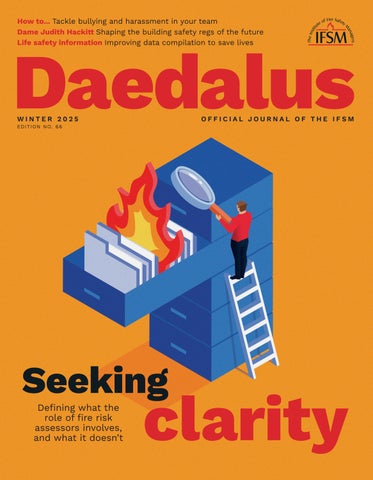
How to... Tackle bullying and harassment in your team Dame Judith Hackitt Shaping the building safety regs of the future Life safety information Improving data compilation to save lives
WINTER 2025
OFFICIAL JOURNAL OF THE IFSM
E D I T I O N N O. 6 6
Seeking Defining what the role of fire risk assessors involves, and what it doesn’t
01 Cover_Daedalus Winter 2025_Daedalus.indd 1
clarity 05/12/2025 12:21
THE UK’S NO.1 FIRE SAFETY EVENT get involved www.firesafetyevent.com DAEDALUS.WINTER25.002.indd 2
02/12/2025 09:22
Contents Winter 2025
Regulars
16
04 View from the top President Bob Docherty on life membership for those in IFSM
05 News National Fire Risk Assessors Register launches; survey reveals social housing safety concerns
A failure to clarify the scope of fire risk assessors’ work can leave them at risk of legal action. Defining their role more accurately will help
The author of Building a Safer Future outlines the thinking behind her recommendations, and the work still to be done
David White celebrates a year of achievements
10 How to... Tackle bullying and harassment in your team
20 Life safety information
28 Member benefits
Fire services should have access to key points about the construction of buildings to inform their firefighting tactics from the start
10
30 New members
24 FSO notices
Congratulations to new members, new NFRAR registrants and upgrades
20
34 60 seconds with... Jerry Hill
Chair/Managing director David White President/Director Robert Docherty Business manager/Associate director Helen Hilton Vice chair/Director Matthew Spivey Council member/Director Victoria Swaine The Institute of Fire Safety Managers Dunston Innovation Centre Dunston Road Chesterfield S41 8NG 0330 355 1286 info@ifsm.org.uk www.ifsm.org.uk
12 Role of fire risk assessors
16 Dame Judith Hackitt’s report
08 Chair’s corner
Joining the Institute ensures your voice is heard and is a recognised mark of competence
Features
Publisher Redactive Media Group 9 Dallington Street, London EC1V 0LN redactive.co.uk
Editor Nick Martindale Lead designer David Twardawa Group content sub-editor James Hundleby Picture editor Akin Falope Production director Jane Easterman Account manager Aaron Nicholls Sales and advertising +44 (0) 20 7880 6237 ifsm@redactive.co.uk
An analysis of non-compliance notices issued to Responsible Persons on the NFCC’s public enforcement register
Should you wish to send us your views, email: daedalus@redactive.co.uk Printer The Manson Group, St Albans Daedalus is the official magazine of The Institute of Fire Safety Managers (IFSM). Views expressed by contributors or advertisers are not necessarily those of the IFSM or the editorial team. The IFSM will accept no responsibility for any loss occasioned to any person acting or refraining from action as a result of the material included in this publication. ISSN 2978-1604 © 2025 The Institute of Fire Safety Managers
Winter 2025 Daedalus 3
03 Contents_Daedalus Winter 2025_Daedalus.indd 3
05/12/2025 12:22
View from the top
Lifelong commitment All members of IFSM continue to receive membership for life once they have retired, in recognition of their years of service
F
or this edition, I have dug into my archive to find this photograph of Howard Myers and his fire investigation dog Kylie. The photograph was taken at one of our technical meetings held at Staffordshire Fire and Rescue Service HQ in March 2009. As always, it was a great meeting, and Howard had just retired as a fire investigator in the US and had brought Kylie (and himself!) home to the UK to set up another fire safety venture. Howard had come along with Kylie as an attending member but ‘volunteered’ to give us a short talk on fire investigation and the role of service dogs in fire investigation. Like Howard, Kylie had retired and I remember Howard telling me how scary it felt as he had to put Kylie in the hold of the aircraft for the flight. The reason I mention all this is that Howard has been a stalwart member of the Institute from its early restart days in 2006. I received an email from him recently telling me he had a few health issues and was now set to fully retire and would therefore be retiring from membership. Reading this, I leapt into action and reminded Howard that we have a special ‘facility’ for retired members. All members in whatever grade, once fully retired, keep their membership for life – and it’s free! Howard is now a fully ‘paid up’ retired member and is entitled to all the facilities we provide for all members. We have done this for many years and I think it is a nice way of thanking and
recognising the loyalty, contribution and support that have been given over many years from those who have finally ‘hung their boots up’. I am sure you will all join me in wishing Howard and his family all the very best for the future.
It is a way of recognising the loyalty, contribution and support that have been given over many years
Howard Myers discussed the role of service dogs in fire investigation, accompanied by Kylie
It’s been a busy few months, which culminated in early October with our technical meeting, annual general meeting and new awards event at Old Trafford Cricket Ground. The whole day was fantastic, with around 200 members attending. The awards event was a huge success, and it was so pleasing to see so many nominees, highly commended and winning individuals and companies receive their awards and certificates. I think it shows how healthy both the Institute and the fire safety industry are. I am looking forward to next year’s event already! Member votes cast in our council ballot elected four members to the council: Tony Bolder, Lucy Cowell, Robert Taylor and Jonathon Smith. Congratulations to them all; first for standing for election, and second for being elected. Welcome back on to council for Tony and Lucy. I know the chair mentioned his disappointment at the very low percentage of votes cast by members in the council ballot and I would like to add to that by encouraging all members to use their entitlement and cast their vote in council elections. Remember, it is your Institute, and this is one of the major ways in which you can influence the outcomes and directions the Institute takes in its future. Once again, I thank all members for their loyalty and support. Dr Bob Docherty QFSM, PhD, CEng, FIFSM (Life), FIFireE, MEI is president of IFSM
4 Daedalus Winter 2025
04 View from the top_Daedalus Winter 2025_Daedalus.indd 4
05/12/2025 12:23
News
News
WHAT YOU NEED TO KNOW THIS QUARTER...
EVENTS
IFSM Awards 2025 celebrate excellence in fire safety THE INAUGURAL IFSM AWARDS 2025 proved to be a spectacular success, bringing together leading professionals from across the fire safety industry to celebrate achievement, innovation and dedication. Held on 1 October at the iconic Old Trafford Cricket Ground, the event welcomed around 150 attendees for an unforgettable evening of recognition and entertainment. Hosted by the unmistakable voice of the National Lottery, Alan Dedicoat, the ceremony shone a spotlight on those making outstanding contributions to fire safety management. Guests were treated to a fantastic evening that also featured comedy from Mick Miller and incredible live performances by Sophie Smith and Dylan Dale. The IFSM proudly congratulates all the 2025 award winners Fire safety manager of the year: Chloe Antoniuk Young fire professional of the year: Ethan McNichol Fire safety professional of the year: Andrew Fox Fire safety team of the year: Delco Safety Compliance Fire safety company of the year: Aico Accredited course of the year: Vulcan Fire Training Company Fire safety project of the year: Safety Critical Training Solutions UK
Winners Vulcan Fire Training Company (above) and Chloe Antoniuk (left)
Each winner represents the dedication, professionalism and excellence that continue to drive the fire safety sector forward. “The IFSM Awards went better than we could have hoped for,” said Richard King, business development manager at IFSM. “Alan Dedicoat was brilliant, the staff and organisers were fantastic, and the whole evening had a polished, professional feel – especially impressive for our first-ever awards event. It really sets the standard for us going forward.” The success of this year’s event would not have been possible without the incredible support of our sponsors. The IFSM extends sincere thanks to our main sponsor, VTSF, for its continued partnership and generosity. We would also like to thank our supporting
sponsors – Firehub, Norseal, Pyro, Vulcan Fire Training, Flamerisk, Fike and Chute Fire – for their invaluable contributions in making the evening such a success. Opportunities to sponsor next year’s event will open soon, and nominations for the 2026 awards will begin shortly. Stay tuned for updates and be part of another inspiring evening celebrating the very best in fire safety management.
Alan Dedicoat hosted the event Winter 2025 Daedalus 5
05-07 News_Daedalus Winter 2025_Daedalus.indd 5
05/12/2025 12:23
News
N E W P L AT FO R M
National Fire Risk Assessors Register launches IFSM HAS OFFICIALLY LAUNCHED the National Fire Risk Assessors Register (NFRAR), a redesigned and restructured evolution of the Institute’s Tiered Fire Risk Assessors Register (TFRAR). The new platform marks a significant step forward in how competence is presented, verified and managed. It has been built around two clear aims: To raise competency standards across the fire risk assessor sector To make it easier for Responsible Persons to find competent fire risk assessors. One of the primary objectives in developing the new website was to enhance the accessibility of information for Responsible Persons and duty holders. The latest public directory allows users to search, filter and view profiles with ease, helping them identify assessors who are competent for the type and complexity of building they are responsible for. Each profile now displays the assessor’s tier, region and professional details more straightforwardly and provides added reassurance. The result is a cleaner, more confident way for Responsible Persons to check who
they’re working with and what their level of competence means in practice. For registered fire risk assessors, the move to the NFRAR brings a more modern and efficient experience. The new system enables assessors to manage everything from a single location: their personal dashboard. From there, registrants can update their public profile, apply or renew online, upload evidence and supporting documents, and record CPD activity directly through the platform. Each registrant also receives a digital membership card, a unique QR code, a tier-specific logo and a downloadable certificate, all of which can be accessed from their profile. All previous registrants from the TFRAR have now been migrated to the new system. Existing registrants are encouraged to log in and review their public profiles. This is a good opportunity to check that all information, including contact details, company name and service area, is correct and up to date. While the new site improves day-today use, it also prepares the Institute for the next stage of its development. The
system provides the foundation needed to support UKAS certification in the future, a goal that will further strengthen the assurance the register offers to both members and the public. The launch of the NFRAR represents an essential step in the continued drive toward professional clarity and public confidence. It builds on the success of the TFRAR, incorporating new features designed for the future, enhanced visibility, streamlined management and increased assurance.
The new register is now live at www.nfrar.org.uk
C O D E O F P R AC T I C E
NEW EMERGENCY LIGHTING STANDARD The British Standards Institution (BSI) has issued an updated version of the Code of Practice for the Emergency Lighting of Premises, setting out recommendations for the design, installation and wiring of systems. BS 5266-1: 2025 expands the scope of the previous standard to include local area lighting and standby lighting, as well as emergency escape lighting.
It is designed for those who are involved in the design and operation of buildings with public or communal access, including local authorities and regulators, trade bodies, insurers, fire safety professionals, built environment specialists, contractors, developers, engineers and Responsible Persons. The standard applies to emergency lighting systems which aim to assist evacuation, protect
occupants who remain in the building during an incident, and support continued operations should the normal lighting arrangements fail. IFSM members can receive access to BSI documents, and can access the new standard through their personal Member Library on the IFSM website.
6 Daedalus Winter 2025
05-07 News_Daedalus Winter 2025_Daedalus.indd 6
05/12/2025 12:24
News
CO UNCI L
LC F S D E F EC TS
IFSM welcomes four council members
SURVEY REVEALS SOCIAL HOUSING CONCERNS
FOLLOWING THIS YEAR’S ELECTIONS, IFSM is delighted to welcome four highly respected professionals to its council. Each brings a wealth of experience, insight and passion for advancing fire safety – qualities that will undoubtedly strengthen the Institute’s work in the years ahead. LUCY COWELL Having already served on council for three years, Cowell returns with her trademark energy and dedication. Known for her proactive involvement in developing the Institute’s CPD programme and contributing articles to Daedalus, Cowell has been proactive in shaping resources that directly benefit our members. With a background that spans trainee fire safety advisor to her current role at CS Todd & Associates, Lucy has been recognised with several industry accolades, including the IFSEC Global ‘One to Watch’ and the Imperial College London Provost award for health and safety. Cowell’s commitment to collaboration and continuous improvement perfectly reflects the values of IFSM, and we are delighted to have her continued contribution on council. TONY BOLDER A familiar face returning to council, Tony Bolder brings over 35 years of service and a sharp, practical understanding of the fire industry. Following an impressive career spanning the Royal Air Force Fire Service, Humberside Fire & Rescue and now his own consultancy, Prism Fire Risk Management, Bolder’s passion for the profession remains undimmed. Previously active within the Institute’s technical subgroup, Bolder has long championed IFSM’s mission in his professional circles. Having stepped away in 2023, he now rejoins with renewed energy
and perspective – ready to offer his ‘two penn’orth’ of wisdom and experience to help steer the sector forward. ROBERT TAYLOR Robert Taylor, chief risk services officer at Tetra Consulting, joins council with a clear commitment to professionalism and competency across the fire safety sector. With three decades’ experience spanning the fire service, the oil and gas industry, and senior management, Taylor brings both technical expertise and strategic insight. At Tetra, he has embedded IFSM values into company culture, ensuring that all consultants engage in formal membership and professional development. His passion for raising standards through accreditation and structured progression aligns strongly with the Institute’s vision. Taylor’s leadership and focus on collaboration will make him a powerful advocate for continued professionalisation within the fire safety community. JONATHAN SMITH With over 36 years in risk and fire safety management, Jonathan Smith adds profound technical and international experience to council. A respected consultant and lecturer, Smith has supported organisations across the UK and abroad, from major retail and commercial sites to heritage and community buildings, ensuring robust fire safety and compliance. A Fellow of the Association of Project Safety, Smith combines his principal designer expertise with a commitment to education and knowledge sharing. His measured approach and dedication to promoting the IFSM on a global stage make him an invaluable addition to council.
Almost 2,000 buildings higher than 11m in the social housing sector have a life-critical fire safety (LCFS) defect relating to the external wall system, research by the Regulator of Social Housing (RSH) finds. The study discovered that 1,926 buildings, out of the 17,146 that were reported, were found to be defective. Of these, 1,365 (71%) are expected to be remediated in the next five years, but work has started on just one in five (22%) buildings. Will Perry, director of strategy at RSH, said: “All social landlords must ensure that tenants are safe in their homes. They need to identify risks, remediate relevant buildings at pace, and protect tenants while the work is carried out. To do this, landlords need to have robust, up-todate information about fire safety.” The survey also found that of the 2,672 buildings over 11m high that were identified back in June 2017 as having a LCFS defect, only 906 have been remediated or are currently waiting for a new building safety works assessment. LCFS are defined as defects, shrinkages, faults or other failings in a building that give rise to fire safety risks identified by a fire risk appraisal of external wall construction or a fire risk assessment. Winter 2025 Daedalus 7
05-07 News_Daedalus Winter 2025_Daedalus.indd 7
05/12/2025 12:24
Chair’s corner
A year of progress 2025 saw the launch of our IFSM Awards, the new National Fire Risk Assessors Register and the arrival of the Level 4 Certificate in Fire Risk Assessment
A
s I sit and write this article of our valued members of staff, will for the winter edition of soon be going on maternity leave. Daedalus, I can’t help but On behalf of council and the wider reflect on how far we’ve membership, I’d like to wish her all come and how much we’ve achieved the best for this exciting new chapter. together over the past 12 months. We will undoubtedly miss her during Our first-ever IFSM Awards, held in this time, but we are delighted for Manchester, was a truly memorable her and look forward to welcoming evening. The event brought together her back in the near future. members, affiliates and partners from While Laura is away, we will be across the fire safety community recruiting at least one new staff member to celebrate excellence within our to support the growing demands of profession. The atmosphere was superb, the Institute and ensure continuity of the venue stunning, and the feedback service during another busy year. overwhelmingly positive. A key milestone this winter It was a proud moment to is the launch of the new see so many familiar faces National Fire Risk recognised for their hard Assessors Register work and commitment (NFRAR) website, to improving fire safety which, by now, standards. I would should have gone like to personally live. This marks thank everyone who the next step in our attended, sponsored and ongoing commitment supported this inaugural to improving event. It was a resounding competency, transparency success and one that will and professionalism David White at a recent become a regular feature in within the sector. fire safety event the IFSM calendar. The new platform Earlier in the day, we held will make it easier than our annual general meeting. During the ever for Responsible Persons to AGM, we confirmed that membership find and verify competent fire risk and TFRAR/NFRAR annual fees will rise assessors, while also improving the in April 2026, with a modest increase experience for registrants managing of £10 for membership fees and £15 their profiles, renewals and CPD. for register fees. These adjustments Importantly, this transition also will help us maintain our quality of coincides with the introduction of a service and ensure that we can deliver regulated qualification, the Level 4 the value our members expect. Certificate in Fire Risk Assessment. This winter also marks a period of This will now form part of our change within our team. Laura, one Intermediate Level on the NFRAR.
This is a significant achievement for the Institute and a testament to the continued collaboration between our education partners, assessors and internal teams. On the international front, the Institute continues to expand its global presence. As I write, I will soon be attending the Fire Event in Singapore – our first time exhibiting in the region. It’s an exciting opportunity to connect with industry professionals across Asia and showcase the IFSM’s commitment to international fire safety standards. I’m confident this will prove to be another great success. Looking ahead to January, the Intersec Exhibition in Dubai will once again provide a fantastic start to the year. This event has always been an excellent platform for meeting potential new members, strengthening relationships with our affiliates, and further extending our reach across the Middle East – an area where the IFSM’s reputation continues to grow from strength to strength. As always, the president and I continue to represent you at all levels. I am incredibly proud of what we have achieved together this year, as an Institute, as a membership, and as a professional community. Finally, I’d like to take this opportunity to thank you all for your continued support throughout 2025. I would like to wish you and your families all the best for the year ahead. David White FIFSM (Life), MIFireE, MIIRSM, LCGI is chair of IFSM
8 Daedalus Winter 2025
08 Chairs Corner_Daedalus Winter 2025_Daedalus.indd 8
05/12/2025 12:28
Professional Indemnity Insurance Built For Fire Safety Professionals We understand your profession almost as much as you do For more than 15 years, Anchorman Professions has been arranging specialist PI insurance for fire safety consultants, fire engineers, and risk assessors. We understand the unique responsibilities and risks within the fire safety sector and work closely with leading insurers to secure the right protection at the right price. So you know that with us, you’ll be in safe hands. Whether you’re just starting out, or a well established firm, we take the time to understand your business, ensuring you get the right cover at the best price.
Expert advice and guidance
Exclusive in-house scheme with an “A” rated insurer
dĂŝůŽƌĞĚ ƚŽ LJŽƵƌ ƐƉĞĐŝĮĐ ŶĞĞĚƐ
Access to a wide range of other insurers
Hear what our clients say about us: “Great service - kept fully informed and updated. It always came across that you had my best interests at heart. I was struggling getting insurance due to the industry I am in and I felt reassured that you would do your best to help.” “Anchorman have been providing insurance cover for a number of years, following a recommendation by a colleague who was very pleased with their service. I can reiterate his recommendation as they have been excellent throughout. Very helpful, friendly and professional - all round a great company to have on your side!”
Reaching out to our friendly UK-based team couldn’t be easier. info@anchormanprofessions.co.uk 01837 650030 www.anchormanprofessions.co.uk Anchorman Professions is a trading name of Anchorman Insurance Consultants Ltd. Authorised and regulated by the Financial Conduct Authority, FRN 304589. Registered in England & Wales no. 03631690.
Anchorman IFSM Advert.V1.indd 12 DAEDALUS.WINTER25.009.indd
25/11/2025 09:24 09:37 02/12/2025
HOW TO…
Tackle bullying and harassment in your team Any team can find itself embroiled in unacceptable behaviour that can damage morale and impact culture. It’s important that managers understand what this involves and know how to act should this occur, says Snéha Khilay
S
tories of bullying and harassment at work hit the headlines with alarming regularity, and no sector, including the fire safety industry, is immune. Whether on the front line or in the office, every workplace needs to be a safe and respectful environment. According to research carried out by the CIPD in 2024, nearly one in four UK workers had encountered bullying or harassment during the previous 12 months. While 81 per cent of employers believe they’re doing enough to address the issue, only 36 per cent of affected employees say their situation was fully resolved. That’s a serious gap between employer confidence and employee experience. So what does this mean for you as a manager? What responsibility do you carry for preventing bullying and harassment in your team, and
how can you live up to your values by creating a culture where respect becomes a given, and harmful behaviour is swiftly addressed? Creating an inclusive, welcoming environment isn’t just a ‘nice to have’ – it’s essential for performance, wellbeing and retention. People do their best work when they feel safe, supported and valued – in essence, included. A psychologically safe team is more engaged, more collaborative and more resilient under pressure. There’s also a legal imperative. Since October 2024, UK employers have a proactive duty to prevent sexual harassment. And, from July 2025, new legislation has prohibited the use of non-disclosure agreements to silence victims of harassment or discrimination. One of the challenges in tackling bullying and harassment is that perceptions vary. A manager’s attempt to address poor performance may be
experienced as bullying. What one person sees as harmless banter may be deeply offensive to another. Put simply, bullying and harassment at work means any behaviour that makes someone feel intimidated, humiliated or unsafe. It can be a pattern or a one-off incident – like shouting at someone in public, spreading rumours, excluding a colleague, ineptly highlighting a person’s
10 Daedalus Winter 2025
10-11 How to_Daedalus Winter 2025_Daedalus.indd 10
05/12/2025 12:29
How to...
3
Be genuinely available
4
Facilitate open conversations
5
Co-create a team charter
6
Be proactive
Be available and present for team members to voice concerns. Managers often use phrases such as ‘My door is always open.’ But employees need more than just supportive statements. People need to trust that you will listen without judgement and take their concerns seriously. Make time for regular check-ins, and follow through on what you hear.
Create space for the team to talk about what respect, inclusion and professionalism mean in practice. Set clear ground rules and acknowledge that people may be unsure or anxious about getting it wrong.
Illustration: iStock
Creating an inclusive, welcoming environment isn’t just a ‘nice to have’ – it’s essential for performance, wellbeing and retention difference or making offensive jokes. Left unchecked, it creates a toxic environment where people fail to thrive. It is worth noting that these types of behaviour are also detrimental to observers. As a manager, you may need to respond to allegations within your team. You may even find yourself facing an allegation yourself. So what can you do to prevent issues and act quickly if they arise?
Encourage the team to define shared expectations – what good behaviour looks like and what won’t be tolerated. Identify effective strategies for bringing to attention when behaviours are not considered inclusive. When people shape the rules together, they are more likely to uphold them.
1
Role-model behaviours
Your team takes its cue from you. Show respect for different backgrounds, listen to diverse views and handle any conflict that arises promptly, calmly and professionally. Make sure to always use inclusive, professional language.
2
Look out for the signs
Has a team member become unusually quiet or withdrawn? Are one individual’s ideas consistently dismissed or mocked? Are people being set up to fail with excessive workload? Be alert to subtle shifts in team dynamics, and don’t ignore early warning signs that unacceptable behaviour may be bubbling up.
Challenge assumptions, notice whose voices are heard (and whose aren’t) and take action to improve the situation. Examine any team norms or routines that might be inadvertently rewarding unacceptable behaviours. Tackle issues informally where possible, but don’t hesitate to escalate if needed. Creating a culture where bullying and harassment are not tolerated isn’t just about policies – it’s about empathetic and inclusive leadership. As a manager, your actions set the tone. By staying alert, listening to understand and fostering open dialogue, you can build a team culture where everyone feels safe, respected and able to thrive.
Snéha Khilay is managing director at Blue Tulip Consultancy
Winter 2025 Daedalus 11
10-11 How to_Daedalus Winter 2025_Daedalus.indd 11
05/12/2025 12:29
Role of fire risk assessors
Murky
picture
Too often, fire risk assessors are asked by clients to extend the scope of their work or left at risk of legal proceedings because of a failure to clarify this at the outset. David Adams finds out how a combination of regulatory reform and efforts within the industry to define and pursue best practice should put assessors in a stronger position
Illustration: iStock
O
ne problem many fire risk assessors encounter today is that, because their role has been defined in a piecemeal fashion over the past 20 years, clients often feel they can ask for additional services as part of an assessment. But an even more troubling problem is that unless an assessor has clarified what is and is not included in the assessment at the outset, and ensured that the Responsible Person (RP) for the building understands their own legal responsibilities, the assessor could end up facing criminal proceedings. These problems have arisen because of the way that the role of fire risk assessor has evolved. The profession owes its existence to the original 2005 Fire Safety Order (FSO), which created a demand for fire risk assessors, but did not specify the levels of competence required.
Over time, the industry sought to define best practice, creating what was IFSM’s Tiered Fire Risk Assessors Register (TFRAR), now the National Fire Risk Assessors Register (NFRAR). More recently, following the Grenfell Tower fire and Dame Judith Hackitt’s 2018 review of building regulations and fire safety, the industry’s Fire Risk Assessment Working Group produced an Approved Code of Practice for fire risk assessors. This has informed the creation of a new British Standard, BS 8674: Built Environment – Framework for Competence of Individual Fire Risk Assessors – Code of Practice, published in 2025. It defines three levels of competence – Foundation, Intermediate and Advanced – in line with the levels of the NFRAR. Other standards and guidance are also helping to define competence and restate the legal responsibilities of assessors and RPs. This year has seen publication of BS 9792: 2025 Fire Risk Assessment – Housing – Code of
Practice, for fire risk assessments in residential buildings. Recent years have also seen passage of the Fire Safety Act (which updates the FSO) and new guidance for assessors and RPs. In addition, the UK government has accepted all the recommendations of the Phase 2 (final) Report of the Grenfell Tower Inquiry, published in September 2024, including mandating certification of the competence of fire risk assessors. The government has said it will introduce “mandatory competence requirements for fire risk assessors … independently verified by a UKAS-accredited certification body and overseen by a regulator”, before 2029.
Dangerous game But today there are still many people working as fire risk assessors who are not yet members of IFSM’s NFRAR or any equivalent register, so may or may not be competent to perform the role. There are also plenty of RPs whose knowledge of their own responsibilities is imperfect and who may base
12 Daedalus Winter 2025
12-15 Features - FRA role_Daedalus Winter 2025_Daedalus.indd 12
05/12/2025 12:30
Role of fire risk assessors
Winter 2025 Daedalus 13
12-15 Features - FRA role_Daedalus Winter 2025_Daedalus.indd 13
05/12/2025 12:30
Role of fire risk assessors
selection of a fire risk assessor less on a commitment to best practice than on price and availability. These circumstances all increase the potential risk of fire risk assessors being subject to criminal proceedings, in the event that a fire risk assessment is deemed to have been unsuitable or insufficient, and to have created a risk of serious injury or death to one or more people. In practice, such cases are unusual, but obviously any assessor should do everything they can to avoid them. While prosecutions have often been the result of exceptional circumstances, such as an assessor simply producing an ‘assessment’ without even visiting the site, assessors have also faced criticism for refusing to extend the scope of an assessment. Warren Spencer, fire safety solicitor and managing director of Blackhurst Budd solicitors, cites the example of an assessor criticised by a fire brigade for failing to provide detailed guidance on which fire alarms should be fitted in a certain location, but instead advising the RP to consult a fire engineer on this matter – despite the fact that this would be best practice. Where should the scope for an assessment end? Completing a fire risk assessment is a matter of “identifying hazards and recommending proportionate measures to reduce fire safety risks in a building”, says Vicki Swaine, director of 3Safety, IFSM council member, fire engineer and fire risk assessor. “It’s about producing an evidencebased report, although with some areas, especially with external walls, you’re trying to be proportionate, making recommendations based on information that you can gather and your knowledge and experience,” she says. Swaine stresses the need for the RP to understand that the report will be based on information available to the assessor at the time. This will include suggestions as to further actions for which the RP must then take responsibility, such as an external walls survey or inspections of roof voids that could not be accessed during the assessment.
Exchange a written contract prior to starting the assessment, including what you’re doing, what you’re not doing, your legal responsibilities and the extent of your liability
IFSM vice-chair Matthew Spivey also emphasises the need for the RP to understand that the assessment is just the start of a process. “The client needs to understand: ‘This risk assessment is for you, and it will include actions you need to take within timescales’,” he says.
Legal protection The definition of where the assessor’s role – and legal liability – begins and ends should be set out on paper, in a signed contract, before work begins. As
Spencer says, while contract disclaimers cannot disclaim criminal liability, they can clarify the assessor’s association with the building, including the fact that they cannot be held responsible for any failure by the RP to implement actions recommended in the assessment report. Disclaimers should also be made in respect of any third-party enforcement agencies, or any subsequent changes to the building or equipment used inside it. If an assessor has any concerns about the amount of information provided
14 Daedalus Winter 2025
12-15 Features - FRA role_Daedalus Winter 2025_Daedalus.indd 14
05/12/2025 12:30
Role of fire risk assessors
to them while they are completing the assessment, they should make this clear in the assessment report. Unfortunately, Spencer concedes, some assessors may be so eager to get the work that they do not do all of these things. “They’re so desperate to keep the RP happy and to keep the work coming in that sometimes they don’t do what they need to do,” he says. “They’re putting themselves at risk for £300 or £400. I say: ‘You need to protect yourselves.’” David Prince is a fire risk assessor, fire safety lecturer and director of Fire Safety Risk Assessment Consultancy, an accredited IFSM training course provider. He takes trainees through basic contract law in an attempt to reinforce the importance of seeking this sort of protection from legal liability. “You exchange a written contract prior to starting the assessment: you include what you’re doing, what you’re not doing, your legal responsibilities and the extent of your liability,” he says. “You get a signed copy back.” He also warns against assessors creating further risks through the way the assessment report is written. For example, stating there is not enough emergency lighting in a specific location could imply that there is enough emergency lighting everywhere else. Prince advocates including as much detail as necessary. “When I write a fire risk assessment I literally ‘write’ it,” he says. “If you can speed that up by using a tablet and tick boxes that will make it more cost-effective, but one thing I challenge people over when they use those is: how can you look back at that in three years or more – in the event of an investigation or dispute – and remember why you ticked ‘yes’, or ‘N/A’?” He also highlights the value of using photographic evidence, to prove, for example, that an exit is clear of obstructions. Spencer believes that changes IFSM is making to the minimum qualification requirements for registration on successive levels of the NFRAR will help not just to define the role of the assessor more clearly but also to reduce the legal risks they face. Since November, membership of the Intermediate
Level (formerly Tier 2) of the NFRAR has required a Level 4 qualification, as opposed to Level 3. In the near future, the minimum requirement for membership of Advanced level (formerly Tier 3) will be a Level 5 qualification.
Role of registration Swaine stresses the importance of fire risk assessors constantly adding to their skills and knowledge. She praises IFSM’s efforts to encourage this, and to raise awareness of changes in competence requirements among its membership. She also highlights the importance of the NFRAR and other registers as a means of assessing and assuring assessors’ competence. “I would like everybody to be on the registers,” she says. “I don’t think that’s realistic at the moment, but ensuring fire safety is recognised as a registered profession is a positive step forward.” IFSM chairman David White also believes membership of one of the registers will become the best way for fire risk assessors to prove their competence, and that doing so will help to define their roles and responsibilities, and protect all fire risk assessors against potential legal risks. “In my opinion, fire risk assessors can protect themselves by proving their competence and joining one of the registers, with ourselves or other industry bodies,” he says. “But there are still about 40,000 people working
It’s about producing an evidence-based report, although with some areas, especially with external walls, you’re trying to be proportionate
as fire risk assessors who haven’t yet proved their competence.” White appeals to policymakers to move further and faster to lift standards and define competency. “We want them to make it a legal requirement to be on one of the fire risk assessment registers,” he says. “It’s very important that RPs know what to look for. Government could make it a requirement for them to do due diligence when trying to find a fire risk assessor.”
Skills shortage The final piece of the puzzle, as discussed in the last issue of Daedalus, is the need to increase the supply of new, well trained fire risk assessors, particularly if higher expectations and the need for accreditation lead to some assessors deciding to leave the industry, or to focus only on lower-risk buildings. The forthcoming fire risk assessment apprenticeship, development of which has been led by IFSM and the Fire Industry Association, should help, by providing a fully accredited, governmentfunded route into the industry. How will these developments guide the evolution of the role of fire risk assessor during the next 20 years? “We’ve got competency standards now, so it’s going in a more professional direction,” says Spivey. “But will the scope change? I hope not. I hope we don’t get dragged into surveying external walls and 100 per cent of fire doors and passive fire protection – that was never the intention of the fire risk assessment.” Completing a fire risk assessment is a vital task as part of a broader process of making buildings safer. It should not simply mean whatever the RP wants it to mean, and it should not leave the assessor at risk of legal proceedings that could damage not just their business, but also the reputation of the whole industry. The introduction of competency standards and the work of IFSM and other organisations supporting the industry should help but, ultimately, raising standards is everyone’s business. David Adams is a freelance journalist with a strong background in the built environment Winter 2025 Daedalus 15
12-15 Features - FRA role_Daedalus Winter 2025_Daedalus.indd 15
05/12/2025 12:30
Dame Judith Hackitt’s report
Q&A Dame Judith Hackitt
Following the Grenfell fire, Dame Judith Hackitt’s report helped shape the Building Safety Act, which created a new system for the planning, design and construction of buildings over 18m tall or with seven or more storeys. She outlines the thinking behind the recommendations, and why more work still needs to be done
16 Daedalus Winter 2025
16-18 Feature - Dame Judith_Daedalus Winter 2025_Daedalus.indd 16
05/12/2025 12:32
Dame Judith Hackitt’s report
One of the key outcomes of the Building a Safer Future report, which was then implemented into the Building Safety Act 2022, was the Gateway system for in-scope buildings. Why were you so insistent this had to go right back to the planning stage? When I was doing my review, so many people told me that by the time projects got to the build stage, too many things had already been locked in around how and where a building would be situated. Fire and rescue services in particular were saying either they had expressed concerns but no one had listened or if someone had asked them, they would have said: ‘Don’t do that.’ The whole process of Gateway One is designed to ensure that the right people are involved and can offer up that advice to the planning authority.
If a building safety report makes recommendations that something needs to change, how do you expect the applicants to deal with that? There are always opportunities for discussion, and at no point do people have to accept anything as a diktat. But if real concerns are raised about fire safety, then the question for me has to be: why would you proceed without resolving that in some way or another? There is no way in the new system that that can simply be ignored.
Are you envisaging a system where people from different disciplines come into the process at different stages to bring their expertise into play?
What we have been able to show over the last few years is that this is a collective responsibility. The regulatory system was not good enough, and it allowed people to take shortcuts which were unacceptable, and there were no penalties and no enforcement in the system. We have rectified that, but we need industry to step up and recognise their poor practices, lack of competence and lack of joinedup collaboration. We must see the need for delivery of a building that is fit for purpose, rather than people doing their bit and then passing it on to somebody else. Over the last eight years we’ve seen some people moving very quickly because they could see that, and they wanted to be in the vanguard of that. But there is a large proportion of the industry that is still quite reluctant to change.
There’s now a review of the Building Safety Regulator, which was set up in the wake of the report. What is the thinking behind that?
If real concerns are a very big ask when we set up raised about ItthewasBuilding Safety Regulator from and they did a tremendously fire safety, then scratch, good job in getting up and running in the question the time that they did. But there are lessons to be learned from for me has to always that. I think it would be fair to say that debate about where the balance be: why would this lies between providing guidance and to industry has proved to you proceed assistance be a bigger gulf than we thought. There’s almost been a vacuum of without guidance because the regulator hasn’t resolving that provided enough, and industry hasn’t felt their job to produce that. My view in some way itis was very clear: it’s a joint responsibility them to get their heads together and or another? for produce guidance that helps everyone
Yes, that’s exactly what should happen. The whole regime should be much more collaborative, earlier in the process. I heard during my review from fire engineers that they were not consulted early enough, and they could have come up with better engineering solutions to fire safety concerns had they been involved earlier. The intention of the new regime is to get people to bring the right expertise together early enough in the project, so that the detailed design addresses all those issues.
How have the various industries reacted to the changes that have been made to date? It’s been very mixed. When I did my review, the overwhelming feeling in the immediate aftermath of Grenfell was one of the system needing to change. We had collectively failed, and we should all be ashamed of what’s happened. I encountered that a lot in those early days; however, there was also a sense, even back then, of ‘but it’s not my fault; it’s some other part of the system that’s failed’.
be clear around what is the right thing to do. It doesn’t all have to come from the regulator but the regulator has to be involved in saying what’s good enough.
Is there a tension between the ambitions and desires of the public and private sectors when it comes to building control? That’s an interesting question. I’m currently chairing an independent panel that’s looking at building control in particular, and that whole issue of whether it is possible for people to operate in building control if they have a commercial interest is one of the key questions. We’re not unique in the UK – Scotland do it differently because they only have public sector building control – but it’s more common around the world to have that mixed economy of both public and private sector than it is to have it wholly public. I don’t necessarily think it is a public-private or commercial interest question. It is about conflict of Winter 2025 Daedalus 17
16-18 Feature - Dame Judith_Daedalus Winter 2025_Daedalus.indd 17
05/12/2025 12:32
Dame Judith Hackitt’s report
interest. There is as much of a conflict of interest between public sector building control acting in a building control capacity on buildings that belong to local authorities, as there is in private sector building control looking at a building in the private sector. For me, it’s more about having robust codes of conduct, and that the people who work in professions like building control are very clear that their primary purpose is acting in the public interest.
Within the recent reform of the Building Safety Regulator, one proposal has been around trying fast-track applications, against the backdrop of the government’s ambition to build 1.5 million homes. Is there potential for more tension here? I haven’t heard anyone suggest that fast-tracking the process should in any way compromise quality. We all recognise the need to uplift the standards, but we need to find innovative ways of doing that. While it’s not part of my remit, I’ve spoken before about the need to perhaps consider standard designs that get approved once and built many times. Those are the sorts of conversations I would expect people within industry and the regulator to be having. One of the other things that I know is being looked at is at Gateway Two, which is where the real tension exists, where there may be a process whereby you can do a staged approval if they can’t provide the full design. But you have to ensure it is only what is approved in each of those stages that can then proceed. And the whole thing needs to get approved way before you get to Gateway Three.
Photography: Julie Kim
What other issues have come up in your discussions? One of the big issues is capacity. When you look at the number of building control professionals that we have versus the number of buildings in total, and you look at the demographic of the people who are currently employed in building control, we have a major capacity issue. We’ve been trying to assess how things are done differently in other places. Some local authorities still do building control strictly within their local authority; others have come together in groups, and we’ve been talking to them about how those different models work. We’ve also been looking at the interaction between people who do both building control and provision of warranty services and, again, whether that is a conflict or not.
Can you see the Gateway system being applied elsewhere as a system of checks and balances, for instance the Future Homes Standard?
How can we do more to attract people into the building control and related industries?
What has been your relationship with the various governments over recent years?
It comes back to professionalism and people feeling proud of what they do and having that commitment to a sense of purpose. If we describe these roles in terms of bureaucracy and oversight, it doesn’t feel too attractive. But if we talk about this as being of societal importance in terms of delivering homes that are safe and fit for people to live in, it starts to get people interested in doing something that has meaning and purpose.
I’ve always had strong support from government of all colours, and from people within the industry. Actually getting change to happen is proving challenging, but we will get there. We need to look at some of frictions that are occurring but we must not let this slow us down. It’s all about learning and finding new ways of working.
In principle, there is no reason why it shouldn’t be applied more generally because if you think about what question we’re asking at each of those gateways, they are ones that we should be asking anyway. The first one is ‘What are you proposing to build, and are we happy with that?’ Gateway Two is ‘Show me that this design meets your intent and how it will operate in practice’. And Gateway Three is ‘Show me that you’ve built what you said you were going to.’ If we ask those same questions in a proportionate way, it feels to me that the whole system would improve.
Original interview undertaken for The Planner magazine
18 Daedalus Winter 2025
16-18 Feature - Dame Judith_Daedalus Winter 2025_Daedalus.indd 18
05/12/2025 12:33
The Fire Protection Association is hiring! Join our team For a promising career empowering learners to ÆìðЌРĴìÐðī ÆìďĮÐĊ ĨĴìœřĮ ðĊ ĴìÐ ť īÐ ĮåÐĴř ðĊÌķĮĴīřș þďðĊ ďķī ÌÐÌðÆĴÐÌ ĴÐĉ ďåȚ • 9ðīÐ wåÐĴř }īðĊÐīĮ • 9ðīÐ tðĮā ĮĮÐĮĮĉÐĊĴ }īðĊÐīĮ
Alternatively, scan the QR code:
9ðĊÌ ďķĴ ĉďīÐȚ thefpa.co.uk/the-fpa/careers
THE UK’S NATIONAL FIRE SAFETY ORGANISATION HR_Advert_IFSM_V2.indd 3 DAEDALUS.WINTER25.019.indd 2
THEFPA.CO.UK 01/12/2025 14:00:40 02/12/2025 09:25
Life safety information
Sharing the knowledge A wealth of information exists that should be used to assist fire and rescue services were a fire to break out. But there is room for improvement in how such data is compiled and the attention that is paid to it, and this could cost lives, warns Malcolm Thomas
20 Daedalus Winter 2025
20-22 Features - Malcolm Thomas_Daedalus Winter 2025_Daedalus.indd 20
05/12/2025 12:33
Life safety information
Photography: iStockphoto
D
uring the past eight years, we have seen a plethora of new legislation, regulation and guidance in fire safety. This has, in turn, generated a considerable quantity of valuable information on the risks presented in a wide variety of existing buildings, particularly residential premises. It occurs to me that fire and rescue services now have access to a valuable source of information to capture to assist in firefighting. Some fire and rescue services compile summary information on building occupancy, risks and control measures to brief firefighters attending a fire. How many, though, systematically use the information that they are now made aware of and put it to good use to help save lives and fight fires to minimise disruption and loss? High-risk buildings in individual areas can be identified from the increasing flow of reports accessible to each fire and rescue service (FRS) and a summary of specific risks should be distilled. Firefighting crews and commanders need to know that they are attending a known, potentially high-risk
building. Are they making best use of the detailed information now available? I would argue that high-risk buildings can be defined by use, occupancy and type of construction; residential blocks are currently defined by height alone. Sleeping accommodation generally, care homes and schools would constitute high-risk uses, for example. Loadbearing timber-frame buildings, those comprising a steel or RC frame with lightweight cladding to external walls and buildings which have been overclad – to improve thermal efficiency and visual appearance – would be examples of types of construction potentially of higher risk. These types rely on a good standard of compartmentation protection within cavities and to loadbearing structural elements, which in turn are dependent on correct specification and good workmanship. The Hackitt report concluded that, among other factors, Grenfell resulted from a broken regulatory system and poor industry practices, where inadequate design and workmanship were key symptoms of the systemic failure that resulted. Many landlords of residential buildings constructed between the 1990s and 2020 would argue that the design and standard of workmanship employed during this period makes them wary that intolerable conditions may be created in external walls in the event of a fire. During the 1980s, the building industry and fire safety sector witnessed the introduction of functional requirements in the Building Regulations, Approved Inspectors, the manufacture of new cladding and building materials, the testing of materials in the private sector, and the widespread insulation of the building envelope of the existing housing stock. These events and changes set the framework for the decades that followed.
Wealth of information What are the sources and types of building information available to fire and rescue services I am referring to? Apart from plans and construction details supplied to the FRS when consulted by Building Control under Approved Document B for new and altered buildings, in the case of existing buildings there are fire risk assessments, external wall reports and EWS1 certificates with supporting reports. Responsible Persons for high-rise residential blocks may have submitted a building safety case report to the Building Safety Regulator. In addition to these, there are compartmentation surveys and other ad hoc fire safety reports commissioned by building owners – admittedly some of which may be confidential – and there are the audits reports provided within the FRS. All these sources represent a valuable body of information. To start the process of compiling this summary information, local protection staff could identify likely candidates for the high-risk building priority list. Based on this list, searches and enquiries can then filter out those where fire risk assessments have confirmed that a risk to life is potentially high. Details of why the building is considered to be high risk can then be extracted – with photographs where this would help – and used to compile the short briefing note to firefighters. Examples of the type of information that would prove invaluable are outlined in the following cases. Take the case of a low/medium rise, loadbearing timberframe building, residential or sleeping accommodation, clad externally in brick, stone or render to suit the local vernacular requirements (see picture overleaf, top right). Experience has shown us that we cannot always rely on an acceptable standard in the installation of cavity barriers to prevent the intolerable spread of fire, smoke and fumes. Over the past 25 years or so, loadbearing timber frames have been used for hotels, offices, residential and buildings in other purpose groups. It is essential that fire crews are made aware of this while approaching the scene of the Winter 2025 Daedalus 21
20-22 Features - Malcolm Thomas_Daedalus Winter 2025_Daedalus.indd 21
05/12/2025 12:33
Life safety information
incident; Google the case of the fire at Beechmere retirement complex in Cheshire in 2019. A second scenario might be a steel or reinforced concrete-framed structure to a residential building with lightweight cladding, which may prove to have the potential for fire to spread and develop beyond the room of origin through the external walls via compartmentation failures. These external walls may comprise a proprietary ETICS (external thermal insulation composite system), ACM (aluminium composite material), HPL (high-pressure laminate) or rainscreen system, which may have been assessed as high risk (see picture, bottom right). From my experience in providing training on PAS 9980 to numerous fire and rescue services over the past three years, it appears that many have poor systems of capturing and using the information I have referred to. Technology and software solutions are available for this task.
Easy access Every appliance heading out on a shout and incident commanders should have online access to this safety information to help protect firefighters and building occupants. How useful and digestible is the information provided in the Secure Information or Premises Box? What of those many potential highrisk residential buildings below seven storeys in height where information boxes are not required? I appreciate that most fire risk assessments are type 1 and consequently are based on a visual and tactile inspection only; compromised and ineffective compartmentation, missing and defective passive fire safety measures, therefore, remain hidden. A fire risk appraisal of external walls in residential blocks, in accordance with PAS 9980, however, is often based on opening up the walls in sampled areas, to determine the composition and standards of workmanship in the construction. The gathering of this information by the FRS begins with the relevant conclusions, recommendations and action plans contained
It could be crucial to know that this block comprises a loadbearing timber frame on a reinforced concrete platform, enclosed in tiled and lightweight panel cladding Firefighters need to know that this block comprises ETICS in external walls with 190mm expanded polystyrene and unprotected cavities
Landlords and tenants have a low appetite for risk post-Grenfell within these reports for identified medium and high-risk buildings. Interestingly, the London Fire Brigade introduced a ‘Fire Safety Check’ system for rating and prioritising premises. Crews received basic training and would go to simple premises to identify serious concerns that needed immediate action (reds), amber, which required a visit at some time, and green, which was satisfactory for the present time. This training also helped crews identify operational risks at the buildings. There remains a widespread lack of knowledge about the basic design and construction of buildings among new entrants to fire risk assessment and protection/auditing, which IFSM is addressing through training courses. There is no guidance provided by the National Fire Chiefs Council on producing the briefing notes I am referring to. While for most buildings the strategy is simultaneous evacuation, nevertheless it is advisable for firefighters to be made aware of where the risks may
lie in the type of construction and the internal and external wall finishes. I appreciate that the building stock is constantly growing and changing in each FRS area. National hotel chains are removing flammable cladding and thousands of residential blocks are being remediated. Many other landlords and tenants have a low appetite for risk post-Grenfell. On the other hand, a relaxation of permitted development rights has led to the repurposing of older commercial property and the addition of extra storeys to existing buildings, which can prove challenging for fire safety enforcement. Safety ratings and priorities have to be continuously re-assessed by each FRS. I understand that crews and commanders en route to a fire are preoccupied, that the number of appliances are mobilised according to the size and nature of the building, and that higher-ranking commanders require more detailed information as incidents develop. Nevertheless, each level of commander should be able to receive key points about the construction of the building to inform their tactical firefighting plan right from the start. Time is of the essence, and crucial key information can save lives. Malcolm Thomas BSc (Hons), PG DipTP, MIFSM is a building surveyor, training consultant and IFSM council member
22 Daedalus Winter 2025
20-22 Features - Malcolm Thomas_Daedalus Winter 2025_Daedalus.indd 22
05/12/2025 12:33
DAEDALUS.WINTER25.023.indd 2
02/12/2025 11:00
FSO notices
g n i l l Fa short Analysis of notices issued to Responsible Persons on the enforcement register provides insight into where organisations are falling short and putting themselves at risk of prosecution. Reuben Bellis outlines the main findings
24 Daedalus Winter 2025
24-27 Features - FSO Notices_Daedalus Winter 2025_Daedalus.indd 24
05/12/2025 12:44
FSO notices
T
he Regulatory Reform (Fire Safety) Order 2005 (FSO) (as amended) consolidates previous fire safety legislation and applies to non-domestic buildings in England and Wales. The law requires the Responsible Person – anyone with control over premises – to conduct a fire risk assessment, implement fire safety precautions and ensure that people can escape safely in case of fire. The FSO was implemented on 1 October 2006, and has subsequently been amended by the Fire Safety Act 2021 and the Building Safety Act 2022. This short paper identifies many offences that can be committed under the above legislation, identifies Responsible Persons and references the public register of enforcement notices hosted on the National Fire Chiefs Council (NFCC) website. It should be noted that the NFCC is not responsible for the validity and accuracy of any data in the register. Any queries regarding the public register of enforcement notices should be directed to the relevant enforcing authority which issued the notice. The reader should note that the FSO is only applicable to England and Wales. Scotland and Northern Ireland have their own legislation. These include the Fire (Scotland) Act 2005 and the Fire Safety (Scotland) Regulations 2006, and the Fire and Rescue Services (Northern Ireland) Order 2006 and the Fire Safety Regulations (Northern Ireland) 2010, which set out the important duties the ‘duty holder’ or ‘appropriate person’ must fulfil and continue to maintain.
Photography: iStockphoto
The Fire Safety Order 2005 There are 53 articles, arranged in five parts that make up the bulk of the FSO. Articles 8 to 23 and 37 are the primary articles to be concerned with in the majority of offences committed. These articles directly relate to the Responsible Persons’ duties, which if not carried out correctly will result in offences being committed and may result in enforcement action being taken. Responsible Persons means: in relation to a workplace, the employer, if the workplace is to any extent under his (or her) control; (b) in relation to any premises not falling within paragraph (a): the person who has control of the premises (as occupier or otherwise) in connection with the carrying on by him (or her) of a trade, business or other undertaking (for profit or not); or (ii) the owner, where the person in control of the premises does not have control in connection with the carrying on by that person of a trade, business or other undertaking.
1,620
The number of enforcement notices made in just under nine months Duties under the FSO It’s worth reminding ourselves of the main duties placed on a Responsible Person under the Fire Safety Order 2005. Article 5 states: (1) Where the premises are a workplace, the Responsible Person must ensure that any duty imposed by articles 8 to 22B or by regulations made under article 24 is complied with in respect of those premises. (2) Where the premises are not a workplace, the Responsible Person must ensure that any duty imposed by articles 8 to 22B or by regulations made under article 24 is complied with in respect of those premises, so far as the requirements relate to matters within his (or her) control. (3) Any duty imposed by articles 8 to 22B or by regulations made under article 24 on the Responsible Person in respect of premises shall also be imposed on every person, other than the Responsible Person referred to in paragraphs (1) and (2), who has, to any extent, control of those premises so far as the requirements relate to matters within his control. (4) Where a person has, by virtue of any contract or tenancy, an obligation of any extent in relation to: (a) the maintenance or repair of any premises, including anything in or on premises; or (b) the safety of any premises, then that person is to be treated, for the purposes of paragraph (3), as being a person who has control of the premises to the extent that his obligation so extends. (5) Articles 8 to 22B and any regulations made under article 24 only require the taking or observance of general fire precautions in respect of relevant persons.
Common offences This brief paper gives an outline of the most common examples of offences that are often committed. The example offences are described as written down on notices, court charges or the pages of local or national press. Winter 2025 Daedalus 25
24-27 Features - FSO Notices_Daedalus Winter 2025_Daedalus.indd 25
05/12/2025 12:44
FSO notices
More often these charges are linked to the business premises and the Responsible Person being found guilty of charges. Among other things, this can result in negative publicity, financial penalties and in some cases a prison sentence. This paper relates to offences under the FSO as amended and updated. Other recently introduced legislation is also applicable, dependant on specific circumstances: The Fire Safety Act 2021 aims to prevent fires in multi-occupied residential buildings in England and Wales. It requires Responsible Persons to assess and reduce fire risks in buildings, including external walls, entrance doors and cladding. The Fire Safety (England) Regulations 2022 impose requirements on Responsible Persons or others, including building owners and building managers, in relation to mitigating the risk to residents for specific premises. The Building Safety Act 2022 aims to improve the safety of buildings in England and Wales. In England, this applies to all buildings and specifically new or existing occupied buildings over 18m high or seven storeys or more, which contain at least two residential units. The design, refurbishment and construction requirements also apply to care homes and hospitals meeting the same height threshold. As said, this primary piece of legislation is applicable in Wales but is implemented differently by the Welsh government. The Building Safety (Description of HigherRisk Building) (Design and Construction Phase) (Wales) Regulations 2023. e.g. Higher-Risk Building Wales Regulations, (effective 1 January 2024). This stipulates that HRBs in Wales are buildings at least 18m tall or with seven storeys. They must contain at least one residential unit, a hospital that has at least one bed intended for use by a person admitted to the premises for an overnight stay, a care home or a children’s home. This is a notable contrast to England’s requirement of two or more residential units.
Enforcement register analysis Carrying out some rudimentary data analysis on the enforcement register on the NFCC website, for the period 1 January 2025 to the 12 September 2025, there were: 1,620 notices issued to various Responsible Persons for non-compliance with the FSO. These can be broken down into 545 prohibition notices. This is almost a third of all notices issued by fire authorities for the period 01/01/2025 to 12/09/2025. Enforcement notices counted for 892 actions taken, with the remainder of 183 being alterations notices. The majority of notices issued were still in force on the 12 September 2025.
PUBLIC REGISTER OF A closer look at the various records published on the NFCC register of enforcement notices for the period 1 January 2025 to the 12 September 2025 reveals the top five in terms of non-compliance number of notices issued were articles 8, 14, 9, 13 and 17. These are broken down as follows:
Article 8
Duty to take general fire precautions
732 notices (45%)
Article 14
Emergency routes and exits
672 notices (41.4%)
Article 9
Fire risk assessment
648 notices (39.9%)
Article 13
Firefighting and detection
525 notices (32.3%)
Article 17
Maintenance
521 notices (32%)
Article 15
Procedures
453 notices (27.9%)
Article 11
Fire safety arrangements
304 notices (18.7%)
Article 21
Training
279 notices (17.2%)
Article 19
Information to employees
223 notices (13.8%)
Article 10
Principles of prevention applied
163 notices (10.1%)
Article 18
Safety assistance
130 notices (8%)
Article 22
Co-operation and co-ordination
119 notices (7.3%)
Article 20
Information to employers of outside undertakings
79 notices (4.8%)
26 Daedalus Winter 2025
24-27 Features - FSO Notices_Daedalus Winter 2025_Daedalus.indd 26
05/12/2025 12:35
FSO notices
ENFORCEMENT NOTICES
Article 12
Elimination or reduction of risks from dangerous substances
15 notices (0.9%)
Leicestershire Fire Authority have issued notices on 198 occasions. This is the highest amount. These include 114 alterations notices, 59 enforcement notices and 25 prohibition notices. It is worth noting that London Fire Brigade publishes public notices on its own website and these do not appear on the NFCC public enforcement register. The author has not included any data in this paper on notices issued by London Fire Brigade.
Analysis
Article 22A
Provision of information to new responsible person. Textual amendments (inserted by Building Safety Act 2022 ) & (The Building (Higher Risk Buildings Procedures) (England) Regulations 2023)
9 notices (0.5%)
Article 22B
Co-operation with accountable persons. Textual amendments (inserted by Building Safety Act 2022)
6 notices (0.3%)
Article 16
Additional emergency procedures in respect of dangerous substances
3 notices (0.18%)
Article 37
Fire-fighter switches for luminous tube signs etc
1 notice issued (0.061 %). Lancashire Fire Authority 07/03/2025 (Articles A9, A14, A17, A19 & A37). Notice complied with 04/09/2025
Article 23
General duties of employees
No notices (0%)
Article 38
Maintenance of measures provided for protection of firefighters
Not been analysed
Article 49
Application to the Crown and to the Houses of Parliament
Not been analysed
It is difficult to comprehend that in this ‘snapshot’ of enforcement notices, four out of 10 Responsible Persons did not have a suitable and sufficient risk assessment or, in some cases, any risk assessment (with 648 notices served under Article 9). Article 8 states: “The Responsible Person must take such general fire precautions as will ensure, so far as is reasonably practicable, the safety of any of his employees; and in relation to relevant persons who are not his employees, take such general fire precautions as may reasonably be required in the circumstances of the case to ensure that the premises are safe.” With 732 notices issued covering the period above, it is evident that those Responsible Persons have a disregard for the FSO. It is my opinion that at the very least a public campaign is called for in England and Wales, focusing on: a) The fact that fires impact people, property and the environment b) Reinforcing Responsible Persons duties c) Raising awareness of the consequences of non-compliance Where an offence under the FSO is committed by a body corporate and proved to have been committed with the consent or connivance of, or to be attributable to any neglect on the part of, any director, manager, secretary or other similar officer of the body corporate, or any person purporting to act in any such capacity, he/she as well as the body corporate is guilty of that offence, and is liable to be proceeded against and punished accordingly. The highest fine you can receive in England and Wales is unlimited. The actual amount of the fine depends on the seriousness of the offence and is often tied to a percentage of the offender’s weekly income. Custodial sentences can be imposed for noncompliance with a Regulatory Fire Safety Order, particularly in serious cases where it is deemed the failure has put people at risk of death or serious injury. Penalties can include up to two years in prison, unlimited fines or both. Reuben Bellis is a fire and health & safety consultant at Bell Fire Solutions and an IFSM council member Winter 2025 Daedalus 27
24-27 Features - FSO Notices_Daedalus Winter 2025_Daedalus.indd 27
05/12/2025 12:35
Your IFSM
Membership benefits IFSM is a professional body for individuals and companies working in the fire industry. Whether you’re just starting out or have years of experience, joining the Institute offers numerous benefits
T
he Institute of Fire Safety Managers (IFSM) is a recognised body dedicated to promoting high standards in fire prevention, protection and risk management. Membership can enhance your career, offering access to resources, networking and ongoing professional development. The great thing about IFSM is that applications are open to anyone, at any level, working within the fire industry. Whether you’re a fire risk assessor, facilities manager, fire alarm installer or involved in fire safety in any other capacity, IFSM membership provides the structure and support to help you grow and develop your expertise. The following are just some of the main reasons people are joining IFSM:
A recognised mark of competence One of the key reasons to join IFSM is that membership is recognised as a mark of competence. By becoming a member, you demonstrate that you have the qualifications, knowledge and experience at the level of membership you hold and pledge to meet the Institute’s high professional standards. Members receive a digital downloadable certificate, can use the IFSM post-nominals and display the IFSM logo on their website, marketing materials or email signature, signalling their commitment to quality and professionalism. IFSM has a range of memberships, many of which come with postnominal letters. These include: Student (SIFSM) Technician (TIFSM) Associate (AIFSM) Member (MIFSM) Fellow (FIFSM) Life fellow (FIFSM (Life))
This is the highest grade of membership of the Institute and is by way of nomination only.
Continuing professional development (CPD) CPD is essential for staying up to date in your profession. Through highly discounted technical events, workshops, trade shows, quarterly journals and online CPD events, IFSM helps you stay at the cutting edge of fire safety knowledge and practices. Additionally, IFSM strives to share valuable updates on industry news. IFSM facilitates attendance at annual technical events that are CPD-accredited, online on-demand webinars, online access to presentations from IFSM technical meetings and regular news bulletins. IFSM also accredits training centres and courses. A full list of accredited providers can be found at ifsm.org.uk/training-courses
28 Daedalus Winter 2025
28-29 Member Benefits_Daedalus Winter 2025_Daedalus.indd 28
05/12/2025 12:35
Your IFSM
IFSM works closely with government bodies, regulatory authorities and industry leaders to represent the views of its members
Members’ library Members can use their login details to gain access to the members’ library section of the website. This hosts numerous technical documents, presentations and 18 British Standard documents.
The National Fire Risk Assessors Register For those involved in fire risk assessments, IFSM membership offers the opportunity to be listed on the National Fire Risk Assessors Register (NFRAR). This recognises the different levels of knowledge and competency that each individual holds, ranging from entry-level assessors just starting out in their career (Foundation level; formerly Tier 1) through to Intermediate and Advanced levels (formerly Tiers 2 and 3). The NFRAR will help you choose a registered fire risk assessor or company in your area with the requisite skills, knowledge, experience and insurance to carry out any fire risk assessment(s).
Access to affiliate members Affiliate members are businesses and companies that are associated with the Institute, which offer a range of fire-related services to help your organisations. If your organisation operates in and around the fire safety space, you may decide to apply for affiliate membership. Find out more at ifsm.org.uk/affiliates
Ensure your voice is heard IFSM works closely with government bodies, regulatory authorities and industry leaders to represent the views of its members. In an everchanging regulatory environment, having a professional body that advocates for you is crucial. IFSM ensures that your voice is heard, influencing policies and standards that impact the fire safety industry. Joining the Institute is much more than a transaction; it’s an investment in your future. From enhancing your
professional reputation with a mark of competence to offering invaluable CPD opportunities, the benefits of membership go far beyond the tangible. No matter your level of experience or your role in the fire safety industry, IFSM is there to support you, advocate for you and help you achieve your career goals. If you want to take the next step in your fire safety career, becoming an IFSM member is a smart and rewarding choice.
NEXT STEPS If you’re interested in joining IFSM, please get in touch through any of the below channels:
info@ifsm.org.uk 0330 355 1286 ifsm.org.uk
Winter 2025 Daedalus 29
28-29 Member Benefits_Daedalus Winter 2025_Daedalus.indd 29
05/12/2025 12:35
Member update
New and upgraded members and registrants Congratulations to the following members and registrants NFRAR | Tier 3 Nationally Accredited Fire Risk Assessors Register ● Denis Sean Murphy ● Stephen Broomfield ● Richard Nicholson ● Paige Weekes ● Bruce Townsend ● Peter Francis ● Vincent Payne ● Christopher Driver ● John (Mark) Alderson ● Natasha Carey ● Parick O’Donnell ● Daniel Pryor ● Philip Newson ● Alan Hards ● John Herbison ● Gavin Russell ● Russell Peacey ● Colin Weatherill ● Simon Maher ● Samantha Crawley ● Michael Peake ● Paul Walters ● Stephen Holland ● Amanda Brint Smee
NFRAR | Tier 2 Competent Fire Risk Assessors Register ● Richard Crisp ● Garret Beenhakker ● Justin Aitken ● Mark Neale Eyre ● Anthony Cain ● Simon Gallagher ● Anthony Arcari ● Michael Ellerby ● Albert Lovell ● Gillian Hodkin ● Amy Jones ● Andrew Cronshaw ● Michael Beresford ● Christopher Stangroom ● Dylan Birch ● Lisa Osgerby ● Dean Bird ● Sam Watts ● Daniel Harrison ● Neil Cooper ● Dan Martin ● Jason Jones ● Raymond Amoah ● William White ● Caroline Greenwood ● Thomas Garrett
● Jacqueline Rice ● Ara White ● Bryan Mclelland ● Connor Mcleod ● Jason James ● Mark Lovelock ● Colin Jennings ● Neil Fritzsche ● Wayne Hayward ● Zaid Khan ● Richard Cruise ● Anthony Kent ● Robert Hamill ● Jonathan Billington ● Louis de Visser ● Jonathan Turner ● Jason Moore ● Christopher Bendall ● Chris Stewart ● Richard Spaven ● Toby Clarke ● Phil Moran ● Kevin Anderson ● Andrew Mckenzie ● Alex Petheram ● Taylor Tuck Brown ● Monty Olding ● Alyssa Williams ● Simon Millward ● Diana Ellis ● Claire Rizos ● Maddie Witkowska
● Brett Hibbitt ● Matthew Warwick ● Philip Compton ● Shaun Nicholls ● Ollie Hamblett ● Dylan Jones ● Stuart Frost ● Ben Letschka ● Andrew Broadbelt ● Paul Williams ● Ian Clarke ● Neil Edwards ● Babish Gladson ● Oladele Ola ● Maurice Holdstock ● Peter Wildi ● Andrew Roberts ● Jonathan Coyde ● John Murphy ● Sue Duggan ● Declan McAvoy ● Chloe Mower ● Liam Kibble ● Steven Mills
30 Daedalus Winter 2025
30-33 Member update_Daedalus Winter 2025_Daedalus.indd 30
05/12/2025 12:36
Member update
NFRAR | Tier 1 Entry Level Fire Risk Assessors Register ● Sarah Durkin ● Matt Hardy ● Adam Dean ● Stuart Jones ● Max Wheeler ● Tonie Hutchinson ● Chris Core ● Anton Plummer ● Oli Green ● Arbaaz Hussein ● Sushanta Das Gupta ● Daniel Briody ● Gerard Thorp ● Olivia Hockin ● Mark Woodward ● Martin Jones ● Jemma Allen ● Sarju Ravalia ● Jamie Morgan ● Joanna Kurczak ● Ian Robinson ● Neil Bergin ● Craig Cowan ● Paul Johnson ● Iqram Patel ● Simon Mather ● Matthew Cockburn ● Jason Donaldson ● Ethan McNichol ● Mark Dare ● Chelsey Harrison ● Fai Yeung ● Felix Lee
Member grade ● Hayley Ashmead ● Nick Cryan ● Alan Doyle ● Jonathan Williams ● Paul Long ● Khalid Mahmood ● Haji Abdul Rahim Tahlip
● Muhammad Uzair Safdar ● Gedeon Zonio ● Chong Choy Chung ● Donny Sinaga ● Salvador Jr Modesto ● David Grant ● Christopher John Barlow ● Debra Monk ● Chris Smith ● Gary Saunders ● Mykhailo Dmytryshak ● Paul Martin ● Davina Thomas-Dillon ● Wayne Byles ● Joseph Wong ● Thomas Edward Flaming Tarigan ● Gilbert Tomas ● Alex Sartin ● Zuraimi Abdul Basheer ● Arun Kumar ● Kam Hang Cheung ● Sam Song ● Dharmit Nakrani ● Abdul Rehman ● Vince Bell ● Katrina Brady-Jones ● Ray pan Pan ● Kelvin Koh ● Girish Kumar ● Jerry Lim ● Norman Mohd Zain ● Howlader Hossain ● Mohammed Hasan ● Michael Yong ● Grace Lee ● Roy Nababan ● Bill Tan ● Arief Zulkarnain ● Richard Webb ● Daniel George Baker ● Andrew Mosler ● Linus Igbaofo ● Gina Cooke ● Steve Lewis ● Shkelqim Nimani ● Robert Neil Griffiths ● Nick Hayes ● Paul Wraith
● Daniel Doherty ● Giles Cresswell ● Deborah Williams ● David Ryell ● Neelambaradharan Karthikeyan Nair Rema
● Thomas Keay ● Irtaza Sadiq ● Robert Cherry ● Mihai-Andrei Taranciuc ● Simon Davies ● Simon Dawson ● Avin Davis ● Vysakh Rajan Santha ● Stuart McMillan ● Stephen Penrose ● Keith West ● Colin Smith ● Liam Cody ● Robert Parkin ● Geraint Parry ● Paul McNeil ● Steven Holmes ● Richard William Harrington
● Stuart Henley ● Philip Higgins ● Derek McDonnell ● Steve Burns ● Paul Lyness ● Marcus Thompson ● Razvan Constantin Cretu ● Tony Thompson ● Jonathan Dickens-Alves ● Lauren Hamblen ● Simon Vaughan ● Dean Clarke ● Martin Sephton ● Phill Jukes ● Christopher Wragg ● Alistair Hendrie ● Tony Simpson
● Stephen Holland ● Justin Kirby ● Andrew Gerrard ● Ben Chalk ● Steve Davies ● Dave Pilling ● Christopher Lowe ● Daniel Smith ● Beata Maciorowska ● Gavin Russell ● Babish Gladson ● Robert Hoy ● Jordy Wright ● Anna Andrew ● Scott Purvis ● Carl Barrick ● David Gover ● Liam Jackson ● David Brookfield ● Ian Wadmore ● Charles Edward Paul Kyle
● Kwok Pan Lee ● Michael Birks ● Tom Horsfield ● Philip Mercer ● Moin Nagani ● Deena Horton ● Craig Brown ● Lloyd Kimbery ● Mihai Georgios ● Matthew Blackburn ● Lewis Griffiths ● Alex Petheram ● Dave Carey ● Matthew Goulding ● David Walford ● Oliver Reddick ● Grant Munn ● Tracey Arnold ● Liam Smith ● David Withers
Winter 2025 Daedalus 31
30-33 Member update_Daedalus Winter 2025_Daedalus.indd 31
05/12/2025 12:36
Member update
● Laurence Aitken ● Steven Wilkes ● Lee Campbell ● Glen Carlin ● Mark Buckingham ● Monika Vilkyte ● Tara Taylor ● Keith Naylor ● Vishnu Jayakumar ● Sophie Faulkner ● Michael Carr ● Geoff Aldington ● Philip Moran ● Peter Wildi ● Andrew Crooks ● Andrew Tollerton ● Damien Russell ● Scott Bonser ● John Ridley ● Susant Kumar Jena ● Andrew Hamilton ● Lukasz Gancarczyk ● Gavin Jones ● Stefano Mancini ● Andrew Roberts ● Martin Jones MBE ● Barry Mills ● James Royle ● Joseph Flounders ● Abimbola Apalara ● Richard Gallagher ● Stuart Morgan ● Glenn Butler ● Jonathan Bartle ● Emily Woodley ● Rachel Steadman ● Mark Conlon ● James Berry ● Jason Telford ● Christopher Driver ● Stephen Jandu ● Lee Grantham ● Mike North ● Stephen Cook ● Mark Anderson ● Graeme Casper ● Justin Harris ● Ian Mathew ● Robert Howard ● Mark Timms ● Kevin McGovern
● Brian Galsworthy ● David Shephard ● James Collier ● Brandon Bakowski ● Jason Moore ● Louis Conway ● Mark Masterman ● Sushanta Das Gupta ● Clement Olutola ● Stephen Bodfish ● Jack Riley ● Brian Humm ● John Moore ● Taylor Tuck-Brown ● John Webb ● Mike Gourlay
Associate grade ● Lorna Lenihan ● Stephen Cox ● Ritvik Bysani ● Jimmy Chong ● Vic Li ● Anthony Bailey ● Andrea Burrows ● Brandon Parker ● Alan Bate ● George Devine ● Glen Stones ● Daniel Scott ● Chai Alfred ● Hansraj Dikkar ● Gerard James ● Zhiyan T ● Miles Parker ● Luke Bacon ● Michelle Loh ● Holly Ferguson ● Zak Barker ● Joey Rymer ● Thomas Chapman ● Janel Mangnall ● Liam Kibble ● Danielle Bonner ● Pelumi Fatunsin ● Marcia Aitken ● Paul Finn ● David Barrick
● John Hazlehurst ● Lee Carey ● Becky Pitcher ● Camilla Donalds ● Frazer-John Lowrie ● Matthew Sewell ● Simon Hollington ● Kerry Anne Scully ● Alison Michelle Letts ● Robert Bentley ● Paul Johnson ● Alan Shearing ● Paul Johnson ● James Taylor ● Michael Boardley ● Zenaida Austin ● Abdi Farah ● Alan Hill ● Adam Denton ● Kim Rahbekuk ● Elaine Walters ● Colin Rayne ● Joshua Alcock ● Anthony Lunn ● Robert McKee ● Christopher Moore ● Trevor Jones ● Peter Jones ● Ashley Palmer ● Nyrox Molyneaux-Reid ● Simon Toennigs ● Richard Carlisle ● Louise Holmyard ● Jayson Beese ● Alec Stubbs ● Ayodeji Olulari ● Muhammad Ali ● Osazua Otalor ● Danny Rowell ● Olusegen Stephen Ogunlola
● Gordon White ● Philip Fancourt ● James Ford ● Hannah Meheran ● Ihsan Guven ● Paul Jennings ● Jonathan Baker ● Cory Bloxham ● Julie Brown-Rigby ● Maddie Witkowska
● Paul Westwick ● Adam Horvath ● Dean Elliott ● Christian Parrott ● Bilal Hameed ● Christopher Murphy ● Jaime-Leigh Gott ● Matthew Holden ● Daniel Robinson ● Ian Wilson ● Brian Thompson ● Daniel Briody ● George Sideris ● Alex MacNeilage ● Matt Vaisey ● George Fiddler ● Jemma Allen ● Pavlina Kotynkova ● Tim Lewis ● Russ Davis ● Chris Hall ● Karl Doran ● Simon O’Connor ● Letitia Lees ● Stephen Knowles ● Tony Pilkington ● Aidan Green
Technician grade ● Nir Shpitzer ● Lucy Dixon ● Jenny Ftest ● Shinn Thant ● Doss Arumugam ● Stacey Anne Booth ● Lee Peter Holmes ● Mark Doidge ● Robert McLeay ● Samantha Wood ● Nathan Shreeve ● Jack Hills ● Alun Davies ● Peta Smallman ● Matthew Dyson ● Darran West ● Sumaira Anwar ● Dale Jones ● Jon Baker
32 Daedalus Winter 2025
30-33 Member update_Daedalus Winter 2025_Daedalus.indd 32
05/12/2025 12:37
Member update
● Rizwan Zafar ● Adam Ledger ● Greg Davis ● Nikki Barrow ● Hector Fleck ● Zuhra Bismel ● Philip Dodds ● Helen Bird ● David Foster ● Stephen Lawson ● Steven Mitchell ● Chris Winn ● David Mills ● Galya Lutter ● Alexander Dorrington ● Gavin Evans ● Jeff Lewis ● Matthew Cockburn ● Naomi Thompson ● Ethan Rhodes ● Stuart Perry ● Ben Griffiths ● Luke Martin ● Ian Robinson ● Dean Baker ● Anees Ur Rehman ● Giacomo Aschero ● Simon Mather ● Christopher wood ● Mark Cain ● Liam Sullivan ● Jessica Gemelli ● Andy Quinn ● Annie Kavanagh ● Zafhur Hussain ● Laurence Gibson ● Sarju Ravalia ● Shabeer Dean ● Daniel Reilly ● Kevin Bonnar ● Alfred Dabi ● Drew Cook ● Andrew Whitmill ● Ryan Kelleher ● Olivia Hockin ● Lewis Blackburn ● Joshua Missas Wiljoen ● Rebecca McGhee ● Mark Hudson ● John Morris ● Alex Edwards
● Shafiqul Islam ● Louis de Visser ● Rosie Mead ● Philip Ruddy ● Daniel Scott ● Stuart Abram ● Colin Risk ● Sharla McDermott ● Paulina Mazanova ● Sarah Coburn
Student grade ● Louis Magibile ● Evan Waistle ● Carmen Powell ● David Skeats ● Joshua Lewis ● Rosie Leishman ● Grace Mansell ● Ezekiel Obosi
Affiliates ● Capital Fire Risk Assessment Surveys UK Ltd ● Helix FMS ● Oak & Aegis Ltd ● Hestia Fire Protection Ltd ● Saxon Safety Solutions Ltd ● Dahlia Boutique Facilities Management ● Broadland Fire Safety ● Compton Fire ● Spartafire Passive Fire Protection ● Anglo-Welsh Fire Services ● HSE Property Checks ● Alden Fire Consultants Ltd ● Kingfisher Professional Services Ltd ● Metrofire Protection Ltd
● Complete Fire Safety Consulting ● Millhaven Fire Risk Management Ltd ● Safefire ● East Anglian Fire Safety Ltd ● EDA Fire Safety Ltd ● Ryedale Safety Management ● Sprint Property Services ● Bell Group Ltd ● Flair Environmental ● Pyro Fire Safety Ltd ● Fire Assessments Wales Ltd ● Lighter Brighter Ltd ● Firegy Ltd ● Essential Safety Ltd ● FRA London ● EICR Cert Ltd ● Knights Agency Ltd trading as Kasorb ● My Fire Safety Ltd ● Maximum Maintenance Ltd ● ATC Fire Safety ● Tamar Safety ● Gold Fire Services ● DPR
Upgrades
STUDENT TO MEMBER
● Dale Heatherington TECHNICIAN TO ASSOCIATE
● Hugo Santos TECHNICIAN TO MEMBER
● Callum Ryan ● Chris Walton ● Guy Gamon ● Jack Sheppard ● Lauren Hamblen ● Vik Panchal ASSOCIATE TO MEMBER
● David Hernon ● Earl Engert ● Emmanuel Arowosafe ● Glenn Leach ● Jack French ● Jonathan Wordsworth ● Lee Doyle ● Lee Larsen ● Louise Whitehouse ● Mansi Babbar ● Mark Williams ● Mike Counsell ● Richard Gamble-Frost ● Tony Ryder ● Victoria Fones
STUDENT TO TECHNICIAN
● Callum DoolanMcCullough
Winter 2025 Daedalus 33
30-33 Member update_Daedalus Winter 2025_Daedalus.indd 33
05/12/2025 12:39
Would you like to feature in Sixty Seconds? Email daedalus@redactive.co.uk
60
SECONDS WITH...
Jerry Hill After many years of working for others, Jerry Hill now operates as a freelance fire, health and safety professional, and is loving every minute
Q
How did you first get into the industry? Like many people, it happened by accident. I was working for a large multi-franchise business in the motor trade when one of the franchises pulled out, leaving a large gap in my working day. I asked the general manager if there was anything else I could get involved in. He suggested I “look at this new health and safety stuff ”, which given it was 1997 was rather ironic. I enrolled in my local college to study the NEBOSH certificate and was hooked.
Q
Why did you feel this was the career for you? Keeping people safe at work resonated with me. I lost a very close friend to a workplace accident years ago. He was playing football during a lunch break when the ball got kicked onto the roof. He climbed up to recover it, and the fragile roof gave way under him. While this type of work is one where you’ll never know if you’ve saved anyone from injury or even death, you can sleep at night knowing you’ve done your best.
Q
How has your career developed to date? From the motor trade, I quickly moved into a specific health and safety role with the local Training Enterprise Council and Chamber of Commerce as a health and safety account manager. The primary responsibility was to ensure the
safety of apprentices on their various work placements, and this extended to students on work experience from East and West Sussex Schools. From there, I joined a large fire, health and safety consultancy, where I built up a small team to eventually manage 16 consultants across the south of the UK. I worked for the same company for 13 years before accepting redundancy in 2016 and was snapped up by a London-based consultancy as an associate director. Then in late 2023, the redundancy hammer fell again, leaving me contemplating retirement. I chose to carry on as a freelance fire, health and safety professional. Seven years of travelling between my Glasgow home and London almost weekly, including throughout the Covid pandemic, was exhausting, but now I have control of my own diary.
Q
What is your current role? My business cards have me listed as director but I consider myself a fire, health and safety professional. I offer a full range of consultancy services, including fire and general risk assessments, training, disability access audits, emergency plans and fire drill observation reports.
Q
Can you run me through a typical day? There are two types of ‘typical’ day for me. A day of site visits is exactly that. I travel to the sites, which can mean leaving home as early as 4am, review them and then go back to my home office to begin the write-up. If I’m at home, I can be writing documents, planning for future site visits or catching up with people in my professional network.
Q
What’s the oddest situation you’ve encountered? A member of my team once phoned me to say he had locked himself into the ladies’ toilet at a site he was assessing. He didn’t have the client’s contact details so I had to phone them and asked if they could go and release him.
Q
What gives you the most pleasure from your career? In a previous role, I delighted in bringing new people into our industry and mentoring them, watching them grow professionally. But now I enjoy all aspects of my work. I love interacting with people, and this work provides ample opportunity for that.
Q
How would you like your career to develop in future? I want to just carry on as I am. I have been fortunate to work with so many talented people throughout my life, experienced working on several iconic properties and developed a wonderful professional network.
Q
What piece of advice would you have for your younger self? Positive thoughts create positive things, and overthinking will ultimately lead to sadness.
Q
What do you get up to outside of work? I enjoy good wine, good food and good company. I’m also a rugby fan and enjoy watching the Scotland team play.
34 Da 34 Daedal Dae Daedalus ae edal dalus dalus us W Win Winter in nter ter e 2025 2025 20 25
34 Sixty secs with_Daedalus Winter 2025_Daedalus.indd 34
05/12/2025 12:19
�
Become a member of the Institute of Fire Safety Managers. Why? We'll give you six good reasons ... Career progression Membership levels are available to suit all career stages, let us accompany you on your career pathway
Professional recognition Use our dedicated membership logo to showcase your commitment to maintaining the highest ethical and fire safety standards
Your voice Your support helps us as a professional body to represent your views and campaign hard to protect you and your profession
Stay informed and competent Keep on top of your CPD and use our CPD recording tool. Join our mailing list for access to webinars, training, industry insights and fire safety updates, including our quarterly Daedalus journal
Postnominals Increase your credibility by using the granted postnominals for your membership level
Networking opportunities Purchase tickets to events and industry workshops at discounted rates, connect and network with likeminded professionals who are at the forefront of the fire safety industry
Join today and become part of a worldwide community dedicated to raising standards of fire safety.
• ��
Visit ifsm.org.uk/join Call +44(0)330 355 1286 Email membership@ifsm.org.uk ifsm.org.uk
Contact us and find out how to open a branch
f Win
Tel +44 (0) 330 355 1286 Email info@ifsm.org.uk Web www.ifsm.org.uk
36 Back Cover_Daedalus Winter 2025_Daedalus.indd 36
05/12/2025 12:18