News May 2023 49
Australia’s
BE A VOICE FOR GENERATIONS NATIONAL RECONCILIATION WEEK EDITION MULTICULTURAL AUSTRALIANS Their crucial role in the referendum SOVEREIGNTY Will a Voice extinguish it? TALEI ELU Carrying the torch for community
Reconciliation
Stories about
journey to equality and unity
Reconciliation News is published by Reconciliation Australia in May and October each year. Its aim is to inform and inspire readers with stories relevant to the ongoing reconciliation process between Aboriginal and Torres Strait Islander peoples and non-Indigenous Australians.
JOIN THE CONVERSATION CONTACT US
reconciliation.org.au
enquiries@reconciliation.org.au
02 6153 4400



Reconciliation Australia acknowledges the Traditional Owners of Country throughout Australia and recognises their continuing connection to lands, waters and communities. We pay our respects to Aboriginal and Torres Strait Islander cultures, and to Elders past and present.
facebook.com/ReconciliationAus
twitter.com/RecAustralia

@reconciliationaus
Reconciliation Australia
Reconciliation Australia is an independent, not-forprofit organisation promoting reconciliation by building relationships, respect and trust between the wider Australian community and Aboriginal and Torres Strait Islander peoples. Visit reconciliation.org.au to find out more.
Cover image:
Queensland’s 2023 Young Australian of the Year is Talei Elu (pictured), a proud Saibai Koedal (crocodile) woman from Seisia, a Torres Strait Islander community in Cape York. Read about her journey back home to Seisia on p.12.
Photo: Lyndon Mechielsen
CONTENTS FEATURES
8 National Reconciliation Week 2023


The National Reconciliation Week theme Be a Voice for Generations asks us to amplify the calls of First Nations peoples.
10 Be a Voice for Generations, Be a Voice for Change
Match your voice with your actions and learn when to stay quiet.
12 In Conversation: Talei Elu
A young Torres Strait Islander woman returns to her hometown in Cape York and finds a passion for community work.
14 Long before the Voice vote, the Australian Aboriginal Progressive Association called for Parliamentary Representation

Close to a century ago, Aboriginal activists asked for a voice. Where would we be today if they had been listened to?
20 Will multicultural Australians support the Voice?
The success of the referendum may hinge on it Andrew Jakubowicz shines a light on the integral –and deciding – role of multicultural Australia in the Voice referendum.
24 If you’ve got knowledge, your ears and eyes grow: Uncle Pat Connolly and Tumut Community Preschool
‘I went camping, Uncle Pat!’ Children at Tumut Community Preschool are thriving with the inclusion of Uncle Pat’s wisdom in their learning.
26 What’s Indigenous sovereignty and can a Voice extinguish it?
Jack Latimore lays down the law on the history of Indigenous sovereignty in Australia.
28 New Elevate Reconciliation Action Plan might be a game changer for Closing the Gap targets and the future of First Nations children Life Without Barriers commits the organisation to progressively transfer children to Aboriginal Community Controlled services.

REGULARS
4 From the CEO
5 Calendar
6 Reconciliation recap
30 Look for a book!

12: Talei Elu is Queensland’s 2023 Young Australian of the Year.

Photo: Salty Dingo.
28: SNAICC CEO Catherine Liddle, Life Without Barriers Chief Executive Claire Robbs, and Reconciliation Australia CEO Karen Mundine.

28 12 30
Photo: Life Without Barriers.
3 Issue no. 49 / May 2023
30: Read our review of Dark Heart, a new comic by Scott Wilson set in the Indigiverse.
FROM THE CEO
After returning from the Common Threads First Nations Summit in Meanjin (Brisbane) last month, young Dunghutti, Bundjalung and Barkindji woman Savannha Roberts from our RAP team reported back: “You could tell it was a Blackfulla event – everyone had

I was reminded of the panel we hosted at Parliament House in November last year to launch the 2022 Australian Reconciliation Barometer. During discussions of Voice to Parliament, treaty and what a reconciled future looks like, the CEO of SNAICC Catherine Liddle noted that every First Nations panel member had talked about children.
“I wonder how many other rooms we go into that every speaker mentions children?” she asked. “We belong to a culture that places children at the heart of everything we do. We had Grandmother’s Law centuries before we had child protection systems.”
For Aboriginal and Torres Strait Islander peoples, making the world a better place for our children and raising strong, proud leaders of tomorrow is part of a precious inheritance, passed from generation to generation.
I carry within me my family history and the history of the Bundjalung Nation. My grandmother, mother and aunties – role models to me and many others – set standards and expectations through their strength and achievements.
My life experiences might be different to theirs, but I share their resourcefulness and resilience, their determination to live their lives on their own terms and with purpose.
This is what the National Reconciliation Week 2023 theme Be a Voice for Generations is all about: embodying a responsibility for generations to come, while taking inspiration from those who came before us.
This edition of Reconciliation News includes a story on the new Life Without Barriers Elevate RAP (p.28). At the heart of the RAP is a strong partnership with First Nations children’s peak body SNAICC which has the potential to provide a decisive voice for Aboriginal and Torres Strait Islander families and communities.
This edition has many contributing voices: from Talei Elu realising her heart lies in community work in Seisia, Cape York (p.12); to Jack Latimore on Indigenous Sovereignty (p.26); to children’s voices raised in excitement to learn from Uncle Pat in Tumut (p.24); and the significance of culturally and linguistically diverse communities on the upcoming referendum (p.20).
What I hope you’ll take away is that there are a multitude of voices that make-up the fabric of debate and conversations on Aboriginal and Torres Strait Islander issues. Listening respectfully is the first step. Matching your words with your actions is the second. We have compiled what you can do next on p.10.
Thank you for coming with us on this journey towards a more equitable, just and reconciled Australia. I hope you have a productive, energising and thought-provoking National Reconciliation Week.
Karen Mundine Chief Executive Officer

brought their children.”
CEO Karen Mundine. Photo: Joseph Mayers
4 Issue no. 49 / May 2023
UPCOMING EVENTS
AIATSIS Summit
5–9 June 2023
This year’s theme, Navigating the spaces in-between, continues the conversation from the 2022 Summit, and expands on the brilliance and value of First Nations ways of knowing, seeing and being in the world.
The theme speaks to the importance of relationships and connectivity, of bonds of trust and reciprocity; it suggests a focus on a journey and a destination and encourages time for reflection of where we have come from.
The Summit program provides the opportunity to bring things from the periphery into focus, recognising that in these spaces in-between there are opportunities for innovation, risks, and complexity. The program will explore radical creativity and how we can re-imagine our future.
To book tickets to the upcoming summit, visit: aiatsis.gov.au/whatsnew/events/aiatsissummit-2023

NAIDOC Week

2–9 July 2023
NAIDOC Week celebrates the history, culture, and achievements of Aboriginal and Torres Strait Islander peoples.

This year’s theme is For Our Elders, highlighting the important part our Elders have played, and continue to play, in our communities and families. They are cultural knowledge holders, trailblazers, nurturers, advocates, teachers, survivors, leaders, hard workers, and our loved ones.
It is their influence and through their learnings that we must ensure that when it comes to future decision making for our people, there is nothing about us –without us.
To take part in a NAIDOC Week event or learn more, head to: naidoc.org.au
Supply Nation Connect Conference
8 August 2023
Connect is Supply Nation’s annual flagship event for the First Nations business sector. The one-day event brings together Aboriginal and Torres Strait Islander businesses, corporate organisations and government departments to foster new business opportunities and celebrate the success of the sector.
With an Indigenous Business Tradeshow and a Gala Awards Dinner celebrating winners and finalists of the Supplier Diversity Award 2023, Connect showcases and fosters the best in First Nations businesses and partnerships.
Connect 2023 will be returning to the ICC Sydney on Gadigal Land on Tuesday 8 August 2023.

To attend Supply Nation’s Connect, visit: connect.supplynation.org.au
SNAICC National Conference
5–7
September 2023
Held on Larrakia Country in September, the 10th SNAICC National Conference brings together experts, researchers, and practitioners to provide a platform for sharing knowledge, experiences, and best practices to improve outcomes for Aboriginal and Torres Strait Islander children and families.
Topics of discussion will include cultural safety, community-led approaches, trauma-informed care, and the impacts of colonisation on First Nations communities. Participants will have the opportunity to engage in workshops, keynote speeches, and panel discussions, and to network with peers and colleagues.
The SNAICC Conference 2023 promises to be an important and informative event for all those working towards positive change for Aboriginal and Torres Strait Islander children and families.
To learn more visit: snaicc.org.au/conference

5 Issue no. 49 / May 2023
RECONCILIATION RECAP
2022 Australian Reconciliation Barometer Released
25 November 2022
Reconciliation Australia released the 2022 Australian Reconciliation Barometer at Parliament House with speakers Senator Pat Dodson, Senator Lidia Thorpe, SNAICC CEO Catherine Liddle and Wesfarmers Executive General Manager Naomi Flutter.

Topics covered by the panel –moderated by John Paul Janke – included leadership, genuine partnerships, Voice to Parliament, Aboriginal and Torres Strait Islander children in out of home care, and treaty.
“When we started the reconciliation process, you would have been probably drummed out of town if you mentioned the word treaty, so we have come a long way in terms of not being afraid of having those discussions,” said Senator Dodson.
“We saw in the barometer the importance of relationships and if Indigenous people are known to non-Indigenous people, then trust increases, the understanding increases,” said Ms Flutter.
Results of the Barometer showed this relationship remains strong, with 93% of Aboriginal and Torres Strait Islander people (95% in 2020) and 89% of Australians in the general community (91% in 2020) feeling our relationship is important.
To read the full report visit: reconciliation.org.au/australianreconciliation-barometer
Panel members: L-R Catherine Liddle, Naomi Flutter, Karen Mundine, Senator Lidia Thorpe, Senator Pat Dodson and John Paul Janke.
Andrew Taylor
Australian of the Year Awards
25 January 2023
Reconciliation Australia hosted its annual Australian of the Year Award Breakfast on Ngunnawal/Ngambri Country, honouring and celebrating the Aboriginal and Torres Strait Islander nominees and non-Indigenous finalists who work closely with First Nations people.
Accompanied by family and friends, the nominees were: ACT Senior Australian of the Year Professor Tom Calma AO; NT Australian of the Year Samuel BushBlanasi; NT Senior Australian of the Year Bernard Tipiloura; NT Young Australian of the Year; QLD Australian of the Year William Barton; QLD Young Australian of the Year Talei Elu (see interview on p.12); SA Senior Australian of the Year Sandra Miller; VIC Young Australian of the Year Darcy McGauley-Bartlett.
Reconciliation Australia’s Chair for over a decade, Professor Tom Calma AO was awarded Senior Australian of the Year later that night.
The Kungarakan Elder “has dedicated his life and career to being a champion of equality for Aboriginal and Torres Strait Islander peoples, lighting the path towards reconciliation,” said Danielle Roache OAM, Chair of the National Australia Day Council.

Go to australianoftheyear.org.au/ recipients to learn more about the finalists.
First Nations excellence at the 2023 Australian of the Year Award Breakfast: L-R Samuel Bush-Blanasi, Jahdai Vigona, Talei Elu, Bernard Tipiloura, Professor Tom Calma AO, Sandra Miller, William Barton, and Darcy McGauleyBartlett.
15th Anniversary of the Apology
13 February 2023



This year marked 15 years since the National Apology to the Stolen Generations.
In 2008, then Prime Minister Kevin Rudd gave a historic apology for the “laws and policies of successive Parliaments and governments that have inflicted profound grief, suffering and loss on these our fellow Australians.”
The anniversary was marked with a commemorative breakfast at Parliament House, with members and families of the Stolen Generations attending, as well as community leaders and politicians.

The Healing Foundation, a national organisation to amplify the voices and lived experiences of Stolen Generations survivors, said that survivors are calling for a national intergenerational healing strategy to respond to unmet healing needs.
Read the Make Healing Happen report to understand what your role could be in intergenerational healing: healingfoundation.org.au/makehealing-happen
Photo:
Photo: Brad Hunter, Salty Dingo
6 Issue no. 49 / May 2023
David Williams leading the opening of the Apology Anniversary Breakfast. Photo: Wayne Quilliam
With more than 500 people in attendance, the official ‘Yes’ campaign for the referendum on Voice to Parliament was launched at the Tandanya National Aboriginal Cultural Institute on the Kaurna Nation, Tarndanya (Adelaide).

After conducting workshops with volunteers from various community, business, and faith groups for two days, the campaign was launched along with its website, Yes23.com.au. The website serves as a platform for volunteer registration, donations, and information about the movement.
Resources include guides, flyers, posters and postcards, as well as a suite of digital resources for social media and email, and instructions for writing to your MP.
To learn more about the Yes campaign and how you can get involved, go to: yes23.com.au
Reconciliation Australia CEO Karen Mundine has been honoured with the National Award of the 2023 Australian Awards for Excellence in Women’s Leadership.
The Award celebrates exceptional Australian women from across industries who drive change and advance equity.
Karen Mundine, a Bundjalung woman, has been instrumental in many of Australia’s watershed reconciliation milestones, and continues to push for advancement in her role as CEO and beyond.
“As Australia further continues down the path of Treaty, truthtelling and establishing a Voice for our First Nations community, her ongoing leadership will be an example for us all,” Chief Executive of Women’s Leadership Australia Karen Taylor said.

Karen said that the diversity of opinion women bring to the table is crucial to changing the way things have been done in the past.
“I remind all women, don’t underestimate what you might bring to the table – own it, everything you know you are, and all the things that you’re not – your perspective is unique.”
To see the full list of recipients, visit: wla.edu.au/awards
Reconciliation Australia CEO, Karen Mundine. Photo: Brad Hunter, Salty Dingo
23 March 2023


Life Without Barriers recently launched its Elevate Reconciliation Action Plan (RAP), cementing its commitment towards truth-telling, self-determination and reconciliation.
In a ground-breaking development in the First Nations’ child protection sector, one of Australia’s largest providers of outof-home care committed to step away from the provision of care to Aboriginal and Torres Strait Islander children, and advocate for the support and investment of resources into community-controlled organisations.

The Life Without Barriers Elevate Reconciliation Action Plan (RAP) commits the organisation to progressively transfer children to Aboriginal community controlled services, placing decision-making about Aboriginal and Torres Strait Islander children where it belongs – with family and communities.
Read more about the Life Without Barriers RAP on p.28.
To learn more visit: lwb.org.au
Committed to the cause. SNAICC CEO Catherine Liddle, Life Without Barriers Chief Executive Claire Robbs, and Reconciliation Australia CEO Karen Mundine. Photo: Life Without Barriers

Karen Mundine wins Women in Leadership Award
March
1
2023
LWB RAP launch
Voice to Parliament Yes campaign launch 23 February 2023
7 Issue no. 49 / May 2023
Voice to Parliament Yes campaign director Dean Parkin speaks to the crowd at the official campaign launch. Photo: Matt Plant, Yes23
NATIONAL RECONCILIATION WEEK: BE A VOICE FOR GENERATIONS
The National Reconciliation
Week 2023 theme
Be a Voice for Generations calls on all Australians to act today to tackle the unfinished business of reconciliation.
Throughout Australia’s history meaningful change has been driven by individuals speaking up, speaking out and matching their words with brave action.
Generations of Aboriginal and Torres Strait Islander people – parents, Aunties, Uncles, Elders and young people – have paved the way. From the 1967 referendum to the 2008 Apology and the 2017 Uluru Statement from the Heart, we have come a long way thanks to their efforts.
These hard-won achievements teach us that small steps today power giant leaps tomorrow. And that when we work together to amplify the voices of First Nations peoples, we can move the dial.
Australia has a long record of inspiring allyship and solidarity to address centuries of racism and injustice.
This National Reconciliation Week – 27 May to 3 June – our actions must be as loud as our voices.
Reconciliation Australia is calling on you to use your power, your words and your vote to create a better, more just Australia for all of us.
Check our suggestions how you can Be a Voice for Generations (p.10).
And to download resources, attend an event and much more, head to: nrw.reconciliation.org.au

8 Issue no. 49 / May 2023
The Artwork
Reconciliation is about improving relationships between Aboriginal and Torres Strait Islander peoples and non-Indigenous peoples for the benefit of all Australians.
It is an ongoing journey that reminds us that while past generations of Australians have fought hard for meaningful change, future generations will likely take just as much effort – if not more.
The collection of symbols in the NRW 2023 artwork were created by Bidjara and Wakka Wakka Graphic Artist Danielle Leedie Gray, and are a visual representation of unity and moving forward as one, which correlates with this year’s theme.
“I wanted my artwork to complement the theme and reflect the fact that, as a country, we need to work together in unity, and allow everyone to have a voice so we can all feel at home,” Danielle said.
“It’s a theme that resonates with me and one that affects all of us. I would ask every Australian to embrace the theme with compassion and display and wear the artwork proudly, as we all work together for a more reconciled country.”
These illustrations were commissioned by Reconciliation Australia in association with Carbon Creative who advised on and managed the 2023 theme creation, development and campaign.
About the artist
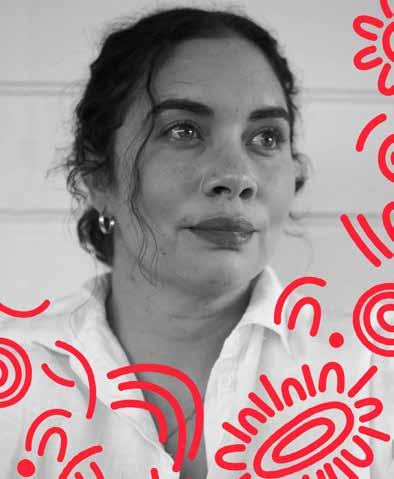
Danielle Leedie Gray is a Graphic Artist, Designer and a Bidjara and Wakka Wakka woman of southwest and east Queensland, Australia.

Danielle’s work is guided by a deep sense of empathy towards her cultural heritage and family history, and invites unity and healing through the unique combination of culture and contemporary vision.
More personally, important symbols for Danielle are the people gathering and the travelling sign because they reflect unity and moving forward.
Danielle wants to invite her work into the homes and businesses of non-Indigenous people, and promote understanding of the symbols, stories and meaning in Aboriginal culture so together we create a united future for all Australians.
Read more about Danielle: danielleleediegray.com.au
9 Issue no. 49 / May 2023
Bidjara and Wakka Wakka artist Danielle Leedie Gray designed the NRW 2023 artwork to represent unity and moving forward as one. Photo: supplied
BE A VOICE FOR GENERATIONS, BE A VOICE FOR CHANGE
For the work of generations past and the fate of generations future, Reconciliation Australia’s theme for 2023, Be a Voice for Generations urges everyone to act today for a more reconciled country. By using your power, your words and your vote you can help create a better, more just Australia for all of us.
Check our suggestions how you can Be a Voice for Generations, while also acting to create a better country for future generations.Take these actions with you every day of the year, not just during National Reconciliation Week.
Be a Voice for Listening

• Sometimes being a voice means shutting up and listening.

• First Nations peoples have a long legacy of speaking up for their communities, but their voices have been excluded or buried under the voices of non-Indigenous people.
• Turn down the noise: listen before you speak. Be an active ally.
• Protect the space for a multitude of Aboriginal and Torres Strait Islander viewpoints and perspectives. If you are unsure, listen and learn.
Be a Voice for Unity

• First Nations cultures, stories and solutions have thrived for over 65,000 years and make Australia a richer, more whole place for everybody.
• Speak up about Aboriginal and Torres Strait Islander sovereignty, cultures and people. Recognise sovereignty by Acknowledging Country and by respectfully prioritising Traditional Owners voices.
• Learn about the significance of the NAIDOC theme, For Our Elders. Attend or plan an event near you.
Be a Voice for Fairness

• Racism damages lives and livelihoods, and it hurts the whole community. Whether in the city, regions, online or in public spaces – being abused, ignored, refused service or getting followed by security, has long-lasting effects.
• Say it out loud: ‘Racism: It Stops With Me.’
• Notice the bias in personal conversations. Speak up when you hear something ignorant, hurtful or not right.
• Amplify calls to eradicate systemic racism. See it. Call it out. Report it.

Be a Voice for Learning

• If you didn’t learn about Aboriginal and Torres Strait Islander cultures at school, speak up to make sure our kids do now.
• Find info for schools and early learning services on the Narragunnawali website and at Learn our Truth.
• Challenge colonial perspectives on history, support school curriculum changes, commit to a RAP in your school or early learning service.
Be a Voice for Action

• Actions speak louder than words – and reconciliation takes action.
• Learn about how to move from ally to accomplice.
• Connect with your local Traditional Custodians and First Nations groups to find out what issues you should stand with them on and help amplify their voices.
• Find your local reconciliation group and collaborate on efforts.

10 Issue no. 49 / May 2023
Be a Voice for Truth-Telling

• Australia’s true history has been silenced, creating inter-generational trauma and preventing healing.
• When talking about the story of Australia, state the facts.
• Always note the continued presence and contributions of Aboriginal and Torres Strait Islander peoples.
• Support First Nations peoples’ truth-telling, in whatever form.
• Start a community conversation about the history of your area, suburb or town.
Be a Voice for Reform

• Aboriginal and Torres Strait Islander peoples are the most incarcerated people in the world, proportionally.
• Learn and understand why this is so.
• Speak out and challenge our leaders to take action on justice.
• Amplify the calls of Change the Record, Raise the Age and Family Matters campaigns.
Be a Voice for Representation

• Aboriginal and Torres Strait Islander peoples have been fighting for a political voice, and structural changes like treaty, for more than 100 years.
• Learn the history of representative bodies and calls for treaty. Find out if your state or territory has started a treaty process.
• Listen to the calls, debates and discussions on treaties, constitutional reform, and Voice to Parliament.
Be a Voice for Self-determination

• When Aboriginal and Torres Strait Islander peoples speak for themselves, our communities become stronger.
• Understand the strengths in First Nations community control in governing, health, education curricula, and media representation.
• Speak up for and support community-controlled and Indigenous-governed organisations.
Be a Voice for Land Rights

• Australia’s First Peoples have never stopped defending their lands and waters, and asserting their rights to their homelands. Land justice is hard fought for and must be vigilantly guarded.
• Show you support First Nations ownership and custodianship of Country.
• Learn about Land Rights and Native Title in Australia.
• Support or join land justice efforts and advocacy near you.
Be a Voice for Equity

• Past policies and practices took money and work away from generations of First Nations people. Stolen wages and lands undermined economic futures, and this is still playing out today.
• Support First Nations businesses as contractors, suppliers, and producers.
• Purchase Aboriginal or Torres Strait Islander art or products only from Indigenous-owned businesses.
• Call out exploitation of Aboriginal and Torres Strait Islander art and cultures in mainstream businesses.

Be a Voice for Tomorrow

• Reconciliation is everyone’s business, every day.
• Use this National Reconciliation Week to learn about and celebrate the world’s oldest living culture.
• Attend events, or host your own. Read, watch, listen and learn.
• Help others to get on board and Be a Voice for Generations.

11 Issue no. 49 / May 2023
IN CONVERSATION: TALEI ELU

Talei Elu is a proud Saibai Koedal (crocodile) woman and the 2023 Young Australian of the Year for Queensland. She moved back to Seisia, a Torres Strait Islander community in Cape York, during the pandemic and saw what can be achieved when community have a say and are listened to. We sat down with Talei to talk about her journey home and the importance of community-led solutions.
You worked for the Federal Government for 6-years before moving back to Seisia. Tell us about that journey.


I lived in Canberra as a child where my dad, Joseph Elu, worked as the chairman of Indigenous Business Australia for 12 years. I was around a lot of incredible people in the public service and Indigenous affairs space and I knew I wanted to be in it, too. Eventually, I found myself working in the Minister for Indigenous Affairs’ office.
But in Canberra you’re so distant, making decisions about other communities and not living through the issues that impact people on the ground. It made me think about the bureaucratic systems impacting my community back home.
What turned everything around was spending three months in Seisia. We ran a community beach clean and I was amazed how many people were involved. After six years of working for the Federal Government, I’d never seen a project make a meaningful community impact.
I knew from then on that’s what I wanted to focus on.

12 Issue no. 49 / May 2023
Talei Elu’s experience organising a beach clean in her home of Seisia, Cape York changed the trajectory of her life and inspired her love for community work. Photo: supplied
So, something as simple as a beach clean changed the trajectory of your life!
Yes, because it’s not just about picking up marine debris. It’s about teaching younger generations about the impact of plastic on the marine life that sustains us. We get Elders involved so kids can hear their stories, and through these interactions we keep cultural knowledge and language alive. There’s one girl here in Seisia who has done every single one of the projects I’m involved in. She’s gained knowledge across media being involved with Torres News; she’s helped run an event. From there, she’s been involved with our Australian Electoral Commission (AEC) project and she uses her media skills to create social tiles in Creole. So what I love about community work is its opportunities for that long-term capacity building.
It is a momentous time with the upcoming referendum on Voice to Parliament to be involved with the AEC. Tell us about it.

When I moved back to Seisia I saw that only 55% of those enrolled to vote here voted in the last federal election. I got very anxious that we wouldn’t be accurately represented in the outcome of the referendum – something that deeply affects us. Whether you vote yes or no to Voice to Parliament, we need to get to have a say. This is why we started the project with the AEC to tackle barriers to enrolment.
Identity documents can be hard to come by because of issues registering for birth certificates, and some people don’t have fixed postal addressed due to structural issues like overcrowding. These are key documents and contribute to the lower rates of enrolment.
We have trained four local women in Seisia to help enrol people in the community. Because they live here, they know when people move away or come back – they understand the life of community. We made enrolment posters and we put a Seisia Elder on it – everyone was saying ‘Oh my gosh, Auntie Eunice is on the poster!’
You’re one of the members of Queensland’s First Nations Consultative Committee. How does this Committee relate to Voice to Parliament?
There is a dynamic of power that isn’t always in our favour, but having more people be heard and to seek to solve the structural nature of the issues we experience is key. That’s what I aim to do developing the framework for the Queensland Voice. Torres Strait Islanders have a deep sense of equity, responsibility and justice. From the 1936 Torres Strait Maritime Strike, to ‘Border Not Change’, Mabo, the Torres Strait 8 and now, the Australian Climate Case launched by Uncle Pabai and Uncle Paul from Saibai Island.
The onus is now on the people with power to really listen and hear the solutions from the people who are on the ground experiencing these issues.
The National Reconciliation Week theme Be A Voice For Generations is about carrying the torch of those who have fought hard before us. Does this resonate with you?

Greatly. My granddad and dad worked hard to make sure we had a safe space to grow and they were raised in a very different time, when Seisia was still under the Aborigines Protection Act. It was a very traumatic, paternalistic, and controlling time in the history of Cape York and Torres Strait. Yet they fought hard to ensure that the younger generations could enjoy freedoms that they were never allowed.
The way I see it is my grandfather and my dad have been a voice for their generation and, they’ve inspired me to take up the charge and do what I can for my generation and those that come after.
Somehow amongst all of this you are also a photographer…
The first time I had used my camera seriously was at Dance Rites in Sydney – it was incredible. I craved trying to capture the next great picture. Capturing people who are in their element, so strong in their culture and in their storytelling is something I find beautiful.
I like the kind of interaction photography can bring about too. Once I was walking down the street when I saw someone creating dance accoutrements – Zamiyaks we call them here in the Torres Strait – and the minute I brought out the camera, we started this random but beautiful conversation. More than the photo, photography can let you peer into someone else’s life and interests. If I’m having a hard day on a project, I spend some time
I’ve found too that through all these projects and all the social issues that we try and tackle here in Seisia, storytelling is such a powerful and important tool that can help create systemic change.
13 Issue no. 49 / May 2023
The onus is now on the people with power to really listen and hear the solutions from the people who are on the ground experiencing these issues.
LONG BEFORE THE VOICE, THE AUSTRALIAN ABORIGINAL PROGRESSIVE ASSOCIATION CALLED FOR PARLIAMENTARY REPRESENTATION
By John Maynard
The most startling point on the referendum for a Voice to Parliament is the fact the majority of people in this country have no idea of history.
For nearly two thirds of the 20th century, we as Aboriginal and Torres Strait Islander people were conveniently erased from the historical landscape and memory. The majority of us were trapped in a historical vacuum as great numbers of our people had been confined to heavily congested and controlled missions and reserves.
As part of this confinement, we were to be severed from any sense of past or inspiration. We could not participate in ceremonies, speak our language, tell our stories, practice songs and dances or conduct our everyday hunting and living experiences. Over time our people could only remember the controlled life on the reserve – a pattern of misery.

In his 1968 Boyer lecture, anthropologist W.E.H. Stanner exposed Australia’s failure to regard, record or acknowledge Aboriginal people. Australian history, he said, had been constructed with ‘a view from a window which had been carefully placed to exclude a whole quadrant of the landscape.’

What is critically important in understanding history is that the call for a Voice to Parliament is not a new initiative. Aboriginal activists nearly 100 years ago first called for such a voice as part of their political platform and demands during the 1920s.
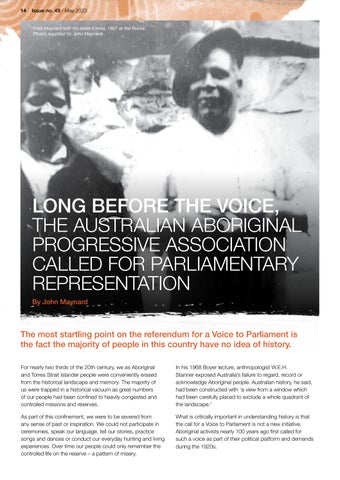
 Fred Maynard with his sister Emma, 1927 at the Rocks.
Photo: supplied by John Maynard
Fred Maynard with his sister Emma, 1927 at the Rocks.
Photo: supplied by John Maynard
14 Issue no. 49 / May 2023

POSTER OVERLEAF 15 Issue no. 49 / May 2023
ACT TODAY FOR A RECONCILED


#NRW2023
RECONCILED TOMORROW


National Reconciliation Week is a time for all Australians to learn about our shared histories, cultures, and achievements, and to explore and reflect on how each of us can contribute to reconciliation in Australia.
Head to nrw.reconciliation.org.au to get involved.


The Australian Aboriginal Progressive Association

The first Aboriginal political organisation, the Australian Aboriginal Progressive Association (AAPA), was formed in Sydney in 1924 and led by my grandfather Fred Maynard.
It advocated several key demands in protecting the rights of Aboriginal people, centring on: a national land rights agenda; protecting Aboriginal children from being taken from their families; a call for genuine Aboriginal self-determination; citizenship in our own country; defending a distinct Aboriginal cultural identity; and the insistence Aboriginal people be placed in charge of Aboriginal affairs.
The call for Aboriginal rights to land was explicit. Leader Fred Maynard declared: The request made by this association for sufficient land for each eligible family is justly based. The Aboriginal people are the original owners of the land and have a prior right over all other people in this respect.
The association’s conference in Sydney was front page news in the Sydney Daily Guardian. Over 200 Aboriginal people attended this conference held at St David’s Church and Hall in Riley Street, Surry Hills.
In the space of six short months the Australian Aboriginal Progressive Association had expanded to 13 branches, four sub-branches and a membership in excess of 600.
Calls for direct representation in parliament
Late in October 1925, the association held a second conference in Kempsey, New South Wales. It ran over three days with over 700 Aboriginal people in attendance. It was noted in press coverage of the conference that ‘pleas were entered for direct representation in parliament.’
Imagine if enough land for each and every Aboriginal family to build their own economic independence had been granted.
Two years later in 1927, the Australian Aboriginal Progressive Association produced a manifesto. It was delivered to all sections of government.
One of the significant points was for an Aboriginal-elected board to be established under the Commonwealth government, and for state control over Aboriginal lives be abolished. It envisioned: The control of Aboriginal affairs, apart from common law rights shall be vested in a board of management comprised of capable educated Aboriginals under a chairman to be appointed by the government
This push continued in 1929, when Fred Maynard spoke to the Chatswood Willoughby Labour League in NSW on Aboriginal issues. A report in the The Labor Daily newspaper in February that year mentioned his call for: Aboriginal representative in the federal parliament, or failing it, to have an [A]boriginal ambassador appointed to live in Canberra to watch over his people’s interests and advise the federal authorities
Surveillance, threats, intimidation, abuse
The Australian Aboriginal Progressive Association disappeared from public view in late 1929. There is strong evidence the organisation was effectively broken up through the combined efforts of the NSW Aborigines Protection Board, missionaries, and the police.
The state government and the Protection Board had been embarrassed by the exposure of their unjust policies in the media and wanted the organisation broken up.
Fred Maynard, in a newspaper interview in late 1927 in The Newcastle Sun revealed the level of threat and abuse he and the other Aboriginal activists were subjected to:
He said that he had been warned on many occasions that the doors of Long Bay were opening for him. He would cheerfully go to jail for the remainder of his life, he declared if, by so doing he could make the people of Australia realise the truly frightful administration of the Aborigines Act
When one ponders upon the legacy of the Australian Aboriginal Progressive Association the sad reality is that if the demands of these early activists had been met nearly a century ago, we would not be suffering the severe disadvantage that hovers over First Nations lives still today.
Imagine if enough land for each and every Aboriginal family to build their own economic independence had been granted. Or that we would not have suffered another five decades of child removal and its shocking impact of on generations of our lives.
If the demand to protect a distinct Aboriginal cultural identity had been taken up, we would not today be working to piece together the shattered cultural pieces of language, stories, songs, and dances.
And finally, if Aboriginal people had been placed in a position to oversee Aboriginal policy and needs, the history of our people would have been vastly different.
The reality today is we continue to fight for the demands that the Australian Aboriginal Progressive Association established nearly 100 years ago.
Professor John Maynard is a Worimi Aboriginal man from the Port Stephens region of New South Wales. He is currently a Director at the Wollotuka Institute of Aboriginal Studies at the University of Newcastle and Chair of Indigenous History. This article was first published in The Conversation. Read more: theconversation.com/au
19 Issue no. 49 / May 2023
THE VOICE REFERENDUM MAY DEPEND ON MULTICULTURAL AUSTRALIANS
 By Andrew Jakubowicz
When Warren Mundine, a leading “no” campaigner of the Voice to Parliament, suggested that migrants be recognised in the Constitution along with Indigenous Australians, it was criticised as a diversionary and potentially destabilising intervention.
It did, however, focus momentary attention on whether Australia’s culturally diverse communities would support the Voice referendum.
These communities could be crucial to the success of a referendum, given their size and breadth. Just over half of Australians were either born overseas or have at least one migrant parent. And nearly a quarter of Australians speak a language other than English at home.
The Voice campaign must capture the support of a majority of electors in a majority of states. The yes vote effectively requires an absolute majority to succeed, while the no vote can depend on unconvinced or confused voters to boost its impact.
Although the informal vote was less than 1% in the 1999 republic referendum, it can be high in multicultural communities. For example, the electorate of Fowler in western Sydney, which has large Vietnamese and Chinese populations, had an informal vote of 10.5% in last year’s federal election.
Recognising how important the multicultural vote is, the “Yes” campaign has already identified several broad coalitions whose support is critical.
First is the Federation of Ethnic Communities Councils of Australia (FECCA), which announced its full support of the Voice at its annual conference in late 2022.
 Australia’s multicultural communities have a unique role to play in standing with Aboriginal and Torres Strait Islander peoples. Here a woman attending an Invasion Day rally in Melbourne on Wurundjeri Country holds a banner reading ‘Muslims on Aboriginal Land’.
20 Issue no. 49 / May 2023
Photo: David Hewison/Alamy
Its chair, former Victorian state MP Carlo Carli, has been using the media to push back at Mundine’s comments, saying there is no interest in ethnic community organisations for a multicultural voice to parliament
FECCA is a federation of state and regional councils, each of which comprises many individual ethnic organisations. As such, it neither controls nor completely reflects the opinions of the broad masses of unaffiliated ethnic voters. However, in the case of the Voice, these bodies may well influence how voters think – this will be tested in coming months.

While FECCA is an important body, individual ethnic community organisations have much closer relationships with the electors who will vote in the referendum. And within these smaller groups, trust in government is sometimes lacking and support for progressive causes less assured. Many of the important conversations about the Voice will also need to be in people’s native languages.
The various Chinese communities offer a good example here. They are increasingly dominated by universityeducated mainland China or Hong Kong migrants. And they’ve been badly hurt by the upsurge in anti-Chinese rhetoric and harassment over the past few years of the pandemic.
This very diverse community does not have a necessary attachment to the Voice. On the one hand, many Chinese migrants may have a shared experience of racism that helps shape their attitudes. But on the other hand, some may retain a suspicion and anxiety about Indigenous people, as well.
Another coalition is religious based. The heads of various religious congregations gathered last year to decide whether a consensus on the Voice would be possible. They soon reached agreement on supporting the referendum, finding in all faiths a moral, if not religious, imperative to endorse Indigenous aspirations for recognition.
Mundine argued that migrants rejected the idea Australia was deeply racist – a notion the “no” campaign will try to seize on.
However, my research into the political mobilisation of ethnic communities over many years has shown that immigrant communities have a more complex relationship with the politics of race. Some communities, for example, have questioned the ideology of integration that was reintroduced by conservative governments in recent years in response to earlier multicultural movements of the 1970s to 1990s.
COVID also disproportionately affected migrant communities. In early 2022, it was revealed that deaths from COVID were three times higher among migrants than those born in Australia. For those born in the Middle East, death rates were 13 times higher.
Immigrant communities also suffered from a high incidence of racism and serious economic stress.
This caused trust in government to erode among the most affected groups – largely working class, non-Englishspeaking people, often born overseas.
And in 2020, the Black Lives Matter movement ignited similar action in Australia. Although driven by Aboriginal activism, BLM rallies also attracted many Australians with backgrounds from Africa, the Middle East, the Americas and the Pacific, in particular.
These events may have heightened the awareness in immigrant communities of the prevalence of racism in Australia. They may also have enhanced empathy for Indigenous people’s struggles, and potentially, support for the Voice.
So far, the Albanese government has called for citizens to support the concept of the Voice and trust parliament to get the details sorted. Yet, research shows trust in government has declined significantly over the past year or so after being very high early in the pandemic.
So, how best to engage with multicultural communities?
The central challenge is to detach support for the Voice from the broader idea of trust in government. To do this, the “Yes” campaign must galvanise grassroots engagement by demonstrating how the Voice is important not only to Indigenous Australians, but also to every citizen from every background.
To this end, some local government initiatives, such as that in Sydney’s inner west, have been running training courses that both educate people about the Voice and enable them to become advocates in their communities.

This approach recognises that group dynamics supporting individuals to do the “right thing” can have far more impact than endorsements from distant elites. This was successfully used in Independent MP Dai Le’s campaign for parliament in the Fowler electorate in last year’s election.
Moreover, teams of advocates from diverse communities will also need to be mobilised to create narratives convincing voters of the need for a Voice. Otherwise, the trust deficit that has been so apparent in these communities may contribute to their turning away from the idea.
The “No” campaign is already aware that confusion and mistrust are useful weapons in their armoury. The “Yes” campaign needs to recognise this danger and ensure multicultural communities understand how the Voice can combat wider issues of racism and discrimination to their common benefit.
Andrew Jakubowicz is an Emeritus Professor of Sociology at the University of Technology Sydney. This article was first published in The Conversation. Read more: theconversation.com/au
21 Issue no. 49 / May 2023
Recognising how important the multicultural vote is, the “yes” campaign has already identified several broad coalitions whose support is critical.
Snapshot:
Snapshot:
Snapshot:
The impact of Reconciliation Action Plans in 2022
The impact of Reconciliation Action Plans in 2022
The impact of Reconciliation Action Plans in 2022
Relationships
At the heart of reconciliation is the relationship between the broader Australian community and Aboriginal and Torres Strait Islander peoples.
Every year Reconciliation Australia measures the extraordinary impact that organisations with Reconciliation Action Plans (RAPs) are having across the country.
Every year Reconciliation Australia measures the extraordinary impact that organisations with Reconciliation Action Plans (RAPs) are having across the country.
Every year Reconciliation Australia measures the extraordinary impact that organisations with Reconciliation Action Plans (RAPs) are having across the country.

RAPs continued to have extensive reach across Australia, with 3,743,939 people working or studying in an organisation with a RAP
Built on foundations of strong governance, every RAP drives change through three core pillars: Relationships, Respect and Opportunities.
A further 6,242,562 people were members of a peak body or sporting club with a RAP
Built on foundations of strong governance, every RAP drives change through three core pillars: Relationships, Respect and Opportunities.
Built on foundations of strong governance, every RAP drives change through three core pillars: Relationships, Respect and Opportunities.
Collected from 1,428 RAP organisations, this is how RAPs contributed to reconciliation from July 2021 – June 2022
Collected from 1,428 RAP organisations, this is how RAPs contributed to reconciliation from July 2021 – June 2022
Collected from 1,428 RAP organisations, this is how RAPs contributed to reconciliation from July 2021 – June 2022
Effective partnerships are core to relationship-building and embedding change. Strong relationships endured across the network, with 16,844 formal and informal partnerships existing between RAP organisations and Aboriginal and Torres Strait Islander organisations (13,591 in 2021).
Participation in National Reconciliation Week keeps growing, with 5,952 National Reconciliation Week events being hosted by organisations with a RAP (4,173 in 2021).
Relationships
Relationships
Relationships
At the heart of reconciliation is the relationship between the broader Australian community and Aboriginal and Torres Strait Islander peoples.
At the heart of reconciliation is the relationship between the broader Australian community and Aboriginal and Torres Strait Islander peoples.
At the heart of reconciliation is the relationship between the broader Australian community and Aboriginal and Torres Strait Islander peoples.
RAPs continued to have extensive reach across Australia, with 3,743,939 people working or studying in an organisation with a RAP
RAPs continued to have extensive reach across Australia, with 3,743,939 people working or studying in an organisation with a RAP
RAPs continued to have extensive reach across Australia, with 3,743,939 people working or studying in an organisation with a RAP
A further 6,242,562 people were members of a peak body or sporting club with a RAP
A further 6,242,562 people were members of a peak body or sporting club with a RAP
A further 6,242,562 people were members of a peak body or sporting club with a RAP
Effective partnerships are core to relationship-building and embedding change. Strong relationships endured across the network, with 16,844 formal and informal partnerships existing between RAP organisations and Aboriginal and Torres Strait Islander organisations (13,591 in 2021).
Effective partnerships are core to relationship-building and embedding change. Strong relationships endured across the network, with 16,844 formal and informal partnerships existing between RAP organisations and Aboriginal and Torres Strait Islander organisations (13,591 in 2021).
Effective partnerships are core to relationship-building and embedding change. Strong relationships endured across the network, with 16,844 formal and informal partnerships existing between RAP organisations and Aboriginal and Torres Strait Islander organisations (13,591 in 2021).
Participation in National Reconciliation Week keeps growing, with 5,952 National Reconciliation
Participation in National Reconciliation Week keeps growing, with 5,952 National Reconciliation Week events being hosted by organisations with a RAP (4,173 in 2021).
Participation in National Reconciliation Week keeps growing, with 5,952 National Reconciliation
Week events being hosted by organisations with a RAP (4,173 in 2021).
Week events being hosted by organisations with a RAP (4,173 in 2021).
Respect
Respect
Respect
Building understanding of Aboriginal and Torres Strait Islander cultures, rights and experiences underpins progress toward all five dimensions of reconciliation.
Building understanding of Aboriginal and Torres Strait Islander cultures, rights and experiences underpins progress toward all five dimensions of reconciliation.
Building understanding of Aboriginal and Torres Strait Islander cultures, rights and experiences underpins progress toward all five dimensions of reconciliation.

Participation in cultural immersion and face-to-face cultural learning experiences increased to above pre-pandemic levels, with 18,702 employees of RAP organisations participating in cultural immersion (7,425 in 2020) and 72,313 in face-to-face cultural learning (48,067 in 2020).
Participation in cultural immersion and face-to-face cultural learning experiences increased to above pre-pandemic levels, with 18,702 employees of RAP organisations participating in cultural immersion (7,425 in 2020) and 72,313 in face-to-face cultural learning (48,067 in 2020).
Participation in cultural immersion and face-to-face cultural learning experiences increased to above pre-pandemic levels, with 18,702 employees of RAP organisations participating in cultural immersion (7,425 in 2020) and 72,313 in face-to-face cultural learning (48,067 in 2020).
Online cultural learning has also increased to well above pre-pandemic levels: 528,095 employees of RAP organisations participated (250,683 in 2020).
Online cultural learning has also increased to well above pre-pandemic levels: 528,095 employees of RAP organisations participated (250,683 in 2020).
Online cultural learning has also increased to well above pre-pandemic levels: 528,095 employees of RAP organisations participated (250,683 in 2020).
68% of RAP organisations changed core operations and/or services because of their RAP, showing RAPs continue to drive organisational outcomes.
68% of RAP organisations changed core operations and/or services because of their RAP, showing RAPs continue to drive organisational outcomes.
68% of RAP organisations changed core operations and/or services because of their RAP, showing RAPs continue to drive organisational outcomes.
Opportunities
Opportunities
Opportunities
Aboriginal and Torres Strait Islander peoples’ equal and equitable participation in a range of life opportunities is crucial to reconciliation.
Aboriginal and Torres Strait Islander peoples’ equal and equitable participation in a range of life opportunities is crucial to reconciliation.
Aboriginal and Torres Strait Islander peoples’ equal and equitable participation in a range of life opportunities is crucial to reconciliation.
There was a sustained increase in employment and procurement opportunities across the RAP network.
There was a sustained increase in employment and procurement opportunities across the RAP network.
There was a sustained increase in employment and procurement opportunities across the RAP network.
73,565 Aboriginal and Torres Strait Islander people were employed by an organisation with a RAP (61,263 in 2021).
73,565 Aboriginal and Torres Strait Islander people were employed by an organisation with a RAP

73,565 Aboriginal and Torres Strait Islander people were employed by an organisation with a RAP (61,263 in 2021).
goods and services were procured by RAP organisations from Aboriginal and Torres Strait Islander-owned businesses ($2,799,542,877 in 2021).
$3,112,203,909 worth of goods and services were procured by RAP organisations from Aboriginal and Torres Strait Islander-owned businesses ($2,799,542,877 in 2021).
goods and services were procured by RAP organisations from Aboriginal and Torres Strait Islander-owned businesses ($2,799,542,877 in 2021).
leadership commitment and representation from First Nations people in . This has improved across the network, however there is still
Change requires leadership commitment and representation from First Nations people in decision-making positions. This has improved across the network, however there is still more work to be done.
leadership commitment and representation from First Nations people in . This has improved across the network, however there is still
Aboriginal and Torres Strait Islander people sat on boards of RAP organisations
490 Aboriginal and Torres Strait Islander people sat on boards of RAP organisations (362 in 2021).
Aboriginal and Torres Strait Islander people sat on boards of RAP organisations
Aboriginal and Torres Strait Islander people in RAP organisations were in executive
491 Aboriginal and Torres Strait Islander people in RAP organisations were in executive leadership roles (388 in 2021).
Aboriginal and Torres Strait Islander people in RAP organisations were in executive
As the program marks 16 years of contributing to reconciliation, this snapshot shows us where the RAP network has succeeded in making change, and where it needs to
As the program marks 16 years of contributing to reconciliation, this snapshot shows us where the RAP network has succeeded in making change, and where it needs to
The increase of Aboriginal and Torres Strait Islander people in leadership positions, as well as the growth in partnerships between RAP organisations and First Nations organisations, are marked achievements in support of First Nations leadership and self-determination that must be sustained.
The increase of Aboriginal and Torres Strait Islander people in leadership positions, as well as the growth in partnerships between RAP organisations and First Nations organisations, are marked achievements in support of First Nations leadership and self-determination that must be sustained.
The increase of Aboriginal and Torres Strait Islander people in leadership positions, as well as the growth in partnerships between RAP organisations and First Nations organisations, are marked achievements in support of First Nations leadership and self-determination that must be sustained.
As always there is more work to be done, but this snapshot shows the ongoing impact of the RAP program as we take our next steps together on our national reconciliation journey.
As always there is more work to be done, but this snapshot shows the ongoing impact of the RAP program as we take our next steps together on our national reconciliation journey.
As always there is more work to be done, but this snapshot shows the ongoing impact of the RAP program as we take our next steps together on our national reconciliation journey.
To learn more about the impact of the RAP program, head to reconciliation.org.au/reconciliation-action-plans
To learn more about the impact of the RAP program, head to reconciliation.org.au/reconciliation-action-plans
To learn more about the impact of the RAP program, head to reconciliation.org.au/reconciliation-action-plans
As the program marks 16 years of contributing to reconciliation, this snapshot shows us where the RAP network has succeeded in making change, and where it needs to concentrate its efforts.
IF YOU’VE GOT KNOWLEDGE YOUR EARS AND EYES GROW: UNCLE PAT CONNOLLY AND THE TUMUT COMMUNITY PRESCHOOL

As Uncle Pat pulls up to the fence a flood of children run to greet him.
“Uncle Pat, Uncle Pat,” they shout, all determined to tell him their news. “I scratched my leg, Uncle Pat,” “I went camping, Uncle Pat,” “I stayed at my Nans last night Uncle Pat!”.
Uncle Pat Connolly, Wiradjuri/Yuin/Ngunnawal man and Elder-in-Residence at the remarkable Tumut Community Preschool reaches down to pat a head or grab a hand pushed through the fence. He patiently listens to all the little-people-yarns they share with him, smiling broadly the whole time.
The Wiradjuri Elder is on one of his frequent visits to this early education centre where he teaches the youngsters about his culture and his Wiradjuri language. His relationship with the children and their teachers has been developed alongside the school’s Reconciliation Action Plan (RAP). A plan which was fundamental in developing the centre’s application for the Narragunnawali Reconciliation in Education Awards 2021, of which they were joint winners in the early learning category.
Uncle Pat’s own educational experience was vastly different from his young fans. His parents and his eleven siblings were constantly on the move to escape child welfare attempts to steal Aboriginal children as part of the overt assimilationist policies of the time.

He left school at 14 because, as he puts it, “Some of the white people didn’t want their kids going to school with the Black kids”. So Aboriginal children were encouraged to leave school early and join their families picking fruit and veggies for local farmers.
Speaking his own Wiradjuri language was a punishable offence and he remembers adults speaking the language in low tones, afraid that if they were caught by the mission authorities, serious punishment would result. “Our Uncles and Aunties knew that if they were caught speaking language; teaching the kids language, they would come and take the kids away.”
“We knew a few words, everyone did, but if you were caught speaking it at school, they had this big, whippy cane….”
Today when he visits the preschool he is often welcomed in his own language by the children.
 Wiradjuri/Yuin/Ngunnawal man Uncle Pat Connolly is Elder-in-Residence at the Tumut Community Preschool, where he shares his knowledge and culture with the children, and by extension, their community.
Photo: Al Harris
Wiradjuri/Yuin/Ngunnawal man Uncle Pat Connolly is Elder-in-Residence at the Tumut Community Preschool, where he shares his knowledge and culture with the children, and by extension, their community.
Photo: Al Harris
24 Issue no. 49 / May 2023
“It makes me feel tremendous. They tried us to stop the language, we couldn’t even practice our own culture, it was all stopped. But now we’re getting it all back.

“When I go into this preschool, primary schools, high schools and universities, I try and teach them cultural things. I’m not leaving out my past, despite the all the angry torment that we had, I’m trying to revive it. Because it’s important to Aboriginal people to understand the past.”
Looking back at his own experiences growing up in NSW Uncle Pat never imagined that one day he would be visiting schools to share his culture and language. Even less that one day he would complete a university degree.
Some years ago, his daughter signed him up to start a Wiradjuri language course at Tumut TAFE where his teachers told him that he should take it further and go on to university. “I know my limitations I told them, but they said just go and try it and so I tried it and I graduated. So, I’m doing alright, for someone who had no education.”
Tess Herring, the preschool’s Services Manager said the reconciliation program, under Reconciliation Australia’s Narragunnawali program, has had a huge impact. “Reconciliation and Indigenous perspectives have been embedded within our philosophy, in the way we work and how children are educated at Tumut Community Preschool. It’s what we are known for and what we are very proud of.
“We teach children as young as 3 years of age how to speak Wiradjuri language and respect for our First Nations culture. Through learning language and professional development and the genuine relationships we have formed with our Wiradjuri community, our staff have a deep respect for First Nations peoples and culture.
“I went to school here in Tumut but there was no Aboriginal cultural content to my education at all. I went to school with Aboriginal people, but I didn’t understand their culture, it was ignored. I had no understanding of the brutal impact of colonisation and the true history of Australia.

“So personally, I’ve learnt and grown in terms of understanding the prevalence and damaging impact of racism in our country and the importance of being an ally in the fight to prevent and remove it, and the ongoing impacts of colonisation on our Indigenous peoples.”
The reconciliation program has also significantly increased the attendance of First Nations children at the pre-school, with enrolments of local Aboriginal children lifting to 16-20% of all enrolments.
Tess said that a big part of their RAP is about addressing racism, not just in the school but in the wider community. “We need to be the advocates to change attitudes. We know that children can start forming racist attitudes from as early as the age of three, so we are providing them with a different narrative around racism, equity and respect.”
Educator Kylie Murdoch said the preschool’s approach has led to some uncomfortable conversations with some parents over the years. “We don’t shy away from teaching children about challenging concepts. We teach these concepts in an age appropriate and sensitive way, and have taught them about the Stolen Generations, Sorry Day, the National Apology and National Aboriginal Childrens Day and the significance of these events.”
Uncle Pat and the staff at Tumut Community Preschool all agree that the reconciliation program is having an impact beyond the school fence. The children are influencing their families and the wider community.
“They go home, and they have conversations with their family; they challenge things that they see in the community,” Kylie said. “They question when they see something that’s unjust. It does have a big impact.”
“It needs to start with the children and Uncle Pat emphasises the children are the future. As these children understand and advocate things will change. They are influential in their families, and their parents listen to them.”
The success has been supported by the Narragunnawali: Reconciliation in Education program. Kylie said the program’s online resources are comprehensive, authentic and practical.

“The Narragunnawali platform provides a wealth of knowledge and information. If a service is thinking about how to start or progress reconciliation, then the Narragunnawali team and resources is excellent. We started by taking baby steps. When we reflect on how far we have come in our reconciliation journey since 2016, we recognise that ‘Oh, wow, we’ve achieved a lot’.”
Uncle Pat agrees. He thinks all schools should follow Tumut Community Preschool’s lead.
“If you’ve got knowledge, I keep telling a lot of people this, your ears and eyes grow. And you will hear and see things differently, and that’s why I’m sharing what I got with these people. Yeah, they’re not people, they’re my family.”
This year marks the fourth Narragunnawali Awards, recognising outstanding commitment to reconciliation in education. To learn more about the Awards visit:
25 Issue no. 49 / May 2023
JACK LATIMORE ON SOVEREIGNTY AND THE VOICE
Some people, particularly First Nations people, are concerned that a constitutionally enshrined Voice to Parliament might extinguish First Nations sovereignty.
What is sovereignty and how did the British settlers assume it? What is the First Nations sovereignty movement and what does it want? And how, if at all, will an Indigenous Voice, or a treaty, affect it?
When the Endeavour crew first sighted New Holland Cook had previously received his instructions from the British Admiralty. “You are also with the Consent of the Natives to take Possession of Convenient Situations in the Country in the Name of the King of Great Britain: Or: if you find the Country uninhabited take Possession for his Majesty by setting up Proper Marks and Inscriptions, as first discoverers and possessors.”
As the ship progressed towards Kamay-Botany Bay the use of fire by the Aboriginal inhabitants was recorded. By the fifth day, Banks noted the fires had grown larger “than any we have seen before” and more numerous, from which he concluded that the land was “rather more populous” than first thought.
For the Indigenous people on their ancestral Country, the fires were a chain of communication between First Nations and a vigorous assertion of their sovereignty. The message was lost on the British, as were the complexities of local customary laws, cultural protocols, governance systems, land cultivation and diverse economies.
What does ‘Indigenous sovereignty’ mean?

Today, Indigenous sovereignty is understood to be inherent rights deriving from spiritual and historical connections to land. Distinguished Professor Aileen Moreton-Robinson, a Goenpul woman, says this concept of sovereignty was imperceptible to the likes of Cook and Banks.
Indigenous sovereignty has gained prominence internationally in recent decades, particularly in countries defined as “settler states” – modern nations whose territories were occupied by established indigenous populations before being colonised by imperial European powers.
Academic historian Bain Attwood, at Monash University, points out that “sovereignty is not a word invented by Indigenous people”. The notion of state sovereignty is imperial, with Western legal roots, and allows absolute power and authority, usually through conquest of territory and the international law doctrine of “possessio” of property.
State sovereignty stems from the writings of Jean Bodin, a 16th-century French philosopher and law theorist, who recognised kings and princes as instruments of God. When most people refer to sovereignty, they mean this concept. But as Moreton-Robinson notes, this imperial regime of sovereignty is uniformly white and male, and to conflate it with understandings of Indigenous sovereignties is confusing.
How does the law view Indigenous sovereignty?

The Australian legal system has addressed the question of First Nations sovereignty many times “In a traditional common-law legal sense, sovereignty has long been lost by Aboriginal and Torres Strait Islander peoples,” says constitutional expert Anne Twomey. “The High Court ... has recognised that Aboriginal people and Torres Strait Islanders are subject to Commonwealth, State and Territory laws, along with everyone else in Australia.”
 The Aboriginal Tent Embassy on Ngunnawali-Ngambri Country in Canberra is the site of the longest protest for Indigenous land rights, sovereignty and self-determination in the world. Photo: Al Harris
26 Issue no. 49 / May 2023
In 1971, the Yolgnu challenged mining leases in Milirrpum v Nabalco Pty Ltd the Northern Territory Supreme Court. The Yolngu lost. In 1979, Wiradjuri man Paul Coe argued in the High Court that Aboriginal people were a sovereign nation. He also lost.
The Mabo decision in 1992, wiped out the concept of terra nullius. The High Court held that First Nations people lived within applied systems of law before the arrival of Europeans. In response to Mabo, came the Native Title Act, recognising some native title but not First Nations customary laws.
In 1993 the High Court, rejected Isobel Coe‘s argument on Wiradjuri sovereignty stating that native title existed only “under the paramount sovereignty of the Crown”. The 1996 High Court Wik decision ruled native title rights can coexist alongside the rights of a pastoral lease, but where there was a conflict in rights the native title was extinguished by the lease.
More recently, the High Court found that “European settlement did not abolish traditional laws and customs which establish and regulate the connection between Indigenous peoples and land and waters.”
How have Indigenous sovereign activists viewed these questions?
Does sovereignty mean First Nations people would pass their own laws, exercise their own customs, run their own community-controlled services? Will they try to collect taxes? Issue their own passports and postal stamps?
All these things are already being done. In 1990 the Aboriginal Provisional Government (APG) was founded by Michael Mansell, a Trawlwoolway-Pinterrairer descendent, “on the principle that Aborigines are and always have been a sovereign people”. The APG has for decades issued its own international passport – a document that has been officially stamped upon entry to several foreign nations.
In Victoria customary practices are recognised. Traditional Owners across the state, for example, are exempt from recreational fishing rules. Elsewhere, Indigenous micronations such as the Sovereign Yidinji Government, issue its own currency and postal stamps.
The concept of Black sovereignty has come to mean different things to different First Nations communities. It is often used as a catchphrase for broad Indigenous rights – principally Aboriginal land rights.
It’s this notion that Senator Lidia Thorpe refers to when she speaks of sovereignty. “It’s not just a spiritual notion, it’s a position of power in this country that we’ve always had and that we will always have until we come to a peace agreement to be able to unite this country once and for all.”
Thorpe’s argument is that we need a treaty before a Voice – giving First Nations people the standing of a state dealing with another state. “We need to protect and preserve our sovereignty. We demand a sovereign treaty with an independent sovereign treaty commission, and appropriate funds allocated. We don’t need a referendum. We need a sovereign treaty.”
So, would the Voice (or recognition in the Constitution) extinguish Indigenous sovereignty?
According to recent polling 10 per cent of First Nations people believe that a constitutional amendment recognising Aboriginal and Torres Strait Islander people would threaten sovereign Indigenous rights.
But constitutional law scholars have repeatedly declared that an enshrined Indigenous Voice cannot cede or extinguish Indigenous sovereignty. Uluru Dialogue co-chair Professor Megan Davis, a constitutional lawyer, and Cobble Cobble woman, says Indigenous sovereignty co-exists with the Crown. “Since neither federation in 1901 nor the recognition of Aboriginal people as citizens in 1967 ceded Indigenous sovereignty, nor would a constitutionally enshrined Voice to Parliament.”
In a 2012 report on Recognising Aboriginal and Torres Strait Islanders in the Constitution, the expert panel wrote: “(Sovereignty) derives from the majority view of the High Court in Mabo v Queensland (No 2)52 that the basis of settlement of Australia is and always has been, ultimately, the exertion of force by and on behalf of the British arrivals”.
“All members of the Expert Group agreed that the draft provision would not affect the sovereignty of any group or body.”
The Australian nation state, with its plurality of sovereignties – black and white – continues. Whether it can cope with a proposed Black Voice to Parliament enshrined in the very fabric of its Constitution is now the question.

This article was first published on 9 Feb 2023 in the Sydney Morning Herald and Age newspapers. It has been abridged. Read the full article: smh.com.au/national/what-s-indigenous-sovereignty-andcan-a-voice-extinguish-it-20230113-p5ccdk.html

27 Issue no. 49 / May 2023
NEW ELEVATE RECONCILIATION ACTION PLAN MIGHT BE A GAME CHANGER FOR CLOSING THE GAP TARGETS AND THE FUTURE OF FIRST NATIONS CHILDREN

When the Uluru Statement from the Heart was offered to the Australian people as a modest and generous offer for improving the rights and
“Our children are aliened from their families at unprecedented rates. This cannot be because we have no love for them. And our youth languish in detention in obscene numbers. They should be our hope for the future.
“These dimensions of our crisis tell plainly the structural nature of our problem. This is the torment of our powerlessness.”

Nowhere has this torment of powerlessness been more damaging than in the circumstances of families from whom children have been taken away.
The 2020 National Agreement on Closing the Gap specifically committed to reducing Aboriginal and Torres Strait Islander children’s over-representation in out-of-home care by 45% by the year 2031. Despite the much-heralded agreement committing Governments to make decisions in genuine partnership with Aboriginal and Torres Strait Islander peoples and organisations this target is not on track.
CEO of Life Without Barriers Claire Robbs (middle) listens to Jason Misfud (left), Head of First Nations Affairs & Enterprise at Wesfarmers, with James Taylor (right) Managing Director of SBS, at a panel at the 2022 RAP Conference called ‘Transforming our Futures’. Claire Robbs detailed LWB’s new plan with SNAICC and explained its transformational capacity to conference attendees.
28 Issue no. 49 / May 2023
Photo: Joseph Mayers
Two years after the partnership agreement was signed Aboriginal and Torres Strait Islander children are being removed at higher rates than ever before.
The Family Matters campaign is an alliance of First Nations child protection organisations and universities which aims to ensure Aboriginal and Torres Strait Islander children and young people grow up safe and cared for in family, community and culture.
In 2022 Family Matters reported that there were 22,243 Aboriginal and Torres Strait Islander children in out-of-home care: one in every 15.2 – making First Nations children 10.4 times more likely to be in out-of-home care than nonIndigenous children (up from 10 times more likely in 2019-20).
Statistics on adoptions, children being fostered in non-First Nations families and the percentage of children that never return to their families show a system in crisis with Aboriginal and Torres Strait Islander voices remaining largely unheard.
But now, in a ground-breaking development in the First Nations’ child protection sector, one of Australia’s largest providers of out-of-home care has committed in its Elevate Reconciliation Action Plan (RAP) to step away from the provision of care to Aboriginal and Torres Strait Islander children and advocate for the support and investment of resources into Community Controlled organisations.
The Life Without Barriers RAP commits the organisation to progressively transfer children to Aboriginal Community Controlled services, placing decision-making about Aboriginal and Torres Strait Islander children where it belongs – with family and communities.
Reconciliation CEO Karen Mundine said the Elevate RAP was a game-changer for the wellbeing of First Nations children and families and provided a real practical example of why the RAP program is so important.
“This RAP includes substantive action that will have a profound impact on the lives of many Aboriginal and Torres Strait Islander people, families and communities for years to come,” said Karen Mundine.
“It will progress long-standing First Nations demands that Aboriginal and Torres Strait Islander people and organisations participate in and have control over decisions that affect their children.
“For the first time it will amplify the voices and place power in the hands of those who best understand the strengths of and challenges to our families and children.”
Chief Executive of Life Without Barriers, Claire Robbs said the partnership is an example of the genuine reform possible in child protection when organisations are encouraged and supported to strive further in their reconciliation commitments.
“Our commitment to step away from the provision of care is one part of the equation – equally important is our organisations commitment to advocating for resourcing and investment to be directed into Community Controlled organisations,” Ms Robbs said.
“The support of Reconciliation Australia and SNAICC had enabled us to shape our commitment and be on the right side of history.”
The Secretariat of National Aboriginal and Islander Child Care (SNAICC) - National Voice for Our Children CEO Catherine Liddle said Life Without Barrier’s commitments set a precedent for other mainstream organisations working with Aboriginal and Torres Strait Islander children and families.
“Closing the gap for our children requires genuine effort from Governments and mainstream organisations to transform the way they work with us.
“Life Without Barriers is to be congratulated for having the vision and courage to see Aboriginal and Torres Strait Islander people and organisations have the solutions and the expertise to know what works for our children and families.”
The three organisations are calling on state and federal governments to increase resources to community controlled child protection services to ensure the transfer can occur without disruption to children or families.
Karen Mundine said the Life Without Barriers RAP was an example of the sort of initiatives that are needed across Australia to enhance a Voice to Parliament.
“The transformative actions in this RAP come from a real partnership between Life Without Barriers and SNAICC and demonstrate the potential for RAPs to profoundly support Aboriginal and Torres Strait Islander aspirations for self-determination.”
Read the Life Without Barriers Elevate RAP: lwb.org.au/social-policy/aboriginal-and-torres-straitislander-peoples/transformation

29 Issue no. 49 / May 2023
LOOK FOR A BOOK!

The First Scientists: Deadly Inventions and Innovations from Australia’s First Peoples
Corey Tutt
Hardie Grant
Deadly Science founder Corey Tutt has produced this illustrated science book for kids aged 7 to 12 years. In consultation with communities and with beautiful illustrations by Blak Douglas, Corey shows young readers of the wealth of First Nations knowledges and technologies that have been built up over 65,000 years.
From the first engineers to the first chemists, Australia’s First Peoples have long been experimenting, inventing and innovating. There is plenty to entice the young – and not so young – reader, many opportunities to learn fascinating facts, and answers to many questions are provided.

As 6-year-old Olivia asked, “But why do they manage the land with fire?” Luckily The First Scientists has the answer.

Jimmy Little: A Yorta Yorta Man
Frances Peters-Little
Hardie Grant
When Frances Peters-Little talks about the motivation for her recently released biography of Jimmy Little it’s simple, “There hadn’t been a biography about Dad ever. I had to do it!”

Frances, a filmmaker, historian and musician, has done us all a favour by uncovering and presenting the story of her much-loved father, community leader, and Australia’s first Aboriginal pop singer.
Jimmy Little’s story is both extraordinary and common place. He reached heights of fame and acceptance previously unknown to Aboriginal performers while, out of the spotlight his family and his own experiences mirrored the dispossession, exclusion and discrimination experienced by any Aboriginal people of the times.
This engrossing book is not just a story of one man but a history lesson as well.
It’s now 60 years since Royal Telephone was the first song by an Indigenous performer to reach No. 1; high time you caught up on the story of Jimmy Little.
Dark Heart (Edition 1 and 2) Scott Wilson
Indigiverse Comics
Calling all comic book lovers! The Indigiverse starts here with Dark Heart.


Gooniyandi and Miriwoong Kadjerong man Scott Wilson weaves together culture, language and oral tradition to introduce the 65,000-year-old order of Elder Protectors. They protect the Lore that defends people and main character Adam Hart is drawn into this ancient story when evil spirits are freed from the Sacred Fires.
Adam, a university student living away from Country in Sydney, is our first superhero in the Indigiverse universe and he must now learn to harness the power of The Dreaming for good and become Dark Heart.
Focused on themes of identity and connection Dark Heart takes on the popular superhero genre to bring the oldest living culture to a worldwide audience.
30 Issue no. 49 / May 2023
Come Together –Things Every Aussie Kid Should Know about the First Peoples

Isaiah
Hardie
Firebrace

 Grant
Grant
In 2021, Yorta Yorta and Gunditjmara artist Isaiah Firebrace presented a petition to Federal Parliament asking for First Nations history to be taught in all Australian schools. Hundreds of thousands of people signed and Come Together was soon born out of this passionate call to educate all children in an understanding of First Nations histories, protocols, and cultures.
Beautifully illustrated with bite-sized explanations of 20 topics such as totems, songlines, the Stolen Generations, astronomy, and art, it is a wellstructured book for young children and their families.
Come Together and its introduction into First Nations seasons, ceremonies, and food will pique the curious nature of its young readers and no doubt ignite a desire to go deeper and learn more about the oldest continuing culture on Earth.
Tune in: Budjerah
‘Be proud of where you’ve come from / They gon’ know my name / B-u-d-j-e-r-a-h,’ sings Budjerah Slabb – a Coodjinburra singer-songwriter whose name and soulful, heartfelt and uplifting music has rocked the music industry.
Touring with Ed Sheeran already under his belt, Budjerah remains relatable with lyrics grounded in his personal story and struggles. Fusing soul, R&B and pop, Budjerah’s debut eponymous EP showcased powerful vocals, with singles Missing You and Higher reaching millions on Spotify.

Born and raised on Bundjalung Country NSW, Budjerah is a passionate advocate for First Nations issues and has used his platform to raise awareness, speaking up about his experiences with racism, mental health and how lucky he was to be raised on Country.
His rise to fame has been rapid, but Budjerah’s blend of soulful lyrics and catchy choruses are sure to stick around. Give him a listen before he goes stratospheric.
Listen to Budjerah’s most recent single Therapy: budjerah.com

31 Issue no. 49 / May 2023
GET READY TO VOTE.
If you are 18 and over, or about to turn 18, you can:
• Enrol anytime on the AEC website or visit an electoral office to complete a paper form.

• You just need your ID (driver’s licence, Medicare card, or passport) OR someone who’s already on the electoral roll that can confirm who you are.
• You can update your details anytime at aec.gov.au
• Visit aec.gov.au/enrolnow or call 13 23 26
13 23 26 aec.gov.au/enrolnow
Authorised by the Electoral Commissioner, 10 Mort Street, Canberra, ACT
OUR VOTE. OUR FUTURE.
Original artwork by Marcus Lee Design
ENROL NOW.