October 2020
thesofiamagazine.com
Women in Business Issue
A Call To Action | You Deserve It | Breast Assured
Asheville’s One-Stop Shop for ALL your Beauty Needs Eyebrow Tinting | Eyelash Extension Waxing | Massage Therapy Skincare | Hydrafacials
beauty-bin.com
828.417.9915 Acupuncture Cupping & Yoga Please enjoy
$20 off your first session with this ad
Natasha Kubis, L.Ac. 917.576.9198 acuwellhealth@gmail.com
acuwellhealth.com
117 Sweeten Creek Rd, Asheville
Voted Best of WNC for the last six years
Keeping Families Comfortable since 1993
Jennifer Bullman Jones President, Bullman Heating & Air
Heat Pumps • Air Handlers • Air Conditioners • Coils • Package Units • Waterfurnance Heat Pumps Thermostats • Gas Furnances • Air Cleaners • Ductless Systems • Steam Humidifiers • Geothermal Bypass Humidifiers • Dehumidifiers • Wine Cellar Cooling Units • iWave
bullmanheating.com 2
thesofiamagazine.com | October 2020
828.658.2468
Welcome to October!
Publisher Tammy Sheppard publisherofsofia@gmail.com
Art Director / Web Design Tina Gaafary
For Advertising Inquiries Mike Demos 828.273.0098 mikedemos@aol.com Trish Luzzi 828.423.0248 wnccreations@gmail.com
Contributing Writers
from the staff of SOFIA!
Natasha Kubis Lavinia Plonka Peggy Ratusz Laurie Richardone
Photographer
Congratulations to Angie and DJ Lamoree of Weaverville, NC Their shop 5 LITTLE MONKEYS QUILT & SEW has been chosen as one of the top 10 shops in America! 5 Little Monkeys Quilt & Sew is featured in the Spring/ Summer issue of Quilt Sampler Magazine, published by Better Homes & Garden
Visit fivemonkeysquilts.com to see and order beautiful fabrics, supplies, and sewing machines. Watch Angie live on Facebook daily for inspiration.
32 N Main St. | Weaverville, NC 28787
828-484-7200
fivemonkeyquilts.com
Bren Dendy
P.O. Box 18416 Asheville, NC 28814 828-230.7537 thesofiamagazine.com
All advertising published in SOFIA is believed to be truthful and accurate. However Sofia Magazine assumes no responsibility and shall have no liability whatsoever for errors, including and without limitation, typographical errors or omissions in SOFIA. Any reference made to Sofia Magazine is not to be construed as making any representation, warranty or guarantee concerning the information advertised in SOFIA. The content of all ads contained herein are solely the responsibility of the advertiser. The opinions and statements contained in advertising or elsewhere in this publication are those of the authors of such opinions and are not necessarily those of Sofia Magazine reserves the right to edit or refuse any advertising submitted to this publication. October 2020 | thesofiamagazine.com
3
made it myself! More than 10,000 bolts of quality quilting cotton!
sheville EST.
1997
ON CO.
1378 Hendersonville Road in Asheville ~ 828-277-4100 Check out our classes at www.ashevillecottonco.com
Read the story of Lily, an endearing little girl who’s passion for spinning gets her into trouble until she learns to spin like a ballerina. Available at A Walk in the Woods 423 Main Street, Hendersonville The Sock Basket 99 Edgewood Road, Suite A Asheville and online at gratefulsteps.org Written by local author, JeanAnn Taylor For more information on book signing events,
please call 828-989-2651
4
thesofiamagazine.com | October 2020
ADVERTISE with SOFIA! Our readers are your potential customers.
WOMEN HANDLE THE BULK OF PURCHASING DECISIONS For additional advertising information contact one of our representatives below:
Mike Demos 828.273.0098 mikedemos@aol.com Trish Luzzi 828.423.0248 wnccreations@gmail.com
CONTENTS 6
B reast Assured Natasha Kubis
Women in Business Sabrina Faith West......................18 Kala Ellis Wolfe.............................18
8
B ut Do I Deserve it
Jennifer Bullman Jones...............19
Lavinia Plonka
Preferred Properties....................20 Millie Parker...................................20
10 W omen Making Music Peggy Ratusz
Hadley Cropp...............................21 LeNoir Medlock............................22
12 All About Breasts Natasha Kubis
Courtney Maybin.........................22 Traci Burke....................................23 Laura McCue & Priestley Ford....24
17 It's About the Journey, Travel Well... Laurie Richardone
April Fore.......................................24 Kirsten Fuchs & Ingrid Cole.......25
5
thesofiamagazine.com | October 2020
October 2020 | thesofiamagazine.com
5
Breast
Assured By Natasha Kubis
O
ctober is Breast Cancer Awareness Month, and a good time to get acquainted with the anatomy of your breasts, as well as the best practices for cancer prevention. Sadly, 1 in 8 women will be diagnosed with breast cancer in her lifetime, and it is a significant health threat. Other conditions that can affect the breasts, and are often benign, are cysts and fibrocystic changes. Infections of the breast tissue can also occur, particularly during breastfeeding, and mastitis, or inflammation of the breast, is common. With the right knowledge, you can take preventative measures and a proactive approach to your breast health. Here’s how: Schedule Your Mammogram A mammogram scans breast tissue for tumors or other abnormalities that might be a sign of breast cancer, and
6
thesofiamagazine.com | October 2020
is typically performed for the first time when a woman is between 40 and 50 years old. Women should have a repeat scan every 1-2 years. Menopausal women often have dense breast tissue, and density can obstruct cancer detection through a mammogram, making it unreliable, so 3-D ultrasound is recommended in these cases. Report Any Breast Changes You should be familiar with the way your breasts normally look and feel. You should report any of the following changes to your doctor: a change in the look or feel of the breast and nipple, which can include a change in size, dimpling, swelling, shrinking, asymmetry of either the breasts or nipples, or a discharge from the nipple. Quit Smoking Smoking is associated with an increased risk of breast cancer, particularly among
women who started smoking at adolescent or peri-menarcheal ages. Cigarette smoke contains 3,000 types of carcinogens that could potentially affect your health. Limit Alcohol A meta-analysis of 53 studies showed that women who drank more than 3 drinks a day had 1.5 times the risk of developing breast cancer than nondrinkers. Try to keep it to 1 serving a day or less: 12 ounces of beer, 5 ounces of wine, or 1.5 ounces of hard liquor. Stay at a Healthy Weight Fat cells produce estrogen and high levels of that hormone have been linked to certain cancers. Working out can shrink the size of fat cells, so your body pumps out less estrogen. The American Cancer Society recommends getting at least 150 minutes of moderate intensity exercise per week.
Eat Your Fruits and Veggies Eat at least 5 servings of fruits and vegetables every day. Several recent studies have suggested that eating a lot of fruits and veggies may be associated with a lowered risk for developing estrogen-receptor-negative breast tumors. The effect may be due to the fact that plant foods tend to be rich in carotenoids, natural pigments that often serve as antioxidants. Estrogen-receptor-negative breast cancers make up only about 15 percent of all breast cancers, but they're particularly hard to treat. The USDA advises that you should fill half your plate with produce. In addition it is best to avoid refined, heavily processed foods, and added sugars. There have been numerous studies on the benefits of plant based diets and decreased cancer risk. Get Rest and Reduce Stress Both of these practices help the body heal by repairing cellular damage and inflammation. Shoot for 7-8 hours of good sleep and try to incorporate techniques for relaxation, such as yoga and meditation. Indulge in Some Chocolate Chocolate contains a phytochemical compound called flavonoids. A flavonoid is an antioxidant that can prevent or slow damage to cells caused by free
radicals, thereby potentially assisting in the prevention of cancer. Of course, moderation is the key. Get Adequate Amounts of Folic Acid Not eating enough folate, the naturally occurring form of folic acid, is linked with impaired ability to repair DNA, and damaged DNA has been linked to cancer. Folate is found in foods such as spinach, black-eyed peas, folic-fortified cereals, and grains. Try to get 400 micrograms daily.
FUN FACTS ABOUT BREASTS Both males and females have breasts. The structure of the male breast is nearly identical to that of the female breast, except that the male breast tissue lacks the specialized lobules, as there is no physiologic need for milk production by the male breast (although there have been some documented instances of male lactation). Our breast size is constantly changing. You might notice that your breasts shrink when you lose weight. That is because your breasts are made of fat. Pregnancy, breast-feeding, menopause, birth control pills, and even sex can cause your breasts to swell. Your breasts can also grow as much as a full cup size
during your menstrual cycle. However, days after your period, your hormone levels drop and your bustline is at its smallest. We are the only primates with permanent breasts. As humans, we grow breasts before puberty even starts, and they continue growing and changing throughout our lives. Other primates' breasts grow only when they are breastfeeding. The average breast weighs between 1-2 pounds. Breasts are not twins, they are sisters. Two breasts are rarely, if ever, identical. Breasts are a wonderful, life nourishing part of our anatomy. It is important to pay close attention to our diet and lifestyles for sustained breast health and wellness.
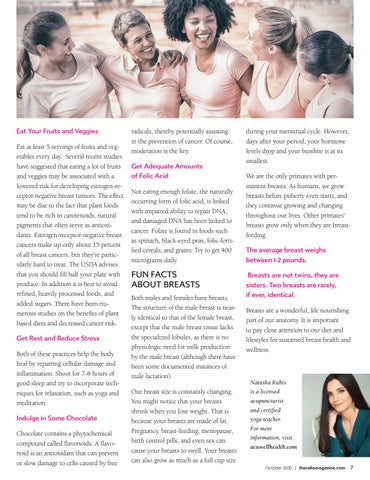
Natasha Kubis is a licensed acupuncturist and certified yoga teacher. For more information, visit acuwellhealth.com October 2020 | thesofiamagazine.com
7
But Do I Deserve It? By Lavinia Plonka
I
have a jacket I call God’s jacket. There was a period in my life where it seemed like nothing went right. I was in debt, my practice was not growing, in fact, it was almost non-existent and I needed a jacket. I saw one in a trendy catalog that seemed unaffordable. It was $275, which seemed exorbitant in the 1990’s. I would look at that jacket. And stress about my life. And look at that jacket. And bemoan my fate. Then I caught a cold. Ever since my childhood asthma, my respiratory system had been my teacher. Whenever I was in denial about my life situation, unhappy, stressed, broke, frustrated, I caught a cold. If I ignored the cold
8
thesofiamagazine.com | October 2020
(because each time I totally forgot that my body was trying to talk to me and I assumed I was merely sick), it quickly either turned into bronchitis, a sinus infection, or some other dreadful, dramatic outpouring of mucus that put a new
meaning on the term “phlegmatic.” Once again, I ignored the cold.
Soon I noticed it wasn’t leaving. That constant discomfort in my nose, that constant feeling of not being able to breathe, that pressing in my head persisted. Finally I recognized it. I was getting a sinus infection. “Oh no! “ I moaned. I envisioned the doctor bill, the prescription cost, cancelling the few classes I had, cash register bells started ringing in my head alongside the throbbing. The last time I had a sinus infection, it had ended up costing me over $200. And then as I passed the coffee table, I saw the catalog with my jacket calling to me. I burst into tears. I sat down on the couch and began to pray, to everyone and everything: Mr. God, my “higher”
self, the Universe, the etheric field that some scientists say creates reality, even Tinkerbell. “PLEASE! Don’t make it a sinus infection! Please, please, please. If it’s not a sinus infection I promise to buy the jacket!” There was silence. Of course, what did I expect, a voice coming from the clouds? A gust of wind? Glinda the good witch? I sat there, and after a few minutes I was completely overwhelmed with a shocking feeling. It wasn’t words, no voice talked to me. But I understood that I literally had to put my money where my mouth was. I had to buy the jacket first. I had to believe, really believe, not sorta kind believe, but in my core, believe I deserved it. I bought it. You’d think I was buying a house, I was so afraid to spend that money. The next morning I woke up, and the sinus infection was gone. Did I create the sinus infection to justify buying the jacket? Did the adrenaline from putting $275 on my charge card knock out the irritation? Was I already recovering and didn’t know it? Or was the universe talking to me? It slowly, (and I mean slowly, like years) dawned on me that I had been living with a series of core beliefs that destined me for a lifetime of the same poverty I had grown up in. I had spent half a lifetime running in place, like Elmer Fudd trying to catch Bugs Bunny.
God’s jacket woke me up to the simple truth that the universe hears every word I say. I learned to catch myself saying self-sabotaging things like, “Well, things are going well, I wonder when the other shoe will drop,” or “Wow, I made this month’s bills and have money left over, what disaster will strike next?” Not just words, but thoughts: you don’t deserve success, you’re not working hard enough, be careful, this can’t last. My Mother, a Russian pessimist, used to sneer at my dreams and say, “May all your dreams come true, and may they come to haunt you.” Spiritual teachers often tell us that we pick our parents before we are born for the lessons we need to learn. My biggest lesson was learning that nothing is impossible – it’s only my beliefs that keep from my dreams. If my
parents had simply been wonderful and supportive, I might never have learned the power of intentional thought. The jacket is no longer as hip as it was then. But it’s still in my closet, a reminder that as Shakespeare said, “ . . . there is nothing either good or bad, but thinking makes it so.”
Body language expert, Lavinia Plonka has taught The Feldenkrais Method for over 25 years. For more information, visit her at laviniaplonka.com
October 2020 | thesofiamagazine.com
9
Women Making Music A Mother & Daughter's Call to Action
Melissa & Kayla McKinney By Peggy Ratusz
Photo by Elliot Schwartz
A
ll over the world there are diligent, passionate, nurturing, collaborative women and persons identifying female, making music their business. Some work behind the scenes, some spend half their career-time teaching, and half performing on stages. Whether she’s a booking agent like Asheville’s Ellie Schwarz and Louise Baker, or Echo Mountain Recording Studio’s Manager and music entrepreneur Jessica Tomison, or a venue owner like Hendersonville’s Kelly Cubin with Southern Appalachian Brewery, the divine feminine pours over our city like mother’s milk. All over the world there are diligent, passionate, nurturing, collaborative women and persons identifying female, making music their business. Some work behind the scenes, some spend half their career-time teaching, and half performing on stages. Whether she’s a booking agent like Asheville’s Ellie
10
thesofiamagazine.com | October 2020
Schwarz and Louise Baker, or a venue owner like Hendersonville’s Kelly Cubin with Southern Appalachian Brewery, the divine feminine pours over our city like mother’s milk. There are literally hundreds of features and articles in prominent to humble publications, validating the conundrum and continued disparity between the sexes within the music industry when it comes to positions, pay and promotions. And still our sisters persevere for equity, pave the way for generations to come, and train and mentor the enlisted. Even within this pandemic, we witness these seafarers at the helm, mapping new and shifting courses. For the past few months it’s been my honor to celebrate with you readers, the plethora of talented and tenacious ladies of the arts and music, who continue to navigate uncharted waters, keep their crafts afloat and flex their muscle during this storm. It’s that fun-
damental commitment that motivates the mother and daughter we feature this month. When Melissa McKinney gave birth to her only daughter, Kayla, she was working the clubs and recording in Charlotte, NC after moving there from her hometown of Princeton, WV. Fast forward some years, and we find Kayla and Melissa splitting their time between Princeton and Asheville, making music and changing young lives through mentoring, teaching and counseling, together. Mom started Stages Music School in West Virginia in 2008 which she still owns and operates today, albeit remotely. Melissa explains that “Our students are encouraged to help others and to make a positive change in the world. We are a family at Stages and we hope that everyone who walks through the door, feels loved and accepted.” At Stages, Melissa teaches guitar, piano,
bass, drums and voice and has a small staff of other instructors who teach violin and brass instruments. Riding tandem to the music school is an offshoot program called “The One Voice Project” that McKinney started within the school Kayla grew up in WV. With an emphasis on artist development, it’s also an enterprise where Melissa produces and schedules empowerment concerts. “We take the young musicians on tours to perform at schools, community centers and festivals with a focus too on motivating kids and to speak to them about mental health issues, suicide prevention and bullying as a way to build confidence.” It’s a program that she intends to bring to the Asheville community. The catalyst for the inception of the program, Melissa says, is when Kayla began to struggle emotionally, especially after a classmate tragically committed suicide at age 11. “Ultimately, Kayla wrote a song about her beloved friend. The overall message in the lyrics being ‘I’m going to make a change in your name.’ As Kayla began to share the song at these showcases and concerts, interjecting empowerment speaking around her personal story of loss and depression, she not only planted the seed for her future role in the program but she started a band and called it “The Change.” “Kayla desired to use her music to uplift other kids and I loved it. While I concentrate on the artist development side, she is more aligned with the emotional development side and we both very quickly realized that a platform where she could help them express their suffering and talk about their challenges and I could teach and produce opportunities for them to play and share their stories through music; it was just very simply a call to action for both of us.” As her 5pc band, Kayla Lynn & The Change began touring with their mes-
sage; mother and daughter began to research and discover other programs with like-minded intentions of advocacy and connections which easily lead them to work with the Leaf Festival organization. The back story starts before Kayla was born. Melissa explains, “My only desire was to be a singer so after I graduated from high school, I moved to Charlotte where I played music for a long time. And when I had Kalya, I started teaching voice, piano and guitar. I never realized until then, that teaching music was what I was born to do. My low self-esteem stood in the way of my being able to follow my dream of being a front person, performer. And honestly, I stood in my own way. So it became my passion to help other people, to not stand in their own way.” “My daughter’s ear for music was early and pronounced. She’d get excited about bass lines and grooves and point out to me, parts of songs that even I didn’t hear. She took to the drums and I started teaching her how to play guitar and bass and we’d sing harmony together.” Consequently, Melissa put 7 year old Kayla, in a band with one of her best friends who she still plays with now, 13 years later. To be part of her offspring’s journey into life through their shared romance with and devotion to music and changing lives, is something Mom doesn’t take for granted. For each, there’s an acute and raised awareness when they share the stage together, that exudes a kind of kindred bloodline of confidence and energy few musicians can claim. “Kayla grew up listening to me sing Blues and Soul and those musical sensibilities are ingrained inside her, but the true gift is when we all see that super-shine that surrounds her and permeates within her when she’s on stage. It’s beautiful for me to see that I was able to provide her a foundation that allows her to be so free.”
areyoureadyforthechange.com - Kayla’s band theonevoiceproject.com - the Empowerment Program facebook.com/stagesmusicschool/ - The Music School Peggy Ratusz is a singer, songwriter, vocal coach reverbnation.com/peggyratusz loveisaroselive.com Peggy’s October shows/gigs: Thursday Oct 1st, Peggy Ratusz & Daddy LongLegs Blues Band, Isis Lawn Music Series, Asheville, NC, 6:30pm Sunday, Oct 4th, Peggy Ratusz & Jonathan Pearlman, Mills River Brewing Co., Mills River, NC, 2:00pm Saturday Oct 10th, Love Bubble, featuring Peggy Ratusz, Paula Hanke & Hank Bones, Whiteside Brewing Cashiers, NC, 6pm Thursday Oct 29th – A Return to Peter, Paul & Mary, 60’s Retro Rewind with Peggy Ratusz, Kelly Jones & Paula Hanke, Isis Lawn Music Series, Asheville, NC, 6:30pm
Peggy Ratusz is a vocal coach, song interpreter, and songwriter. For vocal coaching email her at peggymarie43 @gmail.com
October 2020 | thesofiamagazine.com
11
All About Breasts By Natasha Kubis
Our Beautiful Biology Throughout history, the female breast has been a locus of art, sexuality, eroticism, fertility, abundance, and nurturance. The symbolism and politics of this sacred anatomy has evolved to fit the standards and beliefs of each time and culture. Ancient Egyptians, for example, represented breasts in their art, typically for religious purposes, while showing female deities breastfeeding pharaohs as proof of their divine status. The Ancient Romans were more liberal in expressing the sensuality of the female body in their masterpieces, while the Middle Ages, shaped by strict religious discipline, held more modest representations of the female body. Despite the varying, often objectifying, representations of the female breast in art and culture, breasts are an evolutionary powerhouse. With their complex system of glands, ducts, and high concentrations of estrogen receptors, breasts are responsible for fascinating 12
thesofiamagazine.com | October 2020
anatomical functions, such as helping puberty occur at the optimal time and creating nature's most perfect food, nutrient-rich breast milk.
Breast Anatomy 101 The breasts are medically known as the mammary glands, and these glands are made up of lobules (milk-producing glandular structures), and a system of ducts that transport milk to the nipple for breastfeeding.
bulbs that produce milk. These structures are linked together by small tubes called ducts, which carry milk to the nipples. • Between the glandular tissue and ducts, the breast contains fat and connective tissue. • The nipple is in the center of a dark area of skin called the areola. The areola contains small glands that lubricate the nipple during breastfeeding.
• Breast tissue develops in the fetus along milk lines, extending from the armpit to the groin. The technical term for milk lines is ventral epidermal ridges, and these are the precursors to the mammary glands and nipples.
• Each breast also contains blood vessels and vessels that transport lymph. Lymph is a fluid that travels through a network of channels called the lymphatic system and carries cells that help the body fight infections.
• Each breast has 15 to 20 lobes that surround the nipple in a radial manner, like spokes on a wheel. Inside these lobes are smaller sections, called lobules.
Breasts Make Nature's Most Perfect Food
• At the end of each lobule are tiny
It is no wonder that breast milk is referred to as “Liquid Gold”. It contains 100% of the daily fat, proteins, vita-
mins, minerals, sugars, enzymes, and antibodies that a baby needs to grow, and ward off disease. Human infants are designed to be exclusively breastfed for about 6 months, and then the baby graduates to eat some food, in addition to breast milk. Here are some of the great health benefits of breast milk: • T he first feedings contain colostrum, which delivers a high concentration of antibodies. The laxative effect of colostrum gently clears the baby's intestine, decreasing the chance of jaundice. • I t contains antibodies, enzymes, and white blood cells, which protect your baby from viral, bacterial, and parasitic infections.
• The hormones released while you feed your little one help to lower your stress levels.
A Walkie Talkie for Mom and Baby Breasts are the gateway of communication between mom and baby. Nature has designed the breast to make a perfect product for its offspring. Here are some of the ways breasts communicate with the mom and the infant. • Areolas give off a scent. Around the edge of the areola are little bumps called Montgomery's glands. When nursing, these glands produce a
and cholesterol to match the child’s more active lifestyle. • I f the baby is born prematurely, the breast milk will make higher concentrations of protein and caloric density. • T he breast knows when the mom is stressed, and in response will hold back her output of milk, until the stress response has averted. Stress can also put cortisol into the milk supply, which has shown to affect the baby’s personality. These are good reasons to focus on self care and relaxation techniques whenever possible.
• I t encourages the growth of probiotics and “good” bacteria in the digestive tract. • A dditional immune components in breast milk provide protection against food allergies and eczema early in life. • B reast milk provides a defense against some common childhood illnesses such as, vomiting, diarrhea, pneumonia, urinary tract infections, types of meningitis, and can protect against some chronic conditions like celiac disease, inflammatory bowel disease, and asthma. • B reastfeeding lowers the risk of Sudden Infant Death Syndrome (SIDS), and increases the effectiveness of immunizations. • W hen at your breast, the sucking action of your baby strengthens their oral muscles, facial bones, and supports good dental development. • B reastfeeding supports brain development and is shown to improve IQ scores later in life. • B reastfeeding may help prevent obesity and lower your child’s risk of developing diabetes in adolescence and adulthood.
scent that only babies can detect. It smells like amniotic fluid, so the baby is drawn to the area. • The areola becomes darker during pregnancy and breastfeeding. Babies can see shades of lights and darks early on. By the areolas getting darker, it helps the baby recognize it. • A baby’s hands are designed to knead the breasts and stimulate the milk while their feet help them push up toward their mom’s breast. • When the breast senses an infection, it tips off the mom's immune system to put out more lactoferrin and relevant antibodies. • When the baby is older than 1 year, the milk adapts to contain more fat
• C ells in the breast communicate with cells in the bone, telling the bones how much calcium content it needs to release to make the perfect formula. During breastfeeding a mom loses up to 6% of her calcium for her little one, so it is important to replenish that in the diet.
Natasha Kubis is a licensed acupuncturist and certified yoga teacher. For more information, visit acuwellhealth.com
October 2020 | thesofiamagazine.com
13
Dig Deep, Practice and...
Find Your V o i c e
�� Jazz �� Soul �� Rock �� Country
Blues Pop
Pre-Teens to Baby Boomers Novice to professional
Peggy Ratusz
Vocal Coach 828.301.6768
peggymarie43@gmail.com
reverbnation.com/peggyratusz
FUNKY MUSIC IS FUN.
Dig Deep, Practice and...
FUNKY WATER IS NOT. Improve balance, reduce pain, realize your dreams laviniaplonka.com
Lavinia Plonka, GCFP 828.258.7220
14
thesofiamagazine.com | October 2020
828-251-2420
Listen to what your body is telling you today I hear your body. As a Massage Therapist and a firm believer in a holistic approach to healing, the mind, body, and spirit must flow together. Throughout my practice, I listen to where your body needs help and guide you to bring attention to those areas of disconnect while you use your self-awareness to connect these energies. We must check in with ourselves to see what our needs are, having a Massage is a way to promote well-being and ultimately connect your awareness to where you are today.
Mountain Village Massage Doula
Accepting new massage clients and expecting mothers.
Millie Parker NCLMBT#18646 (828) 527-2329 millie.jo.obuckley@gmail.com milliejoobuckley.wixsite.com/ mountainvillagemassa October 2020 | thesofiamagazine.com
15
16
thesofiamagazine.com | October 2020
Women in Business An important question to ask yourself is Why? It is what will have sustainability, and keep you moving forward. As an entrepreneur who created three successful businesses in a three decade span, the main ingredients have been passion, intention and a bit of drive. My first business was an intimate hair salon in Santa Fe. I opened it with five clients. I remember someone saying she either has money or she has nerve. Neither was the case. I knew it would be successful. I saw the result in my heart and mind, although it had not yet come into fruition. “Do not be concerned with the fruit of your action - Just give attention to the action itself. The fruit will come on its own accord”. Eckhart Tolle I admit it takes some courage to do something like that. When I look at my endeavor’s the common thread was a passion for creating beauty of all kinds, and sharing it with others. What is it for you? If there is doubt,
know it is a natural emotion in the creation of something unknown. As an entrepreneur there will be Sundays still in your jammies working on a project. For me it never feels like work. I feel joy and a heartfelt connection. it will take time, wand some sacrifice, but it is a journey worth taking.
It's About What I learned along the way… • Follow your first instinct the • S tay open, flexible, pay attention to opportunities. Journey, • K now your strengths and limitations, learn how to Travel Well... delegate. By Laurie Richardone
• Follow the 95% rule, especially for all the perfectionists. When a project is 95% move on. The energy spent for that last 5% is exorbitant, and unnecessary. I wish all you courageous women success and magic…
For Cooking Classes in Asheville, Visit: LaurieRichardone.com October 2020 | thesofiamagazine.com
17
Sabrina Faith West Born and raised in Asheville, NC, Sabrina West is a graduate of AC Reynolds High School and attended East Tennessee State University. She is the mother of five children: One in college, two in High School, one in middle school, and a brand new baby boy. She attends Biltmore Church, and has been a trainer for many years at Ladies Workout of Asheville/HF Training Center. Sabrina has been in the mortgage industry for 15 years. She enjoys meeting new people, and assisting them in securing the place they call Home. Her typical clients are first time home buyers, smart money managers, and 40 to 50 year olds. The most rewarding part of her job is assisting clients in making educated decisions. When working with first time buyers, she recommends establishing a realistic budget to determine a comfortable payment plan for the buyer. Sabrina participates in local fundraising organizations such as, Strong Fit Women against Cancer who provide daily needs and a holistic approach to making women feel great, First Time Home Buyers program, Missions work for the Dominican Republic, Autism Awareness assisting low income alternatives for family members with disabilities.
Sabrina.West@rate.com | 828.412.4337
Kala Ellis Wolfe
Shortly after obtaining her bachelor’s degree from East Tennessee State University Kala moved to the mountains of Western North Carolina. Growing up in a Culligan franchise she gained an appreciation of the importance and benefits of having crystal clean and great tasting water. Establishing Culligan of WNC out of her garage in 1997, she and her husband have been providing their knowledge and expertise of water treatment to their neighbors for over 23 years. Her family owned dealership offers residential filtration, commercial filtration, industrial filtration & bottled water services in many counties across WNC. Helping the community improve their water is a passion that her entire family along with their newest addition, Mavis, the Beabull puppy shares.
culliganwaterpros.com 18
thesofiamagazine.com | October 2020
|
888.998.8693
Jennifer Bullman Jones Jennifer Bullman Jones is no stranger to hard work. She started working in the family business at the age of 12. Her parents encouraged her to go after what she wanted, and advised her that she would have to work hard to get it. Jennifer left Asheville in 1999 to attend college at the University of NC Charlotte. In 2002, she married her husband Chris Jones, a professional baseball player. They shared an exciting life over the next couple of years living in various places. In 2004, Chris and Jennifer had a daughter named Mckenzie. Around that time, Jennifer returned to Asheville to work in the family business, Bullman Heating & Air. When Jennifer left Asheville in 1999, she never thought she would come back. But she knew that Asheville was exactly where she belonged. In 2013, Jennifer became a business owner at the age of 32. Being a woman business owner in a male dominated industry can be challenging, and Jennifer embraces the challenge. She loves what she does, and cares about the people who work for her, “I consider them my family”. Several of her employees have watched her grow up from a 12 year old girl who answered phones in the office to an adult woman running the entire operation.
Photo by Isaac Bullman
Jennifer Bullman Jones Bullman Heating & Air Bullmanheating.com 828.658.2468
Fast forward 7 years later, Bullman Heating & Air is still one of the top HVAC Companies in the area, and has been voted Best of WNC every year. “It’s such a nice feeling to love what you do”. Jennifer still relies on her father’s advice. He built this business from ground up, and although things have changed from the day he opened the doors in 1993, the core values of Bullman Heating and Air will always remain the same. Quality work the right way. Jennifer and Chris have been married for almost 19 years and both run successful businesses- Both in HVAC. Outside of work, Jennifer enjoys spending time with her daughters Mckenzie (16) and Madelyn (13). “Time is so precious and goes by so fast. You have make to make every single minute count with loved ones” Jennifer looks back on where she started compared to where she is today and is humbled by what she has accomplished. “I couldn’t have done any of this without the encouragement of my family. You have to have a strong support system behind you. There have been lots of tears and lots of laughs. This industry is not always easy, but it is so rewarding when you get emails and phone calls from customers who praise your company and your staff and at the end of the day that’s what makes it all worth it. Never give up and don’t let anyone tell you that you can’t do something.”
October 2020 | thesofiamagazine.com
19
From left, Current Owner - Jane McNeil, Past Owners - Juanita Swann-Gilbert and Ellen Ford
52 Years Celebrating Women in Asheville Real Estate
Tonia Allen
Sue Ambrose
Pam Autrey-Hester
Ginger Barnes
Simone Bernhard
Lisa Browning
Jo Chandler
Tracy Dew
Ashley Dotson
Barb Fiedler
Kirby Finger
Cathy Hooper
Joye King Steele
Pat Knaggs
Denise Legendre
Sandy Lindsey
Ann Lingerfelt-Lewter
LeNoir Medlock
Debbie Patten Riels
Anna Peddy
Margaret Price
Mitzi Redinger
Sandy Farnam Sellers
Emily Short
Sharon Smith
39 Woodfin Street, Asheville, 828-258-2953 1270 Hendersonville Rd, Suite #3, Asheville, 828-210-9400
www.preferredprop.com
Roza Tamas
I will hold space for you. I have the honor to be with people as they go through difficult times in their life. Being in healthcare for over 20 years in different roles, however, always caring for another human was my purpose. It’s a sacred moment to witness new life being born and also older souls passing away. My passion for this work began at six years old when I helped my mom. I gave her a washcloth to bite down on while in labor and stayed by her side the whole time. My baby sister was born in 28 minutes and I got to cut the umbilical cord. So if you hire me and I get the privilege to be there for you, it will overflow my heart with joy because I get to remember what it felt like the first time in 1989. I’m grateful for each experience I’m a witness too. Birth Doulas are support for women as they give birth. There are also, Death Doulas, who offer emotional support during any life changing experience. Holding someone as they go through these natural parts of life is a privilege I cherish. I believe in the power of love. The difference between me and other body workers is, just that, me. It’s an opportunity to have unconditional love sent to your body by me. We have pain where we experience fear. Our tissues hold emotions and when we send love to the pain spot it will help release the fear or negative emotions attached within. I love this birth/body/lifework so deeply, I’m emotionally moved with gratitude every day. Much LOVE, Millie
(828) 527-2329 millie.jo.obuckley@gmail.com milliejoobuckley.wixsite.com/mountainvillagemassa 20
thesofiamagazine.com | October 2020
Katie Wangrin
Linda Whitehead
Warrene Williams
Millie Parker Mountain Village Massage Doula
Hadley Cropp
Owner of Asheville Realty Group
H
adley is the gal running this whole thing (Asheville Realty Group). She just took over from our ARG Founder, Bobbie Baxter. Hadley is now the Broker-In-Charge and Wizard of Light Bulb Moments. If she’s not planning the next family camping trip, she can be found showing a fabulous home, building client relationships, mentoring new brokers or getting strategic and creative. Hadley was born and raised in the culinary hotspot of Asheville, NC and is the first to admit that she does not cook. However, she does lead our team according to our 5 Core Values and is the resident expert on take out lunches in downtown Asheville. After earning the Rising Star Award her first year in real estate when she was a young Jedi apprentice, Hadley has gone on to consistently make it to the Top Producers list including Asheville Top 100 Realtors on several occasions. She became owner of Asheville Realty Group in 2019, and has settled in nicely as the leader of this extraordinary bunch of folks sharing her wisdom and expertise with clients and agents alike.
- 25+ Years of Experience - Locally Owned and Operated - State-Certified Realtors - We Help You Buy and Sell
Hadley is married to Kevin, who owns Club Pilates in North Asheville and Biltmore Park. Together they divide and conquer the world of parenting Day Cropp and her myriad of interests, including Hip-Hop/ Tik-Tocking and being outdoors. And now for the bottom line. As a wise woman and ARGie Founder Bobby Baxter once said about Hadley, “Hadley is Honest. Hadley is Trustworthy. Hadley is Smart. And, what you see is what you get.” Hadley’s passions are: her super cute hubby, her spunky daughter, their two fur-children Diesel and Chief, all things Asheville, doing all things Asheville and helping families find their happy place. Motto: Ask not “What’s for dinner?” but rather “Who is going to pick it up?”
(828) 252-1910 ashevillerealtygroup.com 47 Patton Avenue, Asheville, NC 2880121 October 2020 | thesofiamagazine.com
Photo by Bren Photography
LeNoir Medlock
Preferred Properties of Asheville has always validated my career by supporting me as a woman, a mother and a community advocate.
LeNoir grew up in Asheville in the Grove Park neighborhood and attended both public and private schools in Asheville. She has a Masters of Education from a woman’s liberal arts college in SC. She taught for several years before returning to her beloved mountains and starting a career in real estate. She is a mother, a community volunteer and activist and a friend. She cares about supporting local businesses and can tell you the great stories of Asheville. She believes her job is to help buyer clients find their sanctuary and broker their purchases using in-depth knowledge of neighborhoods and property value history. When working for a seller, she becomes a business partner with her homeowners to help market, show and sell their homes with the least amount of stress. She has worked for Preferred Properties for over twenty four years and has sold over $100 million in real estate. LeNoir Medlock is a professional, full-time broker, ranked in the top 100 producers for the Land of the Sky Association of Realtors for the past 20 years and has a vast experience across multiple property types and regions.
22
thesofiamagazine.com | October 2020
Courtney Maybin Courtney Maybin is the owner of Beauty Bin, Asheville’s newest day spa located near Biltmore Village. Beauty Bin is a full-service day spa located on Sweeten Creek Road in Asheville, NC. With a focus on inclusivity for people of all backgrounds, genders, and races, Beauty Bin strives to match the outer beauty of each and every client to their inner beauty. Maybin started Beauty Bin out of her home after earning her esthetician license in 2018. In 2019, Beauty Bin’s brick and mortar location officially opened at 117 Sweeten Creek Road. The day spa currently offers waxing, facials, hydrafacials, eyelash and brow tinting, and more, with adherence to safety and health protocols. Beauty Bin’s team is specially trained to treat skin and hair types of all races. Maybin, an Asheville native and biracial entrepreneur, has always had a vision of inclusivity with the goal of offering new experiences. After the success of their summer pop-up shops, Maybin and the team look forward to hosting more events and will be announcing additional services soon. Learn more at beauty-bin.com. When she isn’t running her business, Maybin loves reading, traveling, spending time with her husband, Cameron Maybin, and their three children.
Callie Quinlan
AVL
LIFESTYLE Traci Burke
REALTY
AVL Lifestyle Realty is a full service boutique brokerage assisting home buyers and homeowners to create their ideal lifestyle in Western North Carolina. Traci Burke, the owner, works with all types of people at their West Asheville location, “We assist Asheville home owners, first time buyers, retirees, second home owners, and people moving to North Carolina for the first time...if you are looking for a beautiful place to live, it’s here”. At ALR they curate a custom buying and selling experience for each buyer and seller (they even do property management). Looking at the process from the customer’s eyes and helping to nail down the lifestyle they want to create here in Asheville first. After all, people are drawn to Asheville for what it offers, the escape, the adventure, the social interaction, the breweries and wineries. These ladies and the whole team at AVL Lifestyle Realty enjoy listening and learning about people, finding what is important to them first, and then sorting out the details.
“We look forward to meeting you and welcome you to life in the Blue Ridge” Traci Burke is the owner and Broker in charge of Asheville Lifestyle Realty. She leads her
team with a kind heart and energetic drive for growth. Day to day you will find her at the West Asheville office managing the property management division of the brokerage as well as doing outreach, business development and the nitty gritty back end work of running the business. Traci is also an active realtor, assisting buyers and sellers all around Asheville. Traci and her husband Doug are also seasoned real estate investors in Asheville and privately coach students on how to invest, focusing on acquisition and creative financing strategies. “I love helping people create their version of extraordinary.”
Callie Quinlan is the Director of Marketing and Agency Growth at AVL Lifestyle Realty
managing the strategy and execution of marketing material for the business as a whole as well as assisting the team of realtors with any and all marketing materials, personal branding, and business support. “ I enjoy learning new skills, market research, and being helpful however I can. Working in real estate gives me a chance to grow endlessly!” She is also the director of merriment, planning and executing the monthly Mad Ones networking events and will soon be joining the ALR team as a real estate agent [she has been waiting patiently since May to take her state examination, which has been pushed back due to COVID-19].
We’d love to help you create the lifestyle you envision in Asheville, NC whether that’s through buying your dream home, land to build on, selling your property, managing your income property, or joining our team as an agent. We would love to get to know you and hear your home story. Send us an email traci@madones.com / callieq@madones.com, drop us a line (828) 222.7327 or drop by our West Asheville office 717 Haywood Rd to share a cup of coffee with us.
October 2020 | thesofiamagazine.com
23
Laura McCue
Priestley Ford
White Oak can manage your investments with a clear, consistent risk management strategy that eliminates the emotion and confusion caused by 24/7 media “noise�. Here are some other things that we can do to make a positive difference for you: - Help you articulate and formalize your goals - Help you identify and prioritize financial opportunities - Present alternatives that could help you meet your goals, if necessary - Prepare your retirement plan - Guide you on how to be invested within your employer’s retirement plan - Advise you on when and how to take Social Security benefits - Suggest ways to increase your income in retirement - Monitor changes in your life that might affect your investment strategies - Give advice on matters such as long-term care and life insurance, college planning, risk documents, reverse mortgages, and senior care - Provide referrals to other professionals when needed - Help with continuity of your family financial plans across generations - Help with strategies for credit card management and debt reduction - Serve as a wise sounding board for your plans and ideas - Help keep you on track and feeling confident We offer a warm and welcoming environment at White Oak. Please call to see how we can make a difference for you.
whiteoakfinancialmanagement.com 828-274-7844 24
thesofiamagazine.com | October 2020
April Fore April was born and raised right in the heart of Asheville. Growing up she kept busy playing multiple sports and looking towards a bright future. From an early age, she knew that being an entrepreneur was the only way for her. She started her first business at the youthful age of 23. Over the years she mentored several aspiring women in the salon industry, leading them to become driven and motivated entrepreneurs themselves. The desire to continue her creativity in a different way, led the pathway to interior design. April is the mother of 2 larger than life boys, and 2 girls who rule the roost. When not meeting with contractors and picking the perfect paint, you will find her at the baseball field or cheer gym, making sure she catches the eye of her kiddos in their element. She and her husband own Furniture Specialties. She manages the FS Design Studio and creates unique curated spaces for their clients. She believes that design should be esthetically pleasing, but also functional. The best designs are born from a collaboration amongst client, designer, and talented local artisans. April has built a reputation for excellence in the design industry through her dedication to providing clients with unparalleled commitment and attention to detail. Projects have been met with client satisfaction and overwhelming gratitude in all 50 states and more than 20 countries around the world.
furniturespecialtiesinc.com 828.683.1177
FL
Pt
he
FL
SOFIA
to read
to read
Pt h
Pt
50+Living
PA GE
eP A G E
FL
to read
learned long ago not to make dreams, but to make plans. With an entrepreneurial 50+Living Kirsten Fuchs & Ingrid Cole heKirsten Fuchs
PA GE
heart and a gift for knowing what customers would love, Kirsten created a space where locals and tourists would be reminded of home, she hired a staff that surpasses all others and her pies, oh, those homemade, delicious pies are even better than the Grand Aunts and Mothers of the past. Baked Pie Company opened in the spring of 2017 in South Asheville, where Kirsten has lived over 23 years. She thought there were plenty of independent restaurants downtown and not enough in her own backyard. She wanted her customers to have ample parking and be able to meet at a place where they would see their neighbors. Eight months later, Kirsten opened her second location with the help of her sister, Ingrid Cole. Ingrid moved from Atlanta to become a part of the Baked company and now manages the Woodfin location. Located in Reynolds Village, again, away from the downtown area, Baked-Woodfin has its regulars and they adore the wit and kindness of Ingrid and her team. Closed for three months, due to the pandemic, Baked finally reopened for takeout and outdoor dining and is happy to see its customers come back to support them. Kirsten has made every effort to keep her staff and customers safe during this time and is excited to reopen inside in the near future. Kirsten is currently opening a new café in Fletcher, called P B & Jay’s Café. She plans to open October 2nd. Plans made!
h
eP A G E
FL
Pt
SOFIA
to read