thesofiamagazine.com
October 2019
for Today’s Woman
Complaining About the Men in Our Lives
Bren Dendy Unveiled
Yummy Brews
&
Pumpkin Treats
Nutrition and Stress Management a Recipe for Reproduction
SELL for SOFIA Looking for a rewarding career in advertising sales? Send an email to asheppard@rewnc.com or call 828-279-5962
ADVERTISE with SOFIA! Our readers are your potential customers.
85% of ALL CONSUMER PURCHASES
WOMEN HANDLE THE BULK OF PURCHASING DECISIONS
in the U.S. are made by women.
93% of FOOD PURCHASES are made by women.
75%
of women identify themselves as the
PRIMARY household shopper.
50% of PRODUCTS typically marketed
to men are PURCHASED by women.
80% of HEALTHCARE DECISIONS are made by women.
For additional advertising information contact one of our representatives below: Mike Demos Trish Luzzi
828.273.0098 828.423.0248
mikedemos@aol.com wnccreations@gmail.com
68% of NEW CAR purchase decisions are made by women.
66% of PCs are purchased by women. 92% of VACATION DECISIONS are made by women.
Letter from the Publisher Hello Friends! October is National Breast Cancer Awareness Month. According to healthfinder.gov, breast cancer is one of the most common kinds of cancer in women after skin cancer. About one in eight women born today in the United States, will get breast cancer at some point.
Publisher Tammy Sheppard publisherofsofia@gmail.com
Contributing Editor
JeanAnn Taylor jeananntaylor@rewnc.com
The good news is that most women can survive breast cancer if it’s found and treated early.
Director of Business Operations
If you are a woman age 40 to 49, talk with your doctor about when to start getting mammograms and how often to get them.
Art Director / Web Design
If you are a woman age 50 to 74, be sure to get a mammogram every two years. You may also choose to get them more often. Talk to a doctor about your risk for breast cancer, especially if a close family member of yours had breast or ovarian cancer. Your doctor can help you decide when and how often to get mammograms. If you enjoy this issue of SOFIA, tell a friend! You can also find us at thesofiamagazine.com, Facebook, and Instagram. Sharing is caring! All the best, Tammy Sheppard Publisher of SOFIA
All advertising published in SOFIA is believed to be truthful and accurate. However High Five Enterprises, Inc. assumes no responsibility and shall have no liability whatsoever for errors, including and without limitation, typographical errors or omissions in SOFIA. Any reference made to High Five Enterprises, Inc. is not to be construed as making any representation, warranty or guarantee concerning the information advertised in SOFIA. The content of all ads contained herein are solely the responsibility of the advertiser. The opinions and statements contained in advertising or elsewhere in this publication are those of the authors of such opinions and are not necessarily those of High Five Enterprises, Inc. High Five Enterprises, Inc. reserves the right to edit or refuse any advertising submitted to this publication.
Al Sheppard asheppard@rewnc.com
Tina Gaafary
For Advertising Inquiries Mike Demos 828.273.0098 mikedemos@aol.com Trish Luzzi 828.423.0248 wnccreations@gmail.com
Contributing Writers: Natasha Kubis Jill Long Lavinia Plonka Peggy Ratusz Betty Sharpless Sandi Tomlin-Sutker Cheri Torres
High Five Enterprises, Inc. PO Box 8683 Asheville, NC 28814 828.279.5962
October 2019 | thesofiamagazine.com
3
Deep, Practice and... “ADig must-read for all leaders. Practical wisdom and relatable stories!� - Robert Easton, Senior Managing Director, Accenture
Cheri Torres - Lead Catalyst - Speaker - Author - Trainer
Download your free conversation toolkit at www.conversationsworthhaving.today
Dig
Improve balance, reduce pain, realize your dreams laviniaplonka.com
Lavinia Plonka, GCFP 828.258.7220
4
thesofiamagazine.com | October 2019
The L B D By JeanAnn Taylor
D
o you know anyone who doesn’t have one hanging in their closet? The “Little Black Dress� may be the most iconic garment in fashion history. The versatility and adaptability of the dress has made it a timeless and indispensable element of fashion. While the fabric and silhouette impacts the spirit of the dress, its power lies in the color.
The influence of black is unmistakable. Take any colorful dress you own, dye it black, and it will send a completely different message. Black can conjure up a plethora of reactions including elegance, danger, and sophistication. The little black dress offers the opportunity to define oneself. This is primarily due to the wide range of appropriate fabrics, silhouettes, and added—or avoided—embellishments of flounces, ruffles, and other fancy trims. This dress has been re-invented countless times, yet remains as stylish as ever. This essential LBD works for all women regardless of age, size, or lifestyle. The LBD can be worn during the day, night, and every time in between. It is appropriate for cocktail parties and picnics, for frolicking and funerals, for a business meeting or a tryst. This dress can be as simple as a silk sheath, or as elaborate as a full-skirted ballgown. It can be accessorized with classic pearls or trendy costume jewelry. Every color
in the rainbow can be worn with black. Pastels, brights, and jewel-tones all play nicely with the dark color. The LBD can be worn as a monochromatic ensemble or as a canvas to highlight brightly colored accessories. A LBD worn with only one pop of color, as in a pair of hot pink high-heels or a pumpkin orange fedora, sends a statement of chic confidence. Of course, wearing orange with black will also say, “Happy Halloween!� While Coco Chanel is credited with creating the little black dress, she was actually not the inventor. Wearing black garments to make a statement dates back to centuries ago. Coco is however, responsible for designing dresses for all women—not just the elite. They were also original in her use of jersey fabrics which were at the time reserved for men’s underwear—not ladies’ dresses. Her designs were simple, appropriate for ready-to-wear, and more easily mass-produced, making the LBD the timeless, fashion sensation it has become. All colors affect our mood, but a color that can express both grief and sexiness at the same time, definitely has power. Maybe that’s because black is actually not a color at all. Black is technically the absence of color—which adds to the mystery and magic of the LBD. Style expert JeanAnn Taylor can be reached at jeananntaylor@rewnc.com October 2019 | thesofiamagazine.com
5
CONTENTS
16
Complaining About the Men in our Lives Cheri Torres
28
Playing God Lavinia Plonka
5
Sofia’s Style–The LBD JeanAnn Taylor
11
7th Annual Here’s Hope Event Hope Chest for Women
12
Nutrition and Stress Management Natasha Kubis
14
Capture the Season in a Cup
18
Seasoned by travels across the world and back–Anya Hinkle Peggy Ratusz
23 Hoop-La Until the 21st century, modern Halloween tradition was primarily a small holiday for children. It was a one-night affair for them to carve a pumpkin, dress up, go trick-or-treating, and back to school the next day. My how Halloween celebrations have changed. Extensive home decorating and costume planning begins as soon as the yellow-daisies bloom in late summer. Dressing in character is now just as
popular for adults as it is for children; over seventy percent of us dress up in silly, scary, or sexy costumes. Large parties at homes and churches are planned for the week prior to the actual day of Halloween. Halloween is a big deal. Halloween gives us a chance to be creative, and for that one night, you can be anything or anyone you want. Just for fun here are the most popular costumes of the past.
Southern Gal Gardening Make your Porch your local Garden Betty Sharpless
26
Halloween Hoop-La JeanAnn Taylor
Whoever you become on October 31, I hope you have a very Happy Halloween!
27
1920s - Clowns 1930s - Mickey & Minnie Mouse 1940s - Pinup girls and witches 1950s - Hula girls,
6
thesofiamagazine.com | October 2019
cowboys, and Indians
1960s - Superman, Catwoman, and Dennis the Menace 1970s - Charlie Brown and Raggedy Ann 1980s - Elvira and
Princess Leia
JeanAnn’s Journey–Trick or Treat JeanAnn Taylor
Dig Deep, Practice and...
Find Your V o i c e Blues Pop
Jazz Rock
Soul Country
Cover Story
Bren Dendy
Page 8
Pre-Teens to Baby Boomers Novice to professional
Peggy Ratusz
Vocal Coach 828.301.6768
peggymarie43@gmail.com
reverbnation.com/peggyratusz
A Business That Fits Who She Is Sandi Tomlin-Sutker
Acupuncture & Wellness Please enjoy
$20 off your first session with this ad
Natasha Kubis, L.Ac. 917.576.9198 • Natasha@essential–well.com
essential-well.com
20
Spaghetti vs Waffles–Use of Active Listening Jill Long
October 2019 | thesofiamagazine.com
7
Photo collaboration by Rachael McIntosh Photography and Bren Photography 8
thesofiamagazine.com | October 2019
Bren Photography
a Business that Fits WHO SHE IS By Sandi Tomlin-Sutker
S
tarting and sustaining a small business is challenging enough. Add to that process a marriage and birth of two children and it takes an amazing woman to succeed. As a young woman in her early twenties, Bren Dendy was deeply into active sports; white water rafting on West Virginia’s legendary Gauley River and rugged New River and trips to Colorado in the winter for skiing. To fund this exciting life, Bren tapped into her passion and skill at photography, working for rafting companies to snap and process candid photos, and even videos of customers running the rapids. As a young woman she was exposed to photography through two grand-
Top left: (Little girls screaming) is a personal project about the feelings of women in society today Top right: is a collaboration with Manteo Mitchell, local US Olympic Track and Field medalist Bottom right: (boy in pool) is from an underwater lifestyle portrait project
fathers. One was a wedding photographer, the other was a strong hobby photographer. At age 14, she began to receive camera gear from one of them. “They just enabled, influenced, and inspired me. I was surrounded by their work and it was always a priority in our family life (photos or portraits to commemorate even the simplest days). When she decided to settle down in Asheville it was a natural progression to grow that passion into a business. In 2006, with her dog and all her things in her truck she drove down to Asheville to visit friends from the boating world. During that time, she worked in the hospitality industry and
at Wachovia bank. Seeing the “writing on the wall” in the news every day, she realized it was time to create work that better fit her independent streak. So, she enrolled at AB Tech community college, taking a variety of photography, business and marketing courses. “I had professors who had worked at Harvard, decided to move to Asheville and taught a couple of courses there. I really had a strong pool of people to pull from.” Just before the 2008 real estate crash her husband-to-be Joe bought a house, they got engaged, and began their married life. In the midst of it all, she gave birth to their first child, a son they named Quinn. She was October 2019 | thesofiamagazine.com
9
lucky to have a professor who supported her in bringing the child to class when needed, and she worked for him as a teaching assistant. She also worked at her computer at home, sometimes nursing the baby in her lap in the middle of the night. She and Joe wanted to have their kids while fairly young so two years after Quinn, they had their daughter Charlie. Luckily, Bren is a self-motivated and resourceful person, determined to succeed and finish anything she starts. They didn’t have family here at the time who could provide physical support, no solid babysitter, so it was all on them to figure it out. As she built her business Bren says, “I worked a lot at night. Since it is digital, I can process the photos when the kids are sleeping. When they were babies and I had to get up with them, I’d just stay up and work. I had very little sleep for quite some time.” Self-care in that situation was not really on her radar! “We are in a place in our society right now where we expect women to be strong career women and to also be very involved in raising their kids. You can’t get it totally right and taking care of yourself ends up on the bottom of the list.” With a supportive husband she did find ways for self-care, and she was able to take workshops, join a book group, and basically take time to figure out who she was and what else she wanted in life. And in terms of growing her business she found doing wedding photography especially workable; since the events were typically on weekends, she didn’t need to find a babysitter. With her children back in school, and a new schedule, Bren decided to end the wedding photography part of her business. Fortunately, she found that 10
thesofiamagazine.com | October 2019
shifting out of wedding photography was a natural progression. And, she’s on track to meet or exceed her previous income from weddings with her commercial branding work for a range of clients. “I capture a complete and curated collection of images to fully represent the values, mission, and sales of a company. Here at Bren Photography we believe in listening to clients and we assist with style concepts, logistics, models, and location sugges-
Above photo: is a styled fashion shoot I did with local model, Sadie Grey Munroe for Frock Boutique downtown
tions.” Supporting her clients to reach their visual marketing goals is primary. “Asheville is all about relationships and supporting each other, so finding photography jobs was initially mostly word of mouth.” She does a lot of branding photography work, for instance, for Motif Medical, which is a branch of Aeroflow Healthcare on Sweeten Creek Road. “I have done product photography, lifestyle photography, and general branding photos for them. My work is consistently on their website and that showcases me to our community.” Another great example of “personal, genuine connections” in her work is
a Chicago company, Hadley Capital, a business that hires her to create natural images of owners and the operations for a variety of industries around the country. Achieving a natural look actually takes a lot of planning and attention to detail before going to these places, often sight unseen. Her natural and personable style helps clients feel comfortable about a process where many might feel vulnerable. “I love the ability to give and share with others, to create a lovely image.” After ten years in this business she now focuses on work that is a good fit for who she is. Her strong background in outdoor and adventure sports has led her to attract clients who are concerned about the environment, are caring and have a positive attitude. That concern also shows up in her new online campaign (see the link on her website) to raise money for clean water initiatives around the world by selling prints of landscapes she has taken during her travels. “My business needs to evolve and grow with me. I don’t feel like being in a box! And I listen to what the Universe is telling me.” That attitude will continue to lead Bren Dendy to a full, satisfying life of family, friends, and business relationships that truly do “fit who she is.” bren@brenphotography.net brenphotography.net (828) 419-0484
Sandi Tomlin-Sutker is a freelance writer and editor. Contact her at sts@ madison.main.nc.us
Join us for the
7th Annual Here’s Hope Event
sponsored by The Hope Chest for Women, Inc. The Signature Fundraiser will feature a delicious gourmet luncheon, fall fashion show with latest styles, an exciting raffle and silent auction, and heartfelt testimonies of clients-patients served by the agency. This event will be held at the beautiful Asheville Event Centre on Saturday, Oct. 19th, 2019 located at 291 Sweeten Creek Road in Asheville, NC 28803. Doors will open at 10:30 am to register, meet up and mingle with friends, preview raffle and auction items to explore the venue. Festivities will begin promptly at 11 am. A shuttle service will be available to eliminate parking issues during the event. Here’s Hope is the largest annual fundraiser for The Hope Chest for Women, Inc. The non-profit 501 c (3) organization was founded by Dr. Nathan Williams, a local gynecological oncologist in 2003 to assist his patients who were experiencing financial challenges in their everyday living necessities such as rent, transportation, medication &medical treatment co-pays, groceries, utilities, etc. All proceeds raised by The Hope Chest for Women, Inc. in its community fundraising endeavors is used to directly assist local WNC residents in 22 counties with financial difficulties due to their breast and/or other gynecological cancers. The Hope Chest for Women, Inc. can provide up to $1,750 per client over a 3-year period. This amount is based upon the recipients’ needs & resources. Here’s Hope celebrates patients, survivors, and honors the memory of loved ones who have lost their battles to the disease. Fall fashions will be modeled by cancer patients and/or survivors who will sport clothing selections & accessories ranging from very casual to black tie while showcasing a variety of local clothing retailers in our local area. Personal testimonies shared by a few of our recipients will tell how the organization has impacted them and their families during their crisis. The Chef’s Kitchen of Ingles’ Markets will once again provide a gourmet buffet luncheon offering a variety of healthy & nutritious locally grown & raised food items along with decadent desserts. The Ingles’ floral design department is providing centerpieces for our dining tables. A DJ will be on hand for the event this year to provide hits from several eras and genres. Raffle and silent auction items donated by local businesses, retailers, hoteliers, restaurateurs, crafters, and artisans will be available for purchase. Tammy Jones, local Morning Radio Co-Host at Mix 96.5 WOXL and former Citizen-Times Journalist will emcee this year’s event. Tammy is a breast cancer survivor. We promise a celebration with fun, inspiration, information, entertainment, delicious food, and the fellowship of awesome women. Individual tickets are $50 and tables of eight are available for $400. Sponsorships are available starting at $500. Call Kim the Hope Chest for Women, Inc. at 828-708-3017 for ticket and sponsorship information and/or visit our website: hopechestforwomen.org. October 2019 | thesofiamagazine.com
11
Nutrition
AND Stress Management
for Op mal F lity Health By Natasha Kubis
M
any couples begin their course towards parenthood with enthusiasm and high expectations but for more than ten percent of those couples, the blissful voyage to parenthood is obstructed by the diagnosis no one wants to hear—“infertility.� Infertility is diagnosed after one year of trying to conceive (or six months for women over 35) and can stem from a number of reasons including hormone imbalances, polycystic ovarian syndrome, endometriosis, tumor or cyst growth, thyroid gland problems, eating disorders, alcohol or drug use, excess weight, and high stress. Reproduction for the modern woman looks quite different than it did for our fore-mothers of the early 20th century who were most commonly having
12
thesofiamagazine.com | October 2019
children in their early twenties. Today, women make up half of the workforce and have seen dramatic progress in the areas of education, economics, and leadership. These successes are obviously huge wins for women but can often delay pregnancy, making it more difficult to conceive. Although many women achieve successful pregnancies into their thirties and forties, both the number of eggs and overall egg quality decline with age, which can present a speed bump on the road to pregnancy. This fact contributes to the $5.8 billion fertility industry which includes interventions like In Vitro Fertilization (IVF), Intrauterine Insemination, and a host of various fertility drugs. Women who are trying to conceive should work with a fertility specialist to address any underlying medical con-
ditions. It is also important to focus on the areas of nutrition, stress management, and a healthy lifestyle for optimal fertility health.
Nutrition Eating a diet rich in fruits, vegetables, whole grains, and lean meats will supply you with vitamins and minerals necessary for proper reproductive function. Here are some of the major players in reproductive health: Vitamin D is needed to help the body create sex hormones which in turn affects ovulation and hormonal balance. Sources include eggs, fatty fish, dairy, and cod liver oil. You can also get vitamin D from sitting out in the sun for 15 to 20 minutes per day. Vitamin B6 may be used as a hormone regulator and has also been shown to help with luteal phase defect. Sources
include tuna, bananas, turkey, liver, salmon, cod, spinach, bell peppers, turnip greens, collard greens, garlic, cauliflower, mustard greens, celery, cabbage, asparagus, broccoli, kale, Brussels sprouts, and chard. Vitamin B12 may decrease the chances of miscarriage. Some studies have found that a deficiency of B12 may increase the chances of irregular ovulation. Sources include clams, oysters, muscles, liver, fish, crab, lobster, beef, lamb, cheese, and eggs. Folic Acid helps prevent neural tube defects as well as congenital heart defects, cleft lips, limb defects, and urinary tract anomalies in developing fetuses. Deficiency in folic acid may increase the risk of going into preterm delivery, infant low birth weight and fetal growth retardation. Food sources include liver, lentils, pinto beans, garbanzo beans, asparagus, spinach, black beans, navy beans, kidney beans, and collard greens.
Iron is also important and a deficiency can cause lack of ovulation and poor egg quality. Food sources include lentils, spinach, tofu, sesame seeds, kidney beans, pumpkin seeds, venison, garbanzo beans, navy beans, molasses, and beef.
Selenium is an antioxidant that helps to protect the egg from free radicals and chromosomal damage which is known to be a cause of miscarriages and birth defects. Food sources: liver, snapper, cod, halibut, tuna, salmon, sardines, shrimp, crimini mushrooms, and turkey. Zinc works with more than 300 different enzymes in the body to keep things working well. Without it, your cells can not divide properly; your estrogen and progesterone levels can get out of balance and your reproductive system may not be fully functioning. Low levels of zinc have been directly linked to miscarriage in the early stages of a pregnancy, according to The Centers for Disease Control’s Assisted Reproductive Technology Report. Sources include oysters, beef, lamb, venison, sesame seeds, pumpkin seeds, yogurt, turkey, green peas, and shrimp. Essential Fatty Acids have been shown to help fertility by helping to regulate hormones in the body,
increasing cervical mucus, promoting ovulation and overall improve the quality of the uterus by increasing the blood flow to the reproductive organs. Sources include flax seeds, walnuts, salmon, sardines, halibut, shrimp, snapper, scallops, and chia seeds.
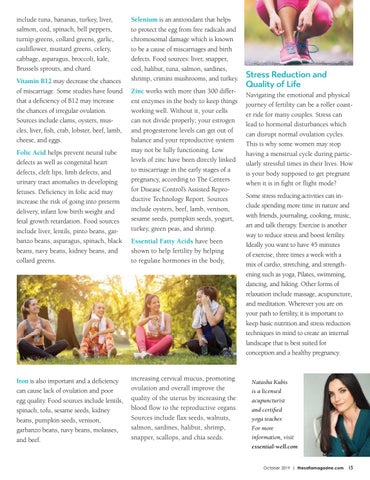
Stress Reduction and Quality of Life Navigating the emotional and physical journey of fertility can be a roller coaster ride for many couples. Stress can lead to hormonal disturbances which can disrupt normal ovulation cycles. This is why some women may stop having a menstrual cycle during particularly stressful times in their lives. How is your body supposed to get pregnant when it is in fight or flight mode? Some stress reducing activities can include spending more time in nature and with friends, journaling, cooking, music, art and talk therapy. Exercise is another way to reduce stress and boost fertility. Ideally you want to have 45 minutes of exercise, three times a week with a mix of cardio, stretching, and strengthening such as yoga, Pilates, swimming, dancing, and hiking. Other forms of relaxation include massage, acupuncture, and meditation. Wherever you are on your path to fertility, it is important to keep basic nutrition and stress reduction techniques in mind to create an internal landscape that is best suited for conception and a healthy pregnancy.
Natasha Kubis is a licensed acupuncturist and certified yoga teacher. For more information, visit essential-well.com
October 2019 | thesofiamagazine.com
13
h e leaves are beginning to change color and the smell of fall is in the air. The days are getting chilly, so now is the time to dig those cozy sweaters out of the back of your closet. There’s no doubt that fall is one of the best seasons not just because of the weather, but also because of the fall-themed drinks. Pumpkin spice lattes have become a traditional, and delicious seasonal beverage. However, don’t limit yourself to one brew when there are so many other amazing mixtures. Here are three fall-themed drinks that are the perfect beverage for the season and that you can make at home!
T
the season in a CUP
Hot Chocolate—With a Twist
Hot chocolate is a standard cold weather staple. It’s pretty easy: cocoa powder, hot milk, and a dash of whipped cream if you’re feeling fancy. But this hot chocolate is different. To upgrade your typical hot chocolate, add a dash of pumpkin puree to the milk as you are heating it. Let those two flavors meld together, then stir in the cocoa powder. You’ll be left with a pumpkin-y hot chocolate that tastes delicious. It might sound strange, but the flavor is mind-blowing. If you really want to spice it up, sprinkle the top with pumpkin spice or cinnamon.
Homemade Apple Cider Are you trying to figure out what to do with 14
thesofiamagazine.com | October 2019
all of those apples you got while you were apple picking this season? Instead of apple pie, grab eight to ten apples and make your own apple cider! First, core your apples and cut into quarters, then add them to a large pot. Add just enough water to cover the apples, then add a half cup of sugar (or a full cup if you like your cider sweeter). Add a cinnamon stick or two, and three or four tablespoons of allspice, then simmer on low for an hour. The result is a delicious, homemade apple cider that makes your kitchen smell exactly like fall.
Spiked Spanish Coffee As the days are getting shorter and the weather is getting cooler, it becomes harder to stay awake in the evening. But this Spiked Spanish Coffee will keep you alert as it soothes your nerves from the day. Brew any kind of coffee then add a shot of brandy, and a shot of Kahlua. No need for extra creamer here—the Kahlua adds a boozy shot of cream. Mix together and serve hot. It’s the perfect drink to sip after dinner. These three delicious drinks are sure to keep you feeling cozy this fall. While you’re in between pumpkin spice lattes, try making one of these drinks at home. You could cozy up with a good book and the hot chocolate, or sit by the fireplace sipping on a spiked coffee. You may even try making homemade apple cider at your next gathering!
Pumpkin Pancakes are an ultimate fall favorite breakfast! Makes about 12 pancakes. Ingredients: 2 cups all-purpose flour 3 teaspoons baking powder 1/2 teaspoon salt 1 1/2 teaspoons ground cinnamon 1/4 teaspoon ground nutmeg 1/4 teaspoon ground ginger 1/4 cup sugar
1/4 cup brown sugar 1 cup (245g) pumpkin puree 1 1/2 cups milk 3 tablespoons butter, melted, plus more cold butter for griddle 2 large eggs 1 teaspoon vanilla extract
Instructions Preheat a non-stick griddle or skillet to medium heat. In a large mixing bowl whisk together flour, baking powder, salt, cinnamon, nutmeg and ginger. In a separate medium mixing bowl whisk together both of the sugars, pumpkin puree, milk, melted butter, eggs and vanilla extract until well combined. Pour the wet ingredients over the dry ingredients and whisk to combine. Let batter rest 3 minutes. Butter griddle then pour about 1/3 cup of batter for each pancake and spread into a circle. Cook until golden brown on bottom then flip and cook opposite side until golden. Repeat process until all of the batter has been used. Serve warm with butter, syrup, whipped cream, nuts or any other favorite topping.
The perfect gift for your little ballerina!
Read the story of Lily, an endearing little girl who’s passion for spinning gets her into trouble until she learns to spin like a ballerina. Available at A Walk in the Woods 423 Main Street, Hendersonville and online at gratefulsteps.org
Written by local author, JeanAnn Taylor
For more information on book signing events,
please call 828-989-2651
Come in and smell the spices! Spices • Herbs • Blends Salts • Teas • Gourmet Gifts THE SPICE & TEA EXCHANGE® OF ASHEVILLE 46 Haywood St., #101 | Asheville, NC 28801 | 828-505-7348
October 2019 | thesofiamagazine.com
15
Complaining About the Men in Our Lives By Cheri Torres
A
friend of mine noted, many older women don’t seem to like their husbands. They complain about them . . . all the time. She noticed these women seemed lonely and loveless even though their partner was still present. My experience with women of all ages is that conversations about the men in our lives often turn to mutual complaining. We seem to enjoy these conversations, as they affirm we are not alone, confirm we are not crazy, and strengthen our bonds with friends, daughters, mothers, and grandmothers.
Given what I now know about the power of conversation, I can’t help but think that such conversations are lethal to loving relationships. Here’s what I know about conversation (backed up by research across multiple disciplines): We create our relationships through conversation and shared meaning-making. Our internal and external conversations influence our expectations and assumptions, which govern our perceptions of reality. What we focus on grows; what we talk about takes shape. The questions we ask and the images we conjure are fateful: they become our reality. 16
thesofiamagazine.com | October 2019
What kind of relationships do we want with the men in our lives?
We need to be asking ourselves: What kind of relationships do we want with the men in our lives? If we want close and loving relationships, then we need to have different conversations. We need to ask questions that deepen our love and affection for one another. We need to have conversations about raising, educating, and nurturing boys in different ways. But what about all those irritating things they do? OMG, surely, we can talk about those! You can talk about anything. Just be aware that your conversations are directly influencing your relationships and their overall health. If your partner does things that irritate you, talk with your partner about it, not your friends . . . unless you are asking for ideas. Friends who can share stories of successful conversations about the same issue are valuable! That’s a complaint conversation worth having! Engaging in these conversations is almost irresistible. The reason is biochemical; complaining with other women juices us. The flood of stress hormones associated with thinking about the negative things men do (cortisol, norepinephrine, and testosterone) strengthens us. At the same time, we are flooded with the love/happiness hormones (oxytocin, endorphins, serotonin, and dopamine) because we are safe and fully aligned with our tribe of women. We feel good and strong; and many of us don’t often feel that way. Still, we might want to consider the price we may be paying for such conversations. How might we turn these conversations into ones worth having? Conversations that support us in creating positive change in our relationship when it’s needed as well as nurturing
healthy growth and development. How do we share our success stories around changing behavior (including our own), letting things go, or having valuable conversations with boys and men? How might we turn the dialogue towards understanding? What might we do at the non-personal level to resolve our issues (e.g., family dynamics, school and societal structures)? Here are two simple practices you can use to shift these conversations in your life: Ask one another generative questions. A generative question shifts the focus of attention; it changes thinking. For example: What would you like to have happen? What might he do that would be helpful?
Instead of talking about the men in our society who are predators, talk about how we create a world of caring and balanced men. Where is this already happening? How do we uplift the men working in these areas? Of course, there are times when it is important to share the negative. If you are in danger, if you are being emotionally abused, neglected, or in a bad relationship, by all means have those conversations with your friends. In these cases, ask questions that deepen understanding and connection and frame your conversations around supporting your friend in being safe and getting appropriate help and guidance. These are also conversations worth having.
How do you and your partner handle this?
The majority of our negative conversations, however, don’t verge on divorce or destruction. Instead, we engage in empathizing and commiserating because it feels good. We are well advised to make this decision consciously instead of leaving it up to whim, as whim is likely to have us growing old and being lonely even though our partner is present.
I wonder how successful relationships navigate this?
Learn more at ConversationsWorthHaving.today.
What’s going on for you when that happens? How do I help my son develop his nurturing, relational side?
Create a positive frame. Frame conversations around what you want (for yourself, for the other, for the relationship) instead of what you don’t want. For example, Instead of dirty clothes on the floor, talk about creative ways to get clothes in the hamper. Instead of every little thing that’s bothering you, talk about how you let the things that don’t matter, go.
Cheri Torres is Lead Catalyst and CEO at Collaborative by Design.
Instead of talking about how terrible your relationships is, talk about the best parts of your relationship (even if there are only a few). October 2019 | thesofiamagazine.com
17
e l l s a a c k r y o b n i t d h e e H w о orld and back . . . Anya Seas
By Peggy Ratusz
“
There’s always this fear when I schedule a big show, as to how many people I’m going to see sitting in the audience. To sell out a show at the Grey Eagle was a dream of mine. This comfort washed over me while driving over for sound check, knowing all the seats had been sold.” These were Anya Hinkle’s thoughts this past January after one of her biggest local shows to date. She and her producer John Doyle who is a Celtic phenom, along with her stellar string band Tellico, presented their latest studio recording, “Woven Waters” at the Asheville music venue. Woven Waters was voted #9 on WNCW radio’s “Top 100 Albums in 2018.” And since its release, Anya has been making the rounds; from her latest jaunt to France, Montreal,
Virginia and Tennessee, to all parts of North Carolina. She’s newly equipped with critically acclaimed tunes like “Courage for the Morning,” (#1 on Folk Radio Music Charts) and the Merlefest’s Chris Smith Songwriting competition’s Bluegrass category winner, “Ballad of Zona Abston.” It is her recent tour in La France profonde (deep France) that I was eager and delighted to talk about with Anya. But first, let me delve into a little bit of her history for those of you who are unfamiliar. This world traveler has encountered an array of landscapes, sights, and sounds; whether visiting or staying a while in places like Virginia (her home state), Japan (her husband’s native land), California, Pacific Islands, New Zealand, Fiji, Hawaii,
and Costa Rica. By the time she planted in Asheville of 2006, she didn’t quite know how to musically and creatively intertwine the mix of cultures she’d encountered, with the traditional sounds of her new home in Appalachia. Once she began to attend local bluegrass jams and making friends on the scene, she created a domino that lead to this “trip of a lifetime” recent tour in France. Once you returned, can you describe how you felt about the overall experience? “I had mixed emotions. Clearly it was fabulous. The food, the sights, the sounds, and the people I met; all that was wonderful. On a personal level though it was challenging bringing a band together for my first European tour, and present my music in a country where I didn’t speak the language.” Luckily she discovered that European audiences are extremely receptive to American music, allowing for a cyclical reception of curiosity being satisfied. “My grandfather played in a Jazz group in the 1930’s. He and his amateur bandmates took the maiden voyage of the famous SS Champlain
18
thesofiamagazine.com | October 2019
to Paris in 1932 for a summer tour. I imagine during that depressive time people yearned for a feeling of worldly sophistication. American music elicited that for them. Following in his footsteps all these years later, bringing my roots music to a part of the world that resonates with its origins as much as Europe and France in particular does, has influenced me and my purpose as an artist in new ways.” How did you put the band together? “The band was primarily an American band. On fiddle was Asheville native and Nashville transplant, Julian Pinelli. Columbian born Canadian Dobro player Jose Mejia was someone I met through Billy Cardine and Marius Pibarot, a French-American bassist and fiddle player, I met through another musician friend.” When they all landed in Paris, they quickly went into rehearsal mode, concentrating on a mix of traditional songs that Anya suspected would help her connect to audiences coming to hear particular instrumentation. She pulled from her songs on Woven Waters and tunes from her years with a previous band she fronted called Delia Low. During shows, how did you work around that you don’t speak French?
“Marius, my bass player translated when needed, but I also thought it was nice to use the opportunity to not talk. I think we feel compelled to talk on stage, and I wanted to use the music to connect.”
cities. To get a gig in a more than 500 year old farm house was an experience of a lifetime. The walls were two feet thick and it was like performing in a cave or a wine cellar, making the acoustics ideal.”
What was the highlight of the tour?
Here’s a link to a YouTube video of a French song that Anya and her band played in this farmhouse: youtube.com/watch?v= 1tuNFf4nL4g&feature=youtu.be
“The Laroche Bluegrass festival, which is the biggest festival of its kind in all of Europe, was the highlight for sure. It was a thrill for us to headline. Meeting musicians in the Bluegrass and Roots worldwide community, through the late night jamming in the French Alps, in the town square, calling songs and playing sometimes until three in the morning was magical! We enjoyed sharing and hearing cultural interpretations from all these nations and continents, as we bonded through our common love of Roots music. It was a beautiful scene!” A link to a video from her set at Laroche - youtube.com/watch? v=NLZ5cF1I4Z0&feature=youtu.be What was the biggest challenge? The weather! France was experiencing record heat levels; over 105 degrees! Where did you stay? “We were mostly in Eastern France in an area called Bruyeres. Brueyeres was liberated from German occupation by a Japanese-American battalion who went behind enemy lines to rescue the “Lost Texas Battalion” so it’s the site of one of the most famous battles of WWII. Being right there, on what was once that battlefield was powerful for me. Hearing people speak about how everyone once lived in the hills but after the wars, because there were so many dead bodies, they all moved into the
Gathering a group of musicians who didn’t know each other before the tour is an exciting and brave choice, but it’s one that many musicians like Anya, who live their lives out loud, are naturally drawn to do. “It was a bonding experience, trying to navigate daily logistics, rehearsals and performing. Late night exhaustion and lack of food can really challenge a person. But I found this group of young, talented, international musicians to be understanding, flexible, and professional. At our lowest moments we worked it out just fine, and our highest moments, we were just having a ridiculously good time.” Next up for Anya is Japan later this year. Please visit her website at tellicoband.com for updates on that tour, as well as all the venues regionally and locally that she’ll be performing until then.
Peggy Ratusz is a vocal coach, song interpreter, and songwriter. For vocal coaching email her at peggymarie43 @gmail.com
October 2019 | thesofiamagazine.com
19
You never listen! You don’t care how I feel!
I don’t want to discuss this now. By Jill Long
Spaghetti vs. Waffles—Use of Active Listening
T
he way men and women communicate differently is a topic discussed by almost everyone. Issues arise in relationships as a result of these communication differences, and ongoing issues in communication can lead to broken relationships. Creating a dynamic of effective communication can promote our relationships. Practicing effective communication by using active listening skills can help. The purpose of active communication is to understand or be understood. Active listening is not designed to determine if someone is right or wrong, but to improve our relationships, create a less stressful life, and promote a more harmonious environment. Based on our unique environments, no two people communicate in the same way. We do tend to respond more positively to others who have similar backgrounds and beliefs, and tend to have a more difficult time 20
thesofiamagazine.com | October 2019
communicating effectively or being understood by people who have different values and beliefs. Also, no two people’s brains are wired the same which also facilitates different perspectives and therefore different communication styles. This seems to present itself between men and women. Different communication styles between men and women can be frustrating. Women’s style has been
compared to spaghetti. Everything runs together and it is hard to not connect things, which may be why we tend to bring up past wrongdoings during an argument. Men’s communication style has been compared to waffles. Pockets of information that do not necessarily interconnect. Men tend to be problem-solvers and want to suggest solutions to situations. They tend to focus on
the immediate issue, whereas, women tend to communicate for connection, but intermingle thoughts together. Many times, women just want to be understood and empathized with, not given solutions. Therefore, women and men can have problems communicating. These differences can create problems with our spouse/significant other because we live and create a life with them. If there are too many disagreements or differences in lifestyle choices and the way communication about these occur, relationships can become estranged. If ineffective communication has not changed, and there is no resolution or repair, relationships can dissolve. As was mentioned earlier, women’s thoughts are entangled together (like spaghetti) and we tend to connect thoughts and communicate accordingly. When this happens, the man
can become overwhelmed and
shut down. This is known as stonewalling. He may go to another room and can become basically non-communicative. This behavior may trigger women to talk more and get more aggravated as she feels he doesn’t care. The argument may escalate because the woman doesn’t feel heard and the man feels overwhelmed. The man again,
is a problem solver, and may need time to process all that is being said, but because of the differences in communication style, the argument has taken on its’ own life and may no longer be about what it started as. Women may need an outlet to vent their frustrations and men may need time to “cave” and process. In addition to being aware of these differences, both parties can benefit by participating in active listening with each other. Active listening is as the name implies, “active.” Active listening uses open ended questions, reflective statements, and clarification. Open ended questions are questions designed to continue the communication, not questions that allow for a yes, no, or one-word answer. An ev-
eryday example of open-ended question would be, “Tell me about your day,” opposed to a close-ended question such as “How was work/school today?” The first statement would require more conversation than the second. The second could be answered with “fine,” or “awful.” Open ended questions solicit more conversation than closed questions.
The second part of active listening is reflective statements. This is not just parroting what someone says, but reflecting the content as well as the feeling. Reflective statements require a certain amount of empathy and are a big connection point for women. They can also cut down on defensiveness because you are not thinking about yourself or your next comment. It further helps to calm the other person as they feel understood. Finally, active listening uses clarification to make sure you thoroughly understand where the other person is coming from. You can reflect back what you have heard and say “Let me see if I understand what you are saying.” As I said, reflective listening is a
connection point for women. The term “empathy” comes to mind when thinking about active/reflective listening. Empathy is having an emotional or intellectual
Obviously effective communication is very hard work. Effective com-
munication requires us to be able to let our guard down, become vulnerable at times, and not believe that every discussion requires someone to be right and someone else to be wrong. The object of effective communication and therefore improved relationships is to be able to live in harmony whether we are spaghetti or waffles. Active listening is a big part of effective communication and can improve relationships. Whether you are spaghetti or waffles, awareness of differences and communicating using active listening can create a more peaceful style of communication. Active listening cuts
down on the need to be right, defensiveness, and feelings of disconnection. Our lives and our relationships can be so much less stressful if we seek to understand others. We are
also much more likely to come up with solutions or compromises if we understand the other perspective.
connection with another person. It is taking time to “walk in someone else’s shoes,” to live their life for just a few minutes. Try using empathy the next time you are in a conversation with someone. Reflect their feelings and their situations back to them and see how it goes. You’re not agreeing with what they are saying or implying that they are right or wrong, you are just identifying how they feel and reflecting back what you have heard.
Practicing active listening can improve our relationships and help us in our everyday relationships at home as well as in our work life.
Jill Long, M.A. Ed. Licensed Professional Counselor
October 2019 | thesofiamagazine.com
21
When a passion for running her own business and a desire for a slice of blueberry pie collided together, Kirsten Fuchs (pronounced Fox), began the search for a place to start the next chapter in her life. Actually, no. She was writing a whole new book! stranger she met at a wedding once told her, and leading up to her 50th birthday, she began the search. She one day, in the summer of her 50th, Kirsten and her oldest daughter, Haley, were driving around in South Asheville in Baked Pie Company. When you walk into either shop (one is located in Arden
Two locations: 4 Long Shoals Road, Arden | 828-333-4366 Hours:
wanted her customers to experience. “Remember those summers that you would visit your of bed, down the hallway, and into the kitchen where you found yourself sitting at the table waiting to see what was about to come out of those that walk into Baked,� explains Fuchs. smiling faces behind the counter lets one know that this is indeed a special place. If you have had the opportunity to taste a piece of their famous Honey Pecan pie or any of their many varieties of baked or cream pies, then you know! You know just how amazing this locally owned business is. Baked is more than a place to get a great piece of homemade pie; it is a destination worth visiting.
50 N. Merrimon Ave (in Reynolds Village)
South n Gal Gardening MAKE YOUR PORCH YOUR LOCAL GARDEN By Betty Sharpless
W
ho says gardening has to be back-breaking hard work? Not me! This time of year I love to empty out my front porch flower pots, and reseed them with greens and herbs that will last all winter long. Greens love cool weather and indirect sun. If you have a porch or deck that faces any direction except north, you can garden in your jammies, and pad out to your very local garden for fresh herbs all winter long. Greens are super easy to grow. I like to plant Swiss chard, beets, spinach, and either Red Russian or Premier Kale. These all grow well from seeds, making them the most cost effective; you can get six plants or 100 seeds for the same amount of money. Kids love to plant seeds and are more likely to eat something they have grown themselves. Just loosen up the first two inches of potting soil, yes you can use your old soil, fertilize it with an organic fertilizer, and make half inch furrows for the seeds. If you plant too thickly, just thin the new plants out to about one inch apart and eat them. Tiny veggies are all the rage! Once the seeds are in, give them a good drink, and keep them slightly damp until they come up. The bigger they are the more water they will want. To keep your garden producing all winter long,
pick leaves off of the outer edges of the plants, this allows the main plant to keep on growing. I pick leaves for my work sandwiches, for omelets, and for my favorite ‘breakfast for dinner’ go to. (See right.)
Breakfast for Dinner Ingredients: • 1/3 onion, chopped into 1/4” pieces • 1 garlic clove, minced • Peppers, mushrooms, other refrigerator veggies • 1 medium Yukon gold potatoe, quartered and sliced very thin • About 3 cups of greens, washed and chopped roughly • 2 eggs • Shredded cheese of your choice Directions Add 2-3 tablespoons of oil or butter to a no stick frying pan. Medium heat. Add onions, garlic and potato cover and let cook until the onions are translucent but not browned.
Do you know that Swiss chard has more available calcium than any other garden green? All of these greens are high in the B vitamin family, including niacin. They are also a good source of iron. When cooking with fresh greens, remember to just barely steam them to keep all that goodness in. I find a squeeze of lemon or a few drops of balsamic vinegar really heightens the flavors.
Add peppers and other veggies, saute for 3-5 minutes.
Aside from these greens, you can plant an herb pot that will grow year round. Choose a really wide pot as herbs grow like tasty weeds. Year round herbs are: parsley, oregano, thymes, chives and sage. I usually give rosemary her very own pot, as she is tall and glorious and a bit pushy about her personal space. Making omelets for dinner? Snip a few pieces of all the herbs, about two inches of each, chop them finely, and mix with 1/3 cup cream cheese. Use this mix for the filling in the omelet, adding it after the egg mix has started to set up. You will be amazed at how good simple food can taste with fresh herbs!
Remove pan from heat. Sprinkle with shredded cheese. Add salt, and pepper as desired.
Add damp greens and 1 tablespoon of lemon juice or white wine and cover until the greens are wilted. Use a spoon to make nests for the eggs, then crack one egg into each nest. Reduce heat and cover until eggs are cooked to you liking.
Slide from the pan to the plate, pour a little wine and open a good book. Bon Appetit!
Betty Sharpless is owner of Good Help Landscaping
Happy Barefoot Pajama Gardening! October 2019 | thesofiamagazine.com
23
15th annual
5 t 1 h e a h t n n r i o versary! f s u n i J
Come share inspiration, celebration, and practical learning about earth-based healing and women’s health
October 11-13, 2019 Kanuga Conference & Retreat Center, near Asheville NC
www.sewisewomen.com
Halloween Fun Events INTO THE ABYSS HALLOWEEN BASH Saturday Oct 26 from 12pm-1:00am Urban Orchard Cider Co.-South Slope Admission: Free Deck yourself out in your best underwater ware and celebrate Halloween and Urban Cider’s 6th anniversary! There will be live DJs throughout the day/evening. PACK’S TAVERN ANNUAL HALLOWEEN BASH Saturday Oct 26 from 8pm-12:30am Pack’s Tavern Dance to current and classic hits with Flashback. Cash prizes for the best costumes. HOWL-O-WEEN Saturday Oct 26 from 10am-4pm WNC Nature Center Friend members get in free Festival offers spooky arts and crafts, games, face painting, a hay maze and educational animal encounters. 24
thesofiamagazine.com | October 2019
HALLOWEENFEST Saturday Oct 26 from 10am-5pm Downtown Brevard Admission: Free Arrive in costume ready to enjoy food and craft vendors, games, music, trick-or-treating, the pet costume contest and the pumpkin carving contest. PUMPKIN FEST Saturday Oct 11-26 from 7pm-9pm Silvermont (Brevard, NC) Admission: $5 entrance, $5 onsite parking cash only Family-friendly fun with beautiful lighted pumpkin trails, music, games, storytelling, face painting, white squirrel scavenger hunt, historic mansion and food. HALLOWEEN IN THE TREETOPS Saturday Oct 26 from 5:30pm-7:45pm Adventure Center of Asheville Admission: $39 per person Trails will be illuminated to give climbing the obstacles a new perspective. More than 15,000 lights plus lasers will create a mystical tree climbing experience. NOCTOBERFEST Saturday Oct 26, 12pm Nantahala Outdoor Center Admission: Free Highlights include pumpkin decorating, costume contests, live music, and the Great Pumpkin Pursuit.
@thesofiamagazine INSTAGRAM
SHARE the love Support the community and businesses who support us
@northashevilletailgatemarket
@bakedpiecompany
@wellbred_bakery
@mangumpottery
@ashevillecottonmillstudios
@fivemonkeyquilts
@ashevillecommunityyoga
@karmacafeasheville
@mad_co_brew_house
@frenchbroadchocolate
@montfordparkplayers
@hiwirebrewing
October 2019 | thesofiamagazine.com
25
Hoop-La Until the 21st century, modern Halloween tradition was primarily a small holiday for children. It was a one-night affair for them to carve a pumpkin, dress up, go trick-or-treating, and back to school the next day. My how Halloween celebrations have changed. Extensive home decorating and costume planning begins as soon as the yellow-daisies bloom in late summer. Dressing in character is now just as
popular for adults as it is for children; over seventy percent of us dress up in silly, scary, or sexy costumes. Large parties at homes and churches are planned for the week prior to the actual day of Halloween. Halloween is a big deal. Halloween gives us a chance to be creative, and for that one night, you can be anything or anyone you want. Just for fun here are the most popular costumes of the past.
Whoever you become on October 31, I hope you have a very Happy Halloween! 1920s - Clowns 1930s - Mickey & Minnie Mouse 1940s - Pinup girls and witches 1950s - Hula girls,
cowboys, and Indians
1960s - Superman, Catwoman, and Dennis the Menace 1970s - Charlie Brown and Raggedy Ann 1980s - Elvira and 1990s -
Princess Leia
Power Rangers and Teenage Mutant Ninja Turtles
2000s - Harry Potter, Darth Vadar and The Hulk Today - Unicorns, Disney princesses, mermaids, pirates, witches, gypsies, dinosaurs, Vampirina, superheroes, PJ Masks; with so many more of us dressing up, the list is endless.
J J
Trick or
inally, it’s October. I can say goodbye to sweat and hello to goosebumps. That’s fine with me. Like many others, autumn is my favorite season because there is so much to love: colorful leaves, pumpkins, candy corn, hoodies, boots, bonfires, and our first fall holiday, Halloween. Halloween has become the second largest commercial holiday in America; its origin stems from an ancient pre-Christian festival, Samhain (pronounced Sahween). These Celtic festivities were held at the end of fall to celebrate the gods and goddesses of harvest, and to honor the dead. Scary disguises were worn as participants danced around bonfires to keep spooky spirits away. Around this same time, All Saints Day, which is devoted to prayer, was also celebrated. On this day, the poor received a pastry in exchange for a promise to pray for a saint. Due to the potato famine of 1845, there was a massive influx of Irish immigrants to America. They brought along their customs and traditions which had by that time evolved from a celebration of spirits and saints into a celebration of lighthearted fun. It’s believed that wearing costumes and handing out treats began with these early ceremonies.
Unfortunately, the lawlessness of the 1920s brought back an element of fear to the celebration. This time the fear was not of ghosts and goblins, it was of the vicious violence that ruled our streets. With the banning of alcohol in 1919, and an ensuing depression, crime became prevalent in America. Jobs were scarce, which induced the criminal activity of bootlegging and prostitution. Murder, rape, vandalism, gambling, drug trafficking, theft, kidnapping, and malicious assaults led to a 561-percent increase of convicts in America’s prisons. Thankfully, when the Second World War ended in 1945, there was a renewed passion to end the violence. Through the efforts of Law Enforcement, law and order was restored in our country and Halloween became a safe holiday once again. Now that my children are grown and live so far away, I enjoy going to neighborhoods where I can watch little witches, princesses, and dinosaurs skip along from house to house to get their treats. I also enjoy decorating my home. There is something so appealing about the colors and fabrics of fall. I’ve made kitchen accessories from fabric adorned with purple cats and orange pumpkins, pillow covers from candy-corn and
green witch prints, and several quilts from pretty, paisley leaf-prints. Crocheted ghosts and witches are also scattered about. It’s pretty cute around here this time of year. October is also the perfect time to bake a pumpkin pie or loaf of cranberry bread. The aroma of these treats will add to the warm, cozy aura of autumn ambiance. If you need a super-simple party recipe, try this~
Pumpkin Delight Slice the top off of a small pumpkin and scoop out the inside. Combine 8-oz of softened, cream cheese with 1/2 cup of canned pumpkin, 1/2 teaspoon of cinnamon, and 1 teaspoon of vanilla. Beat until smooth and creamy. Spoon into the pumpkin. Serve with crackers, bagels, or that loaf of cranberry bread you just took out of the oven.
Please send your thoughts and ideas to me at jeananntaylor @rewnc.com
October 2019 | thesofiamagazine.com
27
PLAYING GOD By Lavinia Plonka
C
alifornia Style Magazine stares up at me from the coffee table in my hotel room. It features a parade of impossibly tall, thin women with sculpted faces and futuristic Barbie hairdos. Like the almost human androids in the movie Blade Runner, these women seem perfectly crafted facsimiles of various iterations of Venus. Which brings me to musing about creation, evolution and mythology. Darwinism tells us that humans evolved over time. Mythology tells us that humans were crafted: from dirt, mud, clay, ashes, blood, spit and more. This reminds me of a childhood 28
thesofiamagazine.com | October 2019
attempt to craft a city out of mud in my backyard. I was about four years old. No matter how I mounded the lumps, they kept looking like blobs instead of some fabled kingdom. In a moment of artistic inspiration, I went inside and took a few glasses from the kitchen, filled them with mud and began tapping out towers, condos, turrets, even a fortress. My architectural masterpiece would have been brilliant had I not tapped too hard with one of the glasses. It shattered in my hand, cutting me in several places. When I ran crying to the house, my Mother freaked out and started screaming. My city remained unfinished, and my architectural career
was over, a memory forever etched in mud and blood. The Mayan gods actually had to keep recreating humans because of poor choice of materials. First, the people they made out of mud dissolved in a flood. I can hear the gods now. “OK, who proposed the mud idea?” All the gods look down at their feet, which at the moment feel like clay. “Harry thought it was a good idea.” “Really Harry, what were you thinking?” “Well, I knew the budget was tight, I was trying to get it done quickly. It worked over in Mesopotamia.”
They then tried wood, but the humans burned up in a fire. They finally got it right by creating humans out of corn. This triggers a disturbing thought. What if we are indeed “Children of the Corn” (with apologies to Stephen King)? Perhaps that’s the reason that corn is currently taking over the world. Michael Pollan has proposed in his book, Botany of Desire that plants have been manipulating us all along, seducing us with beauty and nourishment to help them spread. Could Monsanto’s efforts to “craft” a new, powerful, invulnerable corn that will irrevocably alter our DNA (if we survive) be part of corn’s master plan? Just kidding. Sort of. Back to crafting humans. Another prerequisite in many cultures’ mythology is that the gods create beautiful creatures, in fact like the gods themselves. In a Navajo story, the gods had issues with their handiwork. They had sloppily crafted people with animal teeth, claws instead of feet and to add insult to injury, these proto-humans smelled bad. A paleontologist’s delight! Current AI technology is getting closer to crafting the androids we saw in Blade Runner, and in the TV shows Humans and Better Than Us. Yet all these celluloid androids really just want to be human, like Pinocchio. Simultaneously, we humans are moving more towards becoming . . . something else. The technology of limb and organ replacement is advancing rapidly. Scientists, theologians and philosophers are busy in their ivory towers discussing how many body parts can be replaced before one is no longer human. And why stop at simple replacement? What stands in the way of becoming superhuman? Why not include a super com-
puter in the brain? How about hands that crush steel instead of merely being able to hit “send?” What about eye replacements that can see infrared, UV, night vision? Lungs that can breathe toxic air, stomachs that can digest myriad variations of corn? The possibilities are endless. Between enhancements and replacements, it is predicted that the human of 2030 will be unrecognizable to us. 2030! Perhaps unwittingly we are creating our own replacements. Scientists have already created a “bionic man.” They have taken prosthetics and various organ replacements from around the world and constructed a creature, not functional yet, but getting close. Perhaps all he needs is a jolt of some kind, like Frankenstein’s monster, to walk the earth. In Greek Mythology, Prometheus and Epimetheus were put in charge of creating humans. They used the creation material of choice: mud and clay. Prometheus assigned Epimetheus the task of giving the creatures of the earth their various qualities, such as swiftness, cunning, strength, fur, wings. Unfortunately, by the time he got to man Epimetheus had given all the good stuff out and there was none left for man. So Prometheus decided to make man stand upright as the gods did and then give them fire. Things didn’t go so well for Prometheus after that, but humans have been using fire for craft, both culinary and artistic, ever since. A popular gangster saying regarding departure from earthly life is, “It’s time to meet your maker.” When that opportunity arrives for me, I’ll have a few design suggestions for the craftsperson responsible for making me that scientists have probably not considered.
My wish list: Eyes on the back of my head. Retractable, functional wings. Removable arms so I can sleep comfortably on my side. Invisibility by choice. A pouch like kangaroos have so I don’t have to always carry a purse. A Daryl Hannah hairdo that never needs maintenance. The question remains. If in the future, we have limitless options on not only how to be, but what to be, who will we be? Will the constructions of the future look towards us ordinary humans as their creators? Will un-enhanced humans be viewed with scorn and pity? Millions of years from now, will there be a whole new set of creation myths? From where I sit, it looks to be a brave, new world indeed.
Body language expert, Lavinia Plonka has taught The Feldenkrais Method for over 25 years. For more information, visit her at laviniaplonka.com
October 2019 | thesofiamagazine.com
29
Biltmore Family Medicine PLLC Let Our Family Care for Your Family
Family members that are healthy are more likely to be happy and spend their time together. To help with this, you should have a medical practice that can see all of you in one location. From your children to your grandparents, make sure that everyone is taken care of. You will receive these services and more at Biltmore Family Medicine PLLC. Biltmore Family Medicine PLLC was established in March of 2004; since then, we have focused on giving our quality care to you and your loved ones. We pride ourselves on being friendly, courteous and professional – more than that, we are proud to give your family a new sense of well-being. Let our family care for your family. We are licensed and insured for your protection and ours. Call Biltmore Family Medicine PLLC to set up your next appointment.
CALL US TODAY AT (828) 252-4020
Our Newest Product
SculpSure Non-invasive laser body contouring that helps you achieve a natural-looking, slimmer appearance. No Surgery. No Downtime. Just Results. SculpSure’s body contouring technology is able to target and destroy fat cells safely in 25 minute treatments.
• Customizable treatment plans • Over 90% patient satisfaction rate • FDA cleared Visit: www.sculpsure.com today and call our office to schedule your Free Consultation
(828) 252-4020 | www.biltmorefamilymedicine.net 1 Saint Dunstans Road, Asheville, NC 28803 Mon - Fri 8:30am - 5:00 pm | Closed for lunch 12:30 -1:30pm Extended Hours: Sat 9:00 am - 1:00 pm
October 2019 | thesofiamagazine.com
31
4th HotWorks.org
Asheville Fine Art Show October 26 & 27, 2019 Pack Square Park, Asheville, NC
www.hotworks.org Facebook.com/HotWorksArtShows Instagram @HotWorksArtShows John Wayne Jackson, Sculpture
Juried Fine Art & Fine Craft Show ~ $1,500 Professional Awards All Art is Original, Personally Handmade & for Sale by the Artist Present at the Show Saturday & Sunday 10am-5pm daily ~ Free Admission Plus! Youth Art Competition for K-8 or Ages 5-13 with $250 Youth Art Awards MENTORED BY
â„¢