NOVEMBER 2023 HEALTH • MONEY • TRAVEL • FOOD & DRINK • CULTURE • REAL STORIES
Journalist Breaking Barriers Inside New Treatments & Tests For Dementia 15
Of A
On Fame, Family & Football NATALIE PORTMAN Clive Myrie Veteran
Memories


Make sure your dog is cared for with a Canine Care Card You’ve always done what you can to protect your four legged friend, and that shouldn’t change when life does. With a Canine Care Card, you won’t have to worry about what’s next for them, because we will look after and rehome them at one of our 21 rehoming centres located all across the UK. Apply online to get your FREE Canine Care Card at: dogstrust.org.uk/ccc E: ccc@dogstrust.org.uk T: 020 7837 0006 Please quote “335673” , or complete the coupon below. Please send me a Dogs Trust Canine Care Card application form (Please fill out in block capitals) Mr/Mrs/Miss/Ms/Other Address Postcode 335673 Registered charity numbers: 227523 & SC037843 A dog is for life® dogstrust.org.uk Please send this coupon to: FREEPOST DOGSTRUSTL (No stamp required) N.B. Service only available for residents of the UK, Ireland, Channel Islands & Isle of Man. From time to time we would like to send you exciting updates about our work, products, services and how you can support us, including fundraising activities and research by post. If you’d rather not receive these mailings, please tick here In order to communicate with you more effectively, better understand your preferences and ability to support our work, we may analyse your data. We do share your information within the Dogs Trust Group; currently Dogs Trust Worldwide, Dogs Trust Ireland and Dogs Trust Promotions. To read our full privacy policy visit dogstrust.org.uk/privacy © Dogs Trust 2023 Canine Cared For If I pass away If I receive a life-changing diagnosis If I move to a care home Canine Cared For Canine Cared For
14 IT’S A MANN’S WORLD
In the grips of spooky season, Olly Mann argues why Bonfire Night is the superior holiday
18 INTERVIEW: NATALIE PORTMAN
The toast of Hollywood opens up about her first producing role, enjoying motherhood and her love for football
“I REMEMBER”: CLIVE MYRIE
The BBC journalist on meeting Stevie Wonder, reporting from Ukraine and putting his stamp on Mastermind

80 ART REDISCOVERED
Meet the detectives of the art world hunting for mysterious paintings that were lost to time
88 HIGH-FLYING FACTS ABOUT DRONES
What you didn't know about drones, from the first model built in the 1800s to the rise of drone racing
IS TOURISM SUSTAINABLE?
At long last, leaps forward in medicine
Pakistan's first woman architect Yasmeen Lari on rebuilding disaster-struck villages
As an unfettered tourism industry threatens the world's heritage sites and cities, holiday hotspots look for solutions
102 MOTHER TONGUE
A journey through Ireland's Gaeltacht regions reveals that some thoughts and feelings can only be communicated in Gaelic
Contents NOVEMBER
NOVEMBER 2023 • 1
2023
ENTERTAINMENT
26
HEALTH 34 DEMENTIA DISCOVERIES
could offer new hope
people living with dementia INSPIRE 56 REMAKING RESILIENCE
for
Features
TRAVEL
94
cover photograph by Rodin Eckenroth / Stringer p26

Wills made easy





Offer is 20% off all our packages: Self Service, usually £99 for a single will and £156 for a mirror/pair wills, is now £79.20 and £124.80 respectively; Review, usually £119 for a single will and £189 for a mirror/pair wills, is now £95.20 and £151.20; Premium, usually £169 for a single will and £259 for a mirror/ pair wills, is now £135.20 and £207.20 respectively. A review is where our wills specialists check the answers you provide in your completed document, providing comfort that if you properly execute and sign your document it will comply with legal formalities and meet the specified requirements. Offer ends 30 September 2024. The Which? wills service isn’t suitable in all circumstances, see full details and terms & conditions at whichwills.which.co.uk
The Which? online service is easy to use and full of guidance and advice. As a Reader’s Digest customer, you can get 20% off any will writing service. which.co.uk/readersdigest 20% OFF


NOVEMBER 2023 • 3 5 Editor's Letter 6 Over to You 10 See the World Differently HEALTH 44 Advice: Susannah Hickling 48 Column: Dr Max Pemberton DATING & RELATIONSHIPS 52 Column: Monica Karpinski INSPIRE 66 My Britain: Cardigan Bay 74 If I Ruled the World: Angélique Kidjo 78 Under the Grandfluence: Train with Joan TRAVEL & ADVENTURE 110 My Great Escape 112 Hidden Gems: Switzerland MONEY 114 Column: Andy Webb PETS 120 How to know if you pet is stressed, and what to do about it HOME & GARDEN 122 Transform your living area into a cosy, autumnal space FOOD & DRINK 124 In our eternal quest to cut carbs from our diet, potatoes' health benefits are often overlooked ENTERTAINMENT 128 November Cultural Highlights BOOKS 134 November Fiction: Miriam Sallon’s book selections 139 Books That Changed My Life: Susie Dent TECHNOLOGY 140 Column: James O’Malley FUN & GAMES 144 The triumph of the book 146 You Couldn't Make It Up 149 Word Power 152 Brain Games 156 Laugh! 159 Beat the Cartoonist 160 Good News In every issue p139 Contents NOVEMBER 2023 p74
EDITOR-IN-CHIEF Eva Mackevic
ASSISTANT EDITOR Ian Chaddock
EDITORIAL ASSISTANT Becca Inglis
JUNIOR EDITOR Alice Gawthrop
ART DIRECTOR Richard Cooke
FINANCE MANAGER Irving Efren
PRINT ADVERTISING Keir McCumiskey
INSERTS & DIGITAL ADVERTISING Jigs Pankhania
COMMERCIAL PARTNERSHIPS Beth Bayliss
HEAD OF FINANCE Santwana Singh
MANAGING DIRECTOR Julie Leach
CHAIRMAN Steve Wilkie
TRUSTED MEDIA BRANDS INC (USA)
President and Chief Executive Officer
Bonnie Kintzer
Editor-in-Chief, International Magazines
Bonnie Munday
WRITE TO US! SEND US YOUR STORIES, JOKES AND LETTERS OR VISIT OUR WEBSITE
For all subscriber enquiries, please use the customer services number below
WE PAY...
£50 for the star letter and £30 for regular letters. Email readersletters@readers digest.co.uk or go to readers digest.co.uk/contact-us
WE ALSO PAY...
£30 for the true stories, anecdotes, jokes in Laugh! and You Couldn’t Make It Up…, and contributions to end-ofarticle fillers and My Great Escape Email excerpts@readersdigest.co.uk or go to readersdigest.co.uk/contact-us
SORRY!
We cannot acknowledge or return unpublished items or unsolicited article-length manuscripts. Do not send SAEs. Article-length stories, poetry and cartoons are not requested.

CUSTOMER SERVICES
Contact Customer Services for renewals, gifts, address changes, payments, account information and all other enquiries. Call 0330 333 2220* or email customer_service@readersdigest.co.uk
TALKING MAGAZINES
Reader’s Digest is also available in audio and accessible etext editions from RNIB Newsagent, for blind and partially sighted readers. Call the RNIB Helpline on 0303 123 9999 or visit rnib.org.uk/newsagent
SUBSCRIPTIONS
Annual subscriptions are available to be delivered monthly direct to your door. For our latest offers please visit readersdigest.co.uk/subscribe Or telephone us today on 01778 392461. Gift subscriptions also available. UK rates may vary. Overseas rates: Republic of Ireland £45, Europe £50 and Rest of the World £60 for 12 month subscription.
SMALL PRINT: Ensure submissions are not previously published. Include your name, email, address and daytime phone number with all correspondence. We may edit letters and use them in all print and electronic media. Contributions used become world copyright of Vivat Direct Ltd (t/a Reader’s Digest). Reader’s Digest is a member of the Independent Press Standards Organisation (which regulates the UK’s magazine and newspaper industry). We abide by the Editors’ Code of Practice and are committed to upholding the highest standards of journalism. If you think that we have not met those standards, please contact 0203 795 8886. If we are unable to resolve your complaint, or if you would like more information about IPSO or the Editors’ Code, contact IPSO on 0300 123 2220 or visit ipso.co.uk
PAPER FROM SUSTAINABLE FORESTS. PLEASE RECYCLE © 2017 Vivat Direct Ltd (t/a Reader’s Digest). British Reader’s Digest is published by Vivat Direct Ltd. All rights reserved throughout the world. Reproduction in any manner, in whole or part, in English or other languages, is prohibited. Reader’s Digest is a trademark owned and under license from Trusted Media Brands, Inc, and is registered with the United States Patent and Trademark Office. All rights reserved. Printed by Warners Midlands PLC. Newstrade distribution by Seymour Distribution Limited.
than
rate
number
free
type
line
mobile, BT
other fixed line
*Calls to 03 numbers cost no more
a national
call to an 01 or 02
and will be
if you have inclusive minutes from any
of
including
or
Screen Vs Page
For the longest time, I proudly identified as a paper book purist. I’d spend countless hours perusing secondhand bookstores, took pride in my overflowing bookshelves, and scoffed at the notion of reading from the “soulless” glowing screens of e-books. That was until I got one. Fast forward a couple of months, and you can’t separate me from my Kindle. The convenience, the portability, and the magic of getting any book I want in seconds had me head over heels and reignited my passion for regular reading.
Now, enter Richard Glover’s polemic on page 144. Unlike me, he’s never swayed to the digital side, sticking to his guns as a traditional book champion. And I get it; there’s something magical about the smell of old books, the thrill of finding someone else’s scribbles in the margins, and, er, the unexpected bicep workout from lugging around those weighty tomes. Glover’s argument is worth pondering: recent studies suggest that people retain information better when reading a hard copy book compared to a digital device. As a result, some schools are even bidding farewell to their e-readers. Does that mean I arrived late to a party that’s starting to wind down? Have the traditionalists been onto something all along? Whether you’re Team Paperback, Team E-book, or somewhere in between, let us know your thoughts on this literary debate at readersletters@ readersdigest.co.uk
Eva eva mackevic Editor-in-Chief


Follow Us

Reader’sDigestis published in 23 editions in 10 languages facebook.com/readersdigestuk twitter.com/readersdigestuk @readersdigest_uk
You can also sign up to our newsletter at readersdigest.co.uk
NOVEMBER 2023 • 5 EDITOR’S LETTER
Over To You
LETTERS ON THE September ISSUE
We pay £30 for every published letter
Love And Dates
I found it interesting reading your article “Professional Matchmaking Is Having A Comeback”. My husband and I met through Dateline, a well-known computing dating agency in 1974.
Back then a paper questionnaire was sent to people to fill in as to what their interests were, religion, ethnicity and a bit more. Their intention was to match females with like-minded men. I received back a list of males, with their addresses and phone numbers. We have now been married 48 years and have three married daughters and five grandchildren. One of our daughters also met their spouse through a dating agency.
A few years ago, I found the phone number of the founder of Dateline. I phoned his mobile number, which I kept in my ancient phonebook. It was
amazingly still the same number he had kept and used all those years. He was amazed to hear from me and, although he was extremely busy, managed to talk to me. He told me that he started a new, more elite agency that vetted the couples before they met. A great idea, making it less dangerous by eliminating possible foreseeable serious problems.
There are many lonely people out there who would benefit from dating agencies, young and old singles alike.
SUSAN KING, Bolton
READER’S DIGEST DATING
If you’re looking to find romance or companionship, try the new dating site Reader’s Digest Dating at rddating.co.uk. Enjoy one week’s dating on us with a free trial!
WE WANT TO HEAR FROM YOU!
Send letters to readersletters@readersdigest.co.uk
Include your full name, address, email and daytime phone number. We may edit letters and use them in all print and electronic media
6
NOVEMBER 2023
•

Affordable Energy
“If I Ruled the World” is one of my favourite regular features in your magazine. This month Tommy Emmanuel, a Grammy-nominated acoustic guitarist, gave us his rules and I could relate to them all, especially the one about affordable energy. Sadly, the world is not on track to achieve Sustainable Development Goal 7 (SDG7).
On current trends, it states 670 million people will remain without access to electricity in 2030, with 565 million of them in Sub-Saharan Africa, while a quarter of the world’s people will still be without access to clean cooking solutions. How can this be the case? It's wrong on so many levels. Even in the UK people are struggling.
My step-uncle never used to put his heating on and didn't watch TV to conserve energy. His house was like the inside of a fridge. He was a proud man and wouldn't accept handouts from family or friends. I'm rather relieved he is now in a nursing home, but I know he'd rather be at home and be able to afford electric.
DEMI ROBERTS, Flintshire
New Chapter
I read with interest "Flying The Nest", and it struck a chord with me. My youngest son left for university last September. My middle son had left home for good the same year. My other son lives in Australia.
It marked a life stage change—the end of one and the beginning of another. Because not only was I missing them all, I felt that family life had consumed such a lot of time and energy when they all lived at home, that being just husband and wife took some time to get used to.
Your article explained a lot about the way I felt and how best to deal with my emotions about the beginning of a new chapter. I know I can allow myself to feel sad about all my children flying the nest. That being said, their moving out is a normal and positive change and I should celebrate my children's independence and feel excited about all the opportunities that await them with learned optimism. Thank you for making it a lot easier on me.
ELLA SMITH, Denbighshire
NOVEMBER 2023 • 7
POETRY CORNER
Want to see your short poem published in Reader’s Digest?
Whether you’re a seasoned poet or just getting started, we’d love to see your work!
Email us at readersletters@ readersdigest.co.uk. Include your full name, address and the title of the poem. We’ll pay £30 for every published piece

The Shape of his Hands
by Pauline Travis, East Yorkshire
I miss the shape of his hands A waiting welcome always outstretched A gentle cradle
The strongest of catch
The shape was security
The shape said you can The shape came together to talk to the man
We walked we held on tight We talked we held on fast We laughed we held together Fingers touched we were forever
I miss the shape of his hands
Simply the best!
by Luke Ithurralde, County Durham
Reading My Great Escape allows me to explore. Susannah’s health advice, we shouldn’t ignore. Fascinating interviews will leave you wanting more.
The jokes in Laugh! are oh so funny. There’s Pet of the Month, have you entered your bunny? Andy Webb’s Column is right on the money.
This fantastic magazine is simply the best! Should I tell you its name, or have you guessed? I’m, of course, speaking about Reader’s Digest.
OVER TO YOU 8 • NOVEMBER 2023
Memory Lane
To celebrate the rich legacy of Reader's Digest, we share some of your most cherished, humorous and nostalgic memories of the magazine
Reader’s Driving Instructor
I am 49 now. Reader’s Digest has been part of my family since even before I was born. My father, a planter who managed a tea estate in Sri Lanka, subscribed to Reader’s Digest since the late 1950s. In an era with no iPads, internet or a television, the evenings were spent reading a magazine or playing a board game. By the time I could read— maybe the late 1970s—there was a wardrobe full of Reader’s Digest collected. He never threw away a single magazine. I read through them all over my school holidays—the real life stories at the back and “Laughter Is the Best Medicine” were my favourites.

There is one thing I learned from Reader’s Digest that I carry with me to this day—that is how to reverse park! I remember reading a little snippet about how to align the car to reverse into a space and to date I do it better than most people—with more ease and confidence. I never had to learn how to do it. Every time I reverse park into a little space and get it done in one quick step, the little diagram from the Reader’s Digest from many moons ago passes through my mind. Who would have thought Reader’s Digest could be a driving instructor?
I wish you the best and I hope that the next generations will continue to enjoy and gain from its varied articles and information.
Pri Talwatte, Colombo, Sri Lanka
Email your Reader's Digest memories to readersletters@readersdigest.co.uk
NOVEMBER 2023 • 9
READER’S DIGEST

Foto: © Al A my Stock Photo/Amin Bre P hoto: © Getty i m AG e S /iStock P hoto/Ste FA no B A rzellotti

11 SEE THE WORLD...
turn the page

P hoto: © Getty i m AG e S 12

The history of the Chand Baori goes back a long way. The stepwell in the Indian state of Rajasthan was built in the ninth century, possibly even earlier— according to legend, by ghosts within a single night! Over 13 floors on three sides, a total of 3,500 steps lead to the water level at a depth of about 65 feet. The fourth side is occupied by a threestory pavilion, with galleries supported by columns and two projecting balconies, which was most likely reserved solely for the Indian royal family. The Chand Baori not only provided water all year round, but also offered the population a cooler place to stay when temperatures rose to 40°C and more in the summer.
…DIFFERENTLY

14
Gunpowder, And Plot Treason
Olly Mann thinks that Bonfire Night is superior to Halloween due to its lack of hype

Olly Mann is a presenter for Radio 4, and the podcasts The Modern Mann, The Week Unwrapped and Today in History with the Retrospectors
Halloween has really taken off, hasn’t it? When I was a sprog, October 31 delivered little more than a carved pumpkin, a Simpsons special, and a speech from the headmistress extolling the hazards of strangers bearing sweeties. But these days? Themed products line the shelves, decorations adorn the high street, and TK Maxx has been flogging orange tat since July (“It’s Goth Christmas!” my punky friend explains to me).
My kids, having come of age alongside pumpkin spice lattes and "spooky" scented candles, expect to go trick-or-treating on the night, and to enjoy a packed week of anticipatory build-up over autumn halfterm. That includes our annual excursion to a pumpkin-picking patch we’ve discovered, replete with Dracula-themed adventure playground and promenading "bubble witch" (plaudits to the enterprising farmer who first
illustration by kid-a/iStock NOVEMBER 2023 • 15
turned his land over for this event— what impresses me most is the Instagram-baiting field of sunflowers he leaves to rot and die, so they look as bleak and Tim Burton-esque as absolutely possible).
But where does all this freaky festivity leave poor old Guy Fawkes? Bonfire Night on November 5 appears to have trended in the opposite direction to Halloween: my family hardly seem to notice it’s happening until we’re halfway
during my secondary school’s display, setting alight one hapless dad’s hat. Or the time my father set fire to our fence, attempting to commandeer a cut-price Catherine wheel as we chewed on incinerated marshmallows. Or the year I lived in a London tower block, and some lads took to the roof and chucked firecrackers at pedestrians (which, to be fair, Guy Fawkes would probably have appreciated).
But here’s the thing: I’d argue
I'D ARGUE THAT A LESS FERVENT BUILD-UP TO BONFIRE NIGHT MAKES IT MORE ENJOYABLE
up the dirt-path to the organised fireworks display, trudging through the mud with our head-torches on. I’ll grant you, the anniversary itself—celebrating the torture and death of a wannabe terrorist, driven to attempted mass murder after his religion was repressed into submission by the state is… slightly old-fashioned. But I don’t understand why, when Halloween’s mild flirtation with the underworld has the power to give modern-day children such a titillating frisson, the very real danger of having their fingers burned off by sparklers seems to hold such little appeal.
I mean, I’ve had genuinely terrifying experiences on Bonfire Nights. Like that year a skyrocket launched horizontally at the crowd
that an under-the-radar, less fervent build-up to Bonfire Night actually makes the event much more enjoyable. Because, however diffident the child, however cold the night, however stingy the local council, big bangy bursts of colour lighting up the sky are, you know: impressive. Beautiful, even. And at a time when virtually all forms of mass entertainment have dwindled in popularity to such an extent that I can say, with almost certainty, that you and I are not reading the same books, watching the same films or listening to the same records, how refreshing it is to share a spectacle that can still command everyone’s attention, offer a distinct sense of time and place, and that forces us to put our smartphones down (or,
16 • NOVEMBER 2023 IT’S A MANN’S WORLD
at least, switch the camera away from selfie mode, and towards the extraordinary event actually happening in front of us).
Fireworks are infinitely more pleasurable when there’s no hype or build-up beforehand. I know this first-hand because, back in the summer, I happened to chance upon a firework display, instead of booking it, queueing for it, and standing in the rain waiting for it to happen— and it was the best I’ve ever seen.
We were in Sitges, just down the coast from Barcelona, staying in an apartment that we’d chosen because it had an expansive balcony. Unbeknownst to us, we happened to have timed our visit to coincide with the Festa Major given in honour of Saint Bartholomew—the region’s largest, and most riotous, festival. Down on the streets (as we discovered on subsequent nights of our holiday) there was vibrant folk music; giant papier-mâché figures parading through alleyways; traditional Catalan costumes; and religious ceremonies. But, that first night of our holiday, relaxing on the
balcony with a bottle of wine, we couldn’t see any of that. All we could see were the fireworks.
They started at 11pm, and lasted for around an hour. It was the most thrilling pyrotechnic blowout of my life, and all the better for being an utter surprise. Out on the beaches, no doubt, the bustling crowd was thronging and dancing and snogging and having a wonderful time. But, up on our balcony, the scale of the display could be more properly appreciated; the stunning synchronised explosions absolutely knocking me for six. I knew, as I knocked back the last of the Pinot Grigio, that I would remember that vista forever, as much for its serendipity as its spectacle.
I’m not too bothered that my kids have entirely forgotten what happens on November 5. An unplanned, unanticipated Bonfire Night still has the capacity to blow their socks off. And sure, Halloween is fun, with its playful spells and potions and tricks. But lighting up the night with colour, noise and wonder? Now that’s what I call magic. n
Pumpkin Spice Lattes
The popular autumnal drink turns 20 this year and was invented by Peter Dukes, who led the Starbucks beverage development team at the time
SOURCE: FOODNETWORK.CA
NOVEMBER 2023 • 17 READER’S DIGEST
Natalie Portman
On Fame, Family And Football
By James Mottram
The Hollywood superstar opens up about juggling her many roles, motherhood, and her new film, May December
The clock has just passed noon, but Natalie Portman is looking like she’s just swanned in from a chic evening gala. The elegant actress is wearing a loose-fitting black trouser suit. We’re meeting in May, at the world’s most famous film festival, long before the SAGAFTRA union has called on its acting community to strike against the studios. Portman has graced the famous Palais steps before—notably that arresting moment when she stepped out for 2005’s Star Wars movie Revenge of the Sith with her head shaved.
Her brown locks grown back out, today is something special. The Israeli-born American star is here with May December, the new film from the esteemed director Todd
Haynes (Carol, Far From Heaven). Not only does she co-star with the luminous Julianne Moore in a complex but compelling yarn about identity, creativity and the vampiric nature of acting, but it also marks the first film she’s produced for her company MountainA, alongside producing partner Sophie Mas. When they found out they were going to play in competition in Cannes, they were jubilant. “We did a big dance,” she smiles.
Now 42, it’s easy to forget that the fresh-faced Portman has been in the business for three decades. It was 1994 when she starred as the young protégé of a hired assassin in Léon, opposite Jean Reno. She was 12 at the time, but it was such a knockout performance, everyone wanted a
ENTERTAINMENT RODIN ECKENROTH / STRINGER
18 • NOVEMBER 2023

19
piece of her. Woody Allen cast her in his musical Everyone Says I Love You. Michael Mann turned to her to play the suicidal daughter of Al Pacino’s cop in crime classic Heat. And Tim Burton booked her for his alien comedy Mars Attacks! And then what did she do? Take time out to get a degree in psychology from Harvard.
For years, Portman has resisted going behind the camera to produce, but she felt it was time. “It’s like a whole new world to learn,” she says. “Obviously, having 30 years of [the] work experience I’ve had informs it, but you get a whole new appreciation for what goes on, just to push the movie—or series—up the hill.” Fortunately, in the case
of May December, it all slotted into place. “Todd is just such a dream. He’s so organised, prepared, such a great leader. It’s one of those projects where everything really flows, which is a joy, because more often, it’s quite the contrary.”
In the film, Portman plays Elizabeth Berry, an acclaimed actress who has arrived in Savannah, Georgia to research her latest role. The subject is Moore’s character Gracie, who years earlier became a cause célèbre after she was caught, aged 36, having sex with Joe, a 13-year-old who worked in the same pet store she did. Arrested and convicted, she was sent to jail, where she had Joe’s baby. Yet when she was released, she

COLLECTION CHRISTOPHEL / ALAMY STOCK PHOTO 20 • NOVEMBER 2023
INTERVIEW: NATALIE PORTMAN


and Joe (Charles Melton) remained a couple and raised a family, in spite
that plays with mirror images and melodrama, it’s always Portman, “you’re never quite sure who you should supposed to feel for.”
• 21
READER’S DIGEST

Above all, it’s a film about masks—and the way we all perform in front of others, whether we’re paid actors or not. “The thing that’s interesting about Elizabeth… she’s not aware of how much she’s performing all the time. And so that was really interesting for me to explore: the kind of different levels of performance she has with everyone. And even with herself.” Would she ever consider letting someone into her life if ever there was to be a movie made about her? She burst out laughing. “Never! Especially after seeing this movie!” And who could play her anyway? “Someone who’s not born yet.”
Whoever would play her, a movie of Portman’s life would be fascinating:
a study in naked ambition. Born to Shelley, an American homemaker, and Avner, an Israeli-born gynaecologist, she grew up on America’s East Coast, where she studied ballet and modern dance. By her own admission, she was a serious child, “different from other kids”, aware of exactly what she wanted.
An agent for cosmetics firm Revlon spotted her when she was ten, asking her to become a child model. She turned it down, but was soon auditioning for roles off-Broadway. It clearly shaped her. Portman may be quietly-spoken, gentle in her demeanour, but behind closed doors, it’s a different story. “I’m very demanding with myself,” she admits. “I like order and regiment. I’m a
AJ PICS / ALAMY STOCK PHOTO
22 • NOVEMBER 2023 INTERVIEW: NATALIE PORTMAN
Black Swan, 2010
soldier! I just enjoy the discipline.” This was no more apparent than when she starred in 2010’s Black Swan, a life-changing experience for Portman. Giving a stunning performance in Darren Aronofsky’s psychological thriller set in the ballet world— another film that deals with duality, sexuality and identity, like May December—it won her an Academy Award for Best Actress.
“I LIKE ORDER AND REGIMENT. I’M A SOLDIER! I JUST ENJOY THE DISCIPLINE”
back and an excitement and the renewed energy of why I want to make things and how I want to make things.”
The film also introduced her to choreographer Benjamin Millepied, who became her husband in 2012, the year after she gave birth to their son Aleph (named after the first letter of the Hebrew alphabet).
“When you have a kid and you’re an actor, you’re forced into a long break. I was showing from day one! There was no way I was able to work when I was pregnant. You’re basically off for a year, and then I chose more time to be with my family, so it ended up being two years that I didn’t act, but it was obviously a magical time in my life. But it also was good because it gave me a hunger to come

Portman
in Jackie, 2016
When Portman did return, she came roaring back, notably as Jacqueline Kennedy in the 2016 biopic Jackie , another typically fearless and bold performance that gained her a third Oscar nomination (her first was back in 2005 for the movie of Patrick Marber’s play Closer ). Shortly afterwards, she and Millepied had their second child, daughter Amalia, now six. Which makes you wonder how she does it: motherhood, massive movies (think her regal Amidala in Star Wars and astrophysicist Dr Jane Foster in Marvel’s Thor movies ) and now MountainA. Since May December , her company has produced the forthcoming Apple TV+ drama Lady in the Lake , an adaptation of Laura Lippmann’s novel about a Baltimore investigative journalist in the 1960s, played by Portman. She’s also behind Angel
ENTERTAINMENT PICTURES / ALAMY STOCK PHOTO
NOVEMBER 2023 • 23 READER’S DIGEST
City , a documentary series about the Los Angeles-based team in the NWSL, the National Women’s Soccer League. Portman is a co-founder and part-owner—and a football aficionado. She even attended the recent World Cup in Australia, later praising the Spanish women’s team for “fighting against harassment, abuse and assault” in the wake of the scandal when Spanish football federation president Luis Rubiales caused uproar, kissing player Jenni Hermoso on the lips during the medal ceremony.
What she hasn’t yet done is follow up her 2015 directorial debut A Tale of Love and Darkness , her stirring adaptation of Israeli writer Amos
Oz’s autobiographical account of his early years. “It was the first time I’d read something and imagined it so vividly,” she says. After Portman realised her dream of directing it, Oz died just three years later.
“I was obviously extremely emotional when he passed. He was a great friend and great mind. And it was incredible. I’m so lucky that he trusted me to direct and act in that film. And I would love to do it all again.” She offers a coy smile. “But I don’t have something to announce just yet.”
After living in Paris for a while with her family when Millepied was director of dance with the Paris

DPPI MEDIA / ALAMY STOCK PHOTO 24 • NOVEMBER 2023
INTERVIEW: NATALIE PORTMAN
During the French Open, 2023

Discussing women’s equality during a presentation of “From Equality to Equity: empowering women and girls everywhere”
Opera Ballet, Portman gives off the air of a curious and cultured expat. She’s even dipped her toe in the French film industry, working with Lily-Rose Depp on 2016’s Planetarium . “It’s really interesting in France, when you see the young generation of directors—almost entirely female. I think there are so many factors that go into that. I think that one is there is a much greater social network in France for women. There is great childcare that is free that we do not have in the US, which is a really big issue for women who are mothers.”
A fierce advocate for female empowerment, equality and education, Portman’s move into
producing is another way of taking control. For years, she’s backed campaigns through the charity WE, as she quietly looked to give something back.
Her inspiration, it emerges, came from one of the greats. “Audrey Hepburn is one of the most inspirational people to me because she left acting to go work with UNICEF. I just saw a compilation of all her visits to Africa, and I was crying. To be able to leave the glamour behind, and all the allure of movies, and be real and help people is an admirable thing to do.” n
May December opens in cinemas across the UK on November 17
ZUMA PRESS, INC. / ALAMY STOCK PHOTO
NOVEMBER 2023 • 25 READER’S DIGEST
Clive Myrie
I REMEMBER…


Over his 36-year career, BBC journalist Clive Myrie has reported everywhere from Washington to Singapore, Iraq and Afghanistan. The 59-year-old has presented news bulletins since 2009 and is a regular anchor of BBC News at Ten. He also hosts the legendary quiz show, Mastermind
26
ENTERTAINMENT

© SOPHIA SPRING 27

NOT TALKING FOR THE FIRST FEW WEEKS OF PRE-SCHOOL. I WAS INCREDIBLY SHY. The only person I’d really interacted with was my mum, Lynne. My dad, Norris, would be at work all day, often on building sites in Bolton, where we lived. Then he’d come home and I’d already be in bed asleep. The teachers were very worried about me, but Mum told them to give me time. Eventually, I uttered my first words: “My mum has lions and tigers in the house!”. The teachers were even more worried about me, though I was actually talking about the ornaments on our mantlepiece. I started to enjoy things like reading aloud in lessons and basically haven’t really stopped talking since.
MY MUM FELT HAPPY MAKING THINGS. She had been a teacher in Jamaica before she and my father emigrated to Britain in the early Sixties. Then I was born, and finding time for childcare and getting her British teaching qualifications was too difficult, so she fell back on dress making. She was a wonderful seamstress and so content while she was creating. She loved making wonderful Jamaican food for us to enjoy, too.
SUDDENLY BEING PART OF A CROWDED HOUSE. My little brother Garfield was born, and then, when I was about six, my older sister, Judith, and half-brothers, Lionel and Peter, came over from Jamaica, where they’d been living with grandparents.
28 I REMEMBER: CLIVE MYRIE
• NOVEMBER 2023


(Opposite page) Clive on the right with sister Judith and brother Garfield
(Clockwise from left) With mother Lynne and younger brother Garfield; Lynne in the 1970s; Lynne on the right

READER’S DIGEST
NOVEMBER 2023 • 29

I didn’t mind, though. They all seemed to me to fit right into our family. But it was hard for them. Lionel and Peter were in their early teens and my father was stricter than what they were used to. There were shouting matches with him.
My siblings also had to adjust to the industrial grey northern landscape of Bolton. Judith, who was seven, didn’t know much about the current pop groups and the two boys preferred cricket to football. They spoke in Jamaican patois, too, which definitely would have been quite alienating for them in a Lancashire school.
Later, my mum had two more girls, Sonia and Lorna, so there were seven of us. You had to make your voice heard.
MY DAD INSISTED WE ALL WATCH THE NEWS. But he thought BBC News was a bit snooty so we sat down in front of ITV. I grew up with ITN reporters like Gerald Seymour and presenters such as Reginald Bosanquet—I didn’t really even know who the BBC ones were.
Watching ITN and the likes of Alan Whicker and Judith Chalmers on Wish You Were Here—and reading the newspapers on my paper round—I became fascinated by the world outside Bolton and becoming a journalist. Seeing Trevor McDonald on TV made me think it could be possible for someone like me.
HAVING A MINOR HIT RECORD— ALMOST. I played violin and
I REMEMBER: CLIVE MYRIE
30 • NOVEMBER 2023
Clive Myrie with Sir Trevor McDonald, one of his news presenter heroes
trumpet and was part of my grammar school orchestra and concert band. We played gigs around Lancashire and recorded a version of “Hey Jude” that sold quite a few copies.
I had a great time at school because I loved the idea of learning things, particularly history and geography, though I hated anything technical, like maths.
ENJOYING THE NIGHTLIFE MORE
THAN LAW AT SUSSEX UNIVERSITY. I did a law degree as a fallback, but my heart was already set on journalism. What I did really enjoy in college, though, was dancing in clubs.
Brighton was wonderfully vibrant. I once saw a chap with a beard, white stilettos and a poodle on a string in a record shop. I was very naïve and had no idea about Brighton being a gay mecca. I was enriched by the diversity and it welcomed me. I felt free and alive.
STEVIE WONDER GAVE ME MY BIG BREAK. After college, I was a radio journalist at the BBC in Bristol. But I really wanted to get into national and international journalism. So I left the BBC, even though people thought I was crazy, and did some freelancing, working mainly for Independent Radio News (IRN) in London.
,
I got to interview Stevie Wonder at the top of the BT Tower. He was very charming and funny and I edited his
music into the interview. Thankfully, the package earned me a full-time IRN job. I went on to speak to the likes of Margaret Thatcher and meet Nelson Mandela.
Thanks Stevie!
BEING
A BLACK JOURNALIST IN JAPAN WASN’T THE NOVELTY YOU’D THINK. I rejoined the BBC in the Nineties and they made me their Tokyo correspondent in 1996. Japan was one of the least diverse countries on Earth. But the people took to me because things like baseball and jazz, which I love, are big parts of their culture, following the American postwar occupation.
It was wonderful that the BBC realised that a Black journalist like me didn’t have to just report from a Black country or do Black stories.
FEELING PRIDE AFTER BEING EMBEDDED WITH THE ARMY.
I was with the 40 Commando Royal Marines in Iraq in 2003. I am a child of empire. The British military suppressed my ancestors. But these marines were cultured people who were dedicated to the mission they’d been told they were on fighting to remove a dictator, destroy weapons of mass destruction and foster an idea of democracy.
A SHOCKING REALISATION THAT BLACK AND WHITE AMERICANS ARE ON DIFFERENT PLANETS.
READER’S DIGEST
NOVEMBER 2023 • 31

They might work together, but they go their separate ways at night.
In Britain, though we’ve had problems, you feel like the objective is for us all to live, cheek-by-jowl in harmony. But the legacy of the brutality of slavery in the US means there is still division. A sense of superiority is also entrenched in many white Americans' minds.
Covering Obama’s election in 2008, when I was the BBC’s Washington correspondent, was a highlight of my career. But he turned out to be the outlier, not the rule. His election didn’t really create long-term meaningful diversity.
FEWER WARS AND MORE TIME SPENT WITH MY WIFE . Catherine,
a furniture restorer, and I have been married for 25 years. She’s grown used to my travelling for work.
But, since I’ve been doing more presenting based in London over the last ten years or so, it’s been brilliant to be with her in our North London home. We have so much in common, like music and coming from big families. She used to be in publishing and our house, overlooking the canal, is full of books.
JUST THINKING ABOUT STARTING
ON MASTERMIND MAKES MY HEART PUMP HARDER. I was so, so nervous. John Humphrys had been host for 18 years and had a sharp, angled way of doing it. I worried: That’s not me!
I REMEMBER: CLIVE MYRIE UKRAINE PRESIDENTS OFFICE / ALAMY STOCK PHOTO
32 • NOVEMBER 2023
Ukrainian President Volodymyr Zelenskyy talks with BBC reporter Clive Myrie during an interview for BBC Television on April 14, 2022 in Kyiv, Ukraine
It felt like being handed a broadcasting crown jewel. What if I drop it? Do I need the grief of this being a complete disaster?
But the production team eventually got it into my head that I just needed to be myself. "The BBC is willing to entrust you with this this," I told myself. Try to enjoy it!
UNDERSTANDING
WHY THE PUBLIC WERE WORRIED ABOUT ME HOSTING THE NEWS FROM UKRAINE. We took the News at Ten anchor desk and put it in a warzone. That hadn’t been done before. As a presenter, you’re in people’s houses every night and they think of you as a a friend. To see this friend in harm’s way, fumbling to put his flak jacket on with air-raid sirens going off, is not nice.
I also think some people don’t really know that I’ve been in conflict zones for much of the last 30 years. They were wondering what the chap from Mastermind was doing on a roof with fighting going on around him.
MAKING MY WIFE THE UNSEEN STAR OF MY TRAVEL SERIES. I recently did a programme called Clive Myrie’s Italian Road Trip. Catherine and I go to Italy frequently so I mentioned her throughout the series, even though she wasn’t there.
“Oh, Catherine would love this,” I’d say of some beautiful vista in Tuscany, or whatever.
In the summer, Catherine and I were back in Italy and I was stopped by a British couple who said, “Oh, one of the reasons we are here is because we saw your road trip. And this is Catherine!”. They were easily as pleased to see her as they were to see me.
I’m doing another road trip series. this time in the Caribbean. Catherine will come to visit, but whether she’ll be on camera, I don’t know. I’m wondering if keeping the mystery might be quite good.
I NEVER WANT TO LOSE MY SENSE OF ADVENTURE. I’ve been all over the world. But I can’t see myself ever saying, “Oh I’ve done it all. I want to stay home now.”
The reason I got into this job was to travel and tell stories, because that’s what Alan Whicker and Trevor McDonald did. Some of the moments I’ve covered were huge and written about in history books. And others are tiny. But everything has been a wonderful experience.
I’m presenting the Proms now and a whole new range of music is being opened to me. Stuff I’d never have encountered. That’s wonderful. I hope I’ll always be curious. n
As told to Simon Hemelryk
Clive’s new book about his life, Everything Is Everything: A Memoir of Love, Hate and Hope, is out now (Hodder & Stoughton)
READER’S DIGEST
NOVEMBER 2023 • 33
Dementia New HopeOffer Breakthroughs
After decades of disappointments, new treatments and tests are finally here
BY Vanessa Milne
34 • NOVEMBER 2023 HEALTH
illustrations by Mary Haasdyk Vooys

35
Eight years ago,
neurologist Dan Gibbs was sitting in a room with two dozen doctors and researchers. He was getting ready to look at brain scans—not a patient’s, but his own. They would definitively answer a question he had had for years: what was wrong with him?
It started when he was 55 and working as a neurologist in Portland, Oregon. He noticed he couldn’t smell certain things, like flowers. Then he began to smell things that weren’t there, like baking bread, perfume or citrus. He randomly got a clue as to what the cause might be after doing an at-home DNA test to find out more about his family tree. The results showed he had two copies of a gene, APOE4, that increases Alzheimer’s risk. He was shocked. It had never occurred to him that he might get the disease.
At the time, he did not have memory symptoms, but over the next
few years, he noticed some mild memory problems, like forgetting his colleagues’ names and having difficulty memorising his new office phone number. That, combined with his background as a researcher, led him to participate in a study at the University of California, San Francisco, that was focused on diagnosing Alzheimer’s.
And now the results were in.
The researchers pulled up the pictures and showed him betaamyloid plaques in different parts of his brain, including his prefrontal cortex and the olfactory area, which controls smell. It was a sign of earlystage Alzheimer’s. Surprisingly, Gibbs was happy: “When they showed me the scans, it was a relief to have a firm diagnosis,” he says.
WHAT IS DEMENTIA?
Dementia is an umbrella term for a group of symptoms contributing to a decline in memory, thinking, reasoning and social abilities. It’s progressive, and some people with dementia will need 24-hour care at the end of their lives.
Fifty-five million people around the world have dementia. While only one per cent of those aged 65 to 69 have it, the risk of a diagnosis doubles every five years between ages 65 and 84. One in four people over 85 have dementia. But breakthroughs in treatment and testing this year have given new hope
36 • NOVEMBER 2023 DEMENTIA BREAKTHROUGHS OFFER NEW HOPE
to researchers like Dr Don Weaver, director and senior scientist at the Krembil Research Institute at the University Health Network in Toronto.
“There’s genuine room for optimism,” he says. “The research is moving at a faster pace than ever before.” There are new treatments, and groundbreaking tests are in the pipeline.
Alzheimer’s disease accounts for 60 to 70 per cent of dementia cases. While its cause is not yet fully understood, researchers have been focusing on the malfunctioning of two brain proteins.
The first, beta-amyloid proteins, are a normal part of the central nervous system, and are usually cleared out of the brain. In a brain with Alzheimer’s, however, these proteins are not properly cleared away. The protein clumps together in between neurons, creating deposits called amyloid plaques, which disrupt cell function.
The second type, tau proteins, are primarily found inside neurons. In people with Alzheimer’s, this protein, which normally assists in the transportation of nutrients throughout the brain, accumulates and becomes “tangled” inside the neuron. The build-up of these two proteins impacts the capacity of brain cells to communicate. Eventually they kill the cells,
affecting a person’s ability to think and remember.
Other types of dementia include Lewy body dementia, in which protein deposits called Lewy bodies build up in the brain, affecting thinking, memory and movement; vascular dementia, which can happen after a stroke or blood vessel damage reduces the flow of blood and oxygen to the brain; and frontotemporal dementia, when the frontal and temporal lobes of the brain shrink. The latter can happen to people as young as 40. It was in the spotlight earlier this year after actor Bruce Willis was diagnosed with it at age 67.
NEW DRUGS FOR ALZHEIMER’S
For decades, the treatment of dementia has seemed frustratingly dormant. Two classes of drugs that

NOVEMBER 2023 • 37 READER’S DIGEST
were introduced three decades ago improve symptoms: cholinesterase inhibitors boost acetylcholine, a chemical the brain needs for alertness, memory and judgment; memantine regulates glutamate, a chemical messenger needed for learning and memory. But neither limits the disease’s progress. There is also Aducanumab, a drug launched two years ago; it can reduce build-up of amyloid plaques in Alzheimer’s patients, but has not been proven to slow cognitive decline.
Now, finally, years of research is bearing new fruit, and we’re on the brink of major advances in treatment and prevention.
“The new drugs are big, exciting breakthroughs,” says Gill Livingston, a professor of psychiatry of older people at University College London and lead of the Lancet standing committee on dementia prevention, intervention and care. She adds, however, that it’s still early days and there are some big hurdles to clear.
In January this year in the US, the first drug that slows the progress of Alzheimer’s rather than just treating the symptoms was approved. In clinical trials, people with Alzheimer’s who took lecanemab (Leqembi) for 18 months showed a rate of memory and cognition decline that was 27 per cent less than in those who took a placebo. But it’s not clear what the decline translates to in the real world.
As Dr Roger Wong, clinical professor of geriatric medicine at the University of British Columbia, explains, “We need to know what this means to a person living with dementia. We’re looking for an improvement in functionality.”
In addition, there are downsides to the new drug, which is given by IV. It’s expensive, and can have serious side effects including bleeding in the brain.
A second drug, donanemab, not yet approved by the FDA, has also shown promise in clinical trials. It slows the rate of cognitive decline from Alzheimer’s by about one third. But, like lecanemab, it can have serious side effects.
“So we’re not quite there,” says Livingston. “But it’s fantastic that we’re beginning to be there.”
BIG ADVANCES IN PREVENTION
In the past few years, our knowledge about the prevention of dementia has increased dramatically, and many issues that cause it are actually now treatable. “We have finally sorted out what the risk factors are, and we are paying attention to them,” says Weaver.
According to a 2020 Lancet report led by Livingston, 40 per cent of dementia cases could be avoided. The number-one factor was hearing loss, which can affect your ability to converse with others, leading to
38 • NOVEMBER 2023 DEMENTIA BREAKTHROUGHS OFFER NEW HOPE

isolation. “That really surprised us,” says Livingston. “And it’s a reversible risk, because you can change it by simply using hearing aids.”
Spending time socialising was another important factor. “Talking to other people stimulates your brain and gets it working because you have to engage, you have to think,” Livingston explains.
Getting 150 minutes of exercise a week can keep your heart in good shape, which translates to a healthier brain. Having a stimulating job also helps, as does getting more education earlier in life—it boosts what’s known as your cognitive reserve, so even if you do suffer from a loss of cognitive power, you have some to spare. Treating depression is also important.
And then there are things to avoid: smoking and air pollution raise the risk. Plus, it’s now known that traumatic brain injury makes dementia more likely, as does heavy drinking, having high blood pressure or diabetes, and being obese.
“We now know that for many people, dementia is not inevitable,” says Livingston.
TESTS FOR MORE ACCURATE DIAGNOSIS
Just as important as new medications are breakthroughs in diagnosis. Multiple blood tests for Alzheimer’s, which have been used widely in clinical trials, are expected to be available to the public before the end
NOVEMBER 2023 • 39
of 2023, according to Gil Rabinovici, professor of neurology and radiology and director of the University of California, San Francisco Alzheimer’s disease research centre.
“I think the blood tests and new treatments that are coming are going to really transform how we practise and how we care for people with memory loss,” says Rabinovici.
Currently, Alzheimer’s is diagnosed by doctors through a combination of means, including reviewing symptoms and family medical history, physical exams and brain imaging. Doctors will also administer cognitive tests, such as asking people to remember a list of words, draw a clock or name as many animals as they can.
What’s missing from this evaluation is direct and conclusive biological evidence of Alzheimer’s—meaning the diagnosis relies heavily on the doctor’s expertise, says Rabinovici.
Weaver agrees. “It’s not like rheumatoid arthritis, for which we can do a blood test, or pneumonia where you can do an X-ray and go, ‘Yep, you’ve got it.’”
That’s important, because according to a 2012 study of people with mild to moderate dementia, about 30 per cent of people clinically diagnosed with Alzheimer’s were discovered via autopsy to have not actually had it. For those with only mild cognitive impairment, which is harder to diagnose, accuracy would be even lower, says Rabinovici.
In some cases, that would mean that instead of having Alzheimer’s disease, people might have vascular or Lewy body dementia. However, for others, their symptoms are caused by something reversible, such as sleep disorders like sleep apnoea, mood disorders such as depression, or hormonal changes. Medications, including those used to treat insomnia, incontinence and allergies, can negatively affect cognitive function, especially in older adults.
PLAQUES START DEVELOPING IN THE BRAIN ABOUT 20 YEARS BEFORE SYMPTOMS START
With new Alzheimer’s drugs becoming available, it’s even more important that doctors have the right diagnosis before they prescribe them. An accurate diagnosis allows people to make crucial decisions, such as whether to quit their jobs or move into assisted living, and for their families to plan for caregiving support.
Michelle Mielke, chair of the department of epidemiology and prevention at Wake Forest University School of Medicine in Winston-Salem, North Carolina, says an earlier and more accurate diagnosis, which a
40 • NOVEMBER 2023 DEMENTIA BREAKTHROUGHS OFFER NEW HOPE
blood test may provide, could transform health care in the future. Plaques start developing in the brain about 20 years before symptoms begin, she explains, and not everyone with plaques will develop cognitive impairment. She says that years from now, “just like we screen people for their cholesterol because we know it is a risk factor for heart attack and stroke, we might be able to screen people by a certain age for amyloid and tau brain proteins. And if they are elevated, we could try a treatment plan of medications that will delay or prevent that person from ever developing symptoms.”
MORE FOCUS ON CAREGIVERS
Caring for a family member with
dementia can be incredibly stressful, and for a long time, caregivers’ needs have been overlooked. Now their struggles are better known, thanks to research findings. A review published in Dialogues in Clinical Neuroscience in 2022 found that in developed countries, up to 85 per cent of caregivers developed depression, and up to 45 per cent developed anxiety.
The good news, however, is that community support is growing. Initiatives include “memory cafes,” where caregivers can go with their loved one who has dementia to have a coffee, share in activities, find community—and just feel normal for a while. There are more than 1,200 memory cafes around the world (your local Alzheimer’s organisation can help you find one near you).

READER’S DIGEST
Other public places, such as museums, are also getting on board, running “dementia-friendly days” to offer a supportive environment for people with cognitive issues and their caregivers. And Alzheimer’s organisations in many countries have programmes to support dementiafriendly communities.
WEAVER’S LAB IS RESEARCHING HOW INFLAMMATION MAY AFFECT BRAIN FUNCTION
For example, in the UK hundreds of communities now offer training about dementia to local authority staff, put signs at eye level and mark glass doors so they’re more visible. In one town, Aberfeldy, Scotland, the local cinema is promoting films that are suitable for someone with dementia. Football’s governing body has backed the Alzheimer’s Society’s new Dementia Friendly Sports Clubs and Venues guide; Wembley in London will become the UK’s first dementiafriendly national stadium. The goal is to improve the match-day experience for people living with dementia, since they can find sporting venues disorienting and overwhelming.
Paula Spencer Scott, the US-based author of Surviving Alzheimer’s,
knows firsthand how hard caregiving is. She cared for her father-in-law, who had dementia. “Truly the most intense emotions I’ve ever experienced have been from being a live-in caregiver,” she says. As a coping mechanism, she and her husband used to say to each other, “It’s not him, it’s the dementia.”
“Intellectually, you know that,” she says. “But emotionally you can just be so frustrated and almost angry with the person, and then you feel guilty.”
Though it’s not a complete solution, there’s now a push for caregivers’ work to be financially supported. In the US, for example, many states now fund payment for children, grandchildren and even friends who are caregivers, and more and more are allowing spouses to be paid as well. The UK and Canada also offer financial support, in the form of allowances or tax breaks for carers.
Programmes to support caregivers are effective at preventing some of these issues, but it can be difficult for people providing full-time care to access them. Increasingly, information and support groups are being offered online, so that those who are caregiving without a break can log in from home at a time that works for them.
“It’s been a breakthrough for caregivers that there’s an increasing emphasis on their emotional and
42 • NOVEMBER 2023 DEMENTIA BREAKTHROUGHS OFFER NEW HOPE
mental health,” says Scott. “Over the last ten or 15 years there has been a huge groundswell of support.”
This also helps reduce the stigma about people with dementia, says Gibbs. “I’m very upfront with telling people about my Alzheimer’s. A couple of weeks ago, my wife and I went to our 50th college reunion, and I talked to my classmates about it. Sometimes I think we’re too hesitant to engage people with dementia.”
MORE CLARITY ON THE CAUSES OF DEMENTIA
Weaver feels that over the past two decades, there has been a myopic focus on amyloid plaques. “The new drugs demonstrate that amyloid plays a role, but it’s only one part of a big picture.”
His lab is researching another factor: inflammation in the brain. “I think of Alzheimer’s as an autoimmune disease of the brain, where the immune system is turned on by multiple factors like air pollution, depression or infections,” he says. “Now you have a hopped-up immune system on a search-anddestroy mission in the brain. It’s wandering around inside your skull,
and, oops, it searches for and destroys a few neurons, which causes inflammation.”
Other researchers are also looking in different directions, he says: malfunctioning of the brain’s mitochondria, which produce energy for cells; distortion of the brain’s lipids; or damage to diseased cell membranes, which can kill the cell. Treatments being tested for other possible dementia causes include stem cell therapy and transcranial magnetic stimulation.
Weaver Will alWays remember one of his first encounters with a dementia patient, a military veteran. “The poor man was so confused that he was hiding under his hospital bed,” Weaver recalls. “He was reliving his war experiences. I got down on my hands and knees and looked into this man’s eyes. It was heartbreaking. I thought, We’ve got to do something for these people.”
After the frustrating decades since then of delivering the news to thousands of patients that they have dementia, he’s more determined than ever to finally be able to tell them, “I have something that can help you.” n
Planet Gazing
Scan the skies for Jupiter on November 3, when it reaches opposition to the sun— making it seem bigger and brighter
STARWALK.SPACE NOVEMBER 2023 • 43 READER’S DIGEST
It’s A Guy Thing
Forget jokes about man flu—some conditions really do affect men more than women
A dicky ticker

 Susannah Hickling is twice winner of the Guild of Health Writers Best Consumer Magazine Health Feature
According to the British Heart Foundation, there are 1.5 million men living with coronary heart disease (CHD), compared to 850,000 women. More men die of it too. But lifestyle changes can reduce your risk. These include losing weight if you’re carrying too many kilos, giving up smoking and taking regular exercise. Check blood pressure and cholesterol regularly.
Prostate problems
Prostate cancer has overtaken breast cancer as the number one cancer in the UK. This is partly because more men are getting tested, so if you’re over 50 and have difficulty urinating, go more frequently or feel as if your bladder isn’t empty, see your GP. Be aware of risk factors—a family history and being Black increase your likelihood of developing prostate
44 • NOVEMBER 2 023 HEALTH
cancer. Reduce your risk by eating well, being active and maintaining a healthy weight.
Type 2 trouble
Males are more likely to have diabetes than females. Being overweight is a factor in type 2 diabetes and men develop it at a lower weight than women. Symptoms include peeing more frequently, especially at night, feeling more thirsty or tired than normal, and having cuts and sores that are slow to heal. But symptoms develop slowly, so keep your weight at a healthy level and take up invitations to NHS health check-ups every five years once you’re over 40. These include tests for diabetes.
Mental health issues
Three out of four suicides in the UK are men. Feeling constantly worried, agitated, unhappy or hopeless, loss of appetite, difficulty sleeping or poor concentration, and losing interest in your personal appearance, hygiene or the things you once enjoyed can all be signs of depression. Don’t suffer in silence; go to your GP. To improve wellbeing, surround yourself with friends, exercise and have a regular sleep pattern.
The demon drink
Men are more likely to drink and become dependent on alcohol than women. They might drink to blot out negative feelings, but alcohol is a depressant and can exacerbate poor mental health. Over time it can raise your blood pressure and cholesterol, your risk of heart attacks, stroke and cancer, and lead to liver problems, accidents and relationship breakdowns. To cut down, socialise in a way that doesn’t require you to drink, like going to the cinema or the gym rather than the pub, or be the designated driver. Only drink with a meal.
Skin cancer
Far more men than women die of malignant melanoma, even though similar numbers develop the disease. Why? Probably because they put off going to the doctor, so it’s diagnosed at a later stage. Men tend to get skin cancer on their back and chest, so ask your partner to check your back. Cancer Research UK says 86 per cent of cases are preventable, so cover up (including bald pates), stay in the shade when possible and wear an SPF factor of 15 or more in the sun. n
For more weekly health tips and stories, sign up to our newsletter at readersdigest.co.uk
NOVEMBER 2023 • 45
7 Reasons To Root For Veg
What are the health benefits of humble root vegetables?
1. They’re good for your digestion The recommended daily fibre intake in the UK is 30g. Here’s where root vegetables such as sweet potatoes, onions, turnips, parsnips and swede come in— they’re rich in soluble and insoluble fibre. They help keep us regular, maintain a healthy weight and might even protect against bowel cancer.
2. They’re a source of energy Carbs are converted into sugar when they’re digested and give you much-needed energy. While overdoing some carbs— eg, ones made from refined white flour—can contribute to weight gain and sugar spikes which increase your risk of type 2 diabetes, healthy carbs like carrots release energy more slowly.
3. Orange-coloured veg boost your immunity Thanks to the beta-carotene that gives veg like carrots its colour, these foods, known as carotenoids, are a great source of vitamins A and C. These support your immune system and help prevent cell damage.
4. Carrots can protect against the sun It’s a truism that carrots are good for eyes, but did you know they also offer your skin some protection against
sunburn? According to a meta-analysis of seven studies, beta-carotene supplementation over ten weeks appeared to have a protective effect. But don’t use them as a substitute for a high SPF sunscreen!
5. Root veg may cut your cancer risk Onions, garlic, turnips, carrots and swedes may help protect against a variety of cancers, including breast, prostate, stomach and lung, research has suggested.
6. They could reduce your risk of diabetes In a study spanning eight European countries, people who ate the most root vegetables had a 13 per cent lower risk of developing type 2 diabetes compared with those who consumed the least.
7. These veg are good for heart health Studies have shown garlic can reduce blood pressure, cholesterol and triglycerides. Another showed that eating 200g of raw carrot for breakfast each day for three weeks reduced cholesterol by 11 per cent. Root vegetables’ high fibre content also helps lower blood pressure as well as cholesterol. n
HEALTH
46 • NOVEMBER 2 023


UK 's No.1 Menopause supplement * Menopace® Original contains 22 nutrients, including Vitamin B6 which contributes to the regulation of hormonal activity and the reduction of tiredness and fatigue. *Nielsen GB ScanTrack Total Coverage Value & Unit Retail Sales 52 w/e 15/7/23. UK's No1. Menopause brand. To verify contact Vitabiotics Ltd, 1 Apsley Way, London NW2 7HF. From , Superdrug, Holland & Barrett, supermarkets, chemists, health stores & menopace.com
Photography: David Venni / Chilli Media “I'm wholly embracing my midpoint in life. With the changes life throws at me, I’m glad I can rely on Menopace ” *
Gabby Logan
The Missing Diagnosis
“We’ve made great strides in mental health, so why are we still neglecting depression in later life?” asks Dr Max
Older people are being routinely let down when it comes to their mental health. Over the past 20 years I have worked on and off in old age psychiatry—and have seen repeated examples of how poor the provision is for this group of people. Despite there being a surge of interest in mental health over recent years, with celebrities and even the royals raising its profile, the mental health of older people rarely gets any consideration. Instead, the focus is usually on more fashionable topics such as the mental health of youngsters. Older people don’t get a look in. Services for older people remain a Cinderella speciality.
It’s clear that underpinning this is ageism. It’s also ageism that underpins many of the assumptions and prejudices that mean older people with depression in particular
are dismissed or ignored. Depression in older people is more common than dementia, yet it is significantly underdiagnosed and undertreated. Older people are seen as a lost cause. There’s an assumption that the older are supposed to be down and a bit grumpy and miserable. Their distress and despair is dismissed in a way that would never happen to any other marginalised group.
Over half of older people with depression have no previous history. This “late onset” depression often has subtly different symptoms to depression that affects young people, which can make it tricky to spot unless it is specifically considered
48 • NOVEMBER 2023 HEALTH
by the doctor. Older patients tend not to complain of “feeling sad” but rather have no enjoyment in life. They tend to become more preoccupied with physical health symptoms and develop anxiety or OCD. In over 70 per cent of cases, there is evidence of poor memory or thinking, which often mimics dementia (a condition called pseudodementia). As a result, depression is all too easily missed. It would be wrong to put all the blame on GPs. I’ve seen many hospital doctors overlook depression in older people too. The problem is endemic. I remember one patient I saw early on in my training while working in geriatrics. She was sitting in the chair by her bedside, staring out of the window. She was in her late eighties, frail and stooped. She had been on the ward for the past month after she fell at home. She rarely spoke and when people asked her questions she stared at them then shrugged her shoulders. Her memory was very bad and she frequently forgot what people told her. She obviously had dementia and it was decided on the ward round that it was best that she went into a home. She had no family, her husband having died four months before, so I telephoned her
DEPRESSION IN OLDER PEOPLE IS MORE COMMON THAN DEMENTIA, YET IT IS SIGNIFICANTLY UNDERTREATED
GP to explain what our plan is. Yet the GP was dumbfounded when I explained she had dementia. “I only saw her a few weeks before she fell and she was fit as a fiddle. She had a better memory than me,” they explained. The GP was adamant. After I put down the phone I went over to Mrs Baldwin and asked her basic questions about where she was and what the date was. She shrugged her shoulders each time.
But it niggled at me that she could have been so different when her GP saw her. I telephoned the old age psychiatrist who, after an hour of assessment, confirmed that she actually had depression. She was transferred to the mental health unit, began treatment and incredibly, over the next few weeks her memory improved and she returned home. It had a profound impact on me and was a valuable lesson in not jumping to conclusions, particularly how easy it is to dismiss someone because of their age. n

Max is a hospital doctor, author and columnist. He currently works full-time in mental health for the NHS. His new book, The Marvellous Adventure of Being Human, is out now
NOVEMBER 2023 • 49
The Doctor Is In
Dr Max Pemberton
Q: Dear Max, I have a strange rash on my hands. It is the same colour as my skin and looks like dried blisters. It isn’t itchy or painful at all but it looks strange and is making me self-conscious. Any ideas what it could be?
A: Doctors see a lot of problems with the skin. In fact, it’s suggested that a significant portion of GP consultations might have some connection to dermatology. Skin problems often sound very similar—things are either red or skin-coloured, raised or flat, wet or dry—yet within this there can be a lot of variation that you can only really appreciate if you actually examine the skin. It’s one of the reasons why I’m wary of the telephone appointments now used in the NHS, as nothing beats seeing the problem in the flesh, so to speak. With that caveat, what you are describing does sound like a condition called dyshidrotic eczema (sometimes called pompholyx). This is a common skin condition that affects the hands. It causes small patches of dry, peeling skin and blisters. It’s often itchy, but not always. No
one is sure exactly what causes it, although about half of cases occur in people who have a tendency towards allergic reactions if they touch certain things. While it can be unsightly, it’s not contagious. It most commonly affects women aged 20-40 but can occur in anyone—I get this myself when I’m stressed or have been washing my hands a lot. It tends to affect the sides and webs of my fingers and usually goes after a week when I start taking better care of myself. Using moisturiser on the hands helps it to go. Doctors sometimes recommend an over-the-counter topical steroid or an antihistamine pill to help reduce the inflammation. Sometimes it needs stronger steroids that the doctor can prescribe. There are some other conditions which can cause the skin to peel too though, and as it sounds as though you’ve had this for a while and it’s making you self-conscious, I think it’s very justified to make an appointment to see the doctor so they can have a look. n

Got a health question for our resident doctor?
Email it confidentially to askdrmax@readersdigest.co.uk
HEALTH
illustration by Javier Muñoz 50 • NOVEMBER 2023
It’s
easy to make life happen…
Homeowner exclusive loans
From debt consolidation to making a dream purchase, whatever you have in mind, our friendly team is here to support you all the way.

Because we’re a credit broker, not a lender, we’ll work hard to find the very best deal for you.
Easy application powered by our advanced tech
Unlock your home’s value with loans from £5k to £500k
We search the market for the best deal
No impact on your credit score
No upfront fees or hidden charges
All credit profiles considered
THINK CAREFULLY BEFORE SECURING DEBTS AGAINST YOUR HOME. YOUR HOME MAY BE REPOSSESSED IF YOU DO NOT KEEP UP REPAYMENTS ON YOUR LOAN OR MORTGAGE.
Why spend time just dreaming?
Call today, or scan the unique QR code.

01302 591
390
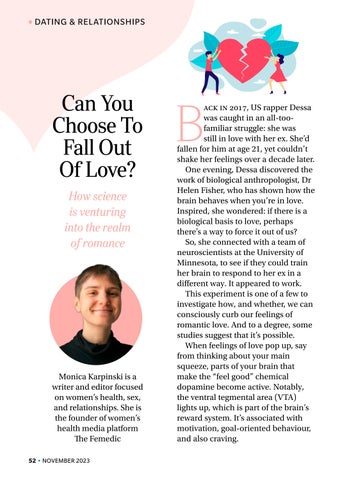
Can You Choose To Fall Out Of Love?
How science is venturing into the realm of romance

Monica Karpinski is a writer and editor focused on women’s health, sex, and relationships. She is the founder of women’s health media platform
The Femedic
Back in 2017, US rapper Dessa was caught in an all-toofamiliar struggle: she was still in love with her ex. She’d fallen for him at age 21, yet couldn’t shake her feelings over a decade later.
One evening, Dessa discovered the work of biological anthropologist, Dr Helen Fisher, who has shown how the brain behaves when you’re in love. Inspired, she wondered: if there is a biological basis to love, perhaps there’s a way to force it out of us?
So, she connected with a team of neuroscientists at the University of Minnesota, to see if they could train her brain to respond to her ex in a different way. It appeared to work.
This experiment is one of a few to investigate how, and whether, we can consciously curb our feelings of romantic love. And to a degree, some studies suggest that it’s possible.
When feelings of love pop up, say from thinking about your main squeeze, parts of your brain that make the “feel good” chemical dopamine become active. Notably, the ventral tegmental area (VTA) lights up, which is part of the brain’s reward system. It’s associated with motivation, goal-oriented behaviour, and also craving.
52 • NOVEMBER 2023 DATING & RELATIONSHIPS
YOU NEED TO TEACH YOUR BRAIN TO KICK THE HABIT OF WANTING YOUR EX
That’s why some liken being in love to an addiction. “It’s like your reward system is activated by that person. If they leave you, you have to get rid of that habitual, compulsive need to see them,” professor of clinical neuropsychology at Cambridge University, Barbara Sahakian, told The Guardian in 2020.
So, in theory, to fall out of love, you need to teach your brain to kick the habit of wanting your ex. One way science has suggested trying is by changing how you think about them—a strategy called cognitive reappraisal. In a 2017 study, thinking about their ex’s negative qualities was enough to dial down participants’ feelings of love and attachment, although it also put them in an unpleasant mood.
Dessa’s experiment used a technique called neurofeedback. This is when you watch live representations of your brain activity while completing tasks and/or receiving different stimuli, in hopes of subconsciously re-training it to change its behaviour.
When the parts of Dessa’s brain associated with love dropped from hyperactive to regular levels of activity (as you’d see in someone not
in love), she was “rewarded” with pleasant harp sounds—so her brain would learn not to set itself off in the same way.
After nine sessions, a scan revealed that her VTA no longer lit up when she was shown a photo of her ex. Biologically, she was out of love, and her fixation feelings dropped off.
Other studies have shown that neurofeedback can regulate activity in the hippocampus, which plays a role in processing emotions. The jury is still out, but this suggests that we have some control over how we move on from an ended relationship.
However, I’d argue that by that point, you’ve already started falling out of love—and regrettably, we don’t seem to have any say on when that process begins.
Per a 2013 study, most folks have a distinct moment of realisation that they no longer see their partner in the same way. It happens after the relationship becomes damaged and being together no longer feels good.
Strategies for getting over someone won’t be the thing that first snaps you away from them, but they may help you reframe your attachment feelings. Nor will they spare you from the hurt that comes with a breakup, I’m afraid. n
NOVEMBER 2023 • 53
Find
where authentic connections
Visit rddating.co.uk
your match with Reader's Digest Dating:
blossom into lifelong love.
Relationship Advice
Monica Karpinski
Q: My husband applied to the air force to become a pilot. I was OK with that, but said I didn’t want him to apply for the navy (at age 32), due to the ten-year programme commitment and long periods away. He wasn’t accepted by the air force but applied to the navy without discussing it with me. He got in and now our plans to get a house and have kids are on hold. We’ve been apart for six months and I am coping fine, but is it time for me to move on from this marriage?
A: Being separated from your partner can be very challenging, but it’s not necessarily a dealbreaker. What does tend to really shake the foundations of a partnership is a betrayal of trust— and from what you’ve said, it sounds like that’s the root issue here.
Applying to the navy is a big decision that affects both your lives, yet he acted in his own interest, without telling you. It shows a lack of regard for you and your needs. It can also be difficult to have the plans you’d agreed on—which charted the path you wanted your life to take—suddenly change without you having a say in it. When life
doesn’t work out the way we planned, it can leave us with a sense of loss.
Whether you want to stay in your marriage depends on your willingness to accept your new circumstances and work through all of this—and, ultimately, forgive him. Although he went about it in a hurtful way, it may have been to pursue his dream.
But if you aren’t willing, that’s perfectly fine: it’s not always possible, or for the best, to try and repair a relationship after a breach of trust. Nor are you obliged to live a life you don’t want. I would suggest reflecting on what’s important to you and where you are prepared to compromise: if you want to have children but it’s not an option with his commitments, that’s something to weigh up.
If you choose to try and save the marriage, remember that he needs to do the work in patching things up. Trust is the foundation of a healthy partnership, and he should make the effort to restore your faith in him after excluding you from a decision that has changed your life. n
Got a question for our resident sex and relationships expert? Email it confidentially to thelovedoctor@readersdigest.co.uk
54 • NOVEMBER 2023 DATING & RELATIONSHIPS

CHEESE AND WINE HAMPER
Six lucky readers have the chance to win ‘The Duo’ Cheese and Wine hamper from The Cheshire Cheese Company. This includes their bestselling waxed cheeses, Black Bob Extra Mature Cheddar and Reserva Caramelised Onion and Rioja Cheddar, accompanied by artisan biscuits and a large bottle of Red Wine. Don’t miss out on this amazing opportunity!
Get 10% off the full range of cheese, accompaniments and gifts by quoting ‘READERS10’ at the checkout or on the phone: cheshirecheesecompany.co.uk or 01270 904911.


Can you find all the chemical elements in our wordsearch grid?
One of them cannot be found and will be your prize answer. Words can run in straight lines in any direction, cross them off as you find them – simply write the missing word you have remaining on the entry form or enter online. See page 151.

COMPETITIONS
ARGON CARBON COPPER GOLD IODINE IRON KRYPTON LEAD MERCURY NEON NICKEL OXYGEN RADON SILVER SODIUM TIN TUNGSTEN XENON ZINC Words to find: 55 www.cheshirecheesecompany.co.uk
WIN 6X

The former “starchitect” who designed gleaming towers for Pakistan’s corporate elite now rebuilds villages completely devastated by natural disasters
YASMEEN LARI’S CHANGE OF HEART
BY Lisa Murphy
As YAsmeen LAri Looked out the car window across the Siran Valley in northeastern Pakistan, she grieved for what was no longer a lush vale with rolling green hills, trees and mountains. It was October 2005, and the catastrophic earthquake that had killed some 79,000 people in Pakistan, India and Afghanistan a week earlier had reduced the valley to mud and rubble.
The 65-year-old architect was there to help lead the reconstruction of settlements, but she had never done disaster work before. Lari was filled
with anticipation after a two-hour flight from Karachi to Islamabad, Pakistan’s capital, followed by this fivehour drive.
Darkness had fallen before her driver pulled into a dimly lit army camp where the military rescue operation was based; at almost 5,000 feet it was safer from aftershocks and rock slides than lower ground. When she stepped out of the car she was taken to the commanding officer, who talked to her about the villages that needed immediate help. The enormity of the task ahead hit her full force.
INSPIRE NOVEMBER 2023 • 57
Lari, who had become Pakistan’s first female architect in 1964, was renowned for designing slick towers of glass and concrete. But here, she’d be drawing plans for earthquake-resistant homes using stone and timber debris. Working from a rough cottage near the camp, she’d spend the next four months working with volunteer architects and engineers from Pakistan and abroad.
She would send her drawings with the volunteers, who walked through difficult terrain to reach mountain hamlets. There, they’d assist displaced families with sorting debris and building new and improved homes, even as temperatures plunged and snow began to fall.
“You can’t imagine the desolation,” Lari recalls of those early days in the mountains. Her team members, often the first to arrive on the scene, were greeted with unexpected hospitality, given the circumstances. On one visit, villagers pulled out their best salvaged chairs and table. “They had lost everything,” she says. “But they covered this damaged table with a beautiful embroidered cloth. And then they served us their World Food Programme food: biscuits, tea and eggs.”
With each passing day, Lari was re-engineering her identity—from “starchitect” to humanitarian. The profession had been good to her, but she had become disillusioned with projects for corporate elites. And
doing disaster-relief work felt deeply right. So she made it her new mission.
over the decAdes, Yasmeen Lari has won many awards and much recognition as an architect, social justice advocate, environmentalist and feminist. While it may seem like an unlikely path for a girl who was born into a well-to-do family in 1941, she had an unconventional upbringing. Her father, Zafarul Ahsan, was a progressive civil service officer working on development projects in Lahore and elsewhere. Her mother, Nabiun Nisa, valued education and took pride in her role as a bureaucrat’s wife who could ride a horse and entertain guests with equal aplomb.

Zafarul treated his three daughters no differently from their brother, and Nabiun encouraged them to do well in school. Lari became aware of politics and poverty after Partition in 1947, when Britain ended its rule of India and carved off a portion to create Pakistan. Dividing the subcontinent into Hindu-majority India and Muslim-majority Pakistan resulted in the displacement of millions.
Zafarul was made deputy commissioner of Lahore, which included overseeing refugee camps and creating residential areas. At home, he would talk about bereaved people, impoverished women selling
ALL PHOTOS COURTESY OF HERITAGE FOUNDATION OF PAKISTAN YASMEEN LARI’S CHANGE OF HEART 58 • NOVEMBER 2023


sweets to the rich and the desperate need for housing.
“I understood for the first time that there can be adversity, and that people needed help,” says Lari. “My sisters and I were the first post-colonial generation. Many women had played important roles in the struggle for independence. It followed that women should participate in nation-building.”
Listening to her father talk about the housing crisis and need for architects made an impression on Lari. On a family visit to London when she was 15, she applied to architecture school at Oxford Brookes University. She laughs as she recalls her boldness. “I was young, and I didn’t have a portfolio, so they told me to learn to draw and then come back.”
After two years of daytime and evening classes, Lari was admitted to
the programme as one of only five women in a class of more than 30.
Protected by her family and her husband, Suhail Zaheer Lari (who passed away in 2020), Yasmeen Lari experienced little sexism or prejudice in England. Even Karachi, where she started working after returning to Pakistan in 1964, was progressive. Building-site contractors might test her mettle by making her climb wobbly ladders in her sari, but her married status and privileged background kept her mostly insulated from discrimination.
Lari gained inspiration by exploring the historic areas of Pakistan. In Kashmir and Sindh she admired the flood-resistant heritage buildings made with local materials to withstand extreme weather. And she loved the winding streets and beautiful terraces
NOVEMBER 2023 • 59
(Left) Lari outside the women’s centre she designed in Sindh province. It was built to withstand floods; (Right) One of Lari’s sustainable shelters
in Lahore and Multan. As architect for a Lahore social housing project in 1973, Lari listened to the local women and she ensured that there were safe, open spaces to raise children and chickens alike.
Yet soon she heard the siren call of commercial projects—with their creative freedom, large budgets and luxurious materials. From 1980 to 2000, as her buildings rose across Karachi, including the Taj Mahal Hotel, the Finance and Trade Centre, the Pakistan State Oil House and the ABN AMRO Bank, Lari’s renown grew. She held senior positions in national and international architectural groups and was a keynote speaker at conferences. “It was a very heady feeling,” she says.
Yet she found ways to stay grounded. Lari and her husband, a historian, created the non-profit Heritage Foundation of Pakistan to celebrate and conserve the country’s historic architecture, art and culture. Lari wrote papers and books on these themes and helped save several prominent buildings.
But it wasn’t enough to offset her growing discomfort with corporate projects. In 2000, Lari retired.
“I realised I was just working with rich people,” she says. She could no longer justify fashioning buildings out of unsustainable materials like polished granite and mirrored glass when corruption was rising and millions had limited access to housing, sanitation and water.
“Perhaps with my present work, I am atoning,” says Lari.
in 2013, LAri was giving a tour of a village in the southern province of Sindh that had been rebuilt after monsoon floods so destructive they impacted some 20 million Pakistanis. In a crisp white kameez and printed headscarf that fluttered in the breeze, she watched as villagers showed off the buildings she had designed. “Our old buildings used to leak when it rained, but these stay dry inside,” one villager told Lari.
The new bamboo structures are covered in a mix of sand and lime called limecrete, which holds up well in Pakistan’s climate. And women can beautify their new homes by painting designs on them, an aspect Lari loves.
Melting glaciers and Pakistan’s location place it within the top ten countries most impacted by climate change over the past two decades, even though the country itself emits less than one per cent of global greenhouse gases. Ironically, rebuilding projects funded by government and non-governmental organisations tend to use concrete, burnt brick, metal sheets and other expensive, non-local building supplies.
Lari points out that the creation and transport of these materials contributes significantly to greenhouse gas emissions, with concrete one of the worst offenders. Furthermore, they don’t perform well in severe weather.
YASMEEN LARI’S CHANGE OF HEART 60 • NOVEMBER 2023
The Zero Carbon Cultural Centre in Makli, Pakistan’s biggest bamboo structure, was built by Lari’s Heritage Foundation

In contrast, Lari’s shelters, inspired by traditional designs and made with sustainable materials such as reed matting, bamboo, mud and lime that are sourced locally first, can better withstand disasters. Bamboo homes on stilts allow water to flow through, while cross-bracing provides strength and flexibility during earthquakes. Lari’s insistence on low-cost, zerowaste and zero-carbon buildings reflects her commitment to the planet.
While her passion for sustainability has grown over the years, her faith in traditional relief funding and charity models has withered. Over two decades she has learned that the approach typically used by government and non-governmental organisations alike doesn’t work well. Locals are treated like helpless victims, and megaprojects are developed using outside labour. Also,
funds are often siphoned away via administrative fees.
“I have seen too much mismanagement when intermediaries are involved,” says Lari, who favours working at the community level. “These are the people who need me.”
Lari says this local, cost-effective, participatory and zero-carbon approach is creating an ecosystem of “barefoot entrepreneurs.” For example, one programme teaches impoverished people in Sindh province to construct buildings, and to create and sell mud bricks, bamboo panels, terracotta tiles and other building materials.
Anyone can learn by watching DIY videos on Lari’s Zero Carbon Channel on YouTube. Also, workshops led by local experts and artisans are held at a training centre in Pono Markaz and at the beautiful, airy Zero Carbon Cultural Centre in Makli. Built by locals
NOVEMBER 2023 • 61

and Lari’s Heritage Foundation of Pakistan, the latter is the biggest bamboo structure in the country.
The town of Makli is located about 60 miles east of Karachi. Almost half the people in the region live in poverty, and many beg at the nearby Makli Necropolis, a Unesco World Heritage Site with its nearly half a million tombs and graves. A day’s worth of alms might be 100 Pakistani rupees— equivalent to 50 cents and not enough to feed a family. But when locals learn to create and sell tiles, organic soap and other products at the Zero Carbon Cultural Centre, they make at least four times that much. Skilled workers share their knowledge, creating prosperity.
Women and youth gather at the centre to socialise and learn. “The women are uppermost in my mind,” says Lari. “They are the ones who really suffer.”

This feminist inspiration has fuelled many of Lari’s designs, which now include household innovations. For instance, more than 80,000 of her limecrete and smokeless cookstoves, called Pakistan Chulahs, have been built and decorated by villagers.
The device, which won a UN World Habitat Prize in 2018, costs about £8 to make and is fuelled with agricultural waste. The stoves stand higher than flood levels, making them safer than smoky, open cooking fires on the ground; they literally and figuratively lift women up.
Another one of Lari’s designs that benefits both women and the environment is a composting private eco-toilet shelter. About ten per cent of Pakistanis lack a toilet or latrine and must seek privacy outside. The ecotoilet provides better sanitation and hygiene, and more dignity.
62 • NOVEMBER 2023
(Left) Building a Pakistan Chulah (smokeless cookstove); (Right) The final result

Lari’s Holistic Villages project builds on all these advances to help villages become selfsufficient. At a cost of about £160 per household, villagers can build disaster-resilient bamboo houses, Chulah stoves and shared ecotoilets. They have access to solarpowered lights, assistance to produce their own food and training to start their own businesses.
Lari says about 60,000 zerocarbon holistic houses have been built since 2010. Next, she wants to scale up—and rehabilitate 1 million households.
in 2022, fLoods struck again, destroying crops, homes and villages and displacing about 33 million people, many of them already below the poverty line. Lari and the Heritage Foundation organised artisans to supply another of her innovations: prefabricated bamboo walls for 3.5-by-3.5-metre quickassembly shelters.
Lari now travels regularly from her home base in Karachi to Makli, as well as to events all over the world. She also travels to the UK, where she holds a visiting professorship at Cambridge University’s department of architecture.
For the Islamic Arts Biennale in Jeddah, Saudi Arabia, earlier this year she created three stunning bamboo mosques that can be dismantled and
reassembled. In 2020 she won the Jane Drew prize for raising the profile of women architects and, in 2023, the coveted Royal Institute of British Architects (RIBA) Gold Medal. Even King Charles is a fan; one of her shelters can be found on his Highgrove estate.
Lari insists that anyone who wants to help the impoverished and floodaffected in Pakistan should connect with village leaders to help fund things like water pumps, solar panels and school computers (The Heritage Foundation of Pakistan offers information about exactly how you can do this).
“It’s no longer a matter of giving money and cleaning your conscience—you need to create connections,” says Lari. “We need to believe in people’s capacity to bring about change. I treat displaced people as partners, not victims. They know what to do.”
At age 83, Yasmeen Lari is still fizzing with ideas about zero-carbon designs, flood mitigation, skills building and self-sustaining villages. As she said when she accepted the RIBA medal, the honour “has strengthened my mission.”
Many young architects have told her that they find her work inspiring, which gratifies her. “Architects can no longer work for just the one per cent,” she says. “That doesn’t allow them to serve humanity as much as they could.” n
NOVEMBER 2023 • 63 READER’S DIGEST

We have a stunning 4 night break to giveaway
Dittisham Hideaway
Reader’s Digest and Dittisham Hideaway, Devon have come together to offer one lucky reader the chance to win a four-night stay in a Shepherds Lodge with a sumptuous welcome hamper for two people worth £1,000.
Dittisham Hideaway is a collection of Treehouses, five luxury Shepherds Lodges and an original American Airstream 1234, located in the heart of the south Devonshire countryside in a 9 acre private wooded valley with stream. Dittisham Hideaway is just one mile from the beautiful River Dart and the historic village of Dittisham, and only four miles from the scenic port of Dartmouth and nearby beaches.
A stay at the secluded and peaceful Dittisham Hideaway offers back to nature relaxation for couples, families, and even four-legged friends. These self-catered accommodations benefit from a high level of design and amenities, from a sumptuous welcome hamper with West Country produce and a bottle of wine, to private decks with a traditional wood-fired cedar hot tub, hammock, outdoor chess and table football, sun loungers, and Weber BBQ with dining area.
Question: Where is Dittisham Hideaway?
A. Devon B. Essex C. Surrey
Simply put your chosen answer A, B or C on the entry form online or on page 151.
They’re also offering readers an exclusive 10 percent discount on new direct bookings for Shepherds Lodges and the American Airstream. Just quote ‘RD10’ at the time of booking.
To book visit www.dittishamhideaway.co.uk
COMPETITIONS T&C’s: Bookings are subject to availability, excluding school holidays, bank holidays and special events. Prize to be taken midweek, from November 2023 to March 2024, and October to December 2024. Only open to over 18 year olds, UK residents. There is no cash alternative and the prize is non transferable
courtesy of


66

My Britain:
Cardigan Bay
BY Alice Gawthrop
Sweeping up the west coast of Wales, you’ll find the beautiful Cardigan Bay. Craggy cliffs offer a sense of freedom, where you can stand on the edge of the world and see dolphins and seals out to sea.
The legendary sunken kingdom of Cantre'r Gwaelod is said to reside under these wild waters; one version of the story says it was submerged by an overflowing well. The myth has appeared in folklore, literature and music since at least the 13th century, although so far there have been no confirmed sightings of this Welsh Atlantis. But certainly the Bay holds some remnants of a bygone world— winter storms in 2014 revealed parts of the lost ancient forest of Borth, which had been buried under layers of peat, sand and saltwater.
These days, Cardigan Bay is home to beautiful beaches, fertile farmland and seaside resorts. The rich marine life includes harbour porpoises, grey seals and bottlenose dolphins, known as the “Big Three”, as well as puffins and basking sharks. Meanwhile, feet firmly on dry land, some locals share what life is like for humans in Cardigan Bay. ➺
INSPIRE 67
NOVEMBER 2023 •
Jethro “Jet” Moore is the managing director of Adventure Beyond, a family-run outdoor activity centre that helps bring people to nature
adventurebeyond.co.uk
I’ve lIved In West Wales since I was a few months old. You’ve got everything you need here. Hills, stunning beaches, nice coastal paths. As someone who loves the countryside, I’ve never wanted to leave.
I was lucky to find work I could do in this area. A lot of people do have to move away in order to find work. I started Adventure Beyond about 30 years ago and we work all over the UK. We go up to Scotland, we work along the Thames. We’ve also taken groups to Canada, the Himalayas, places like that. But honestly, West Wales has got everything, just not on a massive scale. We can do everything we need right here.
I live on a tenant farm on the coast. It’s a working farm; it’s got between 80
and 90 pedigree Herefords and 60 sheep. And it’s close to where we do quite a few of our activities. We do some camping and basic accommodation here, too.
Cardigan Bay is pretty huge, but I find having grown up here there’s a definite sense of place. There’s an awareness that we’re lucky to have these incredible sandy beaches, pebbly beaches, beautiful rivers, hills. It’s peaceful, and it’s not overdeveloped. Of course, there’s periods where it gets busy, but then the second schools go back and you pretty much get the beaches to yourself. There’s a sense of community too, with a lot of good community-based clubs and assets. We’ve got the Poppit Sands Surf Lifesaving Club and the RNLI.

I set up Adventure Beyond to make my own work in the area. I love the
MY BRITAIN: CARDIGAN BAY 68
outdoors and I wanted to be in Cardigan Bay, so it was perfect. I’ve tried to always keep that personal touch. The clients will pretty much always meet myself and all the staff. We took a lot of people on through the Kickstart scheme and they’ve now been employed with us for a few years. And Rhod, my number two, has been with me since we went to college together. A lot of our clients have been with us since we started, too. There’s a sense of family, which is quite special.
I won’t mention a specific favourite spot because it’s already a little too busy half the time, but in general the beaches are just amazing. It’s just a
sort of wild west, really. In the winter it’s stormy and in summer it’s beautifully calm, and you can see seals and dolphins.


READER’S DIGEST 69
Ellen Wakelam owns In The Welsh Wind, a distillery just north of the coastal market town Cardigan, with her partner
inthewelshwind.co.uk
I MOved tO Tresaith, a tiny village right on the beach, with my family when I was six weeks old. I wasn't quite born here, but close enough. I went to school in Cardigan and, like most kids here, I spent a lot of my spare time down at the beach.
I did leave the area to go to university. After 18 years living in a small coastal village, I wanted to see more of the world. I completed teacher training in Aberystwyth and then spent a few years in the Midlands. However, Wales and Cardigan Bay always had a strong hold over me, and my partner and I returned in 2012. Now I have no desire to leave. I think the sea and the coast is really powerful. It always draws you back—the feeling of being at the edge of the world.
Cardigan Bay itself covers a wide area, and there's something different at every point. Where we are at the southern end of the Bay, the coast is made up of gorgeous coves and hidden beaches. As you head further up the coast, you get longer stretches of sand or even pebbly
beaches. Then there's the spectacular Dyfi Estuary, and on round to the towns at Criccieth and Pwllheli. As you go further north, there are the mountains of Snowdonia overlooking the coast— we can see them across the water on a clear day too.
I think the Cardigan Bay spirit is pretty independent and resilient. Even in 2023, we feel quite “apart” from the rest of the UK, and even the rest of Wales. The motorway ends about 35 miles away, so you really have to want to come here. And once you're here, there are challenges; we don't always have great internet access. Logistics are trickier.
But on the flipside, we have an incredible natural playground on our doorstep to enjoy. As Cardigan Bay residents, we feel there’s also an element of responsibility for the coast, to keep it special, and to make sure we're contributing to the community and the local economy so that we all thrive. The other thing that makes us resilient is the weather. When it's sunny, it's quite literally the best place in the world to be. We do also get long stretches of rain and storms, and that can grind you down a little—you just have to cling on to the fact that the sun will always come out again.
My partner Alex and I started In The
MY BRITAIN: CARDIGAN BAY 70 • NOVEMBER 2023

Welsh Wind in January 2018 after being inspired by small craft distilleries in north west Scotland. We now employ 15 people and have moved into an old pub on the main coast road that runs between Aberystwyth and Haverfordwest. We make premium, award-winning spirits—mainly gin, but also vodka and rum. We are also producing a grain to glass single malt Welsh whisky which uses grain grown locally to the distillery and which we malt on site.
We've worked really hard to create an environment where people can come and be creative in what they do. We don't always follow the rule book and that's allowed us to create some really exciting spirits—the whisky in particular. Although I'm no longer a teacher, I've always maintained my interest in encouraging young people, so we run an apprenticeship scheme, and
also provide work experience and other opportunities for those who don't perhaps want to continue in education beyond 18. Young people growing up here don't always see as wide a range of opportunities and career paths as they might in other parts of the country, and I hope that we can show people that there are other options— including deciding to set up your own business!
There's a really wild area of cliffs on the coast north of the village of Llangrannog called Ynys Lochtyn. Ynys means island in Welsh—and although it's not strictly an island, it can feel like it! It's a little peninsula that sticks out into the sea and you can walk onto it perched high up on top of the cliffs. It feels like you're really part of the coast when you're standing there, almost surrounded by the sea, listening to the call of the gulls and tasting the salt spray.

READER’S DIGEST 71

72
John Trott is a volunteer at the Eco Shop in Cardigan, which sells a combination of donated goods, recycled tools and books and magazines about permaculture and sustainability naturewise.org.uk/eco-shop
I’ve lIved In Cardigan Bay for 25 years. I was raised in North Pembrokeshire on a smallholding, but moved away at 21 in 1980. I returned in 1998. My parents still lived in North Pembrokeshire—in fact, my mother is also a volunteer for the Eco Shop at the age of 85.
I love the landscape, coast, nature, relative freedom and lack of crime— compared to most areas. As time goes by, I find that it’s a much more pleasant place to grow older than other, more urban areas. My social life is quite low key but I always seem to strike up a conversation with someone on a daily basis, so it’s hard to feel lonely in Cardigan town. There is a lot of community spirit, at least in Cardigan, and in the surrounding areas.

existence. The proceeds of the shop fund the Naturewise Forest Community Garden based on the Parc Teifi estate. This is a permaculture project run by more volunteers, which grows herbs, fruit bushes and trees. It contains a round house and compost toilet. It runs a volunteer day on a Tuesday where much work and maintenance is done. It also runs education and fun days for the local children and is generally an excellent community resource for everyone.
There are so many beautiful spots in Cardigan Bay that it’s hard to pick a favourite, but I’d go with Poppit, my local beach, as it’s easy to

SHOULTS / ALAMY STOCK PHOTO NOVEMBER 2023 • 73
Kidjo
Angélique
The World If I Ruled
Five-time Grammy Award-winning African singer Angélique Kidjo imbues her multilingual and multi-genre music with Beninese culture on her most recent album Mother Nature a passionate advocate for
Article 1 of the Universal Declaration of Human Rights would be respected
How can you view a society without a framework for everyone to have equal opportunities? That is the foundation of it. We have written it— nobody forced us to
write that. We realised it was important to have that written somewhere and have it as a rule for

74 INSPIRE
•
It would be easy to eat good food when you’re touring
The only food I can eat when I’m on tour is Thai food, because it’s fresh ingredients, freshly cooked and never makes me sick. As a singer, what I put in my stomach is key for how I perform on stage. I grew up in a country where food was a pleasure because you grow your own. I hadn’t eaten processed food until I came to Europe. Both of my grandmothers died at more than 100 years old because they ate healthily. You feel lighter when you eat good food.
Everyone would sing
In my family nobody sings in tune but me. My sister always used to say, “If you want to sing, be ready to see the frogs falling from the sky”. People are so self-conscious, it’s the same with dancing. As my mum would say, “Your heart is beating, there’s a rhythm in you, you have a heartbeat, you’ll always be in time.” It’s the same with singing. We all have a different way of hearing music; you can sing off key (who cares?) as long as you take pleasure in singing.
Everyone would understand the African lyrics of my songs
People are always asking me, “Why do you sing in this language?”, because I speak so many different languages. But people can relate to my songs even if they don’t speak my language. What is the language of emotion?
Emotion is emotion. Don’t focus on the African lyrics, focus on what the music is doing to you.
Selling weapons would be a moneylosing business
We create weapons to defend ourselves from aggression. But when people start selling weapons just to make profit, it becomes complicated. I remember the campaign of Amnesty International and Oxfam to lobby against small weapons, to stop it. We have to trust them, because until all of those militias had access to guns, raping women was not as possible because the woman could run away. But if you can shoot at her, she has no place to hide. If you have a gun in your home, it means the country that you’re living in is at war. What are we afraid of? One another?
It would be compulsory to eat crab gumbo with smoked fish once a week My husband hates it but I love it. I cook it with smoked fish, crab and with okra as well. The way we cook it in Africa, it’s sticky, and you have to eat it and turn it. It’s not fried like Europeans do it. The recipe is delicious and it’s in my book, Spirit Rising: My Life, My Music. n
AS TOLD TO ANNIE DABB
Angélique Kidjo will be performing at London’s Royal Albert Hall in London on November 17
NOVEMBER 2023 • 75

FALL PREVENTION
FREE EVENT
Autumnal weather can be beautiful. Stunning colours, falling leaves - but wetter, slippery pavements call for steady feet, which is why Goldster has teamed up with personal trainer and programme coach James Hilton to create a fantastic free online event to help make sure you stay stable, wherever you’re walking.

“Fall prevention is more important than ever to me now after my recent osteoporosis diagnosis, my GP told me yesterday it is particularly severe in my spine. There will be many of you in the same situation. James’ Goldster classes are such a fun incentive and his encouragement during sessions is just brilliant. Thank you, James.”
-Goldster member
James is an expert in functional movement and a popular personal trainer who prides himself on helping people improve their quality of life and confidence by encouraging them to consciously think more about how they navigate daily tasks from a movement perspective.
James said, “As we progress through life, we’re often told about all the things that we should or shouldn’t be doing to keep healthy and mobile. Whilst this advice is mostly with good intentions, it can have the opposite effect when the suggestions do not fit with the targeted individual, thus creating new hurdles or fears. Creating more achievable targets within reach has a far more profound effect in beginning a fitness or movement journey and getting you closer to where you want to be.”
Join James as he leads Goldster’s fall prevention free online event, “Finding Renewed Stability”and stay confident in putting one foot in front of the other.
PARTNERSHIP PROMOTION
James Hilton
FINDING RENEWED STABILITY EVENT
Join Goldster for a fabulous free online experience and discover how to feel more confident in your footing and prevent falls. You’ll also gain valuable insights into building strength, mobility, and flexibility. through this transformative event. Start your journey towards a more confident and balanced you!
Event Details
Date: Sunday 22nd Oct
Time: 2:00pm - 4:00pm
Place: Online via Zoom - join for free
REGISTER NOW FOR FREE AT
https://bit.ly/goldsterfallprevention

Claudia le Feuvre is a Nutritional Therapist & Eating Psychology Coach. She has 16 years clinical experience helping clients with a wide range of health concerns. Claudia lectures at The British College of Nutrition & Health, and The Nutritional Healing Foundation.
Event schedule

2:00 - 2:15pm Welcome with Goldster Presenter Lee Pycroft
2:15 - 2:45pm James Hilton, Fitness trainer: The basics of movement and the planes of motion plus setting some basic movement assessments.
2:45 - 3:15pm Claudia le Feuvre, Nutritionist and eating psychology coach: Nutrition for muscle and bone health
3:15 - 3:45pm Andy Yau, Tai Chi expert: Balance and flow of movement.
3:45 - 4:00pm Interactive Q&A

Andy Yau is a tai chi expert and helps people find their flow and improve their mobility with this gentle, poetic form of movement.

GOLDSTER IS A PERSONALISED ONLINE, EVIDENCE-BASED HEALTH SERVICE. goldster.co.uk
Grandfluence: The
Under
Train With Joan
Bubbly 79-year-old fitness influencer
Joan MacDonald, also known as Train
With Joan, talks to Annie Dabb about her journey
Joan’s daughter, Michelle (@yourhealthyhedonista on Instagram) told her she could continue living on medication and being overweight or transform herself, so Joan completely changed her lifestyle. Now, she's a fitness fanatic, social media personality (@trainwithjoan on Instagram) and co-author of Flex Your Age. She’s also got biceps of steel!
Her app, Train With Joan, has been designed with accessibility in mind so that anyone can follow her minimalequipment workouts and meal plans.
Was the goal always to go through a complete physical transformation? My health was bad. I didn’t want to
be taking any more medication—my blood pressure was erratic and I have kidney problems. My blood pressure kept coming down with me losing weight and working out. After I got started with Michelle, I came down to Mexico and she took me to the gym. I wasn’t concerned about getting skinny, that wasn’t the aim. The fact that I’ve lost weight is just a bonus. I began [my fitness journey] because I wanted to get off the medication. I take supplements, but if I forget, it doesn’t matter!
Have you ever felt like giving up? There were only a few times I really wanted to throw the towel in. I just felt I was not equipped to do this, but my stubbornness kicked in. I didn’t want to disappoint myself or them [Michelle and her husband, JJ] because they put faith in me. I’ve learned that your hydration, sleep and mindset are all really important. The first six months I was using the machines more than anything. At month two or three Michelle got me into the weights. I remember lifting a 4.5kg weight and struggling but, even with the injuries that I’ve had, I can now lift three or four times that.
78 • NOVEMBER 2023
INSPIRE
How did you come to document your fitness journey on Instagram? It's been a lot of learning about the iPad and the iPhone. I don’t think I had an iPhone until the end of the first year. JJ had to step in and calm me down sometimes because I’d just get
reactions but they’re still sticking with it, and that’s a big plus. Don’t ever say you can’t do something, because you have no idea how strong you could actually be. I know I’m now a stronger person than I ever thought I was. It has been ten years

Meet the dedicated art conservators hunting down paintings that were lost to time
Art Rediscovered
AS YOU ENTER the Tate Britain and head into the heart of the Historic and Modern British Art collection, you will eventually come to a portrait of an elegantly dressed man. He sits at a desk and stares out of the frame, right at you, as if to say, “Oh hello, I didn’t see you there.” It is not the biggest painting in the room, but Arthur Devis’s Portrait of a Man has a newlydiscovered and fascinating secret: it is only half a painting.
BY Alice Gawthrop
Missing from the picture is a woman sitting on the other side of the table from the man. Where she is now, no one knows.
The discovery was made when Portrait of a Man was selected to be included in the Tate Britain’s May 2023 rehang of its permanent collection. Due to having a yellowed varnish layer, the painting Portrait of a Man was also chosen to have a conservation treatment.
INSPIRE
80 • NOVEMBER 2023 PHOTO © TATE (SAM DAY)

81
Portrait of a Man after conservation treatment work

“It’s important to remember that most historic paintings have actually gone through treatments at several times in their life,” says Rachel Scott, a painting conservator at the Tate Britain art museum—the conservator, in fact, who discovered that Portrait of a Man was actually only half a portrait. “We chose to remove the yellowed varnish which had been applied by a previous restorer. That’s why it came into the studio.”
(Left) Rachel Scott working on painting conservation at Tate Britain; (Below) Portrait of a Man before treatment

In conversation, Rachel’s passion for conservation is not just apparent but infectious. “Art is always changing,” she tells me. “As a conservator, you have to think that you’re just one of a long line of conservators, just here for a moment in history. A conservator in the future
ART REDISCOVERED 82 • NOVEMBER 2023 © TATE / PHOTO © TATE (SAM DAY)
might look back on our work and want to change things. They might do things differently, as technology will continue to improve. We’re part of the art’s history.”
It’s impossible not to be as excited as Rachel about this discovery, and fascinated by the history of the painting. Who is the man in the portrait? Who is sitting on the other side of the table?
PORTRAIT OF A MAN was painted around 1750 by Arthur Devis, a painter who devoted his career to painting a type of portrait known as a “conversation piece”. This is a term used to refer to informal group portraits of families or friends, often in a domestic setting.
The first stage of the treatment was a thorough technical examination. Using raking light (that’s the process of holding a light very low down and letting it rake across the surface to throw the painting’s texture into high relief), Rachel saw that there was an additional strip of canvas down the left side that had been joined on, and then overpainted by a past restorer to extend the table to the left. An X-ray confirmed this canvas join.
Cleaning tests to remove some old restorations then revealed original paint on the joined strip, which matched the floorboards in the foreground of the painting. It appeared the strip had been trimmed from the bottom of the painting, turned on its
side and joined to the canvas to extend the image. “It was bizarre and quite fascinating!” Rachel says.
Rachel shared her discovery with Alice Insley, a curator of British Art at Tate Britain, and suggested a trip to the Courtauld Institute’s Witt Library. The Witt Library is an expansive archive of photographs, cuttings and reproductions of Western art. And it was exactly the right place to turn to. Alice happened to be visiting later
PORTRAIT OF A MAN HAS A NEWLYDISCOVERED SECRET: IT IS ACTUALLY ONLY HALF A PORTRAIT
that day and offered to take a look.
“Unbelievably, [Alice] found the other half in the Witt Library!” Rachel shares excitedly. An image of the other half of Portrait of a Man was found, cut out of a Sotheby’s sales catalogue, from 1978. “She emailed me the photo and I used Photoshop to match it with Portrait of a Man, and I could line the two paintings up together, and I found that the additional strip of canvas aligned with the floor boards across both halves.”
Now, a hunt for the lost artwork begins. Initial investigations found that the other half was sold in 1978 to a dealer. However, this dealer quickly
NOVEMBER 2023 • 83 READER’S DIGEST

(Left) An X-ray photo of Portrait of a Man; (Below) Detail of a letter from cleaning the painting

sold it on and from there, the trail has gone cold. “It could be anywhere. It is fascinating to think that somebody out there has the other half of our painting and doesn’t know it. It would be wonderful to reunite them. We would love to do a callout and ask if anyone knows where the other half is,” Rachel tells me.
Portrait of a Man, in its current form, is visible in Tate Britain’s galleries, and at the end of our
conversation Rachel lets me in on a secret. On the painting’s left hand side, she tells me, the old restoration had covered up some of the painting’s original details—she discovered the ink box contained the beginning of a quill pen, which the past restorer had painted out. “After cleaning the painting I needed to retouch the joined left strip of canvas to return the painting to the way it
ART REDISCOVERED 84 • NOVEMBER 2023
©
TATE
(MATT GREENWOOD / ( RACHEL SCOTT)
looked and make it whole. We all decided it would be nice to put that quill pen back in, as it was there originally,” she says.
IT’S NO SURPRISE that conservators have an artistic streak. Devis himself took to restoring pictures later in his career—he received £1,000 for repairing and restoring the “Painted Hall” of the Royal Naval Hospital, Greenwich, between 1777 and 1778.
It’s not all chasing down lost artworks, though. Sometimes, a conservator is lucky enough to discover a painting. This was the case for Helen Kohn and Rebecca Chipkin who, when studying at the Courtauld Institute in 2019, discovered a lost painting by Helen Saunders, one of two female members of the shortlived Vorticist movement.
The pair were analysing a Wyndham Lewis painting called Praxitella when they discovered evidence of a hidden artwork underneath. Like Rachel and Portrait of a Man, their work began with a technical analysis of Praxitella.
After taking many X-rays of Praxitella and putting them together to see the whole painting, Helen and Rebecca discovered a composition underneath. “It looks like two superimposed compositions on each other, because the X-ray reveals all of the layers of the painting,” explains Rebecca, now a conservator at Studio Redivivus in The Hague.
Helen and Rebecca could see that is was an abstract composition and a Vorticist painting, which gave them a time period for its creation. Vorticism was a London-based modernist art movement started by Lewis in 1914 and then cut short by the First World War. The idea, then, was that the mystery painting beneath Praxitella was one of Wyndham Lewis’s works, painted before 1914.
Helen, who is currently a research assistant at the Gemäldegalerie Alte
IT WAS DIFFICULT FOR FEMALE ARTISTS TO GET SPACE IN THIS MALE-DOMINATED ART WORLD
Meister in Dresden and PhD student, was doing research on the painting in the Courtauld Library when she came across the key to the mystery. Turning to a copy of the short-lived Vorticist magazine Blast, she found an image that was far more similar to the X-ray image than she had dared hope. “In fact, when I turned it upside down, I saw that it was the same composition,” she says. “This composition had the title Atlantic City written underneath it, and the name Saunders. We had thought that it was a painting by Wyndham Lewis but in fact it was by a female colleague, Helen Saunders.”
NOVEMBER 2023 • 85 READER’S DIGEST

Painting conservation treatment at the Tate Britain is painstakingly detailed work
“This was a really great moment,” Rebecca chimes in. “Helen was in the library, I was in the conservation department, and she sent me this snapshot of the composition she’d found in the magazine. She said, ‘You know, if you turn it upside down it looks like the X-ray.’ So I went to Photoshop and superimposed her snapshot over the X-ray and lo and behold, the compositional elements lined up. It was this eureka moment where we were like, ‘OK, we’ve found the painting.’”
The discovery opened up a whole new line of inquiry. Why was someone else’s painting beneath Wyndham Lewis’s painting? It’s certainly a big question, and it comes with many theories.
An important detail to note is that there is an interlayer between Atlantic City and Praxitella, painted in lead white paint to blank out the colour of the previous composition. The assumption currently is that this interlayer was painted by Lewis, but there is no way
ART REDISCOVERED 86 • NOVEMBER 2023
© TATE
PHOTO
to prove this. There is a theory that perhaps he did it due to a falling out with Saunders, but Helen suggests the reason might have been more practical.
“Atlantic City is a huge canvas and Lewis was always short on money,” she comments. “Most likely he painted over it at a time when he needed a large canvas. He was trying to innovate British art, and he didn’t think Vorticism had a place in it, so wiping it out was kind of like him saying, ‘OK, it’s from the past, and now I’m doing something new.’”
Rebecca cautions, “As art historians and conservators, we don’t want to say we know for sure why it was painted over unless we have actual evidence.”
Regardless of the reason her work was painted over, this discovery shines a long-overdue light on Saunders’ work. All of her Vorticist paintings were lost; Atlantic City is the only one we know about, and we only recently know of it. What happened to the others remains a
mystery, although Helen reveals that astonishingly one painting was used as a carpet!
“If you don’t have the paintings, it’s easy to minimise the role of an artist,” Helen explains. “It was difficult for female artists to get space in this male-dominated art world. This canon was created that Helen Saunders was just someone who was very influenced by Lewis but that she didn’t really have her own style. That’s something that we are now trying to reverse.”
“It’s interesting to note that Helen and I didn’t start out researching this painting thinking, We’re going to, as women, rewrite the art historical canon,” Rebecca points out. “It just so happens that this is a female artist whose work was painted over by her male colleague and her role has been diminished. We are trying to, in the most unbiased, art historical and scientific way possible, tell the story of this painting. But in doing so, we are kind of fitting in with a larger thrust to understand women artists’ role in history.” n
Bonfire Night
Robert Catesby was the mastermind behind the Gunpowder Plot of 1605, Guy Fawkes was just the explosives expert who was caught by guards
The Houses of Parliament are still searched every year by the Yeoman of the Guard, although it is now more ceremonial than serious
SOURCE: HISTORY.CO.UK
NOVEMBER 2023 • 87 READER’S DIGEST
13 THINGS
1
High-Flying Facts About Drones
BY Marc Saltzman

Drones, or unmanned aerial vehicles, may seem like recent technology, but the earliest iteration took flight in 1849, during the First Italian War of Independence. An Austrian artillery lieutenant, Franz Von Uchatius, used pilotless balloons packed with explosives to attack Venice. The attack was mostly unsuccessful; some balloons even blew back to Austria.
2
Abraham Karem (the “Dronefather”), a Baghdadborn, Israeli-raised engineer,
built the first modern drone for reconnaissance during the Yom Kippur War in the early 1970s. After immigrating to the United States, Karem went on to design the MQ-1 Predator drone, which fired its first combat missile over Afghanistan in October 2001, completely transforming the strategy and tactics of military combat.
Today, drones play a pivotal role in the Russia-Ukraine war. In addition to being used for reconnaissance, combat drones have struck both Moscow and Kyiv. Drones have also
illustration by Serge Bloch 88 • NOVEMBER 2023
been used to drop food and medical supplies to Russian-occupied territories in Ukraine.
3
Military drones resemble small aeroplanes and can cost more than £12 million, but mini versions (sometimes called “quadcopters”) look more like small helicopters; they are widely available for as little as £30. Most are remotely operated via either a controller or a smartphone app, but some models can fly autonomously thanks to GPS, sensors and software as well as cameras that help them avoid obstacles.
4
in many countries, you must register your drone with the authorities before you put it in the sky. Some countries also require drone owners to get third-party liability insurance. In Europe, users must be at least 16, and drones are banned from flying in urban areas.
5
GPS tracking prevents drones from entering “no-fly” zones, such as airports and government facilities. The drone will either automatically turn around and go back to the user, or land itself. If a drone has been illegally modified to enter a no-fly zone, it could be shot down by authorities or electronically “jammed” so it falls out of the sky. The user could face a hefty fine or even imprisonment.
6
be cautious about flying a drone over private residential property: residents have a right to privacy, meaning drones should not be used to hover near or peer into windows. If you believe you’re being recorded by a drone, report it.
Not surprisingly, celebrities have become targets of “paparazzi drones.” In 2020, Prince Harry and Meghan Markle filed a lawsuit against paparazzi for flying a drone above their California home and capturing photos of their son.
7
People now race drones just like they do cars—but the speeds are far faster. Some drones can go from 0 to 90 miles per hour in less than one second! The first “World Drone Prix” was held in Dubai in 2016. A UK teen won the £205,000 grand prize after manoeuvring his drone through 12 laps of the 780 - metre course the fastest.
8
Using cameras, along with sensors that can detect body heat, search-and-rescue drones help locate missing people and animals. They’re used in hard-toreach areas such as a dense forest or mountainous ski hill, and can even search under rubble in the aftermath of a natural disaster—as was the case in Turkey following the magnitude-7.8 earthquake earlier this year.
INSPIRE NOVEMBER 2023 • 89
9
Drones also help authorities nab criminals. In 2016, authorities in Alameda, California used a drone to track a suspect and record video of them discarding drugs and guns, which led to their arrest. Wildlife conservationists are also using them to catch elephant and rhinoceros poachers in Botswana, Malawi, South Africa and Zimbabwe.
pharmaceuticals and COVID-19 tests between remote towns.
1 2
Not only are drones a more environmentally friendly delivery method—most small drones are powered by batteries—but they can help the planet in other ways, too.
1 0 But sometimes it’s criminals who are using the drones. In 2022, 20 people were arrested for using drones to smuggle drugs, weapons and cash into Lee Correctional Institution in the US state of South Carolina.
Conservationists and researchers are using them to monitor endangered species, and the Great Barrier Reef Foundation used them to conduct a census of green turtles. Meanwhile, drones can also help reforest areas devastated by wildfires; tree “seed pods” can be dropped across landscape that’s too dangerous for humans to traverse.
1 1
A drone may one day deliver your online order to your door. Delivery drones are being tested in Europe, the UK and Australia, among other places. In 2021, a company called Drone Delivery Canada was used to deliver
1 3
Soon enough, we might be flying in drones ourselves! The first “passenger drone” was unveiled in 2016 by EHang, a Chinese company. It’s still going through rigorous testing. Perhaps one day we’ll take one to work and fly over rush-hour traffic—without needing a pilot’s licence. n
The Power of One
One machine can do the work of 50 ordinary men. No machine can do the work of one extraordinary man
ELBERT HUBBARD
HIGH FLYING FACTS ABOUT DRONES
90 • NOVEMBER 2023

PRIZES OF UP TO TO BE WON £1,000

Our 100-word-story competition is your chance to show the world your story-telling talents
There are three categories—one for adults and two for schools: one for children aged 12–18 and one for children under 12. Your stories should be original, unpublished and exactly 100 words—not a single word shorter or longer! Entries are now open. The editorial team will pick a shortlist of three in each category and post them online on February 1, 2024. You can vote for your favourite, and the one with the most votes will scoop the top prize. Voting will close on February 29, 2024 and winners will be published in our May 2024 issue. Visit readersdigest.co.uk/inspire/enter-our-100-word-story-competition-2023 to enter.
readersdigest.co.uk/inspire/enter-our-100-word-story-competition-2023

WIN 2 X JAMES BOND

The Scalextric 007 DB5 vs V8 setavailable exclusively from Scalextric.com, features traps and obstacles to decide which is the best Aston Martin of all time.
Fun for all generations, it’ll soon get everyone excited with side-swipe track pieces, working lights, and the chance to run your rival off at the crossroads. This incredible scale set includes beautifully detailed models of the Aston Martin V8 Vantage and the DB5, and is a surefire winner for James Bond fans this Christmas. We have 2 to giveaway!

Complete the crossword and the letters in the yellow squares can be sorted to reveal a word that describes who you may play Scalextric with. Write this word on the entry form. See page 151. COMPLETE THE CROSSWORD FOR

COMPETITIONS ACROSS 4 Generally (7) 6 Vessels (5) 9 Lettuce variety (7) DOWN 1 Hugely popular (3) 2 Try (6) 3 Pesky insect (3) 5 Reverberations (6) 7 Horse controller (3) 8 Part of an epoch (3)
CHANCE TO WIN!
YOUR
SCALEXTRIC
3 Complete Racing Set WIN!
007
Aston Martin, the Aston Martin Wings logo and the model name “DB5” and “V8” are trademarks owned, licensed or used by Aston Martin Lagonda Limited. All Rights Reserved. 007 Gun Logo and related James Bond Trademarks TM Danjaq. All Rights Reserved. 2 9 8


Egypt - Nile River Cruise incl Cairo &
Flights from London Heathrow, Edinburgh or Dublin to Cairo, returning from Hurghada (all via Istanbul)
2 nights in Cairo with a full day guided excursion including the Egyptian Museum
A full day guided excursion to the Pyramids of Giza, The Great Sphinx, Luxor and Valley of the Kings
7 nights cruising aboard 4 star MS Radamis II on a full board basis
A half day to the Valley of the Kings and the Temple of the Queen Hatshepsut
A full day to the Temple of Horus and Temple at Kom Ombo
A full day to visit the High Dam and Temple of Philae
A half day to visit the Temples of Karnak and Luxor 3 nights in the Red Sea Resort of Hurghada at leisure

Rated 4.7 out of 5 (based on over 3,600 reviews) T: 020 3966 0527 W: traveldepartment.co.uk/rd Flights from London & Scotland & Northern Ireland SCAN ME Booking Terms & Conditions: Operated by Travel Department. ATOL Protected 9373. Prices are per person and based on 2 sharing. Single room supplements apply. Check in baggage may be booked at an additional cost. Prices, flight times and availability are subject to change. Booking conditions apply, please visit traveldepartment.co.uk. * Offer valid for all new bookings for 2023 and 2024 departures made between 18th of Sep and the 31st of Oct 2023. Offer is £75pp off holidays of 8 nights or more using the code RD75, £50pp on holidays of 7 nights using the code RD50 and £25pp on holidays of 6 nights or less using the code RD25. Offers are non-transferable, subject to availability, cannot be used in conjunction with any other offer and has no cash value. All deposits are nonrefundable. E&OE. PROTECTED topp For every 2024 booking made this year that makes a contribution towards carbon offsetting, we will plant a tree in conjunction with our partners at Could Forests Discover
more in 2024
Hurghada
Fully Guided 12 Nights J F M A M J J A S O N D FROM
Holiday Departure Months: 2023 2024 J F M A M J J A S O N D Save £75* per person on holidays of 8 nights or more using code RD75 Save £50* per person on holidays of 7 nights using code RD50 Save £25* per person on holidays of 6 nights or less using code RD25 For all new 2023 & 2024 bookings Offer ends 31st of Oct 2023 HOLIDAYS OPERATED BY SOLO TRAVELLER AVAILABLE 4 All-Inclusive & 5 B&B 4 Full board cruise SAVE UP TO £75*
PERSON
£2,199
PER

May 7, 2023 in Barcelona, people march against cruise ships;
94
(Right) Graffiti in Venice

The Growing Need For Sustainable Travel
Tourists are overrunning the world’s cities and ancient sites, and locals have reached their limit. Can travellers do better?
By Chris Moore

JORDI BOIXAREU / ALAMY STOCK PHOTO
NOVEMBER 2023 • 95 TRAVEL & ADVENTURE
as we turned into a narrow alleyway, unwittingly carried along by another pack of cruise ship tourists, scrawled graffiti caught my eye. “Too Many Tourists” was spraypainted three feet high on a garage door. Sucked into the throng in Venice’s old town, I couldn’t help but agree. We passed similar sentiments in Barcelona, though this time “Tourist Go Home” was more than just a casual suggestion. The locals have had enough.
OVERTOURISM
Like a spilled glass of Merlot on a white tablecloth, tourism has spread into every corner of the planet—from historic cities, dense rainforests, and picturesque villages where time has stood still for centuries, to the pristine vastness of Antarctica. The incessant growth of tourist travel is now seemingly taking its toll on wealthy, developed communities as well as previously impoverished rural outposts. We have exploited them all and, in the process, added a new word to our lexicon—overtourism. Simply put, “overtourism” is too many tourists in the same space at the same time, leading to infrastructure overload (think blocked streets, overflowing public transport and, in extreme cases, shortage of water or sanitation), environmental
degradation, and generally negatively impacting the local community. Venice, one of Europe’s most historical, romantic and unique cities, is in danger of drowning—not in one of its famed canals but under the sheer weight of people. Since 1980, there have been more tourists than residents in Venice and the ratio is climbing exponentially. Today, around 30 million people visit the city each year—that’s 600 visitors to every resident. As tourists arrive, so do businesses to support them. Small, local stores are being replaced by souvenir shops and fast-food joints; accommodations are converted to Airbnbs, driving the cost of living here forever upwards. As locals flee the city, the vacuum is filled with yet more tourist investment and, before you know it, the charm and culture of old
96 • NOVEMBER 2023 THE GROWING NEED FOR SUSTAINABLE TRAVEL
Venice that lured us here in the first place has been transformed and lost. It’s no wonder that the World Heritage Committee has drafted a resolution to add Venice and its Lagoon to its World Heritage in Danger list.
Venice is not alone. Croatian favourite Dubrovnik, brimming with history and cultural excellence, is suffering the same fate. There were 5,000 residents in 1991, but in 2017 only 1,157 people were living in the Old Town as it became overrun with tourists and businesses pandering to them. Dubrovnik is a convenient stop for cruise ships trawling the waters of the Adriatic and its popularity has grown further following the success of Game of Thrones, much of which was filmed there.
The list goes on. In 2022, the Greek island of Santorini (population 15,500) saw 686 cruise ships arrive and dump over 860,000 tourists onto this island’s tiny streets. Today, tourists jostle for space to capture that iconic sunset over a whitewashed ekklisia shot.
In Barcelona (population 1.6 million), residents have long protested as 32 million tourists invade the city annually. Since Barcelona is the largest port in the Mediterranean, it’s no wonder thousands of cruise ship tourists hit La Rambla and Sagrada Familia every day.
It’s not just wealthy European cities that are impacted either. Machu Picchu, home of Peru’s iconic Incan

NOVEMBER 2023 • 97 READER’S DIGEST
Crossing the Rialto Bridge, Venice
Numbers are limited in Machu Picchu

citadel is visited by around 1.5 million visitors each year. Although overcrowding makes it tough to really appreciate the significance and majesty of the ruins, it’s the ecological damage to the site by millions of size nines tramping on narrow footpaths that is the major concern.
ENABLING OVERTOURISM
Cruise lines enable overtourism by ejecting thousands of tourists onto the streets of the most popular sightseeing spots. The sudden tsunami of visitors can easily overwhelm narrow streets, museums, taxis and local eateries, especially if more than one ship docks at the same time. Ever larger ships simply exacerbate the problem.
Accommodation rental platforms like Airbnb, Homestay and VRBO continually lure visitors to “become a local” by renting directly in the heart of many already overcrowded cities. Social media, particularly Instagram, combined with the explosion of travel bloggers has catapulted many iconic locations and experiences onto people’s bucket lists, further fuelling overcrowding issues.
CONSEQUENCES OF BURGEONING TOURISM
Visitors on shore expeditions from cruise ships stay only a few hours in each location, bringing increased traffic, noise and pollution but spending little, if any, money in the local economy.
THE GROWING NEED FOR SUSTAINABLE TRAVEL 98 • NOVEMBER 2023
Tourists who stay a few days at least contribute to the host economy. However, the increased demand for accommodation has fuelled the rise of rental platforms like Airbnb, VRBO and others. In many of Europe’s popular major cities (Paris, Vienna, Berlin, Amsterdam and Krakow to name a few) owners abandon long term residential leases for short term tourist rentals, thus reducing available affordable accommodation for locals. Consequently, locals move out and neighbourhoods become “tourist centres”, losing the character and authenticity that made them so appealing in the first place. Everyday shops get replaced by souvenir hawkers. Family-owned bakeries and restaurants are up-sized to cater for tourists who often don’t have time to spend a couple of hours savouring a traditional meal.
As more and more people squeeze into finite spaces, there simply isn’t enough of anything. People squat on paths to eat fast food, rubbish bins overflow with litter, queues snake around corners as tourists wait to buy their meal-on-the-go. With tourism comes increased pollution too. In 2019, Barcelona (along with Palma) earned the ignominious title of most polluted port in Europe.
LOCALS FIGHTING BACK
Many popular locations have started to implement strategies to combat the rising tide of tourism using a
combination of legislation and financial instruments. Barcelona is limiting the number of licenses for tourist accommodation as well as reducing the number of cruise ships allowed to dock. The size and number of tour groups visiting the Old Town will be limited, the tourist tax is being increased and visitors will need to pay a city entry fee. Venice has recently introduced a tourist fee to discourage daytrippers (large cruise vessels are
AS MORE AND MORE PEOPLE SQUEEZE INTO FINITE SPACES, THERE SIMPLY ISN’T ENOUGH OF ANYTHING
already banned from docking in the city’s port). Amsterdam has decided to ban cruise ships from docking in its city port in a bid to reduce overtourism and control pollution.
Erosion of sensitive ancient sites is also a key concern. Authorities have limited the number of visitors to Machu Picchu to 4,500 per day; visitors must now book an entry time, have an official guide, and cannot spend more than four hours at the citadel. Hiking the ancient trails here is limited to just a few hundred tickets per day.
NOVEMBER 2023 • 99 READER’S DIGEST
Mount Toubkal

SUSTAINABLE TRAVEL
Travel companies are taking note. Some (like Australia’s Intrepid Travel) have been advocating “sustainable tourism” and “responsible travel” for 30 years and there is a growing awareness of the need to change behaviour if today’s favourite locations, cultures and environments are to remain for future generations.
Tour companies are taking the lead in developing sustainable tourism by offering small group tours to less crowded places in off-peak seasons, travelling by public transport and staying in places longer to better support local businesses. Zina Bencheikh, Intrepid’s managing director EMEA (Europe, Middle East
& Africa) notes, “This summer’s heatwave in Europe has been another stark reminder about why off-season travel is important, and why more travellers are looking to do this. Not only can it be an economic advantage, but it also helps local communities by spreading the benefits of tourism. For instance, our recently launched Mount Toubkal Winter Trek has extended the trekking season in the Atlas Mountains and has resulted in local people who rely on tourism having an income year-round, instead of just in summer months, and means some don’t have to leave their villages to find other employment.” Further, she explains, “we are removing domestic flights where there is a viable alternative in our tours, which
THE GROWING NEED FOR SUSTAINABLE TRAVEL 100 • NOVEMBER 2023
has resulted in our customers taking thousands less flights”.
On a recent visit to Kas, Türkiye, our small group of a dozen visitors enjoyed lunch at the home of a local woman. It was a wonderfully authentic affair. The money she has received from our tour company has enabled her to send her two daughters to university and she is now sponsoring two more kids to go through higher education. Tourism doing good!
More tour companies (for example Journeys With Purpose, Byway, Audley Travel and Amazonas Explorer, as well as Intrepid Travel) are seeking B Corporation accreditation to demonstrate their sustainable operating credentials. Certification is gained from third party auditors and brings a level of credibility to their ethical and environmental claims. It’s a good
requisite for those looking to travel ethically and sustainably.
RESPONSIBLE TRAVELLERS
As individual travellers, we too have a role to play, which revolves around respecting our hosts, their culture and environment. Be respectful (dress appropriately in mosques or cathedrals, for example), try the local cuisine and eschew fast food chains, learn a few words of the language, don’t be afraid to use local transport and spend your pounds, dollars or Euros with local merchants. It will make for a more rewarding and authentic experience.
Those very same social media travel bloggers who encouraged us to seek out “hidden gems” could also highlight positive actions that give back to those communities they advocate we visit.
I hear Christmas in Dubrovnik is spectacular. n
Days in November
“November—with uncanny witchery in its changed trees. With murky red sunsets flaming in smoky crimson behind the westering hills. With dear days when the austere woods were beautiful and gracious in a dignified serenity of folded hands and closed eyes—days full of fine, pale sunshine that sifted through the late, leafless gold of the juniper-trees and glimmered among the grey beeches, lighting up evergreen banks of moss and washing the colonnades of the pines. Days with a high-sprung sky of flawless turquoise. Days when an exquisite melancholy seemed to hang over the landscape and dream about the lake.”
NOVEMBER 2023 • 101 READER’S DIGEST
M
THE BLUE CASTLE
L
MONTGOMERY,
THE NATIVE LANGUAGE AND CULTURE OF IRELAND ARE ALIVE AND WELL IN THE COUNTRY’S GAELTACHT REGIONS

The Irish Gaelic language is thriving on the Dingle Peninsula
TRAVEL & ADVENTURE
IRISH MELODY
 BY J R Patterson FROM HEMISPHERES FOR UNITED AIRLINES
103
LANGUAGE IS MUSIC.
Each tongue has its particular cadence, rhythm and tone, and finds a natural partner in one musical form or another. German is a march. Italian carries the trills of baroque chamber music. The Irish language, when I first overhear it in a pub in western Ireland, reaches my ears like an old hymnal, its chordal tang ancient and elegiac.
The men upon whom I’m eavesdropping are bent forward, as though discussing mortality—until they burst out laughing and drain their pints. It leaves me feeling, in the words of Irish writer Maurice O’Sullivan, “like a dog listening to music.”
I see this as tús maith—a good beginning, a chance to see a familiar place anew. Ireland has become part of the global community, but the Gaeltacht regions, or An Ghaeltacht, are the root from which the shamrock has bloomed; deeper, darker and full of ortha an dul amú the charm of concealment.
My ancestors were forced from the country by famine and land reforms during the 19th century, when the Gaeilge language (also known as Irish Gaelic) was at its nadir. The lingual tie to their homeland was severed, but in Ireland a steadfast few still hold their end of the link. Wanting to know what
I might glean from hearing that ancestral sound, I’ve come to the shredded western coast, from Dingle to Connemara to Donegal, where one can still catch those hymns in the air.
It’s no coincidence that the coast is where the Irish language retains its strongest hold. While English became dominant among both emigrants to the New World and the Irish who lived closer to Dublin, in the western part of the country the native language remained the connection to Gaelic culture.
Today, a coordinated effort among governments, schools, historians and enthusiasts safeguards these social and linguistic traditions. While almost 2 million Irish now claim to speak some aspect of the language, only about 70,000 speak it daily outside the education system. The majority are found in the counties of Galway, Monaghan, Donegal and Kerry, where I start my journey.
MY FIRST STOP IS the Dingle Peninsula, a finger of land sticking out into the Atlantic. The town of Dingle was once a parochial fishing village, its crooked lanes stacked with lobster pots and gillnets. It’s had a touch-up lately; between the bright facades of jumper shops and galleries hang gilded signs advertising catch of the day. “We’re the last of the Mohicans out here,” a man tells me in the Dingle Pub, the cream of his Guinness spilling over the lip of the glass.
(PREVIOUS SPREAD) MARK DE JONG/UNSPLASH.COM
104 • NOVEMBER 2023 IRISH MELODY
There’s a feeling of the end of things, but also one of hope: the belief that newfound enthusiasm for the language—and quality restaurants, bookshops and festivals—will keep the area alive. On this early autumn day, the town bustles with walkers and window shoppers who move to the drone of an Irish dirge that streams from the pub until well into the night.
The next morning, I awake in my room at An Capall Dubh (The Black Horse) guesthouse. Owner Helena Curran serves me eggs laid by her own chickens, cursing the madra rua (red fox) that stole one of the flock in the night. Curran was raised speaking Irish. “The language is alive here,” she says.
She has certainly made it a part of life at her inn. Moving briskly between the tables, she pours coffee
and serves plates while giving guests tumbling language lessons. I ask what phrase will best serve me during my time in Ireland. “All you’ll need for now,” she says, “is míle buíochas.” A thousand thanks.
When I tell Curran of my plans to hike out to Dún Chaoin, the westernmost point of the peninsula, she gives me a gáire glic, a sly smile. “The whales are in, so keep a good lookout,” she says. “The water’s like a sheet of glass today.”
It is distant and beautiful. Reaches of azure stripped with white extend in a flush expanse toward the green rise of the Blasket Islands and, beyond, the spectral form of the Skellig Islands. Now abandoned, the Blaskets were once home to a thriving literary community; the Irishlanguage canon was bolstered by


(CLOCKWISE FROM LEFT) MARK DE JONG/UNSPLASH.COM; MEGAN JOHNSTON/UNSPLASH.COM; JAMIESON GORDON/UNSPLASH.COM
READER’S DIGEST
Clockwise from left: The town of Dingle; sheep on Ireland’s west coast; Kylemore Abbey in County Galway
islanders Tomás Ó Criomhthain, Maurice O’Sullivan and Peig Sayers, whose autobiography, Peig, was once the bane of Irish schoolchildren.
After a pint in Dún Chaoin, I take the Mám Clasach Road to the village of Baile an Fheirtéaraigh, the roadside hedged with fuchsia, loosestrife and quaking-grass shaking in the wind. The sloping hills are like the bumps of a rumpled bed, the fields laid down like the patchwork of an uneven quilt.
Walking through the countryside gives good perspective, but the blue skies are often overtaken by sudden squalls, the wind bringing blocks of rain that flatten the land and leave me cold and drenched. Because public transport in rural Ireland moves at a pre-industrial pace, I switch to a car and drive north.
The Gaeltachts are vague geographical areas, generally delineated by where Irish remains the
predominant language. They are deeply rural, with advertisements for horse cutting and tractor repair tacked onto telephone poles. For years, their remoteness meant they leaked muscle and brain power, with youth leaving for better opportunities in Dublin or overseas. Today, though, the Gaeltachts are using their language as a strength, to sustain a resurgence that prior generations would have found unthinkable.
On the seaside promenade in Galway, I stop to chat with a man I hear speaking Irish into his cellphone. “Twenty years ago, I would’ve had to emigrate,” he says. “Now, there’s work here. People are building homes, raising their children and sending them to Irish schools.” He pauses and smiles. “It’s not contrived, if you catch my meaning. The language, it’s not a conscious thing. It’s just who we are.”

Wool-maker Carina Coyne has a strong love for her country
There is a feeling among the people who speak Irish that the language is priceless, like a precious stone kept in the pocket. It’s wonderfully exact. There is a word for the roof of a dog’s mouth (carball) and the clacking of pebbles moved by seawater (súitú). Muirleadh is the act of chewing up small crabs and spitting them into the sea for bait. It also imparts the true character of the landscape. During the 19th century, when Irish was replaced with English, the knowledge and legends
COURTESY OF CARINA COYNE
106 • NOVEMBER 2023 IRISH MELODY
within place names became confused. There’s no circular rock at County Galway’s Roundstone village, but there are seals, as conveyed by the original name, Cloch na Rón, or “Rock of the Seals.” Nearby An Cheathrú Rua—“The Red Quarter” for the local population—was anglicised into Carraroe, a nonsense word.
AFTER A NIGHT IN THE CITY of Galway, I drive west into Connemara, the largest of the Gaeltacht regions. At the Ionad Cultúrtha an Phiarsaigh cultural centre in Ros Muc (“Peninsula of Rounded Hills”), my guide, Daíre Óh Ainmhire, shows me a map made by Tim Robinson, an English cartographer who travelled to western Ireland in the 1970s and 1980s to document the Irish names of places.
“Here’s the real Ireland,” he says.
The communities where Irish is still strong, such as Leitir Mealláin and Carna, largely depend on fishing, but stocks have declined. The solution has been technology: the internet, far from disrupting life, has allowed people who left to find work in the city to return. Coworking spaces known as “gteic digital hubs” have sprung up in small towns around the Gaeltacht.
At the gteic in Carna, local development officer Mairín Ní Choisdealbha-Seoige tells me “‘blowbacks’—people returning to live in the Gaeltacht—have become as common as ‘blow-ins,’ people moving here for the first time.”
History weighs heavily on the Gaeltacht, and I visit the Emigrants Commemorative Centre in Carna to explore my own. The centre gives descendants of Irish emigrants a place to reconnect with ancestors through thousands of documents, records and photographs.
AS WITH MOST IRISH SPEAKERS I MEET, COYNE HAS STRONG TÍRGHRÁ , OR LOVE FOR HER COUNTRY
Over ham-and-salad sandwiches in the cafeteria, I sit with a group and discuss Ireland’s historic connection with America—the packages of clothes and money that were sent east from those resettled relatives, the slivers of peat sent west like pieces of totemic incense.
At some point, I realise those around me are speaking English for my benefit. Language can be a concealer of secrets, but it’s more often used to include. Whenever I let my attention waver, they slip in a phrase or two in Irish, careful not to exclude me but finding comfort in their cradle-tongue.
The comfort of custom is an inherent part of maintaining traditions. The next day, driving through the low hills of north County Galway, I turn at a sign for Joyce
NOVEMBER 2023 • 107 READER’S DIGEST

Road signs on Ireland’s west coast are in both Irish Gaelic and English
Country Wool. Here, at a small holding on the fringe of Loch Na Fooey, Carina Coyne teaches visitors how to process wool the traditional way, from the raw fleece of her sheep.
“My ancestors lived on eggs and socks, just over there,” she says, pointing out the window to a small lime-mortar cottage. Beyond that, a flock of sheep moves across the hillside, elongated and squeezed by border collies.
As with most Irish speakers I meet, Coyne has strong tírghrá, or love for her country. She cards and spins fleece as her forebears did and walks the hills of Connemara to collect ingredients with which to dye her handspun wool. Strung around her shop are skeins tinted red with meadowsweet, ochre with onion skins, yellow with gorse, green with
nettle. “Nothing bright,” Coyne says, handing me a burly sweater. “Put this on, and you melt into the land.”
Northern Connemara presents landscapes grander than I thought Ireland could hold. Dry-stone walls snake up hillsides like geoglyphs waiting to be translated. The Twelve Bens and Maumturks ranges rise from green leas to rocky tops, the valleys between strung with lakes and ponds. Country manors such as Screebe House, Ballynahinch Castle and Lough Inagh Lodge maintain airs of antiquated grandeur, with hunting dogs snoring on the carpets and grand paintings hung over sootstained hearths.
At dusk, I stop at the Inagh Valley Lodge. Lit by the falling sun, the slopes of Binn Bhriocáin blush like a golden pyramid. That night, over dinner, I read Manchán Magan’s Thirty-Two Words for Field. From the next table, a man leans over and asks me to explain my breacadh, my scribbling notes. He doesn’t ask it that way, though, as he’s lost his Irish. “It’s not quite Chinese,” he says, “but I’m terrible with language.”
Growing up in Dublin, he’d maintained a certain level of schoolboy Irish, but it was like a rusty bicycle. “I can remember how to ride, but it’s better I don’t get on the thing.”
Being in the Gaeltacht fills him with díláthair, the feeling of something missing. “Hearing it spoken so beautifully makes me wish I could.”
PIERE BONBON/ALAMY STOCK PHOTO
108 • NOVEMBER 2023 IRISH MELODY
Many of those I meet who have lost the language confide such laments. Educational facilities are trying to curb that loss. Students from across the country can study in the Gaeltacht at schools such as Carna’s Coláiste Sheosaimh, where they can immerse themselves in the language. Along with a youthful vigour, the students, with their rising enrolment, prove that Irish has a future.
IN DONEGAL, ONE OF THE farthest Gaeltachts from Dublin, many of the bilingual road signs have the English place names struck out with red paint. At An Bun Beag, I meet up with friends, and together we drive north into a sylvan landscape touched with clouds. The hillsides are scarred with peat cuttings, the white bags of earthen bricks like flocks of swans. Here and there, ruins of stone houses poke through the moss and heather. These carcasses of history heighten the silence, and we go quiet so that we might not break the hallowed calm. As Seamus Heaney wrote, “When you have nothing more to say, just drive/For a day all round the peninsula.”
That is just what we do. To Dún Fionnachaidh, where we tip freshly shucked oysters to our lips, filling our mouths with smoky brine. To the promontory of Horn Head, where the deceptively smooth land rises to meet the sea with sheer cliffs. And to Lough Beagh, where the bright sunshine
makes sparkling tinsel of the slips of water that trickle down the granite slopes of the Glendowan Mountains.
That night at the Teach Hiúdaí Beag pub, we listen to the sound of Irish rising from the tables. As the bartender, Magnus, pulls me a pint, he speaks about his childhood in the village. He is only in his early twenties, but Irish is his first language. I tell him I’ve heard the concern across Ireland that children raised primarily in Irish have trouble adapting to English, that it slows their education and cognition. Magnus scoffs. “It was no bother at all,” he says. “I was like a sponge.”
Around one table, we sense the growing promise of music. First, two young boys with a guitar and an accordion arrive. Then two women draw out their flutes. There’s a man with a drum, and a girl appears with a fiddle. Soon, there are a baker’s dozen of musicians.
Each tune begins tentatively, a fiddler quietly drawing her bow until others join in turn. The songs swell, the players urging each other on, in competition with the rowdy crowd. Then, a lone woman’s voice breaks through the cacophony.
Her words are strange and mournful. The lamenting tune carried by her flat alto spreads through the room, which has hushed to listen to this rare and beautiful hymn. n
FROM HEMISPHERES, COPYRIGHT © 2023 BY INK FOR UNITED AIRLINES, HEMISPHERESMAG.COM NOVEMBER 2023 • 109 READER’S DIGEST

My Great Escape:
Amazing Astley Hall
Our reader Brian Conduit finds an Elizabethan idyll in the heart of Lancashire
Before me is an idyllic scene. I am standing in the corner of a large pool. In the foreground is a fountain and on the far side stands an imposing Elizabethan mansion surrounded by extensive parkland. This is Astley Park, on the edge of the Lancashire town of Chorley, and the people of this locality are fortunate indeed to have such a splendid multi-function amenity literally on their doorsteps.
The park and hall were gifted to the town of Chorley by the family which had previously occupied the great house just after the First World War. It was first opened to the public back in 1924.
Pride of place is the magnificent Astley Hall, recently restored. In the past the façade had a covering of stucco applied in the 19th century but, as part of the recent work on it, this has been removed, thus exposing the original brickwork.
110 • NOVEMBER 2023
It looks splendid, especially when viewed from my location in one corner of the pool.
A tour of the hall is an interesting experience. It does not overwhelm you, as it has a homely and pleasingly intimate atmosphere lacking in many grander country houses. It began its life as a small Tudor manor house, originally built in the late 16th century and subsequently enlarged in the 17th and 19th centuries. There are lots of family portraits on the walls and impressive tapestries. L ook out for the elaborate plasterwork on the ceilings of many of the rooms. Of particular interest is the large shovelboard in the Long Gallery on the top floor, an early example of indoor gaming. There are plenty of information boards throughout the house, plus a number of staff, to help to guide you around.
The coach house and ancillary buildings near the hall house a shop, art gallery, information centre and a very good cafe. The latter serves everything from breakfasts, morning coffee, light lunches and afternoon teas, and in fine weather the outside seating area in the courtyard is a most attractive spot in which to relax after a good appetising walk.
In the park there is plenty to see and do. It covers an area of around 44 hectares, comprising a mixture of woodland and grassland, ideal for walks and ball games, and also has a series of themed gardens. The children’s play area is creative, even including a replica medieval castle. For keen walkers, a waymarked trail guides you around the perimeter of the park, a distance of around twoand-a-half miles, but the multitude of paths means that you can devise walks of shorter distance tailored to your own requirements.
In February you can also follow a clearly marked Snowdrop Trail. These much loved flowers that herald the end of winter and imminent onset of longer and warmer spring days make a splendid sight, clothing the steeply sloping sides of the wooded valley of the little River Chor. As well as being resplendent with snowdrops in late winter, the woods are also full of daffodils and bluebells later in the year.

Next year marks the centenary of the opening of the park and hall to the public, an occasion worthy of celebration. n
Tell us about your favourite holiday (send a photo too) and if we print it, we’ll pay £50. Email excerpts@ readersdigest.co.uk
NOVEMBER 2023 • 111
TRAVEL & ADVENTURE
Holzpark Klybeck
Switzerland
Have you ever fancied visiting three countries all at once? No, really!
At Schweizerische Rheinhäfen in the city of Basel, you can walk right up to the point in the Rhine where France, Germany and Switzerland all meet. Technically you’ll still be in Switzerland. But just at the end of the dock, past a restaurant called Restaurant Sahara, you can visit the three points signposted—if a little humbly—by a tall metal structure with a flag sticker on each wing.
You might be lucky enough to be one of the passengers on one of the decadent cruise ships that pull right up to the port and turn beneath the bridge that leads to Germany, to head further on down the Rhine to its next destination.
However, if you’re more of a land lover, but don’t want to miss out on all of the boat-based fun, fear not!
From Schweizerische Rheinhäfen, you are a mere tenminute walk away from Switzerland’s bohemian artsy neighbourhood, Holzpark Klybeck, home to artist collectives, vibrant graffiti and independent coffee shops, right next to a ship yard on the banks of the Rhine.
Maybe one of the coolest creative spaces in Europe— think Christiania in Denmark’s Copenhagen, except more industrial looking—at Holzpark you’ll also find the Gannet, a restaurant and venue aboard a grounded lightship (a ship with a literal lighthouse on the top deck).
Although this neighbourhood is bustling with more sharply-dressed Swiss creatives than you can count in the daytime—with the lighthouse onboard the Gannet serving as a great sunbathing spot—at night, the reams of fairy lights and neon illuminations make this creative space seem like an urban jungle you can escape to.
By Annie Dabb


112 • NOVEMBER 2023
TRAVEL & ADVENTURE


GEMS HIDDEN ZOONAR GMBH / ALAMY STOCK PHOTO NOVEMBER 2023 • 113
A Bargain? Is It Really
114
Shopping in the sales feels like a savvy way to spend. Lower prices naturally equal money saved. Right? Well, sometimes, but not always. Sadly there are tricks deployed by retailers that make it appear like you’re getting a bargain, when really you’re paying more than you need to. So, how can you tell the deals from the non-deals? If you follow my tips below you’ll hopefully be on the right track.
Don’t get caught up in the hype
The big sales like Black Friday bombard us with so many different sales at so many different retailers. So much so, it’s often presented as the best time of year to snap up bargains. It’s easy to get caught up in the hype and spend when you don’t need to. Don’t!
Only buy what you need
The same can be true all year round. We’ve all seen that item in a shop where the size of the discount or the low price seems too good to miss out on. So we snap it up before we miss out.
But then we get home or it arrives via courier and we don’t really need it. At best it might be used a few times, maybe, but it could easily just stay in the wardrobe or at the back of a cupboard.
Or you might have been tempted to buy a much higher specification than you actually need—at a much higher price—simply because we’re dazzled by the size of the discount.
Despite the savings made on the full price item, it’s actually a huge waste of cash.
The best way to avoid this is to create a list before shopping, in person or online, of the things you need to buy. You can even have a “need” list which you add to regularly, allowing you to focus your shopping during the sales.
I’d also encourage you to unsubscribe from emails from shops that you find tempt you to spend each time they notify you of a special offer. And avoid “doom scrolling” through all the deals on sites like Amazon. There are endless products all seemingly reduced, and the more you look, the more likely it is you will buy something on impulse.
Check it’s actually a discount
Just because you can see a “before” price and a reduced price, doesn’t actually mean the difference is what you’re saving.

Andy Webb is a personal finance journalist and runs the award-winning money blog, Be Clever With Your Cash
NOVEMBER 2023 • 115 MONEY

The recommended retail price (RRP) is just that—a recommendation. Shops don’t have to sell it at that if they don’t want to. Which means that if that price is the one they’re using as a benchmark for the sale price, you could be misled.
In fact, whatever they say is their usual selling price, it’s not necessarily what the items were on sale for in the previous days, weeks or even months. Ultimately the retailer must have had it at that higher price for a reasonable amount of time, but that’s open to interpretation.
In an Advertising Standards Authority ruling this year, they found a bike repair kit listed as 60% off was never actually sold at the full price. But I’m sure many shoppers thought they were getting a great deal.
Similarly, the ASA ruled against a mattress sale where the item was reduced for 51% of the year, and only at full price for the remaining 49%.
So yes, it was available for much of the year at the higher price, but it was available at the lower price for even longer!
This is a common trick, where the higher price is only used to justify saying that an offer is running. Think certain bottles of wine in the supermarket that always seem to be on sale. In these cases, the true price is actually more likely to be the reduced one.
One way to find out what the real “previously” price was is to use a price history website. These tools track the ups and downs of tens of thousands of products, letting you get a feel for whether the price on offer right now is actually any better than at other times in the past.
For Amazon you can use uk. camelcamelcamel.com, while for other retailers my pick is PriceSpy. co.uk. You can also use Trolley.co.uk to do the same for supermarkets.
116 • NOVEMBER 2023
Time when you buy
Just because there’s a sale running with a lower price, doesn’t mean it’s the best time to buy. If you can wait, those price history tools are a great way to get a sense of any regularly occurring price variations.
Certain items will have a life cycle too. Christmas cards and decorations are bargains in January. TVs tend to be at their lowest prices in the early summer when the newer models are released. You’ll pay less for a fan, garden furniture or barbecue in early autumn, while spring is the best time to pick up a winter coat or boots. There is a risk though that you’ll have fewer options to choose from, or will even miss out, so this is only a tactic for non-essentials.
Compare prices now
Assuming you do need to buy it now, and you’ve checked that the price
you’ve seen is actually discounted on the normal price, there’s another step you can take.
Very simply, you need to hunt around for the best prices. Google will give you some quick results, but you can use PriceSpy or Idealo.co.uk to see more retailers.
Remember to factor in delivery costs, and look for any cashback or voucher codes that can bring the price down even further.
Check for alternatives
Finally, even if you think you’ve got the best price out there—or at least one you’re happy to pay—it’s worth checking you’re not overpaying still when compared to similar products.
There may well be cheaper alternatives that do the same job but cost less. That could mean ditching premium brands, looking for second hand items or trying a different but similar style. n
Hackney Diamonds
The 24th Rolling Stones album is released on October 20, titled Hackney Diamonds, the band’s first of original material in 18 years
Singer Mick Jagger says the title refers to “when you get your windscreen broken on Saturday night in Hackney, and all the bits go on the street”
SOURCE: NME.COM
READER’S DIGEST NOVEMBER 2023 • 117
From downsizing to specialist retirement mortgage products, there are a handful of solutions available to homeowners over 55 who are looking to take advantage of their home’s value. One of the most popular but often misunderstood options is equity release

Get the facts about equity release
PARTNERSHIP PROMOTION For more information, please visit: www.readersdigest.co.uk/er2 Or call direct on 0800 029 1233 Reader’s Digest Equity Release is a trading style of Responsible Life Limited. Only if your case completes will Responsible Life Limited charge an advice fee, currently not exceeding £1,490.
The UK’s most popular equity release product is called a Lifetime Mortgage. It allows you to borrow a tax-free sum from your home’s value, which you can spend on fulfilling your long-held goals like clearing an existing mortgage or improving your home.
At Reader’s Digest Equity Release, we want to help you feel fully informed about your financial options. Below you can see 4 facts that you may not know about a Lifetime Mortgage.
1
100%
HOMEOWNERSHIP IS
GUARANTEED
With a Lifetime Mortgage, you are borrowing from your home’s value, not selling it. This is unlike a home reversion plan, which is another type of equity release that does involve selling all or part of your home.
2 YOUR LOVED ONES WON’T INHERIT EQUITY RELEASE DEBT
All Lifetime Mortgages from providers that are members of a trade body called the Equity Release Council come with some guarantees as standard. One of the guarantees is that you will never owe more than the value of your home, no matter what happens to its value in the future.
3
ALL PAYMENTS ARE VOLUNTARY
With a Lifetime Mortgage, it’s your choice how to make payments. You can consider clearing the interest each month or make payments when you’re able to afford to. You can also stop making payments and allow the interest to increase over time. The full amount, plus any unpaid interest, is then only repaid when the last homeowner dies or enters long-term care. This can usually be achieved with the sale of the home.
4
FIXED EARLY REPAYMENT CHARGES
Lifetime Mortgages are designed to last for your lifetime, but we understand that your circumstances can change. All products that we advise on will come with fixed and defined early repayment charges.
With this, you can know exactly how much it will cost to pay the mortgage back in each year following your release and effectively plan for the future.
Releasing equity will reduce the value of your estate and may affect your entitlement to means-tested benefits. It’s essential to receive expert advice so that you understand the features and risks. Get in touch with Reader’s Digest Equity Release today and learn how we can help you.
Call us on 0800 029 1233 to speak with the friendly Information Team. They can answer your questions, check your eligibility, and book you a no-obligation appointment with your local adviser.
Anxious Animals
How to tell if your dog or cat is stressed and what to do
Our pets can get stressed by many things such as new places, changes in routine, new people, new additions like a baby or another pet to the home, and loud noises such as fireworks. The signs can be easily missed or misunderstood by the animal’s owner which can lead to behaviour or health issues in the pet.
Experts at national pet charity Blue Cross have put together some top tips on spotting whether your pet is feeling anxious or stressed.
Stress in dogs
Signs a dog might be feeling stressed or anxious include:
• Yawning
• Panting—with a curled tongue
• Pacing back and forth
• Licking their lips
• Ears pinned back
• Dilated pupils or red around eyes
• Whites of eyes showing (whale eye)
• Loss of appetite
• Backing away from someone
• Tail tucked between their legs
• Cowering (shrinking or crouching)
• Diarrhoea or more toileting
• Shivering (not cold or excited)
• Growling, flashing teeth, snapping or biting. These mean they urgently want something to stop.
HOW TO HELP:
Give your pet time away
Avoiding or removing your dog from a stressful situation will help. Create a space away from children or a bed for them where they won’t get disturbed.
Exercise your dog
Dogs love their walks! Not only are they good for their physical health but walks will help your dog’s mental wellbeing too by having lots of things to sniff, look at and enjoy.
Stay nice and calm
Many dogs are very sensitive to their owner’s emotions and react to them. If your dog is stressed, keep calm and don’t panic or raise your voice as this might add to your pet’s stress levels.
Keep your dog entertained
This can help keep their mind focused and distracted from things they find stressful.
Stress in cats
Spotting signs of stress is more difficult in cats. They will often display a combination of signs, including changes to their behaviour,
PET CORNER
120 • NOVEMBER 2 023
body language and habits. Sometimes their health will also suffer.
Changes in behaviour:

Changes in health:
• Urinary tract issues or cystitis
• Diarrhoea
• Skin issues
• Digestive problems
• Avoiding situations or people more than usual and hiding away for longer
• Toileting or spraying in the home
• Increased vigilance or awareness
• Agitation and aggression
• Overgrooming
• Increased vocalisation
• Not wanting to go outside
• Increased scratching of furniture
Changes in body language:
• Tense, hunched up body
• Flattened ears
• Dilated pupils
• Increased swallowing or lip licking
• Decline in physical condition
• Lack of appetite
Cats are adaptable, but very sensitive, so changes to their life, owners and environment can affect their stress levels. Some common causes include a threat to their territory (another cat), or being stroked more than they would like. As cats have a strong sense of smell, changes to the smell of their home can concern them as well.
For more expert pet advice from Blue Cross visit bluecross.org.uk
READER’S DIGEST’S PET OF THE MONTH

Age: Five years
Breed: Moggie
Owner: Kate Davies
Fun Fact: Ozzy loves books and likes nothing better than a good sniff of a bag full of library books
Email your pet’s picture to petphotos@readersdigest.co.uk

Ozzy NOVEMBER 2023 • 121
£100 gift voucher to spend at Pet Planet Enter our monthly Pet of the Month contest at the email above WIN!
Autumnal Spaces
Felicity Carter on how to create a cosy living room for the autumn months
It’s autumn and that means the nights have drawn in. It’s an ideal time to add some cosy touches to your living space, from sumptuous throws and textured cushions in an autumnal colour palette, to seasonal foliage, and atmospheric lighting. The experts at OKA are here to impart their knowledge to create a warm, inviting living space.
Make subtle changes with your accessories
If you want to give your space a different feel, then think about those really minor tweaks. There’s no need for a complete seasonal overhaul. It’s about choosing pieces that evoke a certain sensation, for example, a cosy throw might automatically make you think of snuggling down and watching TV. Everyone has a different take, so look out for what speaks to you. You could also incorporate more natural motifs into your space to nod to the changes outdoors.

Pair pinecone ornaments or seasonal foliage with brightly coloured vases for a subtle seasonal nod.
Layer textures and patterns
Established in 1999 by Annabel Astor, Sue Jones and Lucinda Waterhouse, the British furniture and homewares brand OKA has built a reputation for elegant homewares that combine comfort and style. Antoni Roig and Sarina Hawkins, two of the experts behind OKA’s Interior Design Service, give their advice on how to create a cosy living room for autumn.
If you want to create a cosy aesthetic, using different textures and patterns will instantly make your space look playful and inviting. To make the transition between seasons more gentle, identify what materials give you the warm look that you want. It doesn’t have to be streamlined colour, whether it’s linen, silk or velvet—any of these finishes can make a huge difference to how your home feels.
122 • NOVEMBER 2 023
HOME & GARDEN
Seek out a cosy colour palette for your cushions
Changing your cushion covers is a really easy way to make your sitting room feel different season upon season, and when it comes to the colder months, it’s all about those moodier tones that evoke cosiness. Think about those really rich shades, such as midnight green, aubergine or burnt orange, which add depth and warmth to a space.
Nod to nature with flowers and foliage
Different faux flower arrangements are a great quick fix. Maple bud branches, for example, are really lovely and work both in summer and winter—the yellow brings a hit of sunshine, but layer in some orange wild rowanberry stems and you’ll have something warm and inviting. Don’t just look for autumnal colours but flowers that are in season at the time.
You don’t even have to go for a whole bunch. A few stems in a vase will bring the drama and scale that you need. Less is more.
Create an inviting glow with your lighting
On a cold winter’s night, when the weather is not on your side, you want to enter a room and get that instant
feeling of warmth—these are the moments to think about when selecting your lighting. Lighting can be easily layered; it’s all about scattering different touches across the room, and for us, the more you have the better. Different scales, different sizes, different heights— that’s how you come up with a beautiful scheme.
You can also create mood lighting with candles and candle holders. They’re great for making a space feel warmer and more atmospheric.
Add a rug for instant warmth
Rugs anchor a space; we always start our designs with a rug and build from there, and during the colder months they become all the more significant. Rugs are great not just for adding warmth to floorboards, but for bringing in a rich layer of texture, colour and pattern. A rug really sets the mood for a room, so choose a design that has a lovely tactile appeal for an instant cosy feel.
Use candlelight to create an autumnal atmosphere
Candles and candle holders are great for making a space feel warmer and more atmospheric. We love using beautiful hurricane lamps with pillar candles for a welcoming glow. n
For more information, visit oka.com/uk
NOVEMBER 2 023 • 123

124
Humble The Potato
Originating in South America, it's one of the most versatile and simply delicious ingredients in cooking—potatoes deserve their due
Paola Westbeek is a food, wine and travel journalist who has tasted her way through Europe, interviewing chefs, visiting vineyards and reviewing restaurants. Her work has appeared in FRANCE Magazine and other publications
Iwas once again reminded of the potato’s numerous culinary virtues this past summer when I discovered a seemingly simple dish at one of the market stalls in the Provençal town of Vaison-laRomaine. Next to a selection of cooked vegetables, I spotted what looked like röstis, the traditional Swiss pancakes made with grated potatoes and often served with eggs, cheese and other hearty toppings. These palm-sized patties, however, called “criques” and hailing from the Ardèche, needed no embellishments, I was assured by the vendor.

I purchased two, frankly not expecting much more than grated, fried potatoes, but my biases were soon dispelled.
Once you bite through their golden and crisp outer layer, criques taste like garlic-infused, fluffy mashed potatoes. Truly, they are a work of culinary artistry—one of the many—with potatoes in the leading role.
Potatoes are indigenous to the Andes region of South America
FOOD NOVEMBER 2023 • 125
and were introduced to Europe by the Spanish in the 16th century. Originally met with suspicion, they were believed to be poisonous and better suited as pig feed. Luckily, towards the end of the 18th century, potatoes gained acceptance as a highly nutritious food source. In fact, in 1787, Antoine-Augustin Parmentier (French army pharmacist and one of the greatest
foods) is the beni imo, a purple sweet potato that is one of the staples of the Okinawan diet, believed to be one of the healthiest in the world. Nevertheless, thanks to the war on carbohydrates in recent years, potatoes are sometimes unfairly shunned when, in fact, it isn’t the potato that is unhealthy or fattening, but rather the way it is prepared. A baked sweet potato,
POTATOES FORM THE CORNERSTONE OF DIETS, IN ALL THEIR WONDERFUL SHAPES AND COLOURS
potato advocates) was said to have organised a sumptuous potato banquet at Les Invalides in Paris in an attempt to prove their nutritional and gourmet merit to others.
Throughout history, this humble tuber has been one of the most versatile ingredients in cooking, forming the cornerstone of diets across the globe, in all their wonderful shapes and colours. While in the Western world, we are fond of the white varieties, for example, in Asia, Africa and South America, preference is given to the sweet potato. Especially intriguing and chock full of anthocyanins (pigments with powerful antioxidant properties found in purple, dark-red and blue

brightened up with a spritz of lemon or lime, topped with a dollop of natural yoghurt and garnished with finely chopped chives or dill, cannot be put into the same category as a cone of salty, deep-fried potatoes (as delicious as this certainly is from time to time). Naturally low in fat, potatoes are a great source of fibre, potassium and vitamins B and C. Plus, they are inexpensive and practically made for the colder months ahead.
Curries immediately come to mind when thinking about comforting winter dishes made with potatoes. The beautifully fragrant aloo curry (consisting of chunks of white potatoes, chopped onions, tomatoes and warming spices such
THE HUMBLE POTATO 126 • NOVEMBER 2023
as cumin, coriander and turmeric) is a fine example. As are curries made with sweet potatoes, red chillis, chickpeas and coconut milk. With mushroom season in full swing, I am especially partial to making a decadent potato gratin with earthy porcinis and a few heaping spoonfuls of aromatic black truffle tapenade (significantly more affordable than the real stuff and also great stirred through creamy pasta dishes). Served in all its bubbling glory with a crisp green salad and an aged Chardonnay, it’s the ultimate restorative dish and one that works equally well as an elegant side for festive dinners this coming holiday season.
Perhaps one of my favourite potato dishes is a focaccia of purple vitelottes. Unlike the sweet and starchy beni imos of Japan, vitelotte potatoes have a distinctly nutty taste and a denser texture. Simply make your favourite focaccia bread recipe and crown it with a layer of paperthin slices of vitelotte potatoes that have been coated in a peppery olive oil mixed with crushed garlic. Scatter with rosemary and sea salt flakes and bake as usual. Cut into small squares, the potato focaccia is a handsome accompaniment to a robust vegetable soup, but it’s also delightful on its own, warm straight out of the oven and paired with a rustic Chianti. n
We Will Remember Them
Armistice Day was made official by King George V and first marked on November 11, 1919, a year after the end of the First World War, with a two-minute silence
The red poppy is the symbol of remembrance in many countries, including the UK because the battlefields in Western Europe saw the flower grow
The National Service of Remembrance is held every year on Remembrance Sunday (the first Sunday after November 11, this year the next day)
The UK service takes place at the Cenotaph Hall in Whitehall, London and includes the royal family, politicians and the armed forces
In 2022, King Charles started the service for the first time by laying a wreath of poppies at the Cenotaph. Around 100,000 veterans joined the march last year
SOURCE: CALENDARR.COM
READER’S DIGEST NOVEMBER 2023 • 127

STATE OF THE ART:
Marlene Smith
A
conversation with the artist
and
founding
member of the BLK Art Group
How would you describe your art?
Through my work I explore the intersections between race, class, gender, lived experiences and the ways that these create a space where memory can be centred. Often, I use domestic archiving, familial memory, and the way that we value familial objects and items. By using objects and materials from the home, I try to explore the questions and tensions of gender and embodiment. In my series Ad (dress) Rehearsal I wear my late parents’ clothing, treating the clothing as both costume and veil.
When did you know you wanted to be an artist? I don’t remember the moment I decided to be an artist. At 17
Marlene Smith’s piece “Art History”, which is featured in the exhibition

I decided to do a foundation course to find out if I could be an artist. I started by showing my art in an exhibition with other members of The BLK Art Group. You never know who might see your work once you’ve made the decision to show it.
Who or what are your main influences? I feel that I have a whole host of influences, artists, musicians, writers. I first read Toni Morrison and bell hooks when I was 18 and their work continues to inspire me. I saw Carrie Mae Weems’ exhibition at the Barbican a couple of weeks ago—I love her work. I first saw it in the 1990s. I came across the work of Betye Saar and David Hammonds when I was writing about Black artists for my A-level. There’s a touch of the magical
Abstract painter
Georgii Uvs’ new collection in Venice presents the Mesozoic era as a path to optimism
ART
128 • NOVEMBER 2023
MARLENE SMITH, ART HISTORY, 1987. © MARLENE SMITH. COURTESY OF SHEFFIELD MUSEUM’S TRUST
in all these artists’ work. They manipulate objects and make them speak. That’s what I try to do.
How did you come to be a member of The BLK Art Group? I went to the opening of the group’s show at the Ikon Gallery in Birmingham in May 1982 where I met Keith Piper, and he invited me to the next group meeting which was at Eddie Chambers’ parents’ home in Wolverhampton. The purpose of the group was to make work, exhibitions and events that discussed what it meant to be Black.
How do feminism and anti-racism factor into your work? I’ve been a feminist all my adult life and debunking the myth of races is very much at the centre of my personal ethos. So those ideas are important right the way through the making process. In one of the pieces, I am showing a conversation about what art is and who makes it. In the other, I am concerned with telling the story of a woman who was injured for life following a police raid at her home. The aesthetic questions are equally important though, otherwise it stops performing as an artwork.
Can you tell us a little about the Tate’s Women in Revolt! exhibition? I was deeply honoured to be asked to be one of three advisors to the project. This show is presenting the work of a generation of women whose work has
been underappreciated by the art establishment. As an advisor to the project, I have been involved with the artists taking part and what they are showing as well as the programme of events and the publications. Griselda Pollock and Althea Greenan are the other advisors and together we have written a foreword for the catalogue.
What is the importance of exhibitions like Women in Revolt! for platforming artists who have formerly been left out of art world narratives? They are game-changing landmark exhibitions that tell a fresh story of how we got here. A show like Women in Revolt! relies heavily on expanded scope of research to bring forth alternative narratives and storytelling about who has been making art and what they have been making. It can tell us who has had an impact on artists making today.
The art world has historically been dominated by certain groups—do you think it is becoming more accessible? There have been a greater number of Black artists’ work shown in the years following the Black Lives Matter movement and the murder of George Floyd. I hope this is more than a moment and that we won’t slip back into business as usual. n
Women in Revolt! will be on at Tate Britain until April 7, 2024. Tickets are available at tate.org.uk
NOVEMBER 2023 • 129
 H H H H
KILLERS OF THE FLOWER MOON
WE LEARNED IN SCHOOL about obtuse concepts like “manifest destiny” and American expansionism in the 19th and 20th centuries, and the horrific treatment of Native Americans as a result, but legendary filmmaker Martin Scorsese’s Killers of the Flower Moon shines a light on just how insidious, ruthless, racist and greedy these white settlers really were. When the Osage tribe in Oklahoma become incredibly wealthy after striking oil on their reservation, cattle baron (and seeming friend of the Osage) William “King” Hale (Robert De Niro) and his manipulated nephew Ernest Burkhart (Leonardo DiCaprio) plot to enrich themselves by any means necessary.
With King encouraging Ernest’s interest in Osage woman Mollie (Lily Gladstone) and her “headrights” to oil deposits, their marriage opens up the possibility of the pair taking control. Mollie observes, “coyote wants money” about Ernest, but
still falls in love with him, which horrifyingly leads to the destruction of her family. Based on the true story of the 1920s Osage Indian murders, the killings are brutal, as the white men in Fairfax marry and steal their way to a fortune.
Relief comes with the arrival of Tom White (Jesse Plemons), a BOI agent (originally the FBI), who is sent from Washington DC “to see about these murders”, sending King and Ernest into a panic. “Evil surrounds my heart”, Mollie laments. She’s right, as events unsettlingly build.
DiCaprio and De Niro play their most despicable villains since Django Unchained and Cape Fear respectively, while Gladstone is truly mesmerising. A bleak historical crime drama and sweeping Western epic all rolled into one, this is Scorsese’s finest and most harrowing film in years.
Ian Chaddock
READERSDIGEST.CO.UK/CULTURE
MONTH FILMOFTHE 130 • NOVEMBER 2023 COURTESY OF APPLE

BEYOND UTOPIA
A REmARkAbLE DOCumENtARy directed by Madeleine Gavin, Beyond Utopia takes audiences on the perilous odyssey of North Korean defectors. A vivid portrayal of the determination of those who dare to escape oppression, it won the US Documentary Audience Award at Sundance Film Festival.
The documentary introduces us to a mother, forcibly separated from her child, driven by an unrelenting desire to reunite. We witness a family of five, including small children and an elderly grandmother, on a treacherous journey through unforgiving terrain in pursuit of a better life. A South Korean man of unwavering faith aids these souls on their path to liberty.
The film is heart-wrenching as it is eye-opening. It exposes the steep price paid by defectors: families left behind endure punishment, while escapees must unlearn everything

they’ve known since birth. It sensitively portrays the psychological battles these individuals face as they grapple with their identities and the depths of indoctrination.
It also reveals shocking facts about their past lives, from the grim reality of citizens’ excrement collection for manure, to the profound wonder at the simple pleasure of a pressurised shower, serving as a stark reminder of the dire conditions in North Korea.
The brutalities depicted, including torture, beatings and labour camps, draw chilling parallels to history’s darkest chapters and serve as a vital reminder that stories like these painfully persist in the 21st century.
Ultimately, Beyond Utopia leaves us with a profound sense of gratitude for the freedoms we often take for granted. The poignant line uttered by one escapee, “We were just born in the wrong country,” will linger on your mind long after the credits roll.
Eva Mackevic
FILM
ALSO OUT THIS MONTH
NOVEMBER 2023 • 131
H H H H

mORE tHAN ANy other genre, the romantic comedy depends on a good hook—the situation that bonds prospective lovers together, merrily or otherwise. Still Up (Apple TV+) has a great hook: two insomniacs, connecting via telephone in the wee small hours. They’d be made for one another, were it not that journalist Danny (Craig Roberts) is an agoraphobic recluse, and his potential BFF Lisa (Antonia Thomas) is already partnered up. Each of the show’s eight episodes is an extended conversation, showcasing superior writing and playing. Lisa talks Danny through a date; Danny redirects Lisa across London after a drunken night out. In the home stretch, you realise how deeply these characters have got under your skin, and how close they are to your heart—but that’s what happens when you stay up past bedtime with folks you care about. More nocturnal activity. The veteran

Italian filmmaker Marco Bellocchio first dramatised the 1978 kidnap of the former Prime Minister Aldo Moro by the Red Brigade in the excellent 2003 thriller Good Morning, Night. With his six-part series Exterior Night (Channel 4), Bellocchio conducts an extended post-mortem, assigning characteristics of the Italian state to individual representatives: the country is diagnosed as neurotic, enfeebled (like Toni Servillo’s Pope Paul VI), as neglected as Moro’s wife (Marguerita Buy). This is serious, sepulchral television—you don’t binge so much as entomb yourself within it—but it grips and unnerves while framing a tricky question indeed. If these politicians, with all the money and power in Rome at their disposal, weren’t even capable of saving one of their own, what hope is there for anyone else? That really is one to keep us awake at night.
Retro Pick:
Look Around You S1-2 (iPlayer)
Light relief, care of Peter Serafinowicz and Robert Popper’s magnificently silly send-up of TV science programming, featuring a pre-Oscar Olivia Colman.
Mike McCahill
TELEVISION
132 • NOVEMBER 2023
StillUp

Miguel AtwoodFerguson
Les Jardins Mystiques Vol. 1
A 52-tRACk, close to fourhour album may sound like a recipe for a meandering mess, but in Miguel Atwood-Ferguson’s hands, such a vast project becomes explorative yet tightly disciplined—an intentional walk down the garden path, if you will, that pauses to notice a fluttering bird or a small flower.
Unbelievably, for a multi-instrumentalist credited on more than 600 albums, Les Jardins Mystiques Vol. 1 is Atwood-Ferguson’s first solo release, which explains its breadth. The dam waters now unleashed, the composer has built a sonic world from over ten hours of music, which will be released as a triptych.
“Kiseki” opens this first record with a lush sonic palette of tinkling piano, brushed cymbals and swooping flutes, which evoke rustling in the undergrowth and snatches of birdsong. Resisting classical motifs in favour of short textural bursts, it evokes jazz’s free flowing improvisation, which spills over into the distortedly rhythmic percussion on “Persinette”. Elsewhere, Atwood-Ferguson embraces machine age sounds—“Znaniya” is a starstudded track built from ascending and descending synths, while “Zarra” takes an acid-tinged turn.
Full of moments that surprise and delight, this is a perfect fusion of classical and jazz sensibilities. Having heard Atwood-Ferguson’s stamp on releases from the likes of Bonobo, Thundercat and Flying Lotus, it’s a pleasure to experience the full repertoire of his creative vision now on his own turf.
Becca Inglis
Vince Clarke Songs of Silence
Another scene veteran debut comes from Vince Clarke (Depeche Mode, Erasure), who has released an experiment in the affecting tones of drone music. Each track is constructed from one single note, drawn out to evoke choral echoes (“Cathedral”), an alien planet’s frontier (“Red Planet”), or the mournful lament of folk music’s fiddle (“The Lamentations of Jeremiah”).
Cher Believe
To mark Cher’s careerdefining floor filler, the post-heartbreak anthem, “Believe”, receives its 25th anniversary reissue. The auto-tuned “Cher effect” that inspired generations of musicians is displayed in remastered glory; on more organic disco numbers like “Strong Enough” we hear Cher’s contralto at full pelt, proving why she still commands superstar status today.
MUSIC NOVEMBER 2023 • 133
November Fiction
A thrilling re-write of 1984 and a deep dive into the history of English monarchy are Miriam Sallon’s top literary picks this month

Juliaby Sandra Newman is published by Granta Books at £18.99

The trend for feminist re-writes has long been upon us: Pat Barker’s The Silence of the Girls, Madeline Miller’s Song of Achilles, Jennifer Saint’s Atalanta to name a very few.
While a brilliant idea in its inception, there’s now a sense of jumping on the bandwagon, looking for new ways to
sell old stories. But in the case of Julia, Sandra Newman resolves a problem that has beleaguered the seminal 1984 since its publication.
Orwell created a terrifying totalitarian nightmare, but it is very much a man’s dystopia. Julia might be considered the lead supporting role but she is, as Noah Berlatsky wrote, nothing more than a manic pixie dream girl, a tool for Winston Smith to self-actualise.
Newman doesn’t discredit Winston’s story; rather she enriches it, lending a female experience so that the two novels might be presented as one series, from the perspective, first, of earnest Winston, and
BOOKS
134 • NOVEMBER 2023
then of savvy and cynical Julia.
On the surface, Julia is a loyal and dedicated party comrade: an enthusiastic member of the Anti-Sex League, she attends all the marches and screams with vitriol during the daily Two Minutes Hate. But, hiding behind her dogged loyalty, she shops on the black market and secretly satisfies her sexual lust with multiple partners. When she is picked out by the Thought Police as an ideal secret operative, she believes this is her destiny. She is special, and for this the state will surely reward her.
NEWMAN DOES WELL TO LATTICE HER STORY WITH
SOME OF ORWELL’S UNEXPLAINED DETAILS
feeling more distorted— even the good guys are bad guys—this somehow also creates more room for hope than Orwell allowed and, stranger still, more humour.
Julia’s relationship with Big Brother is decidedly more complicated than that of Orwell’s Winston: she is not simply waking up to the injustices of the party, rather, she has always known that the party is unjust; she just thinks the best way out is in—with more power would come more freedom. Despite initially
The two narratives don’t just run in tandem; Newman does well to lattice her story with some of Orwell’s unexplained details: why is Julia’s arm in a sling when she and Winston first make contact, and why does Winston’s blindly devout neighbour shout “Down with Big Brother!” in his sleep? It’s as if Orwell were hoping someone would take these hints to follow up with a sequel.
There’s no doubt that Orwell’s ideas were revelatory, and Newman is certainly standing on the shoulders of an eminent giant. But in lending a new perspective, she creates a more complex and, arguably, more disturbing image. n
NAME THE CHARACTER
Can you guess the fictional character from these clues (and, of course, the fewer you need the better)?
1. This character is the central figure in a novel set against the backdrop of the Russian Revolution and Civil War.
2. He is a talented medical professional, known for his compassion and dedication to helping others.
3. In the story, this character experiences a deep and passionate love affair with Lara Antipova.
Answer on p138
NOVEMBER 2023 • 135
RECOMMENDED READ:
Reassessing Royals
Think you know your kings and queens? Think again. In this humorous exploration of England’s monarchs, comedian and student of history David Mitchell tells the founding story of post-Roman England, right up to the reign of Elizabeth I

Don’t know your Henry V from your Edward III? Not sure how and when England became England, or indeed English became English? Well, this is the book for you. Sort of. A la Horrible Histories , except with a lot more swearing and authorly anecdotes, David Mitchell runs us through the creation of the monarchy and England’s borders, right from the Romans’ withdrawal in 410 to Queen Elizabeth I’s supposedly virginal reign.
It’s less a love letter to royalty than an explanation of how we as a nation came so ardently to identify with
BOOKS
136 • NOVEMBER 2023
James Veysey/ s hutterstock
one very rich, supposedly divinely chosen family.
Much like a soap opera, it’s hard to keep up at first, not just because there’s very little proof of who was doing what and where, but because the names and territories change so regularly. Mitchell seems well aware of this, so the first few hundred years are whizzed through—a handful of Edwards, Edgars and Henrys, and one Cnut, all grabbing and ceding power, back and forth.
We finally get to the juicy stuff with King Harold and the Battle of Hastings, after which everything comes into much sharper focus. There’s backstabbings, strange alliances and scheming plans gone awry.
Even at this point, there’s a lack of personal detail which, granted, makes it much easier to whip through the generations, but harder to retain any information. This is less a handy reference text and more an argument for the ridiculousness of our longest standing English tradition. Irreverent and easily read, the book is the perfect introduction for those who have little knowledge of, or interest in, the history of the English monarchy, but who feel they ought, even if just a smidge. n

Unruly
by David Mitchell is published by Penguin at £25
EXCERPT
I’m going to throw a few names at you: Vortigern, Hengist and Horsa, Wehha, Aescwine, Aelle, Aella, Ida, Icel and finally Cerdic (whom I’ve already mentioned). You will be thrilled to hear that no one totally knows if any of these people existed. But it’s more likely than King Arthur. If you like, you could say that King Arthur was based on one of them. Really, go ahead, there’s no harm in it. But who were they based on? Why do we have these names, these noises? Have I made them up? No, I haven’t. I like to think I’d have made them sound more plausible. They are the names that have emerged out of the mists of time as belonging to some early rulers in England. Yes, the mists of time! Deal with it! It’s not a cop-out, that’s the situation. There was very little in the way of record-keeping. Why do you think archaeologists got so excited
READER’S DIGEST NOVEMBER 2023 • 137
“
when, at Sutton Hoo, they discovered the body of a king and a few trinkets in a rotten old boat? All of it dating from hundreds of years later than the complete buried Roman leisure centre they found in Bath? It’s because it was a rare sign of what might have been going on in the 300 years after the Romans left. Otherwise it’s mainly rumour and guesswork.
THE ANCIENT BRITONS
HAD GONE STOCKHOLM
SYNDROME
This is how the (hi)story goes.
Notwithstanding the Caraticus- and Boudica-led resistance to the early days of Roman control, by the time the empire left, the ancient Britons had gone completely Stockholm syndrome. They loved the Romans. In fact, they’d become the ‘Romano-British’ and, with the legions gone, their instinct was to try and keep things going in a nice comfy Roman way.
This strategy didn’t work out. When the Western Roman Empire was

collapsing, a lot of other things were going on. Huns, Goths and Vandals were moving around Europe in an upsetting way. In Britain, a king called Vortigern (but note that ‘vortigern’ means ‘king’ in Brittonic, the ancient Britons’ language, so I worry someone might have got confused, but maybe there really was this King King) was beset by raids from the Picts, who came from what is now Scotland, and from the Scots from what is now Ireland. I know that sounds wilfully confusing but there’s nothing I can do about it.
I imagine Vortigern looking anxiously out to sea over the North Kent marshes, trying to remember how to do up his toga. I also imagine a thick sea mist blowing in. I may be taking the mists of time thing a bit too literally. Baffled and terrified though he was, there’s no reason to assume he didn’t benefit from a normal amount of clear weather.
Answer to
NAME THE CHARACTER:
The passionate, idealistic and a bit stubborn Yuri Zhivago is the hero of Boris Pasternak’s famous novel, DoctorZhivago. It earned him the Nobel Prize for Literature in1958, much to the embarrassment and outrage of the Communist Party of the Soviet Union.
BOOKS 138 • NOVEMBER 2023
”
Books
THAT CHANGED MY LIFE
Susie Dent is Britain’s most-loved word expert, and has appeared in the Countdown’s “Dictionary Corner” since 1992. She has two new books: Interesting Stories About Curious Words (John Murray) and Roots of Happiness (Puffin), both available now


Le Grand Meaulnes by Alain Fournier This was the first book that really stopped me in my tracks. I was a convent girl of around 14, and lapped up its romantic but melancholy story of the twilight world between childhood and adolescence. I’ve never found as acute a description of longing as I did here, and for many things: for the mysterious chateau, for love, and for freedom. It is an eerie and dreamy book. What adds to the magic is that this was the only story that Fournier wrote—he died on the front line in the early months of the First World War.

The Oxford English Dictionary
If I could take just one book to a desert island it would (of course) be the complete OxfordEnglish Dictionary—all 20 volumes. It may sound predictable, but the OED is anything but. In its pages you’ll find comedy, passion, tragedy, and thousands of hidden stories. Even the simplest of words have had quite a journey—“nice”, for example, has gone from meaning “stupid” to “pleasant”. Add to that a host of words that have inexplicably disappeared when—to my mind—we could really do with them, and you have entertainment forever. Among words hidden in its corners are “apricity” (the warmth of the sun on a winter’s day) and “bellycheer” (good food). And which of us hasn’t met an “ultracrepidarian”: one who loves to talk about something they know nothing about?
Maus and Maus II by
Art Spiegelman
The graphic novels Maus and Maus II by the American cartoonist Art Spiegelman are not easy reads, but they’re important ones. They’re really a tale within a tale, in which the narrator interviews his father about his experiences of the Holocaust and his liberation from a concentration camp. Here the Nazis are drawn as cats, and Jews are mice. Overarching it all is a haunting tale of a son’s relationship with his broken father. Given that German has always been my first love, it felt necessary to read these books. Spiegelman takes the unspeakable and gives it an immediacy I’ll never forget.

FOR MORE, GO TO READERSDIGEST.CO.UK/CULTURE
NOVEMBER 2023 • 139

The Pain Of POSTCODES
Why
should apps pay for the PAF database, asks James O'Malley

For the longest time, the thing that drove me most mad online was filling in forms. Why? Because I’ve got a weird name. That little apostrophe in “O’Malley” may not look like much, but it makes every payment a game of Russian roulette. When I hit submit, will I be able to easily complete my purchase, or will the app complain that I’ve entered an invalid character, and possibly make me fill everything in again? If your name also involves punctuation, you will know my pain well. However, I’ve recently discovered that I’m wrong. There is something
140 • NOVEMBER 2023
more annoying on the payment screen. And that’s the address field. Typically when buying something online, you’ll be asked to fill in your postcode, and the website or app will then pop up a list of addresses for you to choose from. Simple, right?
But what you might not realise is that any website or app that does that is only able to do it because they’re paying a hefty fee to the Royal Mail for access to data from the Postcode Address File (PAF).
The PAF is basically an enormous database of every address in Britain. No names of any people, but every street number, name and postcode. And it is extremely useful if you’re, well, doing basically anything involving addresses.
quarterly updates. And then if you actually want to do something clever with the data, like use it on a website or app, the fees go up to at least £6,150 per year.
These fees are bad news for little guys building new tech tools
Needless to say, in my view this is a mad state of affairs, for such a basic digital building block—literally just address data—to cost so much money. And that’s why for over a decade now, a dedicated band of tech industry nerds have been campaigning for the government to take back control of the PAF—and make the data available for free.
For example, if your maps app wants to navigate you to a postcode, it needs the PAF database to work out what a postcode translates to. Or if a courier company wants to optimise its delivery routes, then PAF data can help it deliver more quickly. Or even something like a healthcare app might use PAF data to help figure out where your nearest doctor’s surgery is.
But the problem is that the fees quickly add up. One copy of the data costs £360—though typically you’ll want to keep it up to date, which means paying £900 every year for
To be absolutely clear, I can’t claim to be neutral in this fight. I strongly believe the PAF should be opened up for free. And this isn’t because I’m worried about Google Maps or DHL. It’s because I fear that these restrictive fees are bad news for the little guys: the bedroom coders and small companies that are building innovative tech tools. If anyone who wants to launch an app that uses PAF data has to pay thousands of pounds up front, then it is effectively a huge tax on innovation.

James is a technology writer and journalist. A former editor of tech website Gizmodo UK, James can be found mostly on Twitter posting jokes of variable quality @Psythor
141
TECHNOLOGY NOVEMBER 2023 •
I think there’s a really strong case for a more "open data" approach, as evidenced by the amazing transport apps we have today. For example, one of my favourite apps is CityMapper, which helps you get around big cities like London easily. On the app, it will help work out the quickest way to your destination by looking at real time data from trains, the Tube and buses. And the only reason it is possible is because the transport agencies share things like train timetables freely—and that they’re not locked behind an expensive fee as well.
And this brings me back to the current tragedy of the PAF. It makes me sad to imagine all of the apps and services that don’t exist but could, because of the prohibitively high licensing fees.
For example, if address data were more freely available, perhaps someone would make the app I want most in the world: something that will remind me that it’s bin night—and what coloured bins I need to take out, based on my address.
But this is just one tiny example. There are bedroom coders across the country who could be set loose on the PAF to build and innovate. We just need to set the PAF free to actually make it happen! n
Ask The Tech Expert
James O'Malley
Q: I’m running out of space on my phone and laptop! How can I free up some extra storage?
A: Use any device for long enough and you’ll inevitably fill it up. Here are some tips on how to free up more space for future projects. Though the following advice follows Apple, Google and Microsoft’s recommendations, removing data is always a little scary. So for peace of mind, consider backing up first, as we covered in the previous issue.
On your phone:
If you have an iPhone or Android, then it is likely that the biggest user of your phone’s storage is all of the photos and videos that you’ve taken. The good news is that both Apple and Google have figured out a clever way to work around storage limits using the cloud.
On Android, I recommend checking out the Google Photos app. Fire it up, hit your profile photo and then choose “Free up space” from the menu. Or if you’re an iPhone user, you can simply go to your Settings app, and click on “Photos”.
142 • NOVEMBER 2023
TECHNOLOGY
In both cases, you can choose from the menu to "optimise" your onphone storage. In other words, when you take a photo or shoot a video, your phone will quietly upload it to the company’s cloud service provider the next time you connect to wifi.
This is not just great for safe keeping (see last month’s advice on backing up), but the apps will automatically remove older photos and videos stored on your phone, without deleting them forever. They will be stored safely on the cloud, with only a smaller “thumbnail” version of your photos actually stored on your phone.
But if you do want to access your older photos? There’s no need to worry. As long as you’re connected to the internet, if you scroll back to your older shots, the photos app will seamlessly re-download the full quality originals for you to see.
More broadly, Apple takes this idea of "optimising" your storage even more seriously.
In the App Store section of your iPhone Settings app, you can even tell your phone to delete unused or irregularly used apps. Be careful though, as one day you might find yourself stranded in the countryside, praying for a phone signal so you can redownload that parking app you don't use—but you now desperately need.
On your computer:
illustration by Daniel Garcia
If you’re using Windows, the best place to start is by going to “This PC”, right-clicking your hard drive and clicking "Properties". Here you should see a button for the “Disk Cleanup” tool, which will automatically scan your computer and find files that can be safely deleted, such as old installation files you no longer need, and unused apps. It will also identify any large files on your computer, so if you no longer need that massive video file, it’ll help you get rid of it. Just don’t forget to empty your recycling bin!
And finally, if you have a Mac, the best place to start is by going to your Settings app and look at the "General" section. Here, you should see a "Storage" section, and your Mac will calculate what’s taking up the most space on your computer. Hitting "Optimise Storage" will, like Windows, help you rid yourself of the largest unnecessary files. You can also set your file bin to empty automatically after a number of days.
If you’re still in need of more space after doing this, it might be worth considering upgrading your storage. We covered some of the extra storage options last month when talking about back-up strategies. n

Email all your tech questions for James to readersletters@ readersdigest.co.uk
143 NOVEMBER 2023 • READER’S DIGEST

THE TRIUMPH OF THE BOOK
BY Richard Glover
The prinTed book is back. Recent studies have shown that students retain more information when they read a hard-copy book compared to reading on a digital device.
One school near where I live in Australia responded to these findings by ditching its e-readers. The students found, according to a teacher, that “the ease of navigation” was superior when using a traditional book.
I love the way we now judge printed books using the language of the digital world. E-books may come with a “suite of navigational tools,” but it turns out the best navigational devices are your forefinger and thumb. You can use them to flip the pages forward and backward. To think, all this time, those devices have just been sitting there, dangling at the ends of your arms.
Fans of digital books may point out that e-readers have a handy “search” tool. Old-fashioned books also have a search function, in which you turn back to the opening chapter to remind yourself of the hero’s surname. They even have a “bookmark system,” which uses a device called a “bookmark.”
Can a traditional book offer all the features of an e-book? Alas, no. It lacks a “progress bar” indicating what percentage of the book has been read. Luckily, a “hack” is available: turn
illustration by Sam Island 144 • NOVEMBER 2023
your book so that it can be viewed from the side or top. It will naturally form two halves joined in the middle (“the spine”). If the left-hand chunk is thicker than the right-hand one, you are more than halfway through.
Fans of the e-book point out that digital text is easy to annotate. Some devices even feature a little image of a pencil to guide the reader through the process. Traditional-book users have a similar system called a “pencil.”
ANY PROPERLY THUMBED BOOK WILL ALWAYS FALL OPEN AT THE SEXIEST SCENE
With it, favoured passages can be underlined and, if it’s a history book, pretentious comments can be written in the margin, such as “Not so, according to The Decline and Fall of the Roman Empire.”
Thus annotated, such books can be left around for others to peruse, convincing family members, or prospective lovers, of your intellectual perspicacity.
Admittedly, e-books are lighter than paper volumes, but one must question whether this is really an advantage. In secondary school my physique was actually transformed by the daily need to carry science
textbooks. For me and my fellow students, placing these weighty tomes in our backpacks would draw our shoulders back and our chests forward in a way that turned the school into the equivalent of a military parade ground.
The printed book, of course, has other advantages. A full bookshelf is at once a sound baffle and a store of knowledge. And any properly thumbed book will always fall open at the sexiest scene.
Tidying guru Marie Kondo has said that she keeps about 30 books at any one time. Those who follow Kondo’s example may have a less cluttered home, but a large, well-stocked bookshelf is more meaningful. It’s a map of your life as a reader: the passions that passed and those that endured. There are books that introduced you to other books, like friends at a party, and books that nursed you through difficult times.
Also, the smell of old books in a second-hand bookshop is instantly evocative. Yes, it’s a mix of mould and old paper, but to me it represents possibility. Spend an hour browsing, and you’ll be sure to stumble across an out-of-print book you thought you’d never find.
Educational fads come and go, so maybe the shift back to traditional books won’t last. But for the moment, I find myself standing at attention, flexing my textbook-built shoulders and saluting their glorious return. n
NOVEMBER 2023 • 145 FUN AND GAMES
£30 for your
Go to readersdigest.co.uk/contact-us or facebook.com/readersdigestuk
My granddaughter was playing a board game with her cousins and was clearly not playing by the rules. Her dad told her off and said she was cheating.
"I am not cheating, Dad," she replied indignantly. "I am just helping myself win."
JANE HARDEN, Denbighshire
I am sad at the first anniversary of the loss of my school pal Dick, but then start to chuckle as I remember his tale of driving in the late Sixties.
As a rookie fireman one summer evening on his way home, driving his A35 down Park Lane dressed smartly in his brigade shirt, tie and trousers, the traffic was at a standstill. He became annoyed with the chap behind constantly blowing his horn.
So, Dick took his ignition key, walked to the car behind and said to the driver, "Look, you take my car and shift the traffic and I can blow
Win
true,
stories! You Couldn’t Make It Up 146 • NOVEMBER 2023
funny
FUN & GAMES AND THE £50 GOES TO… IAN FORSTER, Essex £50 PRIZE QUESTION ANSWER TO OCTOBER'S PRIZE QUESTION SYMBOL SUMS 2 ÷ 1 + 6 x 6 = 48 THE FIRST CORRECT ANSWER WE PICK WINS £50!* Email excerpts@readersdigest.co.uk FRIENDS? What do the following words have in common? CHUTE GRAPH LEGAL MOUNT PET PHRASE SITE
your horn for you." Needless to say, they both fell about laughing.
JOHN MARKS, Tunbridge Wells
My brother brought his three-yearold son to visit me.
My brother is completely crazy about football, however my nephew has no interest in it at all.
After watching a match, my nephew had confessed, much to the delight of my brother, that he would after all like to be a footballer when he grows up.
On their visit to me, my brother said, “Tell Aunty Denise what you would like to be when you grow up.”
My nephew replied, “A pink cat”.
DENISE BURGESS, Tyne & Wear
I went to the doctor's with an embarrassing testicular pain. He wrote me a letter and told me to go to the hospital and they would give me an ultrasound scan.
I showed them the letter and was told by the nurse to ready myself while she set up the machine. So I dropped my pants and stood patiently.
She turned around and gasped.
“Mr Craft! I am scanning your kidneys. What the blazes are you doing?".
Turns out the doctor's writing was so bad that she misread it. All was well too—it was just an infection!
TONY CRAFT, Hull

"ANOTHER TIN CAN! TIME FOR HOME"
We were in the local swimming pool during a fun session and my son's ball was accidentally thrown out of the pool.
There were several lifeguards nearby, so I said to my son, "If you ask the pretty lifeguard to throw it back to you, I am sure she will."
He retorted, looking around him at the same time, and the two female lifeguards nearest to him could definitely hear, "Where is the pretty lifeguard?".
Ruthless, isn't he?
LEONA HECKMAN, Denbighshire
I was wearing my new lipstick and my daughter asked me whether it was long-lasting.
"I don't know," I said. "I've only had it a few days."
MARY CROUCH, Kent
NOVEMBER 2023 • 147
by Peter A King
cartoon


12 ISSUES FOR ONLY £24 SUBSCRIBE TODAY AND NEVER MISS AN ISSUE UK DELIVERY FREE BEST VALUE OFFER PLUS, RECEIVE YOUR COPY EACH MONTH BEFORE IT HITS THE SHOPS! EASY WAYS TO SUBSCRIBE… 3 TELEPHONE: UK only. Open Mon-Fri 8:30am-6pm, Sat 9am-5pm. Overseas +44 1788 392461 0330 333 2220 Quoting NOVMAG ONLINE: www.readersdigest.co.uk/novmag BY POST: FREEPOST: WARNERS GROUP (READ) Enclose your full contact and address details along with a cheque for £24 made payable to Reader’s Digest, quoting NOVMAG You can also purchase a single issue or subscription for digital download at www.readersdigest.co.uk/digitalmag
Word Power
It takes all kinds of people to make a world, and an expansive vocabulary to describe everyone. Take on the role of a word sleuth as you tackle this quiz about different types of characters.
BY ROB LUTES
1. rantipole
A: very wild and reckless individual.
B: someone who is a constant complainer.
C: fast talker.
2. populist
A: person who is well-liked by others.
B: individual who enjoys crowds.
C: politician who seeks support from ordinary people.
3. crispin—A: monk.
B: baker.
C: shoemaker.
4. ailurophile—A: fan of relaxing music.
B: cat lover.
C: frequent flyer who travels for pleasure.
5. doomster
A: person who predicts disaster.
B: medieval judge.
C: astrologer.
6. peterman
A: snoop.
B: robber of safes.
C: worker who transports goods by ship or boat.
7. snudge
A: miser.
B: rude individual.
C: judgemental man or woman.
8. narcissist
A: medication abuser.
B: habitual oversleeper.
C: someone in love with themselves.
9. skinker
A: sailor.
B: bartender.
C: tax collector.
10. sophist
A: person who uses clever but simply unsound arguments.
B: traitor.
C: one who promises more than is possible.
11. phillumenist
A: stamp collector.
B: matchbox collector.
C: toy-car collector.
12. pugilist—A: boxer.
B: dog trainer.
C: pollster.
13. bellibone
A: French horn player.
B: kind and also beautiful woman.
C: Inuit carver.
14. nihilist
A: one who rejects all religious and moral principles completely.
B: owner of only very few possessions.
C: amphibian and reptile enthusiast.
15. Micawber
A: person with a highpitched voice.
B: one who prefers darkness to light.
C: eternal optimist.
NOVEMBER 2023 • 149 FUN AND GAMES
IT PAYS TO INCREASE YOUR
Answers
1. rantipole—[A] very wild and reckless individual; Known to disappear for days, Eliza was considered a rantipole by most.
2. populist—[C] politician who seeks support from ordinary people; A populist to the core, Mahmoud promised to lower taxes and build a new sports stadium, despite experts’ warnings that both would be harmful to the city’s budget.
3. crispin—[C] shoemaker; On a holiday in France with her friends, Sophie bought walking shoes made by a local crispin.
4. ailurophile—[B] cat lover; Hoping to meet fellow ailurophiles, Mouli headed to the cat cafe.
5. doomster—[A] person who predicts disaster; Tara was a good accountant, but she was also a doomster whose rants were bad for her colleagues’ morale.
6. peterman—[B] robber of safes; More than ten years as a locksmith helped Oliver become a very successful peterman.
7. snudge—[A] miser; Following the fundraising concert, several snudges snuck out the back door without making donations.
8. narcissist—[C] someone in love with themselves; Leonor had rarely
seen a narcissist like Jan, who could bring even a conversation about a sick colleague back to himself.
9. skinker—[B] bartender; Wai called to the skinker to bring the group another round.
10. sophist—[A] person who uses clever but simply unsound arguments; Ivana was a sophist whose conspiracy theories convinced many to follow her blog.
11. phillumenist—[B] matchbox collector; A set of rare Mexican matchboxes was a treasure to Stan, a lifelong phillumenist.
12. pugilist—[A] boxer; The two brothers stood facing each other, fists raised like pugilists in a ring.
13. bellibone—[B] kind and also beautiful woman; Monique was a bellibone, Jakob believed.
14. nihilist—[A] one who rejects all religious and moral principles completely; In reaction to a religious war that tore apart his homeland, Garood became a nihilist.
15. Micawber—[C] eternal optimist; Despite her money issues, Shareen was a Micawber who believed she would retire wealthy.
VOCABULARY RATINGS
7–10: fair 11–12: good 13–15: excellent
WORD POWER
150 • NOVEMBER 2023
Reader’s Digest Competitions –
Enter today for your chance to win!
Photo Finder

You will find this photograph somewhere inside this issue of the Reader’s Digest magazine, but can you find it? Once you have, simply write the page number on your entry form, or enter online.
Competitions – How to enter
Enter By Post Or Online – November 2023
closing date for entries: 30th November 2023
Online: readersdigest.co.uk/magazine-competitions
By Post:
Complete the entry form and send via post to Reader’s Digest Competitions, Warners Group Publications, West Street, Bourne, PE10 9PH
COMPETITION ENTRY RULES
Competitions are open to residents of the UK, Eire and BFPOs, aged 18 or over, except Reader’s Digest employees and any associated partners or affiliated companies. No purchase necessary. Entries can be made via post or online. There is no cash alternative and prizes are not transferable. Only one entry per person. Winning entries will be chosen at random and winners will be notified by email or post. Winners must agree to publication of their name, age and photo. Your information will only be used in accordance with our privacy policy. Entry implies acceptance of these rules. Full terms can be viewed online at readersdigest.co.uk/ competition-rules.
Fill in all your answers below: NOVEMBER 2023 ENTRY FORM
(enter as many as you like – one entry per competition per person)
Page 55 Prize wordsearch –The Cheshire Chesse Company
Page 64 Dittisham Hideaway
Page 92 Prize crossword – Scalextric
Page 151 Photo Finder
Name:
Address:
Postcode:
Telephone:
Email:
n * I opt-in to receive the reader’s digest email newsletter for offers and competitions
n * I opt-in to be contacted by third party competition promoters about future offers and promotions (*please tick)
WIN! 3
X £50
COMPETITIONS
151
Brain GAMES
Sharpen Your Mind
Pathfinder
MediuM Trace a path through the labyrinth, entering and exiting by the arrows shown.
Sweet Treat
easy The dessert table at the birthday party has 12 cupcakes in three different flavours: chocolate, caramel and vanilla. Nine of the cupcakes are chocolate or caramel, and eight are caramel or vanilla. How many caramel cupcakes are there?
152 • NOVEMBER 2023 FUN & GAMES
Pathfinder by Louis-Luc b eaudoin; s weet t reat by f raser s im P son
No Big Deal
difficult Each playing card’s position depends on the two cards directly above it. Which card should appear at the bottom? Hint: they were dealt from a single deck.
On the Flip Side
MediuM When the four shapes shown are flipped over into the central white space, they form a square… with a hole in it. What is the shape of the hole?
For answers, turn to PAGE 155
NOVEMBER 2023 • 153
n o b ig d ea L and o n the fL i P side by d arren r igby; (P L aying cards i LL ustration) Максим Лебедик / g etty i mages
(7)
CROSSWISE Test your general knowledge. Answers on p158 ACROSS 8 Track performer, perhaps
9
10
11
12
13
19
27
piece
28 Passage
BRAIN GAMES DOWN 1 Large pig (8) 2 Bangkok is the capital city (8) 3 Surrey town in the Domesday Book (7) 4 Recommendation (8) 5 Duke
Seymour
6 Explanatory
7 Flowering garden
15 Fomenting
16 In
17 Ammunition case
18 Road accident statistic
20 Easy
21 Jesus's
22 Balkan
(7)
Spock-like (7)
Squirmed (8)
Power source (6)
One responding to a stimulus (7)
More often than not (7) 14 Twitcher's cover (4) 17 Split or indentation (5)
Bridge section (4) 23 Vets (7) 24 Piccadilly hotel (3,4) 25 Drawn to end the game (6) 26 Spherical (8)
Missing a
(7)
whose family name is
(8)
drawings (8)
tree (8)
(8)
perpetuity (8)
(8)
(8)
(8)
childhood home (8)
native (7)
BY Louis-Luc Beaudoin SUDOKU
8 7 9 1 3 4 7 4 4 3 6 2 4 6 5 3 8 2 9 9 3 2 5 6 7 9 1
To Solve This Puzzle
Put a number from 1 to 9 in each empty square so that:
F every horizontal row and vertical column contains all nine numbers (1-9) without repeating any of them;
F each of the outlined 3 x 3 boxes has all nine numbers, none repeated.
FROM PAGE 152
Sweet Treat 5.
No Big Deal
Each card is the sum of the two numbers immediately above it; black cards have a positive number and red cards have a negative number. Therefore, the sum of seven of clubs (+7) and the four of hearts (-4) is +3. The three of clubs has already been laid, so the missing card must be the three of spades.
On the Flip Side
NOVEMBER 2023 • 155 READER’S DIGEST
BRAIN GAMES ANSWERS
8 5 4 7 6 3 1 9 2 6 1 2 8 9 5 3 4 7 9 3 7 4 2 1 6 5 8 1 4 5 3 7 9 8 2 6 2 8 9 1 4 6 7 3 5 3 7 6 5 8 2 4 1 9 4 9 3 6 5 8 2 7 1 5 6 1 2 3 7 9 8 4 7 2 8 9 1 4 5 6 3 SOLUTION Pathfinder
6
Laugh!
WIN
£30 for the reader’s joke we publish!
Go to readersdigest.co.uk/contact-us or facebook.com/readersdigestuk
The conspiracy theory about the moon being made of cheese was started by the hallouminati.
OLAF FALAFEL (@OFalafel)
My plan for a Roger Moore lookalike competition has certainly raised a few eyebrows. GARY DELANEY (@GaryDelaney)
My optometrist told me my eyesight would be perfect for the rest of my life. My pessimetrist wasn’t so sure.
SANJEEV KOHLI (@GOVINDAJEGGY)
I’m wearing a shirt so loud that I had to turn my trousers up.
T’OTHER SIMON (@TOther_Simon)
I put some fridge magnets on my fridge door and now it’s all covered in fridges.
CRAIG DEELEY (@craiguito)
If I was John Parrot I’d just repeat exactly what the other snooker commentator had just said.
GLENNY RODGE (@GlennyRodge)
Someone asked what my favourite tongue twister is but it’s hard to say.
GARY DELANEY (@GaryDelaney)
I’ve often wondered whether baby deer are left or right-handed. Turns out they’re bambidextrous.
GLENNY RODGE (@GlennyRodge)
Albert Einstein was a lovely chap, and yet his brother Frank was an absolute monster!
DENNIS
BOON
FUN & GAMES
ASK A COMEDIAN
Ignacio Lopez
A Spanish/Welsh comedian known for his hilarious observations about British life, Ian Chaddock asks him about his funniest experiences…
What stand-up special or film made you fall in love with comedy and why? I love Peter Sellers and Eddie Murphy, and watched everything they made when I was growing up. I think I wore out my copies of The Pink Panther and Beverly Hills Cop films. It blew my mind with Eddie’s stand-up that one person could fill 90 minutes with hilarity.
What do you remember about your first time doing stand-up?
Before I was a comedian I worked in a bar in Swansea as a musician—I would play guitar and sing at the end of the regular comedy night. A few of my friends convinced the promoter to let me try stand-up, but nobody had told me, so after the headliner (I think it was Russell Kane!) had wrapped up their barn-storming set, the promoter told me to tell some jokes before I did a song. Stunned, I put the guitar down and, much to the confusion of everyone in the
bar, except my friends, I rambled on. Nothing I said could be considered a typical joke but, surprisingly, I got some laughs. I remember feeling like I was going to do stand-up for the rest of my life, which was for the best—I was a very average musician.
What’s the weirdest heckle you’ve ever heard and how did you reply? I did a gig on a cruise ship. Roughly 20 minutes into my set, a little girl in the audience was whispering to her family. I asked what she was whispering, and very loudly she announced, “I was asking when the comedy starts”. Devastating. I told her she was adopted.

What has been the funniest thing that you’ve seen happen during one of your shows?
I walked on stage in Birmingham and a guy was asleep in the front row, so we all played buckaroo, by stacking more and more items on him until he woke up. He jolted awake, startled,
NOVEMBER 2023 • 157
with six hats, at least 15 coats, and a feather boa falling to the floor. Everyone in the crowd applauded and laughed. He joined in, not understanding what was going on, and I carried on with my set as if nothing had happened. It was glorious.
You’ve gone viral with comedy songs about British tourists and posts about public transport. Do you see British people doing crazy and bizarre things every day? Stag parties still bewilder me. You’re getting married, so your best friends kidnap you, dress you in something ridiculous (the most wholesome one I’ve seen is a Buzz Lightyear costume, the craziest was a full bondage suit), take you to every bar wherever they’re invading that weekend, and try to ruin the marriage before it’s even begun. Outstanding work.
What’s your new stand-up show about? It’s the story of the absurd jobs I did to get the money to see my favourite band in LA. I talk about some of my most catastrophic gigs, brutal heckles, and I talk about my upbringing and my United Nations-like family from Spain, Wales, Ireland and Morocco. It’s 90 minutes of hilarity.
Ignacio Lopez tours the UK with his show Nine IG Fails in October and November



CROSSWORD ANSWERS
Across: 8 Athlete, 9 Logical, 10 Wriggled, 11 Engine, 12 Reactor, 13 Usually, 14 Hide, 17 Cleft, 19 Span, 23 Screens, 24 The Ritz, 25 Stumps, 26 Globular, 27 Unarmed, 28 Transit.
Down: 1 Tamworth, 2 Thailand, 3 Reigate, 4 Referral, 5 Somerset, 6 Diagrams, 7 Magnolia, 15 Inciting, 16 Evermore, 17 Canister, 18 Fatality, 20 Painless, 21 Nazareth, 22 Serbian.
LAUGH
IT SEEMED LIKE A GOOD IDEA AT THE TIME!
What A Mistake!
Via boredpanda.com and Makor Mistakes (@mistakespics)
Beat the Cartoonist!

Think of a witty caption for this cartoon—the three best suggestions, along with the cartoonist’s original, will be posted on our website in mid-NOVEMBER. If your entry gets the most votes, you’ll win £50. Submit to captions@readersdigest.co.uk by NOVEMBER 7. We’ll announce the winner in our January issue.
SEPTEMBER WINNER

Our cartoonist’s caption, “I think you’ll find it’s called rewilding”, failed to beat our reader Wendy Wilkinson, who won the vote with, “Your mum’s an expert on cutting comments, so grass should be no problem!” Congratulations, Wendy!
cartoons by Royston Robertson
IN THE DECEMBER ISSUE

Leona Lewis
The British musician and activist on her life, career and what Christmas means to her

Memories of a legendary Soho tailor who dressed David Bowie and Bryan Ferry I REMEMBER:
Mark Powell
Walking the popular guidebook writer’s favourite fells IN WAINWRIGHT’S FOOTSTEPS
READER’S DIGEST NOVEMBER 2023 • 159
GOOD NEWS
from around the World
American teen donates
15,000 books to children with cancer
When 19-year-old Emily Bhatnagar from Maryland, US, found out her father had stage four thyroid cancer, her response was a little different than you might expect. To honour her father, who she also describes as her best friend, she decided to start a book drive called For Love and Buttercup, collecting books for kids with cancer.
“It was very much an overnight idea,” she explains. “I posted a message on an app called Nextdoor asking my neighbours for used book donations. I was only expecting a few here and there, but the response was truly incredible and it was just the push I needed to co-exist with my grief rather than letting it consume me.
“It was absolutely heartbreaking to watch my dad go through cancer and see him lose a little bit of himself each day, but the book drive allowed me to develop a newfound sense of

purpose intertwined with an even greater sense of compassion to help others in any shape or form. I wanted to help kids. They’ve always held a soft spot in my heart.
Using tips she earns from working at her parents’ bread shop, Emily has bought many books out of her own pocket. In addition, she receives donations through her Amazon wishlist, which can be found in the bio of the book drive’s Instagram account, @forloveandbuttercup.
Emily and her older brother spent a whole summer driving around town, loading boxes of books into their car. “It was such a privilege knowing people have carried these books all their lives through generations, and they wanted to gift it to my cause.”
The project has seen huge success, with For Love and Buttercup donating over 15,000 books and being recognised by The Washington Post, Forbes, The President’s Volunteer Service Award and Lady Gaga’s Born This Way Foundation. by
Alice GAwthrop
160 • NOVEMBER 2023
GOOD NEWS






A gift in your Will can help keep families together
Request your free Gifts In Wills Guide

Thousands of seriously ill children, like Idris, come to Great Ormond Street Hospital from all across the UK. At just three months old, Idris needed life-saving heart surgery. Family accommodation funded by GOSH Charity meant that Idris’ mum could stay just across the road from the hospital throughout the ten weeks it took Idris to recover, when he needed her most.
We’ve put everything you need to know about leaving a gift in your Will into our free Gifts In Wills Guide. Call 020 3841 3131 Go to gosh.org/legacy
Claim your free Gifts In Wills Guide today.
Find out how to write your Will for free in your Gifts in Wills guide, or scan the QR code below to learn more. If you use our free Wills service, there’s no obligation to leave a gift to GOSH Charity in your Will, but after taking care of family and friends we hope that you may be inspired to do so. Just 5% of your estate could help keep families together.

Great Ormond Street Hospital Children’s Charity. Registered charity no. 1160024.
Please scan the QR code