18 How Amazon’s Entry as a National Carrier Will Shake Up Your Transportation Strategy By Justin Cramer 20 Transforming Data Into Decisions By Josh
24 The End of USPS DDU Discounts: How Retailers and Carriers Are Rethinking the Final Mile By Amine Khechfé
28 Data-Driven Deep Dive: Analyzing the Parcel Market from Macro to Micro By Mingshu Bates
32 Mastering Fulfillment: Navigating In-House, 3PL, and Cross-Border Solutions By Majeed Peffley
36 The Democratization of the Digital Twin: A New Era for Transportation Spend Management By Matt McKinney
38 Unpredictable Parcel Spend? Here’s How to Stay Ahead By Lina Haberland
44 Parcel Shippers Beware: Enforcement Is the Second Chapter of the New America First Trade Policy By Andrew M. Danas
46 Enhancing Parcel Efficiency with Data Insights Using AI Agents and Interactive Analytics By Vikram Malik
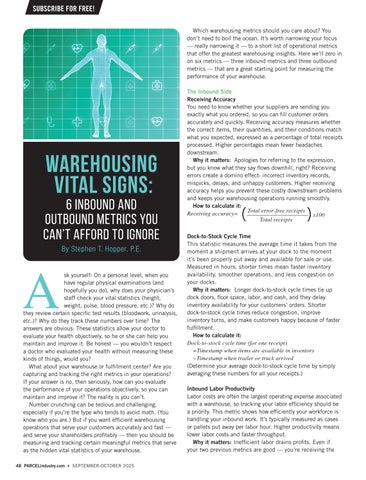
48 Warehousing Vital Signs: 6 Inbound and Outbound Metrics You Can’t Afford to Ignore By Stephen T. Hopper, P.E.
35 Boost Profitability by Powering Up Your WMS
40 30 Booths to See at PARCEL Forum ’25
GEARING UP FOR A GREAT SHOW
By Amanda Armendariz
As we put together this September/ October PARCEL Forum show issue, I’m reminded once again of how lucky the industry is to have such a top-notch conference. The small-package industry is an ever-changing, fast-paced sector, and it’s important to stay on top of all the happenings. Reading PARCEL is, of course, one of the best things you can do, and attending PARCEL Forum is another. This year’s conference is jampacked with knowledgeable speakers on a variety of topics, from artificial intelligence to changing customs regulations to optimizing your warehouse operations. Inside this issue, you’ll get
a substantial peek into the types of information you can expect to absorb from this year’s show. Held September 8-10 at the Renaissance Schaumburg, it is truly a gathering of some of the best and brightest in the industry. In addition to the outstanding educational sessions, the networking opportunities are truly out of this world. There’s no better place to discuss our wonderful, sometimes exasperating, fulfilling industry than at PARCEL Forum. It’s not too late; there’s still time to register! Visit www.parcelforum.com for more information.
Regular readers of our magazine may notice that we don’t have our annual carrier satisfaction survey in this issue like we normally do. Don’t worry; it’s slated for November/December. We just had so much great forum-related content for this issue that we didn’t have room to squeeze one more article in! Be on the lookout for that issue so you can compare your experience with the carriers with those of your peers.
As always, thanks for reading PARCEL, and we hope to see you in Schaumburg!
SUBSCRIPTIONS:
Send subscriptions or change of address to: PARCEL, P.O. Box 259098 Madison WI 53725-9098
Allow six weeks for new subscriptions or address changes. REPRINTS: For high quality reprints, please contact Chad Griepentrog, 608-241-8777, chad.g@rbpub.com
P.O. Box 259098
PRESIDENT CHAD GRIEPENTROG PUBLISHER KEN WADDELL
EDITOR AMANDA ARMENDARIZ [ amanda.c@rbpub.com ]
CREATIVE DIRECTOR KELLI COOKE
PARCEL COUNSEL
THE FIRST RULE OF CONTRACTING: KNOW WITH WHOM YOU ARE DEALING
By Brent Wm. Primus, JD
In an issue from 2009, we reviewed six basic principles of contracting and, in particular, how these rules apply when contracting for transportation services. In this issue, we’re sharing the article again, but with some key updates shippers need to be aware of. The first rule is, “Know with Whom You Are Dealing.” This rule applies in any business situation, not just in transportation, and invokes all of the factors generally considered as part of a duly diligent inquiry regarding a potential business partner — credit worthiness, reputation in the industry, and trade references, as well as other similar factors.
There is a very basic concept that gives rise to this first rule. Even the best contract drafted by a team of legal experts will be of little use if the party with whom you are dealing is either unwilling or unable, even with the best of intentions, to perform their obligations.
However, in transportation contracting, there are other critical inquiries that must be made. The first is to determine the exact nature of the proposed service provider. Are they a carrier such as a motor carrier or an air carrier, or an intermediary such as a property broker, colloquially known as a “truck broker”? This distinction becomes critical in issues involving loss and damage to cargo, as a carrier is liable for such damage while a broker or other intermediary typically is not; however, they may become liable pursuant to a contract or other circumstances.
The distinction between a carrier and intermediary is equally critical when dealing with issues involving the
payment of freight charges. Payment to a carrier extinguishes any obligation of the consignor or the consignee to pay for the freight charges. However, payment to an intermediary, such as a truck broker, does not constitute payment to a carrier. Suffice it to say here, if a shipper pays a broker who fails to pay the carrier, problems arise! It is also important to know which type of carrier the carrier is. Are they a “regulated” motor carrier or an air carrier? If an air carrier, are they a domestic “deregulated” air carrier or a “kinda regulated” international air carrier? If a regulated motor carrier, there are certain laws and regulations relating to the filing of claims for loss and damage, time limits to initiate legal actions, and so on with which the carrier must comply. International air carriers must also comply with certain laws. However, a domestic “deregulated” air carrier is pretty much free to set its own terms and conditions as published in their tariff or service guide. As an aside, it should be noted that the primary reason to enter into a contract with a carrier, other than pricing, is to establish terms and conditions more favorable to a shipper than those which would apply in absence of an individually negotiated contract.
Another issue of particular importance when dealing with motor carriers is the
carrier selection process. A discussion of such a process is beyond the scope of this article, but the process begins by determining if the corporate entity with which one is contracting, and not an affiliate or similarly named entity, is the holder of the requisite motor carrier authority. Vicarious liability is now the largest contingent financial liability faced by shippers. (See "The CSA/ Schramm Problem - Part I: A Complex Situation" by visiting PARCELindustry.com/CSA).
Finally, it must be noted that the two largest carriers with whom PARCEL readers deal with — UPS and FedEx — are very complex legal entities and, broadly speaking, provide services in many capacities, e.g., as a motor carrier, as a domestic air carrier, and as an international air carrier. Thus, any contractual agreements with them should attempt to set forth as clearly as possible in which capacity they will be acting from time to time and, as appropriate to a particular situation, have separate contractual terms depending upon the capacity in which the carrier will be acting. All for now!
Brent Wm. Primus, J.D., is the CEO of Primus Law Office, P.A., the Senior Editor of transportlawtexts,
inc., and
Director of
Virtual Education for the Transportation and Logistics Council, Inc.
PACKAGING
TRACK AND TRACE PACKAGING: THE FUTURE OF SMARTER, SAFER SUPPLY CHAINS
By Yogesh Kulkarni
The Track and Trace Packaging Market is a rapidly expanding sector expected to soar from USD 6.97 billion in 2025 to USD 19.35 billion by 2034, powered by a robust CAGR of 12.02%.
But this isn't just another industrial upgrade. Track and trace packaging is revolutionizing how goods move through the global marketplace, and the once-humble packaging box is becoming a powerhouse of data, trust, and compliance.
What Is Track and Trace Packaging?
Think of it as a digital passport for products. Track and trace packaging integrates technologies like barcodes, RFID tags, 2D matrix codes, and even blockchain into product packaging, allowing stakeholders to monitor a product’s journey from factory to consumer.
Whether you're a pharma giant ensuring a vaccine’s integrity, or a DTC brand offering real-time shipment updates, these intelligent systems ensure safety, efficiency, and accountability every step of the way.
Why Is the Market Booming?
There is a consumer-driven shift at play: more than ever, buyers want to know where their products come from, how they were handled, and if they're genuine. In fact, 42% of European shoppers and 37% in North America have admitted to avoiding products with excessive or unclear packaging.
Regional Dynamics
North America led the market in 2024, largely due to early adoption and strong compliance frameworks.
Asia Pacific is poised for the fastest growth, driven
by booming e-commerce, manufacturing, and government efforts in India and China.
Europe is no laggard either, with its environmentally driven packaging mandates and digital supply chain transformation.
Top Technologies Reshaping the Industry
1. Barcodes (1D & 2D): These continue to dominate due to their simplicity, affordability, and widespread compatibility. Perfect for inventory control, they’re still the go-to for retail and logistics.
2. Blockchain-Based Traceability
The rising star, Blockchain, ensures tamper-proof, decentralized tracking, offering unmatched transparency and security — a game-changer for luxury goods, food, and pharma.
3. RFID-Embedded Packaging
RFID tags are becoming more affordable and allow non-line-of-sight scanning, enabling real-time monitoring of entire batches of goods simultaneously.
4. AI Integration
AI supercharges tracking by analyzing movement patterns, predicting disruptions, and even using image recognition to flag counterfeits. It’s also driving smarter routing and dynamic inventory control.
Industries Leading the Charge Pharmaceuticals & Healthcare: No surprise here. With regulatory pressure and high-stakes
products, this sector has the largest market share.
E-Commerce & Retail: This segment is growing the fastest. Why? Because consumers want real-time delivery updates, smarter returns, and brand transparency. Track and trace systems now power everything from warehouse accuracy to interactive unboxing experiences.
Challenges Ahead
Despite the optimism, the market faces hurdles, like lack of standardization across global systems, complex integration with legacy software, and varying regulations that make implementation tough for multinational companies. Still, with increasing collaboration among tech leaders, regulators, and industry players, these barriers are gradually being overcome.
What’s Next?
The future of track and trace packaging is not just digital, it’s intelligent, sustainable, and customer-focused. With AI, blockchain, and IoT driving rapid transformation, we’re heading toward a world where every product is not only traceable but interactive, smart, and secure.
Yogesh Kulkarni is an experienced research analyst specializing in the packaging sector, with a strong foundation in statistical analysis and market intelligence. He currently contributes his expertise to Towards Packaging. Visit www. towardspackaging.com.
REVERSE LOGISTICS
ENSURING A RETURNS MANAGEMENT STRATEGY IN TIME FOR PEAK SEASON
By Tony Sciarrotta
As the holiday peak season approaches, retailers are preparing by ensuring adequate inventory and parcel shipment capacity. However, often overlooked is how to manage returns effectively during the busy holiday season. With return rates for online purchases ranging between 15% to 30%, preparing a streamlined, customer-friendly returns strategy is essential. Retailers who take proactive steps now can reduce operational strain, enhance customer satisfaction, and even gain a competitive edge during the busiest shopping period of the year.
While retailers cannot eliminate all returns, they can certainly mitigate the number. Analyzing data from previous peak seasons can reveal why items are returned, whether due to incorrect sizing, unclear product descriptions, or damaged packaging. By addressing these issues proactively, retailers can reduce return rates. Additionally, accurate online product pages featuring high-resolution images, detailed specifications, and customer reviews can help establish realistic expectations. Some brands also utilize augmented reality (AR) tools or AI-driven sizing recommendations to minimize guesswork and enhance purchase confidence.
Retailers should also collaborate with their supply chain partners, such as warehousing and transportation, to ensure that warehouses have sufficient dedicated space and personnel to handle returned goods and that transportation partners are prepared for potential increases in returns.
As retailers work with their supply chain partners, the customer must be top of mind. For example, offering multiple return options such as drop-off locations, home pickups, or in-store returns adds flexibility and convenience for customers. Equally important is clear communication. Customers appreciate timely updates on return status and refund
processing. Providing accurate, upfront information can reduce customer anxiety and minimize inquiries to overstretched customer service teams.
Additionally, educating customer service teams is paramount. Retailers should update their FAQs, provide training on return policies, and ensure that systems are in place to track and resolve return issues promptly. Self-service tools, such as AI chatbots or return tracking portals, can help handle high volumes of requests without overwhelming customer service teams. By having a well-informed and responsive customer support team, a frustrating return can turn into a positive brand experience.
Across all levels of returns management, technology and automation play a crucial role. A returns management system, for example, can automate workflows, from return approvals to restocking and refund processing.
Real-time visibility into returns performance is important regardless of the time of year. Dashboards and alerts can help retailers track return volume, turnaround times, and refund processing. If delays or bottlenecks arise, having the ability to pivot, whether by reallocating staff or adjusting routing, is important.
Technology and automation can also help reduce returns fraud by verifying and validating return requests in real time. AI-powered systems can detect suspicious patterns, such as frequent returners or mismatched product con-
ditions, and flag them for review. Meanwhile, RFID tags and smart packaging offer additional verification by confirming if the correct item is being returned.
After the holiday peak season ends, retailers, logistics providers, and other supply chain stakeholders need to conduct a thorough post-mortem analysis. This evaluation helps uncover what strategies and processes were successful and where breakdowns or inefficiencies occurred. Whether it's related to staffing levels, carrier performance, warehouse throughput, returns handling, or last-mile delivery issues, this analysis provides a valuable opportunity to identify what needs improvement and how to address it for the next holiday peak season.
Ultimately, a well-executed returns strategy is more than simply processing returned items; it plays a vital role in protecting customer relationships, maintaining operational efficiency, and preserving long-term profitability. A smooth, transparent, and customer-friendly returns process can be the deciding factor in whether a customer chooses to shop with a retailer again or take their business elsewhere.
Tony Sciarrotta is Executive Director of the Reverse Logistics Association.
The RLA offers various tools, white-papers, and monthly webinars that provide best practices in managing reverse logistics.
CARRIER MANAGEMENT STRATEGIES
By Joe Wilkinson
SPEAKER
Managing carrier relationships is delicate work. Yes, we need to be able to deliver our products in a cost-effective manner. That has been true in the past and will always be true going forward. However, we likewise rely heavily on our carrier partners’ ability and willingness to deliver our products on time, without damage, and in a way that meets our technical, administrative, and operational needs. So simply viewing our carriers solely as “vendors” is short sighted. At the same time, we must acknowledge that the carriers’ annual GRIs and their now incessant, nearly bi-weekly, surcharge changes, zoning, fee, and other pricing actions can result in excessive and un-budgeted cost increases, as the carriers try to offset cost increases and flat or flagging volumes to reinforce revenue and margins.
Carrier management today, in a hyper-dynamic parcel market, is an always-on, explicitly strategic discipline, especially given that in the last five years:
A flood of new carrier options arrived — and a nontrivial number exited
USPS launched Ground Advantage, creating a credible lightweight-parcel alternative
Capacity swung from scarcity to surplus
Amazon entered the market in a meaningful, external-facing way
Carrier cost-to-serve rose materially
National networks were reconfigured, with service standards and operating models shifting beneath shippers’ feet
Frequent national carrier pricing actions
Against that backdrop, I have seen too many shippers swing like a pendulum: when capacity is loose, they negotiate hard; when capacity tightens, they scramble to become a “shipper of choice.” That oscillation leaves value on the
table. A better model is what I call the fulcrum approach: keep one foot on each side — relationship and leverage — and shift your weight deliberately as market realities change. Do what you say you will do, insist on accountability, maintain optionality, and tactically exploit openings without burning bridges.
Below are practical ways to operationalize that balance.
Protect Carrier Independence
Revenue commitments and “capture the majority of your spend” clauses have become standard fare. They are not often enforced, but they do create risk and — just as importantly — a psychological barrier when you consider alternatives. Treat commitment language as a first-order strategic question, not boilerplate to be signed in the eleventh hour.
The ability to quickly and (relatively) painlessly integrate new carrier options from an operational, technical, and administrative perspective is also a consideration. If it would take you 18–24 months to stand up a new carrier — technically, operationally, and administratively — you effectively have no carrier independence, no leverage, and no options. Those are not “IT projects.” They are strategic enablers that buy you speed, leverage, and resilience.
Become a Shipper of Choice — On Purpose
Strong relationships are not about being “nice.” They are about lowering your carrier’s cost to serve, giving them
line-of-sight to your future, and creating space to trade value. Practical steps:
Run real QBRs: Share your roadmap, product/packaging changes, promotions, and forecasted volume by service and geography. Ask for the same transparency in return, especially on capacity, network changes, and future pricing actions.
Engineer win‑wins: If a change on your side (consolidation, packaging, induction point, manifest timing, address hygiene, etc.) meaningfully reduces your carrier’s cost or improves density, do not give it away — trade it.
Broaden the relationship: Connect Directors and VPs on both sides, not just the day-to-day ops teams. When networks wobble or negotiations get tight, executive advocates matter.
Pay attention to their ob jectives: revenue mix, peak planning, zone optimization, or specific lanes they want to build — knowing these lets you coin mutually beneficial proposals.
No illusion here: much of parcel contracting is zero-sum.
But genuine, occasional win-wins do exist — and carriers are far more likely to surface them for shippers who are predictable, data-literate, and easy to serve.
Market Leverage
The carrier relationships and win-wins aside, most of parcel contract negotiation is a
zero-sum game. Every dollar you save is a dollar out of the carrier’s pocket. For this reason, it is critical to understand what is or may be achievable in carrier negotiations. Always remember, everything is negotiable. Whatever anyone tells you, negotiation always comes down to leverage. And if you do not understand your leverage, you will leave money on the table. That is a plain fact, as certain as gravity.
Institutionalize Scorecards, QBRs, and CAPs
With broad service guarantees largely waived and networks still in flux, “trust us” isn’t governance. Create a cadence and a common language of performance:
Carrier scorecard review and discussion
Clear, measurable KPIs
KPIs that are tied directly to cost, service, customer satisfaction, and strategic goals
Definitions of the KPIs do not change over time
Ongoing strategic initiatives and future plans/outlook
Capacity/volume forecast by service and geography (particularly as peak approaches)
Discussion of carrier network changes, labor and labor contracts, recent and upcoming pricing changes
Pricing and service shortfalls and corrective action plans (CAPs) and review of progress on previous CAPs.
Carrier’s opportunities for growth and value-added propositions
“Set it and forget it” never really worked. In today’s market, it is reckless.
Pulling it All Together
The point I am trying to convey is that carrier management is a delicate balance. The key factors to consider are: your goals and objectives, your customers’ demands, the market, the options, and your carriers’ needs and wants.
Considering these variables should inform your strategy
and how far you lean into one area of carrier management versus another.
If these ideas resonate, let’s keep the conversation going. I will be moderating “Carrier Engagement Done Right” at this year’s PARCEL Forum in Chicago, where industry veterans John Janson, Jennifer Kobus, and Gregg Mau will share hard-won lessons and practical tactics of their own. I hope you will join us for what should be a lively — and useful — discussion.
Joe Wilkinson is Vice President of Professional Services, Intelligent Audit. He can be reached at joey. wilkinson@intelligentaudit.com.
EFFICIENT WAREHOUSE OPERATIONS: GETTING PARCEL TRANSPORTATION OFF TO THE RIGHT START
By Deanna Kaufman
In today’s fast-moving e-commerce landscape, warehouse operations are no longer simply about storing goods — they are about accelerating fulfillment, ensuring accuracy, and shipping parcels with speed and efficiency. As parcel volumes climb and customer expectations tighten around delivery speed and visibility, warehouses and distribution centers (DCs) must evolve.
The Challenge: Do More With Less Warehouse leaders are under pressure to fulfill increasing order volumes with constrained labor, limited space, and rising transportation costs. This challenge is compounded by the complexity of parcel shipping — each package must be labeled, routed, and processed with precision, often within tight same-day or next-day windows.
Labor shortages have only amplified these pressures, forcing organizations to rethink how they manage throughput without compromising accuracy or customer satisfaction. To meet these challenges head-on, warehouse operations must be designed not just for scale, but for efficiency, agility, and automation.
Why Parcel Shipping Starts in the Warehouse
While parcel shipping is often seen as a transportation function, its success begins in the warehouse. A parcel’s journey — from pick to pack to ship — is shaped by the operational discipline of the warehouse. Delays in receiving, put away, order release, inefficient picking routes, misaligned staging or manual shipping prep all introduce friction. The result: missed carrier cutoffs, delayed deliveries, and frustrated customers.
Modern parcel shipping performance hinges on tight integration between warehouse systems, automation tools, and carrier platforms. By streamlining these upstream processes, companies can position parcels for faster, cleaner handoffs to the carrier network.
Three High-Impact Tactics to Improve Parcel Fulfillment
Improving warehouse efficiency and parcel readiness — whether you're an SMB scaling fast or an enterprise looking to optimize an existing network — requires three key initiatives:
1. Automate Order Processing to Accelerate Throughput
Manual order processing — prioritizing, waving, and releasing orders — is a significant drag on efficiency. By automating these workflows, labor utilization can be improved, idle time can be reduced, and throughput can be increased.
How to begin? Start by identifying bottlenecks in your order lifecycle. Are orders sitting too long in the queue? Are pick paths inefficiently assigned? Modern warehouse management systems (WMS) can dynamically prioritize orders based on cut-off times, inventory availability, and carrier capacity.
Best practices:
Automate waving logic to group orders by carrier or zone for efficient picking and staging.
Integrate real-time order visibility into warehouse dashboards to align labor to order priority.
Use data to balance pick workloads and avoid congestion at pack-out and shipping areas.
2. Enhance Fulfillment With Scalable Automation
Physical automation is no longer reserved for massive distribution centers. Scalable, modular solutions — ranging from mobile robots to smart conveyors — can deliver immediate gains in both productivity and accuracy.
Whether you’re deploying autonomous mobile robots (AMRs) to assist pickers or investing in goods-to-person (GTP) systems, the goal is to reduce travel time, eliminate manual errors, and boost pick rates. However, for warehouses with very high throughput requirements and complex fulfillment workflows, traditional warehouse automation that leverages MHE (material handling equipment, e.g. conveyors, ASRs, shuttle systems) is likely the best choice.
Considerations when implementing automation:
Determine what types of automation equipment (scalable automation with AMR or traditional automation) best match your needs — today and in the future.
Focus on ROI and scalability — look for automation that can grow with your volume.
Blend physical automation with process automation and digital management (e.g., warehouse management systems, warehouse control systems) to improve productivity and execution.
3. Streamline Parcel Shipping Preparation with Digital Tools
Shipping prep often remains a manual, fragmented process — especially in warehouses relying on disparate systems or legacy tools. But by digitizing how shipments are prepared, labeled,
and communicated to carriers, you can dramatically reduce delays and errors.
Implementing APIs, advanced shipping portals, or integrating with other key systems such as transportation management systems (TMS), can help automate the transfer of shipping information — rate shopping, service optimization (balancing customer service level agreements with cost), label generation, manifesting, and tracking updates — all while improving compliance with carrier requirements.
If labor shortages and rising volumes are stretching your warehouse ops, don’t miss Scott Kramer’s session at PARCEL Forum ’25 on Tuesday, September 9. Learn how predictive tools are driving smarter, faster fulfillment.
Steps to improve shipping preparation:
Use multi-carrier TMS platforms to select the best carrier based on delivery time, zone, and cost.
Integrate WMS or ERP systems with carrier APIs or your TMS to auto-generate compliant shipping labels and documentation and store tracking information for proactive customer notification.
Digitally notify carriers of ready-to-ship parcels and any customs documents for international shipments to avoid missed pickups or cutoff violations.
Putting It All Together: A Holistic Approach to Parcel Efficiency
Efficient parcel fulfillment doesn’t hinge on a single investment — it’s the outcome of a well-orchestrated operation where people, processes, key partners, and systems are aligned. From receiving to outbound, every touchpoint in the warehouse influences the speed and success of parcel shipping.
To achieve this level of orchestration, organizations should:
Audit their current fulfillment workflows to identify gaps in speed, accuracy, routing guide adherence, errors in cost compared to contract, damages and claims or visibility.
Invest in integrated systems that connect order data, inventory, labor, and shipping tools into a unified view.
Train and empower staff to leverage automation effectively — technology alone won’t solve process inefficiencies without buy-in on the ground.
Final
Thoughts
As e-commerce continues to reset customer expectations around fulfillment speed and visibility, warehouses can’t afford to operate with outdated, disconnected processes. Efficient warehouse operations are the launchpad for seamless parcel transportation — and that efficiency is now a competitive differentiator, not just a cost advantage.
Deanna Kaufman is Director, Product Management at Infios.
How Amazon’s Entry as a National Carrier Will Shake
Up Your Transportation Strategy
Amazon is looking to change the way you see your national carrier options.
Manifested shipping has a nearly 5,000-year history, with some of the first known examples utilizing the amphorae of ancient Mediterranean cultures. Amphorae, tall ancient Greek/Roman jars, were used to both carry goods like olive oil as well as contain the manifest’s information. Specific amphorae, marked with the goods type, would contain stones to indicate the number of the containers in question, sealed by the shipper to be opened by the recipient, with the shipper responsible for any goods that “fell overboard.” In that 5,000year history, only one thing has remained constant — change.
For over 50 years, the US thought we were different. We've had three major national carriers: FedEx, UPS, and the United States Postal Service (USPS). They’ve dominated over 98% of all small-parcel shipments. They’ve run competitors like DHL out of the country or purchased anyone that showed promise, like RPS, the company FedEx bought to create FedEx Ground. It was not until the mid-2000s that we started to see any material change as new carriers started to challenge at the fringes of the market.
In 2014, Amazon entered the small-parcel market in a few select cities, aiming to improve delivery times and reduce costs. Over the next four years, Amazon expanded Amazon Shipping to cover most of the US population, reducing its dependence on former partners, UPS and FedEx.
In 2020, the pandemic solidified Amazon’s role as a major carrier in the US, making it clear it was here to stay. Although many did not realize it at the time, in 2018, Amazon had already begun experimenting with its next step: delivering packages for shippers whose orders did not originate on the Amazon platform.
As we all move further into the summer season of 2025, Amazon is now offering carrier services to just about anyone willing to use them. There are definitely some advantages, but there are drawbacks as well.
Amazon was one of the e-commerce retailers primarily responsible for breaking the recipient's habit of saying, “I need you to ship to me using Carrier X, as I don’t like the driver for Carrier Y.” This opened the door for all shippers to use the best fit carrier for each shipment, and now, customers will likely not care if Amazon is delivering a package that did not originate from an Amazon site purchase.
Delivery Seven Days a Week
Amazon is already known for delivering seven days a week. But here is the kicker: there are no additional fees for weekend delivery service. Every day is a delivery day at the same price.
No Residential Charges
On the topic of charges, or lack thereof, Amazon does not charge a residential fee either. This, combined with a seven-day delivery schedule, can have a significant impact on logistics spend for a given customer experience.
More lanes mean more benefit from time-in-transit shopping and advanced date shopping. When multi-carrier shipping software first began to take hold in warehouses, users quickly discovered that the ground networks for UPS and FedEx were distinct. This meant that a destination that might require a three-day shipment for one carrier could be a two-day shipment for another, and the same applied to next-day versus two-day shipping. As additional carriers were added, the ability to take advantage of extended next-day and second-day deliveries at the lowest price point was also expanded. Adding Amazon, with such a complete coverage model, can only further improve those looking for faster and more affordable solutions.
However, while Amazon’s shipping services come with several benefits, there are some cons that should be considered.
Limited Origins
To battle the concerns of some of the cons below, Amazon has built completely new induction centers for this product. This ensures that packages shipped with Amazon as a carrier, rather than Amazon as a marketplace, are not commingled. Building out origin hubs takes time, however. At the time of this writing, there are fewer than 20 induction hubs that can pick up within a 200mile radius. Amazon is known for expanding quickly, but if your inventory sources are not located in one of the existing pickup locations, you may not be able to use that inventory source.
Amazon Is a Data Monster
Using Amazon as a carrier means that Amazon will have more information about your business. Many companies, including retailers and manufacturers, find themselves competing directly with Amazon. It can be a hard pill to swallow to give money to part of a company that you compete with on
a daily basis. Many retailers outright ban anything related to Amazon Web Services (AWS), and Amazon, as a carrier, could end up facing the same fate within a company. It should be noted that Amazon also claims the data is not commingled. Personnel from the marketplace should never be able to see the data on who is shipping what volume.
Amazon is Amazon, the single largest small-parcel shipper in the world. If a region has capacity concerns, will Amazon-sourced packages be prioritized over third-party packages?
If Amazon’s carrier expansion has you rethinking your shipping strategy, don’t miss Justin's session at PARCEL Forum ’25 on Wednesday, September 10! He’ll unpack how to assess the risks, identify opportunities, and stay competitive in a shifting carrier landscape.
Program Cancellation Concerns
The Magnificent 7 (Microsoft, Amazon, Nvidia, Meta Platforms, Apple Inc., Alphabet Inc., Tesla, Inc.) are huge companies that start massive initiatives. These initiatives often fail to meet the companies' set goals, and they are subsequently canceled. Amazon extending its homegrown shipping services to other companies carries a non-zero risk of this happening as well. This risk should be mitigated with a good multi-carrier shipping software, as the other carrier offerings are available to move volume as needed.
Breakup Concerns
There is currently an open antitrust case from the Federal Trade Commission (FTC) and 19 states and territories. The outcome of this case could lead Amazon to split into two or more companies, putting much of its business model and subsequent services at risk as well.
Any major logistics decision requires careful consideration and adopting Amazon Shipping as a carrier is no different. The pros, like seven-day delivery and a lack of residential charges, do not come without a tradeoff. Shippers must assess factors such as limited origin points and concerns around data privacy to ensure they align with their business before making any decisions.
Amazon Shipping: The Road Forward
In short, the emergence of Amazon as a national parcel carrier introduces significant opportunities and challenges for shippers. While its innovative services, such as seven-day delivery and the absence of residential surcharges, offer compelling advantages, businesses must carefully weigh these benefits against limitations like limited origins and concerns over data privacy. Ultimately, adapting to Amazon’s evolving logistics landscape is not just a choice; it’s a strategic imperative for staying competitive in a rapidly shifting market.
Justin Cramer is co-founder of ProShip, Inc.
By Josh Dunham
TRANSFORMING DATA INTO DECISIONS
You’ve got the data, but do you know what to do with it? Here's what to take into account.
In this era of powerful data science, it’s easy to forget that just a few years ago, parcel shipping data remained locked in a proverbial black box, with shippers and consultants poring over spreadsheets and carriers’ invoices in an effort to understand shipping costs after the fact. With carriers’ data in different formats and costs subject to a constantly changing web of surcharges, rules, and fees, parcel shipping remained the least understood line item in many budgets — one virtually untouched by popular business intelligence solutions.
Powerful parcel shipping platforms changed that. But shippers in many companies have yet to deploy it and fail to use their shipping data to answer fundamental questions, such as:
What and where am I shipping today?
Where am I going in my shipping strategy?
Where can I generate savings, and how can I gain efficiencies?
Can I predict what is likely to occur in the business and prescribe effective action?
The ability to act on real, actionable shipping data makes it possible to answer such questions and more while enabling shippers to become the driver of a powerful paradigm shift, one that enables them to take proactive, predictive, and even prescriptive action not just as it relates to shipping, but across the enterprise. Many businesses are at this point today — one that enables them to do far more than optimize parcel shipping spend.
Importantly, such businesses are able to act on the valuable insights within their shipping data to improve the performance of teams across the organization, including those responsible for operational, financial, customer service, and sales and marketing efforts and strategies. The shippers behind these efforts share practices that enable them not only to gather the right data, but to turn it into decisions that move the business forward.
Turning Shipping Data into Decisions Starts with Five Steps
Shippers that effectively use their data all have several things in common. As a
group, they take deliberate steps that enable them to transform data into decisions. More specifically, they abide by five considerations all shippers can learn from. They:
1. Identify the right data and automate its collection: You may have tons of data, but do you have the right data to deliver real shipping intelligence to your organization? Make sure you are gathering the right information and automate its collection to ensure that it enables you to proactively act on the insights within it. What data you collect and how often you gather it significantly impacts how actionable it is and how you can use it to make data-informed decisions.
2. Make sure data is ready: You have identified the right data sources, but is the data ready for use? Make sure your data from numerous sources, often multiple carriers, is clean, normalized, and formatted for maximum utility. Advanced shipping platforms do this, but shippers should still take steps to ensure that they are using quality data in their efforts. This means that data must also be maintained.
3. Make sure data is useful: Having the right data means little if it is difficult to use or act on, something shippers who rely on massive spreadsheets of carrier data know well. To provide real intelligence, shipping data should be easy for shippers to parse and apply. More specifically, this means they should be able to manipulate it in customizable dashboards under a single pane of glass.
4. Integrate systems to utilize shipping data: The silos that for so many years isolated shipping data and prevented businesses from drawing on the intelligence within it can be effectively broken down with robust systems integration. At a minimum, this includes the integration of shipping data with core systems, including enterprise resource planning and transportation management systems. Ideally, it includes customer relationship management and call center management systems as well.
5. Be deliberate and apply shipping data to core business functions: While unique to some degree to each busi-
ness, parcel shipping data is directly applicable to several core business functions and the teams that oversee them. Beyond shipping, this includes operations, finance, customer service, and sales and marketing.
With the right data in hand, normalized, useful, and available in core systems, shippers are ready to turn data into decisions that deliver real intelligence and competitive advantage. As the gatekeeper and custodian of this intelligence, shippers have never played a more important or strategic role, as a quick look at the many ways shipping data can be used reveals.
Put Data to Work by Turning It into Decisions
The applicability and value of parcel shipping data is extensive, with numerous ways to transform it into fact-based decisions today, and the use of powerful modeling and simulation capabilities let shippers pose “what-if?” scenarios that predict future impacts and prescribe effective responses. Following are some
of the many ways parcel shipping data is being used across businesses.
For Shipping Departments: At a minimum, parcel shipping data should be used to reduce shipping costs and increase performance. This begins with staying informed of shipping vital factors — total parcel shipping spend, surcharge spend, the average weight of parcels shipped, average zone, minimum charges, and the average cost-per-shipment. Many also use their data to implement a multi-carrier approach for greater agility and to minimize risk — our 2025 Parcel Shipping Intelligence Market Survey Report found that 90% of respondents plan to scale their carrier networks in the next year. Other use cases include monitoring the performance of carriers, taming surcharges, optimizing mode and service levels, comparing carrier contracts, bundling shipments, anomaly detection, tracking and applying for carrier rebates, custom reporting, and modeling to determine
how new carrier rates, rules, and surcharges will impact costs.
For Operations Leaders: Shipping data is invaluable for optimizing logistics — respondents in our survey also noted that logistics costs average 22% of all operational costs — and they are using it to reduce delays, boost efficiency, and support strategic initiatives. Some of the many ways operational leaders are using shipping data in their decision-making include improving fulfillment operations by aligning warehouse locations and distribution networks with demand patterns, using zone activity to guide expansion strategies and help determine where additional stores should be constructed, and freeing up capital by reducing costs.
For Finance Executives and Teams: Shipping data improves budget forecasting, cost allocations and empowers finance operations to reduce waste. GL coding lets finance teams allocate shipping spend by department, SKU, and customer segment while enabling teams to predict
shipping costs based on seasonal trends, volume spikes, and changes to carrier contracts. Real-time accruals management also keeps finance and accounts payable leaders informed of expenditures rather than in the dark awaiting carriers’ invoices.
For Customer Service Efforts: Using shipping data, call centers can preempt customer issues and address delivery issues with real-time insight into where packages are delayed, and whether issues reflect the carrier, delivery location, product SKU, or other factors. Shipping data is also key in successful efforts to automate claims and resolution efforts that build and safeguard customer loyalty.
For Sales & Marketing Teams: A proactive approach to parcel spend management that lets businesses use their shipping data for decision-making also enables them to compete more effectively online, fine-tune pricing strategies, optimize packaging, and increase customer satisfaction. For example, marketers can determine how shipping costs impact margins for
specific SKUs, segment customers by “cost-to-serve,” analyze campaigns, use analytics to refine SLAs and delivery dates, and set profitable “free” or discounted shipping offers — an important differentiator in online sales.
By keeping these factors, steps, and actions in mind, shippers can turn their data into decisions. And just as importantly, they can play a key role in helping the organizations they serve work smarter by using the unique business intelligence that only parcel shipping data reveals.
Josh Dunham is the co-founder and CEO of Reveel. Founded to help shippers level the playing field for carriers, Reveel’s Shipping Intelligence Platform uses Parcel Spend Management 2.0 technology to provide parcel shippers with the actionable insights they need to lower their shipping costs right now, and an Analytics Hub that enables them to drill down into even the most complex shipping data.
PARCEL & LTL RATES BENCHMARK YOUR 2025
For over 30 years, AFMS has been an industry leader and trailblazer in the parcel and LTL transportation benchmarking and procurement support space.
Carrier contract negotiations are complicated and require a high level of industry expertise, benchmarking and analytical support to maximize the carriers pricing agreements. AFMS provides full RFP & RFQ management support and data analytics to help achieve best in class pricing along with invoice auditing and optimization tools.
Our expert team of former carrier executives & pricing directors from UPS, FedEx, DHL, USPS and the major LTL carriers is what sets us apart from other consultants. AFMS has helped over 5,000 companies reduce their shipping costs by 10–25%. AFMS offers shippers a FREE report card and shipping analysis that will help you determine where your pricing stands in the market today.
The pedigree of the AFMS senior management team is unparalleled in our consulting space, over 500 years of combined sales and senior pricing experience from carriers like UPS, FedEx and DHL. It’s an important foundation upon which our 30+ year of business has been built. Our inside pricing knowledge is why the largest shippers in the US and Europe use AFMS to benchmark and help negotiate their shipping contracts.
AFMS is looking for additional UPS, FedEx, DHL, & USPS Sales & Pricing Executives to join our fast-growing consulting firm. The average AFMS sales executive earns $250k-$500K+ per year. Unlimited commission pay-outs.
The End of USPS DDU Discounts :
How Retailers and Carriers Are Rethinking the Final Mile
A major shift is happening in the final mile. It’s going to hit retailers, carriers, and logistics providers where it hurts: their margins.
By Amine Khechfé
The United States Postal Service is ending its Destination Delivery Unit (DDU) discounts, eliminating a model that’s been a staple for affordable e-commerce delivery for years. Price increases from USPS aren’t new, but this one’s different. Rather than a simple rate change, it’s a structural change in how packages move through the network.
For brands and carriers that have relied on DDU discounts to control costs and speed deliveries, this is going to create meaningful operational and financial challenges. And the question everyone’s asking is: Who’s going to absorb the extra cost?
What’s Changing and Why It Matters
For years, DDU discounts allowed carriers and consolidators to inject parcels deep into the USPS network — typically at the local Destination Delivery Unit (DDU), aka your local post office — for lower rates and faster delivery. The idea was simple: USPS avoided the work of upstream processing, and in return, passed along savings.
Now, USPS is moving toward taking back more control of the sortation process. Instead of accepting parcels at local DDUs, they’re now requiring injection at higher points in the network, like Sectional Center Facilities (SCFs), or even upstream from there. That means packages are traveling further within USPS’s operation, adding time, complexity, and cost to the process. It fundamentally changes how the last mile works for retailers, consolidators, and hybrid carriers.
The era of hyper low-cost USPS-powered deliveries, especially for parcels under one pound, is over.
Who’s Feeling the Impact?
Several groups are going to feel this change the most:
Consolidators like UPS Mail Innovations, OSM, and DHL eCommerce, who built their businesses on leveraging USPS DDU discounts for low-cost final mile delivery
DTC brands, especially those shipping lightweight or low-margin products, where shipping costs are already tight
The bottom line? For a lot of businesses, the playbook they’ve used to keep shipping affordable just got a lot more complicated.
What Shippers and Carriers Are Losing
The DDU discount model wasn’t just about saving money. It also gave shippers more control over delivery times. With the ability to inject packages closer to the customer, carriers could bypass bottlenecks and keep delivery speeds consistent and competitive.
Now, with USPS taking that option off the table, the flexibility and savings that came with DDU are disappearing. Instead, carriers have to hand off parcels earlier to USPS, losing control and introducing new inconsistencies and delays. They’re also losing pricing power and operational efficiency.
For e-commerce brands, especially those in competitive markets, the margin squeeze is real. And it raises a tough question: Who’s going to eat the extra cost?
Honestly, the options aren’t great:
Carriers can absorb the costs, but many are already operating on thin margins
SPEAKER
Retailers can take the hit, but rising shipping costs quickly eat into profitability
Consumers can be asked to pay more or lose free shipping options, but higher shipping fees are a fast track to abandoned carts and lost sales
Nobody wants to be the first to flinch. But with DDU discounts gone, the cost has to land somewhere, and shippers need to decide quickly how to respond.
Concerned about cost hikes and service disruptions?
Amine brings together visionary logistics leaders to share how alternative carrier networks are unlocking agility and improving customer experience — only at PARCEL Forum ’25.
What Comes Next? How the Market Might Adapt
This shift is forcing retailers and logistics providers to rethink their delivery strategies. Here are a few paths forward:
1. Alternative Carriers
Alternative carriers have been gaining ground as shippers look for ways to diversify delivery and offset rising shipping costs. In many cases, they can offer faster, more affordable service, but nationwide coverage has always been the sticking point.
That’s starting to shift. According to new data from Colography in the 2025 Tusk Logistics Benchmark Report, the alternative carrier market has grown at a 34.5% compound annual growth rate (CAGR) from 2021 to 2024, outpacing the growth of the major national carriers. That momentum signals more reach, stronger networks, and expanding capabilities.
Advancements in technology and operations are also changing the game. It’s now much easier for businesses to bring alternative carriers into the mix without adding complexity. The right tools can unify tracking, customer communication, and operational oversight, even when multiple carriers are involved. In practice, it feels like one seamless network, both for shippers and their customers.
And the payoff can be significant. A large e-commerce 3PL recently reduced parcel shipping costs by an average of $2.25 per shipment, saving nearly 16% per package, by adding alternative carriers in their mix. At scale, those savings are projected to reach nearly $1 million annually, alongside added benefits like fewer exceptions, improved delivery visibility, and reduced support escalations.
For shippers, it's no longer a question of whether alternatives are viable, it's whether they can afford not to explore them.
2. Distributed Inventory
Some brands are investing in distributed inventory, moving products closer to customers to shorten the last mile and reduce costs. It works but requires serious planning and investment in warehousing and fulfillment infrastructure.
3. Revisiting Old Ideas
Concepts like micro-fulfillment centers, parcel lockers, or freight pooling might start to make more sense as delivery costs climb. Solutions that were once considered niche or experimental could suddenly become viable at scale.
4. Data-Driven Delivery
The smartest players will lean on data and analytics to dynamically route shipments, stitch together different carriers, optimize carrier selection, and keep costs in check.
There’s no one-size-fits-all answer, but the businesses that adapt quickly will have the advantage.
The Bigger Picture
It’s worth noting: USPS isn’t the only one shaking up the logistics world.
FedEx and UPS are restructuring operations and raising prices to focus on improving their margins
Amazon continues to expand its own delivery network
New carrier options are constantly entering the market
The entire shipping landscape is evolving. The lines between carriers, consolidators, and technology providers are blurring. Expect more M&A, unexpected partnerships, and scrappy new players stepping up to fill the gaps.
Could USPS lose its grip on the last mile? It’s possible.
Could new coalitions of regional carriers and tech platforms reshape the delivery game? It’s already happening in pockets of the market. In fact, according to Pitney Bowes’ latest Parcel Shipping Index, Amazon is expected to ship more US parcels than the USPS by 2028.
Final Takeaway
The end of USPS DDU discounts is a signal that the final mile is evolving. For shippers and carriers, now is the time to revisit your logistics strategy. Whether that means building new partnerships with alternative carriers, investing in distributed inventory, or leaning on smarter tech, one thing is clear: sticking with the old playbook isn’t going to cut it.
The final mile just got more expensive and more complicated. But for those willing to adapt, there's a major opportunity to stay competitive and exceed customers’ expectations.
Amine Khechfé is a seasoned Senior Executive and thought leader with 35+ years of expertise in e-commerce, SaaS, logistics, shipping software, and management consulting. Amine was the co-founder/President of Endicia until its acquisition by Stamps.com in 2015 and then was the Stamps.com (and later Auctane) Chief Strategy Officer until he retired in October, 2023. Amine currently provides executive advisory and mentoring services and/or is a board director for a variety of companies.
DATA-DRIVEN DEEP DIVE: ANALYZING THE PARCEL MARKET FROM MACRO TO MICRO
By Mingshu Bates
Parcel pricing is intentionally difficult to decipher, with intricate rules and constant shifts leaving uncertainty as the only constant for shippers.
While price increases were once announced on a predictable, annual cadence with plenty of advance notice, carriers are making increasingly frequent, creative changes that take effect quickly.
Subtle changes, such as shifting ZIP Code-zone alignments, fiddling with fuel surcharge tables, and bumping up late fees, can add up to major cost increases. But with low-demand characterizing the parcel market following the COVID-era boom, shippers flexed some negotiating power. Reports of carriers handing out discounts emerged in late 2023, and discounting grew to unprecedented levels over the next year and a half as carriers competed to protect their slice of a soft market. Yet as 2025 went on, discounting activity finally began to cool as Wall Street expectations and other pressures pushed carriers to take back control of pricing power.
This tug-of-war between discounts and incessant pricing changes makes it increasingly difficult to gauge the state of
the market as a whole and how individual pricing compares. To provide a complete view of parcel pricing, the TD Cowen/ AFS Freight Index tracks $39 billion in annual transportation spend, including actual net charges that factor in accessorials. Analyzing the latest data can reveal the net effect of shifting pricing dynamics and offer actionable strategies to control shipping costs.
Express Plods While Ground Booms
Despite all of the noise about pricing changes, express parcel rates have actually remained relatively flat, with Q3 2025 rate per package index forecast at just 2.3% above January 2018 levels. In fact, for the last five years, the express parcel rate per package hasn’t deviated more than 4.5% from that baseline. While carriers have taken steps to squeeze out more revenue, market dynamics have posed a formidable headwind to upward pricing momentum. The volume growth simply isn’t there. Express volumes are under siege from carriers’ own ground networks, which can rival express performance at lower cost, and a diversifying carrier landscape — including new or bolstered offerings by the United States Postal Service, Amazon, and regional carriers.
Ground pricing is a different story. Even as deflated volumes and discounting have shaped the market since 2023, ground parcel pricing has remained elevated — a testament to subtle yet potent pricing actions by FedEx and UPS. The ground fuel surcharge is a prime example. From Q2 2024 to Q2 2025, the UPS ground fuel surcharge increased 18.6% and the FedEx equivalent rose 16.3% — even as the price of diesel fuel fell 7.8% over the same period.
The North American parcel market is shifting fast — are you ready? Don’t miss Chris Kina of Gartner as he delivers a powerhouse Closing Keynote at PARCEL Forum ’25 that breaks down what’s next for carriers, competition, and cost control.
The ground parcel rate per package reached an all-time high in Q2 2025 of 32% above the January 2018 baseline. Along with myriad price increases, cost-conscious shippers moving volumes in and out of ground networks contributed to elevated rates. At the top end, shifting volume from more expensive express service bolsters ground demand with higher-value packages. At the bottom end, shippers tired of chronic price increases are diverting lower-value, lightweight packages out of FedEx and UPS ground networks to slower, cheaper services.
While carriers wield major pricing influence even when demand is soft, shippers are not helpless. Here’s how two shippers pieced together winning parcel spend strategies that made all the difference in their bottom lines.
Carrier Optimization Delivers Aggressive Savings
A major consumer electronics company split $100 million in annual parcel spend between FedEx and UPS, siloed with one carrier handling retail shipping and the other handling e-commerce deliveries. Internal stakeholders were satisfied and hesitant to switch, but after corporate leadership mandated a 20% reduction in parcel spend in response to skyrocketing costs during the pandemic era, the company shifted focus toward deeper carrier optimization.
The approach centered on strategic volume consolidation and service optimization, a carefully modeled split to maximize overall value. To make this hybrid approach work, analysts evaluated how shifting volume between carriers would impact volume-based, tiered discount thresholds. The resulting allocation framework balanced contractual commitments and cost efficiency to achieve optimal cost for the shipper.
The new structure delivered on the original cost saving target and set up the company with detailed forecasting and dashboards to track shipping patterns and flag irregularities in real time. The ongoing monitoring delivered immediate value in the first month, uncovering a costly fulfillment error that, if left unaddressed, would have resulted in over $700K in additional cost.
Expert Curiosity and Spend Management
A fast-growing discount retail chain with over $40 million in parcel spend needed to keep shipping costs under control, particularly through contract negotiation with their primary carrier. With limited internal resources dedicated to parcel management, they rely on an ongoing analytics engagement with an outside parcel spend advisor who provides the expert curiosity to shine the spotlight on costly mistakes that might otherwise go unnoticed.
Parcel carriers tend to make errors in batches — systemic billing issues rather than isolated one-offs. One week, the retailer temporarily lost its standard discount on all shipments. With hundreds of thousands of packages in transit, a missing three percent discount could easily be dismissed as a normal cost fluctuation. However, monthly analyses flagged the discrepancy and allowed for quick resolution.
Another issue arose when a new carrier contract took effect. The carrier had to update pricing tables, and for three weeks, they did not properly apply the discount structure — an expensive oversight caught only through proactive review and monitoring. Similarly, many shipments were mistakenly hit with residential surcharges, even though deliveries were going to store locations. Address validation helped correct the misclassification and recover up to $300,000 in overcharges.
One of the highest-priced cost leaks came courtesy of a vendor incorrectly selecting overnight services for low-cost items. The charge for overnight was technically correct for the service offered, so it would not have been flagged in a
standard audit. But by combining a deep understanding of business rules with detailed analysis of shipping patterns, analysts uncovered the mismatch between shipping costs and the business value. This insight led to the discontinuation of a costly practice, eliminating an estimated $500,000 in excess spend and underscoring the value of persistent, intelligence-driven cost monitoring.
Tactics to Give Shippers an Edge
FedEx and UPS often mirror each other’s pricing tactics in ways that leave shippers with limited recourse. Still, shippers can take action to get relief from ever-higher shipping costs.
Stay
vigilant
Parcel pricing structures are intentionally complex, and carriers frequently adjust rates without clear notice. To avoid getting blindsided by these changes, shippers need to know where to look and act fast once updates are made.
Scrutinize every invoice
The complexity of account-based discounts, fees, and fluctuating surcharges makes billing mistakes common on FedEx and UPS invoices. Shippers could be paying for incorrectly applied charges, and rectifying these requires a process to catch errors and submit claims.
Negotiate your rates
While the market dominance of FedEx and UPS does give them an upper hand in bartering, shippers do not have to accept contract rates as-is. Working with a specialist can help shippers negotiate discounts and other terms that make the most sense for their business.
Explore regional alternatives
Due to lower operating costs and less aggressive price increases, regional carriers are typically less expensive options. But as the name implies, these carriers have limitations that national carriers do not, so determining if and how to incorporate regional options requires careful evaluation. Of course, many businesses lack the time and specialized knowledge to effectively evaluate carrier pricing and optimization strategies, much less keep a close eye on every invoice. An outside parcel expert can help shippers level the playing field, with the deep industry knowledge to help businesses carve out the right strategies in a complex, evolving market.
Mingshu Bates is Chief Analytics Officer and President of Parcel, AFS Logistics.
By Majeed Peffley
MASTERING FULFILLMENT: NAVIGATING IN-HOUSE, 3PL, AND CROSS-BORDER SOLUTIONS
If you are a brand selling a product, at some point, you’ve had to figure out how you are going to store inventory and ship it to your customers. If you’re an established company, the odds are, you’ve faced this question multiple times as your business has grown and evolved. So, what’s better? Keeping everything in-house or partnering with a 3PL? And if you do partner with a 3PL, should you use a cross-border solution? The answer is, of course, that it depends on the brand and its goals. Let’s break it down. Before jumping in, it’s important to understand the context in which the decision is being made. Every brand I have worked with is looking to optimize some combination of the following four goals: Lowering cost, improving service, ensuring capacity for the upcoming peak season, and having the ability to scale with long-term growth. So, the first step is to understand your priorities. Which of those four is the most important? What’s the second and how far below the first does it fall? Only with this done can we assess which option is the right fit or identify when it is time to change directions.
With our priorities set, we can begin to review our options. First, let’s consider in-house fulfillment. If keeping costs low for the long term is your utmost priority, then this option must be seriously considered, but it comes with a significant risk. What if you make the wrong investments? When done right, running fulfillment in-house allows a brand to have full control of service quality, peak capacity, and long-term scalability, all while having full control of the costs involved. But building out a logistics wing to your business requires significant upfront expenses and an entirely different set of expertise than developing, marketing, and selling a product.
Brands that want to succeed with this route must hire the right people, invest in the right equipment, and store their products in the right locations, and they must do so consistently in order to maintain an efficient operation. While any mistakes made along the way are reversable, they are costly. Many brands turn to in-house fulfillment looking to cut costs, only to find themselves with a bloated warehousing spend dragging the company down. In fact, this is
common enough that some 3PLs’ growth and acquisition strategy is centered around finding warehouses for sale by brands that have invested heavily in a facility they can no longer afford to operate. To avoid this, building the right logistics team is crucial. When brands build out the right warehousing support for their business, there isn’t a 3PL out there who can beat the cost of in-house fulfillment while meeting desired service expectations.
But on the Other Hand…
So, what about 3PLs? Especially if you’re looking to keep costs down, is there really a situation where working with a third-party provider is better? The short answer is often yes. A 3PL handles warehousing, fulfillment, and shipping for other businesses, allowing them to focus on core operations like product development and marketing. 3PLs come with a variety of advantages that could make them the right choice for your business:
First, 3PLs take on all the risks associated with owning and operating warehouse space, allowing brands to
avoid those costs, the risk associated with making the wrong decisions along the way, and focus on their core business.
Second, the opportunity to leverage expertise, technology, and economies of scale in the warehouse that is out of reach for a brand individually. Put simply, if you’re working with a 3PL that is a good fit for your brand, then they have likely helped brands similar to your own. That means you don’t have to figure out how best to store and fulfill your product, as the 3PL has already done it for you. Rather than figure out the solutions on your own, you’ll have access to experienced experts on day one.
Finally, and perhaps more importantly for cost-minded readers in the e-commerce space, 3PLs are aggregators of parcel volume. They often have access to shipping rate discounts that brands cannot achieve on their own. This translates to real and significant cost reductions compared to negotiating your own parcel contracts.
However, working with a 3PL doesn’t come without its risks. A 3PL relationship is not a typical vendor relationship. It is a partnership, and an intimate one at that. A brand can do everything right to ensure a positive customer experience, but if the 3PL fails to get the product out on time, then that customer’s experience will be a negative one despite all of everyone’s best efforts. So, making sure you are partnering with a 3PL you can rely on is just as critical as the cost savings they may provide. When it comes to making sure you’re picking the right partner, the good news is also the bad news. That news being there are around 1,000 3PLs, all with unique offerings, for a brand to choose from. This means that there is definitely a 3PL out there that perfectly matches your brand’s needs and priorities in this partnership, but it also means that finding said 3PL can be incredibly cumbersome. Adding to this complexity is that the 3PL market is inherently opaque. 3PLs don’t publicly publish their rates and it is difficult to verify if they
truly offer the services they claim until you’re already working with them.
I commonly work with brands that are unhappy with their current partnership
Shipware’s experts are just getting started. Don’t miss their full-day workshop on Monday, September 8 at PARCEL Forum ’25 — where their parcel pros will help you master your carrier agreement and take your savings to infinity (and the bottom line)!
and have decided to take their business elsewhere. To avoid this and ensure success, it helps to work with companies that assist brands in finding and vetting 3PLs during the RFP process. Because once you find the right partner, a 3PL will hasten your company’s growth by leveraging their expertise to keep your customers happy and your costs low.
Help Across Borders
Finally, let’s talk about cross-border fulfillment. This is something you could technically do in-house, but I strongly recommend against it unless you have significant expertise already. So, I will focus on the 3PL aspect of this solution. Cross-border fulfillment is when a 3PL is located just across the border from the US, but most or all its outbound shipments are for US customers.
Historically, these 3PLs were also able to leverage their location to take full advantage of the de minimis exemption, allowing brands to leverage the Temu/ Shein fulfillment model to lower costs. Additionally, cross-border 3PLs offer many of the same advantages and disadvantages as a traditional 3PL, but their location means their fulfillment pricing is usually a little cheaper and delivery times a little slower. Before the current administration, and the closing of the de minimis exemption, e-commerce brands were flocking to cross-border providers as the fulfillment cost savings plus the tax avoidance made the solution a
no-brainer for cost-minded brands.
Now that the de minimis exemption has been completely shut down, at least for the time being, cross-border fulfillment providers have challenging days ahead. The main draw for their solution has always been the D&T avoidance, and without it I expect they will find it difficult to attract new customers. However, the last few years have seen significant investment in this solution by investors, so I will be looking closely to see what service innovations may come from their desire to salvage the model. If you’re interested in this solution, I would caution you against moving currently but encourage you to stay up to date on any developments. That said, cross-border solutions do still offer one other unique advantage in the form of duty and tax deferral. If cash flow is an issue, then being able to delay D&T on your product until the inventory has been sold to your customer is a major advantage. If either of these scenarios applies to you, or you’re willing to trade delivery times for lower fulfillment costs,
then cross-border 3PLs are worth the time to consider.
At the end of the day, there’s no universal right answer, just the right answer for your brand, your goals, and your current stage of growth. There is no one-size-fits-all, but understanding the trade-offs of each option empowers you to make a decision that aligns with your cost structure, customer experience expectations, and growth trajectory. Whether you decide to build internally for maximum control, partner with a 3PL for scalability and expertise, or explore cross-border fulfillment for strategic cost savings, the key to your decision is clarity of what matters most to your business, and on the capabilities of the partners you trust to help get your product to your customers.
Majeed Peffley is Senior Fulfillment Analyst at Shipware, where he develops RFPs, sources 3PLs, and negotiates pricing and contract terms for brands looking for a 3PL.
Boost Profitability by Powering Up Your WMS
High-volume parcel and LTL shippers rely on Warehouse Management Systems (WMS) for inventory, picking, and operations. But as shipping complexity and volume grow, standalone WMS platforms struggle to keep pace. This growth can create bottlenecks that erode profitability.
When Standalone WMS Falls Short
Rapid growth often makes previously dependable WMS features lag. Manual data entry and fragmented carrier portals slow down your entire operation. High-volume shipping requires swift, error-free carrier interactions, quick quoting, and precise label or bill-of-lading generation. Without it, you'll see reduced responsiveness, restricted flexibility, and higher costs.
Enhance Your WMS with Shipstore Integration
Instead of replacing your WMS, integrate Shipstore to extend its capabilities. Shipstore connects directly to your existing infrastructure, offering robust integrations with ERP systems like Magento, NetSuite, Infor, and Order Management Systems (OMS). This integration centralizes operations and synchronizes your warehouse, e-commerce, and ERP systems, which reduces manual data entry and prevents expensive errors.
The Strategic Impact of Shipstore
Shipstore helps shippers cut costs, improve package and freight handling, and minimize dimensional weight penalties. The integration decreases manual processes and lowers error rates, which increases shipping accuracy. The result is enhanced customer satisfaction and greater profitability.
Shipstore Integration: Key Benefits
• Unified Platform: Consolidate parcel and freight shipments within a single system, eliminating repetitive logins and manual workflows.
• Automated Carrier Selection: Automatically choose the best carriers based on your negotiated rates, transit times, and shipment details to maximize cost-efficiency.
• Advanced Cartonization: Precisely calculate packaging dimensions to reduce dimensional weight charges and minimize packaging costs.
• Customized Shipping Logic: Implement tailored rules and business logic to ensure every shipment aligns with your specific strategies.
• Rapid Carrier Onboarding: Quickly integrate new carriers to adapt to market shifts and new shipping requirements.
Real-World Results
A Leading 3PL Fulfillment Client saw immediate benefits: “In just two days, the development team successfully built a custom API integration connecting the Shipstore platform to our WMS. We saved 15% on transportation rates and avoided financial loss.”
Why Shipstore Matters
Integrating Shipstore transforms shipping from an expense into a strategic advantage, empowering your logistics to drive profitability and growth.
Contact: (816) 781-5100
www.shipstoresoftware.com
info@shipstoresoftware.com
THE DEMOCRATIZATION OF THE DIGITAL TWIN: A NEW ERA FOR TRANSPORTATION SPEND MANAGEMENT
By Matt McKinney
For years, digital twins hovered at the edges of supply chain strategy — promising a data-centric intelligence layer, but largely reserved for organizations with the resources and patience to build them from scratch. Until recently, turning freight data into an actionable financial model required significant IT lift, manual data wrangling, and a long runway to develop.
That’s now changing. With generative AI and domain-trained intelligence, digital twins are no longer a luxury. Modern freight audit platforms (FAP) are harnessing AI to turn transportation data into a powerful tool for smarter decision-making and better cost control.
Businesses need systems that explain why costs happen — and how to stop them before they do. That’s the power of a digital twin: a continuously evolving representation of a company’s transportation and spend environment that closes the loop between operations and outcomes — giving teams the leverage to act in real time.
Transform Transportation Spend with a Digital Twin
A digital twin, in the context of
transportation and logistics, is a synchronized, data-driven model of how your network actually operates. It combines real-time data syncing and network context to replicate both the physical and financial behavior of your supply chain.
Think of it not as a static dashboard or a BI tool, but as a continuously updating system that mirrors shipments, costs, contracts, carrier behaviors, service levels, and exceptions — all in one structured environment. That model becomes a platform for answering questions like:
Which carriers are consistently triggering exceptions, and why?
Where should I place my next distribution center?
What’s our true landed cost variance over time, and what’s driving it?
Which customer segments or sales channels are the most expensive to serve — and why?
What is driving our highest unplanned accessorial costs, and how do I fix this at the source?
These models aren’t about predicting the future in a vacuum. They’re about understanding real spend patterns
and costs to shape better, faster, more cost-effective decisions.
Legacy Tools Lack In-Depth Insights
Most freight audit platforms handle the basics well enough, but they often stop at surface-level answers. They don’t explain the behavior behind the spend, and they don’t fix what caused the issue in the first place.
Many offer rule-based “policies,” but these often result in exception overflow, more flagged invoices, more triage, more manual intervention. Historically, the more data you have, the more time your team spends sorting through it.
That’s because legacy systems weren’t built to adapt and to develop real understanding of the data. They validate, but they don’t learn. They connect data, but not context.
AI-native systems have the power to change that. They identify recurring charge patterns, normalize inconsistencies across documents and formats, and recognize operational signals that static rules miss. They know, for instance, that two versions of an address point to the same warehouse, or that a string of liftgate charges at dock-equipped locations signals a deeper SOP issue.
The result? Fewer exceptions. Smarter automation. And more time spent improving the system, not managing it.
AI-Native Architecture Isn’t Optional. It’s a Requirement.
Most shippers aren’t struggling with a lack of data. They’re struggling with what to do with it. Freight documents — BOLs, invoices, rate cards, accessorials — are scattered across formats and systems. Making that data usable in real time is no small task.
That’s why a modern digital twin doesn’t just connect data, it understands it.
AI-native platforms are built for this complexity. They extract fields and learn relationships. They flag problematic patterns that signal process breakdowns, and adapt as your network evolves.
Without this layer of intelligence, even the best-integrated systems hit a ceiling. You’re stuck managing exceptions rather than solving them.
AI-backed digital twins deliver three major benefits to businesses: insights to drive smart financial decisions, rapid decision-making to fuel competitive advantages, and fast time to value.
Most teams treat exceptions as one-off problems to resolve. But when you have a digital twin — one that links charges to the behaviors and decisions that triggered them — those exceptions become actionable signals. And that opens the door to financial improvement.
Forward-looking enterprises are already enjoying the benefits of AI-native FAP systems and a modern digital twin. Here are a few real-world examples:
One shipper used their twin to automate 98% of invoice approvals, replacing manual review with policy logic and turning audit data into a carrier scorecarding engine. The result: faster closes, smarter negotiations, and an 8x ROI.
Another shipper uncovered over $1M in annual leakage by validating fuel and accessorial fees against actual shipment
behavior — something their legacy system couldn’t surface.
A third cut detention costs by six percent with a single policy fix after identifying that outdated pickup protocols were driving recurring charges across a subset of lanes.
This isn’t just a cleaner audit. It’s operational intelligence that pays for itself, on repeat.
Speed Is the New Competitive Advantage Transportation has always been complex. But that complexity is no longer stable — it’s accelerating. Carriers turn over faster. Accessorials update more frequently. NMFC changes are reshaping how freight is classified and priced. Tariffs are impacting sourcing decisions. And every one of these shifts creates ripple effects across contracts, budgets, and forecasts.
Want to see how brands like Kendra Scott are using AI and data to cut parcel costs? Don’t miss this realworld case study with Loop on Tuesday, September 9 at PARCEL Forum ’25 — where smart strategy meets measurable results.
Meanwhile, the clock is ticking. Finance needs to close the books faster. Ops needs to replan lanes faster. Cost variances need to be explained before they delay decision-making or damage trust.
Speed isn’t just a competitive advantage anymore. It’s a cost center when it’s missing.
AI-powered digital twins make fast, accurate decisions possible. They connect operational inputs to financial outcomes in real time, so teams can act proactively, not reactively. The alternative? Slower cycles, riskier assumptions, and decisions made blind.
In today’s market, the cost of delay is often greater than the cost itself.
The Barrier to Entry Has Never Been Lower
Before generative AI, building a transportation-focused digital twin required dedicated data science and engineering teams, clean systems, and months — sometimes years — of setup. Only the largest, most resourced supply chains could make it work. But that’s changed.
AI-native platforms are trained on real-world freight complexity from day one. They understand how documents behave in the wild — how invoices link to BOLs, how charge types vary by mode, how facility-level behavior drives cost, and how exceptions surface deeper policy issues.
Because the models are pre-trained, teams don’t have to spend weeks cleaning data or configuring logic before they see value. From first ingestion, the system begins stitching together records, recognizing patterns, and building a cost model that reflects how your network actually runs.
That means faster visibility, faster automation, and faster time to control. What used to be a multi-quarter lift now starts generating insight in weeks.
The most important decisions in freight aren’t about what already happened. They’re about what to change next — whether to consolidate, shift carriers, adjust service levels, or enforce new policies.
And to make those decisions with confidence, you need more than a monthly report. You need a system that mirrors your operation in real time — one that connects behavior to cost, models tradeoffs, and enforces controls automatically.
That’s what modern freight modeling enables. Not just insight, but control. Not just audit, but action.
In a market where cost volatility isn’t going away, the real risk isn’t making a wrong move. It’s waiting too long to make the right one.
Matt McKinney is the co-Founder and CEO of Loop, a modern transportation audit & pay company. Loop's AI-driven platform removes payment friction in the supply chain to unlock margin and increase liquidity.
Unpredictable Parcel Spend? Here’s How to Stay Ahead
Lina Haberland
Parcel shipping costs have become significantly more volatile over the last few years as carriers make their pricing structures increasingly complex and unpredictable. This trend has left companies across industries struggling to effectively budget shipping expenses, often finding themselves scrambling to explain unexpected budget variances or outright misses to leadership and stakeholders. The problem extends beyond simple cost overruns. It undermines the foundation of sound financial planning that organizations depend on for strategic decision-making, as accurate planning and budgeting serve as a financial compass.
However, effective budgeting in today's parcel landscape requires exceptional precision and foresight, predicated on fully understanding and analyzing an ever-expanding array of cost drivers and surcharge structures. For many finance teams, managing parcel spend forecasting feels more like an art than a science, requiring constant vigilance and expertise that may not exist in-house.
Why does budget predictability matter? In Green Mountain’s 2025 Benchmark Report, budget predictability was ranked as a top-three priority amongst organizations with $1B+ revenue. This is driven by rising e-commerce, growing parcel spend as a total percent of total logistics cost, its impact on profit margin, and constant pressure to protect margins and meet budget goals.
The stakes have never been higher for accurate parcel budgeting. As online shopping continues to surge, parcel shipping has evolved from a supporting logistics function to a core business driver that can make or break quarterly results. Finance teams are under increasing pressure to provide accurate forecasts to stakeholders, investors, and board members who demand transparency and reliability in financial planning.
Unexpected parcel cost spikes ripple across the organization, forcing difficult conversations about margin
compression, potential price increases to customers, or cuts to other operational areas. Publicly traded companies face the added scrutiny of explaining budget variances to analysts and shareholders. Predictable parcel spend is not just an operational necessity, but a critical component of maintaining investor confidence and market credibility.
What makes parcel spend so unpredictable? Carrier contracts are complex, designed with pricing methods that allow carriers to maintain leverage over shippers while protecting their revenue streams. While annual General Rate Increases (GRIs) represent one of the few "predictable" cost changes that shippers can expect each year, the pace at which carriers introduce new surcharges, modify existing fees, or change application rules has accelerated dramatically. These constant adjustments span across multiple cost categories (including fuel surcharge fluctuations, evolving peak season fee structures, expanding ZIP Code classifications for delivery area surcharges, revised pickup fee calculations, and dimensional weight rule changes).
Beyond these carrier-imposed variables, shippers also face unpredictable elements such as shifting carrier capacity constraints, seasonal demand fluctuations, and evolving customer shipping behaviors that can dramatically impact volume distributions and service level selections. Together, these dynamics make budget forecasting difficult and realtime cost analysis challenging, often leaving finance teams playing catch-up as conditions rapidly evolve.
How can you stabilize your parcel budget? Budget stabilization begins with developing a comprehensive understanding of your shipping data and cost structure. Organizations must establish robust data auditing and analysis capabilities to accurately identify cost drivers and gain complete visibility into their parcel spend patterns.
The complexity multiplies quickly when evaluating specific cost impacts:
Can your team rapidly assess how ZIP Code reclassifications will affect delivery area surcharge fees?
What about calculating the financial impact when carriers adjust dimensional weight thresholds for oversized package penalties?
The challenge intensifies when multiple changes occur simultaneously, creating compounding effects that are difficult to predict and model accurately. Many companies find themselves reacting to these changes by updating budgets in subsequent months rather than proactively modeling potential impacts beforehand. Carrier rule changes often trigger necessary adjustments to internal business processes, particularly around rate shopping logic and carrier selection algorithms. If these systems are hard-coded, manual intervention becomes unavoidable.
Even with dynamic rate shopping capabilities that capture current pricing, organizations must verify that resulting carrier and service level distributions align with contractual commitments and business objectives. Successfully managing these interconnected variables requires sophisticated data analysis capabilities and a deep understanding of your shipping patterns.
What
strategies should you pursue to improve predictability?
Shippers should prioritize predictability and align on specific protections including caps on GRIs, surcharge limitations, and locked-in pricing tiers that provide multi-year cost certainty. These contractual safeguards represent critical leverage points that are often overlooked.
Cultivating strong, collaborative relationships with carriers extends far beyond contract terms and can also provide invaluable budget stability advantages. Shippers who invest in regular communication with their carrier account teams often gain early visibility into upcoming pricing changes, surcharge implementations, and service modifications — sometimes weeks or months before official announcements. This creates opportunities for advanced planning and budget adjustments that reactive shippers do not have access to. Furthermore, not only are carriers more likely to work with trusted partners when it comes to capacity constraints or operational challenges, but a strong carrier relationship will help lend a hand when having those strategic carrier agreement conversations.
Beyond individual contracts, developing a robust multi-carrier strategy reduces dangerous dependency on any single provider's pricing volatility. This approach should include partnerships with regional and niche carriers that may offer competitive alternatives while avoiding certain surcharges that national carriers routinely impose.
Unfortunately, most organizations treat contract management as an annual event, conducting minimal renegotiation during contract terms and scrambling to address pricing changes only as renewal deadlines approach.
Technology represents the second pillar of predictability strategy. Parcel spend management platforms provide real-time tracking, analysis, and forecasting capabilities that transform raw shipping data into actionable budget insights. The accuracy of your input data directly correlates to the reliability of your budget projections, making this technological partnership essential rather than optional. Many organizations significantly underutilize available parcel expertise and specialized knowledge, despite carriers' accelerating pace of rule changes that demand sophisticated response strategies.
As parcel shipping costs become more unpredictable due to carriers' complex pricing strategies, companies need to take a proactive approach to stabilize their budgets.
Most importantly, companies must stop treating parcel budget management as a once-a-year task. Instead, it should be managed as an ongoing strategic process that requires continuous attention and expertise. By combining strong data analysis, smart carrier relationships, technology tools, and specialized knowledge, organizations can turn parcel shipping volatility from a budget problem into a competitive advantage.
Lina Haberland is Senior Advisory Engineer at Green Mountain. For more insights into parcel budget predictability and where the market is headed, get a free copy of the 10th edition of the Green Mountain Benchmark Report by visiting https://greenmt.com/ resource/2025-green-mountain-benchmark-report/.
THE BOOTHS TO STOP AND SEE AT
There are many PARCEL Forum exhibitors who will help with your shipping and supply chain challenges. On the following four pages is a select group that you should make sure you stop by and see during your time in Schaumburg. After talking with them, you may see exactly how their solutions can help you strengthen and enhance your small-package operation!
Acuitive looks at parcel shipping differently… we use our passion and creativity to develop solutions that make complex logistics processes simple, controllable, and actionable. To ensure YOUR processes are being followed, Acuitive digitizes your Routing Guides using configurable guardrails. We optimize based on your priorities while saving time and money. Through the creation of distinct communities, we ensure users are following business rules and exceptions are reportable. Acuitive was most recently recognized by Supply Chain Brain as a partner you should know in 2025. We are excited to share the innovative solutions developed by Acuitive. Stop by Kiosk K2! www.AcuitiveSolutions.com/Solutions |
a
we share with our clients the amazing results that our unique technology and years of experience are able to uncover. All designed to reduce your parcel shipping costs. We make our clients smarter consumers of parcel services. www.Go-ACT.com | SendMeInfo@Go-ACT.com | 248.630.1326
Stop by booth 634 at PARCEL Forum 2025 to learn how Banyan Technology’s intelligent parcel shipping works. We’ll show you how to save without volume commitments, simplify parcel delivery, and gain real-time visibility into every shipment. From Parcel Savings+ to our full suite of Marketplace tools, we make it easier to manage costs and improve performance without overhauling your tech stack. Whether you're a shipper, 3PL, or broker, we’ll help you explore solutions that fit your freight flow and boost your bottom line. Come see what your shipping could look like and why others are making the switch. www.banyantechnology.com/marketplace | info@banyantechnology.com | 844.309.3911
Stop by the CT Logistics booth to discover how our global delivery model — covering all invoices, modes, currencies, and regions — help you source, execute, pay, and analyze transportation expense. With 102 years of expertise, our TMS platform supports seamless execution across parcel and non-parcel shipments. Whether you need outsourced freight audit and payment or in-house software, we offer flexible solutions to fit your goals. Benefit from enterprise-level visibility using our BI platform and improve shipping agreements through expert advisory services. Let’s
BOOTH #
Kiosk K2
THE BOOTHS TO STOP AND SEE AT
Delta Cargo DeliverDirect redefines what’s possible in small-package delivery by fusing airline-speed transit with a pricing model as clear as day. Our dock-to-door network leverages over 2,500 flights a day to cut days off transit while eliminating residential surcharges, peak season charges, and every other accessorial fee that bloats traditional invoices. One simple rate means you forecast costs with confidence and pass predictable savings to your customers. Real-time tracking and proactive alerts give shippers complete transparency at every handoff, from pickup to doorstep. Choose DeliverDirect, e-Commerce delivery at the speed of flight. www.deliverdirect.com | sales@deliverdirect.com | 800.621.6258
Designed Conveyor Systems (DCS), founded in 1982, is a brand-agnostic systems integrator that provides full-scale warehouse designs and software solutions. DCS is based in Franklin, Tennessee, and utilizes consulting, engineering design, project management, installation services, and client support. Stop by Booth 314 to learn more about how we can help you keep your promise to deliver on time. www.designedconveyor.com | 615.377.9774 | info@designedconveyor.com DMW&H can revolutionize your parcel operations with innovative, tailored solutions. Specializing in enhancing facility
DMW&H offers expertise in integrating new components into existing setups or designing entirely new handling systems. Discover how our solutions streamline your first-, middle-, and last-mile processes. Our solutions provide the necessary flexibility to support the ever-changing landscape of the parcel industry, ensuring improved outcomes and scalability for future growth. From advanced material handling equipment to cutting-edge software, we provide comprehensive options to optimize your operations. Don’t let inefficiency hold you back — partner with DMW&H to turn logistical challenges into opportunities for success and stay ahead in the competitive market. www.dmwandh.com
Our equipment works harder so your team can work smarter. Join Endura-Veyor, Inc. at booth 316 to learn
more parcels and sort them faster, all while minimizing labor requirements. www.endura-veyor.com/equipment/parcel-infeed-solutions | parcel@endura-veyor.com |
From logistics analytics, shipment reporting and simulation, to automated carrier selection, real-time delivery tracking, and freight audit & recovery, Enveyo is the only technology platform deploying solutions across the logistics lifecycle. Powered by a robust, enterprise data management platform, Enveyo Insights, Modeling, Cloudroute, Alerting, and Audit solutions enable organizations to make business-transforming shipping decisions. Today's shippers are seeking greater visibility into their logistics performance and related costs to drive strategic initiatives. Enveyo makes this possible. Visit us in booth #409. www.enveyo.com | alise.houserman@enveyo.com | 952.210.7202
and end-to-end tracking ensure faster, more reliable service — backed by real-time data and expert consultation. Discover how our global reach and local expertise can elevate your shipping strategy! epostglobalshipping.com | Inquiries@epostglobalshipping.com | 866.784.8444
last-mile challenges, EuroSort offers tailored solutions with industry-leading support and simple integrations. Stop by to explore how we can help you move more parcels, faster. sales@eurosort.com | EuroSort.com | 410.656.2101
THE BOOTHS TO STOP AND SEE AT
Discover how GLS is transforming parcel delivery with smarter shipping solutions, cross-border and international capabilities, and a growing regional network — now including our newest expansion in Texas. Stop by Booth #404 to meet the team, explore our tools, and see how we’re helping businesses ship faster, farther, and more efficiently. www.gls-us.com | sales@gls-us.com | 888.SHIP.GLS
Stop by Booth #107 and connect with Green Mountain’s parcel shipping experts. We’ll discuss today’s biggest challenges — rising costs, carrier complexity, and more — and show you how leading shippers are turning obstacles into opportunities.
Discover the proven strategies trusted by large, complex shippers like Best Buy, Microsoft, and Pfizer. www.greenmt.com | marketing@greenmt.com | 877. 397. 2834
#504 to experience the
in supply chain automation
from North
leading supply chain automation partner. Discover how we’re orchestrating the future of automation with end-to-end
Loop is the first, and only, AI-native transportation spend management platform built to help enterprise shippers control costs, accelerate compliance, and optimize performance across all modes. Our proprietary AI ingests messy, unstructured data from any source and transforms it into a real-time system of record — automating audits, cost attribution, and policy enforcement with unmatched accuracy. Trusted by leaders like Great Dane, Kendra Scott, and Clemens Food Group, Loop replaces fragmented workflows with intelligence and control — turning transportation spend into a competitive advantage. www.loop.com | hello@loop.com
Visit Paccurate at PARCEL Forum, Booth 136, to see how intelligent packing can transform your fulfillment operations. Our packing intelligence platform goes beyond basic cubic efficiency by factoring in materials, labor, and carrier rates to deliver the most cost-effective solution for every order. Explore tools to simulate box mix changes before implementation, monitor performance with real-time benchmarks, and optimize automation such as AMR, ASRS, and On-Demand Packaging. With an API-first design that is easy to integrate and requires minimal IT support, Paccurate turns packing decisions into a competitive advantage. Every shipment, perfectly packed. paccurate.io | talk@paccurate.io | 978.735.1500 Since 1996, Intelligent Audit has helped the world’s biggest brands control costs, gain clarity, and ship smarter. Its awardwinning platform unifies audit, recovery, payment, and claims management with real-time visibility, spend and performance intelligence, parcel network and rate modeling, and AI-powered anomaly detection. With customizable dashboards for any industry, Intelligent Audit empowers shippers with the tools and insights to optimize logistics. Recognized by McKinsey as a logistics disruptor for its AI innovation, the company continues to lead with cutting-edge analytics and top-tier talent. intelligentaudit.com | 201.880.1110
Retailers, 3PLs, manufacturers, and brands can turn shipping into a competitive advantage, expand business, and
and
APIs to build powerful multi-carrier shipping technology. Come and visit us to explore our solutions for finance, customer service, regulatory compliance, supplier management, stores, warehouse, mail centers, offices, purchasing, e-commerce, order entry, enterprise management. https://pierbridge.com
Pitney Bowes is a trusted technology-driven company that provides SaaS shipping software and APIs. Small businesses to large enterprises, and government entities rely on Pitney Bowes to reduce the complexity in the sending of mail and parcels. Our scalable multicarrier shipping platform simplifies shipping by automating workflows, finding the best carrier rates, and consolidating orders in a single place. Pitney Bowes faster APIs and integrations with your existing tech stack help increase accuracy and speed in shipping customer orders. We thrive in helping you deliver not only your orders, but customer experiences that set you apart from the competition. www.pitneybowes.com
THE BOOTHS TO STOP AND SEE AT
Why Visit Booth 522
If multi-carrier complexity, DIM weight fees, and rebate tracking are draining your time and margin, Reveel can help. Our PSM 2.0 platform turns parcel chaos into clarity, with real-time analytics, prescriptive insights, and automation that drives results. Visit Booth 522 for a live demo and get your full copy of the 2025 Parcel Shipping Intelligence Report. We’ll show you how to simplify audits, optimize contracts, and prepare for the 2026 GRI — all without switching carriers. Reveel’s tech solves what others can’t. https://reveelgroup.com | info@reveelgroup.com |
Visit S&H Systems at PARCEL FORUM – Booth #122
Looking to improve throughput, accuracy, and efficiency in your parcel operations? Visit S&H Systems at Booth #122 to explore tailored automation solutions, including high-speed sortation, conveyors, robotics, and controls. With deep operational insight and a proven track record across distribution, parcel, and logistics environments, we design and integrate systems that solve realworld challenges — whether in brownfield retrofits or greenfield builds. Backed by a people-first culture and strong engineering support, S&H is a strategic partner committed to reliable execution and long-term success. https://shsystems.com
Sendflex is a next-generation parcel TMS built for today’s shippers facing parcel market complexity, volatility, and margin erosion. Shippers can configure cost-effective packing, routing, and shipping rules in minutes — instead of weeks of costly programming. Let us show you how our in-platform decision intelligence engine processes an unprecedented 3 million rates, ETDs, and business rules per second. That means instant and more accurate rating directly in shopping carts — no more relying on slow carrier APIs. It enables upstream order optimization and dynamic “what-if” cost simulations to enable more cost-effective planning. And mush smarter multi-carrier label printing at shipping stations. Sendflex.com
Out with the old, in with the new. Visit Sifted in booth #239 at PARCEL Forum and see how shippers are moving beyond outdated logistics solutions. With 20 years of industry leadership, Sifted provides modern technology to keep parcel operations optimized and running smoothly. Our latest platform, SiftedAI, uses artificial intelligence to monitor shipping spend and performance, recommending personalized opportunities for improvement. Unlike traditional consulting models, it continuously scans for anomalies and alerts shippers when action is needed, transforming logistics from an administrative burden into a competitive advantage. Let go of the old way. Discover what’s next in smarter shipping. sifted.com | info@sifted.com
Want to pinpoint what’s eroding your margins at the SKU level? Visit us at Booth 528 to see how AI-powered insights and expert analysis turn complex parcel data into clear actions — through audit, contract optimization, and intelligent business analytics Plus, don’t miss our panel on September 9 at 10:00 AM CT: Unlocking Next-Level SKU Profitability: Leveraging AI, Machine Learning, and Data-Driven Strategies. Learn how to uncover hidden costs, maximize predictive analytics, and optimize your parcel ecosystem. Prefer something more casual? Join us during Exhibit Hall Hours for our Transportation Insight Craft Beer Tasting Event. Let’s transform your parcel strategy together! www.transportationinsight.com | mrktevents@t-insight.com
Zero Down Supply Chain Solutions at booth #612 to
how to turn your parcel spend into a
advantage. Our secure, SOC 2 and GDPR-compliant FreightOptics™ platform connects to
carriers, delivering complete visibility and actionable insights, because “if you can’t see it, you can’t manage it.” This empowers you to eliminate billing errors, secure more favorable carrier rates, and use your own shipping data to make smarter, cost-saving decisions. Learn how our clients typically save 15-30% annually, with one shipper cutting costs by over $3 million per year. Stop by to see how we can optimize your parcel operations. www.zdscs.com | info@zdscs.com | 954.753.7006
SPEAKER
PARCEL SHIPPERS BEWARE: ENFORCEMENT IS THE SECOND CHAPTER OF THE NEW AMERICA FIRST TRADE POLICY
Andrew M. Danas
President Trump’s “America First” Trade Policy has created significant uncertainty for parcel shippers. US trade policy is changing. Some details still need to be filled in, but the first chapter of the America First Trade Policy — setting the new base duty rates — is arguably over for all but a few countries. In addition, while in the recently enacted One Big Beautiful Bill Act (“OBBBA”) Congress set a July 1, 2027 sunset for the commercial Section 321 de minimis duty exemption for shipments valued at or below $800 dollars, President Trump has announced an effective suspension of the program as of August 29, 2025. Unless either Congress or the courts put a stop to them, the new Trump tariffs and the suspension of the de minimis exemption are here.
The second chapter of the America First Trade Policy will focus on compliance. Parcel shippers should expect a heightened legal enforcement environment with a risk of stricter fines, penalties, and even criminal charges for imports that violate the customs laws. Efforts to avoid new country of origin tariff rates by transshipping goods to the United States through a second country are likely to be a significant target of federal enforcement.
In a July 31, 2025 Executive Order entitled Further Modifying the Reciprocal Tariff Rates (“Executive Order”), President Trump directed that when US Customs and Border Protection (CBP) has determined that an article has been transshipped to evade the new Executive Order’s applicable duties of a country of origin CBP shall subject the article to (i) an additional ad valorem rate of duty of 40%, in lieu of the additional ad valorem rate of duty that would apply to the goods of the country of origin; (ii) any other applicable or appropriate fine or penalty, including those assessed under 19 U.S.C. §1592, and (iii) any other US duties, fees, taxes, exactions, or charges applicable to goods of the country of origin. The Executive Order also states that “CBP shall not allow, consistent with applicable law, for mitigation or remission of the penalties assessed on imports found to be transshipped to evade applicable duties.”
Importers must use reasonable care when complying with the US Customs laws. This includes being informed about the applicable rules and providing accurate information and documentation to Customs about their imports. Three possible violation levels — fraud, gross negligence, or negligence — are set forth for violations of 19 USC §1592 when a person enters, introduces, or attempts to enter or introduce goods into the United States by using a document, data, or information which is material and false; or if the information has any omission that is material. The prohibition also applies to any person who aids or abets any other person who violates the law.
Existing law already prohibits falsifying documents or engaging in the transshipment of goods to hide the country of origin of an import to avoid applicable duty rates. What is new in the America First Trade Policy is the 40% ad valorem tariff rate for transshipments and what is now a strict liability enforcement of the existing law.
Customs has extensive discretion to mitigate statutory penalties depending on the circumstances of a customs law violation. These statutory penalties range from the lesser of two times the loss of lawful duties, taxes, and fees or the domestic value of the merchandise for negligent violations of the customs laws that affect the assessment of duties up to the full domestic value of the merchandise for fraud. Under the new Executive Order, a consideration of the CBP mitigation factors that might reduce these penalties will no longer be possible for transshipment violations. Even merely negligent or unintentional customs violations involving transshipments may be subject to strict statutory penalties, without regard to the total circumstances that led to the violation.
Determining the proper country of origin; classification; and valuation of a product can be difficult, especially if components are sourced from one or more countries but are assembled into a final product in a different country before shipment to the United States. In such circumstances the country of origin often depends on the origin of the components and whether a substantial transformation of those components occurred so as to create a new product.
During the first Trump Administration, some companies allegedly sought to avoid the Trump China tariffs by shipping goods through third countries. Some Chinese companies also established new companies and facilities and factories in other countries while allegedly continuing to source most components from China. The Trump Administration’s new 40% transshipment tariff anticipates that importers will engage in such circumvention schemes to avoid its new tariffs. The Executive Order thus requires the Departments of Commerce and Homeland Security, acting through CBP, to publish a list of countries and specific facilities used in circumvention schemes, to be updated every six months The Executive Order says that this list will inform public procurement, national security reviews, and commercial due diligence.
Several other Trump Administration actions signal the heightened risk importers may face for tariff evasions, including potential criminal law violations. Under US law, a person who knowingly effects an import upon a false classification, false statement, or by payment of less than the amount of duty
legally owed can be fined; imprisoned for not more than two years; or both. On May 12, 2025, the Department of Justice Criminal Division issued an internal enforcement memo that included “trade and customs fraud, including tariff evasion”, as a “high-impact” priority area for investigation and prosecution. The Department also added to the DOJ Criminal Division’s Corporate Whistleblowers Awards Pilot Program “trade, tariff, and customs fraud by corporations” as a priority area of focus.
DOJ is also using statutes beyond the customs laws, including the False Claims Act (FCA), to prosecute illegal foreign trade practices that may involve tariff violations. In this context, parcel shippers should be aware that companies can bring lawsuits against competitors under the FCA for alleged violations of the customs laws, including actions involving tariff evasion.
The uncertainty of the first chapter of the America First Trade Policy is now mostly over. The second chapter — compliance and enforcement — is just beginning. Parcel shippers analyzing the new environment cannot just focus on the new
Concerned about the future of crossborder e-commerce under new US trade orders? Andrew will help you navigate legal uncertainties and compliance challenges at PARCEL Forum ’25 on Tuesday, September 9.
tariff rates. They also need to consider the rules governing country of origin; valuation; product classification; substantial transformation of goods; and other customs compliance issues. More guidance on these issues from the Trump Administration may be forthcoming. If not, parcel shippers need to rely on existing court and Customs rulings in their customs compliance activities.
Parcel shippers navigating the new America First Trade Policy especially need a heightened awareness of the relationship between rules of origin and transshipments. Verifying and documenting the compliance with US law of both the importer and all other parties to the import transaction is crucial. Even if the rates and focus areas have changed under the new Trump tariffs, the reasonable care obligations of parcel shippers in complying with the customs laws have not. To prepare for the heightened scrutiny of imports that will occur in Chapter Two of the America First Trade Policy, parcel shippers should be taking steps now to audit and document their supply chains so as to comply with the new rules.
Andrew M. Danas is a partner with the Washington, D.C., law firm of Grove, Jaskiewicz and Cobert, LLP, Washington, D.C. 20036. www.gjcobert.com; adanas@danaslaw.com. He will be presenting an update on how parcel shippers can comply with the America First Trade Policy at PARCEL Forum 2025 in Chicago. The information contained in this article is intended to be general background information. It does not constitute and should not be relied upon as legal advice. Readers should contact a qualified attorney should they have a specific legal question.
ENHANCING PARCEL EFFICIENCY WITH DATA INSIGHTS USING AI AGENTS AND INTERACTIVE ANALYTICS
By Vikram Malik
Artificial Intelligence (AI) is significantly transforming parcel management. Generative AI agents are automating supply chain activities in most industries. Tools like advanced algorithms and machine learning are automating routine tasks. The logistics industry is utilizing AI technology to improve warehouse management efficiency. Companies adopting AI technologies have greater inventory control, thus reducing expenses. Moreover, customer satisfaction due to quick deliveries is increasing repeat orders.
Parcel shipping data visibility helps companies make cost-effective decisions. The concept of depending on manual processes for invoice auditing is outdated. Now, automated AI-powered invoice auditing processes are revolutionizing shipping operations. Parcel auditing processes analyze shipping data and provide insights into spending patterns. Automation reduces labor costs and gives an edge over competitors.
Innovative AI approaches simplify complex shipping operations and optimize supply chain management. Business Intelligence tools transform shipping data that provide valuable insights to businesses. Shippers need AI tools to reduce shipping costs and negotiate better rates with parcel carriers. Utilizing technology to simplify shipping operations and optimize parcel spend is essential for companies.
Leveraging shipping data with advanced technologies helps shippers increase their parcel efficiency. Businesses implement techniques to optimize packaging and choose shipping carriers according to their service level requirements. AI assistants help evaluate the reliability and performance of parcel carriers. In addition, AI technology improves shippers' data visibility and real-time tracking.
AI agents analyze vast amounts of shipping data. They anticipate shipping disruptions and deal with complex tasks autonomously. These intelligent tools integrate with other other systems and are highly scalable. With AI agents and interactive analytics, companies can make data-driven decisions.
Essential Elements in Enhancing Parcel Efficiency
1. Data Democratization with AI
Chatbots powered by AI are transforming data access in organizations. Instead of maneuvering through complex dashboards, these intelligent tools retrieve data accurately for shippers. They give real-time updates to users on parcel tracking, delivery exceptions, service failures, etc. Users can access the data by entering queries into the chatbots without specialized training. Further, easy access to data helps shippers make data-driven decisions, improve customer communications, and optimize operational efficiency.
The AI assistants streamline shipping operations and free up resources for strategic activities. Thus, data democratization with the aid of AI improves parcel spend efficiency within an agile and responsive organization.
2. How AI Agents Unlock Parcel Data
Insights
AI agents are virtual assistants that identify shipping patterns and data anomalies. They process massive datasets and uncover trends, mistakes, and hidden optimization opportunities. These intelligent agents predict bottlenecks, shipping disruptions, and delivery exceptions. They process historical shipping data, forecast demand, and optimize labor allocation. AI agents reduce costs, streamline shipping operations, and enhance customer satisfaction.
AI agents unlock complex parcel data to optimize shipping operations. They provide valuable shipping data insights to companies in real time. Data-driven decisions help in increasing parcel shipping efficiency. In addition, AI agents give businesses a competitive edge by enhancing customer experience.
3. Interactive Analytics for Tracking Parcel KPIs
Parcel shipping operation optimization requires interactive analytics tools. User-friendly interactive analytics converts volumes of data into actionable insights. Tracking Key Performance Indicators (KPIs) like average delivery time, first-attempt delivery rates, and exception handling costs helps assess carrier performance. Intelligent dashboards and visualization tools provide shippers with insights into shipping inefficiencies.
Viewing essential parcel KPIs provides cost-saving opportunities for businesses. Interactive analytics gives greater clarity regarding shipping expenses and carrier performance. Moreover, it provides insights into the shipping process with easy-to-use shipping reports.
Leveraging data analytics optimizes resource allocation and improves the bottom line. Companies can secure a competitive edge by utilizing AI technologies to enhance parcel efficiency.
AI agents analyze failed delivery data and address recurring delays to shipments to improve shipping operations and minimize redelivery expenses. Each package's details are captured in easy-to-understand shipping reports, helping
businesses understand shipping costs. In addition, interactive analytics detect shipping inefficiencies with alerts and optimize operational efficiency.
Curious how AI agents and instant analytics are transforming shipping decisions? Take it a step further with Pitney Bowes on Tuesday, September 9 at PARCEL Forum ’25 — and see how agentic AI is driving smarter, more agile supply chain strategies.
Case Study
A luxury fashion retailer was finding it difficult to understand complex shipping operations. It was incurring high costs due to service failures and unoptimized carrier rates. It had difficulty tracking shipping expenses across departments. The company implemented AI technologies for more cost-effective parcel management.
AI agents streamlined the operations of the fashion company. Advanced technological solutions addressed the complex shipping processes.
AI-powered analysis of shipping records by AI agents identified areas of overspending quickly, avoiding time-consuming manual processes.
AI agents highlighted discrepancies in the shipping expenses of various departments. It enabled better budget management and resource allocation.
Customized reports and interactive dashboards using AI-driven analysis gave clarity regarding shipping costs.
As a result, the fashion company has greater visibility of its shipping expenses. It minimized shipping costs with carrier proposals that suited its business needs. It received best-in-theindustry shipping rates from the shipping carriers. Its shipping data undergoes audits regularly, leading to a substantial reduction in expenses.
Customized, automated reports can track payments across departments in the company. It helped the company make seamless payments to the shipping carriers. Further, it eliminated manual errors in calculating payments from each department and strengthened the bottom line. Finally, the company achieved nearly $944,000 in savings in 2024 by turning its massive data into a powerful decision-making tool, accelerated by the efficiency of AI-powered insights.
Vikram
is CEO and
of
Inc.
is a collaborative technology and product leader with over 20 years of experience specializing in business applications, IT management, and software development, with a focus on the FinTech and logistics sectors. He excels at fostering innovation and driving the adoption of cutting-edge technologies and processes. At Audintel, Vikram leads Product and Implementations, transforming transportation spend management solutions through data-driven insights and AI.
Malik
Co-Founder
Audintel
Vikram
WAREHOUSING VITAL SIGNS : 6
INBOUND AND OUTBOUND METRICS YOU
CAN’T
AFFORD TO IGNORE
By Stephen T. Hopper, P.E.
Ask yourself: On a personal level, when you have regular physical examinations (and hopefully you do), why does your physician’s staff check your vital statistics (height, weight, pulse, blood pressure, etc.)? Why do they review certain specific test results (bloodwork, urinalysis, etc.)? Why do they track these numbers over time? The answers are obvious: These statistics allow your doctor to evaluate your health objectively, so he or she can help you maintain and improve it. Be honest — you wouldn’t respect a doctor who evaluated your health without measuring these kinds of things, would you?
What about your warehouse or fulfillment center? Are you capturing and tracking the right metrics in your operations? If your answer is no, then seriously, how can you evaluate the performance of your operations objectively, so you can maintain and improve it? The reality is you can’t.
Number crunching can be tedious and challenging, especially if you’re the type who tends to avoid math. (You know who you are.) But if you want efficient warehousing operations that serve your customers accurately and fast — and serve your shareholders profitably — then you should be measuring and tracking certain meaningful metrics that serve as the hidden vital statistics of your warehouse.
Which warehousing metrics should you care about? You don’t need to boil the ocean. It’s worth narrowing your focus — really narrowing it — to a short list of operational metrics that offer the greatest warehousing insights. Here we’ll zero in on six metrics — three inbound metrics and three outbound metrics — that are a great starting point for measuring the performance of your warehouse.
The Inbound Side Receiving Accuracy
You need to know whether your suppliers are sending you exactly what you ordered, so you can fill customer orders accurately and quickly. Receiving accuracy measures whether the correct items, their quantities, and their conditions match what you expected, expressed as a percentage of total receipts processed. Higher percentages mean fewer headaches downstream.
Why it matters: Apologies for referring to the expression, but you know what they say flows downhill, right? Receiving errors create a domino effect: incorrect inventory records, mispicks, delays, and unhappy customers. Higher receiving accuracy helps you prevent these costly downstream problems and keeps your warehousing operations running smoothly.
How to calculate it:
Receiving accuracy=
x100 ( ) Total error-free receipts
Total receipts
Dock-to-Stock Cycle Time
This statistic measures the average time it takes from the moment a shipment arrives at your dock to the moment it’s been properly put away and available for sale or use. Measured in hours, shorter times mean faster inventory availability, smoother operations, and less congestion on your docks.
Why it matters: Longer dock-to-stock cycle times tie up dock doors, floor space, labor, and cash, and they delay inventory availability for your customers’ orders. Shorter dock-to-stock cycle times reduce congestion, improve inventory turns, and make customers happy because of faster fulfillment.
How to calculate it:
Dock-to-stock cycle time (for one receipt)
=Timestamp when items are available in inventory
- Timestamp when trailer or truck arrived (Determine your average dock-to-stock cycle time by simply averaging these numbers for all your receipts.)
Inbound Labor Productivity
Labor costs are often the largest operating expense associated with a warehouse, so tracking your labor efficiency should be a priority. This metric shows how efficiently your workforce is handling your inbound work. It’s typically measured as cases or pallets put away per labor hour. Higher productivity means lower labor costs and faster throughput.
Why it matters: Inefficient labor drains profits. Even if your two previous metrics are good — you’re receiving the
right quantities of the right items in the right condition, and you’re putting your inventory away quickly — your CEO and CFO won’t be smiling if your inbound labor costs are too high. Higher inbound labor productivity helps keep your labor costs in check and boosts the ROI of your workforce.
How to calculate it:
Inbound labor productivity=
Total cases or pallets put away
Total inbound direct labor hours
Now, let’s pivot and look at outbound operations.
The Outbound Side Order Picking Accuracy
Measured as a percentage of orders or lines picked, this is a customer-facing metric that tells you how often your workforce picked your orders correctly, right down to the item and quantity.
Why it matters: Picking errors are among the costliest mistakes your warehouse can make. Consider their implications — they lead directly to shrinkage, rework, shipping delays, and returns, all of which eat into profit margins and damage your company’s reputation. Higher order picking accuracy means more delighted customers and greater profitability.
How to calculate it:
Order picking accuracy=
(
Total error-free orders or lines picked
Total orders or lines picked
Outbound Labor Productivity
)
x100
This metric is the big brother of the inbound productivity metric mentioned previously. It reflects how many orders or lines your outbound team can pick, pack, and ship per labor hour.
Why it matters: Your management team and your shareholders want to keep labor costs down, and rightfully so — it’s a major operating expense. Low outbound labor productivity inflates your labor costs and limits your capacity during peak periods. Plus, since the outbound side of your warehouse is the moneymaker for your business, consistently improving this metric will pay dividends in the form of lower cost per order shipped.
How to calculate it:
Outbound labor productivity
= Perfect Order Rate
Total outbound orders, lines, or units picked, packed, and shipped
Total order picking direct labor hours
Finally, there’s the big kahuna of all outbound metrics: the perfect order rate. This metric is the warehousing equivalent of hitting for the cycle in baseball. Perfect order rate is a composite that combines an outbound order’s accuracy, timeliness, completeness, and documentation into a single metric, expressed as a percentage. The higher this percentage, the better.
Why it matters: Simply put, a “perfect order” reflects your
17% Average Reduction in Parcel Costs!
We are not a carrier; we help you keep your carriers on the straight and narrow road to your success! We provide audit and consulting services that save our clients significant dollars each and every day, for over 20 years and counting.
Auditing and optimizing in today’s ever more costly parcel and freight world is an essential business practice that will significantly improve your bottom line. Our process is designed to be simple for our clients, as we bear the burden of all data analysis looking for those hard to find savings. Our tools, analytics, experience and unique approach have positively impacted many manufacturing, distribution and e-commerce companies.
When you partner with us, our team of logistics and data analytic experts will help you become a smarter consumer of freight services, driving savings you will be very satisfied with.
Our goal is to reduce your shipping costs, it’s all we do.
www.Go-ACT.com
248-630-1326 | Connect@Go-ACT.com
customer’s total experience — the order is delivered on-time, complete, damage-free, and with the right paperwork. And it shows you exactly where your warehousing operations need to improve. If you’re only going to track one metric and report it to your executive team, this is the one.
How to calculate it:
Perfect Order Rate=
Total on-time orders Total complete orders
Total orders Total orders =
x ( ) Total damage-free orders
Total orders x ( ) Total orders with correct documentation
Total orders x ( ( ) )
Conclusion: Measure, Think, Compare, Repeat If you want to take your warehousing operations to the next level, start tracking these six core metrics religiously. Follow their trends over time and work relentlessly to keep them moving in the right directions. Use them to make good decisions, challenge assumptions, improve processes, and coach your workforce. Benchmark your results against industry peers. (Resources like WERC’s annual DC Measures report and database are excellent tools for this.)
The real difference between top performers and everyone else isn’t the data itself — it’s how they use it. Metrics like these only create value when they drive action.
In today’s world of big data, capturing metrics is the easy part. Most warehouse management systems, BI tools, and even spreadsheets can handle that. But metrics are meaningless if they’re just numbers on a screen or printout. The real difference between top performers and everyone else isn’t the data itself — it’s how they use it. Metrics like these only create value when they drive action.
Marcus Lemonis, chairman and CEO of Camping World and TV personality on The Profit, said it best: “If you don’t know your numbers, you don’t know your business.” When it comes to your warehousing operations, how well do you really know yours?
Stephen (Steve) T. Hopper, P.E., is Founder & Principal of Inviscid Consulting. Inviscid helps businesses drive down operating costs and boost service levels in their warehousing, fulfillment, distribution, and logistics operations. He can be reached at steve.hopper@inviscidconsulting.com or 404.832.5326.