HOW AI IS REVOLUTIONIZING LAST-MILE DELIVERY PAGE 16
OPTIMIZING YOUR ORDER FULFILLMENT PROCESS PAGE 28
WHY YOU NEED PARCEL INSURANCE. PAGE 25
For more than 30 years, PARCEL has delivered the information and solutions 1000s of industry decision-makers want and need to help them handle, package, ship, and deliver more small packages, more efficiently, and more effectively from coast to coast, across the borders, and around the world.
Armendariz
is a look at five of the most prominent pitfalls that impact all organizations, regardless of their shipping profile.
SUBSCRIPTIONS: Free to qualified recipients: $12 per year to all others in the United States. Subscription rate for Canada or Mexico is $35 for one year and for elsewhere outside of the United States is $55. Back-issue rate is $5.
Send subscriptions or change of address to: PARCEL, P.O. Box 259098 Madison WI 53725-9098
Allow six weeks for new subscriptions or address changes.
REPRINTS: For high quality reprints, please contact Chad Griepentrog, 608-241-8777, chad.g@rbpub.com
P.O. Box 259098 Madison WI 53725-9098
p: 608.241.8777
f: 608.241.8666
PARCELindustry.com
EDITOR’S NOTE
UNCERTAINTY AHEAD?
By Amanda Armendariz
With the new presidential administration taking control in January, many retailers are keeping a close eye on exactly how President-Elect Trump’s proposed policies could impact their businesses, specifically with respect to tariffs. In an article in Business Insider, several companies (such as AutoZone, Columbia Sportswear, and Stanley Black & Decker) stated that any costs incurred from an increase in tariffs will necessarily have to be passed onto the consumer. Other executives, such as the CEO of Steve Madden, are already looking for ways to reduce their company’s imports from China in anticipation of Trump’s proposed increases. Additionally, many companies are looking toward Mexico or Venezuela as a new base for
their manufacturing operations, but as we all know, a shift of that magnitude cannot be completed overnight.
I think it’s safe to say that almost any parcel shipper right now is concerned about the uncertainty that accompanies the presidential transition. Cost increases can cause a customer to look elsewhere, no matter how loyal a customer they are. It is critical that any shipper (but especially B2C companies) take a long, hard look at their parcel operations to identify any weak spots. If costs are going to be going up (and it sounds likely that they will be), the actual process of getting packages to the customer’s doorstep will be more of a customer satisfaction differentiator than ever before. Now is the time to ensure that your returns process is running smoothly (and this means implementing processes to reduce the occurrence of returns in the first place), that your carrier contract grants you as many discounts as you are allowed, and your customers will have complete insight into their packages’ journeys, from order entry to final delivery.
Hopefully, this final 2024 issue of PARCEL will help you do just that, and no matter what 2025 brings, we’ll continue to be by your side as a trusted industry partner. As always, thanks for staying connected with us.
EDITOR’S PICK
Here are some of the most-read articles on our site in recent weeks. If you haven’t already checked them out, you might want to — there is some great information in there!
From Store to Door: Implementing a Winning Ship-from-Store Model
By Taylor Pawelka
Severe External Disruptions Reveal Why IoT Technology Is Crucial for Business Success By Rusty Coleman
UPS 2025 General Rate Increase: What You Need to Know By Paul Yaussy
PARCEL COUNSEL
PARCEL SHIPPERS AND CALIFORNIA AB 98
By Andrew M. Danas
The cost and efficiency of parcel distribution depends on the location, design, and operation of warehouse facilities. The governing laws are usually set by local governments. This is no longer the case in California, where Assembly Bill 98 (AB 98), a new law intended to address truck emissions, now declares that “the movement of freight and the impact of this activity on public health and communities across the state… is a matter of statewide concern and is not a municipal affair.”
AB 98 establishes state-wide criteria for the design and location of new and expanded logistics facilities and related trucking operations. Proponents of the new law wanted to address the adverse health issues experienced by communities that are near heavily used truck corridors and logistics facilities, which they attribute in part to the boom in warehouse construction in California due to the proliferation of e-commerce and consumer expectations for rapid shipping.
AB 98 requires California cities and counties to update local truck travel routes according to new state standards. It also mandates that new and modified logistics facilities meet state standards based on the size of the facility and its proximity to residences, schools, daycare facilities, parks, nursing homes, or hospitals.
Under AB 98, as of January 1, 2026 all new logistics use developments will be required to meet new building and design standards, which include the location of truck bays; parking; signage; setbacks and buffer zones; energy efficiency; electric vehicle charging readiness; and a phased-in mandatory use of zero-emission forklifts. There are additional deadlines and standards depending on the type of facility and for communities with a heavy concen-
tration of warehouses.
AB 98 applies to properties subject to a “logistics use,” which “means a building in which cargo, goods, or products are moved or stored for later distribution to business or retail customers, or both, that does not predominantly serve retail customers for onsite purchases, and heavyduty trucks are primarily involved in the movement of the cargo, goods, or products.” Heavy-duty trucks include vehicles with a gross weight above 26,001 pounds.
AB 98 does not apply to publicly accessible facilities where food or household goods are sold directly to consumers or to certain rail and rail intermodal facilities. Facilities in existence or development as of September 30, 2024 are also not subject to the law, although the new AB 98 standards will apply to any existing facilities whose existing logistics use square footage is expanded by more than 20%.
AB 98 establishes new criteria on what roads can be used to service new logistics facilities and requires new facility operators to establish and submit a truck routing plan meeting these requirements before they commence operations.
Cities and counties are also required by AB 98 to update their circulation requirements regarding truck routes by January 1, 2028 to comply with the new law’s truck travel routing and signage requirements. An earlier January 1, 2026 deadline applies for regions that
AB 98 designates as having a warehouse concentration. Cities and counties failing to update their circulation elements are subject to a $50,000 fine every six months.
AB 98 has multiple critics. Some want stricter standards. Others oppose the imposition of uniform statewide standards over decisions that are usually the subject of local control. Many predict that AB 98 will limit the building of new logistics facilities and increase the cost of distributing goods in California.
AB 98 may thus be modified before it takes full effect. For now, parcel shippers need to learn the details and plan for the new logistics facility and operational standards that will apply in California once AB 98 takes full effect.
Andrew M. Danas is a Partner, Grove, Jaskiewicz and Cobert, LLP, Washington, D.C. Visit www. gjcobert.com or email adanas@ danaslaw.com for more information. The information contained in this article is intended to be general background information. It does not constitute and should not be relied upon as legal advice. Readers should contact a qualified attorney should they have a specific legal question.
Previous PARCEL Counsel columns, including those of regular PARCEL Counsel author, Brent Wm. Primus, JD, may be found on PARCELindustry.com. Your questions are also welcome at brent@ primuslawoffice.com.
INDUSTRY INSIGHT
GRIS – IT’S THE INTEREST THAT KILLS YOU
By Joe Wilkinson
Every year, shippers anxiously await the announcement of carrier GRIs. These increases in rates, increases in surcharges, and changes to rating logic will have a material impact on transportation costs in the year to come. How much or how little depends largely on how the changes relate to the package metrics and shipping patterns of each individual shipper. By now, most shippers understand that the announced GRIs are little more than a convenient metric that, while factually correct, understates the true impact of GRIs. As they say, the devil is in the details. And, zooming out, the real killer is the compounding effect of the changes year after year after year.
The charts on the next page show the increases by one national carrier on several charges going back to 2020. And yes, I did have to dig out old paper copies of the Service Guides to find most of these numbers. As you can see, the CAGR increases, while higher than the announced GRI freight increases, are at least somewhat in line. However, looking at the average annual effective increase, and the nominal dollar increase, from the 2000 “baseline,” we see the true effect of compounding increases. Comparing these averages to, say CPI, we can see that parcel costs, at least as reflected by Service Guide rates, have wildly outpaced inflation over time. Nor are compounded rate and fee increases the only issue. Let us consider the changes made to the rating logic itself over the years:
DIM Weighting – DIM weighting for Ground packages less than three cubic feet wasn’t a thing in 2000. While the Additional Handling surcharge and the OS minimum billable weight provided some cost-to-serve offset for the carriers related to large packages, the actual weight was typically the billable weight. That changed in 2015 when the three cubic feet threshold was removed, and all packages became subject to DIM weighting. Moreover,
the DIM factor has dropped steadily throughout the years, from 194 to 166 to 139, making more and more packages subject to DIM weighting, and the impact on each package larger.
LPS/ Oversize – In 2000 the national carriers applied no Oversize surcharge. Rather, packages over 84” inches in combined length and girth were classified as OS1, and subject to a 30-pound minimum billable weight. Those with length and girth exceeding 108” would be classified as OS2, with a 50-pound minimum billable weight. In time, surcharges would be added to the minimum billable weight penalty. In 2025, those charges will vary from $240-$350 for Ground Residential packages, in addition to a minimum billable weight of 90 pounds, although the length and girth threshold has evolved to 130”. And, in 2025, at least one national carrier is adding a cubic volume threshold to LPS, showing once again that continuing evolution of surcharge definitions is a constant.
DAS/EAS/RAS – This one’s complicated, or, should I say, extensive. So many changes have been made to this category of surcharges over the years that listing all of them would be an article of its own. But let’s hit the highlights. First, there are now 10 different categories of this surcharge for domestic US shipments, not counting those applied to Ground Hwt shipments. Also, the carriers now
apply delivery area surcharges to their postal consolidation services, many of which are delivered by the USPS. Finally, the national carriers have made extensive changes to the ZIP Codes to which these charges are applied, adding and changing the categorization of ZIP Codes. As you might guess, the additions and up-categorizations far outweigh the removals and down-categorizations.
Peak / Demand / Surge Surcharges – These charges are relatively new. But they have already evolved to be a large cost driver for some shippers. While they’ve been present for a number of years, they really took off during the COVID pandemic, when capacity was tight, and the carriers had both the justification to pass through the costs of strained networks / expansion and the leverage to make these changes stick. While it could be argued that these charges are no longer justified in a market with falling volumes and overcapacity, the carriers, at least for now, persist in applying these fees — although there appears to be mixed sentiment for the long-term viability of these charges.
Fuel Surcharges – The carriers’ fuel surcharge indices have always been volatile. April/May increases to the indices used to be an expected occurrence. Also, for a period of time back in the early 2010s, the carriers would adjust the fuel indices with the GRI, announcing a GRI increase of 4.9%,
increasing rates by an average of 6.9%, and dropping the fuel indices by two percent. But in recent years, the carriers have been more active, modifying their indices more frequently, reducing the lag between the EIA pegged indices and the carriers’ applied fuel surcharges, and now changing the tables so that fuel surcharges increase faster as fuel prices rise, and fall slower as fuel prices fall. These are just a few of the most meaningful changes that have happened. Twenty-five years is a long time, and the things that have changed would be more appropriate for a book than an article. But I hope the point is clear; it’s not just the YoY changes in rates and surcharges that should be considered. It’s also the changes over time that are the hidden danger.
So, we’ve identified the issue. What can be done about it?
Make sure you understand everything that’s going to be changing in each GRI. It’s not just about the rates.
It’s not even just about the surcharges. It’s also about the changes to the surcharge definitions and the rating logic itself. You can’t protect yourself from unknown threats.
Apply granular, quantitative analytics to understand the impacts. Put numbers to everything, so that you are basing your strategy on solid ground.
Change how you’re setting negotiation targets and how you’re framing those targets with your carriers. Yes, it
is important to know as much as possible about how your agreement stacks up to the market at any given time. But just as important is having the information on the often-excessive increases foisted on you over time. For example, if you ship a lot of Oversize packages and signed a new agreement in 2020, even if you got aggressive discount on Oversize charges, you’re now paying 160% more in Oversize surcharges in five years’ time. Does that sound reasonable? Of course not. And carriers will have a difficult time defending examples like this. Or if you’re a non-seasonal shipper of industrial parts, should you be paying a peak (now Demand) surcharge in a market with so much excess capacity? Understanding how your spend has changed over time can shift your perspective and give you new talking points in carrier conversations.
Joe Wilkinson is Vice President of Professional Services, Intelligent Audit. He can be reached at joey. wilkinson@intelligentaudit.com.
Figure 1
Figure 2
ILA VS. USMX: NEGOTIATION DEADLINE APPROACHING
By Jena Cardenti
The International Longshoremen’s Association (ILA) and the United States Maritime Alliance (USMX) are set to resume negotiations on January 15, 2025. The previous negotiations led to a three-day strike in October, shutting down 14 ports along the East and Gulf Coast. This included three of the US’s busiest ports: Port of New York & New Jersey, Port of Houston, and Port of Savannah, Georgia.
Could Another Strike Happen?
The ILA and USMX were able to come to a temporary agreement that included an increase in pay for port workers, but they were unable to come to an agreement regarding the use of automation. Automation at the port would involve using automated cranes, gates, and container-moving trucks to load and unload freight. The ILA opposes automation due to its significant impact on job security. As technology increasingly replaces manual labor with automated systems, workers are concerned about the potential for widespread layoffs. The ILA advocates for a balanced approach that embraces technological advancements while safeguarding its
members. On the other side, the USMX supports automation to enhance efficiency, reduce operational costs, and improve safety. By streamlining cargo handling processes, they aim to decrease human error and accelerate turnaround time at the ports. USMX seeks to ensure that US ports can handle an increase in cargo in a rapidly evolving global trade market. With the 100day pause nearing its end, the critical question remains: Can the ILA and USMX reach a consensus?
Prepare for a possible outage by shipping freight earlier. This proactive approach could help alleviate the disruptions that can occur from a strike.
If another strike occurs, there are two possible outcomes. The ILA and USMX could either come to an accord regarding automation, or the White House could invoke the Taft-Hartley Act to mandate the union members to return
to work. This Act allows the President to request that the Attorney General seek a federal court injunction against a strike if it poses a threat to national health or safety. During the previous three-day strike, President Biden refrained from invoking the Act, instead supporting higher wages for workers. However, with wage negotiations already settled and a new president on the horizon, will the Taft-Hartley Act be invoked if automation remains the only issue? If not, could we see a strike lasting longer than three days?
How Can Shippers Prepare?
The January 15 deadline falls between the peak shipping season and the Lunar New Year, a period when shippers typically restock after the holidays and prepare for shutdowns associated with the Lunar New Year celebrations. A strike during this time could lead to significant backlogs of containers and vessels. While shippers may attempt to reroute freight to unaffected ports, this could result in increased transportation costs and longer delivery times. Extended delivery times might lead consumers to turn to local businesses or suppliers with shorter lead times. Retailers could face higher cancellation rates or complaints due to capacity constraints, potentially harming short-term profits
and long-term brand reputation. Shippers may consider the following approaches to help mitigate these effects.
1. Push Safety Stock: Prepare for a possible outage by shipping freight earlier. This proactive approach could help alleviate the disruptions that can occur from a strike. However, the likelihood of many shippers opting for this approach could lead to a surge in early shipments, straining shipping capacity and driving up freight prices.
2. Budget for Air Transportation: Allow for some flexibility in your budget to accommodate air freight. Given the already tight capacity due to ongoing e-commerce demand, air freight costs are expected to remain elevated. Although air transit times will be shorter than ocean freight, delays may still occur. As the Lunar New Year approaches, these rates are likely to increase as shippers rush to ensure their
“hot” freight arrives before shutdowns.
3. Utilize Parcel Services: Investigate parcel services and the discounts available that could benefit your operations. Many parcel companies offer a variety of services for import, export, and domestic shipping. The multi-weight service, particularly with a discount, could be a viable alternative to ocean transportation. Peak season will be in effect for parcel shipping, along with
even higher demand due to the potential strike. This would be a good time to introduce a new discount or to increase current discounts.
Jena Cardenti is a Transportation Consultant at Körber Supply Chain, where she partners with clients to model transportation scenarios and analyze agreements. With a background in analytics, freight, and program management, she brings a proactive and customer-centric approach to managing transportation programs.
REDUCING HOLIDAY BRACKETING HEADACHES
By Tony Sciarrotta
The end-of-year holiday season typically experiences more returns for retailers. Last year, for example, UPS reported that it expected to put about 2.7 million returns into its network on any given day during and after the holiday period. However, a number of retailers have adopted a “keep it” policy. According to a 2023 goTRG report, 59% of retailers surveyed indicated that they have adopted such “keep it” policies for returns that aren’t financially viable to ship back. “Keep it” not only curtails logistical expenses but also bolsters customer loyalty and trust.
But a “keep it” policy doesn’t tend to help when bracketing is involved.
Bracketing has grown rapidly in recent years, driven largely by the shift to online shopping and the convenience of easy returns. Unlike in-store shopping, where customers can try on items or see them in person, online shoppers lack immediate certainty on fit, color, and feel. As a result, many consumers buy multiple variations of a product — different sizes, colors, or styles — intending to keep only one and return the others. This practice is especially prevalent in apparel and footwear, where size and fit vary across brands. With many retailers offering convenient shipping and returns policies, customers feel encouraged to bracket, knowing that the return process is straightforward and often cost-free.
While it can drive up sales in the short term, it also leads to increased returns, restocking expenses, and potential losses from non-resellable returned items. According to a 2022 survey from POS platform provider Tulip, nearly two-thirds of shoppers admitted to bracketing as a standard part of their online shopping experience. However, the practice contributes to 11.3 million tons of apparel discarded annually, which equates to 10% of total global CO2 output.
Retailers can mitigate bracketing and reduce returns costs associated with the practice with a few strategic approaches.
First, provide highly detailed product descriptions, measurements, and customer reviews to help customers make informed decisions. For instance, including images of the product on models of varying sizes, videos showcasing the product in use, and even AI-driven virtual fitting rooms can help customers envision how a product will look or fit, reducing the impulse to bracket. Clear, well-placed size guides and fit recommendations are especially useful for clothing and footwear retailers, as these categories are often prone to bracketing.
Next, retailers can offer personalized assistance, such as live chat or virtual styling sessions, to help customers choose the best option. Pro-
active customer service can encourage buyers to make a more confident choice, decreasing the likelihood of them ordering multiple items with the intent of returning extras. Additionally, targeted incentives like offering discounts on future purchases if customers avoid excessive returns or implementing a modest return fee for returns over a certain threshold can make bracketing less appealing.
Finally, optimizing the logistics around returns can mitigate some of the negative impacts of bracketing. Fast restocking and inventory management processes ensure that returned items are quickly evaluated and placed back in stock if still sellable. Monitoring and analyzing return patterns allows retailers to identify frequent bracket customers and consider setting tailored return limits or policies for these buyers. By using a mix of clear communication, proactive customer support, and strategic returns management, retailers can reduce bracketing and build stronger, more loyal relationships with customers.
Tony Sciarrotta is Executive Director of the Reverse Logistics Association.
The RLA offers various tools, white-papers, and monthly webinars that provide best practices in managing reverse logistics.
Efficient Reverse Logistics During Peak Season
The peak season rush is a familiar challenge for retailers, e-commerce providers, and logistics teams alike — and it’s not just about fulfilling outbound orders. As holiday purchases surge, so do returns. Reverse logistics can overwhelm even the most robust logistics operations. Engineering Innovation Inc. (Eii) offers two key solutions to help companies tackle this influx efficiently: the modular automated parcel processing system, Chameleon®, and the LightSort® Pick-and-Put-to-Light technology.
The Challenge of Reverse Logistics During Peak Season
During peak shopping seasons, online return rates can exceed 30%, particularly in categories like apparel, according to data from Shopify. This increase adds significant pressure to existing logistics systems, as returned items must be swiftly sorted, inspected, and directed to restock shelves, recycling, or disposal. When returns aren’t managed effectively, costs increase, customer satisfaction suffers, and valuable warehouse space is consumed. To handle these demands, companies need automation solutions capable of processing large volumes of mixed parcels accurately and efficiently. That’s where the Chameleon® and LightSort® systems come in.
Chameleon®: Streamlining Returns with Speed and Precision
The Chameleon sorting system, featuring SLAM (Scan, Label, Apply, Manifest) technology, automates the sorting and labeling of returns, enabling efficient reintegration into the supply chain. For companies transitioning from manual processes, the Chameleon provides a streamlined entry point to automation that can scale with evolving needs. Its SLAM function quickly scans and labels returned items, reducing errors and minimizing manual labor, allowing teams to focus on quality inspections and other tasks. The newly designed Shuttle Divert further enhances the Chameleon’s efficiency, especially with polybags, which are prone to jamming, tearing, or unreadable barcodes. By smoothly diverting these challenging items, the Shuttle Divert maintains a steady flow and prevents disruptions,
making reverse logistics smoother and more reliable, especially during high-volume return periods.
LightSort®: Guiding the Way
The LightSort system simplifies reverse logistics by guiding employees through its intuitive Pick-and-Put-to-Light capabilities. Using light indicators, LightSort directs staff on where to place or pick items, reducing sorting errors and removing guesswork from the process. During peak return seasons, LightSort enables rapid and accurate sorting of items, whether for restocking, repair, recycling, or resale. This efficient approach speeds up returns processing, helping businesses maintain a steady flow and minimize delays, ensuring smoother overall operations during the most demanding times of the year.
A Holistic Solution for Reverse Logistics During Peak Season
Together, the SLAM-equipped Chameleon® and LightSort® systems create a seamless workflow for managing peak season returns. By reducing manual touchpoints, errors, and labor costs, these systems enable businesses to handle returns more effectively, retain valuable warehouse space, and maintain customer satisfaction. As reverse logistics continue to pose challenges in high-demand seasons, Eii’s solutions help companies stay competitive and efficient, ensuring smooth operations year-round.
eii-online.com
sales@eii-online.com 765-807-0699
THREE PARCEL SHIPPING
New Year’s Resolutions for 2025
By Mingshu Bates
Once upon a time, in a magical land called “Parcel Shipping,” carriers would change the fuel surcharge tables no more than once a year, the delivery area surcharges were (sort of) logical, handling fees weren’t too much of a handful, and seasonal rate hikes were… seasonal. But that was a simpler time.
In today’s world, parcel pricing is a complex, counterintuitive, and constantly shifting landscape. Carriers have changed fuel surcharge tables nine times in less than a year, and the fuel surcharge has gone up even as diesel fuel prices fall. Delivery area surcharges now cover more than 60% of all ZIP Codes in the United States. Handling charges? Their reach has grown, now applying to smaller, lighter boxes and subject to a minimum weight threshold and higher fees. Shippers can also leave behind the quaint idea of seasonal rates applying to the holiday season, as those rates now basically mean fall and winter. Perhaps a rebranding to a “chill surcharge” is in order?
Welcome to the world of parcel shipping, 2024-style, where surprise fees are the only guarantee.
While shippers can’t do much to stop carrier rate hikes, they’re not powerless. To soften the impact of what’s shaping up to be an even more surcharge-packed 2025, here are three New Year’s resolutions every shipper should consider.
1. Make parcel analytics a priority, especially if your organization has significant spend.
Understanding your parcel shipping profile — the distribution and physical characteristics of your shipments — is a critical, foundational step toward a smarter, more efficient parcel strategy. With year-round pricing changes by carriers quickly becoming the new normal, shippers need to swiftly and accurately assess the impact and adjust cost forecasts accordingly. Whether you absorb the increases or pass them on to your customers, these subtle but consequential changes can have a major impact on your bottom line.
As parcel cost structures and changes become increasingly fast-paced and complex, having the right resources, skills, and expertise to conduct accurate analysis and build effective strategies is now essential. With the continued proliferation of various fees and surcharges, shippers must optimize factors they can control.
Optimize service choices. Express services are day and time-specific, while ground deliveries are based on origin and destination. Shippers should use the lowest-cost service option to meet their delivery commitment to customers, and this commitment should be based on delivery time — not service choice. Improvements to ground delivery networks enable shippers to save money without compromising when packages are delivered. For example, if a customer is 150 miles from your warehouse, ground service can reach them in fewer than two days. Why use two-day express service, when ground can slash your cost by at least 50%? To trust but verify this strategy, I recommend working with a company with the empirical data necessary to independently verify carriers’ true service levels.
Optimize packaging. Size, weight, and packaging type are all important factors when it comes to navigating various surcharges. Dimensions can trigger additional handling charges, oversize or large package charges, plus a demand surcharge for either additional handling or oversize. In 2024, just the oversize surcharge can ring as high as $240, which is followed by an additional $84 to $100 for the demand surcharge. Reducing packaging size by an inch or two might be enough to stay below the threshold for the additional length surcharge. Breaking heavy items into multiple packages could avoid a weight surcharge, but in other cases, consolidating shipments can avoid multiple handling charges. Remember to also keep an eye on thresholds for dimensions and weight, as carriers commonly change the definitions of “over length” and “overweight.”
Focus on avoidable charges. A lot of penalties are under shippers’ control, and in-depth parcel analytics will pinpoint where unnecessary costs are coming from. Does empty space in boxes have you paying to “ship air?” Are you suffering from late fees? Tightening up parcel shipping execution can avoid paying these and other hefty fees.
2. Build a good relationship with your parcel carriers. Parcel negotiation is both an art and a science, requiring a balance of strategic planning, market expertise, and effective
communication skills. Ultimately, carriers and shippers need each other, and while carriers wield significant pricing power, shippers have some power of their own. Carriers expect some push-back, and it’s incumbent on shippers to pick the right battles. As the classic Kenny Rogers tune says, “you have to know when to hold ‘em and know when to fold ‘em.”
Properly executing this give-and-take requires a fact-based negotiation strategy and external support that can overlay your needs as a shipper with an up-to-date view of the market and pricing changes. This can provide direction on where carriers are most likely to dig in their heels and where there may be some flexibility. For example, if your deliveries are destined for low-density areas, then residential charges may stay stubbornly high despite negotiation. But fuel might be more prone to discounting — especially if the surcharge is up but the actual price of fuel has trended down.
3. It is never too early to plan for next year. Start now. As soon as this peak season is over, start planning for the next one. Planning to expand with new locations in new regions? Forecasting other changes to your business? Get carriers involved as soon as possible so they can help you plan and so they can prepare for how your change affects them.
Early planning also gives shippers critical time to research their options, explore alternative carrier arrangements and, most importantly, test various options before ramping up to
full capacity. The parcel carrier landscape is an increasingly dynamic space, with USPS and regional players offering some advantages over established global players, but also bringing some real limitations. For some shippers, the inherent complexity of using several carriers can make the order fulfillment process too difficult or service may be either inconsistent or simply not good enough, leaving shippers with unhappy customers. But whether issues are deal-breakers or just unpleasant — but fixable — wrinkles, they need to be identified and addressed before busy periods turn up the heat. Test these new processes and carriers early so that the effects of any experiments gone awry are not magnified by peak demand.
Stay Vigilant
There’s no way to accurately anticipate the number and scale of parcel rate increases — only that they will happen. But shippers can effectively manage rates and protect margins by staying informed about carrier policies and surcharges, keeping track of and optimizing internal processes, and leveraging technology, analytics, and common sense to adjust forecasts to keep up with the ever-changing world of parcel.
Mingshu Bates is Chief Analytics Officer and President of Parcel Services, AFS Logistics.
AI INNOVATIONS IN LAST-MILE DELIVERY:
Driving Efficiency by Elevating Customer Satisfaction
By Simon Seeger
Despite handling over 21.7 billion parcels in 2023, the US last-mile delivery sector remains outdated in terms of the customer experience it offers. Major carriers like FedEx, UPS, USPS, and Amazon dominate the market, controlling 97% of deliveries, but even they struggle to meet the evolving expectations of their customers. While the overall volume of deliveries continues to rise, many consumers feel dissatisfied with the service they receive, citing issues such as vague delivery windows, limited tracking information, and a lack of flexibility in adjusting delivery options.
A recent survey conducted by Triangle Management Services, commissioned by Bettermile, highlights this gap between consumer expectations and reality. According to the study, 89% of consumers place high importance on parcel visibility to better plan their daily schedules. Yet, only 19% of deliveries offer a time window of two hours or less on the day of delivery. Furthermore, 47% of consumers are either never or rarely given the option to make same-day changes to their delivery.
The breakthrough of food-delivery and ride-hailing services has increased the demand for transparency and customer centricity for regular last-mile delivery. Yet many providers still fall short of these expectations. At the same time, the explosion of e-commerce, driven by consumer convenience and accelerated by the global pandemic, has placed last-mile delivery companies under increasing pressure to balance operational efficiency with customer satisfaction.
In other markets, the use of customer-oriented and efficiency-enhancing technologies is more widespread. In Europe, major carriers such as DHL and GLS have widely adopted advanced tracking. Consumers can track their deliveries live
on a map, and delivery windows narrow down to 15 minutes in some cases as the vehicle arrives. In China, e-commerce sites offer highly sophisticated parcel tracking systems, including complete visibility of the driver’s location in relation to the delivery destination and dynamic estimated times of arrival (ETAs). In emerging markets such as Brazil, we see massive adoption of advanced tracking technologies, driven by companies like Loggi, who also offer an Uber-like delivery experience.
The Changing Consumer Expectations
In an era where services like DoorDash, Uber Eats, and Lyft have raised the bar for real-time tracking and customer communication, consumers expect the same level of visibility and control when it comes to receiving their packages. These apps allow users to track their rides or food deliveries in real time, receive dynamic updates, and adjust their plans accordingly. It is no surprise that consumers now expect similar experiences when waiting for a package. However, the reality is quite different. Traditional package delivery systems still rely on scan-based updates at fixed checkpoints, such as “out for delivery” or “delivered.” This results in vague delivery windows, forcing consumers to stay home all day for important deliveries. Additionally, without dynamic ETAs or real-time tracking, there is an increased risk of porch piracy – one of the most prevalent problems that affects nearly half of all Americans, according to a study by Security.org.
How AI Is Revolutionizing Last-Mile Delivery
Artificial intelligence is proving to be a game-changer in addressing many of these challenges. By leveraging AI-powered solutions such as predictive analytics, dynamic route optimization, and real-time communication between drivers and recipients, last-mile delivery companies can create a more efficient and customer-friendly delivery process. Here’s how AI can help solve some of the most pressing problems in last-mile delivery:
1. Predictive Analytics and Dynamic ETAs
AI-driven predictive analytics can dramatically improve the accuracy of delivery time estimates. By analyzing historical delivery data and real-time conditions (such as traffic, weather, and the number of stops a driver needs to make), machine learning models can calculate precise delivery windows, often narrowing them down to an hour or less. This technology provides dynamic ETAs that adjust as a delivery progresses, much like ride-hailing apps do.
2. Route Optimization
AI-powered route optimization tools can help delivery companies reduce delivery times, fuel costs, and operational inefficiencies. Traditional route planning methods often result in suboptimal delivery paths, with drivers making unnecessary detours or facing unexpected delays. AI, however, can analyze vast amounts of data to generate optimal routes that account for real-time variables like traffic conditions, road closures, and customer availability.
By optimizing routes in real time, delivery drivers can avoid congested areas, make more stops in less time, and adjust their paths dynamically as conditions change. This not only
increases operational efficiency but also improves the chances of successful first-attempt deliveries, further reducing costs and improving customer satisfaction.
3. Real-Time Communication and Customer Control
AI can also enhance communication between delivery drivers and recipients, providing customers with real-time updates on their package’s location, changes to delivery times, and options for making last-minute adjustments. Whether it’s rerouting a delivery to a neighbor’s house, rescheduling, or choosing a specific drop-off point, giving customers more control over their delivery improves the overall experience.
4. Addressing Porch Piracy with AI
The rise of AI-powered delivery tracking and real-time communication can also help combat porch piracy. With dynamic ETAs and precise tracking, customers are less likely to leave packages unattended for long periods, reducing the risk of theft. Additionally, AI can predict high-risk areas for package theft, allowing carriers to take preventive measures such as requiring a signature upon delivery or offering secure drop-off locations. Solutions where packages are delivered to a central, secure location, or real-time delivery alerts that notify customers when a package is about to arrive, also mitigate the risk of theft.
Competitive Advantage Through AI
While Amazon already incorporates AI into its logistics
operations, regional and local carriers stand to gain significantly by adopting these technologies. In a market dominated by a few large players, smaller companies can differentiate themselves by offering a customer-centric delivery experience powered by AI. Providing more precise delivery windows, flexible rescheduling options, and real-time tracking can help these carriers secure contracts with e-commerce businesses eager to meet customer expectations for a smooth and transparent delivery experience. Consumers have shown a willingness to pay a premium for enhanced delivery services. Research indicates that nearly 74% of shoppers would choose a retailer based on the delivery options available, such as more precise time windows. By investing in AI-powered solutions, carriers can improve their operational efficiency, reduce costs, and ultimately provide a better service to their customers — an advantage that could help them compete with industry giants.
Simon Seeger is founder and managing director of Bettermile. With Bettermile, he has set himself the task of digitizing the last mile in parcel logistics and making it better for everyone involved. With its applications, Bettermile increases efficiency on the last mile and creates an extraordinary delivery experience for recipients. Bettermile does not see itself as a mere tech provider, but rather as a company that supports its customers in the digital transformation with intuitive technology, consultation, and the integration of software solutions.
THE “GOTCHAS” THAT COST SHIPPERS IN 2024
The actionable insights shippers drew on in 2024 illuminate the common “gotchas” that all shippers should be wary of.
Here are five of the most prominent pitfalls that impact all organizations, regardless of their shipping profile.
BY JOSH DUNHAM
For most shippers, 2024 was a mixed bag. On the one hand, shipping costs continued to increase, something we saw right out of the gate with FedEx and United Parcel Service (UPS) instituting general rate increases (GRIs) of 5.9% for 2024. At the time, this represented a compounded increase of 20% over three years, but in reality, most companies saw significantly higher increases once they factored in the new rules, fees, and surcharges not included on either carriers’ rate card. Now we are looking at another 5.9% GRI from both in 2025.
On the other hand, all carriers were more eager to gain market share — a fact that led most to grant significant concessions to shippers who effectively pursued discounts and exceptions. In many ways it was a buyers’ market, with those who included a strong business case with their requests seeing far more advantageous outcomes from their carrier partners than in recent years. Even in this market, though, shippers
continued to needlessly fall victim to a litany of extra charges as a result of failures within parcel shipping operations and the enterprises they serve. While it is imperative that every organization look closely at its unique shipping profile to identify organization-specific opportunities to generate savings and close cash leaks, these extra charges are needless, common expenditures that are directly applicable to nearly every business.
Just as importantly, they can be proactively avoided with the actionable insights and alerts shippers now have access to — a reality that only serves to make these “gotchas” all the more noteworthy. Following are some of these pitfalls that needlessly encumbered shippers in 2024.
1.Unclaimed Rebates
While not the most impactful loss, the fact that money is owed to shippers based on carriers’ failures to meet their own service level guarantees — typically because a package is delivered late — puts unclaimed rebates in its own class
among the “gotchas” shippers fall victim to. In our analysis, we have found that more than 75% of shippers relying on traditional audits do not request the rebates they are entitled to contractually. While varying from one business to another, these unclaimed rebates are literally money left on the table, a distinction that puts them in a category of their own.
2. Unneeded Early A.M. Deliveries
When an urgently needed part is required to keep operations on the factory floor up and running or when a patient is in urgent need of medication, early a.m. deliveries are clearly necessary and valuable. Unfortunately, the decision to send packages out for one-day, early a.m. delivery continues to be frequently made without insight into whether they are necessary or their dramatic impact on costs.
In our analysis of more than 30,000 shipments shipped for one-day, early a.m. delivery in 2024, the average weight in our sample size was 9.5 pounds, with the average cost-per-shipment being $142.28 — a reflection of the fact that many shippers do not have discounts in place for this premium service. In contrast, a parcel weighing 9.5 pounds shipped via 1-Day Priority averaged out to a shipping cost of $20.14. In most cases, that equates to a 700% increase in cost between a shipment that is guaranteed to arrive at 8:30 a.m. and one that is guaranteed to arrive at 10:30 a.m. Clearly, a two-hour time difference was not consequential in all of those shipments.
3. Address Corrections
In any parcel shipping operation, it is important to know and monitor the average cost-per-package. This is particularly true when in comes to charges that occur after a package is shipped, but which can dramatically impact shipping costs, and in e-commerce operations, where even a small change can result in a transaction that results in a loss in the face of what are often very tight sales margins. Address corrections are a particularly insidious example. In 2024, shippers who experienced an address correction saw their average shipping costs increase by 40% over their shipments that did not require a correction — a $14.28
difference in the sample we analyzed. Regrettably, to add insult to injury, shippers who incur address correction fees all too often do not automatically isolate and scrub the addresses involved, something which often makes this “gotcha” a repeat offender.
4. Late Fees
In a time when the cost of capital is a top-of-mind issue among senior executive leaders across industries, the very notion of late fees is cause for concern. Fortunately, fees associated with late payments to carriers are 100% avoidable with shipping intelligence that alerts shippers and enables them to present accurate billing reports faster than ever before. Despite this, on our platform alone, shippers incurred $7,626,800 in late payment fees just for FedEx and UPS — most often because accounts payable departments failed to tender payment within established deadlines.
5. Chargebacks
Like late fees, chargebacks completely upend the economics associated with
any shipment. This clearly makes sense — carriers should not have to absorb payment failures they clearly have no control over, something the 2024 UPS Service Guide puts in clear focus: “In the event of non-payment by the consignee or third party, the original shipper will be billed a refusal fee in addition to the shipping charges.”
In other words, if the shipment is billed to a third party and they refuse or fail to pay for it, the shipper is responsible for it and a rebill penalty — again an understandable extra charge. In 2024, in a sample taken from our platform, UPS alone levied nearly $600,000 in chargeback fees and nearly $977,000 in associated fees to shippers.
These “gotchas” are, of course, only some of the many reasons that parcel shippers lost money in 2024. Longstanding culprits, among them oversize and overweight charges, surcharges that were unexpected either because shippers were unaware of them — the new Delivery Area Surcharges (DAS) applied to largely metropolitan areas in 2024 for the first time are an example — or failed to account for
them when negotiated discounts expired before the end of the contract were also common causes of lost revenue.
Just as importantly, even the most sophisticated shipping organizations fell victim to “gotchas,” like when sophisticated multi-carrier operations failed to meet contractual agreements when they optimized their interactions with one carrier and failed to factor in the subsequent impact on volume minimums and earned discounts with others. Fortunately, however, all of these “gotchas” can be prevented and avoided with the proactive action shippers are now able to make — a reality that promises real gains in the year to come.
Josh Dunham is the co-founder and CEO of Reveel. Founded to help shippers level the playing field for carriers, Reveel’s Shipping Intelligence Platform uses Parcel Spend Management 2.0 technology to provide parcel shippers with the actionable insights they need to lower their shipping costs right now, and an Analytics Hub that enables them to drill down into even the most complex shipping data.
THE IMPACT OF AI ON E-COMMERCE AND LENDING FOR SMBS: A Q&A
The advancement of AI has impacted nearly every industry, and in the parcel logistics space, there’s a good amount of information available about how AI is altering or will alter operations. What hasn’t been largely addressed, however, is how AI is impacting the working relationship between online small- to medium-sized businesses (SMBs) and e-commerce lenders. PARCEL sat down with Eric S. Youngstrom, CEO and Founder of Onramp Funds, to discuss this industry shift.
How is AI currently influencing e-commerce businesses, particularly SMBs, in terms of funding models? While AI isn’t revolutionizing funding models for SMBs yet, it’s setting the stage for big changes. Traditional funding models rely heavily on credit scores and financial history, but AI can look beyond these limited factors by analyzing a wider range of data inputs.
For example, AI systems can track performance metrics such as online sales growth, customer retention, and even social media engagement. These additional data points allow lenders to gain a fuller understanding of an SMB’s financial health and growth potential. Platforms like Shopify can leverage AI to aggregate data across thousands of sellers, offering insights that individual SMBs might struggle to access. Shopify can detect trends within its seller ecosystem that help determine which businesses are thriving and which are struggling, providing more accurate risk assessments. This approach could lead to more flexible lending terms, with SMBs benefiting from lower interest rates or faster approvals based on AI-driven insights.
What role does AI play in inventory forecasting and cash flow management for SMBs?
AI’s potential in inventory management and cash flow forecasting is substantial
but underutilized in SMBs. At present, most SMBs rely on basic tools to track inventory, such as spreadsheets or software that uses simple metrics like sales velocity. However, AI-powered systems can offer a deeper level of forecasting. For instance, AI can analyze a wider array of variables — such as seasonal trends, weather patterns, and market demand — to predict future inventory needs with greater accuracy. This allows businesses to plan ahead, avoid stockouts, and prevent overstocking, all of which can improve cash flow. Moreover, AI can integrate with other systems, such as accounting software, to offer cash flow predictions based on real-time data. For example, by monitoring supply chain disruptions, AI can help SMBs adjust their cash reserves and avoid unexpected shortages. This level of insight helps SMBs better manage working capital and align their finances with their operational needs. As the technology advances, AI could even recommend
specific cash flow strategies to keep businesses financially healthy.
How can AI help small and mid-sized e-commerce businesses secure funding?
AI provides lenders with more comprehensive insights into an SMB’s financial behaviors, which can improve creditworthiness assessments. Traditional credit scoring models focus on narrow financial data, such as credit history and outstanding debt. AI, however, can analyze a broader range of indicators — like how often a business bounces checks, its daily sales flow, or even customer reviews — to paint a fuller picture of the company’s financial health.
For example, AI-driven tools can quickly flag issues such as pending lawsuits or negative press that might affect a business’s ability to repay a loan. In contrast to traditional credit bureaus, which might take months to gather this information, AI can detect these red flags within days or even hours, allowing lenders to make quicker, more informed decisions.
For SMBs, the advantage of using AI comes in securing better loan terms. By providing lenders with real-time data that demonstrates financial stability, businesses can potentially qualify for lower interest rates, larger loan amounts, or quicker approval processes. Partnering with platforms that integrate AI into their lending assessments can make a significant difference for SMBs seeking capital to grow.
What are the key considerations for SMBs when deciding to use AI tools in their operations?
SMBs must weigh several factors when adopting AI tools, starting with data privacy and proprietary value. Initially, many businesses may not have the resources to build their own AI tools, which means they will rely on off-the-shelf solutions that aggregate data from multiple users. While this can provide valuable insights, SMBs need to carefully consider what data they’re sharing. If data about sales, customer behavior, or pricing becomes too widely accessible, it could benefit competitors as well.
As businesses grow, they may find that their data is valuable enough to justify developing proprietary AI systems. For example, a business that reaches a certain scale may want to keep its pricing models, customer profiles, or supply chain strategies in-house. At that stage, SMBs should think about transitioning from third-party AI tools to custom solutions that give them more control over their data.
In the short term, using commercial AI tools can still be highly beneficial, particularly for tasks like inventory management, customer support, and marketing. SMBs should focus on leveraging these tools for operational improvements while remaining mindful of data privacy concerns.
SMBs that demonstrate stability and growth potential will be better positioned to take advantage of AI-driven funding opportunities as the technology continues to advance.
What AI tools do you recommend to SMB businesses to run a more efficient business?
For SMBs, integrating AI into everyday operations can deliver significant efficiency gains. AI chatbots like Zendesk and Intercom are excellent for automating customer service. These tools offer 24/7 support, answering common customer questions and resolving issues without the need for human intervention. This not only improves customer satisfaction but also reduces the workload on customer support teams.
On the marketing side, AI-driven platforms like Dynamic Yield and Nosto enable businesses to offer personalized product recommendations based on customer behavior. Personalization has
been proven to increase engagement and conversion rates, making these tools valuable for driving revenue growth.
For inventory management, tools like Inventory Planner help SMBs optimize stock levels by forecasting demand more accurately. By analyzing past sales data and current trends, these tools can reduce the risk of overstock or stockouts, improving both efficiency and profitability.
Finally, automation tools like Zapier are crucial for streamlining repetitive tasks such as order updates, customer notifications, and report generation. By automating these processes, SMBs free up valuable time to focus on growth and strategic decision-making.
How will future advancements in AI impact the e-commerce lending space, and how can SMBs prepare? As AI evolves, the lending process will become faster and more accurate. Lenders will be able to assess creditworthiness in real-time by analyzing vast amounts of data from multiple sources, including sales figures, customer reviews, and even social media activity. This will give e-commerce businesses quicker access to capital, allowing them to react more nimbly to market opportunities.
To prepare, SMBs should start working with software providers that integrate AI into operational tools, such as cash flow forecasting and inventory management. Moreover, businesses need to exhibit strong financial behaviors, like maintaining consistent transaction flows and avoiding financial missteps. SMBs that demonstrate stability and growth potential will be better positioned to take advantage of AI-driven funding opportunities as the technology continues to advance.
Eric S. Youngstrom is Founder and CEO of Austin-based Onramp Funds, an innovative funding provider that supports the growth of e-commerce businesses. Eric leads a team steeped in e-commerce, providing financing and other resources to empower online merchants to scale their businesses and achieve their dreams.
SPONSORED CONTENT
TAKE YOUR RETURNS PROCESS TO THE NEXT LEVEL
With the explosive growth of parcel shipping comes an increase in returns. Now, more than ever, it’s critical that shippers ensure their returns processes don’t break the bank — or lose them a customer. Here are eight companies who can help your returns operation run as smoothly as possible.
Caljan provides automated solutions that streamline the returns process in cross-border and global parcel shipping. With innovative tools like telescopic conveyors and automated loading/unloading systems, we simplify parcel handling to improve efficiency and accuracy in reverse logistics. Designed to fit seamlessly into existing operations, our flexible solutions help e-commerce and logistics businesses manage growing returns volumes effectively while maintaining speed and cost-efficiency. By optimizing returns processes, Caljan enables faster turnaround times, reduced errors, and improved scalability, ensuring businesses can handle the increasing demands of global e-commerce with accuracy, safety, and reliability, keeping customers satisfied every step of the way.
Celebrating 101 years, CT Logistics is a leader in the freight audit and payment industry, delivering global cost reduction solutions. Clients benefit from a suite of high-impact services such as parcel and freight audit, TMS, managed freight, bid management, and expert analytics, with customized solutions that promote expense reduction and avoidance. CT’s Professional Services team offers specialized consulting, while our business intelligence platform provides comprehensive supply chain visibility through intuitive dashboards. CT is ISO 9001:2015 and SOC certified. Additionally, we deliver detailed line-item audits of parcel returns, offering clients crucial visibility and cost control in this significant category.
Engineering Innovation Inc. (Eii) provides powerful solutions for managing parcel returns, especially during peak seasons when return volumes surge. The Chameleon® system, equipped with SLAM technology and a newly designed Shuttle Divert, streamlines the sorting and labeling process, efficiently handling polybags that often jam or tear. This helps reduce errors and manual labor while maintaining a steady workflow. LightSort® further enhances return management by using intuitive light indicators that guide staff, speeding up sorting and reducing guesswork. Together, Eii’s innovative systems enable businesses to process returns quickly, cut costs, and maintain customer satisfaction year-round.
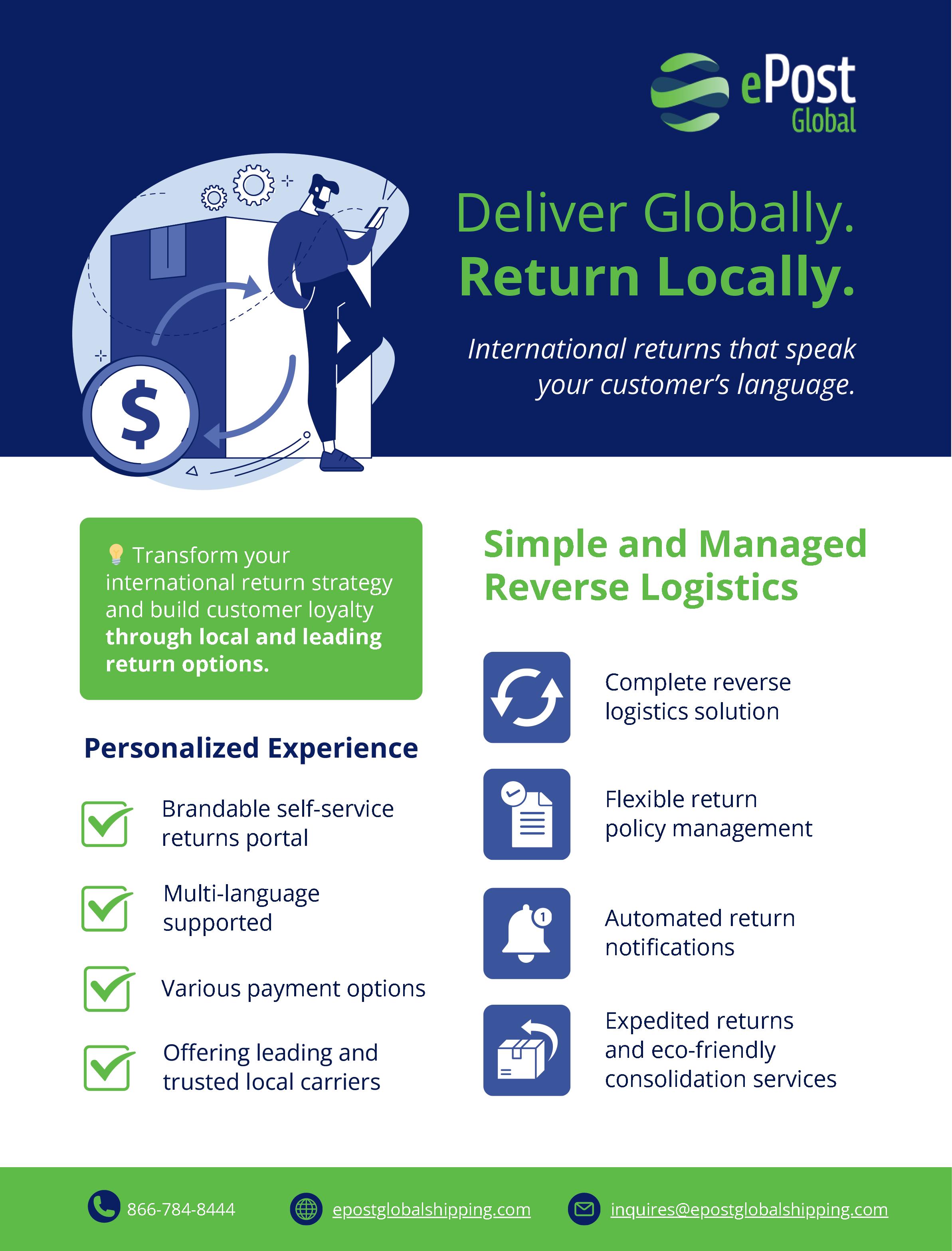
Enhance your customer’s return experience with ePost Global’s International Returns Management solution. Our customizable, brandable consumer portal offers flexible return methods, discounted shipping rates, and trusted regional providers for easy, secure returns. With cross-border data provisioning and adaptable return policies, retailers ensure customs compliance and streamlined reverse logistics on a global scale. Build customer loyalty, boost confidence, and simplify your international expansion with ePost Global’s powerful returns management solution.
FirstMile offers innovative solutions for parcel returns through our Xparcel Returns service, streamlining the process for businesses and customers. With on-demand prepaid labels and QR codes, businesses are only charged for completed returns, reducing costs and boosting efficiency. Customers can drop off items at local points without needing a printer, enhancing convenience. Beyond returns, FirstMile provides comprehensive domestic and international shipping with data-driven optimization. Unlike rate-shopping tools, we are a carrier that handles physical pickups and shipment induction, connecting national, regional, and local delivery networks for seamless, cost-effective delivery through our proprietary Xparcel method.
With over 20 years of e-commerce experience, we empower brands with comprehensive logistics solutions, enhancing customer satisfaction and streamlining operations. Our services cover all aspects from storage and order fulfillment to efficient returns management, ensuring products are processed accurately and returned smoothly. Our proprietary ship method optimizes parcel spend with the best combination of speed and cost, leveraging a strong carrier network to manage returns efficiently. This helps brands maintain control, reduce costs, and foster trust with their customers. By managing complex logistics, ShipNetwork enables businesses to focus on growth and exceptional customer experiences.
SiftedAI provides comprehensive monitoring of shipping spend, carriers, and contracts, delivering personalized recommendations and ongoing cost optimization. By building custom reports that integrate SKU-level data with invoices, users can accurately assess individual product costs. With a clear, data-driven view of their shipping expenses, SiftedAI empowers businesses to establish profitable, customer-friendly returns policies.
solutions handle the efficient recording and integration of data in warehouses and logistics centers throughout the world. VITRONIC has an expanded portfolio of offerings that provide a complete dimensioning, weighing, and scanning solution for logistics automation, whether items are on pallets, boxes, bags, or unpackaged goods. Intelligent, modular sorting systems, like the VIPAC Small Sort, combines the collection of shipment data and automatic sorting, together in one end-to-end solution.
PARCEL INSURANCE: A MUST-HAVE FOR ANY SHIPPER
Shipping insurance is a must-have for any company that sends packages out the door. Don’t rely solely
the carrier-provided insurance; check out the two companies below to see if they’re
pipinsure.com/savemore/.
BY BOB MALLEY
THE CASE FOR MULTI-CARRIER TMS SOLUTIONS: INTELLIGENT, COST-EFFECTIVE DECISION-MAKING FROM ORDER TO FULFILLMENT
With the explosive growth of e-commerce, shippers can’t hide from the complexity that has crept into the parcel industry and is eroding shipper margins. This complexity challenge cannot be solved by simply sourcing with a single carrier, no matter how comprehensive their services are or how efficient their shipping systems are at printing labels. Today, there are many more decision factors and variables that need to be considered to manage costs and service offerings effectively.
Unlike carrier-provided shipping systems operating at the end of a warehouse conveyor, modern parcel transportation management systems (TMS) are designed to automate complex end-to-end decision-making throughout the order-to-delivery process, protecting margins while streamlining operations. Below are five ways parcel TMS platforms tackle the complex challenges that modern logistics managers face — challenges a single-carrier solution simply can’t overcome.
1. High-Speed Rating and Delivery Options in Digital Storefronts
The digital storefront is the new battleground for customer experience and brand loyalty. Just as marketing messaging has become more targeted
based on customer-specific product preference data, offering delivery methods suited to the customer is also a key differentiator. In fact, recent McKinsey research found that 34% of online shoppers now expect multiple delivery options.
For example, some customers may want same-day delivery, PO box deliveries, specialized services like BOPIS (buy online, pick up in-store), more sustainable choices, or over-the-threshold setup services. Not all carriers can provide all these services, nor can their solutions make data-driven, customer-specific decisions. And their APIs can’t calculate rates fast enough to keep up with digital storefront processes. In comparison, parcel TMS solutions feature in-platform optimization engines designed to process thousands of carrier rates, times in transit, and customer-specific delivery instructions per second.
In B2B environments, the need for customer choice is even greater. Many business customers prefer using their own carrier billing accounts or their own negotiated rates. Parcel TMS platforms are smart enough to apply and account accurately for carrier billing instructions.
2. Improve Margin by Plugging Spend Leakage
Free shipping is a crucial part of the e-commerce experience, with 90%
of shoppers abandoning shopping carts if they don’t see it offered at checkout. But of course, free shipping isn’t actually free. Businesses need to accurately calculate or, better still, avoid shipping costs to minimize margin erosion. Unfortunately, the gap between expected and actual carrier costs continues to widen as rate structures grow more complex, with added surcharges, fluctuating discount levels, and seasonal pricing changes. Single carrier solutions don’t focus on shippers’ margins, but parcel TMS platforms do.
Parcel TMS solutions enable shippers to configure instructions to plug the spend leakage problems that regularly show up in invoice audits, thereby avoiding unexpected surcharges and errors. These systems route to alternative carriers offering more forgiving DIM factors, out-of-area surcharges, residential charges, and peak season fees.
And despite what some advocates for a single-carrier solution suggest, shippers needn’t fear “volume dilution” of their primary carrier incentive if they diversify their carrier network. Parcel TMS solutions have the ability to monitor primary carrier spending levels and only allow routing to other carriers once primary carrier discount targets have been met. It is a win-win-win for shippers, primary carriers, and alternative carriers.
3. Make and Keep Cost-Effective Delivery Promises
There are indeed service level inconsistencies among different carriers. According to a recent DC Velocity article, one in three (27%) home delivery packages are delivered late. Unless shippers opt for expensive express services, most parcel carriers can’t provide firm delivery commitments, especially for ground shipments outside of urban areas.
Parcel TMS platforms leverage predictive machine learning models to monitor carrier performance based on shipping history and can provide shippers with more accurate delivery estimates throughout the order-to-delivery process. But why use a two-day express service if history shows a ground service can achieve the same result? Even in a single carrier environment,
businesses can utilize parcel TMS solutions to confidently offer accurate delivery windows without resorting to premium shipping options, improving both margin and customer satisfaction.
4. Intelligent Diversified Carrier Management
Another argument single-carrier advocates make against a multi-carrier solution is that it leads to increased administrative overhead. Managing multiple carrier accounts, monitoring service levels, and optimizing for cost can indeed be complicated — but with the right technology, it doesn’t have to be.
Unlike legacy shipping platforms that require costly and inflexible custom programming, parcel TMS platforms enable business users to easily configure automated routing, customer preference, cartonization, and other instructions in minutes instead of weeks. Parcel TMS systems dynamically decide when, where, and how to use specific carrier services cost-effectively and efficiently.
Rather than avoiding complexity, a well-managed multi-carrier approach through a parcel TMS can be a strategic competitive weapon.
5.
Intelligent
Packing Reduces Carbon Emissions and Waste
Sustainability is increasingly important to consumers, especially younger generations. Most consumers have experienced the frustration of receiving a small product in an oversized box filled with wasteful packaging materials. Parcel TMS solutions solve that problem by determining the most cost-effective way to pack an order based on SKU-level packing instructions.
By applying cartonization instructions during shopping carts (where rules of thumb often prevail), order allocation, and fulfillment processes, parcel TMS users can better predict shipping costs and avoid unexpected dimensional weight adjustments on their carrier invoices. Carriers can cube out their vehicles, giving consumers a more
The Future of Parcel Shipping: Why TMS Is the Smarter Choice
There is no doubt that the major carriers offer valuable, quality services. But in an increasingly complex shipping world, parcel TMS solutions provide businesses the flexibility, control, and efficiency to thrive. Whether managing single or multiple carriers, parcel TMS platforms simplify operations, protect margins, and enhance customer satisfaction. For businesses looking to stay competitive, adopting a parcel TMS is not just a smart choice — it’s an essential step toward sustainable growth and long-term success.
Bob Malley is CEO of Sendflex Technology. To learn more about their parcel TMS solutions visit https://www.sendflex.com/ or reach out directly bob.malley@sendflex.com.
OPTIMIZING YOUR ORDER FULFILLMENT PROCESS
By Jeff Haushalter
Order fulfillment turns shopper dreams into reality, and the efficiency of order fulfillment can make or break a business. It is the most critical part of the sales cycle. Order fulfillment can be broken down into four steps:
1. Receiving the Order: Capturing order details, checking inventory, collecting payment, and formally accepting the order
2. Processing the Order: Picking products, packing them, and preparing for shipment
3. Shipping the Order: Selecting the appropriate carrier, printing shipping labels, and sending the package to the customer
4. Handling Returns: Efficiently managing returns to maintain customer satisfaction and minimize losses
Each of the above steps has a dollar and time impact. Spending excess time on a task adds cost and decreases customer satisfaction. This leaves a company open to customer regret, order cancellations, and, in the worst case, customer defections.
The order fulfillment process is a loop (see Figure 1) because each step sets up subsequent steps for success or failure. As an example, failing to check inventory levels before accepting an order can cause backorders. Customers must then wait for a complete order or freight charges will increase from split shipments.
Optimization finds the best possible solution from all viable options. It can maximize necessary components (like profits or throughput) or minimize components (like cost per order) that are less desirable.
Parcel order fulfillment is difficult to optimize. New product introductions, changing order quantities, promotions, seasonality, dimensions, etc. introduce multitudes of variables and constraints that overwhelm many traditional optimization processes.
It is also unlikely that companies can perform a comprehensive “clean sheet” optimization. Decisions made in the past introduce fulfillment tradeoffs (see Figure 2) that must be accounted for.
What can be done, however, is finding improvements that increase efficiency, reduce costs, and improve supply chain velocity. To succeed, follow a structured approach of “baseline, prioritize, and accelerate.”
Steps to Take
Baseline your current fulfillment operations before implementing any optimization effort. Establishing a solid reference point involves assessing your current performance, identifying bottlenecks, and understanding your operational capabilities.
Measure your current performance using key KPIs such as order accuracy, order cycle time, inventory turnover, warehouse space utilization, and return rates. These metrics provide a quantitative baseline against which you can measure future improvements.
Next, conduct a thorough walkthrough of the fulfillment process. Document each step, from order receipt to delivery, and identify areas where delays or errors occur. Consider the impact of growth on these processes.
Look for performance gaps versus your competitors. Likewise, look at non-competing companies to stretch performance expectations and avoid being disrupted.
Lastly, collect feedback from customers and employees to identify specific pain points and areas needing improvement. Customer feedback highlights satisfaction issues while employee feedback identifies hidden operational inefficiencies.
Prioritizing warehouse initiatives requires a methodical approach. Start by listing all potential initiatives and evaluate their costs, both initial and ongoing, as well as their expected timeframes for implementation and benefits realization.
Focus on initiatives that offer the highest return on investment (ROI) with the lowest cost. These should be prioritized as they provide significant improvements without straining the budget. For example, implementing a basic inventory management system might be more cost-effective and quicker to implement than a fully automated picking system.
Next, assess the time factor. Prioritize initiatives that can
be implemented quickly and provide immediate benefits. Short-term wins build momentum with stakeholders. For instance, reorganizing the warehouse layout for better efficiency can be done relatively quickly and yield immediate results.
Plot initiatives on a cost versus time matrix graph. Initiatives falling in the low-cost, short-time quadrant are prime
candidates for immediate action. High-cost, long-time projects should be scrutinized for their long-term strategic value and possibly broken into smaller, more manageable phases. Lastly, companies should deploy accelerators that can provide significant cost and time improvements. These fall into three categories: integrating systems, inventory management, and infrastructure.
Systems Integration
Integrating advanced system technologies into your fulfillment process can dramatically improve efficiency and agility. Key technologies to merge include Order Management Systems (OMS), Warehouse Management Systems (WMS), and shipping software.
An OMS consolidates orders from multiple sales channels into a single system. This integration ensures a centralized view of all orders, simplifying the processing and reducing errors. By automating order updates and inventory adjustments, an OMS enhances both speed and accuracy in the fulfillment process.
A WMS automates and optimizes warehouse operations. It helps in organizing the warehouse layout, ensuring products are easy to find and reducing the time taken to pick and pack orders. It also helps manage the costliest warehouse component: labor.
Shipping software streamlines the shipping process by automating carrier selection, rate shopping, label printing, and shipment tracking. By integrating with your WMS and OMS, the most cost-effective and quickest shipment option will be chosen and customers will be able to self-serve any questions around package deliveries.
The next accelerator is inventory management. Poor inventory management can lead to stockouts, overstocks, and ultimately, dissatisfied customers. Here are three suggestions: Accurate demand forecasting tools minimize the risk of overstock and stockouts. These tools use historical sales data, market trends, and seasonal patterns to predict future demand.
Real-time inventory tracking ensures an accurate on-hand number, across multiple locations and channels. This visibility allows for better planning and quicker responses to demand changes, improving both speed and cost efficiency.
Lastly, adopting a just-in-time (JIT) inventory approach reduces carrying costs by ordering stock only when needed. This method requires a reliable supply chain but significantly cuts down on storage costs and reduces the risk of obsolete inventory.
Our last accelerator is automating repetitive tasks to save time and reduce human errors. Implementing automated picking systems such as integrated conveyance, robotic pickers, goods-to-man, or voice-directed picking enhances picking speed and accuracy. Automated packing machines can also quickly and accurately pack products, further reducing the time and labor to prepare orders for shipment.
Customer expectations have risen to the point where quick deliveries, accurate orders, and hassle-free returns are the new normal. Implementing the strategies above will help you create a robust, efficient, and agile order fulfillment process to meet customer demands and drive business growth.
Jeff Haushalter is Partner at Chicago Consulting where he focuses on decreasing costs and improving service via warehouse operations, parcel spend management, and optimal packaging practices, among others.