The articles in this magazine represent the views of the authors and not those of MadMen3 or Mailing Systems Technology. MadMen3 and/or Mailing Systems Technology expressly disclaim any liability for the products or services sold or otherwise endorsed by advertisers or authors included in this magazine.
MAILING SYSTEMS TECHNOLOGY
(ISSN 1088-2677) [Volume 37 Issue 2] is published six times per year (January/February, March/April, May/June, July/August, September/October, November/December) by MadMen3, PO Box 259098 Madison WI 53725-9098, 608-241-8777. Periodical postage paid at Madison WI and additional offices.
POSTMASTER
Send address changes to:
Mailing Systems Technology
PO Box 259098
Madison WI 53725-9098
MAKING YOUR MAIL PIECE STAND OUT
BY AMANDA ARMENDARIZ
This issue of Mailing Systems Technology is our Inkjet Summit show issue, so it’s only fitting that I mention the importance of color when it comes to your mail piece getting noticed. As mailers, we have such an advantage over digital marketing. Emails and social media ads overwhelm the average consumer by their sheer volume, but the fact that mail volumes are much lower than they have been in the past actually works in our favor (although these lower volumes affect the industry in other ways, but that’s a discussion for another time). Because mail pieces are not sent out in the volume that digital messages are, and they possess a sense of legitimacy that electronic message lack (have you ever received a physical letter from a Nigerian prince asking for money? I’m not saying it’s impossible, but I’ll wager it’s highly unlikely), they are much more likely to be picked up, examined, and engaged with. And the strategic use of color ups the effectiveness even more.
So if you’re at Inkjet Summit, make sure you take the time to really examine all of the offerings available. Don’t send out boring, utilitarian mail pieces; take the time to create eye-catching, color-popping communications that will make your customers eager to learn more about your company. After all, we already have an advantage; why not take it all the way to the next level? Rob Hanks gives some great ideas on incorporating color into mail pieces in his article on page 26.
And speaking of trade shows and taking your mail pieces to the next level, the National Postal Forum is a great place for mailers to meet and exchange ideas. I am looking forward to this year’s show, and I hope to see many of you there! As always, thanks for reading Mailing Systems Technology.
TEAMWORK MAKES THE DREAM WORK
BY WES FRIESEN
Iam writing right before the 58th Super Bowl game between Kansas City and San Francisco. For those of us who are fans of team sports, isn’t it exciting to see our favorite teams blend their individual talents and abilities and achieve success as a unified team? The good news is that our teams in the business world can also achieve success — and the key to making that happen is teamwork. What is teamwork? I like Andrew Carnegie’s definition: “Teamwork is the ability to work together toward a common vision. The ability to direct individual accomplishments toward organizational objectives. It is the fuel that allows common people to attain uncommon results.”
Twelve Principles to Build High-Performance Teamwork
1. Make a Commitment to Pursue and Model Teamwork. There is a temptation for us in leadership roles to charge ahead based on our individual talents and abilities. But these quotes from two successful CEOs give sound advice. Reid Hoffman (LinkedIn) counseled, “No matter how brilliant your mind or strategy, if you’re playing a solo game, you’ll always lose out to a team.” Steve Jobs (Apple) said, “Great things in business are never done by one person. They’re done by a team of people.” And Helen Keller once said, “Alone we can do so little; together we can do so much.”
2. Create a Psychologically Safe Learning Environment. Amy Edmondson of Harvard is the world’s leading expert on psychological safety. She explains that team psychological safety is a shared belief held by team members that it is OK to take risks, to express their ideas and concerns, to speak up with
questions, and to admit mistakes — all without fear of negative consequences.
3. Build Trust with Integrity. As a leader of a team, we need to walk with integrity and build trust for us — and build trust among all team members. Building trust comes down to being a person of good character. Author Marsha Sinetar said it well: “Trust is not a matter of technique, but of character. We are trusted because of our way of being, not because of our polished exteriors or our expertly crafted communications.” We model integrity and build trust as we walk our talk, listen to others, always be honest — and be humble enough to admit our mistakes and ask for forgiveness when needed.
4. Put the Team First. In the middle of a very high-performance team is a common purpose — a sense of vision and mission that unites and inspires each individual team member. Make sure you ask for participation from the team when developing the common purpose, remembering the principle that “change imposed is change opposed” and Ken Blanchard’s quote that “none of us is as smart as all of us.”
Alexander Graham Bell summarizes well when he said, “All winning teams are goal oriented. Teams like this win consistently because everyone connected with them concentrates on specific objectives. They go about their business with blinders on; nothing will distract them from achieving their aims.”
5. Communicate Openly and Candidly. High-performing teams are empowered teams, and information is a major source of power. Sharing the team’s key
performance metrics and indicators and ongoing status is crucial. Ask yourself, “What do team members need to know on a daily, weekly, and monthly basis to manage performance?” Tools such as balanced scorecards, dashboards, teamwork review meetings, and 1-1 coaching sessions can be helpful.
6. Be Part of the Solution, Not the Problem. There is no substitute for personal ownership, responsibility, and self-control. These are traits that we can model — and intentionally encourage in our team members. Also, recognize that problems will arise — and they may be blessings in disguise if we learn and grow from them. Mark Victor Hansen encouraged us with “Problems are good, not bad. Welcome them and become the solution.” Rene Descartes reminded us: “Each problem that I solved became a rule which served afterwards to solve other problems.”
7. Commit to Excellence. One of my sayings is that “we can choose to be mediocre — or we can choose to strive for excellence. The choice is ours.” The reality is that if we do not intentionally choose to strive for excellence the default choice is to settle for being mediocre. I agree with Mario Andretti when he said, “Desire is the key to motivation, but its determination and commitment to an unrelenting pursuit of your goal — a commitment to excellence — that will enable you to attain the success you seek.”
8. Promote an Atmosphere of Respect. One way to show we really respect someone is to actively listen to them and then respond appropriately. Socrates once said, “You have two ears and one mouth. Use them appropriately.” James O’Toole explained a benefit of active listening when he said, “Almost all employees, if they see that they will be listened to, and they have adequate information, will be able to find ways to improve their own performance and the performance of their work group.”
Showing respect also includes positive encouragement and expressing our appreciation and approval. I like Charles Schwab’s quote, “I have never seen a man who could do real work except under the stimulus of encouragement and enthusiasm and the approval of the people for whom he was working.”
9. Ask and Encourage the Right Questions. The art of questioning is an
important management skill. It is a “pulling” technique — challenging people to think, to probe, to investigate, to challenge assumptions and, to seek answers. John Chancellor illustrated the importance of this skill when he said, “If you take a close look at the most successful people in life, you’ll find that their strength is not in having the right answers, but in asking the right questions.”
10. Use a Rational Problem-Solving Process. Albert Einstein supports the need for rational and thoughtful problem-solving processes when he said, “The significant problems we face cannot be solved at the same level of thinking we were at when we created them.”
There are several rational problem-solving processes to choose from. One such approach is to follow these steps:
1. Gather data.
2. Review facts.
3. Define the problem and desired endstate.
4. Ask questions and identify alternative solutions.
5. Evaluate each alternative.
6. Select “best” alternative.
7. Implement chosen alternative.
8. Evaluate after the fact effectiveness of solution; make changes if necessary.
11. Promote Interdependent Thinking. The key here is to promote “we” thinking — not “me” thinking. Vince Lombardi encouraged us to “Build for your team a feeling of oneness, of dependence on one another and of strength to be derived by unity.” Having talented team members and encouraging development of individuals is important — but Michael Jordan put it into perspective when he said, “Talent wins games, but teamwork and intelligence wins championships.” Phil Jackson added, “The strength of the team is each individual member. The strength of each member is the team.”
12. Pull the Weeds. Most people on a team are willing and able to “play by the rules” and be a value-added member of a successful team. But the reality is that sometimes we may have a team member
that is either not capable or is not willing to meet expectations — even after we have tried to remedy the situation. We are then faced with the choice of allowing the “weed” to remain and hold back the team’s success, or to remove the weed so the rest of the team can grow. Voltaire said, “we must cultivate our garden” and that applies to the teams we lead.
Let me close with a quote from Mother Teresa: “I can do things you cannot, you can do things I cannot, together we can do great things.” Teamwork truly helps make the dream work of an even more successful team!
Wes Friesen (MBA, EMCM, CMDSM, MCOM, MDC, OSPC, CCE, CBF, CBA, ICP, CMA, CFM, CM, APP, PHR, CTP) is a proven leader and developer of high-performing teams and has extensive experience in both the corporate and non-profit worlds. His book, Your Team Can Soar!, has 42 valuable lessons that will inspire you and give you practical pointers to help you — and your team — soar to new heights of performance. Wes can be contacted at wesmfriesen@gmail.com or at 971.806.0812.
USPS GREENWASHES ITS NETWORK CHANGES – ANALYSIS
BY LEO RAYMOND
In an unabashed example of creative reinterpretation, the Postal Service has reframed the ongoing changes to its processing and transportation networks as initiatives designed to reduce its carbon footprint.
In a lengthy Industry Alert issued February 6, the agency asserted that the environmental benefits flow from elements of Postmaster General Louis DeJoy’s 10-Year Plan, repeating some of his stock criticisms of past management:
“Reduce our regional and local network transportation by at least $2.5 billion by aggregating volume in fewer facilities, moving mail and packages regionally in an integrated manner eliminating thousands of trips each day and using less air transportation.
“Reduce our processing, distribution, and delivery costs by at least $2.5 billion by insourcing previously outsourced operations, consolidating operations out of random buildings, modernizing facilities, reorganizing operating plans and schedules, adding more sortation equipment, and improving operating tactics to increase throughput, gain productivity and increase asset utilization.
“All of these initiatives will significantly reduce carbon emissions by eliminating wasteful and unnecessary operating
activities that have been deployed for almost two decades.”
The release quoted Jennifer BeiroRéveillé, senior director of environmental affairs and corporate sustainability and an ardent advocate of DeJoy’s Plan:
“Our customers and partners expect the Postal Service to be efficient and environmentally responsible and I’m proud that our leadership team has developed meaningful sustainability goals and aligned them with our operational efficiency, service improvement, and revenue growth initiatives. These new targets help advance our commitment to being the greenest way for customers to mail and ship across the country.”
Spin
In describing actions being taken to reduce costs or rework its networks, the Postal Service listed them instead as initiatives to reduce environmental impacts:
“The Postal Service is reducing greenhouse gas emissions across the organization by moving freight from air to ground transportation, optimizing delivery routes for trucks and carriers, and procuring reduced-emission and zero-emission vehicles. By fiscal year 2030, USPS seeks to reduce Scope 1 and Scope 2 greenhouse gas emissions by
40% [and] reduce Scope 3 greenhouse gas emissions by 20%.”
The announcement included measures aimed at “strengthening the circular economy,” aiming by 2030 to “divert 75% of waste from landfills; increase recycled content of packaging to 74%; increase package recyclability to 88%; [and] increase renewable energy use to 10%.”
Seeking to appear as an environmental leader, the notice stated that “throughout its work to create a greener Postal Service, the organization will continue to educate its 640,000 employees, local communities and federal, state and local partners on its progress.” In other words, the agency will continue to claim that actions being taken for operational or financial reasons are actually motivated by its dedication to environmental concerns. Presumably, while the USPS is trumpeting its “rollout of the nation’s largest electric vehicle fleet,” no one is supposed to remember that DeJoy resisted purchasing more than 10% electric vehicles as part of the fleet replacing its aging LLV delivery vehicles, that he upped that proportion after he was broadly criticized by environmentalists, that the agency’s environmental impact statement had to be rewritten, and that DeJoy enthused about a higher proportion of EVs only after Congress appropriated billions to pay for them.
Greenwashing
Merriam-Webster defines greenwashing as “the act or practice of making a product, policy, activity, etc. appear to be more environmentally friendly or less environmentally damaging than it really is.”
In this case, DeJoy has heretofore been pursuing changes in the transportation and processing networks as cost reduction or “efficiency” measures. Service standards were reduced to enable less costly ground (vs air) transportation, trips were reduced to improve vehicle utilization, and the recently-introduced “Optimized Delivery” program was developed to reduce trips to smaller post offices and enable replacement of contracted transportation with unionized postal employees.
Obviously, reducing service enables reductions in related processing and transportation which, in turn, means less vehicle fuel consumption and emissions. However, spinning such actions as designed to provide environmental ben-
Merriam-Webster defines greenwashing as “the act or practice of making a product, policy, activity, etc. appear to be more environmentally friendly or less environmentally damaging than it really is.”
efits is cynical and disingenuous, if not downright false.
When the USPS filed to reduce service standards for First-Class Mail and some Periodicals, the lead reasons for its action were to reduce unnecessary transportation, move mail out of airplanes and onto trucks, eliminate trips that were less than full (though “full” was never defined), and enable changes to processing
schedules. Reducing the postal carbon footprint wasn’t a topic.
Similarly, establishing a revised processing network of regional and local processing centers, closing annexes, and setting up sort and delivery centers was overtly motivated by the replacement of outmoded facilities, establishment of a more “efficient” mailflow, and concentrating carriers at a place where parcel sorting
equipment would be available. Environmental purposes were never featured.
Moreover, the S&DCs have been widely suspected as resulting in more driving and requiring more routes (and trucks) to deliver to the same number of addresses — hardly an environmentally-friendly outcome.
As a result, the Postal Service’s February 6 anointment of the PMG’s 10-Year Plan as designed to reduce the agency’s carbon footprint is laughably contrived. Essentially asserting that the USPS is reducing service so it can be good to the environment is transparently disingenuous. But such spin is typical of an organization whose leader prefers to revise the agency’s situation to create his own alternative reality.
Leo Raymond is Owner and Managing Director at Mailers Hub LLC. He can be reached at lraymond@mailershub.com. This article is based on information from a recent Mailers Hub newsletter.
ELEVATING THE CUSTOMER EXPERIENCE: CORRECT, ENHANCED DATA RAISES THE BAR
BY GREG BROWN
Dirty data makes it hard to serve clients and grow business. This challenge applies to any industry aspiring to build loyal customers with great service and smart products. Insurance agents optimizing policies, retailers reliably delivering the goods, online gaming platforms recognizing their best customers with special offers, banks combatting fraud and onboarding customers easily and seamlessly from their mobile devices, get-out-the-vote campaigns seeking lookalike constituents… in these settings and so many more, the customer journey and the communication they receive is everything.
Whether the “customer” is a homeowner, shopper, or voter, their pivotal role in defining a brand's success cannot be overstated. Yet according to Gartner, three percent of customer contact data decays every month. That means around 25% of the average CRM database becomes inaccurate annually.
In a single year, changes are immense:
18% of all telephone numbers change (according to ReachForce)
22.5% of email addresses decay (according to HubSpot)
20% of postal addresses change (according to the USPS)
10% of CRM records are duplicated (according to On the Record)
If a customer’s perception and experience with a brand determines its market standing, customer experience must be a priority. Understanding and reaching them requires a data hygiene plan — the key to retaining current customers and nurturing new ones. A straightforward but consistent and comprehensive checklist covers the bases.
Run customer and prospect lists through a data cleansing program to verify addresses, mobile and landline phone numbers, and email addresses.
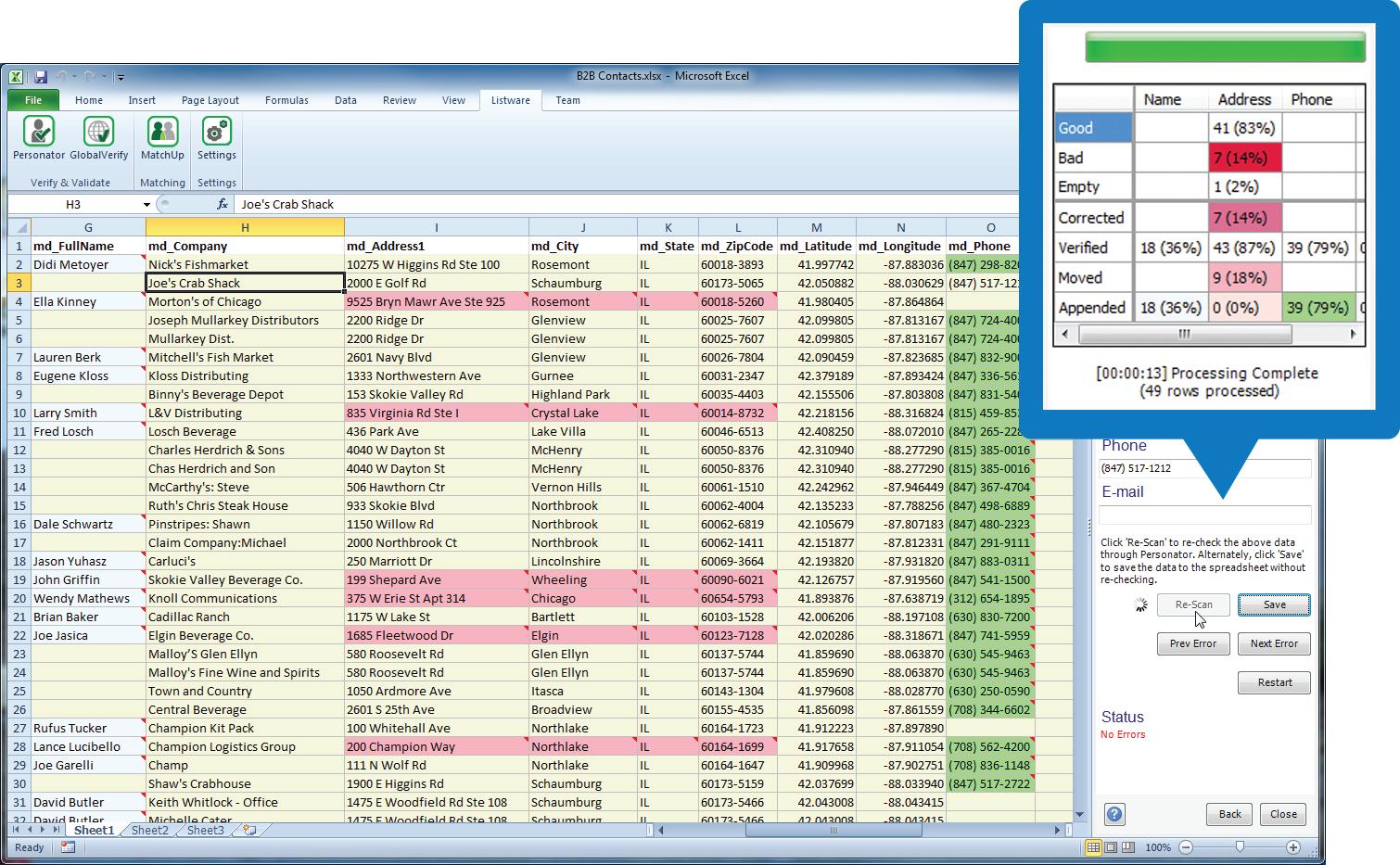
1. Clean your CRM at least twice a year Run customer and prospect lists through a data cleansing program to verify addresses, mobile and landline phone numbers, and email addresses. There are no excuses for a business skipping this task, with different programs spanning the full range of needs — from integrations for popular CRM platforms like Salesforce and Dynamics, to spreadsheet apps for Google Sheets and Excel, to SaaS options. Whatever the platform or format, files can easily be uploaded and processed to return clean and correct contact data in seconds.
2. Update or add missing addresses, phone, and email data
Clean data adds value in layers. Business operations prevent decay by keeping client data up to date, but firms can also unlock the power of multi-channel marketing by adding email addresses to postal lists, or adding mobile numbers to email lists.
Altapass Foundation is a 501(c)(3) public non-profit, charged with preserving the history, heritage, and culture of the Blue Ridge Mountains. Its large database of supporters and partners was accumulated over many years but plagued by outdated contact data. Also, because many of its members did not provide or use email, the foundation relied heavily on traditional mail outreach, resulting in a significant amount of returned mail. Using a data cleansing, deduping, and enrichment tool that integrated directly into Excel (where most of its contact data was stored), Altapass tapped into multisource data to verify, correct, and update its contact records. The tool returned the current addresses of individuals or businesses that have moved, processing records dating as far back as ten years. All data touch points were associated with a contact, cross-referencing names to correspond with an address, email, and phone data. After initial data cleansing, the foundation mailed postcards to more than 400 people with whom they had not had contact for four to eight years — with only one postcard returned.
3. Append demographic, geographic, and property data to contacts
Augmenting internal data with external information enables a more nuanced understanding of customer behaviors and overall preferences. The more a business knows about its clients, the better it can communicate with them, develop the most attractive products and services, protect against risk and fraud, and identify opportunities for upsell and cross-sell.
4. Dedupe your CRM
Find those sneaky twins that are lurking in the CRM system. Duplicate contacts happen due to inaccurate data entry by employees or customers themselves. They cloud a business’s ability to market effectively, result in excessive postage and high lead acquisition costs, create a hassle for sales and marketing teams, and prevent accurate calculation of customer lifetime value (CLV) — especially if many clients don’t actually exist. While most CRM platforms have some level of built-in duplicate merging, add-on data quality products boost the ability to sniff out duplicates with advanced matching algorithms and machine learning.
Clairvoyix, a Nevada-based consumer data management and direct marketing firm, performs data hygiene and enhancement services for La Quinta Inns & Suites, one of the US’s largest operators of limited-service hotels. Clairvoyix captures a file of each guest checkout record nightly, as part of the guest’s entire history. The hotel chain’s Software as a Service (SaaS) platform for marketing automation then verifies, updates, and standardizes the data throughout the night. Costs for consumer data hygiene decreased by more than $100,000 in the first year. Email verification adds even more value, with domain names automatically updated, syntax verified and repaired, and mail servers confirmed as valid and accepting mail. The company added nearly a million email records to La Quinta’s existing mailing addresses, supporting La Quinta’s record growth reported in the following quarter.
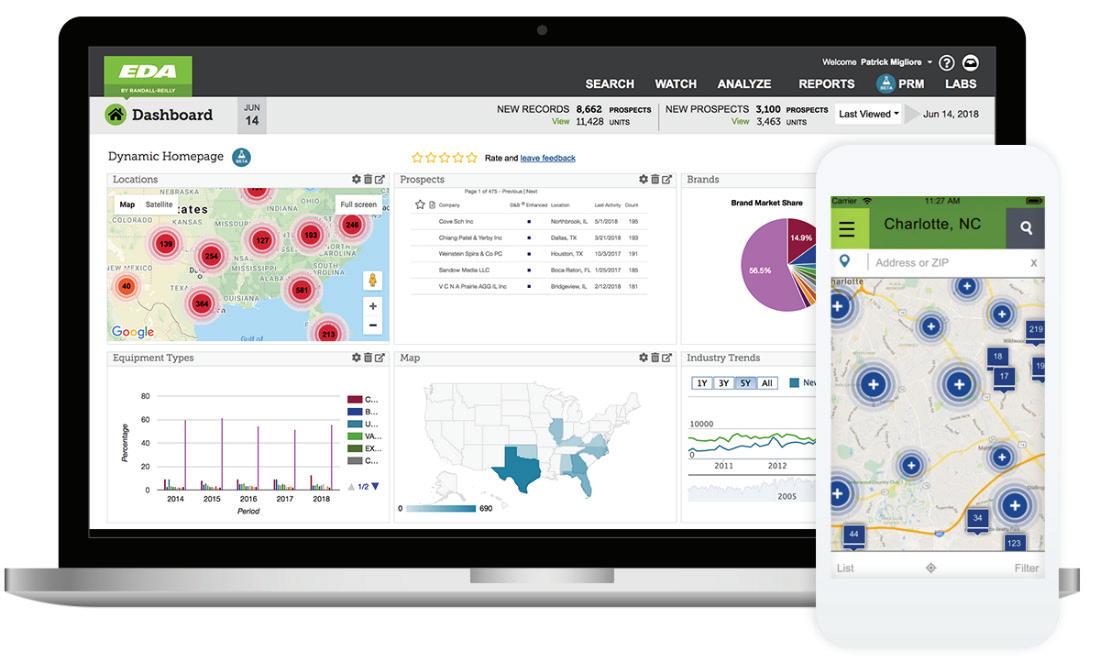
Equipment Data Associates (EDA) provides equipment-based market intelligence data to more than 4,000 clients in the trucking, construction, and agricultural industries, as well as data services, media advertising, and custom marketing services to the banking sector. Featuring 54 fields of data, such as equipment descriptions, buyer name, county of transaction, transaction type and date, EDA empowers its clients with metrics and analytical tools to gain strategic insights into their customers’ behavior and identify new prospects. To ensure a single, accurate view of contact data, EDA automated a multiplatform API that finds, merges, deletes, and prevents duplicate records. Integrated at different points in the company’s system, for example, comparing new records at the point of entry or batch processing an entire list, 10 to 50 million records per hour are verified and deduped across multiple tables and data silos. EDA eliminated hundreds of man-hours per month in labor, while enabling its clients with a seamless duplicate suppression mechanism for optimal results in gathering new leads.
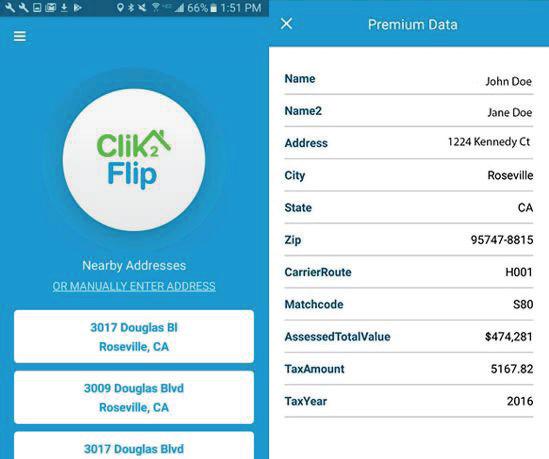
Clik2Flip is an online value calculator, helping real estate investors make informed opinions about a particular property. Using geolocation and a rich database of personal and location information, the company’s data tools verify the names that correspond to addresses, along with email addresses and phone numbers. Demographic data is added, including whether the occupant on site is a renter or owner, length of residence, household income range, and occupation. The tool provides last-sale information, and can even assess if the property is occupied — valuable insight for investors assessing an owner’s willingness to sell.
An enhanced lookalike report takes a broad view of a business's customer base — identifying sectors where market presence is strong or weak, learning who their best customers are, how they differ from less active customers, and how many prospects exist in a specific regional or nationwide trade area. Using third-party data validation services, an existing file is matched against a comprehensive database and enhanced with demographic/lifestyle/interest data. The report applies a Market Penetration Index (MPI), assessing and revealing higher or lower representation of each attribute in the business's customer portrait. Businesses can then purchase a list of leads who closely resemble contacts identified as “best performers” or “undecided prospects,” or apply the intelligence in other ways depending on their goals.
5. Find new prospects just like your best clients
A Customer Look-Alike report provides a detailed portrait of a company’s ideal customers including many demographic elements. This helps organizations define their market and better target their marketing campaigns. Additionally, armed with the data, companies can easily reach potential new clients just like their best ones when purchasing new leads. Customers define your company’s success, whether measured by selling more insurance policies, increasing online sales, or getting out the vote. Ultimately, a data-driven and customer-centric marketing approach meets the challenge — and demonstrates that a business cares enough about its customers to enrich their buying experience and prioritize improved engagement, loyalty, and advocacy.
Greg Brown is vice president of global marketing, Melissa.
Example 4
Example 3
Example 5
THE POWER OF THE ENVELOPE
We all know that physical mail pieces have an advantage over their digital counterparts, and the envelope can be a major contributing factor to customer engagement. You spend so much time making sure that the mail piece itself is eye-catching, but don’t overlook the power of the envelope! Below are 5
who can help you take your envelope game to the next level.
Envelope Mart USA has offered a broad range of envelope products and services from small, medium, and very large quantity projects for nearly 50 years. Our unique approach sets us apart with dedicated CSRs, 24-hour a day manufacturing with Quality Control teams on-duty, warehouse and distribution services, and supply agreements available for a guaranteed uninterrupted supply of goods. Envelope Mart USA focuses on attention to detail like no others, with one-of-a-kind systems and procedures ensuring consistency and accuracy. We are strategic partners to our clients, and continually offer solutions that lead to their growth.
| www.envelopemart.com | info@envelopemart.com | 419.666.0012 or 800.356.7241
Goelzer Industries stands out as the Envelope Experts, combining precision, exceptional customer service, and an updated, state-of-the-art facility. With advanced equipment like their new W+D 628 roll-fed flexo printer and an expansive suite of three Heidelberg presses and numerous folding machines, Goelzer ensures unmatched product quality and readiness for small to largescale orders. Capacity is never an issue at Goelzer Industries. Their diverse envelope offerings plus their flexibility, tailored to meet various customer needs, along with their expertise in overcoming common industry challenges such as mail insertion jams, precise adhesive application, and precise specs for windows on envelopes, etc. solidify their reputation as an Envelopes Expert.
The MACH 6 printer leverages Memjet® inkjet technology to print on
The simple envelope in a direct mail campaign holds more power than you might think. It acts as the initial impression, the salesperson, convincing the recipient to
self-mailer and over 15% higher than a large postcard. W+D has been empowering the envelope for over 111 years of mail technology leadership.
MAXIMIZING DIRECT MAIL ROI FOR YOUR CUSTOMERS
BY MIKE PORTER
How can you increase your clients’ return on investment (ROI) in their direct mail marketing campaigns without taking a hit on your own revenues? As a print/mail service provider, either in an outsourcer role or as an internal operation, it is in your best interest to help your clients get more from their direct mail campaigns. This keeps your document operations center thriving.
When a client experiences great results from a direct mail campaign, you both win. The client is happy because of positive results and a high return on their investment. Your company is likely to secure more frequent campaigns from the client. Hint: start talking about the next campaign as the positive results from the current job start rolling in.
Strategic Approaches to Enhancing Direct Mail ROI
Print/mail service providers can leverage strategic approaches to enhance your clients’ direct mail ROI. Your operation’s contribution goes beyond merely sending mail; it can sometimes involve expert advice and executing a cohesive and strategic plan.
Design
Design and content are critical, but by the time a mail center manager sees the material, it may be too late to make design modifications. This is why developing an outreach strategy to work with your clients early in the project process is so important. Show clients you have something to offer that can save them money, make the job run more efficiently on your equipment, or improve the response rate. Use your postal knowledge to help your clients avoid running afoul of mailing guidelines. Tell them about aspect ratios, address placement, barcode clear zones, etc. Help them integrate direct mail with other aspects of their marketing strategy. I recall working on an annual project that the internal department had always done on their own. The way they designed it involved several sets of identical personalized labels they then affixed to multiple personalized items and closed-face envelopes. Staffers manually matched items, sorted them into categories, hand-folded the letters, and stuffed them into labeled envelopes. They wanted us to replicate their process until I showed them some alternatives. We switched to legal-size paper with perforations, segmented the
data before printing, and made other changes that eliminated all the matching and hand work. We did it all on our automated equipment, saving them money, days of labor, and frustration.
Get Noticed
Assist your clients by ensuring their direct mail stands out from the clutter. Give them examples of outbound envelope designs that have produced exceptional results in the past. Show them statistics about the effectiveness of different size postcards. Talk to clients about dimensional mail or other innovative ways to make customers pay attention to their mail.
Lower Costs
You might also find ways to lower costs for your clients, which improves the campaign ROI. Discuss the pros and cons of First-Class vs. Marketing Mail. See if you can help clients reconfigure flats as lower-cost letters. Ask about geographic segmentation to increase presort density.
Postal promotions are another opportunity to lower mailing costs. Learn about the promotions and when they apply. Approach clients well in advance and plan to take advantage of the postal savings the USPS offers during the promotional periods.
Precise Timing
Direct mail delivered at the right moment can enhance ROI. Encourage your clients to tap into information sources like their CRM system and consider the ideal timing for their product or service. Discuss triggered mail or connecting mail delivery with messaging in other channels, such as email or text.
Testing
Offer to help your clients compare the effectiveness of different approaches using A/B testing. Show them how to test various designs, offers, and calls to action. Draw attention to the results and recommend adjustments to their approach based on the responses they receive. Recommend a flexible approach and a readiness to adapt based on results from each campaign. Highlight your flexibility to adapt with them.
Capitalizing on Data
The mail center may not have direct access to the data used to create the mailing pieces unless you are doing the composition. But you can suggest improvements to personalization or segmentation based on information that probably exists somewhere upstream in the client’s organization. Talk to clients about the value of providing you with more data than only the names and addresses. Show them how you can turn added data into better targeted mail.
When clients do not have that extra data, you may acquire it for them via third parties. If you can use that data to customize offers or drop unqualified buyers from the list, your clients will notice a difference in how well the campaigns perform.
Enhance your capacity to handle and interpret data. As a result, you can offer more integrated solutions and present your clients with valuable feedback about their customer bases. This will put you in a better position to maximize their ROI and solidify longer-term business relationships.
Mail pieces such as statements, bills, and invoices include a great deal of valuable data. However, if the document center receives only pre-composed printready files, extracting that information seems impossible unless you’ve invested in post-composition document re-engineering software. I have written about this software many times in this column (see “What Can Document Re-Engineering Software Do for the Mail Center”). Use data already in the documents, such as purchase details or customer loyalty levels to customize the documents or add graphic elements like charts or graphs.
Encourage your team to be consistent in their use of data and proactively seek training opportunities to ensure their skills keep pace with change. Informed employees will not only enhance your service offerings but also bolster your reputation as an innovative, forward-thinking service provider.
Personalization Drives Direct Mail ROI
Boost your clients’ direct mail ROI with personalization. Make every message count, ensuring that each piece of direct mail speaks directly to the recipient. This
will increase your clients’ engagement levels and overall campaign success. With variable data printing you can create customized mail pieces that resonate by acting on the specific preferences or needs of each recipient.
Personalization is about more than just inserting the recipient’s name — it requires a 360-degree view of the customer. This is where data management plays a part. By working closely with your clients, you can help them segment their data to reveal valuable perceptions about their customers. These insights can then be used to tailor your clients’ messages, offers, and promotions, resulting in an improved campaign performance. Your service becomes indispensable to their marketing efforts. Make it a point to stay engaged with your clients and keep making suggestions to help them succeed.
Learn how to submit an Informed Delivery campaign on your clients’ behalf and allow them to benefit from this program that now includes over 50 million subscribers.
Effective Tracking
Your clients may not be aware of the big changes in postal mail tracking that have occurred over the last several years. The USPS Informed Visibility program tracks the mail as it advances through the postal distribution network. You can offer your clients precise updates about when their mail pieces are expected to reach their final destinations. Detailed reporting can assure marketers their direct mail campaign is being executed on
schedule, further enhancing their trust in your services. Marketers can also use the tracking data to trigger other actions, such as staffing for an expected influx of inquiries or scheduling a complementary message to be delivered via email.
Another USPS program, Informed Delivery, can increase the number of impressions for your clients’ campaigns at very little cost. Learn how to submit an Informed Delivery campaign on your clients’ behalf and allow them to benefit from this program that now includes over 50 million subscribers. The USPS charges nothing to use Informed Delivery (and during promotional periods, they actually offer postage credit). Print/mail service providers can charge to set up the campaigns for their clients.
The Big Picture
In most scenarios, print/mail service providers are far from being powerless spectators in their clients’ quest to improve direct mail ROI. By offering strategic approaches, leveraging data effectively, personalizing communications, and keeping track of results, they can actively contribute to the achievement of their clients’ objectives. In doing so, they enhance the ROI of their clients’ campaigns and foster stronger relationships built on trust, efficiency, and shared success.
Every direct mail campaign can be an opportunity for print/mail service providers to demonstrate their expertise, while forming a sturdy base for future collaborations. As service providers respond adaptively to their clients’ needs, they promote the continuity of established partnerships and the initiation of future campaigns. Print/mail service providers can be vital allies in maximizing marketing efforts, transforming direct mail from cost to a true investment.
Mike Porter at Print/Mail Consultants creates content that helps attract and retain customers for companies in the document industry and he assists companies as they integrate new technology. Learn more about his services at www.pmccontentservices.com. Follow @PMCmike on X, or send him a connection request on LinkedIn.
FROM DULL DATA TO DYNAMIC DIALOGUES: TRANSFORMING BILLS AND STATEMENTS WITH INKJET AND CCM
BY KAREN KIMERER
Historically, bills and statements were seen as purely functional documents — something essential for providing information, but not something particularly engaging. This was partly due to the limitations of print technology available to produce transactional documents. Other reasons for benign and boring statements stem from the cultural norms of the era, which prioritized efficiency and functionality over aesthetic appeal.
The limitations of technology and the emphasis on a practical approach posed a challenge for brands that aimed to improve customer engagement and stand out through their communications. Consequently, customer interactions were mundane with little potential for capturing attention or conveying the brand's personality. However, with the advent of modern inkjet technology, customer communication management (CCM) initiatives have been transformed — enabling brands to enhance customer experiences. This article will highlight how inkjet technology has revolutionized the print world and customers' expectations.
Chicken or Egg? Untangling the Evolution of CCM and Inkjet
It's difficult to know if print technology
evolved due to customer demands for more engaging communications or if customers now expect more because of technological advancements. It's likely a combination of both. Before discussing what today's inkjet technology can do, it's important to understand some of the critical drivers behind the deliberate practice of CCM.
The Demand for Better Customer Engagement. Over three decades ago, Don Peppers and Martha Rogers published the now iconic book, The One-to-One Future — Building Relationships One Customer at a Time. The authors provided several good reasons to customize products and services to fit the customer's needs. The critical takeaway is how personalization creates better relationships when interacting with prospects and customers. Peppers’ and Rogers' principles were way ahead of their time, yet they are precisely what brands are trying to achieve today. The mere volume of marketing messages trying to grab consumers' attention and the rise of individualism that continues to shift from group identities create a perfect storm for CCM.
The Constant Explosion of Data: The sheer volume and variety of customer data — including emails, social media interactions, and purchase history — make it difficult to manage. CCM tools help brands analyze customer data to understand individual needs and preferences, allowing them to tailor communications accordingly. This personalized approach resonates better with the "me-first" mindset.
More Connections, Yet Less Connected: Today, customers interact with brands through various channels, including print. Their communication preferences may depend on age or
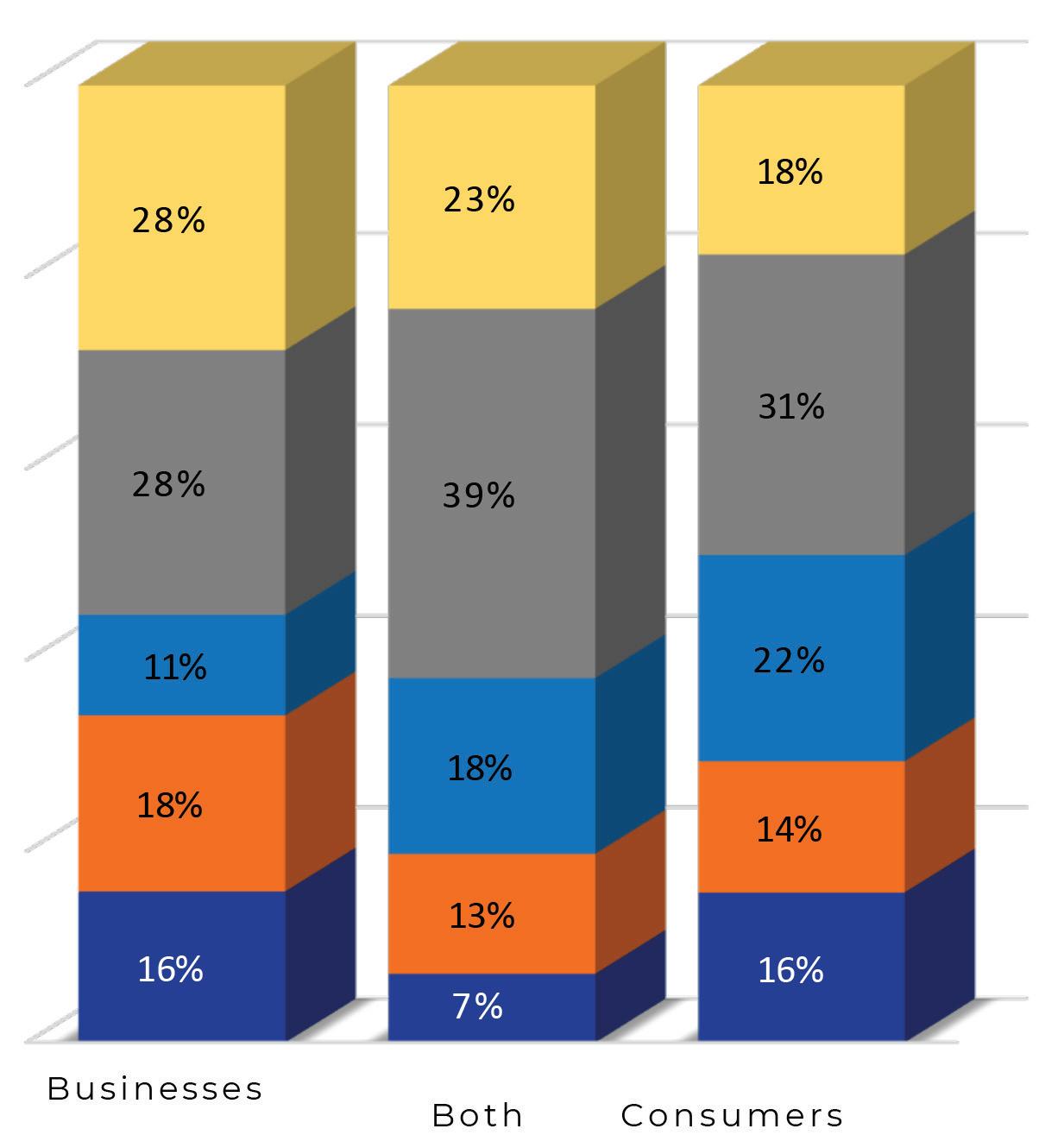
still a significant number of businesses that have not yet taken advantage of this opportunity (see Figure 2).
For many, the visual appeal of a blackonly document can be compared to reading a newspaper; it is informative, but could be more engaging. In contrast, fullcolor statements and bills feel more like reading a visually engaging magazine that is memorable and delivers impact. For brand owners, the transactional documents they send out today may be the only opportunity to engage with their customers after the initial transaction. Taking shortcuts anywhere in the customer's journey can mean the difference between loyalty and indifference.
individual choices, but their expectation of prompt responses and effective solutions remains constant. Moreover, they turn to brands that understand and connect with them on social or economic levels. They expect the collected data to be utilized for their benefit rather than the brand's advantage.
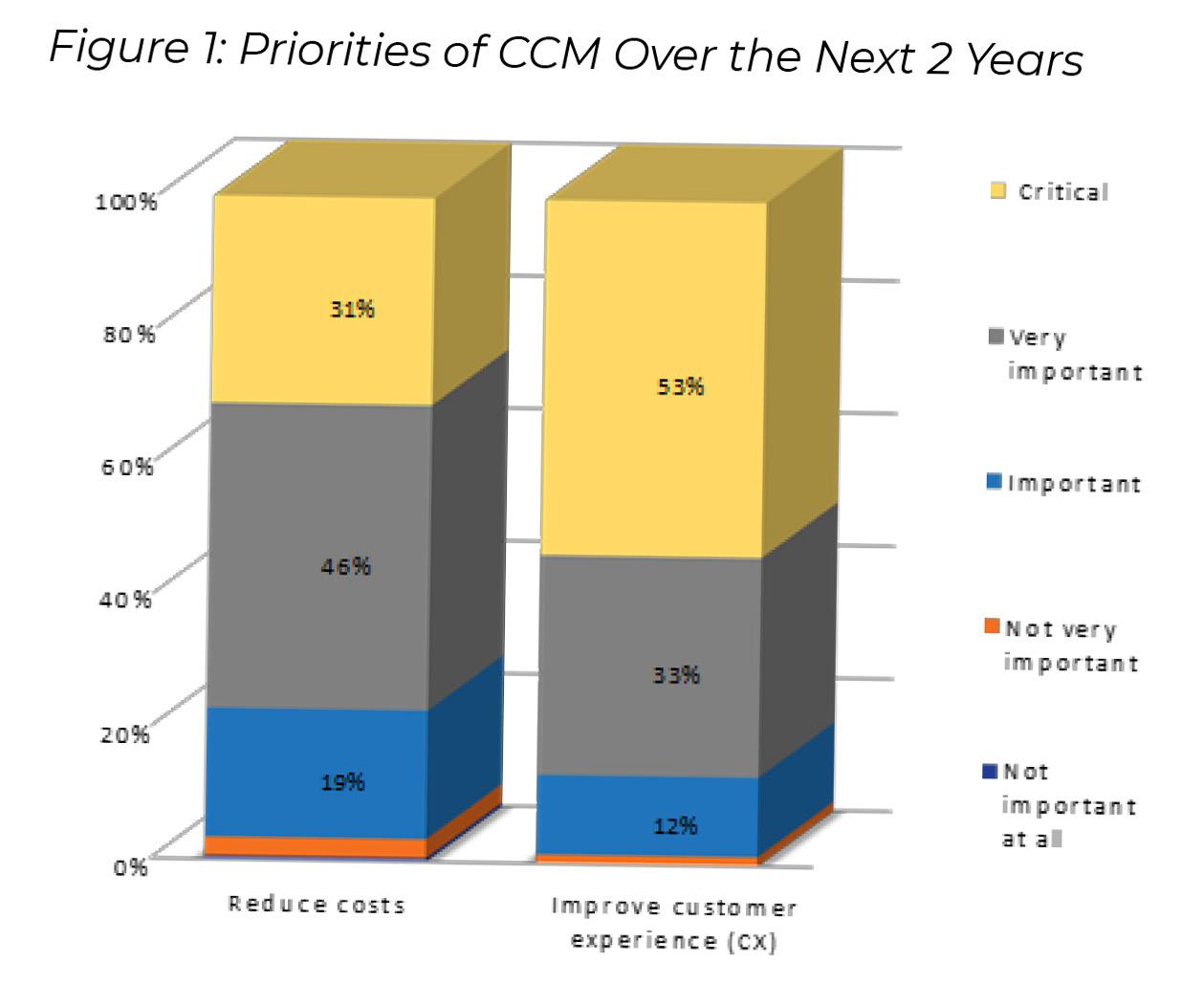
From Transactional to Transformational Today, it is essential for businesses to leverage CCM to improve the customer experience. According to data from Keypoint Intelligence, when asked to prioritize the most crucial goals over the next two years surrounding their transactional communications strategy, businesses emphasized the importance of improving the customer experience over reducing costs by nearly 71% (see Figure 1).
When we talk about CCM and the Customer Experience (CX), it’s important to include in the conversation all the paperwork that you receive in your mailbox or inbox — such as invoices, financial statements, or personalized health updates. These documents often contain sensitive and personal information, making it essential for companies to step up their game when sending them to their customers. Generic statements and notifications do little to build trust
between a brand and the recipient. But businesses often don't know what tools are available to them.
Technology Sparks a Customer Engagement Revolution
Production inkjet technology has brought about a revolution in the printing industry by providing high-speed and high-quality printing capabilities at a significantly lower cost than traditional methods. Apart from its technical capabilities, production inkjet technology plays a crucial role in customer communication management — particularly in enhancing customer engagement through personalized messages. By leveraging this technology, businesses can enhance their printing capabilities and elevate their customer communication strategies to new heights.
As a result, businesses are now integrating their marketing strategies with their bills and statements to improve customer engagement and loyalty. According to Keypoint Intelligence’s 2023 Transactional Communications Business Survey, 75% of respondents are incorporating marketing messages on their bills and statements. The survey also revealed that while some businesses are using color to enhance the appeal of their transactional documents, there is
Until recently, bills and statements were limited to antiquated print technology. Today's inkjet breathes new life into CCM. With advancements in ink chemistry and printhead technology, organizations can create personalized transactional documents with highquality images that accurately display their brand's colors. This not only improves the customer's experience, but also makes communication more effective. It's no surprise that the USPS is offering discounts on full-color personalized messaging that is integrated with statements or bills.
The Bottom Line
Communication is the cornerstone of human interaction. From the invention of the telephone that revolutionized communication overnight, to the gradual evolution of social media platforms that continue to add new features and functionalities over time, the way we communicate is constantly evolving. The field of inkjet technology is no exception. Rapid advancements and the increasing demand for cost-effective personalization make inkjet an attractive option, especially when it comes to CCM. With its unparalleled value proposition, inkjet technology is poised to continue transforming the world of communication.
Karen Kimerer of Keypoint Intelligence has experienced the many challenges of expanding current market opportunities and securing new business. She has developed a systematic approach to these opportunities, addressing the unique requirements of becoming a leader in our changing industry. She is well-versed in 1:1 marketing, web-to-print, direct mail, book publishing, supply chain management, data segmentation, channel integration, and photo products.
THE GLOBAL POSTAL NETWORK, THE USO, AND MAIL DELIVERY
BY MERRY LAW
At recent meetings of the Universal Postal Union (UPU), there has been discussion of the Global Postal Network. What this means at the UPU may not be the same as it might seem to a group of international mailers. The UPU’s Global Postal Network is the exchange of mail among its member countries’ official, designated postal operators. Mail moves from one designated operator to another for delivery. It does not include the many mail service providers that international mailers may use to move their mail toward its final destination country.
Near-shoring and B2B2C mail had considerable attention at recent UPU meetings, and were not familiar concepts to some postal operator and country representatives. That items for delivery to consumers in other counties are handled by more than one business en route will not come as a surprise to mailers. Neither will the current trend of near-shoring to locate distribution closer to final destinations.
The UPU is a UN specialized agency coordinating the exchange of mail among its 192 member countries. It’s an intergovernmental agency — a group of government representatives, not of postal operators. Each country decides who represents it, and that representative can be their designated postal or another governmental agency. (For the US, the Department of State is the authorized representative.) The UPU staff and member countries have been
exploring once again ways to incorporate what the UPU terms wider postal sector players in UPU discussions and meetings, with little actual change to the UPU’s decision-making.
So, as letter mail volumes continue to shrink and postal package volumes do not grow as much as anticipated, the official agency for coordinating the exchange of mail continues to talk primarily with governments and their designated postal operators. Meanwhile, a significant volume of packages to consumers travels internationally outside this narrowly defined Global Postal Network. The continuing decline in overall volumes and an increase in the proportion of packages is putting pressure on that network.
The decrease in overall mail volumes has led some countries to question the viability of the Universal Service Obligation (USO). The UPU in Article 3 of the Universal Postal Convention obliges all 192 member countries to ensure that all postal customers enjoy the right to a Universal Postal Service (UPS) involving the permanent provision of quality basic postal services at all points in their territory, at affordable prices. (What constitutes quality basic service or affordable prices are not defined.)
Domestically, the USO in each country may vary greatly, specifying delivery frequency, time to delivery, pricing, and other conditions. In some countries, the USO is detailed and codified in law and, in others, it is not clearly defined.
Denmark removed its USO as of January 1, 2014, for most mail with exceptions for mail to some islands, material for the blind, and inbound international mail. The UK’s postal regulator, Ofcom, is holding hearings and soliciting opinion on their USO, saying, “Universal postal service must modernize.” They cite that letter volumes have halved since 2011. Denmark and the UK have a liberalized postal sector, allowing competitors to the designated postal operator, as do most highly developed countries and some less developed countries. A lack of postal sector competition does not improve the situation for the postal operators, as seen in both the US and Canada, where mail volumes continue to decline.
Related to this, and another effort to reduce postal delivery costs, are changes to postal delivery schedules. New Zealand has moved to three days a week in cities and towns, with five-daya-week rural delivery. Italy has moved to three-day-a-week delivery in areas with low population density. Norway, Sweden, and Belgium have moved to alternate day delivery — two days one week and three days the next. Slower delivery is also occurring to reduce costs with more days between mail entry and delivery. This is sometimes combined with fewer days of delivery or, as in the US, with full five- or six-day delivery schedules.
As delivery expectations by consumers continue to be for quick and free service (to them), merchants will watch the delivery trends by the postal operators. If their delivery is insufficient, more packages will move to private delivery services. The postal operators can illafford to lose more volume.
The worldwide network of mail delivery has changed irrevocably to include warehousing, logistics, and mail processing service options that did not previously exist. For the postal network to remain relevant, particularly with small packages, the world’s countries and designated postal operators must recognize the realities of today’s international mail logistics from the merchant to the consumer.
Merry Law is President of WorldVu LLC and the editor of Guide to Worldwide Postal-Code and Address Formats. She is a member of the UPU’s Addressing Work Group and of the U.S. International Postal and Delivery Services Federal Advisory Committee.
THINK ABOUT IT
Obviously, reducing service enables reductions in related processing and transportation which, in turn, means less vehicle fuel consumption and emissions. However, spinning such actions as designed to provide environmental benefits is cynical and disingenuous, if not downright false.
— LEO RAYMOND
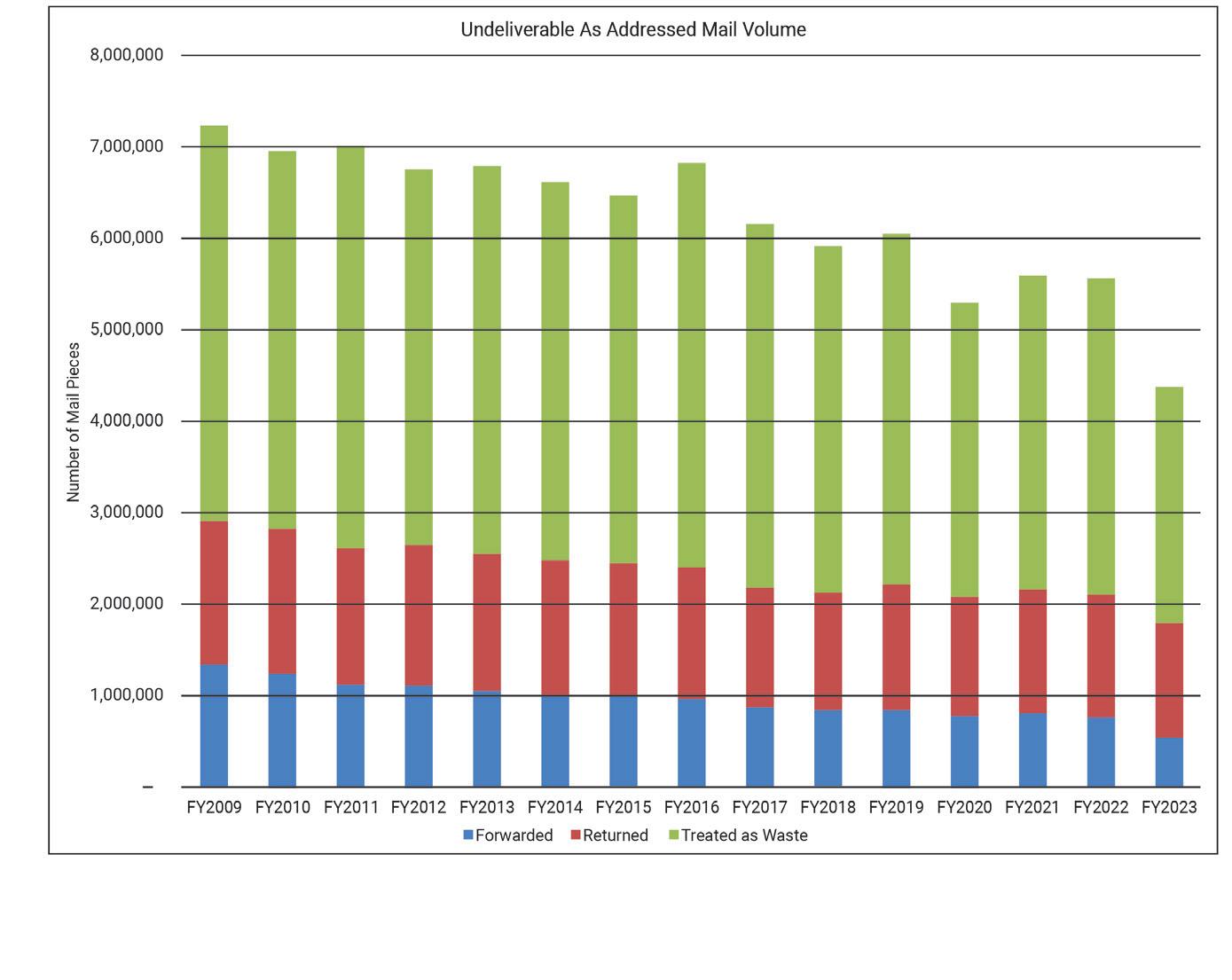
The USPS has been tracking UAA mail volumes since 2008, and year over year it has been a relatively slow and steady decline that, for the most part, matched overall mail volume declines. The USPS groups UAA into three main types: treated as waste, returned to sender, and forwarded. In all three cases, there are costs to the USPS amounting to a billion dollars or more.
— CHRIS LIEN
PRODUCTION INKJET TECHNOLOGY HAS BROUGHT ABOUT A REVOLUTION IN THE PRINTING INDUSTRY BY PROVIDING HIGHSPEED AND HIGH-QUALITY PRINTING CAPABILITIES AT A SIGNIFICANTLY LOWER COST THAN TRADITIONAL METHODS. APART FROM ITS TECHNICAL CAPABILITIES, PRODUCTION INKJET TECHNOLOGY PLAYS A CRUCIAL ROLE IN CUSTOMER COMMUNICATION MANAGEMENT —PARTICULARLY IN ENHANCING CUSTOMER ENGAGEMENT THROUGH PERSONALIZED MESSAGES.
— KAREN KIMERER
Color can also be used when testing mailing campaigns. Switch between your brand colors when doing A/B testing to see which color gets a better response rate. Keep the offer the same on both pieces to get accurate results. Mail the two versions multiple times and track your results. Once you have established the color that works best, you will make this your control package A.
— ROB HANKS
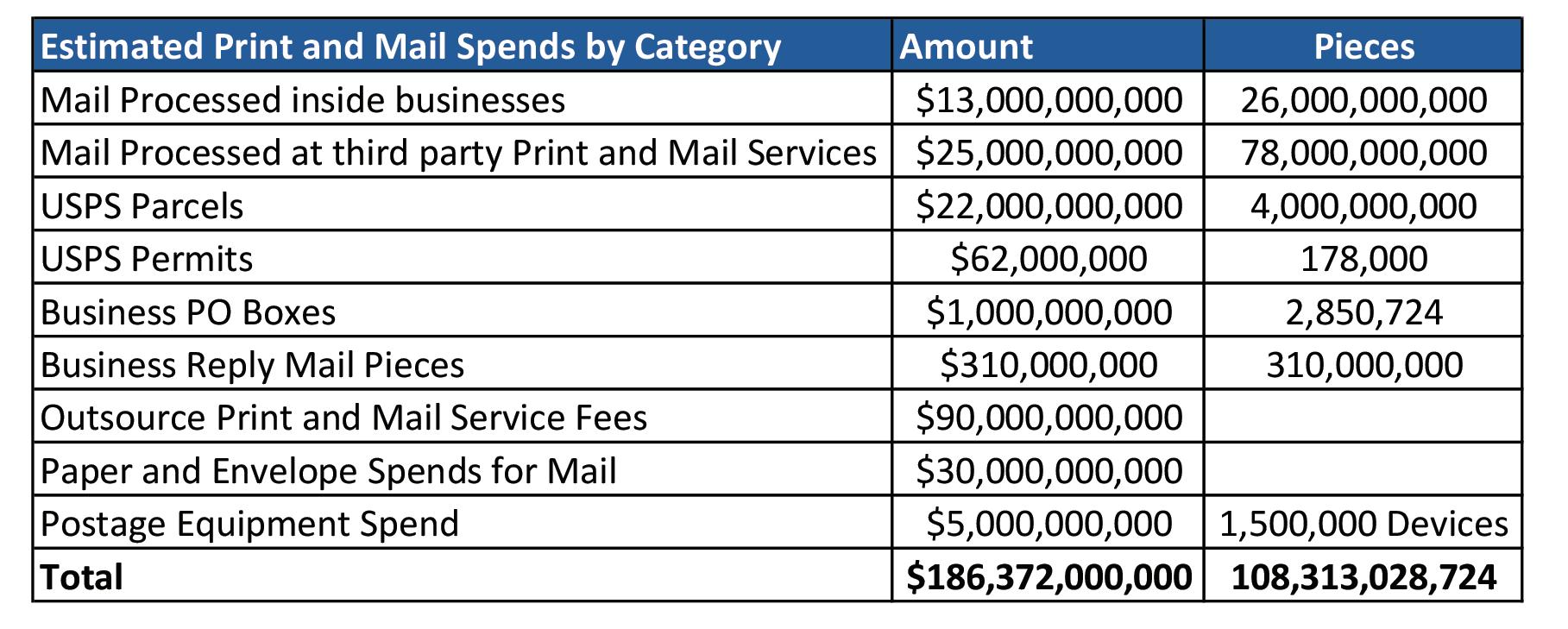
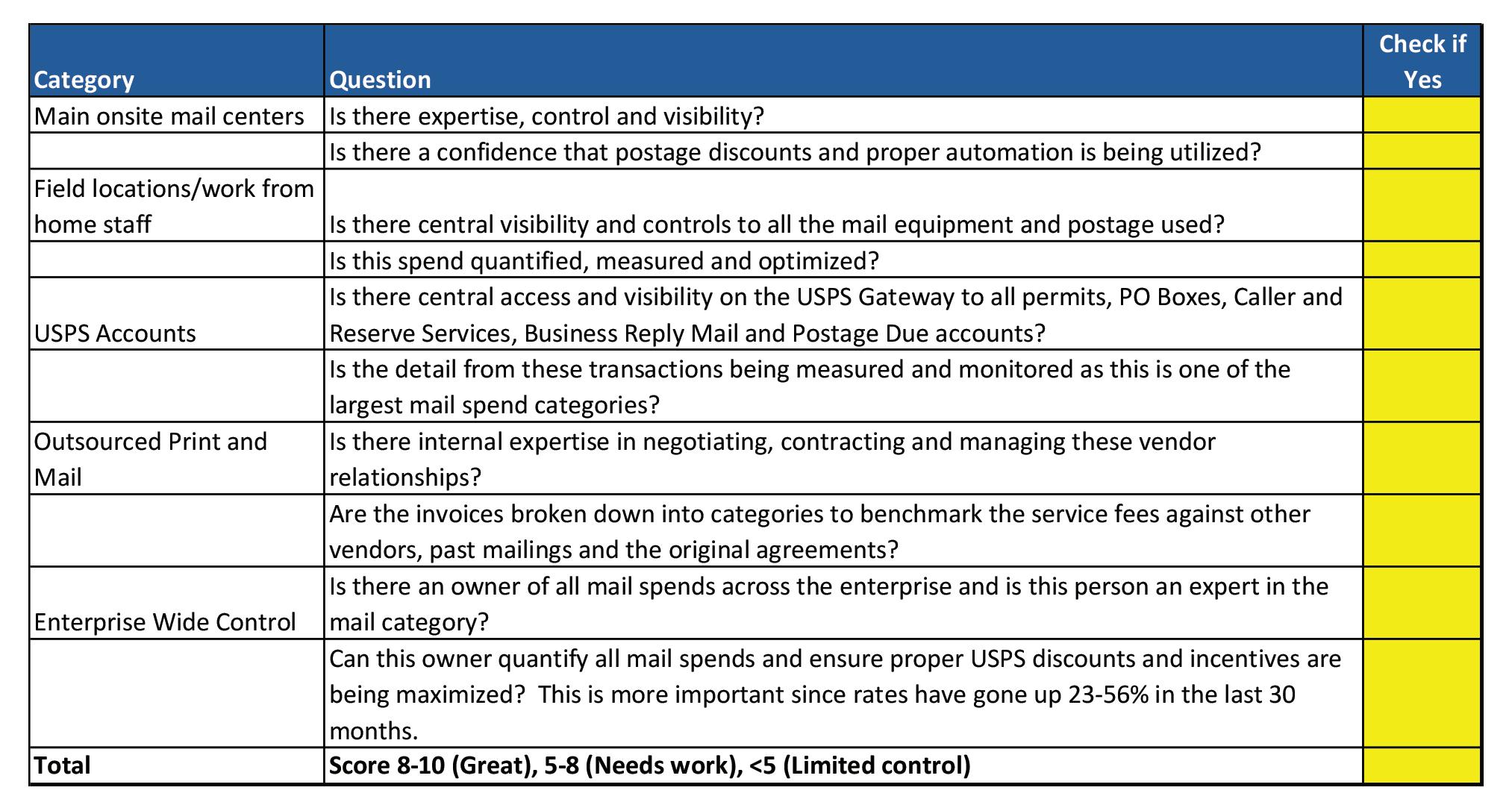
The media is always focusing on huge mail declines, but costs are increasing. The USPS has increased rates 23-56% over the past 30 months and we are expecting another seven percent increase in July. Mail equipment and service provider fees keep going up and actual volume declines for the largest volume mail segments are typically very small. Companies more than ever need to understand their costs and find ways to create savings, if for no other reason than to minimize these inevitable increases.
— ADAM LEWENBERG
Print/mail service providers can leverage strategic approaches to enhance your clients’ direct mail ROI. Your operation’s contribution goes beyond merely sending mail; it can sometimes involve expert advice and executing a cohesive and strategic plan. —MIKE PORTER
THE QUEST FOR THE PERFECT ADDRESS
By Chris Lien
Acomplete, correct, and current address is the only way to achieve timely, predictable, and ultimate delivery of a mail piece. Unfortunately, despite the vast array of address quality tools and techniques widely available to mailers, not much progress has been made with regards to reducing undeliverable as addressed (UAA) mail.
The USPS has been tracking UAA mail volumes since 2008, and year over year it has been a relatively slow and steady decline that, for the most part, matched overall mail volume declines. The USPS groups UAA into three main types: treated as waste, returned to sender, and forwarded. In all three cases, there are costs to the USPS amounting to a billion dollars or more. They are effectively passed through to the mailing industry either as built-in fees for First-Class Mail or optional charges in the case of Marketing Mail for mailers that use ancillary service endorsements or Address Change Services.
As noted earlier, UAA volumes for the most part matched overall mail volume declines. However, with the price of postage increasing substantially in the past 18 to 24 months, mailers are starting to focus more aggressively on UAA volumes. According to USPS data, if you compare 2023 to 2019, total mail volume was down 18.5%, but UAA volume was down 27.85%. That is encouraging, especially since the drops in UAA were primarily in treated as waste and forwarded mail pieces.
As the USPS rolls out their Delivering For America (DFA) plan, it’s time for the industry to also respond with action and to do something to remove undeliverable and ineffective addresses with these good, better, and best practices to achieve the perfect addresses.
Good
The foundation for any address quality solution is a CASS-certified product. CASS is a USPS certification program that tests commercially available software to make sure it assigns a proper ZIP+4. CASS has been around for several decades but hadn’t really changed much until 2023, when CASS Cycle O was released. With CASS Cycle O, mailers now have more intuitive return codes from the various software products that can provide valuable clues as to why the software was unable to assign a proper ZIP+4 code. Oftentimes, the primary issue can be the secondary address line such as an apartment number for a residence or a suite number
for a business. Knowing that the secondary address is wrong or missing, but required for a proper ZIP+4, can help mailers use industry tools such as Address Resolution Services (ARS) to correct or complete the secondary address.
Better
While a proper ZIP+4 is essential to obtain USPS workshare presort discounts, the recipient at the address may have moved. The USPS requires mailers to use an approved Move Update solution in order to have a complete, correct, and current address prior to mailing. An effective pre-mailing solution such as NCOALink is an excellent solution. NCOALink is either an 18-month or 48-month database of permanent change of addresses filed with the USPS. It is widely available through a number of non-exclusive licensees and, if utilized every month, it is a very effective way to keep your addresses current.
Unfortunately, not everyone files a change-of-address with the USPS. That is where a Proprietary Change of Address (PCOA) can be useful. PCOA contains inferred change-of-addresses that are aggregated from such sources as warranty registration cards, subscription renewals, and various public records. It is often used for prospect mailings when you are trying to either make an initial contact with someone or can also be used for addresses that have been unresponsive for more than four years — as PCOA data can often go back five years or more.
As with other address quality products, there are various return codes that should be reviewed and leveraged to ensure you have a proper address. This is especially true for return codes such as Moved Left No Address (MLNA) and Box Closed No Order (BCNO). These are USPS carrier filed change-of-addresses that are entered into the NCOALink database and should be removed from the mailing list.
Best
The final step in your quest for the perfect address is suppressing ineffective addresses. This includes deceased suppression, prison suppression, and various others. On the surface, it seems odd or even very insensitive to mail to a deceased individual and yet it continues to occur. Deceased suppression not only removes ineffective mail pieces, but it can also actually improve the response rate for the mailing. The same can be said for prison suppression as it is highly unlikely an incarcerated individual is going to purchase vinyl siding in their current situation.
Various other suppression and filtering services such as using geocoding to select only those addresses within a distance from a centroid address can also help to remove ineffective addresses and improve the overall response rate. While response rates have improved for direct mail and are now five percent or higher, they can be even higher if you leverage these best practices in address quality.
It’s time now to do something about address quality, so contact your software solution provider to determine what services are available to help you achieve the perfect address.
Chris Lien is Executive Vice President of Postal Affairs for BCC Software, a BlueCrest company. He has been active in the mailing industry for 30 years and participates in numerous industry associations including the Postmaster General’s Mailers Technical Advisory Committee as a former industry chair. As EVP of Postal Affairs, he is focused on all aspects of the mail supply chain and provides a voice of advocacy on behalf of the thousands of BCC Software and BlueCrest customers. Chris also chairs the Board of Directors of the National Postal Forum.
ARE YOU PREPARED FOR A SECURITY AUDIT?
In part 1 of our series, we’ll take a look at internal audits.
By Steve Berman
There are three words no executive wants to hear from their IT staff: "We've been breached." Any mailing or data processing company that deals with sensitive client data likely generates reams of written security policies, because let’s face it, customers want to know that their vendors take security seriously, or they won’t continue to be customers. At some point, management has likely sat down with staff, and possibly an outside consultant, to select a security framework, such as NIST SP800-53, ISO 27001, or HITRUST CSF, and complete the long process of scoping, tailoring, and documenting company procedures.
Having those policies in place is a good start, but it’s only a start. Security policies are only as good as the last time they were tested. Or to use a sports or music analogy, the proficiency of play is often determined by how recently and frequently someone has practiced. A good security posture is the result of learned and
practiced behaviors and processes, along with proper equipment. Determining how well policies are followed and how closely written procedures describe actual practices is called auditing.
There are two kinds of audits: external and internal. External audits are performed by independent, professional auditors certified in their particular field of practice. For example, a CPA would conduct a financial audit, or a SOC 1 report on Internal Control over Financial Reporting. A cybersecurity auditor conducting a SOC 2 audit would likely have a certification such as the Information Systems Audit and Control Association (ISACA) Certified Information Systems Auditor (CISA). External audits rigorously test sets of specific controls relating to proper risk management and standards.
An internal audit is conducted by the company’s own staff. The purpose of an internal audit is generally to prepare for the external audit, which costs the organization significant money. Without first conducting an internal audit, the risk of major findings during the external audit is unknown. An internal audit is therefore a mandatory step before the outside firm comes in.
We will be dealing with internal audits here and external audits in the next part of this series.
Who Should Conduct an Internal Audit?
Internal audits are commissioned by senior company management. The audit team members should be chosen from among subject matter experts who represent a wide array of departments in the organization, and the audit leader should be familiar with the relevant cybersecurity standards and policies currently in use. Management should provide the internal audit team with a charter that lays out the mission, and the independence to complete the audit and provide truthful, unbiased results.
A charter may be something like: Examine all cybersecurity policies and procedures to ensure they have been reviewed and updated per the document requirements. Test at least 40% of policies against the NIST 800-53R5 standards and controls via
observation, evidence collection, and interviews with key personnel. Perform at least one walkthrough or simulation of an actual security event involving IT and production staff. Report results to the COO within three weeks after the start of the audit.
Note that a good charter includes guidelines for what is to be tested, a timeline for the process and a deadline for when results should be reported, and guardrails to keep the audit from becoming an unlimited hall pass for the audit team to induce havoc. A good internal audit timeline should also schedule in adequate time for the team to plan, learn, and coordinate in advance of the actual audit. Telling your audit leader to have the team ready in a day or two is a recipe for confusion and chaos.
What Should Be Audited?
The first element of an internal audit is called a “desk audit.” This is where the audit team assembles the organization’s policy and procedure documentation and determines if the policies are current and have been recently reviewed. It’s useless for auditors to test procedures that are five years out of date, or controls that are obsolete because the framework referenced is deprecated. Are your policies collecting dust? The internal audit team will find out.
The desk audit should be performed in advance of the control testing, though it can also be performed simultaneously, if done in manageable phases. The audit team should follow a timeline with interim meetings built in to determine whether to continue in a particular area, or to tailor the controls tested before proceeding. This will keep the team from wasting time or going down rabbit holes.
It is important to understand what limitations are placed on the auditors. An audit is not a penetration test, so auditors need to be careful not to get into an antagonistic relationship with those being audited. There is no need, for example, to pull a fire alarm, or activate an incident reporting system to test the controls dealing with those areas — unless the charter specifically calls for
that kind of intrusive test. Internal auditors must always “stay in their lane.” A cybersecurity audit need not expand the scope into safety, OSHA, professional or legal practices, or financial risk. Asking about the versions of software products in use, when they were last patched, and how the hardware and software inventory is compiled and maintained is, however, well within the scope.
Internal auditors are independent, but they are not to be loose cannons. An auditor merely observes, gathers evidence, and interviews to determine how well policies and procedures represent the ways in which things are actually done in the organization. In other words, “test” does not mean an adversarial pass-fail situation. It is, rather, an informational, cooperative process.
An auditor merely observes, gathers evidence, and interviews to determine how well policies and procedures represent the ways in which things are actually done in the organization.
Findings and Mitigation
The purpose of the internal audit is not to rubber-stamp a “pass” to satisfy external auditors or customers. The main point is to provide an honest assessment of how well the organization’s management goals and objectives align with its cybersecurity and risk management programs — and how the people who perform daily tasks follow the policies that govern both.
The internal audit team should directly brief senior management on its findings and recommendations. The auditors should not have power to assign mitigation tasks, but their findings may recommend further, more in-depth audits, or bringing in professionals to help reduce risk.
Management should not fear these findings, nor dole out punishment for honest assessments that may not convey happy news. The findings should be taken seriously, and mitigation recommendations that follow from the audit should be added to a Plan of Action and Milestones (POA&M) or similar document.
Finally, management should plan the internal audit with sufficient time to complete mitigations before going to the next phase — the external audit. Producing a “to-do” list without addressing the items on it will only make the external audit more painful, as it will likely confirm the validity of the internal audit.
Remember, as you go through this sometimes-arduous but necessary process: A thorough internal audit can be the single most valuable tool for reducing any organization’s cybersecurity risk.
This article is part 1 of a 2-part series on security audits. Part 2 will focus on external audits.
Steve Berman is Director of Risk and Compliance for DATAMATX, one of the nation’s largest privately held full-service providers of high-volume print and electronic transactional communications. He has been involved in cybersecurity for over 25 years and has a Certified Information Systems Security Professional (CISSP) certification. For more information, visit www.datamatx.com.
KATE MUTH AWARDED THIRD ANNUAL MEGAN J. BRENNAN AWARD FOR EXCELLENCE
By Amanda Armendariz
In January, Kate Muth, Executive Director, International Mailers Advisory Group (IMAG), was presented with the third annual Megan J. Brennan Award for Excellence at a Women in Logistics and Delivery Services (WILDS) luncheon. Since 2014, when Muth assumed her current role, IMAG has doubled in membership and is well-known as an influential association in the US international mailing and shipping industry. Muth began her career as an editor and journalist, winning many awards for her work, one of which she received when she broke the news that the Postal Service would be partnering with FedEx. She has also written several pieces for Mailing Systems Technology and our sister publication, PARCEL.
“Kate has long partnered with the Postal Service to improve international mailing and shipping efficiency, while at the same time, delivering value to her membership,” said Megan Brennan of Muth’s selection. “Under Kate’s leadership, IMAG has played a pivotal role in international forums, including, importantly, with the UPU. Kate is widely respected for her tireless advocacy, her institutional knowledge and experience, and her unique ability to effectively communicate the pressing issues and opportunities in the international mail and parcel business.”
The Megan J. Brennan Award for Excellence was created after Brennan, the 74th Postmaster General and first (and, as of
now, only) woman to hold that position, was approached by WILDS prior to her retirement in June of 2020. WILDS wanted to create an award that would honor an individual who embodies the leadership traits Brennan so well demonstrated during her tenure.
The award criteria are:
Appreciation for the employees of an organization (PMG Brennan was known for viewing every decision through the lens of the impact on the people of the Postal Service, so it’s crucial that the award winners demonstrate this same type of appreciation for the members of their respective organizations).
Ability to work collaboratively.
Ability to look at problems and opportunities holistically, as Brennan was dedicated to “peeling back the onion” to understand the impact of decisions across the organization and the industry.
Muth fit all these criteria, and then some. “I am truly honored to receive the Megan J. Brennan Award. To have my name linked with Megan Brennan, and with the past awardees Pritha [Mehra] and Tammy [Whitcomb Hull], is both incredibly humbling and enormously rewarding,” she said.
“They are public servants of the first order. For this award to be presented to me by my WILDS’ sisters, many of whom have served as role models and mentors to me, well, it means more than words can adequately express.”
Muth’s speech ended on a humorous note when she shared that she seemed destined for the industry ever since 1993, when her then-boyfriend (now husband) was interviewed by a local news station about whether he wanted the young or old Elvis to be featured on the Elvis Presley
stamp. Then-Postmaster General Marvin Runyon was going to unveil the stamp at the dedication later that night. While watching the news to see the segment on the stamp unveiling, the news station mixed up the captions and put the name John Muth under PMG Marvin Runyon when he came out to unveil the stamp.
“Kate was the unanimous choice of the WILDS Board to receive this year’s Megan J. Brennan award. Kate was one of the founding members of WILDS and has been an inspiration and mentor to me and others. She is always generous with her time and expertise and is a tremendous resource for her members and the industry. WILDS is enormously grateful to Kate for being this year’s honoree.”
— Shoshana Grove, CEO, International Bridge
Whether she is here by destiny or chance (or a little of both), the industry is certainly lucky to have someone like Kate Muth as such an involved member, and this is exemplified by her selection as this year’s award winner. Congratulations to Ms. Muth!
WILDS is a nonprofit organization created to promote women’s leadership in the postal, delivery, and logistics industries and to address the challenges women and minorities regularly face in these industries. It has been known as an organization that “fights above its weight” in Washington and the logistics industry, being comprised of leaders from across the spectrum of government and the private sector with a common goal of building bridges across interest groups.
Top photo: (L-R):
Anita Pursley, Kate Muth, Paula Stoskopf, Shoshana Grove
Bottom photo: Muth poses with her husband and son
DOES COLOR MATTER IN DIRECT MAIL? YOU BET IT DOES!
BY ROB HANKS
Ihave been asked on more than one occasion: “Does color matter in direct mail?” My answer is always a resounding “YES!” Color sets your mail piece apart in a stack of mail. Color draws attention to your mailer and can either make or break your campaign. A well-designed mail piece using color, a relevant offer, and mailed to a clean list of people most likely to respond will increase your return on investment.
Design your mail piece or campaign using colors that are on brand. You have fewer than three seconds to grab attention to your mail piece, and by using your brand colors it helps recipients recognize who sent the mail piece. If you do not have a set of brand guidelines, I strongly suggest you get one. If you are unsure how to do so, find a creative designer to assist you. A proper brand guide should include your specific brand colors, font style, font size, and how your logo should be displayed. The use of any tag lines should be included as well. Besides your brand colors, you can also provide direction on the use of your logo in one-color situations.
Brand colors are the colors you use in your logo, letterhead, business cards, and marketing collateral. You will want to be sure these colors are used in all your marketing channels including direct mail, email
marketing, and social media. Your font style and font size should be consistent between all marketing channels.
Your mail piece will need additional colors in most cases. Be sure to choose complementary colors to your brand. Stay away from colors that clash or overpower your brand. Less is better than more, so keep the number of additional colors to a minimum while still getting your message across.
Color invokes emotions. You can use color to create the emotion that suits your messaging and brand strategy. This is called the psychology of color and there is a lot of information regarding this topic online. A 2015 article from Print Solutions stated that blue is the most-used color in direct mail. Here are how colors are perceived and can be used to influence the mail recipient.
Blues: Peace and calm, associated with trustworthy products
Green: Growth, health, generosity
Red and pink: Love, femininity, attention-grabbing colors
Gold and purple: Luxury, royalty, wisdom, indicators of wealth
Orange and yellow: Fun, happiness, creative, warm, cheerful colors
Brown: Comfort, security
Gray: Neutrality, non-judgmental
White: Innocence, goodness, honest, truthful
Black: Elegance, mystery, sophisticated
Images are another way to sell your product or service. Images should not clash with your brand colors and messaging. Use the images to help with creating an emotional response to your mail piece. Images can be obtained several diverse ways. You can use images from your own image library, or you can have a photographer take images for you. The images should be a high resolution of at least 1,200 DPI. You will want to be sure the image is clear and stay away from busy backgrounds or poor lighting. Images represent your company and brand, so you will want to make sure they are pristine. Stock images can be purchased online as well from companies such as Getty Images and Shutterstock.
Color can also be used when testing mailing campaigns. Switch between your brand colors when doing A/B testing to see which color gets a better response rate. Keep the offer the same on both pieces to get accurate results. Mail the two versions multiple times and track your results. Once you have established the color that works best, you will make this your control package A. Next, change the offer on the B version of the mailer. If it draws better than the control
package, then the B version will become the new control package A. Just like when you did the first series of mailings, you will want to mail out the B version more than once to ensure that it is drawing a better response rate that the original control package.
Color invokes emotions. You can use color to create the emotion that suits your messaging and brand strategy.
The use of coatings on your mail piece can enhance the color by brightening or dulling its appearance. Using a dispersion coating, where much of the coating is matte and a smaller portion is high gloss, can draw attention to a specific part of the mail piece. When using dispersion, the matte portion of the coating can either be smooth or textured to give your mail piece a unique feel. This technique works great for companies selling items or services where texture will
enhance the mail piece. Examples are a landscape company that builds rock walls, or a home builder that builds log cabins or a furniture store highlighting everything from carpets to couches to lampshades.
Color can also save you postage on your direct mail campaign. The USPS currently is running two promotions in 2024. Here are the details on those two promotions:
Tactile, Sensory and Interactive Mail Piece Engagement
Registration opened on December 15, 2023, and runs through July 31, 2024, with the promotion running from February 1 through July 31. To qualify for this promotion a mail piece needs to engage though innovative use of paper stock, substrates, inks, interactive elements and finishing techniques. The promotion is for both Marketing Mail letters and Flats as well as First-Class Mail letters, cards, and flats. If you are mailing out a First-Class postcard, do not forget you can go up to 6” H x 9” W card and receive the First-Class Postcard rate. You must mail the cards out as an automated barcoded mailing. The discount for this promotion is five percent. This is the last year that gloss stock will qualify for this promotion.
A link to the Guidebook and Resources is available by going to https://postalpro. usps.com/promotions/tsi.
Personalized Color Transpromo
As in the case with the Tactile promotion, registration opened on December 15, 2023, and runs through July 31, 2024, with the promotion running from February 1 through July 31. The Personalized Color Transpromo Promotion enhances the value of First-Class Mail by encouraging mailers of bills and statements to incorporate color marketing messages to improve connection to and response from customers. By making mail pieces more fun and impactful, a mailer will get a three percent discount for personalized full color and consumer messaging, and this year, mailers will receive an additional one percent discount by including reply mail (BRM/CRM) to collect customer responses. A link to the Guidebook and Resources is available at https://postalpro.usps.com/promotions/pct.
Rob Hanks is an inside sales representative at Suttle-Straus and has more than 30 years of experience in direct mail. Rob is a Certified Direct Mail Professional and a Certified Mail Piece Design Professional though the United States Postal Service and serves as the National Industry Co-Chairperson for the Postal Customer Council Advisory Committee (PCCAC). Rob enjoys the challenges of mail piece design within postal regulations and helping clients save on postage costs.
By Adam Lewenberg
AN ORGANIZATION’S BIGGEST CHALLENGE: MANAGING THEIR SHARE OF THE $186 BILLION PRINT AND MAIL INDUSTRY
Most companies are overspending on print and mail and in this article, we will give you 10 questions to answer that will prove it. We estimate that organizations are spending a combined $186 billion on mailing expenses each year with limited expertise, controls, or processes, leading to huge opportunities for savings and efficiency. Very few companies have mail experts, and those that do focus on the main production spends and not at all on the mail supporting the rest of the organization. Most large mail runs are being moved to outsource print and mail services and managed by single departments around their specific projects (instead of across
the enterprise). All of this leads to one of the biggest and most overlooked categories ripe for savings.
How Did This Happen?
Here are the main reasons these problems exist:
Knowledge Gap – There are fewer mail experts than there were 10 to 20 years ago, and an organization may have little to no expertise on staff. Many of the younger generations are not driven to specialize in this area. Also, mail has gotten more complex, requiring a higher skill set to manage the data, optimize USPS rules, and implement solutions around software and service providers. When you go to postal shows and sem-
inars, they are a skeleton of what they once were. Also, fewer people are getting mail industry certifications.
Ownership Gap – Where you do have people that understand mail, they are usually managing a specific project, such as billing, for example. But this is not all the mail sent by that organization, so hopefully the organization has experts in other departments generating mail. Unfortunately, most will not have a high level of expertise at a corporate level controlling all enterprise print and mail spending.
Visibility Gap – Data on print and mail is cumbersome to collect, in varying formats, and most will not have any central repository to store and analyze infor-
mation. Even if there was expertise, without the proper data, good decision-making cannot occur.
Benchmarking Gap – Even if all the items above are in place, is there access to what the best in class are doing, paying, and driving for?
We developed 10 questions you can ask yourself about your organization’s mail to see if these problems exist (see Figure 2).
How Can This Be Fixed?
There are huge opportunities for cost reductions and efficiencies that can be solved and lead to 10-60% savings. We are going to share the processes we implement with our clients to fix these issues.
1. Assign a person to have responsibility for print and mail spends across the enterprise. This person should have some analytical skills to manage the data.
2. Make sure this person is trained in postal rules. We recommend at least a basic mail certification that they should be able to get within a couple of months to ensure they know the basics of mail categories, resources, and savings available.
3. Collect the needed data – This is the most important step as you need visibility to all mail spends.
a. Mail Equipment and Postage – Go to your mailing vendors and ask for
Figure 1
reports on the equipment and agreements. Go to accounts payable and pull invoices from your mailing vendors. Link this information onto the mail vendor websites and pull in invoices, postage spends, and contract details. Find the non-metered USPS purchases to measure trips to the USPS. This may be on P-Cards or expense reports. Update this information quarterly.
b. USPS Accounts – Using the same accounts payable reports, look for all the payments to support direct USPS accounts. Pull those invoice copies to get more specific details about the locations and types of accounts. Create a login on the USPS Customer Gateway and link each of these accounts to have visibility to the usage, spends, renewals, and account structures. Export the transaction details at least quarterly.
c. Outsource Print and Mail – Survey your largest departments to see who they are using for outside service providers. Get copies of their contracts and pull the invoice history for the past six to 12 months as some projects may be seasonal. Break down the charges by material, print, production, data processing, and postage so you can compare the fees across vendors and projects. Update this data quarterly.
4. Create a central repository to manage this data. We have developed a web platform to hold all this data, but you could do this with a spreadsheet with multiple tabs. The key is to standardize the projects by categories to be able to see trends and measure the expenses.
The USPS has increased rates 23-56% over the past 30 months, and we are expecting another seven percent increase in July.
5. Identify the largest savings areas that require immediate attention and then work down to smaller areas once solved.
6. Work with the stakeholders of the savings area mail to make sure they are aligned with any needed changes.
7. Implement the required changes.
8. Measure the savings and monitor its future success.
9. Stay involved in the mail industry to find future best practices.
10. Continually look for new print and mail streams that evaded previous visibility.
The media is always focusing on huge mail declines, but costs are increasing. The USPS has increased rates 23-56% over the past 30 months, and we are expecting another seven percent increase in July. Mail equipment and service provider fees keep going up and actual volume declines for the largest volume mail segments are typically very small. Companies more than ever need to understand their costs and find ways to create savings, if for no other reason than to minimize these inevitable increases. The only way to do this is by having the right expertise, visibility, and controls in place. Since this has not been done in most organizations, it is one of the largest spending areas with the greatest opportunity for savings.
Adam Lewenberg, CMDSS, MDC, President/CEO of Postal Advocate Inc., runs the largest Mail Audit and Recovery firm in the United States and Canada. They manage the biggest shipping & mail equipment fleet in the world and their mission is to help organizations with multi-locations reduce mail and parcel related expenses, recover lost postage funds, and simplify visibility and oversight. Since 2011, they have helped their clients save an average of 56% and over $88 million on equipment, postage, presort, and outsource mail. He can be reached at 617.372.6853 or adam. lewenberg@postaladvocate.com.