


Ernie Crawford





Ernie Crawford

You can’t turn a corner without coming face-to-face with new opportunities powered by technology. Whether you joined the thousands of your peers in Boston at the 2024 DOCUMENT Strategy Forum (DSF ’24) to learn the latest innovations in the changing world of document and customer experience management or you have been navigating the challenges on your own, there are many resources to help you. This edition of our magazine is one to keep on your desk as an ongoing guide as you consider the impact of artificial intelligence, assess your current workflows and review all elements of your customer’s experience.
As DSF ’24 wrapped up, it was clear that AI is already playing a role in the world of documents. Even when it wasn’t in the title of a session, the scent of generative AI tools wafted through presentations on content generation, optimization, management and distribution. There was also an array of sessions to document the state of the industry and remind everyone that clear communication is a necessity, no matter what technology you use to get there. You will want to spend some time with our overview to find the threads to help you set your strategic plans and budgets for your next fiscal year.
While the show was a great smorgasbord of solutions, this edition brings even more essentials to every document professional. If you are struggling with your workflow, consider grabbing a beverage and spending time with our guide to normalizing your document processing tools for
a cleaner, more efficient set of processes. Grab a snack before you sit down with our guide to implementing intelligent forms to improve how your customers provide data. And share our considerations for ECM monitoring with your team to get everyone on the same page.
But don’t add this edition to your reference stack until you read the AI-centric articles that provide an advanced class in living with AI tools. You will walk away with an understanding of the terms you need to know and how to create a strategic plan to integrate this new generation of tools into your organization. There are new tools coming to the market every day, but don’t forget to talk to the vendors you currently work with. Most of them have been quietly leveraging the power of AI tools without shouting about them. Pose your challenges to them after you finish reading the content from these great contributors!
Pat McGrew helps companies perform better in the print hardware, software and printing services industries. Her experience spans all customer communication channels (CCM, ECM, ECP, EMM) and segments including transaction print, data-driven and static marketing, packaging and label print, textiles, and production commercial print using offset, inkjet, and toner. An experienced professional speaker and co-author of 8 industry books, editor of A Guide to the Electronic Document Body of Knowledge, and regular writer in the industry trade press, Pat won the 2014 #GirlsWhoPrint Girlie Award for dedication to education and communication in the industry, and the 2016 Brian Platte Lifetime Achievement Award from Xplor International. She is certified as a Master Electronic Document Professional by Xplor International, with lifetime status, and as a Color Management Professional by IDEAlliance.
president Chad Griepentrog publisher Ken Waddell managing editor Erin Eagan [ erin@rbpub.com ] contributing editor Amanda Armendariz contributors
Ernie Crawford, Bryan DeWyer, Avi Greenfield, Afif Khan, Robert Linsky, John Mancini, Mia Papanicolaou, Stephanie Pieruccini, Lois Ritarossi, Liz Stephen advertising Ken Waddell [ ken.w@rbpub.com ] 608.235.2212
audience development manager Rachel Chapman [ rachel@rbpub.com ] creative director Kelli Cooke
PO BOX 259098
Madison WI 53725-9098 p: 608-241-8777 f: 608-241-8666 email: customerservice@rbpub.com
DOCUMENT Strategy Media (ISSN 1081-4078) is published on a daily basis via its online portal and produces special print editions by Madmen3, PO BOX 259098, Madison, WI 53725-9098. All material in this magazine is copyrighted ©2024 by Madmen3 All rights reserved. Nothing may be reproduced in whole or in part without written permission from the publisher. Any correspondence sent to DOCUMENT Strategy Media, Madmen3, or its staff becomes the property of Madmen3.
The articles in this magazine represent the views of the authors and not those of Madmen3 or DOCUMENT Strategy Media. Madmen3 and/or DOCUMENT Strategy Media expressly disclaim any liability for the products or services sold or otherwise endorsed by advertisers or authors included in this magazine.
SUBSCRIPTIONS: DOCUMENT Strategy Media is the essential publication for executives, directors, and managers involved in the core areas of Communications, Enterprise Content Management, and Information Management strategies. Free to qualified recipients; subscribe at documentmedia.com/subscribe.
REPRINTS: For high quality reprints, please contact Chad Griepentrog, 608-241-8777, chad.g@rbpub.com

Robert Linsky is an expert in information design, clear communications and document processes. He has created solutions for nationally and internationally recognized companies in the fields of financial services, insurance, healthcare and utilities. His expertise includes plain language, typography, graphic design, analysis, accessibility, project management, stakeholder management and usability testing. He is the senior partner of the Clear Info Group. He has spoken at DSF, Xplor, BFMA, PLAIN and Clarity. He has written numerous articles and is on the editorial board of the Information Design Journal
John Mancini is the former President of AIIM and a long-time keynote speaker on trends within the document and content space. He is also a well-known author and advisor on information management, digital transformation and intelligent automation. Post-AIIM, John is the author of Immigrant Secrets, available in paperback, Kindle, and audiobook at Amazon.com. John is a Phi Beta Kappa graduate of the College of William and Mary, and holds an M.A. in Public Policy from the Woodrow Wilson School at Princeton University.


Lois Ritarossi, CMC®, is the President of High Rock Strategies, a consulting firm focused on sales, marketing and operational strategies, for business growth in the B2B communications sector. Lois brings her clients a cross functional skill set and strategic thinking with disciplines in business strategy, sales process, marketing, software implementation and workflow optimization.


BY ROBERT LINSKY
Bills, invoices and statements are opened, read and acted upon by nearly everyone. So too are letters and notices — some surveys say up to 99%. When done well, they reduce costs and customer service calls while creating a better customer experience.
When planning to recreate any communication, the first step is to dismiss the notion that anyone can do it. There is no easy shortcut for creating transactional communications that are effective and successful. Transactional communications are complex, have content that changes on the fly, need to accommodate small as well as large dollar amounts, and can be very confusing, all of
which can cost the company time, money and customers.
So, start with the premise that the end result that is being created is for an audience that is most likely not familiar with the industry. Then move forward, keeping in mind these seven key points to ensure a successful outcome.
1. Project plan: have one upfront and stick to it. The plan should include representatives from all departments that touch the communications.
2. Don’t rush: this is a project that takes time not only because it is complex, but also to ensure that you get it right the first time. Remember one of Murphy’s Laws, “There is never enough time to do it right the first time, but there is always enough time to do it over-correctly.”
3. Senior-level sponsor: A senior-level sponsor will emphasize the importance of the project and be the final decision maker. After all, this is a project that spans the breadth of the company.
4. Decision makers: Gather in one room all decision makers who touch the communications — the sponsor, project manager, business owners, marketing, customer service, IT, legal, compliance, etc. This way they not only will buy into the project from the beginning, but also feed off each other and come to agreement on all issues. They will be invested as a team to stay on track and finish on time. Doing it this way sets the bar, makes everyone have the same level of commitment and solves all problems and issues along the way and not at the end. Some of the more obvious ones are marketing, business and production. But don’t forget legal, compliance and customer service, too. Bringing together all departments at the beginning of the process ensures that
all voices will be heard and all will be in agreement throughout avoiding last minute holdups.
5. Usability testing: In-Depth Interviews (IDIs) are most successful, not focus groups. Leave room for testing with actual customers in controlled settings. Use professionals who are not employees of the organization.
6. Content first: Because the content will drive the design. If the design is done first, then when the content is agreed upon, the design will need to be adjusted to fit the content. Content first!
7. Hire an expert: Many organizations think they can do it internally with or without a graphic designer. But to ensure a successful project, not only hire an expert in clear communications but one that also understands the development and production requirements of transactional communications.
These seven points will help make the project a success not only with actual customers, but within the organization
as well. Creating a communication that is clear, easy to understand, accessible and, more importantly, save time and money is the goal. Giving customers a better experience leads to maintaining and increasing their relationship.
Creating a better customer experience currently is not just a good idea — it’s imperative, whether you print or deliver to someone’s smartphone.
The bottom line: communications must be clear and accessible to be effective.
ROBERT LINSKY is an expert in information design, clear communications and document processes. He has created solutions for nationally and internationally recognized companies in the fields of financial services, insurance, healthcare and utilities. He is the senior partner of the Clear Info Group. He has spoken at DSF, Xplor, BFMA, PLAIN and Clarity. He has written numerous articles and is on the editorial board of the Information Design Journal.


How our previous period of revolutionary change might give us some insight into the new revolution that is now upon us
By John Mancini
You may wonder why an old content management guy is writing about generative AI and LLMs.
I was president of AIIM for over 20 years. I’ve been away from AIIM for a while now, but that’s a good thing in terms of gaining some perspective on something as revolutionary as generative AI and LLMs. Will generative AI and LLMs truly revolutionize the document and content space? Or are we looking at technologies that will “merely” be disruptive and usher in a set of relatively modest innovations?
As I reflect upon my time at AIIM, it strikes me that most of my tenure
was, in fact, during a previous period of revolutionary change. And reflecting on that revolution might give us some insights into the new revolution that is now upon us.
The First Revolution — Computing, Storage and Communications
Radical changes in the price/performance of computing, storage and communications technologies marked the period from 1995 to 2015. Plot any of these — even on a logarithmic scale — and the curves shoot wildly off the top of the page.
Average performance of semiconductors: 1995 = DEC Alpha 21164 - 9.3M transistors
2005 = Intel Pentium D - 115M transistors
2015 = IBM z13 - 4B transistors
Average price of memory:
1995 = $26.25 million/TB
2005 = $76,172/TB
2015 = $3,661/TB
Average price of disk storage: 1995 = $213,846/TB
2005 = $406/TB
2015 = $28/TB
Average internet access speed:
1995 = 24 kbps
2005 = 1 Mbps (1000 kbps)
2015 = 39 Mbps (39000 kbps)
This revolution wasn’t limited in its implications for the document and
content space or even the technology sector. True revolutions have societal implications by their nature, which is why they are rare.
Of course, true revolutions aren’t always recognized early on, even by those smack in the middle of them.
Figure 1 is an excerpt from the lead editorial in AIIM’s Inform magazine in April 1996, the month before I arrived at AIIM.
It took a while, but revolutionary computing, storage and communications forces eventually swept through the document and content management space. The winds of process change initially drove these forces. In Crossing the Chasm, Geoffrey Moore documented how Documentum applied document technologies to mission-critical, vertically-focused processes like new drug applications and then used this beachhead to “cross the chasm” into broader enterprise applications. Many other vendors followed suit.
Revolutionary winds also swept through ordinary knowledge work involving documents. In Clayton Christensen fashion, Microsoft SharePoint disrupted the market with a simplified content solution (at least compared to the initial process-driven content solutions). Box then disrupted SharePoint with an even simpler freemium cloud-based model. “Traditional” process-centric content management vendors initially dismissed both as not “real” ECM.
Ultimately, process-centric and knowledge worker-centric content management intersected, converged and overlapped in a wildly chaotic fashion multiple times. We in the AIIM community ultimately tried to rationalize all of this in a model called “Systems of Record” and “Systems of Engagement,” (Figure 2) but that’s a story for another day.
Fast-forward to the present day and the market tumult around AI and LLMs. Regarding document and content management, are we entering a revolutionary new period? I believe the answer is “YES.” The indicators are all around us.


The Second Revolution — Generative AI and LLMs
Almost overnight, ChatGPT pushed the revolutionary AI and LLM forces, brewing for some time, into sudden popular
consciousness. Figure 3 from Google Insights shows the relative search interest in “document management” and “content management” over the past two years. It is about what you might expect.

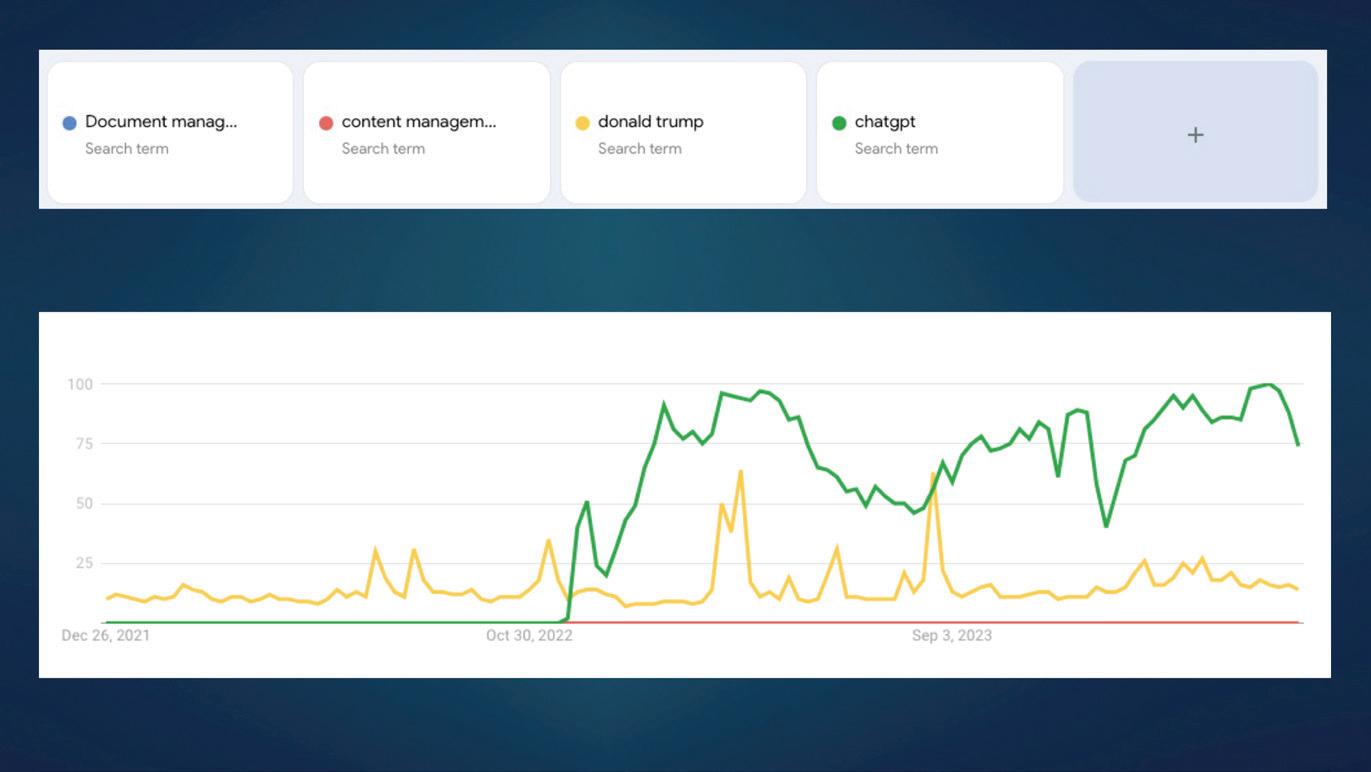
Just for the sake of argument, add “Donald Trump” to the mix (Figure 4). And now the curves look like this: It’s humbling for those in the content space who sometimes have exaggerated impressions of our importance, but it’s about what you might expect.
Now add ChatGPT (Figure 5).
Revolutionary indeed.
Why did such a rapid change occur? More than any other single reason, it’s because ChatGPT crossed over into the consumer realm. Once technologies are consumerized, change accelerates.
Add a few more indicators of pending revolution to the mix.
There were 5,509 newly funded AI startups in the US alone between 2013 and 2023 that received at least $15 million in funding.
(Source: Quid 2023)
Over 60,000 AI patents were issued in 2022 (Source: AI Index 2024 Annual Report) — 61% to China.
In 2023, a variety of AI performance benchmarks (i.e., image classification, natural language inference, visual reasoning, basic-level reading comprehension) arrived at a 100% human baseline (Source: AI Index 2024 Annual Report)
State legislatures introduced 150 AI bills in 2023, and 38 passed. There were 25 new AI-related regulations at the federal level in 2023, up from just one in 2016. There was a similar explosion in new laws and regulations internationally. (Source: AI Index 2024 Annual Report)
So, let’s stipulate that society is on the cusp of an AI and LLM-driven revolution just as fundamental as the one
driven in the 1990s by the collapse of computing, storage and communications costs. At this very early stage, what should user organizations keep in mind as they begin to incorporate these revolutionary forces into their planning?
1. AI is not perfect.
The first thing to remember about AI is that emerging technologies are imperfect. Given the conversational elegance of ChatGPT, it was natural that many confused conversational elegance with information accuracy.
Just about anyone who has dabbled with consumerized versions of these technologies since ChatGPT went mainstream in early 2023 has a story about AI factual mistakes. These range from trivial and fun errors — it’s incredible how factually deficient early ChatGPT was at tasks like writing a bio or solving a Wordle puzzle — to serious mistakes — like making up phantom cases to support a legal brief.
There is even a cottage industry around mistakes made by Google AI Overview searches. These include responses to queries like:
“How many rocks should I eat per day?” (AI Overview answer: “One small pebble.”)
“What are the health benefits of running with scissors?” (AI Overview answer: “Running with scissors is a cardio exercise that can increase your heart rate and requires concentration and focus.”)
The good news is that AI learns from these mistakes; if you try to recreate them now, they will be gone. The bad news is that risk-averse enterprises need to figure out how far and how soon they want to push the AI risk/ innovation curve.
2. LLMs have an insatiable appetite for content.
According to The New York Times (How Tech Giants Cut Corners to Harvest Data for AI), “In late 2021, OpenAI faced a supply problem. The artificial intelligence lab had exhausted every reservoir of reputable English-language text on the internet as it developed its latest AI system.
It needed more data to train the next version of its technology — lots more.” There are three implications of this for enterprises looking to apply LLM models to practical content and process problems:
1. As The Times documents, the large platform LLM players will push the limits of acceptable past copyright practices in the quest for more and more content, creating potential downstream risks for users of this content.
2. Enterprises themselves hold vast troves of unstructured information that, if curated, represent a huge source of potential value, differentiation and intelligence.
3.Search has long suffered from a recency bias. Because there is more “new” information than “old” information, recency bias causes AI systems to prioritize recent information when drawing conclusions.
3. AI particularly impacts two long-standing content management focus areas: 1) document processing and 2) document structure.
Dan Lucarini from Deep Analysis believes we are entering the fourth wave of Intelligent Document Processing (IDP).
Wave 1 solutions used Optical Character Recognition (OCR) to convert characters in an image to text characters a computer could understand.
Wave 2 solutions used forms and templates to give a computer hints of what information lay where on a particular form so that organizations could more easily extract data from that location.
Wave 3 solutions use machine learning to analyze sample sets of documents with known structure to help computers learn new document types.
Wave 4 document processing will use LLMs to bypass the need for sample data and learn how to curate, categorize and extract information from documents over time.
Machine processing of documents also carries fundamental implications
for the actual structure of documents. Alan Pelz-Sharpe, also from Deep Analysis, notes, “The business information contained in files accounts for a small proportion of the overall file size but typically represents most of the file’s value…Traditional ECM systems were designed for human interaction, but automation, driven by AI, is shifting the balance toward machine processing.”
4. Automation of process and knowledge work will be where most organizations will begin their AI journey.
Process-driven AI adoption: Most jobs and departments in an organization have responsibility for: 1) processes or parts of processes, 2) goals related to those processes and 3) specific tasks that somebody must complete. Using AI to automate specific document-intensive processes will follow a similar pattern to those used during the previous computing, storage and communications revolution. Deployments will begin with specific niches and then try to move more broadly.
We have already started down the path of using technology to automate some of these tasks, particularly those that are predictable and routine. Many organizations use robotic process automation (RPA) to speed up processes like data entry, extraction, invoice processing, customer service and order processing and reduce error rates. AI technologies will become an increasing part of the offerings of RPA companies and expand the kinds of tasks that organizations can automate. Successful vendors will focus on specific “horizontal” processes or processes unique to particular verticals.
Knowledge worker AI adoption: The large platform vendors will increasingly push AI tools at knowledge workers, often even when their employers are reluctant. Microsoft users now see Copilot everywhere. Knowledge works will eagerly embrace AI to streamline mundane tasks like creating a first draft or marketing copy, or summarizing a document or creating images for a website. In the same way that Microsoft and Box hooked individual
knowledge workers once they realized they could use SharePoint and Box to collaborate, knowledge workers will be reluctant to relinquish these tools. And that’s just the beginning.
The way that process-specific innovation and knowledge-worker innovation chaotically intersected, converged and overlapped multiple times during the first revolution will repeat itself during the AI revolution. But with even more far-reaching implications.
A final thought.
Sangeet Paul Choudary’s work provides some of the best examples of how processes and knowledge workers will collide in the AI era.
He notes that previous automation may have reduced headcount for specific functions, but humans ultimately remained in charge of processes and workflows. However, as AI agents begin to unbundle workflows, they will not only automate specific tasks but also find additional automation opportunities — on their own. Ultimately, AI agents will be able to redefine the workflows themselves and the roles and goals associated with those workflows.
“We frequently make the mistake of thinking of AI as ‘just another technology’. We arrive at the vague conclusion that AI will automate some jobs and augment others. But there’s a larger, less understood, nuance to understanding the potential of AI. AI – particularly autonomous AI agents – are goal-seeking. Goal-seeking technologies are unique. They take over planning and resource allocation capabilities, and in doing so, restructure how work is organized and executed.” (Sangeet Paul Choudary, “How AI Agents Rewire the Organization”)
Fasten your seat belts. It’s going to be quite a ride.
JOHN MANCINI is the former President of AIIM and a long-time keynote speaker on trends within the document and content space. Post-AIIM, John is the author of Immigrant Secrets, available in paperback, Kindle, and audiobook at Amazon.com.
PRESENTER

BY ERNIE CRAWFORD
How to navigate the complexities of modern workflows with ease
In today’s fast-paced business environment, the future of efficiency and productivity is automation.
As we move toward more automated workflows, the management of documents and data becomes increasingly crucial. However, the complexity of document processing tools often resembles a tangled spaghetti bowl of disparate systems and processes.
Imagine a scenario where you have multiple document processing tools, each serving a specific purpose in your workflow. The concept of a “white paper factory” in which various workflows converge into a single output medium, minimizing waste and maximizing efficiency, sounds ideal. However, achieving this seamless integration can be challenging.
Without proper normalization — otherwise known as standardization — organizations face disorganization and possible chaos. Multiple job steps for similar tasks increase manual labor and costs. Separate workflows create bottlenecks and errors, impacting productivity and profitability. Disparate processing environments compound these issues, leading to costly setups and redundant processes.
The struggle for many organizations is that each composition solution creates a different output and was acquired at a different time and for a specific purpose. New billing systems create a very different output than new cloudbased marketing solutions, whereas legacy systems may still use older data streams like AFP or Metacode or LCDS. Combining these into a centralized workflow may seem impossible to someone who is not familiar with workflow de-siloing. Advancements in AI technology and data processing tools have enabled newer solutions to extract content and information about each specific document page and embed it in the print file as intelligent, usable information for smart ADF solutions.
Workflow normalization enables the print file to intelligently drive post-production equipment.
The key to untangling Normalization is the key to untangling the spaghetti. By embedding intelligence into every file, document and page, normalization streamlines workflows and enhances operational efficiency. It may seem futuristic to have a print file contain information that provides a mail inserter with setup information, or the billing account information for every document in the file so it can automatically create accurate reporting. However, these are some of the phenomenal benefits that come from a modern normalized workflow.
Embedding intelligence into documents provides additional benefits: From reducing the manual steps and touches, organizations automatically improve the ability to deliver a consistent product. The idea of a single flow that runs all applications forces an organization into production standards, ensuring that addresses are correct and, often, ensuring that the stock and materials are available for the job before it even arrives in the production department.
A truly normalized intelligent workflow means going from hundreds or thousands of input directories to just one. Many production sites struggle with multiple people or subcontractors developing workflows with little concern for postal processing, barcoding, auditing and 100% mail verification.
The dream status of workflow normalization is a holistic, fully automated data flow that handles all your marketing, billing, invoicing and compliance communications through the same process. It provides centralized data verification and auditing, postal address correction for printed pieces, preference management and print deflection for eDelivery and digital channels, along with 100% mail verification and tracking through the production process.
By embedding intelligence into the data, modern solutions can connect and drive legacy systems and solutions. Workflow normalization is more
efficient than the standard rip-and-replace solutions often proposed, which only serve the interests of some parties involved and fail to address all your internal communications challenges with legacy workflows.
Consider the words of John Slaney, CTO at Content Critical Solutions (CCS): “We can run 40% more work through our normalized workflow without adding headcount.”
Normalization translates into tangible benefits for organizations. For instance, a health insurance company with more than a million policyholders leveraged automation and defined rules to protect staff and reduce errors. By consolidating disparate data streams and workflows, they optimized production, reduced turnaround times and achieved significant cost savings.
By embedding intelligence into every file, document and page, normalization streamlines workflows and enhances operational
efficiency.
Similarly, a state government in the Southeast that produces customer communications from its in-plant facility — one of the 10 largest in-plants in the nation — incorporated normalization processes into its solution, achieving remarkable results. With automated workflows and dynamic inserter setups, they streamlined production, reduced overtime and realized substantial savings.
Normalization isn’t only about streamlining processes; it’s about
future-proofing operations. By embracing automation and standardization, organizations can scale their operations without needing additional resources. This is particularly crucial in today’s labor market, where finding skilled staff is increasingly challenging.
Getting started with workflow normalization is not as hard as you might think. Here’s a step-by-step guide:
1. Secure buy-in from a key stakeholder, outline a vision with goals, clearly define what you aim to achieve with normalization.
2. Document all your workflows, map out your current processes, identify all your manual touchpoints, highlight areas where manual intervention occurs, create a comprehensive inventory of equipment and software versions.
3. Engage your vendors in your vision, choose a moderately complex workflow to test normalization, gradually add additional workflows, expand automation until all repetitive applications are completely automated.
In the quest for efficiency and productivity, normalization is a gamechanger, making the future of your workflow intelligent, automated and seamless. It mitigates single points of failure, reduces downtime and enables organizations to handle new and diverse work effortlessly. By embracing normalization, organizations can navigate the complexities of modern workflows with ease, paving the way for sustained success in an ever-evolving business landscape.
ERNIE CRAWFORD is the President/CEO and founder of Crawford Technologies. One of only a small number of people worldwide with a Master Electronic Document Professional (M-EDP) designation, Ernie has more than 30 years of senior marketing and management experience in the high-volume electronic printing market.

Editor’s Note: This is part 2 of a 3-part series on AI in CCM. You can find part 1 in our Spring issue. Look for part 3 in the Fall issue.
In the first installment of my series, “What it Takes to Be Effective with Gen AI – Part 1: Tips for Great Prompt Engineering,” we delved into the foundational aspects of prompt engineering, exploring principles like clarity, context and user-centric design. In this second article, we will explore the innovative techniques and methodologies in prompt engineering to shed light on the technical progress that is shaping the future of our interactions with generative AI.
First, it is important to understand that generative AI systems like
ChatGPT leverage large language models (LLMs) to produce human-like text based on vast amounts of training data. LLMs like ChatGPT are trained on massive datasets containing diverse language patterns, enabling them to understand context, predict subsequent words and generate coherent and contextually appropriate responses to prompts. Organizations may choose to create a specific version of an LLM by taking a model like ChatGPT and training it with their own proprietary data. This involves feeding the LLM their unique datasets and industry-specific language, jargon and context. This customization can certainly enhance an LLM’s accuracy for the organization’s particular needs, enabling it to generate responses and insights that are more aligned with the company’s
specific industry, policies, products and brand. While this is an effective approach, it is very time-consuming, costly, can pose security risks and requires a team of experts to properly train, test and maintain the LLM. For many organizations and applications of AI, this approach is out of reach.
One of the primary advantages of prompt-based techniques in working with LLMs is their flexibility and efficiency. Unlike methods that require retraining or fine-tuning the base model, like creating a corporate model mentioned above, prompt engineering relies on crafting semantically rich prompts to guide the LLM. This approach effectively aligns the model to perform specialized tasks without altering its underlying structure. This flexibility is a significant win as
it allows the same technique to be applied across various LLMs, regardless of their individual architectures or training datasets. It democratizes the use of advanced AI by making it more accessible and adaptable to a wide range of applications and users. However, this approach is not without its challenges. Using complex prompts to guide AI can be tricky. If prompts are too detailed, they might become too complicated and take up too much space. This is a problem because AI can only take in so much information at once. In practice, this means there’s a cap on how much information can be included in a single prompt or interaction. Furthermore, in longer conversations or interactions, repeating the prompt to maintain context can be problematic since LLMs have a finite input size. This limitation can pose challenges in maintaining the continuity and depth of interactions with the AI tool, particularly in more complex or extended dialogues.
Let’s begin by exploring different strategies for interacting with LLMs to achieve desired outcomes. Asking the model to assume a particular role or perspective can be particularly effective in shaping a response. Approaches might include:
1. Expert role adoption: In this technique, the LLM is prompted to assume the role of an expert in a specific field to guide and provide specialized responses. For instance, in the insurance sector, you might prompt the LLM with, “As an insurance underwriter, rewrite this policy in plain language without losing meaning.” Here, the LLM takes on the role of an insurance professional and customizes its response to provide detailed information on life insurance options.
2. Audience role adoption: You may wish to prompt the LLM to tailor its responses to a specific audience considering their knowledge level, interests and needs. For instance, in the finance/ banking domain, if the target audience is first-time investors under 30 years old with small portfolios, the prompt might be, “Rewrite this newsletter on the latest market trends for investors between
the ages of 18 and 30 years old with a portfolio of less than $100,000 in a manner that would resonate with a firsttime investor.” The LLM then adjusts its response to be informative, beginner-friendly and engaging, tailored to the needs of someone new to financial investment decisions.
3. Meta-prompting: This involves providing guidelines, context and structure to guide the LLM to steer the responses. For example, a user might input, “Describe the process of applying for a personal loan.” A metaprompt approach might involve the LLM internally rephrasing or expanding the prompt to something like, “As a financial advisor, explain the step-by-step process of applying for a personal loan, including necessary documentation, credit requirements and typical approval timelines.” This not only guides the LLM to provide a more comprehensive answer, but also aligns the response more closely with what might be the underlying intent of the user’s query.
To further enhance the effectiveness of any of the above approaches in prompting, additional techniques can be applied to guide an LLM’s responses using examples or context provided within the prompts. One such technique is called “in-context learning” and involves including instructions, background information or examples in the prompt to generate a more precise response. This might be done in a single prompt or through a series of prompts to refine output. For example, if you ask an LLM to shorten a letter so that it can be more effectively communicated via email, you might give it an example of a similar email you wish it to mimic.
Another technique that can be employed to increase accuracy is called “few-shot learning.” Few-shot learning involves giving the LLM a small number of examples to help it learn how to perform a specific task. This is particularly effective in situations where large-scale training isn’t feasible. For instance, you might provide an LLM with a few examples of well-written customer service emails with the sentiment you would like. The prompt would then instruct the
LLM to craft responses in a similar sentiment and tone. By analyzing these few examples, the LLM learns the desired format and content for the task at hand and applies this understanding to generate similar responses. When combined with the basic techniques of persona adoption and meta-prompting, these techniques can dramatically improve the efficiency and effectiveness of interactions with LLMs. In-context learning helps the model understand and utilize additional information provided in the prompts, while few-shot learning helps it quickly adapt to new tasks or styles with minimal examples. Together, they allow for more dynamic, accurate and contextually relevant responses from the LLM, enhancing the overall user experience.
Despite these improvements, challenges such as knowledge freshness (the ability of LLMs to provide up-todate information) and hallucinations (the generation of incorrect or irrelevant responses) remain. Knowledge freshness is critical when using LLMs for new or recent information and, while better prompts can mitigate hallucinations, they do not eliminate them entirely. In the next and final article of this 3-part series, we will explore more sophisticated prompt engineering techniques designed to address these limitations. These advanced strategies aim to further refine user control over LLM output, pushing the boundaries of what we can achieve with this cutting-edge technology.
ATIF KHAN has over 20 years of experience building successful software development, data science, and AI engineering teams that have delivered demonstrable results. As the Vice President of AI and Data Science at Messagepoint, Khan has established a comprehensive AI research and engineering practice and delivered two AI platforms (MARCIE and Semantex) that have brought a fresh perspective to the CCM industry. Through collaboration with the leadership team, he has defined the vision and objectives for these platforms, accelerated their market launch, while forging academic partnerships to achieve long-term product research goals.

By Avi Greenfield
In today’s fast-paced world, patience is a rare commodity, especially when dealing with the cumbersome task of filling out forms. Whether paper or digital, forms are often seen as necessary evils — tedious, repetitive and prone to errors. According to Thomson Reuters, a whopping 89% of customers encounter frustrating friction during onboarding processes, leading 13% to abandon the experience and go to competitors. This paints a grim picture for businesses in sectors as varied as finance, healthcare and public services, highlighting a critical need for a shift in how data is collected and managed.
The sticky situation with traditional forms
It’s no secret that, despite the digital revolution, many businesses are stuck in the old ways of using PDFs and
paper forms. This old-school approach isn’t just a minor inconvenience, it’s a significant barrier to efficiency and customer satisfaction. The finance industry offers a stark example with 60% of paper forms submitted containing errors, leading to a domino effect of delays and frustration. It’s clear that the traditional method of data collection is ripe for disruption. Enter intelligent forms, the champions of the digital world. These aren’t your average forms; they’re smarter, sleeker and designed to make life easier for everyone involved. By leveraging technology to streamline data collection, intelligent forms ensure that information is captured accurately and efficiently, reducing errors and saving precious time. Their benefits and advantages include:
1. Streamlining the information collection process
The beauty of intelligent forms lies in their ability to simplify the complex. They eliminate the need to ask for the same information repeatedly by intelligently routing data where it’s needed. As an example, a pharmacy chain needed to overhaul its data collection system for pharmacists prescribing medicine for minor ailments. The old forms process, taking up to an hour, was difficult for both pharmacists and patients. Implementation of an intelligent form helped guide pharmacists to collect the right information, check the patient’s history, provide a diagnosis and generate a prescription — all with one form in a few minutes. Without needing special training, the pharmacists could lead a high-quality dialogue with the patient that ensured full compliance and controls for patient safety. This example underscores the transformative power of intelligent forms in
enhancing operational efficiency and customer satisfaction.
2. Enhancing customer experience and loyalty
With intelligent forms, an enterprise can deliver a journey that’s free of obstacles that might harm brand reputation or result in a lost customer. Customers encounter a thoughtfully designed digital experience that includes personalized self-service touchpoints without compromising on compliance. Forms take less time to complete, and customers appreciate that they can complete or sign documents from any device without losing data.
Take the case of a national bank that built a universal omnichannel experience for small business customers interested in applying for a credit card online. Previously, the complex process involved visiting a branch to fill out an array of forms, which deterred potential customers right out of the gate. Now, regardless of the digital channel, a customer answers the same flow of questions in an intelligent form created by the bank’s small business team. The form resides on the website’s member portal and is branded to resemble all its other digital assets, turning a daunting task into an inviting, straightforward experience that aligns with its digital-first strategy.
3. Empowering employees and streamlining workflows
Beyond the obvious benefits to customers, intelligent forms empower employees and drive productivity. Forms technology that offers low-code design makes it possible for non-technical staff to build and deploy forms in days or weeks, instead of months, without involving IT or worrying about compatibility with an existing system. Employees who are on the frontline with customers — and who know the business processes best — can generate forms that ensure the right information is captured the first time by codifying the rules and validating data at each juncture. Employees require less training, make fewer mistakes and are more satisfied when backed by a guided experience with clear communication, whether it’s a call center handling a claim or human resources onboarding a new employee.
Another good example is a major bank that wanted to consolidate its process for clients who needed to designate or change a power of attorney. The original process involved more than 40 PDFs representing various types and jurisdictions. Employees struggled to identify the correct form and accurately collect information, which often resulted in mistakes or clients needing to refile paperwork. Using an intelligent form, even a new employee can now walk a client through the right set of questions, which are validated along the way to always guide them to the correct next step. The solution saved hours of employee effort, enhanced the client experience and generated an accurate document package every time.
A whopping 89% of customers encounter frustrating friction during onboarding processes, leading 13% to abandon the experience and go to competitors.
Tips for leveraging intelligent forms
Adopting intelligent forms is a step in the right direction, but to realize their full potential, businesses must consider several strategic factors:
Customer-centric design: Ensure forms are designed with the end user in mind, focusing on usability and accessibility. This includes clear instructions, intuitive navigation and responsive design for mobile users.
Data integration: Intelligent forms should seamlessly integrate with existing databases and CRM systems, ensuring data consistency and availability across all customer touchpoints.
Compliance and security: With increasing concerns about data privacy, ensure your forms comply with regulations like GDPR and CCPA. Implement robust security measures to protect sensitive customer information.
Continuous improvement: Utilize analytics to monitor form performance, identify bottlenecks and continuously refine the process. This iterative approach ensures forms remain effective and user-friendly over time.
The transition to intelligent forms represents more than just an upgrade to digital; it’s a fundamental shift toward a more efficient, customer-focused business model. By addressing the pain points associated with traditional forms, intelligent forms pave the way for smoother interactions, heightened customer satisfaction and improved operational efficiency. They embody the principle that technology should serve to enhance human experiences, not complicate them.
As businesses continue to navigate the complexities of digital transformation, the adoption of intelligent forms stands out as a clear step toward not only meeting, but exceeding, customer expectations. This move in the direction of smarter, more responsive forms is a testament to the power of technology in creating more connected and efficient business practices. In embracing intelligent forms, businesses are going beyond keeping up with the times by setting the stage for a future where customer centricity is not just a buzzword, but a tangible reality.
AVI GREENFIELD, Vice President of Product Management for Customer Experience Management (CXM) at Quadient, has over 25 years of experience using technology solutions to build business value, with a focus on customer communications and content strategy and delivery. He leads Quadient’s portfolio vision and roadmap for CXM. He helps meet the needs of businesses for managing omnichannel communications to enhance customer engagement and improve experiences across key journeys.

Individually RPA and AI solve different problems, but when combined it becomes transformative
By Brian DeWyer
Today, executives are excited about the promise of artificial intelligence (AI) to help their businesses grow and innovate, potentially transforming every part of work, delighting customers with new experiences and increasing productivity among employees.
Also, enterprises for the past decade have been investing into a new
automation strategy fueled by Robotic Process Automation (RPA), a low code / no code approach to automating repetitive and rule-based tasks by integrating software bots easily within existing human work patterns.
AI, on the other hand, has captured most of our attention in the last few years, given the business impact it is having on organizations and the new wave of generative AI (GenAI) which
has again excited leadership as they cautiously look at ways it can be utilized in different facets of the business.
It is not surprising given AI encompasses a broader range of technologies, including machine learning, natural language processing (NLP) and computer vision, that take intelligent automation to the next level going well beyond what RPA bots can perform. In fact, Gartner research states “90% of robotic process automation (RPA) vendors will offer generative-AI-assisted automation by 2025” (Gartner: Magic Quadrant for Robotic Process Automation).
We could draw distinct lines in an AI vs. RPA side-by-side comparison, showing the pros and cons of both, but that viewpoint is very limiting and constrains the potential combined value.
The best approach is an open discussion on the investments enterprises have made into RPA, redefining the work between humans and machines, and detailing a multi-year strategic plan that outlines corporate business goals and use of combined technologies to deliver the biggest impact to the business.
If we consider all the ways in which bots are used today, everything from manipulating and inputting data into systems like ERP, CRM, ECM, EHR and more, accessing and moving financial data between systems and spreadsheets and creating a better onboarding experience for employees and customers, software bots have proven technically powerful at delivering significant business impact with quicker time to value. Early on, enterprises laid the foundation making sure their RPA strategy covered all the bases, from identifying the right use cases, design and implementation, and planning for how they would scale and support the deployment of thousands of bots.
RPA failed early on when organizations attempted to use bots to handle processes that involved highly unstructured data, especially with document extraction.
Enterprise RPA strategies quickly adapted and started to include intelligent document processing (IDP) which could handle the processing of unstructured data coming from images, PDFs and emails. Business processes like AP automation, legal contract reviews, supply chain logistics and onboarding employees or customers were ripe for new technology and approaches to automation. IDP proved to be the next key pillar to a digital transformation strategy, giving intelligent automation teams the technology they needed to read, extract and organize meaningful information from all documents.
The core of IDP is all about AI, specifically the historic use of optical character recognition (OCR), natural language processing (NLP) and machine learning technologies. This natural progression of RPA into processing unstructured data meant IDP solutions would go the same way as RPA, introducing low code / no code offerings that utilized machine learning and introduced pre-trained models to understand documents right out of the box. This gave enterprise automation teams exposure to AI but did not require individuals to have deep domain expertise with AI skill sets.
The ability to process unstructured data is a key measurement of how relevant the use of RPA is today. Taking RPA’s ability to automate simple tasks and processes and combining it with AI to incorporate understanding and learning capabilities has continued to make RPA platforms relevant especially when it involves document processes.
Still, some may be skeptical about whether RPA platforms can truly remain relevant as part of an enterprise automation strategy. RPA will likely retain its relevance given the technology provides key support functionality to make AI work more smoothly including cleansing AI data, bridging gaps with legacy systems, incorporating humans into the process, performing simple tasks where
AI is not even required, and even monitoring activities involving AI.
With the latest wave of AI embracing GenAI and large language models (LLM), the combined RPA and AI approach offers great promise to advancing AI agents, ones that act on behalf of an individual, making rational decisions based on data and are always learning to produce optimal results and performance. The potential benefits are unlimited when we consider an AI agent could engage with employees and customers and participate in critical business decisions just like humans do.
Consider common use cases like analyzing and auditing financial documents, understanding insurance claims and underwriting reports, or summarizing and comparing legal contracts. These types of document processes are extraordinarily complex data driven tasks that rely on complex data structures in documents, but GenAI now opens the door to quicker time to implement along with more accurate information.
The RPA platform provides a solid foundation for these AI agents by using the RPA platform architectures designed to operate thousands of bot automations. This will be necessary as humans and AI agents work independently or together. Consider an intelligent document process could extract the data from a set of documents, and then a human steps into not only review, but interact with the information to derive additional insight from the data.
The pace at which GenAI is moving is incredibly fast. What was not possible a year ago is now possible today, and six months from now we will be having a new conversation. One of the biggest challenges to GenAI is ensuring trust and data security around the services. This is a very similar challenge that RPA platforms faced when it came to managing human credentials that bots use to access systems. GenAI takes the challenge to an entirely new level, where we can
imagine oversight of these AI agents will require knowing what systems and data was used by the AI agents or monitoring behavioral changes that occur in responses to data. Effective application management of a dynamic digital workforce growing in complexity will be required, to provide oversight of not just the RPA and AI micro-automations, but all the systems and data being accessed and processed.
The business benefits achieved from the combination of AI and RPA are solid. Individually RPA and AI solve different problems, but when combined it becomes transformative. In particular, the strengths perform well when automating complex unstructured document processes (hard to reach data), an area where there is no shortage of opportunity and business upside to automating the extraction of data that drives insight and better business decisions.
Furthermore, the solid platform foundation by which RPA comes from to quickly automate existing work patterns through UI integration has a tremendous upside to AI agents that also require access to vast amounts of information to perform more advanced cognitive tasks.
BRIAN DEWYER is CTO and Co-Founder of Reveille Software. With more than 25 years of experience in technology, Brian DeWyer provides product strategy and technical leadership in his role as Reveille CTO and board member. Brian leverages his extensive knowledge from his tenure as a senior IT leader at Wachovia and previous role as a process consulting practice leader for IBM Global Services delivering on-premises and cloud-based solution implementations for Fortune 1000 commercial and government clients. He has led process change efforts within large organizations, building on content-driven solutions for high-volume transaction processing applications. He is a past board member of the Association of Image and Information Management (AIIM) industry association. Brian graduated from Virginia Tech with a BSME and holds an MBA from Wake Forest University.

Journey
management can provide the context needed to turn static communications into an engaging conversation
By Stephanie Pieruccini
Personalization is the core of what we do in CCM, and we do this on a scale that still requires specialized software that cannot be replaced by marketing or office editing tools. The number of personal data fields in a single communication and generated in such a short amount of time is table stakes for CCM — and we sometimes forget to pause and reflect on
just how incredible it is. However, personalization can be taken for granted, as it’s such a core of our business. It can be easy to miss new opportunities to expand personalization and start conversational customer experiences.
We typically think of personalization as the content that goes into a communication, which may be designed for optimal engagement of specific delivery channels. As we gather more and more
information about what an individual’s behavior might be revolving around a single communication, an opportunity is presented to rethink how personalization can take the recipient’s experience to the next level and begin conversations. As a result, we are improving customer satisfaction (C-SAT), providing a more engaging experience that evolves into a conversation and nurtures the customer towards behavior that leads to the desired outcome.
1. Communication Preferences: How the communication is delivered is important to providing a personalized experience. It’s not as simple as providing print versus electronic as an option. It’s understanding what channels are preferred by what type of communications. This could be the type or purpose of the communication, e.g., statement, letters, notices, reminders, etc. But it could also be topical such as transactional, marketing, tax documents, etc. Advancing preferences could even include language preferences or frequency of communications. For example, credit card bills are important to receive monthly, but investment account materials may not be reviewed in depth monthly. So, a preference example may be to receive a printed statement quarterly or biannually, while receiving monthly statements electronically.
2. Combined Communications: Combined or consolidated communications are an opportunity to show customers that you recognize their loyalty to your business. If someone has more than one product, e.g., checking, savings, credit card and a loan, they prefer to do business with one financial institution. By aggregating the communications from those four accounts into one can provide a much better customer experience than receiving four individual communications. It reduces the cost of mailing out those communications if their preference is print and encourages electronic
delivery as they can keep their inbox a bit cleaner. It also provides a foundation for taking personalization even further by enabling an understanding of common combinations of account ownership which allows for conversational messaging that shows customers you understand their relationship with your organization.
3. White Space Management: White space management is the ugly duckling of CCM. We all know about it, we’ve seen a few great examples, but scaling to full production on a regular basis is challenging. This is because data lives everywhere! It’s siloed and incomplete. Without a 360-degree view of the customer, which can be analyzed for patterns and trends (opportunity for AI!), it is difficult to truly personalize white space. Instead, it is often another variable pulled in when there happens to be space and is somewhat generic. The more you know about an individual you are communicating with, the greater the opportunity to create impactful personalization.
4. Targeting with Variations: Targeting is another area that is table stakes for some CCM use cases, but often overlooked for the true value it can provide in personalizing communication messaging and experience. Commonly, there may be communication variations that capture state- or country-specific legal text, language translations, variable images used in the communication or other small areas of information that vary based on a specific input data. Variations can be called for reasons beyond what may be in the input data file, such as having a different variation for a communication that is being sent for the second or third time, identifying a new customer who is receiving their first communication, emphasizing a customer who may not be in a good status with the organization, or alerting to outstanding activities. This requires knowing more about the history of events with the individual or could be called based on
an input data attribute, but the idea is to call a variation of that communication which is more specific to the individual.
5. Orchestrating Within the Context of the Journey: In CCM, we tend to focus on specific communication touch points which are a single moment within a larger journey or series of touchpoints. This is natural as transactional communications have specific requirements for how quickly they need to be generated and delivered to comply with regulations. In CCM, a statement and three bill pay reminders
Combined or consolidated communications are an opportunity to show customers that you recognize their loyalty to your business.
relevant message that meets another business objective and reducing cost of sending unnecessary communications.
This is where journey management can provide an opportunity to understand what communications are being sent and what the current success of those communications are by creating conversations in context with related touchpoints as well as connecting other expected events such as website or contact center events. It also enables the ability to pull in additional information from other business systems (such as bill pay systems) that can help drive communication personalization such as those mentioned above or expanding further into segmentation or A/B/ multivariate testing that can improve business outcomes and success rates. Creating the foundational journey provides the insight needed to enhance and optimize personalized communications and experiences over time.
are four separate communications. To the recipient, they are all related and part of a larger conversation. Beyond that, there are events that could occur that can provide insight and context that when considered as part of the next communication touchpoint, can inform CCM of the most relevant communication to deliver next. For example, if we know a customer has paid their bill before the second reminder is scheduled to be sent, we can take advantage of the touchpoint to send a different communication, reducing noise for the recipient (better experience), leveraging the opportunity to present a more
Personalization is far more than the content and messaging within a communication. It’s catering to preferences, adjusting messaging and communication variations to specific audiences, and it’s leveraging related touchpoints to orchestrate communications in context with other touchpoints. To truly take personalization to a new level requires reevaluating your data strategy — which is a conversation for another time. Journey management can provide the context needed to turn static communications into an engaging conversation, personalized to the individual.
STEPHANIE PIERUCCINi is a Senior Manager of Product for OpenText CCM. In this role she is responsible for CCM Orchestration for OpenText Exstream as well as the StreamServe and Exstream platform solutions. Her experience comes from a strong knowledge of communication and production management from creation through delivery acquired from covering the print, marketing and CCM markets as an analyst and consultant with InfoTrends as well as serving as the channel development manager for CCM and digital transformation solutions at Neopost USA (Now Quadient).


Attendees left hopeful about change, inspired by the impacts of AI and embracing new ideas to address their strategic goals
By Lois Ritarossi
Important conferences like the DOCUMENT Strategy Forum (DSF) often reflect the tenor of its times, so it comes as no surprise that the dominant topic at DSF ’24 was the impact of AI on customer communications, content management and customer experience.
Certainly, there were other topics as well, including: reinventing and investing in CCM, document management, technology innovations, transforming forms, fourth wave transformation and charting CCM maturity. We’ll get to some of those in a minute.
But this is AI’s moment, and Chuck Gahun from Forrester Research set the context with his keynote address about
the rise of intelligent digital experiences in the age of AI.
Gahun reviewed recent consumer market research on digital experience. Forrester predicts the next adoption wave for AI will be in creative functions and product development. This AI integration will change organizational strategies from implement personalization to achieve intimate engagements at scale. This, he said, will become the metric for CX.
Other speakers said that organizations that produce marketing content will succeed best when they break down data silos. This means embracing an enterprise view of CX and creating a unified customer experience. Other speakers raised the issue if AI technology will
be able to emulate human empathy, vastly improving the customer service interactions currently provided by many technology platforms. This will ultimately produce better CX.
Another AI consideration is the important strategic decision of whether to build internal AI tools or pay third parties like Salesforce to implement premium integrations within their platforms. Speakers from the property and casualty (P&C) insurance industry, for example, noted that the cost of maintaining evolving LLMs should be an important factor in this important buy vs. build calculus.
Several speakers said their organizations are grappling with issues of risk, control, privacy and additional tech debt as they weigh their options to buy or build AI tools. Hybrid solutions by business function is a likely option, such as building internal tools for critical functions, and utilizing thirdparty solutions in some departments, depending on data governance.
Governance was a theme heard in several sessions. A speaker from a P&C company shared that his company has defined governance rules to enable using AI to summarize customer service calls. His organization is working on governance models to determine how each data set is used. Panelists spoke of ongoing discussions to determine governance for the use of AI tools.
Tori Miller Liu, from the Association for Intelligent Information Management (AIIM), spoke of the need for governance to define how AI is used in data management processes. In another session, Liz Stephen and Mia Papanicolaou, stated that AI technology has proven results in content and communication management. The challenge with large organizations is defining governance with proprietary data and risk in using AI tools. With tools, features and capabilities changing on a weekly basis, organizations are analyzing risk and the impact for lines of business and functional tasks before allowing wider adoption of AI tools. An example was cited in the context of Medicare enrollment communications. Due to the

complexity and compliance, strong governance is needed. The speakers believe that AI could have a positive impact in making enrollment communications with recipients more effective.
There were 7 new exhibitors, as well as leaders who have participated in DSF for years. In exhibitor-led sessions and during time on the exhibit floor, software and technology companies demonstrated solutions to improve content management, workflow automation, reduce IT expenditures and replace legacy systems. Speakers from software providers and end users shared many success stories from reengineering to workflow automation and breaking down silos of data to create operational efficiencies.
The major topics for the solutions presented were:
Empowering business users to manage content and communications to relieve IT resources for maintenance
Moving to SaaS and cloud to lower IT infrastructure costs
Retiring legacy systems
Embracing intelligence to define journey mapping
Closing the loop from forms to communications
Making the user experience simpler
Accelerating digital transformation while reducing cost
Improving forms management has been a DSF and AIIM conference topic since I began attending conferences in the 1990s. It was encouraging to hear
success stories about digital transformation with automated workflows and elimination of redundant processes.
The South Carolina Department of Revenue shared its big win in changing the mindset from forms to data collection and management.
The DSF board members participated in a lively Q&A closing panel. They shared the importance of getting and keeping executive sponsorship to change strategies for operational and communications processes. They shared their battles to get funding for CCM projects.
In one example, a panelist shared her strategy to foster alignment with product development teams to get budget support for new CCM investments. Another panelist shared the hard work with her technical team to crack the code on effective household to reduce postage costs.
My memorable takeaway from this session was the statement that success came from ruthless prioritization. Leaders must continually communicate and remind people that content management, operations and CCM strategies all impact the CX.
Speakers shared several statistics that were a bit scary and gave me pause to think about the potential impact to the financial services, retail and healthcare companies I work with as a consultant and those providing me services as a customer. Statistics shared by Scott Draeger, of Smart Communications and Andrew Young, of Treeline Research included:

Technical debt for inbound and outbound is $1.5 trillion.
DocuSign has been involved with 13% of all data breaches.
AI will define the first $1 billion company among the current MarTech ecosystem.
Of the 14,000 listed on MarTech report only 40 companies include services related to print.
The impact of tech debt and the number of technical resources dedicated to security and risk is a business issue that is not getting better. DSF exhibitors recognize this issue and have responded with many solutions to support business users in operational and marketing roles that require less IT resources for configuration and implementation.
DSF attendees left the conference hopeful about change, inspired by the impacts of AI and embracing new ideas to address their strategic goals for content management, customer communications and CX. Attendees proved that lifelong learning with peers is the way to evolve and remain relevant today and tomorrow.
Lois Ritarossi, CMC®, is the President of High Rock Strategies, a consulting firm focused on sales, marketing and operational strategies, for business growth in the B2B communications sector. Lois brings her clients a cross functional skill set and strategic thinking with disciplines in business strategy, sales process, marketing, software implementation and workflow optimization. You can reach Lois at: www.highrockstrategies.com.
BY LIZ STEPHEN AND MIA PAPANICOLAOU

Generative AI (GenAI) is set to revolutionize the Customer Communications Management (CCM) industry, driving profound changes in how businesses interact with their customers.
We expect that GenAI will significantly impact the creation, management and distribution of regulated documents and communications such as bills, statements and policies.
According to research by Zendesk, 70% of Customer Experience (CX) leaders plan to integrate generative AI into most of their touchpoints within the next two years. This strategic shift aims to support intelligent experiences that provide humanized journeys, making interactions feel personable and interactive.
These experiences cannot stop within the world of marketing. They need to extend into the world of CCM as we move to a far more customer-centric view of regulated communications, and we evolve into Customer Experience Management (CXM).
Data is at the crux of using GenAI in communications
Leveraging data is crucial for creating these personalized experiences. Without the data — from behavioral, demographic, engagement and/or geographic data for example — providing deeply personalized communications becomes exponentially more difficult.
Ensuring you have the technology and processes in place to extract and ingest customer data is crucial to a successful strategy using GenAI.
Understanding data privacy and transparency in AI decision-making remains a challenge that needs addressing. Implementing strong data privacy and security measures is needed when using gen AI models. This means having enterprise-wide governance on how the technology is used and ensuring all processes and staff adhere to the strict rules that will need to be put in place to guard-rail any customer data.
As you start to think about the benefits around AI in regulated communications, you need to be mindful of the growing and notable disconnect between leaders and front-line staff regarding AI strategy, tools and its impact on existing roles.
Being open and including all affected staff will ultimately make for a better adoption and implementation of the technology.
AI enhances data management by improving the quality, security and accessibility of data. Tasks such as cleaning, extracting, integrating, cataloging, labeling and organizing data are streamlined, ensuring that the data used for customer communications is accurate and reliable.
AI-driven systems can deliver dynamic messages based on customer data and behavior. These messages are designed to prompt customers to take specific actions or increase their

spending, thereby enhancing the effectiveness of marketing campaigns.
Content Rationalization
AI can reduce the number of templates and streamline content creation processes, making communications more concise and readable. This rationalization improves the overall customer experience by eliminating redundancy and ensuring clarity.
Hyper-Personalization
Leveraging AI with real-time data allows for the creation of highly granular, customer-specific content. This hyper-personalization ensures that each communication is relevant and tailored to the individual, significantly boosting engagement and satisfaction.
Customer Analytics
AI uncovers patterns in customer behavior, needs and requirements, providing valuable insights that can inform communication strategies and improve customer service.
AI-Driven Bots
Smart bots, powered by AI, outperform traditional deterministic bots by learning from previous interactions.
This continuous learning enables them to provide more accurate and helpful responses over time, enhancing the customer experience.
The integration of AI into CCM offers numerous advantages, including:
Improved customer experience
Uncovering hidden trends
Ensuring regulatory compliance
Facilitating upselling and cross-selling
Gaining customer behavioral insights
Increasing operational efficiency
Identifying dissatisfied customers
Reducing the number of templates
Improving call center response times
1. Consolidation: AI consolidates similar or duplicate content, reducing the number of messages and templates needed.
2. Consistency: Ensures that all content aligns with brand guidelines and maintains consistency across all touchpoints.
3. Understanding: Evaluates the readability of communications, ensuring they are easily understood by all customers.
4. Sentiment: Maintains the appropriate sentiment in each communication to enhance engagement and improve the customer experience.
Communications in CCM
GenAI can add value by incorporating personalized content that makes sense for the customer. This includes:
Personalized Video: Delivering engaging and relevant visual content.
Integrated Chatbots: Providing realtime assistance and information.
Simplified Payments: Making it easier for customers to complete transactions directly from their bills.
Digital Assistants: Enhancing engagement through interactive and hyper-personalized experiences.
The Customer-Centric Premise: Know Me, Help Me, Value Me
To effectively integrate GenAI into
CCM, businesses must adopt a customer-centric approach:
1. Know Me: Utilize AI to gather relevant data, ensuring communications feel personalized and empathetic.
2. Help Me: Create clear, actionable communications that assist customers in understanding complex terms and actions, boosting their confidence.
3. Value Me: Ensure every interaction conveys value to the customer, regardless of their spending level, by leveraging data and touchpoints effectively.
The Financial Brand highlights other use cases of how GenAI can help personalize communications, such as incorporating product recommendations tailored to individual preferences, as well as using personalization to not only enhance customer loyalty but also increase the propensity to pay on time.
Taking note of the potential applications of GenAI in regulated and transactional communications is the first step towards developing an effective strategy. It is crucial to focus on possibilities rather than obstacles, ensuring a proactive approach to integrating GenAI into the CCM industry.
By embracing GenAI, businesses can transform their customer communications, creating more personalized, efficient and valuable interactions. This not only enhances customer satisfaction but also drives loyalty and long-term success in an increasingly competitive market.
LIZ has a true passion for helping organizations identify their customers’ needs and consulting with them to satisfy those needs. She is an expert in Customer Communications Management (CCM) and helping clients utilize digital communications to meet their CX goals.
With more than 20 years experience in digital communications, MIA helps companies go paperless for transactional customer communications and works to improve those touchpoints through customized strategy and advisory services.

By Kaspar Roos
Aspire’s Leaderboard, our interactive, digital-first CCM-CXM vendor evaluation portal, helps industry professionals keep track of key developments in the space and gain a better understanding of their impact on the wider market. Evaluating vendors in six different market segments, the Aspire Leaderboard provides the most detailed and up-todate assessment of software vendors and service providers in the Customer Communications Management (CCM) and Customer Experience Management (CXM) industries. Below you will find a short update covering the most recent developments within each of these six segments.
First, the AnyPrem CCM segment evaluates CCM software vendors that have evolved their legacy flagship software solutions by shifting them to cloud-native and CX-oriented versions. We’ve received particularly positive market feedback about OpenText Exstream’s latest 23.4 Cloud Edition, as well as OpenText’s AI Aviator, which provides a flexible framework for various AI applications within the CCM-CXM domain. We’ve already studied Quadient’s acquisition of Daylight Automation (now called iForms), and we will cover it in more depth when we launch an Interaction eXperience Management (IXM) grid focused on providers in the intelligent interactive customer data capture and
processing space later this year.
Meanwhile, SmartComms is expanding its cloud-native batch rendering in order to beef up its hybrid cloud capabilities and has enhanced its migration capabilities by creating a global center of excellence that support various regions with accelerators and AI applications.
Messagepoint, with its strong focus on healthcare, has expanded further into the AI space by integrating world-class translation capabilities to meet evolving CMS needs involving mandatory customer communications for primary demographics within the Medicare/Medicaid market.
Next, the Vendor-hosted CCM SaaS segment is focused on providers that have launched dedicated Software-as-a-Service solutions.
Smart Communications, Quadient, and Messagepoint along with smaller players such as TopDown and Iberdok all introduced incremental product improvements. We’ve also examined MHC’s NorthStar cloud solution, a complete refresh focused on AR/AP within the mid-market US healthcare space. For its part, OpenText has taken a very measured approach to SaaS. Besides integration within SAP SuccessFactors (for HR), it has integrated Exstream SaaS with its Case Management solution, (with others in the pipeline), and made Exstream available to developers as an API-
based SaaS solution on the OpenText Developer Cloud.
Our third segment, dedicated to Enterprise Communications Processing (ECP), evaluates CCM vendors serving the downstream post-composition market. Crawford Technologies continues to innovate in this space with a strong focus on AI-based translation and accessibility, as well as auto-tagging for accessibility use cases. We’re witnessing a strong push for accessibility, both in Europe and US, that clearly benefits players like Crawford. Ricoh has made some significant architectural enhancements to its Ricoh Process Director flagship ECP solution, while Sefas continues to build out its Conductor solution to support downstream CXM use cases. Meanwhile, Compart is shifting some of its focus to upstream cloud composition (SaaS) with its DocBridge Impress solution.
This brings us to the Communications eXperience Platform (CXP) segment for software vendors and service providers building cloud-native platforms that extend composition with homegrown or third-party CXM capabilities, including data analytics, dashboards, digital delivery, inbound/forms, or even marketing automation, journey orchestration, and conversational messaging solutions. Precisely has completely modernized its CedarCX components on a native AWS stack and constructed a new composition
engine that will ultimately replace its aging (but still robust) EngageOne Compose solution. We are upbeat about Precisely’s CX potential concerning data analytics, CX, and chat, as well as video and conversational messaging capabilities. We also revised O’Neil Digital Solutions’ positioning to better reflect improvements in its strategy and increasing depth around AI-supported use cases.
Our fifth segment is Customer Communications Outsourcing which focuses on traditional transactional print providers who are evolving to offering digital services to improve customer experience. DataOceans released ComplianceHub which gives its consumer-lending/auto-finance customers access to pre-approved legal templates for popular customer communications. It has now also partnered with a law firm to offer ComplianceHub+, a legal subscription service that enables clients to get their templates legally approved by a third party (or their own law firm) directly from within the Oceanus platform. CSG’s Bill Explainer is also worth calling out because it leverages generative AI to construct a onesentence explainer when a consumer’s monthly bill deviates from what they’ve come to expect, helping reduce bill shock and leading to a sharp decline in call center volume.
Finally, the Implementation Services (IS) segment focuses on system integrators specializing in CCM-CXM solution delivery. This quarter, we added a leading UK-based integrator called Signal to the grid. Signal’s CX-focus, agency background, and software solution-driven approach has set it up for success within the FSI market, particularly in light of consumer duty regulation.
Our ongoing assessment process is very rigorous, and vendors share a lot of detailed information about their solutions, so it’s impossible for us to mention every vendor on the Aspire Leaderboard in a single review. If you need support in your vendor selection or RFI/RFP process, please contact the Aspire team www.aspireccs.com.

The pandemic of 2020 was an inflection point in retail banking. It catalyzed customer digital utilization and spurred industrywide investment in digital banking functional capabilities, particularly digital account and loan origination. The next evolution of retail delivery won’t be in new self-service features, but emerging highly personalized, valuable experiences for customers—designed to meet them along their life events and financial journeys. The future will be all about customer engagement. Therefore, every institution needs a customer engagement strategy that defines how it seeks to engage each customer segment using all mechanisms at its disposal. For some, this will require thinking differently about their institution’s value proposition and how all parts of the organization are aligned to deliver it.
https://www.celent.com/insights/994632330


Aspire recently published a brand-new global research study that provides an up-to-date perspective on consumer channel preferences as well as demand for digital delivery and other emerging technologies (especially artificial intelligence). It also highlights consumers’ overall view of the state of customer communications and the aspects of communications experience they consider most vital. Furthermore, the study revealed that while younger consumers are more open to digital adoption and more willing to engage on a variety of communications channels, they are also more likely to switch providers after a negative interaction. If you’d like to dive into these and a host of other intriguing findings, let us know at:
https://blog.aspireccs.com/new-research-coms-cx-ai

70% OF CUSTOMER EXPERIENCE (CX) LEADERS PLAN TO INTEGRATE GENERATIVE AI INTO MOST OF THEIR TOUCHPOINTS WITHIN THE NEXT TWO YEARS.
(Source: Zendesk “Intelligent customer experience ICX - A guide for 2024“)
ONLY 9% OF CUSTOMERS WHO HAD LOWEFFORT EXPERIENCES WERE LIKELY TO CHANGE VENDORS OR MERCHANTS, COMPARED TO 96% WHO HAD HIGH-EFFORT SERVICE INTERACTIONS.
(Source: Gartner “4 Actions to Improve Customer Loyalty by Reducing Customer Effort”)
90% of robotic process automation (RPA) vendors will offer generative-AI-assisted automation by 2025.
(Source: Gartner Magic Quadrant for Robotic Process Automation)
64% of CX leaders expect to have larger budgets in 2024 for CX initiatives.
(Source: Forrester Planning Guide 2024: Customer Experience)
State legislatures introduced 150 AI bills in 2023, and 38 passed. There were 25 new AI-related regulations at the federal level in 2023, up from just one in 2016. There was a similar explosion in new laws and regulations internationally. (Source: AI Index 2024 Annual Report)

