ETHICAL DILEMMAS
Greenwashing, Russian supply, and sustainability in practice
ABOUT TIME
Clock the latest trends in our brand new watch section
Greenwashing, Russian supply, and sustainability in practice
Clock the latest trends in our brand new watch section
The top diamond cuts customers are embracing right now


EDITOR IN CHIEF: SONIA ESTHER SOLTANI
ACTING EDITOR: RACHAEL TAYLOR
SENIOR ANALYST: AVI KRAWITZ
NEWS EDITOR: JOSHUA FREEDMAN
SENIOR NEWS REPORTER: LEAH MEIROVICH
US EDITOR: ANTHONY DEMARCO
SENIOR COPY EDITOR: RACHEL BEITSCH-FELDMAN
COPY EDITOR: NECHAMA VEEDER
ART DIRECTOR: TARDEO AJODHA
SENIOR DESIGNER: DAVID POLAK
DATA ANALYST: OREN YANNAI
VICE PRESIDENT OF OPERATIONS: DAVID EHRLICH
PROJECT MANAGER: ANNA SIMAKOVA
SALES OPERATIONS MANAGER: ZOIA KOLTON
SALES AND OPERATIONS
COORDINATOR: YANA SHLYAKMAN
PODCAST AND VIDEO PRODUCER: VANINA PIKHOLC
PUBLISHER: MARTIN RAPAPORT
ASSOCIATE PUBLISHER: LEA RETTER
CHIEF MARKETING OFFICER : ROSANNA GIACALONE
TEL: 646.572.8545
ROSANNA.GIACALONE@RAPAPORT.COM
INDIA ADVERTISING SALES MANAGER : NEERAV PATEL
TEL: 91.22.6628.6592
NEERAV.PATEL@RAPAPORT.COM

TO CONTACT EDITORIAL: SONIA ESTHER SOLTANI
SONIA.SOLTANI@RAPAPORT.COM
RAPAPORT MAGAZINE AND ONLINE CONTENT IS PUBLISHED BY RAPAPORT USA INC.
1212 AVENUE OF AMERICAS, SUITE 801 NEW YORK, NY 10036, USA
TEL: 212.354.9100 NY@RAPAPORT.COM
133 EAST WARM SPRINGS ROAD, SUITE 100 LAS VEGAS, NEVADA 89119, USA
TEL: 702.893.9400 INFO@RAPAPORT.COM
RAPAPORT INTERNATIONAL
RAPAPORT BELGIUM
HOVENIERSTRAAT 53, BOX 13
B-2018 ANTWERP, BELGIUM
TEL: 32.3.232.3300
BELGIUM@RAPAPORT.COM
RAPAPORT ISRAEL
TUVAL ST. 21, SUITE 1362
RAMAT GAN 52521, ISRAEL
TEL: 972.3.613.3330
ISRAEL@RAPAPORT.COM
RAPAPORT INDIA
101, THE CAPITAL, PLOT NO C-70, BKC, BANDRA EAST
MUMBAI 400 051, INDIA
TEL: 91.22.6628.6500
INDIA@RAPAPORT.COM
RAPAPORT INDIA-SURAT
501-504 C WING, DIAMOND WORLD BUILDING, MINI BAZAAR, MANGADH CHOWK, VARACHHA ROAD
SURAT 395 006, INDIA
TEL: 91.261.672.3300
INDIA@RAPAPORT.COM
RAPAPORT HONG KONG
UNIT 404-405, PROSPEROUS BUILDING 48-52 DES VOEUX ROAD
CENTRAL, HONG KONG, CHINA
TEL: 852.2805.2620
HK@RAPAPORT.COM
RAPAPORT DUBAI
DUBAI DIAMOND EXCHANGE
LEVEL 2, OFFICE D06
ALMAS TOWER, JUMEIRAH LAKE TOWERS
PO BOX 340600, DUBAI, UAE
DUBAI@RAPAPORT.COM
I came late to the Emily in Paris phenomenon, despite the stream of related press releases filling my inbox since its 2020 launch. I finally broke and watched the fashion-focused Netflix show, the third season of which racked up more than 117 million viewing hours in its first month. It tells the tale of an American girl falling in love with Paris while working at a luxury PR firm, and is filled with clever product placement — including jewels by Dinh Van, an iconic brand in France but one little-known in the US. This is about to change, however. Find out more in my interview with its new CEO, former Cartier managing director Corinne Le Foll.
Like me, I’ m sure you have heard the term “sustainability” so many times that it has probably ceased to mean anything. But sustainability has a precise meaning as an essential component of environmental, social and governance (ESG) practices, which are providing companies and governments with a blueprint for positive change. In my story for Rapaport Magazine, I shed light on sustainability (and the abuse thereof), how jewelers are integrating ESG into their strategies, and how legislation is speeding up change.




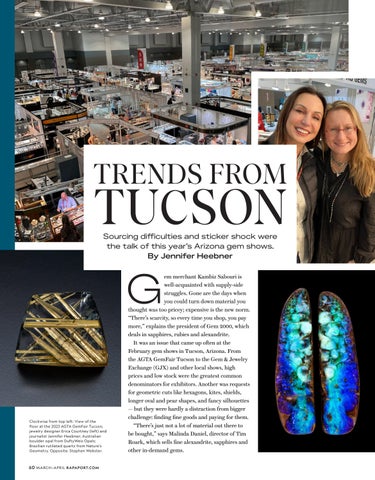
The Tucson gem shows are my absolute favorite. It’s a World’s Fair-type environment in the Sonoran Desert, complete with a Saguaro-cactusstudded landscape and excellent Tex-Mex fare at every meal. Dealers from around the world hawk gemstones from venues along the I-10; you can buy a faceted sapphire at the Tucson Convention Center or a 55-gallon drum of uncut rocks from a dealer in a motel parking lot. Unconventional landscape aside, serious transactions happen here. In my “Trends from Tucson” piece, dealers weigh in on strong sales despite sourcing challenges and the ever-climbing costs of raw materials.

I’ve always enjoyed the action, drama and suspense of the live auction market, the stories behind the historic pieces, and the everchanging techniques for creating jewels and watches. In my interview with Paul Redmayne of Sotheby’s, I try to give readers a sense of what it’s like to work in the business. Meanwhile, the secondary watch market saw incredible gains during Covid-19, and many young people with good business sense and a passion for timepieces are getting involved in it. One of the newest entries is WatchAnalytics, a website where watch aficionados can view market trends for thousands of models. In my story on this up-and-coming company, we look at a handful of top watches to see how the market has changed since the pandemic.
Also in this issue:
Carol Besler, Beth Bernstein, David Brough, Francesca Fearon, Richa Goyal Sikri, Joshua Hendren, Vivien Johnston Glass, Sarah Jordan, Joyce Kauf, Kate Matthams Spencer, Livia Primo Lack, Kyle Roderick, Adrianne Sanogo, Jodie Marie Smith, Cynthia Unninayar, Isabella Yan
When my friends go on maternity leave, they completely switch off from work. Bye-bye, see you in three, six, 12 months!
I enjoyed the precious time with my baby daughter, but disconnecting from the diamond and jewelry industry, I did not.

First, I looked forward to each new issue of Rapaport Magazine, brilliantly edited by Rachael Taylor. I listened to our insightful podcasts and clapped at each new weekly Market Comment video. And I was beyond excited to see the launch of Rapaport.com.
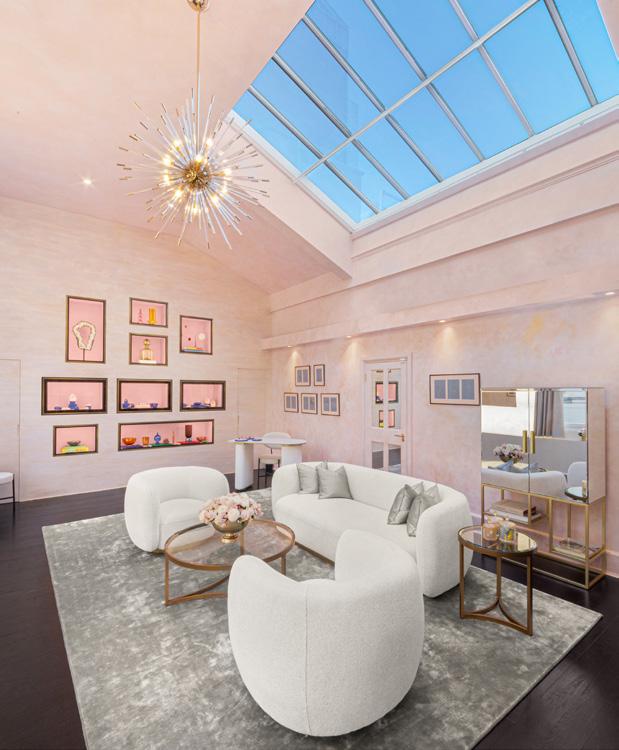
The opening of a gorgeous jewelry showroom like Lily Gabriella’s in London, the debut of a new
collection by Lebanese artist Clara Chehab, and so many other glittering developments kept me enthused about the creative energy in our trade. My dear friend Alan Bronstein warned me six years ago when I joined Rapaport that this was an all-consuming industry. I’m happy to be back and privileged to have resumed work with our Dream Team. One of the benefits of taking a bit of distance from work is to have time to think of new ideas, so watch out for our new projects in the coming months.
“One of the benefits of taking a bit of distance from work is to have time to think of new ideas”
S onia Esther Soltani EDITOR IN CHIEF SONIA.SOLTANI@RAPAPORT.COM



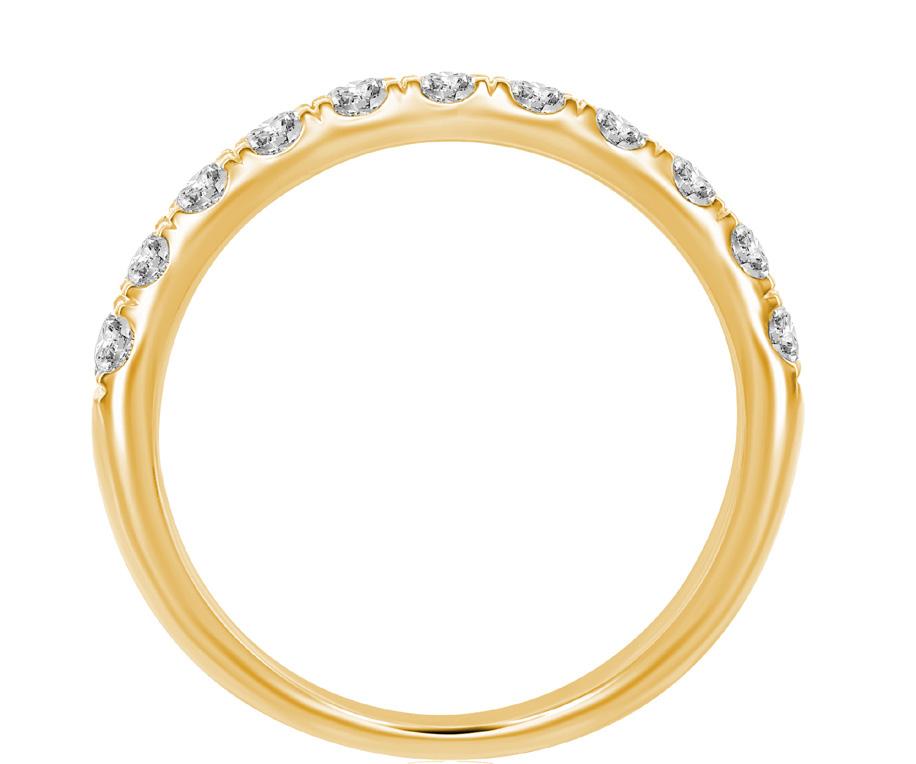
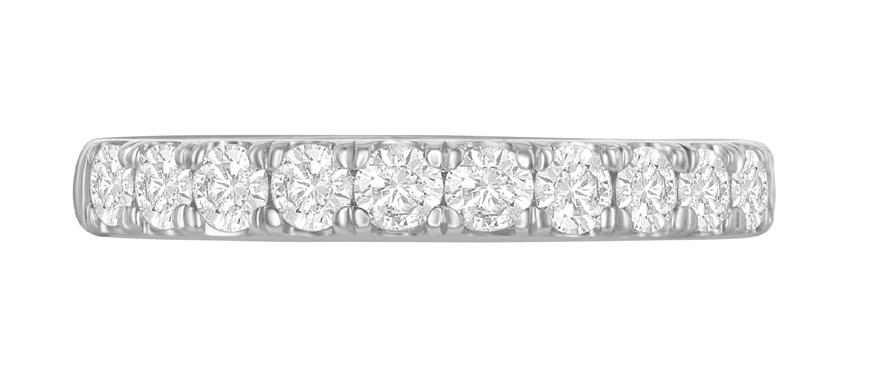
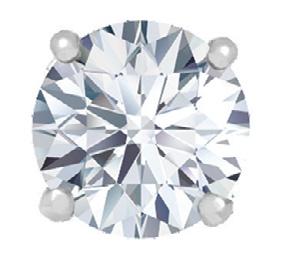
Natural rough diamonds come in a variety of shapes. The challenge for the cutter is to imagine the polished diamond inside the rough. Sometimes a large rough diamond offers the opportunity to cut more than one polished from one piece of rough.
The decision of what to cut from the rough is often complicated by the location of inclusions and the desire to maintain an optimal weight. For example, the owner might have to decide whether to avoid certain inclusions in the rough and produce a 3.05-carat, D, SI2 instead of a pear-shaped, 2.51-carat D, VS1.
Sarine technology has turned the imagining of what the rough has to offer into a science with three-dimensional alternatives that map inclusions. The decision about which shape to produce so as to maximize profits transcends the cutter’s skills. The owner must consider numerous factors such as market prices and liquidity. Is consumer demand for pears greater than for ovals? How important is the 3-carat size for ovals? How many pears are already in inventory?
Artificial intelligence will advance the role of technology in business and in some instances replace the subjective creative decision-making we call art. Computers will calculate the shape, quality, size, inventory position, and price differentials, and tell us what to do.

The lesson here is that there is more to diamond cutting than meets the eye. This is true about everything in the diamond business. The secret to our success lies in our ability to integrate all the factors required for success. It’s not just market conditions. How are we treating the people that work with us? Do we understand and care about our customers? Are we socially responsible relative to the environment? Where is our rough coming from?
Our business is and will always be about people. Ourselves and the people we work with and work for. It will be about our passion for what we do and how we do it. Technology is advancing. Are we?
A roundup of key events and stories from the first quarter of 2023
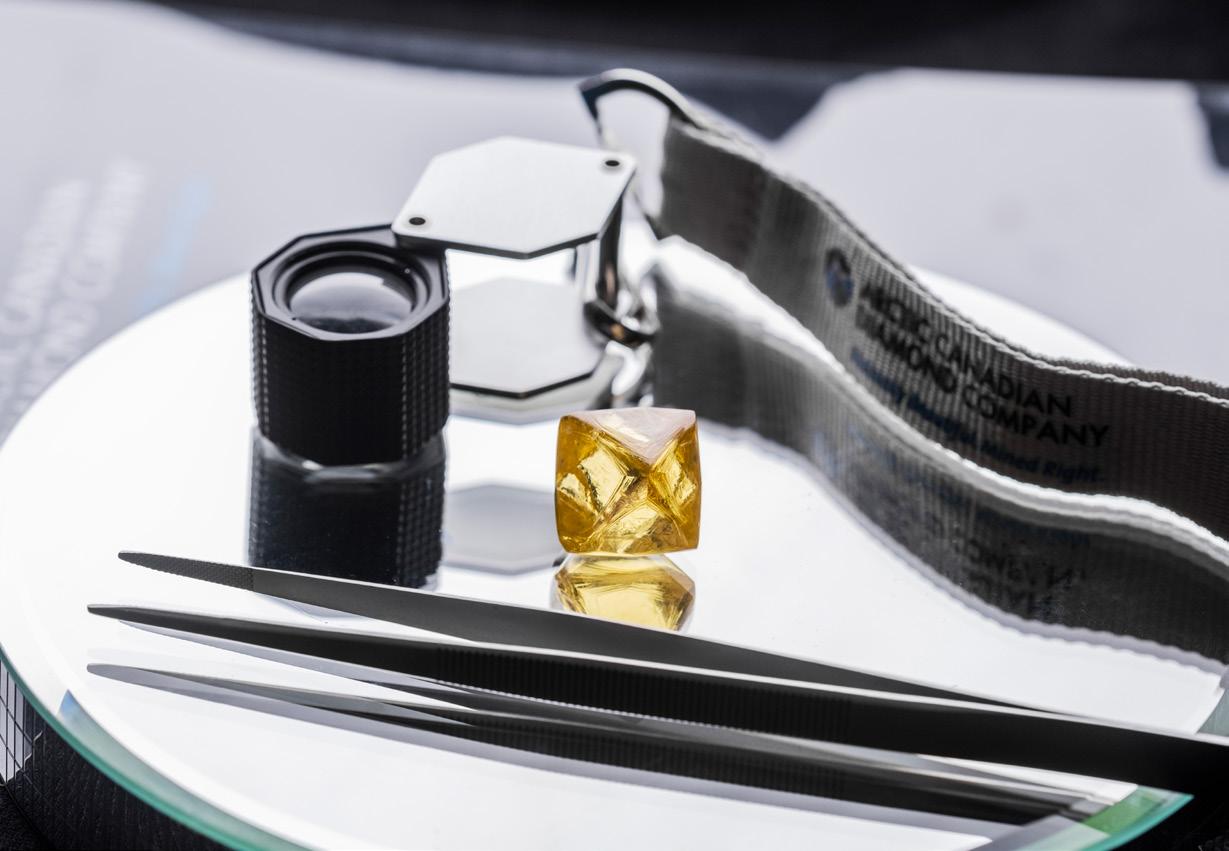
The Ekati deposit in Canada, famous for producing highquality rough such as this 71.26-carat, fancy-vivid yellow stone (below), has sold to Burgundy Diamond Mines. The Australian business acquired the site by buying owner
Arctic Canadian Diamond Company for $136 million.

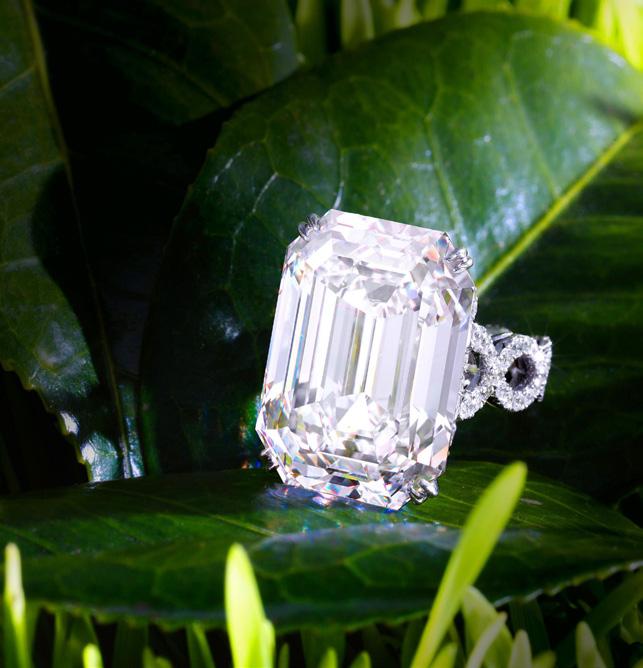
A ring from luxury jeweler Leviev, featuring an emeraldcut, 35-carat, D-color, VVS1-clarity diamond (pictured), fetched $2.7 million at a Bonhams auction in New York. All 119 items at the March sale — named Perfect Jewelry Box — found buyers.
A staff member from the Hong Kong Trade Development Council (HKTDC) takes a selfie with attendees at the organization’s March jewelry show. Traffic was strong after three years of disruptions from Covid-19.

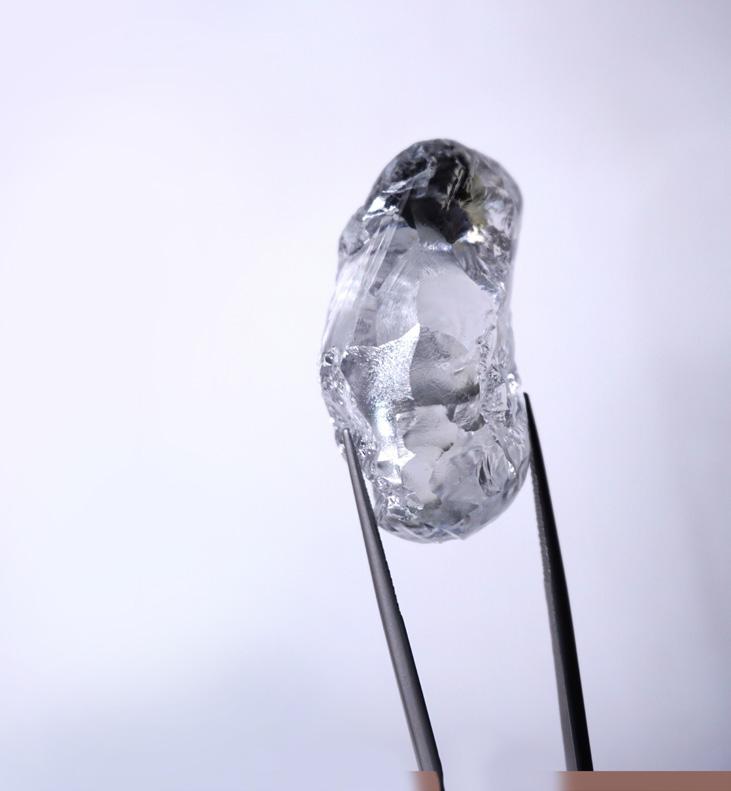
Lucapa Diamond Company unearthed a 150-carat, D, type IIa diamond at its Lulo mine in Angola, raising spirits in a sluggish period for large rough discoveries.
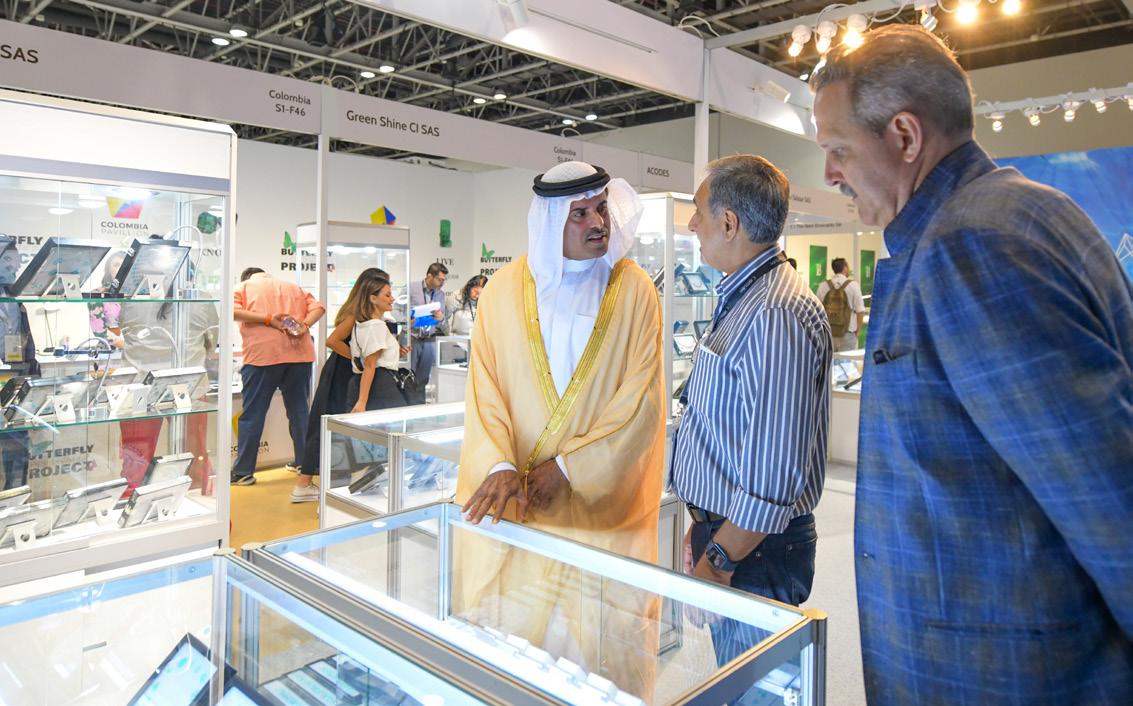
Buti Saeed Mohammad
Al Ghandi (left), vice chairman of Dubai
World Trade Centre (DWTC), walks the Jewellery, Gem & Technology (JGT) fair, which took place in the Emirati city in February.
Accurately screen out simulants, synthetics and treated stones.

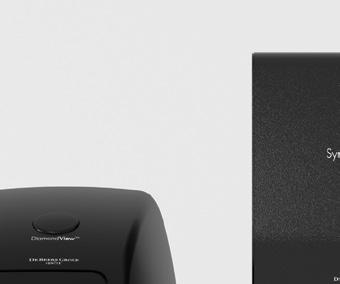

Ensure confidence in your brand through accurate detection, differentiation and disclosure of loose and mounted diamonds.
Use advanced ASSURE tested instruments which, when used in combination, considerably reduce the number of stones that would require extensive time consuming laboratory testing.

Book a demo
Email: contactignite@debeersgroup.com





Ignite is a leading innovation, science and technology division of De Beers Group. Through continuous research, development and innovation, our advanced suite of detection and verification instruments provide consistent and accurate screening of your diamonds.



The perception of augmented reality (AR) is that it’ s a futuristic technology that will one day shape the retail landscape. However, the techniques for generating realistic virtual jewels for consumers to try on already exist.
In January, Cartier announced the launch of the Looking Glass — an instore device capable of rendering jewelry on customers’ hands in high resolution. It fits neatly on a desk and requires a lamp-like camera, an iPad, and a desktop computer to function, according to Wired magazine. The customer wears a black band on the chosen finger to serve as a motion-capture device. The software then superimposes a ring over the band and displays the results on the iPad.
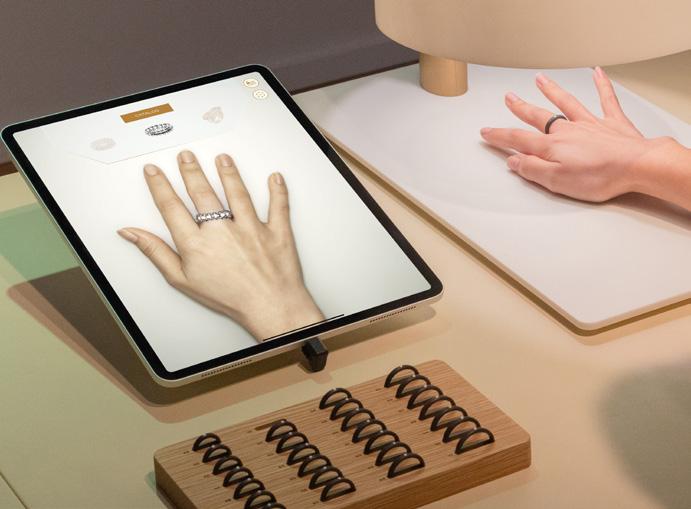
The Looking Glass is being tested globally in a handful of Cartier stores. It allows shoppers to try 13 different rings,
By Jordanwith a sales associate on hand to provide further information about each item.
The launch of such a product by a big name like Cartier has ignited a conversation around AR in the luxury retail environment. However, the developers behind the tech — French artificial intelligence (AI) firm Jolibrain and California-based Blue Trail Software — had to face the challenges of ensuring the quality of the results matched the high-value nature of the goods.
The Looking Glass employs an AI-led neural network that “has been trained to execute the realistic rendering of a ring in real time, without being explicitly written by a programmer,” explains Jolibrain CEO Emmanuel Benazera. The benefit is that a 3D model, or “digital twin,” of a ring doesn’t need to be made
in advance. “The AI system is trained from just videos of the target ring,” making it “simple and easily scaled to full catalogs,” Benazera says.
Blue Trail Software worked with the Cartier Retail Innovation Lab to develop the Looking Glass application and integrate the Jolibrain AR tech. “Cartier wanted virtually no latency between hand motion and its rendering on the iPad,” says Blue Trail president Remi Vespa. This rendering had to be “perfect in terms of colors and illumination.”
This highlights another jewelry-related AR challenge: the materials themselves. Jewelry is “difficult compared to other things you could virtually try on,” according to David Ripert, CEO of London-based 3D and AR company Poplar Studio. Issues include “the reflection and transparency of the stones,” as well as the reflections and shine from precious-metal settings.
The Looking Glass uses subtle trickery to get around this. “On every generated image, the way the stone reflects light is wrong in terms of what the exact true underlying physics should be,” Benazera explains. “But the trick is that our brains can’t tell.”
All this effort has so far resulted in only 13 rings to try on. While that would be a problem for an e-commerce site, this project is for the store environment, where the goals are different.
“From a buyer’s perspective, AR provides a more immersive and engaging experience,” says Vespa. “Cartier is clearly ahead of the pack. Their solution enhances the purchasing experience... by providing potential buyers with many more options” than are present in the store. He believes the move may spur Cartier’s competitors to follow suit, but that internal naysayers could be the biggest hurdles for companies.
In that vein, Ripert sees brand adoption of AR, more than the technology itself, as the next frontier.
Cartier’s Looking Glass virtual try-on device shows that the future of luxury jewelry retail has arrived. Will the house’s competitors follow its lead?
Sarah

transform infrared (FTIR) spectroscopy, and fluorescence and phosphorescence imaging, Sibley relates. They also consulted with one of De Beers’ senior geologists in South Africa to gain a better understanding of how such an uncharacteristic formation occurred. The stone “initially looked like a twin, and upon closer inspection, we found out it was indeed a macle,” Sibley says, using the term for a twinned crystal.
The De Beers researchers identified three layers making up the diamond, she continues. “The initial growth, the core, was good-quality diamond followed by rapid, fibrous growth. This fibrous growth is [mostly] poor-quality, containing many fluid inclusions. Subsequent to the poor-quality growth came more gemquality [material], the outer part of the diamond.”
By Adrianne SanogoPicture a diamond that has just formed deep in the earth, en route to the surface in fluidrich pipes. So many factors go into its creation, including specific pressure, the perfect temperature, and certain trace elements. Now imagine a disruption occurs in this complicated process, and then a recovery that gets the process back on track. That’s one way to create a diamond-within-a-diamond — like the 0.33-carat rough specimen that De Beers has dubbed the Beating Heart.
The D-color, type IaAB stone was discovered last year at one of De Beers’ mines in either Africa or Canada. It appeared in an allocation for sightholder VD Global in October, according to Samantha Sibley, technical educator at
the miner’s Ignite innovation arm. The next month, it was submitted for analysis to the De Beers Institute of Diamonds facility in Maidenhead, England, which verified the stone as natural.
As one might imagine, examining the intricacies of a diamond-withina-diamond on such a small scale is something of a challenge. However, the scientists at De Beers succeeded with techniques such as optical and scanning electron microscopy (SEM), Fourier-
However, because of an opening in the outer layer, “mantle fluids entered the diamond and etched away this fibrous growth, leaving the tiny diamond [core],” she explains. “The opening is not big enough for the tiny diamond to pop out, so it remains enclosed in the larger crystal, free to move.”
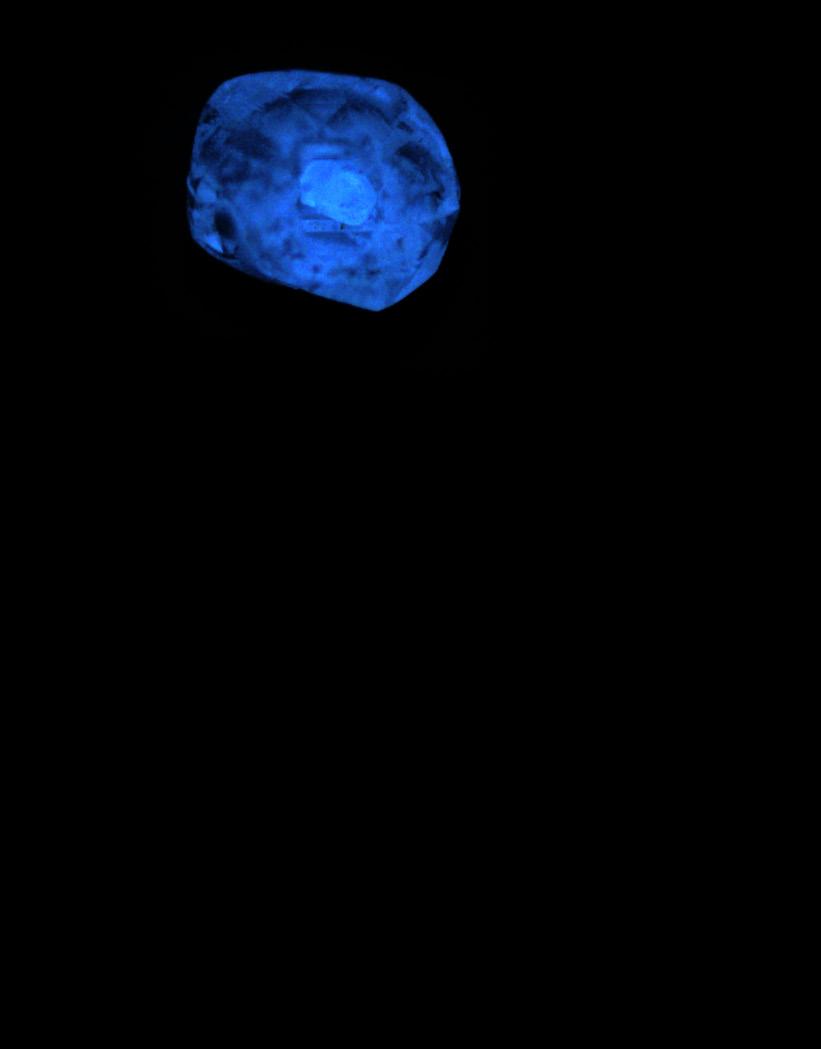
The Beating Heart’s growth process was different from that of the Matryoshka diamond that Alrosa found in Siberia back in 2019. Named for the famous Russian nesting dolls, that stone resulted from one diamond growing inside another, according to Alrosa’s scientists.
The gem-quality Beating Heart is among the rarest of rare in the diamond space, and given its tiny size, there are no plans to cut and polish it. It has, however, been registered on De Beers’ Tracr blockchain platform. It wouldn’t be surprising if it appeared in a museum someday.
“The fact that the gem-quality portion of the diamond has remained proves that the Beating Heart diamond really is a tough cookie [able] to thrive in these conditions,” says Sibley.
is rare, but
Beers’ recently unearthed Beating Heart specimen has shed light on how such stones form.
“The fact that the gem-quality portion... has remained proves that [this stone] really is a tough cookie”
Martin Rapaport’s 2023 New Year message caused a storm of controversy. He argued that the rise in synthetic-diamond sales was being driven by a greed that would destroy the natural diamond industry once consumers realized lab-grown had no lasting value. Rapaport received a slew of emails as the industry weighed in on the debate. Here are just a few of those comments.
Edited by Rachael TaylorI was initially anti-lab-grown and have since seen the viability of this market. We are selling lab-grown 4:1, and there are several reasons why: The price is making what was previously only available to the super-rich within reach; Gen X-, Y- and Z-ers prefer that the diamond not come from the earth, [in the interest of] protecting and leaving our natural resources undisturbed; and the availability of lab-grown diamonds provides consumers with many more and faster options.
I’m not saying lab-growns are for everyone, but they certainly present an opportunity for both buyer and seller. Our margins on lab-grown diamonds are tremendously higher than naturals,
and many other dealers are seeing the same thing. I always educate and explain the differences to customers and try to emphasize the value of a rare earth-mined gem. Usually it’s a financial decision, plain and simple.
I hope both can find their place in the market. Naturals became so ridiculously expensive toward the end of the pandemic, and [that] carried over until mid-2022. I believe this opened the door for synthetics. My customers don’t seem to care that their diamonds will be worthless at some point. Gen X, Y and Z largely do not care about the rarity or mystique of natural diamonds. [This is] the world we live in, and...humans need to adapt to the curveballs.
DAVE ALPERT New England Diamond & Jewelry BuyersI have resisted lab-grown diamonds for years, but I’ve reached a point where I will now sell but not stock them. Customers want to buy them from me, so I feel a sense of responsibility to sell it to them for a fair price with complete disclosure, rather than have them buy it from the stores that are pushing them with insane markups. My explanation to them is simple: Keep your spend below $5,000, and think of it like an expensive bag that you wear to death that won’t have any resale value, but at least you enjoyed it.
At first, we received very few synthetic requests. In 2022, [these] increased substantially. My children are now of the age where their friends come to me for engagement rings. One such man in his 20s, my son’s roommate, was initially sold on the idea of buying a synthetic because it was larger and less money. He didn’t care about any effect on the environment or anything else. G-d willing, he was never going to sell it, so he didn’t care about future value until I pointed out how the family heirloom, passed down to a future son or daughter, would be worthless. That got him.
Using De Beers’ Lightbox pricing as a guide, we think we’ll start seeing a huge disparity [between] what someone buys a synthetic for [and] what it appraises for. This at a time when synthetic retailers cling to over-inflated profit margins as rapidly “rotting” inventory value dries up in their cases. It should be an interesting ride as this all plays out.
KATHERINE
Jewelry designer, AustraliaI feel, at present, that the production of lab-grown diamonds is far higher than the demand from the end consumer, even considering [that the] growth in demand and production is only going to keep increasing. However, I do see why consumers, especially millennials, may choose lab-grown diamonds for small, casual jewelry purchases. People spend about $1,000 to $1,500 on a mobile phone, and it has almost no resale value, just the utility/usage value. Yet in India, most customers at present are averse to buying lab-grown diamonds. In fact, after the awareness about lab-grown diamonds, we get
clients asking us specifically for natural diamonds and making sure we are not giving them lab-grown, because people in India see jewelry-buying as an investment, as something having a store of value, and a safe asset in uncertain times. It may open up a whole new segment of consumers in India who couldn’t afford natural diamond jewelry, but I believe that may adversely affect the natural-diamond market, as the exclusiveness factor will be diminished unless we as an industry are able to market both as separate categories and insist on buying natural diamond jewelry for special occasions.... Natural diamonds are rare, hence expensive and exclusive.
IN MY OPINION, THE BIGGEST HARM TO THE JEWELRY INDUSTRY IN THE LAST TWO DECADES HAS BEEN THE PASSING OFF OF LAB-GROWN DIAMONDS AS BEING ACCEPTABLE AS LONG AS THEY ARE MOUNTED IN GOLD JEWELRY.ISHAAN SHAH , Sarvada Jewels JOHN S. GUPTON , Private Label Imports
Hard-luxury companies are accelerating their responsible-sourcing efforts so they can meet consumer demand, comply with new legislation and ensure their long-term growth. But there is a lot yet to be done, and the costs of not embracing these practices are rising.
 By Milena Lazazzera
n the late 1960s, Philip Kotler’s seminal book Principles of Marketing introduced the “four P’s” that constitute a blueprint for any company: product, price, place and promotion. But the advent of more knowledgeable, demanding and engaged consumers calls for a revision. So businesses have added a fifth P: purpose.
A company’s purpose is more than a consumer-facing mission. Investors see a firm’s environmental, social, and governance (ESG) credentials as intertwined with profit. The latest financial reports from the largest luxury groups are a case in point: LVMH and Kering included a section detailing their ESG-related activity and progress, while Richemont issued a separate corporate social responsibility (CSR) report.
But which ESG areas are the most important for hardluxury companies when it comes to consumer perception and long-term growth? And how far have these companies come?
While ESG encompasses a broad range of topics, Federica Levato and Matteo Capellini respectively senior partner and associate partner at Bain & Company point to three key areas for luxury businesses: responsible sourcing and labor conditions, environmental sustainability, and transparency.

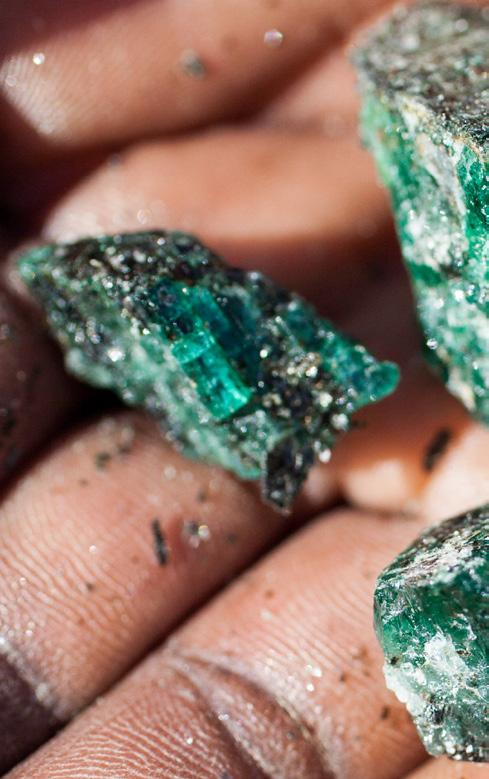
The issues of human rights and labor practices in the jewelry business came to the fore at the end of 2020, when NGO Global Witness released a 48-page report alleging that rubies from the military-controlled state of Myanmar were ending up in the jewels of Place Vendôme brands. In the past, Global Witness exposed how the Taliban and other armed groups were earning millions with Afghanistan’s lapis lazuli, while the arrest of Horacio Triana, known as Colombia’s “emerald czar,” revealed Colombian emeralds’ complicated links to drug trafficking and the country’s paramilitary groups.
De Beers has set aside a total of 200,000 hectares of land for conservation to offset its mining activity, according to the firm
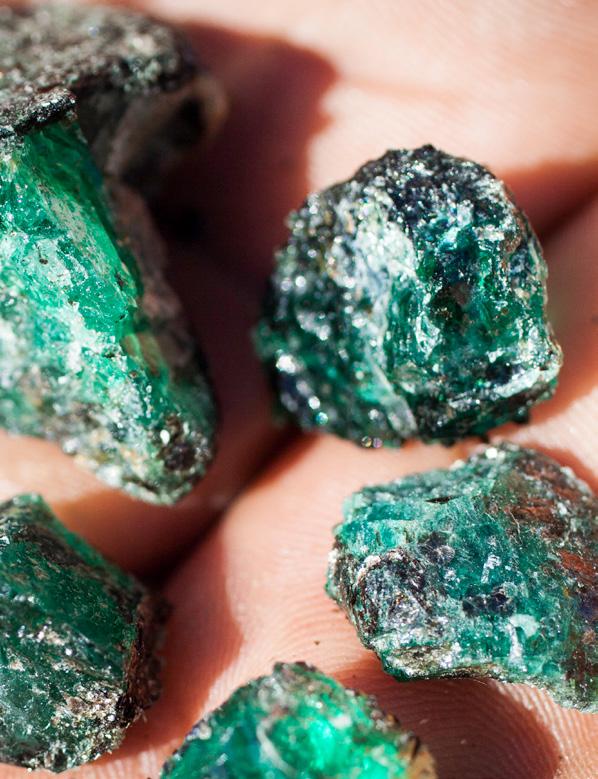
Unlike diamonds, which are controlled by a handful of large miners and regulated by the Kimberley Process, colored gems mostly come from a multitude of small artisanal mines scattered all over the globe, and pass through a tangle of dealers before ending up in jewelry. Supervising bodies like the Responsible Jewellery Council (RJC), the Coloured Gemstones Working Group (CGWG), the World Jewellery Confederation (CIBJO), the International Colored Gemstone Association (ICA), and the International Council on Mining and Metals, among others, have attempted to make the sector more transparent and accountable, but there seems to be no magic bullet.
Gemfields, the largest colored-stone miner, joined the Voluntary Principles Initiative on Security and Human Rights in 2020. The move aimed not only to improve Gemfields’ own image it had come under fire for its labor practices in

the past but also to lead the way for other players in the colored-gem sector. The House of Gübelin has begun buying rubies from less problematic countries such as Greenland.
However, even in countries with ethical issues, there are responsible ways to source directly from miners, believes Susan Wheeler, founder of the Chicago Responsible Jewelry Conference. If one does purchase from conflict areas, Wheeler recommends thorough due diligence. “Let’s not only ask where the gemstones are mined; let’s also ask, who are the companies and the executives running the mining companies?” she says.
Large luxury groups still have a lot of homework to do on workers’ rights, according to the Sustainability Index that online media source The Business of Fashion published last year. Although it didn’t focus specifically on jewelry, the report rated the workers’ rights scores of publicly traded luxury firms. Kering scored 40 out of 100, Richemont 25, and LVMH only 19.
De Beers, which has full mine-to-market operations, is keen to declare its own ESG credentials. “Our diamonds are not only 100% conflict-free, but they have been ethically sourced to the highest health, safety, environmental and labor standards,” says Céline Assimon, CEO of De Beers Jewellers. For the past 15 years, the miner has employed “the strictest set of standards in the industry...covering all critical issues of ethical, social and environmental integrity,” she adds. Responsible sourcing is one of the core pillars of De Beers’ “Building Forever” plan — a set of 12 goals the company announced in 2021 to achieve by 2030.
The company also runs the GemFair program to regulate and improve the operations of artisanal and small-scale miners (ASM). The platform tracks diamonds and ensures that these mines respect international requirements for fair labor practices, worker health and safety, and environmental impact.
While GemFair’s stated aim is to promote the sector’s legitimacy and benefit the 150 million people who depend on ASM, the platform is not without its critics. In a 2020 study,

“Let’s not only ask where the gemstones are mined; let’s also ask, who are the companies and the executives running the mining companies?”Isaia Byele, a ranger, overlooks a watering hole at the Venetia Limpopo Nature Reserve, part of South Africa’s Diamond Route.
Kering rated only 40 out of 100 on workers’ rights in a Business of Fashion study — still better than Richemont and LVMH 40/100
If advances in sustainability have so far been the fruit of companies’ own initiatives, new laws seek to bring more transparency to consumers.
In January, the European Parliament approved the Corporate Sustainability Reporting Directive, which demands thorough monitoring of companies’ supply chains, holding them accountable at every step of the process.
New technologies ranging from blockchain to artificial intelligence (AI) have dramatically increased transparency for diamonds and gemstones at major jewelers; The Business of Fashion Sustainability Index 2022 gave high transparency scores to Kering and LVMH — 74 and 52 out of 100 points, respectively, for this category — though Richemont received only 15.
Tracing gold — the most fundamental element in jewelry — still proves a challenge, however. In March last year, the Global Gold Transparency Initiative warned brands about the risk of unwittingly funding Russia’s war on Ukraine by not conducting a thorough overview of their supply chains.
But brothers Charlie and Dan Betts, whose family has traded and refined gold since the 1700s, believe that Single Mine Origin (SMO), the new standard they created in 2018, is the solution to obtaining traceable gold.
Marc Choyt, president of New Mexico-based jeweler Reflective Jewelry, warned that GemFair posed the risk of letting De Beers dominate the diamond trade again as it did until a couple of decades ago.
Brands that use lab-grown diamonds often maintain that man-made gems are the only eco-friendly option.
In 2021, Pandora announced that it was switching to labgrown to improve its environmental practices. Last year, watchmaker Breitling declared the same move and motives, and many new jewelry brands that use solely synthetic diamonds are marketing themselves as sustainable.
Some take it a step further, dismissing miners’ own sustainability claims as “greenwashing.”
“The notion of ‘sustainable mining’ is an oxymoron and particularly laughable,” asserts Martin Roscheisen, founder and CEO of lab-grown producer Diamond Foundry. “Mining,
SMO applies a chain-of-custody protocol at two sizable mines in Mali and the Ivory Coast. A third mine in Guinea will become operational by mid2023. The SMO gold goes to a partner refinery in Switzerland, where it is segregated and refined separately from other gold bars. The process can be monitored via a QR code. London-based jeweler Boodles was among the first to transition to SMO gold in 2018, followed by Garrard and Shaun Leane, among many others. The SMO kitemark affirms that the gold is from mining companies that pay workers a fair wage and have no ties to conflict.
In its recent sustainability report, Richemont mentioned its commitment to source 100% of its gold from traceable sources. The group is also partnering with Swiss Better Gold, an organization that facilitates artisanal and small-scale gold miners’ access to international markets.
by definition, depletes a resource, and not doing so is the Merriam-Webster dictionary definition of ‘sustainable.’”
That said, “lab-grown diamonds aren’t necessarily sustainable,” remarks Pierre Dupreelle, global leader of customer behavior for Boston Consulting Group (BCG). While some producers, like Diamond Foundry, rely only on renewable energy to power their diamond-growing machines, others are still using less-sustainable forms of energy.
Moreover, the production of lab-created diamonds involves methane and hydrogen. The former comes from liquefied natural gas, and Europe produces the latter from natural gas, though China gets its hydrogen from coal, according to a 2021 report by ESG-focused service provider Sphera. The United Nations Environment Programme has identified methane as one of the leading causes of climate change though the Sphera report notes that the synthetic-diamond industry contributes only a negligible amount.
head Aurelia Figueroa. “We kept the traditional packaging as an alternative and offered our customers the choice. But it showed that less than 1% asked for the traditional watch box.”
Some critics still maintain that initiatives like these are mere public relations stunts especially considering the top three luxury groups’ poor scores in The Business of Fashion Sustainability Index. Running a sustainable business goes beyond isolated initiatives; it demands structural and operational changes.
70 %
While Assimon acknowledges that mining exploits natural resources, she stresses De Beers’ engagement with the environment. “Most people don’t know that for every hectare of land affected by mining activity, De Beers sets aside six hectares for conservation, totaling 200,000 hectares — twoand-a-half times the area of New York City,” she says.
Meanwhile, Kering halved its environmental footprint between 2015 and 2022, according to its financial report, and created the Climate Fund for Nature last year to support biodiversity restoration and conservation. LVMH plans to use recycled materials for 70% of its packaging as part of its LIFE (LVMH Initiatives For the Environment) 360 program.
At Breitling, clients welcomed the company’s switch to smaller, foldable, upcycled packaging, reports sustainability
“To really make a change, the industry needs to consider the supply chain as a value chain,” asserts Leanne Kemp, founder and CEO of blockchain company Everledger, which provides traceability technology for the trade. “This means considering every aspect of a product’s life the impact each of the supply chains is having [on] the production process” — and restructuring the company’ s operations to incorporate ESG strategies.
Everyone must get involved, she believes: “The responsibility for ESG practices should be shared throughout the entire organization, rather than a single C-level role hidden within the marketing department or alongside procurement.”
Naturally, a structural turnaround implies costs. Ethical practices challenge companies’ bottom lines, says Dupreelle. “There is up to a 20% to 25% cost increase when switching to Fairtrade gold to ensure it is mined in ethical conditions. The effect is the same with responsibly mined gemstones, which have an average cost increase of 10% to 15%. The question remains as to how much of these costs customers will be willing to absorb.” Larger and established luxury brands have a greater ability to adjust to these changes, he adds.
And it’s not just the monetary costs. Besides being more expensive, recycled materials require additional traceability efforts to guarantee their sustainable origins, explains Dupreelle. The monitoring also needs to reach sub-suppliers to be truly meaningful, and this requires investment in technologies. In the creative department, designers have to retrain to adopt sustainable practices.
Yet the costs of not implementing sustainable practices are rising, Dupreelle warns. Governments are cracking down on companies’ transparency and emissions with new laws and taxes. ESG criteria matter not only to consumers, but also to prospective employees. When looking for work, 40% of millennials check firms’ ESG records, according to a recent BCG study. So do financial institutions, which offer better deals to companies with good ESG scores.
As Assimon says, “sustainability is no longer [just] nice to have, but core to every business.”
Alrosa goods are still flowing into certain countries, but the details are hazy.
By Joshua FreedmanRussian diamonds are entering India, Belgium and other global trading centers. Everyone acknowledges that. But it’s unclear how the goods are getting there, what the volumes are, and which banks are handling the payments.
One rumor on the market is that Russian miner Alrosa, a sanctioned entity in the US, has set up a subsidiary that sells rough to manufacturers, perhaps via an intermediary. Some say Alrosa goods
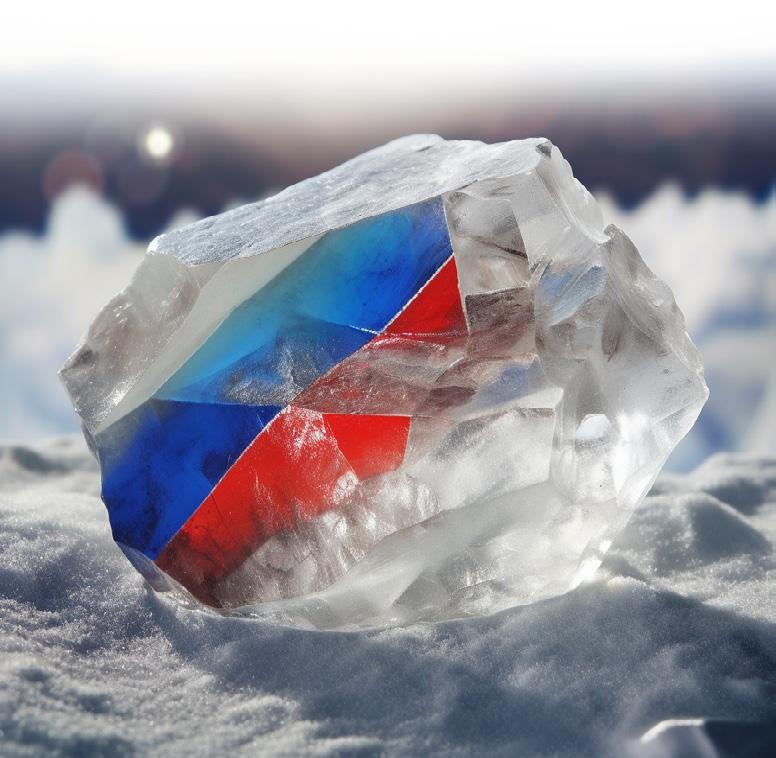
have been reaching Mumbai and Surat via Dubai, though this pathway seems to have ceased due to banking problems.
By almost all reports, the flow of Russian rough into India has declined since the start of the Ukraine war in February 2022. Shipments slowed in last year’s fourth quarter, though few people who spoke with Rapaport this past February were able to explain why. It appears certain banks became less willing to approve money transfers to Russia, either voluntarily or under the influence of governments. Another factor might be the depletion of existing stockpiles of Alrosa stones. The company has not published production and sales data since the war began, so it’s hard to know the extent of its fresh output.
Several Mumbai-based traders told Rapaport they’d been buying Russian rough from private dealers in Antwerp, at least until recently. However, one small-scale manufacturer — who also focuses on small diamonds — found that the quality of the rough he’d been receiving had dropped, with lower clarities and more fluorescent stones appearing in parcels. This led him to believe the best stones were going to a few large manufacturers rather than to the secondary market.
He isn’t alone in that belief. Widespread reports say only a select few major cutting firms have been getting access to the bulk of direct Alrosa supply, creating an impression of shortages for everyone else. Indeed, the manufacturers that estimated Alrosa was still selling at prewar volumes in February were in the minority.
The bottom line is that no one knows for sure how much merchandise is coming from Russia. But it’s definitely flowing. Most of the polished demand is in China and India, where consumers are less sensitive about the Ukraine war than their North American and European counterparts. With the US likely to expand its sanctions, that trend looks set to continue.

Hiding unethical practices behind a veneer of sustainability is a serious issue in the luxury sector. Transparency is key to keeping consumers’ trust.
By Vivien Johnston GlassTouting your company’s efficient energy use while failing to address complaints from the local community. Claiming to be “sustainable” because your business donates to charities, but neglecting your own staff’s labor rights. These are examples of “greenwashing” — misleading marketing messages that falsely claim to make a positive impact on society or the environment.
The term has become a buzzword in recent years as companies seek to boost their environmental, social and governance (ESG) credentials. Related terms include “greenlabeling” — marking a product as “responsibly sourced” without evidence of how its supply chain differs from any other — and “greenlighting” or virtue signaling, in which businesses use a single positive to distract from other negatives. When the targets for improving ESG constantly shift, this is called “greenrinsing.”
In January 2021, the European Commission and consumer authorities in the EU completed a sweep of websites that were making green claims. Half proved to be unfounded, while 42% were exaggerated, false or deceptive and could qualify as unfair commercial practices under EU rule, according to the report. In 2022, the UK’s Competition and Markets Authority announced an investigation into three major high-street fashion retailers for greenwashing. This year, the US Federal Trade Commission (FTC) is reviewing its 2012 Green Guides for the Use of Environmental Claims, which aim to prevent this kind of misleading marketing.
The point of transparent marketing is that buyers should be able to make an informed choice, which means companies should provide evidence to support their claims — no matter what they are.
In the jewelry industry, for instance, there has been disagreement for the past
decade over the ESG merits of “recycled” gold. Proponents assert that reusing gold from discarded products reduces waste. However, others say it’s more responsible to get gold from traceable, certified sources that support the local mining communities; they argue that gold has never been a “waste” product to begin with — that people have always reclaimed it, so it wouldn’t have been thrown out — and as such, recycling it doesn’t actually cut down on existing waste.
Both of these are potentially valid positions to take — as long as the firms espousing them can show evidence that they’re true. When buying a diamond, it’ s reasonable to request a lab certificate to verify its quality, as this affects its value. There is no reason the public shouldn’t ask for similar proof from companies that make ESG claims, since these affect people’s purchasing choices.
Greenwashing can be a deliberate effort to mislead consumers, or it may result from a failure to understand the seriousness of certain issues and how to address them. As in any industry, there
DO:
will be both good- and bad-faith actors. Opportunists will see people paying a premium for certification, and engage in greenwashing to boost their business’s value. In contrast, jewelers who value integrity and having an ethical reputation will put more emphasis on ensuring accurate disclosure and fair pricing.
Underplaying the serious issues that exist in the supply chain leaves the whole industry open to negative scrutiny and a public perception of opaque business practices, all of which erodes consumer trust. Being transparent is essential. It’s wrong for a seller to conceal a diamond’s flaws from the buyer. It’s no less wrong to make deceptive ESG declarations.
While problems exist in all supply chains, luxury goods attract a significant amount of media and consumer attention. Valuable mineral sales can have far-reaching effects. Doing our best to make sure they’re positive ones will benefit both people and the planet.
The author is the founder of consulting firm Johnston Resources and an expert in the responsible sourcing of precious metals, diamonds and gems.
• Take time to learn about the problems identified in supply chains.
• Report and measure. Free tools are available for ESG impact assessments.
• Take the online Green Claims Quiz to check your knowledge at greenclaims.campaign.gov.uk.
• Plan how to address the issues. Create policies, goals and a strategy.
• Commit to improvements. Create procedures everyone can get behind.
• Bring others in. Join initiatives or trade associations, or collaborate.
• Take it one step at a time. It’s about progress, not perfection.
DON’T:
• Only measure and report the positive impacts; commit to acknowledging and reducing negative impacts, too.
• Mudsling about competitors or other sectors within the industry; focus on your own backyard.
While the everyday US diamond market may not sport the kinds of spectacular stones and stratospheric prices that grace auction headlines, last year did see an increase in both the average size and value of the diamonds people chose for their jewelry, according to industry analyst Edahn Golan.
“For natural stones, the average [weight] was 0.67 carats, up 2.7% compared to 2021,” he says. In addition, “while unit sales fell 11%, the average value rose 7.3%” — meaning that American consumers bought fewer diamond-set jewels but spent more per piece.
To find out the latest cut, color, clarity and size trends in the US market, Rapaport Magazine spoke to multiple dealers, from small and medium family-run firms to corporate giants that sell mostly to retailers and designers.
Round cuts are the most popular shapes, dealers say, though the size of choice may vary. Rounds account for 94% of New York-based J&R Ismaili Gem’s business, reports company president David Ismaili. Rounds are also best-sellers at fellow New York-based supplier RDI Diamonds, with sought-after sizes ranging from 0.75 to 2 carats, according to vice president of operations Andrew Rickard.
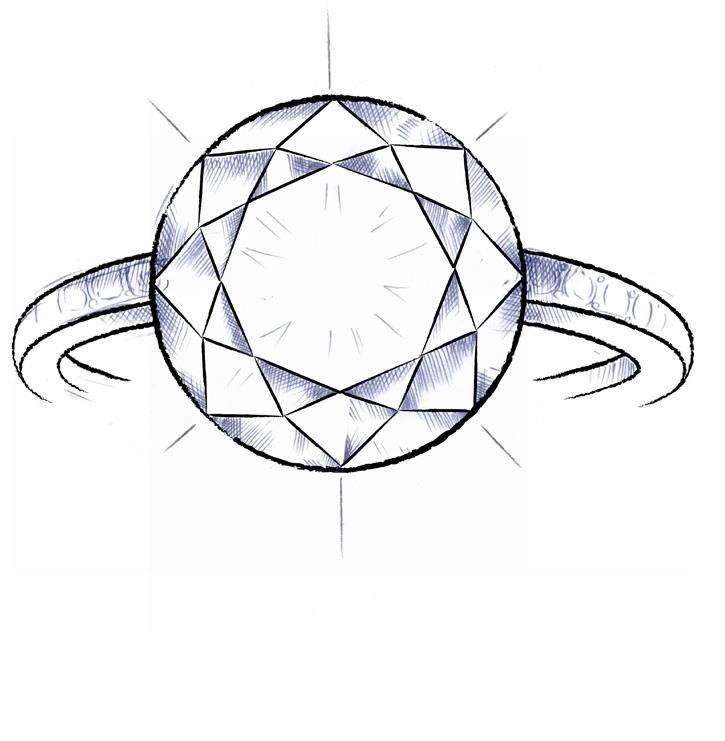
For Elliot Krischer, the most requested size for rounds is 1 carat, though the Esskay Gems owner and Diamond Dealers Club of New York president has noted increasing demand for 3 to 5 carats. Stones weighing 2, 3 and 4 carats have been popular for Stuart Samuels, who heads the Diamond Manufacturers & Importers Association of America (DMIA) and owns New York-based Premier Gem. He’s seen particular interest in pairs for studs, as well as shortages of 6- to 10-carat goods.

In 2020, rounds made up 63% of purchased diamonds, but that number declined to 58% in 2022, says Golan; in contrast, ovals increased from 16% to 19%. But ovals are not the only rising stars.
Cushions and radiants are trending, according to Krischer, although supply is limited for good makes. Samuels has also seen a surge in orders for marquise cuts, and Ronnie Vanderlinden, CEO of New York-based Diamex, confirms that ovals, marquises and pears are all top performers. For Saul Goldberg, president of dealer William Goldberg in New York, ovals and cushions are doing well, as is the company’s patented Ashoka cut. At fellow New York firm InterFancies, ovals are number one, with cushions, radiants and emeralds next in line, reports president Gregory Telonis. James Allen CEO Oded Edelman cites solid sales of oval, cushion and emerald cuts at the online jeweler.

“In terms of clarity and color, the US market is very conservative and keeps sticking to SI-clarity, G- [to] I-color goods,” states Golan. Most of the dealers in this article agree, though Vanderlinden has noticed some regional differences.
“Two-carat rounds are strong in F to J colors,” he says, but in some areas, “notably the west and southwest, the softer [I through K] colors are preferred, whereas the east coast tends toward D to I.”
Telonis has seen demand for certain darker colors as well — particularly K through M —while Rickard says RDI’s most popular ranges are F to J, VS2 to SI2 goods.
While white diamonds may be the majority, fancy colors are highly desirable as well.
People today want something a bit different, says Yoran Dayagi of New York-based Dayagi Diamonds. He points to lozenges, hexagons, kites, shields, stars and animal motifs as increasingly popular in fashion and bridal jewelry.
Telonis has found that trapezoids, half-moons, tapered baguettes, shields, and trilliants sell nicely as side stones in the 10- to 50-point range, depending on the design. “New” old mine cuts and rose cuts in white, champagne and salt-and-pepper colors are winners for Harsheel Shah, owner of Los Angeles-based Prijems, as are “kites, hexagons and other geometric cuts, from 1 to 2.50 carats.”
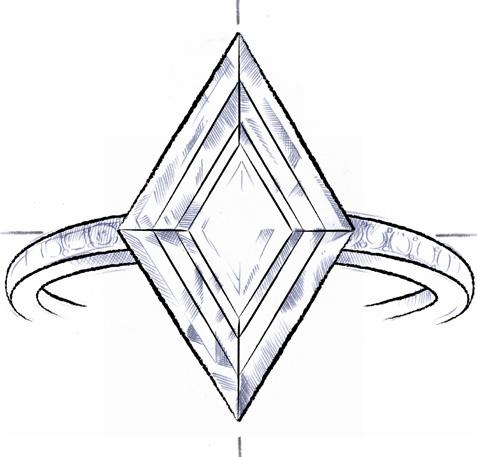
Manak Jewels in San Francisco, California, features a range of rose, step, hexagonal, lozenge, pear and oval cuts. “Rose cuts provide a bigger look for engagement rings,” notes director Sumeet Sethi, adding that his bestselling range for fancies is 1 to 5 carats.
“There are cycles in the diamond industry that tend to come every five to seven years,” says Alan Bronstein, a 42year veteran of the fancy-color sector. Yellow diamonds may be trending now because they are the most abundant, he suggests, especially in radiant cuts that maximize their color.
“We see a very high demand for yellow in almost all sizes and saturations,” affirms Efrat Ashtar, office manager of the Ramat Gan-based Fancy Color Research Foundation (FCRF). “The main issue with supply is finding fancy-color diamonds with strong saturations in most hues.”
Fancy-color specialist Sammy Namdar agrees that yellow is popular in finer hues and clarities — mainly for a more affluent clientele, as prices continue to rise — “yet pink, blue and green have been coming back over the last two years.” Some stones have been more difficult to source, confides the owner of New York-based firm Namdar, and the closing of the pink-producing Argyle mine in Australia has complicated matters. “We can still get pink, but melee is harder to find.”
Whether white or color, says Golan, “consumers still appreciate the value of natural diamonds.”
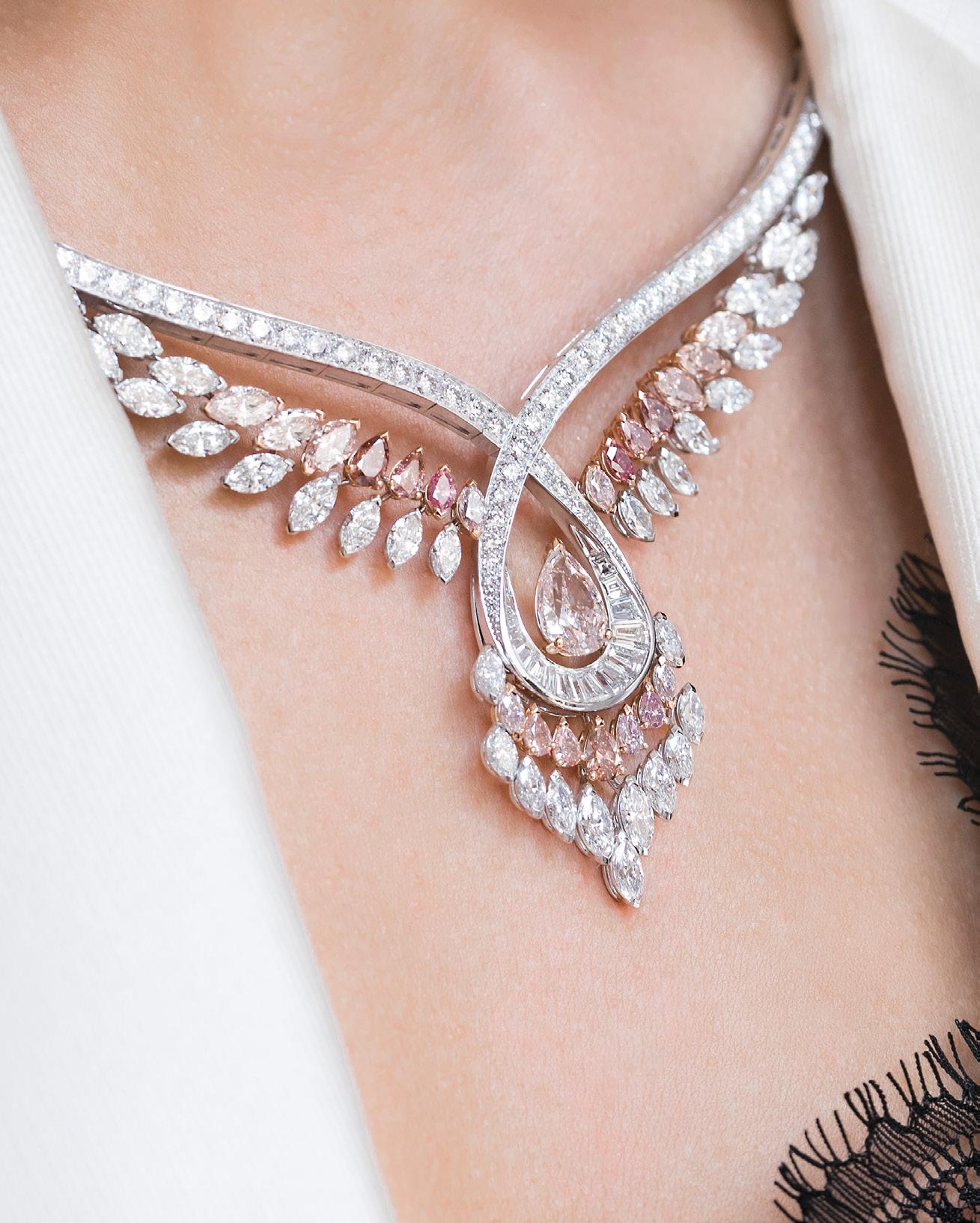
Combining round brilliant and marquise cuts into a teardrop shape, the pear is a distinctive fancy cut with an elegant taper that lends itself to pendants and earrings. Paris-based jewelry house Messika has noticed increased traction in this shape recently, reporting strong demand for it in fine diamond jewelry and “a growing segment in men’s jewelry. For us, pears are well-liked and recognizable.”
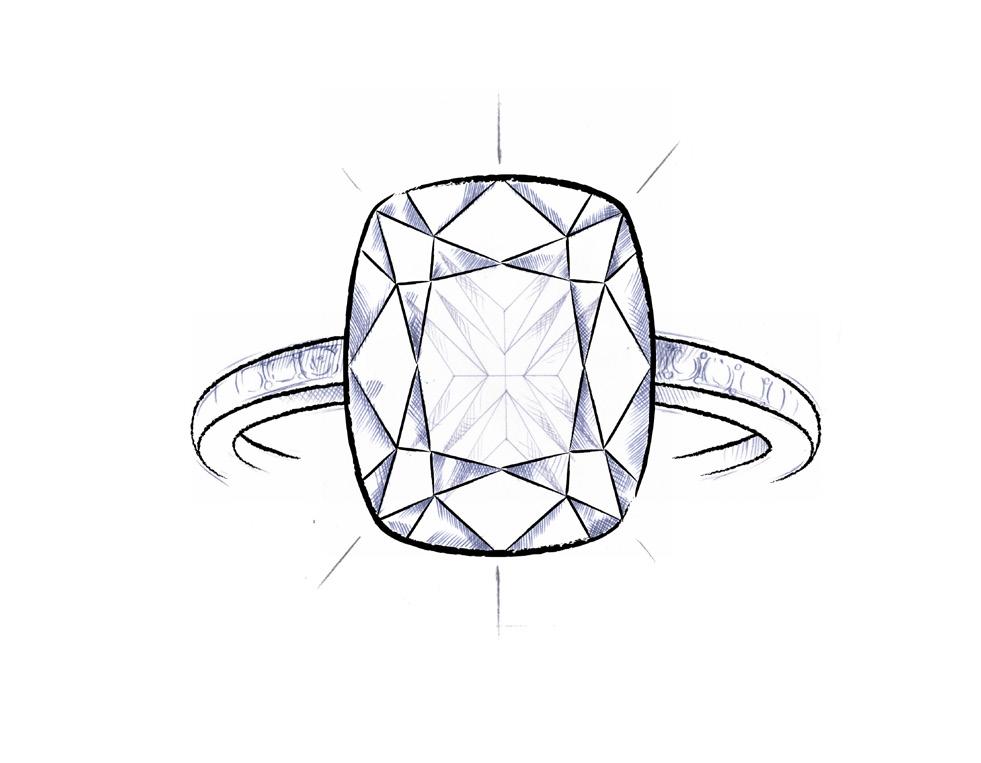
Heritage diamond specialist Baunat has seen an uptick in sales of fancy cuts to the US in recent years, with the cushion leading the charge among well-informed clients. This square cut with rounded corners and large facets is known for its fire and its vintage feel, making it a popular choice for diamond commitment rings.
have been in high demand over the last six months. It’s a classic shape with originality”
“Elongated cushion cuts
The world’s most popular diamond cut, the round brilliant shines as a solitaire but is often overlooked outside the engagement market in favor of fancy shapes. That said, round brilliants are currently in the jewelry spotlight for bringing balance to mixed-stone designs. “I love creating patterns with diamonds and mixing up shapes,” says Nancy Newberg of Nancy Newberg Jewelry. “Round-cut diamonds are always an important part of this mix, as they give softness.”
Old cuts are antique diamonds cut without modern precision tools. The less-structured faceting makes for an “imperfect beauty,” according to Ellis Mhairi Cameron, whose eponymous brand just launched a collection in New York featuring this cut. The client response was strong, she relates: “The collection has already sold well with my US stockists, as it fits their clients’ brief for something classic with a twist, featuring more ethically sourced diamonds.”
An Art Deco favorite, this square cut with facets in a distinctive X shape originated in 1902, when the Asscher family pioneered it in The Netherlands. Minimalist jeweler Grace Lee reports a rise in Asscher requests. While the cut often has pavé accent stones, her unembellished Asscher-cut bezel ring “is one of our most popular bridal styles.”
The rectangular cushion is a more unusual, elongated version of the classic cushion diamond. “Elongated cushion cuts have been in high demand over the last six months,” says New York-based jewelry designer Shahla Karimi. “It’s a classic shape with originality; [it] stands out in a sea of oval and emerald-cut engagement rings. It’s also quite versatile, as it works well not only as a solitaire, but in two-stone, three-stone and cluster rings.”
The Rapaport Price List is commonly used by dealers as a guideline for evaluating natural diamond prices. Readers should understand the List’s standards for describing diamonds, as well as its limitations and how it can be used to aid buyers and sellers.
The Round and Pear Shape Price Lists are published online every month.
The Price List quotes Rapaport opinion of high cash asking prices for Rapaport Diamond Specification A3 and better natural diamonds. These prices may be substantially higher than actual transaction prices. It is most common for the diamond trade to transact at discounts to the List. However, select quantities that are in short supply or subject to speculative demand may trade at significant premiums to the List.
Detailed information about discounts is provided online in real time via our RapNet® and RapX® diamond trading networks. They are also included in the Trade Sheets published in this magazine.
The level of discount or premium is influenced by many factors, including diamond quality and cut, credit/memo terms, the location and type of market, the liquidity level of particular size-quality combinations, and the associated risk of ownership. The easier it is to sell a diamond, the lower its discount to the List. Hard-to-sell diamonds often trade at large discounts. Very in-demand, scarce diamonds may trade at premiums.
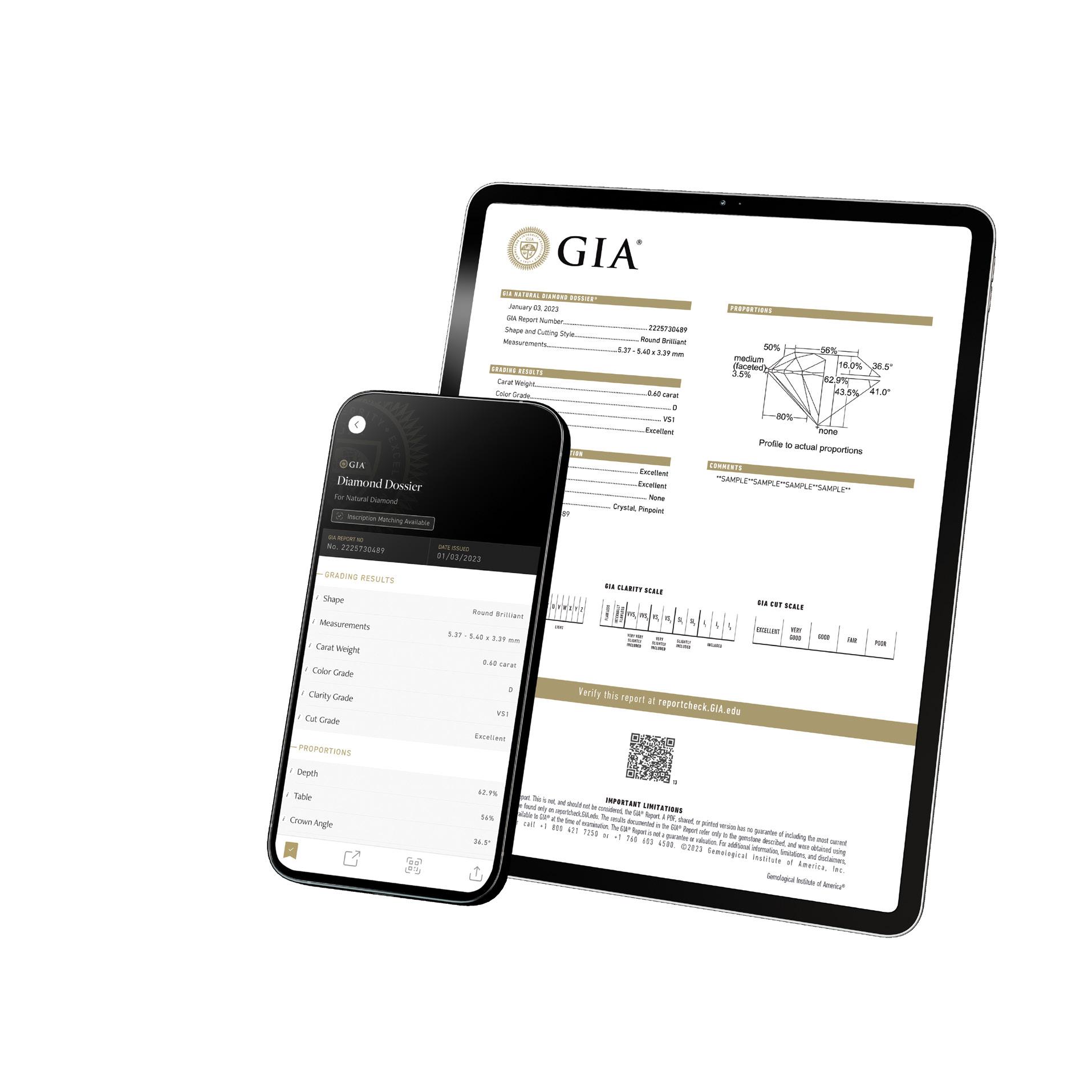
The Price List relates to Rapaport Diamond Specification A3 or better natural diamonds that are graded based on Gemological Institute of America (GIA) standards (except for SI-3, an additional intermediate non-GIA grade).
CAUTION: Grading laboratories use subjective methods of analysis. The same diamond may be evaluated differently by different labs or even each time it is submitted to the same lab.
Grading reports and our Price List do not replace the human factor in evaluating diamond quality or price determination. The Rapaport Price List does not provide transaction prices, but price indications that serve only as guidelines — a starting point for negotiations and a basis for estimating value. Buyers and sellers are advised to consult with experts before trading diamonds.
THE RAPAPORT PRICE LIST IS BASED ON THE FOLLOWING SPECIFICATIONS:
Grading report GIA
Shape Round brilliant
Cut Excellent
Polish Excellent
Symmetry Excellent
Culet None
Depth % 58.5%-63.5%
Table % 55%-62%
Girdle No extremely thin, extremely thick or very thick
Fluorescence None
Weight No .00 sizes for 1.00 and larger
GIA comments No GIA color comment
GIA comments No knot or cavity
GIA comments For SI1 or lower, no “Clarity based on cloud”
Seller requirement No green tint
Seller requirement No Marange diamonds
© Copyright 2023 by Rapaport USA
CUT SPECIFICATION
The Price List relates to fine-cut Rapaport Specification A3 or better diamonds. Additional Rapaport specifications are available at rapaport.com/rapspec These specifications are subject to change without prior notice.
RAPAPORT DIAMOND SPECIFICATION A3Approximate percentage increases from 5-carat prices for larger sizes*
These indications should only be used as guidelines. Large stones are very thinly traded, and prices may vary significantly from dealer to dealer and stone to stone. Availability of large, better-quality stones may be limited, and buyers may find that asking prices and/or transaction prices may be significantly higher or lower than these price indications. This price information should only be used as a general indication of the current market.
* Asking price indications are based on Rapaport Cut Specification A3 or better.
The impact of fluorescence on price depends on its noticeability. In some cases, fluorescence gives the stone a milky-white appearance, which greatly lowers value. In some instances, the fluorescence is hardly noticeable and has minimal impact on the stone’s brilliance. Blue fluorescence gives lower-color stones a whiter, brighter face-up appearance. Yellow or white fluorescence is problematic and may require an additional 5% to 10% discount. Generally, the higher the quality and price per carat, the more fluorescence lowers value.
In the table below, we present our estimation of the price gap between nonfluorescent polished round diamonds, and polished round diamonds that show varying degrees of fluorescence. The percentages represent the average price difference for each of the size, color and clarity categories indicated. ◼
THE RAPAPORT PRICE LIST IS ALSO AVAILABLE ONLINE. YOU CAN SUBSCRIBE AT RAPAPORT.COM/JOIN OR CONTACT US AT SERVICE@RAPAPORT.COM



The following round diamonds were offered for sale on INDEX - Internet Diamond Exchange® to the trade subject to prior sale. Qualities listed are Rap Spec A3+ based on seller’s indication.

Rapaport does not guarantee the availability, quality or accuracy of any diamond, certificate or report. All asking prices include a 5% commission and are in US$ per carat. Additional listings are available at rapnet.com
PERCENTAGE FIGURES show the percent difference between the price of the diamond and the Rapaport Price List. Please read the Guide to the Rapaport Price Lists in the magazine (Page 30) for additional information.
NOTICE: THIS IS A PARTIAL LISTING OF THE BEST-PRICED DIAMONDS LISTED ON RAPNET THAT MEET OR EXCEED RAPAPORT SPECIFICATION A3. ADDITIONAL DIAMONDS ARE AVAILABLE ON RAPNET.® RAPNET.COM
To buy or sell diamonds, please email trade@rapaport.com or call our trading department at +1.212.354.9800.
Selection from our listings on RapNet® at rapnet.com
Total diamonds 2,174,038 Carats 1,966,910 Value $11,736,838,637 Average discount -29.68%





-76%, 22,640 CARATS
FEBRUARY
POLISHED IMPORTS:
▼ -33%, $76 MILLION VOLUME:
▲ 3%, 420,000 CARATS
POLISHED EXPORTS:
▲ 20%, $2.4 BILLION VOLUME:
▲ 22%, 2.6 MILLION CARATS
ROUGH IMPORTS:
▼ -18%, $1.7 BILLION VOLUME:
▼ -14%, 14.2 MILLION CARATS
ROUGH EXPORTS:
▼ -25%, $70 MILLION VOLUME: ▲ 12%, 2.4 MILLION CARATS



Clockwise from
the wedding ring became part of their to-do list,” she relates. So in 2018, Vasquez, a self-described “romantic at heart,” decided to offer meaningful experiences to help couples “get back into their hearts before the ceremony.”
The couples sit at her worktable or in the comfortable embrace of her velvet sofa to design their own rings with her expert guidance. There are three different experiences they can choose from.
The “Make Love” option lets them shape the gold into rings for themselves. Ahead of their appointment, they tell Vasquez their ring sizes and the width of the gold wire they want to use. During the five-hour session, they bend, solder and shape the flat wire before Vasquez “finesses” it as a final step.
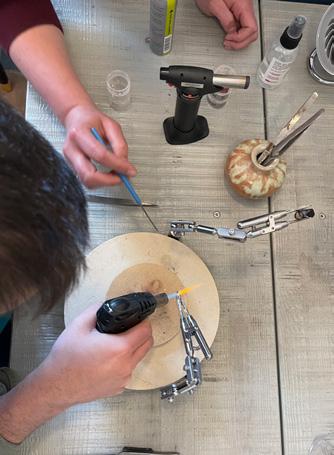
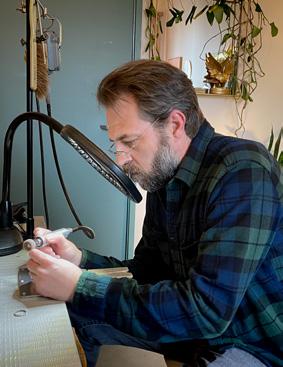
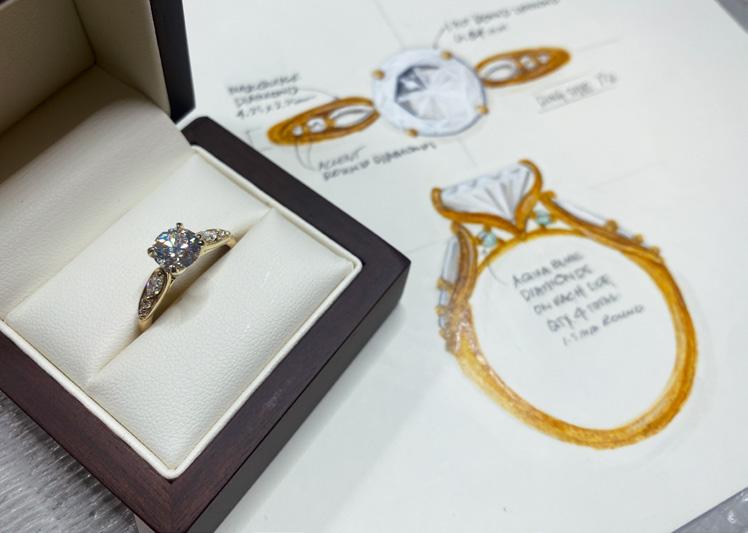 By Joyce Kauf
With soft lighting, gentle strains of music, and a waft of bergamot-scented fragrance, Anna Vasquez welcomes couples to her “casa a casa” (home to home) personal wedding-ring design experience in Portland, Oregon.
“I wanted to provide a space that was approachable, cozy and conducive to creativity,” says the Honduras-born Vasquez, who founded her studio, Nested Yellow Jewelry Co., in 2009. While couples were excited to have her create their engagement rings, they were “so overwhelmed with wedding details that
“Forever Forge” combines adventure and design: Couples go to a place that has special significance for them, such as the site of their first date or a favorite river, and make an imprint of it in the gold. “I send them off with a mandrel and raw-hide hammer,” says Vasquez. She personally relates to this “indoor-outdoor studio,” as nature is one of her design influences.
The third option is “Alchemy Love,” in which the couple watches Vasquez design the rings from start to finish.
The average cost for a private workshop with two 14-karat gold bands is $3,500 per couple, though they can upgrade to 18-karat gold for an additional charge.
“Helping clients make their rings takes custom design to the next level,” says Vasquez. “More importantly, it allows me to do what I love best — connecting with others to create something special.”
TikTok has become a cultural behemoth that’s part of every conversation about reaching younger consumers. By 2021, the video-sharing app had surpassed 1 billion active monthly users. Nonetheless, giant brands like Tiffany & Co., Blue Nile and Kay Jewelers have seen poor engagement on this platform. As of press time, the last 10 Tiffany videos that weren’t collaborations or celebrity endorsements had received an average of only 523 likes and eight comments; Blue Nile and Kay each averaged fewer than 50 likes for theirs. All of this was despite what were likely enormous expenses for the companies, such as the cost of dedicated social media teams and sponsored advertisements.
Results like these can be discouraging for jewelry brands, especially those used to higher engagement rates on other social media. While most agree that TikTok is an important marketing tool, they’re finding it entails some growing pains.
Many of the brands now experimenting with TikTok already have an established presence on Instagram. Jeweler Marla Aaron has seen huge success on the latter app, boasting 123,000 followers and a highly engaged audience. With the help of her team — including social media interns who occasionally star in videos — the brand has started creating TikTok content, too. Aaron’s jewelry is well-suited to video, which lets the brand demonstrate its signature kinetic design elements, such as rolling diamond spheres.
Why did Aaron want to join TikTok? “I could see the groundswell and understood that we had to be there,” she says. While she was aware that she didn’t understand the platform, she also understood that her lack of expertise didn’t matter. “That’s how [things start] on every social outlet.”
Low engagement numbers and a distinct learning curve have made jewelers hesitant to embrace the popular app.
She’s not the only one riding the wave. Bridalfocused media channel Engagement 101 has been “posting less on Instagram, because you can’t get as much organic engagement as you used to,” says editor in chief Severine Ferrari. “It pales in comparison to TikTok.”
Not everyone feels the same, however. Jewelry blogger Danielle Miele of Gem Gossip prefers Instagram, citing “one simple reason: community. I have a deeper connection with my audience on Instagram, and my posts there perform better.” Indeed, the type of content that does well on Instagram doesn’t necessarily get much traction on TikTok. Diamond manufacturer Dayagi Diamonds’ TikTok account shared a screenshot to that effect, with the caption “When you get around 300,000 views on your Instagram Reels, but barely a hundred on TikTok. What the f***?”
Despite their best efforts, US-based companies may soon face a different kind of hurdle in their TikTok marketing: legislation.

On March 8, the US government introduced the Restrict Act, which would give the Department of Commerce new powers to ban Chinese apps that pose security threats — including TikTok. If the bill passes, it will make accessing TikTok much more difficult for the 150 million Americans who use the platform. Implementing such a ban will be complex, and it may yet be avoidable; as of press time, the bill had yet to reach a vote, and discussions were reportedly underway to find alternate solutions. But the move is one that companies should take into account when considering TikTok’s role in their marketing strategies.
That said, it’s not necessarily fair to compare the two platforms, since they use different algorithms for pushing content.
Besides the usual challenges of TikTok, posts that promote diamonds are often met with negative comments, as Ligal Dervish of equipment manufacturer Sarine Technologies can attest.
“As diamonds have become a highly controversial topic, what truly surprised us were the reactions our videos elicit,” relates Dervish, the company’s content and social media manager. “But rather than shy away from this, we embrace it. All engagement is good engagement in the eyes of the TikTok algorithm, and greater engagement means greater exposure.” To that end, she says, “Sarine’s social media managers carefully monitor negative comments related to diamonds and respond with information that sheds light on the industry’s current alignment with sustainability issues.”
So what does work on TikTok? Miele offers a few tips: “Create content that is shareable — what is going to make another person, especially someone who knows nothing about jewelry, want to save or share your video. ‘How to’ videos are great, and educational videos perform well, too.”
Shares are the most highly valued data metric on social media like Instagram and TikTok; the algorithm values 100 shares much more highly than 100 likes or comments. And information-led content creates a strong value proposition that can draw in followers. Ferrari particularly appreciates “how salespeople at retail stores have embraced education through humor [on TikTok] with the help of their younger staff members. I wish more designers/manufacturers were doing this, too.”
As a whole, “TikTok’s culture rewards creativity and originality,” explains Dervish. “The most effective TikToks typically have a captivating hook that draws the viewer in from the outset.”
And it’s not always planned. “Sometimes the posts that you put the least effort into creating can be the most viral,” observes Yoran Dayagi, executive manager of Dayagi Diamonds.
Aaron’s advice to any jewelry companies starting out on TikTok is simple: “Open your phone. Set up the account. Watch. Listen. Make mistakes. Have fun. Everyone should embrace what is new.”
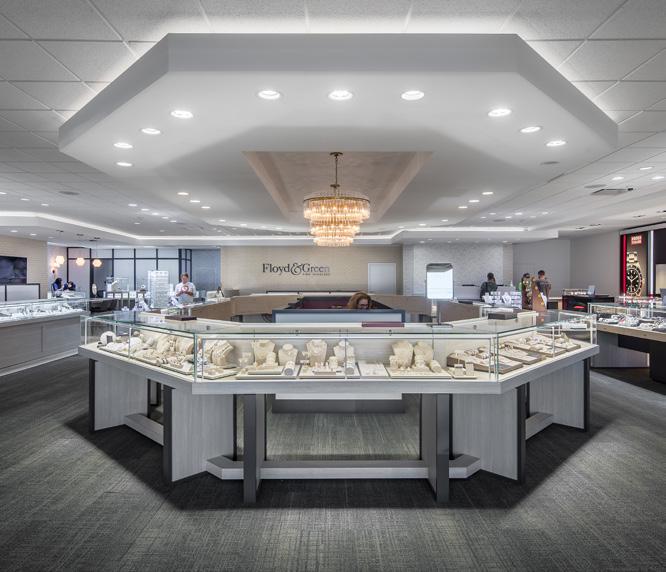
Revamping a jewelry store or designing a new one from scratch can be a stressful experience. Two experts — Jesse Balaity, owner of Balaity Property Enhancement in Sarasota, Florida, and Robert Dykman, president of RAD Construction Consultants in Livingston, New Jersey — offer some tips for navigating the process. By Joyce Kauf

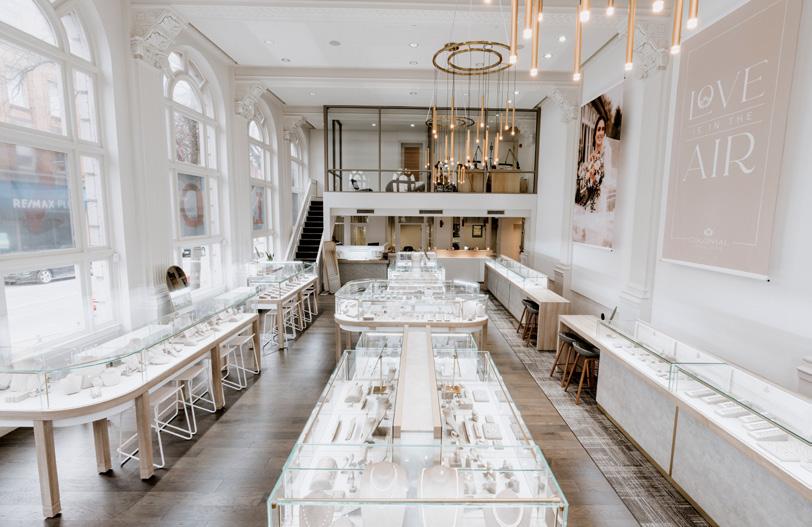
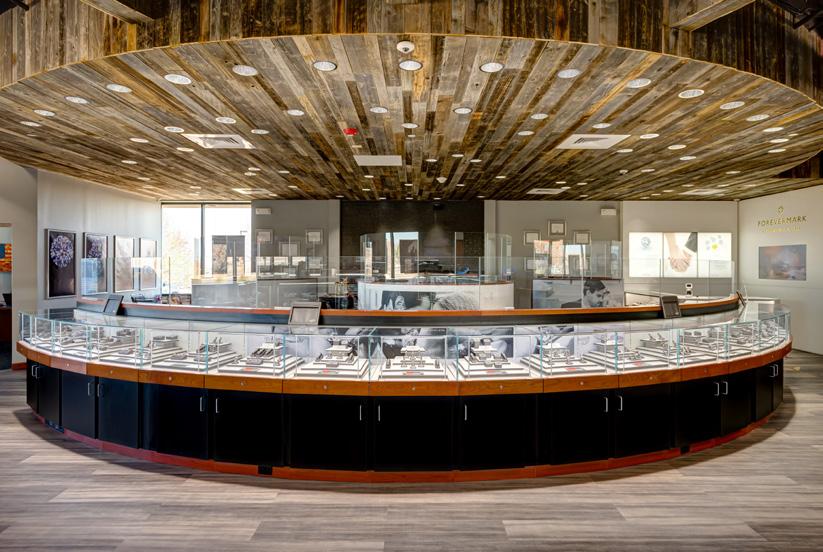
Do you want to update a 20-year-old store? Rebrand a family business? Go upscale? “The solution is different for every jeweler, but the focus has to be on function first,” says Balaity. “It’s easy to make a store pretty, but it has to be functional, safe and profitable.”
Considerations should include your clients’ needs, the amount of custom jewelry work you do, and the space you want to dedicate to retail.
“It’s critical for the retailer to convey the big picture [to me] so that I can translate it into the form and
you to cater to clients’ preferences and comfort levels — whether that’s a private consultation room or a community table for a shared experience.”
When searching for inspiration, see what other industries are doing. “Consider all of the spaces that your clients frequent, from hospitality to other retailers,” Balaity advises.
“Unfortunately, bigger and better can make the store more of a target,” warns Balaity.
Recognize that anything old will look even older against a new backdrop. Don’t carry dated logos and signage into a new space. “Expecting to refurbish existing showcases could be throwing good money after bad,” says Balaity, though he acknowledges that it might be necessary for budgetary reasons.
Consider an open remodel, with partitions or windows between the selling area and the area that’s under construction, so customers can tell the store is still operating. “It’s very important to maintain continuity, because you don’t want to lose business,” explains Dykman. “The last thing you want is a client seeing a locked door and going to one of your competitors.”
To maintain that accessible atmosphere, he also recommends encouraging your staff “to dress casually in jeans.”
function of the store,” says Dykman, adding that “the most compelling reason to upgrade is not for your existing clients, but for your future client base.”
This should include design fees, showcases, and the actual cost of construction. It’s also important to take the extras into account, says Balaity — things like audio-visual, furniture and displays.
Avoid fitting everyone into the same retail interaction model. The way we sell has changed, Balaity notes, and “offering a variety of spaces to interact allows
Involve the brands you sell, such as Rolex, early on in the process because of the long lead times they may require, advises Balaity.
Dykman prefers to minimize brand installations in general; while he understands their cachet, he warns against letting them dilute your own brand message. “I want clients to walk in and know whose store it is.”
Getting designers with firsthand knowledge of your business makes a huge difference. “Jewelry stores are so different from other stores,” says Dykman. He personally takes a hands-on approach, spending two to three days on site during a project. “But I try to get my ego out of the way. It’s the owner’s store.”


























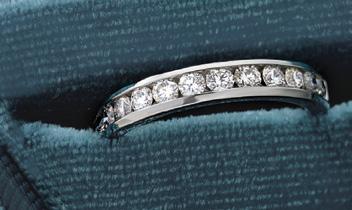




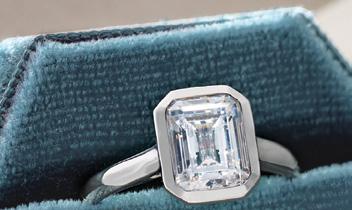




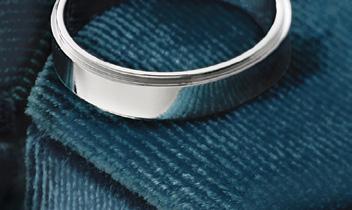
ever&ever® rings set in platinum represent the enduring quality and beauty of every lasting relationship — perfect for holding precious diamonds.
Learn more at Stuller.com/EverandEverBridal @everandeverbridal #EverAndEverBride













Rings featured, top to bottom: 122939, 122981, and FE9










IN A NUTSHELL
DESIGNER : CINDY CHAO
CRAFT TIME : TWO YEARS
MADE IN: EUROPE
TECHNIQUES USED : WAX SCULPTING
METAL : TITANIUM
GEMSTONES : COLOMBIAN EMERALDS, DIAMONDS (YELLOW, COLORLESS, BROWN), COLOR-CHANGE GARNETS, TSAVORITES, SAPPHIRES (GREYISH-BLUE, GREYISHGREEN, GREENISH-BLUE), TOURMALINES, DEMANTOID GARNETS, ALEXANDRITES
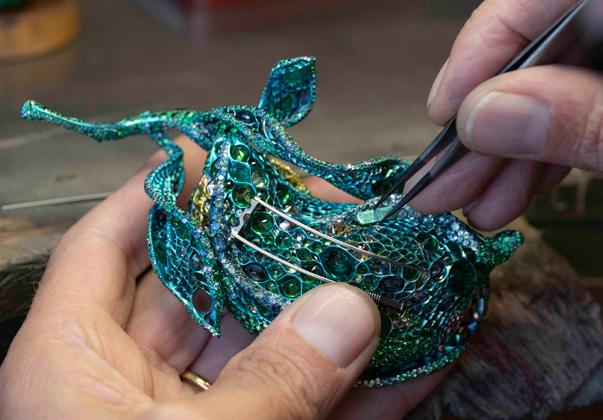
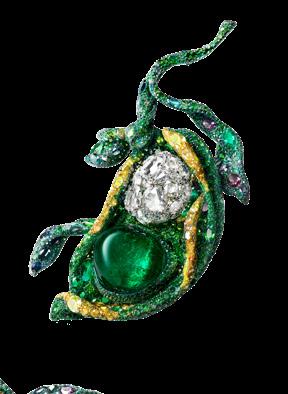
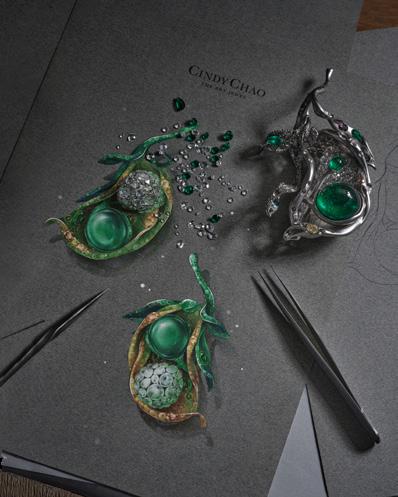
Taiwanese jeweler Cindy Chao is famous for her extravagant, avant-garde pieces. In a continuation of her Four Seasons collection, Chao has brought to life two brooches in the shape of freshly sprouted cardamom pods, symbolizing hope for a new spring. The 2022 Black Label Masterpiece Spring Cardamom brooches took over two years to create and passed through the talented hands of several European craftsmen.
Drawing on her fascination with the natural world, Chao designed the pieces with nature’s asymmetry in mind. No two cardamom pods are the same, and although the brooches seem identical at first glance, they have subtle differences. One cabochon Colombian emerald is slightly larger than the other (80.79 carats versus 81.11 carats), and the colors of the pieces vary. Each pod uses 28 different shades of green gemstones to emulate the natural color gradation of organic vegetation. Thin and rose-cut diamonds allow light to penetrate.
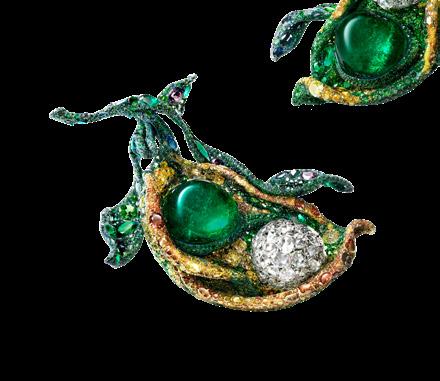
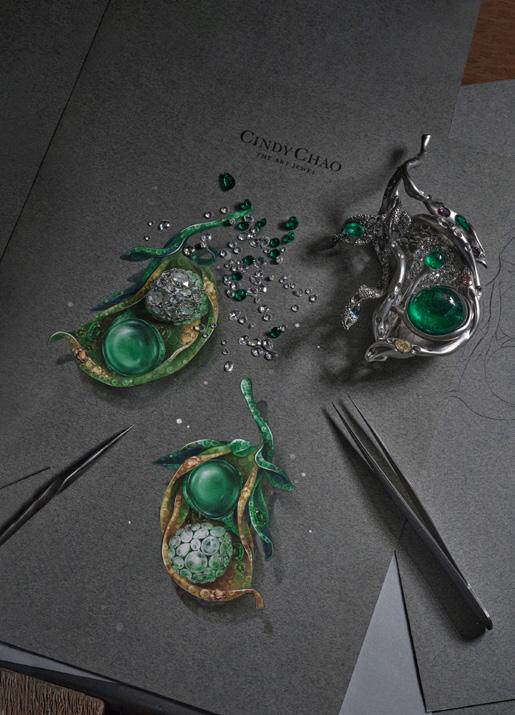
Patience is key when creating a piece of this caliber, so to ensure as true a rendering as possible, Chao chose to hand-carve the wax models. “The wax carving technique is the only approach that guarantees perfection, as I can feel it in my hands and examine it from all angles,” she says. “This gives my work an impactful architectural and sculptural character that would not be achieved through two-dimensional sketches alone.” Indeed, the brooches are equal parts architecture and design; there is a hidden tenon structure that holds the two plump spheres of each brooch together. What fate awaits these wearable objets d’art? One has already sold to a collector. As for what’s next, Chao says she “will continue to draw inspiration from nature. My best creation is always the next piece, so that’s something to look forward to.”
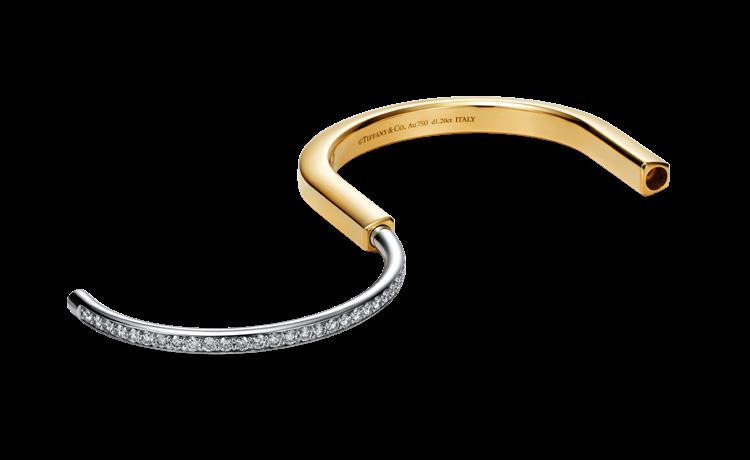
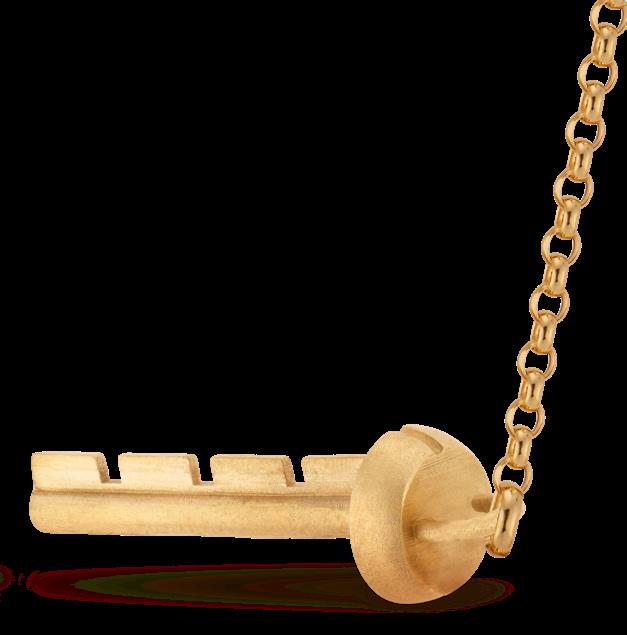
Tiffany & Co. enjoyed record sales in 2022, and one of its star performers was the Lock collection it launched that year. The Lock bracelets are sleek, minimalist gold designs that some have hailed as the brand’s answer to the Cartier Love bangle. Designed to suit all genders, these versatile stackers swivel open and lock in place — a pleasing function that does indeed recall the Love bangle, though Tiffany’s offering lets you easily unlock yourself.
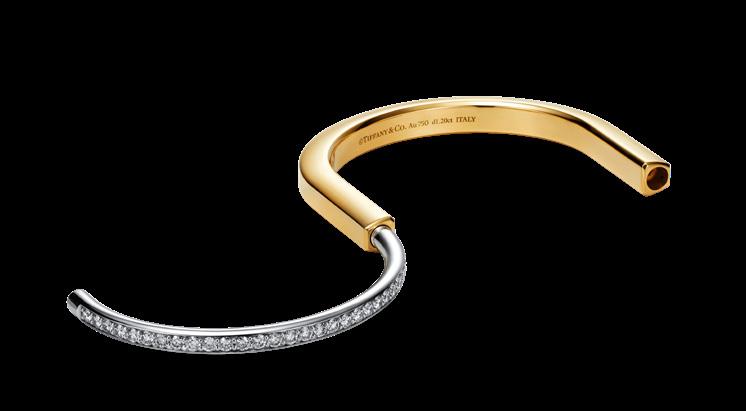
The lock motif is proving popular elsewhere in the industry, too.
“It ties into people’s love of utilitarian design, being such a classic piece of hardware,” comments Eéra cofounder Romy Blanga, who says her customers often layer up the brand’s Lock designs. Eéra’s Chiara and Romy collections also tap into this trend, featuring snap-hookinspired jewels with working hinges.
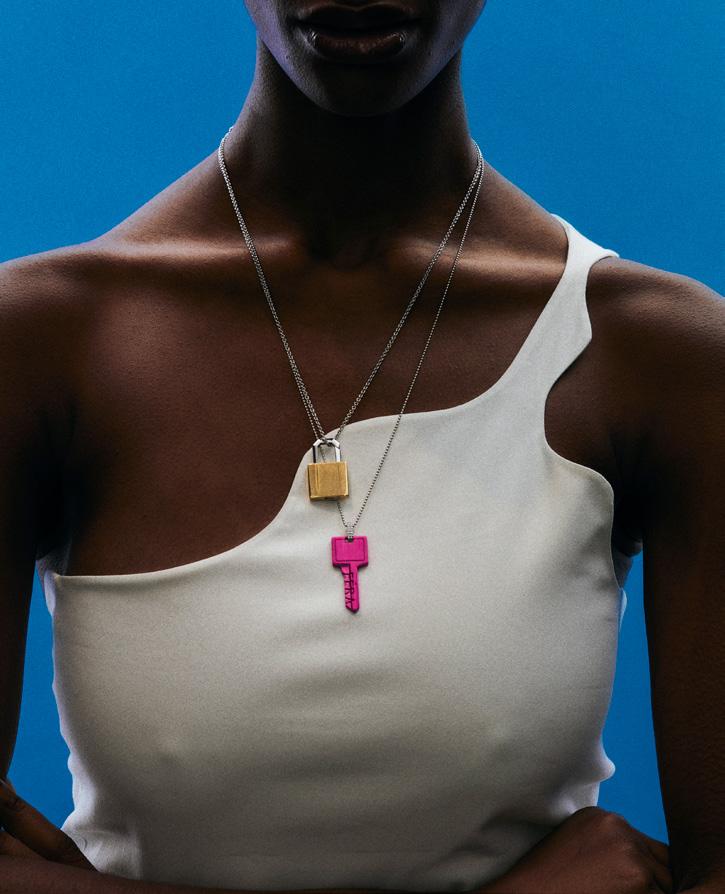
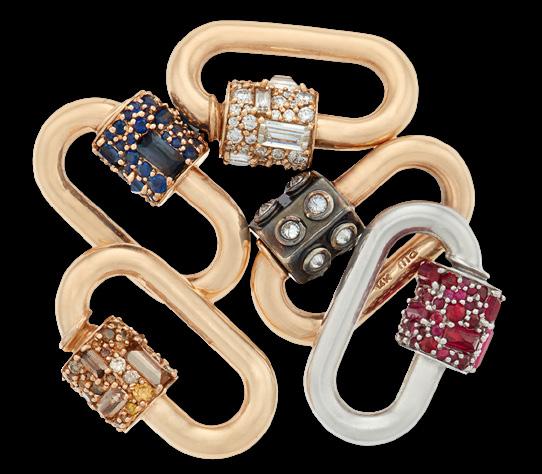
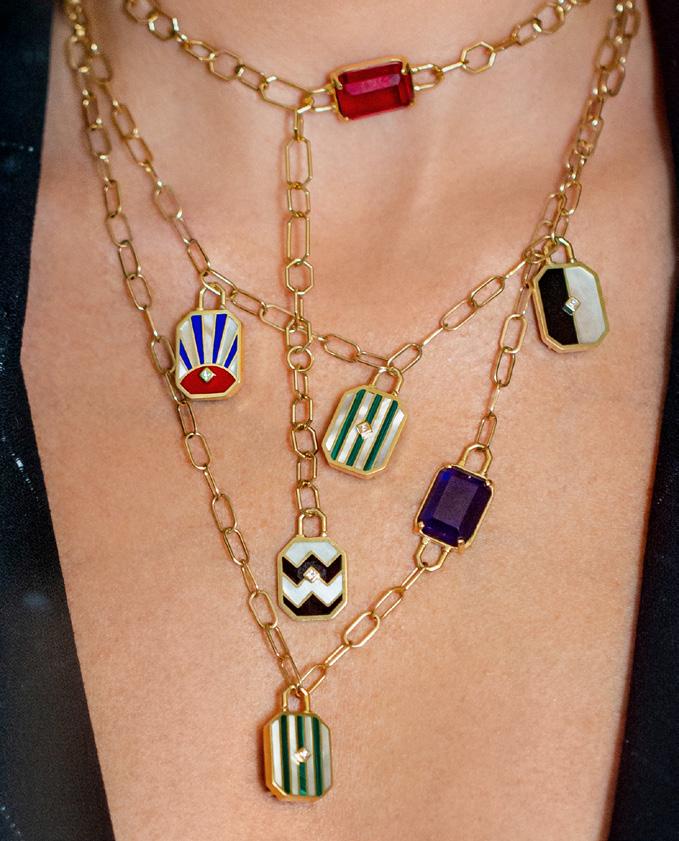
Designer Marla Aaron’s precious carabiner-style Locks have a similar functionality, which makes them highly collectible; besides serving as standalone charms, they
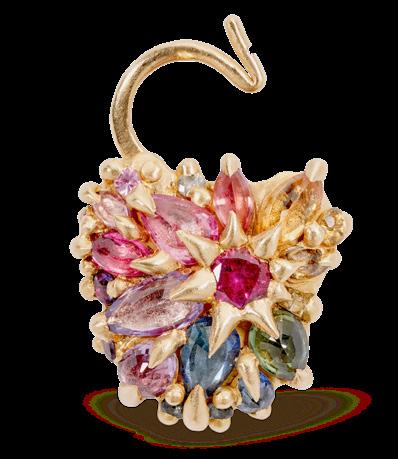
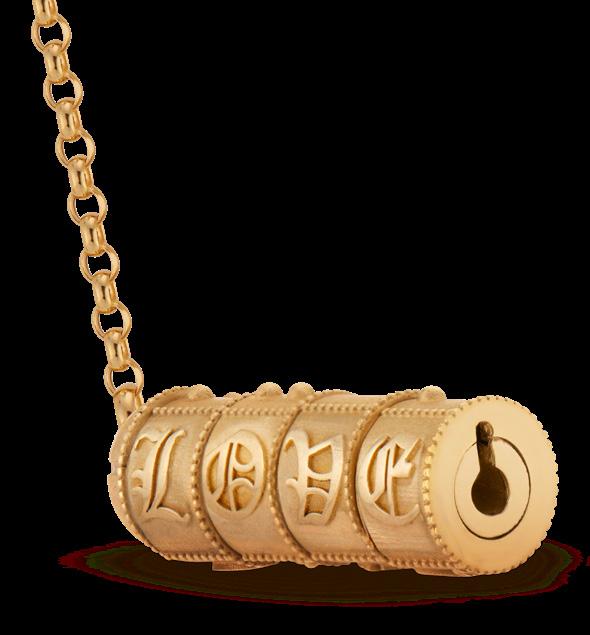
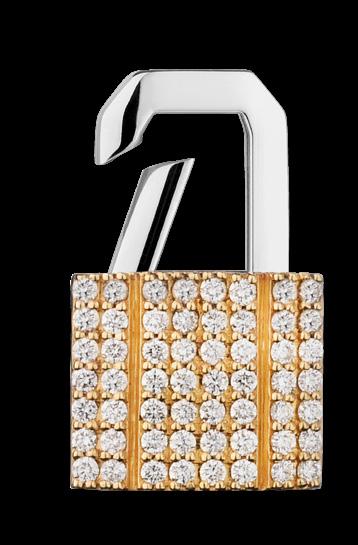 EÉRA; HEAVENLY VICES; POLLY WALES; TIFFANY & CO.; THREE STORIES; DARKAI; LIONHEART; L'ATELIER NAWBAR; MARLA AARON
DARKAI
PVD-coated
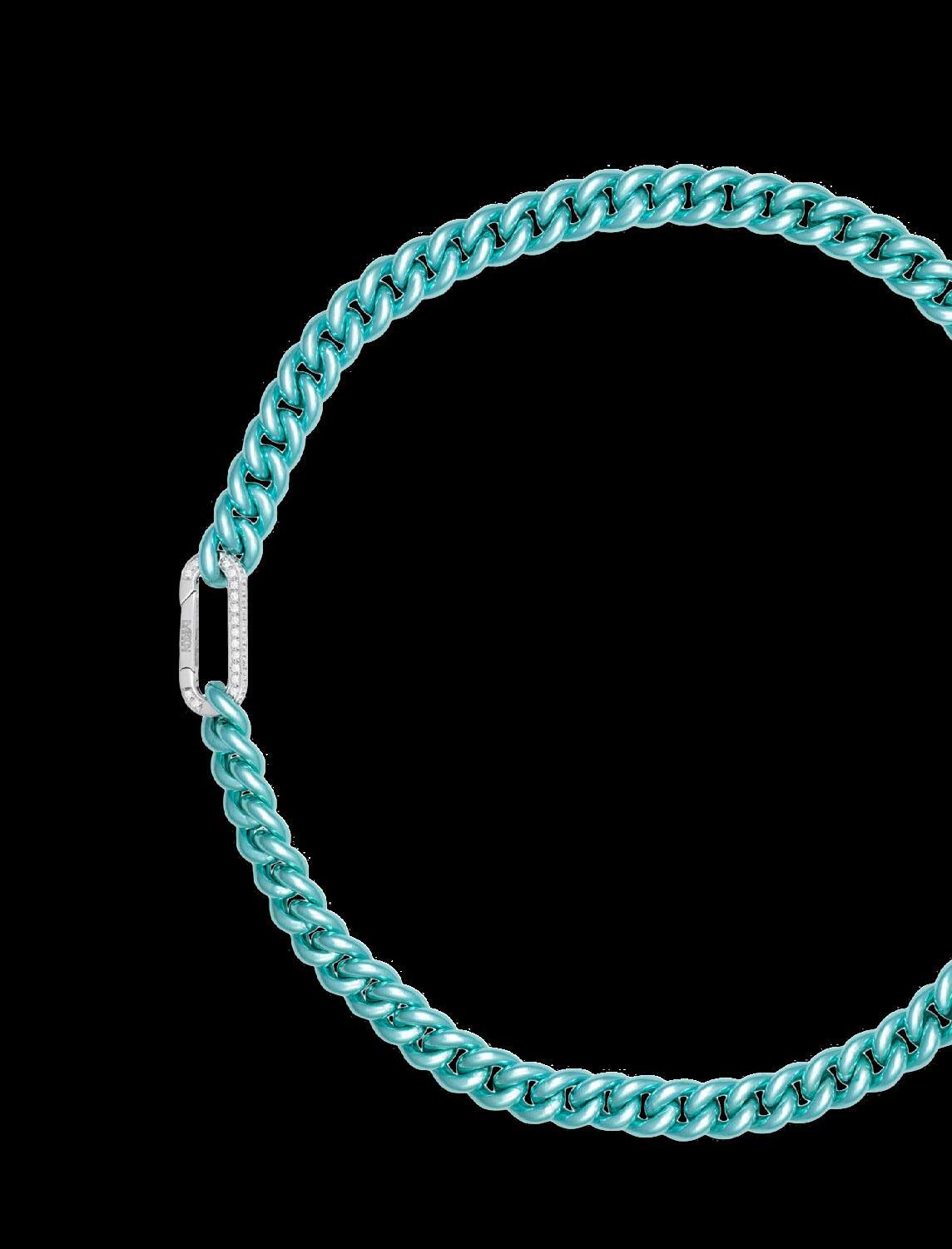
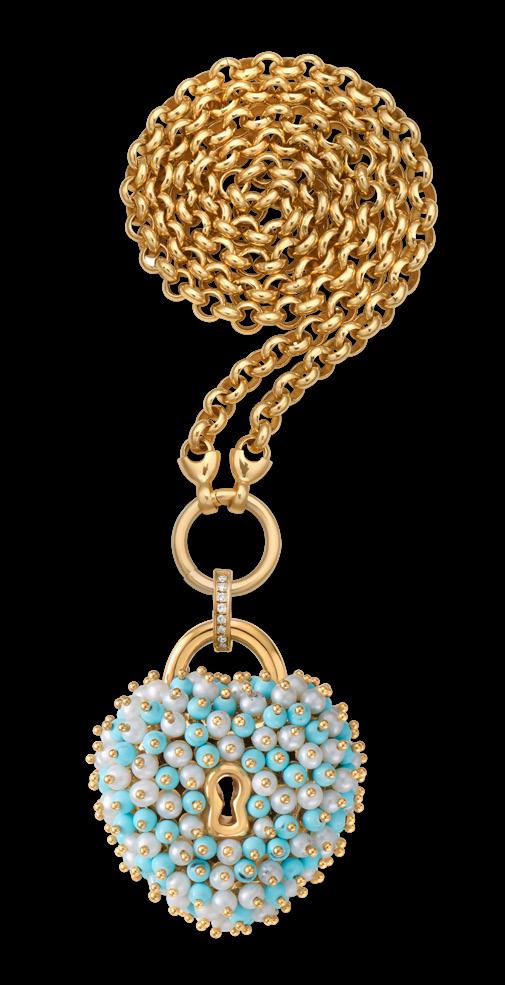
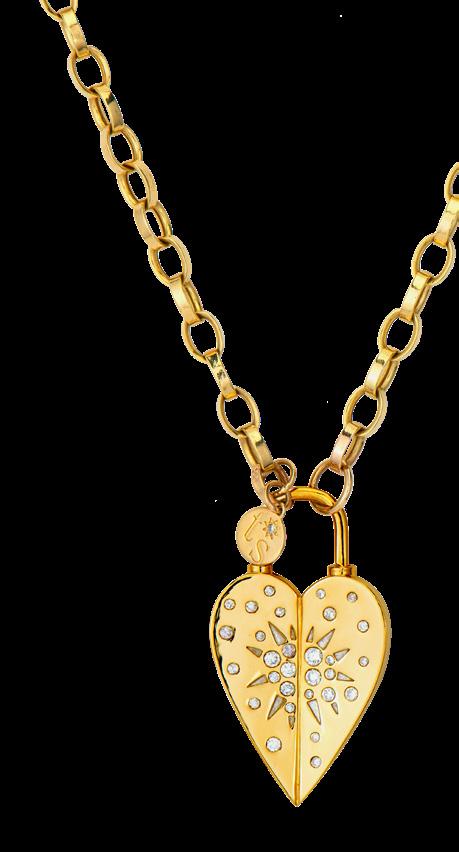
 silver Cuban Sky chain with carabiner clip closure in 18-karat white gold and diamonds.
Lucchetto padlock charm necklace in 14-karat gold with turquoise beads, pearls and diamonds.
MARLA AARON
A selection of carabiner-style Locks in 14-karat gold with diamonds and colored gemstones.
NAWBAR
High jewelry glories in the symmetry and sparkle of its finished gemstones. So it was a significant shift in aesthetic when some houses included rough gems in their designs last year, such as Cartier’s Ryu necklace with partially cut yellow diamonds beside tiny brilliants.
De Beers popularized incorporating rough stones into high-end jewels when it launched its Talisman line in 2005, featuring tiny colored rough diamonds in textured gold. However, the aesthetic dates back to jewelry artist Andrew Grima in the 1960s, who saw the beauty in the organic shapes of the raw material.
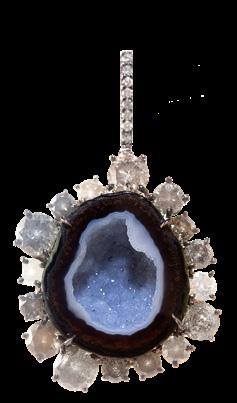
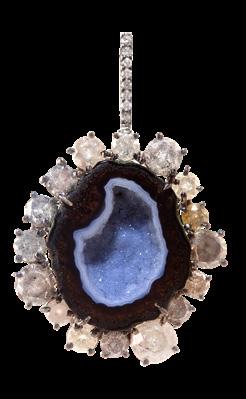
BRINGING OUT THE BEST IN EACH OTHER A contemporary enthusiast is New York-based jeweler Kimberly McDonald, who trims geode and agate slices with diamonds. “There’s nothing we can create today that even comes close to the beauty of what nature has created over millions of years,” she says. “I love the juxtaposition of rough and fine.”
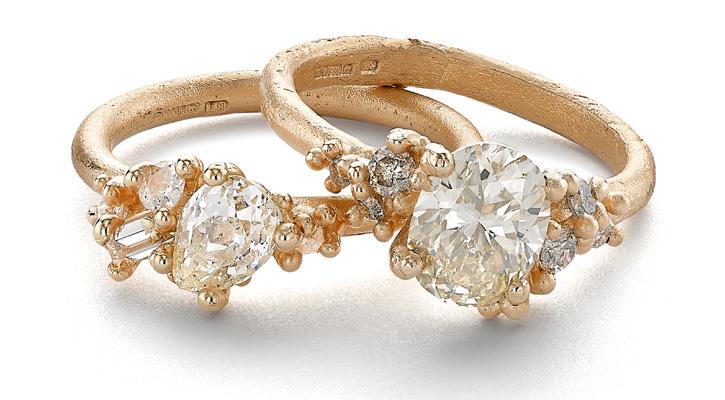
So does Ruth Tomlinson. The British designer, whose pieces sell at retailers across the US, started seeking out small raw gems on her travels through India and Sri Lanka, and enjoys pairing them with polished ones in textured gold settings. “I’ve always questioned perceptions of preciousness through my work,” she reflects. “A raw diamond is as precious as a cut diamond, materially speaking, but it looks completely different.” Juxtaposing the two “amplifies this conversation, as well as looking beautiful.”
Creating an intimate relationship between mineral and jewel is a sleeper trend that multiple brands have explored, including Pippa Small, byAngeline, Judy Geib, Jia Jia, and Pamela Huizenga. All of these companies’ designs appeal to consumers who “want something that is individual [and who] have a deep appreciation for the nature and energy of these stones,” says McDonald.
Pairing uncut and polished stones in a single jewel is a striking way to evoke the earthy origins of fine gems.
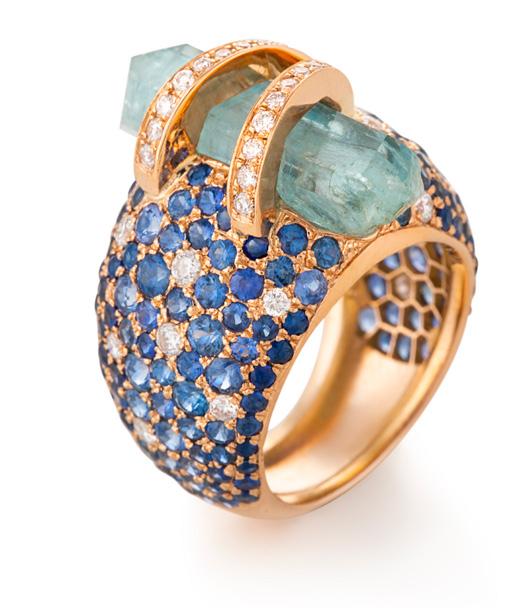
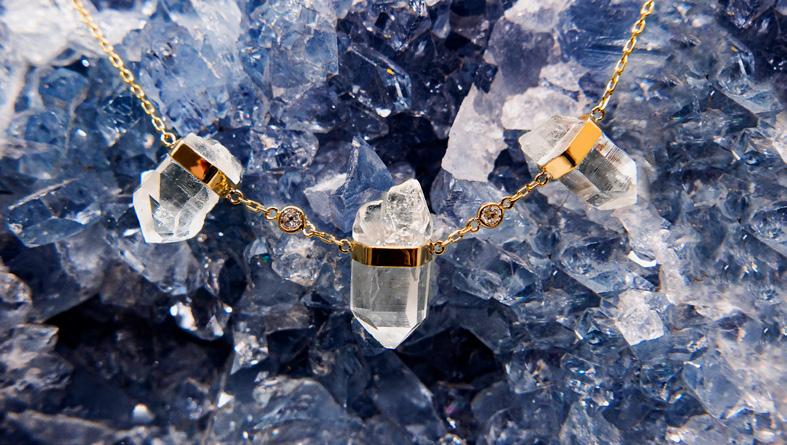
One root of this modern trend may be the hippie practice of wearing gem crystals for their perceived healing properties. Bali-based designer Jia Jia Zhu, a former women’s-wear and jewelry buyer at department store Bergdorf Goodman, sets rough crystal specimens in bands of gold and diamonds.
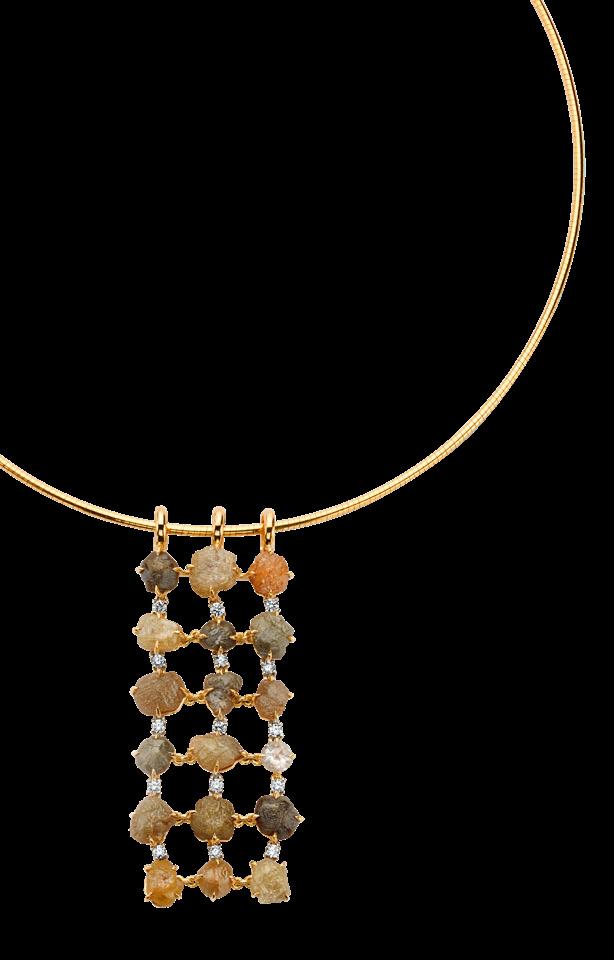
“Some [people] may feel more connected to polished stones, others to more natural stones,” says Zhu. “For me, it would be the more natural state.”
The protective talismanic qualities of the gemstones resonate with customers, she adds, as was apparent from her eponymous brand’s sales figures during the pandemic.
Retailer April Higashi, owner of Shibumi Gallery in San Francisco, California, is a fan of the rough look. “I love the unusual,” she says. “Diamonds that look different in different light and angles are more interesting than brilliant-cut diamonds that look like the light switch is always on.”
For Paul Schneider, the aesthetic of rough and smooth is a niche product. “It is not a common sale, but it’s a great situation when you are able to express the fact that this [gemstone] is as G-d
created it and straight out of the ground,” says the cofounder of jewelry boutique Twist, which has branches in Portland, Oregon, and Seattle, Washington. He points to designers like Small and Geib, who seek out these stones “because they’ve got a life to them, with their asymmetry and imperfections.”

Huizenga, too, embraces nature’s imperfections. The American lapidarist uses raw gems in most categories of her bold, unusual jewelry. “I think they lend themselves to just about anything,” she says. “Multi-stone pieces are fun because it is easier to incorporate both raw and finished stones, showing the differences. Kind of a before-and-after effect from mother nature. But also, a single raw diamond can make quite a stunning ring or centerpiece for a necklace.”
The terminology that sellers use for rough stones varies. Tomlinson prefers the word “raw,” while Schneider opts for the consumer-friendly “rustic.” Higashi goes for “rustic diamonds with inclusions,” and explains to clients “why the inclusions make the stone look so dynamic and unique, and how they are made, and why there are colors in these diamonds.”
Having a general knowledge of gems is important for those retailing this style of jewelry, Huizenga believes. “The more educated they can be about crystal structures, how gemstones form, different [sources] around the world, and other key facts, [the better they’ll be able to] draw the customer in and educate them on the allure of natural raw gemstones.”
“A raw diamond is as precious as a cut diamond, materially speaking, but it looks completely different”From left: Kimberly McDonald geode and diamond earrings in 19-karat gold; Pamela Huizenga collar with raw and polished diamonds. Opposite, from top: Jia Jia Crystalline triple crystal quartz necklace with diamonds in 14-karat gold; Ruth Tomlinson diamond rings in 18-karat gold.
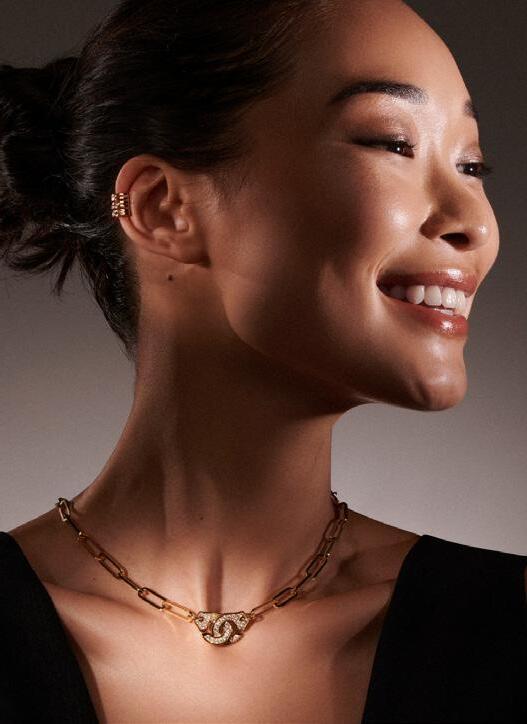
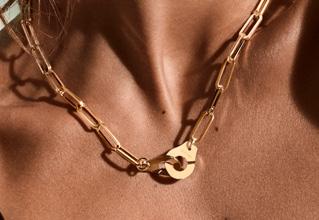
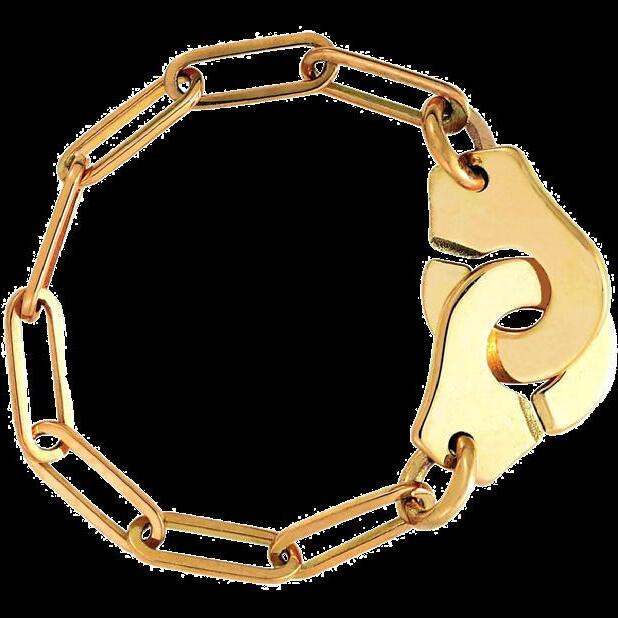
Walk the streets of Paris paying attention to the accessories of those who cross your path and you may spot the interlocking gold clasps of Menottes. It is the signature collection of French jeweler Dinh Van, and it has become a much-loved staple of Parisian chic since its launch in 1976.
Founder Jean Dinh Van was a French-Vietnamese designer who first made a name for himself in the mid-1950s as a designer at Cartier. After a decade with the house, working alongside then-creative director Jeanne Toussaint, Dinh Van opened his own studio in Paris in 1965.
The designer's work put him at the vanguard of a new style of fine jewelry: minimalism. His aesthetic was rooted in his belief that “jewelry should not be showy; it should reflect the personality of the woman who wears it, because she feels like wearing it all the time, not only for special occasions.”
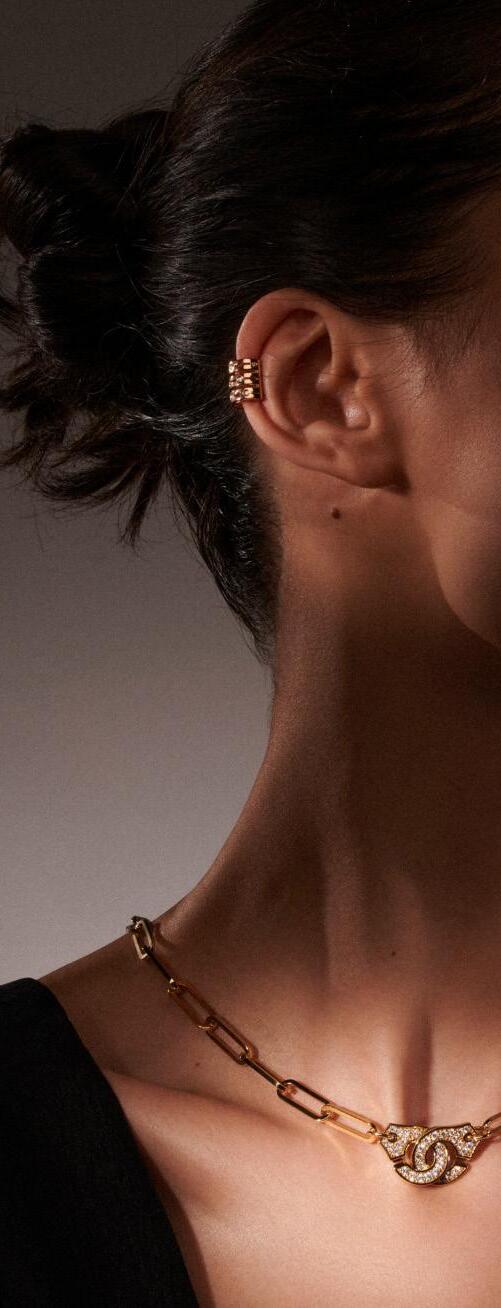
Dinh Van soon became an iconic name in jewelry within France, but has remained underexposed globally. Its managing director, Corinne Le Foll — who also started her career at Cartier, spending 21 years at the brand — wants to change that.
“The DNA of this brand is absolutely fantastic, the creations are amazing, and we are at a stage where the developing of this brand is an exciting adventure,” says Le Foll, who gave up her role as Cartier’s managing director for France to join Dinh Van in January last year.
Six months later, Jean Dinh Van passed away at the age of 94. He had sold his brand in 1988 to a group of investors led by French businessman Frédéric Laporte, but continued to design for the house until late in his life. The challenge of creating new lines in the spirit of his style now falls to freelance designers — particularly young talents — who Le Foll believes help Dinh Van to “capture the air du temps [zeitgeist].”
Besides Menottes, Dinh Van lines — all designed to have a genderless appeal — include Le Cube Diamant, featuring gold cubes set with round diamonds; the hammered 24-karat gold discs of Pi; and the brand’s Maillon chains.
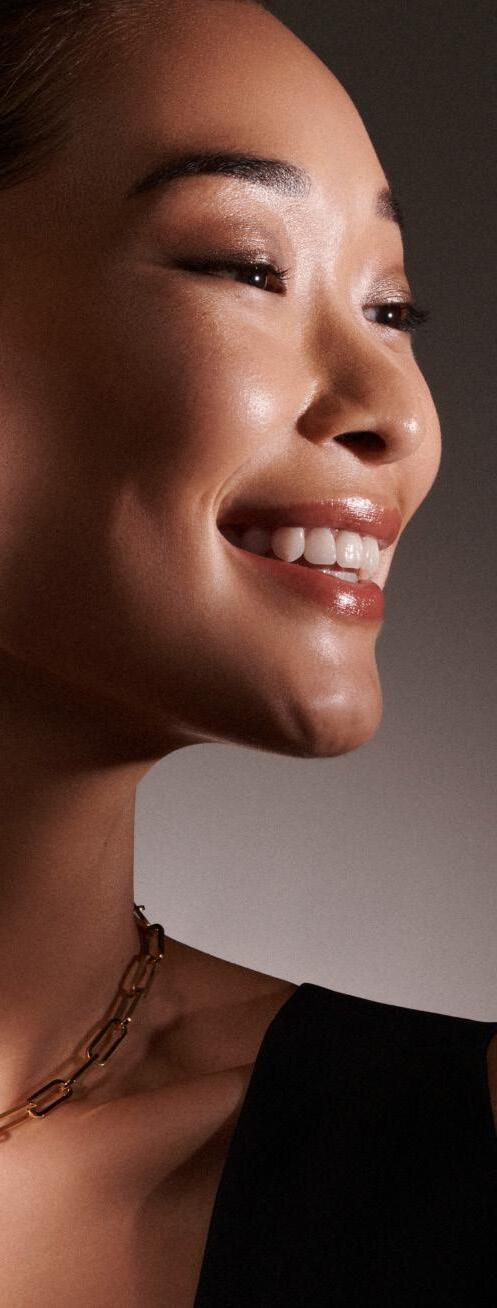
With expansion and exposure on her mind, Le Foll’s focus is the US. The brand is already selling at about 30 stores in that market, including Saks Fifth Avenue, Neiman Marcus, Bloomingdale’s, Ylang 23 and Hamilton Jewelers. Le Foll hopes to deepen these relationships as well as expand into new stores, with a particular focus on New York, Florida, Texas and the west coast. She has appointed a global PR firm with US offices to amp the brand’s story there including the designer’s historic links to the country.
“Our presence in the US is quite new we’ve been in the market for about five years but the first presence of Dinh Van in the US dates back to the ’70s,” Le Foll relates. In the infancy of his brand, Dinh Van took part in an exhibition of promising French jewelers in Montreal, Canada, where he was spotted by executives at Cartier US — at that time a separate entity from Cartier’s Paris- and London-based businesses. It became a distributor for his jewels, selling them at its Fifth Avenue store in New York, and later in some additional Cartier boutiques in Florida and the west coast. Dinh Van even collaborated with Cartier on some designs, and these pieces — with dual signatures — can be found on the secondary market today, as well as at the Museum of Fine Arts, Boston.
In recent years, numerous French luxury brands that had fallen out of production, such as Vever and Oscar Massin, have had a reboot. What is it about French jewelry that’s capturing the hearts of American shoppers today?
“There’s something about effortless French luxury, which I think is interesting for our American clients,” says Le Foll. To deepen the American-French connection, she oversaw the placement of Dinh Van jewels on actress Lily Collins’s character in the third season of hit Netflix show Emily in Paris. “I would say that our creations are, at the same time, both quite minimalist and quite sophisticated.”
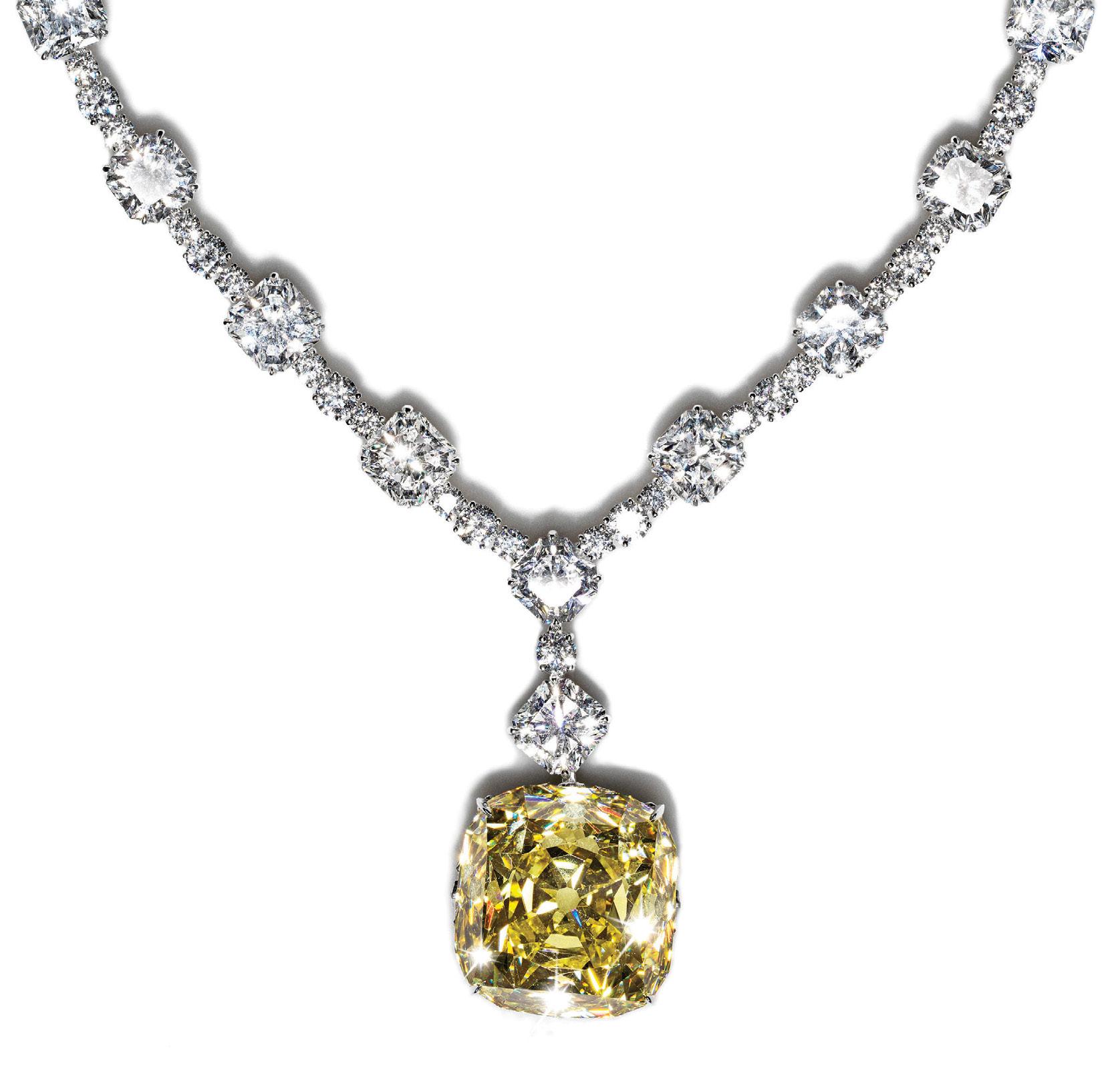
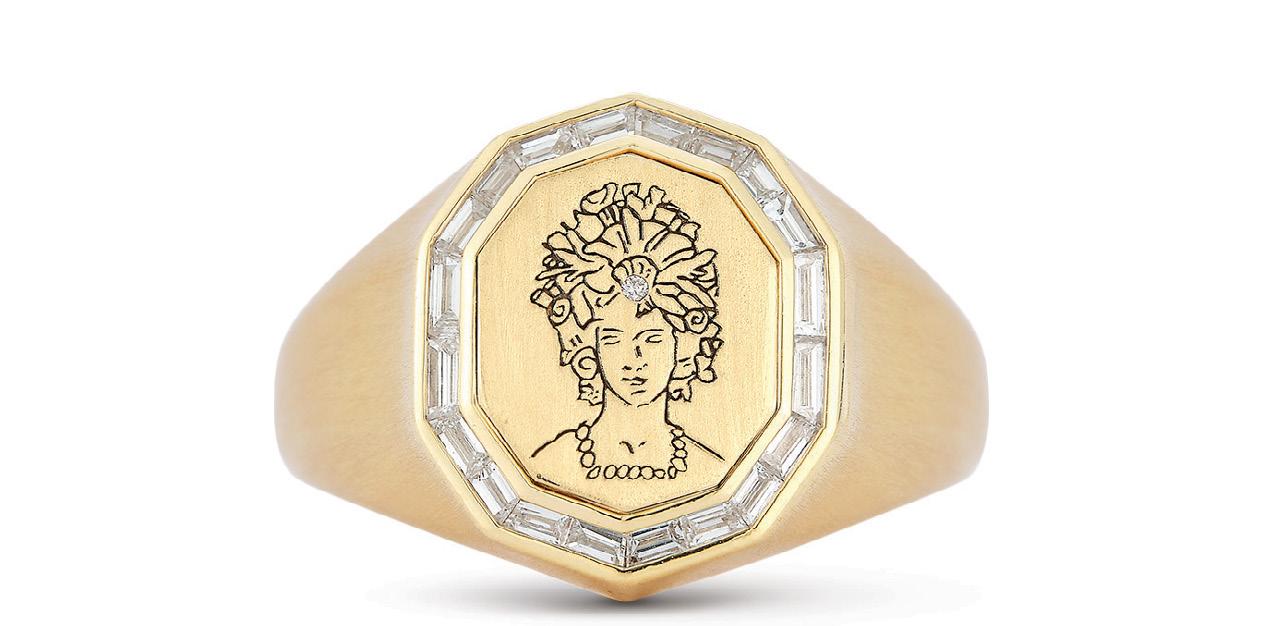






 Katherine Jetter
Fine-jewelry brand Yutai combines minimalist Japanese aesthetics with intricate technical artistry in its Fused Gems collection. Founded and led by Tokyo-based designer Yuta Ishihara, the company has developed a signature technique that involves fusing multiple gems together to form a single stone.

Ishihara subtly upends tradition by splicing precious materials, creating hybrids of garnets and citrines, rutile quartz, ametrine, and blue topaz. The resulting polished stones are multilayered and visually striking.
The highly specialized technique is unique to the brand. “When I was developing the concept for the Yutai Fused Gems, I was thinking about what makes a gem sparkle,” Ishihara recalls. “I wanted to take this idea and experiment with how the stone would look if I took two differentcolored stones and combined them together into one to see how the light would reflect and the colors of the two stones would mix.”
The process involves using a strong adhesive to fuse the rough gems, then cutting and polishing the result, he explains. He came up with the idea while fixing broken pieces of a gemstone. “I noticed
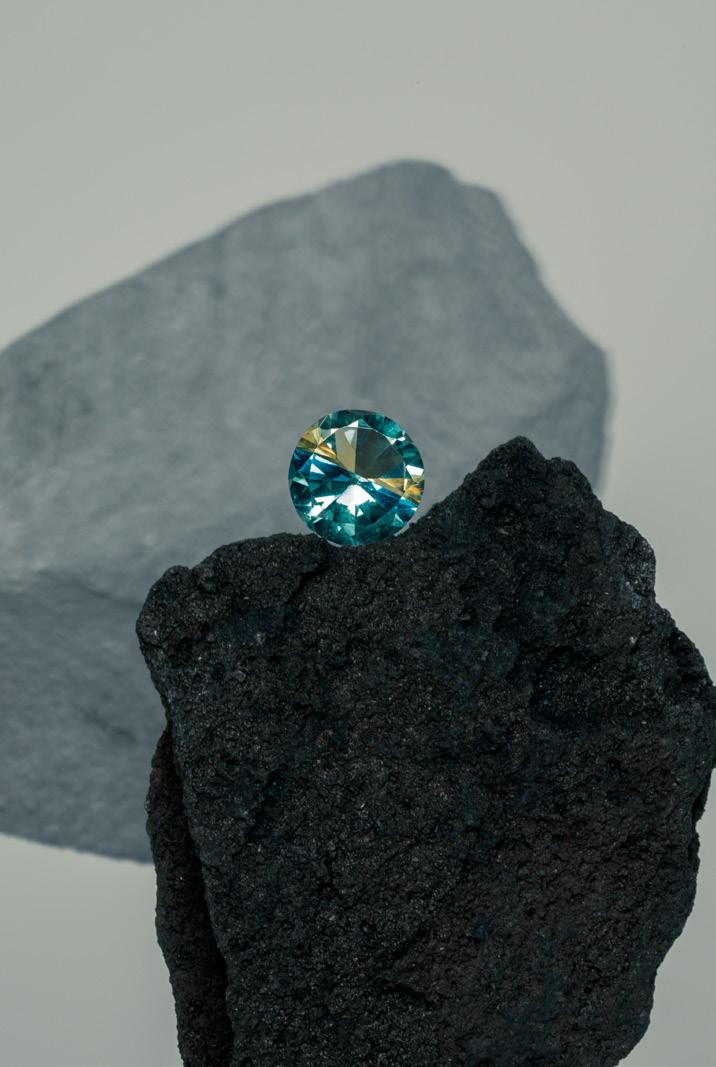
that the adhesive became nearly invisible, and thought this was a method that had the potential to expand the possibilities of stones.”
A high level of skill and precision is necessary in this process, as is an innate understanding of different gems’ optical properties. One challenge is finding two stones that have a similar hardness so they can be cut once fused. Citrine and garnet, for instance, are both about 7 on the Mohs scale.
“I found that selecting the right color combinations of the stones was important as well to create this unique mixing of colors [from] the reflected light,” the designer adds.
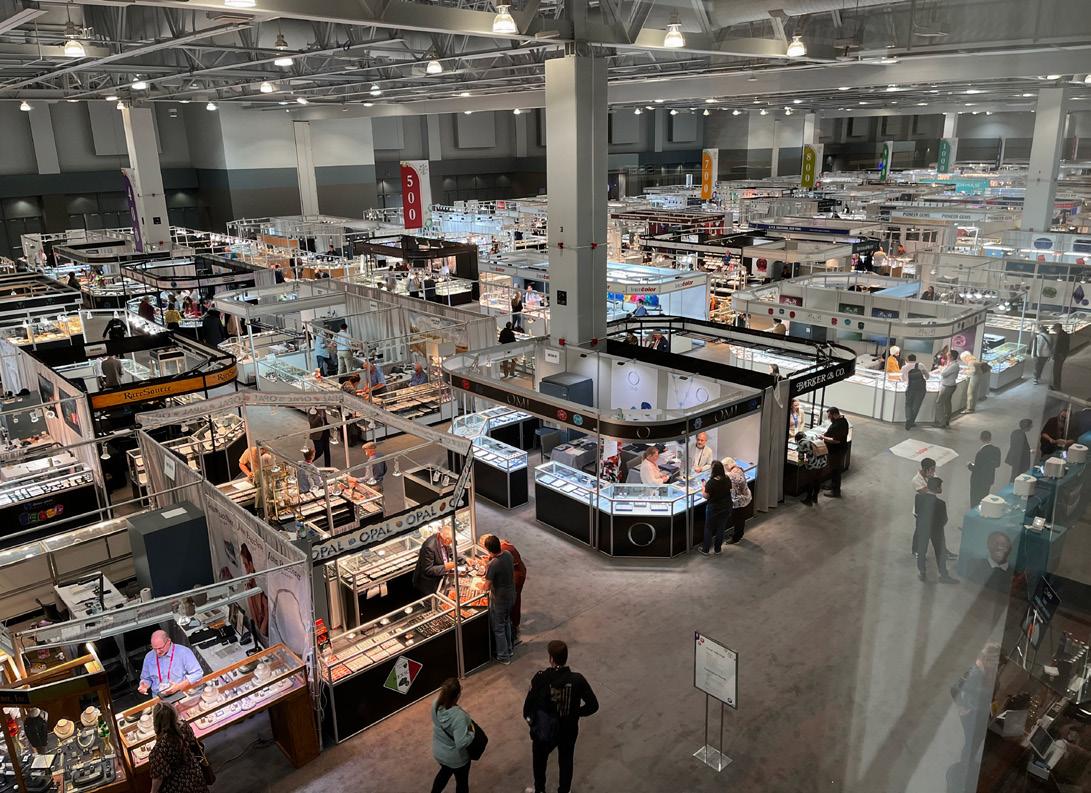 By Jennifer Heebner
Gem merchant Kambiz Sabouri is well-acquainted with supply-side struggles. Gone are the days when you could turn down material you thought was too pricey; expensive is the new norm. “There’s scarcity, so every time you shop, you pay more,” explains the president of Gem 2000, which deals in sapphires, rubies and alexandrite.
It was an issue that came up often at the February gem shows in Tucson, Arizona. From the AGTA GemFair Tucson to the Gem & Jewelry Exchange (GJX) and other local shows, high prices and low stock were the greatest common denominators for exhibitors. Another was requests for geometric cuts like hexagons, kites, shields, longer oval and pear shapes, and fancy silhouettes — but they were hardly a distraction from bigger challenge: finding fine goods and paying for them.
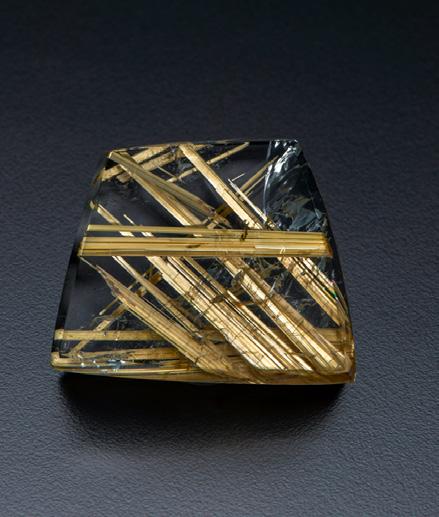
“There’s just not a lot of material out there to be bought,” says Malinda Daniel, director of Tim Roark, which sells fine alexandrite, sapphires and other in-demand gems.
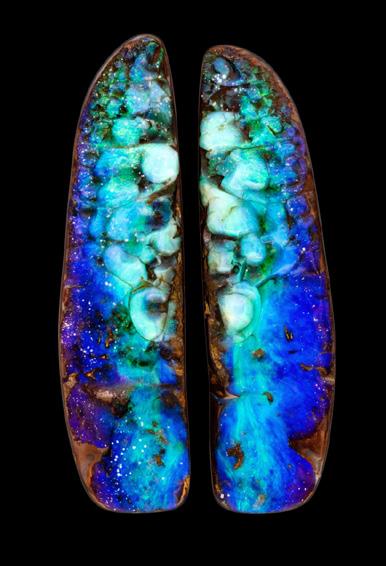 Clockwise from top left: View of the floor at the 2023 AGTA GemFair Tucson; jewelry designer Erica Courtney (left) and journalist Jennifer Heebner; Australian boulder opal from DuftyWeis Opals; Brazilian rutilated quartz from Nature's Geometry. Opposite: Stephen Webster.
The challenge of finding heat-free rubies and sapphires — and then only at sky-high prices — is every dealer’s bittersweet reality. The cost of these goods has gone up by 20% to 50%.
Ivan Hackman of Intercolor USA has seen prices for no-heat rubies jump as much as 30% in a year, with unheated blue sapphires coming close. For the latter, he’s seeing some price resistance. “If I sold blue sapphires to someone in Las Vegas last year, and saw them again in Tucson with 20% to 25% price increases…there was some sticker shock,” he says. “Some didn’t buy.”
Sabouri’s biggest gem hurdle is Mozambique rubies. Prices are high, and the quality isn’t as fine as he likes for some. Plus, there are more people at the source buying. “Demand worldwide has really increased for all [colored gems],” he reports.
Sales of other top-end goods bear that out. In alexandrite, Daniel has seen her costs go up as much as 40%. Dealer Dudley Blauwet scrambles to find any at all, noting that “it’s in short supply.”
Meanwhile, prices for Australian black opals have shot up 30% to 100% in the past three to five years, according to Robyn Dufty, president of DuftyWeis Opals. Why? Because it’s harder to locate the good stuff. “What I used to sell at $14,000 a carat...is now $20,000 a carat,” she says.
Emeralds are a fixture in any jewelry store, but some Tucson exhibitors were seeing greater interest than usual. Daniel was among them. “All of a sudden people want emeralds!” she exclaims.
Dealer Brian Cook of Nature’s Geometry has been hearing the same call, as well as peers grumbling about their rising prices. But cost isn’t deterring him from selling emeralds from Brazil’s Bahia region. Meanwhile, limited Colombian mining means fewer emeralds for sale — and much of what’s going to auction in Colombia stays there.
“Colombians have the wealth to buy the gems themselves,” comments Jonathan Gad of coloredstone dealer Gad Enterprises. There isn’t much large-scale mining taking place in the country, he reports, and prices for fine material are up 50%.
Hackman now offers emeralds from Afghanistan. In general, these cost more than Zambian and Brazilian, but less than Colombian. “They are an in-between product,” he says.
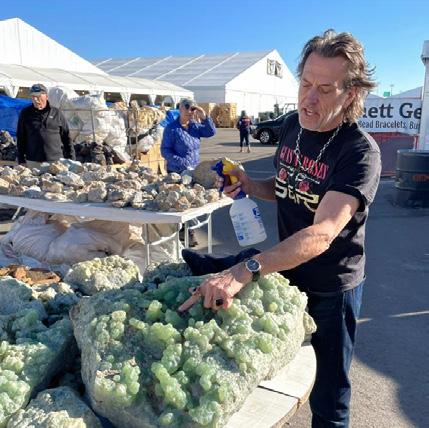
This year marked the 40th anniversary of the first time I visited the Tucson Gem & Mineral Society show in 1983. At the time, I was working for a Canadian geologist who traded mineral specimens. He opened an “upmarket” mineral and jewelry store in Banff, Alberta, and recruited me to be the jeweler. We went to the Tucson show to see what that side of the gem trade looked like, and I was blown away and hooked.
Tucson was shabby back then — a town literally faded by the desert sun — and the shows, with their rambling lack of formality, suited it. I had never seen shows like it, before or since. Today, AGTA GemFair and the Gem & Jewelry Exchange (GJX) are two of the more formalized fairs, and to a certain extent, so is the Pueblo Gem & Mineral show; these are where serious gems can be found. As one ventures out to other venues (there are 42 citywide), sojourning through aircraft
hangar-size tents, the offerings become more random: rugs, Buddhist paraphernalia, dinosaurs, beads, beads, and more beads. And then there are kitchen sinks — literally, sinks carved out of gemstone.
My main mission every year, in addition to buying cut gemstones, is to buy rough material that we cut to fit our designs. I have been buying that way ever since I developed my Crystal Haze signature technique 28 years ago. I tend to find most of what I’m looking for at the Kino Gem & Mineral Show, about 5 miles up the I-10 and away from the more central fairs. Here, I deal with the actual miners. This is a community far removed from the more brilliantine finished-gem dealers of the more structured shows. I usually end up taking a few industry people with me who have never shopped gems by the kilo. And I always hire a truck, for added theater. This year, I bought 46 kilos of Falcon’s Eye and 25 kilos of silver sheen obsidian from Mexico. However, by far my best star find was chrysolemon. This opaque, minty-green material in such clean form is exceptionally rare and a perfect color for our latest Crystal Haze collection. Read the full version of this article at jewelryconnoisseur.net.
After three years of virtual gatherings, members of the International Colored Gemstone Association (ICA) met in Dubai in mid-February for their annual conference. An intimate affair with only 150 registered attendees — down from 370 in 2019 — the 2023 ICA Congress featured prominent speakers, insightful presentations, and deliberations on the gem sector’s future. Here are some of the key topics that came up. By
 Richa Goyal Sikri
Two standout presentations demonstrated the value of storytelling for the colored-gem industry. Jeffrey E. Post, curator of the Smithsonian’s National Gem and Mineral Collection, brought breathtaking images of precious stones to life by interspersing them with stories of the collectors who’d donated them to the museum. And Guillermo Galvis, president of the Colombian Emerald Exporters Association, drew parallels between the “butterfly wing” optical effect in select Colombian emeralds and the iridescence in the wings of endangered Colombian butterflies near emerald deposits. His organization has been helping preserve the butterflies as part of its overall positive impact and that of the emerald trade, he said. Meanwhile, miner Gemfields announced the upcoming publication of its latest storytelling project: a collection of short adventure stories by none other than this reporter, based on true events in the colored-stone world. The book, No Stone Unturned: The Hunt for African Gems, is set to come out in September.
Artificial intelligence (AI) was a hot topic at the gathering when it came to grading stones. Experts from the Gemological Institute of America (GIA), American Gemological Laboratories (AGL), and the Gem and Jewelry Institute of Thailand (GIT) deliberated on how the emerging technology would influence the role of gem labs. Computers can’t replace a trained gemologist who has years of grading experience, maintained Chris Smith of AGL.
Thanong Leelawatanasuk of the GIT echoed that sentiment, but added that “machine-based learning can support…gemologists, especially with large quantities of calibrated goods.”
GIA executive vice president Tom Moses, meanwhile, called to stop assigning a premium price to historic sources, and instead focus on the fundamentals of a gem’s beauty when grading. He quoted former GIA executive director Richard Liddicoat, who argued that “sourcing of colored stones misleads the public and imposes an artificial price differential. Why should someone pay more for an inferior ruby from Burma?”
As origin discussions unfurled, several presentations highlighted the importance of identifying a stone’s source, whether for storytelling or ethical purposes.
Multiple mining companies — including Gemfields, Fura, Belmont, Potentate Mining and Fuli Gemstones — pointed to consistent and responsible supply chains as part of the value that institutional players brought to the industry, along with their marketing might and other contributions.
Instead of just talking about Gemfields’ mines in Zambia and Mozambique, CEO Sean Gilbertson shared data: research from the World Bank and resource site Artisanalmining.org, import and export statistics from the United Nations, and monetary inflow figures from the Bank of Mozambique. In one graph, he showed that countries with higher levels of government
corruption tended to have a greater number of informal miners. He also mentioned that people had been smuggling rubies out of Mozambique since the gems’ discovery there in 2008.
Because there may be both good and bad actors in a country’s mining industry, “we are keen to instill a ‘mine-of-origin’ model [for gem tracing, rather than] the prevalent ‘country-of-origin’ [model],” he stated. Delegates also expressed concern about ongoing insurgent attacks in Mozambique and how they might affect future ruby supply.
certification. Panjshir and Swat emeralds — from Afghanistan and Pakistan, respectively — are considered premium brands among consumers, they added, and buyers tend to gravitate toward trade names such as Jedi spinels.
In addition, consumers in China are shifting their focus from the price point of jewelry to its longterm value, they reported, and cautioned that “to be successful, you have to be innovative and fast.”
There was also a panel on Fei Cui jade, aka jadeite. Despite having a market worth more than $8 billion — second only to diamonds — Fei Cui jade has been undervalued in the West, maintained the panelists. The top auction record for emerald is $300,000 per carat, while the record for Fei Cui is only $120,000 per carat, leaving room for future growth.
Social media is crucial for sales and marketing in China, stressed presenters — specifically Jing Jing, editor in chief for Harper’s Bazaar Jewelry in China, and Andrew Lucas and Ruby Liu from Guild Gem Labs.
Jing credited women with boosting the popularity of colored gems via PR, retail and media, while Lucas and Liu shared statistics on the Chinese gem market. Although 69% to 70% of imported emeralds are from Zambia, said the Guild presenters, Chinese labs see more Colombian emeralds coming in for
Industry stakeholders should embrace diversity not only in their workforce, but also in their products and marketing, said Annie Doresca, board president of the Black in Jewelry Coalition. In fact, firms with greater diversity and inclusion are 35% more likely to outperform their competitors, according to data she cited from McKinsey & Company.
Launch and growth expert Elle Hill urged companies to communicate their SDG achievements transparently. “If no one heard it, the tree didn’t fall,” she said.
The diversity panel acknowledged that there was no single yardstick for measuring a company’s inclusivity level; much depends on regional and cultural context. To access the best talent, the panelists advised, companies need to abandon their preconceived notions of where such talent resides, and work to create the kind of environment that can help it flourish.


Who will buy Bonhams?
By David BroughThe question has been on industry insiders’ minds since the 230-year-old British auction house went up for sale in February. Its current owner, private equity firm Epiris, put it on the market following several years of sales growth that boosted the house’s value, according to media reports. Last year, for the first time in its history, Bonhams boasted a turnover of more than $1 billion.
The most likely buyer would be a large private equity company, another auction house, or a billionaire luxury investor. Those are the parties that financial-service provider JPMorgan Chase & Co. — which is advising Epiris on the sale, according to Bloomberg — is expected to approach: private equity houses that are betting on sales growth
in the luxury-auction space; competitors such as Christie’s and Sotheby’s; and individual billionaire investors who might want to add a “trophy” asset to their stable of luxury businesses. One potential purchaser could be Francois-Henri Pinault, billionaire owner of Christie’s. However, it’s unknown whether he would feel the need to add another auction house to his portfolio.
“I think the prospective sale is [spurring] confidence in the auction market,” one industry source tells Rapaport Magazine, citing Epiris’s own apparent confidence in Bonhams’s forecast sales figures. Epiris has reportedly set a price tag of up to $1 billion for the auction house. “If they were not bullish, it would be a difficult sell,” asserts the source.
That said, Bonhams’s competitors may take advantage of its uncertain ownership status to try and woo away prospective clients, the source suggests.
But whatever happens to Bonhams, it’s unlikely to affect the luxury auction market as a whole, which has been going strong for the last several years and looks set to continue its resilience regardless.
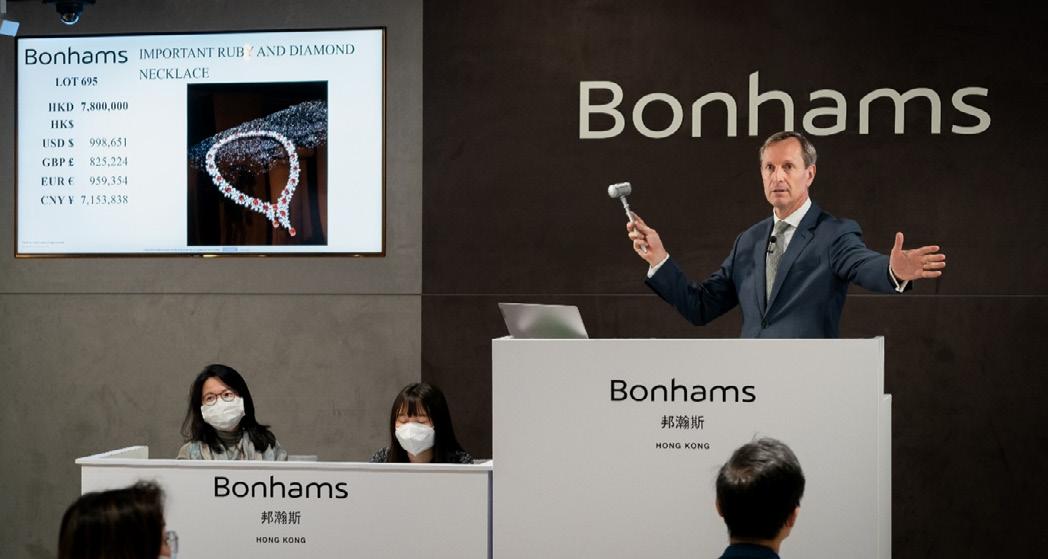
With the auction house itself on the block this time, likely buyers include billionaires and big firms.
Afrequent buyer of fine jewelry from Farber
Auctioneers & Appraisers recently shopped her tony private collection around to higher-profile houses to sell, but ultimately gave the job to the two-year-old jewelry-only outfit in Lambertville, New Jersey. The move was a coup for the fledgling firm and speaks to why some smaller auctioneers are stealing work away from biggername competitors.
By Jennifer Heebner“She got estimates from the larger houses but didn’t like their turnaround times or fees,” explains Farber co-owner Sasha Krivitsky. “She trusted us — so much so that she didn’t even want to wait for an auction and took our quote for immediate payment.” Further sweetening the deal was Farber’s policy of waiving consignment fees — such as commissions or repair and cleaning costs — for any previous shoppers, though Farber did charge a buyer’s premium fee.
While many think of Sotheby’s and Christie’s for sales of natural colored diamonds or famous private collections like film icon Elizabeth Taylor’s, a growing number of clients are warming up to the idea of entrusting more approachable auction houses with finding their heirlooms a new home.
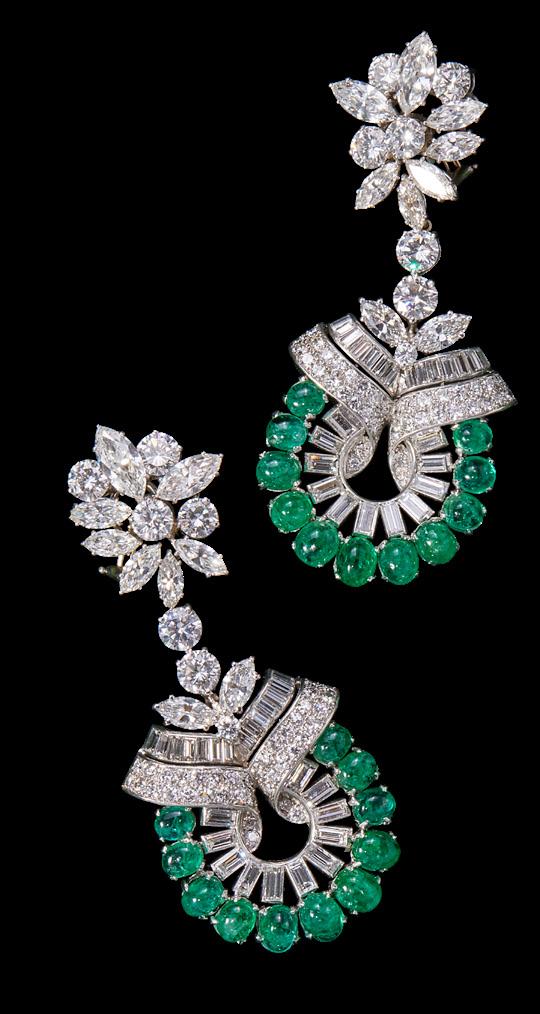
One of the biggest auction misconceptions is that hammers drop only for million-dollar gems; in reality, designer silver jewelry, lesser-known makers, and even nonprecious collections are selling at houses that may not have crossed your radar.
Dianne Batista spent 10 years working at a big house before joining Rago Auctions, which is also in Lambertville. The now-director of fine jewelry and watches knows firsthand that her new employer treats pieces under $20,000 differently than her prior one did. “A $14,000 piece becomes important for our auctions,” she says. “We give it ads and coverage, whereas it might be overlooked in a larger house.”
There are many reasons to consider consigning jewelry to a lower-profile auction house. It can offer more fee flexibility
People seeking to auction their jewels may think first of big-name houses, but lesser-known establishments can have as much or more to offer clients.
and personal attention, including access to jewelry department heads. Smaller houses are also super interested in the backstory behind your jewels and will often use it to build interest in sales.
Emily Waterfall is the director of the Bonhams jewelry department, and managed to carve out an art-jewelry niche thanks to a client. A collector approached the UK-based international auction house two years ago with her own 1,500-piece collection from legends like mid-20th-century jeweler Art Smith. Unlike auction houses’ usual precious jewelry fare, art jewelry often consists of nonprecious materials like brass or paper. However, Bonhams took a chance on the commission, and the sale was a success. “Now we have a strong buying presence for art jewelry,” she says.
Lourdes Winnick appreciates the rich histories of singleowner collections, which is why her employer, Freeman’s Auctions in Philadelphia, Pennsylvania, loves to sell them. Winnick heads the jewelry and watch department there, as well as the luxury handbags and accessories department. At press time, she was enthusing about the upcoming March auction of philanthropist Dianne Kay’s collection. “Jewelry with a story always does better,” she says, noting that she and her staff can put more resources into supporting those collections.
And don’t discount a house just because it seems regional; its reach is likely more expansive than you realize. For example, Freeman’s will rent an office in New York if it feels buyers might be there. And although the headquarters of auctioneer Hindman is in Chicago, Illinois, the company has staffers in 15 different offices nationwide, including New York and Milwaukee, Wisconsin.
Sally Klarr, director and senior specialist of Hindman’s jewelry and watches department, also worked at a big house in the past and knows the importance of being local.
“We are regionally based; we live in their communities,” she says of areas like Detroit, Michigan, and San Diego, California. “And I’ll fly across the country to meet with a potential client, even if they don’t have six figures to sell.”
When deciding on an auction house, it’s important to consider factors like fees, turnaround times, the kinds of marketing it will do, and the frequency and types of auctions on offer.
Fees can vary widely, from consignment and buyer’s fees to photography, insurance, restocking and buy-back charges. Nearly all the houses in this article say their consignment fees are negotiable and can start as low as 10% of the final achieved price, while other houses operate on a sliding scale based on the value of the goods.
Also ask about the sell-through rate and payout dates. Some houses make clients wait months to receive sale proceeds, while some smaller establishments can get it done sooner because they don’t need to deal with a massive corporate infrastructure.
“Our payout is 30 days,” says Farber’s Krivitsky. “And our sellthrough rate is 90% when we help the seller choose a starting price.” If a piece still fails to sell, the house will either keep trying, or purchase the item at the starting price it suggested.
Promotions can include e-blasts to existing clients, social media marketing, ads in major metropolitan publications, postcard mailings, and the occasional world tour. Ahead of its March auction of a private collection from southern California, Bonhams sent the jewels to outposts in San Francisco, Los Angeles, Hong Kong, and Scottsdale, Arizona, with the final sale taking place in New York.
Auction types vary as widely as the houses’ office locations. Some hold weekly online sales starting at $500, while others have monthly or triannual auctions of higher-priced items. Participants can bid in person, online, or by phone. Some houses offer a buy-it-now feature, letting people purchase select pieces at a set high price without bidding.
“We’re trying to give lots of options,” explains Jill Burgum, executive director of fine jewelry at Heritage Auctions in Dallas, Texas. “The public is often afraid of auctions.”
Burgum is also no stranger to creative problem-solving. When a client approached Heritage with an array of loose gems that didn’t fall into any set category, she started a new one: melee auctions. “Our first one was last year,” she relates. “It was all diamonds, and everything sold. We’re having another one in June.”
Perhaps the best type of auction is an emotion-packed one. In 2018, Fortuna Auctions in New York sold the estate of socialite and TV host Bokara “Bo” Legendre, which featured jewels from Belperron and Cartier, among others. As part of its promotion, Fortuna CEO Herbert John Saxon helped organize an event with Rolls Royce and luxury hotel The Surrey. The New York Times wrote an obituary about Legendre. By the time the live auction took place, these efforts had generated a frenzy of interest, paving the way for a 100% sell-through rate and a final intake of more than $1.6 million.
“The auction room was so packed that we were breaking fire codes,” Saxon recollects. When the last hammer fell, Saxon saw the estate executor stand up in the front row, sobbing with mascara streaming down her face. She walked over to him and gave him a big hug. “That validated our efforts and may be the most powerful moment of any auction we’ve conducted in 11 years of business,” he says.
“A $14,000 piece becomes important.... We give it ads and coverage”
Paul Redmayne has had life experiences that few in the auction industry can match. Athletic and adventurous, he sailed with a crew from Antigua to the UK, volunteered in a chimpanzee sanctuary for six months, and worked in luxury retail in London, Paris and Hong Kong before joining the world of auctions. Even with his work, his travels, and his personal excursions, he’s managed to be happily married in Dubai with two daughters, ages 12 and seven. Here, he shares what he loves about the auction sector and recounts the path he took to get there.
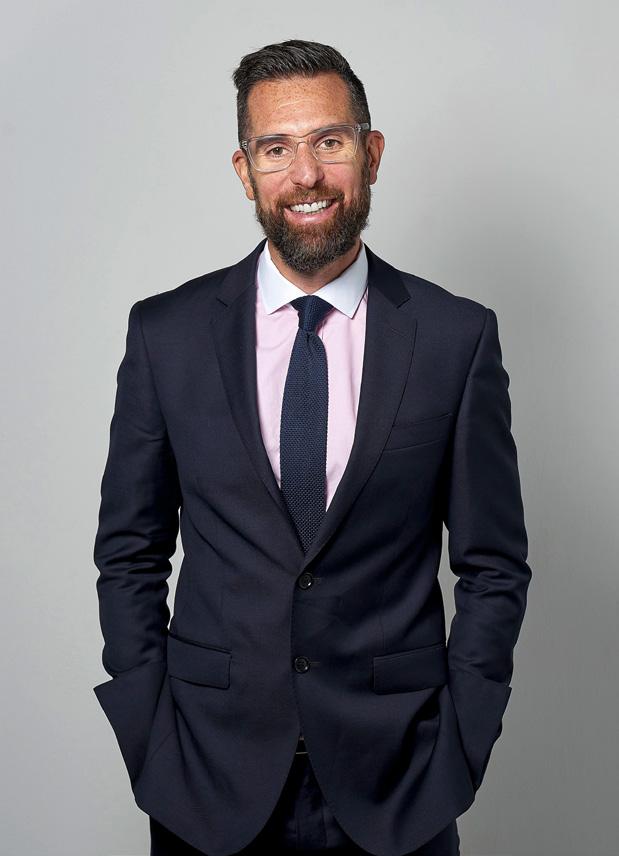 Anthony DeMarco
WHAT IS YOUR JOB AT SOTHEBY’S, AND WHAT REGION DO YOU SERVE?
I’m mainly responsible for our private sales in the Middle East, where the luxury market is increasingly expanding. A large part of my role is interacting and transacting with private collectors, as well as organizing themed private selling exhibitions in Sotheby’s locations, or in third-party spaces such as client residences, hotels, etc. Prior to moving to Dubai, I worked 20 years in highend luxury retail — initially in my native London, then moving to Paris, where I lived seven years before relocating to Hong Kong, where I stayed for 10 years. This relatively nomadic background has [allowed] me to build an address book that is geographically agnostic; hence, my role is more global than purely Middle East-centric.
WHAT IS IT ABOUT YOUR JOB THAT GETS YOU UP IN THE MORNING?
The people I get to work with. It sounds like a cliché, but ours is very much a people business. There is also the predictably unpredictable nature of what lies ahead. As you sit looking at your diary over breakfast, a client calls you out of the blue and asks that you join them for lunch, as they want to introduce you to a friend who has something they’d like to show you: a Pandora’s box of wonderment. Ultimately, what I end up selling is the real draw in the work I do.
WHAT ARE A FEW OF THE MOST INTERESTING JEWELS YOU HAVE HANDLED AT THIS JOB?
Thankfully, over the years, too many to recount. Historical pieces, breathtaking pinks, blues,
should join an auction house. A client then made an introduction, and I took the jump to the other side of the track and have never looked back.
I love the auction world. You are surrounded by the world’s foremost specialists who have chosen to dedicate their entire life to one discipline, be it jewels, watches, handbags, contemporary art, etc. I love what I do, and currently have no desire to find an alternative.
There’s so much we want to do at Sotheby’s, and although we are the world’s oldest auction house, it feels like this is just the beginning.
YOU WORKED AT A CHIMPANZEE SANCTUARY FOR SIX MONTHS. WHAT WAS THAT EXPERIENCE LIKE, AND WOULD YOU RECOMMEND IT TO OTHERS?
I was determined to achieve one of the most cherished items on my bucket list. I Googled “chimpanzee sanctuary” and up came this one place in West Africa that didn’t require a degree in primatology and was looking for two volunteers to live for six months in a hut on stilts, with no electricity and no running water in the Cameroonian jungle, looking after 25 rescued/ orphaned chimps (their parents had been killed by hunters fueling the bushmeat trade). The things I saw and the experiences I lived in those six months have helped form who I am today. It was truly life-changing, and I would recommend it to anyone.
reds…. I’m an especially big fan of old stones [like] the historical Golcondas and have been blessed to have a good few go through my hands. I’m always on the lookout for old Golcondas; I think it’s a sector of the market which is still undervalued.
WHAT MADE YOU CHOOSE THE AUCTION BUSINESS AS A PROFESSION, AND HOW LONG DO YOU THINK YOU’LL BE DOING THIS?
I was working in retail in Hong Kong and was losing so many clients to auction that I joked I
From top: Van Cleef & Arpels Zip necklace; model wearing a selection of jewels sold at Sotheby's. Opposite: Paul Redmayne.
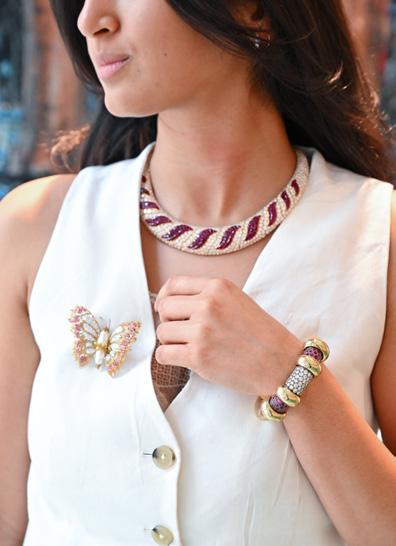
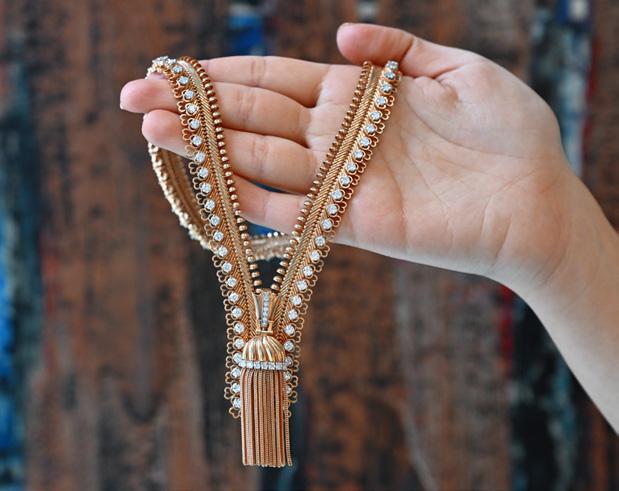
WHAT WOULD YOU SAY TO ANYONE WANTING TO GET INTO THE AUCTION BUSINESS?
If working alongside the smartest, most knowledgeable and passionate people is your thing, then do it; the auction world is built on them. If seeing the most incredible jewels, stones, art and collectables each day is your thing, that’s another reason to join the business. And then there are the collectors, who most often are equally passionate about their collections, each with their own extraordinary story to tell.
“I was working in retail in Hong Kong and was losing so many clients to auction that I joked I should join an auction house”





Since 1988, the European Fine Art Foundation (TEFAF) has showcased art, jewelry, antiques and design each year at its rigorously vetted fairs. Its latest edition in Maastricht, The Netherlands, which took place in March, featured 270 exhibitors from 20 countries and included 18 estate and antique jewelry booths one more than in 2022.
“TEFAF is where museums bring curators and donors to shop,” say exhibitors Didier and Martine Haspeslagh, co-owners of UK gallery Didier. This has translated to museum sales for the London-based business, which deals in pre-owned jewels by 20thand 21st-century artists and architects.
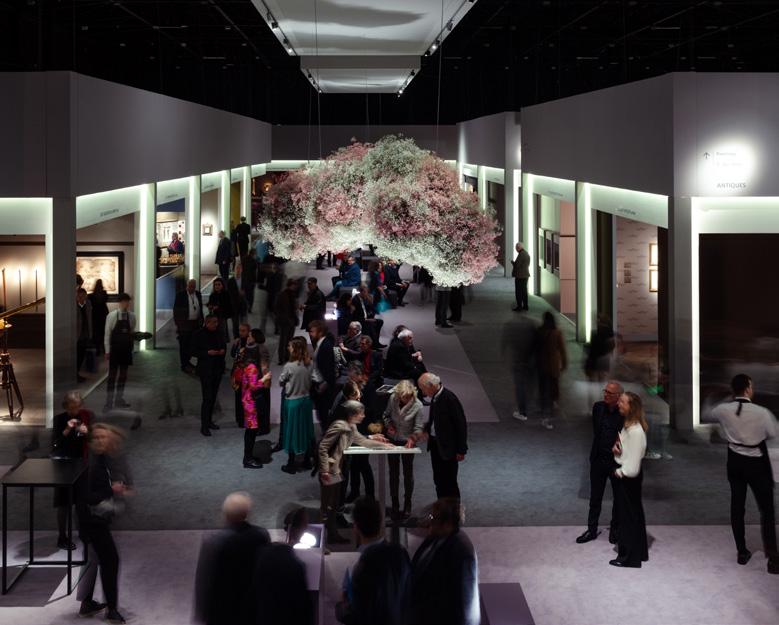
“The art-educated public attending TEFAF includes collectors of the highest caliber, and the contacts and sales made at TEFAF are priceless,” the couple adds.
New York dealer A la Vieille Russie has exhibited antique and estate jewelry, as well as fine art, at TEFAF Maastricht for 29 years. This year, the family-owned business showed pieces by Cartier, Van Cleef & Arpels, Schlumberger, and artist Salvador Dalí, among others.
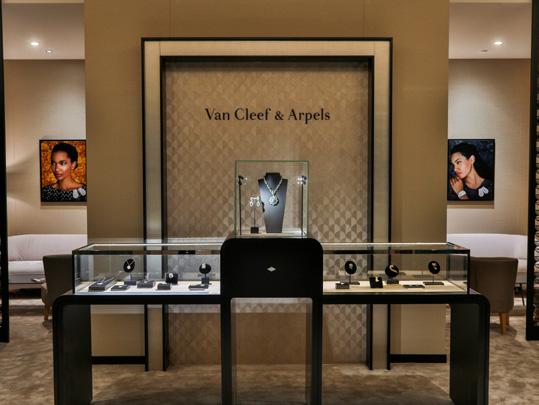
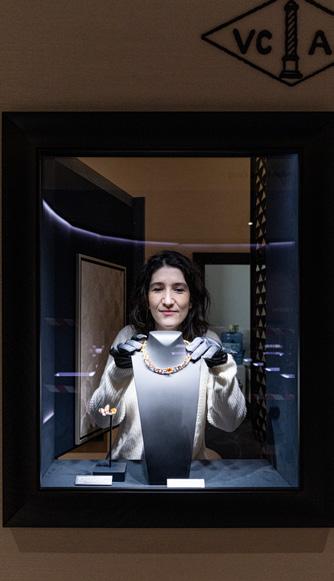
“We keep returning because the high quality, number and range of exhibitors continues to attract thousands of sophisticated collectors and museum professionals from across the globe,” says A la Vieille Russie co-owner Mark Schaffer. “We see visitors from year to year whom we don’t see at other fairs.”
TEFAF has “always had a strong presence in antique and contemporary jewelry,” remarks Sherien Berger, the fair’s PR and communications coordinator. “Our exhibitors and team highly value our connections and clients in the jewelry space, to ensure our fairs continue to thrive and grow.”
Exhibitors brought their best to this year’s edition of the international art and jewelry fair in The Netherlands.
Antique and vintage chains, mainly in yellow gold, have become popular among collectors, who buy them as fast as they go up for sale on Instagram.
These old-school styles, dating from the 1700s through the 1970s, have been inspiring modern designers as well as gaining traction on their own at the retail level.
One retailer that offers a range of chains from various periods is Lang Antique & Estate Jewelry in San Francisco, California. “It’s important to educate your salespeople and your clients about purchasing antique and vintage chains,” says co-owner Suzanne Martinez. When buying modern versions, “many women go to the jewelry districts in their cities or hometowns, where they are taught to ask the weight,” as this usually indicates how much gold is in the piece and thus how much it’s worth. However, “this goes against how you buy certain earlier period chains.”
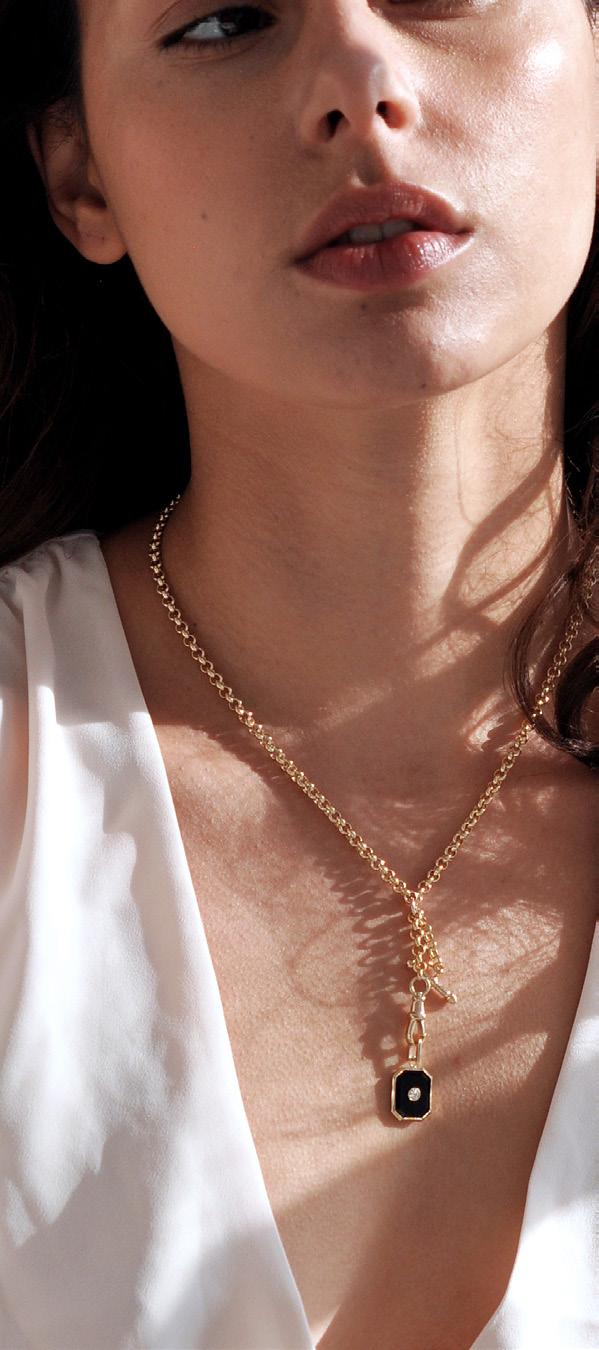
Georgian chains, which usually come in 18-karat gold and are hard to find in original condition, are most often lightweight,
Originally designed to hold men’s watches, this style traditionally measured 12 to 13 inches. The real finds are ones as long as 16 or 17 inches for men who were taller or of wider girth. These fob chains were heavier than women’s chains, since they had to hold a pocket watch as well as seals for signing documents. Today, they are sought-after for charm necklaces. The most popular ones feature tromboneand paper-clip-style links or curb chains.
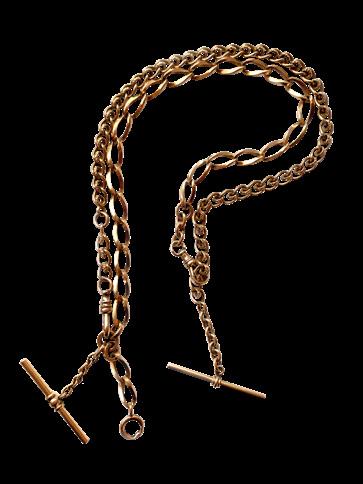
The allure of antique and vintage chains is alive and well in this generation.

This Georgian-era style employed hand-stamped 18-karat gold links that women could string through a fur muff to secure it in place for their hands outdoors. Indoors, they could remove the muff and wear the chain on its own. Different fasteners kept the chain closed; the most charming were shaped like hands, with miniature jewels such as gem-set rings on the fingers. These chains were traditionally 54 to 60 inches long, but they’re hard to find in their original
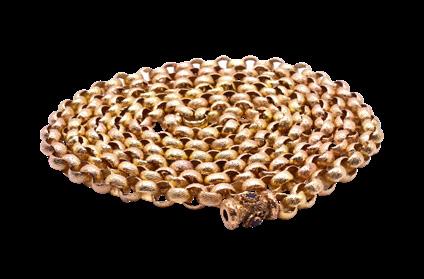

as the makers would craft the links from fine gold sheeting. Even the longest chains — 60 inches — are light as a feather, so weight is irrelevant to their value; it’s their handmade quality, technique, and longevity that render them rare finds.
“If the chain feels too weighty, it usually indicates it is a reproduction,” cautions Martinez, noting that English Victorian chains were lightweight as well. French chains from this period were often heavier, but even with those, she urges buyers to focus primarily on the filigree designs and ornate workmanship.
Lang’s wares include intricate, handmade Georgian chains, Victorian guard chains, and Victorian and Edwardian watch-fob chains long enough to wear around the neck (15 to 17 inches). Fob chains “continue to be the most desirable styles,” Martinez reports, as they can hold multiple charms and medallions.
Diane Richardson of The Gold Hatpin in Oak Park, Illinois, carries watch-fob chains of 13 to 17 inches. “It feels more original and contemporary to mix two shorter fob chains together” for hanging charms, she says. She and her staff tend to pair up similar gold colors and karats, but “also teach customers that it’s okay to combine different-colored golds in one necklace.”
Both stores stock Victorian chains with distinctive link designs like openwork or filigree, double-sided floral styles, and infinity knots, which have a twisted texture. Richardson recommends “finding one locket or a special pendant to work with these more intricate links, or else wearing them alone or layered.” Chains from the 1970s tend to have elongated rectangular or oval links, which can be solid or hollow; clients at both stores prefer solid.
These appeared during Victorian times, featuring swivel dog clasps or bolt rings from which lockets, watches or padlocks could hang. They were lightweight and sported links in the belcher or rollo style, as well as ones with symbolic motifs. Many of these chains were cut down over time — say, if a family wanted to pass them down to two daughters or get more sales mileage out of the piece. In their original form, they range from 54 to 60 inches.
Many Victorian styles are in 9-karat gold (or “9ct” in hallmarks) if they’re from the UK. While people often view these as the “poor stepsisters” of higher-karat chains, Martinez advises explaining to clients that “9-karat is harder and more durable, allowing these chains to last longer and often be found in excellent condition.”
A “10K” or 10-karat gold hallmark means the chain was made either elsewhere in Europe or in the US. These chains also had a bad rap from the 1900s onward, but Richardson urges retailers to revisit buying them, as the price tends to be less prohibitive and they have the same advantages as 9-karat. That said, some clients will still turn up their noses at the lower karats, so it’s good to have a selection of higher-karat alternatives.
Antique and vintage chains offer more appreciation value than their modern counterparts, too. So why not stock up?
chain by Ashley Zhang with a 14-karat gold charm featuring a recut vintage onyx and a diamond.
Jewelry specialists Anellie Manolas and Susan Abeles met while working at Bonhams in 2012. Describing themselves as “kindred spirits,” they share the same passion for researching pieces in-depth. During the Covid-19 pandemic, Manolas, who had recently moved from Hong Kong to the west coast, started to build a collection of rare estate jewels. Castello & Rossi was born, and she invited Abeles to join the project. The two thoughtfully purchase jewels, which they showcase on the castellorossi.com site, Instagram, and trade platform The Jewelers Circle. Here, they discuss how they approach sourcing and selling one-off pieces.
Abeles: The thing that unites us is that we’re really driven by identifying the piece, whether it be its history, provenance, any type of reference. Anellie has an amazing eye; she is a hawk and can find anything. And I love the fact that we
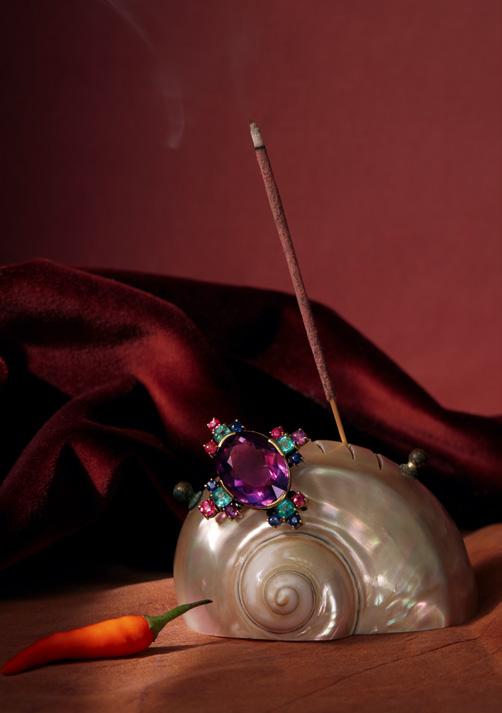
Anellie Manolas and Susan Abeles, the duo that makes up Castello & Rossi, talk about sourcing the perfect piece, transparency, and collecting versus selling.
Sonia Esther Soltani
share this. We see the importance in every single piece of jewelry. We have very much a curator lens when we look at something, but we also have respect for the person who sat down and designed it or the group of people that designed it and where it comes from and where it sits historically.
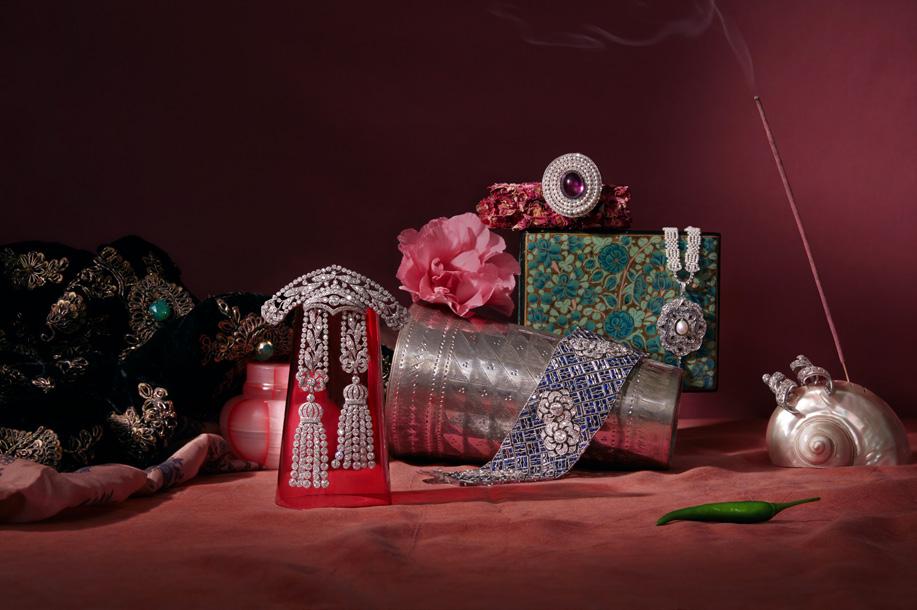
Manolas: For Castello & Rossi, we’re playing a long game. We’re not looking to turn over jewelry frequently. We’re not looking to purchase jewelry quickly. We slowly add to our collection of pieces that we think are worthwhile adding, and we’re not looking to make quick sales. I really think that probably differentiates us from the greater dealer market and places us a little bit more in the collectors’ bucket rather than the dealers’ bucket, although obviously we do sell the pieces that we buy.
Manolas: We are very transparent about our processes. We like to take our clients along with us on that journey so that they understand how and why we acquire pieces. We are very happy to talk about the fact that we buy jewels at auction — something that traditionally dealers are not comfortable being forward about. They don’t want people to know where they purchase their jewels. But the reality is that the market that we live in today is very savvy, and our clients can easily hop online and see where something has come from. And we’re really not afraid of that. We have a great respect for the auction industry, for our peers. We see great value in buying at auction.
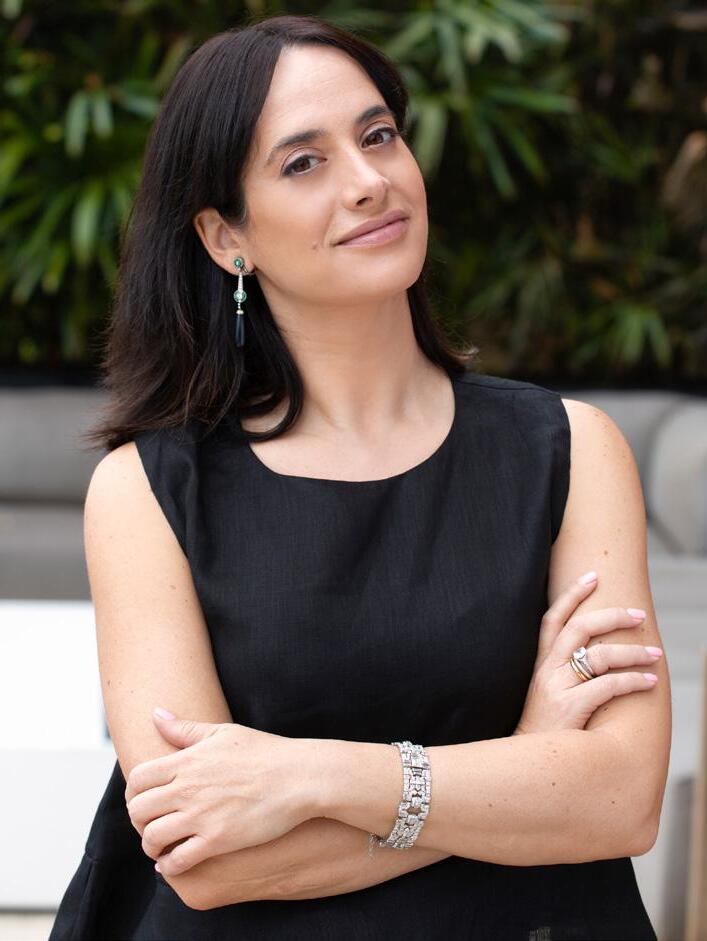 Manolas founded Castello & Rossi in 2021 after working for Christie’s in London, Bonhams Australia, and Phillips in Hong Kong. “Susan and I buy pieces that we truly love,” she says. “We have the confidence that if we are passionate about them, someone else is going to be, too.”

eventy-four years after its creation, the Luminor — the flagship model of Italian watch brand Panerai — is still a hot commodity. The distinctive cushion-shaped timepiece has been garnering serious attention from collectors, says Daniel Yi, chief marketing officer at Bob’s Watches in Newport Beach, California. Vintage models from the 1940s and ’50s, along with a smattering of limited-edition runs, have emerged as sought-after investment assets, he reports.
Notable for its crown-protecting bridge, integrated lugs, and glow-inthe-dark display, the Luminor traces
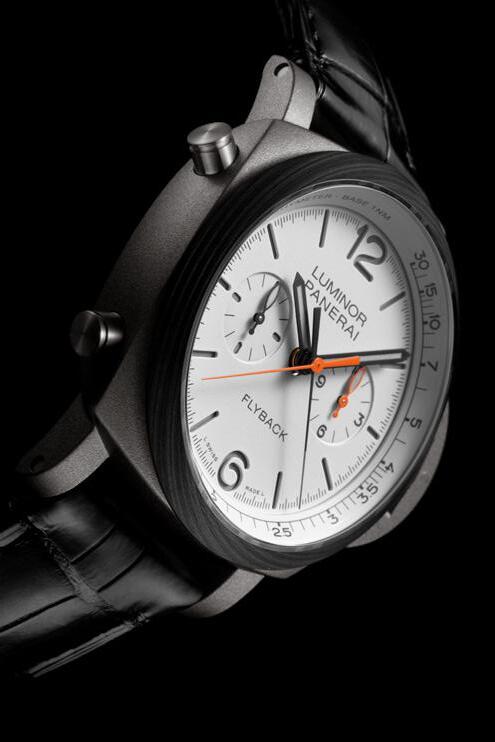

its origins back to 1949, when Panerai secured a patent for a luminous tritiumbased compound. Initially only available to the military, the model made its public debut in 1993 and has since attracted some influential wearers. Actor Sylvester Stallone sported a PAM5218201/a in the 1996 film Daylight and even gifted a Luminor Marina to fellow action star Arnold Schwarzenegger, who wore it in Eraser that same year.
Today, there’s a collector base for ’90s Panerai watches associated with Stallone, says Yi, though that’s not the only draw. “Panerai used to use Rolex movements in some models back in the 1940s, and those are some of the most collectible.” Models with movements by watchmaker ETA, such as the PAM111, are also highly valued, he relates, as are those from before Panerai’s 1998 acquisition by the Vendôme Group (now the Richemont Group).
All of these elements have fed the Luminor buzz on the secondary market. A global community of aficionados known as Paneristi seek “specific models that are either not available new...or were discontinued years ago,” says Yi, adding that pre-owned Luminors go for about $4,500 to $7,000.
Some dealers have expressed concern over the Luminor’s affiliation with World War II Axis forces, he notes. “Buyers will need to go to a trusted source, as there are so many factors to take into consideration.”
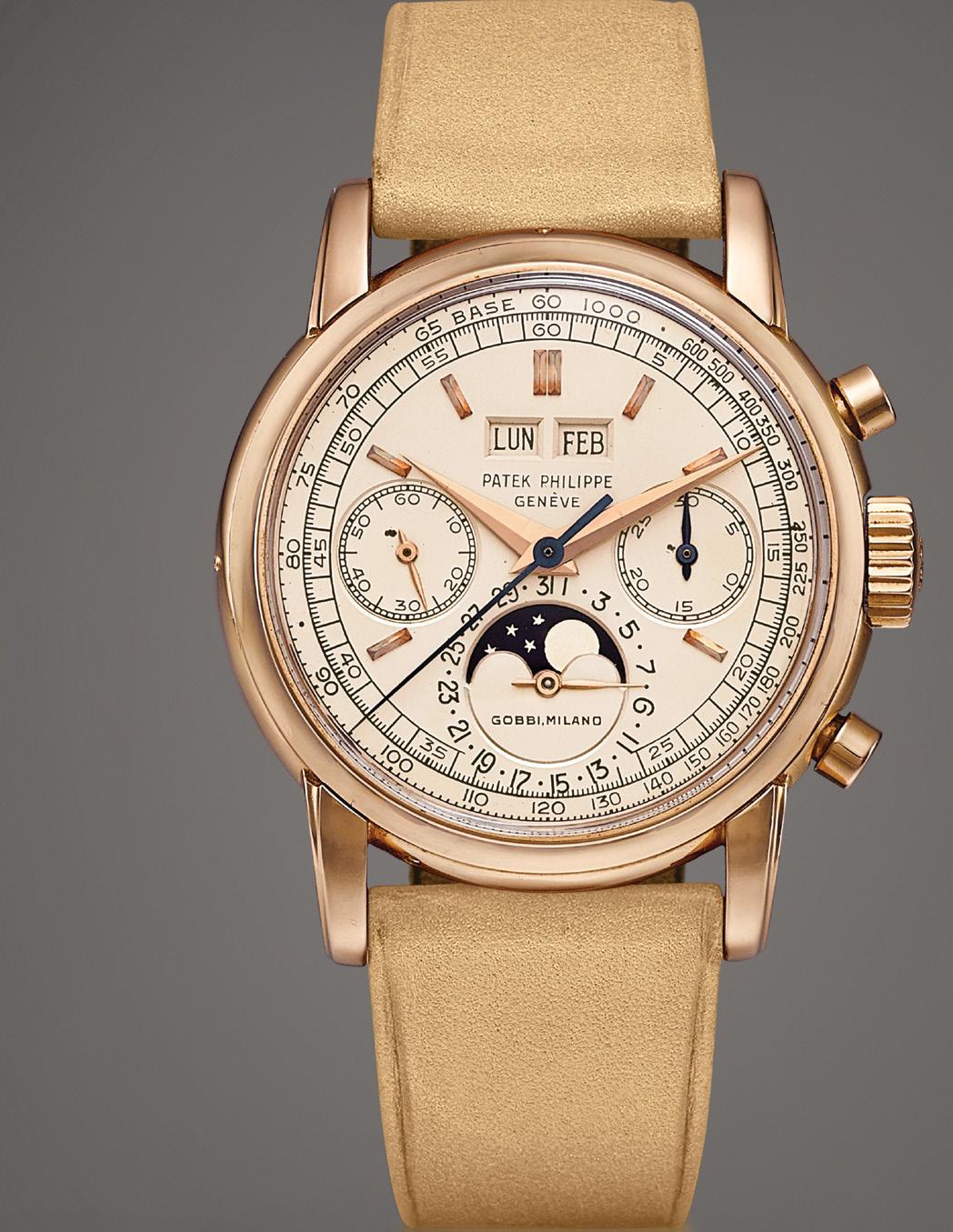
The results are in: It was another record year in the watch auction world. The five major auction houses for the category — Phillips, Christie’s, Sotheby’s, Antiquorum, Bonhams and Poly Auction — brought in a combined CHF 701.6 million (about $767 million) in 2022, according to the latest report from auction-tracking company The Mercury Project. That’s an 11% increase over 2021’s CHF 634 million (about $693.1 million), and a whopping 80% more than in 2019.
The only hitch was the lackluster fourth quarter, when sales fell by 29%. But there’s no reason to believe this is the start of a downward trend, says The Mercury Project founder Thierry Huron. “The 2022 spring season set the bar very high, with 14 [auctions] that totaled above CHF 10 million [about $10.9 million]. Those spring sales included 28 millionaire lots” — items that sold for over CHF 1 million ($1.1 million) — “so it would have been difficult to go higher in the fourth quarter.”
Another reason for this blip may have been “speculators being distracted by a stronger offering in other luxury categories, such as jewelry, which rose 10% during the same quarter,” Huron suggests. There was also a drop in online watch sales, which accounted for 19% of the total in 2021, compared to 14% in 2022.
Remy Julia, head of watches at Christie’s Dubai, agrees that speculators seemed less active in the fourth quarter. “There were fewer watches in current production or that had been produced in the last two years, which tells me it may have been a drop-off in activity by flippers — people whose hobby is to make money [by reselling] watches without [having] a real interest in watches.”
There were several world auction records in 2022. For one, the top three houses achieved their highest annual watch sales to date. Phillips
1. PATEK PHILIPPE REF. 2499
Sold at: Sotheby’s Achieved price: CHF 7,255,605 ($7,935,072)
2. RICHARD MILLE RM 52-01 SKULL TOURBILLON
Sold at: Antiquorum Achieved price: CHF 6,663,737 ($7,286,801)
3. GEORGE DANIELS SPRING CASE TOURBILLON
Sold at: Phillips Achieved price: CHF 4,083,500 ($4,465,077)
4. RICHARD MILLE RM 56-01 IN SAPPHIRE AND TITANIUM
Sold at: Christie’s Achieved price: CHF 3,654,000 ($3,995,550)
5. ROLEX PAUL NEWMAN DAYTONA OYSTER LEMON IN 18-KARAT YELLOW GOLD
Sold at: Christie’s Achieved price: CHF 3,414,000 ($3,730,502)
took the lead with year-end sales of CHF 219.1 million ($239.6 million), a 31% market share. Next up were Christie’s at CHF 207.3 million ($226.6 million) and Sotheby’s at CHF 171.2 million ($187.2 million), or 30% and 24% of the market respectively. Christie’s has been gaining market share from Phillips in the past two years, which Julia attributes to the former’s acquisition of several important collections. Still, of the top five auction events by value last year, four were at Phillips and one at Christie’s.
Price ceilings shattered as well: 2022 yielded the all-time highest number of millionaire lots — 98, compared to 57 in 2021 — and of lots over six figures. The average price was CHF 49,901 ($54,567), a 27% increase over 2021 and 70% more than two years ago a sign that auction houses are consigning fewer but more valuable pieces. The CHF 100,000 to CHF 1 million ($109,335 to $1.1 million) price point is now their core business, the report says; lots in that range were up 44% from 2021, accounting for 53% of 2022’s total sales.
Patek Philippe and Rolex continue to reign as the top-value brands, respectively making up 40% and 16% of all millionaire and six-figure watches last year. But several independent brands — Richard Mille, F.P. Journe, George Daniels and Audemars Piguet — made it into the top 20. Audemars Piguet was the third-highest seller, accounting for 14% of the total with 229 lots. F.P Journe was also strong at 131 lots, and two Richard Mille references were among the top five best-sellers. Other solid performers were A. Lange & Söhne, Cartier, Vacheron Constantin, Omega and De Bethune.
The 2023 spring season will confirm whether the fourth-quarter dip was a glitch or whether the market is indeed slowing down, says Huron, noting that it really depends “on the offer of the houses.”
Things look promising so far. Phillips’s March auctions included an F.P. Journe Tourbillon Souverain ref. 040-04TN and a Patek Philippe ref. 5270 perpetual calendar chronograph. The Christie’s Hong Kong sale that month offered a much sought-after Patek Philippe ref. 6002G-100 Sky Moon Tourbillon, and its April auction in Dubai features a Parmigiani Fleurier Hijri perpetual calendar, one of only 25 made. Get your paddles ready.
Global watch auctions totaled more than $760 million last year, says The Mercury Project. What’s next?
Besler
Three young watch aficionados in Italy wanted to make the watch-buying process more accessible for fellow enthusiasts. The result was WatchAnalytics, a website that displays the market trends for thousands of timepieces. The trio — Francesco Boni, Francesco Bortolan and Stefano Fusai, all 23 and from Milan — launched the site in November 2022 with an algorithm they’d developed to estimate the price of each watch. Using multiple online marketplaces, the algorithm takes sale prices, listing prices, bid prices, the condition of the watches, and other factors into account, Bortolan explains.
“WatchAnalytics was born out of our shared passion toward the world of watches,” he says. “Since we were all friends, we often found ourselves discussing watches, and a large part of the topics of our conversations were about the watch market that was growing. From those chats, we got the idea.”
The platform isn’t a marketplace; rather, it provides timepiece-lovers with information on which to base their buying decisions. It aims to help prospective purchasers get an accurate watch quote in an easy and user-friendly way.
“Our goal is to make the watch market as transparent as possible for those who may not normally have access to curated and accurate data,” Bortolan elaborates.
Regarding current trends, he says, “the market in the last six to eight months has experienced a rather steep price drop, especially for those watches that had performed so well in recent years. The drop mainly involved sports models of the most renowned brands, such as Rolex, Patek Philippe and Audemars Piguet. Yet despite the descent, many of these models are still being sold at prices well above list.”
Here are four of the top models on WatchAnalytics as of March 2.
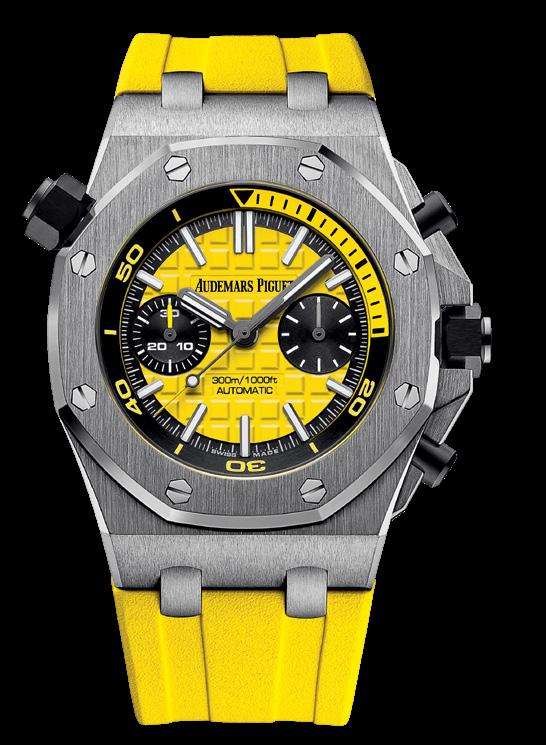
26703ST.OO.A051CA.01)
The 42-millimeter, domed, stainless-steel case houses a yellow dial with two subdials, powered by an automatic movement.
Annual price change: Up 30% from $27,941 to $36,237
Retail price: EUR 27,900 ($29,765)
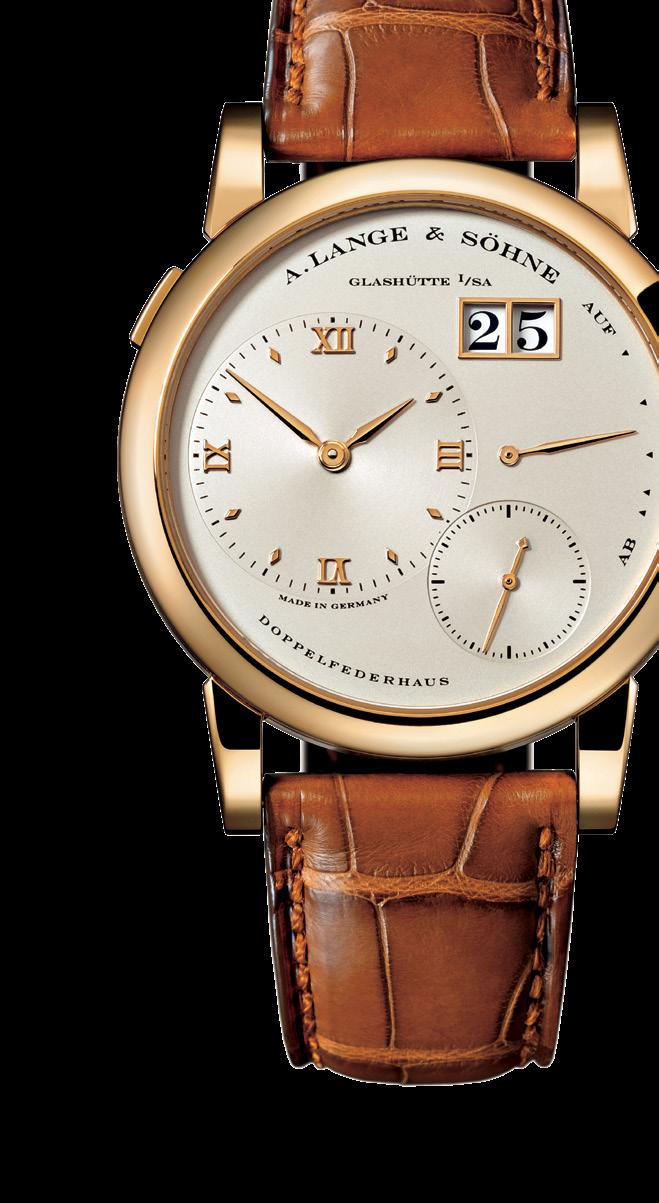
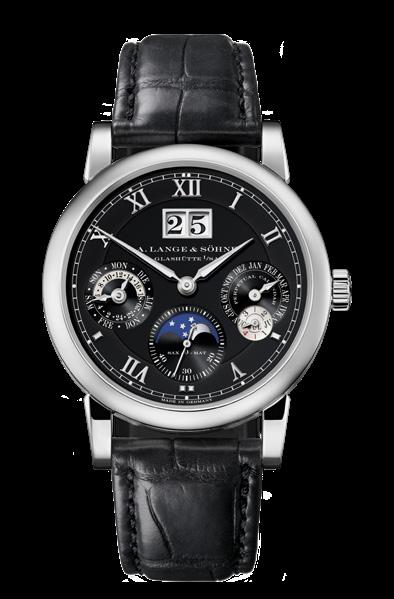
The 38-millimeter, 18-karat white gold case contains a black-colored solid silver dial. The perpetual calendar functions include a large double date window, a day/night indicator, and displays for the month, leap year, and day of the week.

Annual price change: Up 42% from $55,330 to $78,802
The 42-millimeter case features a grey guilloche dial with a jumping-hour display at the 12 o’clock position, and minute markers on the outer rim. The Caliber 9905 manually wound movement has a 65-hour power reserve.
Annual price change: Up 40% from $15,052 to $21,090
Retail price: EUR 39,800 ($41,460)
This watch features a 38-millimeter, 18-karat yellow gold case housing an off-center dial, a big date display, and an outsize date. Powering it is the manually wound Caliber L901.0.
Annual price change: Up 33% from $23,027 to $30,690
Retail price: EUR 42,300 ($45,127)
IMAGES: AUDEMARS PIGUET; CARTIER; A. LANGE & SÖHNE1 GEM WAVE
Gem Wave carries a variety of shapes, sizes and qualities of diamonds, including fancy colors. It is particularly strong in -2, stars, melee, and diamonds 1 carat and under.
Telephone: + 1 800 622 9283 gemwave.com
3 B.H.C. DIAMONDS (USA)
B.H.C. Diamonds specializes in top makes and consistent assortments ranging from 0.003 carats to 35-pointers in D to K colors, from flawless to promotional qualities.
Telephone: +1 212 997 9195 bhcdiamonds.com
37 DIAMONDS FOR LIFE
Diamonds for Life specializes in providing premium-quality GIA- and EGL-certified loose diamonds, diamond engagement rings, wedding bands, diamond pendants, and fine jewelry to the public at wholesale prices.
Telephone: +1 213 955 5900 indiamondsforlife.com
42 PADMAVATI EXPORTS
Padmavati Exports has built its reputation on making diamonds more accessible, transactions more convenient, and the experience as fulfilling as possible.
Telephone: +1 212 869 0544
50 STULLER
Stuller is a manufacturer and distributor of jewelry and jewelry-related items worldwide. Its core product categories are bridal, mountings, jewelry, diamonds, gemstones, findings, metals, tools, supplies and digital solutions.
Telephone: +1 337 262 7700 stuller.com
INSIDE BACK COVER PRISTINE GEMS
Pristine Gems is a family-run manufacturer of fancy-shaped diamonds, boasting 28 years of experience. Dedication to client needs and excellent service is the motto of this company.
Telephone: +1 212 840 2500 pristinegem.com
BACK COVER RDI DIAMONDS
RDI Diamonds is a leading supplier of loose diamonds and has one of the largest inventories in the world. It is also one of the largest memo houses in the US.
Telephone: +1 585 225 3390 rdidiamonds.com
7 FURA GEMS
Fura Gems is a colored-gemstone mining and marketing company. Fura aims to bring transparency to the colored-gemstone segment, ensuring every gem is sustainably and ethically mined.
Telephone: +971 6 531 3641 furagems.com
14 GOLDMAN KOLBER
Goldman Kolber manufactures jewelry at its proprietary factory, blending old-world craftsmanship with modern efficiency and techniques to offer the most diverse and unique fine jewelry available anywhere.
Telephone: +1 800 223 2139 gkjewelry.com
8 VEER
Founded in 2012, Veer is a second-generation diamond jewelry manufacturer and merchant. Veer's mission is to help entrepreneurs, creators and decision makers compete in their market and increase revenue while maintaining desirable profit margins.
Telephone: +1 855 836 5483 veer.diamonds
12 DE BEERS GROUP – IGNITE
Ignite is a division of De Beers focused on promoting innovation across the diamond value chain. Activities include research, technology incubation, sales, and promoting joint ventures and partnerships.
Telephone: +44 207 891 5874 ignite.debeersgroup.com
32 DELGATTO DIAMOND FINANCE FUND
Delgatto DFF offers those in the industry an easy, inexpensive, nonrestrictive way to access capital, as well as a no-cost marketing option.
Telephone: +1 212 681 9550 delgattodff.com
INSIDE FRONT COVER GEMOLOGICAL INSTITUTE OF AMERICA (GIA)
Established in 1931, the GIA − a public-benefit nonprofit institute – is the leading source of knowledge, standards and education in gems and jewelry.
Telephone: +1 760 603 4000 gia.edu
76 THE ART OF JEWELLERY
The Art of Jewellery is India’s number-one business magazine on the jewelry trade and industry. It is a one-stop source for cutting-edge information.
Telephone: +91 80 2520 1687 artofjewellery.com
1-3 INTERNATIONAL GEM & JEWELLERY SHOW (IGJS) Jaipur, India, intl.gjepc.org/jaipur
6-8 BHARAT DIAMOND WEEK Mumbai, India bharatdiamondweek.com
10-11 GIFT & JEWELLERY TRADE DAYS Perth, Australia giftfairevents.com.au/tradedays
12-14 YAMANASHI JEWELLERY FAIR Yamanashi, Japan yamanashijewelleryfair.com
24-25 INTERNATIONAL WATCH & JEWELRY GUILD (IWJG) Chicago, IL, iwjg.com
26-29 JEWELLERY & GEM ASEAN BANGKOK Bangkok, Thailand aseanbangkok.exhibitions. jewellerynet.com
MAY
1-3 AGS CONCLAVE Louisville, KY americangemsociety.org
8-11 JEDDAH INTERNATIONAL LUXURY WEEK Jeddah, Saudi Arabia saudiluxuryweek.com
11-14 GEMGENÈVE Geneva, Switzerland gemgeneve.com
16-19 RIYADH INTERNATIONAL LUXURY WEEK Riyadh, Saudi Arabia saudiluxuryweek.com
17-21 JUNWEX MOSCOW Moscow, Russia junwex-style.ru
18-20 INTERNATIONAL JEWELLERY KOBE Kobe, Japan, ijt.jp/kobe
18-21 SIERAAD INTERNATIONAL JEWELLERY ART FAIR Amsterdam, The Netherlands sieraadartfair.com
29-30 INTERNATIONAL WATCH & JEWELRY GUILD (IWJG) Las Vegas, NV, iwjg.com
29-JUN 1 JOGS LAS VEGAS GEM & JEWELRY SHOW Las Vegas, NV jogsshow.com/las-vegas
31-JUN 5 LUXURY JCK Las Vegas, NV, luxury.jckonline.com
JUNE
1-4 COUTURE Las Vegas, NV thecoutureshow.com
1-4 LAS VEGAS ANTIQUE JEWELRY & WATCH SHOW Las Vegas, NV lasvegasantiquejewelry andwatchshow.com
1-5 AGTA GEMFAIR Las Vegas, NV, agta.org
2-4 JEWELLERY SEASONS CHINA Shenzhen, China shenzhenjewelleryfair.com
2-4 UNIQUE GEMS AND JEWELLERY INTERNATIONAL SHOW (UGJIS) Pune, India, ugjis.com
2-5 JCK LAS VEGAS Las Vegas, NV lasvegas.jckonline.com
9-11 HYDERABAD JEWELLERY PEARL & GEM FAIR Hyderabad, India hyderabad.jewelleryfair.in
13-15 JEWELS BASEL Basel, Switzerland jewelsbasel.com
22-25 JEWELLERY & GEM ASIA Hong Kong jga.exhibitions.jewellerynet.com
26-27 INTERNATIONAL WATCH & JEWELRY GUILD (IWJG) Miami, FL iwjg.com
JULY
14 GIA CAREER FAIR London, UK gia.edu/career-fair
17-20 PAWN EXPO Atlanta, GA, pawnexpo.com
29-31 RJO BUYING SHOW Philadelphia, PA, rjomembers.com
31-AUG 1 INTERNATIONAL WATCH & JEWELRY GUILD (IWJG) Las Vegas, NV, iwjg.com
AUGUST
5-8 INDEPENDENT JEWELERS ORGANIZATION (IJO) CONFERENCE Cleveland, OH, ijo.com
11-12 CHICAGO RESPONSIBLE JEWELRY CONFERENCE Chicago, IL chiresponsiblejewelryconference. com
13 RESPONSIBLE GEM BOUTIQUE Chicago, IL chiresponsiblejewelryconference. com
13-14 SELECT JEWELRY SHOW Washington, DC selectjewelryshow.com
14-16 MELEE THE SHOW New York, NY, meleetheshow.com
26-27 ATLANTA JEWELRY SHOW Atlanta, GA atlantajewelryshow.com
27-28 SELECT JEWELRY SHOW Mohegan Sun, CT selectjewelryshow.com
30-SEP 1 JAPAN JEWELLERY FAIR Tokyo, Japan, japanjewelleryfair.com
2-4 BIJORHCA Paris, France whosnext.com/bijorhca
2-4 MIDORA LEIPZIG Leipzig, Germany, midora.de
3-6 AUTUMN FAIR Birmingham, UK, autumnfair.com
5-9 HONG KONG WATCH & CLOCK FAIR Hong Kong, hktdc.com
6-10 BANGKOK GEMS & JEWELRY FAIR Bangkok, Thailand, bkkgems.com
8-12 PALAKISS SUMMER Vicenza, Italy, palakiss.com
8-12 VICENZAORO Vicenza, Italy, vicenzaoro.com
10-11 SELECT JEWELRY SHOW Dallas, TX, selectjewelryshow.com
14-17 MADRIDJOYA Madrid, Spain ifema.es/en/madrid-joya
15-18 HARD ROCK SUMMIT Denver, CO, hardrocksummit.com
18-24 JEWELLERY & GEM WORLD HONG KONG Hong Kong jgw.exhibitions.jewellerynet.com
20-21 JEWELLERY SHOW London, UK thejewelleryshow.co.uk
21-24 PORTOJOIA Matosihnos, Portugal portojoia.exponor.pt
29-OCT 1 COUTURE INDIA New Delhi, India coutureindia.show
29-OCT 1 INTERGEM Idar-Oberstein, Germany intergem.de

All the trade shows and events you need to know about
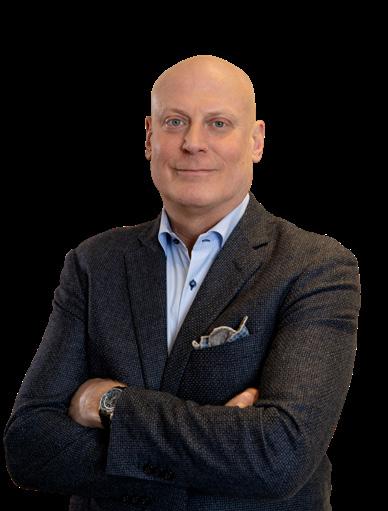 Kay Jewelers.
By Rachael Taylor
What was your first job in the industry? Executive general manager for Jared and [parent company] Signet Jewelers’ chief marketing officer (dual role) in 2018.
Why jewelry?
Our purpose is to inspire love, and our business is helping people symbolize their most meaningful relationships and celebrate the most meaningful moments in their lives. It doesn’t get any better.
How did you get to where you are today?
Before coming to Signet, I started my career and spent nearly 30 years at Procter & Gamble. My undergraduate degree was in electrical engineering, so my first years were in supplychain roles. After getting my MBA, I switched into marketing and ultimately held several general management roles in Europe and North America, primarily for beauty businesses and brands like Olay, Old Spice, Oral-B, Dolce & Gabbana, and Gucci fragrances.
How do you feel about your new appointment as Kay president? Excited and optimistic.
Where is home for you?
Cleveland, Ohio and Montana whenever I can get away.
Tell us what you love.
Spending time with my family and being active. My wife Karen and I have been married for 28 years and have three boys, ages 19, 17 and 16. We escape to Montana, where we both grew up, and spend our free time skiing and snowmobiling in winter, and hiking, biking, golfing and fly-fishing in summer.


What was the last thing you watched on Netflix?
Drive to Survive, a documentary about Formula 1 racing. I’ve always loved adrenaline, competition and cars, and this show packages them all nicely in a very entertaining manner.
Do you have a professional mantra?
“The consumer is the boss.” It’s a reminder to focus on deeply understanding what the customer wants before building all your strategies, and to spend time creating solutions, products and experiences that deliver for them better than everyone else. It is one of the fundamental strategies that has underpinned the transformation of Signet over the past five years.
What is the biggest lesson life or work has taught you? How about the key lesson that bridges both? Balance. Over the course of my career, some of the most successful professionals I’ve worked with were incredibly successful in their personal lives. It’s easier said than done, but they do it by relentlessly focusing on the priorities that make a difference and are able to set boundaries at work that allow them time to spend quality time at home with the people and activities they love.
Is there anyone you look up to professionally?
I have been fortunate to work with some incredible leaders over the course of my career. [Signet CEO] Gina Drosos is obviously one. Michael Kuremsky [former vice president of Procter & Gamble] and Patrice Louvet [former Procter & Gamble president, now CEO of Ralph Lauren] are other standouts. I apply leadership lessons I learned from them every day and do my best to create the same kind of incredibly positive impact they had on me for the people on my team