by rail engineers for rail engineers
OCTOBER 2018 – ISSUE 168
Siemens' new approach to
FUNDING
high-speed
station improvements TO BENEFIT CUSTOMERS travel
RETURN OF THE RAIL PARTNERSHIP THE END OF AN ERA? AWARDS Mark Carne looks back at his tenure as Network Rail chief executive and the challenges and rewards of CP5. DERBY STATION DEPOT EQUIPMENT REMODELLING AND TRENDS
BI-MODE CP6: A GAME GOOD, OF TWO TRI-MODE HALVES BETTER
Andy Coles of Rail Depot Solutions talks of bogie drops, lifting jacks and the all important toilet servicing.
Malcolm Dobell describes Porterbrook’s new Class 769 Flex train, which runs on AC, DC and diesel (and hydrogen).
www.railengineer.uk
ROLLING STOCK / DEPOTS
RAIL ENGINEER MAGAZINE
CONTENTS
14
06 50 54 56 58 62 68
Feature News Hydrogen trains, New York City subway, driverless trains, Railtex.
Challenging times Andy Mellors, the latest chairman of the IMechE’s Railway Division, prepares for his Chairman’s Address.
Wembley North junction renewal Bob Wright explains how collaboration and communication scored a success, despite closing Euston for two weekends.
SafeCap – automated verification of railway signalling The SafeCap signalling verification module applies formal methods to signalling data.
Improved data communications in Cornwall Westermo has provided data networking technology to the Cornwall Capacity Enabling Scheme.
Rolling Stock & Depots
10 14 18 20 22 26 30 34
Velaro Novo – a new approach to high-speed travel Siemens’ latest design of a high-speed train, with faired-in bogies and an empty tube.
Bi-mode good, tri-mode better Malcolm Dobell describes Porterbrook’s new Class 769 Flex train, which runs on AC, DC and diesel.
Hydroflex – the next iteration of the Flex concept Porterbrook has donated a Class 319 train so that Birmingham University’s BCRRE can add hydrogen power.
Swift doors for Crossrail depot Jewers has supplied the doors for the new Old Oak Common depot on the Elizabeth line.
Digital is delivering Philip Hewlett explains Hitachi Rail’s approach to the Digital Railway.
20th century heritage, 21st century safety Running historic trains on today’s main line brings particular challenges in terms of maintenance and safety.
Depot control for the 21st century Fenix Rail Systems is working with Pintsch Tiefenbach to improve train depot control systems.
Heating depots old and new Nick Winton describes the challenges faced by Nortek’s Reznor division when heating railway depots.
Re-doubling Aberdeen to Inverurie - halfway there David Shirres reviews the completion of the first phase of the Aberdeen to Inverness improvement programme.
The end of an era? Mark Carne looks back at his tenure as Network Rail chief executive and the challenges and rewards of CP5.
38 38 42 48
26
Reducing risks in depots Zonegreen’s Depot Personnel Protection System (DPPS) keeps personnel from areas where they would be at risk.
Depot equipment and trends Andy Coles of Rail Depot Solutions talks of bogie drops, lifting jacks and the all-important toilet servicing.
Data communications protocols in the rail industry Mornsun, working with Relec, has developed a range of fully isolated CAN bus transceiver modules.
68 Rail Engineer | Issue 167 | September 2018
3
Working together to Create a Dynamic
future without compromising Our Values
Lundy Projects is an award-winning multi-disciplinary civil engineering company with an excellent reputation for delivering quality rail projects and civil works. With our own installation teams, fleet of road rail vehicles and piling equipment, Lundy Projects have a true “one-stop shop� approach. Our piles are fabricated in-house, with standard lengths for all OLE series always in stock and bespoke designs & lengths available. Our PCL and full POS approval ensure a complete, fully integrated service.
Design | Manufacturing | Civils | Piling | Plant | Installation
RAIL ENGINEER MAGAZINE
EDITORIAL
Affordable trains, expensive infrastructure Over 7,000 new rail passenger vehicles are to enter service between 2014 and 2021, representing more than half the UK fleet. These orders are due to a combination of factors including cheap finance, lower manufacturing costs, franchise quality requirements and new trains having lower operating and maintenance costs, as described in our feature on remote condition monitoring this month. Whilst this is apparently good news, there are downsides. The Rail Delivery Group estimates that these new trains will provide an extra 3,000 vehicles in service. Thus, thousands of serviceable surplus vehicles are likely to be scrapped, as leasing companies are unlikely to pay for their storage. This adds cost to the industry and threatens rolling stock companies, which provide heavy-maintenance and enhancement services. Only a small proportion of these new trains will be owned by the original rolling stock companies (ROSCOs), which provided a stewardship service over the vehicle’s lifetime. It will be interesting to see how this role will be exercised by the finance houses that will own the remainder of these new trains. Over the years, the price of new trains hasn’t changed much. At today’s prices, in the 1980s, the East Coast electrification scheme spent £447 million on 299 passenger vehicles and their locomotives, representing £1.5 million per coach. The cost of recent train orders is just under £2 million per coach. In contrast, current electrification schemes have cost seven times more per mile than the East Coast scheme. Given changes to standards and traffic levels, this is not a totally fair comparison. However, it shows that today’s electrification costs much more than it should, as we explained in issue 164 (June 2018). Signalling costs are also increasing. Ten years ago, the renewal cost of a signalling equivalent unit was £200,000, now it is around £500,000. Mark Carne addresses the issue of project
costs in his interview with Nigel Wordsworth, in which he points out that the Great Western electrification scheme was over budget because it was an immaturely planned project. Yet there must be other lessons that need to be learnt to reduce the rising project costs that led to the cancellation of many projects following Network Rail’s reclassification as an arms-length government body. Nevertheless, Carne has done much to promote improved project discipline, including avoidance of bank holiday project overruns. His wide-ranging interview is an interesting read which highlights his belief that diversity and inclusion drives better business performance and shows his passion for safety improvement. The safe operation of old rail vehicles has its own challenges, as Malcolm Dobell reports following his visit to the Severn Valley Railway. His article shows that, with the support of the Boiler and Engineering Skills Training Trust and Heritage Railway Association, this heritage railway has a modern approach to developing both competence and a just safety culture. Another heritage railway, the Great Central Railway, is expected to be used for type approval testing of the class 769 Flex units which will be Britain’s first tri-mode trains. These are the result of an initiative by Porterbook Leasing to fit a diesel engine to surplus dual-voltage Class 319 units. Two articles describe these Flex units, how they are being modified by Wabtec at Loughborough, and why hydrogen is now of interest. In contrast, the Velaro Novo is a development of the successful Siemens Velaro high-speed train which operates in Spain, Germany, Russia, China and Turkey. It is expected to use 30 per cent less energy than previous Velaros and will, no doubt, be a contender for the HS2 train tender. As well as trains, we feature depots this month, with various articles on their construction and operation and how these
have changed over the years to provide a better working environment. However, some work, such as carriage washing, fuelling and controlled emission toilet discharge, still has to be carried out in the open. There are about 160 depots with such facilities. Maintenance and repair work is generally done inside. This requires depot doors built to a demanding specification and heating systems to overcome the cold sinks that are trains entering the depot in winter. Depot protection systems to ensure a safe working environment and signalling systems to control depot movements are also becoming the norm. Signalling features in our reports on two capacity improvements at opposite ends of the country. The Cornwall Capacity Enabling Scheme provides 20 intermediate block sections between Plymouth and Penzance whilst, just north of Aberdeen, 16 miles of track is being redoubled. A three-month blockade has just completed the first part of this project, which will double the frequency of local services in 2019. Bob Wright reports on another track renewal, the replacement of four life-expired crossovers at North Wembley - a project that closed Euston station for three consecutive weekends. His article describes the extensive contingency planning required for this high-profile project, which posed significant challenges. Challenging times is the apt title of the address that Andy Mellors, as chairman of the IMechE Railway Division, is giving as he tours the Division’s centres. His theme is that railway engineering offers big challenges that bring their own rewards. Communicating this message to the next generation of railway engineers is a challenge that Andy feels has to be addressed. RAIL ENGINEER EDITOR
DAVID SHIRRES
Rail Engineer | Issue 168 | October 2018
5
6
THE TEAM
NEWS
Editor David Shirres david.shirres@railengineer.uk
Production Editor Nigel Wordsworth nigel.wordsworth@railengineer.uk
Production and design Adam O’Connor adam@rail-media.com Matthew Stokes matt@rail-media.com
Engineering writers bob.wright@railengineer.uk chris.parker@railengineer.uk clive.kessell@railengineer.uk collin.carr@railengineer.uk david.bickell@railengineer.uk graeme.bickerdike@railengineer.uk grahame.taylor@railengineer.uk lesley.brown@railengineer.uk malcolm.dobell@railengineer.uk mark.phillips@railengineer.uk paul.darlington@railengineer.uk peter.stanton@railengineer.uk stuart.marsh@railengineer.uk
Advertising Asif Ahmed
asif@rail-media.com
Chris Davies
chris@rail-media.com
Jolene Price jolene@rail-media.com
Rail Engineer Rail Media House, Samson Road, Coalville Leicestershire, LE67 3FP, UK. Switchboard:
01530 816 444
Website: www.railengineer.uk
Rail Engineer Videos http://rail.media/REYouTube
Editorial copy to Email:
news@rail-media.com
Free controlled circulation Email:
subscribe@rail-media.com
The small print Rail Engineer is published by RailStaff Publications Limited and printed by PCP Ltd. © All rights reserved. No part of this magazine may be reproduced in any form without the prior written permission of the copyright owners. Part of: ® www.rail-media.com
Rail Engineer | Issue 167 | September 2018
All change for Railtex! Railtex is returning for its 14th edition at Birmingham's National Exhibition Centre from 14-16 May 2019. The event sees thousands of industry professionals come together to showcase the latest innovations in the infrastructure and rolling stock sectors. The last event, held in 2017, brought together more than 10,000 industry professionals across three days, with a total of 475 exhibitors taking part, the most for more than a decade. Over 13 per cent of visitors were nonUK nationals from 50 different countries, whilst almost 100 exhibiting companies came from 23 countries, highlighting the show’s importance in the international rail calendar. 2019 will see the introduction of three new areas to the Railtex programme, including a new High Speed Rail Hub, focusing on the aims of adding capacity and connectivity to the UK’s network. A new Digital Rail Forum will also be present, enabling broad discussion on the future of this revolutionary programme, alongside a new Railway Industry Association Hub. This will bring
the association’s members together in an environment that will offer a platform for SMEs as well as contain the Knowledge Hub, with its traditional updates, briefings and keynote addresses present at Railtex since the show first began in 1993. With a jam-packed programme of CPDcertified events to be confirmed in the near future, Railtex 2019 can rightly claim to be the perfect platform for companies serving all aspects of the rail industry to demonstrate their capabilities and meet their future customers. With the UK rail industry reaching a critical period in its lifespan the exhibition promises to be the definitive show for those involved in shaping its future. For more information, see www.railtex.co.uk
NEWS
coming soon... NOVEMBER 2018 / MAY 2019
17 years after 9/11... A New York City subway station has reopened 17 years after being destroyed in the 11 September, 2001, terrorist attacks. The Metropolitan Transportation Authority (MTA) opened the new WTC Cortlandt station on 8 September. The infrastructure of the former station was completely destroyed when the World Trade Centre collapsed following the 9/11 terrorist attacks. MTA rebuilt 1,200ft of tunnel and tracks and made significant repairs to the station shell, track tunnels and track infrastructure, which enabled the restoration of line service to the South Ferry terminal. The remainder of the Cortlandt St station was demolished as part of the overall reconstruction of the World Trade Centre site, leaving behind the foundation for a new subway station to be built in its footprint. Construction of the new station began in 2015 when MTA was given control of the site, which is located within the greater World Trade Centre site overseen by the Port Authority of New York and New Jersey.
The station box, within which the station shell and structure are housed, had to be underpinned or supported by piles driven into the bedrock more than 60ft below, creating an underground railway elevated above the bedrock. The station site was then built to grade, allowing the construction of a subway station 700ft long and 47ft wide to take place several floors below street level. A partnership of several agencies worked on the design of the new station. MTA chair Joseph Lhota said: “WTC Cortlandt is more than a new subway station. It is symbolic of New Yorkers’ resolve in restoring and substantially improving the entire World Trade Centre site.” The new WTC Cortlandt station has 23,720 sq ft of public space, with two side platforms for service in each direction 20ft below street level and two station mezzanines below the platform level.
PERMANENT WAY Twice a year, Rail Engineer considers the elements that make up the permanent way – rails, sleepers, clips, pads, ballast and even the make-up of the embankment on which the track sits. Ballast, Excavation, Fastenings, Geotechnical, Grinding, Installation, Lifting, Lighting, Maintenance, Milling, On-track Machines, PPE, Piling, Plant Hire, Plant Maintenance, Rail, Rail Handling, Repairs, RoadRail Plant, S&C, Site Access, Sleepers, Soil Nailing, Structures, Tamping, Welding.
DECEMBER 2018 / JUNE 2019 ELECTRIFICATION & POWER As the UK rail network is one of the biggest consumers of electricity in the UK, it is always investigating ways to innovate, reduce costs, introduce new power alternatives and reduce carbon. Cabinets, Components, Connectors, Control Equipment and Systems, Cables, Distribution Networks, Earthing, Fasteners, Generators, Housings, Insulation, Lamps, Lightning Protection, Monitoring, OLE, Pantographs, Power Supplies, Security, Substations, Transformers.
JANUARY 2019 / JULY 2019 STATIONS Rail Engineer reports on station construction and redevelopment, using technology to improve the passenger experience, and managing access and revenue. Accessibility, Architecture, BIM, Barriers, Buildings, CCTV, Car Parks, Catering, Cleaning, Escalators, Landlord Permissions, Lifts, Lighting, Maintenance, Passenger Information Systems, Planning Issues, Platform / Train Interface, Platform Screen Doors, Platforms, Records, Refurbishment, Reporting, Retail, Security, Software, Smart Ticketing.
Want to learn how to win more business? Join us at the Rail Procurement Roadshow to learn from leading procurement and tender teams and for rail-based workshops.
22 November 2018 – Bird & Bird, London
www.railroadshow.com Rail Engineer | Issue 168 | October 2018
7
8
NEWS
Driverless trains in France While the UK struggles to introduce driver-only operation, our French neighbours have set ambitious targets for operating driverless trains By 2023, SNCF has set itself the target of introducing driverless passenger trains onto the French rail network. The institutes of technological research (IRT) Railenium, Alstom, Altran, Ansaldo, Apsys, Bombardier, Bosch, Spirops and Thales have signed an agreement with SNCF to develop two prototype driverless trains within the next two years. SNCF said it was “embarking on the
construction of the railway system of tomorrow”. Two separate consortia have been created. Alstom, Altran, Ansaldo STS and Apsys will work on a prototype driverless freight train while Bombardier, Bosch, Spirops and Thales have been tasked with creating an autonomous TER train. The total cost of the project is €57 million, with SNCF contributing 30 per cent, the state
30 per cent and project partners 40 per cent. SNCF said the Public Railway Safety Establishment (EPSF) and the French national cyber security agency, ANSSI, would work closely with the consortia to address issues around rail safety and cybersecurity. Driverless trains will offer passengers various benefits, said SNCF, including more regular services which are better able to adapt during periods of disruption.
safe & easy crossing LEVEL CROSSING SYSTEMS
for highest demands
-/ veloSTRAIL eliminating the flange groove
extremely safe crossing for cyclists, wheelchair users, inline-skaters, baby carriages and trolley bags. veloSTRAIL inner panels are available in 600 mm and 1,200 mm and are designed for train speeds up to a maximum of 70mph for the UK with full Network Rail Product Acceptance. excellent compression of “fl ange groove”, even at very low temperatures (tested down to - 25 °C) coupled with high load capacity in road direction for safe crossing of individual users.
www.strail.com STRAIL (UK) Ltd. Richard Whatley / Tannery Lane / Send / Woking / GU23 7EF / Great Britain Phone +44 (14 83) 22 20 90 / Fax + 44 (14 83) 22 20 95 | richard@srsrailuk.co.uk
Rail Engineer | Issue 167 | September 2018
NEWS
Green light for green train On 17 September, two of Alstom's hydrogen-powered Coradia iLints entered service on a 100km line in Lower Saxony, Germany, replacing diesel trains in the process. Built nearby in Salzgitter, the trains are equipped with fuel cells which convert hydrogen and oxygen into electricity, eliminating pollutant emissions related to propulsion. Alstom CEO Henri Poupart-Lafarge described the hydrogen fuel-cell train as “a revolution for Alstom and for the future of mobility”. He added: “The world’s first hydrogen fuel cell train is entering passenger service and is ready for serial production. “The Coradia iLint heralds a new era in emission-free rail transport. It is an innovation that results from French-German teamwork and exemplifies successful cross-border cooperation.”
Gaseous hydrogen will be pumped into the trains from a 40ft-high steel container next to the tracks at Bremervörde station. A stationary filling station is scheduled to go into operation in 2021, when Alstom will deliver a further 14 Coradia iLint trains to Lower Saxony Transport Authority. With one tank, the iLints can operate up to 1,000km before they need to be refuelled. Meanwhile, in the UK, Alstom is currently working with Eversholt Rail to convert Class 321s to hydrogen operation by fitting hydrogen tanks and fuel cells to upcycle the trains.
www.jobson-james.co.uk/rail
We Are A Rail Specialist Insurance Broker (RISQS Link up approved)
RAIL PACKAGES AND LABOUR SUPPLY SPECIALIST RAIL CONTRACTOR £3M TURNOVER
WE INSURE • RRV and Plant Companies • S&T, S&C, SMTH, OLE and Civils contractors • Rolling Sock Turnkey Modifications companies • Manufacturers, Wholesalers and Installers of rail products • ROSCOs and TOCs supply chain • Rail Consultants, Surveyors and Engineering Companies WHY US? • Specialist Rail Knowledge • NEBOSH/Safety approach producing lower premiums • Contractual Liability checking • Better Technical advice • Specialist rail safety consultancy site audits funded by insurers Contact Keven Parker on 07816 283949 / 0121 4528717 / 0207 9839039 Email: Keven.parker@jobson-james.co.uk
• The existing Employers/Public Liability insurance had been mis-sold by the current broker and the client was been charged incorrectly. • A twelve page summary of the client contracts was complied, detailing liability and risk management information. • Annual premiums were reduced by almost 60% and contractual liability was reduced resulting in £40,000+ annual premium saving.
£40,000 SAVING
ON INSURANCE PREMIUM
GAPS IN
COVER CLOSED
12-PAGE
RISK REPORT TO
INSURERS
£3M
TURNOVER
58%
SAVING
HAPPY TO RECOMMEND
Offices in London and Birmingham. Nationwide coverage. Jobson James Insurance Brokers Limited are authorised and regulated by the Financial Conduct Authority
Rail Engineer | Issue 167 | September 2018
9
10
ROLLING STOCK & DEPOTS
PHOTO: DB/FRANK BARTELD
NIGEL WORDSWORTH
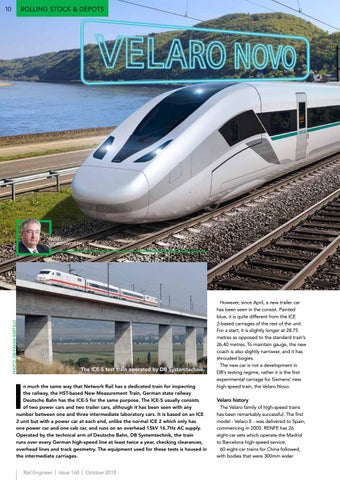
The ICE-S test train operated by DB Systemtechnik.
I
n much the same way that Network Rail has a dedicated train for inspecting the railway, the HST-based New Measurement Train, German state railway Deutsche Bahn has the ICE-S for the same purpose. The ICE-S usually consists of two power cars and two trailer cars, although it has been seen with any number between one and three intermediate laboratory cars. It is based on an ICE 2 unit but with a power car at each end, unlike the normal ICE 2 which only has one power car and one cab car, and runs on an overhead 15kV 16.7Hz AC supply. Operated by the technical arm of Deutsche Bahn, DB Systemtechnik, the train runs over every German high-speed line at least twice a year, checking clearances, overhead lines and track geometry. The equipment used for these tests is housed in the intermediate carriages.
Rail Engineer | Issue 168 | October 2018
However, since April, a new trailer car has been seen in the consist. Painted blue, it is quite different from the ICE 2-based carriages of the rest of the unit. For a start, it is slightly longer at 28.75 metres as opposed to the standard train’s 26.40 metres. To maintain gauge, the new coach is also slightly narrower, and it has shrouded bogies. The new car is not a development in DB’s testing regime, rather it is the first experimental carriage for Siemens’ new high-speed train, the Velaro Novo.
Velaro history The Velaro family of high-speed trains has been remarkably successful. The first model - Velaro E - was delivered to Spain, commencing in 2005. RENFE has 26 eight-car sets which operate the Madrid to Barcelona high-speed service. 60 eight-car trains for China followed, with bodies that were 300mm wider
ROLLING STOCK & DEPOTS
Siemens' new approach to high-speed travel to allow for 3+2 seating. More, wider trains followed for Russia. Eight 10-car sets, running on 1,520mm gauge bogies, were ordered in 2006 for the Moscow to Saint Petersburg line. A further 20 sets were ordered in 2011. Deutsche Bahn itself ordered 16 eight-car Velaro D sets for international services from Germany. Keeping up the international theme, Eurostar ordered ten 16-car, 400-metre long Velaro e320 trains for services between London and Paris/Brussels. Finally, Turkish railways bought 17 eight-car units for the country’s developing high-speed network.
Reduced energy consumption Building on this success, Siemens started, in 2013, to develop the next generation - Velaro Novo. Intended to be lighter and more efficient than its predecessors, the longer cars will, as standard, be coupled into seven-car formations, eliminating both the weight and maintenance requirements of a pair of bogies.
The bogies themselves are an inside-frame design. Siemens developed inside-frame bogies for the Desiro City design that is now the Class 700 trains used on Thameslink. On that train, the inside-frame saved one tonne of weight per bogie. Much work was needed to develop the design for high-speed use, but similar weight savings are anticipated. The lower unsprung mass also ensures smoother operation and reduced wear. In addition to the lighter bogies, new profile and welding technologies for the body shells, including the use of friction stir welding, new on-board converters and the use of innovative materials and construction solutions have reduced the train’s weight by over 70 tons, or around 15 per cent. The use of permanent-magnet motors further reduces weight, as the heavy cooling systems needed for normal asynchronous motors is no longer needed. But weight saving is only part of the equation. Improved aerodynamics also play their part in achieving higher energy efficiency and thus substantially reduced lifecycle costs. The completely covered and streamlined bogies (see above) cut energy consumption by roughly 15 percent and reduce noise emissions. This shielding is not restricted to the outside of the car, but the underside of the bogie is also covered, giving the whole train a smooth underbody and helping to control airflow under the train.
Rail Engineer | Issue 168 | October 2018
11
12
ROLLING STOCK & DEPOTS
From economy...
to premium...
to future... The interior is fully flexible and can be changed from an economy to a premium layout quickly and easily.
The aerodynamics of the end cars is further improved by a more streamlined design, and gangway connections that are flush with the train’s body shell substantially reduce aerodynamic drag and cut energy consumption by around ten percent. In addition, the highvoltage equipment on the car roof is also completely covered, further improving the aerodynamics. These improvements to weight and aerodynamics result in a train which, running at 300km/h, for example, will use 30 per cent less energy than previous Velaro models, translating to savings of 1,375 tons of CO2 emissions a year.
to optimise cable routes and weight savings. Overall, the interiors are some 10 per cent roomier than previous models. Combined with the new wider connections between cars, already mentioned due to their improved aerodynamic performance, the interior of the train will have a more spacious feel than earlier high-speed trains. Internet service, passenger information systems, on-board entertainment and CCTV security surveillance systems can be integrated to meet customer needs. Despite the longer car length, and slightly narrower bodyshell that necessitates, the new cars have an aisle width of 535mm, 11mm wider than the previous Velaro, while offering the same seating comfort. For operations on rail routes with larger structure gauges, such as in Sweden, Russia and China, a variant is available with a wider body shell, making possible a 2+3 seating configuration.
Flexible interior concept The Velaro Novo’s lightweight body shell is based on the empty tube concept, meaning that there are no permanent installations inside the car and the interior can be laid out however the operator wishes and altered whenever requirements change. The cars have no underseat fittings or electrical cabinets in their interior. Technical installations are reduced to a minimum and are functionally organised
Rail Engineer | Issue 168 | October 2018
The future is here As has been mentioned, Siemens is already testing these new innovations. A test car, integrated into the ICE-S operated by DB Systemtechnik, is currently undergoing test runs throughout Germany. The tests are being conducted under various operating conditions to monitor and analyse the performance of the car body and bogies, among other things.
ROLLING STOCK & DEPOTS
The test car currently running as part of an ICE-S formation. The ICE-S test train has a maximum operating speed of 280km/h, although it can run at up to 330km/h. Velaro Novo is intended to operate on high-speed railways at between 250 and 360km/h. Programme director Michael Kopp explained that the test car was actually almost a production vehicle. “Actually this car already has a series-production status,” he explained. “Essential components of this car have been manufactured as standard products. Bogies, car body, windows, doors and many more. “The crucial point is finding a solution, and what we did differently this time with Velaro Novo, was to tell colleagues involved to step forward with ideas, to question everything we have known up to now, to think “out of the box”, to think in new ways - we are not going to brush anything aside for now.”
That approach has borne fruit, and the test/development car, christened “#seeitnovo”, is the tangible result. “The Velaro Novo is our answer to global demands in high-speed transport,” Sabrina Soussan, CEO of Siemens’ Mobility Division, commented before the train was shown off for the first time at InnoTrans 2018. “The new train writes a new chapter in the Velaro’s success story and enables operators to offer improved passenger comfort and economy over the train’s entire lifecycle. What we are presenting today is the result of five years of development: a platform offering uniquely optimised energy consumption and maintenance costs, as well as maximum flexibility and reliability.”
Despite having a narrower bodyshell, the Velaro Novo has a gangway that is 11mm wider than earlier models. Rail Engineer | Issue 168 | October 2018
13
14
ROLLING STOCK & DEPOTS
MALCOLM DOBELL
Bi-Mode Good,
A
Tri-Mode Better
previous article in Rail Engineer (issue 157, November 2017) outlined plans for bi-mode fleets on UK railways. This article briefly described Porterbrook Leasing’s Class 319 Flex conversions. A total of 32 units are currently on order, more than half of which will be the UK’s first tri-mode trains (AC, DC and diesel). Rail Engineer was particularly interested in the engineering and performance challenges of this project and was given the exclusive opportunity to talk with Helen Simpson, engineering innovation and development manager of Porterbrook, and Simon Evans, group innovations director of Wabtec Faiveley UK. They talked about the background and engineering challenges on this ground-breaking project and kindly escorted your writer on a tour of the production facility whilst the first trains were being completed.
withdrawn from GTR as the Class 700 trains were introduced. Some units have been leased to Arriva Rail Northern and West Midlands Trains, operating on 25kV only. The story starts in September 2014 when Helen Simpson was asked to start looking at how the Class 319 trains might be “re-purposed”. At this time, an ambitious electrification programme was in full swing, but Porterbrook concluded that there would never be a case to electrify all routes and there was likely to be a role
Initial considerations Class 319 trains were originally provided for the Thameslink route (currently operated by GTR) in the late 1980s/early 1990s. There are 86 units with sub-fleets that have slightly different interior layouts. They are all capable of operation using 25kV AC overhead and 750V DC third rail and can operate at speeds up to 100mph. The entire class has been through a recent upgrade programme, with the addition of passenger information system displays, as well as controlled emission and universal access toilets. The fleet was
Rail Engineer | Issue 168 | October 2018
MAN D2876 engine.
for bi-mode suburban/regional trains to allow through journey opportunities, even without continuous electrification. With the cancellation and delays to schemes since then, the opportunity has expanded. Of course, there was a lot to consider, evaluate and model before any metal was cut. The key decision was the independent power source. Porterbrook determined that the self-powered performance needed to be at least as good as a Class 150 Sprinter train and that it should have a broadly comparable range. Alternative power sources such as batteries, flywheels, and supercapacitors were rejected because of their lack of range, and hydrogen fuel cells were rejected because of the novelty risk, lack
ROLLING STOCK & DEPOTS
The engine raft nears completion. of hydrogen infrastructure for refuelling, and approvals risks (drafted before the announcement of the Hydroflex, covered in this issue). Consequently, Porterbrook decided that the only fully developed option was diesel power, delivering the best compromise of range, weight, physical size, power density and total cost.
Concept design After considering a number of supply chain options, Porterbrook formed a partnership with Wabtec Brush to develop the design and convert the units. Brush has expertise in complex engineering design and prior experience of repowering the Class 73 electro diesel locomotives. The basic concept provides for fitting a diesel alternator power pack to each driving trailer (DT) vehicle, driving the original traction equipment via the existing DC bus line with a return cable added (on electric power the return is via the track). Electronic control units are being provided a) to trick the traction package into thinking it is being powered by a DC conductor rail and b) to control the power output of the diesel engines. Rail Engineer was told that the dieselelectric package is expected to be more efficient than current diesel-hydraulic units during acceleration The engines are MAN D2876, producing up to 390kW and connected to ABB alternators. The engines are compliant with the EU stage IIIB requirement. They have a selective catalytic reduction (SCR) system to reduce NOx emissions using AdBlue - Helen commented that the engines produce lower emissions than most existing diesel rolling stock and are expected to be quieter. She added that the MAN engine, one of the few that is compact enough to fit under the train, is widely used in rail applications in Europe and is supported in the UK by Wabtec group member LH Plant.
Performance The rated output of two diesel engines at 780kW is the maximum they can produce. By the time alternator efficiency, auxiliary supplies, and traction control efficiency are taken into account, the electrical input to the traction motors will be approximately 550kW, little more than half the maximum rated output of the traction motors. Simon and Helen are well aware of this deficit. They explained that simple headline figures do not tell the whole story and that the required performance on diesel was likely to be as good as, if not better than the Class 150. Simon described the modelling that had been carried out to gain confidence that the Class 769 trains - the new designation for what had internally been called the Class 319 Flex - will deliver this required performance. He said that Wabtec had constructed its models from scratch and some worst-case routes had been selected to demonstrate the performance. Modelling is only as good as the quality of the modelling algorithms, data and assumptions and Rail Engineer heard that a degree of conservatism has been built into the modelling, leading to confidence that the Class 769 will out-perform class 15X DMUs on the tough routes modelled.
Compared with a Class 150, the Class 769 has a higher tractive effort on starting, but the tractive effort falls away more steeply. This difference in tractive effort curves makes it difficult simply to predict performance on any particular route, illustrating the importance and value of modelling. Modelling has shown the gradient balancing speed on a flat gradient when powered by the diesel engines to be approximately 87mph and the trains will retain the 100mph capability when powered by electricity. The modelling has also shown that two 1000-litre fuel tanks should be ample for the expected duty. Whilst maintenance costs will inevitably rise compared with an electric-only Class 319, track access charges should be similar to the donor units. Compared with class 15X DMUs, overall fuel consumption - even on all-diesel routes - and routine maintenance costs will be lower, due to the use of a modern diesel engine requiring less maintenance.
Physical modifications Converting a Class 319 train into a trimode Class 769 involves the following on each driving trailer (DT) vehicle, except where stated otherwise: »» Installation of a new MAN engine and ABB alternator power pack, raft mounted and using similar attachments to those on similar modern DMU rafts such as Turbostars; »» Installation of the SCR system including an AdBlue tank; »» Moving the existing heater contactor equipment case to accommodate the new powerpack; »» Installation of a new exhaust system with a layout that is similar to that on a Class 150, given the similar carbody and bogie configuration; »» Modification of the power control
Fitting out the control cubicle.
Rail Engineer | Issue 168 | October 2018
15
16
ROLLING STOCK & DEPOTS
PHOTO: JAMIE STEEL
circuits and traction interface controller for diesel mode (DT, motor second open (MSO) vehicles); »» Fitting fire barriers, a fire suppression system and a fire alarm system to control the risks of fire on or around the diesel engine equipment; »» Minor modifications to the cab controls and cab circuit breakers to allow the driver to select diesel mode, AC or DC; »» Installation of new return cable and jumpers for the 750V DC supply (all vehicles); »» Fitment of track circuit assistor (TCA), a first on an EMU. It has to be disabled when drawing electricity from the OLE or third rail; »» For the tri-mode vehicles - fitting shoegear to the trailing bogies on DT vehicles to avoid physical conflict with the TCA and fitting a new power bus to replace the original one which is used by the diesel generator; the additional changeover contactors (diesel to DC) will be fitted to the intermediate trailer car and motor car; »» For vehicles specified to have air conditioning/air cooling, a static converter will be fitted in place of the motor alternator which has insufficient capacity for the additional load. This description shows clearly that this is an extensive modification. Simon explained that more than 60 engineers have been involved in the design using more than 45,000 engineering hours to produce over 2,500 drawings, detailing more than 3,500 components for each conversion. As is often the case with older vehicles produced by what are euphemistically called “coach-built techniques”, the
vehicles did not always conform to the drawings and some of the original drawings were missing or incomplete. Access to some of the original designers was a great help, as was the early delivery of a Class 319 to Brush’s Loughborough factory allowing designers to compare drawings with the real thing. The modifications add approximately 7.5 tonnes to the DT vehicle. In discussion about the impact of this extra mass, Simon revealed that finite element analysis of the bodyshell had been carried out, that the axles are strong enough, and that the suspension and brake cylinder pressures had been adjusted to compensate for the additional mass. Inevitably, there were design and logistic challenges, such as accommodating an exhaust on a train never intended to have one, even though the design resembles the class 150 exhaust which has similar bogies and carbody. It was also important to make sure the extra mass was evenly spread around the underframe, which in turn led to some space constraints.
Approvals Helen talked about the compliance and approval process. The modification is not considered an upgrade or renewal and does not require authorisation under the common safety method for risk evaluation and assessment, although this process has been voluntarily applied as a robust means of managing safety. SNC-Lavalin is providing integrated Notified Body, Designated Body and Assessment Body services. Full details of this process would justify its own article, and Helen described some of the challenges applying the approval process mandated by the Technical Standards for Interoperability (TSI) regulations on a 30-year-old train. For example, TSI noise requirements do not apply, but pass-by noise will be compared to other DMUs operating the same services on the route; in the case of the Northern trains, this means comparing with the Class 15X units. Porterbrook needs to show it is no worse, but is actually aiming for it to be a demonstrable improvement. This, and other type approval testing, was expected to be carried out at the nearby Great Central Railway.
The programme
The completed exhaust stack. Rail Engineer | Issue 168 | October 2018
The initial eight Northern units are being completed by Wabtec Brush Traction at Loughborough. During a tour of the factory, a number of vehicles in various states of upgrade were observed, as were the neat modifications to the body to attach the engine/alternator raft. Several engine/alternator rafts and control cubicles were seen under construction (bringing back memories of visits to Brush Traction in the 1980s during the building of equipment cases for the LU 1983 tube stock). The tour concluded with a visit to the engine/alternator test cells, three of which have been constructed for this project.
The core Flex modifications are not the only works being carried out to these trains. As stated earlier, they have recently had PRM (persons of reduced mobility) works carried out together with the installation of retention tanks for the toilets. All of the core Flex work will be carried out at Loughborough. For Northern, reliability improvement, re-branding and other modifications are being undertaken by Knorr-Bremse Rail Services (KBRS) under contract to Northern. For the Arriva Trains Wales (ATW) and subsequent trains (such as GWR), all works other than core Flex will be carried out by KBRS. The ATW trains are due for delivery between August and October 2018. “All works” can include air cooling (which require the static converter), CCTV - both saloon and forward facing, at seat USB and power sockets, Ethernet backbone to support engine control and Wi-Fi, interior and exterior rebranding, and guard’s door control panels.
Dynamic testing
PHOTO: JAMIE STEEL
At the start of the process, Porterbrook resolved to provide trains able to operate on both electrified and non-electrified networks with a simple switchover, potentially on the move. Performance in diesel mode was to be similar to Class 150, uphill with several stops, and a refuelling range of at least one day (500 miles). This was to be accompanied by diesel engine fuelling and maintenance similar to Class 150 and a driving style as close to Class 319 as possible in order to deliver a bi-mode train that was attractive to operators. Helen said that, subject to test, all this has been achieved and she is looking forward to seeing the results of the dynamic testing.
PHOTO: JAMIE STEEL
ROLLING STOCK & DEPOTS
The first Class 769 unit arrives at Quorn and Woodhouse on the Great Central Railway for dynamic testing in diesel mode.
On 14 September, the first Class 769 unit arrived at Quorn and Woodhouse on the Great Central Railway to commence that dynamic testing. The diesel-powered aspects of the upgraded train will be put through their paces over the coming weeks.
The Future Helen and Simon indicated that other orders might be forthcoming but would not be drawn on what they might be. They also indicated the possibility of other Flex products, possibly a true hybrid design based on the Class 455 750V DC units. These have been extensively refurbished and have been retrofitted with three-phase AC traction systems incorporating regenerative braking. There would be space on the intermediate trailer coach for batteries that could be charged by the regenerated energy and by the diesel engines. Such a feature could have several benefits such as being
able to stop the diesel engines in terminal stations and to supplement diesel engine power when accelerating. Thanks to Helen Simpson, Porterbrook and, Simon Evans, Wabtec for their tour of the production facility and for patiently answering questions, and to Rupert Brennan-Brown and Karen Jackson of Porterbrook for facilitating the article.
Class 769 orders (as of May 2018): On 22 December 2016, Northern (Arriva Trains Northern) and Porterbrook Leasing announced that they were cooperating to extend the reach of the Class 319 trains that have been leased for the North West Electrification programme. Eight of their four-car units were to be converted into bi-mode trains, described as Class 319 Flex. Abellio Wales & Borders and the Welsh Assembly Government announced in July 2017 that they would take five Class 319 Flex trains, operated in diesel mode, to cover for Sprinter DMUs that needed to have modifications carried out to conform to the Technical Specification for Interoperability - Requirements for People of Reduced Mobility. Next, on 23 April 2018, Great Western Railway announced that it had ordered 19 of the trains, now known as Class 769 Flex; these will be tri-mode units (diesel and AC/DC) fitted with air cooling, at-seat power sockets and Wi-Fi.
Rail Engineer | Issue 168 | October 2018
17
18
ROLLING STOCK & DEPOTS
Hydroflex
MALCOLM DOBELL
the next iteration of the Flex concept
W
hen researching the article for the Class 769 Flex elsewhere in this issue, there were lots of ideas discussed about how the concept could be extended for other uses. What was not discussed
was the possibility of a hydrogen-powered version. Yet, at InnoTrans
BCRRE reported that it has already undertaken a significant amount of research into the potential application of hydrogen fuelcell technology to railway operations and has worked with a number of global rail businesses to identify potential opportunities to use hydrogen as a clean alternative to diesel.
on 19 September, in the presence of the Secretary of State for Transport Chris Grayling, Porterbrook announced that it was making
Strictly a demonstrator
a Class 319 unit available to Birmingham Centre for Railway Research
Rail Engineer readers who have been following this topic will understand that the Class 319 is not necessarily the best base for a hydrogen-powered train - the lack of regenerative braking might lead to a bigger fuel cell, for example. Clearly, if the objective was a fully developed train ready for production, then this might be a problem, but this is not the key objective at this stage of the project. In response to Rail Engineer’s questions, BCRRE said that the demonstrator version focuses on delivering an electric/hydrogen bi-mode to UK gauge, which the UK market is currently looking for given the wider context of the 2040 decarbonisation ambition and the need to make more effective use of existing electrification with additional emission-free running beyond the wires. BCRRE added that a part of the project includes developing the product approval and safety cases for hydrogen running on the UK railway. The team working on this demonstrator project has a lot of work to do to make hydrogen rail a reality. The demonstrator will take passengers in 2019, but BCRRE will need to prove the technology to the regulator and the infrastructure manager before the demonstrator can go into full passenger service. BCRRE promised more technical details later, so watch this space!
and Education (BCRRE) for conversion into a hydrogen-powered train to be known as HyrdoFlex.
The announcement added that development work has recently commenced and HydroFlex will undertake testing and demonstration runs in summer 2019. The HydroFlex will retain the ability to operate on existing electric routes (on either third rail or 25kV overhead power) and the addition of a hydrogen fuel cell will allow it to operate in selfpowered mode, without the need for diesel engines. As was reported in Rail Engineer earlier this year, Rail Minister Jo Johnson has challenged the rail industry to develop decarbonisation plans, with the objective of removing diesel-only trains from the network by 2040. HydroFlex is Porterbrook’s and BCRRE’s response to this challenge, bringing together industry and academia in partnership to deliver the UK’s first-in-class, clean energy, main line passenger train. After the signing ceremony, the Secretary of State joined representatives from Porterbrook and BCRRE to discuss both the potential for hydrogen technology to decarbonise the railway and the world-leading rail R&D and innovation expertise to be found across the UK rail supply industry and through the UK Rail Research and Innovation Network (UKRRIN).
Rail Engineer | Issue 168 | October 2018
Part of
20
ROLLING STOCK & DEPOTS
SWIFT DOORS FOR CROSSRAIL DEPOT
T
ransport for London (TfL)’s new Operations, Maintenance
Demanding specification
and Control (OMC) depot for the Elizabeth line at Old Oak
Specialist industrial door manufacturer Jewers Doors was therefore contracted to supply and install eight of its latest Swift-SEW and two smaller Swift horizontal bi-folding doors for this application. Four metres wide and 6.6 metres high, each of the main doors is made up of four highly insulated, single-piece composite panels, with two leaves folding to each side when open. An 850mm x 760mm cut-out allows an OLE cable to pass through the closed door. The cut-out is lined with 9mm thick safety matting tested to 30kVA to prevent bird entry and, for additional safety, the door is earthed back to the structure with suitably rated earth bonding braids. For visibility when closed, each door panel incorporates a 600 x 600mm argon-filled, double-glazed vision panel made from toughened glass, fitted with multi-wall rubber seals to all edges to reduce water, air and dust ingress. To meet the environmental criteria, panels are injected with CFC-free polyurethane foam providing a thermal efficiency U-value of 1.1W/m2/°C and noise reduction of 25dB. To eliminate the spread of fire and to provide great rigidity and strength, panels incorporate an internal steel frame to all edges. The doors are operated by a powerful, centrally mounted drive unit, supplied by SEW-Eurodrive, combined with a purposedesigned control panel incorporating inverter control for smooth starts and stops. The system takes less than eight seconds to full open and close, and safety is ensured with full height, pressuresensitive safety edges and photocell beams to create a safe zone around the door during operation. In addition to the drive unit holding the door in the closed position, a pair of automatic solenoid-operated floor bolts provides additional security and prevents wind-damage. In the event of power failure, a low-level disengage handle enables the doors to be opened quickly by hand from ground level. Fulton added, “This is a high-profile flagship project and, as Jewers are a tried and tested company in the rail sector, we were confident that the doors would be of the highest quality, fully meet the spec and provide reliable service for many years to come.”
Common, West London is a state-of-the-art, nine-track train maintenance building. It is part of the £142 million contract
awarded to Taylor Woodrow and will accommodate 33 trains while routine maintenance is carried out.
While it is fairly obvious that each of those nine roads would need to be closed off by a door, selecting the correct type was not as straightforward as may be thought. Keith Fulton, associate architect with RPS Consulting Services Limited, the lead designer for the new OMC depot, commented: “In addition to securing the building, there were a range of practical issues that were critical in the design of these doors. The major factor was accommodating live overhead electrification lines (OLE), which meant vertical opening doors would have been impractical. These were eight extremely large openings, so effective thermal and acoustic insulation was important for the doors to ensure compliance with TfL’s strict environmental requirements.”
INNOVATION in Rail
BYBANEN BERGEN TRAM DEPOT, NORWAY
Phoenix range Swift automatic bi-folding doors – only solution for rail depots. Safe, energy efficient, fast, reliable and industry proven throughout the world. jewersdoors.co.uk
|
OXLEY TRSMD, WOLVERHAMPTON
01767 317090
|
Engineer Issue 168 October A67468 Jewers Rail Rail engineer Advert Innovation 90w x 130h.indd 1
2018
@Jewers_Doors
21/04/2016 09:40
HV magnetics & wirewound resistors
Fibre-optic TX/RX
High-current foil resistors Self-healing film capacitors
Circuit breakers EN50155 & EN50121 power supplies EN50155 & EN50121 power supplies
Thermostats
Energy-storage capacitors
Pressure Long-life sensors position sensors EN50121-4 power supplies High-stability mica capacitors
image credit: 123RF-anmbph
Rail Challenge #1: Legacy system upgrades Challenge Charcroft to help you to overcome obstacles to designing upgrades for electronic systems in rolling stock or signalling. The flexibility to customise standard products can enable new components to become drop-in replacements for legacy parts, or provide additional environmental protection against harsh environments.
Standard, semi-custom and fully customised components POWER SUPPLIES
• • • •
RESISTORS
EN50155 & EN50121 compliant EN50121-4 AC/DC 150W Wide input voltages Vacuum encapsulation
THERMOSTATS, SENSORS & BREAKERS
• • •
Pressure sensors Thermostats Circuit breakers
OPTOELECTRONICS
• •
ST-connectorised solutions Fibre-optic TX/RX discrete components
• • • •
Surface mount Tubular wire-wound Voltage- & current-sense Specialist power resistors
Jeff Gurr
Electromechanical Product Specialist jeff.gurr@charcroft.com
CAPACITORS
• • • • •
Aluminium electrolytic High-power, HV film capacitors Precision mica capacitors High-voltage MLCC Tantalum
MAGNETICS
• •
Transformers & inductors Sensors & electro-magnets
Chris Leek
Power Specialist chris.leek@charcroft.com
Charcroft: Challenge Accepted
www.charcroft.com Email: request@charcroft.com Tel: 01591 610408 Passives, power, interconnect, emech and more
Roger Tall
Passive, Hi-rel Semi & Opto Specialist roger.tall@charcroft.com
22
ROLLING STOCK & DEPOTS
Digital is delivering D PHILIP HEWLETT
igital affects almost every facet of UK rail activity. It has been transforming rolling stock, maintenance, and passengers’ journeys for almost a decade. Industry requirements, such as ASDO (Automatic Selective Door Operation), remote CCTV and timetabling, mean that it is now impossible NOT to have a digital train. The pace of change is now faster than ever. Train components that improve the passengers’ experience, such as intelligent information screens, are driving greater technological sophistication and the further digitisation of modern trains. Digital is already playing a vital role in increasing reliability, which remains a top priority for UK passengers.
Improving reliability One of the manufacturers at the forefront of this technological revolution is Hitachi. Its ‘Digital Brain’, which was developed specifically to cut down the hours needed for train maintenance, consists of tens of thousands of sensors throughout the train that feed back to the main computer in the driver’s cabin. On the Class 800/802 IEP trains, for example, there are over 48,000 signals -
Rail Engineer | Issue 168 | October 2018
from the engine to door sensors - which provide real-time data to the driver or, remotely, to the support team. If an issue should arise, the train’s Digital Brain identifies and processes the system data in a matter of seconds, supporting technicians and engineers in diagnosing defects and formulating a repair plan. On a manual basis, by comparison, just identifying the source of a problem can take hours.
Although the benefits of this technology are already being seen on the company’s high speed IET and Class 385 commuter trains, the greater application of this technology will come when data analytics are combined with Hitachi’s machine learning software, enabling engineers to predict and take steps to fix potential faults before they even occur. For every mile that Hitachi trains accumulate, more and more valuable data is gathered about their performance and general wear and tear. This establishes a data model that will start to identify trends as the fleet matures.
ROLLING STOCK & DEPOTS The machine learning software can make recommendations on when parts of the trains should be investigated or replaced. It will also identify whether certain aspects of the trains are changing or there are anomalies - for instance, if the long-term variance of door cycles is increasing or there are gradual increases in compressor times. The software will be able to identify data patterns and recommend when preventative maintenance can take place, increasing reliability as well as driving down costs of doing unnecessary work. Equally, it can identify if the variance is symptomatic of another fault and will then recommend when a thorough depot check should take place. Having this critical information and the capacity to fix problems before they occur has numerous and wide-ranging benefits to fleet management, ordering supplies and organising maintenance regimes. Most importantly, this all adds up to ensuring reliability remains high across the fleet’s life cycle.
Futureproofing Being part of a global company, Hitachi Rail is in the fortunate position that it collaborates with other companies in the group, including Hitachi Consulting, Vantara and CSI Research Labs, which specialise in big data, machine learning and Artificial Intelligence. Indeed, the global leading research company, Gartner, recently placed Hitachi in the top three “Magic Quadrant” for IoT (the Internet of Things). Being able to call upon this leading expertise to develop, and continuously refine, the preventative maintenance product, by combining expertise in rail engineering and information technology (IT), has proved essential to creating a product that is not only effective today, but also has the potential to deliver more in the future.
To create future-proofed products, one must think ahead to predict the solutions that will add value to customers, as well as what rail passengers want to see from their trains. An excellent example of predicting, rather than simply following, demand is the work undertaken by Toyota in the automotive industry to develop in-car GPS before it was widely used by the public or before smartphones even became commonly available. This begs the question what’s next for digital rail? Driver monitoring that ensures drivers have seen the signals, perhaps? To ensure that Hitachi trains are future-proofed and are ‘digital ready’, they
are already compatible with digital signalling, future traffic management systems and smart ticketing, even if all of this technology is not currently being fully utilised and may not have been in the original design scope. Onboard CCTV is a good example. When it was first installed, CCTV was used to review past events. Now it provides live footage that can be accessed remotely. In the future, it may be able to identify real-time developments that can be used to warn the driver. Through incremental change and integrating new digital solutions, CCTVs functionality continues to evolve.
Rail Engineer | Issue 168 | October 2018
23
24
ROLLING STOCK & DEPOTS
As in mechanical engineering, digital also goes through an iterative process of improvement. There are very few instances where installing or introducing new digital technology has worked perfectly first time. The good news is that incremental improvements to digital solutions tend to happen far more quickly than when building a complex mechanical device, such as an internal combustion engine. The next step in the process to hone and improve the railway of the future is through sharing data. Data is knowledge, and knowledge is, most definitely, power. Sharing knowledge is how the digital railway will become a reality. Having data sets - of trains, operators and the rail network - communicating with each other is essential in achieving more trains running closer together and increasing service frequency on the current network. Understandably, and rightly, businesses are protective of their data. Nevertheless, Hitachi Rail has already found that, where it is appropriate and legitimate to do so,
Rail Engineer | Issue 168 | October 2018
pooling data provides benefits. Sharing data with suppliers about their products and their performance, and providing detailed feedback, allows them to understand where wear and tear takes place. This information can be used to adapt and improve their manufacturing accordingly. Likewise, their data is incorporated into Hitachi’s ‘data model’ and algorithms to improve predictive maintenance.
Digital workforce As trains become increasingly digital, the workforce needs to keep up with the latest developments. IT specialists and data scientists are now at the heart of every aspect of rolling stock, from design, maintenance and operations. They regularly work alongside mechanical engineers to maintain and improve train fleets. Data scientists have a key role to play in analysing the mountains of data created by the train’s ‘digital brain’. Hitachi’s software is able to make sense of all of this information and to turn it into easily understandable and
actionable content so that maintenance teams can be as effective and efficient as possible. Having mechanical engineers and data sciences working together is now fundamental to maintenance operations. Transferring knowledge between teams with a variety of different work backgrounds and experiences allows them to speak a common language. Combined with an extensive programme of digital upskilling at all of its depots, Hitachi is creating a digital workforce ready to deal with an even greater rate of technological change. The benefits of digital are making a real difference in the rail sector, as can be seen every day. The ‘digital railway’ is a truly exciting opportunity and will deliver tangible benefits on reliability, frequency and capacity. As a sector, we need to collaborate, be bold and to put digital at the heart of a modern and sustainable railway. Philip Hewlett is business change and IT development programme manager at Hitachi Rail.
EXPERIENCE
At Hitachi, high speed trains are in our DNA. From our extensive delivery record in Japan to our Class 395 Javelin™ fleet operating across HS1, we understand how important it is to connect cities and people using innovative solutions that work out‑of‑the‑box. We
WORKING FOR YOU
are delivering new trains across the UK network, find out more here: hitachirail.com
HitachiRailEU
26
ROLLING STOCK & DEPOTS
20th Century Heritage st
21 Century Safety
MALCOLM DOBELL
Rail Engineer | Issue 168 | October 2018
Time passed, and diesel locomotives and multiple units were added to many heritage railways’ fleets. Heritage vehicles now operate on the main line railway too. All this keeps alive the history and tradition of the railways from time past, and the public loves it, as do the people who run the railway heritage movement - staff and volunteers. Nostalgia is often viewed through rose-tinted glasses, and one of the unwelcome characteristics of railways of the past is the comparatively poor safety record. Historic tragedies are well documented in Her Majesty’s Railway Inspector’s reports, most of which are available on The Railways Archive. Indeed, it lists ten reports from 50 years ago about accidents involving fatalities or major injury.
PHOTO: ISTOCKPHOTO.COM
LMS Stanier Class 5 45407 ‘The Lancashire Fusilier’, built in 1937, heads sister locomotive 44871 hauling enthusiast special ‘The Cathedrals Explorer’ at Carmarthen station. Both locomotives are currently based at the East Lancashire Railway, are mainline certified, and also regularly haul the ‘Jacobite’ train along the West Highland line.
I
n August 1968, the last scheduled British Railways steam train ran on the British railway network. By then, the heritage movement had already started, and the slowness of the Barry scrapyard in South Wales to scrap redundant steam locomotives provided one source of motive power for many of the new railway owners and operators.
ROLLING STOCK & DEPOTS Kidderminster carriage works
Ex-GWR Bradley Hall.
Modern standards Today, with improved design and operational control, derailments or collisions leading to injuries or fatalities are rare, and this is now the expectation of all UK railways. However, it is challenging for heritage railways to deliver safety to the same standard as the national network when they are operating old rolling stock that predates modern design standards, often using volunteer staff. But delivering modern safety standards is their duty and the results are good; the ORR paid tribute to them in their 2017-18 Annual Safety Report saying: “Heritage operators across Britain continue to demonstrate enthusiasm to manage their operations safely.” Accidents still happen, and recent examples include the derailment of a Welsh Highland Railway locomotive due to the failure of a suspension component and the near miss on the South Devon Railway where a child nearly fell though the missing floor in a toilet whose door had been inadequately secured. Heritage operators also have a duty to evaluate and implement improvements that further reduce risk and address societal concern. It is the hallmark of operating a good safety management system that the lessons of incidents are taken on board and changes made. Yet, it is the very nature of heritage and, charter operations, that many of the safety features of modern railways could spoil the heritage appeal. A case in point is Mark 1 coaches (see end panel), which are the mainstay of such operations and which have a number of features - poor crashworthiness, opening windows, slam doors and lack of retention toilets that would in an ideal world be eliminated. It was with all this in mind that Rail Engineer visited the Severn Valley Railway and met Neil Taylor, its engineering
services manager. Neil is a chartered engineer and a fellow of the Institution of Engineering and Technology, with over 30 years experience. Unusually, his experience is not from the railway but from the defence industry. In discussion it quickly became apparent that both industries share similar problems when operating older equipment! The Severn Valley Railway is one of the largest and oldest heritage lines in the UK. It is 16 miles long, operating between Kidderminster and Bridgnorth. It was incorporated 51 years ago in 1967 and started operations in 1970 between Bridgnorth and Hampton Loade. The line was gradually extended, reaching Kidderminster in 1984. According to its 2017 accounts, the railway had a £7 million turnover, carried roundly 240,000 passengers and has approximately 80 permanent, 50 part-time and another 50 seasonal staff, plus around 1,700 volunteers.
The first stop was the carriage works at Kidderminster. The tour included nostalgic sights of 60-year-old rolling stock being overhauled or converted. It has often been said that old rolling stock can be kept in service indefinitely as everything can be re-created as it wears out or breaks - like Trigger’s broom (“I’ve had this broom for 20 years. It’s had 17 new heads and 14 new handles!”). The tour showed how SVR manages this process and takes account of new issues as vehicles get older and older. Neil described how the railway has documented the maintenance and repair requirements of all the coaches and the competence required of the staff and volunteers. Documentation is based on the original British Rail documents, but updated to take account of factors never considered by BR. BR maintained these vehicles from new to about 30 years old. Some coaches are now well over 60 years old and suffer problems that BR never had to deal with. Indeed, some of the older coaches use materials no longer available and substitutes have to be found. Amongst the first people Rail Engineer met were two apprentices, one of whom was on an exchange from France. In the coach shop was one of SVR’s brake guard’s (BG) vehicles that had been converted to a wheelchair persons’ vehicle some years ago and is now being converted into a dining car for disabled people. The disabled toilet was a masterpiece as it looked as though it was an original fitting.
Load rig for carriage dynamos. Rail Engineer | Issue 168 | October 2018
27
28
ROLLING STOCK & DEPOTS
Corrosion damage around cantrail of ex-BG mark 1 vehicle.
The apprentices were repairing corrosion damage at cantrail level on one end of the vehicle. James Broughton, the carriage shop chargehand, compared this work in progress with a completed repair at the other end of the vehicle. James also described how BR mark 1 coaches suffer from corrosion of the “crash pillars” at vehicle ends. These square sections were only protected on the outside and, after decades of service, they corrode from the inside. James also demonstrated heritage test equipment for the coaches’ belt-driven dynamos and vacuum brake cylinders and the documentation covering their safe use. In the context of the South Devon Railway accident, Neil talked Rail Engineer through the repair and test process and documentation for the door locks used on
the various different types of carriage, with a modern digital force meter to ensure that spring forces are within tolerance. During a train ride from Kidderminster to Bridgnorth, hauled by West Country pacific “Taw Valley”, Neil and Jane Preece, the SVR’s HR manager, described how the railway is run and how competence is assured. They were clearly proud of their Heritage Skills Training Academy, which is funded by the Severn Valley Railway Charitable Trust and has an association with Dudley College and, through them, the Black Country museum. At the time of the visit, there were 10 apprentices in the Academy, the majority of whom are gaining technical skills across the railway including locomotive mechanical maintenance, boiler shop, carriage mechanical and carriage
Boiler for BR Standard Class 4 number 75069.
Rail Engineer | Issue 168 | October 2018
bodywork. Two apprentices are recruited annually through a national recruitment process, as SVR seeks people who are enthusiastic about railways but not rail enthusiasts! All operational staff have to be demonstrably competent for the job they do and they have an enormous mine of good practice to draw upon from the members who come from all walks of life. Neil emphasised that SVR is a member-led railway; the staff support the volunteers but also, sometimes encourage volunteers to “move with the times”. Neil said that he routinely reviews Rail Accident Investigation Branch reports relevant to the SVR and has had several papers approved by SVR’s senior management aimed at further improving the competence and culture. This includes demonstrating competence of staff and volunteers using material from the Heritage Railway Association (HRA), and the Boiler and Engineering Skills Training Trust (BESTT), redrafting the railway’s safety management procedures and developing a “just safety culture” (learning from mistakes, not blame).
Facilities at Bridgnorth The boiler shop opened in 1990, is involved in the repair and manufacture of boilers for locomotives that operate on the SVR (of 27 locos currently operating, the SVR only owns three) and manufactures for others. A new boiler was being manufactured for the Bala Lake railway’s “Alice” and a number of boilers were in work, both new and refurbished, for the Isle of Man steam railway.
ROLLING STOCK & DEPOTS
Bridgnorth boiler shop.
Neil made the point that it is usually much easier and often cheaper to manufacture new boilers than attempt to repair older boilers where many of the materials were of questionable quality. The machine shop included machine tools that your writer recognised from his time as a trainee in the 1960s, although Neil confessed that they do have a numerically controlled lathe for making, for example, boiler stays. Old skills much in evidence included manufacture of white metal bearings and, in the locomotive shed, some excellent quality welding was observed on frames that had cracked.
Neil illustrated the problems of running old vehicles with the work they had done to manage fractures on locomotive leaf springs. As a result, they have serialised all the springs and have virtually completed a programme to refurbish or renew them. Neil made the point that new springs cost little more than refurbished springs. All this was in place before the incident on the Welsh Highland Line. Purists might wonder about the historical accuracy, and Neil was at pains to reassure that the railway has to look, feel and sound right, but in order to deliver
a safe railway that is also dependable and reliable they have to recognise that they need to have much more control of process and have to embrace modern health and safety practice. Sometimes substituting modern materials saves an awful lot of trouble. As the tour concluded, Neil gave his honest assessment of his engineering domain: »» They practice competence management; »» They use processes that are suitable for competent-wise people; »» They learn from their own and others’ mistakes; »» The carriage works is where he would like it to be; »» There is more work to do in the locomotive works and the material from BESTT is a good start for the training/ tutorial aspects, but work is needed to translate all this in to competence statements against which people can be assessed. All that remained was a leisurely trip back to Kidderminster on a mark 1 set hauled by ex-GWR locomotive “Bradley Manor”, enjoying a coffee brought to my seat, confident that SVR is in good hands. Thanks to Neil Taylor and Jane Preece of the Severn Valley Railway for their help in preparing this article.
MARK 1 CARRIAGES; THE ORR VIEW Mark 1 coaches were built by British Rail during the 1950s, with the final vehicles of this designation being built in 1974. They have a strong steel underframe with a steel body. Most had externally opened swing-slam doors with droplights, were fitted with traditional toilets that discharged waste onto the track and had poor crashworthiness. Regulations enacted in 1999 effectively outlawed the coaches, and any others having similar characteristics, unless suitable mitigations were put in place. A practical interpretation of “having similar characteristics” is all coaches that preceded the mark 1 design. Mark 1 coaches are still used by most heritage railways and charter operations. Rail Engineer sought a view from ORR about the continued operation of mark 1 coaches on charter and heritage lines. A spokesman said: “In broad terms, we recognise that heritage railway operators want to continue to use Mark 1s as part of their operation and that there is a place for these vehicles to operate in the UK heritage sector. We also recognise that the safety risk profile of these vehicles operating on heritage lines is different to those operating on the mainline, largely due to speed. “As part of their safety management system, we expect heritage operators to control the risks associated with this stock, particularly in connection with structural condition (taking
account of the age of the stock), passengers falling out of carriages (passenger door security - which is closely related to the need for droplight windows), and environmental impact. Their arrangements to control such risks should include taking into account developments elsewhere in the rail sector that could help them improve risk control. “We welcome, for example, HRA’s work in producing guidance on inspecting and maintaining carriages, and work by various heritage operators to develop solutions to improve the quality and ease of repair work. “We are encouraging the main line charter sector to improve the management of risks associated with Mark 1 rolling stock operating on the main line, specifically regarding central door locking (CDL), control emission toilets (CET), and structural integrity. We expect to see significant progress before the current mainline exemptions expire in 2023 (Railway Safety Regulations 1999). “As new solutions emerge in these areas, it presents opportunities for heritage operators to review their own arrangements and consider if new solutions allow them to implement reasonably practicable actions to improve their own management of risk and impact on the environment. “We are planning inspections of heritage and charter operations during 2018/19 targeting the condition of mark 1 rolling stock.”
Rail Engineer | Issue 168 | October 2018
29
30
ROLLING STOCK & DEPOTS
Depot control
for the 21st century
T
he UK’s rail industry has faced a number of challenges over the last year, with increasingly negative reports of punctuality and delays surfacing in the media every month. The Office of Rail and Road’s passenger experience report shows that, despite significant historic improvements being made to operations in the UK, including punctuality, the industry suffers from a persistently poor perception of its services. It is therefore vital that efficiencies are located wherever possible, including in areas that are invisible to passengers, as the knock-on effects of operational delays caused by inefficiencies in depot operations can be almost impossible to mitigate. In any depot, yard or maintenance facility, it is essential that trains depart on schedule. With so many activities taking place before service, including cleaning, CET (controlled emission toilet) service and small repairs, a quick and reliable signalling system that is easy to handle is a must for successfully managing operations.
Managing movements The Tie-Fen Lock Depot Control system - consisting of the TMC-RaStw depot system - is an innovative solution that assists depot operators by reducing their workload and increasing safety, allowing them to set multiple routes within the depot in just a few seconds to optimise the operation of the depot. Fenix Rail Systems, in conjunction with its partner Pintsch Tiefenbach, is the sole provider of the Tie-Fen Lock Depot Control system in the UK. The companies’ combined knowledge and experience, with hundreds of depot systems in use worldwide, has enabled designers to develop a system that makes depot operators’ jobs quicker and easier meaning that a single operator is able to control even complex depots. This is already the case at the Deutsche Bahn (DB) depot in Cologne, Germany, where 105 point machines, 97 signals and 100 axle counter track sections are controlled by just one depot operator supervisor (DOS). It is imperative that train movements into, out of and within a depot are as smooth as possible, and the Tie-Fen Lock system allows single operators to control as many movements as possible, safely and easily.
Rail Engineer | Issue 168 | October 2018
The system is totally adaptable and equally applicable to modified and new depots around the UK rail network due to its centralised depot control features, flexibility and low operating costs. Fenix has developed a bespoke technical interface that enables the system to be integrated with all UK-based interlockings. Indeed, it has already been implemented in several UK depots, including: »» Central Rivers, Burton-on-Trent - 26 points, signals and axle counters; »» Northam Depot - 10 points, signals and axle counters; »» Immingham Port - 10 points, signals and axle counters; »» Golders Green Depot - 29 points, signals and axle counters; »» Morden Depot - 32 points, signals and axle counters; and »» Banbury Depot - 7 points, signals, axle counters and interfaces to mainline interlocking and DPPS. Depot operators have many responsibilities in addition to setting routes, including entering train describer codes and communicating with drivers, maintainers, interface signal boxes, operations staff and contractors working
ROLLING STOCK & DEPOTS Point control
on site, as well as being responsible for the overall operational safety of the train facility. Codes of practice and safety dictate that all of these actions must also be recorded via daily reports and entry into the train register. As the operators go about their daily tasks, the Tie-Fen Lock Depot Control system’s computer-based interlocking (CBI) continuously and automatically checks the current traffic and operations in the depot, alerting the operator to any conflicts or potential dangerous situations and preventing a wrong-side failure. The system also checks that the operator’s commands are safe and do not conflict with the implemented rules and operations, alerting them using pop-up information boxes and audible or visual alarms where necessary. Activities are automatically recorded throughout each shift, with a printed copy available at any time to assist daily reporting. In the event of an emergency or degraded mode situation, the system has a defined (configurable) fallback level to minimise any impact on train movements, getting the system and movements back up and running as soon as possible. During peak times, the handling of incoming and outgoing trains can require complex shunting movements. The Tie-Fen Lock is designed to make this as stress-free as possible, with a screen layout that allows for a good overview of the depot situation at all times. All operational and hardware commands and activities are continually monitored, logged and saved in the data log file on the VDU PC. This data has a number of practical uses, including helping maintainers to prepare themselves with spare parts before going to the depot, allowing engineers to review the status of the ongoing system and its activities as well as enabling managers to plan predictive maintenance and to continuously improve and fine tune their strategies.
All points control circuits communicate with the central control unit via serial bus. Each points control circuit has its own microcontroller card for communication and individual functions. For fast responses, the points controllers are typically organised into sub control logic groups of 60-80 points. These substations exchange information and data with the main logic station via serial interface. Over long distances, fibre-optic communication is recommended, allowing up to 256 points controllers to communicate with just one CPU. Should the project require stage work, individual points control circuits can be enabled according to the stage requirements. This provides total flexibility during the installation of any stage or enabling works. This approach allows the hardware design to be completed and stage work data design prepared and downloaded to new cards in advance for a simple card changeover during commissioning. The Tie-Fen Lock approach to subgrouping circuits saves time and costs on projects by reducing cabling costs over long distances, as well as overcoming specific cable route problems on existing infrastructure. The point machine is fully trailable and can be six-foot or four-foot mounted, depending on the requirements of the client.
Rail Engineer | Issue 168 | October 2018
31
32
ROLLING STOCK & DEPOTS
Signals Six individual signal controllers can be housed in one 19� rack. Each signal controller card is the interface between the central control unit and local shunt signal (normally a Dorman LED head for the UK infrastructure). An internal fallback function guarantees the reversion of a signal to danger (red) in failure mode, for example in the event of loss of communication or loss of control voltage. This modular design results in a system that is able to control hundreds of signals that can be modified or upgraded at any time with minimal software and hardware changes - users simply plug in a new signal control card. This also provides a significant time and cost saving when implementing a system in stages, as not only is the hardware a modular design, but the software is too.
Train detection The Tie-Fen Lock system receives vital track occupation information from track section control circuits. There is an individual, modular pair of circuit boards for each track section. These SIL 4 (safety integrity level 4) control circuits are purely hardware-based and a hybrid FPGA (field programmable gate array) relay-based dual channel design. All track section control circuit 19� racks and their printed circuit boards (PCBs) are built up in a modular form and can be
Rail Engineer | Issue 168 | October 2018
cascaded in unlimited numbers of racks in an unlimited number of cabinets. This modular design with plug couplers allows the system to be integrated into existing infrastructure in stages and ensures a quick and easy modification to the next stage commissioning. Track occupation data is transmitted with the output of switching amplifier cards and input information is received via rail-mounted axle counter heads. These detect the flanges of the wheels on the running rail and work as proximity switches, generating an analogue signal that is fed into the switching amplifier in the REB for evaluation and electric noise filtering. This communication works safely and reliably over distances of up to 8km.
Axle counter detection The axle counter head is a dualproximity switch unit designed to detect the flange of the wheels passing over the two proximity switches. With each detected wheel, the axle counter detection systems send one package of data to the switching amplifier. The evaluation electronics used in train detection and axle counter detection are installed in the REB or location case. There is no danger of damage from trackside lightning strikes or over voltages. This is a significant advantage of the Tie-Fen Lock system, as many other systems require electronics to be installed trackside.
An outstanding track record The Tie-Fen Lock system was first installed in the UK at the Central Rivers Depot in 2000 and has since established a track record of outstanding reliability and low maintenance. The system is simple, offering numerous benefits over old systems, and its low-cost and simple maintenance makes it highly likely that depots across the country will be enjoying these benefits for years to come.
d n a e n i l n i a m n i s t r e p x E s m e t s y s l o r t n o depot c Who we are Fenix operates across the UK, Southeast Asia and Australasia to provide high-quality signalling and telecoms services for mainline rail and depot control systems. We provide a wide range of expertise and services allowing us to deliver collaborative consultancy services and turnkey signalling solutions that add real value to our clients and rail projects worldwide.
Signalling design
Signalling installation
Signalling testing and commissioning
Bespoke depot signalling systems
Independent checking
CRE/CEM services
Signal sighting
Project management
Project engineering
Telecoms
Whatever your signalling requirements, Fenix has it covered. 18 Shottery Brook Office Park Timothy’s Bridge Road Stratford-upon-Avon CV37 9NR 03300 580180
fenixrailsystems.com
enquiries@fenixrailsystems.com
34
ROLLING STOCK & DEPOTS
Heating depots OLD AND NEW
NICK WINTON
Rail Engineer | Issue 168 | October 2018
ROLLING STOCK & DEPOTS
H
igh Speed 2 (HS2) is one of the largest infrastructure projects that this country has ever seen - six times the budget of the 2012 Olympics. It will provide a new high-speed railway link between London, Birmingham, Manchester and Leeds, speeding up journeys, releasing space on crowded lines and bringing Britain closer together. HS2 will create thousands of jobs during its construction process, as well as 2,000 apprenticeships. Approximately 25,000 people are needed to build the project and, to support this, Network Rail is providing two state of the art colleges to train the next generation of rail engineers, located in Birmingham and Doncaster. Network Rail’s high-speed rail colleges will be elite institutions, defined by their focus on progression to a higher level of study - delivering truly innovative training and offering the very best in teaching and specialist equipment. The college occupies a 5.1 acre site at Doncaster’s Lakeside. As an elite institution, the college will be a flagship facility for advanced and higherlevel apprentices as well as providing opportunities for the existing workforce to learn new skills in the latest technology. Thus it meets the wider economic need for an increased supply in engineers and will therefore have a purpose beyond the timeframes of HS2. The new pool of talent will need to understand the challenges involved in high-speed electric railways of the future rather than the steam and diesels of the past. Doncaster is one of two High Speed rail colleges we’re building.
Heating a rail shed Increasingly, almost as much attention is being paid to topics such as energy efficiency, sustainability and the environment as the traditional topics of railway engineering and operations. This is as true of train depots as of any other part of the rail network. The ways in which train care depots are utilised, often intermittently and at irregular time intervals, make the efficient use of energy extremely difficult. Therefore, consideration must be given to selecting a heating system that offers flexibility of operation at optimum efficiency. Train maintenance sheds are invariably very long and narrow, with large doors opening constantly at each end, and are thus notoriously difficult to heat and even more difficult to keep warm. The doors often occupy the full width of the building and may be left open for many hours a day, creating a wind tunnel effect as cold air at high velocity is drawn through the shed. This means that air infiltration can severely disrupt worker comfort within the interior.
A heating system needs to be able to sustain a comfortable environment in these conditions and, especially, provide rapid recovery once the doors are closed. Air curtains over or to the side of the doors, either ambient or heated, can mitigate the issue of air infiltration. Maintenance is frequently carried out at night, thus compounding the inhospitable climatic conditions and, with partial occupation, it is therefore important, for efficient use of energy, that the heating system can be easily and effectively zone controlled. But air ingress is not the only problem. The mass of a train is considerable and when a cold and wet train enters the shed it creates a cold sink, so the heating system needs to be able to provide rapid response to changed conditions.
Radiant heating The primary source of radiant energy in the natural environment is the sun. By standing in the sun’s rays, a feeling of warmth is experienced, whilst in the shade it feels considerably cooler. Radiant heat warms all solid objects and surfaces in its path. Reznor has exploited this concept in its energy efficient radiant heating systems. Radiant-tube heaters, mounted overhead, produce infrared radiant heat that is directed downward by a reflector. The infra-red heat passes through the air without heating it and falls on people, floors and equipment below, creating comfortable, all-round radiant warmth at low level, without wastefully heating the whole volume of the building or the roof space. Because radiant heat can be controlled directionally, only the occupied areas of the building need to be heated, which enables considerable energy savings to be realised. The objective of a radiant heating system is to ensure that the people in the building are comfortably warm. By the
Rail Engineer | Issue 168 | October 2018
35
36
ROLLING STOCK & DEPOTS Third-rail electric sheds These sheds tend to be cleaner, due to the lack of diesel fumes, and do not require ducted air to the gas burners of a radiant heating system. The work on these trains is primarily at low level, so the above points 1 to 3 are also relevant to heating these sheds.
Overhead electric sheds
correct application of a radiant heating system, comfort levels can be optimised. Radiant heat warms objects and surfaces, increasing the mean radiant temperature and reducing the body’s loss of heat to its surroundings. In addition, by eliminating air movement, convective loss of heat from the body will also be reduced.
Differing specifications Steam Loco Sheds While no longer built, many sheds today were constructed in the age of steam. Due to the nature of the locomotive, vast amounts of steam were released, captured by massive hoods and released to the atmosphere. These sheds due to the age were notoriously poorly insulated structures with open doors at each end creating a massive wind tunnel. Radiant heat was the only realistic option as a heat source and, when designing a heating system, account of these hoods in the roof space was critical. 1. The majority of work undertaken on these locos was at low level, so ensuring heat between the tracks on the platform and in the pits was vital. 2. Nor-Ray-Vac, due to its unique long lengths of radiant emitter is an ideal solution for heating the long distances between trains. 3. Some rail sheds are over 300 metres long. Due to the physical size of the sheds, the design of the heating system is paramount to ensure optimum zoning capabilities, both for client operational flexibility to minimise running costs and to ensure the capability of being able to rapidly respond to changed conditions.
Diesel sheds Many of these sheds derive from the steam era and consequently some still lack good insulation values for the fabric. Diesel locos also have hoods, this time to collect the diesel fumes from the engines, but, due to the general atmosphere within these sheds, the radiant heating system has to be designed to have a ducted fresh air supply from outside to the gas burners. This ensures the filters within the burners are kept clean and not clogged from the diesel fumes. Again, the above points 1 to 3 are relevant to heating these sheds.
Rail Engineer | Issue 168 | October 2018
These sheds are primarily new facilities, in which case they are well insulated. Again, due to the cleanliness within the sheds compared to diesels, there is no requirement for ducted air to the gas burners of the radiant heating system. However, unlike the previous types of locos, work has to be undertaken on top of the loco to maintain the pantograph and power systems. As a result, these sheds have personnel staging for access to the top of the trains. When designing a radiant heating system for such facilities, due regard of the staging has to be taken into account. The radiant emitter cannot be too close to the working area above the trains. The staging is normally in a defined location within the facility. This can result in a challenge for designers, but it is achievable given sufficient roof height within the facility. The ability to be able to zone the radiant heating is paramount in such instances.
Evidence of success Amongst other successful traincare applications, Reznor was able to provide the ideal heating solution for the National College for High Speed Rail at Doncaster. Radiant heat (Nor-Ray-Vac NRV) was specified as the heating system for the Large Scale Workshop, comprising an area of 1,906m2 within the facility. The selected NRV system was made up of nine 38LR burners arranged in three branches, suspended at 12 metres above the finished floor level, with one discharge fan flue. Due to the type of operation within the facility - the training of students throughout the floor area - the system is controlled as one zone and produces blanket, uniform heat coverage for the complete workshop. Operating costs are minimised by concentrating the heat at low level, where it is most needed, without heating the volume of air in the building. Rapid response times reduce running costs further and mean that warmth is felt by people in the building within minutes of start-up and no fuel is wasted bringing the whole volume of air to a comfortable temperature. Since the Nor-Ray-Vac radiant system burns fuel at point of use, there are no distribution losses to take into account. Nick Winton is divisional manager for Reznor, a subsidiary of Nortek Global HVAC.
Our Technology. Your Comfort. We develop technology and solutions which improve the environments in which we live and work.
01384 489250
www.reznor.eu
reznorsales@nortek.com
ReznorÂŽ is a registered trademark of Nortek Global HVAC, LLC
38
ROLLING STOCK & DEPOTS
REDUCING RISKS
A
IN DEPOTS
t the end of this month, industry regulator, the Office of Rail and Road (ORR), will publish its final thoughts on how Network Rail should allocate its budget over the next five years, during Control Period 6.
June’s draft determination focused heavily on worker protection, advising an extra £80 million should be spent on installing additional safety measures, from a recommended total renewals budget of £18 billion. This was followed swiftly in July by the ORR’s annual health and safety report, which revealed “continuing significant failures, particularly in regards to exposure to OLE and third rail” are still occurring on our railways. So, the gauntlet has been thrown down. How does the industry reduce the risk of serious injuries, or on occasions, worse? Despite recent upgrades, the majority of the existing rail network is ageing. What can be done, practically and cost-effectively, without ripping it up and starting again? Britain’s railways remain the safest in Europe, but high voltage equipment, heavy machinery and moving vehicles make maintenance depots, in particular, potentially risky places to work. When coupled with an inconsistent approach to staff safety, and some facilities still relying on poor, ad hoc risk control arrangements, it is undeniable that more can be done. The ORR has noted this year that technological developments offer great opportunities to improve safety, yet it believes such innovations should be introduced in a way that takes account of human interaction. This philosophy is at the core of Zonegreen’s working practices and the Sheffield-based depot safety specialist continues to develop highly sophisticated systems that protect personnel, without impeding depot operations or productivity.
Rail Engineer | Issue 168 | October 2018
GapSafe inflatable bladders close the space between the train and the access platform. Protection via prevention Perhaps best known for its market leading Depot Personnel Protection System (DPPS™), which is installed extensively across the UK, Australasia and the Middle East, Zonegreen is also a leading expert in interlocking, combining intuitive functionality with easy to use controls to improve worker safety. The firm provides advanced interlocking systems for new build and existing facilities that prevent personnel and equipment entering dangerous areas and coming into contact with live third rails or overhead lines. It has developed a safe system of work that absolutely prevents access to high level platforms by means of a fully guarded stairway and interlocked gate, which can only be opened with a key that is released from a control panel when the OLE is isolated. The sequence of unlocking and removing keys, which in turn allows other keys to be released, ensures prohibition of access to areas unless they are safely isolated and earthed. It is also possible to
ROLLING STOCK & DEPOTS monitor the position of the gate locks to ensure that they are all closed and locked prior to enabling the reenergisation of the OLE. In addition, a series of green lights can be provided that illuminate when roads are isolated, earthed and interlocked, providing a visual indication that it is safe to work. Interlocking is far superior to ‘permit to work’ systems that rely entirely on everyone operating within the area of risk to follow procedure continually. One lapse of concentration is all it takes to place a member of staff in danger, so taking away the margin for human error can, potentially, save lives. Further refinements can be included within an interlocked OLE system to protect third party depot equipment. For example, to eliminate hazards from trains with two pantographs or multiple pick up shoes and to ensure the safe placing and removal of earth loops. In the past, failure to remove earth loops has caused numerous incidents, subsequent injury to workers and damage to equipment. Depot installations that have the potential to come into contact with a live OLE, such as cranes, pressure washers and mobile gantries, can also be interlocked to prohibit their operation in potentially unsafe conditions. Staff working on high-level access gantries are not only exposed to the dangers of OLE, but are also at risk of falls from height. A relatively new innovation in the improvement of depot safety is GapSafe - an inflatable bladder that closes the space between a maintenance platform and train. It prevents personnel, tools and equipment from dropping between the train and the maintenance platform, eliminating injury to workers and damage to plant and equipment.
Zonegreen Points Converter. Unlike traditional fall arrest systems or fall prevention flaps, GapSafe fills spaces of varying sizes quickly, without causing damage to the train or maintenance platform. Interfacing Zonegreen’s interlocking technology with the bladders allows them to inflate automatically when the first gantry gate is unlocked. This ensures that staff are in a position of safety whilst setting up a safe system of work, eliminates human error and protects personnel working at height. When the OLE is isolated, the gantry gates are unlocked and GapSafe is in place, the aforementioned green beacons illuminate above the respective road to indicate it is completely safe to enter. Christian Fletcher, Zonegreen’s technical director, said: “Our interlocking is so flexible it can be adapted to all sorts of third-party depot equipment. The interface with the GapSafe bladders is the perfect example of how advanced technologies can be used together to provide a fully integrated, fully automated safety system.”
GapSafe and Zonegreen control panels.
Rail Engineer | Issue 168 | October 2018
39
40
ROLLING STOCK & DEPOTS
Equipment (top) and OLE (bottom) interlock panels. Third rail risks
The future
The prevalence of third rail electrification in the South East is greater than in any other area of the country. In this day and age, the concept that bare, 750V live conductors run through our places of work at ground level is hard to comprehend, yet these are exactly the dangers facing depot operatives in this region on a daily basis. Traditional safety measures, for example, the use of protection boards and written procedures, are still commonplace. However, these manual systems are open to human error and can lead to fatalities, resulting in untold grief for family and colleagues and huge fines for employers. Zonegreen is leading a two-pronged attack on the risks associated with third rail, via its interlocking and Points Converter systems. Interlocking is applied in much the same way as it is to OLE equipment, but at low level. Areas of risk are fenced off and access is controlled via secure gates, which cannot be opened until the third rail has been isolated. This type of system is particularly beneficial on stabling roads, where operations such as cleaning and sanding are completed. Workers are often required to access the six-foot space alongside the third rail, putting them at considerable risk. Points Converter is an innovative method of automating manual points that has been designed to increase safety in rail depots and can be used to reduce the dangers associated with the third rail. Fitted retrospectively to existing manual hand points, they can be controlled either by key switches located in a position of safety, by remote handsets or by a central computer system. This allows the point to be operated remotely, without putting people in harm’s way. Using Points Converter removes the need for shunters to traverse potentially long distances to reach manual points, at all times of the day and night. In areas where there could be poor lighting, ballast and uneven surfaces, the dangers of contact with the third rail are heightened and ever present. It is a low-cost, easy to use system that maintains the integrity of the underlying hand point and requires only minimal civil works and changes to operating procedures. Routes can be pre-set through multiple points that can be reconfigured or upgraded at any time, and it incorporates an event logging facility that enables the depot manager to keep a record of all points operations.
Whilst many UK depots, particularly those associated with the Thameslink, IEP and Crossrail projects, already benefit from Zonegreen’s technology, there is still room for improvement, as indicated by the ORR’s health and safety report. Clearly the human grief and suffering caused by workplace fatalities is unquantifiable, but it is also difficult to obtain precise estimates of the financial costs. When legal proceedings, medical charges, damage to equipment, loss of production and insurance are taken into account, a figure of anywhere between £2 and £7 million is not unreasonable. This would be crippling for all but a few large organisations, so it is vital everything possible must be done to reduce worker risk. Christian Fletcher added: “The safest way to protect personnel is to keep them out of dangerous areas. It is vital, therefore, to have properly engineered systems that can not only play a major role in staff safety, but also have the ability to improve efficiency. By applying its expertise, experience and adaptable technology to the issue, Zonegreen is helping to prevent personal injury and the associated costly damages. “At the moment, the rail industry still has an inconsistent approach to keeping workers safe. Until the failings of manual systems are addressed across all rail depots, the potential for loss of life remains all too real. Our user-friendly DPPS™ can be developed to encompass both electronic and mechanical interlocking, providing proven protection against the risks identified.”
Rail Engineer | Issue 168 | October 2018
Protecting your depot’s most valuable assets
Zonegreen’s SMART DPPS™
Give your rail depot workforce the confidence to work safely & effectively. Even with all of the expensive infrastructure and equipment present in modern railway depots, the most valuable element of any rail facility will always be its workforce. Zonegreen’s SMART Depot Personnel Protection System (DPPS™) protects workers by safely and efficiently controlling train movements within depots. By far the market leader, Zonegreen’s DPPS™ has an unrivalled reputation as the most
advanced, high-quality, reliable, proven and widely-installed product of its kind, with installations both across the UK and around the world. The company boasts unparalleled expertise and experience in depot protection systems and employs an array of highly-skilled specialist engineering staff. Zonegreen is also an experienced and trusted provider of depot interlocking solutions.
Zonegreen contact: E-mail: info@zonegreen.co.uk Tel: +44 (0)114 230 0822 Fax: +44 (0)871 872 0349
www.zonegreen.co.uk
42
ROLLING STOCK & DEPOTS
MALCOLM DOBELL
TRENDS
Blackburn depot.
A
train maintenance engineer will be familiar with sending out a clean train with
all its water tanks full, and a day or so later comes back filthy with other tanks full of… well let’s leave that to the imagination!
Bogie drop at Old Oak Common depot.
This is just part of what has to be provided when a depot has to be built or adapted to accommodate new trains, the objective being to offer the required number of trains for service each day in immaculate condition and to be able to carry out maintenance as quickly as possible. Staff have to be able to work safely; in the yard in all weathers, around electrification assets, around pits, at height and well within manual handling rules. Just thinking about the author’s career, much has changed in depots. For a start, they are generally cleaner and warmer, helping to attract staff, and Health and Safety legislation has made a positive contribution to how the job is done. Using a couple of examples, in the 1970s, there would not be a torque wrench in sight, let alone power tools. And lifting techniques were primitive to
Rail Engineer | Issue 168 | October 2018
say the least. To lift all cars of an eight-car train, first each car would be uncoupled, then all the bogie disconnections are made, followed by each being lifted in turn by an overhead crane, the bogie being rolled out then the car end was lowered onto stands, repeating for each of the 16 bogies. Compare that with the 21st century version where an eight-car S stock is run into the lifting shed, and, provided it is stopped in exactly the right place, the whole train is lifted at the touch of a button. Bogies can then be disconnected and lowered individually. Other depots use bogie drops to allow rapid bogie changes. London Underground has also had to change the
arrangements of its District and Metropolitan line wheel lathes. Formerly they were arranged to accommodate four or three-car units respectively, but as the new trains are not easily divisible, they have had to be altered to accommodate respectively eight- and seven-car trains. In electronics, trains often have systems that warn depots of defective equipment and depots can have staff and equipment standing by to deal with the defect as soon as the train rolls in - albeit probably taking a little longer than it takes to change a set of wheels on a Formula 1 car! To achieve this, of course, needs excellent wireless download and analysis tools it’s no good having gigabytes
PHOTO: BUCKINGHAM GROUP CONTRACTING
Depot Equipment
ROLLING STOCK & DEPOTS PHOTO: BUCKINGHAM GROUP CONTRACTING
of data if no one looks at it! It would be a very strange 21st century depot that didn’t have excellent mobile phone and Wi-Fi coverage, both for maintainer’s devices and for the trains themselves. Depot construction or alterations involve regular railway and building professions such as civil construction, permanent way, steel framed buildings (generally), power (traction and building) and signalling. In addition, many specialised depot systems are supplied by British companies who have established a reputation for flexibility and delivery of the very many specialist systems required, from safe electrical isolation systems via platforms and staging to cleaning, replenishment of fluids and, well, sucking effluent from those toilet retention tanks. Apropos Controlled Emission Toilets (CETs), when you include the other fluids used, such as refuelling, train washing, routine changing of lubricating oil on
an increasing number of diesel/ diesel bi-mode trains, there’s a lot to think about. These were the main topics of conversation when Rail Engineer recently met Andy Coles from Rail Depot Solutions, whose company specialises in providing solutions for washing, fuelling and CET servicing, an unloved but vitally important aspect of train maintenance. Andy said he has built his career “following new trains around”; his company seeking to provide common-sense solutions by delivering new depot systems, or by adding to or adapting existing systems. Carriage washing, fuelling and CET servicing is generally carried out in the open, adjacent to places where trains move and where the track is electrified (either third rail or OLE). Personnel safety is therefore paramount and, indeed, subject to research into automation (RRUKA conference - Rail Engineer issue 159, January 2018), although Andy Coles’
view was that automation of these activities will take a long time to implement safely and dependably. First - the basics; Andy said there are around 160 depot sites in the UK where fuelling, washing and/or CET servicing take place. There are a number of different ownership models. Most locations are owned by Network Rail and leased by the train operator (TOC). Depot equipment is provided by Network Rail with maintenance shared between TOC (first line) and Network
Carriage wash at Blackburn depot.
RAIL DEPOT & WORKSHOP EQUIPMENT • • • • •
RAILCAR LIFTING JACKS BOGIE/EQUIPMENT DROPS TRAVERSERS TURNTABLES BOGIE WORKSHOP MACHINES • UNDER CAR EQUIPMENT HANDLING
• • • • •
LASER MEASURING SANDBOX FILLING SHUNTERS EXHAUST EXTRACTION UNDER FLOOR WHEEL LATHES
mechan.co.uk info@mechan.co.uk +44 (0)114 257 0563
Davy Industrial Park Prince of Wales Road Sheffield S9 4EX Rail Engineer | Issue 168 | October 2018
43
44
ROLLING STOCK & DEPOTS PHOTO: MORGAN SINDALL
minutes. It is usual for trains to have connectors for water and CETs on both sides of the train, so that the depot facilities need only be on one side, whereas filling facilities are needed on both sides of the trains for sand used for adhesion improvement. Changing from one fleet to another can bring its own challenges. Firstly, to comply with the current legislative regime, the connectors for water and toilets have to comply with TSIs/Euronorms.
Tripping hazard Class 385 at Millerhill depot. Note CET stations in foreground.
Blackburn depot.
Rail Engineer | Issue 168 | October 2018
have multiple servicing points or do you have one servicing point and move the train? The latter is usually frowned upon; the location has to be roughly twice as long as the longest train, and there needs to be excellent communication between the ground staff and the driver. It is much more satisfactory to have multiple servicing points.
Vacuum facility A servicing point needs to have a vacuum facility to pump the effluent from the tank, water to rinse the tank and a separate water feed for the flushing and washing water. The operator attaches the hoses to the first toilet and sets the system running, and moves onto the next, and so on. At the end, the operator removes the hoses and seals the pipes. This can be accomplished in about 20
These connectors are not necessarily those currently in use. Thus, during changeover from one fleet to another, both connectors have to be provided, increasing the number of hoses that might become a tripping hazard. The legacy filling connection is a taper fitting onto which a hose is pushed. The new style is a claw fitting that turns anti clockwise to seal (anti clockwise being counter intuitive). Depots also have to cope with an increased volume of trains during the changeover from one fleet to another. The temporary “bulge” in fleet numbers can result in trains being stabled in unusual locations and Andy Coles described how, with a little notice (perhaps three to four months), temporary facilities can be provided such as a temporary, extra narrow wash plant provided at Gidea Park. PHOTO: BUCKINGHAM GROUP CONTRACTING
Rail (everything else). In depots owned and/or operated by a train manufacturer, equipment is generally owned by that train manufacturer supplier. Andy observed that split responsibility for provision and maintenance can lead to what he described, diplomatically, as “difficulties”. Rail Engineer has reported extensively about the large number of new rail vehicles being purchased and the opportunities and challenges they bring. There is a further opportunity/challenge in that most of the rolling stock companies (ROSCOS - the train owners who then lease them to the operators) have chosen to add provision of CETs to the modifications being carried out to existing trains to comply with the Technical Specification for Interoperability for persons of Reduced Mobility by the 1 January 2020 deadline. It was fascinating to hear about these major challenges from the point of view of the depot equipment. For example, South Western Railway has committed to providing toilets on all its trains. Wimbledon Depot has had CET systems for many years and in fact has two systems located at different locations within the depot. This implies providing CET facilities at locations such as Wimbledon depot are expanding. When it comes to servicing all the toilets on a train, do you position the train and
Georgian Wired Polycarbonate Non-Fragile Rooflights Twinfix is a family run business. As experienced innovators they offer a range of well-engineered glazing products, many of which are fitted on the roofs of Rail Stations and Depots. The Multi-Link-Panel is an aluminium framed modular rooflight system, designed with a unique ‘fix and link’ fixing method that results in incredibly quick installation, ideal for short possession times. The panels are non-fragile to ACR(M)001:2014 and available with different polycarbonate glazing variations, from clear solid (offering a glass like appearance) to Georgian wired and multiwall options.
The benefits of this system are: • Safe in use: All Multi-Link-Panels pass the ACR[M]001:2014 drop test, in accordance with HSE recommendations, with a ‘B’ designation. • The Twinfix Georgian wired grade solid polycarbonate is particularly popular as it mimics Georgian wired glass. • Polycarbonate absorbs vibrations without cracking, crazing or breaking. • The aluminium framework can be powder coated to a RAL colour to suit your project. • The light weight of the finished product results in less stress to the fabric of original buildings. • Sleek in-line access hatches (developed at the request of Network Rail) offer unobtrusive and safe access through the glazing for maintenance purposes. • Factory manufactured rooflight panels means no costly mistakes on site.
For more information contact us on:
Tel: 01925 811311
Email: enquiries@twinfix.co.uk
www.twinfix.co.uk
46
ROLLING STOCK & DEPOTS
PHOTO: BUCKINGHAM GROUP CONTRACTING
Fuel pumps at Blackburn. Fuel Systems - the growth of bi-mode
Unipart Rail TrackPan system controls pollution at Holyhead depot.
As a self-confessed fan of electric trains, your author has a prejudiced view that diesel engines leak oil and coolant and that diesel fuel gets spilled everywhere when the tanks are filled. Of course, none of this would be acceptable today! The requirement has increased, however, with the increasing number of diesel engines to be dealt with due to the proliferation of bi-mode trains. Trains with three or five 560kW or 700kW underfloor diesel engines need to be dealt with in a number of depots, including facilities for draining and replenishing lubricating oil, refuelling, maintaining cooling systems and replenishing the AdBlue tanks for the selective catalytic reduction systems.
What to do with the waste?
In any event, there are times of the year when cleaning has to be suspended - when the temperature is too low or in times of drought. That led Andy to mention that “train washes keep clean trains clean”, highlighting that other techniques need to be used if a train has become significantly dirty. We talked about the challenge of keeping train fronts clean, which led to a discussion about automation versus bucket and mop with suitable staging to protect the cleaner.
Much to your author’s surprise Andy mentioned that the waste from the CETs can be discharged into the sewers as domestic waste, whereas the water from the train washers is regarded as trade waste and TOCs have to pay a fee for its disposal. This led to a conversation about the challenges of train washers. Andy said that roundly 250 litres of water is used per car, per wash, or 3,000 litres for a 12 car train - enough to fill nearly 70 baths! Therefore, recycling of the water is useful. Andy cautioned not to heat recycled water, despite the beneficial effects on cleaning, as heating recycled water causes harmful bacteria to multiply.
People
PHOTO: CAIRN CROSS ENGINEERING
And lastly, but, probably most importantly, it should be obvious that new trains require their maintainers to acquire new skills to maintain them. The same is true of those who operate and maintain depot plant, something that, in Andy’s view, is often overlooked. With low unemployment and a general problem of recruiting people in STEM work, depots will continue to have to work hard to provide the culture and working conditions that will attract good people and then to train them. This is particularly important as a great deal of train maintenance work takes place at night and during other unsocial hours. Thanks are due to Andy Coles of Rail Depot Solutions (www. raildepotsolutions.co.uk) for his help in developing this article.
Rail Engineer | Issue 168 | October 2018
ROLLING STOCK & DEPOTS CMS Rail advert.qxp_Layout 1 23/09/2016 12:07 Page 1
LOCOMOTIVE SERVICES Visit www.mcelectronics.co.uk for all your Depot, Trackside, Platform and Emergency Requirements.
MCE 610 S/L Not to be Moved Hanging Lamp (054/042311)
MCE 1402 Compact Worksite Marker Board (020/039499)
MCE 205 Lightweight Possession Limit Board (057/072981)
MCE 1901 Not to be Moved Roll Up S/L with Limpet Fixing
MCE 210 Limit of Isolation Board Bespoke sign and Blue LED
MCE 610 S/L Not to be Moved Hanging Lamp with Limpet Fixing (0039/001149)
For more information call
MCE 310 Hinged STOP Banner (057/073006)
020 8428 2027
CMS Cepcor is a high quality machining company based in Coalville Leicester. We specialise in supplying both standard and narrow gauge heritage railway organisations with quality products. Recent examples: • Tyseley Locomotive Works - Valve and cylinder liners • LMS Patriot project- expansion links, bushes, eccentric rods and sheaves, big end strap, reversing gear components and brake gear parts • Class 5 4-6-0, No 44767 “George Stephenson” - new cylinders We also have the capability of machining all motion parts (inc. full length connecting and coupling rods) plus pressing wheels/axle assemblies. CMS Cepcor Precision Services Technical Centre, Samson Road, Hermitage Ind. Est., Coalville, Leicestershire, LE67 3FP Tel: 01530 510247 E: precisionservices@cmscepcor.com
www.precisionservices.co.uk
Railvac® OTM + Ballast Feeder System, our unique industrial concept increases capacity and offers flexible approach to the re-ballasting/backfilling process.
www.railcare.co.uk Rail Engineer | Issue 168 | October 2018
47
48
ROLLING STOCK & DEPOTS
Data Communications protocols in the rail industry
A
central communication network within a product or a system can be likened to a human’s nervous system. Networks continue to evolve, but the protocol that has been widely adopted to be at the heart of the modern systems is the Controller Area Network (CAN).
Traditional transceiver.
CAN bus, which was originally developed for data communications in automobile networks, is a robust, differential signalling, serial communications system. It has quickly gained acceptance into a variety of other industries including aerospace, industrial machinery and medical systems, as well as numerically controlled tools and intelligent robots, and is now being adopted widely within the railway industry, both in trainborne and trackside applications. The CAN protocol allows individual parts of a system to be controlled via a two-wire differential bus which can run throughout the core of the system. Functional elements are placed along the bus at ‘nodes’ and converted by transceiver modules. Traditional transceivers can only receive and send data, which require external isolation chips, opto-coupler and an isolated DC/DC converter to complete the solution.
Mornsun TD_MCAN/TD_MCANFD.
Integrated modules
The integration of DC/DC converters and CAN bus transceivers, as used in train-borne door control systems.
Mornsun has developed a range of fully isolated bus transceiver modules. Each module integrates a transceiver, isolation chip and high-efficiency isolated DC/DC converter in one single package. Their compact size, low power consumption and high reliability make them suitable for use in harsh industrial environments. Modules are available in either CAN bus, RS232 or RS485 formats. Mornsun’s CAN transceivers solve specialised networking requirements for various applications and power supply systems, providing solutions for 5V and 3V operation as well as being compatible with the new CAN FD (Flexible Data rates) standard. Mornsun has also developed a full suite of products which are easy to integrate and offer the following advantages over discreet solutions: »» a) Simplicity of design with just one module to integrate plug and play; »» b) Two-part isolation (3kV) on power supply and signals;
Rail Engineer | Issue 168 | October 2018
ROLLING STOCK & DEPOTS
»» c) Known EMC performance; »» d) Baud rates up to 5M (CAN FD); »» e) Modules with suffix CAN FD meet ISO11898-5; »» f) Operating temperatures from -40 to +105ºC; »» g) Low cost, short lead-times.
Train power Mornsun and its UK distributor, Relec Electronics, are also specialists in the field of DC power on trains. With a portfolio of EN50155 and RIA-certified DC/DC converters and filters, systems can easily be put together using off-theshelf modules.
As a leading supplier of specialist products, Relec Electronics offers support to the electronics industry with a wealth of experience going back over 40 years. The company offers AC/DC power supplies, DC/DC converters, DC/AC inverters, displays and EMC filters. Through working closely with manufacturers like Mornsun, with its range of fully integrated transceiver modules, the Relec team can bring the latest technologies and products to the railway industry and dramatically reduce design and integration time.
Rail Engineer | Issue 168 | October 2018
49
50
FEATURE
Challenging Times I
t is exactly 50 years since the former Institution of Locomotive Engineers amalgamated with the Institution of Mechanical Engineers, forming its Railway Division. Andy Mellors, the Division’s 50th chairman, mentioned this when Rail Engineer interviewed him as he prepared his Chairman’s Address, which he presented on 10 September.
Andy had decided on the title “Challenging Times”, which seems particularly apt, not least for him personally, as he balances his IMechE role with his day job as managing director of South Western Railway, one of the UK’s biggest train operating companies. Andy continued the tradition of outlining his career and using that experience to explore some of the opportunities and challenges for railway engineering.
Rail Engineer | Issue 168 | October 2018
Early days Andy comes from the “class of 88”; one of 17 school leavers - “all male”, he said with disappointment in his voice - who joined the British Railway Engineering Management Training scheme. He reflected on what it was that attracted him to engineering, attributing it to a combination of his physics teacher, who made much of the practical application of the science, the enthusiasm of his form tutor, who urged him to go to university in London, and to his deputy headteacher, who had an interest in railways. Andy returned to this subject later. The BR training scheme provided for practical experience in the years before and after university and a university project to solve a practical rolling stock ride quality problem. This delivered an engineer who, at the tender age of 22, was appointed a shift production manager at Wembley depot, a position of considerable responsibility. Andy said: “Whilst I’ve had some very rewarding moments in my career in the subsequent years, never have I had a job more consistently rewarding than one where, after many a challenging night shift, with the pressure of imminent deadlines, teamwork was everything and you could readily see the fruits of your labour being realised, with correctly formed and wellpresented trains going into service on-time for the benefit of our customers, as you made your way home for some well-earned sleep.” This role was Andy’s introduction to people management, as well as learning about the systems aspects of railways, not least when he had to have a conversation with a very experienced train planning manager “undertaking a postmortem into a Saturday night at the southern end of the West Coast main line when there were more trains planned to stable than there was actual space - never mind the manpower to clean or service them!” Andy then moved to the Merseyrail network in a commercial role dealing with contracts required to lease and maintain the privatised fleet. He recalled: “As a relatively small operation, there was plenty of opportunity to get involved in a much wider range of issues and get a better understanding of the workings of the railway
FEATURE
MALCOLM DOBELL
company and the communities and the stakeholders which it served” - something he would encourage all engineers to do. After Merseyrail, Andy moved to FirstGroup, starting with First North Western dealing both with the bathtub curve problems of new trains at the start of their lives and of the end of life issue of ancient class 101 diesel multiple units. Moving to First Scotrail, at the start of that franchise in 2004, provided further challenges with an even more diverse rolling stock fleet. Andy then moved to become engineering director and later deputy managing director at First Great Western (now GWR) in 2007, a modern-day equivalent of the role of his former mentor from the start of his career. In conversation, it was clear that he had to deal with some truly “challenging times”, but he chose to highlight some wonderful memories. Many of these inevitably revolved around High Speed Trains, including the coalition between operator, owner and supply chain to re-engine the power cars and put further life and vital reliability into the venerable machines, as well as some record breaking non-stop runs and the 40th anniversary with Sir Kenneth Grange. His proudest moment was the launch of the electric commuter service out of Paddington with brand new trains, which has been a real game changer on that railway. Finally, in Summer 2017, he took up his current role. Andy commented that the challenges had remained remarkably similar, irrespective of where he has worked. These include managing safety in a steady-state environment and ensuring that safety is not compromised during periods of change, always wanting to do better in terms of service/customer delivery with a desire to improve fleet reliability and deliver the required levels of capacity, all with the requirement to ensure value for money and achieve continuous improvement in driving out waste. Of course, none of this can be delivered by one person and Andy emphasised the importance of teamwork and collaboration
With Sir Kenneth Grange, who designed the timeless ‘face' of the HST. in achieving results, often across contractual boundaries and physical interfaces where the individual parties’ objectives may not be completely aligned. “So, all of that helps explain why I am a rail engineer and a railwayman - the opportunity to work with awesome kit and great people where, not only is every day different, we can and do make a difference in people’s daily lives,” he said. Andy briefly mentioned some of the strengths of the railway such as the dramatic increase in frequency and ridership on the North London line of the London Overground network, before focusing on things to improve.
Challenging Times - Railways Andy reported a number of measures of dissatisfaction with the railway - delays to projects, the inability to run all the trains in the timetable, demands for renationalisation, and falling customer satisfaction. Many of these are consequences of trying to carry passenger volumes that our predecessors could never have anticipated. “Our network is increasingly congested,” he admitted. “I mentioned the North London line earlier as an example where service frequency has dramatically improved. Across the national network, some 4,000 additional services operate
every day compared to twenty years ago - with almost 1,300 more a day planned within the next three years.” Indeed, it is issues with providing additional capacity that has led to the current “challenging times” - late running electrification, industrial disputes around modernising job roles and timetable changes that have not worked out as intended. Even Crossrail - until recently seen as a model for big infrastructure projects - will be nearly a year late. Once delivered, however, they will all deliver enormous benefit to their customers and the UK economy. Andy anticipated that demand will continue to increase, despite recent small indications to the contrary, and customer and society’s expectations for the railway will continue to evolve. He referred to three areas from the Rail Delivery Capability Plan in his predecessor’s Chairman’s Address (issue 156, October 2017) - cost effective electrification, Digital Railway and decarbonising non-electrified routes, saying “in the case of the latter, it’s certainly been an eventful last six months since Jo Johnson’s ‘2040 challenge’ back in February 2018. “This led to the establishment of a crossindustry task force, who will be delivering a preliminary report by the end of September 2018. Direction from the Minister is that
Rail Engineer | Issue 168 | October 2018
51
52
FEATURE South Western Railway Siemens Desiro Class 444.
further electrification is not in scope for the initial response and options being considered are therefore likely to include bi-modes, batteries, hydrogen fuel cell combinations, and other lower or zero carbon fuels.” Andy highlighted three more themes from the Rail Capability Delivery Plan, all of which fit perfectly with his day job running SWR. Running Trains Closer Together will increase the capacity of the railway and allow the railway to accommodate higher passenger numbers. Andy said that moving block signalling will help, but this needs to be accompanied by a new operational philosophy of consistency in everything, whether by design or through on-the-day operation; variance is bad! This includes homogenous fleets with predictable and dependable braking rather than having to contend with a variety of rolling stock types with varying and poor, by modern standards, performance characteristics. Andy added that “predictable door positions and locations of other on-board facilities, such as wheelchair and cycle areas, will also support active platform management and promote consistent delivery of reduced station dwell times, to be taken as either more capacity or network resilience. The Japanese have been doing this for years - despite upgrading its rolling stock more frequently than we might otherwise do, train length and door positioning remains a constant on the Shinkansen”. He also highlighted the importance of predictable and dependable braking as a means of enabling closer running. Attitudes have changed over the years, and it is increasingly unacceptable to live with the safety and performance risk
Rail Engineer | Issue 168 | October 2018
arising from leaves on the line. Wheelside protection is not enough, on its own, to overcome slippery leaf debris and Andy was “pleased to play a part last year in providing otherwise spare modern rolling stock - in that sense a welcome by-product of electrification delays - to undertake what some have since called the most significant piece of research relating to on-train sanding.” (issue 163, May 2018). Andy urged that rapid progress be made to implement the results of the research. The second issue from the Capability Delivery Plan, Services Timed to the Second, is another area where heavy rail needs to improve. Providing a signalling system and rolling stock to achieve reduced headways will come to nothing if train planning/timetabling allows no more granularity than the half minute. “The right train needs to be in the right place at the right time at the right speed,” he stated. Furthermore, understanding variances in performance will have to be much more extensive. Fresh insight into why trains are not where they should be will be required.
On a congested railway, seconds really do matter and it is no longer acceptable to only consider the impact of delays of three minutes or more. The cumulative impact of time loss from what might historically have been considered as minor irritants, such as speed restrictions, under-performing rolling stock, slightly extended station dwell times and defensive driving, can no longer be ignored as headways get tighter. All of this investigation will be useless unless the results are implemented and, moreover, the operation is designed to be able to recover quickly from minor delays. There is a risk that none of this may happen as the ORR’s draft determination for ‘pump priming’ R&D funding in CP6 included only £100 million for infrastructure and nothing for the rest of the railway system, compared with the £440 million that Network Rail had requested on behalf of the whole industry. Encouragingly, the Railway Industry Association and others are actively campaigning to redress the balance. A More Personalised Customer Experience was Andy’s third theme. He said that it’s not just about raising the game with the on-board experience, but customers do expect air conditioning, toilets, electrical sockets and Wi-Fi to be working. These aspects of the on-train experience need to be matched by the off-train experience. This is as much about culture as design and maintenance. Andy said: “Whilst rail is seen as a vital engine of growth and can spread wealth, we are failing to deliver the promises we make today on punctuality and value for money. We have to work hard to keep up with the progress being made in other areas of people’s lives and must be more agile, so as to meet the changing needs of passengers, communities, society and our economy.”
Launch of GWR's Class 387.
FEATURE
Challenging Times - Engineering Profession The second part of Andy’s address considered the engineering profession, saying “without the right people we will get nowhere”. He highlighted the industry’s drive to make engineering in general, and railway engineering in particular, attractive to youngsters, citing the example of his son’s school where some seventy 11-year olds were asked to say what job they would like to do. Only one said engineering and another seven, just 10 per cent, referred to a STEM related job. Continuing, he highlighted the IMechE’s November 2017 report “We Think It’s Important But Don’t Quite Know What It Is”, The title sums up the problem, the point is not about the children but about the adults who give them guidance, who
Andy also echoed both his predecessor’s and the IMechE’s immediate past president’s concerns at the poor representation of women in the engineering profession (8-9 per cent) and railway engineering (4 per cent). “This issue needs to be addressed at every step along what appears to be a tortuous path,” he said. “As well as actions by schools and universities, as employers we have to continue to work on some of the enablers including how we measure organisational culture, behaviours and business processes which will encourage, address and ultimately maintain diversity.” Andy concluded his address by calling for more collaboration between engineering institutions and railway professional organisations, referring to the success of the Young Railway Professionals. He also paid tribute to the incoming President, Tony Roche’s reaffirmation that “the IMechE is, first and foremost, a membership organisation and it is crucial that we remember that our object and purpose under the Royal Charter is to ‘promote the development of mechanical engineering and to facilitate the exchange of information and ideas’”. All at Rail Engineer wish Andy Mellors a fulfilling year in this role.
often don't know enough to encourage children into engineering. He outlined the report’s recommendations and described some of the research underway to see what needs to change to make a difference. He made particular mention of the practical approach of the London Transport Museum which, despite what the name suggests, does not just tell the story of the past and present but has, for a number of years, done a lot to think about the future. A lot of this is undertaken in conjunction with industry sponsors. A good example is the museum’s “Great Summer of Engineering” promotion, which ran for the school summer holiday. In each of the six weeks, there was a different theme with STEM-related interactive challenges to develop young people’s creative and problem-solving skills - as well as some storytelling and demonstrations. Andy added: “It was great to be able to visit the museum in my RD Chair capacity and meet some of the volunteers involved in the project. I know this is only part of the great work which the museum and its partners do - something which the wider industry and engineering profession could learn from in terms of how we try and better engage and inspire the next generation of engineers.”
Higher Speed Installing, operating and maintaining rail infrastructure safely, quickly and efficiently, with minimal disruption is a big challenge.
SLEEPER SPACING INDEPENDENT
Innovative solutions are needed. Whether it’s a temporary, semi-permanent or permanent access point, whatever the sleeper spacing, our customers can install a 10.8m RRAP in less than 90 minutes, reducing possession times and costs. Rosehill Rail – Setting New Standards For more information, or to enquire about training, please call the Rosehill Rail sales team on +44 (0)1422 317 473, or email info@rosehillrail.com
22 November 2018 York Racecourse 27 - 28 November 2018 National Convention Centre Canberra - Australia
Road Crossings
//
Road Rail Access
//
Pedestrian Crossings
Rosehill Rail_Rail Engineer Half Page Advert OCT2018_Higher Speed.indd 1
//
Anti-Trespass
Rail Engineer | Issue 168 | October 2018 13/09/2018 09:48
53
54
FEATURE
WembleyCollaboration Northand Junction renewal communication score a success BOB WRIGHT
Loading modular S&C panels to Geismar PEM-LEM units from the build-up area.
R
eflecting the sporting heritage of the nearby stadium, this successful North London project was the result of unprecedented teamwork across the railway industry. As a result, passengers and freight users will now benefit from better, more reliable journeys through this junction, located on one of Europe’s busiest sections of mixeduse of railway, with 500 trains passing every 12 hours. The West Coast main line’s North Wembley junction provides crossovers between the 125mph Fast and 90mph Slow lines. The condition of the track was known to have deteriorated and it was vital that this junction was renewed so as to continue to meet the huge demand of passenger and freight rail services on the West Coast main line safely.
Down Fast - Up Fast crossover installed. Rail Engineer | Issue 168 | October 2018
Lengthy planning Access negotiations started several years in advance and, whilst the project was postponed by a year because of this, there were still three years of project development, design, and preparation. Being located just eight miles north of Euston, any possessions were going to have significant effects on services in and out of this very busy terminal station. It was realised that it would not be practical to replace components piecemeal over a long series of disruptive possessions and, in any case, modular S&C is much more reliable when installed in one operation. The optimum solution was for three long weekend possessions that closed the WCML completely. The works would impact all services between London Euston and Birmingham/Crewe. It was recognised that there would never be an ideal time to shut the railway, but that school holiday weekends were going to be the least disruptive times to renew the junction, as historically this period sees fewer passengers travelling. This was a bold approach and could only succeed with the proactive cooperation of the train operating companies. Network Rail and the S&C South Alliance (Colas/Aecom) developed a strategy with the operators to identify, and publicise to travellers, alternative routes and services, to reduce passenger demand and work together to minimise effects. Journeys would be very different to normal with busier trains, less seat availability and longer diverted routes, but would be well planned and reliable.
While the dates had been chosen as being quieter travelling weekends, the strategy was to reduce demand still further. All the operating companies on the WCML itself, and also on the Midland, Chiltern and East Coast main line routes, collaborated to ensure that travellers were aware of the closures and that alternative rail and bus routes were available and well publicised, especially for those travelling to the Notting Hill Carnival, Godiva Festival or Rugby Challenge Cup. One of Network Rail’s largest advertising campaigns was launched nationally in early July to raise awareness of the changes to services. This made use of social media, adverts on TV and websites, at stations and on commercial radio stations in areas served by the WCML on the route to and from Euston. Station and on-train announcements further reminded passengers of the closures. Trains were terminated at Hemel Hempstead and Milton Keynes. The advice to passengers for the first weekend was to ‘avoid travel’ in the area and for the second and third, the more forceful ‘do not travel’.
The work involved This £7.2m project comprised the complete replacement of four F21.5 crossovers and associated equipment. This was largely a like-for-like replacement for the life expired track, with timber bearers being replaced by concrete. The geometry was slightly amended, with switch toes moving up to 12 metres. The opportunity was taken to provide hydrives to the switches.
FEATURE The possessions also enabled station operators to maximise maintenance opportunities during the unusual total closures of their stations. At Euston, this meant a chance to renew floor surfaces and for a station-wide deep clean. The project compound and build-up area were located on industrial land leased from BOC and, unusually, were directly alongside the site, avoiding the inconveniences of bussing people to and from the work area. Wembley is an urban location and both the site, and the project compound, were surrounded by housing. The project was going to affect those in earshot and a letter drop to residents was carried out in advance, and individuals’ queries and concerns resolved by the project team. During the works, normal good practice with the positioning of lights and the minimisation of noise meant that no complaints at all were received from the site’s neighbours. The renewal works were delivered by the S&C South Alliance and led by Network Rail’s scheme project manager Caroline Gates. AECOM carried out the design and Colas Rail the site works. More than 20,000 hours of effort were involved over three weekends of 18-20 and 2528 August, and 1-3 September, with around 80 people on each shift. A series of rules of the route possessions were used for advance works, including new undertrack crossings and ductwork as well as new drainage through the site.
Geismar PEM-LEM units prepare to install modular panels. As with all S&C projects, the site was short in length but extremely complex in logistics. The modular panels were delivered to the project on tilting wagons and welded together in the buildup area. These were then brought to site using Geismar’s Switch laying and removal system (32 Pem and 21 Lem units). Road/rail vehicles loaded scrap and spread ballast from 15 engineering trains, and, to support the installation, a 125-tonne Kirow crane was used. After installation, seven tamper shifts ensured alignment and handback to traffic - at the planned 90mph after the first weekend
and at line speed, a betterment achieved by the team, after the third weekend. This was a very high-profile project and an on-time completion was vital to avoid disruption and poor publicity. Extensive contingency planning in line with DWWP (Delivery of Works Within Possessions) included duplication of major plant, including a second Kirow crane, contingency TSR if required, as well as time allowances within the work schedule. All three possessions were handed back to operations on time and, significantly, the project attracted no adverse publicity - a tribute to the collaboration and communication of all involved.
New Network Rail chief executive Andrew Haines (blue helmet) visits Wembley North.
Rail Engineer | Issue 168 | October 2018
55
56
FEATURE
SafeCap Automated Verification of Railway Signalling
T
he increasing complexity of modern railway signalling systems, both in terms of geographic coverage and of functionality, poses a major challenge to safety verification. The challenge is compounded by the scarcity of skilled resources in proportion to the number of projects underway.
Automation has long been proposed as a means of addressing this challenge (for example Section 4.5.1 of Network Rail standard NR/L2/SIG/11201/Module B11), though implementation of a practical, cost-effective automation process has frequently proved elusive. SafeCap brings a practical approach to automated verification, using computer science formal methods to enhance efficiency and accuracy whilst integrating with existing testing processes. Formal methods (issue 155, September 2017) are a family of mathematical techniques for the specification, design, analysis and verification of software and hardware systems. They have been successfully used in multiple industries including transport, defence, telecommunications and nuclear power. Recent advances in formal methods make it possible to successfully apply them in a range of complex applications. Developed through collaboration between SYSTRA and Newcastle University, the SafeCap signalling verification module applies formal methods to signalling data in its native format, allowing data to be quickly and efficiently checked for compliance with pre-defined signalling principles.
Rail Engineer | Issue 168 | October 2018
Verification with formal methods Traditional verification processes, both manual and automatic, test that a signalling system behaves as expected in pre-defined scenarios - the greater the number and variety of scenarios, the more comprehensive the testing. However, for all but the simplest systems, it is not possible to test every possible scenario. Formal methods take a different approach, using logic to reason about complex systems to construct a rational proof that the system will always conform to certain safety properties. A railway signalling example of such a safety property is that the commanded position of points never changes when a train is detected to be on those points. A key advantage of the formal approach is that, unlike traditional testing, it is fully comprehensive for the safety properties that it is verifying: there is no risk of missing a scenario where the property is violated. Furthermore, formal methods can be automated, enabling verification to be carried out much more quickly and costeffectively than by using traditional manual testing processes. Mature, automatic proven tools, to construct the logical arguments used by formal methods, are already widely available, though, so far, their application to railway signalling has been limited.
The SafeCap Approach A key reason for the limited uptake of formal methods in railway signalling has been the high upfront investment needed before any benefits can be realised: »» Training of signalling engineers in formal notation; »» Specification of signalling data and principles in this notation; »» Licence fees for software tools. A further reason has been the limited scalability of early approaches to formal methods, making them unsuitable for the complex railway layouts where they are most needed. SafeCap overcomes these drawbacks through an evolutionary approach to the application of formal methods based on the (highly scalable) method of analysing data as a state transition system. Data is verified in its native language, such as Solid State Interlocking (SSI) Geographic Data Language (GDL), with which signalling engineers are already familiar. Rather than attempting to verify every signalling principle from the outset, initial deployments of SafeCap verify a targeted subset of frequently used principles. The automated approach can be applied alongside existing data preparation processes, delivering benefits through enhanced safety assurance and reduced re-work (through early identification of errors). Looking to the future, it is planned to expand the range of signalling principles verified so as to enable more potential
FEATURE errors to be detected early and automatically in the signalling data preparation process. It is also planned to develop a safety case to support the use of SafeCap as an alternative to some testing activities, thereby enabling further benefits in terms of reducing the project costs and timescales associated with signalling testing activities.
Practical results The practical application of SafeCap has focused on SSI GDL data as there is a large repository of signalling data, including several non-operational data sets with known errors in this language on which to trial the approach. These trials have demonstrated that the approach works in practice by finding not only seeded errors and known errors (in non-operational data sets), but also errors (in non-operational data sets) of which those conducting the trials were unaware. The types of errors detected included those that, if in service, would allow points to move under trains as well as those that would allow signalling routes to be set/unset when it is potentially unsafe to do so. The total process of verifying a dataset takes only a couple of days, including manual configuration of the tool and production of a commentary on the results. This makes it feasible to carry out verification quickly using a SafeCap and cost effectively throughout a project. The challenge of ‘falsepositives’ (reported violations of signalling principles where none exist) is addressed through alignment of safety properties to data structures and use of goal structured notation to demonstrate that high level signalling principles are satisfied. SafeCap is a practical approach to the automatic verification of signalling data using computer science formal methods alongside existing data preparation processes. Co-developed by SYSTRA
and Newcastle University, SafeCap has been shown to work effectively on complex real-world signalling data (50-100 routes) for SSIs (and hence also SSI derived interlockings). It has shown that it can quickly and efficiently find errors that, if they were in service, could lead to serious accidents. The formal rigour of mathematical analysis allows SafeCap to conduct complete analysis of the signalling system under development more comprehensively than is possible with manual testing. The practicality of the approach is in working alongside existing processes to reduce re-work and enhanced safety assurance. In the long term, it has the potential to deliver further benefits by completely replacing some manual testing activities with automated processes. Being automated and extremely scalable, even the most complex layouts can be verified extremely quickly.
SYSTRA and Digital Rail
Cambrian Line ERTMS
SYSTRA has extensive Digital Railway knowledge gained over sixteen years’ supporting clients implementing digital technology on railway systems in eight countries.
Thameslink
In the UK, SYSTRA has supported all three UK ETCS projects: Cambrian Line, Thameslink and Crossrail West. We are proud to have been part of the team that introduced the first applications of Automatic Train Operation over ETCS on Thameslink. SYSTRA is proactively developing innovative solutions to industry challenges, including automation of testing activities. Collaborating with Newcastle University, we have developed a unique ‘SafeCap’ approach, which automates the testing process for signalling schemes - this has the potential to save millions of pounds, improve safety and drastically reduce possession times. We are part of the Interim Joint Development Group, managed by the Digital Railway Programme that uses multiple suppliers to respond to problem statements. This collaborative approach brings together leading industry experts and innovation to support development of a Digital Railway for the UK.
Crossrail West IJDG
Ashford International Signalling For more information please contact: Sarah White: swhite@systra.com Images © SYSTRA, Shutterstock and Crossrail 2018
www.systra.co.uk Rail Engineer | Issue 168 | October 2018
57
FEATURE
W
ith the number of railway journeys in Britain having doubled between 1998 and 2018, and passenger numbers predicted to increase by 40 per cent by 2040, the country’s rail network faces long-term capacity challenges.
train per hour in each direction between Plymouth and Penzance when the new timetable is implemented in December 2018. CCES was divided into two geographical areas, east and west, with rail infrastructure specialist Amey plc being awarded the design and build contract for the eastern area segment from St Germans to Lostwithiel. This part of the project included the introduction of a new signal section at Menheniot, in which the signals are controlled by a Westplex vital transmission system, and axle-counters are used to detect passing trains. Helping to meet this capacity challenge, Westermo has provided data networking technology to support the CCES. Creating resilient data networking solutions that provide reliable and secure performance
As a result, Britain’s railway infrastructure is undergoing a period of significant investment and renewal. A number of extensive upgrade projects are taking place across the country, and data communications networks have a vital role to play in helping to ensure their timely and successful completion. One example of this is the Great Western main line’s route through Cornwall, down to its westernmost terminus in Penzance, which is in particular need of capacity improvements to encourage economic growth and tourism in the county.
Shorter block - increased capacity The Cornwall Capacity Enabling Scheme (CCES) is a major two-phase signalling improvement project to increase the number of block sections on the main line, thereby making the sections shorter. To ensure safe operation, only one train at a time is allowed to pass within each signalling section, but the length of these blocks had been restricting the frequency of services. The first phase of the project, which was completed in May 2018, saw 20 intermediate block signals introduced, and six level crossings fitted with miniature signal lights (MSL), which allow users to see a green or red light to indicate whether it is safe to cross. As well as improving safety and journey reliability, the extra signalling will soon enable an increase in capacity, giving operators the capability to run one extra
Lostwithiel station.
PHOTO: TONY MARSDEN
Cornwall IMPROVED DATA COMMUNICATIONS IN
in the harsh environments of railway applications is one of Westermo’s core areas of expertise. Indeed, the company has many years of experience in supporting mission-critical trackside and on-board rail projects.
Enhanced data flow Data communications plays a critical role in ensuring the safety, reliability and availability of railway operations. About 50km of new communications cable was laid, and the Fixed Telecom Network (FTN) fibre network provided digital access to certain trackside locations. It was vital for Amey to ensure a resilient and secure data networking solution for the new signalling section, and it consequently selected Westermo to provide its robust and compact industrial switches to be installed at trackside to securely manage the network’s data flow. Because the data communications network is critical to the line operating safely, network redundancy is essential.
St Germans station. The coach is a travelling post office from the 1880s, and was part of the consist pulled behind the City of Truro when it made its record-breaking 100mph run in 1904. It is now a self-catering holiday home owned and operated by Railholiday. PHOTO: RAILHOLIDAY
58
Rail Engineer | Issue 168 | October 2018
59
FEATURE A30(T)
This is provided via networking with a ring structure and Westermo’s patented FRNT protocol, which enables fast recovery of the network in the event of a fault, such as a failed device or cable, at any point in the network. Westermo specialises in developing products that can function in the harshest environments and meet the most stringent approval specifications, and the Lynx L110-F2G Managed Ethernet Switches that were chosen for installation on the new signalling section are well-proven in rail applications. The switches have been tested both by Westermo and external test houses to meet many electromagnetic compatibility, isolation, vibration and shock standards. The Lynx range has Network Rail acceptance and meets the requirements of the EN 50121-4 standard for trackside use, where typical challenges include wide temperature variations and exposure to electromagnetic interference.
Gunnislake Calstock 4 signals + banner repeater
Newquay Quintrel Downs
Bodmin Parkway
St.Columb Road
Roche Bugle
Parkandillack
Goonbarrow Junction SB
Lostwithiel Luxulyan
St. Blazey SB
Coombe
Liskeard
Liskeard SB
St.Keyne Lostwithiel SB
Menheniot
Sandplace
Par Fowby Dock
Par SB
Bere Ferrers
4 signals
Causeland
Plymouth
Truro SB
Looe
4 signals
Lelant Hayle Lelant Saltings St. Erth SB St.Erth
Penzance signal SB box Penzance
Phase 2 East
Truro
KEY
Redruth
St.Ives Carbis Bay
Phase 1 West
Camborne
Perranwell
Roskear Junction SB
Signal Box (SB) Area controlled by Plymouth PSB
Penryn Penmere
Penzance
Area controlled by Liskeard SB
Falmouth Docks Falmouth Town
Area controlled by Lostwithiel SB Area controlled by Par SB Area controlled by Truro SB Area controlled by Roskear Jn SB Area controlled by St Erth SB Area controlled by Penzance SB Area controlled by St Blazey SB Area controlled by Goonbarrow SB Intermediate block signalling islands
The signalling architecture required the transmission of several functions over the FTN network, including axle-counter transmission of remote heads that could not be directly fed with paired cable, and
transmission of vital Westplex functions between signalling buildings. The transmission of these functions was designed using Internet Protocol (IP) technology. This required
Robust Industrial Data Communications –Made Easy
Resilient Solutions for Trackside Data Communication Applications Westermo is a global player in mission critical data communications solutions. Westermo products thrive in the harsh environments of the trackside at the edge of today’s enterprise networks. … Quality systems audited by leading global rail companies … Designed for high reliability and long life leading to reduced maintenance costs … Legacy serial communications to Ethernet IP networking solutions … Secure and resilient networking solutions … Tested to EN50121-4 EMC standard and operational at extreme temperatures … Wide range of Network Rail accepted products … Low power consumption helping to build sustainable railway
… Westermo Data Communications Ltd … www.westermo.co.uk
St.Budeaux Victoria Roa St.Budeaux Ferry Roa Keyham Dockyard Plymouth Devonport
Saltash St.Germans
St.Austell
8 signals
Bere Alston
… Phone: 01489 580585 … sales@westermo.co.uk Rail Engineer | Issue 168 | October 2018
Plymouth power SB
60
FEATURE Lostwithiel signal box is Grade 2 listed.
Amey’s design team to provide an IP network from trackside relocatable equipment buildings (REB) to the nearest FTN transmission nodes. The use of fibreoptic cables between the nodes and the REBs provided a path for routing the IP circuits over the FTN network to each of the other Signalling REBs and trackside assets within the project boundary.
Challenging timetable Various switching technologies to provide the IP networking connectivity for the signalling circuits were evaluated by Amey, with Westermo being selected because of the switches’ proven robustness, high reliability, ease of configuration and long service life. Once the network design had been approved by Network Rail, the Lynx switches were successfully tested to prove that their IP circuits would work across the Westermo equipment and across optical fibre connections. A point-to-point test was also successfully completed over an FTN Keymile testing rig, proving connectivity over the new FTN Keymile transmission equipment. The switches were then installed at each of the Signalling REBs at St Germans, Menheniot, Bodmin and Liskeard. Using the Lynx switches and fibre optic cables enabled the FTN layer 2 interfaces to be extended out to existing and new Signalling REBs. The enhanced IP network was commissioned in April 2018. The one-year timeframe for completing this section of the project was extremely challenging.
Therefore, as well as the data networking technology having to be extremely reliable, it was also important to use equipment that would reduce complexity and help ensure that the project would be completed on time. One area where valuable project time was saved was in device and network configuration. Traditionally, this would require a great deal of programming and coding, which would be both complex and time-consuming. However, the use of Westermo’s WeConfig network configuration management tool made network configuration more simple, efficient and reliable, saving many hours of work on initial installation of the network. Increasing reliability, WeConfig automates time-consuming routine configuration, minimising the risk of misconfiguration caused by human error, and reduces maintenance requirements. As well as supplying products and technology, Westermo also provided Amey with expert application advice and technical support throughout the duration of the project, helping to ensure that its section of CCES was finished on time. Reducing the risk of unauthorised access to the network, WeConfig enabled the simple deployment of system-wide security features, while its security analysis functionality allows any network vulnerabilities to be found and fixed. After the Westermo devices had been configured and the network commissioned, WeConfig enabled a manual or periodic back-up of all the device configuration files to be easily made and stored. Lynx switches provide a long service life, with a mean time between failures of 630,000 hours, but, in the event of a switch needing to be replaced in service, a rapid download of the saved configuration file onto a new device will result in a fast network repair. Which will be good news for the people of Cornwall, who just want a reliable railway that connects with the rest of the UK.
The Westermo Lynx switches were commissioned in April 2018.
Rail Engineer | Issue 168 | October 2018
THREE LETTERS. TOTAL QUALITY. NSK sets many things in motion – for example in the railway industry. As a leading global manufacturer of rolling bearings, NSK combines 100 years of success and a total quality approach.
www.nskeurope.com
62
FEATURE
DAVID SHIRRES
Re-doubling ABERDEEN TO INVERURIE halfway there
Rail Engineer | Issue 168 | October 2018
FEATURE
63
T
he 18-mile long Aberdeenshire canal, from Aberdeen docks to Inverurie, opened in 1805. It was not a commercial success, so its shareholders were glad to sell their canal to the Great North of Scotland Railway (GNSR) who wanted to build their planned railway on top of it. In 1854, the GNSR opened its first railway between their Kittybrewster terminus in Aberdeen and Huntly, extending it to Keith in 1856. Two years later, the Inverness and Aberdeen Junction Railway reached Keith, thereby completing the railway between Inverness and Aberdeen. A further extension, also built on top of the canal, enabled the GNSR to open a new terminus in 1856 at Waterloo, close to Aberdeen’s docks. This became a goods terminus in 1867 after a 1.5-mile line was built through tunnels under the city centre to connect Kittybrewster to Scottish North Eastern Railway’s line from the South. A jointly run city-centre station was also built at the time. The GNSR gradually doubled its singletrack line between Aberdeen and Keith from the 1880s. Of the 20 original stations, 16 were closed by the 1960s. In 1968, the line was singled. The following year the discovery of the Montrose oil field heralded Aberdeen’s oil boom. Although Dyce station, adjacent to Aberdeen airport, re-opened in 1983, the single track north of Aberdeen constrained significant train service improvements.
Redoubling out of Aberdeen As reported in issue 158 (December 2017), the Aberdeen to Inverness improvement project (A2I) aims to add capacity for commuter services into each city as well as supporting longer-term improvements. Last year’s completion of the new Forres station, as well as signalling enhancements at Elgin, will improve commuter services into Inverness. This was the first part of phase one of the A2I project. To complete phase one, A2I is now working to improve local train services at the other end of the line to enable the frequency of trains between Aberdeen
In the project office, interactive planning sessions use Post-it notes on a large chart. and Inverurie to be increased from one to two an hour. To do this, 16 miles of track is being redoubled from just beyond the city centre tunnels (1,500 yards) to the loop at Inverurie station (16 miles 1,580 yards), taking in the existing loop at Dyce station (6 miles 242 yards to 7 miles 106 yards). A turnback facility is also to be installed beyond Inverurie station extending to 17 miles 1,100 yards. Distances quoted in this article are those from Aberdeen station. In the fifty years since the track was singled, it has been given a racing line, numerous assets have been placed adjacent to it and some underbridges only have a single-track deck. Moreover, the original earthworks cannot accommodate a double track in accordance with current standards. Redoubling this 16-mile corridor therefore requires the virtual reconstruction of the railway corridor, for INVERURIE which a blockade is the only option. This was assessed as six months work. As it KINTORE was considered unacceptable to close the railway for this time, it wasDYCE decided that it wouldTObe done in two summer blockades, BE DOUBLE TRACKED each of about three months, with the loop at Dyce enabling the redoubling to be ABERDEEN split into two parts. Hence, this year saw the line from Aberdeen to Dyce close from 12 May until 19 August for its redoubling. When it reopened, passengers could see the new adjacent line but could not travel on it.
Trains will only use this line once it is part of a complete new double-track section between Aberdeen and Inverurie at the end of the 2019 blockade. A 30-minute service should then be introduced in the December 2019 timetable.
Moved from Forres to Inverurie Rail Engineer visited the redoubling works during week 11 of the 14-week blockade and had an opportunity to meet its programme manager, Colin MacDonald, at BAM Nuttall’s large project office and compound at Inverurie. As Colin explained, much of this compound has been used for the recently completed Forres work, including its 50-bed ‘Hotel BAM’ to accommodate some of the workforce. Building this temporary accommodation block was one way of addressing some of the issues associated with the project, as
INVERURIE
KINTORE DYCE
TO BE DOUBLE TRACKED
ABERDEEN
Raith's Farm Freight Terminal
ABERDEEN
Kittybrewster
Dyce Station
Bucksburn Viaduct
DUNDEE Hutcheon Schoolhill Street Tunnel Tunnel
Down Sidings Boat of Kintore Level Crossing
River Don Viaduct
(proposed re-opening)
ABERDEEN
Kittybrewster
Dyce Station
Bucksburn Viaduct
DUNDEE Hutcheon Schoolhill Street Tunnel Tunnel
INVERNESS
Raith's Farm FreightInverurie Terminal
Kintore Station
UB22 OB38 UB40
Waterloo Multi-Modal Terminal
Kirkton of Kinellar Level Crossing
Kirkton of Kinellar Level Crossing
Boat of Kintore Level Crossing
Kintore Station UB22 OB38 UB40 | Issue 168 | October Rail Engineer 2018 (proposed re-opening)
River
64
FEATURE
(Above right) Track laying with FLASS machine.
(Right) Northern end of the blockade at Dyce. The temporary connection from the new Up line on the right was removed at the end of the blockade.
it is a three-hour journey from Scotland’s central belt where many of the project personnel are based. For example, as well as overseeing the work on site, the Network Rail project team must liaise with engineers, designers, operational planners and others based in Glasgow. Network Rail has engaged two contractors for the current A2I work: Siemens for the signalling and telecommunications work and BAM Nuttall for everything else. BAM Nuttall’s main subcontractors are AECOM and Jacobs for design, Babcock for track work and Stobart Rail for ancillary civil engineering work. Colin advised that the blockade could be broadly split up into eight weeks of civil engineering work, four weeks of track work and two weeks of signalling. A maximum of 400 personnel per day worked on the blockade. Once the track was all in place, about 60 were on site. One advantage of blockade working is that noisy activities can be scheduled during the daytime, as can access at sensitive areas. With some minor exceptions, no work was done between 02:00 and 06:00, when plant was refuelled.
From Dyce to Kittybrewster After a site briefing, project engineer (track) Mark Taylor was the guide for a four-mile inspection of the work at Dyce. At the time, the new
Rail Engineer | Issue 168 | October 2018
Up line was connected to the old Down line immediately south of the Dyce loop points (6 miles 70 yards) by a set of temporary points, which are to be removed at the end of the blockade. Mark explained that the project has to address the requirements of the Railways (interoperability) Regulations. In doing so, as much as possible of the existing Down line was retained whilst the Up line is entirely new. Hence, subject to their condition, it was possible to re-use some of the Down line’s existing F27 sleepers. To take account of further track renewals, the reused sleepers were grouped together at one location on the re-laid Down line. About a quarter of the ballast was reused after it had been regraded, washed and screened at the site of an old papermill near Inverurie. Ballast and sleepers were stockpiled at the Raith’s Farm freight terminal, which is connected to the Dyce loop. Mark advised that staging the track work was highly complex. Amongst other things, this had
to consider the requirement to move the existing track, the new long welded rails that had previously been delivered to the site, reusing sleepers at one location, interface with civils work and the need to provide a track to deliver materials. Track relaying was done with a FLASS machine provided by McCulloch Rail, which aligns and spaces sleepers to eliminate the need for manual handling. Heading towards Aberdeen, underbridge UB40 over Fairburn Road (5 miles 1,590 yards) is one of five that needed structural work to accommodate two tracks. UB40 required new cills and separate Up and Down steel spans and ballast retention units. UB20 and UB22 required re-decking, UB24 was infilled and UB34 required an extension to its concrete deck, which was done during a weekend disruptive possession immediately prior to the blockade. Four other underbridges required parapet alterations. At the Market Street overbridge (OB38 at 5 miles 170 yards), various types of
FEATURE slope stabilisation could be seen. Immediately north of the bridge, the Up side slope had been regraded using high-friction materials and the Down side slope had soil nails. Beyond this, bridge retention was by interlocking pre-cast concrete blocks and king post retaining walls. These use H piles driven to pre-determined depths into the ground with timbers inserted between the webs of the H section. Further slope regrading was evident on the embankment south of Stoneywood Road, where high-friction fill had also been used. The project had no powers to acquire land, so the design of such slopes is derived from a risk assessment with the intention of minimising the railway’s footprint. Soon after this, the A2I project has increased this footprint by purchasing an 18 metres long strip of Council land, two metres wide, to ensure signal sighting and provide space for a signalling location case. Passing signal DY7205 (3 miles 853 yards), Colin explained that the project has an unusual signal-sighting problem as the new Up line will not be used by trains until the end of the 2019 blockade. Until then, what will become the Down line remains as the single bi-directional Up/ Down line. This means that, until the 2019 blockade commissioning, some signals for trains in the Up direction will have to be
relocated as temporary signals to the right of the single line as the new Up line prevents them being located on the left. These temporary signals will have to be replaced by new permanent signals to the conventional left of the new Up line when this is commissioned in 2019.
Filling in the canal The new deck on UB22 (2 miles 1440 yards) required the temporary infill of a gulley to position the crane. Unfortunately, this is a scheduled ancient monument as it was part of the old canal that didn’t have the railway on top of it. As a result, Historic Environment Scotland (HES) objected to the planning application for this temporary
access. Following consultation with HES, the original application was withdrawn and a revised one submitted. This committed the project to an archaeological written scheme of investigation that had to be approved by the Council prior to any infill work. Due to the resultant delay, it was not possible to re-deck UB22 during the weekend disruptive possession prior to the blockade as originally planned. This planning application was one of many planning and consent issues that had to be managed by the project team in consultation with numerous stakeholders. This highlights the volume of consents work that is required for major works of this nature. The possession limit board was at the Hayton Road pedestrian access point (2 miles 186 yards), adjacent to a re-sited GSM-R mast and UB18 on which new bridge waybeams had been installed, despite this being a mile from the start of
(Above) UB40 - removal of steel span.
(Left) Four types of slope stabilisation - king post retaining wall, interlocking blocks, soil nailing and high-friction materials. (Below) Tamping and sign replacement.
Rail Engineer | Issue 168 | October 2018
65
66
FEATURE main A96 dual carriageway road on land that is being compulsorily purchased. Its estimated cost is £12 million. The Scottish Government is to provide sixty per cent of this cost with the remainder being provided by the station’s promoters, Aberdeenshire Council and the North East Regional Transport Partnership (NESTRANS). It is expected to open by May 2020 latest, although possibly sooner. Although this station is not part of the A2I project, it is likely some of it will be built during the 2019 blockade.
From Keith to Inverurie Up track to be reinstated on Don viaduct. the blockade. This was because it was a Wednesday, when a mile of the blockade had to be handed back each week to enable a freight train to access the Waterloo branch under pilotman working at 20 mph.
From Dyce to Inverurie Next year’s Dyce to Inverurie blockade requires nearly ten miles of new track, almost twice as much as this year’s blockade. This section of the line is largely through farmland, whereas this year’s blockade was through an urban area. To ensure all the work can be completed within this blockade, as much as possible will be done beforehand including devegetation, access works, earthworks, drainage, advance structures works and signalling ancillary civils works. Before the blockade, there will be two weekend disruptive possessions for bridge and other civil engineering work. One civil engineering challenge is reinstating the Up line on the five-span River Don viaduct (15 miles 1300 yards). This is a combination of superstructure and substructure strengthening works that may require in-river work, which can only be carried out at certain times of the year and could be a significant programme constraint. Colin expects that the 2019 blockade will start off by completing any remaining civil engineering corridor works, followed by around eight weeks of track work and four weeks of signalling. With the commissioning of the entire new double track and transfer of its control to the Highland workstation at Inverness, this next blockade will also have more signalling work, to include the abolition of Dyce and Inverurie signal boxes together
Rail Engineer | Issue 168 | October 2018
with the provision of a fringe train describer and NX panel alterations at the Aberdeen signalling centre. In addition, the Inverurie to Insch single line is to be converted from Scottish Region Tokenless block to Track Circuit block with fringe working at Insch to the Highland workstation. Once commissioned, this workstation, which now controls Inverness to Keith, will also control the line between Inverurie and Aberdeen, with the central section of the line remaining under the control of manual signal boxes. Being a rural area, this section of the line has three user-worked crossings that will be upgraded when the line is doubled. One, at Kirkton of Kinellar, will be provided with both miniature stoplights and power-operated sliding gates. The automatic half barrier (AHB) crossing at Boat of Kintore is also to be upgraded to a manually controlled barrier with obstacle detector (MCB-OD). This will have stopping and non-stopping controls for the future provision of Kintore station. This proposed new station will have a 166-space car park and be built immediately north of Kintore off the
The 108-mile railway journey between Aberdeen and Inverness currently takes around two hours 25 minutes, with an irregular service that is roughly two hourly. The Scottish Government’s long-term aspiration is to deliver a two-hour journey time with an hourly service by 2030. Achieving this will require the development of A2I phase two, which has yet to be funded. It is likely that this will focus on the route’s central section between Keith and Inverurie. This will probably provide more efficient loop operation and resignalling to remove the remaining mechanical boxes to give the Highland workstation control of the entire line between Inverness and Aberdeen. Before then, at a cost of £330 million, phase one of the A2I project will, in 2019, deliver the Government’s immediate objective of enhanced commuter services into each city and make use of the 2018 blockade’s double-tracking. The statistics for this year’s blockade are impressive - 76,000 tonnes of earthworks spoil, 65,000 tonnes of ballast, 19,000 sleepers, 45 miles of new cable in 5.5 miles of new troughing, six miles of new rail and 2.5 miles of new drainage. However, perhaps more impressive is the management, planning and logistics that delivered all of this activity in a constrained corridor with limited access.
ScotRail Alliance managing director Alex Hynes helps clip one of the last rails into place.
S T R A I G H T S · B E N D S · J U N C T I O N S · G R A D I E N T S · W A L K W AY S · E L E VAT E D
Trough-Tec Systems (TTS Rail)
Green Trough — versatile cable troughing systems with extra capacity
TTS 90 SERIES
TTS 135 SERIES
TTS 150 SERIES
TTS 200 SERIES
TTS 300 SERIES
TTS 430 SERIES
EXTRA CAPACITY
EXTRA CAPACITY
EXTRA CAPACITY
EXTRA CAPACITY
EXTRA CAPACITY
EXTRA CAPACITY
+20%
+13%
+44%
+28%
+30%
+15%
Other key benefits include:
Rail networks today are rapidly integrating technology into their operations, and it’s easy to get trapped into planning cable routes that will only accommodate current requirements. Planning ahead using Green Trough, provides the ideal solution for future-proofing routes.
• • • • • • • • • •
Green Trough units have been designed to maximise internal capacities for new and existing cable routes, but more importantly, they can be used to plan for extra cabling at a later date. TTS cable troughs provide extra capacities from 13 to 69 percent when compared with other troughing systems.
Network Rail approved products in use for 20 years Easy-to-handle - HSE compliant for a one-man lift Quick installation Substantially reduced transport & on-site handling costs Made from 100% recycled polymer material Anti-vandal & anti-theft features A configuration service to help design cable routes CAD & SolidWorks drawings A wide range of accessories for customisation on-site A free hands-on product demonstration is available at a location of your choice
Start with a troughing system from TTS, and you are on the right track now and into the future Carries and protects cabling anywhere
Create safer and stable, anti-slip walkway routes
Adaptable to any on-site considerations
For more information contact us on: PHONE:
01302 343 633
·
EMAIL:
info@ttsrail.co.uk
·
WEBSITE:
ttsrail.co.uk
All troughing systems will interface with each other
Trough-Tec Systems/TTS Rail is a division of the HIRD Group
68
FEATURE
End of an era?
MARK CARNE LOOKS BACK ON HIS TIME AT NETWORK RAIL
Rail Engineer | Issue 168 | October 2018
FEATURE
M
ark Carne stepped down as chief executive of Network Rail in August after just under five years in the job. During that time, he gained a reputation for being passionate about safety, a keen promoter of the Digital Railway as the best way to improve capacity and network performance, and convinced that the railway was there to give its customers - the passengers - the best service possible. His tenure wasn’t an easy one. He was involved in the aftermath of the destruction of the seawall at Dawlish, and the later one at Dover. Then there were several major landslips which closed the railway for weeks at a time, the damaging overruns of work over Christmas 2014/15 which ended up with him having to give evidence to the parliamentary committee, the delays and overspend on Great Western electrification and the shambles that was the introduction of the May 2018 timetable. But there were high points too. The Borders Railway opened, as did the Ordsall, Ipswich and Todmorden curves. Huge new stations were successfully delivered at Reading, Birmingham and London Bridge. Billions were spent on renewing worn out sections of the railway, largely without fuss, and the safety record was vastly improved. So, a week after Andrew Haines took over as Network Rail’s new chief executive, Rail Engineer sat down with a visibly relaxed Mark Carne to talk over his career and his achievements.
NIGEL WORDSWORTH
as they say, and so I was quickly put into the task force and grew in that role to eventually lead it and lead the response, first in the North Sea and then two years later I went to The Hague and helped with the response internationally. “So I saw at a relatively young age the massive impact that safety leadership, or lack of leadership, can have on businesses. It had a profound impact on me and it has completely coloured my whole approach to leadership throughout my career.” After that early responsibility, Mark was appointed managing director of Brunei Shell Petroleum. 21 years later, he moved to BG Group as managing director for Europe and Central Asia, before moving back to Shell where he became executive vice-president for the Middle East and North Africa. So why change jobs, and industries, to join Network Rail? Mark laughed when he was asked. “Interestingly, there were two key factors that made me want to join rail,” he explained. “One is that, in my last job in Shell, I’d been running the Middle East during the Arab spring, and that was
a pretty tough gig. I had five countries where I had to evacuate all our staff in emergency circumstances during revolutions and so on. “But we were also developing a field in Iraq. We were building an oilfield on the site of the Iran/Iraq war and it was a massive live minefield, so our first job was to clear four thousand mines from where we were working. The challenges were huge and there were the social challenges of just dealing in Iraq with the security situation, which was very, very difficult.” Despite the tough environment, Mark found that he was doing more than building a refinery, he was helping to rebuild a nation bringing in different ways of working and helping to change the lives of the people. “My mind was very much driven by being motivated by things that matter to society and in wanting to run big businesses which are safety-critical. And, of course, the rail industry is exactly that, it is a business that matters enormously to the country - four and a half million people every day depend upon it - and it’s safety-critical.”
Brought up on oil Mark joined Network Rail from Shell, part of an oil industry which has a strong safety culture. When he was just 29, the Piper Alpha oil production platform in the North Sea exploded on 6 July 1988, killing 167 people. Although not a Shell platform, it was operated by Occidental Petroleum, the disaster had a massive impact on the whole industry since, at the time, some 10 per cent of all North Sea oil and gas production came from the Piper Alpha platform. Mark led Shell’s Piper Alpha response team, attending the public enquiry and overseeing massive upgrades on all of the company’s platforms in the North Sea. It was a big responsibility for one so young. “I was on holiday in Cornwall on the day that it happened,” Mark recalled, “and the next morning, when the newspapers were full of it, I just got on the train and came back to the office and said, ‘What can I do to help, because we’re sure as hell going to have to do some stuff here?’ A volunteer is worth ten pressed men,
Rail Engineer | Issue 168 | October 2018
69
70
FEATURE Safety behaviour When Mark joined Network Rail, he told his management team: “I’ve got three priorities, three messages that you’ll hear from me every day for the next few years; safety and performance go hand in hand, continuous improvement or better every day, and digital railway.” However, once in post, Mark found he was shocked at how poorly the safety performance of Network Rail, and the whole rail industry, compared to the industry he came from. A firm believer that safety and performance go hand in hand, he decided that improving safety performance would also improve business performance. “In safety leadership, you as a leader have to be able to juggle three balls in the air at the same time,” he explained. “One is design safety, engineering safety, making sure that you’re always dealing with things in the appropriate technological way. “Second is about process safety, the organisation of capability and resources in an efficient and effective way to deploy work safely. And the third is behaviours, personal behaviours. You can’t focus on any one to the exclusion of the others without something going wrong; you have to have all three in your sights the whole time. “In the days of Piper Alpha, behavioural safety was just irrelevant. Frankly, technical safety was pretty poor as well and process safety wasn’t much better. “But that was 1988. And what came from it was technical safety through the safety case and process safety. Behaviour safety didn’t come in the North Sea until about 2000, so a full twelve years later.” There were interesting parallels with the rail industry. The Clapham Junction disaster happened in the same year as Piper Alpha, 1988, and Mark accepts that a lot was learnt then in the rail industry about technical safety and, in that particular case, about process safety, the management of time and the hidden rules. But the behaviour safety journey didn’t follow in the rail industry in the way that it did in the oil industry. “I think one of the things that attracted me to this job, and the reason why, ultimately, I decided I wanted to do this job, was because of the safety performance. I thought there was a really fascinating opportunity for somebody coming from a different industry, with the experience that I had, to help to make a difference in that area, and think it’s been a fascinating journey over the last few years to see the progress that has been made.”
Rail Engineer | Issue 168 | October 2018
Reclassification Mark joined Network Rail in January 2014, having been appointed in September 2013. It was a time of change for the organisation and Mark stepped right into the middle of it. When he arrived, Network Rail was still an independent company. However, all the assurances were that reclassification wouldn’t change anything. Those assurances proved to be wholly inaccurate. “It was a huge change”, Mark admitted. “The people who ran Network Rail and the rail industry in CP4 (Control Period 4 - 1 April 2009 to 31 March 2014) did an amazingly good job of persuading the government to carry out the biggest rail upgrade programme in the history of the railways and to invest in the massive projects that we had to deliver in CP5. They also knew that the amount of development work that had been done on those projects was really very, very limited - they were literally just ideas. “So, recognising that immaturity, they developed, with the regulator, a cost adjustment mechanism (ECAM) which meant that the final cost and timescales of these projects that were in a very early stage of development could be set further down the line and more funds be made available by the regulator so long as it was economic sense to do so. Hats off to the team in CP4 who persuaded government and developed a regulatory structure that would manage the risk.” The problem, however, was that no one anticipated reclassification and the Treasury then refusing to advance the organisation any more money. That changed everything, because it meant that suddenly Network Rail was left with a portfolio of very immature projects, which were going to cost a lot more than
was originally thought, with no means of paying for them as the regulatory ECAM process had been decapitated. It all came to a head in 2015 after the general election, although it was obvious in the months beforehand that this was a massive problem, and ultimately led to the Hendy Review.
Dawlish The organisation faced other challenges too. Mark Carne joined Network Rail in January, with the intention of having three months to get to know the company before taking over the reins from Sir David Higgins in April, at the start of CP5. However, on 7 February 2014, a storm destroyed the sea wall at Dawlish and the railway that ran behind it, effectively cutting part of Devon and all of Cornwall off from the national rail network. “I’d done a fair bit of touring by then,” Mark remembered, “so David and I just agreed that I would take over at that point in time, which was right decision because both of us knew that you can’t have ambiguous leadership at those times; people have to be really clear who’s in charge. And I was very hands-on with Dawlish. There was massive political pressure to get the railway reopened as quickly as possible, including weekly COBRA (Cabinet Office briefing room A, where ministers and officials meet in response to major events and emergencies) meetings chaired by Prime Minister David Cameron. “It taught me a lot about the heroic over-optimistic assumptions that people make and how quickly that can get you into trouble,” Mark recalled. “I remember meeting with the team the day before the Secretary of State came down to see me, in the first few days of the problem, and I said to them: ‘So how long is it going to take?’ this was in the late evening - and they said: ‘Oh we’ll fix this in six weeks.’
ON-TRACK PLANT | POS SERVICES | SUB-CONTRACTING | LABOUR SOLUTIONS | PROJECT MANAGEMENT
Ready for action whatever the challenge We offer a broad range of services, supporting primary contractors across the UK with Network Rail, Crossrail and LUL projects. •
On-track plant hire and POS services
•
Multi-disciplined labour provision
•
Sub-contract management and full project delivery services
With over 80 RRVs, a highly experienced team and a superior safety record, we can support with your next infrastructure, civils, permanent way or electrification project. T 01962 711642
E info@totalrailsolutions.co.uk
W totalrailsolutions.co.uk
FEATURE “I said to them: ‘Where’s the plan to show the six weeks’ and they said: ‘Well, we haven’t really got a plan, it’s just our judgement as experienced railway engineers. It’s about a six-week job.’ And I said: ‘I’m sorry, guys, but that isn’t really good enough and I’m not going to sit in front of the Secretary of State tomorrow and tell him six weeks if I haven’t got a plan, so dinner’s off.’ “So, they all rather shamefacedly left the dinner table, went into a dark room and about one o’clock in the morning I got a phone call saying: ‘Okay, we’ve now got a plan.’ I came down and they rolled out the plan and they said: ‘Look, you see, we can do it in six weeks.’ “I asked: ‘How much float have you got in your six weeks?’ ‘Oh, there’s no float.’ ‘So what’s the probability of success of you delivering it in six weeks?’ ‘Well, pretty much zero, because everything has to go right.’ “Then I said: ‘Okay, we’re not going to say six weeks, are we? I’m going to say ten weeks.’ They said: ‘You can’t say that, they’ll go mad.’ I said: ‘I’m going to say ten weeks until you’ve got a better plan, basically.’
“And Cameron did go a bit mad, he was very unhappy about it. But then what happened was we got a bit of confidence, started work, and then we brought it back to nine weeks, then eight weeks and we delivered it in about seven. The point was that we didn’t overpromise and under-deliver, completely the opposite, we said it was going to take longer and then over-delivered, and we were national heroes.” David Cameron still remembers it. Meeting Mark Carne at an event recently, the former Prime Minister recalled it as “one of the best days of my entire time as Prime Minister.” He went on to explain that very seldom does a Prime Minister go to a town or a village to find that every single person is out cheering his great achievement. It never happens - but it did at Dawlish. Mark can understand how he felt. “We got there on the train together and the whole of Dawlish, the brass band and the Women’s Institute and the Morris dancers and the Girl Guides, they were all out to welcome the reopening of the railway; it was just a great day of celebration and it was terrific, it was a great moment.”
PHOTO: CROWN COPYRIGHT
72
Visiting Dawlish with Prime Minister David Cameron. Rail Engineer | Issue 168 | October 2018
Christmas 2014/5 But it wasn’t all brass bands and Morris dancers. Almost a year later, Network Rail deployed 11,000 people over Christmas 2014/5 to work on 2,000 sites around the country. However, in the national press afterwards, the story wasn’t about the 314 projects that were handed back on time, it was about the eight that weren’t. Or, more exactly, it was about two of the eight that weren’t. That seems like a very small number, but those two delays did shut two of London’s main termini - King’s Cross and Paddington. Unsurprisingly, everyone took this very seriously. Mark Carne made a public apology and pledged that an internal report on what went wrong would be prepared and published. That duly happened. Written by Dr Francis Paonessa, the managing director of Network Rail Infrastructure Projects, it was published on Monday 12 January. Mark and Robin Gisby, managing director of Network Operations and the duty director over the Christmas holiday, then met with the Commons Select Committee on Wednesday 14 January. It was a very public embarrassment for all at Network Rail.
FEATURE
CALL US NOW ON 01206 396 446
WWW.STEPONSAFETY.CO.UK RAIL@STEPONSAFETY.CO.UK
Step On Safety Ltd, on track since 2009 as one of the UK’s largest market leading Design, Manufacture, Supplier and Installers for GRP Composite materials within the Rail Industry.
OUR KEY SYSTEMS
Boasting a long line of prestigious projects from extensive work on GRP Access Solutions in the Euro Tunnel to 220m of Multi Story fully Composite Access Platforms at Selhurst Depot.
• GRP Single/Multi Story TCD Access Platforms.
• GRP Track Side Walkways. • GRP Dagger Boards. • GRP Station Platforms/Platform Extensions. • GRP Hand Railing/Barriers. • GRP Ramps. • GPR Bridge Decks and Treads. • GRP Embankment Stairs.
GPR Substructure GPR Hand Rail GPR Deck
GPR Safety Barriers GPR Suspended Pods
• GRP Ballast Retention/HCE Systems. • GRP Trench Covers. • GRP Station Platform. • GRP Grating Panels. • GRP Fencing.
STEP ON SAFETY LTD, FACTORY LANE, BRANTHAM, SUFFOLK, CO11 1NH
Macrete Macrete NCENCE 1-2 page 1-2 page Feb Feb 15-paths.indd 15-paths.indd 1 1
27/01/2015 27/01/2015 14:23 14:23 Rail Engineer | Issue 168 | October 2018
73
74
FEATURE
With 10 apprentices from 10 years of the scheme. Looking back on it, Mark now thinks that the “debacle” - his word - was actually, in many ways, a blessing in disguise. “It was really a poorly run job. It was very, very much hand to mouth. Francis Paonessa wrote a very good and open report about it and exposed all the weaknesses in a very open way and you could really see there was no contingency plan - there were lots and lots of lessons that could be learnt from it. “The reason why I think it was a blessing was because it was very early in the control period and we immediately put in place all sorts of enhancements and an improvement plan and started to say: ‘This must never happen again, how are we going to work fundamentally differently?’ “And we’ve had fourteen Bank Holidays of work since then, carrying out the biggest programme of works ever, and we’ve never had another repeat event or anything even remotely like it. I think that’s down to the fact that, today, going into a Bank Holiday, or into any weekend’s work, the amount of preparation and planning and contingency planning is just of a completely different order than was the case in 2014.” Of course, one way to make sure no project overruns is to put so much padding into the programme that it can’t. “It’s inevitable that people are going to be conservative and I think we need to recognise that,” he admitted. “I think we’re probably less conservative now than we were three years ago. As you get better and better at managing it, you are able to reduce the float; you are able to be smarter about the times when you will trigger the contingency plans. So I don’t think we are excessively
Rail Engineer | Issue 168 | October 2018
conservative today, but I do think the risk/ reward equation inevitably means that you’re going to have a pretty risk-averse approach to these sorts of opportunities. “If you’re just a few hours late and you don’t get the people into work on the day after the Bank Holiday then it’s a really huge problem for hundreds of thousands of people and I think we need to take those responsibilities very seriously - and we do. “Before every Bank Holiday we hold an executive review and sometimes a Board review, and the train operators are in the room, so we ask the train operators just as many questions as our own teams. During the debacle at King’s Cross, there was no passenger handling by GTR of the people at Finsbury Park, there was no contingency plan, and so it was as much a failure of the train operator’s contingency arrangements as ours. I take the blame for that, because we never asked them to even prepare those contingency plans, that was the failure. Today, we do.”
GW electrification Two other well-publicised problems during Mark’s tenure as chief executive have been Great Western electrification going over budget and over time, and the recent chaos caused by the introduction of the new timetable on 20 May 2018. He was quite happy to give his views on both. “Great Western, clearly, was an example of an extremely immaturely planned project. The problem with it was that the dates that had been indicated and promised meant that people felt the need to go out and start building stuff before we’d even designed it, before we knew what it was we were even building, and so the whole project got into a very bad place. “But I would say that I’m very proud of Great Western actually. People find this a bit strange, because I’ve had to take such a lot of stick in the Public Accounts Committee and so on, but we re-based that project in 2015, a year and a half into
A royal visitor at the opening of London Bridge station.
FEATURE
Key Clamp Handrail System Manufactured with simplicity and ease of installation in mind With only an Allen key or ratchet key required to assemble and tighten grub screws or join galvanised tubes, you can install this handrail system in a matter of seconds! Available in a range of polyester powder coated colours and finished with a weather resistant galvanised coating. • Handrails • Pedestrian & safety barriers • Roof Edge Protection
GOT A PROJECT IN MIND? CALL US ON 0117 970 2420
Visit us online today at eziklampsystems.com
No one will ever know how great they are… …unless you nominate them!
Staff Awards for the railway’s people THE NEC, BIRMINGHAM THURSDAY 29TH NOV 2018 TheRailStaffAwards rail-media @railstaffawards
Vote for your Graduate of the Year today
www.railstaffawards.com
Rail Engineer | Issue 168 | October 2018
75
76
FEATURE the control period, and we are absolutely on track to meet every date that we said we would meet, and pretty much bang on cost as well. From what we said in 2015, the team have done a phenomenal job of delivering it, and to hit every single construction milestone, either on the date or early, as Great Western have done in the last three years, which is an absolutely staggering achievement because it’s an incredibly tough project.” So is that what Mark and Network Rail want to do in the future, to get projects to that level of maturity before they start the job? “Absolutely, exactly that, which is the approach that we’re taking on TransPennine. Two years ago, or just over two years ago, I was under a lot of pressure from the government at the time to commit to dates and projects and so on and I just said: ‘No, we’ll do a study and we’ll deliver you a study by December 2017 and then you can decide what it is you want to buy and then we’ll go and build it.’ “And that’s what we did, we gave them the study, the government are now considering that report and they will decide what project they then want to buy and we’ll build it and we’ll make a massive success of it. So this is lesson 101 of all project management in any industry, whether it’s the oil industry or the rail industry, is do your homework, do the upfront design work, take the time to do it right, understand really what it is you’re trying to build, what the specification should be and then you’ve got a fair chance of delivering it - if you rush into it, it always goes wrong.”
Timetabling The other ‘own goal’, or one for which the press seemed to put some of the blame on Network Rail, was the introduction of the May 2018 timetable, which rescheduled a huge number of trains and which resulted in cancellations and delays, much to the noisy annoyance of passengers. “Just to be really clear, there’s nothing wrong with the timetable,” was Mark Carne’s somewhat surprising comment. “The timetable is fine, the problem is the resourcing of the timetable. The industry, as a whole, hasn’t got enough train crew with the right level of competencies to operate the timetable and the problem is that the timetabling process didn’t give the train operators enough time to develop those skills. We’ll have to
Rail Engineer | Issue 168 | October 2018
Visiting Basingstoke with apprentices Tanushri Gukhool and Princess Balun. wait and see what the Glaister Report concludes, of course, but I think it’s an example of a total system failure - you’ve got little elements of the system all optimising their parts, but the total system doesn’t work.” This is not, in Mark’s opinion, a new and isolated instance. The Gibb Report of 2016, looking at the performance of the Southern Rail network, said basically the same thing, that the system has not been designed to actually provide the level of performance that the railway needs. “You’ve got a timetable where the operator has filled the middle of the day with trains so there’s no ability to recover between the two peaks, you’re running trains all through the night so we can’t get on and maintain the railway, you’ve got a train crew diagram system which is theoretically brilliant but practically useless, which all means that, as soon as one train is delayed, there’s a huge cascade knock-on effect to other trains. “So, there are lots and lots of systemwide problems which no one individual is accountable for resolving. There’s no one person that’s overseeing all of those different elements and making sure that they work and there’s no one person that is ensuring that, if there’s a problem in one area, we all understand the implications of that problem to the other parts of the system.”
Specific cases The two biggest problems occurred in implementing the timetables for Northern and GTR. However, Mark feels that the two cases were slightly different. “Northern was definitely impacted by the delayed infrastructure and therefore the change to the timetable that we ‘imposed’. We had offered them back a
timetable, we then said: ‘No, we have to change it’ because the Bolton Corridor couldn’t be electrified, so they then had to go and rework it all again and come back. So definitely Network Rail infrastructure delays were a key contributory factor to the Northern situation. “GTR is different because the infrastructure was all there. The problem was that there were lots of changes to the timetable being made by the industry, by government, by GTR, at the request of various people and that led to lots of late changes to the timetable which then ultimately didn’t give GTR enough time to check that they had enough drivers with the competencies needed to run the trains. “The really worrying thing in both cases, I think, is that the alarm bells were not ringing in the weeks running up to the May timetable, so we were collectively unsighted on the scale of the problem. Again, that comes back to, where was the integrated leadership where this should have come together? And it is concerning because, in the case of GTR, we did have integrated leadership through the Industry Readiness Board, which was put in place to manage those integrated risks. “But I think what that shows is that, if you put in place a board with some very competent people in it, and still they’re not able to identify the risks, in a way it just shows how incredibly complicated these systems have become but also how vulnerable they are to single point failures.”
Successes However, Mark’s time at Network Rail hasn’t been all doom and gloom. There have been many successes as well. What did he think were the most significant?
The Railway Industry Association announces new, inclusive, membership offer RIA have created a new Entry Level Membership of £875 + VAT that offers value for money for the smallest of businesses. Join before the end of October and pay £510 + VAT, pro rata to 31 March 2019. The sooner you join, the sooner your company can receive all the benefits. What will you get? • Weekly communications • Full access to member-only events. • Ability to attend our “Meet the tailored for the rail • Preferential rates for RIA’s Annual Buyer” events connecting suppliers supply community. Conference on 22 October and directly with buyers from major Innovation Conference in March 2019. international companies. This is a great option for companies looking to win new business in the rail industry as it provides access to RIA’s networking events, email communications and the RIA team. For more information please contact Monica Barbosa on Monica.Barbosa@riagb.org.uk or Membership, Events & Business Administration Director Gaynor Pates on Gaynor.pates@riagb.org.uk, or call 020 7201 0777.
RIA Annual Conference 2018 Growing a sustainable rail industry in uncertain times
Speakers include: Secretary of State for Transport, The Rt Hon Chris Grayling MP Shadow Secretary of State for Transport, Andy McDonald MP Network Rail new Chief Executive, Andrew Haines Crossrail and new HS2 Chairman, Sir Terry Morgan National Infrastructure Commission Chairman, Sir John Armitt
Book now!
The Landmark Hotel - London 22 October 2018
www.riagb.org.uk/AnnualConference2018
78
FEATURE “The delivery of the biggest railway upgrade programme in the history of the railway,” was Mark’s immediate answer. “Despite all the massive challenges and the setbacks that we’ve had along the way, I think delivering that programme is something that the industry should be proud of because millions of passengers will benefit from these projects for decades to come. “But I think that this is an industry where you also have to adjust to the crisis of the moment, and if you think about some of the issues that we’ve also had to deal with over this time, where we’ve had the railway washed away in Dawlish, the railway washed away at Dover, we’ve had massive landslips at Harbury, at Eden Brows and at Hatfield. We’ve had to deal with these really challenging sets of circumstances at the same time as driving operational performance and delivering these massive projects and I think there’s a lot there to be very proud of. “And, of course, going back to where we started, I am very encouraged by the progress that the company has made on the safety side. I think that, although we continue to have near misses and all the rest of it, no Network Rail employee and nobody working on the track, contractor or Network Rail, lost their life in the four and a half years. Now, we had six fatalities in the construction part of the business. Five of them were road traffic accidents, and one of them the terrible Bearsden incident, but we’ve made great progress - a 39 per cent reduction in lost time injury and a 39 per cent reduction in train accident risk.
Joining Air Vice Marshall Graham Russell to re-sign Network Rail’s Armed Forces Covenant on Reservists Day. “It’s not me, I haven’t done it. What you try to do is to create the environment which allows people to do that and it’s just wonderful when they do it.” Safety isn’t the only area that has seen big improvements. Network Rail recently achieved 17 per cent of its workforce being women for the first time, which goes back to the second of Mark’s business priorities - continuous improvement or better every day. “People today would recognise that diversity and inclusion drives better business performance,” Mark commented. “It’s not about political correctness, this is about actually wanting to be a better performing company and
you become a better company if you have different ideas, different ways of thinking in your organisation, and that’s what diversity really brings. “I’m really encouraged by the progress that has been made in the understanding of why this is important and in the belief that it’s important that we should do something about it, but of course we’re still only scratching the surface of the scale of the challenge. We’ve made a really concerted effort to have a gender equality approach to recruitment which then enables us to attract more very capable women to want to come and work in the rail industry.”
Unfinished business
Inside the Mobile Maintenance Train.
Rail Engineer | Issue 168 | October 2018
Mark’s time at Network Rail isn’t quite over. He is staying on to present the organisation’s case for CP6 funding to the regulator, as he has been intimately involved in its preparation. But then he will go. What will he leave unfinished? “This is a never-ending journey, and so there are lots of things which are unfinished business. Even the devolution process - I always said that the full devolution of Network Rail would take ten years and we’re five or six years into that process, so there’s still a lot of work to do on it, but I do believe the back is broken on that and we’ve made massive progress. “But I have two regrets that I would talk about particularly. One is that, in the early years when CP5 was so obviously in real problems, I think we just tried almost too hard to keep it going rather than
Get y
our
head … t i und
DR
aro
BRINGING BUYERS TO THE SUPPLY CHAIN
22 NOV
The Rail Procurement Roadshow aims to bring the supply chain together with its buyers to improve the way the industry does business.
LONDON
LEARN INVALUABLE SKILLS Designed to enhance your knowledge of the procurement process and ultimately help you to not only tender for more business but win it!
A
CALL 01530 816 444 TO BOOK TICKETS EVENT
WWW.RAILROADSHOW.COM
E VE
NT
INK
FO
SR
LLO
WE
ECE
DB YA
PTI
ON
80
FEATURE saying: ‘You know what, this is a material change, we need a rethink.’ Because, unfortunately, we needed an absolute crisis to trigger that moment in 2015 but I think, looking back at it, we all knew it was going to come. “This is where politics comes in. In the run-up to the election it was absolutely obvious we were in huge problems, but it was politically not acceptable to fully expose that. And so, we were all trying desperately to keep a brave face on things. But, as soon as the election was over, you couldn’t do that anymore, and so Patrick McLoughlin said: ‘Okay, we need to make some changes here, we’ve got to sort this out. There is no more money so we, as government, have to make some choices about what projects to deliver.’ “Sir Peter Hendy’s first task as the new Chairman was to manage that process of the government deciding what it wanted to buy. In the Hendy Review, what Peter did, quite rightly, was to say: ‘You can’t afford everything you want, this portfolio of projects is going to cost much more than you thought. These projects are all underway and I think you should carry on with them. These ones haven’t started yet; it makes sense to push them back.’ But it was as much a government review as anything else. “My point is the timing of it. If we could have done it earlier, it would have been better.” However, in making that comment, Mark isn’t talking about the arguments for or against renationalisation of the railways. Network Rail, is, of course, already
nationalised, but the operating companies are not, with the current exception of LNER. “I don’t think the ultimate shareholding is the key question here. The key question is, how do you assemble the parts of the railway in such a way that they work seamlessly and most efficiently together in the interests of passengers? That’s what I want to see happen. I actually think there’s a huge advantage in having private sector involvement in whatever model you have, but it doesn’t need to be private sector ownership. “I have private sector involvement in all of the projects that we deliver; they’re delivered by the private sector, they’re all private sector contracting entities that take risk on the delivery of projects. You can do the same thing in the way in which train operators operate; you don’t have to use the current franchise model, you can use different kinds of contract models to engage train operations.” Another of the areas that the private sector is beginning to get involved with is the digital railway - the third of Mark’s three business priorities. “I unashamedly pinched David Waboso from TFL,” he admitted, “because he had already delivered a digital railway (London Underground) and I needed somebody who could deliver a digital railway and who had the respect and understanding of the supply chain and the industry. “We - Network Rail, government, and the wider rail industry - have been working tirelessly behind the scenes to get the concept of a digital railway off the ground. It is now a reality. We now
have a plan, the impetus and the funding, to introduce these systems across large swathes of our railway network over the coming years. “Transforming our railway into the digital age offers the chance to deliver huge benefits for our passengers and the freight that this country depends on. It is the most cost-efficient way to deliver the future railway Britain needs. “So, the digital railway is the key to unlocking a lot of latent capacity in the railway. But, if you’re going to bring digital train control onto the railway, why not let the private sector invest in the digital train control to enable the trains to run? “They can then benefit from the incremental capacity that the digital railway will bring, the incremental farebox revenue and so on, and they can use that incremental revenue to help fund and pay for the necessary upgrades to the train control system. “These are the ways that the model is going to have to evolve; I think the black and white days of government funded infrastructure and privately funded train operations have passed. “I think there needs to be a wider debate about the right way to organise the railway so that it operates in the most seamless and effective way, and then you think about, given that organisation, which bits of it now should you enable the private sector to contribute to and to compete for? And some of that will be construction, some of it may be operations and some if it may be ticketing or something. “Why not?”
Celebrating success at the 2018 Rail Partnership Awards as host Alexander Armstrong looks on.
Rail Engineer | Issue 168 | October 2018
YOUR RAIL CIVILS SHOW
www.plantworx.co.uk
www.railworx.co.uk
TO BOOK YOUR STAND — contact gina@railworx.co.uk for RAILWORX or angela.spink@plantworx.co.uk for PLANTWORX. PLANTWORX, the UK’s largest plant and equipment exhibition, is about to get even bigger with the introduction of a new dedicated section for the rail industry | 11-13 June 2019 | East of England Arena.
82
CAREERS
No one will ever know how great they are… …unless you nominate them!
Staff Awards for the railway’s people
THE NEC, BIRMINGHAM THURSDAY 29TH NOV 2018
Vote for your Project Manager of the Year today
www.railstaffawards.com
TheRailStaffAwards rail-media @railstaffawards
PWI Chief Executive Officer Location; Flexible in England £92,000 fte, Up to 100 days per year
The CEO will lead the Institution through its next, exciting phase of development. It has been transformed in recent years – building on this is key to the role. The Permanent Way Institution is a 21st Century open-entry professional engineering institution with a strong customer service culture. It is tailored specifically to the rail infrastructure engineering industry and enjoys broad support. It is dynamic and fast-moving, providing excellent services to over 3000 members. Developing these services still further to meet the needs of members is its central aim as the ‘go to’ place for rail infrastructure knowledge and support. Its offering of professional registration for rail infrastructure engineers is highly successful and a major growth area. The CEO leads a small but highly competent team. The role demands sensitivity to the needs of the Institution’s wide stakeholder base; individual members, corporate members, volunteers, rail infrastructure industry clients and suppliers. An appreciation of the rail infrastructure industry is vital. Further information on the PWI is available on its website and from the Operations Director, Kate Hatwell (kate.hatwell@thepwi.org, 01277 230031). A letter of application outlining your suitability for the role and ambitions for the PWI plus a CV (not more than three pages) should be received by Kate Hatwell not later than 09.00 on Monday 22nd October. Interviews will take place in London on Thursday 1st November.
Apply here: kate.hatwell@thepwi.org
Rail Engineer | Issue 168 | October 2018
Closing date: Monday 22nd October / Interviews: London Thursday 1st November
RA ILW AYP EO PLE .CO M
TH EL AR GE ST WE DEDI BS CAT ITE E IN T D RA HE IL C UK ARE ER S
THE CHANGING FACE OF RAIL COME AND FIND YOUR NEXT CAREER OPPORTUNITY
VISIT WWW.RAILWAYPEOPLE.COM TODAY
way People.com
Velaro Novo It’s time to rethink velocity Discover a train that offers a whole new perspective on high-speed and intercity transportation. 30% lower energy consumption,10% more available space and lower maintenance costs: these and many other benefits make the Velaro Novo unique when it comes to increasing value sustainably over the entire lifecycle and enhanced passenger experience. siemens.com/velaro-novo