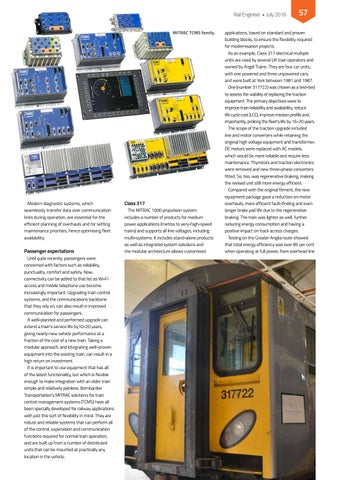
Rail Engineer • July 2016 MITRAC TCMS family.
Modern diagnostic systems, which seamlessly transfer data over communication links during operation, are essential for the efficient planning of overhauls and for setting maintenance priorities, hence optimising fleet availability.
Passenger expectations Until quite recently, passengers were concerned with factors such as reliability, punctuality, comfort and safety. Now, connectivity can be added to that list as Wi-Fi access and mobile telephone use become increasingly important. Upgrading train control systems, and the communications backbone that they rely on, can also result in improved communication for passengers. A well-planned and performed upgrade can extend a train’s service life by10-20 years, giving nearly-new vehicle performance at a fraction of the cost of a new train. Taking a modular approach, and integrating well-proven equipment into the existing train, can result in a high return on investment. It is important to use equipment that has all of the latest functionality, but which is flexible enough to make integration with an older train simple and relatively painless. Bombardier Transportation’s MITRAC solutions for train control management systems (TCMS) have all been specially developed for railway applications with just this sort of flexibility in mind. They are robust and reliable systems that can perform all of the control, supervision and communication functions required for normal train operation, and are built up from a number of distributed units that can be mounted at practically any location in the vehicle.
Class 317 The MITRAC 1000 propulsion system includes a number of products for medium power applications (metros to very-high-speed trains) and supports all line voltages, including multi-systems. It includes stand-alone products as well as integrated system solutions and the modular architecture allows customised
57
applications, based on standard and proven building blocks, to ensure the flexibility required for modernisation projects. As an example, Class 317 electrical multiple units are used by several UK train operators and owned by Angel Trains. They are four car units, with one powered and three unpowered cars, and were built at York between 1981 and 1987. One (number 317722) was chosen as a test-bed to assess the viability of replacing the traction equipment. The primary objectives were to improve train reliability and availability, reduce life cycle cost (LCC), improve mission profile and, importantly, prolong the fleet's life by 15-20 years. The scope of the traction upgrade included line and motor converters while retaining the original high voltage equipment and transformer. DC motors were replaced with AC models, which would be more reliable and require less maintenance. Thyristors and traction electronics were removed and new three-phase converters fitted. So, too, was regenerative braking, making the revised unit still more energy efficient. Compared with the original fitment, the new equipment package gave a reduction on motor overhauls, more efficient fault-finding and even longer brake pad life due to the regenerative braking. The train was lighter as well, further reducing energy consumption and having a positive impact on track access charges. Testing on the Greater Anglia route showed that total energy efficiency was over 85 per cent when operating at full power, from overhead line