12
ROLLING STOCK & DEPOTS
DAVID SHIRRES
Northern’s trains
from Spain
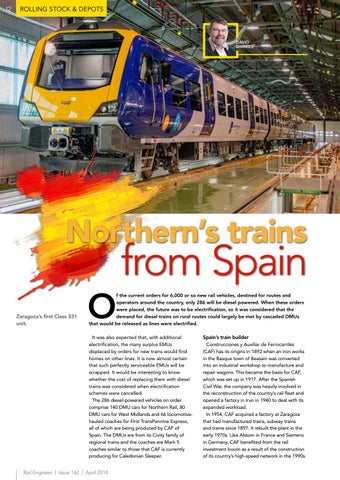
Zaragoza’s first Class 331 unit.
O
f the current orders for 6,000 or so new rail vehicles, destined for routes and operators around the country, only 286 will be diesel powered. When these orders were placed, the future was to be electrification, so it was considered that the demand for diesel trains on rural routes could largely be met by cascaded DMUs that would be released as lines were electrified. It was also expected that, with additional electrification, the many surplus EMUs displaced by orders for new trains would find homes on other lines. It is now almost certain that such perfectly serviceable EMUs will be scrapped. It would be interesting to know whether the cost of replacing them with diesel trains was considered when electrification schemes were cancelled. The 286 diesel-powered vehicles on order comprise 140 DMU cars for Northern Rail, 80 DMU cars for West Midlands and 66 locomotivehauled coaches for First TransPennine Express, all of which are being produced by CAF of Spain. The DMUs are from its Civity family of regional trains and the coaches are Mark 5 coaches similar to those that CAF is currently producing for Caledonian Sleeper.
Rail Engineer | Issue 162 | April 2018
Spain’s train builder Construcciones y Auxiliar de Ferrocarriles (CAF) has its origins in 1892 when an iron works in the Basque town of Beasain was converted into an industrial workshop to manufacture and repair wagons. This became the basis for CAF, which was set up in 1917. After the Spanish Civil War, the company was heavily involved in the reconstruction of the country’s rail fleet and opened a factory in Irun in 1940 to deal with its expanded workload. In 1954, CAF acquired a factory at Zaragoza that had manufactured trains, subway trains and trams since 1897. It rebuilt the plant in the early 1970s. Like Alstom in France and Siemens in Germany, CAF benefited from the rail investment boom as a result of the construction of its country’s high-speed network in the 1990s.