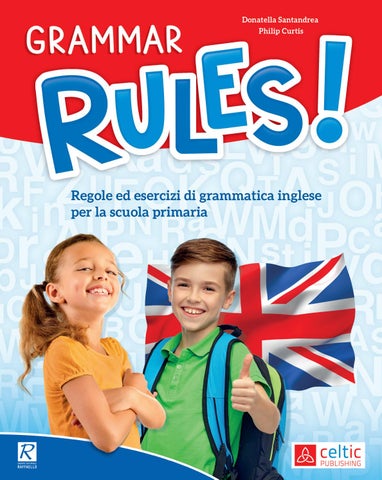
a G Sa BN ra nta 97 mm ndr 8- a ea 88 r R - P -4 72 ule hilip -2 s! C ur 91 ti s 36 IS
approccio alla grammatica inglese. Il testo, in un volume unico, è un utile strumento per l’apprendimento di lessico e strutture grammaticali del livello A1 del Common European Framework of Reference.
In ciascuna unità: - tavola illustrata per la presentazione di lessico e strutture; - spiegazione in italiano della regola grammaticale ed esempi visuali; - pagine di esercizi e giochi, per mettere in pratica quanto appreso; - fumetti con simpatici personaggi che aiutano a puntualizzare la regola; - pagina di autovalutazione.
LA GUIDA PER L’INSEGNANTE La guida per l’insegnante suggerisce attività per la presentazione degli argomenti e giochi di rinforzo. Inoltre contiene le soluzioni di tutte le attività e schede fotocopiabili.
€ 6,50
Regole ed esercizi di grammatica inglese per la scuola primaria
Questo volume, sprovvisto del talloncino a fronte (o opportunamente punzonato o altrimenti contrassegnato), è da considerarsi copia di SAGGIO-CAMPIONE G RATUITO, fuori commercio (vendita e altri atti di disposizione vietati: art. 17, c. 2 L. 633/1941). Esente da I.V.A. (D.P.R. 26-10-1972, n° 633, art. 2 lett. d). Esente da bolla di accompagnamento (D.P.R. 6-10-1978, n° 627, art.4. n° 6).
Do
na te ll
GR AMMAR RULES!
Grammar Rules! propone un primo e graduale
Contents
1
2
3
4
5
6
7
8 9
10
11
12
Vocabulary
Grammar Focus
AT SCHOOL
2
oggetti scolastici
nomi: singolare e plurale
ANIMALS
8
animali selvaggi e domestici
articoli: A - AN - THE
BIG AND SMALL
14
aggettivi
pronomi personali soggetto
TOYS
20
giocattoli
aggettivi possessivi
PARTY TIME
26
età, famiglia, professioni
TO BE
MY DOLL’S HOUSE
32
casa: stanze e mobilio
there is - there are
MY CLOTHES
38
vestiario
HAVE GOT
SPORTS
44
attività sportive
CAN
THE DAILY ROUTINE
50
azioni quotidiane
present simple
56
attività estive
SUMMER ACTIVITIES
No part of this publication may be reproduced, stored in a retrieval system, or transmitted, in any form or by any means, electronic, mechanical, photocopying, recording or otherwise without the prior written permission of the Publishers.
present continuous
Every effort has been made to trace copyright holders but where this has proved impossible, the publisher would be grateful for any information that would enable them to amend any omissions in future editions. Copy editing: Francesca Ceppi, Clarissa Coppari Graphic design: Astarte, Marco Mancini Illustrations: Licinia Tozzi Cover: Marco Mancini
FOOD
62
cibi e bevande
TO LIKE
OUT AND ABOUT
68
negozi e luoghi pubblici
preposizioni di luogo
© 2018 Raffaello Libri S.p.A. Via dell’Industria, 21 60037 - Monte San Vito (AN) www.grupporaffaello.it - info@grupporaffaello.it Ristampa:
Printed in Italy by Gruppo Editoriale Raffaello
5 4 3 2 1 0
2023 2022 2021 2020 2019 2018
A SCHOOL
1 one shelf
two boxes
two shelves
one box two schoolbags
two exercise books one pencil
one ruler two rubbers Hi! I’m Mrs Perfect. hen you see me... pay attention!
two children one pen
one child foot
2
one pencil case
feet
Grammar focus
INomi: nomi:singolare singolaree eplurale plurale
1
I nomi sono le parole che indicano oggetti, persone o luoghi. I nomi possono essere singolari (uno) o plurali (piÚ di uno). I nomi in inglese non hanno genere, non sono nÊ maschili nÊ femminili. La regola base in inglese è che i nomi diventano plurali aggiungendo una s alla fine della parola.
one pen
three pens
one book
two books
Attenzione! A Se i nomi terminano in: ch, o, s, sh, ss, x, z, al plurale si aggiunge es.
Se i nomi terminano in consonante + y, la lettera y viene tolta e si aggiunge ies.
In alcuni nomi che terminano in f, la lettera f viene tolta e si aggiunge ves.
Altri nomi sono irregolari. Non seguono alcuna regola. Sono da studiare.
one flash
three flashes
one box
two boxes
one family
two families
one fly
three flies
one shelf
two shelves
one wolf
two wol wolves
one man
two men
one child
two children
one woman
two women
one person
two people
3
I nomi: singolare e plurale
1
1. Completa le tabelle. SINGULAR
PLURAL
PLURAL
SINGULAR
rubber
_ ______________
pencil cases
_ ______________
book
_ ______________
posters
______________
ruler
_ ______________
computers
______________
pencil
______________
desks
_ ______________
2. Trova le differenze fra i due banchi.
4
________________________________ two pens, one
________________________________ three pens,
________________________________
________________________________
________________________________
________________________________
1
I nomi: singolare e plurale
3. Scrivi i plurali delle parole. watch _____________
fly
_____________
wolf
_____________
man
_____________
kiss
_____________
strawberry _____________
dish
_____________
hobby
_____________
woman
_____________
box
_____________
cherry
_____________
child
_____________
glass
_____________
shelf
_____________
person
_____________
4. Leggi i nomi, trasformali al plurale e scrivili nel libro corrispondente. person . bag . fox . family . wolf . school . child . butterfly . watch . shelf . half . teacher . flash . woman . computer . cherry . story . man . scarf . glass
S IES
_ _____ _ _ _ _ ___ _ _____ _ _ _ _ ___ _ _____ _ _ _ _ ___ _____ _ _ _ _ ____
ES
_______ _______
______
_______
______
_______
______
______
ARI L O G E R IR _____ ___
___
___
___
___
___
___
___
___
___
___
___
___
___
___
___
___
___
___
___
_______________ _______________ _______________ _______________
___ _______ ______ _ _ _ _ _ _ ___ _ _______ _______ _ _______ _______
VES 5
I nomi: singolare e plurale
1
5. Nel riquadro sono nascoste parole al singolare e al plurale. Sfida i tuoi amici a chi ne trova e scrive di piĂš.
C
H
I
L
D
R
E
N
F
A
M
I
L
I
E
S
H
P
E
N
S
N
B
B
W
F
A
P
E
N
U
H
I
E
S
F
L
Y
O
A
O
L
N
B
A
B
Y
E
L
O
H
B
T
B
X
B
M
I
W O
M
A
N
L
D
P
E
R
S
O
N
I
E
E
B
O
X
E
S
V
S
L
L
B
A
G
A
E
N
S
B
O
O
K
P
E
Y
E
F
B
O
O
K
S
L
M
E
N
B
A
G
S
V
T
J
W
F
A
M
I
L
Y
Y
G
O
C
Q
R
SINGULAR
PLURAL
______________
______________
______________
______________
______________
______________
______________
______________
______________
______________
______________
______________
______________
______________
______________
______________
______________
______________
______________
______________
______________
______________
______________
______________
Mrs Perfect’s corner
At the restaurant Hello! One table for two persons please.
6
hat?!? One table for two people!
his way... es, please. hank you.
1.Leggi e segna la definizione corretta.
1
two mans two men
4
four babies four babys
2
four flies four flys
5
five penciles five pencils
3
three boxs three boxes
6
three children three childs ..... / 6
2. Trova gli errori e riscrivi correttamente. 1
I’ e got two pen and three pencil!
2
hat a beautiful families! hat good childs!
________________________
_________________________ !
________________________ !
_________________________ !
Tot. ..... / 10
..... / 4
7
ANIMALS
2 parrot
iguana
hamster antelope
goldfish rabbit
octopus dog
cat
elephant ook! dog. ook! n elephant.
he elephant is ery big.
he dog is my fa ourite animal.
The Loch Ness monster Pay attention!
The Tower of London
8
The Queen of England
Gli ar
Grammar focus
oli
2 1
Gli articoli possono essere indeterminativi o determinativi. In inglese ci sono due articoli indeterminativi, a e an, che corrispondono all’italiano: un, uno, una, un’. In inglese c’è un solo articolo determinativo, the, che corrisponde all’italiano: il, lo, la, i, gli, le, l’. ar
olo in etermina vo
A si usa davanti a parole che cominciano con consonante o con h aspirata (hamster, house, horse...).
a dog
a green parrot
a cat
an elephant
an enormous octopus
an iguana
a hamster
An si usa davanti a parole che cominciano con vocale.
ar
olo
etermina vo
ook, an elephant!
an antelope
es, the elephant is a ery big animal.
The si usa: - quando si fa riferimento a qualcosa o qualcuno di cui si è già parlato.
- quando si fa riferimento a qualcosa o qualcuno di unico e/o specifico. The Queen of England
The girls in my class
9
Gli ar
oli
2
1. Copia le parole nella colonna giusta.
octopus
antelope
iguana
cat
dog
elephant
hamster
ant
lion
A
AN
____________________
____________________
____________________
____________________
____________________
____________________
____________________
____________________
____________________
____________________
2. Sottolinea l’articolo giusto.
10
parrot
1 This is a/an apple.
4 This is a/an orange.
2 This is a/an umbrella.
5 This is a/an banana.
3 This is a/an T-shirt.
6 This is a/an hat.
2
Gli ar
oli
3. Osserva e completa con l’articolo giusto: the, a, an. ___ cat is in
Look! _____
_____ box.
aeroplane!
1
2
What _____ nice dog!
_____ apple,
please!
3
4
This is _____ difficult exercise!
_____ sun 5
is hot today!
6
Kate is _____
This is _____
Princess of Wales.
interesting story.
7
8
11
Gli ar
oli
2
4. Aiuta Tom a uscire dal labirinto. Scrivi il nome di ciò che trova nel percorso, preceduto dal corretto articolo indeterminativo: a, an.
_______________________ _______________________ _______________________ _______________________ _______________________ Mrs Perfect’s corner
At the ice-cream kiosk n ice cream!
es?
Here you are.
ice cream!
es, please!
12
hank you!
1. Leggi e segna con una crocetta (
) le frasi sbagliate e con un tick (
) quelle giuste.
1 an big elephant
4 an red apple
7 a green snake
3 a orange umbrella
6 an yellow banana
9 an old castle
2 a pink pig
5 a small mouse
8 a fat cat
2. Osserva le immagini e riordina le frasi.
1 an - is - This - octopus _______________________________.
3 a - What - big - ice - cream _______________________________!
..... / 9
2 bag - The - the - parrot - is - in _______________________________.
4 Moon - Look - at - the _______________________________!
..... / 4
3. Trova gli errori e riscrivi correttamente. 1
ook! sun is in the sky.
2
his is a och Ness monster!
________________________
________________________
________________________ !
________________________ ! Tot. ..... / 15
..... / 2
13
3
BIG AND SMALL re you tired?
He’s tall.
I’m green.
It’s interesting! he’s happy!
e’re beautiful!
hey’re hinese.
ou’re fast!
Pay attention!
he
she it
14
I pronomi personali so
Grammar focus
etto
3
I pronomi personali soggetto sono parole che si usano al posto dei nomi. 1a persona singolare 2a persona singolare
I
you
io
per parlare di se stessi
tu
per parlare con una persona
egli/lui
per parlare di una persona di genere maschile o di un animale domestico con nome
3a persona singolare
he
3a persona singolare
she
ella/lei
3a persona singolare
it
per parlare di una persona di genere femminile o di un animale domestico con nome
esso/essa
per parlare di un oggetto, animale o luogo
noi
per parlare di se stessi insieme ad altre persone
voi
per parlare con più di una persona
essi/loro
per parlare di più di una persona, cosa, animale o luogo
1a persona plurale 2a persona plurale 3a persona plurale
we
you the
I’m happy.
You’re tall.
He’s old.
It’s interesting.
We’re Italians.
You’re young.
She’s beautiful.
They’re fast.
A Attenzione! I è sempre maiuscolo in inglese. You può significare “tu” o “voi”. Può anche essere usato come forma di cortesia “Lei”. In inglese è sempre obbligatorio esprimere il soggetto (nome o pronome che sia). A differenza dell’italiano, il soggetto non può mai essere sottinteso.
You are strong.
You are strong.
Hi, I’m Steve and I have a sister. We live in London.
15
I pronomi personali so
etto
3
1. Osserva le immagini e segna il pronome corretto. we you I 1
they she it 2
you he I 3
we he it 4
she they he 5
we you it 6
they you she 7
she I it 8
you they we 9
16
it he I 10
3
I pronomi personali so
etto
2. Scrivi il pronome personale soggetto corrispondente. 1 Mum___________
3 the car
2 Dad ___________
4 Luca and Lucia ___________
___________
5 my brother and me ___________ 6 me
___________
3. Osserva e completa. They’re slow. . It’s ugly. . I’m good. . We’re fat. She’s bad. . He’s short. . You’re tall. . You’re big.
_______________.
______________. 1
2
______________.
______________.
3
4
______________.
5
______________.
6
______________.
7
______________.
8
17
I pronomi personali so
3
etto
4. Osserva le immagini e completa il cruciverba degli aggettivi. 4
3
2
5
3 2 1
4
5
B D
7
1
10
6
8
9
S
O
W
11
6
S
T
H
L
L
7
11 9 8
10
Mrs Perfect’s corner
At school
Mrs Perfect is ery ugly!
es! He’s a monster.
hat!?! I’m a woman! H not H !
nd... I’m not so ugly!
orry Mrs Perfect!
18
1. Riscrivi le frasi sostituendo i nomi con i pronomi personali soggetto. 1 London is a big city.
_______ is a big city.
2 John and Jim are brothers. 3 Mary is a beautiful girl.
_______ are brothers. _______ is a beautiful girl.
4 My friend and I are thin.
_______ are thin.
5 Mr Smith is my teacher.
_______ is my teacher. ..... / 5
2. Trova gli errori e riscrivi correttamente. 1
2
he’s tall!
ou’re happy and I’m sad.
3
___________________________
___________________________
___________________________!
___________________________!
It’s beautiful!
4
He’s my schoolbag! ___________________________
___________________________
___________________________!
___________________________! Tot. ..... / 10
..... / 5
19
4
OYS
our ball is small.
My skateboard is orange.
His dinosaur is scary.
Her doll is pretty. Our bikes are new.
Its teddy bear is purple.
our tennis rackets are old. heir cars are fast.
Pay attention!
Its door is big.
20
Its ears are long.
Gli a
Grammar focus
ettivi possessivi
4
Gli aggettivi possessivi vengono usati per indicare il possesso di qualcosa. Gli aggettivi possessivi, in inglese, sono invariabili e non si accordano con la cosa posseduta (come in italiano) ma con chi la possiede. Non hanno variazione al singolare e al plurale, né al femminile e al maschile. Come tutti gli aggettivi, in inglese, si trovano sempre prima del nome. my
mio, mia, miei, mie
your
tuo, tua, tuoi, tue
his
suo, sua, suoi, sue (di lui)
her
suo, sua, suoi, sue (di lei)
its
suo, sua, suoi, sue (di oggetto o animale)
our
nostro, nostra, nostri, nostre
your
vostro, vostra, vostri, vostre
their
loro
My doll. His car.
A Attenzione! A differenza dell’italiano, in inglese, gli aggettivi possessivi non sono mai preceduti dall’articolo determinativo.
It’s my doll.
Il
It’s our skateboard.
Si usa his se chi possiede è un maschio, her se chi possiede è una femmina e its se chi possiede è un animale o una cosa.
his nose
her nose
its nose
enitivo sassone
Spesso in inglese per specificare a chi appartiene qualcosa usiamo il genitivo sassone, cioè aggiungiamo ’s al nome di chi possiede.
Luigi’s T-shirt
Mum’s car
21
Gli a
ettivi possessivi
4
1. Abbina le frasi alle immagini. Poi colora secondo le indicazioni. 1 Its dress is red.
3 Your bike is blue.
2 His cat is black.
4 Her bag is orange.
5 Our dog is brown.
6 My snake is green.
2. Osserva, leggi e scegli la definizione corretta. her eyes its eyes his eyes 1
our cap her cap his cap 2
her baby his baby our baby 4
22
5
3
his toy box your toy box her toy box
its skateboard their skateboard my skateboard
their doll its doll her doll 6
4
Gli a
ettivi possessivi
3. Osserva l’immagine e completa con l’aggettivo possessivo appropriato.
1 This is ___________ bike.
4 This is ___________
skateboard.
2 This is ___________ kite.
5 This is ___________
3 This is ___________ doll.
6 This is ___________ car.
tennis racket.
4. Leggi la descrizione che Tom fa della sua famiglia e completa con l’aggettivo possessivo corretto.
their
. his . our . my . her . its . your
My family is great! My dad is a teacher, 1______ name is Terry. Mum is a doctor, 2______ name is Tina. I’ve got two brothers: 3______ names are Tim e Tony. We live in Tamton; 4______ house is number twenty-two; it is big but 5______ garden is small. ______ favourite sport? Table tennis!
6
What’s 7______ favourite sport?
23
Gli a
4
ettivi possessivi
5. Abbina gli aggettivi possessivi ai pronomi personali soggetto. Per ogni coppia usa un colore.
MY
YOUR
WE
THEY
HIS
I
HER
ITS
OUR
THEIR
IT
YOU
SHE
HE
6. Completa la tabella. SUBJECT PRONOUN
POSSESSIVE ADJECTIVE
SUBJECT PRONOUN
I
POSSESSIVE ADJECTIVE its
your
we
he
you
she
their
Mrs Perfect’s corner
In the park ook. ball!
24
es! It’s his ball.
No! Not his ball... its ball! Help!
1. Osserva e completa. she her
I
1
my
e
2
eir
3
_______’s tall.
________ cap is green.
_____ names are Paco and Jose.
_______ eyes are blue.
________ like golf.
_______ are Mexican.
we
our
he
4
his
you
5
your
6
_______ are friends.
_______ car is new.
What’s _______ name?
That is _______ school.
_______ is happy.
Do _______ like English? ..... / 12
2. Trova gli errori e riscrivi correttamente. 1
2
He’s bike is new.
They’re dolls are small.
_____________________ .
_____________________ . Tot. ..... / 14
..... / 2
25
5
PAR Y IME Hello! hat’s your name?
I’m
How old are you?
It’s e o’clock. It’s party time! elcome to the party!
en!
I’m ten. It’s my birthday today!
He’s my Dad, he’s a doctor. he’s my Mum, she’s a singer.
nd that is e ! He’s my dog!
hey’re im and om, my brothers!
e’re twins.
Pay attention!
I’m ten.
26
She’s nine.
They’re seven.
Grammar focus
Il verbo TO BE
5
Il verbo essere (to be) è un ausiliare e può essere usato anche con altri verbi. Come tutti i verbi in inglese ha una forma affermativa, negativa e interrogativa. Ha una forma intera e una forma contratta. La forma intera si usa quando si scrive, la forma contratta quando si parla. forma affermativa forma intera I am you are he is she is it is we are you are they are
forma contratta I’m you’re he’s she’s it’s we’re you’re they’re
I’m ten.
io sono tu sei lui è lei è esso è noi siamo voi siete essi sono
Tom is a doctor.
He’s my Dad. he’s my Mum. hey’re my brothers.
It’s 5 o’clock.
We’re happy.
forma negativa forma intera I am not you are not he is not she is not it is not we are not you are not they are not
forma contratta I’m not you aren’t he isn’t she isn’t it isn’t we aren’t you aren’t they aren’t
Per formare la frase negativa si aggiunge not (n’t).
io non sono tu non sei lui non è lei non è esso non è noi non siamo voi non siete essi non sono
Mrs Peg isn’t a teacher.
I’m not pleased. It isn’t your cake!
You aren’t Tom.
They aren’t tall.
27
5
Grammar focus forma interrogativa
risposte brevi
Am I…? Are you…? Is he…? Is she…? Is it…? Are we…? Are you…? Are they…?
Yes, I am. / No, I’m not. Yes, you are. / No, you aren’t. Yes, he is. / No, he isn’t. Yes, she is. / No, she isn’t. Yes, it is. / No, it isn’t. Yes, we are. / No, we aren’t. Yes, you are. / No, you aren’t. Yes, they are. / No, they aren’t.
Per formare la frase interrogativa si inverte il soggetto con il verbo. Nelle risposte brevi affermative non si usa la forma contratta.
Are you Spanish? No, I’m not.
re you lice?
Are they brothers? Yes, they are.
es, I am.
Is she Italian? No, she isn’t.
A Attenzione! Si usa il verbo essere per presentare se stessi e gli altri.
I’m Tom.
Si usa il verbo essere per descrivere persone, animali e cose e per parlare di mestieri.
She’s my sister.
Si usa il verbo essere per dire l’età.
It’s fat.
They’re students.
Si usa il verbo essere per esprimere stati d’animo e stati fisici. He’s 100.
I’m 10.
Si usa il verbo essere per indicare l’orario. It’s 5 o’clock.
28
It’s happy.
I’m tired.
5 1. Osserva le immagini e completa i fumetti. • It’s ten o’clock. • You’re very late! • She’s nine years old. • I’m a teacher.
• He’s in London. • They’re sad.
Il verbo TO E
• We’re Italians! • Wow! You’re very clever! ______________
___ _________You’re ____________ Wow!
_______________________
________very ________clever! _________________
1
2
______________
______________
_______________________
_______________________
____________________ ____________________________ 3
4
____________________ ______________ _____________ ___________________ 5
6
________________________ ________________________
7
29
Il verbo TO BE
5
2. Completa le frasi con il verbo “to be”. Poi trasformale alla forma negativa. 1 He _______ ten.
_______________________________________ .
2 We _______ friends.
_______________________________________ .
3 They _______ teachers.
_______________________________________ .
4 I _______ thin.
_______________________________________ .
3. Completa le frasi con il verbo “to be”. Poi trasformale alla forma interrogativa. 1 She _______ Italian.
_____________________________________ ?
2 It _______ 10 o’clock.
_____________________________________ ?
3 You _______ a pilot.
_____________________________________ ?
4 They _______ interesting.
_____________________________________ ?
Mrs Perfect’s corner
At home with Polly Polly! epeat I’m beautiful .
I’m b e a u t i f u l.
30
ery good! o...
hat?! No! No! No! ou’re just a stupid parrot! m I beautiful?
No, you aren’t! I’m beautiful.
1. Leggi e completa con il verbo “to be”. Fai attenzione al simbolo:
(+) forma affermativa, (–) forma negativa, (?) forma interrogativa.
1 (+) I _______ from Italy.
4 (–) They _______ in the same class.
2 (+) It _______ very hot today.
5 (?) _______ she on holiday?
3 (–) Bob’s mother ___________ a doctor.
6 (?) _______ you good at reading? ..... / 6
2. Riordina le frasi. 1 ten - ’s - years - He - old
3 It - eight - ’s - o’clock
_____________________.
________________________.
2 aren’t - You - Italian
4 They - sister - brother - are - and
_____________________.
________________________. ..... / 4
3. Trova gli errori e riscrivi correttamente. 1
2
It’s my birthday, I ha e years.
Is you merican?
es, I’m!
___________________________
___________________________
___________________________!
___________________________! Tot. ..... / 13
..... / 3
31
MY DOLL’S HOUSE
6
ook at my doll’s house. here are four rooms. BEDROOM
BATHROOM shower
lamp
bed
toilet
KITCHEN
LIVING ROOM
picture
television
fridge
es! nd there are e chairs.
table chair
sofa
here’s a kitchen and a big fridge. Is there a table? No, there aren’t. here are four. Pay attention!
There’s = There is
32
Grammar focus
There is - There are
6
There is in italiano corrisponde a “c’è”: si usa per indicare una persona, un animale o una cosa presente in un luogo. There are in italiano corrisponde a “ci sono”: si usa per indicare più persone, animali o cose presenti in un luogo. Per chiedere della presenza di una persona, un animale o una cosa in un luogo, si usa l’espressione Is there…? Si può rispondere con “Yes, there is.” (Sì, c’è.) o con “No, there isn’t.” (No, non c’è.). Per chiedere della presenza di più persone, animali o cose in un luogo, si usa l’espressione Are there…? Si può rispondere con “Yes, there are.” (Sì, ci sono.) o con “No, there aren’t.” (No, non ci sono.).
There is a fridge in the kitchen.
There are three books on the bed.
Is there a table? Yes, there is.
There are two cats under the sofa.
Are there two chairs? Yes, there are. Are there three dogs? No, there aren’t.
Is there a computer? No, there isn’t.
Attenzione! There is è sempre seguito da un nome singolare o da una lista che inizia con un nome singolare. There are è sempre seguito da nomi al plurale. There is e There are si usano spesso con le preposizioni di luogo. Le più usate sono queste:
There is an apple on the table.
in
There are two cats under the table.
on
under
next to
33
There is - There are
6
1. Osserva le immagini e completa le frasi con la lettera corrispondente. 1 There is a lamp in picture ___. 2 There are two lamps in picture ___.
A
B
C
3 There is a table in picture ___. 4 There is a chair in picture ___. 5 There is a sofa in picture ___. 6 There are two chairs in picture ___.
F D
E
2. Osserva l’immagine e scrivi: There is / There are / There isn’t / There aren’t.
34
1 ______________ two beds.
5 ______________ a computer.
2 ______________ a fridge.
6 ______________ a TV.
3 ______________ two lamps.
7 ______________ three chairs.
4 ______________ eight books.
8 ______________ a wardrobe.
6
3. Osserva e segna la risposta giusta.
1 Is there a bedroom? 2 Are there two beds? 3 Is there a garden?
4 Is there a living room?
Yes, there is. No, there isn’t.
5 Are there two sofas?
Yes, there are. No, there aren’t.
Yes, there is. No, there isn’t. Yes, there are. No, there aren’t.
6 Is there a television?
Yes, there is. No, there isn’t.
There is - There are
Yes, there is. No, there isn’t.
4. Osserva e rispondi. 1 Is there a dog in the bedroom? ____________________________
2 Are there three cats in the bathroom?
1
2
3
4
5
6
____________________________
3 Is there a sofa in the kitchen?
____________________________
4 Are there two dolls in the living room? ____________________________
5 Is there a computer in the bedroom? ____________________________
6 Are there four chairs in the living room? ____________________________
35
6
There is - There are
5. Trova le parole del mobilio e riscrivile accanto all’immagine corrispondente. S
H
O W
E
R
T
O
I
L
E
T
I
S
C
F
T
T
G
H
E
P
I
C
T
U
R
E
H
R
A
R
A
E
A
B
D
O
K
S
N
S
A
I
B
C
O M
P
U
T
E
R
M
K
O
I
D
L
E
D
I
N
C
A
T
Y
O
U
F
R
G
E
T
E
L
E
V
I
S
I
O
N
A
S
E
F
A
N W A
R
D
R
O
B
E
V
R
O
H
L
A M
X
G
B
E
D
M
E
P
______________
______________
______________
______________
______________
______________
______________
______________
______________
______________
______________
______________
Mrs Perfect’s corner
In the living room
an you see them on the sofa?
here’s a pair of glasses on your head!
ait... Polly? Polly, I can’t nd my glasses!
36
No, they aren’t there.
1. Sottolinea la forma verbale o la preposizione corretta. 1 There is/are a computer next to the chair.
5 There are books in/on the sofa.
3 There is/are children in the garden.
7 There are two eggs in/under the fridge.
2 Is/Are there people in the kitchen?
4 Is/Are there a shower in the bathroom?
6 There is a fridge under/next to the chair. 8 There’s a lamp under/on the table.
..... / 8
2. Riordina le frasi.
1 there - Are - three - eggs
____________________________________________________ ?
2 are - there - Yes
____________________________________________________ .
3 a - fridge - There - isn’t
____________________________________________________ .
4 two - There - sofas - are
____________________________________________________ . ..... / 4
3. Trova gli errori e riscrivi correttamente. 1
here is two dog in the park.
2
Is there a in the li ing room? No, there is.
________________________________. 3
here are two bananas in the fridge?
___________________ ________________________________.
__________________. Tot. ..... / 15
..... / 3
37
7
MY CLO HES
Has he got a shirt?
Ha e you got new trainers? es, I ha e.
skirt jacket
trainers
No, he’s got a jacket. trousers
shoes
e’ e got purple shorts.
hat
shirt
he’s got a beautiful dress. shorts
dress es, but she hasn’t got a nice hat.
boots
to have got lunch to have got dinner Pay attention!
to have got breakfast to have got a shower to have got a swim
38
Grammar focus
Il verbo HAVE GOT
Il verbo “avere” in inglese è have got. Si usa per esprimere il possesso relativo a oggetti e cose o per descrivere le loro caratteristiche e quelle delle persone. Si usa anche per esprimere le relazioni tra le persone: I have got two brothers and a sister. Ha una forma intera e una forma contratta. La forma intera si usa quando si scrive, la forma contratta quando si parla.
7
forma affermativa forma intera
forma contratta I have got I’ve got you have got you’ve got he has got he’s got she has got she’s got it has got it’s got we have got we’ve got you have got you’ve got they have got they’ve got
io ho tu hai lui ha lei ha esso ha noi abbiamo voi avete essi hanno
They’ve got long hair.
He’s got green trousers.
forma negativa forma intera I have not got you have not got he has not got she has not got it has not got we have not got you have not got they have not got
e’ e got red shorts.
forma contratta I haven’t got you haven’t got he hasn’t got she hasn’t got it hasn’t got we haven’t got you haven’t got they haven’t got
She’s got new boots.
he hasn’t got a nice nose.
io non ho tu non hai lui non ha lei non ha esso non ha noi non abbiamo voi non avete essi non hanno ou ha en’t got shoes.
It hasn’t got a tail.
I ha en’t got a jacket.
39
7
Grammar focus forma interrogativa Have I got…? Have you got…? Has he got…? Has she got…? Has it got…? Have we got…? Have you got…? Have they got…?
Ha e you got new shoes?
risposte brevi Yes, I have. / No, I haven’t. Yes, you have. / No, you haven’t. Yes, he has. / No, he hasn’t. Yes, she has. / No, she hasn’t. Yes, it has. / No, it hasn’t. Yes, we have. / No, we haven’t. Yes, you have. / No, you haven’t. Yes, they have. / No, they haven’t.
es, I ha e.
Per formare la frase interrogativa si inverte il soggetto con il verbo.
Have they got red hair? No, they haven’t.
Has he got a pair of trainers? Yes, he has.
A Attenzione! Quando il verbo avere non indica il possesso e non descrive delle caratteristiche si omette “got” e non si usa la forma contratta.
Nella forma affermativa di “have got” si usa l’abbreviazione ’ve per tutte le persone, tranne che per la terza persona singolare per cui si usa l’abbreviazione ’s.
Nelle risposte brevi affermative non si usa la forma contratta. Nelle risposte brevi (affermative e negative) non si usa la parola got.
40
I have breakfast at 8 o’clock.
I have lunch at school.
I’ve got a jacket.
He’s got sandals.
Has she got a hat? Yes, she has.
Have we got an umbrella? No, we haven’t.
7 1. Sottolinea la forma verbale corretta.
1 I has/have got brown eyes. 2 Lucy have/has got a long skirt. 3 I have/has got blue socks.
2. Trasforma la forma intera in forma contratta.
1 I have got
________________________
2 We have not got 3 He has got 4 John has got
___________________
Il verbo HAVE GOT
4 They has/have got yellow shorts. 5 We have/has got black trainers. 6 Bob has/have got red shoes.
5 They have got 6 She has got
_____________________ _______________________
_______________________
7 You have got
______________________
______________________
8 It has not got
_____________________
3. Osserva e completa le frasi con have/has got, haven’t/hasn’t got.
1 It ______________ a long tail.
2 We ______________ a small car.
3 She ______________ a skirt.
4 They ______________ a radio.
41
Il verbo HAVE GOT
7
4. Leggi, osserva e completa. Poi rispondi alle domande. 1 Have you got a red
____________? _________________________________________
2 Have you got a
_______________? _________________________________________
3 Have you got a
_______________? _________________________________________
4 Have you got new 5 Have you got a
________________? ______________________________________ ________________?__________________________________________
5. Riordina le frasi.
1 Have - you - a - bicycle - got _____________________________________________________ ? 2 she - Has - got - pen - a
_____________________________________________________ ?
3 Has - got - trainers - he
_____________________________________________________ ?
4 Have - a - got - skirt - you
_____________________________________________________ ?
Mrs Perfect’s corner
In the garden es, she ha e.
hat?? he has, not she ha e!
Has she got a cake?
42
Now we’ e got a cake!
1. Completa le frasi con la forma corretta di “have got”. 1 She ___________ my bag!
4 They ___________ new shoes.
2 __________ you __________ a sister?
5 __________ your dog _________ a kennel?
3 No, I ___________ .
6 I ___________ an orange car. ..... / 6
2. Osserva la tabella e scrivi le frasi. 1 Julie has got a dog and a goldfish.
She hasn’t got a cat.
2 ____________________________ 1 Julie
2 Tom
X
3 Mila
____________________________
X
X
3 ____________________________ ____________________________ ..... / 2
3. Trova gli errori e riscrivi correttamente. 1
2
ou’ e got new boots?
hey hasn’t got a ball.
es, I’ e.
___________________________? ___________________________.
___________________________. Tot. ..... / 11
..... / 3
43
SPOR S I can skateboard and I can play tennis.
8 I can’t play tennis but I can run fast. He can dance.
hey can swim and they can y too!
It can’t swim.
an we play rugby Mrs Perfect?
es, you can.
an you gi e me the tennis racket, please?
Here you are.
Pay attention!
I can to swim. She can to sing. Can you to play football?
44
Grammar focus
Il verbo CAN
8
Il verbo can esprime diversi significati: - saper fare qualcosa; I can play the guitar. - chiedere, accordare un permesso; Can I open the window? - chiedere e offrire qualcosa; Can I help you? Can rimane invariato per tutte le persone: non vuole la s alla terza persona singolare. Per formare la frase negativa si aggiunge not. La n raddoppia diventando così cannot. Più spesso però si usa la froma contratta can’t. Per formare la frase interrogativa si inverte la posizione del soggetto con quella del verbo. forma affermativa I can you can he can she can it can we can you can they can
io so / posso tu sai / puoi lui sa / può lei sa / può esso sa / può noi sappiamo / possiamo voi sapete / potete essi sanno / possono
forma interrogativa Can I…? Can you…? Can he…? Can she…? Can it…? Can we…? Can you…? Can they…? an you play rugby?
forma negativa I can’t you can’t he can’t she can’t it can’t we can’t you can’t they can’t
risposte brevi Yes, I can. / No, I can’t. Yes, you can. / No, you can’t. Yes, he can. / No, he can’t. Yes, she can. / No, she can’t. Yes, it can. / No, it can’t. Yes, we can. / No, we can’t. Yes, you can. / No, you can’t. Yes, they can. / No, they can’t.
io non so / non posso tu non sai / non puoi lui non sa / non può lei non sa / non può esso non sa / non può noi non sappiamo / non possiamo voi non sapete / non potete essi non sanno / non possono
an I ha e a sandwich, please? es! Here you are!
es, I can.
45
Il verbo CAN
8
1. Osserva e completa con can o can’t. I ________ cook.
I ________ swim! 1
2
I ________ ride a horse.
ou ________ speak hinese.
3
4
2. Scrivi cosa sai e cosa non sai fare. Aiutati con i verbi nel box. cook . dance . swim . run . write . ride a bike . use a computer . do judo . jump . speak Chinese . ski . play the piano . surf
• I can __________________________________ and __________________________________. • I can’t __________________________________ or ___________________________________.
3. Completa con can o can’t e il verbo. play football . skateboard . play tennis . ride a bike
1
2
3
4
1 She ________________________________ but she _________________________________.
2 They ______________________________ but they ________________________________. 3 He ________________________________ but he __________________________________. 4 We ________________________________ but we _________________________________.
46
8
Il verbo CAN
4. Osserva l’immagine e completa la domanda. Segui l’esempio.
1
2
3
4
_________________ Can they
_________________
_________________
_________________
play tennis?
play football?
skateboard?
ride a horse?
5. Osserva le immagini e completa con can o can’t. Can we play football?
No, you
an apple?
Here you are!
________ .
1
Can she speak French?
____ I have
2
Yes, she
Can he play the violin?
Bonjour.
________ .
3
No, he ________ .
4
4
6. Riordina le frasi.
1 can’t - Tim - French - speak
___________________________________________ .
2 I - Can - have - apple - an - please
___________________________________________ ?
3 open - door - Can - the - you
___________________________________________ ?
4 can - play - He - games - computer ___________________________________________ . 5 can’t - You - park - the - to - go
___________________________________________ .
6 you - salt - pass - Can - the - please ___________________________________________ ?
47
Il verbo CAN
7.
8 7
Risolvi il cruciverba.
ACROSS
1
3
an you... fast?
8 6
2
2
I can’t...!
3
I can... basketball!
e can’t... pasta.
4
5
4
1 5
DOWN
6
iao!
7
he can... Italian!
8
He can... hip hop!
an we... to the cinema? He can’t... Mrs Perfect’s corner
In the classroom
es, you can! Hey Polly, listen...
I want a biscuit!
an I ha e a biscuit, please?
No, you can’t ha e a biscuit!
ery good!
48
1. Ricopia ciascuna frase sotto l’immagine corrispondente. She can ride a horse.
Can I help you?
They can swim.
She can’t sing.
Can you dance?
You can’t watch TV.
Can you dance? 1 _______________________
2 ______________________
3 ______________________
4 ______________________
5 ______________________
6 ______________________ ..... / 5
2. Trova gli errori e riscrivi correttamente. 1
It can y?
No, it can.
2
ou can dance?
es, I dance.
___________________________?
___________________________?
___________________________!
___________________________. Tot. ..... / 9
..... / 4
49
9
HE DAILY ROU INE hat do you do e ery school day?
We go to school.
We get up.
We have breakfast.
We study.
We watch TV.
She gets up.
She goes to the gym.
She has lunch.
She corrects tests.
She meets her friends.
She dances.
We go to bed.
hat does she do e ery unday?
Pay attention!
50
He gets up.
She gets up. It gets up.
Grammar focus
Present simple
9
Il presente semplice in inglese è detto present simple. Si usa per: - parlare di azioni abituali; - descrivere situazioni permanenti che non cambiano nel tempo. Il verbo base non cambia, tranne per la terza persona singolare, alla quale si aggiunge la s. forma affermativa I read you read he reads she reads it reads we read you read they read
io leggo tu leggi lui legge lei legge esso legge noi leggiamo voi leggete essi leggono
We have breakfast.
She gets up early.
It usually snows in winter.
It plays in the park.
La frase negativa si forma aggiungendo l’ausiliare don’t (do not) o doesn’t (does not) prima del verbo. Don’t si usa per tutte le persone tranne che per la terza persona singolare. Doesn’t si usa per he, she, it. Il verbo base non cambia nelle diverse persone. forma negativa I don’t read you don’t read he doesn’t read she doesn’t read it doesn’t read we don’t read you don’t read they don’t read
io non leggo tu non leggi lui non legge lei non legge esso non legge noi non leggiamo voi non leggete essi non leggono
We don’t study on Sunday.
It doesn’t fly.
51
9
Grammar focus Nella frase interrogativa l’ausiliare Do/Does va prima del soggetto. Il verbo base che segue non cambia nelle diverse persone, rimane sempre uguale. Nelle risposte brevi si usano gli ausiliari do/don’t, does/doesn’t, ma non si ripete mai il verbo base.
forma interrogativa Do I read…? Do you read…? Does he read…? Does she read…? Does it read…? Do we read…? Do you read…? Do they read…?
risposte brevi Yes, I do. / No, I don’t. Yes, you do. / No, you don’t. Yes, he does. / No, he doesn’t. Yes, she does. / No, she doesn’t. Yes, it does. / No, it doesn’t. Yes, we do. / No, we don’t. Yes, you do. / No, you don’t. Yes, they do. / No, they don’t.
Do you drink orange juice in the morning?
es, I do.
A Attenzione! Nella terza persona singolare affermativa, i verbi base che finiscono con consonante + y cambiano: si toglie la y e si aggiunge -ies.
Con gli ausiliari does e doesn’t il verbo ritorna alla forma base: scompare la s.
Nella terza persona singolare affermativa, i verbi base che terminano con s, ss, z, sh, ch, x, o, sh aggiungono es.
It flies.
He plays football.
He doesn’t play rugby.
AVVERBI DI FREQUENZA
always usually often sometimes never
52
sempre di solito spesso talvolta mai
He watches.
Does he play volleyball?
Gli avverbi di frequenza indicano quanto spesso si compiono le azioni. Nella frase, la posizione degli avverbi è tra soggetto e verbo, tranne con il verbo “to be”. In questo caso l’avverbio segue il verbo. I usually go to school on foot. She is never late for school.
9
Present simple
1. Ricopia ciascuna frase sotto l’immagine corrispondente. I have breakfast . I go to bed . I go to school . I get up
1
2
3
4
2. Trasforma il verbo alla terza persona singolare. 1
They cry.
He ______________ .
2
I fly.
It _______________ .
3
They speak English.
She _____________ English.
4
I play basketball.
He ____________ basketball.
5
You go home.
It _______________ home.
6
We watch TV.
She ________________ TV.
53
9
Present simple
3. Trasforma le frasi alla forma negativa. 1 They get up at 9 o’clock.
2 We have breakfast at home. 3 I study on Sundays. 4 You go to the gym.
5 Jim and Mary swim well.
6 We have a holiday in summer.
_______________________________________________ _______________________________________________ _______________________________________________ _______________________________________________ _______________________________________________ _______________________________________________
4. Riordina le frasi, poi numera le immagini.
1 She - dance - doesn’t
_______________________________
2 French - doesn’t - He - speak
_______________________________
3 fly - doesn’t - It
_______________________________
onjour!
4 on - foot - He - go - to - doesn’t - school _______________________________ Mrs Perfect’s corner
To the gym Hey! Mrs Perfect goes to the gym!
hat?!? he doesn’t! Not don’t! Pah! illy boys!
It’s impossible! he don’t go to the gym.
54
ow! he’s strong! he goes to the gym.
1. Leggi e segna la domanda e la risposta corretta. Poi numera le immagini. 1 Do you play tennis? You play tennis?
Yes, I don’t. Yes, I do.
2 Do go they to the gym?
Yes, they go.
Do they go to the gym?
Yes, they do.
3 When do you study? When study you? 4 Does he has breakfast? Does he have breakfast? 5 Where does she work? Where does she works? 6 Does you speak English? Does she speak English?
Do you play the iolin?
b
c
d
e
f
In the afternoon. At home. Yes, he do. Yes, he does. She work in a shop. She works in a shop. Yes, she speaks. Yes, she does.
..... / 18
2. Trova gli errori e riscrivi correttamente. 1
a
2
es, I play.
My Dad is a pilot. He ys planes. He usually work on undays.
______________________________. ___________________________?
______________________________.
__________, ________________!
______________________________. Tot. ..... / 21
..... / 3
55
SUMMER AC IVI IES
10
seagull
sun
ook at me! I’m sur ng! sea
hat are you doing?
I’m reading a book!
re the kids swimming?
beach umbrella
No, they aren’t. hey are making a sandcastle.
he isn’t sleeping. he’s sunbathing.
sandcastle
mask
Pay attention!
I’m reading. You’re surfing. He’s drinking.
56
Grammar focus
Present continuous
10
Il presente progressivo è un tempo grammaticale. In inglese è detto present continuous. Si forma con il verbo essere e il verbo base più ing. Il present continuous si usa per parlare di azioni che accadono nel momento in cui si parla. forma affermativa forma intera I am eating you are eating he is eating she is eating it is eating we are eating you are eating they are eating
forma contratta I’m eating you’re eating he’s eating she’s eating it’s eating we’re eating you’re eating they’re eating
io sto mangiando tu stai mangiando lui sta mangiando lei sta mangiando esso sta mangiando noi stiamo mangiando voi state mangiando essi stanno mangiando
hey’re making a sandcastle.
He’s playing tennis. e’re walking.
forma negativa forma intera I am not eating you are not eating he is not eating she is not eating it is not eating we are not eating you are not eating they are not eating
forma contratta I’m not eating you aren’t eating he isn’t eating she isn’t eating it isn’t eating we aren’t eating you aren’t eating they aren’t eating
They aren’t singing.
he isn’t sleeping.
io non sto mangiando tu non stai mangiando lui non sta mangiando lei non sta mangiando esso non sta mangiando noi non stiamo mangiando voi non state mangiando essi non stanno mangiando
She isn’t watching TV.
57
10
Grammar focus forma interrogativa Am I eating? Are you eating? Is he eating? Is she eating? Is it eating? Are we eating? Are you eating? Are they eating?
risposte brevi
re they watching ?
No, they aren’t.
Yes, I am. / No, I’m not. Yes, you are. / No, you aren’t. Yes, he is. / No, he isn’t. Yes, she is. / No, she isn’t. Yes, it is. / No, it isn’t. Yes, we are. / No, we aren’t. Yes, you are. / No, you aren’t. Yes, they are. / No, they aren’t.
re you cooking?
es, I am.
hat are you doing?
I’m listening to music.
A Attenzione! Le regole ortografiche per ottenere la forma ing sono le seguenti. La regola principale è aggiungere ing alla forma base del verbo.
He’s playing He’s reading. tennis.
They’re playing.
Nei verbi che terminano in e, la e cade prima di aggiungere ing.
I verbi che terminano con una sola consonante preceduta da una sola vocale, raddoppiano la consonante prima di aggiungere ing.
58
We’re dancing.
I’m sunbathing.
You’re swimming.
It’s running.
10
Present continuous
1. Completa le frasi, poi riscrivile di fianco alle immagini corrispondenti. 1 She ____ writing a letter.
4 I ____ listening to music.
2 He ____ cooking sausages.
5 We ____ eating an ice cream.
3 You ____ sleeping on the sofa.
6 They ____ playing football.
a
g
__________________
__________________
__________________
__________________
d
__________________
__________________
__________________
__________________
__________________
__________________
__________________
2 eat
3 dance 4 have
f
__________________
__________________
__________________
__________________
__________________
2. Trasforma il verbo base alla forma in -ing.
1 cook
__________________
__________________
c
e
b
____________________________ ______________________________ ___________________________ _____________________________
5 run
6 swim
7 listen 8 fly
_____________________________ ____________________________ ____________________________ ______________________________
59
Present continuous
10
3. Osserva le immagini e rispondi. Aiutati con il box.
1 Are you watching TV?
No, I’m not. . No, he isn’t. . Yes, she is. Yes, I am. . No, they aren’t. . Yes, they are.
2 Is she making a cake?
____________________
____________________
4 Are you studying?
5 Are they skating?
____________________
____________________
3 Are they listening to music? ____________________
6 Is he swimming? ____________________
Mrs Perfect’s corner
In the kitchen ut... ut...
hat are you doing?
ye bye!
Mrs Perfect, what you doing?
I’m preparing for a picnic!
60
It’s raining!
1. Riordina le frasi. 1 an - eating - He’s - ice - cream
______________________________________________ .
2 are - doing - What - you
______________________________________________ ?
3 They’re - park - in - playing - the
______________________________________________ .
4 isn’t - She - watching - TV
______________________________________________ .
5 he - sleeping - Is
______________________________________________ ?
6 cake - aren’t - We - a - making
______________________________________________ . ..... / 6
2. Forma delle frasi al present continuous. Usa i verbi tra parentesi. 1 They _______________ in the park. (play)
4 Hey! You _______________ ! (sleep)
2 He _______________ to school. (go)
5 I _______________ a shower. (have)
3 We _______________ a film. (watch)
6 It _______________ in the garden. (run) ..... / 6
3. Trova gli errori e riscrivi correttamente. 1
ook, he’s swiming!
2
hey isn’t playing tennis.
___________________________
___________________________
___________________________.
___________________________. Tot. ..... / 14
..... / 2
61
11
FOOD I like grilling hamburgers.
e don’t like cooking.
salad
hamburger tomato
cheese
Do you like apples? He doesn’t like bananas.
I like pi a! es, I do! lemonade apple
banana pizza orange juice
Does it like ice cream? es, it does! ice cream Pay attention!
62
I like grilling hamburgers.
It likes eating ice cream.
We don’t like cooking.
She doesn’t like swimming.
11
Grammar focus
Il verbo TO LIKE
Per esprimere ciò che ci piace si usa il verbo “to like”. Il verbo “to like” al presente semplice segue le regole di tutti gli altri verbi: aggiunge s per la terza persona singolare affermativa e usa do, does e doesn’t come ausiliari. forma affermativa I like you like he likes she likes it likes we like you like they like
mi piace / piacciono ti piace / piacciono gli piace / piacciono le piace / piacciono gli piace/ piacciono ci piace / piacciono vi piace / piacciono a loro piace / piacciono
forma negativa I don’t like you don’t like he doesn’t like she doesn’t like it doesn’t like we don’t like you don’t like they don’t like
She likes fruit.
forma interrogativa Do I like...? Do you like...? Does he like...? Does she like...? Does it like...? Do we like...? Do you like...? Do they like...?
risposte brevi Yes, I do. / No, I don’t. Yes, you do. / No, you don’t. Yes, he does. / No, he doesn’t. Yes, she does. / No, she doesn’t. Yes, it does. / No, it doesn’t. Yes, we do. / No, we don’t. Yes, you do. / No, you don’t. Yes, they do. / No, they don’t.
Se il verbo “to like” è seguito da un verbo, questo viene messo nella forma in ing (e in italiano viene tradotto con l’infinito).
non mi piace / piacciono non ti piace / piacciono non gli piace / piacciono non le piace / piacciono non gli piace/ piacciono non ci piace / piacciono non vi piace / piacciono a loro non piace / piacciono
She doesn’t like cheese.
Do you like pi a?
es, I do.
I like playing tennis.
63
Il verbo TO LIKE
11
1. Ricopia ciascuna frase sotto l’immagine corrispondente. 1 I like apples.
5 They don’t like chocolate.
3 He likes bananas.
7 It doesn’t like cats.
2 We like pizza.
6 I don’t like dancing.
4 She likes swimming.
a
8 She doesn’t like school.
b
c
d
__________________
__________________
__________________
__________________
__________________
__________________
__________________
__________________
e
g
f
h
__________________
__________________
__________________
__________________
__________________
__________________
__________________
__________________
2. Trasforma le frasi alla terza persona singolare. I like ice cream. 1 She ____________
2 He _____________
_______________ .
_______________ .
I don’t like Maths.
64
I like playing tennis.
I don’t like tomatoes.
3 She ____________
4 He _____________
_______________ .
_______________ .
11
Il verbo TO LIKE
3. Osserva la tabella e leggi le frasi, poi scrivi il nome delle persone a cui si riferiscono. LIKES
DOESN’T LIKE
Mark
oranges
pizza
Joe
pizza
sandwiches
George
chicken
sausages
Alice
oranges
sandwiches
Mary
sandwiches
pizza
Betty
sausages
chicken
1 He likes chicken but he doesn’t like sausages.
__________________
2 She likes sausages but she doesn’t like chicken. 3 He likes oranges but he doesn’t like pizza.
__________________
4 She likes oranges but she doesn’t like sandwiches. 5 He likes pizza but he doesn’t like sandwiches.
__________________
__________________ __________________
6 She likes sandwiches but she doesn’t like pizza.
__________________
4. Riordina le frasi.
1 like - playing - I - tennis
2 Tom - doesn’t - fish - like
3 don’t - We - studying - like 4 friends - My - pizza - like
5 likes - Mrs - Perfect - English - grammar
6 brother - watching - likes - My - cartoons
7 My - doesn’t - father - like - cooking
8 you - Do - going - like - to - gym - the 9 fish - Does - Lucy - and - like - chips
_______________________________________ . _______________________________________ . _______________________________________ . _______________________________________ .
________________________________________ . _______________________________________ . _______________________________________ . _______________________________________ ? _______________________________________ ?
65
Il verbo TO LIKE
11
5. Completa le domande, poi osserva e rispondi.
2 ____ he _______ painting?
3 ____ she _______ writing?
No, I don’t. ____________________ .
____________________ .
____________________ .
4 ____ you ________ going
5 _____ he _____________
6 _____ they ___________
1 Do you like horror films?
to the cinema?
playing rugby?
singing?
____________________ .
____________________ .
____________________ .
Mrs Perfect’s corner
A picnic I like picnics!
Hello boys, can I join you? I like sandwiches, hot dogs, cakes, sweets... I like chocolate, ice cream, biscuits.
66
Oh no! Mrs Perfect!
Don’t
I doesn’t like picnics anymore!
Not doesn’t!
1. Osserva e completa.
like 1 I ____________ bananas.
2 I ____________ pizza.
3 She ____________ sausages.
don’t like tomatoes. I ____________
I ____________ chicken.
4 He __________ swimming.
5 You ____________ football.
6 It ____________ biscuits.
He __________ cooking.
You ____________ tennis.
It ____________ cats.
She ____________ ice cream.
..... / 12
2. Trova gli errori e riscrivi correttamente. 1
2
ou like nglish?
he don’t like dancing!
es, I like!
_________________________ ?
_________________________
_________________________ !
_________________________ ! Tot. ..... / 15
..... / 3
67
12
OU AND ABOU
train station bank
park museum
sports shop chemist’s
clothes shop
supermarket café
restaurant
bookshop shoe shop
here’s the bank?
It’s opposite the museum.
he bookshop is in front of the caf .
he clothes shop is between the chemist’s and the supermarket.
he train station is behind the bank.
he sports shop is ne t to the restaurant. Pay attention!
in front of next to opposite to
68
Grammar focus
Le preposizioni di luogo
12
Le preposizioni di luogo indicano dove si trova qualcuno o la posizione di qualcosa. Si usano le preposizioni di luogo in risposta alla domanda “dove“, in inglese “where“. Per chiedere “Dove è...?“ in inglese si utilizza Where is...? Per chiedere “Dove sono...?“ in inglese si utilizza Where are...?
The fish is in the bowl.
The school is in front of the park.
The cat is on the table.
The dog is under the table.
Tom is in front of the chemist’s.
Where is the boy? He’s in the café.
The shoe shop is next to the toy shop.
The sweet shop is opposite the sports shop.
The clothes shop is between the bookshop and the café.
Where are the boys? They’re in the park.
Opposite si usa principalmente per orientarsi nello spazio. Tom is opposite the chemist’s.
69
Le preposizioni di luogo
12
1. Osserva l’immagine e segna la preposizione corretta.
1
2
The boy is next to
next to
in
the park.
4
5
under
in front of
her umbrella.
2. Osserva e rispondi alle domande.
in
the sports shop.
opposite
the chemist’s.
6
The bike is
The school is between
behind
the supermarket.
Mrs Perfect is on
3
The café is
The bank is behind
between
the toy shop and the supermarket. 1 Where is the school? It’s ______________ the bookshop. 2 Where is the girl? She’s ______________ the school. 3 Where are the cats? They’re ______________ the bench. 4 Where is the dog? It’s ______________ the cats.
70
12
Le preposizioni di luogo
3. Osserva e scegli la risposta esatta. 1 Where is the ball?
2 Where is the dog?
It’s next to the chair.
It’s in the box.
It’s on the chair.
It’s behind the box.
It’s under the chair.
It’s next to the box.
3 Where is the rabbit?
4 Where is the cat?
It’s in the table.
It’s on the cushion.
It’s on the table.
It’s behind the cushion.
It’s under the table.
It’s in front of the cushion.
4. Osserva l’immagine e in base alle risposte formula le domande. 1 __________________________________? It’s under the table. 2 __________________________________? It’s on the chair. 3 __________________________________? It’s in the hat. 4 __________________________________? It’s opposite the cat.
71
Revision
R
1. Scegli l’alternativa corretta. 1 Three
childs children
are playing in the park.
2 This is
an
3
a beautiful princess.
4
He’s She’s
a
They’re Their
6
8
expensive hotel.
There is There are
He’s got He has
9 Mary Jane
names are John and Richard.
5 Are you happy?
7 The dog is
Yes, I am.
two women in the toy shop.
swimming
in the river.
lunch at school.
doesn’t not
go to the gym.
10 Does your brother like pizza? 11
Yes, I’m.
swiming
Can you You can
Yes, he likes. Yes, he does.
play golf? Yes, I can.
12 The restaurant is
in front of in front
the chemist’s.
Mrs Perfect’s corner
Nobody’s perfect! It’s ne t the tree. It’s ne t to the tree.
Mrs Perfect, today you are imperfect!
hat!!
Mrs Perfect, where’s the ball?
72
ell... nobody’s perfect!
THE
END
Contents
1
2
3
4
5
6
7
8 9
10
11
12
Vocabulary
Grammar Focus
AT SCHOOL
2
oggetti scolastici
nomi: singolare e plurale
ANIMALS
8
animali selvaggi e domestici
articoli: A - AN - THE
BIG AND SMALL
14
aggettivi
pronomi personali soggetto
TOYS
20
giocattoli
aggettivi possessivi
PARTY TIME
26
età, famiglia, professioni
TO BE
MY DOLL’S HOUSE
32
casa: stanze e mobilio
there is - there are
MY CLOTHES
38
vestiario
HAVE GOT
SPORTS
44
attività sportive
CAN
THE DAILY ROUTINE
50
azioni quotidiane
present simple
56
attività estive
SUMMER ACTIVITIES
No part of this publication may be reproduced, stored in a retrieval system, or transmitted, in any form or by any means, electronic, mechanical, photocopying, recording or otherwise without the prior written permission of the Publishers.
present continuous
Every effort has been made to trace copyright holders but where this has proved impossible, the publisher would be grateful for any information that would enable them to amend any omissions in future editions. Copy editing: Francesca Ceppi, Clarissa Coppari Graphic design: Astarte, Marco Mancini Illustrations: Licinia Tozzi Cover: Marco Mancini
FOOD
62
cibi e bevande
TO LIKE
OUT AND ABOUT
68
negozi e luoghi pubblici
preposizioni di luogo
© 2018 Raffaello Libri S.p.A. Via dell’Industria, 21 60037 - Monte San Vito (AN) www.grupporaffaello.it - info@grupporaffaello.it Ristampa:
Printed in Italy by Gruppo Editoriale Raffaello
5 4 3 2 1 0
2023 2022 2021 2020 2019 2018
a G Sa BN ra nta 97 mm ndr 8- a ea 88 r R - P -4 72 ule hilip -2 s! C ur 91 ti s 36 IS
approccio alla grammatica inglese. Il testo, in un volume unico, è un utile strumento per l’apprendimento di lessico e strutture grammaticali del livello A1 del Common European Framework of Reference.
In ciascuna unità: - tavola illustrata per la presentazione di lessico e strutture; - spiegazione in italiano della regola grammaticale ed esempi visuali; - pagine di esercizi e giochi, per mettere in pratica quanto appreso; - fumetti con simpatici personaggi che aiutano a puntualizzare la regola; - pagina di autovalutazione.
LA GUIDA PER L’INSEGNANTE La guida per l’insegnante suggerisce attività per la presentazione degli argomenti e giochi di rinforzo. Inoltre contiene le soluzioni di tutte le attività e schede fotocopiabili.
€ 6,50
Regole ed esercizi di grammatica inglese per la scuola primaria
Questo volume, sprovvisto del talloncino a fronte (o opportunamente punzonato o altrimenti contrassegnato), è da considerarsi copia di SAGGIO-CAMPIONE G RATUITO, fuori commercio (vendita e altri atti di disposizione vietati: art. 17, c. 2 L. 633/1941). Esente da I.V.A. (D.P.R. 26-10-1972, n° 633, art. 2 lett. d). Esente da bolla di accompagnamento (D.P.R. 6-10-1978, n° 627, art.4. n° 6).
Do
na te ll
GR AMMAR RULES!
Grammar Rules! propone un primo e graduale