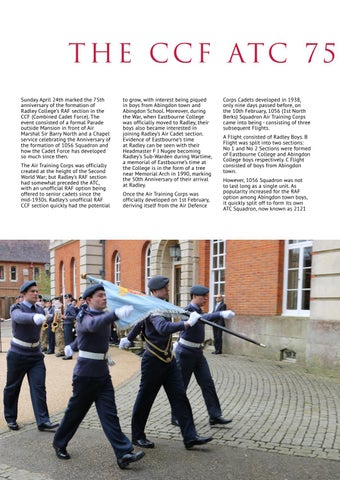
T H E C C F AT C 7 5 Sunday April 24th marked the 75th anniversary of the formation of Radley College’s RAF section in the CCF (Combined Cadet Force). The event consisted of a formal Parade outside Mansion in front of Air Marshal Sir Barry North and a Chapel service celebrating the Anniversary of the formation of 1056 Squadron and how the Cadet Force has developed so much since then. The Air Training Corps was officially created at the height of the Second World War; but Radley’s RAF section had somewhat preceded the ATC, with an unofficial RAF option being offered to senior cadets since the mid-1930s. Radley’s unofficial RAF CCF section quickly had the potential
6
THE RADLEIAN
to grow, with interest being piqued in boys from Abingdon town and Abingdon School. Moreover, during the War, when Eastbourne College was officially moved to Radley, their boys also became interested in joining Radley’s Air Cadet section. Evidence of Eastbourne’s time at Radley can be seen with their Headmaster F J Nugee becoming Radley’s Sub-Warden during Wartime, a memorial of Eastbourne’s time at the College is in the form of a tree near Memorial Arch in 1990, marking the 50th Anniversary of their arrival at Radley. Once the Air Training Corps was officially developed on 1st February, deriving itself from the Air Defence
Corps Cadets developed in 1938, only nine days passed before, on the 10th February, 1056 (1st North Berks) Squadron Air Training Corps came into being - consisting of three subsequent Flights. A Flight consisted of Radley Boys. B Flight was split into two sections: No 1 and No 2 Sections were formed of Eastbourne College and Abingdon College boys respectively. C Flight consisted of boys from Abingdon town. However, 1056 Squadron was not to last long as a single unit. As popularity increased for the RAF option among Abingdon town boys, it quickly split off to form its own ATC Squadron, now known as 2121