ADVERTORIAL PROCTOR GROUP
Fire Safety and Membrane Specifications: why system performance matters When Building Regulations changed in 2018 to require non-combustible or limited combustibility materials in external walls, membranes were exempt. Despite this, the industry has continued to evolve, with A2-rated membranes now available for projects seeking higher fire performance standards.
1
2
AT PROCTOR GROUP, this has meant developing
For example, membranes may be tested fixed
solutions such as Wraptite®, an airtight, vapour
to a substrate or free-hanging, and with different
permeable membrane designed to support both fire
installation details such as overlaps, tapes and fixings.
performance and overall building envelope efficiency.
These variables can affect fire performance, meaning
While Regulation 7(3) permits membranes classified as B-s3,d0, many specifiers now aim for A2-
two products with the same classification may behave differently in real-world applications.
s1,d0 across the full wall build-up. However, focusing
This is why Proctor Group promotes a system-
purely on fire classification can overlook other critical
led approach. By combining membranes such as
factors. Membranes play a vital role in airtightness,
Wraptite® with compatible components like Proctor
moisture management and durability, so performance
A1 Cement Board, specifiers can have greater
must be considered holistically.
confidence that the installed system will perform as
Not all membranes deliver the same balance of
intended. Substituting individual elements reduces
properties. In some cases, products with higher fire
this certainty. Differences in test methods, substrates
ratings may compromise on vapour permeability
or installation details can introduce unintended risks
or water resistance. The challenge is to achieve the
that are not immediately apparent from product data.
right combination of fire performance and envelope
Building Safety Act, there is also increased scrutiny
Membranes are often swapped for lower-cost
on specification changes. What might previously have
alternatives claiming similar classifications. However,
been considered a minor substitution now carries
matching a classification such as B-s3,d0 does not
greater responsibility.
necessarily mean equivalent performance or safety.
Ultimately, compliance is only part of the picture.
Fire classifications under BS EN 13501-1 are based
Delivering safe, robust and high-performing buildings
on multiple tests, including small flame exposure
requires a joined-up approach to specification – one
and the Single Burning Item (SBI) test. To achieve A2
that considers how all elements of the envelope
classification, additional calorific value limits must
interact. By specifying complete, tested systems,
also be met. Importantly, these tests are conducted
project teams can reduce risk, protect performance
under specific conditions that can significantly
and maintain confidence from design through
influence outcomes.
to completion.
Issue 52 April / May 2026
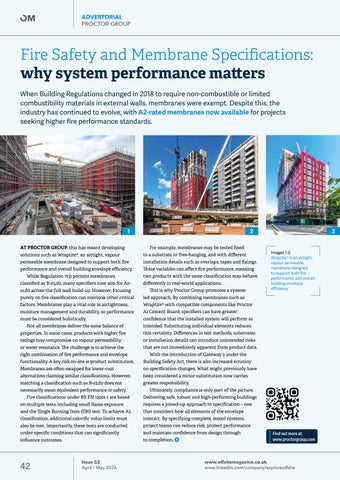
Images 1-3: Wraptite® is an airtight, vapour permeable membrane designed to support both fire performance and overall building envelope efficiency
With the introduction of Gateway 2 under the
functionality. A key risk on-site is product substitution.
42
3
Find out more at: www.proctorgroup.com
www.offsitemagazine.co.uk www.linkedin.com/company/exploreoffsite