$5.00 NOVEMBER 2013
THE REAL ESTATE REVIVAL
A BUSTLING BROOKLYN FLOWS INTO A RESURGING MANHATTAN
questmag.com
INTRODUCING THE RL67 TOURBILLON STAINLESS STEEL 45MM MODEL GUNMETAL FINISH SELF-WINDING TOURBILLON MANUFACTURE MOVEMENT EQUIPPED WITH A MICRO-ROTOR SAPPHIRE CRYSTAL CASE BACK 38-HOUR POWER RESERVE SWISS MADE
The Ralph Lauren RL67 Safari Collection
NEW YORK BEVERLY HILLS LAS VEGAS DALLAS CHICAGO BAL HARBOUR BETTERIDGE GREENWICH HAMILTON JEWELERS PALM BEACH MOYER FINE JEWELERS INDIANAPOLIS FOR A COMPLETE LIST OF STORES, PLEASE VISIT R ALPHLAURENWATCHES.COM
P E T E DY E G O L F
TENNIS
P O LO C L U B
SINCE 1974 IN DOMINICAN REPUBLIC
S H O OT I N G C L U B
EQUESTRIAN
MARINA
COUNTRY CLUB OF THE CARIBBEAN
WE CALL IT “SPORTING” B E CAU S E L I F E I S M E A N T TO B E P L AY E D THE
#
1 G O L F R E S O R T I N L AT I N A M E R I C A GOLF MAGAZINE, 2013
CALL YOUR TRAVEL PROFESSIONAL OR 1.855.267.3279 WWW.CASADECAMPO.COM.DO
FIFTY PERCENT OF PROFITS TO BENEFIT
PANCREATIC CANCER ACTION NETWORK CHARITY
Pan Cam Logo Earrings in 18k yellow gold with Center Amethyst surrounded by Diamonds
NOVEMBER IS PANCREATIC CANCER AWARENESS MONTH
Pan Cam Logo Pin in 18k yellow gold with Center Amethyst surrounded by Diamonds
PALM BEACH, FL. 561-366-4893
NEW YORK, N.Y. 800-223-3717
PALM BEACH, FL. 561-420-8866
TO VIEW FULL CATALOG: WWW.JUDITHMURAT.COM • BOOK AVAILABLE AT WWW.AMAZON.COM
,035(66,21,67
3 , ( 5 5 ( $ 8 * 8 6 7 ( 5 ( 1 2 , 5
Arbres au bord de l’Eau | 12
1/4
[ LQFKHV _ RLO RQ FDQYDV _
W W W . WA L LYF I N DL AY . COM W W W . FAC E BO O K . COM / WALLYFINDL AYGALLE RIE S
,1 ) /8 (1 & (
, 6 $ % ( / / ( ' ( * $ 1$< %
CrĂŠpuscule au Jardin des Plantes | 25
9/16
x 31
7/8
inches | oi l on canvas |
WAL LY F I ND LAY G A LLER IES 1 ( : < 2 5 . ‡ 3$ / 0 % ( $ & + ‡ % $ 5 & ( / 2 1 $ 124 EAST 57 7+ 675((7 ‡ 1(: <25. 1< ‡ 7 ) :257+ $9(18( ‡ 3$/0 %($&+ )/ ‡ 7 )
EST. 1870
ART WALLY FINDLAY
Stribling Private Brokerage is the Stribling & Associates marketing division for properties valued in excess of $5,000,000. It provides services on the level of “private banking” and intensive, customized marketing for luxury properties and discerning clients on a global basis.
Exquisite 12 Rooms on Park Avenue in the 70s
Luxury 2-3BR in White Glove Prewar Condo
LR with wood-burning fireplace, DR, paneled library, powder rm, 5BRs with ensuite baths, eat-in kitchen, laundry rm, maid’s rm & bath. Co-excl. $12.5M. Web #9103287. E.Paul 212-452-4419/J.Merrill 212-434-7082
Sunny southwest corner condo with formal DR, eat-in kitchen & MBR suite with dressing room & separate windowed office in premier condo on 69th btwn 5th/Madison. $8.75M. Web #9191914. P.D'Arc 212-452-4377
Park and City Views from the Pierre Hotel
Elegant Candela Duplex
An elegant 5-room home built to a grand scale and offering a luxurious lifestyle with hotel services. $7.95M. Web #3613034. Cornelia Zagat Eland 212-452-4384
Facing sunny south over East 72nd. Entertaining rooms, high ceilings, 3BRs, 3 baths. Enormous kitchen & breakfast area + laundry & staff room with bath. $7.75M. Web #8625191. Kirk Henckels 212-452-4402
A SAVILLS INTERNATIONAL ASSOCIATE · EQUAL HOUSING OPPORTUNITY · STRIBLING.COM · UPTOWN 924 MADISON AVENUE 212 570 2440
Stunning Brooklyn Heights Townhouse Mint renovated 20' wide, 5-story, 5500+/-sf, 5BR single-family with original architectural detail, basement, landscaped garden, 6 fireplaces & open views to Manhattan. $8.25M. Web #9161468. P.Bijur 212-452-4459/L.Melnick 212-452-4425/T.Desmond 212-452-4380
CHELSEA 340 WEST 23RD STREET 212 243 4000 路 TRIBECA 32 AVENUE OF THE AMERICAS 212 941 8420 路 BROOKLYN 386 ATLANTIC AVENUE 718 208 1900
96
122
CONTENTS THE R EAL E STATE R EVIVAL 96
VANDERBILT HOUSE
The beautiful houses of the Vanderbilt legacy,
as seen through the eyes of David Patrick Columbia.
102
A GROWNUP’S GUIDE TO BROOKLYN
118
LILY HOAGLAND
Discovering the joys of living in
New York’s hottest borough—at any age.
108
BY
BY
128 110
MICHAEL M. THOMAS
REAL ESTATE’S RENAISSANCE
Quest talks with the best brokers of today.
REAL ESTATE’S RISING STARS
A look at the up-and-comers who are helping
to define the industry. BY ELIZABETH QUINN BROWN
122
SCHWAB HOUSE BY
128
The history of one of the greatest houses in all of New York City.
DAVID PATRICK COLUMBIA
THE SPIRIT OF THE RIVERSIDE
The west side of Manhattan has much to offer
by way of activities, thanks to the Hudson Park Fund.
132
ALL IS GILT ON THE SURFACE
BY
LILY HOAGLAND
The Museum of the City of New York takes us back
to an age when absolute decorum ruled.
BY
ALEX R. TRAVERS
102
144
70
82
CONTENTS 74
C OLUMNS 20
SOCIAL DIARY
66
SOCIAL CALENDAR
70
HARRY BENSON
72
YEARS GONE BY
74
FRESH FINDS
80
CANTEENS
82
ART
86
The goings-on around New York City and beyond.
BY
DAVID PATRICK COLUMBIA
This month’s guide to the best places for supporting causes and being seen.
Photographing the king of New York City real estate, Donald Trump. New York City just ain’t what she used to be.
BY
T AKI T HEODORACOPULOS
Hunting down the latest fashions. BY DANIEL CAPPELLO AND ELIZABETH MEIGHER
At the crossroads of high-end shopping comes high-end dining. BY DANIEL CAPPELLO
Jack Geary settles in at his new gallery space on Varick Street.
BY
D ANIEL C APPELLO
JEWELRY
Roberto Coin’s new Pois Moi collection is a sure stunner.
BY
ALEX R. TRAVERS
88
CULTURE
A look at Prohibition, and how Simi Winery survived.
138
APPEARANCES
140
YOUNG & THE GUEST LIST
144
SNAPSHOT
BY
ELIZABETH QUINN BROWN
Lincoln Center was the place to be in the month of October.
BY
HILARY GEARY
Our columnist is on the scene, as always. BY ELIZABETH QUINN BROWN
A look back at E. B. White’s love letter to New York City.
BY
ALEX R. TRAVERS
74
questmag.com EDITOR-IN-CHIEF
DAVID PATRICK COLUMBIA C R E AT I V E D I R EC TO R
JAMES STOFFEL EXECUTIVE EDITOR
LILY HOAGLAND FA SHION DIRECTOR
DANIEL CAPPELLO ART DIRECTOR
VALERIA FOX A S S O C I AT E E D I TO R
ELIZABETH QUINN BROWN SOCIET Y EDITOR
HILARY GEARY A SSI STANT EDITOR
ALEX TRAVERS CONTRIBUTING WRITERS
HARRY BENSON DARRELL HARTMAN BILL HUSTED MICHAEL THOMAS JAMES MACGUIRE ELIZABETH MEIGHER LIZ SMITH TAKI THEODORACOPULOS CONTRIBUTING PHOTOGRAPHERS
DREW ALTIZER HARRY BENSON LUCIEN CAPEHART PHOTOGRAPHY JEANNE CHISHOLM MIMI RITZEN CRAWFORD JACK DEUTSCH BILLY FARRELL MARY HILLIARD CUTTY MCGILL PATRICK MCMULLAN JOE SCHILDHORN JULIE SKARRATT ANNIE WATT
KLEMM REAL ESTATE
Litchfield County’s Premier Brokers
questmag.com
SOUTHBURY, CT
Inc
KENT, CT
CHAIRMAN AND C.E.O.
S. CHRISTOPHER MEIGHER III
106
A SSI STANT TO THE C.E.O.
KATHLEEN SHERIDAN ACCOUNTING MANAGER
ARLENE LEFKOE ADVERTISING MANAGER
SARA BETH SHRAGER 917.576.1217 PA L M B E AC H
LINDA LANE SOPER 612.308.4159 CHICAGO
TIMOTHY DERR 847.615.1921 DETROIT
www.klemmrentals.com
EXT .
$3.900.000
$2,950.000
Rossiter-style Lake Lillinonhah Waterfront. 3.82± Acres. Maria Taylor. 860.868.7313.
South Spectacle Lake Waterfront Contemporary. 3.04± Acres. Peter Klemm. 860.868.7313.
WOODBURY, CT
$5,000/MONTH ANNUALLY
Luxury Direct Lake View. 3 Bedrooms. 4.02± Acres. Owner/Agent. Kathy Ashton. 203.263.4040.
WARREN, CT
$1,950/MONTH ANNUALLY
Secluded Getaway. 2 Hours from NYC. 85± Acres. Cleve Fuessenich. 860.567.5060.
www.klemmrealestate.com
MARKETING SERVICES
ROXANNE UNRATH
KAREN TEEGARDEN 248.642.1773
#1 FOR SELLING & RENTING FINE COUNTRY PROPERTIES!
HONG KONG
BINA GUPTA 852.2868.1555 MILAN
EMILIO ZERBONI 011.39.031.267.797
Litchfield Hills, CT - Less Than 2 Hours From NYC
BOARD OF ADVISORS
BRUCIE BOALT EDWARD LEE CAVE JED H. GARFIELD CLARK HALSTEAD PAMELA LIEBMAN HOWARD LORBER ELIZABETH STRIBLING ROGER W. TUCKERMAN PETER TURINO WILLIAM LIE ZECKENDORF © QUEST MEDIA, LLC 2013. All rights reserved. Vol. 27, No. 11. QUEST—New York From The Inside is published monthly, 12 times a year. Yearly subscription rate: $96.00. QUEST, 420 Madison Avenue, Penthouse, 16th floor, New York, NY 10017. 646.840.3404 fax 646.840.3408. Postmaster: Send address changes to: QUEST—New York From The Inside, 420 Madison Avenue, Penthouse, 16th floor, New York, NY 10017.
Email: subscriptions@questmag.com
ER
YE
OP
Call 646.840.3404, ext. 106
1st
SUBSCRIPTION INQUIRIES
AR
For article reprints, contact Wright’s Media: 877.652.5295 HE ATO R OF T
JOIN OUR MAILING LIST Text "klemm" to 22828
EDITOR’S LETTER
Skyscrapers created Manhattan’s distinctive skyline (right); Empty Mansions by Bill Dedman and Paul Clark Newell, Jr. (left).
ABANDONED MANSIONS seem to have thousands of stories pocketed away in their dusty corners. The urge to uncover one behind the sale of a grand, empty house prompted journalist Bill Dedman to track down the story of a woman who had begun life with the world at her feet but spent it locked away instead. American heiress Huguette Clarke owned a large fortune in real estate in some of the country’s most desirable locations, which she then spent fortunes on maintaining, decorating, or just using for storage—but instead chose to live in a New York hospital room. With the help of one of Huguette’s cousins, Paul Clark Newell, Jr., Dedman traces what happed to create a recluse out of the daughter of the richest man of his day. Empty Mansions is a well-researched true tale that whets our appetite for our November real estate issue. David Patrick Columbia spent many years researching the old grand families as well, and chose to write about the famous house of Charles M. Schwab, the American steel magnate. David details the history behind the ambitious “Riverside,” Schwab’s house on the Upper West Side, which spanned a full city block and had a total of 75 rooms. Word is, after Schwab’s death in 1939, Mayor Fiorello La Guardia refused to make the house the official residence of the mayor 18 QUEST
because he thought it was too extravagant. Among other real estate avenues to walk down, we take a look at what the Vanderbilts built, the rebirth of Brooklyn, the community along the Hudson River, and the many brokers of who know the ins and outs of real estate better than anyone. Empty mansions or crowded apartments, there’s definitely over eight million stories to read about in here. X
Lily Hoagland
ON THE COVER: A night view of downtown Manhattan from Brooklyn, including One World Trade Center with its redesigned spire, estimated to be completed in early 2014. It will include a museum commemorating the attacks of 2001. Courtesy of the Port Authority of New York and New Jersey and the Durst Organization.
S T UA RT W E I T Z M A N. C O M
625 MADISON AVENUE
675 FIFTH AVENUE
T H E S H O P S AT C O L U M B U S C I R C L E
2 1 5 1 B R O A D W AY
118 SPRING STREET
D AV I D PAT R I C K C O L U M B I A
David Patrick Columbia
NEW YORK SOCIAL DIARY NOVEMBER. IN THIS month’s issue of Quest, which is the real estate issue, I wrote a piece on a man and a house that were famous here in New York in the first four decades of the 20th century. After that, as it happens, he and his house were forgotten. His name was Charles M. Schwab—not to be confused
with the contemporary American retail stockbroker, Charles Schwab. Charles M. Schwab, known as Charlie to his friends and family all of his life, was a steel man, one of the great ones in the history of the American steel industry. He was up there with the founding fathers of the industrial state, along
with Morgan, Frick, Phipps, and Andrew Carnegie, a Scottish-born entrepreneur who was the grandfather of it all. Charlie M. Schwab got his start with Carnegie in the early 1880s working as a stake driver in one of his mills in Braddock, Pennsylvania. He would turn out to be, like Henry Ford and others of the era,
who had the personal wherewithal—and genius—to create something huge and beneficial to the workingman and family. I’d heard his name from the time when I was a young boy and my father—who was born and bred in New York—used to talk about “Mr. Schwab’s” house being the greatest mansion in New York. My father
H I S PA N I C S O C I E T Y O F A M E R I C A AT T H E M E T R O P O L I TA N C L U B
Ingenborg and Daniel Young 20 QUEST
Robert Jackson, Margaret McQuaid and Todd Meister
Kristina Blahnik, Geroge Moore and Mariette Scott
Lore Dodge and Tom Quick
Bianca Pratt and Alvin Valley
Agatha Ruiz de la Prada, Tony Bechara and Lucia Canerio
PAT R I C K M C M U LL A N
Miner Warner, Norma Dana and Robert Power
Caterina Murino by Sylvie Lancrenon
“Eternité Elégance” sapphire ring: 18 kt. gold, diamonds and pavé sapphires
714 Madison Avenue (63rd Street) - New York, NY - 212.752.4300 - www.mauboussin.us
D AV I D PAT R I C K C O L U M B I A O P E N I N G O F T H E C R I S T O F L E B O U T I Q U E I N B E V E R LY H I L L S
Stephane Parmentier
was one of those New Yorkers, an inevitable expatriate as it happened, who loved the city and spoke of its wonders with an awe and respect that was separate from everything and everyone else he knew. The fact that Mr. Schwab had the greatest mansion stuck in my craw. About a year ago, I found myself reading about the man and his mansion, which occupied the entire block between Riverside Drive and West End Avenue and between 73rd and 74th streets. Talk about awesome! So, I learned even more than my father knew about Mr. Schwab’s house. And there is quite a bit know to know. And that is what the article in this issue is about… What fascinated me most 22 QUEST
Aliza Faragher
Glenn Faber and Shannon Wurtz
Nicholas Krafft and Ginny Gerard
about Charles M. Schwab, however, was the man himself. He grew up in a German-American family in a village in western Pennsylvania. They, like everyone else, lived close to the earth, far from electricity, telephones, and even plumbing. He got a job in the steel mill as a kid, a teenager, and happened to find it intriguing. He was curious; he read, he learned. He got so that he knew more than his boss, Carnegie. His great rise from stake driver to being a giant in the industry who created his own company (Bethlehem Steel Corporation) by the time he was 40 is more awesome than his castle. He was a man of magnanimous personality and he obviously liked people. His great
gift that eventually made Carnegie dependent on him was what one writer described as his “genius” in handling others and his ability to motivate them and to reward them. The stories of his successes are inspiring. Not to mention a relief. He was a charming man. He loved music and he played instruments. He loved to play whist and bridge, and he played the game of business as enthusiastically. One of the scores of stories about Charlie M. Schwab’s days takes place during the First World War, when Bethlehem Steel Corporation had acquired a shipbuilding company. He was approached by the British admiralty, desperate to get 20 submarines and
Anne Schumacher
Suzanne Hillford
wanting to know how quickly he could produce them. He asked them how quickly they could build 20 submarines in England. They told him 15 months. He said that he could do it in less than nine, if they gave him a bonus for every week he saved. He also offered to pay an indemnity of half the amount of the bonus for every week required over the nine months. They agreed; they were desperate. The job was completed in five and a half months. The bonus that Schwab reaped was $2.5 million, or $80 million in today’s dollars. He divided the bonus up among his workers. One man, a superintendent, received $100,000. Charlie M. Schwab was 44 when he moved into the cha-
B I LLY FA R R E LL A G E N C Y
Katie Icaza and Danta Banta
© 2013. Douglas Elliman Real Estate.
Equal Housing Opportunity.
S A L E S | R E N TA L S | R E L O C AT I O N | N E W D E V E L O P M E N T S | R E TA I L | M O R T G A G E | P R O P E R T Y M A N A G E M E N T | T I T L E I N S U R A N C E
WHEN TALK TURNS TO REAL ESTATE, WHO DOES NEW YORK TURN TO FOR ANSWERS?
As the largest regional and global network of real estate experts, Douglas Elliman has a way of understanding your home and what makes it unique. From buying and selling to appraisals, mortgage financing and rentals, top experts on AskElliman.com offer timely answers to today’s questions about all things real estate. With a powerful combination of talent and technology, we have the experience, insight and access to guide you skillfully from beginning to end. Visit AskElliman.com for a list of our office locations in your area.
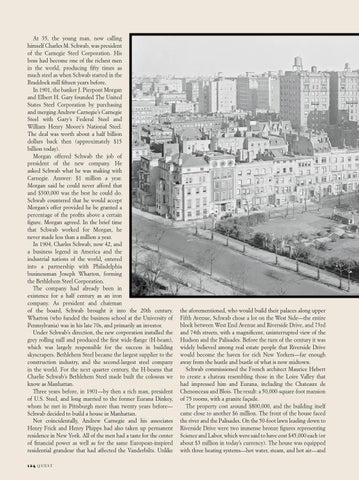
D AV I D PAT R I C K C O L U M B I A teau that he named “Riverside” with his wife, Eunana. He was such a busy man that he usually was there only a few weeks a year (usually in the winter). He and his wife moved in 1906 and spent part of the year there for the next 33 years, until 1939, when Charlie and his wife died within nine months of each other. The house was demolished in 1948 and subsequently replaced with a residential building called, appropriately or not, Schwab House. The Month Just Passed. Everyone was back home by October and the social calendar was busy on every level. From here on to about the third week of December, many New Yorkers are going to be going out and about a lot.
Here’s a glance at what I was seeing. The beginning of the month, on October 3, the Friends of Hudson River Park held its gala at Pier 57 at 15th Street and the West Side Highway. Hugh Jackman— who lives nearby and uses the Hudson River Park all the time, much to everyone’s pleasure—was the host. Jackman also fishes in the park, from the Hudson. I don’t know how to feel about that… That night, Denis Leary also performed. They honored Goldman Sachs and Michael Novogratz. Honorary chairs were Julianne Moore and Bart Freundlich and gala chairs are Diana Taylor and Scott Lawin. The Hudson River Park is the newest park in New York in a century. It was born out
of the land that once was riverfront, where piers flourished in the days of sailing and steam ships. The area that surrounds it is also one of the most recently developed residential sections of Manhattan, and it’s flourishing. I was introduced to the park by Diana Taylor and Madelyn Wils. Madelyn has been in on the organization since its inception. She is now president and C.E.O. of the Hudson Park Trust. Diana serves as chairman. Among the gala committee were Susanna Aron and Gary Ginsberg, Greg Agran, Gabrielle and Louis Bacon, Charles Bendit, Cathy Blaney, Anthony Borelli, Keija and Peter Braus, William Elder, Edie Falco, Pam Frederick and Charlie Stuard, Stacey
and Rob Goergen, Beth and Peter Hammack, Suni and Woody Harford, Mark Hass, Deborra-lee Jackman, Sonia snd Gaurav Kapadia, Robin and Jeffrey Kaplan, Michelle and Daniel Lehmann, Paula and Eric Madoff, Amanda Maher and Amar Gautam, Erica and Sam Martini, Joseph Rose, Mitchell Rudin, Lee and Justin Sadrian, Lisa and Peter Seccia, Rebecca Shaghalian and John Larkin, Megan Sheetz and Trevor Price, Brooke Shields, Marla Smith and Tom Berkenkamp, and Martha Stewart. Also that week, over at the Metropolitan club, Lighthouse International hosted the annual Henry A. Grunwald Award for Public Service luncheon with Louise Grunwald. This
F R I E N D S O F H U D S O N R I V E R PA R K ’ S G A L A AT P I E R 5 7
Hugh Jackman and Gary Cohen 24 QUEST
Brooke Shields
Dennis Leary and Madelyn Wils
Jennifer Meyer, Barbara Daniels and Ann Fitzgibbons
PAT R I C K M C M U LL A N
Sukey and Michael Novogratz
1-800-853-5958
SHANGHAI COLLECTION
ROBERTOCOIN.COM
D AV I D PAT R I C K C O L U M B I A A M E R I C A N B A L L E T T H E AT R E O P E N E D I TS S E A S O N AT T H E D AV I D H . KO C H T H E AT E R
Julia Koch and Jolene Wilson
year’s awardee was Dr. Henry Kissinger. Henry Grunwald, for those who don’t know, was a distinguished New Yorker who was a journalist and a diplomat. His presence occupied the last half of the 20th century. He held two very important positions in journalism as the managing editor of Time magazine and, later, editor-in-chief of Time, Inc., overseeing Fortune, Sports Illustrated, People, and Money as well as Time. He was a Republican, as had been his superior, Henry Luce, co-founder of the company. I mention that because when president Richard Nixon was under legal pressure because of Watergate, it was Henry Grunwald who wrote a 26 QUEST
Jessica Stam
Charles Rockefeller and Daniel Cappello
widely admired editorial calling for him to resign. Born to a Jewish family in Austria, he arrived here circuitously in 1940 at the age of 18. He came with his family after Anschluss in 1938, which was Adolf Hitler’s annexation of Austria into Nazi Germany. His father was a librettist for operettas by such composers as Franz Lehar and Oscar Straus. The boy Henry wanted to be a playwright but, when at New York University, he got a job as a “copy boy” at Time. It is important to point out that, during Henry Grunwald’s era, the magazine was the most important news magazine in America, very widely read and popular, and it was regarded as very powerful, politically.
Brian Atwood and Sutton Stracke
Carlos Souza and Alix Duvernoy
When he retired more than 40 years later, Ronald Reagan made him ambassador to Vienna, a post he held for three years. When he left Time, he continued writing. He wrote an autobiography, entitled One Man’s America, about his arrival and life here. He also wrote a novel, A Saint More or Less. By his late 70s, however, he had developed macular degeneration, a double burden because he was a reader and a writer. He wrote a book about the experience in Twilight: Losing Sight, Gaining Insight, which was published in 1999. It was his serious vision impairment that inspired the book as well as his relationship with Lighthouse International.
Genevieve Jones and Crystal Renn
Prince Dimitri of Yugoslavia and Sarah Arison
It was this that led to a memorial to the man, the Award for Public Service. Henry himself was the first recipient, a token of massive thanks from the organization. His wife, Louise, has been the guiding influence in this luncheon since its inception. Louise is one of the great hostesses in New York. It’s a title that has faded almost into obscurity in the parlance of these times, but the talent that evokes it remains. I think if she’d been born a generation later, she would have been running a major corporation because she is one of those women who possesses an executive’s turn of mind and presence. This luncheon raises a half
B I LLY FA R R E LL A G E N C Y
David Koch
info@biscaynebeachresidences.com | www.BiscayneBeachResidences.com NOW SELLING AT PRE-CONSTRUCTION PRICES | PRIVATE PRESENTATIONS: 305.521.0985 Oral representations cannot be relied upon as correctly stating the representations of the developer. For correct representations, make reference to this brochure and to the documents required by section 718.503, Florida statutes, to be furnished by a developer to a buyer or lessee. Obtain the property report required by federal law and read it before VLJQLQJ DQ\WKLQJ 1R IHGHUDO DJHQF\ KDV MXGJHG WKH PHULWV RU YDOXH LI DQ\ RI WKLV SURSHUW\ $OO LPDJHV DQG GHVLJQV GHSLFWHG KHUHLQ DUH DUWLVW¡V FRQFHSWXDO UHQGHULQJV ZKLFK are based upon preliminary development plans, and are subject to change without notice in the manner provided in the offering documents. No guarantees or representations whatsoever are made that existing or future views of the project and surrounding areas, are or will be as depicted, or that any other features, amenities or facilities depicted by any VXFK DUWLVW¡V FRQFHSWXDO UHQGHULQJV RU RWKHUZLVH GHVFULEHG KHUHLQ ZLOO EH SURYLGHG RU LI SURYLGHG ZLOO EH RI WKH VDPH W\SH VL]H ORFDWLRQ RU QDWXUH DV GHSLFWHG RU GHVFULEHG KHUHLQ These materials are not intended to be an offer to sell, or solicitation to buy a unit in the condominium. Such an offering shall only be made pursuant to the prospectus (offering circular) for the condominium and no statements should be relied upon unless not made in the prospectus or in the applicable purchase agreement. In no event shall any solicitation, offer or sale of a unit in the condominium be made in any state or country in which such activity would be unlawful. We are pledged to the letter and spirit of u.S. Policy for the DFKLHYHPHQW RI HTXDO KRXVLQJ WKURXJKRXW WKH QDWLRQ :H HQFRXUDJH DQG VXSSRUW DQ DIÀ UPDWLYH DGYHUWLVLQJ PDUNHWLQJ DQG VDOHV SURJUDP LQ ZKLFK WKHUH DUH QR EDUULHUV WR REWDLQLQJ housing because of race, color, sex, religion, handicap, familial status or national origin. This project is being developed by Biscayne Miami Partners LLC., a Florida Limited Liability &RPSDQ\ ZKLFK ZDV IRUPHG VROHO\ IRU VXFK SXUSRVH (DVWYLHZ 'HYHORSPHQW DQG *7,6 3DUWQHUV DUH DIÀ OLDWHG ZLWK WKLV HQWLW\ EXW QHLWKHU RI WKHP LV WKH GHYHORSHU RI WKLV SURMHFW
EXCLUSIVE SALES AND MARKETING BY
D AV I D PAT R I C K C O L U M B I A AU T U M N D I N N E R AT T H E F R I C K C O L L EC T I O N
Susan Gutfreund and Elizabeth Rohatyn
Nicola Knight and Guillaume Fouilleron
million dollars—a big number for a luncheon fundraiser. Louise’s oversight and influence are responsible for much of that amount. The event has also been important in raising not only the profile of this great philanthropy but public awareness about vision impairment. Then, that night. In the Grill Room of the Four Seasons Restaurant, Charlie Rose, Diane von Furstenberg, Michael Ovitz, Milly and Arne Glimcher, Christine and Stephen Schwarzman, Erica and LA Reid, Samantha Boardman and Aby Rosen, Jamie Tisch, John Demsey, and Marjorie Gubelmann hosted a book party for Tamara Mellon and her book, In My Shoes: A 28 QUEST
Lorin Stein and Antonio Weiss
Lucy Waletzky and Jim Hamilton
Memoir. That group, by itself, would be a party you could write about. Tamara Mellon sure has some interesting drawing power. More beautiful autumn days. On a Thursday night, they held the annual autumn dinner at the Frick Collection. The Frick is what has become of one man’s art, one man’s house (as you probably know). That said, it was intended from the planning to be a museum one day. His daughter, Helen Frick, took the mantle of her father after he died and left the family imprimatur as effectively as all of the artists, sculptors, architects, and interior decorators that had created and built the house. So, it is not only an exquisite
Margot Bogert and Ian Wardropper
Missie Taylor and Michel David-Weill
museum but also a space that has an emotional life that only a family can impart. They honored Michel David-Weill, the banker, collector, and philanthropist. David-Weill (pronounced dahveed-vay) lives here in New York. His family has been associated with the international banking house of Lazard for a long time. Generations, even. He himself was chairman from 1977 to 2005. He is a Frenchman, although I noticed from the program that he was educated as a child at the Lycée Français de New York. Nevertheless, he has one of those wonderful French accents where your American ear can’t always understand his English enunciation. But you
Hendrikje Crebolder and Wouter Han
don’t care because it sounds so good. I always wanted one of those. Seriously. When I was a very young man in New York, I was infatuated briefly with a very charming French girl from Paris named Nadine. The word I remember most of hers, which actually charmed me, was “impossiible.” Impaw-see-bul! And so it was. David-Weill has been a generous benefactor of the Frick for the past two decades. He is also a major patron of the arts and has helped underwrite exhibitions of French art at the Frick as well as having contributed to the museum’s endowment for a newly created position of Curator of Decorative Arts. David-Weill
PAT R I C K M C M U LL A N
Oscar and Annette de la Renta with Philippe de Montebello and Beatrice Santo Domingo
NEW TO MARKET
Exceptional 11-into-9 Room Duplex NIKKI FIELD Senior Global Real Estate Advisor, Associate Broker 212.606.7669 | nikki.field@sothebyshomes.com | www.nikkifield.com EAST SIDE MANHATTAN BROKERAGE | 38 East 61st Street, New York, NY 10065 Operated by Sotheby’s International Realty, Inc.
3 EAST 69TH STREET
$7,200,000
D AV I D PAT R I C K C O L U M B I A
Q: What do you think makes Sotheby’s International Realty so effective at catering to clients in New York? A: As local experts, Sotheby’s International Realty is committed to providing unparalleled real estate services and expertise by anticipating and meeting the needs of our clients and the marketplace both locally and worldwide. Q: What neighborhoods do you focus on at Sotheby’s International Realty? A: I live on the Upper East Side and our office is based there, so I really have an intimate understanding of the neighborhood. Having also lived in SoHo for many years, I am well versed in many areas downtown as well and always happy to service the home buying and selling needs of various other neighborhoods. Q: What is the state of the market? A: Robust buyer activity continues to drive the real estate market in New York with strong gains being posted in closed sales, median price and pending sales according to the Sotheby’s International Realty third-quarter market report. We are seeing a lot of pent-up demand and tight inventory levels. You have a lot of people feeling like if they don’t act now, they’ll miss the boat. They want to take advantage of historically low rates and they don’t want to be priced out of the market.
it of the program. Brief and to the point. Everyone appreciated that, too. Among the guests in the room, Helene David-Weill, Jane and Michael Horvitz, Tiobias Meyer, Mrs. Julio Santo Domingo, Susan Gutfreund, Oscar and Annette de la Renta, Judy and Alfred Taubman, Patricia and Henry Tang, Barbara von Bismarck, Dr. Lucy Waletzky and James Hamilton, Ms. Claude Wasserstein, Adam Weinberg, Ezra Zilkha, Barbara de Portago, Irene Aitken and Konrad Kessee, Mrs. Henry Clay Frick II, Marilyn and Larry Friedland, Susan Galassi, Candace and Rick Beinecke, Cynthia Boardman, Robert Couturier, Cecile David-Weill, Richard and Isabelle Feigen, Arie and Coco Kopelman, Beatrice David-Weill Stern, Elizabeth and Felix Rohatyn, Elizabeth Stafford, Guy Wildenstein, and scores more. And then, Mario. Mario Buatta, as
D A V I D LY N C H F O U N D AT I O N ’ S D I S C U S S I O N AT T H E PA L E Y C E N T E R FO R M E D I A
Pat Mitchell
Fredda Plesser
Q: What do you consider to be the upand-coming areas of New York? The upcoming neighborhoods of Manhattan are Hudson Yards as well as areas north of 96th Street. Benjamin C. Clyburn may be reached at 212.606.7773 or benjamin.clyburn@sothebyshomes.com.
Yolanda Jimenez
Lesley Seymour, Pam Peeke and Rehanna Farrell
CO U RTE S Y O F T H E DAV I D LY N C H F O U N DAT I O N
BENJAMIN C. CLYBURN LICENSED SALESPERSON, SOTHEBY’S INTERNATIONAL REALTY
is also a trustee of the Metropolitan Museum of Art as well and a life trustee of New York-Presbyterian Hospital. He is also very active with his philanthropies and support of the arts and of museums in France. It was a beautiful evening with a kind of solemn dignity that seems to affect everyone present. The women are beautifully dressed but conservatively so, reflecting age and sensibility. This was true of many of the younger women also. The dinner in the West Gallery is spectacular because you’re surrounded by these extraordinary paintings and masterpieces. The seating is such that everyone has interesting dinner partners with whom to share this specialness. It was a fundraising evening. The Frick’s chairman, Margo Bogert, opened and introduced Ian Wardropper, who in turn introduced David-Weill, but that was
RARE ELEVEN PLUS MID-COUNTRY ACRES | $13,000,000 WEB ID: 0066880 | Joseph Barbieri | 203.618.3112 In supreme Mid-Country privacy, this serene 11.48 acre estate borders hundreds of protected acres. Dramatic pool/guest house by renowned architect Robert Stern.
ENCHANTING ESTATE | $11,900,000 WEB ID: 0066134 | Renee Haggquist | 203.618.3140 Enjoy complete privacy and tranquillity in an urban oasis just minutes to downtown Greenwich. Park-like estate on 3.12 pristine rolling acres on a private in-town lane.
EXQUISITE PRIVATE ESTATE | $9,995,000 WEB ID: 0066362 | Fran Ehrlich | 203.618.3164 Elegant but so much Fun! Fantastic guest/pool house with bowling alley. Pool. Movie Theatre. Tennis court. Gorgeous level property. Great detail. Superb master suite.
BRAEBURN | $8,100,000 WEB ID: 0065758 | Barbara Daly | 203.618.3171 A classic Backcountry estate on nearly 6 acres of sweeping open lawns. Two majestic fountains are complemented by a pool and Har-Tru tennis court.
OLD GREENWICH HARBOR VIEWS | $7,995,000 WEB ID: 0066878 | Amy Rabenhorst | 203.550.7230 Overlooking two magical sailing harbors, this exceptional property truly captures the essence of life and the spectacular views of the Long Island Sound.
RIVERSIDE MAGIC | $3,300,000 WEB ID: 0066747 | Sandy Shaw | 203.618.3105 Enchanting Victorian beautifully renovated and maintained. Old world charm details but with today’s amenities. Level yard perfect for active family.
LOC AL EXPERTISE. EXTRAORDINARY RESULTS.
sothebyshomes.com/greenwich GREENWICH BROKERAGE | One Pickwick Plaza | Greenwich, CT 06830 | 203.869.4343 Operated by Sotheby’s International Realty, Inc.
D AV I D PAT R I C K C O L U M B I A N E W YO R K - P R E S BY T E R I A N H O S P I TA L ’ S “ C A B A R E T ” E V E N T AT T H E W A L D O R F = A STO R I A
Fern and Lenard Tessler
you may already know by now, has published a book, a kind of photo-memoir—a beautiful tome, voluminous and filled with beauty as well as Mario’s personal recollection of the the way things were. And remain. Mario is the world’s chintz diarist, and one of the most successful American interior designers of the last half-century. He is also one of the cleverest marketers of a brand without appearing to be a brand (or even a marketer) in the last half century of the profession. The book’s a real beauty and he’s getting the message out there by being Mario and 32 QUEST
Arthur Mahon and Joan Weill
Richard and Bonnie Reiss
having 41 (yes, 41) book signings. The first one I know of was held at the beginning of the month at Mecox Gardens, the shop on Lexington Avenue and 70th Street. Kinsey Marable, the rare-book dealer from Charlottesville hosted. I left Mecox Gardens to go down to the Waldorf where the New York-Presbyterian Hospital and Weill Cornell Medical College were holding its annual gala benefit, “Cabaret.” They honored Bob Appel and Charlotte Ford. Mr. Appel has been in the investment advisory business his entire adult life. He’s also one of those individuals who are committed to community
Mary and Peter Kalikow
Laurie Glimcher
philanthropy. For example, he’s chairman of the board for Jazz at Lincoln Center. He’s on the boards of New York-Presbyterian Hospital, the 92nd Street Y, and the Orchestra of St. Lukes. He and his wife, Helen, have been involved with his alma mater, Cornell University, where they met. He’s a vice chair of the Weill Cornell board of overseers. He was Cchair of their $1.3-billion “Discoveries that Make a Difference” campaign. He and Helen donated $30 million to establish the Appel Alzheimer’s Disease Research Institute. Honor. Mr. Appel took the podium to express his appreciation
Nathan Saint-Amand and Anne Ford
Marian and Daniel Knowles
and thanks as well as what, for him, was kind of a shock—being “honored” for his work and generosity. The success of the hospital and medical college was the foremost in all of his and his wife’s efforts. Honors were beside the point! Charlotte Ford has been on the board of the New York Presbyterian Hospital since 1979. In her youth, Charlotte and her sister, Anne, who were brought up in Grosse Pointe and Southampton, were celebrated heiresses of the great American automotive family. In their young adulthood, they were the darlings of the society pages and the tabloids covering their comings and goings,
PAT R I C K M C M U LL A N
Christy Mack, Mehmet Oz, John Mack and Lisa Oz
Long Island's North Shore danielgale.com
Brookville, NY SD #15. MLS# 2613941. $4,250,000. Lois Kirschenbaum, LAB, 516.484.1800 ext.229
Garden City, NY SD #18. MLS# 2613234. $1,695,000. Fortune Heaney, LAB, 516.248.6655 ext.301 Claudia Galvin, LAB, 516.248.6655 ext.214
Glen Cove, NY – Cobble Court SD #5. MLS# 2612865. $15,500,000. Bonnie Devendorf, LAB, 516.759.4800 ext.111, c.516.509.6229
Glen Cove, NY – “One Golden Pond” Enhanced Listing. SD #5. MLS# 2588112. $1,498,000. Kathy Borg, LAB, 516.759.4800 ext.104
Huntington, NY – Village Colonial SD #3. MLS# 2614044. $679,000. Maria Boccard, LAB, 631.427.6600 ext.361 c.631.834.5713
Huntington Bay, NY – Waterfront SD #3. MLS# 2569793. $2,499,000. Maria Boccard, LAB, 631.427.6600 ext.361 c.631.834.5713
Huntington, NY – Classic Elegance SD #3. MLS# 2478425. $1,150,000. Tina McGowan, LAB, 631.692.6770 c.631.786.5235
Lloyd Harbor, NY – Low Bridge CSH SD #2. MLS# 2603822. $2,750,000. Margy Hargraves, LAB, 631.692.6770 ext.227 Peggy Moriarty, LAB, 631.692.6770 ext.224
Manhasset, NY – Plandome Colonial SD #6. MLS# 2620140. $1,899,000. Ann Carlucci, LAB, 516.627.4440 ext.203 c.516.672.2023
Mill Neck, NY – “Beechfield” Masterpiece Listing. SD #3. MLS# 2576210. $4,250,000. Bonnie Devendorf, LAB, 516.759.4800 ext.111 Gail Bushey, LAB, 516.759.4800 ext.121
Muttontown, NY SD #3. MLS# 2605496. $2,880,000. Kathy Borg, LAB, 516.759.4800 ext.104 Ann Roberts, LAB, 516.759.4800 ext.164
Northport, NY – Waterfront NPT SD #4. MLS# 2595520. $1,195,000. Bonnie Williamson, LAB, 631.427.6600 ext.210, c.516.443.5958
Old Field, NY Masterpiece Listing. 3VSD #1. MLS# 2542355. $4,500,000. Miriam Ainbinder, LAB, 631.689.6980 ext.216
Old Field, NY Masterpiece Listing. 3VSD #1. MLS# 2599886. $4,000,000. Miriam Ainbinder, LAB, 631.689.6980 ext.216
Old Westbury, NY SD #1. MLS# 2620076. $2,100,000. Celeste Restivo, LSP, 516.627.4440 ext.302 Patricia Gahan Moroney, LSP, 516.627.4440 ext.369
Sands Point, NY SD #4. MLS# 2559318. $3,250,000. Anne Arter, LAB, 516.883.2900 ext.111 c.516.639.4448
Shelter Island, NY – 2.6 Acre Flag Lot SD #1. MLS# 2541541. $615,000. Susan C. Cincotta, LAB, 631.749.1155 ext.207, c.631.514.9891
Each office is independently owned and operated. We are pledged to provide equal opportunity for housing to any prospective customer or client, without regard to race, color, religion, sex, handicap, familial status or national origin.
D AV I D PAT R I C K C O L U M B I A marriages and, also, divorces. They were the stuff of media marketing. That public image was probably more a fantasy on the part of the press and media of the day because, away from the camera, they were a close couple of sisters, brought up in a strict household where children followed the rules and toed the line. There were no “wild ones” among them. They wouldn’t have dared if they even thought of it. They moved to New York when they were young women. They both had children and raised them very hands-on. To this day, the families are close in the old American style. What is really notable, in addition to the sisters’ devo-
tion to each other and their families and their brother’s family, is their very serious devotion to what some would call philanthropy but what the two women would call their work. Anne developed the National Center for Learning Disabilities, which has now helped hundreds of thousands of young people with learning disabilities to turn their lives around. She has also written three books about the matter of children with learning disabilities and brought the subject to the public table. Learning disabilities are far more widespread and common than many people even know to acknowledge. Charlotte’s work has been the New York Hospital. I
don’t know how she first got involved, although she told us last night that when she was six years old, she got a nurse’s uniform and kit for Christmas, and she loved it. Taking care of and healing people has always been her passionate motivation. Somehow, 34 years ago when she, then in her mid-thirties, joined the hospital’s board, she found a way to exercise that childhood fancy and turn it into a serious and constructive reality for many others. If the child is the father of the man; then what children express creatively defines their potential. Last night Charlotte Ford emphasized her intense interest in patient care. That to her, is everything. Her re-
lationship to the hospital and its constant upgrading of care and service is something that draws her interest (and visits very often). In the years since she first joined the board she has also raised millions for the cause and enlisted all possibly available assets to make the hospital the great institution it is today. Everyone was happy. This dinner has a huge turnout. They raised a record $3.3 million. After dinner we were treated to the music of John Pizzarelli Quartet with Jessica Molaskey. Chairs of the evening were Renee and Robert Belfer, Lee and Jeffrey Feil, Barbara and Stephen Friedman, Barbara and Peter Georgescu, Peter and Mary
G O D F R E Y A N D M A R G E B L O C H C E L E B R AT E D T H E I R 3 0 T H A N N I V E R S A R Y
Joan Alleman and Marge Bloch
Christine Biddle, Anki Leeds and Christine Frissora 34 QUEST
Reid Miles and Godfrey Bloch
Sarah Rodeo
Henry Logan and Anne Snee
Paulette Castillo and Wilhelmena Kelly
Henry Snee
You know the place your mind wanders to? Own it.
Pine Creek Sporting Club is the perfect place to build your family tradition. Residents enjoy 2,400 acres of unspoiled Florida wilderness, conveniently located 1.5 hours from Orlando and Palm Beach. Offering world-class hunting, sport shooting, fishing, fully furnished lodge with dining and catering facilities, pool, equestrian, fitness and activity centers, Pine Creek is the escape you’ve been hunting for. It may be your second or third home, but it will surely be first in your heart. A limited number of luxurious cabins from $800,000, and pristine 40-acre ranch sites from $1,000,000. Welcome to the greater outdoors. • 561.346.9365 • pinecreeksportingclub.com
D AV I D PAT R I C K C O L U M B I A Kalikow, and Beatrice and Michael Tusiani. The event committee were Patricia Yarberry Allen, M.D., and Douglas McIntyre, Serena Boardman and John Theodoracopulos, Stephanie and Chase Coleman, Anne Ford, Kim and Jeff Greenberg, Susan and Roger Hertog, Nancy and Peter Meinig, Jill and William Roberts, Samantha Rosen, M.D., and Aby Rosen, Nicki and Harold Tanner, and Judy Francis Zankel and Norman S. Benzaquen. On another night, Sharon and John Loeb hosted a cocktail reception and black-tie dinner in celebration of an
exhibition: “Danish Paintings from the Collection of Ambassador John Loeb Jr.” It took place at Scandinavia House, the Nordic Center in America at 58 Park Avenue and 37th Street. Ambassador Loeb, who was ambassador to Denmark during the Reagan Administration, is a longtime collector of this genre of art. I am not equipped as an art historian to describe what I saw, except to say that it had an emotional power in its beauty that drew me in to want to see more, and to know more. The exhibition runs through January 18. It’s a beautiful col-
lection; dreamy, yet earthy, serene, and soothing. This was an especially good dinner party in New York. There were more than a hundred guests. The menu was Danish, prepared down to the bread and butter by a man who has a farm upstate. The décor was Danish: simple but elegant. The flowers were hung from the ceiling. It was one of those evenings where about 80 percent of the guests knew, or knew of, the other guests. The 20 percent of the guests who were new made it interesting for everyone. On a Tuesday, midmonth, I started the evening at the Park
Avenue Armory where Ellie Cullman and Tracey Pruzon were hosting a book signing for their new book, The Detailed Interior: Decorating Up Close with Cullman & Kravis (Monicelli). This is the 30th anniversary of Cullman & Kravis, which Ellie launched with her good friend Heidi Kravis, who died several years ago. The book signing was held in the Board of Officers room and the recently restored Mary Diver room, which was originally a ladies reception room when the Armory was built in the 19th century. These are two of three Herter Brothers-de-
A S S O C I AT E S O F T H E S O C I E T Y O F M S KC C AT C A R O L I N A H E R R E R A
Ferebee Taube and Eleanor Ylvisaker 36 QUEST
Veronica Swanson Beard and Allison Aston
Patricia Lansing
Kate Allen, Shabnam Henry and Lesley Fineman
B I LLY FA R R E LL A G E N C Y
Dani Stahl
Ƭ ǯ Ƥ ǡ ͜͝ Ǥ Ǥ Ǥ ǡ Ƭ ͚͙͛͘ Ǥ ͙ǡ͘͘͝ ǡ ǡ ơ Ǥ
“A Unique Way of Life”
www.puntacana.com Telephone: 888.442.2262 | info@puntacana.com | Puntacana Resort & Club | Dominican Republic
D AV I D PAT R I C K C O L U M B I A C E L E B R AT I N G H O U S E O F W A R I S AT T H E E X P L O R E R S C L U B
Liya Kebede
signed rooms on the first floor. I left the Armory to go over to the Café Carlyle, where Judy Collins was opening for a 10-day engagement. I’ve been a Judy Collins fan since the 1960s when she came on the music scene. She was first known in the folk music world, which was becoming more and more mainstream through her work. Either way, it doesn’t matter, because the charisma is in the voice. It’s a touch of the Irish sentiment (which she referred to that night) and a deeply American approach. She’s a Western child, with relatives in Southern Califor38 QUEST
Olivier Theyskens and Rebecca Dayan
Gretchen Gunlocke Fenton
Becky and Alan Nichols
Jamie Johnson
Mickey Sumner and Genevieve Bahrenburg
nia, Seattle, and mainly Colorado. She’s now been at it for a half century and, except for the color of her hair, which is now white, everything is as fresh—yet winnowed by the winds of time—and wise and beautiful as ever. I was thinking as I was watching her that night, before a house that was absolutely still and silent as she sang and played both guitar and piano, that the memories her music evokes are not so much nostalgia as a restorative for the human spirit in these anxious times. I’m sure everyone left the room feeling so. Nighttime in Manhattan.
Midmonth, getting chillier. One night, I went down to the West Village where Ara and Rachel Hovnanian were hosting a reception for their friend, Darren Walker, who was recently made president of the Ford Foundation. It is understatement to say that Darren is a very popular fellow. I understand he’s had several receptions given in his honor over his new appointment. Why so many? I’m not sure. It could actually be that people just want the chance to be in the man’s company. I first met Darren several years ago when another friend named Holly Peter-
son gave a cocktail party for him. He had been appointed to an executive position with the Rockefeller Foundation. I hadn’t heard of him before Holly invited me. When I got to the Peterson apartment, I was amazed that it was literally packed wallto-wall with people there to congratulate Darren. Now all these years later, I rarely see him. But whenever I do, I feel like I’m in the company of a trusted old friend. I’m old enough now to know that’s just his personal charisma. Everybody shares in it. Darren is a quintessential New Yorker. He came to the
PAT R I C K M C M U LL A N
Cynthia Rowley and Bill Powers
D AV I D PAT R I C K C O L U M B I A big town from way out West, after school and college in Texas or Oklahoma. He was as anonymous as the rest of us, and took the town. It’s now at his feet. And lucky to be there. After the Hovnanians, I took a cab up to the apartment of Alex and Jeannette Watson Sanger, who used to live right around the corner from me overlooking Carl Schurz Park. A couple of years ago, they moved down to Madison Avenue overlooking Madison Square Park and love it. They were hosting a dinner for Kevin Kwan, author of the sensational best-seller Crazy Rich Asians. I haven’t read it yet but everyone I know who
has is still talking about it. At first, judging from the conversations about it, I thought it was non-fiction. Well, it’s not, but it could be. It’s about just what the title says. The rich part, anyway. And on a Thursday night at the Park Avenue Armory, they held their annual gala, “In the Void,” honoring Robert Wilson, the visionary artist and director, and Citi Private Bank, the season sponsor. The building was dedicated in 1880 as the 7th Regiment Armory and originally served as headquarters and an administrative building for the 7th New York Militia Regiment, known as the “Silk Stocking” regiment be-
cause of the great number of the city’s social elite among its membership. At the time of its creation, architects and designers of the American Aesthetic Movement were involved, including Louis Comfort Tiffany, Stanford White, the Herter Brothers, Kimbel and Cabus, Alexander Roux, and Francis Davis Millet. After more than a century, the Charles Clinton-designed Gothic Revival-style edifice, which became a National Historic Landmark in 1986, had begun to show alarming signs of age and wear. In 2000, two men with a shared vision, Wade Thompson and Elihu Rose, created a non-profit organization
called the Park Avenue Armory. Its mission was to revitalize, refurbish, repair, and restore the interior and exterior of the structure as a unique alternative arts space. And unique it is. In the past half dozen years, the result of the vision of Thompson and Rose is a major cultural center on the Upper East Side. It has established its own style and signature for arts-oriented public demonstrations, performances, and events. One Thursday night’s fundraising gala included a seated dinner for 650 guests in the 55,000-square-foot Wade Thompson Drill Hall. I like to go to any event, activity, or show at the Park
M E E R A G A N D H I P R E S E N T E D H E R “ G I V I N G B AC K ” A W A R D AT T H E W O O D STO C K F I L M F E ST I VA L
Andy Garcia and Peter Bogdanovich 40 QUEST
Cecilia Peck
Paul Rudd
Vera Farmiga
Stephen Dorff
Mira Nair
CO U RTE S Y O F T H E G I V I N G B AC K F O U N DAT I O N
Meera Gandhi
Established 1934
504 Park Avenue (between 59th and 60th Streets)
New York 800-223-3717 Please call for Catalogue
www.scullyandscully.com
China
Crystal
Silver
Fine Home Furnishings
Jewelry
Gifts
D AV I D PAT R I C K C O L U M B I A
NEW YORK, NATIONAL HAS YOU COVERED
THE ZECKENDORF BROTHERS LAUNCHED 50 UN PLAZA
NATIONAL CAR RENTAL NEW YORK AREA LOCATIONS:
Michael Weiss and Steven Brinlee
Arthur Zeckendorf and William Lie Zeckendorf
Michael Gabellini and Michael Sillerman
19 E. 12th Street 142 E. 31st Street 138-146 E. 50th Street
252 W. 40th Street 219 W. 77th Street JFK AIRPORT LAGUARDIA AIRPORT
Go National. Go Like a Pro.
00 QUEST
Ginger Brokaw and Wendy Maitland
Samuel Kellner and Alan Starr
Avenue Armory simply because you never know what you’re going to get, see, and be amazed by. That night was a perfect example. The evening began with a cocktail reception in the building’s grand entrance hallway and period rooms at 6:30 p.m. I arrived about 15 minutes before the dinner was scheduled at 7:30 p.m. At about my time of arrival, they’d opened the doors to the Drill Hall. I knew immediately I was in for something wondrous and spectacular, and so I did my best to record the experience with my camera. The entire spectacular evening was conceived and designed by David Monn, the prominent New York events designer and producer. Honorary chairs of the gala committee were Karen and Bill Ackman, Peter Clive Charrington, and Susan and Elihu Rose. The honorary committee was comprised of Marina Abramovic, Mikhail Baryshnikov, Willem Dafoe, Philip Glass, Ralph Lemon, and Cindy Sherman. Gala vice-chairs were Wendy Belzberg and Strauss Zelnick, Carolyn Brody, Helene and Stuyvesant Comfort, Lisa and Sandy Ehrenkranz, Sandi
Jack Moresca and Stephanie Lobron
and Andrew Farkas, Michael Field and Jeff Arnstein, Olivia and Adam Faltto, Marjorie and Gurnee Hart, Ken Kucyin and Tyler Morgan, Almudena and Pablo Legorreta, Heidi and Tom McWilliams, Rebecca Robertson and Byron Knief, Donna and Marvin Schwartz, and Liz and Emanuel Stern. And then, on another Tuesday night, Mia Farrow and her son, Ronan Farrow, the new man in town, were honored for their humanitarian efforts at the 79th annual Blue Card beneďŹ t and auction at the American Museum of Natural History. The event was hosted by Emmy-award winning T.V. and radio Host and best-selling author Rita Cosby. The evening commemorated the 70th anniversary of the Warsaw Ghetto Uprising by paying tribute to several survivors and the Blue Card’s humanitarians for their dedication this cause. Aside from this wonderful cause, Mr. Farrow has been in the news in an “overnight sensationâ€? sort of way with a public posing of the question as to who is or was his father. Frank Sinatra or Woody Allen? Whoever, whatever. It’s good news all around. X
CO U RTE S Y O F Z E C K E N D O R F D E V E LO P M E N T LLC
305 E. 80th Street
YOU ARE A BUSINESS PRO And business pros rent from National. Because only National lets you choose any car in the Aisle and go.* No trips to the counter. No asking for keys. No hassles. In the Aisle you can choose any car and pay the mid-size price, even if it’s a full-size or above. Take control.
Go National. Go Like a Pro. nationalcar.com *At participating locations and subject to availability and other restrictions. Requires enrollment in the complimentary Emerald Club. Š2013 National Car Rental. All other marks are property of their respective owners.
D AV I D PAT R I C K C O L U M B I A D I N N E R FO R STO R M K I N G A R T C E N T E R AT T H E FO U R S E A S O N S R E STAU R A N T
Hudson Cavanaugh and Kimberly Birn
Gordon Gund and Holly Hegener
Peter Stevens
Lisa Niccolini and Johnny Swing
Linda Stern, Scott Vandervort and Rachel Coker
Helena Bienstock, Lee Auchincloss and Sharneela Medriatta 44 QUEST
Rebecca Smith and Candida Smith
Kate Levin
Joan Davidson
Eleanor Killian and Mark di Suvero
Geoffrey Stern with Ralou and Ronnie Stern
John Stern and Peter Bienstock
PAT R I C K M C M U LL A N
Roberta Denning and Joelle Kayden
PURE TREATMENT OIL | THE ULTIMATE HAIR RESTORING ELIXIR
FABULOUSLY DECADENT HAIRCARE
D AV I D PAT R I C K C O L U M B I A G EO F F R E Y B R A D F I E L D TO A ST E D A R T I ST I C L I C E N S E AT G A L E R I E D U MO N T E I L
Karen Jaffe, Justin Concannon and Rachel Hovnanian
Roric Tobin, Tina Krivoshein and Geoffrey BradďŹ eld
Helena Lehane
Susan Lloyd and Gigi Benson
Patrick Askin and Charlie Scheips
Ann Rapp
Annie Watt and Kim Sargent
N E W YO R K L A N D M A R K S P R E S E R VAT I O N FO U N D AT I O N AT T H E N E W YO R K YA C H T C L U B
Elisabeth Saint-Amand 46 QUEST
Arie Kopelman and Mariana Kaufman
Gail Hilson, Melinda Blinken and Arete Warren
Marjorie Gordon and Suzette Smith
Doriana Fuksas, Dominique Perrault, Massimiliano Fiksas and Christina Davis
PAT R I C K M C M U LL A N ( A B OV E ) ; M A RY H I LL I A R D ( B E LO W )
Nathalie Kaplan, Alexia Hamm Ryan, Fernanda Niven and Tiffany Moller
Reviving 5,000 years of civilization. IMAGINE a theatrical experience so profound, so inspiring, it touches your soul. Let Shen Yun take you on a journey through 5,000 years of divinely-inspired culture: A journey where the virtues of ancient China, the world’s finest dancers, a unique East-West orchestra, and dazzling animated backdrops converge in one spectacular performance.
“It was an extraordinary experience... the level of skill, but also the power of the archetypes and the narratives were startling. It was exquisitely beautiful.”
“A marvelous evening… I am completely enchanted.”
— Cate Blanchett, Academy Award-winning actress
SHEN YUN cannot be seen in China today, where traditional culture has been mostly destroyed under communist rule. Yet, Shen Yun has become a global cultural sensation bringing the virtues and wisdom of traditional Chinese culture to millions of people across four continents.
ALL-NEW PERFORMANCE FOR THE 2014 SEASON To secure best seats: 800-818-2393 | ShenYun.com/NYC
— HRH Princess Michael of Kent
“A beautiful show, fantastic! If you ever get the chance to see it, you should.” — Joy Behar Former co-host of ABC’s The View
JAN 10–19, 2014 LINCOLN CENTER DAVID H. KOCH THEATER
D AV I D PAT R I C K C O L U M B I A G O D ’ S L O V E W E D E L I V E R P R E S E N T E D I TS “ G O L D E N H E A R T ” A W A R D AT S P R I N G ST U D I O S
Harley Viera Newton, Derek Blasberg and Giovanna Battaglia
Hillary Clinton and Anna Wintour
Howard Lorber and Janine Gourin
Doutzen Kroes and Fred Howard
Bette Midler
Alyssa Miller and Aerin Lauder
Julianna Margulies and Michael Kors
Iman
A M E R I C A N FO L K M U S E U M H O N O R E D VA L E R I E ST E E L E A N D L U C Y SYK E S AT T R I B EC A R O O F TO P
Dominique Comte and Patrick Bell 48 QUEST
Daphne Guinness and Laudomia Pucci
Valerie Steele and Peter Scotese
Tim Gunn and Monty Blanchard
Courtney Wagner, Betsey Johnson Hayley Bloomingdale, Berry Bloomingdale and Selig Sacks and Jane Bloomingdale
Angel Sanchez and Amy Fine Collins
PAT R I C K M C M U LL A N
Catherine Malandrino, Sy Rappaport and Jerry Lauren
EAST HAMPTON MODERN STATEMENT WITH TENNIS Fabulous 1-story, light-filled, immaculate & private 3000 sf home on 3 secluded acres with room for expansion. Sleek kitchen with modern appliances, spacious dining area, sunken living room & entertaining areas, 4 bedrooms, 4 baths, heated pool & spa tub, tennis. Exclusive. web#33422. $2,995,000 Richard Swift 516.455.6820 • rswift@1TownandCountry.com
EAST HAMPTON VILLAGE CLASSIC IS ALWAYS IN STYLE Tucked away on a secluded south of the highway lane, is this special property featuring 6 bedrooms, 7.5 baths, 3 fireplaces, gourmet kitchen, screened-inporch, finished lower-level and 2-car garage. Lushly landscaped shy acre has a 60 foot heated gunite pool with spa. Exclusive. web#16040. $6,999,000 Gene Stilwell 516.641.3755 • gstilwell@1TownandCountry.com
EAST HAMPTON JUST BUILT Two miles from Newtown Lane, this stunning 5000+ sq foot home combines classic architecture with sophisticated amenities. Features include coffered ceilings, crown molding, and state-of-the-art kitchen. Private .75 acres with heated pool, patio, deck. Exclusive. web#28396. $2,099,000 Liz Ekeblad 917.882.8220 • lekeblad@1TownandCountry.com
WAINSCOTT CHARMING AND PRIVATE Impeccably maintained 4 bedroom, 4 bath surrounded by acres of bucolic reserve. 2400 sf home boasts a light filled living room with fireplace, dining area & updated kitchen. 2 car garage, pool, hot tub & outdoor shower surrounded by beautiful decking. Exclusive. web#52490. $1,250,000 Stacey Barnds 516.769.3674 • sbarnds@1TownandCountry.com
WHEN YOU’RE READY TO PUT DOWN ROOTS OUT EAST, REMEMBER WHOSE ROOTS RUN DEEPEST.
1TownandCountry.com Owned and Operated by Town & Country Real Estate of the East End LLC
D AV I D PAT R I C K C O L U M B I A 2 0 T H A N N I V E R S A R Y O F T H E Q U E S T 4 0 0 AT W A L LY F I N D L A Y G A L L E R I E S
Jim Hoagland and Diana Quasha
Lars Totterman
Pepe and Emilia Fanjul
Taki Theodoracopulos with Lisa Crosby and Chuck Pfeifer
James Moreno and Terry Waldan
Mai Harrison and Donald Smith 50 QUEST
Bob Hardwick and Michael Meehan
Anka Palitz and David Ober
Brothers Pierce and Jamie MacGuire
Ellie Stover, Amanda Meigher and Elizabeth Pyne
Stephanie Clark, James Borynack and Grace Meigher
Emilia Saint-Amand and Jim Zirin
Jake and Erica Howard-Potter
Alex Travers and Lily Hoagland
D AV I D PAT R I C K C O L U M B I A 2 0 T H A N N I V E R S A R Y O F T H E Q U E S T 4 0 0 AT W A L LY F I N D L A Y G A L L E R I E S
Hannah Pakula and David Patrick Columbia
Dana Hammond, Patrick Stubgen, and Bettina Zilkha
Christopher Mason and Jeanne Lawrence
Stephen and Pat Attoe with Blaine and Robert Caravaggi
Chuck Whittingham and Steve Millington
Richard Johnson and Harry Benson
Beth Hardwick and Daisy Soros with Somers and Jonathan Farkas
Michael Scully, Sabrina Forsythe and CeCe Black
Blair Bandt and Jason Briggs
Martha Glass and Barbara Harbach
Chris Bates with Marijane and Brad Hvolbeck
Fred Clark and Elizabeth Meigher
Jamie Figg and Wendy Vanderbilt Lehman
D AV I D PAT R I C K C O L U M B I A MU S E U M O F T H E C I T Y O F N E W YO R K ’ S “ N E W YO R K A F T E R DA R K ” E V E N T
Amanda Taylor, Michael Gross, Lavinia Snyder and Roy Kean
Graziano and Valerie de Boni 52 QUEST
Earl and Tania Smith
Miles Rutter and Elizabeth Brown
Scott Currie and Susan Dunning
Calvert Moore, Dan Lufkin and Burwell Schorr
Nicole Mellon with Lee and Allie Hanley and Matthew Mellon
Lisa Selby and Amy Hoadley
Mary Snow
Jamie Creel, Mary Hillard and Larry Creel
Sarah Ayers, Mark Gilbertson and Jennifer Creel
PAT R I C K M C M U LL A N
Chappy and Melissa Morris
EXTRAORDINARY OCEANFRONT PROPERTY
Luxurious Bahamian inspired estate designed and custom-built in 2010 for international superstar, Celine Dion. Located on exclusive Jupiter Island, this 5.5 acre property with over 415 linear feet on the Atlantic Ocean is being sold turn-key. $72,000,000 | WEB: 0076148
CRISTINA CONDON | 561.301.2211 cristina.condon@sothebyshomes.com PALM BEACH BROKERAGE | 340 Royal Poinciana Way, Ste 337 | Palm Beach, FL 33480 | 561.659.3555 Operated by Sotheby’s International Realty, Inc.
D AV I D PAT R I C K C O L U M B I A C E L E B R AT I O N O F D E E H U T TO N ’ S C L OT H I N G C O L L EC T I O N
Perfectly situated at 71 Laight Street in Northwest Tribeca, The Sterling Mason pairs a collection of 33 distinct residences with the highest caliber of service and amenities found in a boutique building. Residents will enjoy: • Private parking (available for purchase) • Fully-attended lobby, with doorperson and concierge • Live-in resident manager • Library lounge • State-of-the-art fitness studio • Bicycle storage • Lush interior courtyard designed by Deborah Nevins • Children’s playroom created in consultation with the experts at 92Y Wonderplay™ The Sterling Mason features historic architecture brilliantly reimagined by Morris Adjmi and luxurious, handcrafted interiors designed by GACHOT. The residences are open, airy and light-filled, each boasting oversize windows, soaring ceilings and a unique floor plan that captures the feeling of a quintessential Tribeca loft, but with the elegance of a classic prewar residence. Handcrafted finishes recall Tribeca’s true industrial heritage, such as five-inch plank American white oak flooring, blackened steel framing and custom-designed, handcrafted millwork and cabinetry by Henrybuilt.
Siena Rumbough and Allegra Rumbough
Nico, Kim and Roy Landrigan
Dinah Cook and Welyn Craig
Cole Rumbough and Leah Rumbough
Alex Erdman and Frances Cashin
Tutti Davis and Brooke Danielson
Please visit www.thesterlingmason.com, call 212-674-7171 for more information, or visit the sales gallery at 459 Washington Street.
Anna Witt, Rachel Rondell and Jihad Harkeem
Nina Rumbough and Nedenia Craig
PAT R I C K M C M U LL A N
Available residences range from $3.95 million to $22 million, and occupancy is slated for fall 2014. Douglas Elliman Development Marketing is the exclusive sales and marketing agent for The Sterling Mason.
Artist Renderings
U NCO MPRO MIS ING DE SIGN. UNPARALLELED SERVICE.
With its innovative architecture, graciously proportioned residences and bespoke amenities and services, The Sterling Mason redefines classic Tribeca. Amenities feature the stunning courtyard garden by acclaimed landscape designer Deborah Nevins, library lounge, private fitness room with yoga and exercise studio, a WonderplayTM children’s playroom designed by the 92nd Street Y, storage and on-premises parking. Refined services include a doorman, concierge, porter and resident manager.
71 LAIGHT STREET NEW YORK, NY 10013 | SALES GALLERY: 459 WASHINGTON | 212.674.7171 | THESTERLINGMASON.COM Equal Housing Opportunity. The complete offering terms are in an offering plan available from the Sponsor. File No. CD13-0017. Sponsor: Laight Street Fee Owner, LLC and Laight Street Fee Owner II, LLC c/o Taconic Investment Partners, 111 Eighth Avenue, New York, NY 10011.
D AV I D PAT R I C K C O L U M B I A RECEPTION FOR THE YWCA IN GREENWICH
Pat Toogood, Sonia Hedvat, Dancia Rose and Alease Fisher
Ann LeConey, Audrey Charleson and Westy LeConey
Lynne and Olivia Wheat
Rebecca Kirhoffer and Paige Pedersen
Mary Pedersen and Laura Roosevelt
Daria de Koning
Magnus Berger and Kristina O’Neill
Simon Doonan 56 QUEST
Amanda Ross and Amy Astley
Nadejda Savcova and Constance Jablonski
Stephanie LaCava
Anya Ziourova and Natalie Joos
Ana Khouri and Mark Lee
FA I R F I E L D CO U N T Y LO O K , PAT R I C K M C M U LL A N ( A B OV E ) ; B I LLY FA R R E LL A G E N C Y ( B E LO W )
B A R N E YS N E W YO R K H O N O R E D A N A K H O U R I AT I N D O C H I N E
D AV I D PAT R I C K C O L U M B I A R OYA L O A K FO U N D AT I O N ’ S G A L A AT T H E M E T R O P O L I TA N C L U B
Beth Lebenthal and Irene Aitken
Patrick Gallagher, Henrietta Spencer-Churchill and Allen Maines
Mary Dangremond and Rob Ward 58 QUEST
Edwina Sandys and Richard Kaplan
Tom Savage and Charlotte Moss
Bill and Robin Hubbard
Rod Pleasants with Tracy and Daniel Dart
Friederike Biggs, Paul Dassenko and Nancy Taylor
PAT R I C K M C M U LL A N
Bruce Perkins and James Hare
P H I L A N T H R O P Y I S A LWAY S I N S T Y L E . . .
A RT S
& INTERIORS
Classic and contemporary art and home accessories from private collectors, artists and decorator showrooms
AUCTION & COCKTAIL RECEPTION Monday, November 25, 2013 6 pm Cocktails & Private Sale 7 pm Live Auction
445 Park Avenue at 57th Street 2nd Floor New York City For more information or tickets, call (212) 821-9445 or e-mail pfarmer@lighthouse.org poshsale.org ALL PROCEEDS BENEFIT
D AV I D PAT R I C K C O L U M B I A M A R I O B UAT TA F ĂŠ T E D H I S B O O K , F I F T Y YE A R S O F A M E R I C A N I N T E R I O R D EC O R AT I O N
Suzanne Ainsley, Muffy Miller and Lis Waterman
Louise Grunwald and Jamie Niven
Leslie and Tom Foley
Ezra and Cecile Zilkha
Julie Baumgold and Ed Kosner
Steve Simon and Blaine Trump
T H E N E X T S T E P R E A LT Y S P O N S O R E D A N E V E N I N G W I T H S PA R K M I C R O G R A N T S
Casey Dorne 60 QUEST
Emily Wygod and Martin Ambrose
Katie Collins and Meade Elizabeth
Erica Lawrence and Patrick Siegel
Thomas Phillips and Skye Lehman
Sasha Fisher and Annie Whalen
Lauren Rome and JoJo Cohen
PAT R I C K M C M U LL A N
Rebecca and David Rattner
My Commercial Banker from IDB. He doesn’t just write a loan. He structures the loan I need.
IDB Bank’s Commercial Lending offers your business the level of attention you deserve and the capital you need to grow. Call Sten Sandlund at 212-551-8127 or visit www.idbny.com IDB Bank® is a registered service mark of Israel Discount Bank of New York. Member FDIC.
D AV I D PAT R I C K C O L U M B I A T H E N E W YO R K P O S T C E L E B R AT E D R I C H A R D J O H N S O N ’ S R E T U R N AT B I L L ’ S F O O D A N D D R I N K
Matt Warshaw, Drew Nierporent and Ed Hayes
Rebecca Dana and Chris Taylor
Heather Thompson
Richard Johnson with Silvano and Marisa Marchetto
Col Allan and Michael Bloomberg
Sessa von Richthofen and John Mosley
C A S I TA M A R I A ’ S F I E STA AT T H E M A N D A R I N O R I E N TA L
Martha Kramer and Neal Fox 62 QUEST
Anne Bass and Rodman Drake
Toni and Paul Lubetsky
Aileen Mehle
Jacqueline Weld Drake and France Desmarais
Dailey and Gordon Pattee
PAT R I C K M C M U LL A N
John Demsey and Alina Cho
10.12- 2 /(*2 ( 0++2 -,2'#12 +-%0+2 0&/+"
#12 /(1)'21&1, 1(."2&1*/.0+2.0,12222 1*/'1*20..1))2'-2'- #")/./0()2 -,+* /*12 2 2 2 ..1))2 '-2 "-!,2 1% %0)1*2 &1*/.0+ ,1.-,*2222 #12 ,1&/1,2 +-%0+21&1, 1(."2&1*/.0+21$0.!0'/-(2 )1,$/.12%0. 2'-2"-!,2#-) /'0+2- 2.#-/.12222 *$0(.1*2 +0((/( 0(*21 1,'20*$/.12 -,2&1*/.0+20(*2)1.!,/'"2(11*)
/ 1 ',10&2 2 ,-$/*1)20(2/($0+!0%+12)1,$/.1 22 #1(2&1&%1,)2- 2&"2 0&/+"2 1,12/(.,1*/%+"2$!+(1,0%+1 2 / 1 ',10&2 ,-$/*1*2!)2 /'#2 /)12.-!()1+20(*20..1))2 '#0'2 -!+*2(-'2#0$12%11(2-'#1, /)120$0/+0%+12'-2!) 2 2
+/ 1)',10&&* .-&
2
D AV I D PAT R I C K C O L U M B I A SOCIET Y OF MSKCC’S PREVIEW OF THE FINE ART AND ANTIQUE SHOW
Catherine Carey and Lilly Bunn Weekes
Joe and Susan Meyer with Libby and Terry Fitzgerald
Joshua and Shoshanna Gruss 64 QUEST
Harry and Marian Seherr-Thoss
Barbara and Donald Tober
Armene Milikin and Liz Gardner
Bambi Putnam and Robert Strawbridge
Billy and Katherine Rayner
Antoinette Guerrini-Maraldi and Hans Kertess
Carol Mack and Peter Lyden
PAT R I C K M C M U LL A N
Martha and John Glass
CALENDAR
NOVEMBER
On November 23, Yuletide at Winterthur will present traditions of the past with its dazzling displays in this special wintertime tour at the Winterthur Museum in Wilmington, Delaware, beginning at 10 a.m. For more information, call 302.888.4600.
1
WITH GREAT CARE
New York City’s Hospital for Special Surgery will host its gala at Guastavino’s at 6:30 p.m. For more information, call 917.359.3939.
6
DRESSED TO THE NINES
Phoenix House will hold its Fashion Awards dinner at Cipriani 42nd Street at 6:30 p.m. For more information, call 212.759.2800. TO THE RESCUE
The International Rescue Committee (IRC) will present its Freedom Awards at the Waldorf=Astoria at 6:30 p.m. The IRC responds to the world’s worst humanitarian crises and helps people to survive and rebuild their lives. For more information, call 908.351.5116.
6:30 p.m. For more information, call 212.247.7800. CLASSY AND FABULOUS
Fashion Delivers and K.I.D.S. will host their annual gala at Pier Sixty at Chelsea Piers at 6 p.m. For more information, call 212.921.9070. PRACTICE, PRACTICE!
The Collegiate Chorale will present its first concert of the season, “Mefistofele,” at Carnegie Hall at 8 p.m. For more information, call 212.247.7800.
7
FOR THE CHILDREN
World of Children Award will host its ceremony at 583 Park at 6 p.m. For more information, call 925.399.6411. THINK PINK!
LOVE-LOVE
Fountain House will hold its annual Associates Fall Fête at the Racquet and Tennis Club at 66 QUEST
The Breast Cancer Alliance will hold its luncheon at the Hyatt Regency in Greenwich at 11 a.m. For more information, call 203.861.0014.
8
12
The 50th annual Delaware Antiques Show will be held at Chase Center on the Riverfront at 11 a.m. For more information, call 302.888.4803.
The 16th annual Food Allergy Ball will take place at the Met at 6:30 p.m. For more information, call 212.810.4150.
A LONG LINEAGE
RESEARCH FOR LIFE
ANTIQUE HUNTING
GESUNDHEIT
13
The New England Society in the City of New York will host its dinner dance at the Metropolitan Club at 7 p.m. For more information, call 212.752.1938.
The Society of Memorial SloanKettering Cancer Center will host its fall gala at the Four Seasons at 7 p.m. For more information, call 212.829.0002.
11
14
The Thurgood Marshall College Fund will hold its gala celebration at the Washington Hilton at 6 p.m. For more information, call 202.483.3000.
The New York Landmarks Conservancy will hold its annual gala at The Plaza at 7 p.m. For more information, call 212.921.9070.
REMARKABLE WORK
ART IN ACTION
The American Italian Cancer Foundation will celebrate its annual benefit at 370 Park Avenue at 6:30 p.m. For more information, call 212.628.9090.
The Salon: Art + Design will host its opening night preview at the Park Avenue Armory at 6:30 p.m. For more information, call 212.288.0503.
HELPING STUDENTS
HANDS-ON HELP
“THE GIRLS’ LEADERSHIP PROGRAM AT THE ELEANOR ROOSEVELT LEADERSHIP CENTER IS OFTEN A TURNING POINT IN THE LIVES OF YOUNG WOMEN. THE GIVING BACK FOUNDATION IS THRILLED TO SUPPORT THIS WORTHWHILE ENDEAVOR.” —MEERA GANDHI, CEO AND FOUNDER, THE GIVING BACK FOUNDATION
OPAL SAMIHA G WATE I DANDA D ARIAK N A G IN K ARIELLE
LEXI KENNAR D
CONGRATULATIONS TO THE FOUR 2013 WINNERS OF THE SECOND ANNUAL MEERA GANDHI GIVING BACK AWARDS HELD AT THE GIRLS’ LEADERSHIP WORLDWIDE PROGRAM AT THE ELEANOR ROOSEVELT LEADERSHIP CENTER, VAL KILL, HYDE PARK NEW YORK. THE FOUR YOUNG LADIES RECEIVED GIVING BACK TROPHIES AND HONORARIUMS. GIRLS FROM THE UNITED STATES AND 13 INTERNATIONAL COUNTRIES PARTICIPATED.
PLEASE VISIT
CALENDAR
NOVEMBER DECEMBER 2 ALLEGRO!
The Palm Beach Symphony, whose mission is to engage, educate, and entertain the greater community through live performances of inspiring orchestral music, will celebrate the season’s kick-off with cocktails at Club Colette at 6 p.m. For more information, call 561.659.0537.
3
LET IT SNOW!
The Palm Beach Junior Assembly will hold is Snowflake Ball at the Mar-a-Lago Club at 4:15 p.m. For 72 years, the women of the Junior League of Palm Beache have been dedicated to promoting voluntarism, developing the potential of women, and improving the community. For more information, call 561.832.2600. On November 6, Fountain House—the charity that provides services to more than 1,300 individuals with mental illness in New York City—will host its annual Fall Fête at the Racquet and Tennis Club at 6:30 p.m. The event will feature both dinner and dancing. For more information, call 212.874.5457.
15
20
Hosted by Ali Wentworth, the Humane Society of the United States will present its “To the Rescue!” event in celebration of the life-saving work of its Animal Rescue programs at Cipriani 42nd Street at 6 p.m. For more information, call 212.373.0117.
Silver Hill Hospital will host its annual gala at Cipriani 42nd Street at 7 p.m. For more information, call 646.223.3067.
ANIMAL LOVE
17
STORYBOOK ENDINGS
SILVER LININGS
21
WHALE OF A TIME
The American Museum of Natural History will hold its gala at the museum at 7 p.m. For more information, call 212.496.3409.
RENAISSANCE MAN
Philip Dodd will lecture at the Institute of Classical Architecture and Art at 7 p.m. For more information, call 212.730.9646.
25
THE PRINCE OF CHINTZ
The Preservation Foundation of Palm Beach will host a book signing with Mario Buatta at 6 p.m. For more information, call 561.832.0731.
5
INTOXICATING
The American Museum of Natural History’s Junior Council will continue its season with a private viewing of the new special exhibition, “The Power of Poison,” and a cocktail reception at the museum at 6:30 p.m. The exhibition, which highlights human fascination with the secrets of poison and its toxic powers, promises to cast a spell. For more information, call 212.496.3409. BONS MOTS
The Brooklyn Center for the Performing Arts at Brooklyn College will open its storybook series with The Little Engine That Could. For more information, call 718.951.4500.
Nelson DeMille, the American author of thriller novels, will host Philip Dodd’s new book signing at the annual Charity Book Fair at the Union Club of New York. For more information, call 212.496.3409.
18
6
The New 42nd Street gala will take place at the New Victory Theater at 7 p.m. For more information, call 646.223.3067.
The American Red Cross will host its 57th annual International Ball in Palm Beach. Always a white-tie and tiara affair, the ball celebrates more than half a century’s status of being among the highlights of the Palm Beach social scene. The American Red Cross welcomes ambassadors, dignitaries, and philanthropic leaders from around the world in support of its humanitarian missions. For more information, call 212.752.1938.
STAGE RIGHT
RONDÉ AT RED CROSS
19
FOR A GOOD CAUSE
The New York Society for the Prevention of Cruelty to Children will hold its gala dinner at the Metropolitan Club at 6 p.m. For more information, call 917.836.5250. 68 QUEST
On November 11, the Thurgood Marshall College fund will hold its awards gala at the Hilton Hotel in Washington D.C. at 6 p.m. Henrietta Spencer-Churchill, above, will be in attendance. For more information, call 202.483.3000.
Ginnel Location3
Magazine on your iPad
Visit the Apple App Store or ginnel.com/location3 to download
Old Apple Farm -
A True Gentleman’s Farm from the Golden Age! Beautiful and Classic Country Colonial, circa 1928. Handsome lines and period detailing. Beautifully-scaled rooms perfect for entertaining. An incredibly bucolic setting with over twelve flat acres with ancient trees and old stone walls. Antique Guest/Caretaker House. Sparkling Pool and Pool House. Office/Studio. Greenhouse. Four Car Garage. Tennis Court. The perfect equestrian property with four stall stable and access to the Hunt Sanctuary hiking trails. $4,950,000
Unsurpassed Distant Views - From one of the highest points on Keeler Hill. Absolutely breathtaking Western views of the Hudson Highlands and late day sunsets! Long drive to private 13-acre hilltop. Dramatic Shingle Colonial with grandly-scaled rooms, polished floors and elegant appointments. Spectacular Living Room with vaulted ceiling and Fireplace. Private Master Suite. Four additional Bedrooms. Two Bedroom Carriage House. Pool. Tennis Court. Garages for 10 Cars. A remarkable and rare opportunity! $5,850,000
Waterfront Shingle Style - Sophisticated and sun-filled Country House overlooking a pristine pond. Gleaming Oak floors, incredible millwork and wonderful open floor plan. Impressive TwoStory Entrance Hall. Spacious Living Room. Formal Dining Room. Maple Kitchen. Family Room with stone Fireplace. Study with doors to the deck. Four Bedrooms. Recreation Room with Fireplace. Two beautiful, waterfront acres just moments from Scotts Corners. $999,000
Stunning Antique - Gracious lines and perfect proportions. Circa 1795
Pre-Revolutionary Bedford - Charming Antique Colonial, circa 1750. Spectacular wide board pine floors, extensive millwork and built-ins. Center Entrance Hall. Living Room with Fireplace. Formal Dining Room. Family Room with Fireplace. Sun Room. Over one beautiful acre in top estate area. Landscaped grounds with rolling lawns and extensive stone work. Charming Summer House and Deck perfect for taking in the view. $599,000
An American Dream - Traditional Family Colonial on quiet cul-de-
(914) 234-9234
Colonial brimming with period details. Gorgeous wideboard floors, hand hewn beams, period millwork and five fireplaces. Front Parlor. Sun-filled Living Room with door to the rear porch. Beautifully renovated Country Kitchen with Dining Area. Five Bedrooms. Over three breathtaking acres. Rear terrace with gorgeous garden and meadow views. Incredible Magnolia, Apples, ancient Evergreen and majestic Maple. Old wishing well. $1,195,000
sac. Completely renovated with hardwood floors, bay windows and French doors. Two Story Entrance Hall. Living Room with Fireplace. Formal Dining Room. Country Kitchen with new, upscale appliances. Master Suite with French doors to balcony and luxurious Bath. Two additional Bedrooms plus Nursery/Office. Recreation Room. Deck overlooking the Pool. $719,000
493 BEDFORD CENTER RD, BEDFORD HILLS, NY SPECIALIZING IN THE UNUSUAL FOR OVER 60 YEARS
WWW.GINNEL.COM
Donald Trump atop the Trump Tower in 1992.
H A R RY B E N S O N
IT SEEMS LIKE YESTERDAY THE VERY FIRST TIME I met Donald Trump must have been
nearly 40 years ago, when I was given an assignment from Women’s Wear Daily. And I have been photographing him ever since. I must say, every time I have photographed him, it has always been a happy thing. There is no one like him anywhere, and I mean that in the best possible way. Whenever I was given an assignment to photograph Donald, whether he was riding in his helicopter or jet; in his casino literally holding a million dollars; on top of the construction site of one of his skyscrapers; repairing Central Park’s skating rink when the city couldn’t; or giving new meaning to the words “You’re fired,” I smiled. I knew it was going to be fun and, you know, it always is. Donald is what every photographer wants: someone who knows that you want a good picture and knows how to oblige. I always come back with at least one great picture, hopefully a picture that people will stop and look at. I ran into Donald the other day at the Park Avenue Armory and he looked great. I wouldn’t be surprised if he runs for president. The photographers who cover the White House, those photographers, they would be happy—they would get tons of good photo ops. X NOVEMBER 2013 71
TA K I
UNLIKE IN A TALE Of Two Cities, this is the worst of times for New York. The mythic city of my youth, of debs at the Plaza, dancing at El Morocco, and late night snacks on 58th street is long gone. The magical city of stone and steel with its cocktail parties high up above Rockefeller Center, its Observation deck romances and the sometime mysterious side of the streets are all a thing of the past. Even the opening nights on Broadway are gone, the white and black tied crowd having gone the way of good manners and mid-Atlantic accents. I went to two Broadway shows this past spring and both times I was among the very few wearing a suit and necktie. Yet the city I first saw through 11-year-old eyes remains in my memory as vivid as ever, the Edward Hopper loneliness of nighthawks, the 3rd Avenue rumbling of the EL, the long row of red-brick houses near Gracie Square, the sound of music floating out of Tin Pan Alley offices on 47th and Broadway. Now it’s all drill, drill, dig, dig, and cement mixers, a nightmare of noise and ugliness and glass. Never did I ever imagine I would ever get to hate glass as much as I do now, but, as they say, you ain’t seen nothing yet. Over in Brooklyn, once the most beloved borough for “them bums” and its Brooklynese accents, one LeRoy McCarthy has put forward a proposal to name a corner after the late rapper Notorious B.I.G., an obese drug dealer and parole violator who also dealt in guns until cut down in a hail of bullets. LeRoy called him an artistic inspiration. Talk about role models for a hip city. Gazing south-
L I B R A RY O F CO N G R E S S
YEARS GONE BY
ward across Central Park, the once beautiful and gracious view of Carnegie Hall, Rockefeller Center, and the Empire State Building will soon be a memory. Over 1,000-feet billionaire beanstalks in glass are going up and selling for tens of millions per apartment, mostly to foreign oligarchs of the Russian and Chinese persuasion. This blight on the skyline will remain mostly empty but paid for by zillionaire crooks laundering money into safe investments in Gotham. Some jerk writing in The New York Times called the old 57th street dowdy—a jerk would, wouldn’t he? I certainly didn’t think so. There were movie houses, penny arcades, the old Russian Tea Room, even a Horn & Hardart automat, plus small residential hotels like the Buckingham at 101 West. Anything old and beautiful still remaining will disappear as tall and chunky curtains of glass will be built to serve foreign gangsters. Ultraluxury towers in glass are the order of the day and to hell with tradition and grace and human scale and co-existence with the culture. Always in The New York Times, a paper that slants all the news that’s fit to print through omission—it failed to notice that the hood from Guinea who attacked the couple and their 2-year-old child with his motorcycle gang had a rap sheet for drug dealing, weapon possession, armed robbery and six illegitimate children—a cultural historian is quoted saying that “these are the kinds of buildings that the robber barons built,” as false a remark as the newspaper’s take on race and crime. The robber barons of a century ago were like the nouveaux riche when I was a boy: They aped their betters. Bleak and sterile streamlined apartment buildings were not for them. They drew on the decorative styles of previous eras. Next to Frederick Law Olmstead’s miracle park, the robber barons built beautiful Italianate mansions, faux Gothic and Classical buildings that emphasized the pastoral elements of Central Park rather than intrude upon them. That was when New York was the Golden City, where modernism in limestone like the Rockefeller Center, the Chrysler Building and the Empire State Building advertized the colossus that is capitalism, and the Upper East Side illustrated the restraint of good taste, tradition, and superiority of classical design.
This page: an aerial shot of the Chrysler Building—an amazing feat of Deco architecture that stands proud (above); modern skyscrapers loom over the Plaza buildings (below). Opposite page: “Plaza Buildings Reflected in Open Lake” shot by Samuel Gottscho from Central Park in 1933.
The most beautiful square of the city was that of the Grand Army (Manhattan), with the Plaza hotel, Bergdorf Goodman and the Savoy-Plaza on three sides, the northern part open to Central Park. Then down came the Savoy and up went the horrid modern monster, the G.M. building, and old city hands know all about the rest. The Plaza is now dark, its apartments sold for tens and tens of millions to disgruntled Russians, the venerable Oak Room —where once upon a time Ivy Leaguers would meet for drinks before and after parties—shut down, like the old
Biltmore under-the-clock meeting place for preppies ever since Scott Fitzgerald. Yes, it’s quite depressing, especially when one’s of a certain age. Never having experienced the old New York must be a blessing to the already blessed young. But that’s like saying how lucky one is never having suffered love pangs. Those who have never loved and suffered are as unlucky as those who never saw or experienced life during the golden age of New York. X For more Taki, visit takimag.com. NOVEMBER 2013 73
QUEST
Fresh Finds BY DA N I E L C A P P E L LO A N D E L I Z A B E T H M E I G H E R
FROM ELEPHANT-TUSK cuffs to camouflage iPad cases, the
shopping terrain can be a savanna of its own. Every retail hunter should reward herself with a raccoon fur vest, courtesy of style staple Veronica Beard. For the adventurer, we suggest heading south—to the Caribbean’s Casa de Campo resort, featuring a 245-acre onsite shooting center. And, for the more metropolitan at heart, Mauboussin, Wempe, Fabergé, and Bulgari offer jewels galore. As you set afoot, be sure to keep in mind that the holidays are only a month away... Let Veronica Beard spoil you in the trappings of fall: ochre raccoon fur vest ($3,995), Bonfire Banana–print silk chiffon gypsy gown ($1,595), and
Be transported to a farflung land with Roberto Coin’s 18-kt. rose-gold elephant cuff with black and white diamonds, black jade, and enamel. $63,000. Roberto Coin: At robertocoin.com.
sweater (special order), all at veronicabeard.com.
Asprey’s Harbour bag in oyster sueded bullskin offers shelter for all your finer things. $3,750. Asprey: 853 Madison Ave., 212.688.1811, or asprey.com.
There’s no greater shade of brown than BALLY’s calf-colored Nimet boot, a perfect fit for the stables or the streets. $1,250. BALLY: 212.751.9082 or bally.com.
74 Q U E S T
Fresh Finds
New tech meets old school with
Adorn your walls with these exquisitely
these bespoke camo iPad and
framed 19th-century facing bronze
iPhone cases made in collaboration
doré Roman Emperor portrait-profile busts.
between DODOcase + Ball and
$19,500 for pair. William R. Eubanks
Buck. $98. Available at Ball and
Interior Design, Inc.: 561.805.9335.
Buck: 144B Newbury St., Boston, or ballandbuck.com.
Stay three consecutive nights in the lap of midtown luxury at The Chatwal Hotel and receive a fourth night free (includes daily breakfast for two). Mention
Take a trip—and advantage
code XRZ when reserving: 888.625.5143.
of Casa de Campo’s Sporting Clays Shooting Center, set on more than
The custom-made Douglas jacket in chocolate
245 acres with over 200 stations for trap,
and black wool with leather trim and tortoise-
skeet, and sporting clays: 800.877.3643
shell buttons is impeccably masterful. $1,245.
or casadecampo.com.do.
Katherine Hooker London: At katherinehooker.com.
Partridge note cards with silver engraving on moss paper with white hand-painted border from Pickett’s Press. $45 for set of 10 (envelopes included). Pickett’s Press: 146 E. 74th St. or pickettspress.com.
Rolex introduces a handsome new addition to its already impressive fleet of timepieces: the 40-mm. Oyster Perpetual GMT-Master II in stainless steel with rotatable black and blue ceramic bezel. $8,950. Rolex: Visit rolex.com.
76 QUEST
E VA N S U N G ( PI C K E T T ’ S P R E S S )
For the first—to the twelfth—day of Christmas:
ROBERTA.McCAFFREYREALTY Garrison • Cold Spring, NY • 60 Mins NYC
Westchester,Putnam,DutchessMLS
143MainStreet,ColdSpring,NY10516 Tel:845.265.4113•www.mccaffreyrealty.com info@mccaffreyrealty.com
COLD SPRING - Combining old world opulence with modern convenience, this 10,000 square foot Irish Palladian inspired home presides over 14+ acres of terraced hillside overlooking the Hudson River, Constitution Island and West Point. Interconnecting main floor living areas provide excellent flow and optimal views. Highlights include soaring ceilings, gleaming wood floors, mahogany woodwork, three fireplaces, elevator, state-of-the-art kitchen, and 3 car garage with studio apartment. This utterly private treasure, adjoining over 8000 acres of parkland, offers the ultimate lifestyle in a highly desirable location. Offered at $5,400,000
Member of Westchester/Putnam, MLS • Mid-Hudson MLS (Dutchess County) Greater Hudson Valley MLS • (Orange, Rockland, Ulster, Sullivan Counties) For more information on these and other listings, many with full brochures and floor plans, visit our website: www.mccaffreyrealty.com
Fresh Finds
Metallic straps and logo detailing enrich this adorable pink calfskin
Channel your inner diva with
leather messenger bag
Bulgari’s Diva necklace in pink
by Emporio Armani—a
gold, rubellites, amethysts,
winning addition to
and diamonds. $73,000. Bulgari:
any wardrobe. $750.
At BVLGARI stores nationwide,
Emporio Armani:
800.BVLGARI, or bulgari.com.
601 Madison Ave. or armani.com.
Indulge the antique-seeker with this Tiffany & Co. reticulated sterling-silver basket with handle and leaf and nut motif. American, ca. 1910. At Robin’s Antiques, Gallery #1 at The Manhattan Art & Antiques Center: 1050 Second Ave., 212.355.4400.
She’ll be overcome with emotion when slipping on Fabergé’s Émotion ring in white and pink diamonds, sapphires, tourmalines, and spinels, set in 18-kt. rose gold. $38,104. Fabergé: 694 Madison Ave., 646.559.8848.
You’ll be in full fashion bloom with Carolina Herrera’s Cherry Blossom sleeveless, kneelength jacquard dress. $2,390. Carolina Herrera: 954 Madison Ave., 212.249.6552.
78 QUEST
When packing for Palm Beach, don’t forget to slip the pink linen Travelette by Belgian Shoes in your carry-on bag. $325. Belgian Shoes: 110 E. 55th St., 212.755.7372, belgianshoes.com.
We’re full-on
For fall dinner parties, reach for
swooning for
BESIEGED 2012 by Ravenswood,
Stuart Weitzman’s
a red blend of Carignane, Petite
Demiswoon black
Sirah, Zinfandel, and other
suede boots—sleek,
dark grapes. $15.99.
sexy, and comfortable,
Ravenswood: Avail-
to boot. $598. Stuart
able widely and at
Weitzman: Available at
Wine at 79,
stuartweitzman.com.
1490 York Ave.
Marrying the elegance of diamonds with the sentimentality of flowers and lace, Wempe introduces these chandelier earrings for life’s beautiful moments. $17,225. Wempe: 700 Fifth Ave., 212.397.9000.
Oh-so-chic: Bottega Veneta launches the fraise new red madra Sfumato Brera bag as part of its women’s cruise collection. $2,445. Bottega Veneta: Bottega Veneta Boutique, 212.371.5511, or bottegaveneta.com.
Mauboussin’s Moi Non Plus bracelets in stainless steel, 14-kt. white gold, and diamonds are a marvel of contemporary elegance. $795 each. Mauboussin: 714 Madison Ave., 212.752.4300.
Go west! in Ralph Lauren Western Eyewear Collection RL 8112 sunglasses. $200. Ralph Lauren: The beau monde’s abuzz
Available at select Ralph Lauren stores and at ralphlauren.com.
about Belstaff ’s Beaumont coat: try it on, and you’ll know why. $8,595. Belstaff: 814 Madison Ave., 212.897.1880.
NOVEMBER 2013 79
CANTEENS
YOU SAY TOMATO, THEY SAY TOMATE
IN THE HAUTE shopping corner of Barneys-meets-Bergdorf, Madison-meets-Fifth, the fashionista may have her pick of fine threads, but what about fine dining? Though tony shopping addresses often invite equally tony restaurateurs (the Costes brothers’ L’Avenue on the avenue Montaigne in Paris comes immediately to mind), is the food ever really the draw? Thankfully for the well-heeled yet food-conscious shopper in Manhattan there is Rouge Tomate, offering a gastronomical respite where Manolos meet their match in the monkfish. (The roasted monkfish, incidentally, comes served with taste bud–tingling black garlic spaetzle, celeriac, wild mushroom, guanciale, and market pear-cider jus.) The space is open, airy, sleek, and 80 QUEST
refined—rather nouveau European—with abundant flowers and hints of the natural world everywhere, from the art to the bar. Founded in Brussels in 2001 and opened in New York City in 2008 by owner Emmanuel Verstraeten, the restaurant holds a steady Michelin star while setting the standard for environmentally conscious, aesthetically inspired, and nutritionally optimal cuisine (executive chef Jeremy Bearman works in tandem with resident culinary nutritionist Kristy Del Coro, R.D., to maximize the beneficial appeal of everything from beets to beyond). To assuage any anguish of over-cocktailing, the bar serves up organic spirits and freshly made juices, which have a way of making even the booziest of diners feel somewhat spa-cleansed.
CO U RTE S Y O F RO U G E TO M ATE ; E VA N S U N G
BY DANIEL CAPPELLO
CANTEENS
This page, clockwise from top left: The fall dessert menu from Rouge Tomate; the restaurant’s entrance on 60th Street; cow’s milk ricotta gnudi, a standout staple among appetizers. Opposite page: The juice and cocktail bar. Rouge Tomate: 10 East 60th Street (between Madison and Fifth avenues), open Monday–Saturday from 12 p.m. until 3 p.m. for lunch, 5:30 p.m. until 10:30 p.m. for dinner; 646.237.8977 or rougetomatenyc.com.
And, speaking of spas (from the Latin sanitas per aquam, or “health through water”), Rouge Tomate follows the principles of SPE (from the Latin sanitas per escam, or “health through food”), a unique culinary and nutritional program designed to enhance the nutritional quality of meals without compromising taste. Bearman works with several local farms to create a market-driven menu that’s piquant and punchy, but hardly gimmicky and never overdone. In an era defined by farm-freshest, the race can sometimes lead to lousy juxtapositions. Bearman, however, has a knack for knocking them out of the park: the autumn squash soup, for one, is topped with Greenmarket apple, pumpkin seeds, fall spices, and anisette; the Cervena venison is elevated to
holy heights with red-cabbage sauerkraut, pumpernickel bread pudding, Hubbard squash, and huckleberry. This fall, squash lands quite a starring role on the menu, even for dessert, in the much-hyped S’More—executive pastry chef James Distefano’s autumnal take on the summertime treat. In this manifestation, liquid from the roasted squash is used to make a squash marshmallow, which is then enrobed in a black cocoa film and laid on top of graham-cracker crumbs and diced squash. Though many will be calling for s’more, it would be criminal to neglect the chocolate icebox cake, which culls an insurmountable cast of cohort flavors in salted caramel, banana, coffee, and coconut. Now that’s what we call an ending. X NOVEMBER 2013 81
ART The artist Vadis Turner at Jack Geary’s Varick Street gallery during the recent installation of her works “Swamp” (left) and “Daybreak” (right).
JACK GEARY FINDS A NEW HOME
E M I LY A N D R E W S
BY DANIEL CAPPELLO
82 QUEST
THERE’S A PALPABLE sense of new beginnings at 185 Varick
Street, situated smack on King Street, where SoHo hasn’t quite ended and TriBeCa hasn’t quite begun. It’s a corner of the city nestled squarely in the middle of downtown and yet wholly apart; there’s a vast sense of openness and possibility. Outside, Varick Street shepherds traffic southward to the gateway out of New York City—the Holland Tunnel. Inside, behind floor-toceiling glass windows that flood the space with a brilliant natural light, starkly painted white walls surround a russet-hued terrazzo
floor. This seems like a gallery space if ever there was one. Equally fresh-faced are Jack Geary, who opened his permanent gallery here just a few months ago, and Dolly Bross Geary, Jack’s wife and the gallery’s director. For Geary, being a gallerist was not his life’s plan. Until very recently, he was a hedge-fund analyst, but, with a love of art that traces back to his childhood, it’s hardly a surprise that he should find himself here. In fact, only two years ago, he began curating pop-up galleries for emerging artists across the Lower East Side. Today, as the
84 QUEST
Scenes from the Vadis Turner opening at Jack Geary, clockwise from top left: The installation of Turner’s “Swamp”; Sandrina Bencomo and Manou Kulukundis; Chris Moneypenny and Nissa Botthoff; Hilary Geary Ross, Wilbur Ross, and Vadis Turner; guests at the opening reception; Kosuke Fujitaka and Aneta Glinkowska; Steve and Tina McPherson; gallery founder and owner Jack Geary with gallery director Dolly Bross Geary; Yana and John Rowley; Casey Benjamin and Emily Smith. Opposite page: Vadis Turner’s “Soil Swamp Sample” (2013), in upcycled fabric, ribbon, and mixed media. Jack Geary: 185 Varick Street, New York City: Tuesday–Saturday, 12–6 p.m.; Monday, by appointment. 212.456.3467 or info@jackgearycontemporary.com.
E M I LY A N D R E W S ; PAT R I C K M C M U LL A N
decaled window signage declares, Jack Geary has found a home. As he walks me through the works of fabric and mixed media hanging on the walls, part of the current and inaugural exhibit, “Vadis Turner: Past Perfection,” Geary invites me to consider the “tactile and cerebral construction of painting.” Turner, trained in painting, has woven works of intricately strung fabrics as studies of the distillation and form of color. “I love this one,” he says, pointing to “Daybreak,” a somewhat parallelogram-shaped intertwinement of light and soft shades— whites, lavenders, pale blues, taupes, khaki greens, tamarind yellows, and frosted-mint greens. “The colors of the dawn,” he
ART
remarks, admiringly. “Compare it with this,” he says, gesturing to a “Swamp”-labelled work—a muddled, muddy mix of earthier oranges, browns, blues, and blacks. “She’s exploring the Garden of Eden in the moments after the fall.” It makes sense: I feel transfixed by some postlapsarian bliss of chaos and beauty. In his teenage years, Geary worked for Bill Acquavella at Acquavella Galleries, where he became enamored of a self-portrait etching by Lucian Freud—his first art purchase. As an undergraduate at Harvard, he took advantage of the Fogg Art Museum’s program by which students can borrow art from the collections for their dorm rooms. There, he would also meet his
future wife, Dolly Bross, who shares his love of art, albeit somewhat more classical. She is Old Masters; he is more MoMA. After a successful launch with Turner, the Gearys are looking to November for the next show, “Ceyda Aykan: The Architect,” set to feature Aykan’s oil paintings. Jack Geary will also be presenting this December at the Aqua Art Fair in Miami. And, while keeping a realistic business eye on the future, the number-cruncher in him seems poised to take a chance; it’s clear that he is humbled by and proud of artists and art. His goals, according to him, are simply: “Doing right by artists, helping emerging artists, and being a respectful player in this world.” X NOVEMBER 2013 85
This page, clockwise from top left: The 18-kt. single-row Pois Moi square gold earrings; bangles in rose gold and diamonds; the padlock necklace with diamonds; rear detail of the padlock. Opposite page: The 18-kt. gold and diamond necklace and bracelet (above);
CO U RTE S Y O F RO B E RTO CO I N
the padlock necklace (below).
J E W E L RY
EVERLASTING ELEGANCE BY ALEX R. TRAVERS ROBERTO COIN INSISTS that when a woman wears a piece
of his jewelry, “she will feel fresh and powerful and elegant.” Given his new Pois Moi collection, it’s hard to argue with the architect of that declaration. While Pois Moi offers an entirely new aesthetic, it still encompasses the brand’s iconography. Its sleek design, for instance, was inspired by the hyperbola-like curvature of old television receivers—a clever composition that expertly walks the tightrope between sporty and soigné. “It’s the perfect shape for any bangle,” says Coin, “as it fits the wrist and doesn’t turn around.” But it’s in the modern expression of feminine elegance where Pois Moi truly comes alive. Coin was right to trust his instincts: “I knew that Pois Moi was going to be a bestseller,” he admits, “so I started the production as soon as I could.” After his filigree-filled Appassionata Collection—which remains one of the brand’s bestsellers—he is taking his woman on a new journey. This time around he introduces a whimsical mood spiked with contemporary European glamour, which is exquisitely expressed in the 18-kt. gold double-row ring with diamonds. “Pois Moi will surely attract a large number of new customers, as it is innovative and fresh,” assures Coin. It’s hard to resist the thought of the Roberto Coin
woman leaping from sidewalk cafes to soirées, accompanied by her beautiful bangles and boundless thirst for excitement. Getting back to the design process for a moment, it’s evident that Coin can successfully translate his vivid imagination into a graceful physicality. For example, Pois Moi’s perforated 18-kt. rose-gold bangle with diamonds is a sui generis conception. Coin is not one to systematically check off a few design inspirations then head straight to production. In fact, while his mind may work quickly, he understands the importance of the nitty-gritty. “I imagined Pois Moi in less than five minutes,” he beams, “but it took 45 days of study to reach the perfection in its design.” Pois Moi won high praise immediately after its inception, and Coin is currently working on an exclusive enlargement of the collection. “Soon,” he insists, “a haute couture version of the PoisMoi collection will be launched with special stones and different gems.” And while the pois trend has seeped into recent fashion shows, Coin utilizes its context carefully: “I always consider fashion,” he states, “but I prefer to focus on style, which I believe is more meaningful and everlasting.” Leave it to Coin to transform the ephemeral into something permanent. X NOVEMBER 2013 87
C U LT U R E
AMERICAN VINTAGE The manufacturers who survived Prohibition—like Simi Winery in Sonoma, California—offer the industry a real sense of heritage. BY ELIZABETH QUINN BROWN
“UNDERSTAND NOW,” expressed F. Scott Fitzgerald. “I’m purely a fiction writer and do not profess to be an earnest student of political science, but I believe strongly that such a law as one prohibiting liquor is foolish, and all the writers, keenly interested in human welfare whom I know, laugh at the Prohibition law.” In the era of Prohibition—which extended from January 17, 1920, to December 5, 1933—there were those who agreed with the author. Despite the passing of the 18th Amendment to the United States Constitution, which decreed the “manufacture, sale, or transporation of intoxicating liquors” illegal, Americans from sea to shining sea were eager to circumvent the legislation. By 1925, five years into Prohibition, tens of thousands of speakeasies existed in New York, a statistic that speaks to the human and social inclination for alcohol. What started as an argument about temperance, as preached by the Protestants, evolved into one about politics and, ultimately, economics. An industry was fermenting. What were the manufacturers, the sellers, and the transporters to do? They could become criminals—and many did—or they could attempt to engage in the following: 1. Those who produced alcohol from fruit, such as cider from apples or wine from grapes, were able to continue by selling what they claimed to be non-alcoholic juices or preserves.
Even so, many businesses shuttered, or closed for the duration of the thirteen-year era. The ones that survived were committed and, well, lucky. Simi in Sonoma, California, is an example of a winery that endured Prohibition to exist today, thereby securing its position as the oldest in the state to have operated without stop. In 1876, the winery was established by brothers Giuseppe and Pietro Simi, who had emigrated from Montepulciano, Italy, questing for gold. They settled the operation in the town of Healdsburg, delivering the product to San Francsico via the Petaluma River. In 1904, both of the brothers died from influenza, bequeathing their company to the care of Giuseppe’s daughter, Isabelle. She expanded the operation, and bolstered the cellars with steel in preparation for earthquakes, which meant that the winery survived the San Francisco Earthquake of 1906. And then there was Prohibition, which proved more disastrous. That said, Isabelle continued to produce wine throughout, selling to customers as medicine or sacarament, thereby sustaining the company. Her determination and industriousness was especially evident in her decision to store Cabernet Sauvignon and Zinfandel in anticipation of the repeal of the amendment. When Prohibition ended, Simi had 500,000 cases of wine to sell to the country for profit—a feat that would continue to succeed in distinguishing the winery from its competitors. Prohibition was trying for the United States for a host of reasons. But, in the end, manufacturers, sellers, and transporters demonstrated a resilience and tenacity that would, like Fitzgerald, laugh at the Prohibition law. X
CO U RTE S Y O F S I M I
2. The American Medical Association offered prescriptions for alcohol; for $3 to a physician, patients were able to procure a pint of liquor from the pharmacy. 3. Wine was needed as sacrament—whether by Catholics for communion or by Jews for sabbath—and so wineries were able to supply bottles to a variety of congregations.
This page, clockwise from top: Simi Winery in Sonoma, California; production as it exists as Simi, the oldest winery in the state of California to have continuously operated since 1876; Simi stockpiled 300,000 cases of wine during Prohibition; Isabelle Simi, who carried her winery for decades. Opposite page: A photograph of Simi Winery (800.746.4880).
NOVEMBER 2013 89
R E A L E S TAT E
THERE IS A POINT where art, architecture, and design meet, and that is the focus of the exhibition that Susan de França, CEO of Douglas Elliman Development Marketing, is bringing to Art Basel Miami Beach this winter. “Like art, real estate is an inherently creative endeavor,” she says. “Both require inspiration, imagination, and the ability to execute a vision impeccably.” Her words ring true. In fact, real estate goes hand in hand with art, both sources of inspiration that continue to draw upon each other. And to showcase art and real estate’s synergy, Douglas Elliman will present its “Penthouse Collection,” an exhibit at Art Basel Miami Beach this December in the Collectors Lounge. “It has been our experience that both developers and purchasers alike are avid art collectors, particularly in recent years, where we’ve seen a growing trend of clients around the world gravitating towards tangible assets,” tells de França. She describes how real estate is similar to the art market: “It’s the discerning eye, appreciation for distinctive architecture and fine design, and capacity for intuitive assessment that leads a collector on his or her search for the perfect piece of art. This is precisely what guides these individuals in their pursuit for the perfect home.” Here, we invite you to take a sneak peek of “The Penthouse Collection,” which will be presented at Douglas Elliman’s exhibit at Art Basel Miami Beach. Puck Penthouses: A limited-edition collection of just six iconic penthouses atop the fabled Puck Building in the heart of SoHo, these sprawling condominium loft Penthouses have been reverentially crafted to retain their inherent loft characteristics with barrel-vault brick ceilings, cast-iron columns, and oversize windows. The quintessential “downtown” neighborhood, SoHo is defined by its cobblestone streets, landmarked 20th-century architecture, and world-class dining and shopping. 11 East 68th Street, The Marquand: Located on Madison Avenue and 68th Street, The Marquand is a New York City landmark that represents a marriage of the finest in space and elegance. This Beaux Arts Revival–style building, built in 1913, has been carefully restored and modernized by the award-winning architectural firms of Shelton, Mindel & Associates and Beyer Blinder Belle Architects. The Sterling Mason: A modern reflection of historic TriBeCa. Located at 71 Laight Street, The Sterling Mason offers unparalleled services and amenities. Thirty-three distinctive residences include three bespoke penthouses with 90 QUEST
sweeping landscaped terraces in a private enclave designed by Christine and John Gachot. 10 Madison Square West: Overlooking historic Madison Square Park, fourteen tower residences designed by award-winning designer Alan Wanzenberg have been elegantly imagined for contemporary living. Each exquisite tower residence features 11-foot ceilings, oversized kitchens and exceptionally spacious Master Suites. Residents will enjoy a 10,000-sq.-ft. Residents’ Club including a fitness center managed by The Wright Fit and a 60-foot lap pool with steam and sauna rooms. The Schumacher | No. 36 Bleecker Street: Crowning the top of this majestic historic Queen Anne Victorian and Romanesque Revival–style structure are three rare penthouses, each of which has been exquisitely crafted by a team of visionary tastemakers, including Morris Adjmi of Morris Adjmi Architects, to offer the finest in downtown loft living for the most discerning buyers. Celebrated gallerist Cristina Grajales was selected to curate the art and furniture for the lobby and public spaces. 33 East 74th Street: On Madison Avenue, adjacent to the Whitney Museum of American Art, is a collection of ten spectacular residences. With meticulous attention to detail and a carefully curated sense of style, these bespoke and timeless residences embrace the quiet confidence and classic elegance that define this world-renowned neighborhood. Walker Tower: Ralph Walker’s 1929 architectural masterpiece incorporates the building’s original design details and all of the conveniences of upscale, modern living. The residences at Walker Tower rise high above its surroundings and feature stunning 360-degree Manhattan views along with an unsurpassed level of detail never before realized. Faena House: An extraordinary, 18-story oceanfront luxury condominium situated on the widest stretch of white sand in all of Miami Beach. Envisioned by Alan Faena and designed by internationally renowned architects Foster+Partners, these exclusive residences feature a true indoor/outdoor living experience with aleros that bring sweeping city and ocean views inside. The Residences at the Miami Beach EDITION: Ian Schrager presents 26 one-of-a-kind sophisticated and stylish “Homes in the Sky” designed by world-renowned architect John Pawson. The Residences at The Miami Beach EDITION offer the embodiment of the “good life”—luxurious homes where one can live with pleasure and without effort by enjoying priority access to all EDITION hotel services and amenities. X
COURTESY OF DOUGL A S ELLIMAN; MICHAEL MORAN (11 E 6 8TH ST, THE MARQUAND); EVAN JOSEPH (PUCK PENTHOUSE)
ART BASEL, MEET ART ELLIMAN
R E A L E S TAT E
This page, clockwise from left: The townhouse at 33 East 74th Street, which pays breathtaking attention to detail and has a carefully curated sense of style; an interior of the penthouse in the Puck Building, luxuriously updated for gracious 21stcentury living; the interior at The Sterling Mason, located at 71 Laight Street—downtown’s most desirable landmark district; the interior of 11 East 68th Street, The Marquand, located in the heart of the UES. Opposite page: The exterior of 10 Madison Square West, overlooking historic Madison Square Park.
OPEN HOUSE
SUN RISES ON THE EAST RIVER At 410 East 57th Street, the feeling of a home, within an apartment, exists.
THE SUN, INDEED, RISES in the east, as evidenced by the three-bedroom and three-bathroom property for sale in Sutton Place. The apartment boasts views of the East River and beyond, among the variety of amenities. Located at 410 East 57th Street—a co-op with white-glove service as well as a garden and gymnasium—the property is the epitome of a “find,” with its enviable address and pre-war style. And the building is as welcoming as the neighborhood... They allow pets! The property is one-of-a-kind, with a dining room that offers a range of options for entertaining and a living room that is 92 QUEST
spacious enough to include a working fireplace. The apartment also offers an eat-in kitchen with stainless-steel appliances; a laundry room with a full-sized washer and dryer system; and a master suite measuring more than 200 square feet, with a Jacuzzi bathtub. Throughout, the cozy warmth of a home permeates the spacious apartment. X For more information, contact Rebecca Cavallaro, Licensed Salesperson, at rebecca.cavallaro@sothebyshomes.com or 212.606.7641 and Pauline Evans, Associate Broker, at pauline.evans@sothebyshomes.com or 212.400.8740.
CO U RTE S Y O F S OT H E BY ’ S
The property features three bedrooms, three bathrooms, and more!
This page, clockwise from above: The master suite includes a Jacuzzi bathtub; the view of the East River and beyond is incomparable; the kitchen is eat-in, with stainless-steel appliances. Opposite page: The living room is awash with light, with space for multiple areas for seating.
MAGNIFICENT CLOSE TO TOWN FEDERAL $5,295,000
EUROPEAN GRANDEUR AT “CHIEFTANS”
· Please visit: www.braeheadgreenwich.com Exclusive Agent: Sharon Kinney
$5,150,000 · Please visit: www.themanoratchieftans.com Exclusive Agents: Maureen Crumbine / Jeffrey Crumbine
LAKESIDE SETTING IN MILBROOK
OVER SEVEN SPECTACULAR ACRES ON ROUND HILL
$3,295,000 · Please visit: www.stunningmilbrook.com Exclusive Agents: Mary Ann Grabel / Laurie Smith
$2,775,000 · Please visit: www.407roundhill.com Exclusive Agents: Joseph Williams / Blake Delany
STUNNING CUSTOM COLONIAL IN WILTON
GLORIOUS COUNTRY RETREAT
$1,899,000 · Please visit: www.wiltonluxury.com Exclusive Agent: Marianne Scipione Lepre
$1,849,000 · Please visit: www.70bluespruce.com Exclusive Agents: Lee Fleischman / Bonnie Caie
G R E E N W IC H
F I N E
P R OP E RT I E S
Exclusive Greenwich Affiliate of Classic Properties International
191 MASON STREET . GREENWICH, CONNECTICUT 06830 GREENWICHFINEPROPERTIES.COM . 2 0 3 . 6 6 1 . 9 2 0 0 KATHY ADAMS . JILL BARILE . BERDIE BRADY . EVANGELA BREITBART . BONNIE CAIE . JIM CAMPBELL . LESLIE CARLOTTI . BARBARA KELLY CIOFFARI . JEFFREY CRUMBINE MAUREEN CRUMBINE . BLAKE DELANY . CANDY PETERS DURNIAK . LEE FLEISCHMAN . JANIE GALBREATH . JANE GOSDEN . MARY ANN GRABEL . SARA HOLDCROFT . SHARON KINNEY MARIANNE SCIPIONE LEPRE . GILA LEWIS . DEBBIE MCGARRITY . CINDY MEEKER . LIZ OBERNESSER . FIFI SHERIDAN . LAURIE SMITH . DIANE STEVENS . DOUGLAS STEVENS VICTORIA THORMAN . TYLER TINSWORTH . MARGI VORDER BRUEGGE . JOSEPH WILLIAMS . MIHA ZAJEC
CLASSIC BEAUTY ON OAKWOOD LANE
CLASSIC ROUND HILL AREA GEORGIAN
$3,995,000 · Please visit: www.convenientoakwood.com Exclusive Agent: Bonnie Caie
$3,495,000 · Please visit: www.roundhillareageorgian.com Exclusive Agents: Joseph Williams / Blake Delany
ROUND HILL AREA CLASSIC
ARCHITECT-DESIGNED COLONIAL
$2,295,000 · Please visit: www.roundhillareacolonial.com Exclusive Agents: Sharon Kinney / Margi Vorder Bruegge
$1,985,000 · Please visit: www.colonialoncutler.com Exclusive Agents: Joseph Williams / Blake Delany
MID-CENTURY MODERN
MAPLE AVENUE
$1,700,000 · Please visit: www.modernonflower.com Exclusive Agent: Debbie McGarrity
$1,375,000 · Please visit: www.33maple.com Exclusive Agent: Debbie McGarrity
G R E E N W IC H
P R OP E RT I E S
F I N E
Exclusive Greenwich Affiliate of Classic Properties International
191 MASON STREET . GREENWICH, CONNECTICUT 06830 GREENWICHFINEPROPERTIES.COM . 2 0 3 . 6 6 1 . 9 2 0 0 KATHY ADAMS . JILL BARILE . BERDIE BRADY . EVANGELA BREITBART . BONNIE CAIE . JIM CAMPBELL . LESLIE CARLOTTI . BARBARA KELLY CIOFFARI . JEFFREY CRUMBINE MAUREEN CRUMBINE . BLAKE DELANY . CANDY PETERS DURNIAK . LEE FLEISCHMAN . JANIE GALBREATH . JANE GOSDEN . MARY ANN GRABEL . SARA HOLDCROFT . SHARON KINNEY MARIANNE SCIPIONE LEPRE . GILA LEWIS . DEBBIE MCGARRITY . CINDY MEEKER . LIZ OBERNESSER . FIFI SHERIDAN . LAURIE SMITH . DIANE STEVENS . DOUGLAS STEVENS VICTORIA THORMAN . TYLER TINSWORTH . MARGI VORDER BRUEGGE . JOSEPH WILLIAMS . MIHA ZAJEC
Marble House Built between 1888 and 1892, Marble House was the summer house—or “cottage,” as the Newport residents like to call their homes—for Mr. and Mrs. William K. Vanderbilt. But while the terms “summer house” and “cottage” bring to mind a more Rockwellian America, this Newport property was stately and baronial—Alva Vanderbilt’s “temple to the arts” in America. The interior, pictured here, mirrors the classical elegance of the Palace of Versailles. In fact, its architect, Richard Morris Hunt (Morris also designed the Metropolitan Museum of Art’s façade and the Statue of Liberty pedestal), cites the Petit Trianon at Versailles as inspiration. According to Newport’s Historical Society, “The cost of the house was reported in contemporary press accounts to be $11 million, of which $7 million was spent on 500,000 cubic feet of marble. Upon its completion, Mr. Vanderbilt gave the house to his wife as a 39th birthday present.” After the Vanderbilts, Marble House was sold to the American stockbroker Frederick H. Prince, and, in 1963, was acquired by The Preservation Society. In 2006, Marble House was designated a National Historic Landmark.
P H OTO C R E D I T G O E S H E R E
THE TREASURE TROVE OF VANDERBILT HOUSES
NOVEMBER 2013 97
L I B R A RY O F CO N G R E S S
CO U RTE S Y O F
William K. Vanderblit’s mansion at 660 Fifth Avenue on 52nd Street
“Petit Chateau.” According to the Museum of the City of New York, “The
(opposite page) made a strong impression on architects of its day. Surrounded
house was an architectural and social triumph for the young Vanderbilts.
by homogenous brownstones, the mansion’s Baroque-like qualities set a
Up until this time, even the richest families in New York lived in brownstone
new standard for the Gilded Age. William was just 39 when he decided to
rowhouses that looked much the same from the outside and had the
commission the home after receiving a sizable inheritance from his grand-
same over-furnished Victorian rooms.” Not the case for “Petit Chateau.” The
father, Commodore Cornelius Vanderbilt. For the design, William tapped the
mansion also gave Alva, William’s wife, the chance to compete with Mrs.
architect Richard Morris Hunt, but it was his wife Alva—the Southern and
William B. Astor as the Queen Bee of New York Society. “Petit Chateau” was
heiress to a cotton fortune—who actually made most of the architectural
demolished in 1925. Another Vanderbilt marvel was the Triple Palace at
decisions. Alva, who had spent time in Paris, was quite the Francophile
642 Fifth Avenue (this page). Emily Vanderbilt’s father, William H. Vanderbilt,
and when the mansion was competed in 1882, it got the nickname
provided the palace for her and husband William Douglas Sloan.
CO U RTE S Y O F L I B R A RY O F CO N G R E S S
Fifth Avenue
THERE IS NO EXPERT on the Vanderbilt family quite like Quest’s own David Patrick Columbia. His extensive knowledge of these pillars of communities gives us insight into the multi-faceted personalities behind the iconic names. For example, David recounts that when the original patriarch, Commodore Cornelius Vanderbilt, died, “he left nothing to his eight daughters because he believed women didn’t need their own money.” The Commodore’s successive generations would build grand properties to honor the family name: like his favorite grandson’s mansion the Breakers, or Alva and Willie K.’s “cottage,” the Marble House, and their “Petit Chateau” mansion on Fifth Avenue, among others. “The propensity toward mansions was true of all of the grandchildren of the patriarch,” according to David. “The phenomenon of Vanderbilt residential architecture continued throughout the family into the next generation. Several of the Vanderbilt mansions built in New York in that period (into the 19-teens) are still standing and in use institutionally.” After all of these years, thanks to these incredible properties, some of which are open to the public, David believes that “visitors see nothing but the architectural grandeur that history associates with the Vanderbilt name.” Each estate has its own romance, and is part of American folklore. These stunning spreads are proof enough of that truth. —Lily Hogland NOVEMBER 2013 99
Of all of Newport’s so-called summer “cottages,” The Breakers might be
a fire the previous year. Hunt directed an international team of craftsmen
seem as the grandest of them all—a symbol of the Vanderbilt family’s social
and artisans to create a 70-room Italian Renaissance–style palazzo inspired
and financial preeminence in turn-of-the-century America. Commodore
by the 16th-century palaces of Genoa and Turin. Allard and Sons of Paris
Cornelius Vanderbilt, who lived from 1794 until 1877, established the family
helped with furnishings; Austro-American sculptor Karl Bitter designed relief
fortune in steamships and then later in the New York Central Railroad.
sculpture; and architect Ogden Codman decorated the family quarters. Of the
The Commodore’s grandson, Cornelius Vanderbilt II, became Chairman and
Vanderbilts’ seven children, their youngest daughter, Gladys, who married
President of the New York Central Railroad system in 1885, and purchased
Count Laszlo Szechenyi of Hungary, inherited the house in 1934. An ardent
a wooden house called “The Breakers” in Newport, Rhode Island, that same
supporter of The Preservation Society of Newport County, she opened The
year. In 1893, he commissioned architect Richard Morris Hunt to design
Breakers in 1948 to raise funds for the Society. Today, the majestic house—
a villa to replace the original wood-framed house that was destroyed by
Newport’s jewel in the crown—is designated a National Historic Landmark.
100 QUEST
CO U RTE S Y O F L I B R A RY O F CO N G R E S S
The Breakers
This spread: DUMBO’s clocktower apartment building, the so-called Mansion in the Sky, located on Brooklyn’s waterfront (right); pedestrians cross the Brooklyn Bridge, designed by John Augustus Roebling, which is one of the oldest suspension bridges in United States (left).
A GROWNUP’S LOOK AT
BROOKLYN BY MICHAEL M. THOMAS
NOVEMBER 2013 103
This page: A mix of hotel guests and locals enjoy drinks on the roof of Williamsburg’s Wythe Hotel, offering 360-degree views of both Brooklyn and Manhattan. Opposite page: Green-Wood cemetery, founded as a rural cemetery in Kings County, New York, was granted National Historic Landmark status in 2006.
IN 1999, I HEEDED the importuning of David Walentas, a friend of 30 years, and looked at a loft building he was rehabilitating in DUMBO, a rundown Brooklyn neighborhood he and his son Jed would ultimately infuse with TriBeCaintensity “heat.” I was at first skeptical. I’m a Manhattan kid from the get-go (born at Doctor’s Hospital, now a condo, in 1936). It had never occurred to me to put down roots on the east bank of the East River, but I was beginning yet another chapter in a life that seemed by then to have had too many new chapters already, so I thought, “What the hell?” and drove up to take a look. I was immediately taken by the space, signed a lease, and in April 2000, when the refurbishment of the loft and the building was complete, moved in. Thirteen-plus years later, I’m still here, very happy with my situation, and intent on staying until finally removed by the great Eviction Agent in the sky. In those 13 years, the alteration in Brooklyn generally, and DUMBO specifically, has been seismic. With respect to the latter, when I arrived, there wasn’t much in the immediate neighborhood in the way of people and amenities. Both of those shortages have been taken care of. Somewhat unexpectedly, DUMBO has developed a somewhat bifurcated personality. On the one hand, it’s a hotbed of digital innovation and entrepreneurship; hardly a week goes by without a couple of kids with a closet-sized office and a couple of MacBook Airs selling whatever it is they do to some big Silicon Valley outfit for $100 million or more. It has also become a family neighborhood. When I wander 104 QUEST
around at lunchtime, it seems to me that I’m looking at a virtual tie between numbers of geeks and numbers of strollers. The place is 50 percent cool, 50 percent huggy. Part of this is due to the appearance on our west-by-south border of the Brooklyn Bridge Park, a family-values and tourist magnet as well as a monumental testament to what can be done by a city with its heart in the right place. Perhaps there’s no more striking evidence of this combined digital- and pediatric-onslaught than the lobby of my building. For the first three or four years I lived here, an earlymorning lobby audit would have turned up a dozen delivered newspapers, period. Today, a similar forensic effort would show a dozen strollers and two newspapers. The Internet and the cradle marching on! As for “Brooklyn style,” or—as the French say—“c’est très Brooklyn,” most of the ink is directed at Williamsburg. That neighborhood is single-handedly responsible for the regeneration of the word “hipster,” with its connotations of microbrew-swilling thrift-shop chic and those stupid little fedoras. But the Navy Yard is humming with new enterprise; Fort Greene, home of the Brooklyn Academy of Music (BAM), is terrific. The general coolness seems to be spreading south to Red Hook, southeast into downtown Brooklyn, and even eastward, where the course of gentrification takes it way into Prospect Heights, Bushwick, along Eastern Parkway and into Bed-Stuy, a name that used to chill the spirit. But let’s get to the big point. The media has helped propagate and disseminate the impression that Brooklyn is mainly if not
“I find the whole pace of life in Brooklyn to be congenial. There’s space, so one never feels pressed by striving throngs the way one does in Manhattan.”
solely about and for young people. I don’t entirely disagree. It may be because I’m peering at them from the Plato’s cave of my dotage, but it seems to me that 90 percent of the people I observe—and this seems to be true of Brooklyn generally—look to be younger than 40. And it little matters if we’re talking about creative types, whether visual artists or software designers, or mothers and nannies on stroller patrol, or tourists thronging the parks or lined up at the food carts or restaurants of the moment, or the group at the next table, devouring artisanal microbrews and the latest in “locavoria” between peeks at smartphone screens. Whatever game is afoot is a game for the young. The inference, therefore, is that older citizens will find little satisfaction here—Brooklyn is no country for the elderly. I beg to disagree. I wouldn’t live anywhere else, now and forever. My reasoning starts with this borough’s amenities, which have burgeoned since I arrived. There’s a wealth of marvelous small restaurants; few, if any, of which encourage that “attitude” you find across the river. There’s a lively arts scene, food carts, outdoor markets, and a positively Parisian variety of neighborhoods. There’s the richness and elegance of its architecture, splendid parks, and the comforting omnipresence of the sky, across which my pal Steve Hindy’s Brooklyn Brewery arches like a comet. There are views that you needn’t pay millions in condo money to enjoy. The Brooklyn Museum is on a roll; the Brooklyn Botanic Garden is without peer. St. Ann’s and BAM are unmatched for theater and music; Mark Morris is here. The Theater for A New Audience will open this fall and, of course, there’s the Barclay’s Center featuring everyone from
the Nets to Leonard Cohen and Jay Z. Just take DUMBO. When I moved in there was no infrastructure, really. Not much in the way of the retail support we oldsters require. Now there are two good groceries, a firstclass drugstore, and all kinds of shops. Several mani-pedi choices and a barber. There are people on the street after dark. You want lunch? Hit Almar or Archway for great panini, or Foragers for the salad bar. Dinner: the Almar rigatoni is worldclass and Gran Electrica’s gran Mexican cuisine dazzling. There are several “scene” and wine bars worth popping into. On Sundays, Smorgasburg, a gathering of 50 food vendors, is just down the street. Directly across Water Street is Almondine, the best bakery and patisserie this side of Paris. Fresh croissants at first light; marvelous baguettes at noon. The Rue de l’Université would be hard pressed to match what Hervé Poussot can do with flour, water, butter, and heat. It’s not just the hot spots. I find the whole pace of life in Brooklyn to be congenial. There’s space, so one never feels pressed by striving throngs the way one does in Manhattan’s cultural, social, and entertainment epicenters. Everyone in Manhattan is in such a hurry, everything is so compressed, so competitive. Whenever I’m in “the city,” as we call it, I’m reminded of what actor Ernest Thesiger replied when asked, while home on leave in London in 1915, what it was like in the trenches. “My dear,” he answered, “The noise! And the people!” This isn’t to say that my move to Brooklyn has been wholly unproblematic. I still find it difficult to get old Upper East Side cronies to cross the river. I’m talking about friends who’ve NOVEMBER 2013 105
“A Manhattan zip code was regarded as an earmark of accomplishment, [while] a Brooklyn address was taken as a statement of virtue.”
thought nothing of traveling to Afghanistan to interview Taliban members in caves—although when they actually cross the bridge they love what they see and taste. Anyway, back to business: Let’s begin with the metaphysics. I hadn’t been a Brooklyn resident for more than a few months when a singular comparison presented itself. Among New Yorkers, I noted, a Manhattan zip code was regarded as an earnest of an individual’s material and social accomplishment, of wealth or position, preferably both. A Brooklyn address, on the other hand, was taken as a statement of personal moral quality, of virtue. Both views have their irritating pretensions but, as I’ve grown both older and less affluent, I have to say that I find the latter much easier to take. Fundamentally, what I value most about Brooklyn is exactly what it’s accused of being. It is indeed the country of the young, and for a senior citizen whose curiosity remains intact, what could be more exciting than to live among and study this lively species that now rules our culture, for better or worse? It’s an important point that needs to be appreciated. Our lives have come to be dominated by digital technologies that only young people fully understand. In my youth, a 20-year-old wasn’t necessarily better at fixing a car than a 70-year-old. But fixing cars (metaphorically speaking) is no longer where the action is. It was the work of many centuries to establish experience and age (and their corollaries, wisdom and judgment) as the defining factors in the progress of culture and commerce. The elders contributed experience and judgment, and were deferred to; young people offered energy and new ideas and were given 106 QUEST
a measure of freedom to pursue their gifts and urges. Time passed, generations aged and mellowed. No longer. The old structure seems to me to have been pretty much turned upside down. Nowadays, a high-tech senior V.P. will be 25, reporting to a CEO who’s 27. The kids are in charge, because only they understand how the dominant technologies work. But one thing computers and the young folks that drive them conspicuously lack is pragmatic judgment, the handson feel of things. We used to measure “time in the outfit” in decades; today is the metric is months, or venture-capital cycles. The past was once accorded workplace respect. No longer. I couldn’t write a line of computer code if my life depended on it. But I do love to sit and study people who can. Most Fridays, you’ll find me perched on a barstool at Frankies 457, my favorite Brooklyn restaurant (my favorite anywhere restaurant really, although I do keep a special place in my heart for the Veau d’Or), eating marvelous, inventive Italian food and keeping an eye on the madding crowd. So, what am I watching? The kids, the kids. The endlessly fascinating kids. It’s culturally more interesting, more engaging than anything I was shown in Anthropology 30 back in 1955 at Yale. For example, I am fixated on their FOMO syndrome, the cultural pandemic that has infected so many of the present day’s young adult generations to the point of addiction. (FOMO stands for “Fear of Missing Out.”) Missing out on the restaurant, the dive bar, the latest this or that, the dish read about on Yelp or Eater, the threads featured on DailyCandy, the new exercise or cleansing regimen. The general attitude’s
This spread: Brooklyn Heights Promenade, a.k.a. the Esplanade, on a bright winter’s day. The one-third-of-a-mile-long platform offers breaktaking views of New York Harbor and lower Manhattan’s sprawling skyline. It was constructed after World War II and continues to be a popular destination today.
not wholly new. My father used to say of certain functions, “the only thing worse than going was not being invited.” The whole point of FOMO seems to be not to miss out, and to be able to communicate that triumph instantly. FOMO dances to the beat of the herd, which means lots of people converging on the same goal. This requires patience, which surely accounts for the curious fact that young people today appear to have no objection to standing in line. In my day, if I saw a queue, I went elsewhere (the only exceptions being certain films). Now people form up to get into thrift-shop sales. They’re willing to wait for hours outside the latest Billyburg joint for that early slab of kale moussaka or a three-tequila Old Fashioned. My theory is that young peoples’ customary impatience has been mitigated by technology. The smartphone is the greatest force for distraction and self-absorption the world has ever known. With one in hand, they can study Mandarin online while waiting however long it takes to be able to prove that they’ve achieved FOMO Nirvana with an Instagram picture of the Quinoa bread pudding with fried shallots and iguana kidneys! All is not sunshine. Increasingly, one hears grousing about the younger generation’s lack of manners. Elementary courtesy is not part of their worldview. They seem to display little regard for the social fact that there are other people in the world, a tendency confirmed by the perception that they’re also terrible tippers. Why be surprised? They were raised according to a parenting philosophy that emphasizes self-esteem and its behavioral sibling, self-indulgence; they were swaddled in a technology that promotes solipsism; their waking hours are
spent transfixed by a screen basically displaying news about themselves; many were raised by newly wealthy parents out to validate themselves by spoiling their children, parents whose own manners aren’t so hot. Put all these together, and the instincts that produce good manners—notably kindness and generosity—have to have become somewhat atrophied. Justice Holmes notably remarked that a man must share the action and passion of his time. He imposed no age limit. For the older action-passion sharer, there’s no better laboratory than Brooklyn. I don’t have a whole lot left in the way of foot speed, hand-eye coordination, erotic drive or their mental and psychological equivalents. My once-rampant shopping gene is withered and superfluous. But I have become patient and my curiosity remains unfazed. As I told a friend not long ago, “Nowadays, when stuff happens, and it happens a lot, I find I’m ridiculously philosophical. I hardly recognize myself.” I always think F. Scott Fitzgerald got it backward at the end of The Great Gatsby. It isn’t the current dragging you into the past that matters; it’s the current driving you into the future. I have friends who gulp down nostalgia the way others take Ambien, as an opiate. They end up in Palm Beach, which isn’t my scene, and frankly my personal style never played too well on Worth Avenue or at the B&T. There are many, many blessings that go with living here, but for persons of a certain age, to be surrounded by young people is the big one. Fifty years from now, I confidently predict, this will be where activeminded old folks—today’s generation—will choose to retire. Perhaps, by then, they’ll have learned to leave a decent tip. X NOVEMBER 2013 107
R E A L E S TAT E MANHATTAN
B R O O K LY N
H A M P T O NS
NORTH SHORE
COLD SPRING
PALM BEACH
REAL ESTATE’S RENAISSANCE BY ALEX R. TRAVERS
THERE ARE TWO buildings in downtown New York that act as a microcosm for the pages that follow. They are the Worth Building at 233 Broadway and Frank Gehry’s tower at 8 Spruce Street. The Woolworth, completed in 1913, stands testament to historic New York’s inimitable skyline. Its classic, Neo Gothic style, designed by Cass Gilbert, is still worth marveling at today. The structure was coined “The Cathedral of Commerce” by the Reverend S. Parkes Cadman in a booklet published in 1916. Then there’s Ghery’s tower, a 76-story skyscraper with dramatic, undulating curvature that was completed in 2010. The critic Paul Goldberg described Ghery’s building as “the first thing built downtown since then that actually deserves to stand beside [the Woolworth Building].” So when it came to choosing our real estate experts to talk about the markets, we felt the same way: Let’s pick a handful of seasoned professionals, ask them about their markets, and compare their thoughts with the responses of their newcomer counterparts. And while New York City isn’t the only focus here, the analogy still stands. Certainly, there are many factors that affect the real estate market: the value of the dollar, the stock and bond markets, consumer sentiment, and access to credit. But unlike these markets and impersonal indicators, it’s often quite hard to gauge the exact value of a home, unlike, for example, the price of a share of Microsoft stock. There are benchmarks for home prices, like Standard and Poor’s Case-Shiller Index, created by economists Karl Case, Robert Shiller, and
108 QUEST
Allan Weiss. However, there’s nothing like personal insight, especially when it comes to market niches. That’s where our realtors become invaluable barometers on the value of home and consumer sentiment. As they have in the past, local economic factors such as regional unemployment rates, increases in employers, and local investment initiatives, are starting to play lager roles in the housing market. According to a report from CoreLogic, a leading provider of consumer, financial, and property information, analytics and services to business and government, completed foreclosures fell 39 percent from a year ago. “We’re not out of the woods yet,” noted Mark Fleming, chief economist for CoreLogic, “but these are encouraging signs for a return to a healthier housing market in the U.S.” After a dramatic housing collapse, there are many signs of progress. A recent report published by Realtor.com, which provides listings, homes for sale, apartments for rent, and property records, as well as school and neighborhood information, ranked West Palm Beach seventh in its list of “Top 10 Turnaround Towns.” Want proof? The quarterly year-to-year median list price has gone up 17.4 percent. Here, our experts—both veteran brokers and a new generation of bright, young agents—look at the following areas: Brooklyn; Cold Spring, New York; the Hamptons; Manhattan; and Palm Beach. And since our realtor’s economic antennae have been so attuned in the past, we asked them some in-depth questions. Here’s what they have to say about the current state of the real estate market.
M A N H AT TA N
M A N H AT TA N
M A N H AT TA N
R E A L E S TAT E
M A N H AT TA N
M A N H AT TA N
M A N H AT TA N
HOWARD LORBER
L I B R A RY O F CO N G R E S S ( M A P ) / CO U RTE S Y O F D O U G L A S E LL I M A N
Chairman, Douglas Elliman / 212.891.7000 / elliman.com
THE NEW YORK CITY mar- the larger buildings we saw before. Demand will not be ket is extremely strong. In fact, absorbed by supply. Growth will come from a number of sales in the third quarter of new directions. We looked at a number of studies recently that show 2013 were the second highest total in the 24 years since we significant appreciation for property east of Third began keeping such statistics. Avenue and credit the anticipated finish of the Second At the same time, inventory is Avenue subway for the impact it will have Upper East so low that people are having a Side property values. Neighborhoods along the East hard time finding new homes. River from Long Island City to Red Hook and other It’s this impasse between supply parts of Brooklyn will increase in value. We believe the real estate market in New York City and demand that’s driving the market. And, at the same time, international buyers have will continue to gain strength. added to the momentum. New York City is unique—it doesn’t suffer from many of the same factors affecting other cities and it has become much more of a global city. With approximately 20 percent of buyers coming from overseas, we’re just catching up to London and Hong Kong, where prices have been considerably higher. New York real estate is considered a safe and secure investment. For the future of the the market and with new construction making the news today, both re-sales—and new developments are setting records and we don’t see that changing anytime in the neat future. In addition, much of the new construction coming online will be smaller: more boutique-type properties as opposed to 7 East 84th Street, an exquisite 25-foot-wide mansion. List price: $30,000,000.
NOVEMBER 2013 109
M A N H AT TA N
M A N H AT TA N
M A N H AT TA N
R E A L E S TAT E
M A N H AT TA N
M A N H AT TA N
M A N H AT TA N
NIKKI FIELD
,
ONE OF THE world’s most coveted residential targets is back: New York, New York! It seems everyone wants an address of their own on this island. In fact, third quarter data delivered extraordinary stats: Prices are now an average eight percent more than a year ago and are at the highest level in over four years; co-op sales averaged an 11 percent increase from a year ago; and condo prices are now nine percent higher, year to date. New development sales are driving this surge as buyers are again purchasing homes from floor plans often at asking prices with little or no price adjustments, and inventory is at historic lows—50 percent below the peak of the market in 2009. Additionally, stock market advances have contributed to a new “wealth effect.” Buyers, previously on the sidelines, now have new liquidity accumulation restoring their buying power. The Field Team continues its robust sales momentum generated by international buyers flooding the Manhattan residential market. Foreign buyers have proven to be the instrumental market force. New York remains more affordable than other major global cities and there is a perceived upside to the long-term investment potential here. Europeans have been joined by Canadians, Brazilians, Asians, and Russians, signaling confidence in both the United States
110 QUEST
1158 Fifth Avenue's Manor House on Central Park, a lakefront penthouse with conservatory and gardens. List price: $14,500,000.
and the value of the U.S. dollar. This consumer confidence in both the U.S. economy and the dollar has contributed to new record-setting prices in the luxury segment. Working together with our Sotheby’s International Realty’s worldwide network as well as with wealth managers and their portfolio-building clients, we are focused on our advisory position as real estate consultants. We are committing The Field Team’s efforts of targeting and delivering extraordinary opportunities for our clients here in New York as well as identifying and securing prime residential homes around the world. The global real estate market forecast is indeed exciting and opportunity laden.
L I B R A RY O F CO N G R E S S ( M A P ) / CO U RTE S Y O F S OT H E BY ' S I N T E R N AT I O N A L R E A LT Y
Senior Vice President, Associate Broker, Sotheby's International Realty / 212.606.7669 / nikkifield.com
B R O O K LY N
B R O O K LY N
B R O O K LY N
R E A L E S TAT E
B R O O K LY N
B R O O K LY N
B R O O K LY N
ELIZABETH ANN STRIBLING-KIVLAN
L I B R A RY O F CO N G R E S S ( M A P ) / CO U RT E S Y O F S T R I B L I N G & A S S O C I ATE S
Director of Marketing and Business Development, Stribling / 212.585.4542 / stribling.com
IT HAS BEEN an incredible year for the Brooklyn real estate market! The demand for the borough is increasing every day. For many years, people saw Brooklyn as a cheaper alternative to Manhattan but that concept no longer holds true. There is a global perception that Brooklyn is the hippest and coolest destination due to the fabulous housing stock, renowned restaurants, and remarkable shopping. There are restaurants in Stockholm named for the borough, and in France one now hears “C'est tres Brooklyn” when referring to the newest trend. Prices are holding strong, showing year-over-year gains. What makes Brooklyn so desirable, as with most of New York City, is its geographical limits. Brooklyn is comprised of such wonderful and unique neighborhoods that have their own individual charm and character. When one decides to enter the Brooklyn market it is important to research and explore all of these areas to see what feels the most like home to them. That being said, with the tightness of the market, one must also decide what is most important, the neighborhood or the specific type of housing stock. Unlike in the recent past, when a buyer would only look in one set area, smart buyers are now exploring a myriad of neighborhoods in order to find the perfect space. I have incredible faith not only in the Brooklyn market but
in the New York market as a whole. New York is truly a global center, and a locale that so many aspire to live in. I have been so impressed with the fortitude in the new development arena. The high level of finish and desirability of the neighborhood has fueled the fast-paced activity. Stribling opened its first Brooklyn location this year at 386 Atlantic Avenue, at the crossroads of Boerum and Cobble Hill. Atlantic Avenue has long been the gateway to the entire borough, and we felt it was the perfect location for us to serve the needs of all the neighborhoods. We were lucky to create an office that reflects the area; much of it was locally sourced. We couldn’t be happier to have expanded to such a wonderdul and thriving neighborhood!
36 Garden Place in Brooklyn, New York. List price: $8,250,000.
NOVEMBER 2013 111
M A N H AT TA N
M A N H AT TA N
M A N H AT TA N
R E A L E S TAT E
M A N H AT TA N
M A N H AT TA N
M A N H AT TA N
KIRK HENCKELS Executive Vice President, Director of Stribling Private Brokerage / 212.452.4402 / stribling.com
112 QUEST
People live vertically here, in multi-story buildings where location, views, and sunlight are cherished. Each person has very few square feet to call their own—and are willing to pay a lot for those square feet. Given the global nature of New York’s property owners, whether full- or part-time residents or possibly investors, brokers need to be unusually knowledgeable and flexible in order to understand such a wide variety of needs. Listening well is a sine qua non—or an imperative.
The interior of 655 Park Avenue. List price: $16,850,000. For more information, please contact Chris Young at 212.585.4561.
L I B R A RY O F CO N G R E S S ( M A P ) / CO U RT E S Y O F S T R I B L I N G & A S S O C I ATE S
THE LUXURY MANHATTAN residential market is complex and multi-tiered. And, fortunately, almost all levels are now experiencing medium to strong activity despite record-low inventories. The upswing began in late 2012 with the wave of new condominium developments, which further enhanced New York’s status as an excellent “piggy bank” and safe haven for international money. These elegant new buildings offer the latest in conveniences for both New York and foreign purchasers, along with a few major trophy penthouses for the oligarchs of the world. These $90-million penthouse contracts made great fodder for the press and, early on, led to an overinflated view of the luxury market. Subsequently, in the late Spring, the rest of the $5 million market (cooperatives, resale condominiums, and townhouses) began their upswing as well and this trend continues. As a result, the strong second half of this year will be sufficiently energized to overcome the relatively weak first half—and give us a quite spectacular 2013 overall. From either a global or national perspective, every luxury real estate market is unique. New York is not London, Paris, or Hong Kong. Neither is it Miami or Beverly Hills. New York is the “action-packed” hub of the United States.
HAMPTONS
HAMPTONS
HAMPTONS
R E A L E S TAT E
HAMPTONS
HAMPTONS
HAMPTONS
JUDY A. DESIDERIO
L I B R A RY O F CO N G R E S S ( M A P ) / CO U RT E S Y O F TO W N & CO U N T RY R E A L E S TATE
C.E.O. and President, Town & Country Real Estate / 631.324.8080 / 1TownandCountry.com
THE ENTIRE EAST END is doing much better. We are back from the Great Recession! In my 33 years as a broker who publishes market reports, I can honestly say that was the worst market correction in my tenure. As you know, our individual markets are all quite diverse, and we even have markets within markets. Some bounced back like a superball, while others took the slow and steady ascent. Town and Country monitors 11 different Hamptons markets and, within each market, seven different price ranges as well as the number of sales, total home sales, and market and median home sale price. Some makers saw prices swing during the bust then bounced back. Others did not experience such peaks and valleys. What makes the Hamptons so different from other real estate markets is that each client is unique. They come to us with different criteria and intentions. Some are longterm players; others view real estate as a commodity. It’s up to the seasoned broker with optimum skills to navigate the clients’ needs and desires and adjust accordingly. Our market is umbilically connected to Wall Street and the financial world. We are a global market as well. Every tic and check is felt on our Main Streets. Since we are not a primary home market, for the most part, we excel when
Bridgehampton, NY. For information, call Bill Stoecker at 631.324.8080.
high-end consumers feel the time is right to shift some of their money into real estate. That said, all indicators point toward a significant recovery and steady climb for real property. Certainly, 2013 will be a good year for Hamptons real estate and, barring the unforeseeable, 2014 should be even better—not in an off-the-charts way, but rather a sustainable appreciation and growth in numbers. And now, more than ever, the importance of having a well-connected, highly educated, and experienced real estate professional can make the difference between making the deal or not. When it comes to buying a home, chose wisely!
NOVEMBER 2013 113
COLD SPRING COLD SPRING COLD SPRING
R E A L E S TAT E
COLD SPRING COLD SPRING COLD SPRING
BOB MCCAFFREY Owner / Broker, Bob McCaffrey Realty Inc. / 845.265.4113 / mccaffreyrealty.com
114 QUEST
192 East Mountain Road in Cold Spring, New York. List price: $849,000.
don’t flip houses. They come, they buy, they stay. They want a quiet lifestyle. I will tell anybody right upfront that there is no big night life here and no beach scene. But, my goodness, we are on the best part of the Hudson River. We have many miles of unspoiled mountains and open space. The boating, the hiking, and the birding are big draws. Also, the arts are very lively. Everyone from Kurt Vonnegut to TC Boyle gives readings here. Philip Glass gave a concert this summer. The Dalai Lama visits, our Hudson Valley Shakespeare Festival is famous, nationally, there is the Historical Society, The Garrison Art Center, the Russel Wright Design Center at Manitoga, Storm King, Dia Art Foundation, and an outdoor summer film series.
L I B R A RY O F CO N G R E S S ( M A P ) / CO U RTE S Y O F B O B M CC A F F R E Y R E A LT Y
THE COLD SPRING, New York, market is having an upswing, but we’re not back to 2006 standards, yet. Many people who live here commute daily to New York City. The train ride from Cold Spring, Garrison, and Peekskill into the City is beautiful, pleasant, and affordable, and you arrive into Grand Central fairly quickly. “Upstate” is farther north of here, but not here. Cold Spring, Garrison, and Peekskill are not as upscale as Scarsdale or Greenwich. (And, by the way, our taxes are much lower.) We have plenty of commuters, clients looking to live and work locally, and people who want a second residence. We have our share of movie and theater stars, entrepreneurs, and media folks, but, across the board, people come here for privacy, comfort, and safety. Our clients love our dirt roads and the fact that it is dark enough here to see stars at night... In fact, dirt roads are one of our big assets. They are town roads, they are well-kept, they are school bus routes. Our dirt roads are safe for walking and biking. Although they may have different wants and needs, when it comes to houses, my clients are looking for what you might call “home.” Some want a big place while others want something smaller. People come to me because they already have an idea of the area and they want “home.” People here
N O RT H S H O R E N O RT H S H O R E N O RT H S H O R E
R E A L E S TAT E
N O RT H S H O R E N O RT H S H O R E N O RT H S H O R E
PATRICIA J. PETERSEN
L I B R A RY O F CO N G R E S S ( M A P ) / CO U RTE S Y O F DA N I E L G A LE S OT H E BY ’ S
President and C.E.O., Daniel Gale Sotheby’s International Realty / 631.423.1180 / danielgale.com
AS A COMPANY doing business from 21 different sales offices spanning markets from Manhasset to Greenport (roughly 100 miles), we have a great overview of the real estate market. Although Daniel Gale Sotheby’s International Realty literally dominates the upper-tier markets for Long Island, New York, we do business at all price points. Our average sales price is, nevertheless, more than double the Multiple Listing Service (MSL) average. Most economists define a Housing Recovery as one with continuous price appreciation. I differ with this position simply because we are indeed in a recovery—albeit a slow one, with modest price appreciation in some areas, but certainly not all. We experienced an upswing in residential real estate beginning in the fourth quarter of 2011 and extending throughout most of 2012 (the only real pause in the market was in the aftermath of Hurricane Sandy). Although I choose to use words like “slow” and “modest,” they are conservative adjectives that actually reflect a more healthy pace than we experienced prior to 2008. The first nine months of 2013 for closed residential transactions in Nassau and Suffolk Counties (excluding the Hamptons) improved dramatically from 2012—up 12.3 percent in units and up 16 percent for sales volume
in Nassau County, and up 16 percent in Units and up 20.5 percent in sales volume for Suffolk County. And unlike many summers in the past, we embark on the final lap of 2013 with almost 20 percent more under contract for the entire MLS than 2012. But since average has never been our goal, Daniel Gale Sotheby’s closed units and sales volume for the first nine months of 2013 are both up over 30 percent, and we presently have almost 40 percent more under contract than 2012, which is quite and improvement. The market is actually quite promsing, and if you’re interested in buying or selling on Long Island, we’re here to help you. Results do count.
Cobble Court in Glen Clove, New York. List price: $15,000,000.
NOVEMBER 2013 115
PA L M B E A C H
PA L M B E A C H
PA L M B E A C H
R E A L E S TAT E
PA L M B E A C H
PA L M B E A C H
PA L M B E A C H
JOHN O. PICKETT III Senior Associate, Principal, Barrett Welles Property Group / 561.301.5266 / barrettwelles.com
116 QUEST
last one), but in terms of prices. The lack of inventory has created almost food fight–like battles among buyers when new product presents itself in the market place. At some point, I believe, the pendulum will swing back slightly, to the point where we have a balanced, and therefore healthy, market. In the meantime, it is important that both buyers and sellers alike are realistic and manage their expectations.
240 Bahama Lane in Palm Beach, Florida. List price: $3,249,000.
L I B R A RY O F CO N G R E S S ( M A P ) / CO U RTE S Y O F B A R R E T T W E LLE S G RO U P
TWO YEARS AGO, I wrote in Quest that we were in the seventh inning of the real estate recovery in Palm Beach; we still had part of the game to play, and anything could still happen, but things were looking up. Today, to continue the baseball analogy, we have a three-run lead, with Mariano on the mound. The recovery is complete and the market is strong. The current upswing really only started to emerge at the beginning of the year, after taking the better part of five years to sort out the mess that began in 2008. After only coming off the sidelines in trickles for those years, buyers emerged in force beginning in January. The unleashed, pent-up demand quickly ate up the remaining inventory and pushed prices higher. The demand from buyers remains strong, and property scarce, which is why I think this new bull market has legs, and will hang around for a while. The future, however, is still far from certain in terms of where we go in the long-term from here. In a healthy competitive market, buyers and sellers are roughly equally matched and, in the current market, the pendulum has swung to the extreme in the sellers’ favor. This raises the obvious concerns that we are in the process of creating another bubble, not in terms of credit (which caused the
PA L M B E A C H
PA L M B E A C H
PA L M B E A C H
R E A L E S TAT E
PA L M B E A C H
PA L M B E A C H
PA L M B E A C H
CRISTINA CONDON
L I B R A RY O F CO N G R E S S ( M A P ) / CO U RTE S Y O F S OT H E BY ’ S I N T E R N AT I O N A L R E A LT Y
Agent, Sotheby’s International Realty / 561.301.2211 / sothebyshomes.com
THIS PAST SEASON the sales going to happen next in real estate. Over the past year, volume was up in the Palm Beach we have seen an increasing number of buyers from the market. Prices, however, were tri-state area, which has always been a major draw for still lower than previous years; Palm Beach. Now, for the first time in my 30 years in therefore, buyers were eager Palm Beach real estate, we are finding that Californians to purchase properties before are choosing to make their permanent residence in the the prices increase. The total Palm Beach area. It is encouraging to see the number of number of homes sold so far this new houses under construction—more than we have seen year is higher than in the past six since 2008, which indicates that developers are once again years, showing a strong interest competing with the buyers for properties. Overall, the in the Palm Beach market. market has come back, but for now, not at the price levels And prices are starting to bounce back. At least of 2007 and early 2008. X momentarily, properties continue to sell, but buyers are showing concern that dwindling inventory will result in increasing purchase prices. We are all very positive that as prices continue to rise, more owners will be motivated to place their properties on the market, giving a wider array of choices to buyers. What makes Palm Beach different that other markets is that it was primarily a secondary real estate market. However, with good schools, easy airport access, and no individual state income or inheritance tax, Palm Beach has become a very desirable community resulting in an influx of families establishing it as their primary residence. With new construction making the news today, people should be looking for ideas about what’s 472 North Country Road, Palm Beach, Florida. List price: $15,900,000.
NOVEMBER 2013 117
M A N H AT TA N
M A N H AT TA N
M A N H AT TA N
R E A L E S TAT E
M A N H AT TA N
M A N H AT TA N
M A N H AT TA N
REAL ESTATE’S RISING STARS BY ELIZABETH QUINN BROWN
ALEXANDER DAIGH Real Estate Salesperson, Douglas Elliman Real Estate / 212.350.2256 / alexander.daigh@elliman.com
Q: Why a career in realty? And why in New York? A: My father has been a real estate broker on Long Island for 30-plus years, so I grew up around the business and it had always interested me. The New York City real estate market is the most efficient and stable market in the country. Q: What do you consider to be the "hot" neighborhoods? A: The Upper East Side and Upper West Side are always hot because of the high concentration of people and also the amount of inventory. The West Village is hot and will continue to be because of conversions and new
118 QUEST
developments. Further into the future, I think the far West 30s and 40s will be a very hot. That popularity will be based on all of the development and Hudson Yards. Q: What do you consider to be the "hot" properties? A: Development is hot. Buildings like 432 Park, 150 Charles, 10 Madison Square West, 36 Bleecker, Greenwich Lane, and 215 Sullivan are all great new developments that will be completed in the next two to five years. Also, there are up-and-coming areas of Brooklyn, in addition to ones like Williamsburg, that will become important. X
Lower East Side The neighborhood, which is defined as between Canal and Houston streets and the East River and Bowery, welcomes twentysomethings with its after-hours scene.
M A N H AT TA N
M A N H AT TA N
M A N H AT TA N
R E A L E S TAT E
M A N H AT TA N
M A N H AT TA N
M A N H AT TA N
CORNELIA VAN AMBURG Vice President, Stribling & Associates / 646.613.2683 / cvanamburg@stribling.com
Q: Why a career in realty? And why in New York? A: Upon graduation from NYU’s Tisch School of the Arts, I made the logical career choice of broadcast commercial Producer, working at a wellknown Advertising firm here in New York. While I enjoyed the challenge of bringing projects in on budget, solving new problems, and mastering the art of negotiation, it wasn’t ultimately fulfilling. As the daughter of a real estate broker, I knew how the business worked. I love architecture and interior design. I love the challenge of getting to know and help my clients navigate a nuanced process. And I love helping them find a home in this town. It’s a profession that allows me make use of all of these passions. Q: What are the advantages of being a younger member at your firm? A: Most people automatically equate age with wisdom, so being a younger broker can be a challenge no matter
how many deals are under your belt. Any doubts about my experience or acumen vanish moments into a conversation with a potential client. And the wonderful thing about Stribling, as a firm, is that it is a very forwardlooking. Elizabeth Stribling's move to the penthouse at One Brooklyn Bridge is a wonderful example of how she thinks about the entirety of the New York real estate market and the evolution of luxury real estate. Her firm nurtures the next generation of broker talent and understands that today's luxury buyer is looking uptown, downtown, they and in Brooklyn. This is a perspective that I know and understand—and I think that it is a great advantage in my work. Q: What sort of neighborhoods do you work in? A: I would say that my focus has been the Upper East Side and TriBeCa. More recently, I've worked with "Lower Fifth" or Flatiron. Of course, Brooklyn has been consistently in demand for a certain set of my clientele. X
West Village Existing between Houston and 14th streets and Sixth Avenue and the Hudson River, the neighborhood has proven to be popular with people of all ages and interests.
NOVEMBER 2013 119
M A N H AT TA N
M A N H AT TA N
M A N H AT TA N
R E A L E S TAT E
M A N H AT TA N
M A N H AT TA N
M A N H AT TA N
NICK DREXEL Real Estate Salesperson, Douglas Elliman Real Estate / 917.453.6805 / ndrexel@elliman.com
Q: Why a career in realty? And why in New York? A: I grew up in New York and my family has been involved in real estate for many generations and has owned a lot of property in Manhattan. I always wanted to become a broker in New York because I had seen the business firsthand from my mother who helped start the residential real estate office in New York for Sotheby's in 1977. Myself, I was fortunate enough to join the Rande Coleman and Nicole Orphanos team, which is consistently ranked in the top 1 percent among Douglas Elliman agents. I pursued a career in real estate because I like meeting and working with many different types of people, in all fields of business.
and by collaborating with team members on deals, I have learned valuable skills. Without this support, my learning curve would not have been so fast. I’ve learned about negotiation tactics and time management, as well as the fact that size does, indeed, matter.
Q: What have you learned from others at your firm about how to navigate the world of real estate in New York? A: Through Douglas Elliman’s extensive training program
Upper East Side Existing between 59th and 96th streets
120 QUEST
Q: What are your thoughts on the market? A: The real estate market is very strong at the moment for both domestic and international buyers. We are seeing record prices for many sales in our office and I think the market will continue to move in this direction. There is a shortage of inventory that makes it difficult for people to find the exact apartment they are looking for. Q: What neighborhoods do you specialize in? A: I work in all neighborhoods of Manhattan, from Wall Street to Harlem. Wherever my customers want to live! X
and the East River and Fifth Avenue, the neighborhood is one of the more residential—and therefore safer—in New York.
M A N H AT TA N
M A N H AT TA N
M A N H AT TA N
R E A L E S TAT E
M A N H AT TA N
M A N H AT TA N
M A N H AT TA N
BRI COUGHLAN Real Estate Salesperson, The Next Step Realty / 631.553.6647 / bri@thenextsteprealty.com
Q: What sort of clients do you work with? A: The Next Step Realty receives clients who are recent graduates moving to New York City for the first time. I have worked with clients from all over the country. Many of our clients need to rent an apartment immediately after they graduate. Oftentimes, these clients are flying in for the day to view apartments, choose one and fly right back out that same day. We make sure that we make this one stop shop possible. Other times, we have clients that live within the tri-state area who choose to commute to work until they can no longer put up with their 5 a.m. alarm clocks. Q: What sort of neighborhoods do you work in? A: Downtown is the place to be right now. Everyone wants to live in or near the East Village and West Village. These neighborhoods have amazing restaurants, bar scenes, funky shops, and the water on either side. Then their are
those who prefer the Upper East Side and Upper West Side, where they have the convenience of Central Park, the rivers, and the tree-lined streets. Right now, not many people are looking at Financial District as a place to live, especially after Sandy hit. Yet, the buildings in this area are phenomenal and provide many amenities, such as rooftops, shared grill areas, complementary gyms, elevators, and doorman, for affordable prices. They are luxe buildings with the convenience of all the subway systems. Q: What are your thoughts on the market? A: Everyone wants to try living in New York City at one point in his or her life. It's the city that never sleeps and rental prices seem to never drop. Since 2011, rental prices have only increased—and by a significant amount. Depending on the time of year, rental prices tend to change a slight amount, rising in the summer and dropping in the winter. X
East Village The neighborhood, which is defined as between Houston and 14th streets and the East River and Fourth Avenue, is inviting to New York University students and more.
NOVEMBER 2013 121
THE LEGACY OF CHARLES M. SCHWAB BY DAVID PATRICK COLUMBIA
HE WAS A KID from Loretto, a village in the Allegheny mountains of western Pennsylvania. It had been settled by Roman Catholic priests to become the first Roman Catholic community in the United States. He was born Charles Michael Schwab to first-generation Americans (both parents were children of German immigrants) in 1862—three years before the Civil War, when the world was always dark at night and quiet except for the sounds of animal life and the wind and the weather. There was no electricity, plumbing, telephones, or cars. His father ran a stagecoach with horses, providing service between the village and the railroad station in nearby Braddock. As an early teenager, Charlie drove the stagecoach occasionally until he got a job in the next town working for a man who owned a general store. The pay? Three dollars per week. And the job bored him. One of the boy’s customers was Captain Bill Jones, the superintendent for a nearby steel mill owned by a businessman named Andrew Carnegie. One day, Charlie asked Captain Bill if they needed anybody over at the mill. The man took a look at the boy and said something like: “You look husky enough to drive a stake. Answer the whistle on Monday morning.” He started out sweeping floors and quickly moved on to driving a stake. Steel in the 1870s was in its infancy. It was going to revolutionize the world in myriad ways by the early 20th century. Charlie, the boy, had a natural curiosity about the process, as well as its uses. He not only did his job well, finding out about how to do everybody else’s jobs, but he also read books to learn more about steel, which were difficult to find. Schwab’s natural interest in reading continued throughout his life and, although he was no intellectual, he knew music and mathematics and had a command of Latin and Greek culture and history. This impressed Mr. Carnegie, who worked at education all his life. He soon realized that the young man knew more about the process of making steel than he did. Carnegie was not a steel man; he was an entrepreneur. He had vision, and steel was where he placed his bet. When Charlie Schwab was 20, his mentor, Captain Bill, died suddenly. Carnegie turned to Charlie and made him the superintendent of the mill at Braddock. Five years later, Carnegie made him the superintendent of the Homestead Steel Works in Pittsburgh. Charlie was on his way! A crucial aspect of Schwab’s success with Carnegie was his ability to motivate the workers to produce more. He gained their confidence by encouraging them, praising them, and criticizing them as thoroughly as he was otherwise fair. More importantly he also encouraged them with financial incentives. The more that could be produced above the quota, there was a reward: a percentage of the excess profit. He was making a name for himself, but also acquiring a controversial reputation. Thomas Edison called him the “master hustler,” inferring some traits that were not necessarily in Charlie Schwab’s favor. 122 QUEST
“Riverside,� the grand house of Charles M. Schwab on the Upper West Side of Manhattan, occupied an entire city block.
At 35, the young man, now calling himself Charles M. Schwab, was president of the Carnegie Steel Corporation. His boss had become one of the richest men in the world, producing fifty times as much steel as when Schwab started in the Braddock mill fifteen years before. In 1901, the banker J. Pierpont Morgan and Elbert H. Gary founded The United States Steel Corporation by purchasing and merging Andrew Carnegie’s Carnegie Steel with Gary’s Federal Steel and William Henry Moore’s National Steel. The deal was worth about a half billion dollars back then (approximately $15 billion today). Morgan offered Schwab the job of president of the new company. He asked Schwab what he was making with Carnegie. Answer: $1 million a year. Morgan said he could never afford that and $300,000 was the best he could do. Schwab countered that he would accept Morgan’s offer provided he be granted a percentage of the profits above a certain figure. Morgan agreed. In the brief time that Schwab worked for Morgan, he never made less than a million a year. In 1904, Charles Schwab, now 42, and a business legend in America and the industrial nations of the world, entered into a partnership with Philadelphia businessman Joseph Wharton, forming the Bethlehem Steel Corporation. The company had already been in existence for a half century as an iron company. As president and chairman of the board, Schwab brought it into the 20th century. Wharton (who funded the business school at the University of Pennsylvania) was in his late 70s, and primarily an investor. Under Schwab’s direction, the new corporation installed the grey rolling mill and produced the first wide-flange (H-beam), which was largely responsible for the success in building skyscrapers. Bethlehem Steel became the largest supplier to the construction industry, and the second-largest steel company in the world. For the next quarter century, the H-beams that Charlie Schwab’s Bethlehem Steel made built the colossus we know as Manhattan. Three years before, in 1901—by then a rich man, president of U.S. Steel, and long married to the former Eurana Dinkey, whom he met in Pittsburgh more than twenty years before— Schwab decided to build a house in Manhattan. Not coincidentally, Andrew Carnegie and his associates Henry Frick and Henry Phipps had also taken up permanent residence in New York. All of the men had a taste for the center of financial power as well as for the same European-inspired residential grandeur that had affected the Vanderbilts. Unlike 124 QUEST
the aforementioned, who would build their palaces along upper Fifth Avenue, Schwab chose a lot on the West Side—the entire block between West End Avenue and Riverside Drive, and 73rd and 74th streets, with a magnificent, uninterrupted view of the Hudson and the Palisades. Before the turn of the century it was widely believed among real estate people that Riverside Drive would become the haven for rich New Yorkers—far enough away from the hustle and bustle of what is now midtown. Schwab commissioned the French architect Maurice Hebert to create a chateau resembling those in the Loire Valley that had impressed him and Eurana, including the Chateaux de Chenonceau and Blois. The result: a 50,000-square-foot mansion of 75 rooms, with a granite façade. The property cost around $800,000, and the building itself came close to another $6 million. The front of the house faced the river and the Palisades. On the 50-foot lawn leading down to Riverside Drive were two immense bronze figures representing Science and Labor, which were said to have cost $45,000 each (or about $3 million in today’s currency). The house was equipped with three heating systems—hot water, steam, and hot air—and
To the right of the hall was a reception room containing a full-length portrait of Schwab, along with French pictures of estate on Riverside Drive. cows and school children. South of the reception room at one end of the great entrance hall was the Riverside Drive entrance (rarely used), with a marble foyer, an ornamental plaster ceiling, and iron and glass doors a foot thick and hung with lace. Off the main hall was a huge art gallery, also two stories high and fifty feet long, its walls covered with red silk damask that came from a Spanish cathedral and was more than two centuries old. At the head of the gallery was a full-length portrait, about twelve by seven foot, of Eurana Schwab. The room was filled with Titian, Rembrandt, Turner, Corot, Hoppner, Romney, and others. One of the best paintings was Turner’s “Rockets and Blue Lights.” At the foot of the hall was the main stairway of bronze with a marble base, which led to the organ room above, and then divided into two stairways that turned in the opposite direction, up to the second floor. Archer Gibson, who was choir-master and organist of the Brick Presbyterian Church in New York, and also one of the leading organists in the United States, used to play the organ every Sunday afternoon while Schwab and his friends played bridge downstairs. Because having an organ was very fashionable in the early years of the 20th century, Gibson was in demand in the homes of Fricks, a six-panel fuse board with around a hundred switches on it to Tiffanys, Vanderbilts, Rockefellers, and Sloanes. He billed control the electric lights. It generated its own electricity, filtered by the hour and was paid in the tens of thousands. Schwab was a great lover of music, and when the mansion its own water, and required the services of six men, including a fireman and a licensed engineer to run its light and heat plants. was built he first hired Gibson to work with the architects and There was storage space for 100 tons of coal to start a fire. Every engineers to achieve Schwab’s vision. He wanted the finest time the dryers were turned on in the laundry, it took half a ton private instrument in the world—with no visible pipes—and of coal. It was not unusual to use a ton of coal on any given day he wanted it heard throughout the 50,000-square-foot building. that the Schwabs were in residence. And even on a warmish day There were organ pipes behind walls, under floors, in closets, in shaftways, everywhere from the basement to the attic, and in autumn or winter, the house could be rather chilly. In 1906, the couple moved in with their two dogs and not one in sight. The house was, in effect, a gigantic musical one parrot. The carriage entrance was on the 74th Street instrument. Even the steel framework of the mansion had to be side, where guests ordinarily came in. Upon entering the designed to allow for the pipes. Some of the girders were curved foyer, hung with heavy Italian curtains and full of palms and instead of straight in order to accommodate this matter. The flowers, visitors were greeted by a marble statue of a heroic pipes ran all over the house, and were inevitably torn down with Greek goddess, flanked by two gigantic colored jars. The the house. NBC broadcast music from this organ several times main entrance hall, which was two and a half stories high and during the latter years of the 1930s. There was also a mechanical organ, which was often played was hung with tapestries woven to fit in with the woodwork, was the most impressive feature of the house. It was also when Gibson wasn’t there. Some of the rolls for it included: decorated with copper plaques of St. Paul and St. Thomas, Hungarian Rhapsody, The Merry Widow Waltz, Overture from Tannhauser, The Merry Wives of Windsor, and Moonlight Sonata. busts of Roman emperors, great jars, paintings, and statues. An aerial view of the great
NOVEMBER 2013 125
This page: Charles M. Schwab made his fortune in the steel industry; the interior of his house (inset). Opposite page: The façade of “Schwab House.”
The library overlooked the Hudson. The music room, on the other side of the house, was creamcolored and full of mirrors, which gave the room extra light. It had a cream and gold piano, with gold pedals, and a vitrine containing bowls, miniatures, and two encrusted gold cups that once belonged to Napoleon. The piano had as a cover a bed spread which had belonged to Marie Antoinette. The music room had nine electric-light buttons— one marked “Mantle,” two marked “Auto,” and the others marked “South Brackets,” “East Brackets,” “Columns,” “Alcove,” and “Floor.” There were “Auto” switches throughout the house, connecting not with the garage but with indirect lighting in the ceilings and under the paintings. Every room had a bright-red button with a removable cap over it with the word “Fire,” and connected with the pantry. The pantry telephone served 10 rooms in the house and the pantry bell box received signals from 56 rooms, including Mr. Schwab’s rooms, Mrs. Schwab’s dressing room, Mr. Schwab’s room nook, the natatorium (the swimming pool), the South West Guest Bath, and the North West guest room nook. The nooks were tower rooms, corresponding to those off the library and music room. In its heyday, the house was full of flowers and plants from the Schwab greenhouses from their country estate in his hometown of Loretto, Pennsylvania. There was also a bowling alley and a gymnasium, along with the swimming pool—which, after several years, was boarded over and made into a billiard room. Mr. and Mrs. Schwab, who were childless, moved in 1906 with their two dogs and a parrot, and for the next 33 years spent practically every winter in the house, with a staff of 35 servants, and burning up to five tons of coal a day to keep warm. Mr. Schwab’s bedroom contained three pictures of Napoleon—one reviewing his troops, another the battle of Austerlitz, and the third, a portrait engraving. There was a library between the two master bedrooms, known as the Italian Room, decorated with pictures of Italian villas and painting of a Madonna by Botticelli. Nevertheless, the couple lived rather simply. Mr. Schwab liked preserves and his wife put these up herself, especially for him. There was one guest room on the second floor that Mr. Schwab’s mother occupied when she visited, and the third floor consisted entirely of guest rooms. One of the couple’s favorite spots in the house was on the balcony in front of the organ. There were two tapestried rocking chairs where they’d sit and rock and listen to Archer Gibson’s playing. Although he was one of the most famous businessmen in the world, who met and had dealings with many others of high rank in business, banking, politics, and the musical world, the couple never competed for a place in New York society, and limited their entertainment to occasional musicales, family parties, dinners for Roman Catholic dignitaries, and informal suppers for Mr. Schwab’s bridge cronies. Mr. Schwab figured out that in the four or five months they spent there at the house on Riverside Drive, it cost him about $3,000 a day or about $400,000 a year (or about $20 million in today’s dollars). By the 1920s, Schwab began to feel the house was too large
for two people, but Mrs. Schwab was attached to it and so, while she lived, there was no serious thought of giving it up. Despite having earned a great fortune in his lifetime, once he began making his millions, Schwab lived luxuriously, and spent heavily on lifestyle—a yacht, cars, the country estate, the Pittsburgh property, the large staff. He also lost a fortune in the stock market crash of 1929. By the 1930s, he was semi-retired from Bethlehem Steel, although still receiving what was then a huge salary of more than quarter million a year (many millions in today’s dollars). Nevertheless, his income was now far exceeded by his spending. In 1935, at a stockholder’s meeting, a small stockholder named Mary Gallagher suggested that Schwab was now “an old man” and no longer useful to the company, and should retire. Two years later, it was suggested by a stockholder at the annual stockholder’s meeting that Mr. Schwab’s $250,000 a year salary be cut or even dismissed. This came as a shock. Schwab, present at the meeting, responded to the suggestion noting that in the past 25 years he had founded and devoted himself to the company. The salary was cut shortly thereafter to $180,000. The stockholder did not press for more after Schwab admitted that he was “hard up.” Eurana Schwab died in January 1939. Her husband’s financial situation had worsened radically. He was in debt and the property was in foreclosure. He had offered the house to the City of New York as a Mayor’s residence but Fiorello LaGuardia turned down the offer because he felt the house was too “grandiose” for a public servant. Mr. Schwab moved out of the house to an apartment, and decided to close it forever. Charles Schwab died eight months after his wife on September 18, 1939, at age 77. The house was dismantled and eventually demolished in 1948, leaving behind a very valuable piece of real estate upon part of which was built a brick apartment house, still standing, and known as “Schwab House.” Ironically, although Charlie Schwab died “broke,” the family (nephews and nieces) holdings in Bethlehem Steel remained in the family’s hands, providing them with millions in income until the early 1980s, when the company filed bankrupcy. X NOVEMBER 2013 127
THE SPIRIT OF THE RIVERSIDE Along the West Side of Manhattan lies a respite from the hectic life on the island: the Hudson River Park.
B Y L I LY H O A G L A N D
128 QUEST
CO U RTE S Y O F H U D S O N R I V E R PA R K T RU S T
EVEN IN THE concrete jungle, we need some sense of green. There is not one of us that doesn’t benefit from a quiet afternoon sitting in the grass, under a tree, looking out over water. It’s essential to our characters to let our batteries recharge with a peaceful natural tableau. The social and psychological benefits of parks, particularly in urban areas, has been well documented. A 1981 study by R. S. Ulrich found that a park experience may reduce stress, enhance contemplativeness, rejuvenate the city dweller, and provide a sense of peace and tranquility. A later study of his found that hospital patients who could look out on trees and nature from their windows recovered more quickly than those whose views where restricted to buildings. There is no denying that parks and water space help the human condition. And putting into the adage of “don’t talk, do” are the benevolent people behind the Hudson River Park Fund. New York City residents have limited resources available of where they can go for a real park experience outside Central Park, which, frankly, is not easily accessible to families below 14th street. Hudson River Park is here to fix that. With beautiful park lounging areas and many events for the community, the non-profit organization Hudson River Park Trust makes sure that there’s fun times to be had by all.
A young man who wants to take up surfing can carry his board across the avenues to get lessons. Music lovers who want to enjoy on outdoor performance from their favorite bands can check the listings. The park is 550 acres of available opportunities for people with varied interests and a desire to take advantage of the parks and piers. These wonderful activities and programs—which include a putt-putt course, historic walking tours, tennis courts, boat building lessons, sailing lessons, dog runs, and a skate park— were unimaginable to many people not so long ago. “Less than 15 years ago, the Westside waterfront was a desolate group of crumbling piers and empty warehouses across the highway,” said Diana Taylor, the chair of the Hudson River Park Trust. “Today, it’s an activated waterfront park that attracts millions of visitors from across the city. The once-desolate warehouse buildings have been converted to family style apartments that now use the Hudson River Park as their This page: New Yorkers can relax and take in the serene view of the Hudson River thanks to the conservation efforts of the Hudson River Park Fund to support it. Opposite page: the organization offers many daytime activities as well as exciting cultural events during the evening for people of all ages.
And after that poetic that statement, he quickly runs off to defend his goal. This past July, two groups popular in the music scene, Fun. and Tegan and Sara, drew crowds that would normally be reserved for the Central Park shows, or, maybe even Madison Square Garden considering the caliber of the musicians who were certainly having their moment in the sun (and by the riverside). This new, communial, and, dare we say, hip Hudson River Park is cretainly doing wonderful things to pull together its community. After some setbacks from Hurricane Sandy last year, the Fund has been able to start rolling out some exciting new plans for the neighborhood to enjoy. So strolling along the west side of Manhattan will be a more interesting adventure, where your walk could get detoured by a quirky game of putt-putt or knocking a couple back at the indoor batting cages. Just make sure to keep your wits about you around the soccer fields—those Europeans are serious. X
CO U RTE S Y O F H U D S O N R I V E R PA R K T RU S T
front yard: a place to play, relax, and unwind. But, unlike other city parks, we receive no public funding for operations. So, in order for the park to thrive and grow, we need to raise funds and continue to broaden our base of support.” What’s interesting about the opreation is that they receive no city or state funding, and, like Blanche DuBois, they need to rely entirely on the kindness of stangers. Of course, some of those strangers are bold-faced names like local resident Marthat Stewart, who generously looks after her surrounding community, and many of the biggest name in New YOrk real estate realize how important an investment the park is. Madelyn Wils, the President and CEO, explains the importance of the park and its goals: “If you look at it, the Hudson River Park was created as really one of the only park ammenities of the Lower West Side. The Lower West Side still has some of the lowest amount of park space anywhere in the city, but because of the Hudson River Park its created a community that has really moved over to the west side and now the west side is really where it’s happing because the park is an extrememly lively place. We had 93 free events— activities, concerts, performances—(and if not free, then very very affordable) this summer.” “That’s a major part of our mandate: not just to give people a place to retreat to—to the water—but to also offer them educational programs and entertain them.” And entertain they do. Young men and women love to join intermural sports and play on the fields available at the Hudson River piers. Thomas Minc, an expatriate Frenchman, takes the experience very seriously. “You might have been playing for four years, and every once in a while you’ll look up and see the waterfront, and it’ll seem like something out of a movie.”
This page, clockwise from top left: full-sized soccer terrains are available to neighborhood players; small children have many attractions in the parks as well; one of the many popular activities during temperate times is kayaking,which each year sees a boost in membership. Opposite page: Locals cry “goal� on the terrain (bottom); while concerts draw the big crowds (top).
NOVEMBER 2013 131
ALL IS GILT ON THE SURFACE OPENING NOVEMBER 13, a truly civilized exhibition at the Museum of the City of New York, “Gilded New York,” will illuminate an age when absolute decorum ruled. The exhibition arranges over 100 works, including costumes, jewelry, portraits, and decorative objects, all created between the mid-1870s and early 20th century—a time when New York became the nation’s corporate headquarters, and helped launch the city to its global prominence. “Gilded New York” begins in 1870: a revelatory period American textbooks call the Second Industrial Revolution, when fortunes amassed by industrial titans such as Jay Gould and John D. Rockefeller translated into lifestyles that could only be described as wantonly excessive. At the time, the existence of cooks, coachmen, and valets was
CO U RTE S Y O F T H E M U S E U M O F T H E C I T Y O F N E W Y O R K
BY ALEX R. TRAVERS
This page: An ornate Japanese room in the home of William H. Vanderbilt printed in a book titled Mr. Vanderbilt’s House and Collection, which was published circa 1883. Opposite page: A satin damask wedding gown by Maison Worth from 1878. The gown was worn by Annie Schermerhorn and was given as a gift to the museum by Miss Fannie M. Cottenet; a folding fan in painted silk, feathers, and mother-of-pearl made by Duvelleroy around 1900 (inset). NOVEMBER 2013 133
134 QUEST
CO U RTE S Y O F T H E M U S E U M O F T H E C I T Y O F N E W Y O R K
deemed de rigueur rather than decadent: Women wrapped themselves in Charles Fredrick Worth’s celebrated couture gowns, and the luster of Tiffany & Co.’s impeccable jewels seemed incapable of dimming. On the surface, “Gilded New York’s” continued reiteration of prosperity and wealth points to signs of well-being. But, beneath those polite smiles and ladylike mannerisms, defiance against the customs of society often brewed. The exhibition leads us around themes of obeying tradition, and encourages us to dissect the disparate elements of an era pregnant with intrigue. Just as it did in the Renaissance, art played an important role in creating the appropriate image of affluence and power. While we can look at 15th-century paintings today with a cerebral coolness, during the Renaissance, commissioning works had the capability to restore a political dynasty or to disguise a family’s bankruptcy; a case of the paintbrush being mightier than the sword. But even more so than it did in the Renaissance, art’s allure in the Industrial Revolution came in the form of competitive collecting and hiring European portraitists to portray familial scenes. And, with New York’s now widespread wealth, trophies like art, fashion, and jewelry from new and exotic sources were abound. The artworks and scenes that were displayed in 19thcentury New York mansions are translated well in “Gilded New York.” One artist featured in the exhibition is a Frenchman named Alexandre Cabanel. While Cabanel won praise for his academic pictures, his subjects were mainly aristocratic women—ladies with a capital “L”— who appear lit from within. His work echoed Dutch and Italian genre paintings in that Cabanel captured the shimmer of satin dresses with Gerard ter Borch–like exactness, and his subjects’ pale skin color against their dark settings had the bold contrasts of Caravaggio’s chiaroscuros. Prominent American collectors like William Astor and William T. Walters frequently purchased Cabanel’s works. In the artist’s own eyes, he was quite adept at capturing the image wealthy women desired, in part by showcasing their delicacy and grace. Cabanel was also venerated by the Paris Salon, the official art exhibition of the Académie des Beaux-Arts in Paris, which, in turn, led several more Americans to commission Cabanel to paint portraits of their wives. One of his pictures on display in “Gilded New York” is an 1887 portrait of Olivia Peyton Murray Cutting. The painting is a vivid likeness of William Bayard Cutting’s wife in a pink satin full-skirt gown and a pearl necklace. She holds a folding fan, perhaps made by Duvelleroy. Also
This page: A fancy dress costume by Maison Worth worn by Mrs. Cornelius Vanderbilt II to the Vanderbilt Ball, which represented “Electric Light.” The dress was made in 1883; a Tiffany & Co. perfume bottle (inset). Opposite page: Thomas Wilmer Dewing’s “DeLancey Iselin Kane.”
CO U RTE S Y O F T H E M U S E U M O F T H E C I T Y O F N E W Y O R K
on view is a magnificent Gordigiani, presenting Cornelia Ward Hall with her children and a photogravure of actress Madame Rejane at the Hyde Ball in Versailles. Along with the pictures, the vast selection of gowns and accessories in “Gilded New York” showcases the imagination of the curators. (The exhibition is the first in the museum’s Tiffany & Co. Foundation Jewelry Gallery.) It’s worth mentioning a selection of items: Theodore B. Starr’s swan-billed flask, Maison Worth’s voided velvet gown, and Tiffany & Co.’s gold, quartz, and rock-crystal perfume bottle. But apart from their obvious beauty, fashion and accessories also had symbolic value. They embraced the leisurely lifestyles of the ultra-rich. In fact, fashion became a topic of thought and research and was heavily covered in the media. Fashion plates—illustrations depicting the highlights of current styles of clothing—were circulating around New York, England, and France, allowing dressmakers and consumers to have access to the latest foreign fashions, accessories, and hairstyles. As far as fashion goes, “Gilded New York” features a satin damask wedding gown by Maison Worth, from 1878, worn by Annie Schermerhorn. There is also a dress costume that Mrs. Cornelius Vanderbilt II wore to the famous Vanderbilt Ball. Upon viewing “Gilded New York,” you can’t help resist envisioning the lifestyles of the men and women of the Gilded Age. For starters, they had some wardrobe—one that the modern millionaire could only dream of. Then there were the jewels: rare opals, sapphires, and diamonds, all brilliantly crafted by Tiffany & Co. Surely, there was scandal in their lives; history tells us as much. Through a more modern lens, director Martin Scorsese captured the risqué romanticism of a Gilded Age ball in his film version of Edith Wharton’s The Age of Innocence. Scorsese’s camera, as it did when he followed Ray Liotta through the Copacabana’s kitchen in GoodFellas, weaves through Julius Beaufort’s ornate drawing rooms, leading us into the grand setting of the Beaufort’s opera ball. Then, also à la GoodFellas, we learn the complexities of each character. There are other novels (Washington Square) and films (The Heiress and Senso) that bleed through in his 1993 film. Yet, Scorsese claims that The Age of Innocence was the most violent film he ever made without a single act of violence ever occurring. He’s right; society was—and still is—tough, especially in an era that created scenarios designed to underscore the exposure of any raw emotions. Taking in all those spectacular portraits in “Gilded New York,” it’s worth pausing for a second glance and wondering if all is just as it seems on the surface. “Is New York such a labyrinth?” Wharton asked in The Age of Innocence. “I thought it so straight up and down—like Fifth Avenue. And with all the cross streets numbered!” You’ll have to make your way up to 1220 Fifth Avenue this month to decide for yourself. X
This page: Alexandre Cabanel’s 1887 portrait “Olivia Peyton Murray Cutting (Mrs. William Bayard Cutting),” a striking oil on canvas using chiaroscuro techniques. Opposite page: A voided velvet evening gown by Maison Worth worn by Mrs. Stanford White in 1894; a Tiffany & Co. brooch in 22-kt. gold, sapphires, zircons, and enamel, circa 1900.
APPEARANCES
OPENING NIGHTS BY HILARY GEARY
This page, clockwise from left: The scene for the New York City Ballet at the David H. Koch Theater, designed by Bronson van Wyck; Carmen Dell'Orefice and John Heineman; Coco Kopelman with Will Kopelman.
IT’S HARD TO BELIEVE that it’s fall,
and it sure seems like everyone everywhere is saying the same thing. They cannot believe how fast the summer zoomed by! Yikes, oh my! Got to gear up and shake the sand out of my Louboutins before heading back to the 138 QUEST
Big Apple. Even New York City slows down a tad bit in August, but it quickly returns to its usual ferocious beat with events or opening nights—one after another. One of my very favorite designers in the world, the one and only
Michael Kors, was honored right after Labor Day at a luncheon benefiting the Museum at F.I.T. and all of the ladies jumped into their Michael Kors to salute the charming, very talented designer and philanthropist (one of his causes is Gods Love We Deliver). Also,
must mention that, during Fashion Week, I would never miss the Michael Kors show—and this year it was truly a winner with very beautiful, wearable clothes that I know I will live in. In the audience I spotted Katie Holmes plus dear pals like Celia and Silas Chou, Blaine Trump, and Jamee Gregory. Of course, the fall brings on the grand parties every night but standouts always have a dash of culture that you can only find in New York City. We were thrilled to go to the New York City Ballet as guests of Liz and Jeff Peek to take in the dazzling performance before heading into dinner at the promenade to find the vast room decorated by the brilliant Bronson van Wyck with huge, colorfully striped bal-
fabulous black embroidered chinoiserie Huntsman jacket—Pierre acquired the famed English tailor Huntsman earlier this year), Carol and Earle Mack, Alexandra Lebenthal and Jay Diamond, and more. Another terrific musical treat was the New York Philharmonic’s opening night benefit at Avery Fisher Hall, which we attended as guests of Karen and Richard LeFrak. The sold-out performance was a joy to listen to, with a glorious concert conducted by Alan Gilbert and starring Yo-Yo Ma, the famed cellist. We heard two works by Argentinian composers: Octavio Brunetti's arrangement of a suite from Astor Piazzolla’s “La serie del Ángel,” and Osvaldo Golijov's “Azul,” which was composed for Yo-Yo
Among the music lovers were Grace and Chris Meigher, Andrew and Sandi Farkas, Jamee and Peter Gregory, Ann and Charlie Johnson, Lauren and John Veronis, Leonard Lauder and Linda Johnson, Oscar Tang, Couri Hay, and about 800 more! I loved every minute of the book party and dinner that Kathy Rayner (along with Bob Colacello and Shelley Wanger) hosted for Kathy’s talented husband, Billy Rayner, and his beautiful new book, Notes and Sketches: Travel Journals of William P. Rayner, at the storied Morgan Library. After sipping drinks and scooping up his gorgeous book, we headed into dinner to celebrate the very talented Billy. Among his fans were Virginia and Peter
This page, clockwise from top left: George Farias and Beth Rudin DeWoody; a performance by the New York Philharmonic; Daria Foster and Alan Gilbert; Carol Mack and Christopher Mason; Bill Rayner, autographing his book; Kathy Rayner with Alfred and Judy Taubman.
loons floating above us, cleverly filling the space. I spotted Clelia and Tom Zacharias, Dailey and Gordon Pattee, Kitty and Tommy Kempner, Yaz and Valentin Hernandez, Marianne Lafiteau and Henri Barjudian, Roubi L’Roubi with Pierre LaGrange (in a
Ma. Additionally, we heard Maurice Ravel's “Alborada del Gracioso” and— saving the best for last—the concert closed with “Boléro.” Another big plus: The evening was thoughtfully planned with no intermission so dinner could be served at a reasonable hour… Bravo!
Duchin, Saz and Livio Borghese, Ann and John Pyne, Victoria and Minot Amory, Alexandra and Philip Howard, Ann and Jim Sitrick, Christopher Mason, Judy and Alfred Taubman, George Farias, Beth Rudin deWoody, and more. X NOVEMBER 2013 139
BROWN
YGL
THE YOUNG & THE GUEST LIST Our columnist is back in the New York groove, skipping around the city for events at Cipriani 42nd Street and the Four Seasons. Oh, and don’t forget the Cinema Society!
John Krokidas, director of Kill Your Darlings, celebrated his 30th birthday with the Cinema Society screening of his film. 140 QUEST
B FA NYC . CO M ; PAT R I C K M C M U LL A N
BY ELIZABETH QUINN BROWN
Peter Brant, Jr., and Hannah Bronfman at a gala to benefit youth in foster care at Cipriani 42nd Street.
Chris Benz at the Cinema Society after-party at Tao Downtown on September 30. Dane DeHaan and Daniel Radcliffe at the Cinema Society screening of Kill Your Darlings.
Jack Huston, Shannon Click and Nur Khan at the after-party for Kill Your Darlings at Tao Downtown.
Emily Smith for New Yorkers for Children at Cipriani 42nd Street on September 17.
Erika Bearman and Amy McFarland at the New Yorkers
Annabelle Dexter-Jones at the New Yorkers for
for Children gala to benefit youth in foster care.
Children gala on September 17.
WHATEVER IT MEANS to be back in the New York groove,
that’s what’s going on with me... On September 17, New Yorkers for Children honored Nicholas Scoppetta at its gala to benefit youth in foster care. I joined Lydia Fenet and others for dinner as David Patrick Columbia, Billy Farrell, Rebecca Minkoff, Tinsley Mortimer, and Annelise Petersen swirled around my seat. For dessert, a treat of treats: a performance by Common (put your hands up). On the 25th, American Cut opened at 363 Greenwich Street,
welcoming uptown-ers and downtown-ers to TriBeCa. The steakhouse, via chef Marc Forgione, offers a selection of appetizers, like chili lobster and cornflake crab cake, before getting to the meat (yes, a pun) of the menu. I ordered a medium-rare filet mignon with foie gras and, also, béarnaise sauce with a side order of twice-baked potatoes with cheddar cheese and truffles because, like, winter’s a-comin’... A kiss for Juliet Izon and Mike Lewin and I was off, perhaps to buy pants with a smidge of stretch. NOVEMBER 2013 141
On the 26th, the Young Patrons of Lincoln Center hosted its gala at the Bowery Hotel, which honored musician Gabriel Kahane. I tagged myself to Dane Evans and Meredith Murphy before ordering a white-wine spritzer and taking a lap before committing to a location (which was, of course, by the pool table). For the after-party, the partiers crossed Bowery to B Bar, where Tyler Webster was deejaying. On the 30th, the Cinema Society hosted a screening of Kill Your Darlings with Johnston & Murphy. The film, which features Jack Huston as Jack Kerouac and Daniel Radcliffe as Allen Ginsberg, is brilliant—a tortuous tale of passion, based on events that occurred at Columbia University in the 1940s... Another lover hits the universe. The circle is broken. But with death comes rebirth. And like all lovers, I am a poet. The after-party was at Tao Downtown, where Qui Tequila cocktails were offered to guests such as Dree Hemingway, Parker
American Cut, the new restaurant from chef Marc Forgione at 363 Greenwich Street (212.226.4736). 142 QUEST
at American Cut, with popcorn-flavored ice cream.
Posey, and Zachary Quinto. On October 3—the eve of the birthday of my BFF, Caroline Smith—I attended the Cinema Society screening of House of Versace, starring Gina Gershon, at the Museum of Modern Art. The Lifetime Original Movie was an explosion of color and, also, cocaine, with the character of Donnatella Versace played with aplomb. The after-party, at B & Co., featured bottles of Martini—prosecco not champagne, natch. On the 8th, the director’s council of the Museum of the City of New York hosted New York After Dark, in honor of Calvert Moore and Burwell Schorr and in memory of Cynthia Lufkin. As I danced around the pool with Lily Hoagland and Miles Rutter, greeting Mark Gilbertson, Charlotte Ross, and Georgina Schaeffer, the Four Seasons was alive as ever... And now, das Hunt. X
CO U RTE S Y O F A M E R I C A N C U T; PAT R I C K M C M U LL A N
YGL
The Cracker Jack sundae
Brett Fahlgren and Darrell Hartman attended the Cinema Society screening of House of Versace on October 3.
Lacary Sharpe, Rebecca Regan, and Tim Taft at the Four Seasons on October 8.
Emilie Ghilaga and Alixe Laughlin at the Museum of the City of New York’s event.
Dylan Lauren, Dori Cooperman, and Jaret Keller at 363 Greenwich Street.
Alan Cumming at the after-party for the Cinema Society screening of House of Versace on October 3.
Dawne Grannum and Kristel Kempin at the Young Patrons of Lincoln Center event.
Andrew Watt and DJ Tanner (ha) at the Bowery Hotel on September 27.
Dennis Basso, Peter Davis, and Michael Cominotto at the
Meghan Cross, Anna Buehler, and Leah Bourne
opening of American Cut on September 25.
for the Young Patrons of Lincoln Center. NOVEMBER 2013 143
SNAPSHOT
E. B. White with his dog Minnie in White’s office at The New Yorker.
HERE IS NEW YORK “NO ONE SHOULD come to New York unless he is willing to be lucky,” wrote E. B. White in his 1949 short story Here Is New York. But even if you’ve only just visited New York, you have to consider yourself lucky; if you’re a resident, you’re even luckier. For the closing page of Quest’s Real Estate Issue, it seemed appropriate to revisit White’s story and take a walk through the city that never sleeps. While much of New York’s skyline has changed since it was written, the city’s innards still beam with the same kinetic energy. The New York White portrays is a romantic one, a city that seems to float above a reservoir of mystery. His result is an incredible achievement; a poetic and honest account of the city without any self-congratulating prose. At times, when analytical detachment to New York’s Darwinian culture feels certain, White pulls you back in with a vice grip. Even as he writes the story from a small room in 90-degree heat, his cynicism is always straightforward. Certainly, Here Is New York is White’s valentine to this city; his words proudly wave Manhattan’s flag. And the author’s suggested conviction—“The island of Manhattan is without any doubt the greatest human concentrate on earth, the poem whose magic is comprehensible to millions of permanent residents but whose full meaning will always remain elusive”—will carry his voice through generations of New Yorkers to come. Here’s to the greatest city in the world. —Alex R. Travers 144 QUEST
AN ADDITION AND RENOVATION OF A ENGLISH TUDOR ARTS & CRAFTS STYLE HOME DESIGNED BY WADIA ASSOCIATES
RESIDENTIAL DESIGN ~ INTERIOR DESIGN AND DECORATION ~ LANDSCAPE DESIGN (203) 966-0048 ~ WADIAASSOCIATES.COM
SCAN TO SEE MORE PHOTOS OF THIS AND OTHER CUSTOM DESIGNED HOMES
ELEVEN 3, 4, 5 BEDROOM & PENTHOUSE RESIDENCES IN A FULL SERVICE BUILDING