Queens' College, March 2000 Visitor THE CROWN Patroness HER MAJESTY QUEEN ELIZABETH THE QUEEN MOTHER President The Rt Hon. the Lord Eatwell, of Stratton St Margaret, M.A., Ph.D.(Harvard).
Honorary Fellows: The Revd Hen ry Chadwick, K.B.E., M.A., Mus.B., D.D., D. D.h.c.(Glasgow, Yale, Leeds, Manchester, Surrey, Lateran, Harvard and Jena) , Teol.Dr.h.c.(Uppsala), D.Hum.Lett.h.c.(Chicago), M.R.l.A., F.B.A. Emeritus Regius Professor of Divinity. The Rt Hon. the Lor d Allen , of Abbeydale, G.C.B., M.A. Alfred Charles Tomlinson , M.A., M.A.(London), D.Litt.f,.c.(Keele, Colegate and New Mexico), F. R.S.L. Robert Neville Haszeldioc, M.A., Sc.D., D.Sc.(Birmingbam), F.R.S., F.R.S.C., C.Chem. Sir Humphrey Cripps, D.L., M.A., LL.D.h.c., D.Sc.h.c.(Nottingham), C.Chem., F.R.S.C. The Rt. Hon. Sir Stephen Brown, G.B.E., M.A., LL.D.h.c.(Birmingham andLeicester), P.C. Sir Ron ald Halstead, C.B.E., M.A., D.Sc.lt.c.(Reading and Lancaster), Hon.F.I.F.S.T., F.R.S.C. Peter Mathias, C.B.E.. M.A., Lilt.D, D.Litt.h. c.(Buckingham, Birmingham, Hull, Warwick, De Montfort and East Anglia), F.B.A., F.R.H.S. Sir John Michael Middlecott Banham , D.L., M.A., LL.D.h.c.(Balh). D.Sc.h.c.(loughborough, Exeter and Strathclyde). Sir David Alan Walker , M.A., F.R.S.A. Bernardo Sep ulveda Amor, LL.B., Hon.G.C.M.G .. LL.D.h.c.(San Diego and Leningrad). Nicholas Kenneth Spencer WiUs, M.A., F.C.A. The Rt Revd Mark Santer , M.A., D.D.h.c.(Birmingham and Lambeth). Bishop of Birmingham. Sir Derek William Bowett, C.B.E., Q.C., M.A., LL.D., Ph.D.(Mancheste.r), F.B.A. Emeritus Whewell Professor oflntemational Law. The Rt Hon. Professor the Lord Oxburgh, of Liverpool, K.B.E., M.A., Ph.D.(Princeton). D.Sc.h.c.(Paris, Leicester, Loughborough, Edinburgh, Birmingham. and Liverpool), F.G.S., Hon.F.LMech.E., F.R.S. Emeritus Professor of Mineralogy and Petrology. Rector of Imperial College, London. Sir Martin Best Harris, C.8.E., D.L., M.A., Ph.O.(London), LL.D.h.c.(Queen's, Belfast), D.U.h.c.(Essex), D.Litt.h.c.(Salford). Vice-Chancellor of the Uruversity of Manchester. Richard Sidney Hickox, M.A., F.R.C.0., L.R.A.M. Ewen Cameron Stewart Macpherson, M.A., M.Sc. (London Business School) The Revd Canon John Charlton Polkinghorne. K.B.E., M.A., Sc.O., D.Sc.h.c.(Exeter and Leicester), D.0 .h. c.(Kent and Durham), F.R.S. Aubrey Solomon (Abba) Eban, M.A., LL.Dh.c. (The Weizman Institute of Science, Jerusalem, Hebrew Union College, New York, Boston, Temple (Philadelphia), Massachusetts, Aberdeen, George Washington, Maryland, Brandeis and Cincinnati). Colin Michael Foste, M.A., Ph.D. NASA Astronaut
The Cam on a misry momi11g. Cover Photo: Aerial view of Q11ee11s' d11ri11g the May Ball season.
Photo: Siraj Khaliq Photo: Keith Papworth
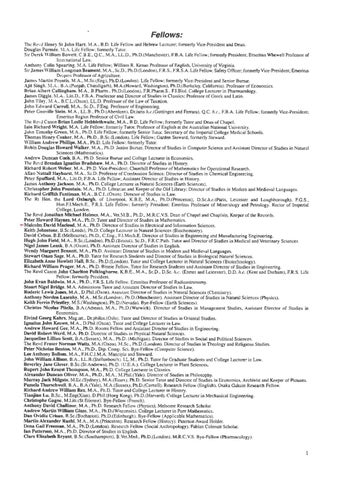
Fellows: The Revd Henry St John Hart. M.A., 8.0. Life Fellow and Hebrew Lecturer; fonnerly Vice-Presidenl and Dean. Douglas Parmee. M.A. Life Fellow; fonnerly Tutor. Sir Derek William Bowett, C.B.E., Q.C., M.A., LL.D., Ph.D.(Manchester), F.B.A. Life Fellow; fonnerly President; Emerirus Whewell Professor of lmemational Law. Anthony Colin Spearing. M.A. Life Fellow; William R. Kenan Professor of English, University of Virginia. Sir James William Longman Beament, M.A., Sc.D., Ph.D.(London), F.R.S., F.R.S.A. Life Fellow. Safety Officer; formerly Vice-President; Emeritus Drapers Professor of Agriculture. James )lartln Prentis, M.A., M.Sc.(Eng), Ph.D.(London). Life Fellow; formerly Vice-President and Senior Bursar. Ajit Singh, M.A .• B.A.(Punjab, Chandigarh), M.A.(Howard, Washington), Ph.D.(Berkeley, California). Professor of Economics. Brian Albert Callingham, M.A., B.Pharm.. Ph.D.(London). F.R.Pharm.S., F.I.Biol. College Lecturer in Phannacology. James Diggle. M.A., Litt.D., F.B.A. Praelector and Director of Studies in Classics; Professor of Greek and Latin. John TIiey, M.A., B.C.L.(Oxon), LL.D. Professor of the Law of Taxation. John Edward Carroll. M.A., Sc.D., F.Eng. Professor of Engineering. Peter Gonville Stein, M.A., LL.B., Ph.D.(Aberdcen), Dr.iuris h.c.(Gottingen and Ferrara), Q.C. h.c. , F.B.A. Life Fellow; fonnerly Vice-President; Emeritus Regius Professor of Civil Law. The Revd Canon Brian Leslie Hebblethwaite, M.A., B.D. Life Fe!Jow; formerly Tutor and Dean of Chapel. lain Richard Wright, M.A. Life Fellow; formerly Tutor. Professor of English at the Australian National University. John Timothy Green, M.A., Ph.D. Life Fellow; formerly Senior Tutor. Secretary of the Tmperial College Medical Schools. Thomas Henry Coaker, M.A., Ph.D., B.Sc.(London). Life Fellow; Garden Steward, formerly Steward. William Andrew Phillips, M.A., Ph.D. Life Fellow; fonnerly Tutor. Robin Douglas Howard Walker, M.A., Ph.D. Junior Bursar, Director of Studies in Computer Science and Assistant Director of Studies in Natural Sciences (Mathematics). Andrew Duncan Cosh, B.A., Ph.D. Senior Bursar and College Lecturer in Economics. The Revd Brendan Ignatius Bradshaw, M.A., Ph.D. Director of Studies in History. Richard Robert Weber, M.A., Ph.D. Vice-President; Churchill Professor of Mathematics for Operational Research. Allan Nuttall Hayhurst, M.A., Sc.D. Professor of Combustion Science. Director of Studies in Chemical Engineering. Peter Spofford, M.A., Litt.D, F.B.A. Life Fellow; Assistant Director of Studies in History. James Anthony Jackson, M.A., Ph.D. College Lecturer in Natural Sciences (Earth Sciences). Christopher John Pountain, M.A., Ph.D. Librarian and Keeper of the Old Library; Director of Studies in Modem and Medieval Languages. Richard Griffith Fentiman, M.A., B.C.L.(Oxon). Director of Studies in Law. The Rt Hon. the Lord Oxburgb, of Liverpool, K.B.E, M.A., Ph.D.(Princeton), D.Sc.h.c.(Paris, Leicester and Loughborough), F.G.S., Hon.F.l.Mech.E., F.R.S. Life Fellow: formerly President: Emeritus Professor of Mineralogy and Petrology. Rector of Imperial College, London. The Revd Jonathan Michael Holmes, M.A., Vet.M.B., Ph.D., M.R.C. V.S. Dean of Chapel and Chaplain. Keeper of the Records. Peter Howard Haynes, M.A., Ph.D. Tutor and Director of Studies in Mathematics. +-Malcolm David Macleod, M.A., Ph.D. Director of Studies in Electrical and Information Sciences. Keith Johnstone, B.Sc.(Lceds), Ph.D. College Lecturer in Natural Sciences (Biochemistry). David Cebon, B.E.(Melbourne), Ph.D., C.Eng., F.I.Mech.E. Director of Studies in Engineering and Manufacturing Engineering. Hugh John Field, M.A., B.Sc.(London), Ph.D.(Bristol), Sc.O., F.R.C.Path. Tutor and Director of Studies in Medical and Veterinary Sciences. Nigel James Leask, B.A.(Oxon}, Ph.D. Assistant Director of Studies in English. Wendy Margaret Bennett, M.A., Ph.D. Assistant Director of Studies in Modem and Medieval Languages. Stewart Onan Sage, M.A., Ph.D. Tutor for Research Students and Director of Studies in Biological Natural Sciences. Elizabeth Anne Howlett Hall, B.Sc., Ph.D.(London). Tutor and College Lecturer in Natural Sciences (Biotechnology). Richard William Prager, M.A., Ph.D. Binnie Fellow, Tutor for Research Students and Assistant Director of Studies in Engineering. The Revd Canon John Charlton Polkinghome, K.B.E., M.A., Sc.O., D.Sc. h.c. (Exeter and Leicester), D.D. h.c. (Kent and Durham), F.R.S. Life Fellow; foanerly President. John Evan Baldwin, M.A .• Ph.D., F.R.S. Life Fellow. Emeritus Professor of Radioastronomy. Stuart Nigel Bridge. M.A. Admissions Tutor and Assistant Director of Studies in Law. Roderic Lewis Jones, M.A., D.Phil.(Oxon). Assistant Director of Studies in Natural Sciences (Chemistry). Anthony Norden Lasenby, M.A., M.Sc.(London), Ph.D.(Manchester). Assistant Director of Studies in Natural Sciences (Physics). Keith Ferrin Priestley, M.S.(Washington), Ph.D.(Nevada). Bye-Fellow (Earth Sciences). Christos Nicolas Pitelis, B.A.(Alhens), M.A., Ph.O.(Warwick). Director of Studies in Management Studies. Assistant Director of Studies in Economics. Eivind Georg Kahrs. Mag.art.. Dr.philos.(Oslo). Tutor and Director of Studies in Oriental Studies. Ignatius John Keown, M.A., D.Phil.(Oxon). Tutor and College Lecturer in Law. Andrew Howard Gee, M.A., Ph.D. Rooms Fellow and Assistant Director of Studies in Engineering. David Robert Ward, M.A, Ph.D. Director of Studies in Physical Natural Sciences. Jacqueline Lillian Scott, B.A.(Sussex), M.A., Ph.D. (Michigan). Director of Studies in Social and Political Sciences. The Revd Fraser Norman Watts, M.A.(Oxon), M.Sc., Ph.D.(London). Director of Studies in Theology and Religious Studies. Peter Nicholas Benton, M.A., Ph.D., Dip. Comp. Sci. Bye-Fellow (Computer Science). Lee Anthony Bollom, M.A., F.H.C.I.M.A. Manciple and Steward. John William Allison, B.A.. LL.B.(Stellenbosch), LL.M., Ph.D. 1\1tor for Graduate Students and College Lecturer in Law. Beverley Jane Glover, B.Sc.(St Andrews), Ph.D. (U.E.A.). College Lecturer in Plant Sciences. Rupert John Ernest Thompson, M.A., Ph.D. College Lecturer in Classics. Alexander Duncan Oliver, M.A., Ph.D., M.A., M.Pbil.(Yale). Director of Studies in Philosophy. Murray Jack Milgate, M.Ec.(Sydney), M.A.(Essex), Ph.D. Senior Tutor and Director of Studies in Economics, Archivist and Keeper of Pictures. Pamela Thurschwell, B.A., B.A.(Yale), M.A.(Sussex}, Ph.D.(Cornell). Research Fellow (English). Osaka Gakuin Research Fellow. Richard Andrew William Rex. M.A., Ph.D. TULor and College Lecturer in History. Tianjian Lu, B.Sc., M.Eng(Xian), D..Phil.(Hong Kong), Ph.D.(Harvard). College Lecturer in Mechanical Engineering. Christophe Gagne, M.Lin.(St.Etienne). Bye-Fellow (French}. Anthony David Challinor, M.A., Ph.D. Research Fellow (Physics). Melsome Research Scholar. Andrew Martin William Glass, M.A., Ph.D.(Wisconsin). College Lecturer in Pure Mathematics. Dan Ovidiu Crisan, B.Sc.(Bucharest), Pb.D.(Edinburgh). Bye-Fellow (Applicable Mathematics). Martin Alexander Ruehl, M.A., M.A.(Princeton). Research Fellow (History). Paterson Award Holder. Dena Gail Freeman, M.A., Ph.D.(London). Research Fellow (Social Anthropology). Fabian Colenuu Scholar. Ian Patterson, M.A., Ph.D. Director of Studies in English. Clare Elizabeth Bryant, B.Sc.(Southampton), B.Vet.Med., Ph.D.(London). M.R.C. V.S. Bye-Fellow (Pharmacology).
l
From the President These are difficult times for the College. Fee income has been cut. The finances of undergraduates and graduates are becoming ever more precarious. Keeping together a fellowship committed to world-class teaching and research is an ever greater challenge in an increasingly competitive world. Yet Queens' is thiiving. To a significant extent this is due 10 the efforts of all the Members of the College. Academic pecformancc continues to be amongst the very best in the University, whilst the achievements of the Fellowship have been recognised in a record number of promotions. The contributfons which Members have made to the 550th Anniversary Appeal are enabling the College 10 overcome the difficulties posed by reduced student funding, ensuring that Queens' can continue to attract, and where necessary support, the very best students. The quality of our students and the friendly character of the College at all levels, are imponant factors helping us to attract outstanding new Fellows to Queens' . Our ' Investing in People' Appeal, could not have been better timed. This edition of The Record provides. as always. a picture of the multifaceted life of the College. Music, drama and dance are thriving as never before. thanks in no small part to the support of the Membership. That suppon is also in evidence in sport, not just in the Boat Club (which has traditionally been aided by Old Members) but also in rugby and other spons too. Some of the suppon is financial; some involves assistance in coaching and training. This wider picture of Queens' College, including all Members of the College, has been reinforced by the events organised around Q550. Lunches and dinners. Academic Saturday, the Varsity Match, and the Members' evening at the Bats play have all been occasions that have brought the wider College together. 1\vo important events in the coming year will be the College Choir singing Evensong al Westminster Abbey on 27th April (followed by a reception for Members of the College at Westminster School) and the 'Grown-Ups' Ball' on Friday 11th August. I hope you will come along and enjoy them both. When I first became President, many Members told me that they had not beard from the College for years. Now I suspect that many are feeling that they never stop receiving correspondence about some new Queens" initiative.1 hope that this steady flow of mail not only contributes to keeping in touch, but also provides some real substance to your continuing membership of the College. Queens' is an entirely private institution. It receives no funding from the Government (other, that is, than the tax benefits associated with charitable
giving - Gordon Brown will now contribute 28p for every ÂŁ1 given by Members). ln the future, just as in the past, the success of the College depends on the continuing support of the Members, on their willingness to give back to the College something of what earlier generations provided for them. Fortunately, there is ample evidence that Members of Queens' are committed to the success of the College, so that it will continue to thrive. even in difficult times. JOHN EATWELL
The Society The Fellows in 1999 The whole College was greatly saddened in August by the death of John Holloway, Emeritus Professor of Modem English, who had been a Fellow of Queens¡ for 44 years and served as a Tutor and Director of Studies in English. A memorial service was held in Chapel in October. Professor's Diggle's address on that occasion is published elsewhere in 11,e Record. On a happier note, the College was delighted by the life peerage conferred on Sir Ronald Oxburgh, former President, and Rector oflmperial College, London. Professor Oxburgh has taken the title Lord Oxburgh of Liverpool. It is also a great pleasure to record the knighthood conferred on Sir Martin Harris, Honorary Fellow and Vice-Chancellor of the University of Manchester, and the G.B.E. (Knight Grand Cross of the Order of the British Empire) conferred on Sir Stephen Brown on bis retirement as President of the Family Division of the High Court. Sir Martin Harris and Sir John Banham have also been appointed Deputy Lieutenants of Greater Manchester and Cornwall respectively. In October the Society beard with great pleasure of the appointment of Allan Hayhursl to a personal Chair; he is to be Professor of Combustion Science. The University also promoted to personal Readerships four Fellows and a Fellow Commoner: Mr Richard Fenti.man, Dr Peter Haynes. Dr Lisa Hall. Dr Roderic Jones and Dr Philip Towle. Dr Kareen Thome retired after seven productive years as Senior Tutor and the Governing Body immediately asked her to become a Fellow Commoner. Kareen has presided over the academic side of College life with calmness and quiet authority and done much to maintain academic standards at Queens'. She has also been an effective supervisor in Biochemistry for the medical and veterinary students. For part of her term of office her
Members ofthe Housekeeping Staff receivillg their Customer Care Course certificates from the Preside/I/. Photo: By pem1issio11 of Cambridge Evening News
2
John Polkinghome, former President, has been awarded an Honorary
D.D. by the University of Durham and also the von Humboldt Foundatio.n
Dr Kareen Thome.
Photo: Dona Haycraft
husband, Chris, was Senior Tutor: of St Catharine's - a unique double in Cambridge. She also served as Secretary of the Senior Tutors Committee of the University. Dr Murray Milgate took over as Senior Tutor in October. Dr Richard Rex has become a Tutor. Professor John Baldwin retired as Professor of Radioastronomy in September and becomes a Life Fellow. Dr Brendan Bradshaw also retired from his University office, but continues as Director of Studies in History at Queens·. He has, unfortunately, had to take leave of late following serious illness. but the College is pleased to bear that he is on the mend. Dr Peter Spufford, who retired from bis Fellowship in September. has continued to act as Dr Bradshaw's deputy. Dr Spufford has also been elected to a Life Fellowship. Canon Brian Hebblethwaite retired from his University offices in September after a year as Senior Proctor. Professor John CarrolJ is on leave after serving for several years on the General Board of the University. Dr Malcolm Macleod bas been elected onto the Council of the Senate. Several Fellows have left Queens'. Dr Georgia Brown came to the end of her Official Fellowship in English and Dr Stefan Llewellyn Smith to the end of his tenn as a Research Fellow, Dr Llewellyn Smith has taken up an Associate Professorship in California. Dt John Richer resigned his Fellowship on his appointment as UK Project Scientist for the Atacama Large Millimetre Array, be continues to be based at the Cavendish Laboratory. Dr Stephen Hewson resigned his Research Fe llowship to take up a job in the City of London. Mr Michael Smithson resigned bis post as University Development Director in order to take up a similar post at Oxford. Two other Research Fellows, Dr Beverley Glover and Dr Rupert Thompson, were elected to Official Fellowships on their appointment as University Teaching Officers, and Dr Andrew Glass bas been elected to an Official Fellowship in Pure Mathematics. Four new Fellows have joined the Society. Mr Martin Ruehl, an historian and an old member of the College, who bas been studying at Princeton, and Dr Dena Freeman, a social anthropologist, who was an undergraduate at Jesus College and has undertaken research at the University of London, have been elected to Research Fellowships. Dr Ian Patterson comes to us from King's College and is Director of Studies and a College Lecturer in English. Dr Clare Bryant, a phaunacologist at the Veterinary School, has been elected to a Bye-Fellowship. The President was a member of the Joint Committee of the Lords and Commons on the Financial Markets and Services Bill. He is now Deputy Chairman of the Enforcement Committee al the Securities and Futures Authority. His work on financial regulation continues to be funded by the Ford Foundation. As a member of the Board of the Royal Opera House he had the honour of escorting the Patroness at the re-opening of the House. In January he published Global Finance at Risk: the Case for lntema1io11al Reg11/atio11, written with Professor Lance Taylor of the New School for Social Research, New York.
senior research award. His book, Belief in God i11 an Age of Science, was awarded a prize by the Templeton Foundation as the most outstanding book on Science and Religion published in 1998. Professor Sir James Bearnent's String Sextet Op.50, published by Phylloscopus in 1999, is believed to be the first ever published music by a Fellow of the Royal Society. Professor Singh gave lectures. and seminars in the Netherlands, Italy, India and the US. He participated in a panel discussion on the Asian Crisis with the President al the American Economic Associ.alion Annual Meeting in New York in January 1999 and be- gave several radio and television interviews in connection with the award of the Nobel Prize in economics to Professor Amartya Sen. Of tbe lectures de)jvered abJoad during 1999 by Dr Brian CaUingham, perhaps the most interesting was one of tbe two plenary lectures at the Congress of African and Arabian Pharmacological Societies in Cairo. Professor John Tiley has been made a Fellow of the Chartered Institute of Taxation. Professor Diggle bas lectwed in Dublin, and in Madison, Wisconsin. He is Chairman of a Committee that is overseeing the production of a major new Lexicon of Ancient Greek, and Chairman of the 'Classical Antiquity· Section of the British Academy. Professor Wright has been elected Honorary Secretary of the Australian Committee of the Cambridge Commonwealth Trust and reelected to the Executive Committee of the International Association of Universiry Professors of English. He convened a conference on 'The End of Postmodernism?' in Canberra and is editing the conference papers for publication. Dr Spufford has addressed historical colloquia on medieval mines, moJ1ey and merchants in Tlibingen, Estella, Milan and Cambridge, and has spoken at the 'Datini' conference of economic historians in Prato and lectured in the University of Arhus. He has also published a two-volume reference work on early modem English probate accounts. Dr Malcolm Macleod, together with V K-N Lau, received The Hong Kong Institution of Engineers Transactions Prize 1999 for the paper 'Variable Rate Adaptive Channel Coding for High Bandwidth Efficiency Applications'. Dr David Cebon's book Handbook of Vehicle-Road Interaction was published during 1999. Dr Richard Prager and Dr Andrew Gee helped to organise the 2nd International Conference on Medical Image Computing and Computer-Assisted Intervention which was held in Cambridge in September 1999. This conference attracted several hundred delegates from all over the world (including one who came from Belarus by bus!). Mr Stuart Bridge published a book on Assured Tenancies for Blackstone Press and made a substantial contribution to the new edition of Megarry & Wade's L(lw of Real Property. Dr Pitelis has received the '.New Century Award ' from Baron ·s Who is Who, as a member of tbe Financial 500 who have been cited as leaders for the new century. He has travelled to conferences in Russia, Barbados and Italy. He has published in, and edited, a special issue of, Contributions to Political Economy and also published in the Journal ofEconomics Srndies. He organised conferences for the ACE Project and for the Advisory Board members of the Centre for International Business and Management. In April 1999 Dr John Keown gave the Otin Foundation Distinguished Lecture at Notre Dame Law School, Indiana; he toured Australia in Ju.ly lecturing on end-of-life decision-making. Dr Keown's latest analysis of data concerning the practice of euthanasia in the Netherlands was published in the Jo11mal of Medical Ethics and his third book, The wst Rights, will be published soon. He has also been assisting in drafting lhe Medical Treatment (Prevention of Euthanasia) Bill. Dr Richard Rex published an edition of a fascinating, but little known, early English Protestant text, as Thomas Swynnerlon's Tropes and Figures ofScripture. Dr Rex has also become Academic Secretary of the Faculty of Divinity. He bas also lectured and published extensively on the Reforroaton world an,d on Henry Vlll. Dr Andrew Glass's book, Partially Ordered Groups, was published by World Scientific Publishing in August 1999. Dr Glass gave a series of lectures in the Peoples' Republic of China on 'Algorithmic Effectiveness in Algebra' . Dr David Evans, Fellow Commoner, bas written The Demise of 'Brain Death' in Britain for an anthology entitled Beyond Brain Demh: The Case Against Brain-based Criteria for Human Death. Mr Peter Watson has been awarded the Krwawicz Gold 'Medal from Poland and has been appointed Boerhaave Professor in th.e University of Leiden. He is Chairman of the Education Committee of the International Council of Ophthalmology. Dr David Sattelle has been appointed Head of Neural Signalling in the new MRC Functional Genetics Unit at Oxford, and thus leaves Queens' after over thirty years. Of our Honorary Fellows, Charles Tomlinson, has pubUshe(\ The Vineyard Above the Sea and a lengthy review of his poetry appeared in The Paris Review. He was invited to Mexico City and the Metropolitan Museum at New York to read his translations of Octavio Paz's poetry. He has travelled to Tlaly and Japan and has recently been made an Honorary Foreign Fellow of the American Academy of Arts and Sciences. Professor Peter Mathias continues ;is Chairman of the Trustees, of the Great Britain-Sasakawa Foundation which promotes Anglo-Japanese relations, has been a Visiting Professor at Bolzano University in Italy, lectured at the. Institute of Philosophical Studies in Naples and was appointed Chairman of the University Press of the Central European University, Budapest. In February he retired as Chairman of the National Advisory Council of the British
3
Library. Professor Sir Marlin Harris completed two years as Chairman of the Committee of Vice Chancellors and Principals and four years as Chairman of the Clinical Standards Advisory Group which has now been replaced by the Commission for Health Improvement. Sir Martin has been appointed as one of the initial group of fourteen Health Commissioners. Bishop Mark Santer has been awarded Honorary D.O.s from Birmingham and Lambeth. Dr Michael Foale has been once more into space aboard the shuttle, Discove1y, and, in a long 'Extra-Vehicular Activity', effected major repairs and modifications to the Hubble Telescope. JOHN EATWELL
Thomae Smithi Academia The Thomae Smithi Academia, a discuss.ion group for Fellows and Fellow Commoners. founded in 1976, continues to bold five meetings annually, in the Old Combination Room. Discussions were held on 1he following topics: 'Ageism, Health Care, and Justice', introduced by Dr Keown, 'Should we eat genetically modified food?' introduced by Dr Glover, ' Government Policy and the Wealth of Nations', introduced by Dr Pitelis, 'Patents, Consulting, Books and Lectures - Should the University own our efforts?', introduced by Professor Carroll, 'Cellar Prospects¡, introduced by Dr Kahrs. JAMES DIGGLE
The Hart Walk 1999 This year's Lakeland peregrinations began on Trinity Sunday. when a dozen of us undertook a pre-prandial limbering up fromSlonethwaite to High Spy, some returning via Cat Bells in a stiff N.E. breeze, with high cloud but no rain. Appetites were thereby whetted for dinner at the Yew Tree at Seatoller presided over by Henry and Gil l. After Lakeland plum bread pudding and toffee sauce there was a chance to mingle in the stream-side garden. The Monday dawned calm over Derwentwater, but with clouds over Great Gable as an ominous reminder of last year, when we were confined to a low-level walk. Undeterred, a large party of Queens.men and their families rapidly took over the Honister Pass car park, from which two processions duly emerged: those who might have lefi the Dean behind tackled the inclined plane, while Henry and his retinue followed a gentler route, with furled windbreaks adding to the sense of pilgrimage. The subsequent ascent of Green Gable necessitated a certain amo1mt of reconnoitring and path smoothing by scouting parties, so that by lunchtime Henry had reached his goal, to much applause. Remembering my precipitous scree-run of 4-0 years ago.1 asked Henry's permission to climb Great Gable. the cloud having lifted as we arrived. "Watch your step" was enough to speed a dozen of us (including a six-year-old) to the summit for photographs before the cloud seuled again. Various routes were followed back to Rosthwaite, our's being over Haystacks and down into Gatesgartb. By the time we reached the Royal Oak the only rum butter left was as traces on the plates, but hot tea helped to reinforce the memory traces of friendships and peaks old and new, enlivened by a host of conversations on topics as diverse as the conviction of seventeenth century Quakers and the financial costs of bungee-j umping. Once again, Henry had furthered our all-round education by taking co the hills. DAVID HARDING ( 1958)
Dr Michael Foale 011 his latest mission in space. Photo: By kind pem1issio11 ofNASA
4
Professor John Holloway Fellow 1955-1999 Professor Jolm Holloway, Emeritus Professor of Modem English and a fon11er Tutor and Director of Studies i11 English at Queens'. died 011 29th August 1999 aged 79. Thefollow ing is the address delivered at his Memorial Service by P,-r,fessor James Diggle. The outlines of the life of John Holloway are briefly told: Earliest years in south London, described in his memoir A Lo11do11 Childhood; the County School at Beckenham in Kent; an open scholarship in History to New
College, Oxford, and a First in Modem Greats; war service, in the Artillery and Intelligence; Temporary Lecturer in Philosophy at New College, then Fellow of All Souls; Lecturer in English at Aberdeen; then to Cambridge, to be Lecturer, Reader. Professor of Modem English, and a Fellow of Queens' College for forty-four years. If we fill in the outlines by adding his scholarly works, we shall stan with a book of linguistic philosophy, Ltmguage and lll1ellige11ce, soon followed by the book which established his name, The Victorian Sage, a study of philosophy, rhetoric and religion in the works of six Victorian writers and thinkers. As we proceed, we find that philosophy has yielded place to literature. And turning the pages of a dozen volumes of criticism and theory, we marvel at the multitude that passes by: Shakespeare and Milton and Donne and Blake: Wordsworth, Byron. Shelley, Keats; Dickens and Hardy, George Eliot, Henry James: Boccaccio, Racine, Dostoevsky, Chekhov; Christopher Isherwood, Wyndham Lewis, Muriel Spark, and Patrick White. But beside these familiar faces are others, unrecognised, and som.etimes nameless. These are the writers who step forth from 1he two volumes of Later English Broadside Bc,l/ads, which he edited with his second wife Joan. and from the Oxford Book of weal Verses. For what interested John was language, in all its forms, from whatever sources; and a street-song, a churchyard epitaph, a country charm or a farmer's chyme, an inscription on a sampler or a sundial or a fountain or a bell, could engage him no less than the giants of literature. Such, then, was the scholar. But how much more than scholar was the man. He was teacher and poet too; and teaching and poetry, I fancy, he ranked not lower than scholarship. For two years Byron Professor in Athens, teaching English litera1ure to Greek students; to fndia, Ceylon. Pakistan, for the British Council; and Hong Kong, New Zealand, Tunisia, and Japan do not exhaust the list of his travels as lecturer. And at home he was ever prompt to answer the call, or volunteer, when a talk was wanted by College or other society. In the lecture and the informal talk he excelled. He broadcast often, and he made many recordings for schools. His technique was simple. Suppose that his subject was a novel by Dickens. He spoke as ifhe had j ust put the book down. He.had found in it this and that, and he felt that this and that were worth telling you about. There was no parade of learning; what other critics may have said was not his concern. What he told you. in language direct and lucid, was what be believed was worth knowing and worth thinking about. He let you in to his own thoughts, in a manner and voice confiding and encouraging, and you felt privileged to be let i.n. But it was above all as poet that he wanted to be remembered. Six collections of verse stand to his name, verse deep in thought and deep in feeling. He said of his poetry: "I care for intellectuality, but I care for what is (in a sense) primitive. and for the stranger realities that spread all around intellectuality's narrow circle". Five years ago. the culmination of his poetic achievement, came that long and complex poem, Civitamla, The little City. the name which the Venerable Bede gave to Cambridge. The poem charts tbe whole history of the region, from times remote and immemorial to the present day. ln varying poetic modes and metres, it mingles geology and history, anecdote and biography, the real and the imagined, distilling the essence and the spirit of the place and its people. Listen to this passage. in which landscape and language are made one, and life and meaning are breathed into the names of well-known places. Saxon words. Consonants on the teeth or aspirated; and made names for the high ground they came to at last. Herel's Farm, at Harston; Trippa 's hill at Thriploiv by lhe moor. (Tmmp for my own village) swallowed in the City, and seems to mean ¡the Fann of the surly Man'. He11gest at Hinxton. Comberton, Cumbra, Orwell of the Fair Spring; north in the Fen, Stretham, the place on the Roman Straet (all grass now); Witte/'s eyot;
and Ely the plenty of eels. They spoke: fen, forest and open field became names and places. When the teacher is forgotten in the lecture room, and the scholar is replaced on the library shelf by newer fashions, John Holloway poet will live. There is a poem in his earliest collection. called 'The Petty Testament of Peter the Clerk'. It is a monologue. The speaker reviews his past life and makes dispositions for his death. Then he reveals, to our surprise, that he is a man of thirty years, and I suspect that this was the age of the poet himself. One stanza. to end. poignant and prophetic: And now. alas, what is there left Of all the things that once were mine? E\'ery book and every friend And every vice and virtue's gone Like things .left on the beach, that drift With the blind tide away from hind: Only. I think that it will be Some little time, before I die
JAMES DIGGLE Professor lain Wright also writes:-
With the death of Professor John Holloway, the literary world has lost one of its most distinctive, independent and humane voices, its only major poetcritic since Eliot and Empson, and a writer and teacher of extraordinary breadth. "O royal Holloway, a college in himself' was the quip at his retirement party in Cambridge, and it was true. He ranged from books on Shakespeare and on the Victorian sage to technical work in linguistic philosophy, from editions of ballads to discussions of Australian aboriginal songs to critiques of structuralism to translations of Russian verse; from wide, sweeping meditations on the evolution of the modem self to poignant little poems on love and landscape and loss. His first book, fonguage and fn1ellige11ce (I 95 I), was ostensibly a defence o( the new kind of analytic language-philosophy then being advocated by his mentor Gilbert Ryle but anyone reading between the lines could have predicted that he would not be able to continue to discuss the forms of language and intelligence which he was interested in, and to the celebration, defence and definition of which he devoted the rest of his career, within aoa.lytic philosophy's schematised and disembodied vocabulary: "an account invented for one fragment of human activity by thinkers oblivious of the rest of it" was how he described 'classical' language-philosophy, but be clearly had th.e same unease about its successor. In a bold move, he quit philosophy and reinvented himself as a poet and critic, writing a second doctorate, on Skelton. He then wrote his best and most influential book, The Victoria11 Sage ( 1953), which developed a way of reading the work of the great nineteenth century social critics - Carlyle, Arnold, George Eliot, etc. - simultaneously as philosophy and as rhetoric. It was a book which only he bad the qualifications and sympathies to write. By the mid-fifties, he was already reaching a wide audience as a poet, via radio broadcasts and publication in magazines such as The Spectaior and The New Statesman, and seven collections of verse foUowed, two of them - to his great satisfaction - being selected as 'Choices¡ of the Poetry Book Society. Pigeon-holing literary historians have him labelled as a member of 'the Movement' (Larkin, Amis, Wain, etc.) but be. was not, nor of any movement. It is clear who his poet-heroes were - Edwin Muir and Robert Graves above all - but his poetic voice, with its odd blend of cerebration and sensuality, the donnish and the Dionysiac, was entirely.his own, sui generis. He was generally prolific as a critic. In 1961 he published The Story of the Night: Studies in Shakespeare's Major Trngedies, which for many readers delivered the deathblow to the mealy-mouthed moralism which. thanl<s 10 Dr Leavis, had become the orthodoxy in Shakespeare studies ("before it is a source of insight, great imaginative literature is a source of power"). The Lion Hunt, a strange, confessional prose poem-cum-essay on 'galloping rnodemity', the decay of language and the future of poetry appeared in 1964. followed by Widening Horizons in English Verse (1966) which, long before the analysis of 'orientalism' became all the fashion, explored English poetry's discove.ry of the cultural Other and 'exotic' cultures. The Proud Knowledge (1977) was equally ahead of its time in its detailed study of literary 'self-fashioning' from the Renaissance to the twentieth century. Unlike most senior members of his Faculty, John Holloway refused to join the witch-hunt against 'theory' which was then well under way, remarking icily of one colleague's sneering dismissal of French theory in general that "the discussion is simply not worth pursuing at this level", and although he in fact had very little in common with the Parisian nouvelle critique, be developed his own thoughtful engagement with structuralist theory in Narrative and Stmc111re (1979). He generally ploughed a pretty lonely furrow in the Cambridge English Faculty in fact. In I 970 and I971 he took his tum as its chairman and initiated some important reforms, bringing more American literature and more contemporary English literature into the syllabus, but like many others, he had to lay waste too many of his powers in dealing With the personalised
John Holloway in 1958.
Photo: A. C. Barrington Brown
bickerings and backstabbings and virility contests which (another Leavis legacy) then took the place of [easooed debate in the Faculty. Diplomacy and administration - in that kind of poisonous atmosphere at least - were not his strong suit and he in effect quit the academic political field, to get oo. with bis own writing and teaching, long before bis retirement in J982. The works of his last years were the marvellous Oxford Book of Local Verses (1987) with its exhilarating demonstration that "a gift for poetry is not the preserve of any elite"; The Slumber ofApollo (I 983), a rather sad jeremiad in which he argued - with his usual suppleness but implausibly that modem consciousness was undergoing a general narrowing and coarsening; and Civitatula (1993), a remarkable multivoiced historical epic poem about the City and University of Cambridge he so much loved and a more fitting valediction: You need not think anything everlasting ... Now at the end of a summer evening's moment,the sun composes its early vignette at the end of the lane. IAIN WRIGHT
The Rt Hon Sir George Waller Honorary Fellow 1974-1999 George Stanley Waller came to Queens' in 1929 from Oundle, took both pruts of the Law Tripos and gained a Blue for rugby. Called to the Bar in 1934, be practised in Newcastle-on-Tyne working on the North East Circuit, thus obtaining a wide general experience of the administration of justice. During the War he served in Coastal Command (a natural outcome of his undergraduate membership of the University Air Squadron), reached the rank of Wi.ng Commander, received a mention in despatches and was appointed OBE in 1945. Following demobilisation, be returned to practise at the Bar, was chairman of the Northern District Valuation Board from 1948 to 1955, became a QC in 1954 and was Recorder, successively, of Doncaster, Sunderland.Bradford, Sheffield and Leeds unti.1 his appointment to the High Court and knighthood in 1965. The broad span of his socjal and legal experience was of special advantage during his service on the Parole Board ( 1969-72, Vice-Chairman in 1971), his membership of the Advisory Council on the Penal System (1970-75), Chairmanship of the Policy Advisory Committee on sexual offences (1977- 85) and membership of the Criminal Law Revision
5
Committee during the time it was considering sexual offences. Promoted to the Court of Appeal and sworn of the Privy Council in 1976, he retired as a Lord Justice of Appeal in 1984. Widely recognised as an extremely good judge for his knowledge of the working of the law and its effect on the lives of ordinary men and women, he was particularly alive to the way people react under pressure and had a feeling for those with problems and in trouble. Neither conservative nor moralistic, he possessed a sense of humanity and humour and kept an open mind in a changing moral climate. Sir George was elected an Honorary Fellow of the College in 1974. His visits 10 the College to talk to Queens' Bench were much appreciated. He is survived by his wife, a daughter and two sons, Sir MarkWall.er and Professor James Waller, both of whom are themselves distinguished in Law - one as a Lord Justice of Appeal and the other as a criminologist in Canada - and both of whom followed him to Queens'.
The Staff A visit to the pantomime. Aladdi11, at the Arts Theatre by 75 members of staff and their families started off a busy year for the Staff Sports and Social Club. A day trip to France via the Channel Tunnel to the CiL~ Europe shopping centre was a great success, and, in March, a Tea Party was anen.ded by 25 college pensioners. The choice of a day al Southend or a trip to London. with an optional theatre visit to see Grease, meant that over 70 members of staff enjoyed the official staff outing in June. I 12 staff members and their friends played rounders, boules and tennis and had an excellent BBQ despite chilly weather in July at the sportsground. The summer reception was auendcd by over 40 staff, pensioners and their guests who enjoyed a delicious tea in the President's Lodge Garden. There was line dancing, a buffet and a disco in September for the more energetic. A trip to the new Bluewater complex near Dartford or a more traditional option of Leicester were the choices for the shopping trip in November. The children's Christmas party was popular and a record number of staff enjoyed the dinner dance. Trevor Lord, Clerk of Works si nee I980, retired and we welcomed Steve Pauley as Head of Maintenance in the summer. Robin Wilson, the College electrician, was marrried in Chapel in May and Alison Hawk.ins, Catering Manager, married in September and is now Mrs Alison Brown. 20 of the College's bedders passed a Welcome Host Customer Care course in July. The presentation of their certificates by the President was featured in the Cambridge Evening News. Those who knew John Camps will be sad to hear that he died in November 1999. John joined the College Bursary staff when be was fifteen and worked his way up through the ranks to become Cleek to the Bursar. He retired in 1995 due to ill health. We also have to announce the death of Anna Marino who worked in the catering department for twenty-eight years, before retiring in 1992. GILL HERVEY-MURRAY
programme of conversions during the Long Vacation 2000 with W staircase, including one ground-floor set to be converted for use by a disabled person. During the works on Y staircase, an outbreak of wet rot was discovered under a leaky roof, on which repairs were started in the Christmas Vacation. An unrelated but substantial infestation of dry rot fungus was discovered in the roof above W staircase, also stemming from a leaky roof. The resulting remedial woru rendered one bathroom at the top of the staircase unusable for much of the Michaelmas Term 1999 whi le lhe ceiling and other timbers were renewed. The fungus had spread down the walls through the mortar between the bricks and attacked the window-frame, which also had to be replaced. To complete a trilogy of roof problems, lhe flat roof over part of the JCR Office failed and began to subside, so that water would not run to the drains. This office is located under the Essex Room of the President's Lodge and has a single-storey extension with the problematic roof. In the 1960s, this area had been converted into use as a pantry for the Fellows' Butler, when the old SCR was stilJ in use. The rooms on the ground floor were taken over by the JCR some years ago. The building as a whole is of uncertain and varied vintage: some of it must pre-date the Long Gallery (which it holds up), but the stone wi ndow was inserted in the 1960s. The flat roof was a simple asphalt layer over a timber frame which had gone rotten. The whole structure was renewed. By the time Cripps Court Phase l was bu.ill in the early 1970s, the dangers of asbestos had been recognised, and certain forms of it had been outlawed as a building material, while other forms, considered not to be dangerous, continued to be used as ingredients in such things as insulati ng panels. The latest Asbestos Regu lations, however, now make no distinction between one form of asbestos and another: if works have to be carried out involving any kind of asbestos, very demanding conditions apply. The College could not possibly meet those conditions every time we needed to demount a panel just 10 replace a tap washer, so it was decided to remove in bulk from Cripps Court the panels containing asbestos as an ingredient that our maintenance staff were likely to encounter in regular work. The problem areas included bath panels and gyp-room cooker insulation. This was done in the Christmas Vacation 1999, when the entire building was evacuated of residents. We employed a second company to monitor the contamination levels created by 1he first: no problems were found. We have renewed part of the floor surface of the college kitchens, replacing the ceramic tiles laid in 1977 with an epoxy screed. The tiles had begun to decay. At 61 Panton Street, a new back door has been created into the communal courtyard already shared by 63, 65 Panton Street and 98 Norwich Street, so that 61 can also share use of the court. The whole house has also been redecorated. We are in the process of selling 77 River Lane, formerly used as a house for three postgraduate studentS, which had proved lo be too small and too far from College to be able to maintain economicaUy. At 71 Maids Causeway, a full-scale slate roof renewal is in progress. There are now 300 students with computers in their own rooms connected to the college network. ROBIN WALKER
Reriremem Party o/Trevor lcrd, Clerk of Works. Photo: Bria11 Ccdlingham
The Fabric In the Summer Vacation 1999, major renovations were carried out to staircases X and Y of Fisher Building. These works were similar in nature to those carried out on V staircase in 1998. They incl ude the provision of an en-suite shower and WC in each residential set (excluding the attic floor, where there is insufficient room). The double guest room on Y staircase was also fitted with en-suite facilities. The project on X and Y started immediately after May Week 1999 and finfahed in early September, allowing us to complete the rooms with new catpets and curtains in time for !he Michaelmas Term. Some of the original I936 furniture was refurbished and some new furniture was added in each room. We plan to continue this
6
Summer of 1999 - Repairs to the Fisher 811ildi11g. Photo: Jo11athan Holmes
A Reynolds Portrait? Serendipity often plays a part in the life of the Keeper of the Pictures. The College has long had a portrait, believed to be by Sir Joshua Reynolds and thought to be of a "Mr Fitzwilliam". The subject is depicted half-length, wearing blue coat and white collar, in a painted oval 29 inches by 24 inches. However, neither the attribution nor the subject are at all certain. The tentative identification of the subject is taken from an undated inscription on the reverse of 1he frame.
Parliament from 1660 to 1710. Edward himself was MP for Coventry 1701-10. He was later MP for Eye 1713-27 (probably Grafton patronage). For part of that time Edward was, however, not in either Coventry or Suffolk, but in lreland, as Secretary to Charles Fitzroy, second Duke of Grafton, while he was Lord Lieutenant of Ireland 1720-4. Edward was provided with a seal in the Irish parliament, in plurality with Eye, from 1721 onwards. It is possible that Richard Hopkins was a godson of the second Duke, and brought up with the third Duke (such patronage would have been especially necessary as Edward Hopkins, his father, died when Richard was only about six). Can the 'Mr Fitzwilliam' label come from someone saying rightly 'He was connected to the Fitzroys', which tumed into ' He was connected to the Fitzwilliams' ... which turns into the label we have?" The story does not end here. There is more research to be done. A portrait of Hopkins was sold at Christie's some years back and a comparison of the two pictures (or, more accurately, a comparison of the Christie's catalogue reproduction with our picture) reveals similarities. This needs to be followed up. MURRAY MlLGATE Keeper of the Pictures
The Grove Elms During the 1970s and 1980s the countryside around Cambridge was transfonned by the devastation of Dutch Elm Disease. Thousands of trees died and relatively few survive in or around the City. Amongst those that did not_perish were the group of Huntingdon elms (Ulmus x hollaodica 'vegeta') in Queens' College Grove. Two of the trees in particular which remain have grown into magnificent specimens. They were probably planted in the late eighteenth century and are the tallest trees in the Grove. The original specimen tree of this type was raised from seed in Hinchingbrooke Pack, Huntingdon, in 1760. It bas a rapid growth rate and has been known to reach over 30 metres tall and 150 ems in girth diameter. The first known distributor of the type was from a nursery in Brampton,just south of Huntingdon. However the type grew in the wild some time prior to this and some conspicuous trees around East Anglia may be descendants of these earlier trees. The first known avenue ofHuntingdon elm was presumed to be planted at Brooklands Avenue, south of the University Botanic
The College's Joshua Reynolds picmre, perhaps of Richard Hopkins. Phoro: Christopher Hurst
Io tb.e early part of 1999 the College received an enquiry from Dr David Mannings atAberdeen University which has led to the establishment of what now seems to be a more certain provenance of the picture and a .more plausible identification of the subject. For the week of 17 February 1766, there is a note in Reynolds' 'Sitter Book' wbicb reads: "Mr Hopkins Picture to be directed to the Revd Dr Plumtre [sic) Master of Queens College Cambridge". The artist's own ledger of27 September 1766 records a payment of tbirty-five guineas with a note "paid in full". This information raised the obvious question: is this the picture tbe one currently in the College collection ?'There are strong grounds to believe that it is. Richard Hopkins (1728-1799) was admitted as a Fellow Commoner to Queens' in 1745-6. He ros.e to high parliamentary office as a Lord of the Admiralty 1782-3 and 1784-91 and a Lord of the Treasury 1791-7. liis parliamentary career began in L766 as MP for Dartmouth (to 1780). He was returned for Thetford in 1780, again for Dartmouth in 1784, for Queensborough in 1790 and, finally, for Harwich in 1796. It should be noted that the date of the picture, 1766, coincides with a significant career achievement for Hopkins; one certainly suitable to be marked by the commissioning of a major po11rait. The Queens' connection of the subject is thus easily established. Moreover, although it would be natural for a portrait of a distinguished former student to be directed to the President, there is an interesting further eonnection between Plumptre and Hopkins. Plumptre entered the Fellowship in 1745, the same year that Hopkins became a Fellow Commoner: There are, however, no references in the Conclusion Book for the relevant period of either the comrnissi.oning of, or payment for, a portrait by the College. It must be assumed, unless further evidence comes to light, that the portrait was commissioned and paid for by Hopkins and given to the College ( or the even the President) as a gift. Reynolds' ledger has a handwritten memo suggesting payment was received from Hopkins. In connection with this picture, I report some interesting speculations of my predecessor, Peter Spufford. Peter writes: "Richard Hopkins was politically connected to the Fitzroys and a personal friend of the third Duke of Grafton. (The first Duke, Henry Fitzroy, was an illegitimate son of Charles ll.) Richard's father Edward (1675-1736) was also aMembero[Parliament. Edward came from an old Coventry family that represented the City in
The Elms in the Grove from the top of Cripps.
Photo: Jo11arhan Holmes
7
Gardens. Three trees survive in the Botanic Gardens as well as two at Churchill College and two on Butt's Green. There are also four trees growing in the grounds of the Ministry of Agriculture and Fisheries on the junction of Brooklands Avenue and Shaftesbury Road, more than likely natural sucker growths from one of the original first plantings on Brooklands Avenue. The two large trees in Queens' have been noticed by the Tree Register of the British Isles which recently sent a representative to measure them. One of these trees was measured at 41 metres ( 135 ft) higb and I08 ems ( 11 ft 2 ins) in girth and the other at 43 metres (141 ft) high and 123 ems (12 ft 8 ins) in girth. These trees are then the cwo tallest living of any species of elm on record in the British Isles. The 43 metres tree is the second tallest ever recorded in history of this type and the 41 metres one the third tallest. TI1e tallest (and also the broadest) ever recorded was at Magdalen CoUege, Oxford and was measured in 1911, shortly before it blew down. at44 metres ( 143 ft) high and 274 ems (28 ft 3 ins) in girth. As this tree was said to have been planted in 1610, 140 years before this variety of tree is supposed to have been introduced, the TRBI expert is dubious about its claims and thinks the Queens' trees may well be the tallest ever Huntingdon elms. From a letter to the Garden Steward by Mr Peter Bourne, Tree Register of the British Isles.
The Chapel 1999 began with a special series of sermons at Sunday Evensong on 'The Church of England in the 2 1st Century'. The preachers were the Rt Revd Colin Buchanan, Area Bishop of Woolwich; the Dean of Chapel; the Revd Philippa Boardman, Dean of Women's Ministry for the Diocese of London and Priest-in-Charge of Old Ford St Paul and St Mark. London; the Revd Donald Reeves (1954), former Rector ofStJames's, Piccadilly. London; the Revd Canon Dr Alan Wilkinson, Honorary Diocesan Theologian, Portsmouth Diocese, and a former Principal of Chichester Theological College; the Ven. George Austin, Archdeacon of York; and the Revd Canon Dr John Polkinghome, former President of Queens' and Proctor in Convocation for the University of Cambridge. The term ended as usual with a well-attended 'Music and Readings for Passiontide'. The Easter Term began with an Easter Praise Service, organised by a group of students, and the Commemoration of Benefactors at which the preacher was the Very Revd Nicholas Bury ( 1962), Dean of Gloucester. The preachers for the rest of term were Mrs Gillian Binns, Reader, Diocese of Yock: the Revd Anoe Stevens, Chaplain of Trinity College; Sam Norton,
'Assistant Chaplain' on attachment from Westcott House; the Rt Revd Simon Barringtou-Ward. former Bishop of Coventry; and the Dean who preached at the End of Year Eucharist. The preacher at the Commemoration of Benefactors Service during the Visit of the Graduate Club in June was the Revd Michael Bochenski (I 973), President of the Baptist Union. The Dean preached at the 'Freshers Service' in the Michaelmas Tenn. Other preachers have been the Revd Emma Hebblethwaite, Chaplain of King's College; the Revd Keith Riglin, Minister of St Columba's United Refonned Church, Cambridge; the Revd Roger Greeves. Assistant Chaplain of St Edward King and Martyr, Cambridge, who spoke on the occasion of a Eucharist for AIJ Saints Day; the Revd Dr Fraser Watts, Fellow and Director of Studies in Theological and Religious Studies: and the Revd Dr Michael Langford, a former Chaplain of Queens' and until recently Professor of Philosophy and Medical Ethics, the Memorial University of Newfouodland. As well as the ever popular Advent Carol Service and a Staff Carol Service in mid-December, there was an Act of Remembrance on Remembrance Sunday at which the list of College casualties from the Second World War was read to mark the 60th Anniversary of the outbreak of war, and in the evening there was an Infonnal Service on the theme of reconciliation. Later the same evening the Choir sang Biber's Requiem. The Informal Service was organised by a committee of students under tbe guidance of Sue Caddy, who is on attachment at Queens' this year from Westcott House. Sue preached on this occasion and has also contributed to the series of sermons on l Peter at the Sunday morning communion services. As an experiment the communion services were moved to 12 noon from Easter onwards in a successful attempt to boost congregation numbers. As last year the College Corporate Communion in theEasterTeon was replaced by a Uoiversity-wide service at Great St Mary's on Ascension Day. There has been something of a revival of numbers attending services, particularly the regular weekday morning prayers and the fortnightly latenight informal communions, since October. Christian Aid Week in May was ma1¡ked by a special service, combined with an informal communion, organised by the Christian Aid Rep .. Steve Jones. There have been ten weddings (one of which featured a formal Russian Orthodox blessing) in Chapel during the year and three baptisms. Memorial services were held for Elizabeth Carlo, Philip Mann and Professor John Holloway. David Binns was succeeded as Chapel Clerk by Andrew Coleman at Easter and Peter D'Souza took on the role of Sacristan. Jonathan Bryon became Chapel Secretary. David Binns also organised a sponsored walk to raise money for the support of Tim Green (1979) and his family who continue to work in Pakistan under the auspices of lnterserve. There has been a Student Alpha Course under the joint auspices of the Chapel and Christian Union this year run by Mr Theo Welch and Andrew Latimer. Under the direction of James Weeks and accompanied by Matthew Steynor the Chapel Choir has continued to maiotain an extremely high standard of music for Wednesday and Sunday servic~ this year. They have made a CD of hymns suitable for use at weddings and another of carols to be sold through the Past Times shop chain. The Choir completed a most successful tour of Germany and Switzerland in the summer and has given a remarkable series of concerts over the year including a stunning (and sellout) performance of Monteverdi's Vespers and an extraordinary semi-staged Dido 011d Ameas by Purcell at the May Week Concert. A fuller report of the Choir's activities appears elsewhere in the Record. Meanwhile the organ continues to give great cause for concern. It is something of a grand old lady bill, as reported in last year's Record, it is very badly in need of a major overhaul. A committee bas been focmed to report to the College on the advisability of various recommended repairs and renewals and to organise the restoration of the instrument. Two quotes have been obtained, both well in excess of £100,000, way beyond the resources of the current organ restoration fund. Major donations are being actively sought to enable the full restoration of this historic instrumen.t. Gifts can be channelled through the Q550 Appeal but the need is pressing as the organ continues slowly but surely to deteriorate and to become Jess and less reliable. JONATHAN HOLMES
The Libraries Fellow Librarian: Dr Pountain College Librarian: Mr Martin Williams LJbra1y Assistam: Mrs Miriam Leonard
Tire Wedding of Robi11 Wilso11 (the College elecrricia11) and Nicola Steplre11son in Chapel. Photo: By kind permission of Eaden Lilley Plrotograplry
8
It has been a varied year in the Library. In the War Memorial Library, the weeding of stock has begun in earnest; each section has been the object of scrutiny by Directors of Studies with the aim of removing obsolete books in order to make more shelf space for the new. The books removed will be transferred to a reserved store or, if the Governing Body is satisfied they have no further interest for the College, disposed of. Tl is perhaps ironical that getting rid of books is even more difficult than acquiring them I
We have been extremely fo~ate this year in having the services of two volunteer assistants: Richard Brown, who is helping with general duties, and E\izabe1h Russell, who is helping with the reclassification project, made necessary by the issue of new full schedules in some areas of the BLISS cataloguing sys1em to replace the draft ones according to which the Library was classified immediately after the reborbisbment. Elizabeth has begun with the law books. There has been much activity in the Old Library. Dr Jenny Sheppard visited the Library in order to carry out part of the national Survey of Medieval Bindings which is currently under way, and bas kindly made all her results available to us. Melvyn Jefferson of the Cambridge Conservation Consortium gave a well-attended practical talk in the Old Library on rare book conservation; it is clear that there is much interest in what can be a rewarding Jabour of love. In December, Manin Williams staged the annual exhibition on the theme 'Botany'. at which many beautiful illustrations were on display. An extraordinary coincidence led to a most exciting discovery. Martin Williams attended the Library Association's Rare Books Group in September at which Michael Hunter presented a launch of volumes 1-7 of the new edition of the Works of Robert Boyle (1627-91, of Boyle's Law fame). He mentioned in his talk that two of Boyle's works, including the second edition ofThe Sceptical Chymist, appear to have been lost-no copies were to be found anywhere in tlie world. Martin remembered that our edition of The Sceptical Chymisr was a second edition, one of the presumed lost works. and this bas now been confirmed. It is entirely possible, therefore, that our copy of the book is the only one to have survived.
THE
_,,tpttcal<bpmUt: 0 &,
CHYMICO-PHYSICAL
'IXYllB'TS and P.dRJ.VOXES, Touching the
EXPERIMENTS WHEREBY
VULGAR SPAGIRISTS Are woor to End~vour to Evince their
SALT, SVLPHVR., and MER.CVR.T, TO BE
The True P&INCIPL&s of THI NG S. To which, in this Edirioo, arc fubjoyn'd divers Expcrimem:s and Notes about the
Prod11ahlmep tf Cby,nieal Pri11eipler. €be etconll Cbitton. LONDON:
Pdmcd. and Sold by &a. S-,:1,, at the Prirm's .Ants ia Sr.P-"5 Cban:h-yatd.
1
6 9 o.
The title page of Robert Boyle's 'The Sceptical Chymist ·, Second Edition.
One of our most valuable and unique treasures, the Erasmus Nov11111 Testamentum, travelled to Emden, Gem1any, where it held centre stage in an ex.hibition at the A Lasco Bibliotbek. A Lasco (Jan Laski) was a Polish theologian and friend of Erasmus who is said to have bought much of the latter's library. He became a Protestant and ministered for many years in Emden before coming to England during the reign of Edward VI. Quite apart from its intrinsic interest to Queens' as one of Erasmus's works, the book is remarkable for its provenance, since it contains many marginal annotations in A Lasco's own exquisitely careful hand, and for its rare Polish binding. [t must have Jed a colourful life, not all the details of which are known: its donation to the College in 1748 by Thomas Walker leaves almost 200 years
The Queens' copy of Erasmus' 'Novum Testamentum '.
unaccounted for. It was returned by Henning Jiirgens just in time to be admired before the Smith Feast. We gratefully acknowledge donations to the Libraryfrom the following: The President, Dr Allison, Ms P Barclay, Mr P Bassett, Dr Bradshaw, Mr Bridge, Ms H Davis, Professor Glass, Mr H P Gray, Dr P Happe, Professor R N Haward, Dr M V Herbert, Professor DE mn, Dr Jackson, Dr Kahrs, Professor D Karlin, Mr J Kinsella, Dr J Pickles, Dr Pountain, Dr Rex.,. Mr M Schrecker, Mr V Stock and Mr Welch. Very special thanks are due to Mr Bill Duftoti, whose generous donation to tbe Queens' 550 Appeal in memory of Kathleen Mary Harwood and Alice Bertha Woolley has allowed us to make a major purchase, the new Routledge Encyclopaedia of Philosophy, which wouJd under normal circumstances have been beyond our means, together with a selection of language dictionaries. CHRISTOPHERPOUNTAIN MARTIN WILLIAMS
Queens' 550 Q550 is more than a fund-raising appeal, it is also a series of celebratory and reunion evenL~. The College is now into the third year of Q550 and it is encouraging to all ofus who are involved with the day-to-day administration to see our vis.ion of the College's celebrations for the 550th anniversary of the foundation of Queens· come to fruition. Over 2,000 Members have so far attended a Q550 event, These have included garden parties, diJJners, parties to the Bats' Play and Varsity matches and Academic Saturdays. We aim to include some of these events in the College calendar on a permanent basis along with the Club Weekend and invitation Dinner. A Q550 interest sheet is enclosed with The Record. One of the benefits that we have derived is experience in managing Queens' events abroad. lJ1 the past twelve months the President has attended gatherings and dinners in New York, Toronto, Mexico City, San Francisco, Los Angeles, Adelaide, Melbourne and Washington. If you are resident abroad, I hope it won't be too long before your very own Queens' event comes your way! Ideas to the Q550 team please. As well as the fun, Q550 is about raising funds to establish an endowment for bursaries for students, undergraduates and graduates. It is an amazing achievement that over £4,000,000 has been raised by the membership in two years and our target of £5.5 million by the end of2000 is tantalisingly close. However, at the outset of Q550 we aimed for a 55% participation rate, and in this respect tbe challenge has not been met. About I 9% of the membership have contributed to this 'investing in people' campaign. Their support is a great encouragemenL There is an assumption that being a donor requires a
9
sum of hefty proportions, but gifts range from£5 per year upwards. Changes from April 2000 mean that tax-payers can donate from £1 under Gift Aid and any charity will benefit from a 'top up' from the lnland Revenue. The College is a registered charity and details about the methods of making donations are enclosed on the Q550 leaflet. Over the past two years, many Members have been contacted by telephone by specially trained student Members of the College, led by a recent graduate student, Dr John Campbell The purpose of the calling is not only to bring Members up to date about specific Q550 events but also to ascertain whether they are willing to support Q550 fund-raising. The feedback received by our student callers has ensured that your ideas continue to be a vital component of lbe Q550 process. In September Clare Tarling moved 10 Downjng College to continue similar alumni development work. Her successor, Emily Foreman, Liaises with the year groups from the I950s, 80s and 90s. Jackie Dabbs and Rachel King work with the remai ning year groups. Meanwhile, my role as Q550 Coordinator remams an exciting challenge. One event not originally scheduled at the outset of Q550 is the Ball to be held on Friday 11th August. Aimed at all Members of Queens'. however long ago they matriculated, the planning is spearheaded by the experienced May Ball Commiuee. Whilst the intricacies of the night's entertainment remain a surprise, the usual ingredients are there: entertainments, music, and lavish refreshments. For the Q550 Ball, however, there will be the bonus of a 'reunion tent' on Erasmus Lawn. Here we hope to be able to arrange timed gatherings for those years or groups where there is sufficient interest. The full details of the Ball are available on the website: http://www.queensball.com The bookings have been encouraging; call the Q550 Office to identify those of your contemporaries who have registered. Why not join them? Q550 has consumed many reams of paper and much Presidential ink but the effort has been worthwhile. It has provided tangible evidence of the affection in which Queens' is held by its twentieth century alumni and their legacy to those of the twenty-first and beyond. JOSEPHINE BROWN Q550 Co-ordinator
Q550 Office, Queens' College, Cambridge CB3 9ET Tel: 01223 335564 or 331944 Fax: 01223 335566 e-mall: appeal@quns.cam.ac.uk
The Historical Record How to Steal a Martyr In the Middle Ages, corporations such as monasteries or cities would engage in dubious manoeuvres and even daylight robbery in order to wrest from one another the powerful relies of saints and martyrs and thus increase their own prestige (and. enhance the pilgrimage trade). In 1hese enlightened days we pursue corporate rivalries in a more subtle way. Colleges, in particular. lly to score off each other by the vi rtuosity of their scholarship rather than by the violence of their stratagems, so it gives me particular pleasure to transfer the classically medieval crime of relic theft to a contemporary context by trying to deprive one of our nearest neighbours of one of their favourite sons. In this ease there are no rel ics - for John Frith, the subject of this little investigation, was burned at the stake at Smithfield in London on 4 July 1533 - but there is a reputation, and that, so to speak, is what I shall now endeavour to filch. Few facts concerning the careers of England's earliest Protestant martyrs have seemed more secure than the statement that John Frith was educated at Henry Vi's twin foundations of Eton College and King's College. Cambridge. This venerable tradition has been attested by authorities who seem beyond reproach: including the Dictionary of National Biography, J.A. Venn, J. Foster, C.H. Cooper, and A.B. Emden. Little could be more unlikely at first sight than that this Kingsman and martyr rujght in fact have been a member of our own College. Yet an American scholar working on Frith brought it to my attention a year or so ago that Venn, himself President of Queens', had ascribed Frith not only to King's but a.lso to Queens'. He asked me to look into the records and see if there was any foundation for this, and frankly I could 6nd none. The complete absence of any reference to Frith in the ample early sixteenth-century documentation of Queens' College initially inclined me to suspect Venn of some patriotic wishful thinking. However, my curiosity having been aroused, I made an appointment next door to investigate the even more voluminous documentation of early sixteenth-century King"s College, and this was where the surprises began. For there, too, 1 could find no reference at all to John Frith. Now that the two colleges were competing on level te.rms, it seemed worth digging a little deeper. The notion that John Frith studied at King's College goes back almost to his own times. Its first occurrence is in a catalogue of British authors compiled by the indefatigable Protestant controversialist and historian, John Bale, by whom Frith is said to have been transferred 'a collegio regio' in
10
Cambridge to Cardinal Wolsey's new foundation in Oxford. That Frith moved from Cambridge to Oxford is beyond doubt. and records in Oxford date this reliably to 1525. However, while Bale is often well-informed about his contemporaries, and had been at Cambridge in the 1520s. it is not clear why be made this clllim about the 'royal college'. He gives no inwcation of having known Frith personally, and although this cannot be ruled out, it would have been excessively modest i.n Bale to have refrained from mentioning a personal association with one of Tudor England's earliest and most influential Protestant martyrs. All subsequent references to Frith's having smdied at King's College can be traced to the single original source in Bale's catalogue, and all suggestions that he had previously studied at Eton are based on the assumption that he studied at King's. The problem with Bale's claim, as 1 have already indicated, is that the excellent sixteenth-century records for King's give no evidence for Frith's membership of that college. A t that time King's College kept a remarkable register of admissions, a book of notarial attestations of all occasions on which fellows and scholars were admitted. These attestations give us the full names of those adrujtted. their age and birthplace, and the precise date of admission. The record gives every impression of being careful and comprehensive. J-lad John Frith been a fellow or a scholar of King's, his name would be found in this register. It might be thought that perhaps he was a member of the college in some humbler capacity. Yet th.is possibility 100 can be eliminated with almost complete certainty. King's at this stage seems to have had no students or pensioners other than the fellows and scholars. The only other capacities in which people could be associated with the college were those of stipendiary clerks, choristers. and servants. The records of these categories are not as complete as those for the fellows and scholars. But we can find out about them from lhe 'Mundum books', bursarial records of stipends paid to members of the college. Although the Mundum books do not survive in a complete series, the book for 1524-25, a crucial year for Frith's supposed membership of the college, does survive. Frilh's name is not to be found in it. Moreover. the Mundum books can be supplemented with the 'Commons books·. which record the living expenses of those on the college foundation. These books survive for several relevant years, but also make no mention of any John Frith. The earliest reliable, although sadly obscure. information about Frith's collegiate allegiance at Cambridge is found in a very curious source, an open letter published by one of his opponents shortly after his martyrdom. The letter was written by Germain Garwner, a nephew (and subsequently secretary) of the powerful Bishop of Winchester and loyal councillor of Henry VTU. Stephen Gardiner. It is particularly regrettable that the printed version of the letter does not give us the name of its addressee, for Frith is described in the text of the letter as ·somtyme scoler in that colledge wherof ye were after bis departynge maystcr'. This is the point at which the argument becomes a Little risky. The imperfect tense used in this phrase implies that the addressee had also since ceased to be master of that college. This presents us with an Olllside chance of identifying the addressee of the letter by finding which Cambridge college, if any, saw a new master both come and go between autumn 1525 (Frith formally petitioned for admission to Oxford University on 27 October, and was formally admitted on 7 December 1525) and 1534, when Gard iner's letter was published. There were 14 Cambridge colleges then in existence. Seven retained the same master throughout this period. and can therefore be eliminated with confidence from our enquiries: Corpus Christi (William Sowde), Gonville Hall (William Buckenham), Jesus (John Capon), Pembroke (Robert Shorton), Peterhouse (John Edmunds), St John's (Nicholas Metcalfe), and Trinity Hall (Stephen Gardiner). The elimination of Triruty Hall is particularly interesting, as Germam's uncle might otherwise have seemed a Likely addressee of his letter. A further five colleges changed their master only once in this period: Clare J-lall (Edmund Natares was succeeded by John Crayford in 1530; King's College (Robert Hacumblen was succeeded by Edward Foxe in 1528); King's Hall (Geoffrey Blythe was succeeded by his nephew, Geoffrey Blythe, in 1528); Mid1aelhouse (Thomas Stackhouse
Old Court at Night.
Photo: Sirc,j Khaliq
was succeeded by Nicholas \Vilson io the early 1530s): and St Cathal'ine's (Thomas Green was succeeded b~ Reginald Bainbridge in 1529). Only two possibilities DO\\ remain: Christ's College, wbere Thomas Thomson was succeeded by Jobn \Vatson in 1525, who was succeeded in bis rum by Henry Lod.·wood around 1531; and Queens' College, which had a rapid tumoverof Presidenb in these years. John Jenyn was succeeded by Thomas Farman around Chrisrmas 1526, Farman was succeeded by William Franklin later in 1527, and Franklin by Simon Heynes around Michaelmas 1528. But Christ°~ College can also be eliminated. Christ's has very detailed account~ of Mipends paid to borh fellows and scholars in the 1520s, and John Frirh"s name does nm appear among them. By a process of elimination, then, we are left wirh Queens· College as Ihe only one which fits the criteria for Frirh ·s college derived from Germain Gardiner's letter. Incidentally, as Thomas Farman had died in 1528, and Simon Heynes was still President of Queen~· in 1534. this makes William Franklin the most likely recipient of the letter. In conclusion, it is hard to say now what led J.A. Venn to assign John Frith to Queens· College. It was certainly not the college's own records, in which an unbroken series of bursarial accounts survives from the early 1480s. \Vhile this lists all the fellows of the college asit records the payment of their stipends. it gives us no information at all about the scholars. It is even harder to say wbat led him to put Frith at Queens' in the year 1523-24. Needless to ~ay, there is no sign of John Frith's name in the accounts for that year. nor indeed anywhere in the accounts or records for the years 1518- 28. But the silence of the records in Queens' is far less informative than the silence of those at King's. for tb.e Queens' records tell us only about fellows and one or two others, while those at King's were very comprehensive. Erasmus. for example, was certainly at Queens' CoUege, yethas left no trace in our records.As for the early evidence of John Bale for Frith's membership of King's CoUege, it is conceivable that, writing more than 20 years after Frith left Cambridge, be may accidentally have turned a tradition about Frith·s having been at Queens' into a tradition about King's. It is not bard to see. for example, how a reference to Frith's having moved to Oxford 'e collegio reginali' (from Queens' College) might have been transmuted into ·e collegio regio' (from King's College). An error of this kind would be all too simple in a verbal, scribal, or typographical context. All in al l. then, John Frith is far more likely to have studied at Queens' College than at King's College in the early 1520s. And that is bow you steal a martyr. RICHARD REX
Montgomery, also claimed the Islands and had placed a governor there. preempting Carlisle's rights an(! income. Charles l eventually sent a Royal Commission to go to Barbados to arrest the Herbert governor. Carlisle's secretary, Peter Hayes, was one of the King's envoys with this Royal Commission lo the West lndies. The dispute was settled in 1640 by which time Carlisle had died, but his son the second Earl established bis hereditary right to Barbados, then called the Carlisle Islands, and actually settled there for Ihe duration of the Civil War. The first Earl's widow, incidentally, became the mistress of the Earl of Strafford and is said to have been the person who warned Pym that King Charles was about to· descend on the House of Commons to arrest him and four fellow Members of Parliament. Meanwhile Peter Hayes had also decided to stay in the New World. No doubt it was expedient for anyone closely associated with the Royal Court to keep well clear of the llritish Isles during the War and no doubt also he was curious to see the estate be had by now inherited from his father. He went to Virginia, settled there and became a planter. Three of bis sons were also planters, the eldest (a third Peter) settling on the Blackwater River, the fourth followed in his grandfather's footsteps and was a Ship's Captain. The Hayes family eventually rose to considerable prominence in Virginia. Peter Hayes died in 1669. JONATHAN HOLMES
Envoy to the Caribbee Islands "HAYES or HEYES, PETER. Manic. sizar from QUEENS', Michs. 1615. Of Cheshire" - a typical entry in Venn's monumental Al1111111i Canlabrigienses, the reference work on all known Cambridge men up to 1900. The Queens' records are notoriously sparse and this was all we knew about Peter Hayes of the 1615 Year until one of bis descendants, Mrs Betty Chandler of Atlanta. Georgia, decided to visit his college late in 1999. fn fact Peter Hayes was the progenitor of an important family in the United States. The family has been extensively researched, and the results published in Historical So11rhem Families Volume XV, Genealogical Pub)jshing Co. Inc., Baltimore, I971. Hayes was the son of another Peter Hayes of the parish of Great Budworth in Cheshire who became a Sea Captain. The English Merchant Marine was much depressed in the early decades of the 17th century and this first Peter Hayes seems to have spent most of bis sea-going days employed by the Dutch and based in Edam, separated, no doubt, from his family in Cheshire. In 1630 he was contracted by the Dutch West Indja Company tocan·y a party of emigrants to the Caribbean island ofTortugas. After touching there Hayes sailed on to Virginia to the Delaware Bay a_rea where the Dutch were planning a colony and whale-fishing station. Captain Hayes returned to Holland but evidently found Virginia conducive and so returned there himself to settle on the south side of the James River. He had a small plantation on Pagan Point Creek, now Jones Creek, but there is evidence that bis enterprise did not thrive as he is one of the '·divers poore men", grown "decreped and impotent" referred to in minutes of the Virginia Assembly in 1641. Meanwhile his son, the Queensman Peter Hayes who had been born about 1600, probably also in Greai Budworth, was thriving. He matriculated as a sizar, a relatively poor student who received board and lodging and tuition in return for acting as a servant in college. There is no record that he ever graduated, but it is known that he moved to London to be entered in one of the Inns of Cou.rt. There he came under the patronage of a cousin, Sir Thomas Hayes, Lord Mayor of London 1614-1615. He wastbenemployed by James Hay, Lord Doncaster and later Earl of Carlisle, one of the most important statesmen and courtiers at the courts of both James I and Charles I, and eventually became Carlisle's secretary. James Hay was one of the young Scottish gentlemen who accompanied James I to England in 1603. He became Master of the Great Wardrobe; many honours were showered upon him and he was entrusted with a number of djplornatic missions. Charles I made him First Gentleman of the Bedchamber and Governor of the Stole, so he was a power at court, a valued counsellor of the King. In 1627 be was made Governor of the Caribbee Islands. However, another powerful noble, Phi(jp Herbert, Lord
The M{lf/zematical Bridge ,111d the President's Ledge. Photo: Bl'ian Callingham
The Mathematical Bridge The True Story The Maihematical Bridge bas been therefor 250 years. It was built in 1749 by James Essex the Younger ( 1722-1784) to the design ofWil liam Etheridge ( 1707- 1776). lt has subsequently been rebuilt to the same design in 1866 and 1905. For those who have fallen prey to the baseless stories told by unscrupulous guides to gullible tourists. it is necessary to point out that Isaac Newton died in 1727 and therefore cannot possibly have had anything to do with this Bridge. Anyone who believes that students or Fellows could have disassembled the Bridge (and then failed to re-assemble it, as the myth runs) cannot have a serious grasp on reality, given the size and weight .of the wooden members of the Bridge. The joints of the present Bridge are fastened by nuts and bolts. Earlier versions of the Bridge used coach screws at the joints, driven in from the outer elevation. Only a pedant could claim that the Bridge was originally built without nails. Other baseless stories are that Etheridge had been a student, and/or had visited China. Tbe erection of tbe Bridge occurred at the same time as the building of brick walls along tl1e river banks and alterations in the layout of the Grove. It can therefore be difficult in reading the College records to distinguish one project from another. The following entries in the Mag,wm Joumale appear to be relevant to the Bridge.or riverside works: 1748 1749 1749 1749 t749 1749 1749 1749 1749 1749 1749 1?49 1750
61h 251h
October March
ht 8th
July July
30th JOlh 301h 30th JOlh 30th 30th
September S<:ptcmbcr September Septc-.mber September September Septembcr 30th September JOlh Scptcro.bcr
.1/r E,b<ridll' for th, Design &,.,I/ode/ ef ,It, Br;d9, .C 21 O, 0d Paid for ,.,..,.,Ing the Mud from tht Brldg< L I Zs !Kl Paid for.fl,·, ,1/,nfor Jl99in9 the Rfru Bank .( 1 I ls 6d Pa.id for sli< Mtn for di99in9 rhe l\im Bonk £ 2 1$ 6d Paid for ,vork ,n /c,d/ln9 ,he /Um Bonk 7s 6d Tn·o ,I/en /ere/Jing the Bank at the Brid9, 7s Od Gmn Tuiffor r.ht Rlw Bonk ISs Od Paid Wm Christmas for the Use of" BOCJr ls Od .1/r Groom for tire Ust ef a Boat £ 3 Os Od Air ·r ude, rh, Bricklayer~ Bill LI 14 16s 8d Mt Bonomi')', the ,llason't BIii LISI 12• 9d Air Emx s Bill far the new Br/dB' LI 60 Os 0d Cook ... a Supper •nfi»wi"8 ,be Brid9e 10 Mi .Essex~ Alen 175 9d
11
It was the practice to account for the bills of tradesmen (including the College's own Cook) in a single lump sum on the last clay of the academic year. so nothing much can be deduced about the timing of works accounted for on September 30th, other lhan that they occurred sometime in the previous twelve months. The supper that was accounted for in September 1750 might have occurred as early as October 1749. As Essex was paid in the year ending September 1749, it is reasonable to assume that all the works were executed during the summer of 1749. The College still possesses an old model of the Bridge and we assume that this is Etheridge's model of 1748. It is to be noted that even the model has screws at the joints. The design of the Queens' Bridge resembles Etheridge's much greater Old Walton Bridge. a three-arch bridge over the Thames at Walton, built 1748-50. The Queens' Bridge is the earliest recorded work of James Essex the Younger. He later constructed the Essex Building 1756-60. which was intended to be part of a new building along the complete riverfront, replacing lhe 1460s part of the President's Lodge, but which was never completed. He is buried i_n St Botolph's. His father James Essex had also been a carpenter, doing work in many colleges, including the panelling of the Hall at Queens'. By lhe 1860s, the original Bridge of 1749 was badly decayed. Photographs show many timbers patched, and the sides of the Bridge apparently leaning inwards. A photograph taken about 1860 shows the Bridge stepped rather than sloped. There are iron hoops connecting both sides of the Bridge together- it is unclear whether this is to support a canopy, or whether the hoops are there to prevent further inward leaning of the sides. Two adults are shown. The nearest one, with a top hat, is probably the (Head) Porter. He lived in one of the cottages behind the camera position. A small girl is standing beside him and a small boy is sitting near to her - perhaps the Porter's children. The Bridge was repaired in 1866 at acostof £348 7s. The entry for 1867 January 10th in the Conc/11sio11 Book records: Agreed that the Bills/or repairing the Bridge over ihe Cam, amounting 10 £348-?s having been received, that £/48-7s be deductedfromrevenuefor this year and £JO() from revenue for each of the two next succeeding years. There was one change of design: the pedestrian decking was sloped instead of stepped on each side, making it possible today for wheeled trolleys to be used over the Bridge. The use of the word repairing suggests that this was not a complete rebuilding, however, and maybe parts of the original Bridge were retained and continued to decay, explaining why this version lasted less than 40 years. In 1905 the Bridge was completely rebuilt, by the local builder William Sindall, in teak instead of oak. Once again, the cost of the new Bridge was partly buried in the costs of a larger project of works to the riverside buildings. The only invoice solely attributable to the new Bridge was the final one of £207 6s. 6d, but it seems unlikely that a bridge could have been built in 1905 for such a small sum. In this version of the Bridge, the joints were fastened by nuts and bolts passing right through thejoint, the bolt heads being on the internal elevations of the side arches, and therefore visible to peopJe passing over the Bridge. Previous versions of the Bridge had the joints fastened by coach screws driven in from the outer elevation, which were therefore not visible to the casual passer-by on the Bridge, as the screws did not penetrate as far as the inner elevation. One may speculate that perhaps the sight of bolt beads where none had been seen before might have given rise to the myth of the failed re-assembly.
The Wooden Bridge photographed about 1865.
12
Etheridge had previously been foreman to James King, master carpenter during the building of lhe first Westminster Bridge 1737-1750. It is to King that the interesting system of trussing may be attributed. The main members of each rib are set at tangents to lhe circle describing the underside arch of the Bridge. An engineering analysis will show that, in the arch itself, each member ls in compression with little or no bending moment, an ideal application of wood as a structural material. Where the main members cross, the wood joint is designed to transmit the compressive stress from one member 10 the next, with a bolt serving 10 hold the joint. together laterally, rather than ca.Tying any stress. There are also radial members which both support the top rail and lock all the overlapping tangents into a rigid structure. by creating triangles out of quadrilaterals. The load bearing deck is attached to the bottom of the radials, close to the junction of two tangents. where the applied load can balance the resultant of the two compressive forces from the tangents. In 1741, construction of a Westminster Bridge in stone commenced, and Frances King was appointed to erect the wooden centres on which the stone arches would be laid. He used a system of tangent and radial trussing for his wooden arched curves. This design perrniued shipping to pass under the arches while they were being erected. Etheridge took over the work at Westminster after King's death, and went on to use this system of trussing again in his designs for Walton and Queens', both in 1749. The angle between two adjacent radials in the Queens' Bridge (except the ones on the abutments) is one 32nd of a revolution: other examples of this design used different spacings. This is also, of course, the angle between adjacent tangents. In the 18th century. the generic description for designs of this sort was geometrical co11structio11, from which one might speculate that the phrase Mathematical Bridge could be derived. There once was a bridge of similar design on the site of the present Garret Hostel Bridge, between Trinity Hall and Trinity College. This was also built by James Essex the Younger in 1769. It was called a Mathematical Bridge in Cooper's Annals of Cambridge. ROBIN WALKER
Heroism and Tragedy in the Antarctic 1n 1999 investigators entered Captain Scott's hut at Cape Evans in the Antarctic, the 6rst people to do so since 1917. Among the items that they found was a wallet. wedged in a bunk frame. The only clues 10 the identity of the owner were three photographs, a tall man standing outside a tent with three boys and separate photographs of two of the boys (one on a horse), a ticket for a return tram ride in Cape Town and a ferry pass, dated 21 November 1914, to Cockatoo Dock in Sydney. Painstaking detective work by journalist Bruce Montgomery of The Australian has established that the wallet almost certainly belonged to a Queensman, lhe Revel Arnold SpencerSmith who perished in appalling circumstances in lhe Antarctic in 1916, aged 32. Spencer-Smjth was a member of Ernest Shackleton's ill-fated expedition 10 cross the Antarctic and thus salvage some glory for Great Britain after the Norwegian explorer Amundsen had beaten Scott to the South Pole in 1911. Arnold Patrick Spencer-Smith was born on St Patrick's Day, 17 March, 1883 in S1reatham, London. He went to Westminster City School and then aged 13 10 board at Woodbridge School. Suffolk. On 4 October 1899 there was a lecture at the school on Arctic exploration, perhaps the spark that inspired Spencer-Smith to apply to Shackleton for a place on his expedition 15 years later. At school be was much involved in sport, excelling in cricket, football, fives and gymnastics. He followed his brother Philip (1901) to Queens· to read History, coming up in 1903. Arnold Spencer-Smith was the founding editor of the student magazine, The Q11ee11s' Courier, renamed after two issues The Dial. He played left half for the Football Team and is described as "Slight but bony. Plays an ext.remely useful spoiling game ... Now that he has lea med to bead in the right direction bis height is useful Shows his keenness by denying himself more than 18 cigarettes per diem". He was President of the St Bernard Society, the College debating society, and Secretary of the QuaeristS, a society which met for discussion "of learned papers in philosophical and theological questions in general relation to modern thought". He was oo the May Week Concert Committee and tried rowing but gave it up ..owing to fundamental difficulties". Each term the editors of The Dial selected an undergraduate as a 'Man of Mark' and wrote a tongue-in-cheek article about that colleague. AP Spencer-Smith was the Man of Mark in the Lent Term 1907 edition which includes a picture (quite clearly the same man who appears i.n the famous picture in the wallet - 111e Australian persuaded the New South Wales police forensic service to compare the photograph in the wallet with one of Spencer-Smith in the party setting out for the Antarctic. The.ir director is sure it is the same man). There is also a witty thumb-nail sketch of lhe m.an: "As regards his personal appearance, we are asked to contradict the rumour that he was not made all in one piece. His lithe and lengthy form, studious stoop, pallid brow, neatly-groomed head, mediaeval raiment. decadent pumps. and inevitable Woodbine, are farniliarin thecowts (of the College). Jt bas been said that he has chan11i11g manners".
In 1905 he was scheduled to ~ke Part J of the Historical Tripos, but had the 'flu and so was allowed the examination. He never took Part U and graduated in 1907 with a Pass Degree. He became a schoolmaster at Merchiston Castle School and was ordained in post in 1910. The School lies close to the open country of the Pentland Hills and it was common practice for the boys and thei r masters to go horse-riding and camping. In 19 l 3 Spencer-Smith was elected a Fellow of the Royal Historical Society and the following year submitted his application to join the 'British Imperial TransAntarctic Expedition' . Shackleton had proclaimed that "there remains but one great main object of Antarctic journeyings - the crossing of the South Polar Continent from sea to sea". He planned to cross with the main party from west to east, from the Weddell Sea, south of South America, across to McMardo Sound in the Ross Sea, south of Australia. Meanwhile a second team would land at McMurdo Sound and walk 700 km towards the South Pole, establishing depots of food and fuel to help the main Shackleton group heading east to complete their journey. Spencer-Smith was the chaplain and photographer of this second group. Most of this 'B Team' sailed from England on the liner Jonie, calling at Cape Town (the tram ticket js for a well-known tourist trip to the seaside resort of Camps Bay) before proceeding to Sydney where their ship the Aurora was being refitted for the expedition at Cockatoo Dock. The Aurora sailed to Hobart to pick up the dogs and then set out for the Antarctic on Christmas Eve 1914. The story of the disasters that befell the main Shackleton group is wellknown. Their ship, the Endurance, became trapped io ice in the South Atlantic and drifted for nine months before sinking in October 1915. The 28 men on board floated in whalers on the pack ice for a further 5 months before landing on Elephant Island, a stonn-swept spot near the Antarctic Peninsula. Shackleton and five others set off on an epic row 1200 km 10 South Georgia to fetch belp, rerurning to rescue the others in August 1916. Meanwhile the 'B team' knew nothing of the desperate plight of the main expedition and set off to set up Shackleton's food depots. First of all tbe Aurora. could not get within 14 km of Captain Scott's Discovery Hut, their intended base, and had great difficulty anchoring near Cape Evans. Undaunted the team set off in three groups with sledges and dogs. Conditions were atrocious and most of the dogs died. On 23 March 1915 Spencer-Smith was among a party. of four picked up by the Aurora from the Discovery Hut and delivered to Scott's hut at Cape Evans. It would become their winter base and haven. At some point during the stay Spencer-Smith lost his wallet with its photographs of camping expeditions in the hills near Merchiston down the side of the bunk where it was to remain undiscovered for 84 years. On 6 May, when the Aurora's skipper was ashore leading one of the sledging parties. the ship snapped her hawsers and disappeared, her crew still aboard. She drifted for 10 months, right out of tbe Ross Sea into the Southern Ocean. The crew managed to sail her to New Zealand but the 'B team' was stranded. They decided to go ahead with their mission, unaware that Shackleton and bis party were by then adrift on the ice-locked Endurance, their expedition abandoned.
Arnold Spe11cer-Smith photographed by J. Palmer Clarke in 1907.
Harrowing diaries detail what the ' B team' experienced - atrocious weather, inadequate food and clothing, frostbite, hunger, scurvy, bleeding bowels and snow blindness. Ernest Joyce wrote, "Still blizzarding. We are lying in pools of water made by our bodies through staying in the same place for such a long time. I don't know what we shall do if this does not ease ... The food for today was one cup of pemmican amongst three of us, one biscwt each, and two cups of tea among the three ..." On 19 January 1916 Spencer-Smith was near the base of Mount Hope and was so ill with scurvy that the party had to leave him in his tent with what food they could afford. Ten days later and after perpetual blizzards they returned. He was still alive. For 40 days they sledged rum back t0wards Cape Evans, but on 9 March he died, his body blackened by disease. He was buried in his sleeping bag, a bamboo cross on a cairn at the graveside. One of his team reported, "He never uttered a word of complaint" . Two other members of the 'B team' perished. It was July 1916 before the exhausted survivors reached Cape Evans and January 1917 before they were rescued by Shackleton in the repaired Aurora. News.of the death of Arnold Spencer-Smith was noted in the Lent 1917 copy of The Dial and a more extensive report promised. No such report ever appeared- perhaps the details were just too grim when they became known, perhaps the promise was overlooked in the midst of the holocaust of the Great War in which so many of Spencer-Smith's Queens' contemporaries died. His brother Philip served in the London Regiment, was wounded and made prisoner-of-war, but be survived aod died aged 73 in 1955. This article is mostly abridged by kind permission from that published in The Australian, Christmas Weekend Edition 24-26 December 1999, by Bruce Montgomery. JONATHAN HOLMES
Second World War - Roll of Honour Several years ago I wrote a short article in the Record commenting on the College's lack of information on the Members of Queens' who were killed in the Second World War. Several Old Members wrote to me with infonnation about friends or relations. I have continued to try to glean information, mostly from the Internet, about these 116 men whose names appear on our War Memorial and it seems appropriate 10 publish such details as I have discovered to date in the Record to mark the 60th anniversary of the start of the War. The most useful source for these researches has been the Commonwealth War Graves Commission website which gives details of rank and commemoration or burial place and sometimes of unit for those who were in the forces. I have been able to work out ages from the matricuation register. A few of those commemorated bad beeo admitted to Queens' but never matriculated; they are designated (DNM) instead of the date of matriculation after their names. The war casualties are presented as far as possible in chronological order. Pe Tsun Yen ( 1934) died, according to 17ieDial, in 1939. He was a Chinese national, a graduate of the Chinese MiJ.itary Academy who read Englneeri.ng at Queens', so was probably in the Chinese army. Second Lieutenant William H B Bagou. (1937), King's Shropshire Light Infantry. He died 28 January 1940, aged 22, and is buried in Kingswinford Cemetery, Brierley Hill. Pilot Officer David G D Maynard ( 1933), R.A.F., 222 Squadron, who were flying Blenheims from R.A.F, Duxford, Carobs. He died 31 January 1940, aged 24, and is buried in the Churchyard of St Mary and St Andrew's, WhiUlesford. Lieutenant John A Esam ( 1932), 8th Battalion, Sherwood Forresters (Notts and Derbys Regiment). He died 28 April 1940, aged 26, and is buried in the Lillehammer Northern Civil Cemetery in Norway. Second Lieutenant Eric Hughes-Narborough (1938), Royal Army Service Corps (14th Corps Ammunition Company). He died 29 May 1940, aged 22, and is commemorated on tbe Memorial at Dun.kirk. Captain Cyril EB Pugh (1932), M.B.E., Royal Engineers (1st Chemical Warfare Group). He also died 29 May 1940, aged 27, and is commemorated on the Memorial at Dunkirk. Lieutenant Richard S Olive ('1925), 2nd Battalion, Gloucestershire Regiment. He died 3 I May 1940, aged 32, and is commemorated on the Memorial at Dun.kirk. Lieutenant Trevor H Rouse (1936), Royal Engineers (17 Field Company). He also died 31 May 1940., aged 23, and is commemorated on the Memorial at Dunkirk. Captain Basil S Dove (1928), Royal Army Service Corps (3 Field Bakery). He died l Juoe 1940, aged 30, and is commemorated on the Memorial at Dunkirk. Pilot Officer Gordon TM Mitchell (1929), R.A.F. (Aux.illary Air Force), 609 Squadron, Fighter Command, who were flying Spitfires from R.A.F. Middle Wallop, Hants. He died 11 July 1940, aged 29, and is buried in the Churchyard of All Saints, Willian. Second Engineer David W Harris (1932), Merchant Navy, S.S. Ha,palyce of London. He died 25 August 1940, aged 26, when his ship was torpedoed by U124 off tbe Hebrides, and is commemorated on the Merchant Nayy Memorial oo Tower Hill.
13
Able Seaman Stafford A Mal ins (I 931), R.N., H.M.S. Preside/II Ill. He died 15 November 1940, aged 29. on board the S.S. Kohi1111r. and is commemorated on the Portsmouth Naval Memorial. Lieutenant Evan G Hughes (1932), R.N.V.R., H.M.S. Gloucester. He died 22 May 1941, aged 27, when his ship, a cruiser, was sunk off Crete, and is commemorated on the Plymouth Naval Memorial. Surgeon-Lieutenant James O Fielding (1929). R.N., H.M.S. flood. He died 24 May 1941 , aged 30, when his ship, a battle<:ruiser, blew up under fire from the Bismarck in the North Atlantic, and is commemorated on the Portsmouth Naval Memorial. Ordinary Seaman Thomas F Nichols ( 1939), R.N., H.M.S. Hood. He also died 24 May 1941, aged 21, when the Hood was sunk and is commemorated on the Portsmouth Naval Memorial. Pilot Officer Robert J Burleigh (1934), R.A.F., 603 Squadron, Fighter Command, who were flying Spitfires from R.A.F. Homchurch, Essex. He died 7 June 1941, aged 28, and is buried in the War Cemetery at Boulogne, France. Pilot Officer Duncan H Hobson(l936), R.A.F.V.R. He died 19August 1941 , aged 27. and is commemorated on the R.A.F. Memorial at Runnymede. Captain Ronald C Bentley ( 1910), 2nd Battalion, Green Howards (Yorkshire Regiment). He died 25August 1941 , aged 49, and is buried in the Madras War Cemetery.
POPPY APPEAL 1luwl-.ro-a~"r"'udlfot'ht(.,.n40t1r,\~I. h1 lhb dia.tril..-c we cullcc:t<:d
,
/L~o
J
Qfwhich
l
t_ld,_l., ' CLU:__
l
1\'tl.$4.'0lk.-ct'\.'dbr,.-ou. Wlthour your help. ~'C' 1to'OV1d bo t.m11blc ,o continuc ou.. wctfatc:mdhc::ne,,'Cl~nt work. 1.l11tnk)-OU.io.. I hopt: >'OH - •nd perh:tps rou.r friend~
-win hoahlc w lidpN next ye.er,
it ~~
_Q~~
_sd:_
Ca.-w~~'-~ -
1-- - - -
Receipt for one of two Poppy Day collectio11 boxes i11 1999. Flight Sergeant Ralph C Plaistowe (1930), R.A.F.V.R., pilot with 83 Squadron, Bomber Command, who were flying Hampdens from R.A.F. Scampton, Lines. He died L September 1941, aged 30, and is buried in the Ceme1ery at Eindhoven, Holland. Second Lieutenant Kenneth R W Bunemer (1939), Royal Artillery (28 1 Battery 88 Heavy Anti-Aircraft). He died 29 October 1941, aged 20, and is buried in the Fayid War Cemetery, lsmailia, Egypt. Flight Lieutenant (Dr) Harold S Mellows ( 1929), R.A.F.V.R .. 115 Squndron, Bomber Command, who were flying Wellingtons from R.A.F. Marham. Norfolk. He died 11 November 1941, aged 31. and is buried at Marham Cemetery. Flight Lieutenant Walter AS Blackden (1931), R.A.F.V.R., 224 Squadron. Coastal Command, who were flying Hudsons from R.A.F. Limavady, Co. Londonderry. He died 14 November 1941, aged 31, and is commemorated on the R.A.F. Memorial at Runnymede. Second Lieutenant Allan G Chapman (l 938), 2nd Battalion Cameronians (Scottish Rifles). He died 22 November 1941, aged 21 , and is commemorated at Leeds Crematorium. Pilot Officer George K Eaton (DNM), R.A.F.V.R. Hed.ied 7 December 1941. aged 20, and is buried in Eaton St Andrew Old Churchyard. Ordinary Seaman Frederick PL Good (1940), R.N., H.M.S. Matabele. He died 17 January 1942, aged 19. when his ship, a destroyer. was sunk by a U-boat whilst escorting a convoy off Murmansk, and is commemorated on the Plymouth Naval Memorial. Sub-Lieutenant (A) John A G Sidford (1936). R.N.V.R., H.M.S. Malabar. He died 19 January 1942, aged 24, and is commemorated on the Fleet Air Arm Memorial at Lee-on-Solent. Second Lieutenant James R Hanninglon (1925), Royal Engineers (Royal Bombay Sappers and Miners). He died 31 January 1942, aged 34, and is commemorated on the Singapore Memorial. Pilot Officer George W Martin ( 1938), R.A.F.V.R., 137 Squadron, Fighter Command, who were flying Whirlwinds from RAF Matlaske, Norfolk. He died 12 February 1943, aged 22, and is commemorated on the RAF Memorial at Runnymede. Major Alfred BG Stephen (1919), 2nd Battalion. Cambridgeshire Regiment (Suffolk Regiment). He died 14 February 1942, aged 40, and is commemorated on the Singapore Memorial. Second Lieutenanl Clive D Carver ( 1934), 3rd Battalion, 7th Gurkha Rifles. He died 23 February 1942, aged 26, and is commemorated on the Rangoon Memorial, Burma.
14
Lieutenant John NP Kennett (1938), 4th Battalion, Suffolk Regiment He died 8 March 1942, aged 22, and is buried in the Kranji War Cemetery, near Singapore. Second I~ieutenant David WW Spittle (1937), Royal Corps of Signals. He died 26 March 1942, aged 22, and is buried in the Nicosia War Cemetery, Cyprus. Sub-Lieutenant (A) Robert J F Streatfeild (1939), R.N.V.R., H.M.S. Indomitable. He died 5 April 1942, aged 21, and is commemorated on the Fleet Air Arm Memo1ial at Leigh-on-Soleot. Aircraftman 2nd Class Arthur G Bryan-Brown ( 1941 ), R.A.F. V.R. Re died 23 April I 942, aged I 9, and is buried in St Alban's Cemetery. Second Lieutenant Oliver T Woods (1938), 12th Battalion. Devonshire Regiment. He died 23 June 1942, aged 22. and is commemorated at Golders Green Crematorium. Lieutenant Gerald B Kenyon ( 1937), R.N.V.R., H.M.S. Gossamer (minesweeper). He died 24 June 1942, aged about 23, and is commemorated on the Portsmouth Naval Memorial. Mr Tunku Bahauddin (1940). A civilian, he died 30 July 1942, aged 21, in St Chad's Hospital. Birmingham. Flight Lieutenant Wilfred L Cox ( 1934). R.A.F. V.R., 20 I Squadron, Coastal Command, who were flying Sunderlands from RAF Castle Archdale, Co. Fermanagh. He died 2 August 1942, aged 26, and is commemorated on the RAF Memorial at Runnymede. Pilot Officer Kenneth J Pierpoint (DNM), R.A.F.V.R., 605 Squadron, Fighter Command, who were ft ying Havocs and Bostons from RAF Ford. Sussex. He died 28August 1942, aged 20, and is buried at theAltrincham, Bowden and Sale Cemetery. Pilot Officer Dennis P Pollock {1939), R.A.F.V.R., 1435 Squadron, who were flying Spitfires and based in Malta. He died 29 August 1942. aged 21, and is commemorated on the Memorial at El Alamein. Private James FM Howard-Clarke (1939), I/6th Battalion The Queen's Royal Regiment (West Sw,-ey). He died 24 October 1942, aged 22, and is commemorated on the Memorial at El Alamein. Lieutenant John G Lawrance ( 1940), Green Howards (Yorkshire Regiment), attached Royal Berkshire Regiment. He died 25 October 1942, aged 21. and is buried at the El Alamein War Cemetery. Sub-Lieutenant Dennis F Barnard ( 1939), R.N.V.R., H.M.S. Avenger. He died 15 November 1942, aged 22, when his ship, an escort carrier (formerly the liner Rio H11dso11) was sunk by a U-boat off Gibraltar returning from the North African landings, and is commemorated on the Chatham Naval Memorial. Pilot Officer John R P Taylor (1939), R.A.F.V.R., 16 Squadron, Hying Mustangs for reconnaissance. He died 29 November 1942, aged 21, and is commemorated on the RAF Memorial at Runnymede. Sergean1 Munro McKenzie ( 1941 E), R.A.F.V.R., 9 Squadron, Bomber Command, who were flying Lancasters from RAF Waddington, Lines. He died 8 January 1943, aged 19, and is buried atVorden Cemetery near Zutphen. Pilot Officer JamesJRobinson(l939), R.A.F.V.R. He died 11 January 1943, aged 21. and is buried at the Kbayat Beach War Cemetery, near Haifa, Israel. Pilot Officer Hugh B Bell (1940), R.A.F.V.R., a navigator/wireless operaror with 264 Squadron, Fighter Command, who were flying Mosquitos from RAF Colerne, Wilts. He died 22 January 1943, aged 21, and is buried in Bexhill-on-Sea Churchyard. Mr Peter G Turner {1942). A civilian, be was killed by enemy action in Exeter in February 1943, aged 18. Lieutenant Colonel Lancelot T Grove (1925), Royal Engineers. He died 9 February 1943, aged 37. and is buried at Gander Cemetery, Canada. Sub-Lieutenant (A) William H G Browne (1937), R.N.V.R.. H.M.S. Victorious. He died 26 February 1943, aged 23, and is commemorated on the Fleet Air Ann Memorial at Leigh-on-Solent. Sub-Lieutenant (A) Trevor Horsey (1940), R.N.V.R.. H.M.S. Lcmdrail. He died 16 March 1943. aged 21, and is buried in the Oban (Pennyfuir) Cemetery. Major Alfred TA Wallace (1926), M.C., Bedfordshire and Henfordshire Regiment. He died 6 May 1943, aged 36, and is commemorated on the Memorial at Medjez-el-Bab, near Tunis. Lieutenant Godfrey L Walker (1938), 8th Battalion, Suffolk Regiment (attached 7th Battalion Gold Coast Regiment, Royal West African Field Forces). He died 21 May 1943, aged 22, and .is bu.ried at tbe Lafenwa Military Cemetery. Flying Officer Michael Dona.ldson (1940), R.A.F.V.R., 167 Squadron, Fighter Command. who were flying Spitfires from RAF Westhampnett, Sussex. He died 10 June 1943, aged 21, and is buried in the Eeklo Cemetery, near Brugge. Belgium. Sub-Lieu1enant Michael TR Yeo (1939), R.N. He died 17 July 1943, aged 23, and is commemorated on 1he Plymouth Naval Memorial. Captain Maurice H B Cockin (1934), Hastings and Prince Edward Regiment, Royal Canadian LC. He died 21 July 1943, aged 27, and is buried at the Agira Canadian War Cemetery, Sicily. Lieutenant Stephen C Bonneil (1935), Royal Artillery (54 Heavy Regiment). He died 4 August 1943, aged 26, and is buried in St Peter's Churchyard, Addingham.
The Cambridge War Memorial on Hills Road.
Photo: Jo11a1ha11 Holmes
Lieutenant-Commander Anthony HBrown (1921), R.N.,H.M.S. Abdie/. He died 10 September 1943 wheo his ship, a mine laying crniser, was sunk by a mine in Taranto Bay, aged 40. and is commemorated on the Plymouth Naval Memorial. Lieutenant John S Hawkard (1941), Royal Mari.nes (No. 41 RM Commando). He died JO September 1943, aged 20, and is buried in the Salerno War Cemetery, Italy. Sergeant Hugh D Grundy (1926), 2nd Selangor Battalion, Federated Malay States Volunteer Force. He died 25 October 1943, aged 35, and is buried at the Chungkai War Cemetery, the Base Camp for the Bunna Railway Prisoners-of-War. Fught Lieutenant l)avid Smyth (1933), D.F.C., R.A.F.V.R., 614 Squadron, Bomber Command, flying from Sicily. He died 18 November 1943, aged 28, and is commemorated on the RAF Memorial at Runnymede. Captain Richard S Allen (1936), 6th Battalion, Queen's Own Royal West Kent Regiment. He died 19 November 1943, aged 26, and is buried at the Sangro River War Cemetery, near Chieti, Italy. Sub-Lieutenant Lewis F Jones (1938), R.N.V.R., H.M. S11bmari11e Si1110011. He died 19 November 1943, aged 24, when his submarine was sunk by U-boat 565, and is commemorated on the Portsmouth Naval Memorial. Lieutenant-Commander John H Cooper (1931) R.N.V.R., H.M. Trawler Rysa. He died 8 December 1943, aged 31, and is commemorated oo the Royal Naval Patrol Service Memorial at Lowestoft. Captain (Dr) John B C Murdoch (1926), Royal Army Medical Corps. He died 17 December 1943, aged 35, and is buried at the Kampala (Jinja Road) European Cemetery, Uganda. Lieutenant Kenneth B Mackenzie (DNM), 2nd Battalion, Scots Guards. He died 22 December 1943, aged 20, and is buried in the Naples War Cemetery, Italy. Wing Commander Patrick E Hadow ( 1931), R.A.F., 220 Squadron, Coastal Command, who were flying Fortresses from RAF Hagens o.n tbe At.ores. He died 25 December 1943, aged 31 . and is commemorated on the RAF Memorial ar Runnymede. Lieutenant Randall E Counop Price (DNM), 7th Battalion, Gloucestershire Regiment. He died 9 January 1944, aged about 18, and is buried in the Churchyard of St Mellon's, Cardiff. Captain Marr.in O D Hawkin (1932), 10th Battalion, 19th Hyderabad Regiment. He died 22 January 1944, aged 30, and is buried in the Delhi War Cemet.ery.
LieutenantJohn G Ashby (1941), Royal Artillery (Royal North Devon Field Regiment). He died 24 January 1944, aged 20, andis buried in the Caserta War Cemetery, Italy. Lieutenant (E) Ian RA Adamson ( L936), R.N.. H.M.S. Uganda. light cruiser. He died 5 February 1944, aged 25, and is buried in the Beaufort National Cemetery. Captain Anthony J Eyre (1938), Royal Artillery (44 LA Regiment). He died 6 February 1944, aged 24, and is commemorated on the Rangoon Memorial. Captain John R Handford ( 1911). Royal Artillery. He died 10 February I944, aged 5 l, and is commemorated at the Stoke-on-Trent Crematotium. Lance-Corporal George H Good (1937), Intelligence Corps (91 Port Security Section). He died J March 1944, aged 24, and is commemorated at the Liverpool (An.field) Crematorium. Squadron Leader Perer J Carpenter (1936), R.A.F., 519 Squadron, Coastal Command, who were flying Ventura Vs from RAF Wick, Caithness. He died 12 March 1944, aged 25, and is commemorated on the RAF Memorial at Runnymede. Lieutenant John K O Black ( L934), 2nd Battalion Wiltshire Regiment. He died 4ApriJ 1944, aged 27, and is bm'ied at the Beachhead War Cemetery, Anzio, Italy. Major William F Towell (1937), Royal Engineers (attached 68 Field Company Royal lndian Engineers). He died 19 April 1944, aged 27, and is buried at the Imphal War Cemetery. Major William J F Jannaio (1930), Royal Artillery (193 Battery, Anti-Tank Regiment). He died 26 June 1944, aged 33, and is buried at the Rauville War Cemetery. Normandy Beaches. LeadingAircraftman Ambrose MA Goddard (1942), R.A.F.V.R. Re died 16 July 1944, aged 19, and is buried at the Metis Beach Cemetery. Flying Officer Peter C McIntosh (1941), R.A.F. V.R., 207 Squadron. Bomber Command, who were flying Lancas.ters from RAF Spilsby, Lines. He died 25 July 1944, aged 20, and is buried at the Scartho Road Cemetery in Grimsby. Lieutenant Gavin H Galbraith (1942), Royal Engineers (275 Field Company). He died 11 August 1944. aged 21, and is buried at the La DeUvrance War Cemetery, Douvres, near Caeo. Captain Anthony D Herbert (1936), Royal Engineers. He died 26 August 1944, aged 26, and is buried at the St Desic War Cemetery, near Caen. Trooper Roger D Rawlence (1937), Royal Horse Guards. He died l September 1944, aged 24. and is buried at the Albert Communal Cemetery near Amiens, France. Lieutenant Donald Creaton ( 1939), M.C., 11th Hussars, RAC. He died 4 September 1944, aged 23, and is buried in an isolated grave at Croisette in France. Gunner Samuel R Hetherington (1940), Royal Artillery (84th Medium Regiment). He died 12 September 1944, aged 22, and is buried in the Leopoldsburg War Cemetery, near Leuven, Belgium. Captain John M Henry (l 940L), 10th Battalion Parachute Regiment, Anny Air Corps. He died 19 September 1944, aged 23, and is buried in lhe Arnhem Oosterbeck Cemetery, Holland. Flying Officer John CC Garvey (1941), R.A.F. V.R., 48 Squadron, Transport Command. He died 21 September 1944, aged 21, and is buried in the Brookwood Military Cemetery near Bagshot. Captain Kenneth S Dimmer (1938), South Staffs Regiment, atiached 6th Battalion Green Howards. He died 26 September 1944, aged 24, and is buried in the Arnhem Oosterbeck War Cemetery. Lieutenaot Reginald B Woods (1938), Parachute Regiment, Am1y Air Corps. He died 14 October 1944, aged 25, and is buried in the Becklingen War Cemetery , Soltau, Hanover, Germany. Sergeant Laurence P Hyde ( 1942), R.A.F. V.R. .He died 18 November 1944, aged 20, and is commemorated on the Malta Memorial. Flying Officer Martin W Bottomley (1941 ), R.A.F. V.R. He was a navigator and died 3 December 1944, aged 22, and is buried in the Nicosia War Cemetery, Cyrpus. Major Alfred CG Hesketh-Prichard (19.35), M.C., Royal Fusiliers (City of London Regiment), attached to the Special Operations Executive. He died around 3 December 1944. aged 28, and is commemorated on the Athens Memorial. FlyiQ.g Officer Henry NT Medrington ( 1942E), R.A.F. VJ~., 57 Squadron, Bomber Command, who were flying Lancasters from RAF East Kirkby, Lines. He died 17 December 1944, aged 21, and is commemorated on the RAF Memorial at Runnymede. Lieutenant Eric G Gardner (DNM), Royal Corps of Signals. He died 4 January 1945, aged 21, and is buried in the Eindboven Cemetery, Holland. Lieutenant Brian Byrne ( 1940), 2nd Battalion East Lanes Regiment. He died 18 January 1945, aged 23, and is buried in the Taukkyan War Cemetery, near Rangoon, Burma. Lieutenant Kenneth A Jeavons (1939), Royal Artillery (77 Light AntiAircraft Regiment, attached Worcs Regiment). He died 9 Febrnary 1945, aged 24, and is buried in the Taukkyan War Cemetery, near Rangoon. Lieutenant Andrew R Murdoch (1940), Royal Engineers, attached Field Company Royal Indian Engineers. He died 14 February 1945, aged 22, and is buried in the Taukkyan War Cemetery, near Rangoon.
15
Acting Sub-Lieutenant Anthony M Fahy (1943), R.N.V.R. He died 17 February 1945, aged 19, when his motor torpedo boat failed to return from an operation and is commemorated on the Portsmouth Naval Memorial. Lieutenant Peter S Collins (1939), M.C., Royal Marines (48 RM Commando). He died J2March 1945, aged 24, and is buried in Bergenop-Zoom Cemetery. Lieutenant Maurice Hammond ( 1942), Royal Engineers. He died 31 March 1945, aged 21, and is buried in the Taukkyan War Cemetery, near Rangoon. Flight Lieutenant Maurice N Matthias (DNM), R.A.F.V.R., 112 Squadron, Fighter Command, probably flying Mustangs. He died 2 April 1945, aged 25, and is buried in the Klagenfurt War Cemetery, Austria. Lieutenant William HJ Hogg (1938), Irish Guards. He died 29 April 1945, aged 25, and is buried in the Becklingen War Cemetery, Soltau, near Hanover, Germany. Mr Ronald G McDonald (1900). A solicitor from Shanghai, he died somewhere in China between 1942 and 1945 during the Japanese occupation. aged about 63. Swee Cheng Liew (.1932). A Singaporean civilian. he died during the Japanese occupation. Eng Ann Tan (1936). A Singaporean civilian, he died during the Japanese occupation. Flight Lieutenant Geoffrey A B Edwards (1941), R.A.F.V.R. He died 7 November 1945, aged 22. and is buried in the Jakarta War Cemetery, Indonesia. Lieutenant John E Sayers (1942E), Royal Engineers (attached 71st Field Company Indian Engineers). He died 27 December 1945, aged 21, and is buried in the Jakarta War Cemetery. Lieutenant Geoffrey H Hobson (1939), Intelligence Corps. He died 11 August 1946, aged 26, and is commemorated at the Oxford Crematorium. Air Commodore Edward D MacL Hopkins (1922), R.A.F. He died 28 October 1946, aged 42, and is commemorated on the RAF Memorial at Runnymede. Sub-Lieutenant (A) Napier E Whitcroft (1943) R.N., H.M.S. Ga1111et. He died 20 November 1946, aged 21, and is commemorated at Southampton Crematorium. Aying Officer John B Herrington (1942), R.A.F.V.R., 85th Squadron, Fighter Command. He died 24 October 1947, aged 23, and is buried in the Churchyard of St Mary's, West Malling. Pilot Officer Kenneth H W Turner (1944), R.A.F.V.R., 2865 Squardon. He died IS December 1947 in a flying accident. aged 21. and is buried in the Munster Heath War Cemetery. I have as yet been unable 10 obtain any infonnation about the following who also appear on our War Memorial: The Revd George W Boddy ( 1919), who died (according to Tire Dial) in 1950. Neville O Cornwall (1944). Adam HBC Salaman (1934), said to have died about 1942 by The Dial. John C P Sloan (1931), said to have died in 1940 by The Dial. JONATHAN HOLMES
The Queen's Oak lt may interest your readers 10 know that a short distance from where I live there flourishes ''The Queen's Oak Society". This Society was originally set up to preserve an ancien1 oak tree known as the Queen's Oak al Potterspury Lodge, Northamptonshire, formerly the site of the Woodville Manor, the binh place of our second foundress, Elizabeth Woodville. The legend is that Elizabeth, the widow of a Lancastrian Knight, met the Yorkist King Edward JV under the branches of this ancient tree and their subsequent marriage at Grafton Regis Manor brought about eventually a renewal of the Wars of the Roses. Although the Society flourishes, unfonunately the Queen's oak has nol, and efforts have been made to try and locate its acorns to replant one at the site of the old tree. So far DNA testing at Advanced Technologies (Cambridge) Ltd has not been successful but the Society continues its search. However. to preserve the legend of the meeting of Edward and Elizabeth beneath the old tree, the Society has commissioned a play by author Paul Drewitt about the famous encountec and the historical significance of the subsequent marriage. The last production was at Grafton Regis on 1st May 1999, the 535th anniversary of the date of the marriage of King Edward JV to our second patroness. This performance was attended by Charles Fitu0y, Duke of Grafton, a descendant of Edward and Elizabeth. Who knows? One day there may be an acorn located with undisputed provenance which could be offered to the College for planting. perhaps in the Grove. KR EMBLETON (1942) Syresham, Northants
16
Martyn Todd and the S1ra11gford Stone i11 situ. Photo: Professor J. R. Todd
Marking the Millenium As the year 2000 approached all eyes were on the Millenium Dome at Greenwich and on the Minister for the Dome, Lord Falconer (1970). Meanwhile another Queensman, Martyn Todd (1968), was busy organising a millenium project in Northern Ireland which has been described as "one of the simplest and most directly appealing of all the year 2000 projects". Martyn Todd read Engineering at Queens'. His plan was to quarry and erect a megalith which would be pulled into position by a 1000 strong team of young people from across the Province, from all backgrounds and both communities, as a symbol of co-operation and mutual friendship. The idea came to him in January 1995 and he quickly assembled a consortium of experts in relevant fields so that an application for funds could be made to the Millenium Commission. Over the next few years experts in civil engineering and project planning, in youth work and fina11ce, in quaoying and publicity gave their time freely to bring the project to fruition. A 47 tonne block of granite was quarried from the Mourne Mountains and a site in the Oclamont County Parle in County Down overlooking the Strangford Lough was selected for the stone which would be the tallest megalith in the British Is les. The prospects of quarrying so large a stone in one piece were very slim and in the event a flaw was found in the large block selected from the Slieve Donard quarry. It was thought expedient to allow the block to break at the natural flaw and then reattach the two parts with steel dowels to avoid potential accidents during the erection. The stone was engraved before it was pulled upright with the alignment of the four inner planets on the day of erection, 26th June 1999. A special steel cradle was designed to support the megalith during transport and erection along with an extraordinary system of ropes and pulleys and hydraulic rams to enable the teams of young people 10 pull the stone upright smoothly and safety. A stable foundation was built Lo ensure that the Strangford Stone had every chance of remaining in place for a thousand years at least to come. Most of the young people camped beside the Megalith before the day of erection and were given some training. It took two hours to ease the stone up and into position. The completion of the lifting of the stone into place was celebrated with a party and open air pop concert. The Secretary of State, Dr Mo Mow lam, and many local politicians attended the formal handing over of the Stone, which stands 10 metres (deliberately 1000 centimetres)
high <a flinher two metre, of the stone is embedded in the foundations) on a drumlin overlooking Strangford Lough. The whole concept of :'-.lartyn Todd's and the completion of the project without a major hitch and on schedule was a tremendous achievement especiall) ~ ~afety was of paramount importance in view of lhe number of children invohed.
It has been a promising start for a new boat club and we are very keen to involve as many Queens' members as possible. We invite you to visit our dedicated websi te: http://www.boars-hcad.rowing.org.uk/ or for more information please contact the captain, Gareth Sylvester-Bradley (e-mail: captain@boars-head.rowing.org.uk). GARETH SYLVESTER-BRADLEY
Based 011 a /mer f rom J.R. Todd ( 1946) and 11ews/e11ers.
The Sporting Record Cambridge Sport for Women On 18 June 1999 a suite of rooms at Magdalene College was formally opened by Caroline Hamilton, Polar Explorer and former Cambridge Triple Blue, to provide a 1cmporary Club House and office for the Ospreys, a club formed in 1985 10 provide a social and sponing focus for Cambridge women athletes. This opening marks the beginning of new opportunities for women athletes at Cambridge. Cambridge women ~tudents have been competing in sport at local. national and international levels since the foundation of Girton College (1869). The first 'Inter-varsity' tennis match was played against Oxford in 1882 (Cambridge won). Hockey, cycling, cricket, swimming, and lacrosse followed. although rowing does not appear to have become a sport for women (as distinct from a social activity) until about 1914. Since then Cambridge women have created a great tradition of sporting excellence. Today they compete in 41 sports ranging from athletics to rugby, from fencing to skiing. In 1999 there are about 70 Ospreys competing at national and international levels. The Ospreys comprise nearly 400 current and 'old' members. who have been awarded Blues, half-Blues or second Team Colours. Until now, women athletes at Cambridge have had to pay nearly all expenses from their own pockets, this discourages some from attending important events, while others are unable to participate at all. They have bad no office or club house. little financial support or recognition, and, until 1998, no senior committee to help raise their profile and establish links with alumnae and with the business community. The Ospreys Senior Committee was founded last year to assist the Universi ty's women athletes by promoting their academic and physical education, providing them with a forum, helping with links to the alumnae, fund raising. events and the creation of a permanent base where women athletes can meet. The members of the Senior Comrninee themselves represent a wide range of professional talent and experience. The active support of all Heads of Houses has been secured. 1n September 1998, members of 1he Senior Ospreys Committee met with the Directors of the Hawks Company at the Hawks Club to discusi; the Committee's aims, and as a result has drafted and adopted a Constitution modelled upon that of the Hawks. The committee has also initinted contact with the business community. The presence of many local and national business figures at the opening of the Club House in June was a great encouragement towards the primary goal - of promoting excellence in women's sports in Cambridge. lf you would like to help the Senior Committee. please contact Lady Gurdon on 01223 332154. Abridged from a11 article by Lady G11rdo11 i11 'Cambridge'.
Boar's Head Boat Club The Boar's Head Dining Club has for many years been one of the most active of the College's old member interest groups, holding a dinner each year around the time of the Boat Race. In July 1999 members of the Club went one step further with the founding of a Boar's Head Boat Club. Membership is open to all oarsmen and women who have gained a First Lent, First May or Henley colour representing Queens' College Boat Club. Our aims are to encourage members to stay in training and regularly compete together. to increase lhe contact between members and the current Queens' boat clubs. to encourage members regularly to make donations 10 QCBC, and to represent the Club competitively at the highest possible level. Next year we hope to qualify for Henley Royal Regatta. We have made great progress on many of these fronts since the idea occurred to the Club's founding captain, Sbailen Majithia The club is affiliated to the A.R.A. and to date has competed in eleven events, recording wins at the Boston Marathon, Bedford Small Boats Head and Cambridge Wmter Head. The Club also posted a good result at the Fours Head (7th Senior 3 Club IV) and produced the fastest invitation VIll in the Fairbaims (ranked 10th against College Vills). We have a busy weekend-based training and racing schedule up to the Head of the River Race on 18 March 2000. The creation of this Club has meant that many of our members have been spending more time on the tow path and in the gym coaching the Queens' Michaelmas and Lent boats. Some of the money we have raised along the way is being used by the Queens' boat clubs' committee to purchase a SpeedCoach.
The Boar's Head 8.C. boa, in the 1999 Fairbaims. Photo: JET Photographic. the Cambridge Studio. by ki11d permission
Fencing in Cambridge A li1tle known spon, fencing was developed by 16th Century French duelling masters to teach their students the art of duelling without unnecessary casuahics. The sport came about later, was mostly practised by the European social elite, and was kept very refined and dignified, with counesy and respect being of utmost importance. However, mid-20th Century technology enabled the sport to get faster while remaioing safe, and, as such, to grow in popularity, to the point today where it requires a high degree of speed and agility, and is practised throughout the world. The Cambridge University Fencing Club (CUFC) was established in 1896, and has developed a fine reputation in the somewhat small world of fencing for consistently high standards. Although recently overshadowed by Oxford, the Cambridge Blues and Cut Throats (Isl and 2nd teams) rallied magnificently to beat what was on paper a superior Oxford side in the 1999 Varsity Games, and also reached lhe quarter finals of the 1999 British University Championships. At the time of writing. in Queens' , Richard Holden and Philip Wilson, veterans of last year¡s winning side, are both preparing for the 2000 Varsity Games, training with the rest of the squad under Polish international coach Marek Stepien, and also helping to run the ninety-strong club. The club recruits readily from each year's new intake of freshers, with senior fencers and Marek teaching basic classes to get the beginners quickly up to competition standard. Steve Lisle. Mary Shepperson and Peredur Davies are three such people in Queens', people the club need if it is to continue to help this fantastic sport grow. RICHARD HOLDEN
Cambridge Gliding Aviation must be everybody's dream at some time or other, and there's no better way to fulfil it than gliding. Soaring silently in his unpowered aircraft. an experienced pilot can exploit areas of lift to carry himself up many thousands of feet and glide many hundreds of miles. As a recreation it has more thrill than a high speed roller-coaster ride, and as a sport it tests skill, control, precision and judgement Gliding was brought to Cambridge by rich students such as John Slazcnger early this century. Traditionally Cambridge gliding was a University-only activity, but recently the Cambridge University Gliding Club spawned the Cambridge Gliding Club. to introduce the spon to a wider audience. Currently flying takes place from Gransden Lodge airfield, which was an operational bomber base during World War H; the gliding airfield was recently constructed on the o ld (dug-up) site, to the same layout. The location of the ¡airfield is perhaps the biggest hindrance to would-be pilots; it is fony minutes drive from Cambridge and not easily accessible by public transport. Gliding bas become a competition sport for high-performance machines and motivated pilots -flying a given circuit in the quickest time, finding the most lift. reaching the greatest height. A team selected from the CUGC competes nationally with other Universities as well as in annual 'Oxbridge' matches. We haven't beaten Oxford since 1993 ....
17
CUGC only owm:one glider, a wooden K-8b single-seater, but has use of Cambridge Gliding Club·s four two-seaters and five single-scaters, which are shared with non-student members. Training to solo standard takes place in the two-seaters. A budding pilot is escorted by one of CGC's forty rota instructoi:s who teach basic manoeuvres such as turns and stalls, as well as those which require more skill such as taking otl' and landing. Two-seater training is a relatively modern phenomenon - in the old days the trainee pilot wou ld be briefed on the ground and sent up solo on his first ever flight. hopefully remembering enough of what he was told to be able to make a safe landing! As could be e,tpected there are risks and the occasional accident, which are reduced by careful pre-flight checks and in-flight procedures. Fortunately, modern gliders can be landed in fields as well as airfields - so the cross-country pilot who bas run out of altitude away from base does not need to panic. There will just be a long tow back home! MAITHEW LLOYD
The Kangaroos The Kangaroo Club, a di11ing ,mddri11ki11g society/or sportsmen i11 Queens', has been in existenceforover a centwy. It has 1101 been usualforrhe Club rosend a report to the Record, but this year rhe editor received a11 unsolicited entry .....
The last season has been a great one for the gentlemen of Queens' College Kangaroo Club, one filled with sophistication, class and the occasional drink. Among the entertainments there were many ver:y notable initiations, elections, cocktail parties and some very civilised evenings in the company of an astonishing number of very friendly ladies. Amongst the most notable events were the elections, which on two occasions involved such celebration and rejoicing that the somewhat inebriated Roos forgot who we had decided to invite, and the enjoyable initiations, which peaked with the invention of the now famous game 'Pee,ka-Roo'. Special mention should also go to the ·old enemy', our most noble of foes 'Ye Cherubs'. Their policy of keeping evenings simple by remaining reasonably sober, having as little fun as possible and repulsing their visiting ladies at the first opportunity should be commended, and it is often the case that the genllemen of the Roos appreciate entertaining two ladies· drinking societies, not just the one. One of the most notable occasions was the 1998/ 1999 Christmas dinner held in the most cultured surroundings of the Hawks Club. We were especially lucky to gain the company of a few old members, including Messrs Stone, Ashdown, Middlemiss, Jordan and Beecroft. The meal started excellently with each Roo enjoying a fine bottle of 1995 Claret during starters. Unfortunately one of the old members who had. perhaps. been indulging to excess suffered a little accident and the party bad to leave the meal early. Thus, Mr Jordan, arriving late from a long day at work, managed only two mouthfuls of food for the very reasonable price of £25, and our host at the Hawks, Mr Murray. had to explain a tricky situation to the Steward. I am glad to relate Lo anybody reading this that the Roos are going from strength to strength, as befits our first proud inclusion in the Queens' College Record. BENJAMIN HEDLEY
Athletics The year began prematurely with the unexpected appointment of the new committee just after the first course of the College Christmas Dinner. The licld events and relays were the lirst competition of the year and unfortunately they were marred by treacherous weather and injury. Queens· were placed a respectable joint sixth with Trinity, thanks to V. Stock, G.Mooney, S.Jones and others who braved the weather to compete. As has been the case in the past, Queens' continued to support the University Club. This year our lone ranger and ex-president Chris Ainsley. veteran of four varsity matches, once more represented the University in the Jong jump. Attempts are being made by the present committee to acquire sponsorship for an annual dinner and team/club photos. Suggestions have also been made for a Queens' Athletics t-shirt. This academic year has seen the membership of the club soar to an unprecedented level with over sixty members on our records. Cuppers provided a good testing ground, with Queens' men and women putting on a fine performance, both placing s.ixth. Notable performance were recorded by Alex Wilkinson in the IOOm, Zanna Brunton in the 800m, Rosie Curling in the long jump. Harriet Osborn in the discus and Matt Donmall in the 3000m. Dan Sills, a college football player, must be commended for running to the track for the men's 4 )( 100m relay from a field trip. having been informed he was competing that morning. The results of the Freshers Varsity Match were even more exciting, Queens' had five entries and Ale,t. Rosie and Sarah Farmer all won their events.
18
Badminton The first team came 3rd in Division I of the League in both the Lent and Michaelmas Terms 1999. The second team plays in the Third Division (coming fourth in the Michaelmas Tenn), the third team in the Fifth Division and the fourth in the Eighth. The Ladies team improved over the year from sixth to third place in their First Division. It has therefore been a very successful year for Queens' badminton both on and off the court. Sheer good fortune, startling organisation and cajoling of players, have resulted in relatively few demotions in the intercollegiate leagues this year. A11 captains should be applauded for their efforts in getting games completed despite limited available time in the Fitzpatrick Hall. Interest bas escnlated, and the college now has approximately 50 regular and occasional players. The success of the Social Secretary post has continued with ternlly formal halls and pub crawls dispelling the worrying stereotype of badminton players being "a little bit soft". Also, for the first time in years we have had enough members to staff a bop. The money made at a very successful 'Disco Demand' has gone towards subsidising T-shirts for all who want them ... and rumour bas it, there might be a little left over for an annual dinner - maybe after we better our Quarter-Final placing last time in the Cuppers tournament by winning it this year! Thanks to all who have turned up, been sociable, and from time to time even played some brilliant badminton...
Basketball The Basketball Club has enjoyed mixed fortunes in the last year. The 1998/99 season saw us play out a string of enthusiastic but glory-less performance that left us low in the Second Division. However, we seemed to have learnt from the mistakes made in the league and turned in muchimproved perfonnances in the Cuppers competition. We sailed through the first match, our ranks ably reinforced by Ofer Eldar, who showed strong leadership and equally commanding skills that lifted the team to a new level. We then came up against a real challenge in Selwyn. Normal time was nailbiting enough, as the teams matched each other shot for shot and neither could nose ahead. Overtime ensued. A real edge-of-your-seats finale was set up as the first period of overtime also failed to separate the teams. Compounding this, the Basketball Club's session at Kelsey Kerridge was drawing to a close, and we were being ushered out by incoming hockey players. 1'he second period of overtime was a fraught, rushed affair as tension mounted in the players, the referees and the hockey enthusiasts. With seconds to go, we found ourselves two points down and Ofer in possession. He set off on a mazy run to the opposition's basket, stopped at the threepoint line. set up to shoot, and, as the ball left his hand on what was surely a basket-bound arc, he appeared to be fou led. The referees found themselves too timid in the face of hockey and Selwyn pressure. No cal!. The ball bounced ineffectually off the rim. Better luck ne,tt year. This season has started more promising! y than last: with half the matches played we are unbeaten in the league. An influx of new players has greatly strengthened our ranks and we are looking to top the Second Divison. Let's hope Cuppers holds better fortune for us too.
Boat Club The Lent Bwnps '99 were rife with mi,ted fortunes for QCBC. The Isl women retained a very high placing by finishing 5th on the river, and the 2nd women did outstandingly, earning their blades and also promotion into the 2nd Division. Both the 1st and 2nd men's boats dropped three places, however, both being awarded a row-over on day two. But things would have been different had the 2nd VIIl not had their bump reverted to a technical row-over as a result of a certain amount of dishonesty by the LMBC IJ1 crew.
The First Boat, May Bumps 1999. Photo: JET Photogmpl,ic, the Cambridge Swdio, by ki11d pen11issio11
The 3rd men were well on their way to a set of blades when, on the last day, they were obstructed by a boat.that had collided into the bank, and as a result were caught by the chasing boat. The May Bumps '99 were not one of the Club·s more successful, with both 1st and 2nd men's crews dropping four places. It was a term plagued with unsettled and constantly changing crews. For the women, their hard work throughout the term was rewarded by rising one place to 8th, and the second boat earned promotion to the Second Division in the Mays as well as in the Lents. This year's novices once again put in a good performance in the Fairbairns race, with the men·s and women's crews finishing 20th and 7th respectively. Queens' Novice Ergo Competition was another great success; the Fitzpatrick Hall was filled to capacity and the atmosphere was electric. Senior Fairbairns was cancelled due to extremely bad weather conditions and rescheduled for ihe start of Lent Term. Queens' 1st men finished satisfactorily midway through the results. With the 1st and 2od men starting low down in ls! and 2nd divisions respectively, there is plenty of hope and expectation for some good results in this year's Lent Bumps. We will also be rowing at the Bedford Head and Regatta, the Eights Head of the River on the Tideway. and one of our main goals for this year is to qualify once again for the Healey Royal Regatta in the summer.
Bridge The Queens· College Bridge team was undefeated in 1999 - the third yea( in a row. We have lost the subtlety, skill and fi.nesse from players who have left to become bankers. On the other band we have gained the brazen singlemindedness of our new players to succeed in the all-consuming spoJt of Cuppers bridge. Our most notable win came during May Week in the semi-final against a stronger than avernge Peterhouse team with antipodean spiriL However spirit was the last thing one member of our team was in need of after consulting a gutter outside, fai ling to recognise the stepped nature of a a staircase, and fighting a fierce battle with a camouflaged man-eating sofa. Suffice it to say we were well down at half rime. but overcame the deficit at the Jast hurdle to win by l imp. Queens' was also well represented in the University bridge scene, with Gareth Birdsell and Ian Greig members of the victorious Varsity team (February 2000) and British University Championships (Easter 1999).
Chess Last year was another successful one for Queens' Chess Club. For the fifth year running, we won the League and Cuppers double. A$ of Summer 1999, Queens' first team had not lost a single match for five years. This roust surely make it one of the most successful college societies in recent years! Congratulations to the team members: Mark. Ferguson, David Moskovic (93ptain), Aron Cohen, Samuel Essen, Peter D'Souza. Eng Khan Seet, Lydia Bell and James Keith. 1:he year was nevertheless much closer than previously, with Queens' receiving stiff competition from King's and Trinity in particular. Unfortunately, faced with the loss of a number of key players, we have been unable to continue our success this year. Al the time of writing, we have won only one match. The quinniple double will prove a hard feat to exceed.
which mysteriously disappeared from T staircase. However, a handful of games were played- friendly matches against the Jesrers and Girton were both won, with some fine batting from Kumar, Bevan and Biddle, our Crusaders player. and decent.efforts from all-rounders Dyson and Evans. In fact, at our strongest we were not a bad side, as we showed in our Cuppers demolition of King's - the bowling of Khan, Finlay, Biddle, Doornail ,and Bevan beingjusc too good, aided by so·me impressive perfonnances in the field from Foster, Oxbrough, Lloyd behind the stumps and even the nimble Kumar. diving to take a one-handed catch to unanimous disbelief, including his own. Unfortunately the next round never materialised, so an all-Queens' cricket day was organised for May Week, to the great enjoyment of all eighteen or so who played. Therefore, despite the frustrations of the season, Queens' cricket remained fun to the last.
Croquet This year the College saw a substantial increase in entries for Cuppers. with ten pairs competing. Sadly most were knocked our in the first round, but.two pairs made it to the quarter-finals: Sam Tudor and Tobin Dunn lost to the eventual champions and Jody Farrington and Steve Fry did very well for novices. 'I\vo other performances should be mentioned: those of Henri Coles, whose natural ability should have taken her team further, and Duncan Adam, whose Soloman grip was unusual to say the least. In the world outside College, SamTudor won the national students' championship and played in the Varsity match, while Jonathan Kirby, after a superb i11dividual season, is certain to make the team against Oxford next year.
Cross-Country Despite the fact that a number of Queens' members competed in various marathons though the year, cross-country in College has definitely been a minority sport. Throughour the Lent Tenn, race,5 were carefully scheduled to clash with as many NatSci/medic practicals as possible, so in the whole term only one person turned up to one race- which is a shame as, had noone turned up at all, maybe the league organiser wouldn't have notic.e d us, so we'd nave stayed up i.n the .First Division. The Michael.mas Tenn started well, with a number of freshers and notso-freshers competing in the Freshers' Fun Run. There was a good turnout of three men and one woman for the Madingley relays. with one rnnner completing two laps of the course ( !) to make our team up to '4 runners'. Other races au suffered the perennial problem of insufficient numbers for a team. There are a number of able runners in the college, the difficulty appears to be in getting people to show up at the times of the league races. If anyone could find an effective way of doing this, Queens· would have a very good chance of doing well in the inter-collegiate competitions.
Football
The Cricket Club, th.is year as last, was beset by the unholy Trinity which bedevils collegiate cricket: Tripos, rain, and calamitous organisation. The captain, Matt Donmall, struggled, at various times, to get a team out; to get a pitch to play on; to get the opposition to turn up; even to find the kit bag
Having had a promising start to the 1998-99 season the Mens' 1st XI were hoping for a renirn to the First Division and a good ru.n in Cuppers. However, out hopes were bit by a combination of injury and bad Incl<,; in the league match against fellow promotion chasers Anglia Polytechnic University our already injury-depleted team Jost Darren Graves to injury in the warm-up and then Ben Dixon within the first ten minutes of the game, having been 2-0 up we lost 4-2. Our only league highlight was demolishing promotion hopefuls Long Road 6-0 on their own turf with Dave Evans hitting the net five times. More dropped points in the league led to a mid-table finish and meant that Cuppers was our only .hope of glory. The draw bad not treated us well matching us with Christ's, who had 4 Blues players, in the quarterfi.nals; the first match, at Barton Road, saw Christ's take an early lead but two late goals from Rich Caldwell, including a spectacular free-kick, sent the vocal home fans wild: unfortunately, with two minutes to go, their Blues
Mens' 1st XI Football. Photo: JET Photographic, the Cambridge Studio, by kind permission
Women's Ist XI Football. Photo: JET Photographic, the Cam.bridge Studio, by kind pennissio11
Cricket
19
players linked up 10 lake the game 10 a replay. The replay was not so memorable with their players combining well to beat us comfonably. A preseason camp and addition of first years Jon Sturges and Dan Sills plus the return from loug-term injury of Darren Graves led to optimism in 1he learn for the 1999-2000 season. Promotion chances looked good wilh six consecutive victories in which we scored 26 goals. The most notable game being against APU. We were losing 3-0 with 25 minutes to go but the arrival of Darren Neville (who bad been plying his skills in Italy last year) bad an immediate impact and we found ourselves 4-3 up with ten minutes to go and we held on for victory; a mention must go 10 Duncan Adam whose crunching tackle on their star striker saw him forced to leave the pitch early. Some people have suggested tha1 this success in the Michaelmas Term must partly be attributed 10 the team deciding to try novice rowing. The character and commitment shown in this venture built team morale which could be clearly seen when playing on the pitch. However, despite our many successes at this secondary sport. it was narrowly decided 10 give up at Christmas and leave rowing to the boaties. Recent dropped points in the league have meant that promotion is much tougher than first hoped, though still a possibility. However, Rich Caldwell has been picked 10 play for the Falcons. The end of last season saw the Womens' First XI narrowly missing promotion as we came third in 1he league competition losing out to Jesus and Trinity HaJJ. But our spirits were raised by a good run in the Plate Tournament where we blazed through to the semi-finals. Encouraged by this finish we started the new season optimisticaUy with an intensive training weekend organised by our dedicated coaches, Darren Graves and Joe Clinton. With our ball skills and tackles finely honed, we were joined by fresh first year talent, Rachel Skinner and Emma Hoskinson joining our defence and Cornelia Ewald and Mary Shepperson providing an entirely new striking force. The second team was entirely revamped with an enthusiastic new group of freshers and second years. The First Team returned victorious from their first three games, beating Selwyn 5-2, Newnham 7-1 and Pembroke 2-0. Injuries, however, meant that our following matches against Darwin and Caius proved difficult, but the team was remarkably flexible with Jane Mackley moving effortlessly into the midfield and wingers Amanda Burgess, Alison Fosler, Izzy Sharpe and Clare Coleman proving invaluable as they created some fantastic play. The last game of the season saw us beat Christs 4--0. This game also saw the return of injured midfielder Zana Brunton, who celebrated with an incredible pass from the halfway line that gave us one of our goals. This year also saw the largest second team turnout the Women's Club has seen for some time and all of the mostly new recruits have been dedicated and keen. Though it took some time for coach Steve Fry to shape this new team. their e.ffons have already borne fruit with a win early on followed by some nail-biting draws which left spectators at screaming pitch.
Golf The last year has seen three very successful golf days. The first, in March, was at Wyboston Lakes, as a.lways a memorable day, although the winter's rest showed in the early stages, with James Foster managing to reach double figures on the first hole. A good victory was notched up by the Head Porter, Jim Coulter. The pi~e de resistance of the golfing calendar saw 32 attend the 10th anniversary of Queens' very own Heineken Cup. While some honed their skills on Pidley's second course in the morning, others took their first swings on the pitch and putt. The afternoon brought together both first-timers and pros on the Manor course and a)l performed admirably. notably Steve Arch who came in strongly at the finish to take the cup. After a fine barbecue and a touch of bowli ng. a new committee was elected. Vinnie Stock passed on the President's reins, which he handled so well, to Will Daws. Chris Davison, the big striker of the club, took over as treasurer and Dave the Bannan happily took the challenging role of social secretary. A new academic year saw the society descend upon Bar Hill for the winter golf day. 16 golfers braved the chill and strong winds for a relaxing 18 holes of excellent golf. Top on the quality stakes on this occasion was Chris Woods, winning what I am sure will not be his last golf day. Thanks go to Dave for the fantastic prizes.
John's in the Cup. At right-wing we had the dependable Harry Carslake, who teamed up with centre-forward Mike Rolf to considerable effect, while with shrieks of"my ball" the inimitableAndy Stannard terrorised defences with his reverse-stick trickery. Part of our success also lay in the depth and ability of the squad - Will Daws. Andrew Latimer, Steve Arch, Colin Singleton and Henri Coles all contributed importantly at various points. The season ended fittingly with an annual dinner enormously enjoyed by all who attended. The new season has also seen high hopes disappointed: having been unlucky only to draw against St John's. we were then heavily beaten by Jesus in the League. The quarter-final tie again~t the same team produced a much closer encounter-it went to extra-time, and was lost when Jesus broke away, after our own short-comer, to score in contested circumstances. Nevertheless the team remains in high spirits. 'Rookie' James Buchanan has slotted into an otherwise familiar team with consummate ease. Finally, Queens' is impressively represented in the university teams: Jon Drury joining Jan Linington in the Squaoderers, and Paul Bevan bidding for a blue alongside the legendary Phil Outram. The second half of the 1998-99 season continued in much the same vein as the first for the women's hockey team, with comprehensive victories in all the league matches. Our trusty goalkeeper Louisa Gill was often very cold by full time. Meanwhile Cuppers was becoming increasingly exciting - not least because the quarter-final against Anglia was played mainly in the dark! Barely being able to see the ball proved to be to our advantage, however, and we progressed to the semi-final against - who else? - Jesus. Despite a brave performance in the first half, in which we managed to hold the old enemy down to 1-0. and our vocal travelling support, (who were heard singing '·we're going 10 win &-7" in a most encouraging fashion), tired legs eventual! y took their toll and we crashed out to a stronger team. The start of the new season saw the arrival of many enthusiastic first years, and the captain found herself in the enviable position or having an excess of players. The league season began well with victory over Sidney Sussex, and we have since maintained this good fonn to reach our current position as joint leaders or Division 1\vo. Alongside this, we are having another good run in Cuppers. The first round saw a nail-biting match against Ginon. We rallied back from 0-2 down to claim a 3-2 victory, the winning strike being a 'golden goal'. Victory over Sidney in the second round followed, and we are now at the quaner-final stage, on course for another possible semi-final against Jesus. Having narrowly missed promotion last season. we are determined not to make the same mistake again, and we trust that next year's captain will be writing an account or our first season bac.k in Division One.
Lacrosse Lacrosse continues to thrive in Queens' at all levels. Both last season and this we have seen much enthusiasm to learn how to play a game which relatively few of us played at school. In fact talented beginners, such as James Bowen-Jones and Mau Cable, were key members of the side which, though unbeaten in the first round, was cruelly robbed of a place in the semifinals of Cuppers on goal difference. ln spite of a late start to the League, this season loo.ks to be an exceptional one. With the Men's and Women's Blues Captains leading the Club and last year's Queens' Captain and Vice-Captain. Cath Rothon and Gavin Mooney still playing, we have considerable experience to complement the wealth of new talent coming into the squad. This was, in fact, exemplified in our match against Trinity which we won by a convincing IO goals to I. The aim of the Club continues to be the promotion of lacrosse. and making it available to all at whatever level. The fact still remains, however, that for many, lacrosse still conjures up images of Malory Towers, strange fishing-net-like sticks and the real possibility of running off wilh the ball to the pub, mid-game. due toa lack of boundaries. I am certain that !hose who have played a1 Queens' would be the first to describe it as the fastest game on two feet, requiring fitness, speed and skill.
Hockey Having tasted Cuppers success in the 1997-98 season, the Queens' men 's hockey team was hungry for more. Under the captaincy of Vincent ·Potato' Stock, Queens' in the 1998-99 season won all but two games, both lost cruelly to the same team, St John's. Sadly, it was they, not us, who went on to win the League and Cup double. Thus, despite not bringing back any silver, it was a consideroble improvement over the previous year, when at one stage we were in the peculiar position of having won Cuppers and being on - 1 points in the league. We owed much to the influx of talent in the first year, notably Paul Bevan. Andi Lloyd and Jon Drury, who settled into defence and midfield alongside established faces Stock, Torbet, Linington, and Donmall. Andy Cooper was the new goalkeeper. learning from scratch at great speed, and brought off a memorable penalty-flick save against St
20
Women ·s Ist XI Hockev Team. Photo: JET Photograpliic, the Cambridge Studio, by kind pem1ission
Netball 1999 was a characteristically spirited year for the Queens' Netball Club. Though the first team was relegated at the end of the 1999 season, having also been categorically demolished in Cuppers, much fun was had-as well as numerous bruises sustained as a result of Barton Road's perilously slippery court. At the beginning of the 1999 Michaelmas Term, however, the return of centre Kate Baldwin and the arrival of first year Blues' player Claire-Louise Bradshaw helped to instil the team with a new vigour, and we have proceeded to storm to the top (well nearly) of the 2nd Division with a series of fine victories - we'll overlook a rather pitiful collapse at the hands ofa Sidney VU who were twice our size! Particularly no1:1ble was the fiercely fought battle against Magdalene which nearly broke into a fistfight (some netball players are more aggressive than they look!), as well as our valiant performance against Emmanuel who we eventually overcame, despite the fact that we only had 6 players. Mixed Cuppers provided the opportunity for some of Queens' strapping young men to demonstrate their ball skills on the netball court. One player's classic, ..Am l allowed to push him if he pushes me first?'' epitomises our lads' lack of even a basic understanding of the rules of netball! But, if not the most skilful, we were certainly one of the most amusing teams. The 2nd Vil, captained by Hannah Baker, fared better and actual ly made it to the quarter-fi nals of the Cup. Unfortunately their courageous efforts came to an unwelcome end when. having been knocked out by Churchill, they discovered that they were literally imprisoned inside St John's netball courts. They spent the remainder of the afternoon attempting to escape by scaling the fence, only to find that the court they"d climbed into was also locked! Luckily Bill Edwards managed to break free and cycled speedily off to get help from a rather sceptical John's porter, who eventually rescued tbe remaining cold and miserable players.
Pool Queens' continues to field more pool teams than any other college. However, the final positions of the men's teams last season demonstrated the ethos that having fun is more important than winning matches (but winning the beer keg is more important than having fun) . The new campaign started much more strongly, thanks partly to some fresh talent and also some cunning rotation of players between teams, most notably fielding college members of the Women's Varsity squad -a strategy that never fails to dent the macho pride of the opposition. The 2nd team ace looking strong favourites for promotion. with a 100% league record so far. The size of their squad (the whole ofW-staircase) means they shouldn't find any problems seeing out the season with strong line-ups. In comparison, the 4th tcam·s policy of selecting their team 20 minutes before each fixture has not been as impressive. They came close in an epic match where the Smith/Shine combo couldn·1 quite manage 10 conquer Sidney ll. eventually losing 5--4 to decide our Plate fate. Disastrous performances by the 1st and 2nd teams mean that Queens' is now only represented by the 3rd team in the knockout competitions (they got a bye in the first round .... ) 1999 was the year for women's pool in Queens. We started the year with the strongest squad yet, sporting four varsity players. We achieved a couple of 9-0 victories in the League, it would have been more if our ever-choking captain hadn't missed the final easy black against John 's, and with two shots. We finished the league unbeaten champions, n feat never before attained! ln Cuppers we were equally successful, beating the previous favourites Robinson by a maximum 5--0 in the final. We are now proud owners of the most tasteful trophy in sporting history. The new season has started just as strongly, despite loosing a star, Louisa Gill, to the world of work. After three convincing wins a chink was finally found in our armour. Despite some impressive debut games by our new players we managed to loose 5-4 to John's. Our domination has finally come to an end. We are, however. still confident of a good showing this year.
Rugby The last year has seen the men's team once again reaffirm their position as one of the better sides of the University, getting to the semi-finals ofCuppers and beating some quality opposition on lbe way. Unfortunately, in the present season as in the last. we are set to come third in the Second Division and so once again just miss out on promotion. A very poor intake in the first year (in the rugby playing sense) has seen the squad lack depth, but even so there is no excuse for our failure to win crucial matches. The revitalisation of the second team is a step in the right direction. However, an unwillingness 10 come training bas hindered development. Steve Rogers, our coach, is a great stickler for fitness! 1999 has been a year of surprises for Women's Rugby. We began the 1998/99 season with an entirely novice team and one member claimed fame by scori ng a try within two minutes of the start of our first game .... over the dead ball line. Having drawn this match as a result, we thought we had missed promotion to the First Division by this single point.
Cuppers was cancelled, unfortunately, despite our international team going to extraordinary lengths to return for the Easter Term in time to play. With most of the team continuing on to the 1999/2000 season, we were looking forward to destroying Second Division competition, promoting the team and graduating! However with trepidation verging on abject terror, we discovered we had been promoted anyway as a result of new teams joining the Second Division. Our coaches - from the men's 1st team and Steve Rogers - were delighted, though. and we owe them many thanks for their patience, inspiration and expertise. So far we have won one and los1 one in the League and won a friendly in a late-starting season. We are playing superbly as a team and are now eagerly looking forward LO clashing with the titans. St John's I. In the meantime we soothed all those bruises and cuts with an end-of-tenn trip to the new health suite and swimming pool.
Skiing and Snowboarding 1999 was a good year for Queens' skiers with two week-long trips to Val d'lsere in the French Alps. The more recent trip was lucky enough to benefit from the best snow conditions ever, for learners and ·experts' alike, although the bus on the way out did not enjoy it, getting stuck for seven hours only 15 miles from the reson. Having had the pleasure of flying out myself, I was very glad when the bored and frustrated party of 60 Queens' students took to the slopes the next day for the best skiing they are likely to have. Naturally. as is apt to happen when 60 students go on holiday together, partying was on the agenda almost as much as skiing. Some people found it hard to hack the pace of dancing ·1il dawn and skiing from 8.30 a.m. Once again the last night"s "black tie' dinner on the mountain was a great success - civilised beginnings. ending up in the various clubs and bars of the resort in varying degrees of black tie.
Squash The men ·s first team finished Lent Tenn 1999 in fifth place in Division I out
of nine teams, equalling performances of recent years. Wolfson were champions. Tnterestingly. the fourth team managed to outplay the third team fi.nish ing above them in the Third Division! The Cuppers event was a bit of a disappointment in 1999 as the competition wasn't completed and no college was crowned champions, a feat the likes of star blues player Jim Usberwood, Dr Allison, Dr Haynes, Andrew Harrower and Colin Singleton aim to achieve for Queens' this year. Already a place in the quarter-finals looks assured after a bye in the first and an easy draw against Magdalene in the second round. Queens' continued to enter more league teams than any other College. The men's success of Michaelmas 1999 bas to be the fifth team who won the bottom (8th Division). meaning all five of our teams are now in the top six divisions! Unfortunately the first team finished 6th outof8 meaning they were relegated one division - something they wi ll certai nly be looking to reverse in the Lent Tenn. The promotion of the second women's team Lo the First Division after Christmas meant that we were the only College with the honoured position of two teams in the top women's division. Unfortunately, however, the competition was a little too tough forlhe newer players and the team returned to the Second Division forthe Michaelmas Term. Organisational problems meant that Cuppers was never completed, but that must make Queens' a joint winner, surely! The Michaelmas Tenn didn't get off to the best stan with the League Secretary failing to set up the League until the third week of term, leaving both women's teams with a large backlog of matches. Problems with fitting these in meant that the second team was unfonanately demoted to the Third Division at Christmas. bat they stand every chance of going straight up again in the New Year. The first team had a tough term, with virtually all players making the mo,·e up from the seconds. An improvement was however seen by the end of term and everyone is looking forward to some coaching and a gout.I Cuppe1-,; 1L111 i11 2000, when blues players Sian Lewis and Lizzie McCosh are able to join tile team.
Swimming and Water Polo After the dizzy highs of a few years ago when Queens' won almost everything, Queens' swimming has continued its recent decline. Wilh the newly refurbished Parkside swimming pool now open we hope things will improve. Indeed there has been some interest when the Club meets on Monday evenings, though the temptations of the water slide often prove too much! Having failed to win a water polo match last year, there was not enough interest for Queens' to enter a team this year in the Priday evening league. Nevertheless, we should be entering a team for Cuppers. Fresher Paul Mcflroy, along with some older players, will be hoping to put in a respectable performance.
21
Lasl year's hopes of a high league placing were dashed when the College's best players were all picked to play for the University. In Cuppers we fared rather better, reaching the semi-finals with ease. However, as the semi-final could not be arranged last year and was canied forward to this year, the pressure was on a fairly new team, many of our best players having left. The team of Eng Khan Seet, Pete Hewitt, Steve Fry and Dave Crofts were unlucky to lose 6-3 bearing in mind the opposition, Trinity, bad a 2-0 start by default. This year both league teams have struggled. but the emergence of some new players promises better fo1tune for the run in to this season. Cuppers this yeru- saw us draw Trinity Hall in the first round, we stonned into a 4-0 lead, in a best of nine match, but somehow managed to lose 5-4.
it smoothly through to the final where they were unopposed as the other half of the draw was unfinished. The Women's 1st team, led from the front by Captain Dania Qatarneh, showed great promise for the coming season. There were some great wins by newcomers Joline Lind andJoSimpson, playing for Queens I, and Emily Cloke. Cat Rothon and Sophie Woodward playing for the 2nd 1eam. as well as Jane Mackley who played Isl team for Lbe second year in a mw. Sadly the 1st team struggled owing to lack of player availability and they were relegated to the 3rd Division, and for the same reason a Cuppers glory run was cut short at the quarter-finals. The Lraditional Pimms and Strawberries mixed doubles tournament in May Week finished off the season in style, with players of all standards enjoying a great afternoon in the sunshine on the grass courts.
Tennis
Volleyball
1999 proved to be a mixed year for Queens' College Tennis Club. The departure of some strong members from the men's team left the side weakened, but we were lucky to have a strong group of first years arrive. in particular Lawrence Jewsbury, Dave Dyson and Gabriel Alrscbuler, who became valuable 1st team members. Men's Captain Lonnie Barsam also boosted the team by giving up his place in the Grasshoppers squad in order to play for Queens' in League as well as Cuppers matches. Surviving members from last year's team included Shyam Kumar, Stuart Campbell and James Foster, as well as Cuppers stalwarts Fahad Roumani (Grasshoppers) and Greg Reinaud (Blues). Some good league performances saw the Men's I st team finish 3rd in the 2nd Division, narrowly missing out on promotion. It was also great to see the substantially new team continue its record of success in Cuppers, making
During the Lent Term we continued our twice-weekly practices, at which a large number of College Members made occasional appearances. Several of those attending were talented new players, which, combined with an unchanged first team, led to optimism for the forthcoming league competition. The annual dinner was also attended by a larger number of people than last year - another promising sign! The improved weather that came with the Easter Term allowed us to start practicing outdoors on Queens' Green, giving some of the new players thefr first taste of outdoor volleyball (and the hazards, such as the mud and swirling wind, that come with it). Easter Tenn also saw the start of the intercollegiate league with the first team, under the leadership of Chris White and Andy Grant, hoping to build on their position from last year. Unfortunately the First Division was very strong and we bad to settle for a respecrable, if somewhat disappointing, fou1th place. As it happened the First Division bad a very regular look to it, with every team losing to all the teams above them, and beating all the teams below them - there were no sbock results anywhere. The second team suffered from a constantly changing line-up (occasionally resorting to dragging people out of the bar at lunch time). The other seven teams in the Second Division were all first teams, so it was always going to be a tough season. Despite putting up a brave fight the second team were eventually relegated. although they did manage to beat Clare. The pinnacle of the volleyball year, Cuppers, was yet again spoiled by bad weather and a change of date. Our first team, who were mis~ing some of their usual players owing to the rescheduling to mid-June, still managed to put up a series of good performances. After coming top in our pool we were knocked out in the quarter-final by Trinity. who in tum were knocked out by eventual winners King's. The new academic year saw the previous first team almost obliterated. However, despite only retaining a few experienced players, the attendance at practices by many new faces has given hope for the season ahead.
Table Tennfs
The Cuppers Table Tennis Tec,.rn 7999-2000.
Photo: Eng Khan Seet
Officers of the Clubs 1999-2000 Athletics Badminton Basketball Boat Club Bridge Cbess Cricket Croquet Cross Country Darts Football Golf Hock;ey Lacrosse Lawn Tennis Netball Pool Rugby Union SkiingSquash Swimming Table Tennis Volleyball
22
(Mens) (Womens) (Mens) (Womens)
(Mens) (Womens) (Mens) (Womens) (Mens) (Womens) (Mens) (Womens) (Mens) (Womens) (Mens) (Womens)
Captain/President Nnamdi Odozi Ben Thompson Sarah Harris Benjamin Graham Philip Lloyd Sarah Ward Gareth Birdsall David Moskovic Matthew Donmall Samuel Taylor Stephen Jones David Evans Jonathan Hatchett Jo Cohen Williams Daws Matthew DonmaU Kate Baldwin Jo Simpson Stuart Campbell Joline Lind Amaya Chandler Robert Michaelson-Yates Jo Wa1kins Jamie Foster Helen Clay James Foster Colin Singleton Susannah Rayson Colin Singleton Eng K]Jao Seet Joseph Clinton
Secreta1y Richard Clarke
1i¡eas11rer Gavin Mooney Frances Gibson
Jeremy Carlton
Dan-en Graves
Gavin Chu
Stephen Fry Jane Mackley
Adhir Ramdarshan Christopher Davison Paul Bevan
Rebecca Owne-Evans Kieran Collins Gabriel AJtschuler
Richard CJ.arke Lawrence Jewsbury Ashish
Christopher Davison Caroline Dent
Richard Benwell
Peter Hewitt Lewis Smith
Mind & Matter · Ke1111e1h Thmp. Dancer in Residence at Queens' 11wses 011 his role and why
he has been dancing for 35 years. A number of years ago when 1 read in the press that professional dancer Sara Matthews (my predecessor) bad been invited to Cambridge University to work with the rugby players my response was a mixed one: of mild amusement at my own imaginings of this slender ballet dancer putting those hefty sports men through their paces, but also wondering who had had the insight and vision to arrange a meeting between the proponents of these seemingly discrete systems of physical exertion. By virme of my own particular history I felt that this was an interface that could offer potential for positive exchange. I was a keen sportsman at school, playing in the rugby, tennis and athletic teams. Witb the school scout troup I also adventured in various rugged outdoor pursuits. However, at the same lime l also led a double life as an attyfarty type, playing the piano and 'cello and - by the time I was in my mid teens - dancing 6 days a week, studying with a distinguished Russian ballet teacher in Cambridge. Rugby was in fact the sport for which I was awarded ·schoo.l colours' , but even then at the back of my mind I always felt that any skill, discipline or ba~ic body awareness I had attained was neithettaughtnor learnt on Lhe rugby field but gained rather through my intense study of dance. More specifically: speed. agility, timing, shifting of weight, stamina. flexibility, jumping, complex co-ordinations. endurance, were alt things I practised daily in the dance studio. My story was certainly different from my contemporaries; by the age of 15 I bad already been dancing for IO years, and let's face it, how many 15 year olds study classical ballet and play in the rugby team? In the end however. perhaps the reason T chose to become a dancer and not a rugby player is that I found the goals.and challenges in dance were more complex, more creative, and ultimately more satisfying, and because dance for the most part goes hand in hand with my other lifelong passion: music. In the world of professional sport there have been some significant recent developments towards cross-tra.ining and the possible benefits and insights that dance can bring to sports like football and rugby, and similarly a recognition th'at sports science can in turn offer important guidance to dance which has for many yea£$ existed more as an aesthetic tradition with more art and less science. In the dance world we begin to understand more now the different components of fitness, and practice is changing particularly within vocational schools, but also within the profession. For many dancers though, there still exists a tension between the notion and demands of athlete and artist. It is clear to me that I am both - athlete and artist, and I now regularly supplement my dance training with work in the gym. The vision that has led to having a Dancer in Residence at Queens ' is unusual, perhaps because-at the risk of cliche- the university environment, seems to be a place where agility and flexibility of mind come first and that of the body second. Despite an obvious wealth of sporting activity, perhaps the demands of college life along with this perceived hierarchy of mind over body encourage some to ignore their physical existence to their overall detriment. As a dancer and choreographer I know from personal experience that my moods, my intellect, my creativity and my spirit are all affected by physical activity. The iotensc concentration and sustained physical activity in a 11/2 hour dance class is more than enough to change one's whole physiology. I have woken up sometimes flat, tired, crabby, mentally flabby, or anxious and have been changed by dance. JI is always dangerous 10 make overstated claims, but, in my own experience and in observing the many non-dancers whom [ have taught over the last 18 years, I have come to believe that dance, like a well known lager, can sometimes reach the pans that other things can't. Last week an MPhil smdentcame to a special roen·s class at Queens' and told me that he had recently started attending ballet classes 100. It had, he said, begun to change his life. Many of those who come regularly to my cl.asses in college say they thrive on dance as an antidote to their daily routine and study. Moreover, wb.ilst Nietzche may have believed that the creative process was stimulated by adversity I prefer Anthony Storr's perspective in his book Music & the Mind when he asse11s that even the simple physical activity of walking can stimulate creativity and thought. Dancing was not really in my family history, although my father, an academic, and (now retired) Professor of Veterinary Medicine was a keen ballroom dancer in his younger days. During my formative years we would discuss his notion of the importance of 'balance' - its importance to the health of any system or organism. This is the bottom line. It is not so much a question of 'mind over matter' or 'matter over mind' for that matter, though one could argue either; I think rather that what matters, and what I mind about, is finding tl1e complementary 'balance' between 'mind & matter'. l beJieve dance, as well as being a life-affirming and life-enhancing activity, can at best help teach one how to be totally 'present': coonected with all one's senses and energy in the moment. As a dancer one has to constantly cake controlled risks; to live dangerously; it .is never cosy, no matter how Jong one has been doing it! I believe one learns more by making BIG mistakes! Like many other sports it is often a team activity that relies on trust and commitment. There has to be absolute trust whether in rehearsal or performance, that when for example one throws oneselJ backwards into the air that the person who is due to catch you will be there without fail Flexibility, strength, tenacity, are more than physical attributes; along with
courage, and a good measure of humility they are qualities that every politician, for example, should be armed with. For me the dance studio has been a good place 10 confront these things in myself on a dai ly basis. Perhaps this is why I have continued to do this strange activity for so many years, and continue even as the physical journey becomes harder with age. But don' t let me put you off! So, whether you are wanting to improve your sport or your essay writing, escape into a different world for a brief spell or just find a better balance in your life, or are simply curious enough just to have a go, why not try dance? For resident members of Queens· it is on your doorstep- what have you got to lose?
KENNETH THARP
Kenneth Tha,p, Dancer i11 Residence, in the Bowett Room. Photo: Merlin Hendy
Admissions Changes to the Sixth Form Curriculum the Cambridge Response As members who are schoolteachers, or those whose children or grandchildren are coming- to the end of their secondary education, will no doubt be aware. September 2000 wi!J see the introduction in English and Welsh schools of a broader curriculum in Yeats 12 and 13. In the first year of their post-16 education, students will take a number of AS (Advanced Subsidiary) Examinations, to be followed in the second year by a set of examinations to be known as A2s. In addition, there will be greater focus on Key Skills, and there are plans, as yet somewhat imprecise, to introduce Advanced Extension papers for the brightest students. The intention is to provide greater breadth in10 sixth form studies, without sacrificing the current depth ofknowledge required for A-level. We will see the first cohort of candidates offering papers under the new regime applying in autumn 2001 for entry the following yea.r. These reforms have been welcomed by Cambridge, but the how will they will affect those preparing for making application to co!Jeges in the years to come? What will colleges expect, in tenns of the number of AS papers to be taken in Year 12, and what respective weight will be placed on AS and A2 examinations? The following statement on selection criteria has been agreed between the Cambridge colleges: ·we will continue ro respond to the different educational pat.terns of our candidates, and grades obtained at A and AS level are only patt of our basis of assessment. However, Cambridge candidates are encouraged to study either four or five subjects at AS level in Year 12, of which at least one contrasts with their intended A2 choices. Separate certification at AS level in the case of subjects being taken at A2 will nm be required. Candidates taking four subjects in Year 12 will not be disadvantaged compared with those taking five. When making a decision as to whether or not to offer a place, we will continue to take into account all the infonnation that is available to us, including GCSE grades, AS grades (where already taken). the school reference, other achievements, and personal circumstances. We would norma!Jy expect A/B grades at AS where the subject(s) taken are particufarly relevant to the Cambridge course applied for. Colleges will not make unconditional offers on the basis of AS grades alone.' The changes may seem cosmetic. but tbey are not. Colleges will have more information in the form of an up-to-date. externally validated assessment of current achievement- the AS results at the end of Year 12. Conditional offers will be made, as at present, on the basis ofYear 13 results, albeit now in A2 papers. Students will be expected to achieve at the level of
23
AAA or thereabouts, although offers may be more flexible, in view of the possible range of papers being taken, than previously. Certain subjects will continue to have their own expectations and demands, and further subjectspecific information is available from theAdmissions Office and on our websjte. Of course many of our -5ucc·essful candidates take wholly different examinations- Scottish Highers and CSYS, the European and International Baccalaureates, the German Abitur, the American Advanced Placement tests, the New South Wales Higher School Certificate- and the expertise of the· college in evaluating candidates from extremely diverse educational environments is always being tested. Whatever the background of the individual applicant, the selection of candidates to whom offers should be made, by interview and other methods of assessment, will remain an essential and valuable process on which the college will expend considerable efforts. STUART BRIDGE
The Student Record The Students Among the more enjoyable task.s of the Senior Tutor is to report for The Record the achievements ot Queens' students. Taking over in that role from Kareen Thorne this year bas, in fact, made me even more conscious than before ofjust how many and varied these have been. They range from meilic Ruth Reed's top first in Part 1B of the Tripos, to the exploits of Henri Coles in women's blues hockey, to the performance in London of a new clarinet quintet by fresher Vladimir Jovkovich. I am happy to report Lhat Queens' students continue to thrive and prosper. Once again the College has rauked high on its results in University examinations. These words were penned by Kareen Thome last year with, I am sure, a justly deserved sense of satisfaction as she came to Lhe end of her term of office. I bon-ow them with not a little sense of apprehension. Tt will bea difficult act to follow. This year Queens' finished third in the University 'league table' in terms of the percentage of First Class Honours (up one place from last year). The academic record breaks down to a total number of firsts of 1.26 (up from 110). Of these, 93 firsts went to men and 33 to women; thatis, nearlytwentyseven percent of our students achleved this distinction. At the admission of Scholars in Chapel in the Michaelmas Term, the line of new scholars now extended into Walnut Tree Court!
It is also worth noting that Queens' now numbers among one of the larger graduate communities in the University and that, like the-undergraduates, Queens' graduate students have kept up a record ofbigh achlevement. The lawyers ilistinguished themselves in the LLM, finishing at or near the top of the class list last June. Mark Elliott, who took his PhD in law this year, was elected to a teaching Fellowship at St Cathariue's. The MPhil economists performed similarly well - in the MPhil in Finance, for example, Queenf produced the top student. A number of Queens' PhDs students have gone on to take up prestigious Research Fellowships elsewhere in Cambridge: including Lara Allen (Music, Girton), Matthias Domaph (Mathematics, St John's), Oliver Johnsoo (Mathematics, Christ"s), Alice Reid (History, St John's), Johann Haubold (Girton) and David Stone (Medieval History, Corpus). ln all, the graduate students' perfonnance has been outstanding. It is also customary for the Senior Tutor to report oo the sponing prowess of Queens' students and, in some cases, their sporti.ng successes as well. As l write, the women's hockey team is poised to win promotion to the first division. The women's rugby team, wbo achieved that feat last year, has this year consolidated its position in the middle of the Division One table. Men's rugby has had a solid year. However there is some evidence (variable form) to suggest that the unfortunate encounter with the billygoat last season has stiJJ not been put fully behind them. Football, too, continues to be popular. The club's annual dinner revealed that the squad (and, indeed, their guests) had all the requisite skills associated with top footballing talent- translating these into results on the pitch is to be boped for. More detailed reports on these and other sporting activities can be found elsewhere in The Record. Excellence and access are, as ever, being pursued by the College with vigour and determination. This pati of our activity has taken on an altogether more central place with the new governmental funding arrangements (reported last year) in place. Student loans and fees are now an i.niegral part of the university experience for most of our students. However, next year the first fruits of the generosity and commitment of our old members to the Q550 appeal are due to come on stream. These monies, earmarked for investmentjn people,will significantly enhance our ability to target financial assistance in cases of hardship as well as allowing the College to offer scholarships and studentships to support our ever growing graduate community. I conclude by reporting that our direct links with old members continue to remain strong. This year the children of old members coming into residence included: Polly Canning, Rosanne Curling, Eleanor Newbigin, Jamie Shotton, Peter White, Rosalyn Hillard, Emma Hoskison. Roy Pang, Frederick New and Daniel Sills . MURRAY MILGATE SENIOR TUTOR
Student Action India
Dr Murray Milgate. the new Senior Tu101:
24
Photo: Dona Haycraft
As a Raj iv Gandhi scholar 1spent my summer working as a Student Action lndia volunteer in Bangalore, Karnataka. The aim of SAT is to promote understanding between young people in India and the UK, and to offer some assistance to the Indian partner organisations. A previous visit to India had enticed me to return for a longer period to see a different side of Indian life. Having worked in an orphanage for 6 months in Malaysia during my gap year, I was keen to further my experience of working in a developing country. As a pre-clinical medical student, 1 wanted to see first band how a grass-root level of community development could help lay the foundation for better health and reduced mortality. Four volunteers, inclurung myself, were placed for 8 weeks with a NonGovernmental Organisation called DEEDS (Development Education Society) based in Bangalore. DEEDS' principle aim is to prevent chlld Jabour and rehabilitate existing working children, of which there are currently 73 million in India. DEEDS works with 4 main ideals in mind: Ignorance should be wiped out; Heallh should be preserved; Economic poverty should be eliminated; People must be empowered- soljdarity for success. It has projects in 4 of the 76 slums in Bru1galore. Parents cannot afford to send young children to school and elder siblings are forced to drop out in ordei to earn an income for the family. Work is irregular and very poorly prud whlch reinforces the cycle of poverty and child labour. Non Formal Education centres exist for working children who have either dropped out of school to work, or have never attended school. There they learn Kannada (the local language) and English, as well as recreational activities with a view to being reintroduced to mainstream education. The ¢lasses are held either in the morning or afternoon to allow the children to go co work during the day if absolutely necessary. Parents must still partly fund tl1eir child's education as part of their own empowerment aod capacity building. DEEDS works hard to avoid giving 'hand outs' but aims to develop people's own capabilities. I worked 5 days a week, teachlng in three centres in the slums with another volunteer and working in the DEEDS office. Facilities at the schools were basic but what they lacked in eqwpment the children made up for with their eotbusiasm to learn !AtAshokpuram and Satyanagal' we started the day with an English lesson for formal school children before their classes began. The lessons tended to focus on conversational English as well as vocabulary
and a little grammar. After the English lesson, we would take the NFE children for a couple of hours. Our aim was to stimulate their interest in learning and give them the opportunity to think for themselves. It took some time to adjust to the bare walls and straw mat floors of the NFE centres, the lack of chairs, desks and the dim lighting from a single window. In the third slum, Ashokpuram, NFE was held outside in someone's back yard with a sheet of black paper taped to the wall, posing as a blackboard! The children at the centres were aged from about 4 to 12 years old. We would often split the class and teach some basic English to the older children, and do songs, drawing and ABC with the little ones. Some of the children were lively and outgoing_, whereas others sat in silence, oblivious to what was going oo around them. Although they were learning Kannada, most spoke Tamil as they were from families who bad emigrated to Bangalore from Tamil Nadu. The children were so used to rote learning tbat they would copy everything I put on the blackboard and repeat everything 1 said to the extend of repeating "Sit down!" if [ asked them to sit! Once I gave them paper and crayons and free reign to draw what they pleased. Ten minutes later most were sitting with a blank page waiting for me to tell them what to draw! However, as time passed they began to use their imagination and it was hugely rewarding to watch them enjoying themselves using their talent. 1n Bangalore. perhaps more than in other cities in India, the results of education and hard work, and the opponunities those can bring, are apparent to young children. Exposure to the commercial world, mass advertising and upwardly mobile Bangaloreans seem l0 bave a marked influence on attitudes to education and it was inspiring to see this expressed in the children's creative work. The biggest challenge facing DEEDS is changing attitudes to education particularly for the ·girl child'. Bringing up a daughter in India has been likened to "watering a tree in another's garden" and many parents do not see the benefit in sending their children to school when they could be earning money. The importance of education, especially for girls, cannot be emphasised enough when it comes to measurements of health. Female education and autonomy are essential aspects of low mortality in a population, and this was strikingly apparent during our visit to the rural villages in Ponnai where DEEDS works. Local people are involved in educating their community abournutrition. health care and AIDS awareness. Talking to the young women who came to our English classes really opened my eyes to the exceptional obstacles they tiad overcome in order to have an education. When the subject of marriage was brought up mo.st balked at the idea. I wa~ astounded at how different their reality was to mine. I began to appreciate the wealth of books and stationary I had at school, but most of all I realised how I had taken for granted the opportunity to learn and the encouragement from my teachers and parent~. In our society we talk about education as a 'right' whereas it seemed to me that for most of the world going to school is a real privilege.
ESME GATES
The Philip Pouncey Memorial Trip to Italy Philip Pouncey matriculated at Queens' in 1928 Lo read English. It was in Cambridge that he developed his passion for Italian Art, spending as much time as possible studying the collection of the Fitzwilliam Museum. After graduating Philip put to use his expert knowledge at institutions such as the National Gallery and the British Musewn, for which he produced a catalogue of ltalian Drawings of the 14th and 15th Centuries. However, he never forgot Cambridge and mainlained strong I.inks with the University. After his death in 1990, his wife Myril, who accompanied Philip 011 many of his trips to Xtaly, established an award to assist Queens' students' teaming of Italian art. On hearing about ihe award, I took the opportunity to propose a dream trip for any student of the Italian Renaissance. My journey would take me from Florence to Milan, stopping at many places along the way, in order to study the painting of Piero dell a F(ancesca in the context of the architecture of Leon Battista Albe1ti. The lure of such a trip is that these two giants of the Early Renaissance seem to captw·e the point and the achievemenc of the period. They consolidated the rebirth of classical ideas and developed alongside it an advanced understanding of geometry and space. I had stood before a Piero painting before (the ethereally beautiful Baptism of Christ in the National Gallery), but I bad never had the experience of standing in an Alberti building. Myiil Pouncey gave me that wonderful opportunity. As well as Florence and Milan, my joumey took me to Arezzo (to see Piero's incredible Legend·of the True Cross fresco cycle) and to Urbino to see what was really the holy grail .of my 'pilgrimage', Piero's Flagellation of Christ of 1458-60. This enigmatic. and surprisingly small, painting displays the geometrical precision and transcendent beauty that characterises the work of both Piero and Alberti. ll is the work which links them most closely and elicits from the viewer a bewildering reverence. Without seeing this painting in the flesh, or looking at the proportions of Alberti's buildings, one cannot fully understand their significance. I will always be -grateful to Mrs Pouncey for making possible an experience 1 won't forget. RHODRI THOMAS
Yangrima Boarding School After a l Ohour plane journey, a 6 hour trip along mud tracks on the roof of an old rickety bus and a 15 mile-walk ascending 3000m, I finally arrived in the small village of Sermathang, Helambu, Nepal, to start five months of teaching in Yangrima Board School. What I had not realised before I arrived was that the money for the school building had actually been produced by Queens'/Clare Overseas Education Fund in J99L, quite a coincidence as I was coming to Queens' 1he following October. Almost a year later Darsban Sudarshi had a similar experience. We met up last term on the QCOEF Committee and ex.changed stories and obs.cure hyolmo pbrases and shared a continuing desire to help this place which had made such an impression on our lives. Y.B.S is set high in the Himalayas in an area where Jess than 15% of cl1i.ldren have a primary education. There a.re 140 pupils, most are sponsored, and about half of them are boarders. Some of the day pupils walk for 21/2 how·s to get to school so the kids really appreciate the value of education. There are two boarding houses, packed to the brim with bunks where the kids sleep, two or three to a bed. In a village with no electricity or running water, the children have a difficult life, perhaps the reason why l found them to be so full of spirit and fun.
Chiltlren at Yangrlma School in Nepal.
Photo: Jessica Parrerson
Here are some of Darshan 's experiences of teaching: '"Good Morning Darshan Sir', echoed through my ears as the students rose to my presence in unison. From the first moment l stepped into the class.room 1 was given so much respect, and made to feel so important and valued. Having worked as a suppo1t worker in England, it is easy for me to recognise the differences: In Nepal the students were so grateful to have the opportunity to receive au education. This is not to say that teaching didn't pose any challenges. It was difficult to pick up where the last teacher left off and hard for the children not to have a permanent teacher. Due to their subservient role in society it was a challenge to get girls to participate in class: a Jot of the students had quite serious social problems: lack. of most equipment made resourcefulness essential." Living in Sermathang wa~ much more than being a teacher. I was involved in the village literacy project, the women 's project and teaching English to the Nepali teachers. I became mother and sister to the hostel children, many of whom never saw their parents, and I rarely slept without two or three little girls in my bed. Perhaps the most unexpected role I found myself filling was that of doctor. Since the nearest medicaUy qualified person was a ten hour trip away my possession of a first aid kit was qualification enough. While! was there I controlled a fever epidemic offorty children, treated another volunteer for typhoid and sewed on a woman's ear. Darsham summarised what he had learnt from the whole experie(lce and the sentiments he expresses go for me too: "I gained so much from living amongst the small community in Sermad1ang. Among the many lessons and the most important to me came from a realisation of my own situation. I have the freedom to travel, the benefit of a su·uctured education system and the opportunity to change the things that dissatisfy me. Despite lacking these and other basic necessities, which I take for granted, the Nepalese children and fami lies welcomed me wholeheartedly, being very generous with their time, skill and possessions. I learned to play the guitar, eat spicy food and organise my lime whilst dealing with the inherent awkwardness of someone el.s e washing up. Sennathang has certainly changed me and given me great insigllt into a very different way of living. I hope I have contributed a fraction as much to the Jjves of the people who Jive there.'' JESSICA PATTERSON & DARSHAN SUDARSHI
25
Unchanging Tibet This summer J travelled LO Tibet. It was the second time of visiting - it is such a large country that 1 wanted to see more. By various bus ~oum_eys I travelled into eastern Tibet, a huge area of flat grassland and rolling hills. I was lucky enough to be there in the wildflower season- the grasslands w~re literally covered in flowers, yellow and purple and white. The populaaon there is largely unaffected by the Chinese ru le and still maintains a ~os~y nomadic lifestyle: a few live in small towns, but mostly the Tibetans ltve JD big yak-hair tents (black in winter. white in summer). They tend large herds of yak and sheep or goats, usually on horseback but occasionally riding the yaks themselves. It was great to see such an ·unwcsternised" culture still managing in this day and age. J travelled funher into central Tibet, through arid desert and endless saltpans, up onto the high plateau. I reached Lha~a - the capital - after a boneshaking sleeper bus journey, which was supposed to be 28 hours long, but ended up being 38 hours! We broke down on the highest pas:5 ~n route, at 5010 metres! Lhasa is full of people from all over Tibet ns II 1s the most important place of pilgrimage. so it makes for some very amazing sights. I visited many monasteries, very interesting for me as a Philosophy student but also as a tourist - their monasteries are vast religious universities (divided into schools of philosophy. medicine, meditation etc), the largest once holding 10,000 monks. The art and architecture is on a huge scale, and full of bright colours. I met some very welcoming people, who would share all their food with me, monks and nuns who would invite me to sit and drink Tibetan boner tea with them. and who were especially interested in my height and arm hair (they don't grow any)! 1 don't speak much Tibetan but it is amazing h~w much communication you can have just by a few words, gestures and facial expressions. I left 1ibet overland into Nepal on an amazing four day journey over the worst roads imaginable! I visited the Mt Everest base camp. which was stunnin,g. I was lucky enough to get good views as the monsoon clo~1ds cleared and also visited the memorial co George Mallory and Andrew lrvme. which was particularly interestingasjt was only a few months after they had found Mallory's body on Everest. It was an amazing trip, full of friendly and interesting people, and exu-aordinary sights. SAM HARRISON
Queens'/Clare Overseas Education Fund Toe Queens'/Clare Overseas Education Fund raises money a1\d then distributes it to help fund education related projects in le5,~ fortunate areas of the world. especially the Third World. We try to fund smaller projects which tend not to attract funding from many other sources. Thus our donations make a real difference and are not just a drop in the ocean. Weare also keen to receive feedback from all the projects that we fund, ensuring the money we send is put to good use and not, for example, abso~ in adminisinltion. This means that a lot of out targets are gap-year proJects from students intending to stay in touch and maybe visit during vacations. As well as donations on college bills, there were a couple of other ways of raising funds this year. We held bops at both Queens' and Clare and a 'rich man/poor man dinner' at Queens'. For this, everyone paid the same price for their ticket, but most (80%) received a typical ·Third World meal' - i.e. !!ruel! The incentive was that one in five people (chosen randomly) sat down fo a tasty feast. It proved to be good fuo and raised awareness of third world issues as well as money. As usual we have helped to fund a wide variety of projects in different countries. One interesting example was the provision of 3 months' rent for an educational bakery set up by a Queens' student in Peru. It aims to create employment for underprivileged and abandoned street children. Th:Y are educated in baking and marketing of their bread and are encouraged to invest their wages in continuing their education. Additionally. a strong work ethic and sense of doing something worthwhile is instilled. We have also supported projects in schools in Ethiopia and Zanzibar, the Society for Integrated Development in Bangladesh which sets up schools, a Link Africa project in Northern Province. South Africa, a CAMFED primary school project in Zimbabwe, an orphanage in Sri Lanka. and a student at a technical college in Eritrea. Lastly the cost of a computer for a school for the deaf was also donated. GAVTN MOONEY
Informatics Olympiad The eleventh International Olympiad in lnfonuatics (IOI) was held from the 9th to the 16th of October, 1999. The competition aimed to assemble the brightest young tal.ent in the computing world together for a programmi_ng challenge, but its main purpose was to bring together people from countr!es all over the world to oive them a chance to meet people they would otherwise never have come int~ contact with. It was held on the sunny mediterrancan south coast of Turkey, close to the city of Antalya. To my great surprise, l discovered in Freshers' week that I was not the only member of Queens' auending this event - Mattias de Zalenski would also be taking part. though as a member of the Swedfah team. The British team consisted of the four competitors, Thomas Barnet-Lamb. Tom Gamet, Tomasz Czajka, who bad been studying in England for a year away from bis native Poland, and myself (not another Tom, thankfully!). We bad taken part in the British Informatics Olympiad the previous Easter and been selected from the finals. Our two team leaders wereFieke Dekkers and Antony Rix. and Britain had recently been voted onto the "International Committee" that oversees the competition, being represented by Richard Forster. During the week we spent out there, Lhere were two days of actual competition. five hours each, in which we had to solve algori~ic problems in the language of either C++ or Pascal. There were approximately two hundred and fifty competitors. and half of these would be awarded individual medals, in lhe ratio 1/2 bronze, 1/3 silver. and 1/6 gold, based on a points score. Each program you wrote was tested with ten pieces of nasty rest-data, and you were given points for how well it performed. However, ten hours out of a week is not a very long time, and it was very pleasant to be put up in a 5 star hotel with several swimming pools. a ~ac~. water-slides and numerous restaurants. There was plenty of free time m which to meet and make friends with other teams, but also we had several organised sight-seeing outings, visiting, among other sites, the enoan~us and well-preserved amphitheatre at Aspendos and the Greaco-Roman rums of Perge. The whole region was surrounded by enourmous mountains. snowcapped despite the sweltering heat of 35°C at sea-level. Everyone made new friends and I certainly enjoyed myself immensely. our team ge11ing on very well with the Canadians in particular. For the duration of the week we had been allocated a guide from a university in Ankara to look after us, and in spite of initial language barriers we got on well, and our guide, Mine, was very helpful and friendly. Both Mattias and I got Bronze medals, our points score d.iffering by one out of six hundred. But this was not the main point of the week- as far as I was concerned. UNESCO's objective of bringing together people from disparate backgrounds had succeeded weU. JAMIE SHOTTON
26
Leslie MclA11ri11 i11 rite Penivia11 bakery s11ppor1ed by QCOEF.
DISTINCTIONS AND AWARDS First Year Firs, Classes and Awards: Richard A Adams (Manchester Grammar School): Part IA Medical & Veterinary Sciences Tripos; College Exhibition
Gabriel M Altschuler (University College School, London): Part IA Natural Sciences Tripos: College Exhibition Richard A BryaN (Deepings School, Peterborough): Part IA Engineering Tripos: College Exhibition Sarnh W Carle) cNew College, Cardiff): Part IA Engineering Tripos; College fahibition lain J Carroll (Cranbrook Schoolj: Part IA Medical & Veterinary Scienc.es Tripos: College Exhibition Thomas R Charles (New College, Swindon): Part IA Mathematical Tripos; College Exhibition Tania C N Elias (Sevenoaks School): Part IA Medical & Veterinary Sciences Tripos: College Exhibition D:lniel F M Goodman (University College School, London): Part IA Mathematical Tripos; College Exhibition Benjamin B J Graham (Dulwich College, London): Pan IA Modem and Medieval Languages Tripos (French) Peter G Hewett (Hills Road Sixth Form College, Cambridge): Part lA Engineering Tripos; College Exhibition Brian Hill (Hutchesons' Grammar School, Glasgow.): Part IA Mathematical Tripos: College Eithibition David A Howey (Queen Elizabeth High School, Hexham): Part IA Engineerfog Tripos; College Exhibition Lawrence A Jewsbury (John Henry Newman School, Stevenage): Part IA Natural Sciences Tripos: College Exhibition Edward H Jones (Canford School, Wimbome): Part IA Medical & Veterina1·y Sciences Tripos: College Exhibition James A Keith (Roundwood Park School, Harpcoden): Part IA Mathematical Tripos: College Exhibition Nicholas A Kennedy (Queen Elizabeth's Hospital, Bristol): Part IA Medical & Veterinary Science~ Tripos: College Exhibition Jenny N Kleeman (Westminster School): Part I Social and Political Sciences Tripos: College Exhibition Ming Wei Leong (Raffles Junior College, Singapore): Part [A Engineering Tripos: College Exhibition C Sian Lewis ((Bradford Girls' Grammar School): Pan IA Modem and Medieval Languages Tripos (German) Mnuhew T Lloyd (Abingdon School): Part IA Computer Science Tripos: College Exhibition Rebecca J Mason (Queen Mary's High School. Walsall): Part r Economics Tripos; College Exhibition Risto-A Paju (Kuopion Lyseon Lukio, Finland): Part IA Natural Sciences Tripos; College Exhibition Rufus G Pol.lock (Laxton School, Peterborough): Part IA Mathematical Tripos; College Exhibition Rowena G Price (Queen Anne's School, Reading): Preliminary Part J Cla~sics Tripos; College Exhibition Susannah Rayson (St Bartholomew's School. Newbury): Part t Economics Tripos: College Exhibition Murray W Rogers (Westminster School. London): Part lA Mathematical Tripos: College Exhibition Holly V Rose (Stratford-upon-Avon Girls· Grammar): Part IA Modem and Medieval Languages Tripos (Spanish) Joanna C Simpson (Surbiton High School. Surrey): Part IA Medical & Veterinary Sciences Tripos: College Exhibition Thomas PC Solloway (Ellham CoJiege): Part 1Social and Political Sciences Tripos: College Exhibition Andrew P Spray (Royal Hospital School, Ipswich): Part IA Natural Sciences Tripos: College Exhibition Mauhew C Steynor (Royal Grammar School, Guildrord): Part TA Music Tripos; College Exhibition G Samuel J 1\1dor (Wolverhampton Grammar School): Part IA Natural Sciences Tripos; College Exhibition Leah Williams (Chiswick School, London): Part IA Modem and Medieval Languages Tripos (French) Yee Sook Yong (KoJej Yayasan Pelajaran Mara, Kuala Lumpur): Part IA Engineering Tripos; College Exhibition
Second Year 1'/iefol/011'i11g ll'ere awarded First Classes a11d Fo1mdario11 Scholarsl,;ps: Ashish: Pa11 18 Medical & Veterinary Sciences Tripos Richard G W Benwell: Part 18 Engineering Tripos Bruno Bowden: Part 1B Computer Science Tripos Angus T Bryant: Pan 18 Engineering Tripos Elizabeth M Buchanan: Part m Natural Sciences Tripos James A Bull: Part TB Natural Sciences Tripos Stuart JC Campbell: P-.in m Natural Sciences Tripos Steven CS Chua: Part 18 Engineering Tripos Laura M Clarke: Part m Modem & Medieval Languages Tripos Harriet B Davies: Part rs Law Tripos Matthew F Donmall: Part I Historical Tripos Alison S Dodds: Part lB Natural Sciences Tripos Richard P Dwight: Part 18 Mathematica.I Tripos Timothy CR Finlay: Part TB Engineering Tripos Harriet B Fino; Part IB Law Tripos
Graduation Day.
Photo: Jonatlum /lo/mes
Thomas E Gardner: Part lB Architecture Tripos Loma M Goldring: Part 18 Medical & Veterinary Sciences Tripos D:lrren Graves: Part 18 Natural Sciences Tripos Jonathan PL Hatchett: Part 18 Mathematical Tripos Stephen A Jones: Pnn 18 Natural Sciences Tripos Siraj R Kha liq: Part TB Computer Science Tripos P Jonathan Kirby: Part IB Mathematical Tripos Jan E Linington: Part 18 Natural Sciences Tripos Juliet M Michaelson: Part TB Philosophy Tripos Gavin R Mooney: Part 18 Enginering Tripos Simon J Munday: Part IB Mathematical Tripos Nnamdi B Odozi: Part IB Engineering Tripos Norman A Qureshi: Part IB Medical & Veterinary Sciences Tripos Ruth V Reed: Pan IB Medical & Veterinary Sciences Tripos Catherine N Rothon: Part I Historical Tripos Mark R Shin well: Pan IB Computer Science Tripos Lewis M Smith: Part IB Mathematical 1i'ipos Gregg Spivey: Part 18 ]':atural Sciences Tripos Tony G Starkey: Pan 18 Natural Sciences Tripos Zoe A Svendsen: Part 1 English Tripos James DE Weeks: Part 18 Music Tl'ipos David E Welchew: Part 18 Medical & Veterinary Sciences Tripos
Third Year First Closes ond A11·a1-cls: Tobias Berger: Part U Mathematical Tripos; Bachelor Scholarship Gareth J R Birdsall: Part IT Mathematical Tripos; Bachelor Scholarship Matthew S Bowden: Part II Law Tripos; Foundation Scholarship Jonathan G Bryon: Part II Natural Sciences Tripos; Foundation Scholarship Oliver WJ Burstall: Part !TA Engineering Tripos: Foundation Scholarship Ricbard M Caldwell: Pan 11A Engineering Tripos; Foundation Scholarship fames E Choulterton: Part IT Natural Sciences Tripos Sarah Clelland: Pan n Mathematical Tripos N lvan K Collister: Part II Historical Tripos Sarah J Couithurst: Pan IT Natural Sciences Tripos; Foundation Scholarship Richard J Davies: Part n Mathematical Tripos Andrew D Grant: Part II Natural Sciences Tripos: Foundation Scholarship Anjana S Haridas: Part II Natural Sciences Tripos; Foundation Scholarship SuzannaLHavard: Part II Medical and Veterinary Sciences Tripos; Bachelor Scholarship Terry Heymann: Part I Manufacturing Engineering Tripos; Foundation Scholarship Kwok Ying Lie: Part 11 Nalllral Sciences Tripos Michael G Martin: Part llA Engineering Tripos; Foundation Scholarship Ben R Mansell: Part II Computer Science Tripos Mark J Nuttall: Part U Law Tripos; Foundation Scholars.hip Brendan D O'Donovan: Part ILA Engineering Tripos; Foundation Scholarship Sophie C N Read: Pan n English 1i'ipos; Foundation Scholarship Samantha A Rix: Pan U Natural Sciences Tripos; Foundation Scholarship Oliver W B Rooke: Part Tl Law Tripos; Foundation Scholarship Justin A D Sama Barbara: Part I1 Mathematical Tripos Andrei A Serjantov: Part II Computer Science Tripos Neil G Sime: Part IT Natural Sciences Tripos; Foundation Scholarship Andrew Stephenson: Part a Natural Sciences Tripos; Foundation Scholarship Nick J Tolley: Part n Law Tripos; Foundation Scholarship David Torbet: Part I Manufacturing Engineering Tripos; Foundation Scholarship Sarah O WaLwn: Part II Natural Sciences Tripos; Foundation Scholarship
27
Anita E Waters: Part Il Law Tripos; Foundation Scholarship Christopher P White: Part H Mathematical Tripos Joanna C Willmott: Part 11 Classics Tripos; Foundation Scholarship; Bachelor Scholarship Thomas J Wills: Prut 11 Natural Sciences Tripos; Foundation Scholarship
Fourth Year First Classes or Dis1i11ctio11s and Awards: Christopher J Ainsley: Part ID Natural Sciences Tripos; Bachelor Scholarship John KAndrews: Pan TI Historical Tripos: Bachelor Scholarship A Lewis E Bantin: Pait 11 Chemical Engineering Tripos; Foundation Scholarship Peter J Clements: Part lI Cllemical Engineering Damian N Cowell: Part 1TB Engineering nipos Michael J Dowler: Part Ill Natural Sciences Tripos Caroline C Full man: Part ll Modern & Medieval Languages Tripos; Bachelor Scholarship Ian R Greig: Part ID Natural Sciences Tripos; Bachelor Scholarship Ali Kavian i: Pan ID Natural Sciences Tripos Paul D Swift: Part n Chemical Engineering Tripos; Foundation Scholarship; Bachelor Scholarship Petri M Tuomola: Part II Electrical and Information Sciences Tripos
PhDs
C Arena (Engineering); P T Bellingham (Earth Sciences); R J Bradbury (Computer Science); N J Bruguier (Earth Sciences); V S Buchanan (Pathology); M J Buffey (Physics): H A Bulkeley (Geography); M R Burton (Chemistry); J F Campbell (History); T J A Cardy (Pharmacology); AD Challinor (Physics); CT Charlton (Engineering); BS Chuah (Chemistry); SJ Cooper (Plant Science); RA Day (History); A P Dominey (Chemistry); M C Elliou (Law); R M H Entress (ChemiSll'y); M J Evans (Chemistry): D P Grisby (Compucer Science); R H Harrell (Physics); A J Harrower (Engineering); A L Hazel (Mathematics); I H Holmes (Molecular Biology); A E Holroyd (Mathematics); D J Horrobin (Chemical Engineering); A C Humphries (Chemistry); S Kanjanachuchai (Physics); J H L Khang (Engineering); H A Lewis (Archaeology); J R Mellor (Molecular Biology); N P E Mongan (Genetics); A Rehding (Music); J O Reiners (Biotechnology); B Y Reis (Computer Science); E T Roller (Engineering); E S Scou (Genetics); D J Stone (History); M Tait (German); S G Taylor (Chemical Engineering); K J Terry (Criminology); G W P Thompson (Mathematics); F J Tilmann (Earth Sciences); K McM Tkaczyk (Chemistry); M HTodd (Chemistry); CR Watts (Cl1emistry): SP Wilcox (Computer Science); A Woonbumroong (Materials Science); J Yannikkou (History): A J Young (Astronomy)
Graduate Students First Classes 01路 Disti11ctio11s and Aw"rds: Colin D Campbell: LLM: Foundation Scholarship D.aniel G Collins: Part m Mathematical Tripos Probin S Dass: LLM; Foundation Scholarship Michelle L Dillon: LLM; Foundation Scholarship Michael B Doheny: LLM; Foundation Scholarship David S Leslie: Part Ill Mathematical Tripos Konrad Ost LLM; Foundation Scholarship Benjamin Rudge: Part llI Mathematical Tripos; Foundation Scholarship; Bachelor Scholarship Martin D Worthington: Part Ill Mathematical Tripos
College Awards Year Prizes Joshua King Prizes: CG Ainsley, J K Andrews, PM Tuomola Hughes Prizes: RV Reed, T G Starkey Venn Prizes: Y S Yong, T PC Solloway
College Subject Prizes Braithwaite Prize: A P Spray, RA Paj u Bull Prize: TC N Elias Chalmers Prize: SA Rix Colton Prize: R G R Pollock Cook Prize: J K Andrews Davies Prize: T G Starkey Lucas-Smith Prize: M S Bowden, P S Dass Melsome Prize: S MHavard Morgan Prize: M F Donmall Mosseri Prize: NA Kennedy. JC Simpson Peel Prize: Y S Yong Penny White Prize: J C Willmott PhilUps Pri1.c: N I K Collister Prigmore Prize: D N Cowell Wheatley Prize: A P Spray
Unnamed Subject Prizes Computer Science: M R Shinwell EIST: P MTuomola Geology: J G Bryon Philosophy: J M Michaelson Social & Political Sciences: T PC Solloway
Other Prizes: Openshaw Prize: MR Sbinwell Hadfield Poetry Prize: A J C Kelly Farr Poetry Prize: B G Goulden Ryle Reading Prize: EM Moore-Bick
University Awards: Charles Lamb Price: PM Tuomola Smith-Knight Pri1.c: DC Richer The Royal Aeronautical Society Prize & the Morien Morgan Prize: D N Cowell The Donald Wort Prize: J D 6 Weeks Marmaduke Shield Scholarships: Ashish; RV Reed
28
n,e 1998-1999 JCR Commiuee. Photo: JET Photographic, the Cambridge Studio, by kind permission
TheJCR Since changeover in April 1999, the new 'JCR Committee 2000' have invariably been madly busy during term-time, working on a wide range of new ideas and projects. On a College level, we have been dealing with a whole number of diverse issues, from numerous tutorial, academic and financial maners; to renovation ideas for Dokett Building focililies and a Cripps Court roof garden; to organising weekly self-defence-kickboxing and aerobics lessons. There have also been several import.ant Universitywide initiatives: lhe biggest one being lhe Rents Campaign, which really took off during the Michaelma~ Term. QJCR felt that it was extremely important for Queens' students to have their say on such a big issue and there was a huge turnout of students at Open Meetings and the special meeting with the College Bul'sars. There was a large (and very noisy!) Queens' involvement in the CUSU 路Access not Excess路 Demonstration in October. Special thanks also to several members of the Committee who were left with virtually no time to sleep, trying to keep everyone up-to-d;ite with the latest (and seemingly ever-changing) actions of all the other colleges. The Michaelmas Term also saw a change to the QJCR Commiuee, as our newly elected first year representatives took over, following a closely fought baule. They have a hard act to follow as !heir predecessors proved 10 be truly excellent representatives of their year-group and organised a fantastic 路Freshers' Week full of fun and varied events. Specific examples of achievements by the Committee this year include: the highly successful recruitment of Target Schools volunteers - twice as many Queens' students have offered 10 get involved in this initiative: the appointment of a Lesbigay Rep. and GEEMA Rep. (Group For Encouraging Ethnic Minority Applications) who work closely with our Equal Opportunities Officer. A complete re-vamp of the JCR Office, enabling Welfare and Equal Opportunities drop-in session.s lo take place there twice weekly; the drafting of documents regarding changes to the rutodal system (particularly with regards to making Rediit and Exeat simpler) and reviewing student-tutor expectations. Many of the big projects and initiatives started this year will be carried overtothenewoommiuee, who will hopefully make progress on issues such as the refurbishment of the College Bar, the much-needed review and renovation of Dokett facilities, the idea of a Cripps roof garden and more greenery below the Erasmus Building, and the introduction of an exciting Queens' JCR website, keeping our students regularly informed about all 1he JCR news and ideas.
JCR Committee 1999-2000 President: Mel Scholes Secn11ary: Beth Matthews Vice-Preside/II & Treasuru: Eric Phillips Extemal: Jon Hatchell Em•iro11111e111: Ben Crabb Equal Opponrmiries: Sam Dn\ies Steward: Caroline Read Commrmicarions: Liz 03} Ems: Steve Sunderland Spo11sorsliip & ~th }ear Rep.: Benja Hedley 3rd tear Rep. & Loans: Andy Cooper 2nd lecrr & Bar Rep.: Duncan Adam Js1>ear Reps.: Paul Yardley & Alex Warner 0111goi11g Jsr Year Reps: Sian Lewis & Jon Hall
The MCA The MCR serves two very different, but important, purposes in the College. The first is to represent the interests of the graduate students to other bodies. the second is 10 promote the social life of the graduates; we have been active on both fronts. One of the most important, and most controversial, issues in Cambridge recently has been that of room rents and, particularly, rent increases. I am pleased to say that. unlike some College MCRs. we at Queens' were able to discuss this issue fully with the College before it made the headlines, and, as a result, opposed a rent strike or other direct action. Socialising, however, is perhaps the more important role of the MCR. Many of our members are new to Cambridge, or even the UK, and the MCR provides a link into the social life of the College. We run regular events for graduates; for example, we now provide port, cheese and biscuits after formal hall two or three limes a term, and this is always well attended. In the next few weeks, graduates from other Cambridge Colleges will be dining with us in Queens' , and we will go to their Colleges in tum. The highlight of each term, of course, is always the MCR Feast, a formal dinner which is held in Old Hall. I would like to thank the MCR committee and everyone else who bas helped during the past year. I would like especially to name two people who have made a huge contribution to the MCR over a number of years: James Hopgood, who has been President of the Committee for the last two years. and Stew Sage, who bas certainly done more than his duty as a Graduate Tutor. FRASER ALLAN
Owlstone Crofters The year started with a bang. The highlight of the Owlstone Croft freshers' events was 'The Pany', a tine display of co-operation between the new residents in A block and B block. The day of the event started with a mad dash 10 pick up supplies (mainly of the liquid variety); the afternoon consisted of organising lights, a hi-fi (kindly supplied by the MCR) and frantically making tapes of party music. Anthony Brown, our Treasurer, made splendid use of his culinary skills, making sure there were piping hot sausage rolls into the early hours. Great fun was had (although for some it may be a little hazy!). The new Owlstone Crofters, especially the A-block posse, are party an imals. The Owlstone Committee was a little sluggish in getting going this year, but changing the venue of the meetings to the Red Bull had the desired result with much higher turnouts. This year. the Committee has focussed on improving student services at Owlstone. We now have a brand new bi-fi. courtesy of the MCR. which will make this term's Owlstone party go with a swing, and recently we acquired a table football machine to complement the pool table at the 'games' end of the common room. By connecting the new bi-fl to the video we have transformed the Owlstone common room into a state-of-the-art cinema. Gargantuan quantities of popcorn will add the final touch to all future presentations! Preside/II: Chris Baldwin Treasurer: Anthony Brown Secretary: Felix Jaffe Ems: Hannan El-Nahas A block Reps: Sam Hogben and James Palmer B block Reps: Stefan Horseman, Emily Oulde and Duncan Harvie.
Tire MCR Football Team. Photo: JET Photogmphic. the Cambridge Swdio, by ki11d pen11issio11
Economics Society It has been an extremely eventful year for the Economics Society. The AGM and dinner was held in May, and was a very enjoyable occasion providing the opportunity for Fellows and students to interact in a relaxed and informal atmosphere. Later on in the summer term the annual Economists' golf day was held. Other events during the year have included discussion forums and talks given by eminent economists. Tbe Economists' garden party was held on the Friday of May Week. It was a considerable success and was attended by a large number of students from Qneens' and the University. With the arrival of tbe first years in Octoberthe annual book sale provided the occasion for the second and third years to dispose of their much thumbed-through copies of various tomes. A very real market atmosphere was created, however there was widespread evidence of price fixing through collusive tactics amongst the more senior members of college. The annual lawyers/medics vs economists football match occurred in December. It was a bard fought match with a glorious last minute penalty kick securing victory for the Economists, who celebrated in style at the ensuing fonnal dinner. President: Shyam Kumar Treasurer: James Foster Secretary: Susie Rayson Social Secretary: Philippa Bennett
QED (Queens' Engineers) QED has yet again had a successful year. The highlight of the Lent Term was, as always. the Annual Dinner which was its usual riotous affair. The evening's dress code was 'Aliens in Black Tie', which was honourably upheld by the first years. The competition for the evening was of a musical nature. Each team was required to make up a song to a tune which had a vague relation 10 engineering. Inevitably this meant that the Fellows were the subject of the majority, in an entirely friendly nature of course! The new commiuee was also announced at the dinner, there actually having been elections this year. Once again the Leys School Challenge was the only major event in the East.e r Term, people's minds generally being on the looming examinations. The day passed successfully. The.Leys School was thankful, as always, for our help in encouraging engineering as a career.
FF Society The FF Sociery has continued to meet this year. holding five meetings. The speakers were Dr Gerry Kearns, Lecturer in the Department of Geography and Fellow of Jesus College, on "Trauma and Identity - the Famine in Irish Political Consciousness": Professor Rod Smith, Professor of Engineering, University of Sheffield, and Director of the AEA Cambridge Technology Centre, on "FaLigue failures: trains and boats and planes"; Professor Patrick Bateson, Provost of King's College and Professor of Animal Behaviour, Department of Zoology, on "The stag bunting story"; Dr Tony Dickinson, Lecturer in Experimental Psychology. on "Animal Memory: are there any Proustiao animals?"; and Mr Richnrd Fenliman, Fellow of Queens'. Director of Studies in Law, on "Foreign Laws and Foreign CourtS". JONATHAN HOLMES
'Aliens in Black Tie' - tire QED Dit111e1:
Photo: Jon Rae
29
The Michaelmas Tenn, as tradition dictates, began with a 'Beer and Curry' night, giving the first years a chance to mingle. This was followed up later in the term by a Fonnal Hall, for which the Newnham engineers joined us, no doubt to make up for the current lack of female engineers 'at Queens'.
1999-2000 Preside/II: Jon Rae Treasurer: Simon Phillip
Vice-President: David Howey Secreta,y: Sarah Carley
History Society The History Society has bad a successful year in ]999. 'The Milleoium' formed the theme of the series of talks organised by the President of 1998-99, lvao Collister. Professor Tony Badger spoke on whether America will be ungovernable in the twenty-first century, and Professor Rosamond McKitterick deliberated on the nature of the year I 000. ln March the Society held its annual dinner in the congenial setting of the Munro Room, much enjoyed by all those who attended. The new President devised a programme of talks relating to the theme 'nations and nationalism'. The last meeting of tbe year heard Professor Peter Parish speaklucidly on the making of a nation in the United States between Independence and the Civil War, and the discussion which followed, .involving Queens' undergraduates of several disciplines, points to the continuing vitality of the Society. President: Matthew Donmall
Queens' Bench Law Society This year was another strong year for our extremely active law society. We started 1999 with the annual Lent Dinner kindly sponsored by Slaughter and May. This was a great success and fulfilled one of the main aims of the Society - to allow students to meet legal professionals in a less formal atmosphere. Once again the Annual Dinner proved to be an extremely popular event. Pre-dinner hustings and the election of the new committee were followed try an excellent meal in the historic atmosphere of Old Hall. Mr John Hopkins, fellow of Downing College, delivered an entertaining speech about his life at Cambridge. Following the exams, despite the poor weather, Queens' Bench began May Week with a Garden Party on Erasmus Lawn. This year's was a joint
The 'Wizard of Oz'jfoat for the Rag Procession.
30
event with the Medics and proved to be a lavish affair, with everyone enjoying Champagne, Pimms and strawberries as an exceUent antidote to exam stress. The new academic year began with the Freshers and Graduate Dinner, welcoming new student lawyers to the College The final event of the year was the highly renowned Lawyers, Medics and Economists Christmas Dinner. Along with a trip to a London law firm, 1999 has been a successful and enjoyable year for all law students at Queens' .
1999-2000 President: Adam Parkin Treasurer: David James First Year Rep: Anjalee Patel Gradt1ate Rep: Samantha Hogben
Secreta,y: Stizanna Brunton Social Secreta,y: Ben Dixon
Linguists' and Classicists' Society This year's Annual Dinner was attended, and fully sponsored, by Andersen Consulting, who gave a champagne reception before we moved to Old Hall for a lively meal. After the meal, members and Fellows returned to the bar - which p(Oved to be equally as lively! Once again, the May Week Garden Party was forced indoors owing to rain - perhaps we should try to incorporate a rain theme into this year's event! The Society's membership continues to grow and become more varied (including a couple of vets), but this year has also seen.a concentration upon our subject-based activities. Book sales, the film library and advice sheets enable members to make the most of their studies and we hope to use our limited resources to extend the support we offer ro students reading the MML and Classics Triposes. The corning year promises to be busy and exciting, more regular events are planned and we are currently raising sponsorship for our Annual Dinner. There has even been talk of a weekend away in Paris! We also hope to arrange events to show the range of graduate careers open to Classicists and Linguists, and would welcome any assistance which could be offered in this respect.
1999- 2000 Preside/It: Malt Rhodes Secretary: Georgie free
Treasurer: Ben Graham
Photo: Jon Drury
Medical Society Queens' College ~ledic3l Societ) continues 10 lhrive. As always MedSoc has pro\'ided a bu,y ,ocial calendar for the Queens' Medjes. and also held some thought-pro,oking and emenaining speaker meetings. The year began with the thoroughly enjoyable annual dinner. With the election of the ne,, committee at the annual general meeting beforehand, and Dr Sage pro, iding an excellent and amusing speech :11 dinner, it proved to be a fun and memorable evening. Once again Queens' College Medical Soc1ct) reinforced its reputation as one of the best in the Univers i1y with a hugeI) ~uccessful cocktail party. and the ever popular summer garden party :mracting large numbers of medics from elsewhere in the University. The annual Medics', Lawyers' and Economists路 Christmas dinner also proved to be a great success, providing a good end to the year. Speaker- meetings have continued to be popular events, with topics relevant to the preclinical syllabus of panicular interesL For instance, Dr Grant gave an informative accoun1 of his life in Pathology, and Dr Jonathan Dowson provided an interesting insight into the topic of Personality Disorders. The College Medical Society library has continued to grow and be of greal use, and various meetings between the younger years and older students have helped in the offeri ng of both advice and suppo1t. 1999--2000
Presidem: Chris1opher Wood Secretary: Tania Elias Libraria~1: Iain Carroll
Treas11ll!r: Dania Qatarneh Ver Rep: Ben Crabb Seco11d Year Rep: Rick Adams
The Bats The Bats have had another busy and successful year. The main show in the fifLh week of the Lent Term wasApbra Behn路s Tl,e Rover, an interesting new production of this entertaining Restoration comedy. The late show was A Crazy Comedy, written by Cambridge student Tony Walker. Later in the term Bnts staged Jes11s Christ Superstar. This wild. '60s-influenced production was a sell-out success. In May Week Adam Barnard directed 1kelfth Nighr. The producLion set the play in the 1920s with a jazz and cocktails atmosphere. In the Michaelmas Term Bats presented first a week of European Theatre in the round with productions of Tl,e Resistible Rise ofArrwv Ui by Benoit Brecht and The Ho11se of Bernard Alb<1 by Garcia Lorca. Both plays were sell-out successes with excellent reviews and have been selected for the National Student Drama Festival. In the seventh week of term, a brilliantly staged and fabulously executed farce Noises Off by Michael Frayn also received very good reviews and was followed by a late show n,e: /11sta111 Comedy Fon1111la, a piece of new writing by Queens' student Mark Watson. ln the Lent Term 2000 Bats plan a New Writing Competition. Three plays are to be selected to be produced and will !hen be judged by celebrity guest Stephen Fry ( 1978). Preside/II: Alice Patten Secretary: Sam Harrison Treasure,~ Rebecca Shackleford
in St Edmundsbury Cathedral, the choir then tum.ed its attention to a lavish performance in Chapel of the Monteverdi Vespers of 1610 in late February. Directed by the Senior Organ Scholar, James Weel<s. it was described by !he l11depe11de111 011 S1111dlly as ,;invigorating". Yet another recording session was scheduled for the start of the Easter Term, this time a disc of Christmas carols for Past Times, rather incongruous given the fine summer weather in which ir took place. Then, to prove that exams could not dampen our ardour, four fraught days in early June gave birth 10 a memorable semi-staging of Purcell's Dido and Ae11eas, complete with terrifying witches. rather polite sailors and a lovely lament. The academic year was rounded off by a two-week tour to Germany and Switzerland, the highlight of which was cenainly a gala performance in front of two thousand people in Munich's Philharmonje im Gasteig. Michaelmas 1999 saw a substantially new choir (with some faithful old faces) join the two organ scholars, and their excep1ional vocal talents were soon on show in both the Remembrance Sunday performance of the Biber Requiem and the Advenl Carol Service, which remains the highligh1 of our liturgical calendar. We were delighted to receive a long and detailed appreciation of our activities in the November edi1ion of the magazine Choir and Organ. Readers may be surprised to see little mention in the above account of the weekly round of services undertaken by the Choir. The Music and Readings for Passiontide. the Commemoration of Benefactors, the Club Weekend service and the Remembrance Day observance have passed as ever, and the choir i~ committed to these above its other activities. Rather than de1ailing their conten1. however, we would prefer to invite you to come and hear us; auendance has been very dispiriting this year when one considers the reputation the choir is beginning to win both here and internationally: how long will ii be before the colleges of Cambridge begin to rethink the very feasibility of this most worthwhile tradition when we a1tract congregations of only a handful of people to mid-week Evensong? JAMES WEEKS MATIHEW STEYNOR Senior Organ Scholar Junior Organ Scholar
Christian Union The year began with the CICCU m1ss1on 'Freedom' at which James Lawrence spoke clearly and personably. This was rollowed by fruitful discussion evenings 路Freedom 2路. The College CU group continues to meet on Wednesday evenings for prayer and praise and there are two weekly Bible Study Groups. There has also been a discussion group. At the end of the Easter Term, the annual garden pany took the fonn of a barbecue, again with the kind permission and invaluable help of the Dean. Randall Greendyke, on sabbatical from his church in Chicago. gave a challenging talk. Lots of members of College came to eat, listen and chat and the May Week rain even held off. In the new academic year, we have been excited by !he arrival of a large number of Christian Freshers. Around 35 people now tum up regularly on a Wednesday and members of 1he CU continue to help with the chapel :ind organise occasional informal services. We've enjoyed a week of particular focus internationally with a talk by a missionary planning to go 10 East Africa The house-party this year was held on a boat off the Essex coast. Mark Simpson led sessions on the authority of Scripture as well as a seminar on Ephesians with Laura Prideaux. Reps: Dave Howey. Helen Clay Treasurer: Ben Graham l11tematio11a/ Rep: David Marsden
Photographic Society
Sir Toby Belch in Bats' 'Twelfth Night'.
Photo: Jo11mha11 Holmes
Chapel Choir In a time when it undoubtedly pays for traditional instirurions to diversify and seek new ground and new appeal, the Chapel Choir in 1999 enjoyed an adventurous and successful year, releasing three new CDs, mounting sellout conccns of the monuments of Baroque music, touring the Continent and achieving international accolades for i1s music-making. The year began with some cold but fruitful recording sessions in January for a disc of Wedding Hymns (GMCD7160), in which the Choir joined forces with the Cambridge Universi1y Brass Ensemble and were accompanied skilfully by Matthew Steynor on the organ. After a magical evensong
This year has seen the resuscitation of the Pho1ographie Society from donnaney back into good health with the number of members increasing from five to about thirty within the space of one term. The decline in numbers over the l.ast couple of years was not due to a lack of interest in photography, but a lack of e\'eots and recruitmenl fairs to attract new members. A new committee was appointed to remedy this situation. At beginning of the Michaelmas Term 1999, we set up a stand at the freshers' Creative Arts Squash, using photographs from a few talented Queens' student photographers in order to attract new members. The event was quite successful, and we were able to sign over twenty keen new students into the Society, mostly first years, with a few from 1he second and third year who had been interested in pho1ography but were unaware of the Society's existence. Through terni we ran a series of darkroom classes to teach new members how to use the Photographic Society equipment effectively to create and enhance !heir pho1ographs. These, too. were very successful, with a large number or sa1isfied cus1omers. More advanced classes and photo-laking trips around Cambridge are currently being planned, and next year we may have a photo exhibition to demonstrate the new talent tha1 is developing in college.
Preside11r: Siraj R. Khaliq Vice-Preside111ll'reas11rer: George Danezis
31
Queens' Art Society "Please do not enter" The Michaelmas Term 1999 saw the roundation of a Queens' Art Society. The Society aims to promote lhe visual arts in College through regular life drawing classes and occasional exhibitions of artwork from within the College. Following the success of a number of similar classes in the previous Lent Term, life classes resumed in November in the cold Old Kitchens with the aid of a fan heater. The classes have drawn total beginners as well as practising artists, some from outside Queens', who come to sip tbe free filtre coffee and sketch to lhe dulcet tones of Nina Simone and Tracey Chapman. Two hours of Ufe class on a Tuesday evening give you the chance to cut yourself off from the outside world. Your whole concentration centres on a piece of white parchment that comes to life in front of your eyes. Specialising so much in our own studies, it is easy to forget the variety and creativity .inherent around us - two hours are enough to reminds me that noone sees the world in quite the same way that I do. Seeing other people's work reminds me, also, that I'll never see things quite the way they do either. ANNA BISHOP
CF1V - Dominic Ready and Amir Ma11so11r making a film.
Queens' Creative Dance Group Queens' is the only college in Cambridge that is fortunate enough to have a Dancer in Re.~idence. The creation of this post has provided the opportunity for the formation of a 'Creative Dance Group'. The current Dancer in Residence, who took up his post in Michaelmas 1999, is Kenneth Tharp, a professional contemporary dancer. He comes to Queens· every week to give classes. The Creative Dance Group consists of the attendants of these classes, which, despite being based in Queens', are open to all members or che University and indeed Cambridge residents also. Kenneth runs contemporary classes for all abilities, from those with no past training in dance to very experienced dancers. The classes take two forms: the first is technique-based and the second is more creative, offering the dancers the opportunity to experiment with their own choreograpby and ideas. The members of the group are united by their enthusiasm and love of dance. Working with Kenneth enables them to share his contagious passion. The classes provide a welcome and extremely relaxing break from more academic rigours. stretching the dancers in a quite different discipline. Their work will lead to an informal performance in Lent Tenn 2000. MYFANWY WILLIAMS
Queens' Entertainments Following in the wake of a record-breaking year was never going to be an easy act to follow for this year's cornminec. It seemed that everyone at the University. let alone Queens', wanted to come to Jingles or Es Paradis, still two of our most successful discos. Happily this year we have been buHding on these strengths and can now claim 10 have a relatively full 'product portfolio' with a night to suit most people. What is more, thanks to an effective and professional publicity team, increasing numbers of undergraduates are recognising how much acn1ally happens in Queens·. Following changes to the way in which profits are distributed within the Council of the Union, societies which staff bops are better funded and are less at the mercy of the public whim for the amount they take away from a night. The JCR Barbecue, now known as Bounce, was another success, but for the slight leak in the bouncy castle that seems to have become a permanent fixture on Erasmus Lawn during May Week. Looking to the future we have tbis term invested in a completely new set of sound equipment, amplifiers and speakers, thanks mainly to foresighted financiers in the College Bursary and the single-minded determination of Paul Gotch. TheFitzpatis looking less like theFitzpat with each progressive bop. With more and more attention being given to the 'look' of a night, last year Ents invested in ceiling drapes for the entire haU thus considerably reducing its resemblance to a sports hall, and investment in Ughting equipment has paid off in giving nights which are musically different a very different look. The only downside to all this is we need more and more trained people to make it all happen on time; this year Ents · greatest challenge is finding enthusiastic people with a vision of keeping Queens' the best entertained college in Cambridge.
something else to talk about at meetings. The year started well with some successful Bond films. (quickly becoming staples of the Queens' films djet), and a special Valentine's showing of Breakfast at T,jfmry's which must rank as one of our most succe.~sful fi lms ever. In Lent Term we also teamed up with CFrV (Cambridge Film & Television Society) to show some top films from the cream of the University's film-making talent, a night which is making a repeat perfonnance in 2000 for a third year running. The Easter term was definitely not one of Queens' Films more successful times though. the chief problem being lack of much, and for one showing, any audience. The annual dinner was enjoyed at Chilli's and the outdoor showing in May Week was Little Shop of Horrors. Although the audience was smaller than usual, tbe event passed off extremely well and was a much needed fillip to our collective confidence. Thankfully the Michaelmas Term once again saw Queens' Films on a stable footing. A Monty Python double bill looks to have broken audience figures for a night, with the rather large Monty Python Society helping to sell out both films. After a resurgent end to the year Queens' Film Club can have great confidence for the future.
1999-2000 Presidem: Chris Chudziak Trea.r11rer: James Waldmeyer Secretary: Geoff Blunt Tedmicc1/ Director: Paul Gotch From of Ho11se: David Wilkinson Arsistant Technical Directors: Kieran Collins, Chris Croft-White.
Queens' Rag Cambridge Students' Rag Appeal is a University-wide society which raises money for numerous local, national and international charities by organising fund-raising events. Cambridge Rag 'central' events last year included a hitch to Paris, Blind Date and lire-walking. On a College level, Queens' Rag has organised several very successful events. These included a very popular Miss Queens' drag competition and a blondathon at which Members of College raised money through sponsorship to have thei r hair dyed blonde by fellow coiffeurs. Our slave auction raised over£ 1,200, a large proportion of which came from the rugby team's purchase of a female drinking society for an afternoon of bikini-clad cheerleading for a crucial match! Roses and chocolates were sold and anonymously sent to people for Valentine's Day, while sho,tly after this a week's worth of fun was had by over 25 Queens' Members in conscructing a very imaginative Wizard of Oz float.
1999-2000 President: Steve Sunderland Secretal)~ Gregg Spivey Technical Director. Steve Armstrong
Treasurer; Angus Bryant Publicity Director: Steve Dunlop
Queens' Films The last year of the millennium has been a year of ups and downs for Queens' Film Club, seeing both recocd high and record low audience numbers. Also it looks like the long-running debate on gelling surround sound may soon be resolved into some affirmative action, meaning we should have to find
32
The Rag 'Blo,uiathon' i11 tire JCR.
Photo: Jo11at/ra11 Holmes
Most recently. a hugely pop ular ·Cabaret au Chocolat' - a sophisticated evening of student a cappello music from across the University, washed down with cock,ails and chocolate fondue - was held in the Fitzpatrick Hall and raised over £750! Definitely an event to be repeated! The success of Queens· Rag has been due to the phenomenal support from both students and the College. Special thanks are due to Tony Thorpe. one of the porters. whose sponsored diet raised an incredible£] .100. and 10 Greg Unwin and Ben Sandbrook for producing and selling their popular and entertaining ·Badger CD'. Queens" Rag is a particularly active society and is currently top of the college Rag totals by a long way!
1999- 2000 President: Tania Elias Secretary: Rob Jones Central Rep: Jon Drury Publiciry: Manav Puri
Vice-President: Sarah Cayley Treasurer: Loma Goldring Raids: Caroline Read
When, at last, the evening of the Ball arrived, the guests were amazed to enter Old Court and find themselves in a tropical jungle. Moving further into the Ball. they were able 10 explore the underwater world in Cloister Court, let out their road rage on the dodgems in the City Zone or relax beside the oasis in the desert. Elsewhere they could enjoy the sophistication of the Explorers' Bar, gamble with the sailors in the Ship or indulge in strawberries and cream. or even a massage. in the Treetops Hotel. The tbeme, of course, was 'Habitats and Explorers'. There was a wide range of entertainments and entertainers, including Boy George (although one guest insisted to me, 'That's not Boy George, that's just some bloke in a big hat") and the usual abundance of food and drink l certainly didn"t ha\"e time to try everything. I'd like to thank all tbe members of the Committee who worked bard 10 make the May Ball a memorable e,·ent. nod panicularly Stewart Sage, Lisa Hall and Rupert Thompson, who are \"Clerans of these events. The next May Ball is in 200 I ; forinformation, please contact Joe Clinton al Queens' . There will be an additional Ball in 2000 to celebrate the end of the Queens' 550 Appeal: for details, please contact Dr Stewart Sage FRASER ALLAN
A Cappella Society (QUACS) The society was formed in September 1999 10 fill a gap in the music scene at Cambridge. The aims include co-ordinating, promoting, encouraging and supponing close harmony groups all around the Unive.rsity. These groups include 'Sublime', an un-auditioned group with about20-30 'regulars' open to all students at Queens' . and a semi-professional quartet called 'The Queens' Pleasures' who have sung for charity events and Balls. The main QUACS event in the Michaelmas Term was a cabaret-style charity evening of a cappella, cocktails and chocolate fondue held in the Fitzpatrick Hall in conjunction with Queens' Rag. With Ed Thomas, a first year Queens· historian, as the com~re. and singing groups from around Cambridge with styles varying from barbershop, negro spiritual, and pop to gospel, the evening was a resounding success. Over400 people attended and it raised over £750 for Rag.
Presidem: Daniel Clarke Secre10ry: Lucy Kershaw
Vice-Preside111: James Lewis Treas11rer: Matthew Steynor
St Margaret Society The Lent Term of 1999 was extremely busy for MagSoc with Matthew Sreynor conducting a concert in aid of the Save the Children Fund at Emmanuel United Reformed Church which included Wagner's Siegfried Idyll, and John Andrews conducting Bach's monumental 8 Mi11or Moss at West Road with the MagSoc chorus. An innovation this year was a No1-1heFreshers Concert, providing a forum for all those students who enjoy performing in a less fonual atmosphere than the traditional recitals, many of which were truly excellent. Easter Term saw the usual shut-down of all musical activities until the May Week Concert brought a marvellous semi-staged performance of Purcell's Dido and Ae11eas sung by the Chapel Choir, under Senior Organ Scholar James Weeks, following Julie Beach"s musical swansong in the Mercadante Flute Concerto (accompanied by the sweet sounds ofMay Ball marquee construction). The highlight of the Michaelmas Term was undoubtably the dramatic (and frequently loud) performance of Orff's Carmina 811r01ra at West Road under the baton of Junior Organ Scholar Matthew Steynor. The chorus sang with thei r usual vigour and the audience loved it. The concert was closely rivalled, however, by the return from the grave of the now ancient 'College smoker'. With support from Drs Sage, Walker and Thompson, and with the valuable assistance of Dr Holmes' slide collection, the Tern, drew to a close amid satire. comedy, and. undoubtedly, a certain amount of libel.
The Academic Record Three-Dimensional Ultrasound Imaging Anyone who has had a baby has probably seen an ultrasound image. Prospective mothers often come away from the clinic clutching a fuzzy grey picture showing some pan of their fetus. In this article we explain bow ultrasound imaging works and describe our work on extending it into three dimensions. Ultrasound images are simply a map of the reflected echoes when a pulse of high frequency sound is transmined into the body - Figure 1 shows a typical example. White spots in the image show where the sound has been reflected strongly (by bone. for example), whereas darker patches indicate weaker reflections. Echoes which come back first relate to material close to the skin, showing up as bright patches near the top of Figure I . Later echoes come from deeper in the body and are used to shade more distant pa11s of tbe image. There are other ways of producing images of the inside of the body, but they are generally either more expensive than ultrasound, or they involve exposure to X-rays or other radiation. Ultrasound machines are comparatively cheap. costing between £10.000 and £100,000. They are considered safe, e,·en for scanning the fetus in utero. They are quick and efficient to use, and not unpleasant for the person being scanned. Their main drawback is the speckled nature of the image, and the fact that only a twodimensional slice is produced at any given time. The main clinical consequence of this two-dimensional limitation is that it makes it difficult to measure the volumes of structures in the body. This is a common requirement as volumes are used to assess the progression of disease or its response to treatment. They are also useful for calculating drug dosage. Current practice for volume measurement generally involves the use of heuristic formulae. A number of key dimensions are measured and used
Magsoc Committee Presidem: John Andrews Secretary: David Howey J1111ior Treasurer: Matthew Steynor Senior Treasurer: Dr Pountain Co111111ittee: Ben Elton, Helen McKenna, Andrew Thompson, Richard Tiley, Ollie Walton, James Weeks. Jonathan Kirby, James Aitken, Ben Sandbrook.
May Ball 1999 Once again, the Queens' May Ball was a great success. As is now traditional, the Committee refused to reveal the theme to their friends or family (no matter what they were offered!) and the College was left to puzzle over the mysterious poster, which depicted the Earth surrounded by a man and various animals. There was a lively discussion on the May Ball website (http://www.queensball.com), with suggestions ranging from "Noah's Ark" 10 "The Invasion of the Giant Red Animals from Space". Some contributors even named all the animals, my personal favourite being "Mr Stingy the Scorpion•·.
I. A typical 11/traso1111d image. Tire swface of the 11/t rosowul probe is at the top of the image 011d the image e:xte1uls t1bo11t 14cm i1110 the body. It shows a slice through the t1bdomen of a 22 weekfet11s In 111ero.
33
Receiver
(x,y,z,a,~,'Y) Probe
Magnetic field ""\ , Ji!!~~
.. .,. '""-~-
,.,
y A
z
,>
•
,.._ X
Transmitter
2. The general configuration of a freehand 3D ulrrasow1d system, sliowi11g
the probe of the 2D 11/traso1111d machine and the magnetic position sensor. to provide a volume estimate by combining them witli scaling factors learned from previous experience. These techniques can be incorrect by as much as 50%. Our research bas focused on developing a more accurate approach to volume measurement, based on three-dimensional ultrasound. A commercial 2D ultrasound machine can give us images representing a number of slices through the structure of interest. To find the volume, we need to know the relative position and orientation of these slices in threedim~nsional space. This information cim be obtained by attaching a position sens mg device to the ultrasound scanner probe. We use a magnetic tracking system. These trackers were originally built for the animation and virtual reality industries. They can be attached to clothing and used to analyse the motion of people's limbs as they walk and run about. They consist of a fixed tran~mitter with three orthogonal coils of wire (about a 2 inch cube), and a receiver (about half an inch in diameter), similarly containing three smaller coils of wire. The transmitter generates bannless magnetic fields, that are picked up by the receiver and used by the instrument to calculate their relative position and orientation. We mountthe transminer in a fixed location close to the patient, and attach the rece.iver rigidJy to the probe of the ultrasound machine (see Figure 2). Using the magnetic tracker, we are able to obtain a sequence of slices through the structure of interest at known positions and orientations. Calculating the volume involves drawing a line around the structure in each
- 11.i.. 11 c1> r- wrold
of the slices and then using an algorithm called ''shape-based interpolation" to join the lines in 3D space (see Figure 3). The area inside the closed shape thus obtained gives a volume estimate, accurate to within 5%. You can probably imagine that the most time consum.ino part of thi s process is drawing round the strucmre to segment it out of each of the image slices. Many groups, including our own, have tried to develop computer algorithms to automate this task, but because of the speckled, noisy nature of the images, none have been successful. Algorithms can be desioned to work in certain specific cases, but in general, the only way clinici:ns can have confidence in the volume estimate is if they are :involved in outlining the strUcture on which it is based. Rather than trying to automate the ~egmenta~on, w~ have concentrated on making the shape-based mtetpolat1on algonthm robust so that it works correctly on a relatively small number of manually outlined boundaries. For a typical organ or internal strucmre, IO to 20 outlines is enough for an accurate volume.estimate. This takes a clinician about 3-7 minutes to segment. The arrangement of a conventional 2D ultrasound machine with a position sensor attached to the probe has otJ1er uses . If the images, and matching positions, are recorded fast so that a dense block of data is obtained. it is possible to calculate slices that cannot be obtained by direct scanning, for example, slices entirely beneath the skin. Non-planar slices can also be computed to 'flatten out' curved parts of the body and make certain aspects of the structure easier to understand (see Figure 4). 1f a scan is performed so that all the slices are approximately in the same plane, the position information can be used to patch them together to create a composite 'panorama' image. This can be done 'live,' with the image built Ltp on the screen as the scan is performed (see Fi<>ure 5). It is interesting to draw parallels between today's 30 ultrasound research and the pioneering days of medical ultrasound. The first ultrasound scan was produced by Wild & Reid in 1953. In 1964. Smiths Industries on Clydeside produced the first commercial 2D scanner, carted the Diasonograph, mc.o tporating mechanisms from shipbu ilding and a multitude of valves. By the 1970s, improvements .in transducer design resulted in better images, and the 2D ultrasound machine, as we now know it, emerged in the 1980s. Early 2D scanners were built from a single transducer, moU11ted on a 'dentist's drill' type articulated arm which measured its position. It rook about 20 seconds to scan the traMducer across the body to build up a single 2D image from many thin strips. This procedure was superseded by the construction of arrays of transducer elementS so that the beam could be steered electronically across the body to build up the picture. History is now repeating itself. Our current freehand 3D system works by measuring the position of a 2D probe to build up a 3D data block, just as ~he early scanners measured the position of a 1D probe to build up a 2D 1mage. The only difference is that we use a magnetic position sensor in place of the articulated arm. In time, we anticipate the development of 2D tr_ansd~tce~ arrays which will permit real-time 3D acquisition. Our v1sualisatJon and volume measurement tools are already mature and waiting to be exploited by this new technology.
RICHARD PRAGER ANDREW GEE
Voluae (ocll; ~!>.227442 Done
3. The left image shows the segmented boundaries 011tli11i11g the body of a fetus in 3D space. The right image shows a swface reconstructed from these boundaries 11si11g shape-based i11terpolation.
34
4. A non-planar reslice, showing afe111s' leg flattened o~c to be displayed in one pla11e. The Review Wi11dow (top left) shows 011e of the original 2D 11/trasow1d images that make up the daia set. The diagonal line is used to locate a planar res/ice through one of the fetus' legs. The Res/ice Wi11dow (right) shows the planar res/ice through a leg. The 'z'shaped li11e shows the location of the leg a11d is used to locate the 11011-planar res/ice. The Manifold Window (bottom left) shows then.ohp/anar res/ice in ll'ltich cite leg appears vertically. flattened out. in the middle of the window.
5. An extended field of view image generated byjoi11i11g up a large 1111mber
of individual 2D scan images. The position sensor is used to line the images up correctly relative to their neighbours. The image was b11ilt11p by scanning aro1111d the abdome11. lt shows the live,; with a kidney i11 the lower left corner.
My German Questions In his 1•ery last lener, dated January 6 1889, Nietzsche confessed to his former colleague Jacob Burckhardt that in the end he would have " much preferred being a Basie professor to being God". Let us dl.sregard, for a moment, the fact lbat Nietzsche was already balf-mad when he wrote these Iines and consider the alternatives for a Cambridge research fellow (I cannot speak with any authority on Basie professors in classical philology.) lf al first sight being God seems to have some obvious advantages, a Research Fellowship at Queens' turns out to be full of redeeming moments. The Olympian feasts associated with the names of Messrs Leman and Smith, the obliging treatment by porters and housekeepers, the (quasi) total liberation from mundane teaching obligations-all of this gives the research fellow's existence a strong semblance, if not of di vinity, at least of Oberme11schent11m..
Nietzschean hyperbole aside, Queens has been an ideal envitonmenl the utterly irreverent behaviour of my neighbours in V staircase notwithstanding - for post-doctoral (and, for that matter, doctoral) work. Sin.ce I returned to my alma mater in September (I was an undergraduate here 1991- 95), 1 have finished an article for the Warbw¡g Journal, rewritten a conference paper for publication and completed a further chapter of my thesis. Thariks to the College's generous suppo,t, I have been able to go on two extensive research trips this winter, visiting, among other places, the Leo Baeck Institute in New York and the Stefan GeorgeArchiv in Stuttgart. Here is a more detailed account of these projects. My thesis grew out of a research paper with the vir eruditissinms of Princeton's history department, Anthony Grafton. Its topic is the idea of the Renaissance in Germany, 1780-1940. To cut an already excessively tong story (the current word count is just under 130,000) short: In the nineteenth century, the cultural elite of Gennany (Bildungsburgenwn) became obsessed with the Renaissance. Renaissance novels, dramas and histories celebrating the individualist, secular elbos of fifteenth-century Italy absorbed the imagination of a steadily growing reading public. At a time of accelerated social and political change - the Napoleonic Wars, industrialisation, the birth of the Second Reich - the Renaissance setved as an imagined realm in which German scholars as well as litterateurs could debate questions of morality, political power, national identity and religion. My thesis locates these debates within their specific historical contexts. In particular, it seeks to explain how and why the Italian Renaissance emerged as a secular 'counter-ideal' to the Catholic Middle Ages. My basic argument is that the Bildw1gsburger ' invented' the Renaissance as a 'model of modernity' (Burc.khardt), one which would provide a genealogy and legitimisation of their own role in a rapidly changing Germany. Against the corporate, feudal st.uctures and the Christian spirit of the MiddJe Ages, they invoked the Italian Quattrocento as an energetically meritocratic world of atomised individuals competing without regard for the traditional restraints of religion and rank: a dress rehearsal for the civil society then emerging in Central Europe. As the corollaries of modernisation - m.ost notably, the rise of the Fourth Estate-seemed more threatening, the cultural elite came to think more critically about the emancipatory legacy of lbe Renai.ssance.
35
Up to the middle of the nineteenth century, most histories of the Renaissance had focused on the North Italian city-republics and their fight for independence :from the encroaching Holy Roman Empire. 1n Burckhardt's Civilisation of the Italian Renaissance (1860), by contrast, the true representatives of the age were not the citizens of the Lombard communes, but princes and tyrants like the Visconti, Malatesta and Moro, whose cold-blooded cruelty embodied the new 'objective' spirit of politics - reason of state. Drawing on Burckhardt, Nietzsche idealised. the ruthless condottiere Cesare Borgia as a 'trans valuator' of Christian slave morality. His paean to Borgia inspired a vogue of Re,uiissancismus in fin-de-siecle Germany that gradually eroded the liberal ideals formerly associated with the Renaissance. Decadent playwrights and neo-Romantic cultural critics like Stefan George now exalted the Dionysian vitality and Machiavellian sce/era1ezza of the Renaissance princes over the 'thickly cushioned humanitarianism' (Nietzsche) of the Wilhelmine bourgeoisie. By the 1930s, the idea of the Renaissance had been stripped of most of its progtessivist connotations and incorporated in the ideological arsenal of the New Right, Ironically, thus, what had originally been a significant challenge to the aotimodem, nationalist rhetoric of the conservatives in the end helped to prepare the intellectual ground for the rise of National Socialism. This tem1, I an1 worlting on the fowth (and penultimate) chapter of my thesis, which investigates the post-Nietzschean phenomenon of Renaissancismus (1880-1910). If the peculiar shelving system and the sUghlly disappointing opening hours of the University Library allow me to make sufficient progress by then, I wi II deliver a paper on this topic at the University of York in the first week of March. Over the past few days. however, I have devoted almost all of my time to the re-writing of another paper: 'Politeia 1871: Young Nietzsche's Reactionary Utopia'. This was presented at a conference on German classicism ('The Gods of Greece and their Prophets: Liberal and llliberal Moments in Cl.assical Scholarship since Burckhardt and Nietzsche') in Princeton last year. My paper examined what is perhaps Nietzsche's most political text, a short essay entitled 'The Greek State'. Originally conceived as part of the Birth of Tragedy, this essay was offered, in a neat leather-bound manuscript, to Cosima Wagner in the winter of 1871. It was an am.bivalent gift (aod considered as such by the recipients), for .Nietzsche's vision of the Greek polis was an implicit critique of the ooe Wagner had projected in his Zurich writings, most notably 'Art and Revolution'. In contrast to Wagner, who conceived of the polis as a democratic model state, Nietzsche, drawing on Plato's Republic, presented an anti-socialist. anti-liberal archetype: a hierarchically structured, cruelly oppressive society. whose cultural excellence rested on the relentless exploitation of slave labour. Combining a close readi,tg of Nietzsche's essay with careful historical contextualisation,.my paper makes fov.rclaims. First, 'The Greek State' was composed in May 1871 (the editors of the l<ritische Gesamtausgabe give but a vague 'spring 1871 '), under the effect of the violent uprisings in the Paris Commune. Like Burckhardt, with whom he discussed the contemporary events in France, Nietzsche regarded the Commune as a threat not only to the political order of Alteuropct, but also to .its cultural continuity. Second, 'The Greek State' marks a transformation in Nietzsche's political thinking from the at least potentially egaUtarian concept of the Dionysian developed in the Birth ofTragedy to the preoccupation with 'Rangordnung' ('hierarchy') in the later writings. Third, 'The Greek State' was an intervention in a nineteenth-century debate amongst classical scholars (dating back to Friedrich Creuzer) aboot the relation berween slavery and culture in the ancient world. Fourth and fioalJy. 'The Greek State' is the earliest textual trace in Nietzsche's oeuvre - hithe.rto unnoticed - of a rift in his relation to Wagner. Already during the so-called 'Tribschen idyll' (1869-71 ), in fact, Nietzsche began to question the neo-hurnanist, emancipatory image of the classical Greek polis that formed such a centraJ historical reference-point in Wagl)er's anti-capitalist aesthetics. This.reading of Nietzsche's essay calls into question recent attempts by American political theorists to claim Nietzsche as a proponent of radical democratic ideas and an unreserved critic of state power. Points three (the German debates about Greek slavery) and four (Nietzsche's relation to Wagner in 1871) still need some work, but I hope to submit this paper to the Jou ma] ofthe Histo,)•of Ideas and the ln.temationa/ Journal of the Classical Tradition before the end of next month. By thal time, my third project, a comprehensive analysis of Ernst Kantorowicz's Emperor Frederick the Second (I 927), should have appeared in the Journal of rhe Warburg and Courtcwld Institutes. The publication of this piece, entitled 'Eagle, Cross and Swastika: The Politics of Ernst Kantorowicz's Kaiser Friedrich der Zweite Reconsidered' , proved to be quite complicated. This was due partly to its great length (51,000 words) , partly to its controversial argument. (Two of the grand old men of the Warburg Institute actually tried to put their veto on its being printed by the Journa.l.) Whence the controversy? Kantorowicz (1895-1963) was a German-Jewish historian, who emigrated in 1938 and went on to become, after a brief stint at Oxford, one of the foremost medievalists in the United States, teaching first at Berkeley, then at Princeton. Over the past ten years, he has been the subject of a flood of articles and monograph!; extolling his seminal studies on 'medieval poUtical theology' and his exemplary, resolute opposition against the brown revolurion in Ge1many. My article paints a somewhat different picture. Its
36
main contention is that the biography of the medieval emperor Frederick II, a central monument of Weimar historiography and culture, resonated with Nazism in ways that the recent Kantorowicz industry has resisted recognising. The representation of Dewschtum (Germanness) and Herrschaft (rulership, sovereignty) in the book was indebted to the spirit of the so-called George Circle, group of scholars and bohemians around the poet-prophet Stefan George, which Kantorowicz entered in 1920. Insofar as this Circle discarded its former ideal of a 'Roman', universal Gemiaoy after the Great War and gradually embraced a militantly anti-Latin nationa.lism, attempts lo interpret Emperor Frederick the Second as an expression of Georgean cosmopolitanism are off the mark. In addition to being stridently nationaUstic and Nietzschean (in the sense of admiring the demonic), Kantorowicz's biography was racist and projected a medieval empire that was both expansionist and germanocentric and that could subsequently be appropriated by Nazi ideologists. (Significantly, Goebbels allowed the book a generous re-edition in 1936.) Finally, Kantorowicz's unpublished letters and notes from the time of the Nazi take-over reveal that, i.n the summer of 1933, he was ready to acquiesce in the view that the Nazis were legitimate vessels of the nationalistic ideals of the George Circle. Obviously, thjs is a very delicate subject and I regret that my reading of Kantorowicz's work comes rather close-not in its underpinnings, but in its conclusions - to that offered some time ago by Norman Cantor. But ncstra tota quaestio Mn est de re optata, sed de refacta: as history, this seems right to me. It also seemed right, incidentally, to the Kantorowicz (and Frederick expert at Gonville and Caius, David Abula6a, with whom T will be organising a conference on representations of the Middle Ages in twentiethcentury European scholarship, scheduled for the beginning of next year. My own contribution to this conference will be a comparative, analysis of the historiographical. appropriations of Charlemagne in Germany and France. The projects sketched above reflect my larger interestsfo modem German intellectual and cultural history: historiography, p0litical thought, Rezeptionsiisthetik. l{ow was Burckhardt's Civilisation of the Renaissance (mis)read by Nietzsche and how was the latter's reading, in its turn. (mis)read by the 'Renaissancisf playwrights of the fin de siecle? To what extent were Nietzsche's thoughts on slavery in 'Th_e Greek State' a reflection of typically bourgeois concerns about the 'social question'? In what sense was Kantorowicz's mythmaking biography of Frederick II a political text that helped to erode the liberal fabric of the Weimar Republic? On the one hand, these questions point to the manifold problems of contextualisation: they remind us that complex works of literature and historiography cannot be reduced to a political 'content' , a token of the Zeitgeist or their author's intentions. On the other band, they draw attention to the fact that the ideas developed in these texts bad a potent political dimension: Burckhardt's aestheticisation of violence, Nietzsche's anti-humanist re-interpretation of the polis and Kantorowicz's paean to the messianicmler contributed, in their different ways, t.o the abundant reservoir of illiberal thought on which the Nazis could Jater draw. Even (perhaps especially) after 1989, the Third Reich remains the major exp/anandum for the historian of Wilhelmine and Weimar Germany. But to explain the rise of Nazism and its enormous appeal to the Gemian people, we have to look beyond the unemployment figures of the Great Depression or the machinations of the Hindenburg Kamarilla in January 1933 and gaze into the dark thicket of illiberal Kultur.kritik that began to grow after the foundation of the Second Reich. Despite increasingly vociferous calls (most notably in Germany) for 'historicisation', our intellectual and cultural histories, t believe, still need to be written sub specie 1933, as it were without, however, creating-any facile trajectories 'from Nietzsche to Hitler'. While our principal task must be to examine Nietzsche's ideas on ilie polis, say, or the Renaissance in their own, particular historical context, we should not lose sight of their appropriations and misappropriations after his selfproclaimed apotheosis in January 1889. MARTIN A RUEHL
m
The Library Screens.
f>ho10: Brian Cal/i11gham
Q ueens' College Club President: Secretary: Treasurer:
Committee
Lord Eatwell A.N. Rayhur t T.H. Coaker
Until 2000 R. J. Dix.on D. W. Swinhoe-S1anden ďż˝ R. Trigg B. J. W. Winterbotham
1980 194 1948 1940
Vice-Presidents:
1 964 19 7 1970 Umi/ 2001 E Benoya R. A. Lowe J. A. V. Richard M. V. Sternberg
1 980 1972 1947 1970
Umil 2002 K. E. Grange R. King A. D. Pomfret J. W. Sutherland
Prof. Sir Derek Boweu, CBE, QC The Rt Hon. Sir Stephen Brown M.M. Scarr, G.M. 1 994 1940 1979 194 1
1 948 !942 1933
Unti/ 2003
N. J. Tyrrell N. Tabemer F. G. Farman B . Le G . Waldron
1982 1963 1946 1 95 1
The Annual General Meeting wa held o n Saturday 19th June 1999 when i l was agreed that partners would attend future Club Dinners, 1ttmg next to lheir bosts. The Trea urer reponed 1hat 264 new members bad joined. Over 200 people were present at the Dinner, at which Sir Martin Holdgate (1 949) proposed a toast to the College and the Club. In bis reply the Pre ident reported on the past year in College. The next annual Club Dinners and Annual Meetings will be beld on 24th June 2000 and 23rd June 200 1 . Ali members are invited to these enjoyable events and booking forms are enclosed. Those who matriculated 60. ¡o. 40. 25 or 15 years ago will be invited to special anruversary reunions.
Deaths We regret the following deaths: J.D. Parkin ( l 920) Dr T. Ridsdill Smith ( 1 922) C.T. Eddy ( 1 924) S.C. Mancbanda (1 924) D.D.R. Pouncey, F.R.C.O. (1 926) W.F. Russell (1926) J.K. Anderson ( 1 929) The Revd W.T.F. Castle ( 1 930) Dr A.S. Wigfield ( 1930) J.O. Ackroyd ( 1 93 1 ) Dr G.R.C. Peatfield ( 1 93 1 ) C.M. Dalley, C.M.G. ( 1 932) G. Gneditch M.B .E. ( 1 932) M.A. Collings. C.B.E. ( 1933) Dr R.W.J. Maclure ( 1 933) Colone\ P.C.M. Hingston, M.B.E. ( 1 934) C.G.H. Rodgers ( 1 934) Dr G.H. Tee ( 1 934) E.S. Capstick ( 1 935) P.A. Deane ( 1 935) H.'J'. D. Holgate (1 935) C.J.D. Hooper ( 1 935) C.E. Wilson ( 1 935) Dr I.H.D. Johnston ( 1936) D.M.J. Partridge ( 1 936) Dr H.L.K. Whitehouse (J 936) The Revd Canon R.E. Adeney, OBE (1 937) J. Farquharson (1 93.7) P.R. Gibson ( 1 938) J .C. Talbot ( 1 938) J.F. Holdsworth (1 939) G.J.F. de P. Speddlng (1939) Dr J.H. Inskip ( 1 942) R.A.C. Fosbeny (1943) D.W. B urrell ( 1 944) I.M. Henderson ( 1944) J.S. O' Hanlon ( 1 944) RW. Morris ( 1 945) W. Ackroyd (1946) J. Laird ( 1 946) P.F. Taylor ( 1 946) l.D.M. Mackenzie ( 1 947) Professor E.D. Fa. rmer (1 948) P.R. Simons ( 1 948) Dr J.F. Wood (1 948) G.I. Streetly ( 1 949) Colonel D.M.H. Harris ( 1 950) R. Lloyd-Jones ( 1 950) J.H.K. Townsend ( 1 950) F.P. Jenkin ( 1 95 1 ) Professor J . Holloway ( 1 955) Air Vice Mar hall D.G. Campbell (1 956) A.F.G. Sharples ( 1957) Professor C .F. Rowe ( 1 958) M.H.F. Morley ( 1 959) D.M. Owen ( 1 960) Dr C.M. Lockwood ( l 963) M.B. Matovu ( 1 964) in 199 1 D r J.R. Wells ( 1966) P.L. Arden ( 1 98 1 )
We publish short sw11111al)' obituaries in the Record of Queens ' members who have died, where information is available to 11s: J.D. PARK.IN, MSc (1920) aged 97. John Parkin won a scholarship to Queens' 10 read Natural Science , acted as reserve organist and took a first in both parts of the Tripos. He specialised in Chemistry and his scholarship was extended for two years to enable him to qualify for his MSc. After working as an industrial chemist, he was evennially appointed as Manager of Crompton's Paper Mill at Heywood, Lancashire. He retired at 65 to indulge his lifelong interests in music and gardening. T. RIDSDILL SMITH, MB, BChir (1922) aged 94. Tom Ridsdill Smith came to Queens' from Rossai! School to read Na1ural Sciences and then completed his clinical tudles at St Bartholomew's Hospital, before entering general practice in Newmarket in 193 1 . He moved to Wantage in 1937 where he continued in g_eneral practice until his retirement in 1969. The son and brother of a Queens' man, he was followed to Queens' by his two sons and later by a granddaughter. His mother married as her second husband R.G.D. Laffan who will be remembered as a Fellow of the College for almost 60 years until his death in 1 972. C.T. EDDY (1924) aged 93. Christopher Eddy attended Holgate Grammar School, Barnsley, from which be obta.i ned a scholarship to Queens' . He took a first in Part I of the Natural Sciences Tripos. Motivated by an interest in missionary work he then read Engli h Part Il and went on to take a teacb.ing certificate. He joined the staff of Newcastle Royal Grartunar School in 1 928 and then moved to the Gold Coast (now Ghana) as tutor al Wesley CoUege, Kumasi, (opened in 1 924 for the training of
Beneath rhe Erasmus Building.
37
Photo: Brian Callingham
teachers, catechists and ministers) of which be became Vice-Principal in 1935 and Acting-Principal from time to time. Married on his first furlough, he and his wife led groups of students to surrounding villages on Sundays to hold services and to give simple medical advice. Appointed Supervisor of Methodist Schools, Ashanti, in 1944, be later became.General Manager in charge of some 650 schools throughout the Gold Coast working from the Methodist headquarters in Accra. During this time he twice acted briefly as temporary Headmaster of the Methodist boarding school, Mfantsipim, and, especially in 1947, his wise control calmed the unrest in the school engendered by the prevailing ferment of agitation for national independence. In 1952, he agreed 10 serve as Assistant Director of Education (seconded by lhe Methodist Missionary Society) in connection with the Accelerated Development Plan for Education inaugurated by the new Government under Kwame Nkrumah. He quickly established new training colleges in every part of the country 10 ensure the necessary very rapid increase in the number of teachers required 10 implement the Plan. Thirty years of distinguished se.rvice in Ghana ended in 1960 when he resigned his post as Principal of the day specialist training college at Winneba and returned home. After teaching at a training college for Malaysians in Kirkby, Chris joined the staff of Westminster College. Oxford, at which he was Vice-P1:incipal for two years. After retirement from Westminster College, he became Education Consultant to the Methodist Missionary Society and visited Kenya, Zambia and Zimbabwe. He was a member of the delegation sent by tbe World Methodist Council in 1979 to try to heal a division in Nigeria. He and his wife beld open house at their home in Cumnor, Oxford, to former students and friends of both African and Westminster College days and were active members ofWesley Memorial Church there before moving to Otley. Widowed in 1984 be lived in a retirement home in Cumnor. A man of few words, whose warm and affectionate nature was masked by a serious demeanour, Chris Eddy was a single-minded and devoted Cb.ristian who gave freely of his wealth of experience to numerous committees and organisations and for whose life and work many people in different lands have abundant cause to be grateful.
D.D.R. POUNCEY, MusB, FRCO (1926) aged 92. Denys Pouncey was a pupil at Marlborough College, where be occasionally stood in for the organist and choirmaster on Sundays, before coming to Queens' to read Music. At Cambridge he was assistant to Dr Cyril Rootham, organist and choirmaster of St John's College. For two years from 1934 he was organist and choirmaster at St Matthew's, Northampton, and during that time founded the Northampton Bach Choir. 1n 1936 be was appointed Master of Choristers at Wells Cathedral where the eighteenth century part books of WiJliam Boyce's music continued in use and there was little acquaintance with the Tudor church music with which Pouncey had become so familiar in Cambridge. A full timetable of Cathedral services made heavy demands and Pouncey was just beginning to settle into bis new post when war broke out and be was called up to join the RAF. There his musical talents, once discovered, were put to good use and he once conducted a performance of The Arcadians in the presence of 'Bomber' Harris. On demobilisation, be returned to Wells to restart the musical life of the Cathedral almost from scratch. He recruited a new choir, rebuilt the Cathedral's Oratorio Chorus and Orchestra the latter from the few amateur players then available- and revived the annual Diocesan Choral Festival. Calm, tactful, and possessed of a quiet determination, he introduced new music and expanded the choir's repertoire. He soon set a high standard of music at Wells. He enjoyed a friendly but formal relationship with the cboir, maintained the confidence of the Dean and Chapter and came to be widely liked and admired in Wells. A gifted, accurate organist, Pouncey had no ambition to make his name as a recitalist and was very reticent about bis own few compositions, though a melody from a piece of his music is embroidered into one of the backfalls of the Cathedral's choir stalls. He retired in L970 remaining in Wells until I981 when he moved to Mine.head. Two brothers, the late Philip and the Revd Cosmo Pouncey, followed him to Queens'.
Hospital. In 1953 he was appointed Consultant Surgeon to Bedford General Hospital, and in 1955 obrained the degree or Master of Surgery from Can1bridge - the first Bedford surgeon to do so. As a member of the Hospital Management Committee he took au active part in the modernisation of the South Wing Hospital and was Secretary of the Bedford Medical Society for 14 years. He bad a reputation for communicating effectively with patients and relatives and for providing unbias.ed opinions on hospital policy. He inaugurated day case surgery in Bedford and played a major role in establishing St John's Home, Moggerhanger, for terminal cancer patients. On retirement, he became .its first Medical Director holding the post for 10 years. His elder son Richard (1967) also read Medicine at Queens'.
C.M. DALLEY, CMG (1932) aged 85. Christopher Mervyn Dalley came to Queens' from Epsom College, read Law for two terms and then switched to Mechanical Sciences. He played rugby for the College, enjoyed golf on the Gogs and was secretary of Ye Cherubs. After six years wartime service in the Royal Navy, successively in HMS Hawki11s, HMS Kelvin and the aircraft-ca1Tier HMS Rajc,h, reaching the rank of Lieutenant-Commander (E), he joined the Anglo-Iranian OiJ Company (later BP) in 1946. Valuable first hand experience ofrefining and drilling during his initial postings in Iran and America were augmented by his work, throughout much of the 1950s, on all aspects of Middle East Oil production, including the construction of the oil terminal at Kharg Island in the Persian Gulf. When foreign oil companies were expelled from Iran in 1951, Dalley remained behind as one of the essential personnel requi,red 10 complete the handover of production. On the return of Iranian Oil operating companies to Iran in 1954, Dalley wholeheartedly supported the technical training and promotion of Iranian nationals to management positions in the Company of which he became Assistant General Managing Director in Teheran in 1958. Awarded the Order of Homayoun for services to the Iranian oil industry in 1960, he was seconded three years later by British Petroleum to Iraq Petroleum (a consortium of British, American, French and Dutch interests) as Managing Director - a post in which be skillfully managed a multicultural team and showed diplomacy in dealing with a complex spectrum of political regimes. As oil wealth fuelled emerging nationa.lism and diplomatic relations between Traq and Syria and the U.K broke down, there was need for delicate negotiations to ensure the continuing flow of oil 10 the Lebanese coast. The award of the CMG to Dalley in I971 recognised the part he played in those pre-Opec days. He had many fiiends as well as colleagues in the countries in which he worked and he
The Reverend W.T.F. CASTLE (1930) aged 88. Wilfrid Castle came to Queens' from Newcastle Royal Grammar School and read Architecture before going on to Wycliffe Hall, Oxford, for trainiJtg as a priest. Ordained deacon in 1935 and priest in 1936, he held curacies at Christ Church, Leyton, St Mary's, Dover. and Holy Trinity. Skipton, before his appointment as Vicar of Cowling in 1942. He was posted Chaplain in Cyprus (1945- 54), at Cannes (1954-63), and at Istanbul from 1962 until his return to England in I 965 as Vicar of St Peter's Bocking, Essex. In 1970 be became Rector of the Scottish Episcopal Church of St Barnabas, Paisley, retiring in 1977, although be remained there as priest-in-charge until he finally retired to Clifton, York, in 1979. G.R.C. PEATFffiLD, MChir, FROS (1931) aged 86. Ronald Peatfield came 10 Queens' from Stowe School to read Medicine and completed his clinical training at the London Hospital, qualifying in 1937. After appointmentto the resident staff, he served in the RAMC as a Regimental Medical Officer in the Western Desert and then later in a Blood Transfusion Unit in Normandy. He became a Fellow of the Royal College of Surgeons in 1948 while Senior Surgical Registrar at Edgware General
44
The Mathematical Bridge.
Photo: Siraj Khaliq
was greatly saddened as ma~y of them fell foul of changing regimes. He retired as chairman of IPC in 1973 and was immediately recruited to the emerging Konh Sea oil industry as chairman of Oil Exploration Holding Ltd which he later merged with the London and Scottish Marine Oil Company cLasmo). Of the new challenges, the project nearest his heart ,,:as the design and building of a specialised pipe-laying barge, the Viking Piper. Dalley served on various oil industry bodies including the Council of the World Petroleum Cong(ess and the Institute of Petrolewn of which he became President in 1970 (his father was President in 1941). Among his charitable works, he was a member of the.Royal Medical Foundation (Epsom). A man of immense charm with a deceptively quick and decisive intelligence, inspiring affection and admiration, he was 'Mervyn' to family and friends, but always 'Chris' to business colleagues to whom he was soft-spoken, courteous, and fair. The width of his interests endeared him to people of all ages and backgrounds and in the last years of his life he found time to enjoy poetry, opera, the works of P.G.Wodehouse, Giovanni Bellini, golf, archaeology, and breeding Soay sheep. An untarnished man of the world, Mervyn Dalley showed in his personal life unfailing care for others. wisdom and good humour. His son, Christopher, followed him to Queens' in 1967. G. GNEDITCH, MBE, FRIBA (1932) aged 84. Born the posthumous son of a Russian Lieutenant-Colonel in the Ukraine. George Gneditch was brought co England in 1923 and eventually anended Burford Grammar School before coming to Queens' to read Architecture. After graduation, George went on to the Bartl.et! School of Architecture, London University, and quali6.ed as an architect in 1937. For two years he was employed as an archltectural assistant working on the design of churches and small hospitals until his appointment, in 1939, as Clerk of Works at a hospital in Bury St Edmunds. On his call-up in 1940, he joined the Northamptonshire Regiment and served abroad as Liaison Officer for the 4th British Infantry Division in North Africa, Italy, Palestine, and Greece. He was mentioned in despatches and awarded the MBE. In October L945 he joined the British Military Mission to the Greek Anny with the rank of Major. Demobilised in 1946, George worked as an architectural assistant to Ernst Freud before moving to Trehearne andNorman, Preston and Partners. of Kings way, London, in 1949. He was a partner in the firm from 1955 until his retirement in 1980, though he remained with them in a consultative capacity for a funher five years. He was a member of the Arts Club and interested in competitive squash rackets (until 1976), fly fishing and stamp collecting. George was a keen member of Queens' Club and, for many years, rarely missed attending the Club Weekend. M.A. COLLINGS, CBE (1933) aged 84. Maurice Collings came from Highbury County School to Queens' on a College scholarship to read Mathematics and Geography. In 1936 be joined lbe Audit Department of the Colonial Service and was posted to the Gold Coast (now Ghana).As a territorial officer be was mobilised into the Gold Coast Regiment of the Royal West Africa and Frontier Force in 1939, but was later released for civilian and quasi-military duties. He returned to work at headquarters in London in 1945 until his appointment as Principal Auditor in Gibraltar in 1948, being awarded the MBE in the same year. Three years later he was posted to the Northern Region of Nigeria but, when Nigeria became independent in 1963, he took early retirement from his post as Director of Audit and received the CBE. After a short period of local government service in London. he was invited by the Overseas Development Administration in 1964 to assist in the re-organisation of the accounts of the Settlement Schemes in Kenya. Pow¡ years later he was appointed to the Panel of Fiscal Experts of the lntemational Monetary Fund and, subsequently, from a base in Spain, took overseas assignments in Sierra Leone, the Sudan, and finally Zambia. Maurice returned to live in England in 1981 and eventually settled in Antndel where he was at last able to indulge in his hobbies of computer programming and tbe composition and .solution of problems. Colonel P.C.M. HINGSTON, MBE (1934) aged 85. Perceval 'Tom' Hingston came up from Charterhouse School to Queens' to read Mechanical Sciences. He was commissioned in the Royal Engineers in 1938 and served in North Africa, Italy, Normandy, and France and with the United Nations from L956 to 1958. Tom then served in Egypt, Palestine,Israel, Jordan and Iran before resigning from the Army in 1962. He was County Director of the Worcestershire Branch of the British Red Cross from 1969 until 1974, Churchwarden of Hill Croo1ne CbDich, Worcestershire, until 1990 and its TreasDier from 1985- 95. Tom bad a stroke in 1990 and was handicapped by ill health for some years prior to his death. E.S. CAPSTICK (1935) aged 82. Born in Jamaica, Edmund 'Bob' Capstick was a pupil at Sedbergh School before coming to Queens' to read Agriculture. After a farther year at the Imperial College of Tropical Agriculture in Trinidad he was posted as an Agricultural Officer to the 001tbern provinces of Sierra Leone in 1940. He became Permanent Secretary to the Minister of Agriculture in Trinidad in 1950- at that time a rather tenuous political post. Bob left the Colonial Service in 1958 to
take up his appointment as agricultural manager of the 48,000 acre estate of Alcan (Jamaica) Ltd which was then the largest exporter of Aluminium ore in tbe world. The Company was required to maintain its mining lands in "good agricultural state pre- and post-mining in the agreed open cast mining areas". Alcao, guided by Bob, went beyond this Government stipulation and bec~me ac1mowledged leaders in new developments in Jamaican agriculture. These included tile establishment of accredited beef and dairy herds and the production of associated grassland feed products, the development of a species of Jamaica Pine to counter the erosion of the island's central limestone hillsides, and the development and marketing of 'Onanique' - an orange and tangerine cross citrus unique to Jamaica. Self-effacing and always ready to acknowledge the work and advice of colleagues, Bob closely supervised all areas of his responsibilities. He retired in 1973 to a cottage near Cambridge but, six years later, moved to Burnham Thorpe in North West Norfolk where be gave a great deal of his time to village projecis and to the church. P.A. DEANE, ARIBA, AMPTI (1935) aged 81. Phillip Deane left Oundle School to spend six months at Munich University before coming to Queens' to read Architecture. He served throughout the war as a commissioned officer in the Royal Engineers both in North Africa and Italy. After completing his qualifications as an Architect and Town Planner, be was employed by the London County Council on surveying bomb damage. Appointments followed with Middlesex County Council and later with Basildon New Town, before he joined Sussex County Council in 1956 as Assistant Town Planning Office,r. There he remained until his retirement. C.J.D. HOOPER (1935) aged 82. Cyril Hooper came up to Queens' from Marlborough College and read History and Geography. He then took a Diploma in Education at London University. The son and grandson of missionaries, be joined the Church Missionary Society in 1939 and spem most of his life working with young people in Kenya and then back in England. He was also a tireless scouting enthusiast and from 1976 until retirement be was on the staff of the Scouts Association Headquarters. He remained an active churchman. first io Harpenden, then in Ludlow, until his death. I.H.D. JOHNSTON, MRCS, LRCP (1936) aged 83. Ian Johnston was a pupiJ at Merchiston Castle School, where he was Captain of Shooting, before coming to Queens' to read medicine. He went on to qualify as a doctor at St Brutholomew's Hospital, and house appointments followed at Gloucester Royal Infirmary and at Lincoln County Hospital where he was gynaecological house surgeon. On leaving hospital medicine, he made crips to Japan and South Africa as a ship's surgeon before settling as a partner in general practice in Chiswick. There his devotion to the care of his patients earned him respect and affection. Following the death of his partner he worked at a Health Centre until his retirement in 1981. Ian's hobbies were photography and piano-playing. He had a life-long interest in astronomy and was a Fellow of the British Interplanetary Society. The Revd Canon R.E. ADENEY, OBE (1937) aged 79. Born a member of a family dedicated to missionary service, Ronald Adeney came 10 Queens' from Monkton Combe School and read Geography and Theology before going to Ridley Hall to train for Holy Orders. Ordained deacon in l 942 and priest in 1943, he was Curate at St Matthew's, Fulham, from 1940 to 1946. He went to Jerusalem in 1947 as the first Di,ector of Youth of the Cnurch's Ministry among the Jewish people (CMJ) during the hazardous period before Independence. He was shot at and once defused a bomb. When war broke out he chose to stay to help at the CMJ Hospital in West Jerusalem. Regardless of danger to himself, he assisted tile wow1ded in hospital, visited the scattered Christians in the besieged city and was involved in many funerals, including that of the American Consul General. Always diplomatic and never political, he gained the respect and acceptance of Jews and Arabs alike and, at the first ceasefire, surprisingly obtained a pass from the Israelis to vis.it Christians on the Arab side of the Jines. I'..arer he taught children in Tel Aviv/Jaffa and ensured tl1at many needy children had the opportunity 10 study in Eogland. Manied in Nazareth in 1958, he and his wife soon became involved in the development of the Christian Conference Centte on Mount Carmel, a centre for children, for missionaries in need of a holiday, and also a place of reconciliation between Jewish and Arab Christians. Undeterred by the Six-Day War, Adeney remained in Jerusalem and by the early seventies was serving in a suppo.rt role for the CMJ and the Anglican Church in a ministry which included work with many Arab churches. For two years from 1973. he taught Religious Education in a London school, but returned to Israel in I 975 as head of the CMJ and Recto.r of Christ Church, Jerusalem. His appointment as an Honorary Canon of St George' s Cathedral inJerusalern in 1976 was followed by the award of the OBE in 1979 and the offer of Israeli citizenship, thougll he chose instead to take up the offer of a permanent residency. These honours reflected the value placed on hi.s service to all nationalities in the Jerusalem comm.unity by the Palestin.ian Diocese, the
45
British Government and the Israeli Government. On retirement from the CMJ in 1980, be was Priest-in-Charge at Fulmer and part-time Chaplain at Wrexham Parle Hospital in England but then. in 1985. went back again to Israel where he and bis wife held open-house for prayer, counsel and Bible study and be assisted at an Arab Church in Haifa. They eventually settled in England at Headington Quarry, Oxford. A wise counsellor, frugal a.nd self-effacing Ronald Adeney was a deeply devout Christian missionary who devoted his life co the service and well-being of others. Major J.C. TALBOT (1938) aged 79. Born in Yorkshire and brought up in London, John Talbot attended Highgate School before corning to Queens' to read Economics and Law. In 1940 he enlisted in the Royal Engineers, was commissioned in 1941, and thereafter served abroad with the Fifth Division (252 Field Company) in thirteen countries, including a year in Sicily and Italy where he wns mentioned in dispatches. Following the Division's return to Palestine after the fall of Rome he was promoted and posted to 1he Staff of the Chief Engineer at Headquarters, Land Forces, Greece, until his demobilisation in 1946 with the rank of Major. John then resumed his legal studies, qualified as a solicitor in 1949, and went into practice until his retirement in 1981 as senior partner in Talbot, Creggy & Co. of Barnet. He continued as a consultant to the firm until it was wound up in 1998 and was also retained by the Solicitors Complaints Bureau - now the Office for the Supervision of Solicitors. He was a long serving member of the local Conservative party, honorary solicitor for many years and Vice-Chairman, and a member of the local Ans Club. An active Christian, with a special love of Yorkshire with which he kept contact throughout his life, John was a keen gardener and follower of country sports, including bare coursing, shooting and fishing. lll-healtb and disability, borne with cheerful resignation. marred the last few years of his life.
J. UPSDELL, FRCS, FRACS (1938) aged 78. Jack Upsdell came to Queens' from Westminster School to read medicine and completed his training at the Middlesex Hospital. ln 1946 he served with the British forces in Singapore and also taught in the teaching hospital there. Io J95 I he emigrated with his family to South Australia to work for the Bush Aid Society and to serve as a flying doctor at a small hospital in Wudina - a small town on the edge of the desert. In 1955 he moved to Adelaide to enable his children to attend a secondary school. He worked there in general practice and also studied for his PRACS. He went to New Zealand in 1961 and, in 1963, became medical superintendent and surgeon a1 Whakatane Hospital, where he is remembered with affection and respect. He took early retirement to found, with his medically qualified wife, a Retreat Home in Coromandel where they were stewards for several years until 1986 when they retired fully to Hamilton. Jack's Christian faith, love of family and concern and care for people were the dominant factors in his life.
LM. HENDERSON (1944) aged 76. Ian Henderson was a student at Dupour College, Glasgow, before coming to Queens' to read History. A keen oarsman, he rowed in the May Boat at Henley and was a great recruiter for the Boat Club. He wocked for IC! for more than 25 years based successively at Welwyn, Stevenage and London and was Sales Manager of the Plastics Division. For some 20 years he coached Queens' 1st and 2nd Boats and, at the time of his death, was Key Member for his matriculation year in connection with the Queens' 550 Appeal. Ian was Membership Manager of the Sandy Branch of the Royal Society for the Protection of Birds for nine years. G.M. MYERS (1944) aged 72. Miles Myers came to Queens' from
Houghton-le-Spring Grammar School to read Geography, served in the RAF as a navigator in Coastal Command, then returned to Cambridge to complete his degree. He began a career in teaching at Christ's Hospital and went on to teach at Michaelhouse School in Natal until 1955, when he became articled 10 a fion of attorneys in Pretoria to train for a career in law. After qualifying, he joined the legal section of the Government of Bechuanaland, now Botswana, and subsequently served in Mafeking, Gaberone. where he was Registrar of Deeds and Assistant Attorney General, and eventually Bulawayo, Southern Rhodesia. A few years after Rhodesia became Zimbabwe, he joined the legal firm of Weber Wertzel in Johannesburg of which he later became a partner. He retired in 1994 though he remained a consultant to the fion until short! y before his death. A keen and competent sportsman (he played hockey and tennis for the College), Miles had a passionate interest in cricket nnd his detailed knowledge of the history and records of the game was outstanding. In later years, nothing pleased him more than to be called upon to umpire a cricket match between bis firm and one of their profe.\sional rivals. An enthusiastic and very knowledgeable philatelist with an interest in cartogmphy and, latterly, in genealogy, Miles was a wonderful companion, slow to condemn others and swift to praise. His health deteriorated following the early death of his beloved elder daughter and a painful and long-lasting back injury sustained through a motor accident.
J.S. O'RANLON (1944) aged 73. John O'Hanlon came to Queens" from Wycliffe College as an air crew cadet in the University Air Squadron on the six-month term war-time arrangement allowing 18 year-olds to continue their education whilst being trained as air crew. He completed his training as a pilot in America and flew the first jet planes. At the end of the War he became Rehabilitation Officer at East Grinstead Hospital helping airmen who had suffered severe burns to readjust to normal life. He later joined the family firm based in Manchester engaged in
R.A.C. FOSBERRY (1943) aged 73. Ron Fosbeuy came to Queens' from Collyer's School, Horsham, and gained a first in Mechanical Sciences before joining the Motor Industry Research Association in Brentford on the date of its inception - Ist January I946. Eighteen months later he played a key role in MIRA's transfer to Nuneaton where, as a bachelor, he established his own home and had a wide circle of friends. He was one of the architects of MIRA's success and rose io become Assistant Director contributing immensely to the establishment of the work of the organisation for the benefit of the automotive industry. Ron retired in - 1988 to devote his time to bis many interests: archaeology, conservation. music, travelling, walking and his huge collection of books. D.W. BURRELL, DL (1944) aged 73. Derek Burrell came to Queens' from Tottenham Grammar School and took Arsts in English and History. Whilst at Cambridge he was secretary of the Cambridge United Christian Council and a group leader in the Methodist Society. After teaching in Solihull and at Dollar Academy, Dunblane, be was appointed Headmaster of Truro School at the age of 33. He was an outstanding and popular headmaster. Always most approachable, knowing everyone and caring especially for the strugglers and the troubled, he ran bis school with compassion and simple humanity. His tireless enthusiasm was instrumental in the considerable increase in the size and the range of facilities of the school that had occurred by the time he retired in 1986. In the wider field, he was Vice-Chairman of Luton lndustrial CoHege, a frequent broadcaster on radio and television, and a member of the BBC's Regional Religious Advisory Council. Derek also served on !he South West Council of the Christian Education Movement and the local committee of NCH Action for children as well as on many other Methodist and educational committees. local and national. A popular and much respected preacher, his life was marked by his total commitment to Christianity and his love for his Church and its Wesleyan heritage. His other powerful loves were Literature and learning, music and musicmaking, and Cornwall and its people. His splendid ministry was recognised when be was made Vice-President of the Methodist Conference in 1987. He was appointed a Deputy Lieutenant of Cornwall in 1993.
46
Cripps Court.
Photo: Brian C(ll/ingham
manufocturing furni,hinJi! fobric, and roller bllnds. In 1 962 he emigrated with his fomily !O :'\e" Zealand where hc joincd a firm dca.ling with the outside cladding .inJ painting of lafie buildillf.S and became lheir Sales and Export Dirc�t<'r. Later he started his own succcssful business. Pride Jndu,1rie, LtJ. mJnuia,luring fW"Tiishing covers ubing s1retch fabrics. He r.m the rirm until hh earlv retirement in 1 983 on medical advice. He bought J ,mJI\ plot in M:rrlborough, N.Z., buill a hou:o-.e and created a tine g:irJ�n :mJ a paddock for a few sheep. W. .-KKROYD ( 1946) aged 75. In 1 943 'William Ackroyd joined the Royal �t.rincs direct fro1n C:inford School, Wimbome, and was commissioned tha1 war. Demobilised in 1 946. he came to Queens' ta read Law. He then �came an:icled 10 Mr G A J Wells of Wells and Woodford, Solîcîtors. and in 1 95 1 was admitted as a solicitar of the Supreme Court. Ackroyd became a partner in the firm in 1 95.3 worlcing there until he retirœ in 1 99 3. He revive.cl hi s association w ith the Roy al Marines in 195 1 a� a commissioned officcr in the volun1eer reserve. A keen �ponsman, he particuh11ty e njoyed shooting and sailing. In 1 97 1 , he was eleci.ed Commodon: of the Royal Southampton Yacht Club. J. LAIRD ( 1946) a.sed 74. Jack Laird left Che,lerfield Grammar SchooJ in 1943 10 join Che Royal Navy, volumeered for ll'ainlng in midget submllrines and reached the rank of Lieuienant. When war in Europe ended, the Nav y continued to need underw:11er diving skills for salvage work and Lai rd joined the Royal Naval Salvage Fleet in the Pacifie. As Fir,t Lieu tenant of HMS King Su!l'Or, he was invo)ved in the major Lask of lifting w recks in Hong Kong Hamour until his release to corne to Queens· to read Eng 1 i sh. In l 948 Jack joined United Steel as a gradu ate 1rainee and in due course became Commercial Oirector of a number of United Steel's branches. Following nationalisation of the s1eel indus!l'y in 1 967, he becnmc Commercial Dîrector of the Spccial Steels Division oflhe British Steel Corporation. Di.senchanted by nationalisation, he left the steel induslry 10 join Steetley Company bec oming Managing Director în 1 972 as well as Chairman of the lirm's Canadîan and Auscralîan Companies. ln 1 979 he became F.xecutive Chairman of BRIDON - sùll kn°""n to many a.s British Ropcs. His retirement to Bakewell in Dcroy shire was influenced by its closeness to hîs birthplace, Chesterfield, for which h e relained a strong sentimental atl.achment 1hroughou1 hîs life . I.D.M. MACKENZIE, FRICS ( 1 947) aged 74. After service i n the 2nd Battalion, Scol.5 Guards, from 1 944-17 . lan MackeMie. a fonner pupil at East boume College, came to Queens· to follow a course ofsmdy in Estate Management. He was elected an Associme of the Land AgenLs' Society in 1 950 am! took up his first app:iintment as agent at an estaœ in Denver, Norfolk. ln 1 9 5 3 he became agent 10 Lord de Ramsey în Huntingdon for a year before moving to an appoinunent with a firm of auclioneers and estate agents in Bridgwater. !an Willi employed by the Mini�!I)' of Agriculture and Fis herics from 1 9 57 -59. based in Maidstone, aod thcn moved to Faver,;ham as agent for an estate in Kent until his retirement in 1987. From 1 965-74 he was concurrently agent for a second es1a1e at Knockhall, Kenc. He was a mcmber of 1he Royal Foresll)· Society, County Landowncrs' As�oçiation and the Kentish Opera Society. Professor E.D. FARMER (1948) aged 82. Desmond Fanner wenl from Newcastk-undcr-Lyme High School to Liverpool Univeni1y where be graduated in Deniistry in J 94 1 . After serving as a Surgeon· Lieute11311t (D) in 1he Royal Navy until the end of Lhe War, he retumed 10 the Dental School in Liverpool as a Demonstrator in Dent.il Pros1helics. He came to Queens' in 1948 as an affiliated student on a Nuffield Fe llowship and studicd Pathology and Microbiology bcfon: retuming to Liverpool as Lecturer in Parodontal Diseases. He succc.eded 10 the Louis Cohen Oiair of Dcnrnl Surgery in 1 957 and was appoint.cd a Pro-Vice -Chancelloc of the U niver.ity in 1967. Of particular noie in a distinguished career. were his major involvemems in the planning of the building, opcned in 1 968, to bouse the new and enlmgcd School of Dcn1al S urgcry and the Dcn\l!J Hos pi ta! and in the gradua1 i ntroduction of radical chanies in undergraduale demal education. inclu<ling a dttper study of bask biological sciences to impmve their scicntilic background for clinical studies. Farmcr was aloo co-author of the li rth edition of Stone '!! 0ml ,md De111r1/ /Jisease,, ( 1 966) - a standard dental textbook for many ye=. T1ie esteem in which he was held by medical colleagues was demonstrated in l 977 when he became the first dcntist 10 be appoin1ed Dean of the Faculty of Medicine - a post he occupied until his retirement in 1982. As a member and Vice-Chainnan of the North-West Cancer Re�:uch Fund. Fllllntr was active in fundraising to endow 1he Chair of Oncology at Liverpool. He served variousty as President of the British Society of Periodomology. the British Society of Oral Pathology and the British Society of Or.il Medicine. He was also Chairman of the Commission on Dental Education of 1he Féderation Dentaire Internationale and a member of the Dental Advisory Commit1ee to the Europcan Economie Communily. He was best known in Europe for the devo� and enthusiastic work that lcd to the formation of lhc Association for De ntal Education in Europe - he was the lirst Pn:sideo1 - dedicated 10 the improvement of communication and co-operation among dent.al
and medical educators. Desmond Facmer loved the countryside and was interci;ted in golf, painting, and cspccially gardcning - he wa:; an authority on camellias. P.R. SIMONS (1948) aged 70. Phillip Simons came 10 Qu�m;' from Greenford County !khool. Middlese�. 1111d read Mechanical Sciences. After National Service in Lhe Roy.il Navy he worlœd as an aerodynamicist wiih Vicken; Annstrong. Wey bridge, from 1955 10 1 965 on various projects including the Vickers Vi scount and the TS R2. Following cancellation of the TSR2. he lcft the airc.-afi ind\1$11)' and joined ICI Plastics Division al Welwyn Garden City. He worlœd for ICI until 1 986, whcn he retired to Nonh Yorkshire and scttlcd in the Pickerin g area. Pror�r J.B, MUDD, Dip. Agric, MSc (Alberta), PhD (Wisronsin) (1941t) aged 69. Brian Mudd was educated al Darl ington Grammar School. Afler National Service a.s a Se,;ond Lieutenant in the Royal Signais in Malaya, he came 10 Queens· to read Natural Sciences and wi:m on to takc the Diploma in Agriculture. He gaincd soccer colours and wa.s captain of the I si XI in l 952-53, played rugby and wiu; a member of the Kangaroo Club. ln 1 953 he obtained a Junior Research Fellowli./tip al the University or Alberta in Canada. where he gained an MSc in Plant Sciences, before moving lO Wisconsin University where he obtained his doctorale in Biochemistry in 1955. He was a faculty member of the De part me ni of Botany and Piani Sciences at the University of Cal i fomia, Riverside , for 20 years, and 1hen worked for nine ye111s in pri.vate indu sui al researe h institutes be fore he was named Director of the Air Pollution Research Cemer al UCR in 1 990 and c-oncurrently Professer of Plant Physiology. Resean:h at the Center focuses on the way gaseous emi�.s ion.s react in the atmosphere to conlrioote to smog formation and the depletion of the .Eanh's protective 01.one layer and how pollu1a11ts auack plants, includîng crops impoiunt to Califomia's agriculture. A long1ime volumeer wilh the Arnerican Lung A�sociation , Brian retired in l 9 93 l,u t contîn ued, un ti 1 recen tl y. to rei;ean:h the reactîon of ozone with plant �-ell membranes. GJ. STIŒETLY (1949) aged 7 1 . Born in Swindon, John Streetly wa� brought up in Trinidad and Tobago where, as a smalt boy. he became skilled at swimming and lishing. At 14 he bought an old small-engined boat and staned serious game lishing. He anended Education Lodge School, Barbados, and !hen came to Queens' on an Island Scho]ar.,hip. He n:ad Natural Sciences, gained a Boxing Blue (Featherweight), swam and coxed for the College, was a member of the Cambridge University Mountaineering Club and was a well-bown Night-climber in Cambridge. He returned 10 Trinidad in 1952 and worked in the oilficld, there until 1955 when he joined United States Steel in Venezuela. ln 1 960 be and a panner jointly founded Brisco, a successful engineering finn servicing the oil industry in Ttinidad and lai.er in the Unit.e,d Kingdom. This was sold in 1979. Climbing was his great passion and he moun1aineered with some of 1he grea1est climbers of the day. He tcxik time off in 1 955 to climb in the Al f>S and Dolomites. in 1956 to takc part in an Andean expedition wh.ich achieved many fir.o.t a$Cents. in 1 957 to undcnake some di fficull rock climbing in Wales. and in 1 959 co climb lhe Grandes-Jorasses and Wal kcr S pu r. John was a member of the Himalayan Nuptse Expedition. though he had 10 leave early and was in London when news of the successful ascen1 of ]lluptsc came through. He Wll5 also a member of the British Expedition 10 1he Towers of Paine in 1962-3 and in the laie sixties of va.rioa� climbîng e�pedilions to Guyana where he collected botanical specimens for Kew. He hclped in the preparation of the 1973-4 expedition 10 Guyana on whîch lhe Prow of Roraima w:a.� finally c!imbed 001 was prevented from going himself becausc of a knee i njury which ended h.is climbing days. He retire<l to Oevun where he happily took !l.l Hy-fishing on the Ri,·er Taw. Colonel D.M.H . HARRIS, OBE, TD, DL (1950) aged 69. From an underprivileged background, David Harris woa a scholarship to Whi!gift School, represented it al rugby and fencing and became deputy head-boy before going d�tly into Lhe Anny for na1ional service. He wa� commi.�sioned in the Royal Anny Service Coips and was based m:dnly at the large Biccs1er Command Suppl y Dcpot. He lhen came 10 Queens' to read Natural Sciences Pt I and L:,.w Pt Il and entered fully inw the social and sporting life of the University, gaining his Half-Blue for fencing in l 95 l and becoming Secrewry of the University Fencing Club. After graduation hc joined Cundcll. Coulis & Company Lld a.� Company Secretary. He remained with this cardbrnml-box making lirm in the East Elld of London for tbe rest of his working l i fe, occupying a nurnber of senior appointments and working in a numbcr of dilTerent locations as the Company grew in size and importance. David m.idc a considerablc contribution to 1his grow1h particu!ar\y as Direccor of Marketing and Sales. Throu gh hi s ex pcriences of national service he bec ame a great advoca� of the benefils of the milita.ry life for young people and he became involvcd with the Territorial Army ( fir.;t with the RASC Supply Troop of56 (London) Armourcd Division and later with 1 he Royal Corps of Transport). Then. on leaving lhe TA in 1978, he became Deputy
47
Commander of the Surrey Army Cadet FO(Ce and for 21 years devoted his spare time to its interests, eventuaUy becoming its Honorary Colonel. David's somewhat grave demeanour and studied delivery belied a sharp and incisive mind as well as modesty and a delightful sense of humour. Universally respected for his integrity and unfailing courtesy he was a sensitive man of high principles whose selflessness made him a popular colleague and friend. Both in. business and in Army affairs he gave dedicated and determined service. He did not al)ow terminal illness, borne with fortitude and dignity for the last three years of his life. to inhibit the enjoyment of his many interests. He was elected a Liveryman of the Worshipful Company of Carmen and a Freeman of the City of London.
J.H.K. TOWNSEND (1950) aged 68. John Townsend came to Queens' from Bedford School, read History and took a leading part in University drama. After graduation be worked for some time as a tutor .in the United States before returning to England to take up a teaching post at Tower House Preparatory School, East Sb.e ea, in January 1961. He remained there for the next 35 years, roaking an outstanding contribution to its life and academic reputation and eventually becoming Second Master. His creative and caring approach to the teaching of English and History was not confined to instruction within a curriculum geared towards successful Common Entrance results, but was also designed to stimulate and enrich young minds in the broadest way possible. John not only gave his pupils confidence, often releasing latent talent, but also inspired them to take a life-long interest in history, literature and the theatre. His instinctive· freely-given compassion, friendship and openness were valued by many of his pupils beyond their time at school and well into their adult lives. His wise counsel and support were given without censure or blame. Gifted with an irrepressible sense of humour and an infectious delight in some of the absurdities of life and eccentricities of the people in a suburban preparatory school, John was a familiar and respected figure in Richmond Hill and a regular worshipper at the nearby St Matthias's Church.
C.A. WILLS, FCA (1955) aged 61. Colin Wills came to Queens' from Eton and read History and Law before going on to qualify as an accountant in 196Z. After working in the USA, be joined Rediffus.i on Television in 1964 and was the Deputy General Manager of the XfV Network, Birmingham 1968-69. He was Managing Director of British Electric Traction from 1970-88 and was concurrently Managing Director of Humphries Holdings pie and A-R Television. From 1970 he was variously a Director of Thames Television, Euston Films, Wembley Stadium,. the English National Opera, BAFTA and Breadwinners (London) Ltd from 1987 and Rhinegold Publishing Ltd from 1991. In 1988 be was appointed a Governor of the English National Ballet (relinquished in 1994) and of the English National Ballet School. In 1990, he became Chairman of the Visiting Arts Office of Great Britain and Northem Ireland. Colin's interests inmusic, opera, travel and country pursuits were reflected in his life's work. His brother, Nicholas, is an Honorary Fel.low of Queens'.
Professor C.F. ROWE (1958) aged 79. Tbe distinguished architect Colin Rowe was a member of Queens' whilst a Lecturer in the Faculty of Architecture from 1958 to 1962. His fame came more through his writings than bis buildings and in 1995 he was awarded theRJBA's Gold Medal, a rare honour for a scholar rather than a practising architect. His training al the Liverpool School of Architecture was interrupted by war service in the Parachute Regiment. After graduation in 1946, he worked al the Warburg Institute in London and then al Yale. He taught at the University of Texas at Austin before Cambridge, then returned to the United States (he became an American citizen in 1984) as Professor of Architecture at Cornell. There he inspired the movement for new urban design and his writings became extremely influential.
D.M. OWEN (1960) aged 56. David Owen, a scholar at RossaU School, gained an English Electric Scholarship and came to Queens' to read Mechanical S.ciences. He played rugby for the College and the occasional game for Fylde Rugby Club. On graduation, having decided that factory life held no appeal, he was tempted back to Rossall to teach Mathematics. Clear and meticulous in the classroom, he taught at all levels but was at his best with the weaker sets through bis skill in presenting the work in easy stages tai lored to the abilities of bis pupils. Active in extra-curricular activities, be was instrumental in developing the Rossall Award, which incorporated parts of the Duke of Edinburgh's Award Scheme but suited to a Rossall day, which came into being in 1960. He was involved in every sport, even transporting the 2nd XI Girls' Hockey ream on their away fixtures. He produced plays and acted in them. In 1972 he was appointed Housemaster of Spread Eagle House which became widely regarded as one of the best houses at Rossa II. After completing his full term of 15 years as a Housemaster with single-minded intensity, David became Second Master in 1989. lncreasingly unhappy with his position after the outside appointment of a Deputy Headmaster, he decided to accept the offer of early retirement in 1997, though he returned to teach part-time
48
and his commitment to other aspects of Rossall life remained undiminished. A conuniued Christian, David was actively involved in the religious Iife of the School and regular!y took part in the summer camps and house parties of the Crusaders' Union. He suffered a hean attack while walking his dogs 011 the School playing fields.
Dr C.M. LOCKWOOD, FRCP, FRCPath (1963) aged 53. Martin Lockwood came to Queens' from Ashville College, Han·ogate, to read Medical Sciences. became a Foundation scholar, and remained on for a fourth year to take a first in Natural Sciences Part II (Pathology). He went on to University College Hospital as a Fi11iter Scholar, won various prizes, including the gold medals in surgery and pathology, and qualified in 1970. After various junior hospital appoinuneots, he joined the renal unit at Harnmersmith Hospital and subsequently acquired a series of increasingly eminent research fellowships. In 1987 he moved to the School of Clinical Medicine at Cambridge and, in 1996, became University Reader in T.berapeutic Immunology. Lockwood was one of the pioneers in the recognition of the need to understand the mechanisms controlling immune responses as a prerequisite for improved treatment of autoimmune diseases. His early success in the treatment of these disorders led to the establishment of the t.echnique of plasma exchange which bas now found application in a number of diseases, especially myasthenia gravis. Over. the last twenty or.s o years, he mainly researched on more subtle methods of controlling aberrant autoimmune reactions and he has played a leading role in the application of geneticallyengineered monoclonal antibodies in the treatment of autoimmunity. This work, though incomplete, shows great promise in the treatment of severe inflammatory disease of blood vessels. Patients. both nationally and internationally, were referred to hiro for investigation and treatment. His ·enthusiasm was infectious and he stimulated the research of many young physicians, a number of whom now occupy leading positions in academic medicine in Britain and elsewhere. Recognised as an international authority and pioneer in therapeutic immunology, be was invited to many important seminars and scientific meetings and had the distinction of addressing the American Society of Nephrology on two separate occasions. An excellent doctor, treasured by bis patients and valued by his colleagues. Martin Lockwood's death, in a sai}jng accident, was a tragic loss to Addenbrooke's Hospital.
J.R. WELLS, PhD (1965) aged 52. John Wells won scholarships to Dulwich College and then to Queens' where be initially read Modern Languages. At the end of his first year he switched to Economics in which he took 1st Class Honours. He was much involved in student politics and in 1968 became the first President of the JCR and the Council of the Union. He then spent a year at the University of California, Berkeley, and subsequently completed his PhD at Cambridge. Early in his career he wrote extensively on Latin America but an article demonstrating the improvements in. the living standards of the poor in Brazil during the economic g,;owth in the fifties and sixties did not endear him to the left which took the opposite view. He also met hostility for his co-authorship of a book challenging existing views on the role of manufacturing in modem economies. Wells joined the Economics Faculty at Cambridge in 1975 and remained there as an enthusiastic and popular teacher until his retirement in 1998 on health grounds. A Fellow of King's College, a consultant to the International Labour Organisation, the World Bauk and the Commonwealth Secretariat, Wells was a member of the Labour Shadow Cabinet's Economic Secretariat and also an un_paid advisor to Margaret Beckett. Passionate in debate, his writing was normally cool and balanced which made it particularly effective. He was best known publicly for his letters and articles io the broadsheets and non-academic periodicals. His careful analyses of unemployment, and in particular the way unemJ?loyment figures could be manipulated politically, and his critiques of economic policy were. compelling. Liberal on social issues, .h e ardently believed io "fairness" .and regarded the use of the tax and benefit system as the best way forward 10 redistribute income. John Wells was a charming and generous man for the roost part, but his criticisms could be fierce. In recent years he launched an attack in Red Pepper magazine on the economic policies of New Labour. A keen supporter of the Labour Party he resigned his members.hip after Tony Bl.air took over.
Regional Dinners Queens' Members in the North-West The forty-ninth Annual Dinner was held on Friday 7th May 1999 at Broomcroft Hall, Didsbury, Manchester, the residence of the ViceChancellor of the University of Manchester. Professor Martin Harris, an Honorary Fellow of th.e College. Our guest-of-honour was the the Admissions Tutor, Stuart Bridge, who replied to the toast of the College. The next Dinner will be on Friday 19th May 1999 at Broomcroft Hal l, again by the kind invitation of Professor Harris. Please address any enquiries about the 2000 dinner to: Stuart Halsall, I Glastonbury Drive, Poynton, Stockport, Cheshire SK121EN. l:el: 01625 876534.
The President at the Luncheo11for Old Members in Mexico Ciry.
Queens' Members in the South-West
Queens' Members in the Cambridge Area
The twenty-seventh Annual Dinner for Queens' graduates in the South-West was held at Percy's Restaurant, Coombeshead, Virginstowe, Devon, on Friday 6th April 1999. Although 214 members were notified of this event, only l l diners sat down to a superb dinner ia this Michelin starred restaurant. Our guest for this occasion was Dr Malcolm Macleod, Director of Studies in Electrical and Information Sciences. In reply to the toast "The College", Dr Macleod very ably listed many of Queens' recent advances (academic and sporting), and plans for the future. The next, twenty-eighth Dinner will be at Glencot House Hotel, near Wells, 'on Friday 5th May 2000. Our guest will be the Director of Studies in Chemical Engineering, Professor Allan Hayhurst. Information from: Dr Bryan LeG Waldron, "Pebbles", Bendarroch Road, West Hill, Devon EXll IUR. Voice and fax 01404 815049. Internet: bryan_legw@free4aU.co.llk
On 21st April 1999, 58 members and guests enjoyed the Annual Dinner in the Old Hall. We were delighted to have Lady Eatwell as our guest-ofhonour, and to have Lady Armjtage With us again. Lady EatweU spoke to us about the pleasure she and the President had had taking up residence in the Lodge, and of how interesting it had been to receive there so many distinguished national and international visitors to the College. Our next dinner is OJI Wednesday 3rd May 2000, when our guest-of-honour is to be the Dean of Chapel, the Revd Dr Jonathan Holmes. The dinner next year is planned for Wednesday 25th April 2001. All members of Queens' Jiving in the Cambridge acea ace encouraged to join us with their guests. Bookings and enquiries will be welcomed by the organiser- Eric Jarvis. 38 Doggett Road, Cheny Hinton. Cambridge CB I 9LF. tel: 01223 213387
Queens' Members in the West Midlands The thirteenth Annual Dinner was held on Friday 4th February 2000 at the Edgbaston Golf Club, Birmingham. Peter B.rown presided and there were 36 diners including partners and guests. The guest-of-honour was the Dean, the Revd Dr Jonathan Holmes. The next dinner will be held at Edgbaston on Friday 3rd February 2001. Those wishing to attend, whose names are not on the mailing list, should contact Philip Cox, 9 Sir Harry's Road, Edgbaston, Birmingham Bl5 2UY. Tel: 01214400278.
Boar's Head Dining Club The thirteenth Annual Dinner was held in Old Hall Oll Saturday 10th April 1999. 46 members and guests attended. Christopher Dalley took the chair. Mike Pugh proposed the toast of the guests, to which Dr Robin Walker responded. He then proposed the t0ast of the Boat Club, to which Matt Jaggard, the Men's Captain replied. The Dowson Sculls were awarded to Howard Stone, and the Williams Cup was presented to Philippa Bayley and Clive Rees. The 2000 dinner will be held on Saturday 25 March. Information about the Club can be obtained from Peter Brass on 01491 652427 (oremail pbrass1@compuserve.com). During the year a Boar's Head Boat Club was formed for the more actively inclined; information can be found on their website: www.boars-head.rowing.org.uk
Queens' Members in Victoria, Australia The Queens' College dinner was held on Tuesday 21st September 1999 at University House, the University of Melbourne. Attended by the President (see below). the dinner had been organised by Roger Bamforth. We plan to meet again in 2000. Members interested should contact Roger Bamforth, 12 Carylyle Street, Hawthorne, Victoria 3123, (03) 9882 5925.
Canada, the United States, Mexico and Australia During 1999 the President was able to be present at gatherings of Members and their guests in several countries. 1n the Spring the President was a guest at the Cambridge University Dinner in Toronto on Saturday 10th April. The next day David and Elizabeth Fry hosted a Queens' Brunch at their home in Toronto. This was followed on Tuesday 13th April by a reception for 47 people at the Racquet and Tenn.i s Club in New York City which had been organised by Nick Richardson. On Friday August 27th, whilst in Mex.ico for a conference, the President met with Members and their guests al a lunch party organised by Santiago Corcuera and his wife at their home. Among those attending was an Honorary Fellow, Bemado Sepulveda, who presented the CoJJege with a silver objet d' art. Two members travelled from New York to be present Immediately after bis Mexico trip, Lord EatweU travelled to the West Coast of the United States . In San Francisco a dinner organised by l-fenry Lesser was held at the World Trade Club and attended by 16 Members and their guests. The following evening the President together with Research Fellow Dr Stefan Llewellyn Smith met with 12 Members and guests in the Peninsula Hotel, Los Angeles, an event organised by Michael Molitor. In September 1999, the President greeted Members attending the Q550 1954 & 1955 dinner in College and immediately dashed off to Heathrow to step on a plane for Australia to attend a conference. In Adelaide be met 14 Members and their guests. The dinner at the University of Adelaide Club organised by Alan Reddrop was a first for South Australia. The Victoria dinner was held in Melbourne on the following day. By the following Saturday, 25th September, Lord Eatwell was back at Queens' in time LO be present at the Invitation Dinner for the Members of the 1969- 1973 matriculation years. On 10th January 2000 a reception was held in the British Embassy in Washington DC which was attended by the President and 49 Members and guests.
49