November/December 2020
18
SectorLeader MAGAZINE
NEWS
THANK YOU TO OUR DEADLY HEALTHCARE WORKERS
QUEENSLAND NATIONAL GOVERNMENT
Genetic Health Partnerships for Aboriginal and Torres Strait Islander Queenslanders
EYEZ on ICE Don’t judge, and listen
Maternity Services Integration Project
ADELINA STANLEY
The devoted CEO of Mamu Health Service Limited Data Room Hearing
QAIHC Youth Health Network Profile Cornwell Pearson
QAIHC Hall of Fame Jaydon Adams
Deadly reading and viewing
We welcome submissions from our Members, Associates and Affiliates on the great work being undertaken within the Aboriginal and Torres Strait Islander Community Controlled Health Organisation Sector. If you would like to contribute story ideas for consideration or comment on items in the current issue, please contact our Communications Team at communications@qaihc.com.au. Previous issues can be viewed online at qaihc.com.au
Aboriginal and Torres Strait Islander readers are warned that this publication may contain images or names of people who have passed away.
Queensland Aboriginal and Islander Health Council First Floor, 36 Russell Street South Brisbane QLD 4101 P 07 3328 8500
Welcome to the eighteenth edition of Sector Leader magazine. We at the Queensland Aboriginal and Islander Health Council (QAIHC) are proud to bring you this informative magazine and promote the great work being undertaken within the Aboriginal and Torres Strait Islander Community Controlled Health Organisation Sector. We hope you were able to use the resources provided by QAIHC leading into the Queensland State Election to drive informed conversations with your local MPs and candidates. Read more about how you can influence your new MP to prioritise our Sector on page 13. We look forward to working with the incoming cabinet and we will continue to advocate for health equity for Aboriginal and Torres Strait Islander people. We have now reached our final edition of Sector Leader magazine for 2020. This month the cover story (page 8) features Adelina Stanley, the devoted Chief Executive Officer (CEO) of Mamu Health Service (HSL). Adelina became the CEO of Mamu in May 2020 and she wants to ensure that Mamu HSL is not just recognised for providing comprehensive primary care, but also acknowledged as a major employer for Aboriginal and Torres Strait Islander people within the Cassowary Coast region. I would like to thank Kalwun Health Service (page 14), North Coast Aboriginal Corporation for Community Health (page 15), Gladstone Region Aboriginal and Islander Community Controlled Health Service t/a Nhulundu Health Service (page 16) and Wuchopperen Health Service (page 18) for submitting stories for this edition. It’s wonderful to hear how your organisations have serviced your communities throughout the year. If you have a story that you would like to submit please email communications@qaihc.com.au. From QAIHC and our Board of Directors, management and staff we would like to wish all our valuable Members and partners a very Merry Christmas and a safe and prosperous New Year. Gail Wason
NEXT EDITION JANUARY 2021
Chairperson | Queensland Aboriginal and Islander Health Council
CONTENTS
8
3 12
2 Message from Acting CEO/Acknowledgement of Service Stella Taylor-Johnson
3 QAIHC Hall of Fame Jaydon Adams 4 National Health News 5 Queensland Health News 6 Government News 7 QAIHC News 8 Cover Story Adelina Stanley, the devoted CEO of Mamu Health Service
11
Don’t judge, and listen Keys to breaking down drug and alcohol use stigma
12 QAIHC Youth Health Network Cornwell Peason 13 Queensland State Election Advocating for health equity
14 Kalwun Delivering extended services during
16
COVID-19
15 North Coast Aboriginal Corporation for
Community Health Toilet paper, yarning, TikTok, tech and tukka
16 Nhulundu Unprecedented pandemic leads to unprecedented strategies
18 Wuchopperen Caring for our Elders during COVID-19
14
19 Health Information Team 20 AOD Eyez on Ice resources 22 Medicare Matters 23 Research Genetic Health Pathways 24 STI Evaluation Qualitative Study 26 Data Room Hearing 27 New hearing health screening tools 28 Finance Australian Federal Government budget 2020–2021
30 Maternity Services Integration Project Virtual Forum
31 Clinical Leaders Forum Thank you to our
18 27
deadly healthcare workers
32 Deadly Reading and Viewing 33 Events Calendar 34 Our Members and Board Sector Leader M A G A Z I N E
| November/December 2020
1
Message from
QAIHC Acting CEO Cleveland Fagan Welcome to November, the month of QAIHC’s AGM and Members Conference for 2020. It seemed only fitting during a year of isolation and being socially distant, that we bring our community together, in a safe way to reflect on a different type of year for the Sector. We want to take this opportunity to use all of our learnings to project how we can improve our services and strengthen the Sector for years to come. COVID-19 with all of its challenges, has also provided us with a view of how things can improve. This has led to the discussions of health reform within Queensland Health. Last month, QAIHC hosted two health reform panels, one in Far North Queensland and the other in North Queensland. Health reform is bringing our people one step closer to health equity, which is, with feedback from our Members the
guiding principle in our asks with the incoming State Government.
been decided, it continues as a part of
Leading into the election, QAIHC distributed several resources to help your services advocate for health equity by our sides. A number of allies were also contacted with CheckUP and the Community Services Industry Alliance being strong champions for change. Our fight for health equity doesn’t stop now that the election has
And for a bit of fun, QAIHC staff
QAIHC’s day to day work. participated in the Murri Netball Carnival last month, making it all the way to the finals. You can read more about that on page 7. Wishing you and your mob a safe and healthy Christmas and New Year! Thank you.
Acknowledgment of service Stella Taylor-Johnson
Stella Taylor-Johnson has resigned as the South East Queensland Director on QAIHC’s board. Born in Quirindi a small town in New South Wales, Stella is a proud Kamilaroi woman. Stella is the Chief Executive Officer of Kambu Aboriginal and Torres Strait Islander Corporation for Health and has more than 40 years’ experience working within the health sector. She is committed to building a better tomorrow for her community and believes in a holistic way of health care.
2
Sector Leader M AG A Z I N E
Stella has been the Chair of Queensland Trachoma and Eye Health for 10 years and was the Chair of the Murri School for many years when it was established in West End in Brisbane.
of paving the way to a better future for her community. QAIHC’s Chairperson Gail Wason thanks Stella for the time she has served on the board.
Stella was instrumental in the implementation of recruitment for Queensland Policing, the development of the first Indigenous Mental Health Strategy for Queensland and is a founding Director of the Institute for Urban Indigenous Health.
“Stella’s wealth of knowledge and experience was very valuable in guiding QAIHC in achieving our goals.”
Stella draws her strength from past generations and the responsibility she has inherited to continue their legacy
The QAIHC Board and staff thank Stella for her service and wish her all the best in her future endeavours.
| November/December 2020
Hall of Fame
AWARD
LEADER:
Winner 2016Jaydon Adams (dec.) ORGANISATION:
Goolburri Aboriginal Health Advancement Co Ltd INDUCTED: 2013
HONOUR ROLL
Hall of
Jaydon Adams was a proud AWARD young leader 2016 from the Mardigan people of South West Queensland. Jaydon’s formal involvement in Aboriginal and Torres Strait Islander Community Controlled Health began with the successful completion of a school-based apprenticeship from 2008 to 2010 in Aboriginal Primary Health Care at Goolburri Aboriginal Health Advancement 2016 QAIHC Co Ltd (Goolburri). Jaydon OF continued to work in his chosen field at Goolburri through 2011 to 2013. His passion for his people, his dedication to honouring his culture, and his infectious charisma and warmth, all contributed 25 YEARS QAIHC CELEBRATIONS to Jaydon’s participation in the inaugural NACCHO Youth Leadership Delegation in 2012.
HALL
FAME
AWARD
Hall of Fame logo
From this point forward, demonstrating both respect and leadership, Jaydon assumed further roles in the Aboriginal and Torres Strait Islander Community Controlled Health Sector.
2016
Photo provided by Lizzie Adams
These included: Inaugural NACCHO Youth Leadership Delegate for Queensland Male Youth Ambassador to the Inaugural NACCHO male Health Ochre Day Queensland Indigenous Youth Leadership participant. Jaydon’s talents extended beyond his commitment to his role with Goolburri. Natural talent ensured he also excelled on the football field. He was extremely proud to have played for Brothers Rugby League Football Club in Toowoomba before being recruited to the Ipswich Jets Rugby League Club to play for the Colts. QAIHC 2016 AWARD As expected, Jaydon continued to promote the interest of his people by educating his team mates, coaches and management about Aboriginal culture and the need to Close the Gap in disadvantage faced by his people. Following in the footsteps of his mother, a strong Aboriginal woman and leader for Aboriginal and Torres Strait Islander Community Controlled health, it is evident to all those who had the pleasure of knowing and working with Jaydon, that Mark and Lizzie Adams raised a leader whose life shaped the future of youth participation in Aboriginal health at the local, state and national levels.
In honour of Jaydon, NACCHO determined that the maiden speech at every Ochre Day will be known as the Jaydon Adams Oration and will be delivered by a young person. The Jaydon Adams Memorial Foundation was established to enhance awareness for the prevention and response to the negative effects of drug and alcohol use and abuse amongst Aboriginal and Torres Strait Islander young people. The Foundation delivers programs and services responsive to cultural needs and aspirations of Aboriginal and Torres Strait Islander youth, families and communities which address the social determinants through participation and encouragement of individual and family decision making. The money raised from the Foundation’s fundraising and bursaries will be used to create, promote and advance opportunities for academic and athletic excellence amongst Aboriginal and Torres Strait Islander young people. Whilst Jaydon’s gift of life was but for a short time, his impact upon many people’s lives was immeasurable and will last more than a lifetime. For more information about the Jaydon Adams Memorial Foundation visit jamf.com.au.
Sector Leader M A G A Z I N E
| November/December 2020
3
NATIONAL HEALTH NEWS
The Endgame Strategy The ‘RHD Endgame Strategy: the blueprint to eliminate rheumatic heart disease in Australia by 2031’ was recently launched by the Hon Greg Hunt MP Minister for Health. The Strategy was produced by the End Rheumatic Heart Disease Centre of Research Excellence, based at Perth’s Telethon Kids Institute, with the backing of 25 leading health and research organisations including the National Aboriginal Community END Controlled Health RHD Organisation and QAIHC. The report clearly sets out the steps needed to eliminate the disease. of Centre Research nce Excelle
To set the foundations needed to make ending RHD achievable within the next decade, the Strategy outlines five key priorities for immediate attention.
The five key priorities are: Resource an Aboriginal and Torres Strait Islander-led National Implementation Unit to coordinate rheumatic heart disease elimination efforts across Australia. Fund communities to develop their own culturally appropriate programs to eliminate RHD. Tackle the root causes of RHD by guaranteeing communities have access to healthy housing and built environments. Establish a comprehensive skin and throat program for high risk communities. Improve the health and wellbeing of those living with ARF and RHD. RHD is a fatal yet entirely preventable heart disease taking the lives of Aboriginal and Torres Strait Islander peoples.
shot : A Snap ic rategy ame St inate rheumat D Endg 31 im The RH ueprint to el ustralia by 20 The bl sease in A heart di
For more information visit endrhd.telethonkids.org.au/ our-research/the-endgame-strategy
Under-reporting of Aboriginal and Torres Strait Islander hearing impairment
The National Indigenous Languages Report
A new analysis by Western Sydney University and the Australian Bureau of Statistics (ABS) has shown that the under-reporting of hearing impairment is a substantial issue for Aboriginal and Torres Strait Islander peoples.
The National Indigenous Languages Report (Report) strengthens the evidence base regarding the use, importance and state of Aboriginal and Torres Strait Islander languages.
As part of the 2018-19 National Aboriginal and Torres Strait Islander Health Survey, Aboriginal and Torres Strait Islander people aged seven years and over across Australia participated in a voluntary hearing test. The independent hearing test found more than four in 10 (43 per cent) of people had a hearing impairment in at least one ear on the day of testing. Analysis by the ABS, in partnership with Dr Scott Avery from Western Sydney University’s School of Social Sciences found almost eight in 10 (79 per cent) of people with a hearing impairment according to the test did not report having a long-term hearing impairment. Dr Avery says both findings are significant as unknown hearing impairments can have wide-ranging and long term impacts on Aboriginal and Torres Strait Islander peoples’ lives. For more information visit westernsydney.edu.au/ newscentre/news_centre/research_success 4
Sector Leader M AG A Z I N E
| November/December 2020
The Report identifies the strengths and speaker numbers of Australia’s Indigenous languages, as well as the many economic and social benefits gained through the recognition, use and reawakening of those languages. It provides guidance on practical ways to use its findings to inform policy, program development and service delivery for Aboriginal and Torres Strait Islander peoples. The Report is a key achievement through Australia’s participation in the United Nation’s 2019 International Year of Indigenous Languages. It’s a collaboration between the Australian Government Department of Infrastructure, Transport, Regional Development and Communications, the Australian Institute of Aboriginal and Torres Strait Islander Studies, and the Australian National University. For more information visit arts.gov.au/what-we-do/ indigenous-arts-and-languages/national-indigenouslanguages-report
QUEENSLAND HEALTH NEWS
Congratulations Haylene Grogan Queensland’s first Chief Aboriginal and Torres Strait Islander Health Officer, Haylene Grogan recently celebrated one year in the role. Since her commencement, Haylene has led the Aboriginal and Torres Strait Islander Health Division, which has been driving efforts to improve health equity and outcomes for Aboriginal and Torres Strait Islander Queenslanders. From all of us at QAIHC we wish you a happy one year anniversary and look forward to many more years working with you.
Torres Strait communities taking back control of their own healing Torres Strait Island communities are leading their own healing by addressing the trauma, distress and long-term impacts caused by colonisation. In September, the island communities of Kerriri, Dauan and Saibai hosted a series of healing forums coordinated by The Healing Foundation, in conjunction with Mura Kosker Sorority Incorporated; the leading family and community wellbeing service provider in the Torres Strait. The Kerriri, Dauan and Saibai communities led conversations during the healing forums and together with The Healing Foundation and Mura Kosker Sorority Incorporated, they will co-design a roadmap to healing with priority solutions identified and developed by community members. The Healing Foundation CEO, Fiona Petersen has family ties to the Torres Strait and understands firsthand the intergenerational impacts of colonisation at the individual, family and community level. The forums will create opportunities for community members to rebuild a sense of control and empowerment and a shared vision for healing, by: identifying local and regional opportunities to embed appropriate healing practices building upon local partnerships to enable better healing outcomes building strong community leadership and governance that fosters pride in spirituality and culture. For more information visit healingfoundation.org. au/2020/09/18/torres-strait-communities-taking-backcontrol-of-their-own-healing/
My See Clearer packs Last year CheckUP received funding from the Arrow Energy Brighter Futures program to develop My See Clearer packs for adults in rural and remote communities undergoing cataract surgery. In August 2020, with elective surgery starting up again in Queensland following a COVID-19 induced shutdown, CheckUP launched the program and the first 14 patients from Cairns and surrounds received life changing cataract surgery and their My See Clearer packs. The packs include information about what to expect during cataract surgery and post-operative care. One of the patients Robbie said he is looking forward to going for a drive and painting again.
“I couldn’t see out of my eye at all before and now I can see a bit blurry, and soon I will be able to see out of it. I used to paint a lot but I had to stop. I used to paint turtle shells. I used to do it just for myself but then I started to sell them at Mareeba markets to all the tourists. And now I will be able to paint again and take the shells back to the markets.” CheckUP thanks their provider Dr O’Hagan from Cairns Eye and Laser Clinic, the Far North Day Hospital and their wonderful patients who are all delighted about their newfound vision. The surgery was funded by the Australian Government Eye and Ear Surgical Support Services Program, coordinated by CheckUP.
Sector Leader M A G A Z I N E
| November/December 2020
5
GOVERNMENT NEWS
Queensland’s transition to NDIS completed
Increased funding to help Aboriginal and Torres Strait Islander councils deliver for their communities
Queensland’s transition to the National Disability Insurance Scheme (NDIS) was officially completed on 1 October 2020, with the NDIS Full There are now around 85,000 Queenslanders in, or currently seeking access to the NDIS. The commencement of Full Scheme arrangements means the total combined investment in the NDIS from the Commonwealth and Queensland governments is expected to reach more than $4 billion in 2020–21. Minister for Disability Services Coralee O’Rourke said to now have tens of thousands of Queenslanders with disability accessing, or seeking access to, life changing supports under the NDIS is a significant achievement and one that can’t be underestimated. “I am particularly proud that there are now more than 36,000 Queenslanders with disability receiving funded disability supports for the first time, thanks to the NDIS. Both the Commonwealth and Queensland government have been investing in ensuring people with disability have fair and equitable access to the NDIS, particularly in Aboriginal and Torres Strait Islander communities, culturally and linguistically diverse communities, people experiencing psychosocial disabilities, and ageing parents or carers of people with disability. For more information about the NDIS visit ndis.gov.au/understanding/ ndiseach-state/queensland 6
Sector Leader M AG A Z I N E
Meriba Omasker Kaziw Kazipa Act 2020 passed The Meriba Omasker Kaziw Kazipa (Torres Strait Islander Traditional Child Rearing Practice) Act 2020 was passed in Queensland Parliament. The legislation will enable legal recognition of Torres Strait Islander traditional child rearing practices. Torres Strait Islander and Member for Cook, Cynthia Lui said Act is a huge step forward.
“For generations, Torres Strait Islanders have supported their children and each other in loving, supportive extended families.” “Until now, these family relationships have never been fully recognised in law. This Act means children and adults who’ve grown up with traditional adoptive parents will finally have their legal identity match their cultural identity. “This supports and strengthens people’s connection to community and culture,” Ms Lui said. For more information visit datsip.qld. gov.au/torreschildrearing
| November/December 2020
Queensland’s Aboriginal and Torres Strait Islander councils will be better placed to deliver general and essential public services for their communities, sharing in more than $41.2 million from three Queensland Government grants. Minister for Local Government Stirling Hinchliffe said the annual State Government Financial Aid (SGFA) program had been increased by more than $880,000 in 2020–21 to help the 16 councils continue to operate. “These councils aren’t in a position to raise revenue through rates, so the SGFA plays a vital role in helping them meet the cost of delivering Local Government services to their communities. “This program will see almost $36.3 million for services such as transport and communication, health, recreation and culture, public order and safety, education and public amenities. The funding also helps councils build towards stronger financial sustainability. “Economies across the world have been dealt a blow by the pandemic and our Indigenous communities and councils are no different,” said Mr Hinchliffe. For more information visit dlgrma.qld.gov.au/lggrants
QAIHC NEWS
Preventative Health Expo On Wednesday 9 September QAIHC collaborated with other key stakeholders to hold the ‘Preventative Health Expo’ in Brisbane at the Parliamentary Annexe. The Expo was targeted at Members of Parliament (MPs) with the aim of raising awareness about chronic disease prevention and how it can help Queenslanders live healthier lives, reduce the burden on the health care system, and encourage a more sustainable and productive economy. QAIHC General Manager of Policy and Research, Angela Young, and Acting Health Policy Manager, Margaret Hollis participated in the event and interacted with a number of Ministers and MPs. QAIHC’s advocacy was focused around the ATSICCHO Sector’s vital role in improving overall health and wellbeing outcomes for Aboriginal and Torres Strait Islander peoples.
QAIHC plays in Murri Netball Carnival
We are very proud of our deadly team!
These classes teach expectant mums how to look after themselves and bubba during this exciting time.
The antenatal education sessions have received positive feedback from mums.
Jemmason said, “Playing alongside so many First Nations netballers of all ages gave me all the deadly vibes. However, my favourite part was watching our jarjums play and enjoy the sport we all love. Seeing them thrive on court reminded me of two things.
The Earth QAIHC Team played well and made it to the Grand Final but were unfortunately defeated.
Carbal Medical Services are working with QAIHC and Toowoomba Hospital to deliver culturallyappropriate antenatal education sessions to their community.
Carbal’s experienced midwives provide many crucial tips relating to health, diet and nutrition, as well as what mums can expect before, during and after birth.
QAIHC’s Jemmason Power and Tiahna Conboy played in the Earth QAIHC team at the Deadly Choices QUT Murri Netball Carnival. The Carnival was held at the Nissan Arena and was held over two days. Jan Roma supported the team and encouraged them to do their best.
We play because we love the game. We fight to stay in the game because our babies can’t be what they can’t see.”
Mudal-Yaal Yarnin Antenatal Education Classes
“Had a great day, and I’m still learning new things about pregnancy, motherhood, and everything else that comes with it, and this is baby number three for me”. “The ladies were very clear and easy to help understand this journey”. For more information about these classes call Carbal’s New Direction team on 07 4639 7300.
Sector Leader M A G A Z I N E
| November/December 2020
7
COVER STORY
ADELINA STANLEY The devoted CEO of Mamu Health Service Limited
Born in Townsville and raised in Innisfail, Adelina Stanley is a proud member of the Saisarem Tribe of Darnley (Erub) Island, situated in the Eastern Island group of the Torres Strait, and of the Kuku Yalangi, the people of the Daintree region. Being raised by parents who were both marginalised, Adelina developed a strong sense of social justice. Her father had immigrated from northern Italy in the 1950s and met her mother when working on the cane farms where Italian immigrants and Aboriginal and Torres Strait Islander people worked together cutting cane. Her parents instilled in Adelina and her siblings the importance of family and culture.
8
Sector Leader M AG A Z I N E
| November/December 2020
Adelina has fond memories growing up in Innisfail, she remembers her backyard resembling ‘little Italy’ where the tropical climate was perfect for her father to grow all the food the family needed including chickens, ducks and pigs. She also grew up eating a lot of seafood including fish, crabs and squid, her father worked hard to ensure that his family ate a very healthy diet. A lot of her mums’ traditional food also made their family menu, including crayfish and turtle and at times would be a mixed cultural cuisine such as eating turtle spaghetti. The link between healthy eating and wellbeing is indisputable. Adelina says a healthy diet is essential when looking at the health outcomes for Aboriginal and Torres Strait Islander peoples and feels fortunate to have had an early education into healthy eating and knowledge of ‘eating out of your own backyard’. Her father’s teachings about healthy eating has stayed with Adelina, where she has shared this appreciation with her own children. To the presentday Adelina still enjoys gardening and even has chickens of her own.
Adelina remembers her earlier years in Innisfail as a small bustling town, everyone knew each other, and it was a safe community. As a child, she would spend her time outside with her siblings riding bikes and swimming at the beach or in freshwater creeks. They would make their own fun and there was always something to do. She enjoyed going to school, attending the Good Counsel College from grades 1-10 and completing years 11 and 12 at the Innisfail High School.
...a healthy diet is essential when looking at the health outcomes for Aboriginal and Torres Strait Islander peoples... With a natural drive to give back to community and to support people in any way that she can, she went on to work as the Assistant Project Officer at Skillshare–an employment and training organisation, once finishing school.
Adelina moved to New South Wales (NSW) where she started her family, but decided to move back to Innisfail because she wanted to raise her family in a safe community connected to family. Adelina worked in the cell-diversionary program which was a part of the Royal Commission into Black Deaths in Custody. The program was centred on ensuring that Aboriginal and Torres Strait Islander people who were incarcerated or in watch houses were kept safe and were supported. After several years Adelina made the move to Townsville where she worked at the Townsville Catholic Diocese in their Aboriginal and Torres Strait Islander education unit. During that time Adelina studied Arts Management at Melbourne University, she also helped establish the Townsville Aboriginal and Torres Strait Islander Cultural Centre. Adelina wanted to see more of the country and decided to pack up and move to Western Australia for a few years where she worked for the Aboriginal Employment Strategy
before taking a role as the State Manager back in Queensland. At this time the Aboriginal and Islander Minority Council, now called Supply Nation, was being established. Supply Nation is Australia’s largest national directory of verified Aboriginal and Torres Strait Islander businesses. Adelina held a national position which included a lot of travel to meet with Aboriginal and Torres Strait Islander businesses throughout the country. The role also included trips overseas as Supply Nation was part of a global network. As much as Adelina enjoyed travelling throughout the country and meeting different mobs, becoming a grandmother helped her make the decision to take up a role that would keep her more at home with her family. On returning to North Queensland she started work with the State Government in the youth space, Adelina was also part of a First Nations council that met monthly with the Director-Generals for Youth Justice and Child Safety. This was a great experience for her and gave her a good understanding of how the machinery of government
Sector Leader M A G A Z I N E
| November/December 2020
9
worked particularly at a state level. During this time Adelina was awarded a scholarship by the Queensland University of Technology to complete a Graduate Certificate in Business. When the role of Chief Executive Officer (CEO) of Mamu Health Services Limited (Mamu HSL) became available, Adelina was quick to apply. Adelina was involved with Mamu HSL back in the 90s as a Board Member and later as the Company Secretary. She enjoyed the role and being part of the community and welcomed the opportunity to come back to the organisation. Seeing firsthand the inequality that Aboriginal and Torres Strait Islander peoples experienced motivated her to make a difference and advocate on behalf of Aboriginal and Torres Strait Islander peoples in employment and training, development of Indigenous businesses, lowering recidivism and now in the health sector. The unacceptable situation of Aboriginal and Torres Strait Islander peoples having a lower life expectancy and worse health outcomes, despite Australia having the resources to provide equitable healthcare, is concerning to Adelina and drives her to make a difference. The importance of equitable access to healthcare and preventative health to achieve better health outcomes has personally shaped Adelina’s life, losing her mother at the age of 12 to cancer. Adelina is determined to do her part to Close the Gap and end the unacceptable inequality in access to health outcomes for Aboriginal and Torres Strait Islander peoples. Adelina commenced the Mamu CEO role in May 2020 during the COVID-19 pandemic at the time when restrictions were imposed; the imminent risk of transmission was causing anxiety and fear amongst Mamu HSL’s local community. It was a very interesting time, the impact of COVID-19 transformed the way 10
Sector Leader M AG A Z I N E
Mamu HSL did business, which included the telehealth platform.
Fundamental in the design, development
Amidst the chaos, this year marks the 30th Anniversary of Mamu (HSL). A very important and remarkable milestone for the organisation. The longevity of the organisation must be attributed to the commitment, passion and dedication of the Mamu HSL board and staff members both past and current.
model of care is developing a cross-
The founding work of community Elders and leaders has helped pave the way for Mamu HSL to keep leading a local response to provide culturally appropriate quality medical care. As the new incumbent CEO, Adelina has been working alongside the Mamu HSL board, staff and communities, which includes Mount Garnet, Ravenshoe, Babinda, Tully, Jumbun and Innisfail. The Mamu HSL journey has continued to focus on maintaining a community-based health service that is recognised and embraced by their clients and communities within their footprint. A safe place for Aboriginal and Torres Strait Islander families, Elders and individuals requiring health care. Mamu HSL’s framework is built on a holistic model of care which encompasses the social determinants of health, whilst recognising and respecting their unique culturally diverse service region. Broadening Mamu HSL’s understanding of the unique cultural differences that are interwoven throughout their region will create a foundation for authentic cross-cultural learning. Increasing Mamu HSL community engagement initiatives will nurture relationships with communities, Elders, Traditional Owners and people of significance to better support health outcomes for clients and patients.
| November/December 2020
and delivery of embedding a holistic community, cross-agency service model. Building capacity through strengthening partnerships within the health sector and with communitybased organisations to extend service productivity potential to meet ‘on country’ health care needs. There are challenges with attracting doctors, nurses and specialists to Innisfail over major centres. Mamu HSL rely on the beauty of Innisfail - the Great Barrier Reef, river and rainforest to attract in demand professionals to the service. The beauty of Innisfail and safety as a community to raise a family is the reason why Adelina chose to raise her children there. Adelina wants to ensure that Mamu HSL is not just recognised for providing comprehensive primary care, but also acknowledged as a major employer for Aboriginal and Torres Strait Islander people within the Cassowary Coast region. A recent success story has been the opening of a respiratory clinic supported by the Federal Government which has now opened in Innisfail. Adelina is proud of this significant achievement. Now she is looking towards creating a health precinct, which will include a new Innisfail primary health clinic, alongside their existing administration centre, Mums and Bubs and Family Wellbeing Service to provide clients with the convenience of all these services in one location. Adelina says that she has been very blessed throughout her career to be able to live across Australia and meet and connect with different mobs around the country. Mamu HSL has provided her with the opportunity to use all of this experience to give back to her community and deliver on her drive to improve health outcomes for Aboriginal and Torres Strait Islander peoples.
Don’t judge, and listen
Keys to breaking down drug and alcohol use stigma The Queensland Mental Health Commission’s Don’t Judge, and Listen report is the outcome of research into the effect of stigma and discrimination on Aboriginal and Torres Strait Islander people with a lived experience of alcohol and other drug use. It considers the negative stereotypes that affect the social and emotional wellbeing of all Aboriginal and Torres Strait Islander peoples, irrespective of whether they engage in alcohol and/or other drug use. Queensland Mental Health Commissioner Ivan Frkovic said the project had been designed to give Aboriginal and Torres Strait Islander people a strong voice in research, rather than to speak on their behalf, and was guided by their involvement. “Research participants came from communities across Thursday Island, Cairns, Yarrabah, Rockhampton, Woorabinda, Mt Isa and Inala. “The research found that Aboriginal and Torres Strait Islander people experience multiple forms of stigma and discrimination relating to race, and are stereotyped when it came to alcohol and other drug use, despite Aboriginal and Torres Strait Islander people being less likely to drink than non-Indigenous Australians. “This stigma and discrimination often prevents people from seeking help—alongside issues such as a lack of access to culturally appropriate services. However, the project found that strong kinship support and strength in culture and community helped build resilience and improve support,” Mr Frkovic said. QAIHC’s Alcohol and Other Drugs Manager Eddie Fewings said he hoped the report would lead to positive change. “While the Don’t Judge, and Listen report has given voice to a small number of the most vulnerable and traumatised people in our communities, it is sadly very much the daily experience of most Aboriginal and Torres Strait Islander people with problematic substance use issues. “In asking for and receiving their stories, we assume a responsibility to ensure the report findings
maximise the opportunities that will significantly and positively change those stories in this generation and those to follow,” he said. Queensland Network of Alcohol and Other Drug Agencies (QNADA) CEO Rebecca Lang said the work highlighted how punitive approaches to substance use served to drive people away from help and further into problematic use. “It provides a perspective on experiences of stigma and discrimination that remind us that substance use is sometimes a way for people to cope with other types of discrimination, including those stemming from racism in our communities and institutions,” she said. Queensland Aboriginal and Torres Strait Islander Child Protection Peak (QATSICPP) Senior Workforce Development Officer, Dion Tatow assisted with the project.
“This report clearly highlights that racism must be addressed in legislation, policies and service delivery as the first step to removing the barriers for Aboriginal and Torres Strait Islander people Don’t Judge seeking support to , and L isten begin their recovery from problematic alcohol and other drugs use,” he said.
Aboriginal and Communities, Torres Strait Islande r Families and Individuals
Experience related to pro s of stigma and discrim blematic alco ina hol and oth tion er drug use
Report to Queenslan d Mental Healt March 2020 h Commission
The Commission is grateful to Aboriginal and Torres Strait Islander community members and service providers who took part in the research, and thanks them for sharing their insights and experiences. The Commission also thanks key stakeholders QAIHC, QATSICPP and QNADA. View the full report at qmhc.qld.gov.au/sites/default/ files/qmhc_dont_judge_and_listen_report.pdf
Artwork by Ailsa Walsh
Sector Leader M A G A Z I N E
| November/December 2020
11
YOUTH HEALTH NETWORK INTRODUCING
Cornwell Pearson QAIHC Youth Health Network member
The QAIHC Youth Health Network provides an opportunity for young people to come together and yarn about health and develop solutions for their health and wellbeing. How old are you? 28 Who’s your mob? Kulkalgal Nation, Central Torres Strait.
Where do you work/ what are you studying? I work for Darumbal Community Youth Service Inc. (DCYSI), a not-for-profit community-controlled organisation providing a broad range of youth services including bail support, homelessness support, alcohol and other drugs and education programs.
12
Sector Leader M AG A Z I N E
I am a Youth Support Worker for the Walali Bili (Strong Walk) program, a community created Aboriginal and Torres Strait Islander culture-based initiative that aims to encourage positive lifestyle choices and prevent re-offending behaviour. The program works in partnership with parents, care givers, elders, other services, and the community by establishing positive mentor partnerships for young people. I am involved in a couple of community meeting groups in the Rockhampton region. I am a member of the COVID-19 Community Response which includes most Indigenous organisations in the Rockhampton region. I am also the chair for the Rockhampton Youth Justice Sub Committee. This group includes Youth Justice, Community Legal Centre (Rockhampton), CQ University, Juwarki and Members from the Rockhampton workforce who are passionate about assisting Rockhampton youth. The aim of the group is to create a presentation for young people on their rights. Prior to this role I worked in child protection for five years as a Recognised Entity Worker and Family Wellbeing Worker. In these roles I have supported children and families through the child protection systems. I have always had a passion to support young people and this is
| November/December 2020
the reason why I chose to study a Bachelor of Education (Primary) which I will exit with an Associate Degree. I have been endorsed by Bidgerdii CEO Thalep Ahmat to be included in the QAIHC Youth Health Network. I attended the 2019 QAIHC Youth Health Summit in Brisbane which was a huge success.
Why is it essential that youth are involved in discussions about their own health?
It is important that youth are involved in these discussions that have a direct impact on their lives.
Who inspires you? My father inspires me to be the best I can be. Growing up he instilled in me cultural values, family values and a strong work ethic. He taught me everything I know and how to be a good father. My father supported me throughout my footy career and my studying. My father makes me a better person, I want to make him proud. What is your role in the QAIHC Qld Youth Health Network? I am a network member from the Rockhampton region in Central Queensland.
For more information about DCYSI visit darumbal.org.au. @darumbal @darumbal_ community_youth
Queensland State Election The polling booths have now closed with a new cabinet leading Queensland for the next four years. The Government’s immediate priorities will focus on managing the COVID-19 pandemic and stimulating economic recovery for Queensland.
QAIHC advocated for health equity in the lead up to the election and many ATSICCHOs joined QAIHC in speaking to political candidates to advocate for the sector. Health equity 2020 Queensland State Election
Working with
Queensland
QAIHC’s political asks:
Member Service Guide
Aboriginal and Islander
Health Council
for Aboriginal and Torres Strait Islander people
1 Speak up in support of equity: Advocate for equity for Aboriginal and Torres Strait Islander people; support legislation that will ensure health equity; and address institutional racism in the health system by holding hospitals accountable to Health Equity Strategies.
2 Champion the new National Agreement on Closing the Gap: In partnership with Queensland’s Aboriginal and Torres Strait Islander communities and the community-controlled sectors, implement the National Agreement on Closing the Gap.
3 Foster a culture of diversity in your community: Eradicate interpersonal and institutional racism.
qaihc.com.au | 1
4 Demand Health Reform: Create a health system that delivers high value, family centred care for Aboriginal and Torres Strait Islander Queenslanders that is free from racism.
5 Keep Aboriginal and Torres Strait Islander peoples out of hospitals where possible: Devolve non-acute care to the ATSICCHO Sector and other culturally safe health care providers.
6 Create structures to ensure accountability: Ensure accountability and transparency of health reform through creating structures such as an Aboriginal and Torres Strait Islander Health Equity Board to develop and oversee health equity strategy accountability measures.
2020 QUEENSLAND 2020 QUEENSLAND STATE ELECTION STATE ELECTION QAIHC MEMBER MEMBERSERVICE SERVICEGUIDE GUIDE||77
Your MP is appointed to represent all the people in their electorate (their constituents). This means they need to be active in the electorate and in touch with what is happening. They also need to give help and advice to their constituents, promote the Government’s policies to their community, and help the Government understand the needs of their region. To help our newly appointed (or reappointed) MPs settle in you might like to: write to your MP and congratulate them on their appointment invite them to attend community events tag them in your social media posts that highlight your concerns and
the concerns of the community
help them to understand your community and why health equity
is needed
ask them to raise your community’s needs in Parliament.
If you are interested in understanding more about the role of your MP visit parliament.qld.gov.au/documents/explore/education/factsheets/ Factsheet_3.17_RoleOfMemberParliament.pdf
Sector Leader M A G A Z I N E
... a health system that delivers high value, family centered care for Aboriginal and Torres Strait Islander Queenslanders that is free from racism.
| November/December 2020
13
Delivering extended services during COVID-19 SUBMITTED BY KALWUN DEVELOPMENT CORPORATION LTD As Queenslanders were coping with the threat of the COVID-19 pandemic, lock-downs, home-schooling and more, Kalwun Development Corporation Ltd (Kalwun) was working towards extended services in health and aged care to provide support to Aboriginal and Torres Strait Islander people of the Gold Coast. Early May 2020 saw the launch of two specialised Kalwun programs including a dedicated COVID-19 respiratory clinic in Nerang and emergency response home support services for community over 50 years of age.
Kalwun Nerang COVID-19 respiratory clinic
reassure clients during what can be a very difficult time.
On 11 May 2020, Kalwun opened the doors to the Gold Coast’s first dedicated COVID-19 respiratory clinic for Aboriginal and Torres Strait Islander people. The stand-alone building on Nerang Street provides a safe and convenient testing service for all Aboriginal and Torres Strait Islander people as well as nonIndigenous vulnerable people. In the first three months of operation, close to 1,000 patients were tested.
Kalwun emergency response home support services
In a first for Kalwun, and in conjunction with the Institute for Urban Indigenous Health (IUIH), the Nerang COVID-19 Respiratory Clinic was set up and operational within weeks from the first concept discussions, a feat that all groups involved are incredibly proud of. Testing is by appointment only, meaning no long queues or waiting around, and the clinic is staffed by professional and dedicated Kalwun health staff ready to assist and
14
Sector Leader M AG A Z I N E
As the COVID-19 situation progressed through 2020, particularly impacting the elderly community, Kalwun recognised that the subsequent changes could bring new needs for persons who may now have required assistance in their homes. In order to support people who may have been feeling overwhelmed or isolated, Kalwun offered emergency response home support services for people living on the Gold Coast who were Indigenous, 50 years or older and not already receiving aged care services. Funded by the Australian Government Department of Health via IUIH, the service assisted with home meal delivery, social support, visiting and phone check-ins, transport—including cab charge vouchers—and help with referrals and linking with medical services.
| November/December 2020
In the first few months since rolling out in May 2020, the service provided more than 1,100 ready-made meals delivered to clients’ homes, 177 welfare checks and more than 40 hours of transport services. This is on top of services Kalwun already provided during this time to existing Community Care clients, who also had new and altered requirements to their regular services. A large contributor to the success of the emergency response home support services is that it was marketed through social media and flyers. Kalwun staff and partners were also encouraged to refer friends and family who could benefit from the program. Once an individual was nominated, Kalwun arranged sign up and support as soon as possible. The service continues to run and recruit new clients as the pandemic alert level rises and falls. Kalwun is working to retain these clients so they can benefit from Community Care Services in the future.
Toilet paper, yarning, TikTok, tech and tukka SUBMITTED BY NORTH COAST ABORIGINAL CORPORATION FOR COMMUNITY HEALTH During the lead up to and at the peak of the first wave of the pandemic, panic buying was experienced nationally, meaning basic supplies such as toilet paper were selling out. To make sure our most vulnerable North Coast Aboriginal Corporation for Community Health (NCACCH) clients were looked after, we sent out 80 care packages with basic toiletry products such as toilet paper, tissues, soap, shampoo and conditioner, toothbrush and tooth paste. In addition, care support phone calls were made to all of our clients aged over 50 to ensure that they were safe and well with appropriate referrals conducted over the phone if required. It was also to remind them that NCACCH services were still available even though the community face-to-face contact had temporarily stopped. Great feedback was received from our community, showing appreciation for the care packages and the support phone call. Spirits were lifted as there were many feeling isolated and worried with the chaos of the pandemic. To adapt and continue to provide ongoing quality services in a safe manner, NCACCH provided referrals and health access card applications over the phone and electronically. This was a first for the organisation and has provided a great opportunity for innovative thinking moving into the future. NCACCH also prioritised its ability to allow service providers to provide services over the phone which was important
for our mob, especially our Elders and Chronic Disease Management Program clients needing to selfisolate during this period. Playgroup, men’s and women’s groups and health messages went online via Facebook Groups and the NCACCH Facebook page to keep connected with mob. This had great success with resources and good yarns being made either via chats, Zoom or live feed videos. Due to the success of the online presence, NCACCH will continue to communicate this way, complementing the face to face community groups that have been in place since September 2020. NCACCH has a robust COVIDSafe Plan in place and will continue to regularly review the situation and adjust as required. To help children cope with the changes to their schooling, NCACCH health mascot Dr Kiah, launched her interactive website drkiahthekangaroo.com. The website includes cultural activities, music,
stories and nursery rhymes read aloud by Dr Kiah. She has also been a regular star on the NCACCH TikTok page with posts being seen globally; she has even had a dance-off with Sean Choolburra. Other great initiatives include Our Tukka Rules COVID-19 Food Security Initiative, COVID-19 Mental Health Support Program, personal hygiene education in schools and our ongoing COVID-19 messaging campaign across multiple platforms. The NCACCH Board and staff have rapidly adjusted and updated systems to allow the continuation of services to our priority focus; the community. We now feel we are in a solid place to continue to adjust as changes continue to occur. We would like to acknowledge all of our community members, partners, state and national peak bodies, funding bodies and stakeholders for your continued support in working in collaboration to ensure much needed support continues for our mob.
Sector Leader M A G A Z I N E
| November/December 2020
15
Unprecedented pandemic leads to unprecedented strategies SUBMITTED BY GLADSTONE REGION ABORIGINAL AND ISLANDER COMMUNITY CONTROLLED HEALTH SERVICE t/a
NHULUNDU HEALTH SERVICE Continuous improvement to service delivery is of paramount importance at Nhulundu Health Service. Accustomed to considering new ways of delivering quality primary health care, staff were well equipped to modify their delivery model when the COVID-19 pandemic emerged earlier this year.
Nhulundu Health Service CEO, Matthew Cooke, said their innovative approach allowed staff to comply with guidelines set down by Queensland Health. “We have implemented a broad range of measures designed to keep our staff, our families and our community safe during this time,” he said.
16
Sector Leader M AG A Z I N E
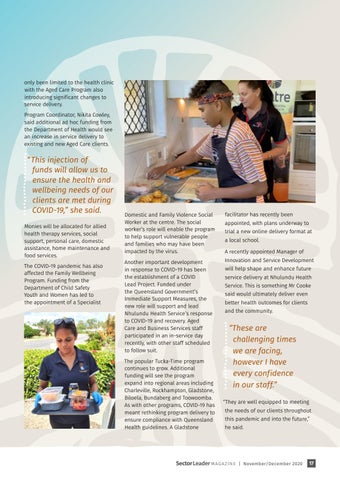
One of the first changes to be rolled out was the establishment of a drive-thru flu clinic. “This was a creative solution to safely deliver flu vaccinations to vulnerable patients during a time of social distancing,” said Mr Cooke.
“ The community response was overwhelmingly positive; we saw a marked increase in the number of clients getting vaccinations.” Staff and clients alike have welcomed a new permanent general practitioner, Dr Sheenu Mishra, to the medical centre. Mr Cooke said that finding a suitable, qualified doctor had been a long and difficult process, however
| November/December 2020
the new appointee brings continuity of care to the local community. Ongoing telehealth consultations have proven popular. Clinical Practice Manager, Jenny Kerr, said this important measure helped prevent unnecessary exposure of patients and healthcare professionals to COVID-19.
“ Funds were made available to purchase phones which allows clients to FaceTime or video call their doctor.” “This has been well received as many clients have been reluctant to come into the clinic,” she said. Additional COVID-19 requirements, including client screening prior to entering the clinic and modified waiting room procedures, have not
only been limited to the health clinic with the Aged Care Program also introducing significant changes to service delivery. Program Coordinator, Nikita Cowley, said additional ad hoc funding from the Department of Health would see an increase in service delivery to existing and new Aged Care clients.
“ This injection of funds will allow us to ensure the health and wellbeing needs of our clients are met during COVID-19,” she said. Monies will be allocated for allied health therapy services, social support, personal care, domestic assistance, home maintenance and food services. The COVID-19 pandemic has also affected the Family Wellbeing Program. Funding from the Department of Child Safety Youth and Women has led to the appointment of a Specialist
Domestic and Family Violence Social Worker at the centre. The social worker’s role will enable the program to help support vulnerable people and families who may have been impacted by the virus. Another important development in response to COVID-19 has been the establishment of a COVID Lead Project. Funded under the Queensland Government’s Immediate Support Measures, the new role will support and lead Nhulundu Health Service’s response to COVID-19 and recovery. Aged Care and Business Services staff participated in an in-service day recently, with other staff scheduled to follow suit. The popular Tucka-Time program continues to grow. Additional funding will see the program expand into regional areas including Charleville, Rockhampton, Gladstone, Biloela, Bundaberg and Toowoomba. As with other programs, COVID-19 has meant rethinking program delivery to ensure compliance with Queensland Health guidelines. A Gladstone
facilitator has recently been appointed, with plans underway to trial a new online delivery format at a local school. A recently appointed Manager of Innovation and Service Development will help shape and enhance future service delivery at Nhulundu Health Service. This is something Mr Cooke said would ultimately deliver even better health outcomes for clients and the community.
“These are challenging times we are facing, however I have every confidence in our staff.” “They are well equipped to meeting the needs of our clients throughout this pandemic and into the future,” he said.
Sector Leader M A G A Z I N E
| November/December 2020
17
Caring for our Elders during COVID-19 SUBMITTED BY
WUCHOPPEREN HEALTH SERVICE LTD Wuchopperen’s Commonwealth Home Support Program (CHSP) workers were needed more than ever to assist our higher risk elderly community members. Laurel McCarthy, Deputy Chief Executive Officer said the CHSP workers have provided domestic assistance and transport services to our Aboriginal and Torres Strait Islander Elders for more than three years.
“COVID-19 has seen us change the way we deliver critical support to our most vulnerable population,” said Ms McCarthy.
Grocery shopping To support our Elders to stay safely at home, we expanded our services to collect and deliver groceries. Shopping bags were left outside, to maintain social distancing, with an item list enclosed.
Appointment list We supported clients by delivering their appointment list so they were aware and could keep track of upcoming medical appointments.
Wuchopperen developed COVID-19 care packs to support clients with important information and resources to stay COVID-19 safe.
Much needed support with domestic assistance continued during the pandemic with social distancing requirements maintained whilst also making the client fully aware
Mobility aids Mobility aids were delivered to clients allowing them to remain safely in their homes.
of COVID-19. Wuchopperen Health Service Ltd would like to acknowledge
Medication We ensured continuity of care during the pandemic by picking up and delivering medications to client’s homes.
Sector Leader M AG A Z I N E
Clients were very happy about receiving their groceries. Domestic assistance
COVID-19 care packs
18
Clients were very happy Wuchopperen could provide this service for them in their time of need.
the Department of Health for their funding and support for this project.
| November/December 2020
Health Information Team Established in 2007, QAIHC’s Health Information Team (HIT) are here to provide a range of support for Member Services. HIT have adapted how they do business to provide ongoing assistance during COVID-19 engagement restrictions.
Report Redesign Working Group update The consultation survey distributed in August 2020 provided valuable feedback about QAIHC’s current health information reports as well as preferences for data visualisation and access. A range of Member representatives participated including Member CEOs, the Report Redesign Working Group (RRWG) and members of QAIHC’s Data Network.
Feedback snapshot1 SUITABILITY OF REPORTS CURRENTLY OFFERED Overall, the current suite of health information reports produced by HIT were considered suitable, with a small percentage indicating specific opportunities for improvement. FREQUENCY OF REPORTS There was some variation in preferences for distribution frequency depending on report type, with the majority of feedback showing a preference for the frequency of most reports to remain the same. PRESENTATION FORMAT OF REPORTS At present, all reports are produced and supplied to Members in PDF format. Survey responses indicated that a combination of PDF and a dashboard tool would be a positive development and the most preferred way to access data.
Next steps Developments based on survey feedback have been incorporated into potential options which were presented to the RRWG in October. RRWG feedback is being integrated so user-testing can commence in November 2020, with implementation to occur in early 2021. HIT will continue to provide updates to the Sector as they emerge.
Data quality tip – data cleansing Remember to routinely check CAT4 cleansing reports so you can view patients lists with missing demographic and accreditation items such as date of birth or allergies. You can export these patient lists to Excel to help identify patient records which are missing any important fields. Cleansing CAT can help identify patients who may have a chronic condition such as kidney disease, diabetes, chronic obstructive pulmonary disease, osteoporosis or a mental health illness, but are not currently recorded as having the relevant diagnosis in your EMR. It is important to review these indicated diagnosis reports on a routine basis to ensure good data quality and patient care. Free text in EMR diagnosis fields can be problematic. You can improve data quality by completing a bulk clean-up of free text diagnosis fields. There are instructions available on the PenCS Help site for Medical Director and Best Practice on how to do this, along with other recipes on improving data quality: help.pencs.com.au/display/CR/Improve+Data+Quality. When cleaning your EMR database, it is advised that patients are archived if they have not been seen in the past two or three years (dependent on your organisational policy), this is also a great way to improve the processing speed of CAT4. If you would like instructions on how to bulk archive patients, please contact HIT.
Contact details For all Helpdesk and general HIT enquiries, please contact the team by email HIT@qaihc.com.au or telephone on 3328 8500.
HIT have skilled Data Analysts to support your clinic’s priorities:
TRAINING CAT4, Topbar and EMRs
References see page 33
REPORTING
MBS Report Cards Data Requests
PRACTICE HELPDESK DATA IMPROVEMENT Email & telephone GOVERNANCE Data to help guide and monitor CQI
support in business hours
NKPI & OSR
Ensuring data accuracy & safety
Sector Leader M A G A Z I N E
Data quality and reporting support
DIGITALHEALTH National Digital Health Strategy, My Health Record
| November/December 2020
19
Eyez on Ice is a new resource that has been developed to assist and support health professionals when engaging with families and young people impacted by substance use, particularly crystal methamphetamine (ice). Funded by the Queensland Government Mental Health Alcohol and Other Drugs (MHAOD) Branch and developed for the AOD-OurWay 2 Project, in consultation with community, sector and clinical experts across Queensland, Eyez on Ice focuses on two key elements: the 4Rs (Respect,
Recognise, Respond and Reconnect)
Stages of Change Our Way. The 4Rs highlight what health professionals, parents, family members or carers can do to support a person experiencing substance abuse.
The Stages of Change Our Way model has been developed as a tool for guiding the way people are supported when impacted by substance use. A Decision Point has been added to the Stages of Change Our Way model to help health professionals and families identify when an individual is ready for change. A Learning Circle encompasses the model indicating that at every stage, the person is learning things about substance use and how to make good choices about healthier living. The social aspect of Stages of Change has been defined in the Eyez on Ice resource. With a community-led response focus, Eyez on Ice discusses how families can support someone
Family
20
Sector Leader M AG A Z I N E
| November/December 2020
impacted by substance use; how to respond to critical incidents; harm reduction strategies and how to keep themselves and others safe. The Eyez on Ice pack includes: health professional information pack family worksheets animated videos wallet cards wristbands fridge magnets USBs tote bags. To find out more about Eyez on Ice, please contact QAIHC on 3328 8500 and ask to speak to the AOD team.
Young P
eople
essionals Health Prof
AOD
WITH
RITA FRANCIS AOD PROJECT OFFICER, QAIHC
Why people use dru
Drugs (including alcohol) are substances when taken or administered into the body has a physiological effect. Drugs can affect the way we think, feel and behave. Psychoactive drugs may be divided into three categories:
Stimulant
Depressant
Treatment journey
gs
What are drugs?
Hallucinogen
Stress
Lose weight
Reduce physical and emotional pain
Socialise
Stay awake
Decision to change
Stop the voices that some people
Physical wellbeing
Counselling
hear
Cultural reasons
Reconnecting
*There can be waiting lists for treatment services.
Referral* Detoxification/ Withdrawal Services
Have fun and celebrate
Rehabilitation Services
Go to sleep
Mental wellbeing
Culture
Peer/ Community Support Groups
Fit in
with friends
Out of curiosity Crystal Methamphetamine
Alcohol
Assessments
Cope with grief and loss
Tobacco
Cannabis
Magic mushrooms
Boredom
As selfmedication to forget and cope with problems
Service:
Assessments will be done throughout a client’s treatment and healing journey
Gain confidence
To relax and experience a ‘high’
Your local Health Service: Your local Health
Family
Home support
To belong
LSD
Reconnect
Land
Community
Spiritual wellbeing
Your local Health Service:
Your local Health
Sector Leader M A G A Z I N E
Service:
Relationships
| November/December 2020
21
WITH
SANDY ROBERTSON WORKFORCE COORDINATOR, QAIHC
COVID-19 Temporary MBS Telehealth Services extended until 31 March 2021 The continuation of the temporary MBS telehealth items has been made available to help reduce the risk of community transmission of COVID-19 and to provide protection for patients and health care providers. The items will now be available until the 31 March 2021, and are available to GPs, Other Medical Practitioners (OMP), Specialists, Consultant Physicians, Nurse Practitioners, Participating Midwives, Allied Health Providers and Dental Practitioners in the practice of oral and maxillofacial surgery, with changes commencing 1 October 2020. What are the changes? GPs and OMPs providing COVID-19 telehealth services are not required to bulk bill* their patients. Temporary MBS COVID-19 bulk billing incentive items 10981 (for GPs) and 10982 (for OMPs) will cease. The temporary doubling of fees for MBS bulk billing incentive items 10990, 10991, 10992, 64990, 64991, 74990 and 74991 will cease. * If your health service has the exemption to Section 19.2 of the Health Insurance Act, you must continue to bulk bill all Medicare services provided by the health professionals who are employed or contracted to your organisation.
How will these changes affect patients? Patients are eligible for GP and OMP telehealth services if they have an established clinical relationship with a GP, OMP, or a medical practice. This requirement supports longitudinal and
22
Sector Leader M AG A Z I N E
| November/December 2020
person-centred primary health care that is associated with better health outcomes. An established relationship is defined as the patient having seen the same practitioner for a face-to-face service in the last 12 months, or having seen a doctor or other health practitioner (such as a practice nurse or Aboriginal and Torres Strait Islander health worker) at the same medical practice for a face-toface service in the last 12 months. This requirement does not apply to the following: homeless patients patients receiving an urgent after-hours (unsociable hours) service children under the age of 12 months patients of medical practitioners at an Aboriginal Medical Service or an Aboriginal Community Controlled Health Service people living in a COVID-19 impacted area.** ** A COVID-19 impacted area is one where a person’s movement is restricted by a state or territory public health requirement that applies to the person’s location. This includes patients subject to quarantine, and other restrictions intended to support infection control. Further Telehealth item information can be obtained from the Department of Health Factsheets at mbsonline.gov.au/internet/mbsonline/ publishing.nsf/Content/factsheet-tempbb
RESEARCH
WITH
VICTORIA DONOGHUE PROJECT OFFICER, QAIHC/QIMR BERGHOFER
Genetic Health Pathways
for Aboriginal and Torres Strait Islander Queenslanders Collaboration with QIMR Berghofer Medical Research Institute and Genetics Health Queensland The use of genetics and genomics in health care has the potential to transform delivery of health services and ultimately improve health and wellbeing outcomes. It has been identified that Aboriginal and Torres Strait Islander peoples are at risk of being ‘left out’ of these developments and potential gains. Coordinated care across primary and specialist services is vital to ensure quality, equitable and accessible genetic health services for Aboriginal and Torres Strait Islander Queenslanders. It is also essential that these services are culturally safe and appropriate.
GENOMIC PARTNERSHIPS Guidelines for genomic research with Aboriginal and Torres Strait Islander peoples of Queensland
QAIHC’s partnership with QIMR Berghofer, Genetics Health Queensland (GHQ) and Queensland Genomics, began with the development of the Genomic Partnerships: Guidelines for genomic research with Aboriginal and Torres Strait Islander peoples of Queensland (the Guidelines). In an Australian first, these guidelines were created to ensure best-practice genomic research when engaging and partnering with Aboriginal and Torres Strait Islander peoples and communities. The Guidelines: clearly articulate the core values reflecting the essential elements of Aboriginal and Torres Strait Islander culture and identity that should be evident in genomic research proposals provide examples of support documentation and templates to assist researchers undertaking genomic research involving Aboriginal and Torres Strait Islander people identify the most appropriate and efficient pathways to engage with local communities. The Indigenous Genomic Health Literacy Project (IG-HeLP) stemmed from community consultation which identified a need for resources to help primary health care providers and Aboriginal and Torres Strait Islander patients to make informed choices about genetic health services. An animation and brochure titled: ‘Your blood, your story’ Let’s have a yarn about DNA, genes and genetic health were developed to educate and inform on topics of DNA, genes, genetic health, genetic testing and precision medicine.
Artwork “My health, my journey” by Wendy Rix
QAIHC continues the QIMR Berghofer and GHQ collaboration in a new project: Referral Pathways: Genetic Health Services for Aboriginal and Torres Strait Islander Queenslanders’ (Referral Pathways project). The Referral Pathways project will explore service utilisation and workforce needs and preferences of Aboriginal and Torres Strait Islander Community Controlled Health Organisations (ATSICCHOs) in Queensland. A series of consultations and engagement workshops will be undertaken to determine a culturally safe referral pathway for genetic health access between ATSICCHOs and GHQ for Aboriginal and Torres Strait Islander Queenslanders. Victoria Donoghue was appointed in July 2020 in a joint role between QIMR Berghofer and QAIHC to work closely with QAIHC Members and communities across the state to develop the referral pathway. Workshops will commence in late 2020, with details communicated to the Sector. For further information on the project, please email Victoria at victoria.donoghue@qaihc.com.au or phone 3328 8500. For more information about Genomic Partnerships projects visit qimrberghofer.edu.au/our-research/ aboriginal-torres-strait-islander-health
Sector Leader M A G A Z I N E
| November/December 2020
23
Sexual Health Workers
organisations in community-controlled health ation of An exploration of the implement these roles funded as part of the Torres Strait Islander North Queensland Aboriginal and s action plan 2016–2021 Sexually Transmissible Infection
Chlamydia, gonorrhoea and syphilis are readily treatable sexually transmitted infections (STIs). STIs represent a significant health issue for Aboriginal and Torres Strait Islander peoples, particularly those who live in rural and remote areas. In early 2011, a re-emergence of syphilis was reported in North Queensland.1 There were also several cases of congenital syphilis, including three Aboriginal and Torres Strait Islander infant deaths.i In response, the North Queensland Aboriginal and Torres Strait Islander Sexually Transmissible Infections Action Plan 2016-2021 (NQ STI Action Plan) was announced in 2016.
24
Sector Leader M AG A Z I N E
NQ STI Action Plan Goals
1 Eliminate congenital syphilis in Aboriginal and Torres Strait Islander babies in North Queensland by December 2017. 2 Control the syphilis outbreak in North Queensland Aboriginal and Torres Strait Islander population by December 2020. 3 Progressively reduce the incidence of syphilis, chlamydia and gonorrhoea among Aboriginal and Torres Strait Islander people in North Queensland. To view visit: health.qld.gov. au/__data/assets/pdf_ file/0028/157555/sti-actionplan-2016-21.pdf
| November/December 2020
In an effort to coordinate the provision of culturally appropriate services and improve sexual health outcomes for Aboriginal and Torres Strait Islander people in North Queensland, QAIHC facilitated funding2 for the placement of a Sexual Health Worker in eight Member Services3 across North Queensland.
Evaluation aim and approach QAIHC commenced a process, outcome and impact evaluation of the Sexual Health Worker roles in July 2019.4 Thematic analysisii of semistructured individual interviews with representatives from the eight Member Services was used to explore their views on implementation of the Sexual Health Worker roles. Data management and coding was conducted in NVivo12 Plus.iii
RESEARCH
WITH
DR REBECCA SOOLE SENIOR RESEARCHER, QAIHC
Key evaluation findings
19 PARTICIPANTS
Sexual health workers n=9
Clinical Workforce5 n=8
Executive Leadership6 n=2
Interviews lasted between 30 minutes and 100 minutes,
9
resulting in 12 hours and 45 minutes of interview data.
8
Identified themes7
2
Aboriginal n=9 Torres Strait Islander n=2 Non-Indigenous n=8
Implications of findings
To learn more about the findings contact QAIHC Research on research@qaihc.com.au
Male n=7 Female n=12
Seven broad themes were identified (see below). Participants were provided an opportunity to comment on the accuracy, credibility and validity of the thematic analysis in May 2020.
The development of a Scope of Practice would be advantageous to both the health care provider and the patient by providing boundaries and clearly defined parameters for the clinical care provided by the Sexual Health Worker role.
Strategies to address the sexual health of Aboriginal and Torres Strait Islander peoples must be decided, designed and delivered in genuine partnership. Investment should be balanced to ensure an adequate share is provided to community-led or controlled organisations.
Stigma will likely remain a barrier to appropriate care for Aboriginal and Torres Strait Islander peoples at risk whilst adverse judgements about STIs are perceived to remain. Community wide education and advocacy is necessary to improve knowledge and sexual healthcare access to reducing STI related stigma and associated shame.iv
The Aboriginal and Torres Strait Islander Community Controlled Health Organisation (ATSICCHO) model of care is exemplified as most responsive to the holistic health needs of Aboriginal and Torres Strait Islander peoples. ATSICCHOs are well placed to address the sexual health needs of Aboriginal and Torres Strait Islander peoples through the delivery of best-practice and culturally appropriate care.
OVERVIEW OF IDENTIFIED THEMES 1 SCOPE OF PRACTICE The essential requirements of the Sexual Health Worker role included knowledge about Aboriginal and Torres Strait Islander sexual health, local community, communitycontrol, cultural awareness and strong interpersonal skills. The Sexual Health Worker was described as a resource for others and a single point of contact about sexual health. Other key responsibilities were the provision of culturally appropriate health promotion and education and playing a vital role clinical management of STIs including screening, treatment, recall and follow-up (dependent on the qualification of the individual). 2 CONTEXT IN WHICH THE SEXUAL HEALTH WORKERS PRACTICE The scope of the Sexual Health Worker’s practice was influenced by the realities of many ATSICCHOs which can include highly mobile and transient population, lack of/or inconsistent access to technology for patients, duality of roles for workers, perceived issues of confidentiality, geographical spread of Sexual Health Workers’ catchment area, diversity of Aboriginal and Torres Strait Islander communities including the dynamic and heterogenous nature of culture and the occurrence and impact of Sorry Business.
3 IMPLEMENTATION OF THE SEXUAL HEALTH WORKER ROLE Barriers to implementation included funding (amount, source i.e. derived from an underspend and cessation) and staff recruitment and retention (which in turn impacted the original 12-month timeframe of the position for some regions). Enablers were internal and external collaboration and passionate and committed organisational leadership. Trust was frequently referred to by participants and was considered invaluable to the successful implementation of the role. 4 ABORIGINAL AND TORRES STRAIT ISLANDER HEALTH To influence sexual health outcomes for Aboriginal and Torres Strait Islander people’s, the social determinants of health must also be addressed and healthcare needs to be aligned to what matters most: the patients’ own health priorities. In this way, the ATSICCHO Model of Care was deemed to be the most culturally appropriate and responsive. 5 STIGMA Stigma about STIs persists and impacts how community interact with the Sexual Health Worker. A range of factors contributes to, or perpetuates stigma in some instances
including religion, attitudes regarding homosexuality, heteronormative and misogynistic notions regarding sex and gender, problematic staff attitudes and beliefs [regarding sexual health], and health literacy levels of community. 6 SHAME Shame surrounding sexual health and STIs for Aboriginal and Torres Strait Islander people specifically was conceptualised differently, described by one participant as a form of self-punishment. Unacknowledged stigma and shame on the part of the health professional was also described as having potentially harmful ramifications on the provision of care. 7 GAPS AND RISKS WITHOUT A DESIGNATED ROLE Without a Sexual Health Worker, relationships between ATSICCHOs and other services, in particular Queensland Health was considered likely to suffer. An increase in the incidence and the prevalence of STIs was a concern for participants and community engagement with health services was anticipated to suffer as a consequence of there not being a funded Sexual Health Worker position.
Sector Leader M A G A Z I N E
| November/December 2020
25
DATA ROOM
Hearing
Hospitalisation1
3.0
There is no difference in hearing loss at birth1 Aboriginal and Torres Strait Islander peoples were 11.1 per cent more likely to be hospitalised with a principal diagnosis of diseases of the ear and mastoid than nonIndigenous Queenslanders
2.7
Aboriginal and Torres Strait Islander
Rate per 1000
NonIndigenous
Aboriginal and Torres Strait Islander children and young peoples aged between 0 to 19 years were 30 per cent or 1.3 times more likely to be hospitalised for chronic (suppurative) otitis media as a principal diagnosis than nonIndigenous children and young people
30%
OR 1.3X
Between 2010–2013 an average of
0.2%
of both Aboriginal and Torres Strait Islander babies and nonIndigenous babies had a mild, moderate or greater permanent hearing loss in one or both ears—around 2 babies per 1000 on average
Middle ear disease and associated hearing loss throughout infancy and childhood2 On average Aboriginal and Torres Strait Islander children and young people experience middle ear disease for over longer than non-Indigenous children and young people
10X
0
1
2
3
2.7 years
Hearing aids
3
3 months
Aboriginal and Torres Strait Islander children* comprised of those fitted with hearing aids or cochlear implants
9.5%
80.8 22.4
%
%
Ear and hearing health problems
17.5 %
ONE OF TOP
Middle ear disease is one of the top 20 diseases contributing to the burden of disease of Aboriginal and Torres Strait Islander peoples (ranked 20 for males and 18 for females)
20
9/10
81
7% 3.6%
Aboriginal and Torres Strait Islander children who live in remote communities have some form of ear disease4
*In 2018, Aboriginal and Torres Strait Islander children made up 5.9% (an estimated 278,000) of the total child population in Australia7
Burden of disease6
Cumulative total in years
Middle ear disease is ranked 81st in the non-Indigenous population
Nearly twice the rate of Aboriginal and Torres Strait Islander children aged 0–14 years were reported as having ear and hearing problems compared to non-Indigenous children5
Urban Hearing Pathways Project In response, QAIHC and Hearing Australia are undertaking the Urban Hearing Pathways Project (the Hearing Project). The shortterm project aims to explore possible service enhancements to improve the ear and hearing health of Aboriginal and Torres Strait Islander children aged 0–5 years. Spanning three urban settings across three states, the Hearing Project will map Aboriginal and Torres Strait Islander ear and hearing health services of each jurisdiction. The three sites of the Hearing Project are Midland in
26
Sector Leader M AG A Z I N E
| November/December 2020
Western Australia, Newcastle in New South Wales and Ipswich in Queensland, involving Kambu Aboriginal and Torres Strait Islander Corporation for Health. The purpose of service mapping is to identify the geographic spread and reach of ear and hearing health services for community, as well as any gaps, overlaps or duplication of services. Service mapping information will be evaluated for alignment with clinical guidelines for the management of otitis media (middle ear disease).
References see page 33
may also need a hearing or speech check.
u are worried about bub’s talking or listening at any time, tell your health or early childhood .
New hearing health screening tools
more information go to plumandhats.nal.gov.au
improving outcomes of Aboriginal and Torres Strait Islander children earlier World leading hearing screening resources have been developed by the National Acoustic Laboratories (NAL), to identify hearing problems earlier in young Aboriginal and Torres Strait Islander children. NAL, the research division of Hearing Australia, has co-developed the Parent-evaluated Listening and Understanding Measure (PLUM) and the Hearing and Talking Scale (HATS) in collaboration with Aboriginal health and early education services. With a focus on Aboriginal and Torres Strait Islander infants and young children, these tools are the only resources of their kind in Australia and they are available for free on plumandhats. nal.gov.au. “With the support of government, Hearing Australia is increasing its focus on improving the hearing health of all Australians through the prevention of avoidable hearing loss. “We remain steadfast in our commitment to reduce the rate of hearing loss in Aboriginal and Torres Strait Islander children by at least half by 2029,” says Kim Terrell, Managing Director, Hearing Australia. Hearing loss in Aboriginal and Torres Strait Islander children is most commonly due to middle ear infection, also known as otitis media2. These infections are often without pain and frequently start before the child’s first birthday. Because the signs are subtle, hearing loss is often not picked up until children start school. Long References see page 33
term, undetected hearing loss in these early years raises the risk of children not being developmentally ‘on track’ when they start school3,4,5. “The first three years of life are crucial for developing these skills. They are building blocks for learning language and culture, building relationships, learning in school and becoming independent in life. Being able to hear well early in childhood directly affects children’s development of language, communication and social skills. These are skills that impact hugely on children’s life experience and futures,” says Dr Teresa Ching, Head of Communication Sciences, NAL. Research indicates that almost half of childhood hearing loss is preventable1, with Aboriginal and Torres Strait Islander children experiencing significantly higher rates of hearing loss than nonIndigenous Australian children2. For three-year-old Tjandamurra and his Mum, Kaylah, using the PLUM and HATS resources was a crucial step forward for Tjandamurra on his hearing journey. Due to his chronic ear issues, Tjandamurra struggled to hear and had difficulty learning to communicate well. The PLUM assessment indicated he was well below the acceptable level of listening skill for a threeyear-old. Kaylah decided to get Tjandamurra fitted with a hearing device to provide immediate help. With this hearing technology, the world opened up for the vibrant boy. Tjandamurra is now wearing his hearing device and working with his regular speech therapist to improve his speech and listening skills.
Within a month, Tjandamurra had gone from a toddler with little-to-no speech to now being able to say 30 sentences. It’s a huge jump in his development. Now that he can hear there is no looking back. “I get tears when I speak about it, it’s been such a long road,” says Kaylah.
“Now he can hear me clear as day and he even responds—it’s so good to hear his voice. He has a little man voice.” PLUM and HATS make use of parents’ and carers’ observations of their children in everyday situations so that hearing and talking problems in infants and young children can be detected early on. The PLUM assessment includes 10 questions that screen listening skills. The HATS assessment includes 5 questions that screen communication skills. For training enquiries please email plumandhats.nal.gov.au.
Sector Leader M A G A Z I N E
| November/December 2020
27
Australian Federal Government budget The 2020-2021 Australian Federal Government budget brings significant stimulus to assist with the recovery of an economy impacted by the global covid-19 pandemic. The following are examples of measures that could directly impact our Sector.
Prioritising Aboriginal and Torres Strait Islander health This budget includes a $4 billion investment in Indigenous health funding over four years, including $975.5 million in 2020-2021. $546.9 million is allocated to the Indigenous Australians Health Program (IAHP) funding to Aboriginal and Torres Strait Islander Community Controlled Health Organisations (ATSICCHOs), with a further $33 million being provided through the IAHP to expand Aboriginal and Torres Strait Islander primary health care services. $5 million is provided in 2020-21 to improve early identification of hearing and speech difficulties for Aboriginal and Torres Strait Islander children as part of the $21.2 million funding for the national three-year Roadmap for Hearing Health. Also included, is an expansion of the Closing the Gap Pharmaceutical Benefits Scheme (PBS) Co-Pay Program. This will increase accessibility for Aboriginal and Torres Strait Islander people to PBS medications by reducing restrictions on patient registration and issuing of scripts. This will especially benefit Aboriginal and Torres Strait Islander people when moving between different geographic locations.
Closing the Gap $46.5 million is provided over four years to support the National Agreement on Closing the Gap and build the capacity of the ATSICCHO Sector to improve local service delivery. This funding will be complemented by cocontributions from state and territory governments. The Government will also provide $10.1 million over four years for the Productivity Commission to provide independent oversight and accountability of progress under the National Agreement on Closing the Gap. As well as supporting the comprehensive review of progress every three years, this measure includes developing and maintaining an information dashboard and an annual data report that all parties can use in reporting their performance against the Agreement.
28
Sector Leader M AG A Z I N E
| November/December 2020
Response to the COVID-19 pandemic $9.8 million is provided to deliver free COVID-19 testing at the point-of-care in 86 remote locations and $52.8 million to support early evacuations, aeromedical retrievals, as well as mobile respiratory clinics. ATSICCHOs are enabling unprecedented access to culturally safe assessment and testing across urban and regional areas, by operating 23 of the up to 150 General Practitioner-led Respiratory Clinics. As part of that $377.5 million package, additional support worth $8.3 million has already been distributed through NACCHO to enable ATSICCHOs to respond flexibly to COVID-19.
IAHP New funding model for ATSICCHOs From 1 July 2020, more than $90 million over three years will be provided to cover the costs of the new funding model for ATSICCHOs, with three year funding agreements and annual indexation, under the IAHP.
Investing in mental health The government has invested $5.7 billion in 2020-2021, including funding for critical frontline services, suicide prevention and key programs. This includes $101 million of additional funding to provide access to ten additional Medicare subsidised psychological therapy sessions to people with a mental health care plan, so that they can continue to access the services they need.
Pharmaceutical Benefits Scheme To make high cost drugs available and affordable, the Government included 12 additional high cost medicines in the listing of the PBS.
Prevention $184.1 million is provided in 2020-21 for long-term investments in preventive health. Also, the Government will provide $7.2 million in 2020-21 to extend the Good
FINANCE
WITH KEVIN SIAH, FINANCE MANAGER AND
GOVIND OJHA, SENIOR POLICY OFFICER, QAIHC
Sports Program, which provides tools and support for community sporting clubs to promote good mental health and reduce harmful alcohol consumption and drug use.
Oral health $107.8 million is provided in 2020-21 to extend the National Partnership Agreement on Adult Public Dental Services for one year to provide services to around 180,000 additional public dental health patients.
JobMaker Hiring Credit To encourage organisations to hire additional employees, the government will provide a Hiring Credit for each eligible employee for 12 months from 7 October 2020. Employers must demonstrate the new employee will increase overall headcount and payroll. Employers will receive $200 per week per eligible employee aged 16-29 years and $100 per week per eligible employee aged 30-35 years. Employees will need to work a minimum of 20 hours per week and have received a JobSeeker payment, Youth Allowance or Parenting Payment for at least one month in the last three months prior to hiring. Employers who are currently claiming JobKeeper payments are ineligible.
Traineeships Organisations will receive 50 percent wage subsidy, up to a cap of $7,000 per quarter, for commencing apprentices and trainees, including those employed by Group Training Organisations until 30 September 2021. Existing workers embarking on a new apprenticeship will be included in this scheme to support upskilling and reskilling.
Housing $150 million over three years from 2020-21 is provided to Indigenous Business Australia for new housing construction loans in regional Australia through its Indigenous Home Ownership Program. In addition, $100 million is provided to the Queensland Government to finalise the agreement to deliver more housing for Aboriginal and Torres Strait Islander people in remote Queensland.
The Sector’s response NACCHO lodged two pre-budget submissions, one in December 2019 as part of the normal 2020-21 Budget process, and a redrafted version in August 2020 as the Budget was deferred to October due to the pandemic. The redrafted submission takes into consideration the profound impact of the COVID-19 pandemic as well as the need to realign the Sector’s priorities with the recent National Agreement on Closing the Gap (signed on 27 July 2020). The majority of NACCHO’s requests were not adequately addressed in the 2020-21 Federal Budget. In their Media Release of 7 October 2020, NACCHO highlighted that the Budget had missed an opportunity to: invest in local clinics across the country where over 410,000 clients reside; investing in the ATSICCHO Sector would have supported the main objective of the Budget (stimulus) fix the funding shortfall for the second largest employer of Aboriginal and Torres Strait Islander people in the country; investment in infrastructure would have helped the Sector to generate even more local jobs strengthen the Commonwealth Government’s commitment to the new National Agreement on Closing the Gap; further investment in Aboriginal and Torres Strait Islander programs would have been a clear demonstration of the Commonwealth’s commitment to the new arrangements address historic funding shortfalls in social housing; an opportunity to improve the social determinants of health acknowledge the Sectors successful response to COVID-19 crisis and the importance of locallydriven action. For more information visit naccho.org.au/aboriginal-health-funding-boostedbut-infrastructure-overlooked/ or contact the Policy Team at policyteam@qaihc.com.au
Sector Leader M A G A Z I N E
| November/December 2020
29
POLICY
WITH
KAREN FRANCISCO, MARGARET CASHMAN AND RACHEL DOOLAN MSIP PROJECT TEAM, QAIHC
Maternity Services Integration Project Virtual Forum
On 16 September 2020, Queensland Aboriginal and Islander Health Council (QAIHC) held a virtual forum for the Maternity Services Integration Project (MSIP) with five participating sites. The sites were Apunipima Cape York Health Council, Gurriny Yealamucka Health Service Aboriginal Corporation, Mamu Health Service Limited, Mulungu Aboriginal Corporation Primary Health Care Service and Wuchopperen Health Service working in collaboration with Cairns Hospital and Health Service, Mareeba and Innisfail Hospitals.
Gurriny Yealamucka Health Service Aboriginal Corporation resources
30
Sector Leader M AG A Z I N E
The MSIP virtual forum was an opportunity for the participating Aboriginal and Torres Strait Islander Community Controlled Health Organisations (ATSICCHOs) and their local Hospital and Health Services to come together to present the integration activities they have undertaken as part of their participation in the MSIP. Each site led a presentation on the integration activity they undertook to address local needs, provided a breakdown of what antenatal services were offered before and after their participation in the MSIP, barriers and enablers to providing a more integrated maternity service in their community and ‘where to now’ to ensure that mothers birthing Aboriginal and Torres Strait Islander babies are able to access culturally appropriate maternity services.
Wuchopperen Maternity Services staff
| November/December 2020
Presentations highlighted a range of site achievements including: memorandums of understanding that were being finalised collaboration and strengthened relationships resources—calendar, brochures, posters sharing and coordination of care joint service delivery in the ATSICCHO implementing telehealth for high risk patients sharing patient information identifying and improving gaps. With the completion of the MSIP integration activities in the Cairns and Hinterland Hospital and Health Service area, the MSIP Evaluation will commence shortly. In the meantime, the QAIHC MSIP Team looks forward to providing continued support to the other sites as they progress through their implementation journey.
Thank you
to our deadly healthcare workers
Throughout the COVID-19 pandemic, QAIHC has routinely engaged with our Clinical Leaders Forum (CLF) to inform our clinical advocacy and understand our Sector’s adaptability and innovation in service delivery. We recognise that behind every individual member of the CLF is an entire team of valued, flexible, knowledgeable and capable health workers, and we want to take the time to say thank you to all our healthcare workers who have gone above and beyond to help to keep mob safe. COVID-19 has dramatically shifted the world that we live in—suddenly we all know about hand hygiene, sanitiser and social distancing, how to ‘check in’ to restaurants and keep our gatherings small. We know that we need to get tested if we have symptoms and we can probably even list most of the symptoms because we’ve seen so many promotional flyers and advertisements! What can easily go un-seen is the work of our Aboriginal and Torres Strait Islander Community Controlled Health Organisations (ATSICCHOs); the constant shifting of plans and strategies in light of new medical or legal guidance and the establishment of new services to help us to better understand life during the COVID-19 pandemic. Our ATSICCHOs have ensured their health service can continue to support their community, while making sure that their staff remain safe during this period. The CLF have demonstrated exceptional leadership throughout the year. On 5 March 2020, before the epidemic was announced by the World Health Organisation, the CLF met Queensland’s Chief Health Officer, Dr Jeanette Young and Queensland’s Chief Aboriginal and Torres Strait Islander Health Officer, Ms Haylene Grogan. This forum was an opportunity for the Sector to provide early input on Queensland Health’s response for Aboriginal and Torres Strait Islander peoples. Recognising the threat that COVID-19
presented based on past experience (many will remember the Severe Acute Respiratory System (SARS) outbreak in 2003 and the swine flu outbreak in 2009), our Clinical Leaders moved swiftly to share information and support QAIHC in its advocacy to Queensland Health and the Commonwealth Government. Initially meeting virtually every week, the CLF provided opportunity for our Clinical Leaders to network, share learnings and implement evidence based best practice in their local ATSICCHO. QAIHC supported ATSICCHOs to lead continuous quality improvement in health care, ensuring staff safety while maintaining health service delivery—for example, through discussing access to Personal Protective Equipment (PPE), use of PPE, training needs and safe working policies and procedures. This safeguarded the standards of care within the ATSICCHO Sector. The Clinical Leaders also discussed and influenced: Queensland Health’s testing
strategy, data capture, isolation and quarantine accommodation processes and biosecurity zones.
The existance and location of
point of care testing machines in the state.
The establishment of fever
clinics (COVID-19 testing centres run by ATSICCHOs).
Topics to communicate
to community.
Best practice for staff isolation
and health care provision in biosecurity zones.
The transition to telehealth and
best practice.
The Clinical Leaders identified solutions and opportunities, such as ways to work better with hospitals to reduce travel requirements, how to communicate health promotion information to community and how to overcome the hidden long-term health impact of COVID-19 as a result of people not seeing their health clinic team during the lockdown. Thank you to our health workforce for your determination and dedication throughout 2020. The Sector has once again demonstrated its expertise, value, adaptability and strength. About the Clinical Leaders forum: Membership of the CLF is open to QAIHC Full Members and Regional Members’ clinical leaders (Medical Practitioner, Practice Manager, Practice Nurse, ATSIHW/P) with their CEO’s endorsement. Usually the CLF meet face to face for two days twice yearly, however meetings have been more regular and conducted virtually in 2020 due to the COVID-19 pandemic.
If your ATSICCHO is not represented and you would like to nominate a representative, please email policyteam@qaihc.com.au
Sector Leader M A G A Z I N E
| November/December 2020
31
Deadly reading and viewing A Question of Colour; my journey to belonging (2020)
SNAICC COVID-19 resources snaicc.org.au
Author: Pattie Lees with Adam C Lees
SNAICC — National Voice for our
The removal of Aboriginal and Torres Strait Islander children from their families remains a dark chapter in Australia’s history. Pattie Lees was just ten-yearsold when she and her four siblings were separated from their mother on the grounds of neglect and placed into State Care. Believing she was being shipped and exiled to Africa, Pattie was ultimately fated to spend the rest of her childhood on the island once dubbed ‘Australia’s Alcatraz’ – Palm Island Aboriginal Settlement, off the coast of Queensland.
Children have compiled a number of
A Question of Colour; my journey to belonging provides a first-hand account of Pattie’s experiences as a ‘fair-skinned Aboriginal’ during Australia’s assimilationist policy era and recounts her survival following a decade of sexual, physical and emotional abuse as a Ward of the State. A Question of Colour is a deeply moving and powerful testimony to the resilience of a young girl, her identity and her journey to belong. For more information visit magabala.com
resources to help better understand the impacts of COVID-19, and to help children, carers and families get through this difficult time.
Visual Dreaming app visualdreaming.com.au The Visual Dreaming app is designed to help people strengthen their social-emotional health and wellbeing through digital story-telling and visual goal settings. It connects people with their dream team which can consist of family, friends, coworkers, mentors or trusted health care workers.
Living on Stolen Land (2020) Author: Ambelin Kwaymullina Living on Stolen Land is a prose-styled look at our colonial-settler ‘present’. This book is the first of its kind to address and educate a broad audience about the colonial contextual history of Australia, in a highly original way. It pulls apart the myths at the heart of our nationhood, and challenges Australia to come to terms with its own past and its place within and on ‘Indigenous Countries’. This title speaks to many First Nations’ truths; stolen lands, sovereignties, time, decolonisation, First Nations perspectives, systemic bias and other constructs that inform our present discussions and ever-expanding understanding. This title is a timely, thought-provoking and accessible read. For more information visit magabala.com 32
Sector Leader M AG A Z I N E
| November/December 2020
Leanne Sanders is the founder of Visual Dreaming an Indigenous female-tech company, she started the idea for the app three years ago after seeing mob struggle with access to mental health services and the NDIS. “We wanted to create visual goal setting and communication for young ones to connect to Elders and knowledge holders to help build their connection to culture and spirituality,” said Leanne. Different goals can be selected including spiritual and physical wellbeing, cultural, social and emotional and personal skills.
EVENTS CALENDAR
SIGNIFICANT EVENTS November
Movember
1 December
World Aids Day
8–15 November
NAIDOC Week (new dates)
3 December
International Day of Persons with Disabilities
13 November
World Kindness Day
25 December
Christmas Day
14 November
World Diabetes Day
26 January
Invasion/Survival Day
QAIHC Member Events
For more information, or to register for an event, please email tiana.lea@qaihc.com.au
Date
Member Event
Location
Duration
Cost
18 November
2020 QAIHC AGM
Afternoon
No cost
19–20 November
2020 State Member Conference
Novotel Sunshine Coast Resort 270 Ocean Drive Mudjimba QLD 4564
2 days
No cost
References page 17 Health Information Team:
1. Some results presented here relate to small numbers; as such results should be interpreted with appropriate caution.
page 24–25 Sexual Sexual Health Workers in community-controlled health organisations: 1. 2. 3. 4.
Specifically, the North West, Torres and Cape, Townsville, and Cairns and Hinterland Hospital and Health Services. Total funding $1,000,000 (1 May 2018–31 December 2019). Source: Funding Schedule. Apunipima, ATSICHS Mackay, Gidgee Healing, Gurriny, Mamu, Mulungu, TAIHS and Wuchopperen. Special thanks to Natalie Van der Zant who conducted the evaluation interviews with participants. As the Sexual Health Coordinator, Natalie works with QAIHC Member Services to provide a coordinated response to reduce the rates of sexually transmissible infections, particularly syphilis, in North Queensland. 5. Includes Practice Managers and Senior Medical Officers. 6. Includes Chief Executive Officers. 7. The order of the presented themes does not indicate weighting or relative importance. The views and opinions expressed as part of the thematic analysis are a combination of the 19 people who participated. In this way they do not necessarily reflect the official policy or position of QAIHC or Member Services overall.
i Queensland Health. (2016). North Queensland Aboriginal and Torres Strait Islander sexually transmissible infections action plan 2016–2021. Queensland Health. ii Braun, V., & Clarke, V. (2006). Using thematic analysis in psychology. Qualitative Research in Psychology, 3, 77-101. doi: 10.1191/1478088706qp063oa iii NVivo qualitative data analysis software; QSR International Pty Ltd. Version 12, 2018. iv Fortenberry, J.D., McFarlane, M., Bleakley, A., Bull, S., Fishein, M., Grimley, D. M., Malotte, C. K., & Stoner, B. P. (2002). Relationships of stigma and shame to gonorrhea and HIV screening. American Journal of Public Health, 92(3), 378–81.
page 26 Data Room:
1. Department of Education and Training & Queensland Health. (2016). Deadly Kids, Deadly Futures: Queensland’s Aboriginal and Torres Strait Islander Child Ear and Hearing Health Framework 2016-2026. Brisbane: Queensland Government. 2. Williams, C., & Jacobs, A. (2009). The impact of otitis media on cognitive and educational outcomes. Medical Journal of Australia. 191(9), s69-72. 3. Hearing Australia. (2019). Demographic Details of young Australians aged less than 26 years with a hearing loss, who have been fitted with a hearing aid or cochlear implant at 31 December 2018. 4. Leach, A.J., Wigger, C., Beissbarth, J., Woltring, D., Andrews, R., Chatfield, M.D., Smith-Vaughan, H., & Morris, P.S. (2016). General health, otitis media, nasopharyngeal carriage and middle ear microbiology in Northern Territory Aboriginal children vaccinated during consecutive periods of 10-valent or 13-valent pneumococcal conjugate vaccines. International Journal of Pediatric Otorhinolaryngology, 86, 224-232. 5. Australian Bureau of Statistics (2013). Australian Aboriginal and Torres Strait Islander Health Survey: First Results, Australia, 2012-13. Cat 4727.0.55.001. Canberra: ABS. 6. Vos, T., Barker, B., Stanley, L., & Lopez, A. D. (2007). The burden of disease and injury in Aboriginal and Torres Strait Islander peoples 2003. Brisbane: School of Population Health, The University of Queensland. 7. Australian Institute for Health and Welfare [AIHW]. (2020). Australia’s children. Cat. no. CWS 69. Canberra: AIHW
page 27 Hearing Health Screening Tools:
1. World Health Organisation. (2020, March 1). Deafness and hearing loss. https://www.who.int/news-room/fact-sheets/detail/deafness-and-hearing-loss 2. Kong, K., & Coates, H. L. C. (2009). Natural history, definitions, risk factors and burden of otitis media. The Medical Journal of Australia, 191(9), S39-S43. https://doi.org/10.5694/j.1326-5377.2009.tb02925.x 3. Simpson, A., Šarkić, B., Enticott, J. C., Richardson, Z., & Buck, K. (2020). Developmental vulnerability of Australian school-entry children with hearing loss. Australian Journal of Primary Health, 26(1), 70-75. https://doi.org/10.1071/py18162 4. Bell, M. F., Bayliss, D. M., Glauert, R., Harrison, A., & Ohan, J. L. (2016). Chronic Illness and Developmental Vulnerability at School Entry. Pediatrics, 137(5) e20152475; DOI: https://doi.org/10.1542/peds.2015-2475 5. Su, J-Y., Guthridge, S., He, V. Y., Howard, D., & Leach, A. J. (2020). Impact of hearing impairment on early childhood development in Australian Aboriginal children: A data linkage study. Journal of Paediatrics and Child Health, https://doi.org/10.1111/jpc.15044
Sector Leader M A G A Z I N E
| November/December 2020
33
QAIHC Board Members
Gail Wason Chairperson
Sue Andrews Deputy Chairperson
Gary White South West Queensland Director
Thalep Ahmat Central Queensland Director
Dallas Hure Far North Queensland Director
Dr Steve Hambleton Independent Director
QAIHC Members Members Aboriginal and Torres Strait Islander Community Health Service Brisbane Aboriginal and Torres Strait Islander Community Health Service Mackay Ltd Apunipima Cape York Health Council
Galangoor Duwalami Primary Healthcare Service
Mamu Health Service Limited
Gidgee Healing
Mudth-Niyleta Aboriginal and Torres Strait Islander Corporation
Girudala Community Co-Operative Society Ltd
Mulungu Aboriginal Corporation Primary Health Care Service
Gladstone Region Aboriginal and Islander Community Controlled Health Service (GRAICCHS) T/A Nhulundu Health Service
North Coast Aboriginal Corporation for Community Health NPA Family & Community Services Aboriginal and Torres Strait Islander Corporation
Bidgerdii Aboriginal and Torres Strait Islander Community Health Service
Goolburri Aboriginal Health Advancement Co Ltd Goondir Health Services
Carbal Medical Services
Townsville Aboriginal and Islander Health Services
Gurriny Yealamucka Health Service Aboriginal Corporation
Wuchopperen Health Service
Charleville and Western Areas Aboriginal Torres Strait Islander Community Health Limited Cherbourg Regional Aboriginal and Islander Community Controlled Health Service Cunnamulla Aboriginal Corporation for Health
Injilinji Aboriginal and Torres Strait Islander Corporation for Children & Youth Services Kalwun Health Service Kambu Aboriginal and Torres Strait Islander Corporation for Health
Yulu-Burri-Ba Aboriginal Corporation for Community Health
Regional Members Institute for Urban Indigenous Health Northern Aboriginal & Torres Strait Islander Health Alliance