Courses of study Years 7 to 10 2022
Contents Introduction .................................................................................................................................. 1 Pattern of study ............................................................................................................................ 2 Mandatory subjects ...................................................................................................................... 4 Elective subjects in Year 8 ............................................................................................................ 7 Elective subjects in Year 9 .......................................................................................................... 12 Elective subjects in Year 10 ........................................................................................................ 18 Advice on making elective choices for Years 8 to 10 ................................................................... 25 Overview of elective subjects ..................................................................................................... 26
Introduction The purpose of this booklet is to:
▲
•
give a brief outline of the pattern of study mandated by the NSW Education Standards Authority (NESA) for students to complete successfully all Stage 5 requirements
•
provide an outline of the subjects offered at Pymble in Years 7 to 10
•
provide information and advice to assist students and parents when making elective subject choices.
Please note: This booklet outlines various opportunities for exchange, excursions, fieldtrips or attendance at other external events. All learning opportunities which require travel will be reviewed closer to the date with regards to any COVID-19 restrictions that apply at the time.
1
Pattern of study The pattern of courses undertaken by students proceeding through Stage 4 and Stage 5 is governed by regulations set down by NESA. This pattern of courses involves a mandatory core curriculum that occupies about 60 per cent of available teaching time. Schools are free to program the remaining time by offering additional courses of study. The Pymble curriculum program involves two main areas:
1. Mandatory core curriculum – as determined by NESA • • • •
English Mathematics Science Human Society and its Environment (History and Geography)
Girls will study Mandatory Geography in Years 7 and 9 and Mandatory History in Years 8 and 9. For students who have not met the requirements of the course prior to Year 10, the Mandatory course is offered again in Year 10 in lieu of elective study. • • • • •
Technology – studied in Years 7 and 8 Creative Arts – studied in Year 7 as Visual Arts and Music Personal Development, Health and Physical Education – studied in Years 7 to 10 Languages – studied in Year 7 with students choosing one of the following: Chinese, French, German or Japanese Religion and Ethics – studied in Years 7 to 10
2. Electives Girls entering Year 8 select two elective subjects. There is a wide range of subjects available which allows for a variety of student interests and abilities. The elective subjects offered for Year 8 are: • Chinese Beginners* • EAL/D (English as an additional language) (by invitation only) • Financial Literacy • French* • Literacy and Learning (by invitation only) • German* • Japanese* • Latin • Literacy and Learning • Music • Thinkers and Ideas • Visual Arts (* continued study from Year 7)
2
Girls entering Year 9 may continue with one or both of their elective subjects, or they may choose two new electives from an expanded list. New elective subjects offered in Year 9 include: • • • • • • • • • • • • • •
Aboriginal Studies Agriculture Classical Greek (see note below) Commerce Contemporary Music Studies Data Science Design and Technology Drama Elective Music (new, if not chosen for Year 8) Food Technology Literacy and Learning (by invitation only) Physical Activity and Sports Studies Textiles Technology Visual Arts (new, if not chosen for Year 8)
It is important to remember that if a girl wishes to study a language, she must choose it in Year 8 as there is no beginner’s language starting in Year 9. Classical Greek is studied as an optional third elective and lessons are conducted outside of the regular timetable. In Year 10, Classical Greek is continued within the timetable in place of the Group 2 elective (see below). Girls entering Year 10 continue with both of their electives commenced in Year 9. In addition, they may choose one elective from each of the following groups: Group 1 • Elective Geography • Elective History • Mandatory History • Big History (students selected by application) Group 2 • Aboriginal Studies (100-Hour)* • Big History (students selected by application) • Commerce (100-Hour)* • Dance • Data Science • Design and Technology (100-Hour)* • Drama • EAL/D (English as an additional language) (by invitation only) • Food Technology (100-Hour)* • Elective Geography • Mandatory Geography • Elective History • Literacy and Learning (by invitation only) • Philosophy • Marine and Aquaculture Technology • Photographic and Digital Media • Physical Activity and Sports Studies (100-Hour)* • Textiles Technology (100-Hour)* • Visual Arts (100-Hour)* (* Students can only select these subjects if they are not currently studying the course in Year 9)
Students must complete mandatory courses in History and Geography by the end of Year 9 to be able to choose these electives. 3
Students who join the College in Year 10 will need to study the Mandatory Geography and Mandatory History subjects to complete the NESA requirements. The Mandatory subjects are timetabled in the same blocks as the Year 10 electives so new students will select two electives from the Year 9 list.
4
Mandatory subjects English The study of English aims to guide students to grow as effective communicators and to foster a love of literature. Studying English develops students’ knowledge, understanding, appreciation and enjoyment of the English language as an essential skill. Through their study of different lives, contexts and perspectives, students will develop empathy, compassion and integrity. Students will develop their skills to communicate for a range of purposes and audiences and in doing so will develop their personal voice and a greater understanding of themselves and their world. Students explore a rich and diverse range of literature from past and contemporary societies, as well as a range of spoken, visual, media and multimedia texts. Students create their own content, learning how to communicate their message purposefully and to create an impact. Students will write imaginative, interpretive, and critical texts with clarity and accuracy for a range of purposes and audiences. Students learn to reflect on their own compositions and to analyse meaning, perspective and cultural assumptions. There is some variation in the texts studied in classes to accommodate for the different abilities and interests of each group.
Mathematics Mathematics is a reasoning and creative activity employing abstraction and generalisation to identify, describe and apply patterns and relationships. The symbolic nature of mathematics provides a powerful, precise and concise means of communication. The study of mathematics provides opportunities for students to appreciate the elegance and power of mathematical reasoning and to apply mathematical understanding creatively and efficiently. The study of the subject enables students to develop a positive self-concept as learners of mathematics, obtain enjoyment from mathematics and become self-motivated learners through inquiry and active participation in challenging and engaging experiences. In Year 8, the syllabus followed in Mathematics is the same for all girls. In Years 9 and 10 there are three courses in Mathematics offered at Pymble: 5.1 to 5.3 Pathway, 5.1 to 5.2 Pathway and 5.1 Pathway. Girls are placed into the appropriate course according to their ability and performance.
Science The study of Science enables students to develop knowledge, understanding of, and skills in applying the processes of working scientifically. They will develop an appreciation of the contribution of science to finding solutions to personal, social and global issues relevant to their lives now and in the future and develop a willingness to use evidence and reason to engage with and respond to scientific and technological ideas as informed, reflective citizens. They will develop knowledge of the physical world, Earth and space, living world and chemical world, and understanding about the nature, development, use and influence of science.
Geography Geography is the study of places and the relationships between people and their environments. It is a rich and complex discipline that integrates knowledge from natural sciences, social sciences and humanities to build a holistic understanding of the world. Students learn to question why the world is the way it is, reflect on their relationships with, and responsibilities for the world, and propose actions designed to shape a socially just and sustainable future. Geographic education prepares students for effective participation in society. They learn to develop informed opinions on local and global issues like changing environments, and issues faced in the future world.
5
History History gives a sense of perspective and offers us an insight into the past and into the world in which we live. In our information-rich age, it teaches how to critically assess and evaluate sources of information. It aims to build in our students a sense of social justice and the responsibilities of global citizenship. The Mandatory History course is based on the Australian Curriculum which has adopted the approach of World History; that is, it aims to give students an understanding of the broad sweep of world history with time allocated for the study of certain periods in-depth. This course taught in Years 8 and 9 involves the study of Modern World, Australian, Ancient and Asian History providing a basic foundational tool upon which other subjects rest.
Music All students will study Core Music in Year 7. They will explore and discover the concepts of music through the three learning experiences of performance, composition and listening. They will gain an understanding of different genres of music, including, but not limited to, film, pop, classical and musical theatre. With a focus on keyboard, guitar, percussion and technology (iPads, notation software and sequencing programs), students will engage in a variety of learning opportunities individually, as part of an ensemble, and through a transdisciplinary approach.
Personal Development, Health and Physical Education Personal Development, Health and Physical Education (PDHPE) contributes significantly to the cognitive, social, emotional, physical and spiritual development of students. It provides opportunities for students to learn about, and practice ways of adopting and maintaining a healthy, safe and active life. It also involves students learning through movement experiences that are both challenging and enjoyable, and improving their capacity to move with skill and confidence in a variety of contexts. PDHPE promotes the value of physical activity in students’ lives.
Religion and Ethics As a school of the Uniting Church in Australia, Pymble Ladies’ College provides for the religious education of its students. It does this through a study of Christianity focusing on the person of Jesus the Christ, the importance of the Bible and God’s message of love and reconciliation. In line with the inclusive nature of the Uniting Church and its commitment to interfaith dialogue, Religion and Ethics also provides for the study and comparison of other faith traditions. Religion and Ethics at Pymble Ladies’ College aims to help students: • • • •
Develop an understanding of the beliefs of Christianity and other religions Reflect upon their own beliefs Examine the impact of beliefs in the world Develop tolerance, respect, understanding and compassion towards others.
Technology This is a practical course designed to develop an understanding of a range of technological activities and their applications to the personal, commercial, industrial and global domains. A problem-solving approach will be undertaken so that students will learn how to use various forms of technology to address design briefs. This will involve processes of researching, analysis of data and information, designing, making, evaluating, communicating, marketing and managing a range of projects. Throughout the mandatory program students will gain valuable transferable skills in communicating, collaborating, critical thinking, problem solving, digital literacy, project management, creativity and innovation.
6
Visual Arts The mandatory Visual Arts course combines a practical and theoretical study of artmaking practices. Students engage in developing their skills using a range of media and techniques to explore practices in research, planning, problem solving and resolving, to create artworks independently. A visual diary is used to document learning about other artists and record planning and processes related to individual artmaking. Students’ artmaking experiences will include drawing, painting, printmaking, sculpture and/or digital media throughout the mandatory program.
Languages All Year 7 students study a language selected from Chinese, French, German or Japanese. In Year 8, students can change to or add the study of Latin and in Year 9, Classical Greek. The next opportunity to commence study of a language is in Year 11 when Italian Beginners is offered as an elective for the HSC. Students who do not continue with a language subject will not be able to recommence study of that language in later years. The Year 11 and 12 Continuers language subjects have the prerequisite that the language is studied throughout Years 8 to 10.
7
Elective subjects in Year 8 Chinese Chinese is the language of communication of approximately one-quarter of the world’s population. It is one of the official languages of the United Nations. Among the many spoken varieties of the language, Mandarin is pre-eminent. Chinese is also recognised as one of the fastest-growing languages in New South Wales and has one of the largest groups of non-English background speakers in Australia. In Year 8, the main aim is to continue to use Chinese as a method of communication with growing confidence in everyday situations within and beyond the classroom. Students find the lively approach of their textbook Easy Steps to Chinese 2 particularly enjoyable. In Year 7, students will not only learn the pronunciation system of Chinese, basic greetings and topics of family and daily routine, but also have the opportunity of exploring Chinese culture through class activities and the Chinese Garden Excursion. They will also be able to have simple communication in the target language. Topic areas studied in Year 8 will include school life, hobbies, food and drinks, Chinese cuisine and restaurants, house and neighbourhood. In Years 9 and 10, students will continue their learning of Chinese using the textbook Easy Steps to Chinese 3 and 4. Topic areas will include descriptions of people, weather and holidays, school facilities and events, shopping and travelling, festivals and celebrations etc. Chinese traditional and contemporary culture plays an important role and is integrated with language learning. For example, school excursions will expose the students to the Chinese Arts and History. The relationship with our sister school in Beijing continues through electronic sharing of class work and face-to-face interaction whenever possible to allow our learners to interact with Chinese students. In Year 10, student exchange to our sister school in Beijing is possible.▲
EAL/D (English as an additional language) (by invitation only) This course is designed to provide additional assistance in the development and consolidation of English language skills for students who study English as a second or third language. The underpinning goal of this program is to provide instruction and opportunities for each student to practise, and gain confidence and capability in reading and writing skills, as well as to develop an increased awareness of how to apply learning strategies effectively. The EAL/D elective also provides opportunities for academic support across a range of learning areas and provides students with cultural knowledge to assist them in their future studies in an Australian academic environment. This course requires a flexible approach to enable individual learners to reach personal targets.
Financial Literacy This course introduces the knowledge and understanding and skills and values, which are essential for a young person to successfully participate in the commercial world. It provides a unique opportunity to gain the financial skills and competencies that will be required of an educated and responsible individual in modern society, no matter what career path they follow. Students complete much of the course through engagement with digital technology, state and nationwide competitions and learning activities. Students also have the opportunity to showcase their IT skills and cross-curricular learning.
8
Topics: • • • • • •
Money management (including goal setting, entrepreneurship) Budgeting (saving and managing credit) Investing (including ASX Share Market Game) for future wealth Diversified investing (property, shares, $20 Boss) Global links (trade, aid, investment, employment) Travel (insurance, security, planning, budgeting).
French French is one of the major languages in the world. It is spoken in parts of Europe, Canada, North America, the Middle East, the West Indies, the Indian Ocean and South Pacific regions. It is a language of international affairs, trade and diplomacy. In Years 8 to 10, the main aim is to use French as a means of communication. French is used as much as possible in class, group and pair work activities. Topic areas studied in Years 8 to 10 deal principally with the everyday life of young people in French-speaking countries: hobbies, home life, food, sport, entertainment, health, weather, clothes, shopping and travel. Through the learning of French, students will also learn to understand and appreciate the culture of France and French-speaking countries. Documentary and feature films, mostly in French, are used to present these aspects of French life. Student exchanges to France in Year 10, including homestay and attending school, present students with lifelong experiences and opportunities for personal contact and lessons in international understanding.▲ A range of excursions and workshops is offered to students to supplement what they learn in class. Students will also subscribe to a language learning website to extend their vocabulary and comprehension skills.
German The German syllabus aims to motivate students to achieve high levels of competence in accessing and responding to information, composing texts and interacting in the target language, enabling them by the end of Year 10 to communicate with German speakers in day-to-day situations. Students find the lively approach of the learner-centered course, Genau, enjoyable. It represents a refreshingly imaginative response to the needs of learners. Topics in Genau are selected for their relevance to the experiences of teenagers. Beginning with a cartoon story, each chapter successfully integrates the communicative approach with a thoroughly planned program for the teaching of German grammar. Through familiar characters, the learning experience is enhanced, while also providing information on the culture and lifestyle of the German people. Lessons also make regular use of video clips and there is the opportunity to use the internet and in some circumstances, social media, for extension work and further communicative activities. Frequent visits from exchange students provide extra enrichment in the classroom and students are encouraged to participate in our exchange program to Germany which is on offer each year.▲ German and English are based on the same linguistic roots and principles and share a common core of concepts and vocabulary. The focus is on similarity rather than difference. With Germany’s prominence as a major world industrial nation, the study of German has relevance in the pursuit of many future careers.
9
Japanese Japanese is a culturally interesting and practical language relevant to Australia’s developing role in South-East Asia. It is the language of one of our largest trading partners, spoken by about 123 million people. The coursebook called ii Tomo focuses on intercultural awareness and offers interesting activities to support and reinforce the structures to be learned. A variety of role-play situations provides the opportunity for developing the skills of listening, speaking, reading and writing to a high degree. Students begin immediately to learn the Japanese writing system, starting with Hiragana in Year 7, to which Katakana is added in Year 8. Kanji, a script comprised of the Chinese characters used in Japan, is introduced gradually throughout the course. Japanese culture plays an important role and is integrated with language learning. Students have opportunities to participate in cultural activities such as kimono dressing and obento making, calligraphy, etc. Cultural assignments are prepared on laptops enabling the students to write in Japanese on their computer and students are aware when seasons and festivals are taking place in Japan. Students have opportunities to interact with Japanese exchange students. In Year 10, student exchanges to our sister schools in Nagoya and Osaka are very popular.▲
Latin The principal aim in studying Latin is to acquire a first-hand acquaintance with some of the greatest literature ever written, but there are other practical benefits to be gained as well. As more than half the words in the English language are derived from Latin, students will gain a greater insight into the meaning, spelling and origin of English words, and will readily understand the specialist terminology of science, law and medicine. Latin also provides an excellent basis for the study of those modern languages descended from it, such as French, Italian and Spanish. In learning a Classical language, students will develop skills in analytical thinking, attention to detail, systematic memorisation and clarity of expression – skills that can be applied in many different fields. In Years 8 to 10, students will learn the basic grammar and structures of the language and at the same time will explore various aspects of Roman history, culture and mythology. Before the end of Year 10, students will be able to begin reading original Latin. Several activities are offered to enrich the study of Latin, such as a weekend camp in Year 8, and inter-school competitions in general knowledge, art and design, and solo and choral recitation. A cultural tour of famous classical sites in Greece and Italy is offered every third year to students completing Years 9, 10 and 11.
Literacy and Learning (by invitation only) This course is designed to provide additional assistance in the development and consolidation of literacy and learning skills for students with identified learning needs. The underpinning goal of this program is to provide instruction and opportunities for each student to practise, and gain confidence and capability in reading and writing skills, as well as to develop an increased awareness of how to apply learning strategies effectively. This course requires a flexible approach to enable individual learners to reach personal targets. Literacy and Learning I also provides opportunities for academic support across a range of learning areas.
10
Music The study of Music in Year 8 continues to explore the six musical concepts through development of the three core disciplines of performance, composition and listening. It is expected that Elective Music students participate in at least one College ensemble where possible. This can be instrumental or choral. All students are encouraged to join the College choir as this will help develop their aural awareness and ensemble skills. Each unit of work is an engaging exploration into a variety of musical genres ranging from the medieval period through to contemporary popular music. Activities in the course include: •
Singing or playing their chosen instruments as a class ensemble: these group performances will comprise the bulk of performance activities; there will also be ample opportunity to experience playing other instruments and to use various technological resources as performance tools; plus students will also be given the chance to perform as a soloist
•
Composing in various styles for different combinations of performing media using the latest software and equipment
•
Developing listening skills that promote aural awareness, musical appreciation and analytical techniques.
Thinkers and Ideas “Thinkers and Ideas” is a new course, which seeks to connect students to the great minds of the past so that they develop a rich appreciation of their intellectual heritage. Although Philosophy has been described as “as the discipline of disciplines, [and] as the science of the sciences”, it is not typically studied by NSW school students. In “Thinkers and Ideas”, students study seminal philosophical texts, such as Plato’s Dialogues, pondering fundamental questions, such as “What is the nature of existence?”, “What is right and wrong?” and “Where does knowledge come from?” Utilising the tools of logic and reason, students analyse the complex social and material nature of the world. They learn to formulate, articulate and defend their views, with the strong emphasis on critical thinking and communication skills setting them up for success in their Senior years of study and in the workplace. Students who have a strong work ethic and demonstrate self-autonomy will enjoy the opportunity “Thinkers and Ideas” provides for independent research and student choice. The discussion-style nature of the lessons will also enable students to play an active role in their learning.
Visual Arts Elective Visual Arts encompasses in depth experiences in both artmaking and the study of artists and artworks. In this way, students develop critical and creative thinking skills. The emphasis is on artmaking experiences with a 70% assessment weighting. Critical and Historical studies form 30% of this course. Students also use a visual arts diary to record their artmaking processes, and the study of artists and their work. Artmaking is focused on the development skills with direct instruction using a range of approaches. A diversity of art forms is explored; painting, digital media, printmaking, drawing, ceramics and/or sculpture. Students develop confidence in the use of specific art materials and develop both traditional and innovative ways of expressing their ideas. They also develop an understanding of the process of making artworks through exploring various themes including portraiture, still life, landscape and interiors.
11
Critical and Historical Studies develops the capacity to write about artists and artworks in an informed and articulate manner. Students learn to critically analyse artworks and examine works within a context of time and place. They also study artists and artworks to inform their own artmaking, using artists as ‘mentors’. Artists studied are from a range of cultures and include both contemporary and historical examples.
Elective subjects in Year 9 Aboriginal Studies The Year 9 200-Hour Aboriginal Studies course offers a rich and diverse range of learning experiences. The course is designed for indigenous and non-indigenous students to be able to come to a complex and well-informed understanding of First Nations cultures. In studying this course, students can become culturally competent, active and informed advocates for a just and inclusive world. The course offers students the opportunity to develop knowledge and understanding of: • • • •
Aboriginal identities, kinship, the fundamental importance and spiritual connection to Country, human rights, Aboriginal Peoples’ contributions to contemporary Australian society, the racism existing in Australian society Skills in critical thinking and problem-solving in relation to the current challenges facing Aboriginal Peoples in Australia and around the world as a result of colonisation The importance of self-determination and autonomy to Aboriginal Peoples’ ongoing contribution and success Skills in ethical research, data collection and respecting community consultation protocols
The Year 9 Core topic is ‘Aboriginal Identities’ and the Option topics include: • • • • •
Aboriginal Peoples and the Visual Arts Aboriginal Peoples and Oral and Written Expression Aboriginal Peoples and Film and Television Aboriginal Peoples and the Performing Arts Aboriginal Peoples and the Media
Year 9 Excursions [subject to change] ▲ •
•
Year 9 students will visit the Centre for Indigenous Excellence in Redfern, where they will participate in an early morning training session with local athletes and community members, followed by a walking tour of the historical, cultural and politically important sites of the Redfern community led by a local elder. After lunch at a bush tucker fusion café, we visit the Art Gallery of NSW to explore some of its incredible indigenous art collection. For a second excursion, students will travel to the Central Coast to visit significant rock art sites, and to learn from a Darkinjung elder about Dreaming, ceremony and art in that region.
12
Agriculture Agriculture is by nature a practical subject therefore there will be emphasis on practical work throughout the course. Practical tasks are carried out at the school Agriculture plot as well as on excursions. Excursions involve farm visits and hands-on practical work with animals. The course will involve the study of: •
Farm animal enterprises with emphasis on management, nutrition, health and productivity
•
Plant production including vegetable, crop and pasture plants; methods to maximise plant growth and plant products in a sustainable farming manner
•
The relationships between soils, microbes, management style and climate and their influence on animal and plant production
•
Farm management including farming as a business and the selling and marketing of farm products.
Classical Greek Classical Greek is the language of the ‘golden age’ of ancient Greece: a period which saw the beginnings of Western culture as we know it, including developments in democracy, drama, science, art and architecture, athletics and oratory. In Year 9, students learn to read and write the distinctive Greek script (still used to write Modern Greek) and then read simple stories. They explore aspects of history, mythology and society and learn about the origins of many aspects of life today. Greek classes are arranged off-timetable, so that gifted linguists have the opportunity to do an additional language course. In Year 10, the subject continues within the timetable in place of one of the additional electives.
Commerce There are no prerequisites for Commerce in Year 9. Commerce develops the knowledge and understanding, skills and values that form the foundation for sound decision making in relation to consumer, financial, business, legal and employment issues. The syllabus is designed to allow students to develop: • • • •
Knowledge and understanding of consumer, financial, business, legal and employment matters Skills in decision making and problem solving in relation to consumer, financial, business, legal and employment issues Skills in effective research and communication Skills in working independently and collaboratively.
Year 9 core topics include: • •
Consumer and Financial Decisions Law, Society and Political Involvement
Year 9 option topics include: • •
Promoting and Selling Running a Business
Year 10 core topics include: • •
Employment and Work Futures The Economic and Business Environment
13
Year 10 option topics include: • •
Investing Commerce in a Connected World.
Contemporary Music Studies The Contemporary Music Studies course is designed for those students who have a keen interest in, and an appreciation of, music. Students are not required to be taking private tuition on an instrument and there will be extensive opportunities for students to experience playing a variety of instruments such as keyboard, guitar, drums and percussion, as well as singing. As will all Stage 5 Music study, there will be aspects of performance, composition and listening, combined with an exploration of a variety of music genres predominantly from the late 20th and 21st centuries. Genres studied in this course will include jazz, rock, pop, and music for film and television to name a few. A key focus area of this course will be on technology and the role it plays in the composition, performance, recording and consumption of contemporary music. •
Although there will be occasions where solo performance may be required, the bulk of performances will be group based and involve various combinations of instruments, singers and technology.
•
Composition tasks will focus on songwriting and composing for film, television and multimedia.
•
Listening tasks will develop skills in aural analysis of musical works using the concepts of music.
This course provides the skills required to study the HSC Music 1 course should a student decide to do so. Students may swap to the Elective Music course after Term 1 in Year 9, if the timetable allows. It is expected that Contemporary Music Studies students participate in at least one College ensemble where possible. This can be instrumental or choral. All students are encouraged to join College choir as this will help develop their aural awareness and ensemble skills. Data Science NOTE: Pymble is offering Data Science for the first time in 2022; the course is underpinned by the UCLA Data Science course. Data Science is the set of skills and the mental habits that will empower students to infer scientific knowledge from the “data deluge” that we all have to face, and allow them to make decisions, take actions and form opinions. Collaborating with machines and authentic data sets will expand and enrich their experience of the world. “Data Scientist” is currently one of the most in-demand jobs within Australia and internationally. In fact, most Universities are adapting their courses and subject designs to meet this increasing demand from industry, training graduates to be capable of uncovering patterns in data and to develop models that make accurate predictions. Our Data Science course will give the students a head start in developing skills for any scientific or research-based subject they study for the HSC and beyond. Being able to use the computational power of digital devices will be particularly beneficial in the compulsory Chemistry, Physics or Biology Depth Study assessment tasks, as well as in research-based courses such as Science Extension, in Years 11 and 12. Our Data Science course will provide students an opportunity to learn R coding language to analyse authentic datasets to make conclusions about complex real-world phenomena. Our course has been 14
designed to have a range of diverse and collaborative learning opportunities that will help our students of all ability levels to structure their ideas and become more confident and efficient thinkers, decision makers and communicators. 4 Units 25 hours each • • • •
Unit 1: What is Data? Unit 2: How to collect and visualise data Unit 3: How to read Data Unit 4: How to question data
Design and Technology Design and Technology provides broad experience in a range of contexts and builds on the Technology (Mandatory) course. The design and development of quality projects gives students the opportunity to identify problems and opportunities, research and investigate existing solutions, analyse data and information, generate, justify and evaluate ideas and experiment with technologies to manage and produce design projects. The diversity of approaches to design projects provides the scope to develop high-order thinking, future thinking and understanding of conceptual principles. The design process caters for a variety of student needs, abilities and interests. The flexible and creative consideration of parameters encourages students to take intellectual risks and experiment with resources when developing projects. The development of functional and aesthetic design solutions allows students to be innovative and creative in their thinking and application. Students will develop the skills necessary for the safe use and maintenance of a variety of technologies in the production of their design projects. Information and communication technologies (ICT) are vital tools for this course. They are used to develop, communicate and research design solutions, communicate students’ design ideas and facilitate interactions with the wider community. There is an annual fee for this course.
15
Drama Drama in Stage 5 engages and challenges students to maximise their dramatic abilities and enjoyment of drama and theatre through learning experientially. The syllabus is designed to allow students to develop knowledge, understanding and skills, individually and collaboratively, through: •
Making drama that explores a range of imagined and created situations in a collaborative drama and theatre environment, with an emphasis on creating belief, clarity and tension in character, role, situation and action
•
Performing devised and scripted drama using a variety of performance techniques, dramatic forms and theatrical conventions to engage an audience
•
Appreciating the meaning and function of drama and theatre in reflecting the personal, social, cultural, aesthetic and political aspects of the human experience
•
Designing for the theatre – set, costume, lighting, promotional copy
•
Reflecting on the process of skill development through the maintenance of a logbook
•
Attending a range of theatrical experiences and participating in workshops.
The Year 10 200 hour course explores Drama with depth and insight. Over the two years, students deeply learn and develop their curiosity as performers and theatre makers, enriching their understanding of dramatic forms and styles. Each year, students perform in a learning Drama showcase, which is held in the GMCPA theatre, as well as attending theatre incursions and excursions, which maximise the development of their skills in this Drama course.
Elective Music The Elective Music course is designed for those students who have had, and are currently having, tuition either as a singer or on their chosen instrument and have undertaken studies in musicianship at a level necessary to match their performance capabilities. As with all Stage 5 Music study there will be aspects of performance, composition and listening combined with an exploration of a variety of musical genres and topics ranging from the classic to the contemporary. Technology and the role it plays in the composition, performance, recording and consumption of contemporary music will also be studied. • • •
Performance activities will involve solo works, class performances and a focus on chamber music. Composition activities will look at the melodic, harmonic and structural conventions of specific genre-based styles and cultivate the creative process Listening activities will develop the ability to critically evaluate musical works with or without a score. Dictation and sight singing skills will also be developed.
This course lays the foundation for the skills required in the study of HSC Music should a student wish to continue their studies beyond Year 10. Students may swap to the Contemporary Music Studies course after Term 1 in Year 9, if the timetable allows. It is expected that Elective Music students participate in at least one College ensemble where possible. This can be instrumental or choral. All students are encouraged to join the College choir as this will help develop their aural awareness and ensemble skills.
16
Food Technology The Food Technology course is designed to provide students with the opportunity to learn about food in a variety of settings and equip them with the knowledge and skills to make meaningful connections between food, technology, nutritional status and the quality of life. Students will develop confidence and proficiency in practical applications and decisions regarding food. The study of Food Technology provides students with a broad knowledge and understanding of aspects of the Australian food industry, food properties, ethical issues related to food, nutrition, and the factors that impact on consumption patterns. The course addresses the importance of hygiene, safe work practices and legislation in the production of food. Students spend at least two periods a cycle involved in practical work in our specialised Food Technology workroom. In these lessons, students develop practical skills in experimenting, preparing and presenting food that will enable them to select and use appropriate ingredients, methods and equipment. There will be a charge at the end of each term to cover food costs.
Literacy and Learning (by invitation only) This course is designed to provide additional assistance in the development and consolidation of literacy and learning skills for students with identified learning needs. The underpinning goal of this program is to provide instruction and opportunities for each student to practise, gain confidence and capability in reading and writing skills, as well as to develop an increased awareness of how to apply learning strategies effectively. This course necessitates a flexible approach to enable individual learners to reach personal targets. Literacy and Learning II also provides opportunities for academic support across a range of learning areas.
Physical Activity and Sports Studies (PASS) The aim of PASS is to enhance students’ ability to participate effectively in physical activity and sport, leading to improved quality of life for themselves and others. PASS is a combination of practical and theory activities, which involve a comprehensive study of physical activity and sport in society. Students will investigate the way the body functions and how to prepare to move efficiently in a variety of contexts. The course has a strong focus on learning through movement, offering students a variety of challenging practical experiences. The course contains three areas of study, which are: • • •
Foundations of Physical Activity Physical Activity and Sport in Society Enhancing Participation and Performance
Within these areas of study are modules such as: • • • • • • • • •
Australia’s Sporting Identity Fundamentals of Movement Skill Development Body Systems and Energy for Physical Activity Nutrition and Physical Activity Sport Coaching Participating with Safety Enhancing Performance – Strategies and Techniques Event Management Issues in Sport.
17
Textiles Technology The study of Textiles Technology provides students with a broad knowledge of properties, performance and uses of textiles. Environmental and sustainable issues in the Textiles Industry are researched, along with quality and marketing strategies. Students will be encouraged to develop creativity and individuality by researching the work of textile designers. Project work is developed through investigation and experimentation, with students documenting and communicating their design ideas using various mediums including digital presentations. Students will undertake a range of projects in various focus areas, such as apparel, costume, textile art, non-apparel and furnishing. The completion of practical projects enables students to develop skills and confidence in the use of a range of textile materials, equipment and techniques. Students spend a minimum of three lessons per cycle working on individualised practical projects. There is an annual fee for this course.
Visual Arts Visual Arts is an intensive course involving the artmaking and the study of images and objects. Artmaking classes allow all girls to develop their creative talents in a variety of media. Critical and historical writing activities develop their interpretive and written communication skills of art. In the practical areas, Pymble has a policy of providing experience in specialist areas including Drawing, Digital Media, Painting, Printmaking, Sculpture, Photography and Ceramics. During Years 9 and 10, girls have the opportunity to work in several of these areas. A wide range of historical and contemporary artworks from different cultures is studied, including: • •
Australian art including Aboriginal art (Year 9) Development of 20th century artmaking (Year 10).
There is an annual fee for this course.
18
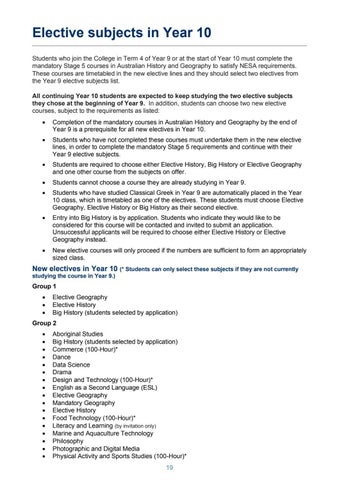
Elective subjects in Year 10 Students who join the College in Term 4 of Year 9 or at the start of Year 10 must complete the mandatory Stage 5 courses in Australian History and Geography to satisfy NESA requirements. These courses are timetabled in the new elective lines and they should select two electives from the Year 9 elective subjects list. All continuing Year 10 students are expected to keep studying the two elective subjects they chose at the beginning of Year 9. In addition, students can choose two new elective courses, subject to the requirements as listed: •
Completion of the mandatory courses in Australian History and Geography by the end of Year 9 is a prerequisite for all new electives in Year 10.
•
Students who have not completed these courses must undertake them in the new elective lines, in order to complete the mandatory Stage 5 requirements and continue with their Year 9 elective subjects.
•
Students are required to choose either Elective History, Big History or Elective Geography and one other course from the subjects on offer.
•
Students cannot choose a course they are already studying in Year 9.
•
Students who have studied Classical Greek in Year 9 are automatically placed in the Year 10 class, which is timetabled as one of the electives. These students must choose Elective Geography, Elective History or Big History as their second elective.
•
Entry into Big History is by application. Students who indicate they would like to be considered for this course will be contacted and invited to submit an application. Unsuccessful applicants will be required to choose either Elective History or Elective Geography instead.
•
New elective courses will only proceed if the numbers are sufficient to form an appropriately sized class.
New electives in Year 10 (* Students can only select these subjects if they are not currently studying the course in Year 9.)
Group 1 • • •
Elective Geography Elective History Big History (students selected by application)
Group 2 • • • • • • • • • • • • • • • • •
Aboriginal Studies Big History (students selected by application) Commerce (100-Hour)* Dance Data Science Drama Design and Technology (100-Hour)* English as a Second Language (ESL) Elective Geography Mandatory Geography Elective History Food Technology (100-Hour)* Literacy and Learning (by invitation only) Marine and Aquaculture Technology Philosophy Photographic and Digital Media Physical Activity and Sports Studies (100-Hour)* 19
• •
Textiles Technology (100-Hour)* Visual Arts (100-Hour)*
Year 10 Geography Elective Elective Geography in Year 10 explores contemporary geographic issues that confront an everchanging world. A student’s geographic knowledge will be broadened to give her the skills to analyse issues which are current, relevant and which will impact on their lives. Geographic issues presented may include: • • • • • • •
The changing role and status of women around the world Global variations in the level of development and associated impacts on quality of life Environmental management issues Terrorism - causes and impacts Refugees - Causes and impacts Australia's Asia pacific neighbors The urban living lab in partnership with Celestino
The Urban Living Lab – Sydney Science Park program is a significant real world learning opportunity for students, which has been created and delivered in partnership with Celestino, the company responsible for the development of the Sydney Science Park CBD in Western Sydney, and their alliance partner CSIRO. This program requires students to develop their own solutions to complex challenges facing developers as they strive to make Sydney Science Park a smart and liveable city of the future. There will be further development in research and analytical skills which will allow students to discover and understand issues in depth. Fieldwork to Cabramatta also forms part of this course. Elective Geography aims to encourage students to take a more active role as global citizens and to foster an appreciation of different cultures, environments and perspectives.
Year 10 Geography Mandatory (for new Year 10 students only) The aim of Mandatory Geography is to stimulate a student’s enjoyment of, and interest in, the interaction of the physical and human environments. Through a study of Mandatory Geography, a student’s knowledge, understanding, skills, values and attitudes, are developed to ensure that she is able to interpret and understand contemporary issues that she may face. Topics will include Coastal Management, Migration, Spatial Inequality, Shanty Towns, Child Labour, Food Security and Future Worlds. Students will engage in fieldwork which will bring to life her classroom learning.▲
Year 10 History Elective Elective History in Year 10 allows and encourages students to explore the effect of human actions on the world around them, both past and present, and to give students the skills and knowledge essential for their future roles in an ever-changing society. It seeks to help them develop an understanding of motivation, causation, consequence and empathy. Students will study six topics over the course of the year. The first unit is ‘Bad Girls in History’, which explores a number of controversial women across history, with a case study on Cleopatra. Students will also study History through film with a focus on Elizabeth I and the varying interpretations of her through film. The final unit for Semester 1 focuses on the Cold War from the end of World War II, to the Cuban Missile Crisis. During Semester 2, students will study ‘Revolutions’, focusing on specific revolutions in history and its importance to the modern world. This unit will focus on building historical literacy skills. The final unit for the Semester is ‘History Mysteries’, exploring the areas of history that are controversial or have questions that have remained unanswered. The Elective History course aims to develop in students an understanding of the world around them, both past and present, and to give students the skills and knowledge essential for their future roles in an ever-changing society. 20
Year 10 History Mandatory (for new Year 10 students only) The aim of Mandatory History is to ensure that students have the skills to develop a critical understanding of Australian and World History and enable them to participate in Australian society as active, informed and responsible citizens. The content of the Mandatory course includes four topics listed below, within which there is internal choice and the integration of a site study. • • • •
Topic 1: Core Study – Comparison study of World War I and II Topic 2: School-developed Study – Australia and the Cold War Topic 3: School-developed Study – The Holocaust Topic 4: Depth Study – Rights and Freedoms (1945 to the present)
Big History (Students will need to submit an application and be prepared to be interviewed about themselves as learners and what they want to get out of the course, as part of the acceptance process) The Big History course is an interdisciplinary study of change over time from the Big Bang to the future. Big History requires students to draw upon the latest findings in history, the sciences, and the social sciences, including astronomy, physics, biology, geography, geology, climatology, archaeology, anthropology, cosmology, demography, and environmental studies. Consequently, the course introduces students to important ideas and discoveries and gives them an idea of how these have changed our understanding of the Universe and our place within it. It is considered a transdisciplinary course as it looks at the past and present through unifying the knowledge and perspectives of varying disciplines. This means, rather than creating an understanding of the big picture from a purely scientific or historical perspective, Big History draws connections between the disciplines to provide a holistic perspective. The course content is considered a universal history as it traces big-picture themes from the beginning of the universe until today. It surveys history on huge time scales from the big bang, creation of solar systems and planets, to the evolution of humans, prehistory, agricultural and industrial revolutions. It focuses on trends and themes providing a powerful platform for thinking about the challenges of the future through an integrated disciplinary lens. Big History is styled similar to a Year 11 course.
Aboriginal Studies (100-Hour) The Year 10 100-Hour Aboriginal Studies course focuses on topics such as the importance of selfdetermination and autonomy for Aboriginal Peoples’ journey towards equality, Aboriginal Peoples’ interactions with the Western legal system and Aboriginal Peoples’ contribution to sport. The Year 10 Core topic is ‘Self-determination and Autonomy’ and the option topics include: • Aboriginal Peoples’ Interactions with Legal and Political Systems • Aboriginal Peoples’ and Sport • Aboriginal Enterprises and Organisations
21
Year 10 Excursions [subject to change]: ▲ •
•
Tribal Warrior mob cruise around Sydney Harbour. On the cruise, we hear stories of the Cadigal, Guringai, Wangal, Gammeraigal and Wallumedegal people of Sydney Harbour and learn the Aboriginal names and meanings of significant Sydney landmarks, before stepping ashore on Be-lang-le-wool (Clark Island National Park). On the island, we’ll be taken on a journey to traditional coastal life pre-white settlement, uncovering traditional fishing methods and food gathering techniques, before participating in an exciting Aboriginal cultural performance. Other experiences include a visit from a local elder to learn about the history of the Guringai area and taking the Aboriginal Heritage walking tour of West Head to see important rock art sites.
Commerce (100-Hour) The Year 10 100-Hour Commerce course develops the knowledge and understanding, skills and values that enable critical evaluation and problem solving in relation to consumer, financial, business, legal and employment issues. The course is designed to allow students to develop: • • • •
Knowledge and understanding of consumer, financial, business, legal and employment matters Skills in decision making and problem solving in relation to consumer, financial, business, legal and employment issues Skills in effective research and communication Skills in working independently and collaboratively
Year 10 core topics include: • •
Employment and Work Futures The Economic and Business Environment
Year 10 option topics include: • •
Investing Commerce in a Connected World
Dance The 100-Hour Dance course is a NESA Developed Course. All students, irrespective of previous dance experience, study the essential content. This involves an integrated study of the practices of performance, composition and appreciation together with the elements of dance within the context of dance as an artform. Students learn through their own dances, the dances of others and dances as works of art in the public domain, allowing them to develop new ways of expressing their own experiences. Experience with the elements and language of dance enables students to communicate physically, verbally and in written form. They also learn about the development of cultural meanings and artistic traditions. Throughout the course, equal emphasis is placed on the processes of experience and end products. Students learn movement principles and a variety of dance styles. The development of creativity, imagination and individuality are taught along with a theoretical and practical knowledge of dance. The students are given several opportunities to perform for the general public at College events.
22
Data Science NOTE: Pymble is offering Data Science for the first time in 2022; the course is underpinned by the UCLA Data Science course. Data Science is the set of skills and the mental habits that will empower students to infer scientific knowledge from the “data deluge” that we all have to face, and allow them to make decisions, take actions and form opinions. Collaborating with machines and authentic data sets will expand and enrich their experience of the world. “Data Scientist” is currently one of the most in-demand jobs within Australia and internationally. In fact, most Universities are adapting their courses and subject designs to meet this increasing demand from industry, training graduates to be capable of uncovering patterns in data and to develop models that make accurate predictions. Our Data Science course will give the students a head start in developing skills for any scientific or research-based subject they study for the HSC and beyond. Being able to use the computational power of digital devices will be particularly beneficial in the compulsory Chemistry, Physics or Biology Depth Study assessment tasks, as well as in research-based courses such as Science Extension, in Years 11 and 12. Our Data Science course will provide students an opportunity to learn R coding language to analyse authentic datasets to make conclusions about complex real-world phenomena. Our course has been designed to have a range of diverse and collaborative learning opportunities that will help our students of all ability levels to structure their ideas and become more confident and efficient thinkers, decision makers and communicators. 4 Units 25 hours each • • • •
Unit 1: What is Data? Unit 2: How to collect and visualise data Unit 3: How to read Data Unit 4: How to question data
Design and Technology (100-Hour) This course aims to expand the realisation of concepts and promote visible thinking. This is achieved with the use of technical design that aligns to student interest while strengthening skills and content knowledge. The path of production mastery is explored with continued experimentation and testing of possible design solutions. 3D modelling is highly utilised with the integration of reductive machining to create final products. Students will have opportunities to pursue their interests and passions within each Design Brief. Student choice and justification of final designs are important components used to guide evolution of design. There is an annual fee for this course.
Drama Drama in Stage 5 engages and challenges students to maximise their dramatic abilities and enjoyment of drama and theatre through learning experientially. The syllabus is designed to allow students to develop knowledge, understanding and skills, individually and collaboratively, through: •
Making drama that explores a range of imagined and created situations in a collaborative drama and theatre environment, with an emphasis on creating belief, clarity and tension in character, role, situation and action
•
Performing devised and scripted drama using a variety of performance techniques, 23
dramatic forms and theatrical conventions to engage an audience •
Appreciating the meaning and function of drama and theatre in reflecting the personal, social, cultural, aesthetic and political aspects of the human experience
•
Designing for the theatre – set, costume, lighting, promotional copy
•
Reflecting on the process of skill development through the maintenance of a logbook
•
Attending a range of theatrical experiences and participating in workshops.
The Year 10 100 hour course will explore the elements of drama and a condensed version of the Stage 5 Drama course. It is a helpful course to study, leading into Years 11 and 12 Drama, with students gaining an understanding of the fundamentals to Drama. Students will perform in a Year 10 Drama Learning showcase, which is held in the GMCPA theatre, as well as attending theatre incursions and excursions, which maximise the development of their skills in this Drama course.
EAL/D (English as an additional language) (by invitation only) This course is offered as an elective for targeted students in Year 10 whose second or third language is English. It is designed for those who need additional assistance in the development and consolidation of their reading, writing, listening and speaking skills. The particular focus is on the improvement of these skills, as well as making the individual aware of the processes in learning a language so they can develop into more independent language learners. The course also aims to provide students with cultural knowledge to assist them in their future studies of the Stage 6 curriculum in an Australian academic environment. This course necessitates a flexible approach in order to address individual student learning needs and provide opportunities for cross-curricular, academic support across a range of learning areas.
Food Technology (100-Hour) The Food Technology course is designed to provide students with the opportunity to learn about food in a variety of settings and equip them with the knowledge and skills to make meaningful connections between food, technology, nutritional status and the quality of life. Students will develop confidence and proficiency in practical applications and decisions regarding food. The study of Food Technology provides students with a broad knowledge and understanding of aspects of the Australian food industry, food properties, ethical issues related to food, nutrition, and the factors that impact on consumption patterns. The course addresses the importance of hygiene, safe work practices and legislation in the production of food. Students spend at least two periods a cycle involved in practical work in our specialised Food Technology workroom. In these lessons, students develop practical skills in experimenting, preparing and presenting food that will enable them to select and use appropriate ingredients, methods and equipment. There will be a charge at the end of each term to cover food costs.
Literacy and Learning (by invitation only) This course is designed to provide additional assistance in the development and consolidation of literacy and learning skills for students with identified learning needs. The underpinning goal of this program is to provide instruction and opportunities for each student to practise, gain confidence and capability in reading and writing skills, as well as to develop an increased awareness of how to apply learning strategies effectively. This course necessitates a flexible approach to enable individual learners to reach personal targets. Literacy and Learning II also provides opportunities for academic support across a range of learning areas.
24
Marine and Aquaculture Technology The 100-Hour Marine and Aquaculture Technology course is a NESA Content Endorsed Course. The course does not continue into Stage 6 (Years 11 and 12) but relates to a variety of Stage 6 courses offered at Pymble including Agriculture, Biology, Earth and Environmental Science, Personal Development, Health and Physical Education, and Food Technology. The course contains one Core Unit and five Option Modules. The Core Unit, Introduction to Marine and Aquaculture Technology, is divided into five sections, which include: •
Introduction to Marine and Aquaculture Technology
•
Water Safety
•
General First Aid related to Marine Activities
•
Maintenance of Equipment used in water
•
The Marine Environment.
Most of the course covers five Option Modules from areas including Biology, Ecology, Leisure, Aquaculture, Employment, Management and General Interest. Students will be able to choose an option from a broad list to study in-depth, as well as the following: • • • • • •
Set up and Maintenance of an Aquarium Basic Snorkelling – covering basic skills in the College pool Open Water Snorkeling – including an excursion to a Sydney beach Dangerous Marine Creatures – including identification and the first aid required for bites and stings Marine Mammals – covering types, characteristics and protection The Abyss – covering the cold and dark deep ocean and how organisms possess adaptation allowing them to survive.
Philosophy “Philosophy” is a new course, which seeks to connect students to the great minds of the past so that they develop a rich appreciation of their intellectual heritage. Although Philosophy has been described as “as the discipline of disciplines, [and] as the science of the sciences”, it is not typically studied by NSW school students. In this course, students study seminal philosophical texts, such as Plato’s Dialogues, pondering fundamental questions, such as “What is the nature of existence?”, “What is right and wrong?” and “Where does knowledge come from?” Utilising the tools of logic and reason, students analyse the complex social and material nature of the world. They learn to formulate, articulate and defend their views, with the strong emphasis on critical thinking and communication skills setting them up for success in their Senior years of study and in the workplace. Students who have a strong work ethic and demonstrate self-autonomy will enjoy the opportunity “Thinkers and Ideas” provides for independent research and student choice. The discussion-style nature of the lessons will also enable students to play an active role in their learning.
Photographic and Digital Media Students will undertake an in-depth study of still, interactive and/or moving digital media that will enable them to apply their understanding of making, appreciating and interpreting imagery to all areas of study across the curriculum to: • •
Engage students in the media of their generation and culture Encourage art practice that is creative and confident. 25
In making photographic and digital media artworks, students: • • • •
Investigate practice, the conceptual framework and the frames and a range of ideas and interests in areas of still and moving forms Investigate computer-based technologies Use a visual arts diary to record explorations of ideas, storyboards, interests, experiments techniques and technologies Build a body of work using a range of photographic, digital media and moving forms equipment and technologies.
In critical and historical interpretations, students: • • •
Use the conceptual framework and the frames to understand photographic, digital media and moving forms Investigate relevant events, photographers, artists, video artists, animators, designers Develop a critical understanding of photographic, digital media and moving forms practice.
There is an annual fee to undertake this course.
Physical Activity and Sports Studies (PASS) (100-Hour) The aim of PASS is to enhance students’ ability to participate effectively in physical activity and sport, leading to improved quality of life for themselves and others. PASS is a combination of practical and theory activities which involve a comprehensive study of physical activity and sport in society. Students will investigate the way the body functions and how to prepare to move efficiently in a variety of contexts. The course has a strong focus on learning through movement, offering students a variety of challenging practical experiences. Coursework for PASS is drawn from the following modules of study: • • • • • • •
Fundamentals of Movement Skill Development Body Systems and Energy for Physical Activity Nutrition and Physical Activity Sport Coaching Participating with Safety Event Management Issues in Sport
Textiles Technology (100-Hour) The study of Textiles Technology provides students with a broad knowledge of properties, performance and uses of textiles. Environmental and sustainable issues in the Textiles Industry are researched, along with quality and marketing strategies. Students will be encouraged to develop creativity and individuality by researching the work of textile designers. Project work is developed through investigation and experimentation, with students documenting and communicating their design ideas using various mediums including digital presentations. Students will undertake a range of projects for various focus areas, such as apparel, textile art and non-apparel. The completion of practical projects enables students to develop skills and confidence in the use of a range of textile materials, equipment and techniques. Students spend a minimum of three lessons per cycle working on individualised practical projects. There is an annual fee for this course.
Visual Arts (100-Hour) Visual Arts is an intensive course involving the artmaking and the study of images and objects. Art History and Criticism classes and the artmaking classes help students develop their creative talents. In the practical areas, students develop skills in a variety of media that could include Drawing, Digital Media, Painting, Printmaking, Sculpture, Photography and Ceramics. In critical and historical studies, students will explore developments in art from the 20th Century through to the present time. These studies build upon their existing knowledge of the Visual Arts and assist 26
them to develop informed and well-structured written responses. There is an annual fee for this course.
27
Advice on making elective choices for Years 8 to 10 The electives offered provide opportunities for students to develop and extend their capabilities in a range of areas. There are five main aspects to consider when making these elective choices: 1. Choices should meet the individual needs of students in terms of their academic capabilities and interest, by providing challenging opportunities which extend their breadth of experiences and encourage them to reach their potential. It is ideal to choose subjects which provide these challenges. 2. Girls should choose subjects which interest them and which they will enjoy studying. 3. Subjects should be chosen in line with their level of ability. Most of the electives offered are suitable for all levels of academic ability. However, for languages, girls need to have demonstrated in their Year 7 work, the interest in, and ability to, study a foreign language. 4. The only Years 11 and 12 subjects for which the equivalent Year 8 to 10 courses are a prerequisite, are the Higher School Certificate Continuers language courses. At present Pymble offers these HSC courses in French, German, Japanese, Latin and Classical Greek. There is, however, another Year 11 and 12 course called Italian Beginners which can be studied in Years 11 and 12 only. 5. Girls and parents should not be concerned about HSC results or the scaling procedures applied to HSC subjects. This is quite irrelevant at the Year 8 to Year 10 level. If students have trouble in making subject choices or if they have additional questions to ask, they should contact the Director of Studies or the Head of Learning Area.
28
Overview of elective subjects This is an overview of the choice of elective subjects you will have from Year 8 to Year 10. You will be able to choose two elective subjects each year. This grid will enable you to see your elective choices over the next three years. Elective subjects on offer
Information to guide your decision
Year 8 – choose in Term 3, Year 7 • • • • • • • • • • •
Chinese Beginners EAL/D (by invitation only) Financial Literacy French German Japanese Latin Literacy and Learning (by invitation only) Music Thinkers and Ideas Visual Arts
You choose two electives to study for Year 8. Keep these points in mind: • If you do not choose to continue your Year 7 language elective for Year 8, it will not be offered again. • At the end of Year 8, you will be able to change one or both of your electives if you wish, for Year 9. Because of this, consider being adventurous in your choice of electives – challenge yourself!
Year 9 – choose in Term 3, Year 8 • • • • • • • • • • • • • •
Aboriginal Studies Agricultural Technology Classical Greek Commerce Contemporary Music Studies Data Science Design and Technology Drama Elective Music Food Technology Literacy and Learning (by invitation only) Physical Activity and Sports Studies (PASS) Textiles Technology Visual Arts
29
For Year 9 you can either: • continue with both the electives you chose in Year 8 (Financial Literacy becomes Commerce) • drop one or both of your Year 8 electives, and choose new elective(s) from the list • remember: the two electives you choose for Year 9 must be studied for two years (Years 9 and 10).
Year 10 – choose in Year 9, Term 3 • • • • • • • • • • • • • • • • • • • •
Aboriginal Studies (100-Hour) Big History (students selected by application) Commerce (100-Hour) Dance Data Science Drama Design and Technology (100-Hour) • Completion of the mandatory courses in EAL/D (by invitation only) Australian History, Geography, Civics and Food Technology (100-Hour) Citizenship by the end of Year 9 is a Geography prerequisite for all new electives in Year 10. History Literacy and Learning (by invitation only) • Students who have not completed these Mandatory Geography courses must undertake them in the new Mandatory History elective lines, in order to complete the Marine and Aquaculture Technology mandatory Stage 5 requirements. Philosophy Photographic and Digital Media Physical Activity and Sports Studies (PASS) (100-Hour) Textiles Technology (100-Hour) Visual Arts (100-Hour)
30
31