ECPD: EMS
Protecting implants starts with prevention Peri-implant disease often develops quietly, but the opportunity to stop its progression does not last. With this in mind, Louise Warden explores how early detection and a biofilm-focused approach can protect implants for the long term.
The aim of this article is to explore the early detection and management of peri-implant disease, with a focus on recognising peri-implant mucositis, assessing risk and applying a structured, biofilm-focused approach to support long-term implant outcomes.
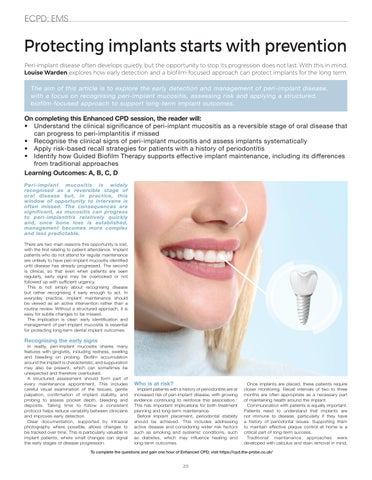
On completing this Enhanced CPD session, the reader will: • Understand the clinical significance of peri-implant mucositis as a reversible stage of oral disease that can progress to peri-implantitis if missed • Recognise the clinical signs of peri-implant mucositis and assess implants systematically • Apply risk-based recall strategies for patients with a history of periodontitis • Identify how Guided Biofilm Therapy supports effective implant maintenance, including its differences from traditional approaches Learning Outcomes: A, B, C, D Peri-implant mucositis is widely recognised as a reversible stage of oral disease but, in practice, this window of opportunity to intervene is often missed. The consequences are significant, as mucositis can progress to peri-implantitis relatively quickly and, once bone loss is established, management becomes more complex and less predictable. There are two main reasons this opportunity is lost, with the first relating to patient attendance. Implant patients who do not attend for regular maintenance are unlikely to have peri-implant mucositis identified until disease has already progressed. The second is clinical, so that even when patients are seen regularly, early signs may be overlooked or not followed up with sufficient urgency. This is not simply about recognising disease but rather recognising it early enough to act. In everyday practice, implant maintenance should be viewed as an active intervention rather than a routine review. Without a structured approach, it is easy for subtle changes to be missed. The implication is clear: early identification and management of peri-implant mucositis is essential for protecting long-term dental implant outcomes.
Recognising the early signs In reality, peri-implant mucositis shares many features with gingivitis, including redness, swelling and bleeding on probing. Biofilm accumulation around the implant is characteristic, and suppuration may also be present, which can sometimes be unexpected and therefore overlooked. A structured assessment should form part of every maintenance appointment. This includes careful visual examination of the tissues, gentle palpation, confirmation of implant stability, and probing to assess pocket depth, bleeding and deposits. Taking time to follow a consistent protocol helps reduce variability between clinicians and improves early detection. Clear documentation, supported by intraoral photography where possible, allows changes to be tracked over time. This is particularly valuable in implant patients, where small changes can signal the early stages of disease progression.
Who is at risk? Implant patients with a history of periodontitis are at increased risk of peri-implant disease, with growing evidence continuing to reinforce this association.1 This has important implications for both treatment planning and long-term maintenance. Before implant placement, periodontal stability should be achieved. This includes addressing active disease and considering wider risk factors such as smoking and systemic conditions, such as diabetes, which may influence healing and long-term outcomes.
Once implants are placed, these patients require closer monitoring. Recall intervals of two to three months are often appropriate as a necessary part of maintaining health around the implant. Communication with patients is equally important. Patients need to understand that implants are not immune to disease, particularly if they have a history of periodontal issues. Supporting them to maintain effective plaque control at home is a critical part of long-term success. Traditional maintenance approaches were developed with calculus and stain removal in mind,
To complete the questions and gain one hour of Enhanced CPD, visit https://cpd.the-probe.co.uk/
20
20-21_Smile-MarApr_EMSCPD.indd 20
30/03/2026 23:24:51